


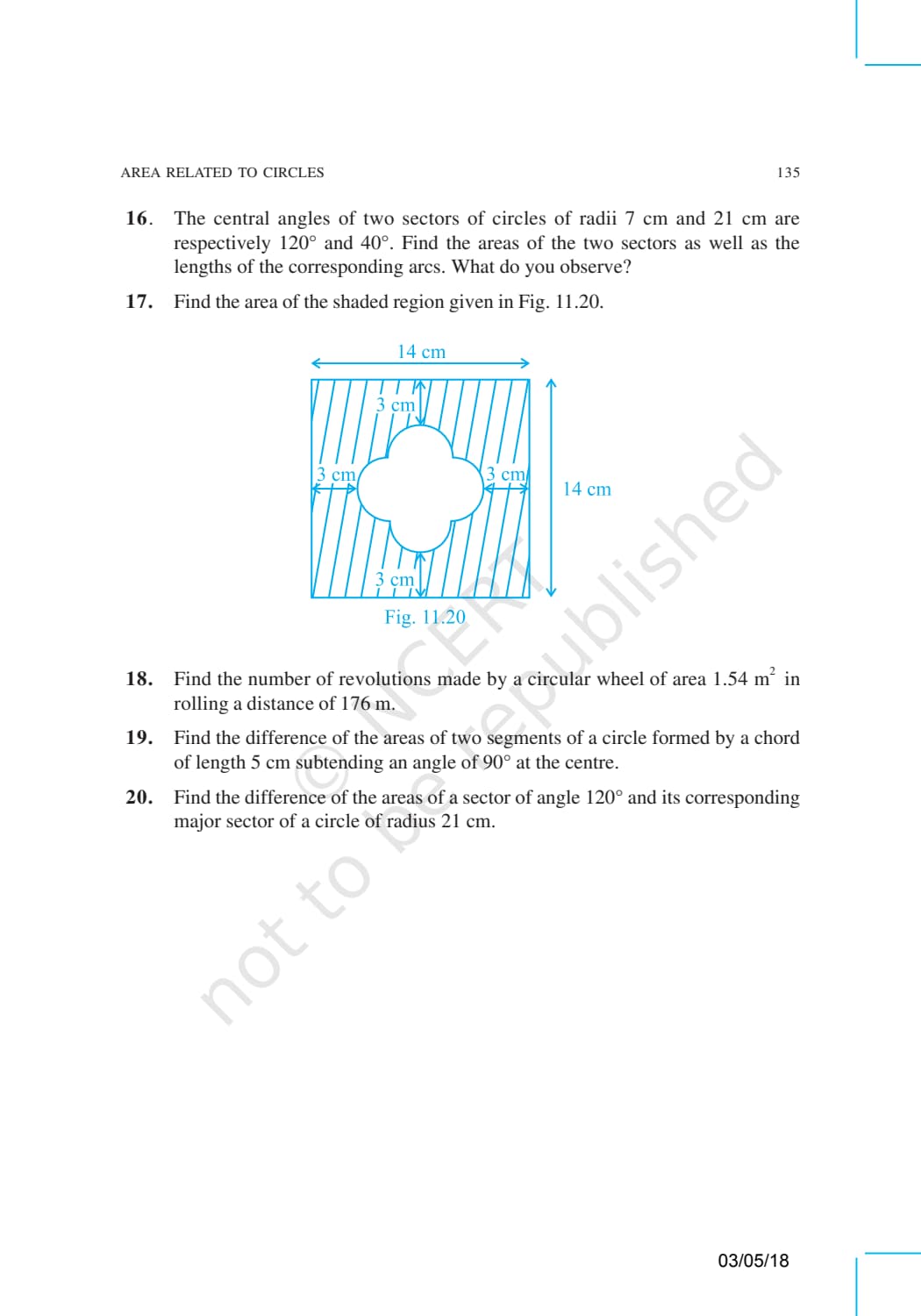
The NCERT Exemplar Class 10 Maths Areas Related to Circles book is a free, download-ready problem set for Chapter 11, mapped to the 2026-27 NCERT syllabus. This page bundles the official Exemplar PDF with a question-type map, a difficulty guide, and a study plan. You get harder CBSE-style practice on sectors, segments, and area combinations.
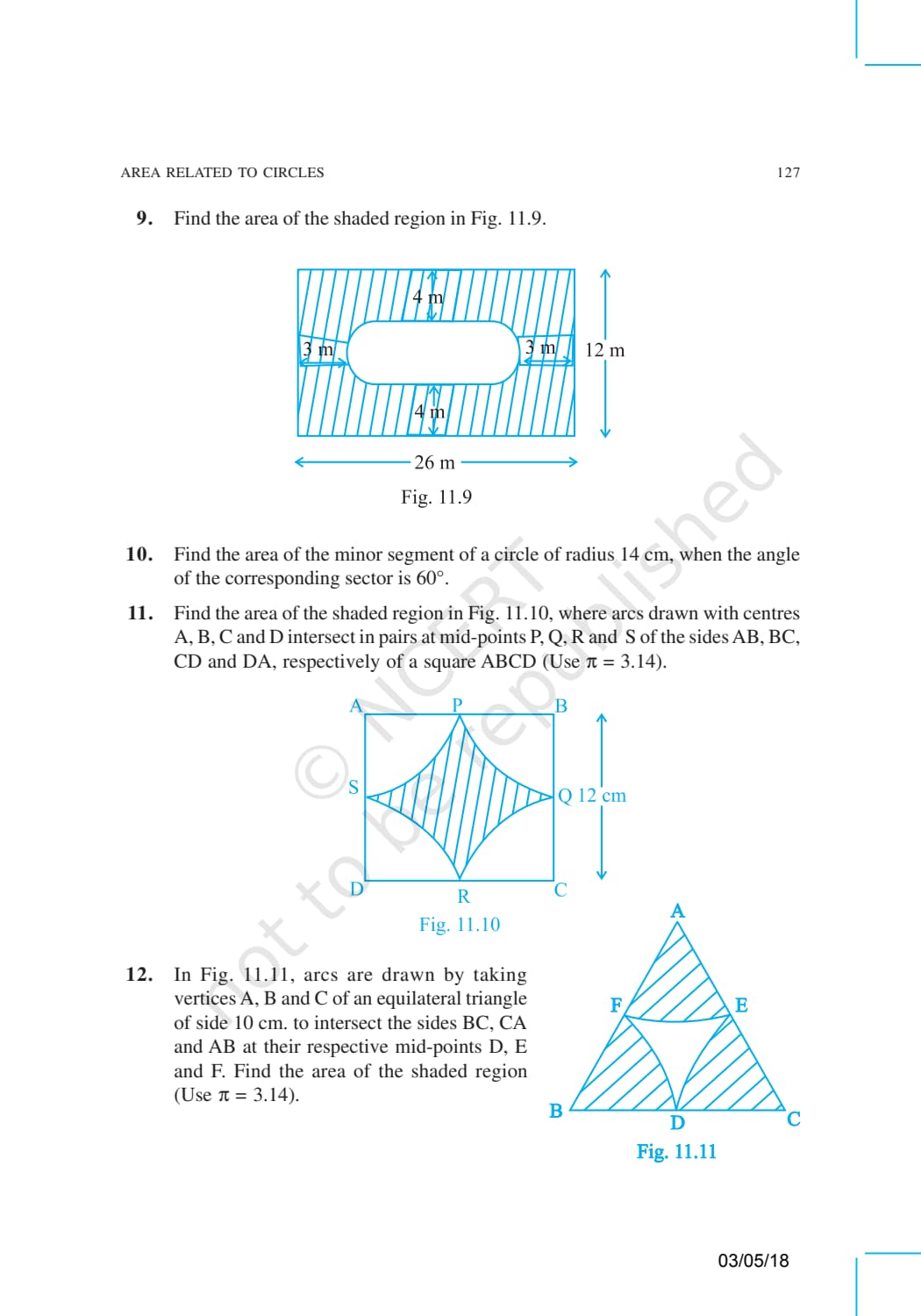
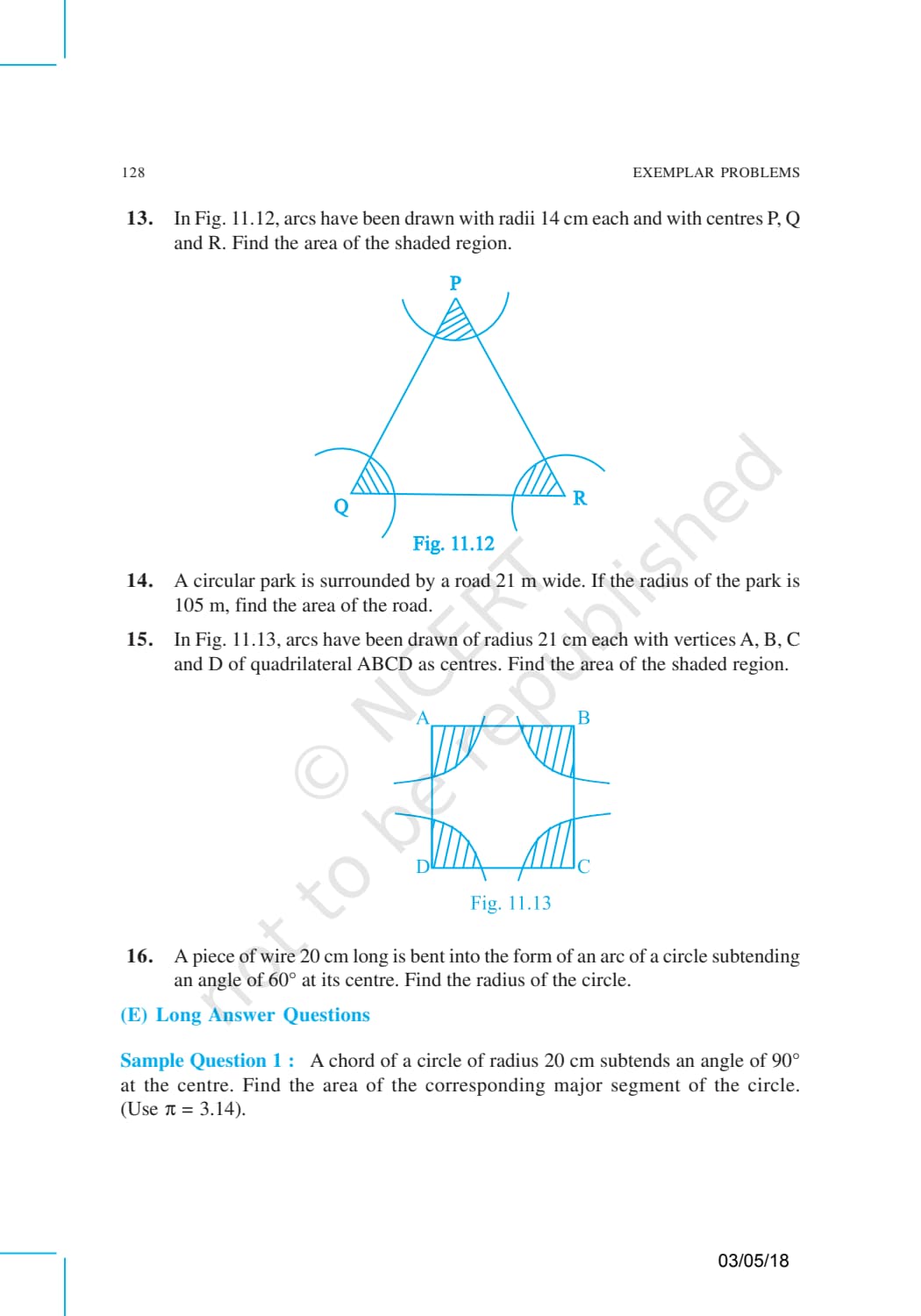
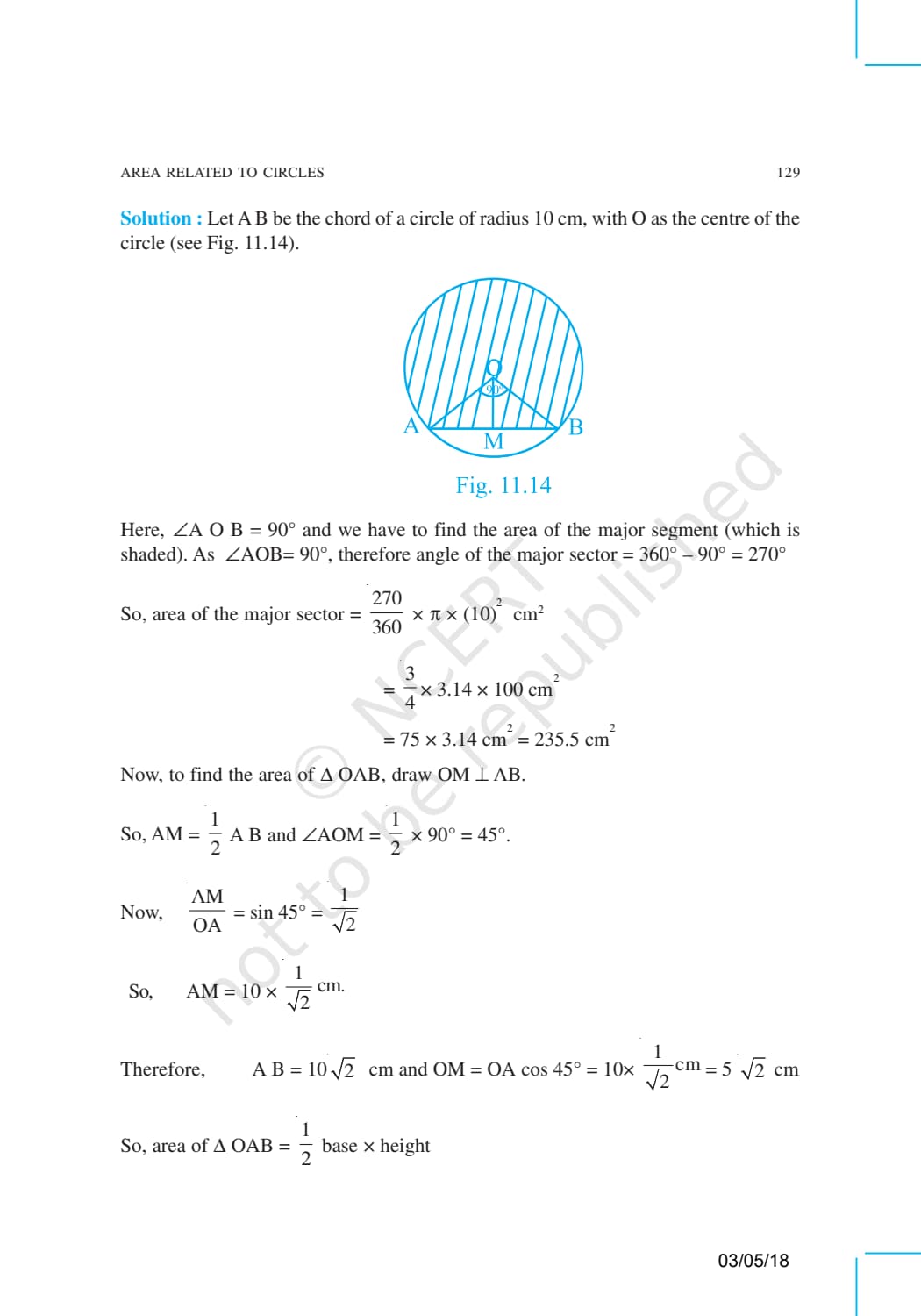
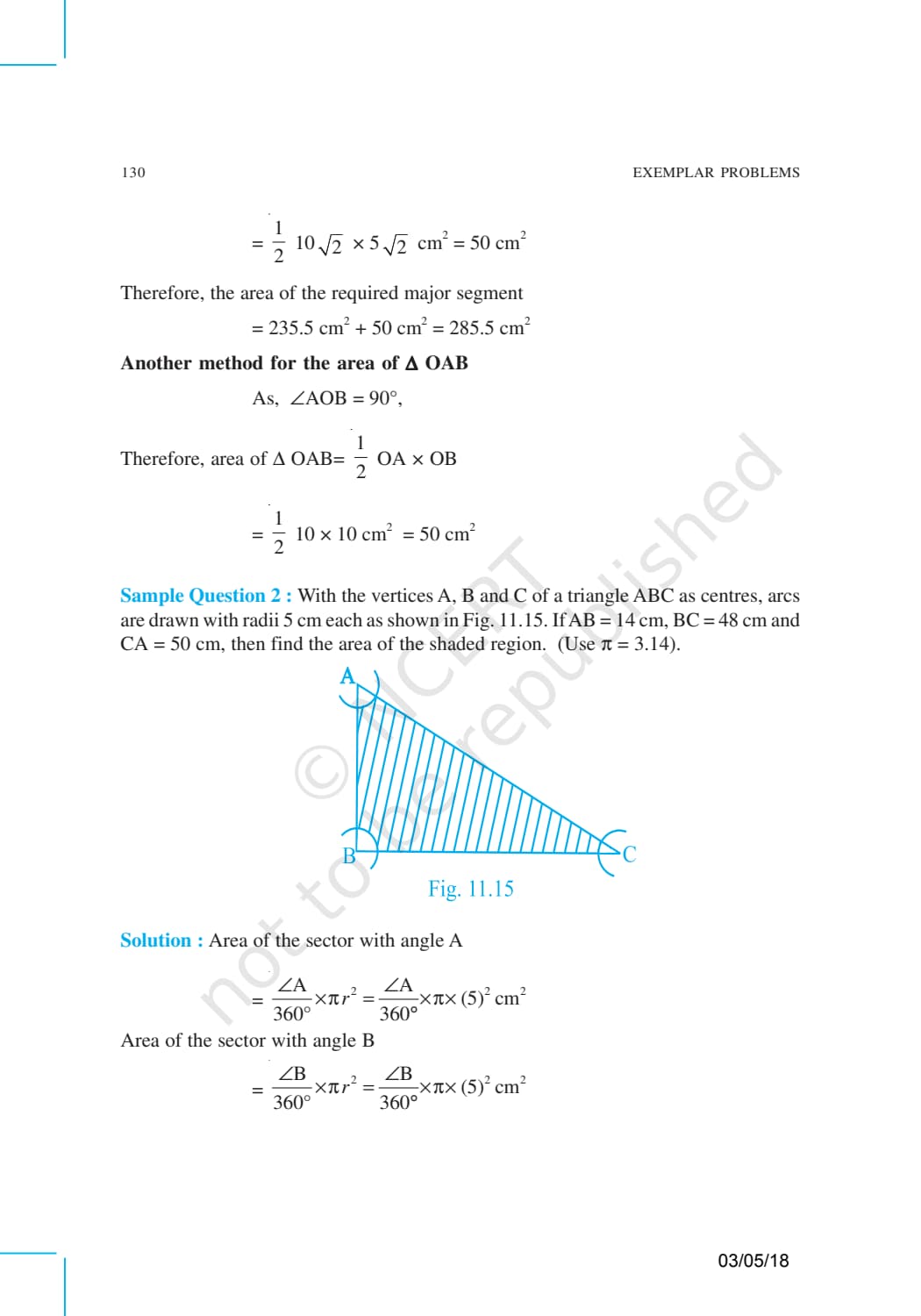
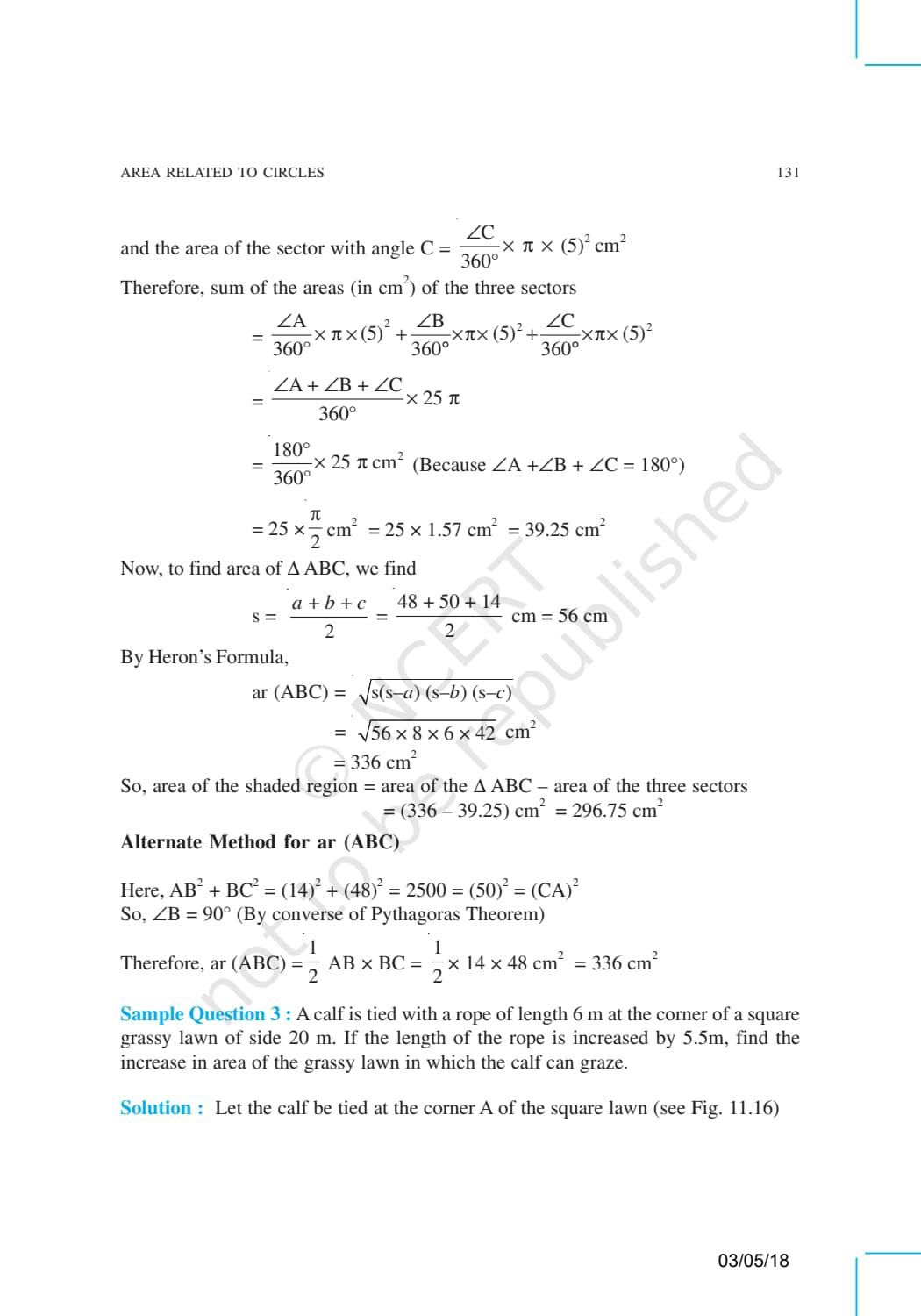
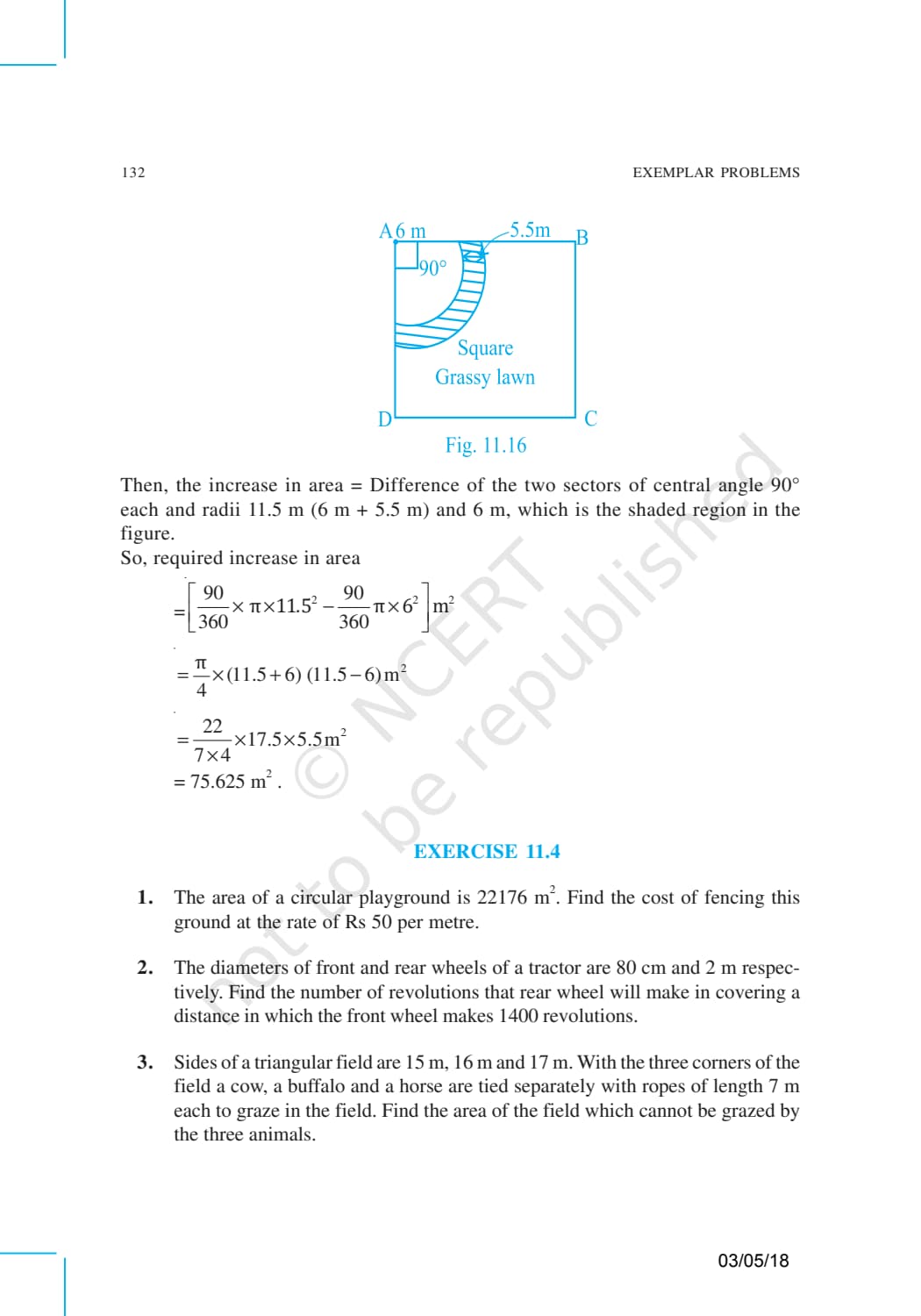
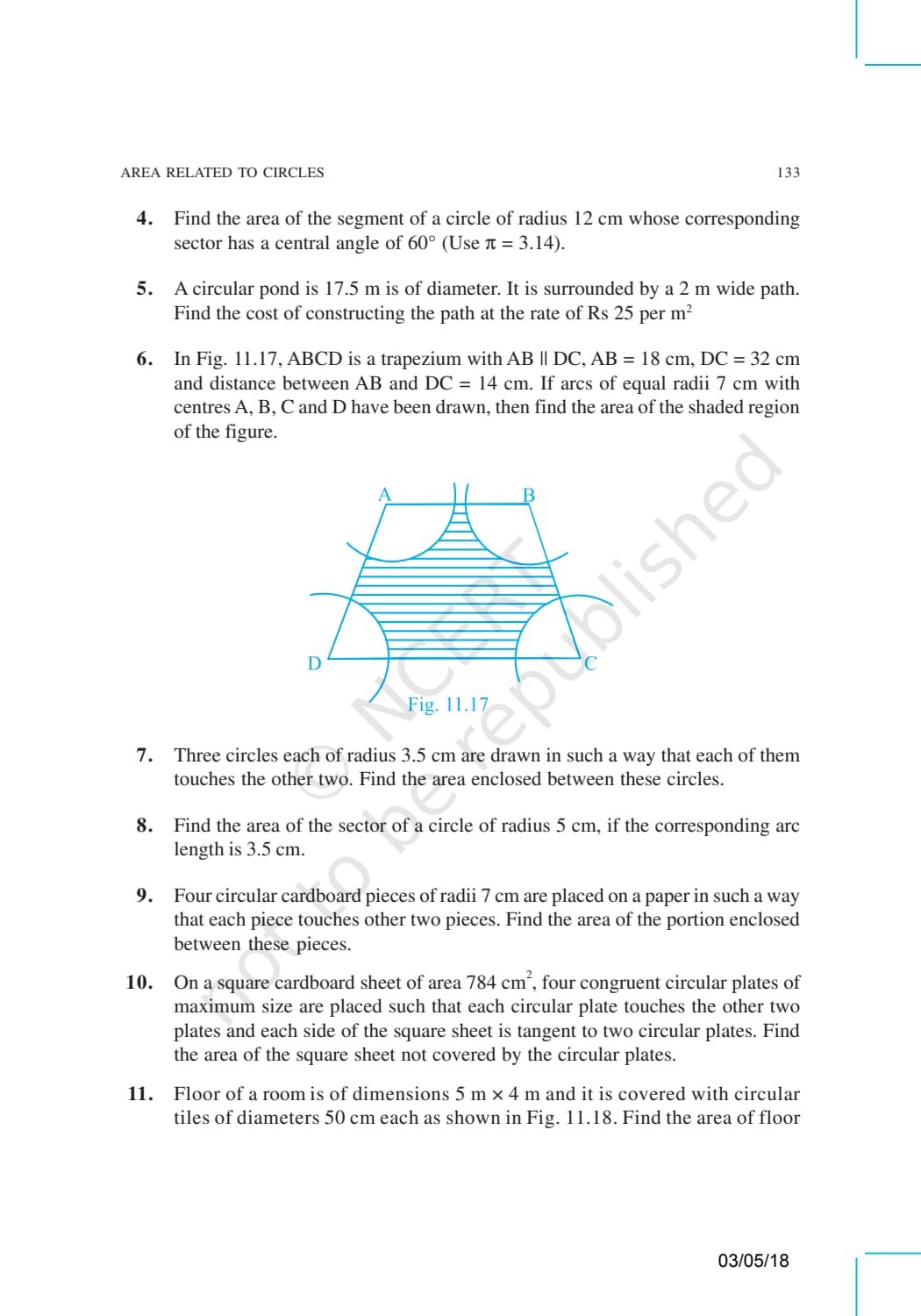
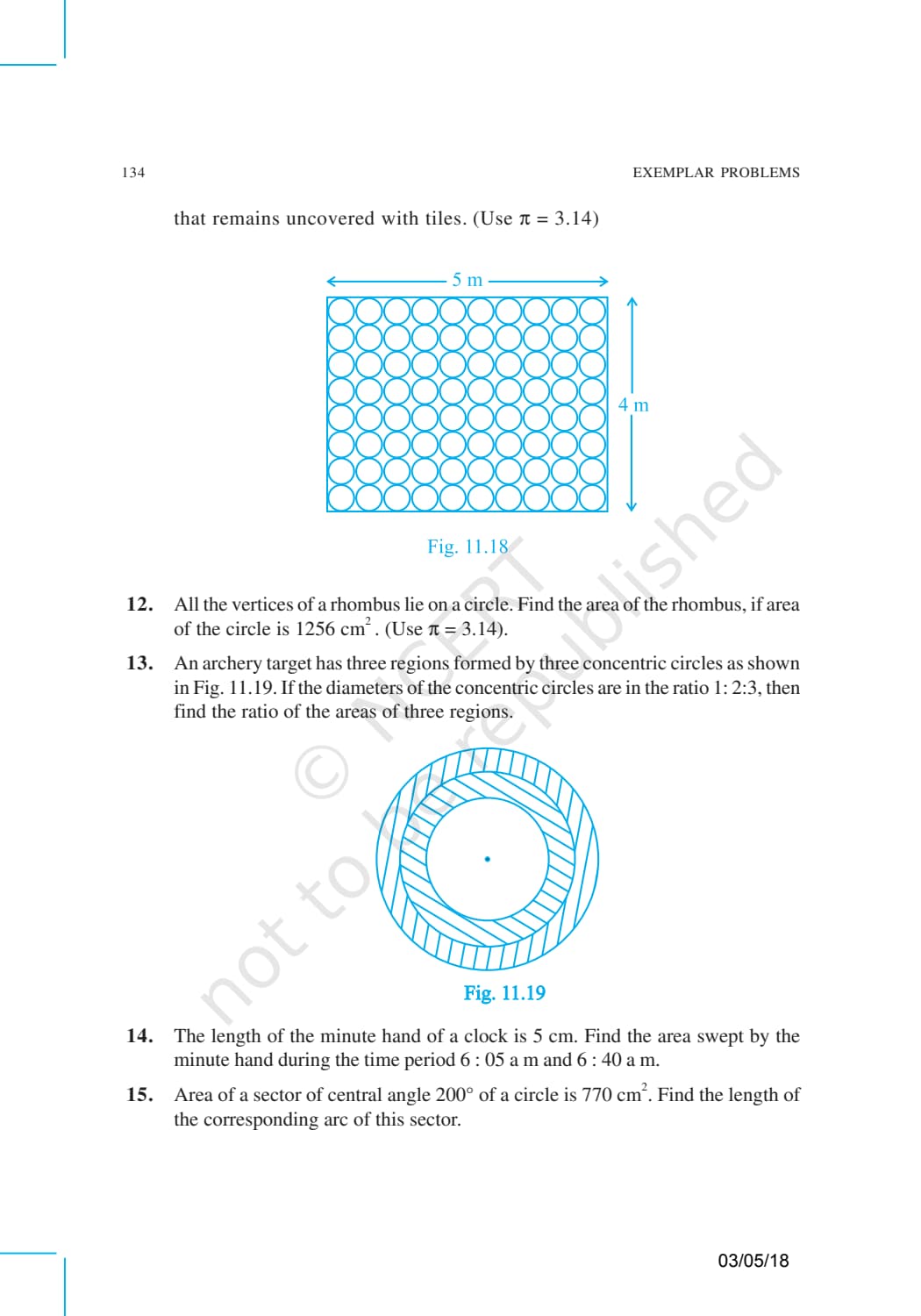
- CBSE Weightage: this chapter sits in the Mensuration unit, worth 10 marks in the board paper.
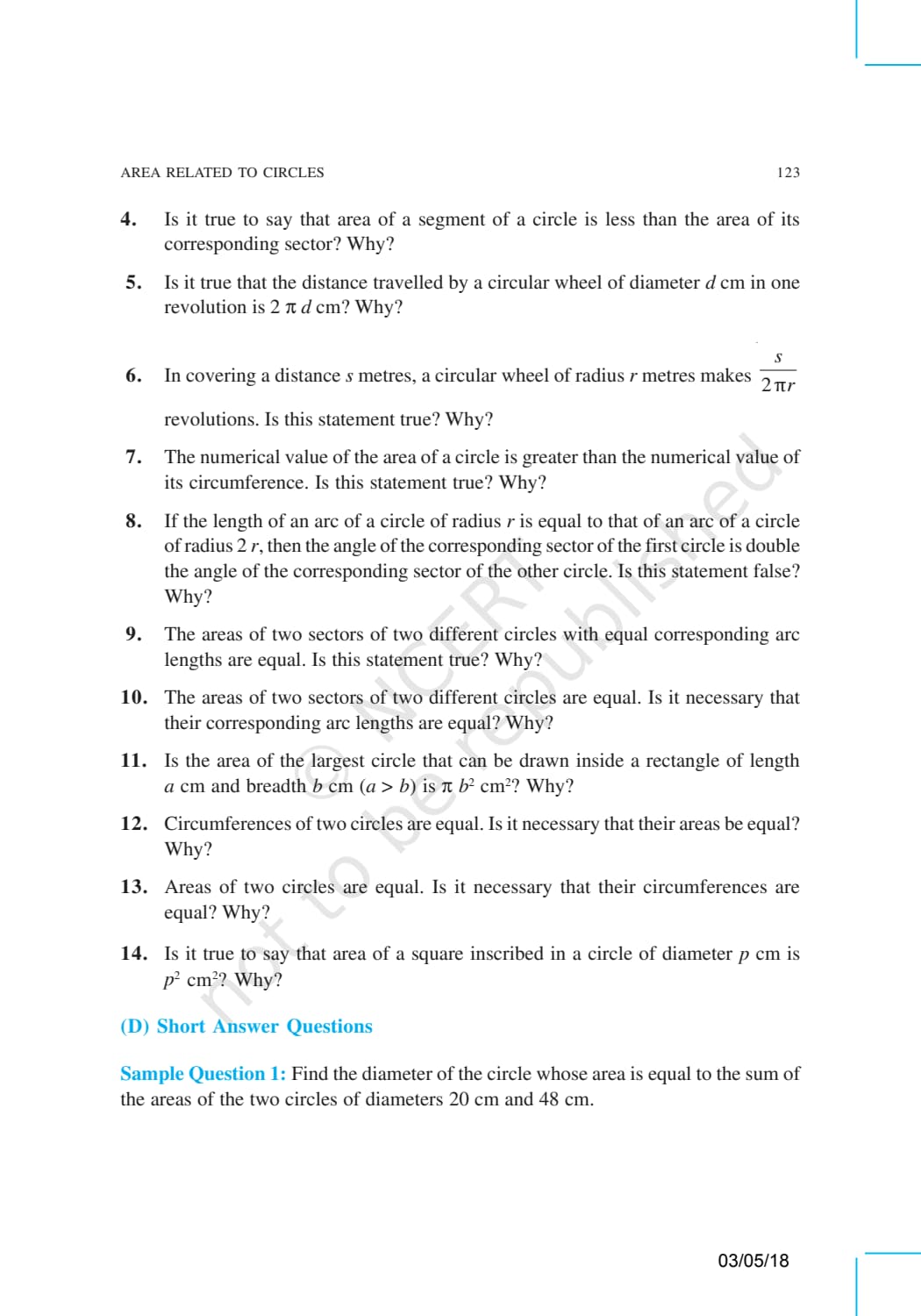
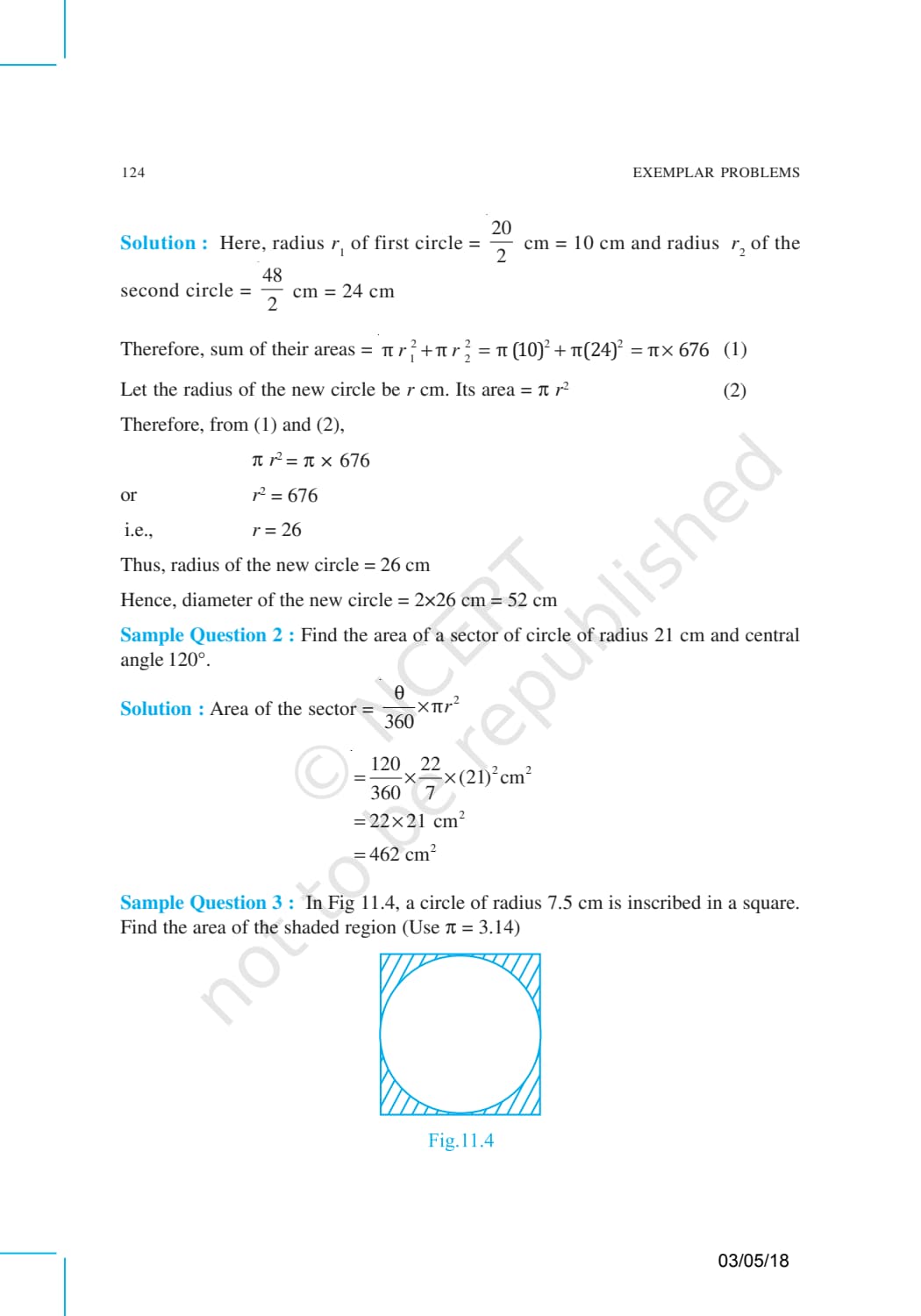
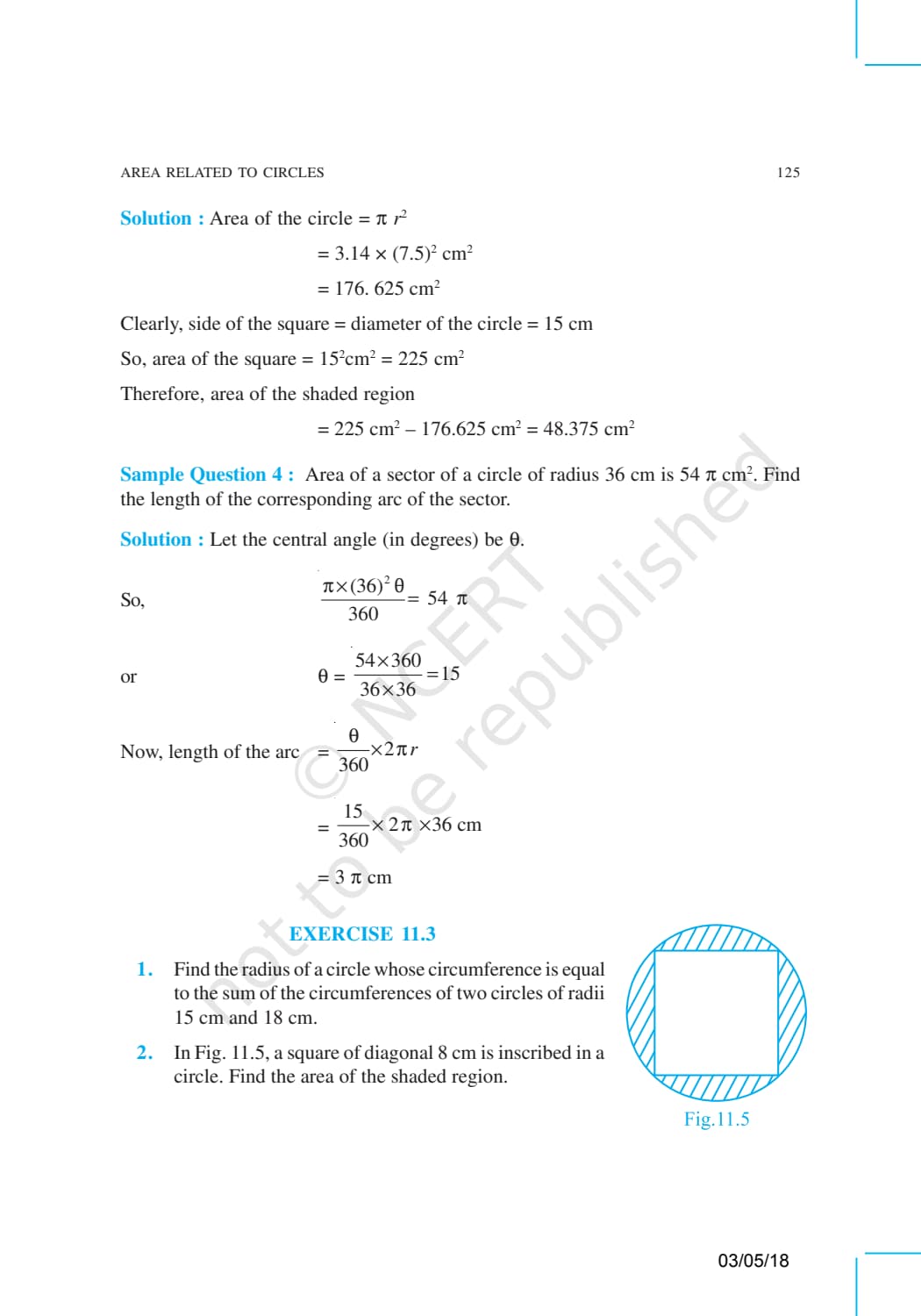
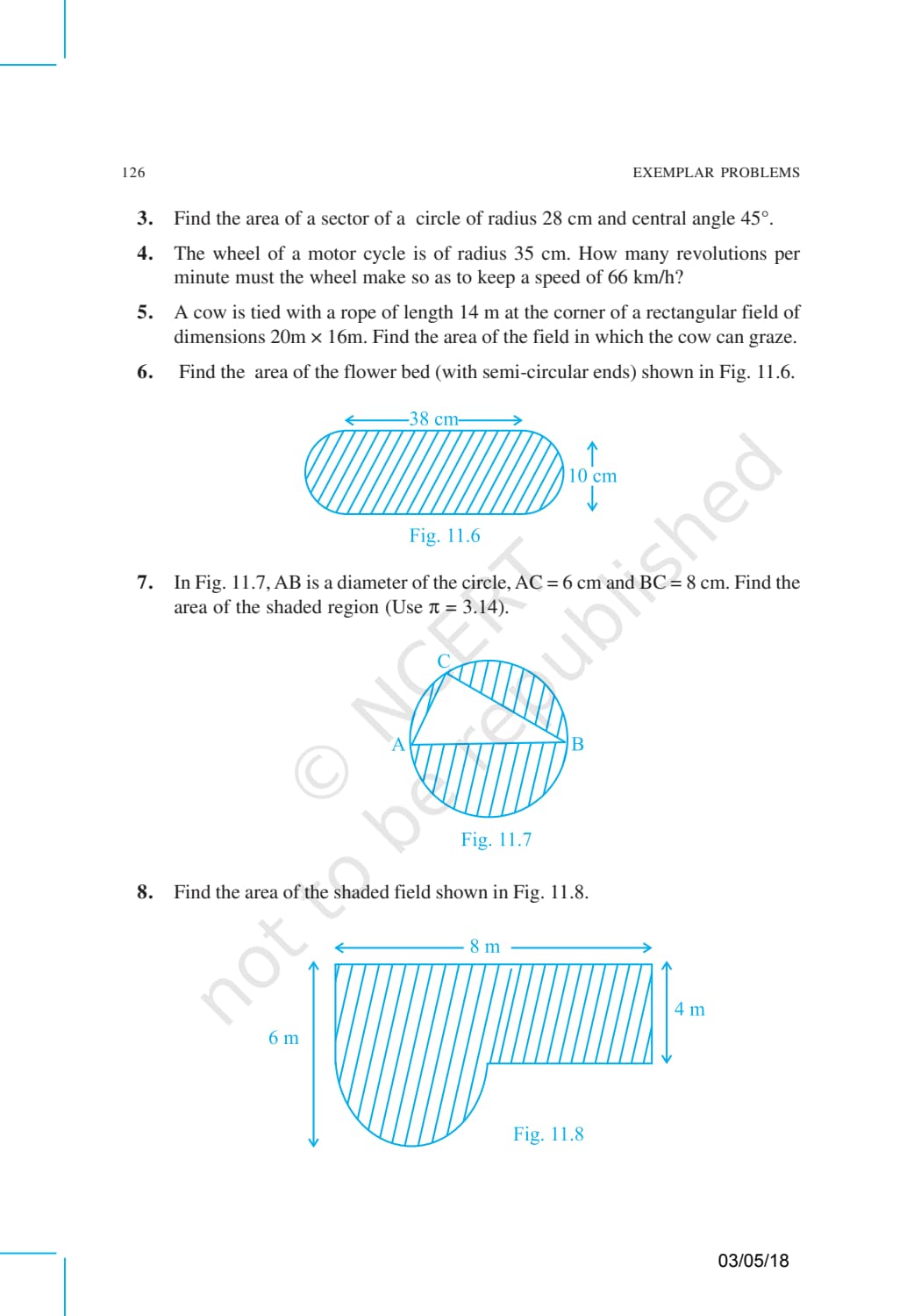
- Exemplar Problems: 39 unsolved questions across 4 exercises (11.1 to 11.4) plus a solved sample section.
- Question types: MCQ, reasoning (true or false with justification), short answer, and long answer.
Student Feedback - Areas Related to Circles Exemplar (March 2026 survey of 8,730 Class 10 students):
- 82% of students surveyed said the long-answer combination problems in Exercise 11.4 were the hardest part. They need you to break an irregular shaded region into circles, sectors, and triangles, then find each area on its own.
- The average student lost 2.8 marks here by using the wrong segment formula and forgetting to subtract the triangle area from the sector area.
- Toppers reported that finishing all 39 Exemplar problems made shaded-region questions feel predictable in the board exam.
This Exemplar PDF is sourced from the official NCERT print, mapped against the last five years of CBSE Class 10 board questions on mensuration, and aligned to the 2026-27 syllabus.
You can find the complete NCERT Exemplar Book for Areas Related to Circles, including the question-range map, the Exemplar versus textbook difficulty comparison, and a parallel-track study plan, in the sections below.
Also Check:
- Areas Related to Circles Class 10 Maths NCERT Exemplar Solutions
- Areas Related to Circles Class 10 Maths NCERT Book PDF
Watch Areas Related to Circles Class 10 Maths Explained
Source: Ritik Mishra - 9th & 10th on YouTube
How This NCERT Exemplar Class 10 Maths Areas Related to Circles PDF Helps You
This Collegedunia download wraps the official NCERT Exemplar Class 10 Maths Areas Related to Circles PDF with the maps a student needs for the CBSE board exam.
- Concept Recap Card: a one-screen summary of area of a sector, area of a segment, and the area-of-combination approach.
- Question-Type Tagging: every problem tagged MCQ, reasoning, short or long answer so students drill one type at a time.
- Difficulty Flagging: each exercise rated against the matching textbook exercise.
- Board-Style Map: each long-answer problem matched to the CBSE style it resembles.
What Is Inside the Areas Related to Circles Exemplar Book
The Exemplar opens with a concepts page, then moves through five lettered sections. The table maps each section to its question range and the concept it tests.
| Section | Question Range | Type | What It Covers |
|---|---|---|---|
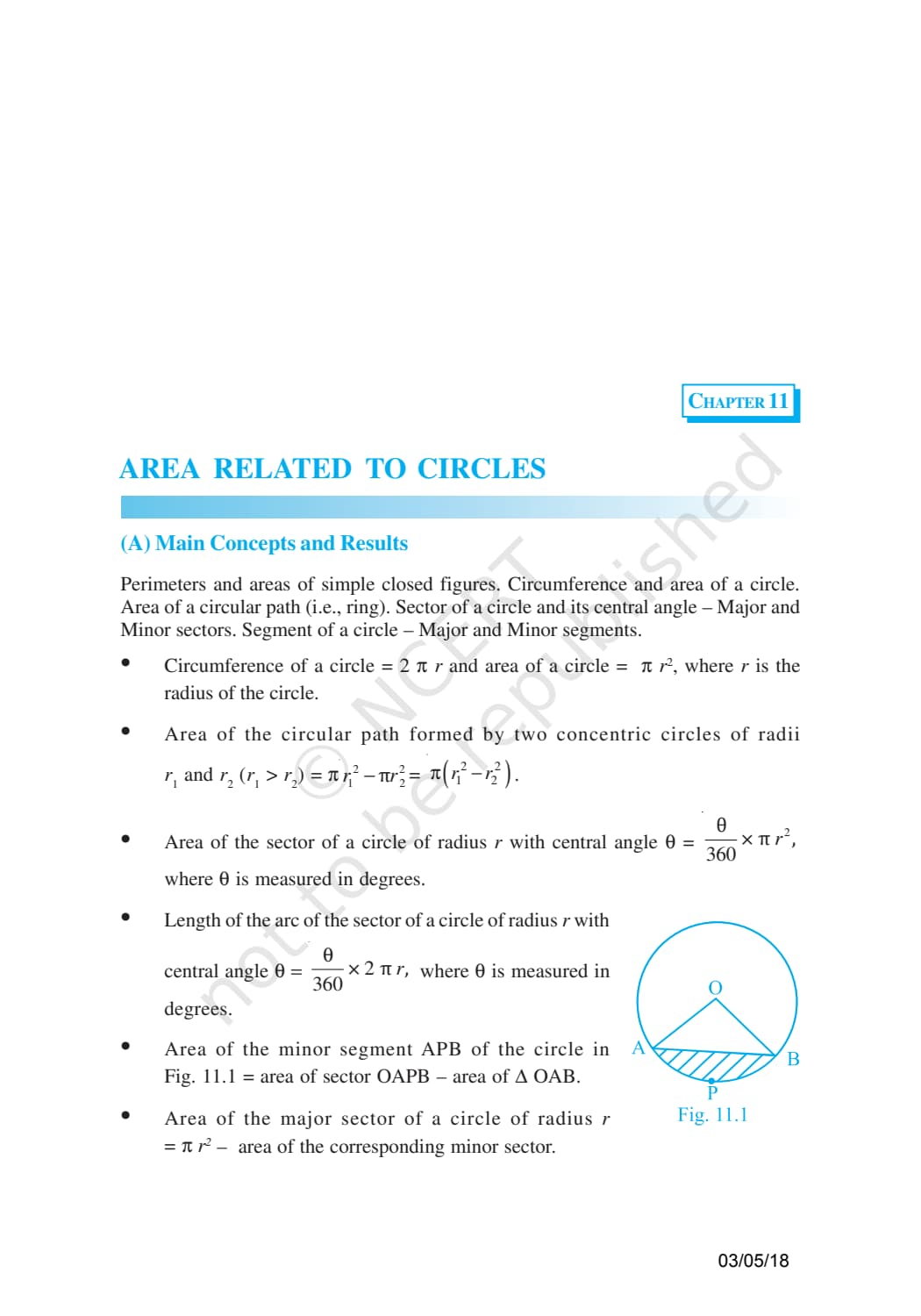
| (A) Main Concepts and Results | - | Theory recap | Area and perimeter of a sector, area of segments, area of combination of figures, degree-to-radian conversion |
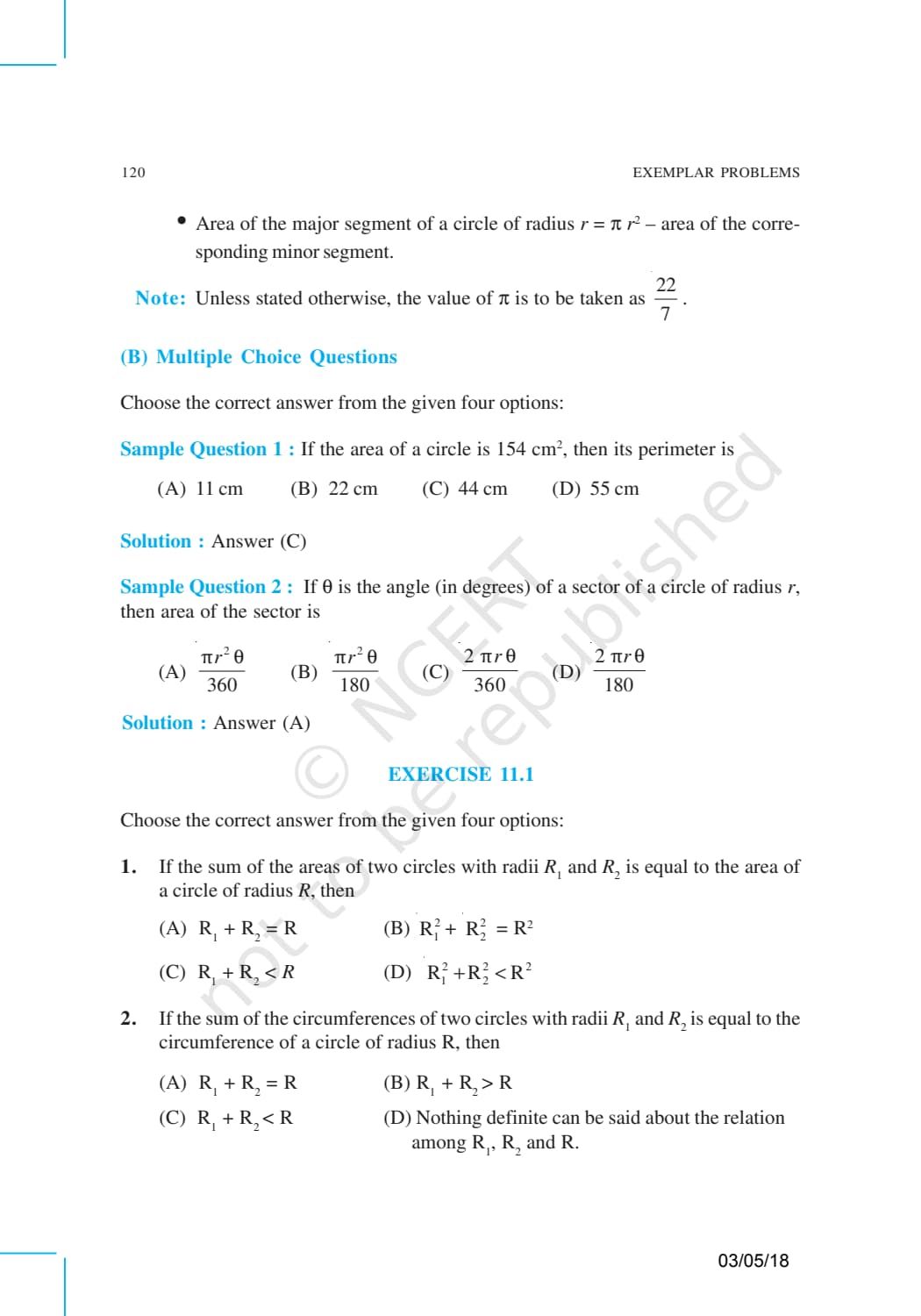
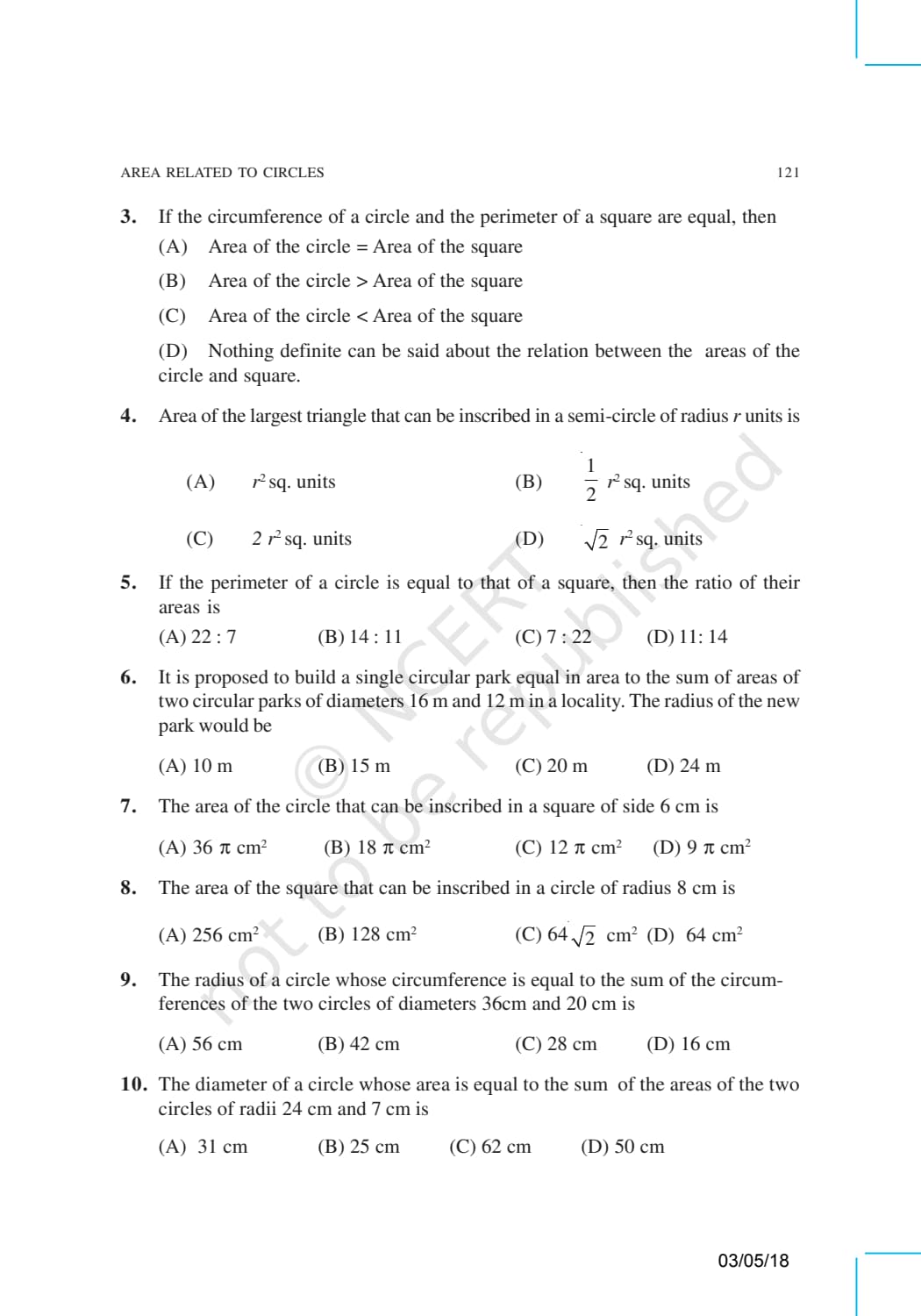
| (B) Multiple Choice (Exercise 11.1) | Q1 to Q10 | MCQ | Recall of sector area, arc length, segment area, and shaded-region components |
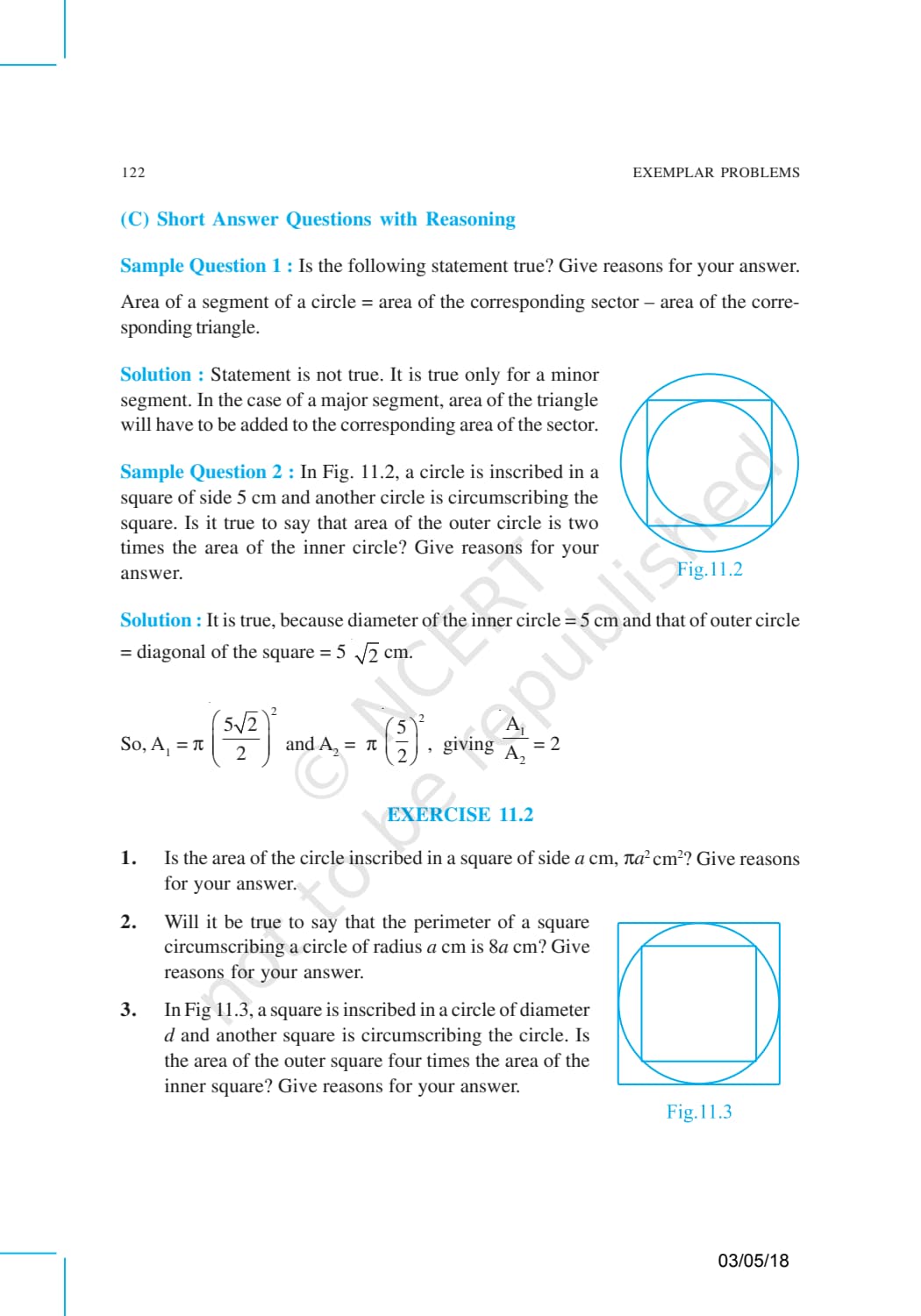
| (C) Reasoning (Exercise 11.2) | Q1 to Q10 | True or False with justification | Properties of sectors and segments, correctness of formulae, circle-polygon relationships |
| (D) Short Answer (Exercise 11.3) | Q1 to Q12 | Short Answer | Areas of sectors and segments, perimeters of segments, two-step combination problems |
| (E) Long Answer (Exercise 11.4) | Q1 to Q7 | Long Answer | Multi-step shaded-region problems joining a circle with a square, rectangle or triangle; HOTS |
Areas Related to Circles Exemplar Question-Type Distribution
The 39 problems split across four question types. The short and long answers in Exercises 11.3 and 11.4 carry the most marks value; 11.1 and 11.2 sharpen recall speed and the justification style.
| Type | Exercise | Count | Best For |
|---|---|---|---|
| Multiple Choice (MCQ) | Exercise 11.1 | 10 | 1-mark recall of sector area, arc length and segment identification |
| Reasoning (True or False) | Exercise 11.2 | 10 | Assertion-reason and justification on formulae and circle-polygon combinations |
| Short Answer (SA) | Exercise 11.3 | 12 | 2 and 3-mark sector/segment areas, perimeters, two-figure combinations |
| Long Answer (LA) | Exercise 11.4 | 7 | 5-mark shaded regions joining a circle with a square, rectangle or triangle |
Why the NCERT Exemplar Matters for Class 10 Areas Related to Circles Prep
The Exemplar raises the bar. Where the textbook gives a single sector or segment, the Exemplar adds a second figure (square, rectangle, or triangle) and requires students to split the region into two or three parts. Students who practise only the textbook often freeze on a board problem with a circle inscribed in or around a polygon.
- Sector-Plus-Triangle problems: finding the area of a flower petal or leaf shape formed by two arcs (Exercise 11.4 Q1 to Q3) is a repeat board setup; a petal is the intersection of two circular segments.
- Circle-in-Square problems: a square inscribed in a circle, or a circle inscribed in a square, is a repeat board topic, drilled in Exercise 11.3 Q7 to Q12.
- HOTS three-part decomposition: Exercise 11.4 Q5 to Q7 split a figure into a rectangle or triangle, one or two sectors, and sometimes a smaller circle.
Exemplar vs NCERT Textbook Difficulty for Areas Related to Circles
The same idea gets a softer test in the textbook and a harder one in the Exemplar. Three concrete cases:
| Concept | NCERT Textbook Style | NCERT Exemplar Style |
|---|---|---|
| Area of a Sector | "Area of the sector of a circle, radius 4 cm, angle 30 degrees, and the corresponding major sector." | "A chord of a circle of radius 12 cm subtends 120 degrees at the centre. Find the minor and major segment areas." |
| Shaded Regions | "Shaded design where ABCD is a square of side 10 cm with semicircles on each side as diameter." | "In a circle of radius 21 cm, an arc subtends 60 degrees. Find the segment area, hence the remaining part of the circle." |
| Combination of Figures | "Two circles of radii 8 cm and 6 cm; find the radius of the circle with area equal to their sum." | "In square OABC of side 20 cm, quadrants of radius 20 cm are drawn from O and B. Find the shaded region between the two arcs." |
The Exemplar always adds a layer: a proof, an intermediate decomposition step, or a generalised expression. Students who practise only the textbook often lose 3 to 5 marks per board shaded-region problem, since the paper now expects the decomposition step shown explicitly.
Full worked solutions: Areas Related to Circles Class 10 Maths NCERT Exemplar Solutions
How to Use the Areas Related to Circles Exemplar with the NCERT Textbook
The Exemplar is not a replacement for the textbook. Interleave them: read a formula, solve the matching textbook exercise, then attempt the Exemplar problems on the same concept. A three-day plan:
- Day 1 (Formulae and MCQ): read the textbook section on sector area and arc length, then attempt Exercise 11.1 Q1 to Q6 and Exercise 11.2 Q1 to Q5.
- Day 2 (Segments and Short Answer): read the segment-area section, finish the remaining MCQ and reasoning items, then attempt Exercise 11.3 Q1 to Q12 under a 40-minute timer, writing the decomposition step before each computation.
- Day 3 (Long Answer): attempt Exercise 11.4 Q1 to Q7 under a 50-minute timer, writing the decomposition, formula, substitution and result in full.
Related Links:
- Areas Related to Circles Class 10 Maths NCERT Solutions
- Areas Related to Circles Class 10 Maths Notes
Areas Related to Circles PDF Download Formats and Languages
The Areas Related to Circles Class 10 Exemplar PDF comes in formats suited to different revision styles:
| Format | Best for | Approx. size |
|---|---|---|
| Normal-resolution PDF | Phone reading and quick revision between classes | 1-2 MB |
| HD PDF | Print-ready desk study and clean photocopies | 3-5 MB |
| Hindi-medium edition | Hindi-medium students; same problem numbering | 1-2 MB |
Both the PDF and its Hindi-medium edition follow the same notation and numbering as the printed NCERT 2026-27 release:
- NCERT-faithful: every problem matches the printed Exemplar line for line, including the solved samples.
- Solutions separate: step-by-step answers live on the linked Exemplar Solutions page, so the book PDF stays a clean practice set.
- State-board alignment: same sector, segment and combination content; only the exercise numbers may differ.
More Areas Related to Circles Class 10 Maths Resources
- Areas Related to Circles Class 10 Maths NCERT Solutions
- Areas Related to Circles Class 10 Maths Notes
- Areas Related to Circles Class 10 Maths Formula Sheet
- Areas Related to Circles Class 10 Maths NCERT Book PDF
- Areas Related to Circles Class 10 Maths NCERT Exemplar Solutions
- Areas Related to Circles Class 10 Maths Handwritten Notes
NCERT Exemplar Book PDF for Class 10 Maths: All Chapters
Download any other chapter's Exemplar Book PDF for the 2026-27 cycle using the table below.
| Chapter | Exemplar Book PDF |
|---|---|
| Chapter 1 | Real Numbers NCERT Exemplar Book PDF |
| Chapter 2 | Polynomials NCERT Exemplar Book PDF |
| Chapter 3 | Pair of Linear Equations in Two Variables NCERT Exemplar Book PDF |
| Chapter 4 | Quadratic Equations NCERT Exemplar Book PDF |
| Chapter 5 | Arithmetic Progressions NCERT Exemplar Book PDF |
| Chapter 6 | Triangles NCERT Exemplar Book PDF |
| Chapter 7 | Coordinate Geometry NCERT Exemplar Book PDF |
| Chapter 8 | Introduction to Trigonometry NCERT Exemplar Book PDF |
| Chapter 9 | Some Applications of Trigonometry NCERT Exemplar Book PDF |
| Chapter 10 | Circles NCERT Exemplar Book PDF |
| Chapter 12 | Surface Areas and Volumes NCERT Exemplar Book PDF |
| Chapter 13 | Statistics NCERT Exemplar Book PDF |
| Chapter 14 | Probability NCERT Exemplar Book PDF |
NCERT Exemplar Class 10 Maths Areas Related to Circles: available above as a free PDF download, aligned to the 2026-27 NCERT Class 10 Mathematics syllabus.
| Resource | Link |
|---|---|
| NCERT Solutions | Areas Related to Circles NCERT Solutions |
| Notes | Areas Related to Circles Class 10 Notes |
| Formula Sheet | Areas Related to Circles Formula Sheet |
| NCERT Book PDF | Areas Related to Circles NCERT Book PDF |
| Exemplar Solutions | Areas Related to Circles Exemplar Solutions |
| Handwritten Notes | Areas Related to Circles Handwritten Notes |
NCERT Exemplar Class 10 Maths Areas Related to Circles Frequently Asked Questions
Ques. Where can I download the NCERT Exemplar Class 10 Maths Areas Related to Circles PDF for free?
Ans. You can download the Areas Related to Circles Class 10 Maths NCERT Exemplar Book PDF directly from this page. Both the Normal and HD versions are available, and both are free.
Ques. Is this Areas Related to Circles Exemplar Book aligned with the 2026-27 NCERT syllabus?
Ans. Yes. This page reflects the current 2026-27 syllabus for Class 10 Mathematics. The Exemplar covers area of a sector, area of a minor and major segment, perimeter of a segment, and area of combination of plane figures including circles with squares, rectangles, and triangles.
Ques. How many problems are in the Class 10 Maths Areas Related to Circles Exemplar PDF?
Ans. The Areas Related to Circles Exemplar PDF contains 39 unsolved problems, split as 10 MCQ (Exercise 11.1), 10 reasoning items (Exercise 11.2), 12 short answer (Exercise 11.3) and 7 long answer (Exercise 11.4).
Ques. Is the NCERT Exemplar harder than the NCERT textbook for Areas Related to Circles?
Ans. Yes. The Exemplar introduces multi-step decomposition problems requiring students to split a shaded region into three or more parts, MCQ on properties of sectors and segments beyond direct formula use, and true-or-false items that test the logical relationships between areas rather than just numerical answers. This layered style matches the HOTS and long-answer shaded-region questions in recent CBSE Class 10 board papers, which the textbook's more direct problems do not fully prepare students for.
Ques. Should I attempt the Areas Related to Circles Exemplar before or after the NCERT textbook?
Ans. Attempt them in parallel. Read the textbook section on a formula, solve the matching textbook exercise, then attempt the Exemplar problems on the same concept. Trying the Exemplar first usually leaves students stuck on multi-step decomposition problems because they have not yet built the single-formula application habit from the textbook.
Ques. Which Exemplar problems most resemble the CBSE Board long-answer style for Chapter 11?
Ans. The seven long-answer problems in Exercise 11.4 are closest to the CBSE 5-mark shaded-region style. They cover circle-plus-square combinations where the shaded region is bounded by the sides of the square and the arcs, equilateral-triangle-plus-circle problems requiring students to use the formula for the area of an equilateral triangle alongside the sector formula, and problems where the shaded region requires subtracting two separate segment areas from a larger polygon area.
Ques. What are the key concepts tested in the Areas Related to Circles Exemplar?
Ans. The main concepts tested throughout the Exemplar are: (1) Area of a sector as a fraction of the circle's area proportional to the central angle, (2) Area of a minor segment equals the area of the sector minus the area of the triangle formed by the two radii and the chord, (3) Perimeter of a segment equals the arc length plus the chord length, (4) Decomposition of a combination figure into individual circles, sectors, triangles, or rectangles whose areas can be computed separately, (5) MCQ and reasoning on properties of arcs, sectors, and segments, and (6) HOTS problems where the shaded region is bounded by two or more arcs from different circles or from the same circle at different radii.



Comments