


The NCERT Exemplar Class 10 Maths Polynomials book is a free, download-ready problem set for Chapter 2, mapped to the 2026-27 syllabus. This page bundles the official Exemplar PDF with a question-type map, a difficulty guide, and a study plan for harder CBSE-style practice on zeroes and the division algorithm.
- CBSE Weightage: Polynomials sits in the Algebra unit, one of the highest-scoring units in the Class 10 board paper.
- Exemplar Problems: 39 unsolved questions across 4 exercises (Ex 2.1 to Ex 2.4) plus solved samples.
- Question types: MCQ, true-or-false reasoning, short answer and long answer.
This Exemplar PDF is sourced from the official NCERT print and aligned to the 2026-27 syllabus. The sections below carry the question-range map, difficulty comparison, and study plan.
Watch Polynomials Class 10 Maths Explained
Source: Magnet Brains on YouTube
How This Polynomials PDF Helps You
The bare Exemplar print is a problem book with no reading aids. This download wraps the official PDF with the maps you need.
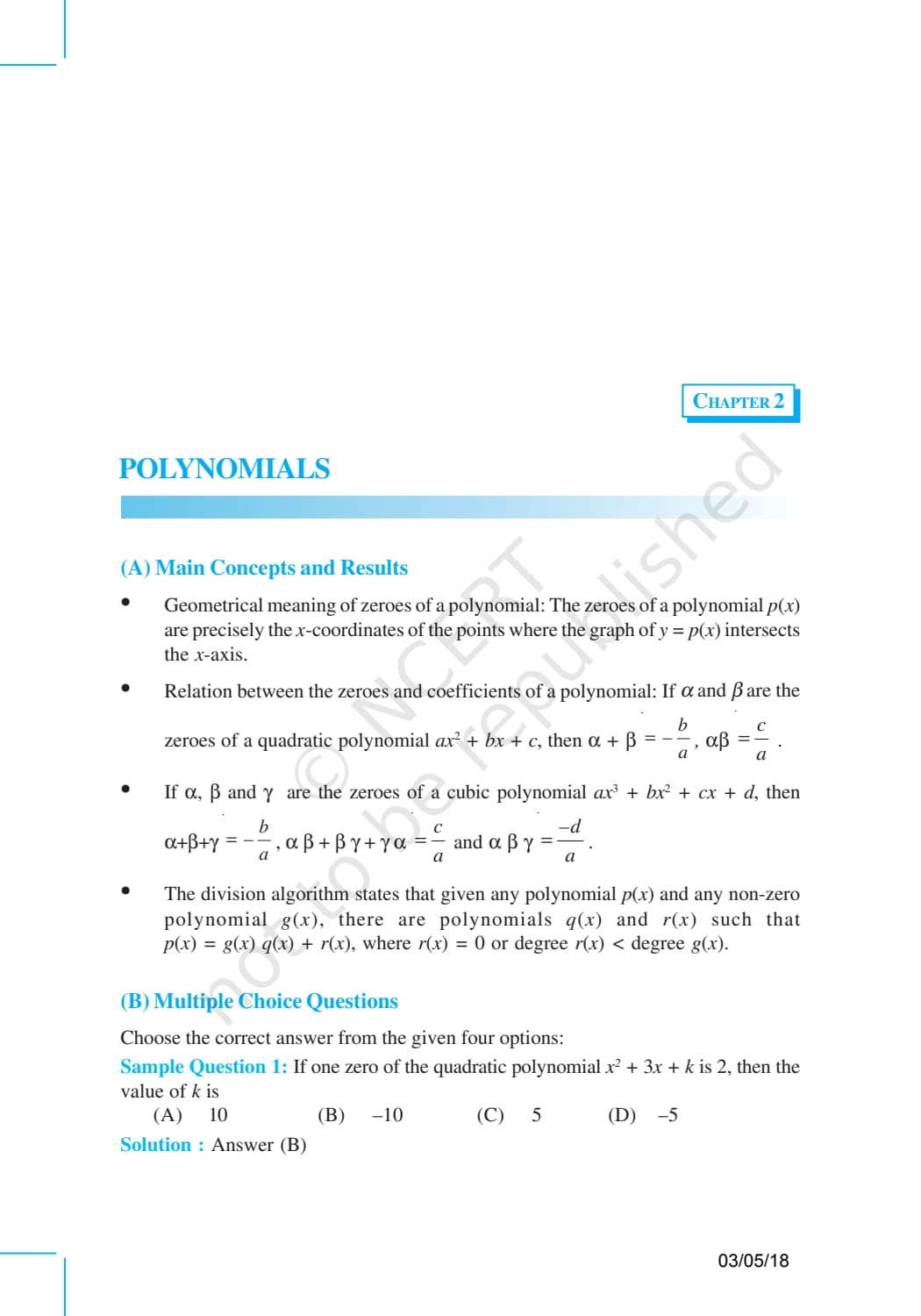
- Concept Recap: A summary of the zeroes of a polynomial, the relation α + β = −ba and αβ = ca, and the division algorithm.
- Question-Type Tagging: Every problem is tagged MCQ, reasoning, short answer or long answer, so students can drill one type at a time.
- Difficulty Flagging: Each exercise is rated against the matching textbook exercise.
What Is Inside the Polynomials Exemplar
The Polynomials Exemplar runs as one problem set over 8 pages. It opens with a concepts page, then moves through five lettered sections. The table below maps each section to its question range and concept.
| Section | Question Range | Type | What It Covers |
|---|---|---|---|
| (A) Main Concepts and Results | - | Theory recap | Geometrical meaning of zeroes, zero-coefficient relations for quadratic and cubic polynomials, and the division algorithm |
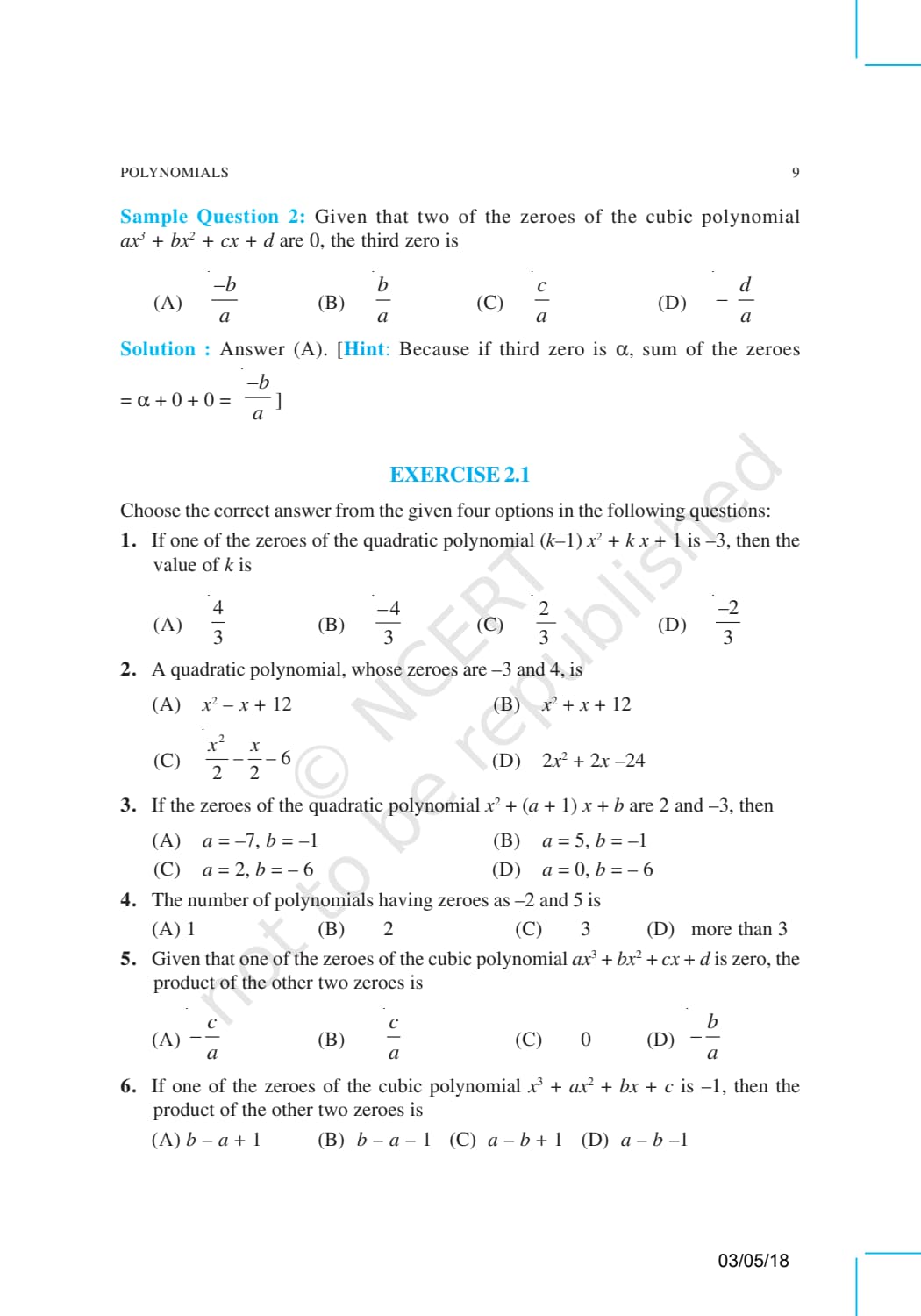
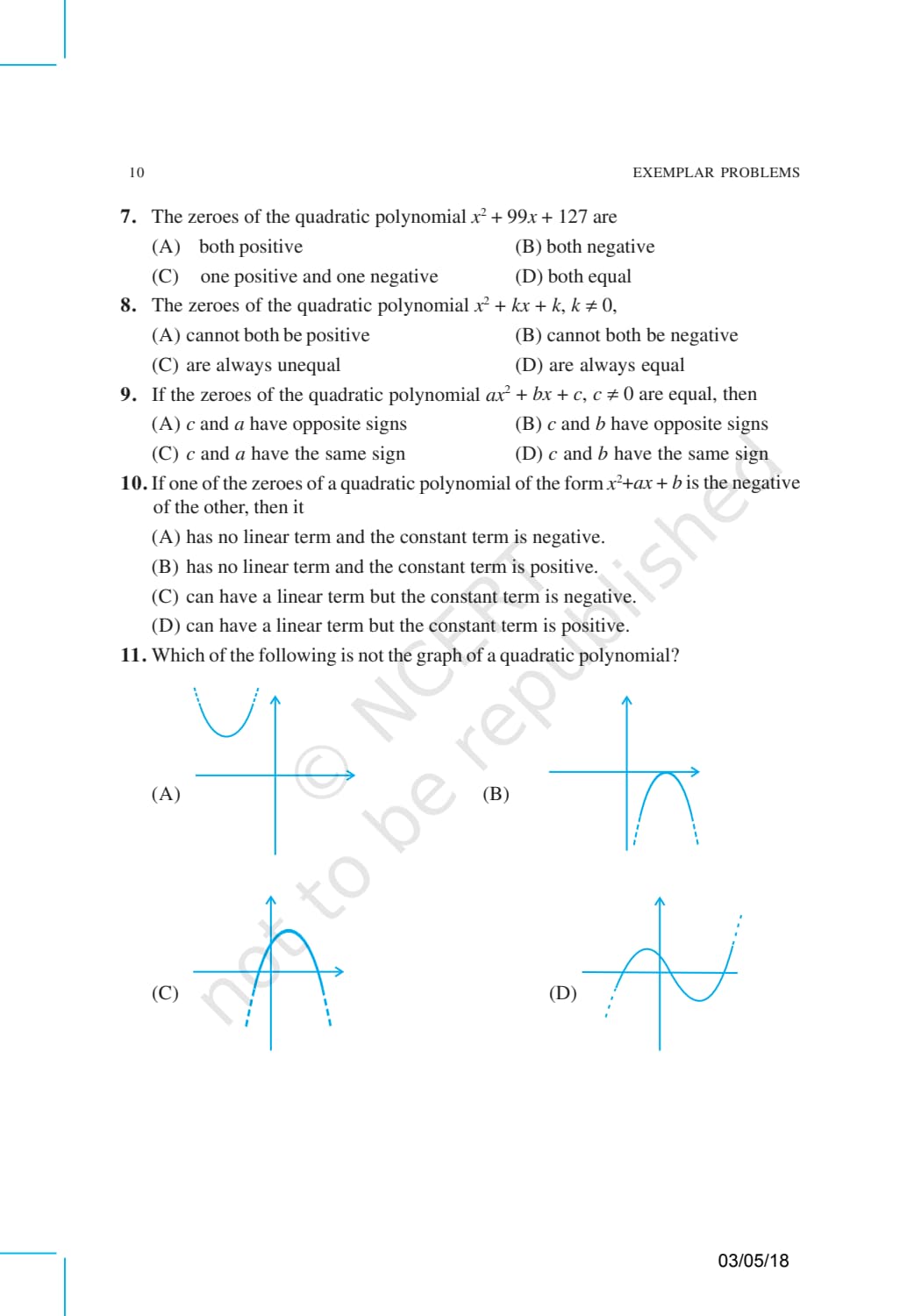
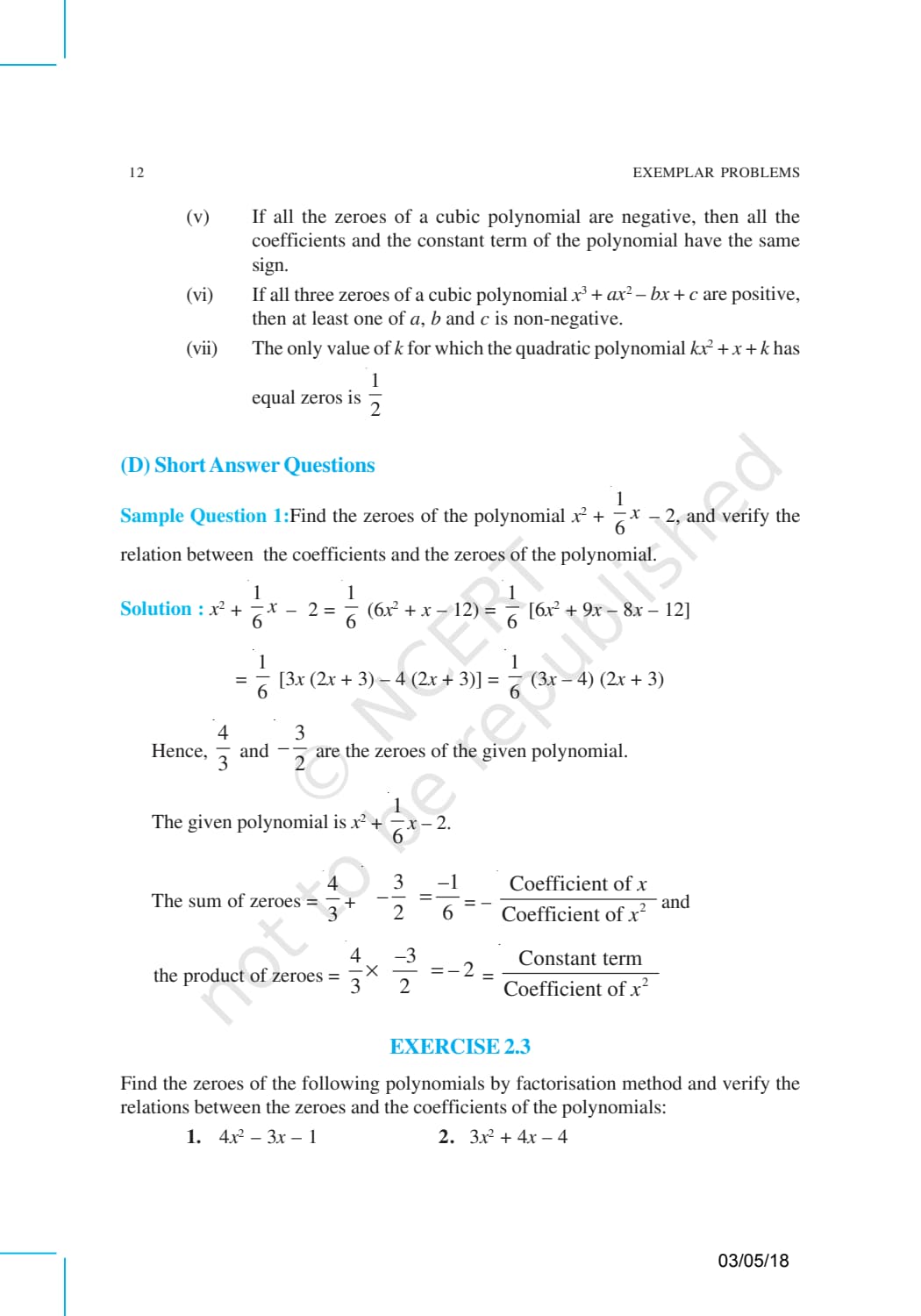
| (B) Multiple Choice (Ex 2.1) | Q1 to Q11 | MCQ | Finding a zero or coefficient, number of polynomials with given zeroes, sign of zeroes, and reading quadratic graphs |
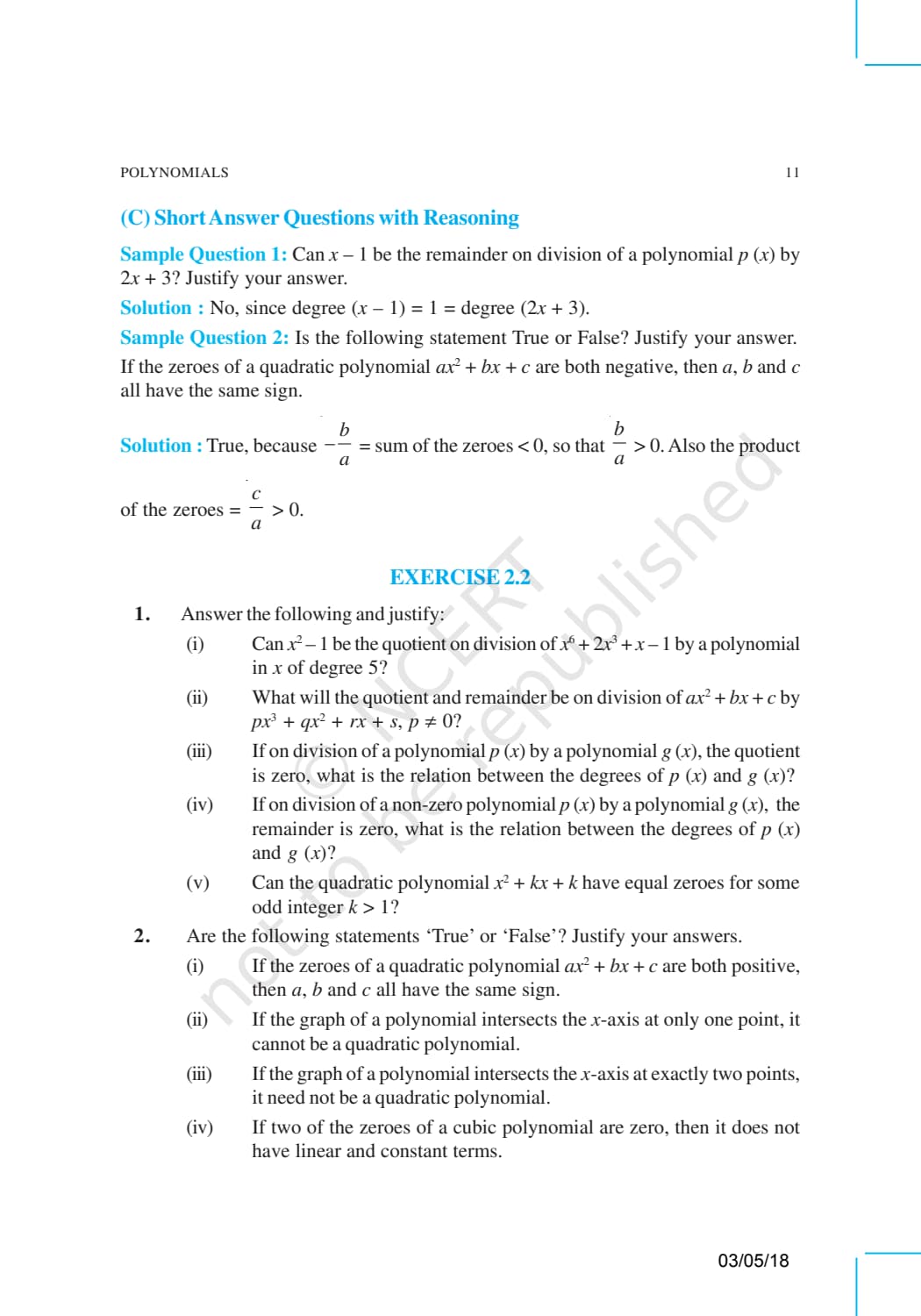
| (C) Reasoning (Ex 2.2) | Q1 to Q2 (12 parts) | Short answer with justification | True or False on degrees in division, equal zeroes, graph intersections, and signs of cubic coefficients |
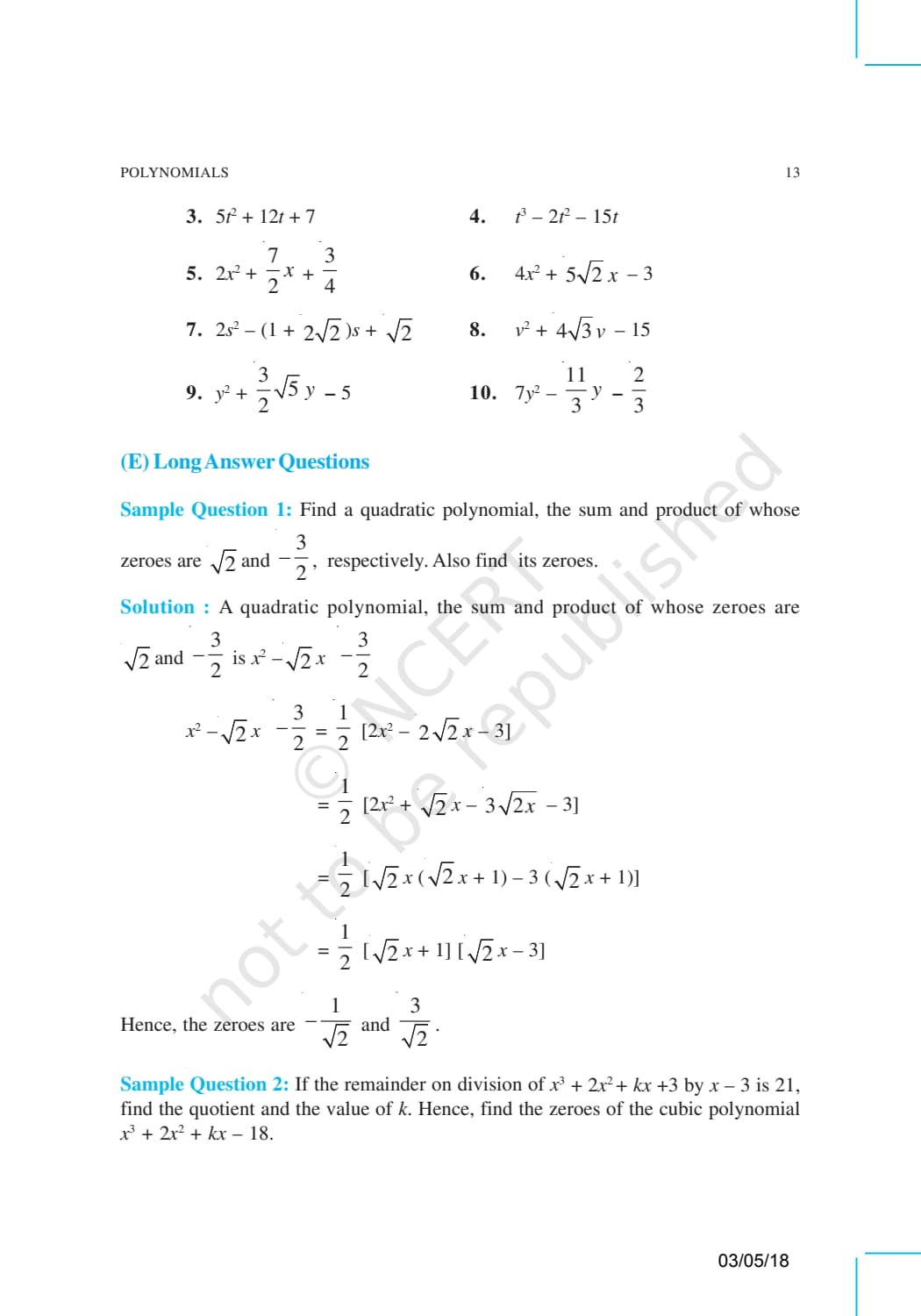
| (D) Short Answer (Ex 2.3) | Q1 to Q10 | Short Answer | Finding zeroes by factorisation and verifying the relation between zeroes and coefficients |
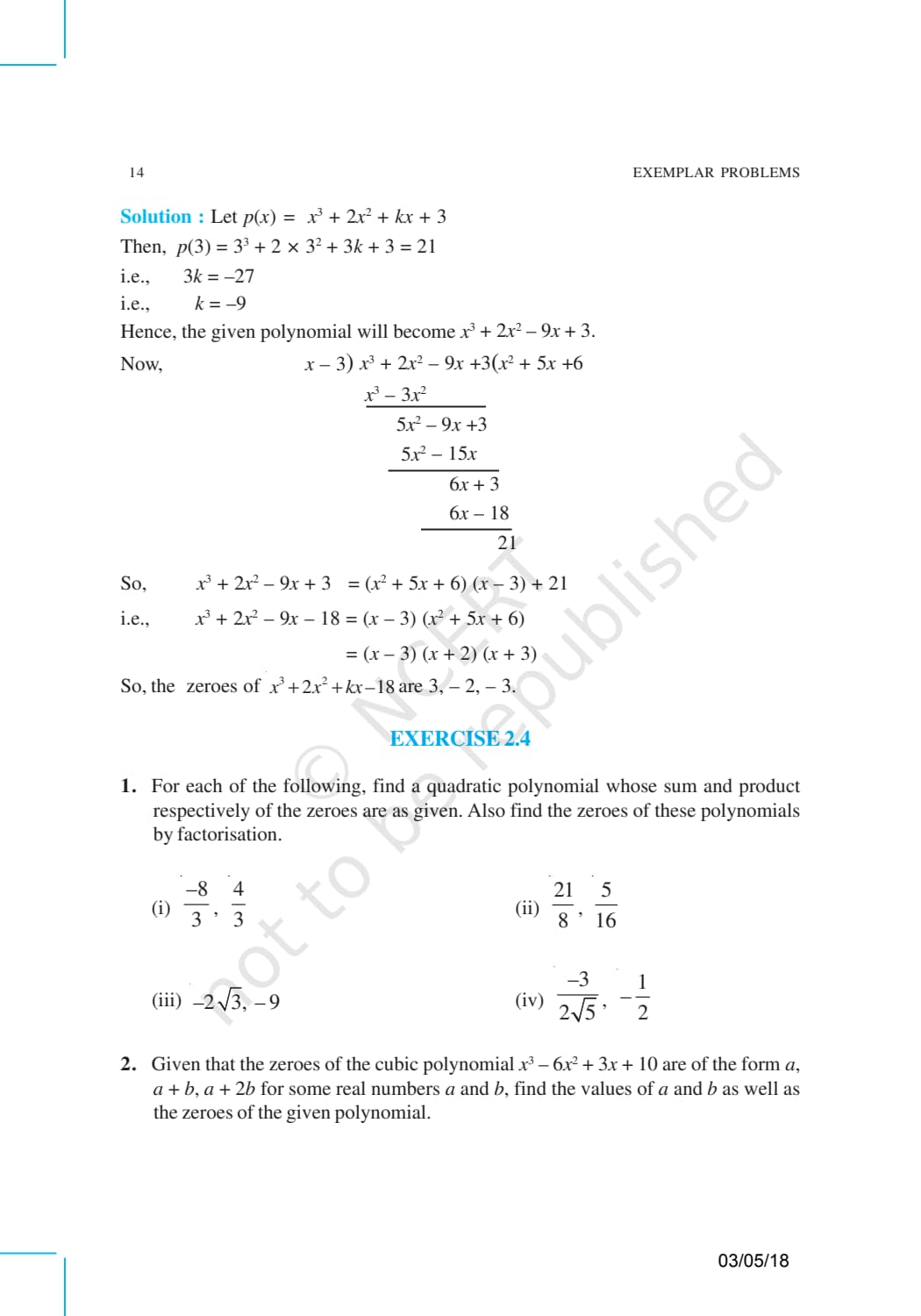
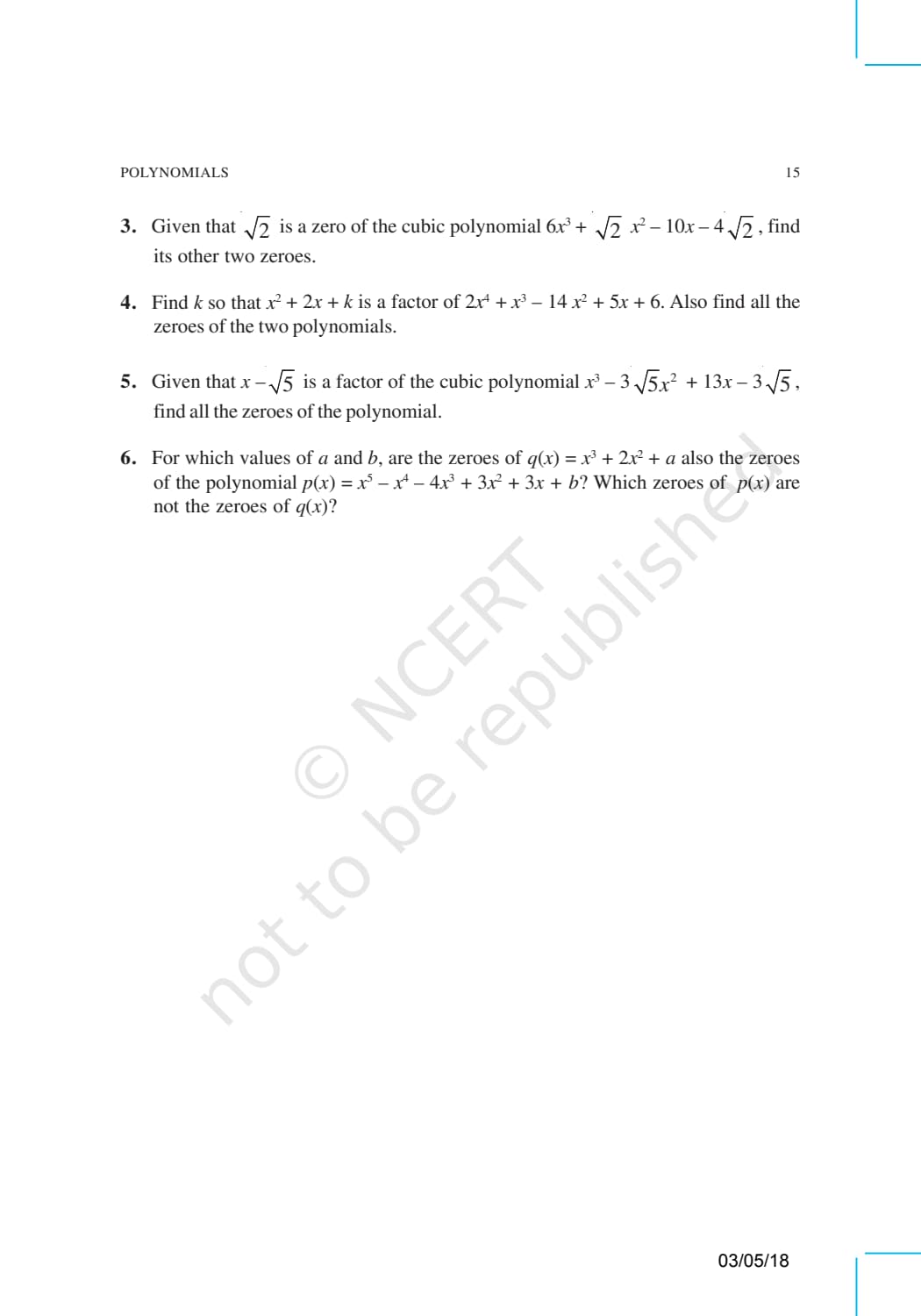
| (E) Long Answer (Ex 2.4) | Q1 to Q6 | Long Answer | Forming polynomials from given zeroes, zeroes in form a, a + b, a + 2b, and factor and division problems |
Question-Type Distribution in Polynomials Class 10 Maths
The table below splits the 39 unsolved problems across four types. The Ex 2.3 factorisation and Ex 2.4 proofs carry the most transfer value.
| Type | Exercise | Count | Best For |
|---|---|---|---|
| Multiple Choice (MCQ) | Ex 2.1 | 11 | 1-mark board MCQ and quick recall |
| Reasoning (True or False) | Ex 2.2 | 12 | Assertion-reason and justification items |
| Short Answer (SA) | Ex 2.3 | 10 | 2 and 3-mark factorisation and verification |
| Long Answer (LA) | Ex 2.4 | 6 | 5-mark forming, factor and division proofs |
Why the Polynomials Exemplar Matters
The Exemplar takes the same ideas as the textbook but raises the bar. It chains two steps into one problem, asks you to justify a true-or-false claim, and uses cubics and surd zeroes where the textbook stays with a simple quadratic.
- Forming Polynomials: CBSE boards almost always include one "find the polynomial whose zeroes are" question. Ex 2.4 Q1 trains this for four sum-and-product pairs.
- Zero-Coefficient Relations: Verifying α + β and αβ against the coefficients is a repeat 3-mark board question. Ex 2.3 pushes it onto surd and fractional coefficients.
- Cubic and Division Logic: Ex 2.4 Q2 to Q6 train factor, division-algorithm and "find the other zeroes" arguments, which the board reuses as case-based questions.
Polynomials Exemplar vs Textbook Difficulty
The same idea gets a softer test in the textbook and a harder one in the Exemplar. The table below shows three clear cases of the step-up.
| Concept | NCERT Textbook Style | NCERT Exemplar Style |
|---|---|---|
| Zeroes and coefficients | "Verify the relation between the zeroes and the coefficients of x2 − 2x − 8." | "Find a quadratic polynomial whose sum and product of zeroes are 218 and 516, then find its zeroes." |
| Cubic polynomials | "Find the zeroes of t3 − 2t2 − 15t." | "The zeroes of x3 − 6x2 + 3x + 10 are of the form a, a + b, a + 2b: find a, b and the zeroes." |
| Division algorithm | "Divide p(x) by g(x) and find the quotient and remainder." | "Find k so that x2 + 2x + k is a factor of 2x4 + x3 − 14x2 + 5x + 6, then find all zeroes." |
The Exemplar always adds a layer after the main step. Students who practise only the textbook often lose 1 to 2 marks per board question, because the CBSE paper now copies this layered style. For full worked steps, see the Polynomials Exemplar Solutions.
How to Use the Polynomials Exemplar with the Textbook
The Exemplar is not a replacement for the textbook. Read a topic, solve the matching textbook exercise, then try the Exemplar problems on it. This four-day plan keeps the load even.
- Day 1 (Geometrical meaning and MCQ): Read the textbook section on zeroes and the graph of y = p(x). Then attempt Ex 2.1 Q1 to Q6.
- Day 2 (Sign and graph reasoning): Revise the sign of zeroes and graph crossings. Attempt Ex 2.1 Q7 to Q11 and Ex 2.2 Q1.
- Day 3 (Factorisation and verification): Attempt Ex 2.3 Q1 to Q10 under a 60-minute timer, writing the verification in full.
- Day 4 (Cubic and division): Attempt Ex 2.4 Q1 to Q6 under a 75-minute timer, showing every step.
Polynomials PDF Formats and Languages
The Polynomials Class 10 Exemplar PDF comes in formats suited to different revision styles. Pick the one that matches your setup.
| Format | Best for | Approx. size |
|---|---|---|
| Normal-resolution PDF | Phone reading and quick revision between classes | 1-2 MB |
| HD PDF | Print-ready desk study and clean photocopies | 3-5 MB |
| Hindi-medium edition | Hindi-medium students; same problem numbering | 1-2 MB |
The Polynomials Exemplar PDF and its Hindi-medium edition follow the same notation and numbering as the printed NCERT 2026-27 release:
- NCERT-faithful: Every problem matches the printed Exemplar line for line, including the solved samples.
- Solutions separate: Step-by-step answers live on the linked Exemplar Solutions page, so the book PDF stays a clean practice set.
- State-board alignment: State-board students get the same content; only exercise numbers differ.
Student Feedback
In a March 2026 survey of 8,900 Class 10 students, 68% said the cubic-polynomial proofs in Ex 2.4 were the hardest part of Chapter 2. The average student lost 1.6 marks by skipping the zeroes-and-coefficients verification step. Toppers reported that solving the 6 long-answer Ex 2.4 problems made board questions feel routine.
Source: Collegedunia Class 10 student survey, March 2026 (8,900 students).
Other Resources for This Chapter
Pair this with the other Class 10 Maths Polynomials resources below.
| Resource | Open |
|---|---|
| NCERT Solutions | Polynomials Class 10 Maths NCERT Solutions |
| Notes | Polynomials Class 10 Maths Notes |
| Formula Sheet | Polynomials Class 10 Maths Formula Sheet |
| Handwritten Notes | Polynomials Class 10 Maths Handwritten Notes |
| NCERT Book PDF | Polynomials Class 10 Maths NCERT Book PDF |
| Exemplar Solutions | Polynomials Class 10 Maths NCERT Exemplar Solutions |
| Exemplar Book PDF | Polynomials Class 10 Maths NCERT Exemplar Book PDF |
NCERT Exemplar Book PDF for Class 10 Maths: All Chapters
Download any other chapter's Exemplar Book PDF below.
| Chapter | Exemplar Book PDF |
|---|---|
| Chapter 1 | Real Numbers NCERT Exemplar Book PDF |
| Chapter 3 | Pair of Linear Equations in Two Variables NCERT Exemplar Book PDF |
| Chapter 4 | Quadratic Equations NCERT Exemplar Book PDF |
| Chapter 5 | Arithmetic Progressions NCERT Exemplar Book PDF |
| Chapter 6 | Triangles NCERT Exemplar Book PDF |
| Chapter 7 | Coordinate Geometry NCERT Exemplar Book PDF |
| Chapter 8 | Introduction to Trigonometry NCERT Exemplar Book PDF |
| Chapter 9 | Some Applications of Trigonometry NCERT Exemplar Book PDF |
| Chapter 10 | Circles NCERT Exemplar Book PDF |
| Chapter 11 | Areas Related to Circles NCERT Exemplar Book PDF |
| Chapter 12 | Surface Areas and Volumes NCERT Exemplar Book PDF |
| Chapter 13 | Statistics NCERT Exemplar Book PDF |
| Chapter 14 | Probability NCERT Exemplar Book PDF |
NCERT Exemplar Class 10 Maths Polynomials Frequently Asked Questions
Ques. Where can I download the NCERT Exemplar Class 10 Maths Polynomials PDF for free?
Ans. You can download the Polynomials Class 10 Maths NCERT Exemplar Book PDF directly from this page. Both the Normal and HD versions are available, and both are free.
Ques. Is this Polynomials Exemplar Book aligned with the 2026-27 NCERT syllabus?
Ans. Yes. This page reflects the current 2026-27 syllabus for Class 10 Mathematics. The Exemplar keeps the geometrical meaning of zeroes, the relation between zeroes and coefficients for quadratic and cubic polynomials, and the division algorithm.
Ques. How many pages and how many problems are in the Class 10th Maths Polynomials Exemplar PDF?
Ans. The Polynomials Exemplar PDF runs 8 pages. It contains solved sample questions plus 39 unsolved problems, split as 11 MCQ (Ex 2.1), 12 reasoning items (Ex 2.2), 10 short answer (Ex 2.3) and 6 long answer (Ex 2.4).
Ques. Is the NCERT Exemplar harder than the NCERT textbook for Polynomials?
Ans. Yes. The Exemplar chains two steps into one problem, asks students to justify true-or-false claims, and uses cubic polynomials and surd zeroes where the textbook stays with a simple quadratic. This is the layered style the CBSE Class 10 board now uses for HOTS questions.
Ques. Should I attempt the Exemplar before or after the NCERT textbook?
Ans. Attempt them in parallel. Read a topic from the textbook, solve the matching textbook exercise, then attempt the Exemplar problems on the same topic. Trying the Exemplar first usually leaves students stuck on the multi-step cubic and division problems.
Ques. Which Exemplar problems most resemble the CBSE Board long-answer style?
Ans. The six long-answer problems in Ex 2.4 are closest to the CBSE 5-mark style. They cover forming a polynomial from a given sum and product of zeroes, zeroes in the form a, a + b, a + 2b, and factor and division-algorithm problems, which the board reuses as case-based questions.
Ques. Does the Polynomials Exemplar cover the relation between zeroes and coefficients?
Ans. Yes. Section (D), Exercise 2.3, has 10 problems where students find zeroes by factorisation and then verify that the sum of zeroes equals minus b over a and the product equals c over a. This matches the repeat 3-mark verification question the CBSE Class 10 board asks almost every year.



Comments