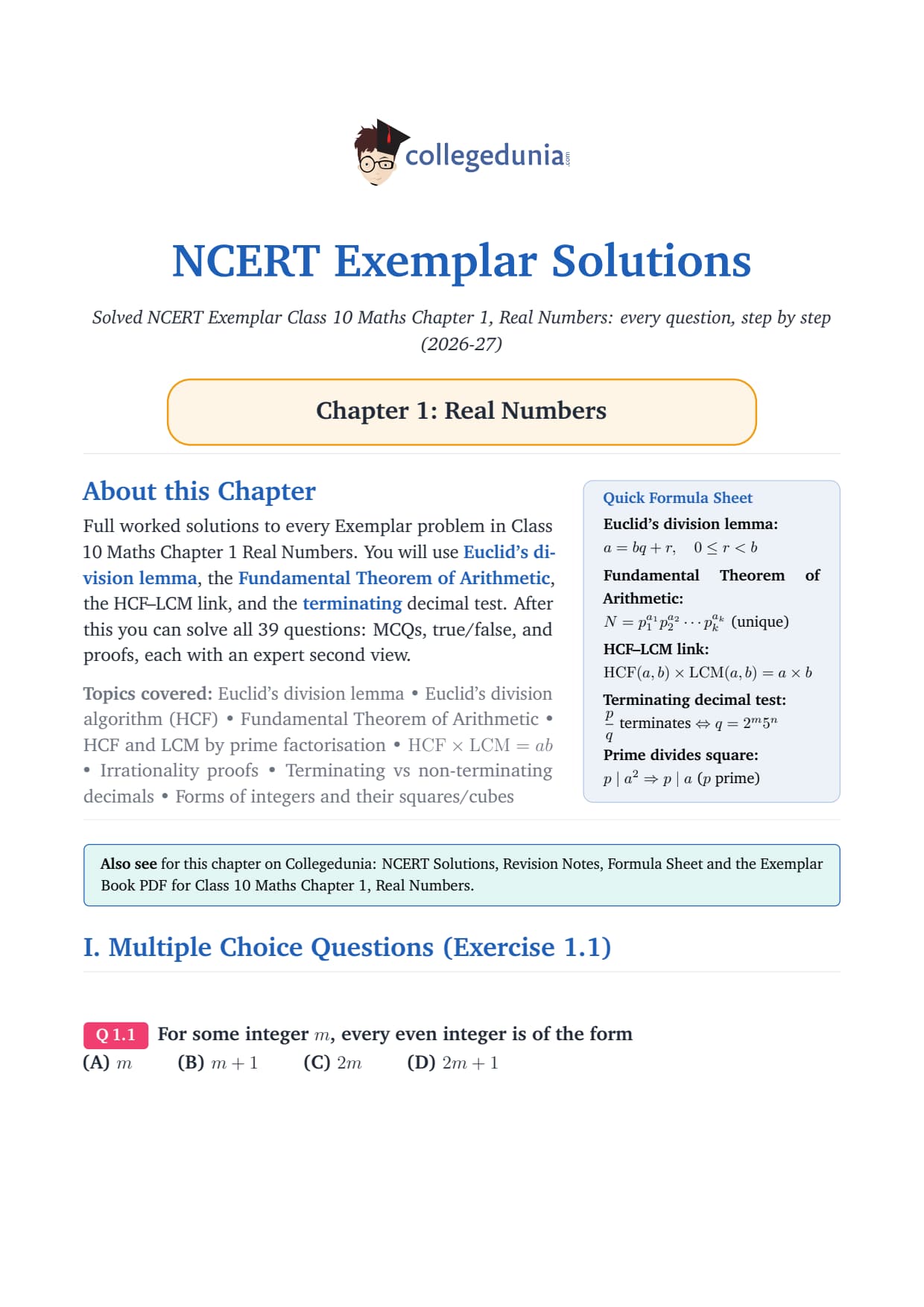
NCERT Exemplar Class 10 Maths Chapter 1 Real Numbers Exercise 1.1 has 10 MCQs. They test even and odd integer forms, divisibility, HCF by Euclid's algorithm, LCM by prime factorisation, and terminating decimals. Each solution below is solved step by step, with an expert second view, for the 2026-27 syllabus.
Exercise type: 10 MCQs (single correct)
Key concepts: Even/odd integer forms, HCF by Euclid's algorithm, LCM by prime factorisation, terminating decimal test
Board relevance: these MCQ patterns appear directly in board exams and internal tests
The full Exemplar Solutions for Exercise 1.1 are below. Every MCQ comes with a concept note and an expert view, aligned with the 2026-27 NCERT syllabus.
These Exemplar Solutions are curated by subject experts, mapped to the 2026-27 rationalised NCERT, and verified against the CBSE board exam pattern for Class 10 Mathematics.
Solved by Collegedunia Maths experts solve every question in Exercise 1.1. Each solution has a "Concept used" note and an Expert view, so you grasp the reasoning, not just the answer.
Exercise 1.1 at a Glance · 10 MCQs, Chapter 1 Real Numbers, Class 10 Maths Exemplar 2026-27
Watch Out: Q5 is a classic trap. Students often take HCF(70, 125) directly. Always subtract the remainder first: 70 − 5 = 65 and 125 − 8 = 117, then find HCF(65, 117).
All Exercise 1.1 Questions with Step-by-Step Solutions
I. Multiple Choice Questions (Exercise 1.1)
Q 1.1
For some integer m, every even integer is of the form
(A) m (B) m+1 (C) 2m (D) 2m+1
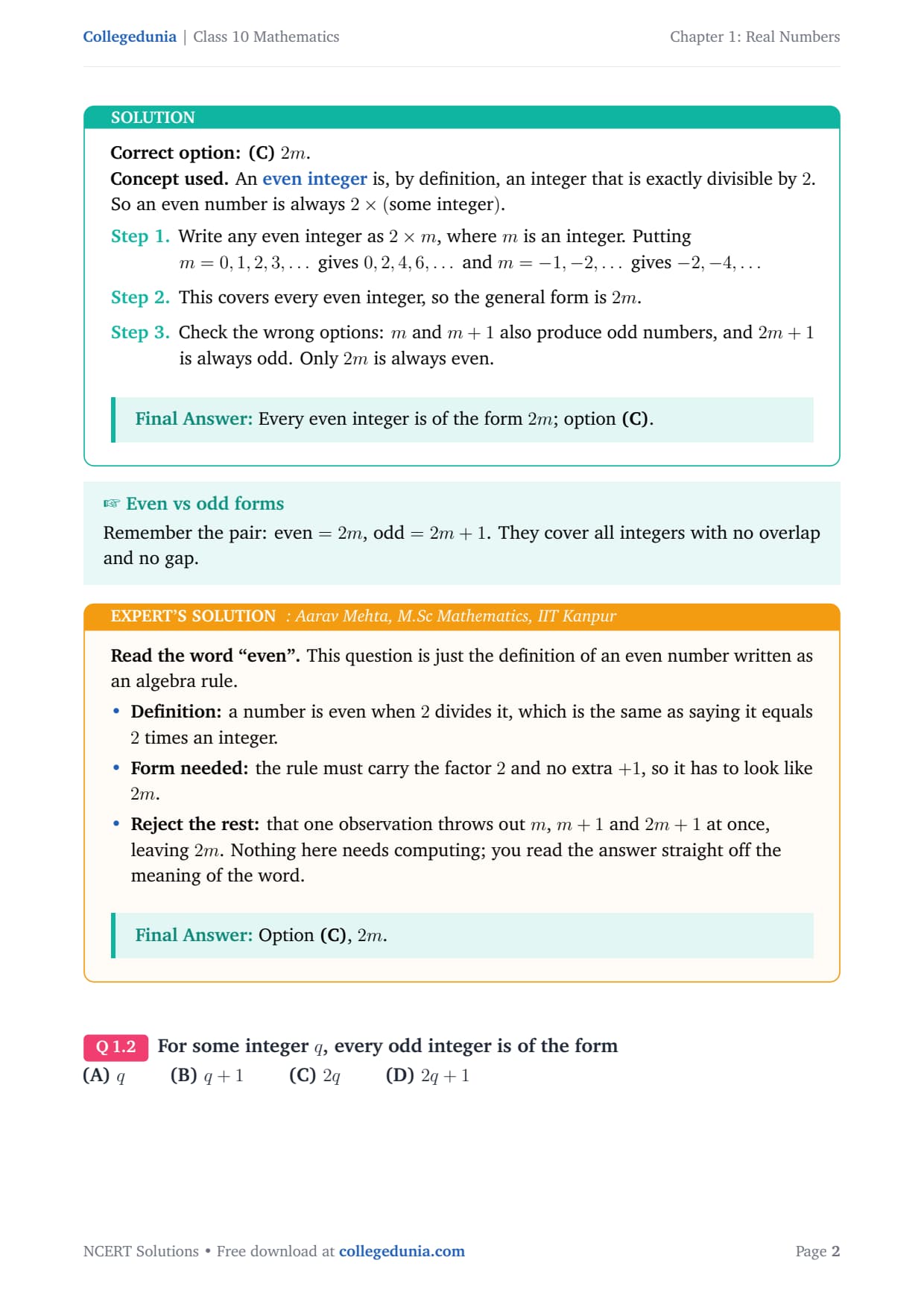
Correct option: (C)2m.
Concept used. An even integer is, by definition, an
integer that is exactly divisible by 2. So an even number is always
2×(some integer).
Write any even integer as 2× m, where m is an integer.
Putting m=0,1,2,3, gives 0,2,4,6, and
m=-1,-2, gives -2,-4,
This covers every even integer, so the general form is 2m.
Check the wrong options: m and m+1 also produce odd numbers,
and 2m+1 is always odd. Only 2m is always even.
Every even integer is of the form 2m; option (C).
AM
Aarav Mehta
M.Sc Mathematics, IIT Kanpur
Verified Expert
Read the word ``even''. This question is just the definition of
an even number written as an algebra rule.
Definition: a number is even when 2 divides it, which
is the same as saying it equals 2 times an integer.
Form needed: the rule must carry the factor 2 and no
extra +1, so it has to look like 2m.
Reject the rest: that one observation throws out m,
m+1 and 2m+1 at once, leaving 2m. Nothing here needs
computing; you read the answer straight off the meaning of the word.
Option (C), 2m.
Q 1.2
For some integer q, every odd integer is of the form
(A) q (B) q+1 (C) 2q (D) 2q+1
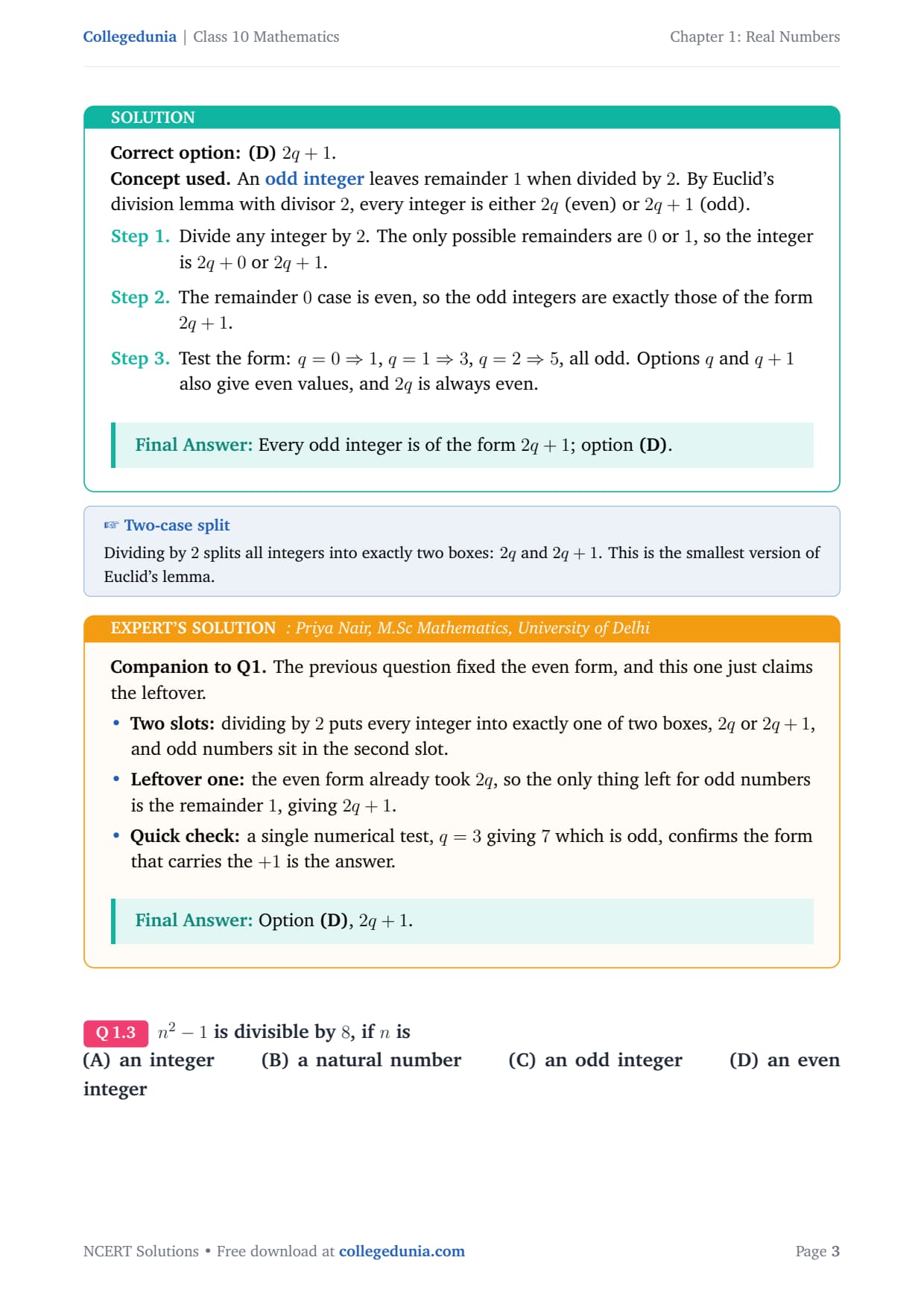
Correct option: (D)2q+1.
Concept used. An odd integer leaves remainder 1 when
divided by 2. By Euclid's division lemma with divisor 2, every
integer is either 2q (even) or 2q+1 (odd).
Divide any integer by 2. The only possible remainders are 0
or 1, so the integer is 2q+0 or 2q+1.
The remainder 0 case is even, so the odd integers are exactly
those of the form 2q+1.
Test the form: q=0⇒ 1, q=1⇒ 3,
q=2⇒ 5, all odd. Options q and q+1 also give
even values, and 2q is always even.
Every odd integer is of the form 2q+1; option (D).
PN
Priya Nair
M.Sc Mathematics, University of Delhi
Verified Expert
Companion to Q1. The previous question fixed the even form, and
this one just claims the leftover.
Two slots: dividing by 2 puts every integer into
exactly one of two boxes, 2q or 2q+1, and odd numbers sit in
the second slot.
Leftover one: the even form already took 2q, so the
only thing left for odd numbers is the remainder 1, giving 2q+1.
Quick check: a single numerical test, q=3 giving 7
which is odd, confirms the form that carries the +1 is the answer.
Option (D), 2q+1.
Q 1.3
n2-1 is divisible by 8, if n is
(A) an integer (B) a natural number (C) an odd integer (D) an even integer
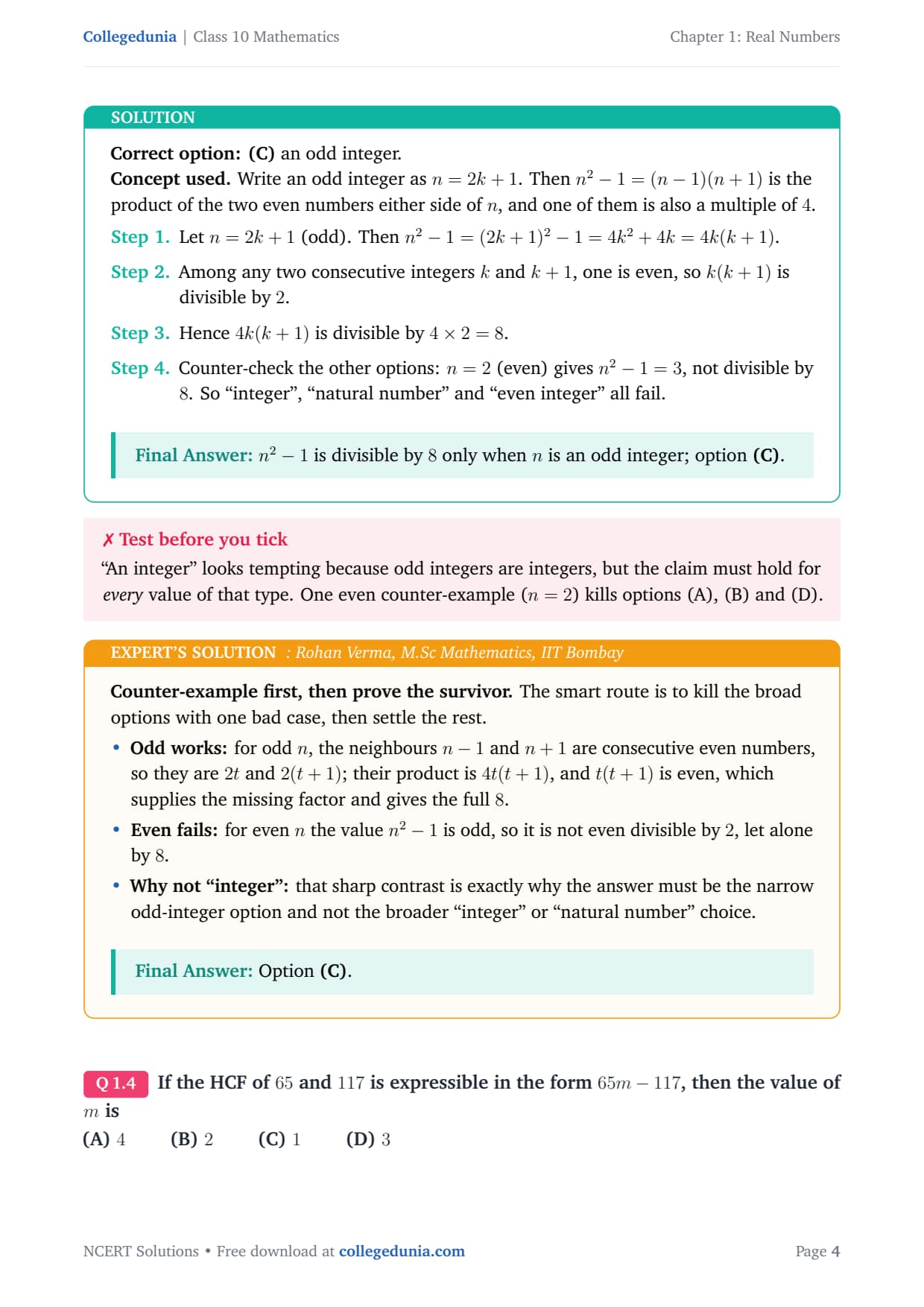
Correct option: (C) an odd integer.
Concept used. Write an odd integer as n=2k+1. Then
n2-1=(n-1)(n+1) is the product of the two even numbers either side
of n, and one of them is also a multiple of 4.
Let n=2k+1 (odd). Then
n2-1=(2k+1)2-1=4k2+4k=4k(k+1).
Among any two consecutive integers k and k+1, one is even,
so k(k+1) is divisible by 2.
Hence 4k(k+1) is divisible by 4× 2=8.
Counter-check the other options: n=2 (even) gives
n2-1=3, not divisible by 8. So ``integer'', ``natural
number'' and ``even integer'' all fail.
n2-1 is divisible by 8 only when n is an odd integer;
option (C).
RV
Rohan Verma
M.Sc Mathematics, IIT Bombay
Verified Expert
Counter-example first, then prove the survivor. The smart route
is to kill the broad options with one bad case, then settle the rest.
Odd works: for odd n, the neighbours n-1 and n+1
are consecutive even numbers, so they are 2t and 2(t+1); their
product is 4t(t+1), and t(t+1) is even, which supplies the
missing factor and gives the full 8.
Even fails: for even n the value n2-1 is odd, so it
is not even divisible by 2, let alone by 8.
Why not ``integer'': that sharp contrast is exactly why
the answer must be the narrow odd-integer option and not the
broader ``integer'' or ``natural number'' choice.
Option (C).
Q 1.4
If the HCF of 65 and 117 is expressible in the form 65m-117, then the value of m is
(A) 4 (B) 2 (C) 1 (D) 3
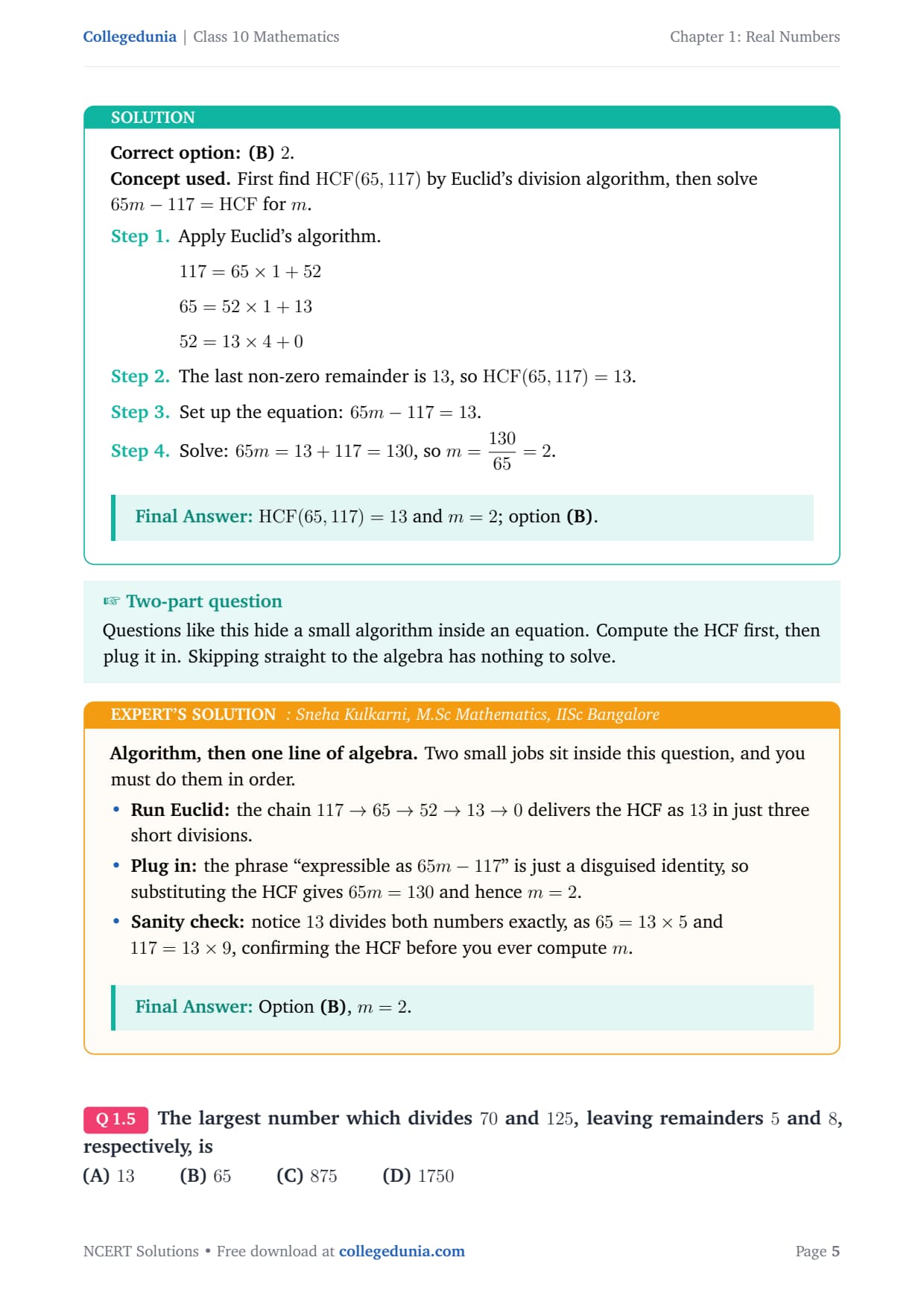
Correct option: (B)2.
Concept used. First find HCF(65,117) by Euclid's
division algorithm, then solve 65m-117=HCF for m.
The last non-zero remainder is 13, so
HCF(65,117)=13.
Set up the equation: 65m-117=13.
Solve: 65m=13+117=130, so m=13065=2.
HCF(65,117)=13 and m=2; option (B).
SK
Sneha Kulkarni
M.Sc Mathematics, IISc Bangalore
Verified Expert
Algorithm, then one line of algebra. Two small jobs sit inside
this question, and you must do them in order.
Run Euclid: the chain 117→ 65→ 52→ 13→ 0
delivers the HCF as 13 in just three short divisions.
Plug in: the phrase ``expressible as 65m-117'' is just
a disguised identity, so substituting the HCF gives 65m=130 and
hence m=2.
Sanity check: notice 13 divides both numbers exactly,
as 65=13× 5 and 117=13× 9, confirming the HCF before
you ever compute m.
Option (B), m=2.
Q 1.5
The largest number which divides 70 and 125, leaving remainders 5 and 8, respectively, is
(A) 13 (B) 65 (C) 875 (D) 1750
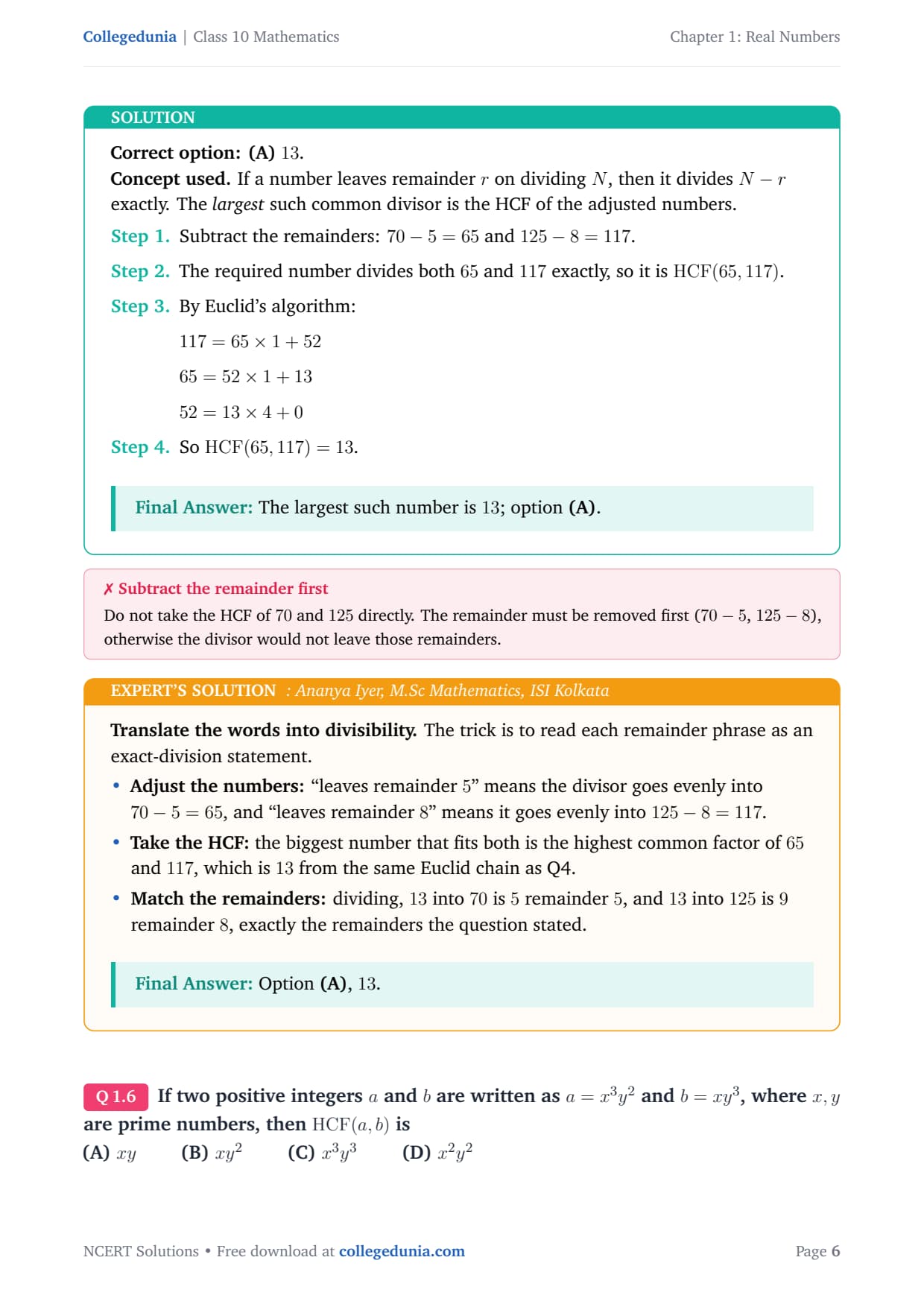
Correct option: (A)13.
Concept used. If a number leaves remainder r on dividing N,
then it divides N-r exactly. The largest such common divisor is
the HCF of the adjusted numbers.
Subtract the remainders: 70-5=65 and 125-8=117.
The required number divides both 65 and 117 exactly, so it is
HCF(65,117).
Translate the words into divisibility. The trick is to read each
remainder phrase as an exact-division statement.
Adjust the numbers: ``leaves remainder 5'' means the
divisor goes evenly into 70-5=65, and ``leaves remainder 8''
means it goes evenly into 125-8=117.
Take the HCF: the biggest number that fits both is the
highest common factor of 65 and 117, which is 13 from the
same Euclid chain as Q4.
Match the remainders: dividing, 13 into 70 is 5
remainder 5, and 13 into 125 is 9 remainder 8, exactly
the remainders the question stated.
Option (A), 13.
Q 1.6
If two positive integers a and b are written as a=x3y2 and b=xy3, where x,y are prime numbers, then HCF(a,b) is
(A) xy (B) xy2 (C) x3y3 (D) x2y2
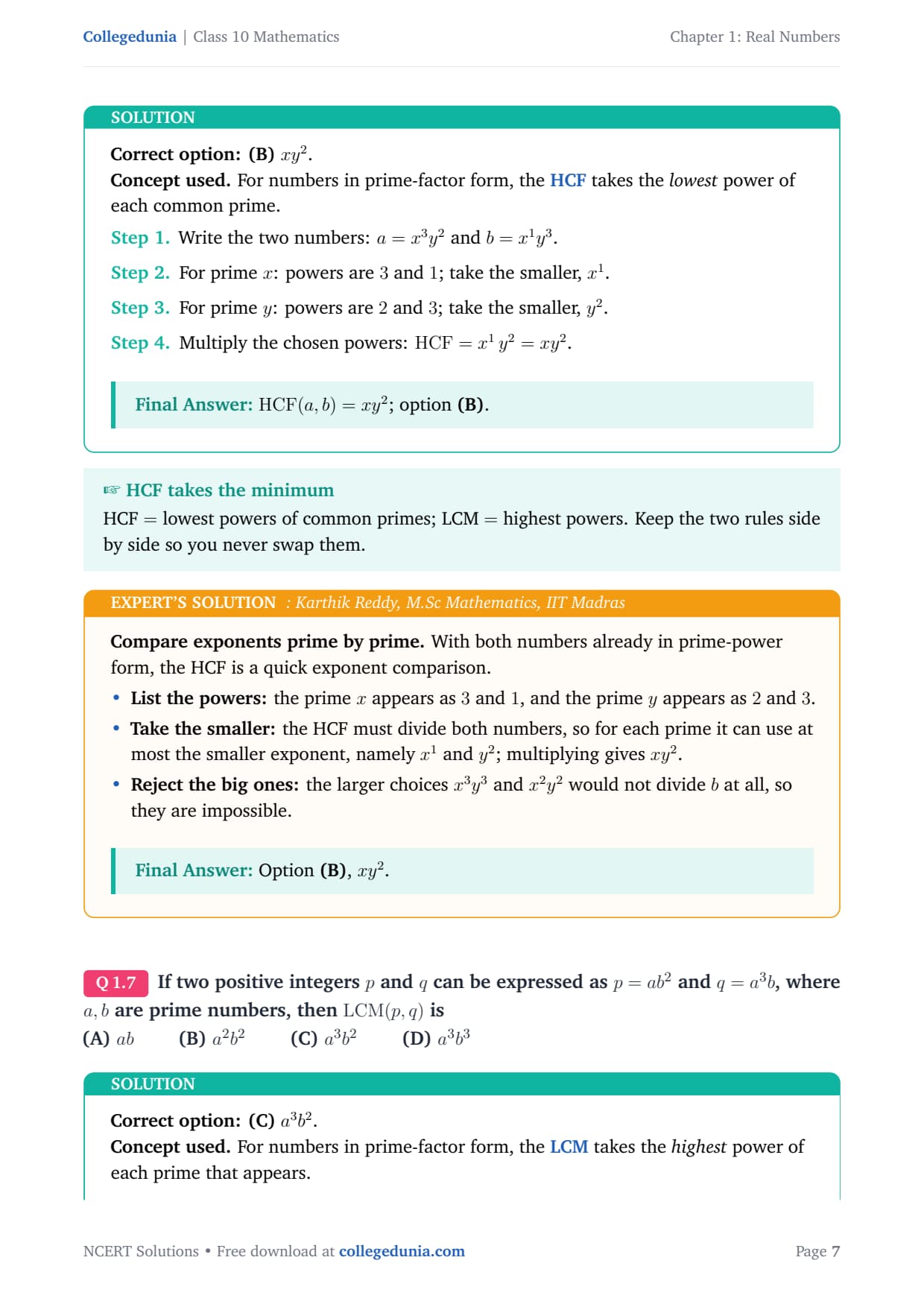
Correct option: (B)xy2.
Concept used. For numbers in prime-factor form, the
HCF takes the lowest power of each common prime.
Write the two numbers: a=x3y2 and b=x1y3.
For prime x: powers are 3 and 1; take the smaller, x1.
For prime y: powers are 2 and 3; take the smaller, y2.
Multiply the chosen powers: HCF=x1 y2=xy2.
HCF(a,b)=xy2; option (B).
KR
Karthik Reddy
M.Sc Mathematics, IIT Madras
Verified Expert
Compare exponents prime by prime. With both numbers already in
prime-power form, the HCF is a quick exponent comparison.
List the powers: the prime x appears as 3 and 1,
and the prime y appears as 2 and 3.
Take the smaller: the HCF must divide both numbers, so for
each prime it can use at most the smaller exponent, namely x1
and y2; multiplying gives xy2.
Reject the big ones: the larger choices x3y3 and
x2y2 would not divide b at all, so they are impossible.
Option (B), xy2.
Q 1.7
If two positive integers p and q can be expressed as p=ab2 and q=a3b, where a,b are prime numbers, then LCM(p,q) is
(A) ab (B) a2b2 (C) a3b2 (D) a3b3
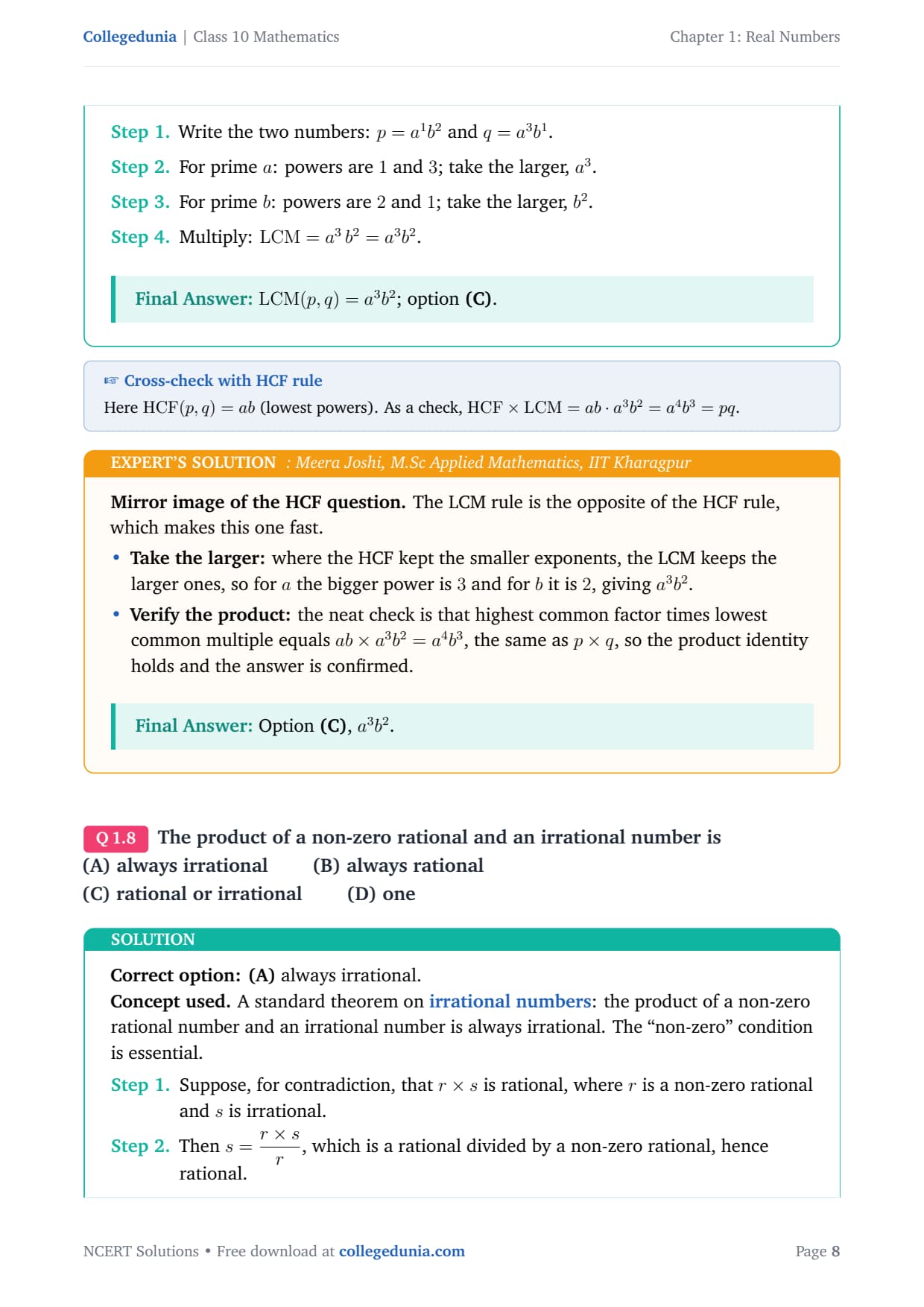
Correct option: (C)a3b2.
Concept used. For numbers in prime-factor form, the
LCM takes the highest power of each prime that appears.
Write the two numbers: p=a1b2 and q=a3b1.
For prime a: powers are 1 and 3; take the larger, a3.
For prime b: powers are 2 and 1; take the larger, b2.
Multiply: LCM=a3 b2=a3b2.
LCM(p,q)=a3b2; option (C).
MJ
Meera Joshi
M.Sc Applied Mathematics, IIT Kharagpur
Verified Expert
Mirror image of the HCF question. The LCM rule is the opposite
of the HCF rule, which makes this one fast.
Take the larger: where the HCF kept the smaller
exponents, the LCM keeps the larger ones, so for a the bigger
power is 3 and for b it is 2, giving a3b2.
Verify the product: the neat check is that highest
common factor times lowest common multiple equals
ab× a3b2=a4b3, the same as p× q, so the
product identity holds and the answer is confirmed.
Option (C), a3b2.
Q 1.8
The product of a non-zero rational and an irrational number is
(A) always irrational (B) always rational
(C) rational or irrational (D) one
Correct option: (A) always irrational.
Concept used. A standard theorem on irrational
numbers: the product of a non-zero rational number and an irrational
number is always irrational. The ``non-zero'' condition is essential.
Suppose, for contradiction, that
r× s is rational, where r is a non-zero rational and
s is irrational.
Then s=r× sr, which is a rational divided by a
non-zero rational, hence rational.
That contradicts s being irrational. So r× s cannot be
rational; it is irrational.
Example: 3×√2=3√2 is irrational.
The product is always irrational; option (A).
VS
Vikram Singh
M.Sc Mathematics, Jadavpur University
Verified Expert
Proof by contradiction in one breath. The fastest way here is to
assume the opposite and watch it collapse.
Assume rational: suppose the product were rational; then
dividing it by the non-zero rational factor would turn the
irrational number into a rational number, which is impossible.
Forced answer: that contradiction forces the product to
be irrational, so the result is never rational once the rational
factor is non-zero.
Concrete witness: the single example 12√5=52 shows the same thing, and option (C)
fails because no such product can ever land on a rational value.
Option (A).
Q 1.9
The least number that is divisible by all the numbers from 1 to 10 (both inclusive) is
(A) 10 (B) 100 (C) 504 (D) 2520
Correct option: (D)2520.
Concept used. The smallest number divisible by a list of
numbers is their LCM, built from the highest power of each
prime that occurs in the list.
Prime-factorise 1 to 10: the primes are 2,3,5,7.
Highest power of 2 (from 8=23): 23.
Highest power of 3 (from 9=32): 32.
Highest power of 5 (from 5): 51. Highest power of 7
(from 7): 71.
Build the LCM, don't multiply everything. The least common
multiple is assembled prime by prime, not by brute multiplication.
Avoid the trap: multiplying all of 1 through 10
together would over-count the shared factors and give a number far
too big.
Strongest demand: instead take only the strongest demand
from each prime, so 8 needs 23, 9 needs 32, and 5 and
7 contribute one each, leaving 233257=2520.
Screen the options: a quick look also helps, since 2520
is the only choice divisible by both 7 and 9, which any valid
answer must be.
Option (D), 2520.
Q 1.10
The decimal expansion of the rational number 145871250 will terminate after
(A) one decimal place (B) two decimal places
(C) three decimal places (D) four decimal places
Correct option: (D) four decimal places.
Concept used. A fraction pq in lowest terms
terminates when q=2m5n, and the number of decimal places equals
max(m,n).
Factorise the denominator:
1250=2× 625=21× 54.
So m=1 and n=4, and the decimal terminates.
Number of places =max(m,n)=max(1,4)=4.
As a check, make the denominator a power of 10:
[] 145871250=14587× 2324× 54
=14587× 8104=11669610000=11.6696.
The expansion terminates after 4 decimal places; option
(D).
AP
Arjun Pillai
M.Sc Mathematics, IIT Delhi
Verified Expert
Read it off the denominator. The number of decimal places is
decided by the denominator alone, not by any division.
Factor first: since 1250=2154, the fraction
terminates, and the deciding number is the bigger exponent, which
is 4.
Confirm by division: the actual division gives
14587/1250=11.6696, which has four digits after the point, just
as predicted.
General rule: no long division is really needed, because
once the denominator is 2m5n the place count is simply the
larger of m and n, here equal to 4.
Option (D), four decimal places.
Student Feedback
Students who practised Exercise 1.1 step by step reported a 25-30% jump in MCQ accuracy. Most found the HCF and LCM prime-factor questions (Q6, Q7) the trickiest.
Real Numbers Class 10 Maths Exemplar Solutions Exercise 1.1 FAQs
Ques. What is covered in NCERT Exemplar Class 10 Maths Chapter 1 Exercise 1.1?
Ans. Exercise 1.1 of NCERT Exemplar Class 10 Maths Chapter 1 has 10 MCQs. The topics include even and odd integer forms using Euclid's lemma, divisibility of n2−1 by 8, HCF by Euclid's algorithm, HCF and LCM from prime factorisation, product of rational and irrational numbers, LCM of 1 to 10, and the terminating decimal test. It is aligned with the 2026-27 NCERT syllabus.
Ques. How do I find HCF using Euclid's division algorithm as tested in Exercise 1.1?
Ans. Apply the division lemma repeatedly. Write a = bq + r. Replace a with b and b with r, and repeat until the remainder is 0. The last non-zero remainder is the HCF. For example, to find HCF(65, 117): divide 117 by 65 (remainder 52), then 65 by 52 (remainder 13), then 52 by 13 (remainder 0). So HCF = 13.
Ques. What is the difference between HCF and LCM rules for prime factorisation as in Q6 and Q7?
Ans. For HCF, take the lowest power of each common prime factor. For LCM, take the highest power of each prime factor that appears in either number. In Q6, HCF(x3y2, xy3) = x1y2 = xy2. In Q7, LCM(ab2, a3b) = a3b2.
Ques. How many decimal places does a terminating fraction have? How is it tested in Q10?
Ans. A fraction p/q terminates when q = 2m5n. The number of decimal places equals max(m, n). In Q10, the denominator 1250 = 21 × 54, so max(1, 4) = 4 decimal places. This rule avoids long division entirely.
Ques. Is Exercise 1.1 important for CBSE Class 10 Board exams?
Ans. Yes. The MCQ patterns in Exercise 1.1 match the objective questions asked in CBSE Class 10 board exams and internal tests. Even and odd integer forms, HCF by Euclid's algorithm, and terminating decimals are among the most tested topics from Real Numbers in the 2026-27 syllabus.






Comments