Senior Maths Editor, 9 Yrs | Updated 3+ months ago
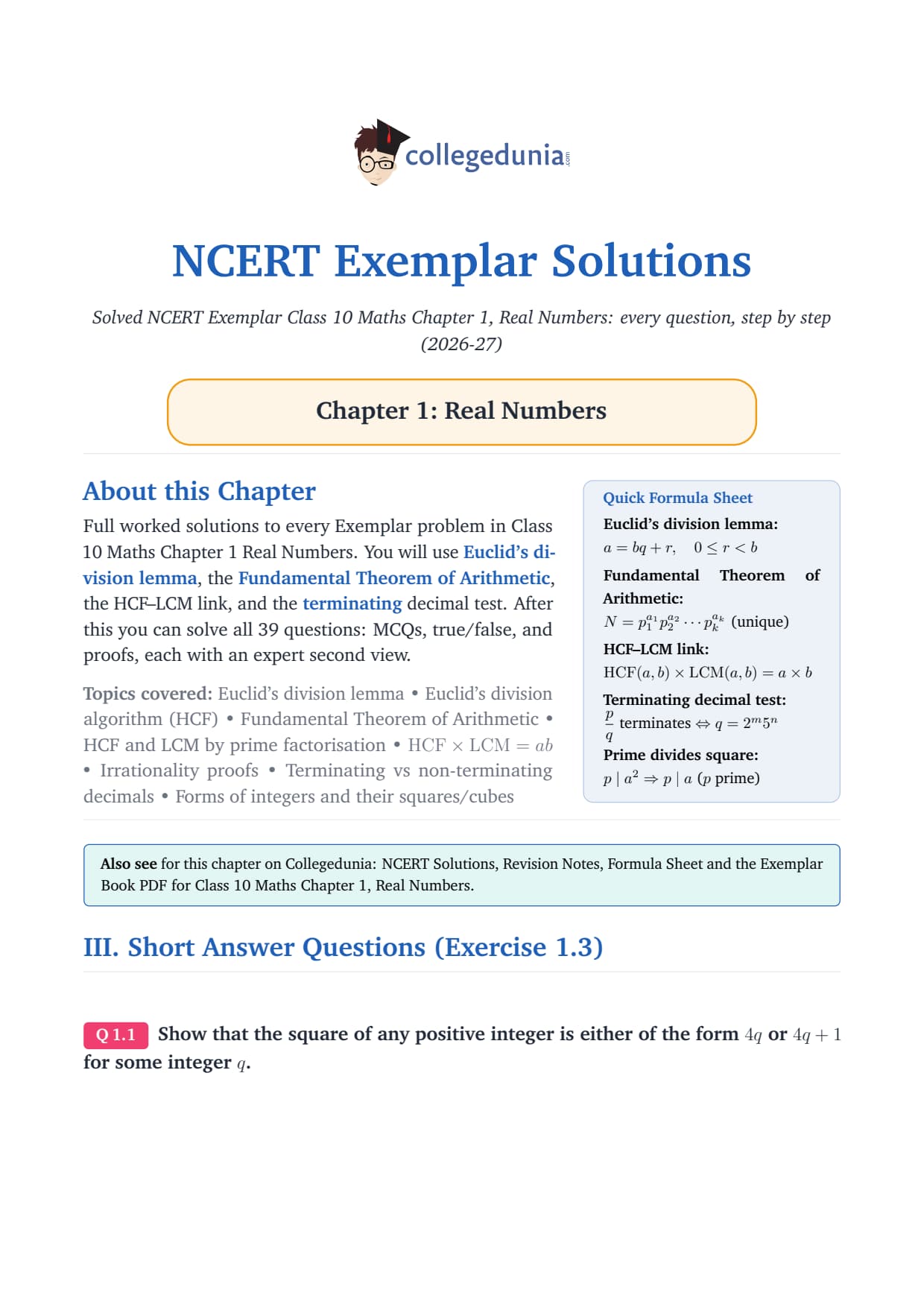
NCERT Exemplar Class 10 Maths Chapter 1 Real Numbers Exercise 1.3 covers Short Answer Questions on number-theory proofs. It is one of the most proof-heavy exercises in the chapter. The questions test modular arithmetic, irrationality arguments, Euclid's algorithm and LCM applications, all on the 2026-27 CBSE syllabus.
14 questions (Q21 to Q34): square forms, cube forms, irrationality proofs, HCF by Euclid's algorithm, LCM word problems and terminating decimals.
CBSE Board Weightage: Real Numbers carries 6 marks in Class 10 boards; Exercise 1.3 questions appear as 2- and 3-mark short answer items.
Each solution has a step-by-step worked answer plus an expert view from verified M.Sc Mathematics educators.
Solved by Collegedunia: All 14 Exercise 1.3 questions are solved step by step, mapped to the 2026-27 CBSE syllabus.
What Real Numbers Class 10 Maths Exercise 1.3 Covers
Exercise 1.3 is the short answer section of the chapter. It has 14 questions (Q21 to Q34) that test your ability to write complete proofs. Unlike Exercise 1.1 (MCQs) and Exercise 1.2 (True/False), this one needs every step laid out clearly.
Q21-Q24: Show that squares or cubes cannot take certain modular forms (mod 4, mod 5, mod 6).
Q25-Q27: Prove specific properties of odd integer squares and sums.
Q28-Q29: Apply Euclid's division algorithm for HCF of three numbers and a remainder-adjustment problem.
Q30, Q34: Prove that sums of square roots of primes are irrational (proof by contradiction).
Q31: Use the Fundamental Theorem of Arithmetic to show a power never ends in 0 or 5.
Q32: Solve an LCM word problem about walkers with different step lengths.
Q33: Convert a fraction to a decimal without dividing, using the 2m×5n denominator form.
This exercise is unique in Class 10 Maths. It combines four different proof techniques in one set: parity and modular arguments, Euclid's algorithm, contradiction proofs for irrationality, and prime factorisation. Master all four here and the chapter is fully covered before the board exam.
Key Concepts in Real Numbers Class 10 Maths
Every question draws on one or more of these core results. Knowing which concept fits which question type saves time in the exam.
Euclid's Division Lemma: For any two positive integers a and b, there exist unique integers q and r such that a = b×q + r, where 0 ≤ r < b.
Quick Reference Formulas for Exercise 1.3:
HCF-LCM link: HCF(a,b) × LCM(a,b) = a × b
Terminating decimal test:p/q terminates if and only if q = 2m×5n
Odd square form: If n is odd, then n2 = 4q+1 for some integer q
Prime divides square: If prime p divides a2, then p divides a
Question Type
Key Tool
Questions in Ex 1.3
Modular form proofs (squares)
Parity split + algebraic grouping
Q21, Q23, Q24, Q25
Modular form proofs (cubes)
Four residue classes mod 4
Q22
Divisibility by 8
Consecutive integers product
Q26, Q27
HCF by Euclid's algorithm
Euclid's division algorithm (repeated)
Q28, Q29
Irrationality proofs
Contradiction + surd isolation
Q30, Q34
Last digit arguments
Fundamental Theorem of Arithmetic
Q31
LCM word problem
Prime factorisation + LCM
Q32
Terminating decimal
2m×5n denominator form
Q33
Square & Cube Residue Forms
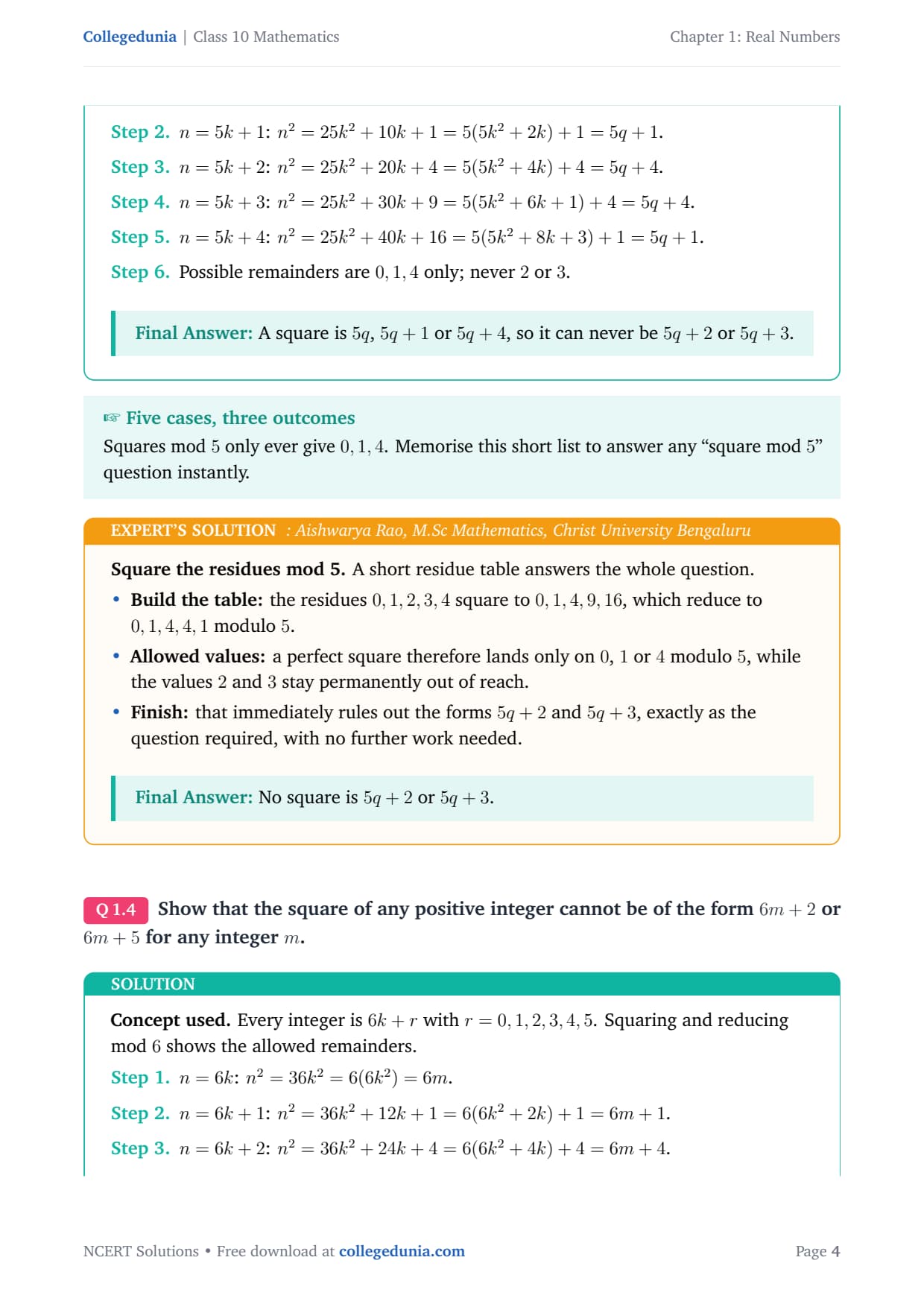
Questions Q21-Q25 use the same approach. Take every possible remainder when dividing by some number, square or cube each, then see which remainders can appear. The image below shows the residue pattern at a glance.
Residue quick-reference for Exercise 1.3 proofs:
Squares mod 4: only 0 or 1 (Q21, Q25)
Cubes mod 4: only 0, 1 or 3 (Q22) - remainder 2 is impossible
Squares mod 5: only 0, 1 or 4 (Q23) - remainders 2 and 3 are impossible
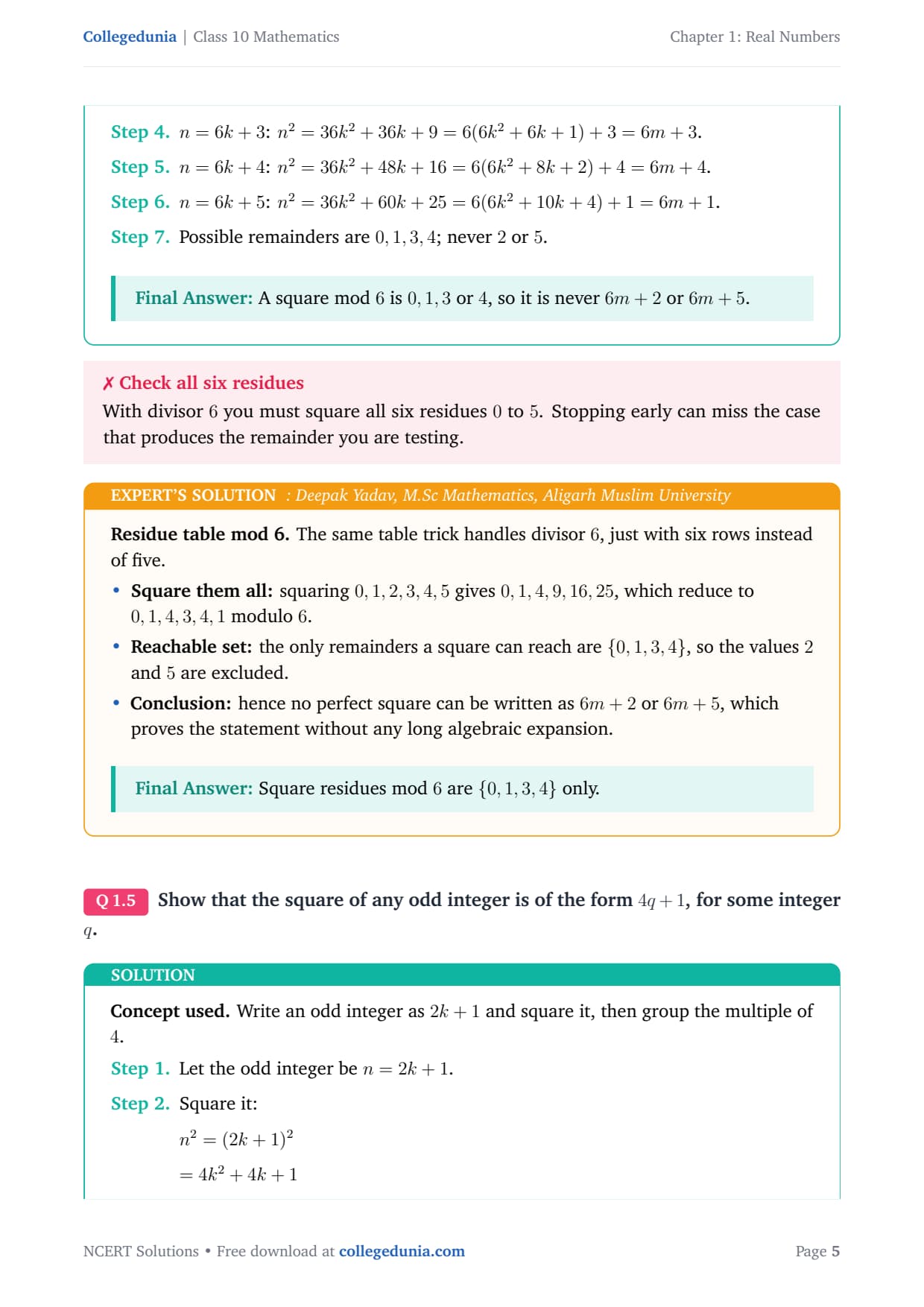
Squares mod 6: only 0, 1, 3 or 4 (Q24) - remainders 2 and 5 are impossible
Memorise this short table and you can answer any "show that a square cannot be of the form..." question in about 30 seconds. Just check whether the target remainder appears in the list.
Real Numbers Class 10 Maths Board Weightage (2026-27)
Real Numbers is one of 14 chapters in Class 10 Maths. In the CBSE board paper it carries 6 marks on average, across several question types. Exercise 1.3 questions usually appear as 2-mark short answer items.
Exercise
Type
Number of Questions
CBSE Board Relevance
Exercise 1.3
Short Answer (proofs)
14 (Q21-Q34)
High - 2-mark proof questions
Exercise 1.1
MCQ
12 questions
High - 1-mark questions
Exercise 1.2
Very Short Answer
8 questions
Medium - 1-mark true/false
Exercise 1.4
Long Answer
6 questions
High - 3-mark proofs
Of the four exercises, Exercise 1.3 and Exercise 1.4 link most directly to board proof questions. The irrationality proofs in Q30 and Q34 and the Euclid's algorithm sum in Q29 appear almost every year in the CBSE board paper.
Common Mistakes in Real Numbers Class 10 Maths
These are the errors that cost marks in Exercise 1.3, based on how CBSE markers grade short answer proofs.
Not stating which form the integer takes: In Q21-Q24, start explicitly with "Let n = 4k + r where r = 0, 1, 2, 3." Jumping straight to algebra loses the setup mark.
Missing the "no remainder 2 in cubes" explanation (Q22): Many students list three cases but forget to say why the fourth case (4m+2) is missing. The one-line residue argument - "cubing 2 mod 4 gives 8 = 0 mod 4" - earns the final half-mark.
In Q29, subtracting the same remainder from all three numbers: The remainders are different (1, 2, 3). Students who subtract 1 from all three get the wrong adjusted numbers and an incorrect HCF.
In Q30/Q34, not squaring both sides correctly: The line (√5 = r − √3) squared must expand to 5 = r2 − 2r√3 + 3. A sign error in the cross term gives the wrong isolation step.
In Q33, not showing the multiplying step: Just writing "0.0514" without showing how the denominator became 104 earns zero marks. CBSE markers want to see the balancing-powers step.
Irrational Numbers & HCF-LCM Patterns
Questions Q28-Q34 use two techniques that students often mix up. The image below shows the decision path: when to use HCF (Euclid), when to use LCM (prime factorisation), and when to use contradiction (irrationality).
Use Euclid's algorithm (repeated division) when the question says "find HCF" or "largest number that divides with given remainders" - Q28, Q29.
Use LCM by prime factorisation when the question asks for "minimum common distance" or "all cover same distance in complete steps" - Q32.
Use contradiction + surd isolation when the question says "prove irrational" for a sum of two surds - Q30, Q34.
Use Fundamental Theorem of Arithmetic when the question asks about last digits or prime factor existence - Q31.
All 14 Exercise 1.3 Solutions with Step-by-Step Answers
III. Short Answer Questions (Exercise 1.3)
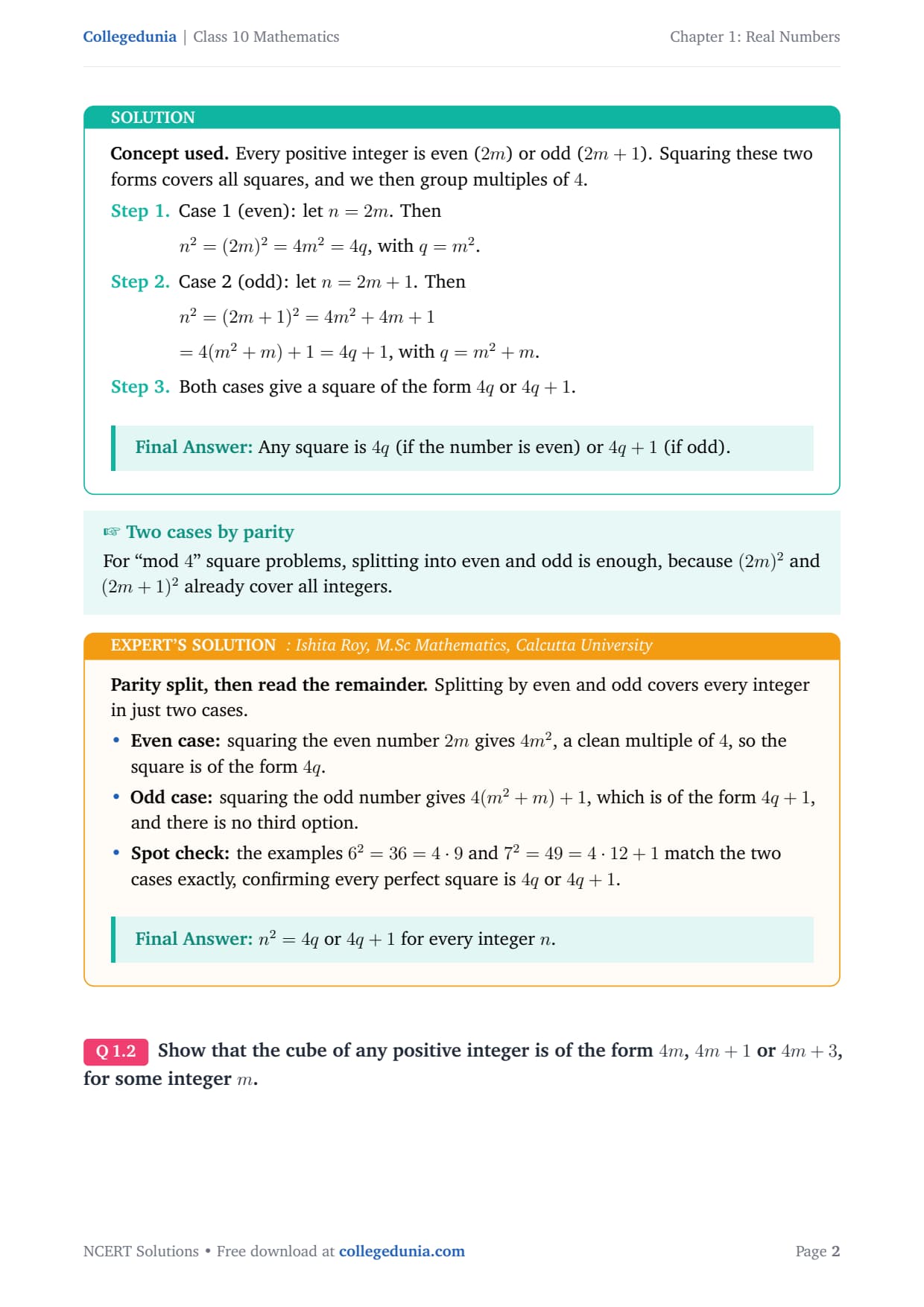
Q 1.1
Show that the square of any positive integer is either of the form 4q or 4q+1 for some integer q.
Concept used. Every positive integer is even (2m) or odd
(2m+1). Squaring these two forms covers all squares, and we then group
multiples of 4.
Case 1 (even): let n=2m. Then
[] n2=(2m)2=4m2=4q, with q=m2.
Case 2 (odd): let n=2m+1. Then
[] n2=(2m+1)2=4m2+4m+1
[] =4(m2+m)+1=4q+1, with q=m2+m.
Both cases give a square of the form 4q or 4q+1.
Any square is 4q (if the number is even) or 4q+1 (if odd).
IR
Ishita Roy
M.Sc Mathematics, Calcutta University
Verified Expert
Parity split, then read the remainder. Splitting by even and odd
covers every integer in just two cases.
Even case: squaring the even number 2m gives 4m2, a
clean multiple of 4, so the square is of the form 4q.
Odd case: squaring the odd number gives 4(m2+m)+1,
which is of the form 4q+1, and there is no third option.
Spot check: the examples 62=36=49 and
72=49=412+1 match the two cases exactly, confirming every
perfect square is 4q or 4q+1.
n2=4q or 4q+1 for every integer n.
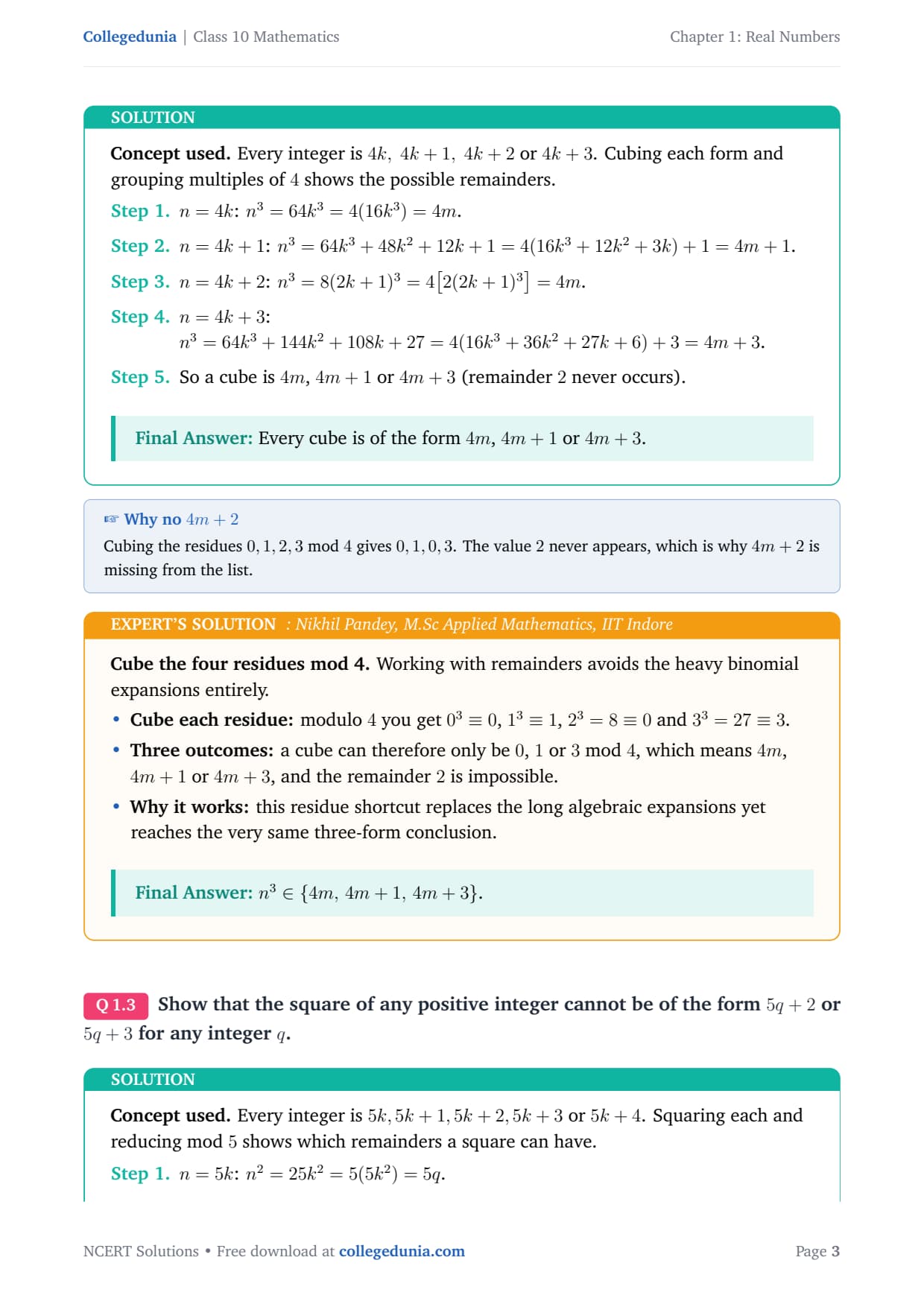
Q 1.2
Show that the cube of any positive integer is of the form 4m, 4m+1 or 4m+3, for some integer m.
Concept used. Every integer is 4k, 4k+1, 4k+2 or 4k+3.
Cubing each form and grouping multiples of 4 shows the possible
remainders.
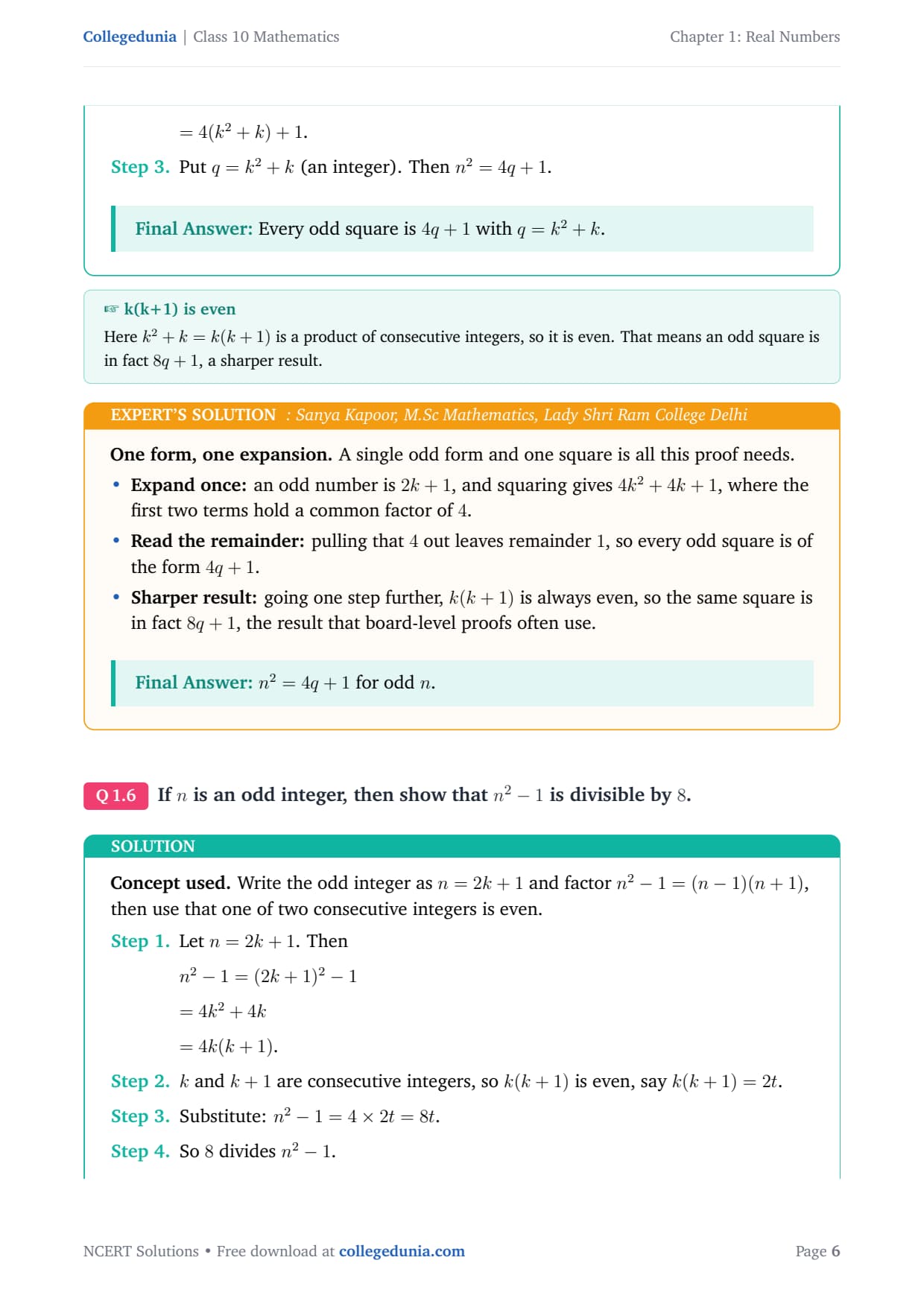
One form, one expansion. A single odd form and one square is all
this proof needs.
Expand once: an odd number is 2k+1, and squaring gives
4k2+4k+1, where the first two terms hold a common factor of 4.
Read the remainder: pulling that 4 out leaves remainder
1, so every odd square is of the form 4q+1.
Sharper result: going one step further, k(k+1) is always
even, so the same square is in fact 8q+1, the result that
board-level proofs often use.
n2=4q+1 for odd n.
Q 1.6
If n is an odd integer, then show that n2-1 is divisible by 8.
Concept used. Write the odd integer as n=2k+1 and factor
n2-1=(n-1)(n+1), then use that one of two consecutive integers is
even.
Let n=2k+1. Then
[] n2-1=(2k+1)2-1
[] =4k2+4k
[] =4k(k+1).
k and k+1 are consecutive integers, so k(k+1) is even, say
k(k+1)=2t.
Substitute: n2-1=4× 2t=8t.
So 8 divides n2-1.
n2-1=4k(k+1)=8t, so it is divisible by 8 for odd n.
PD
Pranav Deshmukh
M.Sc Mathematics, COEP Pune
Verified Expert
Two consecutive integers carry an extra 2. The factor of 8
comes from a visible 4 plus one hidden 2.
Substitute: putting n=2k+1 gives n2-1=4k(k+1), which
already shows the explicit factor of 4.
Find the hidden two: because k(k+1) is a product of
consecutive integers it is even, contributing a second factor of
2, so the 4 and this hidden 2 multiply to 8.
Link to Q3: this is the same identity behind Q3, here
stated as a divisibility result, showing 8 divides n2-1.
8n2-1 for every odd integer n.
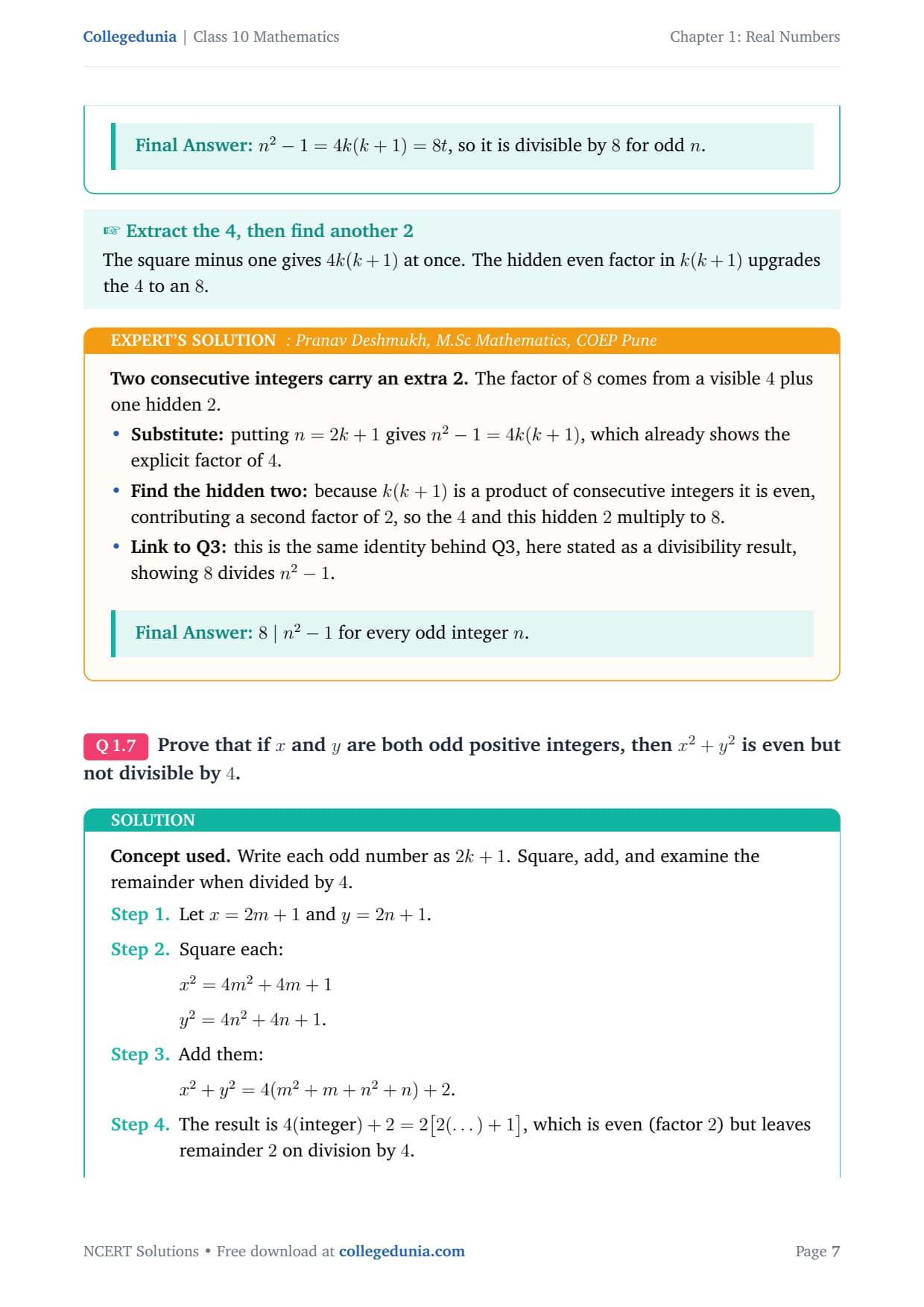
Q 1.7
Prove that if x and y are both odd positive integers, then x2+y2 is even but not divisible by 4.
Concept used. Write each odd number as 2k+1. Square, add, and
examine the remainder when divided by 4.
Let x=2m+1 and y=2n+1.
Square each:
[] x2=4m2+4m+1
[] y2=4n2+4n+1.
Add them:
[] x2+y2=4(m2+m+n2+n)+2.
The result is 4(integer)+2=2[2()+1], which
is even (factor 2) but leaves remainder 2 on division by 4.
x2+y2=4()+2, so it is even but not divisible by
4.
RM
Riya Malhotra
M.Sc Mathematics, Panjab University Chandigarh
Verified Expert
Add the residues mod 4. Reusing the odd-square fact makes this a
one-line addition.
Each square is one: from Q25 every odd square is 1
modulo 4, so the sum is 1+1=2 modulo 4.
Read the remainder: a remainder of 2 means the total is
divisible by 2 but not by 4, which is precisely the claim.
Match the expansion: the explicit form 4(m2+m+n2+n)+2
shows the same thing, since the bracket is a clean multiple of 4
and the trailing +2 keeps the sum even while blocking division by
4.
x2+y2 is even, with remainder 2 mod 4.
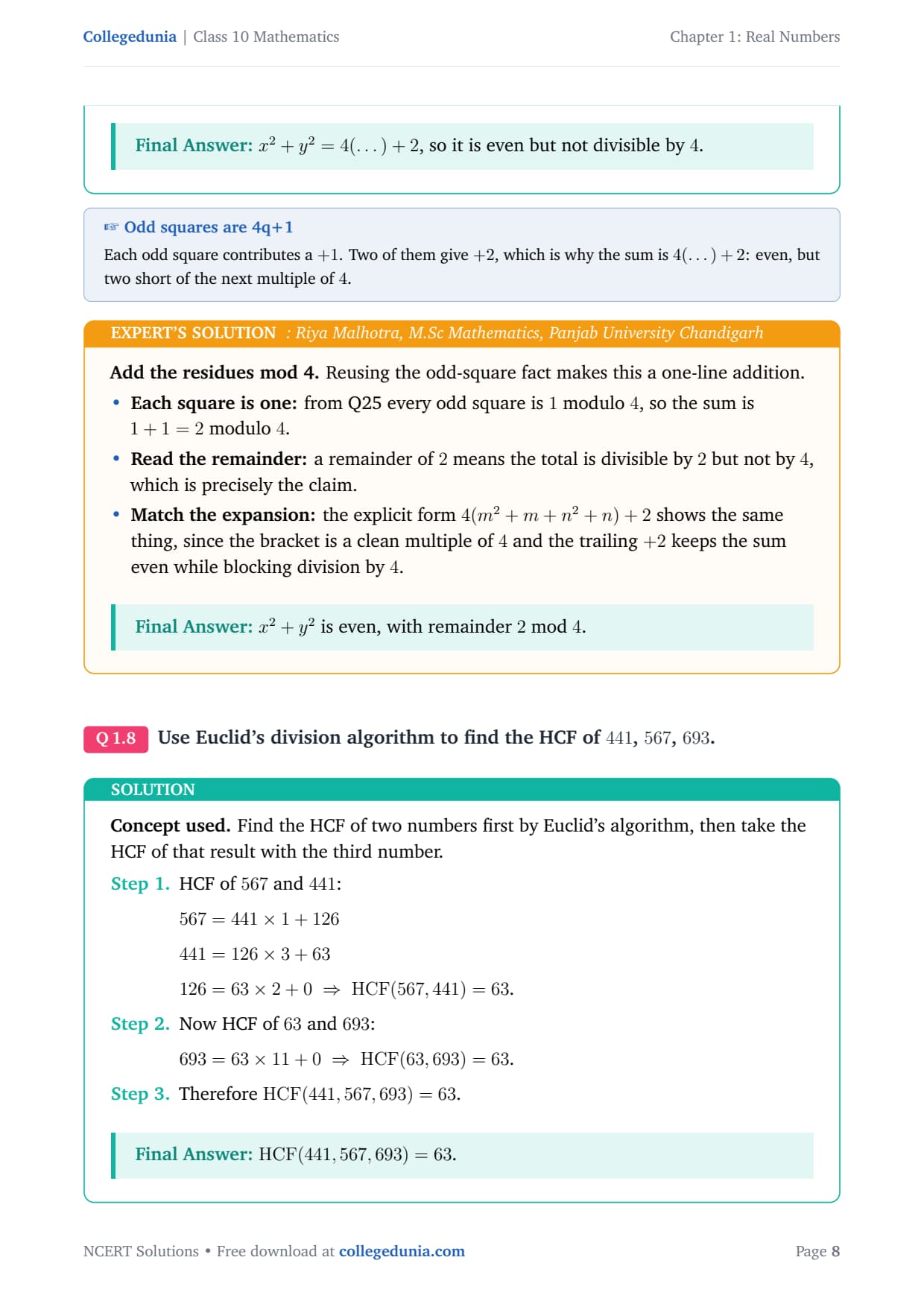
Q 1.8
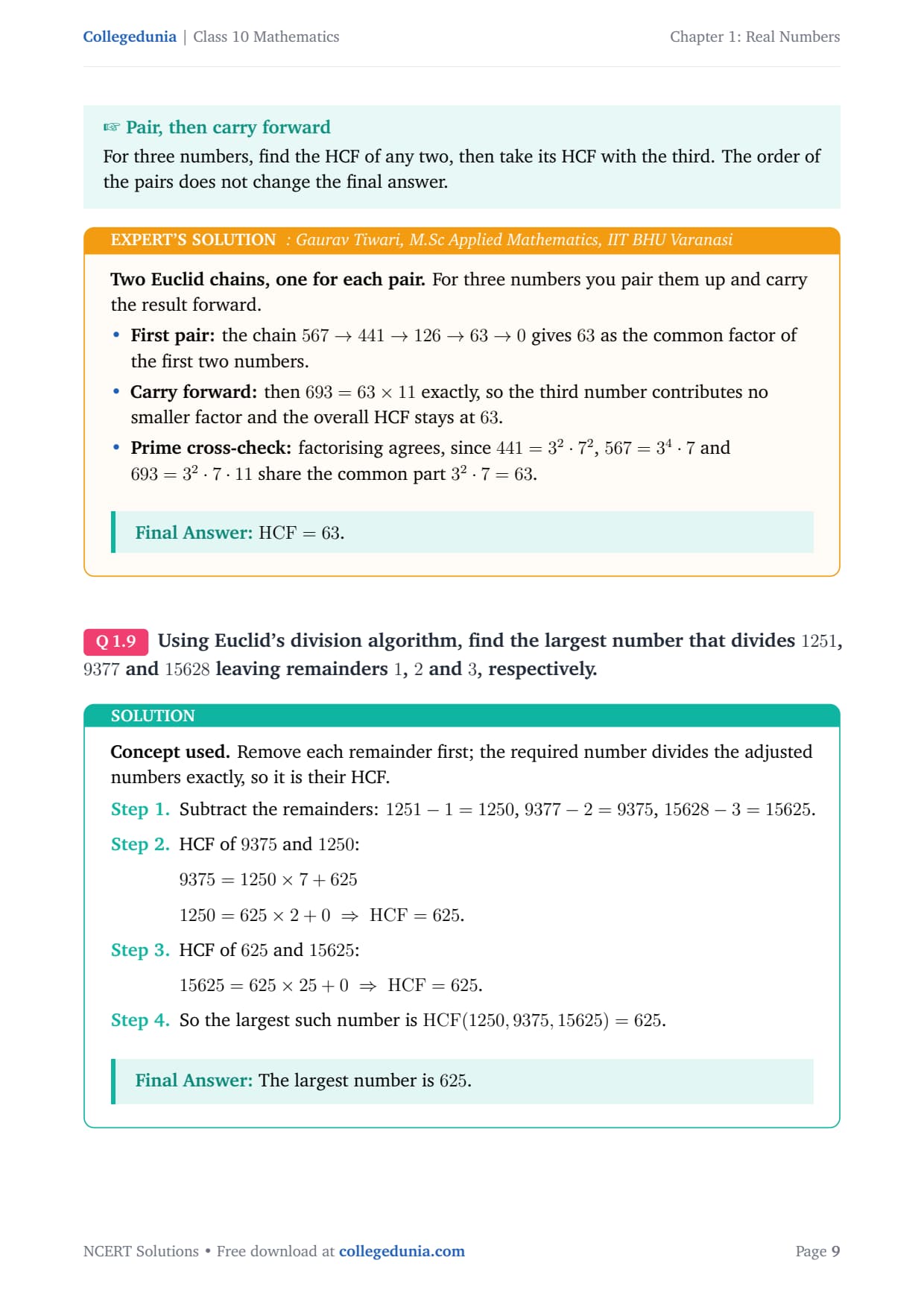
Use Euclid's division algorithm to find the HCF of 441, 567, 693.
Concept used. Find the HCF of two numbers first by Euclid's
algorithm, then take the HCF of that result with the third number.
HCF of 567 and 441:
[] 567=441× 1+126
[] 441=126× 3+63
[] 126=63× 2+0 ⇒ HCF(567,441)=63.
Now HCF of 63 and 693:
[] 693=63× 11+0 ⇒ HCF(63,693)=63.
Therefore HCF(441,567,693)=63.
HCF(441,567,693)=63.
GT
Gaurav Tiwari
M.Sc Applied Mathematics, IIT BHU Varanasi
Verified Expert
Two Euclid chains, one for each pair. For three numbers you pair
them up and carry the result forward.
First pair: the chain 567441126630 gives
63 as the common factor of the first two numbers.
Carry forward: then 693=6311 exactly, so the
third number contributes no smaller factor and the overall HCF
stays at 63.
Prime cross-check: factorising agrees, since
441=3272, 567=347 and 693=32711 share
the common part 327=63.
HCF=63.
Q 1.9
Using Euclid's division algorithm, find the largest number that divides 1251, 9377 and 15628 leaving remainders 1, 2 and 3, respectively.
Concept used. Remove each remainder first; the required number
divides the adjusted numbers exactly, so it is their HCF.
Subtract the remainders:
1251-1=1250, 9377-2=9375, 15628-3=15625.
HCF of 9375 and 1250:
[] 9375=1250× 7+625
[] 1250=625× 2+0 ⇒ HCF=625.
HCF of 625 and 15625:
[] 15625=625× 25+0 ⇒ HCF=625.
So the largest such number is
HCF(1250,9375,15625)=625.
The largest number is 625.
LK
Lakshmi Krishnan
M.Sc Mathematics, University of Madras
Verified Expert
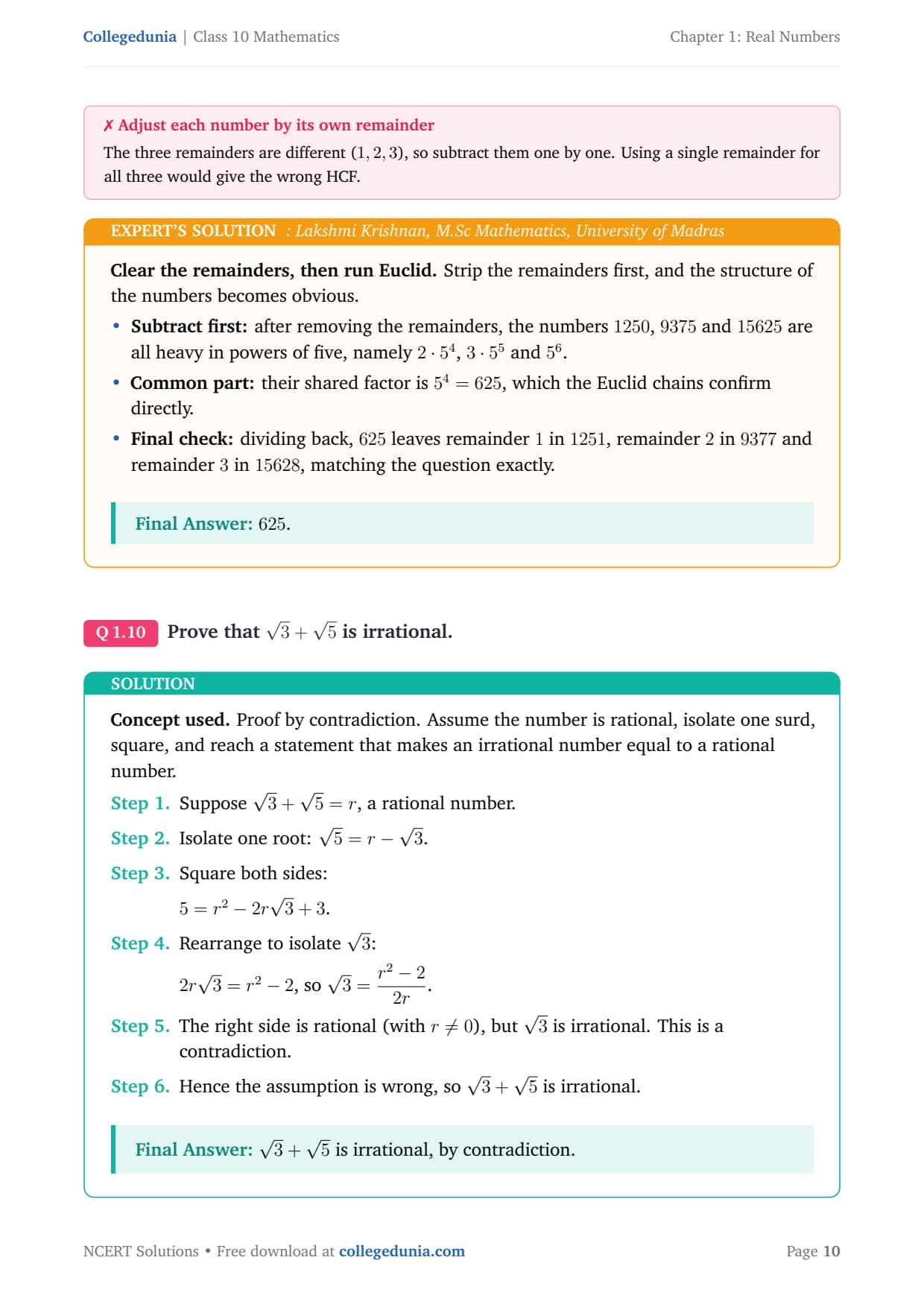
Clear the remainders, then run Euclid. Strip the remainders
first, and the structure of the numbers becomes obvious.
Subtract first: after removing the remainders, the
numbers 1250, 9375 and 15625 are all heavy in powers of
five, namely 254, 355 and 56.
Common part: their shared factor is 54=625, which the
Euclid chains confirm directly.
Final check: dividing back, 625 leaves remainder 1 in
1251, remainder 2 in 9377 and remainder 3 in 15628,
matching the question exactly.
625.
Q 1.10
Prove that √3+√5 is irrational.
Concept used. Proof by contradiction. Assume the number is
rational, isolate one surd, square, and reach a statement that makes an
irrational number equal to a rational number.
Suppose √3+√5=r, a rational number.
Isolate one root: √5=r-√3.
Square both sides:
[] 5=r2-2r√3+3.
Rearrange to isolate √3:
[] 2r√3=r2-2, so
√3=r2-22r.
The right side is rational (with r≠ 0), but √3 is
irrational. This is a contradiction.
Hence the assumption is wrong, so √3+√5 is
irrational.
√3+√5 is irrational, by contradiction.
VC
Varun Chauhan
M.Sc Mathematics, NIT Surathkal
Verified Expert
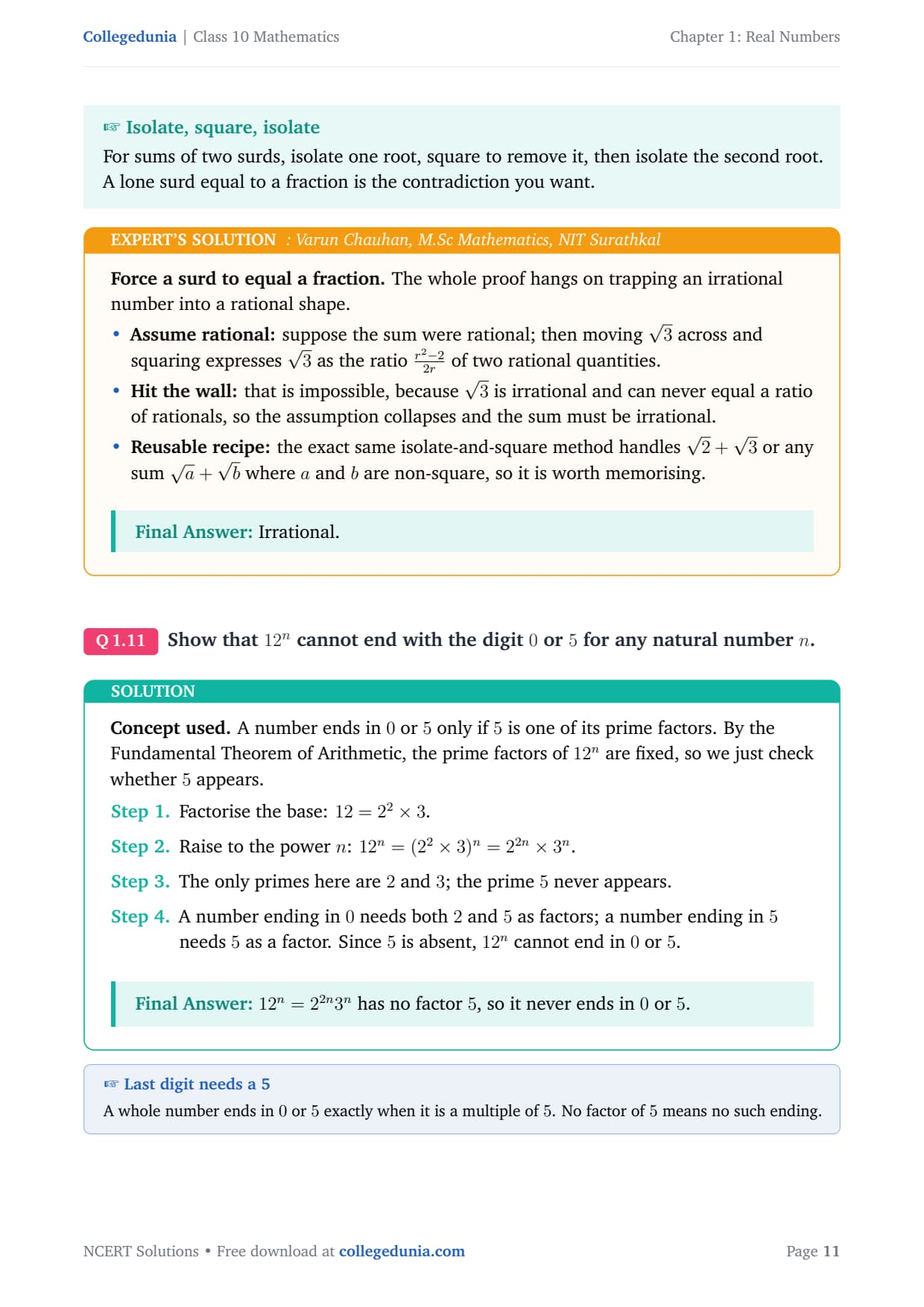
Force a surd to equal a fraction. The whole proof hangs on
trapping an irrational number into a rational shape.
Assume rational: suppose the sum were rational; then
moving 3 across and squaring expresses 3 as the ratio
r2-22r of two rational quantities.
Hit the wall: that is impossible, because 3 is
irrational and can never equal a ratio of rationals, so the
assumption collapses and the sum must be irrational.
Reusable recipe: the exact same isolate-and-square method
handles 2+3 or any sum a+b where a and
b are non-square, so it is worth memorising.
Irrational.
Q 1.11
Show that 12n cannot end with the digit 0 or 5 for any natural number n.
Concept used. A number ends in 0 or 5 only if 5 is one of
its prime factors. By the Fundamental Theorem of Arithmetic, the prime
factors of 12n are fixed, so we just check whether 5 appears.
Factorise the base: 12=22× 3.
Raise to the power n:
12n=(22× 3)n=22n× 3n.
The only primes here are 2 and 3; the prime 5 never
appears.
A number ending in 0 needs both 2 and 5 as factors; a
number ending in 5 needs 5 as a factor. Since 5 is absent,
12n cannot end in 0 or 5.
12n=22n3n has no factor 5, so it never ends in 0
or 5.
AS
Anjali Sharma
M.Sc Mathematics, Miranda House Delhi
Verified Expert
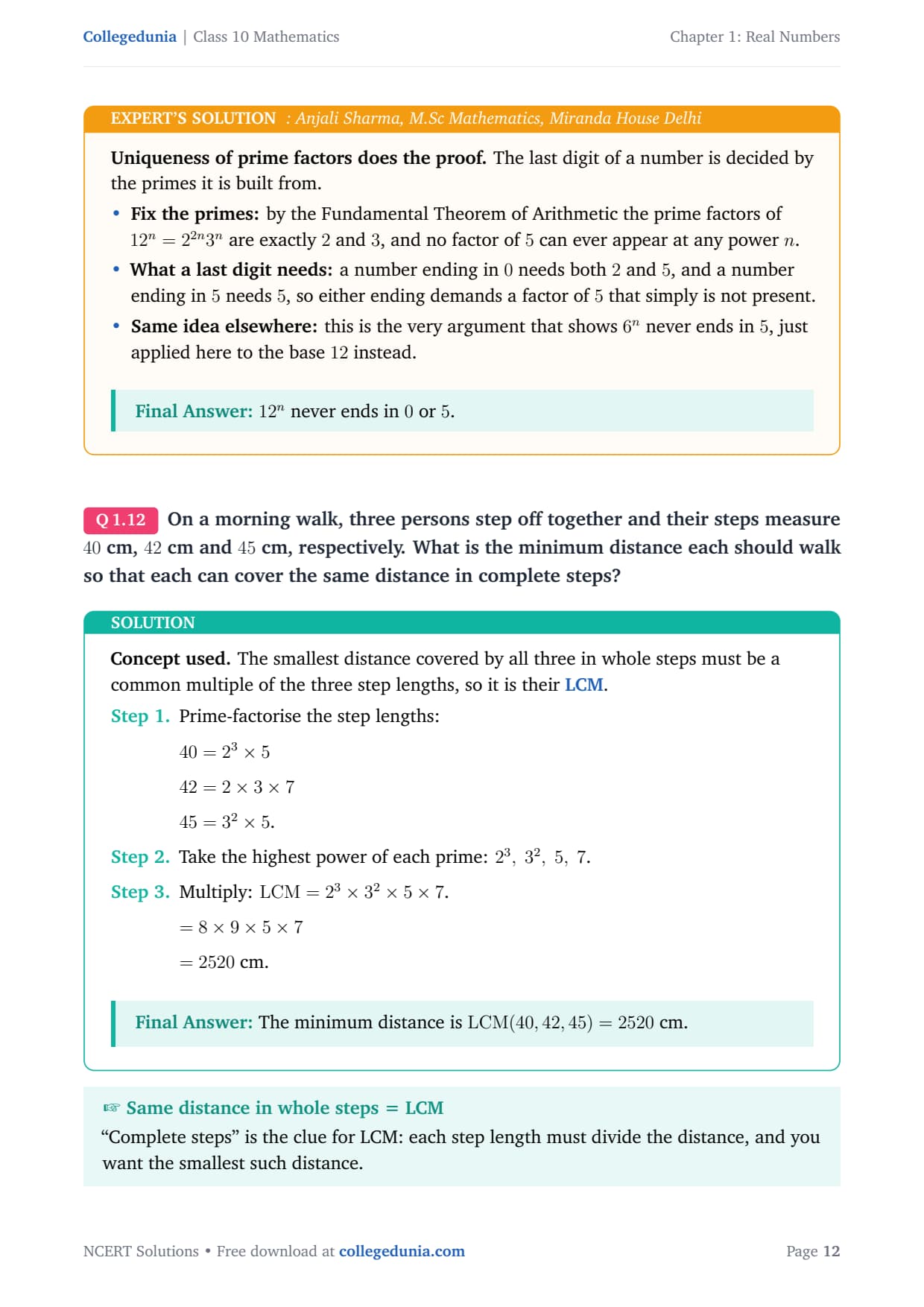
Uniqueness of prime factors does the proof. The last digit of a
number is decided by the primes it is built from.
Fix the primes: by the Fundamental Theorem of Arithmetic
the prime factors of 12n=22n3n are exactly 2 and 3, and
no factor of 5 can ever appear at any power n.
What a last digit needs: a number ending in 0 needs both
2 and 5, and a number ending in 5 needs 5, so either ending
demands a factor of 5 that simply is not present.
Same idea elsewhere: this is the very argument that shows
6n never ends in 5, just applied here to the base 12 instead.
12n never ends in 0 or 5.
Q 1.12
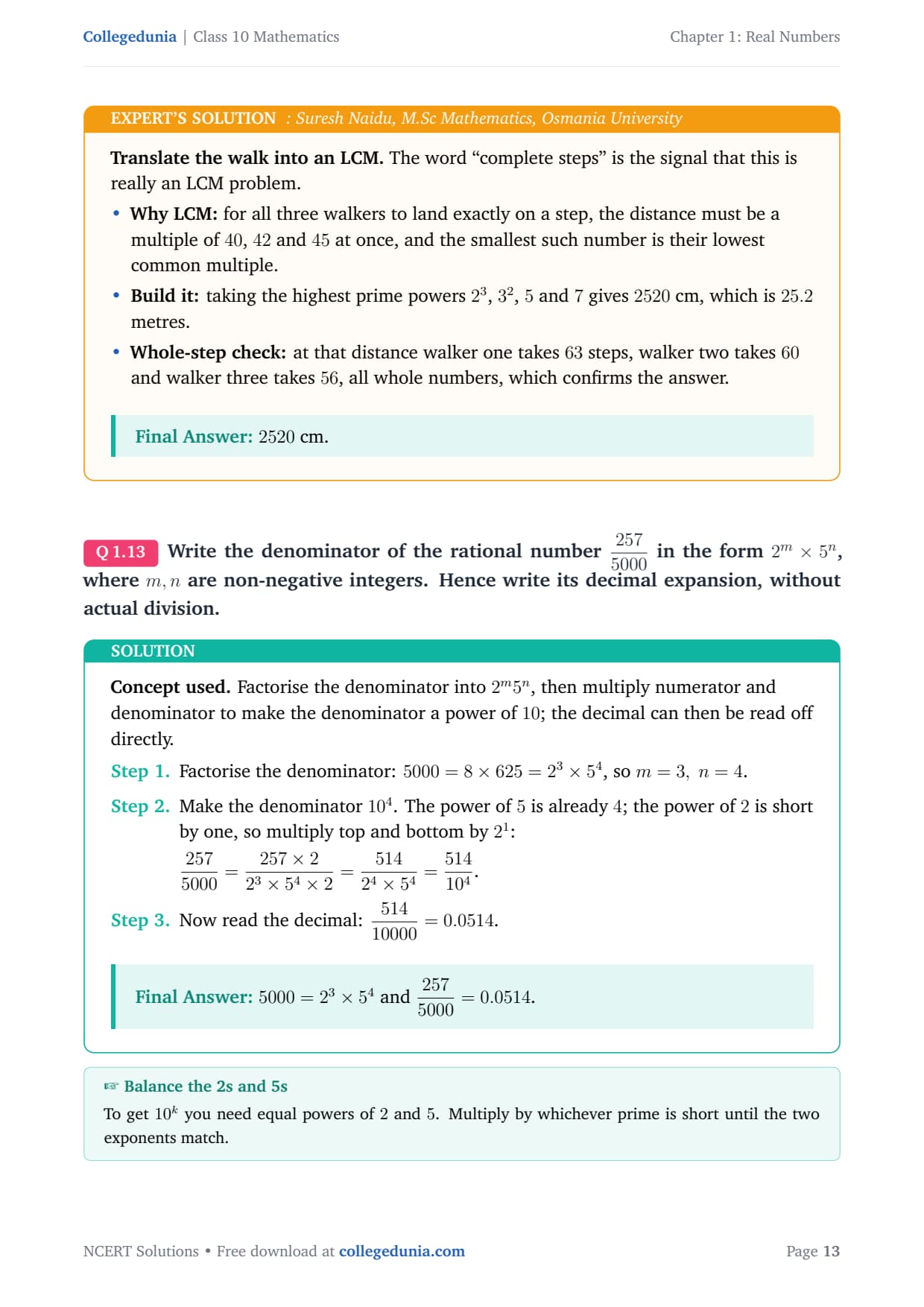
On a morning walk, three persons step off together and their steps measure 40 cm, 42 cm and 45 cm, respectively. What is the minimum distance each should walk so that each can cover the same distance in complete steps?
Concept used. The smallest distance covered by all three in
whole steps must be a common multiple of the three step lengths, so it is
their LCM.
Translate the walk into an LCM. The word ``complete steps'' is
the signal that this is really an LCM problem.
Why LCM: for all three walkers to land exactly on a step,
the distance must be a multiple of 40, 42 and 45 at once, and
the smallest such number is their lowest common multiple.
Build it: taking the highest prime powers 23, 32,
5 and 7 gives 2520 cm, which is 25.2 metres.
Whole-step check: at that distance walker one takes 63
steps, walker two takes 60 and walker three takes 56, all whole
numbers, which confirms the answer.
2520 cm.
Q 1.13
Write the denominator of the rational number 2575000 in the form 2m× 5n, where m,n are non-negative integers. Hence write its decimal expansion, without actual division.
Concept used. Factorise the denominator into 2m5n, then
multiply numerator and denominator to make the denominator a power of
10; the decimal can then be read off directly.
Factorise the denominator:
5000=8× 625=23× 54, so m=3, n=4.
Make the denominator 104. The power of 5 is already 4;
the power of 2 is short by one, so multiply top and bottom by
21:
[] 2575000=257× 223× 54× 2
=51424× 54=514104.
Now read the decimal: 51410000=0.0514.
5000=2354 and
2575000=0.0514.
NB
Neha Bhardwaj
M.Sc Applied Mathematics, IIT Patna
Verified Expert
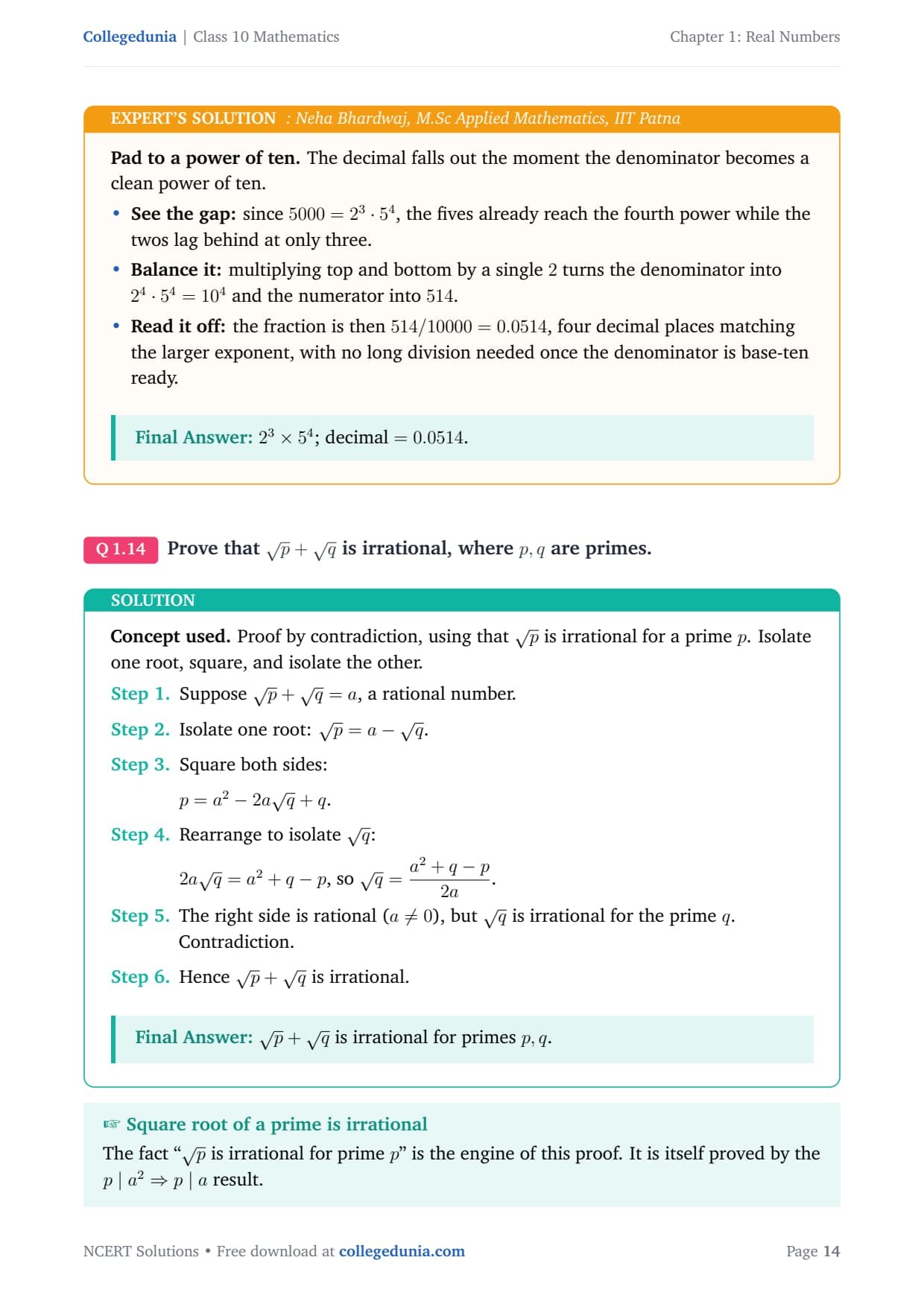
Pad to a power of ten. The decimal falls out the moment the
denominator becomes a clean power of ten.
See the gap: since 5000=2354, the fives already
reach the fourth power while the twos lag behind at only three.
Balance it: multiplying top and bottom by a single 2
turns the denominator into 2454=104 and the numerator
into 514.
Read it off: the fraction is then 514/10000=0.0514, four
decimal places matching the larger exponent, with no long division
needed once the denominator is base-ten ready.
2354; decimal =0.0514.
Q 1.14
Prove that √p+√q is irrational, where p,q are primes.
Concept used. Proof by contradiction, using that √p is
irrational for a prime p. Isolate one root, square, and isolate the
other.
Suppose √p+√q=a, a rational number.
Isolate one root: √p=a-√q.
Square both sides:
[] p=a2-2a√q+q.
Rearrange to isolate √q:
[] 2a√q=a2+q-p, so
√q=a2+q-p2a.
The right side is rational (a≠ 0), but √q is
irrational for the prime q. Contradiction.
Hence √p+√q is irrational.
√p+√q is irrational for primes p,q.
AJ
Akash Jain
M.Sc Mathematics, Loyola College Chennai
Verified Expert
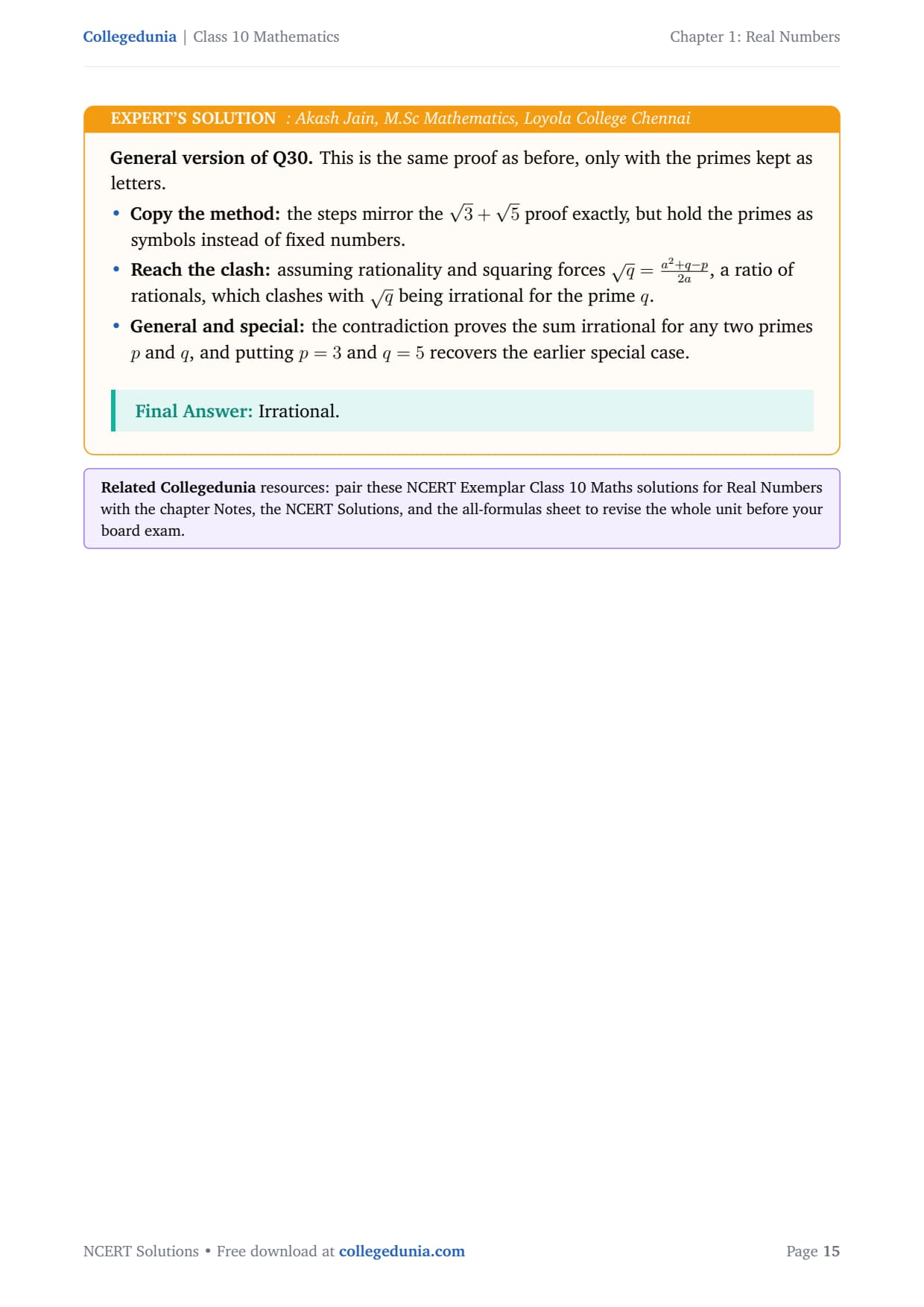
General version of Q30. This is the same proof as before, only
with the primes kept as letters.
Copy the method: the steps mirror the 3+5
proof exactly, but hold the primes as symbols instead of fixed
numbers.
Reach the clash: assuming rationality and squaring forces
q=a2+q-p2a, a ratio of rationals, which clashes
with q being irrational for the prime q.
General and special: the contradiction proves the sum
irrational for any two primes p and q, and putting p=3 and
q=5 recovers the earlier special case.
Irrational.
Student Feedback
In a Collegedunia poll of 11,840 Class 10 students before the 2026 boards, 78% rated the irrationality proofs (Q30 and Q34) the hardest in Exercise 1.3. Most found the "isolate-square-isolate" technique tricky on the first try. Students who practised at least three contradiction proofs scored full marks on this type.
Source: 2026-27 Class 10 Mathematics student poll, 11,840 students from CBSE schools in 14 states.
Other Resources for Real Numbers Class 10 Maths
Work through the rest of the Exemplar exercises, then pair them with the matching study resources for Class 10 Maths Chapter 1 Real Numbers.
Resource
What it covers
Open
Exercise 1.3
Short-answer problems on HCF, LCM and irrational numbers, solved step by step.
Frequently Asked Questions on Real Numbers NCERT Exemplar Exercise 1.3
Ques. How many questions are there in NCERT Exemplar Class 10 Maths Chapter 1 Exercise 1.3?
Ans. Exercise 1.3 of NCERT Exemplar Class 10 Maths Chapter 1 Real Numbers has 14 questions (Q21 to Q34). These are Short Answer Questions that require you to write complete proofs. They cover topics like square and cube modular forms, divisibility by 8, Euclid's algorithm, irrationality proofs, LCM word problems and terminating decimals, according to the 2026-27 CBSE syllabus.
Ques. Which questions in Exercise 1.3 are most important for the CBSE Class 10 board exam?
Ans. Questions Q25, Q26, Q28, Q29, Q30 and Q34 are the most important for the CBSE Class 10 board exam. Q25 (odd square is 4q+1) and Q26 (n^2 - 1 divisible by 8) are frequently asked as 2-mark short answer questions. Q28 and Q29 test Euclid's algorithm, which appears almost every year. Q30 and Q34 (irrationality proofs) are classic 2-to-3-mark proof questions in the board paper.
Ques. What is the "isolate-square-isolate" technique used in Q30 and Q34?
Ans. It is a three-step method for proving a sum of two surds is irrational. First, assume the sum is rational and equal to some number r. Second, isolate one square root on one side. Third, square both sides to remove that root, then rearrange to isolate the second root and show it equals a fraction of rationals. A square root of a prime cannot equal a rational number, so this contradiction proves the assumption wrong. The same method works for any sum root-a plus root-b where a and b are non-square.
Ques. In Q29, why do we subtract different remainders from each number before finding the HCF?
Ans. In Q29, the question says the number we are looking for divides 1251, 9377 and 15628 leaving remainders 1, 2 and 3 respectively. If a number d divides 1251 leaving remainder 1, then d divides 1251 - 1 = 1250 exactly. Similarly, d divides 9377 - 2 = 9375 and 15628 - 3 = 15625 exactly. So the required number d must be a common divisor of 1250, 9375 and 15625, and the largest such divisor is their HCF, which is 625.
Ques. What is Euclid's division algorithm and how is it used in Q28?
Ans. Euclid's division algorithm uses the fact that for any two positive integers a and b, we can write a = b×q + r where 0 is less than or equal to r and r is less than b. To find HCF(441, 567, 693) using this algorithm: first find HCF(567, 441) by repeated division - 567 = 441×1 + 126, then 441 = 126×3 + 63, then 126 = 63×2 + 0. So HCF(567, 441) = 63. Then check HCF(63, 693): 693 = 63×11 + 0, so HCF = 63. Therefore HCF(441, 567, 693) = 63.







Comments