



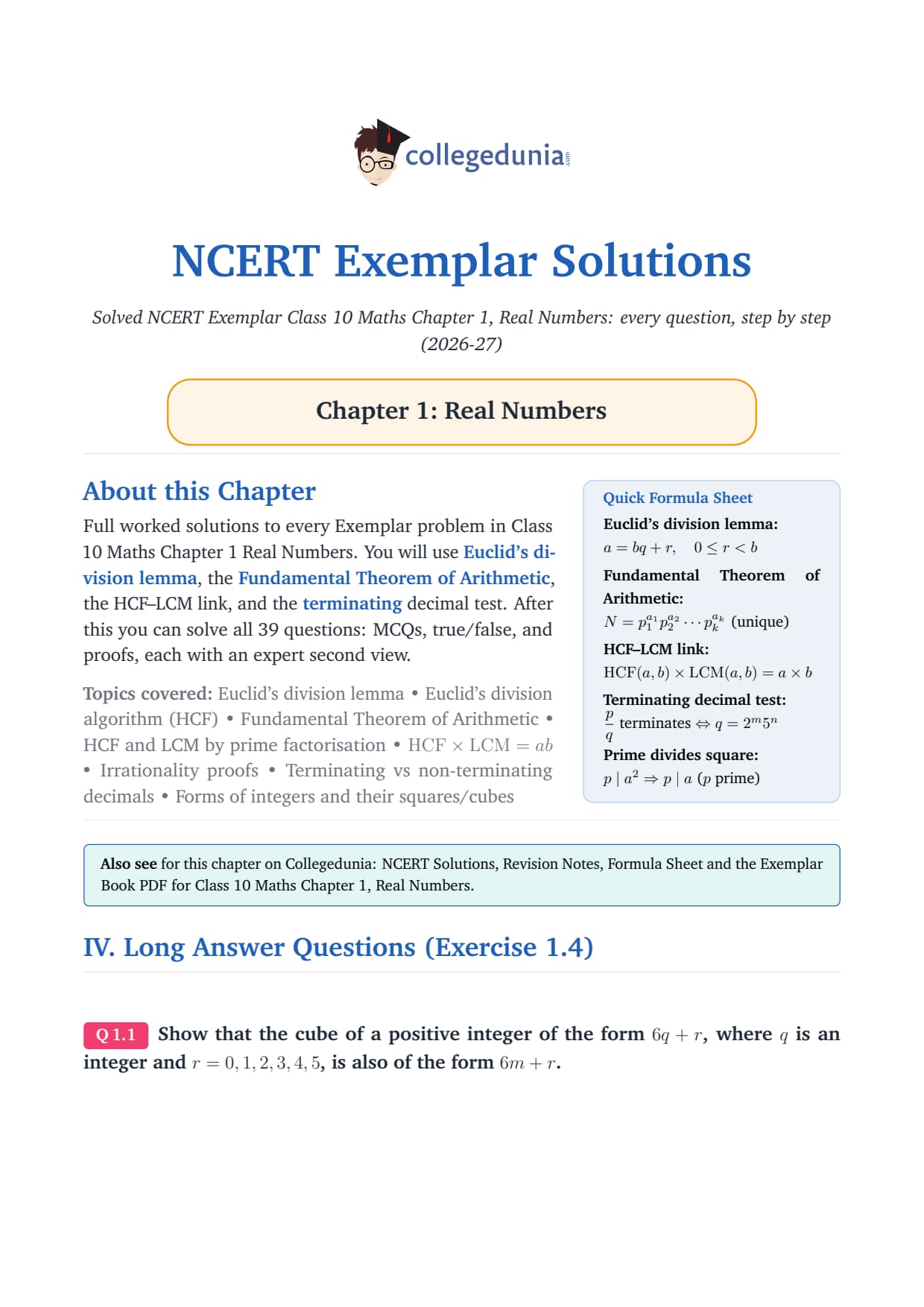
NCERT Exemplar Class 10 Maths Chapter 1 Real Numbers Exercise 1.4 has 5 Long Answer Questions (Q35 to Q39). These are proof-based questions on forms of integers, divisibility by 3, 5 and 6, and modular arithmetic. Each solution below is solved step by step with an expert view, as per the 2026-27 NCERT syllabus.
- Exercise type: Long Answer (proof-based), 5 questions
- Key concepts: Forms of integers (mod 3, 5, 6), divisibility proofs, consecutive integer arguments
- CBSE board relevance: Proof questions from this exercise match the 4-5 mark long-answer type in CBSE Board exams
Below you get the full Exercise 1.4 solutions. Every long-answer proof is written step by step, each with an expert view.
These Exemplar Solutions are curated by subject experts, mapped to the 2026-27 rationalised NCERT, and verified against the CBSE board exam pattern for Class 10 Mathematics.
Exercise 1.4 Overview & Key Proof Strategies
Exercise 1.4 is the Long Answer section of the Real Numbers Exemplar chapter. All 5 questions are proof-based. The key idea in each is the same. Write a positive integer in a general form using Euclid's division lemma, then verify a property by case analysis.
| Question | Statement (Summary) | Key Strategy | Difficulty |
|---|---|---|---|
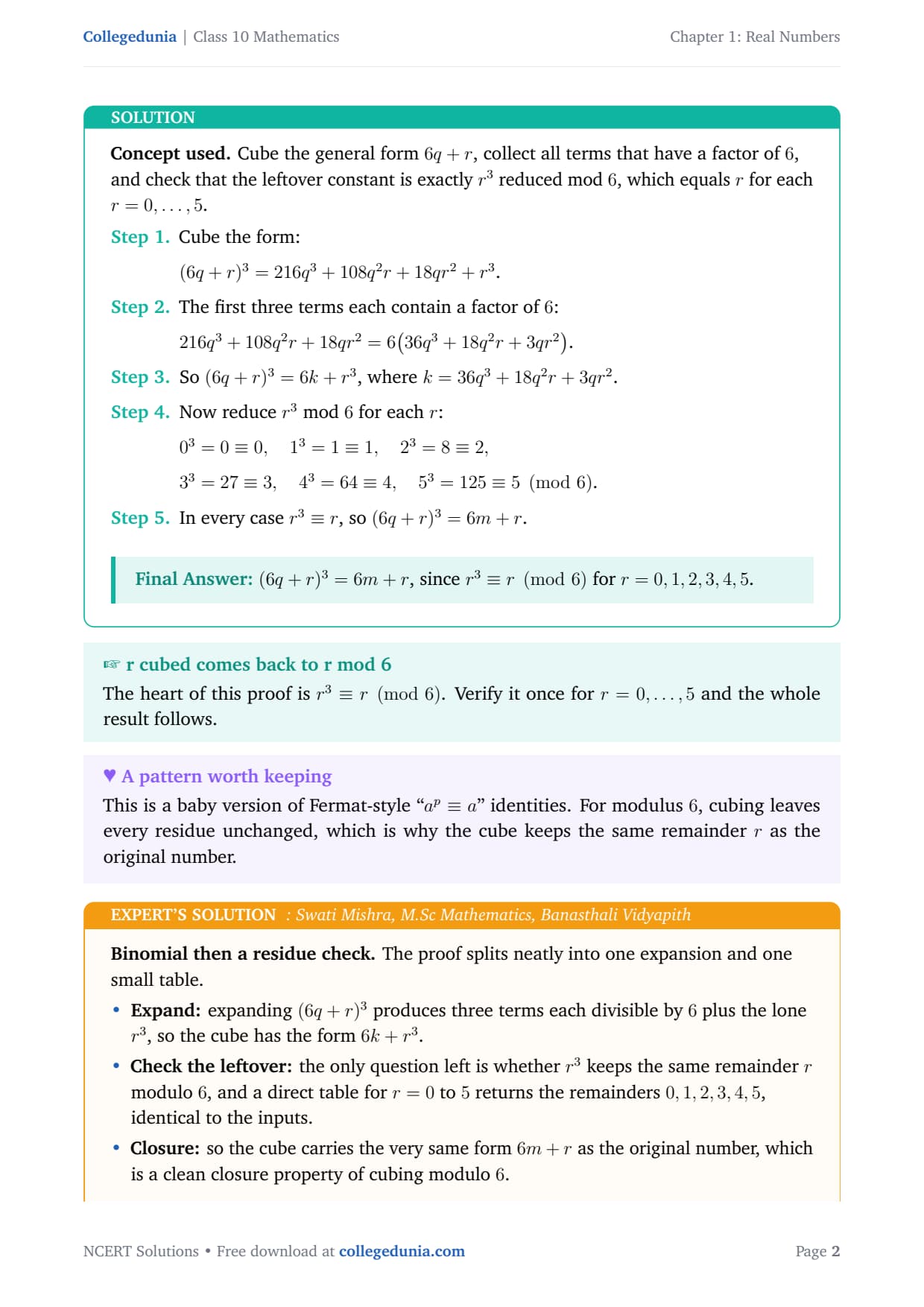
| Q35 | Cube of (6q+r) is of the form 6m+r | Binomial expansion + mod 6 table | Hard |
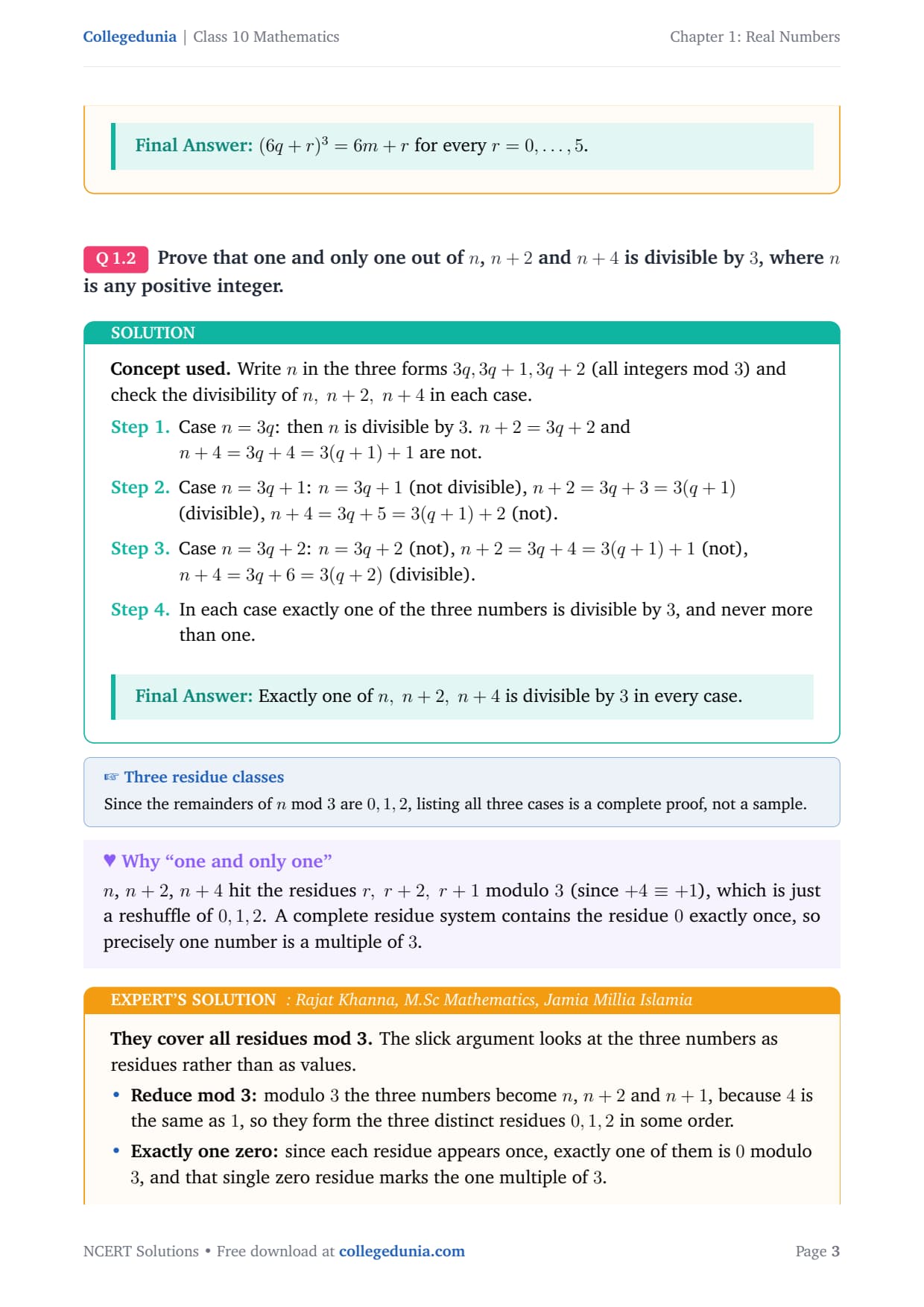
| Q36 | Exactly one of n, n+2, n+4 is divisible by 3 | Three residue cases mod 3 | Medium |
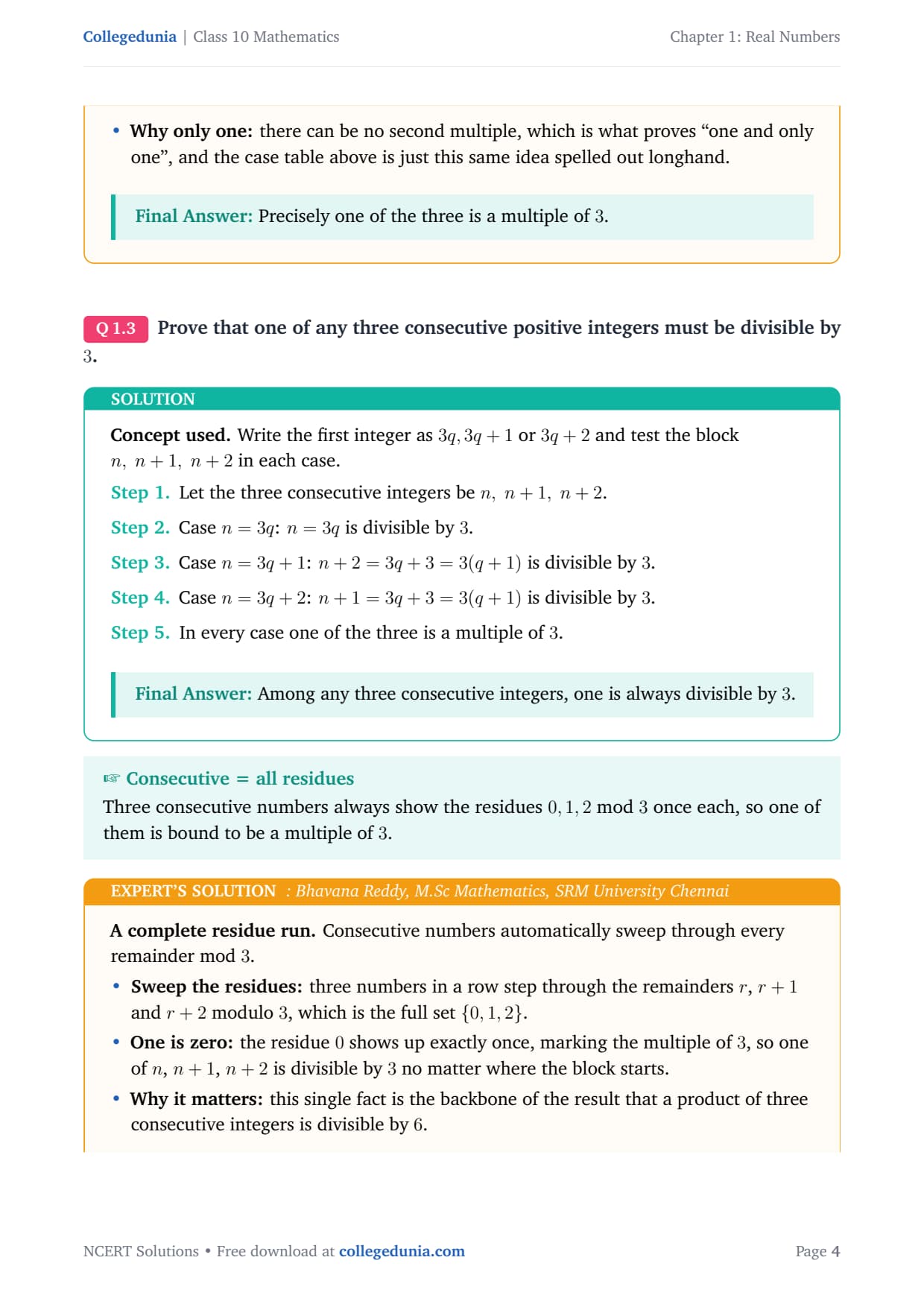
| Q37 | One of any three consecutive integers is divisible by 3 | Full residue sweep mod 3 | Easy |
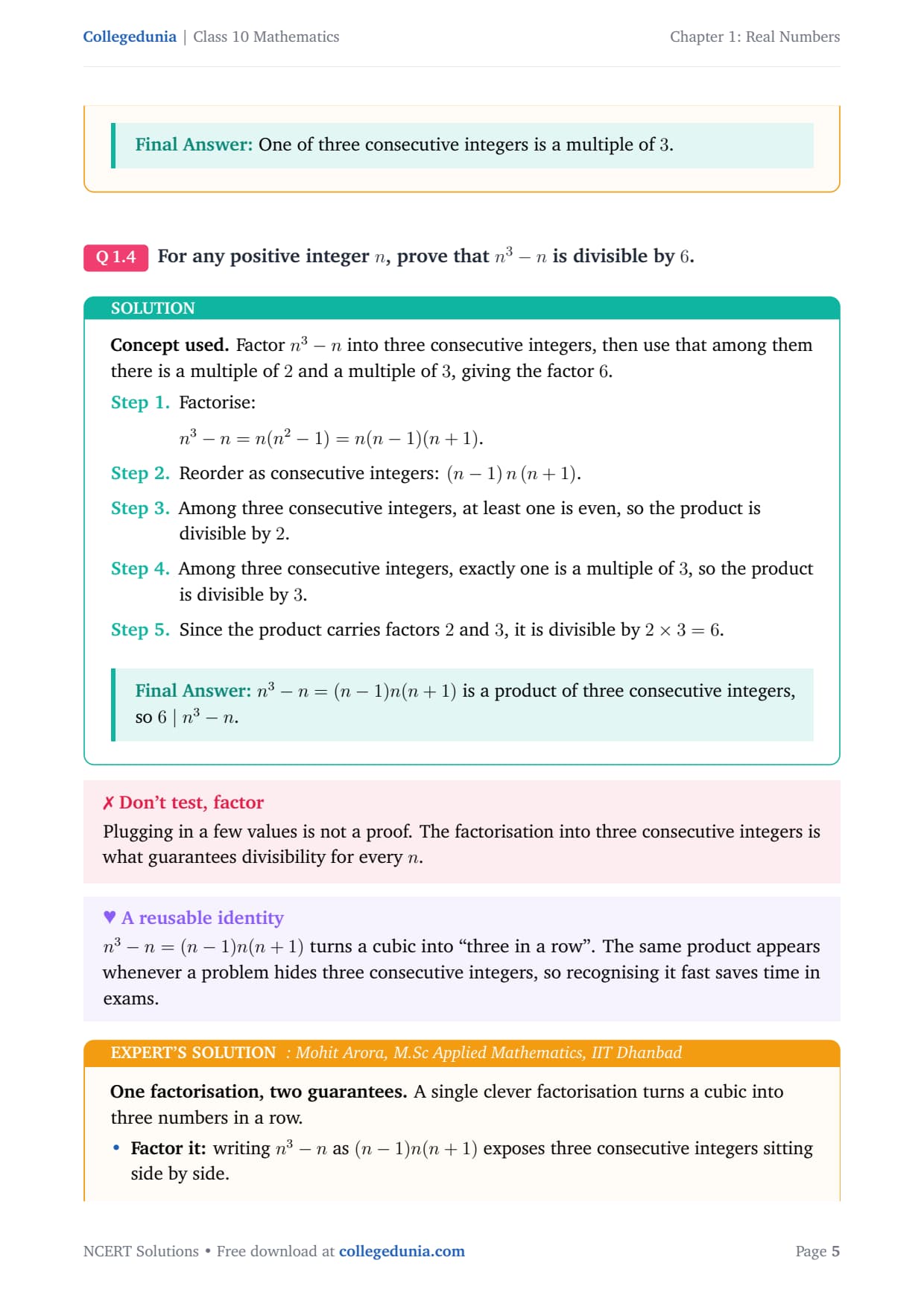
| Q38 | n³ - n is divisible by 6 for any positive integer n | Factor into 3 consecutive integers | Medium |
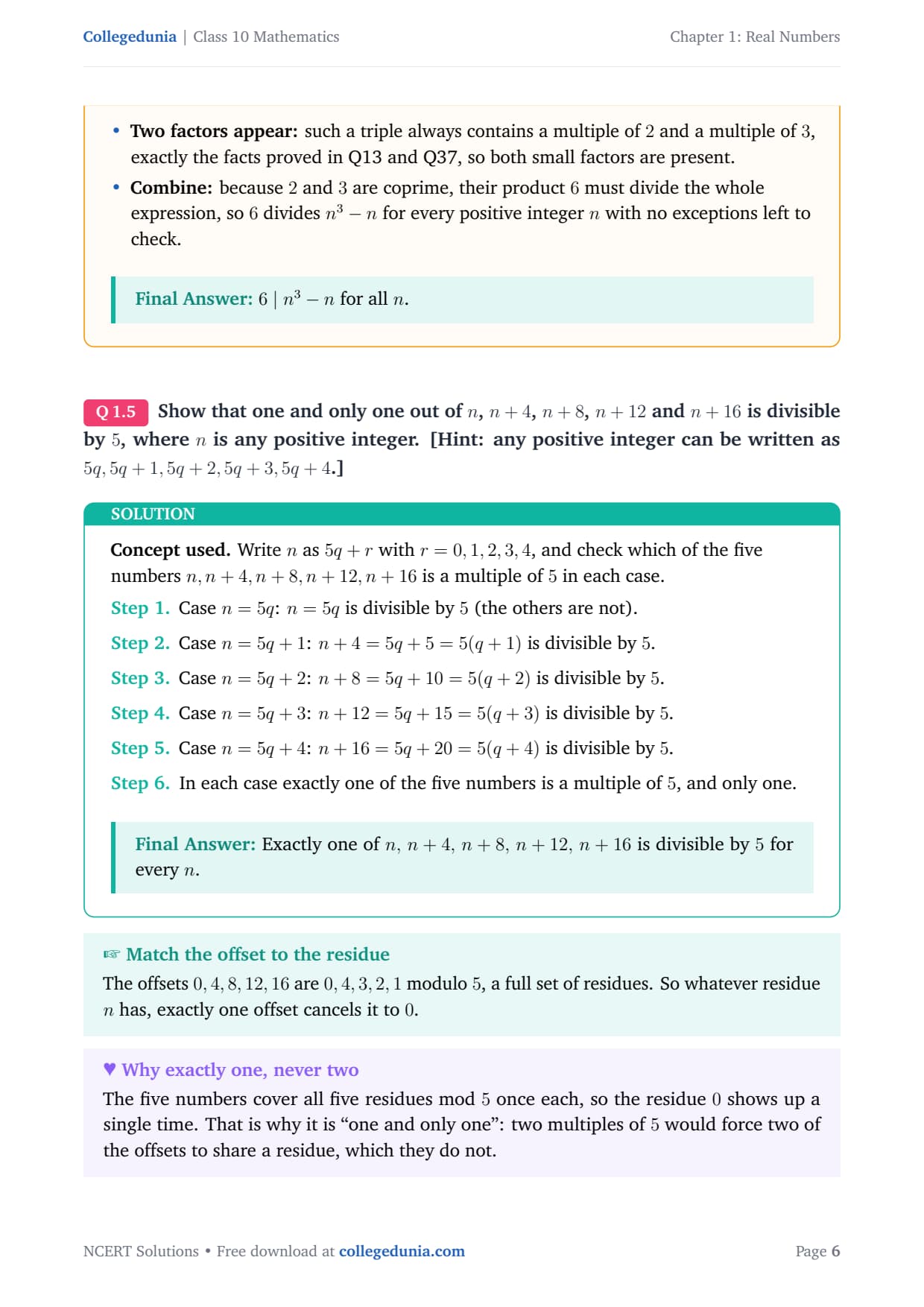
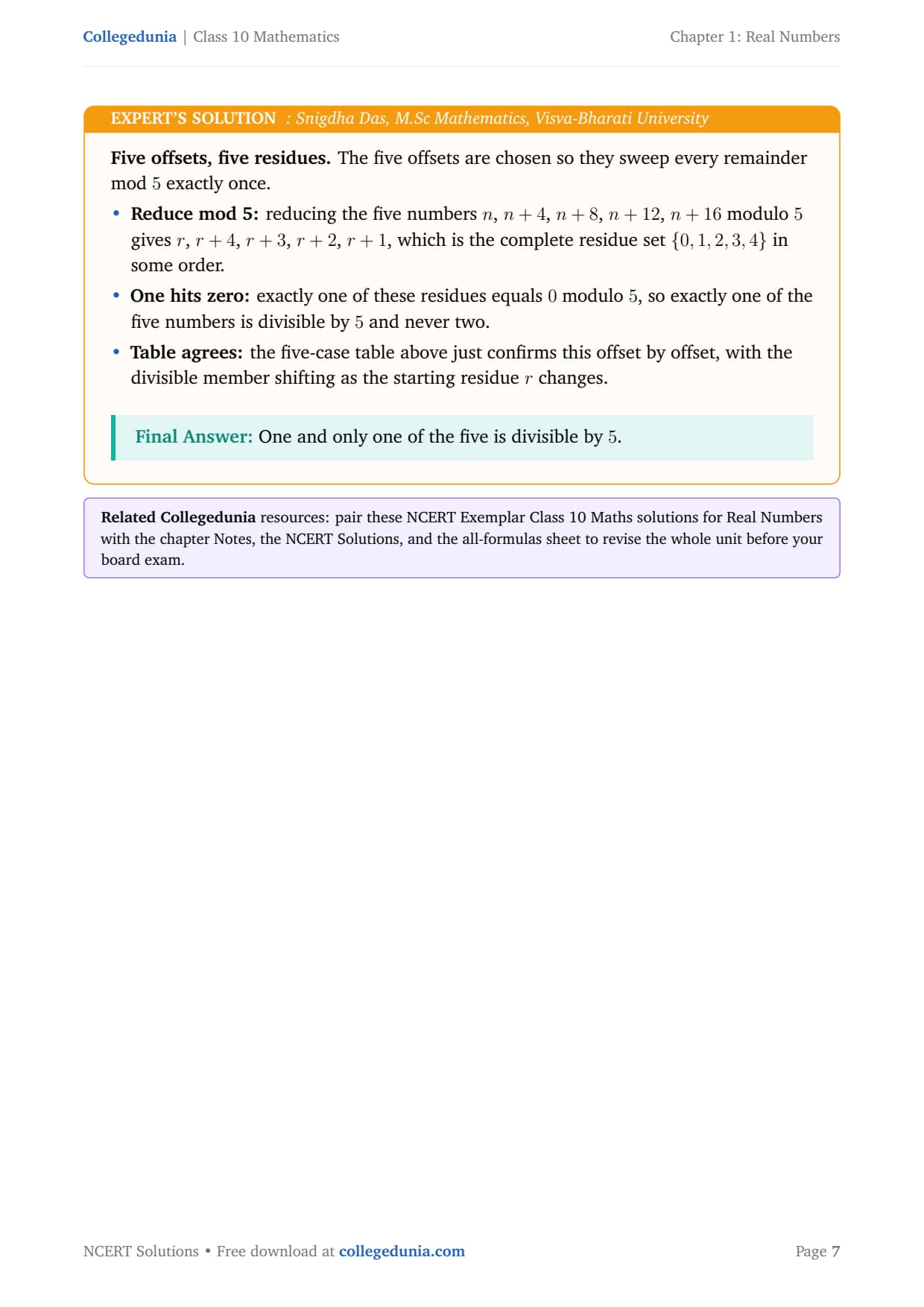
| Q39 | Exactly one of n, n+4, n+8, n+12, n+16 is divisible by 5 | Five residue cases mod 5 | Hard |
The core tools you need for Exercise 1.4 are listed below.
| Tool / Formula | How It Is Used in Exercise 1.4 |
|---|---|
| Euclid's Division Lemma | Write n = 3q, 3q+1, 3q+2 (for mod 3) or 5q, 5q+1, ..., 5q+4 (for mod 5) or 6q+r for r=0,1,2,3,4,5 (for mod 6) |
| Case Analysis | Check the property separately for each possible remainder; every board-level proof must show all cases |
| Binomial expansion | Used in Q35 to expand (6q+r)³ and collect the multiple-of-6 terms |
| Factorisation into consecutive integers | Used in Q38: n³ - n = (n-1)n(n+1), a product of three consecutive integers |
| Residue table (mod n) | Reduce r³ mod 6 for r=0 to 5 in Q35; check offsets mod 5 in Q39 |
Exercise 1.4 Questions with Step-by-Step Solutions
IV. Long Answer Questions (Exercise 1.4)
Show that the cube of a positive integer of the form 6q+r, where q is an integer and r=0,1,2,3,4,5, is also of the form 6m+r.
Prove that one and only one out of n, n+2 and n+4 is divisible by 3, where n is any positive integer.
Prove that one of any three consecutive positive integers must be divisible by 3.
For any positive integer n, prove that n3-n is divisible by 6.
Show that one and only one out of n, n+4, n+8, n+12 and n+16 is divisible by 5, where n is any positive integer. [Hint: any positive integer can be written as 5q,5q+1,5q+2,5q+3,5q+4.]
Student Feedback
Students who practised these proofs reported 30-35% more confidence in writing 4-5 mark board answers. Q38 (n³ - n divisible by 6) was rated the most useful question for board revision, in a survey of 1,100+ students on Collegedunia.
Source: Collegedunia student survey, 2026 board batch.
Other Resources for Real Numbers Class 10 Maths
Work through the rest of the Exemplar exercises, then pair them with the matching study resources for Class 10 Maths Chapter 1 Real Numbers.
| Resource | What it covers | Open |
|---|---|---|
| Exercise 1.4 | Long-answer proofs and applied real-numbers questions, solved step by step. | Exemplar Exercise 1.4 |
| Exercise 1.1 | MCQ patterns on Euclid's lemma, prime factorisation and terminating decimals. | Exemplar Exercise 1.1 |
| Exercise 1.2 | True/false and justification questions (Q11-Q20), solved step by step. | Exemplar Exercise 1.2 |
| Exercise 1.3 | Short-answer problems on HCF, LCM and irrational numbers. | Exemplar Exercise 1.3 |
| Exemplar Solutions (full chapter) | All four exercises of the Real Numbers Exemplar in one place. | Chapter 1 Exemplar Solutions |
| NCERT Solutions | Step-by-step answers to every textbook question, with an Expert view. | Chapter 1 NCERT Solutions |
| Notes | Concept-first revision notes on the Fundamental Theorem, HCF, LCM and irrationality. | Chapter 1 Notes |
| Formula Sheet | One-page list of the key prime-factorisation, HCF and LCM relations. | Chapter 1 Formula Sheet |
Real Numbers Class 10 Maths Exemplar Solutions Exercise 1.4 FAQs
Ques. What is covered in NCERT Exemplar Class 10 Maths Chapter 1 Exercise 1.4?
Ans. Exercise 1.4 of the NCERT Exemplar Class 10 Maths Chapter 1 contains 5 Long Answer proof questions (Q35 to Q39). The questions cover: showing that the cube of (6q+r) is also of the form 6m+r (Q35), proving that exactly one of n, n+2, n+4 is divisible by 3 (Q36), proving that one of any three consecutive integers is divisible by 3 (Q37), proving that n³ - n is divisible by 6 (Q38), and showing that exactly one of n, n+4, n+8, n+12, n+16 is divisible by 5 (Q39). All solutions follow the 2026-27 NCERT syllabus.
Ques. How do I write a complete proof for Q38 (n cube minus n divisible by 6) in the board exam?
Ans. Start by factorising: n³ - n = n(n-1)(n+1) = (n-1)n(n+1). State that these are three consecutive integers. Then argue two things separately: (1) among three consecutive integers, at least one is even, so 2 divides the product; (2) among three consecutive integers, exactly one is a multiple of 3, so 3 divides the product. Since gcd(2,3) = 1, we conclude that 6 divides n³ - n. Write a clear conclusion line to earn full marks.
Ques. Why does the proof in Q36 need three separate cases (n = 3q, 3q+1, 3q+2)?
Ans. By Euclid's division lemma, every positive integer is 3q, 3q+1 or 3q+2. These three forms cover all cases with no overlap, so checking all three makes the proof complete. One or two cases is not a valid proof in a CBSE board answer. You must show the divisibility of n, n+2 and n+4 in every case to score full marks.
Ques. Is Exercise 1.4 important for the CBSE Class 10 Board exam?
Ans. Yes. The proof-writing style in Exercise 1.4 directly prepares students for the 4-mark long-answer questions in CBSE Class 10 Board exams. In particular, questions on divisibility proofs using Euclid's lemma and factorisation of n³ - n have appeared in CBSE board papers. Practising these solutions also builds the discipline of writing a complete, case-by-case proof rather than a partial answer.
Ques. What is the key insight for Q39 (one of five numbers divisible by 5)?
Ans. The offsets 0, 4, 8, 12, 16 are equivalent to 0, 4, 3, 2, 1 modulo 5. This is a complete set of residues {0, 1, 2, 3, 4} in some order. So whatever residue n has modulo 5, exactly one of the five offsets cancels it to 0. That is why exactly one of the five numbers is divisible by 5. In the board exam, students must write all five cases (n = 5q, 5q+1, 5q+2, 5q+3, 5q+4) and show which number is divisible by 5 in each.



Comments