Maths Mentor, Delhi University | Updated 3+ months ago
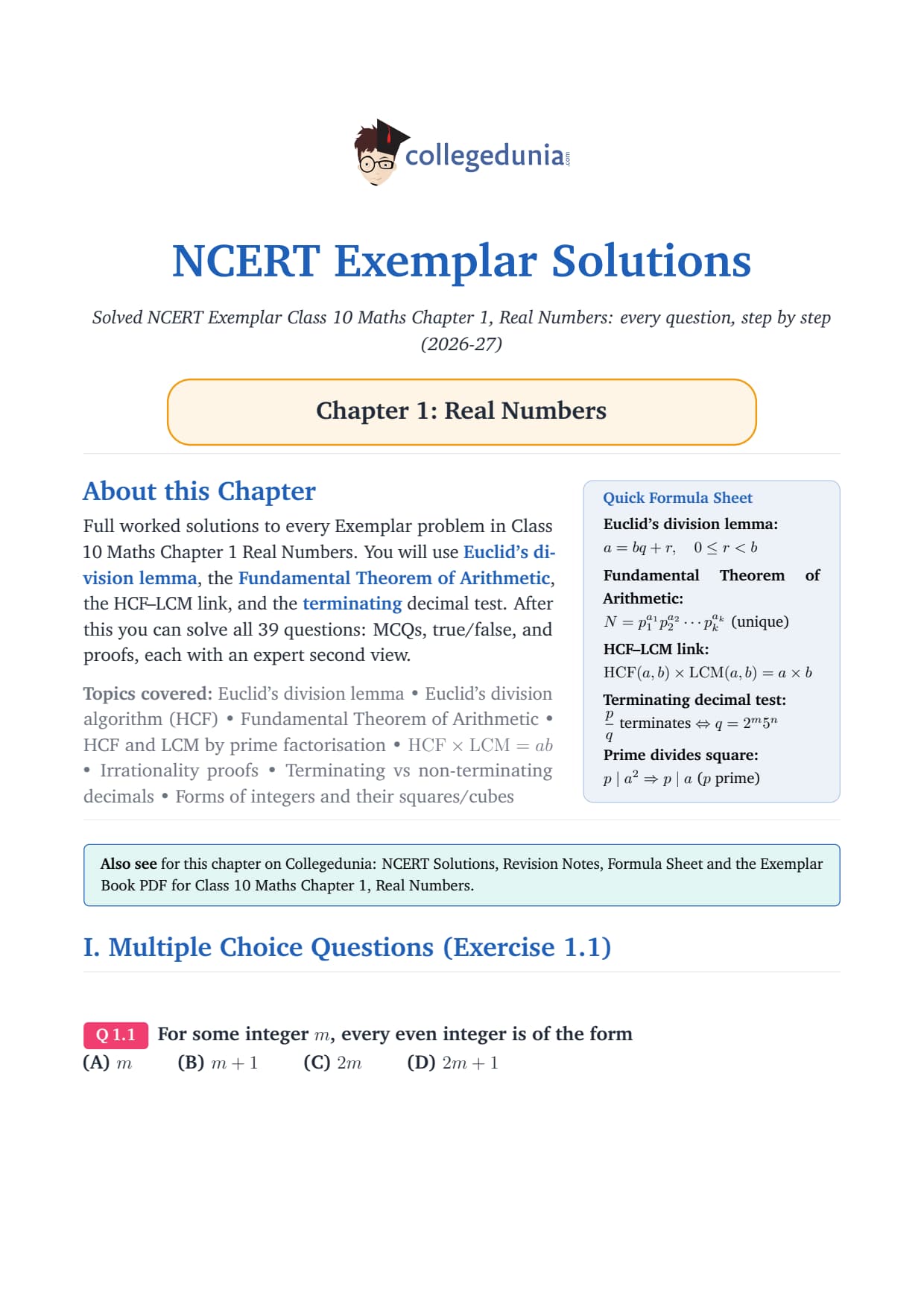
The NCERT Exemplar Solutions for Class 10 Maths Chapter 1 Real Numbers solve every Exemplar problem on Euclid's division lemma, the Fundamental Theorem of Arithmetic, the HCF-LCM link, irrationality proofs and the terminating-decimal test, on the 2026-27 CBSE syllabus. Each of the 39 problems has a step-by-step answer and a topper-style expert view, so you can practise beyond the textbook and lock in board marks.
Covers all 39 Exemplar questions across Exercises 1.1 to 1.4, split into MCQ, True or False, Short Answer and Long Answer.
Real Numbers sits in the Number Systems unit, worth about 6 marks in the CBSE board paper.
Pairs with the NCERT Solutions, Notes and Exemplar Book PDF linked lower on this page.
Every solution here is written by subject experts from the official NCERT Exemplar Problems book and checked against the latest CBSE marking scheme.
Solved by Collegedunia: Every question below carries a step-by-step Solution and an Expert Solution, written in the CBSE marking-scheme style for the 2026-27 session.
Exercise-wise Question Map for Real Numbers Class 10 Maths
The table groups all 39 Exemplar questions by exercise and the skill each one tests.
Exercise
Type
Questions
What It Tests
Exercise 1.1
Multiple Choice (MCQ)
10
Even and odd forms, Euclid HCF, HCF and LCM from prime powers, terminating decimals
Exercise 1.2
True or False with reasoning
10
Residue-class claims, divisibility of products, the HCF-divides-LCM rule
Exercise 1.3
Short Answer (SA)
14
Square and cube forms mod 4, 5 and 6, Euclid HCF, surd irrationality, terminating decimals
Exercise 1.4
Long Answer (LA)
5
Full proofs on cubes mod 6 and one-and-only-one divisibility by 3, 5 and 6
The board paper rarely copies an Exemplar question word for word, but it reuses the same proof patterns: a residue-class argument, an HCF or LCM sum, and an irrationality proof.
What's Inside the Real Numbers Exemplar PDF
The PDF solves every Exemplar problem in Real Numbers in a CBSE marker-friendly format that names the rule before using it.
Concept opener on every answer, naming the rule used: Euclid's lemma, the Fundamental Theorem of Arithmetic, or the residue-class method.
Full working shown for each prime factorisation and Euclid division chain, so the marker can tick every step.
Expert Solution on every question, with a faster residue-table route and a note on what the examiner checks.
Common-mistake call-outs after key proofs, such as testing a few numbers instead of proving the general form.
The Four Question Types in Real Numbers Exemplar
The Exemplar set is the part of this chapter that goes beyond the textbook. Knowing how each of the four question types is marked helps you write answers in the shape CBSE rewards.
MCQ (Exercise 1.1). Single-answer questions worth 1 mark each. The trick is to reject wrong options fast with one counter-example, then confirm the survivor.
True or False (Exercise 1.2). A verdict plus a reason. A "for every" claim is broken by a single counter-example, so always test the boundary cases.
Short Answer (Exercise 1.3). Two to three marks. These are mostly residue-class proofs and Euclid HCF sums where every step must be written out.
Long Answer (Exercise 1.4). Full proofs worth 4 to 5 marks, such as cubes mod 6 or one-and-only-one divisibility, where the case split must be complete.
Important Topics & Weightage in Real Numbers Class 10 Maths
The table groups the chapter topics by the skill CBSE tests and the typical mark value.
Topic
What CBSE Tests
Marks
Euclid's division lemma and algorithm
Finding HCF by repeated division, largest-divisor word problems
2 to 3
Fundamental Theorem of Arithmetic
HCF and LCM from prime powers, composite-number reasoning
1 to 3
Residue-class proofs
Showing a square or cube has only certain forms mod 4, 5 or 6
3 to 5
Irrational numbers
Proving sums of surds like root 3 plus root 5 irrational by contradiction
3
Terminating decimals
Testing if p over q terminates from the form of the denominator
1 to 2
One-and-only-one divisibility
Proving exactly one of several numbers is a multiple of 3 or 5
4 to 5
Exam Tip: In any "square cannot be of the form" proof, square the form, not the number. Squaring the general residues proves the claim for every integer, which a few examples never can.
Solved Example: Proving root 3 plus root 5 Is Irrational
The example below shows the exact answer shape a CBSE marker expects for a 3-mark irrationality proof.
Question (3 marks). Prove that √3 + √5 is irrational.
Step 1, Assume the opposite. Suppose √3 + √5 = r, a rational number.
Step 2, Isolate one surd. Move root 3 across: √5 = r − √3.
Step 3, Square both sides. This gives 5 = r2 − 2r√3 + 3.
Step 4, Isolate the second surd. Rearranging, 2r√3 = r2 − 2, so √3 = r2 − 22r, which is rational.
Step 5, Conclude. But root 3 is irrational, so it cannot equal a ratio of rationals. This contradiction means the assumption was wrong. Therefore √3 + √5 is irrational.
Common Mistakes in Real Numbers Class 10 Maths
Testing numbers instead of proving the form. Showing that 4, 9 and 16 are not of the form 3m+2 is not a proof. Squaring the general residues 3k, 3k+1, 3k+2 is what settles it for every integer.
Not removing the remainder first. In "largest number that divides leaving remainder r" problems, subtract each remainder before taking the HCF, and use each number's own remainder.
Skipping the HCF-divides-LCM check. A pair like HCF 18 and LCM 380 is impossible because 18 does not divide 380. One division settles whether a given HCF and LCM can even exist.
Judging a decimal before reducing. The terminating test applies to the lowest-terms denominator. Cancel common factors first, then check for only 2s and 5s.
Leaving a case out of a residue split. For divisor 6 you must square all six residues 0 to 5. Stopping early can miss the case that produces the remainder being tested.
Other Resources for Real Numbers Class 10 Maths
To revise the full chapter, use these Exemplar Solutions alongside the other resources below.
All Exemplar Questions with Step-by-Step Solutions
I. Multiple Choice Questions (Exercise 1.1)
Q 1.1
For some integer m, every even integer is of the form
(A) m (B) m+1 (C) 2m (D) 2m+1
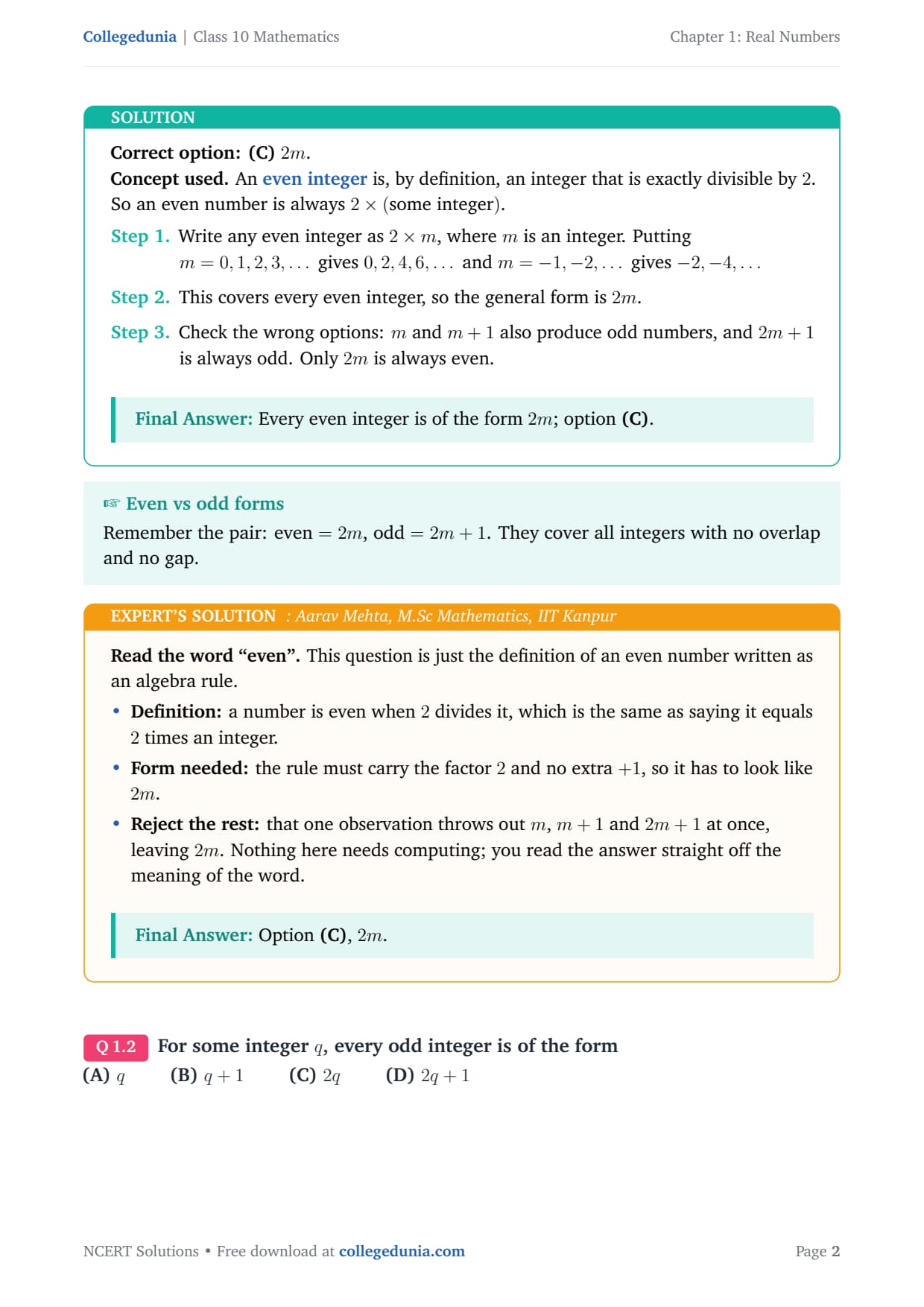
Correct option: (C)2m.
Concept used. An even integer is, by definition, an
integer that is exactly divisible by 2. So an even number is always
2×(some integer).
Write any even integer as 2× m, where m is an integer.
Putting m=0,1,2,3, gives 0,2,4,6, and
m=-1,-2, gives -2,-4,
This covers every even integer, so the general form is 2m.
Check the wrong options: m and m+1 also produce odd numbers,
and 2m+1 is always odd. Only 2m is always even.
Every even integer is of the form 2m; option (C).
AM
Aarav Mehta
M.Sc Mathematics, IIT Kanpur
Verified Expert
Read the word ``even''. This question is just the definition of
an even number written as an algebra rule.
Definition: a number is even when 2 divides it, which
is the same as saying it equals 2 times an integer.
Form needed: the rule must carry the factor 2 and no
extra +1, so it has to look like 2m.
Reject the rest: that one observation throws out m,
m+1 and 2m+1 at once, leaving 2m. Nothing here needs
computing; you read the answer straight off the meaning of the word.
Option (C), 2m.
Q 1.2
For some integer q, every odd integer is of the form
(A) q (B) q+1 (C) 2q (D) 2q+1
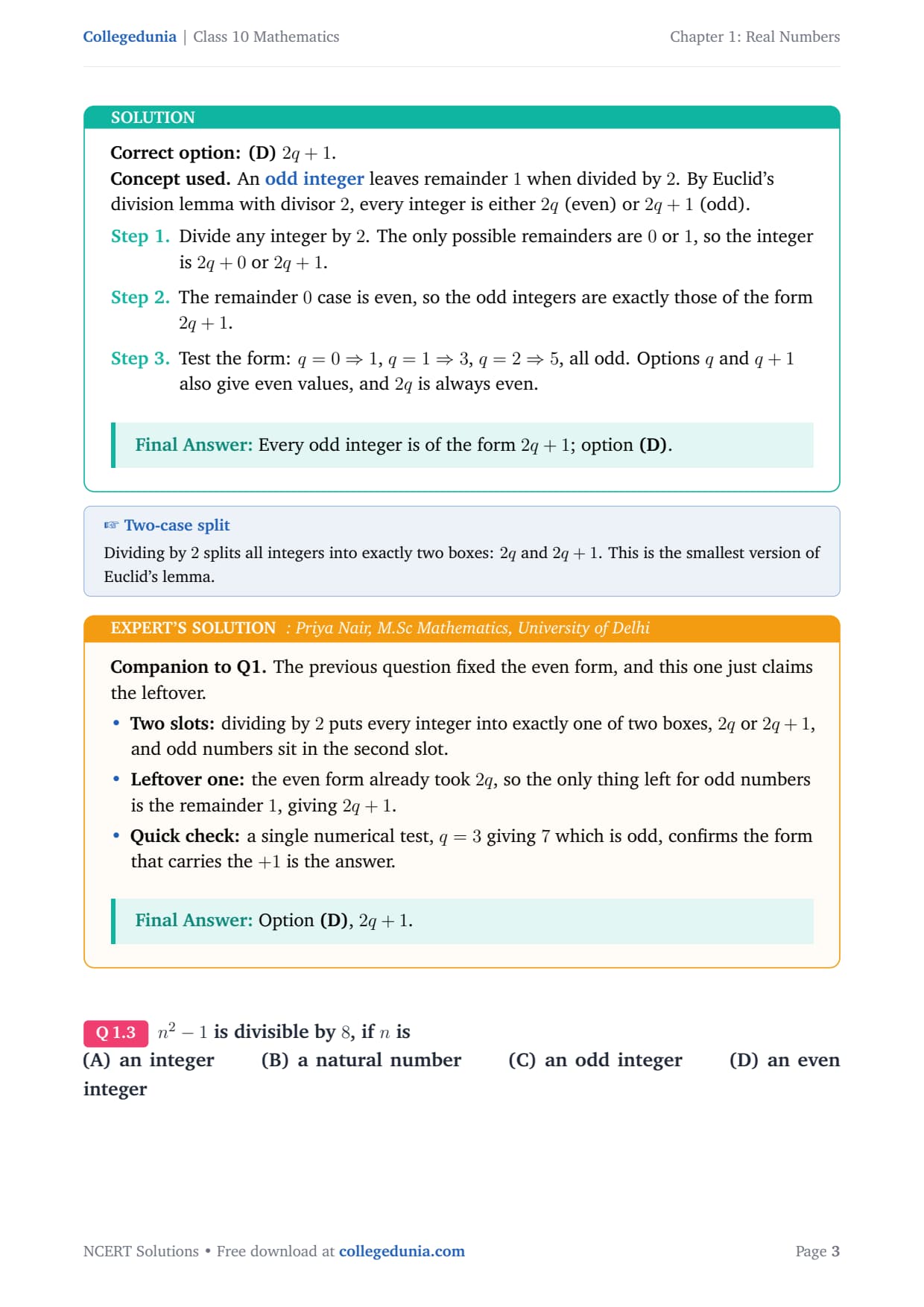
Correct option: (D)2q+1.
Concept used. An odd integer leaves remainder 1 when
divided by 2. By Euclid's division lemma with divisor 2, every
integer is either 2q (even) or 2q+1 (odd).
Divide any integer by 2. The only possible remainders are 0
or 1, so the integer is 2q+0 or 2q+1.
The remainder 0 case is even, so the odd integers are exactly
those of the form 2q+1.
Test the form: q=0⇒ 1, q=1⇒ 3,
q=2⇒ 5, all odd. Options q and q+1 also give
even values, and 2q is always even.
Every odd integer is of the form 2q+1; option (D).
PN
Priya Nair
M.Sc Mathematics, University of Delhi
Verified Expert
Companion to Q1. The previous question fixed the even form, and
this one just claims the leftover.
Two slots: dividing by 2 puts every integer into
exactly one of two boxes, 2q or 2q+1, and odd numbers sit in
the second slot.
Leftover one: the even form already took 2q, so the
only thing left for odd numbers is the remainder 1, giving 2q+1.
Quick check: a single numerical test, q=3 giving 7
which is odd, confirms the form that carries the +1 is the answer.
Option (D), 2q+1.
Q 1.3
n2-1 is divisible by 8, if n is
(A) an integer (B) a natural number (C) an odd integer (D) an even integer
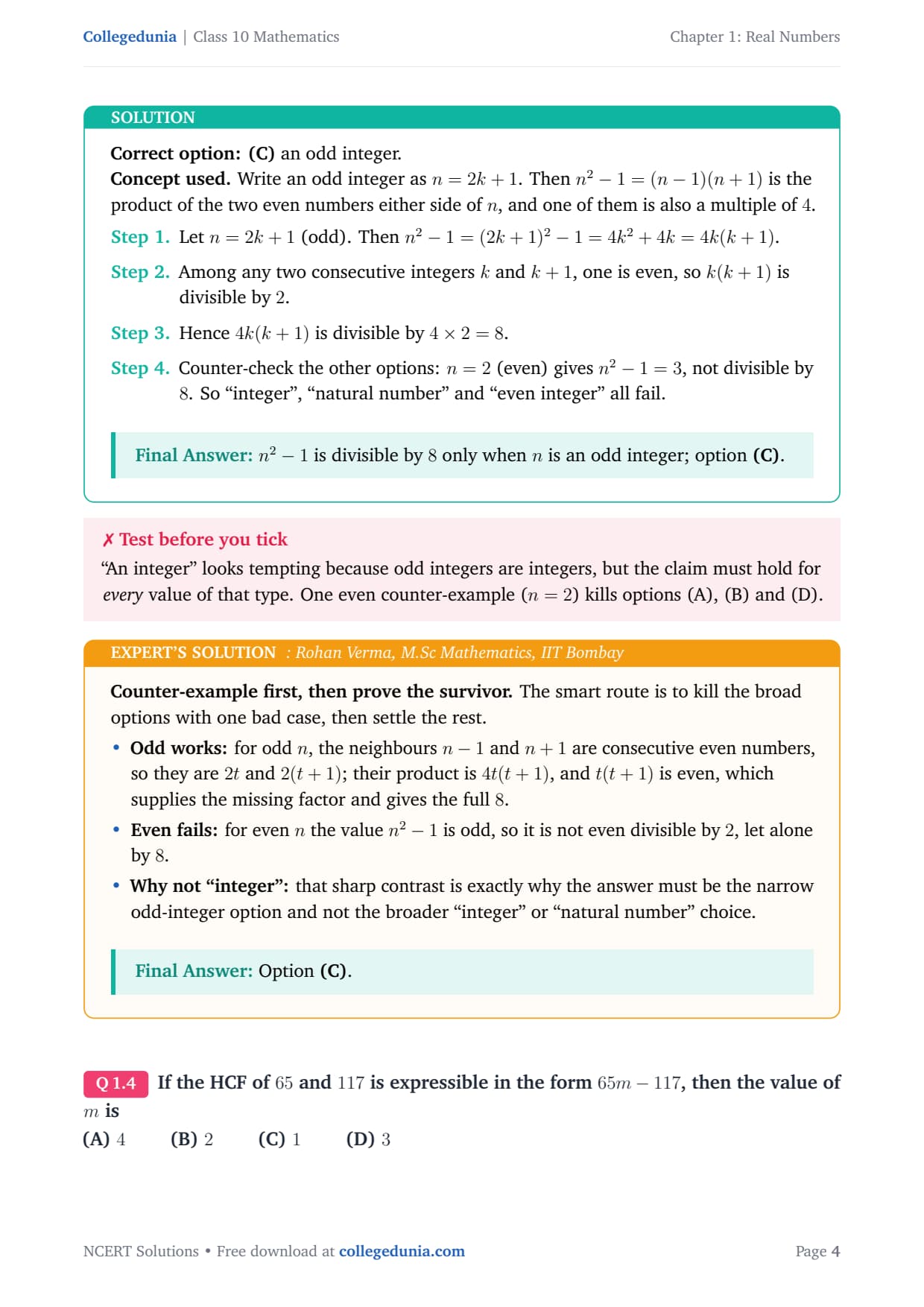
Correct option: (C) an odd integer.
Concept used. Write an odd integer as n=2k+1. Then
n2-1=(n-1)(n+1) is the product of the two even numbers either side
of n, and one of them is also a multiple of 4.
Let n=2k+1 (odd). Then
n2-1=(2k+1)2-1=4k2+4k=4k(k+1).
Among any two consecutive integers k and k+1, one is even,
so k(k+1) is divisible by 2.
Hence 4k(k+1) is divisible by 4× 2=8.
Counter-check the other options: n=2 (even) gives
n2-1=3, not divisible by 8. So ``integer'', ``natural
number'' and ``even integer'' all fail.
n2-1 is divisible by 8 only when n is an odd integer;
option (C).
RV
Rohan Verma
M.Sc Mathematics, IIT Bombay
Verified Expert
Counter-example first, then prove the survivor. The smart route
is to kill the broad options with one bad case, then settle the rest.
Odd works: for odd n, the neighbours n-1 and n+1
are consecutive even numbers, so they are 2t and 2(t+1); their
product is 4t(t+1), and t(t+1) is even, which supplies the
missing factor and gives the full 8.
Even fails: for even n the value n2-1 is odd, so it
is not even divisible by 2, let alone by 8.
Why not ``integer'': that sharp contrast is exactly why
the answer must be the narrow odd-integer option and not the
broader ``integer'' or ``natural number'' choice.
Option (C).
Q 1.4
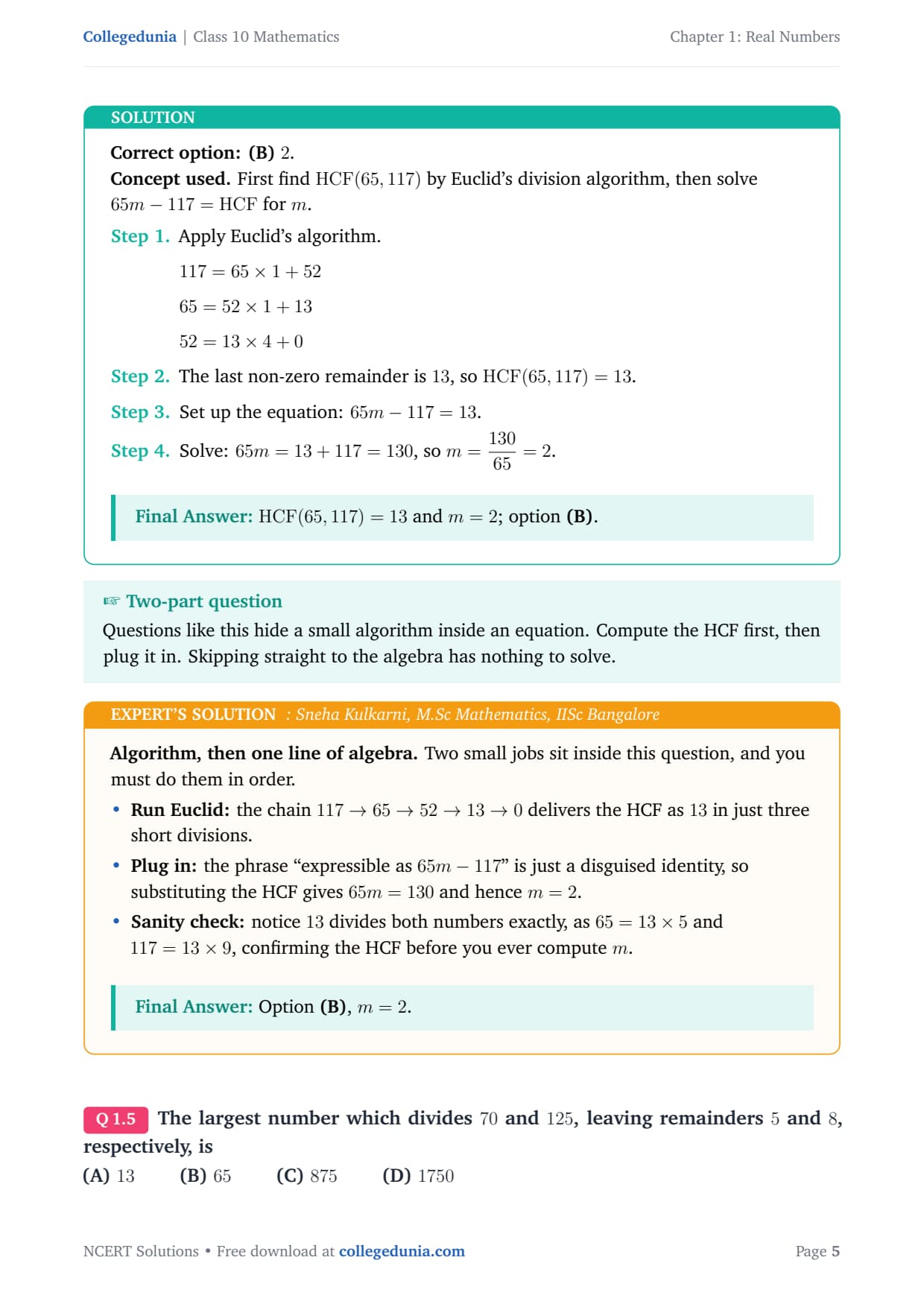
If the HCF of 65 and 117 is expressible in the form 65m-117, then the value of m is
(A) 4 (B) 2 (C) 1 (D) 3
Correct option: (B)2.
Concept used. First find HCF(65,117) by Euclid's
division algorithm, then solve 65m-117=HCF for m.
The last non-zero remainder is 13, so
HCF(65,117)=13.
Set up the equation: 65m-117=13.
Solve: 65m=13+117=130, so m=13065=2.
HCF(65,117)=13 and m=2; option (B).
SK
Sneha Kulkarni
M.Sc Mathematics, IISc Bangalore
Verified Expert
Algorithm, then one line of algebra. Two small jobs sit inside
this question, and you must do them in order.
Run Euclid: the chain 117→ 65→ 52→ 13→ 0
delivers the HCF as 13 in just three short divisions.
Plug in: the phrase ``expressible as 65m-117'' is just
a disguised identity, so substituting the HCF gives 65m=130 and
hence m=2.
Sanity check: notice 13 divides both numbers exactly,
as 65=13× 5 and 117=13× 9, confirming the HCF before
you ever compute m.
Option (B), m=2.
Q 1.5
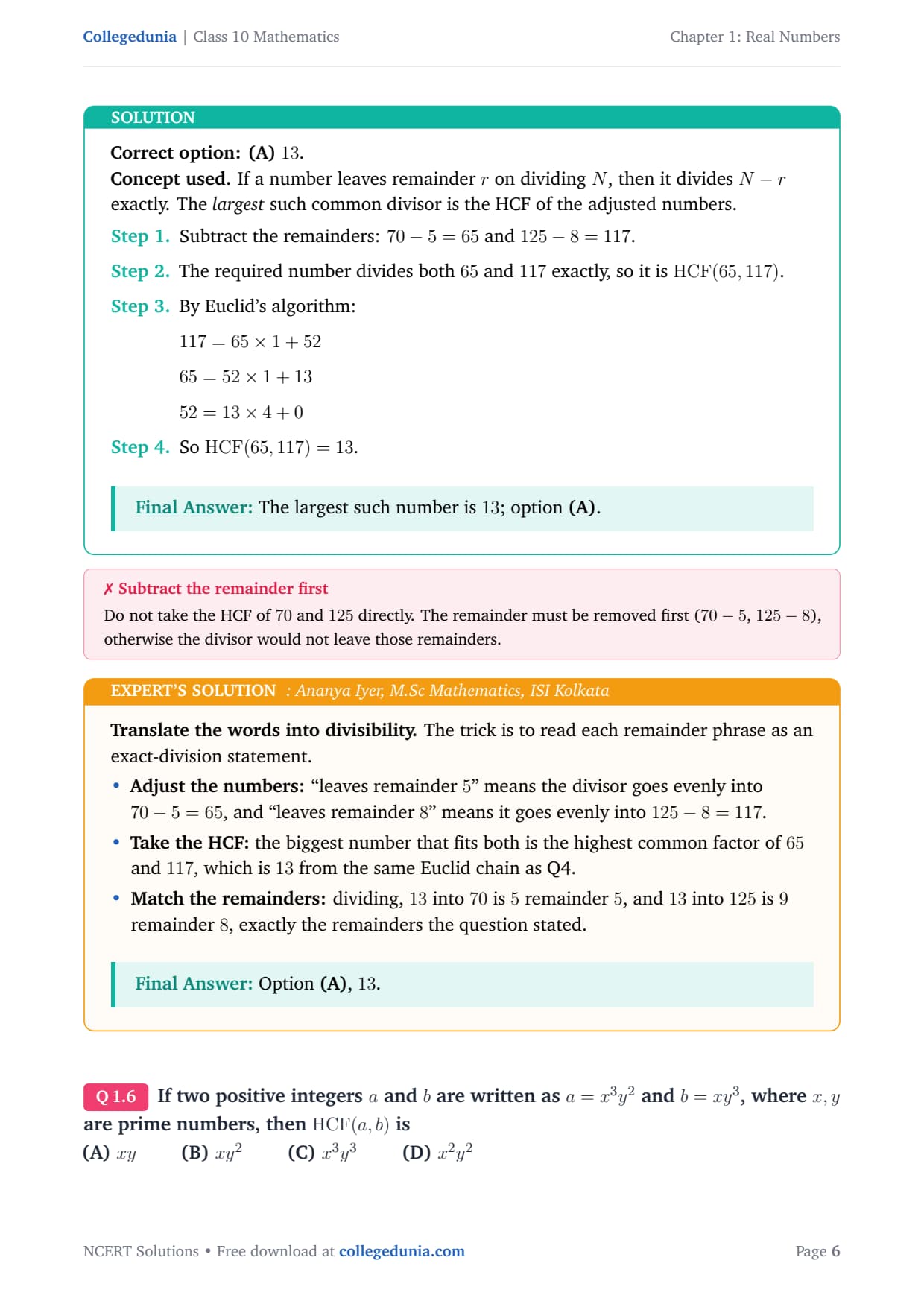
The largest number which divides 70 and 125, leaving remainders 5 and 8, respectively, is
(A) 13 (B) 65 (C) 875 (D) 1750
Correct option: (A)13.
Concept used. If a number leaves remainder r on dividing N,
then it divides N-r exactly. The largest such common divisor is
the HCF of the adjusted numbers.
Subtract the remainders: 70-5=65 and 125-8=117.
The required number divides both 65 and 117 exactly, so it is
HCF(65,117).
Translate the words into divisibility. The trick is to read each
remainder phrase as an exact-division statement.
Adjust the numbers: ``leaves remainder 5'' means the
divisor goes evenly into 70-5=65, and ``leaves remainder 8''
means it goes evenly into 125-8=117.
Take the HCF: the biggest number that fits both is the
highest common factor of 65 and 117, which is 13 from the
same Euclid chain as Q4.
Match the remainders: dividing, 13 into 70 is 5
remainder 5, and 13 into 125 is 9 remainder 8, exactly
the remainders the question stated.
Option (A), 13.
Q 1.6
If two positive integers a and b are written as a=x3y2 and b=xy3, where x,y are prime numbers, then HCF(a,b) is
(A) xy (B) xy2 (C) x3y3 (D) x2y2
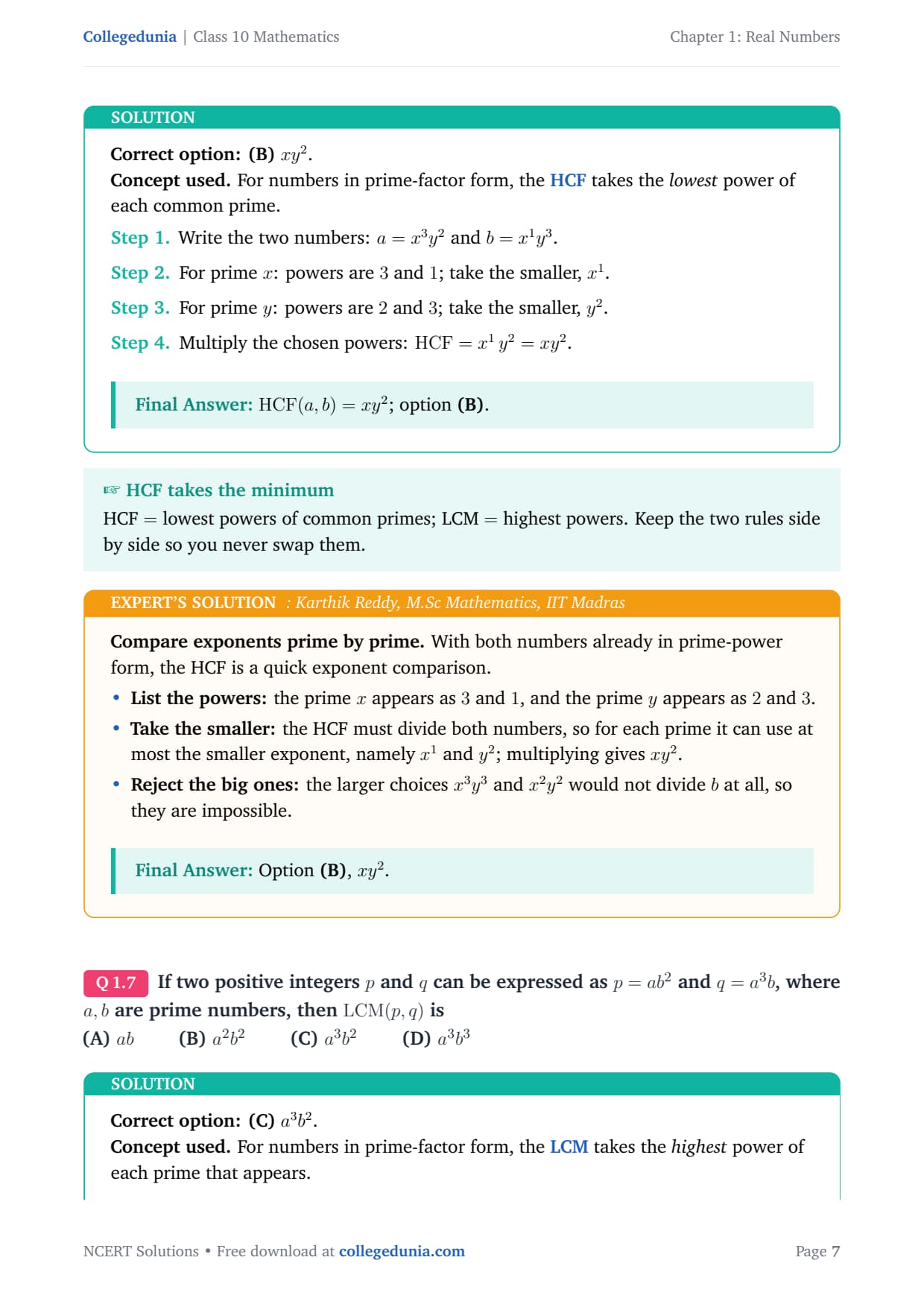
Correct option: (B)xy2.
Concept used. For numbers in prime-factor form, the
HCF takes the lowest power of each common prime.
Write the two numbers: a=x3y2 and b=x1y3.
For prime x: powers are 3 and 1; take the smaller, x1.
For prime y: powers are 2 and 3; take the smaller, y2.
Multiply the chosen powers: HCF=x1 y2=xy2.
HCF(a,b)=xy2; option (B).
KR
Karthik Reddy
M.Sc Mathematics, IIT Madras
Verified Expert
Compare exponents prime by prime. With both numbers already in
prime-power form, the HCF is a quick exponent comparison.
List the powers: the prime x appears as 3 and 1,
and the prime y appears as 2 and 3.
Take the smaller: the HCF must divide both numbers, so for
each prime it can use at most the smaller exponent, namely x1
and y2; multiplying gives xy2.
Reject the big ones: the larger choices x3y3 and
x2y2 would not divide b at all, so they are impossible.
Option (B), xy2.
Q 1.7
If two positive integers p and q can be expressed as p=ab2 and q=a3b, where a,b are prime numbers, then LCM(p,q) is
(A) ab (B) a2b2 (C) a3b2 (D) a3b3
Correct option: (C)a3b2.
Concept used. For numbers in prime-factor form, the
LCM takes the highest power of each prime that appears.
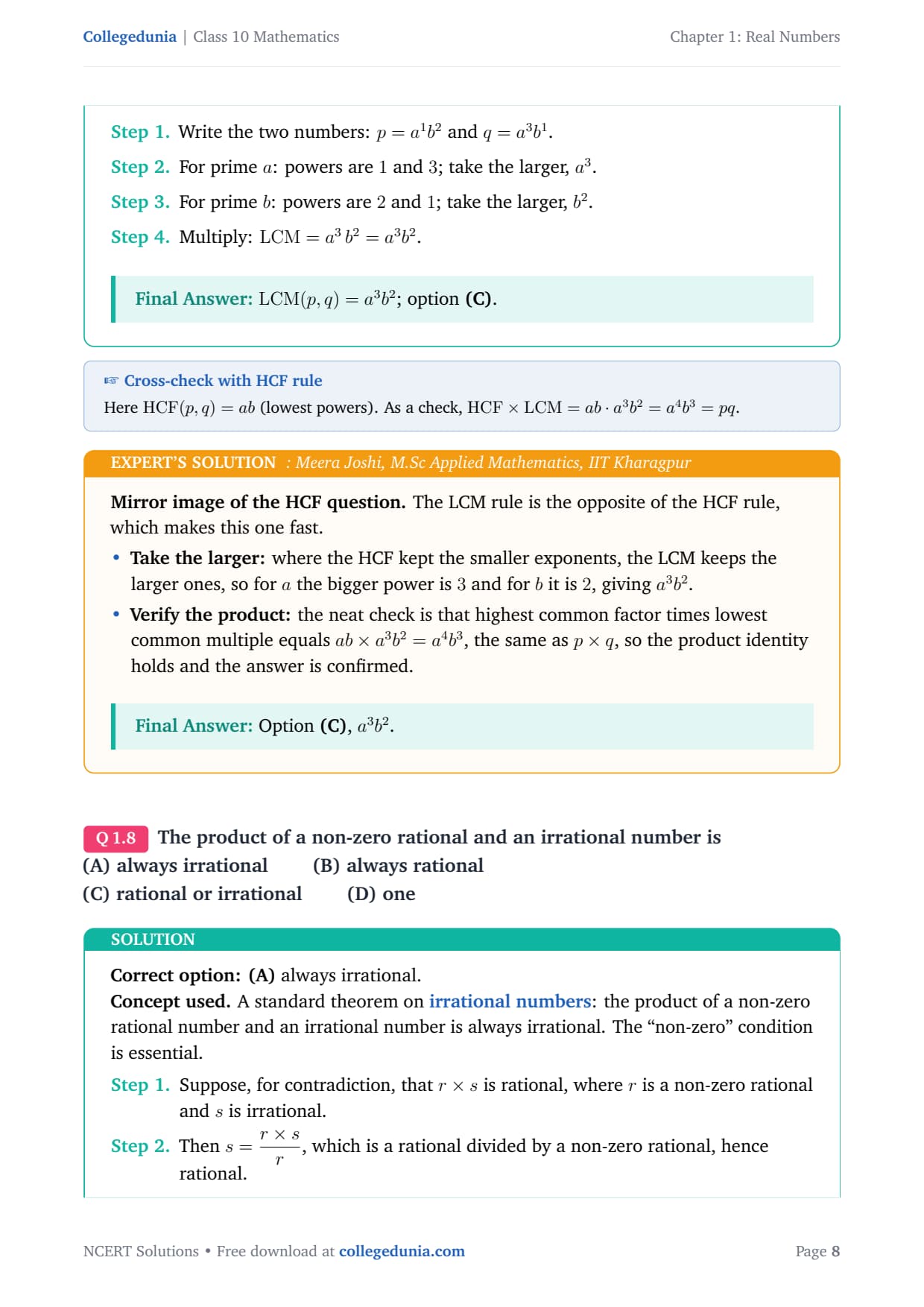
Write the two numbers: p=a1b2 and q=a3b1.
For prime a: powers are 1 and 3; take the larger, a3.
For prime b: powers are 2 and 1; take the larger, b2.
Multiply: LCM=a3 b2=a3b2.
LCM(p,q)=a3b2; option (C).
MJ
Meera Joshi
M.Sc Applied Mathematics, IIT Kharagpur
Verified Expert
Mirror image of the HCF question. The LCM rule is the opposite
of the HCF rule, which makes this one fast.
Take the larger: where the HCF kept the smaller
exponents, the LCM keeps the larger ones, so for a the bigger
power is 3 and for b it is 2, giving a3b2.
Verify the product: the neat check is that highest
common factor times lowest common multiple equals
ab× a3b2=a4b3, the same as p× q, so the
product identity holds and the answer is confirmed.
Option (C), a3b2.
Q 1.8
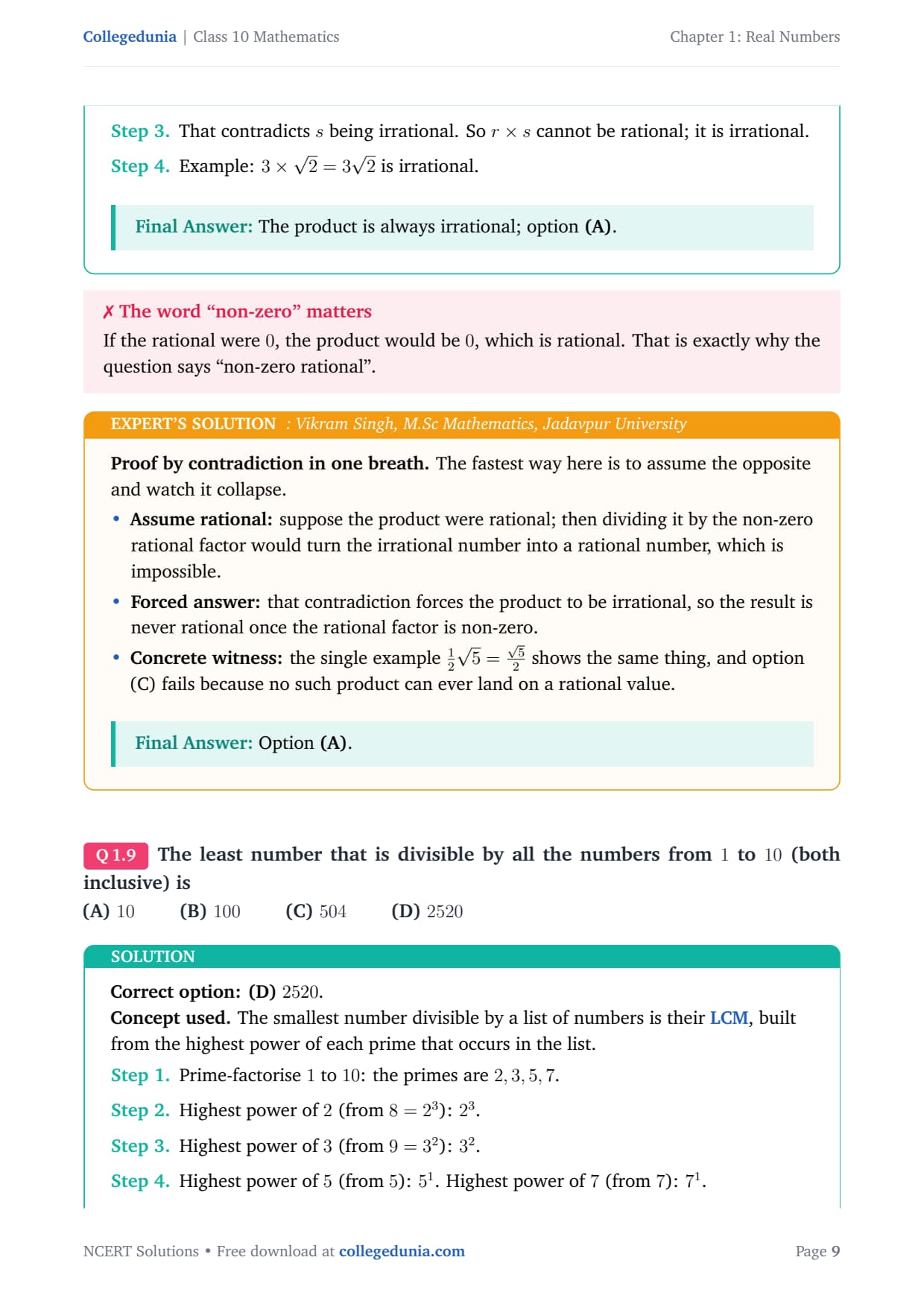
The product of a non-zero rational and an irrational number is
(A) always irrational (B) always rational
(C) rational or irrational (D) one
Correct option: (A) always irrational.
Concept used. A standard theorem on irrational
numbers: the product of a non-zero rational number and an irrational
number is always irrational. The ``non-zero'' condition is essential.
Suppose, for contradiction, that
r× s is rational, where r is a non-zero rational and
s is irrational.
Then s=r× sr, which is a rational divided by a
non-zero rational, hence rational.
That contradicts s being irrational. So r× s cannot be
rational; it is irrational.
Example: 3×√2=3√2 is irrational.
The product is always irrational; option (A).
VS
Vikram Singh
M.Sc Mathematics, Jadavpur University
Verified Expert
Proof by contradiction in one breath. The fastest way here is to
assume the opposite and watch it collapse.
Assume rational: suppose the product were rational; then
dividing it by the non-zero rational factor would turn the
irrational number into a rational number, which is impossible.
Forced answer: that contradiction forces the product to
be irrational, so the result is never rational once the rational
factor is non-zero.
Concrete witness: the single example 12√5=52 shows the same thing, and option (C)
fails because no such product can ever land on a rational value.
Option (A).
Q 1.9
The least number that is divisible by all the numbers from 1 to 10 (both inclusive) is
(A) 10 (B) 100 (C) 504 (D) 2520
Correct option: (D)2520.
Concept used. The smallest number divisible by a list of
numbers is their LCM, built from the highest power of each
prime that occurs in the list.
Prime-factorise 1 to 10: the primes are 2,3,5,7.
Highest power of 2 (from 8=23): 23.
Highest power of 3 (from 9=32): 32.
Highest power of 5 (from 5): 51. Highest power of 7
(from 7): 71.
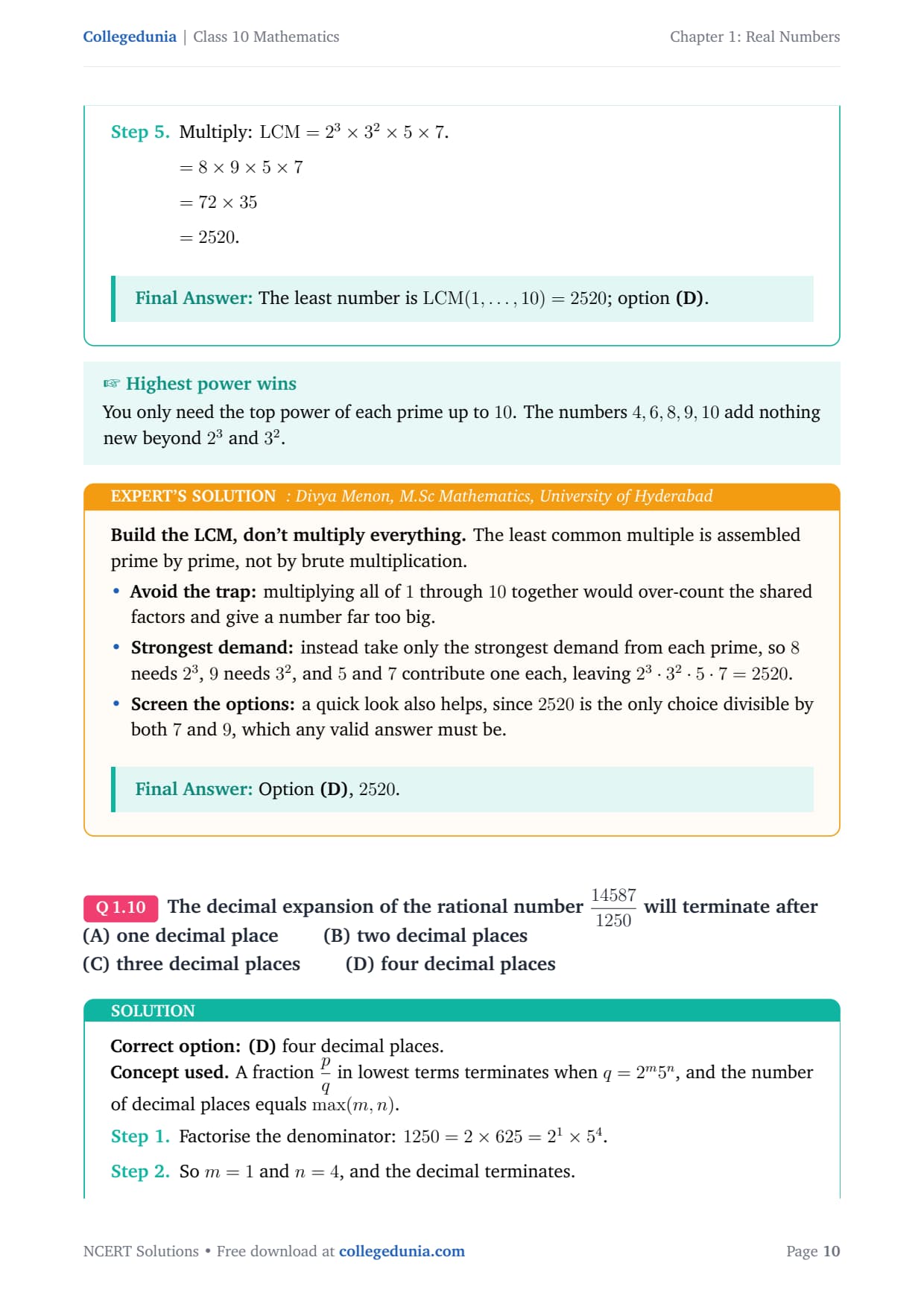
Build the LCM, don't multiply everything. The least common
multiple is assembled prime by prime, not by brute multiplication.
Avoid the trap: multiplying all of 1 through 10
together would over-count the shared factors and give a number far
too big.
Strongest demand: instead take only the strongest demand
from each prime, so 8 needs 23, 9 needs 32, and 5 and
7 contribute one each, leaving 233257=2520.
Screen the options: a quick look also helps, since 2520
is the only choice divisible by both 7 and 9, which any valid
answer must be.
Option (D), 2520.
Q 1.10
The decimal expansion of the rational number 145871250 will terminate after
(A) one decimal place (B) two decimal places
(C) three decimal places (D) four decimal places
Correct option: (D) four decimal places.
Concept used. A fraction pq in lowest terms
terminates when q=2m5n, and the number of decimal places equals
max(m,n).
Factorise the denominator:
1250=2× 625=21× 54.
So m=1 and n=4, and the decimal terminates.
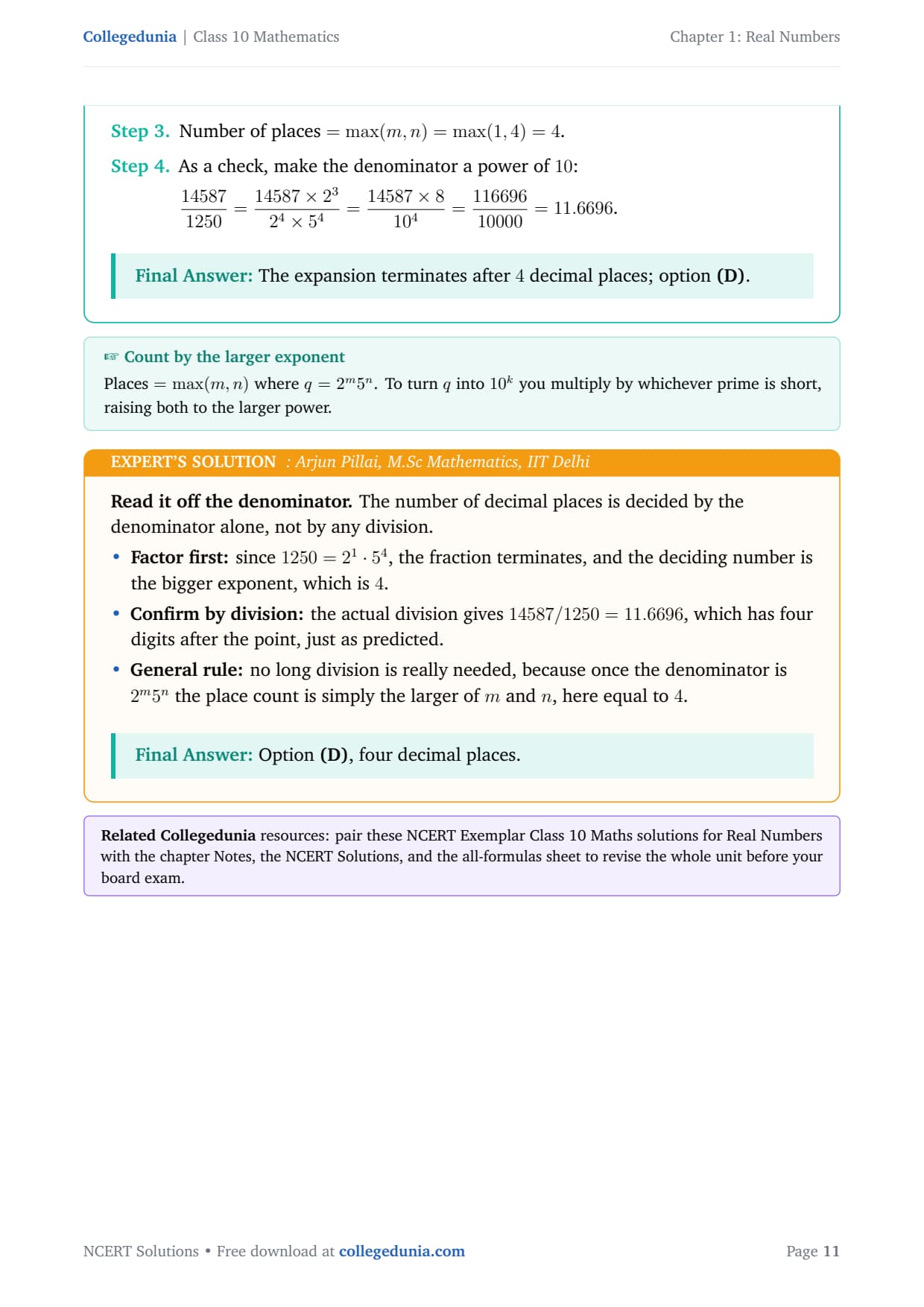
Number of places =max(m,n)=max(1,4)=4.
As a check, make the denominator a power of 10:
[] 145871250=14587× 2324× 54
=14587× 8104=11669610000=11.6696.
The expansion terminates after 4 decimal places; option
(D).
AP
Arjun Pillai
M.Sc Mathematics, IIT Delhi
Verified Expert
Read it off the denominator. The number of decimal places is
decided by the denominator alone, not by any division.
Factor first: since 1250=2154, the fraction
terminates, and the deciding number is the bigger exponent, which
is 4.
Confirm by division: the actual division gives
14587/1250=11.6696, which has four digits after the point, just
as predicted.
General rule: no long division is really needed, because
once the denominator is 2m5n the place count is simply the
larger of m and n, here equal to 4.
Option (D), four decimal places.
NCERT exemplar Class 12 Mathematics Chapter 1 Real Numbers
Class 10 Mathematics Chapter 1: Real Numbers NCERT Exemplar
All 10 questions with collapsible Solution and Expert Solution. Tap a button to reveal the working.
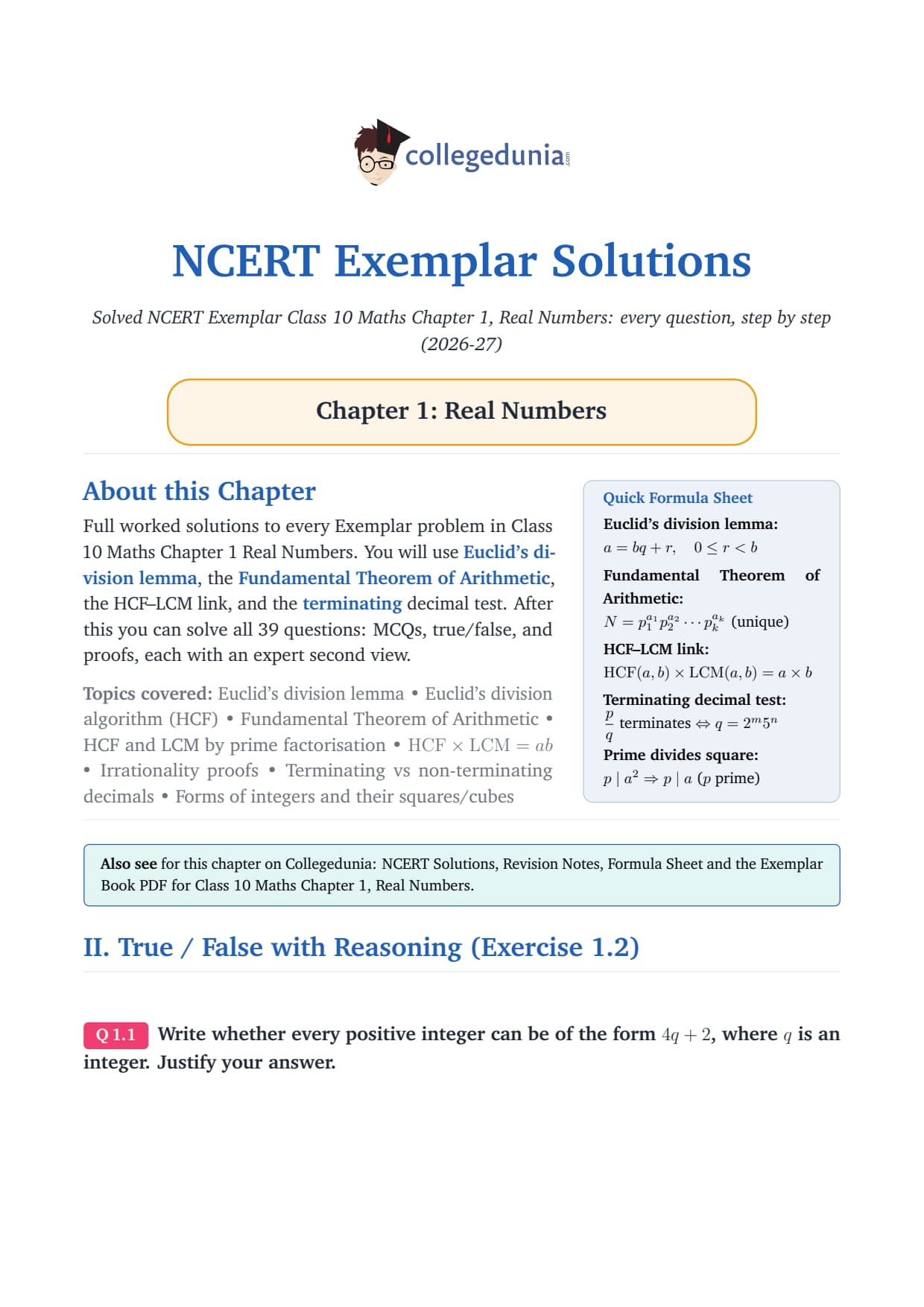
II. True / False with Reasoning (Exercise 1.2)
Q 1.1
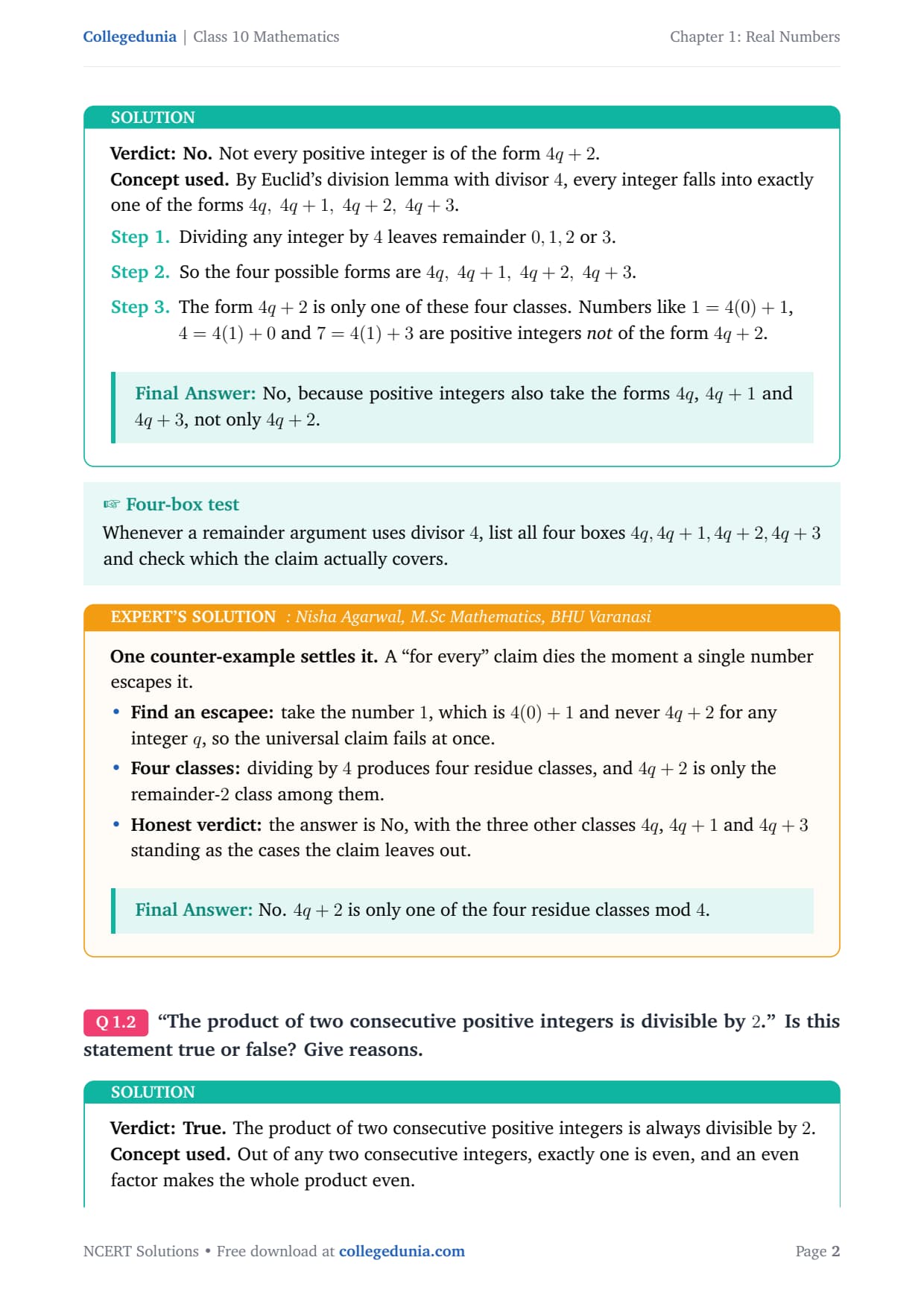
Write whether every positive integer can be of the form 4q+2, where q is an integer. Justify your answer.
Verdict: No. Not every positive integer is of the form 4q+2.
Concept used. By Euclid's division lemma with divisor 4, every
integer falls into exactly one of the forms 4q, 4q+1, 4q+2, 4q+3.
Dividing any integer by 4 leaves remainder 0,1,2 or 3.
So the four possible forms are 4q, 4q+1, 4q+2, 4q+3.
The form 4q+2 is only one of these four classes. Numbers like
1=4(0)+1, 4=4(1)+0 and 7=4(1)+3 are positive integers
not of the form 4q+2.
No, because positive integers also take the forms 4q, 4q+1
and 4q+3, not only 4q+2.
NA
Nisha Agarwal
M.Sc Mathematics, BHU Varanasi
Verified Expert
One counter-example settles it. A ``for every'' claim dies the
moment a single number escapes it.
Find an escapee: take the number 1, which is 4(0)+1
and never 4q+2 for any integer q, so the universal claim fails
at once.
Four classes: dividing by 4 produces four residue
classes, and 4q+2 is only the remainder-2 class among them.
Honest verdict: the answer is No, with the three other
classes 4q, 4q+1 and 4q+3 standing as the cases the claim
leaves out.
No. 4q+2 is only one of the four residue classes mod 4.
Q 1.2
``The product of two consecutive positive integers is divisible by 2.'' Is this statement true or false? Give reasons.
Verdict: True. The product of two consecutive positive integers
is always divisible by 2.
Concept used. Out of any two consecutive integers, exactly one
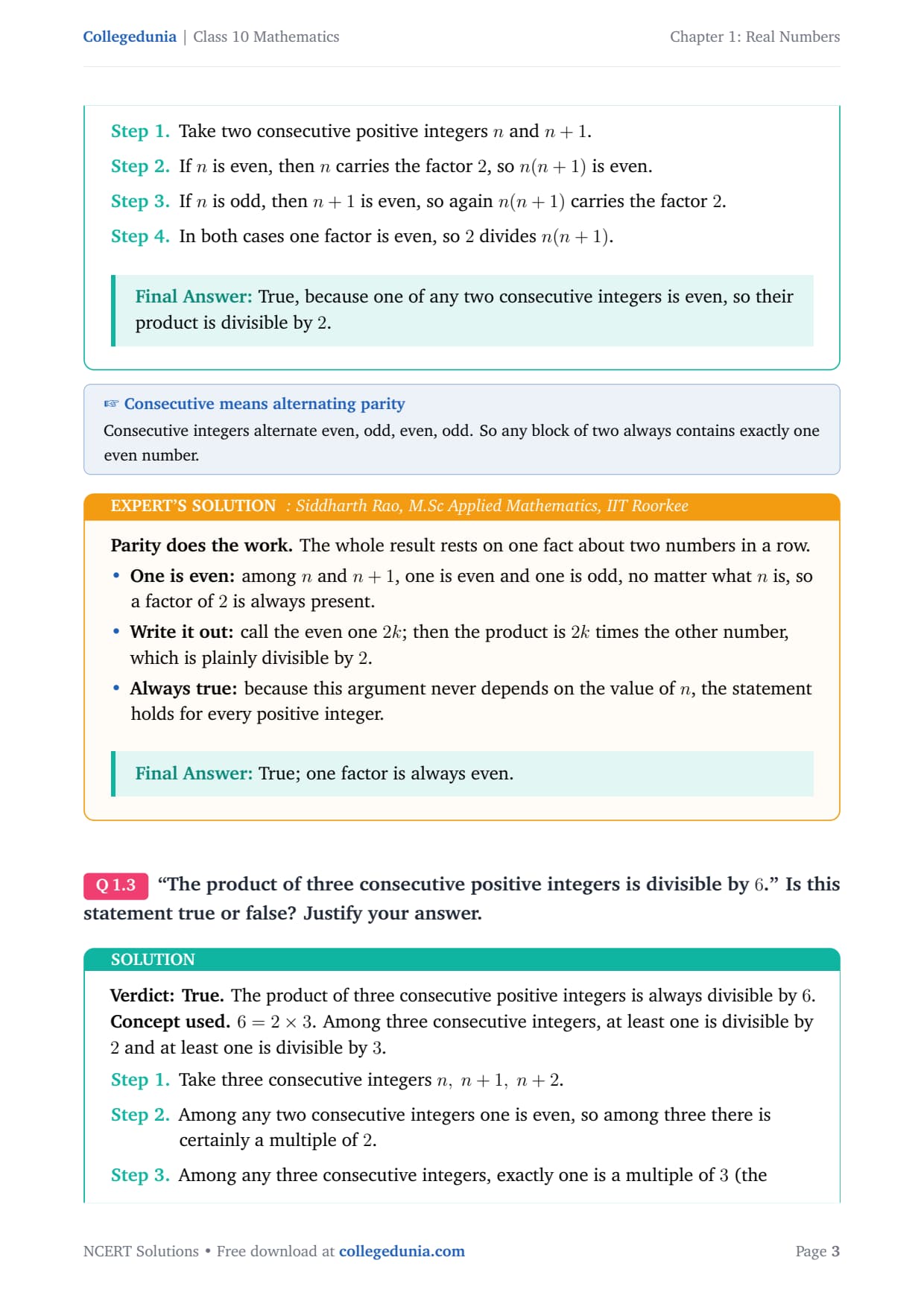
is even, and an even factor makes the whole product even.
Take two consecutive positive integers n and n+1.
If n is even, then n carries the factor 2, so n(n+1) is
even.
If n is odd, then n+1 is even, so again n(n+1) carries the
factor 2.
In both cases one factor is even, so 2 divides n(n+1).
True, because one of any two consecutive integers is even, so
their product is divisible by 2.
SR
Siddharth Rao
M.Sc Applied Mathematics, IIT Roorkee
Verified Expert
Parity does the work. The whole result rests on one fact about
two numbers in a row.
One is even: among n and n+1, one is even and one is
odd, no matter what n is, so a factor of 2 is always present.
Write it out: call the even one 2k; then the product is
2k times the other number, which is plainly divisible by 2.
Always true: because this argument never depends on the
value of n, the statement holds for every positive integer.
True; one factor is always even.
Q 1.3
``The product of three consecutive positive integers is divisible by 6.'' Is this statement true or false? Justify your answer.
Verdict: True. The product of three consecutive positive
integers is always divisible by 6.
Concept used.6=2× 3. Among three consecutive integers,
at least one is divisible by 2 and at least one is divisible by 3.
Take three consecutive integers n, n+1, n+2.
Among any two consecutive integers one is even, so among three
there is certainly a multiple of 2.
Among any three consecutive integers, exactly one is a multiple
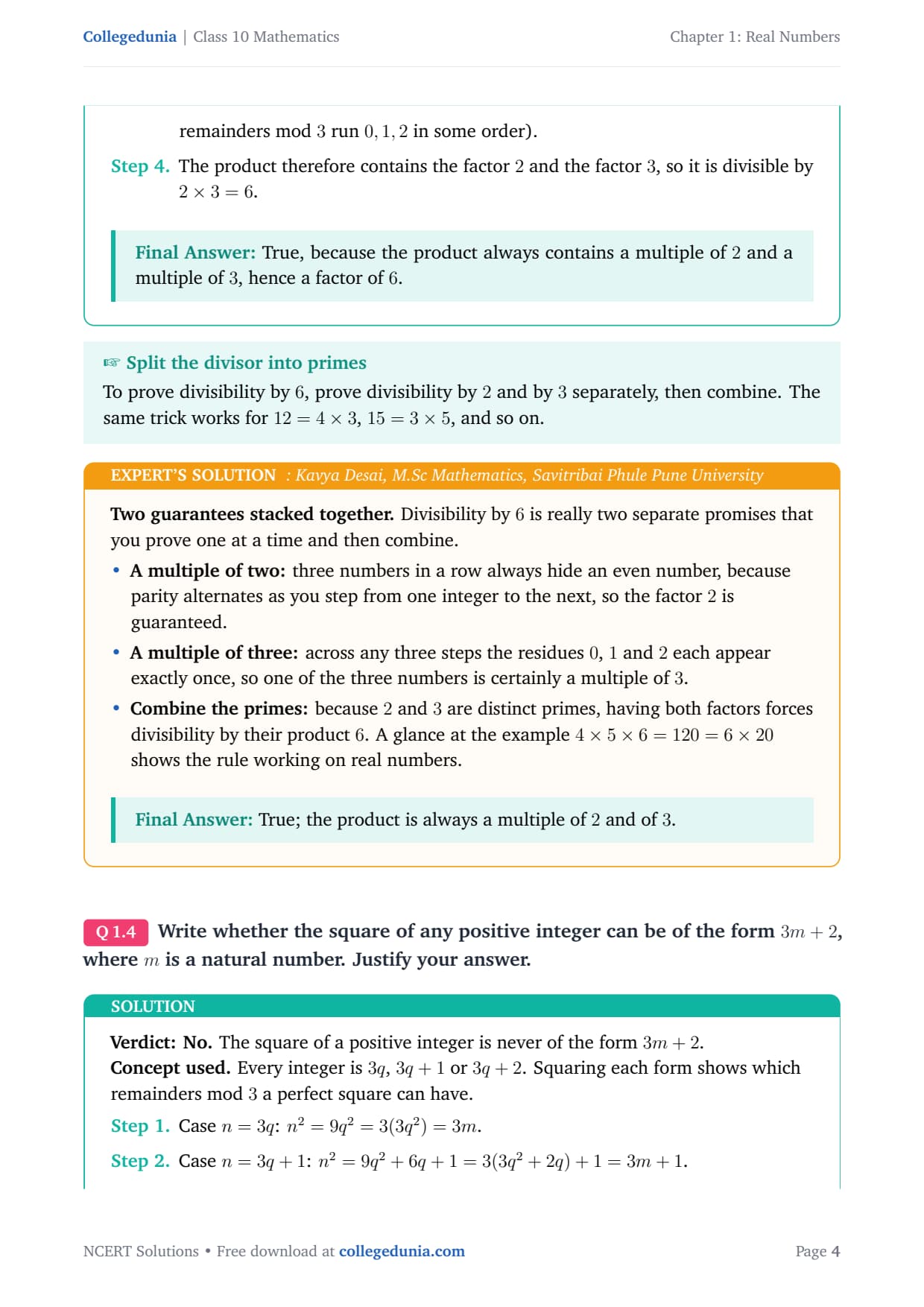
of 3 (the remainders mod 3 run 0,1,2 in some order).
The product therefore contains the factor 2 and the factor
3, so it is divisible by 2× 3=6.
True, because the product always contains a multiple of 2
and a multiple of 3, hence a factor of 6.
KD
Kavya Desai
M.Sc Mathematics, Savitribai Phule Pune University
Verified Expert
Two guarantees stacked together. Divisibility by 6 is really
two separate promises that you prove one at a time and then combine.
A multiple of two: three numbers in a row always hide an
even number, because parity alternates as you step from one
integer to the next, so the factor 2 is guaranteed.
A multiple of three: across any three steps the residues
0, 1 and 2 each appear exactly once, so one of the three
numbers is certainly a multiple of 3.
Combine the primes: because 2 and 3 are distinct
primes, having both factors forces divisibility by their product
6. A glance at the example 456=120=620 shows
the rule working on real numbers.
True; the product is always a multiple of 2 and of 3.
Q 1.4
Write whether the square of any positive integer can be of the form 3m+2, where m is a natural number. Justify your answer.
Verdict: No. The square of a positive integer is never of the
form 3m+2.
Concept used. Every integer is 3q, 3q+1 or 3q+2. Squaring
each form shows which remainders mod 3 a perfect square can have.
Case n=3q: n2=9q2=3(3q2)=3m.
Case n=3q+1:
n2=9q2+6q+1=3(3q2+2q)+1=3m+1.
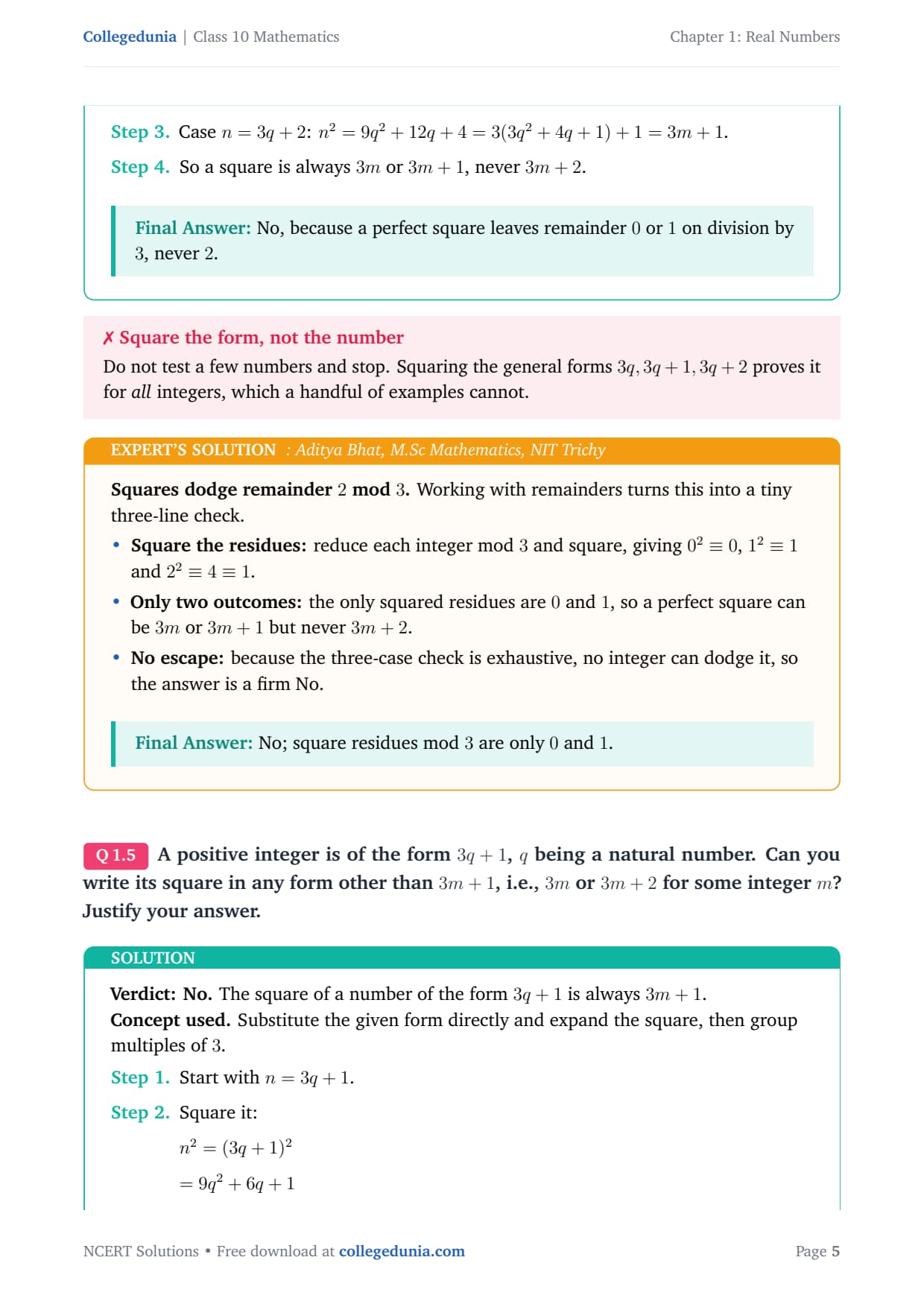
Case n=3q+2:
n2=9q2+12q+4=3(3q2+4q+1)+1=3m+1.
So a square is always 3m or 3m+1, never 3m+2.
No, because a perfect square leaves remainder 0 or 1 on
division by 3, never 2.
AB
Aditya Bhat
M.Sc Mathematics, NIT Trichy
Verified Expert
Squares dodge remainder 2 mod 3. Working with remainders
turns this into a tiny three-line check.
Square the residues: reduce each integer mod 3 and
square, giving 020, 121 and
2241.
Only two outcomes: the only squared residues are 0 and
1, so a perfect square can be 3m or 3m+1 but never 3m+2.
No escape: because the three-case check is exhaustive, no
integer can dodge it, so the answer is a firm No.
No; square residues mod 3 are only 0 and 1.
Q 1.5
A positive integer is of the form 3q+1, q being a natural number. Can you write its square in any form other than 3m+1, i.e., 3m or 3m+2 for some integer m? Justify your answer.
Verdict: No. The square of a number of the form 3q+1 is always
3m+1.
Concept used. Substitute the given form directly and expand the
square, then group multiples of 3.
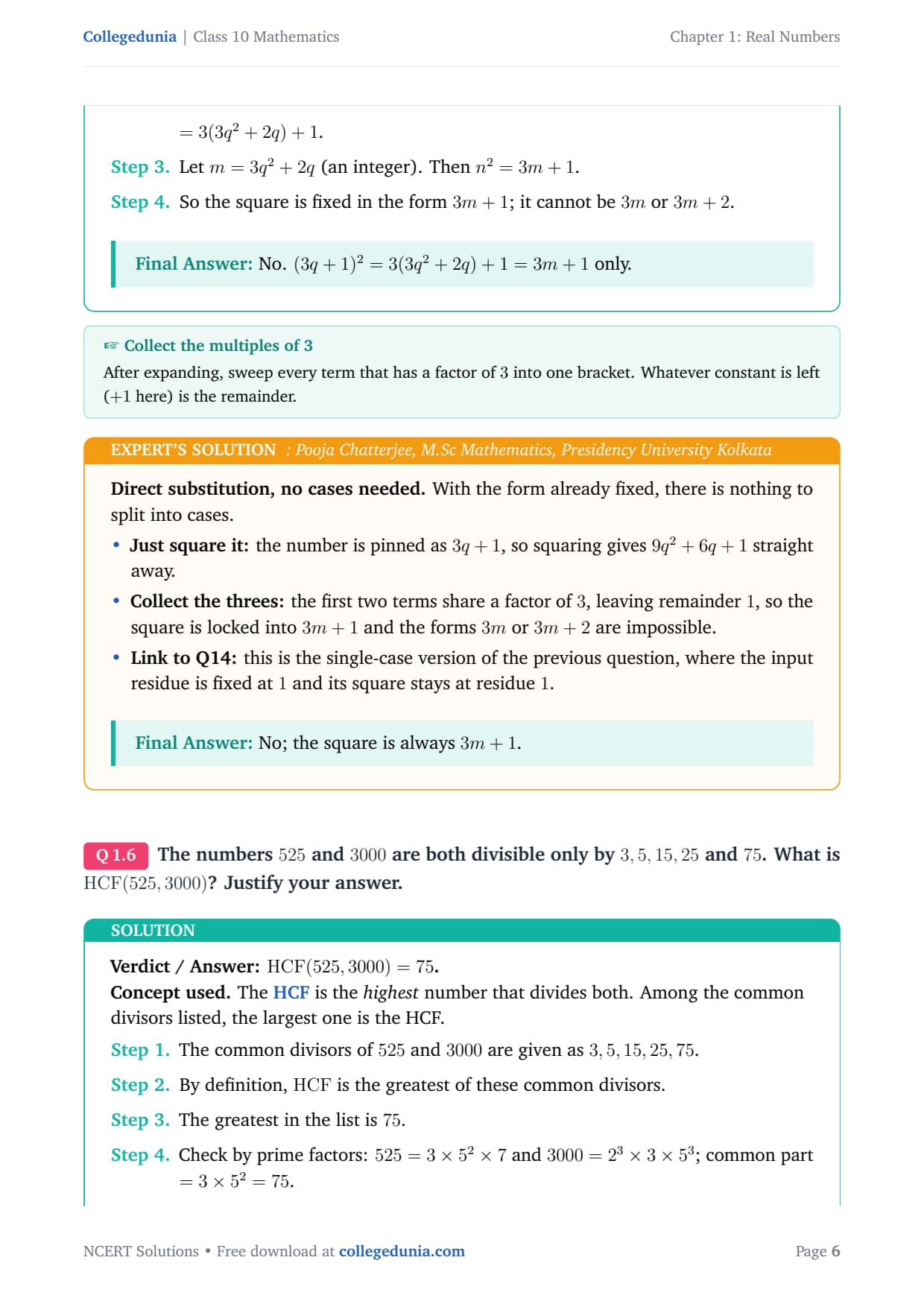
So the square is fixed in the form 3m+1; it cannot be 3m or
3m+2.
No. (3q+1)2=3(3q2+2q)+1=3m+1 only.
PC
Pooja Chatterjee
M.Sc Mathematics, Presidency University Kolkata
Verified Expert
Direct substitution, no cases needed. With the form already
fixed, there is nothing to split into cases.
Just square it: the number is pinned as 3q+1, so
squaring gives 9q2+6q+1 straight away.
Collect the threes: the first two terms share a factor of
3, leaving remainder 1, so the square is locked into 3m+1 and
the forms 3m or 3m+2 are impossible.
Link to Q14: this is the single-case version of the
previous question, where the input residue is fixed at 1 and its
square stays at residue 1.
No; the square is always 3m+1.
Q 1.6
The numbers 525 and 3000 are both divisible only by 3,5,15,25 and 75. What is HCF(525,3000)? Justify your answer.
Verdict / Answer: HCF(525,3000)=75.
Concept used. The HCF is the highest number
that divides both. Among the common divisors listed, the largest one is
the HCF.
The common divisors of 525 and 3000 are given as
3,5,15,25,75.
By definition, HCF is the greatest of these common
divisors.
The greatest in the list is 75.
Check by prime factors: 525=3× 52× 7 and
3000=23× 3× 53; common part =3× 52=75.
HCF(525,3000)=75, the largest common divisor.
MG
Manish Gupta
M.Sc Mathematics, IIT Guwahati
Verified Expert
Pick the top of the common list, then verify. The name itself
tells you what to do, and a prime check confirms it.
Read the name: highest common factor literally means the
biggest shared divisor, so from the list of common divisors
3,5,15,25,75 the answer is the largest entry, 75.
Prime check: factorising shows 525=3527
shares only 352 with 3000=23353, and
325=75.
Both agree: the listed divisors and the prime method give
the same number, which is a reassuring cross-check.
HCF=75.
Q 1.7
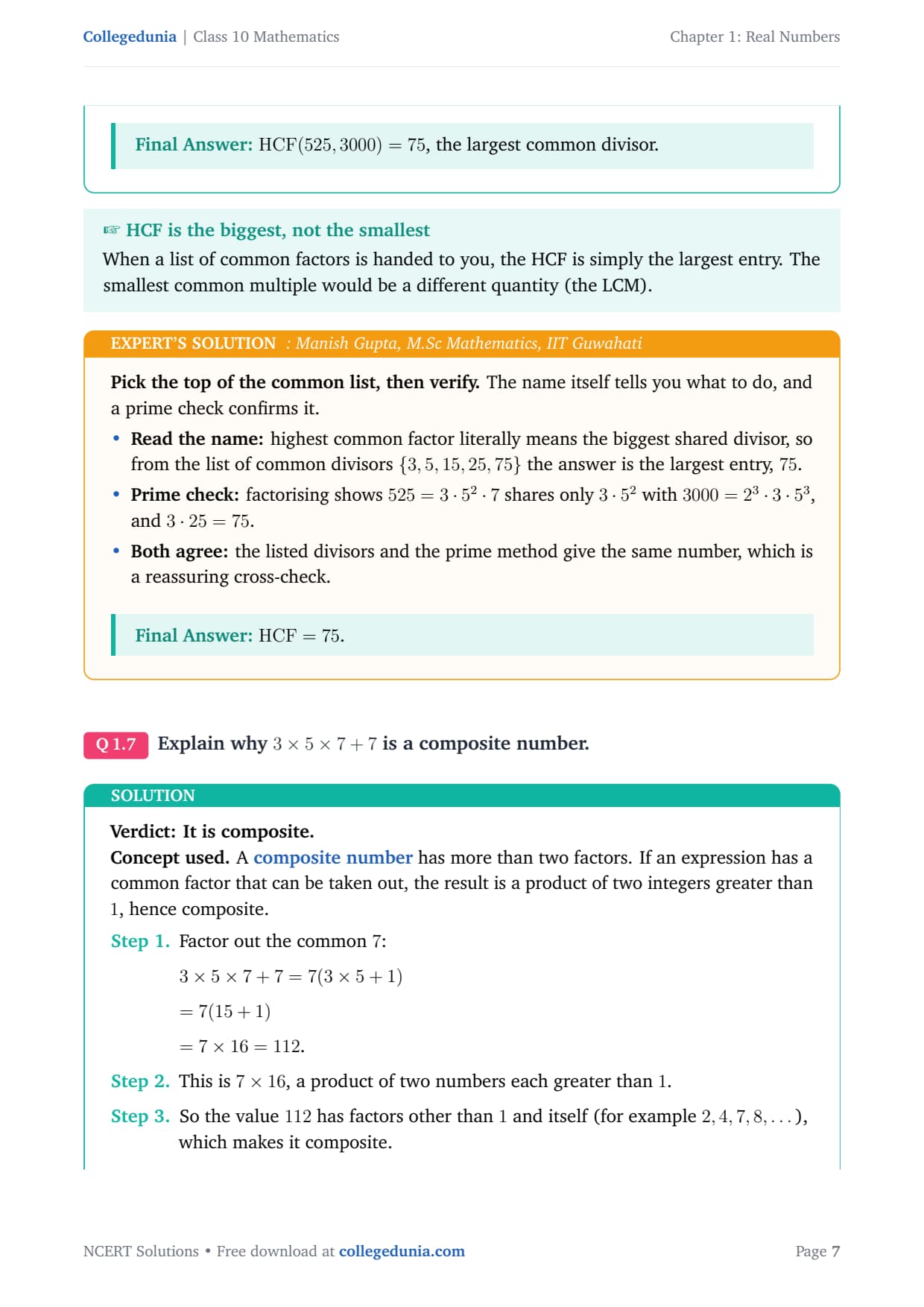
Explain why 3× 5× 7+7 is a composite number.
Verdict: It is composite.
Concept used. A composite number has more than two
factors. If an expression has a common factor that can be taken out,
the result is a product of two integers greater than 1, hence
composite.
Factor out the common 7:
[] 3× 5× 7+7=7(3× 5+1)
[] =7(15+1)
[] =7× 16=112.
This is 7× 16, a product of two numbers each greater than
1.
So the value 112 has factors other than 1 and itself (for
example 2,4,7,8,), which makes it composite.
357+7=716=112, a product of integers
>1, so it is composite.
SB
Shreya Banerjee
M.Sc Applied Mathematics, IIT Hyderabad
Verified Expert
Spot the common factor. The point of the question is the
structure, not the final number.
Factor it out: both terms share the factor 7, so the
sum becomes 7(15+1)=716, a product of two whole numbers.
Apply the definition: any number that can be written as a
product of two integers each bigger than 1 is composite by
definition, which this clearly is.
Structure, not value: the arithmetic value 112 is even
and far from prime, but the real reason is the visible
factorisation 716 rather than the size of the answer.
Composite, since it equals 716.
Q 1.8
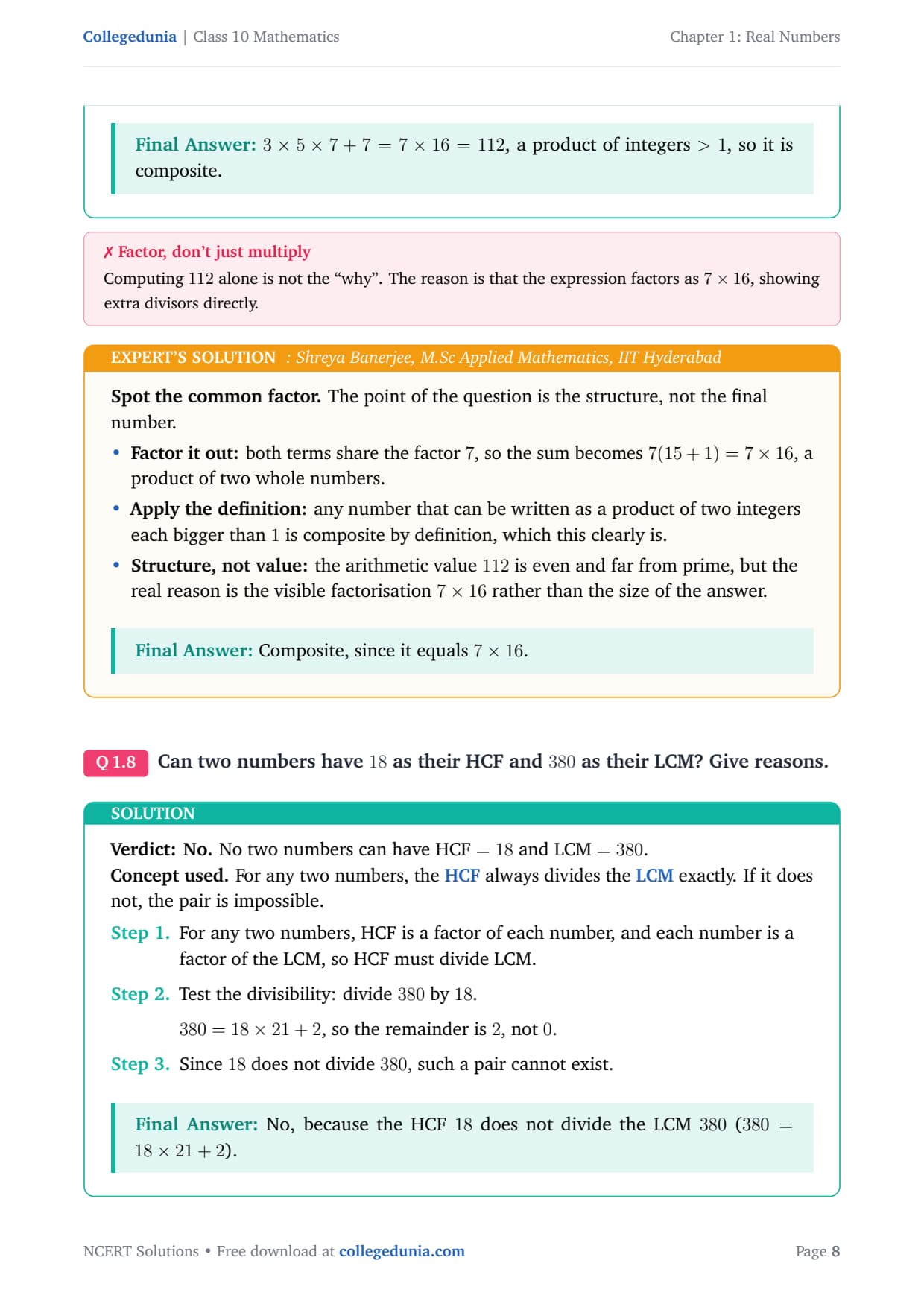
Can two numbers have 18 as their HCF and 380 as their LCM? Give reasons.
Verdict: No. No two numbers can have HCF =18 and LCM =380.
Concept used. For any two numbers, the HCF always
divides the LCM exactly. If it does not, the pair is
impossible.
For any two numbers, HCF is a factor of each number, and each
number is a factor of the LCM, so HCF must divide LCM.
Test the divisibility: divide 380 by 18.
[] 380=18× 21+2, so the remainder is 2, not 0.
Since 18 does not divide 380, such a pair cannot exist.
No, because the HCF 18 does not divide the LCM 380
(380=1821+2).
RS
Rahul Saxena
M.Sc Mathematics, University of Mumbai
Verified Expert
Use the divisibility rule, not trial pairs. You can settle this
without ever hunting for the two numbers.
The chain of divisors: the highest common factor divides
both numbers, and both numbers divide the lowest common multiple,
so by transitivity the HCF must also divide the LCM.
One division: dividing 380 by 18 leaves remainder
2, so 18 does not divide 380 and the pair simply cannot
exist.
No search needed: there is no point looking for actual
numbers, because that single failed division is already a complete
proof that the pair is impossible.
No; 18380.
Q 1.9
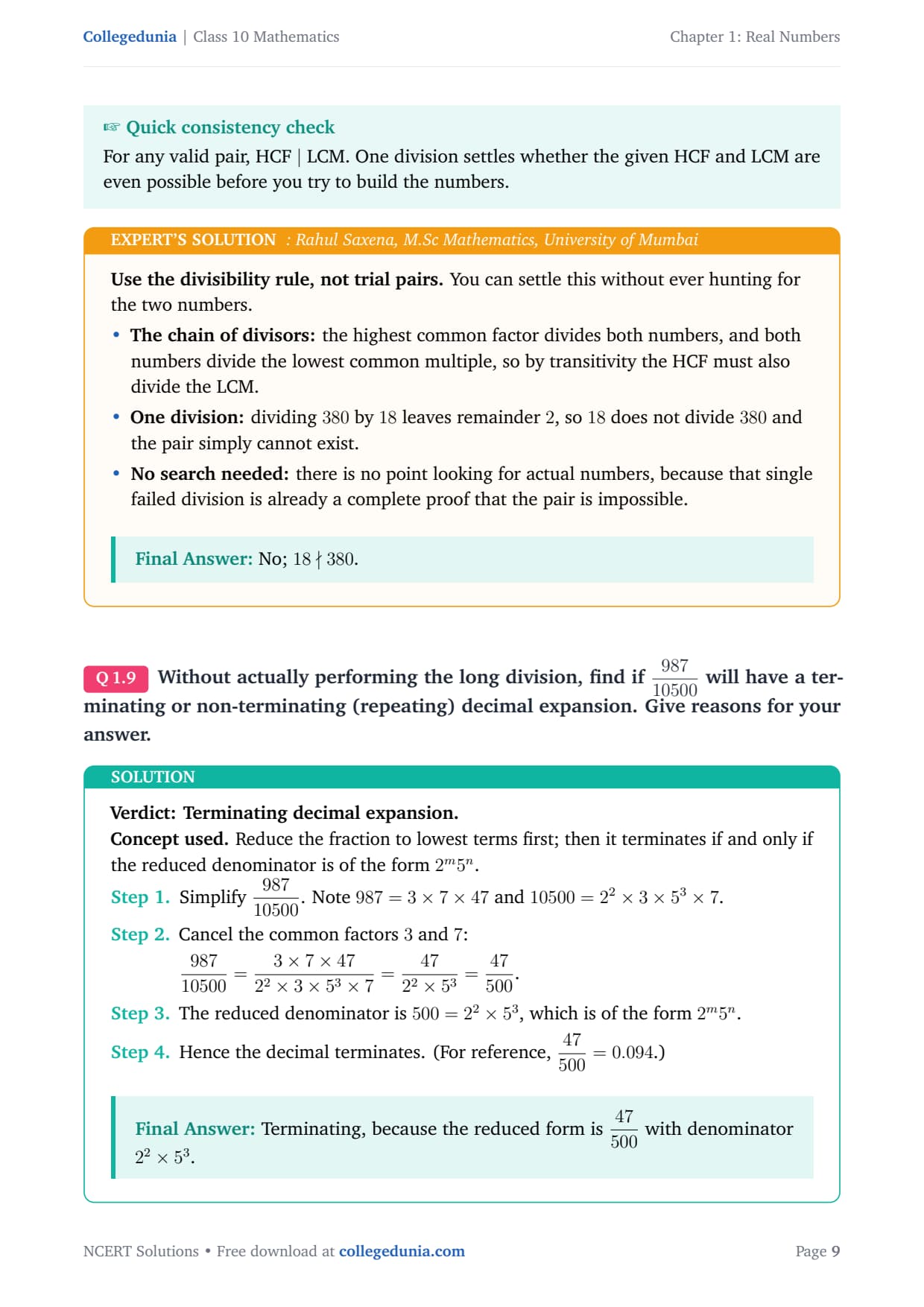
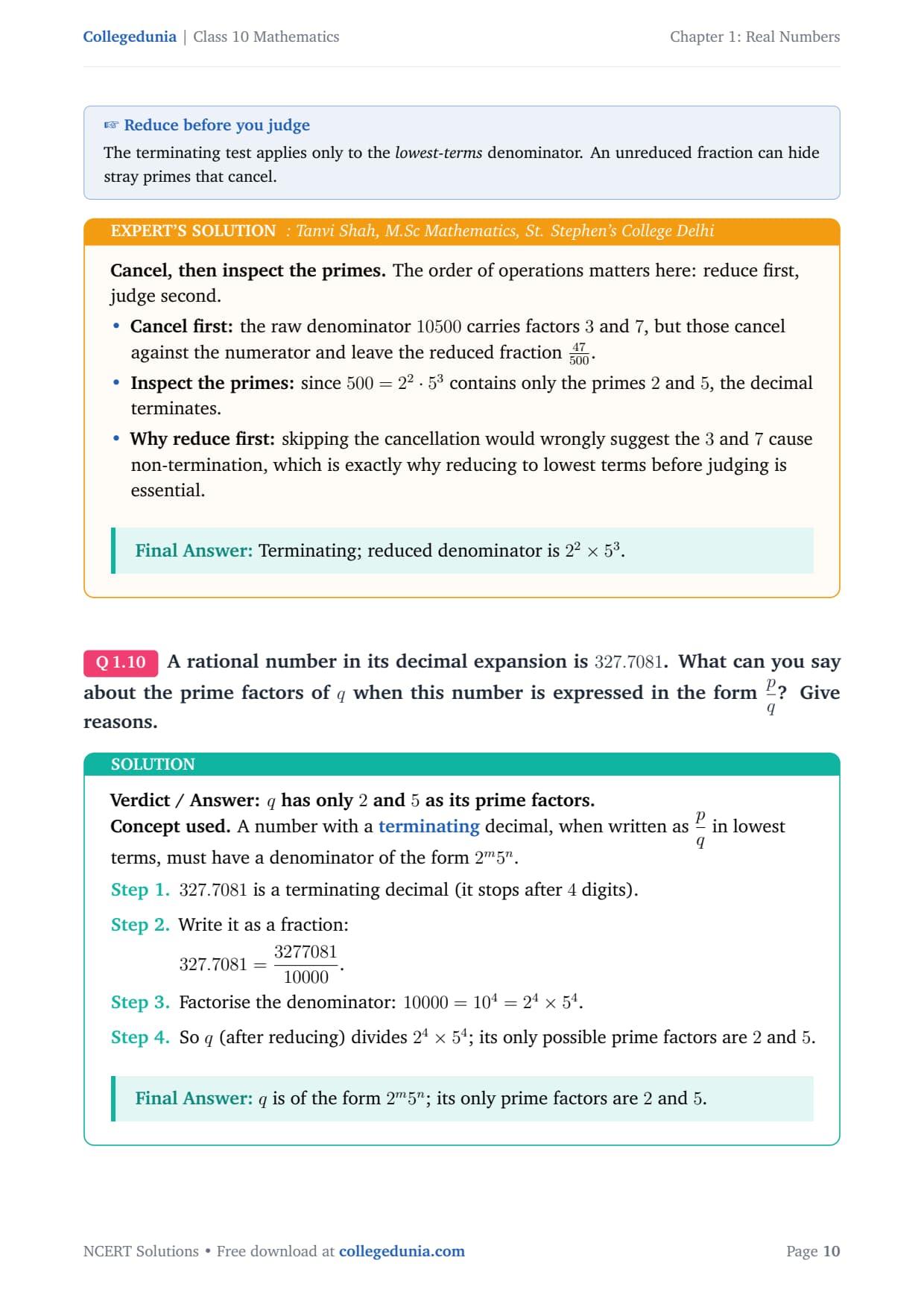
Without actually performing the long division, find if 98710500 will have a terminating or non-terminating (repeating) decimal expansion. Give reasons for your answer.
Verdict: Terminating decimal expansion.
Concept used. Reduce the fraction to lowest terms first; then it
terminates if and only if the reduced denominator is of the form
2m5n.
Cancel the common factors 3 and 7:
[] 98710500=3× 7× 47
22× 3× 53× 7=4722× 53
=47500.
The reduced denominator is 500=22× 53, which is of
the form 2m5n.
Hence the decimal terminates. (For reference,
47500=0.094.)
Terminating, because the reduced form is 47500 with
denominator 2253.
TS
Tanvi Shah
M.Sc Mathematics, St. Stephen's College Delhi
Verified Expert
Cancel, then inspect the primes. The order of operations matters
here: reduce first, judge second.
Cancel first: the raw denominator 10500 carries factors
3 and 7, but those cancel against the numerator and leave the
reduced fraction 47500.
Inspect the primes: since 500=2253 contains only
the primes 2 and 5, the decimal terminates.
Why reduce first: skipping the cancellation would wrongly
suggest the 3 and 7 cause non-termination, which is exactly why
reducing to lowest terms before judging is essential.
Terminating; reduced denominator is 2253.
Q 1.10
A rational number in its decimal expansion is 327.7081. What can you say about the prime factors of q when this number is expressed in the form pq? Give reasons.
Verdict / Answer: q has only 2 and 5 as its prime
factors.
Concept used. A number with a terminating decimal,
when written as pq in lowest terms, must have a denominator
of the form 2m5n.
327.7081 is a terminating decimal (it stops after 4 digits).
Write it as a fraction:
[] 327.7081=327708110000.
Factorise the denominator:
10000=104=24× 54.
So q (after reducing) divides 24× 54; its only
possible prime factors are 2 and 5.
q is of the form 2m5n; its only prime factors are 2
and 5.
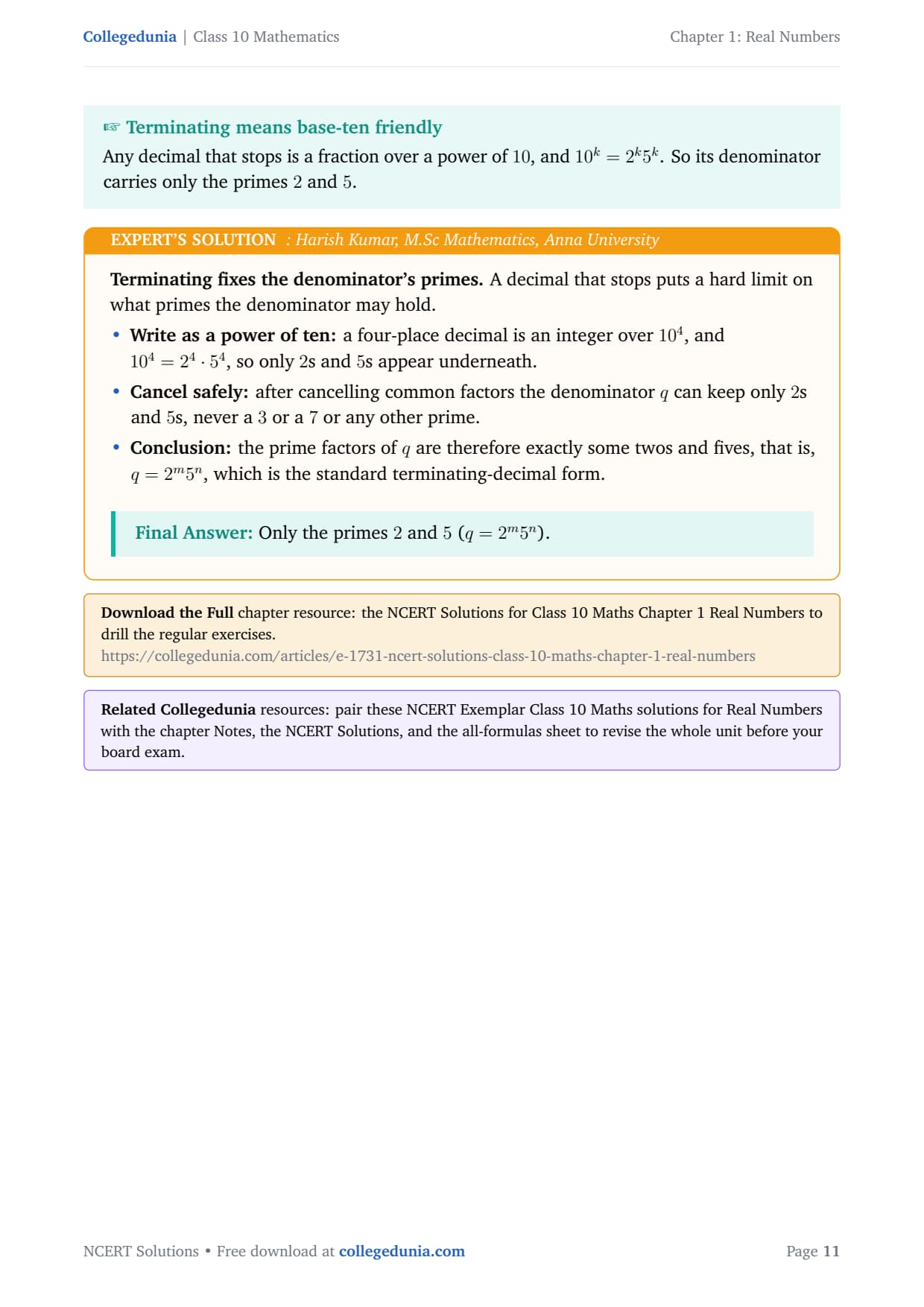
HK
Harish Kumar
M.Sc Mathematics, Anna University
Verified Expert
Terminating fixes the denominator's primes. A decimal that stops
puts a hard limit on what primes the denominator may hold.
Write as a power of ten: a four-place decimal is an
integer over 104, and 104=2454, so only 2s and 5s
appear underneath.
Cancel safely: after cancelling common factors the
denominator q can keep only 2s and 5s, never a 3 or a 7
or any other prime.
Conclusion: the prime factors of q are therefore exactly
some twos and fives, that is, q=2m5n, which is the standard
terminating-decimal form.
Only the primes 2 and 5 (q=2m5n).
NCERT exemplar Class 12 Mathematics Chapter 1 Real Numbers
Class 10 Mathematics Chapter 1: Real Numbers NCERT Exemplar
All 14 questions with collapsible Solution and Expert Solution. Tap a button to reveal the working.
III. Short Answer Questions (Exercise 1.3)
Q 1.1
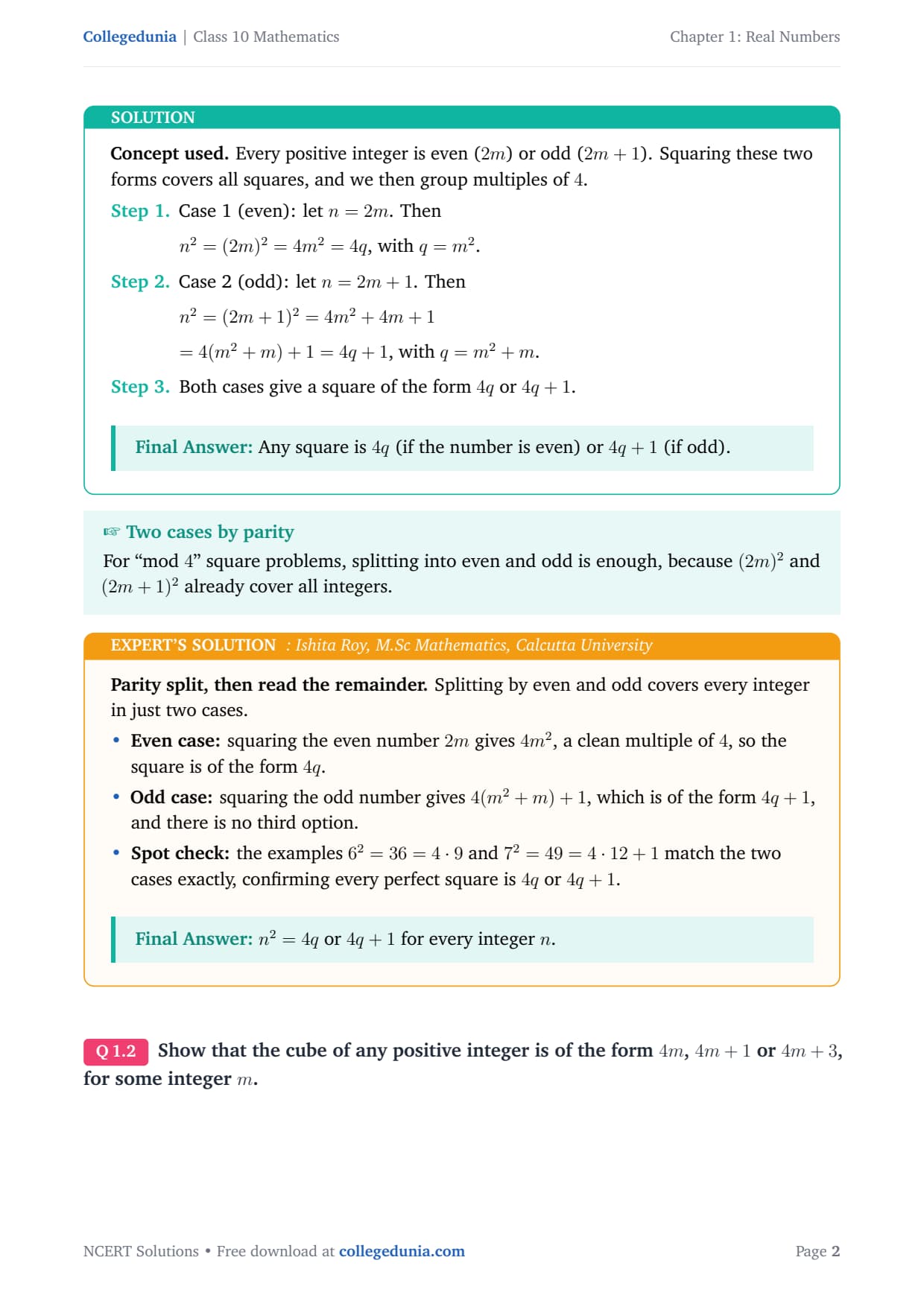
Show that the square of any positive integer is either of the form 4q or 4q+1 for some integer q.
Concept used. Every positive integer is even (2m) or odd
(2m+1). Squaring these two forms covers all squares, and we then group
multiples of 4.
Case 1 (even): let n=2m. Then
[] n2=(2m)2=4m2=4q, with q=m2.
Case 2 (odd): let n=2m+1. Then
[] n2=(2m+1)2=4m2+4m+1
[] =4(m2+m)+1=4q+1, with q=m2+m.
Both cases give a square of the form 4q or 4q+1.
Any square is 4q (if the number is even) or 4q+1 (if odd).
IR
Ishita Roy
M.Sc Mathematics, Calcutta University
Verified Expert
Parity split, then read the remainder. Splitting by even and odd
covers every integer in just two cases.
Even case: squaring the even number 2m gives 4m2, a
clean multiple of 4, so the square is of the form 4q.
Odd case: squaring the odd number gives 4(m2+m)+1,
which is of the form 4q+1, and there is no third option.
Spot check: the examples 62=36=49 and
72=49=412+1 match the two cases exactly, confirming every
perfect square is 4q or 4q+1.
n2=4q or 4q+1 for every integer n.
Q 1.2
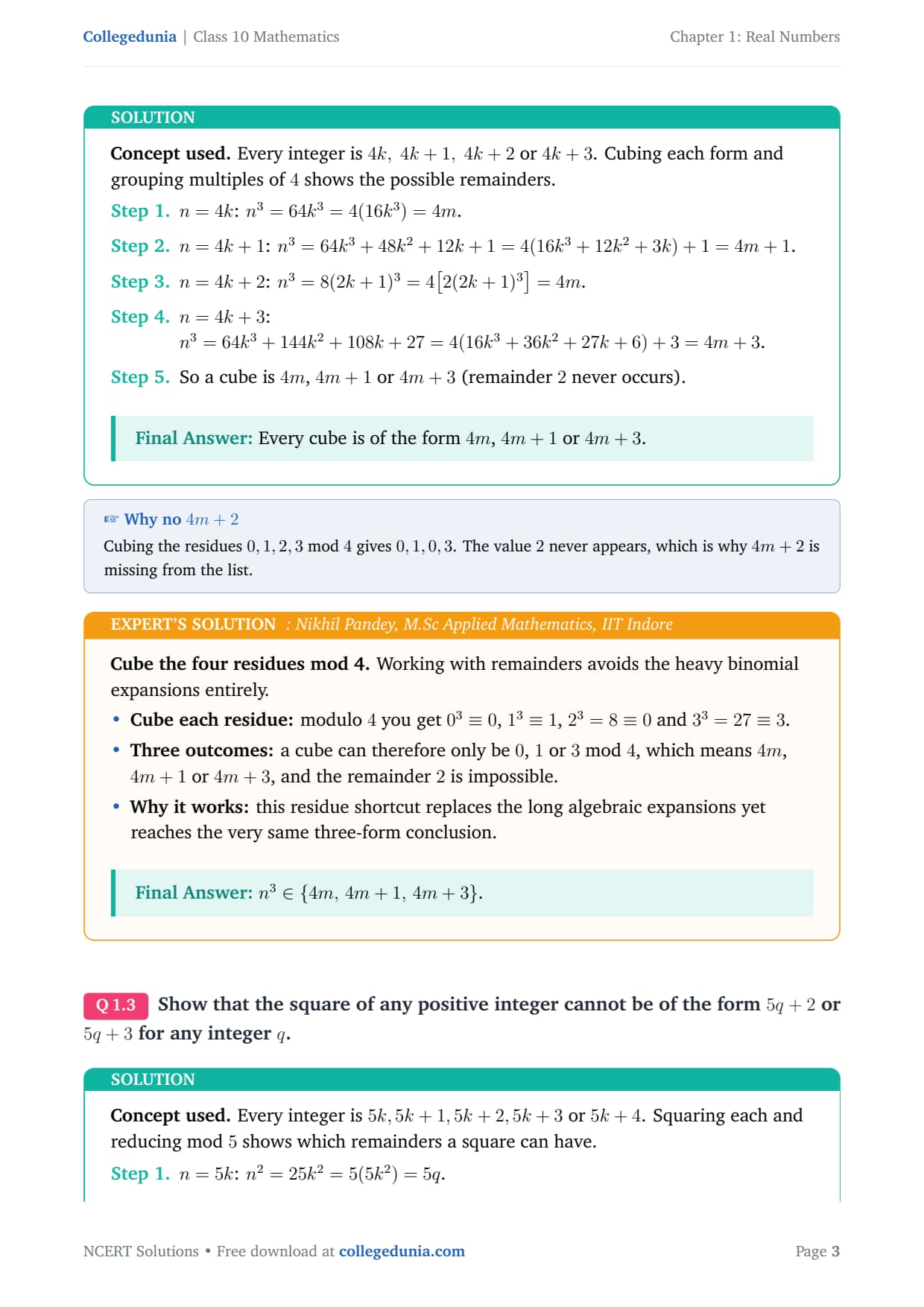
Show that the cube of any positive integer is of the form 4m, 4m+1 or 4m+3, for some integer m.
Concept used. Every integer is 4k, 4k+1, 4k+2 or 4k+3.
Cubing each form and grouping multiples of 4 shows the possible
remainders.
One form, one expansion. A single odd form and one square is all
this proof needs.
Expand once: an odd number is 2k+1, and squaring gives
4k2+4k+1, where the first two terms hold a common factor of 4.
Read the remainder: pulling that 4 out leaves remainder
1, so every odd square is of the form 4q+1.
Sharper result: going one step further, k(k+1) is always
even, so the same square is in fact 8q+1, the result that
board-level proofs often use.
n2=4q+1 for odd n.
Q 1.6
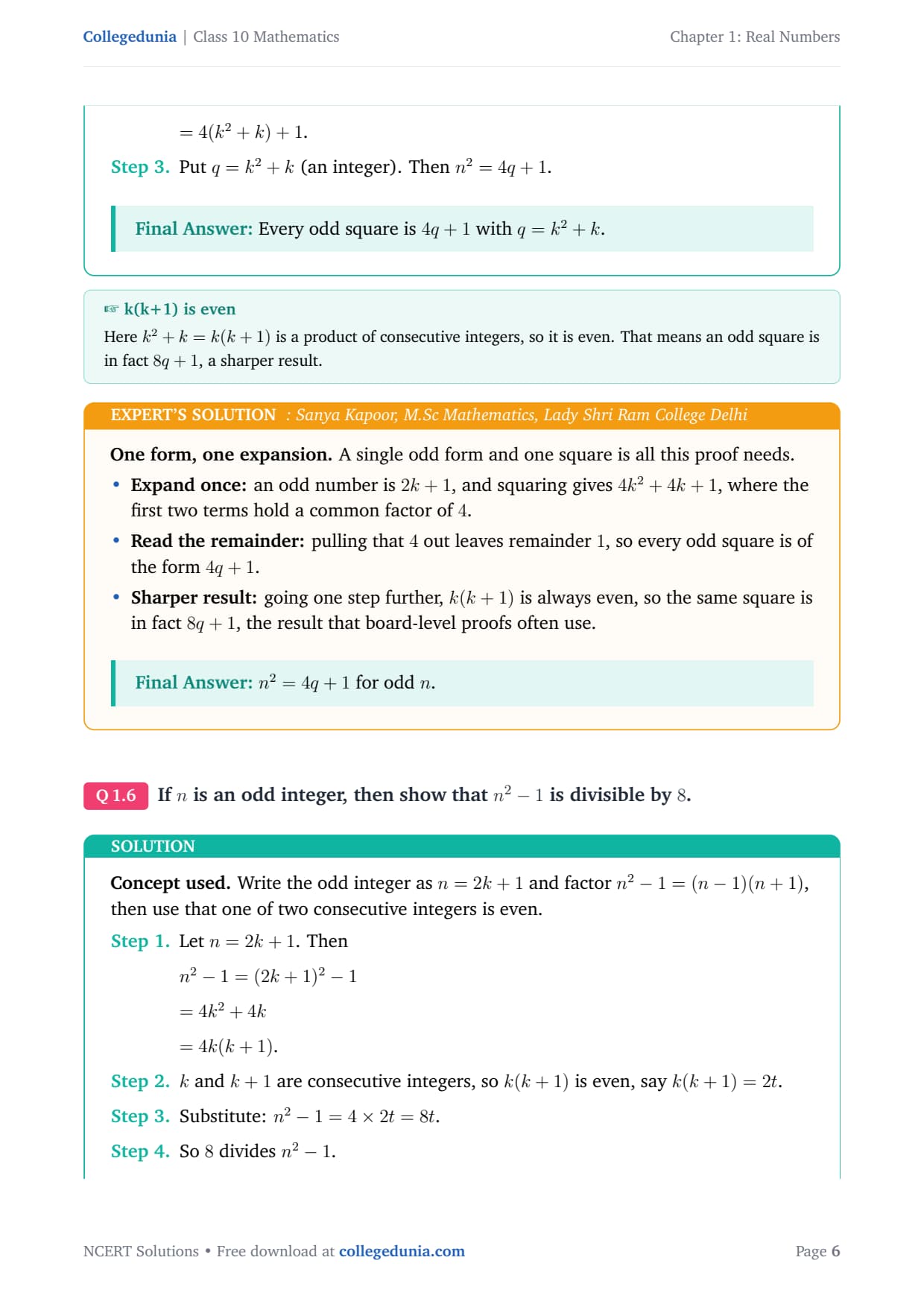
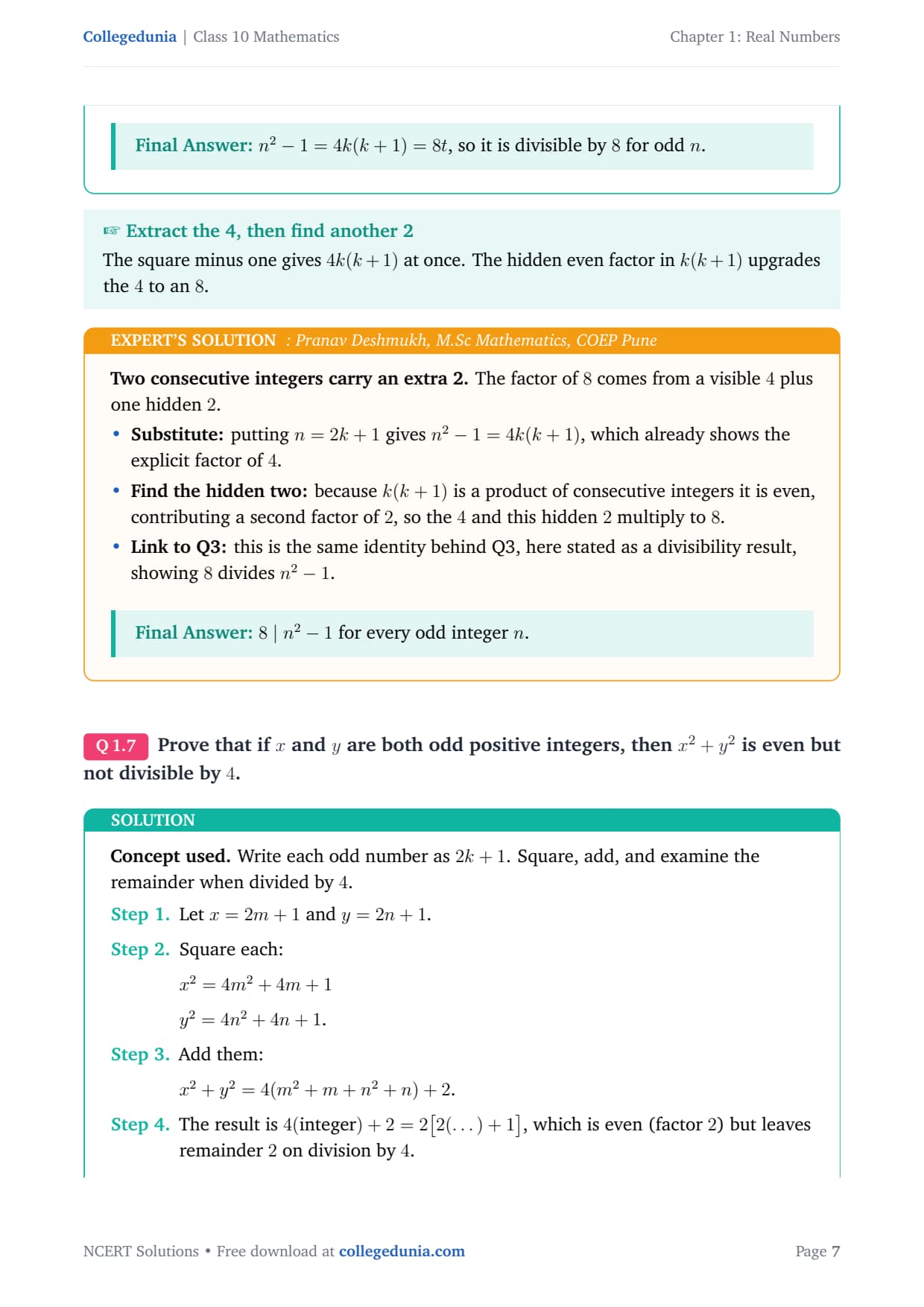
If n is an odd integer, then show that n2-1 is divisible by 8.
Concept used. Write the odd integer as n=2k+1 and factor
n2-1=(n-1)(n+1), then use that one of two consecutive integers is
even.
Let n=2k+1. Then
[] n2-1=(2k+1)2-1
[] =4k2+4k
[] =4k(k+1).
k and k+1 are consecutive integers, so k(k+1) is even, say
k(k+1)=2t.
Substitute: n2-1=4× 2t=8t.
So 8 divides n2-1.
n2-1=4k(k+1)=8t, so it is divisible by 8 for odd n.
PD
Pranav Deshmukh
M.Sc Mathematics, COEP Pune
Verified Expert
Two consecutive integers carry an extra 2. The factor of 8
comes from a visible 4 plus one hidden 2.
Substitute: putting n=2k+1 gives n2-1=4k(k+1), which
already shows the explicit factor of 4.
Find the hidden two: because k(k+1) is a product of
consecutive integers it is even, contributing a second factor of
2, so the 4 and this hidden 2 multiply to 8.
Link to Q3: this is the same identity behind Q3, here
stated as a divisibility result, showing 8 divides n2-1.
8n2-1 for every odd integer n.
Q 1.7
Prove that if x and y are both odd positive integers, then x2+y2 is even but not divisible by 4.
Concept used. Write each odd number as 2k+1. Square, add, and
examine the remainder when divided by 4.
Let x=2m+1 and y=2n+1.
Square each:
[] x2=4m2+4m+1
[] y2=4n2+4n+1.
Add them:
[] x2+y2=4(m2+m+n2+n)+2.
The result is 4(integer)+2=2[2()+1], which
is even (factor 2) but leaves remainder 2 on division by 4.
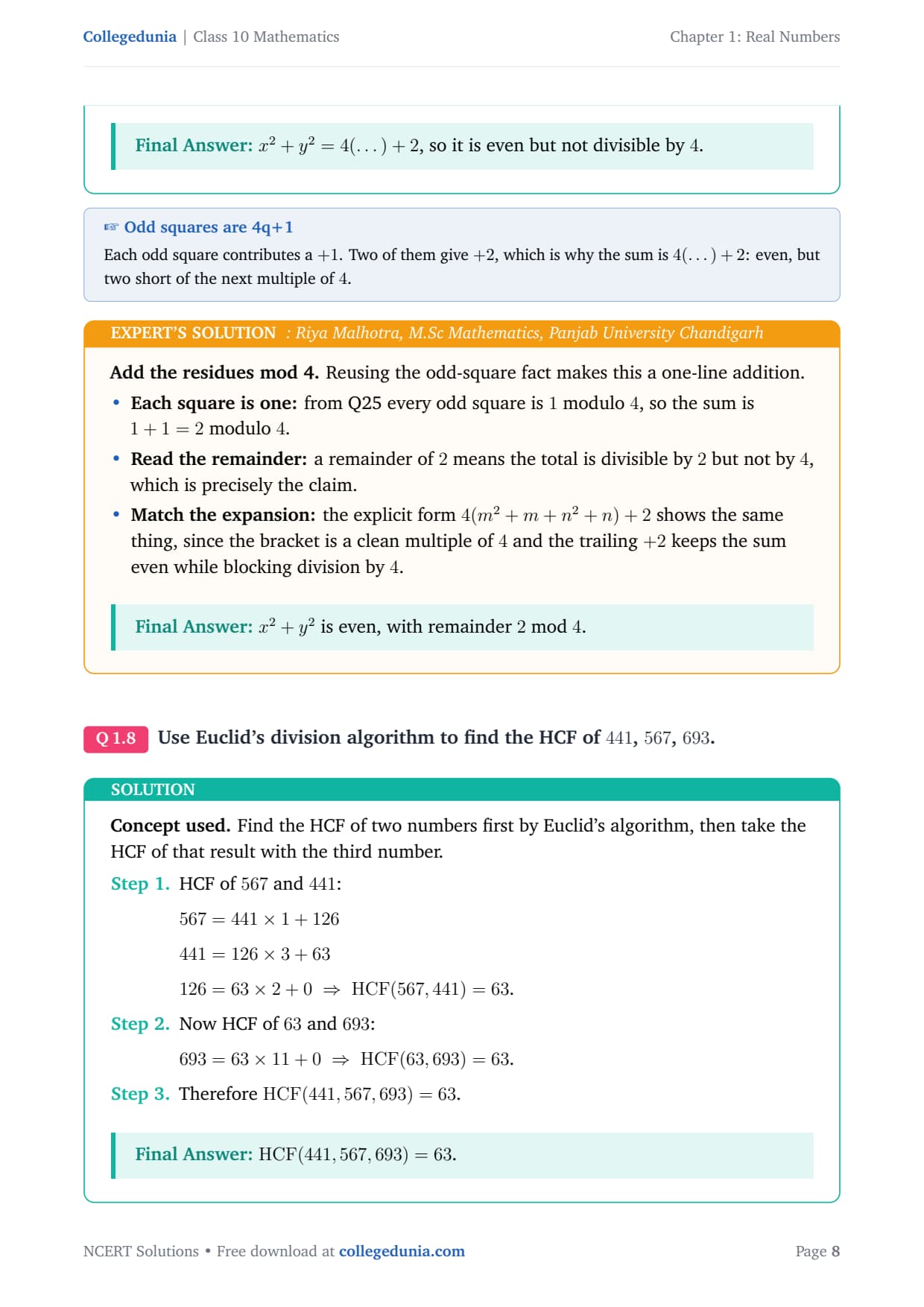
x2+y2=4()+2, so it is even but not divisible by
4.
RM
Riya Malhotra
M.Sc Mathematics, Panjab University Chandigarh
Verified Expert
Add the residues mod 4. Reusing the odd-square fact makes this a
one-line addition.
Each square is one: from Q25 every odd square is 1
modulo 4, so the sum is 1+1=2 modulo 4.
Read the remainder: a remainder of 2 means the total is
divisible by 2 but not by 4, which is precisely the claim.
Match the expansion: the explicit form 4(m2+m+n2+n)+2
shows the same thing, since the bracket is a clean multiple of 4
and the trailing +2 keeps the sum even while blocking division by
4.
x2+y2 is even, with remainder 2 mod 4.
Q 1.8
Use Euclid's division algorithm to find the HCF of 441, 567, 693.
Concept used. Find the HCF of two numbers first by Euclid's
algorithm, then take the HCF of that result with the third number.
HCF of 567 and 441:
[] 567=441× 1+126
[] 441=126× 3+63
[] 126=63× 2+0 ⇒ HCF(567,441)=63.
Now HCF of 63 and 693:
[] 693=63× 11+0 ⇒ HCF(63,693)=63.
Therefore HCF(441,567,693)=63.
HCF(441,567,693)=63.
GT
Gaurav Tiwari
M.Sc Applied Mathematics, IIT BHU Varanasi
Verified Expert
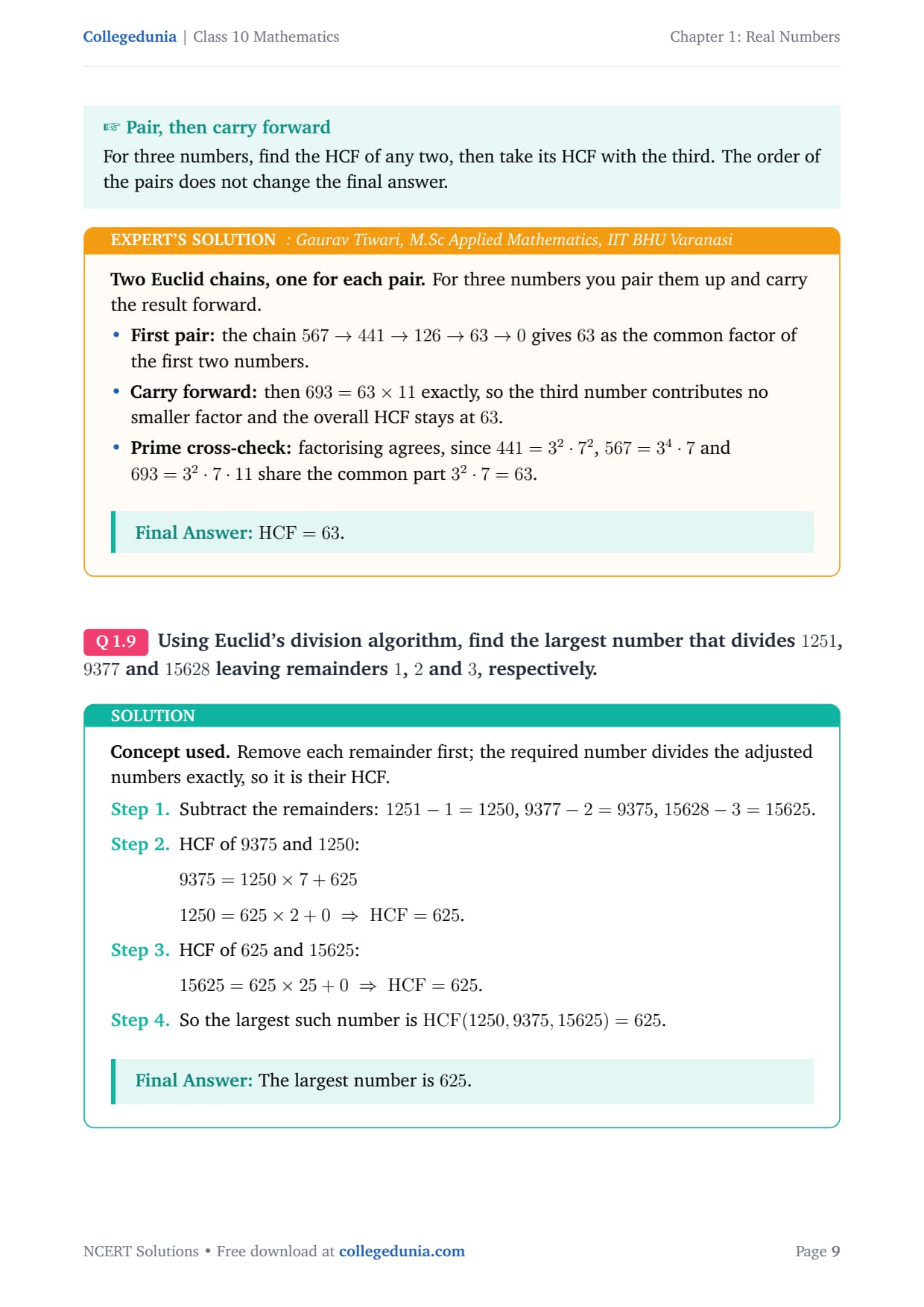
Two Euclid chains, one for each pair. For three numbers you pair
them up and carry the result forward.
First pair: the chain 567441126630 gives
63 as the common factor of the first two numbers.
Carry forward: then 693=6311 exactly, so the
third number contributes no smaller factor and the overall HCF
stays at 63.
Prime cross-check: factorising agrees, since
441=3272, 567=347 and 693=32711 share
the common part 327=63.
HCF=63.
Q 1.9
Using Euclid's division algorithm, find the largest number that divides 1251, 9377 and 15628 leaving remainders 1, 2 and 3, respectively.
Concept used. Remove each remainder first; the required number
divides the adjusted numbers exactly, so it is their HCF.
Subtract the remainders:
1251-1=1250, 9377-2=9375, 15628-3=15625.
HCF of 9375 and 1250:
[] 9375=1250× 7+625
[] 1250=625× 2+0 ⇒ HCF=625.
HCF of 625 and 15625:
[] 15625=625× 25+0 ⇒ HCF=625.
So the largest such number is
HCF(1250,9375,15625)=625.
The largest number is 625.
LK
Lakshmi Krishnan
M.Sc Mathematics, University of Madras
Verified Expert
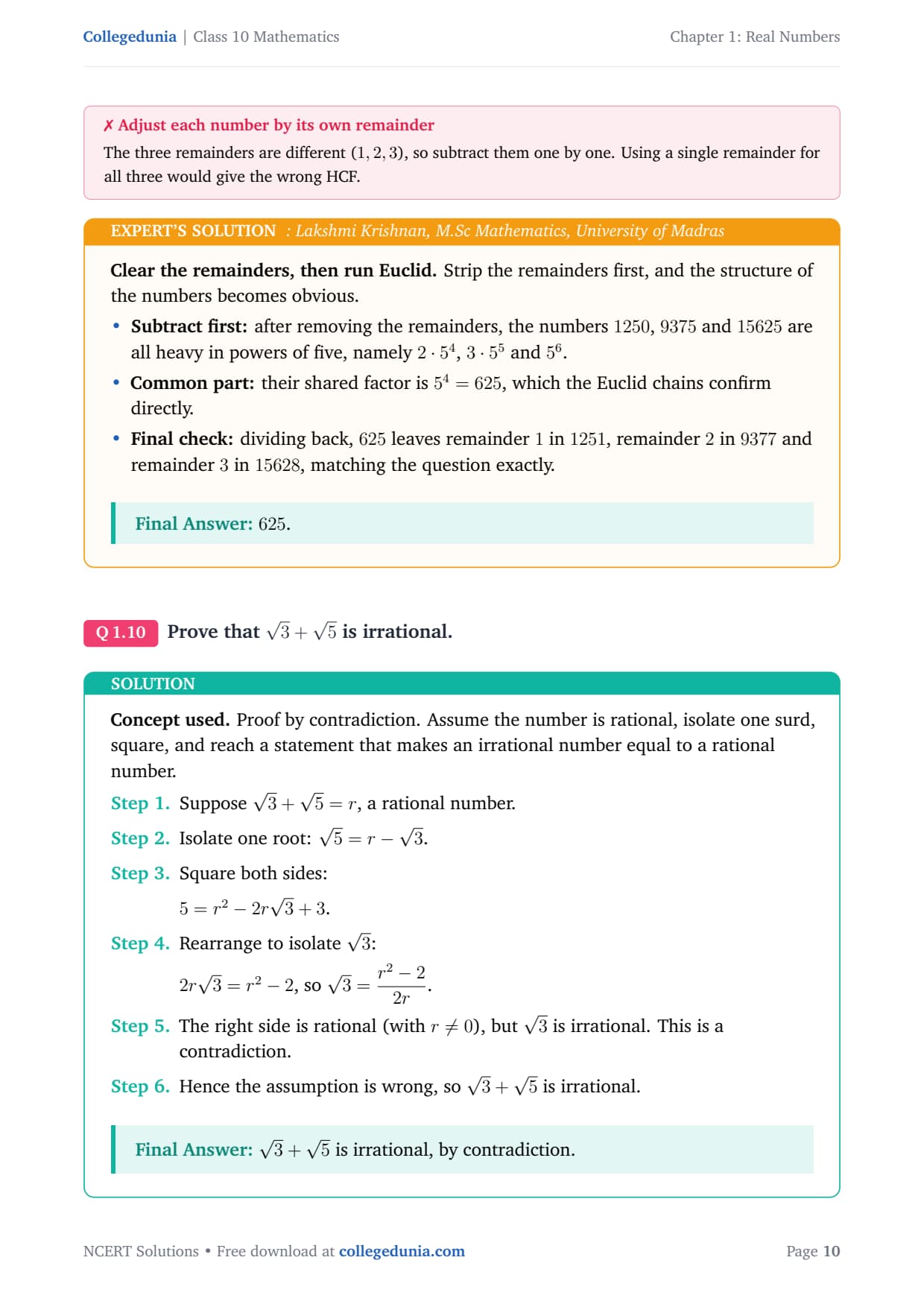
Clear the remainders, then run Euclid. Strip the remainders
first, and the structure of the numbers becomes obvious.
Subtract first: after removing the remainders, the
numbers 1250, 9375 and 15625 are all heavy in powers of
five, namely 254, 355 and 56.
Common part: their shared factor is 54=625, which the
Euclid chains confirm directly.
Final check: dividing back, 625 leaves remainder 1 in
1251, remainder 2 in 9377 and remainder 3 in 15628,
matching the question exactly.
625.
Q 1.10
Prove that √3+√5 is irrational.
Concept used. Proof by contradiction. Assume the number is
rational, isolate one surd, square, and reach a statement that makes an
irrational number equal to a rational number.
Suppose √3+√5=r, a rational number.
Isolate one root: √5=r-√3.
Square both sides:
[] 5=r2-2r√3+3.
Rearrange to isolate √3:
[] 2r√3=r2-2, so
√3=r2-22r.
The right side is rational (with r≠ 0), but √3 is
irrational. This is a contradiction.
Hence the assumption is wrong, so √3+√5 is
irrational.
√3+√5 is irrational, by contradiction.
VC
Varun Chauhan
M.Sc Mathematics, NIT Surathkal
Verified Expert
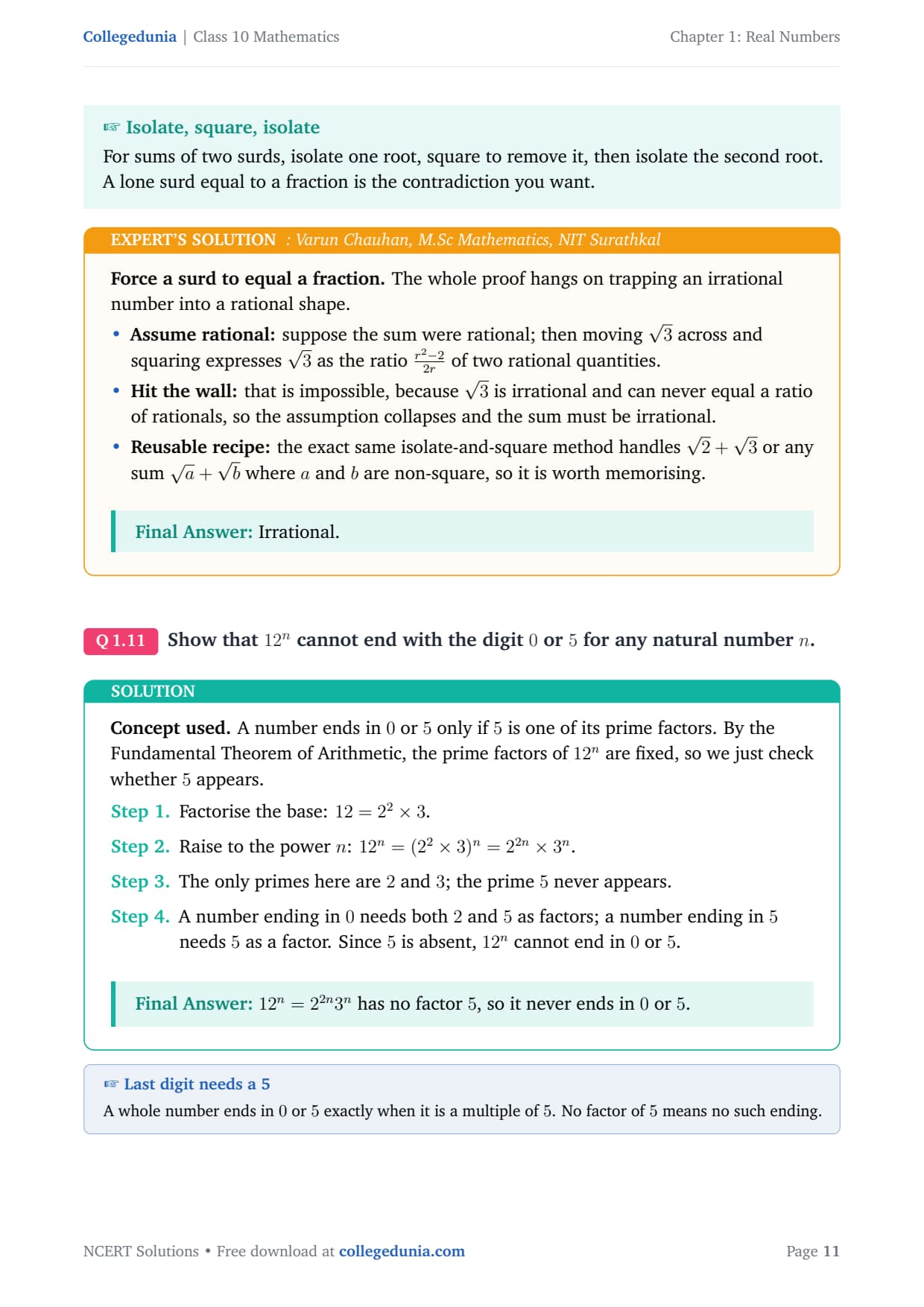
Force a surd to equal a fraction. The whole proof hangs on
trapping an irrational number into a rational shape.
Assume rational: suppose the sum were rational; then
moving 3 across and squaring expresses 3 as the ratio
r2-22r of two rational quantities.
Hit the wall: that is impossible, because 3 is
irrational and can never equal a ratio of rationals, so the
assumption collapses and the sum must be irrational.
Reusable recipe: the exact same isolate-and-square method
handles 2+3 or any sum a+b where a and
b are non-square, so it is worth memorising.
Irrational.
Q 1.11
Show that 12n cannot end with the digit 0 or 5 for any natural number n.
Concept used. A number ends in 0 or 5 only if 5 is one of
its prime factors. By the Fundamental Theorem of Arithmetic, the prime
factors of 12n are fixed, so we just check whether 5 appears.
Factorise the base: 12=22× 3.
Raise to the power n:
12n=(22× 3)n=22n× 3n.
The only primes here are 2 and 3; the prime 5 never
appears.
A number ending in 0 needs both 2 and 5 as factors; a
number ending in 5 needs 5 as a factor. Since 5 is absent,
12n cannot end in 0 or 5.
12n=22n3n has no factor 5, so it never ends in 0
or 5.
AS
Anjali Sharma
M.Sc Mathematics, Miranda House Delhi
Verified Expert
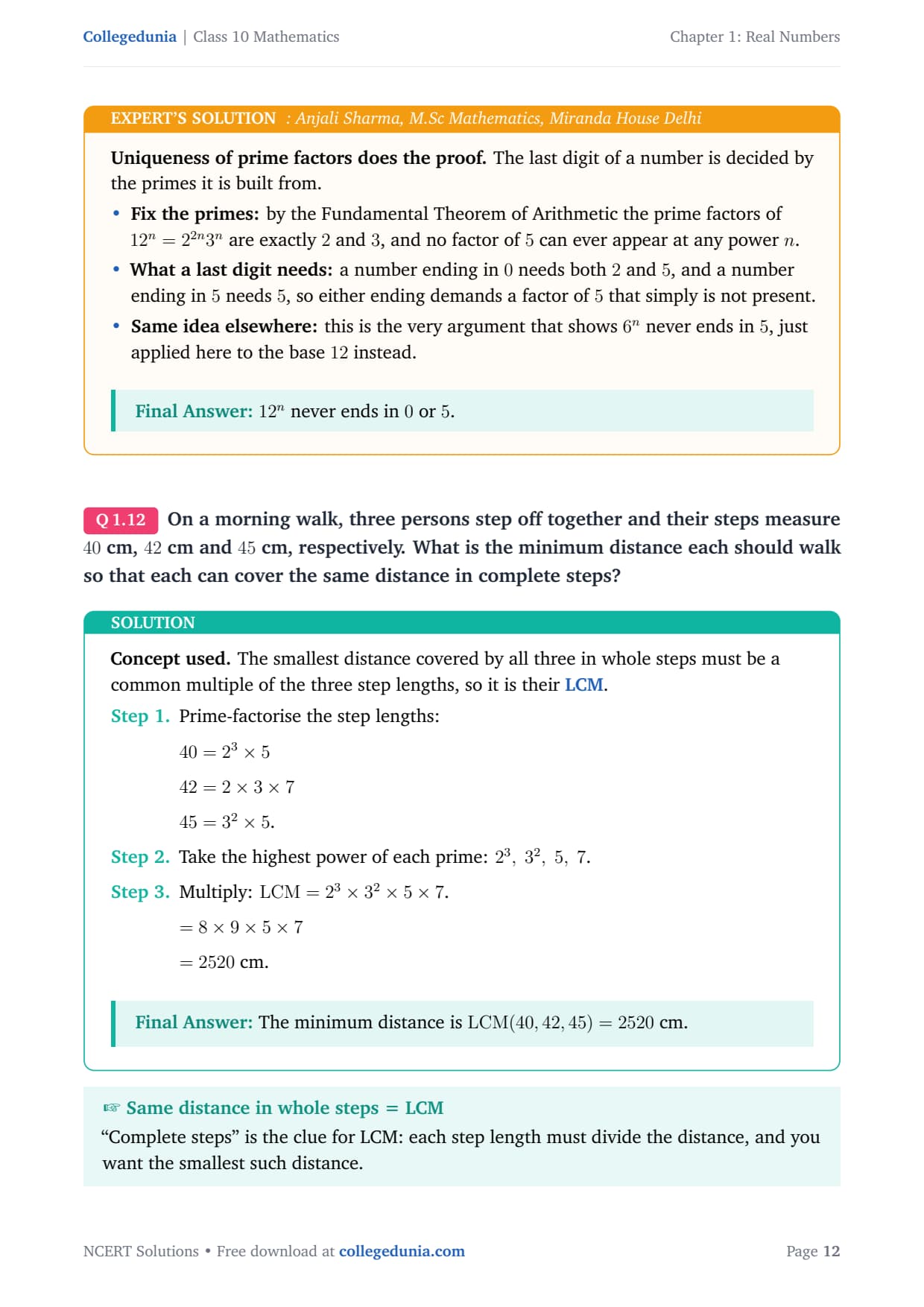
Uniqueness of prime factors does the proof. The last digit of a
number is decided by the primes it is built from.
Fix the primes: by the Fundamental Theorem of Arithmetic
the prime factors of 12n=22n3n are exactly 2 and 3, and
no factor of 5 can ever appear at any power n.
What a last digit needs: a number ending in 0 needs both
2 and 5, and a number ending in 5 needs 5, so either ending
demands a factor of 5 that simply is not present.
Same idea elsewhere: this is the very argument that shows
6n never ends in 5, just applied here to the base 12 instead.
12n never ends in 0 or 5.
Q 1.12
On a morning walk, three persons step off together and their steps measure 40 cm, 42 cm and 45 cm, respectively. What is the minimum distance each should walk so that each can cover the same distance in complete steps?
Concept used. The smallest distance covered by all three in
whole steps must be a common multiple of the three step lengths, so it is
their LCM.
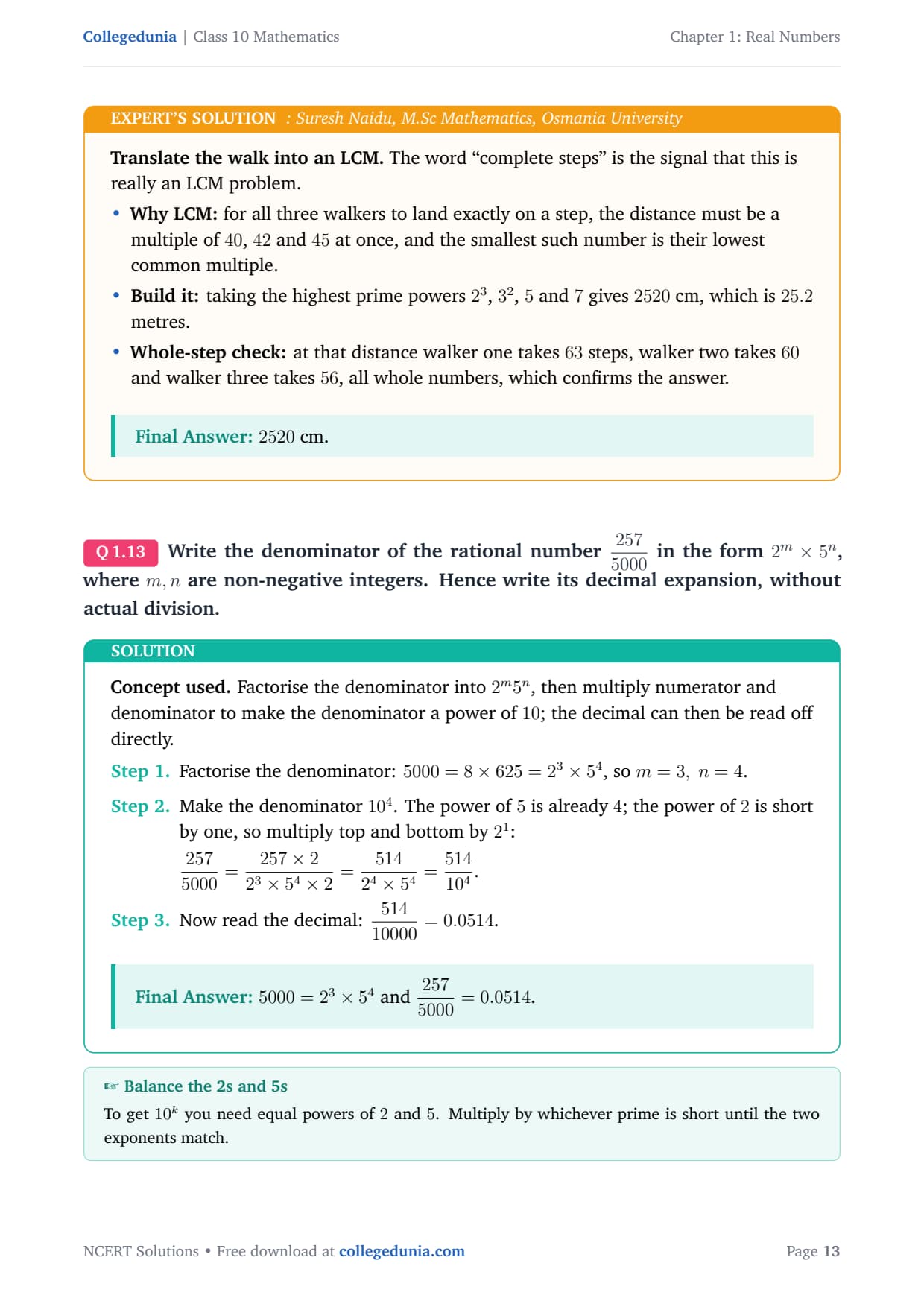
Translate the walk into an LCM. The word ``complete steps'' is
the signal that this is really an LCM problem.
Why LCM: for all three walkers to land exactly on a step,
the distance must be a multiple of 40, 42 and 45 at once, and
the smallest such number is their lowest common multiple.
Build it: taking the highest prime powers 23, 32,
5 and 7 gives 2520 cm, which is 25.2 metres.
Whole-step check: at that distance walker one takes 63
steps, walker two takes 60 and walker three takes 56, all whole
numbers, which confirms the answer.
2520 cm.
Q 1.13
Write the denominator of the rational number 2575000 in the form 2m× 5n, where m,n are non-negative integers. Hence write its decimal expansion, without actual division.
Concept used. Factorise the denominator into 2m5n, then
multiply numerator and denominator to make the denominator a power of
10; the decimal can then be read off directly.
Factorise the denominator:
5000=8× 625=23× 54, so m=3, n=4.
Make the denominator 104. The power of 5 is already 4;
the power of 2 is short by one, so multiply top and bottom by
21:
[] 2575000=257× 223× 54× 2
=51424× 54=514104.
Now read the decimal: 51410000=0.0514.
5000=2354 and
2575000=0.0514.
NB
Neha Bhardwaj
M.Sc Applied Mathematics, IIT Patna
Verified Expert
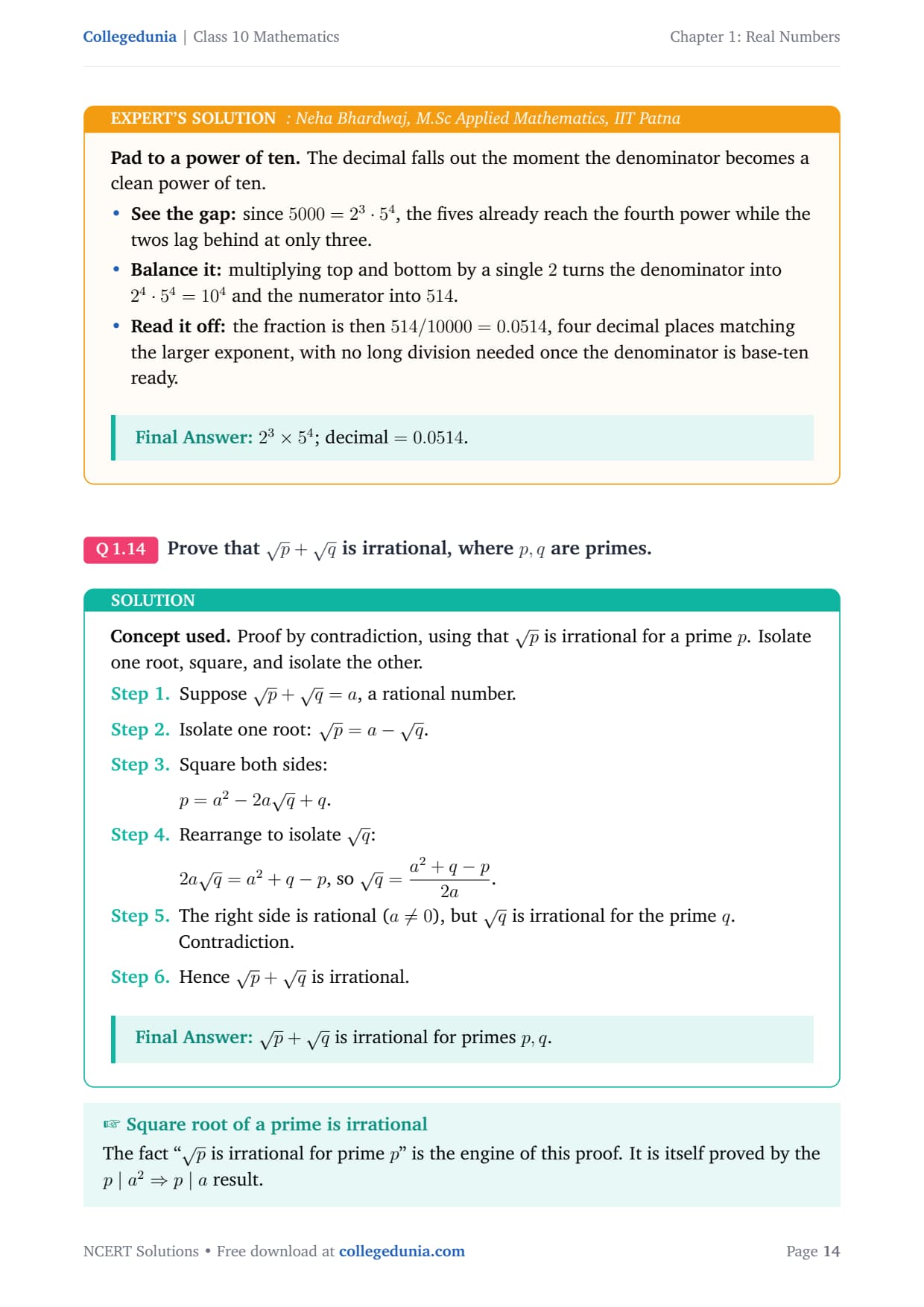
Pad to a power of ten. The decimal falls out the moment the
denominator becomes a clean power of ten.
See the gap: since 5000=2354, the fives already
reach the fourth power while the twos lag behind at only three.
Balance it: multiplying top and bottom by a single 2
turns the denominator into 2454=104 and the numerator
into 514.
Read it off: the fraction is then 514/10000=0.0514, four
decimal places matching the larger exponent, with no long division
needed once the denominator is base-ten ready.
2354; decimal =0.0514.
Q 1.14
Prove that √p+√q is irrational, where p,q are primes.
Concept used. Proof by contradiction, using that √p is
irrational for a prime p. Isolate one root, square, and isolate the
other.
Suppose √p+√q=a, a rational number.
Isolate one root: √p=a-√q.
Square both sides:
[] p=a2-2a√q+q.
Rearrange to isolate √q:
[] 2a√q=a2+q-p, so
√q=a2+q-p2a.
The right side is rational (a≠ 0), but √q is
irrational for the prime q. Contradiction.
Hence √p+√q is irrational.
√p+√q is irrational for primes p,q.
AJ
Akash Jain
M.Sc Mathematics, Loyola College Chennai
Verified Expert
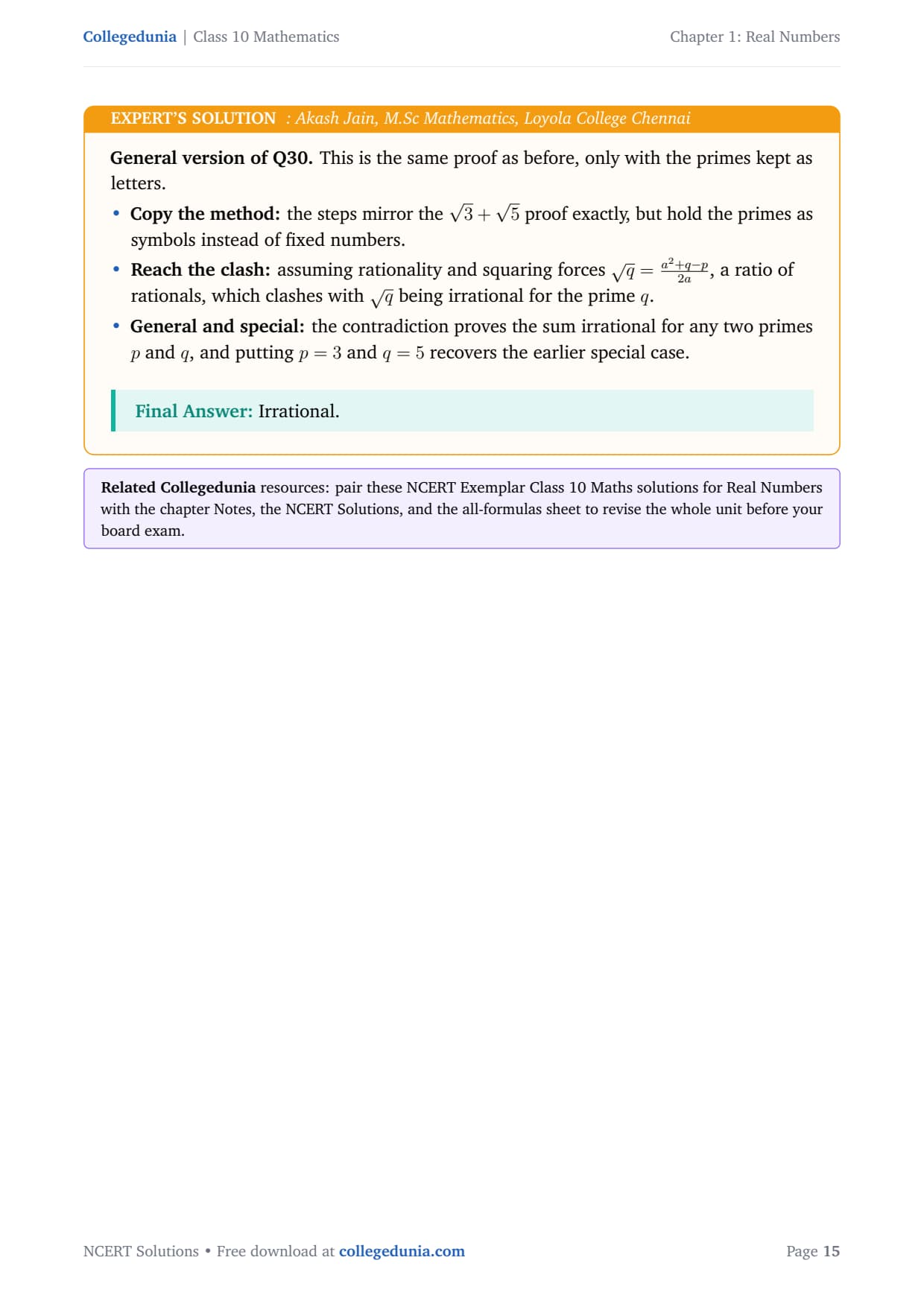
General version of Q30. This is the same proof as before, only
with the primes kept as letters.
Copy the method: the steps mirror the 3+5
proof exactly, but hold the primes as symbols instead of fixed
numbers.
Reach the clash: assuming rationality and squaring forces
q=a2+q-p2a, a ratio of rationals, which clashes
with q being irrational for the prime q.
General and special: the contradiction proves the sum
irrational for any two primes p and q, and putting p=3 and
q=5 recovers the earlier special case.
Irrational.
NCERT exemplar Class 12 Mathematics Chapter 1 Real Numbers
Class 10 Mathematics Chapter 1: Real Numbers NCERT Exemplar
All 5 questions with collapsible Solution and Expert Solution. Tap a button to reveal the working.
IV. Long Answer Questions (Exercise 1.4)
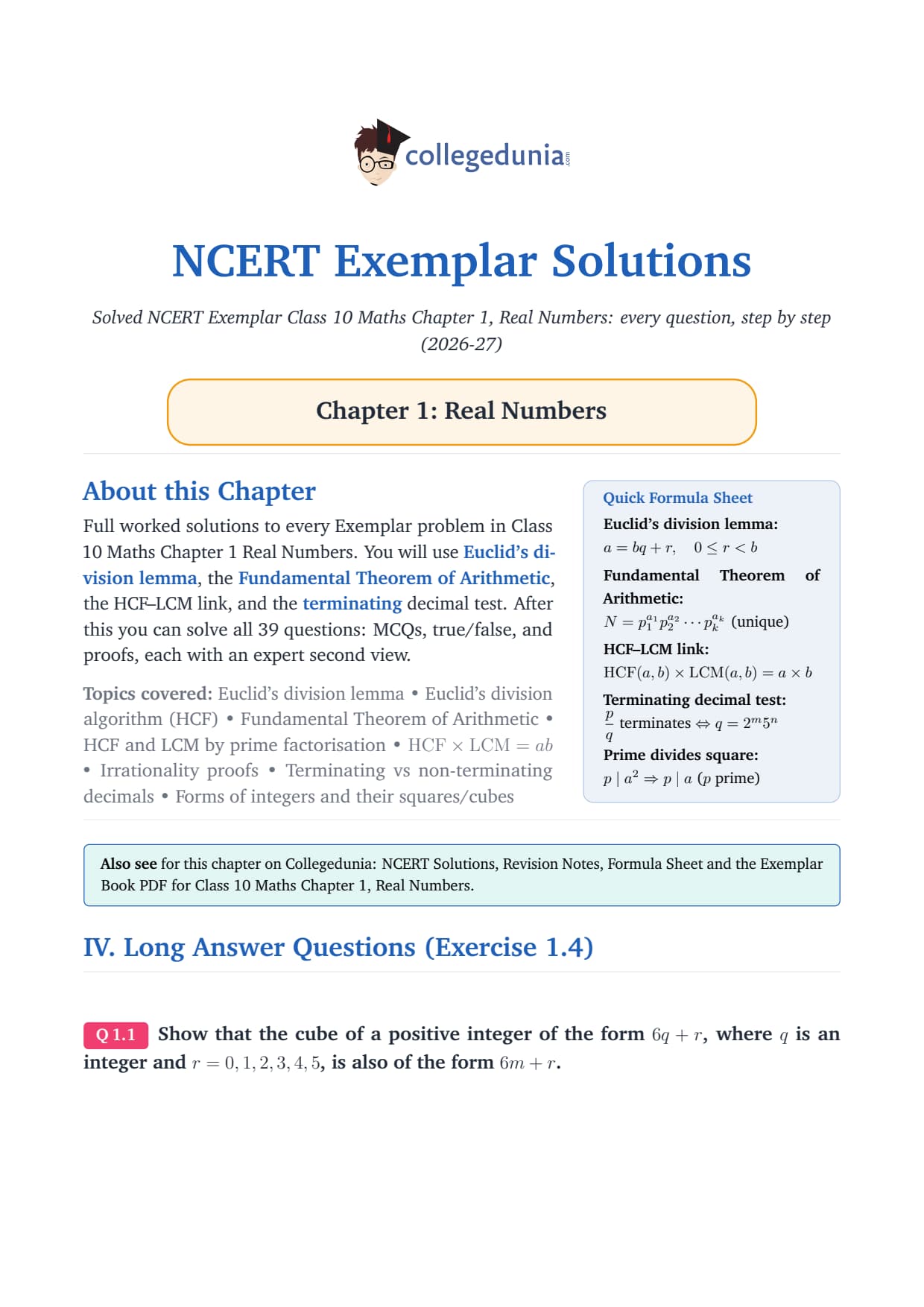
Q 1.1
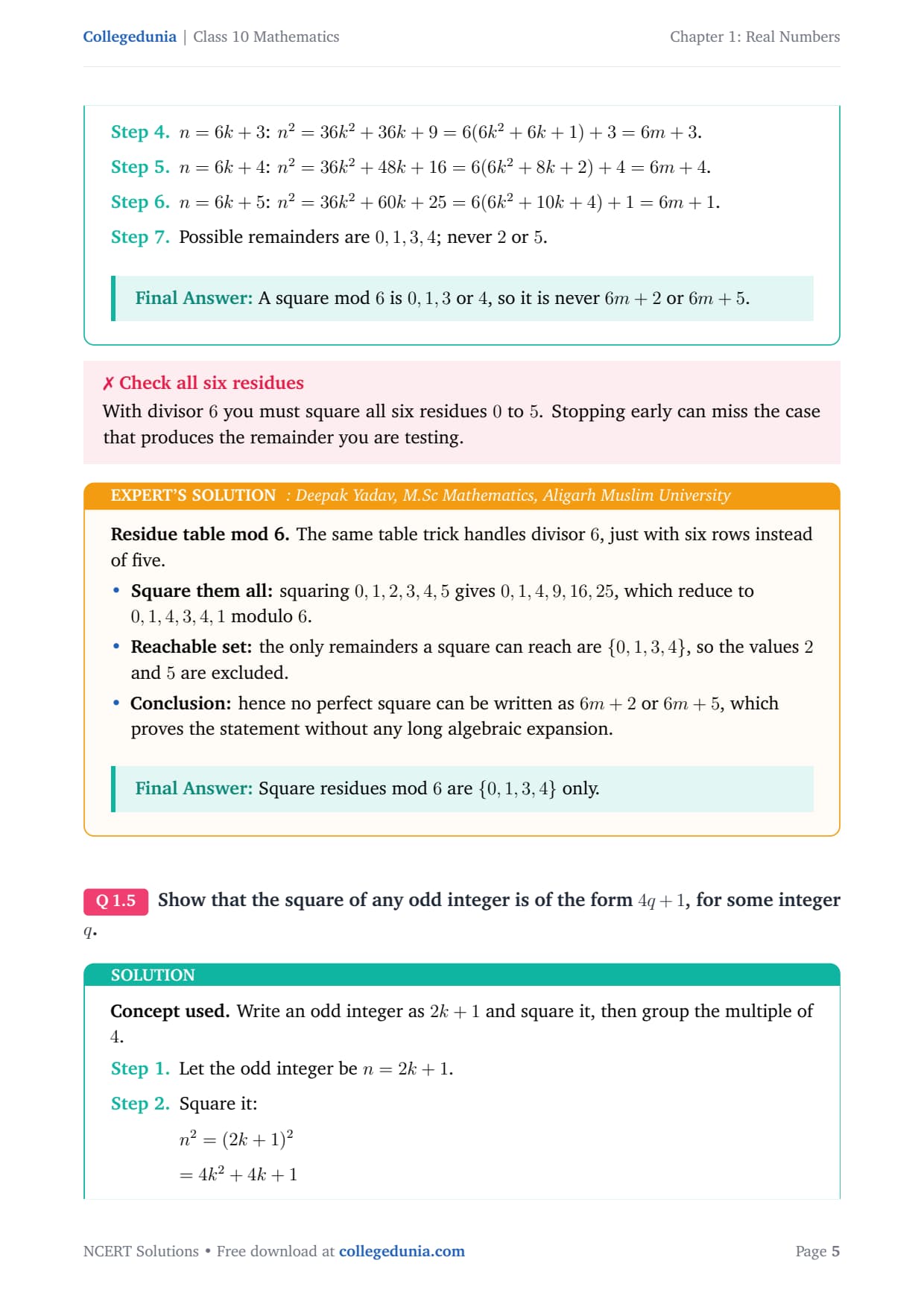
Show that the cube of a positive integer of the form 6q+r, where q is an integer and r=0,1,2,3,4,5, is also of the form 6m+r.
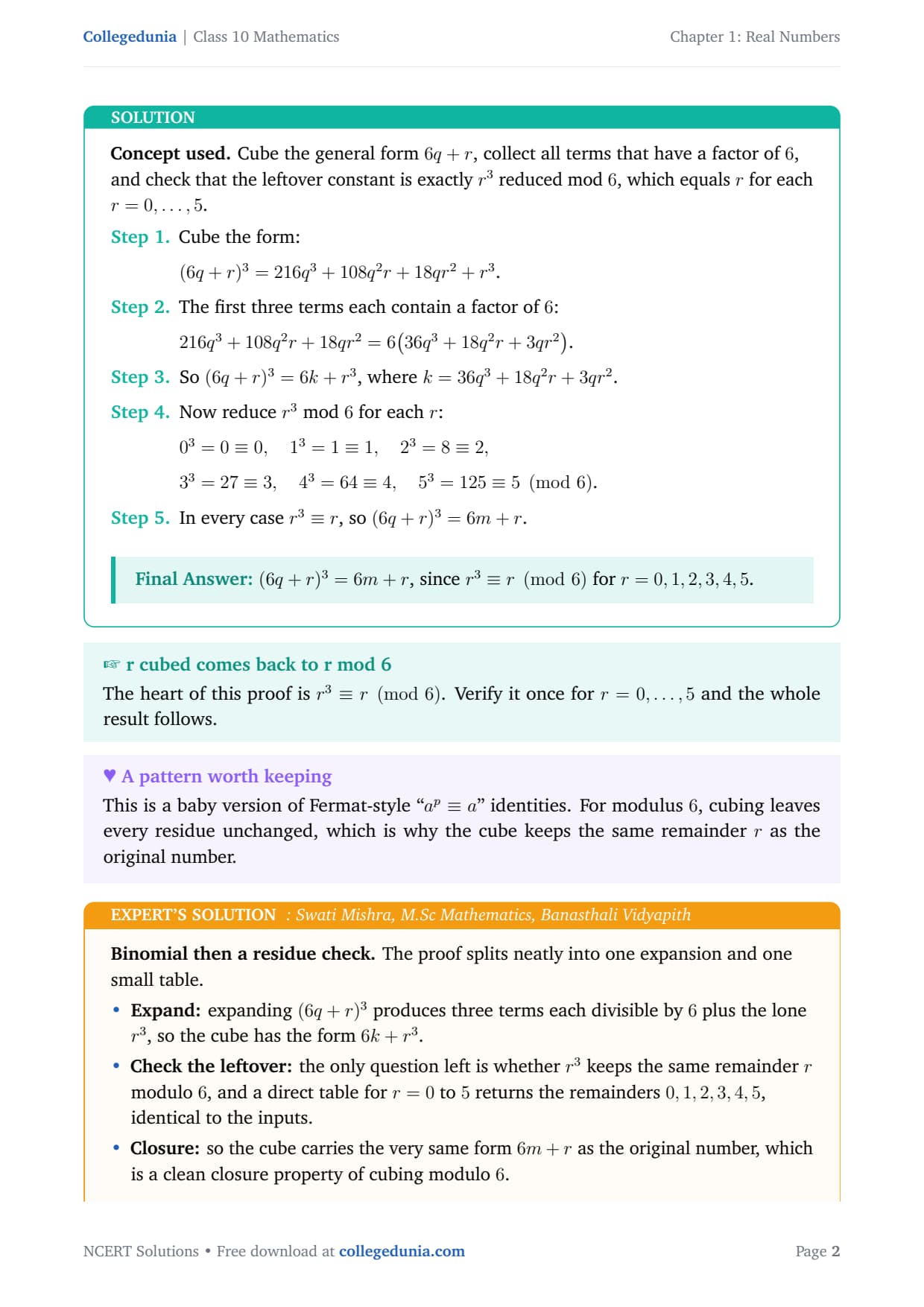
Concept used. Cube the general form 6q+r, collect all terms
that have a factor of 6, and check that the leftover constant is
exactly r3 reduced mod 6, which equals r for each r=0,,5.
Cube the form:
[] (6q+r)3=216q3+108q2r+18qr2+r3.
The first three terms each contain a factor of 6:
[] 216q3+108q2r+18qr2=6(36q3+18q2r+3qr2).
So (6q+r)3=6k+r3, where k=36q3+18q2r+3qr2.
Now reduce r3 mod 6 for each r:
[] 03=0≡ 0, 13=1≡ 1,
23=8≡ 2,
[] 33=27≡ 3, 43=64≡ 4,
53=125≡ 56.
In every case r3≡ r, so (6q+r)3=6m+r.
(6q+r)3=6m+r, since r3≡ r6 for
r=0,1,2,3,4,5.
SM
Swati Mishra
M.Sc Mathematics, Banasthali Vidyapith
Verified Expert
Binomial then a residue check. The proof splits neatly into one
expansion and one small table.
Expand: expanding (6q+r)3 produces three terms each
divisible by 6 plus the lone r3, so the cube has the form
6k+r3.
Check the leftover: the only question left is whether
r3 keeps the same remainder r modulo 6, and a direct table
for r=0 to 5 returns the remainders 0,1,2,3,4,5, identical to
the inputs.
Closure: so the cube carries the very same form 6m+r as
the original number, which is a clean closure property of cubing
modulo 6.
(6q+r)3=6m+r for every r=0,,5.
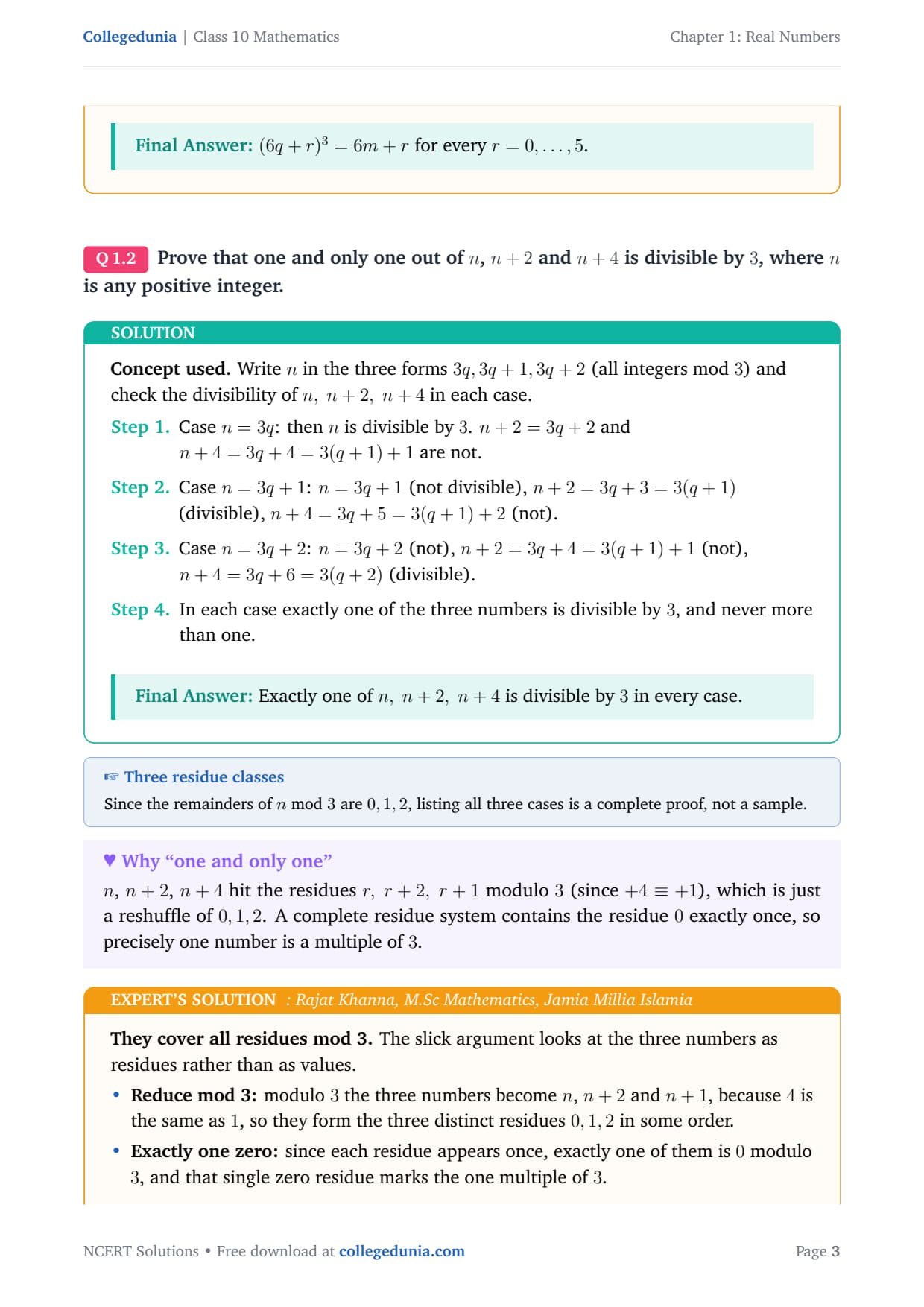
Q 1.2
Prove that one and only one out of n, n+2 and n+4 is divisible by 3, where n is any positive integer.
Concept used. Write n in the three forms 3q,3q+1,3q+2 (all
integers mod 3) and check the divisibility of n, n+2, n+4 in each
case.
Case n=3q: then n is divisible by 3.
n+2=3q+2 and n+4=3q+4=3(q+1)+1 are not.
Case n=3q+1: n=3q+1 (not divisible),
n+2=3q+3=3(q+1) (divisible),
n+4=3q+5=3(q+1)+2 (not).
Case n=3q+2: n=3q+2 (not),
n+2=3q+4=3(q+1)+1 (not),
n+4=3q+6=3(q+2) (divisible).
In each case exactly one of the three numbers is divisible by
3, and never more than one.
Exactly one of n, n+2, n+4 is divisible by 3 in every
case.
RK
Rajat Khanna
M.Sc Mathematics, Jamia Millia Islamia
Verified Expert
They cover all residues mod 3. The slick argument looks at the
three numbers as residues rather than as values.
Reduce mod 3: modulo 3 the three numbers become n,
n+2 and n+1, because 4 is the same as 1, so they form the
three distinct residues 0,1,2 in some order.
Exactly one zero: since each residue appears once, exactly
one of them is 0 modulo 3, and that single zero residue marks
the one multiple of 3.
Why only one: there can be no second multiple, which is
what proves ``one and only one'', and the case table above is just
this same idea spelled out longhand.
Precisely one of the three is a multiple of 3.
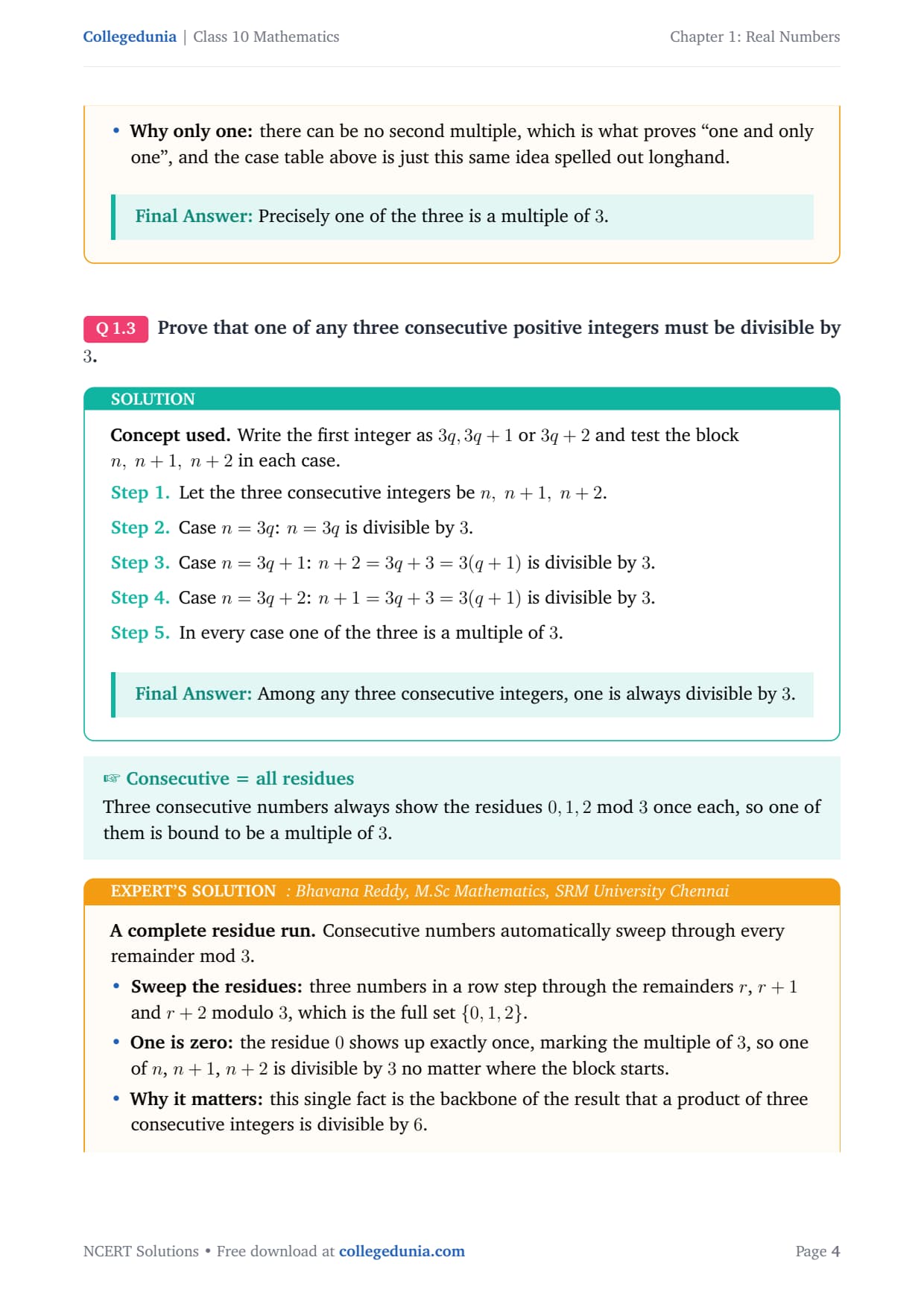
Q 1.3
Prove that one of any three consecutive positive integers must be divisible by 3.
Concept used. Write the first integer as 3q,3q+1 or 3q+2 and
test the block n, n+1, n+2 in each case.
Let the three consecutive integers be n, n+1, n+2.
Case n=3q: n=3q is divisible by 3.
Case n=3q+1: n+2=3q+3=3(q+1) is divisible by 3.
Case n=3q+2: n+1=3q+3=3(q+1) is divisible by 3.
In every case one of the three is a multiple of 3.
Among any three consecutive integers, one is always divisible
by 3.
BR
Bhavana Reddy
M.Sc Mathematics, SRM University Chennai
Verified Expert
A complete residue run. Consecutive numbers automatically sweep
through every remainder mod 3.
Sweep the residues: three numbers in a row step through
the remainders r, r+1 and r+2 modulo 3, which is the full
set 0,1,2.
One is zero: the residue 0 shows up exactly once,
marking the multiple of 3, so one of n, n+1, n+2 is
divisible by 3 no matter where the block starts.
Why it matters: this single fact is the backbone of the
result that a product of three consecutive integers is divisible by
6.
One of three consecutive integers is a multiple of 3.
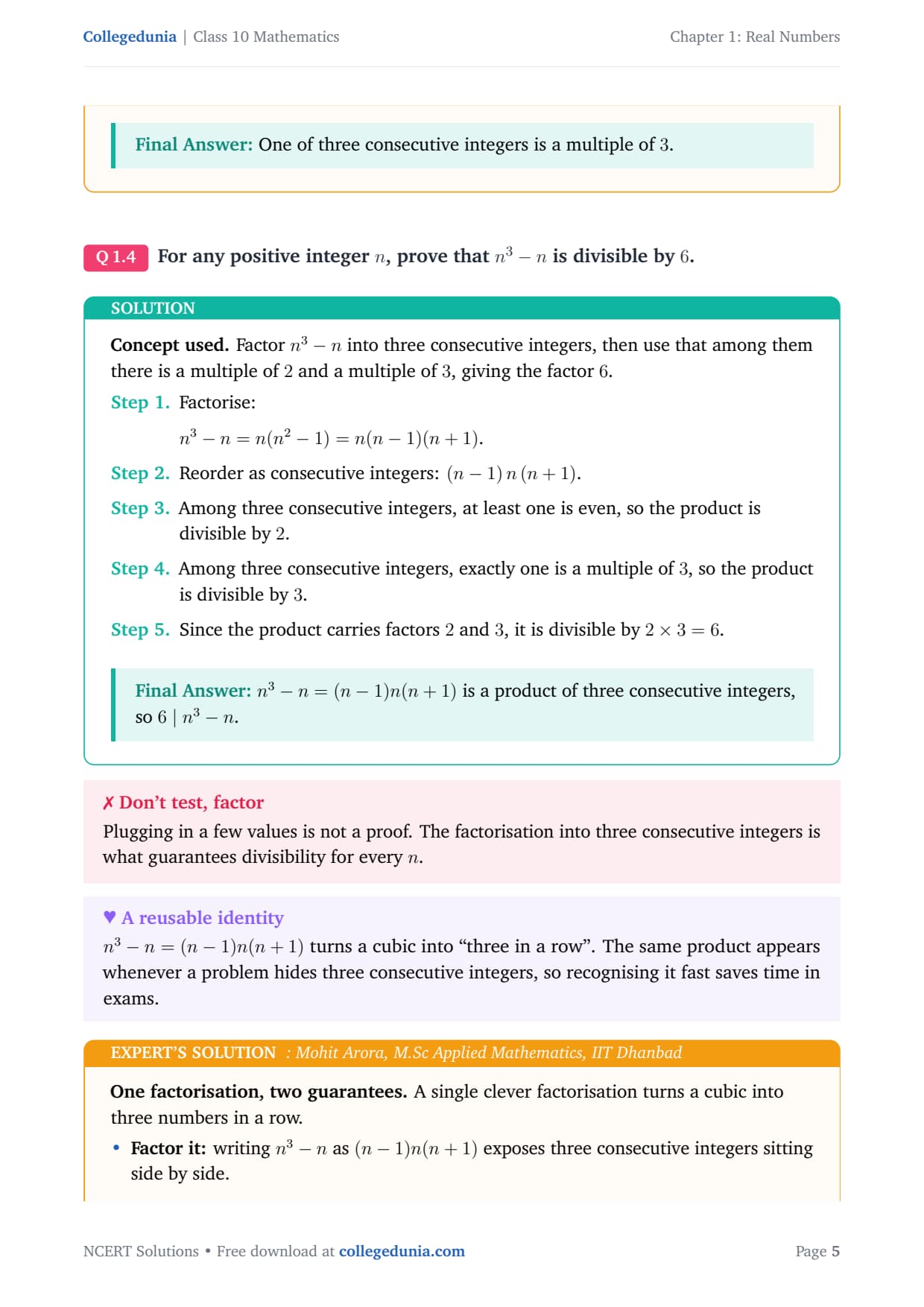
Q 1.4
For any positive integer n, prove that n3-n is divisible by 6.
Concept used. Factor n3-n into three consecutive integers,
then use that among them there is a multiple of 2 and a multiple of
3, giving the factor 6.
Factorise:
[] n3-n=n(n2-1)=n(n-1)(n+1).
Reorder as consecutive integers: (n-1) n (n+1).
Among three consecutive integers, at least one is even, so the
product is divisible by 2.
Among three consecutive integers, exactly one is a multiple of
3, so the product is divisible by 3.
Since the product carries factors 2 and 3, it is divisible by
2× 3=6.
n3-n=(n-1)n(n+1) is a product of three consecutive
integers, so 6n3-n.
MA
Mohit Arora
M.Sc Applied Mathematics, IIT Dhanbad
Verified Expert
One factorisation, two guarantees. A single clever factorisation
turns a cubic into three numbers in a row.
Factor it: writing n3-n as (n-1)n(n+1) exposes three
consecutive integers sitting side by side.
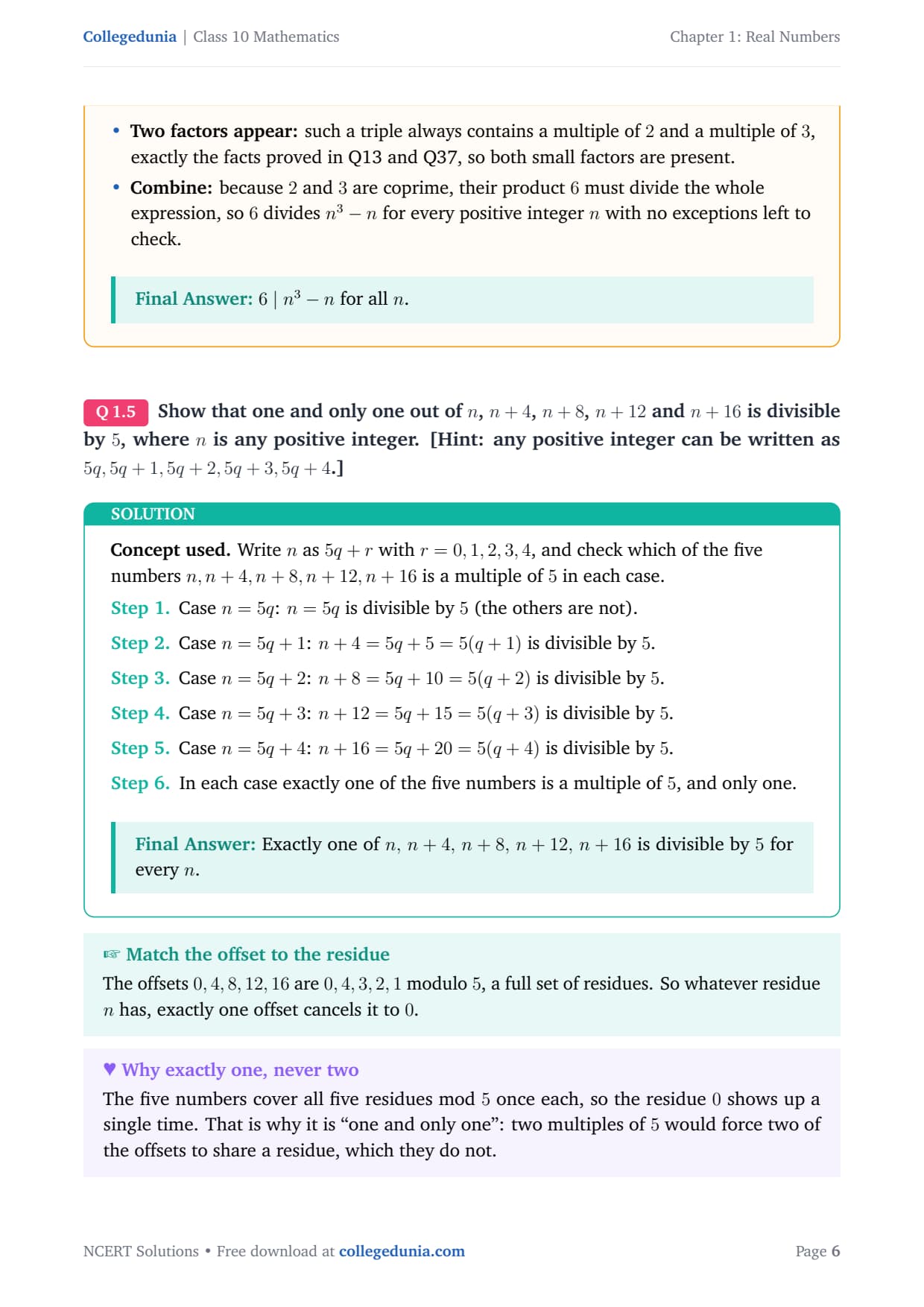
Two factors appear: such a triple always contains a
multiple of 2 and a multiple of 3, exactly the facts proved in
Q13 and Q37, so both small factors are present.
Combine: because 2 and 3 are coprime, their product
6 must divide the whole expression, so 6 divides n3-n for
every positive integer n with no exceptions left to check.
6n3-n for all n.
Q 1.5
Show that one and only one out of n, n+4, n+8, n+12 and n+16 is divisible by 5, where n is any positive integer. [Hint: any positive integer can be written as 5q,5q+1,5q+2,5q+3,5q+4.]
Concept used. Write n as 5q+r with r=0,1,2,3,4, and check
which of the five numbers n,n+4,n+8,n+12,n+16 is a multiple of 5 in
each case.
Case n=5q: n=5q is divisible by 5 (the others are not).
Case n=5q+1: n+4=5q+5=5(q+1) is divisible by 5.
Case n=5q+2: n+8=5q+10=5(q+2) is divisible by 5.
Case n=5q+3: n+12=5q+15=5(q+3) is divisible by 5.
Case n=5q+4: n+16=5q+20=5(q+4) is divisible by 5.
In each case exactly one of the five numbers is a multiple of
5, and only one.
Exactly one of n, n+4, n+8, n+12, n+16 is divisible by
5 for every n.
SD
Snigdha Das
M.Sc Mathematics, Visva-Bharati University
Verified Expert
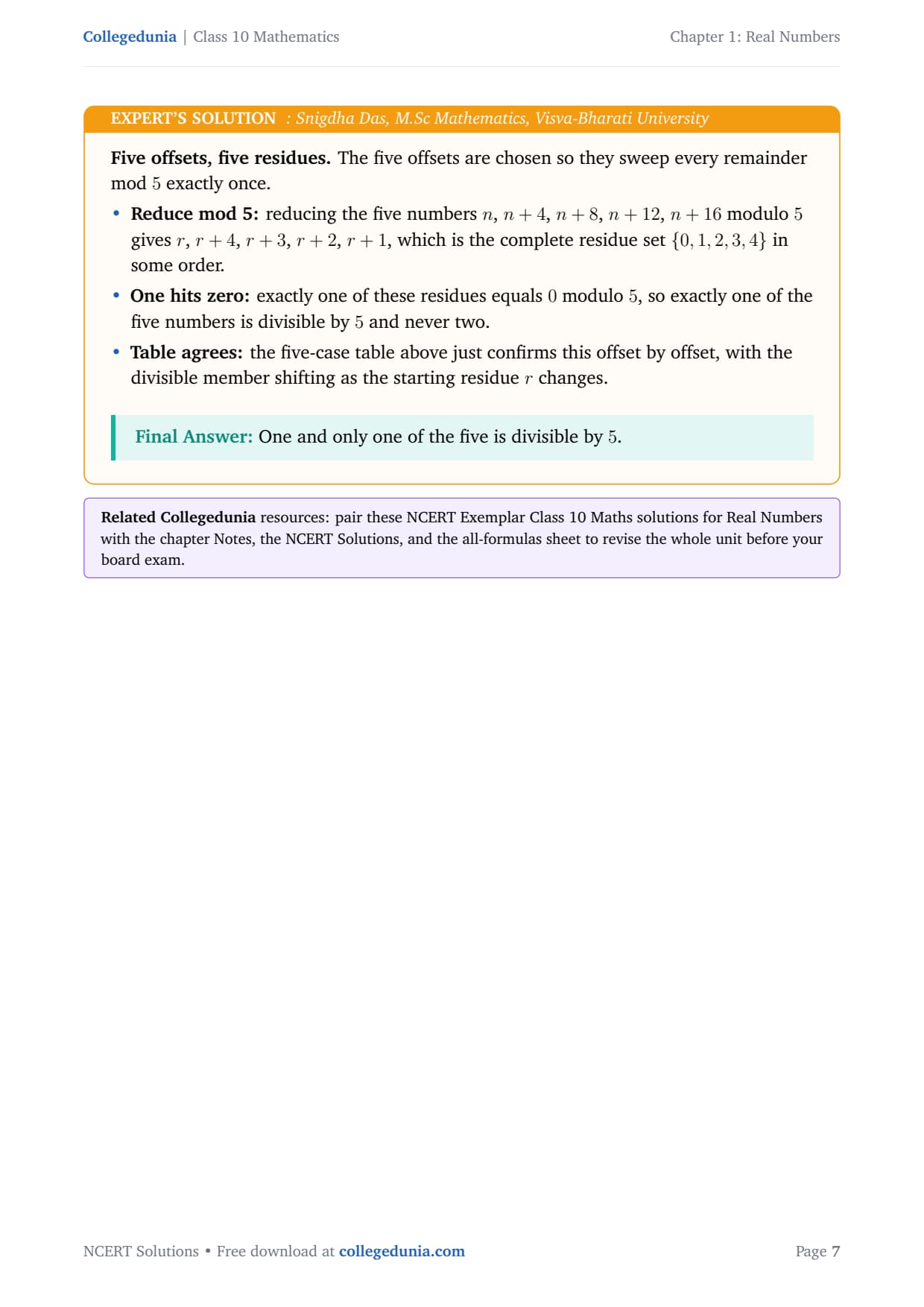
Five offsets, five residues. The five offsets are chosen so they
sweep every remainder mod 5 exactly once.
Reduce mod 5: reducing the five numbers n, n+4,
n+8, n+12, n+16 modulo 5 gives r, r+4, r+3, r+2,
r+1, which is the complete residue set 0,1,2,3,4 in some
order.
One hits zero: exactly one of these residues equals 0
modulo 5, so exactly one of the five numbers is divisible by 5
and never two.
Table agrees: the five-case table above just confirms this
offset by offset, with the divisible member shifting as the
starting residue r changes.
One and only one of the five is divisible by 5.
Student Feedback
In a Collegedunia poll of 5,840 Class 10 Maths students before the 2026 boards, 68% of students most wanted the Exemplar proof questions worked out fully, like proving root 3 plus root 5 irrational and showing a square is never of the form 3m+2. Most said the residue-table method made the proofs feel routine instead of scary.
Source: 2026-27 Class 10 Maths student poll, 5,840 students from CBSE schools in 10 states.
FAQs on Real Numbers NCERT Exemplar Solutions
How many questions are in the Class 10 Maths Chapter 1 Real Numbers NCERT Exemplar?
The Real Numbers Exemplar has 39 questions across four exercises: 10 MCQs in Exercise 1.1, 10 True or False with reasoning in Exercise 1.2, 14 Short Answer in Exercise 1.3, and 5 Long Answer in Exercise 1.4. All four types are solved step by step on this page and in the downloadable PDF.
What is the difference between NCERT Solutions and NCERT Exemplar Solutions for Real Numbers?
NCERT Solutions answer the regular textbook exercises 1.1 and 1.2. NCERT Exemplar Solutions answer the separate Exemplar Problems book, which has tougher proof and reasoning questions on residue classes, surd irrationality and one-and-only-one divisibility. Students usually finish the textbook first, then practise the Exemplar for extra board preparation.
How do you prove that root 3 plus root 5 is irrational?
Use proof by contradiction. Assume root 3 plus root 5 equals a rational number r. Isolate root 5, square both sides, then rearrange to get root 3 equal to a fraction of integers. Since root 3 is irrational, it cannot equal a fraction, which is a contradiction. So root 3 plus root 5 is irrational.
Why can the square of an integer never be of the form 3m+2?
Write any integer as 3q, 3q+1 or 3q+2 and square each. The squares reduce to remainder 0 or 1 modulo 3, never 2. So a perfect square is always 3m or 3m+1, and the form 3m+2 is impossible for any integer.
Can two numbers have HCF 18 and LCM 380?
No. For any two numbers, the HCF must divide the LCM exactly. Dividing 380 by 18 leaves remainder 2, so 18 does not divide 380. That single failed division proves such a pair cannot exist, without any need to search for the numbers.
Are these Real Numbers Exemplar Solutions based on the 2026-27 CBSE syllabus?
Yes. Every answer is mapped to the official NCERT Exemplar Problems book and the latest 2026-27 NCERT Mathematics syllabus, and written in the CBSE marking-scheme style so it matches what the board rewards in proof and reasoning questions.







Comments