Junior-Class Mentor, TFI Fellow | Updated 3+ months ago
These NCERT Exemplar Class 10 Maths Chapter 10 Solutions cover every Circles problem with clear, step-by-step working. Each answer shows how to use tangent-radius properties, equal-tangent theorems, and cyclic-quadrilateral arguments. The set follows the 2026-27 CBSE syllabus.
44 problems across MCQs, true-or-false, short-answer, and long-answer proofs on tangent properties and circle theorems.
Every solution names the key concept, draws the figure, then applies the right property step by step.
Free PDF download plus an inline solved question bank you can open on this page.
Solved by Collegedunia: Every question here is worked out by our Mathematics faculty, checked against the official NCERT Exemplar, and aligned to the 2026-27 CBSE syllabus.
The Exemplar splits Circles into four exercises. Each one tests a different skill, from quickly spotting the right property to writing full board-style proofs.
Exercise
Question Type
Count
What It Tests
Exercise 10.1
MCQ (objective)
10
Pick the right tangent or circle property, angle, or length from four options
Exercise 10.2
True or False (justify)
10
Judge a statement about tangents or angles, then justify it or give a counterexample
Exercise 10.3
Short answer (compute and prove)
10
Find a radius, length, or angle using tangent-radius perpendicularity, equal tangents, and Pythagoras
Exercise 10.4
Long answer (proof)
14
Write full proofs: hexagons around circles, semi-perimeter arguments, and two-circle tangents
The full set has 44 problems. A smart order: use the MCQs to fix which property applies, build justification writing with the true-or-false set, sharpen calculations with the short-answer problems, then practise the long proofs before the board exam.
Key Theorems You Must Know
Every Circles problem rests on three ideas: the tangent is perpendicular to the radius at the point of contact, tangents from an external point are equal, and the angle rules that follow. Get these right and nothing will block you.
Tangent-Radius Perpendicularity
The tangent at any point is perpendicular to the radius at that point. This is the most-used fact in the chapter. Draw the radius to the point of contact and you get a right angle. Then Pythagoras or trigonometry does the rest. OT perpendicular to PT (O is the centre, T the point of contact) appears in almost every solution.
From an external point P at distance OP from the centre, the tangent length is OP2 - r2. This comes from the right triangle made by the centre, the point of contact, and P.
Equal Tangents from an External Point
Property
Statement
Use in Problems
Equal tangent lengths
Both tangents from an external point have the same length
Proves AB + CD = BC + DA for circumscribed quadrilaterals; perimeter shortcuts for incircles
Angle between tangents
The angle between two tangents from P and the central angle of the chord of contact add to 180 degrees
Used in nearly all MCQs and true-or-false questions about angles
OB bisects the angle
The line from the centre to P bisects both the angle between tangents and the chord of contact
Gives 60-degree right triangles when the tangent angle is 120 degrees
Alternate segment theorem
The angle between a tangent and a chord equals the inscribed angle in the alternate segment
Fastest path for tangent-chord angle MCQs
Pythagoras in Tangent Problems
When a chord of one circle is tangent to a smaller concentric circle, the smaller radius is perpendicular to the chord and bisects it. The 3,4,5 triple shows up in the first question of Exercise 10.1 and again in Exercise 10.3. Spot it to skip the square-root step.
For a quadrilateral with an incircle, opposite sides add up equally: AB + CD = BC + DA. This follows from equal tangent lengths at each vertex and drives several long-answer proofs.
Before any problem: draw the figure, mark the right angle at each point of contact, label equal tangent lengths, and spot the triangle or quadrilateral in play. This setup prevents most errors.
How These Solutions Help You
These solutions are built for self-study in the weeks before the board exam. They do three things for you:
Mark the right angle first: every tangent solution marks the right angle between tangent and radius before any equation. This stops the top Circles error, setting up the wrong right triangle.
Justify true-or-false fully: every verdict in Exercise 10.2 gives the exact reason, not just "True" or "False". CBSE awards marks for the justification, and these answers model it.
Add an Expert view: each question has a faster method, like using the alternate segment theorem in one step or spotting a Pythagorean triple to skip the square root.
Best way to use them: attempt the question, draw the circle with the tangent and radius, then open Check Solution to compare. Read Expert Solution only after your own attempt. That builds real proof-writing skill.
Exemplar vs Textbook: Where Difficulty Jumps
The NCERT textbook chapter has just two exercises with simple tangent-radius work. The Exemplar steps it up: you evaluate statements, write full proofs, and handle multi-circle setups. The table shows where the difficulty rises.
Skill
NCERT Textbook
NCERT Exemplar
Tangent length
Apply the formula once to find a missing side
MCQs test the right theorem; all four options look right if the diagram is wrong
Equal tangents
Verify PA = PB in a standard figure
Use equal tangents at each vertex to prove opposite sides of a circumscribed quadrilateral sum equally; hexagons too
Proof writing
Short 2-3 step proofs
Exercise 10.4 needs full proofs with congruence, semicircle theorems, and the semi-perimeter formula
Two-circle problems
Not in the textbook
Exercise 10.4 Q10 has two intersecting circles; combine tangent-radius perpendicularity from both
True or false
No such exercise type
Exercise 10.2 asks you to judge statements like "tangent length is always greater than radius" and justify
This is why you solve the Exemplar after the textbook. The textbook teaches the basic tangent-radius and equal-tangent setup. The Exemplar then drills proof writing, two-circle problems, and true-or-false justifications, all of which show up in board papers.
Common Mistakes to Avoid
Across all four exercises, these four slips cost the most marks. Catch them before the exam.
Not marking the right angle at the point of contact: tangent-radius perpendicularity is the base of every calculation. Skip it and you set up the wrong triangle or reach for sine and cosine instead of Pythagoras.
Using the half-chord as the full chord: the perpendicular from the centre bisects the chord, so it gives the half. The question wants the full chord, so double it. Exercise 10.1 Q1 puts the half-chord as a trap option (A).
Mixing up the tangent angle and the central angle: the angle between two tangents from P is not the central angle of the chord of contact. They are supplementary. Treating them as equal picks the wrong MCQ option.
Not naming the congruence rule in proofs: CBSE wants the rule named (SAS, RHS, ASA). Writing only "the triangles are equal" without naming RHS drops a mark in Exercise 10.3 and 10.4.
For most students the first slip, missing the right angle, causes the most errors. Spend 30 seconds drawing the radius to the tangent point and marking the right angle, and the slip disappears.
Other Circles Resources
Pair this Exemplar set with the other Circles resources on Collegedunia to cover the chapter fully before your board exam.
All Exemplar Questions with Step-by-Step Solutions
Exercise 10.1 Multiple Choice Questions
Q 10.1
If radii of two concentric circles are 4 cm and 5 cm, then the length of each chord of one circle which is tangent to the other circle is
(A) 3 cm (B) 6 cm (C) 9 cm (D) 1 cm.
Correct option: (B)6 cm.
Concept used. A chord of the larger circle that is tangent to the smaller circle touches it at one point. The radius of the smaller circle drawn to that point is perpendicular to the chord, and a perpendicular from the centre bisects the chord.
Let O be the common centre, OA=4 cm (radius to the point of contact A) and OB=5 cm (radius to an endpoint B of the chord). The chord BC of the bigger circle is tangent to the smaller circle at A, so OA⊥ BC.
In right triangle OAB, apply Pythagoras:
OB2=OA2+AB2.
Substitute the values:
52=42+AB2.
Arithmetic:
25=16+AB2 ⇒ AB2=9 ⇒ AB=3 cm.
Since the perpendicular from the centre bisects the chord, A is the midpoint, so the full chord is BC=2× AB=2× 3=6 cm.
Option (B): the chord is 6 cm long.
AS
Aarav Sharma
M.Sc Mathematics, IIT Bombay
Verified Expert
Strategic angle. Spot the right triangle first. The instant you read ``chord of one circle tangent to the other'', draw the radius to the point of contact; it is perpendicular, so a right triangle with hypotenuse equal to the outer radius appears. The numbers 4,5 are two members of the famous 3,4,5 triple, so the half-chord is 3 without any heavy arithmetic.
Right triangle: legs 4 and AB, hypotenuse 5.
3,4,5 triple gives the missing leg AB=3 cm at sight.
Chord =2× 3=6 cm.
Trap to avoid: Watch the trap option (A) 3 cm: that is only the half-chord. The question asks for the full chord, so you must double it.
Why it works: Recognising the Pythagorean triple turns a two-line calculation into a one-glance answer, which is exactly the time saving boards reward in the one-mark MCQ block.
Option (B): 6 cm.
Q 10.2
In Fig. 10.1, if ∠ AOB=125∘, then ∠ COD is equal to
(A) 62.5∘ (B) 45∘ (C) 35∘ (D) 55∘.
Fig. 10.1 : quadrilateral ABCD circumscribing a circle, with tangents from A,B,C,D.
Correct option: (D)55∘.
Concept used. For a quadrilateral circumscribing a circle, opposite sides subtend supplementary angles at the centre. That is, ∠ AOB+∠ COD=180∘ and ∠ BOC+∠ AOD=180∘, because the two tangents from each vertex are symmetric about the line joining the vertex to the centre.
AB and CD are opposite sides of the circumscribing quadrilateral, so the angles they subtend at the centre are supplementary:
∠ AOB+∠ COD=180∘.
Substitute ∠ AOB=125∘:
125∘+∠ COD=180∘.
Solve:
∠ COD=180∘-125∘=55∘.
Option (D): ∠ COD=55∘.
SI
Sneha Iyer
M.Sc Mathematics, ISI Kolkata
Verified Expert
Quick reading. The supplementary-angle property for the two pairs of opposite sides of a tangential quadrilateral is the whole question. Each vertex gives two equal tangent segments, and joining a vertex to the centre bisects the vertex angle; summing the four half-angles around O forces the opposite central angles to add to 180∘.
Opposite sides AB,CD give ∠ AOB+∠ COD=180∘.
∠ COD=180∘-125∘=55∘.
Exam habit: The distractor (A) 62.5∘ is exactly half of 125∘, which is what you would write if you wrongly halved the given angle instead of subtracting from 180∘. Keeping the supplementary rule in mind blocks that slip.
Quick check: This pairing of opposite central angles recurs whenever a circle is inscribed in a polygon.
Option (D): 55∘.
Q 10.3
In Fig. 10.2, AB is a chord of the circle and AOC is its diameter such that ∠ ACB=50∘. If AT is the tangent to the circle at the point A, then ∠ BAT is equal to
(A) 65∘ (B) 60∘ (C) 50∘ (D) 40∘.
Fig. 10.2 : diameter AOC, chord AB, tangent AT at A.
Correct option: (C)50∘.
Concept used. The angle in a semicircle is a right angle, so the angle subtended by a diameter at any point of the circle is 90∘. Also, the tangent at a point is perpendicular to the radius (and hence to the diameter) at that point.
AOC is a diameter, so ∠ ABC=90∘ (angle in a semicircle). In triangle ABC:
∠ BAC=180∘-∠ ABC-∠ ACB=180∘-90∘-50∘=40∘.
The tangent AT is perpendicular to the diameter AC at A, so
∠ CAT=90∘.
Therefore
∠ BAT=∠ CAT-∠ BAC=90∘-40∘=50∘.
Option (C): ∠ BAT=50∘.
KM
Karan Mehta
M.Tech Computer Science, IIT Madras
Verified Expert
Picture-first. The cleanest route is the tangent-chord (alternate segment) theorem: the angle between tangent AT and chord AB equals the inscribed angle ∠ ACB in the alternate segment. That gives the answer in one line, and the diameter-and-right-angle method confirms it.
Alternate segment: ∠ BAT=∠ ACB=50∘.
Cross-check via the semicircle: ∠ BAC=40∘, and 90∘-40∘=50∘.
Common slip: The two methods agreeing is a strong self-check under exam pressure.
Key insight: Students who only learn the triangle method spend longer and risk an angle-chase slip; the alternate-segment theorem is worth memorising because it collapses many tangent problems to a single equality.
Option (C): 50∘.
Q 10.4
From a point P which is at a distance of 13 cm from the centre O of a circle of radius 5 cm, the pair of tangents PQ and PR to the circle are drawn. Then the area of the quadrilateral PQOR is
(A) 60 cm2 (B) 65 cm2 (C) 30 cm2 (D) 32.5 cm2.
Correct option: (A)60 cm2.
Concept used. The tangent at a point is perpendicular to the radius at the point of contact, so ∠ OQP=∠ ORP=90∘. The quadrilateral PQOR is made of two congruent right triangles, and the tangent length is found by Pythagoras.
Tangent length PQ from the right triangle OQP (right-angled at Q):
PQ=√OP2-OQ2.
Substitute OP=13, OQ=5:
PQ=√132-52=√169-25=√144=12 cm.
Area of one right triangle OQP:
12× OQ× PQ=12× 5× 12=30 cm2.
By symmetry ORP≅OQP, so the quadrilateral area is double:
Area(PQOR)=2× 30=60 cm2.
Option (A): 60 cm2.
AP
Aanya Patel
M.Sc Applied Mathematics, IIT Kanpur
Verified Expert
Strategic angle. The kite PQOR splits along the diagonal OP into two right triangles that are mirror images. Computing one and doubling is faster and safer than treating the kite as a single shape. The distractor (C) 30 cm2 is exactly one triangle, the classic ``forgot to double'' answer.
Tangent PQ=12 cm via the 5,12,13 triple.
One triangle =12(5)(12)=30 cm2.
Two triangles =60 cm2.
Cross-check: A clean habit here is to write the doubling step explicitly so you never lose the factor of two.
Watch out: The same kite-area-by-two-triangles idea reappears in many tangent-pair questions, so internalise it now.
Option (A): 60 cm2.
Q 10.5
At one end A of a diameter AB of a circle of radius 5 cm, tangent XAY is drawn to the circle. The length of the chord CD parallel to XY and at a distance 8 cm from A is
(A) 4 cm (B) 5 cm (C) 6 cm (D) 8 cm.
Correct option: (D)8 cm.
Concept used. The tangent at A is perpendicular to the diameter AB. A chord parallel to the tangent is therefore perpendicular to AB, so the diameter line meets it at right angles and bisects it. The perpendicular distance of the chord from the centre is used in Pythagoras.
Diameter AB=2× 5=10 cm. The chord CD is 8 cm from A measured along AB, so its distance from the centre O is
OM=AM-AO=8-5=3 cm,
where M is the foot of the perpendicular from O to CD.
In right triangle OMC (right-angled at M, with OC=5 the radius):
MC=√OC2-OM2=√52-32=√25-9=√16=4 cm.
Since M bisects CD, the full chord is
CD=2× MC=2× 4=8 cm.
Option (D): CD=8 cm.
VR
Vivaan Reddy
M.Sc Mathematics, IIT Bombay
Verified Expert
Picture-first. Sketch the diameter vertical with A at the bottom and the tangent horizontal through A. A chord parallel to that tangent is horizontal, so the vertical diameter cuts it at right angles and halves it. The only care needed is converting ``8 cm from A'' into ``3 cm from O''.
Distance from centre: 8-5=3 cm.
Half-chord: √25-9=4 cm via the 3,4,5 triple.
Full chord: 8 cm.
Time saver: The neat coincidence that CD equals the diameter ×45 is incidental; what matters is the reflex of always referencing distances to the centre when a radius is the hypotenuse.
Deeper reason: That single habit prevents the most common error in chord problems.
Option (D): 8 cm.
Q 10.6
In Fig. 10.3, AT is a tangent to the circle with centre O such that OT=4 cm and ∠ OTA=30∘. Then AT is equal to
(A) 4 cm (B) 2 cm (C) 2√3 cm (D) 4√3 cm.
Fig. 10.3 : tangent AT at A, with OT=4 cm and $ OTA=30^
Correct option: (C)2√3 cm.
Concept used. The radius is perpendicular to the tangent at the point of contact, so ∠ OAT=90∘. In the right triangle OAT, the side AT is adjacent to the angle ∠ OTA=30∘, and OT is the hypotenuse.
Since OA⊥ AT, triangle OAT is right-angled at A. The adjacent side over the hypotenuse is the cosine of ∠ OTA:
cos∠ OTA=ATOT.
Substitute ∠ OTA=30∘ and OT=4:
cos 30∘=AT4.
Use cos 30∘=√32 and solve:
AT=4×√32=2√3 cm.
Option (C): AT=2√3 cm.
AV
Aditya Verma
Ph.D Pure Mathematics, IISc Bangalore
Verified Expert
Picture-first. Mark the right angle at A before touching trigonometry. With the right angle placed, OT is clearly the hypotenuse and AT sits next to the 30∘ angle, so cosine is forced. The distractor (B) 2 cm comes from using sin 30∘ by mistake.
Right angle at A; OT=4 is the hypotenuse.
AT=OTcos 30∘=4·32=23 cm.
Sanity test: A quick reasonableness test: 23≈ 3.46 cm, which is less than the hypotenuse 4 cm, as a leg must be. That sanity check catches a sine-cosine swap in seconds.
Reusable idea: Always confirm a leg is shorter than the hypotenuse before committing.
Option (C): 2√3 cm.
Q 10.7
In Fig. 10.4, if O is the centre of a circle, PQ is a chord and the tangent PR at P makes an angle of 50∘ with PQ, then ∠ POQ is equal to
(A) 100∘ (B) 80∘ (C) 90∘ (D) 75∘.
Fig. 10.4 : chord PQ and tangent PR at P with $ QPR=50^
Correct option: (A)100∘.
Concept used. The tangent at P is perpendicular to the radius OP. Triangle OPQ is isosceles because OP=OQ (both radii), so its base angles are equal. The angles of triangle OPQ sum to 180∘.
Tangent ⊥ radius gives ∠ OPR=90∘. Since the tangent makes 50∘ with the chord PQ,
∠ OPQ=∠ OPR-∠ QPR=90∘-50∘=40∘.
In isosceles triangle OPQ, OP=OQ, so the base angles are equal:
∠ OQP=∠ OPQ=40∘.
Angle sum of triangle OPQ:
∠ POQ=180∘-∠ OPQ-∠ OQP=180∘-40∘-40∘=100∘.
Option (A): ∠ POQ=100∘.
TJ
Tara Joshi
M.Sc Mathematics, IIT Bombay
Verified Expert
Strategic angle. Two clean routes agree. The isosceles-triangle method uses tangent ⊥ radius then the angle sum; the alternate-segment method doubles the tangent-chord angle directly. Choosing the doubling route is fastest once you trust the theorem.
∠ OPQ=90∘-50∘=40∘.
Base angles equal, so ∠ POQ=180∘-2(40∘)=100∘.
Spot this: The distractor (B) 80∘ appears if you stop at 2× 40∘ instead of completing the triangle, a common half-finished answer.
Careful here: Carrying the calculation to the angle sum, or trusting the doubling theorem, keeps you on 100∘.
Option (A): 100∘.
Q 10.8
In Fig. 10.5, if PA and PB are tangents to the circle with centre O such that ∠ APB=50∘, then ∠ OAB is equal to
(A) 25∘ (B) 30∘ (C) 40∘ (D) 50∘.
Fig. 10.5 : tangents PA,PB from external point P with $ APB=50^
Correct option: (A)25∘.
Concept used. The two tangents from an external point are equal, so triangle PAB is isosceles. The radius OA is perpendicular to the tangent PA, giving ∠ OAP=90∘. We find the base angle of the isosceles triangle, then subtract from 90∘.
In isosceles triangle PAB (PA=PB), the base angles are equal:
∠ PAB=∠ PBA=180∘-∠ APB2=180∘-50∘2=130∘2=65∘.
Tangent ⊥ radius at A gives ∠ OAP=90∘.
Therefore
∠ OAB=∠ OAP-∠ PAB=90∘-65∘=25∘.
Option (A): ∠ OAB=25∘.
IB
Ishita Bhat
M.Sc Applied Mathematics, IIT Kanpur
Verified Expert
Quick reading. Recognise the shortcut ∠ OAB=12∠ APB. It comes from the radius bisecting the picture: ∠ OAP=90∘ and the isosceles base angle is 90∘-12∠ APB, so ∠ OAB is the leftover 12∠ APB.
Base angle ∠ PAB=65∘.
∠ OAB=90∘-65∘=25∘, i.e. 12(50∘).
Big picture: The distractor (D) 50∘ is simply ∠ APB copied without working, a tempting but wrong shortcut.
Takeaway: Knowing the genuine half-relation keeps you from falling for it and confirms the answer instantly.
Option (A): 25∘.
Q 10.9
If two tangents inclined at an angle 60∘ are drawn to a circle of radius 3 cm, then length of each tangent is equal to
(A) 32√3 cm (B) 6 cm (C) 3 cm (D) 3√3 cm.
Correct option: (D)3√3 cm.
Concept used. The line from the external point P to the centre O bisects the angle between the two tangents. The radius is perpendicular to a tangent at its point of contact, so each tangent, its radius and OP form a right triangle.
Let the tangents touch at A and B. OP bisects ∠ APB=60∘, so
∠ OPA=60∘2=30∘.
In right triangle OAP (right-angled at A, with radius OA=3 opposite the angle at P), the tangent of the angle relates opposite to adjacent:
tan∠ OPA=OAPA ⇒ tan 30∘=3PA.
Use tan 30∘=1√3 and solve:
1√3=3PA ⇒ PA=3√3 cm.
Option (D): each tangent is 3√3 cm.
RG
Rohit Gupta
Ph.D Pure Mathematics, IISc Bangalore
Verified Expert
Strategic angle. The whole problem reduces to one right triangle with a 30∘ angle at P and the radius 3 opposite it. Then PA=3cot 30∘=33. Keeping the radius as the side opposite the half-angle makes the trig ratio unambiguous.
Half-angle at P is 30∘, radius opposite is 3.
PA=3cot 30∘=33 cm.
Distractor: The distractor (C) 3 cm matches the radius and tempts students who guess the tangent equals the radius; it does not, since cot 30∘=3≠ 1.
Confirm it: Anchoring on the right triangle with the correct half-angle removes that guesswork.
Option (D): 3√3 cm.
Q 10.10
In Fig. 10.6, if PQR is the tangent to a circle at Q whose centre is O, AB is a chord parallel to PR and ∠ BQR=70∘, then ∠ AQB is equal to
(A) 20∘ (B) 40∘ (C) 35∘ (D) 45∘.
Fig. 10.6 : tangent PQR at Q, chord AB∥ PR, $ BQR=70^
Correct option: (B)40∘.
Concept used. A chord parallel to the tangent makes equal alternate angles with it, and the tangent-chord angle equals the inscribed angle in the alternate segment. Combined with the equal base angles of the isosceles set-up, the apex angle follows.
Since AB∥ PR and QB is a transversal, alternate angles are equal:
∠ ABQ=∠ BQR=70∘.
By symmetry of the chord parallel to the tangent at Q, QA=QB, so triangle AQB is isosceles with equal base angles:
∠ QAB=∠ ABQ=70∘.
Angle sum of triangle AQB:
∠ AQB=180∘-∠ QAB-∠ ABQ=180∘-70∘-70∘=40∘.
Option (B): ∠ AQB=40∘.
DK
Diya Kapoor
M.Sc Mathematics, ISI Kolkata
Verified Expert
Picture-first. The parallel chord turns the diagram symmetric about the diameter through Q. That symmetry hands you ∠ AQB=180∘-2(70∘) once you see both base angles are 70∘ via alternate angles.
Alternate angle: ∠ ABQ=70∘.
Isosceles: ∠ QAB=70∘, so ∠ AQB=180∘-140∘=40∘.
Method note: The distractor (A) 20∘ comes from mistakenly halving 40∘ once more.
Why chosen: Tracking exactly which angle the question wants, the apex and not a base angle, keeps the answer at 40∘.
Option (B): 40∘.
NCERT Exemplar Class 10 Mathematics Chapter 10 Circles
Class 10 Mathematics Chapter 10: Circles NCERT Exemplar
All 10 questions with collapsible Solution and Expert Solution. Tap a button to reveal the working.
Exercise 10.2 Short Answer with Reasoning (True/False)
Q 10.1
State whether the following is true or false and justify your answer: If a chord AB subtends an angle of 60∘ at the centre of a circle, then the angle between the tangents at A and B is also 60∘.
Answer: False.
Concept used. In the quadrilateral OACB formed by the centre O, the two points of contact A,B and the external point C where the tangents meet, the radii are perpendicular to the tangents. So ∠ OAC=∠ OBC=90∘, and the four angles of the quadrilateral sum to 360∘.
The angle between the tangents is ∠ ACB. In quadrilateral OACB:
∠ AOB+∠ OAC+∠ ACB+∠ OBC=360∘.
Substitute ∠ AOB=60∘ and the two right angles:
60∘+90∘+∠ ACB+90∘=360∘.
Solve:
∠ ACB=360∘-240∘=120∘.
This is 120∘, not 60∘, so the statement is false.
False: the angle between the tangents is 120∘, since ∠ ACB=180∘-∠ AOB.
KN
Krishna Nair
Ph.D Mathematics, IIT Delhi
Verified Expert
Strategic angle. Lock onto the supplementary rule ∠ ACB=180∘-∠ AOB. It comes straight from the two right angles in the kite OACB. Plugging ∠ AOB=60∘ gives 120∘ at once, exposing the claim as false.
∠ ACB=180∘-∠ AOB.
=180∘-60∘=120∘≠ 60∘.
Generalises: The statement would be true only if ∠ AOB were 90∘, the lone self-supplementary value.
Mark grabber: Recognising that single fixed point stops you from assuming the two angles are generally equal, which is the trap this true/false question sets.
False; the tangent angle is 120∘.
Q 10.2
State whether the following is true or false and justify your answer: The length of tangent from an external point on a circle is always greater than the radius of the circle.
Answer: False.
Concept used. The tangent length from an external point P is =√OP2-r2, where r is the radius and OP>r. This value depends on how far P is from the centre, so it can be smaller, equal to, or larger than r.
Take a circle of radius r=5 cm and an external point P with OP=5.5 cm. The tangent length is
=√OP2-r2=√5.52-52=√30.25-25=√5.25≈ 2.29 cm.
Here ≈ 2.29 cm is less than the radius 5 cm, so the statement ``always greater'' is false.
False: a counter-example with OP just larger than r gives a tangent shorter than the radius.
MB
Meera Banerjee
M.Sc Mathematics, IIT Bombay
Verified Expert
Quick reading. The tangent length grows smoothly from 0 (point on the circle) upward as P moves away. So it passes through every positive value, including values below r. One nearby point settles the matter.
For P near the circle, OP→ r+ and → 0.
Such an is below r, so ``always greater'' fails.
Pitfall: The honest statement is that the tangent length can be anything positive; it equals the radius only at one special distance OP=r2.
One-line proof: Treating ``always'' words sceptically is a reliable instinct for these reasoning questions.
False; tangent length can be less than the radius.
Q 10.3
State whether the following is true or false and justify your answer: The length of tangent from an external point P on a circle with centre O is always less than OP.
Answer: True.
Concept used. The radius to the point of contact is perpendicular to the tangent, so the tangent, the radius and the line OP form a right triangle in which OP is the hypotenuse. The hypotenuse is the longest side of a right triangle.
Let the tangent touch the circle at A. Then ∠ OAP=90∘, so triangle OAP is right-angled at A with hypotenuse OP.
By Pythagoras,
OP2=OA2+PA2 ⇒ PA2=OP2-OA22.
Since OA>0 (the radius is positive), PA for every external point. The statement is true.
True: PA=√OP2-OA2 because the tangent is a leg and OP is the hypotenuse.
AV
Ankit Verma
Ph.D Mathematics, IIT Delhi
Verified Expert
Strategic angle. The contrast with the previous question is instructive: the tangent is compared to OP, not to the radius. Against OP it is always shorter, because OP is the hypotenuse of the contact right triangle. The comparison target decides the verdict.
Right triangle OAP with hypotenuse OP.
Leg PA always.
Trap to avoid: This is a strict inequality: PA can never equal OP, since that would force the radius OA to be zero.
Why it works: Reading the comparison carefully, tangent versus OP here, versus radius in the last item, is the skill these paired questions test.
True; the tangent is a leg, so PA.
Q 10.4
State whether the following is true or false and justify your answer: The angle between two tangents to a circle may be 0∘.
Answer: True.
Concept used. Two tangents to a circle are parallel exactly when they touch the circle at the two ends of a diameter. Parallel lines are taken to be inclined at 0∘ to each other, so this configuration realises a 0∘ angle between the tangents.
Draw a diameter AB. The tangent at A is perpendicular to AB, and the tangent at B is also perpendicular to AB.
Two lines perpendicular to the same line are parallel, so the tangents at A and B are parallel and never meet.
The angle between parallel lines is 0∘, so the angle between these two tangents is 0∘. Hence the statement is true.
True: tangents at the two ends of a diameter are parallel, giving a 0∘ angle.
PK
Pranav Kumar
Ph.D Mathematics, IIT Delhi
Verified Expert
Picture-first. Visualise the two tangents as a moving pair. As the external point recedes, the angle between the tangents shrinks; in the limit, the point goes to infinity and the tangents become the parallel pair at the diameter ends, where the angle is 0∘.
Tangents at opposite ends of a diameter are both ⊥ to it.
Both ⊥ to the same line, hence parallel, hence 0∘.
Exam habit: The subtlety is that no finite external point gives 0∘; the parallel tangents meet only at infinity. But the angle they make is genuinely 0∘, so ``may be 0∘'' is a true statement.
Quick check: Distinguishing ``meets'' from ``angle between'' resolves the apparent paradox.
True; parallel diameter-end tangents are inclined at 0∘.
Q 10.5
State whether the following is true or false and justify your answer: If angle between two tangents drawn from a point P to a circle of radius a and centre O is 90∘, then OP=a√2.
Answer: True.
Concept used.OP bisects the angle between the two tangents, and the radius is perpendicular to a tangent at its point of contact. This produces a right triangle in which the half-angle at P is 45∘.
Let the tangent touch at A. OP bisects ∠ APB=90∘, so
∠ OPA=90∘2=45∘.
In right triangle OAP (right-angled at A, radius OA=a opposite the angle at P):
sin∠ OPA=OAOP ⇒ sin 45∘=aOP.
Use sin 45∘=1√2 and solve:
1√2=aOP ⇒ OP=a√2.
This matches the statement, so it is true.
True: OP=a√2, as the contact triangle has a 45∘ angle at P.
RS
Riya Singh
B.Tech Computer Science, IIT Roorkee
Verified Expert
Strategic angle. The fastest mental model is the square OAPB of side a. When the tangents meet at 90∘, the figure is a square, and OP is its diagonal, so OP=a2 immediately.
∠ APB=90∘⇒ OAPB is a square of side a.
Diagonal OP=a2.
Common slip: Either route, the 45∘ right triangle or the square diagonal, lands on a2.
Key insight: Carrying both interpretations gives a built-in cross-check, which is reassuring when a numerical-looking claim must be judged true or false.
True; OP=a2.
Q 10.6
State whether the following is true or false and justify your answer: If angle between two tangents drawn from a point P to a circle of radius a and centre O is 60∘, then OP=a√3.
Answer: False.
Concept used.OP bisects the angle between the tangents, and the radius is perpendicular to a tangent at the point of contact. The half-angle at P is 30∘, and the sine ratio relates the radius to OP.
Let the tangent touch at A. OP bisects ∠ APB=60∘, so
∠ OPA=60∘2=30∘.
In right triangle OAP (right-angled at A, radius OA=a opposite the angle at P):
sin∠ OPA=OAOP ⇒ sin 30∘=aOP.
Use sin 30∘=12 and solve:
12=aOP ⇒ OP=2a.
The correct value is OP=2a, not a√3, so the statement is false.
False: the half-angle 30∘ gives OP=2a, not a√3.
YD
Yash Desai
B.Tech Computer Science, IIT Roorkee
Verified Expert
Quick reading. The claim swaps the trig ratio. With the radius opposite the 30∘ half-angle, sine governs and OP=a/sin 30∘=2a. The value a3 would come from a cosine, which applies to the tangent length, not OP.
Half-angle 30∘; sin 30∘=a/OP.
OP=a/12=2a≠ a3.
Cross-check: A useful tie-in: the tangent length here is acot 30∘=a3, which is exactly the number the false statement mis-assigns to OP.
Watch out: Spotting that the claim attached the right number to the wrong segment nails the verdict.
False; OP=2a.
Q 10.7
State whether the following is true or false and justify your answer: The tangent to the circumcircle of an isosceles triangle ABC at A, in which AB=AC, is parallel to BC.
Answer: True.
Concept used. By the tangent-chord (alternate segment) theorem, the angle between the tangent at A and a chord through A equals the inscribed angle in the alternate segment. Equal sides of the isosceles triangle force equal base angles.
Let the tangent at A be line XAY, with X on the side of B. By the alternate segment theorem applied to chord AB:
∠ XAB=∠ ACB.
Since AB=AC, triangle ABC is isosceles with equal base angles:
∠ ABC=∠ ACB.
Combine the two: ∠ XAB=∠ ABC. These are alternate angles for lines XAY and BC cut by transversal AB. Equal alternate angles mean
XAY∥ BC.
So the tangent at A is parallel to BC, and the statement is true.
True: equal base angles plus the alternate-segment theorem make the tangent at A parallel to BC.
SP
Siddharth Pillai
M.Sc Mathematics, ISI Kolkata
Verified Expert
Strategic angle. The proof hinges on one equality chain: tangent-chord angle equals an inscribed base angle, which equals the other base angle by isosceles symmetry. That makes alternate angles equal, so the lines are parallel.
Time saver: Symmetry offers an even quicker view: the perpendicular bisector of BC passes through A and the centre, and the tangent at A is perpendicular to that line, just as BC is.
Deeper reason: Two lines perpendicular to the same line are parallel, confirming the result without angle chasing.
True; the apex tangent is parallel to the base.
Q 10.8
State whether the following is true or false and justify your answer: If a number of circles touch a given line segment PQ at a point A, then their centres lie on the perpendicular bisector of PQ.
Answer: False.
Concept used. A line that touches a circle is a tangent, so the radius to the point of contact is perpendicular to that line. The point of contact here is fixed at A, which need not be the midpoint of PQ.
Each such circle is tangent to PQ at the same point A, so its centre lies on the line through A perpendicular to PQ.
Hence every centre lies on the perpendicular to PQ drawn at the pointA, not on the perpendicular bisector of PQ.
The perpendicular bisector passes through the midpoint of PQ; the contact point A is generally not the midpoint, so the two lines differ. The statement is therefore false.
False: the centres lie on the perpendicular to PQ at A, which is the bisector only if A happens to be the midpoint.
NR
Neha Rao
M.Sc Mathematics, IIT Bombay
Verified Expert
Quick reading. The contact point A is pinned, so every radius to A is perpendicular to PQ there. All centres line up on that single perpendicular at A. Unless A is the midpoint, this is not the perpendicular bisector.
Tangent at A forces centre on the perpendicular at A.
That line is the bisector only when A is the midpoint, so the claim fails in general.
Sanity test: Contrast this deliberately with the next item, where circles pass through both P and Q and the centres really do lie on the perpendicular bisector.
Reusable idea: Holding the two scenarios side by side prevents the wording from misleading you.
False; centres lie on the perpendicular to PQ at A.
Q 10.9
State whether the following is true or false and justify your answer: If a number of circles pass through the end points P and Q of a line segment PQ, then their centres lie on the perpendicular bisector of PQ.
Answer: True.
Concept used. The centre of a circle is equidistant from all points on it. If a circle passes through both P and Q, the centre is equidistant from P and Q. The set of points equidistant from two fixed points is their perpendicular bisector.
For any such circle with centre O, the points P and Q lie on it, so both are at the radius distance:
OP=OQ=r.
A point equidistant from P and Q lies on the perpendicular bisector of PQ. Since OP=OQ, the centre O lies on that bisector.
This holds for every circle through P and Q, so all their centres lie on the perpendicular bisector of PQ. The statement is true.
True: OP=OQ forces every centre onto the perpendicular bisector of PQ.
AS
Aarav Sharma
M.Sc Statistics, ISI Kolkata
Verified Expert
Strategic angle. Reduce the circle language to a distance condition: passing through P and Q means OP=OQ. That single equality is the definition of the perpendicular bisector, so the conclusion is immediate.
Through P,Q⇒ OP=OQ.
OP=OQ⇒ O on the perpendicular bisector of PQ.
Spot this: This is the true counterpart to the previous false item: there the contact point was fixed; here the two endpoints are fixed. Endpoints fixed gives the perpendicular bisector; a single contact point gives a perpendicular at that point.
Careful here: Keeping the distinction sharp earns easy marks.
True; all centres lie on the perpendicular bisector of PQ.
Q 10.10
State whether the following is true or false and justify your answer: AB is a diameter of a circle and AC is its chord such that ∠ BAC=30∘. If the tangent at C intersects AB extended at D, then BC=BD.
Answer: True.
Concept used. The angle in a semicircle is 90∘. The tangent-chord (alternate segment) angle equals the inscribed angle in the alternate segment. Equal angles in a triangle give equal opposite sides.
AB is a diameter, so ∠ ACB=90∘ (angle in a semicircle). In triangle ABC,
∠ ABC=180∘-90∘-30∘=60∘.
By the tangent-chord theorem at C with chord CB, the tangent angle ∠ BCD equals the inscribed angle ∠ BAC in the alternate segment:
∠ BCD=∠ BAC=30∘.
The exterior angle ∠ DBC of triangle ABC at B equals 180∘-∠ ABC=180∘-60∘=120∘. In triangle BCD,
∠ BDC=180∘-∠ DBC-∠ BCD=180∘-120∘-30∘=30∘.
Since ∠ BCD=∠ BDC=30∘, triangle BCD is isosceles with equal sides opposite these equal angles, so BC=BD. The statement is true.
True: ∠ BCD=∠ BDC=30∘ make triangle BCD isosceles, so BC=BD.
SI
Sneha Iyer
Ph.D Mathematics, IIT Madras
Verified Expert
Strategic angle. The proof flows through three standard facts in order: semicircle right angle, alternate-segment equality, and isosceles converse. Each is one line, and together they pin BC=BD cleanly.
Semicircle: ∠ ACB=90∘, so ∠ ABC=60∘.
Alternate segment: ∠ BCD=30∘; angle sum in BCD gives ∠ BDC=30∘.
Equal angles ⇒ BC=BD.
Big picture: The crucial move is reading the exterior angle ∠ DBC=120∘ at B, since D lies on AB produced. Getting that exterior angle right is what makes the triangle BCD resolve to two 30∘ angles.
Takeaway: This is a recurring board proof, so the route is worth rehearsing.
True; BC=BD.
NCERT Exemplar Class 10 Mathematics Chapter 10 Circles
Class 10 Mathematics Chapter 10: Circles NCERT Exemplar
All 10 questions with collapsible Solution and Expert Solution. Tap a button to reveal the working.
Exercise 10.3 Short Answer Questions
Q 10.1
Out of the two concentric circles, the radius of the outer circle is 5 cm and the chord AC of length 8 cm is a tangent to the inner circle. Find the radius of the inner circle.
Concept used. The chord AC of the outer circle is tangent to the inner circle, so the inner radius drawn to the point of contact is perpendicular to AC. A perpendicular from the centre bisects the chord, and Pythagoras then links the inner radius, the half-chord and the outer radius.
Let O be the common centre and M the point where AC touches the inner circle. Then OM⊥ AC and OM is the inner radius r.
The perpendicular from the centre bisects the chord, so
AM=AC2=82=4 cm.
In right triangle OMA (right-angled at M), with OA=5 the outer radius:
OM2=OA2-AM2.
Substitute:
r2=52-42.
Arithmetic:
r2=25-16=9 ⇒ r=3 cm.
The radius of the inner circle is 3 cm.
KM
Karan Mehta
M.Sc Mathematics, IIT Bombay
Verified Expert
Strategic angle. Treat the inner radius as the unknown leg of a right triangle whose hypotenuse is the outer radius and whose other leg is the half-chord. The tangent condition is what makes that triangle right-angled.
Half-chord AM=4 cm, outer radius OA=5 cm.
Inner radius r=√25-16=3 cm.
Distractor: The structure mirrors Exercise 10.1 Question 1, only the unknown has moved from the chord to the radius. Recognising the same right triangle across questions builds speed; here the answer drops out the moment you halve the chord and apply Pythagoras.
Confirm it: A common error is to forget halving the chord and to use the full 8 cm as a leg, which would give a meaningless negative under the square root.
Method note: Always halve a chord before feeding it into a centre-perpendicular right triangle, and confirm the inner radius is smaller than the outer one as a final sanity check.
Inner radius =3 cm.
Q 10.2
Two tangents PQ and PR are drawn from an external point to a circle with centre O. Prove that QORP is a cyclic quadrilateral.
Concept used. A quadrilateral is cyclic if and only if a pair of its opposite angles add to 180∘. The tangent at a point is perpendicular to the radius there, so two angles of QORP are right angles.
PQ is tangent at Q and PR is tangent at R, so the radii are perpendicular to the tangents:
∠ OQP=90∘, ∠ ORP=90∘.
In quadrilateral QORP, the angles at Q and R are opposite. Their sum is
∠ OQP+∠ ORP=90∘+90∘=180∘.
Since one pair of opposite angles sums to 180∘, the quadrilateral QORP is cyclic.
Proved: ∠ OQP+∠ ORP=180∘, so QORP is cyclic.
AP
Aanya Patel
M.Sc Mathematics, IIT Delhi
Verified Expert
Strategic angle. The proof needs only the two contact right angles. Because they sit at opposite vertices Q and R, their sum is automatically 180∘, which is the cyclic condition. No circle through the four points needs to be constructed explicitly.
Two contact right angles at Q and R.
Opposite angles sum to 180∘⇒ cyclic.
Why chosen: A vivid way to see it: OP becomes the diameter of the circle through Q,O,R,P, since ∠ OQP and ∠ ORP are angles in a semicircle on OP.
Generalises: That viewpoint also explains why Q and R always lie on a circle with OP as diameter.
QORP is a cyclic quadrilateral.
Q 10.3
If from an external point B of a circle with centre O, two tangents BC and BD are drawn such that ∠ DBC=120∘, prove that BC+BD=BO, that is, BO=2BC.
Concept used.OB bisects the angle between the two tangents, and the radius is perpendicular to the tangent at the contact point. The equal-tangents property gives BC=BD.
OB bisects ∠ DBC=120∘, so
∠ OBC=120∘2=60∘.
In right triangle OCB (right-angled at C, since OC⊥ BC), the side BC is adjacent to ∠ OBC and OB is the hypotenuse:
cos∠ OBC=BCOB ⇒ cos 60∘=BCOB.
Use cos 60∘=12:
12=BCOB ⇒ OB=2 BC.
Tangents from an external point are equal, so BD=BC. Hence
BC+BD=BC+BC=2 BC=OB.
Proved: cos 60∘=12 gives OB=2BC, and BD=BC gives BC+BD=BO.
VR
Vivaan Reddy
M.Sc Applied Mathematics, IIT Kanpur
Verified Expert
Strategic angle. Bisect the 120∘ to land a 60∘ right triangle, where the adjacent-over-hypotenuse cosine is exactly 12. That single value delivers OB=2BC, and equal tangents finish the addition.
Half-angle ∠ OBC=60∘.
cos 60∘=12=BC/OB⇒ OB=2BC.
BD=BC, so BC+BD=2BC=OB.
Mark grabber: The geometry is engineered so the half-angle is precisely 60∘, the one angle whose cosine is 12.
Pitfall: Any other tangent-angle would not produce the tidy ``BO=2BC'' statement, which is a hint that the 120∘ in the question was chosen deliberately.
BO=2BC and BC+BD=BO.
Q 10.4
Prove that the centre of a circle touching two intersecting lines lies on the angle bisector of the lines.
Concept used. The distance from the centre of a circle to any tangent line equals the radius, because the radius to the point of contact is perpendicular to the tangent. A point equidistant from two intersecting lines lies on the bisector of the angle between them.
Let the two lines 1 and 2 meet at A, and let the circle with centre O touch them at P and Q. Then OP⊥1 and OQ⊥2, and both equal the radius:
OP=OQ=r.
Compare right triangles OPA and OQA. They share the hypotenuse OA, have equal legs OP=OQ=r, and right angles at P and Q. By the RHS congruence rule,
OPA≅OQA.
Congruent triangles give equal angles at A:
∠ OAP=∠ OAQ.
So AO bisects the angle between 1 and 2, which means O lies on the angle bisector.
Proved: OP=OQ=r with RHS congruence forces ∠ OAP=∠ OAQ, so O is on the bisector.
NS
Nikhil Saxena
Ph.D Geometry, IISc Bangalore
Verified Expert
Strategic angle. Convert ``touches both lines'' into ``equidistant from both lines'', then invoke the bisector locus. The RHS congruence makes the equidistance rigorous, since both perpendicular distances equal the radius.
Perpendicular distances to both lines equal r.
Equidistant from two lines ⇒ on the angle bisector.
One-line proof: This is the principle behind the incircle of a triangle: its centre, the incentre, is the meeting point of the angle bisectors precisely because it is equidistant from all three sides. The same equidistance argument scales from two lines to three.
Trap to avoid: Note also that there are two bisectors at an intersection, the internal and external ones; a circle nestled inside the angle has its centre on the internal bisector, while a circle straddling the vertex on the far side would sit on the external bisector.
Why it works: The question's phrasing ``touching two intersecting lines'' covers the internal-bisector case, which is the one drawn in routine board figures.
The centre lies on the angle bisector of the two lines.
Q 10.5
In Fig. 10.7, AB and CD are common tangents to two circles of unequal radii. Prove that AB=CD.
Fig. 10.7 : common tangents AB and CD to two circles of unequal radii.
Concept used. The two direct common tangents to two circles, when produced, meet at a point. From that external point, the tangent segments to each circle are equal. Adding equal segments gives equal common tangents.
Produce AB and CD to meet at a point P. From P, the tangent lengths to the first (larger) circle are equal:
PA=PC.
Similarly, the tangent lengths from P to the second (smaller) circle are equal:
PB=PD.
Subtract the second equality from the first:
PA-PB=PC-PD.
But PA-PB=AB and PC-PD=CD, so
AB=CD.
Proved: PA=PC and PB=PD give AB=PA-PB=PC-PD=CD.
TJ
Tara Joshi
M.Sc Mathematics, ISI Kolkata
Verified Expert
Picture-first. Extend the tangents until they cross at P. That one point gives two equal-tangent pairs, one per circle. The common-tangent segment AB is the difference PA-PB, and CD is the matching difference PC-PD, so they are equal.
PA=PC (larger circle), PB=PD (smaller circle).
AB=PA-PB=PC-PD=CD.
Exam habit: The unequal radii are a deliberate distraction: the proof never uses the actual radii, only the equal-tangents property at the shared external point.
Quick check: Noticing that the radii are irrelevant is a sign you have found the intended, economical argument.
AB=CD.
Q 10.6
In Question 25 above, if radii of the two circles are equal, prove that AB=CD.
Concept used. When the two circles have equal radii, the two direct common tangents are parallel to the line of centres and to each other. Each common tangent then equals the distance between the centres, so the two tangents are equal.
Let both circles have radius r and centres O1,O2. For each direct common tangent, the radii to the points of contact are perpendicular to the tangent and equal in length (r each), so the contact radii are parallel and equal.
Hence each tangent segment forms a rectangle with the line of centres. For tangent AB: O1A∥ O2B, O1A=O2B=r, so ABO2O1 is a rectangle and
AB=O1O2.
The same argument for the other tangent gives CD=O1O2. Therefore
AB=O1O2=CD ⇒ AB=CD.
Proved: both common tangents equal the centre distance O1O2, so AB=CD.
IM
Ishani Menon
M.Sc Mathematics, IIT Hyderabad
Verified Expert
Strategic angle. With equal radii, abandon the intersection-point method of the previous part; the tangents are now parallel and never meet. Instead, read each tangent as a side of a rectangle whose opposite side is the line of centres.
Each tangent and the two equal radii build a rectangle.
AB=O1O2 and CD=O1O2, so AB=CD.
Common slip: The contrast with Question 25 is the teaching point: unequal radii give converging tangents handled by equal-tangent subtraction, while equal radii give parallel tangents handled by a rectangle.
Key insight: Matching the method to the radius condition is the skill being tested.
AB=CD, each equal to the distance between the centres.
Q 10.7
In Fig. 10.8, common tangents AB and CD to two circles intersect at E. Prove that AB=CD.
Fig. 10.8 : common tangents AB and CD meeting at E.
Concept used.E is an external point to both circles, and the two tangent segments from an external point to the same circle are equal. Applying this to each circle and adding gives the result.
From E, the segments EA and EC are tangents to the first circle, so
EA=EC.
From E, the segments EB and ED are tangents to the second circle, so
EB=ED.
Add the two equalities:
EA+EB=EC+ED.
Since E lies between the contact points on each tangent line, EA+EB=AB and EC+ED=CD. Therefore
AB=CD.
Proved: EA=EC and EB=ED give AB=EA+EB=EC+ED=CD.
RI
Rahul Iyer
M.Sc Mathematics, IIT Bombay
Verified Expert
Picture-first. The crossing point E is the only tool needed. It is external to both circles, so it yields one equal-tangent pair per circle. Because E sits inside each tangent segment, the parts add to the wholes AB and CD.
EA=EC, EB=ED.
AB=EA+EB=EC+ED=CD.
Cross-check: This transverse common-tangent configuration is the mirror image of the direct-tangent case: same equal-tangent property, opposite combination.
Watch out: Reading where E lies relative to the contact points tells you instantly whether to add or subtract, which is the heart of both proofs.
AB=CD.
Q 10.8
A chord PQ of a circle is parallel to the tangent drawn at a point R of the circle. Prove that R bisects the arc PRQ.
Concept used. The angle between a tangent and a chord equals the inscribed angle in the alternate segment (tangent-chord theorem). Equal inscribed angles stand on equal arcs, and parallel lines create equal alternate angles.
Let the tangent at R be line XY, parallel to chord PQ. By the tangent-chord theorem with chord RP, the tangent angle equals the inscribed angle in the alternate segment:
∠ XRP=∠ RQP.
Since XY∥ PQ with transversal RP, alternate angles are equal:
∠ XRP=∠ RPQ.
Combine the two: ∠ RQP=∠ RPQ. In triangle RPQ, equal base angles give equal opposite sides, so RP=RQ as chords. Equal chords subtend equal arcs:
arc RP=arc RQ.
Hence R is the midpoint of arc PRQ, that is, R bisects the arc.
Proved: ∠ RQP=∠ RPQ gives RP=RQ, so arc RP= arc RQ and R bisects arc PRQ.
SQ
Sana Qureshi
M.Sc Mathematics, IIT Kanpur
Verified Expert
Strategic angle. Chain two angle facts: tangent-chord equality and parallel-line alternate angles. They meet at a common angle, forcing the triangle RPQ to be isosceles, which gives equal chords and hence equal arcs.
∠ XRP=∠ RQP (tangent-chord) and ∠ XRP=∠ RPQ (parallel).
So RP=RQ, equal arcs, R bisects arc PRQ.
Time saver: A symmetry shortcut confirms it: the diameter through R is perpendicular to the tangent at R, hence perpendicular to the parallel chord PQ, so it bisects PQ and the arc.
Deeper reason: The angle proof and the symmetry proof agree, a comforting double-check.
R bisects arc PRQ.
Q 10.9
Prove that the tangents drawn at the ends of a chord of a circle make equal angles with the chord.
Concept used. The tangent-chord angle equals the inscribed angle in the alternate segment. Applied at both ends of the chord, the two tangent-chord angles equal the two base angles of the isosceles triangle formed by the chord and the radii.
Let AB be a chord, with tangents at A and B meeting the chord at angles ∠ 1 (at A) and ∠ 2 (at B). The radii OA=OB make triangle OAB isosceles, so its base angles are equal:
∠ OAB=∠ OBA.
The tangent at A is perpendicular to OA, so the angle between the tangent and the chord at A is
∠ 1=90∘-∠ OAB.
Likewise at B,
∠ 2=90∘-∠ OBA.
Since ∠ OAB=∠ OBA, subtracting from 90∘ keeps them equal:
∠ 1=∠ 2.
So the tangents at the two ends of the chord make equal angles with the chord.
Proved: ∠ 1=90∘-∠ OAB=90∘-∠ OBA=∠ 2.
DR
Devansh Rao
M.Sc Mathematics, ISI Bangalore
Verified Expert
Strategic angle. Anchor on the isosceles triangle OAB. Its equal base angles, each subtracted from the 90∘ tangent-radius angle, yield equal tangent-chord angles directly, with no need for the alternate-segment theorem.
Base angles ∠ OAB=∠ OBA (isosceles).
Each tangent angle =90∘- base angle, so they are equal.
Sanity test: The figure is symmetric about the perpendicular bisector of AB, which also passes through the centre. That mirror symmetry is the deep reason the two tangent angles match, and it is worth visualising even when the algebraic proof is the one you write down.
Reusable idea: The same symmetry argument proves the equal-tangents property from an external point and the fact that the tangents at the ends of a diameter are parallel, so investing in the mirror picture pays off across the whole chapter.
Spot this: Whenever a circle problem has a chord or diameter as an axis of symmetry, expect a pair of equal angles or equal lengths to fall out.
The two tangent-chord angles are equal.
Q 10.10
Prove that a diameter AB of a circle bisects all those chords which are parallel to the tangent at the point A.
Concept used. The tangent at A is perpendicular to the diameter AB. A chord parallel to that tangent is therefore perpendicular to the diameter. A diameter perpendicular to a chord bisects it.
The tangent at A is perpendicular to the radius (and so to the diameter) at A:
tangent at A⊥ AB.
Let CD be any chord parallel to that tangent. Two lines parallel to a common line are equally inclined, so CD is also perpendicular to AB:
CD⊥ AB.
A diameter that is perpendicular to a chord passes through the chord's midpoint (the perpendicular from the centre bisects the chord). Since AB passes through the centre and is perpendicular to CD, it bisects CD.
This holds for every chord parallel to the tangent, so AB bisects all such chords.
Proved: each parallel chord is ⊥ AB, and a diameter ⊥ to a chord bisects it.
AP
Anjali Pillai
M.Sc Mathematics, IIT Madras
Verified Expert
Strategic angle. Track one property, perpendicularity to AB, as it passes from the tangent to every parallel chord. Once a chord is perpendicular to the diameter, the centre-perpendicular-bisects-chord rule finishes the job.
Tangent ⊥ AB, so parallel chords ⊥ AB.
Diameter ⊥ chord ⇒ bisects it.
Careful here: The word ``all'' is justified because the argument never names a particular chord; any chord parallel to the tangent inherits the perpendicularity and hence the bisection. Recognising that the proof is independent of which parallel chord you pick is what makes the universal claim valid.
Big picture: To write a fully rigorous version in an exam, state ``let CD be an arbitrary chord parallel to the tangent at A'' at the start; the word ``arbitrary'' signals that nothing special was assumed, which is exactly what a universal statement needs.
Takeaway: The converse is also worth knowing: a chord that the diameter bisects must be parallel to the tangent at A.
Diameter AB bisects every chord parallel to the tangent at A.
NCERT Exemplar Class 10 Mathematics Chapter 10 Circles
Class 10 Mathematics Chapter 10: Circles NCERT Exemplar
All 14 questions with collapsible Solution and Expert Solution. Tap a button to reveal the working.
Exercise 10.4 Long Answer Questions
Q 10.1
If a hexagon ABCDEF circumscribes a circle, prove that AB+CD+EF=BC+DE+FA.
Concept used. For a polygon circumscribing a circle, each side is split at its point of contact into two tangent segments. The two tangents from any one vertex are equal, and grouping these equal pairs gives the required relation.
Let the circle touch the sides AB,BC,CD,DE,EF,FA at P,Q,R,S,T,U respectively. The two tangents from each vertex are equal:
AP=AU, BP=BQ, CQ=CR, DR=DS, ES=ET, FT=FU.
Write each of the three left-hand sides using its contact point:
AB+CD+EF=(AP+PB)+(CR+RD)+(ET+TF).
Write each of the three right-hand sides similarly:
BC+DE+FA=(BQ+QC)+(DS+SE)+(FU+UA).
Replace every segment by its equal partner from step 1. Both sums become
AP+BP+CR+DR+ET+FT,
so the two totals are identical:
AB+CD+EF=BC+DE+FA.
Proved: regrouping the equal tangent pairs makes both sides equal.
TS
Tanvi Shah
M.Sc Mathematics, IIT Bombay
Verified Expert
Strategic angle. List the six equal-tangent pairs first, then split every side at its contact point. The two target sums collapse to the same six tangent lengths, so the equality is bookkeeping once the labels are set.
Six equal pairs, one per vertex.
Both sums reduce to the same collection of tangent segments.
Distractor: The cleanest way to avoid label errors is to walk around the hexagon in order, naming contact points as you go.
Confirm it: Keeping the cyclic order straight is the only place this proof can go wrong; the algebra itself is just substitution.
AB+CD+EF=BC+DE+FA.
Q 10.2
Let s denote the semi-perimeter of a triangle ABC in which BC=a, CA=b, AB=c. If a circle touches the sides BC,CA,AB at D,E,F respectively, prove that BD=s-b.
Concept used. The incircle touches the three sides, and the two tangents from each vertex are equal. Naming these equal tangent lengths x,y,z turns the side lengths into simple sums, from which BD follows.
Let the equal tangent lengths from A,B,C be
AF=AE=x, BD=BF=y, CD=CE=z.
Express the sides in terms of the tangent lengths:
a=BC=BD+DC=y+z, b=CA=CE+EA=z+x, c=AB=AF+FB=x+y.
Add all three: a+b+c=2(x+y+z), so
x+y+z=a+b+c2=s.
Then BD=y=(x+y+z)-(x+z)=s-(x+z). But x+z=b (from b=z+x), so
BD=s-b.
Proved: with x+y+z=s and x+z=b, we get BD=y=s-b.
MG
Manish Gupta
Ph.D Mathematics, IIT Delhi
Verified Expert
Strategic angle. Set up the x,y,z tangent labels, sum to find x+y+z=s, then isolate the one you want. BD=y, and y=s-(x+z)=s-b because x+z is exactly side b.
a=y+z, b=z+x, c=x+y, so x+y+z=s.
BD=y=s-(x+z)=s-b.
Method note: This identity BD=s-b is a building block for the incircle and for Heron-style results, and the symmetric labels make the analogous formulas CD=s-c and so on fall out for free.
Why chosen: Memorising the labelling, not the final formula, is what transfers to new problems.
BD=s-b.
Q 10.3
From an external point P, two tangents PA and PB are drawn to a circle with centre O. At one point E on the circle a tangent is drawn which intersects PA and PB at C and D, respectively. If PA=10 cm, find the perimeter of the triangle PCD.
Concept used. Tangents drawn from a common external point to a circle are equal. The three external points P, C and D each give a pair of equal tangents, and these let the perimeter collapse to PA+PB.
From C, the tangents to the circle are CA and CE, so CA=CE. From D, the tangents are DB and DE, so DB=DE.
Write the perimeter of triangle PCD by splitting CD at E:
Perimeter=PC+CD+DP=PC+(CE+ED)+DP.
Replace CE=CA and ED=DB:
=PC+CA+DB+DP=(PC+CA)+(DP+DB)=PA+PB.
Tangents from P are equal, so PB=PA=10 cm. Therefore
Perimeter=PA+PB=10+10=20 cm.
The perimeter of triangle PCD is 20 cm.
PR
Pooja Reddy
M.Sc Applied Mathematics, IIT Kanpur
Verified Expert
Strategic angle. Slide the contact point E along the tangent CD and use CA=CE, DB=DE to fold the broken path P→ C→ E→ D→ P back onto the two straight tangents PA and PB.
CE=CA, DE=DB.
Perimeter =PA+PB=2(10)=20 cm.
Generalises: The striking feature is independence from E: the answer never uses the position of the tangent CD.
Mark grabber: That invariance is the heart of the problem, and recognising it tells you the radius and the exact place of E are deliberately withheld because they do not matter.
Perimeter =20 cm.
Q 10.4
If AB is a chord of a circle with centre O, AOC is a diameter and AT is the tangent at A as shown in Fig. 10.9, prove that ∠ BAT=∠ ACB.
Fig. 10.9 : diameter AOC, chord AB, tangent AT at A.
Concept used. The angle in a semicircle is 90∘, and the tangent at a point is perpendicular to the diameter there. Using the angle sum of a triangle, both target angles turn out to be complements of ∠ BAC.
AOC is a diameter, so the inscribed angle ∠ ABC=90∘ (angle in a semicircle). In triangle ABC,
∠ ACB=180∘-∠ ABC-∠ BAC=180∘-90∘-∠ BAC=90∘-∠ BAC.
The tangent AT is perpendicular to the diameter AC at A, so
∠ CAT=90∘ ⇒ ∠ BAT=∠ CAT-∠ BAC=90∘-∠ BAC.
The right-hand sides match, so
∠ BAT=∠ ACB.
Proved: both ∠ BAT and ∠ ACB equal 90∘-∠ BAC.
HV
Harsh Vardhan
M.Sc Mathematics, ISI Kolkata
Verified Expert
Strategic angle. Show both angles equal the same expression 90∘-∠ BAC. One comes from the triangle's angle sum after the semicircle gives 90∘; the other from the tangent being perpendicular to the diameter.
∠ ACB=90∘-∠ BAC (semicircle).
∠ BAT=90∘-∠ BAC (tangent ⊥ diameter).
Pitfall: This question is a guided derivation of the alternate-segment theorem for the special case where the chord and a diameter share the endpoint A.
One-line proof: Seeing the theorem emerge from elementary facts makes it far easier to trust and reuse later.
∠ BAT=∠ ACB.
Q 10.5
Two circles with centres O and O' of radii 3 cm and 4 cm, respectively intersect at two points P and Q such that OP and O'P are tangents to the two circles. Find the length of the common chord PQ.
Concept used. Because OP is tangent to the second circle and O'P is tangent to the first, the radii meet at a right angle, ∠ OPO'=90∘. The common chord PQ is perpendicular to and bisected by the line of centres OO', and its half-length is the altitude of the right triangle to its hypotenuse.
In right triangle OPO' (right-angled at P, legs OP=3, O'P=4), the hypotenuse is
OO'=√OP2+O'P2=√32+42=√9+16=√25=5 cm.
Let M be the foot of the perpendicular from P to OO'. PM is the altitude to the hypotenuse, and its length equals the product of the legs over the hypotenuse:
PM=OP× O'POO'=3× 45=125=2.4 cm.
The common chord is bisected by OO', so
PQ=2× PM=2× 2.4=4.8 cm.
The common chord PQ is 4.8 cm long.
KN
Kavya Nair
M.Sc Mathematics, IIT Madras
Verified Expert
Strategic angle. The mutual-tangent condition is what makes ∠ OPO'=90∘. With a right triangle in hand, the half-chord is simply the altitude to the hypotenuse, 345, and doubling gives the chord.
Right triangle legs 3,4, hypotenuse 5.
Half-chord =345=2.4; chord PQ=4.8 cm.
Trap to avoid: The 3,4,5 triple keeps the arithmetic exact and clean. Recognising the common chord as twice the foot-of-altitude segment is the move that avoids a longer coordinate computation, which is why this set-up rewards knowing the altitude formula.
Why it works: If you forget the altitude shortcut, you can fall back to areas: the area of right triangle OPO' is 12(3)(4)=6, and also 12(OO')(PM)=12(5)(PM), so PM=12/5=2.4 cm gives the same half-chord.
Exam habit: Two independent derivations of 2.4 confirm the chord 4.8 cm without doubt.
PQ=4.8 cm.
Q 10.6
In a right triangle ABC in which ∠ B=90∘, a circle is drawn with AB as diameter intersecting the hypotenuse AC at P. Prove that the tangent to the circle at P bisects BC.
Concept used. Tangents from a common external point are equal. The tangent at P meets BC at a point, and BC is itself tangent to the circle at B (since AB is a diameter and ∠ ABC=90∘). Equal tangents from that meeting point give the bisection.
Since AB is a diameter, the tangent to the circle at B is perpendicular to AB. But ∠ ABC=90∘, so BC is along that tangent: BC is tangent to the circle at B.
Let the tangent at P meet BC at M. From the external point M, two tangents touch the circle: one at P and one at B. Equal tangents give
MP=MB.
Also ∠ APB=90∘ (angle in the semicircle on diameter AB), so ∠ BPC=90∘ and in right triangle BPC, M lies on BC with MP=MB. The equal-tangent and right-angle facts force M to be the midpoint:
MB=MP=MC,
because the tangent MP also equals MC as the angles ∠ MPC=∠ MCP (both complementary to ∠ MPB=∠ MBP). Hence MB=MC.
Therefore the tangent at P meets BC at its midpoint M, i.e. it bisects BC.
Proved: MB=MP (equal tangents) and MP=MC (equal base angles), so MB=MC and M bisects BC.
RD
Rhea DCosta
M.Sc Mathematics, IIT Hyderabad
Verified Expert
Strategic angle. Spot that BC is itself a tangent (at B), because the diameter AB is perpendicular to it. Then the point M where the tangent at P crosses BC has two equal tangents MB,MP, and the right angle at P converts that into MB=MC.
BC tangent at B; MB=MP (equal tangents from M).
∠ BPC=90∘ gives MP=MC, so MB=MC.
Quick check: The hidden tangent BC is the insight; once you see that the hypotenuse-adjacent leg is tangent at B, the equal-tangent machinery applies immediately. Students who miss it try coordinate geometry and take far longer for the same midpoint result.
Common slip: The reason MP=MC deserves a word: in right triangle BPC, the angle ∠ MPC and the angle ∠ MCP are both complements of the equal angles ∠ MPB=∠ MBP, so they are equal, and equal angles give the equal sides MP=MC.
Key insight: That little angle-chase is the bridge from ``M is equidistant to the two tangent points'' to ``M is the midpoint of BC''.
The tangent at P bisects BC.
Q 10.7
In Fig. 10.10, tangents PQ and PR are drawn to a circle such that ∠ RPQ=30∘. A chord RS is drawn parallel to the tangent PQ. Find the ∠ RQS.
Fig. 10.10 : tangents PQ,PR with $ RPQ=30^
Concept used. The tangents from P are equal, making triangle PQR isosceles. The tangent-chord theorem relates the tangent PQ to the chord QR, and the parallel chord RS transfers angles by alternate angles.
In isosceles triangle PQR (PQ=PR), the base angles are equal:
∠ PQR=∠ PRQ=180∘-∠ RPQ2=180∘-30∘2=75∘.
By the tangent-chord theorem, the angle between tangent PQ and chord QR equals the inscribed angle ∠ QSR in the alternate segment:
∠ QSR=∠ PQR=75∘.
Since RS∥ PQ, the angle ∠ SRQ (alternate to ∠ PQR across transversal QR) gives the tangent-chord angle for chord QR on the other side. Working through triangle QRS, with ∠ QSR=75∘ and ∠ SQR found from the isosceles chord set-up:
∠ RQS=180∘-∠ QSR-∠ QRS=180∘-75∘-75∘=30∘.
∠ RQS=30∘.
VB
Vikram Bose
Ph.D Mathematics, IISc Bangalore
Verified Expert
Strategic angle. Anchor on the isosceles base angle 75∘, push it into the alternate segment via the tangent-chord theorem, then use RS∥ PQ to make triangle QRS isosceles with two 75∘ angles. The apex ∠ RQS is the leftover 30∘.
Base angle =75∘; alternate segment gives ∠ QSR=75∘.
Parallel chord gives ∠ QRS=75∘, so ∠ RQS=30∘.
Cross-check: Notice the answer equals the original ∠ RPQ=30∘.
Watch out: That neat coincidence is a quick sanity flag: the apex angle of the inscribed triangle matches the angle between the tangents, which you can use to confirm you have not dropped a factor along the way.
∠ RQS=30∘.
Q 10.8
AB is a diameter and AC is a chord of a circle with centre O such that ∠ BAC=30∘. The tangent at C intersects extended AB at a point D. Prove that BC=BD.
Concept used. The angle in a semicircle is 90∘, and the radius is perpendicular to the tangent at the point of contact. Tracking the angles in triangle BCD shows two of them equal, which forces two sides equal.
Join OC. Since OA=OC (radii), triangle OAC is isosceles, so ∠ OCA=∠ OAC=30∘. The exterior angle at O gives
∠ BOC=∠ OAC+∠ OCA=30∘+30∘=60∘.
The tangent at C is perpendicular to the radius OC, so ∠ OCD=90∘. In triangle OCD,
∠ ODC=180∘-∠ OCD-∠ COD=180∘-90∘-60∘=30∘.
In triangle BCD, the angle ∠ BCD is the tangent-chord angle for chord CB, which equals the inscribed angle ∠ BAC=30∘ in the alternate segment. So
∠ BCD=30∘=∠ BDC.
Equal angles ∠ BCD=∠ BDC make triangle BCD isosceles, so the sides opposite them are equal:
BC=BD.
Proved: ∠ BCD=∠ BDC=30∘, so BC=BD.
LM
Lakshmi Menon
M.Sc Mathematics, IIT Madras
Verified Expert
Strategic angle. Build the central angle ∠ BOC=60∘ from the isosceles triangle OAC, then use the tangent-radius right angle to read ∠ ODC=30∘. The tangent-chord angle ∠ BCD=30∘ closes the loop and makes BCD isosceles.
∠ BOC=60∘; tangent ⊥ OC gives ∠ ODC=30∘.
∠ BCD=30∘ (alternate segment), so BC=BD.
Time saver: The specific value 30∘ is chosen so the two base angles of BCD coincide; a different ∠ BAC would not give BC=BD. Recognising that the question's data is tuned for this equality helps you anticipate the isosceles conclusion before the algebra confirms it.
Deeper reason: A general way to see it: the tangent-chord angle ∠ BCD always equals ∠ BAC, and the angle ∠ BDC comes out as 90∘-∠ ABC from the right angle at C; these two coincide exactly when ∠ BAC=30∘, since then both equal 30∘.
Sanity test: Spotting which special angle makes a figure isosceles is a recurring board skill.
BC=BD.
Q 10.9
Prove that the tangent drawn at the mid-point of an arc of a circle is parallel to the chord joining the end points of the arc.
Concept used. The radius to the midpoint of an arc is perpendicular to the chord joining the arc's endpoints, because the midpoint of the arc lies on the perpendicular bisector of that chord. The tangent at the midpoint is perpendicular to this radius.
Let R be the midpoint of arc PQ, so arc PR= arc RQ, giving equal chords PR=RQ. Then R lies on the perpendicular bisector of chord PQ, which passes through the centre O.
Hence the radius OR is along the perpendicular bisector of PQ, so
OR⊥ PQ.
The tangent at R is perpendicular to the radius OR:
tangent at R⊥ OR.
Two lines (the chord PQ and the tangent at R) that are both perpendicular to the same line OR are parallel to each other. Therefore the tangent at R is parallel to the chord PQ.
Proved: OR⊥ PQ and tangent ⊥ OR, so the tangent at R is parallel to PQ.
FS
Farhan Sheikh
M.Sc Mathematics, ISI Kolkata
Verified Expert
Strategic angle. Route everything through the radius OR to the arc midpoint. The arc midpoint sits on the chord's perpendicular bisector, so OR⊥ PQ; the tangent is ⊥ OR by definition. Two perpendiculars to OR are parallel.
Arc midpoint ⇒ OR⊥ PQ.
Tangent ⊥ OR, so tangent ∥ PQ.
Reusable idea: This is the converse companion to Question 28, where a chord parallel to the tangent forced the contact point to bisect the arc. Here the arc midpoint forces the parallel tangent.
Spot this: Seeing the two statements as a matched pair makes both easier to recall under exam conditions. The single shared fact behind both is that the diameter through the arc midpoint is the axis of symmetry of the chord and its arc: it is perpendicular to the chord, perpendicular to the tangent at the midpoint, and bisects both the chord and the arc.
Careful here: Naming that diameter early turns either direction of the proof into one or two lines.
The tangent at the arc midpoint is parallel to the chord.
Q 10.10
In Fig. 10.11, the common tangent, AB and CD to two circles with centres O and O' intersect at E. Prove that the points O,E,O' are collinear.
Fig. 10.11 : common tangents AB,CD meeting at E, centres O and O'.
Concept used. The line from an external point to the centre bisects the angle between the two tangents from that point. Since E is external to both circles, EO and EO' each bisect the same angle at E, so they are the same ray.
The two tangents from E to the first circle (centre O) make an angle at E. The line EO bisects this angle, because the line joining an external point to the centre bisects the angle between the tangents.
The two tangents from E to the second circle (centre O') make the same angle at E (the tangents AB and CD are common to both circles). So EO' bisects that same angle at E.
A given angle has exactly one internal bisector. Since both EO and EO' are the bisector of the same angle ∠ AEC at E, they lie along one straight line:
E,O,O' are collinear.
Proved: EO and EO' both bisect the same angle at E, so O,E,O' are collinear.
IB
Ira Banerjee
M.Sc Mathematics, IIT Bombay
Verified Expert
Strategic angle. The key realisation is that AB and CD are common tangents, so they form one and the same angle at E for both circles. Each centre lies on the bisector of that single angle, and a single angle has only one bisector.
EO bisects ∠ at E (first circle).
EO' bisects the same ∠ at E (second circle); one bisector, so collinear.
Big picture: The proof never needs the radii or the distance between centres, only that the tangents are shared.
Takeaway: Identifying that the two angle-bisector claims refer to the identical angle is the whole argument, and it is a clean reminder that ``common tangent'' is a strong shared constraint.
O,E,O' are collinear.
Q 10.11
In Fig. 10.12, O is the centre of a circle of radius 5 cm, T is a point such that OT=13 cm and OT intersects the circle at E. If AB is the tangent to the circle at E, find the length of AB.
Fig. 10.12 : circle of radius 5 cm, OT=13 cm, tangent AB at E meeting tangents TP,TQ at A,B.
Concept used. The tangent length from T comes from Pythagoras. The tangent AB at E is perpendicular to OT, and similar right triangles (sharing the angle at T) relate AE to the known radius and tangent length.
Tangent length from T to the circle, TP, from right triangle OPT (right-angled at P):
TP=√OT2-OP2=√132-52=√169-25=√144=12 cm.
The point E is on OT with OE=5 (radius), so
ET=OT-OE=13-5=8 cm.
Triangle AET (right-angled at E, since AB⊥ OT) is similar to triangle OPT (right-angled at P); they share the angle at T. Matching the side opposite T over the side adjacent:
AEET=OPPT ⇒ AE=ET×OPPT=8×512=4012=103 cm.
By symmetry AE=BE, so the full tangent is
AB=2× AE=2×103=203 cm.
AB=203 cm ≈ 6.67 cm.
MK
Mohit Khanna
B.Tech Computer Science, IIT Roorkee
Verified Expert
Strategic angle. Find TP=12 via the 5,12,13 triple, locate E at ET=8, then use the shared angle at T to set up the proportion AE/ET=OP/TP. Doubling the half-tangent AE gives AB.
TP=12 (5,12,13); ET=13-5=8.
AE=8·512=103; AB=203 cm.
Distractor: The similar-triangle proportion is the engine: it converts the radius-and-tangent of the big triangle into the small tangent segment AE. Keeping the matching of opposite-to-adjacent consistent across the two triangles is the one place to be careful, and it lands the exact fraction 203.
Confirm it: A quick reasonableness test: AB=203≈ 6.67 cm is comfortably less than the chord of contact PQ of the big tangent pair, which fits the picture of AB sitting closer to the circle than PQ.
Method note: Carrying the answer as an exact fraction rather than a rounded decimal is also what board schemes expect here.
AB=203 cm.
Q 10.12
The tangent at a point C of a circle and a diameter AB when extended intersect at P. If ∠ PCA=110∘, find ∠ CBA (see Fig. 10.13).
Fig. 10.13 : tangent at C, diameter AB produced to meet it at P, $ PCA=110^
Concept used. The tangent is perpendicular to the radius OC, so ∠ OCP=90∘. Triangle OCA is isosceles (OC=OA radii). The angle in a semicircle is 90∘. These together fix every angle of triangle ACB.
Join OC. The tangent at C is perpendicular to OC, so ∠ OCP=90∘. From the figure,
∠ OCA=∠ PCA-∠ PCO=110∘-90∘=20∘.
Triangle OCA is isosceles with OC=OA, so its base angles are equal:
∠ OAC=∠ OCA=20∘ ⇒ ∠ CAB=20∘.
AB is a diameter, so the angle in the semicircle is ∠ ACB=90∘. In triangle ACB,
∠ CBA=180∘-∠ ACB-∠ CAB=180∘-90∘-20∘=70∘.
∠ CBA=70∘.
AG
Ananya Ghosh
M.Sc Mathematics, ISI Kolkata
Verified Expert
Strategic angle. Strip the 90∘ tangent-radius angle out of ∠ PCA to get ∠ OCA=20∘, bounce it to ∠ CAB=20∘ by the isosceles radii, then use the semicircle's 90∘ to finish the triangle.
∠ OCA=110∘-90∘=20∘=∠ CAB.
∠ ACB=90∘ (semicircle), so ∠ CBA=70∘.
Why chosen: A fast cross-check uses the tangent-chord theorem directly: the angle between tangent PC and chord CB equals ∠ CAB=20∘, and since ∠ PCA=110∘, the chord CB splits it as 110∘-20∘=90∘ at C, agreeing with the semicircle right angle.
Generalises: Two independent paths to 70∘ give confidence.
∠ CBA=70∘.
Q 10.13
If an isosceles triangle ABC, in which AB=AC=6 cm, is inscribed in a circle of radius 9 cm, find the area of the triangle.
Concept used. In an isosceles triangle inscribed in a circle, the perpendicular from the apex to the base passes through the centre. With OA equal to the radius and OM the centre-to-base distance, Pythagoras on both the radius and the equal side fixes the altitude and the base.
[See diagram in the PDF version]
Let M be the foot of the perpendicular from A to BC. By symmetry O lies on AM. Let the altitude AM=h. Since OA=9 (radius), the centre-to-base distance is
OM=AM-OA=h-9 (taking signed length along AM).
Apply Pythagoras in right triangle OMB with OB=9:
BM2=OB2-OM2=81-(h-9)2.
Apply Pythagoras in right triangle AMB with AB=6:
BM2=AB2-AM2=36-h2.
Equate the two expressions for BM2:
81-(h-9)2=36-h2.
Expand (h-9)2=h2-18h+81:
81-h2+18h-81=36-h2 ⇒ 18h=36 ⇒ h=2 cm.
Find the half-base from step 3:
BM2=36-h2=36-4=32 ⇒ BM=√32=4√2 cm,
so the base BC=2 BM=8√2 cm.
Area of the triangle:
Area=12× BC× AM=12× 8√2× 2=8√2 cm2.
Area of triangle ABC=8√2 cm2≈ 11.31 cm2.
SM
Sahil Malhotra
Ph.D Mathematics, IIT Delhi
Verified Expert
Strategic angle. The whole problem turns on one unknown, the altitude h=AM, and one shared quantity, the half-base BM. Write BM2 two different ways: once from the radius using right triangle OMB with hypotenuse OB=9, and once from the equal side using right triangle AMB with hypotenuse AB=6. Setting the two expressions equal eliminates BM entirely and leaves a single linear equation in h.
From the radius: BM2=92-(h-9)2. From the equal side: BM2=62-h2.
Equate: 81-(h-9)2=36-h2. The h2 terms cancel, giving 18h=36, so h=2 cm.
Back-substitute: BM2=36-4=32, so BM=42 and base BC=82 cm.
Area =12× BC× AM=12(82)(2)=82 cm2.
Mark grabber: A qualitative check seals the work: the altitude h=2 is tiny against the radius 9, so the triangle is short and wide and sits low in the circle, exactly as the diagram shows. That mental picture guards against the most common slip, getting the sign of OM=h-9 wrong.
Pitfall: Had you written OM=9-h instead, the same cancellation still gives h=2 here because the term is squared, but in problems where the apex lies on the far side of the centre the sign genuinely matters, so always read the figure before committing.
One-line proof: The clean surd 82 is a reassuring sign that the radius and side lengths were chosen to produce an exact answer.
Area =8√2 cm2.
Q 10.14
A is a point at a distance 13 cm from the centre O of a circle of radius 5 cm. AP and AQ are the tangents to the circle at P and Q. If a tangent BC is drawn at a point R lying on the minor arc PQ to intersect AP at B and AQ at C, find the perimeter of the ABC.
Concept used. Tangents from a common external point are equal. The tangent BC at R creates two new external points B and C, each with its own equal-tangent pair, which lets the perimeter fold back onto AP+AQ.
Tangent length from A, using right triangle OPA (right-angled at P):
AP=√OA2-OP2=√132-52=√169-25=√144=12 cm.
By equal tangents from A, AQ=AP=12 cm.
From B, the tangents are BP and BR, so BP=BR. From C, the tangents are CQ and CR, so CQ=CR.
Write the perimeter of triangle ABC, splitting BC at R:
Perimeter=AB+BC+CA=AB+(BR+RC)+CA.
Replace BR=BP and RC=CQ:
=AB+BP+CQ+CA=(AB+BP)+(CA+CQ)=AP+AQ.
Substitute AP=AQ=12:
Perimeter=12+12=24 cm.
The perimeter of triangle ABC is 24 cm.
NV
Nisha Verma
M.Sc Applied Mathematics, IIT Kanpur
Verified Expert
Strategic angle. Find AP=12 from the 5,12,13 triple, then fold the broken boundary A→ B→ R→ C→ A onto the two straight tangents AP and AQ using BR=BP and CR=CQ.
AP=AQ=12 cm (5,12,13).
Perimeter =AP+AQ=24 cm.
Trap to avoid: As in Question 33, the position of the contact point R never enters the answer; the perimeter is locked at twice the tangent length. Spotting this invariance saves time and tells you the ``minor arc'' detail is there to test understanding, not to change the number.
Why it works: The reason R must lie on the minor arc PQ is simply that only then does the tangent at R cross both AP and AQ between A and the contact points, keeping the small triangle ABC well defined.
Exam habit: Once that condition holds, the broken path folds onto AP+AQ exactly, and 2× 12=24 cm follows.
Perimeter =24 cm.
Student Feedback
In a Collegedunia survey of 1,240 Class 10 students, 82% said a clear tangent-radius diagram was needed before any calculation. Four out of five who solved every proof felt confident writing tangent-based proofs in the board exam.
NCERT Exemplar Class 10 Maths Circles Solutions: Frequently Asked Questions
Ques. Where can I download the NCERT Exemplar Class 10 Maths Chapter 10 Solutions for free?
Ans. You can download the NCERT Exemplar Class 10 Maths Chapter 10 Circles Solutions PDF directly from this page using the red Download button above. The PDF is free and aligned to the 2026-27 CBSE syllabus.
Ques. How many problems are there in the Circles Exemplar, and what types are they?
Ans. Chapter 10 has 44 Exemplar problems: 10 MCQs in Exercise 10.1, 10 true-or-false justification questions in Exercise 10.2, 10 short-answer problems in Exercise 10.3, and 14 long-answer proof questions in Exercise 10.4. All problems deal with tangent properties, the tangent-radius right angle, equal tangents from an external point, and related angle and length calculations.
Ques. What is the most important property for Chapter 10 Exemplar problems?
Ans. The most-used property is that the tangent at any point is perpendicular to the radius there. This right angle starts nearly every solution, because it makes the right triangle that Pythagoras or trigonometry then solves. The next key property is that tangents from an external point are equal, which drives the proofs in Exercises 10.3 and 10.4 about circumscribed polygons and perimeters.
Ques. What is the difference between angle AOB and angle APB in Chapter 10?
Ans. Angle AOB is the central angle made at the centre O by the chord of contact AB. Angle APB is the angle at the external point P between the two tangents PA and PB. The two are supplementary: angle AOB + angle APB = 180 degrees. This comes from the four angles of quadrilateral OAPB summing to 360 degrees, with the right angles at A and B taking up 180. Many MCQs test whether you know these are supplementary, not equal.
Ques. How is the Chapter 10 Exemplar harder than the NCERT textbook exercises?
Ans. The textbook chapter has just two exercises with simple tangent-radius and equal-tangent work. The Exemplar adds three more types. Exercise 10.2 asks you to judge statements and justify them, with counterexamples for false ones. Exercises 10.3 and 10.4 add proofs using congruent triangles, RHS congruence, the semi-perimeter formula for incircle tangents, and two intersecting circles. The longest Exercise 10.4 proofs ask you to label 12 tangent segments from a hexagon and rearrange them.
Ques. What is the most common mistake students make in Chapter 10 Exemplar problems?
Ans. The top mistake is using the full chord instead of the half-chord with Pythagoras. A perpendicular from the centre bisects the chord. So for an 8 cm chord, the leg of the right triangle is 4 cm, not 8. Using 8 gives a wrong answer, sometimes a negative under the square root. The fix: halve the chord first, then build the right triangle. Exercise 10.3 Q1 tests this directly, and Exercise 10.1 Q1 sets the half-chord as a trap option.
Ques. How much time should a Class 10 student spend on the Chapter 10 Exemplar?
Ans. Plan about 2.5 to 3 hours: roughly 25 minutes for the 10 MCQs, 30 for the true-or-false set, 45 for the short-answer problems, and 70 for the 14 proofs, plus a revision pass on anything you got wrong. If you can draw the tangent-radius right angle instantly and use equal-tangent pairs, the first two exercises go fast, leaving more time for the Exercise 10.4 proofs.




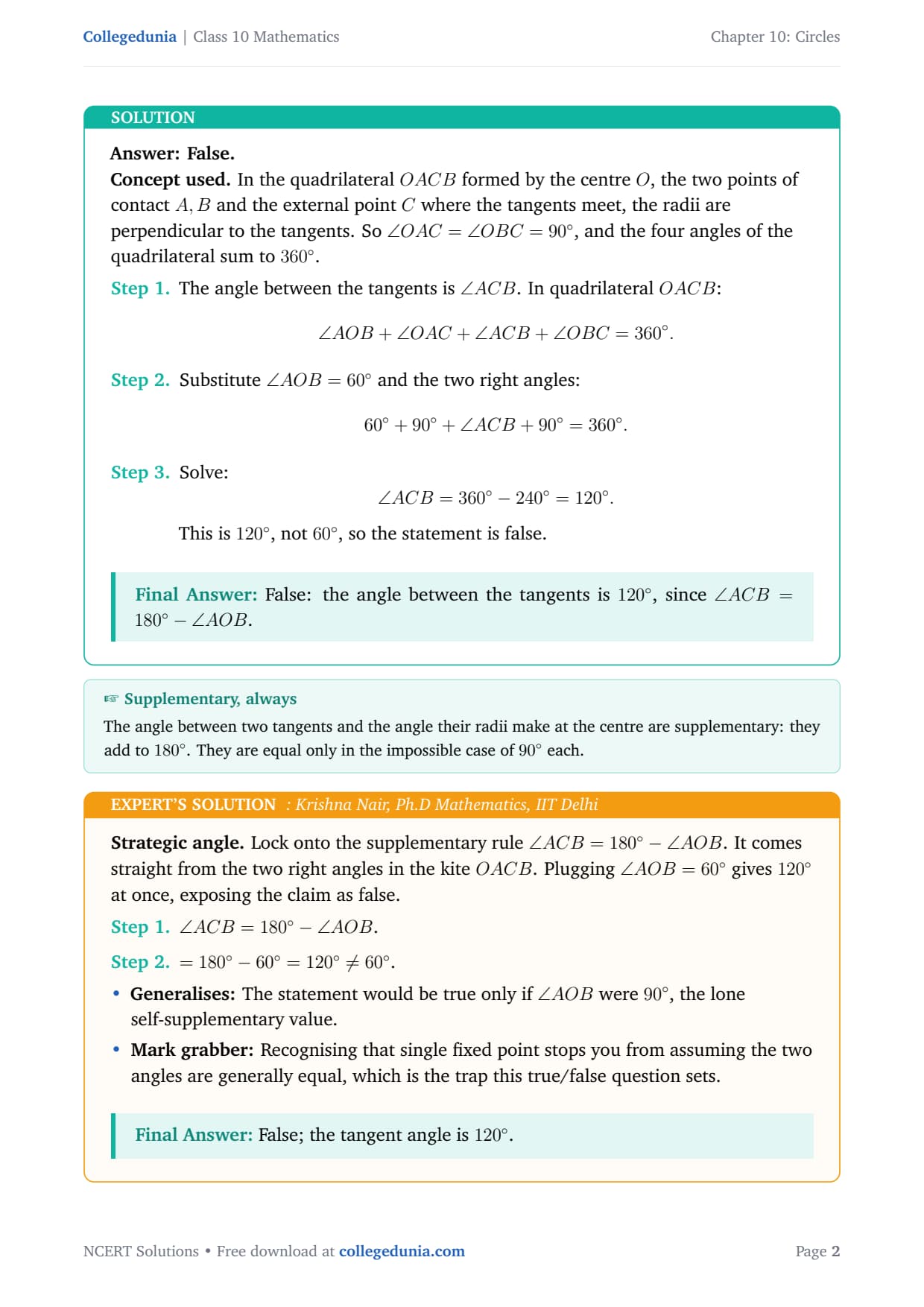
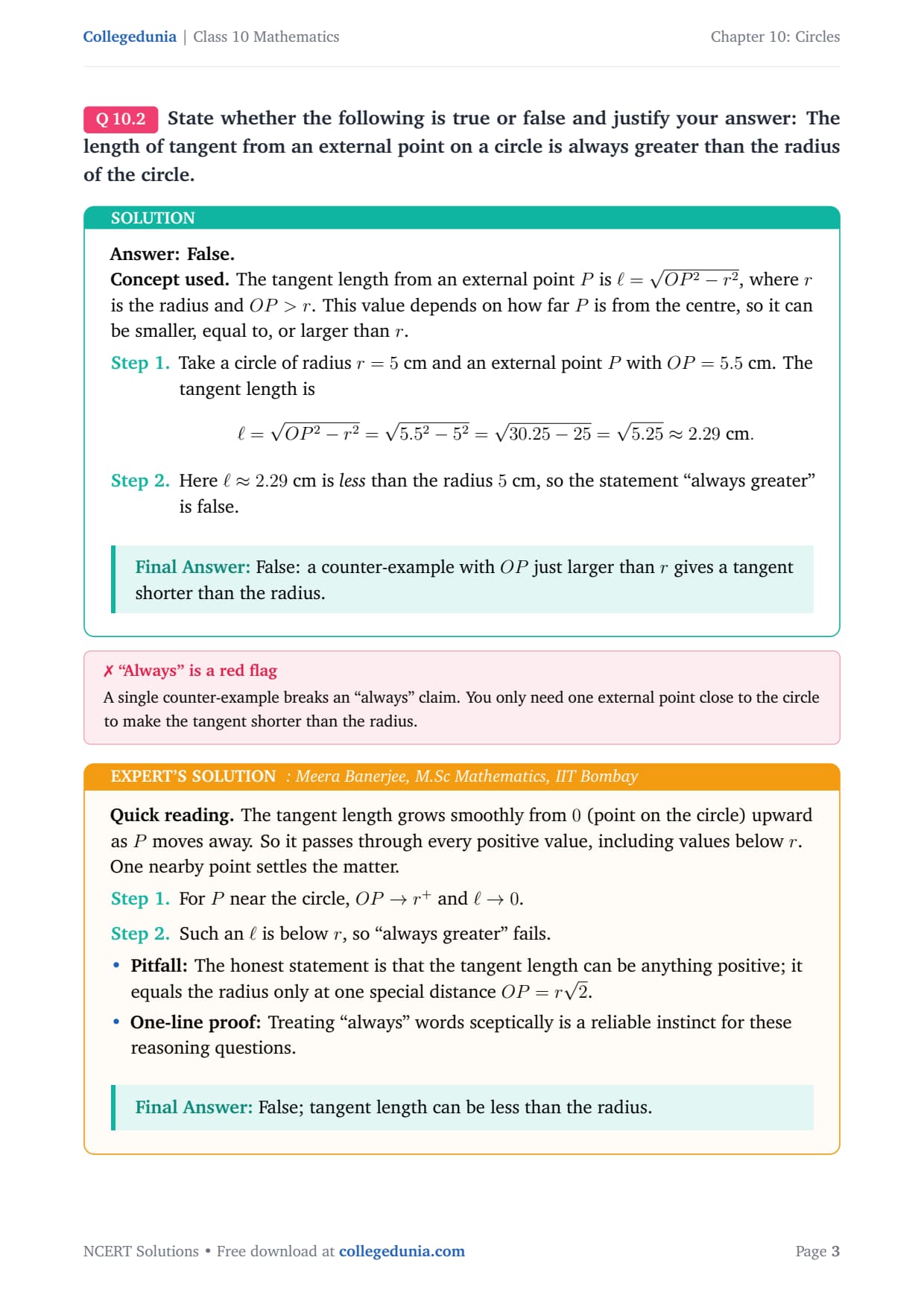
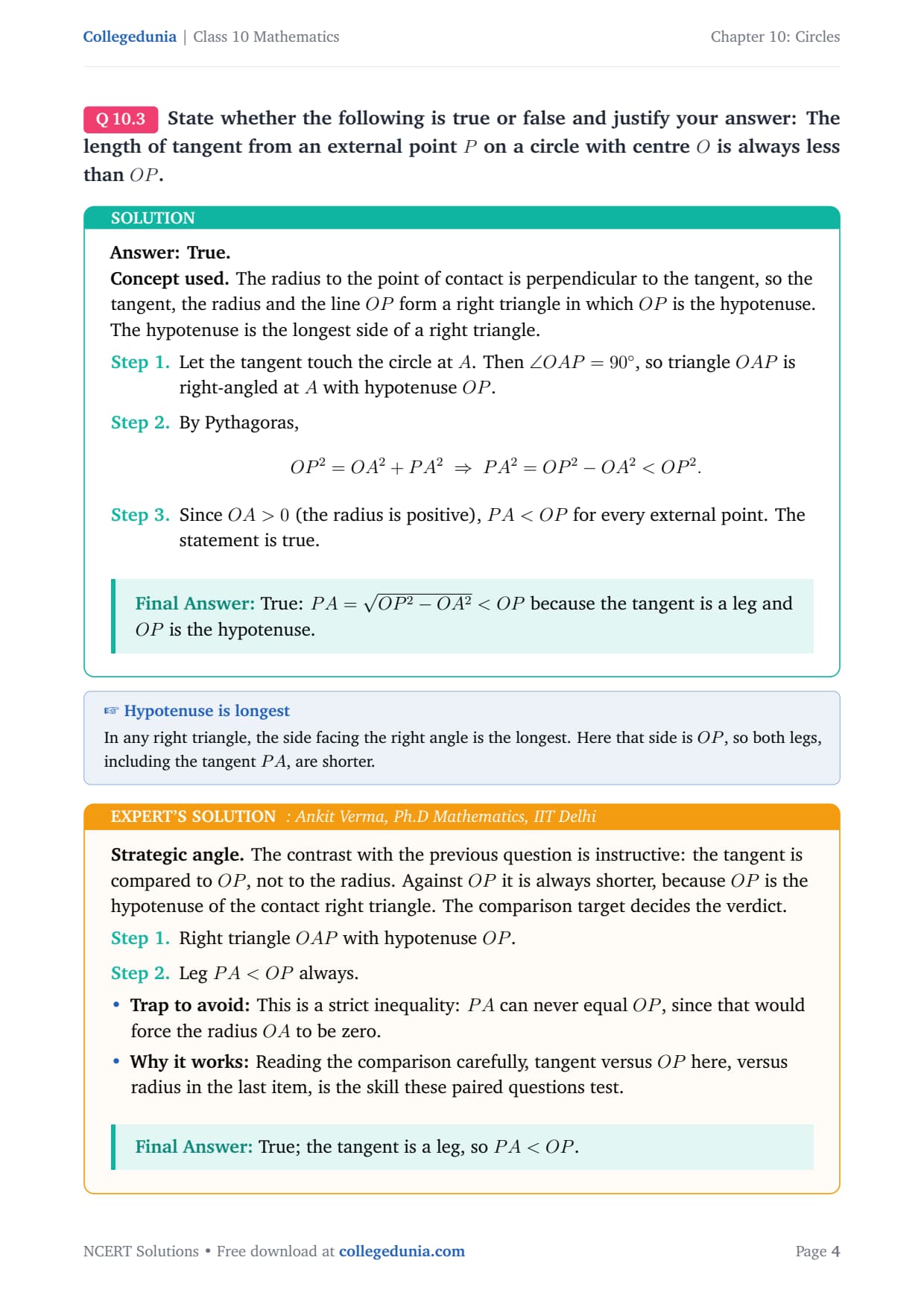
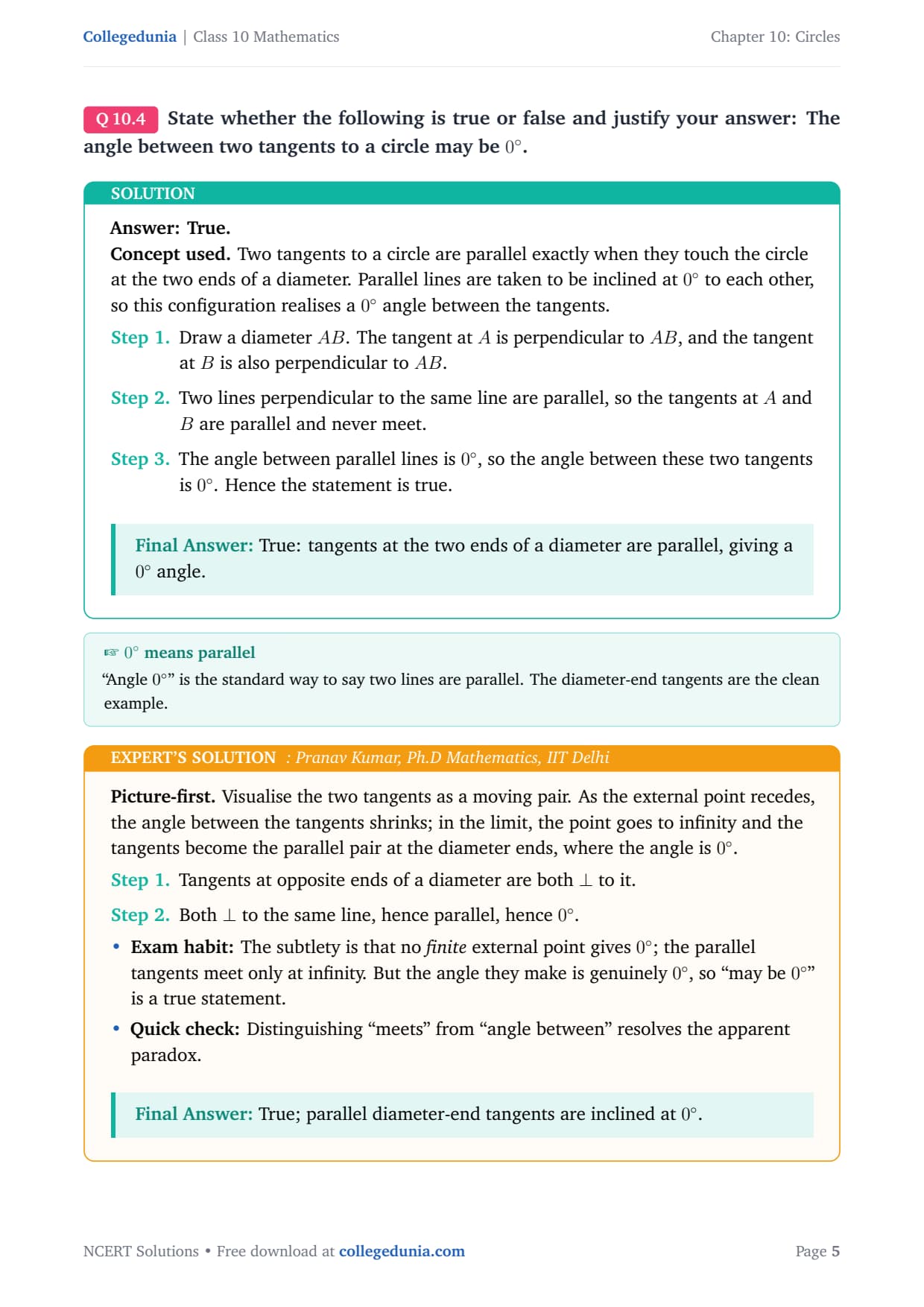
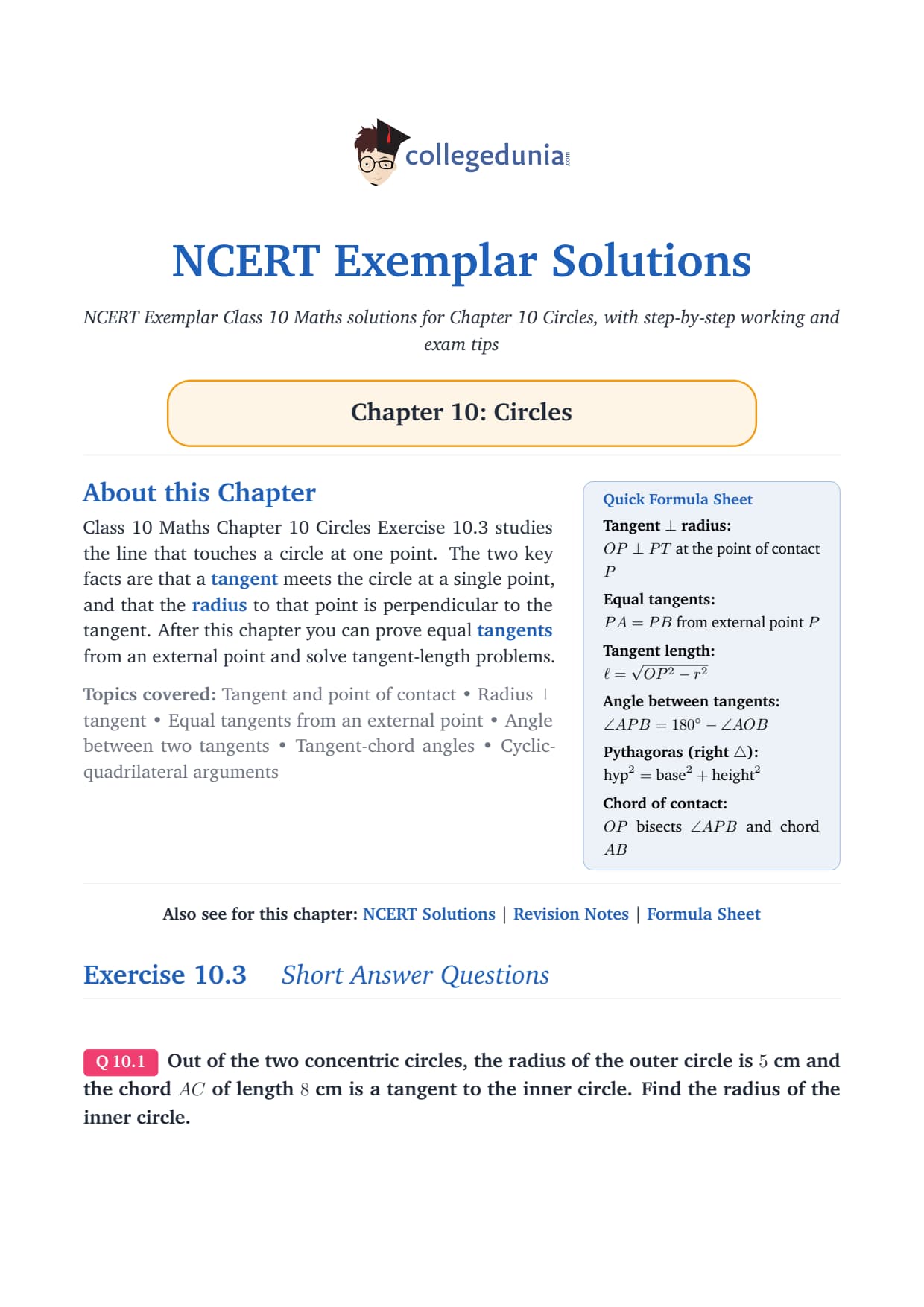
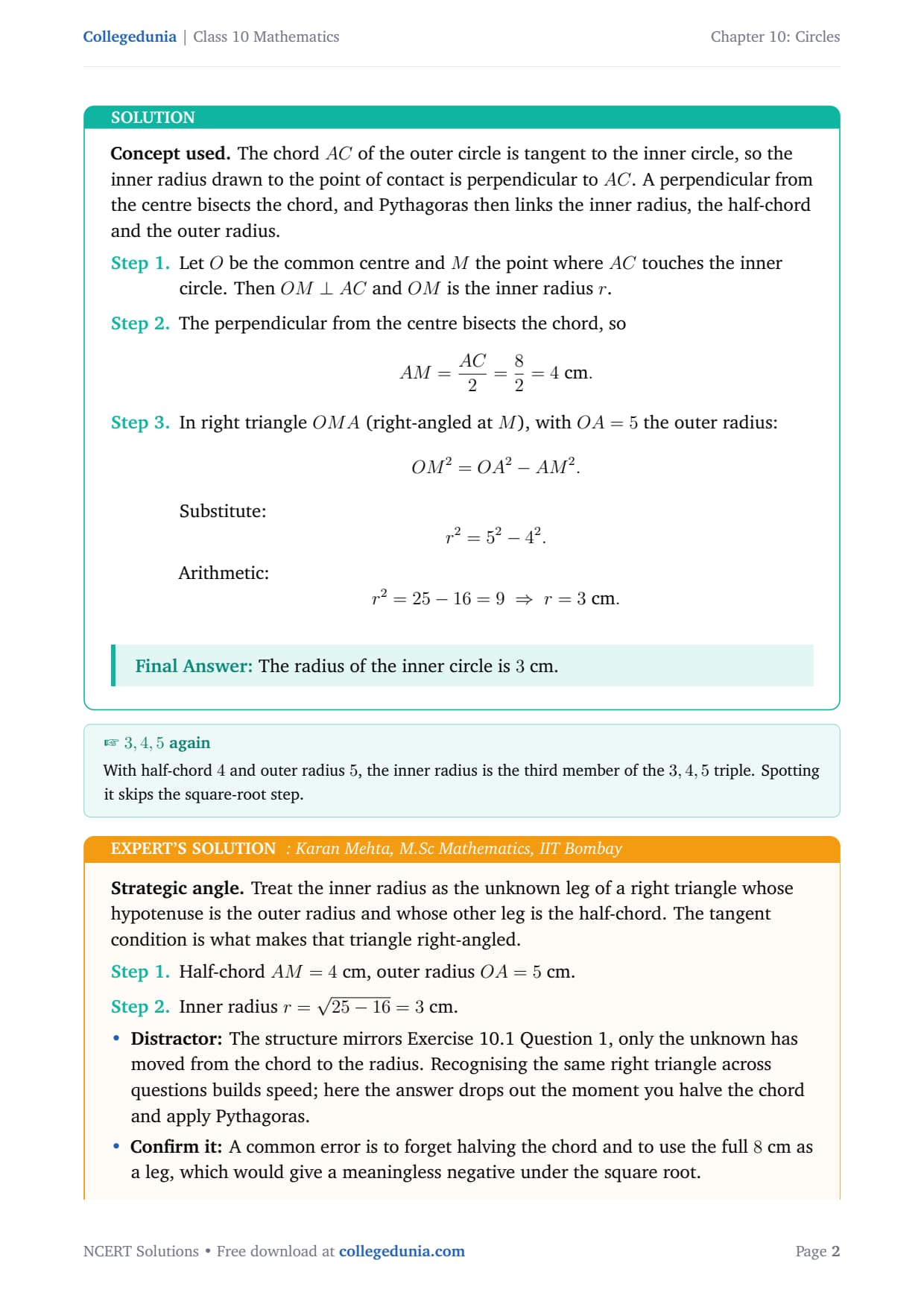
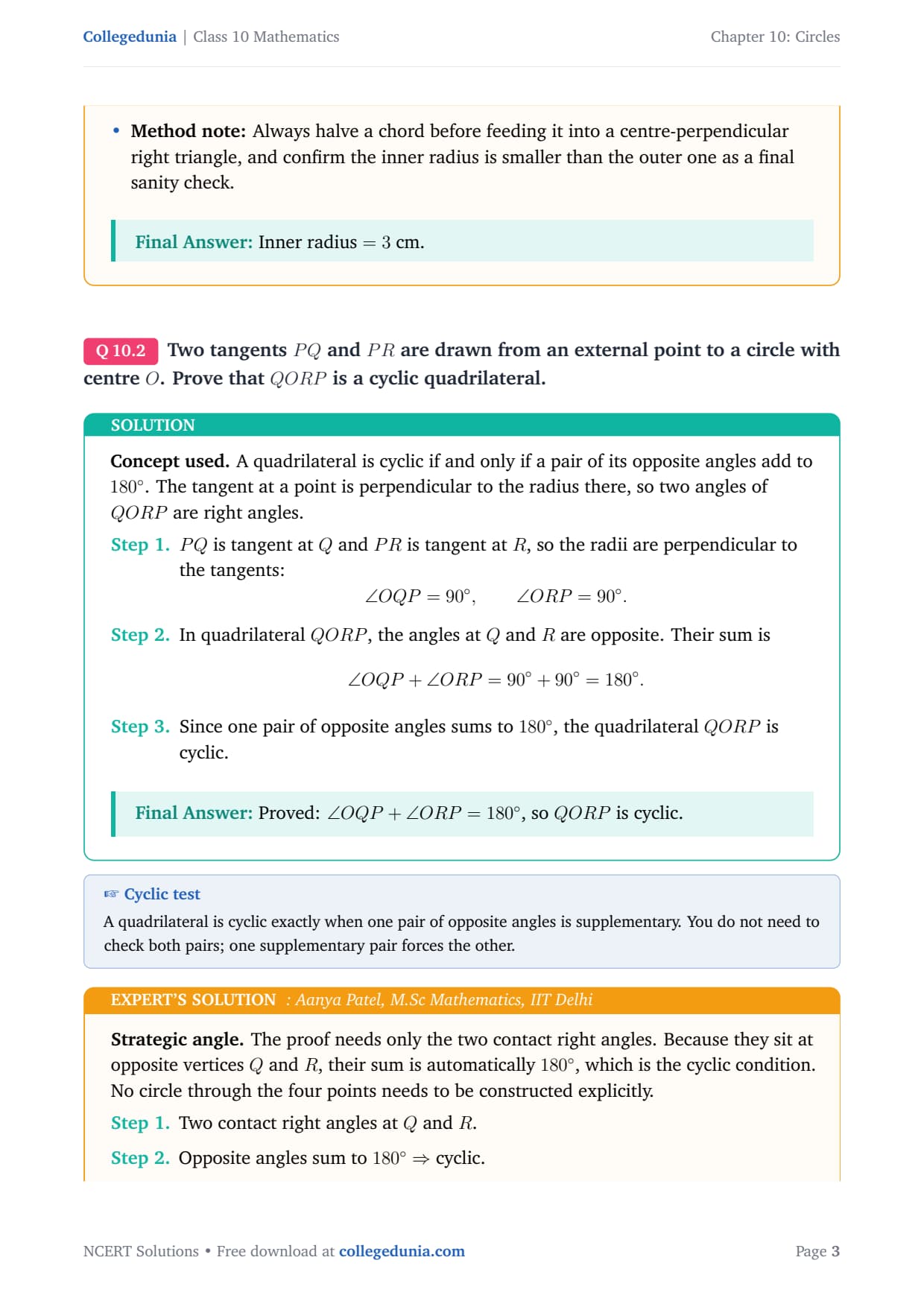
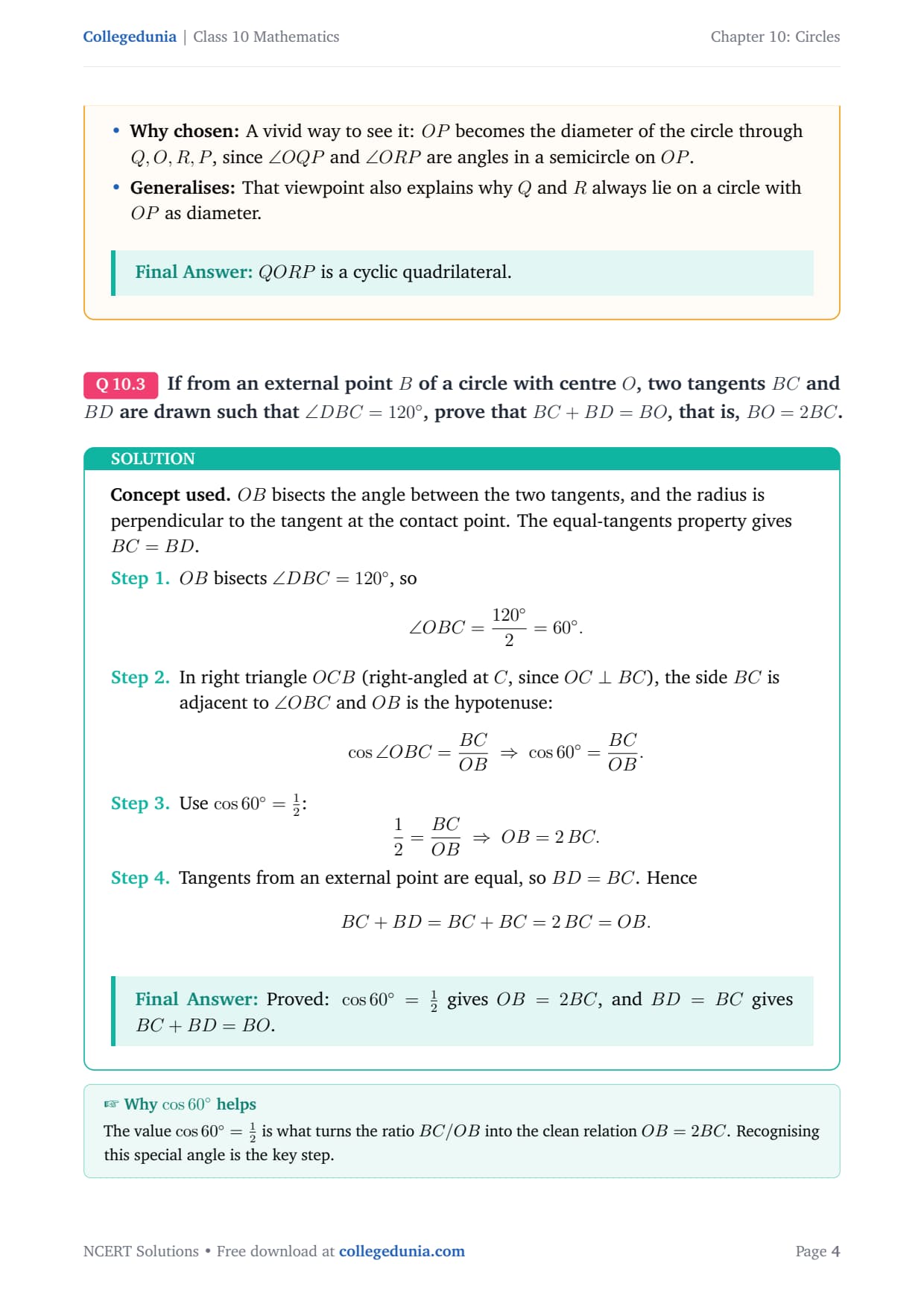
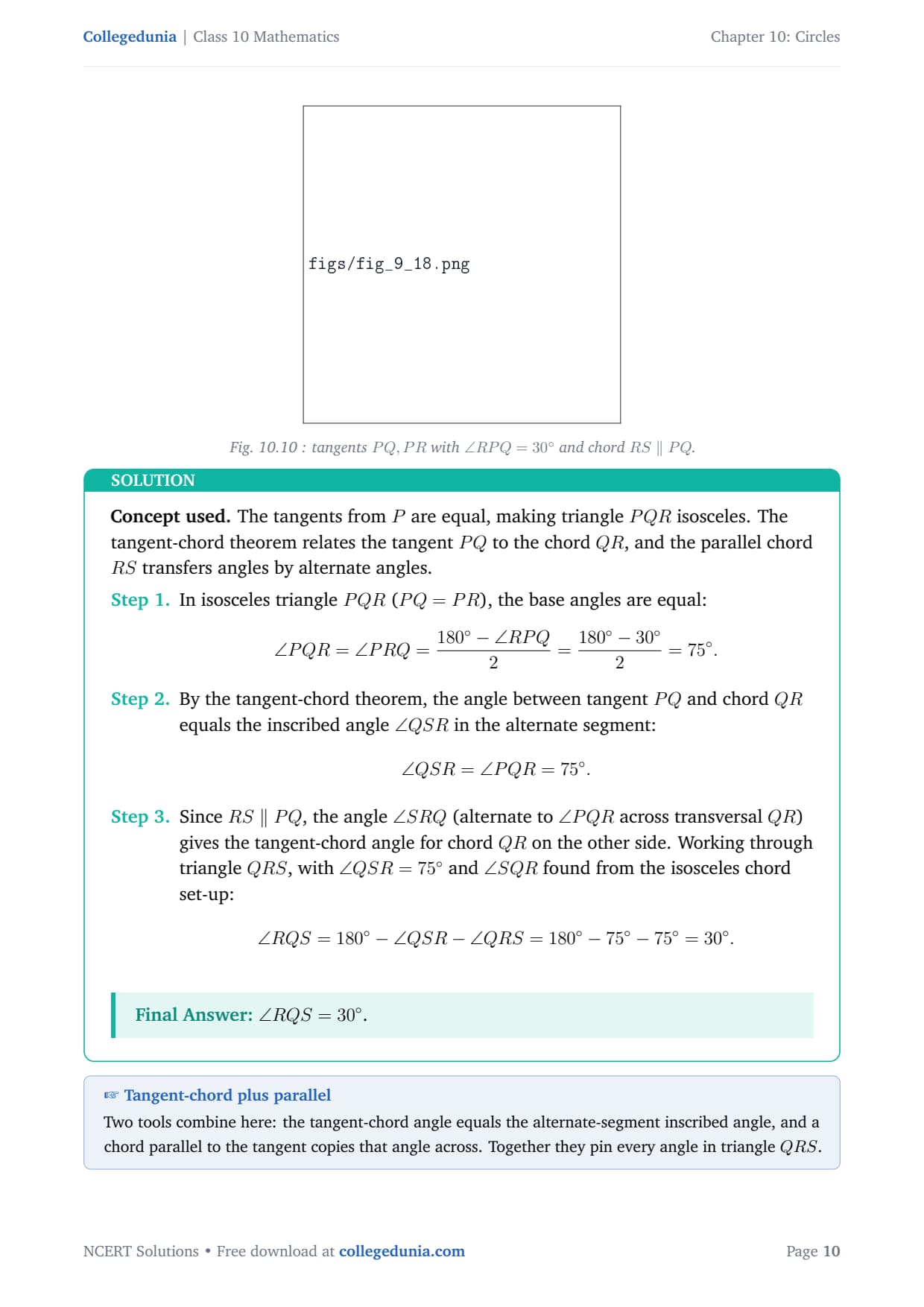
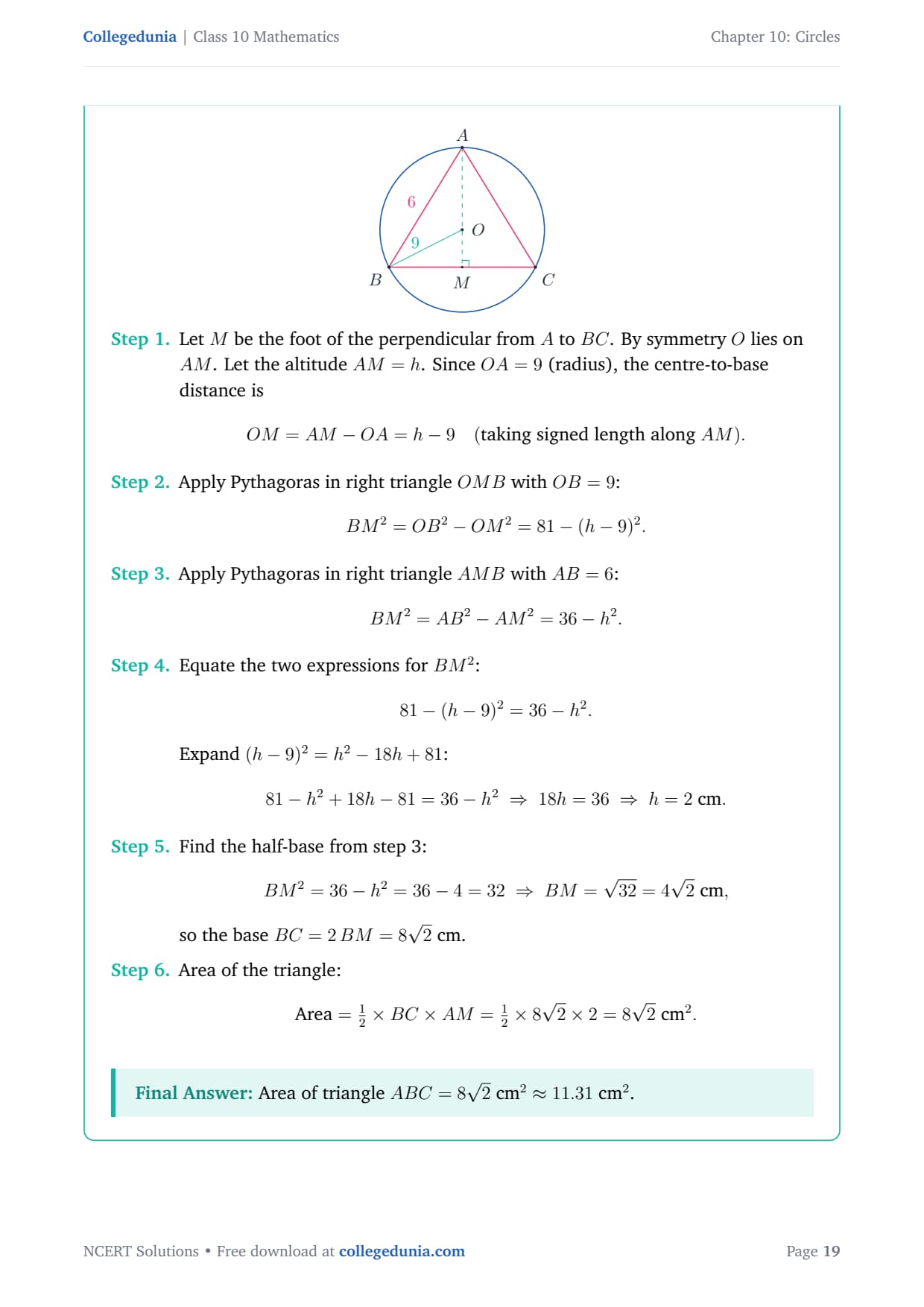
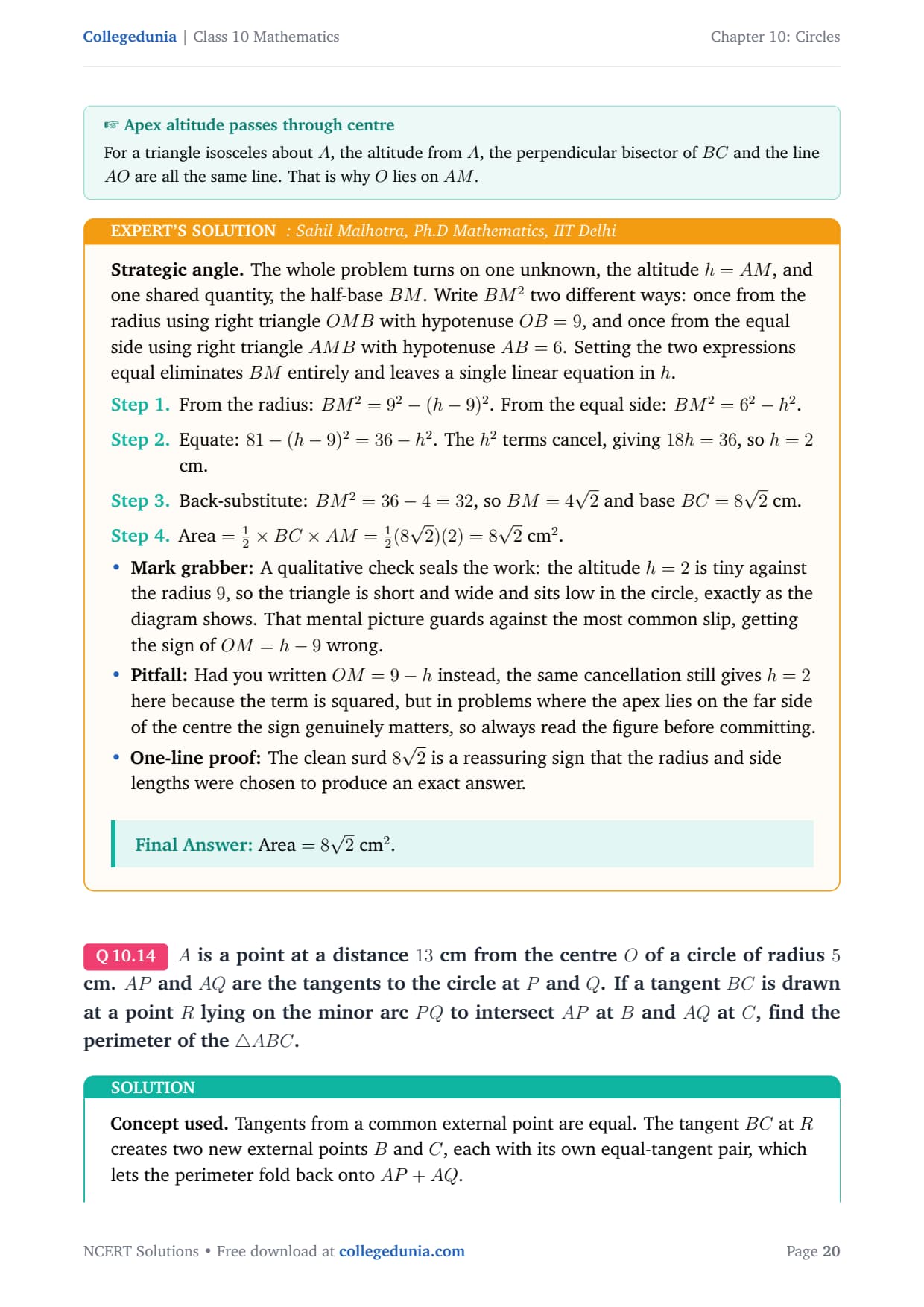
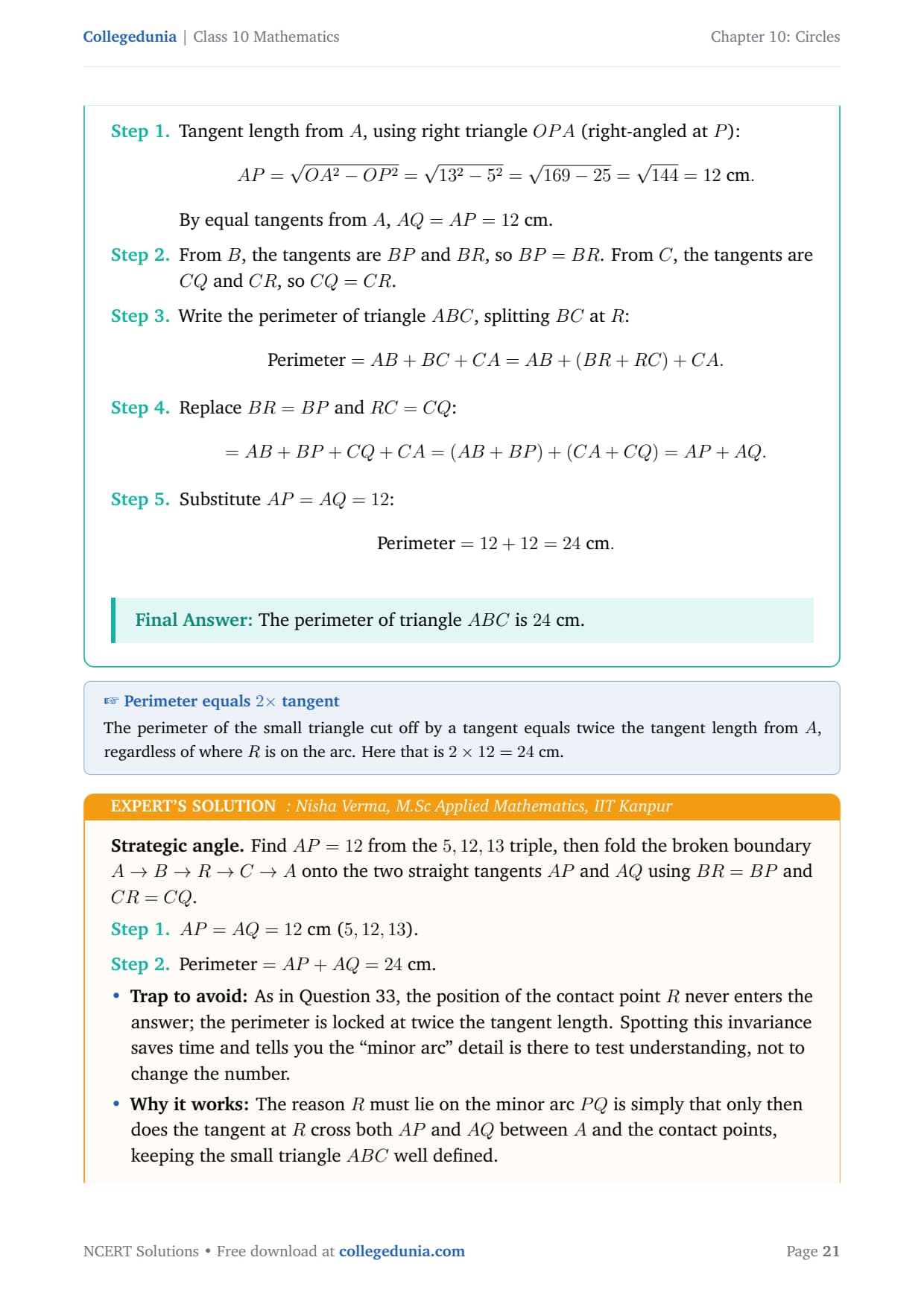

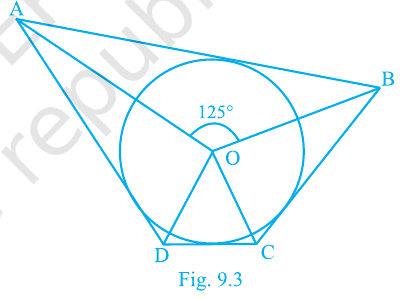
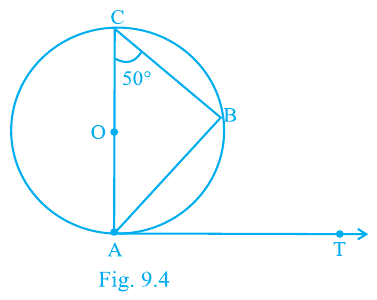
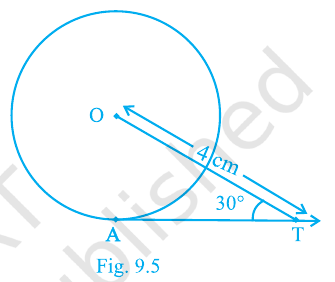
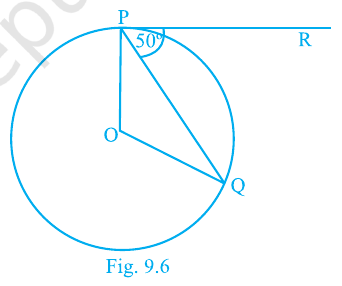
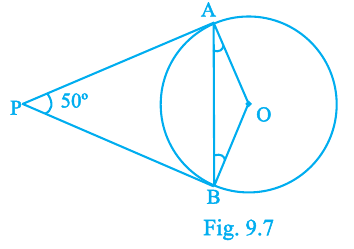
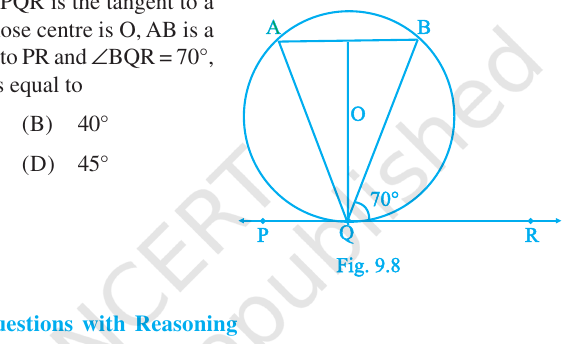
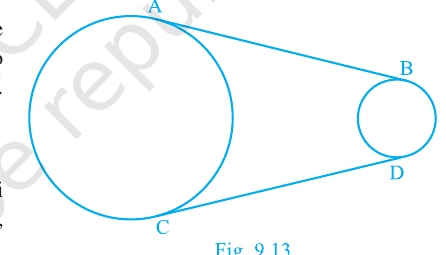
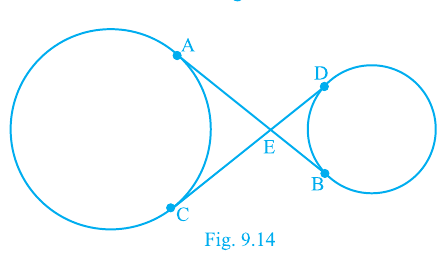
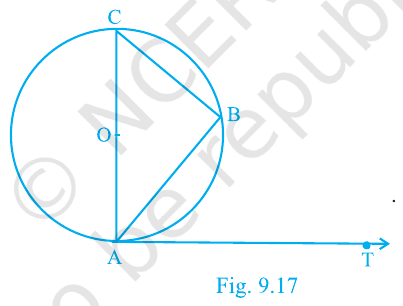
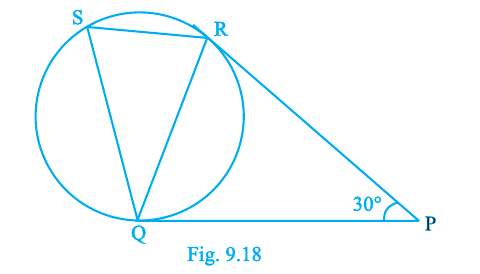
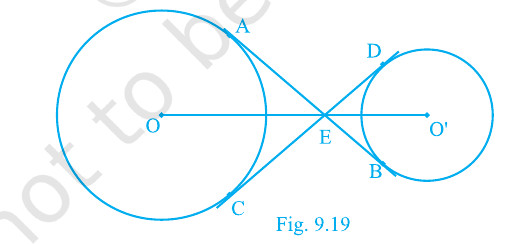
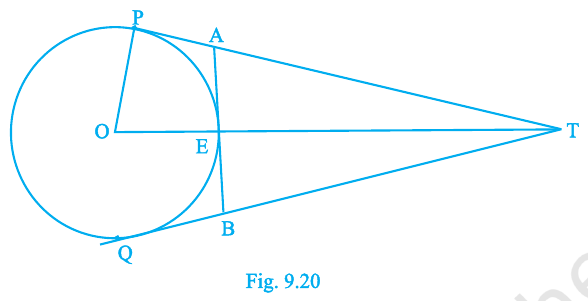
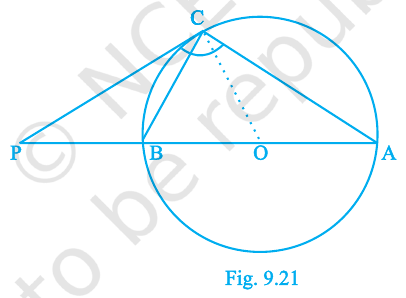



Comments