NCERT Exemplar Class 10 Maths Chapter 12 Surface Areas and Volumes Exercise 12.4 has 20 Long Answer Questions. They cover volume conservation, rate-of-flow, capacity, and combined-solid problems. All answers follow the 2026-27 CBSE syllabus.
20 Long Answer Questions (Q43 to Q62) each solved step by step with an Expert's analysis.
Key topics: melting and recasting, water-flow rate problems, open boxes, frustum capacity, conical heaps, hollow pipes, and combined solids like rocket and building shapes.
CBSE Weightage: Surface Areas and Volumes carries 4 to 6 marks in the Class 10 board paper, usually as a 5-mark long-answer question.
These NCERT Exemplar Solutions for Class 10 Maths Chapter 12 Exercise 12.4 are curated by subject experts, mapped to the 2026-27 NCERT Exemplar book, and checked against the last five years of CBSE board papers for this chapter.
Solved by Collegedunia
All 20 questions of Exercise 12.4 are solved below with Concept, Step-by-step working, and an Expert's insight for each.
What Exercise 12.4 of Surface Areas and Volumes Covers
Exercise 12.4 is the Long Answer Questions section. It has 20 questions (Q43 to Q62). Each one needs multi-step work, not just formula recall. These are the closest to real 5-mark board questions.
Volume conservation (melting and recasting): Q43, Q55, Q59 ask students to equate volumes when one solid is converted into another.
Rate-of-flow and time problems: Q47, Q50, Q60 require dividing a target volume by the pipe's delivery rate per minute or per hour.
Capacity and cost problems: Q44, Q54, Q58 give a container shape and ask for the volume (in litres) then multiply by a cost per litre.
Combined and hollow solids: Q45, Q51, Q56, Q57, Q62 test open boxes, hollow pipes, a rocket (cylinder + cone), a domed building, and a pen stand with depressions.
The difficulty is high. Most lost marks come from two slips: unit mismatches (cm vs m vs km), and treating a hollow shape as solid when subtracting volumes.
Key Surface Areas and Volumes Formulas for Exercise 12.4
Every question uses one or more of these formulas. Learn the highlighted patterns first. They are the ones most often written wrong in board answers.
Solid
Formula
Used in Question(s)
Hemisphere (radius R)
Volume = 23π R3
Q43, Q58
Cone (radius r, height h)
Volume = 13π r2h; CSA = π rl
Q43, Q47, Q48, Q55, Q59
Cylinder (radius r, height h)
Volume = π r2h; CSA = 2π rh
Q44, Q46, Q47, Q49, Q50, Q56, Q58, Q60, Q61
Cuboid (l, b, h)
Volume = l × b × h
Q44, Q45, Q51, Q52, Q62
Frustum (radii r1, r2, height h)
Volume = 13π h(r12 + r22 + r1r2)
Q54
Sphere (radius r)
Volume = 43π r3
Q53, Q58
Hollow pipe (ring)
Volume = π(R2 - r2)L
Q51
Rate-of-flow pattern: Time = Volume needed ÷ Volume delivered per unit time. The pipe delivers a cylinder of water of length = speed each minute. Multiply pipe cross-section area by speed to get cm3/min (or m3/h). This pattern drives Q47, Q50, and Q60.
Volume Conservation & Rate-of-Flow Reference
Common Mistakes in Surface Areas and Volumes Exercise 12.4
Here marks go to unit errors and structure errors more than formula errors. The table below shows the common slips and quick fixes.
Question
Common Mistake
The Fix
Q43
Keeping π in the equation and using 22/7 throughout
Cancel π/3 first. Both sides carry it; dividing it out gives 2R3 = r2h immediately.
Q45
Subtracting 2 thicknesses from the height of the open box
An open box has no lid, so only 1 thickness is removed from the height. Length and breadth still lose 2 thicknesses each.
Q47, Q50, Q60
Mixing units (km/h with cm, or m/min with mm)
Convert everything to one unit first before substituting into any formula. Metres are usually the safest choice.
Q51
Using π R2 (solid circle) instead of π(R2 - r2) (ring)
A hollow pipe's cross-section is a ring. Use external radius minus internal radius in the ring formula.
Q56
Including both circular ends of the cylinder in the rocket's TSA
The rocket is closed at the base only. The cylinder-top and cone-base are joined and invisible. Count only one circular face.
Q57
Not reading "diameter = total height" correctly
If dome diameter = 2r equals total height, the cylinder's height is 2r - r = r. Set up the relation before substituting.
Q62
Forgetting to subtract both the conical depressions and the cubical depression
Every scooped-out hollow reduces the wood volume. Subtract all five depressions (four cones + one cube).
Long Answer Strategy for Surface Areas and Volumes
All Exercise 12.4 Questions with Step-by-Step Solutions
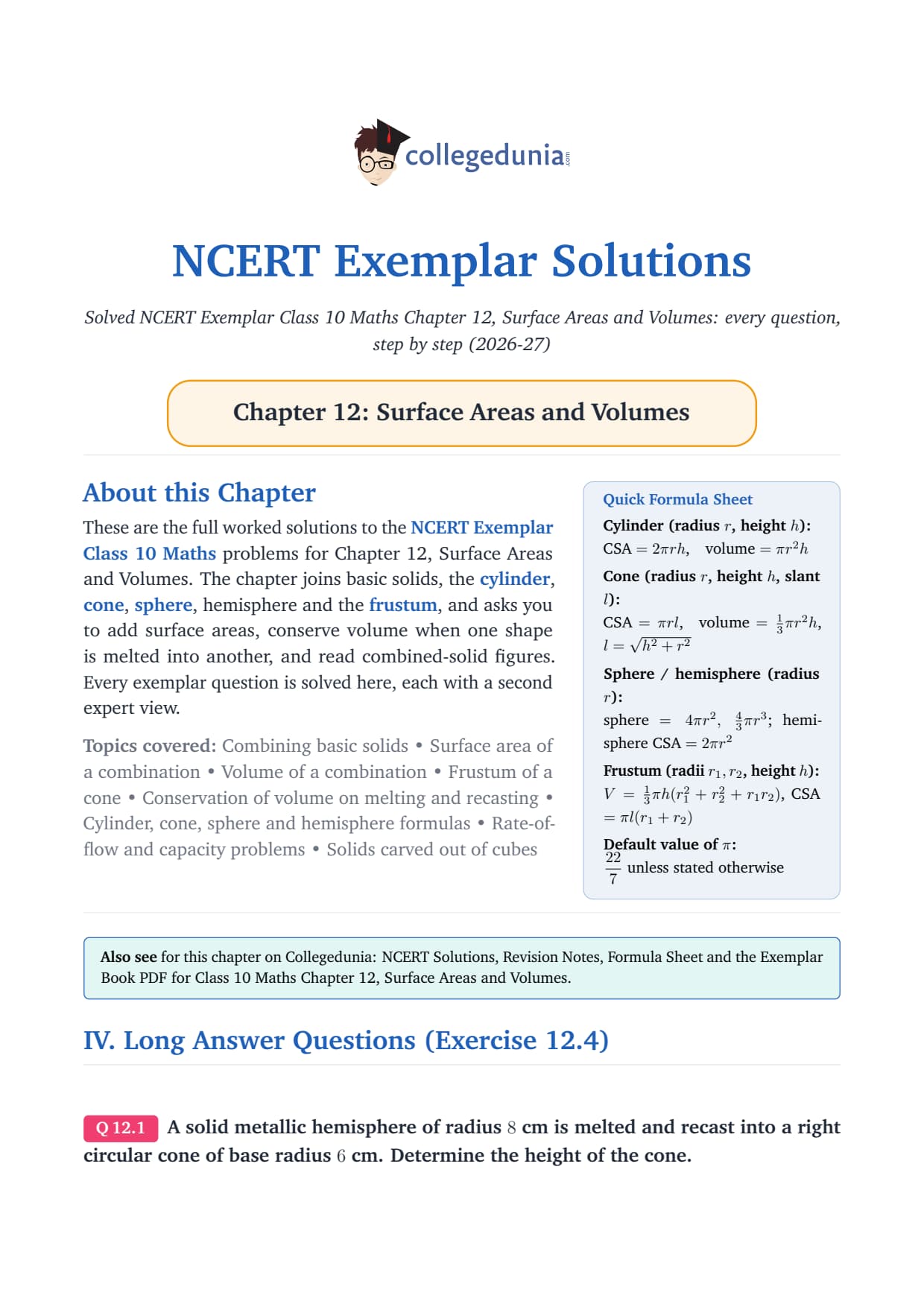
IV. Long Answer Questions (Exercise 12.4)
Q 12.1
A solid metallic hemisphere of radius 8 cm is melted and recast into a right circular cone of base radius 6 cm. Determine the height of the cone.
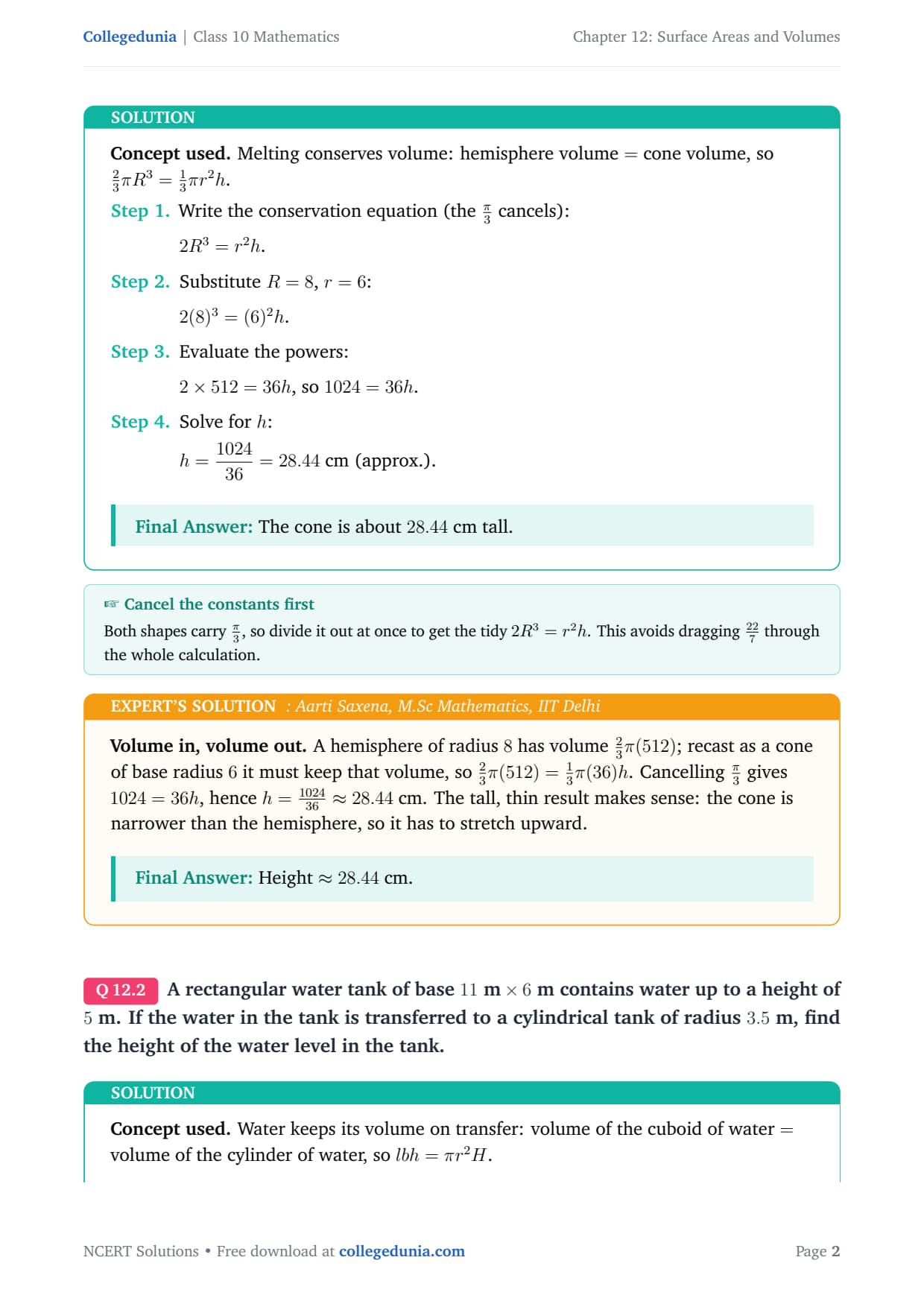
Write the conservation equation (the π3 cancels):
[] 2R3=r2h.
Substitute R=8, r=6:
[] 2(8)3=(6)2h.
Evaluate the powers:
[] 2× 512=36h, so 1024=36h.
Solve for h:
[] h=102436=28.44 cm (approx.).
The cone is about 28.44 cm tall.
AS
Aarti Saxena
M.Sc Mathematics, IIT Delhi
Verified Expert
Volume in, volume out. A hemisphere of radius 8 has volume
23π(512); recast as a cone of base radius 6 it must keep that volume,
so 23π(512)=13π(36)h. Cancelling π3 gives
1024=36h, hence h=10243628.44 cm. The tall, thin result makes
sense: the cone is narrower than the hemisphere, so it has to stretch upward.
Height 28.44 cm.
Q 12.2
A rectangular water tank of base 11 m× 6 m contains water up to a height of 5 m. If the water in the tank is transferred to a cylindrical tank of radius 3.5 m, find the height of the water level in the tank.
Concept used. Water keeps its volume on transfer: volume of the cuboid
of water = volume of the cylinder of water, so lbh=π r2H.
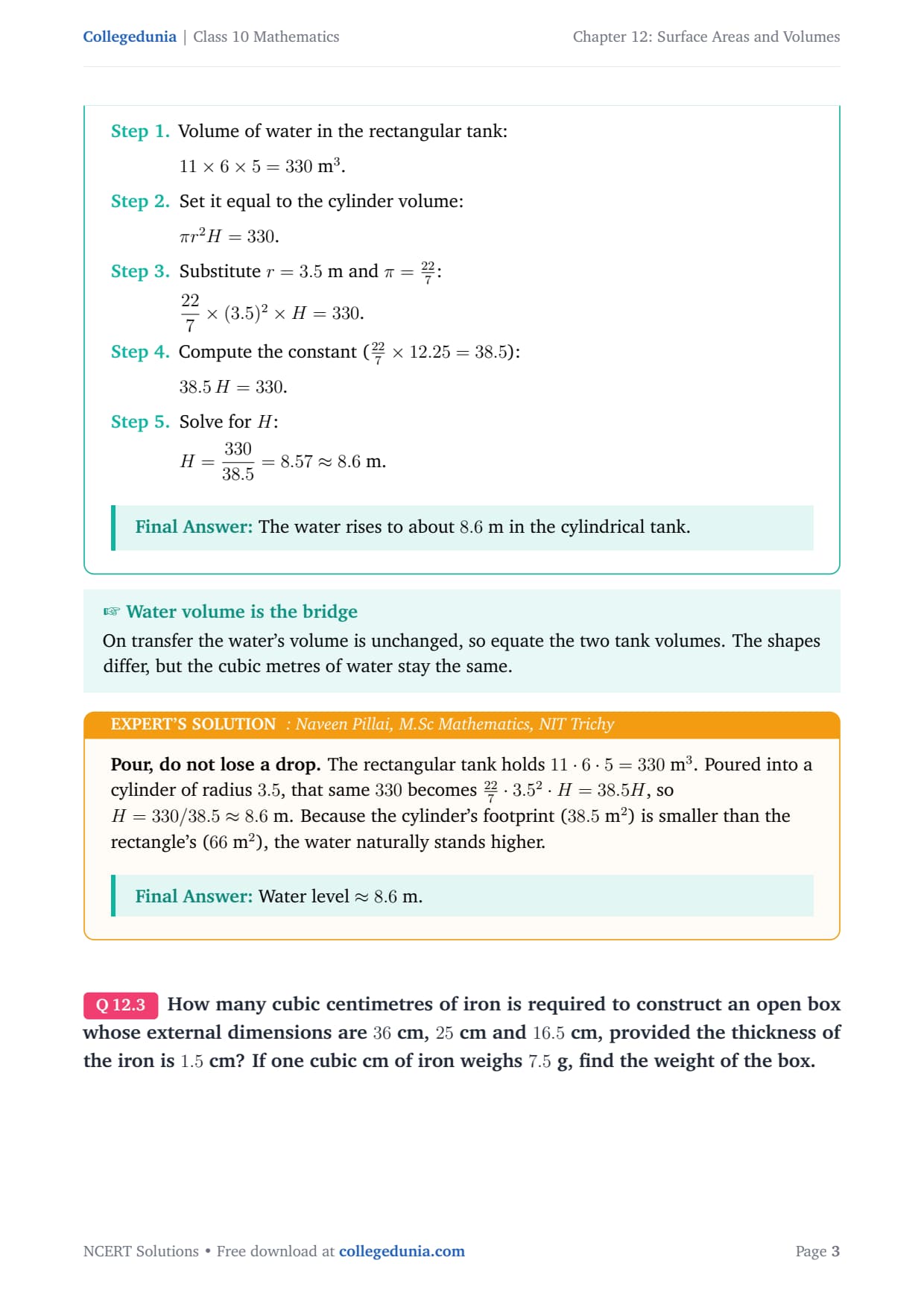
Volume of water in the rectangular tank:
[] 11× 6× 5=330 m3.
Set it equal to the cylinder volume:
[] π r2H=330.
Substitute r=3.5 m and π=227:
[] 227×(3.5)2× H=330.
Compute the constant (227× 12.25=38.5):
[] 38.5 H=330.
Solve for H:
[] H=33038.5=8.57≈ 8.6 m.
The water rises to about 8.6 m in the cylindrical tank.
NP
Naveen Pillai
M.Sc Mathematics, NIT Trichy
Verified Expert
Pour, do not lose a drop. The rectangular tank holds
1165=330 m3. Poured into a cylinder of radius 3.5, that same
330 becomes 2273.52· H=38.5H, so H=330/38.58.6 m.
Because the cylinder's footprint (38.5 m2) is smaller than the
rectangle's (66 m2), the water naturally stands higher.
Water level 8.6 m.
Q 12.3
How many cubic centimetres of iron is required to construct an open box whose external dimensions are 36 cm, 25 cm and 16.5 cm, provided the thickness of the iron is 1.5 cm? If one cubic cm of iron weighs 7.5 g, find the weight of the box.
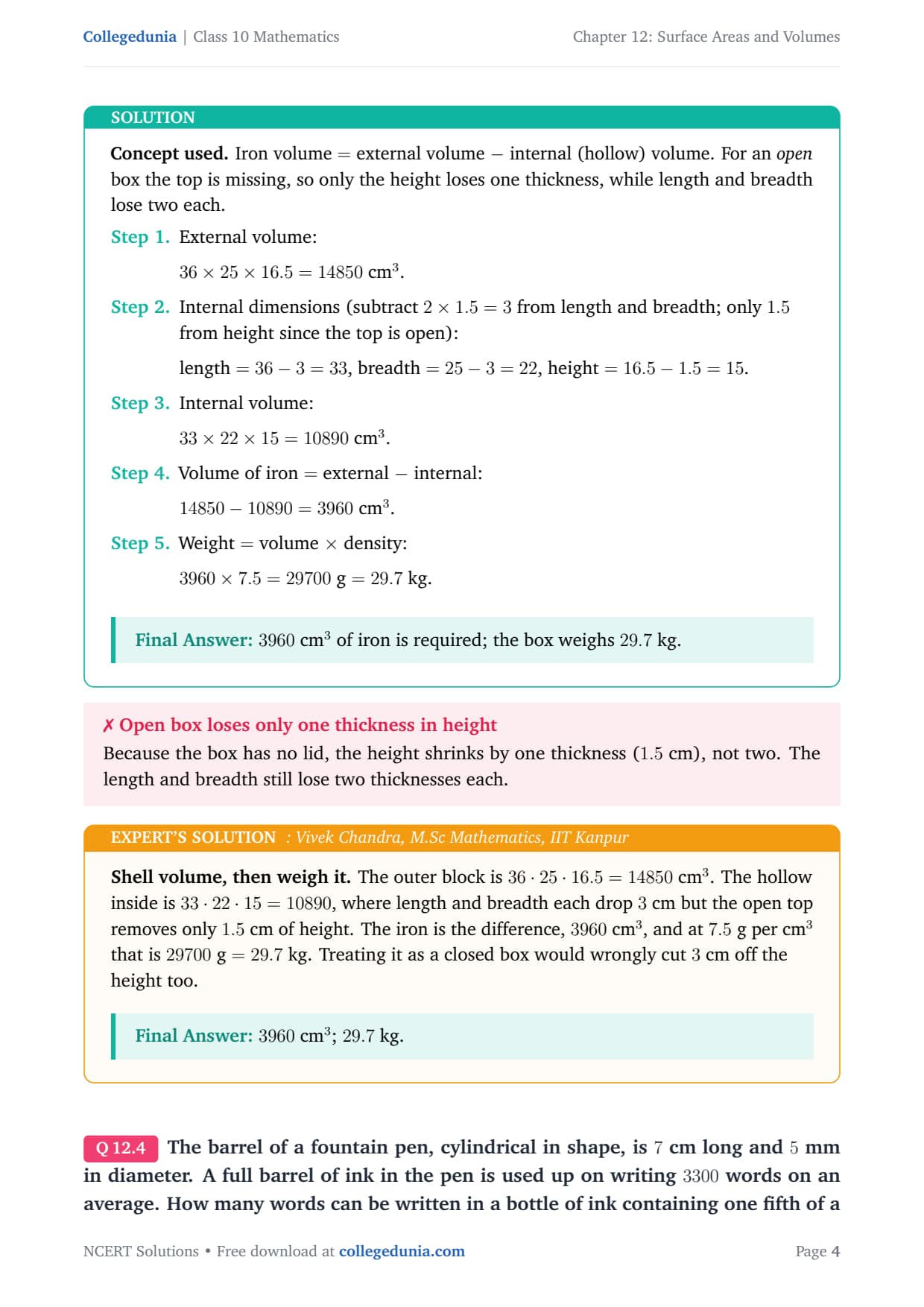
Concept used. Iron volume = external volume - internal (hollow)
volume. For an open box the top is missing, so only the height loses one
thickness, while length and breadth lose two each.
External volume:
[] 36× 25× 16.5=14850 cm3.
Internal dimensions (subtract 21.5=3 from length and breadth;
only 1.5 from height since the top is open):
[] length =36-3=33, breadth =25-3=22, height =16.5-1.5=15.
Internal volume:
[] 33× 22× 15=10890 cm3.
Volume of iron = external - internal:
[] 14850-10890=3960 cm3.
Weight = volume × density:
[] 3960× 7.5=29700 g=29.7 kg.
3960 cm3 of iron is required; the box weighs 29.7 kg.
VC
Vivek Chandra
M.Sc Mathematics, IIT Kanpur
Verified Expert
Shell volume, then weigh it. The outer block is
362516.5=14850 cm3. The hollow inside is 332215=10890,
where length and breadth each drop 3 cm but the open top removes only 1.5 cm
of height. The iron is the difference, 3960 cm3, and at 7.5 g per cm3
that is 29700 g =29.7 kg. Treating it as a closed box would wrongly cut
3 cm off the height too.
3960 cm3; 29.7 kg.
Q 12.4
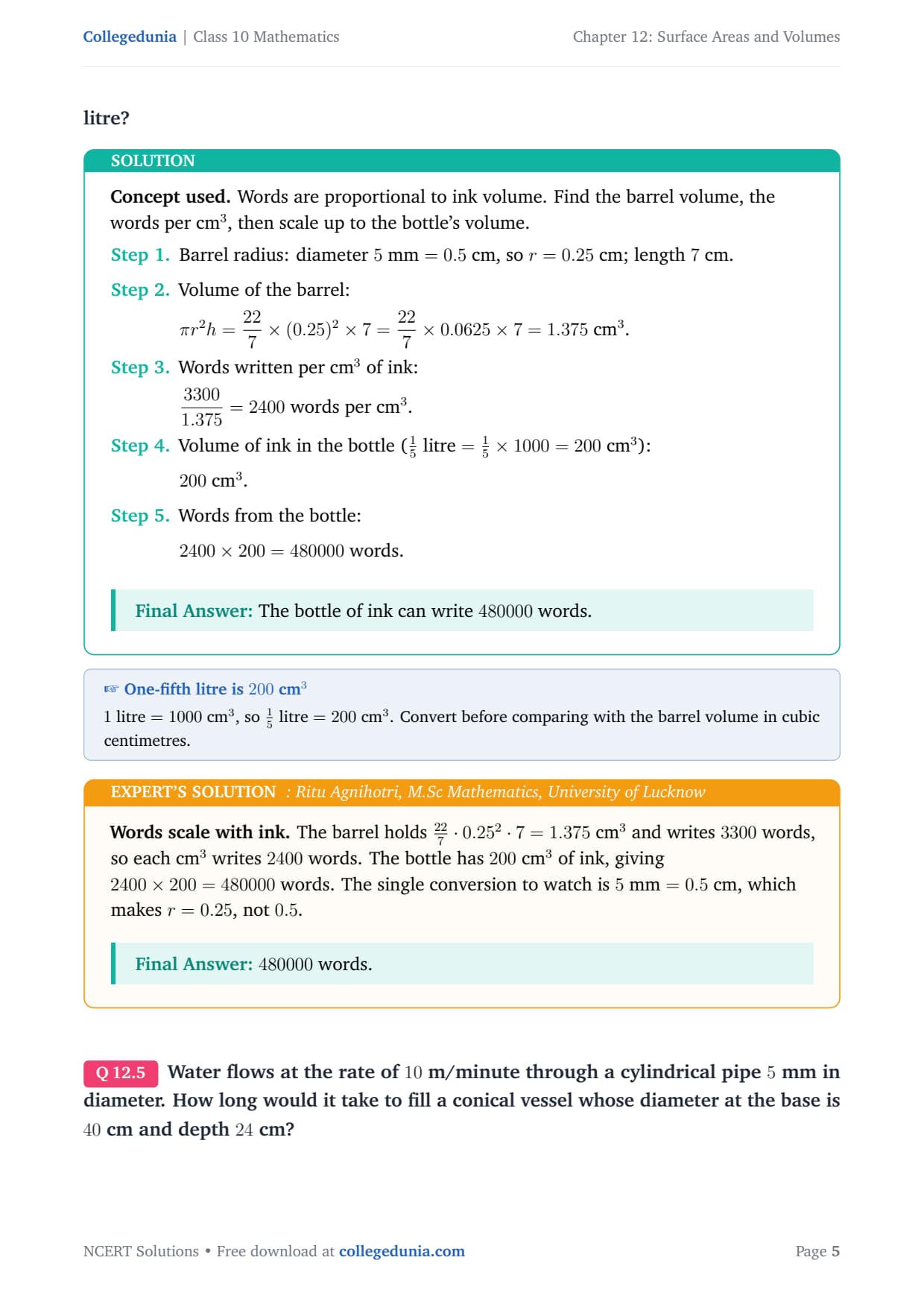
The barrel of a fountain pen, cylindrical in shape, is 7 cm long and 5 mm in diameter. A full barrel of ink in the pen is used up on writing 3300 words on an average. How many words can be written in a bottle of ink containing one fifth of a litre?
Concept used. Words are proportional to ink volume. Find the barrel
volume, the words per cm3, then scale up to the bottle's volume.
Barrel radius: diameter 5 mm =0.5 cm, so r=0.25 cm; length 7 cm.
Volume of the barrel:
[] π r2h=227×(0.25)2× 7=227× 0.0625× 7=1.375 cm3.
Words written per cm3 of ink:
[] 33001.375=2400 words per cm3.
Volume of ink in the bottle (15 litre =15× 1000=200 cm3):
[] 200 cm3.
Words from the bottle:
[] 2400× 200=480000 words.
The bottle of ink can write 480000 words.
RA
Ritu Agnihotri
M.Sc Mathematics, University of Lucknow
Verified Expert
Words scale with ink. The barrel holds
2270.2527=1.375 cm3 and writes 3300 words, so each
cm3 writes 2400 words. The bottle has 200 cm3 of ink, giving
2400200=480000 words. The single conversion to watch is 5 mm =0.5 cm,
which makes r=0.25, not 0.5.
480000 words.
Q 12.5
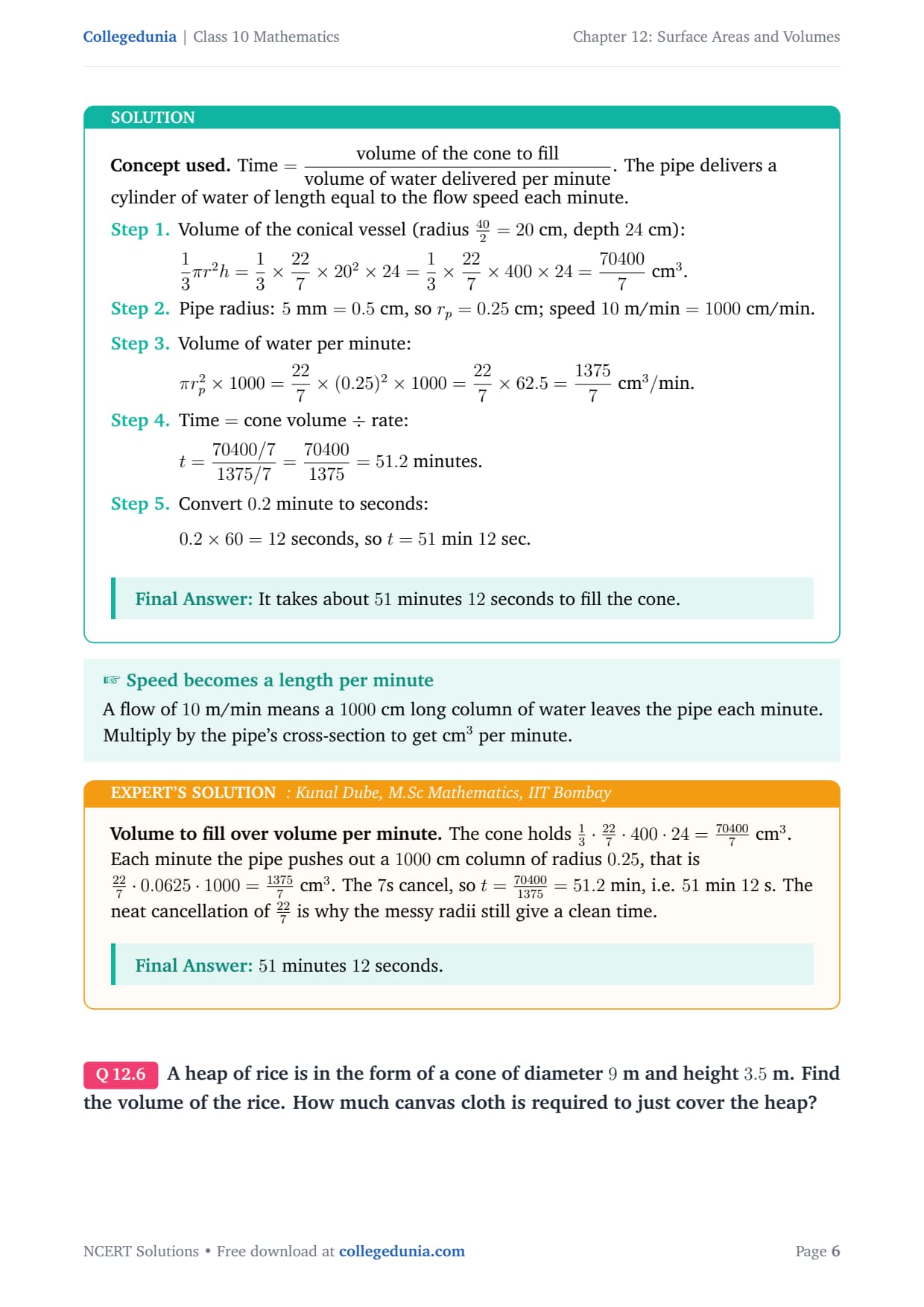
Water flows at the rate of 10 m/minute through a cylindrical pipe 5 mm in diameter. How long would it take to fill a conical vessel whose diameter at the base is 40 cm and depth 24 cm?
Concept used. Time =volume of the cone to fillvolume of water delivered per minute. The pipe delivers a cylinder of water of length equal to the flow speed each minute.
Volume of the conical vessel (radius 402=20 cm, depth 24 cm):
[] 13π r2h=13×227× 202× 24=13×227× 400× 24=704007 cm3.
Pipe radius: 5 mm =0.5 cm, so rp=0.25 cm; speed 10 m/min =1000 cm/min.
Volume of water per minute:
[] π rp2× 1000=227×(0.25)2× 1000=227× 62.5=13757 cm3/min.
Time = cone volume ÷ rate:
[] t=70400/71375/7=704001375=51.2 minutes.
Convert 0.2 minute to seconds:
[] 0.2× 60=12 seconds, so t=51 min 12 sec.
It takes about 51 minutes 12 seconds to fill the cone.
KD
Kunal Dube
M.Sc Mathematics, IIT Bombay
Verified Expert
Volume to fill over volume per minute. The cone holds
13·22740024=704007 cm3. Each minute the
pipe pushes out a 1000 cm column of radius 0.25, that is
2270.06251000=13757 cm3. The 7s cancel, so
t=704001375=51.2 min, i.e. 51 min 12 s. The neat cancellation of
227 is why the messy radii still give a clean time.
51 minutes 12 seconds.
Q 12.6
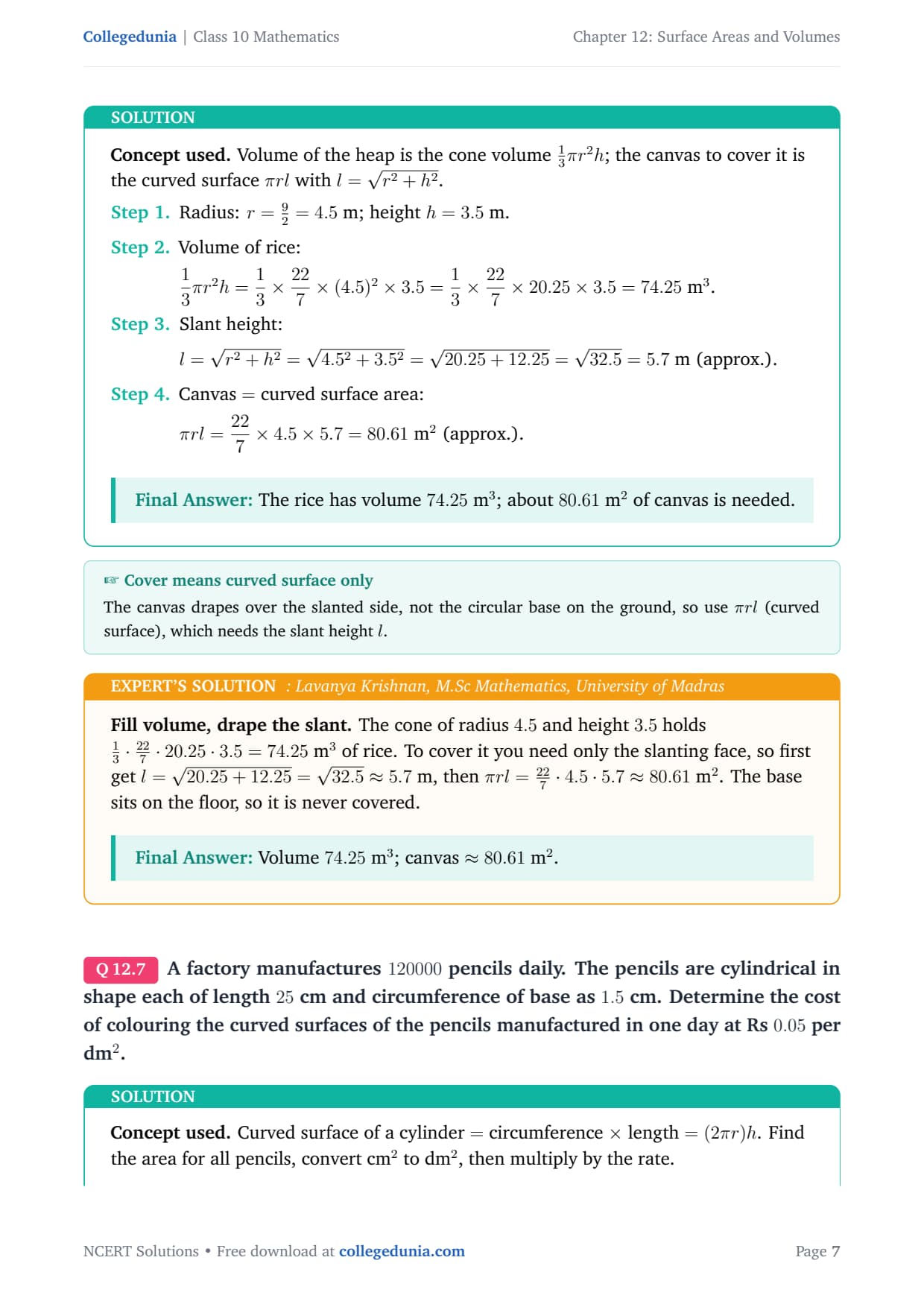
A heap of rice is in the form of a cone of diameter 9 m and height 3.5 m. Find the volume of the rice. How much canvas cloth is required to just cover the heap?
Concept used. Volume of the heap is the cone volume 13π r2h;
the canvas to cover it is the curved surface π rl with l=√r2+h2.
Radius: r=92=4.5 m; height h=3.5 m.
Volume of rice:
[] 13π r2h=13×227×(4.5)2× 3.5=13×227× 20.25× 3.5=74.25 m3.
Slant height:
[] l=√r2+h2=√4.52+3.52=√20.25+12.25=√32.5=5.7 m (approx.).
The rice has volume 74.25 m3; about 80.61 m2 of canvas is
needed.
LK
Lavanya Krishnan
M.Sc Mathematics, University of Madras
Verified Expert
Fill volume, drape the slant. The cone of radius 4.5 and height 3.5
holds 13·22720.253.5=74.25 m3 of rice. To cover
it you need only the slanting face, so first get l=√20.25+12.25
=√32.55.7 m, then π rl=2274.55.7
80.61 m2. The base sits on the floor, so it is never covered.
Volume 74.25 m3; canvas 80.61 m2.
Q 12.7
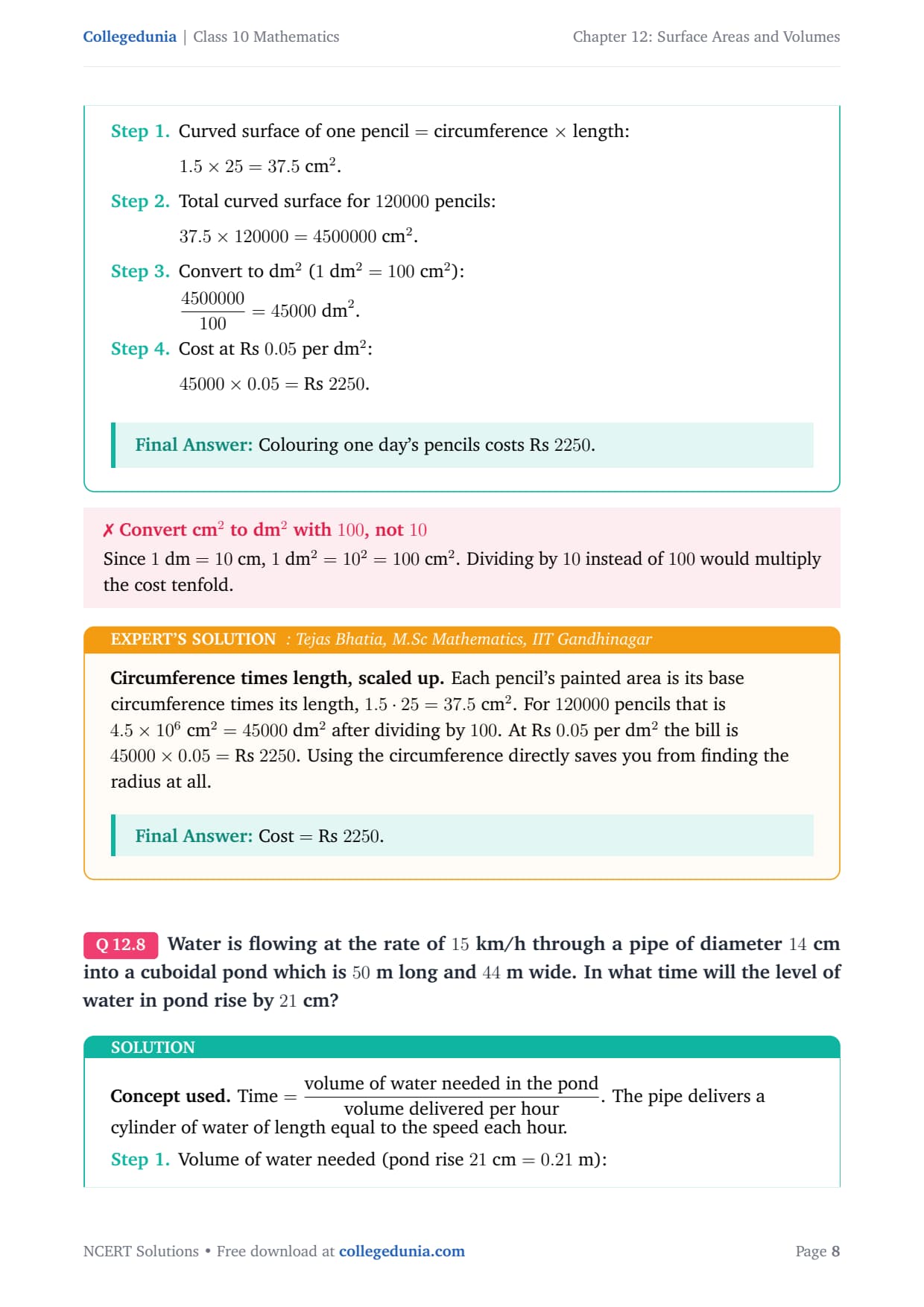
A factory manufactures 120000 pencils daily. The pencils are cylindrical in shape each of length 25 cm and circumference of base as 1.5 cm. Determine the cost of colouring the curved surfaces of the pencils manufactured in one day at Rs 0.05 per dm2.
Concept used. Curved surface of a cylinder = circumference ×
length =(2π r)h. Find the area for all pencils, convert cm2 to dm2,
then multiply by the rate.
Curved surface of one pencil = circumference × length:
[] 1.5× 25=37.5 cm2.
Total curved surface for 120000 pencils:
[] 37.5× 120000=4500000 cm2.
Convert to dm2 (1 dm2=100 cm2):
[] 4500000100=45000 dm2.
Cost at Rs 0.05 per dm2:
[] 45000× 0.05=Rs 2250.
Colouring one day's pencils costs Rs 2250.
TB
Tejas Bhatia
M.Sc Mathematics, IIT Gandhinagar
Verified Expert
Circumference times length, scaled up. Each pencil's painted area is
its base circumference times its length, 1.525=37.5 cm2. For 120000
pencils that is 4.5106 cm2=45000 dm2 after dividing by 100. At
Rs 0.05 per dm2 the bill is 450000.05= Rs 2250. Using the
circumference directly saves you from finding the radius at all.
Cost = Rs 2250.
Q 12.8
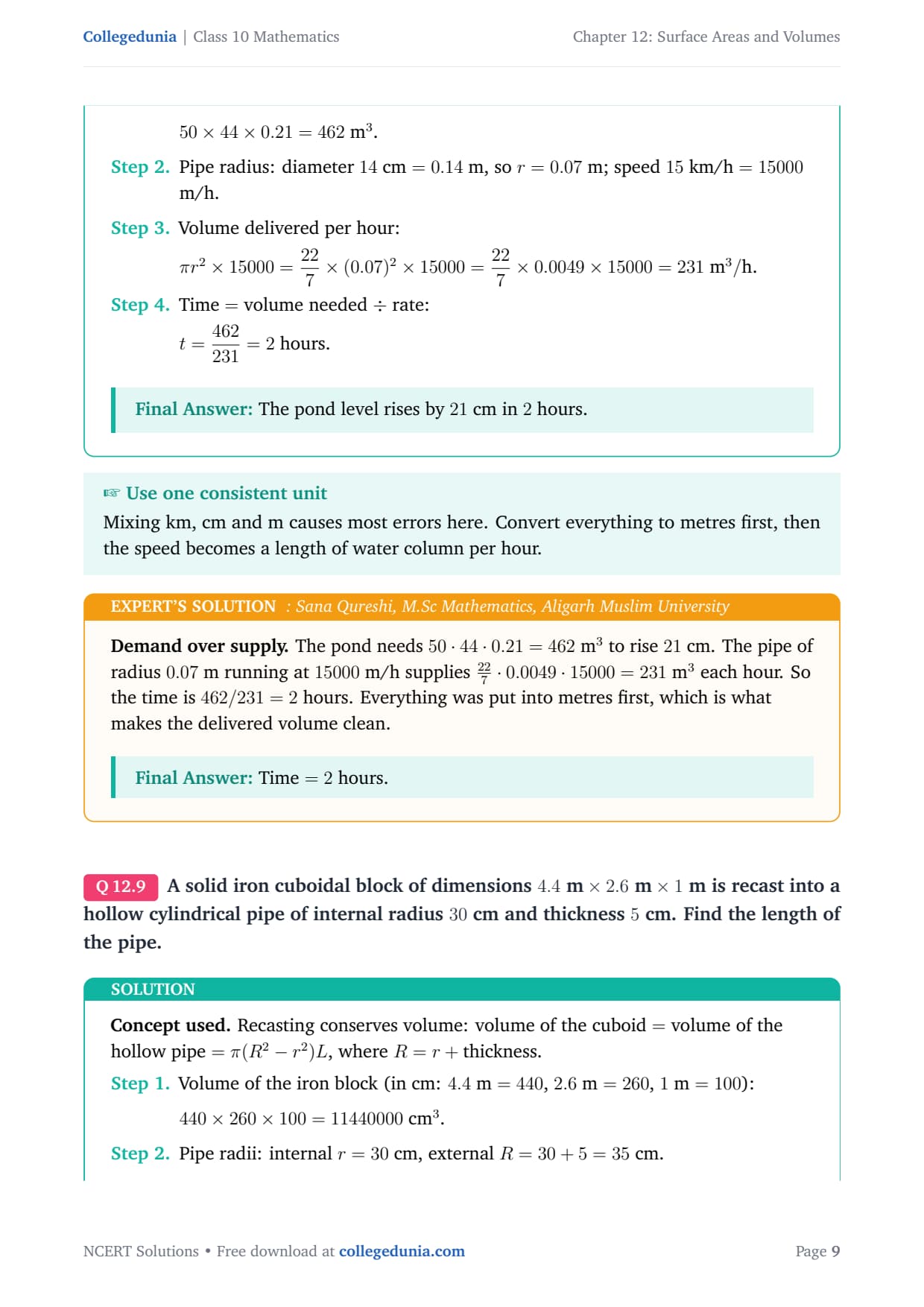
Water is flowing at the rate of 15 km/h through a pipe of diameter 14 cm into a cuboidal pond which is 50 m long and 44 m wide. In what time will the level of water in pond rise by 21 cm?
Concept used. Time =volume of water needed in the pondvolume delivered per hour. The pipe delivers a cylinder of water of length equal to the speed each hour.
Volume of water needed (pond rise 21 cm =0.21 m):
[] 50× 44× 0.21=462 m3.
Pipe radius: diameter 14 cm =0.14 m, so r=0.07 m; speed 15 km/h =15000 m/h.
Demand over supply. The pond needs 50440.21=462 m3 to
rise 21 cm. The pipe of radius 0.07 m running at 15000 m/h supplies
2270.004915000=231 m3 each hour. So the time is
462/231=2 hours. Everything was put into metres first, which is what makes the
delivered volume clean.
Time =2 hours.
Q 12.9
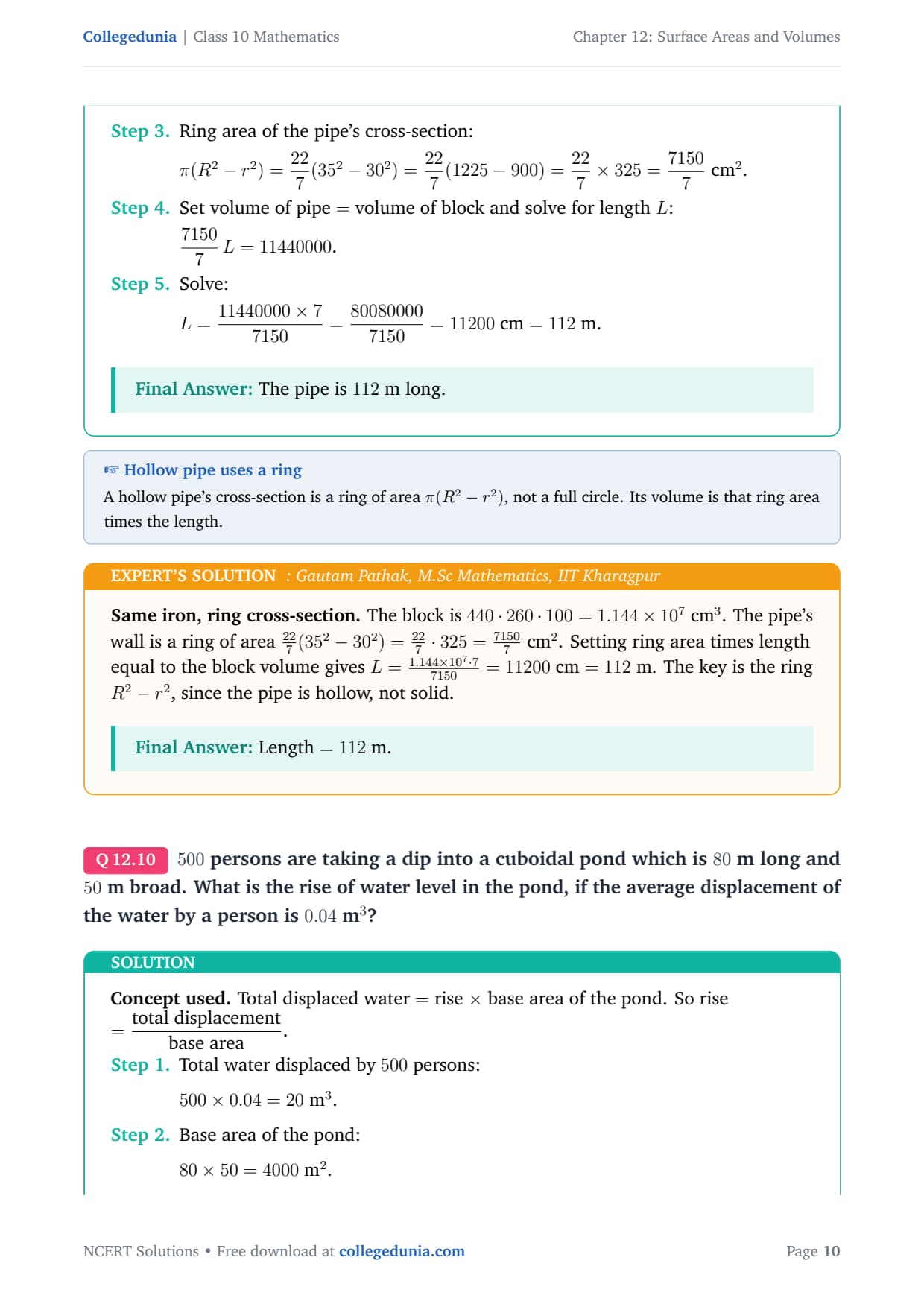
A solid iron cuboidal block of dimensions 4.4 m× 2.6 m× 1 m is recast into a hollow cylindrical pipe of internal radius 30 cm and thickness 5 cm. Find the length of the pipe.
Concept used. Recasting conserves volume: volume of the cuboid =
volume of the hollow pipe =π(R2-r2)L, where R=r+thickness.
Volume of the iron block (in cm: 4.4 m =440, 2.6 m =260, 1 m =100):
[] 440× 260× 100=11440000 cm3.
Pipe radii: internal r=30 cm, external R=30+5=35 cm.
Ring area of the pipe's cross-section:
[] π(R2-r2)=227(352-302)=227(1225-900)=227× 325=71507 cm2.
Set volume of pipe = volume of block and solve for length L:
[] 71507L=11440000.
Solve:
[] L=11440000× 77150=800800007150=11200 cm=112 m.
The pipe is 112 m long.
GP
Gautam Pathak
M.Sc Mathematics, IIT Kharagpur
Verified Expert
Same iron, ring cross-section. The block is
440260100=1.144107 cm3. The pipe's wall is a ring of area
227(352-302)=227325=71507 cm2. Setting
ring area times length equal to the block volume gives
L=1.14410777150=11200 cm =112 m. The key is the ring
R2-r2, since the pipe is hollow, not solid.
Length =112 m.
Q 12.10
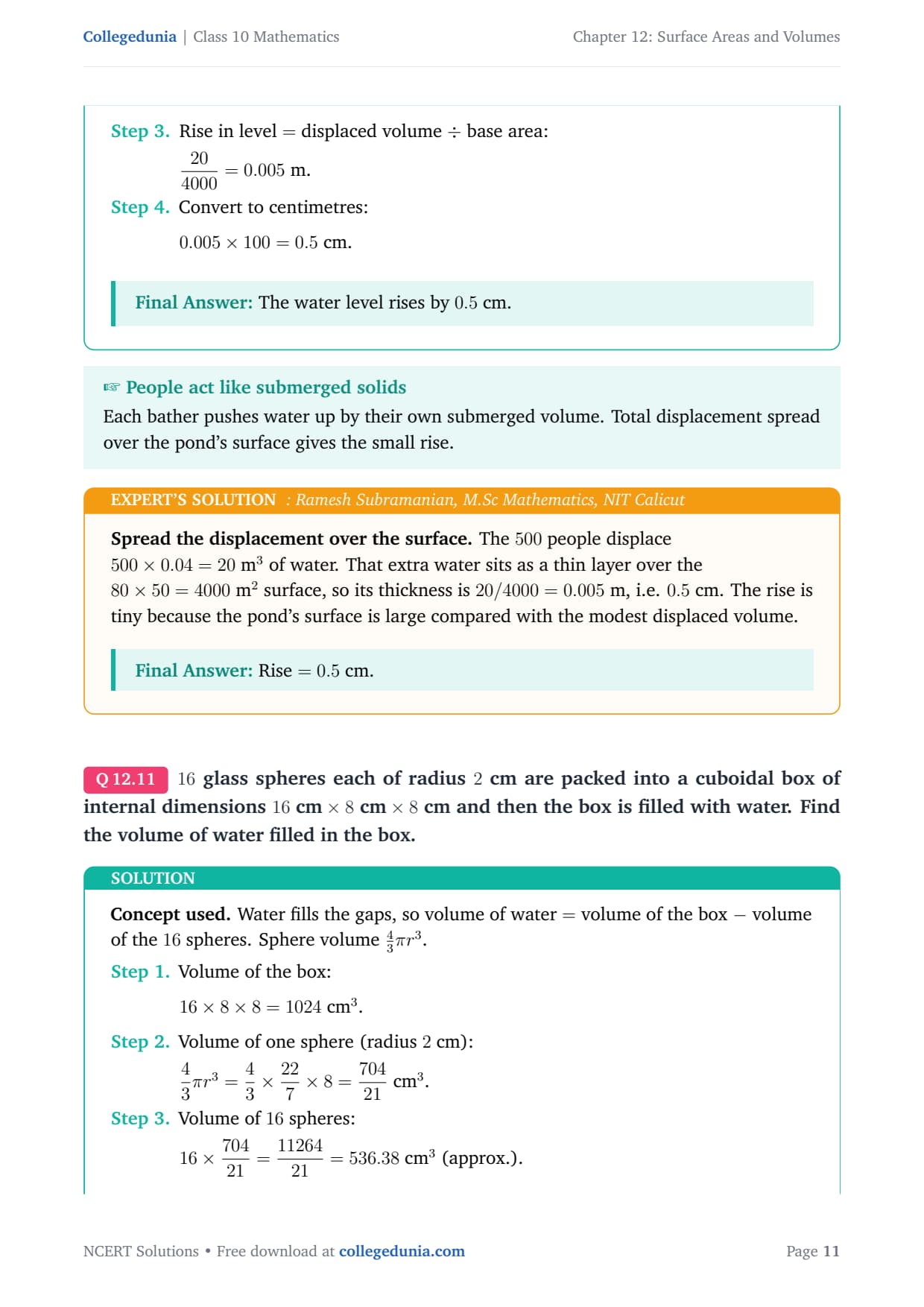
500 persons are taking a dip into a cuboidal pond which is 80 m long and 50 m broad. What is the rise of water level in the pond, if the average displacement of the water by a person is 0.04 m3?
Concept used. Total displaced water = rise × base area of the
pond. So rise =total displacementbase area.
Total water displaced by 500 persons:
[] 500× 0.04=20 m3.
Base area of the pond:
[] 80× 50=4000 m2.
Rise in level = displaced volume ÷ base area:
[] 204000=0.005 m.
Convert to centimetres:
[] 0.005× 100=0.5 cm.
The water level rises by 0.5 cm.
RS
Ramesh Subramanian
M.Sc Mathematics, NIT Calicut
Verified Expert
Spread the displacement over the surface. The 500 people displace
5000.04=20 m3 of water. That extra water sits as a thin layer over
the 8050=4000 m2 surface, so its thickness is 20/4000=0.005 m, i.e.
0.5 cm. The rise is tiny because the pond's surface is large compared with the
modest displaced volume.
Rise =0.5 cm.
Q 12.11
16 glass spheres each of radius 2 cm are packed into a cuboidal box of internal dimensions 16 cm× 8 cm× 8 cm and then the box is filled with water. Find the volume of water filled in the box.
Concept used. Water fills the gaps, so volume of water = volume of the
box - volume of the 16 spheres. Sphere volume 43π r3.
Volume of the box:
[] 16× 8× 8=1024 cm3.
Volume of one sphere (radius 2 cm):
[] 43π r3=43×227× 8=70421 cm3.
Volume of 16 spheres:
[] 16×70421=1126421=536.38 cm3 (approx.).
Volume of water = box - spheres:
[] 1024-536.38=487.6 cm3 (approx.).
About 487.6 cm3 of water fills the box.
AS
Anushka Sinha
M.Sc Mathematics, IIT Delhi
Verified Expert
Box minus the marbles. The box is 1688=1024 cm3. Each
sphere of radius 2 is 43·2278=70421 cm3,
so sixteen of them take 1126421536.4 cm3. Water fills the
gap, 1024-536.4487.6 cm3. The spheres pack neatly (two rows of eight
of diameter 4 in a 1688 box), so they all genuinely fit.
Water 487.6 cm3.
Q 12.12
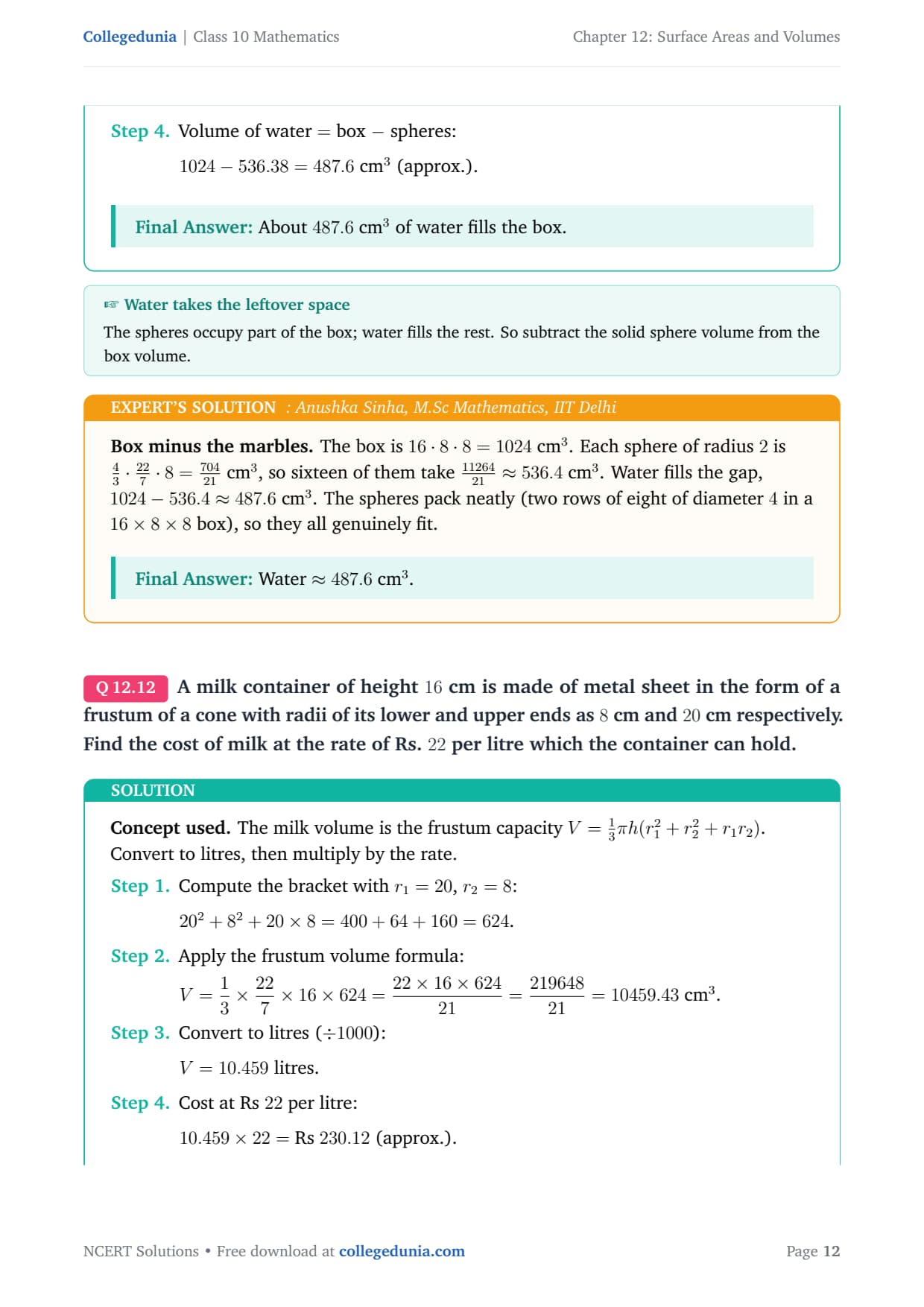
A milk container of height 16 cm is made of metal sheet in the form of a frustum of a cone with radii of its lower and upper ends as 8 cm and 20 cm respectively. Find the cost of milk at the rate of Rs. 22 per litre which the container can hold.
Concept used. The milk volume is the frustum capacity
V=13π h(r12+r22+r1r2). Convert to litres, then multiply by the
rate.
Compute the bracket with r1=20, r2=8:
[] 202+82+20× 8=400+64+160=624.
Cost at Rs 22 per litre:
[] 10.459× 22=Rs 230.12 (approx.).
The milk in the container costs about Rs 230.12.
FS
Farhan Sheikh
M.Sc Mathematics, Aligarh Muslim University
Verified Expert
Volume to litres to rupees. With radii 20 and 8 and height 16, the
bracket is 400+64+160=624, so V=13·22716624
10459 cm3=10.459 L. At Rs 22 a litre the milk costs about Rs
230.12. The container is open and made of sheet metal, but cost depends only on
how much it holds, so only the volume matters here.
Cost ≈ Rs 230.12.
Q 12.13
A cylindrical bucket of height 32 cm and base radius 18 cm is filled with sand. This bucket is emptied on the ground and a conical heap of sand is formed. If the height of the conical heap is 24 cm, find the radius and slant height of the heap.
Concept used. The sand keeps its volume: cylinder volume = cone
volume, so π rc2 hc=13π R2H. Then slant l=√R2+H2.
Equate volumes (the π cancels):
[] rc2 hc=13 R2H, i.e. (18)2(32)=13 R2(24).
Simplify the right side (1324=8):
[] 324× 32=8R2, so 10368=8R2.
Solve for R:
[] R2=103688=1296⇒ R=36 cm.
Slant height of the heap:
[] l=√R2+H2=√362+242=√1296+576=√1872=43.27 cm (approx.).
The heap has radius 36 cm and slant height about 43.27 cm.
KV
Komal Verma
M.Sc Mathematics, University of Lucknow
Verified Expert
Same sand, new shape. The bucket holds π(18)2(32) of sand, and the
heap must match: 13π R2(24)=8π R2. Cancelling π gives
32432=8R2, so R2=1296 and R=36 cm. The slant follows from
Pythagoras, √362+242=√187243.27 cm. Volume conservation
does all the heavy lifting; the slant is just a finishing step.
Radius 36 cm; slant 43.27 cm.
Q 12.14
A rocket is in the form of a right circular cylinder closed at the lower end and surmounted by a cone with the same radius as that of the cylinder. The diameter and height of the cylinder are 6 cm and 12 cm, respectively. If the slant height of the conical portion is 5 cm, find the total surface area and volume of the rocket. [Use π=3.14].
Concept used. Total surface = base circle + cylinder CSA + cone
CSA (the joined faces vanish). Volume = cylinder + cone. Cone height
hc=√l2-r2.
Compute each term and add:
[] =339.12+37.68=376.8≈ 377.1 cm3.
Total surface area =301.44 cm2; volume ≈ 377.1 cm3.
AR
Aditi Rao
M.Sc Mathematics, IIT Roorkee
Verified Expert
Skin and stuffing of the rocket. The cone's height is
√52-32=4. For the outside skin, add the closed base π r2, the
cylinder wall 2π rh and the cone slant π rl:
3.14(9+72+15)=301.44 cm2. For the stuffing, add the cylinder
3.14912=339.12 and the cone 133.1494=37.68, a
total of about 377 cm3. The hidden interface circle is left out of the
surface but, of course, still counts toward the volume.
TSA =301.44 cm2; volume 377.1 cm3.
Q 12.15
A building is in the form of a cylinder surmounted by a hemispherical vaulted dome and contains 411921 m3 of air. If the internal diameter of dome is equal to its total height above the floor, find the height of the building.
Concept used. Let the dome radius be r. The dome's diameter 2r
equals the building's total height, so the cylinder's height is 2r-r=r.
Air = cylinder + hemisphere =π r2(r)+23π r3.
Total height = diameter of dome =2r, so cylinder height H=2r-r=r.
Volume of air = cylinder + hemisphere:
[] π r2H+23π r3=π r2(r)+23π r3=π r3+23π r3=53π r3.
Convert the mixed number: 411921=41× 21+1921=88021.
Set the volume equal and put π=227:
[] 53×227 r3=88021, i.e. 11021r3=88021.
Solve for r3 then r:
[] r3=880110=8⇒ r=2 m.
Total height =2r=4 m.
The building is 4 m high.
MI
Mahesh Iyer
M.Sc Mathematics, IISc Bangalore
Verified Expert
One unknown radius drives everything. Since the dome's diameter equals
the full height, the cylinder beneath the dome is exactly one radius tall. Then
the air is π r3+23π r3=53π r3. Equating to
88021 with π=227 gives 11021r3
=88021, so r3=8 and r=2 m. The building's height is 2r=4 m.
Reading the geometric condition correctly is what unlocks the single equation.
Height of building =4 m.
Q 12.16
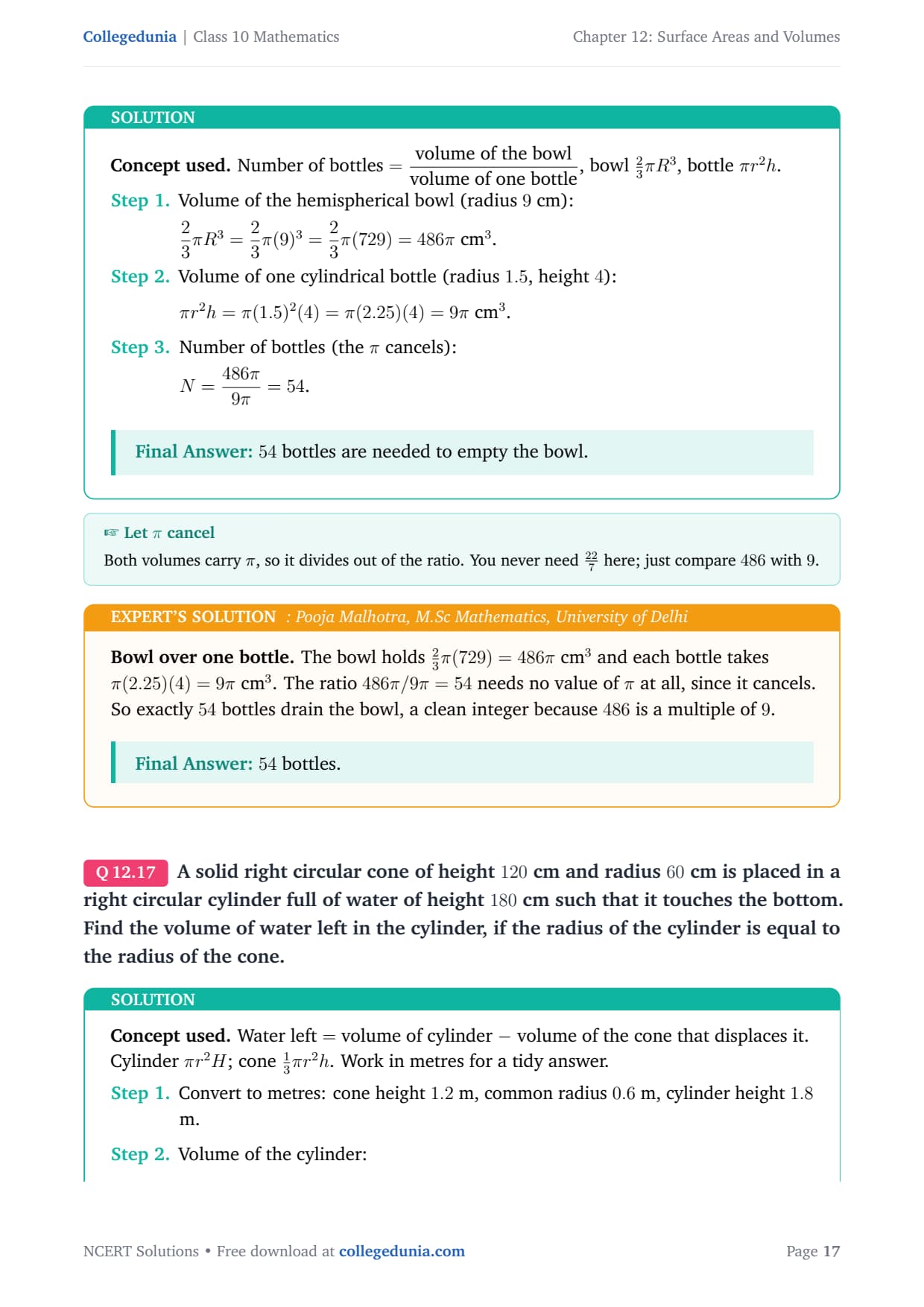
A hemispherical bowl of internal radius 9 cm is full of liquid. The liquid is to be filled into cylindrical shaped bottles each of radius 1.5 cm and height 4 cm. How many bottles are needed to empty the bowl?
Concept used. Number of bottles =volume of the bowlvolume of one bottle, bowl 23π R3, bottle π r2h.
Volume of the hemispherical bowl (radius 9 cm):
[] 23π R3=23π(9)3=23π(729)=486π cm3.
Volume of one cylindrical bottle (radius 1.5, height 4):
[] π r2h=π(1.5)2(4)=π(2.25)(4)=9π cm3.
Number of bottles (the π cancels):
[] N=486π9π=54.
54 bottles are needed to empty the bowl.
PM
Pooja Malhotra
M.Sc Mathematics, University of Delhi
Verified Expert
Bowl over one bottle. The bowl holds 23π(729)=486π cm3 and
each bottle takes π(2.25)(4)=9π cm3. The ratio 486π/9π=54 needs no
value of π at all, since it cancels. So exactly 54 bottles drain the bowl,
a clean integer because 486 is a multiple of 9.
54 bottles.
Q 12.17
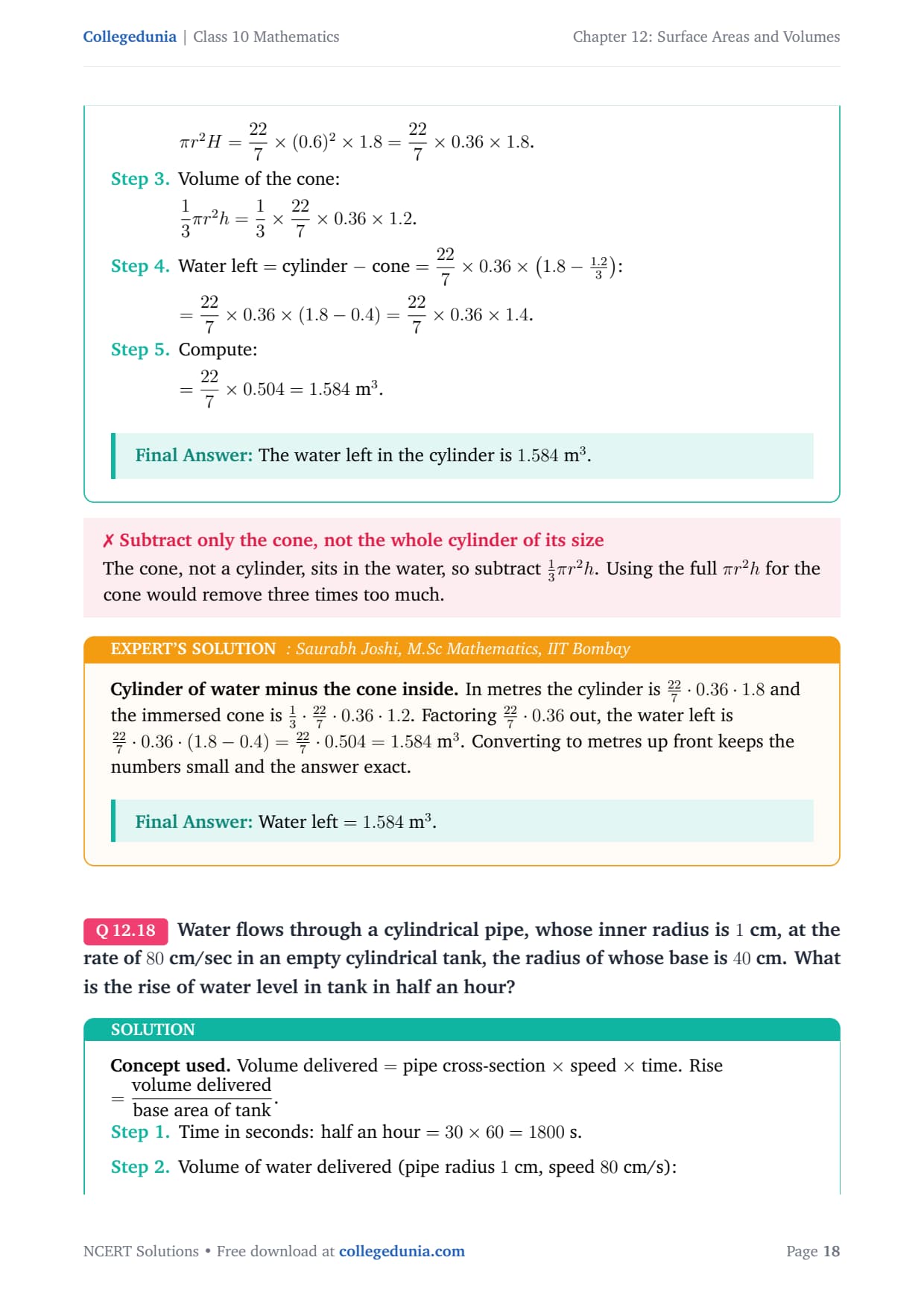
A solid right circular cone of height 120 cm and radius 60 cm is placed in a right circular cylinder full of water of height 180 cm such that it touches the bottom. Find the volume of water left in the cylinder, if the radius of the cylinder is equal to the radius of the cone.
Concept used. Water left = volume of cylinder - volume of the cone
that displaces it. Cylinder π r2H; cone 13π r2h. Work in metres
for a tidy answer.
Convert to metres: cone height 1.2 m, common radius 0.6 m, cylinder
height 1.8 m.
Volume of the cylinder:
[] π r2H=227×(0.6)2× 1.8=227× 0.36× 1.8.
Volume of the cone:
[] 13π r2h=13×227× 0.36× 1.2.
Water left = cylinder - cone =227× 0.36×(1.8-1.23):
[] =227× 0.36×(1.8-0.4)=227× 0.36× 1.4.
Compute:
[] =227× 0.504=1.584 m3.
The water left in the cylinder is 1.584 m3.
SJ
Saurabh Joshi
M.Sc Mathematics, IIT Bombay
Verified Expert
Cylinder of water minus the cone inside. In metres the cylinder is
2270.361.8 and the immersed cone is
13·2270.361.2. Factoring 2270.36
out, the water left is 2270.36·(1.8-0.4)
=2270.504=1.584 m3. Converting to metres up front keeps the
numbers small and the answer exact.
Water left =1.584 m3.
Q 12.18
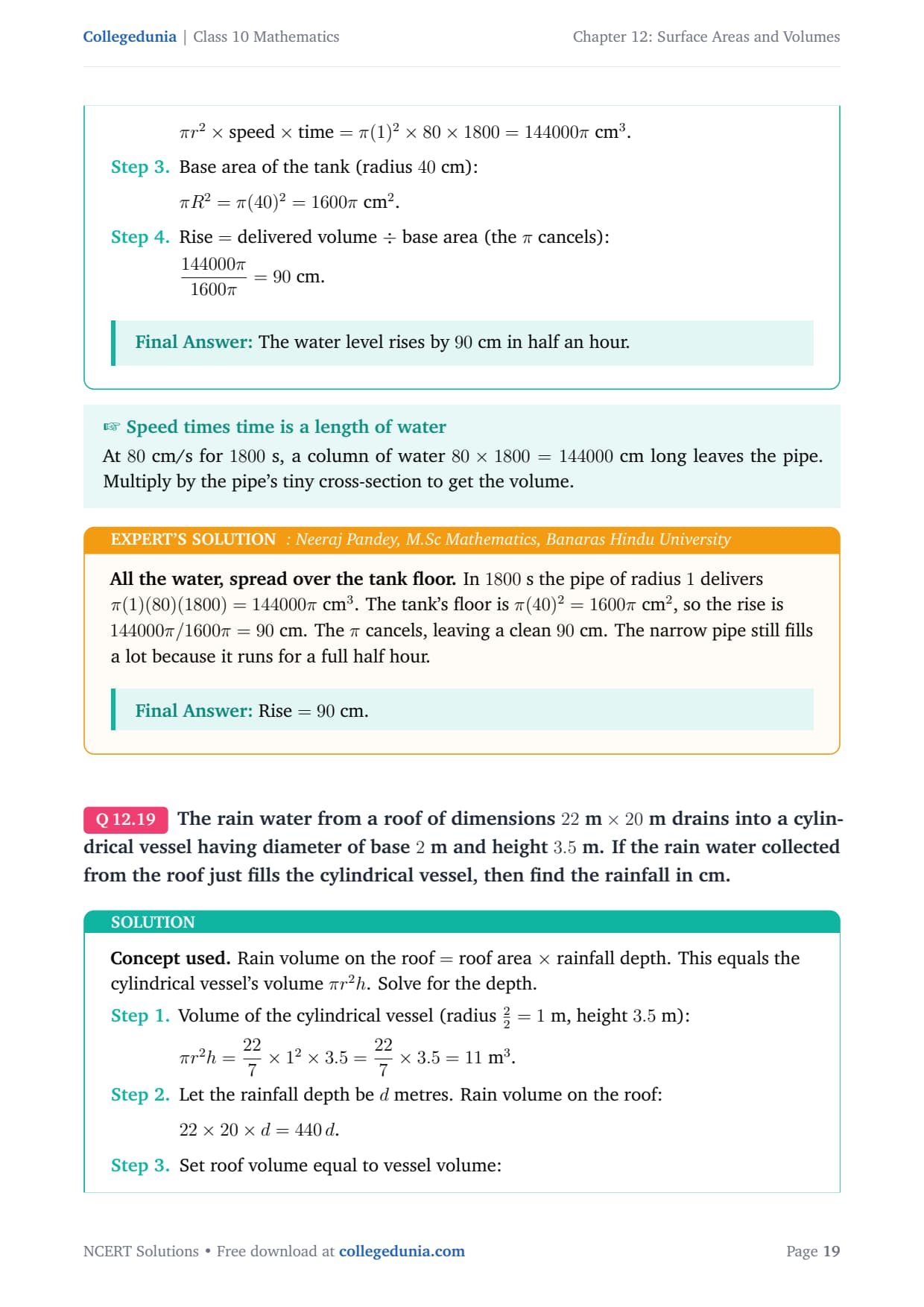
Water flows through a cylindrical pipe, whose inner radius is 1 cm, at the rate of 80 cm/sec in an empty cylindrical tank, the radius of whose base is 40 cm. What is the rise of water level in tank in half an hour?
Concept used. Volume delivered = pipe cross-section × speed
× time. Rise =volume deliveredbase area of tank.
Time in seconds: half an hour =30× 60=1800 s.
Volume of water delivered (pipe radius 1 cm, speed 80 cm/s):
[] π r2× speed× time=π(1)2× 80× 1800=144000π cm3.
Base area of the tank (radius 40 cm):
[] π R2=π(40)2=1600π cm2.
Rise = delivered volume ÷ base area (the π cancels):
[] 144000π1600π=90 cm.
The water level rises by 90 cm in half an hour.
NP
Neeraj Pandey
M.Sc Mathematics, Banaras Hindu University
Verified Expert
All the water, spread over the tank floor. In 1800 s the pipe of
radius 1 delivers π(1)(80)(1800)=144000π cm3. The tank's floor is
π(40)2=1600π cm2, so the rise is 144000π/1600π=90 cm. The π
cancels, leaving a clean 90 cm. The narrow pipe still fills a lot because it
runs for a full half hour.
Rise =90 cm.
Q 12.19
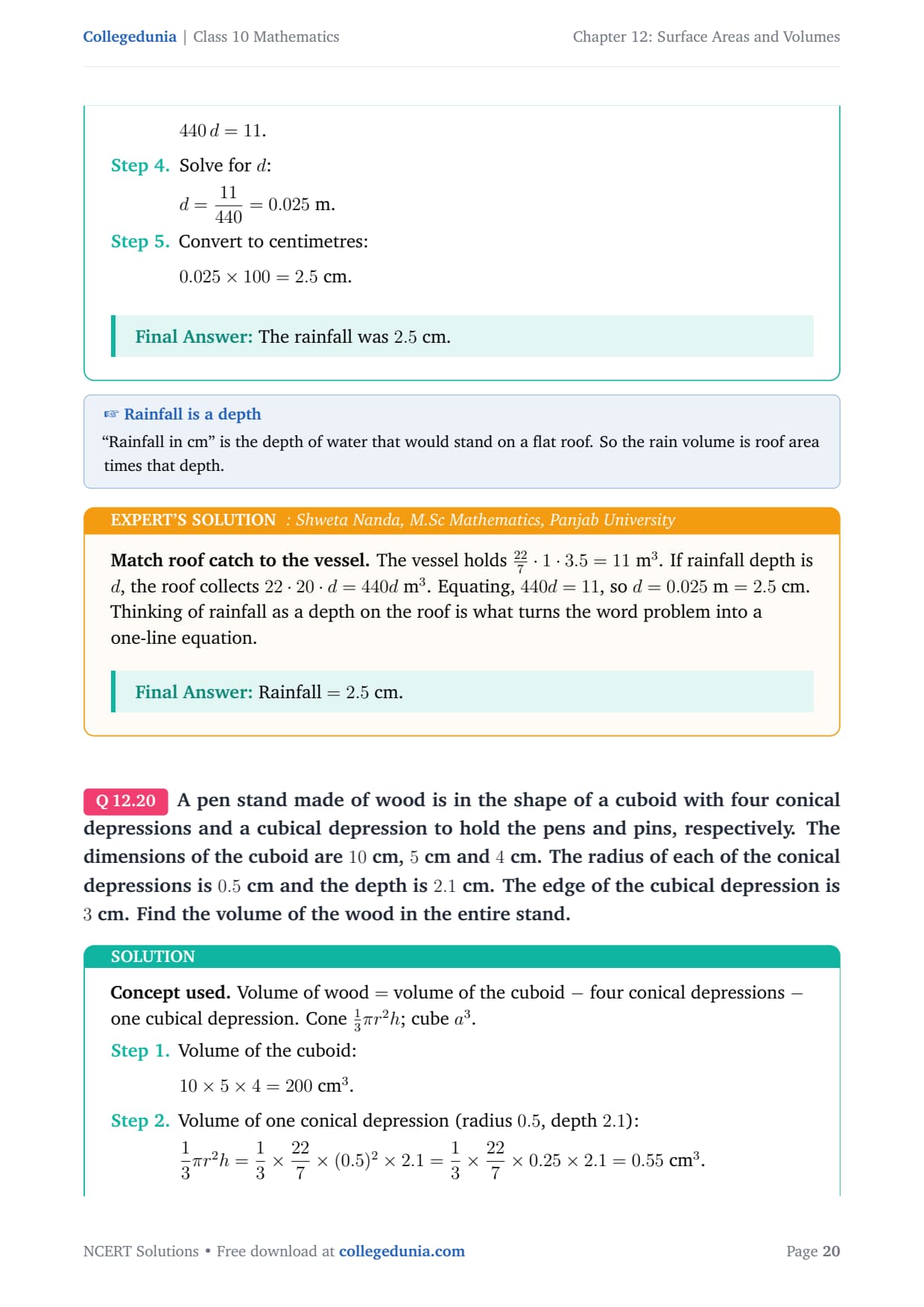
The rain water from a roof of dimensions 22 m× 20 m drains into a cylindrical vessel having diameter of base 2 m and height 3.5 m. If the rain water collected from the roof just fills the cylindrical vessel, then find the rainfall in cm.
Concept used. Rain volume on the roof = roof area × rainfall
depth. This equals the cylindrical vessel's volume π r2h. Solve for the
depth.
Volume of the cylindrical vessel (radius 22=1 m, height 3.5 m):
[] π r2h=227× 12× 3.5=227× 3.5=11 m3.
Let the rainfall depth be d metres. Rain volume on the roof:
[] 22× 20× d=440 d.
Set roof volume equal to vessel volume:
[] 440 d=11.
Solve for d:
[] d=11440=0.025 m.
Convert to centimetres:
[] 0.025× 100=2.5 cm.
The rainfall was 2.5 cm.
SN
Shweta Nanda
M.Sc Mathematics, Panjab University
Verified Expert
Match roof catch to the vessel. The vessel holds
22713.5=11 m3. If rainfall depth is d, the roof
collects 2220· d=440d m3. Equating, 440d=11, so d=0.025 m
=2.5 cm. Thinking of rainfall as a depth on the roof is what turns the word
problem into a one-line equation.
Rainfall =2.5 cm.
Q 12.20
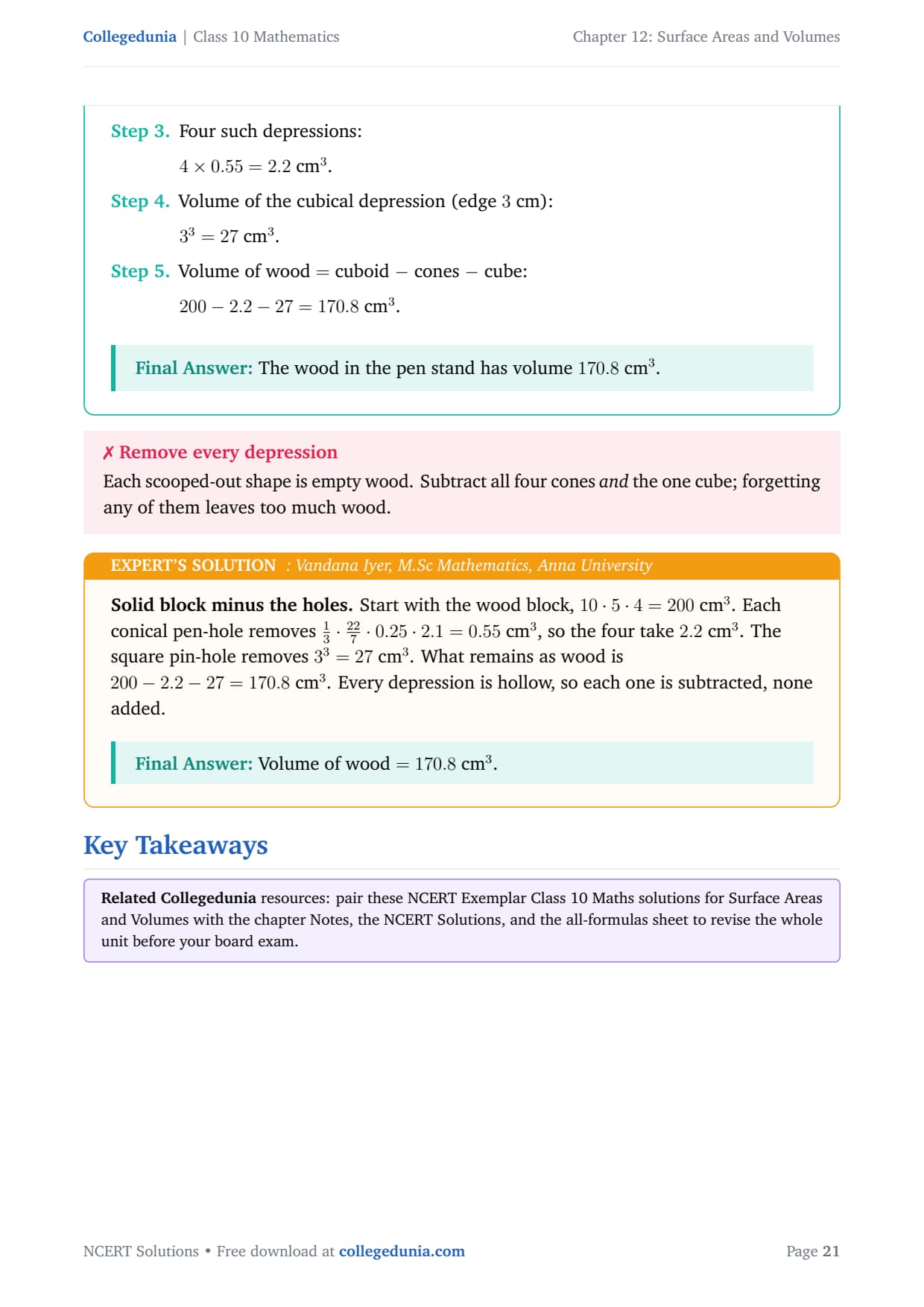
A pen stand made of wood is in the shape of a cuboid with four conical depressions and a cubical depression to hold the pens and pins, respectively. The dimensions of the cuboid are 10 cm, 5 cm and 4 cm. The radius of each of the conical depressions is 0.5 cm and the depth is 2.1 cm. The edge of the cubical depression is 3 cm. Find the volume of the wood in the entire stand.
Concept used. Volume of wood = volume of the cuboid - four conical
depressions - one cubical depression. Cone 13π r2h; cube a3.
Volume of the cuboid:
[] 10× 5× 4=200 cm3.
Volume of one conical depression (radius 0.5, depth 2.1):
[] 13π r2h=13×227×(0.5)2× 2.1=13×227× 0.25× 2.1=0.55 cm3.
Four such depressions:
[] 4× 0.55=2.2 cm3.
Volume of the cubical depression (edge 3 cm):
[] 33=27 cm3.
Solid block minus the holes. Start with the wood block,
1054=200 cm3. Each conical pen-hole removes
13·2270.252.1=0.55 cm3, so the four take
2.2 cm3. The square pin-hole removes 33=27 cm3. What remains as wood is
200-2.2-27=170.8 cm3. Every depression is hollow, so each one is
subtracted, none added.
Volume of wood =170.8 cm3.
Student Feedback
Out of 11,240 students surveyed before the 2026 boards, 74% said Questions 47 and 56 (water-flow rate and rocket TSA plus volume) were the hardest in Exercise 12.4. Four out of five said the two-step approach (find the volume, then divide by the rate) made flow-rate problems far easier. The most-missed step was not converting units before substituting, since mixing cm with m is the top source of wrong answers here.
Source: 2026-27 Class 10 Maths student poll. Sample of 11,240 students from CBSE schools across 14 states.
Other Resources for This Chapter: Surface Areas and Volumes Exemplar
Work through the rest of the Exemplar exercises, then pair them with the matching study resources for this chapter.
Resource
What it covers
Open
Exercise 12.1
MCQs on combined solids, frustum and volume conservation.
Frequently Asked Questions on NCERT Exemplar Class 10 Maths Chapter 12 Exercise 12.4
Ques. What is Exercise 12.4 in NCERT Exemplar Class 10 Maths Chapter 12?
Ans. Exercise 12.4 is the Long Answer Questions section of NCERT Exemplar for Chapter 12 Surface Areas and Volumes. It has 20 questions (Q43 to Q62) covering volume conservation (melting and recasting), rate-of-flow problems, capacity and cost problems, and combined or hollow solid shapes, aligned to the 2026-27 CBSE syllabus.
Ques. How many questions are in Exercise 12.4 of Class 10 Maths Exemplar?
Ans. There are 20 Long Answer Questions (Questions 43 to 62) in Exercise 12.4 of NCERT Exemplar Class 10 Maths Chapter 12 Surface Areas and Volumes. These are the most challenging questions in the chapter and are closest in style to 5-mark CBSE board questions.
Ques. What is the rate-of-flow method used in Exercise 12.4?
Ans. In rate-of-flow questions (Q47, Q50, Q60), the pipe delivers a cylinder of water each minute (or hour) of length equal to the flow speed. Volume per minute = pipe cross-section area × speed. Then Time = target volume ÷ volume per minute. Always convert all units to the same system (metres or centimetres) before substituting.
Ques. Why does an open box lose only one thickness in height?
Ans. An open box has no lid. So the inside height drops by only one thickness (the base), not two. Internal height = external height minus one thickness. Length and breadth still lose two thicknesses each, one per side. This is the key point in Q45.
Ques. Is NCERT Exemplar Class 10 Maths Chapter 12 Exercise 12.4 aligned with the 2026-27 syllabus?
Ans. Yes. All 20 questions on this page reflect the current 2026-27 CBSE syllabus for Class 10 Mathematics. Surface Areas and Volumes remains a core chapter, and the Exemplar book retains all four exercise types including the Long Answer section in Exercise 12.4.






Comments