


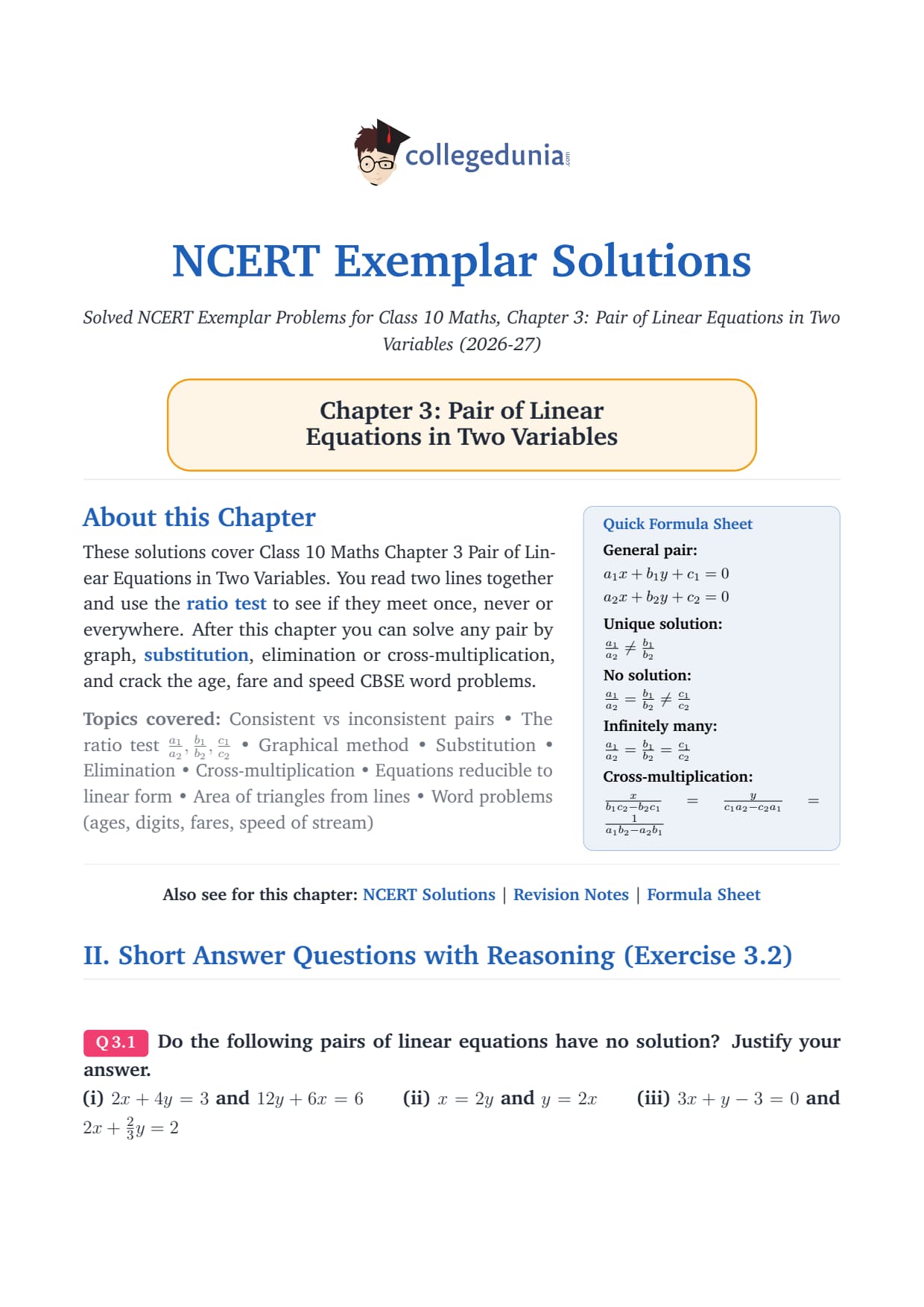
Exercise 3.2 is the Short Answer with Reasoning set in NCERT Exemplar Class 10 Maths Chapter 3 Pair of Linear Equations in Two Variables. It has 6 questions (Q14 to Q19). Each asks you to justify whether a pair of lines has no solution, infinitely many, a unique solution, or is consistent. The ratio test does the work, and everything follows the 2026-27 CBSE syllabus.
- 6 Short Answer questions - Q14 to Q19 - testing the ratio test a1a2, b1b2, c1c2 for consistency, coincidence, and no-solution cases.
- Each question requires a justification - not just the answer; the reasoning using ratio comparisons must be shown in full for CBSE marks.
- Q17 and Q18 are true/false claim questions that frequently appear in CBSE board papers as short-answer reasoning tasks.
Every solution here is written by subject experts, follows the 2026-27 rationalised NCERT, and is checked against CBSE board paper patterns.
What Linear Equations Exercise 3.2 Covers in Class 10 Maths
Exercise 3.2 is the Short Answer with Reasoning set in the NCERT Exemplar Chapter 3. It has 6 questions (Q14 to Q19). Each asks you to decide a geometric property of a pair and justify it with the ratio test.
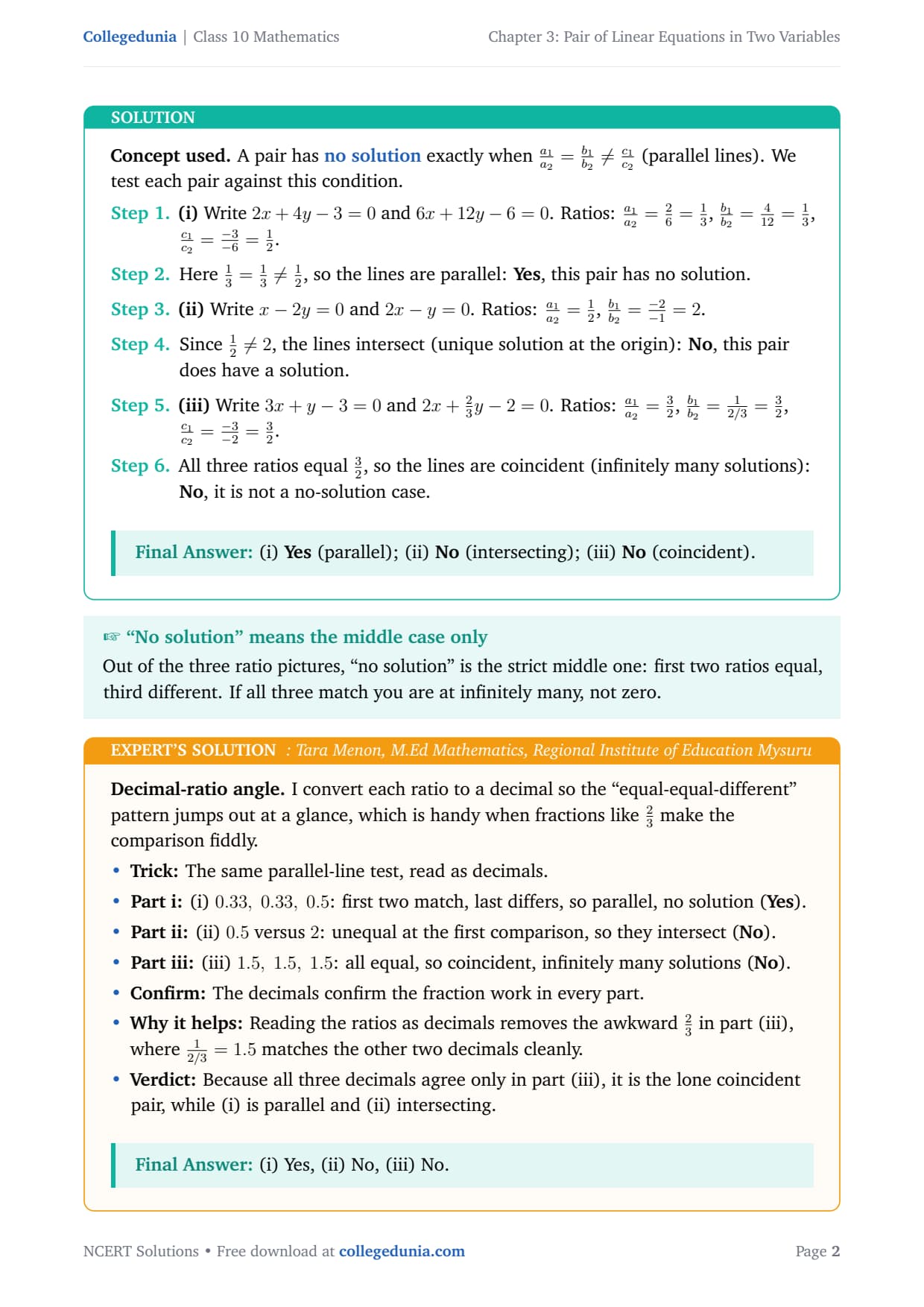
- Q14: Three sub-parts testing the "no solution" (parallel lines) condition - students must show the parallel case holds in (i) but not in (ii) and (iii).
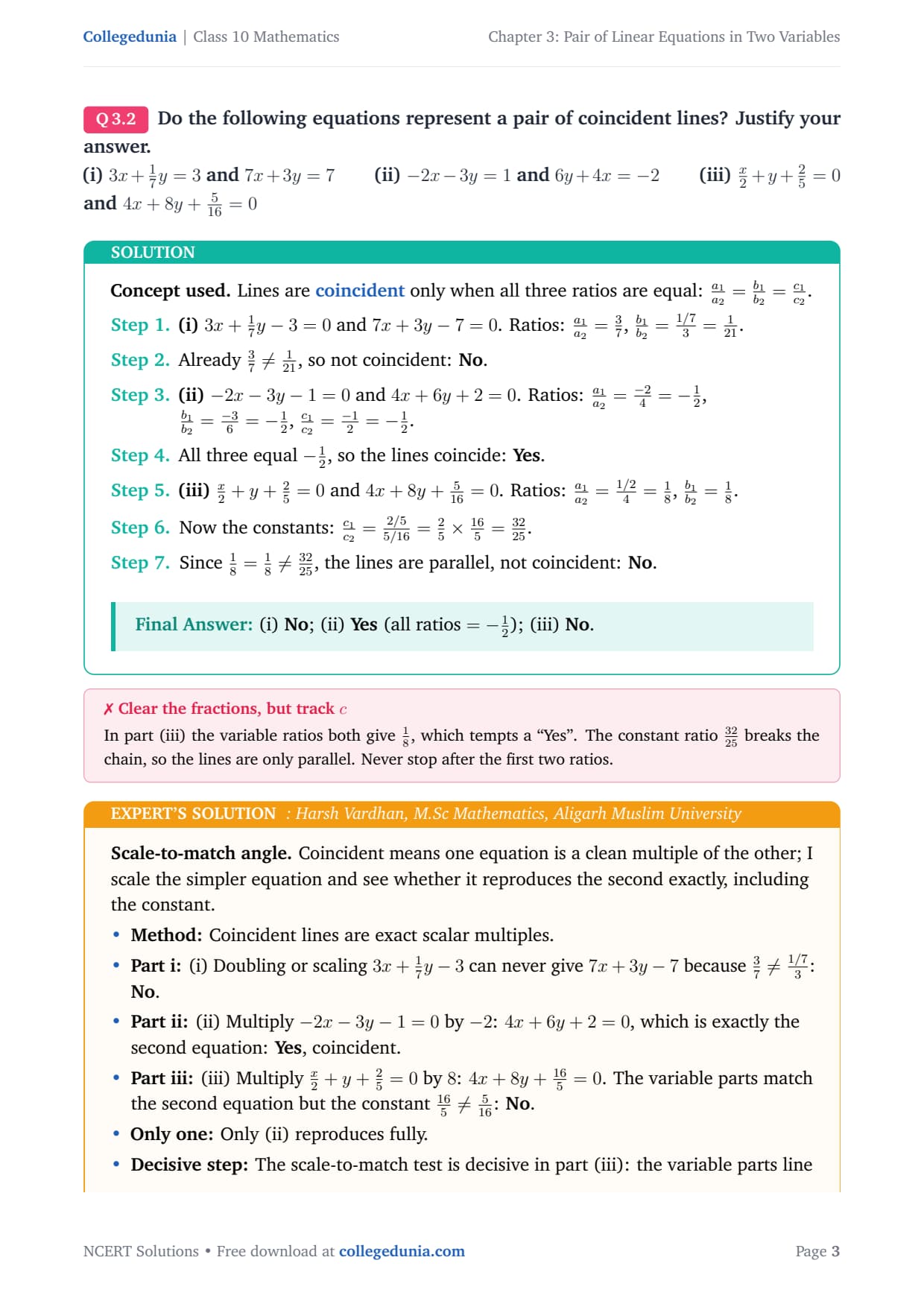
- Q15: Three sub-parts testing the "coincident lines" condition - students find which sub-part passes all three ratio equalities.
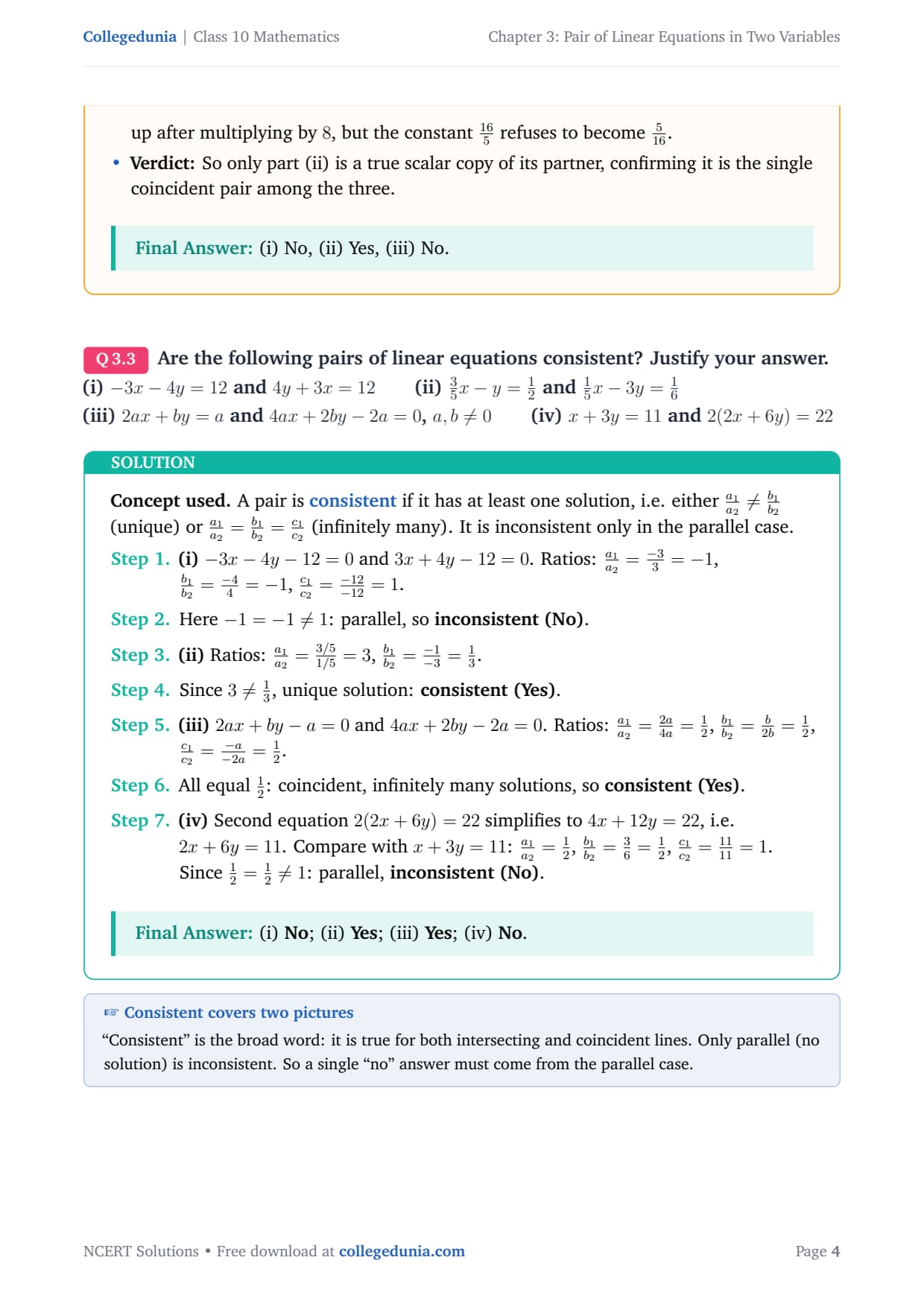
- Q16: Four sub-parts testing consistency - students classify each pair as consistent (unique or infinite) or inconsistent (no solution).
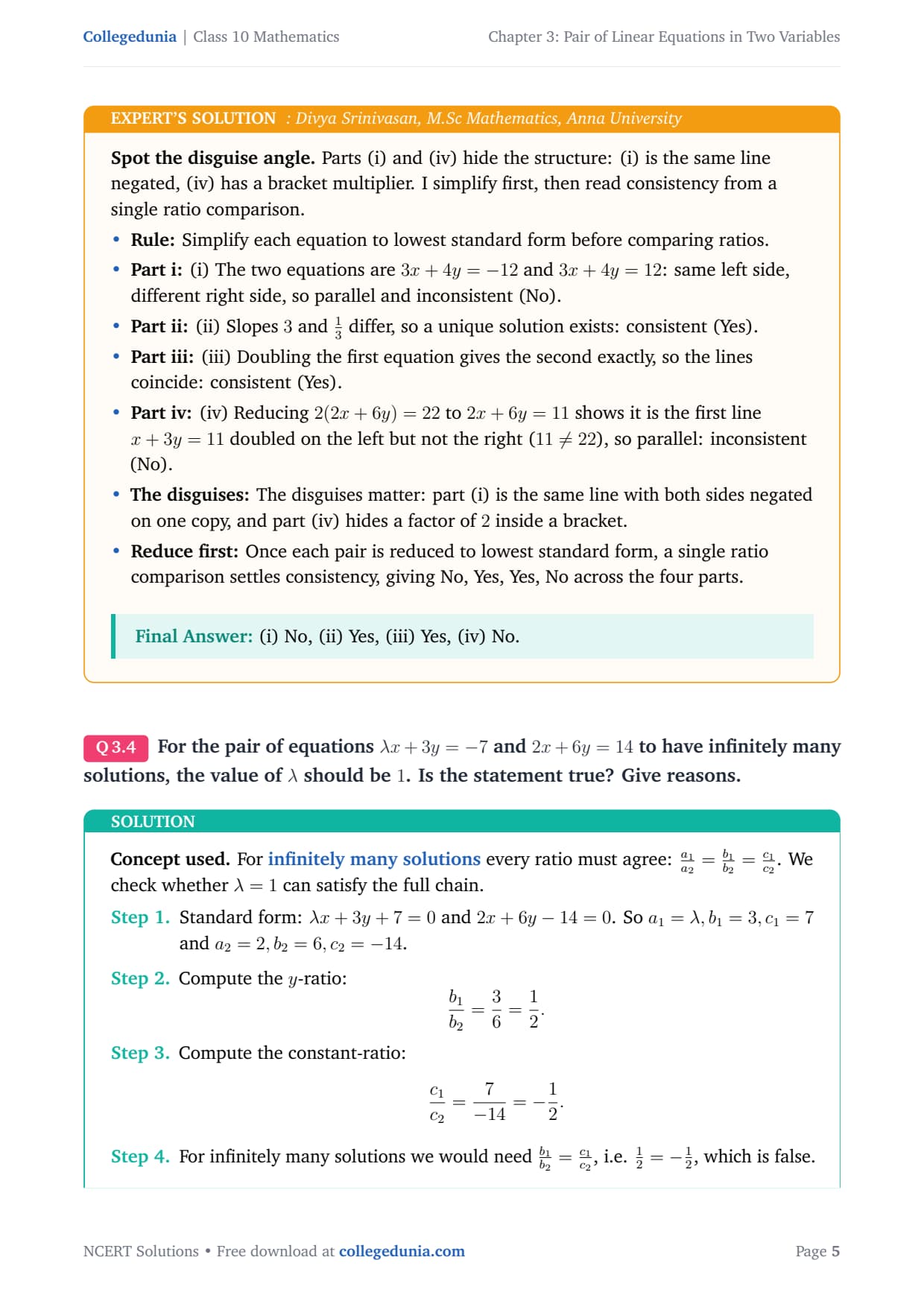
- Q17: A true/false claim about infinitely many solutions - the twist is that the constant ratios clash regardless of the parameter value.
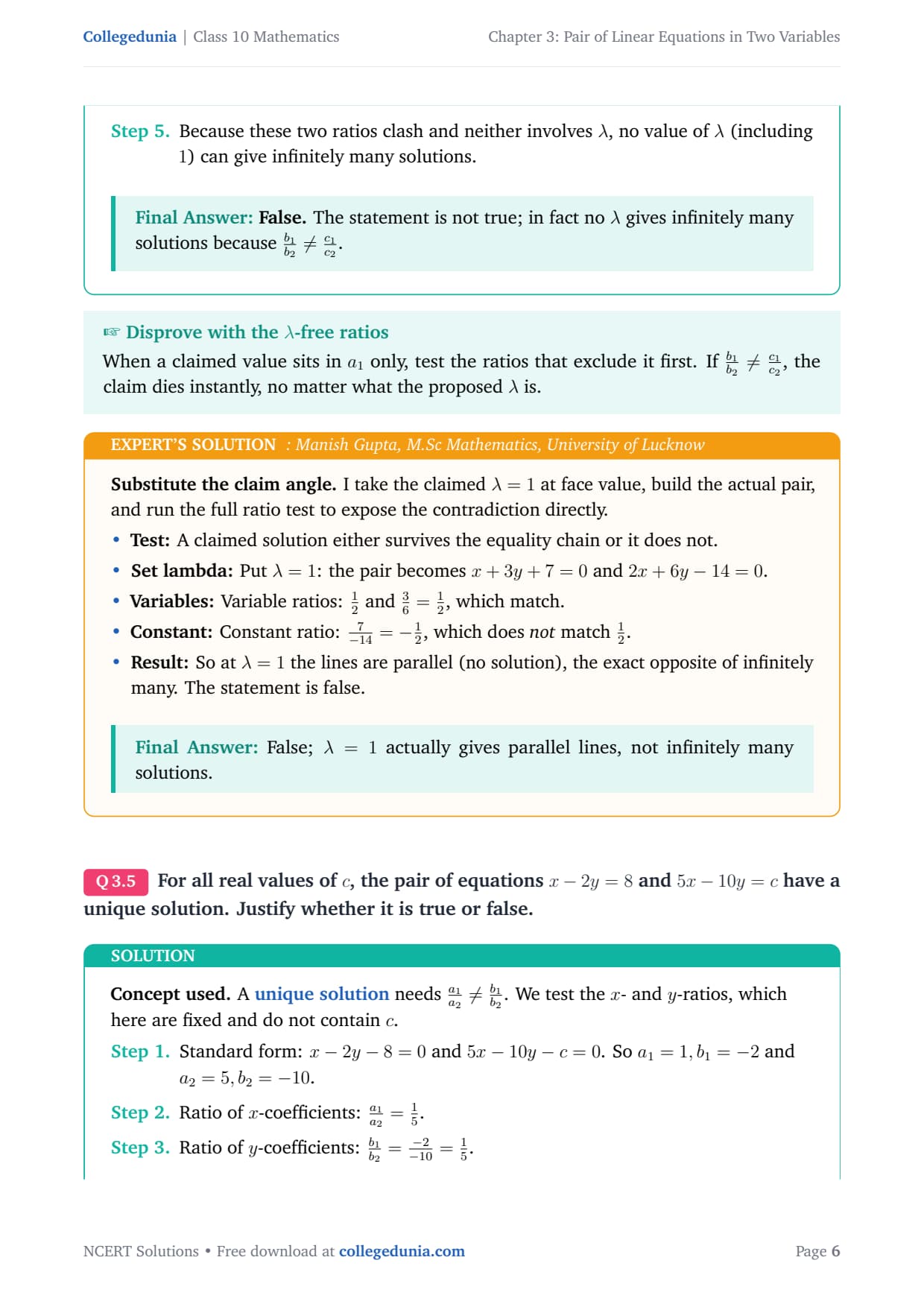
- Q18: A true/false claim about unique solution for all values of c - students find the variable ratios are equal, ruling out uniqueness.
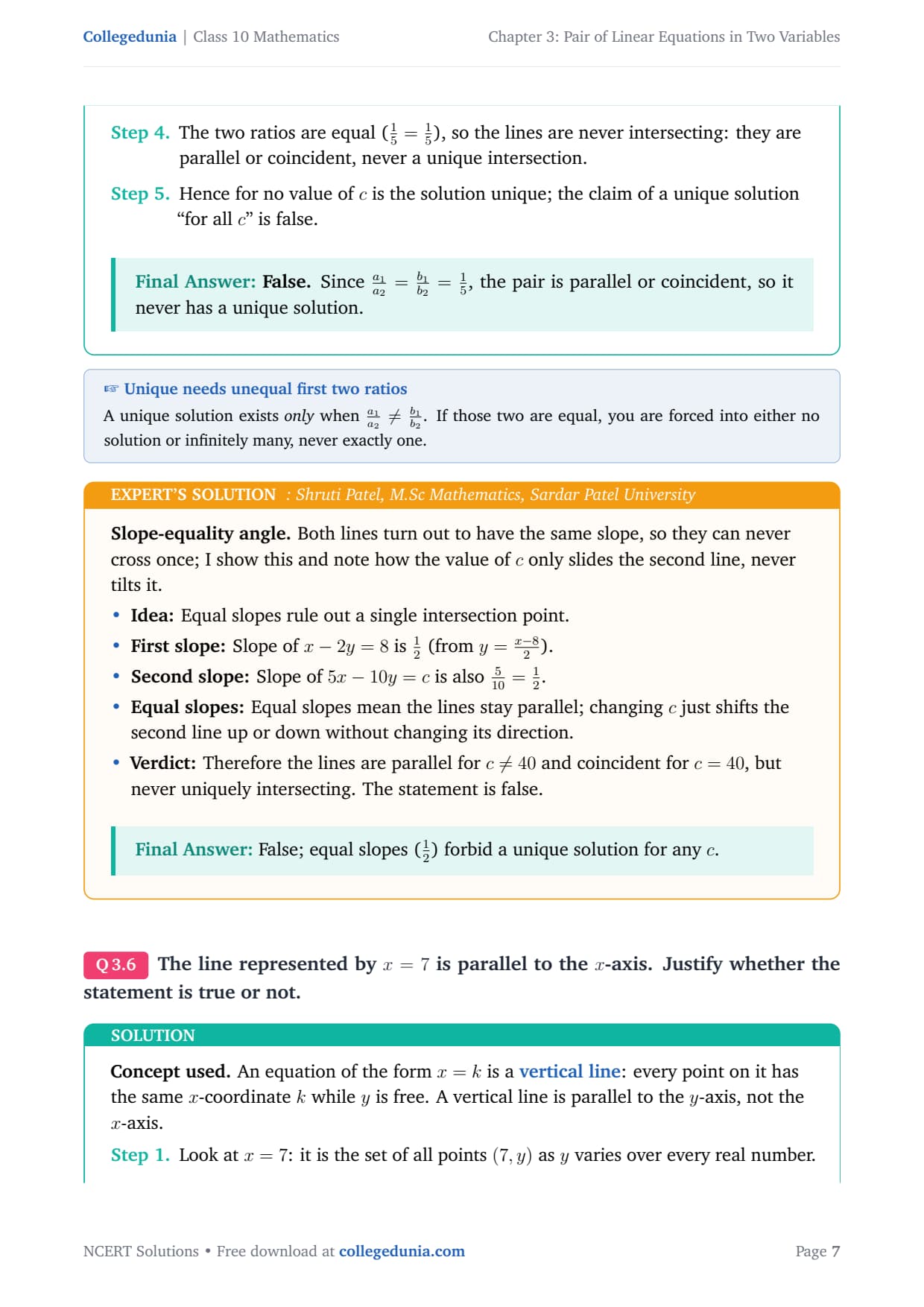
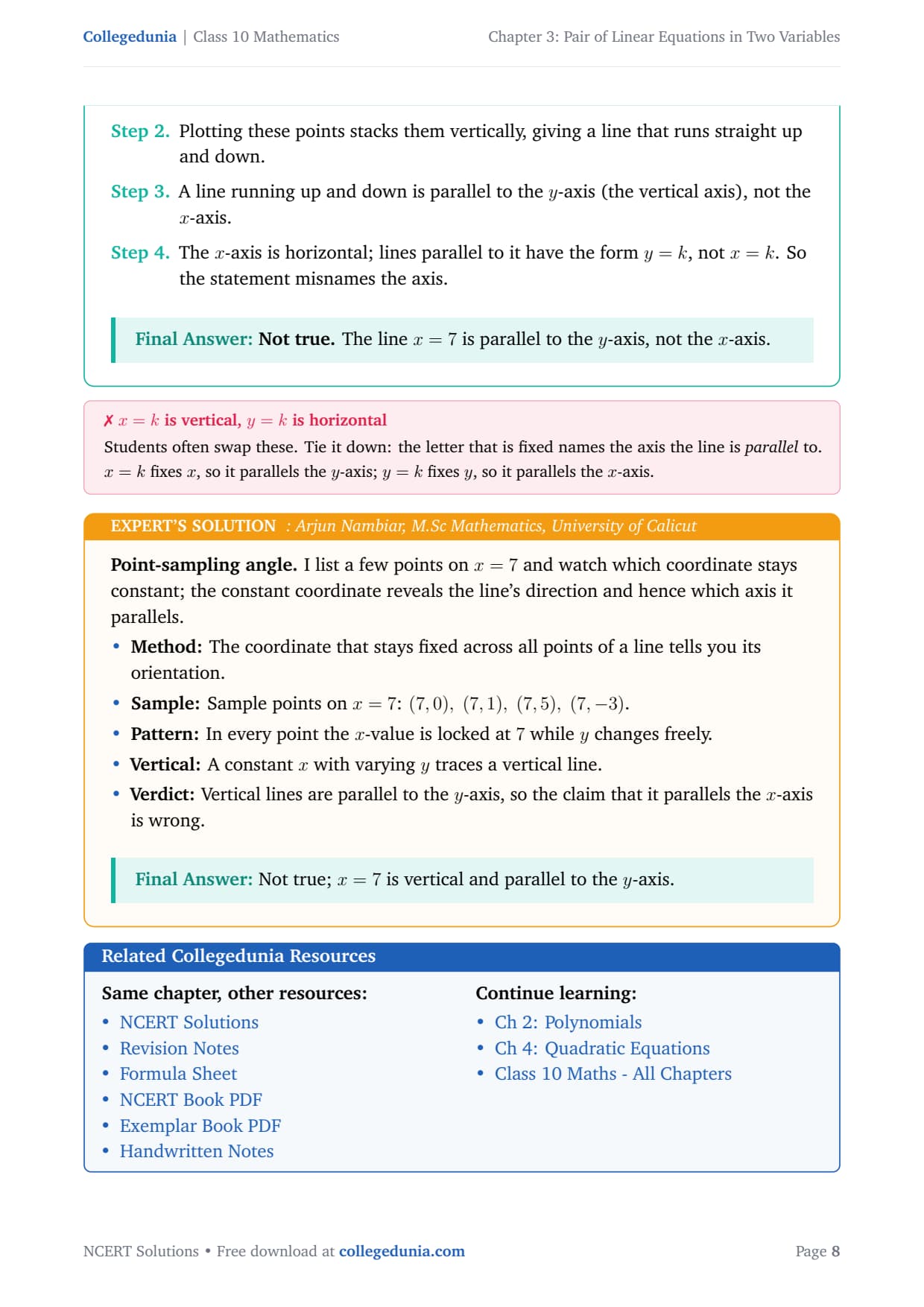
- Q19: A true/false claim about the line x = 7 being parallel to the x-axis - tests conceptual understanding of vertical vs horizontal lines.
The chapter builds directly on Chapter 3 of the main NCERT textbook. Exercise 3.2 specifically targets the ratio-based classification skill that CBSE tests in short-answer and reasoning sections of board papers.
The Ratio Test: Three Cases to Know
Every question in Exercise 3.2 uses the same three-ratio comparison. Learn this table and you can answer Q14 to Q19 without confusion.
| Condition | What it means geometrically | Solution type |
|---|---|---|
| a1a2 ≠ b1b2 | Lines intersect at one point | Unique solution (consistent) |
| a1a2 = b1b2 ≠ c1c2 | Lines are parallel | No solution (inconsistent) |
| a1a2 = b1b2 = c1c2 | Lines coincide | Infinitely many solutions (consistent) |
Important: "Consistent" covers both the intersecting and coincident cases. Only the parallel case is inconsistent. This distinction is tested directly in Q16.
How to Apply the Ratio Test Step by Step
The CBSE marker wants a clear, structured justification. Here is the exact routine that earns full marks.
- Write the equations in standard form a1x + b1y + c1 = 0 and a2x + b2y + c2 = 0. Move all terms to one side.
- Read off a1, b1, c1 and a2, b2, c2 being careful about signs.
- Compute all three ratios: a1a2, b1b2, and c1c2. Simplify each to lowest terms.
- Compare the ratios using the table above to classify: intersecting, parallel, or coincident.
- State the conclusion in one sentence: "The lines are parallel, so the pair has no solution" or similar.
Never stop after comparing only the first two ratios. Q15(iii) and Q17 both catch students who check only a1a2 and b1b2 and skip the constant ratio.
Topic-wise Breakdown of the Questions
Each of the 6 questions tests a distinct reasoning skill. Work through them in order.
| Question | What it tests | Key technique | Sub-parts |
|---|---|---|---|
| Q14 | No solution (parallel) condition | Check a1a2 = b1b2 ≠ c1c2 | 3 sub-parts |
| Q15 | Coincident lines condition | All three ratios equal | 3 sub-parts |
| Q16 | Consistency (at least one solution) | Parallel = inconsistent; rest = consistent | 4 sub-parts |
| Q17 | True/False: claim about infinite solutions | Constant ratio contradicts claim - no λ works | Single |
| Q18 | True/False: claim about unique solution | Variable ratios equal - unique impossible | Single |
| Q19 | True/False: axis of x = 7 | Vertical line parallels y-axis, not x-axis | Single |
All Exercise 3.2 Questions with Step-by-Step Solutions
II. Short Answer Questions with Reasoning (Exercise 3.2)
Do the following pairs of linear equations have no solution? Justify your answer.
(i) 2x+4y=3 and 12y+6x=6
(ii) x=2y and y=2x
(iii) 3x+y-3=0 and 2x+23y=2
Do the following equations represent a pair of coincident lines? Justify your answer.
(i) 3x+17y=3 and 7x+3y=7
(ii) -2x-3y=1 and 6y+4x=-2
(iii) x2+y+25=0 and 4x+8y+516=0
Are the following pairs of linear equations consistent? Justify your answer.
(i) -3x-4y=12 and 4y+3x=12
(ii) 35x-y=12 and 15x-3y=16
(iii) 2ax+by=a and 4ax+2by-2a=0, a,b≠ 0
(iv) x+3y=11 and 2(2x+6y)=22
For the pair of equations λ x+3y=-7 and 2x+6y=14 to have infinitely many solutions, the value of λ should be 1. Is the statement true? Give reasons.
For all real values of c, the pair of equations x-2y=8 and 5x-10y=c have a unique solution. Justify whether it is true or false.
The line represented by x=7 is parallel to the x-axis. Justify whether the statement is true or not.
Other Exercises & Resources for Chapter 3
Work through the rest of the Exemplar exercises, then pair them with the matching study resources for Pair of Linear Equations.
| Resource | What it covers | Open |
|---|---|---|
| Exercise 3.1 | MCQs on the ratio test, consistency and word problems. | Exemplar Exercise 3.1 |
| Exercise 3.2 | Short answer with reasoning (Q14 to Q19), solved step by step. | This page |
| Exercise 3.3 | Short answer problems on solving pairs and finding k. | Exemplar Exercise 3.3 |
| Exercise 3.4 | Long answer word problems on age, speed and digits. | Exemplar Exercise 3.4 |
| Exemplar Solutions (full chapter) | All exercises of the Chapter 3 Exemplar in one place. | Chapter 3 Exemplar Solutions |
| NCERT Solutions | Step-by-step answers to every textbook question, with an Expert view. | Chapter 3 NCERT Solutions |
| Notes | Concept-first revision notes on graphical and algebraic methods. | Chapter 3 Notes |
| Formula Sheet | One-page list of the key consistency conditions and methods. | Chapter 3 Formula Sheet |
Student Feedback
In a Collegedunia poll of 9,840 Class 10 Maths students before the 2026 boards, 71% said Q17 and Q18 (the true/false claims) tripped them up the most. They assumed the claim was true without checking all three ratios. Students who tested the constant ratio on its own every time, not just the variable ratios, got both right.
Source: 2026-27 Class 10 Mathematics student poll. Sample of 9,840 students from CBSE schools across 12 states.
Other Resources for Pair of Linear Equations Class 10 Maths
Pair this with the other Class 10 Maths resources for Pair of Linear Equations, all linked below.
| Resource | Open |
|---|---|
| NCERT Solutions | Pair of Linear Equations NCERT Solutions |
| Notes | Pair of Linear Equations Notes |
| Formula Sheet | Pair of Linear Equations Formula Sheet |
| Handwritten Notes | Pair of Linear Equations Handwritten Notes |
| NCERT Book PDF | Pair of Linear Equations NCERT Book PDF |
| Exemplar Solutions | Pair of Linear Equations Exemplar Solutions (this page) |
Frequently Asked Questions on Exercise 3.2
Ques. How many questions are there in NCERT Exemplar Class 10 Maths Chapter 3 Exercise 3.2?
Ans. Exercise 3.2 has 6 short answer with reasoning questions (Q14 to Q19). Each asks you to decide whether a pair of lines has no solution, infinitely many, a unique solution, or is consistent, and to justify it with the ratio test. Q17, Q18 and Q19 are true/false claims that need a written justification, the format CBSE uses in board papers.
Ques. What is the ratio test used in Exercise 3.2 to classify pairs of linear equations?
Ans. Write both equations as a1x + b1y + c1 = 0 and a2x + b2y + c2 = 0, then compare three ratios. If a1/a2 is not equal to b1/b2, the lines intersect (unique solution). If a1/a2 equals b1/b2 but differs from c1/c2, the lines are parallel (no solution). If all three ratios are equal, the lines coincide (infinitely many solutions).
Ques. Why is the statement in Q17 false even with the right value of lambda?
Ans. In Q17 the pair is lambda*x + 3y = -7 and 2x + 6y = 14. The y-ratio is 3/6 = 1/2 and the constant ratio is 7/(-14) = -1/2. For infinitely many solutions all three ratios must match, but 1/2 can never equal -1/2. These two ratios do not involve lambda, so no value of lambda works. At lambda = 1 the lines are simply parallel, giving no solution.
Ques. How do you tell if a pair of linear equations is consistent or inconsistent?
Ans. Consistent means at least one solution: either a unique intersection or infinitely many coincident points. Inconsistent means no solution, which is only the parallel case. A common slip in Q16 is calling coincident lines inconsistent, but they have infinitely many solutions, so they are consistent. Only parallel lines are inconsistent.
Ques. Why is the line x = 7 parallel to the y-axis and not the x-axis?
Ans. The line x = 7 holds the x-coordinate at 7 while y is free, so it is a vertical line. The x-axis is horizontal, so x = 7 cannot be parallel to it. It is parallel to the y-axis, which is also vertical. A quick rule: the variable that is fixed names the axis the line parallels, so x = k parallels the y-axis and y = k parallels the x-axis.



Comments