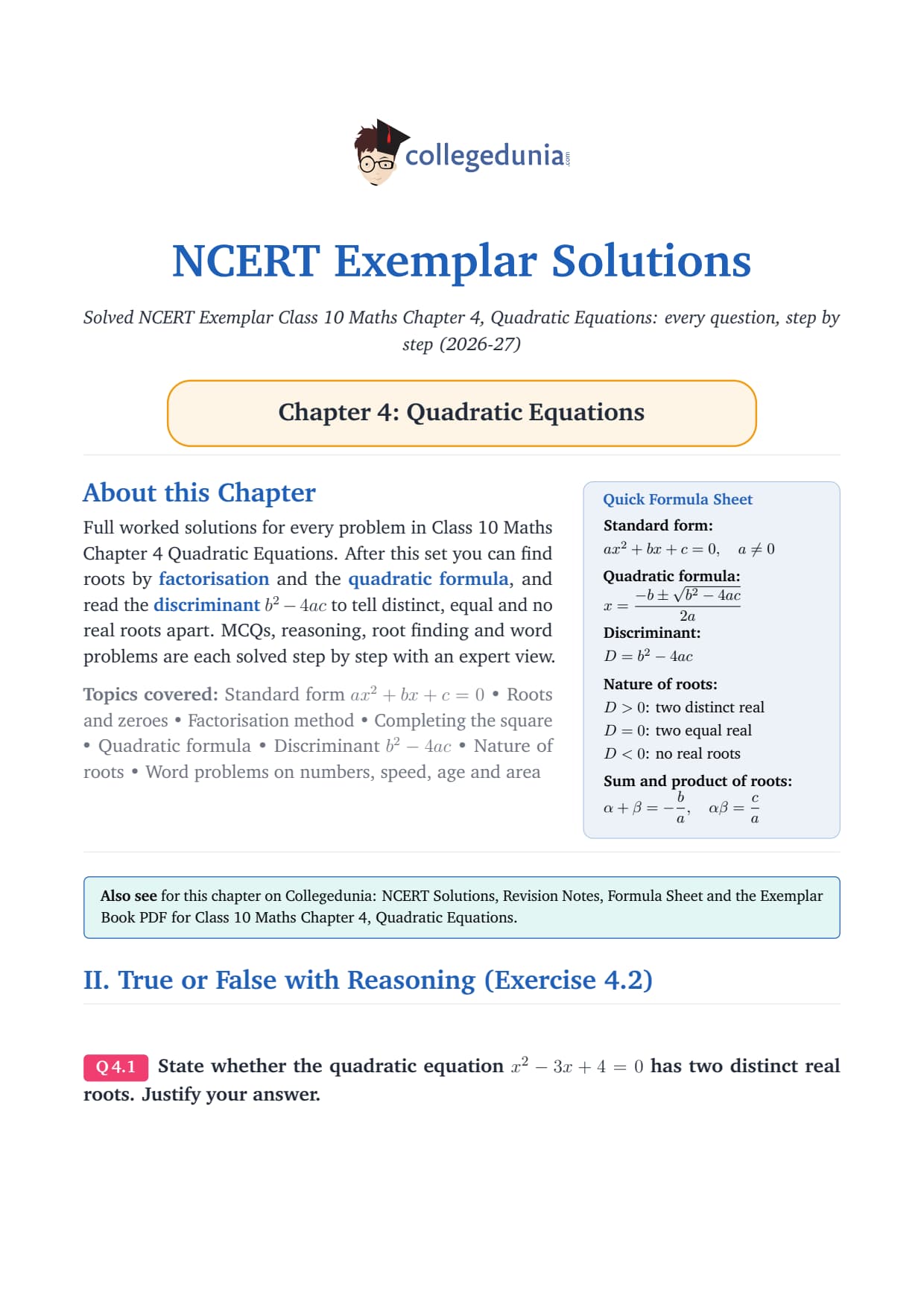
Exercise 4.2 is the True or False with Reasoning section of NCERT Exemplar Class 10 Maths Chapter 4 Quadratic Equations. Its 21 questions (Q12 to Q32) ask you to judge a claim about a quadratic and justify the answer. Every solution leans on the discriminantD = b2 - 4ac, set to the 2026-27 CBSE syllabus.
21 True/False questions (Q12 to Q32) on distinct roots, real roots, root-count claims, and coefficient-root cases.
Each answer needs a full discriminant justification or a counter-example to earn CBSE marks.
Tackles the myths students carry in: "every quadratic has one root" or "integer coefficients force integer roots".
Solved by Collegedunia - Every solution here is worked out by our Mathematics faculty, cross-checked against the official NCERT Exemplar, and matched to the 2026-27 CBSE syllabus.
This is the True or False with Reasoning set. Its 21 questions (Q12 to Q32) each state a claim about a quadratic and ask you to judge it with a full justification.
Q12 to Q21: Check if a given equation has two distinct real roots by reading the sign of the discriminant.
Q22 to Q25: Judge general claims about how many roots every quadratic must have ("exactly one", "at least one", "at most two").
Q26 and Q27: Use sign-only reasoning, with no numbers, when a and c share or oppose signs and b = 0.
Q28 to Q32: Settle existence questions. Can integer coefficients give irrational roots? Is a given number actually a root?
The exercise builds on the discriminant formula from the NCERT textbook. CBSE papers usually carry one or two reasoning questions of this kind. So drilling the justification format here pays off in marks.
The Quadratic Equations Discriminant Test Explained
Every true/false question comes down to reading one number. Know this table and all 21 questions become clear:
Value of D = b2 - 4ac
What it means
Root count
D > 0
Two distinct real roots
2 distinct real roots
D = 0
Two equal (repeated) real roots
1 repeated real root
D < 0
No real roots (only complex)
0 real roots
Key rule: "Two distinct real roots" needs strictly positive D. At D = 0 the roots are real but equal, not distinct. At D < 0 there are no real roots.
Apply the Quadratic Equations Discriminant Step by Step
CBSE markers expect a clear method. This routine earns full marks on the True/False questions:
Expand and simplify first. Bring the equation to standard form ax2 + bx + c = 0. Q16, Q17, Q18, Q20 and Q21 start in factored form.
Read off a, b, c. Watch the signs, especially after multiplying by -1 or with a fraction coefficient.
Compute D = b2 - 4ac. Show each arithmetic step on its own line for full credit.
State the verdict. Write "Since D > 0 / D = 0 / D < 0, ..." and name the conclusion.
Box the answer as True or False with a one-line reason.
For Q22 to Q32, the method shifts. You need a counter-example to disprove a false claim, or a sign argument to prove a true one.
Quadratic Equations Question-wise Topic Map
This table maps each question to the skill it tests, so you can see where to focus revision:
Question
Verdict
Skill tested
Key step
Q12
False
Discriminant with D < 0
D = -7
Q13
True
Opposite signs of a and c
D = 9
Q14
False
D = 0 gives equal, not distinct
D = 0
Q15
True
Positive perfect-square D
D = 4
Q16
False
Expand first, terms cancel
D = -64
Q17
True
Constant term vanishes, c = 0
D > 0
Q18
True
Clear surd, then compute
D = 1
Q19
False
Double-negative in -4ac
D = -7
Q20
True
Constant terms cancel
D = 1
Q21
True
Linear terms cancel
D = 8
Q22
False
General claim: root count varies
Counter-example
Q23
False
General claim: no real roots possible
Counter-example
Q24
False
General claim: fewer than 2 roots
Counter-example
Q25
True
Degree caps root count
Polynomial theorem
Q26
True
Sign argument forces D > 0
ac < 0 ⇒ D > 0
Q27
True
Sign argument forces D < 0
b=0, ac > 0
Q28
False
Integer coefficients, surd roots
Counter-example
Q29
True
Non-square D gives irrational roots
Existence
Q30
True
Scale by surd, roots unchanged
Construction
Q31
False
Substitute and check decimal
(0.2)2 ≠ 0.4
Q32
True
Sum of roots = 0 when b = 0
±√-c
All Exercise 4.2 Solutions, Step by Step
II. True or False with Reasoning (Exercise 4.2)
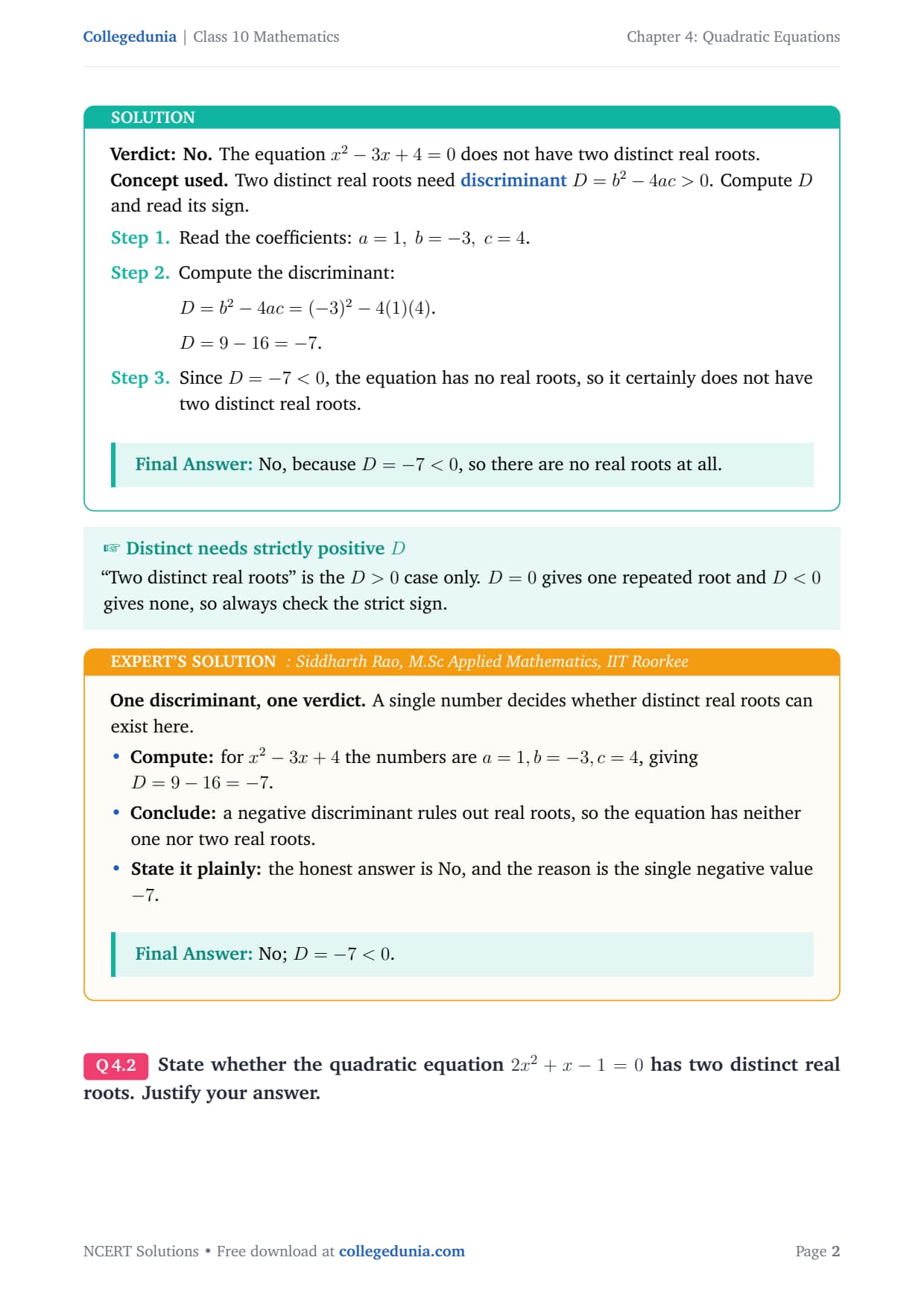
Q 4.1
State whether the quadratic equation x2-3x+4=0 has two distinct real roots. Justify your answer.
Verdict: No. The equation x2-3x+4=0 does not have two
distinct real roots.
Concept used. Two distinct real roots need discriminantD=b2-4ac>0. Compute D and read its sign.
Read the coefficients: a=1, b=-3, c=4.
Compute the discriminant:
[] D=b2-4ac=(-3)2-4(1)(4).
[] D=9-16=-7.
Since D=-7<0, the equation has no real roots, so it certainly
does not have two distinct real roots.
No, because D=-7<0, so there are no real roots at all.
SR
Siddharth Rao
M.Sc Applied Mathematics, IIT Roorkee
Verified Expert
One discriminant, one verdict. A single number decides whether
distinct real roots can exist here.
Compute: for x2-3x+4 the numbers are a=1,b=-3,c=4,
giving D=9-16=-7.
Conclude: a negative discriminant rules out real roots,
so the equation has neither one nor two real roots.
State it plainly: the honest answer is No, and the
reason is the single negative value -7.
No; D=-7<0.
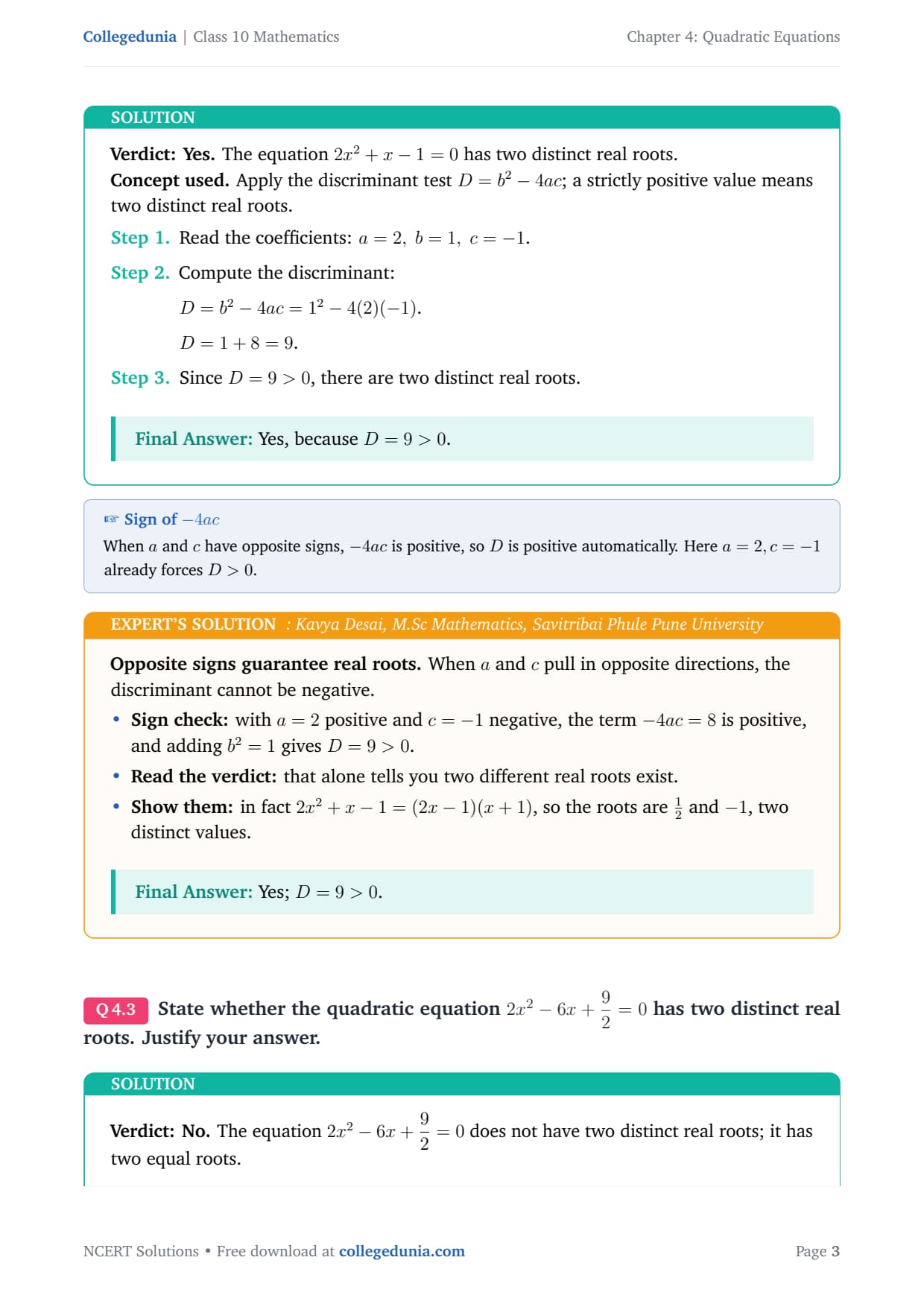
Q 4.2
State whether the quadratic equation 2x2+x-1=0 has two distinct real roots. Justify your answer.
Verdict: Yes. The equation 2x2+x-1=0 has two distinct real
roots.
Concept used. Apply the discriminant test D=b2-4ac; a
strictly positive value means two distinct real roots.
Read the coefficients: a=2, b=1, c=-1.
Compute the discriminant:
[] D=b2-4ac=12-4(2)(-1).
[] D=1+8=9.
Since D=9>0, there are two distinct real roots.
Yes, because D=9>0.
KD
Kavya Desai
M.Sc Mathematics, Savitribai Phule Pune University
Verified Expert
Opposite signs guarantee real roots. When a and c pull in
opposite directions, the discriminant cannot be negative.
Sign check: with a=2 positive and c=-1 negative, the
term -4ac=8 is positive, and adding b2=1 gives D=9>0.
Read the verdict: that alone tells you two different
real roots exist.
Show them: in fact 2x2+x-1=(2x-1)(x+1), so the
roots are 12 and -1, two distinct values.
Yes; D=9>0.
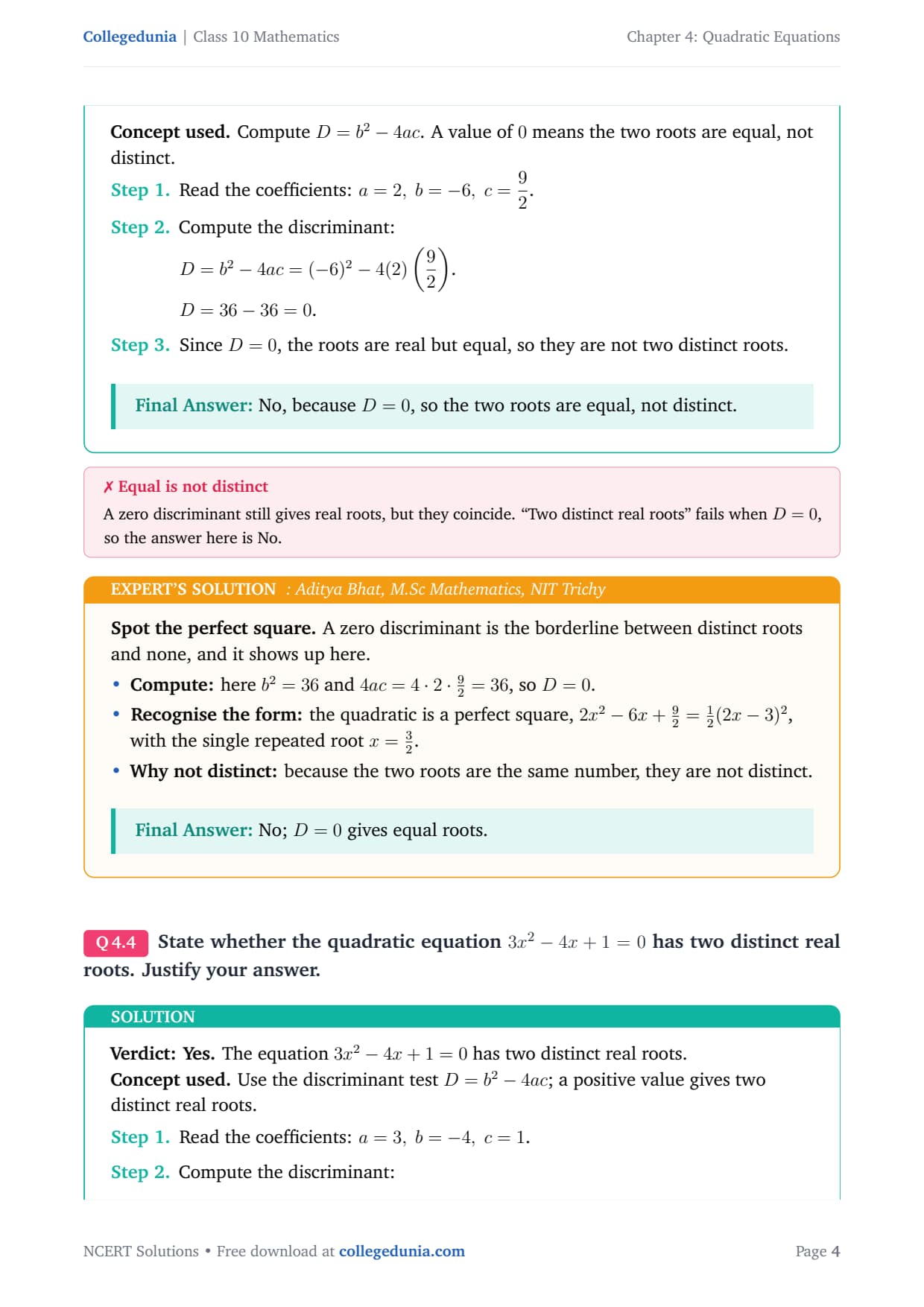
Q 4.3
State whether the quadratic equation 2x2-6x+92=0 has two distinct real roots. Justify your answer.
Verdict: No. The equation 2x2-6x+92=0 does not have
two distinct real roots; it has two equal roots.
Concept used. Compute D=b2-4ac. A value of 0 means the two
roots are equal, not distinct.
Read the coefficients: a=2, b=-6, c=92.
Compute the discriminant:
[] D=b2-4ac=(-6)2-4(2)(92).
[] D=36-36=0.
Since D=0, the roots are real but equal, so they are not two
distinct roots.
No, because D=0, so the two roots are equal, not distinct.
AB
Aditya Bhat
M.Sc Mathematics, NIT Trichy
Verified Expert
Spot the perfect square. A zero discriminant is the borderline
between distinct roots and none, and it shows up here.
Compute: here b2=36 and 4ac=42·92=36,
so D=0.
Recognise the form: the quadratic is a perfect square,
2x2-6x+92=12(2x-3)2, with the single repeated
root x=32.
Why not distinct: because the two roots are the same
number, they are not distinct.
No; D=0 gives equal roots.
Q 4.4
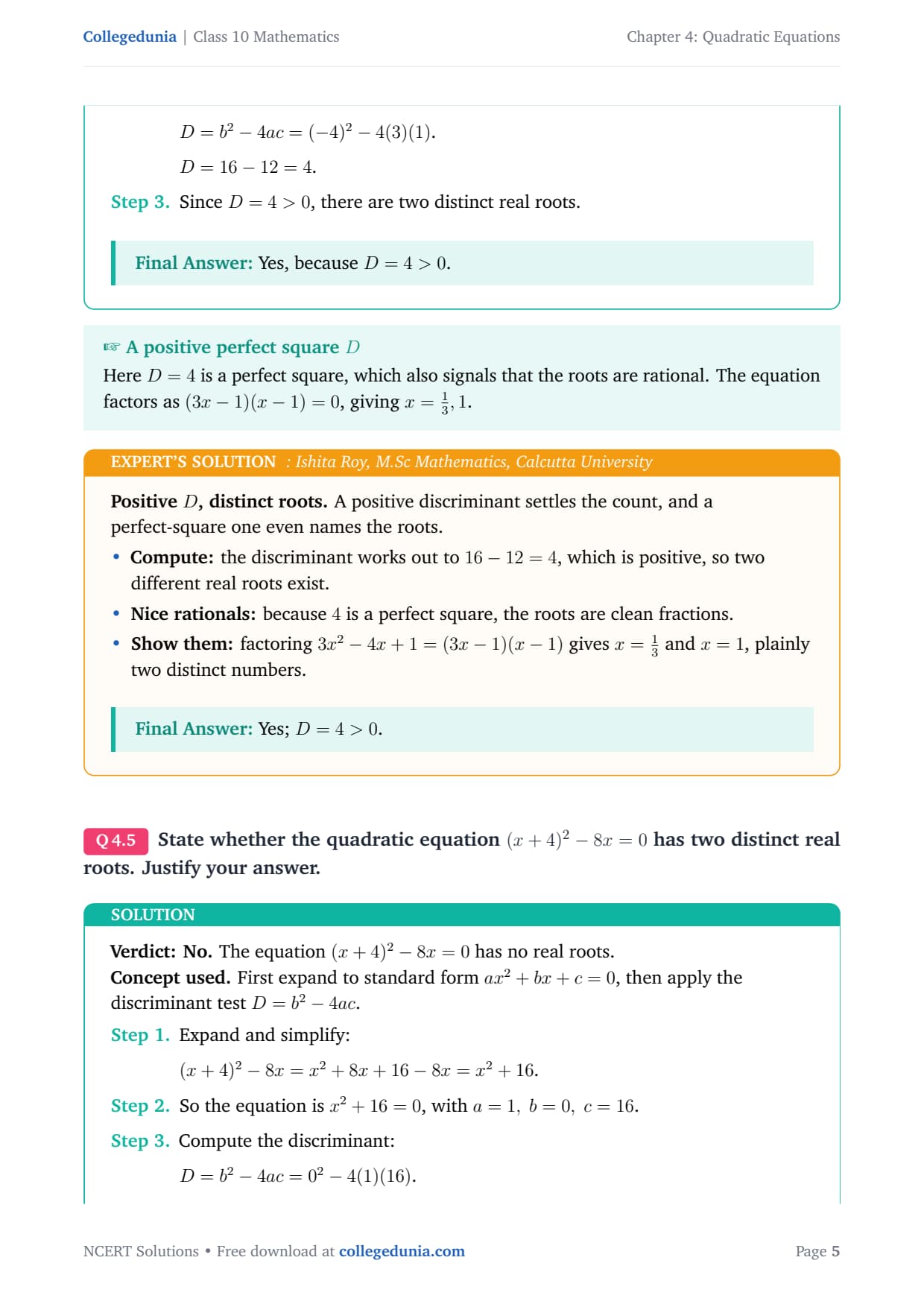
State whether the quadratic equation 3x2-4x+1=0 has two distinct real roots. Justify your answer.
Verdict: Yes. The equation 3x2-4x+1=0 has two distinct real
roots.
Concept used. Use the discriminant test D=b2-4ac; a positive
value gives two distinct real roots.
Read the coefficients: a=3, b=-4, c=1.
Compute the discriminant:
[] D=b2-4ac=(-4)2-4(3)(1).
[] D=16-12=4.
Since D=4>0, there are two distinct real roots.
Yes, because D=4>0.
IR
Ishita Roy
M.Sc Mathematics, Calcutta University
Verified Expert
Positive D, distinct roots. A positive discriminant settles
the count, and a perfect-square one even names the roots.
Compute: the discriminant works out to 16-12=4, which
is positive, so two different real roots exist.
Nice rationals: because 4 is a perfect square, the
roots are clean fractions.
Show them: factoring 3x2-4x+1=(3x-1)(x-1) gives
x=13 and x=1, plainly two distinct numbers.
Yes; D=4>0.
Q 4.5
State whether the quadratic equation (x+4)2-8x=0 has two distinct real roots. Justify your answer.
Verdict: No. The equation (x+4)2-8x=0 has no real roots.
Concept used. First expand to standard form ax2+bx+c=0, then
apply the discriminant test D=b2-4ac.
Expand and simplify:
[] (x+4)2-8x=x2+8x+16-8x=x2+16.
So the equation is x2+16=0, with a=1, b=0, c=16.
Compute the discriminant:
[] D=b2-4ac=02-4(1)(16).
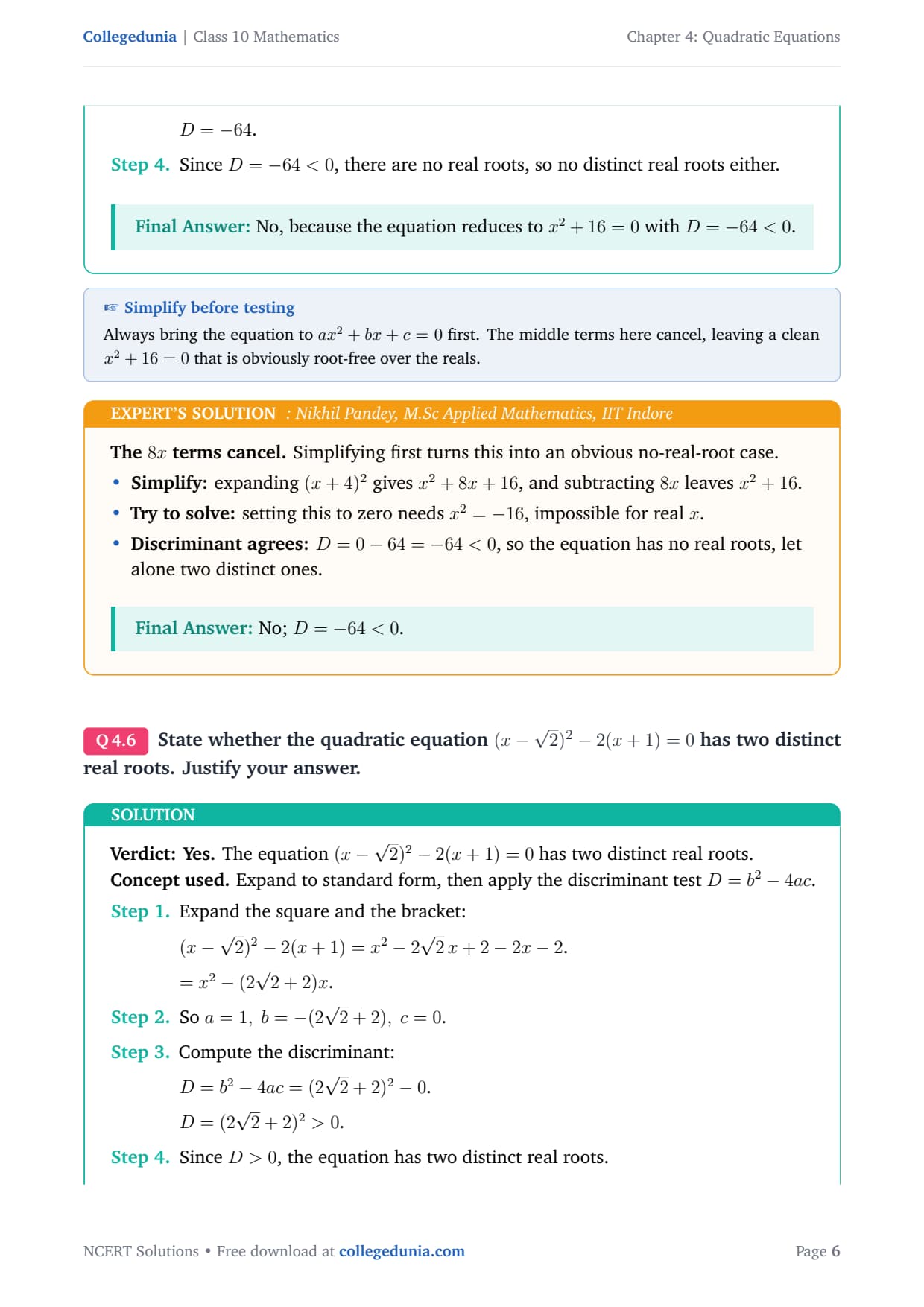
[] D=-64.
Since D=-64<0, there are no real roots, so no distinct real
roots either.
No, because the equation reduces to x2+16=0 with
D=-64<0.
NP
Nikhil Pandey
M.Sc Applied Mathematics, IIT Indore
Verified Expert
The 8x terms cancel. Simplifying first turns this into an
obvious no-real-root case.
Simplify: expanding (x+4)2 gives x2+8x+16, and
subtracting 8x leaves x2+16.
Try to solve: setting this to zero needs x2=-16,
impossible for real x.
Discriminant agrees:D=0-64=-64<0, so the equation has
no real roots, let alone two distinct ones.
No; D=-64<0.
Q 4.6
State whether the quadratic equation (x-√2)2-2(x+1)=0 has two distinct real roots. Justify your answer.
Verdict: Yes. The equation (x-√2)2-2(x+1)=0 has two
distinct real roots.
Concept used. Expand to standard form, then apply the
discriminant test D=b2-4ac.
Expand the square and the bracket:
[] (x-√2)2-2(x+1)=x2-2√2x+2-2x-2.
[] =x2-(2√2+2)x.
So a=1, b=-(2√2+2), c=0.
Compute the discriminant:
[] D=b2-4ac=(2√2+2)2-0.
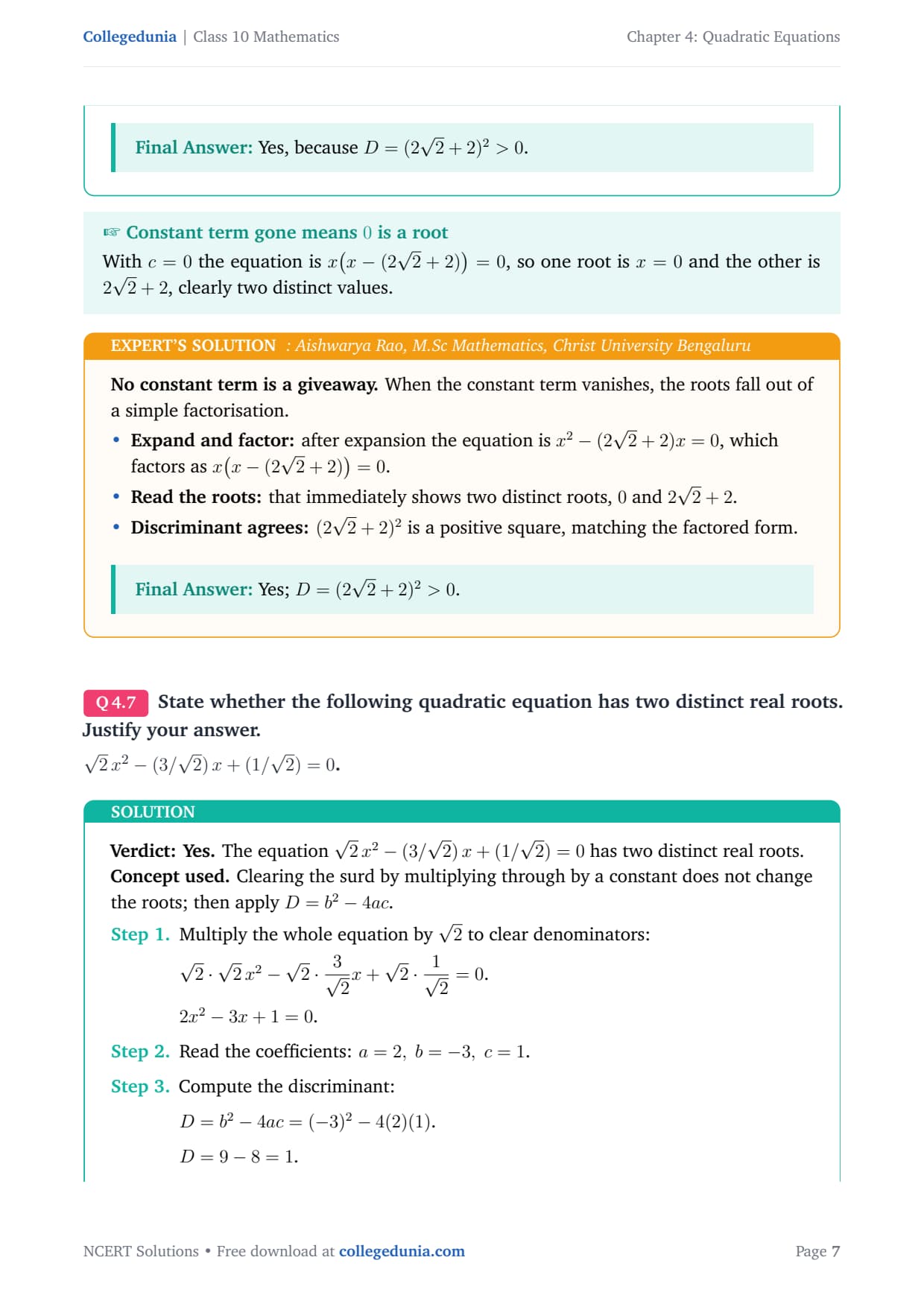
[] D=(2√2+2)2>0.
Since D>0, the equation has two distinct real roots.
Yes, because D=(2√2+2)2>0.
AR
Aishwarya Rao
M.Sc Mathematics, Christ University Bengaluru
Verified Expert
No constant term is a giveaway. When the constant term vanishes,
the roots fall out of a simple factorisation.
Expand and factor: after expansion the equation is
x2-(22+2)x=0, which factors as
x(x-(22+2))=0.
Read the roots: that immediately shows two distinct
roots, 0 and 22+2.
Discriminant agrees:(22+2)2 is a positive
square, matching the factored form.
Yes; D=(2√2+2)2>0.
Q 4.7
State whether the following quadratic equation has two distinct real roots. Justify your answer. [4pt]
√2 x2-(3/√2) x+(1/√2)=0.
Verdict: Yes. The equation √2 x2-(3/√2) x
+(1/√2)=0 has two distinct real roots.
Concept used. Clearing the surd by multiplying through by a
constant does not change the roots; then apply D=b2-4ac.
Multiply the whole equation by √2 to clear denominators:
[] √2·√2 x2-√2·3√2x
+√2·1√2=0.
[] 2x2-3x+1=0.
Read the coefficients: a=2, b=-3, c=1.
Compute the discriminant:
[] D=b2-4ac=(-3)2-4(2)(1).
[] D=9-8=1.
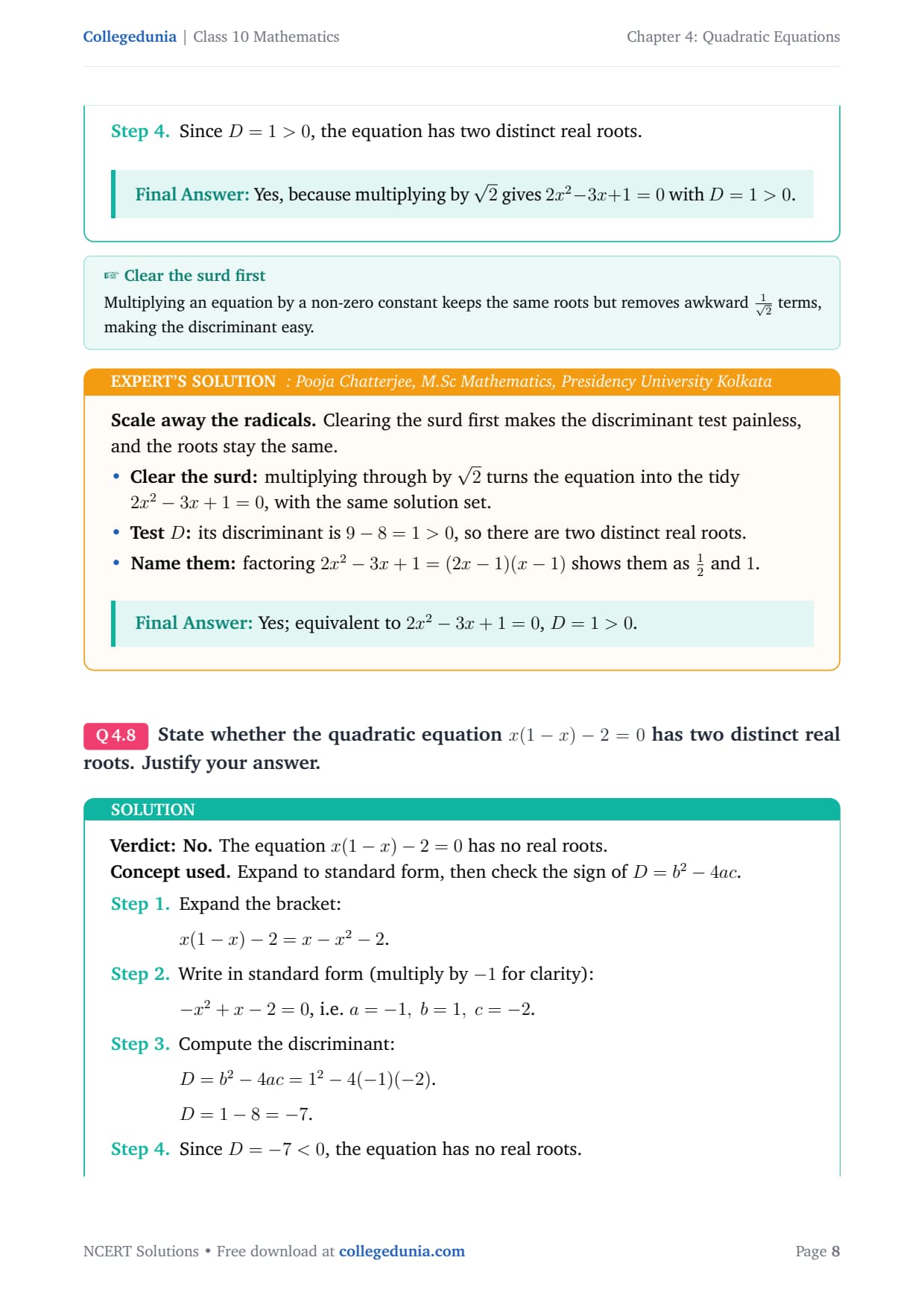
Since D=1>0, the equation has two distinct real roots.
Yes, because multiplying by √2 gives 2x2-3x+1=0
with D=1>0.
PC
Pooja Chatterjee
M.Sc Mathematics, Presidency University Kolkata
Verified Expert
Scale away the radicals. Clearing the surd first makes the
discriminant test painless, and the roots stay the same.
Clear the surd: multiplying through by 2 turns the
equation into the tidy 2x2-3x+1=0, with the same solution
set.
Test D: its discriminant is 9-8=1>0, so there are
two distinct real roots.
Name them: factoring 2x2-3x+1=(2x-1)(x-1) shows
them as 12 and 1.
Yes; equivalent to 2x2-3x+1=0, D=1>0.
Q 4.8
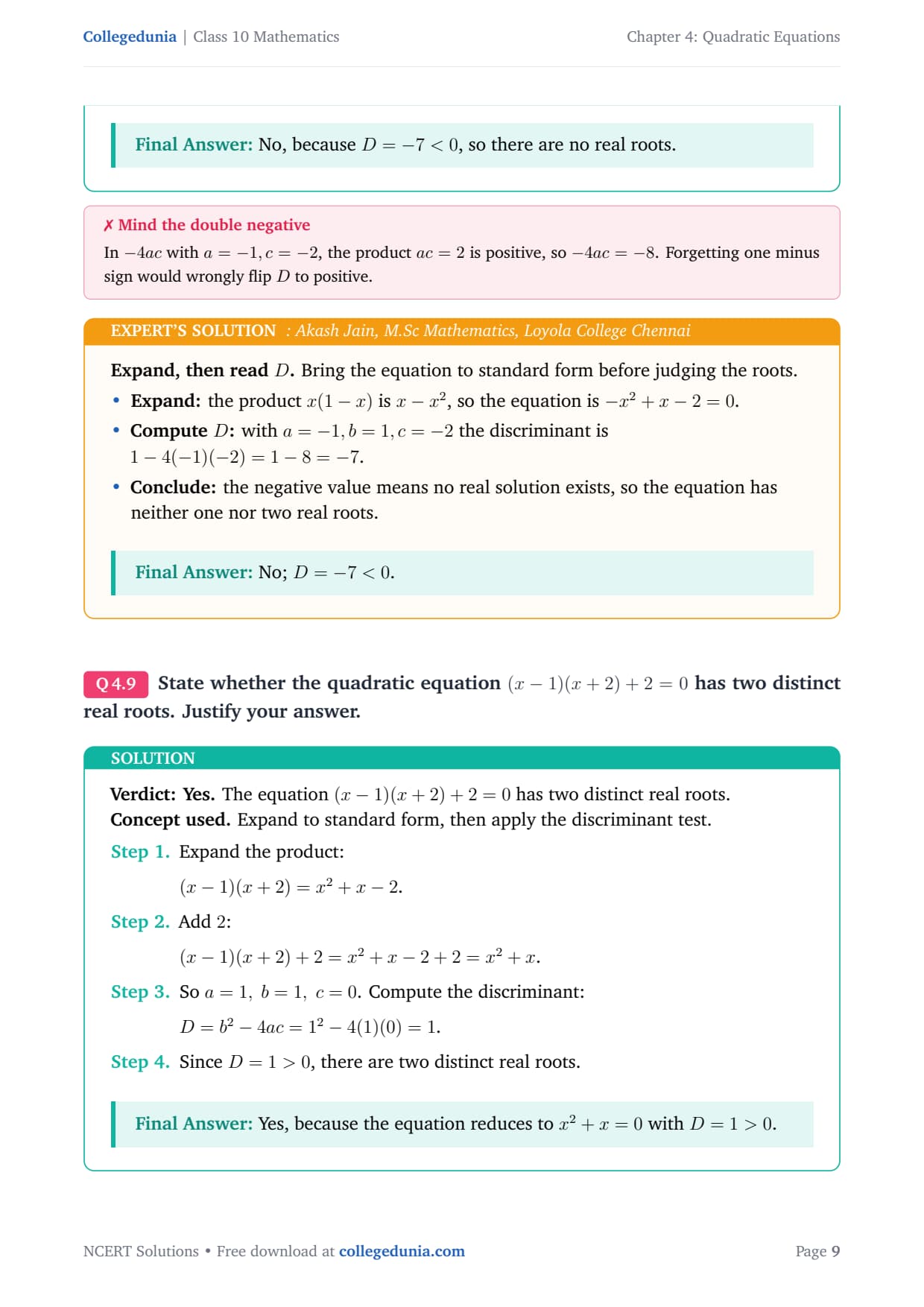
State whether the quadratic equation x(1-x)-2=0 has two distinct real roots. Justify your answer.
Verdict: No. The equation x(1-x)-2=0 has no real roots.
Concept used. Expand to standard form, then check the sign of
D=b2-4ac.
Expand the bracket:
[] x(1-x)-2=x-x2-2.
Write in standard form (multiply by -1 for clarity):
[] -x2+x-2=0, i.e. a=-1, b=1, c=-2.
Compute the discriminant:
[] D=b2-4ac=12-4(-1)(-2).
[] D=1-8=-7.
Since D=-7<0, the equation has no real roots.
No, because D=-7<0, so there are no real roots.
AJ
Akash Jain
M.Sc Mathematics, Loyola College Chennai
Verified Expert
Expand, then read D. Bring the equation to standard form
before judging the roots.
Expand: the product x(1-x) is x-x2, so the
equation is -x2+x-2=0.
Compute D: with a=-1,b=1,c=-2 the discriminant is
1-4(-1)(-2)=1-8=-7.
Conclude: the negative value means no real solution
exists, so the equation has neither one nor two real roots.
No; D=-7<0.
Q 4.9
State whether the quadratic equation (x-1)(x+2)+2=0 has two distinct real roots. Justify your answer.
Verdict: Yes. The equation (x-1)(x+2)+2=0 has two distinct real
roots.
Concept used. Expand to standard form, then apply the
discriminant test.
Expand the product:
[] (x-1)(x+2)=x2+x-2.
Add 2:
[] (x-1)(x+2)+2=x2+x-2+2=x2+x.
So a=1, b=1, c=0. Compute the discriminant:
[] D=b2-4ac=12-4(1)(0)=1.
Since D=1>0, there are two distinct real roots.
Yes, because the equation reduces to x2+x=0 with
D=1>0.
TS
Tanvi Shah
M.Sc Mathematics, St. Stephen's College Delhi
Verified Expert
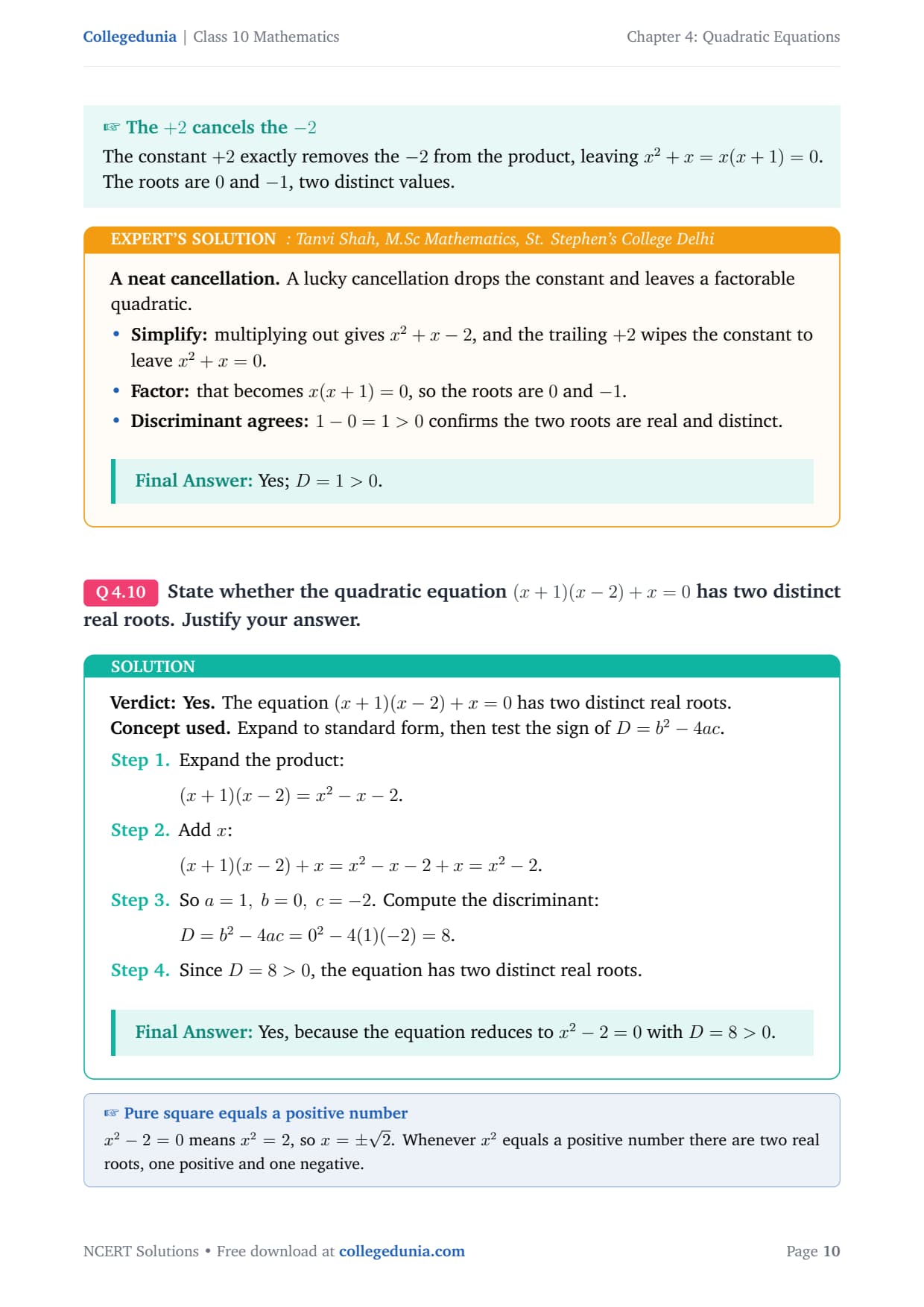
A neat cancellation. A lucky cancellation drops the constant and
leaves a factorable quadratic.
Simplify: multiplying out gives x2+x-2, and the
trailing +2 wipes the constant to leave x2+x=0.
Factor: that becomes x(x+1)=0, so the roots are 0
and -1.
Discriminant agrees:1-0=1>0 confirms the two roots
are real and distinct.
Yes; D=1>0.
Q 4.10
State whether the quadratic equation (x+1)(x-2)+x=0 has two distinct real roots. Justify your answer.
Verdict: Yes. The equation (x+1)(x-2)+x=0 has two distinct real
roots.
Concept used. Expand to standard form, then test the sign of
D=b2-4ac.
Expand the product:
[] (x+1)(x-2)=x2-x-2.
Add x:
[] (x+1)(x-2)+x=x2-x-2+x=x2-2.
So a=1, b=0, c=-2. Compute the discriminant:
[] D=b2-4ac=02-4(1)(-2)=8.
Since D=8>0, the equation has two distinct real roots.
Yes, because the equation reduces to x2-2=0 with
D=8>0.
MG
Manish Gupta
M.Sc Mathematics, IIT Guwahati
Verified Expert
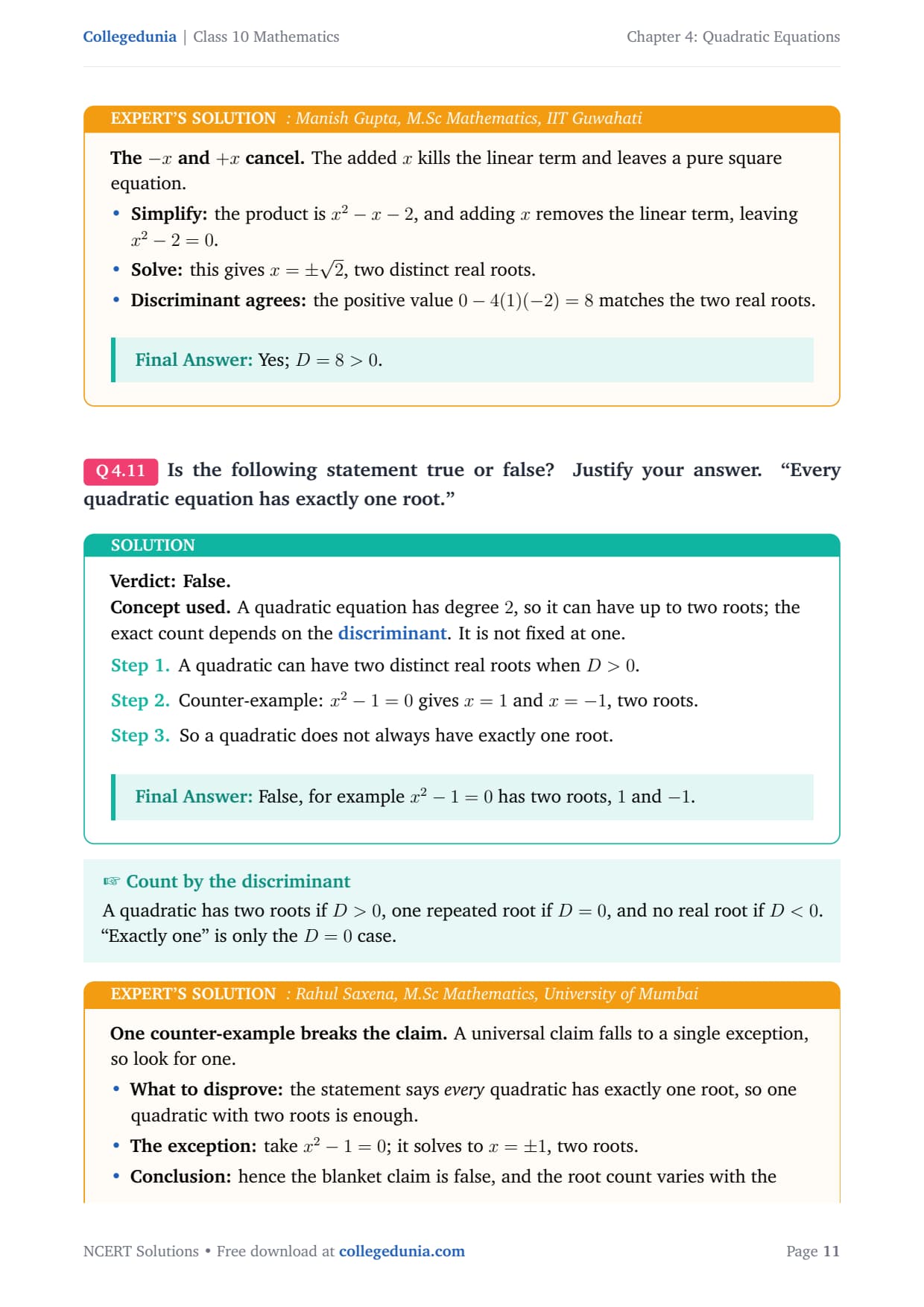
The -x and +x cancel. The added x kills the linear term
and leaves a pure square equation.
Simplify: the product is x2-x-2, and adding x
removes the linear term, leaving x2-2=0.
Solve: this gives x=±2, two distinct real roots.
Discriminant agrees: the positive value
0-4(1)(-2)=8 matches the two real roots.
Yes; D=8>0.
Q 4.11
Is the following statement true or false? Justify your answer. ``Every quadratic equation has exactly one root.''
Verdict: False.
Concept used. A quadratic equation has degree 2, so it can have
up to two roots; the exact count depends on the discriminant. It
is not fixed at one.
A quadratic can have two distinct real roots when D>0.
Counter-example: x2-1=0 gives x=1 and x=-1, two roots.
So a quadratic does not always have exactly one root.
False, for example x2-1=0 has two roots, 1 and -1.
RS
Rahul Saxena
M.Sc Mathematics, University of Mumbai
Verified Expert
One counter-example breaks the claim. A universal claim falls to
a single exception, so look for one.
What to disprove: the statement says every
quadratic has exactly one root, so one quadratic with two roots
is enough.
The exception: take x2-1=0; it solves to x=1,
two roots.
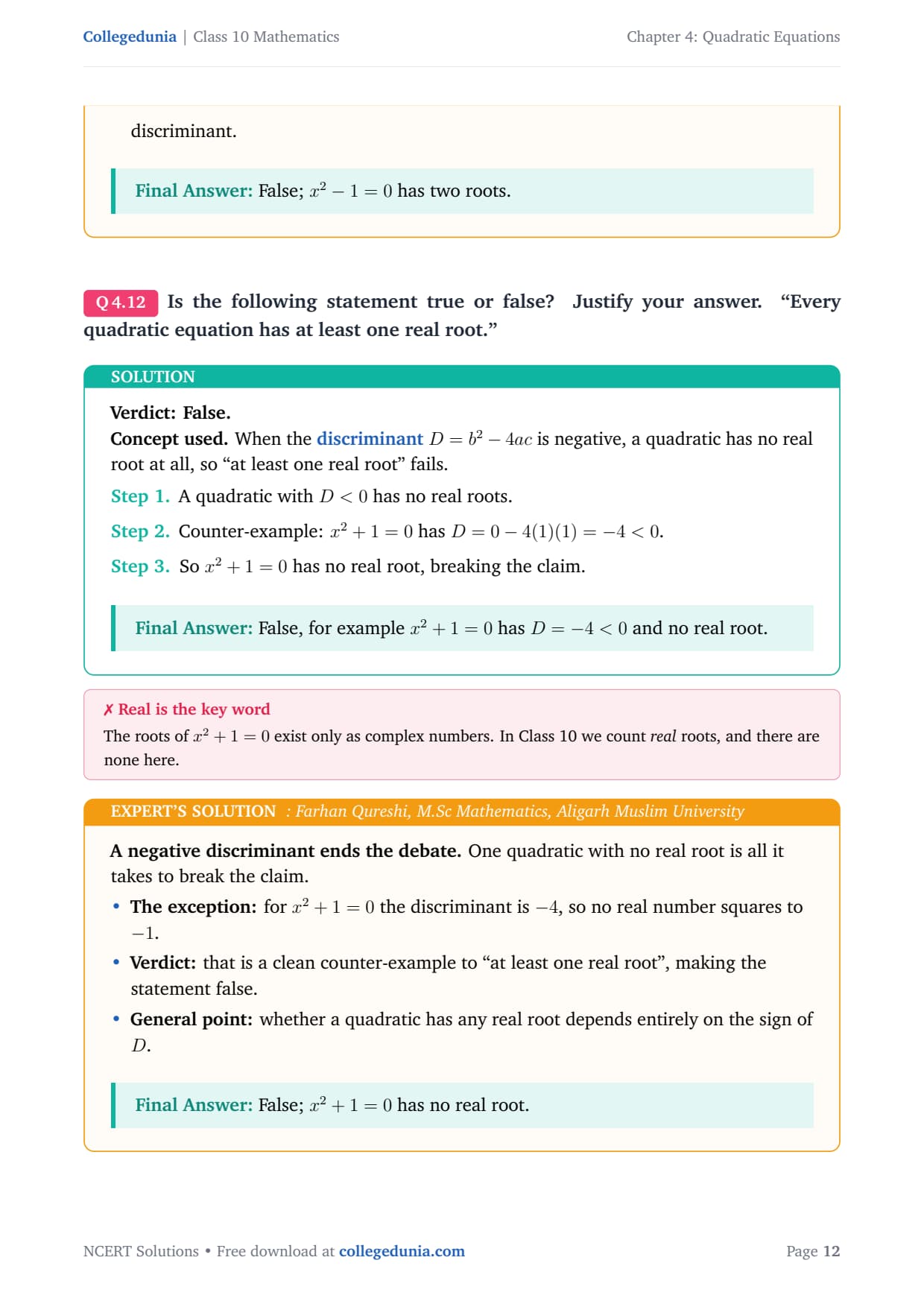
Conclusion: hence the blanket claim is false, and the
root count varies with the discriminant.
False; x2-1=0 has two roots.
Q 4.12
Is the following statement true or false? Justify your answer. ``Every quadratic equation has at least one real root.''
Verdict: False.
Concept used. When the discriminantD=b2-4ac is
negative, a quadratic has no real root at all, so ``at least one real
root'' fails.
A quadratic with D<0 has no real roots.
Counter-example: x2+1=0 has D=0-4(1)(1)=-4<0.
So x2+1=0 has no real root, breaking the claim.
False, for example x2+1=0 has D=-4<0 and no real root.
FQ
Farhan Qureshi
M.Sc Mathematics, Aligarh Muslim University
Verified Expert
A negative discriminant ends the debate. One quadratic with no
real root is all it takes to break the claim.
The exception: for x2+1=0 the discriminant is -4,
so no real number squares to -1.
Verdict: that is a clean counter-example to ``at least
one real root'', making the statement false.
General point: whether a quadratic has any real root
depends entirely on the sign of D.
False; x2+1=0 has no real root.
Q 4.13
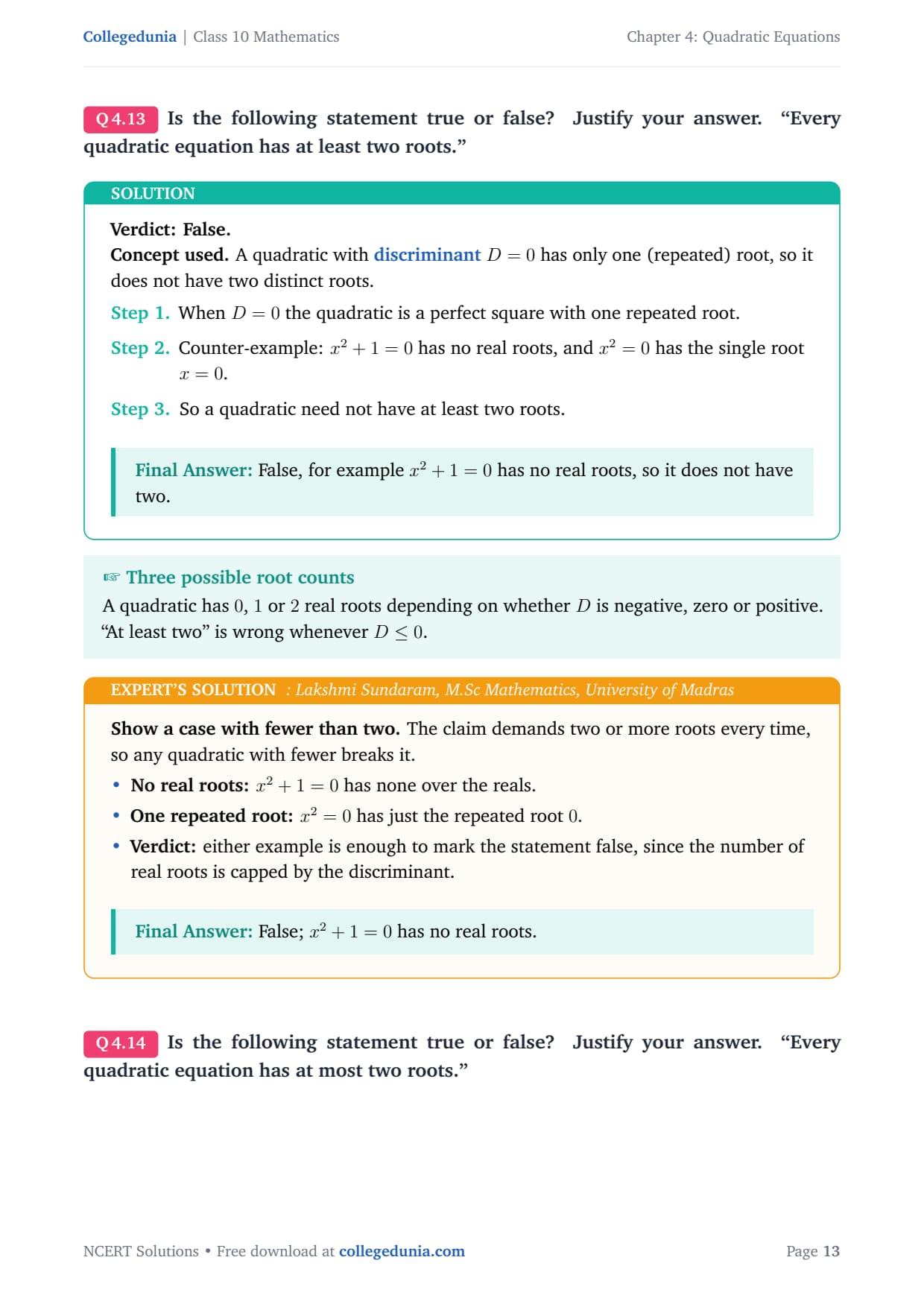
Is the following statement true or false? Justify your answer. ``Every quadratic equation has at least two roots.''
Verdict: False.
Concept used. A quadratic with discriminantD=0 has
only one (repeated) root, so it does not have two distinct roots.
When D=0 the quadratic is a perfect square with one repeated
root.
Counter-example: x2+1=0 has no real roots, and x2=0 has
the single root x=0.
So a quadratic need not have at least two roots.
False, for example x2+1=0 has no real roots, so it does not
have two.
LS
Lakshmi Sundaram
M.Sc Mathematics, University of Madras
Verified Expert
Show a case with fewer than two. The claim demands two or more
roots every time, so any quadratic with fewer breaks it.
No real roots:x2+1=0 has none over the reals.
One repeated root:x2=0 has just the repeated root
0.
Verdict: either example is enough to mark the statement
false, since the number of real roots is capped by the
discriminant.
False; x2+1=0 has no real roots.
Q 4.14
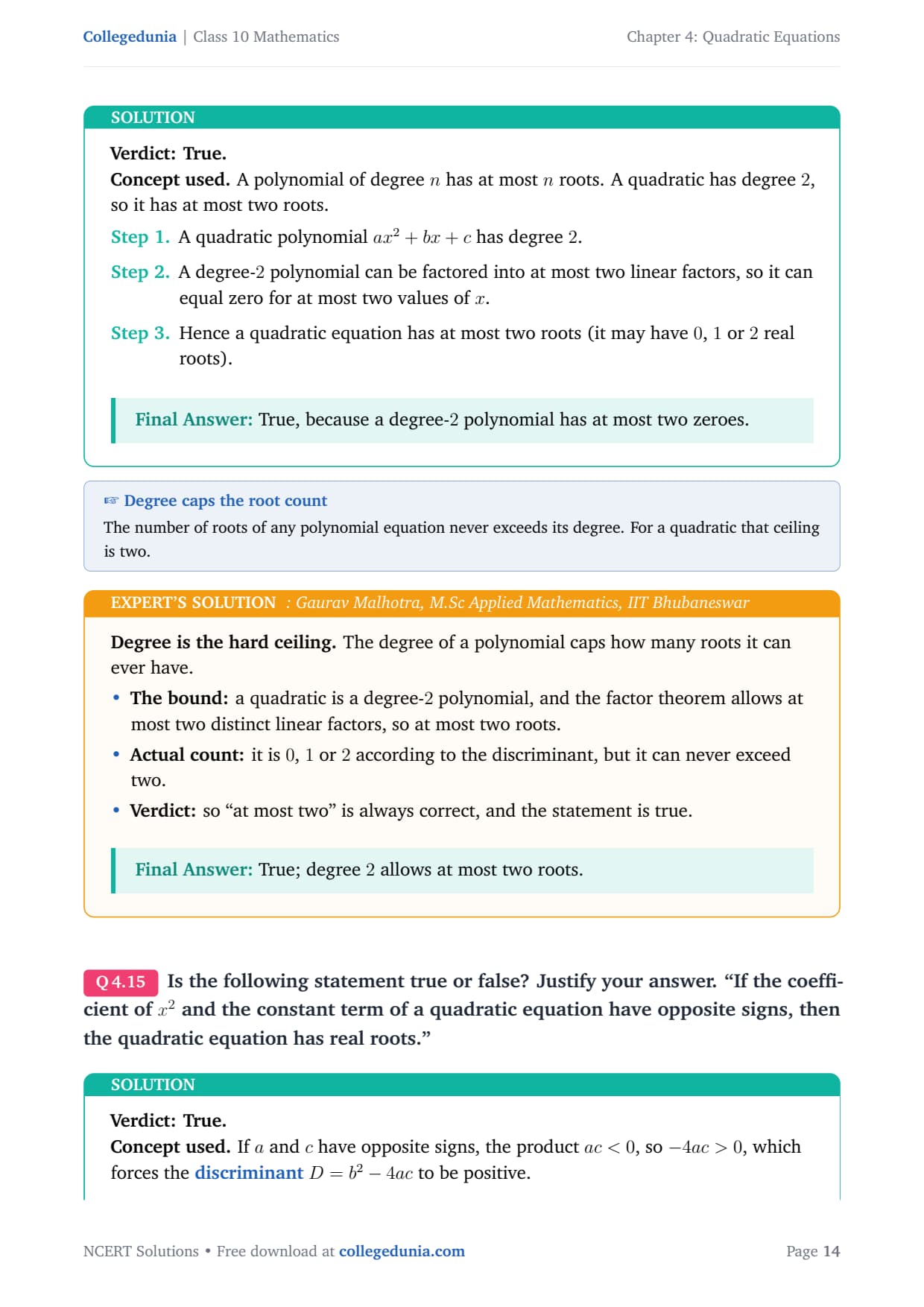
Is the following statement true or false? Justify your answer. ``Every quadratic equation has at most two roots.''
Verdict: True.
Concept used. A polynomial of degree n has at most n roots.
A quadratic has degree 2, so it has at most two roots.
A quadratic polynomial ax2+bx+c has degree 2.
A degree-2 polynomial can be factored into at most two linear
factors, so it can equal zero for at most two values of x.
Hence a quadratic equation has at most two roots (it may have
0, 1 or 2 real roots).
True, because a degree-2 polynomial has at most two zeroes.
GM
Gaurav Malhotra
M.Sc Applied Mathematics, IIT Bhubaneswar
Verified Expert
Degree is the hard ceiling. The degree of a polynomial caps how
many roots it can ever have.
The bound: a quadratic is a degree-2 polynomial, and
the factor theorem allows at most two distinct linear factors, so
at most two roots.
Actual count: it is 0, 1 or 2 according to the
discriminant, but it can never exceed two.
Verdict: so ``at most two'' is always correct, and the
statement is true.
True; degree 2 allows at most two roots.
Q 4.15
Is the following statement true or false? Justify your answer. ``If the coefficient of x2 and the constant term of a quadratic equation have opposite signs, then the quadratic equation has real roots.''
Verdict: True.
Concept used. If a and c have opposite signs, the product
ac<0, so -4ac>0, which forces the discriminantD=b2-4ac to be positive.
Opposite signs of a and c mean ac<0.
Then -4ac>0 (a positive quantity).
Now D=b2-4ac=b2+(positive). Since b2≥ 0, the
sum is positive: D>0.
A positive discriminant means the equation has real roots (two
distinct ones).
True, because ac<0 gives D=b2-4ac>0, so real roots
exist.
RB
Ritu Bansal
M.Sc Mathematics, Panjab University Chandigarh
Verified Expert
Sign analysis, no numbers needed. You can settle this purely by
tracking signs, without any specific coefficients.
Opposite signs: if a>0,c<0 or a<0,c>0 then ac<0,
so -4ac is positive.
Force D>0: adding that positive amount to the
non-negative b2 keeps D strictly positive.
Verdict: a positive discriminant guarantees two real
roots, so the statement holds for every such quadratic and is
true.
True; ac<0⇒ D>0.
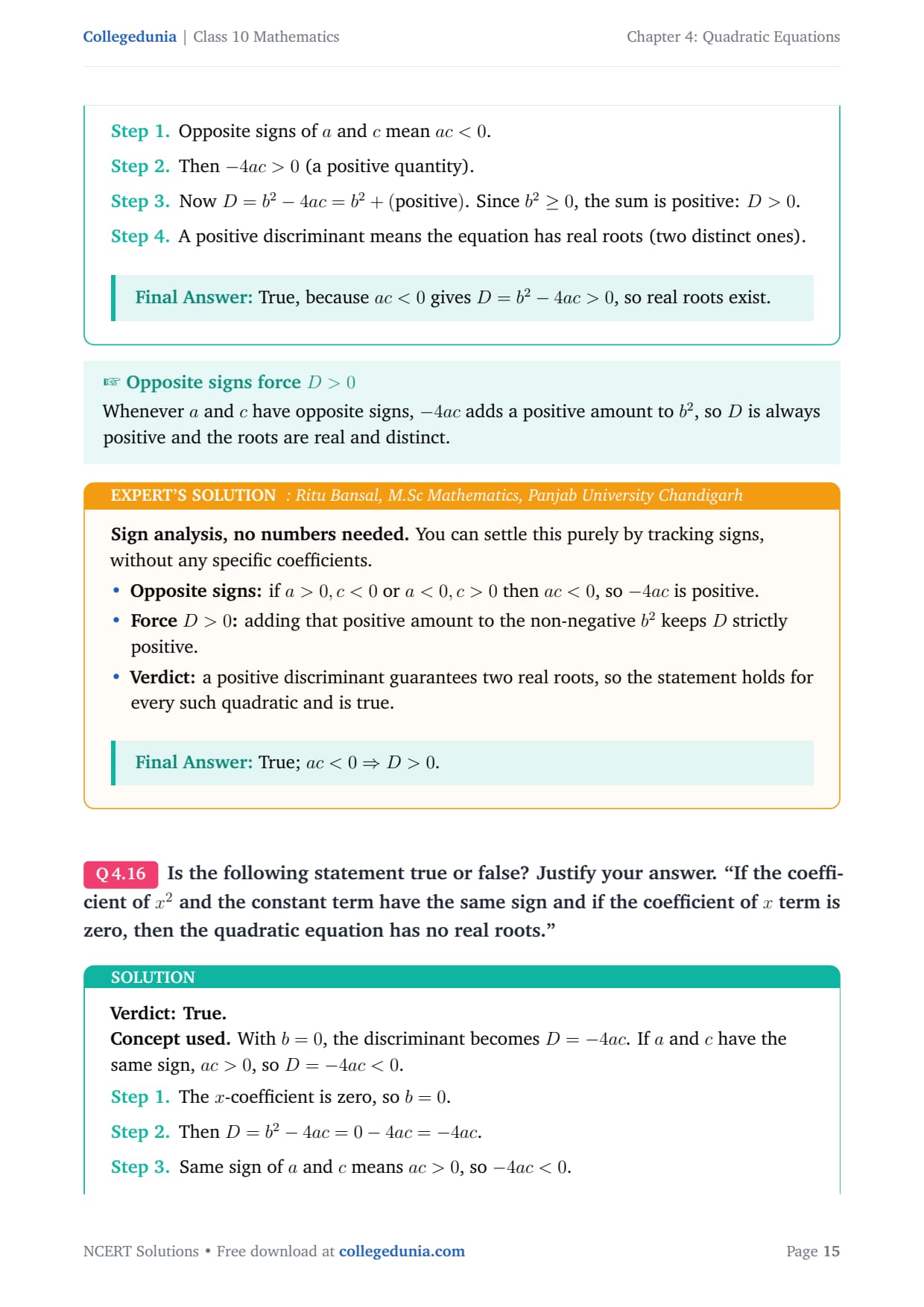
Q 4.16
Is the following statement true or false? Justify your answer. ``If the coefficient of x2 and the constant term have the same sign and if the coefficient of x term is zero, then the quadratic equation has no real roots.''
Verdict: True.
Concept used. With b=0, the discriminant becomes D=-4ac. If
a and c have the same sign, ac>0, so D=-4ac<0.
The x-coefficient is zero, so b=0.
Then D=b2-4ac=0-4ac=-4ac.
Same sign of a and c means ac>0, so -4ac<0.
Therefore D<0, and the equation has no real roots.
True, because b=0 and ac>0 give D=-4ac<0, so no real
roots.
DY
Devendra Yadav
M.Sc Mathematics, University of Rajasthan
Verified Expert
Read it through x2=-c/a. Isolating x2 exposes why no
real root can survive here.
Isolate the square: with b=0 the equation is
ax2+c=0, so x2=-ca.
Same signs hurt: when a and c match in sign,
ca>0 and the right side -ca is negative.
No real root: a square cannot be negative for real x,
exactly as the discriminant -4ac<0 predicts, so the statement
is true.
True; ax2+c=0 needs x2<0, impossible.
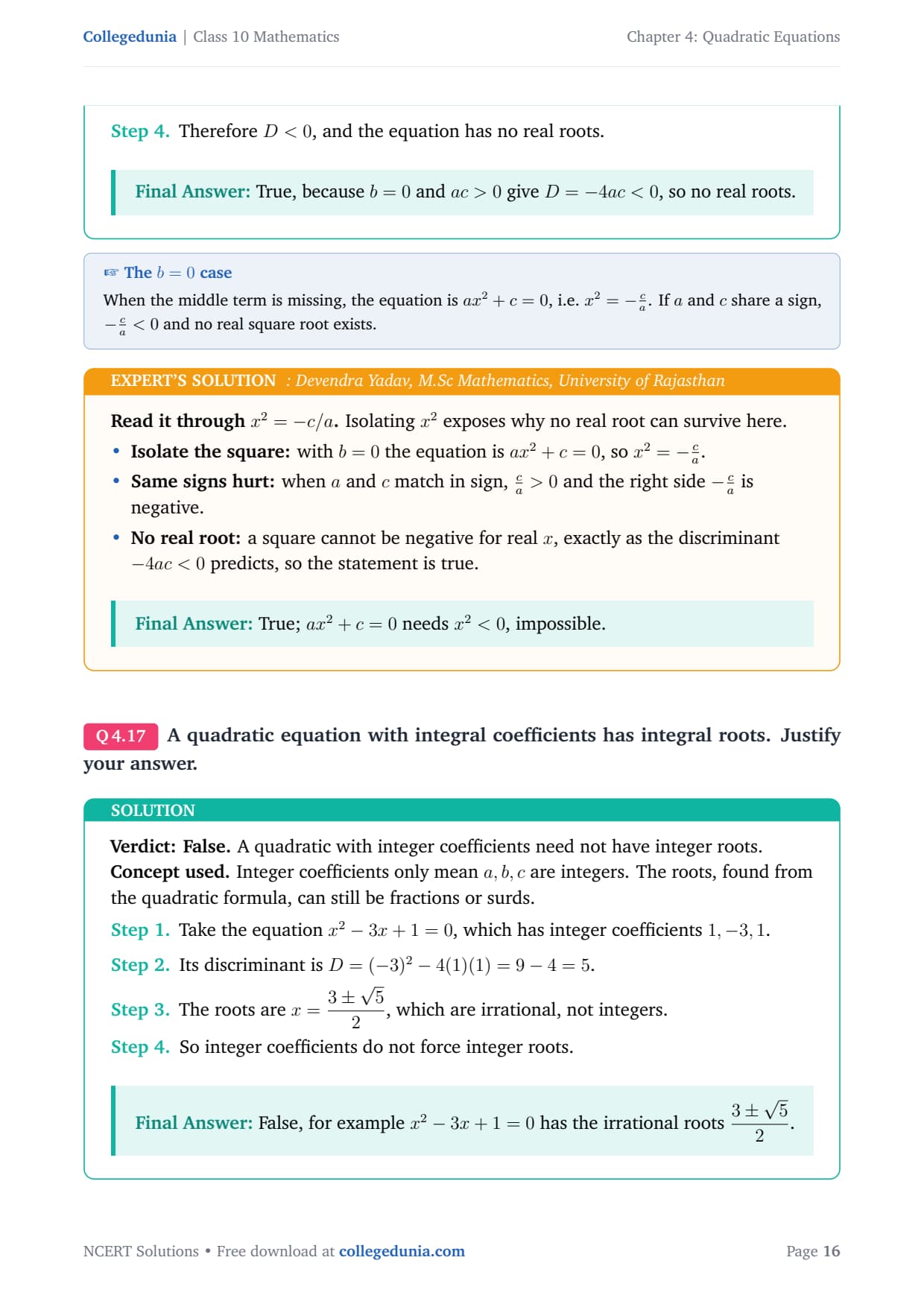
Q 4.17
A quadratic equation with integral coefficients has integral roots. Justify your answer.
Verdict: False. A quadratic with integer coefficients need not
have integer roots.
Concept used. Integer coefficients only mean a,b,c are
integers. The roots, found from the quadratic formula, can still be
fractions or surds.
Take the equation x2-3x+1=0, which has integer coefficients
1,-3,1.
Its discriminant is D=(-3)2-4(1)(1)=9-4=5.
The roots are x=3±√52, which are irrational,
not integers.
So integer coefficients do not force integer roots.
False, for example x2-3x+1=0 has the irrational roots
3±√52.
ST
Sara Thomas
M.Sc Mathematics, Cochin University of Science and Technology
Verified Expert
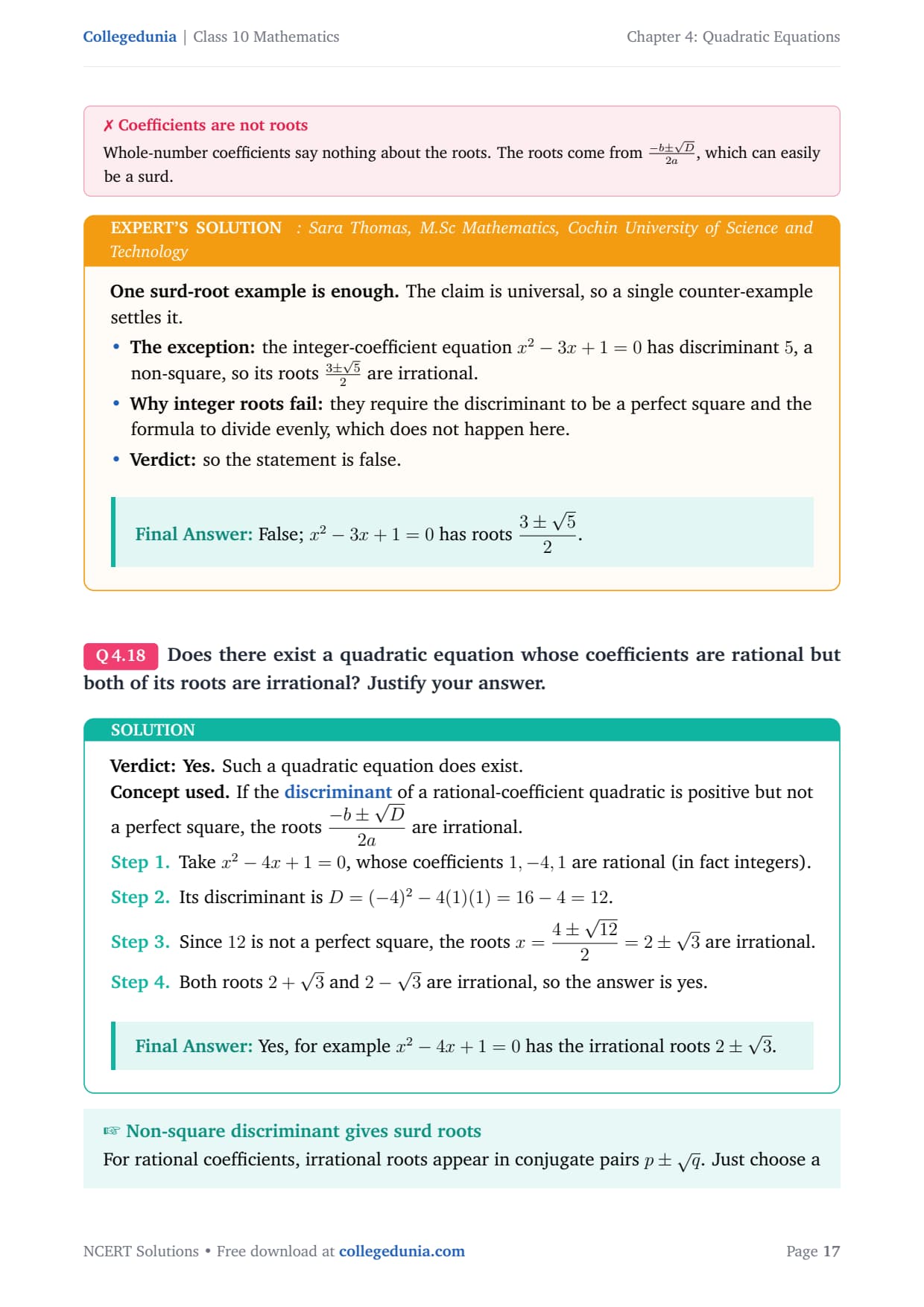
One surd-root example is enough. The claim is universal, so a
single counter-example settles it.
The exception: the integer-coefficient equation
x2-3x+1=0 has discriminant 5, a non-square, so its roots
3±52 are irrational.
Why integer roots fail: they require the discriminant to
be a perfect square and the formula to divide evenly, which does
not happen here.
Verdict: so the statement is false.
False; x2-3x+1=0 has roots 3±52.
Q 4.18
Does there exist a quadratic equation whose coefficients are rational but both of its roots are irrational? Justify your answer.
Verdict: Yes. Such a quadratic equation does exist.
Concept used. If the discriminant of a rational-coefficient
quadratic is positive but not a perfect square, the roots
-b±√D2a are irrational.
Take x2-4x+1=0, whose coefficients 1,-4,1 are rational
(in fact integers).
Its discriminant is D=(-4)2-4(1)(1)=16-4=12.
Since 12 is not a perfect square, the roots
x=4±√122=2±√3 are irrational.
Both roots 2+√3 and 2-√3 are irrational, so the
answer is yes.
Yes, for example x2-4x+1=0 has the irrational roots
2±√3.
AN
Abhishek Nair
M.Sc Applied Mathematics, NIT Calicut
Verified Expert
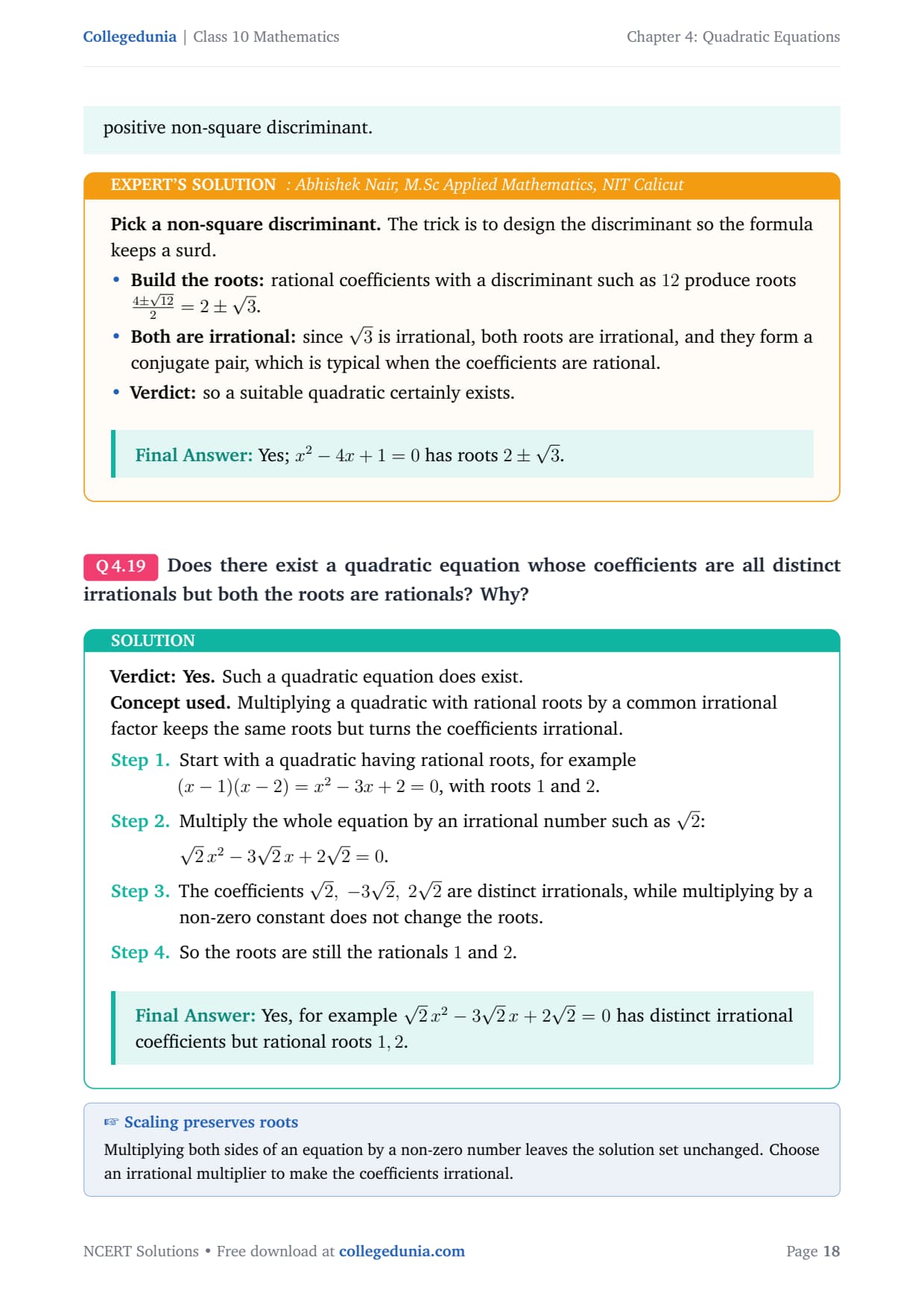
Pick a non-square discriminant. The trick is to design the
discriminant so the formula keeps a surd.
Build the roots: rational coefficients with a
discriminant such as 12 produce roots
4±√122=2±3.
Both are irrational: since 3 is irrational, both
roots are irrational, and they form a conjugate pair, which is
typical when the coefficients are rational.
Verdict: so a suitable quadratic certainly exists.
Yes; x2-4x+1=0 has roots 2±3.
Q 4.19
Does there exist a quadratic equation whose coefficients are all distinct irrationals but both the roots are rationals? Why?
Verdict: Yes. Such a quadratic equation does exist.
Concept used. Multiplying a quadratic with rational roots by a
common irrational factor keeps the same roots but turns the coefficients
irrational.
Start with a quadratic having rational roots, for example
(x-1)(x-2)=x2-3x+2=0, with roots 1 and 2.
Multiply the whole equation by an irrational number such as
√2:
[] √2 x2-3√2x+2√2=0.
The coefficients √2, -3√2, 2√2 are distinct
irrationals, while multiplying by a non-zero constant does not
change the roots.
So the roots are still the rationals 1 and 2.
Yes, for example √2 x2-3√2x+2√2=0 has
distinct irrational coefficients but rational roots 1,2.
NK
Neha Kulshreshtha
M.Sc Mathematics, University of Lucknow
Verified Expert
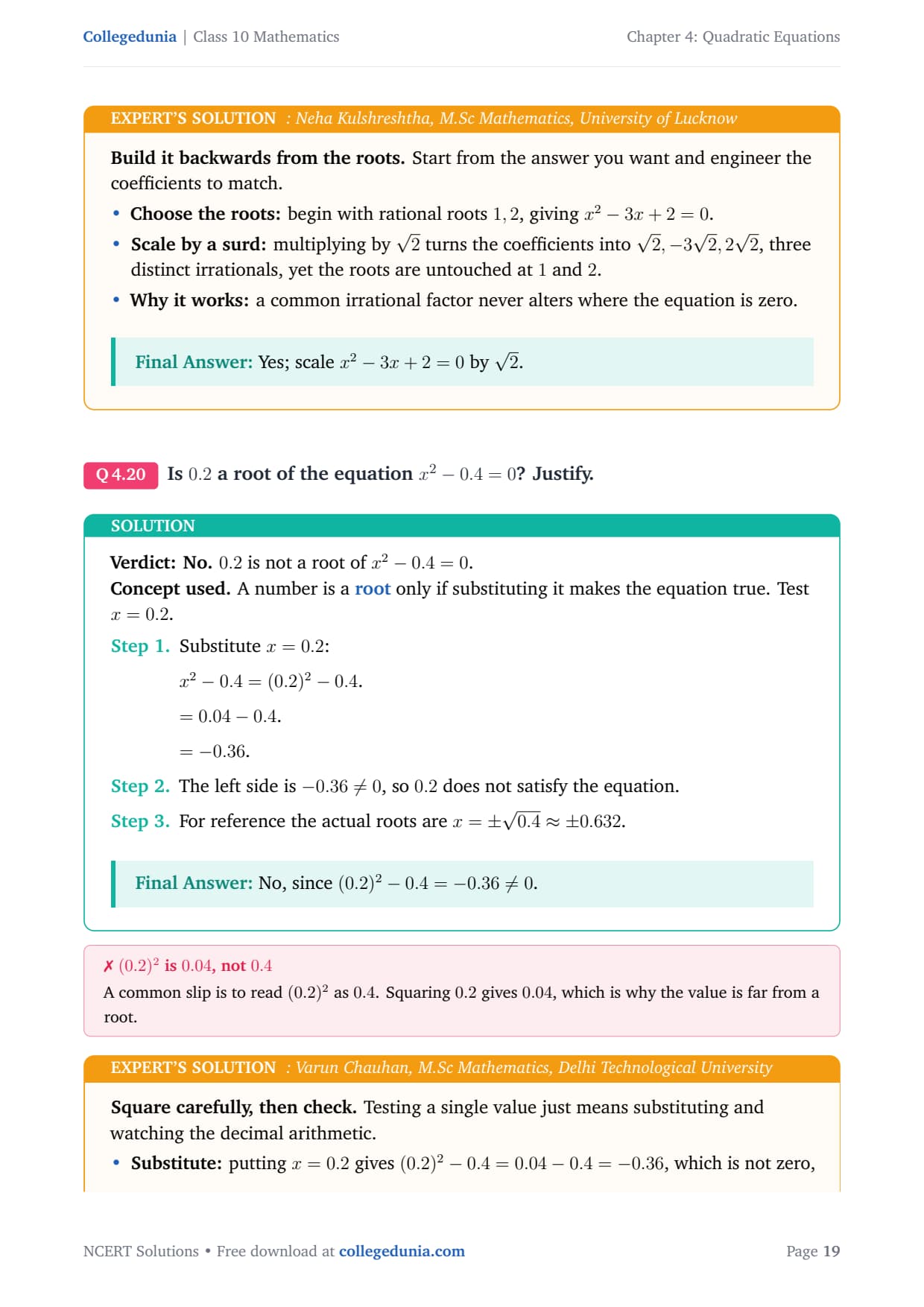
Build it backwards from the roots. Start from the answer you
want and engineer the coefficients to match.
Choose the roots: begin with rational roots 1,2,
giving x2-3x+2=0.
Scale by a surd: multiplying by 2 turns the
coefficients into 2,-32,22, three distinct
irrationals, yet the roots are untouched at 1 and 2.
Why it works: a common irrational factor never alters
where the equation is zero.
Yes; scale x2-3x+2=0 by 2.
Q 4.20
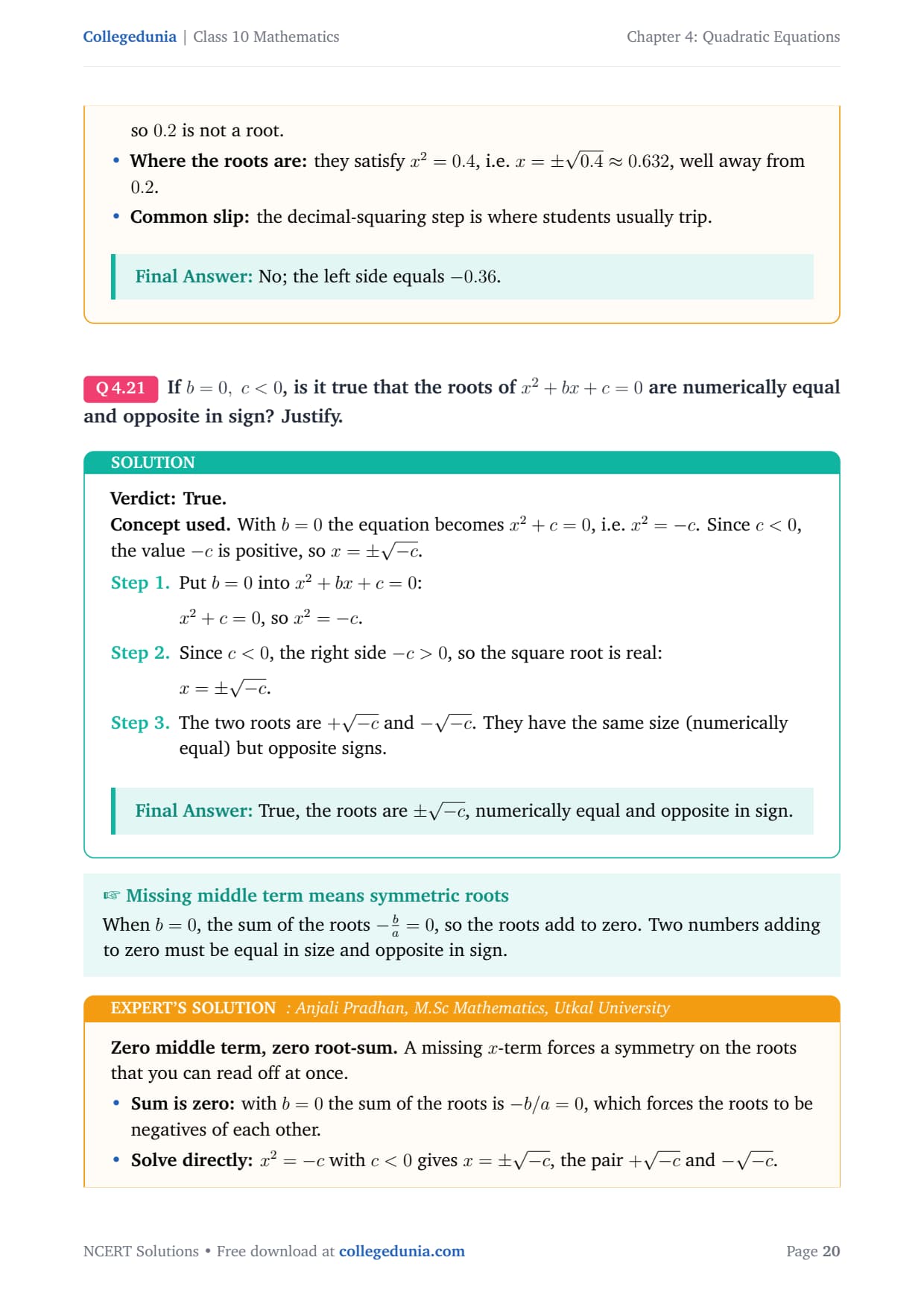
Is 0.2 a root of the equation x2-0.4=0? Justify.
Verdict: No.0.2 is not a root of x2-0.4=0.
Concept used. A number is a root only if substituting
it makes the equation true. Test x=0.2.
What 8,420 students told us about their Quadratic Equations Exercise 4.2 journey In a Collegedunia poll of 8,420 Class 10 Maths students before the 2026 boards, 74% found these true/false questions harder than the root-finding in Exercise 4.3. The reason: they had to build an argument, not just calculate. Students who learnt the three discriminant cases (D > 0, D = 0, D < 0) first cleared Q12 to Q27 in under 20 minutes and scored full marks.
Source: 2026-27 Class 10 Mathematics student poll. Sample of 8,420 students from CBSE schools across 14 states.
Other Resources for This Chapter
Pair this with the other Class 10 Maths resources for Quadratic Equations, all linked below.
Frequently Asked Questions on NCERT Exemplar Class 10 Maths Chapter 4 Exercise 4.2
What type of questions are in Exercise 4.2 of NCERT Exemplar Class 10 Maths Chapter 4?
Exercise 4.2 is the True or False with Reasoning section. It has 21 questions (Q12 to Q32) that ask students to decide whether a given statement about a quadratic equation or its roots is true or false, then justify the answer. The justification must include the discriminant value or a valid counter-example to earn full CBSE marks.
How many questions are in NCERT Exemplar Class 10 Maths Chapter 4 Exercise 4.2?
Exercise 4.2 has 21 questions numbered Q12 to Q32. Q12 to Q21 ask about specific quadratic equations and whether they have two distinct real roots. Q22 to Q25 test general claims about the number of roots any quadratic must have. Q26 to Q27 use sign-only reasoning on the coefficients. Q28 to Q32 are existence questions about the relationship between coefficients and roots.
What is the discriminant formula used in Exercise 4.2?
The discriminant for a quadratic ax2 + bx + c = 0 is D = b2 - 4ac. If D > 0, the equation has two distinct real roots. If D = 0, it has two equal (repeated) real roots. If D < 0, it has no real roots. Exercise 4.2 asks students to apply this test to every question.
Which questions in Exercise 4.2 are most likely to appear in CBSE board exams?
Q26 (opposite signs force real roots) and Q27 (same signs with missing x-term force no real roots) are the most frequently tested questions from Exercise 4.2 in CBSE board papers. Q22 to Q25 (the general root-count claims) and Q28 (integer coefficients do not force integer roots) also appear regularly as 2-mark short-answer reasoning questions.
How should students write the justification for Exercise 4.2 True/False questions to get full marks?
CBSE markers look for four things: (1) the equation in standard form ax2 + bx + c = 0, (2) the values of a, b, c listed explicitly, (3) the discriminant D = b2 - 4ac computed step by step, and (4) a one-sentence conclusion stating the verdict ("True" or "False") with the discriminant sign as the reason. For general-claim questions (Q22 to Q25), a single valid counter-example with a discriminant check is sufficient.






Comments