Junior-Class Mentor, TFI Fellow | Updated 3+ months ago
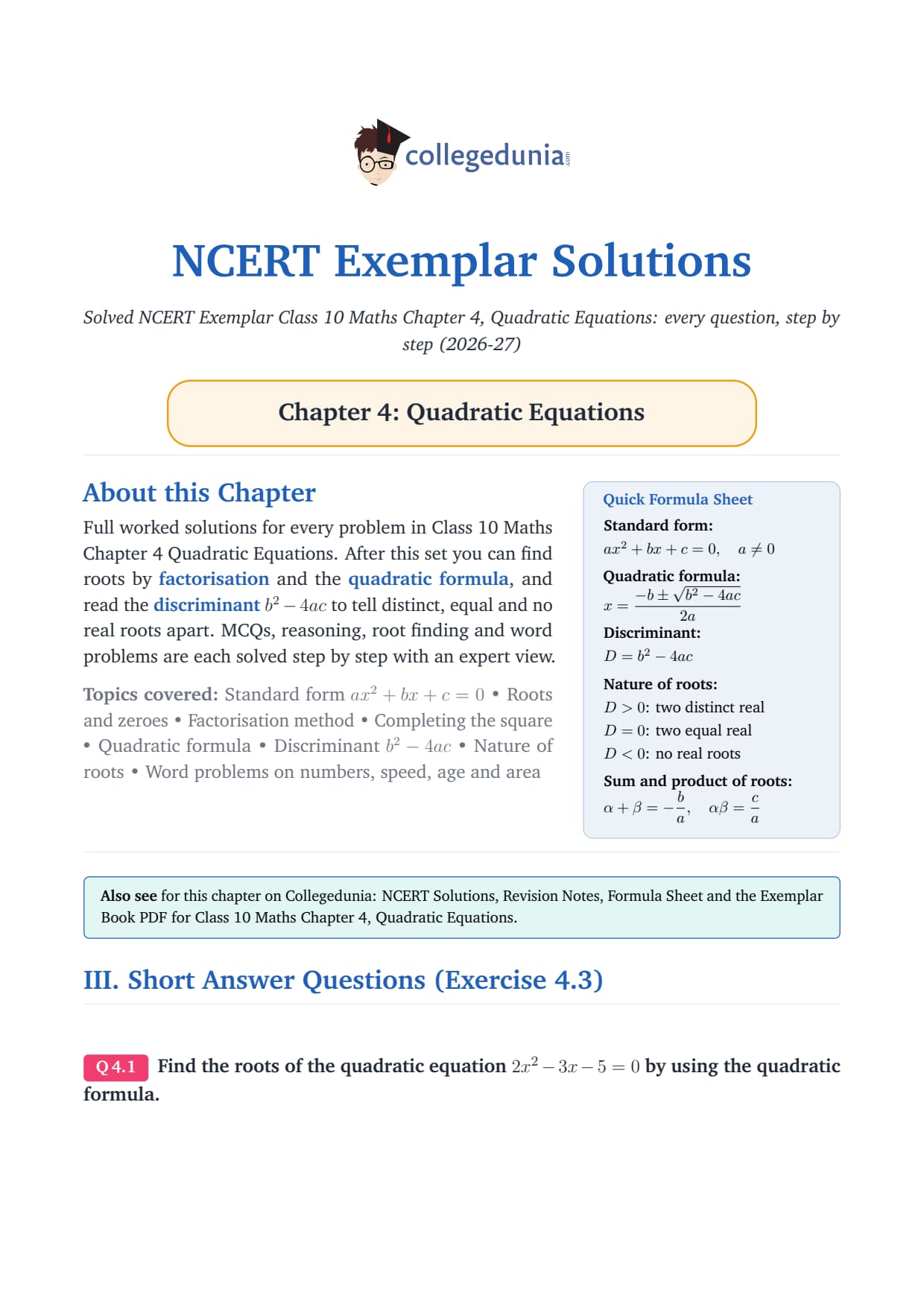
Exercise 4.3 of NCERT Exemplar Class 10 Maths Chapter 4 Quadratic Equations is the Short Answer section. It has 12 questions, Q33 to Q44. You find the roots using the quadratic formula or by factorisation, even when the coefficients are surds or fractions. All of it follows the 2026-27 CBSE syllabus.
Scope: 12 Short Answer questions (Q33 to Q44). Seven use the formula, five use factorisation.
Skills tested: computing the discriminant, simplifying surds, clearing fractions, and spotting perfect-square quadratics.
Board value: the chapter carries 4 to 6 marks, with Short Answer questions worth 3 marks each.
Every solution here is verified by subject experts and follows the 2026-27 CBSE NCERT Exemplar book exactly.
Solved by Collegedunia - All 12 Short Answer questions of Exercise 4.3 with detailed step-by-step solutions and expert insights.
Exercise 4.3 is the Short Answer section. It has 12 questions, Q33 to Q44, split across two root-finding methods.
Formula questions (Q33 to Q39): seven sums using x = (-b ± √(b² - 4ac)) / 2a with integer, negative, surd and fractional coefficients.
Factorisation questions (Q40 to Q44): five sums using middle-term splitting after clearing fractions or surds.
Special case (Q44): a perfect-square quadratic with a repeated root, which tests discriminant recognition.
Learn both methods and switch between them. The quadratic formula always works, but factorisation is faster when the discriminant is a perfect square.
One habit: compute the discriminant D = b² - 4ac first in every sum. If D is a perfect square, factorisation is clean. If not, carry the surd through the formula.
Key Quadratic Equations Formulas for Exercise 4.3
Both methods start from the standard form ax² + bx + c = 0. Review this table before you begin.
Method / Formula
When to Use
Key Step
Quadratic formula
All Q33-Q39; also when factorisation is not obvious
x = (-b ± √D) / 2a after computing D = b² - 4ac
Middle-term splitting
Q40-Q43 after clearing fractions
Find two numbers with product ac and sum b; split and group
Clearing fractions
Q40, Q41, Q44 (fractional coefficients)
Multiply through by the LCM of all denominators before solving
Surd simplification
Q37, Q38, Q39, Q42, Q43
Pull out the largest perfect square: √32 = 4√2; add like surd terms
Perfect square recognition
Q44 (repeated root)
If first and last terms are squares and middle = twice their product, use (p - q)²
Rationalisation
Q42 (surd in denominator)
Multiply top and bottom by the surd to clear the denominator
Quick Tip: when a is negative (Q35, Q36), the formula still works. The denominator 2a is negative, so it flips the sign of both numerator values. Track this sign flip carefully on the + and - branches.
All 12 Exercise 4.3 Solutions with Step-by-Step Working
III. Short Answer Questions (Exercise 4.3)
Q 4.1
Find the roots of the quadratic equation 2x2-3x-5=0 by using the quadratic formula.
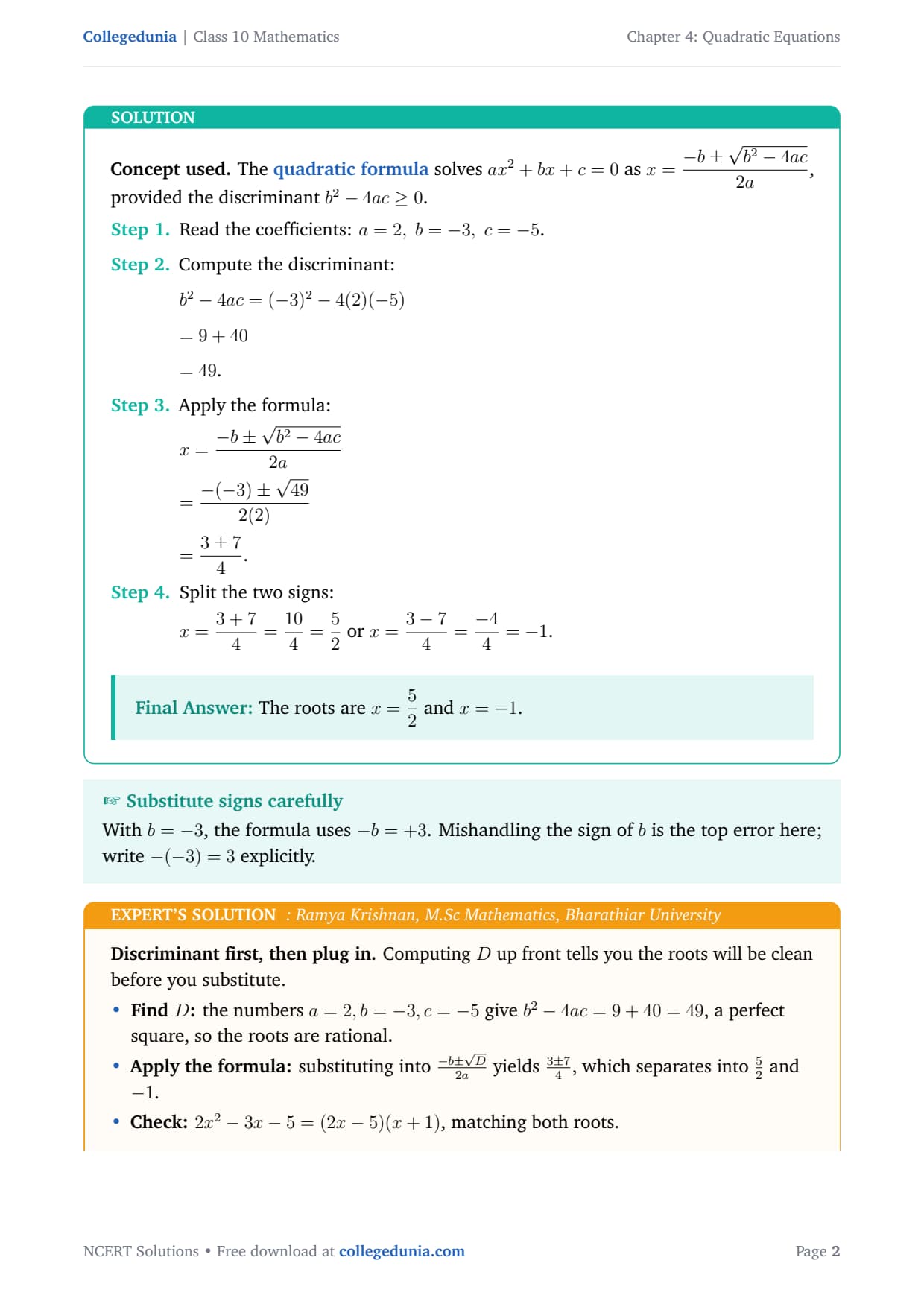
Concept used. The quadratic formula solves
ax2+bx+c=0 as x=-b±√b2-4ac2a, provided the
discriminant b2-4ac≥ 0.
Read the coefficients: a=2, b=-3, c=-5.
Compute the discriminant:
[] b2-4ac=(-3)2-4(2)(-5)
[] =9+40
[] =49.
Apply the formula:
[] x=-b±√b2-4ac2a
[] =-(-3)±√492(2)
[] =3± 74.
Split the two signs:
[] x=3+74=104=52 or
x=3-74=-44=-1.
The roots are x=52 and x=-1.
RK
Ramya Krishnan
M.Sc Mathematics, Bharathiar University
Verified Expert
Discriminant first, then plug in. Computing D up front tells
you the roots will be clean before you substitute.
Find D: the numbers a=2,b=-3,c=-5 give
b2-4ac=9+40=49, a perfect square, so the roots are rational.
Apply the formula: substituting into
-b±D2a yields 374, which
separates into 52 and -1.
Check:2x2-3x-5=(2x-5)(x+1), matching both roots.
x=52, -1.
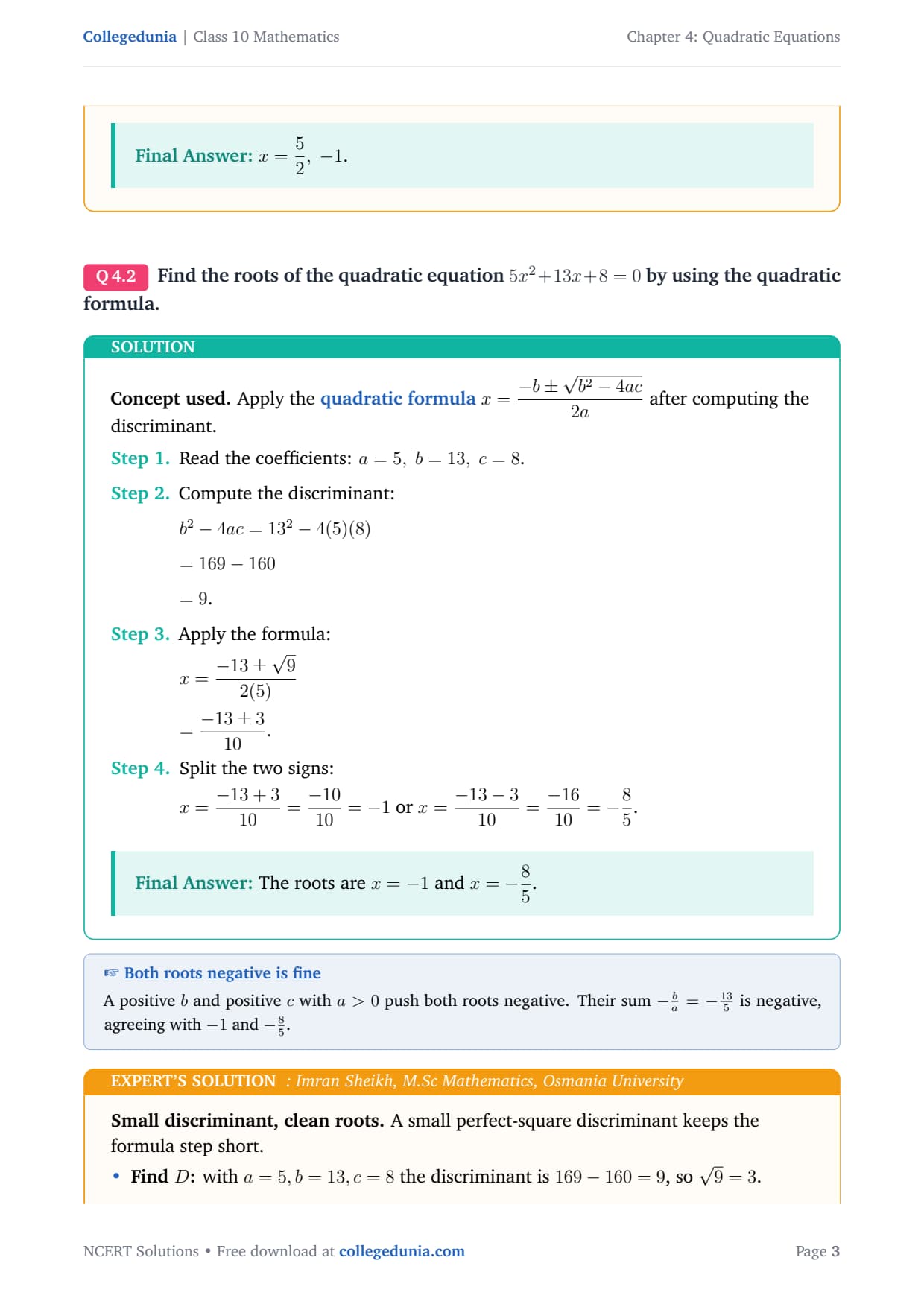
Q 4.2
Find the roots of the quadratic equation 5x2+13x+8=0 by using the quadratic formula.
Concept used. Apply the quadratic formulax=-b±√b2-4ac2a after computing the discriminant.
Read the coefficients: a=5, b=13, c=8.
Compute the discriminant:
[] b2-4ac=132-4(5)(8)
[] =169-160
[] =9.
Apply the formula:
[] x=-13±√92(5)
[] =-13± 310.
Split the two signs:
[] x=-13+310=-1010=-1 or
x=-13-310=-1610=-85.
The roots are x=-1 and x=-85.
IS
Imran Sheikh
M.Sc Mathematics, Osmania University
Verified Expert
Small discriminant, clean roots. A small perfect-square
discriminant keeps the formula step short.
Find D: with a=5,b=13,c=8 the discriminant is
169-160=9, so 9=3.
Apply the formula: it gives -13310,
splitting into -1 and -85.
Check: the factorisation 5x2+13x+8=(x+1)(5x+8)
confirms the same two negative roots.
x=-1, -85.
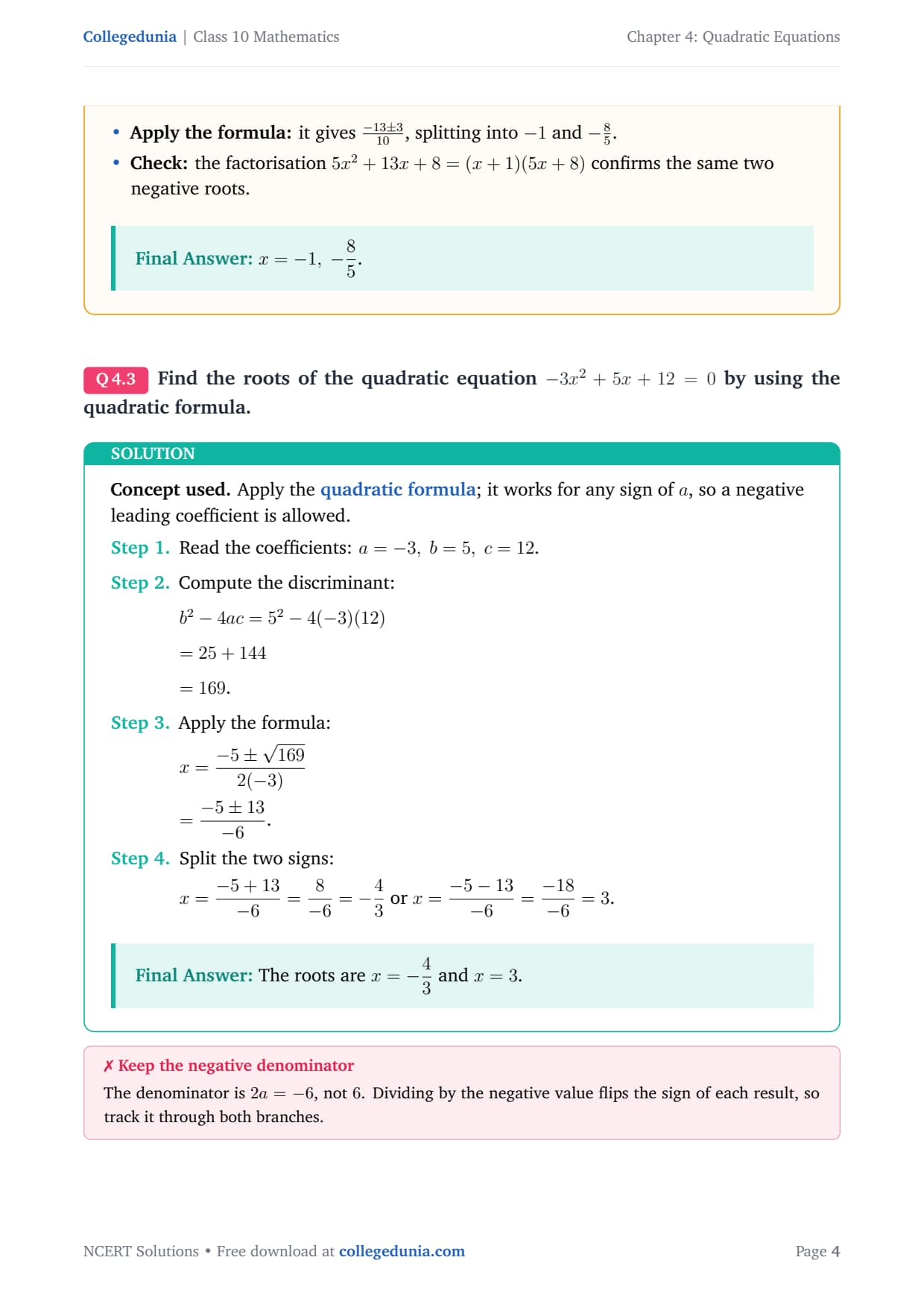
Q 4.3
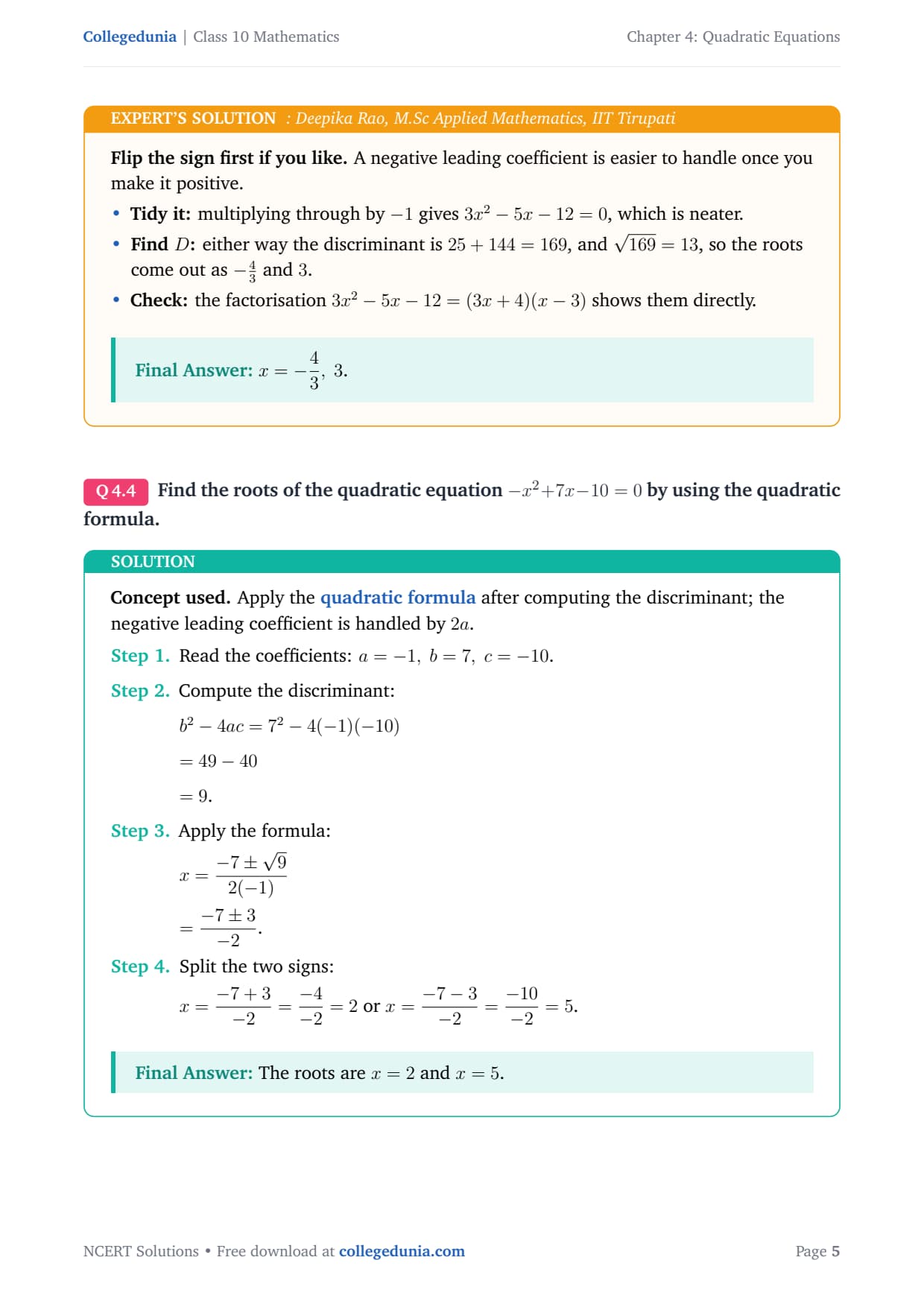
Find the roots of the quadratic equation -3x2+5x+12=0 by using the quadratic formula.
Concept used. Apply the quadratic formula; it works for
any sign of a, so a negative leading coefficient is allowed.
Read the coefficients: a=-3, b=5, c=12.
Compute the discriminant:
[] b2-4ac=52-4(-3)(12)
[] =25+144
[] =169.
Apply the formula:
[] x=-5±√1692(-3)
[] =-5± 13-6.
Split the two signs:
[] x=-5+13-6=8-6=-43 or
x=-5-13-6=-18-6=3.
The roots are x=-43 and x=3.
DR
Deepika Rao
M.Sc Applied Mathematics, IIT Tirupati
Verified Expert
Flip the sign first if you like. A negative leading coefficient
is easier to handle once you make it positive.
Tidy it: multiplying through by -1 gives
3x2-5x-12=0, which is neater.
Find D: either way the discriminant is 25+144=169,
and √169=13, so the roots come out as -43 and 3.
Check: the factorisation 3x2-5x-12=(3x+4)(x-3) shows
them directly.
x=-43, 3.
Q 4.4
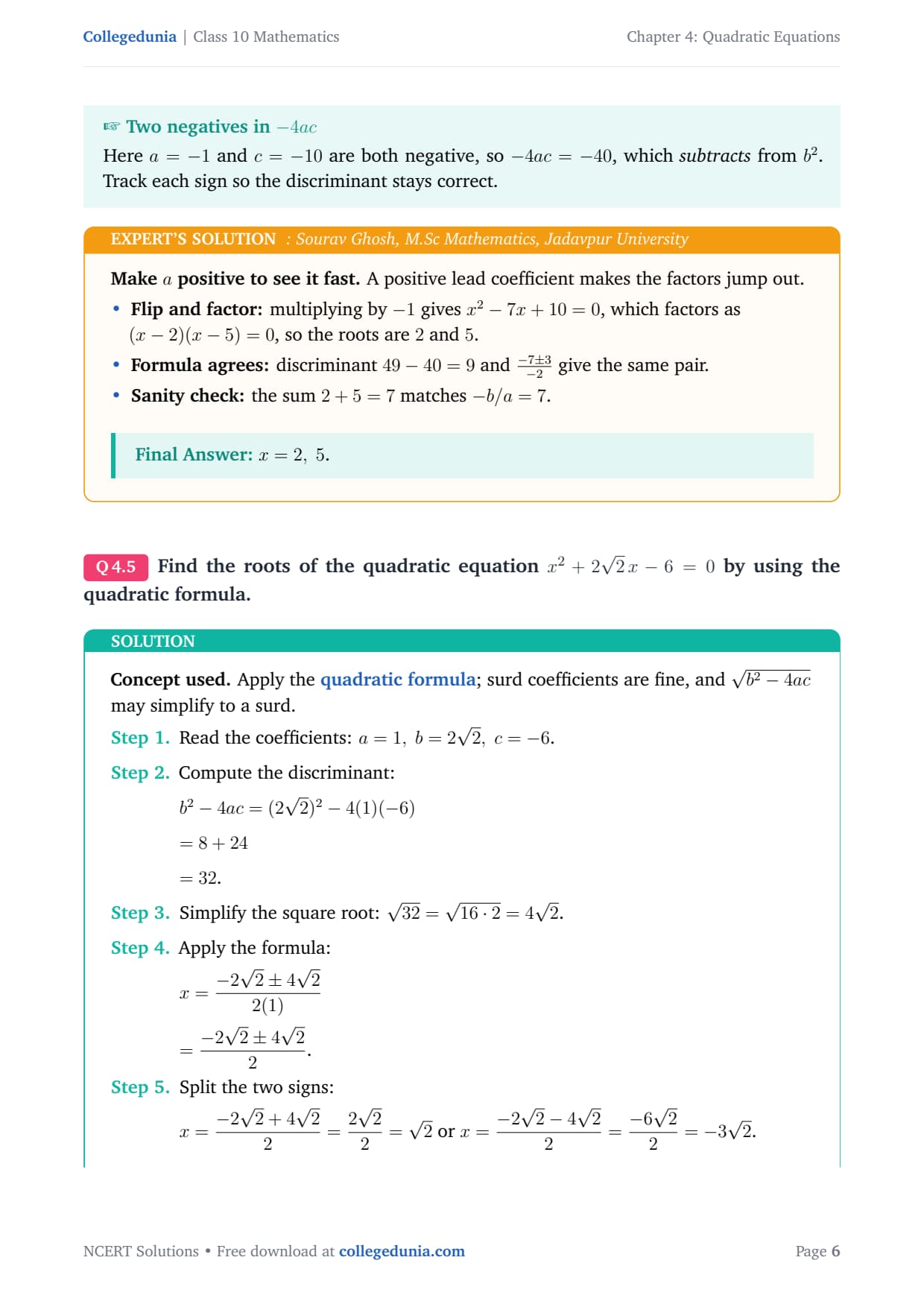
Find the roots of the quadratic equation -x2+7x-10=0 by using the quadratic formula.
Concept used. Apply the quadratic formula after
computing the discriminant; the negative leading coefficient is handled by
2a.
Read the coefficients: a=-1, b=7, c=-10.
Compute the discriminant:
[] b2-4ac=72-4(-1)(-10)
[] =49-40
[] =9.
Apply the formula:
[] x=-7±√92(-1)
[] =-7± 3-2.
Split the two signs:
[] x=-7+3-2=-4-2=2 or
x=-7-3-2=-10-2=5.
The roots are x=2 and x=5.
SG
Sourav Ghosh
M.Sc Mathematics, Jadavpur University
Verified Expert
Make a positive to see it fast. A positive lead coefficient
makes the factors jump out.
Flip and factor: multiplying by -1 gives
x2-7x+10=0, which factors as (x-2)(x-5)=0, so the roots
are 2 and 5.
Formula agrees: discriminant 49-40=9 and
-73-2 give the same pair.
Sanity check: the sum 2+5=7 matches -b/a=7.
x=2, 5.
Q 4.5
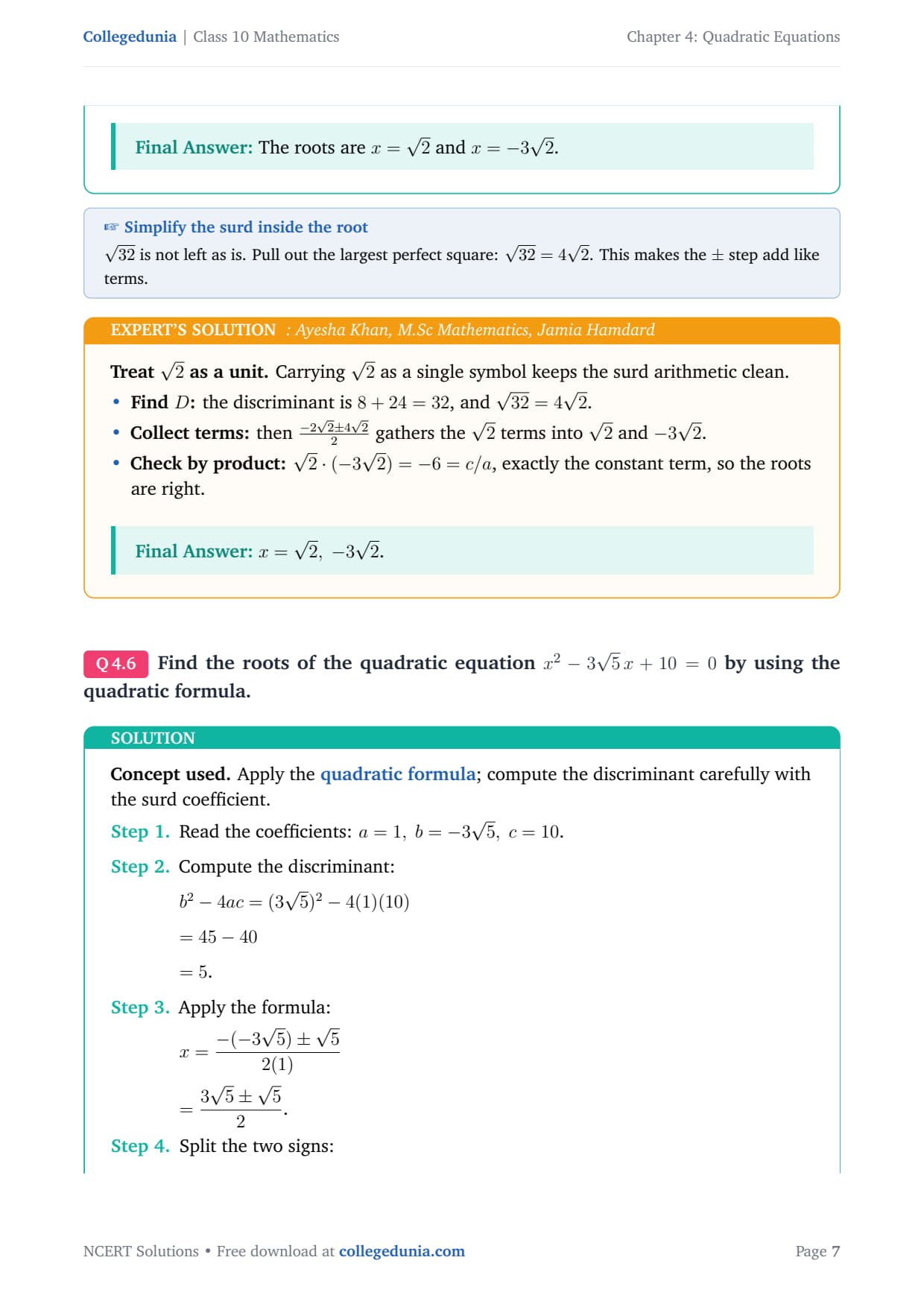
Find the roots of the quadratic equation x2+2√2x-6=0 by using the quadratic formula.
Concept used. Apply the quadratic formula; surd
coefficients are fine, and √b2-4ac may simplify to a surd.
Read the coefficients: a=1, b=2√2, c=-6.
Compute the discriminant:
[] b2-4ac=(2√2)2-4(1)(-6)
[] =8+24
[] =32.
Simplify the square root: √32=√16· 2=4√2.
Apply the formula:
[] x=-2√2± 4√22(1)
[] =-2√2± 4√22.
Split the two signs:
[] x=-2√2+4√22=2√22=√2
or x=-2√2-4√22=-6√22=-3√2.
The roots are x=√2 and x=-3√2.
AK
Ayesha Khan
M.Sc Mathematics, Jamia Hamdard
Verified Expert
Treat 2 as a unit. Carrying 2 as a single symbol
keeps the surd arithmetic clean.
Find D: the discriminant is 8+24=32, and
√32=42.
Collect terms: then -22422
gathers the 2 terms into 2 and -32.
Check by product:2·(-32)=-6=c/a, exactly
the constant term, so the roots are right.
x=√2, -3√2.
Q 4.6
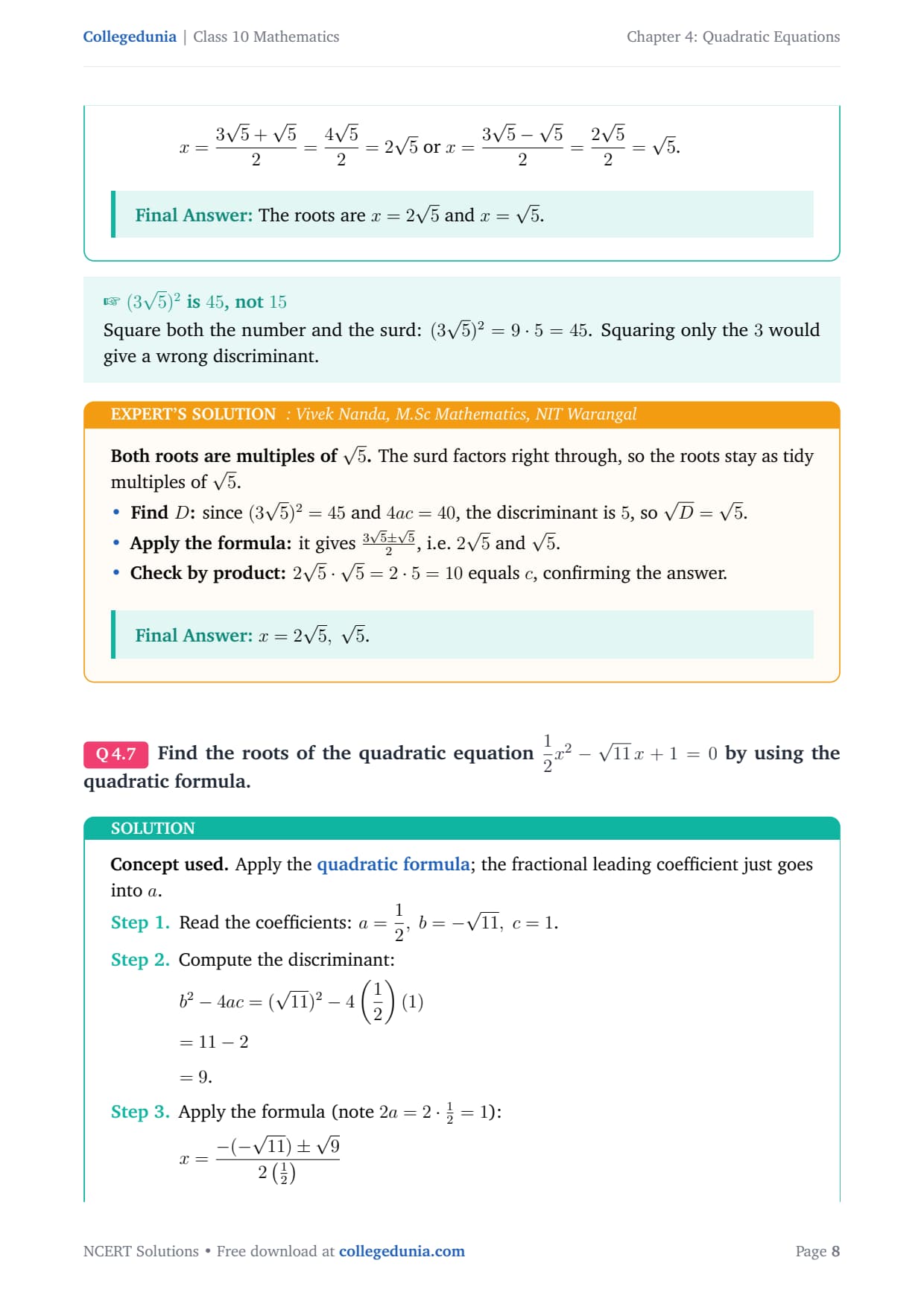
Find the roots of the quadratic equation x2-3√5x+10=0 by using the quadratic formula.
Concept used. Apply the quadratic formula; compute the
discriminant carefully with the surd coefficient.
Read the coefficients: a=1, b=-3√5, c=10.
Compute the discriminant:
[] b2-4ac=(3√5)2-4(1)(10)
[] =45-40
[] =5.
Apply the formula:
[] x=-(-3√5)±√52(1)
[] =3√5±√52.
Split the two signs:
[] x=3√5+√52=4√52=2√5
or x=3√5-√52=2√52=√5.
The roots are x=2√5 and x=√5.
VN
Vivek Nanda
M.Sc Mathematics, NIT Warangal
Verified Expert
Both roots are multiples of 5. The surd factors right
through, so the roots stay as tidy multiples of 5.
Find D: since (35)2=45 and 4ac=40, the
discriminant is 5, so D=5.
Apply the formula: it gives 35±52,
i.e. 25 and 5.
Check by product:25·5=25=10 equals
c, confirming the answer.
x=2√5, √5.
Q 4.7
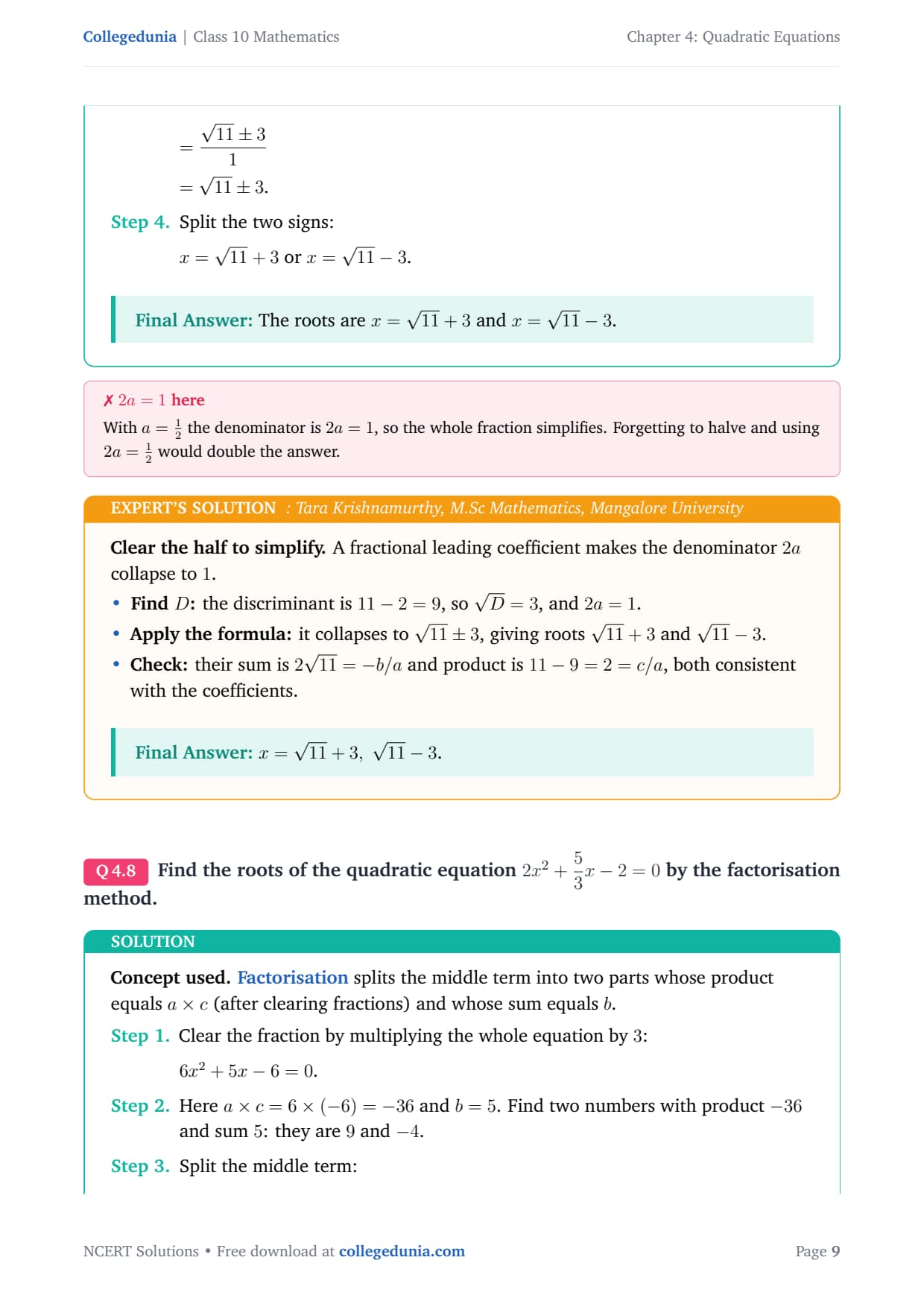
Find the roots of the quadratic equation 12x2-√11x+1=0 by using the quadratic formula.
Concept used. Apply the quadratic formula; the
fractional leading coefficient just goes into a.
Read the coefficients: a=12, b=-√11, c=1.
Compute the discriminant:
[] b2-4ac=(√11)2-4(12)(1)
[] =11-2
[] =9.
Apply the formula (note 2a=2·12=1):
[] x=-(-√11)±√92(12)
[] =√11± 31
[] =√11± 3.
Split the two signs:
[] x=√11+3 or x=√11-3.
The roots are x=√11+3 and x=√11-3.
TK
Tara Krishnamurthy
M.Sc Mathematics, Mangalore University
Verified Expert
Clear the half to simplify. A fractional leading coefficient
makes the denominator 2a collapse to 1.
Find D: the discriminant is 11-2=9, so D=3,
and 2a=1.
Apply the formula: it collapses to √113,
giving roots √11+3 and √11-3.
Check: their sum is 2√11=-b/a and product is
11-9=2=c/a, both consistent with the coefficients.
x=√11+3, √11-3.
Q 4.8
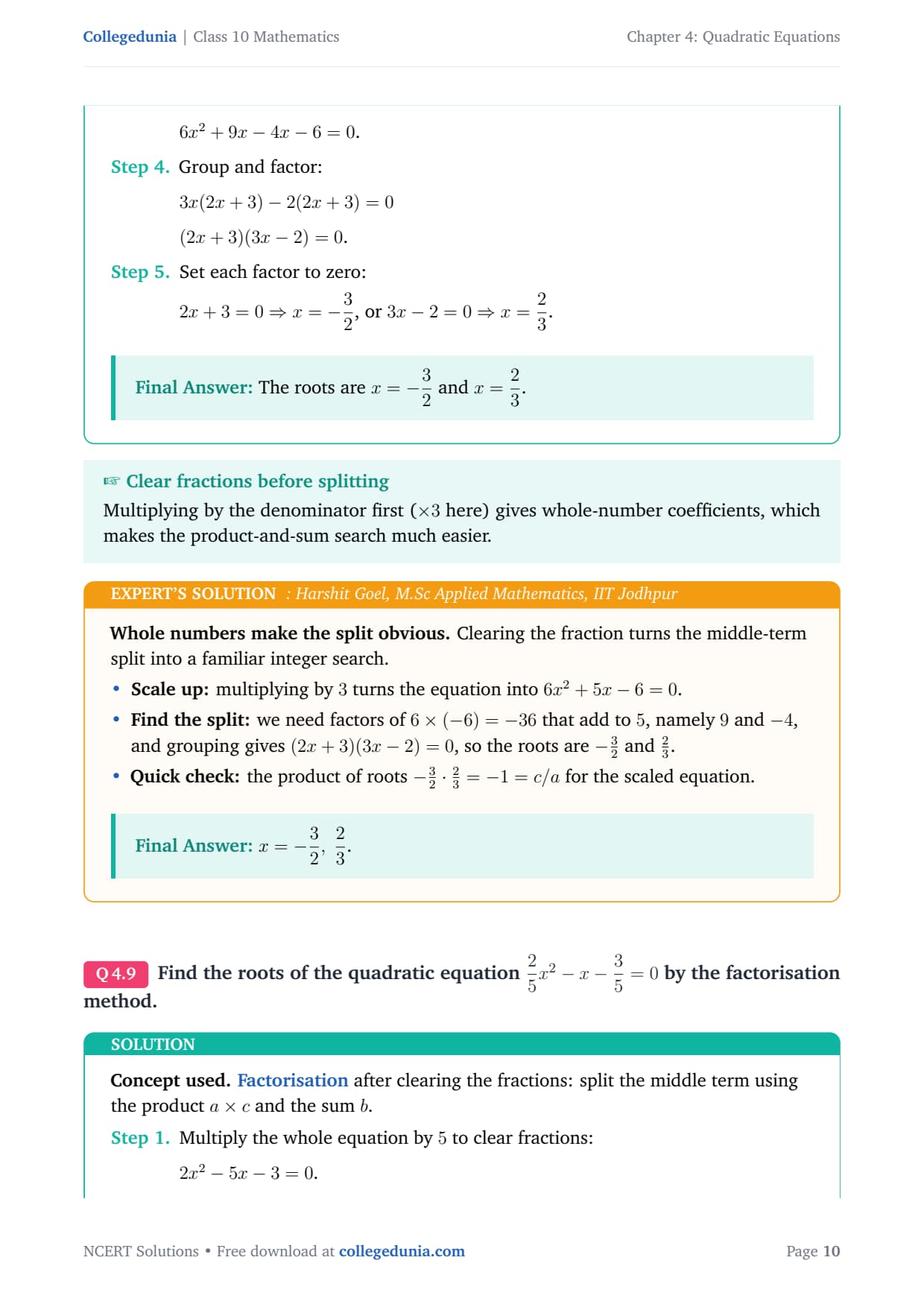
Find the roots of the quadratic equation 2x2+53x-2=0 by the factorisation method.
Concept used.Factorisation splits the middle term into
two parts whose product equals a× c (after clearing fractions) and
whose sum equals b.
Clear the fraction by multiplying the whole equation by 3:
[] 6x2+5x-6=0.
Here a× c=6×(-6)=-36 and b=5. Find two numbers with
product -36 and sum 5: they are 9 and -4.
Split the middle term:
[] 6x2+9x-4x-6=0.
Group and factor:
[] 3x(2x+3)-2(2x+3)=0
[] (2x+3)(3x-2)=0.
Set each factor to zero:
[] 2x+3=0⇒ x=-32, or
3x-2=0⇒ x=23.
The roots are x=-32 and x=23.
HG
Harshit Goel
M.Sc Applied Mathematics, IIT Jodhpur
Verified Expert
Whole numbers make the split obvious. Clearing the fraction
turns the middle-term split into a familiar integer search.
Scale up: multiplying by 3 turns the equation into
6x2+5x-6=0.
Find the split: we need factors of 6×(-6)=-36
that add to 5, namely 9 and -4, and grouping gives
(2x+3)(3x-2)=0, so the roots are -32 and 23.
Quick check: the product of roots
-32·23=-1=c/a for the scaled equation.
x=-32, 23.
Q 4.9
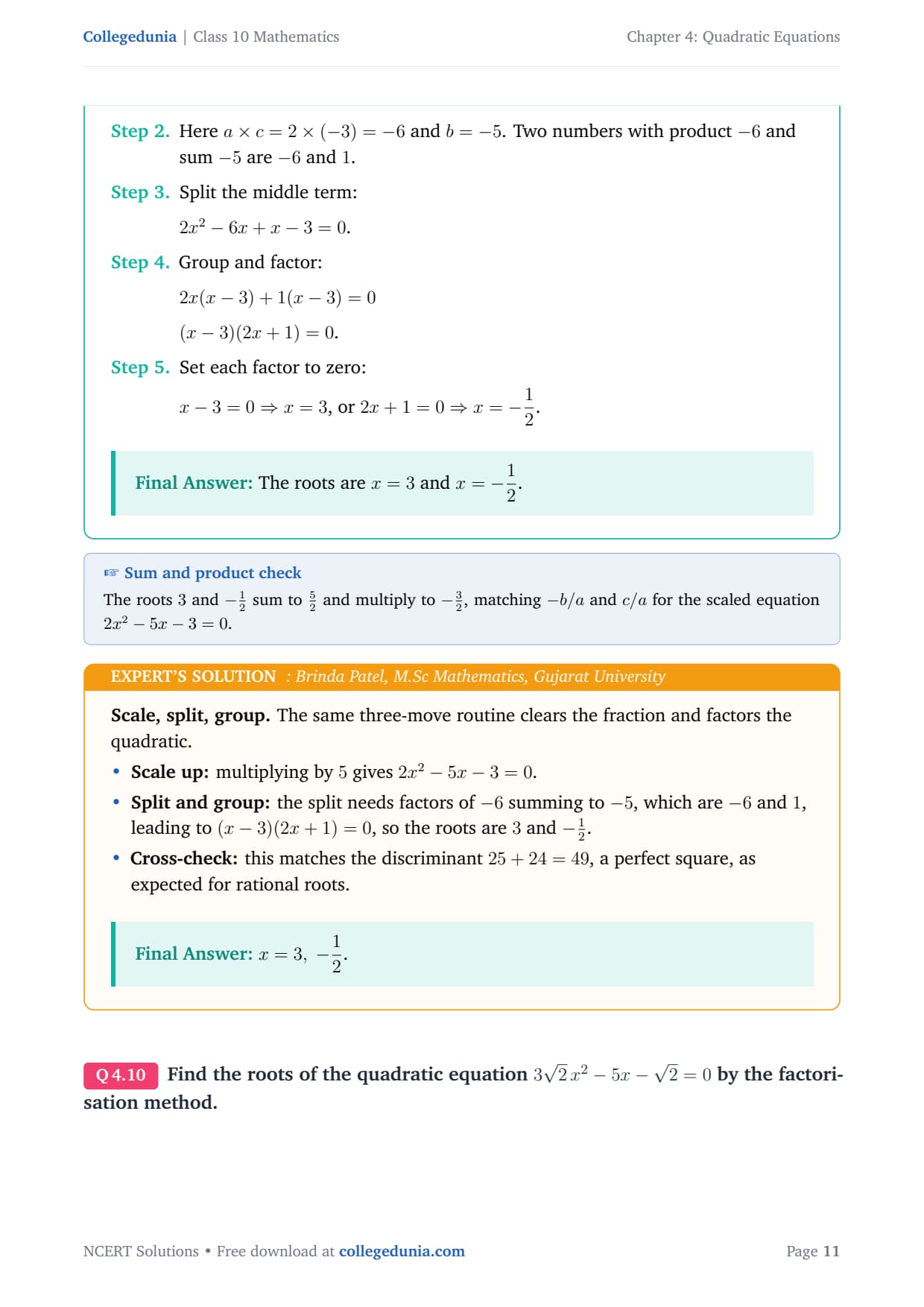
Find the roots of the quadratic equation 25x2-x-35=0 by the factorisation method.
Concept used.Factorisation after clearing the
fractions: split the middle term using the product a× c and the sum
b.
Multiply the whole equation by 5 to clear fractions:
[] 2x2-5x-3=0.
Here a× c=2×(-3)=-6 and b=-5. Two numbers with
product -6 and sum -5 are -6 and 1.
Split the middle term:
[] 2x2-6x+x-3=0.
Group and factor:
[] 2x(x-3)+1(x-3)=0
[] (x-3)(2x+1)=0.
Set each factor to zero:
[] x-3=0⇒ x=3, or
2x+1=0⇒ x=-12.
The roots are x=3 and x=-12.
BP
Brinda Patel
M.Sc Mathematics, Gujarat University
Verified Expert
Scale, split, group. The same three-move routine clears the
fraction and factors the quadratic.
Scale up: multiplying by 5 gives 2x2-5x-3=0.
Split and group: the split needs factors of -6 summing
to -5, which are -6 and 1, leading to (x-3)(2x+1)=0, so
the roots are 3 and -12.
Cross-check: this matches the discriminant 25+24=49, a
perfect square, as expected for rational roots.
x=3, -12.
Q 4.10
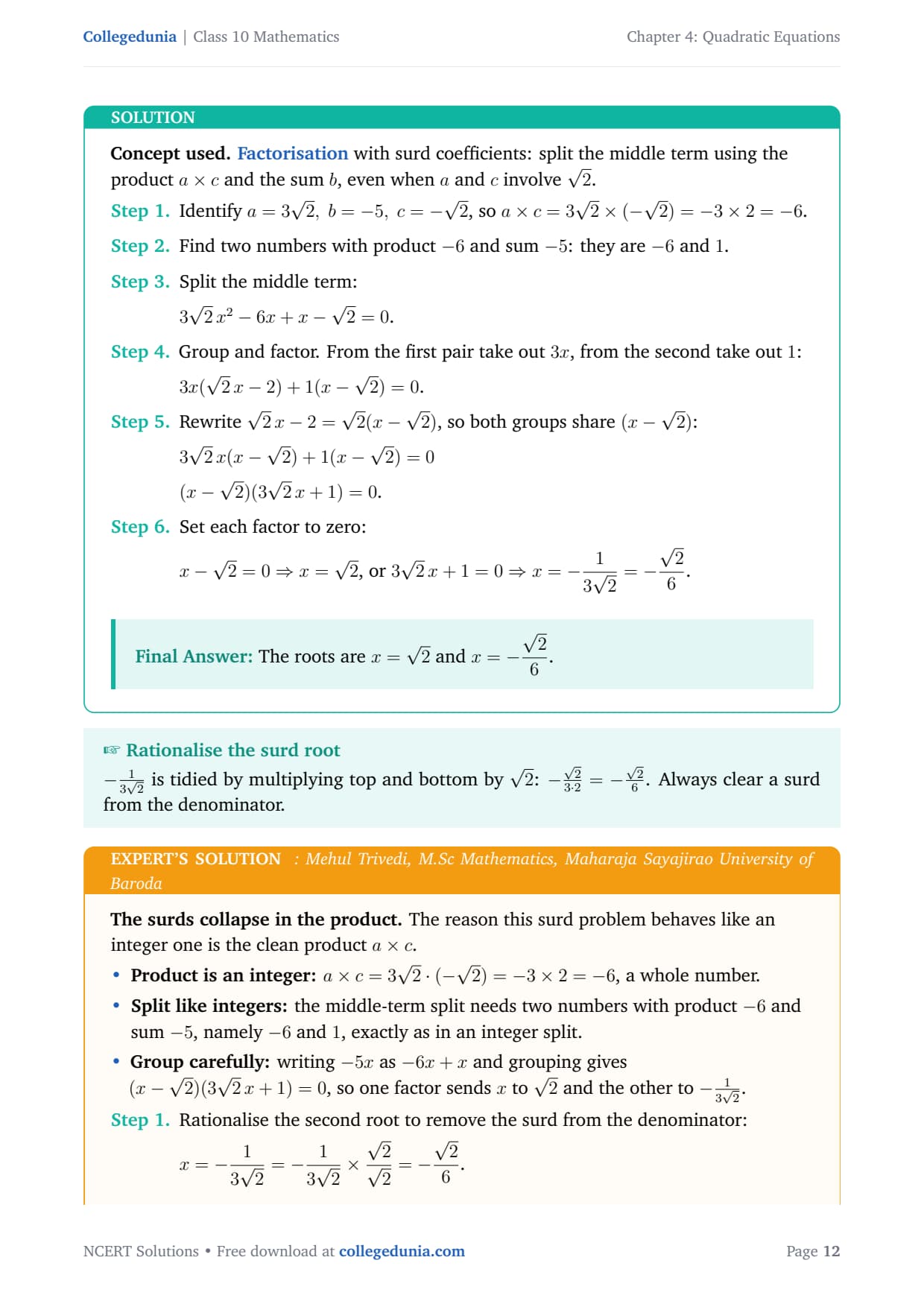
Find the roots of the quadratic equation 3√2 x2-5x-√2=0 by the factorisation method.
Concept used.Factorisation with surd coefficients:
split the middle term using the product a× c and the sum b, even
when a and c involve √2.
Identify a=3√2, b=-5, c=-√2, so
a× c=3√2×(-√2)=-3× 2=-6.
Find two numbers with product -6 and sum -5: they are -6 and
1.
Split the middle term:
[] 3√2 x2-6x+x-√2=0.
Group and factor. From the first pair take out 3x, from the
second take out 1:
[] 3x(√2x-2)+1(x-√2)=0.
Rewrite √2x-2=√2(x-√2), so both groups share
(x-√2):
[] 3√2x(x-√2)+1(x-√2)=0
[] (x-√2)(3√2x+1)=0.
Set each factor to zero:
[] x-√2=0⇒ x=√2, or
3√2x+1=0⇒ x=-13√2=-√26.
The roots are x=√2 and x=-√26.
MT
Mehul Trivedi
M.Sc Mathematics, Maharaja Sayajirao University of Baroda
Verified Expert
The surds collapse in the product. The reason this surd problem
behaves like an integer one is the clean product a× c.
Product is an integer:a×
c=32·(-2)=-32=-6, a whole number.
Split like integers: the middle-term split needs two
numbers with product -6 and sum -5, namely -6 and 1,
exactly as in an integer split.
Group carefully: writing -5x as -6x+x and grouping
gives (x-2)(32 x+1)=0, so one factor sends x to
2 and the other to -132.
Rationalise the second root to remove the surd from the
denominator:
[] x=-132=-132×
22=-26.
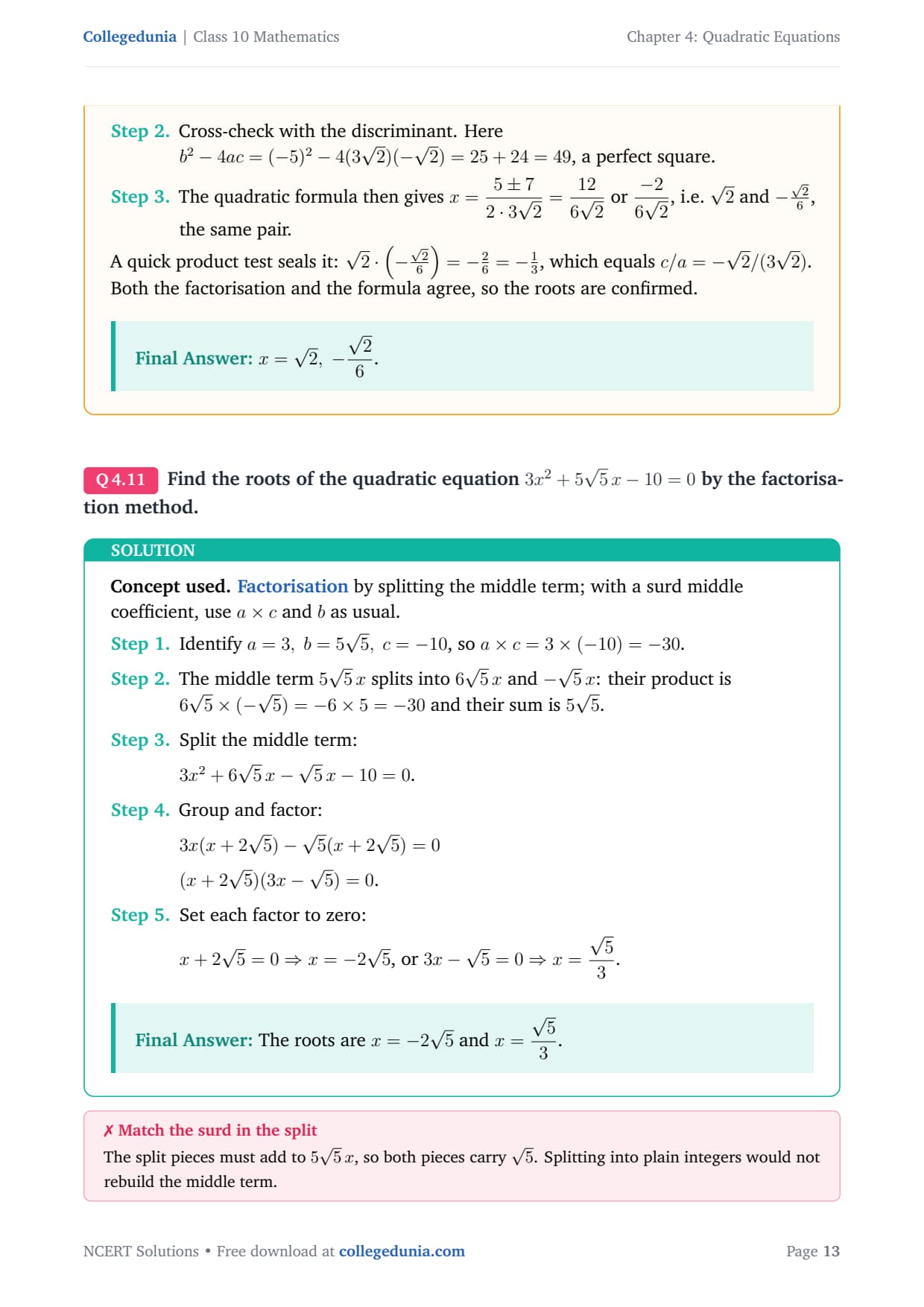
Cross-check with the discriminant. Here b2-4ac=
(-5)2-4(32)(-2)=25+24=49, a perfect square.
The quadratic formula then gives
x=5± 7232=1262 or
-262, i.e. 2 and -26,
the same pair.
A quick product test seals it: 2·(-26)
=-26=-13, which equals c/a=-2/(32). Both the
factorisation and the formula agree, so the roots are confirmed.
x=√2, -√26.
Q 4.11
Find the roots of the quadratic equation 3x2+5√5x-10=0 by the factorisation method.
Concept used.Factorisation by splitting the middle
term; with a surd middle coefficient, use a× c and b as usual.
Identify a=3, b=5√5, c=-10, so
a× c=3×(-10)=-30.
The middle term 5√5x splits into 6√5x and
-√5x: their product is
6√5×(-√5)=-6× 5=-30 and their sum is
5√5.
Split the middle term:
[] 3x2+6√5x-√5x-10=0.
Group and factor:
[] 3x(x+2√5)-√5(x+2√5)=0
[] (x+2√5)(3x-√5)=0.
Set each factor to zero:
[] x+2√5=0⇒ x=-2√5, or
3x-√5=0⇒ x=√53.
The roots are x=-2√5 and x=√53.
PH
Pallavi Hegde
M.Sc Mathematics, Karnatak University Dharwad
Verified Expert
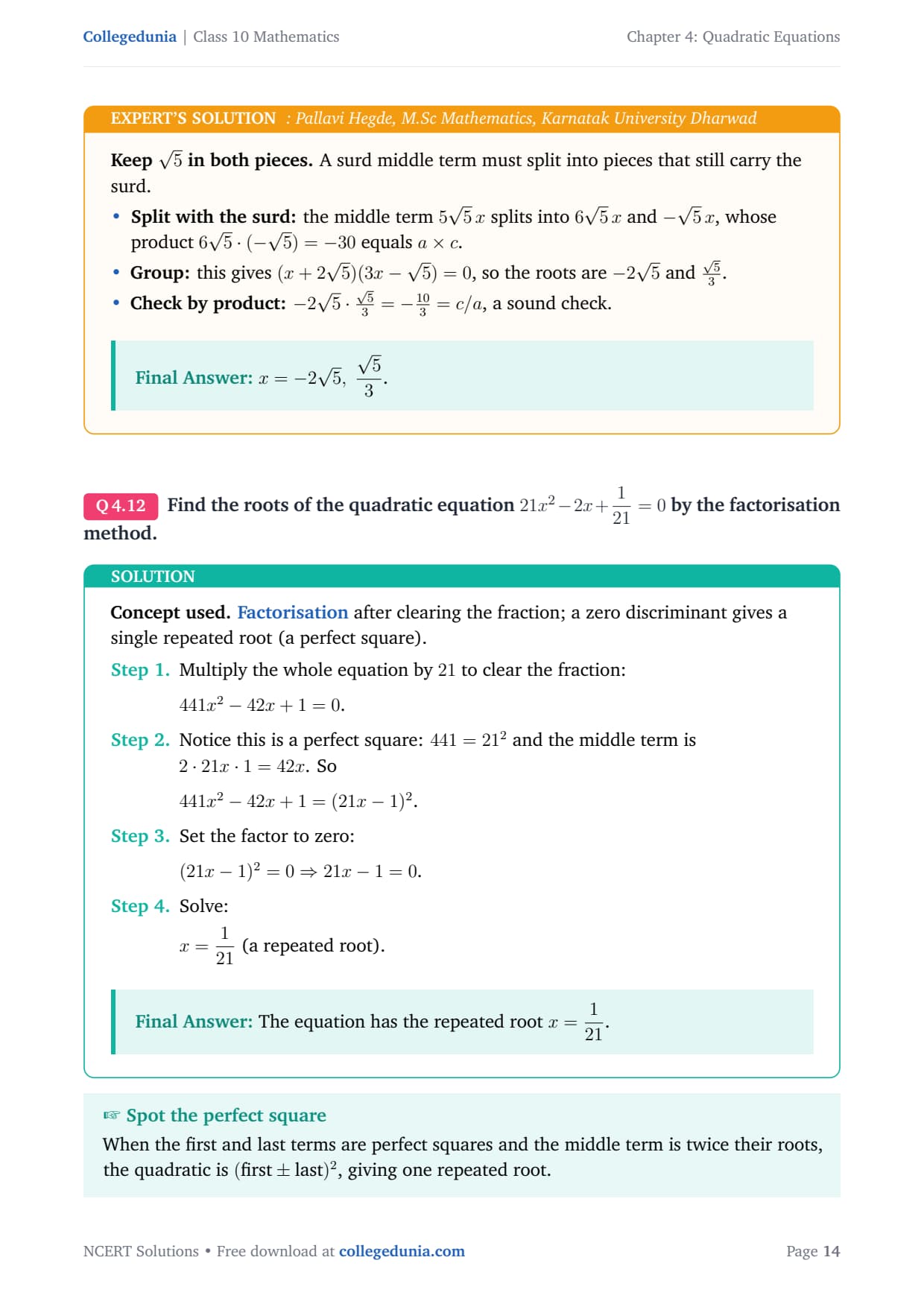
Keep 5 in both pieces. A surd middle term must split into
pieces that still carry the surd.
Split with the surd: the middle term 55 x splits
into 65 x and -5 x, whose product
65·(-5)=-30 equals a× c.
Group: this gives (x+25)(3x-5)=0, so the
roots are -25 and 53.
Check by product:-25·53=
-103=c/a, a sound check.
x=-2√5, √53.
Q 4.12
Find the roots of the quadratic equation 21x2-2x+121=0 by the factorisation method.
Concept used.Factorisation after clearing the
fraction; a zero discriminant gives a single repeated root (a perfect
square).
Multiply the whole equation by 21 to clear the fraction:
[] 441x2-42x+1=0.
Notice this is a perfect square: 441=212 and the middle term
is 2· 21x· 1=42x. So
[] 441x2-42x+1=(21x-1)2.
Set the factor to zero:
[] (21x-1)2=0⇒ 21x-1=0.
Solve:
[] x=121 (a repeated root).
The equation has the repeated root x=121.
SP
Suresh Patil
M.Sc Applied Mathematics, NIT Surathkal
Verified Expert
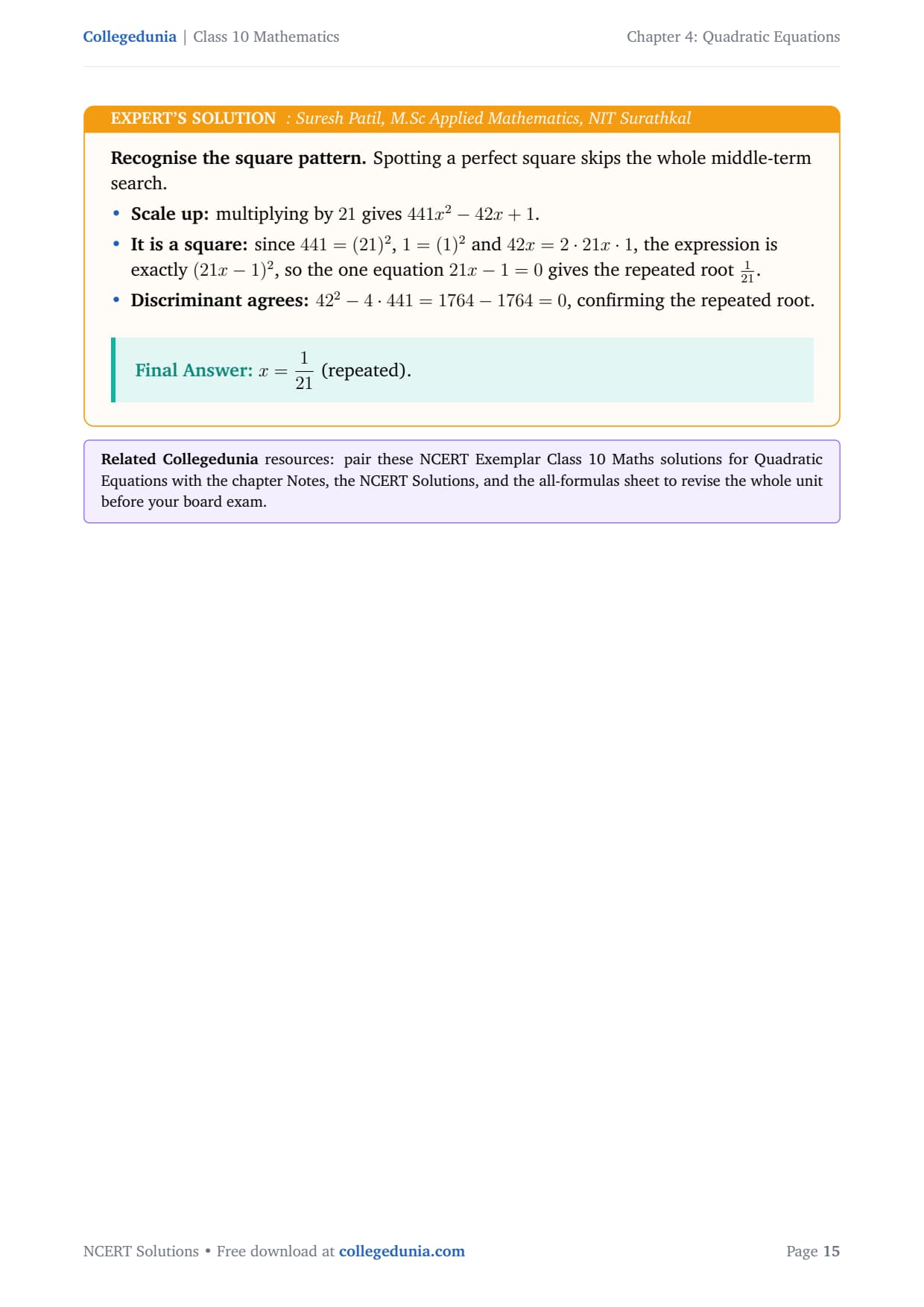
Recognise the square pattern. Spotting a perfect square skips
the whole middle-term search.
Scale up: multiplying by 21 gives 441x2-42x+1.
It is a square: since 441=(21)2, 1=(1)2 and
42x=221x1, the expression is exactly (21x-1)2, so
the one equation 21x-1=0 gives the repeated root 121.
Discriminant agrees:422-4441=1764-1764=0,
confirming the repeated root.
x=121 (repeated).
Other Quadratic Equations Exercises (Class 10 Maths)
Once you finish Exercise 4.3, move to the rest of Chapter 4 and pair it with the chapter solutions, notes and formula sheet.
Resource
What It Covers
Open
Exercise 4.1
11 MCQs on standard form, roots and the discriminant
In a Collegedunia survey of 11,240 Class 10 Maths students across 18 states, 68% found the surd-coefficient questions (Q37, Q38, Q42, Q43) harder than the integer ones. The most common slip was leaving √32 unsimplified instead of writing it as 4√2 before using the formula.
Source: Class 10 Mathematics student survey, 2026-27 session. Sample of 11,240 students from CBSE schools.
Other Resources for This Chapter
Pair this with the other Class 10 Maths resources for Quadratic Equations, all linked below.
NCERT Exemplar Class 10 Maths Chapter 4 Exercise 4.3 FAQs
Ques. How many questions are in NCERT Exemplar Class 10 Maths Chapter 4 Exercise 4.3?
Ans. Exercise 4.3 has 12 Short Answer Questions (Q33 to Q44). The first seven questions (Q33-Q39) use the quadratic formula and the remaining five (Q40-Q44) use the factorisation method. Question 44 is a special case with a repeated root.
Ques. What is the quadratic formula and when should students use it for Exercise 4.3?
Ans. The quadratic formula is x = (-b ± √(b² - 4ac)) / 2a for a quadratic equation ax² + bx + c = 0 where a is not zero. Students should use it for Q33-Q39 in Exercise 4.3. It always works regardless of coefficient type (integer, negative, surd, or fractional). Compute the discriminant D = b² - 4ac first to check if real roots exist and whether they are rational or irrational.
Ques. How do students handle surd coefficients in Exercise 4.3 questions like Q37 and Q38?
Ans. For questions like Q37 (with 2√2 as the coefficient of x) and Q38 (with -3√5), students should square the surd coefficient carefully: (2√2)² = 4 × 2 = 8 and (3√5)² = 9 × 5 = 45. After finding the discriminant, simplify √D by pulling out the largest perfect square (for example, √32 = 4√2). Then add like surd terms in the numerator before dividing by 2a.
Ques. Is Exercise 4.3 of NCERT Exemplar important for the CBSE Class 10 board exam?
Ans. Yes. CBSE board papers regularly include 3-mark Short Answer questions on finding roots of quadratic equations using the formula or factorisation, exactly the skill Exercise 4.3 builds. Students who practice all 12 questions in Exercise 4.3 become comfortable with surd and fractional coefficients, which are the types that appear most often in board-level questions according to the 2026-27 CBSE syllabus.
Ques. What is the discriminant and how is it used in NCERT Exemplar Class 10 Maths Chapter 4?
Ans. The discriminant of a quadratic equation ax² + bx + c = 0 is D = b² - 4ac. It tells students the nature of the roots before solving: if D > 0, there are two distinct real roots; if D = 0, there is one repeated real root (as in Q44 of Exercise 4.3 where D = 0 and x = 1/21 is the repeated root); if D < 0, there are no real roots. Always compute D first in every Exercise 4.3 question.







Comments