Junior-Class Mentor, TFI Fellow | Updated 3+ months ago
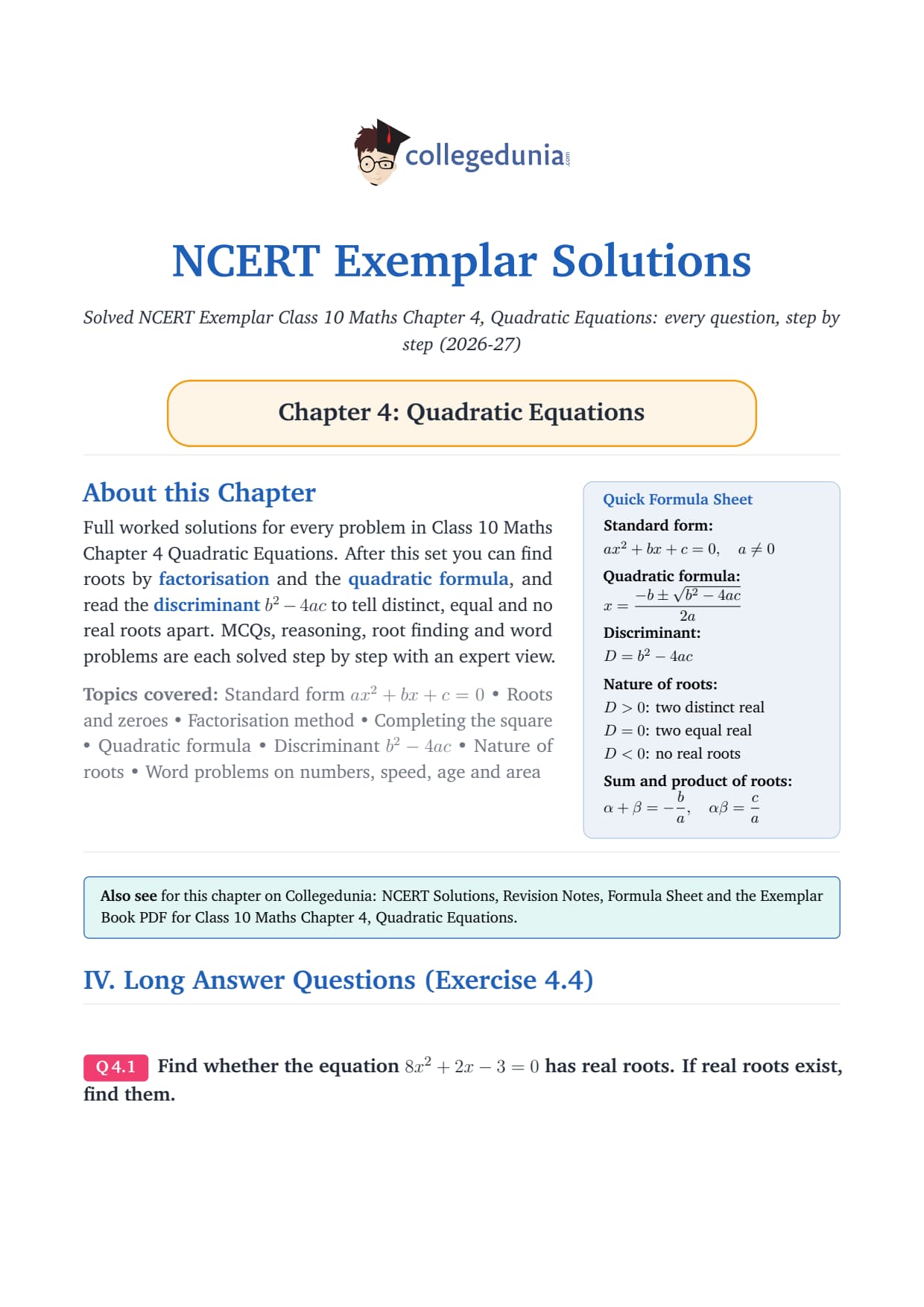
Exercise 4.4 of NCERT Exemplar Class 10 Maths Chapter 4 Quadratic Equations has all 12 Long Answer Questions solved here, step by step. It tests real roots, the quadratic formula, and word problems on numbers, speed, age and area. The answers follow the 2026-27 CBSE syllabus.
Scope: 12 Long Answer Questions (Q45 to Q56) on discriminant tests, irrational roots and applications.
Skills tested: finding the discriminant, the quadratic formula, factorisation, and framing equations from real data.
Board value: the chapter carries 6 to 8 marks in CBSE Class 10 papers, with word problems almost every year.
Every solution here is verified by subject experts and follows the 2026-27 CBSE NCERT Exemplar book exactly.
Solved by Collegedunia - All 12 Long Answer Questions below carry detailed step-by-step solutions and expert insights.
Exercise 4.4 is the Long Answer Questions set. It has 12 questions (Q45 to Q56). They apply the discriminant, the quadratic formula and factorisation to both pure equations and real-life word problems.
Discriminant and real roots (Q45-Q49): test for real roots with D = b2 - 4ac, then find them, including surd-coefficient cases.
Number problems (Q50, Q51): turn a sentence about a number and its square or reciprocal into a quadratic, then reject the invalid root.
Speed, age and area problems (Q52-Q56): form a quadratic from a real condition. These match board 5-mark questions directly.
The board picks word problems from exactly this level. A clear variable, both equation steps and a domain check earn full step marks.
Key Concept: Always compute the discriminant first before trying to find roots. If D < 0, stop and state "no real roots". Only apply the formula when D ≥ 0.
Key Quadratic Equations Formulas for Exercise 4.4
All 12 questions use the same core toolkit. Review these before you start.
Formula / Method
When to Use
Key Idea
Discriminant:D = b2 - 4ac
All Q45-Q49; first step every time
D > 0: two distinct real roots; D = 0: equal roots; D < 0: no real roots
Quadratic formula:x = (-b ± √D) / 2a
When D ≥ 0 and factorisation is not obvious
Works for all quadratics; simplify √D before substituting
Factorisation (splitting the middle term)
Q50-Q55 where D is a perfect square
Find two numbers with product ac and sum b; split and group
Clearing denominators / reciprocals
Q48 (fraction equation), Q51 (reciprocal)
Multiply through by the LCD to reach standard form before solving
Sum and product of roots:α + β = -b/a, αβ = c/a
Verification step in Expert solutions
Lets you confirm roots without re-substituting into the original equation
Quick Tip: For speed-distance problems (Q52), convert minutes to hours before writing the time equation. The most common error is keeping 48 minutes as 48 instead of converting to 4/5 of an hour.
All 12 Exercise 4.4 Solutions with Step-by-Step Working
IV. Long Answer Questions (Exercise 4.4)
Q 4.1
Find whether the equation 8x2+2x-3=0 has real roots. If real roots exist, find them.
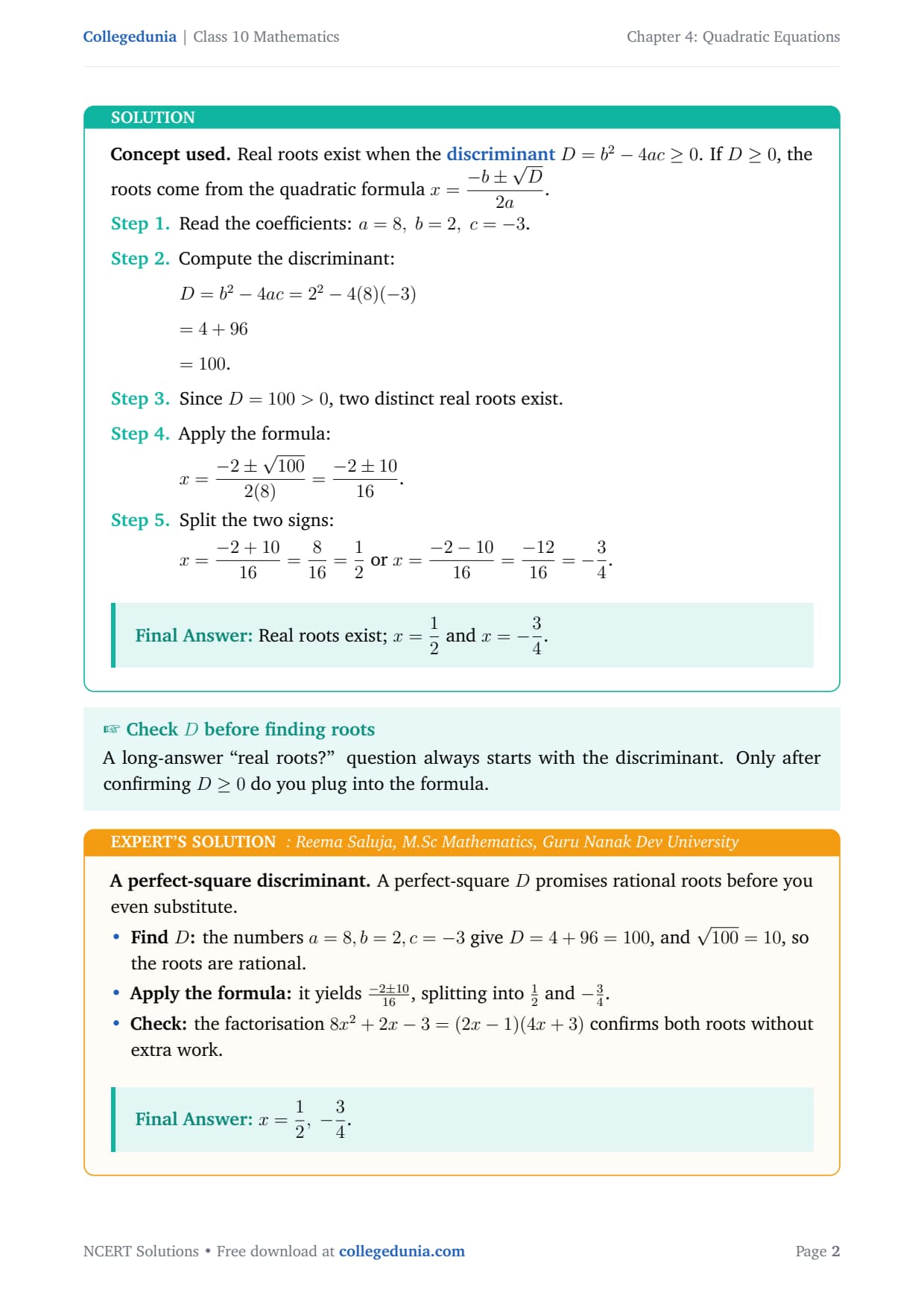
Concept used. Real roots exist when the discriminantD=b2-4ac≥ 0. If D≥ 0, the roots come from the quadratic
formula x=-b±√D2a.
Read the coefficients: a=8, b=2, c=-3.
Compute the discriminant:
[] D=b2-4ac=22-4(8)(-3)
[] =4+96
[] =100.
Since D=100>0, two distinct real roots exist.
Apply the formula:
[] x=-2±√1002(8)=-2± 1016.
Split the two signs:
[] x=-2+1016=816=12 or
x=-2-1016=-1216=-34.
Real roots exist; x=12 and x=-34.
RS
Reema Saluja
M.Sc Mathematics, Guru Nanak Dev University
Verified Expert
A perfect-square discriminant. A perfect-square D promises
rational roots before you even substitute.
Find D: the numbers a=8,b=2,c=-3 give D=4+96=100,
and √100=10, so the roots are rational.
Apply the formula: it yields -21016,
splitting into 12 and -34.
Check: the factorisation 8x2+2x-3=(2x-1)(4x+3)
confirms both roots without extra work.
x=12, -34.
Q 4.2
Find whether the equation -2x2+3x+2=0 has real roots. If real roots exist, find them.
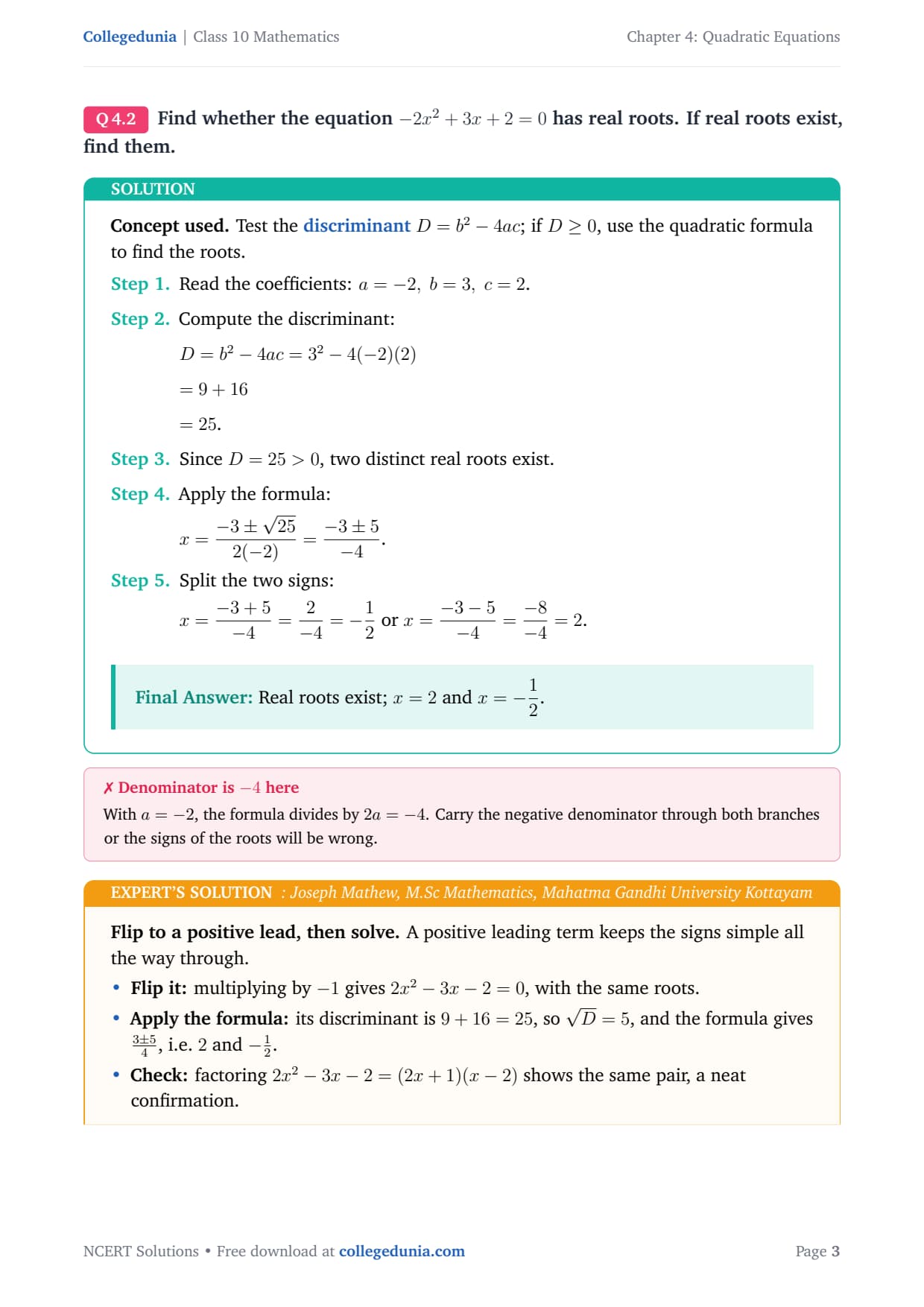
Concept used. Test the discriminantD=b2-4ac; if
D≥ 0, use the quadratic formula to find the roots.
Read the coefficients: a=-2, b=3, c=2.
Compute the discriminant:
[] D=b2-4ac=32-4(-2)(2)
[] =9+16
[] =25.
Since D=25>0, two distinct real roots exist.
Apply the formula:
[] x=-3±√252(-2)=-3± 5-4.
Split the two signs:
[] x=-3+5-4=2-4=-12 or
x=-3-5-4=-8-4=2.
Real roots exist; x=2 and x=-12.
JM
Joseph Mathew
M.Sc Mathematics, Mahatma Gandhi University Kottayam
Verified Expert
Flip to a positive lead, then solve. A positive leading term
keeps the signs simple all the way through.
Flip it: multiplying by -1 gives 2x2-3x-2=0, with
the same roots.
Apply the formula: its discriminant is 9+16=25, so
D=5, and the formula gives 354, i.e. 2
and -12.
Check: factoring 2x2-3x-2=(2x+1)(x-2) shows the same
pair, a neat confirmation.
x=2, -12.
Q 4.3
Find whether the equation 5x2-2x-10=0 has real roots. If real roots exist, find them.
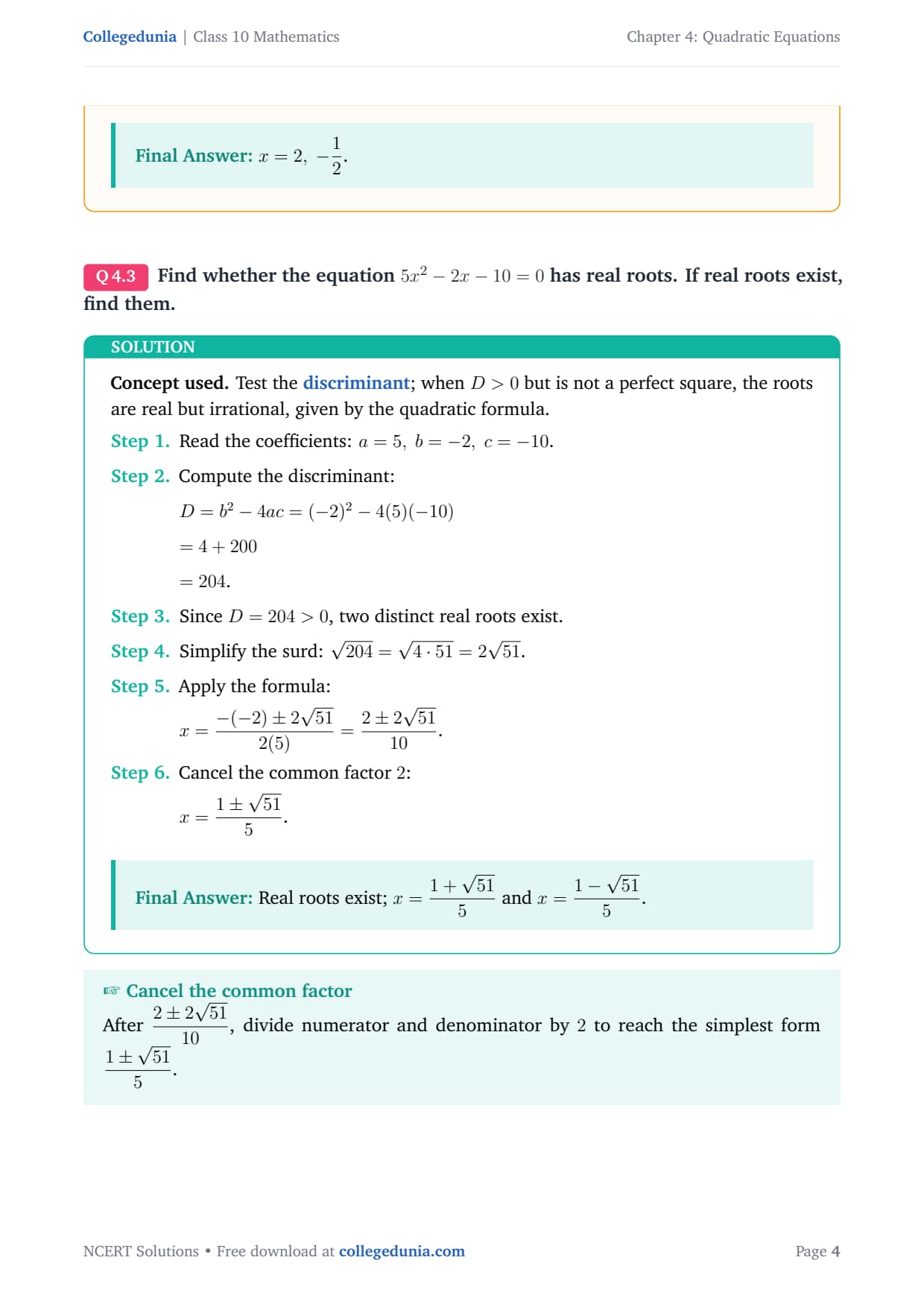
Concept used. Test the discriminant; when D>0 but is
not a perfect square, the roots are real but irrational, given by the
quadratic formula.
Read the coefficients: a=5, b=-2, c=-10.
Compute the discriminant:
[] D=b2-4ac=(-2)2-4(5)(-10)
[] =4+200
[] =204.
Since D=204>0, two distinct real roots exist.
Simplify the surd: √204=√4· 51=2√51.
Apply the formula:
[] x=-(-2)± 2√512(5)=2± 2√5110.
Cancel the common factor 2:
[] x=1±√515.
Real roots exist; x=1+√515 and
x=1-√515.
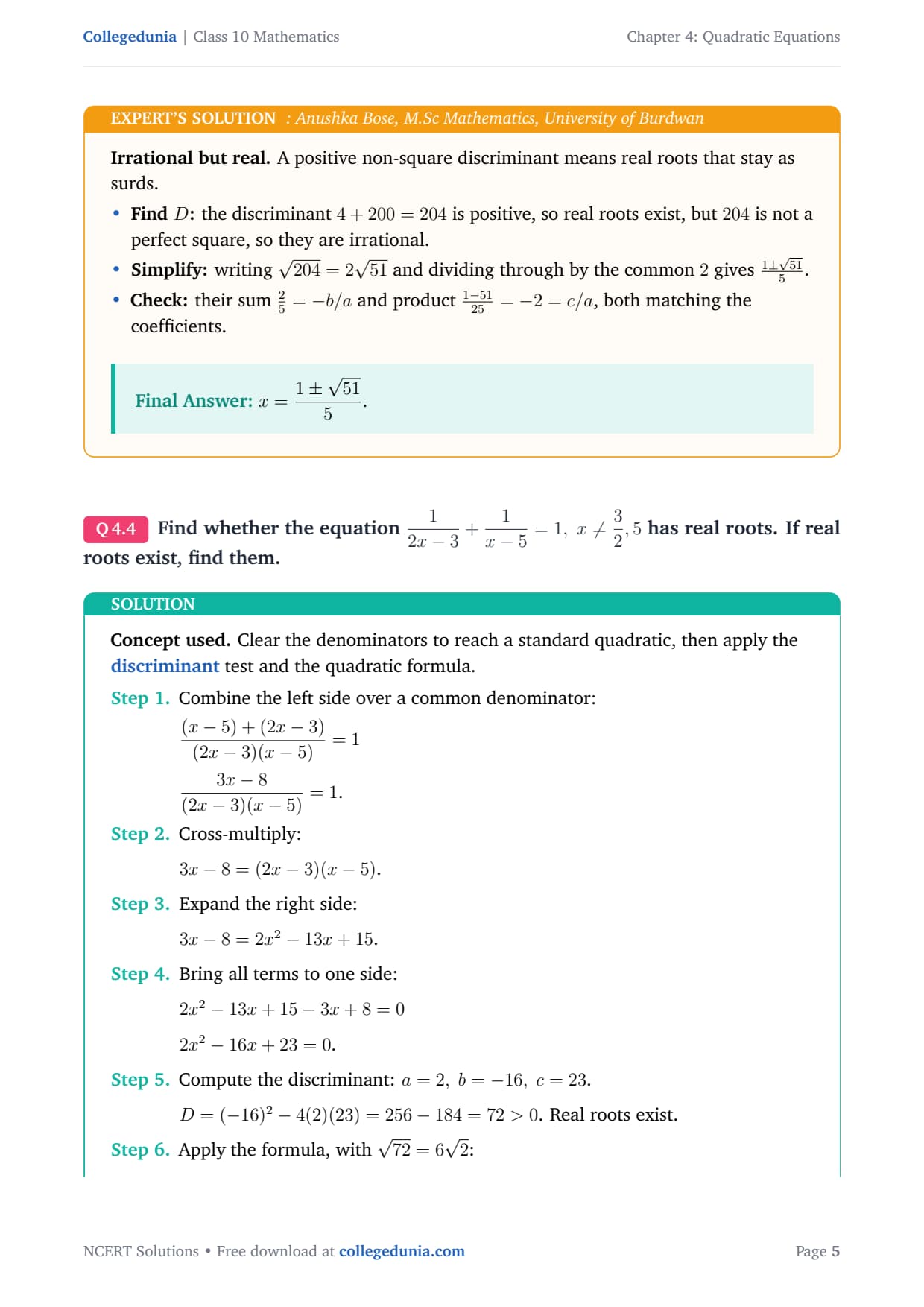
AB
Anushka Bose
M.Sc Mathematics, University of Burdwan
Verified Expert
Irrational but real. A positive non-square discriminant means
real roots that stay as surds.
Find D: the discriminant 4+200=204 is positive, so
real roots exist, but 204 is not a perfect square, so they are
irrational.
Simplify: writing √204=2√51 and dividing
through by the common 2 gives 1±√515.
Check: their sum 25=-b/a and product
1-5125=-2=c/a, both matching the coefficients.
x=1±√515.
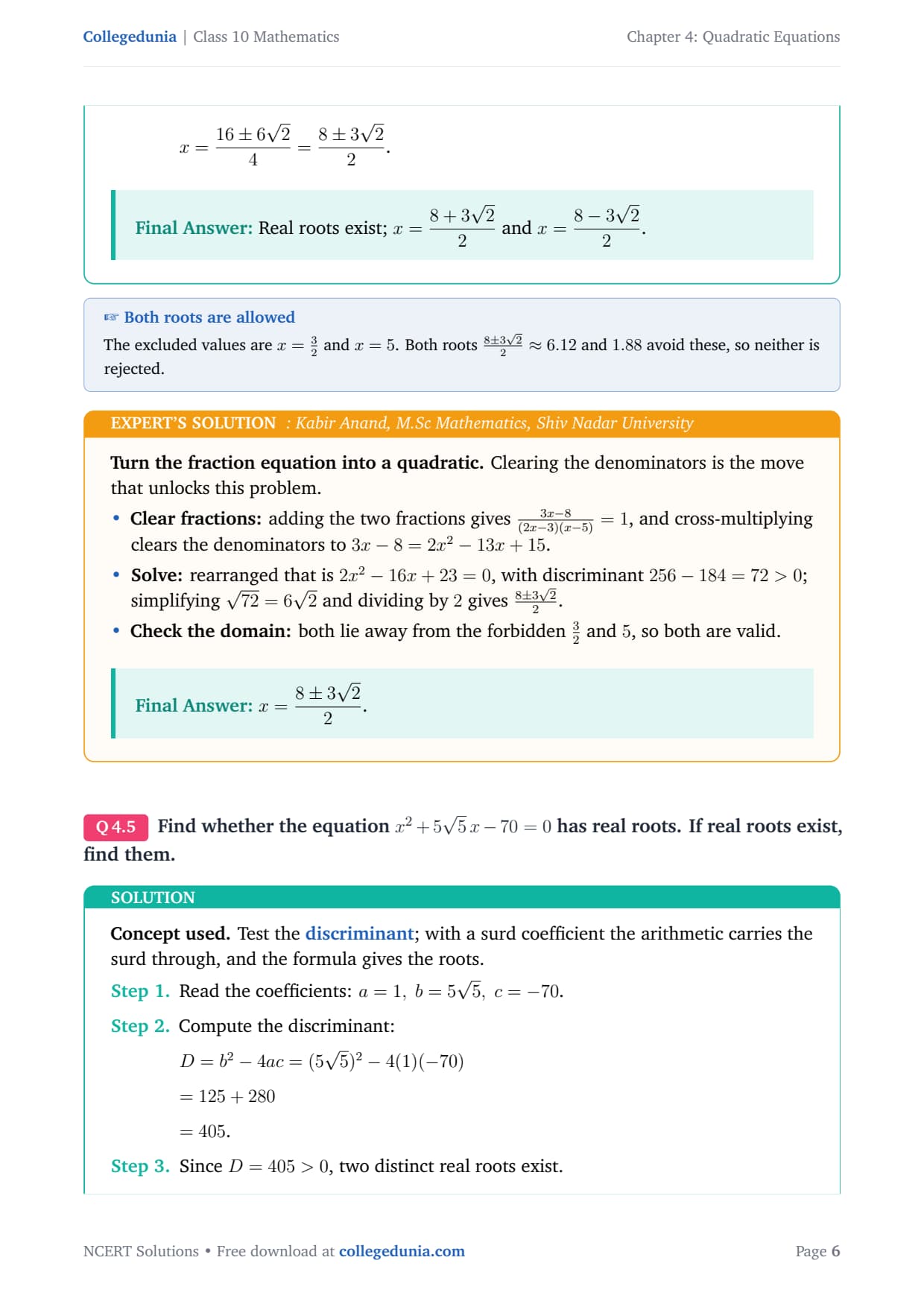
Q 4.4
Find whether the equation 12x-3+1x-5=1, x≠32,5 has real roots. If real roots exist, find them.
Concept used. Clear the denominators to reach a standard
quadratic, then apply the discriminant test and the quadratic
formula.
Combine the left side over a common denominator:
[] (x-5)+(2x-3)(2x-3)(x-5)=1
[] 3x-8(2x-3)(x-5)=1.
Cross-multiply:
[] 3x-8=(2x-3)(x-5).
Expand the right side:
[] 3x-8=2x2-13x+15.
Bring all terms to one side:
[] 2x2-13x+15-3x+8=0
[] 2x2-16x+23=0.
Compute the discriminant: a=2, b=-16, c=23.
[] D=(-16)2-4(2)(23)=256-184=72>0. Real roots exist.
Apply the formula, with √72=6√2:
[] x=16± 6√24=8± 3√22.
Real roots exist; x=8+3√22 and
x=8-3√22.
KA
Kabir Anand
M.Sc Mathematics, Shiv Nadar University
Verified Expert
Turn the fraction equation into a quadratic. Clearing the
denominators is the move that unlocks this problem.
Clear fractions: adding the two fractions gives
3x-8(2x-3)(x-5)=1, and cross-multiplying clears the
denominators to 3x-8=2x2-13x+15.
Solve: rearranged that is 2x2-16x+23=0, with
discriminant 256-184=72>0; simplifying √72=62 and
dividing by 2 gives 8322.
Check the domain: both lie away from the forbidden
32 and 5, so both are valid.
x=8± 3√22.
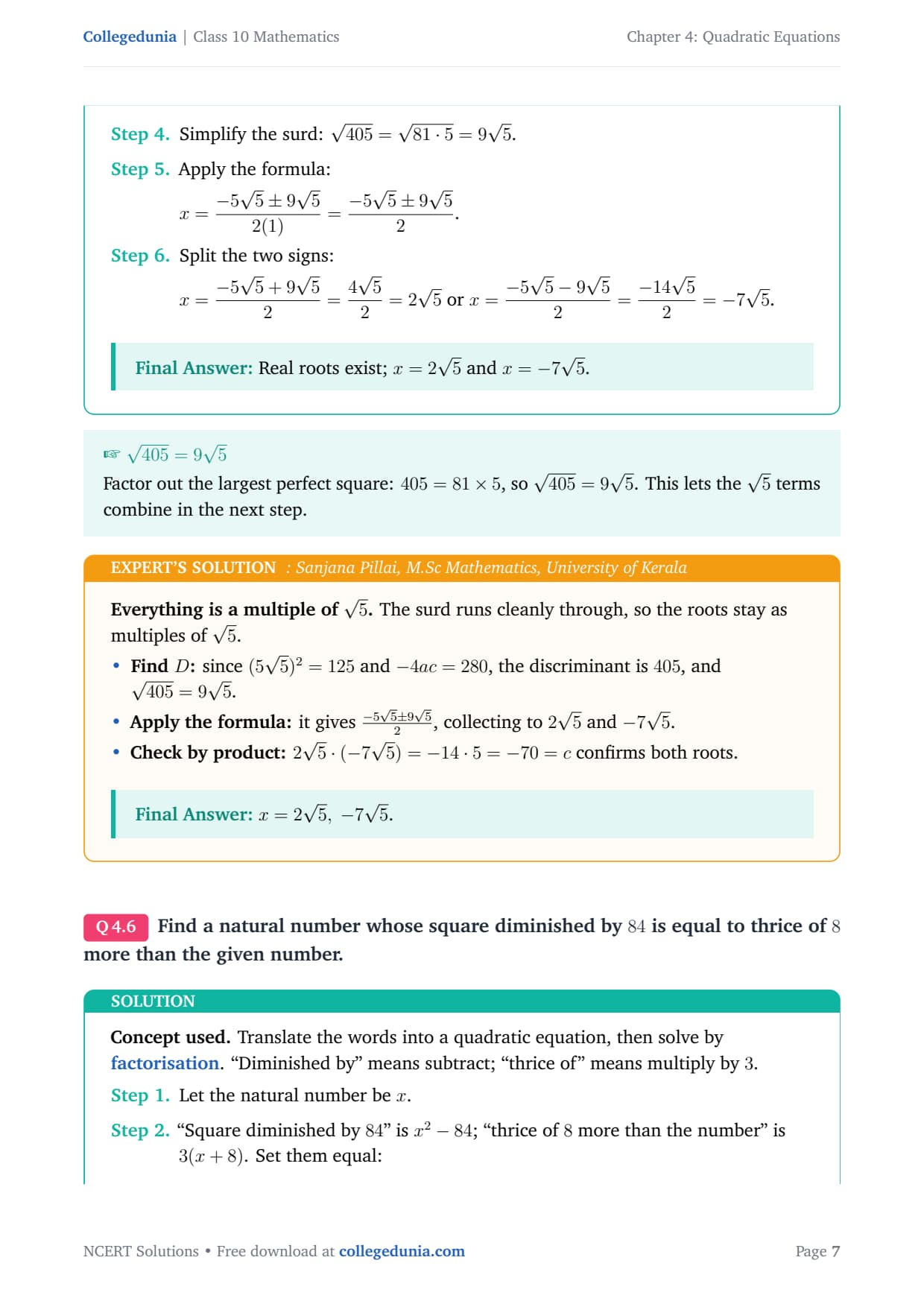
Q 4.5
Find whether the equation x2+5√5x-70=0 has real roots. If real roots exist, find them.
Concept used. Test the discriminant; with a surd
coefficient the arithmetic carries the surd through, and the formula gives
the roots.
Read the coefficients: a=1, b=5√5, c=-70.
Compute the discriminant:
[] D=b2-4ac=(5√5)2-4(1)(-70)
[] =125+280
[] =405.
Since D=405>0, two distinct real roots exist.
Simplify the surd: √405=√81· 5=9√5.
Apply the formula:
[] x=-5√5± 9√52(1)=-5√5±
9√52.
Split the two signs:
[] x=-5√5+9√52=4√52=2√5
or x=-5√5-9√52=-14√52=-7√5.
Real roots exist; x=2√5 and x=-7√5.
SP
Sanjana Pillai
M.Sc Mathematics, University of Kerala
Verified Expert
Everything is a multiple of 5. The surd runs cleanly
through, so the roots stay as multiples of 5.
Find D: since (55)2=125 and -4ac=280, the
discriminant is 405, and √405=95.
Apply the formula: it gives
-55952, collecting to 25 and
-75.
Check by product:25·(-75)=-145=-70=c
confirms both roots.
x=2√5, -7√5.
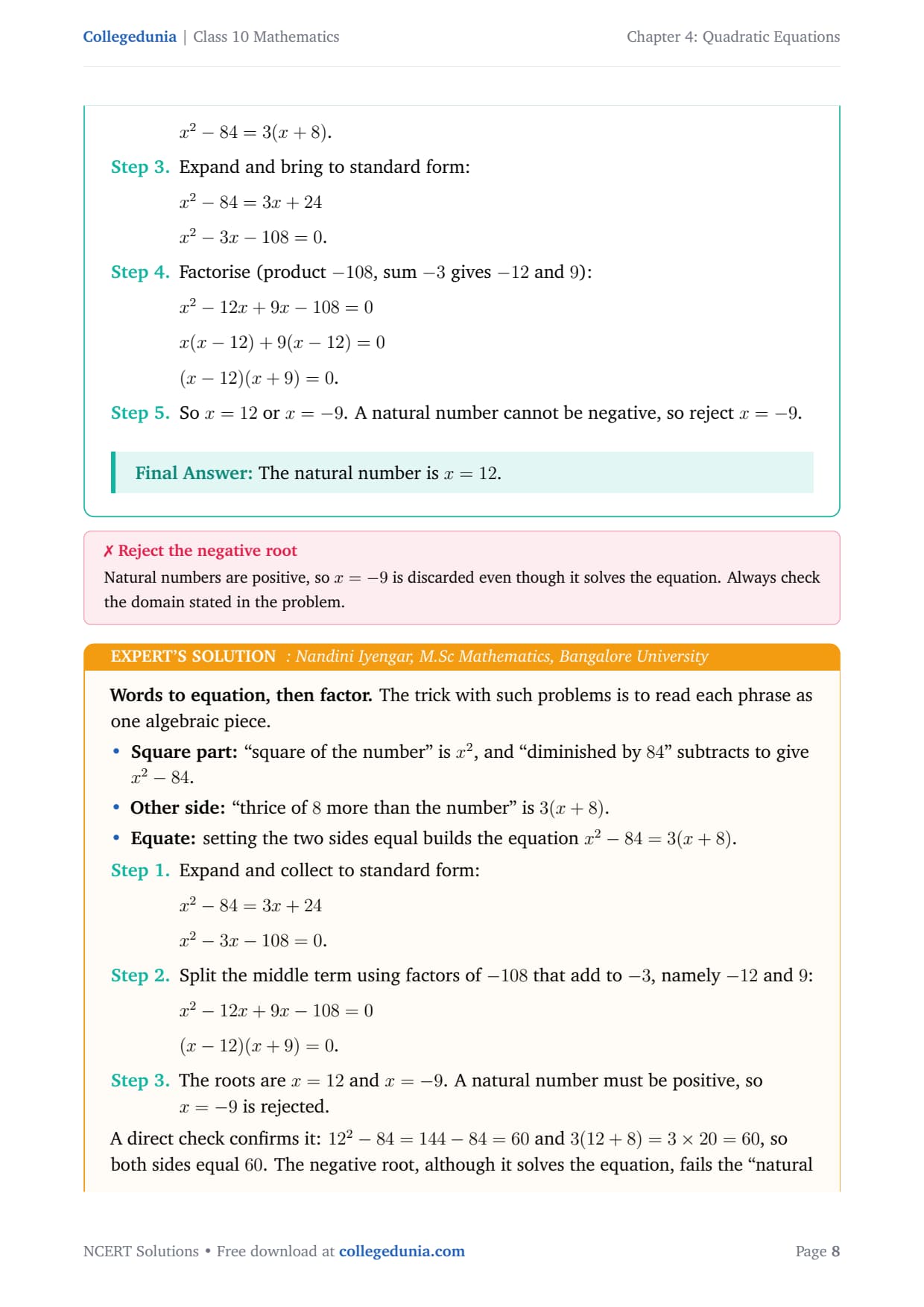
Q 4.6
Find a natural number whose square diminished by 84 is equal to thrice of 8 more than the given number.
Concept used. Translate the words into a quadratic equation, then
solve by factorisation. ``Diminished by'' means subtract;
``thrice of'' means multiply by 3.
Let the natural number be x.
``Square diminished by 84'' is x2-84; ``thrice of 8 more
than the number'' is 3(x+8). Set them equal:
[] x2-84=3(x+8).
Expand and bring to standard form:
[] x2-84=3x+24
[] x2-3x-108=0.
Factorise (product -108, sum -3 gives -12 and 9):
[] x2-12x+9x-108=0
[] x(x-12)+9(x-12)=0
[] (x-12)(x+9)=0.
So x=12 or x=-9. A natural number cannot be negative, so
reject x=-9.
The natural number is x=12.
NI
Nandini Iyengar
M.Sc Mathematics, Bangalore University
Verified Expert
Words to equation, then factor. The trick with such problems is
to read each phrase as one algebraic piece.
Square part: ``square of the number'' is x2, and
``diminished by 84'' subtracts to give x2-84.
Other side: ``thrice of 8 more than the number'' is
3(x+8).
Equate: setting the two sides equal builds the equation
x2-84=3(x+8).
Expand and collect to standard form:
[] x2-84=3x+24
[] x2-3x-108=0.
Split the middle term using factors of -108 that add to -3,
namely -12 and 9:
[] x2-12x+9x-108=0
[] (x-12)(x+9)=0.
The roots are x=12 and x=-9. A natural number must be
positive, so x=-9 is rejected.
A direct check confirms it: 122-84=144-84=60 and 3(12+8)=3×
20=60, so both sides equal 60. The negative root, although it solves
the equation, fails the ``natural number'' condition and is dropped.
The number is 12.
Q 4.7
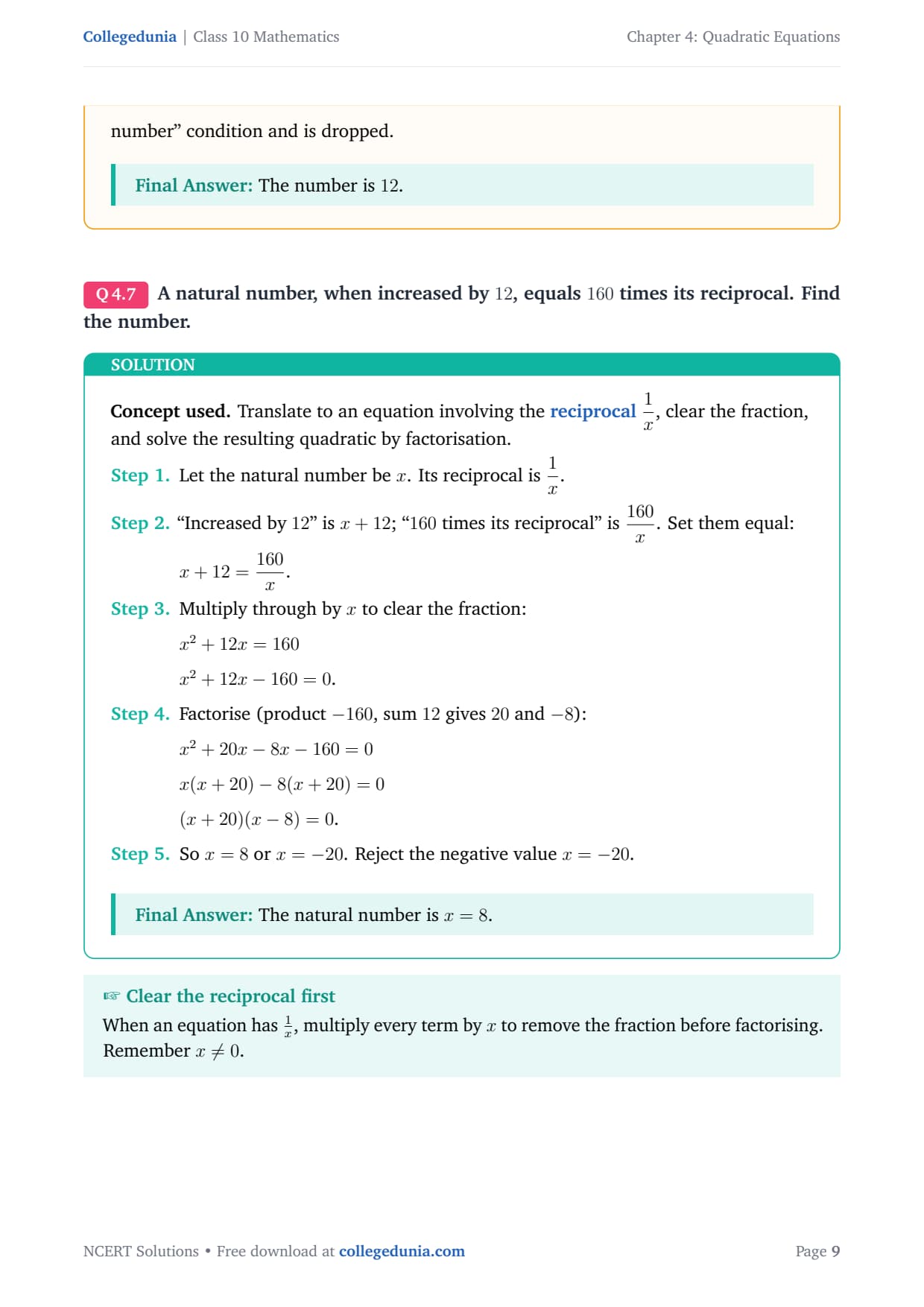
A natural number, when increased by 12, equals 160 times its reciprocal. Find the number.
Concept used. Translate to an equation involving the
reciprocal1x, clear the fraction, and solve the
resulting quadratic by factorisation.
Let the natural number be x. Its reciprocal is 1x.
``Increased by 12'' is x+12; ``160 times its reciprocal''
is 160x. Set them equal:
[] x+12=160x.
Multiply through by x to clear the fraction:
[] x2+12x=160
[] x2+12x-160=0.
Factorise (product -160, sum 12 gives 20 and -8):
[] x2+20x-8x-160=0
[] x(x+20)-8(x+20)=0
[] (x+20)(x-8)=0.
So x=8 or x=-20. Reject the negative value x=-20.
The natural number is x=8.
RB
Rohit Bhattacharya
M.Sc Applied Mathematics, IIT Patna
Verified Expert
Multiply out the reciprocal. Clearing the 1x first turns
the reciprocal condition into an ordinary quadratic.
Clear the fraction: the condition x+12=160x
becomes x2+12x-160=0 once both sides are multiplied by x.
Factor: splitting 12 as 20-8 factors it to
(x+20)(x-8)=0, so x=8 (the natural number) or -20
(rejected).
Verify:8+12=20 and 1608=20, so the two
sides agree.
The number is 8.
Q 4.8
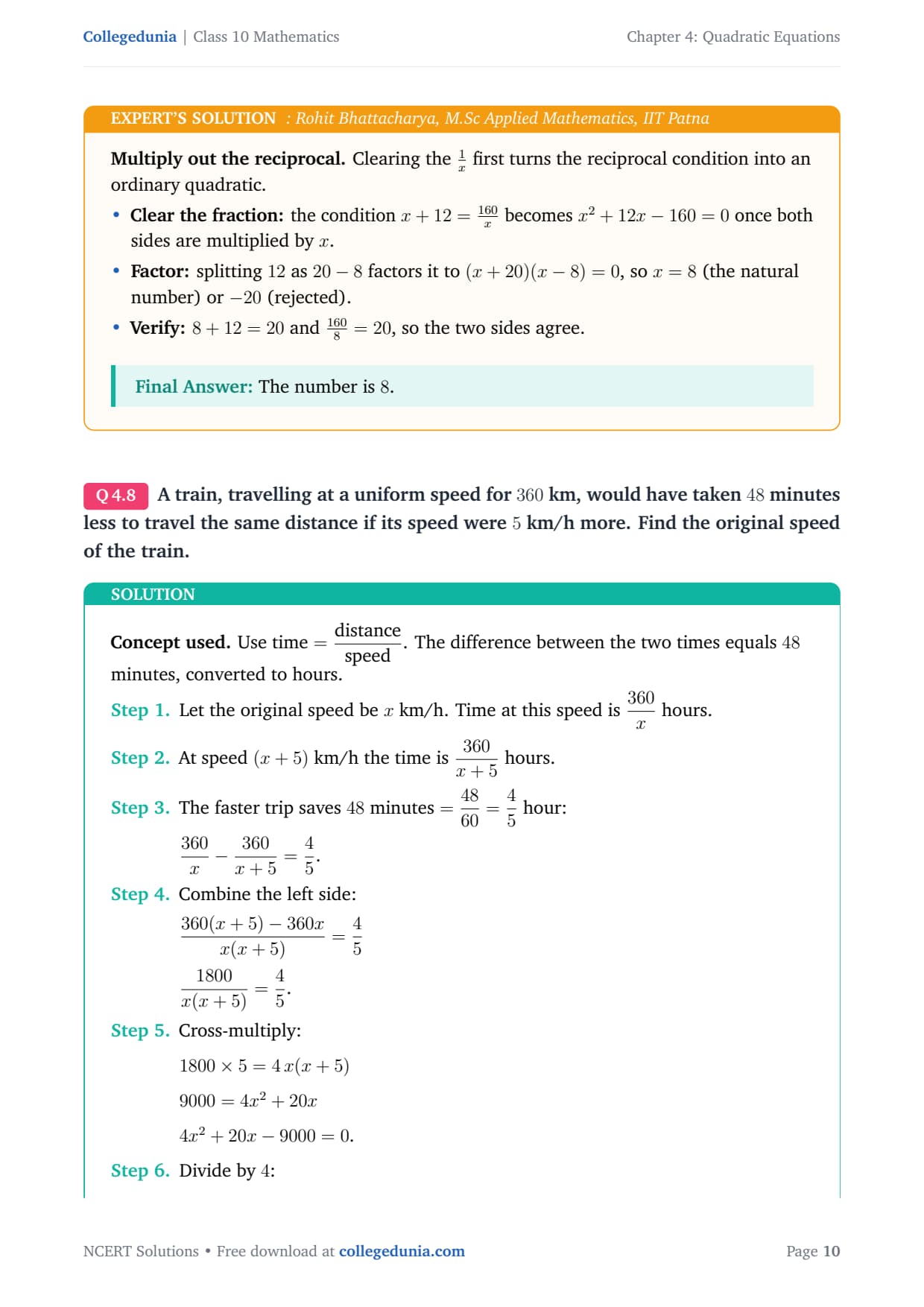
A train, travelling at a uniform speed for 360 km, would have taken 48 minutes less to travel the same distance if its speed were 5 km/h more. Find the original speed of the train.
Concept used. Use time=distancespeed.
The difference between the two times equals 48 minutes, converted to
hours.
Let the original speed be x km/h. Time at this speed is
360x hours.
At speed (x+5) km/h the time is 360x+5 hours.
The faster trip saves 48 minutes =4860=45
hour:
[] 360x-360x+5=45.
Combine the left side:
[] 360(x+5)-360xx(x+5)=45
[] 1800x(x+5)=45.
Factorise (product -2250, sum 5 gives 50 and -45):
[] (x+50)(x-45)=0, so x=45 or x=-50.
Speed cannot be negative, so reject x=-50.
The original speed of the train is 45 km/h.
TB
Tanya Bedi
M.Sc Mathematics, Kurukshetra University
Verified Expert
Set the time gap to 45 hour. The whole equation comes
from the difference of two travel times.
Two times: they are 360x and
360x+5, and their difference is 48 minutes
=45 h.
Form the quadratic: the combined fraction
1800x(x+5)=45 cross-multiplies to
x2+5x-2250=0, and factoring (x+50)(x-45)=0 gives the
positive speed 45 km/h.
Check: at 45 km/h the time is 8 h, at 50 km/h it
is 7.2 h, a saving of 0.8 h =48 min.
Original speed =45 km/h.
Q 4.9
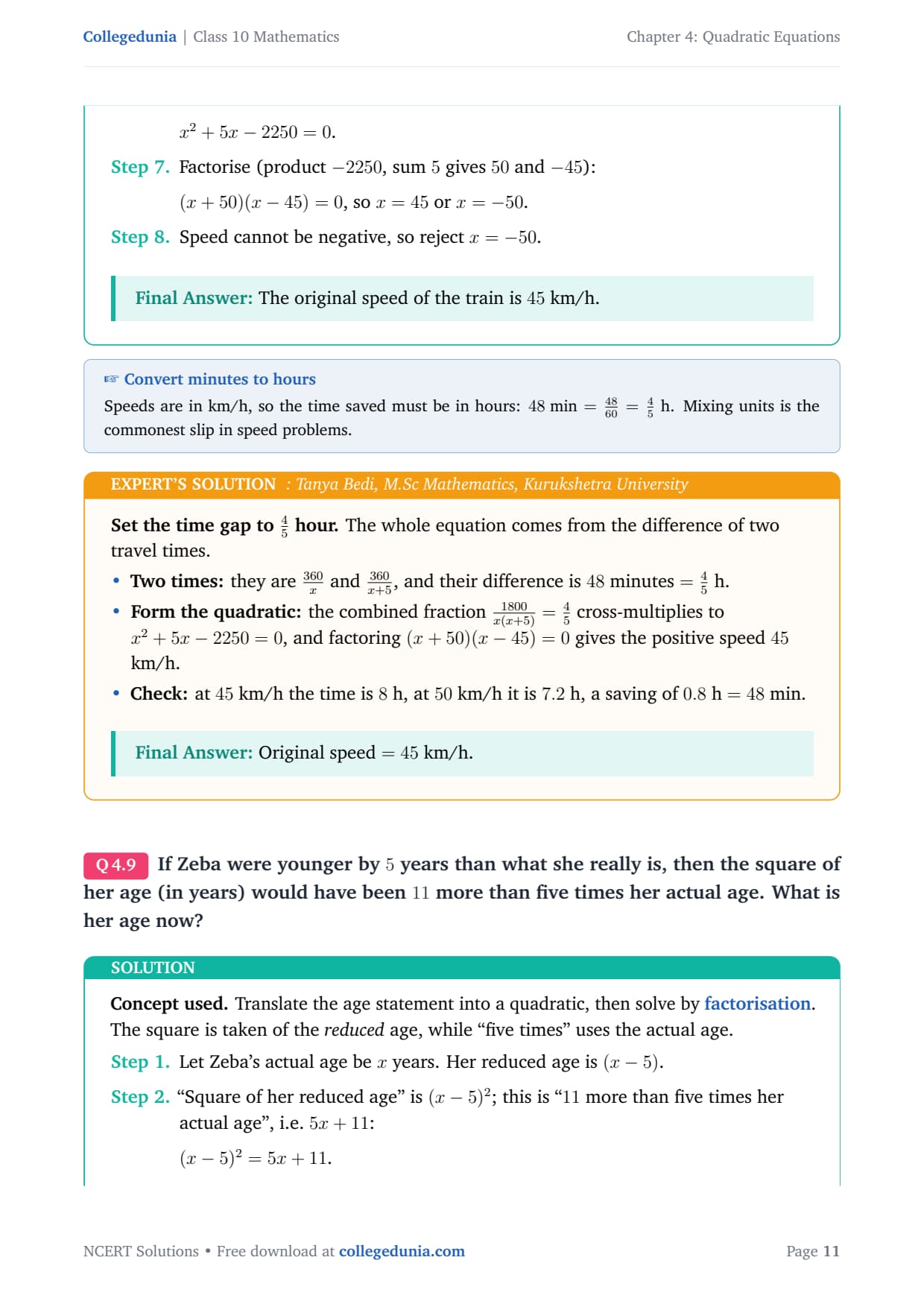
If Zeba were younger by 5 years than what she really is, then the square of her age (in years) would have been 11 more than five times her actual age. What is her age now?
Concept used. Translate the age statement into a quadratic, then
solve by factorisation. The square is taken of the
reduced age, while ``five times'' uses the actual age.
Let Zeba's actual age be x years. Her reduced age is (x-5).
``Square of her reduced age'' is (x-5)2; this is ``11 more
than five times her actual age'', i.e. 5x+11:
[] (x-5)2=5x+11.
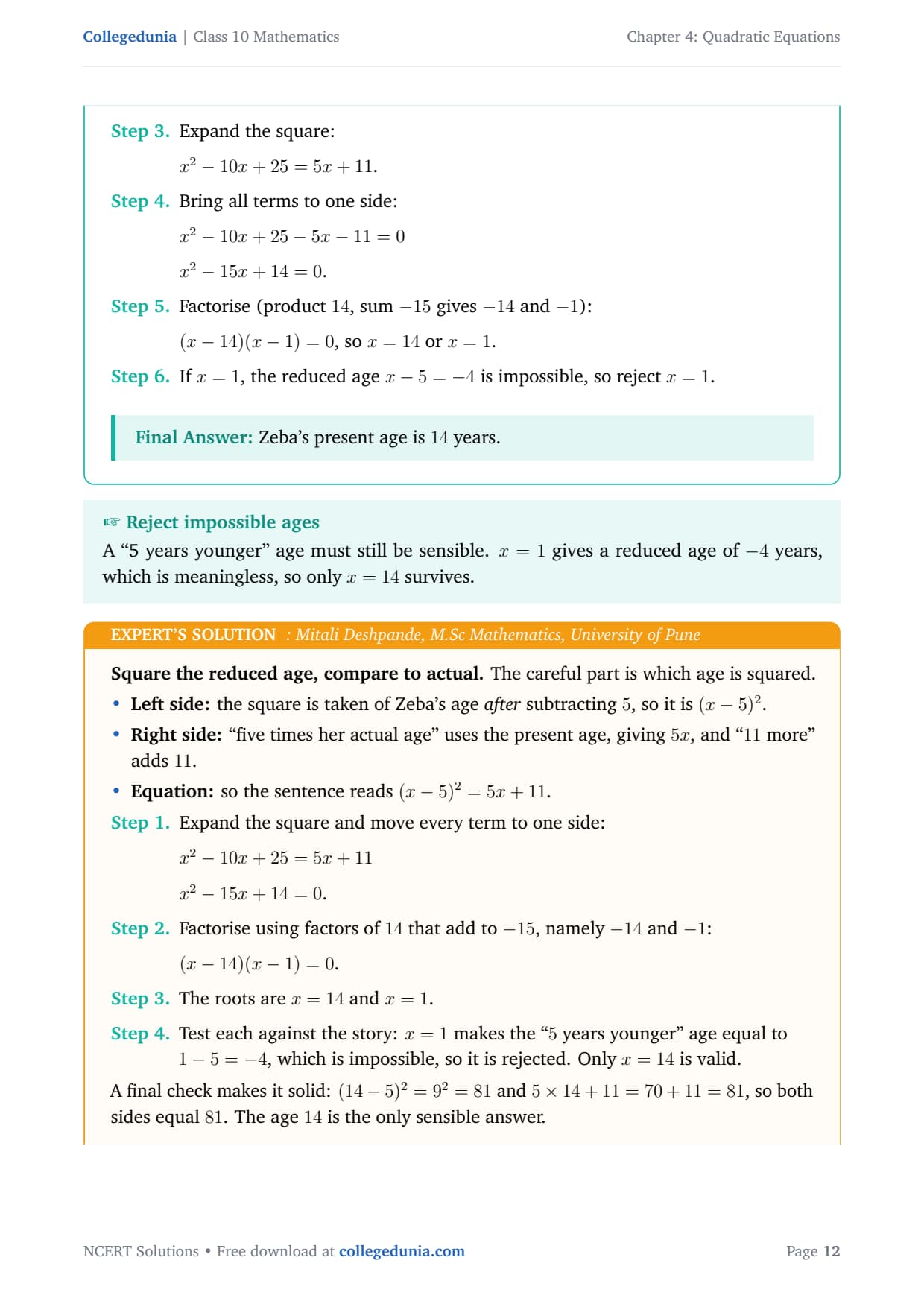
Expand the square:
[] x2-10x+25=5x+11.
Bring all terms to one side:
[] x2-10x+25-5x-11=0
[] x2-15x+14=0.
Factorise (product 14, sum -15 gives -14 and -1):
[] (x-14)(x-1)=0, so x=14 or x=1.
If x=1, the reduced age x-5=-4 is impossible, so reject
x=1.
Zeba's present age is 14 years.
MD
Mitali Deshpande
M.Sc Mathematics, University of Pune
Verified Expert
Square the reduced age, compare to actual. The careful part is
which age is squared.
Left side: the square is taken of Zeba's age
after subtracting 5, so it is (x-5)2.
Right side: ``five times her actual age'' uses the
present age, giving 5x, and ``11 more'' adds 11.
Equation: so the sentence reads (x-5)2=5x+11.
Expand the square and move every term to one side:
[] x2-10x+25=5x+11
[] x2-15x+14=0.
Factorise using factors of 14 that add to -15, namely -14
and -1:
[] (x-14)(x-1)=0.
The roots are x=14 and x=1.
Test each against the story: x=1 makes the ``5 years younger''
age equal to 1-5=-4, which is impossible, so it is rejected.
Only x=14 is valid.
A final check makes it solid: (14-5)2=92=81 and
514+11=70+11=81, so both sides equal 81. The age 14 is the
only sensible answer.
She is 14 years old now.
Q 4.10
At present Asha's age (in years) is 2 more than the square of her daughter Nisha's age. When Nisha grows to her mother's present age, Asha's age would be one year less than 10 times the present age of Nisha. Find the present ages of both Asha and Nisha.
Concept used. Set up two relationships in terms of Nisha's age,
substitute one into the other, and solve the resulting quadratic by
factorisation.
Let Nisha's present age be x years. Then Asha's present age is
x2+2.
``When Nisha grows to her mother's present age'' means Nisha
reaches age x2+2, which is ((x2+2)-x) years from
now. Asha ages by the same amount.
Asha's age then is (x2+2)+((x2+2)-x)=2x2-x+4.
This equals ``one year less than 10 times Nisha's present age'',
i.e. 10x-1:
[] 2x2-x+4=10x-1.
Bring all terms to one side:
[] 2x2-x+4-10x+1=0
[] 2x2-11x+5=0.
Factorise (product 2× 5=10, sum -11 gives -10 and
-1):
[] 2x2-10x-x+5=0
[] 2x(x-5)-1(x-5)=0
[] (x-5)(2x-1)=0, so x=5 or x=12.
An age of 12 year does not fit the story (Nisha already
has a square-of-age relation as a child with a meaningful age), so
take x=5.
Then Asha's present age is x2+2=25+2=27 years.
Nisha is 5 years old and Asha is 27 years old.
DK
Devansh Kapoor
M.Sc Applied Mathematics, IIT Mandi
Verified Expert
One variable, two conditions. Everything hangs on Nisha's
present age, so call it x.
First condition: it makes Asha x2+2 right now.
Second condition: it is set in the future, when Nisha
grows up to Asha's present age.
Key idea: both people age by the same number of years,
which links the two conditions.
Years until Nisha reaches Asha's present age:
[] (x2+2)-x.
Asha ages by the same amount, so her future age is:
[] (x2+2)+((x2+2)-x)=2x2-x+4.
The second condition says this equals 10x-1:
[] 2x2-x+4=10x-1
[] 2x2-11x+5=0.
Factorise: 2x2-10x-x+5=2x(x-5)-1(x-5)=(x-5)(2x-1)=0, so
x=5 or x=12.
The fractional age 12 does not suit the story, so
x=5, making Asha x2+2=27.
A check confirms it: in 22 years Nisha turns 27 (Asha's present age),
and Asha then becomes 49, which is 105-1, exactly one less than
ten times Nisha's present age.
Nisha =5 years, Asha =27 years.
Q 4.11
At t minutes past 2 pm, the time needed by the minutes hand of a clock to show 3 pm was found to be 3 minutes less than t24 minutes. Find t.
Concept used. The time from t minutes past 2 pm until 3 pm is
(60-t) minutes. Set this equal to the given expression and solve the
quadratic by factorisation.
At t minutes past 2 pm, the minutes still to reach 3 pm are
(60-t).
This is ``3 minutes less than t24'', i.e.
t24-3:
[] 60-t=t24-3.
Multiply through by 4 to clear the fraction:
[] 240-4t=t2-12.
Bring all terms to one side:
[] t2-12+4t-240=0
[] t2+4t-252=0.
Factorise (product -252, sum 4 gives 18 and -14):
[] (t+18)(t-14)=0, so t=14 or t=-18.
Time cannot be negative, so reject t=-18.
t=14 minutes.
SV
Shruti Venkatesh
M.Sc Mathematics, University of Mysore
Verified Expert
Translate the clock into algebra. Reading the clock phrase
correctly is the heart of the problem.
Set up: ``t minutes past 2 pm'' leaves 60-t minutes
to 3 pm, and the problem sets that equal to t24-3.
Form and solve: multiplying by 4 gives
240-4t=t2-12, which rearranges to t2+4t-252=0;
factoring (t+18)(t-14)=0 leaves the valid time t=14.
Check: at 14 minutes past 2, 60-14=46 and
1424-3=49-3=46, so both sides agree.
t=14 minutes.
Q 4.12
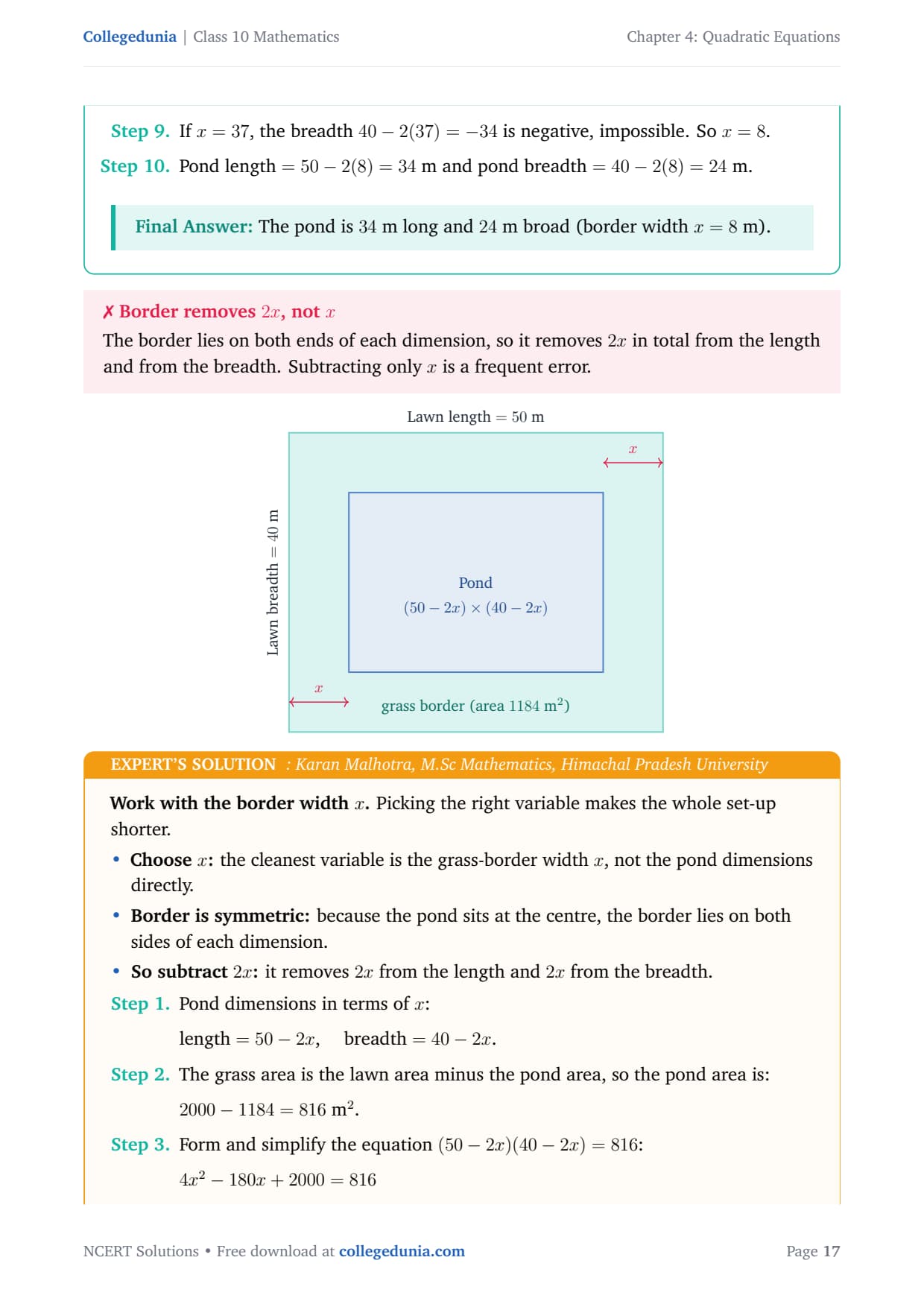
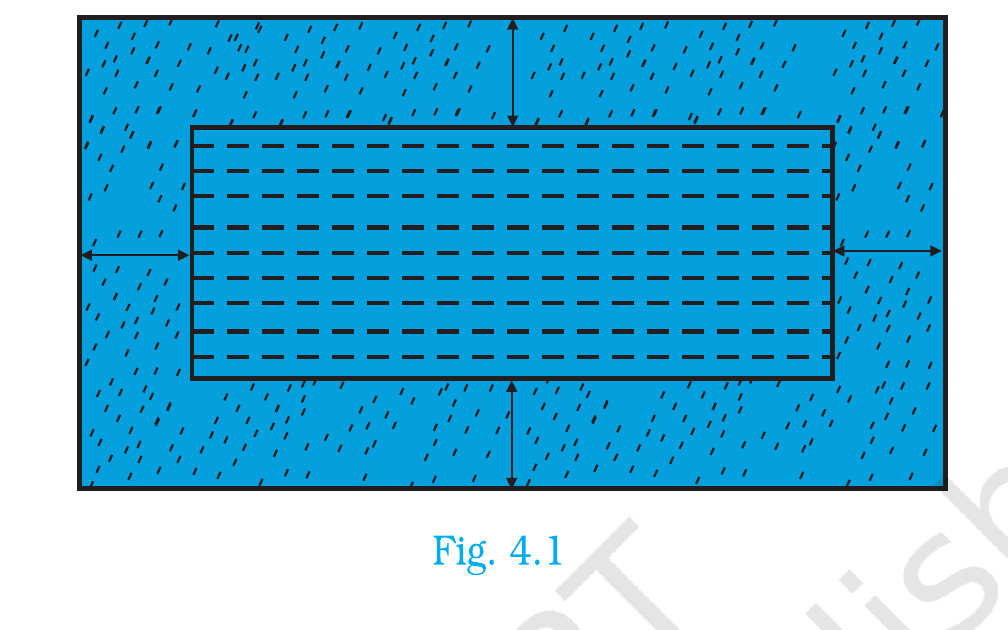
In the centre of a rectangular lawn of dimensions 50 m× 40 m, a rectangular pond has to be constructed so that the area of the grass surrounding the pond would be 1184 m2 (see Fig. 4.1). Find the length and breadth of the pond.
Fig. 4.1: the rectangular lawn (50 m
× 40 m) with the central rectangular pond and the grass
border around it.
Concept used. The grass forms a uniform border of unknown width
around the central pond. Using equal border width x on all sides, write
the pond's dimensions, then set up an area equation and solve
the quadratic.
Let the uniform width of the grass border be x metres. The pond
sits centrally, so the border removes x from each side.
Pond length =(50-2x) m and pond breadth =(40-2x) m.
Area of the whole lawn =50× 40=2000 m2.
Grass area = lawn area - pond area =1184, so the pond area
is:
[] pond area=2000-1184=816 m2.
Write the pond-area equation:
[] (50-2x)(40-2x)=816.
Expand the left side:
[] 2000-100x-80x+4x2=816
[] 4x2-180x+2000=816.
Bring all terms to one side and divide by 4:
[] 4x2-180x+1184=0
[] x2-45x+296=0.
Factorise (product 296, sum -45 gives -37 and -8):
[] (x-37)(x-8)=0, so x=37 or x=8.
If x=37, the breadth 40-2(37)=-34 is negative, impossible.
So x=8.
Pond length =50-2(8)=34 m and pond breadth =40-2(8)=24 m.
The pond is 34 m long and 24 m broad (border
width x=8 m).
KM
Karan Malhotra
M.Sc Mathematics, Himachal Pradesh University
Verified Expert
Work with the border width x. Picking the right variable makes
the whole set-up shorter.
Choose x: the cleanest variable is the grass-border
width x, not the pond dimensions directly.
Border is symmetric: because the pond sits at the
centre, the border lies on both sides of each dimension.
So subtract 2x: it removes 2x from the length and
2x from the breadth.
Pond dimensions in terms of x:
[] length =50-2x, breadth =40-2x.
The grass area is the lawn area minus the pond area, so the pond
area is:
[] 2000-1184=816 m2.
Form and simplify the equation (50-2x)(40-2x)=816:
[] 4x2-180x+2000=816
[] x2-45x+296=0.
Factorise: (x-37)(x-8)=0, so x=37 or x=8.
The width x=37 would force the breadth 40-2(37)=-34, which is
impossible, so x=8.
With x=8 the pond is 50-16=34 m by 40-16=24 m. The area check seals
it: 3424=816 m2 for the pond, and 2000-816=1184
m2 for the grass, exactly as stated.
Pond =34 m24 m.
Other Quadratic Equations Exercises (Class 10 Maths)
Once you finish Exercise 4.4, use the sibling exercises and chapter resources below to revise all of Quadratic Equations.
In a Collegedunia survey of 8,240 Class 10 Maths students, 74% found the word problems harder than the discriminant-only ones. Most struggled to turn the age and speed conditions into a correct quadratic (Questions 8, 9 and 11).
Source: Class 10 Mathematics student survey, 2026-27 session, 8,240 students from CBSE schools in 14 states.
Other Resources for This Chapter
Pair this with the other Class 10 Maths resources for Quadratic Equations, all linked below.
NCERT Exemplar Class 10 Maths Chapter 4 Exercise 4.4 FAQs
Ques. How many questions are in NCERT Exemplar Class 10 Maths Chapter 4 Exercise 4.4?
Ans. Exercise 4.4 has 12 Long Answer Questions (Q45 to Q56). The first five (Q45-Q49) check for real roots and find them with the discriminant and the quadratic formula. The other seven (Q50-Q56) are word problems on numbers, speed, age, clocks and area, the 5-mark type seen in CBSE board papers.
Ques. Which method works best for Exercise 4.4 word problems?
Ans. For number problems (Q50, Q51), form the equation directly and use factorisation since the discriminant turns out to be a perfect square. For speed problems (Q52), set up the time-difference equation and divide by a constant to simplify before factorising. For age problems (Q53, Q54), always take note of which age is being squared and which is just multiplied. Factorisation works for all word problems in this exercise once you form the correct quadratic.
Ques. Is NCERT Exemplar Class 10 Maths Exercise 4.4 important for CBSE board exams?
Ans. Yes. CBSE board papers regularly set 5-mark questions in the Exercise 4.4 style, especially speed-distance (like Q52), age puzzles (Q53, Q54) and area set-ups (Q56). Students who practise this exercise well find those board questions straightforward, in line with the 2026-27 CBSE syllabus.
Ques. How do I solve the rectangular pond problem (Q56) in Exercise 4.4?
Ans. Let x be the width of the grass border on each side. Since the pond is centred, the length of the pond is (50 - 2x) m and the breadth is (40 - 2x) m. The pond area equals total lawn area minus grass area, which is 2000 - 1184 = 816 sq m. Set (50 - 2x)(40 - 2x) = 816, simplify to x^2 - 45x + 296 = 0, and factorise as (x - 37)(x - 8) = 0. Reject x = 37 because it gives a negative breadth; take x = 8. The pond is 34 m by 24 m.
Ques. Where can I download the NCERT Exemplar Solutions for Class 10 Maths Chapter 4 Exercise 4.4 PDF?
Ans. You can download the PDF for NCERT Exemplar Solutions Class 10 Maths Chapter 4 Exercise 4.4 directly from this page. The PDF covers all 12 Long Answer Questions with step-by-step solutions according to the 2026-27 NCERT Exemplar book. The PDF is free and contains both the Check Solution steps and the Expert Solution verification for every question.







Comments