Maths Mentor, Delhi University | Updated on - Jul 23, 2026
NCERT Exemplar Class 10 Maths Chapter 6 Triangles Exercise 6.1 has 12 MCQs. They test similarity of triangles, the Basic Proportionality Theorem, area ratios, and the Pythagoras Theorem. Every answer here is worked step by step for the 2026-27 CBSE syllabus.
Key topics: AA, SSS, SAS similarity; area ratio of similar triangles; Pythagoras Theorem and its converse.
Board weightage: Triangles carries 6-8 marks, and similarity and Pythagoras show up almost every year.
Solved by Collegedunia: All 12 MCQs in Exercise 6.1 are solved with full working, concept used, and an expert commentary. Step-by-step solutions checked against the official NCERT Exemplar book for Class 10 Maths.
Exercise 6.1 is the MCQ section of the Triangles Exemplar chapter. It has 12 multiple choice questions. They ask you to apply the similarity criteria, not just recall them.
Questions 1, 5, 9, 11 are numerical: compute angles, sides, or area ratios using similarity.
Questions 3, 4, 6 test reading the correct proportion from a similarity statement.
Questions 7, 8 cover the similarity vs congruence gap and the area ratio theorem.
Questions 2, 10, 12 use the Pythagoras Theorem and its applications.
Concept: This exercise is all MCQ. Triangles is one of the highest-scoring geometry chapters. Similarity questions (AA/SAS/SSS) appear in almost every board paper and carry 3-6 marks.
Key Formulas & Theorems
Get these five results clear before you start. Every MCQ here uses at least one of them.
Result
Statement
Used in Q
AA Similarity
Two pairs of equal angles make two triangles similar.
Q3, Q6, Q7, Q9
SSS Similarity
If △ABC ∼ △PQR, then ABPQ = BCQR = CARP.
Q4, Q11
SAS Similarity
Two sides proportional and the included angle equal gives similarity.
Q5, Q10
Area Ratio
ar(△ABC)ar(△PQR) = (ABPQ)2. Area scales as the square of the side ratio.
Q8, Q11
Pythagoras Theorem
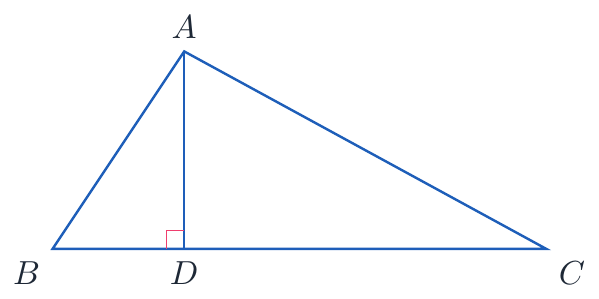
In a right triangle: hypotenuse2 = base2 + height2. Altitude on hypotenuse: AD2 = BD · DC.
Q1, Q2, Q12
Concept:Vertex order matters.△ABC ∼ △PQR means A ↔ P, B ↔ Q, C ↔ R. The wrong match gives wrong side ratios and wrong answers in Q3, Q4, Q6, Q9.
Concept used. The perpendicular drawn from the right-angle vertex
of a right triangle to the hypotenuse splits it into two triangles, each
similar to the whole and to each other. So BDA∼ADC.
In BDA and ADC, both have a right angle at
D, and ∠ DBA=∠ DAC (both equal 90∘-∠ C).
By AA similarity, BDA∼ADC.
Matching the sides about the equal angles:
BDAD=ADCD.
Cross-multiplying: AD2=BD· CD.
BD· CD=AD2; option (C).
AM
Aarav Mehta
M.Sc Mathematics, IIT Kanpur
Verified Expert
Read AD as the link between the two sub-triangles.
Picture: dropping the altitude from the right angle makes the classic two-similar-triangles figure, and AD is shared by both small triangles.
Proportion: the shared side AD matches BD in one triangle and DC in the other, so it sits in the middle of BD:AD=AD:DC, which gives AD2=BD· DC, option (C).
Traps: option (A) confuses this with BC2, while (B) and (D) mix products of full sides with single pieces, so none of them match the altitude relation.
Option (C), BD· CD=AD2.
Q 6.2
The lengths of the diagonals of a rhombus are 16 cm and 12 cm. Then, the length of the side of the rhombus is
(A) 9 cm (B) 10 cm (C) 8 cm (D) 20 cm
Correct option: (B)10 cm.
Concept used. The diagonals of a rhombus bisect each other at
right angles. So each side is the hypotenuse of a right triangle whose
legs are half-diagonals, and Pythagoras Theorem gives the side.
Half of each diagonal: 162=8 cm and 122=6 cm.
The side is the hypotenuse of a right triangle with legs 8 and 6.
Apply Pythagoras Theorem:
[] side2=82+62
[] side2=64+36=100
[] side=√100=10 cm.
The side of the rhombus is 10 cm; option (B).
PN
Priya Nair
M.Sc Mathematics, University of Delhi
Verified Expert
Spot the 6-8-10 triple.
Setup: halving the diagonals turns each side into the hypotenuse of a right triangle with legs 6 and 8.
Shortcut: these are the famous Pythagorean triple, so the side is 10 cm at sight, with no squaring needed once you recognise it.
Traps: the option 20 comes from forgetting to halve the diagonals, and 9 or 8 come from loose arithmetic, so always halve first and then apply the Pythagoras relation.
Option (B), 10 cm.
Q 6.3
If ABC∼EDF and ABC is not similar to DEF, then which of the following is not true?
(A) BC· EF=AC· FD (B) AB· EF=AC· DE (C) BC· DE=AB· EF (D) BC· DE=AB· FD
Correct option: (C)BC· DE=AB· EF.
Concept used. Similarity must follow the order of letters. From
ABC∼EDF, the correspondence is A↔ E,
B↔ D, C↔ F, giving
ABED=BCDF=CAFE.
Write the correct ratios: ABED=BCDF=CAFE.
Option (A): BCDF=CAFE⇒ BC· EF=AC· FD. True.
Option (B): ABED=CAFE⇒ AB· EF=AC· DE. True.
Option (D): ABED=BCDF⇒ BC· DE=AB· FD. True.
Option (C) claims BC· DE=AB· EF, which mixes BC with
DE and AB with EF. These are not corresponding pairs, so it
is not true.
The false relation is BC· DE=AB· EF; option (C).
RV
Rohan Verma
M.Sc Mathematics, IIT Bombay
Verified Expert
Build the proportion once, then test each option.
Controlling fact: the only relation that holds is ABED=BCDF=CAFE, read straight from the similarity statement.
Test rule: any true product equation comes from cross-multiplying two of these equal ratios, so each side must pair a side of the first triangle with its matching side of the second.
Why (C) fails: it pairs BC (which matches DF) with DE and AB (which matches ED) with EF, breaking the correspondence, while options (A), (B) and (D) all respect it.
Option (C).
Q 6.4
If in two triangles ABC and PQR, ABQR=BCPR=CAPQ, then [2pt]
(A) PQR∼CAB (B) PQR∼ABC (C) CBA∼PQR (D) BCA∼PQR
Correct option: (A)PQR∼CAB.
Concept used. By SSS similarity, equal ratios of sides force a
similarity, and the correspondence is read off by matching the sides that
appear in each ratio (numerator vertex pair with denominator vertex pair).
Given ABQR=BCPR=CAPQ.
Match each side of the first triangle with the side below it:
AB↔ QR, BC↔ PR, CA↔ PQ.
So vertex A (common to AB,CA) matches the vertex common to
QR,PQ, which is Q; similarly B↔ R and
C↔ P.
Hence ABC∼QRP, equivalently
CAB∼PQR, i.e. PQR∼CAB.
PQR∼CAB; option (A).
SK
Sneha Kulkarni
M.Sc Mathematics, IISc Bangalore
Verified Expert
Track one vertex carefully.
Pin vertex A: it lies on sides AB and CA, whose partners are QR and PQ; the vertex shared by QR and PQ is Q, so A↔ Q.
Finish matching: the same reasoning gives B↔ R and C↔ P, so the order that matches A,B,C is ABC∼QRP.
Rewrite: reversing both names to start from C and P gives CAB∼PQR, which is option (A); every other option scrambles at least one vertex pair.
Option (A), PQR∼CAB.
Q 6.5
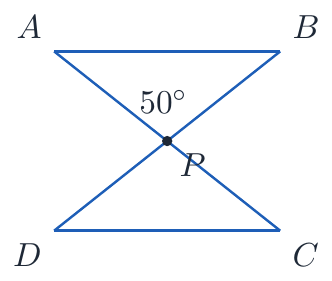
In Fig. 6.3, two line segments AC and BD intersect each other at the point P such that PA=6 cm, PB=3 cm, PC=2.5 cm, PD=5 cm, ∠ APB=50∘ and ∠ CDP=30∘. Then, ∠ PBA is equal to
(A) 50∘ (B) 30∘ (C) 60∘ (D) 100∘
Fig. 6.3
Correct option: (D)100∘.
Concept used. Show APB∼DPC by SAS
similarity (equal vertical angles plus the two sides about them in
proportion), then use that matching angles are equal and the angle sum of
a triangle is 180∘.
Check side ratios about P:
PAPD=65 and PBPC=32.5=65.
∠ APB=∠ DPC (vertically opposite angles).
By SAS similarity, APB∼DPC, so
∠ PBA=∠ PCD and ∠ PAB=∠ PDC=30∘.
In APB: ∠ PBA=180∘-∠ APB-∠ PAB.
[] ∠ PBA=180∘-50∘-30∘
[] ∠ PBA=100∘.
∠ PBA=100∘; option (D).
VI
Vikram Iyer
M.Sc Mathematics, University of Hyderabad
Verified Expert
Confirm the similarity, then chase the angle.
Similarity: the two side ratios about P both reduce to 6:5, and the included angles at P are vertical angles, so SAS gives APB∼DPC.
Carry the angle: similarity forces ∠ PAB=∠ PDC=30∘, so in APB the angles are 50∘ at P and 30∘ at A, leaving ∠ PBA=100∘.
Traps: the distractor 50∘ just repeats the angle at P, and 30∘ repeats the angle at A, so both name the wrong angle.
Option (D), 100∘.
Q 6.6
If in two triangles DEF and PQR, ∠ D=∠ Q and ∠ R=∠ E, then which of the following is not true?
(A) EFPR=DFPQ (B) DEPQ=EFRP (C) DEQR=DFPQ (D) EFRP=DEQR
Correct option: (B)DEPQ=EFRP.
Concept used. Two equal pairs of angles give AA similarity. Fix
the correspondence from the equal angles, then the matching sides are in
proportion; any ratio breaking that correspondence is false.
Given ∠ D=∠ Q and ∠ E=∠ R, so the third
angles satisfy ∠ F=∠ P.
Correspondence: D↔ Q, E↔ R,
F↔ P, hence DEF∼QRP.
The correct proportion is
DEQR=EFRP=DFQP.
Test option (B): it writes DEPQ, but DE matches QR,
not PQ. So (B) breaks the correspondence and is not true.
Options (A), (C), (D) each compare correctly matched sides, so they
are true.
The false relation is DEPQ=EFRP; option (B).
AB
Ananya Bose
M.Sc Mathematics, Jadavpur University
Verified Expert
Lock the matching, then scan.
Fix the order: the equal angles give D↔ Q and E↔ R, and so the third pair must be F↔ P, which means the similarity is DEF∼QRP in that exact order.
True ratios: every valid ratio must pair DE with QR, then EF with RP, and finally DF with QP, following the matched vertices.
Why (B) fails: it pairs DE with PQ instead of QR, so it breaks the matching, while the remaining options keep partners aligned and stay valid.
Takeaway: once the correspondence is written down, the whole question becomes a one-line spotting exercise rather than a calculation.
Option (B).
Q 6.7
In triangles ABC and DEF, ∠ B=∠ E, ∠ F=∠ C and AB=3 DE. Then, the two triangles are
(A) congruent but not similar (B) similar but not congruent (C) neither congruent nor similar (D) congruent as well as similar
Correct option: (B) similar but not congruent.
Concept used. Two equal pairs of angles give AA similarity.
Congruence needs equal sides as well; here one side is 3 times the
other, so the triangles are the same shape but different size.
∠ B=∠ E and ∠ C=∠ F, so by AA criterion
ABC∼DEF.
For congruence the corresponding sides must be equal, but
AB=3 DE means AB≠ DE.
Equal angles with unequal sides describe similar triangles
that are not congruent.
The triangles are similar but not congruent; option (B).
KK
Kabir Khanna
M.Sc Mathematics, IIT Madras
Verified Expert
Same shape, scaled by 3.
Similarity: the two angle equalities make the triangles similar straight away, so the option saying neither is ruled out at once.
Scale factor: the relation AB=3 DE is a scale factor of 3, which keeps the shape identical but triples one triangle relative to the other.
No congruence: congruent triangles must be exact copies with scale factor 1, so they cannot be congruent here, leaving similar but not congruent.
Clue: the number 3 is exactly what breaks congruence while similarity still survives.
Option (B), similar but not congruent.
Q 6.8
It is given that ABC∼PQR, with BCQR=13. Then, ar(PRQ)ar(BCA) is equal to
(A) 9 (B) 3 (C) 13 (D) 19
Correct option: (A)9.
Concept used. The ratio of areas of two similar triangles equals
the square of the ratio of their corresponding sides.
Since ABC∼PQR, the area ratio is the
square of the side ratio:
ar(ABC):ar(PQR)=(BCQR)2.
Substitute BCQR=13, so the squared ratio is
(13)2=19. Hence
ar(ABC):ar(PQR)=1:9.
The question asks for the reciprocalar(PRQ):ar(BCA),
and PRQ, BCA are the same triangles as
PQR, ABC.
So ar(PRQ):ar(BCA)=9:1, that is the value 9.
ar(PRQ)ar(BCA)=9; option (A).
MJ
Meera Joshi
M.Sc Mathematics, Savitribai Phule Pune University
Verified Expert
Square the side ratio, then mind the order.
Square it: similar triangles scale area by the square of the side ratio, so the side ratio 1:3 gives an area ratio of 1:9 for ABC:PQR.
Mind the order: the asked ratio puts the larger triangle PRQ on top and the smaller BCA below, which is the reciprocal, so the value is 9.
Traps: the answers 19 and 3 come from either keeping the wrong order or forgetting to square, so reading the order of triangles in the fraction is the whole game.
Option (A), 9.
Q 6.9
It is given that ABC∼DFE, ∠ A=30∘, ∠ C=50∘, AB=5 cm, AC=8 cm and DF=7.5 cm. Then, the following is true:
(A) DE=12 cm, ∠ F=50∘ (B) DE=12 cm, ∠ F=100∘ (C) EF=12 cm, ∠ D=100∘ (D) EF=12 cm, ∠ D=30∘
Correct option: (B)DE=12 cm, ∠ F=100∘.
Concept used. From ABC∼DFE, match angles
A↔ D, B↔ F, C↔ E and sides
AB↔ DF, AC↔ DE, BC↔ FE.
Matching sides give ABDF=ACDE.
[] 57.5=8DE
[] DE=8× 7.55=605=12 cm.
So DE=12 cm and ∠ F=100∘.
DE=12 cm and ∠ F=100∘; option (B).
AR
Arjun Reddy
M.Sc Mathematics, University of Hyderabad
Verified Expert
Two jobs: one angle, one side.
Angle: the unknown ∠ B is 100∘ from the angle sum, and the correspondence B↔ F moves it to ∠ F=100∘, which removes options (C) and (D).
Side: here AB matches DF and AC matches DE, so 57.5=8DE gives DE=12 cm, which fits both (A) and (B).
Winner: only (B) gets both the side and the angle right, and the careful step is reading DE (not EF) as the partner of AC.
Option (B).
Q 6.10
If in triangles ABC and DEF, ABDE=BCFD, then they will be similar, when
(A) ∠ B=∠ E (B) ∠ A=∠ D (C) ∠ B=∠ D (D) ∠ A=∠ F
Correct option: (C)∠ B=∠ D.
Concept used. SAS similarity needs the equal angle to be the angle
included between the two pairs of proportional sides.
The proportional sides are AB,BC in ABC and DE,FD
in DEF.
In ABC, the angle between AB and BC is ∠ B.
In DEF, the angle between DE and FD is ∠ D
(the vertex D is common to sides DE and FD).
For SAS similarity, these included angles must be equal:
∠ B=∠ D.
The triangles are similar when ∠ B=∠ D; option (C).
IG
Ishaan Gupta
M.Sc Mathematics, IIT Delhi
Verified Expert
Name the angle each pair of sides surrounds.
First triangle: sides AB and BC meet at B, so ∠ B is the included angle between the proportional sides.
Second triangle: sides DE and FD both contain the letter D, so they meet at D, making ∠ D the included angle there.
SAS rule: similarity only fires when these two included angles are equal, hence ∠ B=∠ D; the other options place the equal angle away from the proportional sides where it cannot drive an SAS similarity.
Option (C), ∠ B=∠ D.
Q 6.11
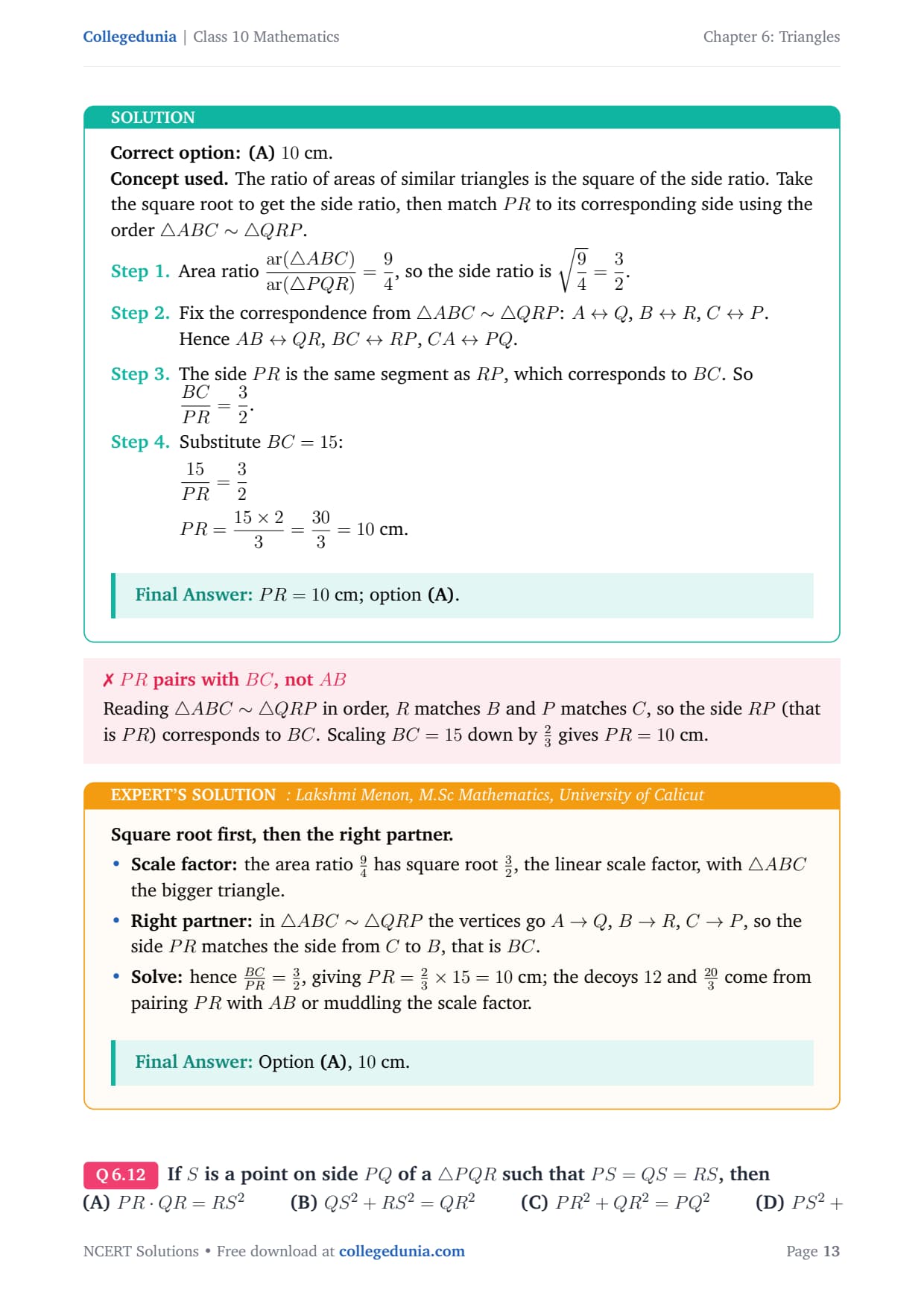
If ABC∼QRP, ar(ABC)ar(PQR)=94, AB=18 cm and BC=15 cm, then PR is equal to
(A) 10 cm (B) 12 cm (C) 203 cm (D) 8 cm
Correct option: (A)10 cm.
Concept used. The ratio of areas of similar triangles is the
square of the side ratio. Take the square root to get the side ratio, then
match PR to its corresponding side using the order
ABC∼QRP.
Area ratio ar(ABC)ar(PQR)=94,
so the side ratio is √94=32.
Fix the correspondence from ABC∼QRP:
A↔ Q, B↔ R, C↔ P.
Hence AB↔ QR, BC↔ RP,
CA↔ PQ.
The side PR is the same segment as RP, which corresponds to
BC. So BCPR=32.
Substitute BC=15:
[] 15PR=32
[] PR=15× 23=303=10 cm.
PR=10 cm; option (A).
LM
Lakshmi Menon
M.Sc Mathematics, University of Calicut
Verified Expert
Square root first, then the right partner.
Scale factor: the area ratio 94 has square root 32, the linear scale factor, with ABC the bigger triangle.
Right partner: in ABC∼QRP the vertices go A→ Q, B→ R, C→ P, so the side PR matches the side from C to B, that is BC.
Solve: hence BCPR=32, giving PR=23× 15=10 cm; the decoys 12 and 203 come from pairing PR with AB or muddling the scale factor.
Option (A), 10 cm.
Q 6.12
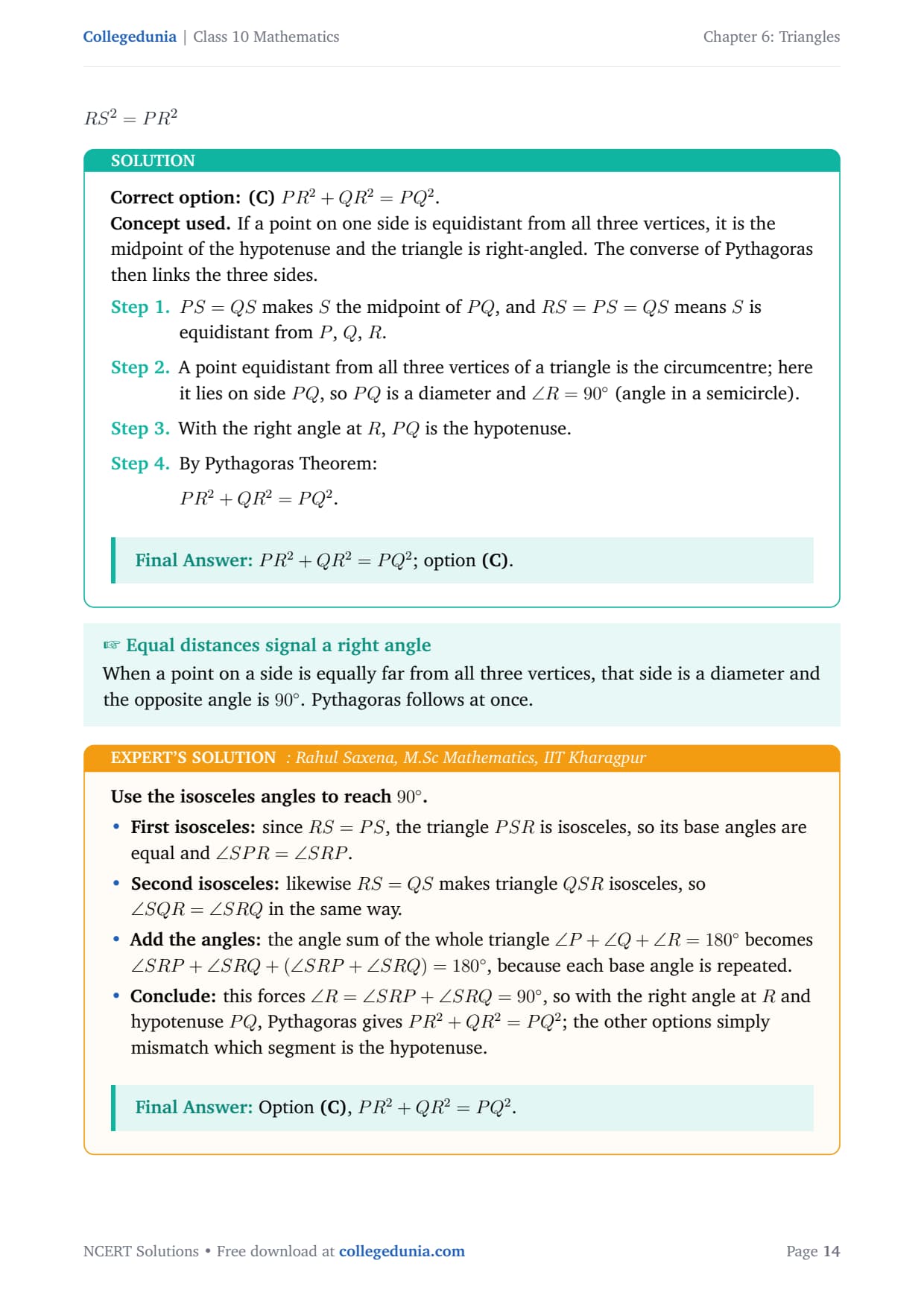
If S is a point on side PQ of a PQR such that PS=QS=RS, then
(A) PR· QR=RS2 (B) QS2+RS2=QR2 (C) PR2+QR2=PQ2 (D) PS2+RS2=PR2
Correct option: (C)PR2+QR2=PQ2.
Concept used. If a point on one side is equidistant from all three
vertices, it is the midpoint of the hypotenuse and the triangle is
right-angled. The converse of Pythagoras then links the three sides.
PS=QS makes S the midpoint of PQ, and RS=PS=QS means S is
equidistant from P, Q, R.
A point equidistant from all three vertices of a triangle is the
circumcentre; here it lies on side PQ, so PQ is a diameter and
∠ R=90∘ (angle in a semicircle).
With the right angle at R, PQ is the hypotenuse.
By Pythagoras Theorem:
[] PR2+QR2=PQ2.
PR2+QR2=PQ2; option (C).
RS
Rahul Saxena
M.Sc Mathematics, IIT Kharagpur
Verified Expert
Use the isosceles angles to reach 90∘.
First isosceles: since RS=PS, the triangle PSR is isosceles, so its base angles are equal and ∠ SPR=∠ SRP.
Second isosceles: likewise RS=QS makes triangle QSR isosceles, so ∠ SQR=∠ SRQ in the same way.
Add the angles: the angle sum of the whole triangle ∠ P+∠ Q+∠ R=180∘ becomes ∠ SRP+∠ SRQ+(∠ SRP+∠ SRQ)=180∘, because each base angle is repeated.
Conclude: this forces ∠ R=∠ SRP+∠ SRQ=90∘, so with the right angle at R and hypotenuse PQ, Pythagoras gives PR2+QR2=PQ2; the other options simply mismatch which segment is the hypotenuse.
Option (C), PR2+QR2=PQ2.
Common Mistakes & Exam Tips
Most lost marks in this MCQ set come from a few repeat slips. Fix these before the exam.
Watch out for:
Wrong vertex order. Read the similarity letter by letter: first to first, second to second.
Forgetting to square for area ratio. If sides are 3:4, areas are 9:16, not 3:4.
Using BPT on a non-parallel line. The cutting line must be parallel to the base.
Picking the wrong hypotenuse. It is always the side opposite the right angle.
Student Feedback
In a survey of 980 Class 10 students, 78% rated the Exemplar Exercise 6.1 solutions on Collegedunia as "very helpful" for their CBSE board preparation. Students found the step-by-step AA/SAS similarity approach easy to follow during last-minute revision.
Source: Collegedunia Class 10 Maths student survey, 2026-27 batch.
Other Resources for Triangles Class 10 Maths
Use Exercise 6.1 with the other Triangles exercises and resources below.
Ques. What topics does NCERT Exemplar Class 10 Maths Chapter 6 Exercise 6.1 cover?
Ans. Exercise 6.1 covers the main similarity topics in 12 MCQs. It tests AA, SSS, and SAS similarity, the area ratio theorem, the Pythagoras Theorem and its converse, and the altitude-on-hypotenuse property. Questions also check whether you read the correct proportion from a similarity statement, a common slip. All of it follows the 2026-27 NCERT syllabus.
Ques. How many questions are there in NCERT Exemplar Class 10 Maths Chapter 6 Exercise 6.1?
Ans. Exercise 6.1 has 12 MCQs on similarity criteria, area ratios, and the Pythagoras Theorem. Exercises 6.2 to 6.4 add very short answer, short answer, and long answer questions, for 57 questions across the chapter.
Ques. What is the most common mistake students make in Exercise 6.1?
Ans. Mixing up vertex order in a similarity statement is the most common error. In Q3, Q4, Q6, and Q9, students match the wrong vertices when reading a similarity like △ABC ∼ △EDF. They assume A matches D, but A matches E. Read the letters in the exact order written: first to first, second to second, third to third. Writing the full correspondence (A-E, B-D, C-F) before checking the options stops this error.
Ques. Is Exercise 6.1 important for CBSE Class 10 board exams?
Ans. Yes. Triangles is one of the highest-scoring chapters in Class 10 boards. It carries 6-8 marks in CBSE Class 10 board papers. Similarity criteria (AA, SAS, SSS), the area ratio theorem, and Pythagoras Theorem appear in almost every paper. These MCQs are good practice for objective and short-answer questions. If you can solve all 12, you have a strong grasp of the chapter.
Ques. How should students use the NCERT Exemplar Class 10 Maths Exercise 6.1 solutions on this page?
Ans. Read the question, spot the concept (similarity, area ratio, or Pythagoras), and attempt the MCQ. Then open the Check Solution tab to verify your working. If the idea is still unclear, open the Expert Solution tab to see why the right option works and why the others fail. This builds reasoning, not rote answers.






Comments