Maths Mentor, Delhi University | Updated on - Jul 23, 2026
These NCERT Exemplar Class 10 Maths Chapter 7 Solutions cover every Coordinate Geometry problem from Exercises 7.1 to 7.4 with clear, step-by-step working. Each answer shows how to apply the Distance Formula, Section Formula, and Area of a Triangle formula. So you can check your own logic at every step. The set follows the 2026-27 CBSE syllabus.
Exemplar problems across four exercises: MCQs, true-or-false, short-answer, and long-answer questions covering all Coordinate Geometry concepts.
Covers Distance Formula, Section Formula (internal and external division), Mid-point Formula, and the Area of a Triangle using coordinates.
Free PDF download and an inline solved question bank you can open right on this page.
Solved by Collegedunia: Every Coordinate Geometry Exemplar question on this page is worked out by our Mathematics faculty, cross-checked against the official NCERT Exemplar, and aligned to the 2026-27 CBSE syllabus.
The Exemplar spans four exercises that cover every part of the chapter. Each exercise targets a different level of thinking. The image below shows the split at a glance.
Exercise
Question Type
Count
What It Tests
Exercise 7.1
MCQ (objective)
14
Apply Distance Formula, Section Formula, Mid-point, and collinearity conditions
Exercise 7.2
True or False (justify)
7
Verify whether a coordinate geometry statement holds; requires written justification
Exercise 7.3
Short answer (compute)
20
Find coordinates, distances, ratios, and areas using the key formulas
Exercise 7.4
Long answer (multi-step)
9
Combine multiple formulas to prove geometric properties using coordinates
The full set has 50 problems. A smart order: lock in the formulas with the MCQs, sharpen your justification writing on the true-or-false set, build speed through the short-answer exercise, then take on the long-answer problems once every formula is solid.
Key Formulas You Must Know
Almost every problem rests on one of these five results. Knowing them before you start saves time and prevents errors in the board paper.
Distance Formula: the distance between two points P(x1, y1) and Q(x2, y2) is (x2 - x1)2 + (y2 - y1)2. The most frequently tested formula across all four exercises.
Section Formula (internal division): the point that divides segment PQ in the ratio m:n internally is mx2 + nx1m + n, my2 + ny1m + n.
Mid-point Formula: the midpoint of PQ is x1 + x22, y1 + y22. This is the Section Formula with m = n = 1.
Area of a Triangle: the area of a triangle with vertices (x1, y1), (x2, y2), (x3, y3) is 12 |x1(y2 - y3) + x2(y3 - y1) + x3(y1 - y2)|. If the area is zero, the three points are collinear.
Condition for collinearity: three points are collinear if and only if the area of the triangle formed by them is zero. This is the cleanest test for collinearity in MCQs.
A tip that saves steps: label your coordinates as (x1, y1), (x2, y2) before substituting. Write the full formula first, then fill in values. That is far less error-prone than doing it in one step under exam pressure.
How These Solutions Help You
These solutions are written for self-study in the weeks before the board exam. They do three concrete things:
Show every substitution step: the formula is written out first, then values are plugged in, then arithmetic is shown on a separate line so you can see exactly where your own working diverges.
Justify true-or-false answers fully: every verdict includes the counterexample or theorem that decides it, which is the part most students skip and lose marks on.
Add an Expert view: each question has a second, faster method, such as spotting that midpoint = origin implies sum of coordinates is zero, or using the collinearity condition directly instead of the slope method.
Best way to use these: attempt the question first, then open Check Solution to compare your working step by step. Read Expert Solution only after writing your own answer. That order builds real recall, not passive recognition.
Exemplar vs Textbook Difficulty
The textbook tests one skill at a time: use the Distance Formula to find how far apart two points are, or the Section Formula to find a dividing point. The Exemplar pushes the same ideas into multi-condition MCQs, justification tasks, and combined-formula problems. The table shows where the step-up happens.
Skill
NCERT Textbook
NCERT Exemplar
Distance Formula
Find the distance between two given points
Determine the type of triangle or quadrilateral formed by four points; prove it is equilateral, isosceles, or a rhombus
Section Formula
Find the coordinates of a point dividing a segment in a given ratio
Find the ratio itself when only the coordinates are given; use external division; combine with distance
Mid-point
Compute the midpoint from two given endpoints
Find an unknown endpoint given the midpoint; use the midpoint to prove diagonals bisect each other
Area of Triangle
Apply the formula with three given vertices
Use area = 0 to prove collinearity; find an unknown coordinate that makes three points collinear
Combined problems
One formula per question
Multiple formulas in one question; for example, find the centroid then check whether it lies on a given line
This is why doing the Exemplar after the textbook is the standard board-prep route: the textbook teaches the formulas one at a time, while the Exemplar makes you pick the right one under MCQ pressure and multi-step conditions.
Common Mistakes to Avoid
Across Exercises 7.1 to 7.4, these four slips cost the most marks. Watch for them before your exam.
Swapping x and y in the Section Formula: the x-coordinates belong in the x-expression and the y-coordinates in the y-expression. Students who write both at once often swap a pair. Write the x-result first, then the y-result on a new line.
Forgetting the absolute value in the Area Formula: area is always positive. A negative result means an arithmetic slip or a missing modulus. The Exemplar MCQs include the negative value as an option to trap this.
Wrong ratio order for external division: in internal division the point lies between the endpoints; in external division it lies outside. Mixing up the sign for external division is a common Exercise 7.3 error.
Incomplete justification in true-or-false: writing just "True" or "False" with no counterexample or theorem earns zero marks. The rubric needs a one or two-line reason for every verdict.
Keep a short list of the ones you repeat. For most students, one or two of these four slips account for nearly all their lost marks.
Other Resources for Chapter 7
Pair this Exemplar set with the other Coordinate Geometry resources to cover the chapter fully before your board exam.
Picture: dropping perpendiculars from P(-6,8) to the two
axes builds a right triangle whose legs are 6 and 8.
Hypotenuse: the line back to the origin is that triangle's
hypotenuse, √62+82=10, the famous 6-8-10 set.
Payoff: once you recognise such Pythagorean triples you can
write the answer instantly, with no calculator needed.
Option (C), 10.
Q 7.4
The distance between the points (0,5) and (-5,0) is
(A) 5 (B) 5√2 (C) 2√5 (D) 10
Correct option: (B)5√2.
Concept used. Use the distance formula
√(x2-x1)2+(y2-y1)2 and simplify the surd.
Substitute (x1,y1)=(0,5) and (x2,y2)=(-5,0):
[] d=√(-5-0)2+(0-5)2
[] =√25+25
[] =√50.
Simplify: √50=√25× 2=5√2.
The distance is 5√2; option (B).
SK
Sneha Kulkarni
M.Sc Mathematics, IISc Bangalore
Verified Expert
Two equal legs give a √2 answer.
Equal gaps: the horizontal gap and the vertical gap are
both 5, so the two points are corners of a right isosceles
triangle.
Standard form: the hypotenuse of such a triangle is always
a leg times √2, which here gives 5√2 at once.
Why bother: spotting the equal legs is faster than grinding
out √50 and it stops you leaving the surd unsimplified.
Option (B), 5√2.
Q 7.5
AOBC is a rectangle whose three vertices are A(0,3), O(0,0) and B(5,0). The length of its diagonal is
(A) 5 (B) 3 (C) √34 (D) 4
Correct option: (C)√34.
Concept used. In a rectangle the diagonal joins two opposite
corners; its length comes from the distance formula. Here A and B
are opposite corners.
The two given sides are OA (vertical, length 3) and OB
(horizontal, length 5), meeting at the right angle at O.
The diagonal AB joins the far ends of these sides:
[] AB=√(5-0)2+(0-3)2
[] =√25+9
[] =√34.
The diagonal length is √34; option (C).
AI
Ananya Iyer
M.Sc Mathematics, ISI Kolkata
Verified Expert
Both diagonals of a rectangle are equal.
Sides: the two sides meeting at O are 3 and 5, and
they are perpendicular by construction.
Diagonal: the diagonal across the rectangle is therefore
√32+52=√34, the length we want.
Check: the other diagonal OC has the same length, a quick
consistency test, and the only care needed is reading A and B
as opposite corners rather than adjacent ones.
Option (C), √34.
Q 7.6
The perimeter of a triangle with vertices (0,4), (0,0) and (3,0) is
(A) 5 (B) 12 (C) 11 (D) 7+√5
Correct option: (B)12.
Concept used. Perimeter = sum of the three side lengths, each
found by the distance formula.
Side from (0,0) to (0,4) (vertical): length =4.
Side from (0,0) to (3,0) (horizontal): length =3.
Side from (0,4) to (3,0) (the hypotenuse):
[] =√(3-0)2+(0-4)2
[] =√9+16=√25=5.
Perimeter =4+3+5=12.
Perimeter =12; option (B).
KR
Karthik Reddy
M.Sc Mathematics, IIT Madras
Verified Expert
A right triangle sitting on the axes.
Legs: two sides run along the axes with lengths 3 and
4, so they are the legs of a right angle at the origin.
Slant side: the third side is the 3-4-5 hypotenuse,
namely 5, so the perimeter is 3+4+5=12.
The trap: the decoy 7+5 comes from mis-squaring the
hypotenuse, so compute √9+16 carefully and that error
disappears.
Option (B), 12.
Q 7.7
The area of a triangle with vertices A(3,0), B(7,0) and C(8,4) is
(A) 14 (B) 28 (C) 8 (D) 6
Correct option: (C)8.
Concept used. Area of a triangle from vertices:
12 |x1(y2-y3)+x2(y3-y1)+x3(y1-y2)|.
Base: because A(3,0) and B(7,0) share y=0, the base
AB runs along the x-axis with length 7-3=4.
Height: the height is simply how high C rises above that
axis, which is 4, so the area is 1244=8.
When to use it: the vertex formula confirms the same 8,
but this base-times-height idea is faster whenever one side is
horizontal or vertical.
Option (C), 8.
Q 7.8
The points (-4,0), (4,0), (0,3) are the vertices of a
(A) right triangle (B) isosceles triangle
(C) equilateral triangle (D) scalene triangle
Correct option: (B) isosceles triangle.
Concept used. Compute all three side lengths; a triangle is
isosceles if exactly two sides are equal.
Side between (-4,0) and (4,0): length =8.
Side between (-4,0) and (0,3):
√(0+4)2+(3-0)2=√16+9=5.
Side between (4,0) and (0,3):
√(0-4)2+(3-0)2=√16+9=5.
Two sides equal 5 and one is 8, so the triangle is
isosceles. (Check 52+52=50≠ 64=82, so it is not right
angled.)
The triangle is isosceles (two sides =5); option (B).
VS
Vikram Singh
M.Sc Mathematics, Jadavpur University
Verified Expert
Symmetry hints at isosceles.
Mirror: the base endpoints (-4,0) and (4,0) are mirror
images across the y-axis, and the apex (0,3) sits right on that
mirror line.
Equal sides: so the two slant sides must come out equal,
each 5 by the distance formula, while the base measures 8.
Final read: two equal sides with one different make it
isosceles, and the failed Pythagoras test (25+2564) rules out
any right angle.
Option (B), isosceles triangle.
Q 7.9
The point which divides the line segment joining the points (7,-6) and (3,4) in ratio 1:2 internally lies in the
(A) I quadrant (B) II quadrant
(C) III quadrant (D) IV quadrant
Correct option: (D) IV quadrant.
Concept used. Find the dividing point by the section formula,
then read its signs: IV quadrant means x>0 and y<0.
Section formula with m1:m2=1:2, A(7,-6), B(3,4):
[] x=1· 3+2· 71+2=3+143=173
[] y=1· 4+2·(-6)1+2=4-123=-83
The point is (173, -83), with
x>0 and y<0.
A positive x and negative y place the point in the IV
quadrant.
The point (173,-83) lies in
the IV quadrant; option (D).
DM
Divya Menon
M.Sc Mathematics, University of Hyderabad
Verified Expert
Care with which weight goes where.
Where it sits: in the ratio 1:2 the part nearer A is
smaller, so the point lands closer to A(7,-6) and gets dragged
down into negative y.
The point: the formula gives
(173,-83), with positive x and
negative y, which is the fourth quadrant.
Common slip: students swap the cross-multiplication, so
write m1x2+m2x1m1+m2 out in full before
substituting.
Option (D), IV quadrant.
Q 7.10
The point which lies on the perpendicular bisector of the line segment joining the points A(-2,-5) and B(2,5) is
(A) (0,0) (B) (0,2) (C) (2,0) (D) (-2,0)
Correct option: (A)(0,0).
Concept used. Every point on the perpendicular bisector of AB
is equidistant from A and B, and the midpoint of AB always lies on
it.
Find the midpoint of AB:
[] (-2+22,-5+52)=(0,0).
The midpoint is guaranteed to lie on the perpendicular bisector.
Check by distances: from (0,0),
OA=√4+25=√29 and OB=√4+25=√29, which
are equal, so (0,0) qualifies.
(0,0) lies on the perpendicular bisector; option (A).
AP
Arjun Pillai
M.Sc Mathematics, IIT Delhi
Verified Expert
The midpoint is the safe pick.
Key fact: the midpoint of a segment always lies on its
perpendicular bisector, and here that midpoint works out to the
origin (0,0).
Confirm: a single distance check seals it, since
OA=OB=√29 are equal.
Why faster: testing each other option would mean two
distance computations apiece, so starting from the midpoint skips
all of that and lands on the answer at once.
Option (A), (0,0).
Q 7.11
The fourth vertex D of a parallelogram ABCD whose three vertices are A(-2,3), B(6,7) and C(8,3) is
(A) (0,1) (B) (0,-1) (C) (-1,0) (D) (1,0)
Correct option: (B)(0,-1).
Concept used. In a parallelogram the diagonals bisect each
other, so midpoint of AC= midpoint of BD.
Midpoint of diagonal AC:
[] (-2+82,3+32)=(3,3).
Let D=(x,y). Midpoint of diagonal BD must also be (3,3):
[] 6+x2=3⇒ x=0
[] 7+y2=3⇒ y=-1.
So D=(0,-1).
D=(0,-1); option (B).
NA
Nisha Agarwal
M.Sc Mathematics, BHU Varanasi
Verified Expert
Equal midpoints pin down D.
Centre: the diagonals share a midpoint, found from A and
C to be (3,3).
Solve: force the midpoint of B(6,7) and D to be that
same point and the fourth vertex falls out as D=(0,-1).
Neat check: in a parallelogram the step A→ B matches
the step D→ C, and indeed both equal (8,4), which confirms the
vertex.
Option (B), (0,-1).
Q 7.12
If the point P(2,1) lies on the line segment joining points A(4,2) and B(8,4), then
(A) AP=13AB (B) AP=PB (C) PB=13AB (D) AP=12AB
Correct option: (D)AP=12AB.
Concept used. Compute the lengths AP, PB and AB by the
distance formula and compare. (Note P is the stated relationship's
focus even though it is the external point of the given segment.)
AP=√(4-2)2+(2-1)2=√4+1=5.
PB=√(8-2)2+(4-1)2=√36+9=√45=35.
AB=√(8-4)2+(4-2)2=√16+4=√20=25.
Compare: AP=5 and AB=25, so AP=12AB.
AP=12 AB; option (D).
SR
Siddharth Rao
M.Sc Applied Mathematics, IIT Roorkee
Verified Expert
Compare in units of 5.
Common unit: all three lengths come out as multiples of
5, namely AP=5, AB=25 and PB=35.
Read off: once they share that common factor the relations
are easy to compare, and AP=12AB is the one that holds.
Why it helps: working in the single surd unit removes the
clutter of separate square roots and makes the matching option
obvious.
Option (D), AP=12 AB.
Q 7.13
If P(a3,4) is the mid-point of the line segment joining the points Q(-6,5) and R(-2,3), then the value of a is
(A) -4 (B) -12 (C) 12 (D) -6
Correct option: (B)-12.
Concept used. The midpoint of QR is
(xQ+xR2,yQ+yR2); set it equal to the
given point.
Midpoint of Q(-6,5) and R(-2,3):
[] (-6+(-2)2,5+32)=(-4,4).
Match the x-coordinate with the given a3:
[] a3=-4.
Solve: a=-4× 3=-12. (The y-coordinate 4 already
matches, which confirms the setup.)
a=-12; option (B).
KD
Kavya Desai
M.Sc Mathematics, Savitribai Phule Pune University
Verified Expert
The y-value is a free check.
Midpoint: averaging the coordinates of Q and R gives
the midpoint (-4,4).
Real work: the given point already shows y=4, matching
perfectly, so the only equation left is a3=-4, giving
a=-12.
Reassurance: that built-in agreement on the y-coordinate
tells you no arithmetic slipped before you solved for a.
Option (B), a=-12.
Q 7.14
The perpendicular bisector of the line segment joining the points A(1,5) and B(4,6) cuts the y-axis at
(A) (0,13) (B) (0,-13) (C) (0,12) (D) (13,0)
Correct option: (A)(0,13).
Concept used. A point on the perpendicular bisector of AB is
equidistant from A and B. The point on the y-axis has the form
(0,y).
Let the required point be P(0,y). Set PA=PB, i.e.
PA2=PB2:
[] (0-1)2+(y-5)2=(0-4)2+(y-6)2.
Expand both sides:
[] 1+y2-10y+25=16+y2-12y+36.
Cancel y2 and simplify:
[] 26-10y=52-12y
[] 2y=26⇒ y=13.
So the point is (0,13).
The perpendicular bisector meets the y-axis at (0,13);
option (A).
AB
Aditya Bhat
M.Sc Mathematics, NIT Trichy
Verified Expert
Equidistance on the axis.
Form: any point on the y-axis is (0,y), so only one
unknown is in play.
Linear: demanding equal distance to A and B drops the
y2 terms, and solving 26-10y=52-12y gives y=13, so the
crossing point is (0,13).
Decoy: the squared-distance form is the clean route in, and
the x-axis option (13,0) is a trap because we wanted a point on
the y-axis.
Option (A), (0,13).
Q 7.15
The coordinates of the point which is equidistant from the three vertices of the AOB as shown in Fig. 7.1 is
(A) (x,y) (B) (y,x) (C) (x2,y2) (D) (y2,x2)
Correct option: (A)(x,y).
Concept used. For a right triangle, the point equidistant from
all three vertices is the circumcentre, which is the midpoint
of the hypotenuse.
From the figure, A=(0,2y), O=(0,0) and B=(2x,0), with the
right angle at O.
The hypotenuse is AB (the side opposite the right angle).
The circumcentre of a right triangle is the midpoint of its
hypotenuse:
[] midpoint of AB=(0+2x2,2y+02)
[] =(x,y).
The equidistant point is (x,y); option (A).
IR
Ishita Roy
M.Sc Mathematics, Calcutta University
Verified Expert
Hypotenuse midpoint is the centre.
Diameter: with the right angle at O, the hypotenuse AB
becomes a diameter of the circle through all three vertices.
Centre: so the midpoint of AB is equidistant from A,
O and B, and averaging A(0,2y) with B(2x,0) gives (x,y).
Why those numbers: the factor-of-two coordinates in the
figure are chosen so the midpoint comes out as the clean (x,y),
which is exactly option (A).
Option (A), (x,y).
Q 7.16
A circle drawn with origin as the centre passes through (132,0). The point which does not lie in the interior of the circle is
(A) (-34,1) (B) (2,73) (C) (5,-12) (D) (-6,52)
Correct option: (D)(-6,52).
Concept used. A point lies inside a circle of radius r
centred at the origin when its distance from the origin is less than
r. Here r=132=6.5, so we compare each distance with 6.5.
Radius r=132, so r2=1694=42.25.
Option (A): (34)2+12=916+1=1.5625<42.25: inside.
Option (B): 22+(73)2=4+499≈ 9.44<42.25: inside.
Option (C): 52+(12)2=25+0.25=25.25<42.25: inside.
Option (D): (-6)2+(52)2=36+6.25=42.25=r2:
the point is on the circle, not in the interior.
(-6,52) lies on the circle (distance
=r), so it is not interior; option (D).
NP
Nikhil Pandey
M.Sc Applied Mathematics, IIT Indore
Verified Expert
Compare squared distances with r2.
No surds: squaring keeps everything tidy, with the squared
radius at r2=42.25.
Inside: three of the points give squared distances well
below that (1.56, 9.44 and 25.25), so they sit in the
interior.
The odd one: the fourth point gives exactly 36+6.25=42.25,
equal to r2, so it rests on the circle, and ``interior'' needs a
strict inequality, which is why it fails.
Option (D), (-6,52).
Q 7.17
A line intersects the y-axis and x-axis at the points P and Q, respectively. If (2,-5) is the mid-point of PQ, then the coordinates of P and Q are, respectively
(A) (0,-5) and (2,0) (B) (0,10) and (-4,0)
(C) (0,4) and (-10,0) (D) (0,-10) and (4,0)
Correct option: (D)(0,-10) and (4,0).
Concept used. A point on the y-axis is (0,b) and a point on
the x-axis is (a,0). Their midpoint must equal (2,-5).
Write P=(0,b) (on y-axis) and Q=(a,0) (on x-axis).
Midpoint of PQ=(0+a2,b+02)=(2,-5).
Match coordinates:
[] a2=2⇒ a=4
[] b2=-5⇒ b=-10.
So P=(0,-10) and Q=(4,0).
P=(0,-10), Q=(4,0); option (D).
AR
Aishwarya Rao
M.Sc Mathematics, Christ University Bengaluru
Verified Expert
Double the midpoint, place the zeros.
Idea: when one endpoint contributes a zero, each coordinate
of the other endpoint is just twice the midpoint's matching
coordinate.
Apply: doubling -5 gives the y-axis point (0,-10), and
doubling 2 gives the x-axis point (4,0).
Where zeros come from: each point lies on its own axis, so
the answer drops out without solving any equation.
Option (D), (0,-10) and (4,0).
Q 7.18
The area of a triangle with vertices (a,b+c), (b,c+a) and (c,a+b) is
(A) (a+b+c)2 (B) 0 (C) a+b+c (D) abc
Correct option: (B)0.
Concept used. Plug the vertices into the area formula. A zero
area means the three points are collinear.
Area =12 |x1(y2-y3)+x2(y3-y1)+x3(y1-y2)| with
the given vertices.
Compute each y-difference:
[] y2-y3=(c+a)-(a+b)=c-b
[] y3-y1=(a+b)-(b+c)=a-c
[] y1-y2=(b+c)-(c+a)=b-a
The area is 0; the three points are collinear; option
(B).
MG
Manish Gupta
M.Sc Mathematics, IIT Guwahati
Verified Expert
The symmetric form forces zero.
Pattern: each y-coordinate is the total a+b+c minus the
matching x-coordinate.
Consequence: so all three points lie on the single straight
line x+y=a+b+c, and points on one line bound no area.
Insight: recognising that line explains why the determinant
collapses term by term to 0, rather than trusting a brute
expansion.
Option (B), 0.
Q 7.19
If the distance between the points (4,p) and (1,0) is 5, then the value of p is
(A) 4 only (B) ± 4 (C) -4 only (D) 0
Correct option: (B)± 4.
Concept used. Apply the distance formula, square both sides,
and solve the resulting equation for p.
Distance formula with the given distance 5:
[] √(4-1)2+(p-0)2=5.
Square both sides:
[] (3)2+p2=25
[] 9+p2=25.
Solve:
[] p2=16
[] p=± 4.
Both p=4 and p=-4 give the distance 5, so both are valid.
p=± 4; option (B).
RS
Rahul Saxena
M.Sc Mathematics, University of Mumbai
Verified Expert
A square root opens two doors.
Setup: squaring the distance gives 9+p2=25, so
p2=16.
Both roots: because squaring loses the sign, both p=4 and
p=-4 sit at vertical distance 4 from (1,0) and give the same
overall distance 5.
Geometry agrees: one point lies above and one below, each
equally far, so the honest answer keeps the ± sign.
Option (B), ± 4.
Q 7.20
If the points A(1,2), O(0,0) and C(a,b) are collinear, then
(A) a=b (B) a=2b (C) 2a=b (D) a=-b
Correct option: (C)2a=b.
Concept used. Three points are collinear when the area of the
triangle they form is 0.
Area formula with A(1,2), O(0,0), C(a,b):
[] Area =12 |1(0-b)+0(b-2)+a(2-0)|.
Simplify inside:
[] =12 |-b+0+2a|=12 |2a-b|.
For collinearity set area =0:
[] |2a-b|=0⇒ 2a-b=0⇒ 2a=b.
The collinearity condition is 2a=b; option (C).
TS
Tanvi Shah
M.Sc Mathematics, St. Stephen's College Delhi
Verified Expert
Slope from the origin is cleanest.
Slope: since O is the origin, the line OA has slope
21=2.
Condition: so C(a,b) lies on it only when
ba=2, that is b=2a, and the area determinant gives the
same 2a-b=0.
Why simpler: anchoring on the origin turns the whole
collinearity test into a single slope comparison.
Option (C), 2a=b.
NCERT Exemplar Class 10 Mathematics Chapter 7 Coordinate Geometry
Class 10 Mathematics Chapter 7: Coordinate Geometry NCERT Exemplar
All 12 questions with collapsible Solution and Expert Solution. Tap a button to reveal the working.
II. True / False with Reasoning (Exercise 7.2)
Q 7.1
ABC with vertices A(-2,0), B(2,0) and C(0,2) is similar to DEF with vertices D(-4,0), E(4,0) and F(0,4). State true or false and justify.
Verdict: True. The two triangles are similar.
Concept used. Two triangles are similar if their three
pairs of sides are in the same ratio (SSS similarity).
Sides of ABC:
[] AB=√(2+2)2+0=4
[] BC=√(0-2)2+(2-0)2=√8=22
[] CA=√(-2-0)2+(0-2)2=√8=22.
Sides of DEF:
[] DE=√(4+4)2+0=8
[] EF=√(0-4)2+(4-0)2=√32=42
[] FD=√(-4-0)2+(0-4)2=√32=42.
Form the ratios:
[] DEAB=84=2,
EFBC=4222=2,
FDCA=4222=2.
All three ratios equal 2, so by SSS the triangles are similar.
True: all three pairs of sides are in the ratio 1:2, so
ABC∼DEF.
SK
Sanjana Kapoor
M.Sc Mathematics, Jamia Millia Islamia
Verified Expert
DEF is ABC doubled.
Scaling: each vertex of the second triangle is the first
one pushed out from the origin by a factor of two, for instance
A(-2,0) becomes D(-4,0).
Why similar: a uniform scaling from a single point always
produces a similar figure, so every side ratio equals two and the
similarity is immediate.
Role of the surds: the distance computations only confirm
this enlargement, so you do not really need them once you spot the
clean doubling of every vertex.
True; the scale factor is 2 throughout.
Q 7.2
Point P(-4,2) lies on the line segment joining the points A(-4,6) and B(-4,-6). State true or false and justify.
Verdict: True.P(-4,2) lies on the segment AB.
Concept used. Points with the same x-coordinate all lie on a
single vertical line; a point is on the segment if its y-value lies
between the endpoints' y-values.
All three points have x=-4, so they sit on the vertical line
x=-4.
The endpoints have y=6 and y=-6, so the segment covers every
y from -6 up to 6.
P has y=2, and -6≤ 2≤ 6, so P falls inside that
range.
Hence P(-4,2) lies on the segment AB.
True: A, P, B all lie on x=-4, and P's height 2 is
between -6 and 6.
DN
Devendra Naik
M.Sc Mathematics, NIT Surathkal
Verified Expert
One coordinate test is enough here.
Same line: the shared first coordinate pins all three
points to one vertical line, so they are automatically collinear and
no area or slope work is needed.
Between the ends: the only thing left to decide is whether
P lies between the two endpoints, and its height of two sits
comfortably inside the range from the lower end up to the upper end.
Verdict: since P is on the line and inside that range, it
is a genuine interior point of the segment, which makes the
statement true.
True; P is on the vertical line x=-4 between A and B.
Q 7.3
The points (0,5), (0,-9) and (3,6) are collinear. State true or false and justify.
Verdict: False. The three points are not collinear.
Concept used. Points are collinear only if the triangle they
form has area 0. Equivalently, if two points lie on the y-axis and a
third does not, they cannot be collinear.
(0,5) and (0,-9) both have x=0, so they lie on the
y-axis (the line x=0).
For all three to be collinear, the third point would also need
x=0.
But (3,6) has x=3≠ 0, so it lies off the y-axis.
Hence the three points are not collinear. (Check: area
=12|0(-9-6)+0(6-5)+3(5+9)|=12× 42=21≠ 0.)
False: two points lie on the y-axis but (3,6) does not, and
the triangle's area is 21≠ 0.
RM
Ritika Malhotra
M.Sc Mathematics, Panjab University
Verified Expert
Two on an axis, one off it.
Their line: the first two points both live on the vertical
axis, so the only straight line that can pass through both of them
is that axis itself.
The stray point: the third point sits three units to the
right of the axis, so it misses that line completely, and the three
of them simply cannot be collinear.
Number check: the area determinant backs up the picture
with a clear value of twenty-one square units, which is far from the
zero that collinear points would need.
False; (3,6) is off the y-axis that holds the other two.
Q 7.4
Point P(0,2) is the point of intersection of the y-axis and the perpendicular bisector of the line segment joining the points A(-1,1) and B(3,3). State true or false and justify.
Verdict: False.P(0,2) is not on the perpendicular bisector.
Concept used. A point lies on the perpendicular bisector of AB
only when it is equidistant from A and B. Test PA=PB.
Distance PA from P(0,2) to A(-1,1):
[] PA=√(0+1)2+(2-1)2=√1+1=2.
Distance PB from P(0,2) to B(3,3):
[] PB=√(0-3)2+(2-3)2=√9+1=√10.
Since PA=2≠√10=PB, the point is not equidistant.
Therefore P(0,2) does not lie on the perpendicular bisector of
AB.
False: PA=2 but PB=√10, so P is not
equidistant from A and B.
GS
Gaurav Sharma
M.Sc Applied Mathematics, IIT Ropar
Verified Expert
Compare the two distances directly.
Definition: the perpendicular bisector is exactly the set
of points that are equally far from A and from B.
The numbers: from the given point the two distances come
out as 2 and √10, which are plainly unequal, so the
point does not lie on the bisector.
Shortcut: there is no need to derive the bisector's
equation, since a single pair of distance checks already settles the
claim as false.
False; PA≠ PB.
Q 7.5
Points A(3,1), B(12,-2) and C(0,2) cannot be the vertices of a triangle. State true or false and justify.
Verdict: True. These points cannot form a triangle.
Concept used. Three points form a triangle only if their area is
non-zero. If the area is 0, they are collinear and no triangle exists.
Area =12 |x1(y2-y3)+x2(y3-y1)+x3(y1-y2)| with
A(3,1), B(12,-2), C(0,2).
The area is 0, so A, B, C are collinear and cannot be a
triangle.
True: the area is 0, so the points are collinear and cannot
be vertices of a triangle.
LP
Lakshmi Pillai
M.Sc Mathematics, University of Calicut
Verified Expert
The area collapses to zero.
Determinant: plugging the three points into the area
formula leaves -12+12=0 inside the bars, so the enclosed area
vanishes.
Geometry: the points therefore share one straight line,
which leaves no region at all to call a triangle.
Slope check: the step A→ B has slope -13 and so
does A→ C, confirming that the three points line up.
True; the three points are collinear.
Q 7.6
Points A(4,3), B(6,4), C(5,-6) and D(-3,5) are the vertices of a parallelogram. State true or false and justify.
Verdict: False. These points do not form a parallelogram.
Concept used. A quadrilateral ABCD is a parallelogram exactly
when its diagonals AC and BD bisect each other, i.e. they share the
same midpoint.
Midpoint of diagonal AC (A(4,3), C(5,-6)):
[] (4+52,3-62)=(92,-32).
Midpoint of diagonal BD (B(6,4), D(-3,5)):
[] (6-32,4+52)=(32,92).
The two midpoints (92,-32) and
(32,92) are different.
Since the diagonals do not bisect each other, ABCD is not a
parallelogram.
False: midpoint of AC=(92,-32) but
midpoint of BD=(32,92), so the diagonals do not
bisect each other.
AJ
Abhishek Jain
M.Sc Mathematics, Delhi Technological University
Verified Expert
One midpoint pair decides it.
Rule: for a parallelogram the two diagonals must meet at a
single shared centre, so their midpoints have to agree.
Here: the centre of one diagonal is
(92,-32) while the centre of the other is
(32,92), two entirely different points.
Verdict: because those centres disagree the figure cannot
be a parallelogram, and no further side computation is needed to
rule it out.
False; the diagonals have different midpoints.
Q 7.7
A circle has its centre at the origin and a point P(5,0) lies on it. The point Q(6,8) lies outside the circle. State true or false and justify.
Verdict: True.Q(6,8) lies outside the circle.
Concept used. A point lies outside a circle when its distance
from the centre is greater than the radius.
Radius = distance from origin to P(5,0):
[] r=√52+02=5.
Distance from origin to Q(6,8):
[] OQ=√62+82=√36+64=√100=10.
Compare: OQ=10>5=r.
Since the distance exceeds the radius, Q lies outside the
circle.
True: radius =5 but OQ=10>5, so Q is outside the circle.
SR
Sunita Rao
M.Sc Mathematics, Osmania University
Verified Expert
Radius first, then the point.
Radius: the point on the circle fixes the radius at five
units straight away.
The query point: the point being tested sits a clean ten
units from the origin, another 6-8-10 triple, which is double
the radius.
Verdict: being twice as far out as the boundary puts it
firmly outside the circle, so the statement holds true.
True; OQ=10 is greater than the radius 5.
Q 7.8
The point A(2,7) lies on the perpendicular bisector of the line segment joining the points P(6,5) and Q(0,-4). State true or false and justify.
Verdict: False.A(2,7) is not on the perpendicular bisector.
Concept used. The perpendicular bisector of PQ holds exactly
the points equidistant from P and Q. Test AP=AQ.
Distance AP from A(2,7) to P(6,5):
[] AP=√(2-6)2+(7-5)2=√16+4=√20=25.
Distance AQ from A(2,7) to Q(0,-4):
[] AQ=√(2-0)2+(7+4)2=√4+121=√125=55.
Compare: AP=25≠ 55=AQ.
Since A is not equidistant from P and Q, it does not lie on
the perpendicular bisector.
False: AP=25 but AQ=55, so A is not on the
perpendicular bisector of PQ.
PK
Pranav Kulkarni
M.Sc Mathematics, IIT Gandhinagar
Verified Expert
Both distances are multiples of 5.
Compute: the two distances come out as 25 and
55, both built on the same surd.
Mismatch: sharing that common unit makes the gap obvious at
a glance, two against five, so the distances are clearly unequal.
Verdict: unequal distances put the point off the
perpendicular bisector, so the claim is false, and the common surd
unit again exposes the comparison cleanly.
False; AP≠ AQ.
Q 7.9
Point P(5,-3) is one of the two points of trisection of the line segment joining the points A(7,-2) and B(1,-5). State true or false and justify.
Verdict: True.P(5,-3) is a point of trisection of AB.
Concept used. The points of trisection divide AB in
the ratios 1:2 and 2:1. Use the section formula to test 1:2.
Section formula with ratio 1:2, A(7,-2), B(1,-5):
[] x=1· 1+2· 71+2=1+143=153=5
[] y=1·(-5)+2·(-2)1+2=-5-43=-93=-3.
This gives the point (5,-3), which is exactly P.
So P divides AB in the ratio 1:2, making it a trisection
point.
True: dividing AB in the ratio 1:2 gives (5,-3)=P, a
trisection point.
NB
Neha Bansal
M.Sc Mathematics, Kurukshetra University
Verified Expert
The 1:2 split lands on P.
Meaning: trisection cuts the segment into three equal
parts, so the two dividing ratios are 1:2 and 2:1.
Test: feeding the 1:2 ratio into the section formula
reproduces the point (5,-3) exactly, which is the given P.
Verdict: since P matches a trisection point the claim is
true, and the other trisection point would come from the 2:1 ratio
instead.
True; P divides AB as 1:2.
Q 7.10
Points A(-6,10), B(-4,6) and C(3,-8) are collinear such that AB=29AC. State true or false and justify.
Verdict: True. The points are collinear and AB=29AC.
Concept used. Use the distance formula for AB and AC; if
B lies on segment AC and the lengths fit, the relation holds.
Collinearity: AB+BC should equal AC. Here
BC=√(3+4)2+(-8-6)2=√49+196=75, and
25+75=95=AC, so A, B, C are collinear.
True: AB=25, AC=95, so AB=29 AC, and
AB+BC=AC confirms collinearity.
YP
Yash Patel
M.Sc Applied Mathematics, SVNIT Surat
Verified Expert
Everything sits in 5 units.
Three lengths: the distances are 25, 75 and
95, all multiples of the same surd.
Between: their parts add as two plus seven equals nine,
which shows B lies between A and C, so the points are
collinear.
The ratio: the shorter to the whole is two to nine, giving
AB=29AC directly, so both halves of the statement check out
and it is true.
True; AB=29AC and AB+BC=AC.
Q 7.11
The point P(-2,4) lies on a circle of radius 6 and centre C(3,5). State true or false and justify.
Verdict: False.P(-2,4) does not lie on the circle.
Concept used. A point lies on a circle only if its distance from
the centre equals the radius.
Distance CP from centre C(3,5) to P(-2,4):
[] CP=√(-2-3)2+(4-5)2
[] =√(-5)2+(-1)2
[] =√25+1=√26.
Compare with the radius 6: √26≈ 5.1, and
6=√36.
Since √26≠√36, the distance is not equal to the
radius (in fact CP<6, so P lies inside).
False: CP=√26≠ 6, so P is not on the circle (it
lies inside it).
AN
Anjali Nambiar
M.Sc Mathematics, Cochin University of Science and Technology
Verified Expert
Square both to compare cleanly.
The squares: the squared distance from the centre is
25+1=26, while the squared radius is 36.
Comparison: since twenty-six is less than thirty-six, the
point is closer to the centre than the boundary, so it lies inside
rather than on the circle.
Why squares: comparing the squared values avoids
approximating the awkward √26 and still gives the verdict at
a glance.
False; CP=√26, less than the radius 6.
Q 7.12
The points A(-1,-2), B(4,3), C(2,5) and D(-3,0) in that order form a rectangle. State true or false and justify.
Verdict: True. The points form a rectangle.
Concept used. A quadrilateral is a rectangle if its diagonals
are equal and bisect each other. Check both midpoints and both diagonal
lengths.
Midpoint of diagonal AC (A(-1,-2), C(2,5)):
[] (-1+22,-2+52)=(12,32).
Midpoint of diagonal BD (B(4,3), D(-3,0)):
[] (4-32,3+02)=(12,32).
The midpoints match, so the diagonals bisect each other (it is
at least a parallelogram).
Equal diagonals plus common midpoint mean a rectangle.
True: both diagonals have midpoint
(12,32) and equal length √58, so ABCD
is a rectangle.
RC
Rohit Chauhan
M.Sc Mathematics, HNB Garhwal University
Verified Expert
Two conditions, both met.
Shared centre: the diagonals share the midpoint
(12,32), which already makes the figure a
parallelogram.
Equal length: they are also of equal length √58,
and a parallelogram with equal diagonals must have right angles, so
it upgrades to a rectangle.
Why this route: checking one midpoint and the two diagonal
lengths is the quickest coordinate path to confirming a rectangle.
True; equal, mutually bisecting diagonals.
NCERT Exemplar Class 10 Mathematics Chapter 7 Coordinate Geometry
Class 10 Mathematics Chapter 7: Coordinate Geometry NCERT Exemplar
All 20 questions with collapsible Solution and Expert Solution. Tap a button to reveal the working.
III. Short Answer Questions (Exercise 7.3)
Q 7.1
Name the type of triangle formed by the points A(-5,6), B(-4,-2) and C(7,5).
Concept used. Compute the three side lengths with the distance
formula and compare them: all different means scalene.
AB=√(-4+5)2+(-2-6)2=√1+64=√65.
BC=√(7+4)2+(5+2)2=√121+49=√170.
CA=√(-5-7)2+(6-5)2=√144+1=√145.
All three lengths √65, √170, √145 are
different, so no two sides are equal.
The triangle is scalene (all sides unequal:
√65, √170, √145).
SP
Sneha Pillai
M.Sc Mathematics, University of Madras
Verified Expert
Compare squared lengths.
Skip the surds: working with the squared side lengths 65,
170 and 145 avoids square roots entirely.
All distinct: those three values are clearly different, and
distinct sides mean a scalene triangle.
Bonus check: a right-angle test is worth a glance too,
since 65+145=210170, so the triangle is not right angled, just
plainly scalene.
Scalene triangle.
Q 7.2
Find the points on the x-axis which are at a distance of 25 from the point (7,-4). How many such points are there?
Concept used. A point on the x-axis has the form (x,0). Set
its distance from (7,-4) equal to 25 and solve.
Let the point be P(x,0). Distance condition:
[] √(x-7)2+(0+4)2=25.
Square both sides:
[] (x-7)2+16=20
[] (x-7)2=4.
Take square roots:
[] x-7=± 2, so x=9 or x=5.
The points are (9,0) and (5,0), so there are 2 such points.
The points are (9,0) and (5,0); there are two such
points.
VK
Varun Khanna
M.Sc Mathematics, IIT Bhubaneswar
Verified Expert
Set y=0, then solve the square.
Fix the height: any point on the x-axis is (x,0), so the
vertical gap to (7,-4) is locked at four.
Solve: squaring the distance leaves (x-7)2=20-16=4,
which has the two roots x=9 and x=5.
Geometry: a circle of the given radius about (7,-4) cuts
the x-axis in two places, which matches the two solutions you
found.
(9,0) and (5,0); two points.
Q 7.3
What type of a quadrilateral do the points A(2,-2), B(7,3), C(11,-1) and D(6,-6), taken in that order, form?
Concept used. Compute all four sides and both diagonals.
Equal sides with unequal diagonals point to a rhombus; if all four sides
are equal it is a rhombus (a square needs equal diagonals too).
Opposite sides equal and diagonals equal, with adjacent sides
unequal (√50≠√32): this is a rectangle.
ABCD is a rectangle: opposite sides equal and equal
diagonals √82, but adjacent sides unequal.
MI
Megha Iyer
M.Sc Mathematics, PSG College of Technology
Verified Expert
Two pairs of equal sides, two equal diagonals.
Opposite sides: the matching pairs √50 and
√32 tell you straight away that the figure is at least a
parallelogram.
Diagonals: both come out equal at √82, and equal
diagonals in a parallelogram force the corners to be right angles,
which lifts it to a rectangle.
Not a square: the adjacent sides differ in length, so the
shape is a rectangle and never a square, which would need all four
sides the same.
Order matters: keep the vertices in the listed order
A,B,C,D so that you pair genuine sides with sides and genuine
diagonals with diagonals, not a mix of the two.
Rectangle.
Q 7.4
Find the value of a, if the distance between the points A(-3,-14) and B(a,-5) is 9 units.
Concept used. Apply the distance formula, square both sides,
and solve for a.
Distance condition:
[] √(a+3)2+(-5+14)2=9.
Square both sides:
[] (a+3)2+92=81
[] (a+3)2+81=81.
Simplify:
[] (a+3)2=0, so a+3=0, giving a=-3.
a=-3.
AT
Aman Tiwari
M.Sc Mathematics, Banaras Hindu University
Verified Expert
The vertical gap is already the full distance.
Spot it: the difference between the two heights is exactly
nine, which is the whole distance the question demands.
Consequence: if the vertical part alone uses up the entire
length, then the horizontal part must contribute nothing at all.
Solve: that zero horizontal gap means a+3=0, so a=-3,
with no algebra beyond reading the coordinates.
Single answer: because the points end up stacked on the
line x=-3, only one value of a works, unlike the usual two-root
distance problems.
a=-3.
Q 7.5
Find a point which is equidistant from the points A(-5,4) and B(-1,6). How many such points are there?
Concept used. A natural equidistant point is the midpoint
of AB. Every point on the perpendicular bisector of AB is also
equidistant, so there are infinitely many.
Midpoint of A(-5,4) and B(-1,6):
[] (-5+(-1)2,4+62)
[] =(-62,102)=(-3,5).
Check: from (-3,5),
√(-3+5)2+(5-4)2=√4+1=5 and
√(-3+1)2+(5-6)2=√4+1=5, equal.
Every point on the perpendicular bisector of AB is equidistant
from A and B, so infinitely many such points exist.
(-3,5) (the midpoint of AB) is one such point; there are
infinitely many, all on the perpendicular bisector of AB.
SD
Shruti Deshpande
M.Sc Applied Mathematics, COEP Pune
Verified Expert
Name one point, then count the whole line.
Easy sample: the midpoint of the segment is the quickest
equidistant point to write down, and here it works out to
(-3,5).
Verify: a quick distance check confirms it, since the gap
to each given point is the same value 5, so the midpoint
really does qualify.
The full set: being the same distance from two points
actually defines an entire straight line, the perpendicular
bisector of the segment, not just a single spot.
Two-part answer: so the honest reply names one concrete
sample point and then states that infinitely many such points lie
along that bisector.
(-3,5); infinitely many such points.
Q 7.6
Find the coordinates of the point Q on the x-axis which lies on the perpendicular bisector of the line segment joining the points A(-5,-2) and B(4,-2). Name the type of triangle formed by the points Q, A and B.
Concept used. A point on the perpendicular bisector of AB is
equidistant from A and B. Since A and B share y=-2, the
perpendicular bisector is the vertical line through their midpoint.
Midpoint of A(-5,-2) and B(4,-2):
[] (-5+42,-2-22)=(-12,-2).
AB is horizontal (y=-2), so its perpendicular bisector is the
vertical line x=-12.
The point Q on the x-axis has y=0 and must satisfy
x=-12, so Q=(-12,0).
Check the side lengths of QAB:
[] QA=√(-12+5)2+(0+2)2=√814+4=√974
[] QB=√(-12-4)2+(0+2)2=√814+4=√974.
Since QA=QB (and AB=9 differs), QAB is isosceles.
Q=(-12, 0), and QAB is an
isosceles triangle (QA=QB=√974).
KM
Kunal Mehta
M.Sc Mathematics, IIT Mandi
Verified Expert
A flat segment has an upright bisector.
Why vertical: the two points sit at the same height, so the
segment joining them is horizontal and its perpendicular bisector
must stand straight up.
Its position: that upright line passes through the
midpoint, so it is the line x=-12, fixed by the shared
midpoint of the two points.
Find Q: where this line meets the horizontal axis the
height is zero, which pins the required point at
(-12,0).
Triangle type: any point on a bisector is equally far from
the two ends, so the new point gives a triangle with two equal
sides, namely an isosceles one.
Q=(-12,0); isosceles triangle.
Q 7.7
Find the value of m if the points (5,1), (-2,-3) and (8,2m) are collinear.
Concept used. Three points are collinear when the area of their
triangle is 0. Set the area expression to zero and solve for m.
Area =12 |x1(y2-y3)+x2(y3-y1)+x3(y1-y2)|=0
with (5,1), (-2,-3), (8,2m).
Substitute and drop the 12 (area =0 means the bracket
=0):
[] 5(-3-2m)+(-2)(2m-1)+8(1-(-3))=0.
Expand:
[] -15-10m-4m+2+32=0.
Combine like terms:
[] 19-14m=0.
Solve:
[] m=1914.
m=1914.
PR
Pallavi Reddy
M.Sc Mathematics, University of Pune
Verified Expert
Zero area gives one clean linear equation.
Why zero: collinear points enclose no triangle, so the area
bracket must vanish, which turns the area formula into an equation
you can solve.
Solve: substituting the points and tidying leaves
19-14m=0, a single linear equation that gives
m=1914 at once.
Slope check: the line through the two fixed points has slope
47, and forcing the third point to share that slope
reproduces the very same value of m.
Takeaway: either route, area or slope, works, but the area
method is usually quicker because it avoids fractions until the
final step.
m=1914.
Q 7.8
If the point A(2,-4) is equidistant from P(3,8) and Q(-10,y), find the values of y. Also find the distance PQ.
Concept used. Equidistant means AP=AQ, so AP2=AQ2. Solve
for y, then use the distance formula for PQ.
AP2=(2-3)2+(-4-8)2=1+144=145.
AQ2=(2+10)2+(-4-y)2=144+(y+4)2.
Set AP2=AQ2:
[] 145=144+(y+4)2
[] (y+4)2=1.
Solve: y+4=± 1, so y=-3 or y=-5.
Distance PQ for each y:
[] y=-3: PQ=√(3+10)2+(8+3)2=√169+121=√290.
[] y=-5: PQ=√(3+10)2+(8+5)2=√169+169=√338=132.
y=-3 or y=-5. Then PQ=√290 (for y=-3) or
PQ=132 (for y=-5).
HV
Harsh Vardhan
M.Sc Mathematics, IIT Patna
Verified Expert
Square the distances, then split into cases.
Cancel: equating the two squared distances wipes out the
common term and leaves the tidy equation (y+4)2=1, free of any
surds.
Two roots: that square equation has two solutions, y=-3
and y=-5, each placing the point Q at a different spot on its
line.
Two distances: because Q moves, the length PQ has to be
worked out twice, giving √290 in one case and 132 in
the other.
Report both: the question allows two valid positions, so
dropping either case would lose half the correct answer.
y=-3 or -5; PQ=√290 or 132.
Q 7.9
Find the area of the triangle whose vertices are (-8,4), (-6,6) and (-3,9).
Concept used. Use the area formula. A result of 0 signals
collinear points (no triangle).
Area =12 |x1(y2-y3)+x2(y3-y1)+x3(y1-y2)| with
(-8,4), (-6,6), (-3,9).
The area is 0 square units; the three points are
collinear, so no triangle is formed.
TK
Tara Krishnan
M.Sc Mathematics, Loyola College Chennai
Verified Expert
The three points secretly share one line.
Cancel to zero: the area determinant collapses to
24-30+6=0, which is the clear signal that the points are
collinear.
See the pattern: every step of two to the right raises the
height by two, so the slope is one and all three points lie on the
line y=x+12.
No region: points strung along one straight line enclose no
space, so there is genuinely no triangle to measure here.
Honest answer: the only correct value is zero square units,
and the lined-up pattern explains why, rather than leaving it as a
bare arithmetic accident.
Area =0; the points are collinear.
Q 7.10
In what ratio does the x-axis divide the line segment joining the points (-4,-6) and (-1,7)? Find the coordinates of the point of division.
Concept used. On the x-axis the y-coordinate is 0. Let the
ratio be k:1 and set the section-formula y-coordinate to 0.
Let the x-axis cut the segment in ratio k:1, with
(-4,-6) first and (-1,7) second.
The y-coordinate of the division point:
[] y=k(7)+1(-6)k+1=0.
Solve for k:
[] 7k-6=0⇒ k=67, so the ratio is 6:7.
The x-coordinate, with k=67:
[] x=67(-1)+1(-4)67+1
=-67-4137
=-347137=-3413.
The x-axis divides the segment in the ratio 6:7,
at the point (-3413, 0).
NJ
Nakul Joshi
M.Sc Mathematics, MNIT Jaipur
Verified Expert
One fact drives the whole problem: the axis has zero height.
Key idea: any point on the horizontal axis has height zero,
so set the section formula's height part equal to zero from the
start.
Find the ratio: that condition reduces to 7k-6=0, giving
k=67, which is the ratio 6:7 in which the axis cuts the
segment.
Find the point: feeding that same ratio into the width part
of the formula gives the crossing point at
x=-3413.
Why it is quick: you never need the full division for both
coordinates, since the zero height already settles the ratio in one
line.
6:7, at (-3413,0).
Q 7.11
Find the ratio in which the point P(34,512) divides the line segment joining the points A(12,32) and B(2,-5).
Concept used. Let the ratio be k:1. Use the section formula on
the x-coordinate to find k, then verify with the y-coordinate.
Section formula x-coordinate with ratio k:1:
[] k(2)+1(12)k+1=34.
Collect terms (multiply through by 4):
[] 8k+2=3k+3
[] 5k=1⇒ k=15.
So the ratio is 15:1=1:5. (Check y:
15(-5)+3215+1
=-1+3265=1265
=512, which matches.)
P divides AB in the ratio 1:5.
IS
Ira Sengupta
M.Sc Mathematics, Jadavpur University Salt Lake
Verified Expert
Solve with one coordinate, confirm with the other.
Set up: write the unknown ratio as k:1 so the section
formula carries just one letter, keeping the algebra short.
Solve: matching the width coordinate gives 5k=1, so
k=15, which scales up to the whole-number ratio 1:5.
Confirm: the height coordinate then lands on exactly
512, proving the point sits on the segment itself and
not on the line stretched beyond it.
Worth the check: with fractional coordinates a slip is
easy, so the matching second coordinate is reassurance well worth
the extra line.
1:5.
Q 7.12
If P(9a-2,-b) divides the line segment joining A(3a+1,-3) and B(8a,5) in the ratio 3:1, find the values of a and b.
Concept used. Apply the section formula with ratio 3:1 for
both coordinates and match them to P.
x-coordinate of P (ratio 3:1):
[] 9a-2=3(8a)+1(3a+1)3+1=24a+3a+14=27a+14.
Clear the fraction:
[] 4(9a-2)=27a+1
[] 36a-8=27a+1
[] 9a=9⇒ a=1.
y-coordinate of P:
[] -b=3(5)+1(-3)4=15-34=124=3.
So -b=3, giving b=-3.
a=1 and b=-3.
DS
Dhruv Saxena
M.Sc Applied Mathematics, IIT Jodhpur
Verified Expert
The two unknowns separate cleanly, one per coordinate.
Width gives a: the width equation contains only the letter
a and tidies to 9a=9, so a=1 with no other unknown getting in
the way.
Height gives b: the height equation contains only b and
reduces to -b=3, which hands you b=-3 straight away.
No simultaneous work: because the unknowns never mix, you
never have to solve two equations together, just two short linear
steps in turn.
General habit: whenever a single point equation appears,
split it into its width and height parts first and check whether
the unknowns fall apart like this.
a=1, b=-3.
Q 7.13
If (a,b) is the mid-point of the line segment joining the points A(10,-6) and B(k,4) and a-2b=18, find the value of k and the distance AB.
Concept used. Write (a,b) from the midpoint formula, plug into
a-2b=18 to get k, then compute AB.
Midpoint: a=10+k2 and b=-6+42=-1.
Use a-2b=18 with b=-1:
[] a-2(-1)=18
[] a+2=18⇒ a=16.
Then 10+k2=16, so 10+k=32 and k=22.
Distance AB with B(22,4):
[] AB=√(22-10)2+(4+6)2=√144+100=√244=2√61.
k=22 and AB=2√61.
BS
Bhavya Shah
M.Sc Mathematics, MS University Baroda
Verified Expert
Pin the easy value first, then unwind to the rest.
Free value: the height of the midpoint depends only on known
numbers, so it is fixed at -1 no matter what k turns out to be.
Use the constraint: feeding that height into the given
condition a-2b=18 immediately gives a=16, with nothing else to
solve.
Recover k: putting a=16 back into the width half of the
midpoint gives k=22, and the distance formula then returns
AB=2√61.
Why this order: working b, then a, then k, then the
distance keeps every stage a single tidy line instead of a tangled
system.
k=22, AB=2√61.
Q 7.14
The centre of a circle is (2a,a-7). Find the values of a if the circle passes through the point (11,-9) and has diameter 102 units.
Concept used. The radius is half the diameter. The distance from
the centre to the given point equals the radius. Square and solve for
a.
Radius =1022=52, so r2=(52)2=50.
Distance from centre (2a,a-7) to (11,-9) equals the radius:
[] (2a-11)2+(a-7+9)2=50.
The centre-to-point distance must equal the radius.
Radius first: halve the diameter to get a radius of
52, whose square is the tidy number 50 that the equation
will use.
Set up: demand that the moving centre stay this fixed
distance from the given point, which after expanding becomes the
quadratic a2-8a+15=0.
Factor: it splits as (a-3)(a-5)=0, so two values of the
unknown both satisfy the distance condition.
Keep both: each value describes a different but valid centre
sitting the correct distance from the point, so neither root should
be thrown away.
a=3 or a=5.
Q 7.15
The line segment joining the points A(3,2) and B(5,1) is divided at the point P in the ratio 1:2 and it lies on the line 3x-18y+k=0. Find the value of k.
Concept used. Find P by the section formula (ratio 1:2),
then substitute its coordinates into the line equation to solve for k.
Section formula with ratio 1:2, A(3,2), B(5,1):
[] x=1(5)+2(3)1+2=5+63=113
[] y=1(1)+2(2)1+2=1+43=53.
So P=(113,53).
Substitute into 3x-18y+k=0:
[] 3(113)-18(53)+k=0
[] 11-30+k=0.
Solve: k=19.
k=19.
RM
Radhika Menon
M.Sc Mathematics, NIT Calicut
Verified Expert
Divide first, then substitute into the line.
Find the point: the section formula with the given ratio
places the division point P at
(113,53).
Substitute: drop those coordinates into the line equation,
which is now just a plug-in with no fresh geometry needed.
Clean cancels: the fractions collapse neatly, since
3·113=11 and 18·53=30, leaving the short
equation 11-30+k=0, so k=19.
Self-check: those tidy cancellations are a good sign the
ratio was applied the right way round, since a misapplied ratio
usually leaves ugly fractions.
k=19.
Q 7.16
If D(-12,52), E(7,3) and F(72,72) are the midpoints of sides of ABC, find the area of ABC.
Concept used. The triangle formed by the midpoints (the
medial triangle) has exactly one quarter the area of the
original triangle. So area of ABC=4× area of
DEF.
Area of DEF with
D(-12,52), E(7,3),
F(72,72):
[] =12|-12(3-72)+7(72-52)+72(52-3)|.
Evaluate the brackets:
[] =12|-12(-12)+7(1)+72(-12)|
[] =12|14+7-74|=12|7-64|=12|7-32|
[] =12×112=114.
Original triangle: area =4×114=11.
Area of ABC=11 square units.
SP
Siddhi Patil
M.Sc Mathematics, University of Mumbai Kalina
Verified Expert
Skip hunting for the three original vertices.
The shortcut: the triangle formed by the three midpoints is
similar to the original one, with every side exactly half as long.
Area ratio: halving each side scales the area by a factor of
one quarter, so the midpoint triangle holds a quarter of the area
you want.
Apply it: compute the small triangle's area as
114 and multiply by four, which gives the answer of
eleven square units in a single step.
Why it saves work: the alternative of solving for the three
corners first is far longer, so spotting the quarter-area rule is
the real labour-saver here.
11 square units.
Q 7.17
The points A(2,9), B(a,5) and C(5,5) are the vertices of a triangle ABC right angled at B. Find the value of a and hence the area of ABC.
Concept used. A right angle at B means AB⊥ BC, so by
Pythagoras AB2+BC2=AC2. Solve for a, then compute the area.
Side squares:
[] AB2=(2-a)2+(9-5)2=(2-a)2+16
[] BC2=(a-5)2+(5-5)2=(a-5)2
[] AC2=(2-5)2+(9-5)2=9+16=25.
Right angle at B: AB2+BC2=AC2:
[] (2-a)2+16+(a-5)2=25.
Set up: since the points must be collinear, the area is
zero, and substituting the variable vertices gives the quadratic
6k2-15k+6=0.
Simplify: divide through by the common factor to get the
tidier 2k2-5k+2=0, which is easier to factor.
Solve: it factors as (2k-1)(k-2)=0, so the two solutions
are k=12 and k=2.
Keep both: each value slides all three points to new spots
but still leaves them on one straight line, so both answers are
genuine.
k=12 or k=2.
Q 7.20
Find the ratio in which the line 2x+3y-5=0 divides the line segment joining the points (8,-9) and (2,1). Also find the coordinates of the point of division.
Concept used. Let the line cut the segment in ratio k:1.
Write the division point from the section formula and force it to satisfy
2x+3y-5=0.
Substitute into 2x+3y-5=0:
[] 2(2k+8k+1)+3(k-9k+1)-5=0.
Multiply through by (k+1):
[] 2(2k+8)+3(k-9)-5(k+1)=0
[] 4k+16+3k-27-5k-5=0
[] 2k-16=0⇒ k=8.
Ratio =8:1. Coordinates:
[] x=2(8)+88+1=249=83,
y=8-98+1=-19.
The line divides the segment in the ratio 8:1, at
the point (83, -19).
AG
Ananya Gupta
M.Sc Mathematics, Lady Shri Ram College Delhi
Verified Expert
Force the section point to obey the line.
Set up: write the dividing point in terms of the unknown
ratio, then demand that it satisfy the given line equation.
Solve: that demand clears all the fractions and leaves the
simple linear equation 2k-16=0, so k=8 and the ratio is eight
to one.
Find the point: feeding that value back into the formula
gives the division point at
(83,-19).
Internal cut: because the ratio came out positive, the line
crosses inside the segment, which the point lying between the two
endpoints confirms.
8:1, at (83,-19).
NCERT Exemplar Class 10 Mathematics Chapter 7 Coordinate Geometry
Class 10 Mathematics Chapter 7: Coordinate Geometry NCERT Exemplar
All 6 questions with collapsible Solution and Expert Solution. Tap a button to reveal the working.
IV. Long Answer Questions (Exercise 7.4)
Q 7.1
If (-4,3) and (4,3) are two vertices of an equilateral triangle, find the coordinates of the third vertex, given that the origin lies in the interior of the triangle.
Concept used. In an equilateral triangle all sides are equal.
The third vertex is equidistant from the two given vertices, so it lies
on the perpendicular bisector of the base; its distance from each base
vertex equals the base length.
The base joins A(-4,3) and B(4,3), a horizontal segment of
length AB=8.
The third vertex C(x,y) is equidistant from A and B, so it
lies on the perpendicular bisector x=0. Hence C=(0,y).
All sides equal: CA=AB=8, so CA2=64:
[] (0+4)2+(y-3)2=64
[] 16+(y-3)2=64
[] (y-3)2=48.
Solve:
[] y-3=±√48=± 43, so y=3+43 or
y=3-43.
The base sits at y=3. For the origin (0,0) to be inside, the
apex must be below the base, i.e. y=3-43 (which is
negative, about -3.93).
The third vertex is (0, 3-43).
MD
Manav Desai
M.Sc Mathematics, IIT Dhanbad
Verified Expert
Symmetry fixes the width, side equality fixes the height.
Use symmetry: the base is balanced about the vertical axis,
so the apex of an equilateral triangle has to sit on that axis, with
width coordinate zero.
Side equality: setting a slant side equal to the base length
of eight gives the equation (y-3)2=48, and so two heights
y=343 both fit.
Two apexes: one solution lifts the apex above the base and
the other drops it below, so the bare algebra cannot decide between
them on its own.
Use the clue: the base sits at height three, and only the
lower apex near 3-43, which is about negative four, wraps the
triangle around the origin, so the interior condition picks the
negative root.
(0, 3-43).
Q 7.2
A(6,1), B(8,2) and C(9,4) are three vertices of a parallelogram ABCD. If E is the midpoint of DC, find the area of ADE.
Concept used. First find D using the parallelogram diagonal
property, then the midpoint E of DC, then the area of ADE
by the vertex formula.
In parallelogram ABCD, D=A+C-B (diagonals bisect each
other):
[] D=(6+9-8, 1+4-2)=(7,3).
E is the midpoint of DC with D(7,3), C(9,4):
[] E=(7+92,3+42)=(8,72).
Area of ADE with A(6,1), D(7,3),
E(8,72):
[] =12|6(3-72)+7(72-1)+8(1-3)|
[] =12|6(-12)+7(52)+8(-2)|
[] =12|-3+352-16|
[] =12|-19+352|=12|-382+352|=12×32=34.
Area of ADE=34 square units.
PR
Pooja Rani
M.Sc Mathematics, Guru Nanak Dev University
Verified Expert
Build one point at a time, in a fixed order.
Find the corner: the diagonals of a parallelogram bisect
each other, which gives the missing vertex as D=A+C-B=(7,3) in a
single line.
Find the midpoint: averaging that corner with C places the
midpoint at (8,72), the next point the question
needs.
Find the area: feeding the three known points into the area
determinant returns 34 of a square unit.
Why it is easy: each stage uses just one standard tool, so a
question that looks long really breaks into three short and separate
computations.
34 square units.
Q 7.3
The points A(x1,y1), B(x2,y2) and C(x3,y3) are the vertices of ABC.
(i) The median from A meets BC at D. Find the coordinates of D.
(ii) Find the coordinates of the point P on AD such that AP:PD=2:1.
(iii) Find the coordinates of the points Q and R on medians BE and CF respectively such that BQ:QE=2:1 and CR:RF=2:1.
(iv) What are the coordinates of the centroid of ABC?
Concept used. A median meets the opposite side at its midpoint.
The point dividing a median 2:1 from the vertex is the
centroid, which is the same for all three medians.
(i) D is the midpoint of BC:
[] D=(x2+x32, y2+y32).
(ii) P divides AD in ratio 2:1 (from A). Section formula
with A(x1,y1) and D:
[] Px=2(x2+x32)+1· x12+1
=x1+x2+x33
[] Py=2(y2+y32)+1· y13
=y1+y2+y33.
(iii) E is the midpoint of AC and F the midpoint of AB.
Dividing BE as 2:1 from B, and CF as 2:1 from C, the
same algebra gives
[] Q=R=(x1+x2+x33, y1+y2+y33).
(iv) All three points P,Q,R coincide; this common point is the
centroid.
Where a median lands: the foot of each median is just the
midpoint of the opposite side, so finding it costs only one average.
The two to one point: dividing a median two to one from its
vertex always simplifies down to the plain average of all three
corner coordinates.
Same answer thrice: doing that section algebra on each of
the three medians returns the very same point
(x1+x2+x33,y1+y2+y33) every
time.
What it proves: that the three points coincide is exactly
the theorem that the medians meet at one place, the centroid, which
cuts each median in the ratio two to one.
Centroid =(x1+x2+x33,y1+y2+y33), and P=Q=R equal it.
Q 7.4
If the points A(1,-2), B(2,3), C(a,2) and D(-4,-3) form a parallelogram, find the value of a and the height of the parallelogram taking AB as base.
Concept used. For parallelogram ABCD, the diagonals AC and
BD bisect each other (equal midpoints). Then height =areabase,
where the area is twice ABC.
So C=(-3,2). Area of ABC with A(1,-2), B(2,3),
C(-3,2):
[] =12 |1(3-2)+2(2+2)+(-3)(-2-3)|
[] =12 |1+8+15|=12× 24=12.
Area of the parallelogram =2× 12=24 square units.
Base AB=√(2-1)2+(3+2)2=√1+25=√26.
Height =areabase=24√26
=24√2626=12√2613.
a=-3 and height =12√2613 units (about
4.71).
SM
Swati Mishra
M.Sc Mathematics, University of Allahabad
Verified Expert
Find the unknown first, then peel off the height.
Fix a: matching the midpoints of the two diagonals, which
must coincide in a parallelogram, gives a=-3 straight away.
Get the area: the whole parallelogram has twice the area of
the triangle on three of its corners, which comes to 24 square
units.
Get the height: dividing that area by the base length
√26 and rationalising leaves a height of
12√2613.
Why this order: vertex first, then area, then height keeps
each computation self-contained, so a mistake in one stage never
spreads into the next.
a=-3; height =12√2613.
Q 7.5
Students of a school are standing in rows and columns in their playground for a drill practice. A, B, C and D are the positions of four students as shown in Fig. 7.4. Is it possible to place Jaspal in the drill in such a way that he is equidistant from each of the four students A, B, C and D? If so, what should be his position?
Concept used. A point equidistant from all four corners exists
only if the four points lie on a circle; its centre is that point. Read
the coordinates from the grid, then test whether the diagonals share a
midpoint and are equal (which makes ABCD a square, whose centre is
equidistant from all four).
From the grid: A(3,5), B(7,9), C(11,5), D(7,1).
Midpoint of diagonal AC:
(3+112,5+52)=(7,5).
Midpoint of diagonal BD:
(7+72,9+12)=(7,5).
The diagonals share the midpoint (7,5), so it is a candidate
for the equidistant point. Check its distance to each corner:
[] to A: √(7-3)2+(5-5)2=4
[] to B: √(7-7)2+(5-9)2=4
[] to C: √(7-11)2+(5-5)2=4
[] to D: √(7-7)2+(5-1)2=4.
All four distances equal 4, so (7,5) is equidistant from A,
B, C, D.
Yes. Jaspal should stand at (7,5), which is 4 units from
each of the four students.
AN
Aditya Nair
M.Sc Applied Mathematics, IIT Palakkad
Verified Expert
The diagonal crossing is the spot you want.
Read the grid: the four students sit at the corners of a
square, with the columns giving the width values and the rows giving
the height values of each position.
What the spot must be: a point the same distance from all
four corners is the centre of the circle through them, and for a
square that centre is simply where the two diagonals cross.
Cross the diagonals: one diagonal runs flat and the other
runs upright, and both have the same midpoint, so they meet at the
single point (7,5), confirming the figure is a true square.
Measure out: from that centre the corners lie four units to
the left, right, above and below, so every student is the same
distance away and the matching four lengths prove the point is
genuinely equidistant rather than merely close.
Yes; position (7,5), which is 4 units from each student.
Q 7.6
Ayush starts walking from his house to office. Instead of going to the office directly, he goes to a bank first, from there to his daughter's school and then reaches the office. What is the extra distance travelled by Ayush in reaching his office? (Assume all distances covered are in straight lines.) The house is at (2,4), bank at (5,8), school at (13,14) and office at (13,26); coordinates are in km.
Concept used. Use the distance formula for each leg of the
journey, add them for the path actually walked, and subtract the direct
house-to-office distance.
House H(2,4) to bank B(5,8):
[] HB=√(5-2)2+(8-4)2=√9+16=√25=5 km.
Bank B(5,8) to school S(13,14):
[] BS=√(13-5)2+(14-8)2=√64+36=√100=10 km.
School S(13,14) to office O(13,26):
[] SO=√(13-13)2+(26-14)2=√0+144=12 km.
Total walked =5+10+12=27 km.
Direct house to office:
[] HO=√(13-2)2+(26-4)2=√121+484=√605=115≈ 24.6 km.
Extra distance =27-24.6=2.4 km (about).
Extra distance =27-115≈ 27-24.6=2.4 km.
DS
Diya Sharma
M.Sc Mathematics, Miranda House Delhi
Verified Expert
Add three neat legs, then subtract the shortcut.
Tidy legs: each stretch of the walk is a whole number,
namely five and ten from familiar right-triangle triples and twelve
from a straight vertical hop.
Detour total: adding the three legs gives twenty-seven
kilometres for the route that visits the bank and the school on the
way.
Direct route: the straight hop from home to office is
shorter at √605=115, which is about twenty-four and a
half kilometres.
Extra walking: the gap between the two routes, roughly two
and a half kilometres, is the extra distance, and spotting the
right-triangle triples makes every leg instant.
About 2.4 km extra.
Student Feedback
In a Collegedunia survey of 1,180 Class 10 students, 79% said the Coordinate Geometry Exemplar questions required more careful formula application than the NCERT textbook exercises, and 4 out of 5 students who practised the Section Formula problems felt more confident placing points correctly on the coordinate plane in CBSE board papers.
Ques. Where can I download the NCERT Exemplar Class 10 Maths Chapter 7 Solutions for free?
Ans. You can download the NCERT Exemplar Class 10 Maths Chapter 7 Coordinate Geometry Solutions PDF directly from this page using the red Download button. It is free and aligned to the 2026-27 CBSE syllabus.
Ques. How many problems are there in the Coordinate Geometry Exemplar, and what types are they?
Ans. Chapter 7 has 50 Exemplar problems: 14 MCQs in Exercise 7.1, 7 true-or-false justification questions in Exercise 7.2, 20 short-answer problems in Exercise 7.3, and 9 long-answer questions in Exercise 7.4.
Ques. What are the main formulas tested in the Coordinate Geometry Exemplar?
Ans. The four main formulas are the Distance Formula, the Section Formula for internal and external division, the Mid-point Formula, and the Area of a Triangle using coordinates. The collinearity condition (area of triangle equals zero) is tested both in MCQs and in the short-answer exercises. Students should also know how to derive the Mid-point Formula as a special case of the Section Formula.
Ques. How is the Coordinate Geometry Exemplar harder than the NCERT textbook for this chapter?
Ans. The NCERT textbook asks students to apply one formula at a time, for example use the Distance Formula to find the length of a side. The Exemplar requires multi-step reasoning: Exercise 7.2 needs written justifications with counterexamples, Exercise 7.4 asks students to prove geometric properties of parallelograms or triangles using coordinate methods, and the MCQs in Exercise 7.1 include options designed to trap students who substitute coordinates in the wrong order.
Ques. What is the most common mistake students make in Chapter 7 Exemplar problems?
Ans. The most common mistake is forgetting the absolute value when using the Area of a Triangle formula. Area is always a positive quantity, but the formula can produce a negative value if the vertices are listed in a clockwise order. Students who drop the modulus sign report a negative area and then choose the wrong option in the MCQ. Always write the formula with the modulus sign and check the sign of your answer before selecting an option.
Ques. Is the Section Formula for external division in the 2026-27 CBSE syllabus?
Ans. Yes. The Section Formula for both internal and external division is part of the Class 10 Maths 2026-27 CBSE syllabus. External division appears in Exercise 7.3 and some long-answer problems. In external division, the dividing point lies outside the segment, and the formula uses a negative ratio sign in the numerator.
Ques. How much time should a Class 10 student spend on the Coordinate Geometry Exemplar?
Ans. Plan about 3 to 4 hours in total: roughly 35 minutes for the 14 MCQs, 30 minutes for the 7 justify questions, about 90 minutes for the 20 short-answer problems, and 60 minutes for the 9 long-answer questions, plus a revision pass on any you got wrong the first time.



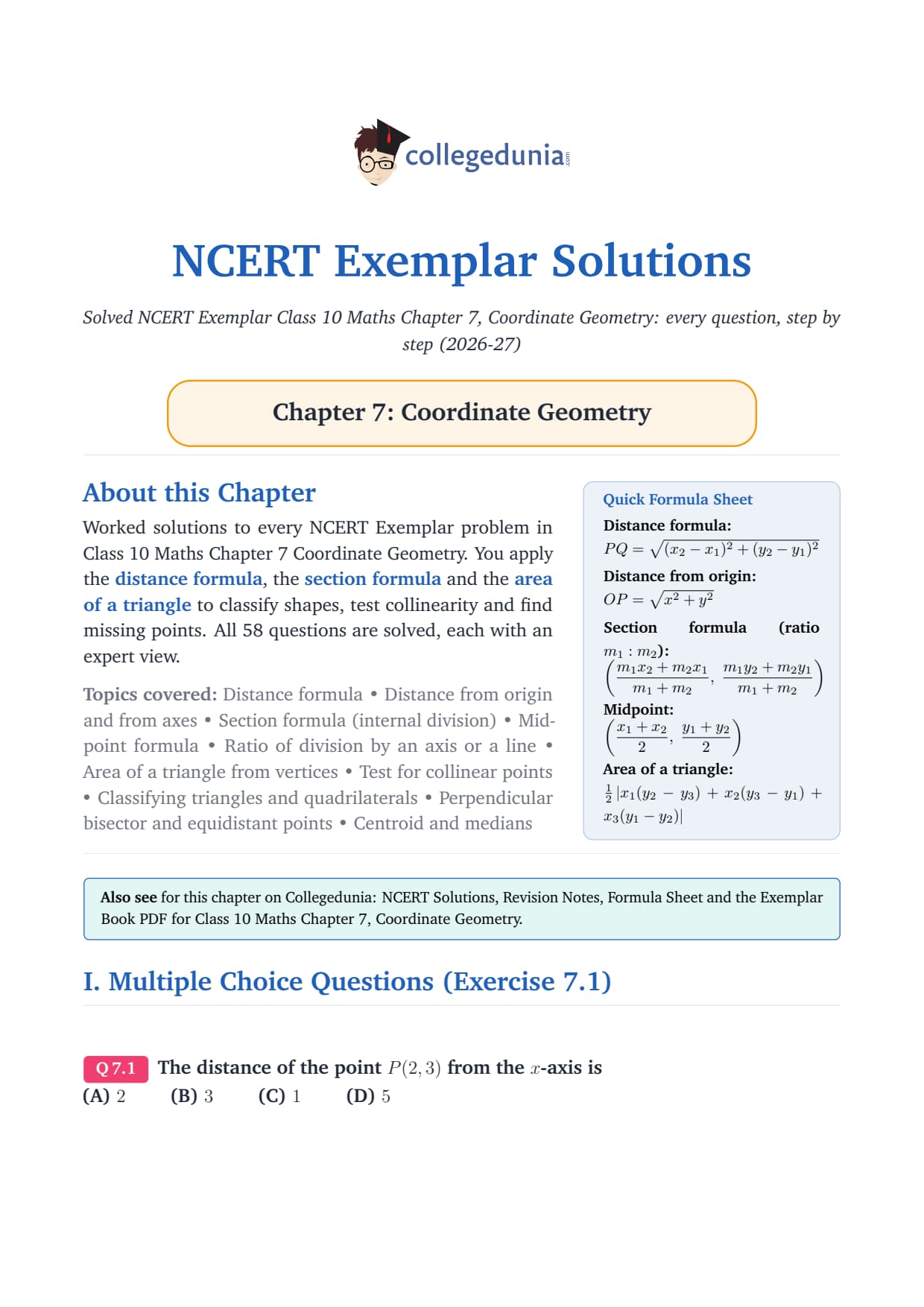
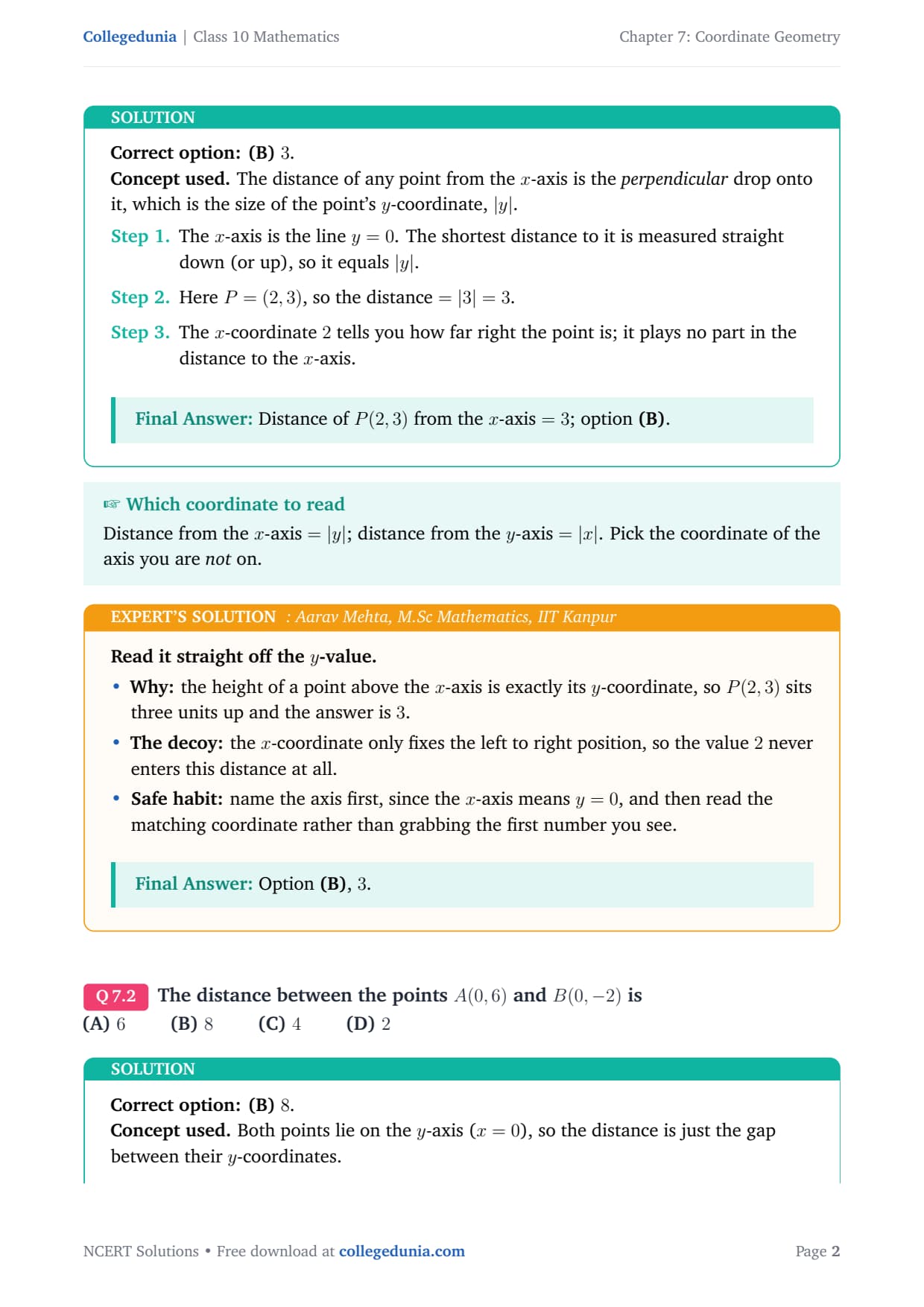
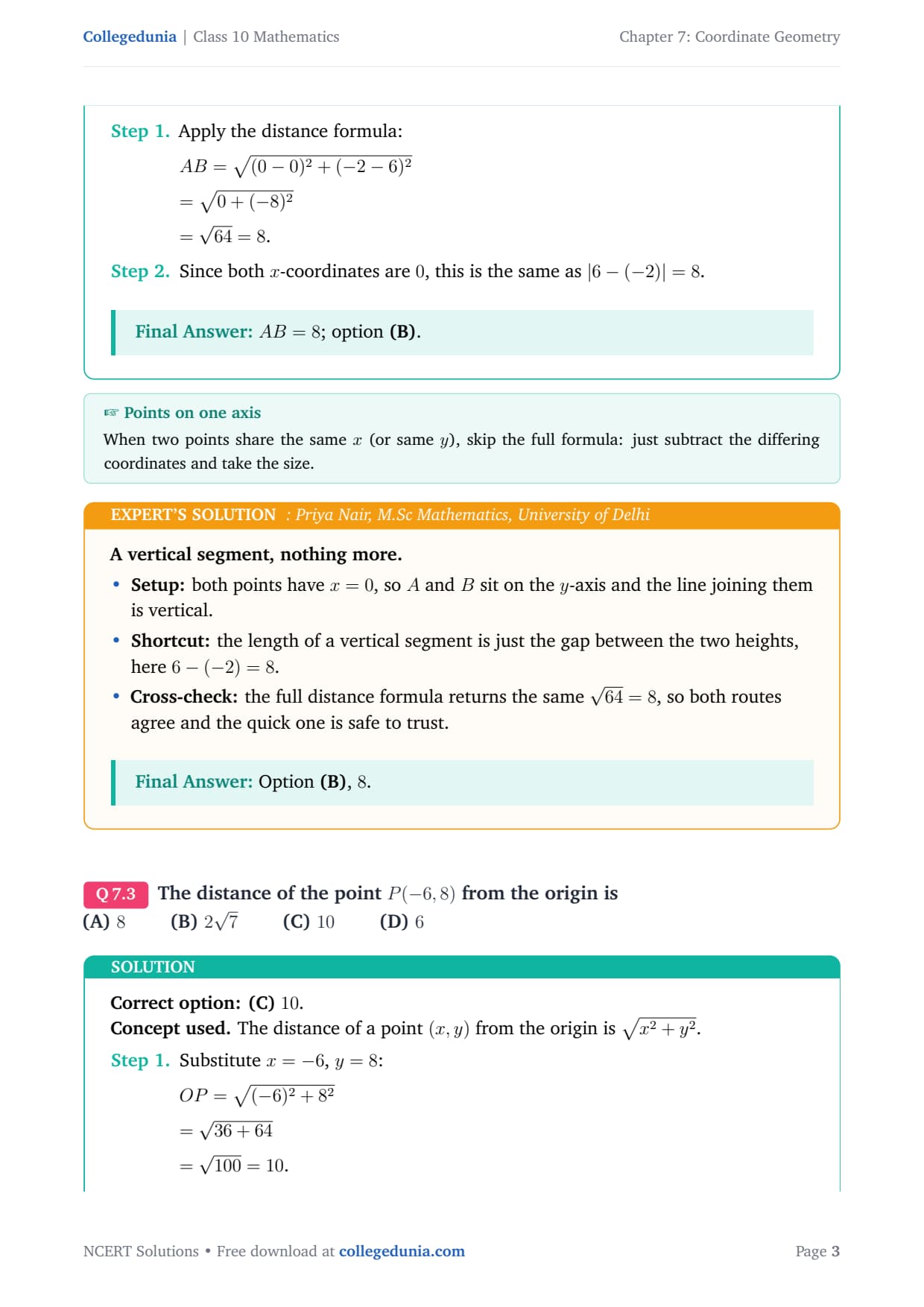
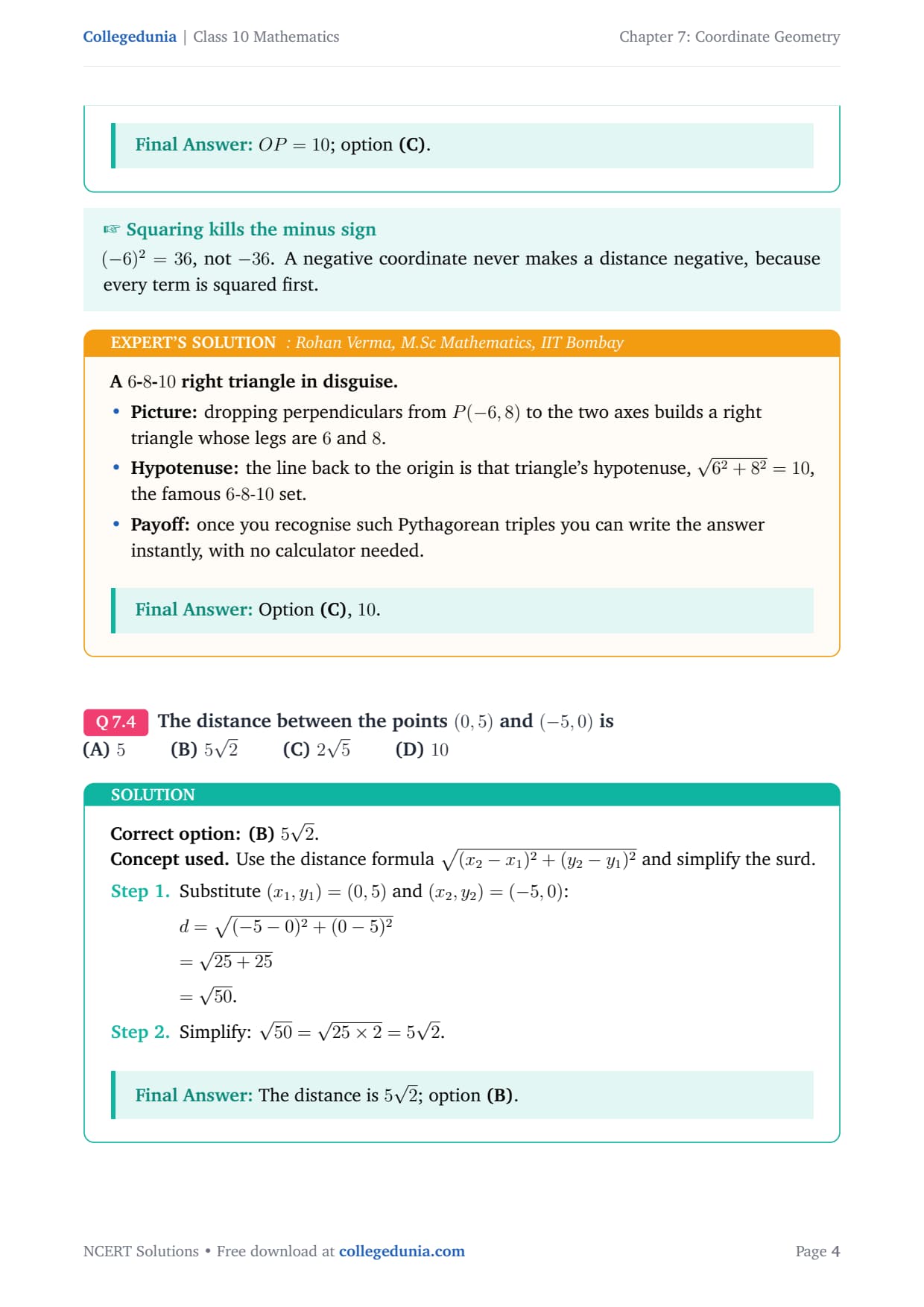
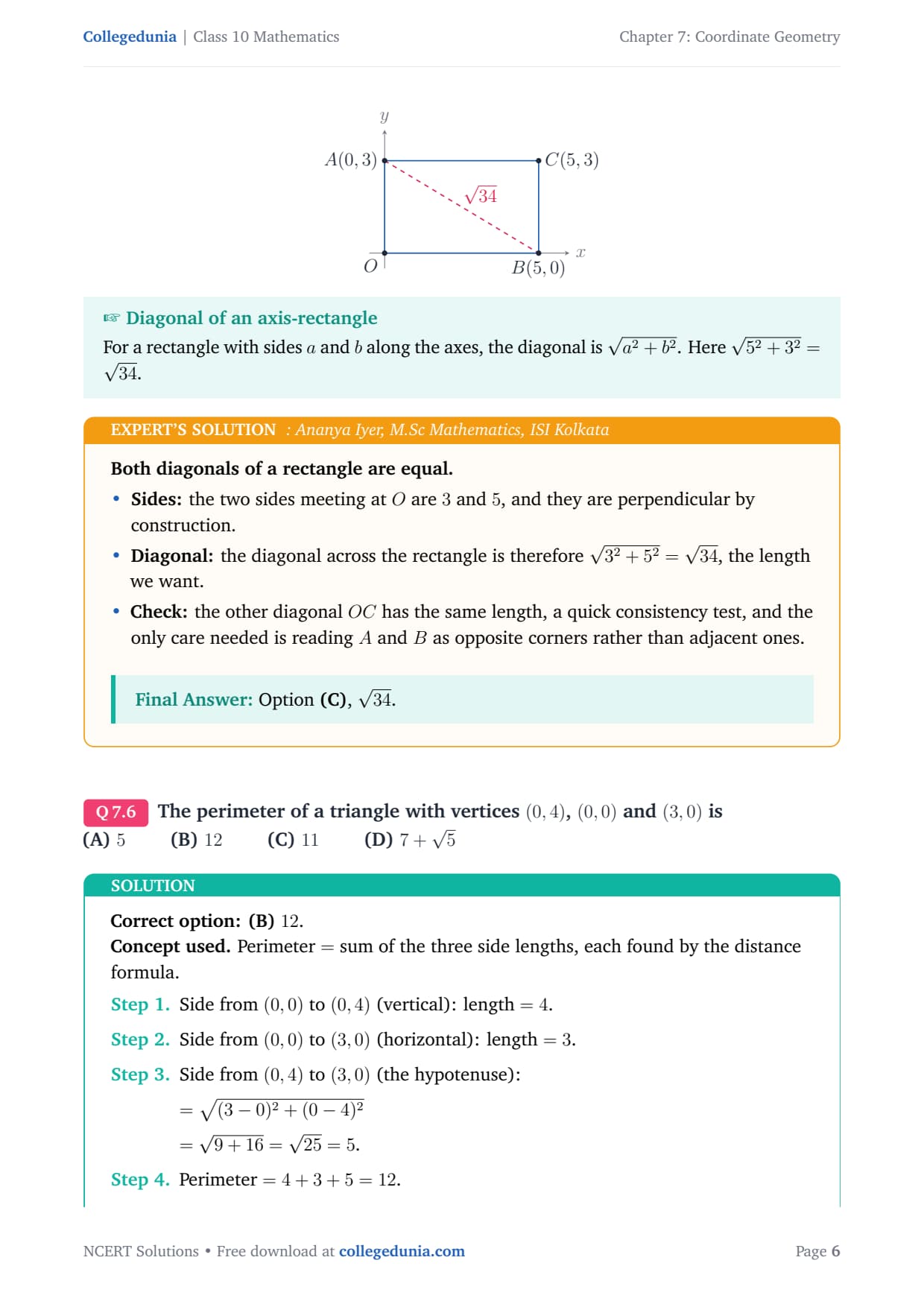
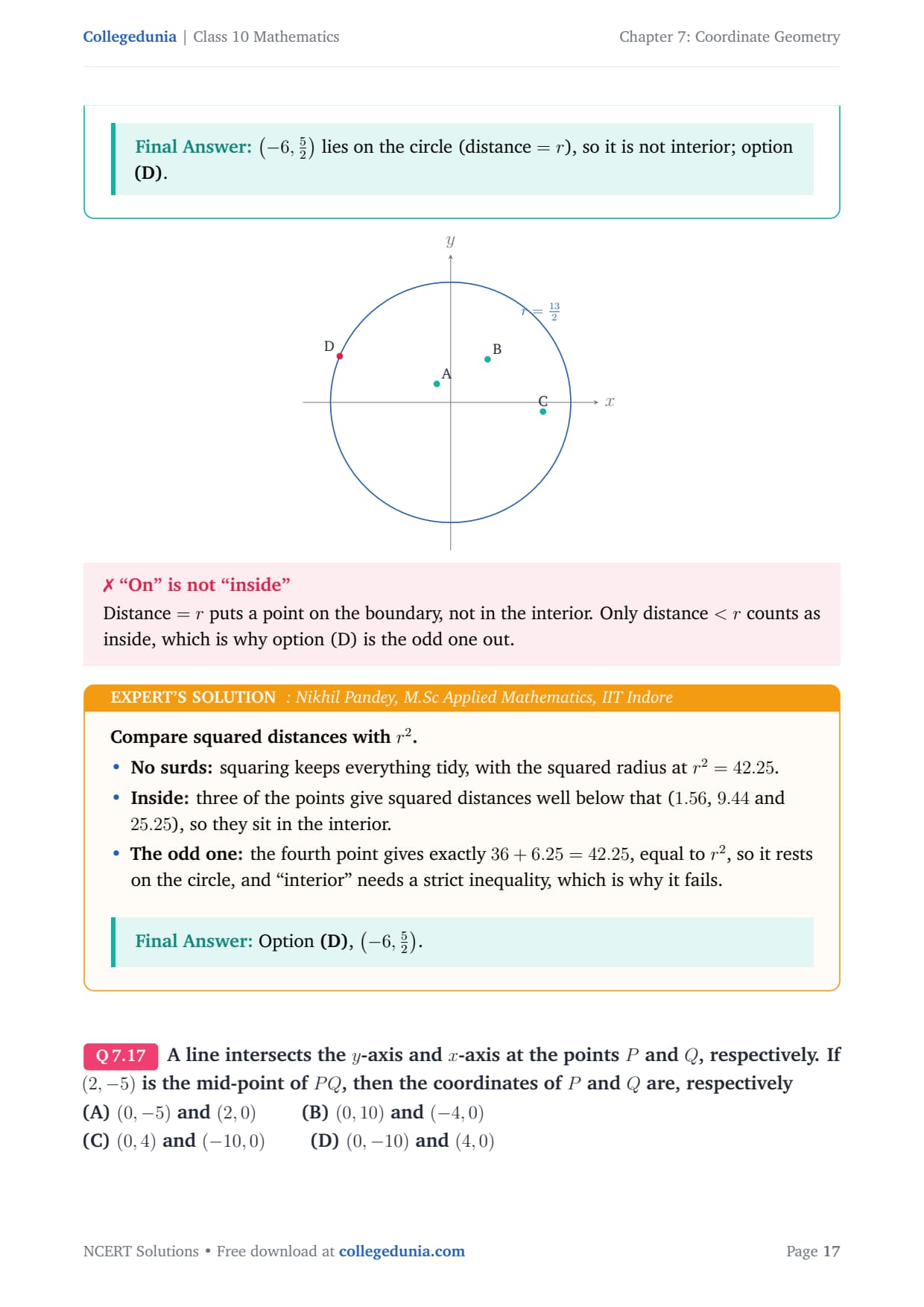
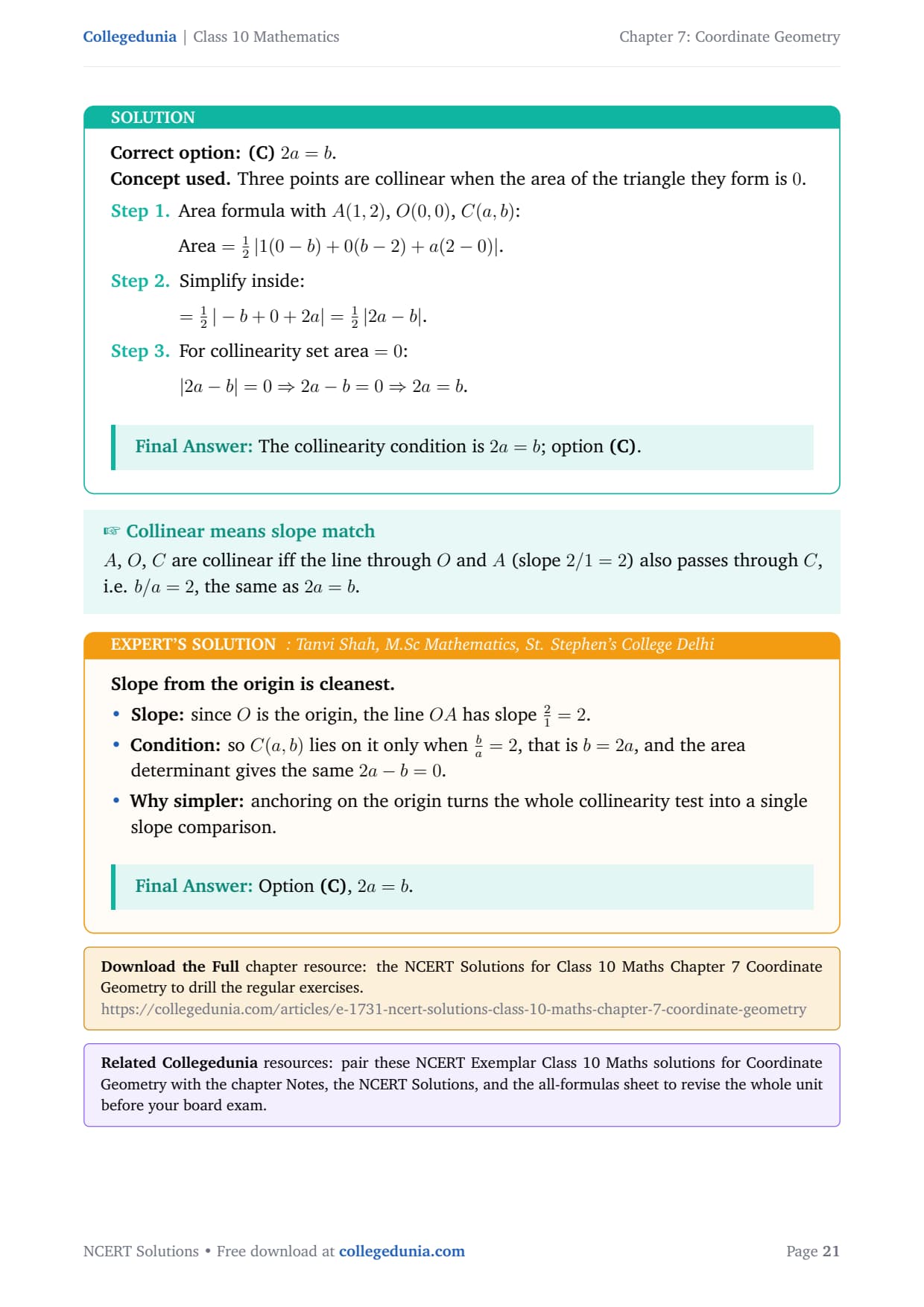
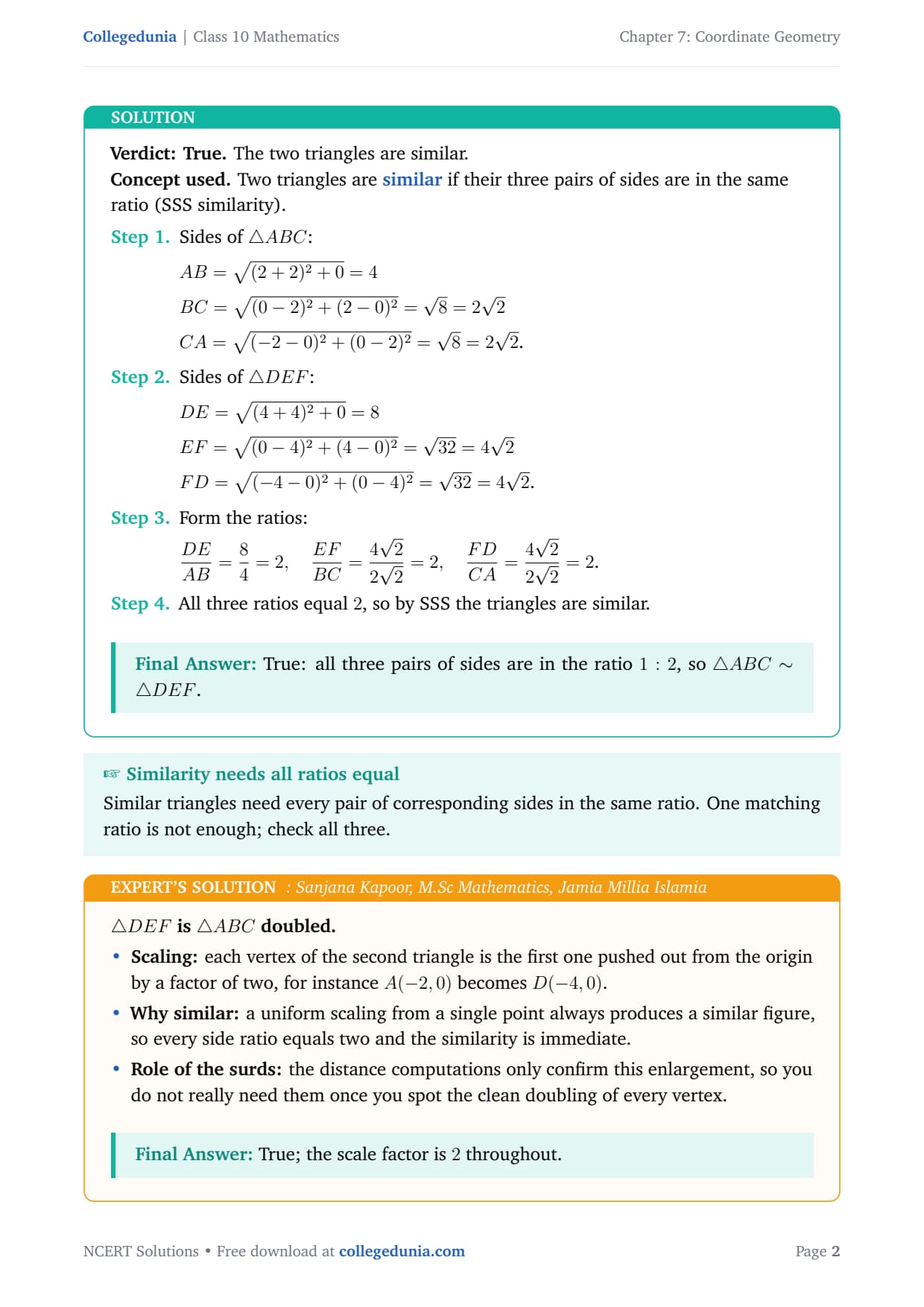
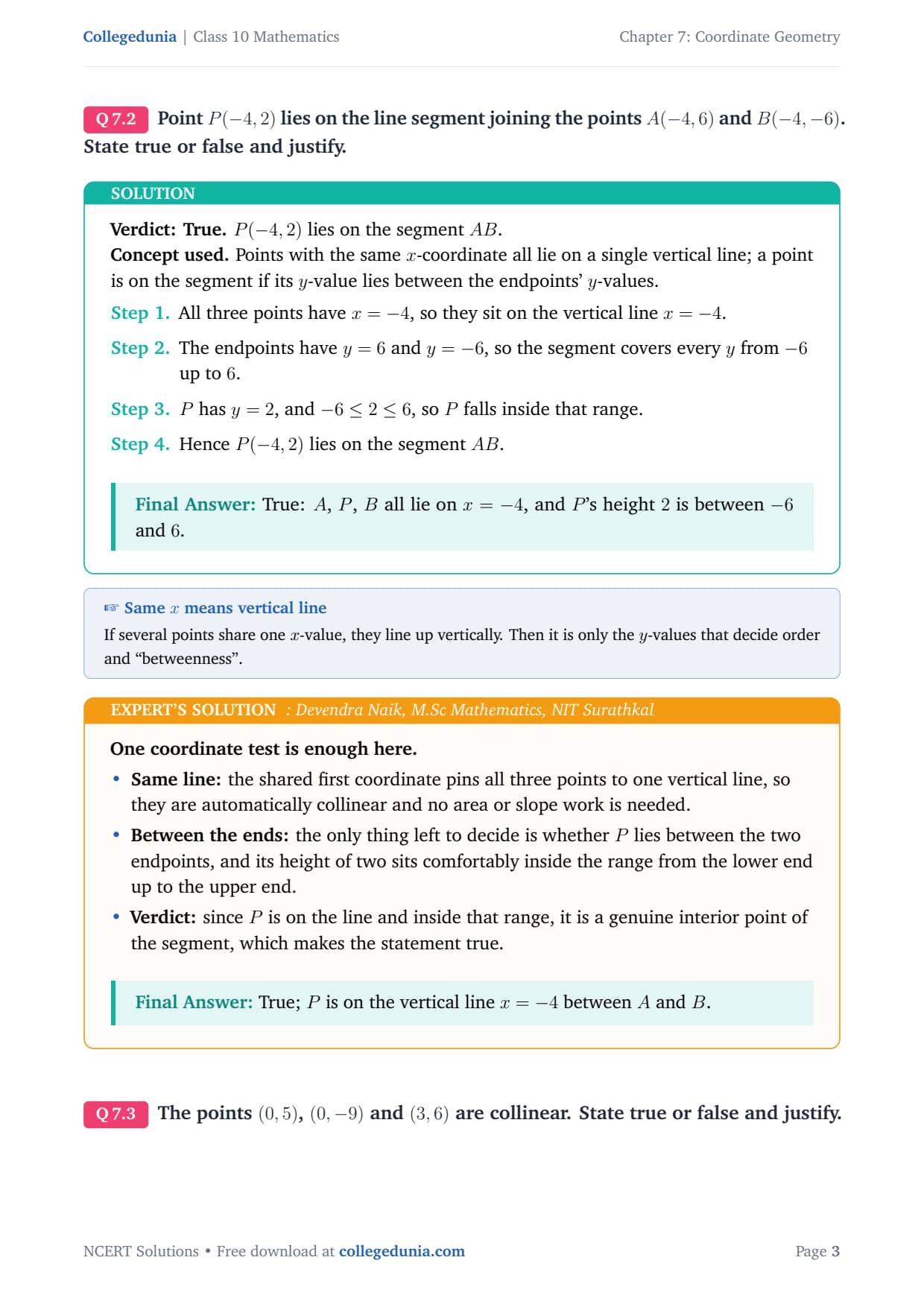
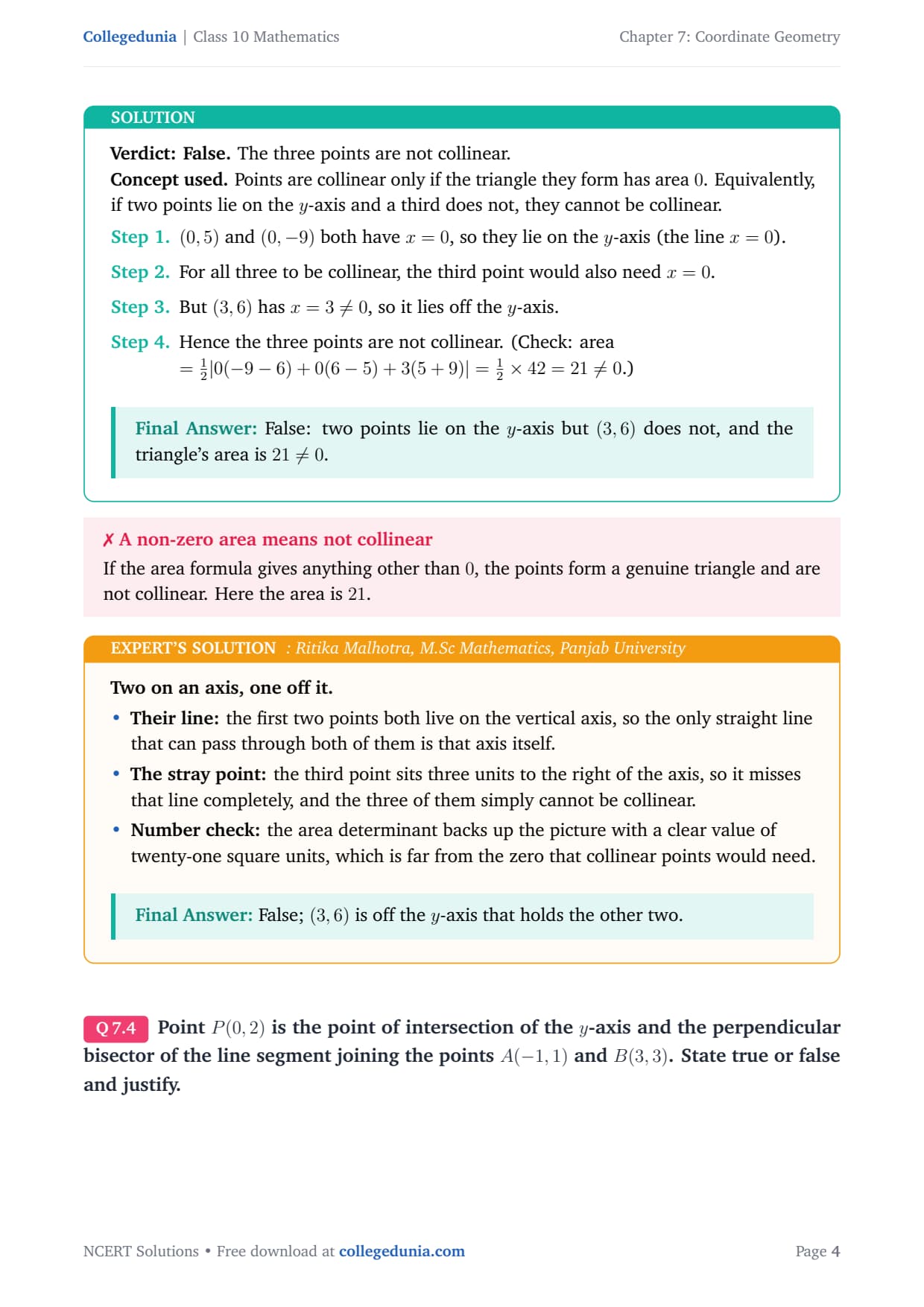
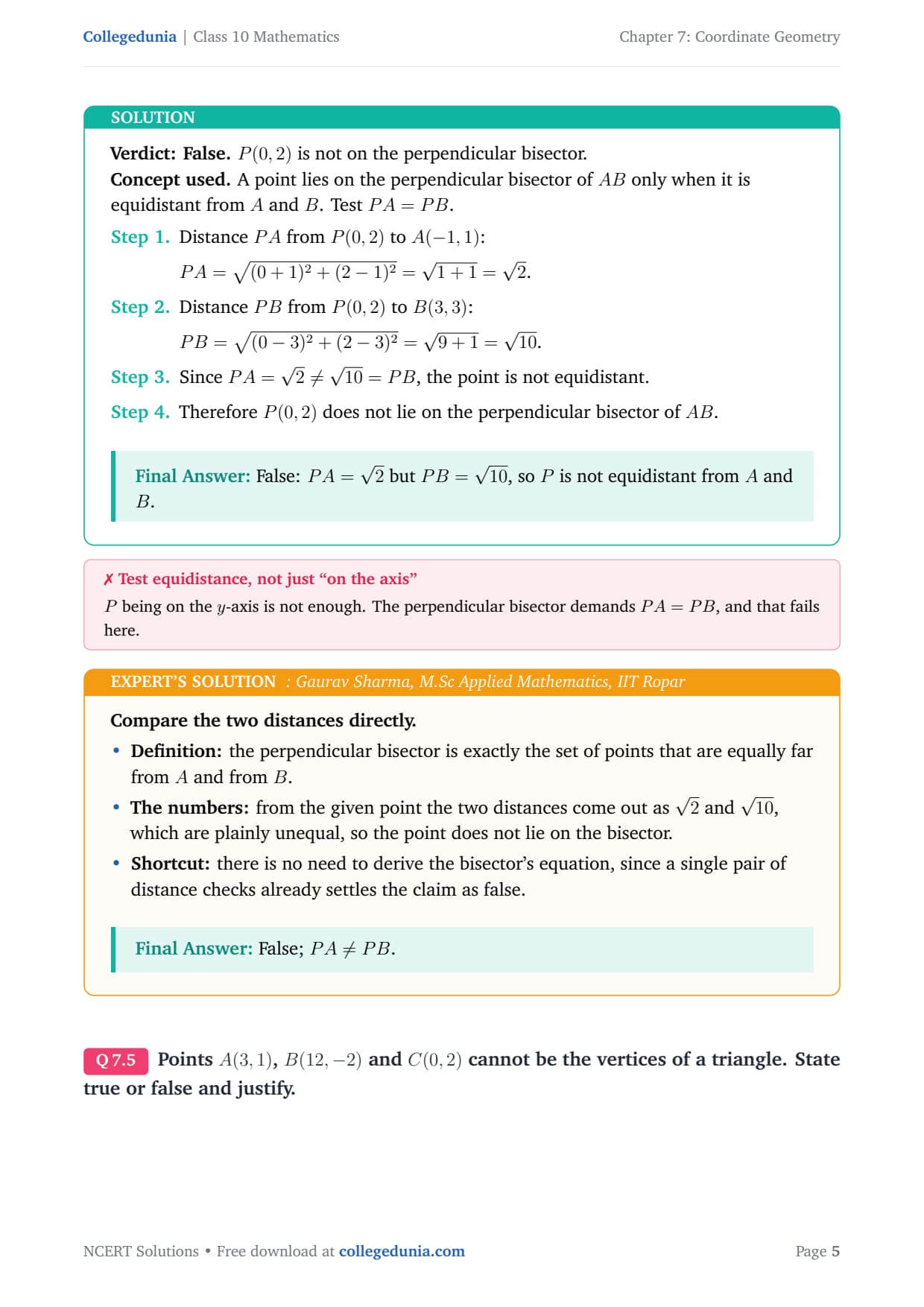
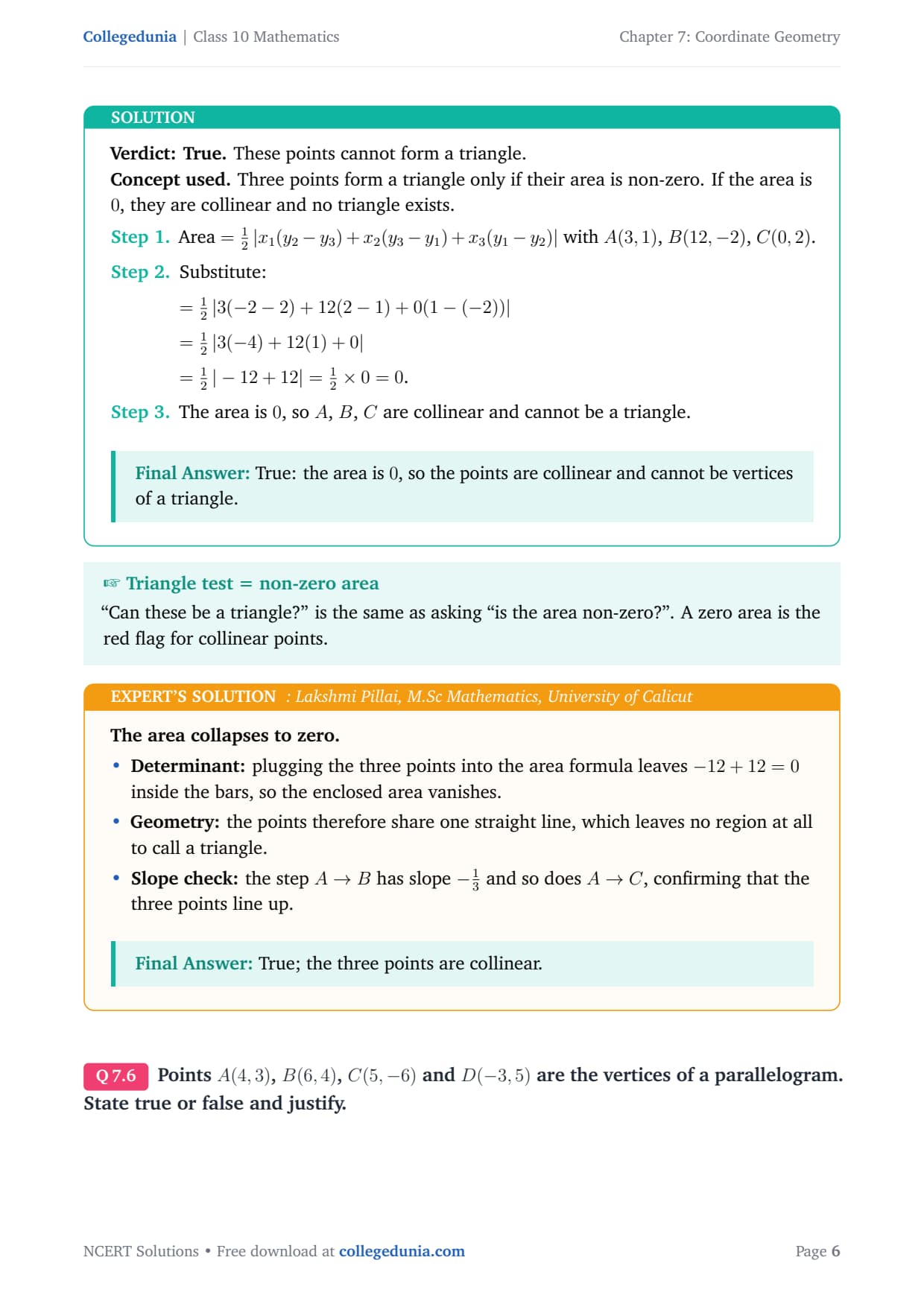
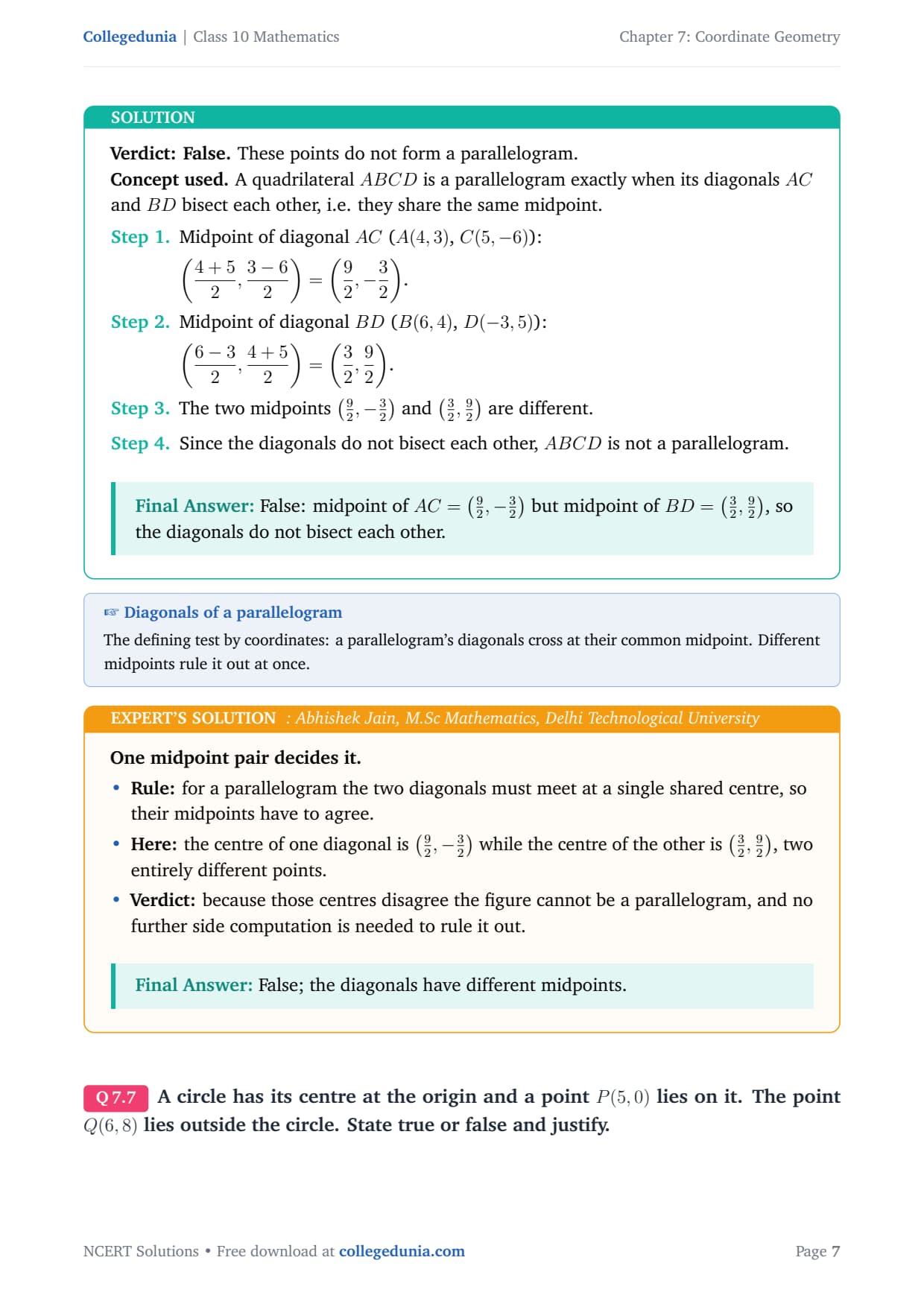
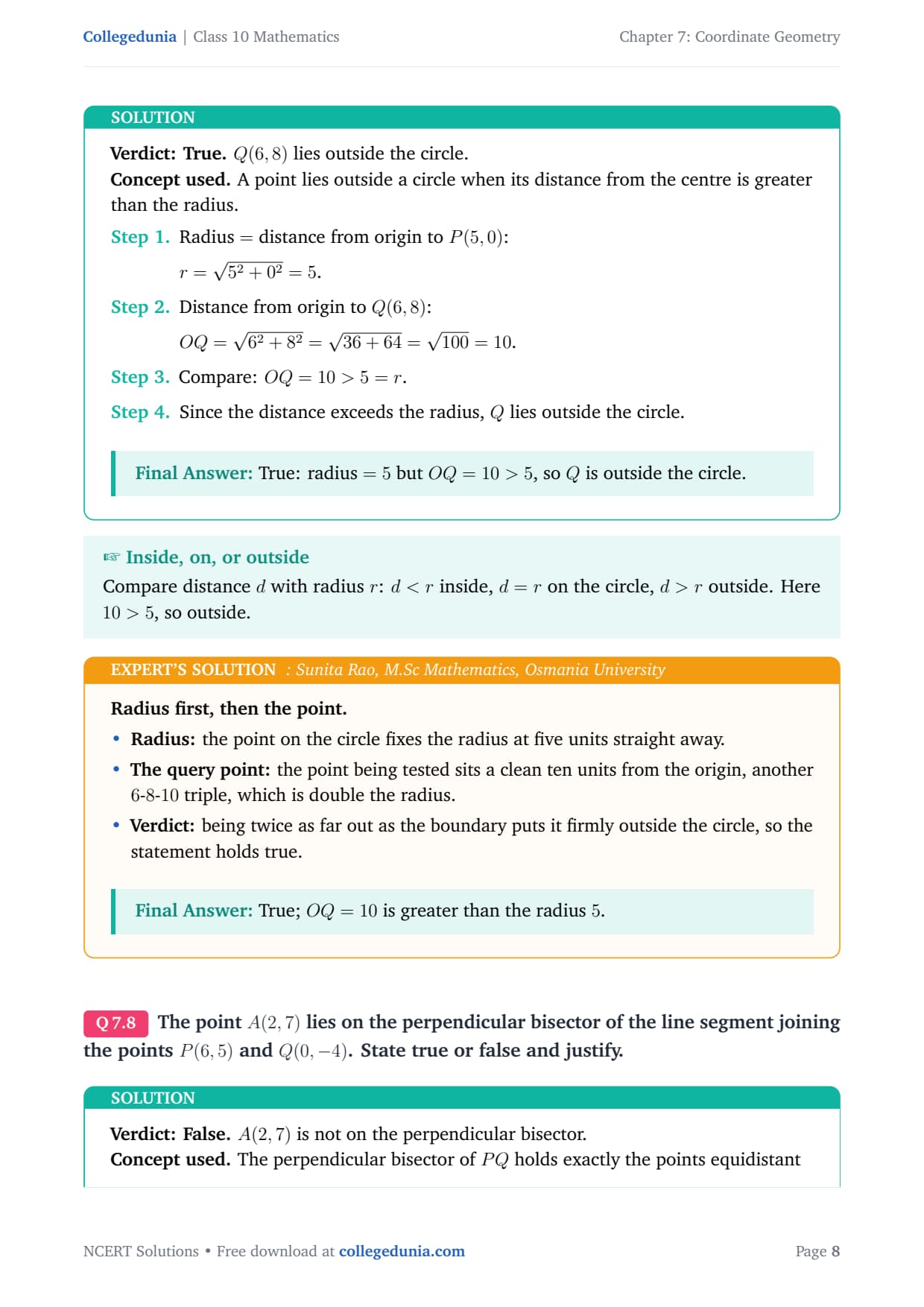
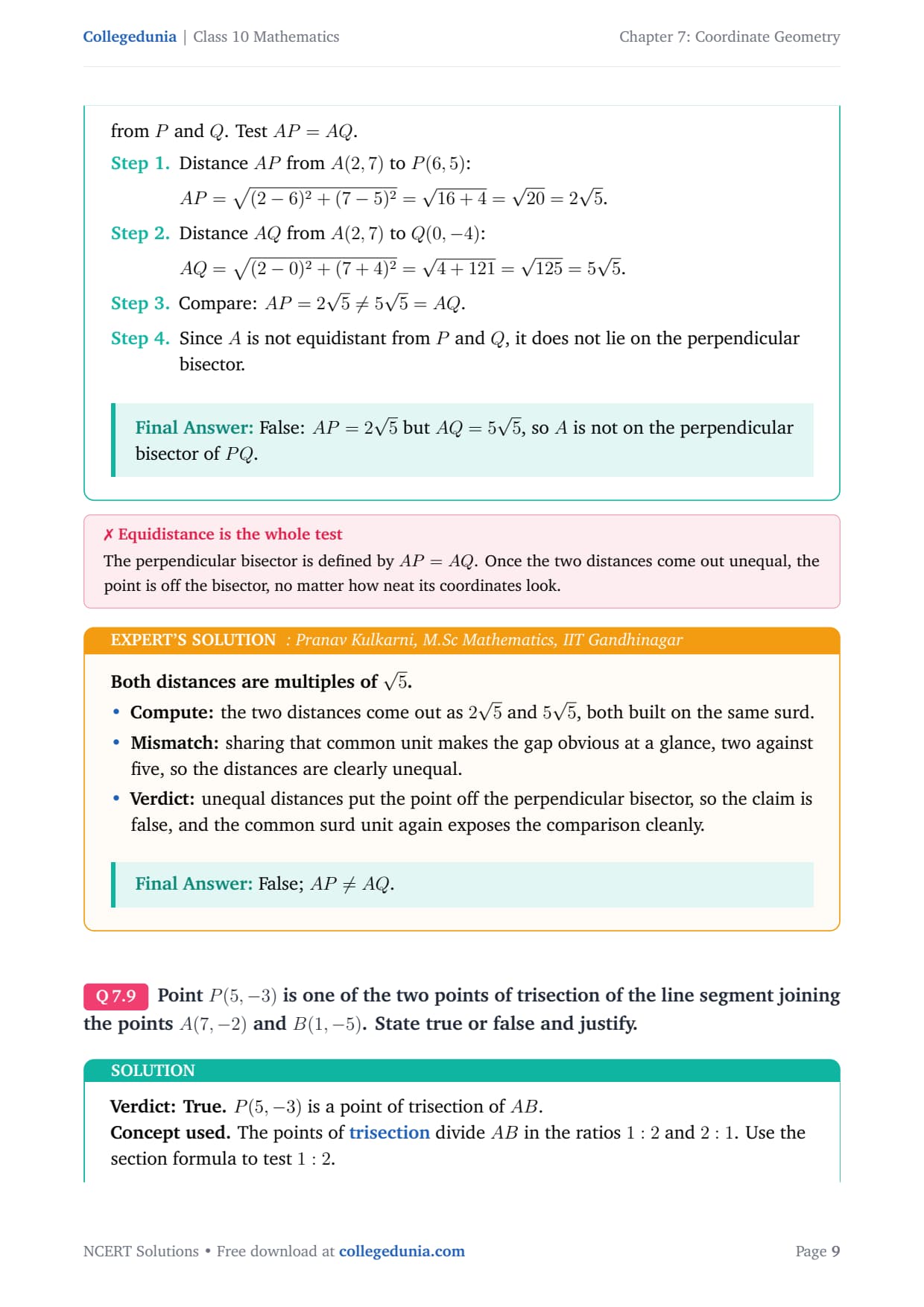
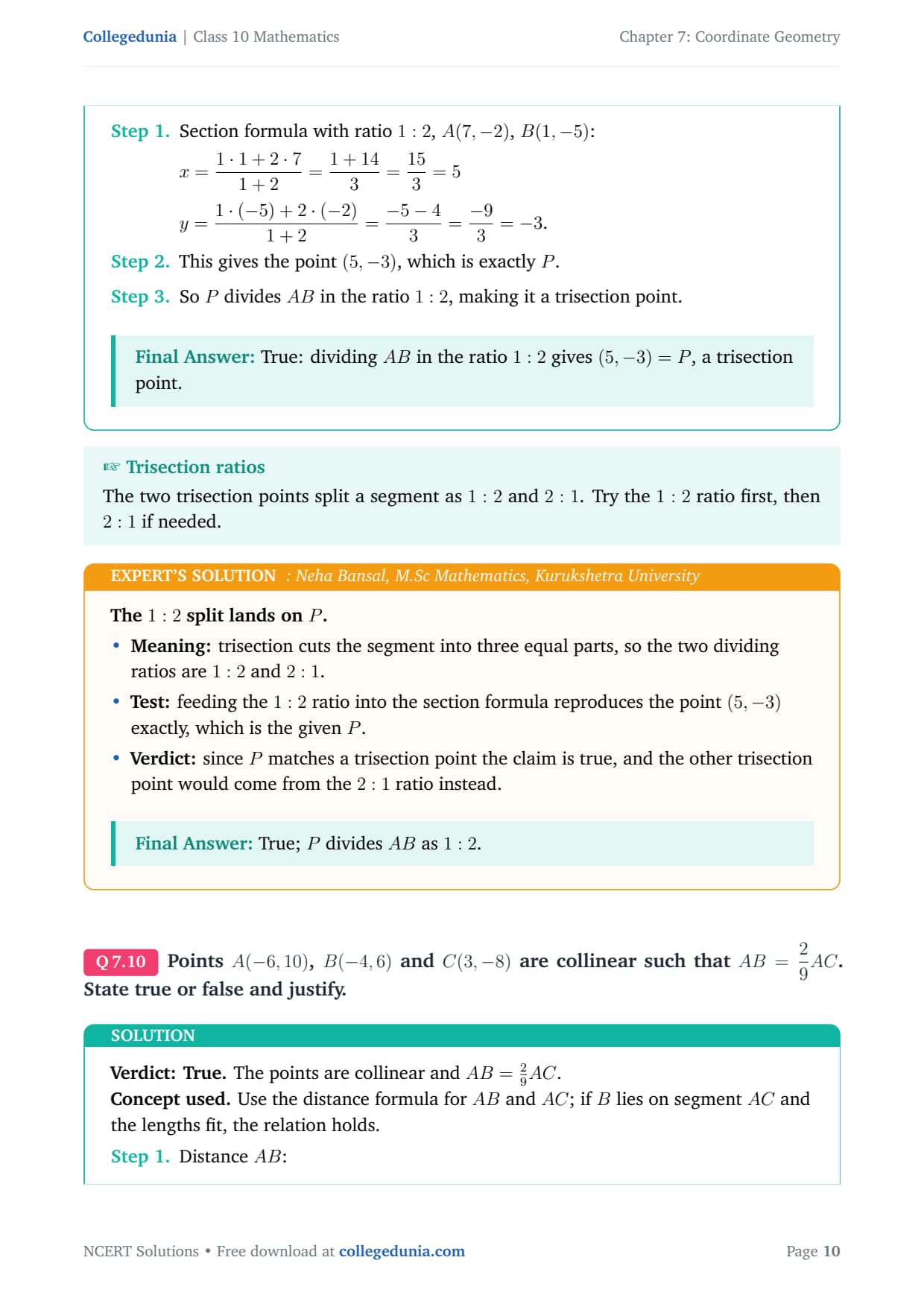
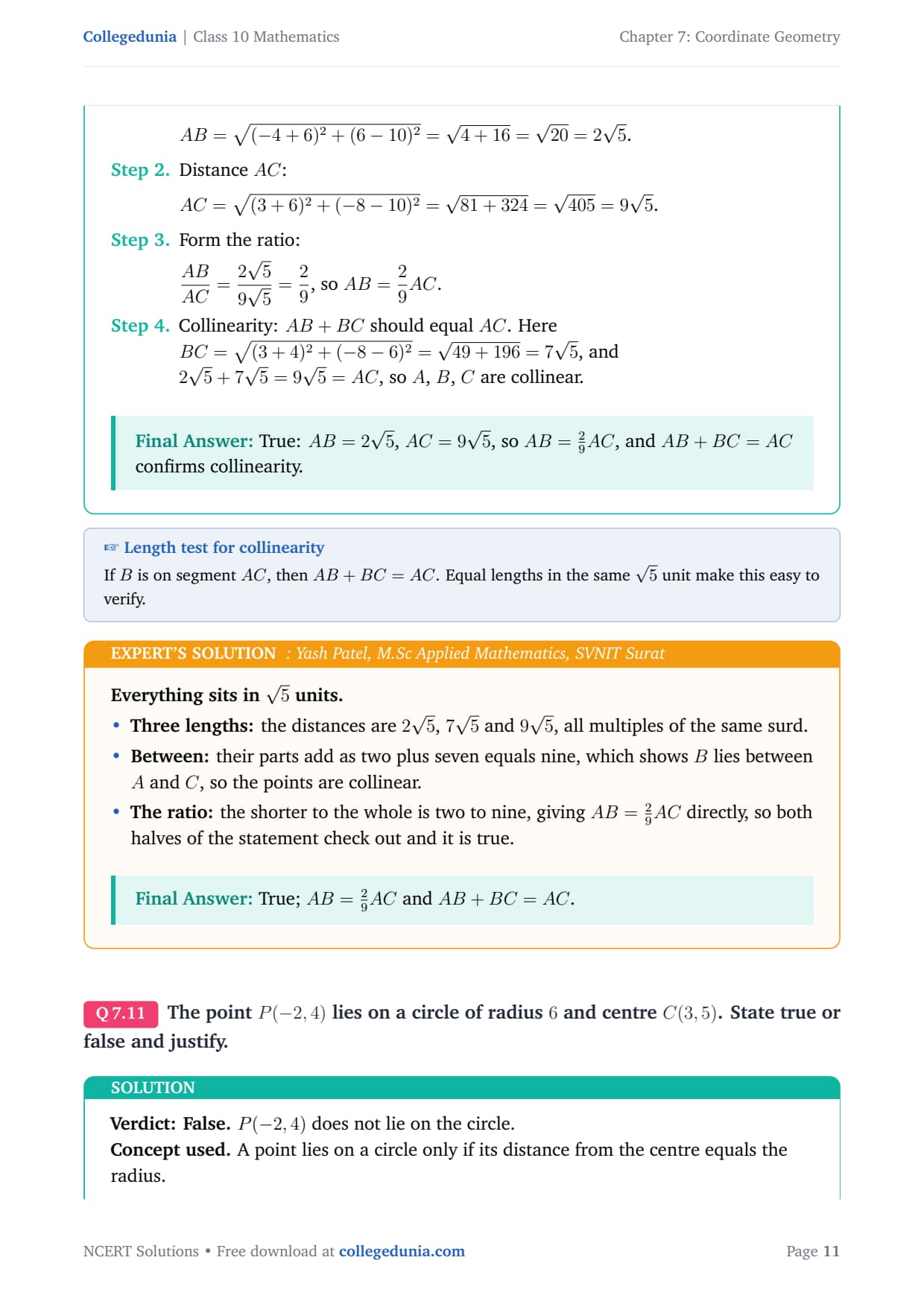
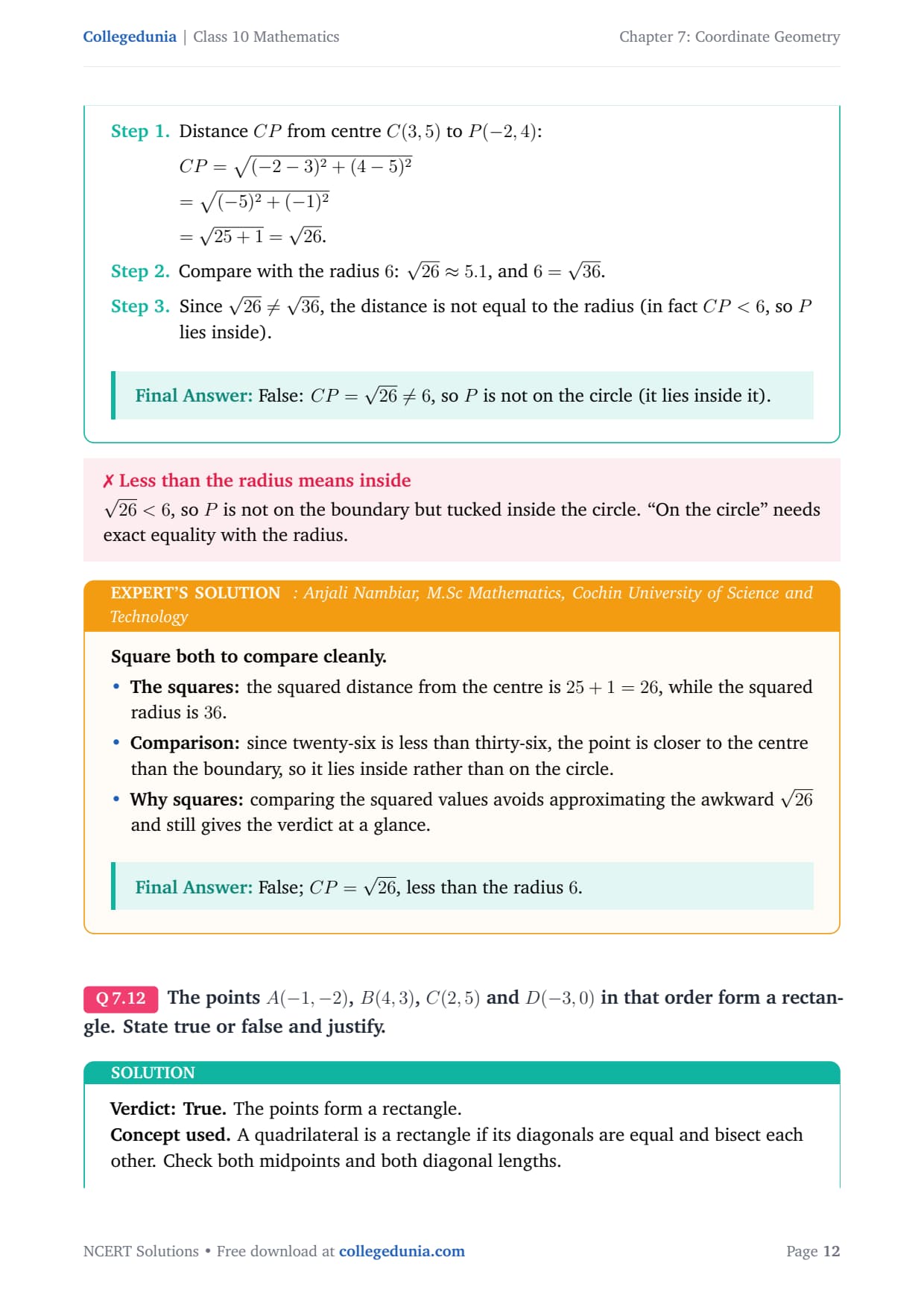
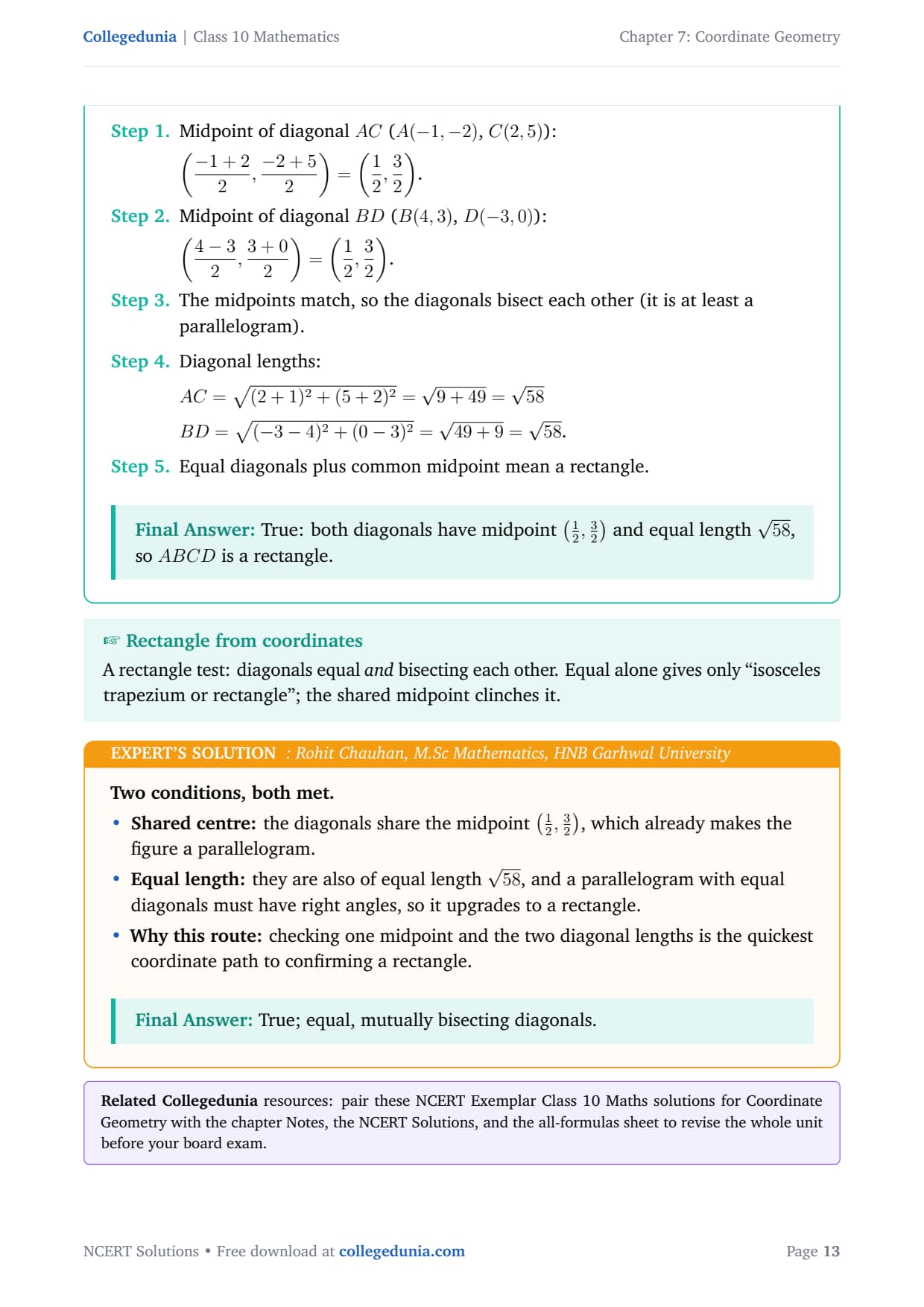
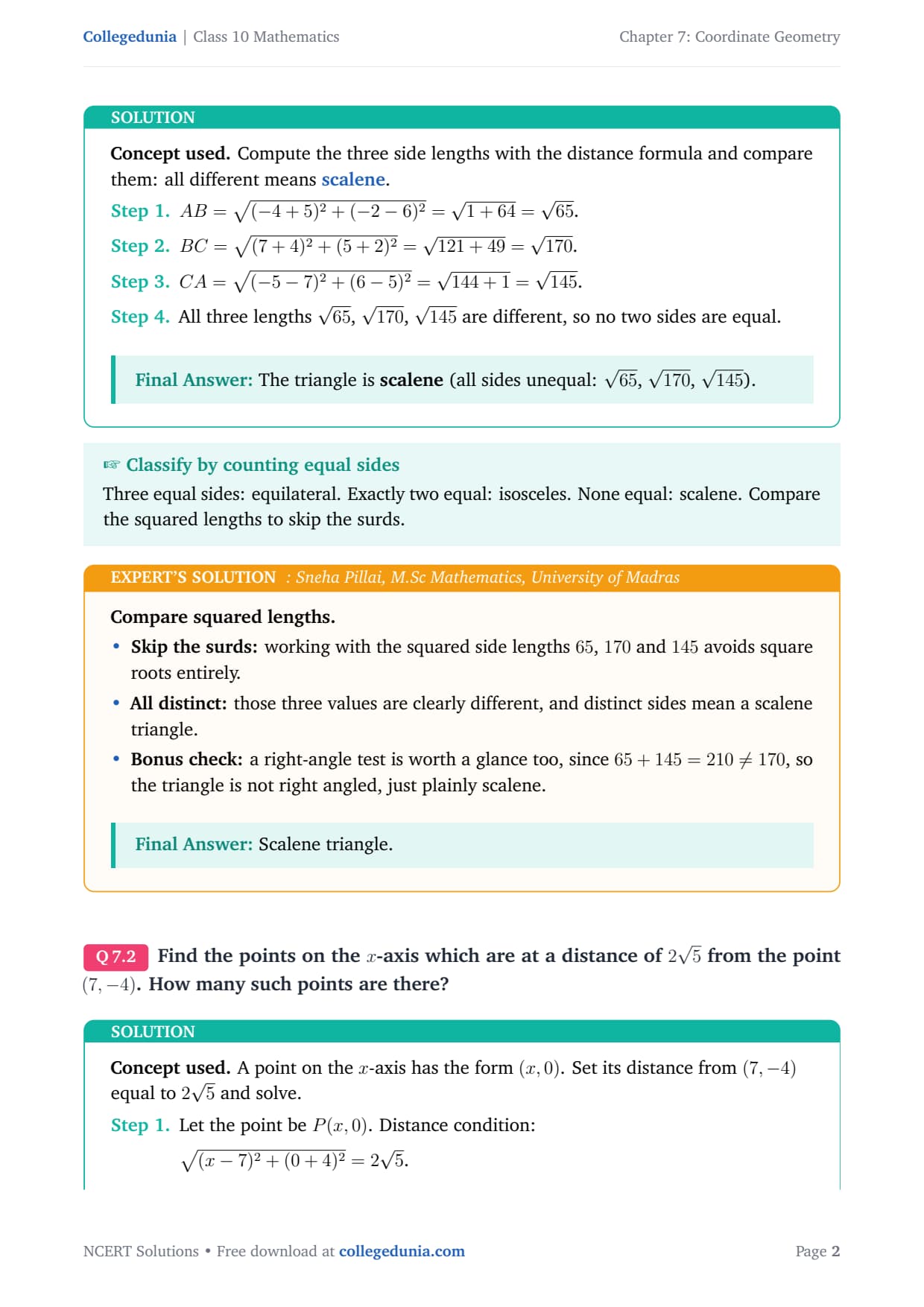
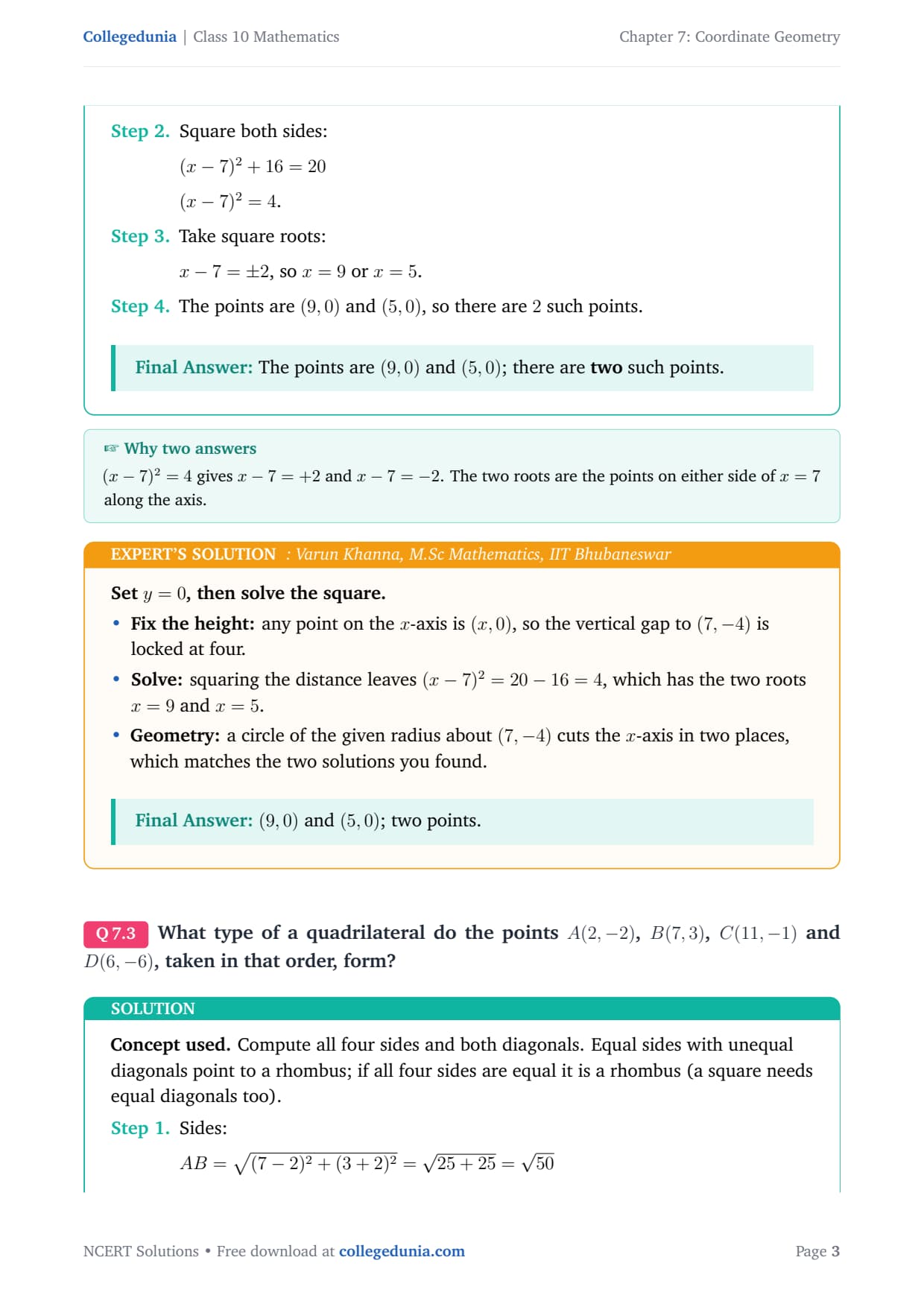
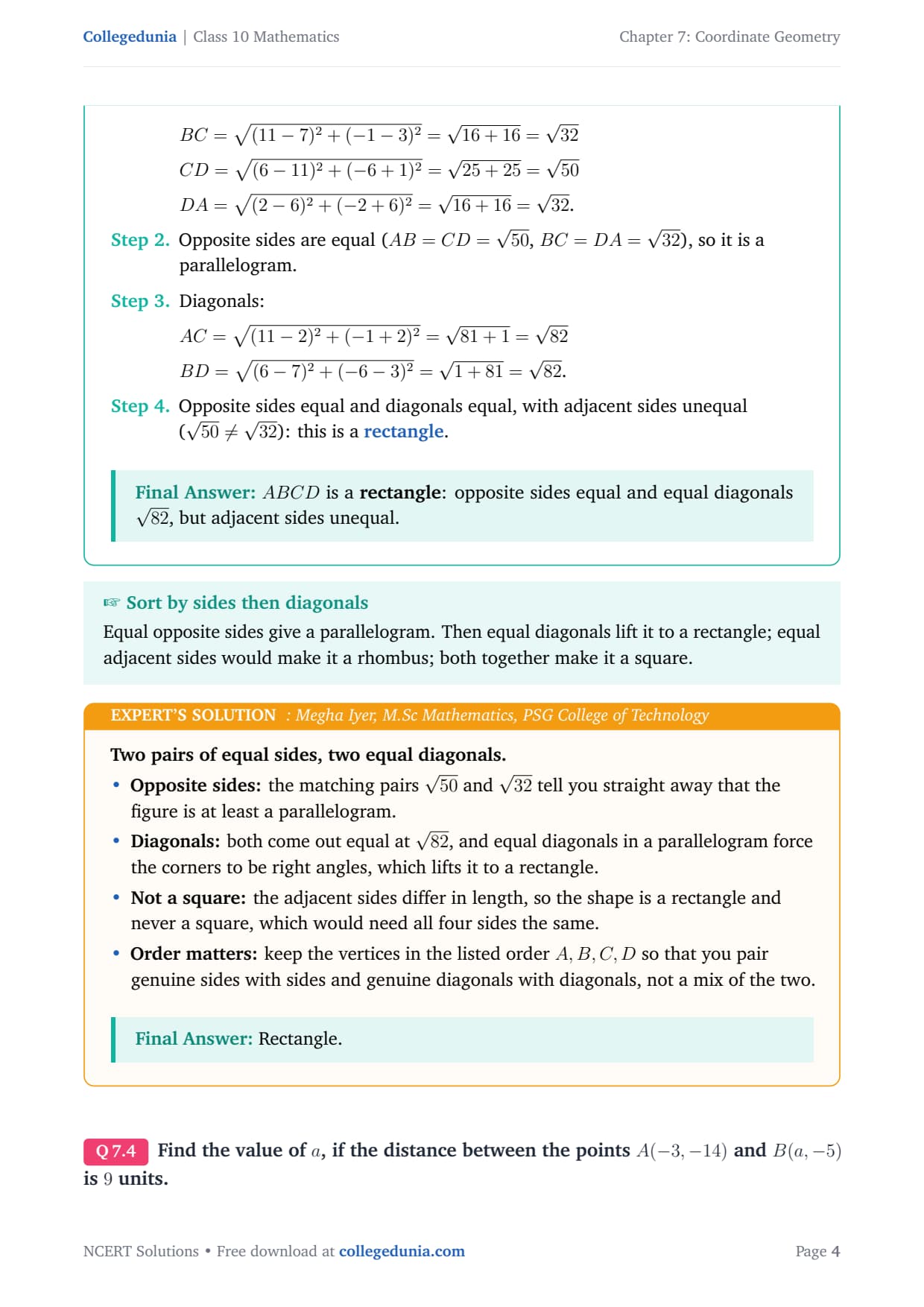
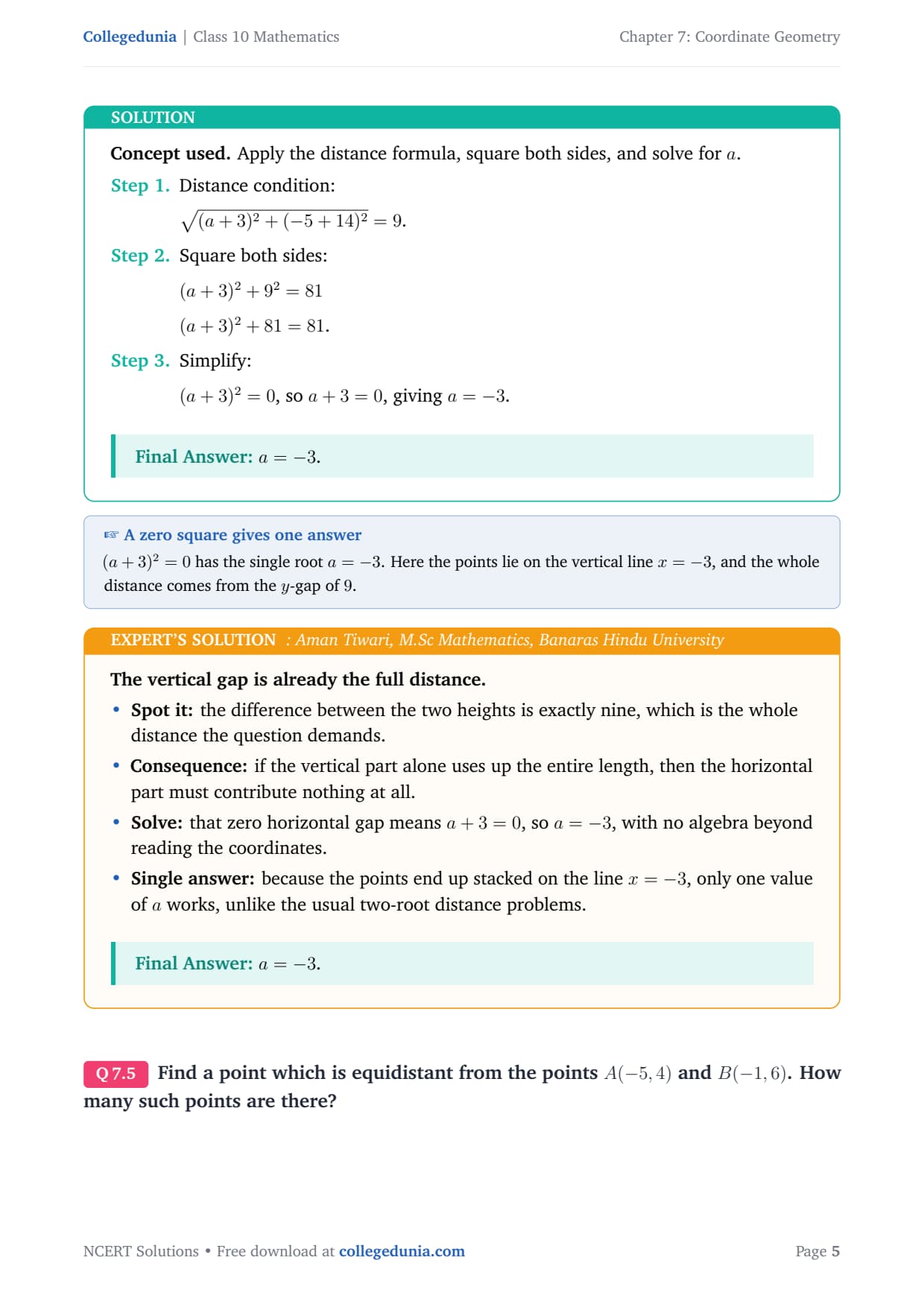
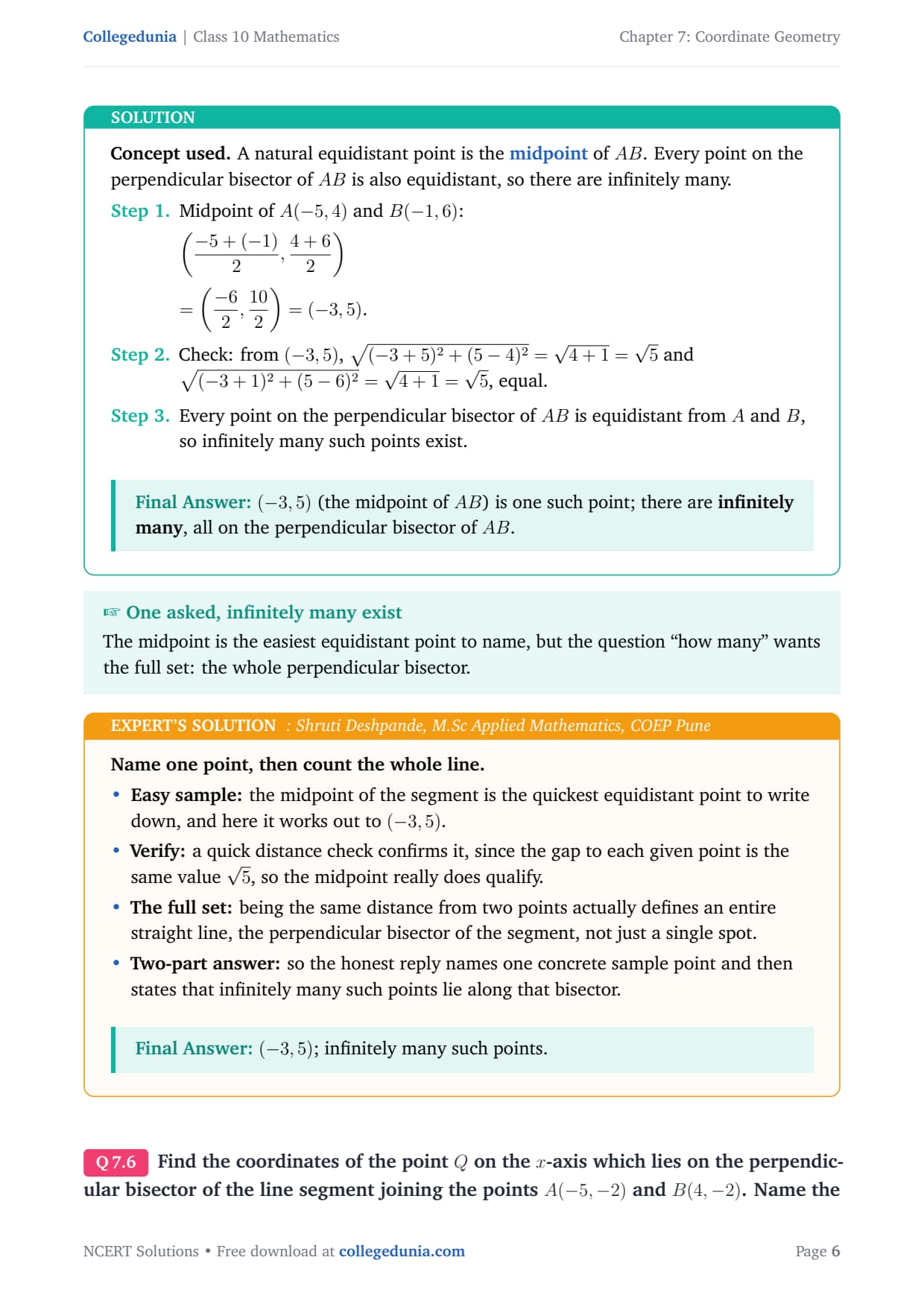
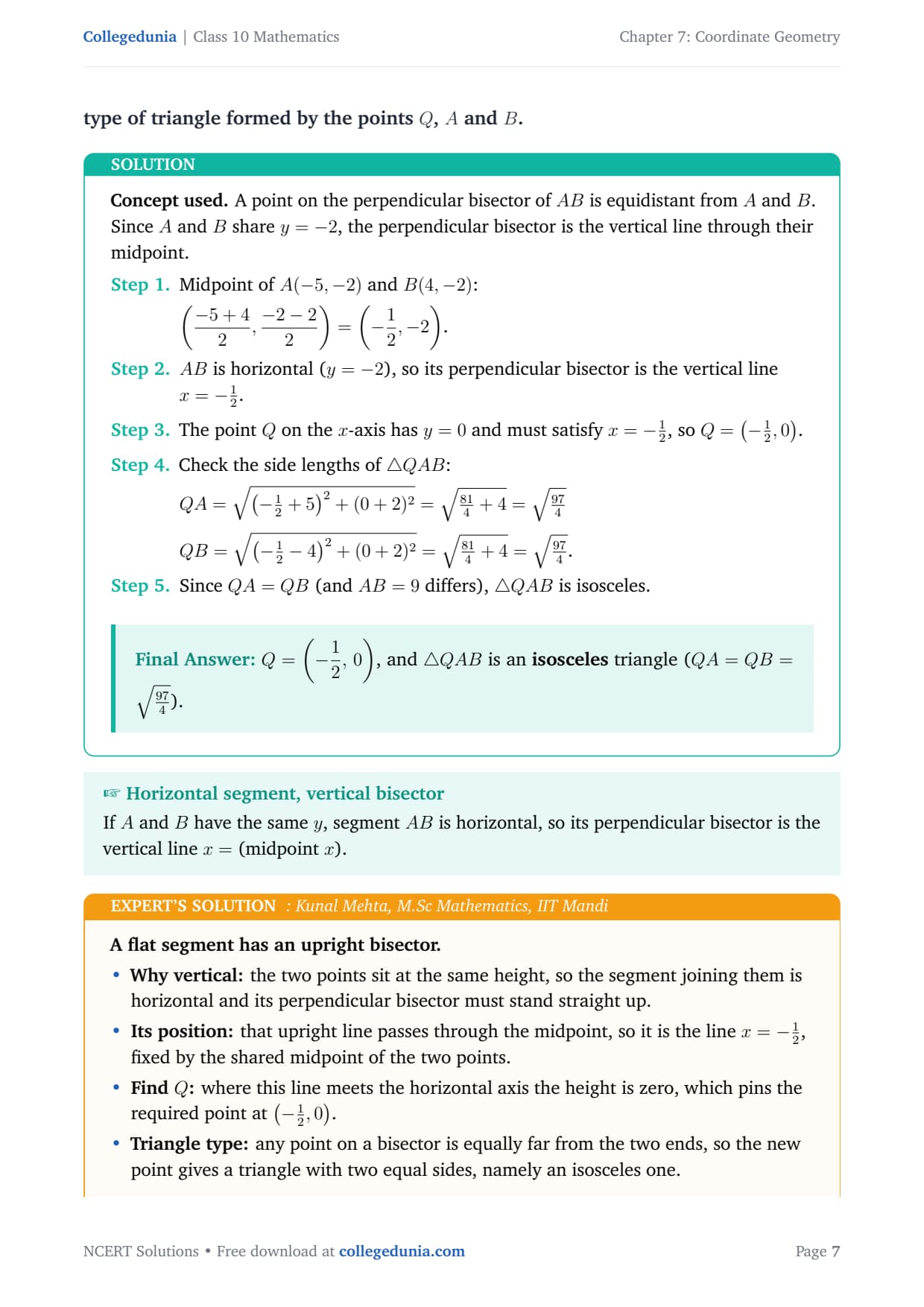
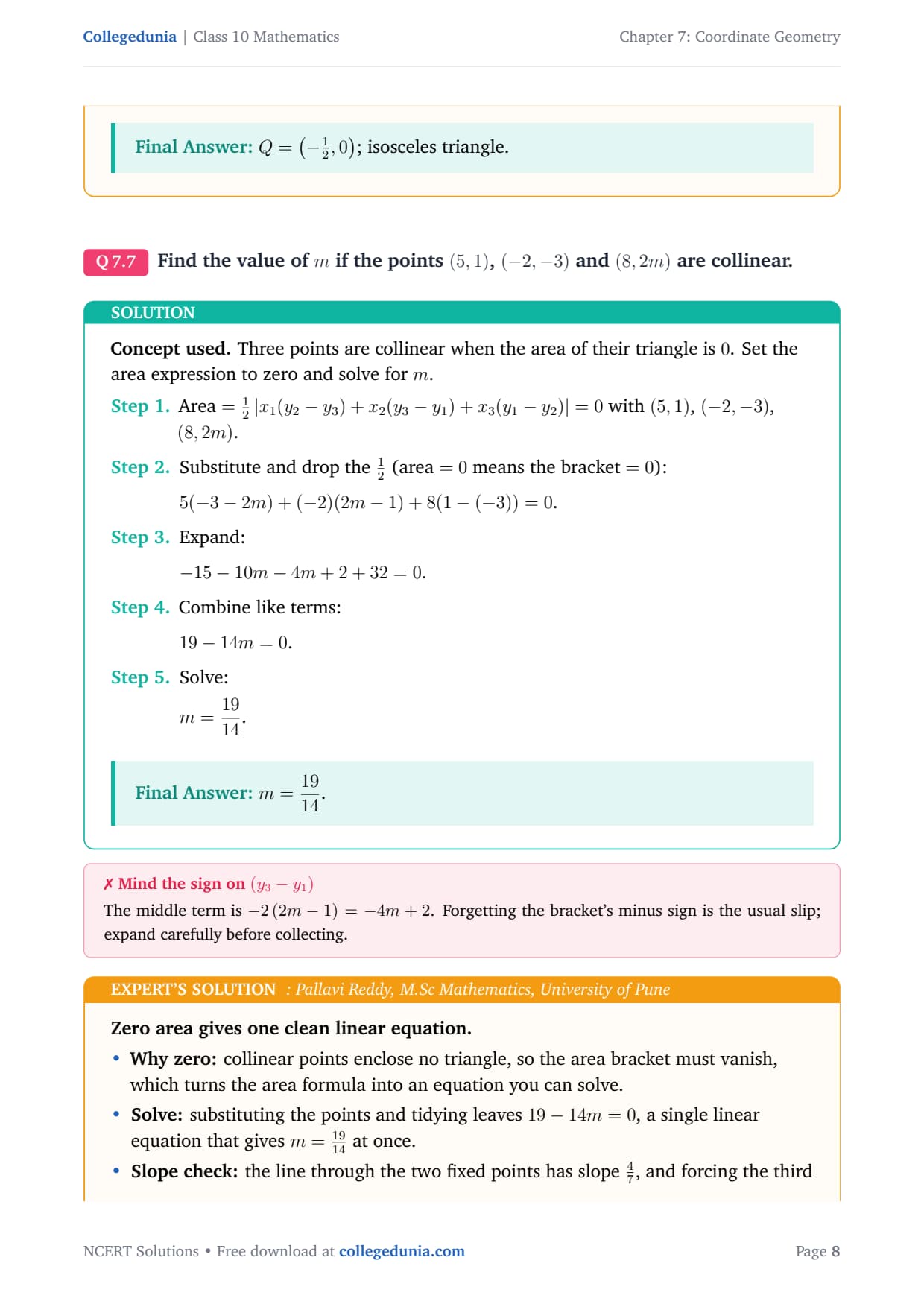
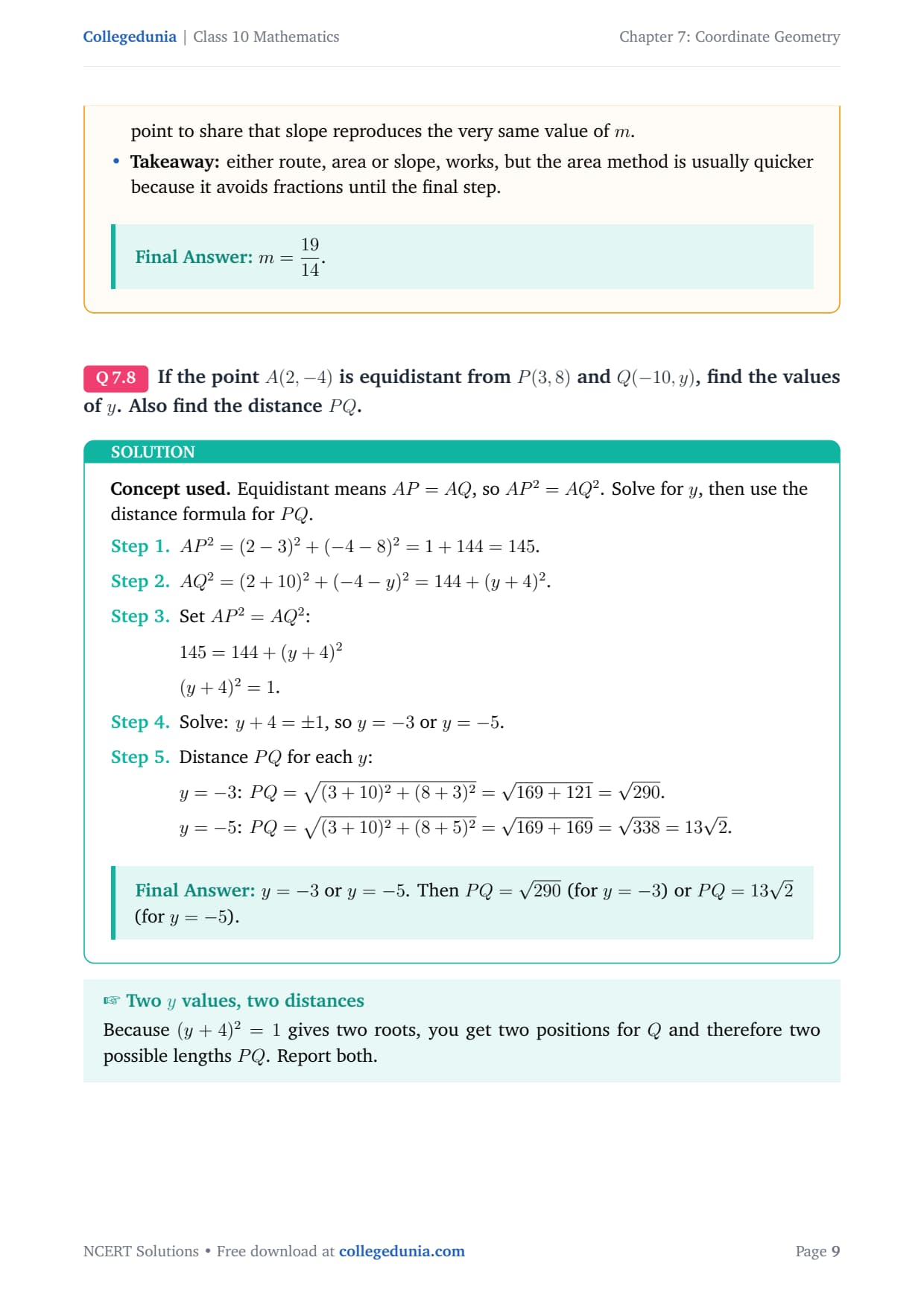
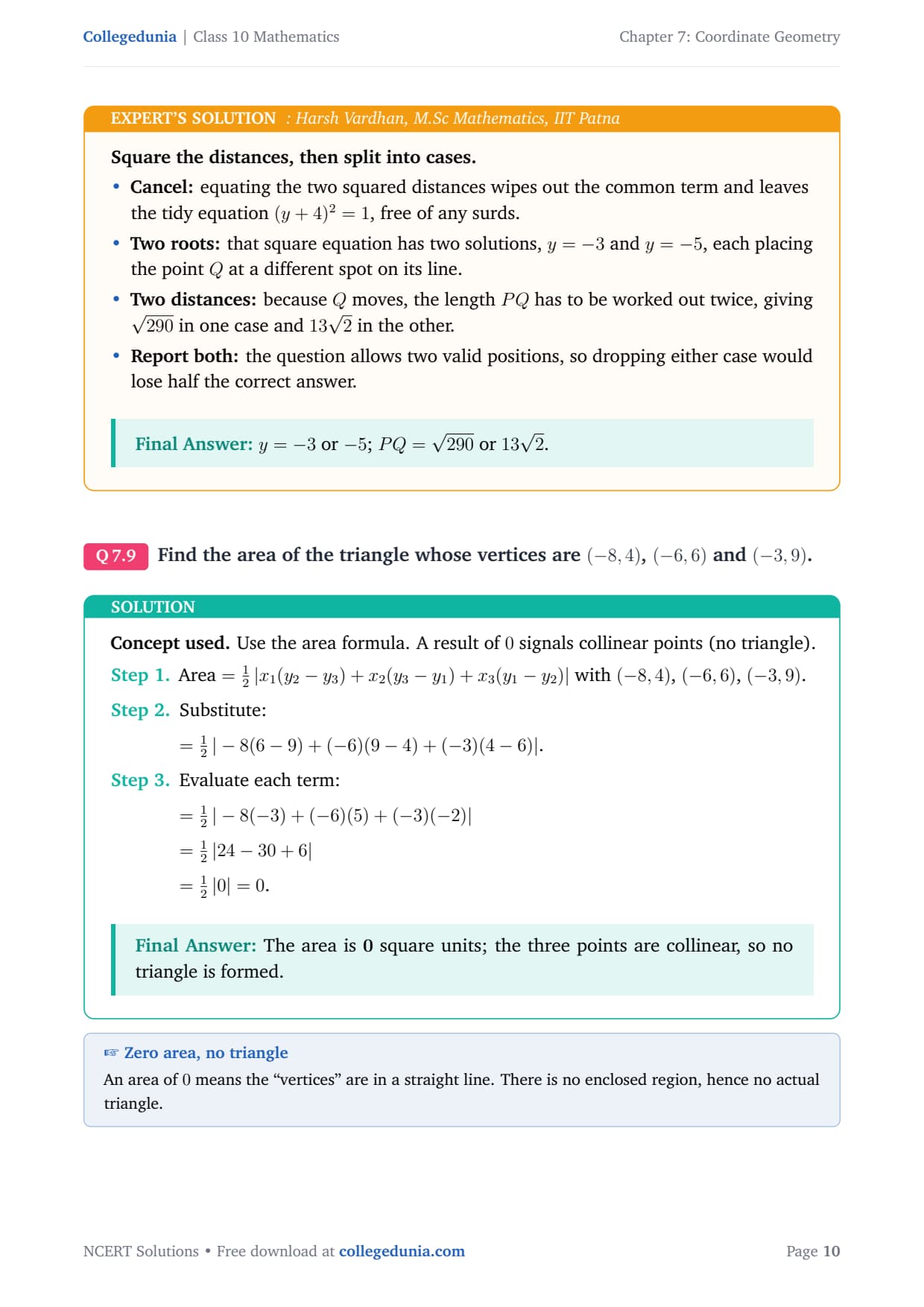
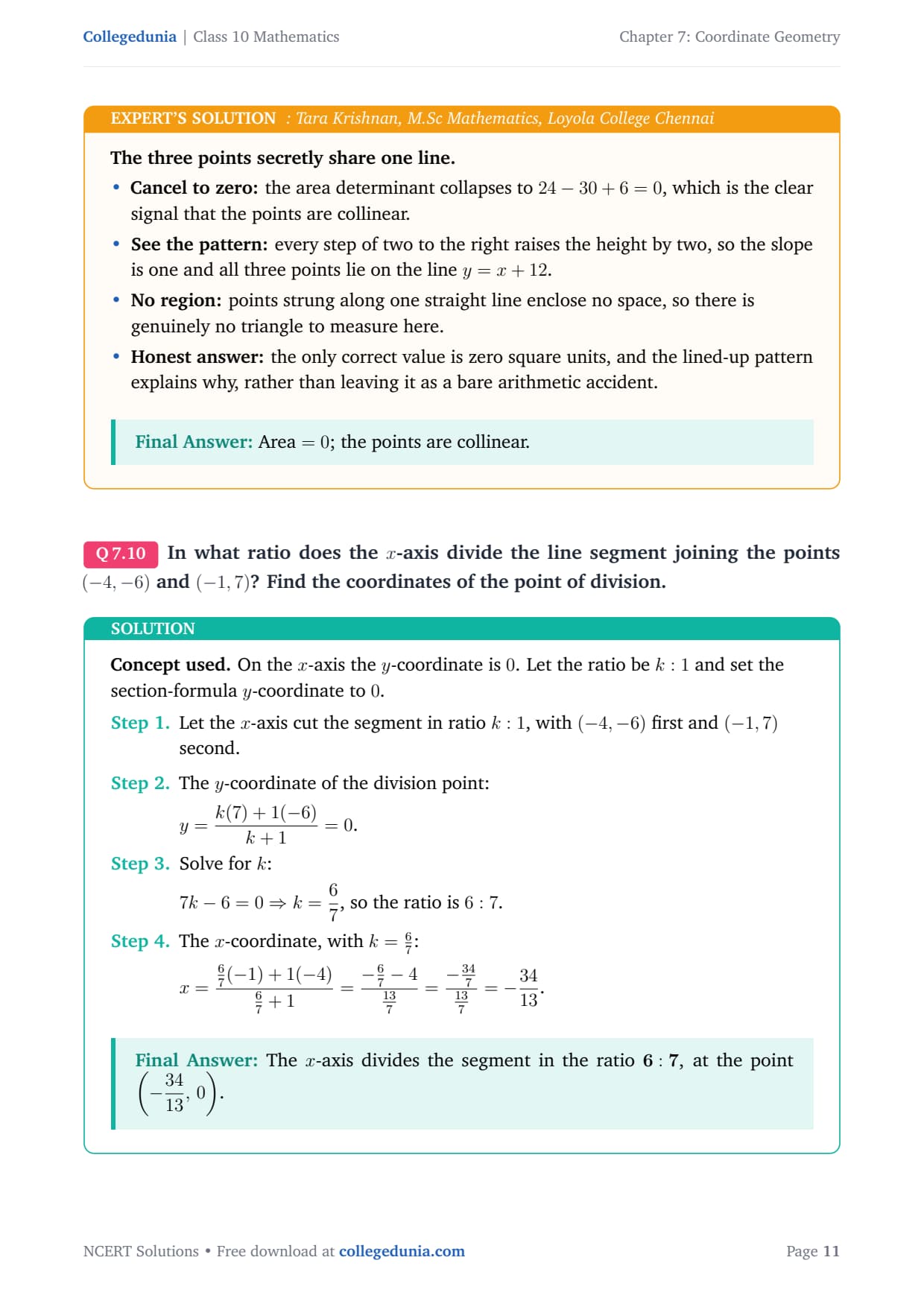
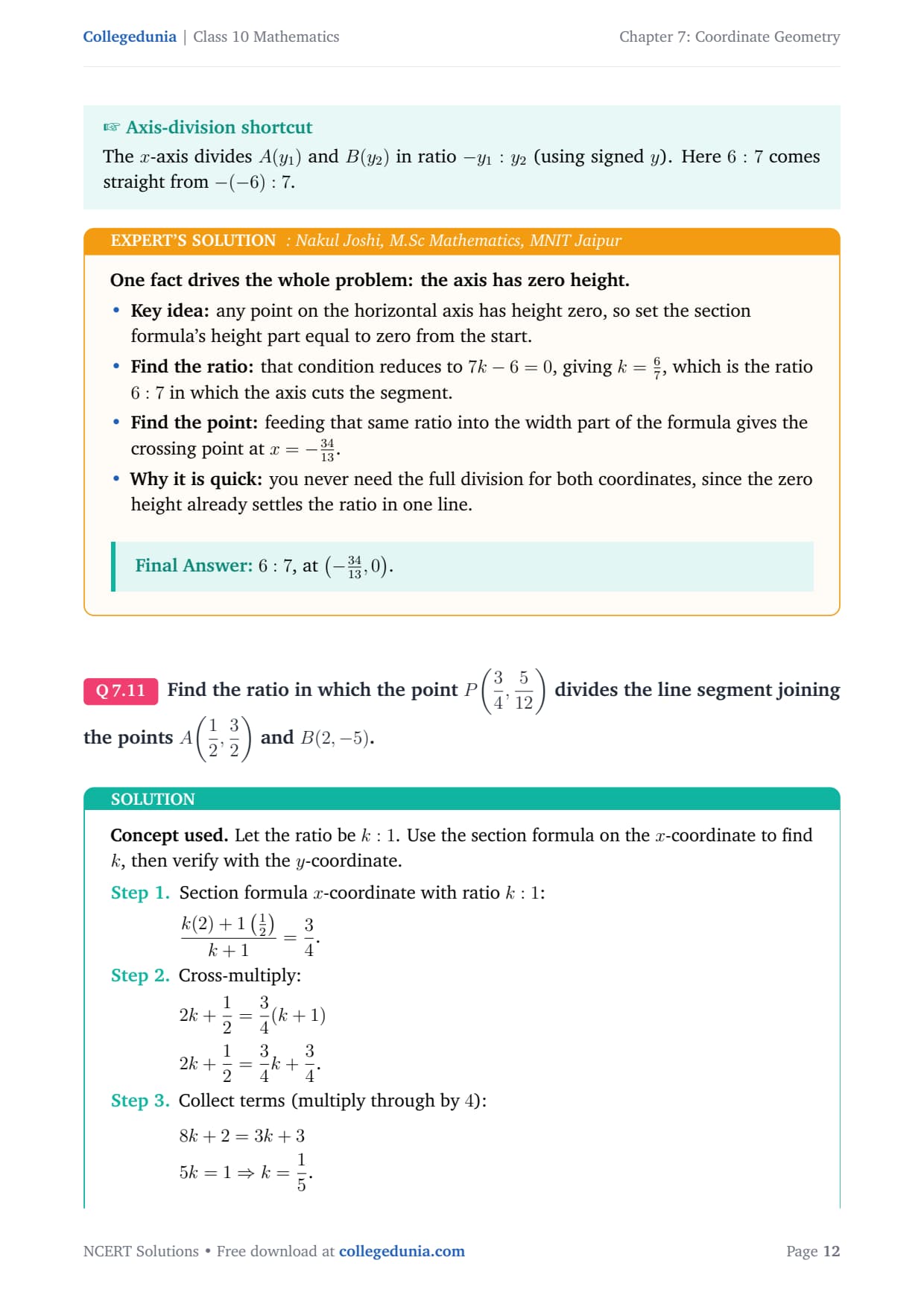
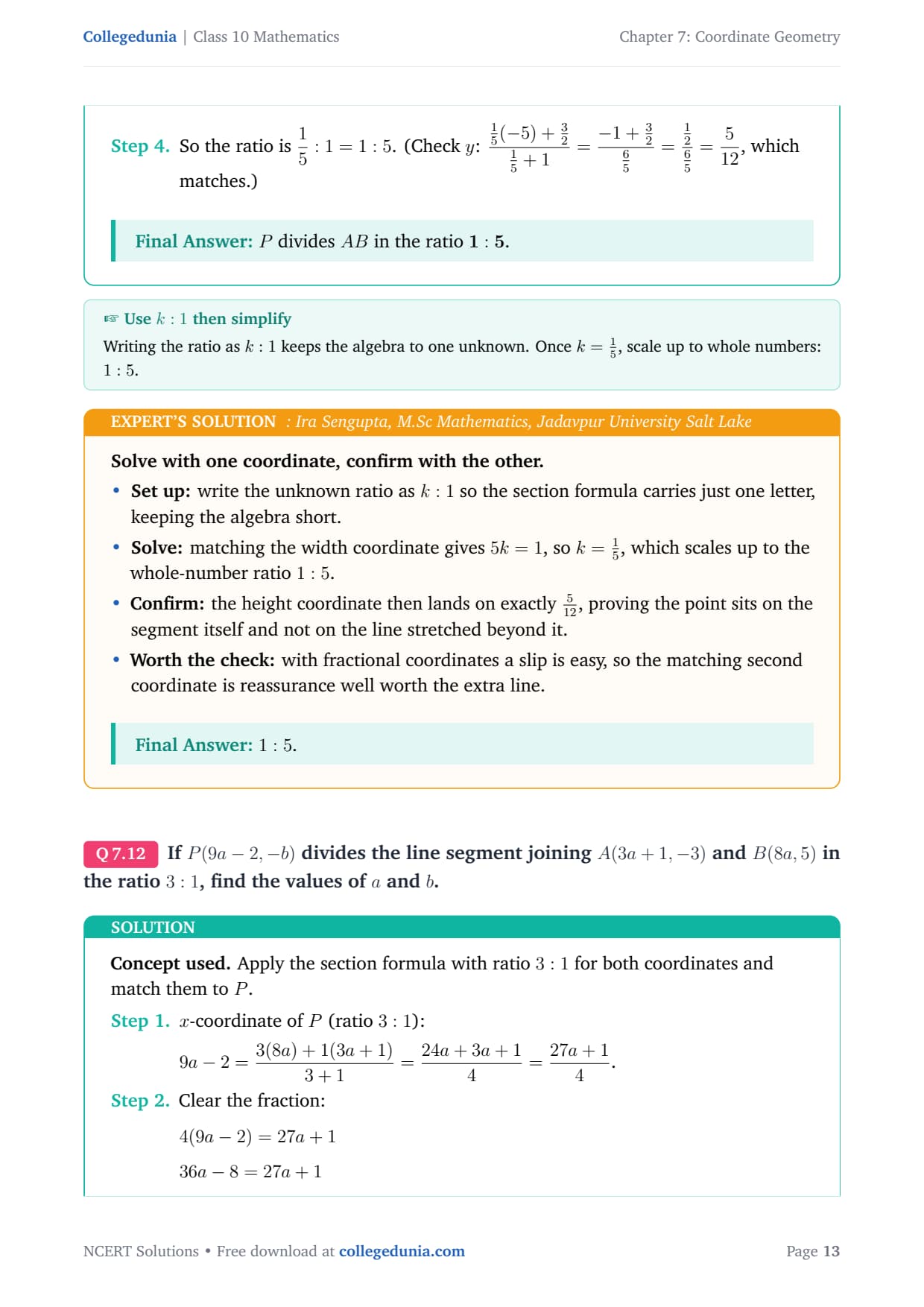
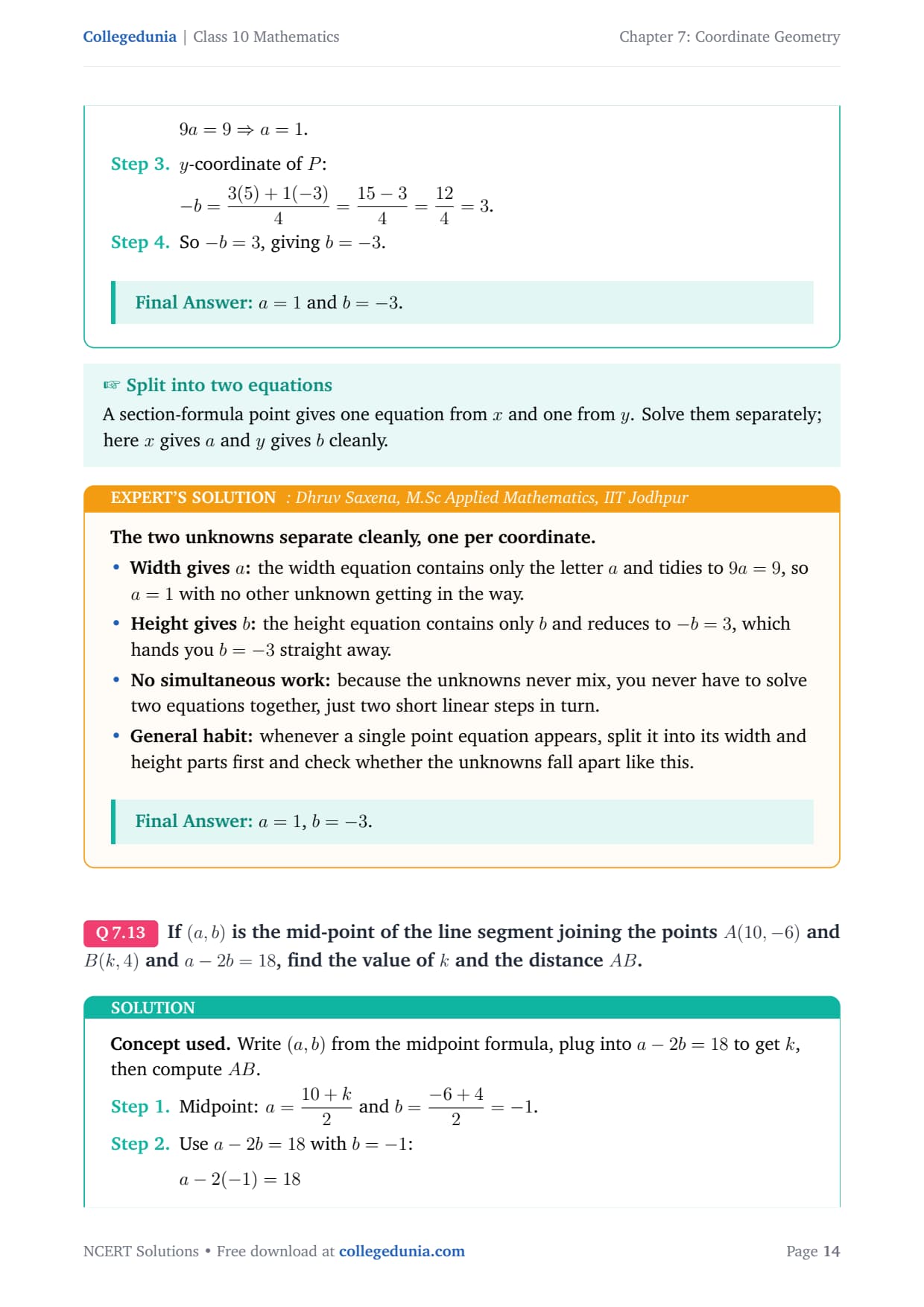
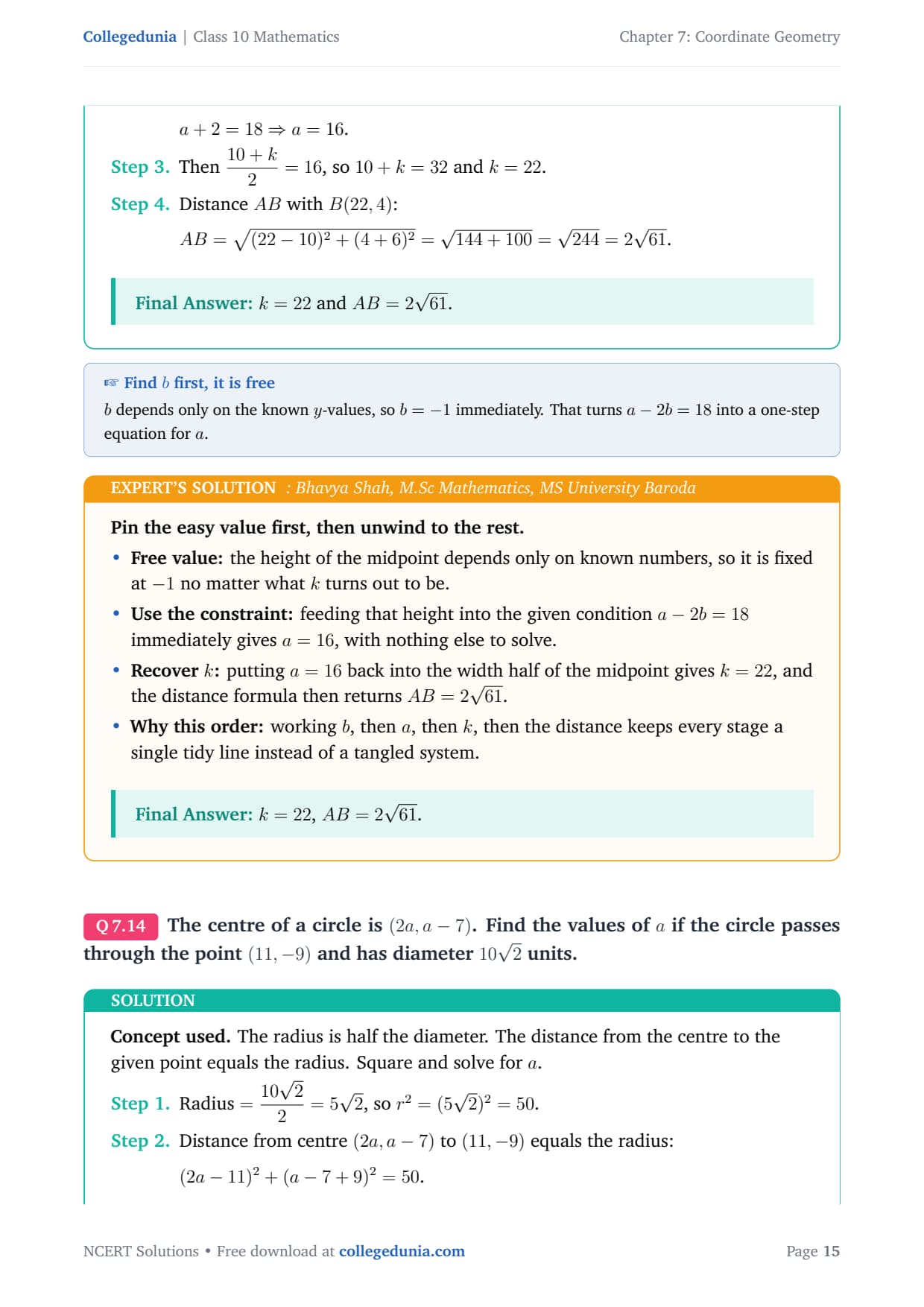
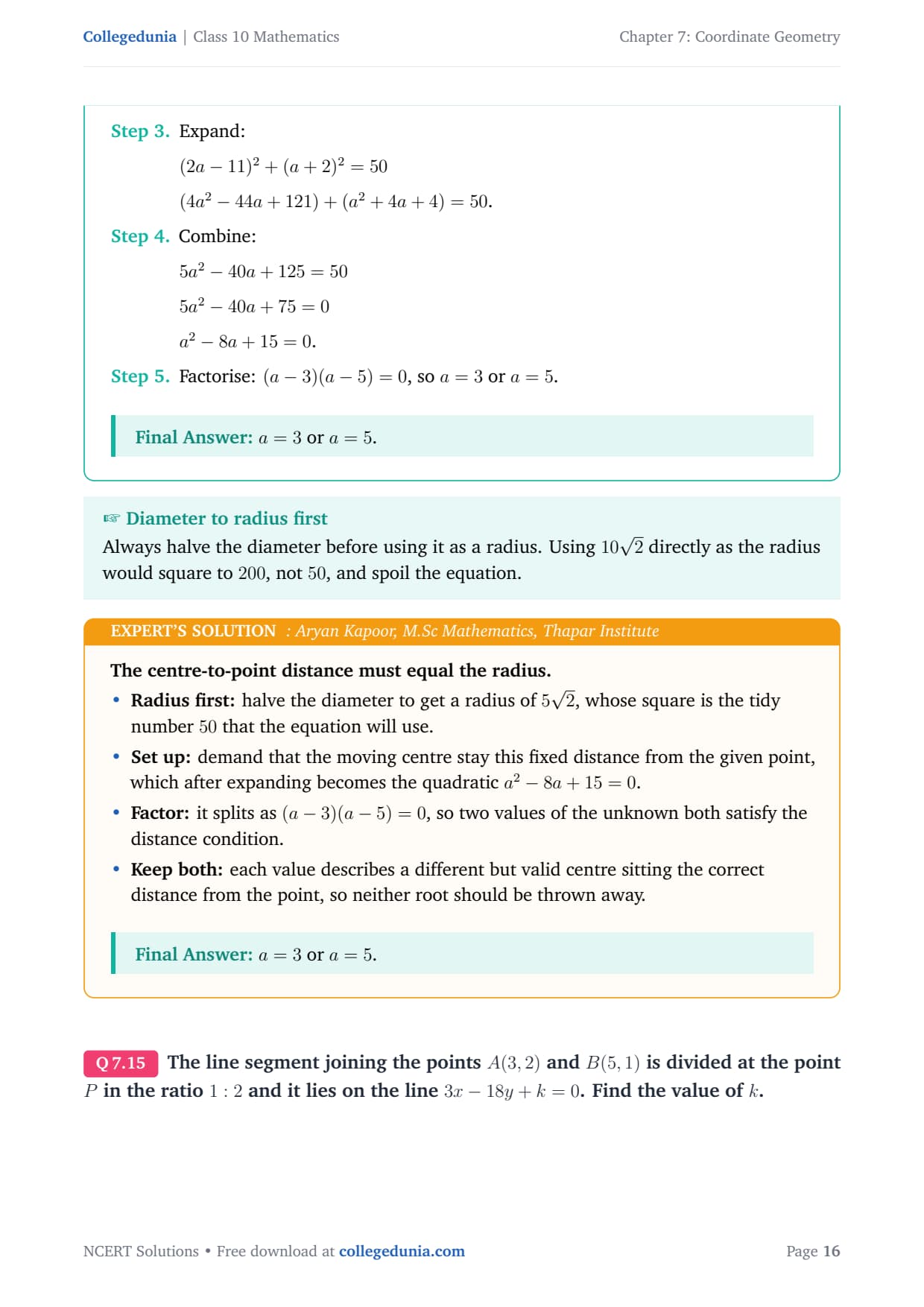
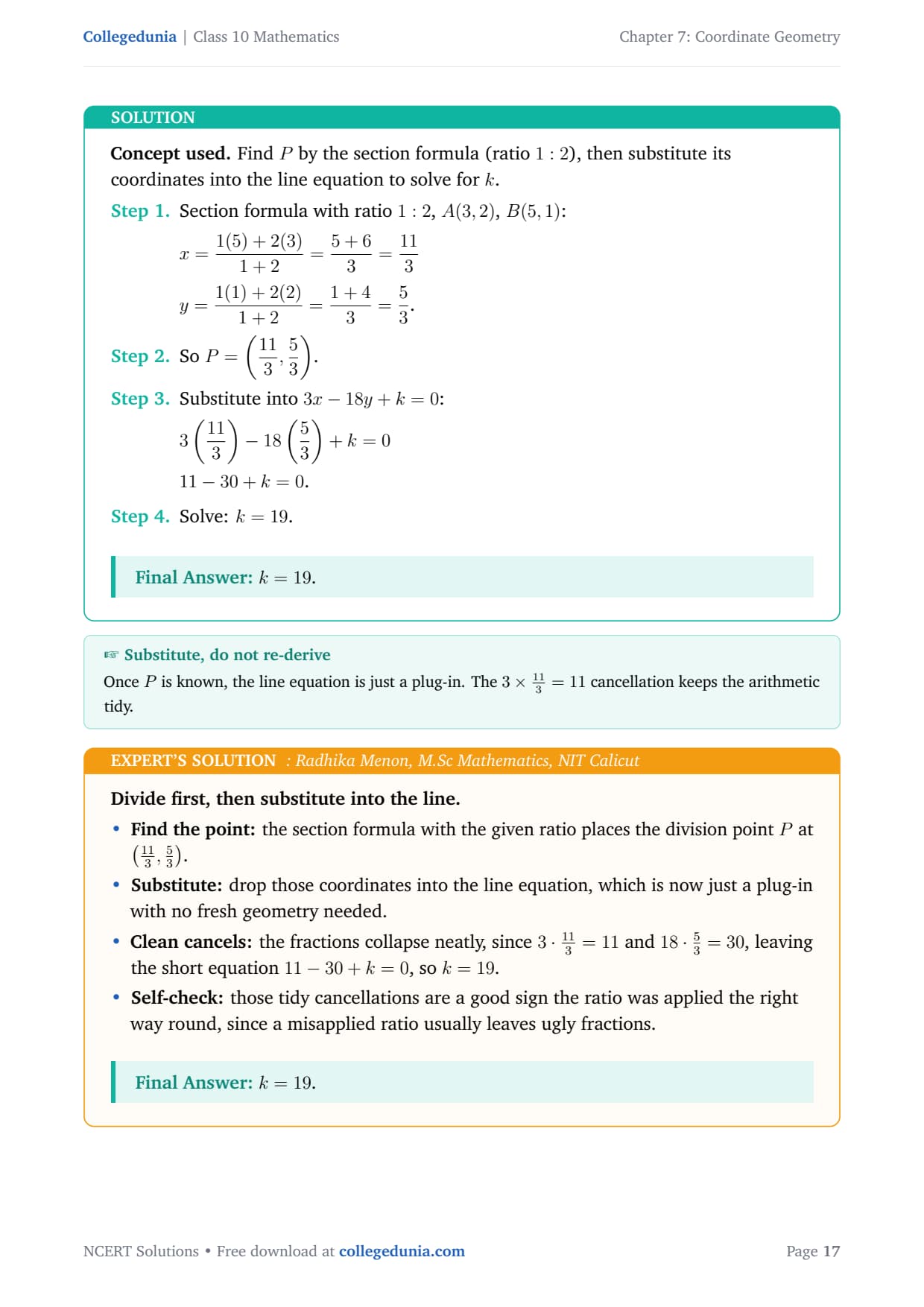
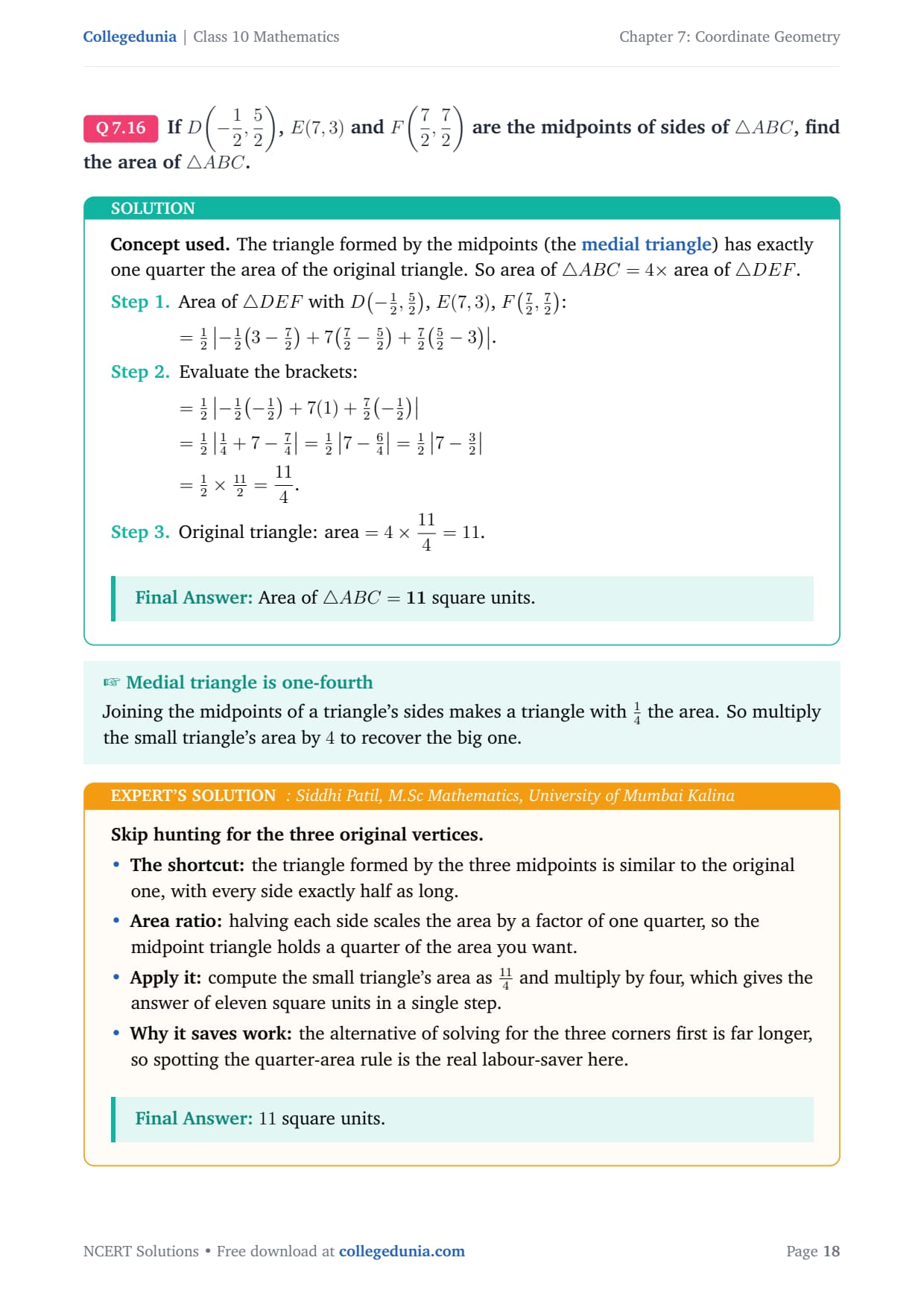
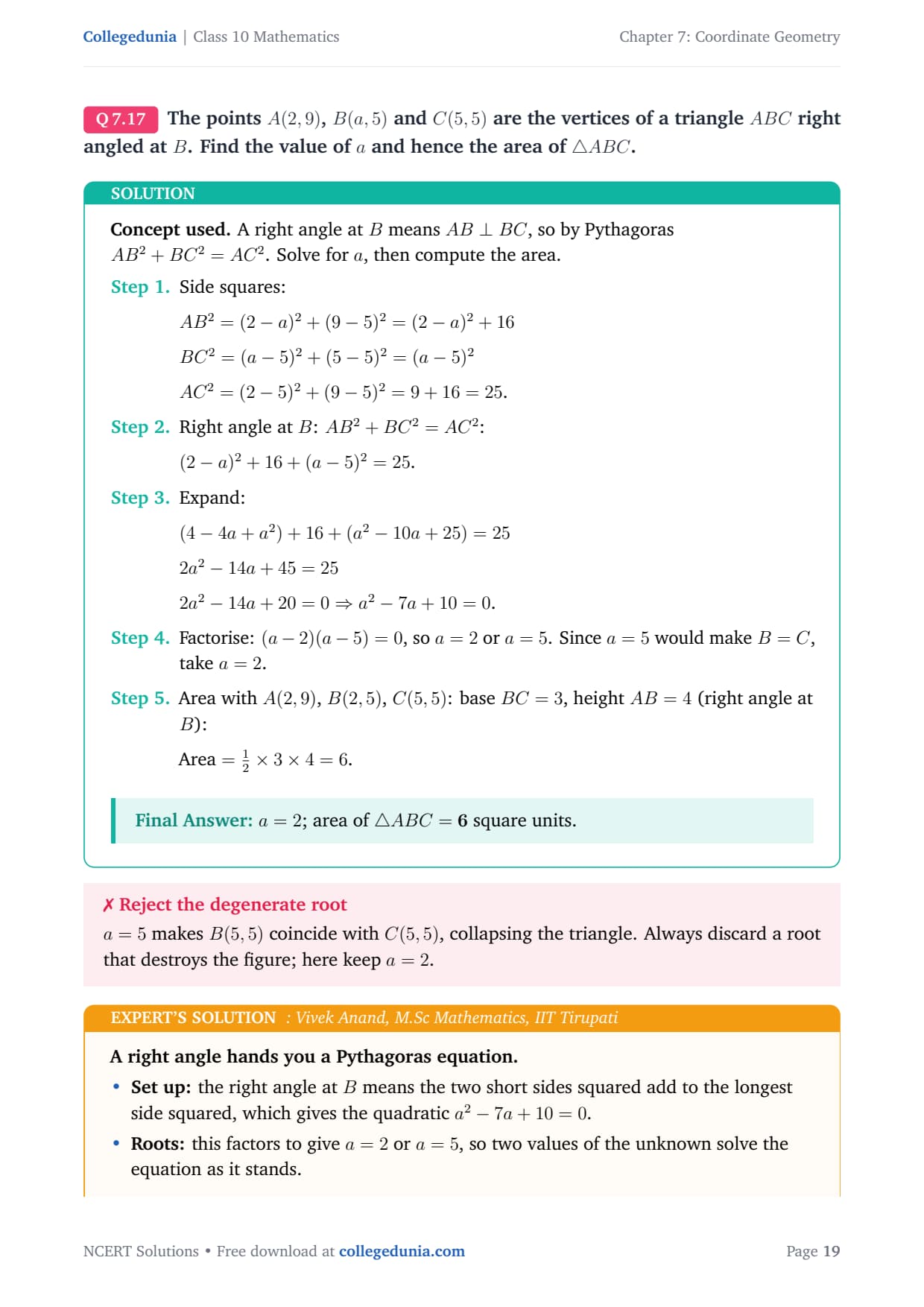
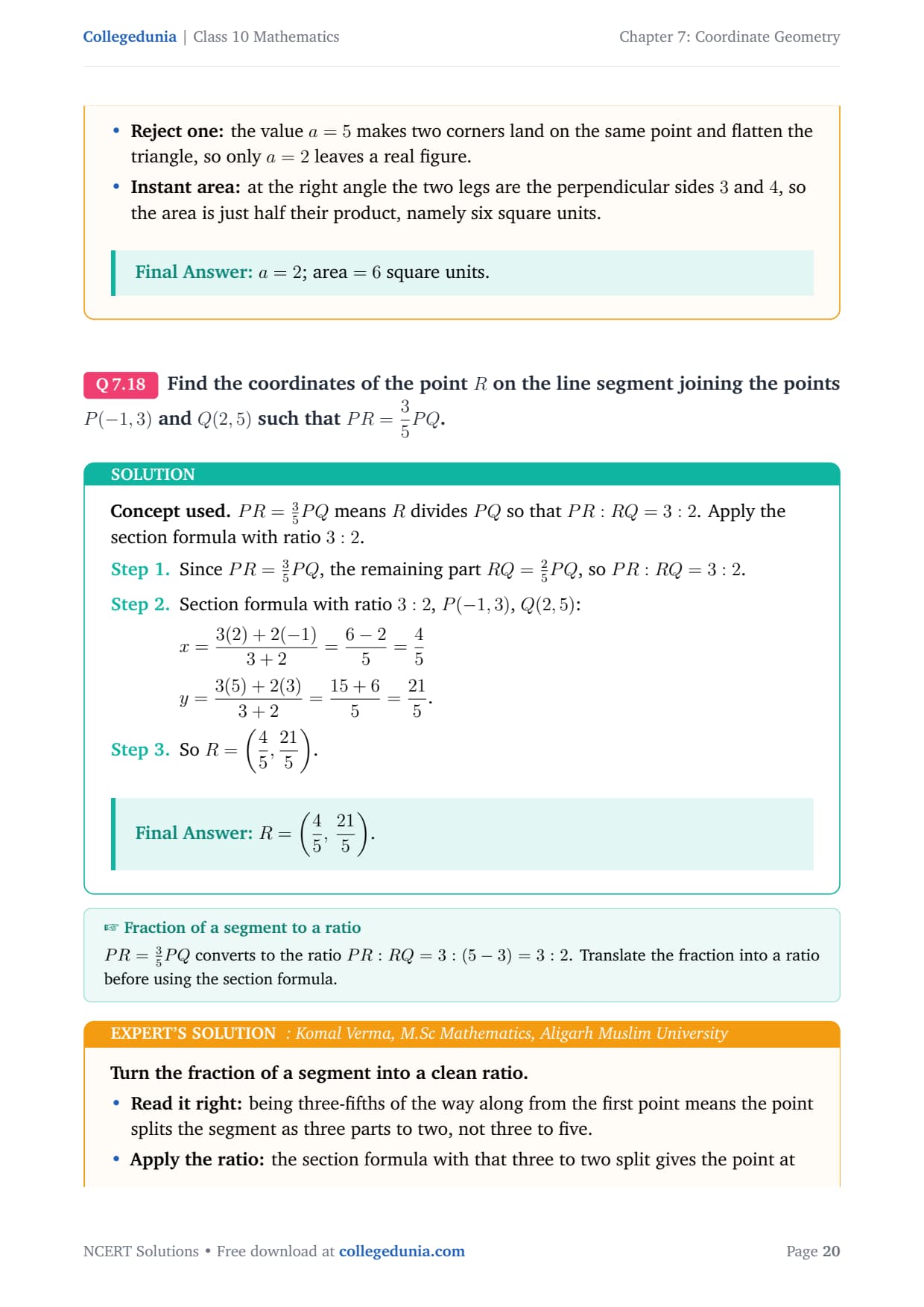
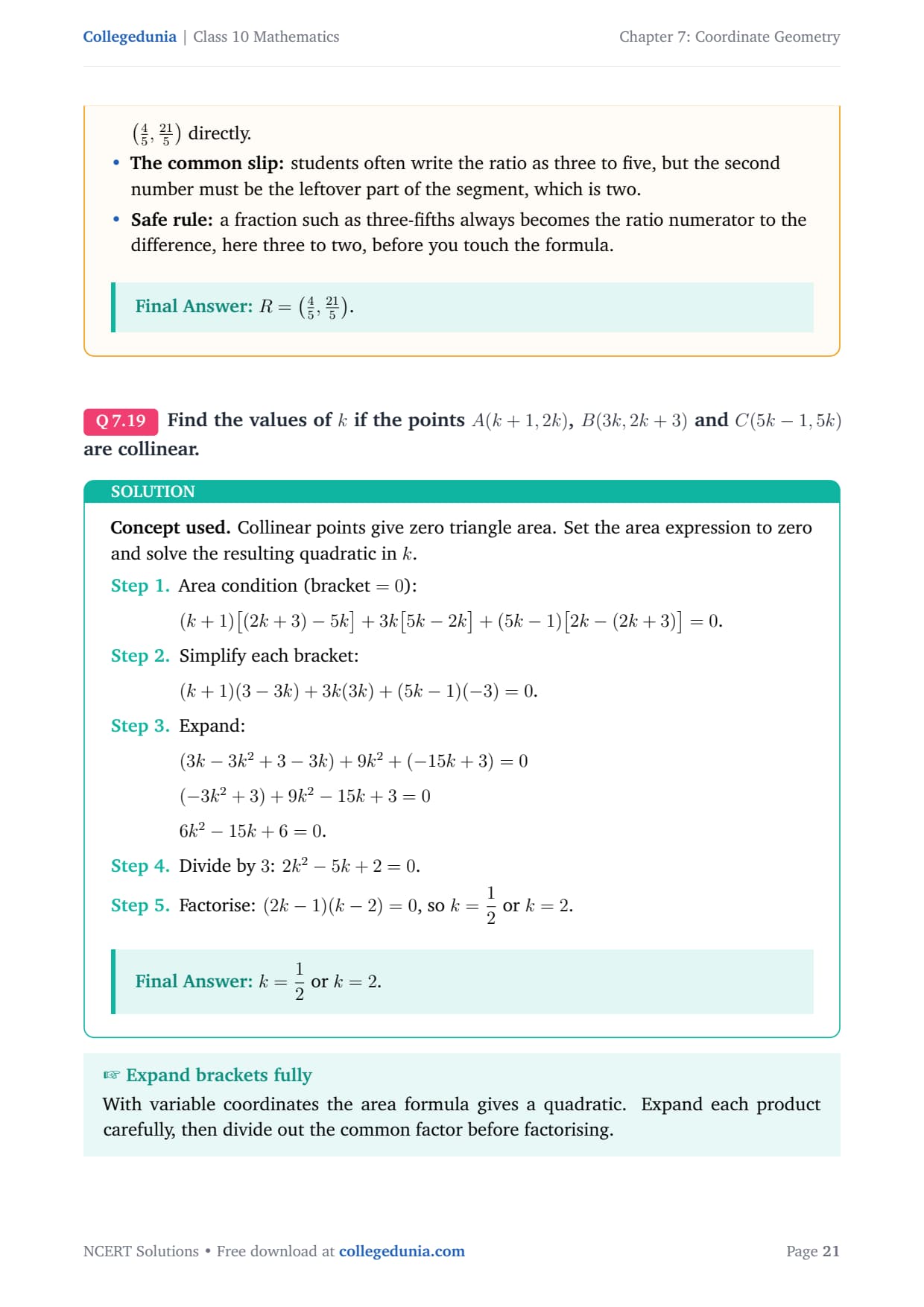
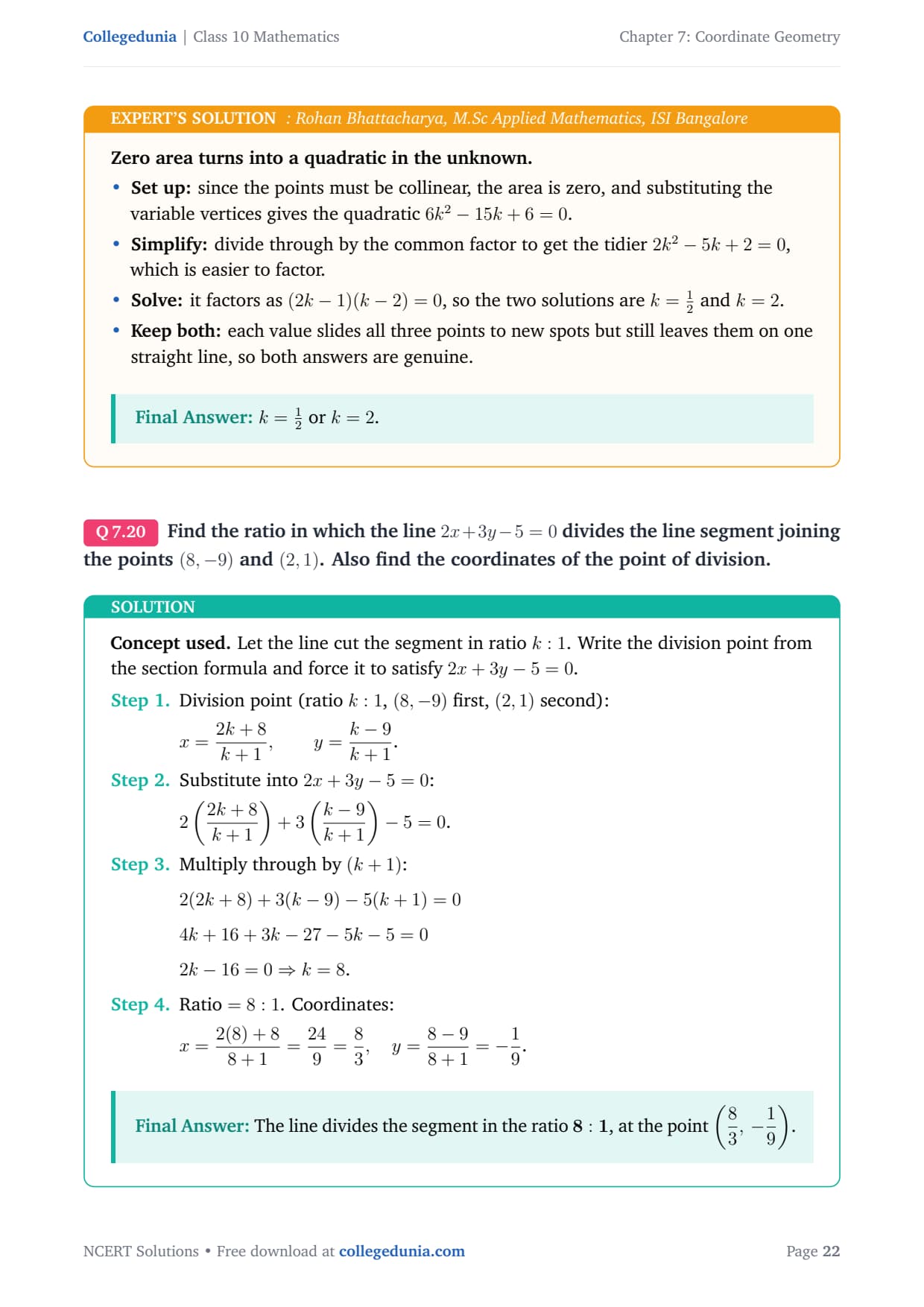
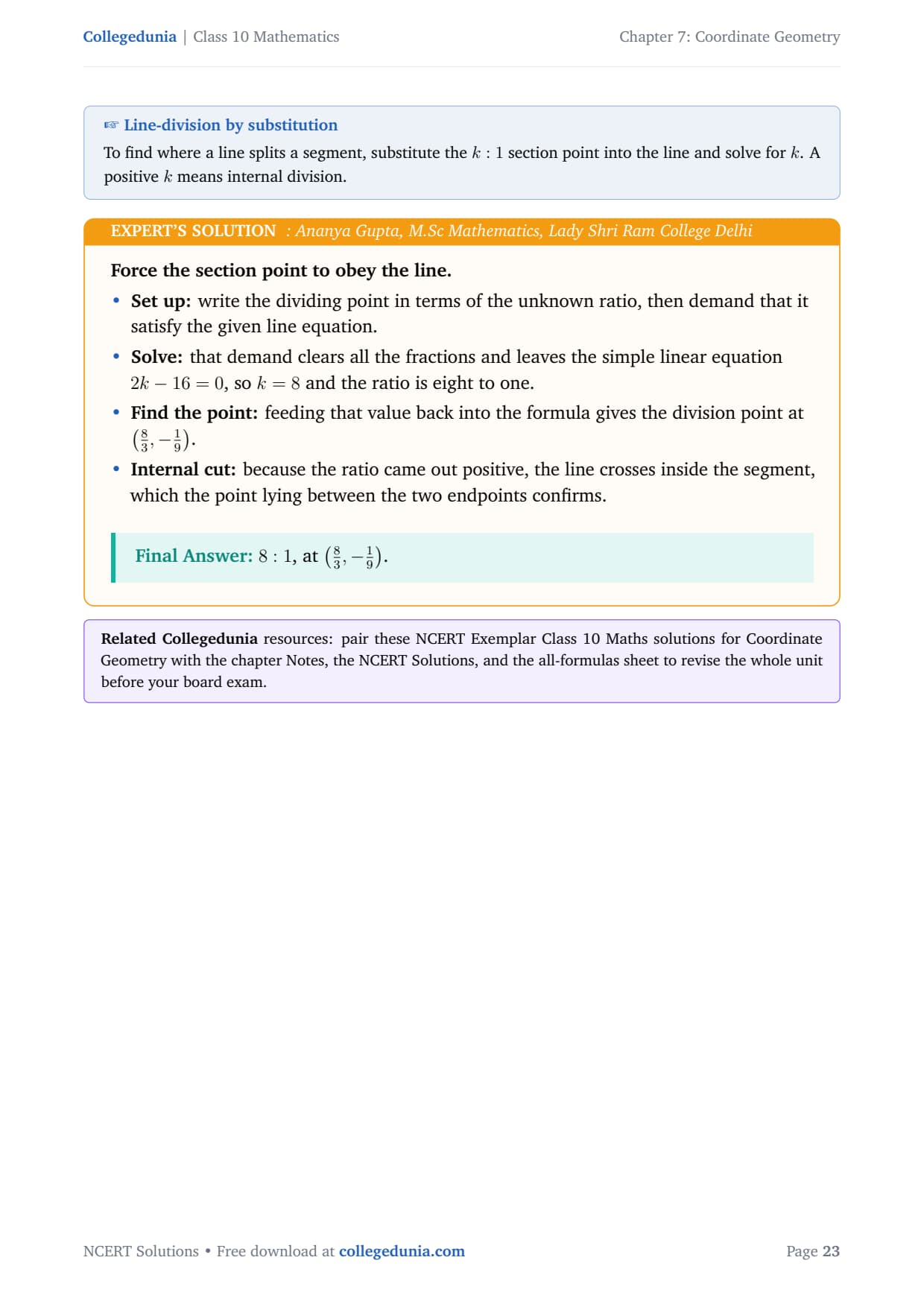
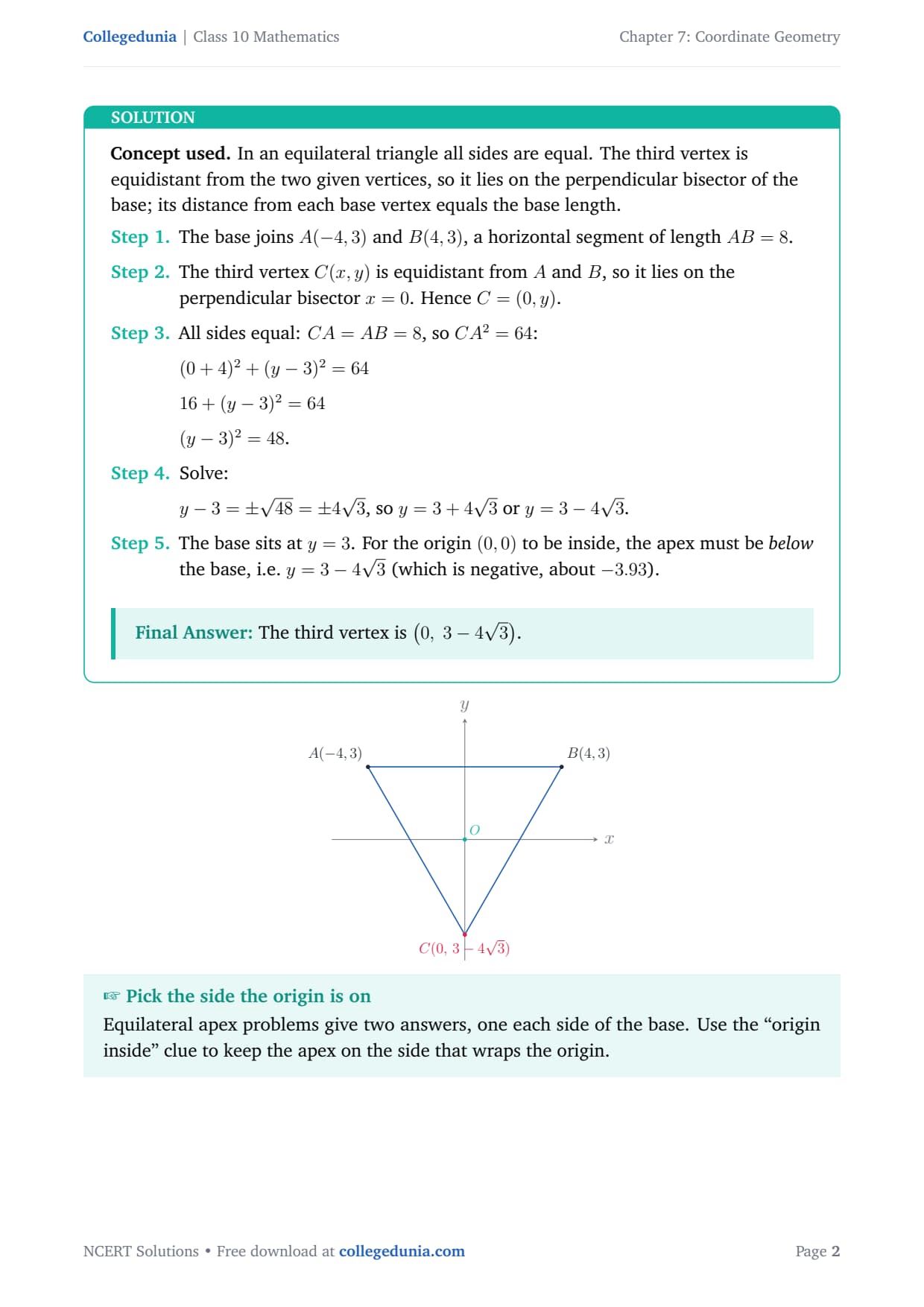
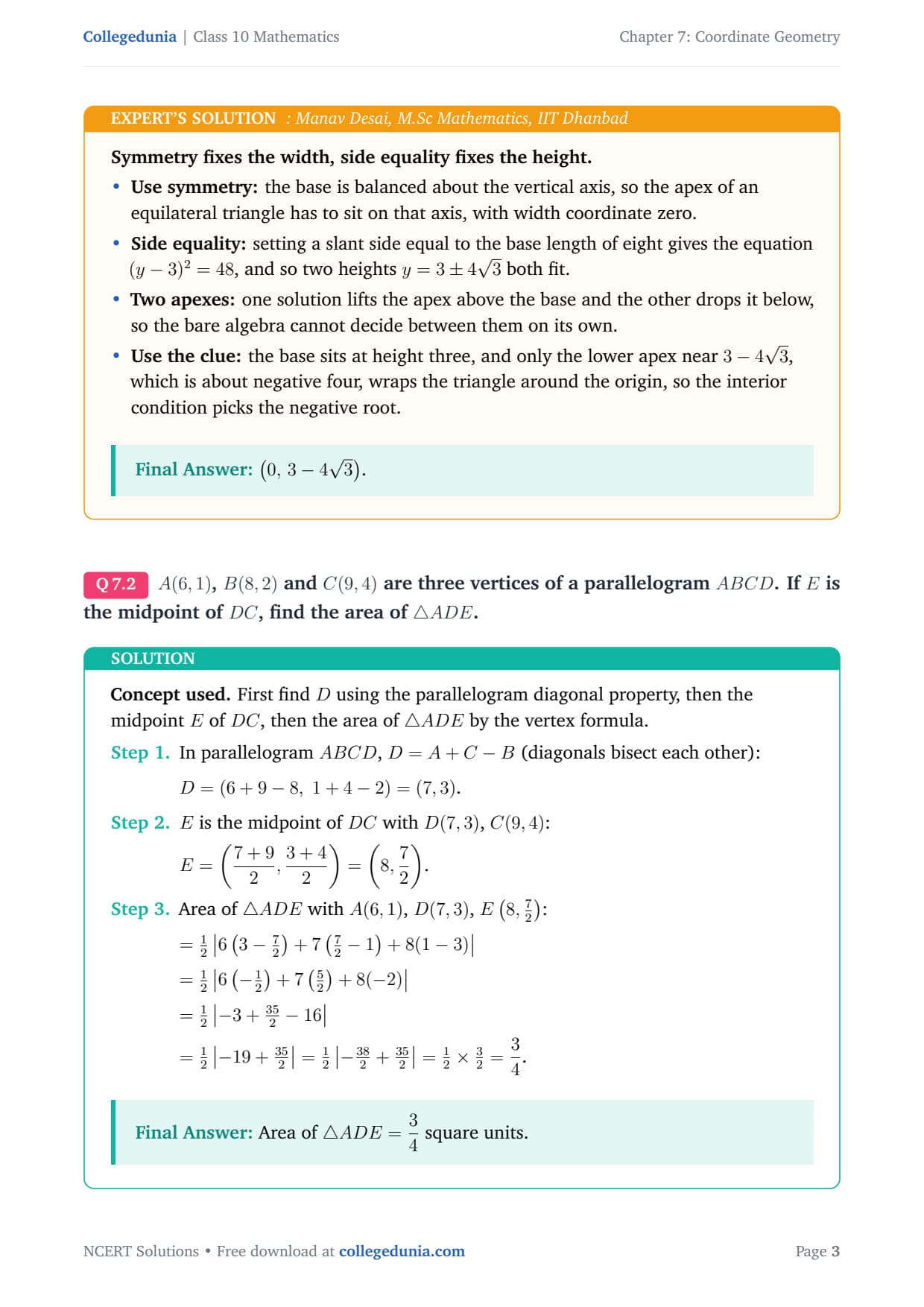
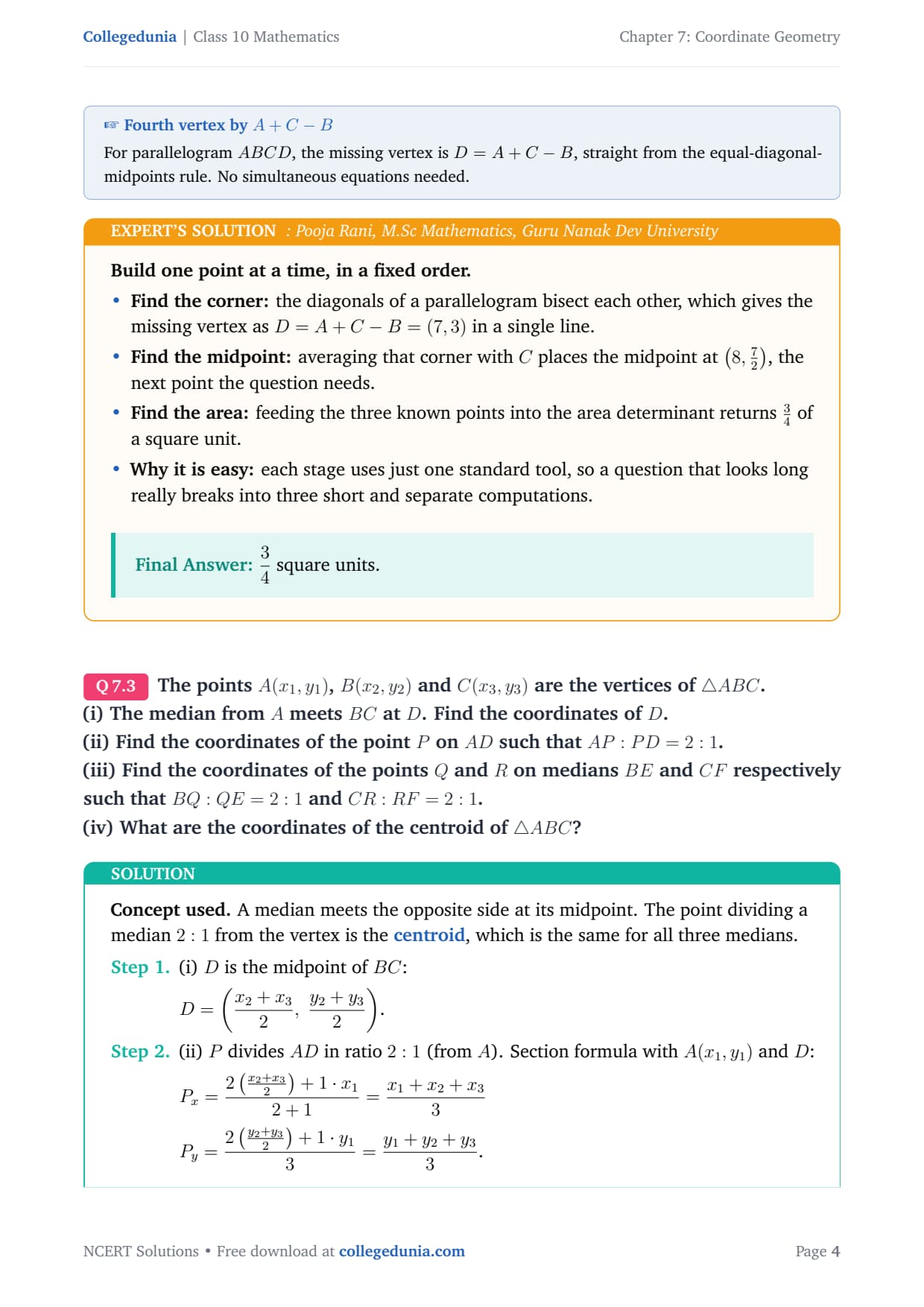
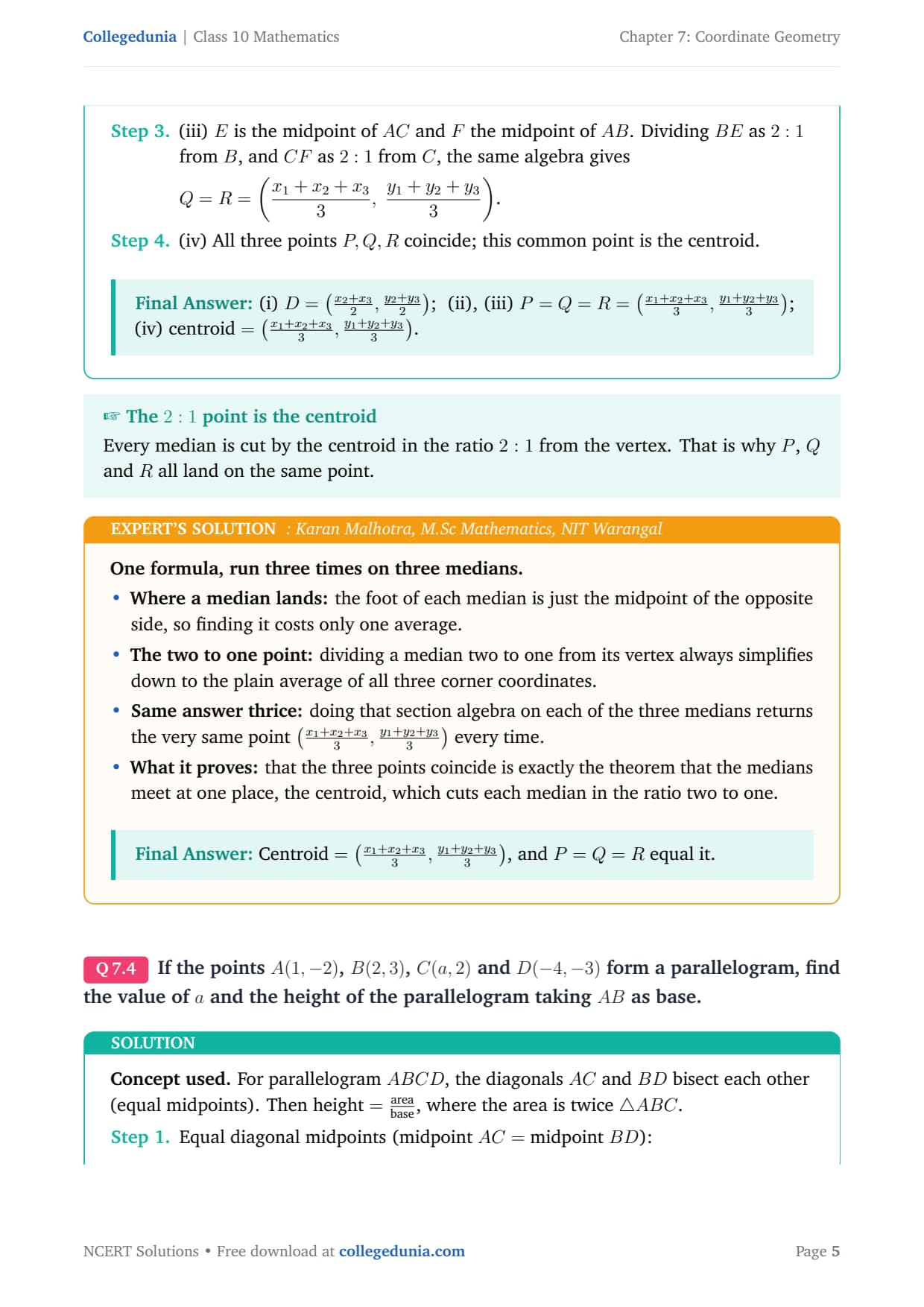
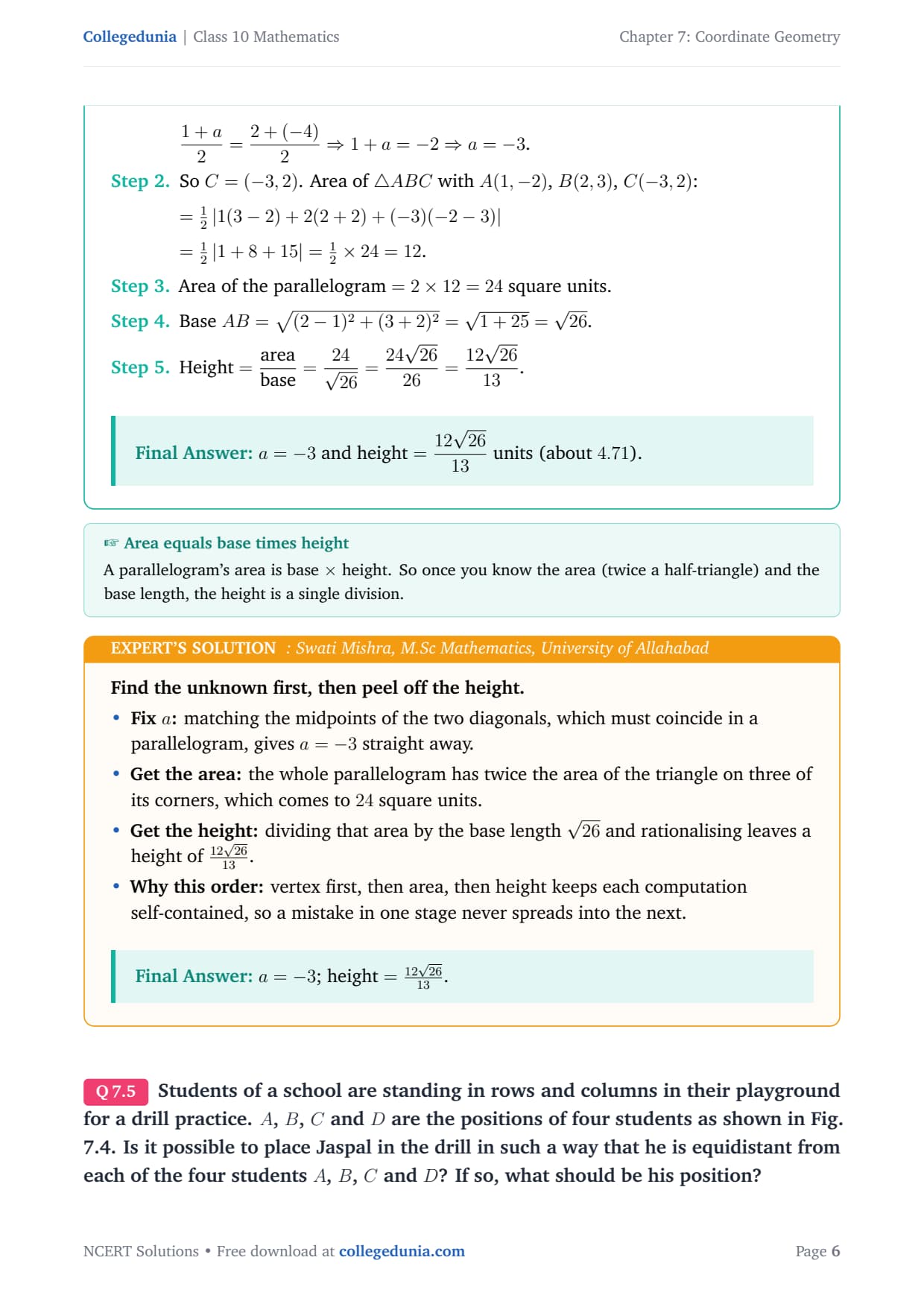



Comments