Maths Mentor, Delhi University | Updated 3+ months ago
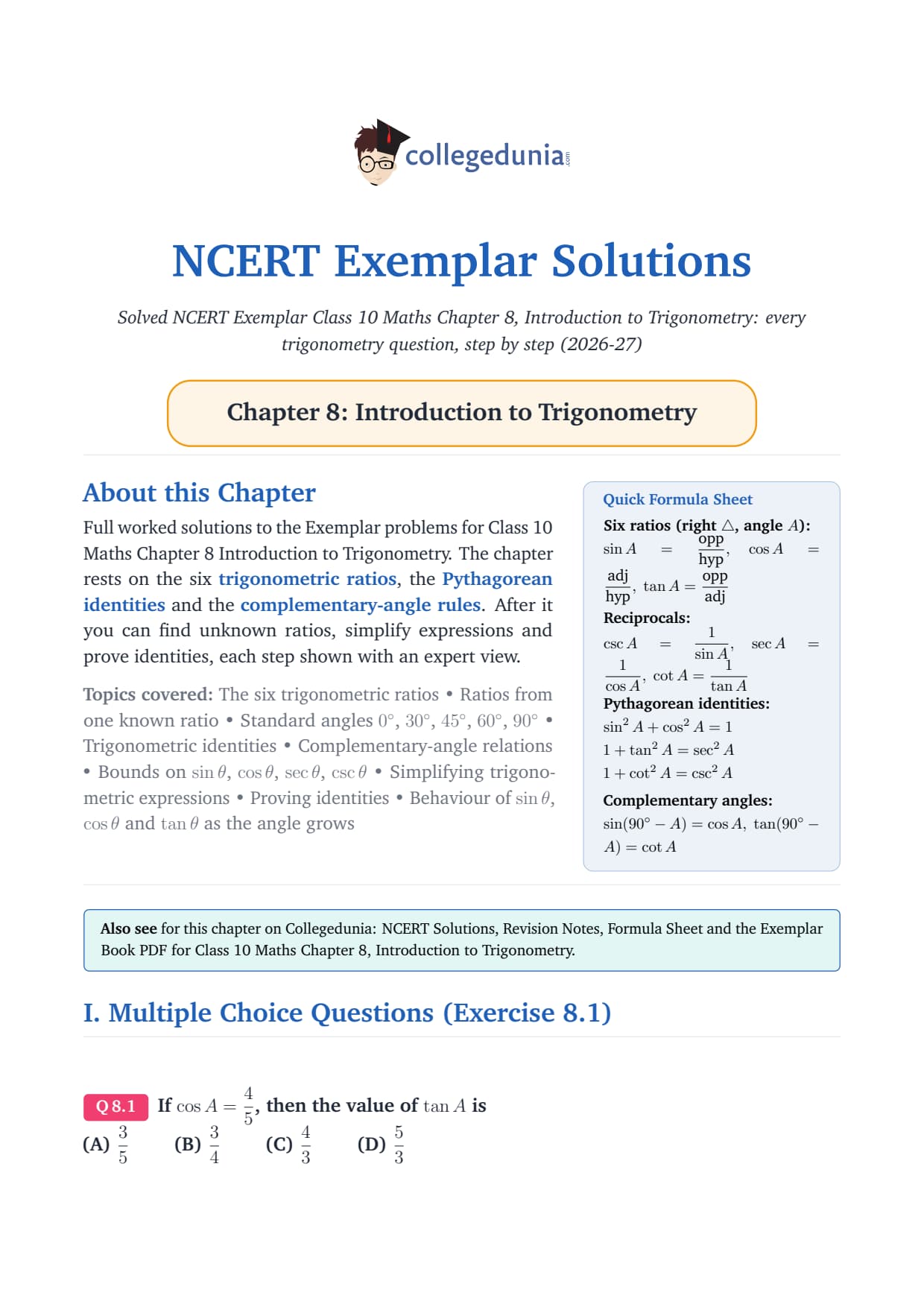
NCERT Exemplar Class 10 Maths Chapter 8 Exercise 8.1 has all 14 Multiple Choice Questions (MCQs) on Introduction to Trigonometry. You work with trig ratios, standard angles, Pythagorean identities and complementary-angle rules to pick the right option under exam conditions.
Exercise type: 14 MCQs from Chapter 8 of the NCERT Exemplar.
Topics tested: six trig ratios, standard angles, complementary-angle rules, Pythagorean identities.
Board relevance: MCQs from this set appear often as 1-mark questions in Class 10 board exams.
Solved by Collegedunia: Every Exercise 8.1 question is solved by verified subject experts under the 2026-27 rationalised NCERT syllabus.
Exercise 8.1 is the MCQ set in the NCERT Exemplar for Chapter 8, Introduction to Trigonometry. It has 14 MCQs. They test whether you can:
Convert one trig ratio into the others using the Pythagorean theorem.
Apply standard-angle values (0°, 30°, 45°, 60°, 90°) to evaluate expressions without a calculator.
Use complementary-angle rules like sin(90° - A) = cos A and tan(90° - A) = cot A to simplify expressions.
Prove results using the Pythagorean identitiessin2A + cos2A = 1 and 1 + tan2A = sec2A.
These are commonly asked as 1-mark MCQs in board exams. Practising them builds speed and accuracy with standard trig values.
Exam tip: For each MCQ, note the given ratio, build a right triangle with those sides, and read off every other ratio. This beats algebra.
Key Identities & Formulas in Class 10 Maths
These six identities appear directly in the 14 questions. Knowing them by heart is the fastest route to the right option.
Identity / Rule
Formula
Used in Q
Pythagorean identity 1
sin2A + cos2A = 1
Q4, Q9, Q13
Tangent definition
tan A = sin Acos A = oppadj
Q1, Q12
Cotangent definition
cot A = 1tan A = adjopp
Q2
Complementary rule (sin/cos)
sin(90° - A) = cos A
Q3, Q5, Q7, Q11, Q14
Complementary rule (tan/cot)
tan(90° - A) = cot A
Q3, Q6
Standard angle values
sin 30° = 12, tan 45° = 1, cos 60° = 12
Q2, Q7, Q8, Q10, Q13
Quick recall: The 3-4-5 Pythagorean triple is the single most useful set of side lengths in this exercise. When you see cos A = 45 or sin A = 35, the third side is always 3 or 4 without any calculation.
Types of Questions
All 14 questions are MCQs, but they fall into four clear types. Spotting the type tells you which tool to use.
Question Type
Questions
Strategy
Find one ratio from another
Q1, Q2, Q4, Q12
Build the right triangle; read every ratio from its sides
Complementary-angle cancellation
Q3, Q6, Q11, Q14
Check if two angles sum to 90°; if yes, the pair cancels
Standard-angle identification
Q2, Q7, Q8, Q10, Q13
Match the given ratio to the standard-angle table row
Identity substitution and proof
Q5, Q9
Use sin2 + cos2 = 1; rewrite the target in terms of the given
Solving Strategies for the MCQs
Students often lose marks by reaching for long algebra when a quick diagram or table lookup gives the answer in seconds. Here are the four strategies that work best for Exercise 8.1.
Strategy 1, build the triangle: when a ratio is given (e.g. cos A = 45), draw a right triangle with the correct sides and read every other ratio off it.
Strategy 2, name the angle: if the ratio is a standard value (e.g. sin A = 12), name the angle first (30°) and look up the rest from the table.
Strategy 3, sum-to-90° check: in a product or difference of two angle names, add the angles. If they sum to 90°, the complementary rule simplifies the pair at once.
Strategy 4, divide by cos: when a fraction has sinθ and cosθ top and bottom, divide through by cosθ to get tanθ, then substitute.
Watch Out: The most common mistake in this exercise is confusing tan A with hypadj. Tangent never involves the hypotenuse. It is always opposite over adjacent.
Strategies at a Glance
The four strategies cover every question in Exercise 8.1. The list below maps each strategy to the questions it solves, so you can practise one type at a time.
Questions 1, 4 and 12 are triangle-building questions. Draw the triangle, label three sides, and every ratio reads off in one step.
Questions 3, 6, 11 and 14 are complementary-angle questions. The answer is 0 or 1 once the angle pairs cancel.
Questions 2, 7, 8, 10 and 13 are standard-angle questions. Just read the table row for 30°, 45° or 90°.
Remember:tan 1° × tan 2° × … × tan 89° = 1 because every pair tan k° × tan(90° - k°) = tan k° × cot k° = 1, and the lone middle term tan 45° = 1.
All Exercise 8.1 Solutions with Step-by-Step Answers
I. Multiple Choice Questions (Exercise 8.1)
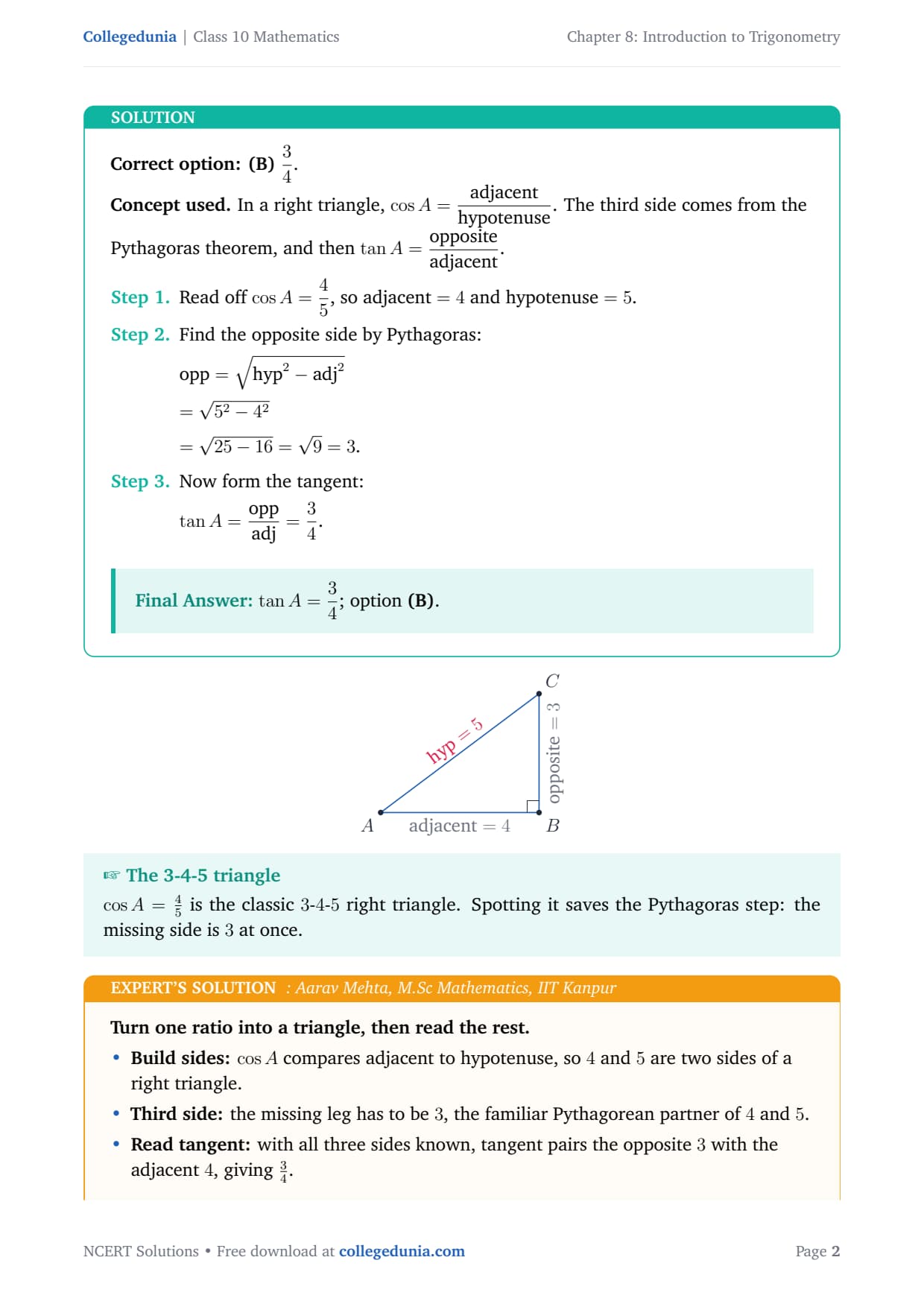
Q 8.1
If cos A=45, then the value of tan A is
(A) 35 (B) 34 (C) 43 (D) 53
Correct option: (B)34.
Concept used. In a right triangle, cos A=adjacenthypotenuse.
The third side comes from the Pythagoras theorem, and then
tan A=oppositeadjacent.
Read off cos A=45, so adjacent =4 and hypotenuse =5.
Find the opposite side by Pythagoras:
[] opp=√hyp2-adj2
[] =√52-42
[] =√25-16=√9=3.
Now form the tangent:
[] tan A=oppadj=34.
tan A=34; option (B).
AM
Aarav Mehta
M.Sc Mathematics, IIT Kanpur
Verified Expert
Turn one ratio into a triangle, then read the rest.
Build sides:cos A compares adjacent to hypotenuse, so 4 and 5 are two sides of a right triangle.
Third side: the missing leg has to be 3, the familiar Pythagorean partner of 4 and 5.
Read tangent: with all three sides known, tangent pairs the opposite 3 with the adjacent 4, giving 34.
Common slip: students who answer 45 forget that tangent never uses the hypotenuse.
Option (B), 34.
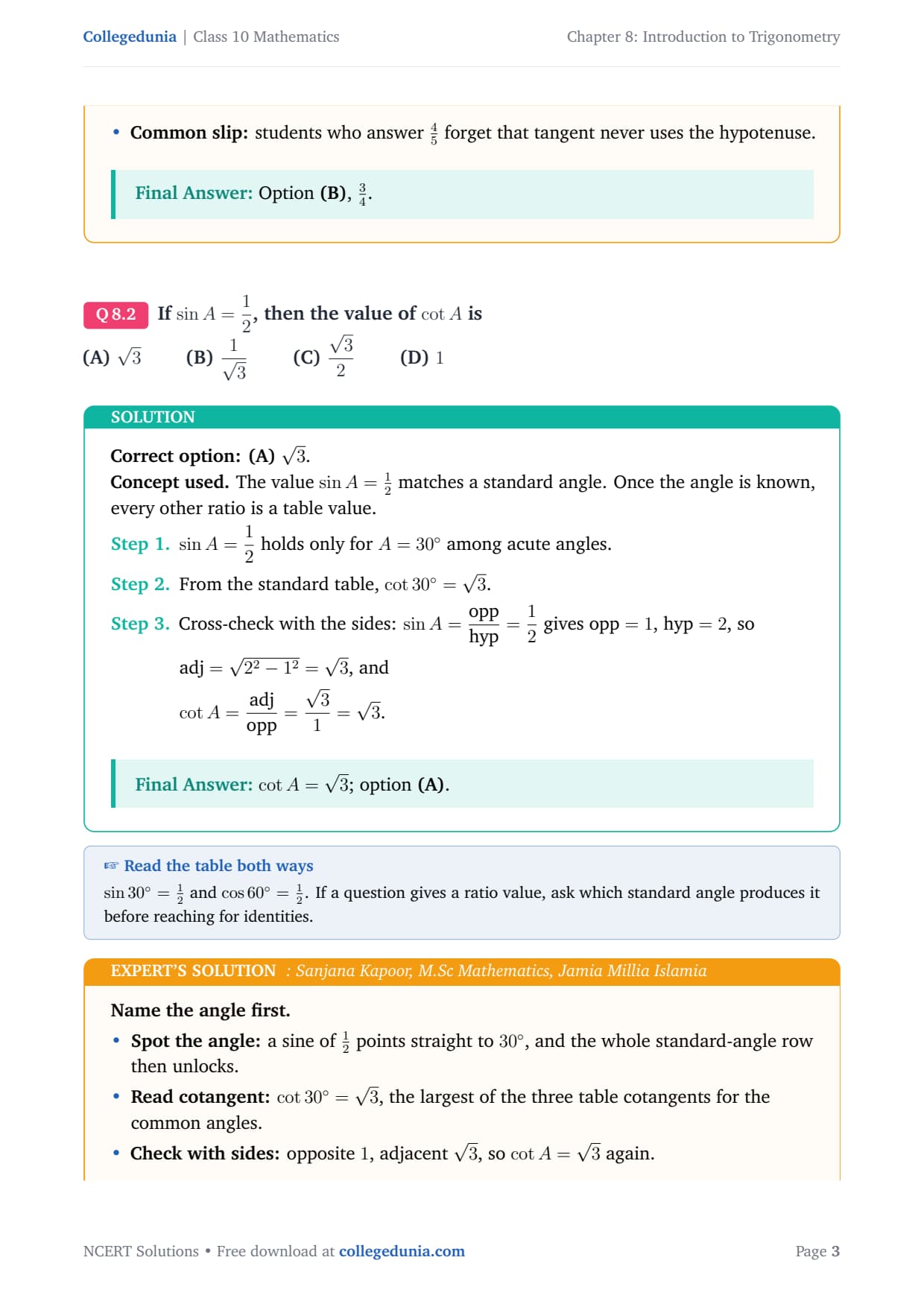
Q 8.2
If sin A=12, then the value of cot A is
(A) √3 (B) 1√3 (C) √32 (D) 1
Correct option: (A)√3.
Concept used. The value sin A=12 matches a standard
angle. Once the angle is known, every other ratio is a table value.
sin A=12 holds only for A=30∘ among acute angles.
From the standard table, cot 30∘=3.
Cross-check with the sides: sin A=opphyp=12 gives opp =1, hyp =2, so
[] adj=√22-12=√3, and
[] cot A=adjopp=31=3.
cot A=3; option (A).
SK
Sanjana Kapoor
M.Sc Mathematics, Jamia Millia Islamia
Verified Expert
Name the angle first.
Spot the angle: a sine of 12 points straight to 30∘, and the whole standard-angle row then unlocks.
Read cotangent:cot 30∘=3, the largest of the three table cotangents for the common angles.
Check with sides: opposite 1, adjacent 3, so cot A=3 again.
Trap option:13 is tan 30∘, the reciprocal that students grab when they swap opposite and adjacent.
Option (A), 3.
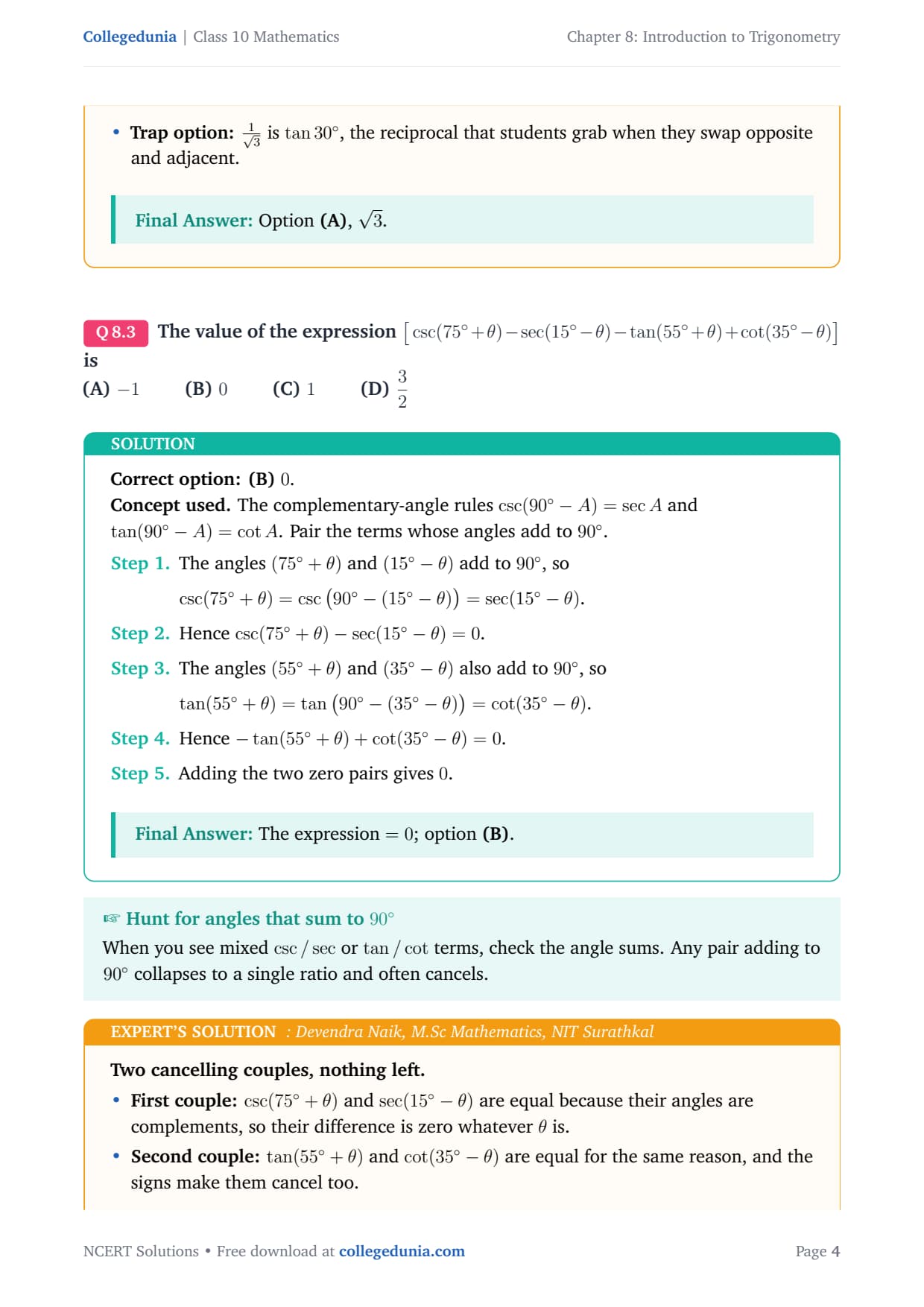
Q 8.3
The value of the expression [csc(75∘+θ)-sec(15∘-θ)-tan(55∘+θ)+cot(35∘-θ)] is
(A) -1 (B) 0 (C) 1 (D) 32
Correct option: (B)0.
Concept used. The complementary-angle rules
csc(90∘-A)=sec A and tan(90∘-A)=cot A. Pair the terms
whose angles add to 90∘.
The angles (75∘+θ) and (15∘-θ) add to
90∘, so
[] csc(75∘+θ)=csc(90∘-(15∘-θ))=sec(15∘-θ).
Hence csc(75∘+θ)-sec(15∘-θ)=0.
The angles (55∘+θ) and (35∘-θ) also add to
90∘, so
[] tan(55∘+θ)=tan(90∘-(35∘-θ))=cot(35∘-θ).
Hence -tan(55∘+θ)+cot(35∘-θ)=0.
Adding the two zero pairs gives 0.
The expression =0; option (B).
DN
Devendra Naik
M.Sc Mathematics, NIT Surathkal
Verified Expert
Two cancelling couples, nothing left.
First couple:csc(75∘+θ) and sec(15∘-θ) are equal because their angles are complements, so their difference is zero whatever θ is.
Second couple:tan(55∘+θ) and cot(35∘-θ) are equal for the same reason, and the signs make them cancel too.
Why it is flat: because θ disappears from both couples, the answer is a flat 0 for every allowed value of θ.
Option (B), 0.
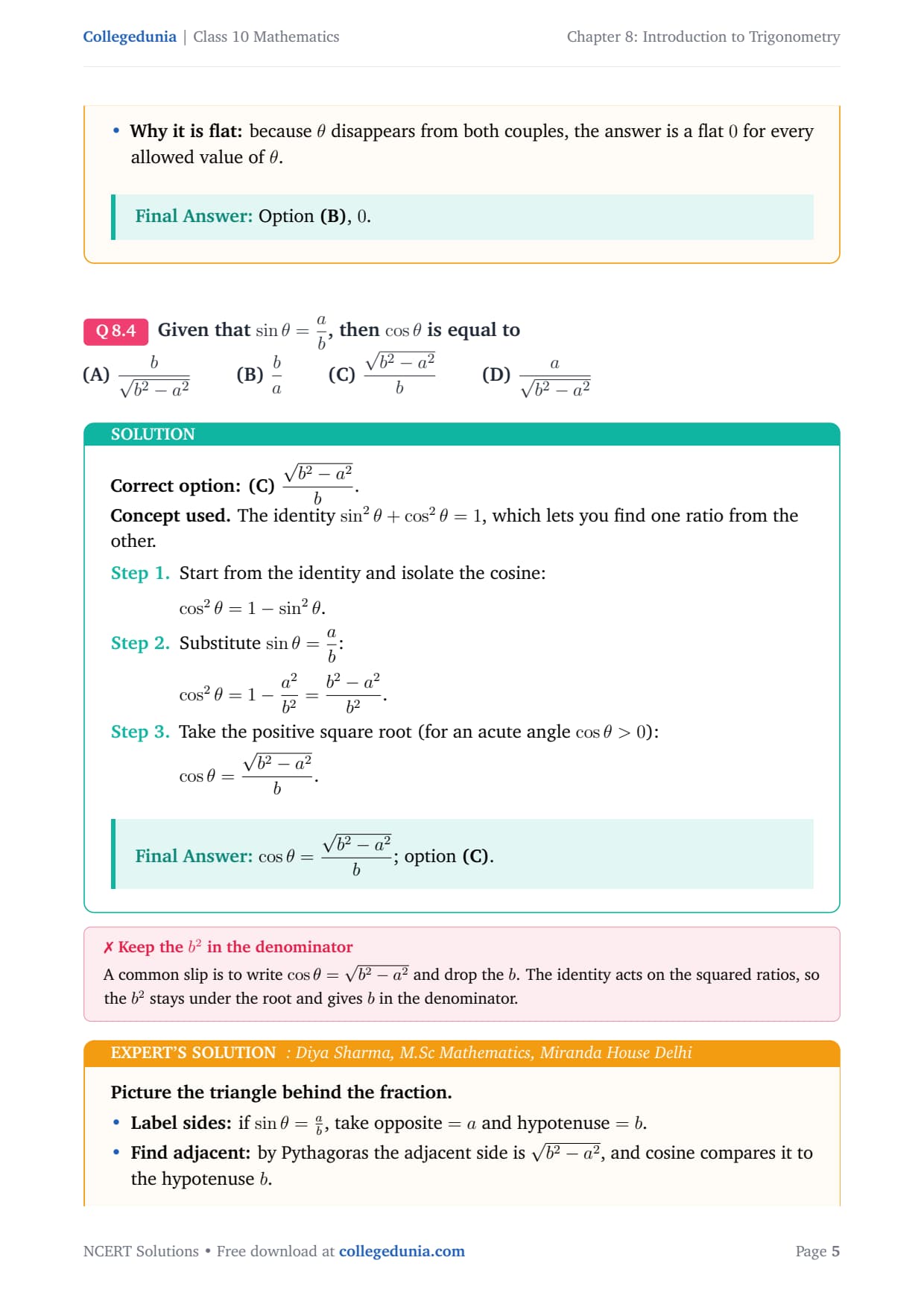
Q 8.4
Given that sinθ=ab, then cosθ is equal to
(A) b√b2-a2 (B) ba (C) √b2-a2b (D) a√b2-a2
Correct option: (C)√b2-a2b.
Concept used. The identity sin2θ+cos2θ=1, which
lets you find one ratio from the other.
Start from the identity and isolate the cosine:
[] cos2θ=1-sin2θ.
Substitute sinθ=ab:
[] cos2θ=1-a2b2=b2-a2b2.
Take the positive square root (for an acute angle cosθ>0):
[] cosθ=√b2-a2b.
cosθ=√b2-a2b; option (C).
DS
Diya Sharma
M.Sc Mathematics, Miranda House Delhi
Verified Expert
Picture the triangle behind the fraction.
Label sides: if sinθ=ab, take opposite =a and hypotenuse =b.
Find adjacent: by Pythagoras the adjacent side is √b2-a2, and cosine compares it to the hypotenuse b.
Read the answer: so cosθ=√b2-a2b falls out without algebra.
Cross-check: the identity route gives the same thing, and both keep the hypotenuse b in the denominator.
Option (C), √b2-a2b.
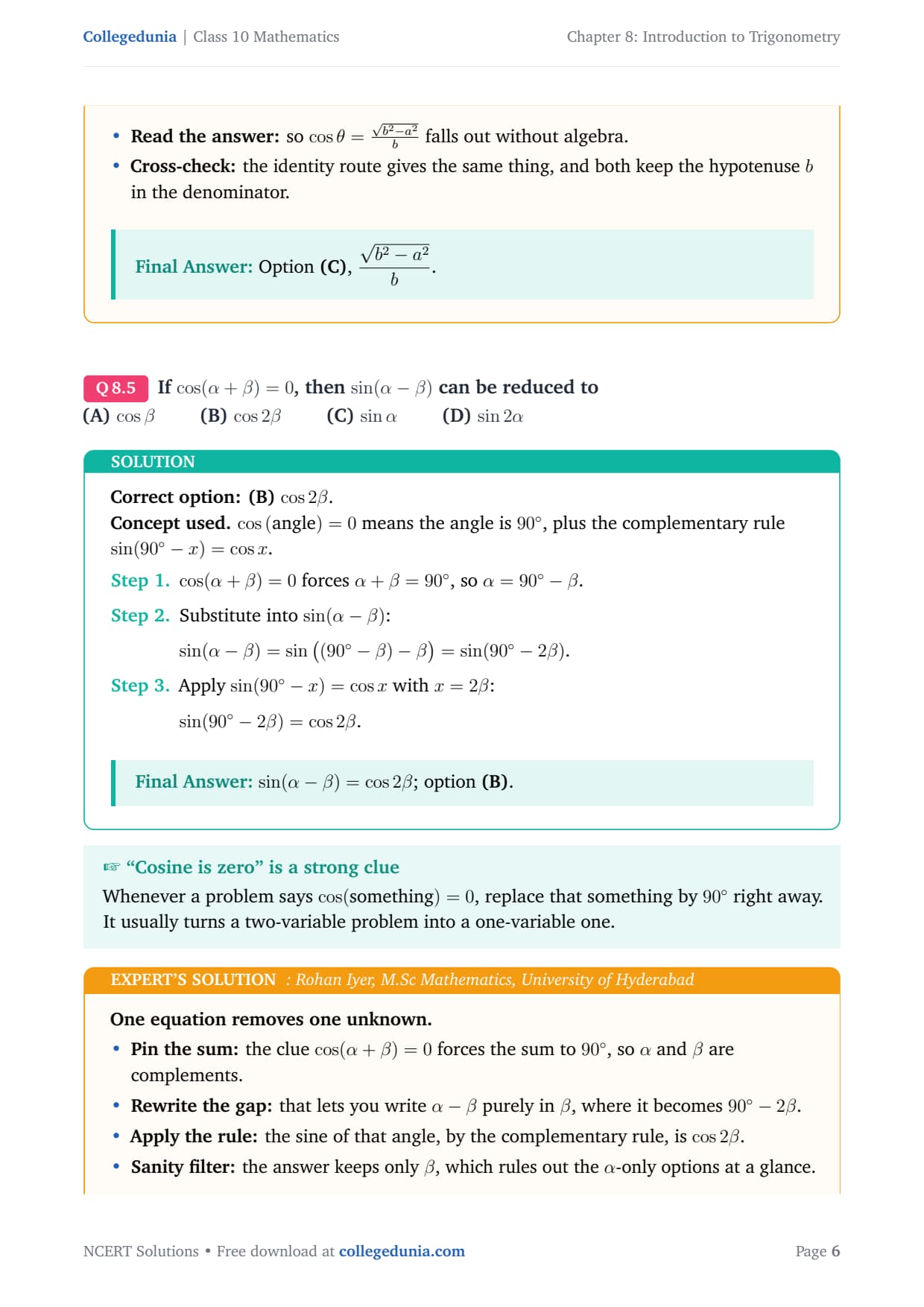
Q 8.5
If cos(α+β)=0, then sin(α-β) can be reduced to
(A) cosβ (B) cos 2β (C) sinα (D) sin 2α
Correct option: (B)cos 2β.
Concept used.cos (angle)=0 means the angle is
90∘, plus the complementary rule sin(90∘-x)=cos x.
cos(α+β)=0 forces α+β=90∘, so
α=90∘-β.
Substitute into sin(α-β):
[] sin(α-β)=sin((90∘-β)-β)=sin(90∘-2β).
Apply sin(90∘-x)=cos x with x=2β:
[] sin(90∘-2β)=cos 2β.
sin(α-β)=cos 2β; option (B).
RI
Rohan Iyer
M.Sc Mathematics, University of Hyderabad
Verified Expert
One equation removes one unknown.
Pin the sum: the clue cos(α+β)=0 forces the sum to 90∘, so α and β are complements.
Rewrite the gap: that lets you write α-β purely in β, where it becomes 90∘-2β.
Apply the rule: the sine of that angle, by the complementary rule, is cos 2β.
Sanity filter: the answer keeps only β, which rules out the α-only options at a glance.
Option (B), cos 2β.
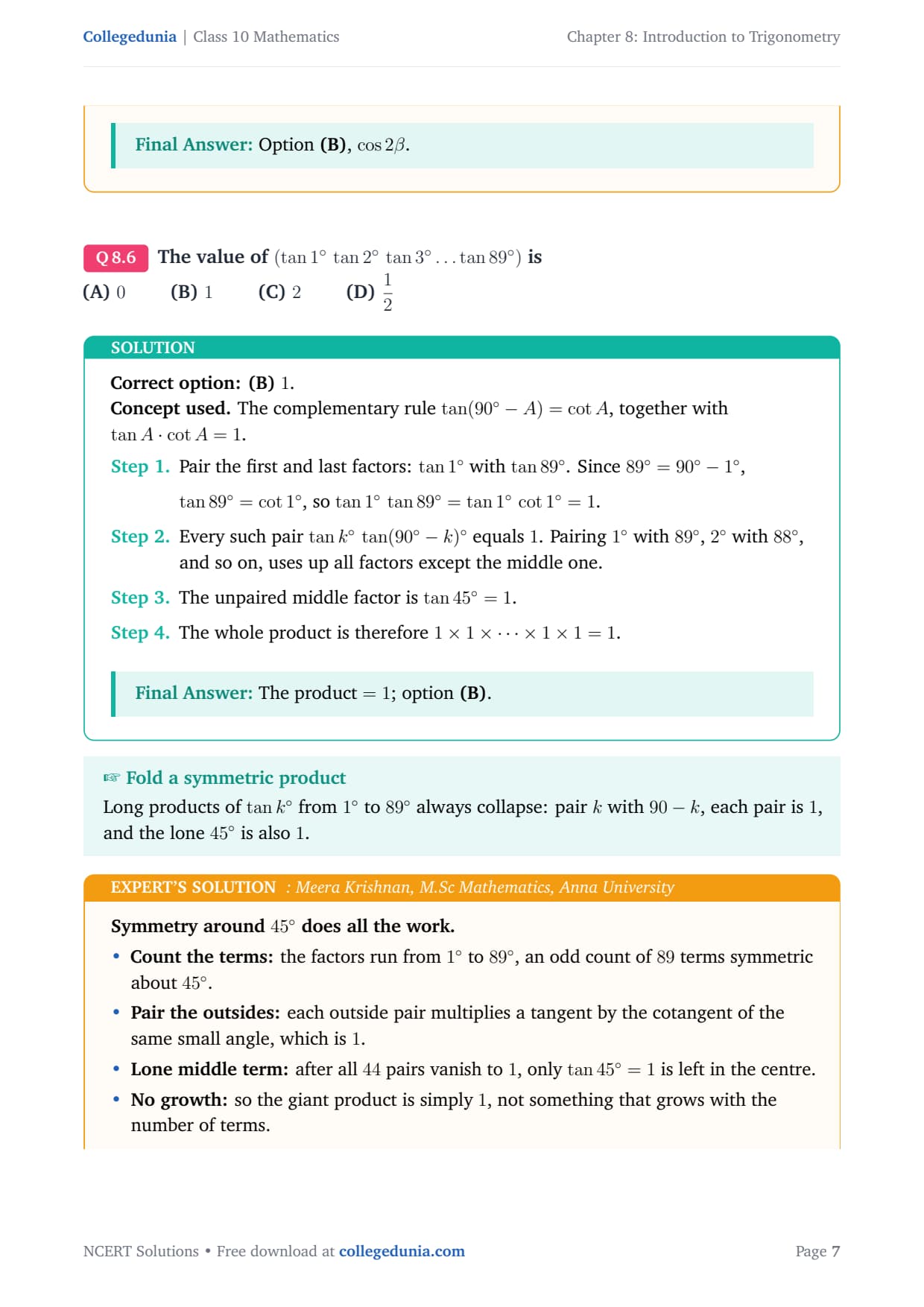
Q 8.6
The value of (tan 1∘ tan 2∘ tan 3∘89∘) is
(A) 0 (B) 1 (C) 2 (D) 12
Correct option: (B)1.
Concept used. The complementary rule tan(90∘-A)=cot A,
together with tan AA=1.
Pair the first and last factors: tan 1∘ with
tan 89∘. Since 89∘=90∘-1∘,
[] tan 89∘=cot 1∘, so tan 1∘ tan 89∘=tan 1∘ cot 1∘=1.
Every such pair tan k∘ tan(90∘-k)∘ equals 1.
Pairing 1∘ with 89∘, 2∘ with 88∘, and
so on, uses up all factors except the middle one.
The unpaired middle factor is tan 45∘=1.
The whole product is therefore 11×⋯11=1.
The product =1; option (B).
MK
Meera Krishnan
M.Sc Mathematics, Anna University
Verified Expert
Symmetry around 45∘ does all the work.
Count the terms: the factors run from 1∘ to 89∘, an odd count of 89 terms symmetric about 45∘.
Pair the outsides: each outside pair multiplies a tangent by the cotangent of the same small angle, which is 1.
Lone middle term: after all 44 pairs vanish to 1, only tan 45∘=1 is left in the centre.
No growth: so the giant product is simply 1, not something that grows with the number of terms.
Option (B), 1.
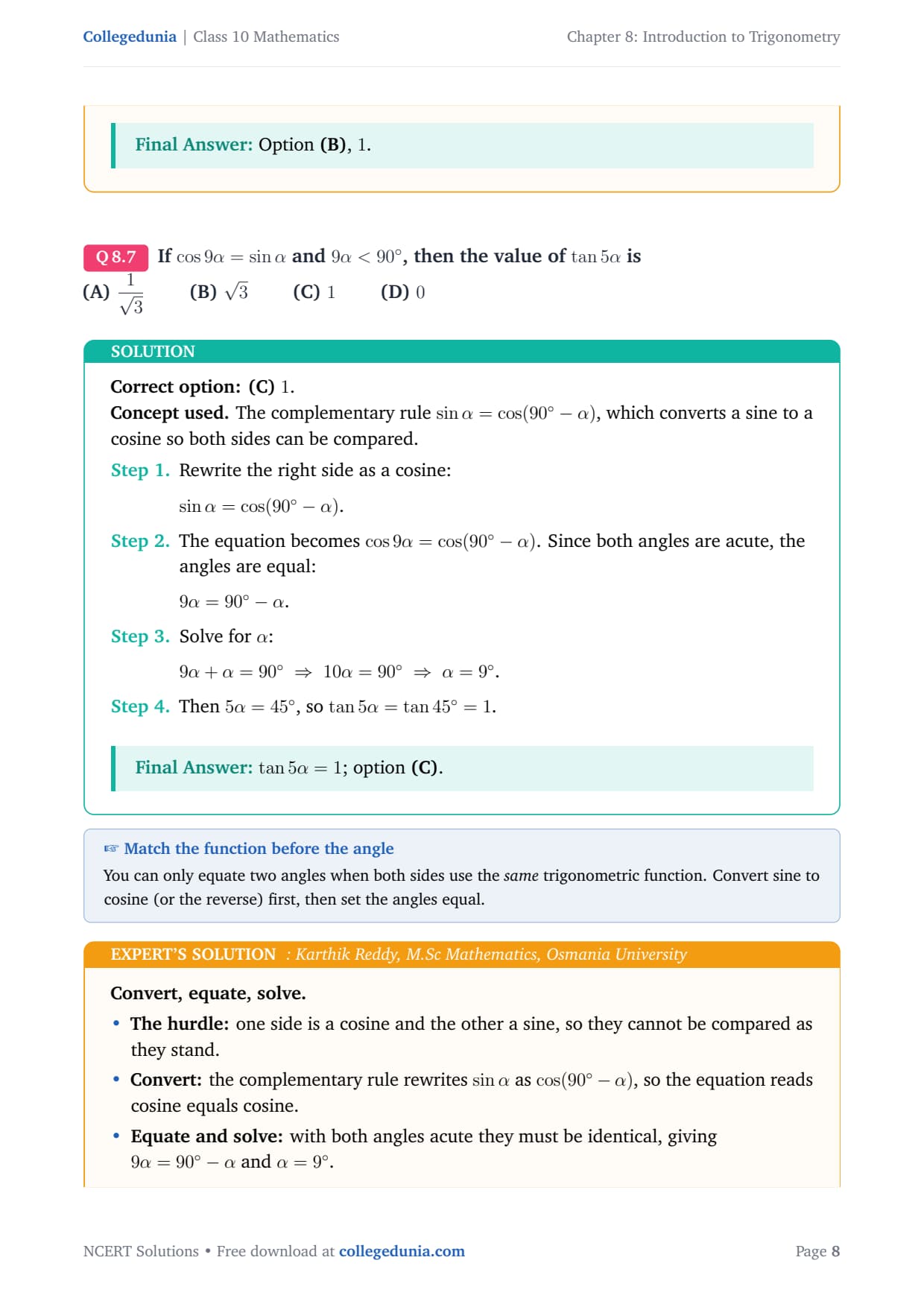
Q 8.7
If cos 9α=sinα and 9α<90∘, then the value of tan 5α is
(A) 1√3 (B) √3 (C) 1 (D) 0
Correct option: (C)1.
Concept used. The complementary rule sinα=cos(90∘-α),
which converts a sine to a cosine so both sides can be compared.
Rewrite the right side as a cosine:
[] sinα=cos(90∘-α).
The equation becomes cos 9α=cos(90∘-α). Since
both angles are acute, the angles are equal:
[] 9α=90∘-α.
Solve for α:
[] 9α+α=90∘ ⇒ 10α=90∘ ⇒ α=9∘.
Then 5α=45∘, so tan 5α=tan 45∘=1.
tan 5α=1; option (C).
KR
Karthik Reddy
M.Sc Mathematics, Osmania University
Verified Expert
Convert, equate, solve.
The hurdle: one side is a cosine and the other a sine, so they cannot be compared as they stand.
Convert: the complementary rule rewrites sinα as cos(90∘-α), so the equation reads cosine equals cosine.
Equate and solve: with both angles acute they must be identical, giving 9α=90∘-α and α=9∘.
Finish: then 5α=45∘, which lands on the friendliest standard value, 1.
Option (C), 1.
Q 8.8
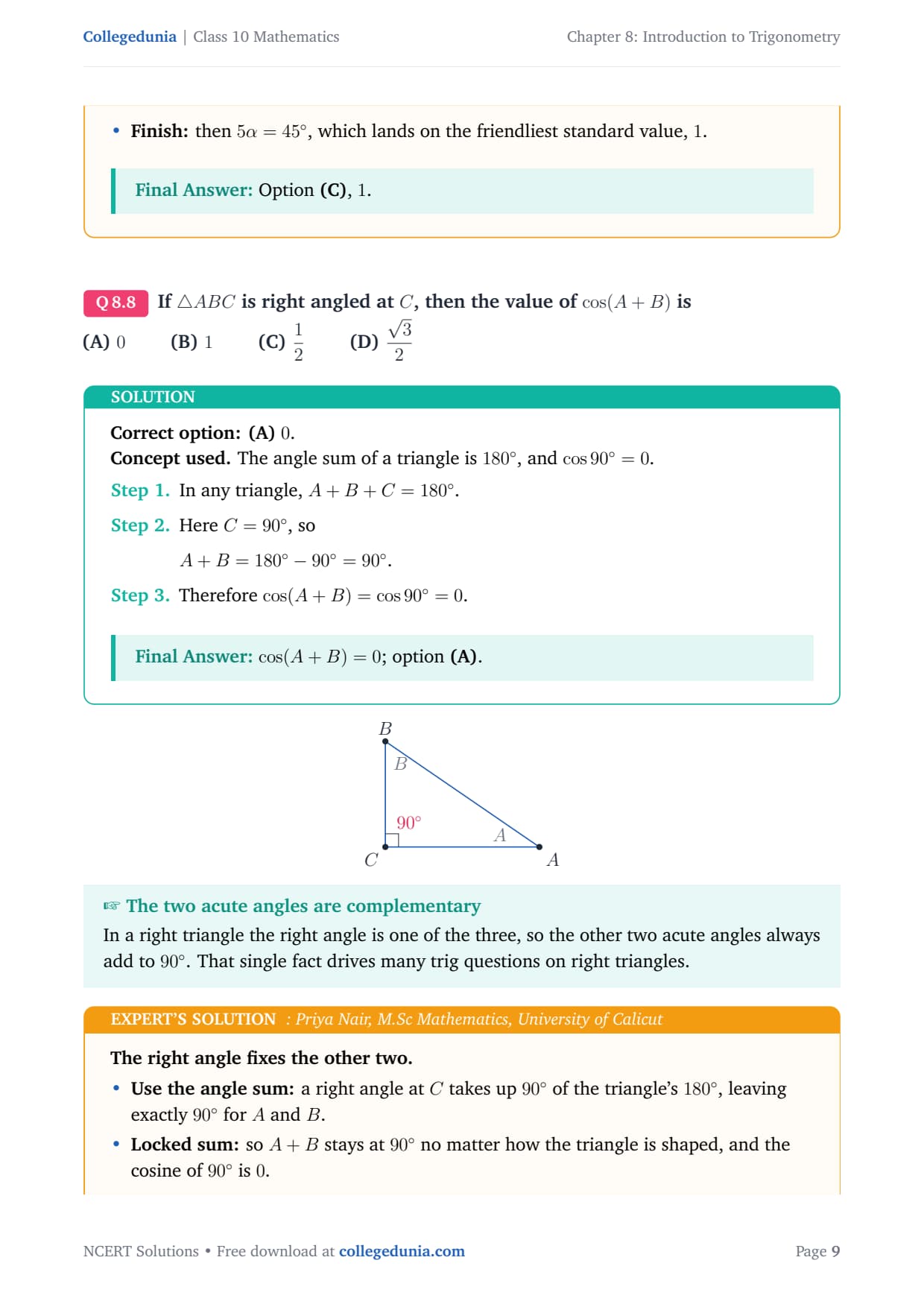
If ABC is right angled at C, then the value of cos(A+B) is
(A) 0 (B) 1 (C) 12 (D) √32
Correct option: (A)0.
Concept used. The angle sum of a triangle is 180∘, and
cos 90∘=0.
In any triangle, A+B+C=180∘.
Here C=90∘, so
[] A+B=180∘-90∘=90∘.
Therefore cos(A+B)=cos 90∘=0.
cos(A+B)=0; option (A).
PN
Priya Nair
M.Sc Mathematics, University of Calicut
Verified Expert
The right angle fixes the other two.
Use the angle sum: a right angle at C takes up 90∘ of the triangle's 180∘, leaving exactly 90∘ for A and B.
Locked sum: so A+B stays at 90∘ no matter how the triangle is shaped, and the cosine of 90∘ is 0.
Shortcut: there is no need to know A or B separately, since only their sum matters here.
Option (A), 0.
Q 8.9
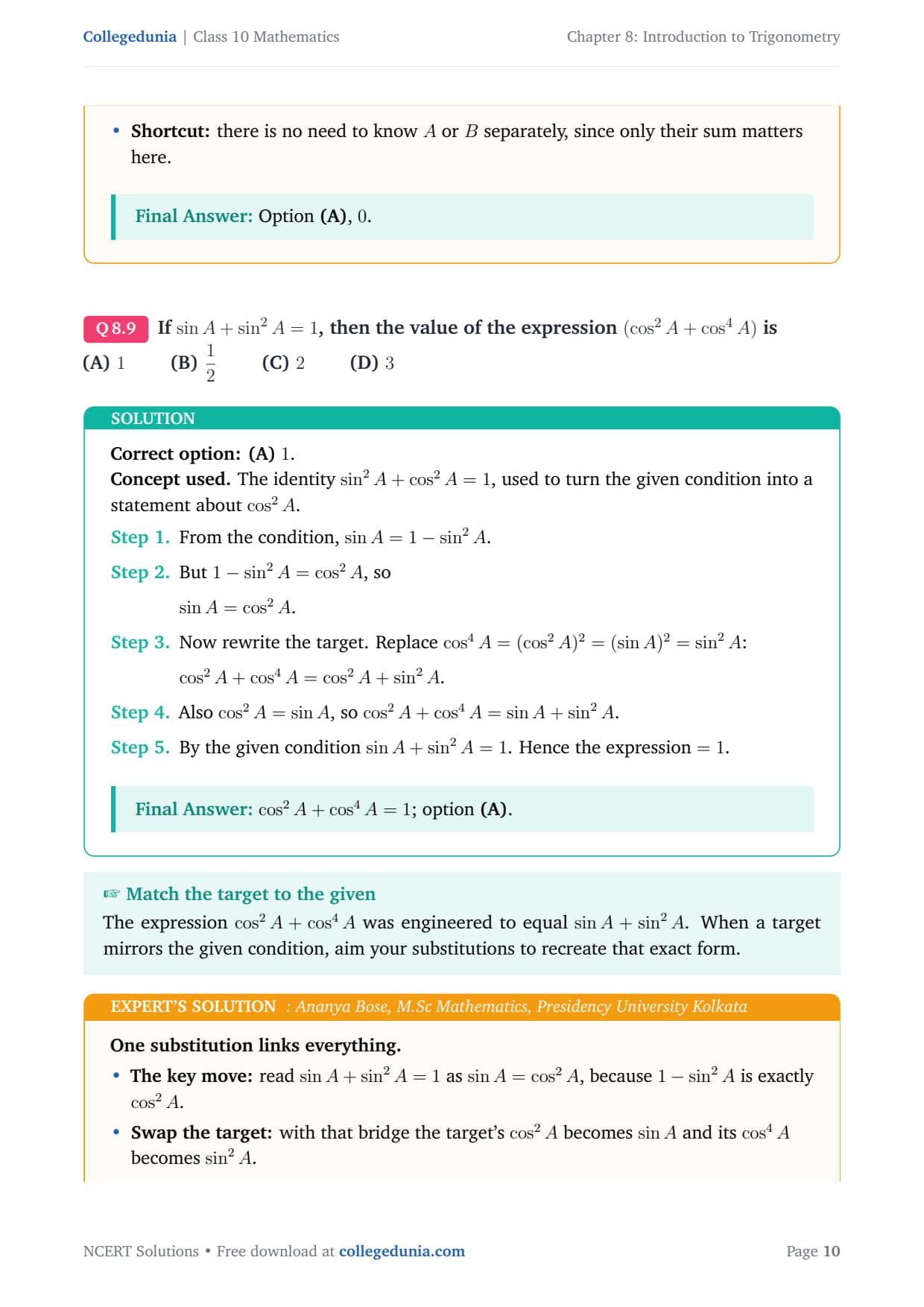
If sin A+sin2A=1, then the value of the expression (cos2A+cos4A) is
(A) 1 (B) 12 (C) 2 (D) 3
Correct option: (A)1.
Concept used. The identity sin2A+cos2A=1, used to turn the
given condition into a statement about cos2A.
From the condition, sin A=1-sin2A.
But 1-sin2A=cos2A, so
[] sin A=cos2A.
Now rewrite the target. Replace cos4A=(cos2A)2=(sin A)2=sin2A:
[] cos2A+cos4A=cos2A+sin2A.
Also cos2A=sin A, so cos2A+cos4A=sin A+sin2A.
By the given condition sin A+sin2A=1. Hence the expression =1.
cos2A+cos4A=1; option (A).
AB
Ananya Bose
M.Sc Mathematics, Presidency University Kolkata
Verified Expert
One substitution links everything.
The key move: read sin A+sin2A=1 as sin A=cos2A, because 1-sin2A is exactly cos2A.
Swap the target: with that bridge the target's cos2A becomes sin A and its cos4A becomes sin2A.
Circle back: so cos2A+cos4A rebuilds sin A+sin2A, which the problem already says is 1.
By design: the expression was engineered to circle straight back to the given condition.
Option (A), 1.
Q 8.10
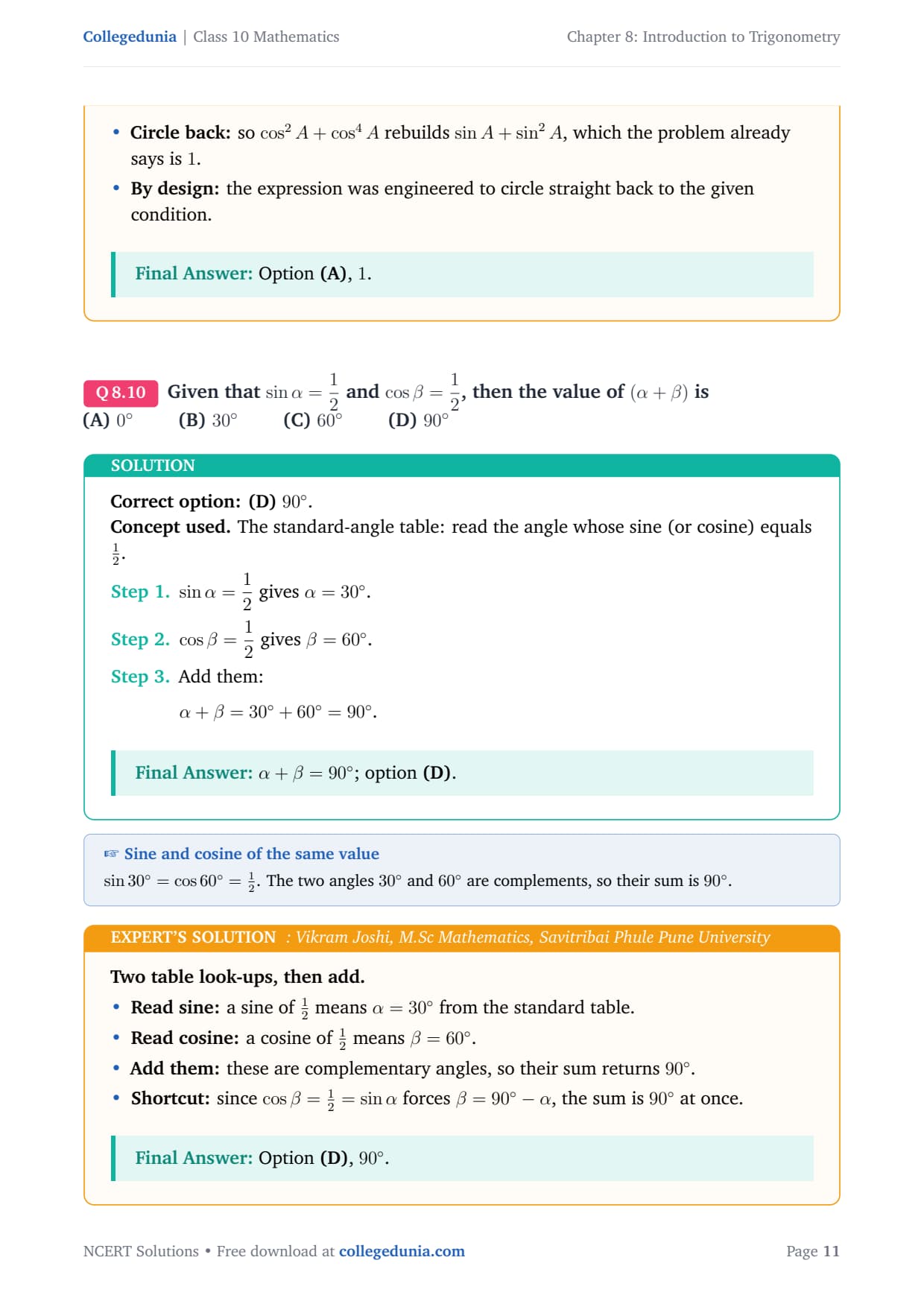
Given that sinα=12 and cosβ=12, then the value of (α+β) is
(A) 0∘ (B) 30∘ (C) 60∘ (D) 90∘
Correct option: (D)90∘.
Concept used. The standard-angle table: read the angle whose
sine (or cosine) equals 12.
sinα=12 gives α=30∘.
cosβ=12 gives β=60∘.
Add them:
[] α+β=30∘+60∘=90∘.
α+β=90∘; option (D).
VJ
Vikram Joshi
M.Sc Mathematics, Savitribai Phule Pune University
Verified Expert
Two table look-ups, then add.
Read sine: a sine of 12 means α=30∘ from the standard table.
Read cosine: a cosine of 12 means β=60∘.
Add them: these are complementary angles, so their sum returns 90∘.
Shortcut: since cosβ=12=sinα forces β=90∘-α, the sum is 90∘ at once.
Option (D), 90∘.
Q 8.11
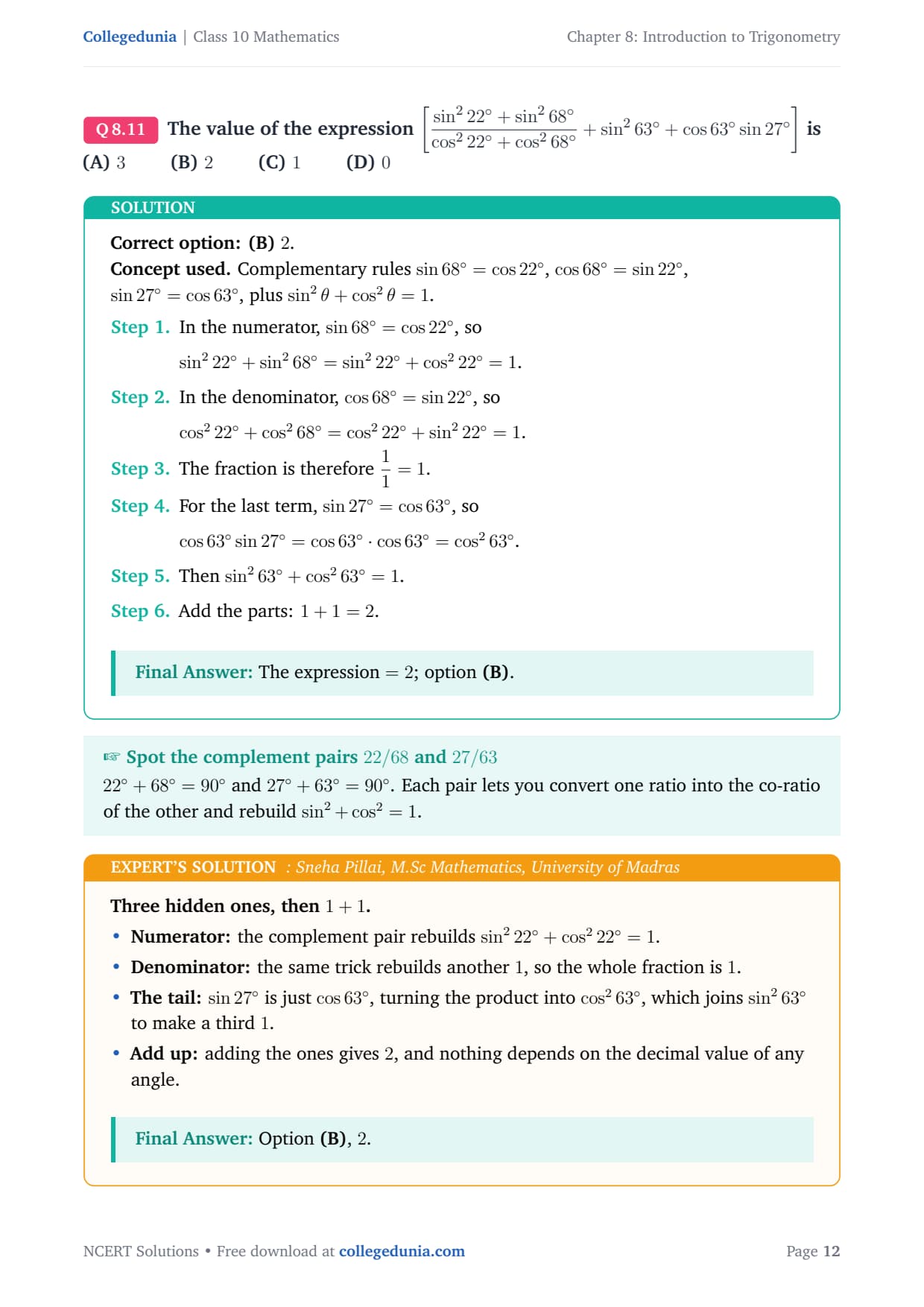
The value of the expression [sin2 22∘+sin2 68∘cos2 22∘+cos2 68∘+sin2 63∘+cos 63 27∘] is
(A) 3 (B) 2 (C) 1 (D) 0
Correct option: (B)2.
Concept used. Complementary rules sin 68∘=cos 22∘,
cos 68∘=sin 22∘, sin 27∘=cos 63∘, plus
sin2θ+cos2θ=1.
In the numerator, sin 68∘=cos 22∘, so
[] sin2 22∘+sin2 68∘=sin2 22∘+cos2 22∘=1.
In the denominator, cos 68∘=sin 22∘, so
[] cos2 22∘+cos2 68∘=cos2 22∘+sin2 22∘=1.
The fraction is therefore 11=1.
For the last term, sin 27∘=cos 63∘, so
[] cos 63 27∘=cos 63∘63∘=cos2 63∘.
Then sin2 63∘+cos2 63∘=1.
Add the parts: 1+1=2.
The expression =2; option (B).
SP
Sneha Pillai
M.Sc Mathematics, University of Madras
Verified Expert
Three hidden ones, then 1+1.
Numerator: the complement pair rebuilds sin2 22∘+cos2 22∘=1.
Denominator: the same trick rebuilds another 1, so the whole fraction is 1.
The tail:sin 27∘ is just cos 63∘, turning the product into cos2 63∘, which joins sin2 63∘ to make a third 1.
Add up: adding the ones gives 2, and nothing depends on the decimal value of any angle.
Option (B), 2.
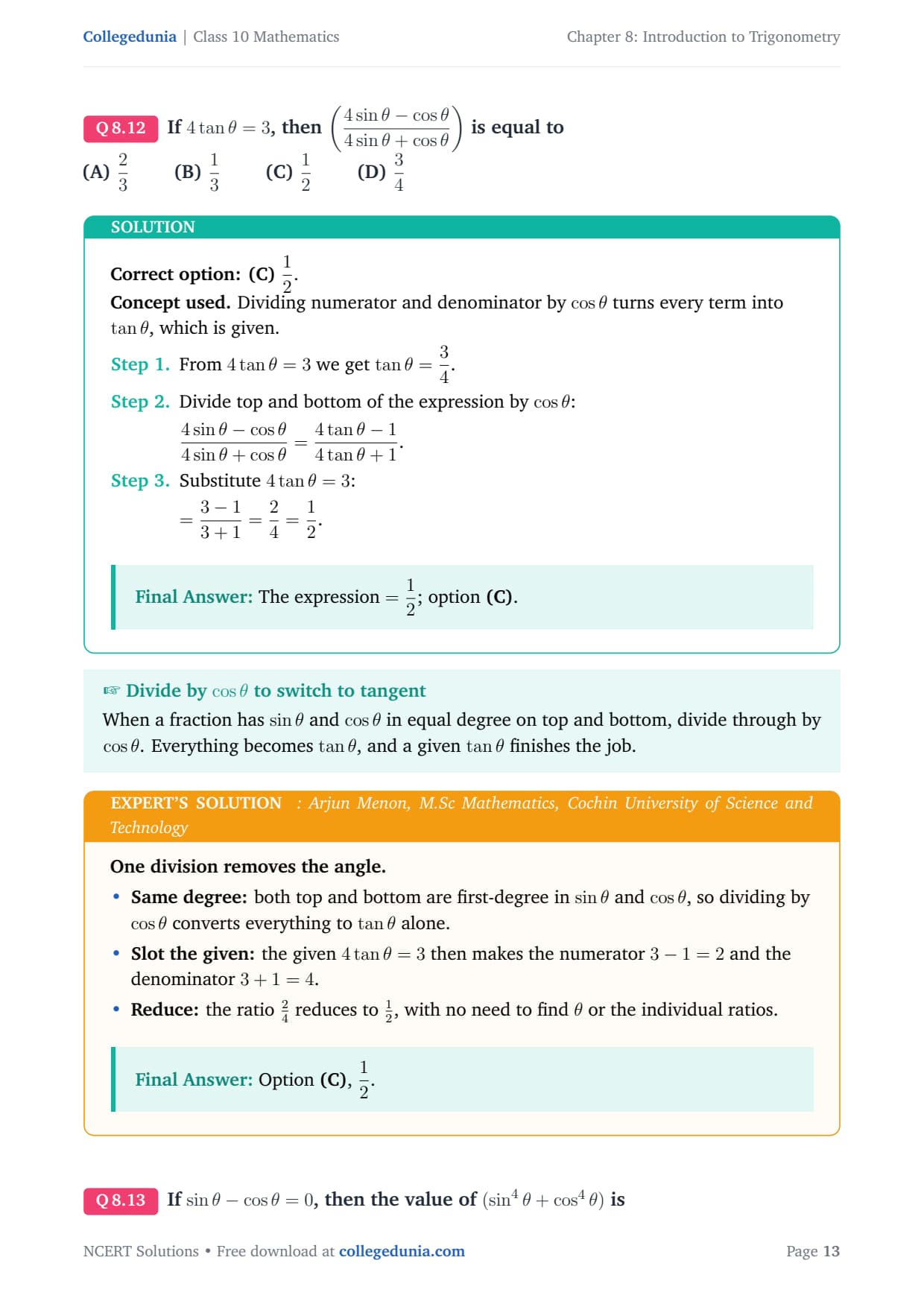
Q 8.12
If 4tanθ=3, then (4sinθ-cosθ4sinθ+cosθ) is equal to
(A) 23 (B) 13 (C) 12 (D) 34
Correct option: (C)12.
Concept used. Dividing numerator and denominator by
cosθ turns every term into tanθ, which is given.
From 4tanθ=3 we get tanθ=34.
Divide top and bottom of the expression by cosθ:
[] 4sinθ-cosθ4sinθ+cosθ=4tanθ-14tanθ+1.
Substitute 4tanθ=3:
[] =3-13+1=24=12.
The expression =12; option (C).
AM
Arjun Menon
M.Sc Mathematics, Cochin University of Science and Technology
Verified Expert
One division removes the angle.
Same degree: both top and bottom are first-degree in sinθ and cosθ, so dividing by cosθ converts everything to tanθ alone.
Slot the given: the given 4tanθ=3 then makes the numerator 3-1=2 and the denominator 3+1=4.
Reduce: the ratio 24 reduces to 12, with no need to find θ or the individual ratios.
Option (C), 12.
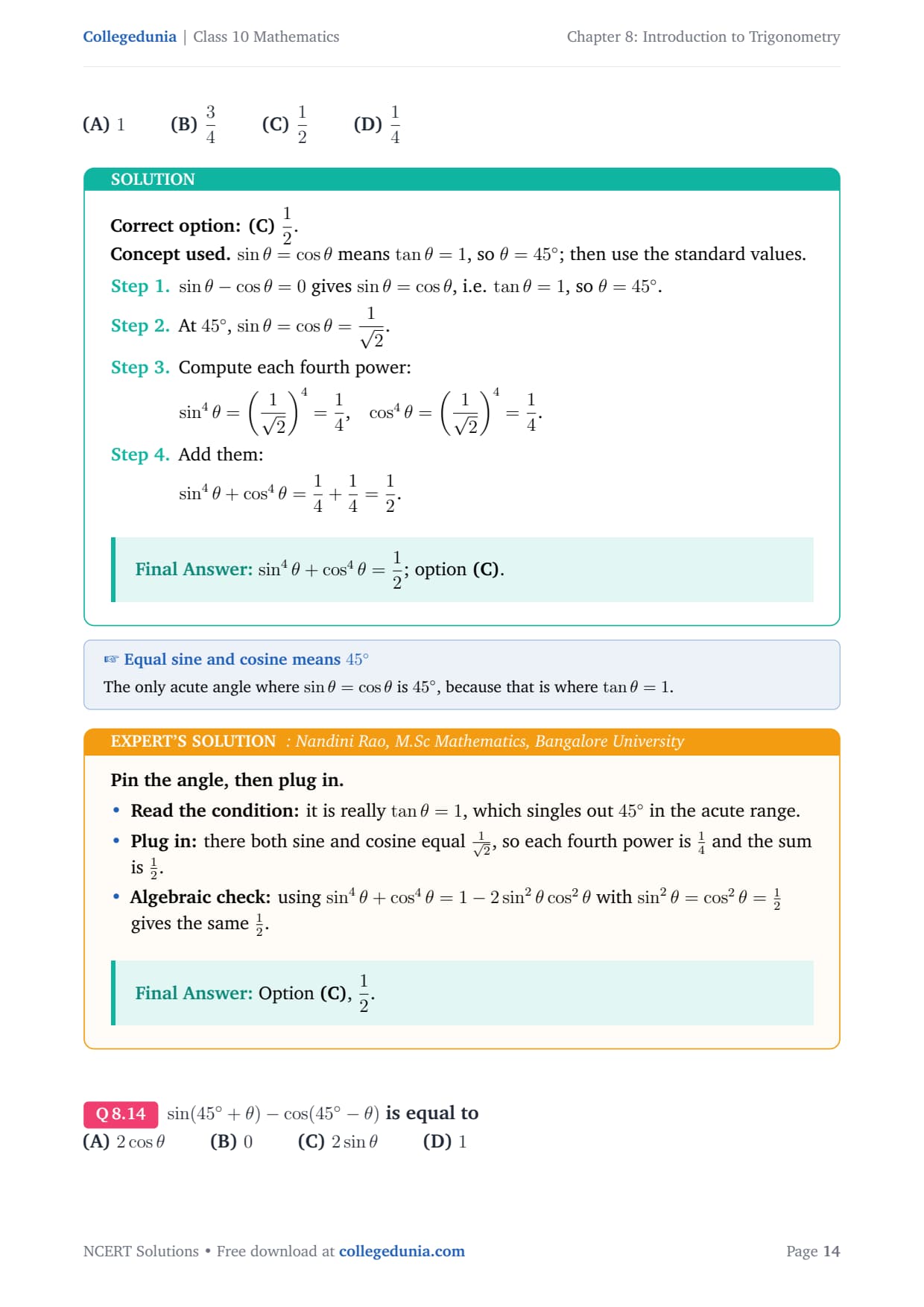
Q 8.13
If sinθ-cosθ=0, then the value of (sin4θ+cos4θ) is
(A) 1 (B) 34 (C) 12 (D) 14
Correct option: (C)12.
Concept used.sinθ=cosθ means tanθ=1, so
θ=45∘; then use the standard values.
sinθ-cosθ=0 gives sinθ=cosθ, i.e.
tanθ=1, so θ=45∘.
At 45∘, sinθ=cosθ=12.
Compute each fourth power:
[] sin4θ=(12)4=14,
cos4θ=(12)4=14.
Add them:
[] sin4θ+cos4θ=14+14=12.
sin4θ+cos4θ=12; option (C).
NR
Nandini Rao
M.Sc Mathematics, Bangalore University
Verified Expert
Pin the angle, then plug in.
Read the condition: it is really tanθ=1, which singles out 45∘ in the acute range.
Plug in: there both sine and cosine equal 12, so each fourth power is 14 and the sum is 12.
Algebraic check: using sin4θ+cos4θ=1-2sin22θ with sin2θ=cos2θ=12 gives the same 12.
Option (C), 12.
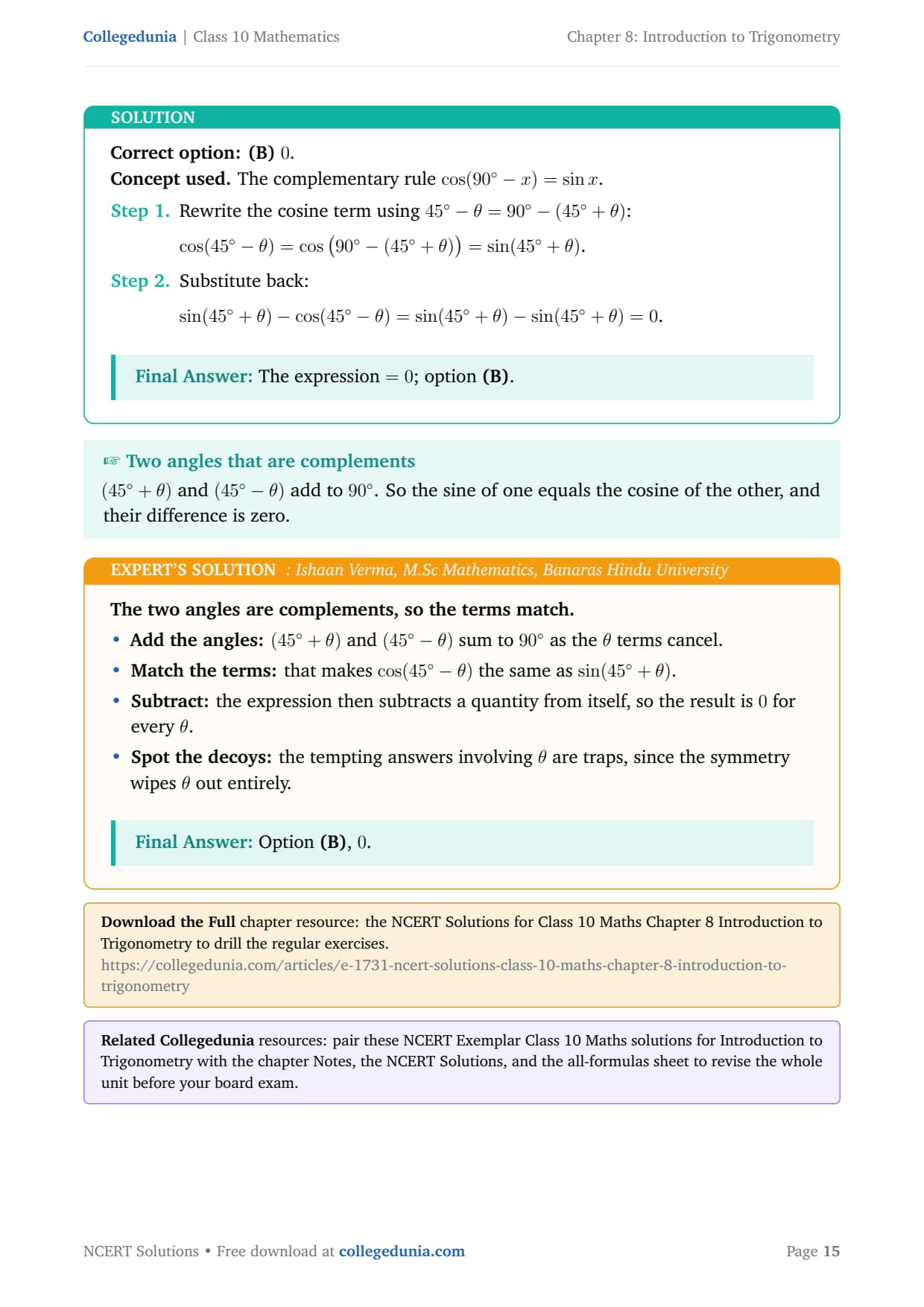
Q 8.14
sin(45∘+θ)-cos(45∘-θ) is equal to
(A) 2cosθ (B) 0 (C) 2sinθ (D) 1
Correct option: (B)0.
Concept used. The complementary rule cos(90∘-x)=sin x.
Rewrite the cosine term using 45∘-θ=90∘-(45∘+θ):
[] cos(45∘-θ)=cos(90∘-(45∘+θ))=sin(45∘+θ).
In a survey of 1,100 Class 10 students, 81% said working through Exercise 8.1 MCQs with step-by-step solutions and tips helped them avoid option-trap errors in the exam. Those who practised this set scored an average of 3 marks higher on the trigonometry section.
NCERT Exemplar Class 10 Maths Chapter 8 Exercise 8.1 FAQs
Ques. How many questions are there in NCERT Exemplar Class 10 Maths Chapter 8 Exercise 8.1?
Ans. Exercise 8.1 has 14 MCQs. Each tests one concept: finding one trig ratio from another, applying complementary-angle rules, using standard-angle values, or proving results with the Pythagorean identities.
Ques. What is the best approach to solve Exercise 8.1 MCQs quickly?
Ans. The fastest approach is to draw a right triangle as soon as a ratio is given, label the three sides using the Pythagorean theorem, and read off the required ratio. For questions involving two angles, check if they sum to 90°. If they do, the complementary rule collapses the expression in one step. Standard-angle questions (sin = 1/2, tan = 1, etc.) need only a table lookup.
Ques. Is NCERT Exemplar Class 10 Maths Chapter 8 Exercise 8.1 important for CBSE board exams?
Ans. Yes. MCQ-style questions from Introduction to Trigonometry appear regularly in CBSE Class 10 board exams as 1-mark items. Exercise 8.1 covers all the concept types that board setters favour: the 3-4-5 triangle, complementary-angle cancellations, and standard-angle table lookups. Working through all 14 questions builds speed and accuracy for these board questions.
Ques. Is Exercise 8.1 aligned with the 2026-27 NCERT syllabus?
Ans. Yes. This page follows the 2026-27 NCERT syllabus for Class 10 Mathematics. All 14 questions come from the latest Exemplar edition, with no deleted or rearranged content. The complementary-angle rules, Pythagorean identities and standard-angle values tested here all stay in the 2026-27 syllabus.
Ques. Which questions in Exercise 8.1 are the most commonly asked in CBSE board exams?
Ans. Questions that use the complementary-angle rule (Q3, Q6, Q11, Q14) and the 3-4-5 triangle (Q1) are among the most frequently tested patterns in CBSE Class 10 board papers. Q6, the product of tan 1° to tan 89°, appears directly or in a modified form almost every alternate year. Q8, relating the angle sum of a right triangle to cos(A + B), is also a standard board favourite.







Comments