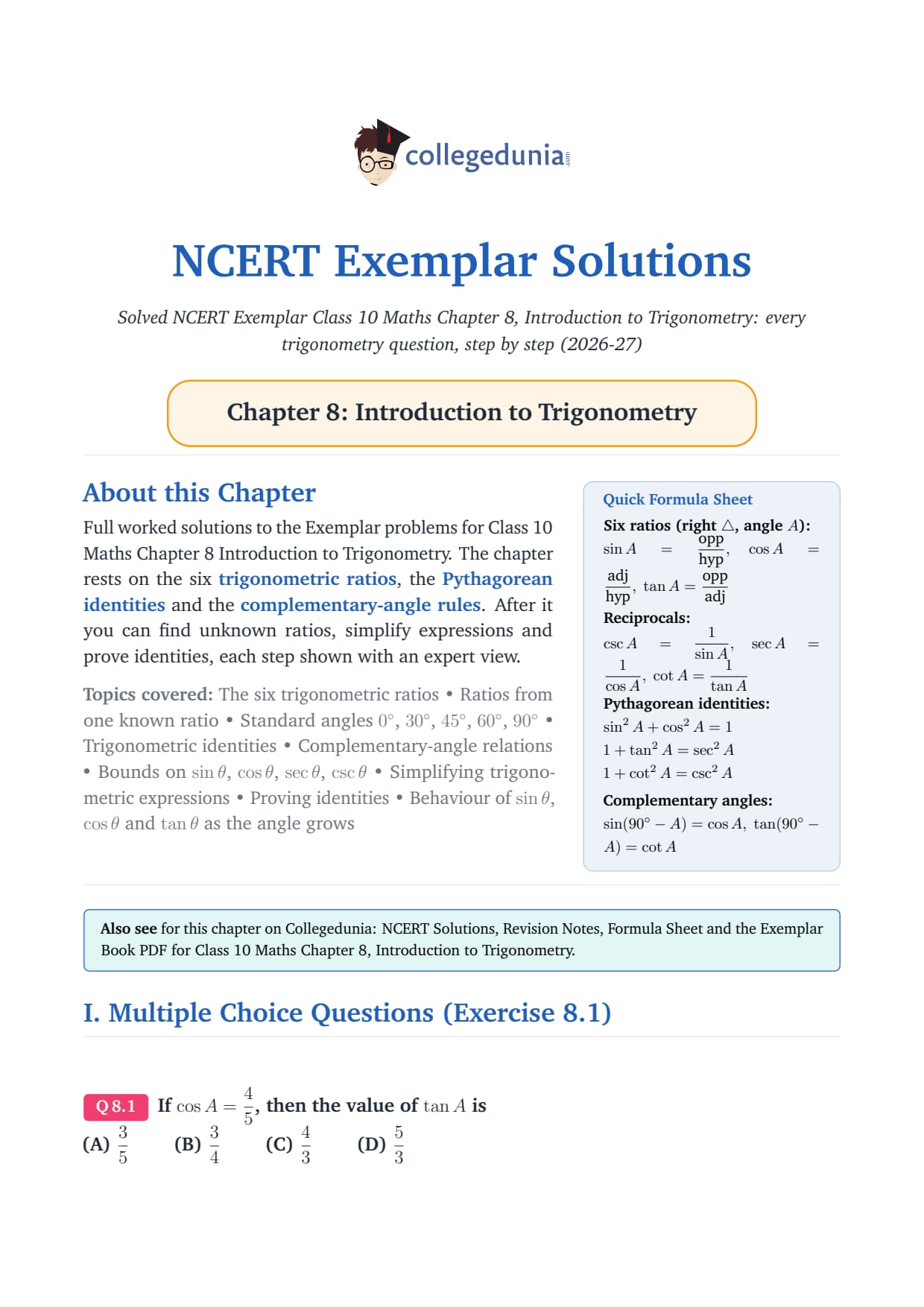
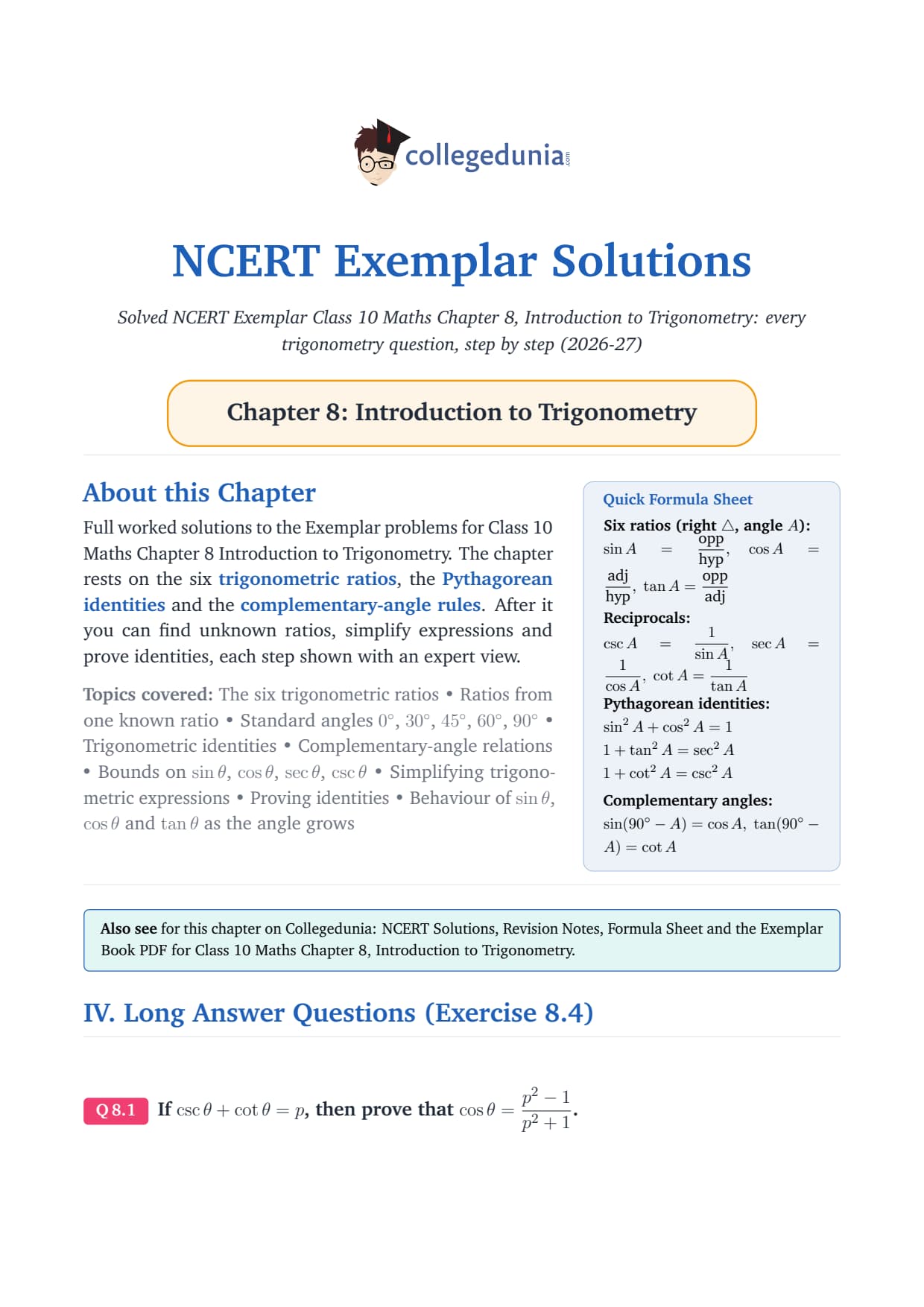
These NCERT Exemplar Class 10 Maths Chapter 8 Introduction to Trigonometry Solutions cover every problem from Exercises 8.1 to 8.4 with step-by-step working. Each answer shows how to apply trigonometric ratios, identities, and complementary angle relations. The set follows the 2026-27 CBSE syllabus.
Exemplar problems across four exercises: MCQs, true-or-false, short-answer, and long-answer questions.
Covers trigonometric ratios of standard angles (0°, 30°, 45°, 60°, 90°), complementary angles, and the Pythagorean identities.
Free PDF download plus an inline solved question bank you can open on this page.
Solved by Collegedunia: Every question here is worked out by our Mathematics faculty, cross-checked against the official NCERT Exemplar, and aligned to the 2026-27 CBSE syllabus.
The Exemplar spans four exercises covering every Trigonometry idea in the syllabus. Each one targets a different level of thinking, from direct ratio recall to multi-step identity proofs.
Exercise
Type
Count
What It Tests
Exercise 8.1
MCQ
20
Recall and apply trig ratios, standard angle values, and complementary-angle relations
Exercise 8.2
True or False
10
Check whether a statement holds; needs a written reason or counterexample
Exercise 8.3
Short answer
17
Evaluate expressions, find unknown angles, simplify using identities
Exercise 8.4
Long answer
8
Prove identities and solve multi-step problems combining two or more identities
The full set has 55 problems. A smart order: use the MCQs to lock in standard angle values and ratio definitions, sharpen justification writing with the true-or-false set, build fluency with the short-answer problems, then take on the identity proofs.
Key Ratios, Identities & Angle Values
Almost every ncert exemplar class 10 maths chapter 8 problem relies on one of the three results below. Know them cold before you open the exercises. It saves time and prevents slips in the board exam.
Standard Angle Values
Ratio
0°
30°
45°
60°
90°
sin
0
12
12
32
1
cos
1
32
12
12
0
tan
0
13
1
3
undefined
Fundamental Trigonometric Identities
Pythagorean Identity 1:sin2A + cos2A = 1. This is the most frequently used identity across all Exemplar exercises. Every identity proof in Exercise 8.4 either starts here or lands here.
Pythagorean Identity 2:1 + tan2A = sec2A. Used when the expression involves tan and sec together.
Pythagorean Identity 3:1 + cot2A = cosec2A. Used when the expression involves cot and cosec.
Complementary Angle Relations
sin(90° - A) = cos A and cos(90° - A) = sin A. These pair up nicely to simplify sums of the form sin A + sin(90° - A).
tan(90° - A) = cot A; similarly sec(90° - A) = cosec A and cosec(90° - A) = sec A. The MCQs in Exercise 8.1 test these repeatedly.
A time-saving tip: before substituting, rewrite every ratio in terms of sin and cos. This collapses most multi-ratio expressions into a simpler form that uses only the Pythagorean identity, and it is far less error-prone under exam pressure.
How These Solutions Help You
These solutions are built for self-study in the weeks before the board exam. They do three things for you:
Show every step: the identity is written first, both sides are simplified step by step, then confirmed equal, so you can see exactly where your own working diverges.
Justify true-or-false answers fully: every verdict gives the exact counterexample or theorem behind it. This is the part most students skip and lose marks on.
Add an Expert view: each question has a second, faster method, like factoring before you substitute, or using a complementary angle relation instead of expanding the full expression.
Use them like this: attempt the question first, open Check Solution to compare step by step, then read Expert Solution. That order builds real recall, not just recognition.
Exemplar vs Textbook: Where It Gets Harder
The textbook exercises test one skill at a time: find a ratio, evaluate at a standard angle, or use one complementary relation. The Exemplar pushes the same ideas into multi-step MCQs, justification tasks, and combined-identity proofs. The table shows where the step-up happens.
Skill
NCERT Textbook
NCERT Exemplar
Trigonometric Ratios
Find sin A, cos A, tan A from a given right triangle
Determine which ratio combination simplifies to a given value; verify whether a statement about ratios is true or false with justification
Standard Angle Values
Evaluate a single expression at 30°, 45°, or 60°
Evaluate multi-ratio expressions; prove equalities using standard values; MCQs where all four options differ only in which angle is substituted
Complementary Angles
Apply sin(90°-A) = cos A to simplify one pair
Simplify sums with multiple complementary pairs; prove equivalence using both the relation and a Pythagorean identity in the same step
Trigonometric Identities
Verify that sin²A + cos²A = 1 for a specific angle
Prove multi-step identities; manipulate LHS and RHS simultaneously using all three Pythagorean identities plus reciprocal relations
Combined problems
One technique per question
Multiple identities in one problem; for example, prove an identity that requires using all three Pythagorean identities and complementary angle relations in sequence
This is why doing the Exemplar after the textbook is the standard board-prep route for Trigonometry. The textbook teaches each result one at a time; the Exemplar makes you pick the right one under MCQ pressure and in multi-step proofs.
Common Mistakes to Avoid
Across Exercises 8.1 to 8.4, these four slips cost the most marks in the board exam. Catch them before your exam.
Treating tan 90° as a large number, not undefined: tan 90° is undefined because cos 90° = 0. Some MCQ options test exactly this. A numerical value for tan 90° in a proof breaks the whole argument.
Using a complementary relation the wrong way:sin(90° - A) = cos A holds for any acute angle A. Students get this right with a single letter but misread the complement when the angle is an expression, like A = (90° - B).
Squaring both sides of a proof: you must simplify one side to match the other. Assuming LHS = RHS and squaring both sides adds extra solutions. Exercise 8.4 gives zero marks for such circular arguments.
Weak justification in true-or-false: just "True" or "False" with no counterexample or theorem earns zero marks. The rubric needs a short reason every time.
For most students, one or two of these four slips cause nearly all the lost marks. Keep a short written list of your own repeat mistakes and fix them before boards.
Other Resources for This Chapter
Pair this Exemplar set with the other Chapter 8 resources to cover the whole chapter before your board exam.
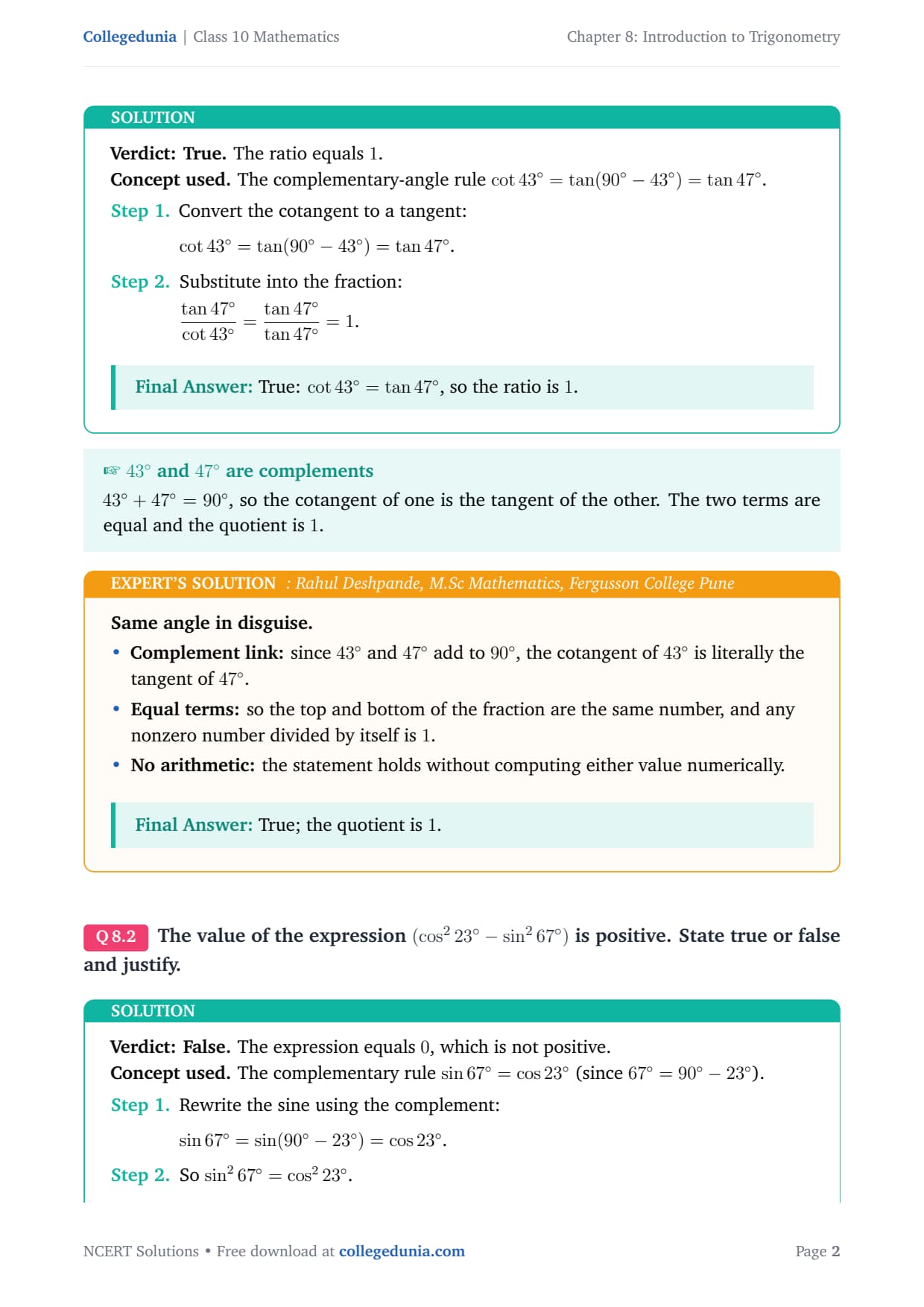
Zero is neither positive nor negative, so the claim ``positive'' fails.
False: the expression is exactly 0, not positive.
TC
Tara Chatterjee
M.Sc Mathematics, Jadavpur University
Verified Expert
The two squares are identical.
Match the terms: since 67∘ is the complement of 23∘, its sine equals cos 23∘, so the two squared terms are the same.
Difference is zero: their difference is 0, and the question's word ``positive'' rules zero out.
So it is false: a sharper wording would have asked whether the value is non-negative, which would be true.
False; the value is 0.
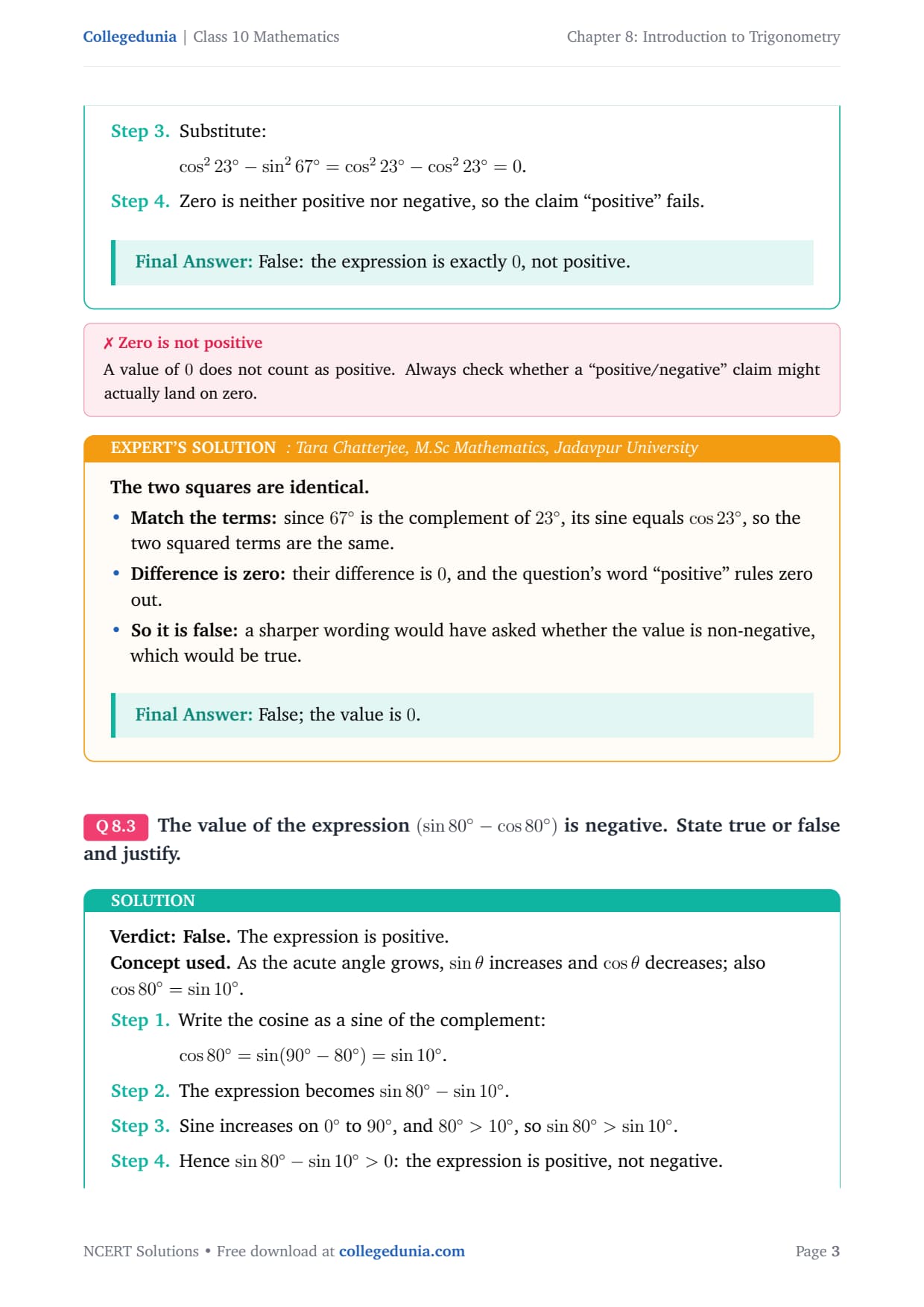
Q 8.3
The value of the expression (sin 80∘-cos 80∘) is negative. State true or false and justify.
Verdict: False. The expression is positive.
Concept used. As the acute angle grows, sinθ increases
and cosθ decreases; also cos 80∘=sin 10∘.
Write the cosine as a sine of the complement:
[] cos 80∘=sin(90∘-80∘)=sin 10∘.
The expression becomes sin 80∘-sin 10∘.
Sine increases on 0∘ to 90∘, and 80∘>10∘, so
sin 80∘>sin 10∘.
Hence sin 80∘-sin 10∘>0: the expression is positive,
not negative.
False: sin 80∘-cos 80∘=sin 80∘-sin 10∘>0.
MG
Manish Gupta
M.Sc Mathematics, University of Delhi
Verified Expert
Rewrite, then compare like with like.
Same footing: turning cos 80∘ into sin 10∘ puts both terms on the same scale.
Sine grows: sine climbs steadily from 0∘ to 90∘, so the larger angle 80∘ gives the larger value and the difference is positive.
So it is false: the claim of a negative value fails the comparison.
Sense check: numerically sin 80∘ is close to 1 while cos 80∘ is small, which agrees.
False; the difference is positive.
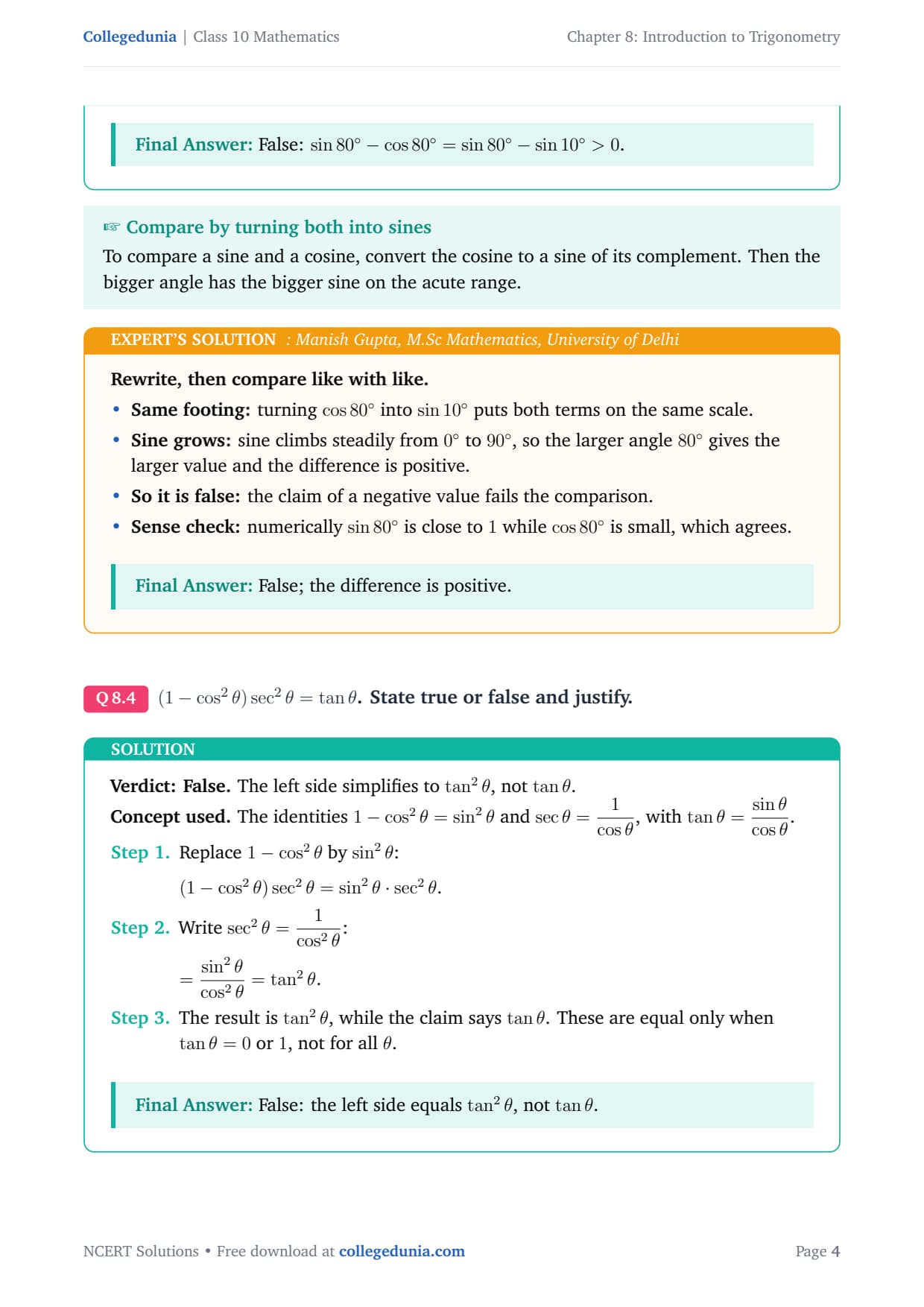
Q 8.4
(1-cos2θ)sec2θ=tanθ. State true or false and justify.
Verdict: False. The left side simplifies to tan2θ, not
tanθ.
Concept used. The identities 1-cos2θ=sin2θ and
secθ=1cosθ, with
tanθ=sinθcosθ.
Replace 1-cos2θ by sin2θ:
[] (1-cos2θ)sec2θ=sin2θ2θ.
Write sec2θ=1cos2θ:
[] =sin2θcos2θ=tan2θ.
The result is tan2θ, while the claim says tanθ.
These are equal only when tanθ=0 or 1, not for all
θ.
False: the left side equals tan2θ, not tanθ.
LS
Lakshmi Subramanian
M.Sc Mathematics, Stella Maris College Chennai
Verified Expert
Simplify cleanly and read the power.
First factor:1-cos2θ is sin2θ, and multiplying by sec2θ divides by cos2θ.
Result: squared sine over squared cosine is tan2θ, so the genuine answer carries a square the statement quietly drops.
So it is false: because tan2θ=tanθ fails for a general angle, the claim does not hold.
False; the correct value is tan2θ.
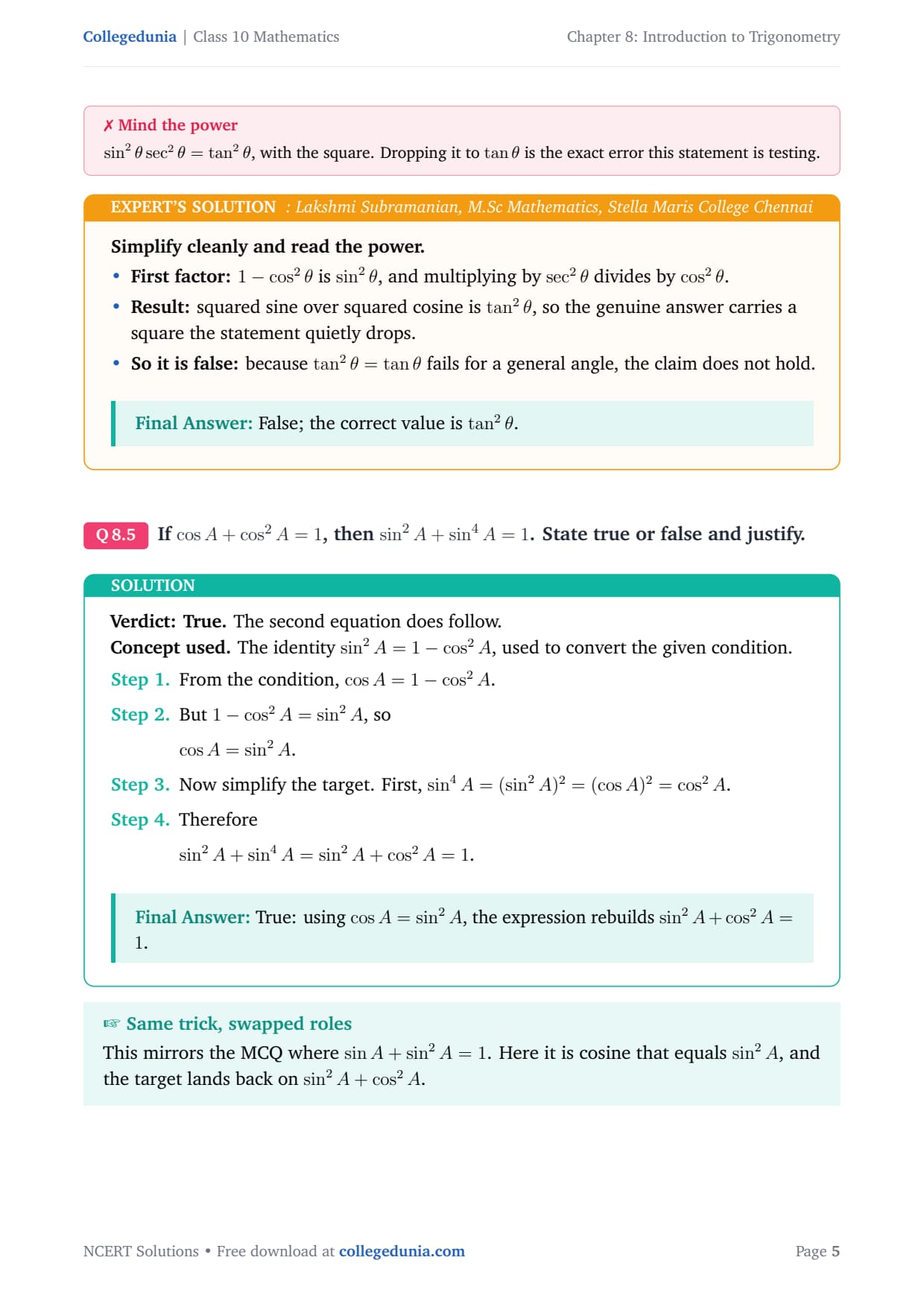
Q 8.5
If cos A+cos2A=1, then sin2A+sin4A=1. State true or false and justify.
Verdict: True. The second equation does follow.
Concept used. The identity sin2A=1-cos2A, used to convert
the given condition.
From the condition, cos A=1-cos2A.
But 1-cos2A=sin2A, so
[] cos A=sin2A.
Now simplify the target. First, sin4A=(sin2A)2=(cos A)2=cos2A.
Therefore
[] sin2A+sin4A=sin2A+cos2A=1.
True: using cos A=sin2A, the expression rebuilds
sin2A+cos2A=1.
AK
Aditya Kulkarni
M.Sc Mathematics, Ramnarain Ruia College Mumbai
Verified Expert
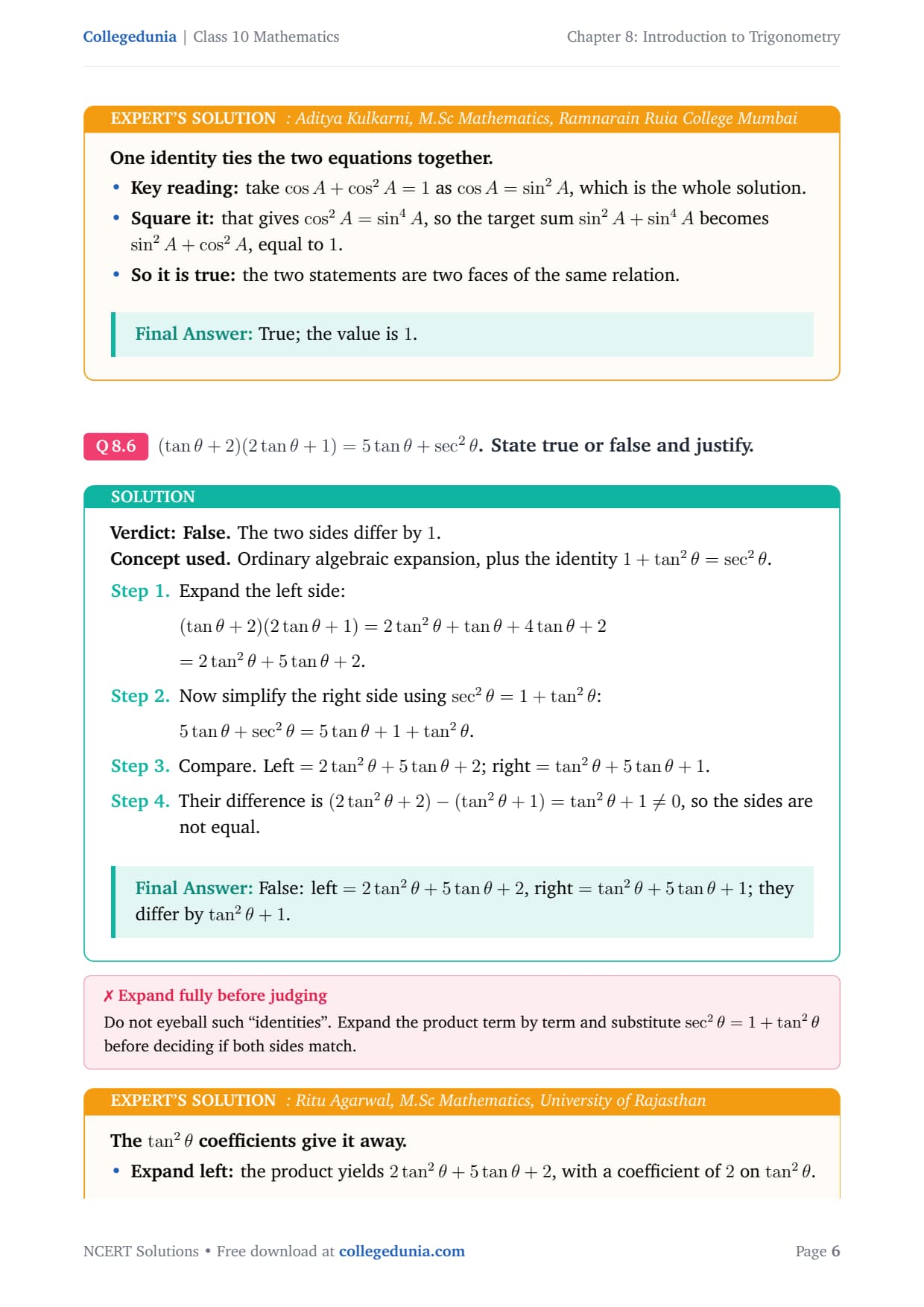
One identity ties the two equations together.
Key reading: take cos A+cos2A=1 as cos A=sin2A, which is the whole solution.
Square it: that gives cos2A=sin4A, so the target sum sin2A+sin4A becomes sin2A+cos2A, equal to 1.
So it is true: the two statements are two faces of the same relation.
True; the value is 1.
Q 8.6
(tanθ+2)(2tanθ+1)=5tanθ+sec2θ. State true or false and justify.
Verdict: False. The two sides differ by 1.
Concept used. Ordinary algebraic expansion, plus the identity
1+tan2θ=sec2θ.
Expand the left side:
[] (tanθ+2)(2tanθ+1)=2tan2θ+tanθ+4tanθ+2
[] =2tan2θ+5tanθ+2.
Now simplify the right side using sec2θ=1+tan2θ:
[] 5tanθ+sec2θ=5tanθ+1+tan2θ.
Compare. Left =2tan2θ+5tanθ+2; right
=tan2θ+5tanθ+1.
Their difference is (2tan2θ+2)-(tan2θ+1)=tan2θ+1≠ 0,
so the sides are not equal.
False: left =2tan2θ+5tanθ+2, right
=tan2θ+5tanθ+1; they differ by tan2θ+1.
RA
Ritu Agarwal
M.Sc Mathematics, University of Rajasthan
Verified Expert
The tan2θ coefficients give it away.
Expand left: the product yields 2tan2θ+5tanθ+2, with a coefficient of 2 on tan2θ.
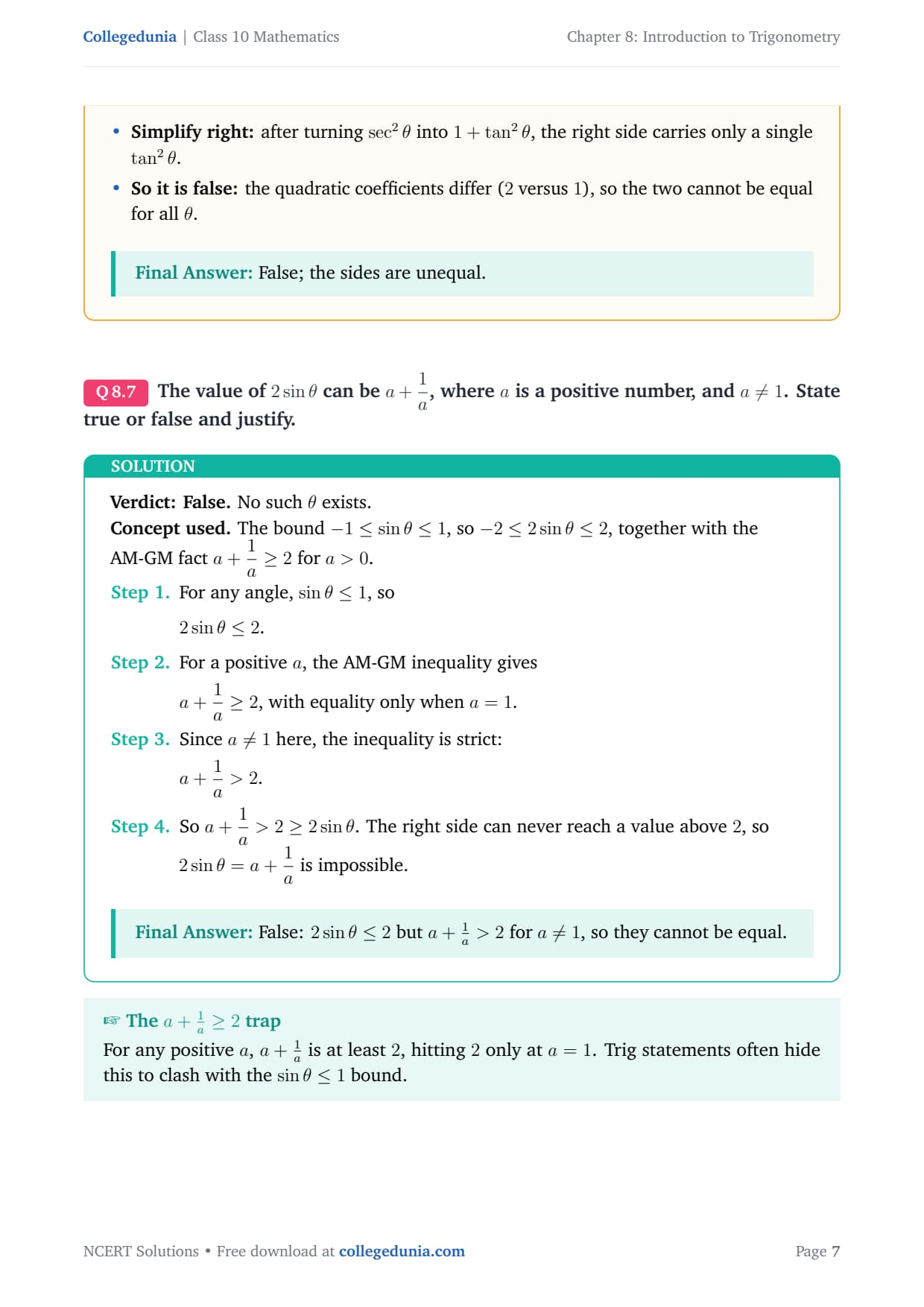
Simplify right: after turning sec2θ into 1+tan2θ, the right side carries only a single tan2θ.
So it is false: the quadratic coefficients differ (2 versus 1), so the two cannot be equal for all θ.
False; the sides are unequal.
Q 8.7
The value of 2sinθ can be a+1a, where a is a positive number, and a≠ 1. State true or false and justify.
Verdict: False. No such θ exists.
Concept used. The bound -1θ≤ 1, so
-2≤ 2sinθ≤ 2, together with the AM-GM fact
a+1a≥ 2 for a>0.
For any angle, sinθ≤ 1, so
[] 2sinθ≤ 2.
For a positive a, the AM-GM inequality gives
[] a+1a≥ 2, with equality only when a=1.
Since a≠ 1 here, the inequality is strict:
[] a+1a>2.
So a+1a>2≥ 2sinθ. The right side can never reach a
value above 2, so 2sinθ=a+1a is impossible.
False: 2sinθ≤ 2 but a+1a>2 for a≠ 1, so
they cannot be equal.
GS
Gaurav Saxena
M.Sc Mathematics, Allahabad University
Verified Expert
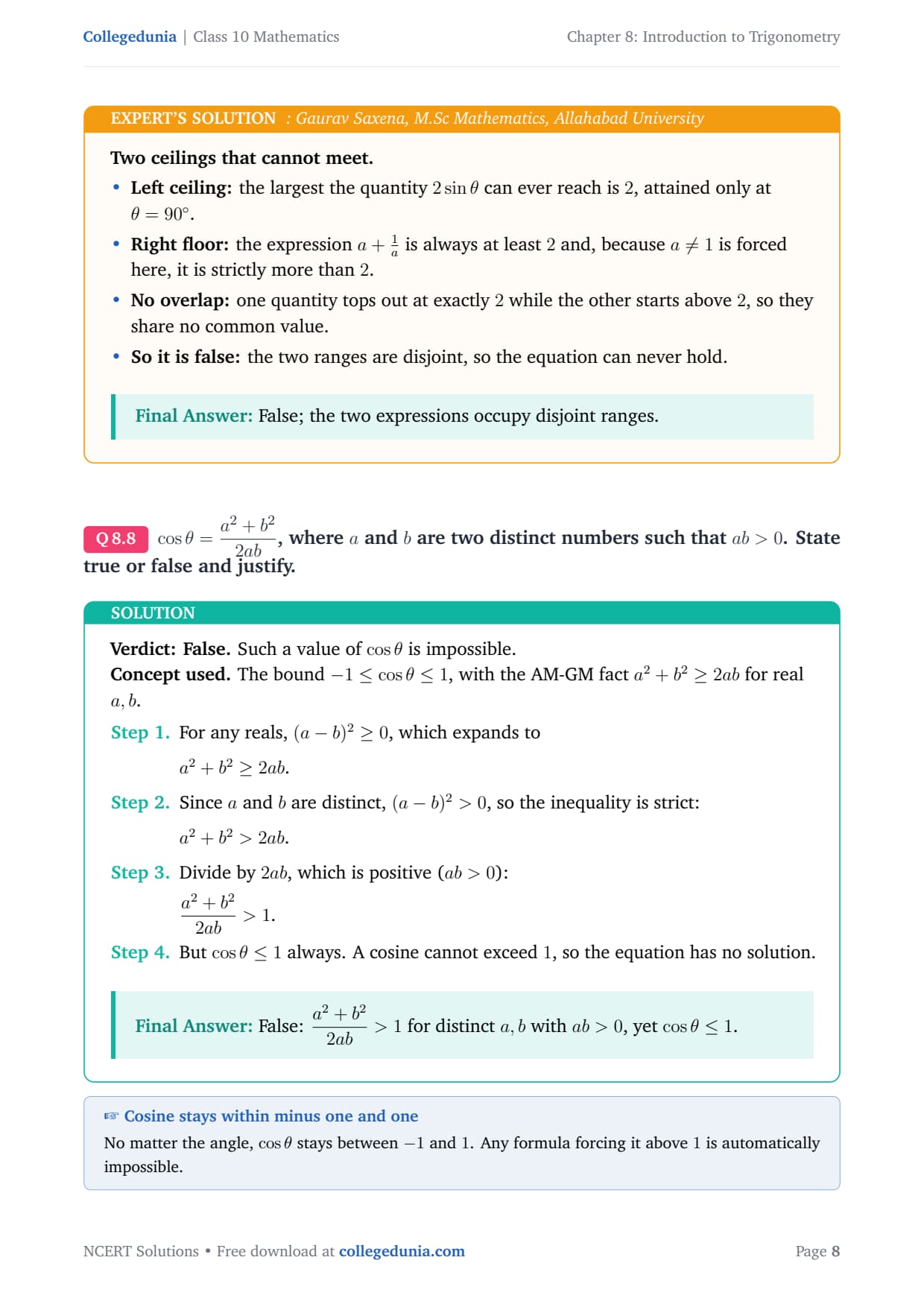
Two ceilings that cannot meet.
Left ceiling: the largest the quantity 2sinθ can ever reach is 2, attained only at θ=90∘.
Right floor: the expression a+1a is always at least 2 and, because a≠ 1 is forced here, it is strictly more than 2.
No overlap: one quantity tops out at exactly 2 while the other starts above 2, so they share no common value.
So it is false: the two ranges are disjoint, so the equation can never hold.
False; the two expressions occupy disjoint ranges.
Q 8.8
cosθ=a2+b22ab, where a and b are two distinct numbers such that ab>0. State true or false and justify.
Verdict: False. Such a value of cosθ is impossible.
Concept used. The bound -1θ≤ 1, with the AM-GM
fact a2+b2≥ 2ab for real a,b.
For any reals, (a-b)2≥ 0, which expands to
[] a2+b2≥ 2ab.
Since a and b are distinct, (a-b)2>0, so the inequality is
strict:
[] a2+b2>2ab.
Divide by 2ab, which is positive (ab>0):
[] a2+b22ab>1.
But cosθ≤ 1 always. A cosine cannot exceed 1, so the
equation has no solution.
False: a2+b22ab>1 for distinct a,b with ab>0,
yet cosθ≤ 1.
SB
Shreya Banerjee
M.Sc Mathematics, Lady Brabourne College Kolkata
Verified Expert
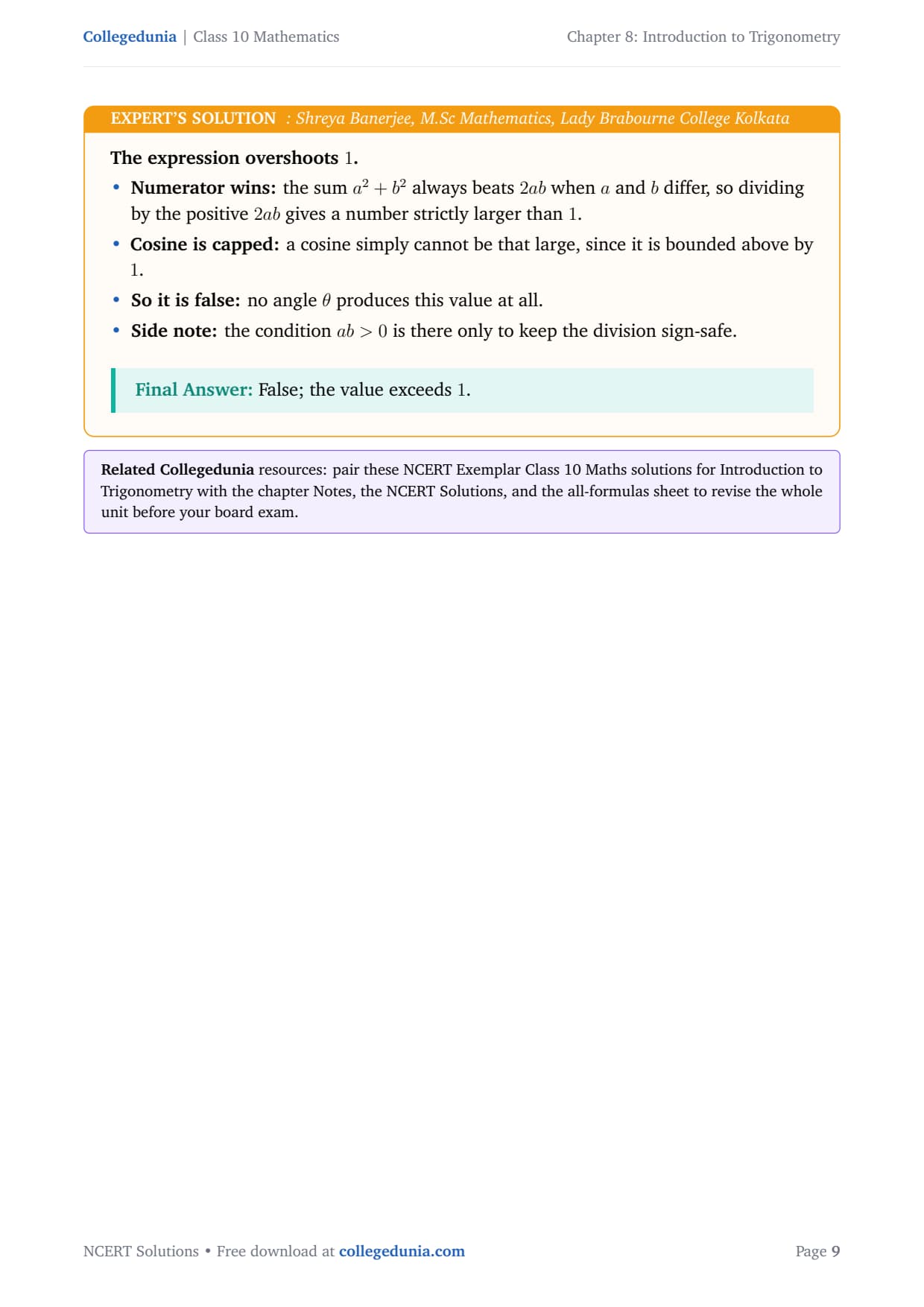
The expression overshoots 1.
Numerator wins: the sum a2+b2 always beats 2ab when a and b differ, so dividing by the positive 2ab gives a number strictly larger than 1.
Cosine is capped: a cosine simply cannot be that large, since it is bounded above by 1.
So it is false: no angle θ produces this value at all.
Side note: the condition ab>0 is there only to keep the division sign-safe.
False; the value exceeds 1.
NCERT exemplar Class 12 Mathematics Chapter 8 Introduction to Trigonometry
Introduction to Trigonometry NCERT Exemplar
All 12 questions with collapsible Solution and Expert Solution. Tap a button to reveal the working.
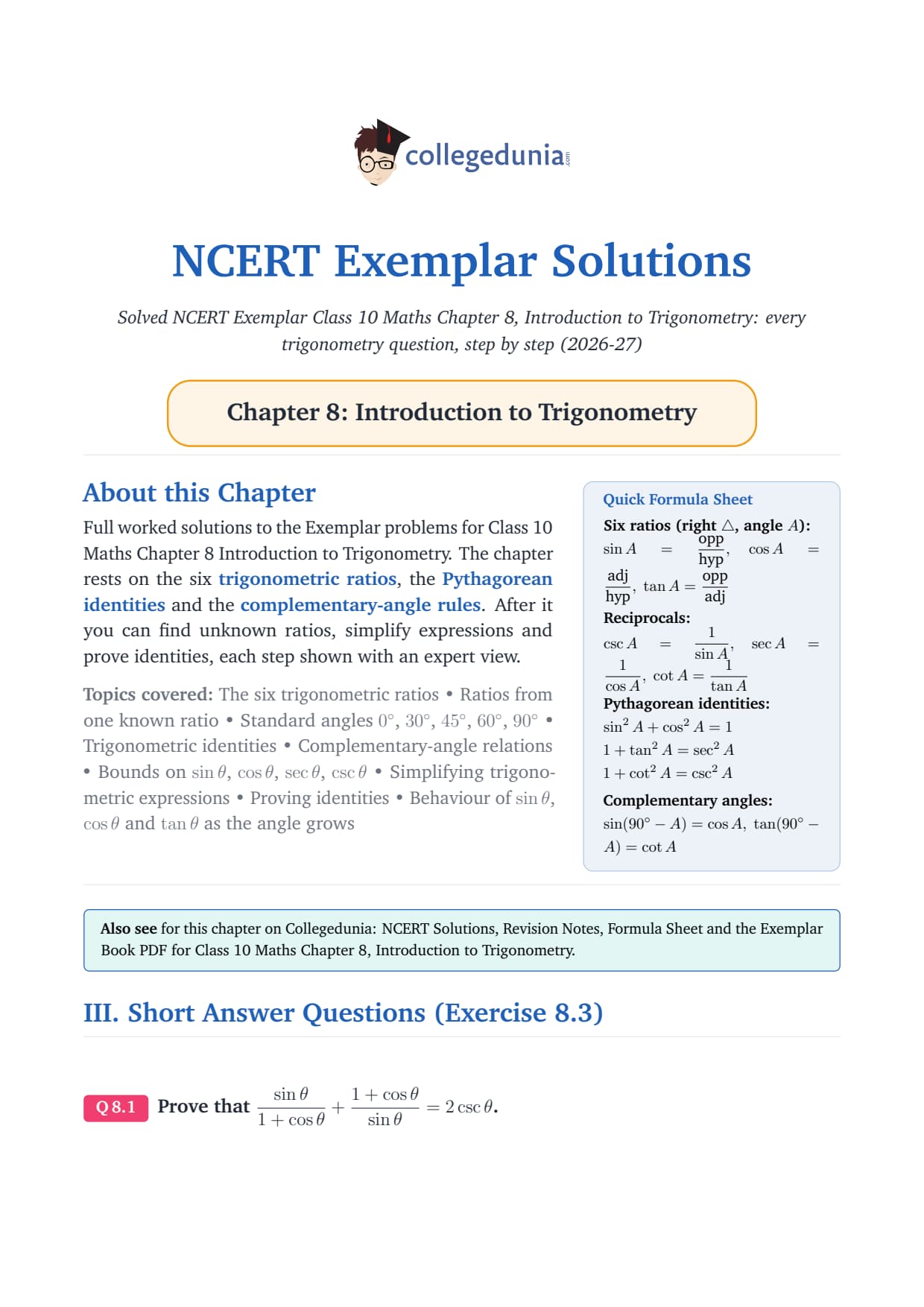
III. Short Answer Questions (Exercise 8.3)
Q 8.1
Prove that sinθ1+cosθ+1+cosθsinθ=2cscθ.
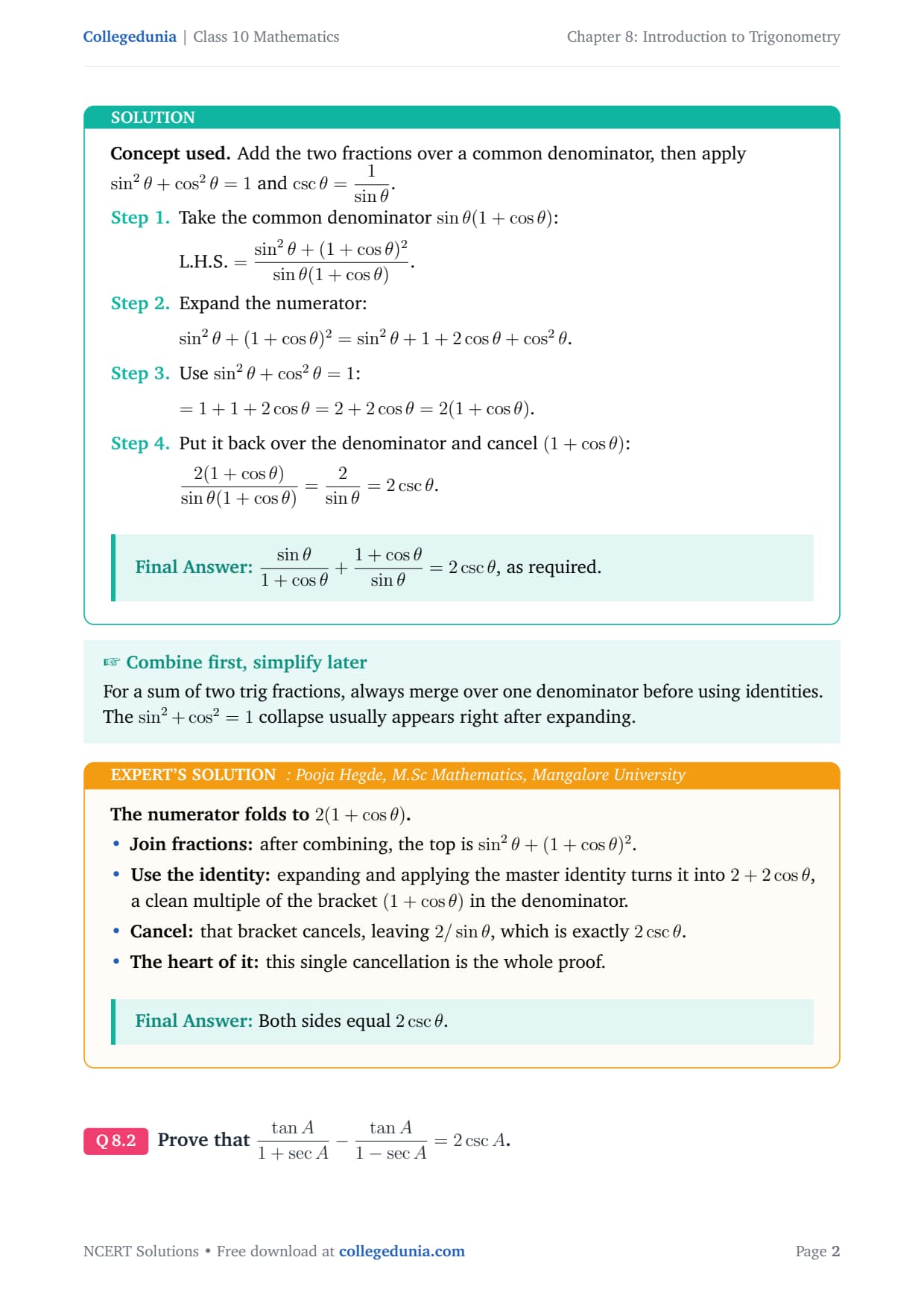
Concept used. Add the two fractions over a common denominator,
then apply sin2θ+cos2θ=1 and cscθ=1sinθ.
Take the common denominator sinθ(1+cosθ):
[] L.H.S.=sin2θ+(1+cosθ)2sinθ(1+cosθ).
Expand the numerator:
[] sin2θ+(1+cosθ)2=sin2θ+1+2cosθ+cos2θ.
Use sin2θ+cos2θ=1:
[] =1+1+2cosθ=2+2cosθ=2(1+cosθ).
Put it back over the denominator and cancel (1+cosθ):
[] 2(1+cosθ)sinθ(1+cosθ)=2sinθ=2cscθ.
sinθ1+cosθ+1+cosθsinθ=2cscθ, as required.
PH
Pooja Hegde
M.Sc Mathematics, Mangalore University
Verified Expert
The numerator folds to 2(1+cosθ).
Join fractions: after combining, the top is sin2θ+(1+cosθ)2.
Use the identity: expanding and applying the master identity turns it into 2+2cosθ, a clean multiple of the bracket (1+cosθ) in the denominator.
Cancel: that bracket cancels, leaving 2/sinθ, which is exactly 2cscθ.
The heart of it: this single cancellation is the whole proof.
Both sides equal 2cscθ.
Q 8.2
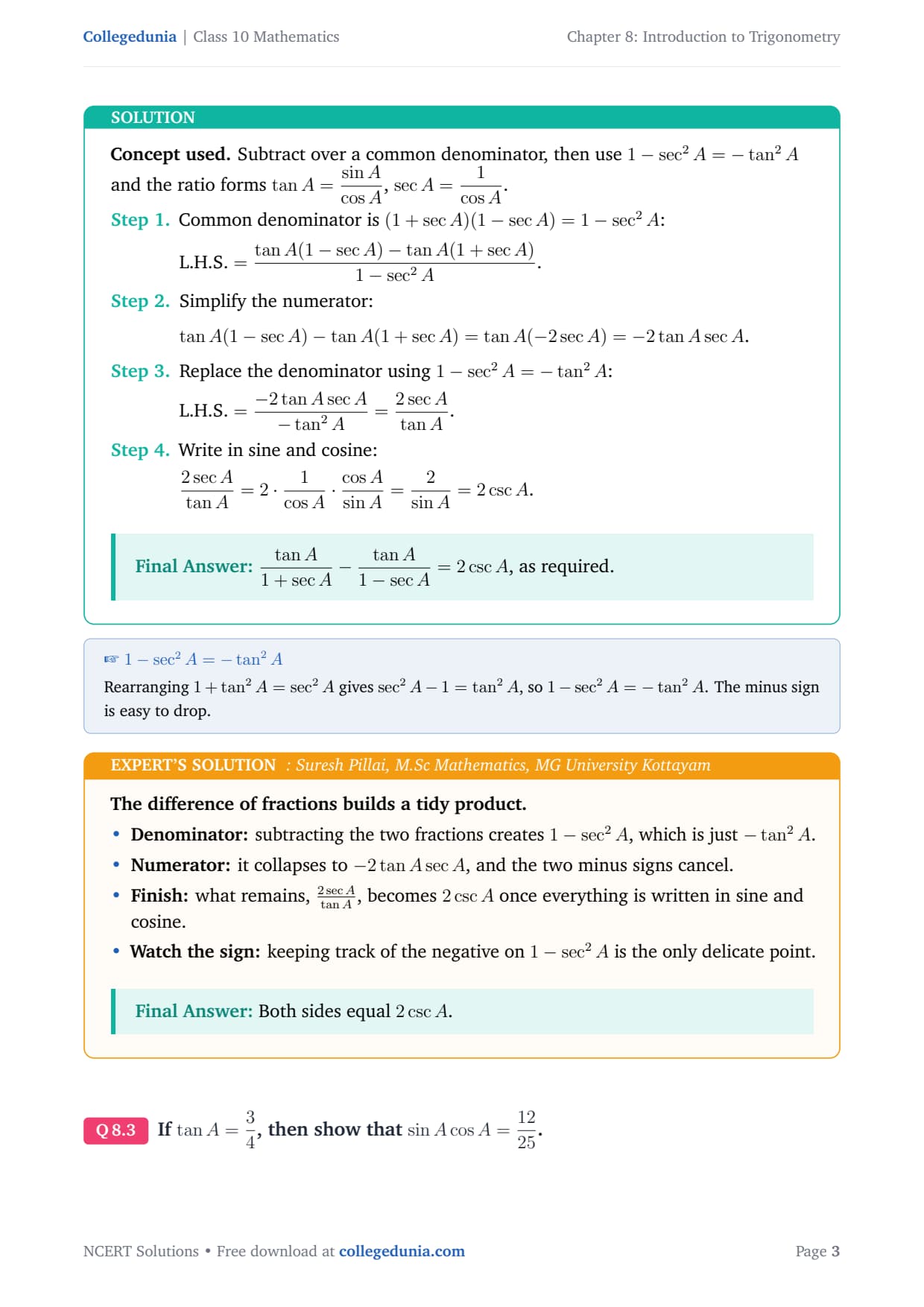
Prove that tan A1+sec A-tan A1-sec A=2csc A.
Concept used. Subtract over a common denominator, then use
1-sec2A=-tan2A and the ratio forms tan A=sin Acos A,
sec A=1cos A.
Common denominator is (1+sec A)(1-sec A)=1-sec2A:
[] L.H.S.=tan A(1-sec A)-tan A(1+sec A)1-sec2A.
Simplify the numerator:
[] tan A(1-sec A)-tan A(1+sec A)=tan A(-2sec A)=-2tan Asec A.
Replace the denominator using 1-sec2A=-tan2A:
[] L.H.S.=-2tan Asec A-tan2A=2sec Atan A.
Write in sine and cosine:
[] 2sec Atan A=2·1cos A·cos Asin A=2sin A=2csc A.
tan A1+sec A-tan A1-sec A=2csc A, as required.
SP
Suresh Pillai
M.Sc Mathematics, MG University Kottayam
Verified Expert
The difference of fractions builds a tidy product.
Denominator: subtracting the two fractions creates 1-sec2A, which is just -tan2A.
Numerator: it collapses to -2tan Asec A, and the two minus signs cancel.
Finish: what remains, 2sec Atan A, becomes 2csc A once everything is written in sine and cosine.
Watch the sign: keeping track of the negative on 1-sec2A is the only delicate point.
Both sides equal 2csc A.
Q 8.3
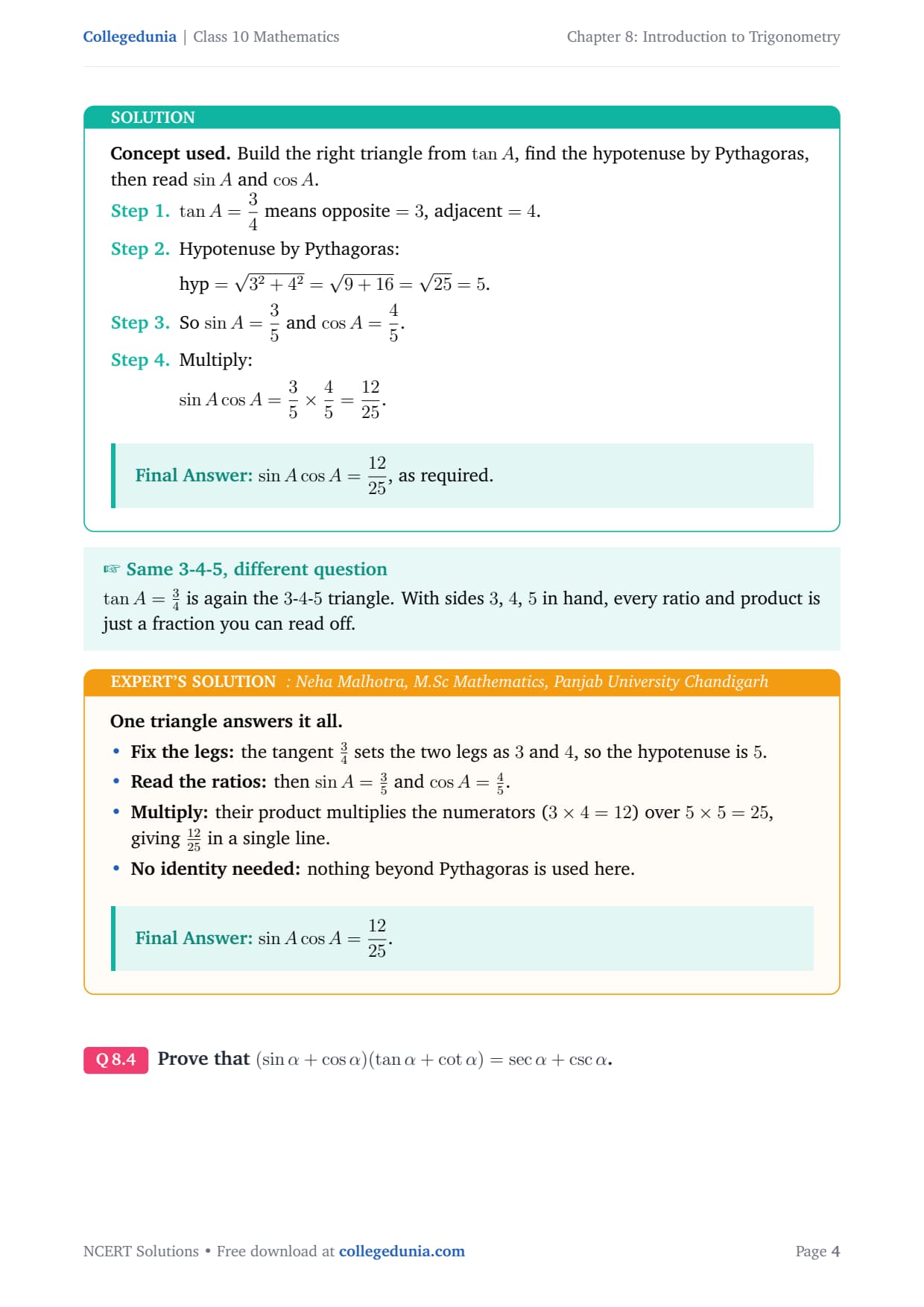
If tan A=34, then show that sin Acos A=1225.
Concept used. Build the right triangle from tan A, find the
hypotenuse by Pythagoras, then read sin A and cos A.
tan A=34 means opposite =3, adjacent =4.
Hypotenuse by Pythagoras:
[] hyp=√32+42=√9+16=√25=5.
So sin A=35 and cos A=45.
Multiply:
[] sin Acos A=35×45=1225.
sin Acos A=1225, as required.
NM
Neha Malhotra
M.Sc Mathematics, Panjab University Chandigarh
Verified Expert
One triangle answers it all.
Fix the legs: the tangent 34 sets the two legs as 3 and 4, so the hypotenuse is 5.
Read the ratios: then sin A=35 and cos A=45.
Multiply: their product multiplies the numerators (34=12) over 55=25, giving 1225 in a single line.
No identity needed: nothing beyond Pythagoras is used here.
sin Acos A=1225.
Q 8.4
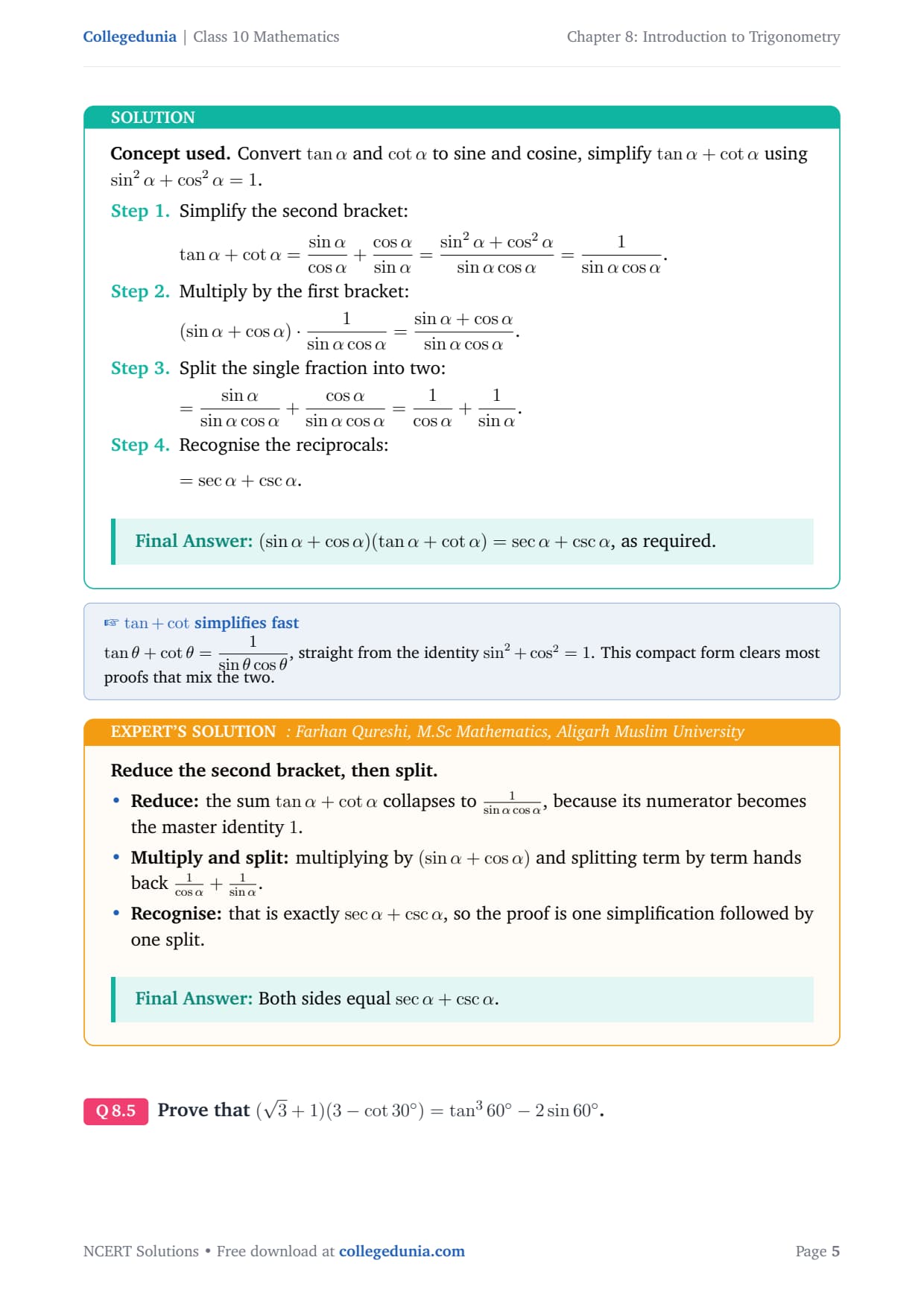
Prove that (sinα+cosα)(tanα+cotα)=secα+cscα.
Concept used. Convert tanα and cotα to sine and
cosine, simplify tanα+cotα using
sin2α+cos2α=1.
Simplify the second bracket:
[] tanα+cotα=sinαcosα+cosαsinα=sin2α+cos2αsinα=1sinα.
Multiply by the first bracket:
[] (sinα+cosα)·1sinα=sinα+cosαsinα.
Split the single fraction into two:
[] =sinαsinα+cosαsinα=1cosα+1sinα.
Recognise the reciprocals:
[] =secα+cscα.
(sinα+cosα)(tanα+cotα)=secα+cscα, as required.
FQ
Farhan Qureshi
M.Sc Mathematics, Aligarh Muslim University
Verified Expert
Reduce the second bracket, then split.
Reduce: the sum tanα+cotα collapses to 1sinα, because its numerator becomes the master identity 1.
Multiply and split: multiplying by (sinα+cosα) and splitting term by term hands back 1cosα+1sinα.
Recognise: that is exactly secα+cscα, so the proof is one simplification followed by one split.
Both sides equal secα+cscα.
Q 8.5
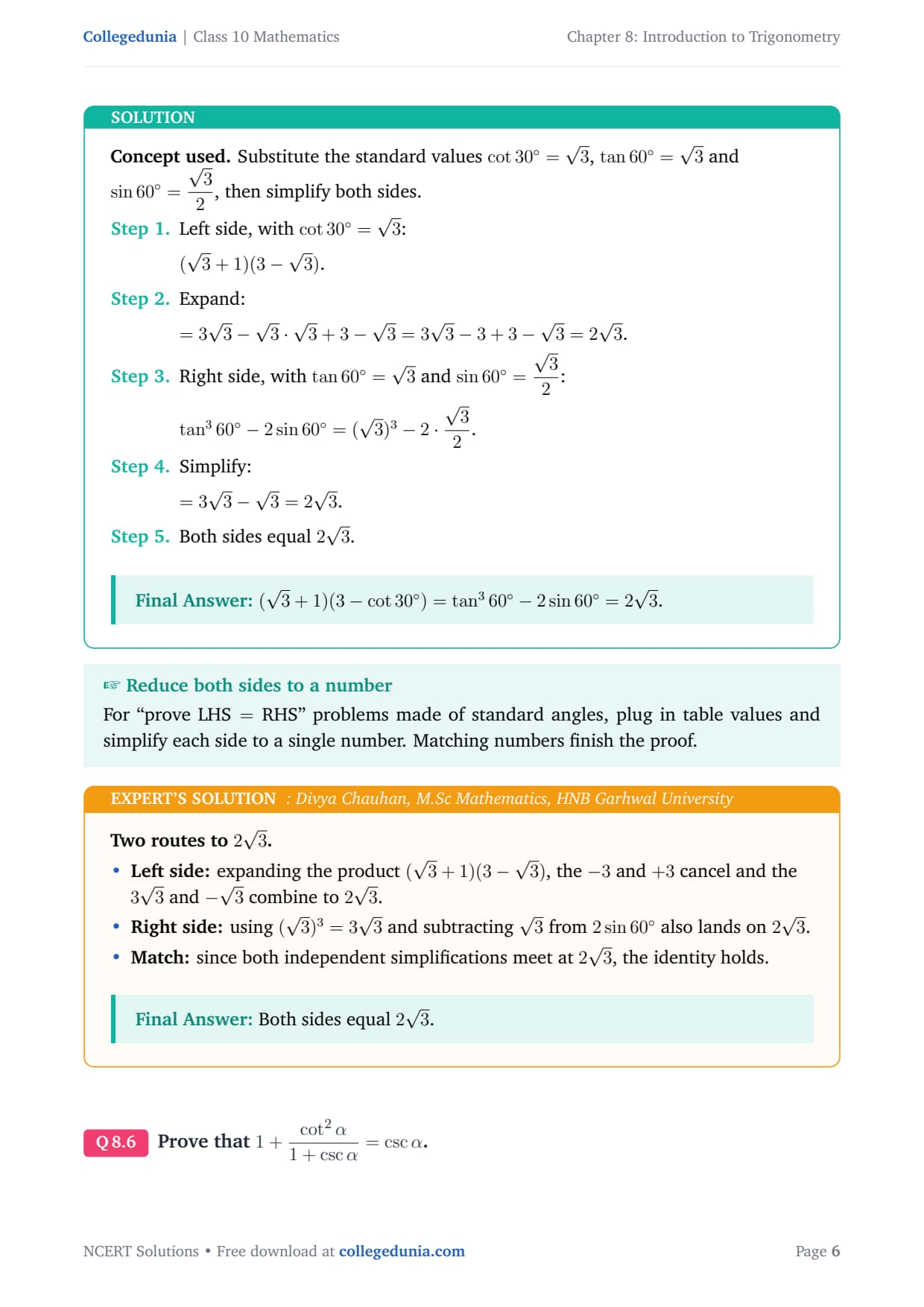
Prove that (√3+1)(3-cot 30∘)=tan3 60∘-2sin 60∘.
Concept used. Substitute the standard values cot 30∘=3,
tan 60∘=3 and sin 60∘=32, then simplify
both sides.
Left side, with cot 30∘=3:
[] (3+1)(3-3).
Expand:
[] =33-3·3+3-3=33-3+3-3=23.
Right side, with tan 60∘=3 and sin 60∘=32:
[] tan3 60∘-2sin 60∘=(3)3-2·32.
Simplify:
[] =33-3=23.
Both sides equal 23.
(3+1)(3-cot 30∘)=tan3 60∘-2sin 60∘=23.
DC
Divya Chauhan
M.Sc Mathematics, HNB Garhwal University
Verified Expert
Two routes to 23.
Left side: expanding the product (3+1)(3-3), the -3 and +3 cancel and the 33 and -3 combine to 23.
Right side: using (3)3=33 and subtracting 3 from 2sin 60∘ also lands on 23.
Match: since both independent simplifications meet at 23, the identity holds.
Both sides equal 23.
Q 8.6
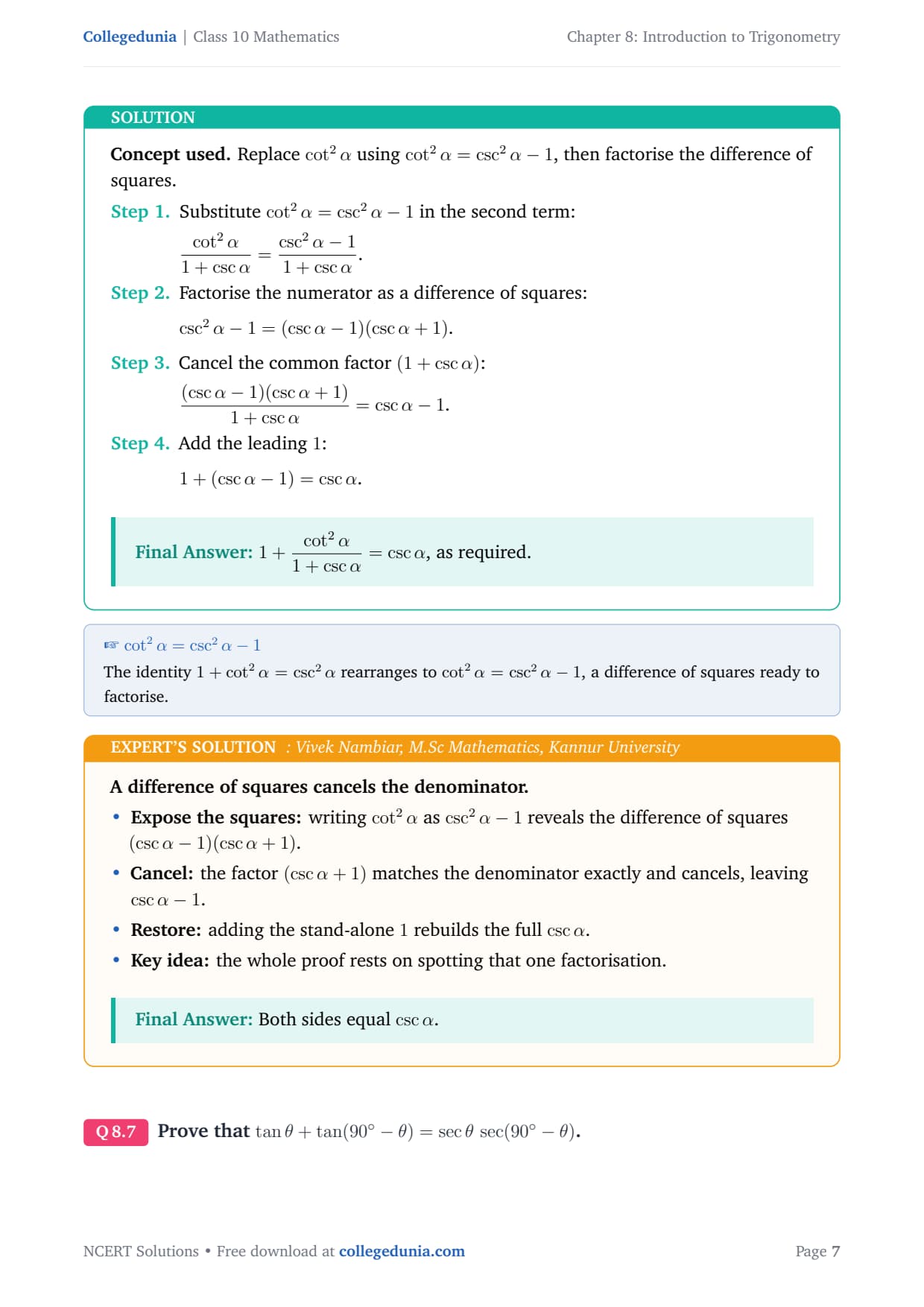
Prove that 1+cot2α1+cscα=cscα.
Concept used. Replace cot2α using
cot2α=csc2α-1, then factorise the difference of squares.
Substitute cot2α=csc2α-1 in the second term:
[] cot2α1+cscα=csc2α-11+cscα.
Factorise the numerator as a difference of squares:
[] csc2α-1=(cscα-1)(cscα+1).
Cancel the common factor (1+cscα):
[] (cscα-1)(cscα+1)1+cscα=cscα-1.
Add the leading 1:
[] 1+(cscα-1)=cscα.
1+cot2α1+cscα=cscα, as required.
VN
Vivek Nambiar
M.Sc Mathematics, Kannur University
Verified Expert
A difference of squares cancels the denominator.
Expose the squares: writing cot2α as csc2α-1 reveals the difference of squares (cscα-1)(cscα+1).
Cancel: the factor (cscα+1) matches the denominator exactly and cancels, leaving cscα-1.
Restore: adding the stand-alone 1 rebuilds the full cscα.
Key idea: the whole proof rests on spotting that one factorisation.
Both sides equal cscα.
Q 8.7
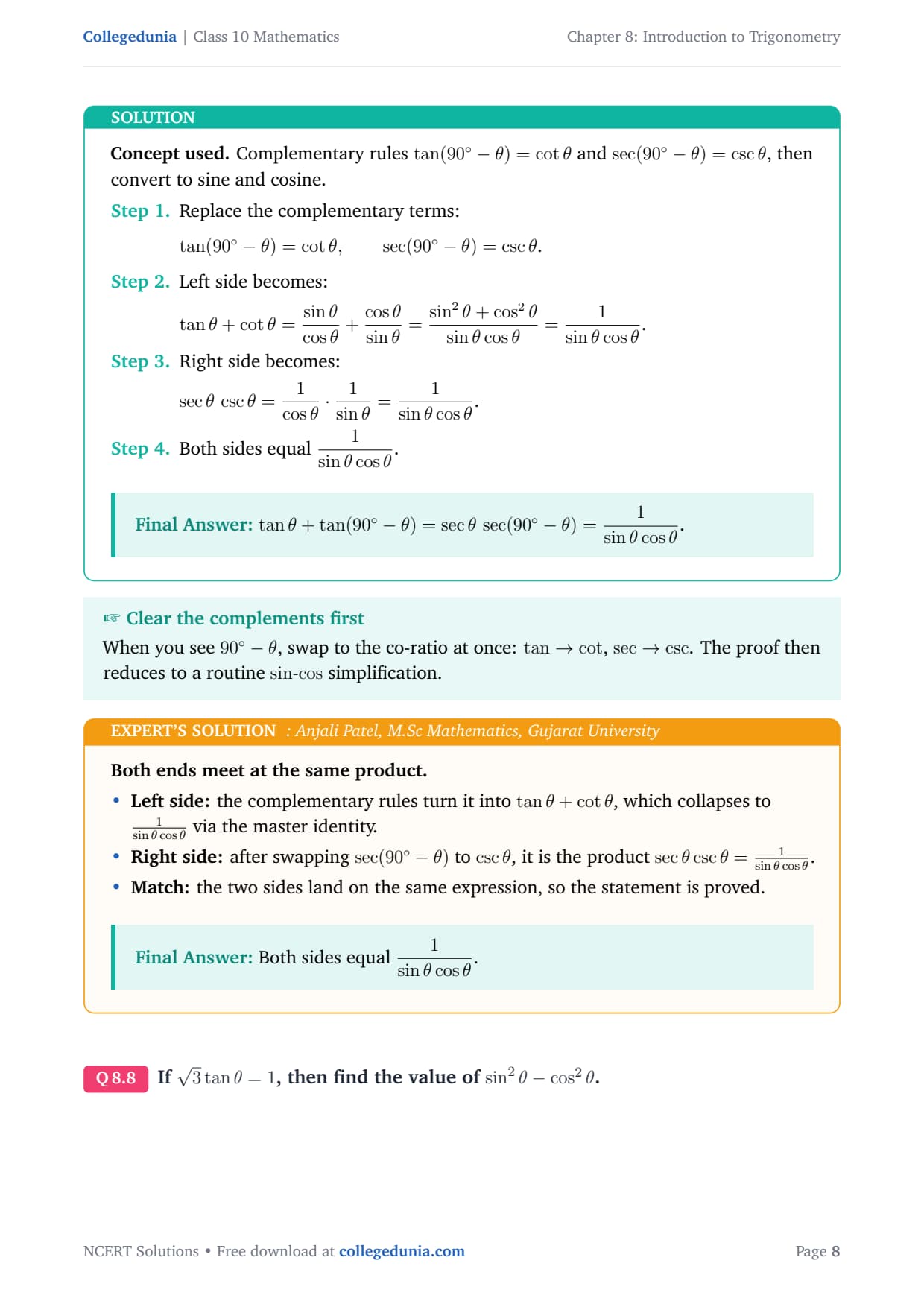
Prove that tanθ+tan(90∘-θ)=secθ sec(90∘-θ).
Concept used. Complementary rules tan(90∘-θ)=cotθ
and sec(90∘-θ)=cscθ, then convert to sine and cosine.
Replace the complementary terms:
[] tan(90∘-θ)=cotθ, sec(90∘-θ)=cscθ.
Left side becomes:
[] tanθ+cotθ=sinθcosθ+cosθsinθ=sin2θ+cos2θsinθ=1sinθ.
Right side becomes:
[] secθ cscθ=1cosθ·1sinθ=1sinθ.
Both sides equal 1sinθ.
tanθ+tan(90∘-θ)=secθ sec(90∘-θ)=1sinθ.
AP
Anjali Patel
M.Sc Mathematics, Gujarat University
Verified Expert
Both ends meet at the same product.
Left side: the complementary rules turn it into tanθ+cotθ, which collapses to 1sinθ via the master identity.
Right side: after swapping sec(90∘-θ) to cscθ, it is the product secθ=1sinθ.
Match: the two sides land on the same expression, so the statement is proved.
Both sides equal 1sinθ.
Q 8.8
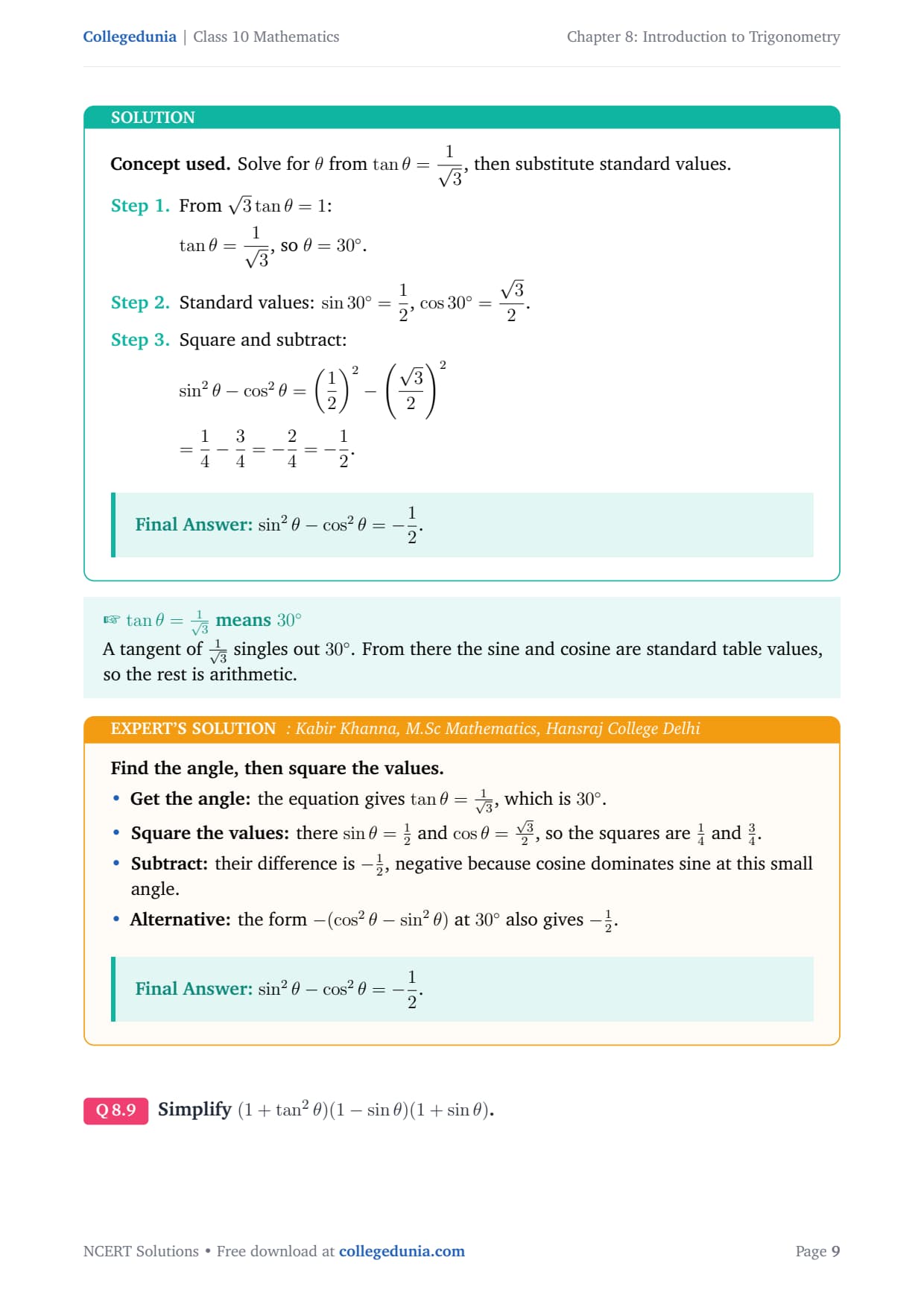
If √3tanθ=1, then find the value of sin2θ-cos2θ.
Concept used. Solve for θ from tanθ=13,
then substitute standard values.
From 3tanθ=1:
[] tanθ=13, so θ=30∘.
Standard values: sin 30∘=12, cos 30∘=32.
Square and subtract:
[] sin2θ-cos2θ=(12)2-(32)2
[] =14-34=-24=-12.
sin2θ-cos2θ=-12.
KK
Kabir Khanna
M.Sc Mathematics, Hansraj College Delhi
Verified Expert
Find the angle, then square the values.
Get the angle: the equation gives tanθ=13, which is 30∘.
Square the values: there sinθ=12 and cosθ=32, so the squares are 14 and 34.
Subtract: their difference is -12, negative because cosine dominates sine at this small angle.
Alternative: the form -(cos2θ-sin2θ) at 30∘ also gives -12.
sin2θ-cos2θ=-12.
Q 8.9
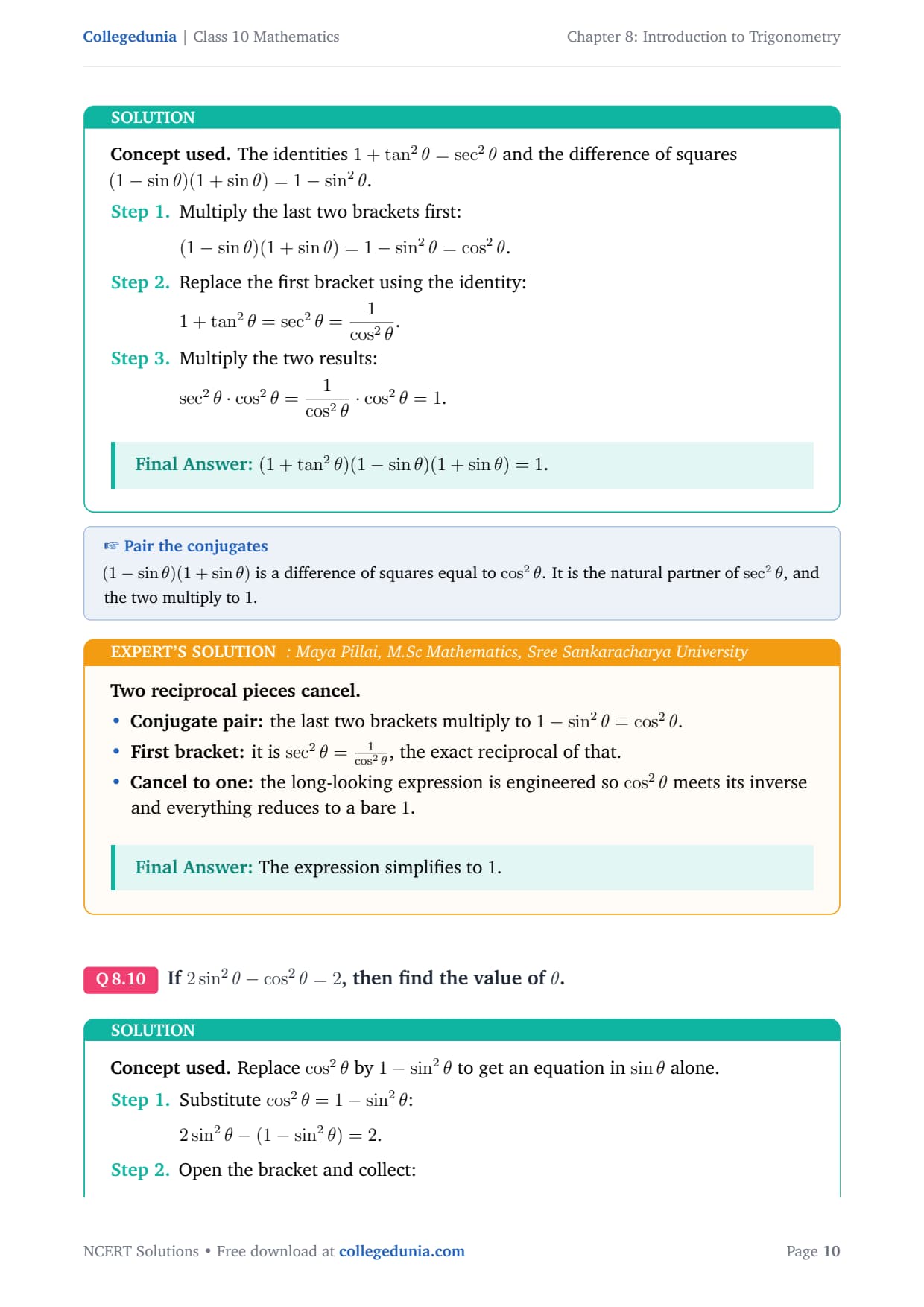
Simplify (1+tan2θ)(1-sinθ)(1+sinθ).
Concept used. The identities 1+tan2θ=sec2θ and the
difference of squares (1-sinθ)(1+sinθ)=1-sin2θ.
Multiply the last two brackets first:
[] (1-sinθ)(1+sinθ)=1-sin2θ=cos2θ.
Replace the first bracket using the identity:
[] 1+tan2θ=sec2θ=1cos2θ.
Multiply the two results:
[] sec2θ2θ=1cos2θ2θ=1.
(1+tan2θ)(1-sinθ)(1+sinθ)=1.
MP
Maya Pillai
M.Sc Mathematics, Sree Sankaracharya University
Verified Expert
Two reciprocal pieces cancel.
Conjugate pair: the last two brackets multiply to 1-sin2θ=cos2θ.
First bracket: it is sec2θ=1cos2θ, the exact reciprocal of that.
Cancel to one: the long-looking expression is engineered so cos2θ meets its inverse and everything reduces to a bare 1.
The expression simplifies to 1.
Q 8.10
If 2sin2θ-cos2θ=2, then find the value of θ.
Concept used. Replace cos2θ by 1-sin2θ to get an
equation in sinθ alone.
Substitute cos2θ=1-sin2θ:
[] 2sin2θ-(1-sin2θ)=2.
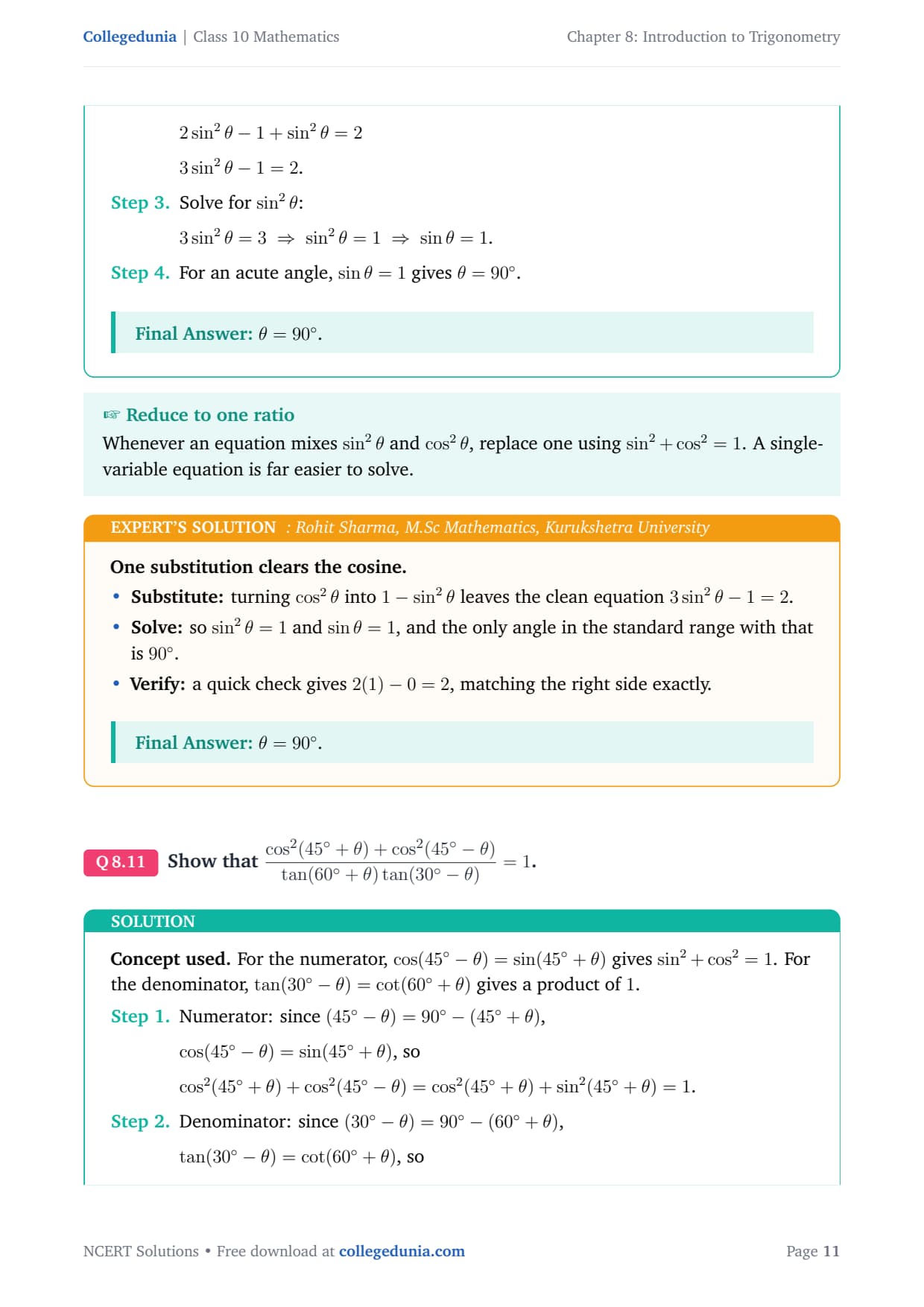
Open the bracket and collect:
[] 2sin2θ-1+sin2θ=2
[] 3sin2θ-1=2.
Solve for sin2θ:
[] 3sin2θ=3 ⇒ sin2θ=1 ⇒ sinθ=1.
For an acute angle, sinθ=1 gives θ=90∘.
θ=90∘.
RS
Rohit Sharma
M.Sc Mathematics, Kurukshetra University
Verified Expert
One substitution clears the cosine.
Substitute: turning cos2θ into 1-sin2θ leaves the clean equation 3sin2θ-1=2.
Solve: so sin2θ=1 and sinθ=1, and the only angle in the standard range with that is 90∘.
Verify: a quick check gives 2(1)-0=2, matching the right side exactly.
θ=90∘.
Q 8.11
Show that cos2(45∘+θ)+cos2(45∘-θ)tan(60∘+θ)tan(30∘-θ)=1.
Concept used. For the numerator, cos(45∘-θ)=sin(45∘+θ)
gives sin2+cos2=1. For the denominator,
tan(30∘-θ)=cot(60∘+θ) gives a product of 1.
Numerator: since (45∘-θ)=90∘-(45∘+θ),
[] cos(45∘-θ)=sin(45∘+θ), so
[] cos2(45∘+θ)+cos2(45∘-θ)=cos2(45∘+θ)+sin2(45∘+θ)=1.
Denominator: since (30∘-θ)=90∘-(60∘+θ),
[] tan(30∘-θ)=cot(60∘+θ), so
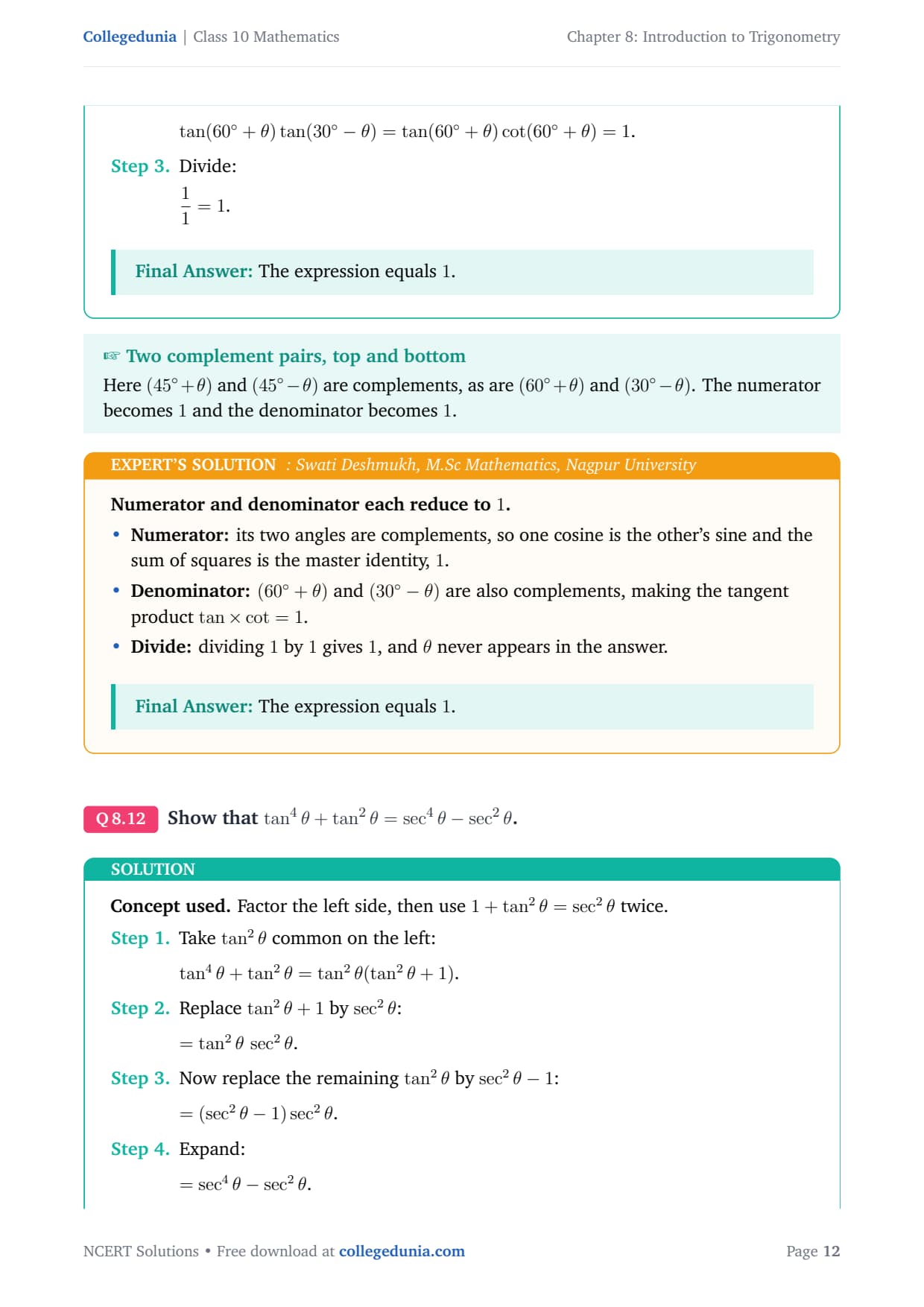
[] tan(60∘+θ)tan(30∘-θ)=tan(60∘+θ)cot(60∘+θ)=1.
Divide:
[] 11=1.
The expression equals 1.
SD
Swati Deshmukh
M.Sc Mathematics, Nagpur University
Verified Expert
Numerator and denominator each reduce to 1.
Numerator: its two angles are complements, so one cosine is the other's sine and the sum of squares is the master identity, 1.
Denominator:(60∘+θ) and (30∘-θ) are also complements, making the tangent product tan=1.
Divide: dividing 1 by 1 gives 1, and θ never appears in the answer.
The expression equals 1.
Q 8.12
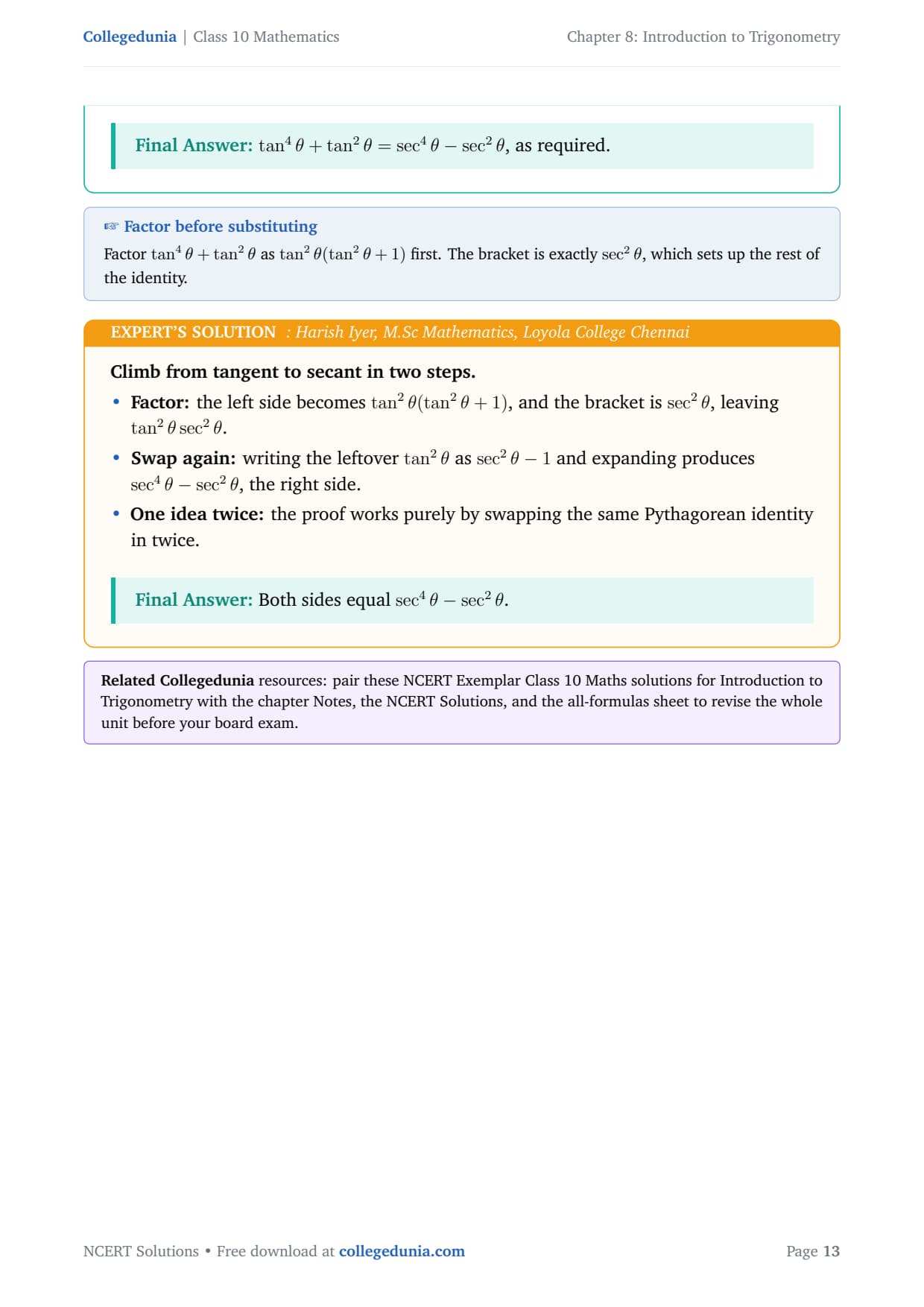
Show that tan4θ+tan2θ=sec4θ-sec2θ.
Concept used. Factor the left side, then use
1+tan2θ=sec2θ twice.
Take tan2θ common on the left:
[] tan4θ+tan2θ=tan2θ(tan2θ+1).
Replace tan2θ+1 by sec2θ:
[] =tan2θ sec2θ.
Now replace the remaining tan2θ by sec2θ-1:
[] =(sec2θ-1)sec2θ.
Expand:
[] =sec4θ-sec2θ.
tan4θ+tan2θ=sec4θ-sec2θ, as required.
HI
Harish Iyer
M.Sc Mathematics, Loyola College Chennai
Verified Expert
Climb from tangent to secant in two steps.
Factor: the left side becomes tan2θ(tan2θ+1), and the bracket is sec2θ, leaving tan22θ.
Swap again: writing the leftover tan2θ as sec2θ-1 and expanding produces sec4θ-sec2θ, the right side.
One idea twice: the proof works purely by swapping the same Pythagorean identity in twice.
Both sides equal sec4θ-sec2θ.
NCERT exemplar Class 12 Mathematics Chapter 8 Introduction to Trigonometry
Introduction to Trigonometry NCERT Exemplar
All 8 questions with collapsible Solution and Expert Solution. Tap a button to reveal the working.
IV. Long Answer Questions (Exercise 8.4)
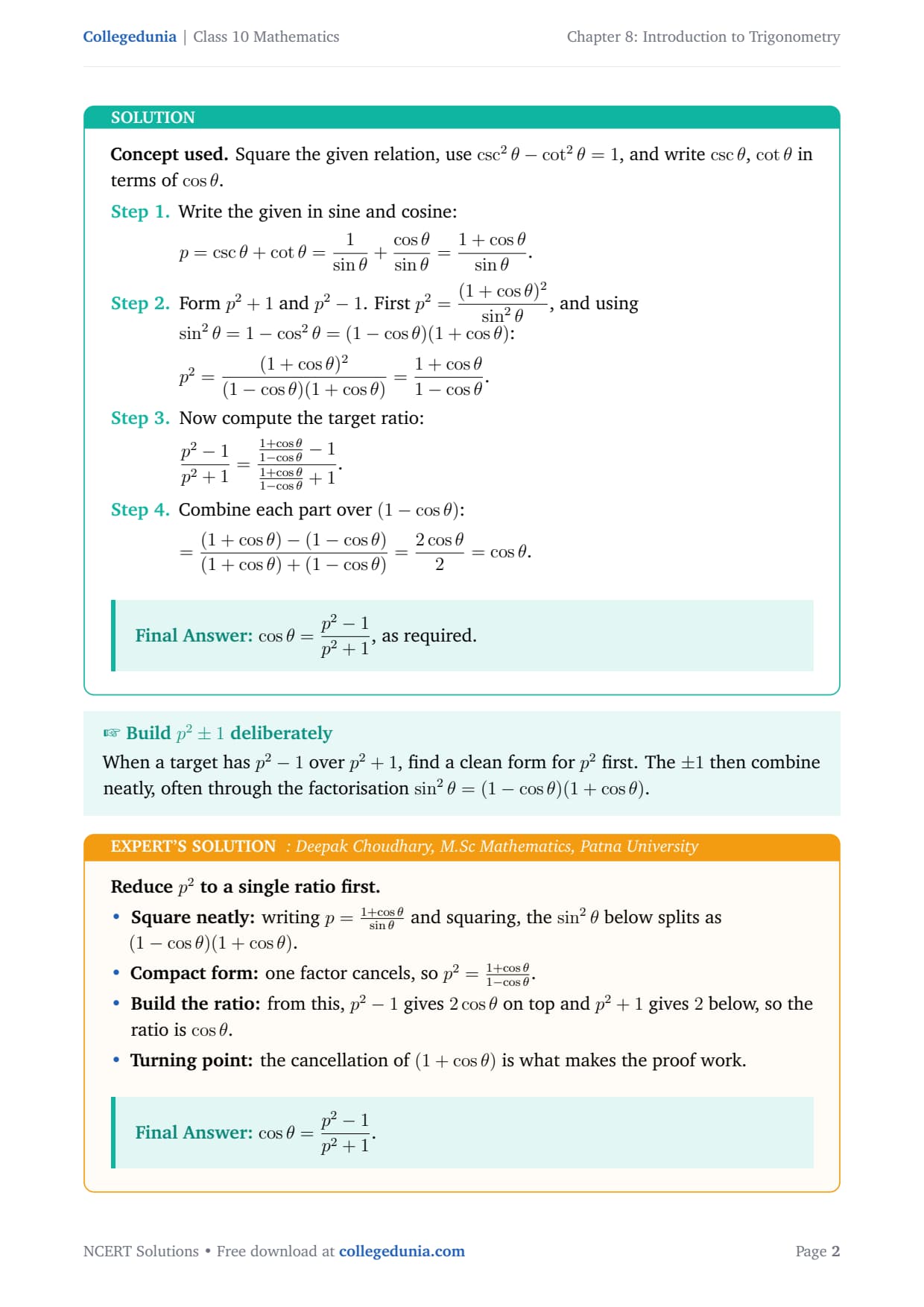
Q 8.1
If cscθ+cotθ=p, then prove that cosθ=p2-1p2+1.
Concept used. Square the given relation, use
csc2θ-cot2θ=1, and write cscθ, cotθ in terms
of cosθ.
Write the given in sine and cosine:
[] p=cscθ+cotθ=1sinθ+cosθsinθ=1+cosθsinθ.
Form p2+1 and p2-1. First p2=(1+cosθ)2sin2θ,
and using sin2θ=1-cos2θ=(1-cosθ)(1+cosθ):
[] p2=(1+cosθ)2(1-cosθ)(1+cosθ)=1+cosθ1-cosθ.
Now compute the target ratio:
[] p2-1p2+1=1+cosθ1-cosθ-11+cosθ1-cosθ+1.
Combine each part over (1-cosθ):
[] =(1+cosθ)-(1-cosθ)(1+cosθ)+(1-cosθ)=2cosθ2=cosθ.
cosθ=p2-1p2+1, as required.
DC
Deepak Choudhary
M.Sc Mathematics, Patna University
Verified Expert
Reduce p2 to a single ratio first.
Square neatly: writing p=1+cosθsinθ and squaring, the sin2θ below splits as (1-cosθ)(1+cosθ).
Compact form: one factor cancels, so p2=1+cosθ1-cosθ.
Build the ratio: from this, p2-1 gives 2cosθ on top and p2+1 gives 2 below, so the ratio is cosθ.
Turning point: the cancellation of (1+cosθ) is what makes the proof work.
cosθ=p2-1p2+1.
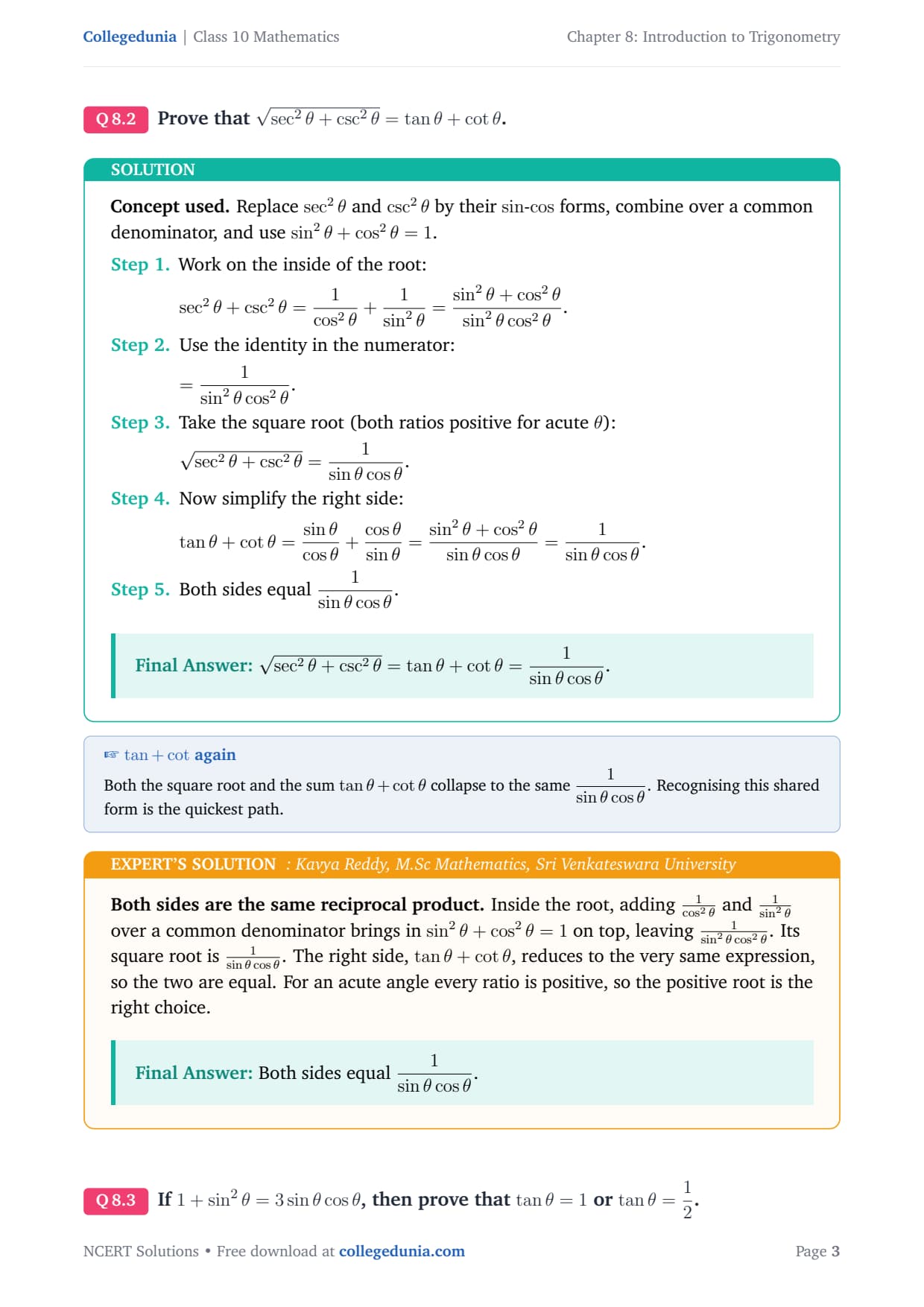
Q 8.2
Prove that √sec2θ+csc2θ=tanθ+cotθ.
Concept used. Replace sec2θ and csc2θ by their
sin-cos forms, combine over a common denominator, and use
sin2θ+cos2θ=1.
Work on the inside of the root:
[] sec2θ+csc2θ=1cos2θ+1sin2θ=sin2θ+cos2θsin22θ.
Use the identity in the numerator:
[] =1sin22θ.
Take the square root (both ratios positive for acute θ):
[] √sec2θ+csc2θ=1sinθ.
Now simplify the right side:
[] tanθ+cotθ=sinθcosθ+cosθsinθ=sin2θ+cos2θsinθ=1sinθ.
Both sides equal 1sinθ.
√sec2θ+csc2θ=tanθ+cotθ=1sinθ.
KR
Kavya Reddy
M.Sc Mathematics, Sri Venkateswara University
Verified Expert
Both sides are the same reciprocal product. Inside the root,
adding 1cos2θ and 1sin2θ over a
common denominator brings in sin2θ+cos2θ=1 on top, leaving
1sin22θ. Its square root is
1sinθ. The right side, tanθ+cotθ,
reduces to the very same expression, so the two are equal. For an acute
angle every ratio is positive, so the positive root is the right choice.
Both sides equal 1sinθ.
Q 8.3
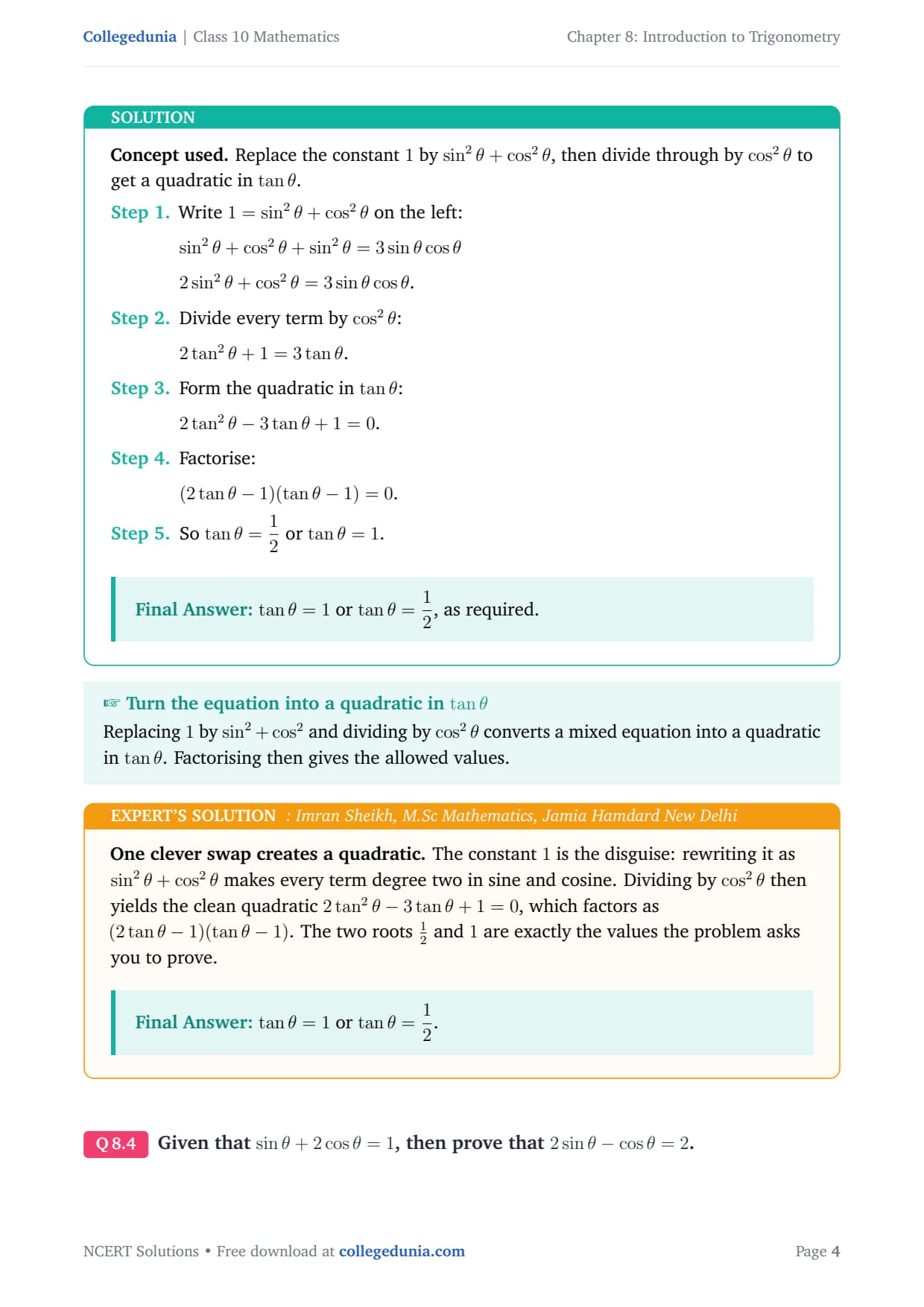
If 1+sin2θ=3sinθ, then prove that tanθ=1 or tanθ=12.
Concept used. Replace the constant 1 by
sin2θ+cos2θ, then divide through by cos2θ to get a
quadratic in tanθ.
Write 1=sin2θ+cos2θ on the left:
[] sin2θ+cos2θ+sin2θ=3sinθ
[] 2sin2θ+cos2θ=3sinθ.
Divide every term by cos2θ:
[] 2tan2θ+1=3tanθ.
Form the quadratic in tanθ:
[] 2tan2θ-3tanθ+1=0.
Factorise:
[] (2tanθ-1)(tanθ-1)=0.
So tanθ=12 or tanθ=1.
tanθ=1 or tanθ=12, as required.
IS
Imran Sheikh
M.Sc Mathematics, Jamia Hamdard New Delhi
Verified Expert
One clever swap creates a quadratic. The constant 1 is the
disguise: rewriting it as sin2θ+cos2θ makes every term
degree two in sine and cosine. Dividing by cos2θ then yields the
clean quadratic 2tan2θ-3tanθ+1=0, which factors as
(2tanθ-1)(tanθ-1). The two roots 12 and 1 are
exactly the values the problem asks you to prove.
tanθ=1 or tanθ=12.
Q 8.4
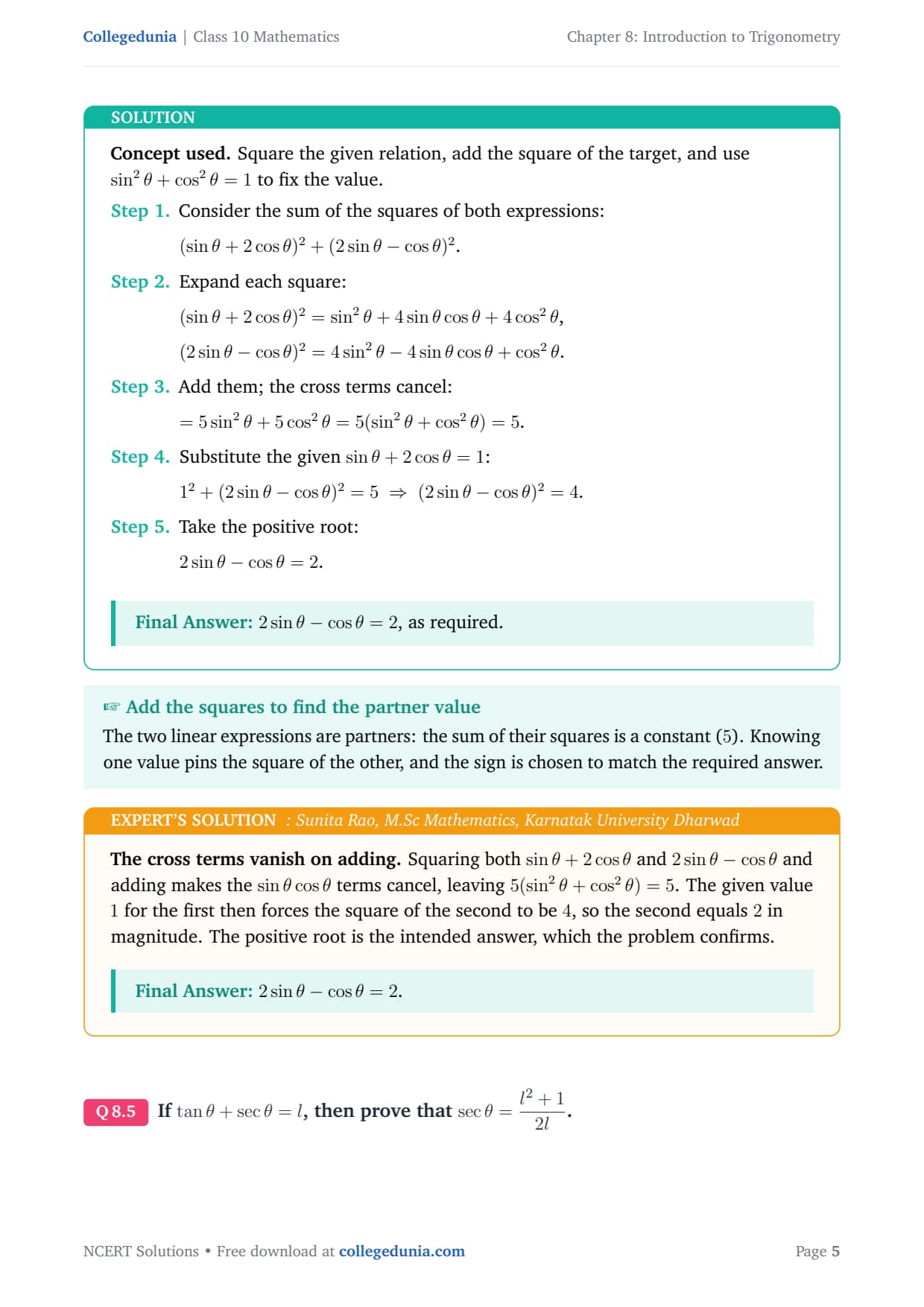
Given that sinθ+2cosθ=1, then prove that 2sinθ-cosθ=2.
Concept used. Square the given relation, add the square of the
target, and use sin2θ+cos2θ=1 to fix the value.
Consider the sum of the squares of both expressions:
[] (sinθ+2cosθ)2+(2sinθ-cosθ)2.
Expand each square:
[] (sinθ+2cosθ)2=sin2θ+4sinθ+4cos2θ,
[] (2sinθ-cosθ)2=4sin2θ-4sinθ+cos2θ.
Add them; the cross terms cancel:
[] =5sin2θ+5cos2θ=5(sin2θ+cos2θ)=5.
Substitute the given sinθ+2cosθ=1:
[] 12+(2sinθ-cosθ)2=5 ⇒ (2sinθ-cosθ)2=4.
Take the positive root:
[] 2sinθ-cosθ=2.
2sinθ-cosθ=2, as required.
SR
Sunita Rao
M.Sc Mathematics, Karnatak University Dharwad
Verified Expert
The cross terms vanish on adding. Squaring both
sinθ+2cosθ and 2sinθ-cosθ and adding makes the
sinθ terms cancel, leaving 5(sin2θ+cos2θ)=5.
The given value 1 for the first then forces the square of the second to
be 4, so the second equals 2 in magnitude. The positive root is the
intended answer, which the problem confirms.
2sinθ-cosθ=2.
Q 8.5
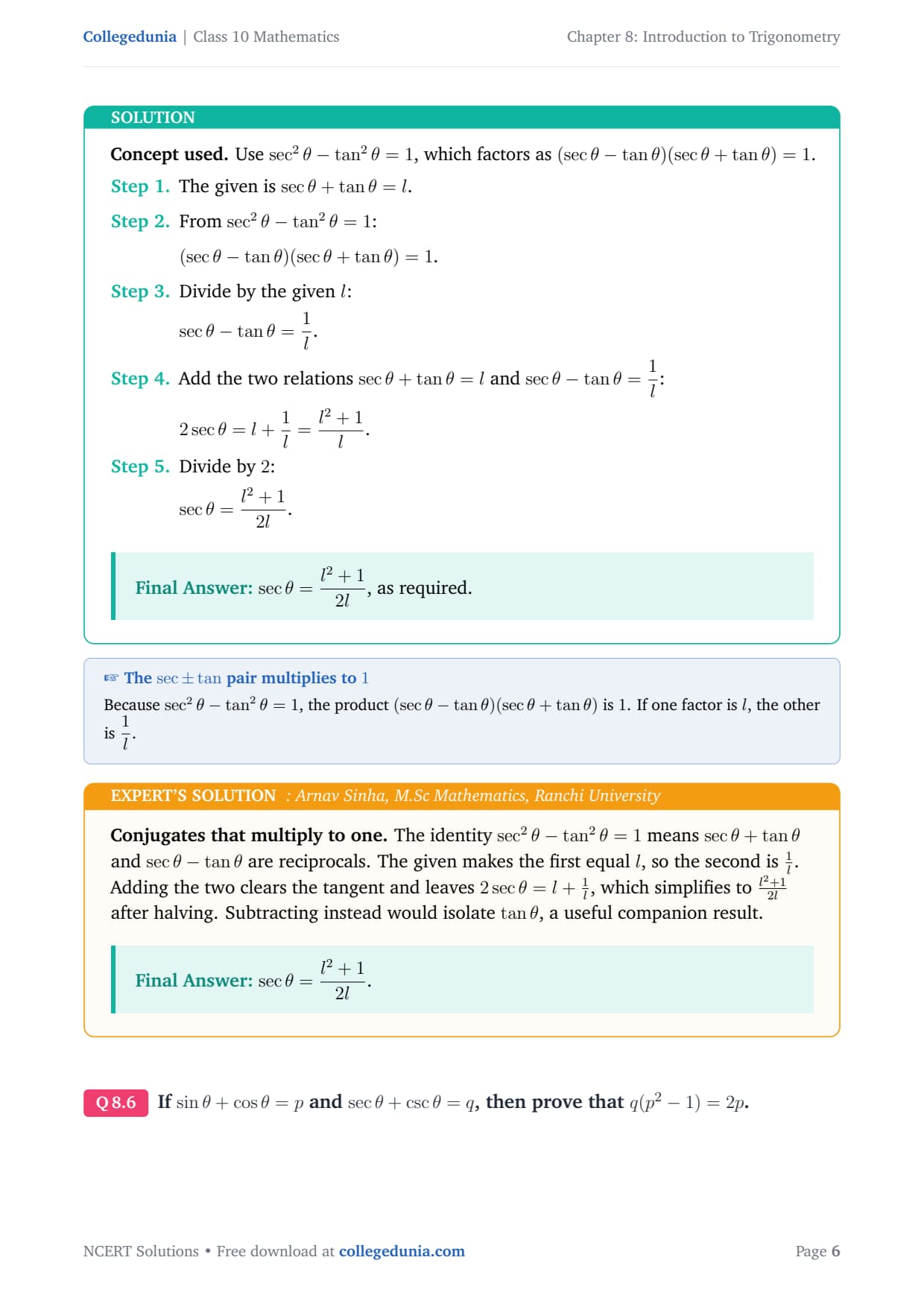
If tanθ+secθ=l, then prove that secθ=l2+12l.
Concept used. Use sec2θ-tan2θ=1, which factors as
(secθ-tanθ)(secθ+tanθ)=1.
The given is secθ+tanθ=l.
From sec2θ-tan2θ=1:
[] (secθ-tanθ)(secθ+tanθ)=1.
Divide by the given l:
[] secθ-tanθ=1l.
Add the two relations secθ+tanθ=l and secθ-tanθ=1l:
[] 2secθ=l+1l=l2+1l.
Divide by 2:
[] secθ=l2+12l.
secθ=l2+12l, as required.
AS
Arnav Sinha
M.Sc Mathematics, Ranchi University
Verified Expert
Conjugates that multiply to one. The identity
sec2θ-tan2θ=1 means secθ+tanθ and
secθ-tanθ are reciprocals. The given makes the first equal
l, so the second is 1l. Adding the two clears the tangent and
leaves 2secθ=l+1l, which simplifies to
l2+12l after halving. Subtracting instead would isolate
tanθ, a useful companion result.
secθ=l2+12l.
Q 8.6
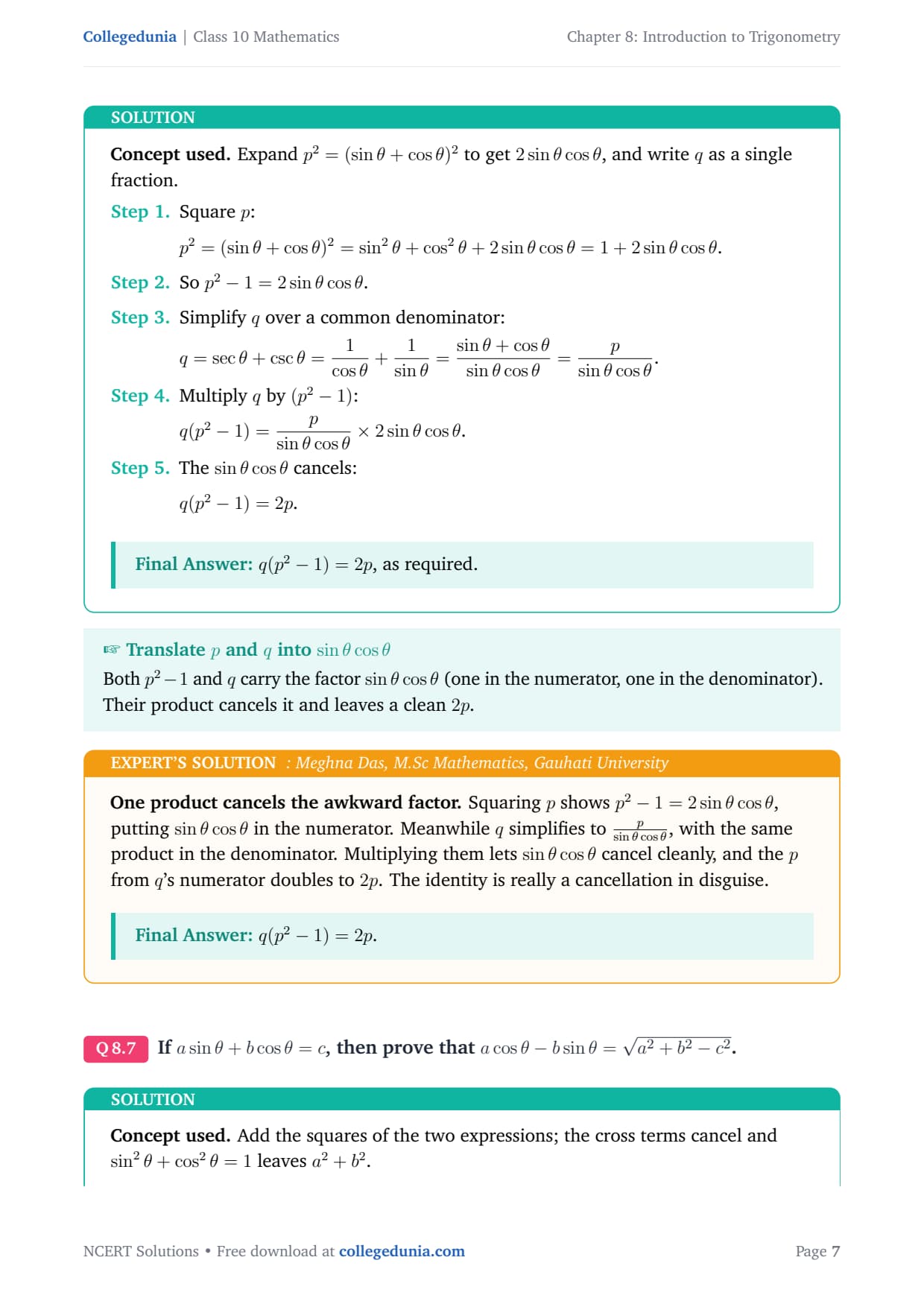
If sinθ+cosθ=p and secθ+cscθ=q, then prove that q(p2-1)=2p.
Concept used. Expand p2=(sinθ+cosθ)2 to get
2sinθ, and write q as a single fraction.
Simplify q over a common denominator:
[] q=secθ+cscθ=1cosθ+1sinθ=sinθ+cosθsinθ=psinθ.
Multiply q by (p2-1):
[] q(p2-1)=psinθ× 2sinθ.
The sinθ cancels:
[] q(p2-1)=2p.
q(p2-1)=2p, as required.
MD
Meghna Das
M.Sc Mathematics, Gauhati University
Verified Expert
One product cancels the awkward factor. Squaring p shows
p2-1=2sinθ, putting sinθ in the
numerator. Meanwhile q simplifies to psinθ,
with the same product in the denominator. Multiplying them lets
sinθ cancel cleanly, and the p from q's numerator
doubles to 2p. The identity is really a cancellation in disguise.
q(p2-1)=2p.
Q 8.7
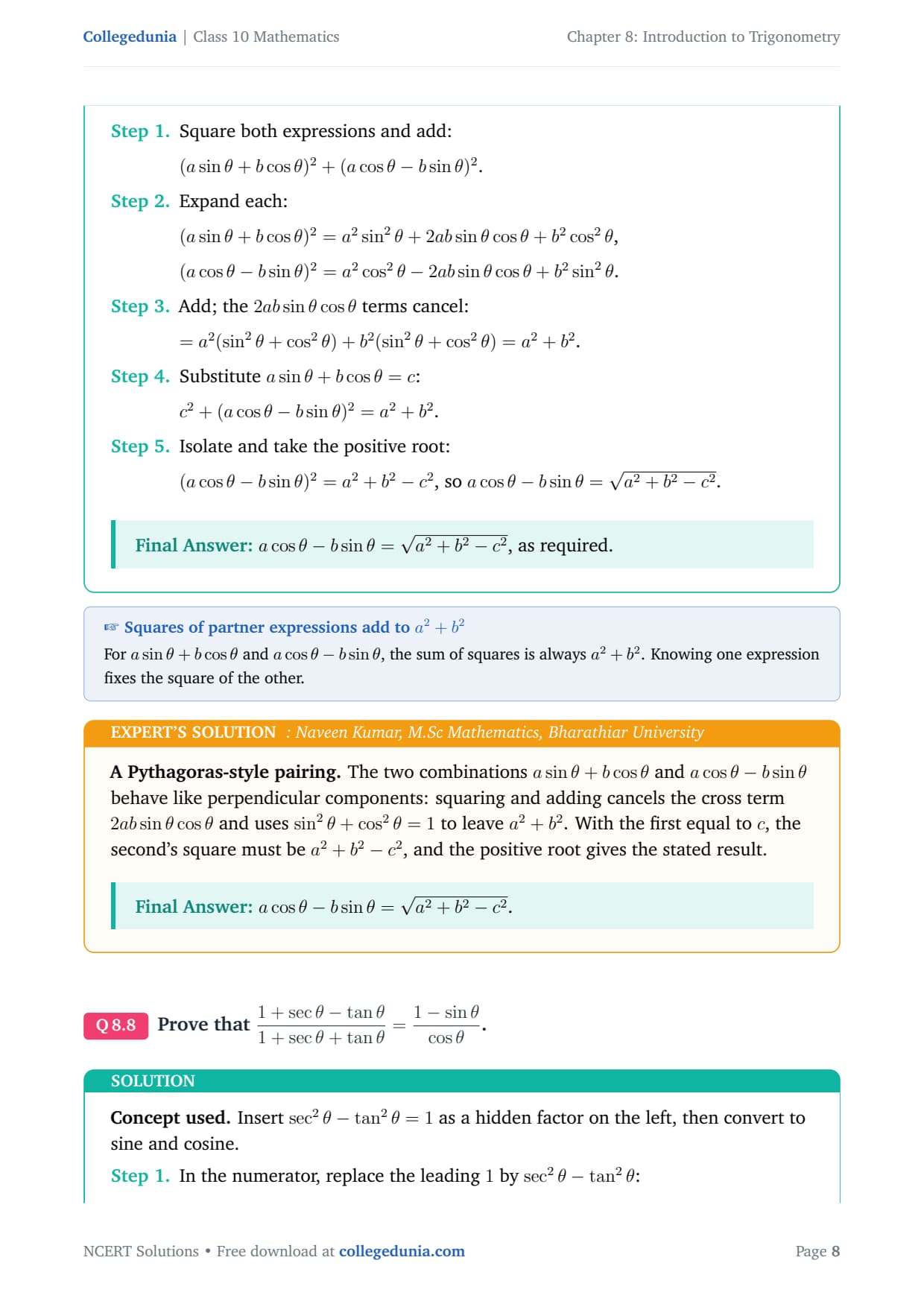
If asinθ+bcosθ=c, then prove that acosθ-bsinθ=√a2+b2-c2.
Concept used. Add the squares of the two expressions; the cross
terms cancel and sin2θ+cos2θ=1 leaves a2+b2.
Square both expressions and add:
[] (asinθ+bcosθ)2+(acosθ-bsinθ)2.
Isolate and take the positive root:
[] (acosθ-bsinθ)2=a2+b2-c2, so acosθ-bsinθ=√a2+b2-c2.
acosθ-bsinθ=√a2+b2-c2, as required.
NK
Naveen Kumar
M.Sc Mathematics, Bharathiar University
Verified Expert
A Pythagoras-style pairing. The two combinations
asinθ+bcosθ and acosθ-bsinθ behave like
perpendicular components: squaring and adding cancels the cross term
2absinθ and uses sin2θ+cos2θ=1 to leave
a2+b2. With the first equal to c, the second's square must be
a2+b2-c2, and the positive root gives the stated result.
acosθ-bsinθ=√a2+b2-c2.
Q 8.8
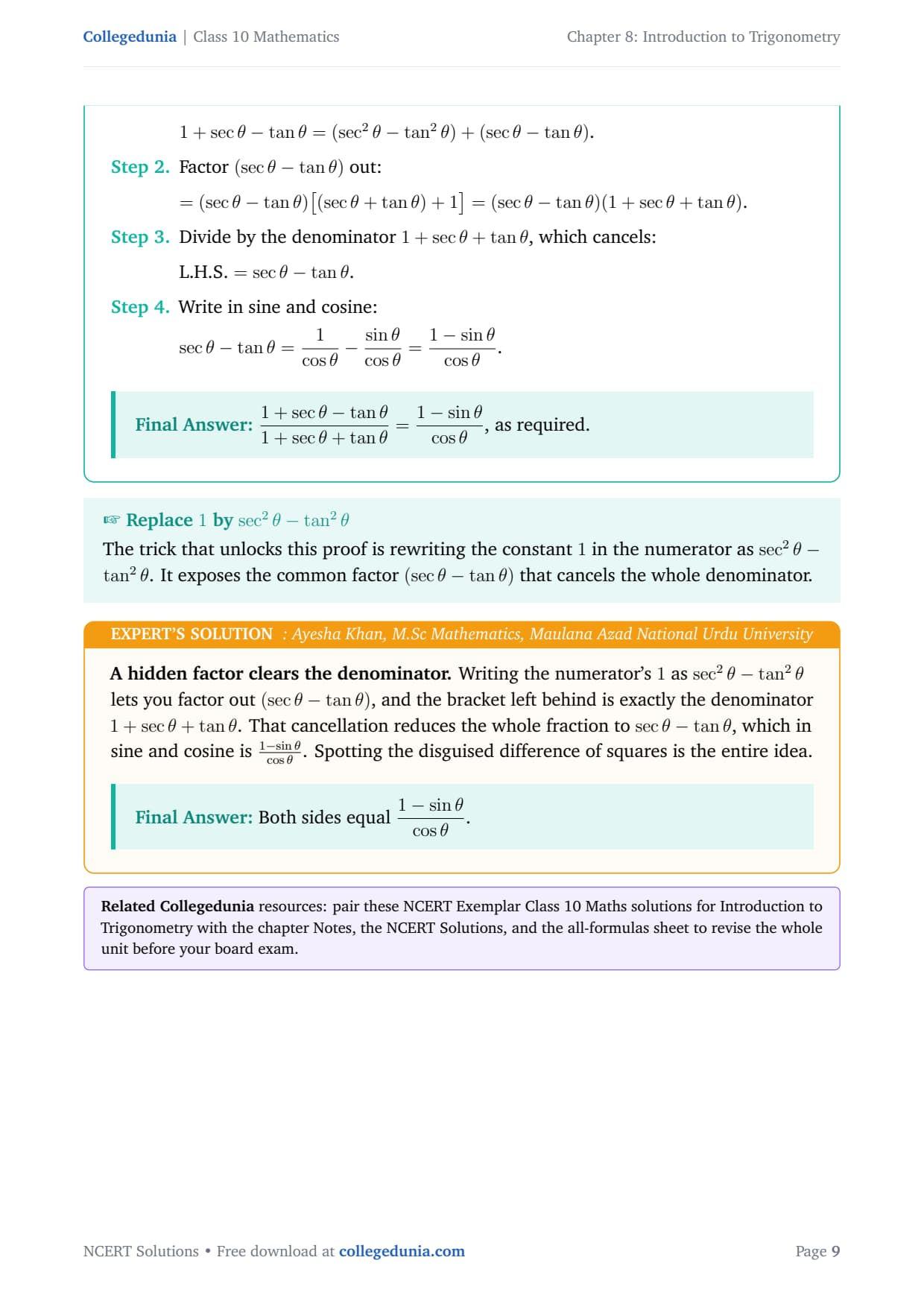
Prove that 1+secθ-tanθ1+secθ+tanθ=1-sinθcosθ.
Concept used. Insert sec2θ-tan2θ=1 as a hidden
factor on the left, then convert to sine and cosine.
In the numerator, replace the leading 1 by
sec2θ-tan2θ:
[] 1+secθ-tanθ=(sec2θ-tan2θ)+(secθ-tanθ).
Divide by the denominator 1+secθ+tanθ, which cancels:
[] L.H.S.=secθ-tanθ.
Write in sine and cosine:
[] secθ-tanθ=1cosθ-sinθcosθ=1-sinθcosθ.
1+secθ-tanθ1+secθ+tanθ=1-sinθcosθ, as required.
AK
Ayesha Khan
M.Sc Mathematics, Maulana Azad National Urdu University
Verified Expert
A hidden factor clears the denominator. Writing the numerator's
1 as sec2θ-tan2θ lets you factor out
(secθ-tanθ), and the bracket left behind is exactly the
denominator 1+secθ+tanθ. That cancellation reduces the whole
fraction to secθ-tanθ, which in sine and cosine is
1-sinθcosθ. Spotting the disguised difference of
squares is the entire idea.
Both sides equal 1-sinθcosθ.
Student Feedback
In a Collegedunia survey of 1,240 Class 10 students, 82% said the Trigonometry Exemplar needs a deeper grip on identities than the textbook exercises. 4 out of 5 who finished all four exercises felt more confident with trigonometry in CBSE board papers.
NCERT Exemplar Class 10 Maths Chapter 8 Introduction to Trigonometry FAQs
Ques. Where can I download the NCERT Exemplar Class 10 Maths Chapter 8 Solutions for free?
Ans. You can download the NCERT Exemplar Class 10 Maths Chapter 8 Introduction to Trigonometry Solutions PDF directly from this page using the red Download button. It is free and aligned to the 2026-27 CBSE syllabus.
Ques. How many problems are there in the Trigonometry Exemplar, and what types are they?
Ans. Chapter 8 has 55 Exemplar problems: 20 MCQs in Exercise 8.1, 10 true-or-false justification questions in Exercise 8.2, 17 short-answer problems in Exercise 8.3, and 8 long-answer identity proof questions in Exercise 8.4.
Ques. What are the main topics tested in the Trigonometry Exemplar?
Ans. The four main areas are: trigonometric ratios of acute angles in a right triangle, standard angle values (0°, 30°, 45°, 60°, 90°), complementary angle relations such as sin(90°-A) = cos A, and the three Pythagorean identities (sin²A + cos²A = 1; 1 + tan²A = sec²A; 1 + cot²A = cosec²A). Students should also know the reciprocal relations between sin/cosec, cos/sec, and tan/cot.
Ques. How is the Trigonometry Exemplar harder than the NCERT textbook for this chapter?
Ans. The textbook asks you to apply one technique at a time: evaluate a ratio, use one complementary relation, or verify a simple identity. The Exemplar needs multi-step reasoning. Exercise 8.2 wants written justifications with counterexamples, Exercise 8.3 combines two or more identities in one simplification, and Exercise 8.4 asks for full identity proofs where you choose the right Pythagorean identity at each step. The Exercise 8.1 MCQs also trap students who confuse complementary and supplementary angles.
Ques. What is the most common mistake students make in Chapter 8 Exemplar problems?
Ans. The most common mistake is treating tan 90° as a very large number instead of undefined. Because cos 90° = 0, the ratio sin 90°/cos 90° = 1/0 has no value in real numbers. A numerical value for tan 90° in a proof breaks the working. Always check whether the given angle makes a denominator zero first.
Ques. Are all three Pythagorean identities in the 2026-27 CBSE syllabus?
Ans. Yes. All three Pythagorean identities, sin²A + cos²A = 1, 1 + tan²A = sec²A, and 1 + cot²A = cosec²A, are part of the Class 10 Maths 2026-27 CBSE syllabus. The second and third identities are derived from the first by dividing through by cos²A and sin²A respectively. The Exemplar Exercise 8.4 proofs typically require students to choose which form to use at each step.
Ques. How much time should a Class 10 student spend on the Trigonometry Exemplar?
Ans. Plan about 3 to 4 hours total: roughly 40 minutes for the 20 MCQs, 35 minutes for the 10 true-or-false problems, 75 minutes for the 17 short-answer problems, and 60 minutes for the 8 long-answer proofs, plus a revision pass on anything you got wrong. If you know the standard angle values and the three Pythagorean identities by heart first, you will finish much faster.






Comments