Biology Mentor, Hindu College | Updated on - Jul 23, 2026
The 2026-27 NCERT keeps Chemical Reactions and Equations as the opening chapter of Class 10 Science, and the NCERT Exemplar pushes it well past the textbook. The Class 10 Science Chapter 1 NCERT Exemplar Solutions on this page solve every Exemplar problem step by step, in plain language a board student can follow.
CBSE Board weightage: the chemistry unit carries strong marks, and Chapter 1 is a near-certain question every year.
What you get: all MCQ, Short Answer and Long Answer problems solved, with a free downloadable PDF.
Solved by Collegedunia: Every problem below is solved by subject experts, mapped to the 2026-27 NCERT Exemplar, and checked against the CBSE Board marking scheme.
Why the NCERT Exemplar Matters for Class 10 Board Preparation
Chemical Reactions and Equations is one of the most scoring chapters in the Class 10 Science board paper, yet small slips cost easy marks. The NCERT Exemplar turns the textbook basics into real exam-style questions: multi-statement MCQs, balance-and-classify problems, and reasoning on rusting and rancidity.
Quick Tip: Solve the NCERT textbook exercises first, then the Exemplar. It assumes you can already balance a chemical equation and name the five reaction types.
Chemical Reactions and Equations Class 10 Video Solutions
How Collegedunia's NCERT Exemplar Solutions Help You with Chemical Reactions and Equations
Each problem is solved the way a CBSE Board examiner expects, with every step written out.
Every question type solved: all MCQ, Short Answer and Long Answer Exemplar problems are worked out, not just the easy ones.
2026-27 Exemplar alignment: problem numbers and answers match the current edition.
Step-by-step balancing: coefficients are added one element at a time so you can copy the method.
Trap flags: red boxes mark where students usually swap oxidising and reducing agents.
Best Way to Use the Chemical Reactions and Equations Exemplar for Board Revision
Treat the Exemplar as a practice paper.
Phase
Exemplar Use
Time
First read
All MCQs
1 hour
Concept practice
Balancing + reaction-type Short Answers
1.5 hours
Answer writing
All Long Answers, full working
2 hours
Pre-board revision
Re-solve the wrong ones
1 hour
That is about 5.5 hours. Spend most of it on balancing equations and naming reaction types, which carry the most marks.
Chemical Reactions and Equations Exemplar Question Types with One Solved Sample Each
The Class 10 Science Chapter 1 Exemplar mixes three broad question formats, previewed below.
Type
Sample Question
Answer Shape
MCQ
Which of the following is not a physical change?
Single option, with reason
MCQ (multi-statement)
Which statements about the iron + steam reaction are correct?
Pick the correct set of statements
Short Answer
Balance the equation and name the reaction type
Balanced equation + reaction name
Reasoning
Why do we store silver chloride in dark bottles?
Short explanation with equation
Long Answer
Heating copper nitrate: equation, gas, type, pH
Four linked parts
Five Types of Chemical Reactions Quick Reference
Most Exemplar MCQs test whether you can spot the reaction family at a glance.
Reaction Type
Pattern
Example
Combination
Two or more reactants give one product
CaO + H2O → Ca(OH)2
Decomposition
One reactant gives two or more products
2FeSO4 → Fe2O3 + SO2 + SO3
Displacement
A more reactive element pushes out a less reactive one
Fe + CuSO4 → FeSO4 + Cu
Double displacement
Two compounds swap ions, often a precipitate forms
Na2SO4 + BaCl2 → BaSO4 + 2NaCl
Oxidation-reduction (redox)
One species gains oxygen, another loses it
CuO + H2 → Cu + H2O
A reaction can wear two labels at once: the thermite reaction is both a displacement and a redox reaction.
Difficulty Step-Up from NCERT Textbook to Exemplar
The Exemplar reuses textbook ideas inside harder wrappers, as shown below.
Concept
NCERT Textbook
NCERT Exemplar
Balancing
Balance a given equation
Fill missing species and state symbols (x and y)
Reaction type
Name one clear reaction
Pick all correct labels from a multi-statement list
Redox
Define oxidation and reduction
Identify oxidising and reducing agents in six reactions
Exothermic / endothermic
State the definition
Classify four real changes from a beaker observation
Corrosion
Explain rusting
Reason out why silver turns black and how to clean it
Topics Covered in Class 10 Science Chapter 1 Chemical Reactions and Equations Exemplar
The NCERT Exemplar for Chapter 1 covers the difference between a physical change and a chemical change, the five reaction families, state symbols (s, l, g, aq), balancing chemical equations, oxidising and reducing agents, exothermic and endothermic changes, thermal and photochemical decomposition, corrosion, and rancidity.
Chemical Reactions and Equations Exemplar Common Mistakes That Cost Marks
The Exemplar twists trigger the same wrong reflexes every year. Watch these four.
Swapping oxidising and reducing agents. The species that gives oxygen to another is the oxidising agent, not the reducing agent.
Not balancing before classifying. Always balance first; an unbalanced equation loses marks even if the reaction type is right.
Wrong state symbols. At a high reaction temperature water leaves as steam, so write H2O(g), not (l).
Calling every dissolving exothermic. NaOH warms its water, but NH4Cl cools it; the direction depends on the salt.
Watch Out: In a multi-statement MCQ, test every statement to the end. Stopping at the first correct one is a common way to lose marks.
Balancing Chemical Equations Step by Step
A balanced equation obeys the law of conservation of mass: each element has equal atoms on both sides. Use this fixed order.
Step 1: Write the correct formula of each reactant and product; never change a correct formula to balance.
Step 2: Balance metals first, then non-metals, then hydrogen, and leave oxygen for last.
Step 3: Treat polyatomic ions such as SO4 as one unit when they stay unchanged.
Step 4: Count atoms on both sides to check, then add state symbols.
For example, combustion of ethene: C2H4 + 3O2 → 2CO2 + 2H2O.
Most Repeated Board Topics from Chemical Reactions and Equations
A quick scan of the topics that show up most often in CBSE Board papers.
Topic
How it is asked
Balancing and reaction type
Balance the equation and name the type
Oxidising and reducing agents
Identify the agent in a given redox reaction
Decomposition reactions
Thermal and photochemical decomposition with equations
Corrosion and rancidity
Explain rusting, blackening of silver, and how to prevent rancidity
Exothermic vs endothermic
Classify changes from a temperature observation
All NCERT Exemplar Questions for Chemical Reactions and Equations with Step-by-Step Solutions
Every NCERT Exemplar question for Class 10 Science Chapter 1 Chemical Reactions and Equations is listed below with its full Solution and Expert Solution in collapsible tabs.
I. Multiple Choice Questions
Q 1.1
Which of the following is not a physical change?
(a) Boiling of water to give water vapour
(b) Melting of ice to give water
(c) Dissolution of salt in water
(d) Combustion of Liquefied Petroleum Gas (LPG)
Correct option: (d) Combustion of Liquefied Petroleum Gas (LPG).
Concept used. A physical change alters only the
state, shape or appearance of a substance; no new substance forms and
the change is usually reversible. A chemical change produces
one or more new substances with new properties and is hard to reverse.
Boiling water, melting ice and dissolving salt only change the
physical state or spread the same molecules around. Water is
still H2O; salt is still NaCl. These are physical.
Burning LPG (mostly butane) reacts it with oxygen to make brand
new substances, carbon dioxide and water, plus a lot of heat:
2C4H10 + 13O2 → 8CO2 + 10H2O. New products mean a chemical
change.
So the one change that is not physical is the combustion
of LPG.
Final Answer: Option (d): combustion of LPG is a chemical change, not a physical change.
RM
Rohan Mehta
M.Sc Chemistry, IIT Bombay
Verified Expert
Reverse-the-change test. I always ask one question: can I undo
this and get the same substance back? If yes, it is physical; if no, it
is chemical.
Concept used. In a physical change the chemical formula of the
substance is unchanged. In a chemical change at least one bond is broken
and a new bond is made, so a new formula appears among the products.
Option (a) boiling water.H2O(l) → H2O(g). Same
molecule, only the state changes. Condense the vapour and you
get water back. Physical.
Option (b) melting ice.H2O(s) → H2O(l). Freeze
it again and the ice returns. Physical.
Option (c) dissolving salt.NaCl ions spread
through water; evaporate the water and the salt crystals come
back. Physical.
Option (d) burning LPG. The fuel is destroyed and
carbon dioxide plus water vapour are created. There is no way to
cool the smoke and recover LPG. Chemical.
Why this matters. Telling physical from chemical change is the
gate to the whole chapter. Combustion, rusting, cooking and digestion
are all chemical because they make new substances.
Final Answer: Option (d): combustion of LPG, the only chemical change in the list.
Q 1.2
The following reaction is an example of a 4NH3(g) + 5O2(g) → 4NO(g) + 6H2O(g)
(i) displacement reaction
(ii) combination reaction
(iii) redox reaction
(iv) neutralisation reaction
(a) (i) and (iv) (b) (ii) and (iii) (c) (i) and (iii) (d) (iii) and (iv)
Correct option: (c) (i) and (iii).
Concept used. A redox reaction is one in which
oxidation (gain of oxygen / loss of hydrogen) and reduction (loss of
oxygen / gain of hydrogen) happen together. A displacement
reaction is one in which a more reactive element pushes out a less
reactive one from its compound.
Nitrogen in NH3 loses hydrogen and gains oxygen to become
NO, so ammonia is oxidised. Oxygen in O2 ends up bonded
to hydrogen as water, so it is reduced. Both happen, so this is a
redox reaction (iii).
Oxygen drives hydrogen out of ammonia and takes its place beside
nitrogen, so it also fits the pattern of a displacement reaction
(i).
It is not a combination reaction (a combination gives one single
product, but here there are two products). It is not a
neutralisation (no acid plus base making salt and water).
Final Answer: Option (c): the reaction is both a displacement and a redox reaction.
AI
Ananya Iyer
M.Sc Inorganic Chemistry, IIT Madras
Verified Expert
Track the oxygen and hydrogen. For a Class 10 reaction the
quickest redox test is to follow where oxygen and hydrogen go. If oxygen
is added somewhere and removed somewhere, it is redox.
Concept used. Oxidation is gain of oxygen or loss of hydrogen;
reduction is the reverse. Displacement means one element takes the place
of another in a compound.
Oxidation half.NH3 has nitrogen tied to hydrogen.
In NO that nitrogen is tied to oxygen instead. Nitrogen has
gained oxygen and lost hydrogen, so ammonia is oxidised.
Reduction half. Free O2 is electrically neutral.
In H2O that oxygen now carries a share of hydrogen's
electrons, so molecular oxygen is reduced.
Why displacement too. Oxygen kicks hydrogen off
nitrogen and bonds to nitrogen in its place. One element
replacing another inside a compound is the displacement pattern.
Eliminate the rest. Combination needs a single product;
we have two. Neutralisation needs acid and base; neither is
present. So (ii) and (iv) are out.
Why this matters. Many reactions wear two labels at once.
Reading the question as "tick all that apply" stops students from
settling for the first match they see.
Final Answer: Option (c): statements (i) displacement and (iii) redox are both correct.
Q 1.3
Which of the following statements about the given reaction are correct? 3Fe(s) + 4H2O(g) → Fe3O4(s) + 4H2(g)
(i) Iron metal is getting oxidised
(ii) Water is getting reduced
(iii) Water is acting as reducing agent
(iv) Water is acting as oxidising agent
(a) (i), (ii) and (iii) (b) (iii) and (iv)
(c) (i), (ii) and (iv) (d) (ii) and (iv)
Correct option: (c) (i), (ii) and (iv).
Concept used. The oxidising agent is the species that
gets reduced (it hands oxygen out or takes electrons). The
reducing agent is the species that gets oxidised (it gives
oxygen away or donates electrons).
Iron starts as the free metal Fe and ends combined with
oxygen in Fe3O4. It has gained oxygen, so iron is oxidised.
Statement (i) is correct.
Water H2O loses its oxygen to the iron and is released as
free hydrogen H2. Losing oxygen means water is reduced.
Statement (ii) is correct.
Because water is the species being reduced, water is the
oxidising agent (it supplied oxygen to the iron). So statement
(iv) is correct and statement (iii) is wrong.
Final Answer: Option (c): iron is oxidised, water is reduced, and water acts as the oxidising agent.
VN
Vikram Nair
M.Sc Chemistry, IIT Kanpur
Verified Expert
Name who-does-what to who. In every redox line, first decide
which species is oxidised and which is reduced, then read off the agents
from those two findings.
Concept used. A reducing agent is itself oxidised; an oxidising
agent is itself reduced. Oxidation here means gaining oxygen and
reduction means losing oxygen.
Iron's fate.Fe (no oxygen) becomes Fe3O4
(full of oxygen). Iron gains oxygen, so iron is oxidised. That
makes iron the reducing agent.
Water's fate.H2O (has oxygen) becomes H2 (no
oxygen). Water loses oxygen, so water is reduced. That makes
water the oxidising agent.
Score the statements. (i) iron oxidised: yes. (ii)
water reduced: yes. (iii) water as reducing agent: no, water is
the oxidising agent. (iv) water as oxidising agent: yes.
So the correct set is (i), (ii) and (iv), which is option (c).
Why this matters. This very reaction is how blacksmiths once
made iron react with steam. Getting the agent labels right is what
separates a careful answer from a guess.
Final Answer: Option (c): statements (i), (ii) and (iv) are correct.
Q 1.4
Which of the following are exothermic processes?
(i) Reaction of water with quick lime
(ii) Dilution of an acid
(iii) Evaporation of water
(iv) Sublimation of camphor (crystals)
(a) (i) and (ii) (b) (ii) and (iii) (c) (i) and (iv) (d) (iii) and (iv)
Correct option: (a) (i) and (ii).
Concept used. An exothermic process releases heat to
its surroundings, so the surroundings warm up. An
endothermic process absorbs heat, so the surroundings cool
down.
Adding water to quick lime (calcium oxide) gives off a large
amount of heat: CaO + H2O → Ca(OH)2. The container feels
hot, so it is exothermic. Statement (i) is correct.
Diluting a strong acid in water releases heat, which is why we
always add acid to water and not the reverse. Exothermic, so (ii)
is correct.
Evaporation of water and sublimation of camphor both need heat
to be taken in to change the state. They are endothermic, so
(iii) and (iv) are wrong.
Final Answer: Option (a): slaking of lime and dilution of acid are both exothermic.
SR
Sneha Reddy
M.Sc Physical Chemistry, IIT Hyderabad
Verified Expert
Feel the beaker. The simplest classroom test for these is
whether the beaker gets hot (exothermic) or cold (endothermic) to touch.
Concept used. Heat flows out in an exothermic change and into
the system in an endothermic change. State changes from liquid to gas or
solid to gas always absorb heat.
Quick lime plus water. This slaking reaction is famous
for boiling its own water. Strongly exothermic. Mark (i).
Diluting acid. Concentrated acid mixing with water
releases hydration energy as heat. Exothermic. Mark (ii).
Evaporation. Liquid water must absorb the latent heat of
vaporisation to leave as vapour. Endothermic, so reject (iii).
Sublimation of camphor. Solid to gas needs energy to
break the solid's forces. Endothermic, so reject (iv).
Why this matters. Cooks, chemists and even cement workers rely
on the heat of slaking lime, while sweat cooling our skin is everyday
endothermic evaporation.
Final Answer: Option (a): processes (i) and (ii) are exothermic.
Q 1.5
Three beakers labelled as A, B and C each containing 25 mL of water were taken. A small amount of NaOH, anhydrous CuSO4 and NaCl were added to the beakers A, B and C respectively. It was observed that there was an increase in the temperature of the solutions contained in beakers A and B, whereas in case of beaker C, the temperature of the solution falls. Which one of the following statement(s) is(are) correct?
(i) In beakers A and B, exothermic process has occurred.
(ii) In beakers A and B, endothermic process has occurred.
(iii) In beaker C exothermic process has occurred.
(iv) In beaker C endothermic process has occurred.
(a) (i) only (b) (ii) only (c) (i) and (iv) (d) (ii) and (iii)
Correct option: (c) (i) and (iv).
Concept used. A temperature rise means heat was given out, so
the process is exothermic. A temperature fall means heat was
taken in from the water, so the process is endothermic.
Beakers A (NaOH) and B (anhydrous CuSO4) both warmed up.
Heat was released, so an exothermic process took place in A and
B. Statement (i) is correct.
Beaker C (NaCl) cooled down. Heat was absorbed from the water, so
an endothermic process took place in C. Statement (iv) is
correct.
Statements (ii) and (iii) reverse the labels, so they are wrong.
Final Answer: Option (c): A and B are exothermic, C is endothermic.
AD
Arjun Desai
M.Sc Chemistry, IIT Roorkee
Verified Expert
Read the thermometer. The whole question reduces to one rule:
hotter solution means heat released (exothermic), colder solution means
heat absorbed (endothermic).
Concept used. Dissolving a substance breaks its lattice (needs
energy) and hydrates the ions (releases energy). If the release wins,
the solution warms; if the lattice cost wins, it cools.
Beaker A, NaOH. Sodium hydroxide releases strong
hydration energy, so the water heats up. Exothermic.
Beaker B, anhydrous CuSO4. The dry salt grabs
water of crystallisation, releasing heat. The solution heats up.
Exothermic.
Beaker C, NaCl. For common salt the energy to break the
lattice slightly exceeds the hydration energy, so the solution
cools a little. Endothermic.
Putting these together, exothermic in A and B (statement i) and
endothermic in C (statement iv): option (c).
Why this matters. This experiment shows that not all dissolving
is the same. Whether a salt heats or cools its water is a balance of two
hidden energy terms.
Final Answer: Option (c): statements (i) and (iv) are correct.
Q 1.6
A dilute ferrous sulphate solution was gradually added to the beaker containing acidified permanganate solution. The light purple colour of the solution fades and finally disappears. Which of the following is the correct explanation for the observation?
(a) KMnO4 is an oxidising agent, it oxidises FeSO4
(b) FeSO4 acts as an oxidising agent and oxidises KMnO4
(c) The colour disappears due to dilution; no reaction is involved
(d) KMnO4 is an unstable compound and decomposes in presence of FeSO4 to a colourless compound.
Correct option: (a)KMnO4 is an oxidising agent and it
oxidises FeSO4.
Concept used. Acidified potassium permanganate is a strong
oxidising agent. Its purple colour comes from the manganese in
the MnO4- ion. When it oxidises something, the manganese is itself
reduced to the almost colourless Mn2+ ion, so the purple fades.
Ferrous ions Fe2+ are oxidised to ferric ions Fe3+
by the permanganate. So FeSO4 is the reducing agent here.
In doing this, the purple MnO4- is reduced to the pale
Mn2+ ion, and the colour disappears.
This is a real chemical reaction, not just dilution, so options
(b), (c) and (d) are wrong.
Final Answer: Option (a): KMnO4 acts as the oxidising agent and oxidises ferrous sulphate, so its purple colour fades.
KM
Kavya Menon
M.Sc Analytical Chemistry, IIT Madras
Verified Expert
Colour change is the clue. The fading of permanganate purple is
the textbook signature of a redox titration, so the explanation must be
a reaction, not dilution.
Concept used. Permanganate is reduced from MnO4-
(oxidation state + 7, purple) to Mn2+ (oxidation state + 2,
colourless) while it oxidises ferrous to ferric ions.
What gets oxidised.Fe2+ loses one electron to
become Fe3+. So FeSO4 is the reducing agent and is
oxidised.
What gets reduced. The manganese drops from + 7 to
+ 2, gaining electrons, so KMnO4 is the oxidising agent and
is reduced.
Why the colour goes. The purple belongs to MnO4-.
Once it becomes Mn2+, that purple is gone, which is exactly
what is seen.
Reject the others. Dilution would only lighten the
purple, never wipe it out completely, so (c) is wrong; and
KMnO4 does not self-decompose here, so (d) is wrong.
Why this matters. This is the basis of permanganate
titrations used in labs to measure iron content, where the end point is
the first lasting pink.
Final Answer: Option (a): permanganate oxidises ferrous sulphate, and being reduced to Mn2+ its purple colour disappears.
Q 1.7
Which among the following is(are) double displacement reaction(s)?
(i) Pb + CuCl2 → PbCl2 + Cu
(ii) Na2SO4 + BaCl2 → BaSO4 + 2NaCl
(iii) C + O2 → CO2
(iv) CH4 + 2O2 → CO2 + 2H2O
(a) (i) and (iv) (b) (ii) only (c) (i) and (ii) (d) (iii) and (iv)
Correct option: (b) (ii) only.
Concept used. In a double displacement reaction two
compounds swap their ions to form two new compounds. It is often shown
as AB + CD → AD + CB, and frequently one product is an insoluble
precipitate.
In reaction (ii), Na2SO4 and BaCl2 exchange partners:
sodium pairs with chloride and barium pairs with sulphate, giving
BaSO4 (a white precipitate) and NaCl. This is a clean
double displacement.
Reaction (i) is a single displacement: lead replaces copper, only
one swap, so it is not double displacement.
Reactions (iii) and (iv) are combination and combustion
respectively, where elements join oxygen; no ion exchange takes
place.
Final Answer: Option (b): only reaction (ii) is a double displacement reaction.
IK
Ishaan Kapoor
M.Sc Inorganic Chemistry, IIT Delhi
Verified Expert
Count the swaps. Single displacement swaps one element; double
displacement swaps two ion pairs at once. Counting swaps sorts these
fast.
Concept used. Double displacement follows AB + CD → AD + CB, with both cation and anion finding new partners and usually a
precipitate, gas or water forming.
Reaction (ii).Na2SO4 gives Na+ and
SO42-; BaCl2 gives Ba2+ and Cl-. They
recombine as BaSO4 (insoluble) and NaCl. Two swaps, so
double displacement.
Reaction (i). Free lead pushes copper out of
CuCl2. Only one element is replaced, so it is single
displacement.
Reactions (iii) and (iv). Carbon plus oxygen, and
methane plus oxygen, are combination and combustion. They build
oxides; nothing is exchanged.
Hence only (ii) qualifies, giving option (b).
Why this matters. Precipitation tests in the lab, like the
formation of white BaSO4, rely on double displacement to detect
sulphate ions in an unknown sample.
Final Answer: Option (b): reaction (ii) alone is a double displacement reaction.
Q 1.8
Which among the following statement(s) is(are) true? Exposure of silver chloride to sunlight for a long duration turns grey due to
(i) the formation of silver by decomposition of silver chloride
(ii) sublimation of silver chloride
(iii) decomposition of chlorine gas from silver chloride
(iv) oxidation of silver chloride
(a) (i) only (b) (i) and (iii) (c) (ii) and (iii) (d) (iv) only
Correct option: (a) (i) only.
Concept used. A photochemical decomposition reaction
is a decomposition driven by light. White silver chloride breaks down in
sunlight into grey silver metal and chlorine gas.
In sunlight, AgCl decomposes: 2AgCl → 2Ag + Cl2.
The grey colour is caused by the fine silver metal left behind.
So statement (i), formation of silver by decomposition, is the
true reason.
AgCl does not sublime here, and the grey is not from
chlorine or from oxidation, so (ii), (iii) and (iv) are wrong.
Final Answer: Option (a): the grey colour comes from silver formed by photo-decomposition of silver chloride.
MK
Meera Krishnan
M.Sc Chemistry, IIT Madras
Verified Expert
Trace where the grey comes from. The grey solid is the leftover
metal, so the cause must be a decomposition that frees silver.
Concept used. Light supplies the energy for the decomposition
2AgCl → 2Ag + Cl2. The freed silver atoms cluster into grey metal,
while chlorine escapes as a gas.
Identify the grey. Silver metal is grey. Its appearance
tells us silver was set free from the white AgCl.
Name the process. Breaking one compound into simpler
pieces using light is photochemical decomposition. So (i) is
correct.
Reject sublimation. Sublimation would carry AgCl
away as vapour, not leave grey metal, so (ii) is wrong.
Reject (iii) and (iv). The grey is not chlorine (a pale
green gas) and not an oxidation product; it is plain silver. Both
are wrong.
Why this matters. The same reason silver chloride is stored in
dark bottles, to stop this light-driven breakdown, links straight to
Question 34 later in this chapter.
Final Answer: Option (a): only statement (i) is true, the grey is silver from photo-decomposition.
Q 1.9
Solid calcium oxide reacts vigorously with water to form calcium hydroxide accompanied by liberation of heat. This process is called slaking of lime. Calcium hydroxide dissolves in water to form its solution called lime water. Which among the following is (are) true about slaking of lime and the solution formed?
(i) It is an endothermic reaction
(ii) It is an exothermic reaction
(iii) The pH of the resulting solution will be more than seven
(iv) The pH of the resulting solution will be less than seven
(a) (i) and (ii) (b) (ii) and (iii) (c) (i) and (iv) (d) (iii) and (iv)
Correct option: (b) (ii) and (iii).
Concept used. Slaking of lime, CaO + H2O → Ca(OH)2,
releases heat, so it is exothermic. Calcium hydroxide is a base, so its
solution (lime water) is basic with pH greater than 7.
The reaction gives out heat, so it is exothermic. Statement (ii)
is correct and statement (i) is wrong.
Ca(OH)2 is a base. A basic solution has pH above 7, so
statement (iii) is correct and statement (iv) is wrong.
Final Answer: Option (b): slaking of lime is exothermic and the lime water formed has pH above 7.
AV
Aditya Verma
M.Sc Chemistry, IIT Guwahati
Verified Expert
Two facts settle it. One: does the reaction heat up? Two: is the
product acidic or basic? Answer both and the option falls out.
Concept used. An exothermic reaction warms its surroundings.
The product calcium hydroxide is a base, and bases give pH greater than
7 in water.
Energy direction. Quick lime plus water famously gives
off so much heat the water can boil. Heat out means exothermic,
confirming (ii).
Nature of the product.Ca(OH)2 is a hydroxide, so
it is a base. Lime water turns red litmus blue.
pH of a base. A basic solution sits above 7 on the pH
scale, so (iii) is correct and (iv) wrong.
Combining the exothermic finding with the basic pH gives (ii) and
(iii): option (b).
Why this matters. Lime water is used to test for carbon dioxide
gas, which turns it milky. Knowing it is basic explains why it reacts
with the acidic gas CO2.
Final Answer: Option (b): statements (ii) exothermic and (iii) pH above 7 are correct.
Q 1.10
Barium chloride on reacting with ammonium sulphate forms barium sulphate and ammonium chloride. Which of the following correctly represents the type of the reaction involved?
(i) Displacement reaction
(ii) Precipitation reaction
(iii) Combination reaction
(iv) Double displacement reaction
(a) (i) only (b) (ii) only (c) (iv) only (d) (ii) and (iv)
Correct option: (d) (ii) and (iv).
Concept used. A double displacement reaction swaps
ions between two compounds. When one product is an insoluble solid that
settles out, the same reaction is also called a precipitation
reaction.
Writing the equation: BaCl2 + (NH4)2SO4 → BaSO4 + 2NH4Cl.
Barium swaps with ammonium, so two pairs of ions change partners.
That is double displacement, statement (iv).
BaSO4 is insoluble and forms a white precipitate, so the
reaction is also a precipitation reaction, statement (ii).
It is not a single displacement and not a combination, so (i) and
(iii) are wrong.
Final Answer: Option (d): the reaction is both a precipitation and a double displacement reaction.
PS
Pooja Singh
M.Sc Inorganic Chemistry, IIT Bombay
Verified Expert
Two labels, one reaction. Whenever a swap of ions throws down an
insoluble solid, the reaction earns both names at once.
Concept used. Double displacement is the exchange AB + CD → AD + CB. If AD or CB is insoluble, that solid is a
precipitate and the reaction is also called precipitation.
Write and check.BaCl2 + (NH4)2SO4 → BaSO4 + 2NH4Cl. Barium leaves chloride for sulphate, ammonium leaves
sulphate for chloride. Both pairs swap, so double displacement.
Spot the precipitate.BaSO4 is famously insoluble
in water and drops out as a white solid, so this is also
precipitation.
Eliminate the rest. No free element is set free, ruling
out displacement (i); two products form, ruling out combination
(iii).
So both (ii) and (iv) apply, giving option (d).
Why this matters. The insoluble white BaSO4 is the same
"barium meal" used in medical X-rays of the digestive tract, because it
shows up clearly and does not dissolve.
Final Answer: Option (d): statements (ii) precipitation and (iv) double displacement are both correct.
Q 1.11
Electrolysis of water is a decomposition reaction. The mole ratio of hydrogen and oxygen gases liberated during electrolysis of water is
(a) 1:1 (b) 2:1 (c) 4:1 (d) 1:2
Correct option: (b) 2:1.
Concept used. Electrolysis splits water using electricity. The
balanced equation 2H2O → 2H2 + O2 fixes the ratio of gases by the
coefficients in front of each formula.
Balanced reaction: 2H2O → 2H2 + O2.
The coefficient of H2 is 2 and of O2 is 1, so 2 moles
of hydrogen form for every 1 mole of oxygen.
Therefore the mole ratio of hydrogen to oxygen is 2:1.
Final Answer: Option (b): hydrogen to oxygen is liberated in the mole ratio 2:1.
NJ
Nikhil Joshi
M.Sc Physical Chemistry, IIT Kanpur
Verified Expert
Read it off the balanced line. For any gas ratio in a reaction,
the coefficients in the balanced equation are the whole answer.
Concept used. In a balanced equation the mole ratio of any two
species equals the ratio of their coefficients. Water is H2O, with
two H per one O.
Balance the split.2H2O → 2H2 + O2. Four H and two
O on each side, so it is balanced.
Pick the coefficients.H2 carries a 2; O2
carries a 1.
Form the ratio. Hydrogen : oxygen = 2 : 1. This matches
the 2-to-1 atom count in water itself.
So the volume of hydrogen collected is double that of oxygen,
option (b).
Why this matters. In the classic electrolysis experiment the
test tube over the negative electrode collects twice the gas of the
positive electrode, a visible proof of this 2:1 ratio.
Final Answer: Option (b): the mole ratio of hydrogen to oxygen is 2:1.
Q 1.12
Which of the following is(are) an endothermic process(es)?
(i) Dilution of sulphuric acid
(ii) Sublimation of dry ice
(iii) Condensation of water vapours
(iv) Evaporation of water
(a) (i) and (iii) (b) (ii) only (c) (iii) only (d) (ii) and (iv)
Correct option: (d) (ii) and (iv).
Concept used. An endothermic process absorbs heat
from its surroundings. Changes of state from solid to gas (sublimation)
and from liquid to gas (evaporation) both need heat to be supplied.
Sublimation of dry ice (solid CO2 turning straight to gas)
absorbs heat, so it is endothermic. Statement (ii) is correct.
Evaporation of water absorbs heat to change liquid into vapour,
so it is endothermic. Statement (iv) is correct.
Dilution of sulphuric acid releases heat, and condensation
releases heat, so both (i) and (iii) are exothermic and are
rejected.
Final Answer: Option (d): sublimation of dry ice and evaporation of water are endothermic.
RA
Riya Agarwal
M.Sc Chemistry, IIT Roorkee
Verified Expert
Energy goes which way? If a step needs heat fed in to happen, it
is endothermic; if it gives heat out, it is exothermic.
Concept used. Breaking the forces in a solid or liquid to make
a gas costs energy, so it is endothermic. Building those forces back up
on condensing or freezing releases energy.
Sublimation of dry ice. Solid CO2 must absorb heat
to jump to gas, leaving a cold fog. Endothermic, so (ii).
Evaporation of water. Liquid takes in latent heat to
become vapour, which is why sweat cools us. Endothermic, so (iv).
Dilution of acid. Concentrated H2SO4 mixing with
water releases hydration heat. Exothermic, reject (i).
Condensation. Vapour to liquid gives heat back.
Exothermic, reject (iii).
Why this matters. Dry ice keeps ice cream cold for hours
because its endothermic sublimation steadily pulls heat from its
surroundings.
Final Answer: Option (d): statements (ii) and (iv) are endothermic.
Q 1.13
In the double displacement reaction between aqueous potassium iodide and aqueous lead nitrate, a yellow precipitate of lead iodide is formed. While performing the activity if lead nitrate is not available, which of the following can be used in place of lead nitrate?
(a) Lead sulphate (insoluble)
(b) Lead acetate
(c) Ammonium nitrate
(d) Potassium sulphate
Correct option: (b) Lead acetate.
Concept used. A precipitation reaction needs both reactants to
be soluble so their ions are free in solution and can meet to
make the insoluble product. The replacement must therefore be a soluble
lead salt.
We need a source of free Pb2+ ions in water. Lead acetate
is soluble, so it provides Pb2+ ions just like lead
nitrate. So (b) works.
Lead sulphate is insoluble, so it cannot release Pb2+ ions
into solution; (a) fails.
Ammonium nitrate and potassium sulphate contain no lead at all,
so they cannot form yellow PbI2; (c) and (d) fail.
Final Answer: Option (b): soluble lead acetate can replace lead nitrate as a source of Pb2+ ions.
TR
Tanvi Rao
M.Sc Analytical Chemistry, IIT Madras
Verified Expert
Find the free lead ion. The yellow solid is PbI2, so the
substitute must release Pb2+ into water freely.
Concept used. A precipitate forms when free cations and anions
meet. So both reactants must dissolve to set their ions loose, and the
new lead salt must be soluble.
What ion do we need. Lead nitrate supplies Pb2+.
The stand-in must do the same.
Test lead acetate (b). It dissolves well in water,
giving Pb2+ ions that join I- to form yellow
PbI2. It works.
Test lead sulphate (a). It is insoluble, so it never
gives free Pb2+. Rejected.
Test (c) and (d). Ammonium nitrate and potassium
sulphate have no lead, so no yellow precipitate is possible.
Rejected.
Why this matters. Choosing the right reagent is a real lab
skill. Picking an insoluble salt by mistake is a common reason an
experiment shows no reaction.
Final Answer: Option (b): lead acetate, a soluble lead salt, can stand in for lead nitrate.
Q 1.14
Which of the following gases can be used for storage of fresh sample of an oil for a long time?
(a) Carbon dioxide or oxygen
(b) Nitrogen or oxygen
(c) Carbon dioxide or helium
(d) Helium or nitrogen
Correct option: (d) Helium or nitrogen.
Concept used. Oils turn rancid because they undergo
oxidation by the oxygen in air. To prevent this, the food is
flushed with an unreactive (inert) gas that keeps oxygen away.
Helium is a noble gas and nitrogen is very unreactive at room
temperature. Neither reacts with the oil, so they stop oxidation
and rancidity. So (d) is correct.
Oxygen is exactly what causes rancidity, so any option containing
oxygen, (a) and (b), is wrong.
Carbon dioxide can dissolve in and slowly affect some foods, and
the exemplar pairs it out; the safe pair given is helium or
nitrogen.
Final Answer: Option (d): flushing with the inert gases helium or nitrogen keeps oil fresh by excluding oxygen.
KS
Karthik Subramanian
M.Sc Chemistry, IIT Madras
Verified Expert
Keep oxygen out. Rancidity is air-oxidation of fats, so the
storage gas must be one that will not react with the oil.
Concept used. Antioxidant packaging replaces reactive oxygen
with an inert gas. Noble gases like helium and unreactive nitrogen are
the standard choices.
Name the spoiler. Oxygen oxidises fats and oils, giving
the stale smell and taste of rancidity.
Reject oxygen options. Options (a) and (b) both include
oxygen, which would speed up spoilage. Rejected.
Choose the inert pair. Helium (a noble gas) and nitrogen
(unreactive in normal conditions) both refuse to react with the
oil, so (d) protects it.
Hence option (d) is the safe storage choice.
Why this matters. Nitrogen flushing is a routine industrial
trick for extending the shelf life of packaged foods, dried fruits and
medicines.
Final Answer: Option (d): helium or nitrogen, both inert, are used to store oils and prevent rancidity.
Q 1.15
The following reaction is used for the preparation of oxygen gas in the laboratory:
2KClO3(s) → 2KCl(s) + 3O2(g) (heated in the presence of a catalyst).
Which of the following statement(s) is(are) correct about the reaction?
(a) It is a decomposition reaction and endothermic in nature
(b) It is a combination reaction
(c) It is a decomposition reaction and accompanied by release of heat
(d) It is a photochemical decomposition reaction and exothermic in nature
Correct option: (a) It is a decomposition reaction and
endothermic in nature.
Concept used. A decomposition reaction breaks a single
compound into two or more products. When heat must be supplied to drive
the breakdown, the reaction is endothermic.
One compound, KClO3, splits into two products, KCl and
O2. That is a decomposition reaction.
Heat has to be supplied continuously to keep the breakdown going,
so the reaction absorbs heat and is endothermic.
Because heat is taken in (not given out) and the trigger is heat
(not light), options (b), (c) and (d) are wrong.
Final Answer: Option (a): the reaction is an endothermic thermal decomposition.
DP
Devika Pillai
M.Sc Chemistry, IIT Hyderabad
Verified Expert
Two questions to answer. What type of reaction is it, and does
it take in or give out heat? Settle both and the option is clear.
Concept used. Thermal decomposition breaks a compound apart
using heat. Since the products carry more stored energy than the single
reactant, energy must be put in, making the reaction endothermic.
Classify by counting. One reactant KClO3 becomes
two products, KCl and O2. One into many is
decomposition.
Check the energy. The mixture must be kept hot for
oxygen to keep coming off. Remove the flame and it stops, so heat
is being absorbed: endothermic.
Reject the wrong labels. It is not combination (b), not
heat-releasing (c), and the trigger is heat not light, so not
photochemical (d).
Hence option (a): endothermic decomposition.
Why this matters. This is the standard lab way to make oxygen,
with a little manganese dioxide as catalyst to lower the temperature
needed.
Final Answer: Option (a): a decomposition reaction that is endothermic in nature.
Q 1.16
Which one of the following processes involve chemical reactions?
(a) Storing of oxygen gas under pressure in a gas cylinder
(b) Liquefaction of air
(c) Keeping petrol in a china dish in the open
(d) Heating copper wire in presence of air at high temperature
Correct option: (d) Heating copper wire in presence of air at
high temperature.
Concept used. A chemical reaction makes a new
substance. Compressing, liquefying or evaporating a substance only
changes its physical state, so those are physical changes.
Heating copper in air forms a new black substance, copper oxide:
2Cu + O2 → 2CuO. A new product means a chemical reaction.
So (d) is correct.
Storing oxygen under pressure (a) and liquefying air (b) only
change pressure and state; no new substance forms.
Petrol left open (c) simply evaporates; the same petrol escapes
as vapour, so it is a physical change.
Final Answer: Option (d): heating copper wire in air is a chemical reaction, forming copper oxide.
HP
Harsh Patel
M.Sc Chemistry, IIT Gandhinagar
Verified Expert
Hunt for a new substance. A process is a chemical reaction only
if something new, with new properties, appears at the end.
Concept used. New product equals chemical change; same substance
in a new state equals physical change.
Option (d). Shiny copper turns into black copper oxide
on strong heating in air. The colour and properties change, so a
new compound CuO has formed. Chemical.
Option (a). Compressed oxygen is still oxygen, only at
higher pressure. Physical.
Option (b). Liquefied air is still the same gases, now
as a cold liquid. Physical.
Option (c). Petrol evaporating is liquid turning to
vapour, the same petrol. Physical. So only (d) is chemical.
Why this matters. The black coat on heated copper is the start
of corrosion. Recognising it as a real reaction connects this chapter to
metallurgy and rusting.
Final Answer: Option (d): only heating copper wire in air is a chemical reaction.
Q 1.17
In which of the following chemical equations, the abbreviations represent the correct states of the reactants and products involved at reaction temperature?
(a) 2H2(l) + O2(l) → 2H2O(g)
(b) 2H2(g) + O2(l) → 2H2O(l)
(c) 2H2(g) + O2(g) → 2H2O(l)
(d) 2H2(g) + O2(g) → 2H2O(g)
Correct option: (d)2H2(g) + O2(g) → 2H2O(g).
Concept used. The state symbols (s), (l), (g) must
match the real physical state of each substance at the reaction
temperature. Hydrogen and oxygen are gases, and when hydrogen burns the
heat is so high that water leaves as steam.
Hydrogen and oxygen are both gases at ordinary and reaction
temperatures, so they should be written as H2(g) and
O2(g).
Burning hydrogen is very hot, so the water produced comes off as
vapour, written H2O(g).
Only option (d) shows all three as gases, so it has the correct
state symbols.
Final Answer: Option (d): all species are gases, matching the high reaction temperature.
SB
Shreya Bose
M.Sc Physical Chemistry, IIT Kharagpur
Verified Expert
Match each symbol to reality. Go species by species and ask: at
the reaction temperature, is this a solid, liquid or gas?
Concept used. State symbols must describe the genuine state at
the conditions of the reaction. Hydrogen and oxygen are gases, and the
heat of combustion turns the product water into vapour.
Hydrogen.H2 is a gas; writing H2(l) as in (a)
is wrong.
Oxygen.O2 is a gas; O2(l) in (a) and (b) is
wrong.
Water at reaction temperature. The flame is very hot, so
water leaves as steam, H2O(g), not liquid. That rules out
(b) and (c).
Survivor. Only (d) lists gas, gas and gas correctly, so
(d) is right.
Why this matters. Correct state symbols are not decoration. They
tell a chemist whether to expect bubbles, a liquid or a solid, which is
vital when scaling a reaction up.
Final Answer: Option (d): 2H2(g) + O2(g) → 2H2O(g) carries the correct state symbols.
Q 1.18
Which of the following are combination reactions?
(i) 2KClO3 → 2KCl + 3O2 (on heating)
(ii) MgO + H2O → Mg(OH)2
(iii) 4Al + 3O2 → 2Al2O3
(iv) Zn + FeSO4 → ZnSO4 + Fe
(a) (i) and (iii) (b) (iii) and (iv) (c) (ii) and (iv) (d) (ii) and (iii)
Correct option: (d) (ii) and (iii).
Concept used. A combination reaction is one in which
two or more reactants join to form a single product.
Reaction (ii): MgO + H2O → Mg(OH)2. Two reactants make one
product, so it is a combination reaction.
Reaction (iii): 4Al + 3O2 → 2Al2O3. Aluminium and oxygen
join into the single product aluminium oxide, so it is a
combination reaction.
Reaction (i) is a decomposition (one becomes many) and reaction
(iv) is a displacement (zinc replaces iron). Neither is
combination.
Final Answer: Option (d): reactions (ii) and (iii) are combination reactions.
AG
Aman Gupta
M.Sc Inorganic Chemistry, IIT Delhi
Verified Expert
Count the products. A combination reaction always ends with
exactly one product. Counting products on the right side sorts these in
seconds.
Concept used. Combination: many reactants form one product.
Decomposition: one reactant forms many products. Displacement: an element
replaces another in a compound.
Reaction (ii). Two reactants, one product
Mg(OH)2. Combination.
Reaction (iii). Aluminium plus oxygen give the single
product Al2O3. Combination.
Reaction (i). One KClO3 gives two products, so it
is decomposition, not combination.
Reaction (iv). Zinc displaces iron, giving two products
by a single swap, so it is displacement. Hence only (ii) and
(iii), option (d).
Why this matters. Reaction (iii), aluminium burning in oxygen,
releases enormous heat. The same combination underlies the thermite
reaction met in Question 20.
Final Answer: Option (d): reactions (ii) and (iii) are the combination reactions.
II. Short Answer Type Questions
Q 1.19
Write the balanced chemical equations for the following reactions and identify the type of reaction in each case.
(a) Nitrogen gas is treated with hydrogen gas in the presence of a catalyst at 773 K to form ammonia gas.
(b) Sodium hydroxide solution is treated with acetic acid to form sodium acetate and water.
(c) Ethanol is warmed with ethanoic acid to form ethyl acetate in the presence of concentrated H2SO4.
(d) Ethene is burnt in the presence of oxygen to form carbon dioxide, water and releases heat and light.
Concept used. A balanced chemical equation has equal
atoms of every element on both sides. We then name the reaction type by
its pattern: combination, double displacement (or neutralisation /
esterification) and combustion.
(a) Ammonia synthesis (catalyst, 773 K).
N2(g) + 3H2(g) → 2NH3(g)
Two reactants give one product, so it is a combination
reaction.
(b) Sodium hydroxide with acetic acid.
NaOH(aq) + CH3COOH(aq) → CH3COONa(aq) + H2O(l)
Acid plus base giving salt and water: a double
displacement / neutralisation reaction.
(c) Ethanol with ethanoic acid (conc. H2SO4).
C2H5OH(l) + CH3COOH(l) → CH3COOC2H5(l) + H2O(l)
An ester and water form, so it is a double displacement /
esterification reaction.
Pattern then balance. Spot the reaction family first, because
the family hints at the products, then balance atom by atom.
Concept used. Conservation of mass forces equal atoms on each
side. The reaction families seen here are combination (many into one),
neutralisation and esterification (both ion-swap double displacements),
and combustion (fuel plus oxygen giving CO2 and water).
(a) Nitrogen and hydrogen join into one product.
N2 + 3H2 → 2NH3; check: 2 N and 6 H each side. Combination.
(b) A base and an acid neutralise. NaOH + CH3COOH → CH3COONa + H2O; salt plus water, double displacement.
(c) Alcohol plus acid with conc. acid catalyst give an
ester. C2H5OH + CH3COOH → CH3COOC2H5 + H2O. Esterification,
a double displacement.
(d) Ethene burns. Balance C (2 CO2), then H (2
H2O), then O (need 6 O, so 3 O2). C2H4 + 3O2 → 2CO2 + 2H2O, with heat and light. Combustion.
Why this matters. Reaction (a) is the Haber process that feeds
the world's fertiliser industry, while (c) is how fragrant esters used in
flavours and perfumes are made.
Final Answer: Balanced equations as above; types: (a) combination, (b) neutralisation, (c) esterification, (d) combustion.
Q 1.20
Write the balanced chemical equations for the following reactions and identify the type of reaction in each case.
(a) Thermit reaction, iron (III) oxide reacts with aluminium and gives molten iron and aluminium oxide.
(b) Magnesium ribbon is burnt in an atmosphere of nitrogen gas to form solid magnesium nitride.
(c) Chlorine gas is passed in an aqueous potassium iodide solution to form potassium chloride solution and solid iodine.
(d) Ethanol is burnt in air to form carbon dioxide, water and releases heat.
Concept used. After balancing each equation, we classify it.
A displacement reaction has a more reactive element pushing out
a less reactive one; a combination reaction forms a single
product; combustion is burning in oxygen.
(a) Thermite reaction.
Fe2O3(s) + 2Al(s) → Al2O3(s) + 2Fe(l) + heat
Aluminium displaces iron from its oxide, so it is a
displacement / redox reaction.
(b) Magnesium in nitrogen.
3Mg(s) + N2(g) → Mg3N2(s)
A single product forms, so it is a combination
reaction.
(c) Chlorine into potassium iodide.
2KI(aq) + Cl2(g) → 2KCl(aq) + I2(s)
Chlorine displaces iodine, so it is a displacement
reaction.
(d) Combustion of ethanol.
C2H5OH(l) + 3O2(g) → 2CO2(g) + 3H2O(l) + heat
Burning in air gives CO2 and water, so it is a
combustion / redox reaction.
Reactivity decides displacement. For (a) and (c), the more
reactive element wins and shoves the weaker one out of its compound.
Concept used. An element higher in the reactivity series
displaces one below it from its compound. Combination forms one product;
combustion is reaction with oxygen releasing heat.
(a) Aluminium is more reactive than iron, so it takes
the oxygen and frees molten iron. Fe2O3 + 2Al → Al2O3 + 2Fe. Displacement and redox.
(b) Magnesium and nitrogen combine into one solid.
Balance Mg: 3Mg + N2 → Mg3N2. Combination.
(c) Chlorine is more reactive than iodine, so it
displaces iodine. 2KI + Cl2 → 2KCl + I2. Displacement.
(d) Balance ethanol burning: 2 C give 2 CO2, 6 H
give 3 H2O, oxygen balances at 3 O2. C2H5OH + 3O2 → 2CO2 + 3H2O. Combustion.
Why this matters. The halogen displacement in (c) proves the
reactivity order of the halogens, a fact used to extract bromine and
iodine industrially.
Final Answer: Balanced equations as above; types: (a) displacement/redox, (b) combination, (c) displacement, (d) combustion/redox.
Q 1.21
Complete the missing components / variables given as x and y in the following reactions:
(a) Pb(NO3)2(aq) + 2KI(aq) → PbI2(x) + 2KNO3(y)
(b) Cu(s) + 2AgNO3(aq) → Cu(NO3)2(aq) + x(s)
(c) Zn(s) + H2SO4(aq) → ZnSO4(x) + H2(y)
(d) CaCO3(s) → CaO(s) + CO2(g) (on heating); find x, the missing condition.
Concept used. We fill the blanks using state symbols
(s, l, g, aq) and conservation of mass. Insoluble products are
(s), soluble ones are (aq), gases are (g), and the formula on each side
must balance.
(a)PbI2 is an insoluble yellow precipitate, so
x = (s). KNO3 stays dissolved, so y = (aq).
(b) Copper displaces silver, so the solid product is
silver metal. Balancing silver gives x = 2 Ag.
(c)ZnSO4 is soluble, so x = (aq); hydrogen
escapes as a gas, so y = (g).
(d)CaCO3 breaks down only on strong heating, so
x = heat (the condition written over the arrow).
Final Answer: (a) x = (s), y = (aq); (b) x = 2Ag; (c) x = (aq), y = (g); (d) x = Heat.
NI
Nandini Iyer
M.Sc Chemistry, IIT Madras
Verified Expert
Solubility and balance. Each blank is fixed either by whether a
species dissolves or by the need to balance atoms.
Concept used. State symbols record physical state: (s) solid,
(aq) dissolved, (g) gas. Coefficients are fixed by conservation of mass.
(a) Lead iodide is the famous yellow precipitate, so it
is solid: x = (s). Potassium nitrate is soluble: y = (aq).
(b) Copper, being more reactive, displaces silver, which
deposits as solid metal. Two silver atoms are freed, so x =
2 Ag.
(c) Zinc sulphate dissolves, so x = (aq); the
hydrogen produced bubbles off as gas, so y = (g).
(d) Calcium carbonate needs heat to decompose, so the
missing item over the arrow is the condition heat: x = heat.
Why this matters. Filling in state symbols correctly is exactly
how chemists predict whether a product will settle, dissolve or bubble
away during an actual experiment.
Which among the following changes are exothermic or endothermic in nature?
(a) Decomposition of ferrous sulphate
(b) Dilution of sulphuric acid
(c) Dissolution of sodium hydroxide in water
(d) Dissolution of ammonium chloride in water
Concept used. A change that releases heat is
exothermic, while a change that absorbs heat is endothermic.
Decompositions usually need heat in; many dissolutions release heat.
(a) Decomposition of ferrous sulphate. This needs strong
heating to break down, so it absorbs heat: endothermic.
(b) Dilution of sulphuric acid. Mixing acid with water
gives out heat: exothermic.
(c) Dissolving sodium hydroxide. The solution warms up
noticeably, so heat is released: exothermic.
(d) Dissolving ammonium chloride. The solution turns
cold, so heat is absorbed: endothermic.
Final Answer: (a) endothermic; (b) exothermic; (c) exothermic; (d) endothermic.
RS
Rahul Saxena
M.Sc Physical Chemistry, IIT Kanpur
Verified Expert
Hot or cold to touch. The fastest sort is to imagine the beaker:
does it warm (exothermic) or cool (endothermic)?
Concept used. Whether a change is exothermic or endothermic
depends on the net heat flow. Breaking bonds costs energy; forming bonds
and hydrating ions releases energy.
(a) Decomposing FeSO4 demands continuous heating,
so it draws heat in. Endothermic.
(c)NaOH dissolving releases strong hydration
energy, so the water heats up. Exothermic.
(d)NH4Cl dissolving costs more lattice energy than
it gains back, so the water cools. Endothermic.
Why this matters. The cooling of dissolving ammonium chloride is
the principle behind instant cold packs, while the heat of dissolving
sodium hydroxide is a real safety hazard in the lab.
Final Answer: (a) endothermic, (b) exothermic, (c) exothermic, (d) endothermic.
Q 1.23
Identify the reducing agent in the following reactions:
(a) 4NH3 + 5O2 → 4NO + 6H2O
(b) H2O + F2 → HF + HOF
(c) Fe2O3 + 3CO → 2Fe + 3CO2
(d) 2H2 + O2 → 2H2O
Concept used. A reducing agent is the substance that
is itself oxidised: it loses hydrogen, gains oxygen, or donates
electrons, thereby reducing the other species.
(a)NH3 loses hydrogen and gains oxygen, so ammonia
is oxidised. The reducing agent is NH3.
(b) Water is oxidised here because fluorine F2 is
reduced to HF. The reducing agent is H2O.
(c) Carbon monoxide gains oxygen to become CO2, so
it is oxidised. The reducing agent is CO.
(d) Hydrogen gains oxygen to form water, so it is
oxidised. The reducing agent is H2.
Identify the oxidising agent (oxidant) in the following reactions:
(a) Pb3O4 + 8HCl → 3PbCl2 + Cl2 + 4H2O
(b) 2Mg + O2 → 2MgO
(c) CuSO4 + Zn → Cu + ZnSO4
(d) V2O5 + 5Ca → 2V + 5CaO
(e) 3Fe + 4H2O → Fe3O4 + 4H2
(f) CuO + H2 → Cu + H2O
Concept used. An oxidising agent is the substance that
is itself reduced: it gives oxygen away, gains hydrogen, or accepts
electrons, thereby oxidising the other species.
(a)Pb3O4 gives up oxygen and is reduced, so the
oxidising agent is Pb3O4.
(b) Oxygen O2 is reduced as it joins magnesium, so
the oxidising agent is O2;
(c)CuSO4 is reduced (copper comes out as metal),
so the oxidising agent is CuSO4.
(d)V2O5 loses oxygen and is reduced to vanadium,
so the oxidising agent is V2O5;
(e) water gives oxygen to iron and is reduced, so the
oxidising agent is H2O.
(f)CuO loses oxygen and is reduced to copper, so
the oxidising agent is CuO.
Find what loses oxygen. The oxidising agent ends up reduced,
which at this level usually means it loses oxygen or gains hydrogen.
Concept used. Oxidising agent equals the species reduced. It
hands oxygen to, or takes hydrogen or electrons from, the other reactant.
(a) and (d).Pb3O4 and V2O5 each lose oxygen
to the other reactant, so both are reduced and act as oxidising
agents.
(b). Free O2 ties up with magnesium and is reduced,
so oxygen is the oxidising agent.
(c).CuSO4 is reduced as copper metal is set free,
so it is the oxidising agent here.
(e) and (f). Water in (e) and CuO in (f) each give
up oxygen and are reduced, so each is the oxidising agent in its
reaction.
Why this matters. Identifying the oxidant in metal-extraction
reactions like (d) and (f) explains how reactive metals are used to pull
others out of their oxides.
Write the balanced chemical equations for the following reactions:
(a) Sodium carbonate on reaction with hydrochloric acid in equal molar concentrations gives sodium chloride and sodium hydrogencarbonate.
(b) Sodium hydrogencarbonate on reaction with hydrochloric acid gives sodium chloride, water and liberates carbon dioxide.
(c) Copper sulphate on treatment with potassium iodide precipitates cuprous iodide (Cu2I2), liberates iodine and also forms potassium sulphate.
Concept used. A balanced equation needs equal atoms of each
element on both sides. We balance by adjusting coefficients
only, never by changing a correct formula.
(a) Equal moles of Na2CO3 and HCl give the
hydrogencarbonate:
Na2CO3 + HCl → NaCl + NaHCO3
(b) The hydrogencarbonate with more acid gives salt,
water and CO2:
NaHCO3 + HCl → NaCl + H2O + CO2
(c) Balance copper, iodine and sulphate carefully:
Balance metals, then ions, then check. Fix the metal atoms
first, then the polyatomic ions, then count everything to confirm.
Concept used. Conservation of mass requires equal atoms on both
sides. Coefficients in front of formulas are the only allowed adjustment.
(a) With equal moles, only one of the two carbonate
oxygens reacts, giving NaCl and NaHCO3. Atoms already
balance as written.
(b) The bicarbonate then meets more acid: NaHCO3 + HCl → NaCl + H2O + CO2. One Na, one Cl, one C and three O on
each side.
(c) Start with copper: two Cu needed for Cu2I2, so
2CuSO4. That gives two SO4, so 2K2SO4, which needs
four K, so 4KI. The four iodides supply two for Cu2I2
and two for one I2.
A solution of potassium chloride when mixed with silver nitrate solution, an insoluble white substance is formed. Write the chemical reaction involved and also mention the type of the chemical reaction.
Concept used. When two soluble salts swap ions to give an
insoluble product, the reaction is a double displacement
reaction, and because a precipitate forms it is also a
precipitation reaction.
Potassium chloride and silver nitrate exchange partners:
KCl(aq) + AgNO3(aq) → AgCl(s) + KNO3(aq)
The white insoluble substance is silver chloride, AgCl, which
settles out as a precipitate.
Two pairs of ions change partners and a precipitate forms, so the
reaction is a double displacement (precipitation) reaction.
Final Answer:KCl(aq) + AgNO3(aq) → AgCl(s) + KNO3(aq); it is a double displacement (precipitation) reaction.
IB
Ira Banerjee
M.Sc Analytical Chemistry, IIT Kharagpur
Verified Expert
White solid means precipitation. The insoluble white product is
the giveaway that two soluble salts have swapped ions.
Concept used. Double displacement AB + CD → AD + CB; if a
product is insoluble it precipitates, so the same reaction is also called
precipitation.
Swap the ions.K+ pairs with NO3- and Ag+
pairs with Cl-.
Write the equation.KCl + AgNO3 → AgCl + KNO3, all
atoms balanced as written.
Identify the precipitate.AgCl is insoluble and
appears as the white solid, so it carries the (s) symbol.
Name the type. Two ion pairs swapped and a precipitate
formed, so it is a double displacement and precipitation
reaction.
Why this matters. This single reaction underpins both qualitative
testing for chloride and the early chemistry of photography.
Final Answer:KCl + AgNO3 → AgCl(whiteppt) + KNO3; a double displacement / precipitation reaction.
Q 1.27
Ferrous sulphate decomposes with the evolution of a gas having a characteristic odour of burning sulphur. Write the chemical reaction involved and identify the type of reaction.
Concept used. Heating a single compound until it breaks into
two or more products is a thermal decomposition reaction. The
smell of burning sulphur points to sulphur dioxide gas.
On strong heating, ferrous sulphate breaks down:
2FeSO4(s) → Fe2O3(s) + SO2(g) + SO3(g)
(heat is supplied to drive the reaction).
The gases with the sharp smell of burning sulphur are sulphur
dioxide SO2 and sulphur trioxide SO3.
One compound has broken into several products on heating, so it
is a thermal decomposition reaction.
Final Answer:2FeSO4 → Fe2O3 + SO2 + SO3 (on heating); a thermal decomposition reaction.
YM
Yash Malhotra
M.Sc Chemistry, IIT Delhi
Verified Expert
Smell names the gas. The burning-sulphur odour points straight
to sulphur oxides, so the green crystals must be breaking apart on
heating.
Concept used. Thermal decomposition splits one compound into
several using heat. Iron(II) sulphate yields a solid oxide plus two
sulphur-oxide gases.
Heat the salt. Green FeSO4 crystals lose their
water first, then the anhydrous salt decomposes on stronger
heating.
Write the products. A reddish-brown solid Fe2O3
forms, with SO2 and SO3 gases given off.
Balance it. Two formula units give the balanced line
2FeSO4 → Fe2O3 + SO2 + SO3.
Name the type. One reactant, several products, driven by
heat: thermal decomposition.
Why this matters. This classic activity shows decomposition in
action and also show how the colour change from green to brown
signals a chemical reaction.
Final Answer:2FeSO4 → Fe2O3 + SO2 + SO3 on heating; a thermal decomposition reaction.
Q 1.28
Why do fire flies glow at night?
Concept used. The glow of a firefly is a
bioluminescence, light produced by a chemical reaction inside
the insect rather than by heat. The reaction is a slow biological
oxidation.
Fireflies contain a protein called luciferin together with an
enzyme.
In the presence of the enzyme, luciferin undergoes oxidation by
the oxygen in air.
This oxidation reaction releases energy in the form of visible
light, so the firefly glows at night.
Final Answer: Fireflies glow because a protein (luciferin) is slowly oxidised by air in the presence of an enzyme, and this chemical reaction gives out visible light.
SK
Sanya Kapoor
M.Sc Biochemistry, IIT Madras
Verified Expert
Light from chemistry, not heat. A firefly's glow is energy from
a reaction escaping as light instead of warmth, the reverse of a
photochemical reaction.
Concept used. In bioluminescence, an oxidation reaction releases
its energy as photons. An enzyme speeds up the oxidation of the protein
luciferin by atmospheric oxygen.
The reactants. The insect's body holds luciferin and an
enzyme that controls the reaction.
The reaction. Oxygen from air oxidises the luciferin
while the enzyme makes the process happen smoothly.
The output. The energy of this oxidation comes out as
visible light rather than heat, so the firefly glows.
Why this matters. It shows that chemical reactions can release
energy as light, just as some absorb light to proceed, tying chemistry to
the living world.
Final Answer: The glow is light energy released when luciferin is oxidised by air through an enzyme, a chemical (bioluminescent) reaction.
Q 1.29
Grapes hanging on the plant do not ferment but after being plucked from the plant can be fermented. Under what conditions do these grapes ferment? Is it a chemical or a physical change?
Concept used.Fermentation is a chemical change in
which microbes turn the sugar of the grapes into alcohol under
anaerobic conditions (without air).
While the grapes hang on the plant, they are alive and their own
immune system keeps microbes from acting, so they do not ferment.
Once plucked, microbes can grow on the grapes. Under anaerobic
conditions (no oxygen), these microbes ferment the sugars.
Since new substances such as alcohol form, fermentation is a
chemical change, not a physical one.
Final Answer: Plucked grapes ferment under anaerobic conditions when microbes act on their sugar; fermentation is a chemical change.
NC
Neha Chowdhury
M.Sc Biochemistry, IIT Guwahati
Verified Expert
Living versus plucked. The key difference is that a grape on the
vine defends itself, while a plucked grape is open to microbes.
Concept used. Fermentation is the anaerobic breakdown of sugar
by microbes into ethanol and carbon dioxide, a chemical change.
On the plant. The grape is alive and its immune system
stops microbes from fermenting it, so no change occurs.
After plucking. The grape can no longer defend itself,
so yeasts and bacteria grow on it.
The condition. In the absence of air (anaerobic
conditions), these microbes ferment the sugar into alcohol.
The verdict. A new substance, alcohol, is produced, so
fermentation is a chemical change.
Why this matters. This same anaerobic fermentation is how wine,
bread and curd are made, all everyday chemical changes driven by
microbes.
Final Answer: Plucked grapes ferment under anaerobic conditions through microbial action; it is a chemical change.
Q 1.30
Which among the following are physical or chemical changes?
(a) Evaporation of petrol
(b) Burning of Liquefied Petroleum Gas (LPG)
(c) Heating of an iron rod to red hot
(d) Curdling of milk
(e) Sublimation of solid ammonium chloride
Concept used. A physical change alters only state or
appearance with no new substance; a chemical change forms a new
substance with new properties.
(a) Evaporation of petrol. Liquid petrol turns to
vapour; the same petrol remains. Physical.
(b) Burning of LPG. New products CO2 and water
form. Chemical. (c) Heating an iron rod
red hot. Only its temperature and glow change; it is still iron.
Physical.
(d) Curdling of milk. Milk turns to curd, a new
substance. Chemical. (e) Sublimation of
ammonium chloride. Solid turns to gas, same NH4Cl.
Physical.
Final Answer: (a), (c) and (e) are physical changes; (b) and (d) are chemical changes.
MA
Manish Agrawal
M.Sc Chemistry, IIT Bombay
Verified Expert
New substance or not. Decide each case by one test: at the end,
do we have a brand new substance or the original one in a new form?
Concept used. Physical change keeps the formula; chemical change
makes new products with new properties.
(a) and (e). Evaporation of petrol and sublimation of
NH4Cl are state changes; the substance is unchanged.
Physical.
(c). A red-hot iron rod is just hot iron; cool it and it
is the same metal. Physical.
(b). Burning LPG makes carbon dioxide and water, new
substances. Chemical.
(d). Curdling turns milk protein into curd, a new
substance that cannot become milk again. Chemical.
Why this matters. Sorting everyday events into physical and
chemical is the practical payoff of this chapter, useful from the kitchen
to the laboratory.
Final Answer: Physical: (a), (c), (e); chemical: (b), (d).
Q 1.31
During the reaction of some metals with dilute hydrochloric acid, the following observations were made.
(a) Silver metal does not show any change.
(b) The temperature of the reaction mixture rises when aluminium (Al) is added.
(c) The reaction of sodium metal is found to be highly explosive.
(d) Some bubbles of a gas are seen when lead (Pb) is reacted with the acid.
Explain these observations giving suitable reasons.
Concept used. A metal reacts with dilute acid only if it is
above hydrogen in the reactivity series. The more reactive the
metal, the faster and more vigorous (and more exothermic) the reaction.
(a) Silver. Silver is below hydrogen in the reactivity
series, so it does not react with dilute HCl; no change is seen.
(b) Aluminium. Aluminium is reactive and its reaction
with acid gives out heat, so the mixture warms up (an exothermic
reaction).
(c) Sodium. Sodium is extremely reactive, so its
reaction with acid is very fast and releases so much heat that it
is explosive.
(d) Lead. Lead is only mildly reactive, so it reacts
slowly, giving a few bubbles of hydrogen gas:
Pb + 2HCl → PbCl2 + H2
Final Answer: Reactivity rises Ag < Pb < Al < Na: silver does not react, lead reacts slowly with bubbles, aluminium warms the mixture, and sodium reacts explosively.
PK
Pranav Kulkarni
M.Sc Inorganic Chemistry, IIT Bombay
Verified Expert
Rank by reactivity. All four observations line up perfectly with
each metal's place in the reactivity series, so rank them first.
Concept used. Only metals above hydrogen displace it from acid,
releasing hydrogen gas. Higher reactivity means a faster, hotter
reaction.
Silver (least reactive). Below hydrogen, so no
displacement and no change.
Lead (mildly reactive). Just above hydrogen, so it
reacts slowly, giving a few bubbles of H2: Pb + 2HCl → PbCl2 + H2.
Aluminium (reactive). Reacts readily and the reaction is
exothermic, so the temperature rises.
Sodium (very reactive). Reacts so fast and releases so
much heat that the reaction is explosive.
Why this matters. The same reactivity order decides which metals
can be safely stored, which need an inert cover, and which are extracted
by displacement.
Final Answer: Behaviour matches reactivity: Ag no reaction, Pb slow with bubbles, Al exothermic warming, Na explosive.
Q 1.32
A substance X, which is an oxide of a group 2 element, is used intensively in the cement industry. This element is present in bones also. On treatment with water it forms a solution which turns red litmus blue. Identify X and also write the chemical reactions involved.
Concept used. A group 2 element present in bones and cement is
calcium. Its oxide reacting with water to give a solution that turns red
litmus blue must be a basic oxide, calcium oxide.
The clues, a group 2 oxide used in cement and found in bones,
point to calcium. So X is calcium oxide, CaO (quick lime).
Calcium oxide reacts with water to form calcium hydroxide:
CaO(s) + H2O(l) → Ca(OH)2(aq)
Calcium hydroxide is a base, so its solution turns red litmus
blue, which matches the observation.
Final Answer: X is calcium oxide (CaO); CaO + H2O → Ca(OH)2, and the basic Ca(OH)2 solution turns red litmus blue.
DP
Divya Pillai
M.Sc Chemistry, IIT Madras
Verified Expert
Decode the clues. Three hints, group 2, cement, bones, all
converge on calcium, and "turns red litmus blue" confirms a basic oxide.
Concept used. Metal oxides of group 2 are basic. Calcium oxide
plus water gives calcium hydroxide, a base that turns red litmus blue.
Identify the element. A group 2 element in bones and
cement is calcium.
Identify X. Its oxide is CaO, quick lime, widely
used in cement.
Write the reaction.CaO + H2O → Ca(OH)2, the
slaking of lime.
Confirm basicity.Ca(OH)2 in water is lime water,
a base, so it turns red litmus blue, matching the clue.
Why this matters. Recognising basic metal oxides by the litmus
test is a skill carried straight into the next chapter on acids, bases
and salts.
Final Answer: X is CaO; CaO + H2O → Ca(OH)2; the basic product turns red litmus blue.
Q 1.33
Write a balanced chemical equation for each of the following reactions and also classify them.
(a) Lead acetate solution is treated with dilute hydrochloric acid to form lead chloride and acetic acid solution.
(b) A piece of sodium metal is added to absolute ethanol to form sodium ethoxide and hydrogen gas.
(c) Iron (III) oxide on heating with carbon monoxide gas reacts to form solid iron and liberates carbon dioxide gas.
(d) Hydrogen sulphide gas reacts with oxygen gas to form solid sulphur and liquid water.
Concept used. We balance each equation, then classify it as
double displacement, displacement or redox by looking at how atoms move
between reactants and products.
(a) Lead acetate with HCl swaps partners:
Pb(CH3COO)2 + 2HCl → PbCl2 + 2CH3COOH
a double displacement reaction.
(b) Sodium displaces hydrogen from ethanol:
2Na + 2C2H5OH → 2C2H5ONa + H2
a displacement reaction.
(c) Carbon monoxide reduces iron(III) oxide:
Fe2O3 + 3CO → 2Fe + 3CO2
a redox reaction.
(d) Hydrogen sulphide burns to sulphur and water:
2H2S + O2 → 2S + 2H2O
a redox reaction.
Final Answer: (a) double displacement; (b) displacement; (c) redox; (d) redox, with balanced equations as shown.
AS
Aditi Sharma
M.Sc Chemistry, IIT Kanpur
Verified Expert
Balance, then follow the oxygen. After balancing, track where
oxygen and electrons move to pin down the reaction type.
Concept used. Double displacement swaps ion pairs; displacement
frees an element; redox involves both oxidation and reduction together.
(a) Lead and hydrogen swap their partners, giving
PbCl2 and acetic acid. Pb(CH3COO)2 + 2HCl → PbCl2 + 2CH3COOH. Double displacement.
(b) Reactive sodium pushes hydrogen out of ethanol.
2Na + 2C2H5OH → 2C2H5ONa + H2. Displacement.
(c)CO gains oxygen (oxidised) while Fe2O3
loses it (reduced). Fe2O3 + 3CO → 2Fe + 3CO2. Redox.
(d) Sulphur loses hydrogen and oxygen is reduced to
water. 2H2S + O2 → 2S + 2H2O. Redox.
Why this matters. Reaction (c) is the core of iron extraction in
a blast furnace, where carbon monoxide reduces ore to metal on an
industrial scale.
Final Answer: (a) double displacement, (b) displacement, (c) redox, (d) redox; balanced equations as above.
Q 1.34
Why do we store silver chloride in dark coloured bottles?
Concept used. Silver chloride undergoes photochemical
decomposition: light supplies the energy to break it down into silver
and chlorine. A dark bottle keeps light out and stops this.
In sunlight, silver chloride decomposes:
2AgCl(s) → 2Ag(s) + Cl2(g)
(the reaction is driven by light).
This breakdown spoils the silver chloride, turning the white
solid grey because of the silver formed.
Storing it in dark coloured bottles blocks the light, so the
photochemical decomposition is prevented and the chemical stays
pure.
Final Answer: Silver chloride decomposes in light (2AgCl → 2Ag + Cl2), so it is kept in dark bottles to block light and prevent this photochemical decomposition.
TI
Tarun Iyer
M.Sc Chemistry, IIT Madras
Verified Expert
Block the trigger. The decomposition needs light, so removing
light stops the reaction; a dark bottle does exactly that.
Concept used. Photochemical decomposition uses light energy to
split a compound. AgCl breaks into silver and chlorine when light
falls on it.
The unwanted reaction.2AgCl → 2Ag + Cl2 happens
whenever light reaches the solid.
The visible spoilage. Freed silver makes the white salt
turn grey, so the reagent is no longer pure.
The fix. A dark coloured bottle stops light from
reaching the salt, so no decomposition occurs.
Hence silver chloride, and other light-sensitive silver salts,
are always stored in dark bottles.
Why this matters. The same light sensitivity is harnessed
deliberately in photography but must be prevented when the pure reagent
is to be stored.
Final Answer: Light decomposes AgCl to silver and chlorine, so dark bottles are used to keep light out and prevent photochemical decomposition.
Q 1.35
Balance the following chemical equations and identify the type of chemical reaction.
(a) Mg(s) + Cl2(g) → MgCl2(s)
(b) HgO(s) → Hg(l) + O2(g) (on heating)
(c) Na(s) + S(s) → Na2S(s) (on fusing)
(d) TiCl4(l) + Mg(s) → Ti(s) + MgCl2(s)
(e) CaO(s) + SiO2(s) → CaSiO3(s)
(f) H2O2(l) → H2O(l) + O2(g) (in the presence of UV light)
Concept used. We balance each equation by adjusting
coefficients, then classify it as combination (many into one),
decomposition (one into many) or displacement (an element replacing
another).
(a)Mg + Cl2 → MgCl2 is already balanced; one
product forms, so it is a combination reaction.
(b)2HgO → 2Hg + O2; one compound gives two
products on heating, so it is a decomposition reaction.
(c)2Na + S → Na2S; one product forms, so it is a
combination reaction. (d)TiCl4 + 2Mg → Ti + 2MgCl2; magnesium displaces titanium, a
displacement reaction.
(e)CaO + SiO2 → CaSiO3 is balanced; one product,
so a combination reaction. (f)2H2O2 → 2H2O + O2; one compound gives two products under UV, a
decomposition reaction.
Final Answer: (a) combination; (b) decomposition; (c) combination; (d) displacement; (e) combination; (f) decomposition, all balanced as shown.
SM
Saurabh Mishra
M.Sc Inorganic Chemistry, IIT Roorkee
Verified Expert
Balance first, classify second. Get equal atoms on both sides,
then count products to name combination versus decomposition, or look for
a freed element to spot displacement.
Concept used. Conservation of mass sets the coefficients.
Combination ends with one product; decomposition starts with one
reactant; displacement frees an element.
(a) and (c) and (e). Each ends with a single product
(MgCl2, Na2S, CaSiO3). After balancing, all three
are combination reactions.
(b) and (f). Each starts from one compound and gives two
products: 2HgO → 2Hg + O2 and 2H2O2 → 2H2O + O2. Both
are decompositions.
(d). Magnesium displaces titanium from TiCl4.
Balance chlorine: TiCl4 + 2Mg → Ti + 2MgCl2. Displacement.
Final classification follows directly from how many products and
which element is set free.
Why this matters. Reaction (d) is the Kroll process used to
extract titanium metal, prized for being strong and light in aircraft and
implants.
A magnesium ribbon is burnt in oxygen to give a white compound X accompanied by emission of light. If the burning ribbon is now placed in an atmosphere of nitrogen, it continues to burn and forms a compound Y.
(a) Write the chemical formulae of X and Y.
(b) Write a balanced chemical equation when X is dissolved in water.
Concept used. Magnesium is so reactive that it burns in both
oxygen and nitrogen. With oxygen it gives an oxide; with nitrogen it
gives a nitride. The oxide then reacts with water to give a
hydroxide.
Burning in oxygen: 2Mg + O2 → 2MgO. So the white compound X
is magnesium oxide, MgO.
Burning in nitrogen: 3Mg + N2 → Mg3N2. So compound Y is
magnesium nitride, Mg3N2.
When X (MgO) dissolves in water it forms magnesium
hydroxide:
MgO + H2O → Mg(OH)2
Final Answer: X is MgO and Y is Mg3N2; dissolving X in water gives MgO + H2O → Mg(OH)2.
RB
Ritika Bansal
M.Sc Chemistry, IIT Delhi
Verified Expert
Two gases, two products. Magnesium is reactive enough to combine
with both oxygen and nitrogen, giving two different compounds.
Concept used. Magnesium forms an oxide with O2 and a
nitride with N2. A basic metal oxide reacts with water to give a
hydroxide.
Compound X. In oxygen, 2Mg + O2 → 2MgO. White
MgO forms with bright light.
Compound Y. In nitrogen, 3Mg + N2 → Mg3N2. The
ribbon keeps burning to give magnesium nitride.
X in water.MgO is a basic oxide, so it reacts with
water: MgO + H2O → Mg(OH)2.
This gives the formulae X = MgO, Y = Mg3N2, and the
hydroxide-forming equation.
Why this matters. It shows that a magnesium fire cannot be put
out by smothering with nitrogen or carbon dioxide, because the metal
reacts with both, an important fire-safety lesson.
Final Answer: X = MgO, Y = Mg3N2; MgO + H2O → Mg(OH)2.
Q 1.37
Zinc liberates hydrogen gas when reacted with dilute hydrochloric acid, whereas copper does not. Explain why.
Concept used. A metal can displace hydrogen from a dilute acid
only if it lies above hydrogen in the reactivity series. Zinc is
above hydrogen, but copper is below it.
Zinc is more reactive than hydrogen, so it displaces hydrogen
from dilute HCl:
Zn + 2HCl → ZnCl2 + H2
Copper is less reactive than hydrogen, so it cannot displace
hydrogen, and no reaction occurs:
Cu + HCl → noreaction
This is why zinc gives off hydrogen gas while copper does not.
Final Answer: Zinc is above hydrogen in the reactivity series, so Zn + 2HCl → ZnCl2 + H2; copper is below hydrogen, so it does not react.
KV
Kunal Verma
M.Sc Inorganic Chemistry, IIT Bombay
Verified Expert
Above or below hydrogen. The reactivity series settles it: only
metals placed above hydrogen can push it out of an acid.
Concept used. A more reactive metal displaces a less reactive
one. Hydrogen sits in the series, so metals above it release H2 from
acids, while those below do not.
Zinc's position. Zinc is above hydrogen, so it is more
reactive and replaces hydrogen from HCl.
Zinc's reaction.Zn + 2HCl → ZnCl2 + H2, with
bubbles of hydrogen gas.
Copper's position. Copper is below hydrogen, so it is
less reactive and cannot displace hydrogen.
Copper's result. No reaction with dilute HCl, so no gas
is seen.
Why this matters. This is exactly why copper, being below
hydrogen, is safe for water pipes and vessels, while reactive metals
would corrode in contact with acids.
Final Answer: Zinc (above hydrogen) reacts: Zn + 2HCl → ZnCl2 + H2; copper (below hydrogen) does not react.
Q 1.38
A silver article generally turns black when kept in the open for a few days. The article when rubbed with toothpaste again starts shining.
(a) Why do silver articles turn black when kept in the open for a few days? Name the phenomenon involved.
(b) Name the black substance formed and give its chemical formula.
Concept used. Silver slowly reacts with substances in the air,
such as hydrogen sulphide, in a process called corrosion. The
black coating it forms is silver sulphide.
(a) Silver reacts with the small amount of hydrogen
sulphide (H2S) gas present in air, forming a black coating on
its surface. This slow attack on a metal by gases and moisture in
the air is called corrosion (tarnishing).
(b) The black substance is silver sulphide, with the
chemical formula Ag2S.
Rubbing with toothpaste removes this thin black layer, so the
shiny silver underneath shows again.
Final Answer: (a) Silver corrodes by reacting with H2S in the air, a phenomenon called corrosion; (b) the black substance is silver sulphide, Ag2S.
AM
Anjali Menon
M.Sc Chemistry, IIT Madras
Verified Expert
Name the attacker. The black layer means the silver has reacted
with something in the air, and the usual culprit is hydrogen sulphide.
Concept used. Corrosion is the slow reaction of a metal with air
and moisture. Silver reacts with airborne H2S to make black silver
sulphide.
Why it blackens. Traces of H2S in the air react
with the silver surface over a few days.
Name the phenomenon. This gradual attack on the metal is
corrosion, specifically the tarnishing of silver.
Name the product. The black coat is silver sulphide,
Ag2S.
Why polishing works. Toothpaste, a mild abrasive,
scrapes off the thin Ag2S layer to reveal bright silver
again.
Why this matters. Understanding corrosion explains everyday care
of metals, from polishing silverware to painting iron gates to prevent
rust.
Final Answer: (a) corrosion, silver reacting with H2S in air; (b) the black substance is silver sulphide, Ag2S.
III. Long Answer Type Questions
Q 1.39
On heating blue coloured powder of copper (II) nitrate in a boiling tube, copper oxide (black), oxygen gas and a brown gas X is formed.
(a) Write a balanced chemical equation of the reaction.
(b) Identify the brown gas X evolved.
(c) Identify the type of reaction.
(d) What could be the pH range of the aqueous solution of the gas X?
Concept used. Heating a single compound until it breaks into
several products is a thermal decomposition. The brown gas is
nitrogen dioxide, an acidic oxide whose water solution has pH below 7.
(a) Balanced equation for the decomposition of copper(II)
nitrate on heating:
2Cu(NO3)2(s) → 2CuO(s) + 4NO2(g) + O2(g)
(b) The brown gas X is nitrogen dioxide, NO2.
(c) One compound has broken into several products on
heating, so it is a thermal decomposition reaction.
(d)NO2 is an oxide of a non-metal, so it dissolves
in water to give an acidic solution. Its pH is less than 7.
Final Answer: (a) 2Cu(NO3)2 → 2CuO + 4NO2 + O2; (b) X is NO2; (c) thermal decomposition; (d) pH less than 7 (acidic).
RK
Rohit Khanna
M.Sc Inorganic Chemistry, IIT Kanpur
Verified Expert
Decompose, then read the gas. The four-part answer follows once
you write the decomposition and recognise the brown gas as NO2.
Concept used. Thermal decomposition splits one compound into
many on heating. The acidic non-metal oxide NO2 dissolves to give a
solution of pH below 7.
Balance the breakdown. Two units of copper nitrate give
two CuO, four NO2 and one O2: 2Cu(NO3)2 → 2CuO + 4NO2 + O2.
Spot the brown gas. Nitrogen dioxide NO2 is the
familiar reddish-brown gas, so X is NO2.
Classify. One reactant into several products on heating,
a clear thermal decomposition.
Predict the pH. As a non-metal oxide, NO2 forms
acids in water, so the solution has pH less than 7.
Why this matters.NO2 dissolving in rain to form acids is a
cause of acid rain, linking this lab reaction to a real environmental
problem.
Give the characteristic tests for the following gases:
(a) CO2 (b) SO2 (c) O2 (d) H2
Concept used. Each gas is identified by a characteristic
test, a simple observation tied to a known reaction or property of that
gas.
(a) CO2. Passing it through lime water turns the
lime water milky due to insoluble calcium carbonate:
Ca(OH)2 + CO2 → CaCO3 + H2O
(b) SO2. It turns acidified potassium permanganate
(purple) colourless, because SO2 is a strong reducing agent.
(c) O2. A glowing or burning splint placed near the
gas burns more brightly, because oxygen supports combustion.
(d) H2. A burning splint brought near the gas burns
it with a characteristic pop sound.
Final Answer: (a) CO2 turns lime water milky; (b) SO2 decolourises acidified KMnO4; (c) O2 relights a glowing splint; (d) H2 burns with a pop sound.
SP
Sneha Pillai
M.Sc Analytical Chemistry, IIT Madras
Verified Expert
One test, one observation. Each gas has a signature response;
match the gas to its single most reliable test.
Concept used. Gas tests rely on a quick chemical or physical
response: precipitation, colour change, support of burning, or a sound.
(a) CO2. The milky lime water comes from CaCO3
forming. Ca(OH)2 + CO2 → CaCO3 + H2O.
(b) SO2. Being a reducing agent, it decolourises
purple acidified KMnO4.
(c) O2. It does not burn itself but makes a glowing
splint flare up, since it supports combustion.
(d) H2. It is flammable, so a lit splint makes it
burn with a squeaky pop.
Why this matters. Reliable gas identification is the first step
in countless experiments, from testing the products of a reaction to
checking the purity of a gas.
Final Answer: (a) lime water turns milky; (b) decolourises acidified KMnO4; (c) rekindles a glowing splint; (d) pop sound with a burning splint.
Q 1.41
What happens when a piece of
(a) zinc metal is added to copper sulphate solution?
(b) aluminium metal is added to dilute hydrochloric acid?
(c) silver metal is added to copper sulphate solution?
Also, write the balanced chemical equation if the reaction occurs.
Concept used. A more reactive metal displaces a less reactive
one from its salt solution or displaces hydrogen from an acid. This is
the displacement reaction governed by the reactivity series.
(a) Zinc is more reactive than copper, so it displaces
copper, and the blue colour fades:
Zn(s) + CuSO4(aq) → ZnSO4(aq) + Cu(s)
(b) Aluminium is more reactive than hydrogen, so it
displaces hydrogen gas from the acid:
2Al(s) + 6HCl(aq) → 2AlCl3(aq) + 3H2(g)
(c) Silver is less reactive than copper, so it cannot
displace copper. No reaction occurs.
Final Answer: (a) Zn displaces Cu, blue fades: Zn + CuSO4 → ZnSO4 + Cu; (b) Al releases hydrogen: 2Al + 6HCl → 2AlCl3 + 3H2; (c) no reaction.
MB
Mohit Bhatt
M.Sc Inorganic Chemistry, IIT Roorkee
Verified Expert
Compare reactivities first. For each part, compare the added
metal with the metal (or hydrogen) it might displace, then decide.
Concept used. Displacement happens only when the added metal is
more reactive than the species it would replace. The reactivity series
ranks them.
(a) Zinc above copper, so it displaces copper and the
blue solution turns colourless. Zn + CuSO4 → ZnSO4 + Cu.
(b) Aluminium above hydrogen, so it displaces hydrogen
gas. 2Al + 6HCl → 2AlCl3 + 3H2.
(c) Silver below copper, so it cannot displace copper.
No reaction is seen.
Each result follows directly from the reactivity comparison.
Why this matters. These displacement rules explain how metals
are extracted and why iron buckets cannot store copper sulphate
solution, a common practical caution.
Final Answer: (a) Zn + CuSO4 → ZnSO4 + Cu, blue fades; (b) 2Al + 6HCl → 2AlCl3 + 3H2; (c) no reaction.
Q 1.42
What happens when zinc granules are treated with dilute solutions of H2SO4, HCl, HNO3, NaCl and NaOH? Also write the chemical equations if the reaction occurs.
Concept used. Zinc, being above hydrogen in the reactivity
series, displaces hydrogen from most dilute acids. With an
oxidising acid like HNO3 the hydrogen is oxidised, so
hydrogen gas is not released, and with NaOH zinc reacts as an
amphoteric metal.
(a) Dilute H2SO4.
Zn(s) + H2SO4(aq) → ZnSO4(aq) + H2(g)
(b) Dilute HCl.
Zn(s) + 2HCl(aq) → ZnCl2(aq) + H2(g)
(c) Dilute HNO3. Nitric acid is an oxidising agent,
so the hydrogen is oxidised to water and no H2 is freed:
(d) NaCl. Sodium is more reactive than zinc, so there is
no reaction. (e) NaOH. Zinc is amphoteric and
reacts to give sodium zincate and hydrogen:
Zn(s) + 2NaOH(aq) → Na2ZnO2(aq) + H2(g)
Final Answer: Zinc reacts with H2SO4, HCl and NaOH to give H2; with HNO3 it gives N2O (no H2); with NaCl there is no reaction.
VA
Vivek Anand
M.Sc Inorganic Chemistry, IIT Bombay
Verified Expert
Most acids give hydrogen, nitric is special. Treat the two
common acids and NaOH normally, then handle nitric acid as the oxidising
exception.
Concept used. Zinc above hydrogen displaces H2 from common
dilute acids. Nitric acid oxidises that hydrogen, and zinc, being
amphoteric, also reacts with alkalis.
Sulphuric and hydrochloric. Both give H2: Zn + H2SO4 → ZnSO4 + H2 and Zn + 2HCl → ZnCl2 + H2.
Nitric acid. As an oxidising acid it converts the
hydrogen to water and gives N2O: 4Zn + 10HNO3 → 4Zn(NO3)2 + 5H2O + N2O.
Sodium chloride. Sodium is more reactive than zinc, so
zinc cannot displace it; no reaction.
Why this matters. Zinc's amphoteric behaviour, reacting with
both acids and alkalis, is a key property used in galvanising and in
distinguishing it from many other metals.
Final Answer:H2 with H2SO4, HCl and NaOH; N2O with HNO3; no reaction with NaCl.
Q 1.43
On adding a drop of barium chloride solution to an aqueous solution of sodium sulphite, a white precipitate is obtained.
(a) Write a balanced chemical equation of the reaction involved.
(b) What other name can be given to this precipitation reaction?
(c) On adding dilute hydrochloric acid to the reaction mixture, the white precipitate disappears. Why?
Concept used. Two soluble salts swapping ions to give an
insoluble solid is a precipitation reaction, which is also a
double displacement reaction. The precipitate dissolves in acid
if it is a salt of a weak acid.
(a) Barium chloride and sodium sulphite swap partners:
Na2SO3(aq) + BaCl2(aq) → BaSO3(s) + 2NaCl(aq)
The white precipitate is barium sulphite, BaSO3.
(b) Because the ions exchange partners, this
precipitation reaction can also be called a double displacement
reaction.
(c)BaSO3 is the salt of the weak acid H2SO3.
Dilute HCl decomposes it, releasing SO2 gas and dissolving
the solid:
BaSO3(s) + 2HCl(aq) → BaCl2(aq) + H2O(l) + SO2(g)
Final Answer: (a) Na2SO3 + BaCl2 → BaSO3 + 2NaCl; (b) it is also a double displacement reaction; (c) HCl decomposes BaSO3 to soluble BaCl2 plus SO2, so the precipitate disappears.
PN
Priya Nambiar
M.Sc Analytical Chemistry, IIT Madras
Verified Expert
Precipitate then dissolve. Part (c) is the giveaway: a
precipitate that vanishes in acid must be the salt of a weak acid.
Concept used. Precipitation is double displacement giving an
insoluble solid. A salt of a weak acid reacts with a strong acid, which
sets the weak acid (here SO2 plus water) free.
Form the precipitate.Na2SO3 + BaCl2 → BaSO3 + 2NaCl. The white solid is BaSO3.
Name the reaction. Two ion pairs swapped, so it is also
a double displacement reaction.
Add acid. Dilute HCl, a strong acid, attacks the
sulphite: BaSO3 + 2HCl → BaCl2 + H2O + SO2.
Explain the disappearance.BaCl2 is soluble and
SO2 escapes as gas, so the solid BaSO3 dissolves and the
precipitate is gone.
Why this matters. The acid test cleanly distinguishes a sulphite
from a sulphate: BaSO3 dissolves in HCl with a smell of burning
sulphur, but BaSO4 does not dissolve at all.
Final Answer: (a) Na2SO3 + BaCl2 → BaSO3 + 2NaCl; (b) a double displacement reaction; (c) HCl converts BaSO3 to soluble BaCl2 and SO2, dissolving the precipitate.
Q 1.44
You are provided with two containers made up of copper and aluminium. You are also provided with solutions of dilute HCl, dilute HNO3, ZnCl2 and H2O. In which of the above containers can these solutions be kept?
Concept used. A solution can be safely stored in a metal
container only if the metal does not react with it. We use the
reactivity series: a container metal must be less reactive than
(or unreactive towards) the solution it holds.
Copper container. Copper is below hydrogen, so it does
not react with dilute HCl, with ZnCl2 (zinc is more reactive)
or with water. So copper can hold dilute HCl, ZnCl2 and
H2O. It cannot hold dilute HNO3, an oxidising acid that
attacks copper.
Aluminium container. Aluminium reacts with dilute HCl
(2Al + 6HCl → 2AlCl3 + 3H2) and is more reactive than zinc,
so it displaces zinc from ZnCl2 (2Al + 3ZnCl2 → 2AlCl3 + 3Zn). So aluminium cannot hold these two.
Aluminium can hold dilute HNO3 because the acid forms a thin,
protective layer of Al2O3 on the surface, and it can hold
water.
Final Answer: Copper container: dilute HCl, ZnCl2 and H2O (not HNO3). Aluminium container: dilute HNO3 and H2O (not HCl or ZnCl2).
RV
Rajat Verma
M.Sc Inorganic Chemistry, IIT Delhi
Verified Expert
Container must not react. For each solution, ask whether the
container metal would react with it; if yes, it cannot be stored there.
Concept used. A metal holds a solution safely only when it is
less reactive than the dissolved species. The exception is aluminium with
nitric acid, which forms a protective oxide coat.
Copper with the four solutions. Below hydrogen, copper
ignores dilute HCl, ZnCl2 and water, so all three are safe.
Dilute HNO3 attacks copper, so it is unsafe.
Aluminium with HCl. Aluminium displaces hydrogen:
2Al + 6HCl → 2AlCl3 + 3H2, so HCl cannot be kept.
Aluminium with ZnCl2. Aluminium is above zinc, so
it displaces zinc: 2Al + 3ZnCl2 → 2AlCl3 + 3Zn; not safe.
Aluminium with HNO3 and water. Nitric acid forms a
protective Al2O3 film, and water does not react, so both can
be stored in aluminium.
Why this matters. Choosing the right container for a chemical is
a practical safety decision in labs and industry, and the reactivity
series is the tool that guides it.
In a Collegedunia survey of 1,150 Class 10 students, 81% said balancing equations and naming reaction types were their two weakest spots in Chapter 1, the exact gaps these Exemplar Solutions target.
Other Resources for Chemical Reactions and Equations Class 10 Science
Quick links to the other Class 10 Science Chapter 1 resources:
NCERT Exemplar Solutions for Class 10 Science: All Chapters
Use the table below to jump to any other chapter's NCERT Exemplar Solutions in the Collegedunia library, covering all 13 chapters of the 2026-27 Class 10 Science syllabus.
Chemical Reactions and Equations Class 10 Science Exemplar Solutions FAQs
Ques. Where can I download the Class 10 Science Chapter 1 NCERT Exemplar Solutions PDF?
Ans. You can download the Chemical Reactions and Equations Class 10 Science NCERT Exemplar Solutions PDF from the top of this page. It solves every Exemplar problem step by step and is free to download.
Ques. Are these Exemplar Solutions aligned with the 2026-27 NCERT?
Ans. Yes. This page follows the current 2026-27 Class 10 Science syllabus. The NCERT Exemplar Problems book for Chapter 1 stays valid, so all the solutions here match the latest edition.
Ques. How many questions are in the Class 10 Science Chapter 1 Exemplar?
Ans. Chapter 1 of the NCERT Exemplar has 44 problems, split into Multiple Choice Questions, Short Answer Type and Long Answer Type questions. Every one of them is solved on this page.
Ques. What are the five types of chemical reactions in Class 10 Chapter 1?
Ans. The five types are combination, decomposition, displacement, double displacement, and oxidation-reduction (redox) reactions. Many Exemplar MCQs simply ask you to spot which type a given reaction belongs to.
Ques. How do you balance a chemical equation in Class 10?
Ans. Write the correct formulae, then balance metals first, non-metals next, hydrogen after that, and oxygen last. Treat polyatomic ions like SO4 as single units, count atoms on both sides, and add state symbols at the end.
Ques. What is the difference between an oxidising agent and a reducing agent?
Ans. The oxidising agent is the species that gets reduced; it gives oxygen to, or takes electrons from, the other substance. The reducing agent is the species that gets oxidised. A common Exemplar trap is to swap these two, so always decide what is reduced and what is oxidised first.
Ques. Why do we store silver chloride in dark coloured bottles?
Ans. Silver chloride undergoes photochemical decomposition in sunlight: 2AgCl → 2Ag + Cl2. The grey silver formed spoils the white salt, so dark bottles keep the light out and stop the breakdown.
Ques. Is the NCERT Exemplar enough for the Class 10 board exam on this chapter?
Ans. Combined with the NCERT textbook exercises, yes. The Exemplar covers the harder, application-style questions that boards favour. Pair it with a couple of CBSE sample papers for complete coverage.
Ques. What is a redox reaction with an example from Chapter 1?
Ans. A redox reaction has oxidation and reduction happening together. In CuO + H2 → Cu + H2O, copper oxide loses oxygen (reduced) and hydrogen gains oxygen (oxidised), so it is a redox reaction.
Ques. Why does the colour of copper sulphate solution fade when iron is added?
Ans. Iron is more reactive than copper, so it displaces copper from copper sulphate: Fe + CuSO4 → FeSO4 + Cu. The blue copper sulphate slowly turns pale green as iron sulphate forms. It is a displacement and a redox reaction.
Ques. What is rancidity and how can it be prevented?
Ans. Rancidity is the spoiling of oily food when fats are oxidised by air, giving a bad smell and taste. It is prevented by adding antioxidants, flushing the pack with an inert gas such as nitrogen, refrigeration, and using air-tight packaging.
Ques. Is heating of ferrous sulphate a decomposition reaction?
Ans. Yes. On strong heating, 2FeSO4 → Fe2O3 + SO2 + SO3. One compound breaks into several products using heat, which is a thermal decomposition reaction.



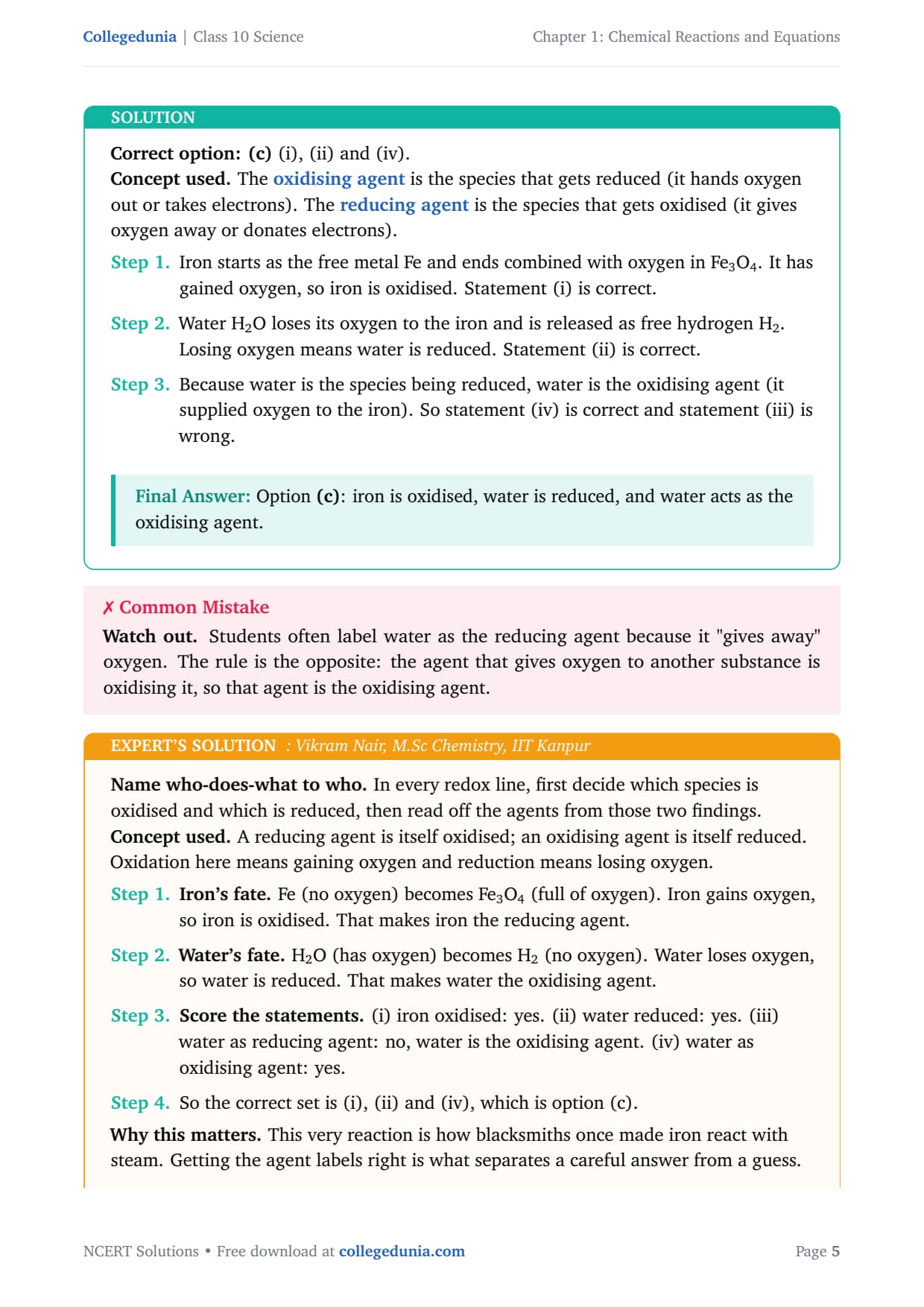
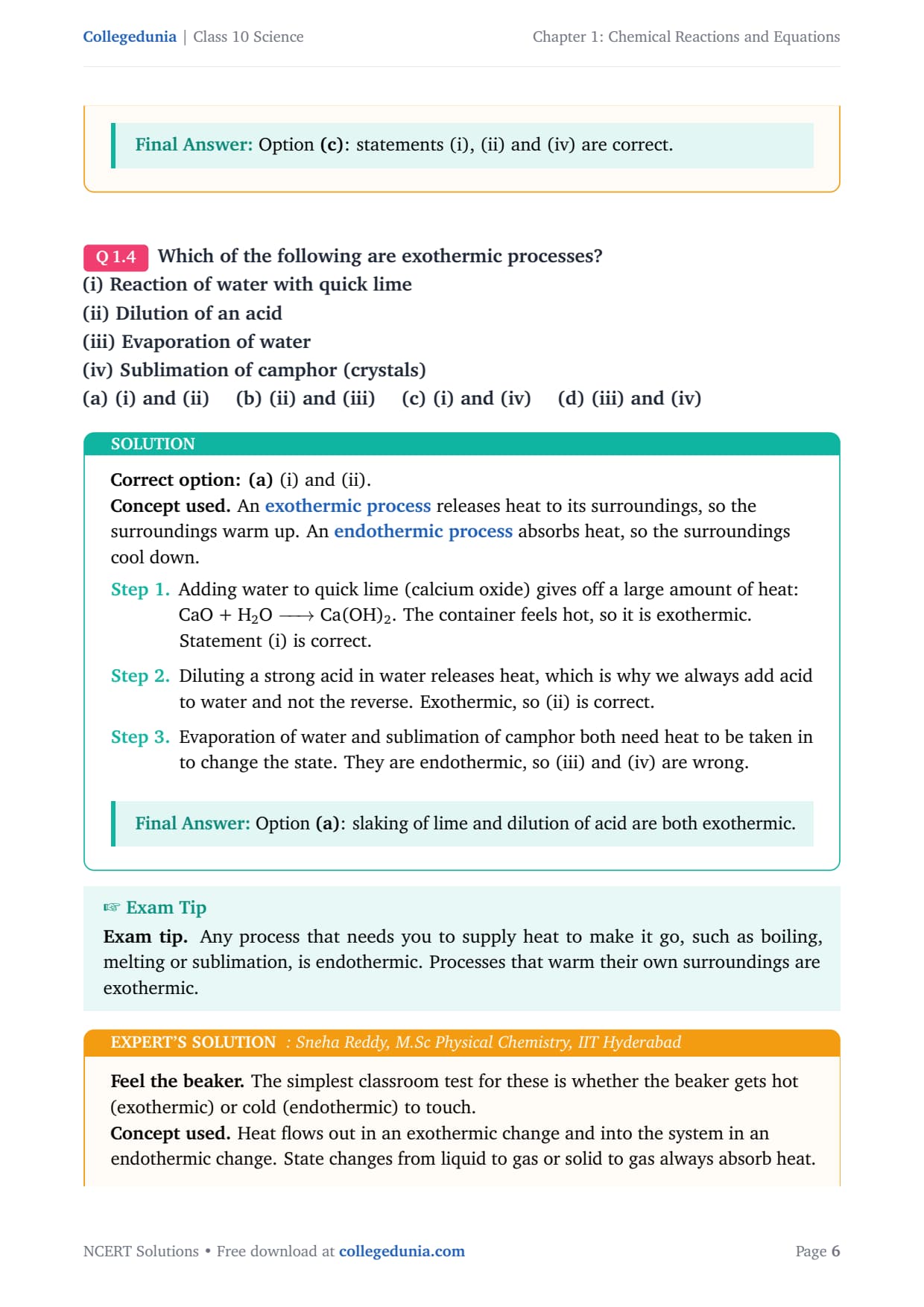
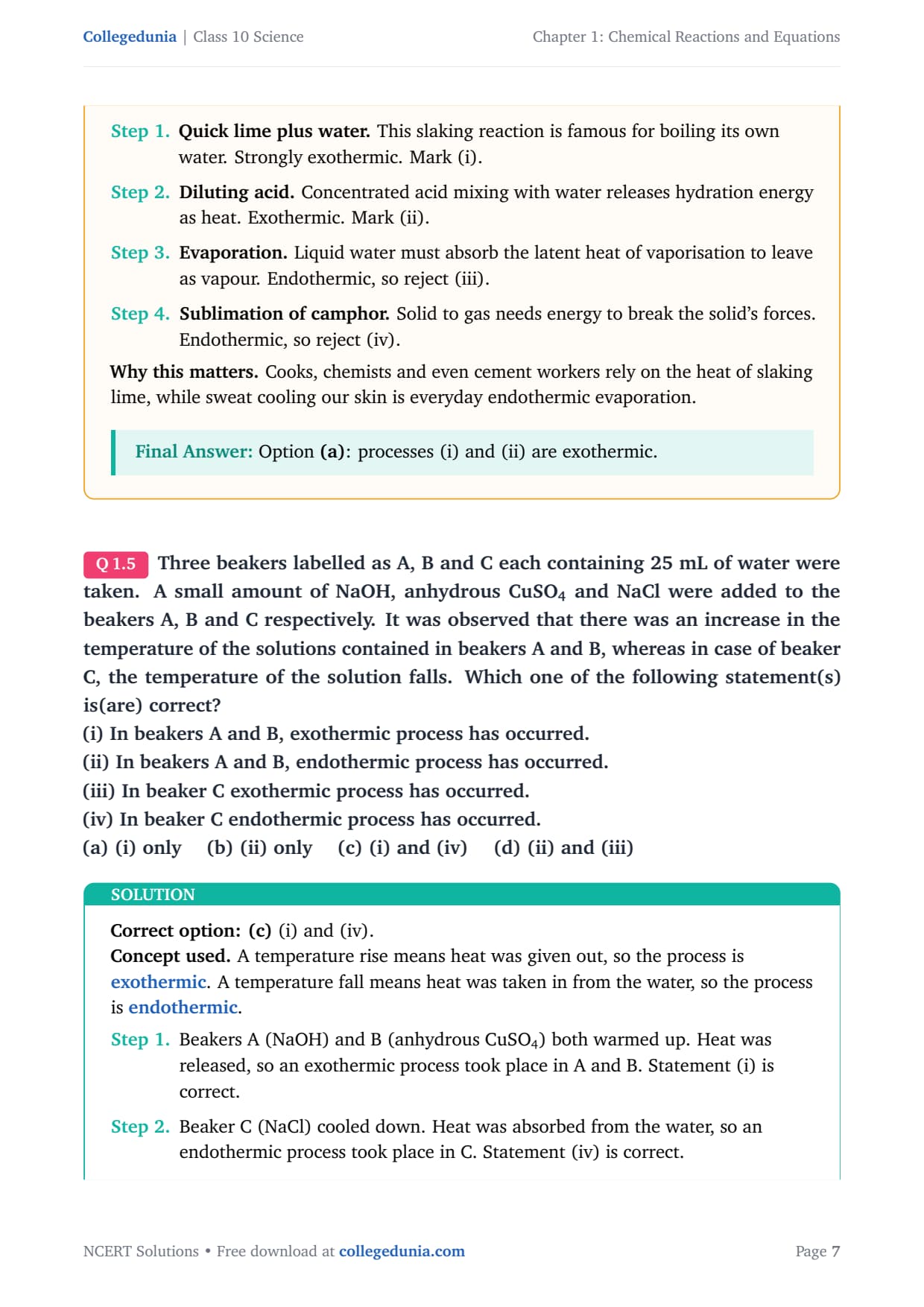
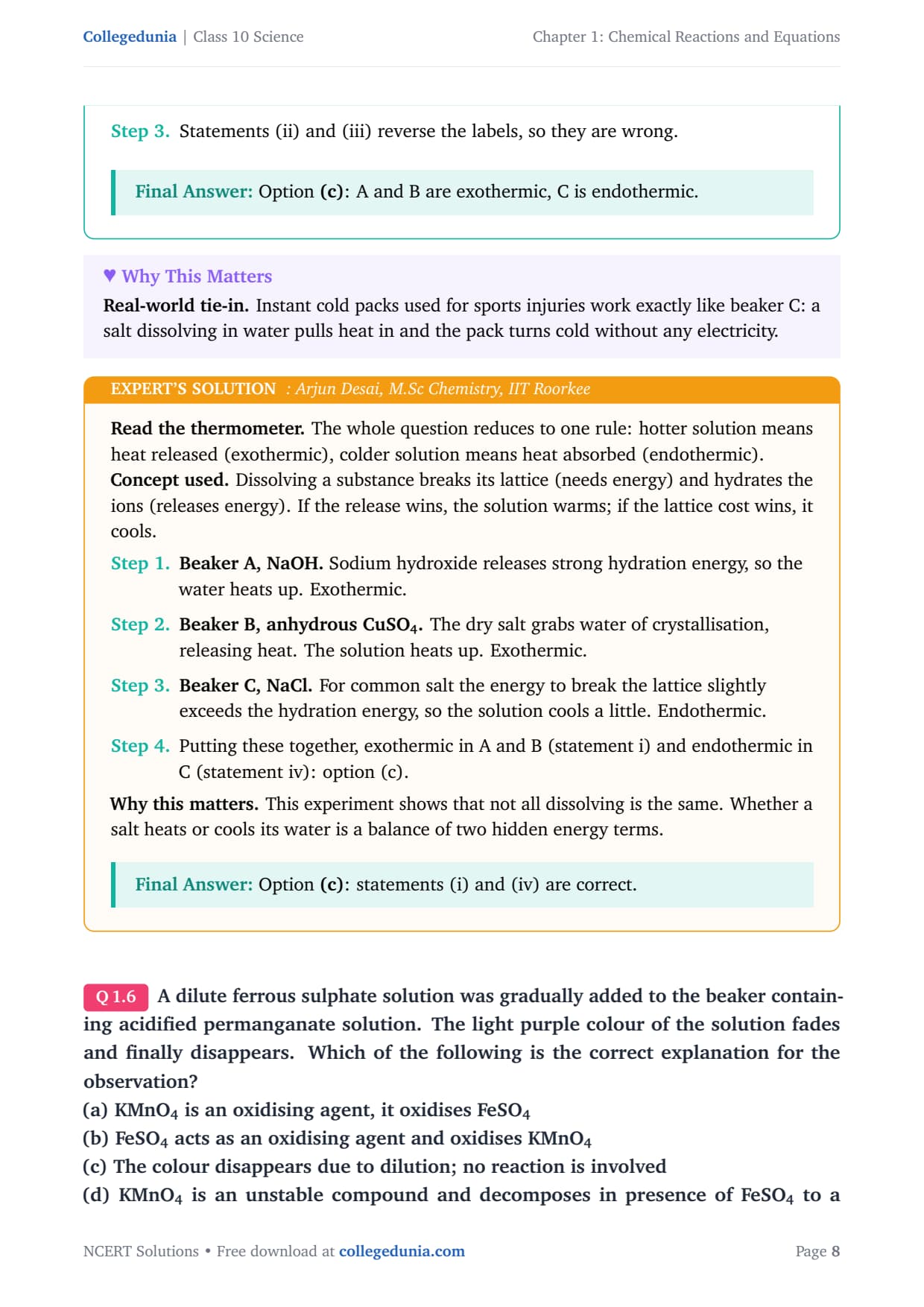
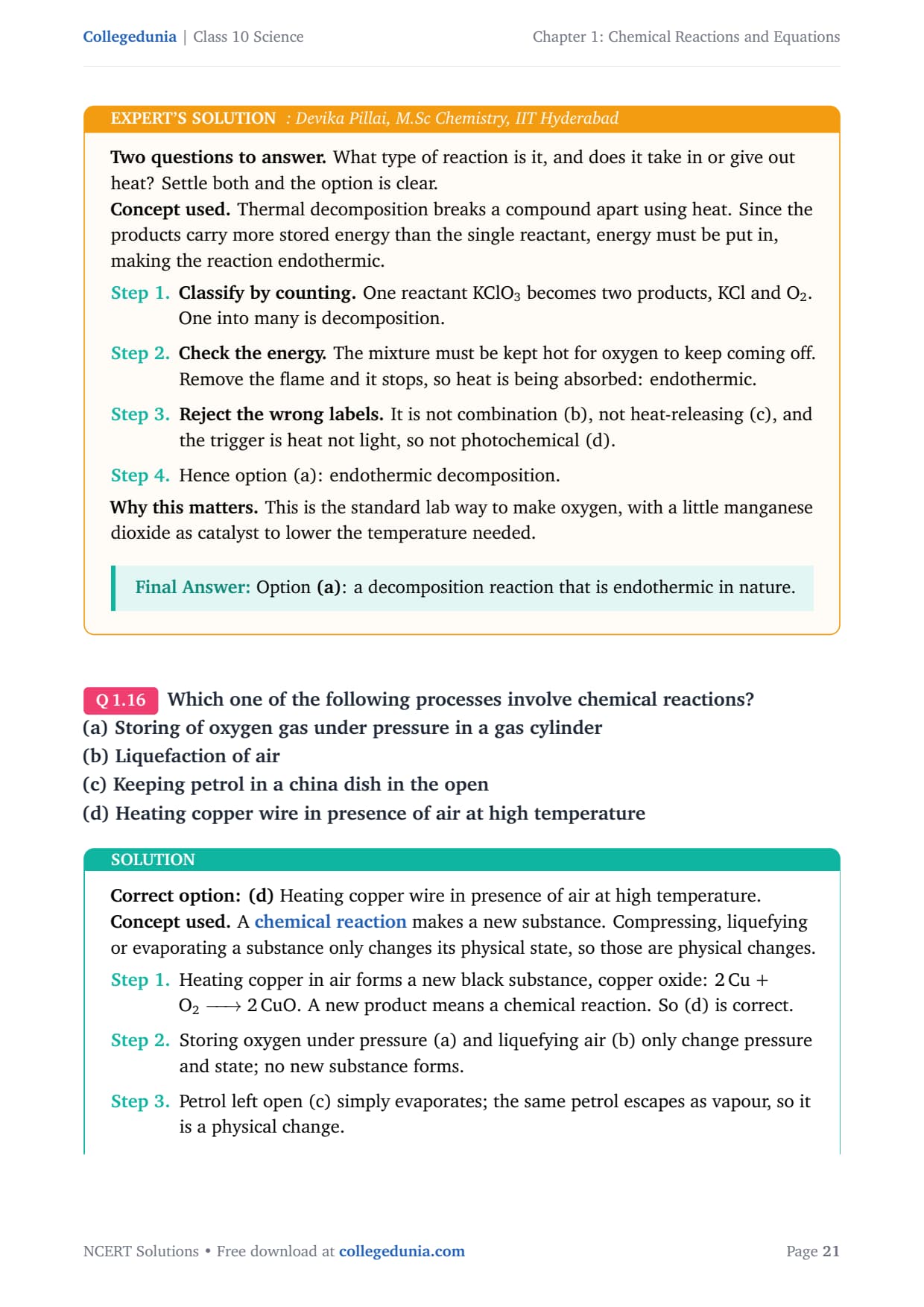
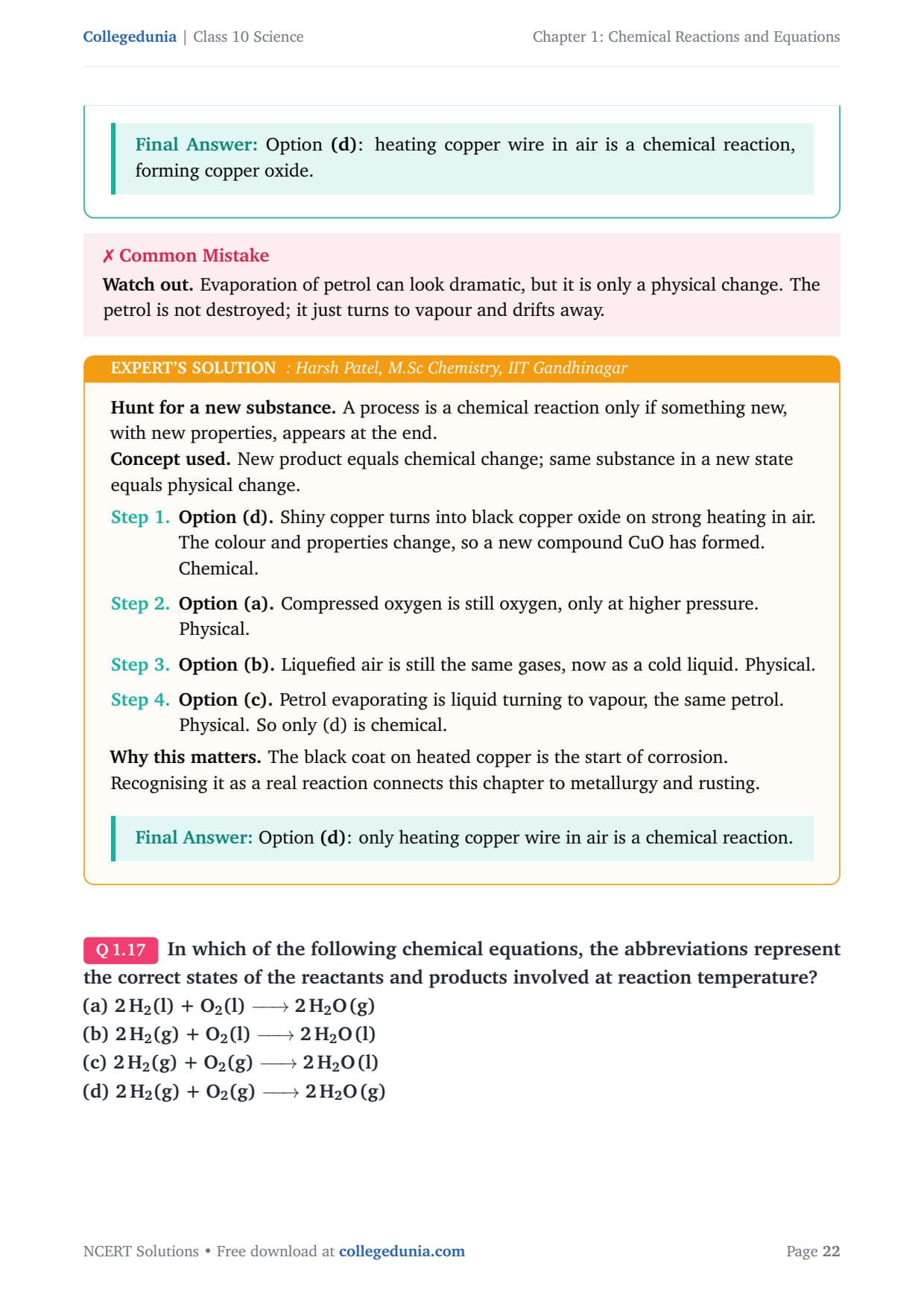
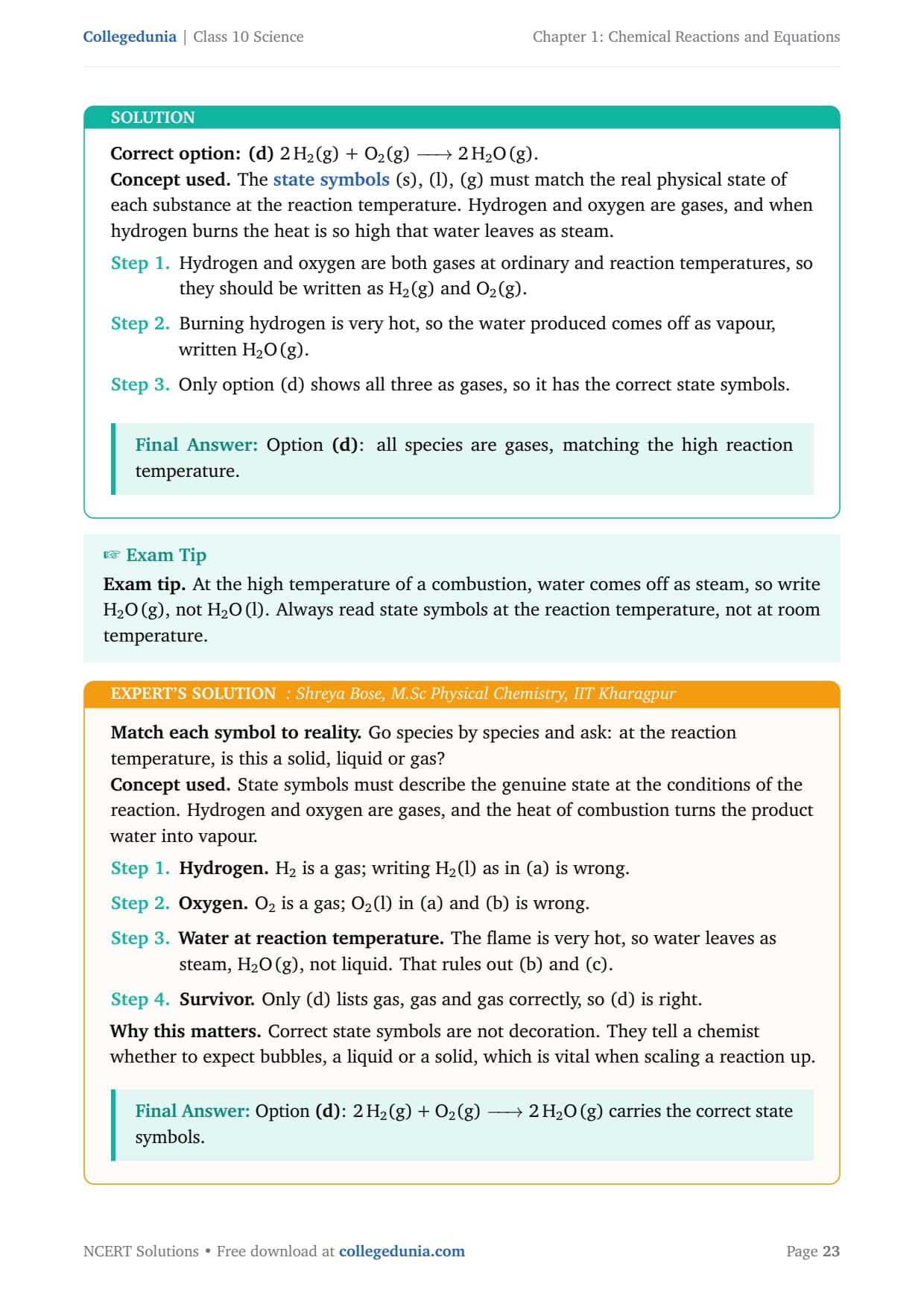
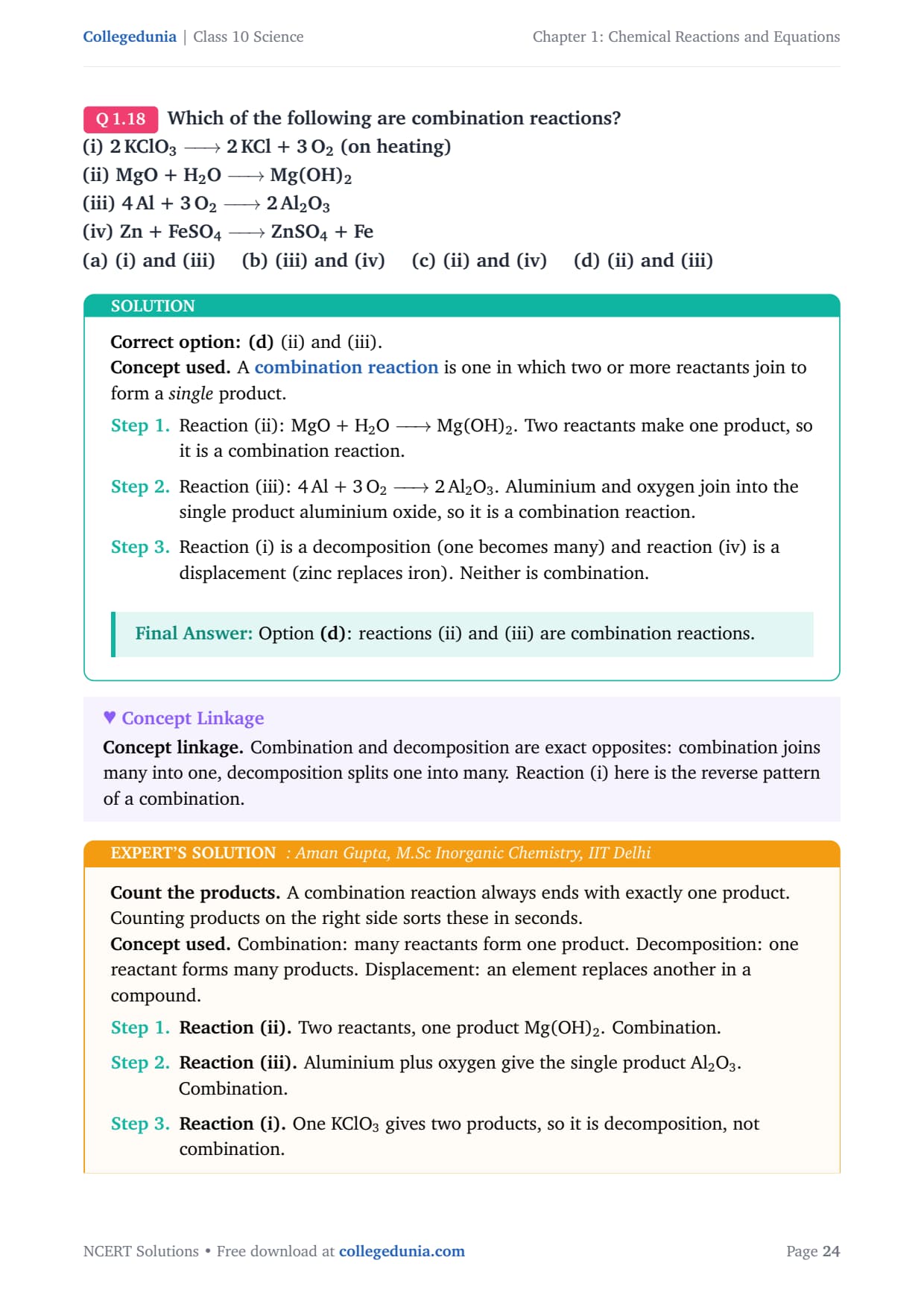
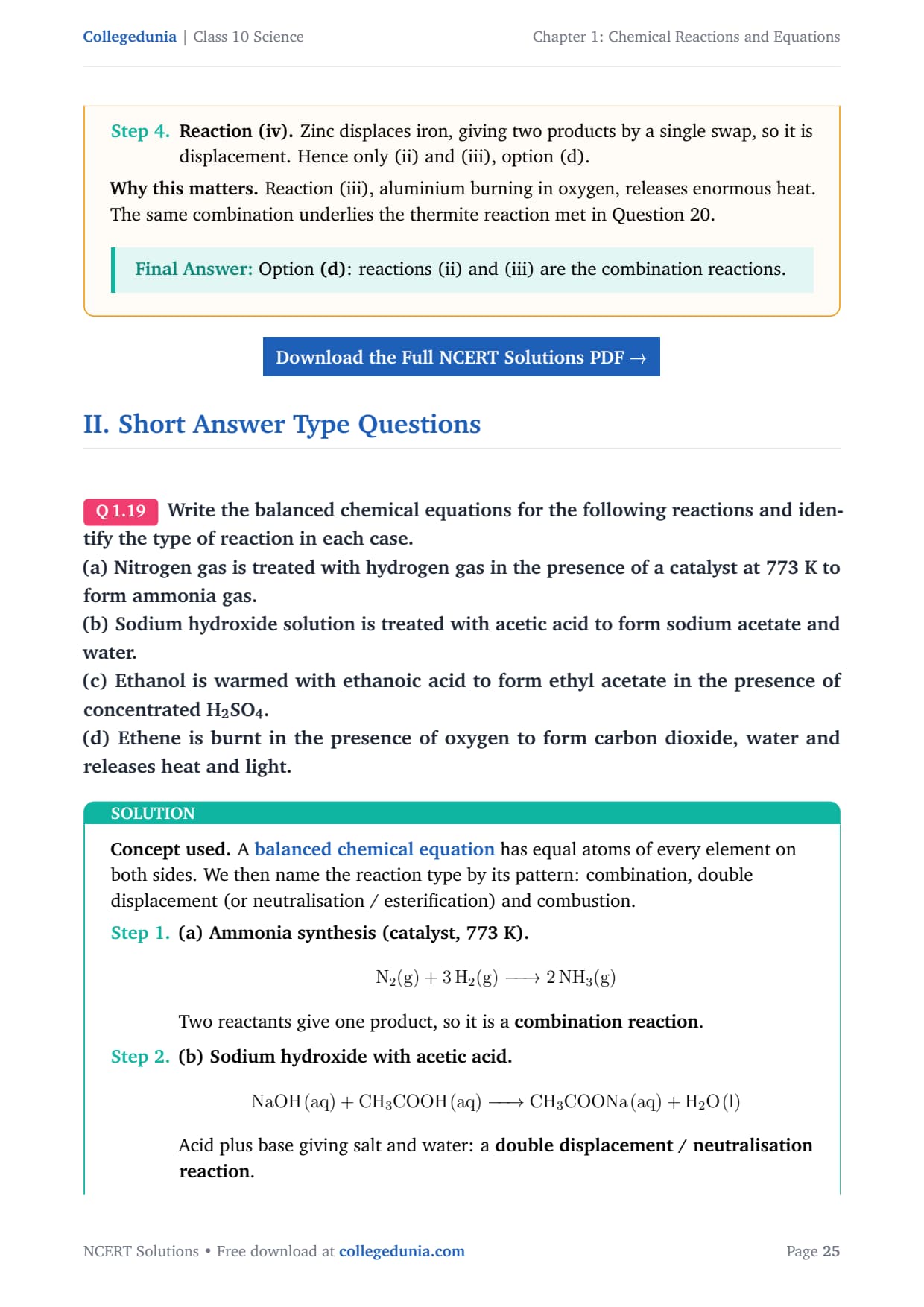
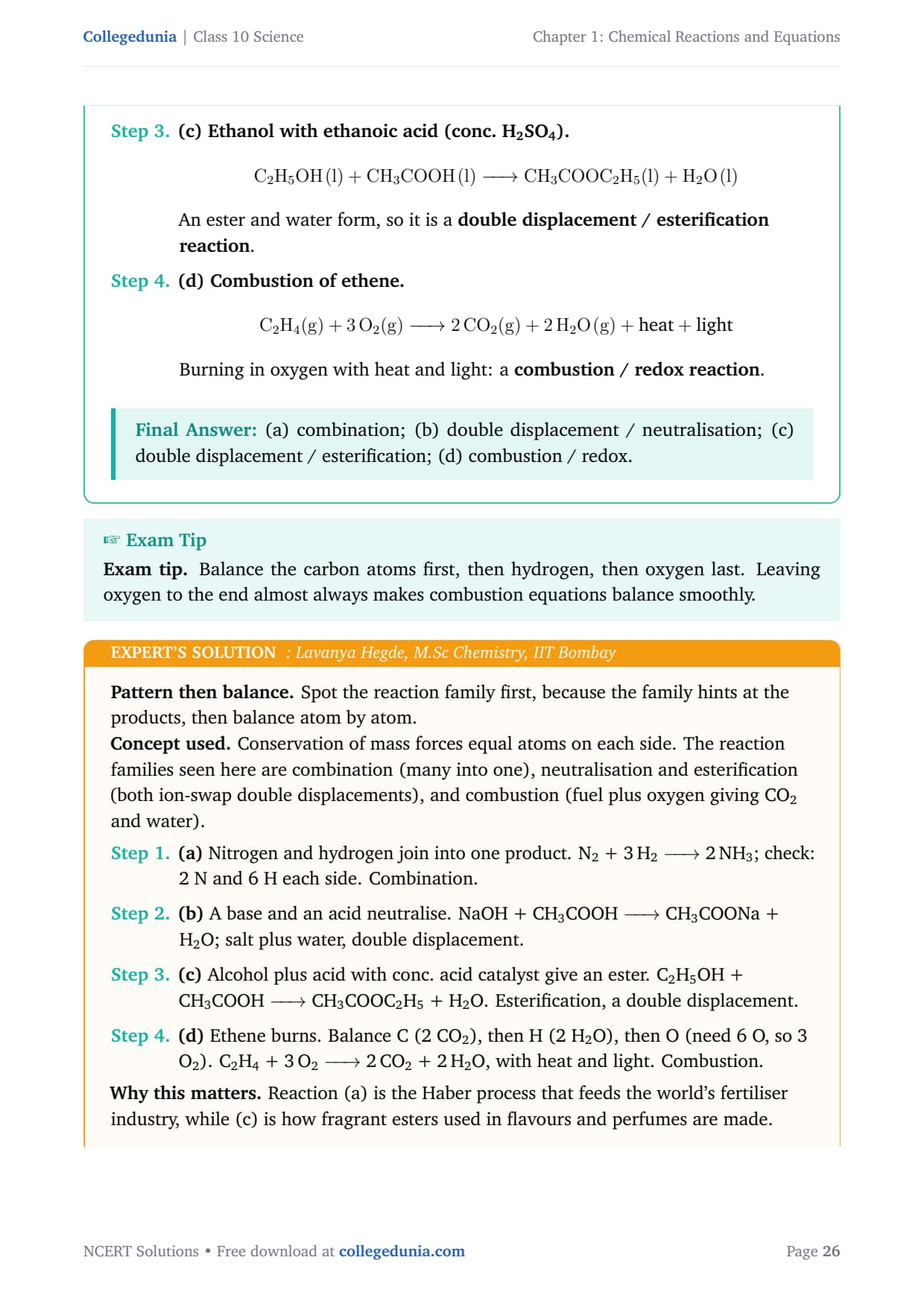
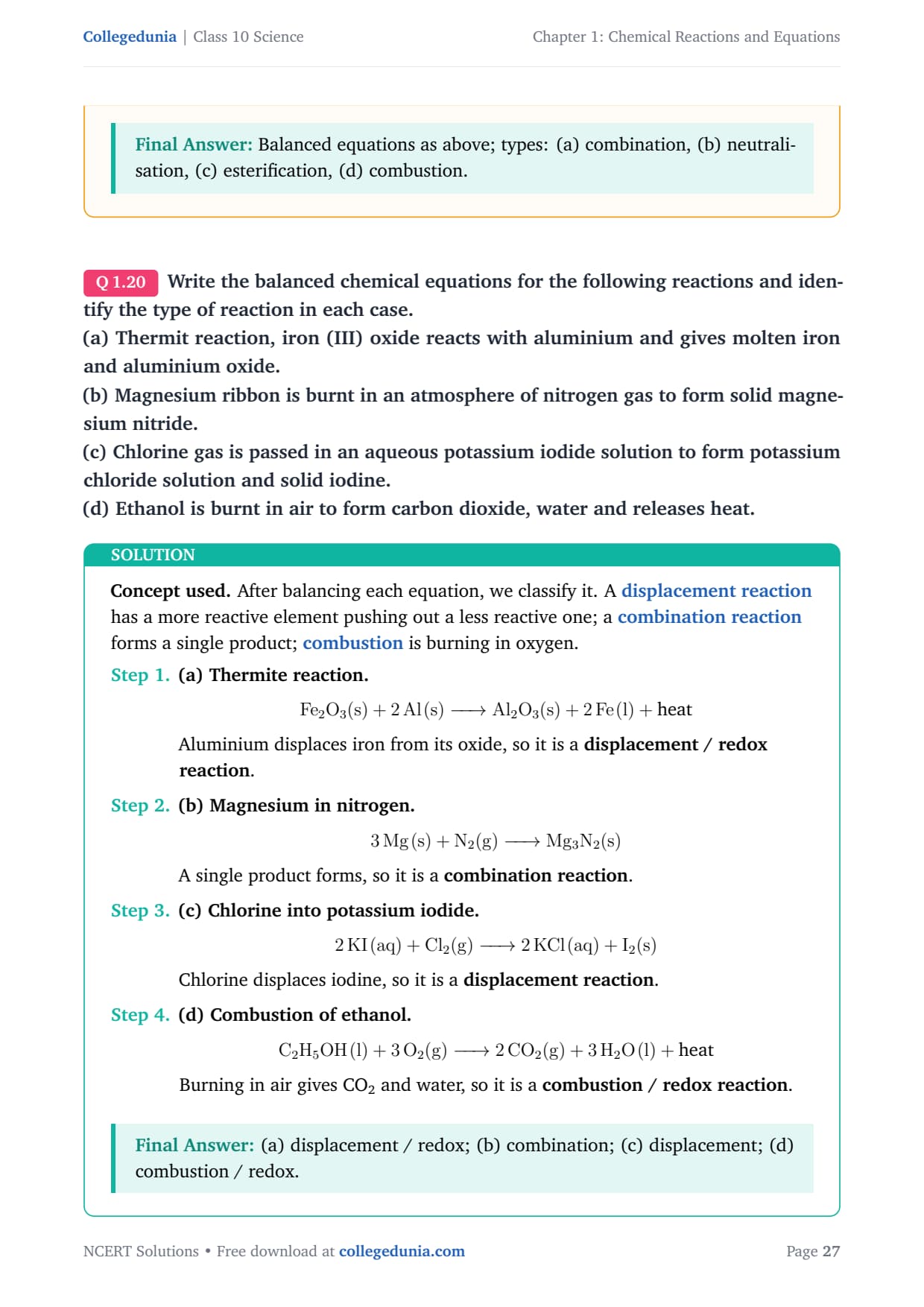
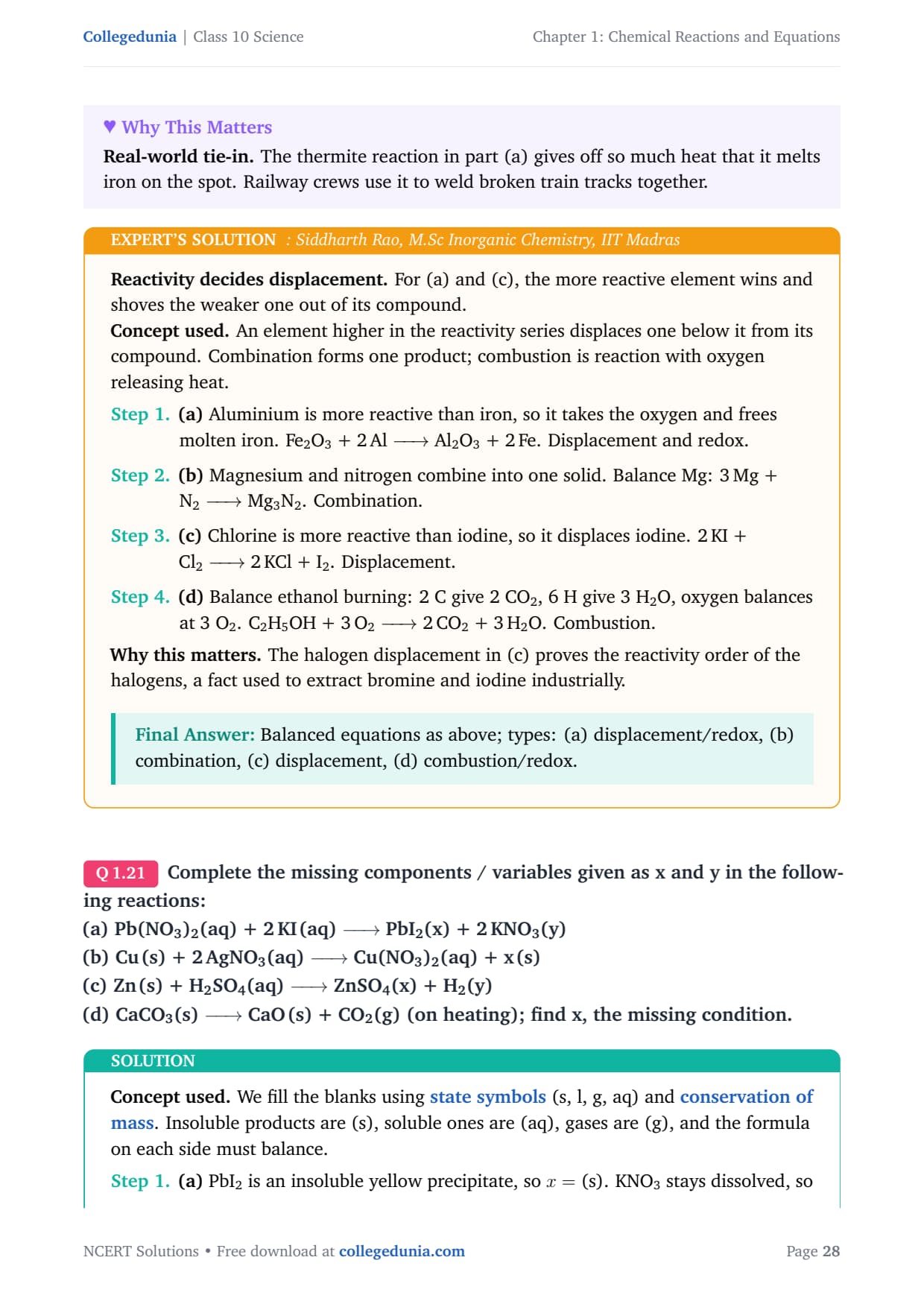
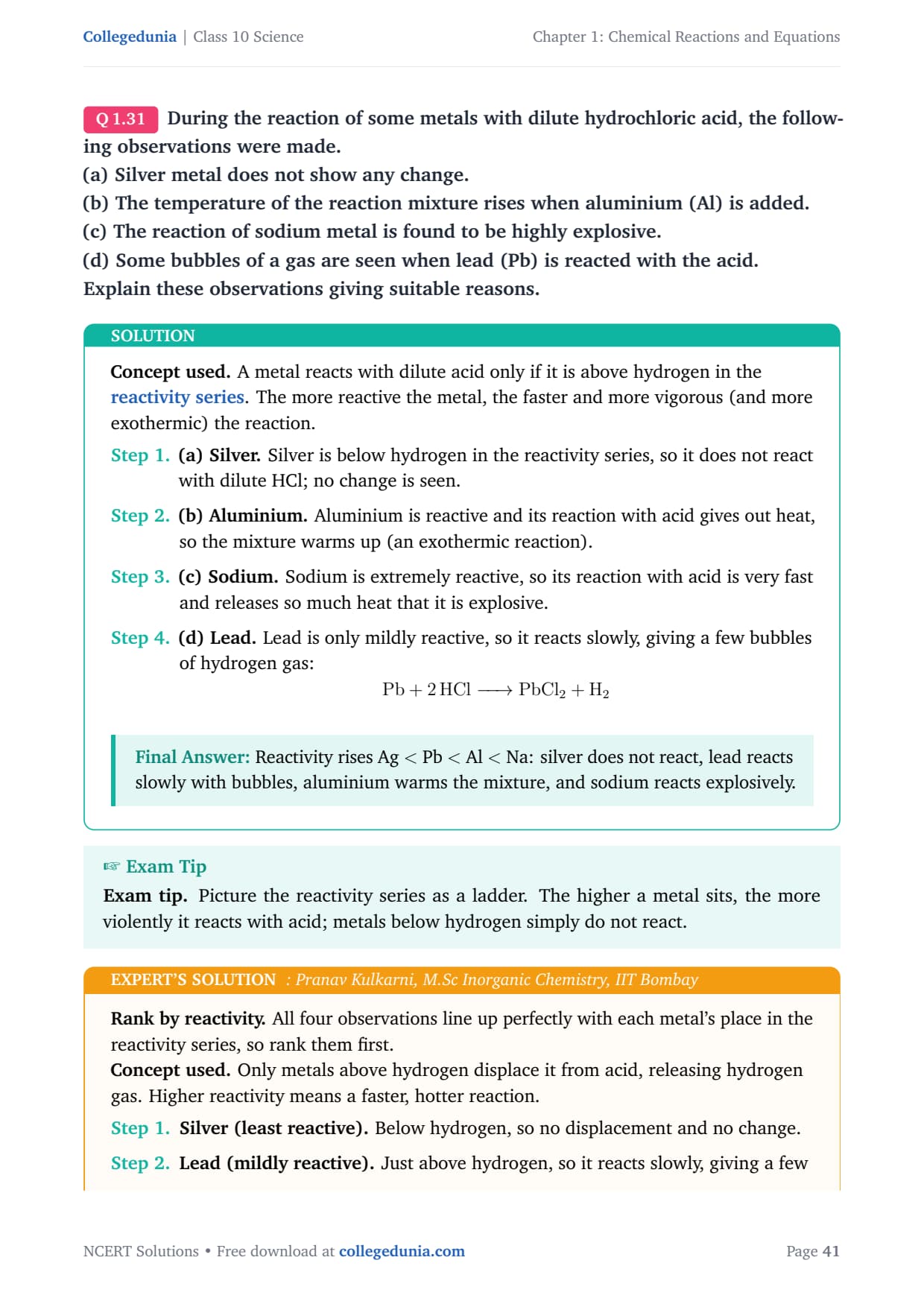
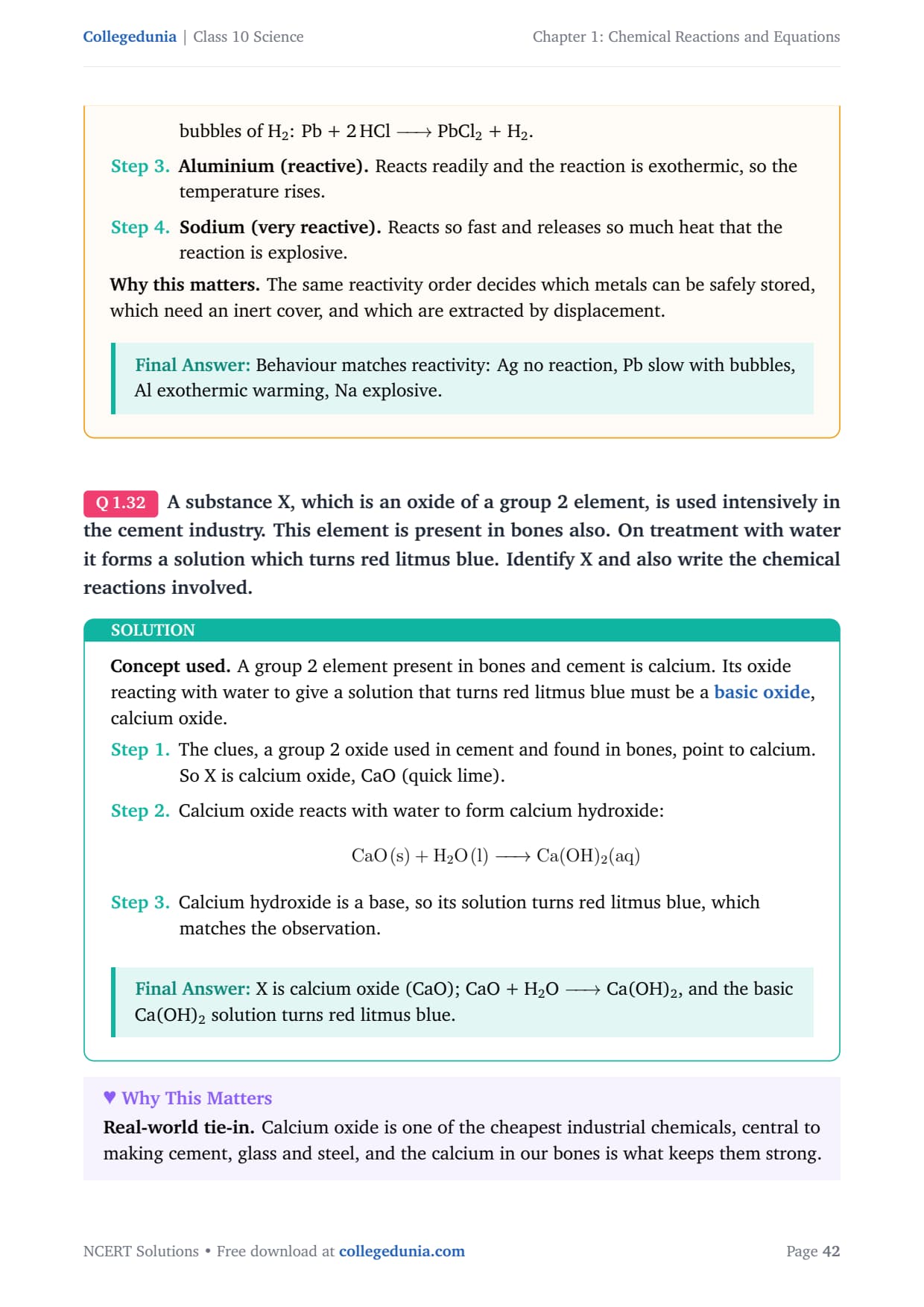
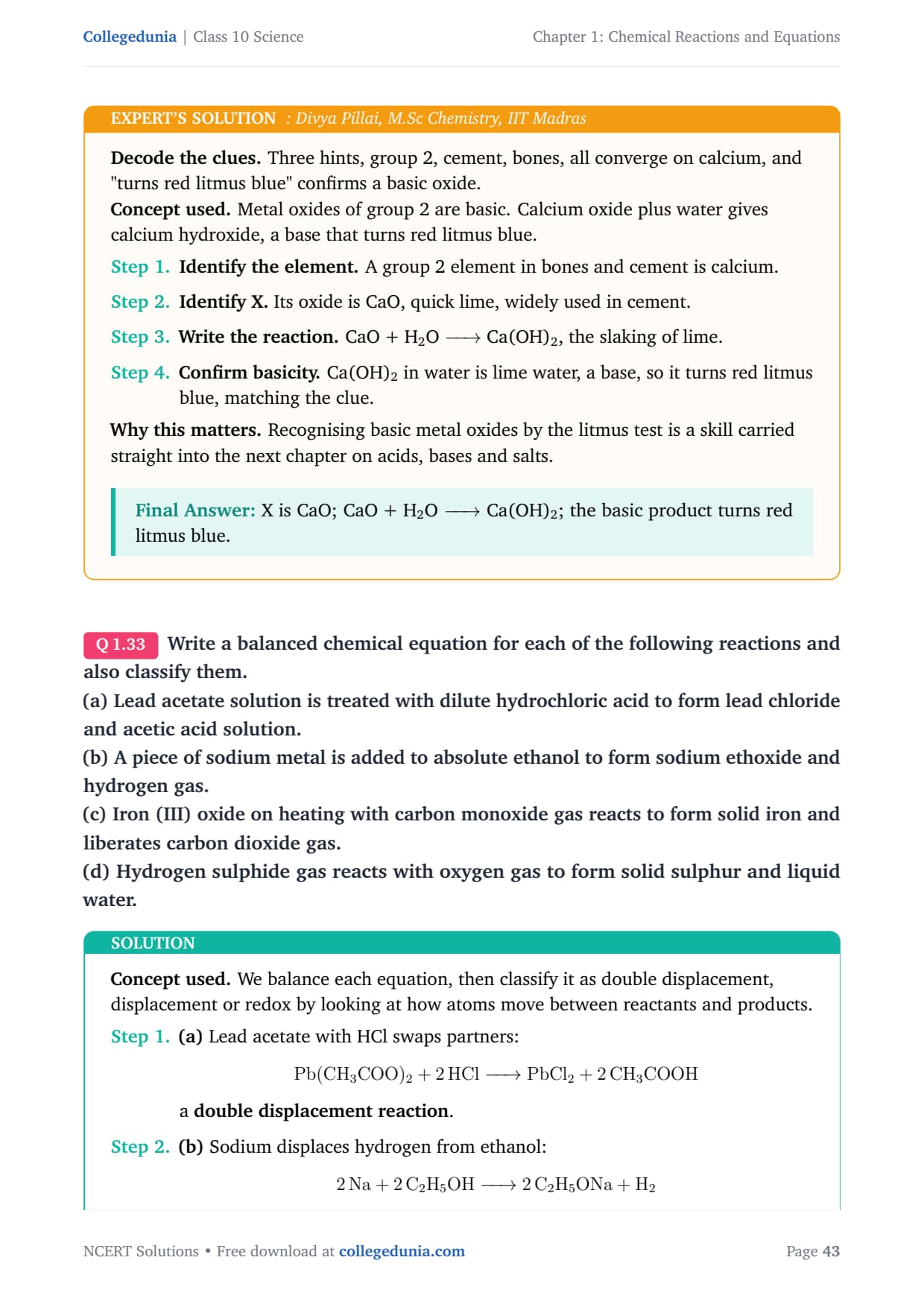
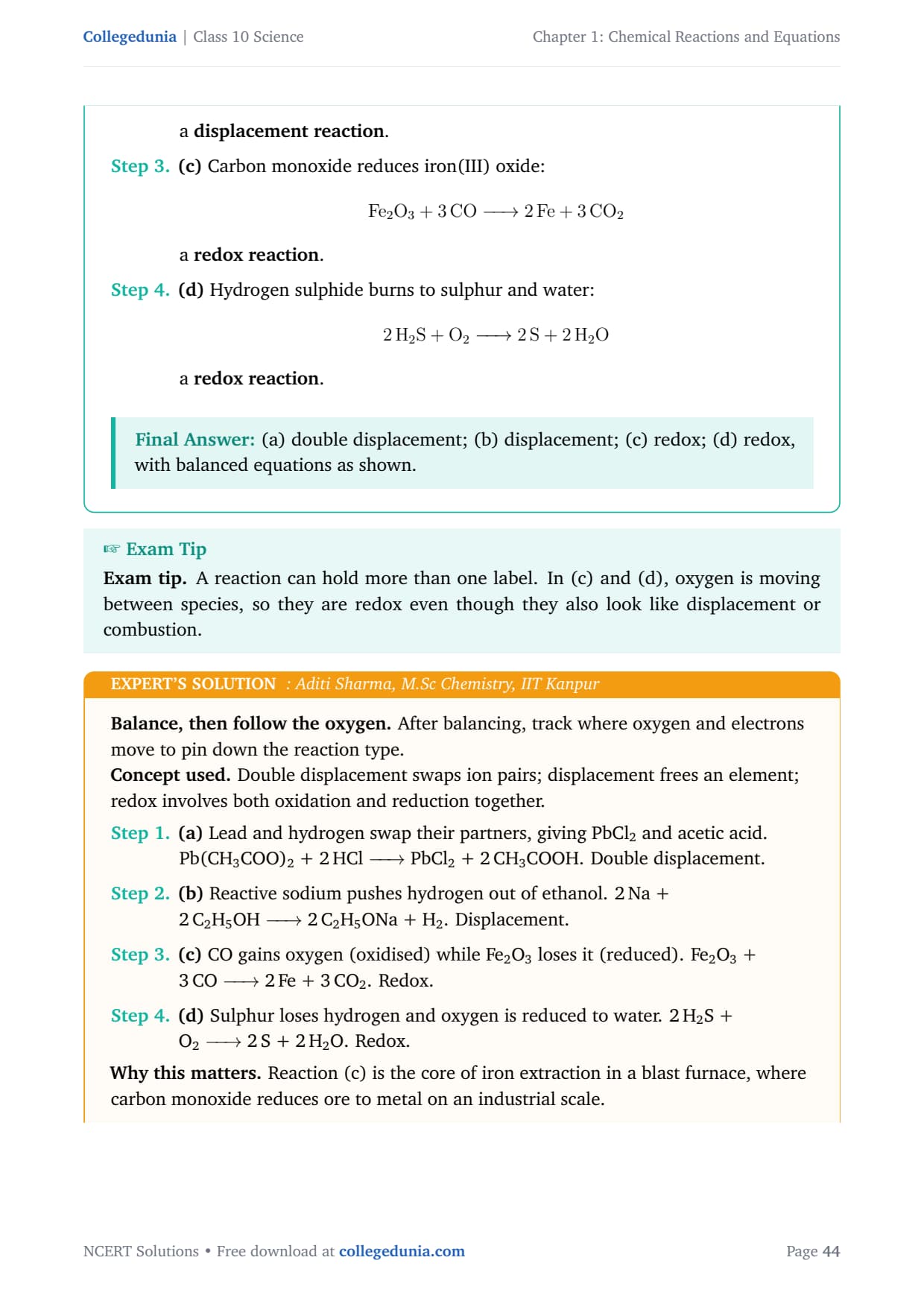



Comments