The 2026-27 NCERT keeps Acids, Bases and Salts as Chapter 2 of Class 10 Science. The Class 10 Science Chapter 2 NCERT Exemplar Solutions on this page solve every Exemplar problem step by step, in plain language a board student can follow.
CBSE Board weightage: acids, bases and salts is a near-certain question every year.
What you get: all MCQ, Short Answer and Long Answer problems solved, with a free PDF.
Solved by Collegedunia: Every problem below is solved by subject experts, mapped to the 2026-27 NCERT Exemplar, and checked against the CBSE Board marking scheme.
Why the NCERT Exemplar Matters for Class 10 Board Preparation
Acids, Bases and Salts is a scoring chapter, but small slips cost easy marks. The NCERT Exemplar turns the basics into exam-style questions: multi-statement MCQs, pH scale reasoning, and identify-the-salt problems. Finishing it is the best way to feel ready for the chemistry section.
Quick Tip: Solve the textbook exercises first. The Exemplar assumes you know the pH scale and the reactions of acids and bases.
How Collegedunia's NCERT Exemplar Solutions Help You with Acids, Bases and Salts
Each problem is solved the way a CBSE examiner expects, with every reaction balanced.
Every question type solved: all 48 MCQ, Short Answer and Long Answer problems are worked out.
2026-27 alignment: problem numbers and answers match the current edition.
Reaction-by-reaction working: neutralisation, gas tests and salt identification in copyable steps.
Trap flags: red boxes mark where students confuse acids with bases or misread the pH scale.
Best Way to Use the Acids, Bases and Salts Exemplar for Board Revision
Treat the Exemplar as a practice paper. This plan fits the revision window before pre-boards.
Phase
Exemplar Use
Time
First read
All 30 MCQs
1.5 hours
Concept practice
pH and reaction Short Answers
1.5 hours
Answer writing
All Long Answers, full working
2 hours
Pre-board revision
Re-solve the wrong ones
1 hour
That is about 6 hours. Spend the most time on the pH scale and salt identification, which carry most marks.
Acids, Bases and Salts Exemplar Question Types with One Solved Sample Each
The Chapter 2 Exemplar mixes three question formats, previewed below.
Type
Sample Question
Answer Shape
MCQ
What happens when an acid is mixed with a base in a test tube?
Single correct set of statements
MCQ (multi-statement)
Which statements about passing HCl gas through water are correct?
Pick the correct combination
Short Answer
Name the acid in an ant sting and how to get relief
Acid, formula and a basic remedy
Matching
Match acids with their natural source
Correct A to B pairing
Long Answer
Identify salts A, B and C from a set of clues
Several linked, reasoned parts
Each one is solved in full below, with a Check Solution and Expert Solution tab.
pH Scale and Indicators Quick Reference
Most MCQs test whether you can read the pH scale and pick the right indicator.
Nature
pH Range
Litmus / Indicator
Strong acid
0 to 3
Blue litmus turns red; methyl orange red
Weak acid
4 to 6
Blue litmus turns red; pH paper orange-yellow
Neutral
7
No change; pH paper green
Weak base
8 to 10
Red litmus turns blue; pH paper bluish-green
Strong base
11 to 14
Red litmus turns blue; phenolphthalein pink
A lower pH means more H+ ions, so a stronger acid; a higher pH means more OH- ions, so a stronger base. pH 7 is neutral.
Difficulty Step-Up from NCERT Textbook to Exemplar
The Exemplar reuses textbook ideas in harder wrappers, as the contrast below shows.
Concept
NCERT Textbook
NCERT Exemplar
Neutralisation
Write acid plus base gives salt plus water
Decide which statements about temperature and salt are true
pH scale
Define pH and place common liquids
Pick the colour change as a soil pH is corrected
Salts
Name a salt and its parent acid and base
Identify salts A, B, C from a chain of reactions
Water of crystallisation
State the formula of a hydrate
Spot the salt that has no water of crystallisation
Chlor-alkali process
List the three products of electrolysis of brine
Pick the correct equation for the process
Topics Covered in Class 10 Science Chapter 2 Acids, Bases and Salts Exemplar
MCQs test acids and bases, the pH scale, litmus and indicators, and the chlor-alkali process. Short Answers cover acid sources, the acid in an ant sting, and strong versus weak acids. Long Answers cover neutralisation, hydrogen gas, water of crystallisation, and the four common salts.
Acids, Bases and Salts Exemplar Common Mistakes That Cost Marks
The Exemplar twists trigger the same wrong reflexes every year.
Reading the pH scale backwards. A lower pH is a stronger acid, not a stronger base.
Dry gases show no acid or base behaviour. Dry HCl gas does not turn litmus red; it must dissolve in water first.
Mixing up baking soda and washing soda. Baking soda is NaHCO3; washing soda is Na2CO3·10H2O.
Adding water to acid. Always add acid to water; the reverse is dangerously exothermic.
Watch Out: In a multi-statement MCQ, test every statement. Stopping at the first correct one loses marks.
Important Salts and Their Everyday Uses
A big block of marks comes from the four common salts and their uses.
Common salt (NaCl): raw material for NaOH, chlorine and hydrogen via the chlor-alkali process.
Baking soda (NaHCO3): a mild base used in cooking, antacids and fire extinguishers.
Washing soda (Na2CO3·10H2O): removes permanent hardness of water; used in glass and soap.
Plaster of Paris (CaSO4·½H2O): sets hard on adding water; used in casts and decoration.
Bleaching powder (CaOCl2): made by passing chlorine over slaked lime; used to bleach and disinfect water.
Most Repeated Board Topics from Acids, Bases and Salts
The topics that show up most often in CBSE Board papers.
Topic
How it is asked
pH scale and indicators
Read the pH, pick the colour change or the right indicator
Neutralisation reactions
Write the reaction, state the heat change and the salt formed
Common salts and their uses
Name and use of baking soda, washing soda, bleaching powder, plaster of Paris
Water of crystallisation
Identify hydrates and the salt without water of crystallisation
Chlor-alkali process
Products of electrolysis of brine and their uses
All NCERT Exemplar Questions for Acids, Bases and Salts with Step-by-Step Solutions
Every question of the NCERT Exemplar set for Class 10 Science Chapter 2 Acids, Bases and Salts is listed below with its full Solution and Expert Solution inside collapsible tabs. Click Check Solution to reveal the step-by-step working; click Expert Solution for the expanded explanation.
I. Multiple Choice Questions
Q 2.1
What happens when a solution of an acid is mixed with a solution of a base in a test tube?
(i) The temperature of the solution increases
(ii) The temperature of the solution decreases
(iii) The temperature of the solution remains the same
(iv) Salt formation takes place [2pt]
(a) (i) only (b) (i) and (iii)
(c) (ii) and (iii) (d) (i) and (iv)
Correct option: (d) (i) and (iv).
Concept used. When an acid reacts with a base, the reaction is
called neutralisation. The H+ of the acid joins the
OH- of the base to make water, and the leftover ions form a salt:
Acid + Base → Salt + Water.
This reaction is exothermic: bond formation in water releases
heat, so the temperature of the mixture rises.
Write a sample neutralisation:
HCl + NaOH → NaCl + H2O. A salt (NaCl) is clearly
formed, so statement (iv) is true.
The H+ + OH- → H2O step gives out about
57.1 kJ per mole of water. Heat is released, so the solution
warms up and statement (i) is true.
Statements (ii) and (iii) say the temperature falls or stays
the same. Both contradict an exothermic reaction, so both are
false. Only (i) and (iv) survive.
Option (d): the temperature rises (exothermic) and a salt is formed.
AV
Ananya Verma
M.Sc Chemistry, University of Delhi
Verified Expert
Strategic angle (rule out, then confirm). Two physical things
always happen in a neutralisation: a salt appears and heat comes out.
Check each option against those two facts and the answer falls out.
Concept used. Neutralisation
Acid + Base → Salt + Water
is exothermic because forming the strong O-H bonds in water
releases more energy than is spent breaking up the acid and base. The
standard enthalpy of neutralisation for a strong acid with a strong
base is close to -57.1 kJ/mol of water.
Salt test. Every acid–base reaction leaves a salt.
In HCl + NaOH → NaCl + H2O the salt is NaCl. So (iv)
is definitely correct, and any option missing (iv) is wrong.
Heat test. The energy released (≈ 57 kJ per
mole of water) heats the mixture. So (i) is correct and (ii),
(iii) are wrong.
Match. The only option that pairs (i) with (iv) is
(d). Options (a), (b) and (c) each drop one of the two true
statements.
Why this matters. The same warm-up is the basis of antacid
relief: the base in the tablet neutralises stomach acid and you feel
the burn ease as the reaction completes.
Option (d): (i) temperature increases and (iv) salt formation, both occur.
Q 2.2
An aqueous solution turns red litmus solution blue. Excess addition of which of the following solution would reverse the change?
(a) Baking powder
(b) Lime
(c) Ammonium hydroxide solution
(d) Hydrochloric acid
Correct option: (d) Hydrochloric acid.
Concept used.Litmus is an acid–base indicator. Red
litmus turns blue in a base and blue litmus turns red in an
acid. To “reverse the change” (blue back to red) we must
add an acid that neutralises the base and then makes the solution
acidic.
The given solution turns red litmus blue, so it is basic.
Baking powder, lime and ammonium hydroxide are all basic or
give basic solutions. Adding them keeps the mixture basic, so
the litmus stays blue. They cannot reverse the change.
Hydrochloric acid is an acid. Added in excess it first
neutralises the base, then makes the solution acidic, turning
the litmus red again.
Option (d): hydrochloric acid, the only acid, reverses blue litmus to red.
RM
Rohan Mehta
M.Sc Chemistry, Banaras Hindu University
Verified Expert
Quick reading (one acid among bases). The starting solution is
basic. Three options are bases and one is an acid. Only the acid can
flip the colour back. Spot the odd one out.
Concept used. Litmus changes colour with H+ and OH-
balance. A base raises OH- (red litmus turns blue); an acid raises
H+ (blue litmus turns red). Reversing a base-driven change needs
an acid that supplies enough H+ to overshoot neutral.
Classify each option. Baking powder contains
NaHCO3 (mildly basic); lime is Ca(OH)2 (basic);
ammonium hydroxide NH4OH is a weak base; hydrochloric
acid HCl is a strong acid.
Eliminate the bases. Adding any base keeps OH-
high, so the litmus stays blue. Options (a), (b) and (c) all
fail.
Confirm the acid. Excess HCl neutralises the base
and then drives the pH below 7, turning the blue colour red.
Why this matters. This is how a lab worker safely
“cancels” a spilt alkali: a measured acid wash restores neutral
conditions, and the indicator colour confirms when to stop.
Option (d): hydrochloric acid is the only acid, so it alone reverses the change.
Q 2.3
During the preparation of hydrogen chloride gas on a humid day, the gas is usually passed through the guard tube containing calcium chloride. The role of calcium chloride taken in the guard tube is to
(a) absorb the evolved gas
(b) moisten the gas
(c) absorb moisture from the gas
(d) absorb Cl- ions from the evolved gas
Correct option: (c) absorb moisture from the gas.
Concept used.Anhydrous calcium chloride
(CaCl2) is a drying agent (desiccant). It is
hygroscopic, meaning it pulls water vapour out of a gas stream without
reacting with the gas itself. A guard tube packed with CaCl2 is
placed in the path of a gas to dry it.
On a humid day the HCl gas carries water vapour with it.
Moist HCl would dissolve and is hard to collect dry.
As the gas passes over CaCl2, the calcium chloride
absorbs the water vapour, so only dry HCl comes out.
It does not absorb the HCl gas itself, does not add
moisture, and does not strip Cl- ions. So options (a),
(b) and (d) are wrong.
Option (c): CaCl2 is a drying agent that removes moisture from the gas.
SN
Sneha Nair
M.Sc Inorganic Chemistry, University of Hyderabad
Verified Expert
Quick reading (name the job of the chemical). “Guard tube” +
“calcium chloride” is textbook shorthand for “dry the gas.”
CaCl2 is a classic desiccant, so its only job here is moisture
removal.
Concept used. A desiccant such as anhydrous CaCl2 has a
strong affinity for water and grabs water vapour from a passing gas.
It must be chemically inert towards the gas it dries, otherwise it
would consume the product.
Identify the problem. Humid air contributes water
vapour to the freshly made HCl gas; the experiment needs
dry HCl.
Identify the fix.CaCl2 absorbs that water
vapour as it flows through the guard tube, drying the gas.
Reject the traps. It does not absorb HCl
(it is inert to it), does not moisten the gas (opposite of its
nature), and has no mechanism to remove Cl- ions from a
gas. Hence only (c) fits.
Why this matters. The same drying trick keeps reagents pure in
real labs: many gases are passed through CaCl2 or concentrated
H2SO4 to remove water before use.
Option (c): calcium chloride dries the gas by absorbing its moisture.
Q 2.4
Which of the following salts does not contain water of crystallisation?
(a) Blue vitriol
(b) Baking soda
(c) Washing soda
(d) Gypsum
Correct option: (b) Baking soda.
Concept used.Water of crystallisation is the fixed
number of water molecules built into one formula unit of a crystalline
salt. Such a salt is called a hydrate and its formula carries
a “· n H2O” tail. A salt without this tail has no water of
crystallisation.
Blue vitriol is CuSO4·5H2O (5 water molecules) → has
water of crystallisation.
Washing soda is Na2CO3·10H2O (10 water molecules) →
has water of crystallisation.
Gypsum is CaSO4·2H2O (2 water molecules) → has water
of crystallisation.
Baking soda is NaHCO3 with no “· n H2O”
tail, so it has no water of crystallisation.
Option (b): baking soda (NaHCO3) has no water of crystallisation.
KI
Karthik Iyer
M.Sc Chemistry, IIT Madras
Verified Expert
Quick reading (look for the dot-water tail). Three of these
salts are famous hydrates whose formulas end in
“· n H2O”. The one whose formula has no such tail is the
answer.
Concept used. Water of crystallisation is water chemically
locked into a crystal lattice in a definite ratio. Its presence is
shown by the dot notation, e.g. CuSO4·5H2O. Heating drives off
this water and changes the salt's colour or texture.
Write each formula. Blue vitriol CuSO4·5H2O;
washing soda Na2CO3·10H2O; gypsum CaSO4·2H2O; baking
soda NaHCO3.
Count the dot-water. The first three carry 5, 10 and
2 water molecules respectively. Baking soda carries none.
Conclude. Only NaHCO3 lacks water of
crystallisation, so option (b) is correct.
Why this matters. This is why heated blue vitriol turns from
blue to white (it loses its 5 water molecules) while baking soda just
decomposes to Na2CO3 on heating instead of dehydrating.
Option (b): baking soda, whose formula NaHCO3 carries no water of crystallisation.
Q 2.5
Sodium carbonate is a basic salt because it is a salt of
(a) strong acid and strong base
(b) weak acid and weak base
(c) strong acid and weak base
(d) weak acid and strong base
Correct option: (d) weak acid and strong base.
Concept used. The pH of a salt depends on the strength of the
acid and base that made it (salt hydrolysis). A salt of a
strong base and a weak acid hydrolyses in water to
give a basic (pH >7) solution.
Identify the parents of Na2CO3: the base is NaOH
(a strong base) and the acid is carbonic acid H2CO3
(a weak acid).
Write the formation:
2NaOH + H2CO3 → Na2CO3 + 2H2O.
In water the carbonate ion takes back H+
(CO32- + H2O ⇌ HCO3- + OH-), releasing OH-. The
extra OH- makes the solution basic. So the parents are a
weak acid and a strong base.
Option (d): Na2CO3 is the salt of a weak acid (H2CO3) and a strong base (NaOH).
PD
Priya Deshmukh
M.Sc Physical Chemistry, University of Pune
Verified Expert
Strategic angle (trace the parents). A salt remembers its
parents. Sodium carbonate is basic, so its stronger parent must be a
base. Confirm which acid and base combine to give it.
Concept used. Salt hydrolysis: when a salt dissolves, the ion
from the weaker parent reacts with water. For Na2CO3, the
carbonate ion (from weak H2CO3) grabs H+ from water and frees
OH-, so the solution turns basic. Na+ (from strong NaOH)
does not hydrolyse.
Name the parents.Na2CO3 = NaOH (strong
base) +H2CO3 (weak acid).
Predict the pH. The weak-acid anion CO32-
hydrolyses: CO32- + H2O ⇌ HCO3- + OH-. Released
OH- makes the solution basic.
Match the option. Weak acid plus strong base gives a
basic salt, exactly option (d). Options (a)–(c) would predict
neutral or acidic, which contradicts the observed basicity.
Why this matters. The same logic explains why washing soda
solution (Na2CO3·10H2O) feels slippery and cleans grease: its
basic OH- attacks oily dirt.
Option (d): salt of weak acid H2CO3 and strong base NaOH, hence basic.
Q 2.6
Calcium phosphate is present in tooth enamel. Its nature is
(a) basic
(b) acidic
(c) neutral
(d) amphoteric
Correct option: (a) basic.
Concept used. Tooth enamel is made of calcium
phosphateCa3(PO4)2. It is the salt of a strong base
(Ca(OH)2) and a weak acid (phosphoric acid H3PO4), so it is
basic in nature. This basic enamel is attacked only when the
mouth becomes acidic.
Identify the salt: tooth enamel is Ca3(PO4)2, calcium
phosphate.
Trace its parents: base Ca(OH)2 (strong) and acid
H3PO4 (weak). A salt of a strong base and a weak acid is
basic.
Therefore enamel is basic; it is corroded when the pH in the
mouth falls below about 5.5 (acid from food and bacteria).
Option (a): calcium phosphate (tooth enamel) is basic in nature.
MK
Meera Krishnan
M.Sc Chemistry, University of Madras
Verified Expert
Strategic angle (salt of which acid and base). Enamel is a
calcium salt of phosphoric acid. Calcium hydroxide is a strong base and
phosphoric acid is weak, so the salt should lean basic. Confirm and
match.
Concept used. The acid–base nature of a salt follows its
stronger parent. Ca3(PO4)2 comes from strong Ca(OH)2 and weak
H3PO4; a strong-base/weak-acid salt is basic. Amphoteric means it
reacts as both acid and base, which calcium phosphate does not do here.
Write the salt and its parents. Enamel
= Ca3(PO4)2; base = Ca(OH)2 (strong); acid
= H3PO4 (weak).
Apply the rule. Strong base + weak acid → basic
salt. So the enamel is basic.
Reject other options. It is not acidic or neutral by
the rule above, and it is not amphoteric (that label fits
oxides like Al2O3 or ZnO, not this phosphate).
Why this matters. Knowing enamel is basic explains the dentist's
advice: rinse after acidic drinks so the acid does not sit on and
dissolve your basic enamel.
Option (a): basic, since Ca3(PO4)2 is a strong-base/weak-acid salt.
Q 2.7
A sample of soil is mixed with water and allowed to settle. The clear supernatant solution turns the pH paper yellowish-orange. Which of the following would change the colour of this pH paper to greenish-blue?
(a) Lemon juice
(b) Vinegar
(c) Common salt
(d) An antacid
Correct option: (d) An antacid.
Concept used. On pH paper, yellowish-orange means a
mildly acidic solution (about pH 5) and greenish-blue means a basic
solution (about pH 8). To move the colour from acidic to basic, we add a
base.
The supernatant is yellowish-orange, so the soil solution is
mildly acidic (pH about 5).
To turn the paper greenish-blue we must raise the pH above 7,
which needs a base.
Lemon juice (citric acid) and vinegar (acetic acid) are acids;
they would lower the pH further. Common salt is neutral, no
change. An antacid is basic, so it raises the pH to give a
greenish-blue colour.
Option (d): an antacid is basic, so it shifts the pH paper to greenish-blue.
AJ
Aditya Joshi
M.Sc Chemistry, IIT Bombay
Verified Expert
Quick reading (which way is the colour moving). Yellow-orange
to green-blue is acidic to basic. So you need to add a base. Three
options are acids or neutral; only the antacid is basic.
Concept used. The pH-paper colour scale runs red (strong acid)
through yellow-orange (weak acid) to green (neutral) to blue (base). A
colour shift up the scale (towards blue) requires adding OH-, i.e.
a base.
Read the starting pH. Yellowish-orange ⇒
pH around 5 (mildly acidic soil solution).
Decide the direction. Greenish-blue ⇒ pH
around 8 (basic). To go from 5 to 8 you must add a base.
Pick the base. Lemon juice and vinegar are acids (push
pH down); common salt is neutral (no change); an antacid is
basic and raises the pH. So the antacid is the only fit.
Why this matters. This is real agriculture: acidic soil is
treated with a base such as lime or calcium carbonate to raise its pH
so crops grow better.
Option (d): an antacid, being basic, raises the pH and gives the greenish-blue colour.
Q 2.8
Which of the following gives the correct increasing order of acidic strength?
(a) Water < Acetic acid < Hydrochloric acid
(b) Water < Hydrochloric acid < Acetic acid
(c) Acetic acid < Water < Hydrochloric acid
(d) Hydrochloric acid < Water < Acetic acid
Correct option: (a) Water < Acetic acid < Hydrochloric acid.
Concept used.Acidic strength is set by how many
H+ ions a substance releases in water. A strong acid
ionises almost completely, a weak acid only partly, and a
neutral substance barely at all.
Water is neutral: it ionises only very slightly, so it is the
weakest acid of the three.
Acetic acid (CH3COOH) is a weak acid: it ionises only
partly, releasing a moderate amount of H+.
Hydrochloric acid (HCl) is a strong acid: it ionises
almost completely, giving the most H+. So the increasing
order is water < acetic acid < hydrochloric acid.
Option (a): water < acetic acid < hydrochloric acid.
VR
Vikram Reddy
M.Sc Chemistry, University of Hyderabad
Verified Expert
Strategic angle (rank by H+ released). Acidic strength is
just “how much H+.” Water gives almost none, acetic acid gives
some, HCl gives the most. That ordering is the answer.
Concept used. Degree of ionisation fixes acid strength. Water
self-ionises to a tiny extent (Kw = 10-14), acetic acid is a weak
acid (Ka ≈ 1.810-5), and HCl is a strong acid
(Ka very large). Larger ionisation means more free H+ and higher
acidity.
Place water. Pure water is neutral; its H+
concentration is only 10-7 M. Weakest acid here.
Place acetic acid. It partly ionises
(CH3COOH ⇌ CH3COO- + H+), giving more H+ than
water but far less than a strong acid.
Place HCl. It ionises completely
(HCl → H+ + Cl-), giving the highest H+. Final
increasing order: water < acetic acid <HCl.
Why this matters. This is why vinegar (acetic acid) is safe on
food while HCl is corrosive: same idea of an acid, but vastly
different H+ output.
Option (a): water < acetic acid < hydrochloric acid, by increasing ionisation.
Q 2.9
If a few drops of a concentrated acid accidentally spills over the hand of a student, what should be done?
(a) Wash the hand with saline solution
(b) Wash the hand immediately with plenty of water and apply a paste of sodium hydrogencarbonate
(c) After washing with plenty of water apply solution of sodium hydroxide on the hand
(d) Neutralise the acid with a strong alkali
Correct option: (b) Wash with plenty of water, then apply a
paste of sodium hydrogencarbonate.
Concept used. A concentrated acid on skin must first be
diluted and washed away with lots of water, then any
remaining acid is neutralised with a mild base. A mild base
like sodium hydrogencarbonate (NaHCO3) is safe; a strong base like
NaOH would burn the skin too.
Wash with plenty of water at once: this dilutes the acid and
carries most of it off the skin, reducing the burn.
Apply a paste of NaHCO3 (baking soda), a mild base, to
neutralise the small amount of acid left behind.
Reject the rest: saline does not neutralise acid; NaOH is
a strong base that would itself burn; “neutralise with a
strong alkali” is dangerous for the same reason.
Option (b): flush with water, then apply mild NaHCO3 paste.
NP
Nisha Pillai
M.Sc Chemistry, University of Kerala
Verified Expert
Strategic angle (safety first, mild base second). First
remove the acid with water, then neutralise gently. The only option
that does both safely is (b); the others either skip the wash or use a
dangerous strong base.
Concept used. First aid for an acid spill: dilution by copious
water lowers H+ fast, then a weak base (NaHCO3) neutralises
the residue without harming skin. Strong bases are corrosive and are
never applied to skin.
Dilute and remove. Plenty of running water washes the
acid off and dilutes what stays, cutting the damage.
Neutralise gently. A paste of NaHCO3 reacts with
leftover acid (NaHCO3 + HCl → NaCl + H2O + CO2) and is
mild enough for skin.
Reject unsafe choices. (a) saline does not neutralise;
(c) and (d) use a strong alkali NaOH, which burns skin.
Only (b) is both effective and safe.
Why this matters. This is the exact protocol on every school
lab safety chart: water first, mild base second, never a strong base.
Option (b): wash with plenty of water, then apply NaHCO3 paste.
Q 2.10
Sodium hydrogencarbonate when added to acetic acid evolves a gas. Which of the following statements are true about the gas evolved?
(i) It turns lime water milky
(ii) It extinguishes a burning splinter
(iii) It dissolves in a solution of sodium hydroxide
(iv) It has a pungent odour [2pt]
(a) (i) and (ii) (b) (i), (ii) and (iii)
(c) (ii), (iii) and (iv) (d) (i) and (iv)
Correct option: (b) (i), (ii) and (iii).
Concept used. A hydrogencarbonate reacting with an
acid releases carbon dioxide gas:
NaHCO3 + CH3COOH → CH3COONa + H2O + CO2. The properties of
CO2 decide which statements are true.
CO2 turns lime water milky because it forms insoluble
calcium carbonate: Ca(OH)2 + CO2 → CaCO3 (v) + H2O. So
(i) is true.
CO2 does not support burning, so it extinguishes a burning
splinter. So (ii) is true.
CO2 is acidic, so it dissolves in basic NaOH:
2NaOH + CO2 → Na2CO3 + H2O. So (iii) is true.
CO2 is odourless, so (iv) (pungent odour) is false. Hence
(i), (ii) and (iii) are correct.
Option (b): the gas CO2 satisfies (i), (ii) and (iii) but is odourless, so not (iv).
SG
Sanjana Gupta
M.Sc Chemistry, University of Calcutta
Verified Expert
Strategic angle (identify the gas, then test each claim). The
acid–bicarbonate reaction gives CO2. Run CO2's known
properties against the four statements: three fit, one (pungent smell)
does not.
Concept used.NaHCO3 + CH3COOH → CH3COONa + H2O + CO2.
CO2 is a colourless, odourless, acidic gas that turns lime water
milky, does not support combustion, and is absorbed by alkalis.
Lime-water test.CO2 + Ca(OH)2 → CaCO3 + H2O;
the white CaCO3 makes lime water milky. Statement (i)
true.
Combustion test.CO2 does not burn or support
burning, so it puts out a flaming splinter. Statement (ii)
true.
Alkali test. Being acidic, CO2 dissolves in
NaOH: 2NaOH + CO2 → Na2CO3 + H2O. Statement (iii)
true. But CO2 has no smell, so (iv) is false. Answer:
(i), (ii), (iii).
Why this matters. These three tests together (lime water, flame,
alkali absorption) are how you positively identify CO2 in any lab,
not just this reaction.
Option (b): the evolved CO2 satisfies statements (i), (ii) and (iii).
Q 2.11
Common salt besides being used in kitchen can also be used as the raw material for making
(i) washing soda
(ii) bleaching powder
(iii) baking soda
(iv) slaked lime [2pt]
(a) (i) and (ii) (b) (i), (ii) and (iv)
(c) (i) and (iii) (d) (i), (iii) and (iv)
Correct option: (c) (i) and (iii).
Concept used.Common salt (NaCl) is the starting
material for several sodium chemicals. The key products made from
NaCl are washing soda (Na2CO3·10H2O), baking
soda (NaHCO3), sodium hydroxide and chlorine. Bleaching powder and
slaked lime are calcium chemicals made from limestone, not from
NaCl.
From NaCl we get NaHCO3 (baking soda) by the Solvay
route, so (iii) is correct.
Heating NaHCO3 gives Na2CO3, which on recrystallising
gives washing soda Na2CO3·10H2O, so (i) is correct.
Bleaching powder CaOCl2 and slaked lime Ca(OH)2 are
made from limestone (CaCO3), not common salt. So (ii) and
(iv) are wrong. Hence (i) and (iii) only.
Option (c): NaCl yields washing soda (i) and baking soda (iii).
HK
Harish Kumar
M.Sc Chemistry, IIT Roorkee
Verified Expert
Strategic angle (sodium products only). Common salt is a sodium
compound, so its products contain sodium. Washing soda and baking soda
are sodium salts; bleaching powder and slaked lime are calcium
compounds. Pick the sodium pair.
Concept used.NaCl is the feedstock for the Solvay process
and the chlor-alkali process. These give Na2CO3, NaHCO3,
NaOH and Cl2. Calcium chemicals (Ca(OH)2, CaOCl2)
trace back to CaCO3, not NaCl.
Baking soda. Made from NaCl via
NaCl + H2O + CO2 + NH3 → NaHCO3 + NH4Cl. So (iii) holds.
Washing soda. Heating that NaHCO3 gives
Na2CO3, then recrystallisation gives Na2CO3·10H2O.
So (i) holds.
Eliminate calcium items. Slaked lime and bleaching
powder need CaCO3/CaO, not common salt. (ii) and (iv)
are out, leaving (i) and (iii).
Why this matters. It shows how one cheap mineral (rock salt)
feeds a whole family of household chemicals, a core idea of the
industrial chemistry in this chapter.
Option (c): common salt gives washing soda and baking soda.
Q 2.12
One of the constituents of baking powder is sodium hydrogencarbonate, the other constituent is
(a) hydrochloric acid
(b) tartaric acid
(c) acetic acid
(d) sulphuric acid
Correct option: (b) tartaric acid.
Concept used.Baking powder is a mixture of
baking soda (NaHCO3) and a mild edible acid,
tartaric acid. On heating, the NaHCO3 releases CO2
that makes cakes rise, and the tartaric acid neutralises the
Na2CO3 left behind so the cake does not taste bitter.
Baking powder =NaHCO3+ tartaric acid.
On heating: 2NaHCO3 → Na2CO3 + H2O + CO2. The CO2
bubbles make the cake spongy.
Tartaric acid reacts with the bitter Na2CO3 to neutralise
it, keeping the taste pleasant. The other acids listed are
either strong/corrosive (HCl, H2SO4) or unsuitable
(CH3COOH), so only tartaric acid is used.
Option (b): tartaric acid, the edible acid in baking powder.
PB
Pooja Bansal
M.Sc Chemistry, University of Rajasthan
Verified Expert
Strategic angle (which acid is food-safe). The added acid has
to be edible and mild. Of the four, only tartaric acid is a food acid;
HCl, H2SO4 and even CH3COOH are not used in baking
powder.
Concept used. Baking powder =NaHCO3+ tartaric acid.
The role of the acid is to neutralise the basic Na2CO3 produced
when NaHCO3 decomposes, preventing a bitter taste in the baked
food.
Recall the mixture. Baking powder always pairs
NaHCO3 with a mild solid acid.
Pick the edible acid. Tartaric acid is a safe, weak
food acid; mineral acids HCl and H2SO4 are corrosive
and never added to food.
State its job. Tartaric acid neutralises the bitter
Na2CO3 left after heating, so the cake tastes right. Hence
(b).
Why this matters. This is why a cake made with plain baking soda
tastes bitter, while one made with baking powder does not: the tartaric
acid does the cleanup.
Option (b): tartaric acid.
Q 2.13
To protect tooth decay we are advised to brush our teeth regularly. The nature of the tooth paste commonly used is
(a) acidic
(b) neutral
(c) basic
(d) corrosive
Correct option: (c) basic.
Concept used.Tooth decay starts when the mouth turns
acidic (pH below about 5.5) and acid dissolves the enamel. A
basic toothpaste neutralises this acid and stops the decay.
Bacteria in the mouth turn leftover sugar into acid, lowering
the pH and attacking the basic enamel.
Toothpaste is made basic so it can neutralise this mouth acid:
base + acid → salt + water.
A neutral or acidic paste could not fix acidity, and a
corrosive paste would harm the mouth. So toothpaste is basic.
Option (c): toothpaste is basic, to neutralise acids in the mouth.
GS
Gaurav Saxena
M.Sc Chemistry, Aligarh Muslim University
Verified Expert
Quick reading (fight acid with base). Decay is acid damage, so
the cure has to be a base. Toothpaste is therefore basic. The other
options cannot neutralise acid.
Concept used. Importance of pH in everyday life: the mouth
becomes acidic after eating; below pH 5.5 enamel dissolves. A basic
toothpaste raises the pH back above neutral, neutralising the acid and
protecting the teeth.
Find the problem. Acid from bacteria lowers mouth pH
and corrodes enamel.
Find the cure. A base neutralises that acid, so the
toothpaste must be basic.
Reject the rest. Acidic or neutral paste cannot
neutralise acid; a corrosive paste would damage gums. Hence
basic, option (c).
Why this matters. It connects directly to Q6: enamel is basic
calcium phosphate, and a basic paste defends that basic enamel from
acid attack.
Option (c): basic toothpaste neutralises mouth acid and prevents decay.
Q 2.14
Which of the following statements is correct about an aqueous solution of an acid and of a base?
(i) Higher the pH, stronger the acid
(ii) Higher the pH, weaker the acid
(iii) Lower the pH, stronger the base
(iv) Lower the pH, weaker the base [2pt]
(a) (i) and (iii) (b) (ii) and (iii)
(c) (i) and (iv) (d) (ii) and (iv)
Correct option: (d) (ii) and (iv).
Concept used. The pH scale runs 0 to 14. A lower
pH means more H+ (more acidic, stronger acid); a higher pH means
more OH- (more basic, stronger base). So pH moves opposite to acid
strength and along with base strength.
For acids: lower pH = stronger acid, so higher pH =weaker acid. Statement (ii) is true, (i) is false.
For bases: higher pH = stronger base, so lower pH =weaker base. Statement (iv) is true, (iii) is false.
Therefore the correct pair is (ii) and (iv).
Option (d): higher pH means a weaker acid (ii) and lower pH means a weaker base (iv).
RC
Ritika Chauhan
M.Sc Chemistry, University of Lucknow
Verified Expert
Strategic angle (pH direction for each). pH down means more
acidic; pH up means more basic. Read each of the four claims through
that single rule and only (ii) and (iv) survive.
Concept used. pH = -log[H+]. Smaller pH ⇒
larger H+⇒ stronger acid; larger pH ⇒
larger OH-⇒ stronger base. Strength tracks the right
ion concentration.
Acid statements. Stronger acid has lower pH, so
“higher pH, weaker acid” (ii) is true and “higher pH,
stronger acid” (i) is false.
Base statements. Stronger base has higher pH, so
“lower pH, weaker base” (iv) is true and “lower pH, stronger
base” (iii) is false.
Combine. The only correct pair is (ii) and (iv),
option (d).
Why this matters. Getting this direction right is the basis of
reading any pH measurement: a falling pH always signals a more acidic
(less basic) solution.
Option (d): (ii) higher pH weaker acid and (iv) lower pH weaker base.
Q 2.15
The pH of the gastric juices released during digestion is
(a) less than 7
(b) more than 7
(c) equal to 7
(d) equal to 0
Correct option: (a) less than 7.
Concept used.Gastric juice in the stomach contains
hydrochloric acid (HCl), which makes it acidic. An acidic
solution has a pH less than 7.
The stomach secretes HCl to help digest food and to kill
germs, so gastric juice is acidic.
An acid has pH below 7; gastric juice sits around pH 1.5 to
3.
So its pH is less than 7. It is not exactly 0 (that would be an
extremely strong acid), so option (d) is too extreme; (b) and
(c) describe basic/neutral, which is wrong.
Option (a): gastric juice is acidic, with pH less than 7.
DR
Deepak Rao
M.Sc Chemistry, Osmania University
Verified Expert
Quick reading (HCl means acidic). Gastric juice contains
HCl, so it is acidic, so its pH is below 7. The trap is option (d)
“equal to 0,” which is far too strong.
Concept used. Acidity in the body: gastric juice carries dilute
HCl, giving a pH of roughly 1.5 to 3. Any pH under 7 is acidic;
pH 0 would mean 1 M H+, much stronger than stomach acid.
Identify the acid. Gastric juice has HCl, so it is
acidic.
Place it on the scale. Acidic means pH below 7; the
measured value is about 1.5–3.
Reject extremes. pH 0 (option d) is far stronger than
real gastric acid; basic (b) and neutral (c) are wrong. So “less
than 7” (a) is the safe, correct answer.
Why this matters. This is why antacids work: they are bases that
raise the stomach pH toward neutral, relieving the discomfort of excess
HCl.
Option (a): gastric juice has pH less than 7 (acidic, due to HCl).
Q 2.16
Which of the following phenomena occur, when a small amount of acid is added to water?
(i) Ionisation
(ii) Neutralisation
(iii) Dilution
(iv) Salt formation [2pt]
(a) (i) and (ii) (b) (i) and (iii)
(c) (ii) and (iii) (d) (ii) and (iv)
Correct option: (b) (i) and (iii).
Concept used. When an acid is added to water two things happen:
the acid ionises (splits into H+ and the anion) and the
acid is diluted (its concentration falls as water spreads it
out). No base is present, so there is no neutralisation and no salt.
Ionisation: HCl + H2O → H3O+ + Cl-. The acid breaks into
ions, so (i) is true.
Dilution: mixing the acid with much more water lowers its
concentration, so (iii) is true.
Neutralisation and salt formation need a base; only water is
added, so (ii) and (iv) are false. Hence (i) and (iii).
Option (b): adding acid to water causes ionisation (i) and dilution (iii).
LM
Lakshmi Menon
M.Sc Chemistry, Cochin University of Science and Technology
Verified Expert
Strategic angle (no base, no neutralisation). Only acid and
water are present, so anything needing a base is impossible. That rules
out neutralisation and salt formation, leaving ionisation and dilution.
Concept used. Dissolving an acid in water: the polar water
molecules pull the acid apart into ions (ionisation) and, since a small
amount of acid spreads through a lot of water, its concentration drops
(dilution). Neutralisation/salt require an acid and a base.
Ionisation. Water ionises the acid:
HCl + H2O → H3O+ + Cl-. Statement (i) holds.
Dilution. The same small amount of acid in more water
is less concentrated. Statement (iii) holds.
Rule out the rest. With no base added, neither
neutralisation (ii) nor salt formation (iv) can occur. So the
answer is (i) and (iii).
Why this matters. The dilution step is exothermic, which is the
chemical reason behind the lab rule “add acid to water, slowly and with
stirring.”
Option (b): ionisation and dilution occur; no base means no neutralisation or salt.
Q 2.17
Which one of the following can be used as an acid–base indicator by a visually impaired student?
(a) Litmus
(b) Turmeric
(c) Vanilla essence
(d) Petunia leaves
Correct option: (c) Vanilla essence.
Concept used. A visually impaired student cannot see colour
changes, so they need an olfactory indicator: a substance
whose smell changes (or disappears) in acid or base. Vanilla
essence is such an indicator; its smell vanishes in a base.
Litmus, turmeric and petunia leaves are colour indicators; a
visually impaired student cannot read their colour change.
Vanilla essence is an olfactory (smell) indicator: its
characteristic smell is lost in a basic solution but stays in
an acidic one.
Since the change is by smell, not colour, a visually impaired
student can use it. So (c) is correct.
Option (c): vanilla essence, an olfactory indicator, works by smell.
AP
Arjun Pillai
M.Sc Chemistry, University of Kerala
Verified Expert
Quick reading (smell, not sight). A visually impaired student
needs a clue they can detect without seeing. Only an olfactory indicator
fits, and vanilla essence is the olfactory one here.
Concept used. Olfactory indicators change their smell with
acidity. Vanilla, onion and clove oil lose their odour in a basic
solution; this smell change is perceivable without vision, unlike the
colour change of litmus, turmeric or petunia.
Set the requirement. The indicator's signal must be
non-visual, i.e. detected by smell.
Classify the options. Litmus, turmeric, petunia
leaves are colour indicators (visual). Vanilla essence is an
olfactory indicator (smell).
Choose. Only vanilla essence gives a smell change, so
it alone suits a visually impaired student. Option (c).
Why this matters. It shows that indicators are not only about
colour: the chapter's idea of detecting acids and bases extends to smell,
making chemistry accessible to all students.
Option (c): vanilla essence, whose smell changes, is the olfactory indicator.
Q 2.18
Which of the following substance will not give carbon dioxide on treatment with dilute acid?
(a) Marble
(b) Limestone
(c) Baking soda
(d) Lime
Correct option: (d) Lime.
Concept used.Carbonates and hydrogen-
carbonates react with dilute acids to release carbon dioxide.
Lime is calcium oxide (CaO), an oxide not a carbonate, so
it gives only salt and water, no CO2.
Marble and limestone are both CaCO3 (a carbonate):
CaCO3 + 2HCl → CaCl2 + H2O + CO2. They give CO2.
Baking soda is NaHCO3 (a hydrogencarbonate):
NaHCO3 + HCl → NaCl + H2O + CO2. It gives CO2.
Lime is CaO, an oxide: CaO + 2HCl → CaCl2 + H2O.
There is no carbonate, so no CO2 is released. Hence lime
is the answer.
Option (d): lime (CaO) is an oxide, so it gives no CO2 with dilute acid.
SA
Sunita Agarwal
M.Sc Chemistry, University of Allahabad
Verified Expert
Strategic angle (carbonate or not).CO2 comes only from a
carbonate or hydrogencarbonate reacting with acid. Three options carry a
carbonate group; lime (CaO) does not. So lime is the odd one out.
Concept used. Acid + carbonate/hydrogencarbonate → salt
+ water +CO2. An oxide such as CaO reacts with acid to
give only salt + water, because it has no CO3 or HCO3 group
to supply carbon.
Carbonate items. Marble and limestone are CaCO3;
with HCl they give CaCl2 + H2O + CO2. CO2
released.
Hydrogencarbonate item. Baking soda NaHCO3 with
acid gives NaCl + H2O + CO2. CO2 released.
Oxide item. Lime CaO with acid gives only
CaCl2 + H2O, no carbon source, so no CO2. Hence (d).
Why this matters. The lime-water test for CO2 uses
Ca(OH)2, not CaO; this question checks that you separate the
oxide from the carbonate, a frequent exam trap.
Option (d): lime (CaO), being an oxide, gives no CO2.
Q 2.19
Which of the following is acidic in nature?
(a) Lime juice
(b) Human blood
(c) Lime water
(d) Antacid
Correct option: (a) Lime juice.
Concept used. A substance is acidic if its pH is below
7. Lime juice contains citric acid, so it is acidic. The other
three are basic or close to neutral-basic.
Lime juice has citric acid, pH about 2, so it is acidic.
Human blood is slightly basic (pH about 7.4).
Lime water Ca(OH)2 is basic, and an antacid is basic.
So only lime juice is acidic. Note: lime juice (the
citrus fruit) is acidic, while lime water (the
Ca(OH)2 solution) is basic.
Option (a): lime juice, which contains citric acid, is acidic.
MT
Manoj Tiwari
M.Sc Chemistry, University of Allahabad
Verified Expert
Quick reading (find the sour one). Acidic things taste sour and
have pH <7. Lime juice is the sour citrus drink; blood, lime water and
antacid are all on the basic side. So lime juice is acidic.
Concept used. pH classification: pH <7 acidic, =7 neutral,
>7 basic. Citrus juices carry citric acid (acidic). Blood is buffered
slightly basic; Ca(OH)2 and antacids are basic.
Lime juice. Contains citric acid, pH ≈ 2, so
acidic. This is our candidate.
Blood and lime water. Blood pH ≈ 7.4 (slightly
basic); lime water Ca(OH)2 is basic.
Antacid. Antacids are bases by design. So the only
acidic option is lime juice, (a).
Why this matters. It is a clean test of the “lime juice vs lime
water” trap and of reading pH categories, both core to this chapter.
Option (a): lime juice (citric acid) is the acidic substance.
Q 2.20
In an attempt to show electrical conductivity through an electrolyte, the apparatus shown in Figure 2.1 was set up. Which among the following statement(s) is(are) correct?
(i) Bulb will not glow because electrolyte is not acidic
(ii) Bulb will glow because NaOH is a strong base and furnishes ions for conduction
(iii) Bulb will not glow because circuit is incomplete
(iv) Bulb will not glow because it depends upon the type of electrolytic solution [2pt]
(a) (i) and (iii) (b) (ii) and (iv)
(c) (ii) only (d) (iv) only
Fig. 2.1: a 6 volt battery, bulb and switch connected through nails dipped in dilute NaOH solution.
Correct option: (c) (ii) only.
Concept used. A solution conducts electricity only if it has
free ions. Sodium hydroxide (NaOH) is a strong
base that ionises fully in water (NaOH → Na+ + OH-), so it is a
good electrolyte. The free ions complete the circuit and the
bulb glows.
NaOH ionises completely: NaOH → Na+ + OH-. These
ions carry charge through the solution.
With ions present and the circuit closed (battery, bulb, switch,
nails as shown in Fig. 2.1), current flows and the bulb glows.
So statement (ii) is correct.
Conduction does not need the solution to be acidic; a basic
electrolyte conducts too. So (i) is wrong. The circuit shown is
complete, so (iii) is wrong. The bulb does glow, so (iv) is
wrong. Only (ii) is correct.
Option (c): (ii) only; NaOH furnishes ions, so the bulb glows.
KS
Kavya Suresh
M.Sc Chemistry, Indian Institute of Science Bengaluru
Verified Expert
Picture-first (does it glow, and why). The circuit is complete
and the electrolyte is NaOH, a strong base full of ions. Ions carry
current, so the bulb glows. Only statement (ii) says exactly that.
Concept used. Electrolytic conduction: a solution conducts when
it contains mobile ions. Strong electrolytes like NaOH dissociate
completely, giving many Na+ and OH- ions. Being basic does not
stop conduction; only the presence of ions matters.
Check the electrolyte.NaOH → Na+ + OH- fully,
so the solution is rich in ions and conducts well.
Check the circuit. Battery, bulb, switch and the two
nail electrodes in Fig. 2.1 form a closed loop, so current can
flow and the bulb glows. Statement (ii) is correct.
Reject the others. (i) wrongly says only acids
conduct; (iii) wrongly says the circuit is open; (iv) wrongly
says it will not glow. All false, so (ii) only.
Why this matters. It corrects a frequent misconception that only
acids conduct. Any strong electrolyte, acid or base or salt, conducts
because the test is simply “are there free ions?”
Option (c): only statement (ii); the strong base NaOH supplies ions and the bulb glows.
Q 2.21
Which of the following is used for dissolution of gold?
(a) Hydrochloric acid
(b) Sulphuric acid
(c) Nitric acid
(d) Aqua regia
Correct option: (d) Aqua regia.
Concept used.Aqua regia is a freshly prepared
3:1 mixture of concentrated hydrochloric acid and
concentrated nitric acid. It is one of the few reagents that
can dissolve gold and platinum; no single common acid can do
this alone.
Gold is a very unreactive (noble) metal, so single acids like
HCl, H2SO4 or HNO3 cannot dissolve it.
Aqua regia (3 parts conc. HCl+1 part conc.
HNO3) is powerful enough: the HNO3 oxidises the gold
and the HCl supplies Cl- that ties up the gold ions.
Therefore gold is dissolved only by aqua regia, option (d).
Option (d): aqua regia, the 3:1 conc. HCl:conc. HNO3 mixture, dissolves gold.
TB
Tarun Bhatt
M.Sc Chemistry, IIT Delhi
Verified Expert
Strategic angle (gold needs the special mix). Gold is too
noble for any ordinary acid. Only the special HCl/HNO3 blend,
aqua regia, can take it into solution. So the answer must be (d).
Concept used. Aqua regia =3 conc. HCl:1 conc.
HNO3. The nitric acid acts as the oxidiser (removing electrons from
gold) while chloride ions stabilise the resulting Au3+ as the
[AuCl4]- complex, allowing dissolution.
Why single acids fail. Gold sits below hydrogen and is
very unreactive, so HCl, H2SO4 and HNO3 alone
leave it untouched.
Why the mixture works. In aqua regia, HNO3
oxidises gold and HCl supplies Cl- to complex the
gold ions, together overcoming gold's inertness.
Conclude. Only aqua regia dissolves gold, so option
(d) is correct.
Why this matters. This is used in real refining and testing of
gold jewellery: aqua regia separates and purifies precious metals on an
industrial scale.
Option (d): aqua regia dissolves gold; no single acid can.
Q 2.22
Which of the following is not a mineral acid?
(a) Hydrochloric acid
(b) Citric acid
(c) Sulphuric acid
(d) Nitric acid
Correct option: (b) Citric acid.
Concept used.Mineral acids are made from minerals
(inorganic sources) in the laboratory or industry, e.g. HCl,
H2SO4, HNO3. Organic acids come from living things
(plants or animals). Citric acid comes from citrus fruits, so it is an
organic acid, not a mineral acid.
Hydrochloric, sulphuric and nitric acids are all inorganic
(mineral) acids prepared from minerals.
Citric acid is found naturally in lemons and oranges, so it is
an organic acid.
The question asks which is not a mineral acid, so the
answer is citric acid, option (b).
Option (b): citric acid is an organic acid, not a mineral acid.
SD
Shreya Das
M.Sc Chemistry, Jadavpur University
Verified Expert
Strategic angle (which comes from a fruit). Mineral acids are
lab/mineral acids; organic acids come from living sources. Citric acid
is from citrus fruit, so it is the organic one, the odd one out.
Concept used. Classification of acids by source: mineral acids
(HCl, H2SO4, HNO3) are inorganic, usually strong, and
made from minerals; organic acids (citric, acetic) are carbon-based and
sourced from plants or animals.
Tag the mineral acids.HCl, H2SO4 and
HNO3 are classic inorganic mineral acids.
Tag the organic acid. Citric acid is a carbon-based
acid obtained from citrus fruits, hence organic.
Answer the negative. The question wants the non-mineral
acid, which is citric acid, option (b).
Why this matters. The mineral/organic split explains why citric
acid is safe in food and drinks while mineral acids like H2SO4 are
strictly lab chemicals.
Option (b): citric acid, an organic acid, is not a mineral acid.
Q 2.23
Which among the following is not a base?
(a) NaOH
(b) KOH
(c) NH4OH
(d) C2H5OH
Correct option: (d)C2H5OH.
Concept used. A base produces hydroxide
ions (OH-) in water. NaOH, KOH and NH4OH all give
OH-. But C2H5OH (ethanol) is an alcohol: its
-OH group does not ionise to give free OH-, so it is not a
base.
NaOH → Na+ + OH- and KOH → K+ + OH-: both give
OH-, so they are bases.
NH4OH ⇌ NH4+ + OH-: gives OH- (weak base), so it is
a base too.
In C2H5OH the -OH is bonded to carbon as an alcohol
group; it does not release OH- ions. So ethanol is not a
base. Answer: (d).
Option (d): C2H5OH (ethanol) is an alcohol, not a base.
IK
Imran Khan
M.Sc Chemistry, Jamia Millia Islamia
Verified Expert
Strategic angle (does it give OH-). A base must release
OH- in water. Three of these are metal/ammonium hydroxides that do;
ethanol's -OH is an alcohol group that does not. So ethanol is not
a base.
Concept used. Arrhenius bases release OH- in water.
NaOH, KOH and NH4OH ionise to give OH-. In an
alcohol like C2H5OH, the O-H bond is covalent to a carbon
chain and does not ionise, so no free OH- appears.
Strong/weak hydroxides.NaOH, KOH (strong
bases) and NH4OH (weak base) all furnish OH-.
Alcohol case.C2H5OH keeps its -OH as part
of the molecule; it does not dissociate into OH-.
Pick the non-base. Only ethanol fails the OH-
test, so option (d) is correct.
Why this matters. It guards against the trap of reading every
“OH” as a base, a distinction that returns in organic chemistry where
alcohols behave very differently from hydroxide bases.
Option (d): C2H5OH does not give OH- ions, so it is not a base.
Q 2.24
Which of the following statements is not correct?
(a) All metal carbonates react with acid to give a salt, water and carbon dioxide
(b) All metal oxides react with water to give salt and acid
(c) Some metals react with acids to give salt and hydrogen
(d) Some non metal oxides react with water to form an acid
Correct option: (b) All metal oxides react with water to give
salt and acid.
Concept used.Metal oxides are basic; when soluble
ones react with water they give a base (an alkali), not a salt
and an acid. Non-metal oxides are acidic. So statement (b) is
the wrong one.
(a) is correct: CaCO3 + 2HCl → CaCl2 + H2O + CO2, true
for metal carbonates with acids.
(b) is wrong: a soluble metal oxide gives a base, e.g.
Na2O + H2O → 2NaOH, not “salt and acid.”
(c) is correct: Zn + 2HCl → ZnCl2 + H2, some metals give
salt and hydrogen. (d) is correct:
CO2 + H2O → H2CO3, a non-metal oxide gives an acid. The
only incorrect statement is (b).
Option (b): false; soluble metal oxides give a base, not “salt and acid”.
NS
Neha Saxena
M.Sc Chemistry, University of Lucknow
Verified Expert
Strategic angle (test each statement). Three statements match
standard reactions; one breaks the “metal oxides are basic” rule.
Find the rule-breaker.
Concept used. Metal oxides are basic and give bases with water
(Na2O + H2O → 2NaOH). Non-metal oxides are acidic and give acids
(CO2 + H2O → H2CO3). Carbonates with acid give salt + water +CO2; reactive metals with acid give salt +H2.
Verify (a), (c), (d). Each is a standard, correct
reaction (carbonate+acid; metal+acid; non-metal oxide+
water).
Examine (b). Metal oxides react with water to give a
base, not “salt and acid.” This contradicts the basic nature
of metal oxides.
Conclude. The incorrect statement is (b), so it is the
answer.
Why this matters. This single rule, “metal oxide = basic,
non-metal oxide = acidic,” explains acid rain (SO2, NO2)
and the basicity of quicklime, both real-world consequences.
Option (b): the false statement; metal oxides give bases with water, not salt and acid.
Q 2.25
Match the chemical substances given in Column (A) with their appropriate application given in Column (B): [3pt]
Column (A): (A) Bleaching powder (B) Baking soda (C) Washing soda (D) Sodium chloride Column (B): (i) Preparation of glass (ii) Production of H2 and Cl2 (iii) Decolourisation (iv) Antacid [3pt]
(a) A–(ii), B–(i), C–(iv), D–(iii)
(b) A–(iii), B–(ii), C–(iv), D–(i)
(c) A–(iii), B–(iv), C–(i), D–(ii)
(d) A–(ii), B–(iv), C–(i), D–(iii)
Concept used. Each named salt has a well-known
application: bleaching powder decolourises,
baking soda is an antacid, washing soda is used in
glass making, and sodium chloride (brine) is electrolysed to
make H2 and Cl2.
Bleaching powder CaOCl2 removes colour (bleaches), so
A–(iii) decolourisation.
Baking soda NaHCO3 neutralises stomach acid, so B–(iv)
antacid.
Washing soda Na2CO3 is used in the glass industry, so
C–(i) preparation of glass.
Sodium chloride brine is electrolysed (chlor-alkali process)
to give H2 and Cl2, so D–(ii). The full match is
option (c).
Option (c): A–(iii), B–(iv), C–(i), D–(ii).
AH
Aishwarya Hegde
M.Sc Chemistry, Mangalore University
Verified Expert
Strategic angle (match the surest links first). Pin the
applications you are certain of, then the rest fall into place. Antacid
= baking soda and H2/Cl2= brine are the anchors.
Concept used. Uses of common salts: bleaching powder
CaOCl2 decolourises fabric and paper; NaHCO3 is a mild antacid;
Na2CO3 is a flux in glass manufacture; electrolysis of NaCl
brine yields H2, Cl2 and NaOH.
Anchor B and D. Baking soda is the antacid, so
B–(iv); brine gives H2 and Cl2, so D–(ii).
Place A and C. Bleaching powder decolourises, so
A–(iii); washing soda is used in glass, so C–(i).
Read the option. A–(iii), B–(iv), C–(i), D–(ii)
matches option (c).
Why this matters. These four salts and their uses recur across
the chapter's “chemicals from common salt” section, so memorising the
pairings pays off in several questions.
Option (c): A–(iii), B–(iv), C–(i), D–(ii).
Q 2.26
Equal volumes of hydrochloric acid and sodium hydroxide solutions of same concentration are mixed and the pH of the resulting solution is checked with a pH paper. What would be the colour obtained? (You may use the colour guide given in Figure 2.2)
(a) Red
(b) Yellow
(c) Yellowish green
(d) Blue
Fig. 2.2: pH colour guide from 0 (red, strong acid) through green (neutral) to 14 (blue, strong base).
Correct option: (c) Yellowish green.
Concept used. Mixing equal volumes of equal-strengthHCl and NaOH causes complete neutralisation, leaving
only neutral salt and water (NaCl solution, pH = 7). On the
colour guide of Fig. 2.2, neutral pH 7 shows as yellowish green.
Same volume and same concentration means equal moles of acid
and base: HCl + NaOH → NaCl + H2O.
Both are fully used up, leaving a solution of NaCl, the
salt of a strong acid and a strong base, which is neutral
(pH 7).
On the pH colour guide (Fig. 2.2), pH 7 corresponds to the
green region, seen as yellowish green. Red is acidic, blue is
basic; neither fits a neutral solution.
Option (c): a neutral NaCl solution (pH 7) gives a yellowish-green colour.
VN
Varun Nambiar
M.Sc Chemistry, IIT Madras
Verified Expert
Strategic angle (equal strong acid and base = neutral).
Equal moles of a strong acid and a strong base cancel exactly, leaving a
neutral salt solution at pH 7. On the colour guide, pH 7 is green
(yellowish green).
Concept used.HCl + NaOH → NaCl + H2O. With equal volumes
and concentrations, moles of H+ equal moles of OH-, so they
neutralise completely. NaCl is a strong-acid/strong-base salt, hence
neutral (pH 7), which reads green on a pH chart.
Count moles. Equal volume × equal concentration
gives equal moles of HCl and NaOH.
Neutralise. They react 1:1 to give NaCl and
water, with no acid or base left over, so pH = 7.
Read the colour. Fig. 2.2 shows pH 7 as yellowish
green. Red (acidic) and blue (basic) are ruled out by
neutrality, so option (c).
Why this matters. This is the principle of a titration endpoint:
when acid exactly neutralises base, the indicator shows the neutral
colour, telling you the reaction is complete.
Which of the following is(are) true when HCl(g) is passed through water?
(i) It does not ionise in the solution as it is a covalent compound.
(ii) It ionises in the solution
(iii) It gives both hydrogen and hydroxyl ion in the solution
(iv) It forms hydronium ion in the solution due to the combination of hydrogen ion with water molecule [2pt]
(a) (i) only (b) (iii) only
(c) (ii) and (iv) (d) (iii) and (iv)
Correct option: (c) (ii) and (iv).
Concept used. Although HCl is a covalent gas, when passed
into water it ionises and the H+ it releases combines
with a water molecule to form the hydronium ion
(H3O+): HCl + H2O → H3O+ + Cl-.
HCl gas does ionise in water (water is polar and pulls the
molecule apart), so statement (ii) is true and (i) is false.
The free H+ cannot exist alone; it joins water to give
H3O+: H+ + H2O → H3O+. So statement (iv) is true.
HCl gives H+ (as H3O+) and Cl-, not
hydroxyl ions, so statement (iii) is false. Correct pair:
(ii) and (iv).
Option (c): HCl ionises in water (ii) and forms H3O+ (iv).
DM
Divya Menon
M.Sc Chemistry, Cochin University of Science and Technology
Verified Expert
Strategic angle (covalent yet ionises in water). Covalent
HCl still ionises in water, and its H+ attaches to water as
H3O+. So the true statements describe ionisation and hydronium
formation, (ii) and (iv).
Concept used.HCl + H2O → H3O+ + Cl-. The polar water
molecules ionise the covalent HCl; the released proton does not
stay free but bonds to water as the hydronium ion H3O+. HCl
produces no OH-.
Ionisation happens. Despite being covalent, HCl
ionises in water, making (ii) true and (i) false.
Hydronium forms.H+ + H2O → H3O+, so (iv) is
true.
No hydroxyl.HCl gives H3O+ and Cl-,
never OH-, so (iii) is false. Hence (ii) and (iv), option
(c).
Why this matters. This explains why acids must be dissolved in
water to act as acids: the hydronium ion, not a bare proton, is the real
acidic species in solution.
Option (c): HCl ionises and forms hydronium ions, statements (ii) and (iv).
Q 2.28
Which of the following statements is true for acids?
(a) Bitter and change red litmus to blue
(b) Sour and change red litmus to blue
(c) Sour and change blue litmus to red
(d) Bitter and change blue litmus to red
Correct option: (c) Sour and change blue litmus to red.
Concept used.Acids taste sour and turn
blue litmus red. (Bases taste bitter and turn red litmus
blue.) So the only statement that matches acids is “sour” plus “blue
litmus to red.”
Acids are sour to taste (like lemon and vinegar), not bitter.
So options (a) and (d) (“bitter”) are wrong for acids.
Acids turn blue litmus red. So “change red litmus to blue”
(option b) is wrong; that is a base's action.
The only correct combination is “sour” and “blue litmus to
red,” option (c).
Option (c): acids are sour and turn blue litmus red.
RB
Rahul Bose
M.Sc Chemistry, Jadavpur University
Verified Expert
Quick reading (sour + blue-to-red). Acids have two signature
properties: a sour taste and turning blue litmus red. Only one option
states both correctly.
Concept used. Properties of acids: sour taste, turn blue litmus
red, react with metals to give H2. Bases are bitter, soapy, and
turn red litmus blue. Matching the taste and the litmus action picks the
right option.
Taste filter. Acids are sour, so drop the “bitter”
options (a) and (d).
Litmus filter. Acids turn blue litmus red, so drop
“red litmus to blue” (option b).
Result. The surviving option is (c): sour and blue
litmus to red.
Why this matters. These are the defining sensory and indicator
tests for acids used throughout the chapter and in the lab, so getting
the pairing right is foundational.
Option (c): acids are sour and turn blue litmus red.
Q 2.29
Which of the following are present in a dilute aqueous solution of hydrochloric acid?
(a) H3O++Cl-
(b) H3O++OH-
(c) Cl-+OH-
(d) unionised HCl
Correct option: (a)H3O++Cl-.
Concept used.HCl is a strong acid, so in water
it ionises almost completely: HCl + H2O → H3O+ + Cl-. The species
mainly present in dilute hydrochloric acid are therefore the
hydronium ionH3O+ and the chloride ionCl-.
Write the ionisation: HCl + H2O → H3O+ + Cl-.
Because HCl is strong, nearly all of it converts to ions,
so unionised HCl (option d) is negligible.
HCl produces no OH-, so options (b) and (c) are
wrong. The main species are H3O+ and Cl-, option (a).
Option (a): dilute HCl mainly contains H3O+ and Cl-.
AS
Ankita Sharma
M.Sc Chemistry, IIT Kanpur
Verified Expert
Strategic angle (full ionisation of a strong acid).HCl is
strong, so it splits almost entirely into H3O+ and Cl-. No
OH- forms and barely any whole HCl remains.
Concept used.HCl + H2O → H3O+ + Cl-. A strong acid has a
near-complete degree of ionisation, so the dominant species are the
ions, not the molecule, and there is no source of OH-.
Ionise fully.HCl converts to H3O+ and
Cl- almost completely.
No hydroxide.HCl gives no OH-, so any option
with OH- (b, c) is wrong.
Negligible molecules. Unionised HCl (d) is
negligible for a strong acid. So the answer is (a).
Why this matters. This is why dilute HCl is a strong
electrolyte and conducts well: it is almost wholly a solution of free
ions, linking directly to Q20's conductivity idea.
Option (a): H3O+ and Cl- are the species in dilute HCl.
Concept used. The chlor-alkali process is the
electrolysis of brine (aqueous NaCl). The correct
equation must use the right physical states: brine is aqueous,
water is liquid, NaOH stays in solution (aqueous), and the products
chlorine and hydrogen leave as gases.
Reactants: NaCl is dissolved (aq) and water is liquid (l),
so “NaCl(l)” in (a) and “H2O(aq)” in (b) are
wrong states.
Products: Cl2 forms at the anode and H2 at the
cathode, both as gases (g); NaOH remains in solution (aq).
So “Cl2(aq)” and “H2(aq)” in (c) are wrong.
Only option (d) has every state right:
2NaCl(aq) + 2H2O(l) → 2NaOH(aq) + Cl2(g) + H2(g).
Strategic angle (check the state symbols). All four options
have the same formulas; only the state symbols differ. Get the states
right and the answer is forced to (d).
Concept used. Electrolysis of aqueous NaCl (brine):
2NaCl(aq) + 2H2O(l) → 2NaOH(aq) + Cl2(g) + H2(g). Cl2 is
liberated at the anode and H2 at the cathode, both gases, while
NaOH stays dissolved.
Fix the reactants. Brine is NaCl(aq) (not
molten (l) as in option a), and water is H2O(l) (not (aq)
as in option b).
Fix the products.Cl2 and H2 escape as gases
(g), not dissolved (aq) as in option c; NaOH is (aq).
Select. Only (d) has all states correct, so it is the
right representation.
Why this matters. The chlor-alkali process is the industrial
source of NaOH, Cl2 and H2, three feedstocks behind soap,
bleach and many other products in this chapter.
Option (d): 2NaCl(aq) + 2H2O(l) → 2NaOH(aq) + Cl2(g) + H2(g), with correct states.
II. Short Answer Questions
Q 2.31
Match the acids given in Column (A) with their correct source given in Column (B): [3pt]
Column (A): (a) Lactic acid (b) Acetic acid (c) Citric acid (d) Oxalic acid Column (B): (i) Tomato (ii) Lemon (iii) Vinegar (iv) Curd
Concept used. Many common organic acids are named
after their natural source. Matching each acid to the food or
material it occurs in is the goal here.
Lactic acid is found in soured milk and curd, so (a)–(iv)
curd.
Acetic acid is the acid in vinegar, so (b)–(iii) vinegar.
Citric acid is found in citrus fruits like lemon, so (c)–(ii)
lemon.
Oxalic acid occurs in tomato (and spinach), so (d)–(i) tomato.
Strategic angle (name tells the source). Each acid's everyday
name points to where it is found. Lactic to curd, acetic to vinegar,
citric to lemon, oxalic to tomato. Match by familiarity.
Concept used. Natural organic acids are classified by source:
foods and biological materials each contain a characteristic acid.
Knowing these pairings is part of the chapter's “acids in daily life”
section.
Dairy acid. Lactic acid forms when milk sours, so it
belongs to curd: (a)–(iv).
Kitchen acids. Acetic acid is vinegar's acid
(b)–(iii); citric acid is the lemon's acid (c)–(ii).
Vegetable acid. Oxalic acid is present in tomato, so
(d)–(i). Full match: a-iv, b-iii, c-ii, d-i.
Why this matters. These source pairings show that acids are not
just lab chemicals; they are part of everyday food, which is the
intuition this chapter builds.
(a)–(iv), (b)–(iii), (c)–(ii), (d)–(i).
Q 2.32
Match the important chemicals given in Column (A) with the chemical formulae given in Column (B): [3pt]
Column (A): (a) Plaster of Paris (b) Gypsum (c) Bleaching Powder (d) Slaked Lime Column (B): (i) Ca(OH)2 (ii) CaSO4·1/2H2O (iii) CaSO4·2H2O (iv) CaOCl2
Concept used. Each named calcium compound has a fixed
chemical formula. Recalling the formula of each industrial
chemical gives the match.
Plaster of Paris is calcium sulphate hemihydrate
CaSO4·1/2H2O, so (a)–(ii).
Gypsum is calcium sulphate dihydrate CaSO4·2H2O, so
(b)–(iii).
Bleaching powder is calcium oxychloride CaOCl2, so
(c)–(iv).
Slaked lime is calcium hydroxide Ca(OH)2, so (d)–(i).
(a)–(ii), (b)–(iii), (c)–(iv), (d)–(i).
YM
Yash Malhotra
M.Sc Chemistry, IIT Roorkee
Verified Expert
Strategic angle (recall each formula). All four are calcium
chemicals. Match each name to its formula by recalling the water content
and the anion.
Concept used. Formulas of key calcium salts: POP
CaSO4·1/2H2O, gypsum CaSO4·2H2O, bleaching powder CaOCl2,
slaked lime Ca(OH)2. The sulphates differ only in water of
crystallisation.
Sulphate pair. POP carries half a water molecule
(a)–(ii); gypsum carries two (b)–(iii).
Chloride salt. Bleaching powder is CaOCl2, so
(c)–(iv).
Hydroxide. Slaked lime is Ca(OH)2, so (d)–(i).
Final: a-ii, b-iii, c-iv, d-i.
Why this matters. These formulas appear again in the long-answer
questions (POP, gypsum, bleaching powder), so the matching here is a
springboard for the rest of the chapter.
(a)–(ii), (b)–(iii), (c)–(iv), (d)–(i).
Q 2.33
What will be the action of the following substances on litmus paper? Dry HCl gas, moistened NH3 gas, lemon juice, carbonated soft drink, curd, soap solution.
Concept used. Litmus changes colour only with free
ions in a moist medium. Acids turn moist blue litmus red;
bases turn moist red litmus blue; a dry gas cannot
change litmus because no ions are released without water.
Dry HCl gas: no moisture, so no H+ is
released; it shows no change on dry litmus.
Moistened NH3 gas: it dissolves to give the base
NH4OH, so it turns red litmus blue.
Acidic items: lemon juice (citric acid), carbonated
soft drink (carbonic acid) and curd (lactic acid) are all acids,
so each turns blue litmus red.
Soap solution: it is basic, so it turns red litmus
blue.
Strategic angle (acid, base, or no ions). Sort each substance:
acids redden blue litmus, bases blue the red, and a dry gas does nothing
because it has no water to ionise in.
Concept used. Litmus is an acid–base indicator that needs ions
in a moist medium. Dry gases give no ions; acidic solutions give
H+; basic solutions give OH-.
The dry gas. Dry HCl has no water, releases no
H+, so litmus shows no change.
The base. Moist NH3 forms NH4OH; soap
solution is basic; both turn red litmus blue.
The acids. Lemon juice, carbonated drink and curd are
acidic; each turns blue litmus red.
Why this matters. The dry-gas case is a classic test of the
deeper idea that acidic behaviour requires water, the same point made in
Q27 about HCl ionising in water.
Dry HCl: no change; moist NH3 and soap: red→blue; lemon, soft drink, curd: blue→red.
Q 2.34
Name the acid present in ant sting and give its chemical formula. Also give the common method to get relief from the discomfort caused by the ant sting.
Concept used. An ant sting injects an acid, so relief comes from
neutralising it with a mild base.
The acid in an ant sting is methanoic acid (also
called formic acid). Its chemical formula is HCOOH.
This acid causes the burning and itching of the sting.
To get relief, rub a mild base on the sting, such as baking
soda (NaHCO3) or calamine (which contains zinc carbonate).
The base neutralises the acid and eases the discomfort.
Methanoic (formic) acid, HCOOH; relief by applying a mild base such as baking soda (NaHCO3).
FA
Faisal Ahmed
M.Sc Chemistry, Jamia Millia Islamia
Verified Expert
Strategic angle (acid in, base on). The sting is acidic
(formic acid), so the cure is a mild base applied on the skin to
neutralise it. Name the acid, give its formula, name the base.
Concept used. Neutralisation in daily life: an ant injects
methanoic acid HCOOH; a mild base (NaHCO3) reacts with it
(HCOOH + NaHCO3 → HCOONa + H2O + CO2), removing the acid and the
sting.
Name and formula. The sting acid is methanoic (formic)
acid, HCOOH.
Why it hurts. The acid irritates the skin, causing
burning and itching.
The relief. Apply baking soda NaHCO3 (a mild
base); it neutralises the acid, easing the discomfort.
Why this matters. This is the everyday face of neutralisation:
the same acid–base reaction that fills a textbook also soothes a real
ant bite.
Methanoic (formic) acid HCOOH; apply a mild base like baking soda to neutralise it.
Q 2.35
What happens when nitric acid is added to egg shell?
Concept used. Egg shells are made of calcium
carbonate (CaCO3). A carbonate reacts with an acid to give a salt,
water and carbon dioxide gas.
Egg shell is CaCO3; nitric acid is HNO3.
They react: CaCO3 + 2HNO3 → Ca(NO3)2 + H2O + CO2.
Brisk effervescence (bubbling) of CO2 gas is seen, and the
gas turns lime water milky, confirming CO2.
CO2 gas is evolved with effervescence: CaCO3 + 2HNO3 → Ca(NO3)2 + H2O + CO2.
RK
Reema Kapoor
M.Sc Chemistry, University of Delhi
Verified Expert
Strategic angle (shell is a carbonate). Egg shell is CaCO3,
so adding any acid gives salt, water and CO2. Write the balanced
reaction with HNO3 and describe the fizzing.
Concept used. Acid + carbonate → salt + water +CO2. With HNO3: CaCO3 + 2HNO3 → Ca(NO3)2 + H2O + CO2.
The CO2 causes effervescence and turns lime water milky.
Identify the shell. Egg shell is calcium carbonate
CaCO3.
Write the reaction.CaCO3 + 2HNO3 → Ca(NO3)2 + H2O + CO2, giving calcium
nitrate, water and carbon dioxide.
Observe. Bubbles of CO2 appear; passing the gas
through lime water turns it milky, confirming CO2.
Why this matters. It is a neat demonstration that shells, marble
and chalk are all CaCO3: any acid makes them fizz, which is also why
acid rain damages marble monuments.
A student prepared solutions of (i) an acid and (ii) a base in two separate beakers. She forgot to label the solutions and litmus paper is not available in the laboratory. Since both the solutions are colourless, how will she distinguish between the two?
Concept used. Acids and bases can be told apart by any
acid–base indicator, not just litmus. A synthetic
indicator such as phenolphthalein, or a natural indicator
such as turmeric or China rose, gives a clear colour difference.
Add a few drops of phenolphthalein to each beaker.
It stays colourless in the acid but turns pink in the base.
So the beaker turning pink is the base; the other is the acid.
Alternatively use turmeric: it stays yellow in acid but turns
red/brown in a base.
She can also feel and use other clues: a base feels soapy and
is bitter, while an acid is sour, though tasting lab chemicals
is unsafe, so an indicator is preferred.
Use an indicator: phenolphthalein turns pink in the base and stays colourless in the acid (or turmeric turns red in the base).
IV
Ishaan Verma
M.Sc Chemistry, IIT Kanpur
Verified Expert
Strategic angle (any indicator will do). Litmus is just one
indicator. Phenolphthalein alone solves it: pink means base, colourless
means acid. Natural indicators are a backup.
Concept used. Acid–base indicators change colour with pH.
Phenolphthalein is colourless in acidic/neutral solution and pink in
basic solution; turmeric is yellow in acid and red in base. Either
distinguishes the two beakers.
Pick an indicator. Add phenolphthalein to a sample
from each beaker.
Read the colour. The base turns it pink; the acid
leaves it colourless.
Backup test. If no synthetic indicator is at hand,
turmeric paper turns red in the base and stays yellow in the
acid.
Why this matters. It teaches that the concept “indicator” is
broader than litmus, which is the practical point of the chapter's
section on natural and synthetic indicators.
Add phenolphthalein: pink identifies the base, colourless identifies the acid.
Q 2.37
How would you distinguish between baking powder and washing soda by heating?
Concept used. On heating, baking soda (NaHCO3,
the active part of baking powder) decomposes to release carbon
dioxide, while washing soda (Na2CO3·10H2O) only loses its
water of crystallisation and gives no CO2. The CO2 test (lime
water) separates them.
Heat each solid and pass any gas through lime water.
Baking soda gives CO2:
2NaHCO3 → Na2CO3 + H2O + CO2. The CO2
turns lime water milky.
Washing soda only loses water on heating
(Na2CO3·10H2O → Na2CO3 + 10H2O); no CO2
is produced, so lime water stays clear. The one that turns lime
water milky is the baking powder.
Heat both: baking powder releases CO2 (lime water turns milky); washing soda only loses water and gives no CO2.
TS
Tanvi Shah
M.Sc Chemistry, University of Mumbai
Verified Expert
Strategic angle (only one gives CO2). On heating, the
hydrogencarbonate (baking soda) gives CO2 while the carbonate
(washing soda) does not. The lime-water test tells them apart at once.
Concept used. Thermal decomposition: NaHCO3 breaks down to
Na2CO3 + H2O + CO2, but Na2CO3·10H2O only dehydrates to
Na2CO3 + 10H2O. CO2 turns lime water milky; water does not.
Heat and trap the gas. Warm each solid and lead any
gas into lime water.
Baking powder. Its NaHCO3 gives CO2
(2NaHCO3 → Na2CO3 + H2O + CO2), turning lime
water milky.
Washing soda. It only loses water; lime water stays
clear. The milky result identifies the baking powder.
Why this matters. The same decomposition is what makes baking
powder leaven a cake: the CO2 released on heating puffs up the
batter, linking lab test to kitchen use.
Baking powder gives CO2 on heating (lime water milky); washing soda only loses water.
Q 2.38
Salt A commonly used in bakery products on heating gets converted into another salt B which itself is used for removal of hardness of water and a gas C is evolved. The gas C when passed through lime water, turns it milky. Identify A, B and C.
Concept used. The clues point to the heating of baking
soda. A bakery salt that decomposes on heating into a hardness-removing
salt plus a gas that turns lime water milky is sodium
hydrogencarbonate, giving sodium carbonate and CO2.
“Used in bakery products” and decomposes on heating ⇒
A is baking soda, NaHCO3.
On heating: 2NaHCO3 → Na2CO3 + H2O + CO2. The
salt B is sodium carbonate Na2CO3, which removes the
hardness of water.
The gas C turns lime water milky, so it is carbon dioxide,
CO2. Hence A =NaHCO3, B =Na2CO3,
C =CO2.
A =NaHCO3 (baking soda), B =Na2CO3 (washing/sodium carbonate), C =CO2.
MA
Mohit Agrawal
M.Sc Chemistry, University of Allahabad
Verified Expert
Strategic angle (follow the clue chain). Bakery salt that
decomposes on heating is baking soda; its product removes water hardness
(sodium carbonate); the gas that fogs lime water is CO2. Three
clues, three identities.
Concept used. On heating, 2NaHCO3 → Na2CO3 + H2O + CO2.
Sodium carbonate softens hard water by precipitating Ca2+/Mg2+;
CO2 turns lime water milky via CaCO3.
Find A. A bakery salt decomposing on heating is baking
soda, NaHCO3.
Find B. Heating gives Na2CO3, used to remove
hardness of water. So B is sodium carbonate.
Find C. The gas that turns lime water milky is
CO2. Thus A =NaHCO3, B =Na2CO3, C =CO2.
Why this matters. It ties three chapter ideas together (baking
soda's use, washing/sodium carbonate softening water, and the CO2
test) into one clue-based identification.
A =NaHCO3, B =Na2CO3, C =CO2.
Q 2.39
In one of the industrial processes used for manufacture of sodium hydroxide, a gas X is formed as by-product. The gas X reacts with lime water to give a compound Y which is used as a bleaching agent in chemical industry. Identify X and Y giving the chemical equation of the reactions involved.
Concept used. Sodium hydroxide is made by the chlor-
alkali process, the electrolysis of brine. Its by-products are
chlorine and hydrogen. Chlorine reacting with slaked lime
gives bleaching powder.
In the chlor-alkali process:
2NaCl(aq) + 2H2O(l) → 2NaOH(aq) + Cl2(g) + H2(g). The
by-product gas X is chlorine, Cl2.
So X is Cl2 and Y is calcium oxychloride CaOCl2
(bleaching powder), a common bleaching agent.
X =Cl2; Y =CaOCl2 (bleaching powder); Ca(OH)2 + Cl2 → CaOCl2 + H2O.
KD
Kunal Desai
M.Sc Chemistry, IIT Bombay
Verified Expert
Strategic angle (by-product to bleach).NaOH comes from
brine electrolysis, whose by-product is chlorine. Chlorine plus slaked
lime is bleaching powder. So X is Cl2, Y is CaOCl2.
Name X. The by-product gas of NaOH manufacture is
chlorine, Cl2 (hydrogen is the other by-product).
Form Y.Cl2 with slaked lime gives bleaching
powder: Ca(OH)2 + Cl2 → CaOCl2 + H2O.
Identify Y. Y is calcium oxychloride CaOCl2, the
bleaching agent.
Why this matters. It shows how one industrial process feeds
another: chlorine from NaOH production becomes the raw material for
bleaching powder, a theme of the chapter's industrial chemistry.
X = chlorine Cl2; Y = bleaching powder CaOCl2; Ca(OH)2 + Cl2 → CaOCl2 + H2O.
Q 2.40
Fill in the missing data in the following table: [3pt]
(i) Ammonium chloride, NH4Cl, base NH4OH, acid = ?
(ii) Copper sulphate, formula = ?, base = ?, acid H2SO4
(iii) Sodium chloride, NaCl, base NaOH, acid = ?
(iv) Magnesium nitrate, Mg(NO3)2, base = ?, acid HNO3
(v) Potassium sulphate, K2SO4, base = ?, acid = ?
(vi) Calcium nitrate, Ca(NO3)2, base Ca(OH)2, acid = ?
Concept used. Every salt is formed from a
base (which supplies the metal/ammonium part) and an
acid (which supplies the anion part):
Base + Acid → Salt + Water. We
read each salt backwards to find its parent base and acid.
(i) NH4Cl: the Cl comes from HCl, so the missing
acid is HCl.
(ii) Copper sulphate: base Cu(OH)2 with acid H2SO4
gives the formula CuSO4.
(iii) NaCl: the Cl comes from HCl, so the acid is
HCl.
(iv) Mg(NO3)2: the Mg comes from Mg(OH)2, so the
base is Mg(OH)2.
(v) K2SO4: the K comes from KOH (base) and the
SO4 from H2SO4 (acid).
(vi) Ca(NO3)2: the NO3 comes from HNO3, so the
acid is HNO3.
(i) HCl; (ii) CuSO4, base Cu(OH)2; (iii) HCl; (iv) base Mg(OH)2; (v) base KOH, acid H2SO4; (vi) acid HNO3.
AN
Anjali Nair
M.Sc Chemistry, University of Madras
Verified Expert
Strategic angle (parent base and parent acid). Each salt is a
base part plus an acid part. Identify the metal/ammonium (from the base)
and the acid radical (from the acid), and the blanks fill themselves.
Concept used. Salt formation:
Base + Acid → Salt + Water. The
cation traces to a hydroxide base, the anion traces to an acid. So
CuSO4=Cu(OH)2+H2SO4, and so on.
Chlorides.NH4Cl and NaCl both take their
chloride from HCl, so the acid is HCl in (i) and
(iii).
Sulphates.CuSO4 comes from Cu(OH)2+H2SO4 (giving formula CuSO4); K2SO4 comes from
KOH+H2SO4.
Nitrates.Mg(NO3)2 takes Mg from
Mg(OH)2; Ca(NO3)2 takes NO3 from HNO3.
Why this matters. Reading a salt back to its acid and base is
the core skill for naming and predicting salts, used throughout
inorganic chemistry.
(i) HCl; (ii) CuSO4, base Cu(OH)2; (iii) HCl; (iv) Mg(OH)2; (v) KOH and H2SO4; (vi) HNO3.
Q 2.41
What are strong and weak acids? In the following list of acids, separate strong acids from weak acids: Hydrochloric acid, citric acid, acetic acid, nitric acid, formic acid, sulphuric acid.
Concept used. A strong acid ionises (almost)
completely in water and gives a high concentration of H+ ions. A
weak acid ionises only partly, giving a much lower H+
concentration at the same molar concentration.
Strategic angle (mineral acids strong, food acids weak). The
three mineral acids (HCl, HNO3, H2SO4) ionise fully and
are strong; the three carbon-based acids (citric, acetic, formic) ionise
partly and are weak.
Concept used. Acid strength = degree of ionisation. Strong
acids ionise nearly completely (large H+); weak acids ionise only a
small fraction, shown by an equilibrium arrow, giving far less H+
at the same concentration.
Define both. Strong acid: full ionisation, high
H+. Weak acid: partial ionisation, low H+.
Sort the strong.HCl, HNO3 and H2SO4
ionise fully, so they are strong.
Sort the weak. Citric, acetic and formic acids ionise
only partly, so they are weak.
Why this matters. This is why dilute H2SO4 is dangerous
while equally dilute acetic acid (vinegar) is safe to eat: same
concentration, very different H+ output.
When zinc metal is treated with a dilute solution of a strong acid, a gas is evolved, which is used in the hydrogenation of oil. Name the gas evolved. Write the chemical equation of the reaction involved and also write a test to detect the gas formed.
Concept used. A reactive metal reacts with a dilute strong acid
to give a salt and hydrogen gas. Hydrogen is the gas used in
the hydrogenation of oils (turning liquid oils into solid
fats).
The gas evolved is hydrogen, H2.
The reaction with dilute hydrochloric acid is
Zn + 2HCl → ZnCl2 + H2.
Test for hydrogen: bring a burning splinter near the mouth of
the test tube; the gas burns with a “pop” sound, confirming
H2.
Hydrogen H2; Zn + 2HCl → ZnCl2 + H2; it burns with a “pop” sound (the test for hydrogen).
PK
Pranav Kulkarni
M.Sc Chemistry, University of Pune
Verified Expert
Strategic angle (metal + acid gives H2). Reactive metals
displace hydrogen from acids. The gas, H2, is the one used to
hydrogenate oils. Write the reaction and the pop-sound test.
Concept used. Metal + dilute acid → salt +H2.
Zinc with HCl gives ZnCl2 and H2. Hydrogen is detected by
its characteristic pop sound on burning, and industrially it adds across
C=C bonds in oils (hydrogenation).
Name the gas. Zinc with a dilute strong acid gives
hydrogen, H2, the gas used in hydrogenation of oils.
Write the reaction.Zn + 2HCl → ZnCl2 + H2
(zinc chloride plus hydrogen).
Test it. A burning splinter held at the tube mouth
makes the H2 burn with a pop sound, confirming the gas.
Why this matters. The same H2 that fizzes out of a simple
metal–acid reaction is what hardens vegetable oil into vanaspati,
linking a basic lab reaction to a real food industry.
Hydrogen H2; Zn + 2HCl → ZnCl2 + H2; detected by the pop sound on burning.
III. Long Answer Questions
Q 2.43
In the following schematic diagram for the preparation of hydrogen gas as shown in Figure 2.3, what would happen if the following changes are made?
(a) In place of zinc granules, the same amount of zinc dust is taken in the test tube.
(b) Instead of dilute sulphuric acid, dilute hydrochloric acid is taken.
(c) In place of zinc, copper turnings are taken.
(d) Sodium hydroxide is taken in place of dilute sulphuric acid and the tube is heated.
Fig. 2.3: preparing hydrogen by reacting zinc granules with dilute sulphuric acid; the gas is collected as a soap bubble that burns with a pop sound.
Concept used. Hydrogen is prepared by reacting a reactive metal
with a dilute acid: Metal + dilute acid →
salt + H2. The rate depends on the metal's
surface area and its place in the reactivity series;
an unreactive metal gives no hydrogen, while a hot alkali can.
(a) Zinc dust instead of granules. Zinc dust has a much
larger surface area than granules, so it reacts faster.
Hydrogen is evolved more quickly:
Zn + H2SO4 → ZnSO4 + H2 (faster).
(b) Dilute HCl instead of dilute H2SO4. Both
are dilute strong acids, so almost the same amount of hydrogen
is evolved: Zn + 2HCl → ZnCl2 + H2.
(c) Copper turnings instead of zinc. Copper lies below
hydrogen in the reactivity series, so it does not displace
hydrogen from dilute acids. No hydrogen gas is evolved.
(d) NaOH instead of dilute acid, with heating.
Zinc is amphoteric, so it reacts with hot NaOH to give
sodium zincate and hydrogen:
Zn + 2NaOH → Na2ZnO2 + H2. Hydrogen is evolved.
(a) faster H2; (b) about the same H2; (c) no H2 (copper is unreactive); (d) H2 is evolved: Zn + 2NaOH → Na2ZnO2 + H2.
AM
Aravind Menon
M.Sc Chemistry, IIT Madras
Verified Expert
Strategic angle (rate, equality, reactivity, amphoterism). Each
change tests one idea: surface area (a), acid swap (b), reactivity order
(c), and zinc's amphoteric reaction with hot alkali (d). Handle them one
at a time.
Concept used. Metal + dilute acid → salt +H2.
Reaction rate rises with surface area; the amount of H2 depends on
moles of metal and acid; a metal below hydrogen (copper) gives no
H2; amphoteric zinc reacts with hot NaOH to give
Na2ZnO2 + H2.
(a) Faster with dust. Powdered zinc has far more
surface area, so Zn + H2SO4 → ZnSO4 + H2 proceeds faster;
the gas comes off more quickly.
(b) Similar with HCl.HCl is also a dilute
strong acid: Zn + 2HCl → ZnCl2 + H2. For the same moles
of zinc, nearly the same volume of H2 is produced.
(c) None with copper. Copper is below hydrogen, so it
cannot displace hydrogen from dilute acid; no gas forms.
(d) H2 with hot NaOH. Zinc is amphoteric:
Zn + 2NaOH → Na2ZnO2 + H2 on heating, so hydrogen is
still evolved, now with the alkali.
Why this matters. Part (d) shows zinc's special amphoteric
character: it reacts with both acids and hot alkalis, a property that
separates it from ordinary metals.
(a) faster; (b) about the same amount; (c) no hydrogen; (d) hydrogen via Zn + 2NaOH → Na2ZnO2 + H2.
Q 2.44
For making a cake, baking powder is taken. If at home your mother uses baking soda instead of baking powder in cake,
(a) how will it affect the taste of the cake and why?
(b) how can baking soda be converted into baking powder?
(c) what is the role of tartaric acid added to baking soda?
Concept used. On heating, baking soda (NaHCO3)
turns into sodium carbonate (Na2CO3), which is bitter.
Baking powder is baking soda plus tartaric acid; the
acid neutralises the bitter carbonate so the cake tastes right.
(a) Effect on taste. Using only baking soda makes the
cake taste bitter, because on heating NaHCO3 forms bitter
Na2CO3: 2NaHCO3 → Na2CO3 + H2O + CO2.
(b) Convert soda to powder. Add the right amount of
tartaric acid to the baking soda. Baking soda + tartaric acid
= baking powder.
(c) Role of tartaric acid. It neutralises the bitter
Na2CO3 formed during baking, so the cake does not taste
bitter.
(a) the cake turns bitter (bitter Na2CO3 forms); (b) add tartaric acid to the baking soda; (c) tartaric acid neutralises the bitter Na2CO3.
SJ
Shruti Joshi
M.Sc Chemistry, University of Pune
Verified Expert
Strategic angle (the missing acid). Baking soda alone leaves
bitter Na2CO3; baking powder adds tartaric acid to cancel it. All
three parts revolve around that one idea.
Concept used.2NaHCO3 → Na2CO3 + H2O + CO2 on heating;
Na2CO3 is bitter. Tartaric acid neutralises this carbonate, and
baking powder is the ready mix of NaHCO3+ tartaric acid.
(a) Why bitter. With only NaHCO3, heating yields
bitter Na2CO3, so the cake tastes bitter.
(b) Make powder. Mix a measured amount of tartaric
acid into the baking soda to get baking powder.
(c) Acid's job. During baking the tartaric acid
neutralises the bitter Na2CO3, keeping the taste pleasant
while CO2 still makes the cake rise.
Why this matters. It explains a real kitchen mistake: swap
powder for soda and the cake turns bitter, all because the neutralising
acid is missing.
(a) bitter, from Na2CO3; (b) add tartaric acid; (c) the acid neutralises the bitter carbonate.
Q 2.45
A metal carbonate X on reacting with an acid gives a gas which when passed through a solution Y gives the carbonate back. On the other hand, a gas G that is obtained at anode during electrolysis of brine is passed on dry Y, it gives a compound Z, used for disinfecting drinking water. Identify X, Y, G and Z.
Concept used. The clues describe the lime cycle and
the chlor-alkali chemistry. A carbonate + acid gives
CO2; CO2 with lime water gives back the carbonate; chlorine
(from brine electrolysis) on dry slaked lime gives bleaching
powder.
X is a metal carbonate that gives CO2 with acid:
CaCO3 + 2HCl → CaCl2 + H2O + CO2. So X is calcium
carbonate CaCO3.
The CO2 passed through solution Y gives the carbonate
back, so Y is lime water Ca(OH)2:
Ca(OH)2 + CO2 → CaCO3 + H2O. So Y is Ca(OH)2.
The gas at the anode during electrolysis of brine is chlorine,
so G is Cl2.
Cl2 passed over dry Ca(OH)2 gives bleaching powder:
Ca(OH)2 + Cl2 → CaOCl2 + H2O, used to disinfect drinking
water. So Z is CaOCl2.
X =CaCO3; Y =Ca(OH)2; G =Cl2; Z =CaOCl2 (bleaching powder).
NR
Nikhil Rao
M.Sc Chemistry, University of Hyderabad
Verified Expert
Strategic angle (carbonate, lime water, chlorine, bleach). Read
each clue in turn: carbonate giving CO2 is CaCO3; the solution
returning the carbonate is lime water; the anode gas from brine is
chlorine; chlorine on dry lime is bleaching powder.
Concept used. Carbonate + acid →CO2;
Ca(OH)2 + CO2 → CaCO3 + H2O; brine electrolysis gives Cl2 at
the anode; Ca(OH)2 + Cl2 → CaOCl2 + H2O (bleaching powder).
Find X. A metal carbonate giving CO2 with acid is
CaCO3 (CaCO3 + 2HCl → CaCl2 + H2O + CO2).
Find Y. The CO2 passed through Y returns the
carbonate, so Y is lime water Ca(OH)2.
Find G and Z. The anode gas from brine is chlorine G
=Cl2; on dry Ca(OH)2 it gives bleaching powder
Z =CaOCl2, used to disinfect water.
Why this matters. It weaves together the lime cycle and the
chlor-alkali process to explain how everyday bleaching powder, the
disinfectant in drinking water, is actually made.
X =CaCO3, Y =Ca(OH)2, G =Cl2, Z =CaOCl2.
Q 2.46
A dry pellet of a common base B, when kept in open absorbs moisture and turns sticky. The compound is also a by-product of the chloralkali process. Identify B. What type of reaction occurs when B is treated with an acidic oxide? Write a balanced chemical equation for one such reaction.
Concept used. A common base that is hygroscopic
(absorbs moisture and turns sticky) and is a by-product of the
chlor-alkali process is sodium hydroxide. A base reacting
with an acidic oxide is a neutralisation reaction giving salt
and water.
The base B is sodium hydroxide, NaOH. It is hygroscopic
(deliquescent), so a dry pellet absorbs moisture and turns
sticky, and it is a by-product of the chlor-alkali process.
When B reacts with an acidic oxide, it is a neutralisation
reaction: base + acidic oxide → salt + water.
Example with the acidic oxide CO2:
2NaOH + CO2 → Na2CO3 + H2O. The salt is sodium carbonate
and water is formed.
B =NaOH; it undergoes neutralisation with an acidic oxide: 2NaOH + CO2 → Na2CO3 + H2O.
RT
Rishabh Tiwari
M.Sc Chemistry, IIT Roorkee
Verified Expert
Strategic angle (sticky base from brine). A common base that
absorbs moisture and comes from the chlor-alkali process is NaOH.
With an acidic oxide it neutralises to give salt and water.
Concept used.NaOH is deliquescent (absorbs water and
turns sticky) and is produced alongside Cl2 and H2 in the
chlor-alkali process. Base + acidic (non-metal) oxide → salt +
water, a neutralisation: 2NaOH + CO2 → Na2CO3 + H2O.
Identify B. The hygroscopic base that is a chlor-alkali
by-product is sodium hydroxide, NaOH.
Type of reaction.NaOH with an acidic oxide is a
neutralisation, giving salt and water.
Balanced equation. With CO2:
2NaOH + CO2 → Na2CO3 + H2O.
Why this matters. This is why NaOH pellets must be stored
in airtight bottles: left open they absorb water and even CO2 from
air, slowly turning into Na2CO3.
B =NaOH; neutralisation with an acidic oxide: 2NaOH + CO2 → Na2CO3 + H2O.
Q 2.47
A sulphate salt of Group 2 element of the Periodic Table is a white, soft substance, which can be moulded into different shapes by making its dough. When this compound is left in open for some time, it becomes a solid mass and cannot be used for moulding purposes. Identify the sulphate salt and why does it show such a behaviour? Give the reaction involved.
Concept used. A soft, mouldable white sulphate of a
Group 2 element (calcium) is Plaster of Paris (calcium
sulphate hemihydrate). On standing in open air it absorbs moisture and
sets into hard gypsum, so it can no longer be moulded.
The salt is Plaster of Paris (POP), calcium sulphate
hemihydrate CaSO4·1/2H2O. Calcium is a Group 2 element, and
POP is white and soft, so it can be moulded as a dough.
Left open, POP absorbs water from the air and changes into
gypsum, which is a hard solid mass that cannot be moulded.
The reaction is
CaSO4·1/2H2O + 3/2 H2O → CaSO4·2H2O, i.e. POP + water
→ gypsum (a hard, set solid).
The salt is Plaster of Paris CaSO4·1/2H2O; it absorbs moisture and sets to hard gypsum: CaSO4·1/2H2O + 3/2 H2O → CaSO4·2H2O.
KV
Komal Verma
M.Sc Chemistry, University of Delhi
Verified Expert
Strategic angle (soft now, hard later). A soft, mouldable
calcium sulphate is POP; left open it grabs water and sets into hard
gypsum. Name it, explain the water uptake, write the setting reaction.
Concept used. POP is calcium sulphate hemihydrate
CaSO4·1/2H2O, made by gently heating gypsum. It reacts with water
to re-form gypsum CaSO4·2H2O, a hard mass:
CaSO4·1/2H2O + 3/2 H2O → CaSO4·2H2O.
Identify the salt. A white, soft, mouldable Group 2
sulphate is Plaster of Paris, CaSO4·1/2H2O.
Explain the change. In open air it absorbs moisture and
sets, turning into hard gypsum, so it can no longer be moulded.
Why this matters. This setting reaction is why POP is used for
casts and moulds: mix with water, shape it fast, and it hardens into
gypsum, which is also why POP must be kept tightly sealed.
Plaster of Paris CaSO4·1/2H2O; it sets to gypsum on absorbing water: CaSO4·1/2H2O + 3/2 H2O → CaSO4·2H2O.
Q 2.48
Identify the compound X on the basis of the reactions given below. Also, write the name and chemical formulae of A, B and C.
Fig. 2.4: compound X reacts with Zn to give A and H2; with HCl to give B and water; with CH3COOH to give C and water.
Concept used. The reactions in Fig. 2.4 show a base X that:
reacts with the amphoteric metal zinc to give hydrogen; reacts
with acids (HCl, CH3COOH) to give a salt and water
(neutralisation). A base that does all three is sodium
hydroxide.
[See diagram in the PDF version]
X reacts with zinc to give H2: this happens with hot
NaOH (zinc is amphoteric). So X is NaOH, and A is
sodium zincate:
Zn + 2NaOH → Na2ZnO2 + H2. A =Na2ZnO2.
X reacts with HCl to give a salt and water:
NaOH + HCl → NaCl + H2O. So B is sodium chloride,
NaCl.
X reacts with acetic acid to give a salt and water:
NaOH + CH3COOH → CH3COONa + H2O. So C is sodium acetate,
CH3COONa.
X =NaOH; A = sodium zincate Na2ZnO2; B = sodium chloride NaCl; C = sodium acetate CH3COONa.
SM
Siddharth Menon
M.Sc Chemistry, IIT Bombay
Verified Expert
Strategic angle (one base, three reactions). The H2 clue
with zinc plus the salt-and-water clue with two acids both fit a single
base, NaOH. Once X is fixed, A, B and C follow from the three
reactions.
Concept used.NaOH is a strong base: with amphoteric zinc
it gives sodium zincate and hydrogen (Zn + 2NaOH → Na2ZnO2 + H2);
with acids it neutralises to a salt and water
(NaOH + HCl → NaCl + H2O; NaOH + CH3COOH → CH3COONa + H2O).
Fix X from the zinc clue. A base that gives H2
with zinc is NaOH; the product A is sodium zincate
Na2ZnO2 (Zn + 2NaOH → Na2ZnO2 + H2).
Get B from the HCl clue.NaOH + HCl → NaCl + H2O, so B is sodium chloride
NaCl.
Get C from the acetic-acid clue.NaOH + CH3COOH → CH3COONa + H2O, so C is sodium acetate
CH3COONa.
Why this matters. It pulls together two strands of the chapter:
zinc's amphoteric reaction (hydrogen with alkali) and the standard
neutralisation of NaOH by a strong and a weak acid.
X =NaOH; A =Na2ZnO2; B =NaCl; C =CH3COONa.
Student Feedback
In a Collegedunia survey of 1,240 Class 10 students, 78% said the pH scale and naming salts were their two weakest spots in Chapter 2, the exact gaps these Exemplar Solutions target.
Other Resources for Acids, Bases and Salts Class 10 Science
Quick links to the other Chapter 2 resources on Collegedunia:
Acids, Bases and Salts Class 10 Science Exemplar Solutions FAQs
Ques. Where can I download the Class 10 Science Chapter 2 NCERT Exemplar Solutions PDF?
Ans. You can download the Acids, Bases and Salts Class 10 Science NCERT Exemplar Solutions PDF from the top of this page. It solves every Exemplar problem step by step and is free to download.
Ques. Are these Exemplar Solutions aligned with the 2026-27 NCERT?
Ans. Yes. This page follows the current 2026-27 Class 10 Science syllabus. The NCERT Exemplar Problems book for Chapter 2 stays valid, so all the solutions here match the latest edition.
Ques. How many questions are in the Class 10 Science Chapter 2 Exemplar?
Ans. Chapter 2 of the NCERT Exemplar has 48 problems, split into 30 Multiple Choice Questions, 12 Short Answer Type and 6 Long Answer Type questions. Every one of them is solved on this page.
Ques. What is the pH scale in Class 10 Chapter 2?
Ans. The pH scale runs from 0 to 14 and measures how acidic or basic a solution is. A pH below 7 is acidic, exactly 7 is neutral, and above 7 is basic. A lower pH means a higher H+ concentration, so a stronger acid.
Ques. What happens when an acid reacts with a base?
Ans. An acid and a base react in a neutralisation reaction to give a salt and water, for example HCl + NaOH → NaCl + H2O. The reaction is exothermic, so the temperature of the mixture rises.
Ques. What is water of crystallisation with an example?
Ans. Water of crystallisation is the fixed number of water molecules present in one formula unit of a salt. For example, blue vitriol is CuSO4·5H2O with five water molecules, and washing soda is Na2CO3·10H2O with ten.
Ques. Why should acid always be added to water and not the other way?
Ans. Diluting a strong acid releases a lot of heat. If water is added to acid, the heat can make the mixture splash out dangerously. Adding acid slowly to water spreads the heat safely, so this is the rule taught in Chapter 2.
Ques. What are baking soda and washing soda?
Ans. Baking soda is sodium hydrogencarbonate, NaHCO3, used in cooking and in antacids. Washing soda is sodium carbonate decahydrate, Na2CO3·10H2O, used to remove hardness of water and in the glass and soap industry.
Ques. What is the chlor-alkali process?
Ans. The chlor-alkali process is the electrolysis of a concentrated solution of common salt (brine). It gives sodium hydroxide at the cathode, chlorine gas at the anode, and hydrogen gas. All three products have important industrial uses.
Ques. Why does dry HCl gas not change the colour of litmus?
Ans. Acids show their behaviour only in the presence of water. Dry HCl gas has no free H+ ions, so it cannot turn blue litmus red. Once it dissolves in water it gives H+ ions and then turns litmus red.
Ques. How is plaster of Paris made and used?
Ans. Plaster of Paris, CaSO4·½H2O, is made by heating gypsum carefully to drive off most of its water. On adding water it sets to a hard mass of gypsum, so it is used for plaster casts, statues and decoration.
Ques. Is the NCERT Exemplar enough for the Class 10 board exam on this chapter?
Ans. Combined with the NCERT textbook exercises, yes. The Exemplar covers the harder, application-style questions that boards favour. Pair it with a couple of CBSE sample papers for complete coverage.



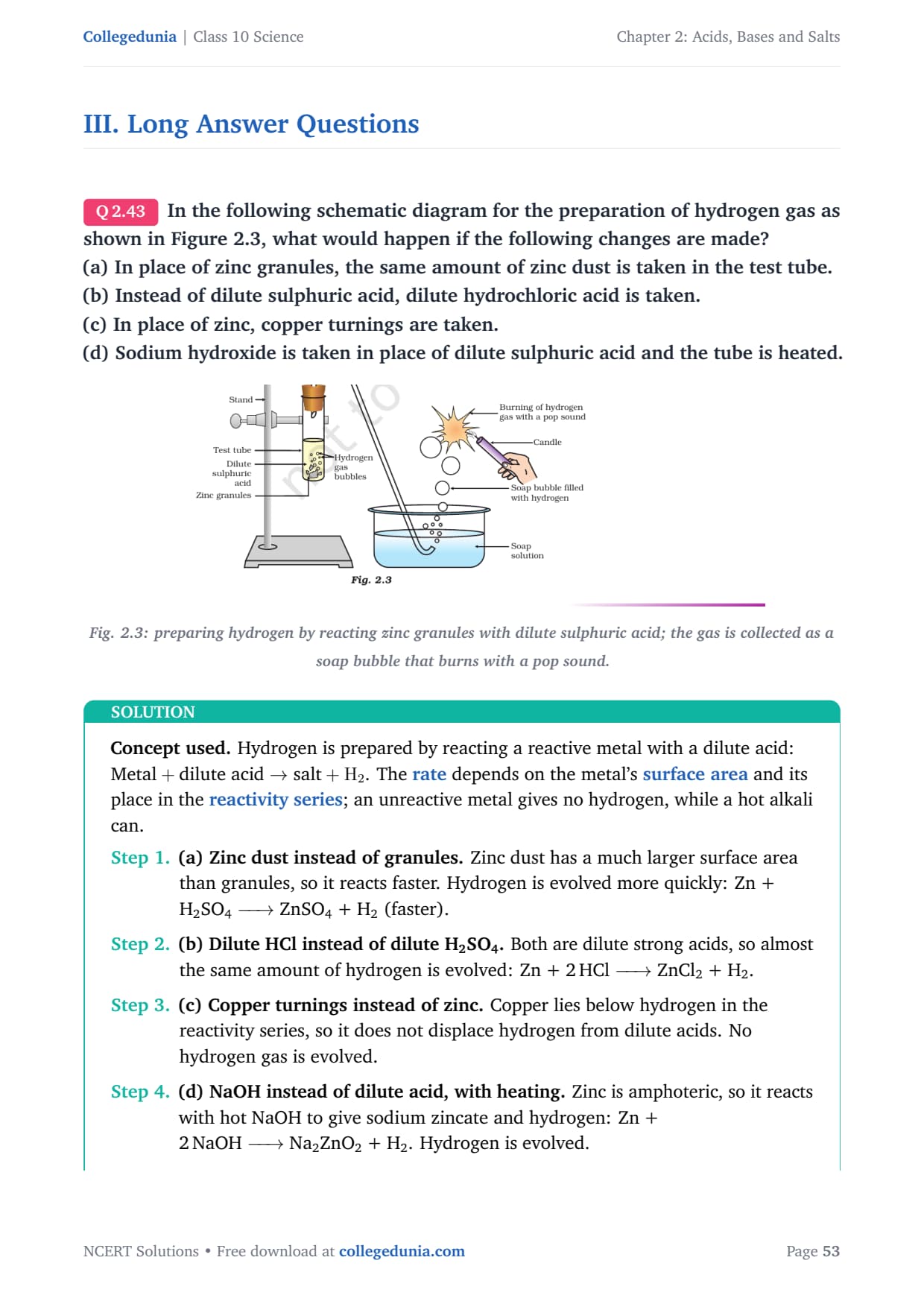
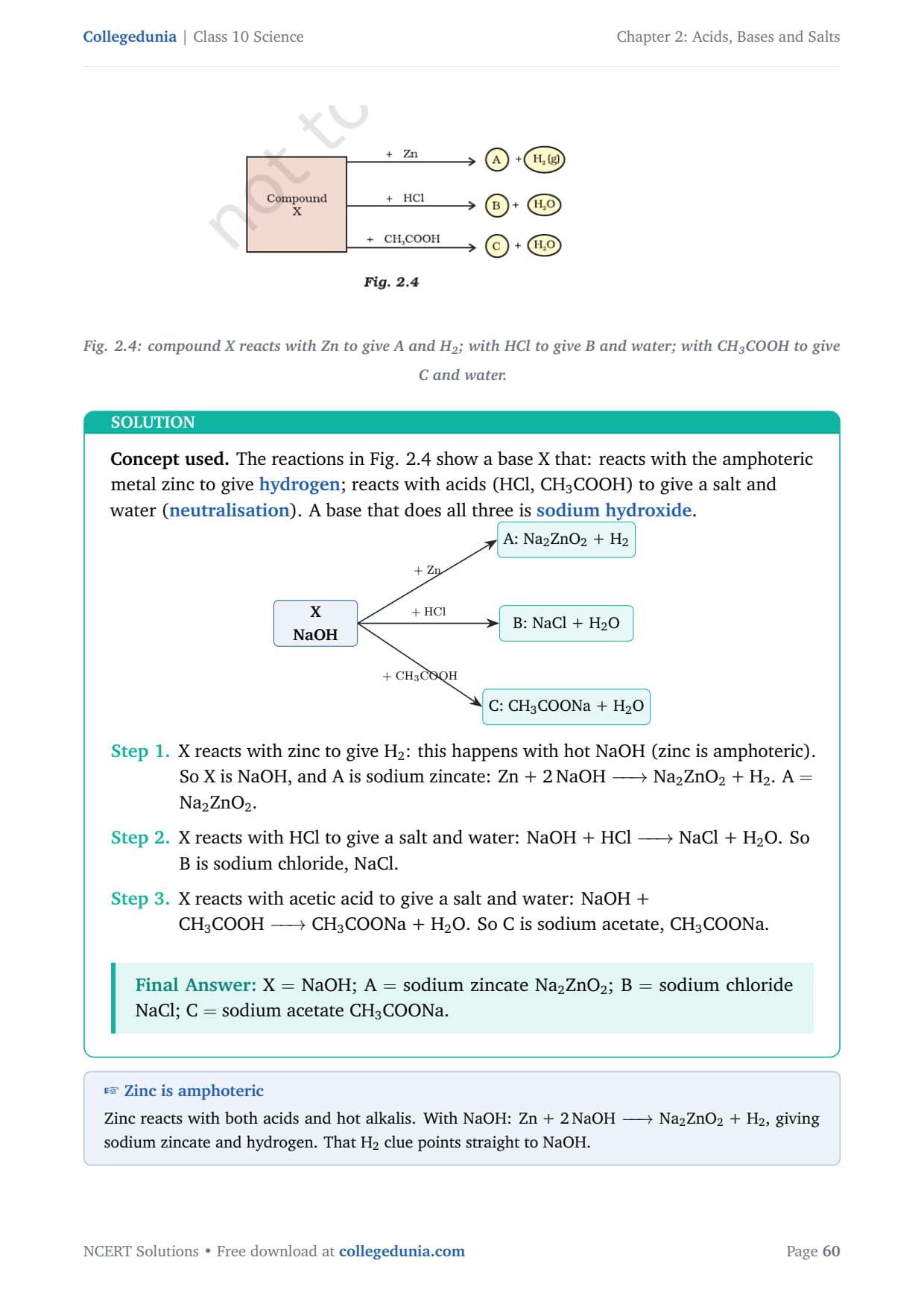
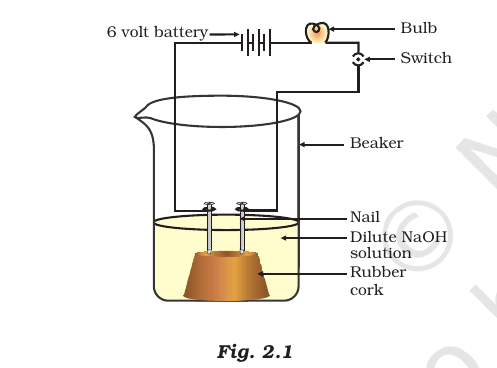

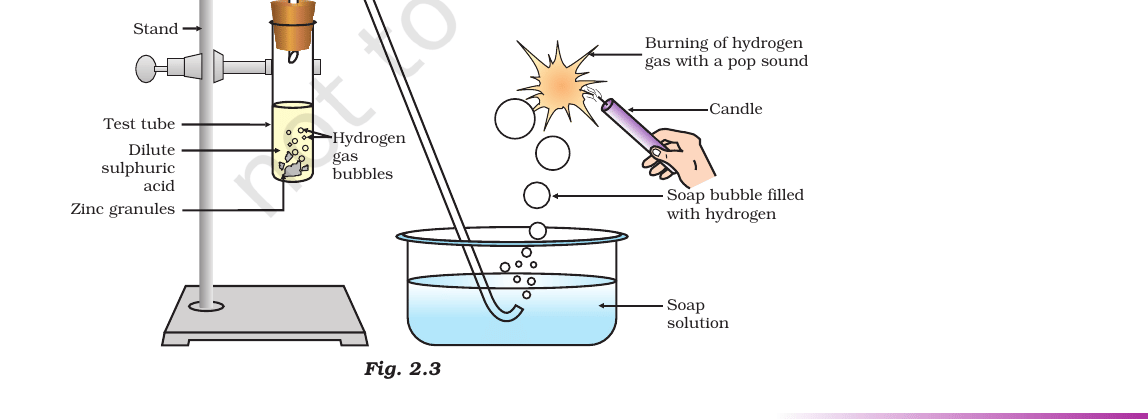
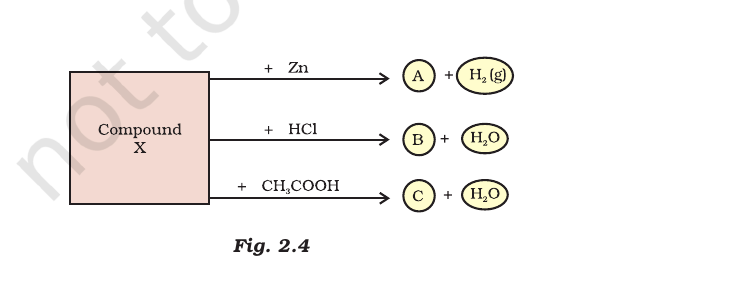



Comments