Physics Strategist, JEE/NEET | Updated on - Jul 23, 2026
Chapter 4 Carbon and its Compounds is one of the most scoring Class 10 Science chapters for 2026-27. The Class 10 Science Chapter 4 NCERT Exemplar Solutions on this page solve every Exemplar problem step by step, in plain language.
CBSE Board weightage: carbon compounds, covalent bonding and functional groups appear almost every year.
What you get: all MCQ, Short Answer and Long Answer problems solved, with a free PDF.
Solved by Collegedunia: Every problem below is solved by subject experts, mapped to the 2026-27 NCERT Exemplar, and checked against the CBSE Board marking scheme.
Why the NCERT Exemplar Matters for Class 10 Board Preparation
This chapter scores well, but small slips cost easy marks. The NCERT Exemplar turns textbook basics of covalent bonding and carbon compounds into exam-style questions: multi-statement MCQs, draw-the-structure problems, and reasoning on addition, substitution and oxidation reactions. Most board questions mirror an Exemplar problem in shape, so finishing it is the best way to feel ready.
Quick Tip: Solve the textbook exercises first. The Exemplar assumes you know the electron dot structures and the four functional groups by heart.
How Collegedunia's NCERT Exemplar Solutions Help You with Carbon and its Compounds
Each problem is solved the way a CBSE examiner expects: structure drawn, reaction written, every step shown.
Every question type solved: all MCQ, Short Answer and Long Answer problems, not just the easy ones.
2026-27 alignment: problem numbers and answers match the current edition.
Step-by-step reactions: equations balanced and named one at a time.
Trap flags: red boxes mark where students mix up addition with substitution or ethanol with ethanoic acid.
Best Way to Use the Carbon and its Compounds Exemplar for Board Revision
Treat the Exemplar as a practice paper, using the plan below.
Phase
Exemplar Use
Time
First read
All MCQs
1 hour
Concept practice
Functional groups and isomer Short Answers
1.5 hours
Answer writing
All Long Answers, full working
2 hours
Pre-board revision
Re-solve the wrong ones
1 hour
About 5.5 hours total. Spend the most time on structural isomers and functional groups, which carry the most marks.
Carbon and its Compounds Exemplar Question Types with One Solved Sample Each
The Exemplar mixes three broad formats, previewed below.
Type
Sample Question
Answer Shape
MCQ
In which compound is –OH the functional group?
Single option, with reason
MCQ (multi-statement)
Which are correct structural isomers of butane?
Pick the correct set of statements
Short Answer
Draw the electron dot structure of ethyne
Structure plus a short note
Reasoning
Why are detergents better cleansing agents than soaps?
Short explanation with logic
Long Answer
Preparation of an ester with a labelled diagram
Several linked parts
Each is solved in full below, with Check Solution and Expert Solution tabs.
Functional Groups Quick Reference
Most Exemplar MCQs test whether you can spot a functional group. It decides the name of the compound and how it reacts.
Functional Group
Formula
Class of Compound
Alcohol (hydroxyl)
–OH
Alcohols, e.g. ethanol
Aldehyde
–CHO
Aldehydes, e.g. ethanal
Ketone
>C=O
Ketones, e.g. propanone
Carboxylic acid
–COOH
Acids, e.g. ethanoic acid
Halogen
–X (Cl, Br, I)
Haloalkanes
A whole homologous series shares the same functional group and differs only by a –CH2– unit from one member to the next.
Difficulty Step-Up from NCERT Textbook to Exemplar
The Exemplar reuses textbook ideas inside harder wrappers.
Concept
NCERT Textbook
NCERT Exemplar
Covalent bonding
Define a covalent bond
Draw the electron dot structure of N2 or water
Saturation
State that alkanes are saturated
Give a test to tell ethane from ethene
Structural isomers
Define isomers
Draw all isomers of hexane or C3H6O
Functional groups
Name the four groups
Identify the heteroatoms in a given chain
Ethanol and ethanoic acid
List their reactions
Identify unknown compounds C, R, A, S from clues
Topics Covered in Class 10 Science Chapter 4 Carbon and its Compounds Exemplar
MCQs test covalent bonding, electron dot structures, the allotropes of carbon (diamond, graphite, buckminsterfullerene), tetravalency and catenation. Short Answers ask you to draw structures, identify functional groups and write structural isomers. Long Answers cover saturated and unsaturated hydrocarbons, addition, substitution and oxidation reactions, ethanol and ethanoic acid, esterification, saponification, and soaps and detergents.
Carbon and its Compounds Exemplar Common Mistakes That Cost Marks
The Exemplar twists trigger the same wrong reflexes. Watch these.
Mixing up addition and substitution. Addition adds across a double or triple bond; substitution swaps an atom in a saturated chain.
Confusing ethanol with ethanoic acid. Ethanol is the alcohol (C2H5OH); ethanoic acid is the acid (CH3COOH) that turns blue litmus red.
Wrong electron dot structure. Carbon needs four shared pairs; N2 needs a triple bond; water has two lone pairs.
Forgetting soap fails in hard water. Soaps form scum with calcium and magnesium ions; detergents do not.
A single missing lone pair can lose the whole mark, so count the valence electrons before you draw a structure.
Watch Out: In a multi-statement MCQ, test every statement. Stopping at the first correct one is how students lose marks here.
First Members of the Homologous Series
Naming and isomer questions become routine once you know the first members of each series; the rest follow by adding –CH2– units.
Alkanes (single bonds): methane, CH4; formula CnH2n+2.
Alkenes (one double bond): ethene, C2H4; formula CnH2n.
Alkynes (one triple bond): ethyne, C2H2; formula CnH2n-2.
Alcohols: methanol, CH3OH, then ethanol, C2H5OH.
For example, ethanol oxidises to ethanoic acid: CH3CH2OH → CH3COOH.
Most Repeated Board Topics from Carbon and its Compounds
Topics that show up most often in CBSE Board and sample papers.
Topic
How it is asked
Electron dot structures
Draw the structure of N2, water, CO2 or methane
Structural isomers
Draw all isomers of butane, hexane or C3H6O
Functional groups
Identify and name the group in a given compound
Ethanol and ethanoic acid
Reactions with sodium, base, and the test for an acid
Esterification and saponification
Write the reaction and describe the activity with a diagram
Soaps and detergents
Cleaning action, micelles, and why detergents work in hard water
All NCERT Exemplar Questions for Carbon and its Compounds with Step-by-Step Solutions
Every question of the NCERT Exemplar set for Class 10 Science Chapter 4 Carbon and its Compounds is listed below with its full Solution and Expert Solution inside collapsible tabs. Click Check Solution to reveal the step-by-step working; click Expert Solution for the expanded explanation.
I. Multiple Choice Questions
Q 4.1
Carbon exists in the atmosphere in the form of
(a) carbon monoxide only (b) carbon monoxide in traces and carbon dioxide (c) carbon dioxide only (d) coal
Correct option: (b) Carbon monoxide in traces and carbon dioxide.
Concept used. Carbon is present in the air as gases that carry
carbon atoms. The major one is carbon dioxide (CO2),
about 0.04% of air, released by breathing, burning of fuels and decay.
A small amount of carbon monoxide (CO) is also present,
formed when fuels burn in a short supply of oxygen (incomplete combustion).
CO2 is the main carbon gas in air (respiration, combustion, decay).
CO is present only in traces (incomplete combustion of fuels, vehicle exhaust).
Coal is a solid; it is not a gas, so it cannot float about in the atmosphere.
So air carries CO2 plus traces of CO.
Air contains CO2 and traces of CO; option (b).
AD
Ananya Deshpande
M.Sc Chemistry, University of Pune
Verified Expert
Source-and-sink angle. The main solution listed the two gases;
let me show why each one is there and in what amount.
Where CO2 comes from. Every living cell respires:
C6H12O6 + 6O2 → 6CO2 + 6H2O. Add to this the burning of coal,
petrol, diesel and wood, plus rotting of dead matter. These sources keep
CO2 at roughly 0.04% by volume, and it is removed by green
plants during photosynthesis. This balance is the carbon cycle.
Where CO comes from. When a fuel burns with too little
oxygen, the carbon is only half-oxidised: 2C + O2 → 2CO instead
of C + O2 → CO2. Vehicle engines and coal stoves running rich do
this, so a trace of CO always exists near roads and chimneys.
CO is poisonous because it locks onto haemoglobin.
Why not the other options. ``Carbon monoxide only'' and
``carbon dioxide only'' both ignore one of the two real gases, and coal
is a mined solid, not an air component. Only option (b) names both gases
with the correct relative amounts.
CO2 (major) plus CO (trace); option (b).
Q 4.2
Which of the following statements are usually correct for carbon compounds? These
(i) are good conductors of electricity (ii) are poor conductors of electricity (iii) have strong forces of attraction between their molecules (iv) do not have strong forces of attraction between their molecules [2pt]
(a) (i) and (iii) (b) (ii) and (iii) (c) (i) and (iv) (d) (ii) and (iv)
Correct option: (d) (ii) and (iv).
Concept used. Carbon compounds are held by covalent
bonds, where atoms share electrons. No ions and no free electrons
are formed, so there are no charged particles to carry current. Also, the
forces between whole molecules (intermolecular forces) are weak.
Sharing of electrons means no free ions/electrons ⇒ poor conductor: statement (ii) correct.
Statement (i) ``good conductor'' is therefore wrong.
Forces between separate molecules are weak (low melting/boiling points): statement (iv) correct.
Statement (iii) ``strong forces between molecules'' is wrong.
Correct pair = (ii) and (iv).
Poor conductors + weak intermolecular forces = (ii) and (iv); option (d).
RK
Rohan Kulkarni
M.Sc Chemistry, Fergusson College
Verified Expert
Property-from-bonding angle. Each of the four statements is a
direct read-off from the nature of the covalent bond. Let me link bonding
to property one by one.
Electrical conductivity. Conduction needs mobile charge. Metals
have a sea of free electrons; ionic melts/solutions have free ions.
Covalent carbon compounds have neither, because every valence electron is
locked in a shared pair between two specific atoms. So a solid or molten
covalent compound (sugar, naphthalene, kerosene) does not conduct.
Statement (ii) is correct and (i) is wrong.
Intermolecular forces. A molecule of, say, methane is neutral
overall. The only attractions to its neighbours are weak van der Waals
(London) forces. Because these are weak, carbon compounds melt and boil
at low temperatures and are often gases, liquids or soft, low-melting
solids. Statement (iv) is correct and (iii) is wrong.
Putting it together. The two correct statements are (ii) and
(iv), so the answer pair is option (d). A quick cross-check: high melting
point and good conduction are signatures of ionic or metallic substances,
not of covalent carbon compounds.
Carbon compounds are poor conductors with weak intermolecular forces; option (d).
Q 4.3
A molecule of ammonia (NH3) has
(a) only single bonds (b) only double bonds (c) only triple bonds (d) two double bonds and one single bond
Correct option: (a) Only single bonds.
Concept used. Nitrogen has 5 valence electrons and needs 3 more
to complete its octet. Each hydrogen needs 1 electron. So nitrogen shares
one electron pair with each of three hydrogen atoms, giving three
N–H single bonds. The fourth pair on nitrogen stays as a lone
pair (not a bond).
N: 5 valence electrons; 3 are used to make bonds, 2 form a lone pair.
Each H shares 1 electron with N ⇒ one single bond each.
Three N–H single bonds in all; no double or triple bonds.
Octet-budget angle. Instead of memorising the structure, let me
build it from the electron count, which is the safe way to settle any
``how many bonds'' question.
Electron accounting. Nitrogen (atomic number 7) has the
configuration 2, 5, so 5 valence electrons. To reach a stable octet of 8
it must gain a share in 3 more electrons. Three hydrogen atoms each bring
1 electron. Pairing one N electron with one H electron three times uses 3
of nitrogen's electrons and all 3 hydrogen electrons.
What is left. Nitrogen still has 5-3 = 2 electrons unused; they
sit as one lone pair on the nitrogen. A lone pair is not a bond,
so it does not change the bond count. Every bond formed is a single shared
pair, hence a single bond.
Ruling out the others. A double bond would need nitrogen to share
two pairs with one atom, and a triple bond three pairs; neither is possible
here because each hydrogen can only ever share one pair. So options (b),
(c) and (d) are impossible for NH3.
Three N–H single bonds plus one lone pair; option (a).
Q 4.4
Buckminsterfullerene is an allotropic form of
(a) phosphorus (b) sulphur (c) carbon (d) tin
Correct option: (c) Carbon.
Concept used.Allotropes are different forms of the
same element in which the atoms are arranged differently.
Buckminsterfullerene (C60) is a cage of 60 carbon atoms
shaped like a football. It is one of the allotropes of carbon, along with
diamond and graphite.
Buckminsterfullerene is made only of carbon atoms (C60).
Its 60 carbons form 12 pentagons and 20 hexagons (a hollow ball).
Other carbon allotropes: diamond (3-D rigid) and graphite (sheets).
Buckminsterfullerene (C60) is an allotrope of carbon; option (c).
AR
Aditya Rao
M.Sc Materials Chemistry, IIT Madras
Verified Expert
Structure-decides-property angle. The main solution named the
allotrope; let me explain the three carbon allotropes side by side so the
``football'' shape makes sense.
Diamond. Every carbon is bonded to four others in a rigid 3-D
network. There are no free electrons, so diamond is the hardest natural
substance and does not conduct electricity.
Graphite. Each carbon bonds to only three others, forming flat
hexagonal sheets. The fourth electron is free to move, so graphite
conducts electricity, and the sheets slide over one another, making it
soft and slippery (used in pencils and as a lubricant).
Buckminsterfullerene (C60). Here 60 carbon atoms close up
into a hollow cage of 12 five-membered and 20 six-membered rings, exactly
like the seams on a football. It was named after the architect
Buckminster Fuller, whose geodesic domes have the same look.
Why the other options fail. Phosphorus (white/red), sulphur
(rhombic/monoclinic) and tin (grey/white) all have their own
allotropes, but none of them forms a C60 cage. The football
molecule is uniquely carbon.
It is a carbon allotrope (C60 cage); option (c).
Q 4.5
Which of the following are correct structural isomers of butane?
(The four options show: (i) normal straight chain CH3CH2CH2CH3; (ii) the branched isomer (CH3)3CH (isobutane); (iii) and (iv) chains that are really the same straight chain re-drawn.) [2pt]
(a) (i) and (iii) (b) (ii) and (iv) (c) (i) and (ii) (d) (iii) and (iv)
Correct option: (c) (i) and (ii).
Concept used.Structural isomers are compounds with the
same molecular formula but different arrangements of atoms. Butane
(C4H10) has exactly two isomers: the straight chain
(n-butane) and the branched chain (isobutane / 2-methylpropane). Structures
(iii) and (iv) only look different but are the same straight chain
drawn in a bent way.
Write C4H10 and find all distinct carbon skeletons.
Skeleton 2: a 3-carbon chain with a CH3 branch = isobutane = structure (ii).
Drawing the straight chain bent (structures iii, iv) does not make a new isomer.
minipage0.85
!%
[See diagram in the PDF version]
minipage
Butane has 2 isomers: n-butane (i) and isobutane (ii); option (c).
SP
Sneha Patil
M.Sc Organic Chemistry, Savitribai Phule Pune University
Verified Expert
Skeleton-first angle. The reliable way to count isomers is to
forget the hydrogens for a moment and just draw the carbon skeletons; then
fill hydrogens to satisfy carbon's valency of four.
Step 1: carbon skeletons of C4H10. With four carbons there
are only two skeletons. One is the unbranched line of four carbons. The
other puts three carbons in a row and hangs the fourth carbon off the
middle carbon as a branch. There is no third arrangement, because moving
the branch to an end just regenerates the straight chain.
Step 2: name them. The straight chain is n-butane,
CH3-CH2-CH2-CH3. The branched one is 2-methylpropane (common name
isobutane), (CH3)2CH-CH3. Both have formula C4H10, so they
are true structural isomers.
Why (iii) and (iv) are decoys. The exam draws the same n-butane
chain twice more, once bent into a zig-zag and once into a hook. Rotating
or bending bonds does not change which atom is joined to which, so these
are not new compounds. A common trick: count the longest continuous carbon
chain and check the branch position; if those match, it is the same isomer.
Only two real isomers exist, drawn as (i) and (ii); option (c).
Q 4.6
In the reaction CH3CH2OH (alkaline KMnO4+ heat) →CH3COOH, alkaline KMnO4 acts as
(a) reducing agent (b) oxidising agent (c) catalyst (d) dehydrating agent
Correct option: (b) Oxidising agent.
Concept used.Oxidation of an alcohol means adding
oxygen (or removing hydrogen). Here ethanol (CH3CH2OH) is turned
into ethanoic acid (CH3COOH), which has one more oxygen and two
fewer hydrogens. The reagent that supplies this oxygen is the
oxidising agent.
Compare reactant and product: ethanol CH3CH2OH→ ethanoic acid CH3COOH.
The product gained an O atom and lost H atoms ⇒ ethanol has been oxidised.
Alkaline KMnO4 (with heat) provides that oxygen, so it is the oxidising agent.
Reaction: CH3CH2OH + [O] → CH3COOH + H2O, where [O] comes from alk. KMnO4.
Alkaline KMnO4 oxidises ethanol to ethanoic acid; it is an oxidising agent; option (b).
KS
Karthik Subramanian
M.Sc Chemistry, Loyola College Chennai
Verified Expert
Electron-transfer angle. The main solution used the
oxygen/hydrogen count. Let me check the same answer using oxidation
numbers, which never lies.
Carbon oxidation state. In ethanol the carbon that carries the
-OH is at oxidation state -1. In ethanoic acid that carbon
becomes +3 (it is now bonded to two oxygens). The carbon's oxidation
number has gone up by 4, which is the definition of oxidation of the
organic substrate.
What happens to manganese. If ethanol is oxidised, something must
be reduced to take the electrons. In alkaline KMnO4 the manganese
falls from +7 (in MnO4-, purple) to +4 (in MnO2, brown).
The purple colour fading is the visible sign that KMnO4 has acted as
the oxidising agent.
Why the wrong options fail. A reducing agent would lower
the carbon oxidation state (wrong direction). A catalyst would speed the
reaction without being consumed, but KMnO4 is consumed (it changes
to MnO2). A dehydrating agent only removes water; it would give an
alkene, not an acid.
Carbon is oxidised (-1 → +3) as Mn drops +7 → +4; KMnO4 is the oxidising agent; option (b).
Q 4.7
Oils on treating with hydrogen in the presence of palladium or nickel catalyst form fats. This is an example of
(a) Addition reaction (b) Substitution reaction (c) Displacement reaction (d) Oxidation reaction
Correct option: (a) Addition reaction.
Concept used. Oils are unsaturated (they have C=C
double bonds). When hydrogen adds across these double bonds in
the presence of a nickel or palladium catalyst, the double bonds become
single bonds and the oil becomes a saturated solid fat. Adding atoms
across a double bond is an addition reaction (here it is called
hydrogenation).
Oil has C=C double bonds (unsaturated).
H2 adds across each C=C in the presence of Ni/Pd.
C=C becomes C–C (saturated) ⇒ fat (solid at room temperature).
Nothing is removed or replaced; atoms are only added ⇒ addition reaction.
Hydrogen adds across the C=C bonds of the oil; it is an addition (hydrogenation) reaction; option (a).
DM
Divya Menon
M.Sc Organic Chemistry, University of Calicut
Verified Expert
Everyday-chemistry angle. This is the reaction that turns liquid
vegetable oil into vanaspati ghee, so it is worth understanding fully.
What unsaturation means. A vegetable oil molecule has long carbon
chains with one or more C=C double bonds. These bends in the chain stop
the molecules from packing tightly, so the oil stays liquid at room
temperature.
The hydrogenation step. Passing H2 over the oil with a
finely divided nickel (or palladium) catalyst makes one H atom add
to each carbon of a double bond, turning each C=C into a C–C single bond.
Removing the double bonds straightens the chains, they now pack tightly, and
the product is a semi-solid fat.
Why each other option is wrong. Substitution swaps one atom for
another (as in chlorination of methane); nothing is swapped here.
Displacement is a metal-replacing-metal idea from inorganic chemistry, not
relevant. Oxidation would add oxygen, but here we add hydrogen. So the
only correct label is addition.
Health note. Hydrogenation can also form harmful trans-fats if
done partially, which is why this reaction matters beyond the exam.
Hydrogen adds across C=C, converting oil to fat; addition reaction; option (a).
Q 4.8
In which of the following compounds is -OH the functional group?
(a) Butanone (b) Butanol (c) Butanoic acid (d) Butanal
Correct option: (b) Butanol.
Concept used. The name ending (suffix) tells you the
functional group. The ending ``-ol'' means the
hydroxyl group (-OH), found in alcohols. So ``butanol''
is the compound whose functional group is -OH.
Butan-ol⇒ ``-ol'' ⇒ alcohol ⇒ functional group -OH.
Butan-one⇒ ``-one'' ⇒ ketone ⇒C=O (carbonyl).
Butanoic acid⇒ carboxylic acid ⇒-COOH.
Butan-al⇒ ``-al'' ⇒ aldehyde ⇒-CHO.
Butanol carries the -OH (hydroxyl) group; option (b).
PJ
Pranav Joshi
M.Sc Chemistry, Institute of Science Mumbai
Verified Expert
Naming-system angle. This question rewards anyone who knows the
suffix code. Let me lay out the code and then apply it to all four names.
The suffix code. In IUPAC naming, the part before the suffix tells
the number of carbons (but- = 4 carbons here for all four), and the
suffix names the functional group. ``-ol'' is reserved for the hydroxyl
group -OH, the defining group of alcohols.
Applying it. Butanol =C4H9OH, an alcohol. The other
three carry different groups: butanone is a ketone (CH3COCH2CH3,
C=O (carbonyl) in the middle); butanoic acid is a carboxylic acid
(CH3CH2CH2COOH, -COOH at the end); butanal is an aldehyde
(CH3CH2CH2CHO, -CHO at the end).
Why this matters. The functional group, not the carbon chain,
decides chemical behaviour. So spotting -OH from the ``-ol'' ending
immediately tells you the compound will react like ethanol (reacts with
sodium, can be oxidised to an acid, forms esters).
Only ``butan-ol'' has the -OH group; option (b).
Q 4.9
The soap molecule has a
(a) hydrophilic head and a hydrophobic tail (b) hydrophobic head and a hydrophilic tail (c) hydrophobic head and a hydrophobic tail (d) hydrophilic head and a hydrophilic tail
Correct option: (a) Hydrophilic head and a hydrophobic tail.
Concept used. A soap molecule has two different ends. The
ionic head (-COO-Na+) mixes with water, so it is
hydrophilic (water-loving). The long carbon chain tail
mixes with oil and grease but not water, so it is hydrophobic
(water-fearing). This two-ended design is what lets soap clean.
Head =-COO-Na+ (charged) ⇒ dissolves in water ⇒ hydrophilic.
Tail = long -CH2-CH2- … CH3 chain ⇒ dissolves in oil ⇒ hydrophobic.
So the molecule is hydrophilic head + hydrophobic tail.
Polarity-matching angle. The main solution named the two ends.
Let me explain the cleaning action so you see why this exact arrangement
is needed.
Like dissolves like. Water is polar, so it dissolves polar or
ionic things. Oil and grease are non-polar, so they dissolve non-polar
things. A single molecule that has both a polar end and a non-polar
end can therefore touch both worlds at once. The soap molecule is exactly
that bridge.
How dirt is removed. When greasy cloth is washed, the hydrophobic
tails dig into the oil drop while the hydrophilic heads stay outside in the
water. Many soap molecules surround one oil drop, heads out, tails in,
forming a tiny ball called a micelle. The outside of the micelle
is charged, so the micelles repel each other and stay suspended; rinsing
then carries the grease away.
Why the other options fail. If both ends were hydrophilic the soap
could not grip grease; if both ends were hydrophobic it could not stay in
water; swapping the head and tail roles is simply not how the carboxylate
ion is built. Only ``hydrophilic head, hydrophobic tail'' allows cleaning.
Polar ionic head in water, non-polar tail in grease; option (a).
Q 4.10
Which of the following is the correct representation of the electron dot structure of nitrogen (N2)?
(The options show different dot diagrams; the correct one, option (d), shows the two N atoms sharing three electron pairs (a triple bond) with one lone pair left on each N.) [2pt]
(a) one shared pair (b) two shared pairs (c) four shared pairs (d) three shared pairs (triple bond) with one lone pair on each N
Correct option: (d) Three shared pairs (a triple bond) with one lone pair on each nitrogen.
Concept used. Each nitrogen atom has 5 valence electrons and needs
3 more to complete its octet. Two nitrogen atoms therefore share
three pairs of electrons, forming a triple bond
(N#N). After making the triple bond, each nitrogen still has one
unshared lone pair.
Each N has 5 valence electrons; needs 3 more for an octet.
The two N atoms share 3 electron pairs ⇒ triple bond.
Count for one N: 3 shared pairs (6 electrons, counted as a share of 6) + 1 lone pair = octet.
Correct dot diagram: N#N with one lone pair drawn on each N (a triple bond between the atoms).
minipage0.55
0.8!%
[See diagram in the PDF version]
minipage
N2 has a triple bond with a lone pair on each N; option (d).
SR
Sanjana Reddy
M.Sc Chemistry, Osmania University
Verified Expert
Octet-completion angle. The main solution built the triple bond
from the electron need. Let me double-check by counting total electrons,
which is the foolproof method for any dot structure.
Total valence electrons. Two nitrogen atoms give 5 + 5 = 10
valence electrons, i.e. 5 pairs to place. These must be split between
bonding pairs (between the atoms) and lone pairs (on the atoms) so that
each N ends up with 8 around it.
Placing the pairs. Put 3 pairs between the two atoms (the triple
bond). That leaves 5 - 3 = 2 pairs, one to sit as a lone pair on each
nitrogen. Now check each N: it sees 6 shared electrons (the triple bond)
plus its own lone pair of 2, total 8. Octet satisfied for both.
Why fewer bonds fail. A single bond would leave each N with only
6 electrons; a double bond leaves 7; only the triple bond delivers the
full octet. So options that show one or two shared pairs cannot be right,
and four shared pairs would over-fill the shell.
Triple bond plus one lone pair on each N gives both atoms an octet; option (d).
Q 4.11
The structural formula of ethyne is
(a) H-C#C-H (b) H3-C#C-H (c) H2C=CH2 (d) H3C-CH3
Correct option: (a)H-C#C-H.
Concept used.Ethyne (C2H2) is the first member
of the alkyne family, which always has a carbon–carbon
triple bond. Two carbons joined by a triple bond, each carrying
one hydrogen, gives H-C#C-H.
Ethyne = 2 carbons + 2 hydrogens =C2H2.
Alkynes contain a C≡C triple bond.
Each carbon uses 3 bonds for the triple bond and 1 for an H ⇒ valency 4 satisfied.
Structure: H-C#C-H.
Ethyne is H-C#C-H (C2H2); option (a).
VC
Vikram Choudhary
M.Sc Chemistry, University of Rajasthan
Verified Expert
Valency-check angle. The main solution gave the structure. Let me
show how to eliminate every wrong option just by counting bonds on carbon,
which must always total four.
Carbon's rule of four. Each carbon atom must form exactly four
covalent bonds. In H-C#C-H each carbon uses three bonds for the
triple bond to the other carbon and one bond to a hydrogen: 3 + 1 = 4.
Perfect, and the formula is C2H2, matching ethyne.
Rejecting the decoys. Option (b) H3-C#C-H asks one carbon
to bond to 3 hydrogens and hold a triple bond, which needs 6 bonds:
impossible. Option (c) H2C=CH2 is ethene (a double bond, formula
C2H4), an alkene, not an alkyne. Option (d) H3C-CH3 is ethane
(all single bonds, C2H6), an alkane.
Family check. Alkanes end in -ane (single bonds), alkenes in -ene
(double bond), alkynes in -yne (triple bond). ``Ethyne'' ends in -yne, so
it must have the triple bond, confirming option (a).
H-C#C-H satisfies carbon's valency and matches C2H2; option (a).
Q 4.12
Identify the unsaturated compounds from the following:
(i) Propane (ii) Propene (iii) Propyne (iv) Chloropropane [2pt]
(a) (i) and (ii) (b) (ii) and (iv) (c) (iii) and (iv) (d) (ii) and (iii)
Correct option: (d) (ii) and (iii).
Concept used.Unsaturated compounds contain at least one
carbon–carbon double or triple bond. The name ending tells you: ``-ene''
means a double bond (alkene) and ``-yne'' means a triple bond (alkyne).
``-ane'' means only single bonds (saturated).
Propane (-ane): only single bonds ⇒ saturated. Not selected.
Propene (-ene): one C=C double bond ⇒ unsaturated. Selected (ii).
Propyne (-yne): one C≡C triple bond ⇒ unsaturated. Selected (iii).
Chloropropane: a chloro-substituted alkane, only single bonds ⇒ saturated. Not selected.
Propene and propyne are unsaturated; option (d).
IV
Ishaan Verma
M.Sc Chemistry, Banaras Hindu University
Verified Expert
Formula-test angle. The main solution read the suffixes. Let me
confirm using the general formulae, which is handy when the name is
unfamiliar.
General formulae. A saturated alkane fits CnH2n+2. An
alkene (one double bond) fits CnH2n, with two fewer hydrogens.
An alkyne (one triple bond) fits CnH2n-2, with four fewer.
Fewer hydrogens for the same carbons is the fingerprint of unsaturation.
Apply to the three carbons (n=3). Propane is C3H8
(2×3+2), fully saturated. Propene is C3H6 (2×3),
short by 2 H, so one double bond, unsaturated. Propyne is C3H4
(2×3-2), short by 4 H, so one triple bond, unsaturated.
Chloropropane C3H7Cl comes from propane with one H swapped for Cl,
still only single bonds, so saturated.
Quick test reminder. Unsaturated compounds decolourise bromine
water and alkaline KMnO4; propene and propyne would, propane and
chloropropane would not. So the two unsaturated members are (ii) and (iii).
Propene (C3H6) and propyne (C3H4) are unsaturated; option (d).
Q 4.13
Chlorine reacts with saturated hydrocarbons at room temperature in the
(a) absence of sunlight (b) presence of sunlight (c) presence of water (d) presence of hydrochloric acid
Correct option: (b) Presence of sunlight.
Concept used. Saturated hydrocarbons (alkanes) undergo
substitution reactions in which a hydrogen atom is replaced by a
chlorine atom. This reaction needs energy to start, and that energy is
supplied by sunlight (ultraviolet light), which breaks the
chlorine molecule into reactive atoms.
Sunlight splits Cl2 into two reactive chlorine atoms.
A chlorine atom pulls off a hydrogen from the alkane.
Another chlorine takes the place of that hydrogen: CH4 + Cl2 → CH3Cl + HCl (in sunlight).
Without sunlight this substitution does not happen at room temperature.
Sunlight is needed for chlorination of alkanes; option (b).
AG
Aryan Gupta
M.Sc Chemistry, University of Delhi
Verified Expert
Energy-source angle. The main solution named sunlight. Let me
explain why light, and not water or acid, is the thing that makes alkanes
react.
Why alkanes are stubborn. An alkane has only strong C–H and C–C
single bonds and no reactive site. To make it react you must first create a
reactive species. Chlorine on its own at room temperature in the dark does
nothing to methane.
What sunlight does. Ultraviolet light has enough energy to break
the relatively weak Cl-Cl bond into two chlorine atoms (free
radicals), each with an unpaired electron. These radicals are very
reactive: one of them snatches a hydrogen from the alkane, and a chain of
substitution steps follows, giving CH3Cl, then CH2Cl2, and so
on, releasing HCl.
Why the wrong options fail. The absence of sunlight means no
radicals, so no reaction. Water and hydrochloric acid do not split the
chlorine molecule, so they cannot start the substitution. Only sunlight
provides the trigger.
Sunlight breaks Cl2 into radicals that substitute alkane H; option (b).
Q 4.14
In the soap micelles
(a) the ionic end of soap is on the surface of the cluster while the carbon chain is in the interior of the cluster (b) ionic end of soap is in the interior of the cluster and the carbon chain is out of the cluster (c) both ionic end and carbon chain are in the interior of the cluster (d) both ionic end and carbon chain are on the exterior of the cluster
Correct option: (a) The ionic end is on the surface while the carbon chain is in the interior.
Concept used. A micelle forms in water when many soap
molecules cluster into a tiny ball. The water-loving ionic heads
point outward to face the water, while the water-fearing
carbon-chain tails hide inside, away from water. This is the only
way both ends are happy in their surroundings.
Ionic heads are hydrophilic ⇒ they face the surrounding water ⇒ on the surface.
Carbon tails are hydrophobic ⇒ they avoid water ⇒ tucked into the interior.
Result: a sphere with charged outer surface and oily inner core.
minipage0.5
0.7!%
[See diagram in the PDF version]
minipage
Ionic heads on the surface, carbon tails in the interior; option (a).
NB
Nandini Bhat
Ph.D Chemistry, Mangalore University
Verified Expert
Free-energy angle. The main solution gave the layout. Let me say
why nature picks this exact arrangement and not the reverse.
The driving force. Water molecules hydrogen-bond strongly to each
other. An oily tail cannot join this network, so when tails are exposed to
water, the water has to cage them, which is unfavourable. The system lowers
its energy by hiding all the tails together inside a ball, so the least
water surface touches oil. This is the same hydrophobic effect that makes
oil droplets merge in water.
Why heads face out. The ionic heads (-COO-) are happy in
water and even attract it. Placing them on the outside surface lets them
hydrogen-bond and ion-attract the surrounding water, which is favourable.
So heads out, tails in, is the lowest-energy structure.
Why this enables cleaning. The oily interior can trap a grease
droplet, while the charged outer surface keeps micelles apart (like charges
repel) and suspended in water, so rinsing carries the dirt away. The
reversed arrangements in options (b), (c) and (d) would either expose the
tails to water or bury the heads, both energetically impossible in water.
Pentane has the molecular formula C5H12. It has
(a) 5 covalent bonds (b) 12 covalent bonds (c) 16 covalent bonds (d) 17 covalent bonds
Correct option: (c) 16 covalent bonds.
Concept used. In a saturated hydrocarbon every bond is a single
covalent bond. Count the C–C bonds (between carbons) and the
C–H bonds (between carbon and hydrogen) separately, then add them.
Draw pentane: CH3-CH2-CH2-CH2-CH3 (5 carbons in a row).
C–C bonds: 5 carbons in a chain give 5-1 = 4 C–C bonds.
C–H bonds: there are 12 hydrogens, each making one C–H bond ⇒ 12 C–H bonds.
Counting-by-formula angle. The main solution drew the chain. Let
me give a formula method that works for any straight-chain alkane,
so you never need the picture.
Set up the count. A straight-chain alkane CnH2n+2 has
n carbons. The carbons link in a single line, so there are (n-1) C–C
bonds. Every hydrogen makes exactly one C–H bond, and there are 2n+2
hydrogens, so (2n+2) C–H bonds.
Total bond formula. Total = (n-1) + (2n+2) = 3n + 1. For pentane
n = 5, so total = 3(5) + 1 = 16. This matches the hand count of 4 C–C
plus 12 C–H.
Why the decoys fail. ``5'' counts only the carbons, ``12'' counts
only the hydrogens or only the C–H bonds, and ``17'' over-counts by one
(a common slip if you write n C–C bonds instead of n-1). The careful
total is 16.
3n+1 = 3(5)+1 = 16 covalent bonds; option (c).
Q 4.16
The structural formula of benzene is
(The options show different ring/chain drawings; the correct one, option (c), is a six-membered carbon ring with three alternate C=C double bonds and one H on each carbon, formula C6H6.) [2pt]
(a) a five-membered ring (b) an open chain (c) a six-membered ring with alternate double bonds (C6H6) (d) a six-membered ring with all single bonds
Correct option: (c) A six-membered ring with alternate double bonds.
Concept used.Benzene (C6H6) is a ring of six
carbon atoms. The ring has three carbon–carbon double bonds
placed alternately with three single bonds, and each carbon carries one
hydrogen. This alternating-double-bond ring is the correct structure.
Benzene formula =C6H6: 6 carbons, 6 hydrogens.
The 6 carbons join in a closed ring (hexagon).
Double and single bonds alternate around the ring (3 of each).
Each carbon has one H, satisfying carbon's valency of 4.
minipage0.45
0.6!%
[See diagram in the PDF version]
minipage
Benzene is a six-carbon ring with alternate double bonds, C6H6; option (c).
HA
Harshita Agarwal
M.Sc Chemistry, University of Lucknow
Verified Expert
Valency-on-a-ring angle. The main solution described the hexagon.
Let me build it from scratch so the alternate double bonds are clearly
necessary, not just memorised.
Start with the formula. Benzene is C6H6. With 6 carbons,
each needing 4 bonds, the total bonding capacity is 6×4 = 24 bonds
worth of electrons. The 6 hydrogens use up 6 of those (one C–H each),
leaving 18 to be shared among the carbon ring.
Why double bonds appear. Six carbons joined in a plain ring with
single bonds would use only 6 C–C bonds, leaving each carbon one bond
short. To satisfy every carbon's valency of 4, three of the ring bonds
must become double bonds, arranged alternately so each carbon has exactly
one double and one single bond to its neighbours plus one C–H. That is the
classic Kekul'e structure.
Rejecting the decoys. A five-membered ring or an open chain would
not give the formula C6H6 with the right valencies; a ring of all
single bonds (option d) leaves each carbon with only 3 bonds, which is
impossible for carbon. Only the six-membered ring with alternate double
bonds works.
Hexagonal C6H6 ring with alternating double bonds; option (c).
Q 4.17
Ethanol reacts with sodium and forms two products. These are
(a) sodium ethanoate and hydrogen (b) sodium ethanoate and oxygen (c) sodium ethoxide and hydrogen (d) sodium ethoxide and oxygen
Correct option: (c) Sodium ethoxide and hydrogen.
Concept used. Sodium metal reacts with the -OH group of an
alcohol. The sodium replaces the hydrogen of the -OH, giving an
alkoxide salt (here sodium ethoxide) and releasing
hydrogen gas.
Ethanol is CH3CH2OH; the reactive part is the O-H.
Sodium pushes out the H of O-H and takes its place.
Products: sodium ethoxide CH3CH2O-Na+ and hydrogen gas H2.
Acid-base angle. The main solution swapped Na for H. Let me frame
this as a simple acid–base style reaction, which makes the products
obvious.
Ethanol's weakly acidic H. The hydrogen of the -OH group is
very slightly acidic. A reactive metal like sodium can displace it, just as
sodium displaces hydrogen from water (2Na + 2H2O → 2NaOH + H2). The
alcohol behaves like a very weak ``acid'' here.
Products by analogy. Replacing water's H by Na gives the hydroxide;
replacing ethanol's O-H hydrogen by Na gives the ethoxide,
CH3CH2O-Na+. In both cases the hydrogen that leaves pairs up to
form H2 gas (which you see as bubbles). This effervescence is in fact
a test for the -OH group.
Why the wrong options fail. ``Sodium ethanoate'' would need
oxidation of ethanol to the acid first, which sodium does not do. Oxygen is
never a product; the gas released is hydrogen. So only ``sodium ethoxide
and hydrogen'' is correct.
Na displaces the O-H hydrogen → sodium ethoxide +H2; option (c).
Q 4.18
The correct structural formula of butanoic acid is
(The options show four-carbon structures. The correct one, option (d),
is a straight four-carbon chain ending in the -COOH group.) [2pt]
(a) CH3-CH2-COOH (propanoic acid) (b) a ketone structure
(c) an ester structure (d) CH3-CH2-CH2-COOH
Correct option: (d)CH3-CH2-CH2-COOH.
Concept used. The name ``butanoic acid'' tells you two things:
``butan-'' means four carbon atoms and ``-oic acid'' means the
carboxylic acid group (-COOH). So the structure is a chain
of four carbons (counting the -COOH carbon) ending in -COOH.
The -COOH carbon counts as one of the four carbons.
Build the chain: CH3-CH2-CH2-COOH (total 4 carbons).
This has the -COOH at one end, matching ``butanoic acid''.
Butanoic acid is CH3CH2CH2COOH (4 carbons, -COOH end); option (d).
AP
Aishwarya Pillai
M.Sc Organic Chemistry, University of Kerala
Verified Expert
Name-to-structure angle. The main solution decoded the name. Let
me also rule out the look-alikes, because the exam draws very similar
four-carbon pictures.
Decode the name fully. The stem ``but'' fixes the carbon count at
four. The suffix ``-oic acid'' fixes the functional group as carboxylic
acid, -COOH, which must sit at the end of the chain (carbon number 1).
So the skeleton is C-C-C-COOH, written CH3CH2CH2COOH.
Why the decoys are wrong. A three-carbon acid CH3CH2COOH is
propanoic acid, not butanoic, so it has the wrong carbon count. A ketone
structure has C=O (carbonyl) in the middle, not -COOH at the end, so it
is the wrong functional group. An ester structure has -COO- linking
two carbon groups, again not a free acid. Only the straight four-carbon
chain ending in -COOH fits.
Confirm by formula.CH3CH2CH2COOH is C4H8O2, the
known formula of butanoic acid (the smell of rancid butter). This
cross-check seals option (d).
CH3CH2CH2COOH (C4H8O2); option (d).
Q 4.19
Vinegar is a solution of
(a) 50%–60% acetic acid in alcohol (b) 5%–8% acetic acid in alcohol (c) 5%–8% acetic acid in water (d) 50%–60% acetic acid in water
Correct option: (c) 5%–8% acetic acid in water.
Concept used.Vinegar is a dilute solution of
acetic acid (ethanoic acid) in water. The acetic acid
content is only about 5% to 8%, which is why vinegar is safe to use in
food.
Acetic acid = ethanoic acid (CH3COOH).
In vinegar it is dissolved in water (the solvent), not alcohol.
Its concentration is low: about 5% to 8%.
Vinegar =5%–8% acetic acid in water; option (c).
MS
Mihir Saxena
M.Sc Chemistry, University of Allahabad
Verified Expert
Everyday-product angle. The main solution gave the figures. Let me
explain where vinegar comes from and why both the solvent and the
concentration in option (c) are correct.
How vinegar is made. Vinegar is produced by the souring of dilute
alcohol: bacteria oxidise the ethanol in fermented liquids to ethanoic acid
in the presence of air. The starting liquid is already mostly water, and
only part of the alcohol turns to acid, so the final product is a watery
solution with a small acid content.
Why 5–8%. Food-grade vinegar is kept at about 5–8% acetic acid.
This is acidic enough to give the sour taste and to preserve pickles by
stopping microbial growth, but dilute enough to be safe to eat. A 50–60%
solution would be corrosive and dangerous.
Why the solvent is water. Acetic acid is fully miscible with water
and forms hydrogen bonds with it, so water is the natural solvent. Options
that name alcohol as the solvent are simply wrong; alcohol is the
starting material, not the solvent of the finished vinegar.
Dilute (5–8%) acetic acid in water; option (c).
Q 4.20
Mineral acids are stronger acids than carboxylic acids because
(i) mineral acids are completely ionised (ii) carboxylic acids are completely ionised (iii) mineral acids are partially ionised (iv) carboxylic acids are partially ionised [2pt]
(a) (i) and (iv) (b) (ii) and (iii) (c) (i) and (ii) (d) (iii) and (iv)
Correct option: (a) (i) and (iv).
Concept used. The strength of an acid depends on how much it
ionises in water (how many H+ ions it releases).
Mineral acids (like HCl) ionise completely, giving
many H+ ions, so they are strong. Carboxylic acids (like
CH3COOH) ionise only partially, giving fewer H+ ions,
so they are weak.
Mineral acid in water: HCl → H+ + Cl- (almost 100% ionised): statement (i) correct.
Mineral acids fully ionise, carboxylic acids partly ionise; option (a).
RM
Riya Malhotra
Ph.D Physical Chemistry, IIT Bombay
Verified Expert
Equilibrium angle. The main solution compared the extents of
ionisation. Let me sharpen this with the idea of an ionisation equilibrium,
which is what ``partly ionised'' really means.
Strong acid, no equilibrium. For HCl, ionisation goes
almost fully to completion; we write a single arrow. Almost every molecule
splits into H+ and Cl-, so a 0.1 M HCl solution has
nearly 0.1 M H+. That high H+ concentration is what makes it
strongly acidic (low pH).
Weak acid, true equilibrium. For CH3COOH, ionisation sets up
a balance, written with a double arrow:
CH3COOH ⇌ CH3COO- + H+. At equilibrium only a small fraction (a few
per cent) has ionised, because the acetate ion readily grabs H+ back.
So a 0.1 M acetic acid solution has far less H+ and a higher pH.
Reading the options. Statement (i) (mineral acids completely
ionised) and statement (iv) (carboxylic acids partially ionised) are both
true and together explain the strength gap. Statements (ii) and (iii)
reverse the facts, so any option containing them is wrong. The answer is
(a).
Complete ionisation (mineral) vs partial ionisation (carboxylic): (i) and (iv); option (a).
Q 4.21
Carbon forms four covalent bonds by sharing its four valence electrons with four univalent atoms, e.g. hydrogen. After the formation of four bonds, carbon attains the electronic configuration of
(a) helium (b) neon (c) argon (d) krypton
Correct option: (b) Neon.
Concept used. Carbon (atomic number 6) has the configuration
2, 4. By sharing its 4 valence electrons with 4 hydrogen atoms, it gains a
share of 4 more, so its outer shell now ``sees'' 8 electrons. A complete
octet in the second shell (2, 8) is the configuration of neon.
Carbon: 2, 4 (needs 4 more for an octet).
Sharing 4 electrons with 4 H atoms gives carbon a share of 8 outer electrons.
Configuration becomes 2, 8 ⇒ same as neon (the nearest noble gas).
Carbon completes its octet (2, 8) like neon; option (b).
ST
Saurabh Tiwari
M.Sc Chemistry, University of Lucknow
Verified Expert
Nearest-noble-gas angle. The main solution reached neon by adding
to the octet. Let me explain why carbon picks neon and not helium.
Counting after bonding. Carbon starts with 4 outer electrons. Each
of the four shared pairs in CH4 contributes one extra electron to
carbon's count, so it now has access to 4 + 4 = 8 electrons in its outer
(second) shell. The full electron picture is 2 (inner) and 8 (outer), i.e.
2, 8.
Match to a noble gas. The noble gas with configuration 2, 8 is
neon. Helium has only 2 electrons (a full first shell), which suits
hydrogen, not carbon. Argon is 2, 8, 8 and krypton even larger, both far
beyond carbon's two-shell size.
Why sharing, not transfer. Carbon would need to gain or lose 4
electrons to become an ion, which costs too much energy. Sharing four pairs
is the easy route to the neon octet, and it is why carbon forms covalent,
not ionic, compounds.
The correct electron dot structure of a water molecule is
(The options show different dot diagrams of H2O; the correct one, option (c), has oxygen sharing one electron pair with each of two H atoms (two O–H single bonds) and carrying two lone pairs.) [2pt]
(a) no lone pairs on O (b) one lone pair on O (c) two O–H bond pairs and two lone pairs on O (d) a double bond to one H
Correct option: (c) Two O–H bond pairs and two lone pairs on oxygen.
Concept used. Oxygen has 6 valence electrons and needs 2 more for
an octet. It shares one electron pair with each of two hydrogen
atoms, forming two O–H single bonds. The remaining 4 electrons on
oxygen stay as two lone pairs.
Oxygen: 6 valence electrons; uses 2 for bonding, 4 stay as lone pairs.
Each H shares 1 electron with O ⇒ two O–H single bonds.
Oxygen now has: 2 bond pairs (shared) + 2 lone pairs = octet.
minipage0.5
0.7!%
[See diagram in the PDF version]
minipage
Water = two O–H bonds + two lone pairs on O; option (c).
PH
Pooja Hegde
M.Sc Chemistry, Karnatak University
Verified Expert
Electron-bookkeeping angle. The main solution placed the pairs.
Let me confirm by a full electron count, which is the safest check for any
dot structure.
Total valence electrons. Oxygen brings 6, and each hydrogen brings
1, so 6 + 1 + 1 = 8 valence electrons, i.e. 4 pairs to place. These must
be arranged so oxygen ends with 8 around it and each hydrogen with 2.
Placing the pairs. Use one pair for each O–H bond, two bond pairs
in total. That leaves 4 - 2 = 2 pairs, which sit as lone pairs on oxygen.
Check oxygen: 2 bond pairs (4 electrons) plus 2 lone pairs (4 electrons)
= 8, an octet. Check each hydrogen: it shares 1 pair, so it has 2
electrons, a complete first shell.
Why the decoys fail. A structure with no or one lone pair leaves
oxygen short of its octet. A double bond to hydrogen is impossible, since
hydrogen can hold only one shared pair (2 electrons). Only the
two-bond-pair, two-lone-pair picture satisfies every atom.
O has 2 O–H bond pairs and 2 lone pairs (octet); option (c).
Q 4.23
Which of the following is not a straight chain hydrocarbon?
(Options (a), (b) and (c) are straight (unbranched) carbon chains; option (d) is a chain that carries a -CH3 branch on a middle carbon.) [2pt]
(a) CH3CH2CH2CH3 (b) CH3CH2CH2CH2CH3 (c) CH2=CHCH2CH3 (d) a branched chain with a -CH3 on a middle carbon
Correct option: (d) The branched chain (it has a side group, so it is not straight).
Concept used. A straight-chain hydrocarbon has all its
carbons in one continuous line with no side branches. If a carbon in the
middle carries an extra carbon group (a branch), the molecule is
no longer straight chain; it is a branched-chain hydrocarbon.
Options (a), (b), (c): all carbons sit in one unbroken line ⇒ straight chain.
Option (d): a -CH3 group hangs off a middle carbon ⇒ a branch.
A branch means it is not a straight-chain hydrocarbon.
The branched-chain structure is the odd one out; option (d).
KK
Kabir Khan
M.Sc Chemistry, Aligarh Muslim University
Verified Expert
Skeleton-shape angle. The main solution spotted the branch. Let me
make the straight-versus-branched test crisp, because the exam disguises it.
Definition first. ``Straight chain'' does not mean the drawing is a
straight line on paper; it means there is one single, unbranched sequence of
carbons. A zig-zag drawing of CH3CH2CH2CH3 is still straight chain
because every carbon links to at most two other carbons.
The branch test. Count the bonds each carbon makes to other
carbons. In a straight chain the two end carbons bond to one carbon each
and every middle carbon bonds to two carbons. The moment a single carbon
bonds to three (or four) carbons, a branch exists, and the molecule is
branched.
Apply it. In option (d) one middle carbon bonds to three carbons
(two along the chain plus the -CH3 branch), so it fails the test and
is the branched, non-straight-chain compound. Options (a), (b) and (c) pass
the test (the double bond in (c) does not make a branch).
Option (d) has a carbon bonded to three carbons (a branch); option (d).
Q 4.24
Which among the following are unsaturated hydrocarbons?
(i) H3C-CH2-CH2-CH3 (an alkane) (ii) a structure with a C=C double bond (iii) an alkane with all single bonds (iv) a structure with a C≡C triple bond [2pt]
(a) (i) and (iii) (b) (ii) and (iii) (c) (ii) and (iv) (d) (iii) and (iv)
Correct option: (c) (ii) and (iv).
Concept used.Unsaturated hydrocarbons have at least one
carbon–carbon double or triple bond. The structures with a C=C double
bond and with a C≡C triple bond are unsaturated; the ones with only
single bonds (alkanes) are saturated.
(i) H3C-CH2-CH2-CH3: all single bonds ⇒ saturated. Not selected.
(ii) has a C=C double bond ⇒ unsaturated. Selected.
(iii) all single bonds ⇒ saturated. Not selected.
(iv) has a C≡C triple bond ⇒ unsaturated. Selected.
The double-bond (ii) and triple-bond (iv) structures are unsaturated; option (c).
NB
Neha Bansal
M.Sc Chemistry, Panjab University
Verified Expert
Bond-type angle. The main solution sorted by bonds. Let me add a
test-tube check that distinguishes saturated from unsaturated, which is the
practical side of this idea.
The structural test. Saturation is about whether carbon's bonds to
its neighbours are all single. A structure with one or more double or triple
carbon–carbon bonds is unsaturated; if every carbon–carbon link is single,
it is saturated. So just scanning each structure for a = or ≡ sign
between two carbons settles it: structures (ii) and (iv) carry them.
The chemical test. Unsaturated compounds add bromine across their
multiple bond, so they decolourise bromine water quickly. They also
decolourise dilute alkaline KMnO4. Saturated alkanes like (i) and
(iii) do not react this way at room temperature, so the bromine-water colour
stays. This is how a chemist would confirm which samples are unsaturated.
Reading the options. The two unsaturated structures are (ii) and
(iv), so the answer is option (c). Any option that includes (i) or (iii) is
wrong because those are saturated alkanes.
Double-bond and triple-bond structures (ii) and (iv) are unsaturated; option (c).
Q 4.25
Which of the following does not belong to the same homologous series?
(a) CH4 (b) C2H6 (c) C3H8 (d) C4H8
Correct option: (d)C4H8.
Concept used. A homologous series is a family of
compounds with the same general formula and the same functional group, each
member differing from the next by CH2. The alkanes follow
CnH2n+2. The first three fit this; C4H8 does not, because
it follows the alkene formula CnH2n.
CH4: n=1, 2n+2 = 4. Fits CnH2n+2 (alkane).
C2H6: n=2, 2n+2 = 6. Alkane.
C3H8: n=3, 2n+2 = 8. Alkane.
C4H8: for n=4 an alkane needs 2n+2 = 10 H, but this has only 8 H. It is CnH2n (an alkene).
C4H8 is an alkene, not an alkane; it is the odd one out; option (d).
GN
Gaurav Nair
M.Sc Chemistry, University of Madras
Verified Expert
Formula-pattern angle. The main solution tested each member. Let me
stress what ``same series'' means so the choice is airtight.
What defines a series. Members of one homologous series share a
single general formula and the same kind of bonding. The alkane series is
CnH2n+2: methane, ethane, propane, butane (C4H10), and so
on, each adding one CH2 unit. They all have only single bonds.
Spot the intruder. The first three given formulae are exactly the
first three alkanes. The fourth, C4H8, has two hydrogens fewer than
butane (C4H10), which is the tell-tale of one double bond. So
C4H8 is butene, a member of the alkene series
(CnH2n), not the alkane series.
Why this matters. Because C4H8 belongs to a different series
with a C=C double bond, it behaves differently (it gives addition
reactions and decolourises bromine water). So it does not belong with the
three alkanes.
C4H8 follows CnH2n (alkene), breaking the alkane series; option (d).
Q 4.26
The name of the compound CH3-CH2-CHO is
(a) Propanal (b) Propanone (c) Ethanol (d) Ethanal
Correct option: (a) Propanal.
Concept used. Count the carbons and identify the functional group.
CH3-CH2-CHO has three carbons (so the stem is ``propan-'')
and ends in the aldehyde group-CHO (so the suffix is
``-al''). Together that gives ``propanal''.
CH3CH2CHO is propanal (3 carbons, -CHO); option (a).
SR
Shreya Reddy
M.Sc Organic Chemistry, Andhra University
Verified Expert
Naming-discipline angle. The main solution named it directly. Let
me rule out each wrong option so the logic is complete.
Carbon count and group. The chain CH3-CH2-CHO has three
carbons, fixing the stem as ``propan''. The terminal -CHO is an
aldehyde group, fixing the suffix as ``-al''. Hence propanal. The aldehyde
carbon is always carbon number 1 because -CHO must lie at a chain end.
Eliminate the decoys. Propanone (option b) is the three-carbon
ketoneCH3COCH3, with C=O (carbonyl) in the middle, not -CHO
at the end. Ethanol (option c) is a two-carbon alcoholC2H5OH, wrong carbon count and wrong group. Ethanal (option d) is the
two-carbon aldehyde CH3CHO, the right group but one carbon short.
Final match. Only ``propanal'' has both the correct three-carbon
count and the correct aldehyde group, so option (a) is the answer.
Three carbons +-CHO= propanal; option (a).
Q 4.27
The heteroatoms present in CH3-CH2-O-CH2-CH2-Cl are
(i) oxygen (ii) carbon (iii) hydrogen (iv) chlorine [2pt]
(a) (i) and (ii) (b) (ii) and (iii) (c) (iii) and (iv) (d) (i) and (iv)
Correct option: (d) (i) and (iv).
Concept used. A heteroatom is any atom in a carbon
compound that is not carbon or hydrogen. In
CH3-CH2-O-CH2-CH2-Cl, the atoms that are neither C nor H are the
oxygen and the chlorine.
List the atoms in the chain: C, H, O and Cl.
Carbon and hydrogen make up the basic skeleton, so they are not heteroatoms.
The remaining atoms, oxygen (i) and chlorine (iv), are the heteroatoms.
Heteroatoms = oxygen and chlorine; option (d).
AJ
Aditi Joshi
M.Sc Chemistry, Devi Ahilya University Indore
Verified Expert
Definition-first angle. The main solution applied the rule. Let me
make sure the meaning of ``heteroatom'' is rock solid, since options (a),
(b) and (c) all try to slip carbon or hydrogen into the list.
The word itself. ``Hetero'' means different. In organic chemistry
the backbone is built from carbon and hydrogen, so any different
atom, anything other than C or H, is called a heteroatom. Common heteroatoms
are O, N, S, and the halogens (F, Cl, Br, I).
Scan the molecule. Reading CH3-CH2-O-CH2-CH2-Cl left to
right: the carbons and hydrogens form the chain, the oxygen sits in the
middle (an ether linkage), and the chlorine sits at the right end (a
halogen). Oxygen and chlorine are the only non-C, non-H atoms, so they are
the two heteroatoms.
Rejecting the decoys. Any option that names carbon (ii) or hydrogen
(iii) as a heteroatom is wrong by definition, which removes (a), (b) and
(c). Only option (d), oxygen and chlorine, is correct.
Only O and Cl are non-C, non-H atoms; option (d).
Q 4.28
Which of the following represents a saponification reaction?
(a) CH3COONa + NaOH → CH4 + Na2CO3 (b) CH3COOH + C2H5OH → CH3COOC2H5 + H2O (c) 2CH3COOH + 2Na → 2CH3COONa + H2 (d) CH3COOC2H5 + NaOH → CH3COONa + C2H5OH
Concept used.Saponification is the reaction of an
ester with an alkali (like NaOH) to give the sodium salt
of a carboxylic acid (a soap) plus an alcohol. So you look for an
ester reacting with NaOH.
Option (a): a salt reacting with NaOH (decarboxylation), not an ester + NaOH.
Option (b): acid + alcohol → ester (this is esterification, the reverse).
Option (c): acid + sodium metal → salt + hydrogen (not saponification).
Option (d): ester (CH3COOC2H5) + NaOH → salt (CH3COONa) + alcohol (C2H5OH). This is saponification.
Ester + NaOH → salt + alcohol is saponification; option (d).
YA
Yash Agarwal
M.Sc Chemistry, University of Rajasthan
Verified Expert
Reaction-type sorting angle. The main solution matched the pattern.
Let me name each of the four reactions so the difference is unmistakable.
What saponification looks like. The signature is: an ester
(-COO- link) on the left reacting with a base (NaOH or KOH), giving a
carboxylate salt and a free alcohol on the right. The word comes from
``sapo'' (soap), because boiling fats (which are esters) with alkali makes
soap.
Naming the four reactions. Option (b) is the reverse process,
esterification (acid plus alcohol making ester and water). Option (c) is the
action of sodium metal on an acid, giving a salt and hydrogen gas. Option
(a) is a salt heated with alkali (a decarboxylation to give methane). None
of these starts from an ester plus a base.
Confirm option (d). Only option (d) has an ester
(CH3COOC2H5) meeting NaOH and yielding the sodium salt
(CH3COONa) plus ethanol. That is the exact definition of
saponification, so option (d) is correct.
Only (d) is ester + alkali → salt + alcohol; option (d).
Q 4.29
The first member of the alkyne homologous series is
(a) ethyne (b) ethene (c) propyne (d) methane
Correct option: (a) Ethyne.
Concept used.Alkynes are hydrocarbons with a
carbon–carbon triple bond, general formula CnH2n-2. A
triple bond needs two carbons, so the smallest possible alkyne has two
carbons: that is ethyne (C2H2).
An alkyne must contain a C≡C triple bond.
A triple bond requires at least two carbon atoms.
The smallest alkyne (n=2): C2H2= ethyne.
So ethyne is the first member of the alkyne series.
Ethyne (C2H2) is the first alkyne; option (a).
RV
Rahul Verma
M.Sc Chemistry, Kurukshetra University
Verified Expert
Series-start angle. The main solution found the smallest alkyne.
Let me clear up why the other options cannot be the first alkyne.
Why two carbons is the floor. A triple bond is three shared pairs
between two carbon atoms. You simply cannot have a carbon–carbon triple
bond with only one carbon, so methane (CH4, one carbon, an alkane) is
ruled out at once. The series therefore must begin at two carbons, ethyne.
Eliminate the look-alikes. Ethene (C2H4) has a double bond,
so it is the first alkene, not alkyne. Propyne (C3H4) is a
genuine alkyne but has three carbons, so it is the second member, not
the first. Only ethyne has the minimum two carbons with a triple bond.
Formula check. Ethyne fits CnH2n-2 at n=2:
C2H2. This is the well-known gas used in oxy-acetylene welding
torches, confirming it as the simplest alkyne.
Smallest alkyne is two-carbon ethyne (C2H2); option (a).
II. Short Answer Questions
Q 4.30
Draw the electron dot structure of ethyne and also draw its structural formula.
Concept used.Ethyne (C2H2) has a carbon–carbon
triple bond. Each carbon shares 3 electron pairs with the other
carbon and 1 pair with a hydrogen. In the electron dot structure we show
all shared pairs as dots/crosses; in the structural formula we show each
shared pair as a line.
Each carbon has 4 valence electrons; each hydrogen has 1.
The two carbons share 3 pairs (the triple bond); each carbon shares 1 pair with its H.
Electron dot structure: H : C ::: C : H (three shared pairs between the carbons).
Structural formula: H-C#C-H (the triple bond shown as three lines).
minipage0.8
!%
[See diagram in the PDF version]
minipage
Ethyne: structural formula H-C#C-H; electron dot structure shows three shared pairs between the two carbons plus one C–H pair each.
MP
Manish Pandey
M.Sc Chemistry, University of Allahabad
Verified Expert
Build-from-electrons angle. The main solution drew both forms. Let
me build the picture step by step from the electron count so the triple
bond is clearly forced.
Count the electrons. Two carbons give 4 + 4 = 8 valence
electrons, and two hydrogens give 2 more, total 10 electrons (5 pairs).
Each hydrogen must end with 2 electrons and each carbon with 8.
Place the pairs. Use one pair for each C–H bond (2 pairs used).
That leaves 3 pairs, all of which must go between the two carbons,
because there is nowhere else for them and each carbon still needs to reach
8. Three shared pairs between the carbons is a triple bond. Now each carbon
sees 6 electrons from the triple bond plus 2 from its C–H bond, total 8,
an octet.
The two representations. In the electron dot (Lewis) structure we
draw those three pairs as dots/crosses between the carbons and one pair for
each C–H. In the line structural formula we replace each shared pair by a
short line, giving three lines between the carbons: H-C#C-H. Both
say the same thing.
A useful check. Ethyne is a linear molecule (bond angle 180^°)
because the triple bond keeps the four atoms in a straight line. Drawing it
straight is therefore also geometrically correct.
H-C#C-H: three shared pairs (triple bond) between the carbons, one C–H pair each, all octets satisfied.
Q 4.31
Write the names of the following compounds:
(a) CH3-CH2-CH2-CH2-COOH (b) CH3-C#C-CH3
(c) CH3-(CH2)5-CHO (d) CH3-CH2-CH2-CH2-CH2-OH
Concept used. To name each compound: count the carbons (for the
stem: meth-1, eth-2, prop-3, but-4, pent-5, hex-6, hept-7) and read the
functional group for the suffix (-oic acid, -yne, -al, -ol).
Systematic-naming angle. The main solution gave the four names.
Let me show the full two-step method on each so you can name any structure
without guessing.
Step 1: longest carbon chain (stem). Count every carbon in the
longest continuous chain. (a) has 5 carbons (pent), (b) has 4 (but), (c)
has 7 (the CH3, five CH2 units, and the CHO carbon, so
hept), (d) has 5 (pent). The stem is fixed by this count alone.
Step 2: functional group (suffix). Read the group and attach its
suffix. (a) -COOH gives ``-oic acid'' → pentanoic acid. (b) a
carbon–carbon triple bond gives ``-yne'' → butyne (strictly but-2-yne,
as the triple bond is between carbons 2 and 3). (c) -CHO gives
``-al'' → heptanal. (d) -OH gives ``-ol'' → pentanol.
Why the order matters. The functional group always gets the lowest
possible locant number, which is why the acid and aldehyde carbons are
numbered 1. For the symmetrical butyne the triple bond is naturally at 2.
Following this fixed order keeps everyone's names identical, which is the
point of IUPAC naming.
Identify and name the functional groups present in the following compounds:
(a) CH3-CH2-OH (b) CH3-COOH (c) CH3-CO-CH3 (d) CH2=CH-CH3
Concept used. A functional group is the reactive atom or
group of atoms that decides a compound's chemistry. Spot the special group
in each structure and name it.
(a) CH3CH2OH: has -OH⇒ hydroxyl group (alcohol).
(b) CH3COOH: has -COOH⇒ carboxyl group (carboxylic acid).
(c) CH3COCH3: has C=O between two carbons ⇒ carbonyl group (ketone).
(d) CH2=CHCH3: has a C=C double bond ⇒ alkene (carbon–carbon double bond).
Spot-the-group angle. The main solution listed the four groups.
Let me explain how to tell a ketone from an aldehyde and an alkene from an
alkane, since these are the usual trip-ups.
Alcohol vs acid. An -OH joined to a plain carbon is a
hydroxyl group (alcohol), as in ethanol (a). When that oxygen sits in a
-C(=O)-OH arrangement, the whole thing is the carboxyl group
-COOH of a carboxylic acid, as in ethanoic acid (b). The extra
double-bonded oxygen is the difference.
Ketone vs aldehyde. Both contain the carbonyl C=O. In a
ketone the carbonyl carbon is bonded to two other carbons, as in
propanone CH3COCH3 (c). In an aldehyde the carbonyl carbon is at the
chain end with an H, written -CHO. So (c) is a ketone, not an
aldehyde, because the C=O is sandwiched between two methyls.
The alkene. A carbon–carbon double bond, as in propene
CH2=CHCH3 (d), is itself the functional group; it makes the compound
unsaturated and able to undergo addition reactions. No oxygen is involved.
A compound X is formed by the reaction of a carboxylic acid C2H4O2 and an alcohol in presence of a few drops of H2SO4. The alcohol on oxidation with alkaline KMnO4 followed by acidification gives the same carboxylic acid as used in this reaction. Give the names and structures of (a) the carboxylic acid, (b) the alcohol, and (c) the compound X. Also write the reaction.
Concept used. The carboxylic acid C2H4O2 is
ethanoic acid (CH3COOH). The alcohol, when oxidised, must
give back this same acid, so the alcohol is ethanol
(CH3CH2OH), because ethanol oxidises to ethanoic acid. The reaction
of an acid and an alcohol with H2SO4 is esterification,
giving an ester (X).
C2H4O2 is ethanoic acid CH3COOH (the only acid with this formula).
The alcohol that oxidises back to ethanoic acid is ethanol CH3CH2OH.
Clue-by-clue angle. The main solution decoded the puzzle. Let me
walk through each clue so the identification is fully justified.
Clue 1: the acid formula.C2H4O2 has 2 carbons, 4 hydrogens
and 2 oxygens. The carboxylic acid with this formula is ethanoic acid
CH3COOH (write it out: CH3 contributes CH3, and
COOH contributes CO2H, total C2H4O2). So acid =
ethanoic acid.
Clue 2: the alcohol via oxidation. The alcohol, on oxidation with
alkaline KMnO4 and then acidification, gives back the same
ethanoic acid. A primary alcohol oxidises first to an aldehyde and then to
the acid with the same carbon count. The two-carbon alcohol that gives
two-carbon ethanoic acid is ethanol CH3CH2OH. So alcohol = ethanol.
Clue 3: the product X. A carboxylic acid heated with an alcohol and
a little concentrated H2SO4 undergoes esterification, losing water
and forming an ester. Ethanoic acid + ethanol gives ethyl ethanoate
CH3COOC2H5, a sweet-smelling liquid. So X = ethyl ethanoate.
The balanced reaction.CH3COOH + C2H5OH → CH3COOC2H5 + H2O
(conc. H2SO4 acts as catalyst and dehydrating agent, pulling out the
water and pushing the reaction forward).
Why are detergents better cleansing agents than soaps? Explain.
Concept used.Soaps are sodium salts of long-chain
carboxylic acids. In hard water (water rich in calcium and
magnesium ions) soap reacts with these ions to form an insoluble
scum, so it cannot clean well. Detergents are sodium
salts of sulphonic acids; their calcium and magnesium salts stay soluble,
so they clean even in hard water.
Soap + hard water (Ca2+, Mg2+) → insoluble scum; soap is wasted.
This scum sticks to clothes and reduces lather, so cleaning is poor.
Detergents do not form insoluble salts with Ca2+/Mg2+.
So detergents lather and clean well in both soft and hard water.
Detergents do not form scum with the Ca2+/Mg2+ ions of hard water, so they clean better than soaps, which form insoluble scum.
BR
Bhavna Rathore
M.Sc Chemistry, University of Rajasthan
Verified Expert
Ion-chemistry angle. The main solution named the scum problem. Let
me show the exact chemistry so you see why detergents escape it.
What hard water contains. Hard water carries dissolved calcium and
magnesium salts. The free Ca2+ and Mg2+ ions are the
troublemakers; they react with the carboxylate head of soap.
Why soap fails. The head of soap is a carboxylate
(-COO-). With Ca2+ it forms calcium stearate, an insoluble
solid (the grey scum on bath tubs). So part of the soap is used up making
scum instead of cleaning, lather is poor, and the scum redeposits on cloth.
Why detergents work. The head of a detergent is a sulphonate
(-OSO3- or -SO3-). The calcium and magnesium salts of
sulphonates are soluble, so no scum forms. The detergent molecules
stay free to surround grease and lift it away, giving good lather and
cleaning even in hard water.
Extra advantage. Detergents can also be made from petroleum
products and can be designed to work in cold water, which is why most modern
washing powders are detergents, not soaps.
Detergent heads (sulphonate) give soluble Ca/Mg salts, so no scum forms; soap heads (carboxylate) give insoluble scum in hard water. Hence detergents clean better.
Q 4.35
Name the functional groups present in the following compounds:
(a) CH3-CO-CH2-CH2-CH2-CH3 (b) CH3-CH2-CH2-COOH
(c) CH3-CH2-CH2-CH2-CHO (d) CH3-CH2-OH
Concept used. Locate the special group in each chain and name it.
Remember that C=O between two carbons is a ketone,
-COOH is a carboxylic acid, -CHO is an
aldehyde, and -OH is an alcohol.
(a) CH3COCH2CH2CH2CH3: C=O between carbons ⇒ ketone.
(b) CH3CH2CH2COOH: -COOH at the end ⇒ carboxylic acid.
Position-of-the-oxygen angle. The main solution named the four
groups. Let me make the distinctions sharp, because (a), (b) and (c) all
contain a C=O and students often mix them.
Ketone (a). Here the carbonyl carbon (CO) is flanked by two
carbon groups (CH3 on one side and a butyl chain on the other), with
no hydrogen on it. A carbonyl between two carbons is the defining mark of a
ketone, so (a) is a ketone.
Aldehyde vs acid (b, c). In (c) the -CHO sits at the chain
end with an H on the carbonyl carbon, the signature of an aldehyde. In (b)
the end group is -COOH, which adds a hydroxyl on the carbonyl carbon,
making it a carboxylic acid. So (b) is an acid and (c) is an aldehyde, even
though both end in a carbonyl.
Alcohol (d). The simplest case: an -OH attached to a
saturated carbon, with no neighbouring C=O, is a plain hydroxyl group,
so (d) is an alcohol (ethanol).
How is ethene prepared from ethanol? Give the reaction involved in it.
Concept used. Ethene is made from ethanol by dehydration
(removal of a water molecule). When ethanol is heated with excess
concentrated sulphuric acid at about 443 K, the
H2SO4 removes one molecule of water from ethanol, leaving a
carbon–carbon double bond, i.e. ethene.
Take ethanol CH3CH2OH and heat with excess conc. H2SO4.
At about 443 K, H2SO4 pulls out H2O (it is a dehydrating agent).
Loss of water creates a C=C double bond.
Reaction (conditions written as text, not on the arrow): CH3CH2OH → CH2=CH2 + H2O (conc. H2SO4, 443 K).
The reaction, with conditions written as text: CH3CH2OH → CH2=CH2 + H2O (conc. H2SO4, 443 K)
Ethanol is dehydrated by conc. H2SO4 at 443 K: CH3CH2OH → CH2=CH2 + H2O (gives ethene).
PS
Preeti Sharma
M.Sc Chemistry, Himachal Pradesh University
Verified Expert
Mechanism-lite angle. The main solution stated the dehydration.
Let me explain how the acid does the job and why the conditions matter.
Role of conc. H2SO4. Concentrated sulphuric acid is a
powerful dehydrating agent; it has a strong appetite for water. It pulls a
hydrogen from one carbon of ethanol and the -OH from the next carbon,
combining them as H2O that the acid then holds. What remains on the
two carbons is a double bond, giving ethene CH2=CH2.
Why 443 K and excess acid. The reaction needs heat (about 443 K,
i.e. 170 C) to break the bonds and drive water off. Excess acid
keeps the medium dehydrating and shifts the balance towards the alkene. If
the temperature is lower, ethanol can instead form an ether, so the high
temperature steers the product to ethene.
Conditions as text, not on the arrow. Note that the conditions
(conc. H2SO4 and 443 K) are stated beside or below the equation, so
that the long labels do not crowd onto the arrow and stay easy to read:
CH3CH2OH → CH2=CH2 + H2O (conc. H2SO4, 443 K).
Heat ethanol with excess conc. H2SO4 at 443 K (dehydration): CH3CH2OH → CH2=CH2 + H2O.
Q 4.37
Intake of a small quantity of methanol can be lethal. Comment.
Concept used.Methanol (CH3OH) is poisonous
because of what the body does to it. In the liver, methanol is
oxidised to methanal (formaldehyde). Methanal reacts quickly with
the contents of cells, making the cell material (protoplasm) clot, and it
also damages the optic nerve, causing blindness, and can lead to
death.
Methanol is taken in and carried to the liver.
In the liver it is oxidised to methanal (formaldehyde).
Methanal reacts rapidly with cell components and coagulates the protoplasm.
It attacks the optic nerve, causing blindness, and can be fatal.
Methanol is oxidised in the liver to methanal, which coagulates cell protoplasm and damages the optic nerve, causing blindness and death; hence even a small amount is lethal.
IQ
Imran Qureshi
M.Sc Biochemistry, Aligarh Muslim University
Verified Expert
Metabolism angle. The main solution traced the poisoning. Let me
explain why the body's own enzymes turn a small dose into a deadly one.
The enzyme that does the harm. The liver enzyme that normally
handles drinking alcohol (ethanol) also acts on methanol. It oxidises
methanol to methanal (formaldehyde). With ethanol the product is
acetaldehyde, which the body clears; with methanol the product is methanal,
which is far more reactive and toxic, and it is then oxidised further to
methanoic (formic) acid.
Why methanal is dangerous. Methanal cross-links proteins, so it
makes cell protoplasm clot. The build-up of methanoic acid also upsets the
body's acid balance. The tissues most quickly hit are those of the eye, so
the optic nerve is damaged and the person may go blind.
Why a small amount is enough. Because the body keeps converting
methanol into the toxic methanal, even a few millilitres can produce enough
poison to cause permanent blindness or death. This is the danger behind
illicit ``hooch'' tragedies, where drinks are contaminated with methanol.
The liver oxidises methanol to highly toxic methanal, which clots protoplasm and destroys the optic nerve, so even a small intake causes blindness and can kill.
Q 4.38
A gas is evolved when ethanol reacts with sodium. Name the gas evolved and also write the balanced chemical equation of the reaction involved.
Concept used. Sodium reacts with the -OH group of ethanol,
replacing its hydrogen. The hydrogen atoms that leave combine to form
hydrogen gas (H2), while sodium ethoxide is the other
product.
Sodium attacks the O-H of ethanol CH3CH2OH.
Na takes the place of H; the freed H atoms pair up as H2.
Gas = hydrogen. 2CH3CH2OH + 2Na → 2CH3CH2ONa + H2.
DR
Deepika Rao
M.Sc Chemistry, University of Mysore
Verified Expert
Balancing-care angle. The main solution identified hydrogen. Let me
show why the equation needs a 2 in front, which students often miss.
Why hydrogen is the gas. Sodium is a very reactive metal. It
displaces the slightly acidic hydrogen of the alcohol's -OH group,
just as it displaces hydrogen from water. The displaced hydrogen atoms cannot
exist alone, so two of them join to make one molecule of H2 gas.
Balancing the equation. One ethanol gives one hydrogen atom,
but H2 contains two atoms. To make a whole H2 molecule we need
two ethanol molecules and two sodium atoms. That gives
2CH3CH2OH + 2Na → 2CH3CH2ONa + H2, where every atom now balances on
both sides.
Cross-check the count. Left side: 2 Na, 2 ethanol units. Right
side: 2 sodium ethoxide units and 1 H2. The two hydrogens of
H2 came from the two O-H groups, so the books balance.
Hydrogen gas is evolved: 2CH3CH2OH + 2Na → 2CH3CH2ONa + H2.
Q 4.39
Ethene is formed when ethanol at 443 K is heated with excess of concentrated sulphuric acid. What is the role of sulphuric acid in this reaction? Write the balanced chemical equation of this reaction.
Concept used. Here concentrated sulphuric acid acts as a
dehydrating agent: it removes a molecule of water from ethanol.
Taking out water leaves a carbon–carbon double bond, so ethene is formed.
Ethanol is heated with excess conc. H2SO4 at 443 K.
H2SO4 is a dehydrating agent. CH3CH2OH → CH2=CH2 + H2O (conc. H2SO4, 443 K).
AV
Anjali Verma
M.Sc Chemistry, University of Lucknow
Verified Expert
Role-clarification angle. The main solution named the role. Let me
contrast it with the other things sulphuric acid can do, so the answer is
precise.
What ``dehydrating agent'' means. A dehydrating agent removes the
elements of water (H and OH) from a compound. Concentrated
sulphuric acid is one of the best, because it bonds strongly to water. From
ethanol it strips an -H from one carbon and an -OH from the
neighbouring carbon, releasing them as H2O and leaving a double bond.
Why not ``catalyst'' or ``oxidant''. It is sometimes loosely called
a catalyst, but in dehydration it actively takes up the water, so
``dehydrating agent'' is the precise term the exam wants. It is not acting as
an oxidising agent here; the carbon count and oxidation state of carbon do
not increase, only water is removed.
The equation and conditions. The reaction is
CH3CH2OH → CH2=CH2 + H2O at 443 K with excess concentrated acid.
Writing the conditions beside the arrow as plain text keeps the equation
clean and avoids cramming labels onto the arrow.
H2SO4 is a dehydrating agent; CH3CH2OH → CH2=CH2 + H2O (conc. H2SO4, 443 K).
Q 4.40
Carbon, Group (14) element in the Periodic Table, is known to form compounds with many elements. Write an example of a compound formed with
(a) chlorine (Group 17 of Periodic Table) (b) oxygen (Group 16 of Periodic Table)
Concept used. Carbon is tetravalent (forms 4 bonds). With chlorine
(valency 1) it forms carbon tetrachloride (CCl4), and with
oxygen (valency 2) it forms carbon dioxide (CO2).
Valency-balance angle. The main solution gave both compounds. Let
me show how the valencies decide the formula, so you could predict any such
compound.
Carbon with chlorine. Carbon has a valency of 4 and each chlorine a
valency of 1. To satisfy carbon's four bonds, four chlorine atoms attach,
one bond each. The result is CCl4, carbon tetrachloride, a liquid once
used in fire extinguishers and dry cleaning. Every atom is satisfied: carbon
makes 4 single bonds, each chlorine makes 1.
Carbon with oxygen. Oxygen has a valency of 2. Carbon's four bonds
are met by two oxygen atoms, each joined by a double bond, giving the
linear molecule O=C=O, carbon dioxide. Two double bonds use up all
four of carbon's bonds.
Why this matters. The same valency-matching idea explains why
carbon forms CH4 with hydrogen (4 H atoms) and CS2 with
sulphur (2 S atoms). Knowing carbon's valency of 4 lets you write the
formula with any partner element.
(a) CCl4 (carbon tetrachloride); (b) CO2 (carbon dioxide, O=C=O).
Q 4.41
In electron dot structure, the valence shell electrons are represented by crosses or dots.
(a) The atomic number of chlorine is 17. Write its electronic configuration.
(b) Draw the electron dot structure of the chlorine molecule.
Concept used. Chlorine has 17 electrons, arranged shell by shell as
2, 8, 7, so it has 7 valence electrons. Two chlorine atoms each share one
electron to form a single Cl–Cl bond, and each chlorine keeps
three lone pairs.
(a) 17 electrons fill as K, L, M shells =2, 8, 7.
Each Cl has 7 valence electrons; it needs 1 more for an octet.
Two Cl atoms share one pair (a single bond), so each reaches 8.
Each Cl is left with 3 lone pairs (6 non-bonding electrons).
minipage0.55
0.85!%
[See diagram in the PDF version]
minipage
(a) Chlorine: 2, 8, 7. (b) Cl2 has one Cl–Cl single bond and three lone pairs on each Cl.
SI
Suresh Iyer
M.Sc Chemistry, University of Madras
Verified Expert
Shell-filling angle. The main solution gave the configuration and
the bond. Let me show how the configuration directly predicts the dot
structure, tying the two parts together.
Filling the shells. Electrons fill K (max 2), then L (max 8), then
M. With 17 electrons: K gets 2, L gets 8, and the remaining 7 go into M.
That is the configuration 2, 8, 7. The outermost shell (M) has 7
electrons, so chlorine has 7 valence electrons, drawn as 7 dots around the
symbol.
From valence count to bonding. Seven valence electrons means
chlorine is just one short of the stable octet of 8. The cheapest way to get
that one electron is to share with another chlorine atom. Each atom puts in
one electron to make a shared pair, the single Cl–Cl bond. After bonding,
each chlorine has its 6 unshared electrons (three lone pairs) plus the shared
pair, totalling 8.
The completed picture. So the dot structure of Cl2 shows two
chlorine symbols joined by one shared pair, with three lone pairs drawn on
each atom. This is why chlorine exists naturally as the diatomic molecule
Cl2, not as single atoms.
(a) 2, 8, 7; (b) a single shared pair (Cl–Cl bond) with three lone pairs on each chlorine.
Q 4.42
Catenation is the ability of an atom to form bonds with other atoms of the same element. It is exhibited by both carbon and silicon. Compare the ability of catenation of the two elements. Give reasons.
Concept used.Catenation is self-linking of atoms into
chains and rings. Carbon catenates far more than
silicon because carbon is a smaller atom, so its C–C bonds
are short and strong; silicon is larger, so Si–Si bonds are longer and
weaker and break easily.
Carbon is small ⇒ short, strong C–C bonds ⇒ very long, stable chains.
Silicon is larger ⇒ longer, weaker Si–Si bonds ⇒ only short chains form.
So carbon shows catenation to a much greater extent than silicon.
Carbon catenates much more than silicon because its smaller size gives strong C–C bonds, whereas silicon's larger size gives weak Si–Si bonds.
RC
Ritika Chauhan
M.Sc Chemistry, University of Rajasthan
Verified Expert
Bond-strength angle. The main solution compared the two elements.
Let me explain the size–strength link and what it means for the number of
compounds each element forms.
Why size controls bond strength. When two atoms bond, their nuclei
attract the shared electrons. In a small atom like carbon the shared
electrons are close to both nuclei, so the bond is short and the pull is
strong. In a larger atom like silicon the shared electrons are farther from
the nuclei, so the bond is longer and weaker. The C–C bond energy is much
higher than the Si–Si bond energy.
Effect on chain length. Because C–C bonds are strong, carbon can
join into chains of thousands of atoms (as in plastics and biological
molecules) and they stay intact. Silicon's weak Si–Si bonds break easily,
especially when attacked by water or oxygen, so silicon chains rarely get
beyond a few atoms.
The big consequence. This is why carbon forms millions of stable
compounds and is the basis of all life, while silicon, despite being in the
same group, forms only a limited number of catenated compounds. The single
factor of atomic size makes the difference.
Carbon's smaller size gives strong C–C bonds and long stable chains; silicon's larger size gives weak Si–Si bonds, so carbon catenates far more.
Q 4.43
Unsaturated hydrocarbons contain multiple bonds between the two C-atoms and show addition reactions. Give the test to distinguish ethane from ethene.
Concept used.Ethene is unsaturated (it has a C=C
double bond) and undergoes addition reactions; ethane
is saturated and does not. The simplest test uses bromine water:
ethene decolourises it, ethane does not.
Add a few drops of orange-brown bromine water to each gas.
Ethene adds bromine across its double bond ⇒ the orange-brown colour disappears.
Ethane has no double bond, so it does not react ⇒ the colour stays.
(Alternative: ethene burns with a sooty yellow flame; ethane burns with a clean blue flame.)
Bromine water test: ethene decolourises orange-brown bromine water (addition), ethane does not. So decolourising shows ethene.
MB
Mohit Bhatia
M.Sc Chemistry, Kurukshetra University
Verified Expert
Two-test angle. The main solution used bromine water. Let me give
both the standard tests and explain the chemistry behind each.
Bromine water test (the main one). Bromine water is orange-brown.
When ethene is bubbled through, the bromine adds across the C=C
double bond: CH2=CH2 + Br2 → CH2Br-CH2Br. Because bromine is used up,
the orange-brown colour fades to colourless. Ethane, having only single
bonds, cannot do addition, so the bromine water stays coloured. The fading
colour cleanly marks the ethene.
The flame (combustion) test. Unsaturated hydrocarbons have a higher
proportion of carbon, so they burn with a sooty, yellow, smoky flame.
Saturated hydrocarbons burn with a clean, almost non-luminous blue flame.
So ethene gives a yellow smoky flame and ethane a blue flame; this is a
quick supporting test.
Which to prefer. The bromine water test is the safer and more
reliable laboratory test because it is a clear colour change at room
temperature and does not need burning. The flame test is a useful backup.
Ethene decolourises orange-brown bromine water (addition); ethane does not. Ethene also burns with a sooty yellow flame, ethane with a clean blue flame.
Q 4.44
Match the reactions given in Column (A) with the names given in Column (B). [2pt]
Column (A): (a) CH3OH + CH3COOH → CH3COOCH3 + H2O; (b) CH2=CH2 + H2 → CH3-CH3; (c) CH4 + Cl2 → CH3Cl + HCl; (d) CH3COOH + NaOH → CH3COONa + H2O.
Column (B): (i) Addition reaction; (ii) Substitution reaction; (iii) Neutralisation reaction; (iv) Esterification reaction.
Concept used. Match each reaction to its type by what happens: acid
+ alcohol → ester is esterification; adding H2 across
a double bond is addition; replacing an H by Cl is
substitution; acid + base → salt + water is
neutralisation.
Pattern-recognition angle. The main solution matched all four. Let
me give the one-line fingerprint of each reaction type so matching becomes
automatic.
Esterification (a). The clue is an alcohol plus a carboxylic acid
giving an ester (the -COO- link) and water. Here methanol and
ethanoic acid give methyl ethanoate and water. Sweet smell plus water out
equals esterification, so (a) matches (iv).
Addition (b). The clue is an unsaturated compound (a double or
triple bond) taking on extra atoms with no atoms leaving. Ethene plus
hydrogen becomes ethane; the double bond is gone and two H atoms are added.
That is addition (hydrogenation), so (b) matches (i).
Substitution (c) and neutralisation (d). In (c) one hydrogen of
methane is replaced by chlorine, with HCl leaving; an atom is swapped,
the mark of substitution, so (c) matches (ii). In (d) an acid reacts with a
base to give a salt and water, the textbook acid–base neutralisation, so
(d) matches (iii).
Write the structural formulae of all the isomers of hexane.
Concept used. Hexane is C6H14. Its structural
isomers have the same formula but different carbon skeletons. By moving the
branch points we get five isomers in all.
Hexane C6H14 has 5 isomers: n-hexane, 2-methylpentane, 3-methylpentane, 2,2-dimethylbutane and 2,3-dimethylbutane.
AN
Arjun Nair
M.Sc Organic Chemistry, University of Kerala
Verified Expert
Systematic-search angle. The main solution listed five. Let me show
the method that guarantees you find exactly five and no duplicates.
Start with the longest chain. The longest possible chain has all 6
carbons: that is n-hexane, isomer 1. This is the only 6-carbon-chain isomer.
Drop to a 5-carbon chain. Now make the main chain 5 carbons and hang
the 6th carbon as a -CH3 branch. The branch can go on carbon 2 or
carbon 3 (putting it on 4 or 5 just repeats carbon 2 or 1 from the other
end). That gives 2-methylpentane (isomer 2) and 3-methylpentane (isomer 3).
Drop to a 4-carbon chain. With a 4-carbon main chain, two extra
carbons become branches. Either both methyls sit on the same carbon
(2,2-dimethylbutane, isomer 4) or on adjacent carbons (2,3-dimethylbutane,
isomer 5). No other distinct arrangement exists.
Why exactly five. Going to a 3-carbon main chain would force more
than four bonds on a carbon, which is impossible. So the search stops, and
hexane has precisely five structural isomers.
Five isomers: n-hexane, 2-methylpentane, 3-methylpentane, 2,2-dimethylbutane, 2,3-dimethylbutane.
Q 4.46
What is the role of the metal or reagents written on arrows in the given chemical reactions?
(a) CH2=CH2 + H2 → CH3-CH3 (reagent: nickel, Ni)
(b) CH3COOH + CH3CH2OH → CH3COOC2H5 + H2O (reagent: concentrated H2SO4)
(c) CH3CH2OH → CH3COOH (reagent: alkaline KMnO4)
Concept used. The reagent written over an arrow does a specific
job. Nickel speeds up hydrogenation as a catalyst;
concentrated H2SO4 helps esterification as a
catalyst (and dehydrating agent); alkaline KMnO4
supplies oxygen as an oxidising agent.
(a) Ni speeds up the addition of H2 across the double bond without being used up ⇒ catalyst.
(b) Conc. H2SO4 catalyses the acid + alcohol → ester reaction and removes water ⇒ catalyst (dehydrating agent).
(c) Alkaline KMnO4 adds oxygen to ethanol, turning it into ethanoic acid ⇒ oxidising agent.
Job-of-each-reagent angle. The main solution named the three roles.
Let me explain how to tell a catalyst from an oxidising agent in each case.
(a) Nickel as catalyst. In the hydrogenation of ethene, nickel
provides a surface on which hydrogen and ethene meet and react faster. The
nickel is not consumed and appears unchanged at the end, which is the mark of
a catalyst. The same reaction is what hardens vegetable oils into fats.
(b) Concentrated sulphuric acid as catalyst. In esterification the
acid speeds up the joining of the carboxylic acid and the alcohol, and it
also soaks up the water formed, pushing the balance towards the ester. So it
acts as both a catalyst and a dehydrating agent, but it is not used up
overall.
(c) Alkaline KMnO4 as oxidising agent. Here the reagent
actively donates oxygen to ethanol, turning it into ethanoic acid. The
manganese is reduced from +7 (purple) to +4 (brown) as it gives up that
oxygen, so KMnO4 is changed by the reaction: that is the behaviour of
an oxidising agent, not a catalyst.
(a) Ni catalyses hydrogenation; (b) conc. H2SO4 catalyses esterification and removes water; (c) alkaline KMnO4 is the oxidising agent.
III. Long Answer Questions
Q 4.47
A salt X is formed and a gas is evolved when ethanoic acid reacts with sodium hydrogencarbonate. Name the salt X and the gas evolved. Describe an activity and draw the diagram of the apparatus to prove that the evolved gas is the one which you have named. Also write the chemical equation of the reaction involved.
Concept used. Ethanoic acid reacts with sodium hydrogencarbonate
(baking soda) to give the salt sodium ethanoate (X), water, and
carbon dioxide gas. CO2 is identified because it
turns lime water milky.
Salt X = sodium ethanoate (CH3COONa); gas = carbon dioxide (CO2).
Activity: add ethanoic acid to sodium hydrogencarbonate in a test tube; brisk effervescence shows a gas.
Pass the gas through lime water with a delivery tube; the lime water turns milky, proving the gas is CO2.
minipage0.7
!%
[See diagram in the PDF version]
minipage
X = sodium ethanoate; gas =CO2. CH3COOH + NaHCO3 → CH3COONa + H2O + CO2. The gas turns lime water milky, confirming CO2.
RP
Rajesh Pillai
M.Sc Chemistry, University of Kerala
Verified Expert
Identify-the-gas angle. The main solution set up the apparatus. Let
me explain the chemistry of both the reaction and the confirming test.
The reaction. Ethanoic acid is a weak acid, but it is strong enough
to react with the mild base sodium hydrogencarbonate. The acid gives a
hydrogen ion to the hydrogencarbonate, which breaks down into water and
carbon dioxide. The full equation is
CH3COOH + NaHCO3 → CH3COONa + H2O + CO2. The brisk fizzing you see is
the carbon dioxide escaping.
Why the lime water test works. To prove the gas is CO2 and
not something else, pass it through lime water (calcium hydroxide solution).
The carbon dioxide reacts to form insoluble calcium carbonate, which makes
the clear lime water look milky:
Ca(OH)2 + CO2 → CaCO3 + H2O. This milkiness is the recognised test
for carbon dioxide.
A neat extra check. If you keep passing excess CO2, the milky
calcium carbonate dissolves again to form soluble calcium hydrogencarbonate
and the solution clears: CaCO3 + H2O + CO2 → Ca(HCO3)2. The
appearance and then disappearance of milkiness is a strong confirmation.
X = sodium ethanoate, gas =CO2; lime water turns milky (Ca(OH)2 + CO2 → CaCO3 + H2O), confirming carbon dioxide.
Q 4.48
(a) What are hydrocarbons? Give examples. (b) Give the structural differences between saturated and unsaturated hydrocarbons with two examples each. (c) What is a functional group? Give examples of four different functional groups.
Concept used.Hydrocarbons are compounds of only carbon
and hydrogen. Saturated ones have only C–C single bonds;
unsaturated ones have at least one C=C or C≡C bond. A
functional group is the reactive group that decides a compound's
chemistry.
(a) Hydrocarbon = a compound made of carbon and hydrogen only. Examples: methane CH4, ethane C2H6.
(b) Saturated (only single bonds): methane CH4, ethane C2H6. Unsaturated (a double/triple bond): ethene CH2=CH2, ethyne HC#CH.
(c) Functional group = the reactive atom/group that gives a compound its properties.
(a) Hydrocarbons = carbon + hydrogen compounds (e.g. CH4, C2H6). (b) Saturated have only single bonds (CH4, C2H6); unsaturated have double/triple bonds (CH2=CH2, HC#CH). (c) Functional groups: -OH, -CHO, -COOH, C=O.
MS
Megha Saxena
M.Sc Chemistry, University of Allahabad
Verified Expert
Definitions-with-purpose angle. The main solution answered all
three parts. Let me deepen each definition so the differences are clear.
(a) Hydrocarbons. These are the simplest organic compounds, built
from just carbon and hydrogen. They form the backbone of fuels: methane
(natural gas), the main alkanes in petrol and diesel, and so on. Methane
CH4 and ethane C2H6 are the two smallest examples.
(b) Saturated vs unsaturated. In a saturated hydrocarbon every
carbon is bonded to the maximum number of atoms using only single bonds, so
no more atoms can be added; methane and ethane are saturated. In an
unsaturated hydrocarbon at least one carbon–carbon bond is a double bond
(ethene, CH2=CH2) or triple bond (ethyne, HC#CH); these can
add more atoms across the multiple bond, which is why they give addition
reactions and decolourise bromine water.
(c) Functional groups. A functional group is the specific atom or
group of atoms responsible for the characteristic reactions of a compound.
The same group behaves the same way no matter how long the carbon chain is.
Four common ones are the hydroxyl group -OH (alcohols), the aldehyde
group -CHO, the carboxyl group -COOH (carboxylic acids), and
the carbonyl group C=O in ketones.
Hydrocarbons = C-and-H compounds; saturated have single bonds only, unsaturated have C=C/C≡C; functional groups include -OH, -CHO, -COOH, C=O.
Q 4.49
Name the reaction which is commonly used in the conversion of vegetable oils to fats. Explain the reaction involved in detail.
Concept used. The reaction is hydrogenation, a type of
addition reaction. Vegetable oils are unsaturated (they have
C=C double bonds). Adding hydrogen across these double bonds in
the presence of a nickel catalyst converts the liquid oil into a solid fat.
Vegetable oils contain unsaturated chains (one or more C=C bonds).
Pass hydrogen gas through the oil with a finely divided nickel catalyst.
Hydrogen adds across each C=C, turning double bonds into single bonds.
The chains straighten and pack tightly ⇒ the oil becomes a solid/semi-solid fat (e.g. vanaspati ghee).
The reaction is hydrogenation (an addition reaction): unsaturated oil +H2 (Ni catalyst) → saturated fat.
TB
Tarun Bose
M.Sc Chemistry, University of Calcutta
Verified Expert
Process-detail angle. The main solution named hydrogenation. Let me
explain the reaction fully, including why a catalyst and why the product is
solid.
Why oils are liquid. An oil molecule has long hydrocarbon chains
with one or more C=C double bonds. Each double bond puts a fixed bend in
the chain, so the molecules cannot stack neatly; the weak forces between them
keep the substance liquid at room temperature.
The hydrogenation step. Passing hydrogen over the oil with a finely
divided nickel catalyst makes hydrogen add across the double bonds: each
C=C becomes a C–C single bond with two new C–H bonds. The nickel speeds
this up by holding the hydrogen and oil molecules on its surface; it is not
used up, so it is a catalyst.
Why the product is a fat. Once the double bonds are gone, the chains
are straight and flexible, so they pack closely together. The stronger
packing raises the melting point, and the once-liquid oil becomes a solid or
semi-solid fat such as vanaspati ghee. This is the everyday use of this
reaction in the food industry.
A caution. Partial hydrogenation can leave some bonds in the
``trans'' arrangement (trans-fats), which are linked to heart disease, so the
reaction is controlled carefully in modern processing.
Hydrogenation: unsaturated oil +H2 over a nickel catalyst becomes saturated fat; the loss of double bonds lets chains pack tightly into a solid.
Q 4.50
(a) Write the formula and draw the electron dot structure of carbon tetrachloride. (b) What is saponification? Write the reaction involved in this process.
Concept used. (a) Carbon tetrachloride is CCl4:
one carbon shares a single pair with each of four chlorine atoms.
(b) Saponification is the reaction of an ester (a fat or oil) with
an alkali (NaOH) to give soap (the sodium salt of a fatty acid) and an
alcohol.
(a) Carbon (4 valence electrons) shares one pair with each of 4 Cl atoms ⇒CCl4.
Each Cl also keeps 3 lone pairs; carbon reaches an octet through the 4 shared pairs.
(b) Saponification: ester + NaOH → sodium salt of carboxylic acid (soap) + alcohol.
Reaction: CH3COOC2H5 + NaOH → CH3COONa + C2H5OH (with conditions written as text, not on the arrow).
minipage0.5
0.75!%
[See diagram in the PDF version]
minipage
(a) CCl4: carbon with four C–Cl single bonds (each Cl has 3 lone pairs). (b) Saponification = ester + NaOH → soap + alcohol; CH3COOC2H5 + NaOH → CH3COONa + C2H5OH.
SG
Sunita Ghosh
M.Sc Chemistry, Jadavpur University
Verified Expert
Two-part angle. The main solution covered both parts. Let me add the
electron count for CCl4 and the real-world meaning of saponification.
(a) Electron count for CCl4. Carbon brings 4 valence
electrons and each chlorine brings 7, but for bonding we focus on the shared
pairs. Carbon forms one single bond to each of the four chlorines, using all
4 of its valence electrons in four shared pairs. After bonding, carbon is
surrounded by 8 electrons (octet) and each chlorine has its shared pair plus
three lone pairs (also an octet). The molecule is symmetrical and
tetrahedral.
(b) What saponification means. The word comes from soap-making.
Fats and oils are esters of long-chain fatty acids with glycerol. Boiling
them with sodium hydroxide breaks the ester links and gives the sodium salts
of the fatty acids (which is soap) plus glycerol. Using a small ester as the
classroom example:
CH3COOC2H5 + NaOH → CH3COONa + C2H5OH, where CH3COONa is the
salt and C2H5OH the alcohol.
Why it is the reverse of esterification. Esterification joins an
acid and an alcohol into an ester using an acid catalyst, releasing water.
Saponification does the opposite: it splits an ester with an alkali into a
salt and an alcohol. Remembering this pairing prevents the common mix-up.
(a) CCl4: four C–Cl single bonds, octet on every atom. (b) Saponification = alkaline hydrolysis of an ester to soap + alcohol; CH3COOC2H5 + NaOH → CH3COONa + C2H5OH.
Q 4.51
Esters are sweet-smelling substances and are used in making perfumes. Suggest some activity and the reaction involved for the preparation of an ester, with a well-labelled diagram.
Concept used. An ester is made by esterification:
heating a carboxylic acid with an alcohol in the presence of a little
concentrated sulphuric acid. Ethanoic acid and ethanol give the
sweet-smelling ester ethyl ethanoate.
Take 1 mL ethanol (absolute alcohol) and 1 mL glacial acetic acid in a test tube.
Add a few drops of concentrated sulphuric acid (catalyst and dehydrating agent).
Warm the mixture gently in a water bath at about 60 C for a few minutes (do not heat directly, as the vapours catch fire).
Pour into a beaker of water and smell: the sweet, fruity smell confirms the ester.
Warm ethanol + glacial acetic acid + a few drops conc. H2SO4 in a water bath; the sweet smell shows ethyl ethanoate. CH3COOH + C2H5OH → CH3COOC2H5 + H2O.
AB
Alok Banerjee
M.Sc Chemistry, University of Calcutta
Verified Expert
Lab-procedure angle. The main solution gave the activity. Let me
explain why each step is done that way and what the chemistry is.
Choice of chemicals. ``Glacial'' acetic acid is pure, water-free
ethanoic acid; ``absolute'' alcohol is water-free ethanol. Starting dry
matters because esterification is reversible, and water would push the
balance back towards the acid and alcohol. A few drops of concentrated
sulphuric acid act as a catalyst and soak up the water formed, driving the
reaction forward.
Why a water bath. The mixture needs gentle warmth (about
60 C) to react at a good rate, but ethanol is highly flammable.
Heating in a water bath gives even, controlled warmth and keeps the
flammable vapours away from a direct flame, which is the safe method.
Confirming the ester. When the warmed mixture is poured into water
and smelt, the sweet, fruity odour confirms that the ester ethyl ethanoate
has formed. The equation is CH3COOH + C2H5OH → CH3COOC2H5 + H2O with
concentrated H2SO4 as catalyst. Esters like this are the source of
many fruit flavours and perfumes.
Warm ethanol + glacial acetic acid + conc. H2SO4 in a water bath; sweet smell confirms ethyl ethanoate; CH3COOH + C2H5OH → CH3COOC2H5 + H2O.
Q 4.52
A compound C (molecular formula C2H4O2) reacts with Na-metal to form a compound R and evolves a gas which burns with a pop sound. Compound C on treatment with an alcohol A in presence of an acid forms a sweet-smelling compound S (molecular formula C3H6O2). On addition of NaOH to C, it also gives R and water. S on treatment with NaOH solution gives back R and A. Identify C, R, A, S and write down the reactions involved.
Concept used. The pop-sound gas is hydrogen, so C reacts
with sodium like an acid. C2H4O2 is ethanoic acid
(CH3COOH). The sweet-smelling C3H6O2 is an ester, so
A is methanol and S is methyl ethanoate. R is the sodium
salt, sodium ethanoate.
C = ethanoic acid CH3COOH (C2H4O2); reacts with Na to give H2 (pop sound).
R = sodium ethanoate CH3COONa (the salt formed).
C + alcohol A + acid → ester S (C3H6O2); S has one more carbon than C, so A = methanol CH3OH.
C = ethanoic acid, R = sodium ethanoate, A = methanol, S = methyl ethanoate.
SD
Shibani Das
M.Sc Chemistry, Jadavpur University
Verified Expert
Deduction-chain angle. The main solution identified all four
compounds. Let me retrace the clues one at a time to show the logic is
forced, not guessed.
Clue from the formula and the pop test.C2H4O2 with two
carbons and two oxygens, reacting with sodium to release a gas that pops, is
the signature of a carboxylic acid. The pop gas is hydrogen, displaced from
the -COOH group. So C is ethanoic acid CH3COOH and R, the
sodium salt left behind, is sodium ethanoate CH3COONa.
Clue from the sweet-smelling ester. Compound C plus an alcohol A
with an acid catalyst gives a sweet-smelling compound S of formula
C3H6O2. Sweet smell means an ester. Counting carbons: the acid part
contributes two carbons (CH3CO-), so the alcohol must contribute one
carbon. The one-carbon alcohol is methanol CH3OH (A). The ester S is
therefore methyl ethanoate CH3COOCH3, which indeed is C3H6O2.
Confirming with the last clues. Adding NaOH to C gives R and water,
the neutralisation CH3COOH + NaOH → CH3COONa + H2O, which fits.
Treating the ester S with NaOH gives back R and A, the saponification
CH3COOCH3 + NaOH → CH3COONa + CH3OH, which also fits. Every clue
agrees, so the identifications are certain.
C = ethanoic acid, R = sodium ethanoate, A = methanol, S = methyl ethanoate; the four reactions follow as listed.
Q 4.53
Look at Figure 4.1 and answer the following questions.
(a) What change would you observe in the calcium hydroxide solution taken in tube B?
(b) Write the reactions involved in test tubes A and B respectively.
(c) If ethanol is given instead of ethanoic acid, would you expect the same change?
(d) How can a solution of lime water be prepared in the laboratory?
Fig. 4.1: Ethanoic acid reacting with sodium carbonate in tube A; the gas is passed into lime water in tube B.
Concept used. In tube A, ethanoic acid reacts with sodium carbonate
to release carbon dioxide. This gas is passed into the calcium
hydroxide (lime water) in tube B, which turns milky due
to insoluble calcium carbonate. Ethanol would not give this change, because
it does not react with sodium carbonate.
(a) The lime water in tube B turns milky (white) as CO2 passes in.
Tube B: Ca(OH)2 + CO2 → CaCO3 ↓ + H2O (the milky CaCO3).
(c) With ethanol: no reaction with Na2CO3, so no CO2 and no milkiness; the change is not the same.
(d) Lime water is made by dissolving calcium oxide (quicklime) in water and decanting off the clear liquid above the settled solid.
(a) Lime water turns milky. (b) A: 2CH3COOH + Na2CO3 → 2CH3COONa + H2O + CO2; B: Ca(OH)2 + CO2 → CaCO3 + H2O. (c) No, ethanol gives no CO2. (d) Dissolve CaO in water and decant the clear liquid.
VK
Vijay Krishnan
M.Sc Chemistry, University of Madras
Verified Expert
Apparatus-and-test angle. The main solution answered all four
parts. Let me explain the chemistry that links the two test tubes shown in
Figure 4.1.
What happens in tube A. Ethanoic acid is acidic enough to react
with the carbonate, breaking it down into the salt sodium ethanoate, water,
and carbon dioxide gas:
2CH3COOH + Na2CO3 → 2CH3COONa + H2O + CO2. The fizzing produces the
CO2 that travels along the delivery tube to tube B.
What happens in tube B. The carbon dioxide bubbles into the lime
water (calcium hydroxide). It reacts to form insoluble calcium carbonate,
which is what makes the clear solution go milky:
Ca(OH)2 + CO2 → CaCO3 + H2O. This is the recognised test for
carbon dioxide.
Why ethanol fails, and making lime water. Ethanol is neutral and
does not react with sodium carbonate, so no carbon dioxide is produced and
tube B stays clear; the change is therefore not the same. To prepare lime
water, calcium oxide (quicklime) is added to water to give calcium
hydroxide; the mixture is left to settle and the clear liquid above is
decanted off for use.
Lime water turns milky from CaCO3; A makes CO2, B traps it as CaCO3; ethanol gives no CO2; lime water is made by dissolving CaO in water and decanting.
Q 4.54
How would you bring about the following conversions? Name the process and write the reaction involved.
(a) ethanol to ethene (b) propanol to propanoic acid
Concept used. (a) Ethanol to ethene is a dehydration
(removing water with concentrated H2SO4). (b) Propanol to propanoic
acid is an oxidation (adding oxygen with an oxidising agent like
alkaline KMnO4).
(a) Heat ethanol with excess conc. H2SO4 at 443 K (dehydration).
Right-tool angle. The main solution named both processes. Let me
explain why each needs its own reagent, so you never swap them.
(a) Ethanol to ethene: dehydration. To turn an alcohol into an
alkene you must remove the elements of water and create a C=C double bond.
Concentrated sulphuric acid is the dehydrating agent; at about 443 K it
strips an -H and an -OH from neighbouring carbons of ethanol,
leaving ethene: CH3CH2OH → CH2=CH2 + H2O. Heat and excess acid push
the reaction to the alkene.
(b) Propanol to propanoic acid: oxidation. To turn a primary
alcohol into a carboxylic acid you must add oxygen. Alkaline potassium
permanganate (followed by acidification) is the oxidising agent. It first
oxidises the -CH2OH end to -CHO and then to -COOH:
CH3CH2CH2OH → CH3CH2COOH. The purple permanganate colour fading marks
the oxidation.
Why not interchange them. Dehydration removes atoms (water) and
makes a double bond; oxidation adds oxygen and makes an acid. Using
H2SO4 on propanol would not give the acid, and using KMnO4 on
ethanol would give ethanoic acid, not ethene. So each conversion needs its
matched reagent.
(a) Dehydration with conc. H2SO4 at 443 K gives ethene; (b) oxidation with alkaline KMnO4 gives propanoic acid.
Q 4.55
Draw the possible isomers of the compound with molecular formula C3H6O and also give their electron dot structures.
Concept used.C3H6O has two main functional isomers:
propanone (a ketone, CH3-CO-CH3) and propanal (an
aldehyde, CH3-CH2-CHO). Both have the carbonyl C=O but in
different positions, so they are isomers.
Isomer 1: propanone CH3-CO-CH3 (ketone; C=O in the middle).
Isomer 2: propanal CH3-CH2-CHO (aldehyde; -CHO at the end).
Both fit C3H6O: 3 carbons, 6 hydrogens, 1 oxygen.
In the electron dot structures, the C=O is shown as two shared pairs between C and O, with two lone pairs on the oxygen.
minipage0.85
!%
[See diagram in the PDF version]
minipage
C3H6O has two isomers: propanone CH3COCH3 (ketone) and propanal CH3CH2CHO (aldehyde). Both have a C=O with two lone pairs on the oxygen.
AS
Anusha Shetty
M.Sc Organic Chemistry, Mangalore University
Verified Expert
Functional-isomer angle. The main solution drew both isomers. Let me
explain why these two, and not others, are the answer, and how to draw their
dot structures.
Find the isomers.C3H6O has one oxygen and three carbons. With
this formula the oxygen is most naturally a carbonyl (C=O). If the
carbonyl carbon sits in the middle of the three carbons, you get propanone
(a ketone). If it sits at the end (carrying a hydrogen as -CHO), you
get propanal (an aldehyde). These two are called functional isomers because
they differ in functional group.
Electron dot structures. In both, the carbon and oxygen of the
carbonyl share two pairs of electrons (a double bond). The oxygen also keeps
two lone pairs, so it has its octet (4 shared + 4 lone). Each carbon
completes its four bonds with hydrogens or carbons as shown. Drawing the
C=O as two shared pairs and adding the two lone pairs on oxygen gives
the correct Lewis structure for each isomer.
A note on a third possibility. One could also write prop-2-en-1-ol
(CH2=CH-CH2OH) as a formal C3H6O isomer, but at Class 10 the
expected answers are the two carbonyl isomers, propanone and propanal, which
the Exemplar key gives.
Two isomers of C3H6O: propanone (ketone) and propanal (aldehyde), each with a C=O double bond and two lone pairs on oxygen.
Q 4.56
Explain the given reactions with examples.
(a) Hydrogenation reaction (b) Oxidation reaction (c) Substitution reaction
(d) Saponification reaction (e) Combustion reaction
Concept used. Each reaction type has a defining change. Match each to
an example: hydrogenation adds H2; oxidation adds
oxygen; substitution swaps an atom; saponification splits
an ester with alkali; combustion burns a compound in oxygen.
(a) Hydrogenation: H2 adds across a double bond (Ni catalyst). Example: CH2=CH2 + H2 → CH3CH3.
Five-types angle. The main solution gave one example each. Let me
explain the change happening in each reaction so the examples make sense.
(a) and (b): adding atoms. Hydrogenation adds hydrogen across a
multiple bond; ethene plus hydrogen over nickel gives ethane,
CH2=CH2 + H2 → CH3CH3. Oxidation adds oxygen (or removes hydrogen);
ethanol with alkaline KMnO4 on heating becomes ethanoic acid,
CH3CH2OH → CH3COOH.
(c): swapping an atom. Substitution replaces one atom with another
without changing the carbon skeleton. In sunlight, methane reacts with
chlorine and one hydrogen is replaced by chlorine,
CH4 + Cl2 → CH3Cl + HCl. This is typical of saturated hydrocarbons.
(d) and (e): breaking and burning. Saponification breaks an ester
with an alkali into a soap and an alcohol,
CH3COOC2H5 + NaOH → CH3COONa + C2H5OH, the reaction behind soap
making. Combustion is the burning of a carbon compound in oxygen, releasing
carbon dioxide, water, heat and light, as in
CH4 + 2O2 → CO2 + 2H2O, the reaction that powers cooking gas.
An organic compound A on heating with concentrated H2SO4 forms a compound B, which on addition of one mole of hydrogen in presence of Ni forms a compound C. One mole of compound C on combustion forms two moles of CO2 and three moles of H2O. Identify the compounds A, B and C and write the chemical equations of the reactions involved.
Concept used. Work backwards from the combustion data. One mole of C
gives 2 moles CO2 (so 2 carbons) and 3 moles H2O (so 6
hydrogens), making C =ethane (C2H6). C comes from adding
H2 to B, so B =ethene (C2H4). B forms from A with
conc. H2SO4 (dehydration), so A is an alcohol =ethanol
(C2H5OH).
Combustion: 1 mole C → 2 CO2+ 3 H2O⇒ 2 C and 6 H ⇒ C =C2H6 (ethane).
C = B +H2 (Ni) ⇒ B has one less H2⇒ B =C2H4 (ethene).
B from A with conc. H2SO4 (dehydration) ⇒ A is an alcohol =C2H5OH (ethanol).
Equations: C2H5OH → C2H4 + H2O (conc. H2SO4; A → B) C2H4 + H2 → C2H6 (Ni; B → C) 2C2H6 + 7O2 → 4CO2 + 6H2O (+ heat and light; combustion of C)
A = ethanol C2H5OH, B = ethene C2H4, C = ethane C2H6.
HP
Hari Prasad
M.Sc Chemistry, University of Hyderabad
Verified Expert
Work-backwards angle. The main solution identified all three. Let me
retrace the logic from the last clue to the first, which is the natural way
to crack this puzzle.
Start at the combustion of C. One mole of C burns to give 2 moles
of carbon dioxide and 3 moles of water. Each CO2 carries one carbon,
so C has 2 carbons; each H2O carries two hydrogens, so 3 waters mean
6 hydrogens. That makes C =C2H6, which is the saturated alkane
ethane.
Step back to B. C was made by adding one mole of hydrogen to B over
a nickel catalyst (hydrogenation). Removing that H2 from ethane
gives C2H4, ethene, an unsaturated alkene that can take up hydrogen.
So B = ethene.
Step back to A. B was formed by heating A with concentrated
H2SO4, which is dehydration. The compound that loses water to give
ethene is ethanol, C2H5OH. So A = ethanol.
The three equations. Dehydration:
C2H5OH → C2H4 + H2O (conc. H2SO4). Hydrogenation:
C2H4 + H2 → C2H6 (Ni). Combustion:
2C2H6 + 7O2 → 4CO2 + 6H2O (with heat and light). Each clue is
satisfied, confirming the identities.
A = ethanol, B = ethene, C = ethane; the dehydration, hydrogenation and combustion equations follow as written.
Student Feedback
In a Collegedunia survey of 1,210 Class 10 students, 81% said structural isomers and naming functional groups were their two weakest spots in Chapter 4, the exact gaps these Exemplar Solutions target.
Other Resources for Carbon and its Compounds Class 10 Science
Pair these Exemplar Solutions with the other Chapter 4 resources in the Collegedunia library for full coverage of the chapter.
NCERT Exemplar Solutions for Class 10 Science: All Chapters
Use the table below to jump to any other chapter's NCERT Exemplar Solutions in the Collegedunia library, covering all 13 chapters of the 2026-27 Class 10 Science syllabus.
Carbon and its Compounds Class 10 Science Exemplar Solutions FAQs
Ques. Where can I download the Class 10 Science Chapter 4 NCERT Exemplar Solutions PDF?
Ans. You can download the Carbon and its Compounds Class 10 Science NCERT Exemplar Solutions PDF from the top of this page. It solves every Exemplar problem step by step and is free to download.
Ques. Are these Exemplar Solutions aligned with the 2026-27 NCERT?
Ans. Yes. This page follows the current 2026-27 Class 10 Science syllabus. The NCERT Exemplar Problems book for Chapter 4 stays valid, so all the solutions here match the latest edition.
Ques. How many questions are in the Class 10 Science Chapter 4 Exemplar?
Ans. Chapter 4 of the NCERT Exemplar has Multiple Choice Questions, Short Answer Type and Long Answer Type questions. Every one of them is solved on this page with a Solution and an Expert Solution.
Ques. Why does carbon form covalent bonds instead of ionic bonds?
Ans. Carbon has four valence electrons. To gain or lose four electrons would need too much energy, so carbon instead shares its four electrons with other atoms. This sharing forms covalent bonds, which is why carbon makes covalent compounds.
Ques. What is catenation?
Ans. Catenation is the ability of an atom to link with other atoms of the same element to form long chains, branched chains and rings. Carbon shows catenation strongly because its carbon-carbon bonds are strong, which is why carbon forms millions of compounds.
Ques. What is the difference between saturated and unsaturated hydrocarbons?
Ans. Saturated hydrocarbons (alkanes) have only single carbon-carbon bonds, formula CnH2n+2. Unsaturated hydrocarbons have at least one double bond (alkenes, CnH2n) or triple bond (alkynes, CnH2n-2). Unsaturated compounds show addition reactions.
Ques. How can you tell ethane from ethene?
Ans. Add bromine water. Ethene is unsaturated, so it decolourises bromine water by an addition reaction. Ethane is saturated and does not react, so the bromine water stays orange-brown. This is the standard test for unsaturation.
Ques. What is esterification?
Ans. Esterification is the reaction of a carboxylic acid with an alcohol in the presence of a little concentrated sulphuric acid to form a sweet-smelling ester and water. For example, CH3COOH + C2H5OH → CH3COOC2H5 + H2O.
Ques. What is saponification?
Ans. Saponification is the reaction in which an ester (a fat or oil) is heated with sodium hydroxide to give soap and an alcohol (glycerol). It is the reverse of esterification and is the process used to make soap.
Ques. Why are detergents better cleansing agents than soaps?
Ans. Soaps form an insoluble scum with the calcium and magnesium ions in hard water, so they clean poorly there. Detergents do not form scum with these ions, so they keep their cleaning power even in hard water, which makes them better cleansing agents.
Ques. What is a functional group? Give examples.
Ans. A functional group is an atom or group of atoms that gives a compound its characteristic chemical properties. Common functional groups in Class 10 are the alcohol group (–OH), the aldehyde group (–CHO), the ketone group (>C=O) and the carboxylic acid group (–COOH).
Ques. What is the cleaning action of soap?
Ans. A soap molecule has a water-loving ionic head and an oil-loving carbon tail. The tails dissolve in oil or grease while the heads stay in water, forming tiny clusters called micelles. The micelles lift the dirt off the cloth and keep it suspended in water, which washes away.



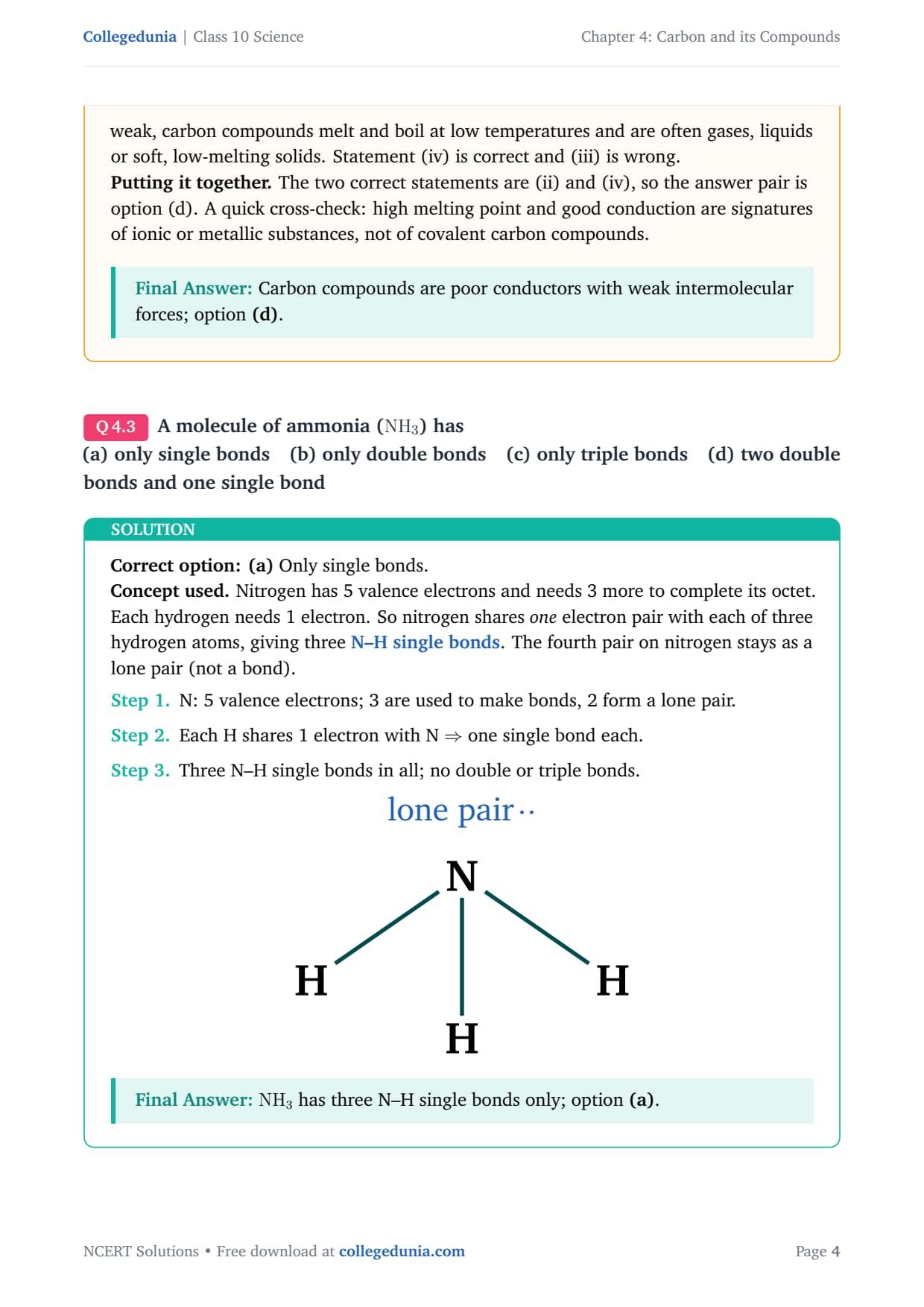
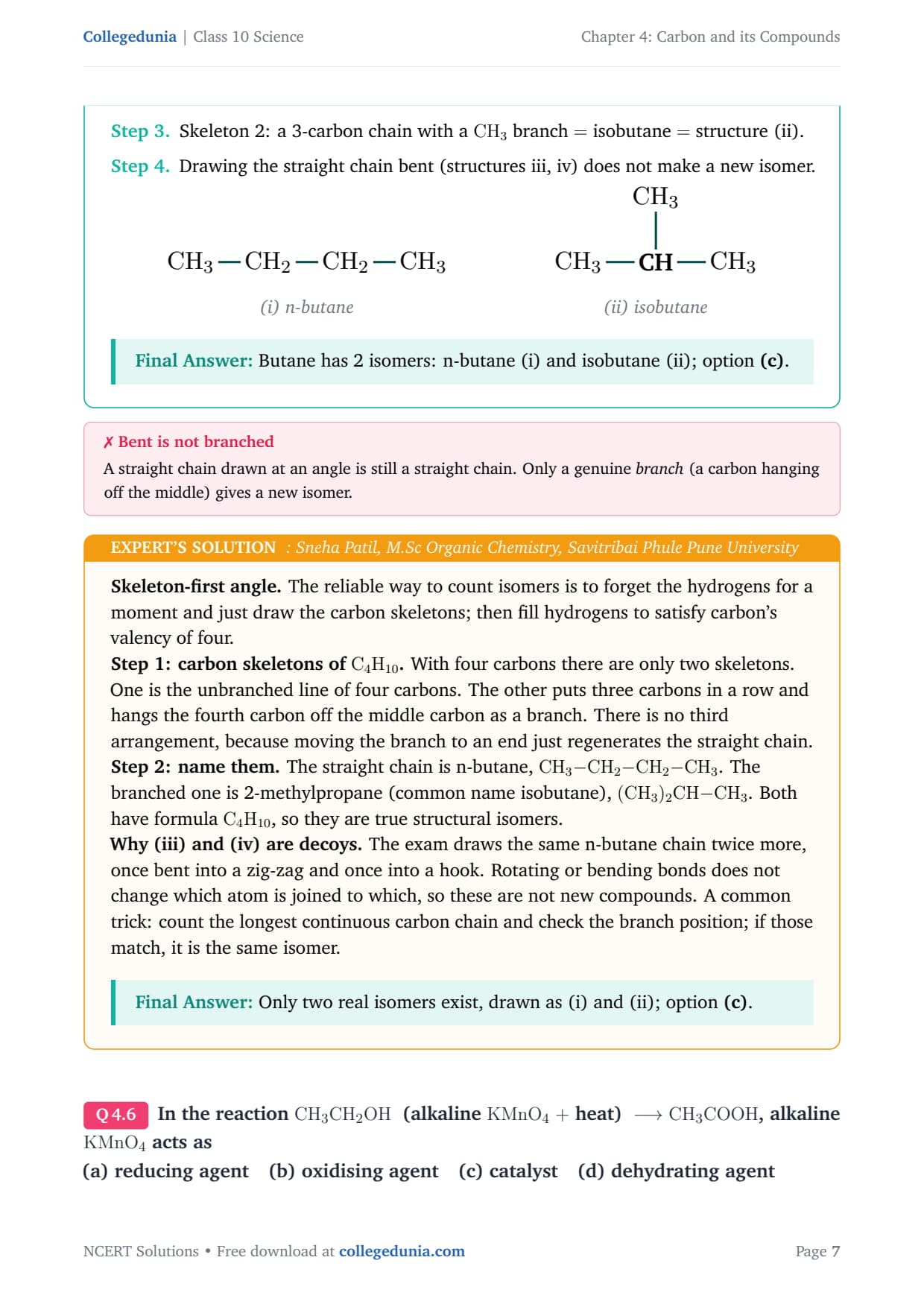
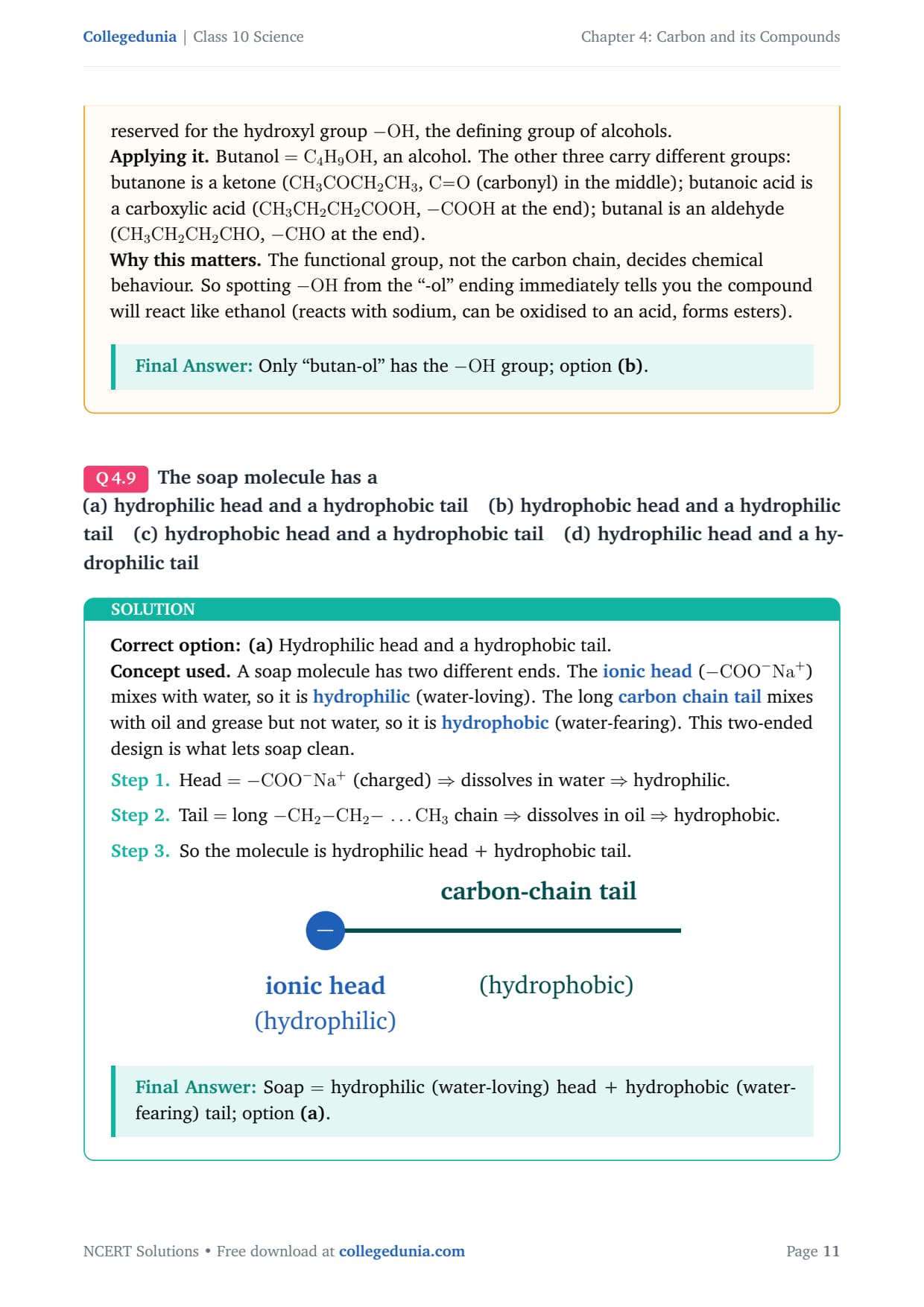
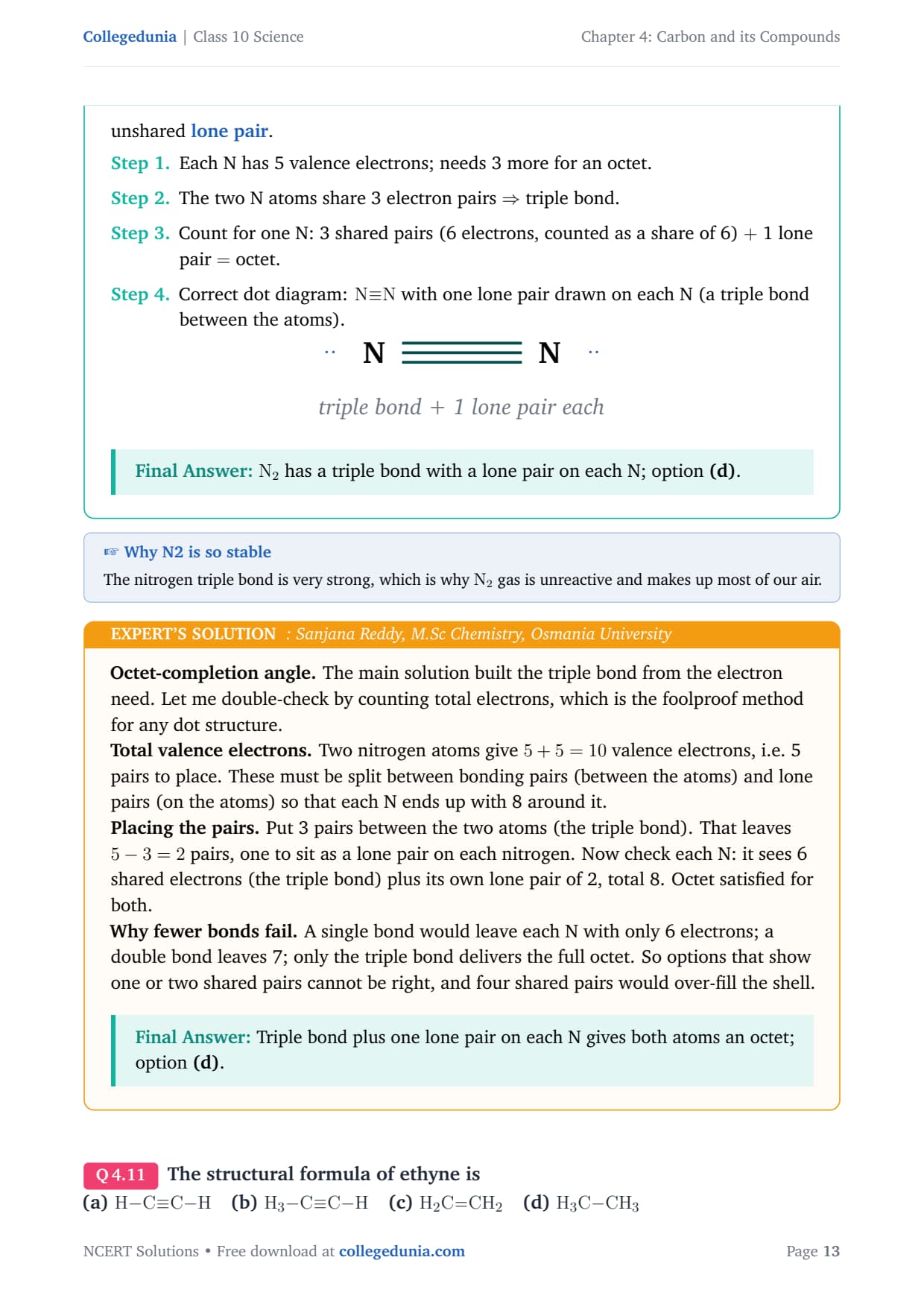
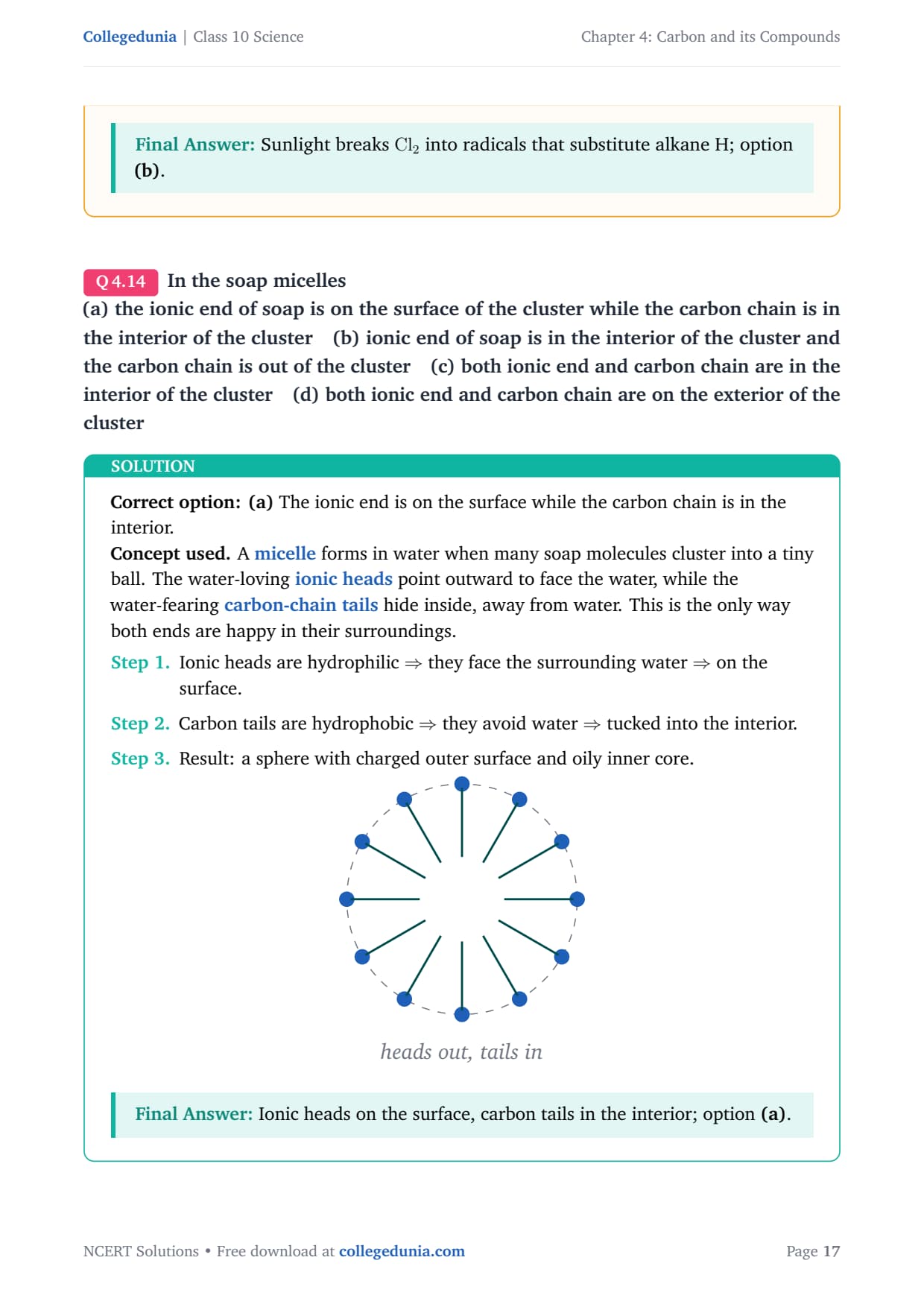
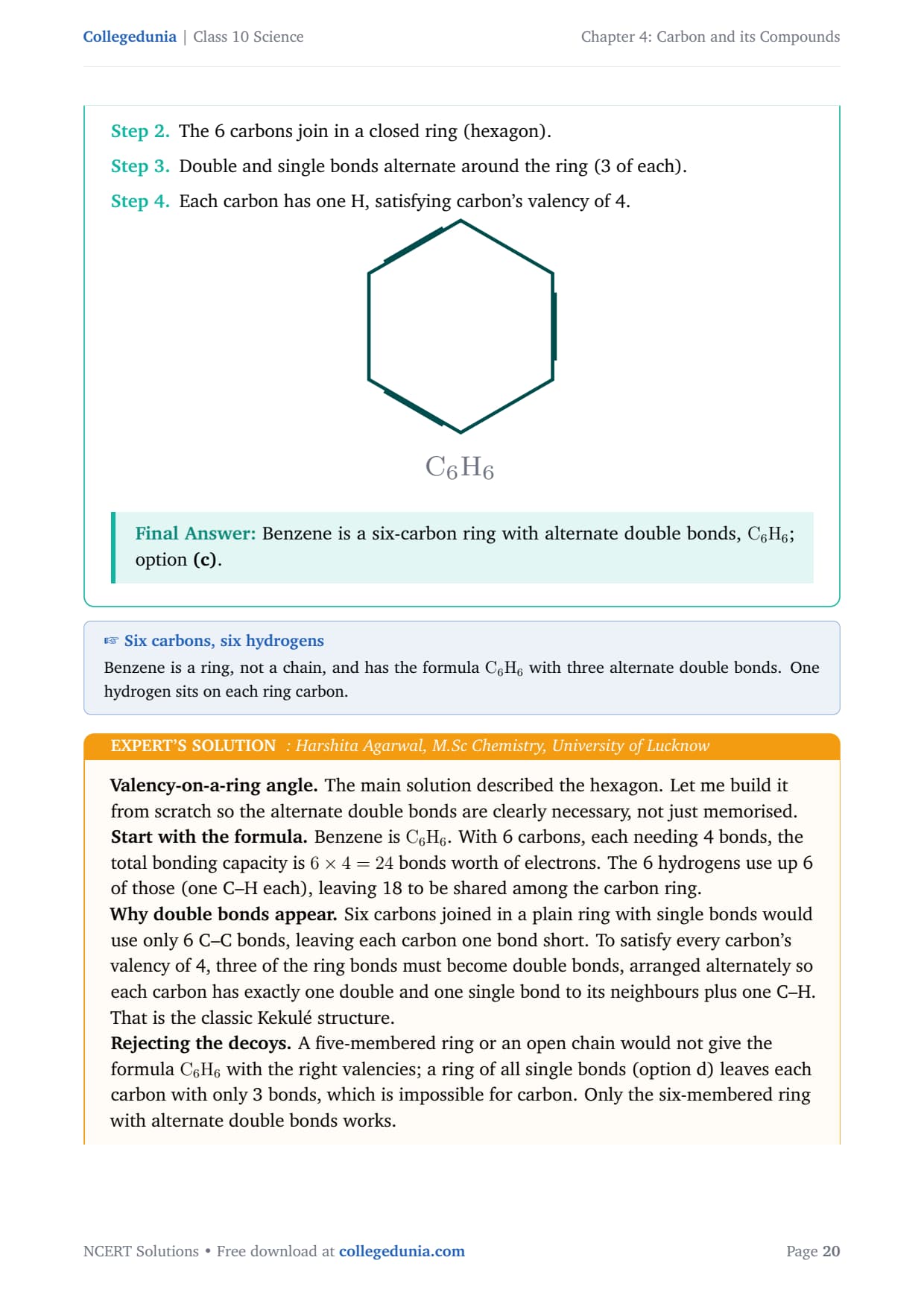
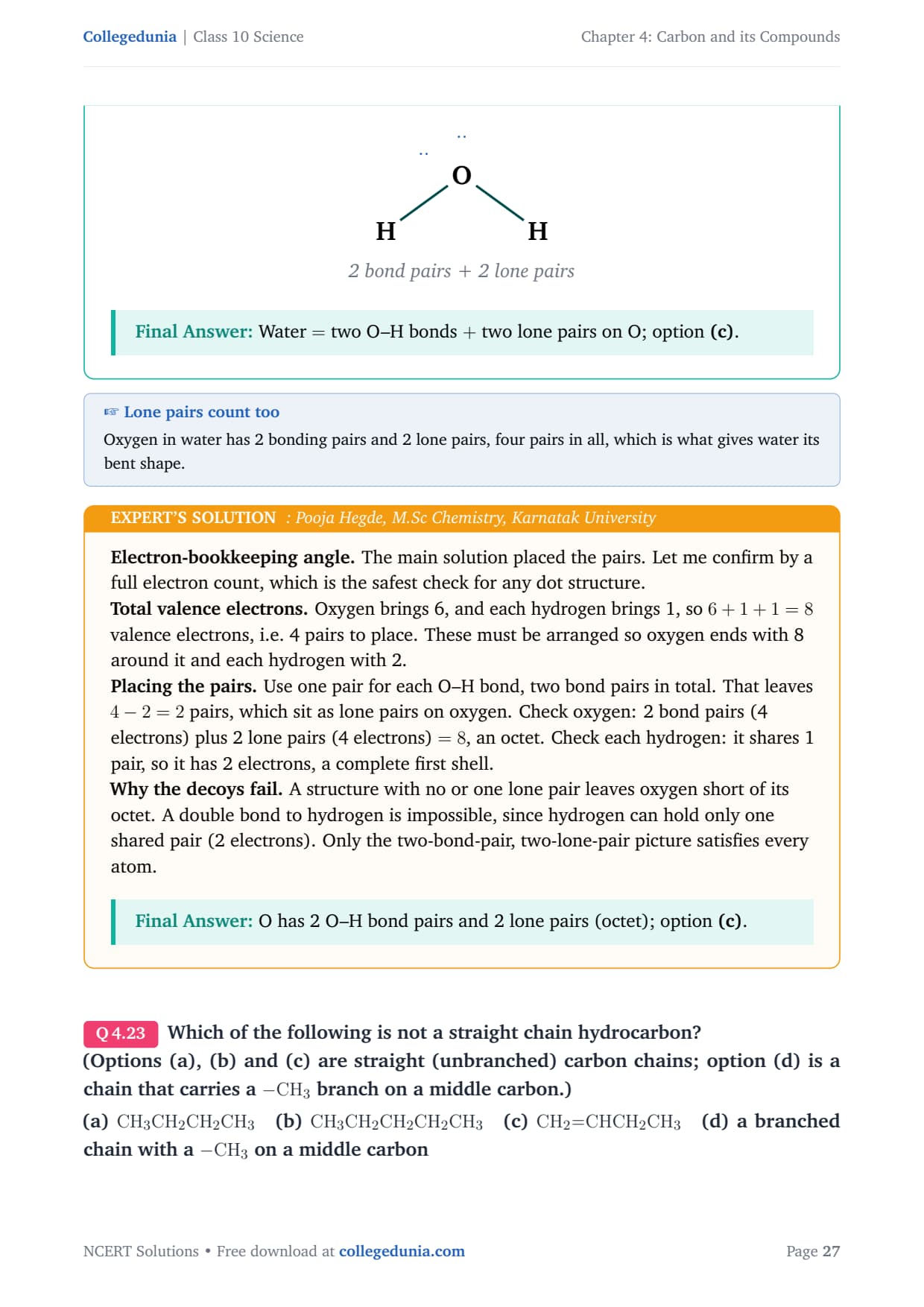
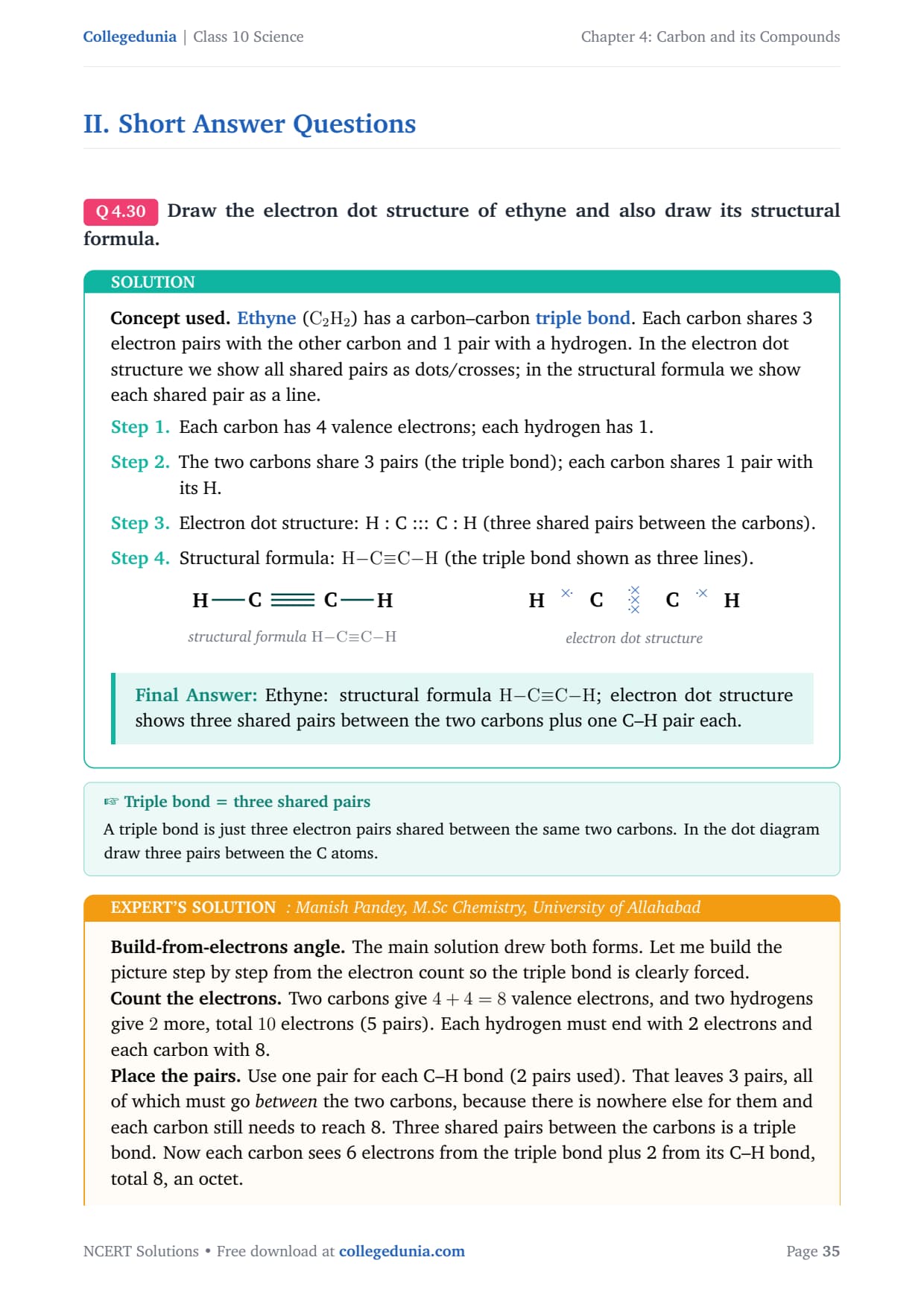
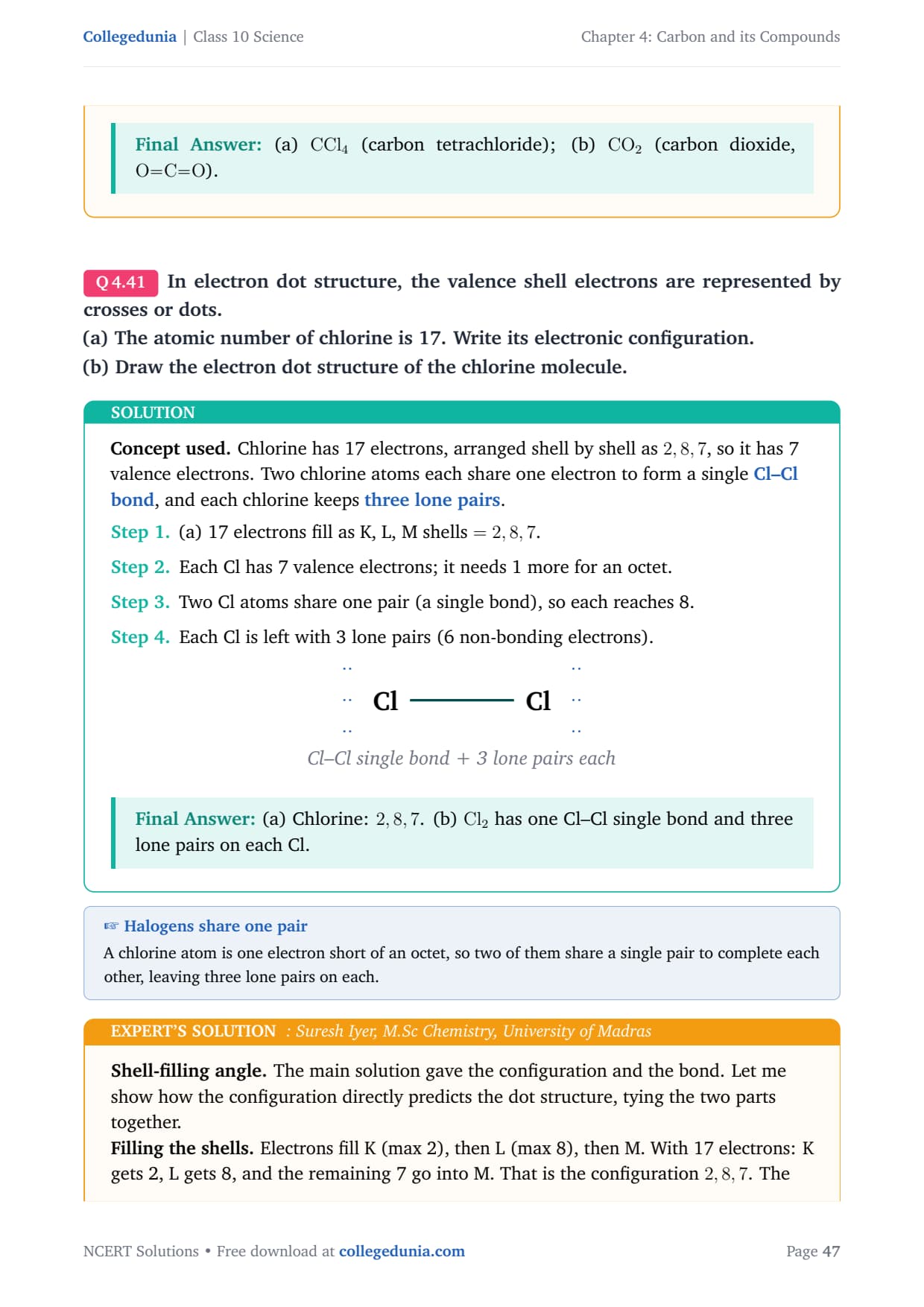
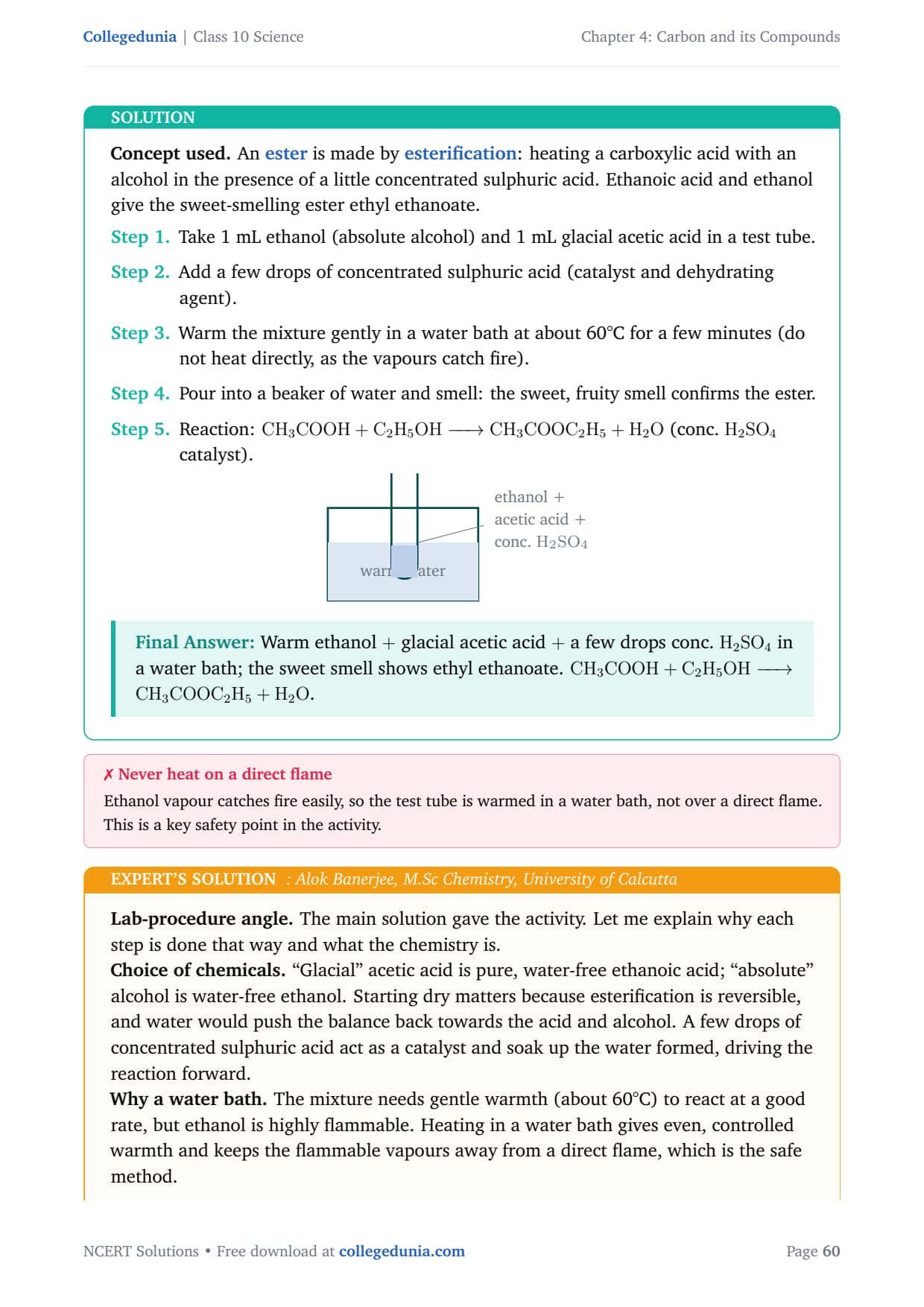
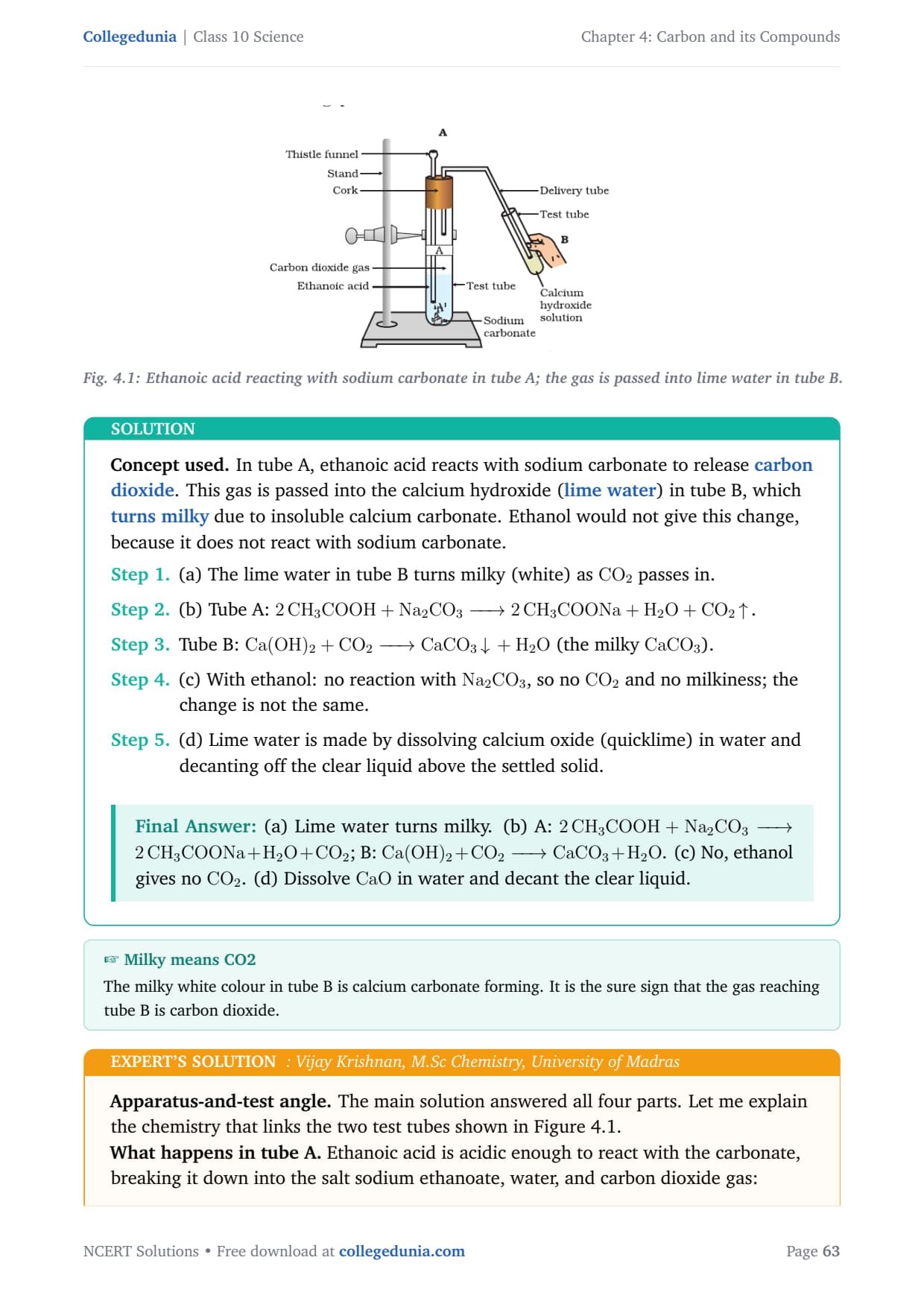
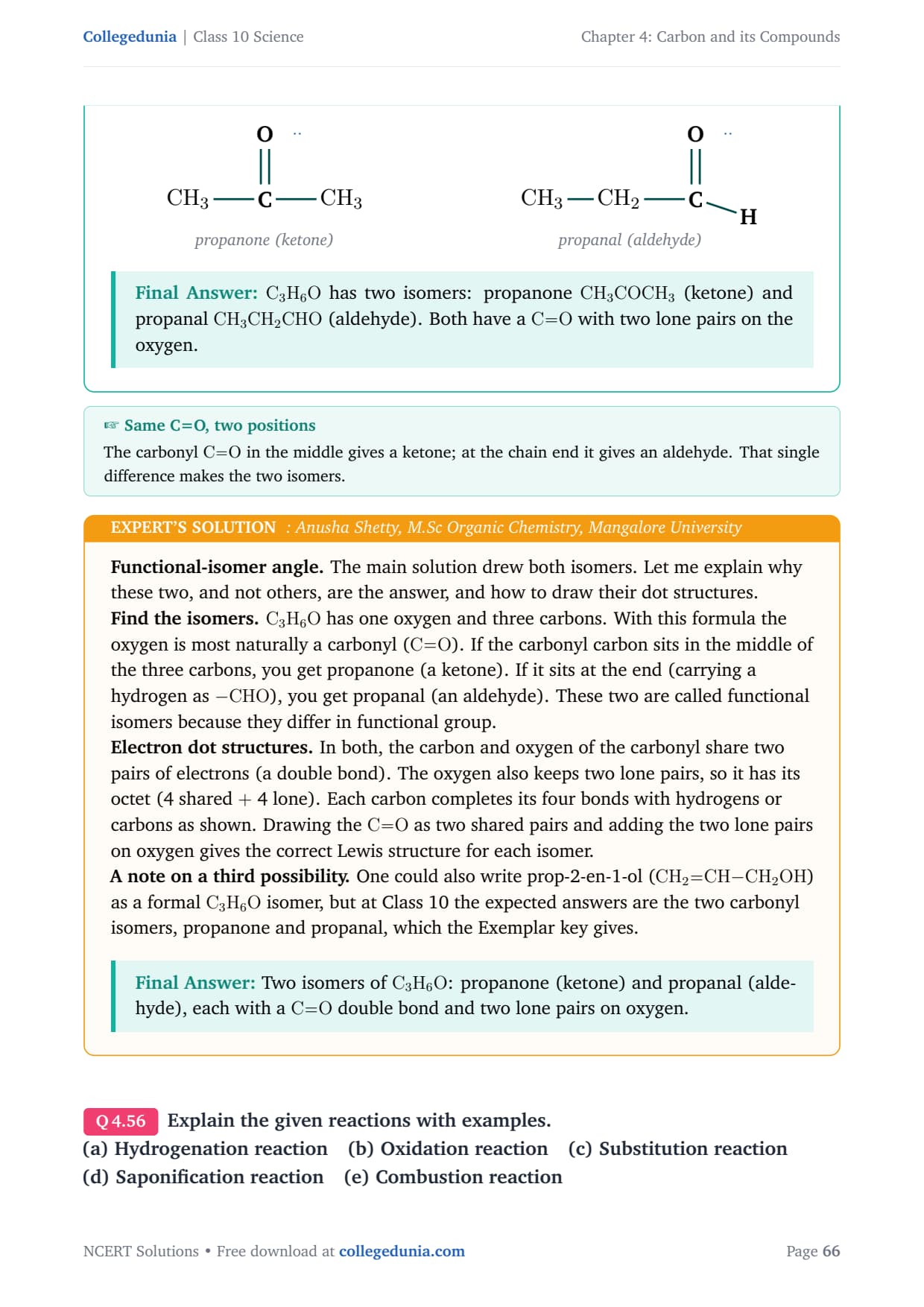
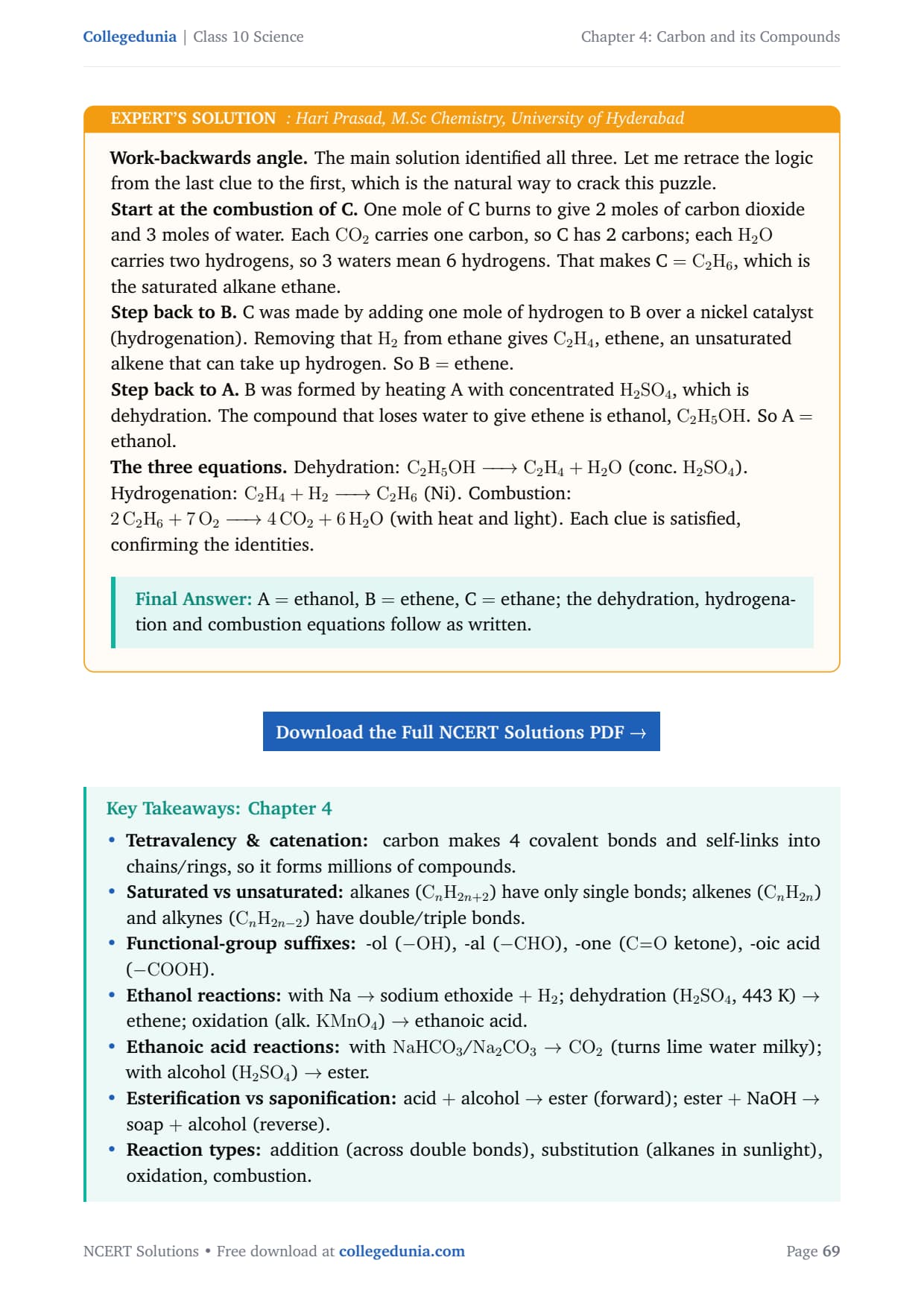
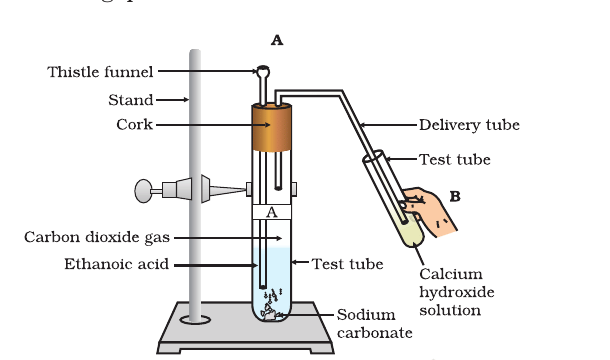



Comments