Chemistry Mentor, Miranda House | Updated on - Jul 23, 2026
Chapter 7 How do Organisms Reproduce? is one of the most scoring biology chapters of Class 10 Science for 2026-27. The Class 10 Science Chapter 7 NCERT Exemplar Solutions on this page solve every Exemplar problem step by step, in plain language.
CBSE Board weightage: flower structure, human reproductive system and chromosome-number questions are repeat favourites.
What you get: all MCQ, Short Answer and Long Answer problems solved, with a free PDF.
Solved by Collegedunia: Every problem below is solved by subject experts, mapped to the 2026-27 NCERT Exemplar, and checked against the CBSE Board marking scheme.
Why the NCERT Exemplar Matters for Class 10 Board Preparation
In this chapter many students slip on reasoning and labelling, not on memory. The NCERT Exemplar turns the basics into real exam-style questions: order-the-sequence MCQs, label-the-diagram problems on the flower and the human reproductive system, and reasoning on variation, chromosome number and reproductive health.
Quick Tip: Solve the textbook exercises first. The Exemplar assumes you know the four whorls of a flower and the asexual-versus-sexual difference.
How do Organisms Reproduce Class 10 Video Solutions
The chromosome rule: gametes carry half the number, and fertilisation restores the full number.
Remember one parent means clones, two parents mean variation.
Difficulty Step-Up from NCERT Textbook to Exemplar
The Exemplar reuses textbook ideas inside harder wrappers, as the contrast below shows.
Concept
NCERT Textbook
NCERT Exemplar
Asexual methods
Name the method for each organism
Pick the asexual reproducers from a mixed list
Flower parts
Name the four whorls of a flower
Identify the exact gamete-making part or label a figure
Reproduction sequence
Define pollination and fertilisation
Arrange pollination, fertilisation, embryo and seedling in order
Chromosome number
State that gametes are haploid
Calculate the zygote number from a given gamete number
Reproductive health
List contraceptive methods
Reason out the benefit of a mechanical barrier
Topics Covered in Class 10 Science Chapter 7 How do Organisms Reproduce Exemplar
MCQs test the modes of reproduction, the asexual methods, the reproduction sequence, the chromosome number rule, and the human reproductive system. Short Answers ask why fertilisation needs pollination and what changes in the uterus. Long Answers cover vegetative propagation, regeneration, the flower and pistil, the placenta, avoiding pregnancy, and sexually transmitted diseases.
How do Organisms Reproduce Exemplar Common Mistakes That Cost Marks
The Exemplar twists trigger the same wrong reflexes every year.
Confusing stamen with anther. The stamen is the whole male organ; only the anther makes the male gametes.
Mixing binary with multiple fission. Binary fission gives two cells (Amoeba); multiple fission gives many (Plasmodium).
Reversing the sequence. Pollination comes before fertilisation, and a seedling appears only after the embryo forms.
Forgetting where fertilisation happens. In humans it occurs in the oviduct, not the uterus.
Watch Out: In a statement-based MCQ, a statement with "always" or "all", such as "flowers are always bisexual", is usually the false one.
Flower Structure and the Path of Fertilisation Quick Reference
Many Exemplar MCQs match a flower part to its job or trace the path from pollen to egg.
Flower part
Whorl
Main job
Sepals
Calyx
The outer green ring that protects the bud
Petals
Corolla
The showy ring that attracts pollinators
Anther (on stamen)
Androecium
Makes the male gametes inside pollen grains
Ovary (in pistil)
Gynoecium
Holds the ovules with the female gametes
Stigma and style
Gynoecium
Receive pollen and guide the pollen tube to the ovule
The path follows a fixed order: pollen lands on the stigma→ grows a pollen tube down the style → reaches the ovule→ the male gamete fuses with the egg to form a zygote.
Most Repeated Board Topics from How do Organisms Reproduce
Topics that show up most often in CBSE Board and sample papers.
Topic
How it is asked
Asexual methods
Match an organism to its method or pick the asexual reproducers
Flower structure
Label the four whorls or name the gamete-making organs
Pollination vs fertilisation
Distinguish the two and give the site and product
Chromosome number
Find the zygote number or explain how the number stays constant
Human reproductive system
Trace the sperm path or label the female system
Reproductive health
Reason out contraception or name and prevent STDs
All NCERT Exemplar Questions for How do Organisms Reproduce with Step-by-Step Solutions
Every question of the NCERT Exemplar set for Class 10 Science Chapter 7 How do Organisms Reproduce? is listed below with its full Solution and Expert Solution inside collapsible tabs. Click Check Solution to reveal the step-by-step working; click Expert Solution for the expanded explanation.
I. Multiple Choice Questions
Q 7.1
In the list of organisms given below, those that reproduce by the asexual method are
(i) banana (ii) dog (iii) yeast (iv) Amoeba
(a) (ii) and (iv) (b) (i), (iii) and (iv) (c) (i) and (iv) (d) (ii), (iii) and (iv)
Correct option: (b) (i), (iii) and (iv).
Concept used.Asexual reproduction needs only one parent
and does not use gametes. Banana, yeast and Amoeba all multiply this way,
while a dog reproduces sexually.
Banana is grown from underground stems (suckers), a kind of
vegetative propagation, which is asexual. So (i) is asexual.
Yeast reproduces by budding, and Amoeba by binary fission. Both use
a single parent and no gametes, so (iii) and (iv) are asexual.
A dog is an animal that reproduces sexually, with two parents and
gametes, so (ii) is not asexual.
Sort animal from microbe and plant. The single animal in the list
gives the game away, because animals like a dog reproduce sexually.
Concept used. Asexual reproduction uses one parent and no gametes
and gives offspring identical to the parent. Vegetative propagation, budding
and binary fission are all asexual.
Banana (i). New banana plants sprout from the parent's
underground stem, so this is vegetative and asexual.
Yeast (iii). A bud grows on the parent yeast cell and
breaks off as a new cell. Budding is asexual.
Amoeba (iv). The single cell splits into two by binary
fission, an asexual method.
Dog (ii). A dog produces young by mating, with male and
female gametes fusing. That is sexual, so it is left out.
Why this matters. Recognising that many crop plants are propagated
asexually explains why a whole banana field can be a single clone, which is
useful but risky if a disease strikes.
Option (b): the asexual reproducers are banana, yeast and Amoeba.
Q 7.2
In a flower, the parts that produce male and female gametes (germ cells) are
(a) stamen and anther
(b) filament and stigma
(c) anther and ovary
(d) stamen and style
Correct option: (c) anther and ovary.
Concept used. In a flower the anther (part of the stamen)
makes the male gametes inside pollen grains, and the ovary (part of
the pistil) holds ovules that contain the female gametes.
The male gamete forms inside pollen grains, which are produced in the
anther. So the male-gamete part is the anther.
The female gamete (egg) is inside the ovule, which lies in the ovary.
So the female-gamete part is the ovary.
Stamen, filament, stigma and style are supporting parts, not the
gamete-making organs, so (a), (b) and (d) are wrong.
Option (c): the anther makes male gametes and the ovary holds female gametes.
RM
Rohan Mehta
M.Sc Botany, Banaras Hindu University
Verified Expert
Match gamete to the exact part. Each option must name the precise
gamete-making structure, not the whole organ.
Concept used. The anther is the pollen-making tip of the stamen, and
the ovary is the swollen base of the pistil that contains the ovules with the
egg cells.
Male side. Pollen, which carries the male gamete, is made in
the anther.
Female side. The egg, the female gamete, sits inside an
ovule, and ovules are housed in the ovary.
Reject the rest. Filament, stigma and style only support or
receive, they do not make gametes, so only "anther and ovary" fits.
Why this matters. Knowing exactly where each gamete forms is the key
to following the path of fertilisation, where pollen from the anther must
reach the egg inside the ovary.
Option (c): anther (male gamete) and ovary (female gamete).
Q 7.3
Which of the following is the correct sequence of events of sexual reproduction in a flower?
(a) pollination, fertilisation, seedling, embryo
(b) seedling, embryo, fertilisation, pollination
(c) pollination, fertilisation, embryo, seedling
(d) embryo, seedling, pollination, fertilisation
Concept used. Sexual reproduction in a flower follows a fixed order:
pollination (pollen reaches the stigma) comes first, then
fertilisation (gametes fuse), then the zygote grows into an embryo,
and finally the seed germinates into a seedling.
Pollination must happen first, bringing pollen to the stigma.
Fertilisation follows, when the male gamete fuses with the egg to
form a zygote.
The zygote develops into an embryo inside the seed, and the seed
later grows into a seedling.
Order by cause and effect. Each stage is the cause of the next, so
arranging them by which must happen first gives the answer at once.
Concept used. Pollination delivers pollen; fertilisation fuses
gametes into a zygote; the zygote becomes the embryo; germination of the seed
gives the seedling.
First, pollination. Without pollen reaching the stigma,
nothing else can begin.
Then fertilisation. The pollen's male gamete fuses with the
egg to make a zygote.
Then the embryo. The zygote divides and grows into the
embryo packed inside the seed.
Finally the seedling. When the seed germinates, the embryo
grows out as a young seedling. So the order is option (c).
Why this matters. Getting this sequence right helps students explain
why an unpollinated flower never sets seed and why a seed is really a
ready-made baby plant waiting to grow.
Option (c): the correct sequence is pollination, fertilisation, embryo, seedling.
Q 7.4
Offspring formed by asexual method of reproduction have greater similarity among themselves because
(i) asexual reproduction involves only one parent
(ii) asexual reproduction does not involve gametes
(iii) asexual reproduction occurs before sexual reproduction
(iv) asexual reproduction occurs after sexual reproduction
(a) (i) and (ii) (b) (i) and (iii) (c) (ii) and (iv) (d) (iii) and (iv)
Correct option: (a) (i) and (ii).
Concept used. Offspring of asexual reproduction are
near-identical clones because they come from a single parent and no
gametes mix two sets of characters.
Asexual reproduction uses only one parent, so the offspring inherit
only that one parent's DNA. Statement (i) is correct.
No gametes are formed, so there is no mixing of genetic material from
two sources. Statement (ii) is correct.
The timing statements (iii) and (iv) are irrelevant to similarity, so
they are wrong.
Option (a): one parent (i) and no gametes (ii) make the offspring nearly identical.
IK
Ishaan Kapoor
M.Sc Genetics, University of Hyderabad
Verified Expert
Where does the DNA come from? Similarity comes from a single,
unmixed source of DNA, so look for the two statements that point to that.
Concept used. Clones are alike because all their DNA is copied from
one parent with no input from a second parent and no shuffling through
gametes.
One parent (i). With a single parent, there is only one set
of genes to inherit, so the offspring match the parent.
No gametes (ii). Gametes are where two parents' genes mix.
With no gametes, no such mixing happens, so no new combinations
appear.
Timing is a distractor. When asexual reproduction occurs
relative to sexual reproduction (iii, iv) has nothing to do with how
similar the offspring are.
Why this matters. This explains why a cutting from a mango tree
gives fruit just like the parent, a fact gardeners rely on to keep a prized
variety unchanged.
Option (a): statements (i) and (ii) explain the high similarity.
Q 7.5
Characters transmitted from parents to offspring are present in
(a) cytoplasm (b) ribosome (c) golgi bodies (d) genes
Correct option: (d) genes.
Concept used. Inherited characters are carried by genes,
which are segments of DNA found on the chromosomes inside the cell
nucleus.
A gene is a piece of DNA that codes for a particular character, such
as flower colour or eye colour.
During reproduction, copies of the DNA, and so of the genes, pass
from parents to offspring.
Cytoplasm, ribosomes and golgi bodies do jobs in the cell but do not
carry the inherited blueprint, so (a), (b) and (c) are wrong.
Option (d): characters are carried from parents to offspring in the genes.
VN
Vikram Nair
M.Sc Genetics, University of Calcutta
Verified Expert
Find the unit of inheritance. Among the cell parts listed, only one
is the recognised carrier of inherited information.
Concept used. Genes, made of DNA, are the units of heredity. They
sit on chromosomes in the nucleus and are copied and passed on during
reproduction.
Genes (d). Each gene is a stretch of DNA that decides a
trait and is handed down to the next generation.
Cytoplasm (a). It is the jelly that holds the cell parts but
is not the store of heredity.
Ribosomes and golgi (b, c). These build and package
proteins; they do not carry the inherited code.
So the only correct answer is genes.
Why this matters. Pinning heredity to genes sets up the next chapter
on Heredity, where students learn how dominant and recessive genes decide the
traits a child shows.
Option (d): inherited characters are stored in the genes.
Q 7.6
Characters that are transmitted from parents to offspring during reproduction show
(a) only similarities with parents
(b) only variations with parents
(c) both similarities and variations with parents
(d) neither similarities nor variations
Correct option: (c) both similarities and variations with parents.
Concept used. When DNA is copied during reproduction it is copied
faithfully but not perfectly, so offspring show similarities to
their parents along with small variations.
DNA copying is mostly accurate, so offspring resemble their parents
in many ways. This gives similarities.
The copying is never perfectly exact, and in sexual reproduction two
parents' DNA mixes, so small differences appear. These are
variations.
Hence offspring show both similarities and variations, so (c) is
correct and the one-sided options (a), (b) and (d) are wrong.
Option (c): offspring show both similarities and variations with their parents.
MK
Meera Krishnan
M.Sc Genetics, University of Madras
Verified Expert
Copying is faithful, not flawless. The truth lies between the
extremes, so the "both" option is the natural choice.
Concept used. Inheritance passes on DNA copies that keep most
features the same (similarity) but include minor copying changes and gene
mixing (variation).
Source of similarity. Genes are copied accurately, so most
traits look like the parents'.
Source of variation. Tiny copying errors and the reshuffling
of genes in sexual reproduction create small differences.
Conclusion. Both effects happen together, so offspring carry
similarities and variations at once.
Why this matters. Variation lets a species adapt to changing
surroundings, while similarity keeps the species recognisable, a partnership
that is central to survival.
Option (c): characters show both similarities and variations.
Q 7.7
A feature of reproduction that is common to Amoeba, Spirogyra and Yeast is that
(a) they reproduce asexually
(b) they are all unicellular
(c) they reproduce only sexually
(d) they are all multicellular
Correct option: (a) they reproduce asexually.
Concept used. The shared reproductive feature of Amoeba,
Spirogyra and Yeast is that all three reproduce asexually, even though they
differ in how many cells they have.
Amoeba reproduces by binary fission, Yeast by budding and Spirogyra
by fragmentation. All three are asexual methods.
They are not all unicellular: Spirogyra is a multicellular filament,
so (b) and (d) are wrong.
They do not reproduce only sexually, so (c) is wrong. The common
reproductive feature is asexual reproduction.
Option (a): all three reproduce asexually.
AV
Aditya Verma
M.Sc Botany, Savitribai Phule Pune University
Verified Expert
Test each option against all three. A common feature must be true
for Amoeba, Spirogyra and Yeast together.
Concept used. Binary fission, fragmentation and budding are all
asexual methods, so the reproductive habit is what unites these three very
different organisms.
Asexual (a). Amoeba uses fission, Spirogyra uses
fragmentation, Yeast uses budding. All asexual, so this is shared.
Unicellular (b). Amoeba and Yeast are unicellular, but
Spirogyra is multicellular, so this is not common.
Only sexual (c) and multicellular (d). Both are false for at
least one of the three, so they are rejected.
Why this matters. It shows that a single reproductive strategy,
asexual reproduction, is used across unrelated groups, from animals to algae
to fungi.
Option (a): the shared feature is asexual reproduction.
Q 7.8
In Spirogyra, asexual reproduction takes place by
(a) breaking up of filaments into smaller bits
(b) division of a cell into two cells
(c) division of a cell into many cells
(d) formation of young cells from older cells.
Correct option: (a) breaking up of filaments into smaller bits.
Concept used. Spirogyra reproduces asexually by
fragmentation: the long filament breaks into smaller pieces, and
each piece grows into a new filament.
Spirogyra is a thread-like (filamentous) green alga made of many
cells joined end to end.
On maturing, the filament breaks into smaller bits (fragments).
Each fragment then grows into a full new Spirogyra, which is the
method called fragmentation, so (a) is correct.
Option (a): Spirogyra reproduces by fragmentation, the filament breaking into smaller bits.
SR
Sneha Reddy
M.Sc Botany, Osmania University
Verified Expert
Match the body to the method. A long, thread-like body suggests
breaking into pieces, which is fragmentation.
Concept used. Fragmentation is an asexual method in which a
multicellular body splits into fragments, each able to grow into a new
individual.
The body type. Spirogyra is a filament of many cells, so it
can break across its length.
The method. The filament breaks into smaller bits, and each
bit grows into a new filament.
Reject the rest. Splitting one cell into two (b) is binary
fission, into many (c) is multiple fission, and budding (d) is for
yeast, none of which describes Spirogyra.
Why this matters. Fragmentation lets a single filament quickly fill
a pond with copies of itself, which is why Spirogyra can bloom rapidly in
still water.
Option (a): asexual reproduction in Spirogyra is by fragmentation.
Q 7.9
The ability of a cell to divide into several cells during reproduction in Plasmodium is called
(a) budding (b) reduction division (c) binary fission (d) multiple fission
Correct option: (d) multiple fission.
Concept used.Multiple fission is an asexual method in
which a single parent cell divides into many daughter cells at once.
Plasmodium, the malaria parasite, reproduces this way.
In Plasmodium, the nucleus of one cell divides repeatedly first,
making many nuclei inside the same cell.
The cell then splits into many daughter cells together, each around
one nucleus.
Dividing into several cells at once is multiple fission, so (d) is
correct.
Option (d): Plasmodium divides into many cells at once by multiple fission.
AD
Arjun Desai
M.Sc Zoology, University of Mumbai
Verified Expert
Count the daughters. The word "several cells" rules out the methods
that give only two cells or a single bud.
Concept used. Multiple fission produces many daughter cells from one
parent cell in a single round, unlike binary fission which gives two.
The clue. The question says the cell divides into several
cells, pointing to many offspring at once.
Multiple fission (d). Plasmodium first makes many nuclei,
then splits into many cells together. This matches the clue.
Reject the rest. Budding (a) gives one outgrowth, reduction
division (b) is meiosis, and binary fission (c) gives only two cells.
Why this matters. This burst of many parasites at once is exactly
what causes the sudden fever cycles of malaria, linking the biology to a real
disease.
Option (d): the method in Plasmodium is multiple fission.
Q 7.10
The correct sequence of reproductive stages seen in flowering plants is
(a) gametes, zygote, embryo, seedling
(b) zygote, gametes, embryo, seedling
(c) seedling, embryo, zygote, gametes
(d) gametes, embryo, zygote, seedling
Concept used. In a flowering plant, the gametes form first, then
fuse to make a zygote, which grows into an embryo inside
the seed, and finally the seed germinates into a seedling.
Gametes (male in pollen, female in the ovule) are made first.
The two gametes fuse during fertilisation to form a single zygote.
The zygote divides and grows into an embryo, and the seed later
germinates into a seedling. So the order is gametes, zygote, embryo,
seedling.
Option (a): gametes → zygote → embryo → seedling.
LH
Lavanya Hegde
M.Sc Botany, University of Mysore
Verified Expert
Build the chain from the start. Gametes are the starting point, so
any sequence that does not begin with them is wrong.
Gametes first. Pollen and egg cells are produced before
anything can fuse.
Zygote next. Fusion of the two gametes gives the zygote.
Embryo then seedling. The zygote grows into an embryo inside
the seed, which germinates into a seedling. Only option (a) follows
this order.
Why this matters. This chain links the microscopic gamete to the
visible seedling, helping students see reproduction as one connected story
rather than separate facts.
Option (a): the correct order is gametes, zygote, embryo, seedling.
Q 7.11
The number of chromosomes in parents and offsprings of a particular species remains constant due to
(a) doubling of chromosomes after zygote formation
(b) halving of chromosomes during gamete formation
(c) doubling of chromosomes after gamete formation
(d) halving of chromosomes after gamete formation
Correct option: (b) halving of chromosomes during gamete formation.
Concept used. During gamete formation a special division called
meiosis (reduction division) halves the chromosome number. When two
such gametes fuse at fertilisation, the full number is restored, keeping it
constant across generations.
While gametes form, meiosis halves the chromosome number, so each
gamete has half the parent's chromosomes.
At fertilisation, a male gamete (half) and a female gamete (half)
fuse, adding back to the full number in the zygote.
So the constancy is maintained because the halving happens during
gamete formation, making (b) correct.
Option (b): halving of chromosomes during gamete formation keeps the number constant.
NJ
Nikhil Joshi
M.Sc Genetics, Aligarh Muslim University
Verified Expert
Halve then double back. The trick to constant chromosome number is
to halve at gamete formation and restore at fusion.
Concept used. Meiosis during gamete formation reduces the chromosome
number to half. Fertilisation then combines two halves into one full set in
the offspring.
Before gametes. Body cells carry the full chromosome number,
for example 2n.
During gamete formation. Meiosis halves this to n in each
gamete.
At fertilisation. Two gametes (n + n) fuse to give 2n again
in the zygote, so the species number stays fixed.
Why this matters. If the number were not halved before fusion, it
would double every generation. This control is what keeps every member of a
species with the same chromosome count.
Option (b): halving during gamete formation, restored at fertilisation, keeps the number constant.
Q 7.12
In Rhizopus, tubular thread-like structures bearing sporangia at their tips are called
(a) filaments (b) hyphae (c) rhizoids (d) roots
Correct option: (b) hyphae.
Concept used. Rhizopus (bread mould) is a fungus made of thread-like
strands called hyphae. Some hyphae grow upright and carry
sporangia (spore cases) at their tips.
The body of Rhizopus is a network of fine tubular threads called
hyphae.
The upright hyphae end in round sporangia that hold the spores.
Rhizoids anchor the mould and absorb food; roots and filaments belong
to plants and algae. So the spore-bearing threads are hyphae, option
(b).
Option (b): the thread-like structures bearing sporangia are hyphae.
RA
Riya Agarwal
M.Sc Microbiology, Savitribai Phule Pune University
Verified Expert
Name the fungal thread. Fungi are built from threads, and the
correct biological name for them is hyphae.
Concept used. Hyphae are the tubular filaments that make up a
fungus. Reproductive hyphae bear sporangia, the spore-producing cases, at
their tips.
The structure. Rhizopus consists of fine tubular threads.
The name. These threads are called hyphae, not filaments,
rhizoids or roots.
The function. The upright hyphae carry sporangia at their
tips, releasing spores for reproduction.
Why this matters. Recognising hyphae and sporangia explains how a
fuzzy mould spreads so fast over food, releasing thousands of spores into the
air.
Option (b): the spore-bearing tubular threads of Rhizopus are hyphae.
Q 7.13
Vegetative propagation refers to formation of new plants from
(a) stem, roots and flowers
(b) stem, roots and leaves
(c) stem, flowers and fruits
(d) stem, leaves and flowers
Correct option: (b) stem, roots and leaves.
Concept used.Vegetative propagation is an asexual method
in which new plants grow from the vegetative (non-reproductive) parts, that
is the stem, roots and leaves, not from seeds.
The vegetative parts of a plant are the stem, roots and leaves.
New plants can grow from these parts, for example potato (stem),
sweet potato (root) and Bryophyllum (leaf).
Flowers and fruits are reproductive parts linked to seeds, so options
that include them, (a), (c) and (d), are wrong.
Option (b): vegetative propagation forms new plants from stem, roots and leaves.
KS
Karthik Subramanian
M.Sc Botany, Bharathiar University
Verified Expert
Vegetative means non-flower parts. The word "vegetative" excludes
the reproductive parts, so flowers and fruits cannot be the source.
Concept used. Vegetative propagation uses the vegetative organs,
stem, root and leaf, to make new plants asexually, giving clones of the
parent.
Stem. Potato, sugarcane and ginger sprout new plants from
the stem.
Root. Sweet potato and dahlia grow from roots.
Leaf. Bryophyllum grows tiny plantlets along its leaf
margins. So stem, roots and leaves together is the correct set.
Why this matters. Because the new plants are clones, a desirable
variety, such as a seedless fruit, can be multiplied exactly through
vegetative propagation.
Option (b): new plants form from stem, roots and leaves.
Q 7.14
Factors responsible for the rapid spread of bread mould on slices of bread are
(i) large number of spores
(ii) availability of moisture and nutrients in bread
(iii) presence of tubular branched hyphae
(iv) formation of round shaped sporangia
(a) (i) and (iii) (b) (ii) and (iv) (c) (i) and (ii) (d) (iii) and (iv)
Correct option: (c) (i) and (ii).
Concept used. Bread mould (Rhizopus) spreads fast because it makes a
large number of spores and because moist bread provides the
moisture and nutrients the spores need to grow.
A single mould releases huge numbers of spores, so many new colonies
can start at once. Statement (i) is a key factor.
Moist bread supplies both water and food, the conditions spores need
to germinate and grow. Statement (ii) is a key factor.
Hyphae and sporangia (iii, iv) are parts of the mould's structure,
not the reasons for its rapid spread, so they are not the answer.
Option (c): the rapid spread is due to many spores (i) and the moisture and nutrients in bread (ii).
PS
Pooja Singh
M.Sc Microbiology, University of Lucknow
Verified Expert
Separate cause from structure. The factors that cause spread are
about numbers and conditions, not about the shape of the mould's parts.
Concept used. Rapid growth of a mould depends on a high spore count
and a favourable environment, namely moisture and nutrients.
Many spores (i). The more spores released, the more new
colonies can form, speeding the spread.
Moisture and nutrients (ii). Moist, nutrient-rich bread lets
spores germinate and hyphae grow quickly.
Structures (iii, iv). Hyphae and sporangia are how the mould
is built and how it makes spores, but they are not the driving
reasons for fast spread.
Why this matters. This explains why bread kept in a warm, damp place
goes mouldy in days, while dry, refrigerated bread stays fresh much longer.
Option (c): statements (i) and (ii) explain the rapid spread.
Q 7.15
Length of pollen tube depends on the distance between
(a) pollen grain and upper surface of stigma
(b) pollen grain on upper surface of stigma and ovule
(c) pollen grain in anther and upper surface of stigma
(d) upper surface of stigma and lower part of style
Correct option: (b) pollen grain on upper surface of stigma and
ovule.
Concept used. After pollination, the pollen grain on the stigma
grows a pollen tube that travels down through the style to reach the
ovule. So its length depends on the distance from the stigma to the ovule.
The pollen grain lands on the stigma and then sends out a pollen
tube.
This tube must grow all the way down to the ovule so the male gamete
can reach the egg.
Therefore the tube's length equals the distance between the pollen on
the stigma and the ovule, so (b) is correct.
Option (b): the pollen tube spans the distance from the pollen on the stigma down to the ovule.
TR
Tanvi Rao
M.Sc Botany, University of Calcutta
Verified Expert
Trace the tube's journey. The tube starts where the pollen sits and
ends where the egg is, so its length is fixed by those two points.
Concept used. The pollen tube carries the male gamete from the
stigma, through the style, to the ovule inside the ovary.
Start point. The pollen grain rests on the upper surface of
the stigma.
End point. The tube must reach the ovule, deep inside the
ovary.
The length. So the tube is as long as the distance from the
pollen on the stigma to the ovule, which is exactly option (b).
Why this matters. In flowers with a long style, the pollen tube has
to grow much longer, which is one reason some pollen grains succeed and
others do not in the race to the egg.
Option (b): tube length depends on the stigma-to-ovule distance.
Q 7.16
Which of the following statements are true for flowers?
(i) Flowers are always bisexual
(ii) They are the sexual reproductive organs
(iii) They are produced in all groups of plants
(iv) After fertilisation they give rise to fruits
(a) (i) and (iv) (b) (ii) and (iii) (c) (i) and (iii) (d) (ii) and (iv)
Correct option: (d) (ii) and (iv).
Concept used. A flower is the sexual reproductive organ of
a flowering plant, and after fertilisation the ovary of the flower
develops into a fruit.
Flowers are the sexual reproductive organs of flowering plants, so
statement (ii) is true.
After fertilisation, the flower's ovary grows into a fruit, so
statement (iv) is true.
Flowers are not always bisexual (some are unisexual), and not all
plant groups make flowers (ferns and mosses do not), so (i) and (iii)
are false.
Option (d): statements (ii) and (iv) are true for flowers.
AG
Aman Gupta
M.Sc Botany, University of Mumbai
Verified Expert
Test each claim for exceptions. A statement with the word "always"
or "all" often fails, so check those first.
Concept used. Flowers are reproductive organs that turn into fruits
after fertilisation, but they can be bisexual or unisexual and occur only in
flowering plants.
(ii) true. The flower is indeed the plant's sexual
reproductive organ.
(iv) true. After fertilisation the ovary ripens into a
fruit.
(i) false. Flowers are not always bisexual; unisexual
flowers exist.
(iii) false. Only flowering plants make flowers, not all
plant groups. So the true pair is (ii) and (iv).
Why this matters. Knowing that the ovary becomes the fruit explains
why a fruit always carries the seeds, the next generation, safely inside it.
Option (d): only statements (ii) and (iv) are true.
Q 7.17
Which among the following statements are true for unisexual flowers?
(i) They possess both stamen and pistil
(ii) They possess either stamen or pistil
(iii) They exhibit cross pollination
(iv) Unisexual flowers possessing only stamens cannot produce fruits
(a) (i) and (iv) (b) (ii), (iii) and (iv) (c) (iii) and (iv) (d) (i), (iii) and (iv)
Correct option: (b) (ii), (iii) and (iv).
Concept used. A unisexual flower has only one of the two
sex organs, either the stamen or the pistil. Such flowers must rely on
cross pollination, and a flower with only stamens has no ovary, so
it cannot form a fruit.
A unisexual flower has either the stamen or the pistil, not both, so
statement (ii) is true and (i) is false.
Since pollen and pistil are on separate flowers, pollen must travel
between them, so cross pollination occurs. Statement (iii) is true.
A flower with only stamens has no ovary, so it cannot develop a
fruit. Statement (iv) is true.
Option (b): statements (ii), (iii) and (iv) are true for unisexual flowers.
SR
Siddharth Rao
M.Sc Botany, University of Hyderabad
Verified Expert
One organ only. Unisexual means a single sex organ, so any statement
claiming both organs is automatically false.
Concept used. Unisexual flowers carry only stamens or only a pistil.
With the sexes on separate flowers, cross pollination is needed, and only the
pistil-bearing flower can make a fruit.
(ii) true. A unisexual flower has either stamen or pistil.
(iii) true. Pollen from a male flower must reach a female
flower, so cross pollination happens.
(iv) true. Without a pistil and ovary, a male-only flower
cannot set fruit.
(i) false. Having both organs would make it bisexual, not
unisexual. So the correct set is (ii), (iii) and (iv).
Why this matters. This is why in crops like papaya only the female
trees bear fruit, and growers must keep some male trees nearby for
pollination.
Option (b): statements (ii), (iii) and (iv) are correct.
Q 7.18
Which among the following statements are true for sexual reproduction in flowering plants?
(i) It requires two types of gametes
(ii) Fertilisation is a compulsory event
(iii) It always results in formation of zygote
(iv) Offspring formed are clones
(a) (i) and (iv) (b) (i), (ii) and (iv) (c) (i), (ii) and (iii) (d) (i), (ii) and (iv)
Correct option: (c) (i), (ii) and (iii).
Concept used.Sexual reproduction needs two kinds of
gametes, male and female; their fusion (fertilisation) is essential and
always gives a zygote. The offspring are not clones because two
parents contribute.
It needs two types of gametes, male and female, so statement (i) is
true.
Fertilisation, the fusion of these gametes, is a must, so statement
(ii) is true, and it always makes a zygote, so (iii) is true.
The offspring carry a mix of two parents' genes, so they are not
clones. Statement (iv) is false.
Option (c): statements (i), (ii) and (iii) are true for sexual reproduction.
AS
Aditi Sharma
M.Sc Botany, Panjab University
Verified Expert
Clones are the odd one out. Three statements describe sexual
reproduction correctly; the "clone" claim belongs to asexual reproduction.
Concept used. Sexual reproduction joins two different gametes through
compulsory fertilisation to form a zygote, and the resulting offspring are
genetically varied, not identical.
(i) true. Two gamete types, male and female, are required.
(ii) and (iii) true. Their fusion is compulsory and always
produces a zygote.
(iv) false. Mixing two parents' genes gives varied
offspring, not clones. So the correct set is (i), (ii) and (iii).
Why this matters. The variation produced by sexual reproduction is
what lets a species adapt and survive changing conditions, the very advantage
clones lack.
Option (c): statements (i), (ii) and (iii) are correct.
Q 7.19
In Figure 7.1, the parts A, B and C are sequentially
(a) cotyledon, plumule and radicle
(b) plumule, radicle and cotyledon
(c) plumule, cotyledon and radicle
(d) radicle, cotyledon and plumule
Fig. 7.1: A germinating dicot seed with parts A, B and C marked (NCERT Exemplar).
Correct option: (c) plumule, cotyledon and radicle.
Concept used. A germinating seed shows three embryo parts: the
plumule (future shoot, pointing up), the cotyledon (the
seed leaf storing food) and the radicle (future root, pointing
down).
Part A, at the top, is the plumule, which grows into the shoot.
Part B is the cotyledon, the fleshy seed leaf that stores food for
the young plant.
Part C, at the bottom, is the radicle, which grows downward into the
root. So the order A, B, C is plumule, cotyledon, radicle.
Option (c): A is the plumule, B the cotyledon and C the radicle.
NI
Nandini Iyer
M.Sc Botany, University of Madras
Verified Expert
Read the seed by position. Top means shoot, bottom means root, and
the large stored-food part is the cotyledon.
Concept used. In a germinating dicot seed the plumule (shoot tip),
cotyledons (food store) and radicle (root tip) are arranged from top to
bottom.
A (top). The upper part that becomes the shoot is the
plumule.
B (middle). The thick seed leaf that feeds the embryo is the
cotyledon.
C (bottom). The lower part that grows down into soil as the
root is the radicle.
Reading A, B, C in order gives plumule, cotyledon, radicle, which is
option (c).
Why this matters. Spotting these parts explains how a seed already
holds a tiny complete plant, with its shoot, root and food packed and ready
to germinate.
Option (c): A plumule, B cotyledon, C radicle.
Q 7.20
Offspring formed as a result of sexual reproduction exhibit more variations because
(a) sexual reproduction is a lengthy process
(b) genetic material comes from two parents of the same species
(c) genetic material comes from two parents of different species
(d) genetic material comes from many parents
Correct option: (b) genetic material comes from two parents of the
same species.
Concept used.Variation in sexual reproduction arises
because the offspring receive DNA from two parents of the same
species, mixing two different sets of genes.
In sexual reproduction, the male gamete and female gamete come from
two different parents.
Their DNA combines in the offspring, creating new gene combinations
that neither parent had alone.
These two parents are of the same species, so (b) is correct;
different species (c) cannot reproduce, and "many parents" (d) is not
how it works.
Option (b): variation comes from combining genes of two parents of the same species.
RS
Rahul Saxena
M.Sc Genetics, University of Delhi
Verified Expert
Two same-species parents. Variation needs two parents, but they must
belong to the same species for reproduction to work at all.
Concept used. Sexual reproduction blends genetic material from two
parents of one species, producing offspring with fresh combinations of genes
and hence variation.
Two parents. Each parent contributes one gamete, so the
offspring gets two sets of genes.
Same species. The parents must be of the same species, since
members of different species generally cannot interbreed.
Result. The two gene sets combine in new ways, giving
variation among the offspring, which is option (b).
Why this matters. This variation is the toolkit of evolution: it
gives a population many slightly different individuals, some of which may cope
better when conditions change.
Option (b): genetic material from two parents of the same species causes variation.
Q 7.21
Reproduction is essential for living organisms to
(a) keep the individual organism alive
(b) fulfill their energy requirement
(c) maintain growth
(d) continue the species generation after generation
Correct option: (d) continue the species generation after
generation.
Concept used.Reproduction is not needed to keep an
individual alive; its real purpose is to pass on life and keep the
species going from one generation to the next.
Staying alive, getting energy and growing are tasks of the life
processes (nutrition, respiration), not of reproduction. So (a), (b)
and (c) are wrong.
Reproduction makes new individuals that carry the parents' DNA
forward.
This keeps the species continuing generation after generation, so (d)
is correct.
Option (d): reproduction continues the species from one generation to the next.
GD
Gauri Deshmukh
M.Sc Zoology, University of Mumbai
Verified Expert
Individual versus species. An organism can live without
reproducing, so the purpose of reproduction must be about the species, not
the individual.
Concept used. Life processes keep an individual alive, but
reproduction exists to create the next generation and so continue the
species.
Not for staying alive. An organism survives by nutrition,
respiration and the other life processes, not by reproducing.
The real role. Reproduction produces offspring that carry
the species forward.
The conclusion. So reproduction is essential to continue the
species generation after generation, option (d).
Why this matters. This is why a species can survive long after every
one of its original members has died, each generation handing life on to the
next.
Option (d): reproduction keeps the species going across generations.
Q 7.22
During adolescence, several changes occur in the human body. Mark one change associated with sexual maturation in boys
(a) loss of milk teeth
(b) increase in height
(c) cracking of voice
(d) weight gain
Correct option: (c) cracking of voice.
Concept used. At puberty, sexual maturation in boys brings
changes such as a deeper, cracking voice. General changes like height or
weight are part of normal growth, not sexual maturation.
Cracking of the voice happens when the voice box (larynx) enlarges at
puberty, a sign of sexual maturation in boys. So (c) is correct.
Loss of milk teeth, increase in height and weight gain are part of
general growth and can happen at other ages too.
So the only change tied specifically to sexual maturation here is the
cracking of voice.
Option (c): cracking of voice is a sign of sexual maturation in boys.
VA
Vivek Anand
M.Sc Zoology, University of Delhi
Verified Expert
General growth versus puberty change. Separate everyday growth from
the special changes that only appear at sexual maturity.
Concept used. Sexual maturation at puberty causes specific changes,
such as a deepening voice in boys, driven by sex hormones. Height and weight
gain are part of general growth.
Cracking voice (c). The larynx grows at puberty, so the
voice deepens and cracks. This is a sexual-maturation change.
Height and weight (b, d). These rise steadily through
childhood as general growth, not just at puberty.
Milk teeth (a). Losing milk teeth happens in early
childhood, well before puberty. So the answer is (c).
Why this matters. Knowing which changes mark puberty helps young
students understand their own bodies and see these changes as a normal,
healthy part of growing up.
Option (c): cracking of voice marks sexual maturation in boys.
Q 7.23
In human females, an event that reflects onset of reproductive phase is
(a) growth of body
(b) changes in hair pattern
(c) change in voice
(d) menstruation
Correct option: (d) menstruation.
Concept used. The start of menstruation (the first
menstrual period) marks the beginning of the reproductive phase in human
females, showing the ovaries have begun releasing eggs.
Menstruation begins when the ovaries start maturing and releasing
eggs, marking the onset of the reproductive phase. So (d) is correct.
Growth of body, changes in hair pattern and change in voice are
general or secondary signs of puberty, not the marker of the
reproductive phase itself.
So the event that signals the reproductive phase is menstruation.
Option (d): menstruation marks the onset of the reproductive phase in females.
AM
Anjali Menon
M.Sc Zoology, University of Madras
Verified Expert
Find the reproductive signal. Among the puberty changes, only one
directly shows the reproductive system has started working.
Concept used. Menstruation is the monthly shedding of the uterine
lining and begins when the ovaries start releasing eggs, marking the
reproductive phase.
Menstruation (d). Its onset shows the ovaries are now
releasing eggs, so the reproductive phase has begun.
Body growth (a) and hair pattern (b). These are general or
secondary puberty changes, not the reproductive marker.
Voice change (c). This is more marked in boys and is not the
signal of the female reproductive phase. So the answer is
menstruation.
Why this matters. Understanding menstruation as a normal sign of
maturity helps remove the stigma around it and supports good menstrual
health among students.
Option (d): menstruation marks the onset of the reproductive phase.
Q 7.24
In human males, the testes lie in the scrotum, because it helps in the
(a) process of mating
(b) formation of sperm
(c) easy transfer of gametes
(d) all the above
Correct option: (b) formation of sperm.
Concept used. The testes lie outside the body in the
scrotum because sperm form best at a temperature slightly lower
than the body's. The scrotum keeps the testes cooler.
Sperm formation needs a temperature about 2 to 3 degrees below normal
body temperature.
The scrotum hangs outside the body, so it keeps the testes cooler
than the rest of the body.
This cooler setting allows healthy sperm to form, so the scrotum
helps in the formation of sperm, making (b) correct.
Option (b): the scrotum keeps the testes cool, which helps in sperm formation.
MB
Mohit Bhatt
M.Sc Zoology, University of Rajasthan
Verified Expert
Why outside the body? The position of the testes makes sense only
when you think about the temperature sperm formation needs.
Concept used. The testes produce sperm, and this process works best
a few degrees below body temperature, which is why the scrotum holds them
outside the abdomen.
The need. Sperm form properly only at a temperature lower
than the core body temperature.
The solution. The scrotum, hanging outside the body, keeps
the testes cooler than the inside of the body.
The result. This cooler environment supports healthy sperm
formation, so option (b) is the key reason.
Why this matters. This explains a real fertility concern: anything
that overheats the testes, such as very tight clothing, can lower sperm
production.
Option (b): the scrotum aids sperm formation by keeping the testes cool.
Q 7.25
Which among the following is not the function of testes at puberty?
(i) formation of germ cells
(ii) secretion of testosterone
(iii) development of placenta
(iv) secretion of estrogen
(a) (i) and (ii) (b) (ii) and (iii) (c) (iii) and (iv) (d) (i) and (iv)
Correct option: (c) (iii) and (iv).
Concept used. At puberty the testes make sperm (germ
cells) and secrete the male hormone testosterone. They do not form
the placenta (made in pregnancy) or secrete estrogen (the female hormone).
The testes form germ cells (sperm) and secrete testosterone, so (i)
and (ii) are functions of the testes.
The placenta develops in the uterus during pregnancy, not in the
testes, so (iii) is not a testis function.
Estrogen is the female hormone, made by the ovaries, not the testes,
so (iv) is not a testis function. The "not" functions are (iii) and
(iv).
Option (c): development of placenta (iii) and secretion of estrogen (iv) are not functions of the testes.
RV
Rajat Verma
M.Sc Zoology, University of Allahabad
Verified Expert
List what the testes truly do. First name the genuine testis
functions, then the two that remain are the answer.
Concept used. The testes have two jobs at puberty: making sperm and
secreting testosterone. Placenta formation and estrogen secretion are female
or pregnancy roles, not testis roles.
Real functions. The testes form germ cells (i) and secrete
testosterone (ii).
Placenta (iii). It develops in the uterus during pregnancy,
so it is not a testis function.
Estrogen (iv). This is the female hormone from the ovaries,
not the testes. So (iii) and (iv) are the non-functions, option (c).
Why this matters. Sorting male from female reproductive roles keeps
the two systems clear, which helps when comparing the testes and ovaries side
by side.
Option (c): statements (iii) and (iv) are not functions of the testes.
Q 7.26
The correct sequence of organs in the male reproductive system for transport of sperms is
(a) testis → vas deferens → urethra
(b) testis → ureter → urethra
(c) testis → urethra → ureter
(d) testis → vas deferens → ureter
Correct option: (a) testis → vas deferens → urethra.
Concept used. Sperm made in the testis travel through the
vas deferens and then out through the urethra. The ureter
carries urine from the kidney and is not part of sperm transport.
Sperm are produced in the testis.
They pass into the vas deferens, the tube that carries sperm onward.
From there they move into the urethra, which opens to the outside. So
the path is testis, vas deferens, urethra, option (a).
Option (a): sperm travel testis → vas deferens → urethra.
PK
Pranav Kulkarni
M.Sc Zoology, Savitribai Phule Pune University
Verified Expert
Follow the sperm, not the urine. Pick the tube made for sperm (vas
deferens) and avoid the urine tube (ureter).
Concept used. Sperm travel from the testis through the vas deferens
to the urethra, which is the shared exit. The ureter belongs to the urinary
system.
Start at the testis. This is where sperm are made.
Through the vas deferens. This tube carries sperm away from
the testis.
Out through the urethra. The urethra is the final passage to
the outside. So the correct order is option (a).
Why this matters. The urethra in males carries both urine and sperm
at different times, a neat example of one tube serving two systems, which is
a favourite exam point.
Option (a): testis, vas deferens, urethra.
Q 7.27
Which among the following diseases is not sexually transmitted?
(a) Syphilis (b) Hepatitis (c) HIV-AIDS (d) Gonorrhoea
Correct option: (b) Hepatitis.
Concept used.Sexually transmitted diseases (STDs) spread
mainly through sexual contact. Syphilis, HIV-AIDS and gonorrhoea are STDs,
while hepatitis (especially hepatitis A) usually spreads through contaminated
food and water.
Syphilis and gonorrhoea are bacterial STDs, and HIV-AIDS is a viral
STD. All three spread through sexual contact.
Hepatitis, particularly the common hepatitis A, spreads mainly
through contaminated food and water, not chiefly by sexual contact.
So the disease that is not (mainly) sexually transmitted is
hepatitis, option (b).
Option (b): hepatitis is not (chiefly) a sexually transmitted disease.
PN
Priya Nambiar
M.Sc Microbiology, University of Madras
Verified Expert
Group the STDs together. Three of the four are classic STDs, so the
odd one out, spread mainly another way, is the answer.
Concept used. STDs pass through sexual contact. Syphilis,
gonorrhoea and HIV-AIDS are STDs; hepatitis A spreads chiefly through
contaminated food and water.
Syphilis and gonorrhoea (a, d). Bacterial STDs spread by
sexual contact.
HIV-AIDS (c). A viral STD spread by sexual contact and
infected blood.
Hepatitis (b). The common form spreads mainly through
contaminated food and water, so it is the one that is not chiefly an
STD.
Why this matters. Correctly grouping diseases by how they spread is
the first step in choosing the right way to prevent each one.
Option (b): hepatitis is the disease not chiefly transmitted sexually.
II. Short Answer Type Questions
Q 7.28
In a bisexual flower inspite of the young stamens being removed artificially, the flower produces fruit. Provide a suitable explanation for the above situation.
Concept used. A bisexual flower has both the male part
(stamen) and the female part (pistil). Removing the stamens takes away the
flower's own pollen, but the pistil is still intact, so pollen from another
flower can still bring about fertilisation.
Removing the young stamens removes only the flower's own source of
pollen; the pistil with its ovary is left untouched.
Pollen from another flower can land on the stigma (cross
pollination), so the egg can still be fertilised.
Once fertilisation occurs, the ovary develops into a fruit, which is
why the flower still produces fruit.
The pistil is intact, so cross pollination from another flower causes fertilisation, and the ovary then develops into a fruit.
DC
Deepak Choudhary
M.Sc Botany, University of Rajasthan
Verified Expert
Pistil decides the fruit. Fruit comes from the ovary in the pistil,
so as long as the pistil works, fruit can form even without the flower's own
stamens.
Concept used. Removing stamens (emasculation) prevents self
pollination, but the intact pistil can still receive pollen from another
flower, leading to fertilisation and fruit.
What was removed. Only the stamens were taken out, so the
flower lost its own pollen supply.
What remained. The pistil, with its stigma, style and ovary,
is still in place.
What happened. Pollen from a nearby flower reached the
stigma, fertilised the egg, and the ovary grew into a fruit.
Why this matters. Plant breeders deliberately remove stamens to
force cross pollination between two chosen parents, which is how new and
improved crop varieties are bred.
Cross pollination reached the intact pistil, fertilisation occurred, and the ovary grew into a fruit despite the stamens being removed.
Q 7.29
Can you consider cell division as a type of reproduction in unicellular organism? Give one reason.
Concept used. In a unicellular organism the whole body is
a single cell, so when that cell divides it forms two new individuals. This
makes cell division a true form of asexual reproduction.
A unicellular organism, such as Amoeba, has its entire body in one
cell.
When this single cell divides, it produces two separate daughter
cells.
Each daughter cell is a complete new individual, so cell division
here is reproduction.
Yes, because the single cell divides into two daughter cells, each a complete new individual, so it produces more organisms.
SB
Shreya Bose
M.Sc Botany, Jadavpur University
Verified Expert
One cell, one body. For a single-celled creature, dividing the cell
literally means making a new organism.
Concept used. In a unicellular organism the cell is the whole body,
so cell division produces new complete individuals, which is reproduction.
The body is one cell. For Amoeba or bacteria, the single
cell is the entire organism.
Division makes two. When the cell divides, two daughter
cells form.
Each is an organism. Both daughter cells are full new
individuals, so the division counts as reproduction.
Why this matters. This is why a few bacteria can become millions
overnight: each division doubles the number, a simple but very fast way to
reproduce.
Yes, since each division of the single cell yields two complete new individuals, cell division is reproduction in unicellular organisms.
Q 7.30
What is a clone? Why do offsprings formed by asexual reproduction exhibit remarkable similarity?
Concept used. A clone is an offspring that is an almost
exact copy of its single parent. In asexual reproduction the
offspring inherit identical copies of the parent's DNA, so they look
remarkably alike.
A clone is an organism produced from a single parent that carries the
same DNA as that parent.
In asexual reproduction there is only one parent and no mixing of
genetic material from two sources.
So the offspring receive exact copies of the parent's DNA, which is
why they show remarkable similarity to the parent and to each other.
A clone is an offspring genetically identical to its single parent. Asexual offspring are alike because they carry exact copies of the parent's DNA.
HP
Harsh Patel
M.Sc Botany, Gujarat University
Verified Expert
Same DNA, same look. Similarity in clones comes straight from
sharing identical DNA with one parent.
Concept used. A clone is genetically identical to its single parent.
Asexual reproduction copies the parent's DNA exactly, with no second parent
to add variation.
Define a clone. It is an offspring that is a near-exact
genetic copy of one parent.
One parent only. Asexual reproduction uses a single parent,
so there is no second set of genes to mix in.
Exact DNA copy. The offspring get faithful copies of the
parent's DNA, so they resemble it and each other very closely.
Why this matters. This is why a field grown from one banana plant's
suckers is a single clone, all plants alike, which is handy for uniform crops
but risky if one disease can attack them all.
A clone is a genetically identical copy of one parent; asexual offspring look alike because they inherit exact copies of that parent's DNA.
Q 7.31
Explain how, offspring and parents of organisms reproducing sexually have the same number of chromosomes?
Concept used. During gamete formation a reduction division
called meiosis halves the chromosome number. At
fertilisation the two halved gametes fuse, restoring the full
parental number in the offspring.
The parent's body cells have the full chromosome number, say 2n.
During gamete formation, meiosis halves this number, so each gamete
carries n chromosomes.
At fertilisation, a male gamete (n) and a female gamete (n) fuse,
giving 2n in the zygote, the same number as the parents.
Meiosis halves the chromosome number in the gametes, and fertilisation fuses two such gametes, restoring the original number, so offspring and parents have the same number of chromosomes.
RB
Ritika Bansal
M.Sc Genetics, University of Delhi
Verified Expert
Halve, then add back. Constancy of chromosome number is a simple
balance: cut to half before fusion, return to full after fusion.
Concept used. Meiosis reduces the chromosome number to half in the
gametes, and fertilisation combines two halves to give the full number again
in the offspring.
Parent cells. Carry the full number, 2n.
Gamete formation. Meiosis halves it to n in each gamete.
Fertilisation. The two gametes (n + n) fuse to make 2n in
the zygote, matching the parents.
So the offspring grow with the same chromosome number as their
parents.
Why this matters. Without this halving step, chromosome numbers
would double each generation, so this control is what keeps a species
genetically stable over time.
Halving by meiosis in the gametes, then doubling back by fusion at fertilisation, keeps the chromosome number the same in offspring and parents.
Q 7.32
Colonies of yeast fail to multiply in water, but multiply in sugar solution. Give one reason for this.
Concept used. Yeast needs energy from food to grow and
reproduce. Sugar provides this energy, but plain water does not, so yeast
multiplies in sugar solution and not in water.
Reproduction in yeast, like all life activities, needs energy.
Sugar solution supplies sugar, which yeast uses as food to release
energy.
Plain water has no nutrients, so yeast cells lack the energy to
multiply. Hence yeast grows in sugar solution but not in water.
Sugar gives yeast the energy it needs to grow and reproduce, but plain water has no nutrients, so yeast multiplies in sugar solution and not in water.
SY
Sandeep Yadav
M.Sc Zoology, Banaras Hindu University
Verified Expert
No food, no growth. Multiplication needs energy, and energy comes
from food, so the difference between the two liquids is the food supply.
Concept used. Yeast obtains energy by breaking down sugar. Without a
food source it cannot power the growth and division needed to reproduce.
Energy is needed. Reproducing yeast must spend energy to
grow and bud.
Sugar provides it. In sugar solution, yeast ferments the
sugar to release energy, so it multiplies.
Water lacks it. Plain water has no nutrients, so the yeast
has no energy source and fails to multiply.
Why this matters. This is exactly why bakers add sugar to activate
yeast for bread dough, giving the yeast the food it needs to grow and produce
the gas that makes bread rise.
Sugar supplies energy for yeast to grow and multiply, while plain water provides none, so colonies multiply only in sugar solution.
Q 7.33
Why does bread mould grow profusely on a moist slice of bread rather than on a dry slice of bread?
Concept used. Bread mould (Rhizopus) needs moisture for
its hyphae to grow. A moist slice provides both moisture and nutrients, while
a dry slice lacks moisture, so the mould cannot grow well.
Moisture is an important factor for the growth of the mould's hyphae.
A moist slice of bread offers both moisture and nutrients, so the
mould grows profusely.
A dry slice offers nutrients but no moisture, so the hyphae cannot
grow well, and little mould forms.
Moisture is needed for hyphae to grow. A moist slice supplies both moisture and nutrients, so mould grows profusely, while a dry slice lacks moisture and supports little growth.
NC
Neha Chowdhury
M.Sc Microbiology, Gauhati University
Verified Expert
Moisture is the deciding factor. Both slices have food, so the one
extra thing the moist slice offers, water, is what allows the mould to thrive.
Concept used. The hyphae of Rhizopus need moisture to grow.
Nutrients alone are not enough; without water the spores cannot develop into
a spreading mould.
Both slices have nutrients. Bread provides food for the
mould in either case.
Only the moist slice has water. Moisture lets the spores
germinate and the hyphae spread.
So growth differs. The moist slice supports profuse growth,
while the dry slice, lacking water, supports almost none.
Why this matters. This is why bread is kept dry and refrigerated to
slow mould: removing moisture takes away the one condition the mould most
needs to grow.
Mould needs moisture for hyphal growth, so it grows profusely on the moist slice, which has both water and nutrients, but barely on the dry slice.
Q 7.34
Give two reasons for the appearance of variations among the progeny formed by sexual reproduction.
Concept used.Variation in sexual reproduction comes from
two sources: the offspring receive DNA from two different parents,
and the gametes carry different gene combinations.
Sexual reproduction involves two parents, each with a different set
of characters, so the offspring get a mix of two gene sets. This is
the first reason.
The gene combinations are different in different gametes, so even
offspring of the same parents differ from one another. This is the
second reason.
These two factors together produce variation among the progeny.
Two reasons: (1) sexual reproduction combines DNA from two parents with different characters, and (2) the gene combinations differ from one gamete to another.
VP
Varun Pillai
M.Sc Botany, University of Kerala
Verified Expert
Two parents, many gamete mixes. Variation has two roots: combining
two parents' DNA, and the different gene mixes carried by different gametes.
Concept used. Sexual reproduction blends genes from two parents, and
because each gamete carries a different combination of genes, the offspring
turn out varied.
Reason one: two parents. The male and female parents have
different characters, so their DNA combines to give new mixtures in
the offspring.
Reason two: different gametes. Each gamete carries a
different combination of the parent's genes, so siblings differ too.
Result. Together these give the variation seen among the
progeny.
Why this matters. This variation is the raw material on which natural
selection works, letting a species slowly adapt to its surroundings over
generations.
Variation arises because (1) DNA comes from two different parents and (2) different gametes carry different gene combinations.
Q 7.35
Would a Planaria cut vertically into two halves regenerate into two individuals? Complete Figure 7.2 D and E by indicating the regenerated regions.
Fig. 7.2: A Planaria (A) cut vertically (B), with the halves regenerating their missing parts (C, D, E).
Concept used.Regeneration is the ability of a simple
organism like Planaria to grow back lost body parts. Each half that is cut
can rebuild the missing half, so it becomes a complete new individual.
Planaria has strong regenerative power, so a piece can grow back the
rest of the body.
When cut vertically into two halves, each half grows back the part it
lost.
In Figure 7.2, parts D and E show each half with its newly
regenerated region (shaded), so yes, two complete individuals form.
Yes. Each cut half of Planaria regenerates its missing half, so two complete individuals form; the shaded portions in D and E are the regenerated regions.
DN
Divya Nair
M.Sc Botany, University of Calicut
Verified Expert
Each half rebuilds the rest. Planaria's regeneration means a half is
not a dead end; it grows back into a whole worm.
Concept used. In regeneration, specialised cells of Planaria divide
and rebuild the missing body parts, so each fragment can become a complete
organism.
The cut. A vertical cut gives two halves, each missing the
other side.
The regrowth. Each half regenerates the lost side, the new
region being the shaded part shown in D and E.
The result. Both halves become full, independent Planaria,
so the answer is yes, two individuals form.
Why this matters. This remarkable power makes Planaria a favourite
model for scientists studying how bodies repair and regrow tissue, with hopes
of using such ideas in medicine.
Yes, each half regenerates its missing region (shaded in D and E) and grows into a complete individual, giving two Planaria.
Q 7.36
From the internet, gather information about the chromosome numbers of five animals and five plants. Correlate the number with the size of organism and answer the following questions.
(a) Do larger organisms have more number of chromosomes/cells?
(b) Can organism with fewer chromosomes reproduce more easily than organisms with more number of chromosomes?
(c) More the number of chromosomes/cells greater is the DNA content. Justify.
Concept used. The chromosome number of a species is not
linked to its body size or to how easily it reproduces. However, since
chromosomes are made mostly of DNA, more chromosomes do mean more
DNA in a cell.
(a) No. There is no relationship between the size of an
organism and its chromosome number. Some small organisms have many
chromosomes and some large ones have few.
(b) No. Reproduction follows a common pattern and does not
depend on the number of chromosomes, so fewer chromosomes do not make
reproduction easier.
(c) Yes. The major component of a chromosome is DNA, so if a
cell has more chromosomes, the quantity of DNA in it is also more.
(a) No, size is not linked to chromosome number; (b) No, ease of reproduction does not depend on chromosome number; (c) Yes, more chromosomes mean more DNA since DNA is the main part of a chromosome.
AT
Akash Tiwari
M.Sc Genetics, University of Lucknow
Verified Expert
Break the size myth. Two of the three answers are firm "no"s,
because chromosome number is not tied to size or to reproductive ease.
Concept used. Chromosome number is a species-specific value with no
fixed link to body size or reproduction, but since DNA is the chief part of a
chromosome, more chromosomes do carry more DNA.
(a) Size. No clear link exists; large and small organisms
can have many or few chromosomes.
(b) Reproduction. The process is common across species and
does not get easier with fewer chromosomes.
(c) DNA content. Chromosomes are mostly DNA, so a cell with
more chromosomes has more DNA, which justifies the statement.
Why this matters. This stops students from assuming "more complex
means more chromosomes", a myth, and focuses attention on DNA as the real
carrier of information.
(a) No link to size; (b) reproduction does not depend on chromosome number; (c) yes, more chromosomes mean more DNA, as DNA is the main part of a chromosome.
Q 7.37
In tobacco plant, the male gametes have twenty four chromosomes. What is the number of chromosomes in the female gamete? What is the number of chromosomes in the zygote?
Concept used. In a species, the male and female gametes
carry the same (haploid) number of chromosomes. At fertilisation
these two gametes fuse, so the zygote has the sum of the two
numbers.
The male gamete has 24 chromosomes. The female gamete of the same
species carries the same number, so it also has 24 chromosomes.
At fertilisation, the male gamete (24) and female gamete (24) fuse.
So the zygote has 24 + 24 = 48 chromosomes.
The female gamete has 24 chromosomes, and the zygote has 24 + 24 = 48 chromosomes.
SK
Sanya Kapoor
M.Sc Zoology, Panjab University
Verified Expert
Equal gametes, doubled zygote. Both gametes share the same number,
and fertilisation adds them, so the zygote count is simply double.
Concept used. Gametes are haploid (n) and both sexes of a species
carry the same n. Fertilisation fuses two gametes, giving the diploid (2n)
zygote.
Female gamete. It must match the male gamete of the species,
so it also has 24 chromosomes.
Fusion. The two gametes, 24 and 24, fuse at fertilisation.
Zygote. The total is 24 + 24 = 48 chromosomes in the
zygote.
Why this matters. This simple sum shows the halve-and-restore rule in
action, confirming that the offspring (from the zygote) will carry the full
species number, 48 in tobacco.
Why cannot fertilisation take place in flowers if pollination does not occur?
Concept used.Pollination brings the pollen, which carries
the male gamete, to the stigma. Without pollination the male gamete never
reaches the female part, so fertilisation cannot happen.
Fertilisation needs both the male gamete (from pollen) and the female
gamete (the egg) to meet and fuse.
Pollination is the step that delivers pollen, and so the male gamete,
to the stigma.
If pollination does not occur, the male gamete is never available at
the stigma, so fertilisation cannot take place.
Fertilisation needs the male gamete, which is delivered by pollination. Without pollination the male gamete never reaches the egg, so fertilisation cannot occur.
MA
Manish Agrawal
M.Sc Zoology, University of Allahabad
Verified Expert
No delivery, no fusion. Pollination is the delivery step; without
it, the male gamete can never reach the egg to fuse.
Concept used. Pollination transfers pollen (with the male gamete) to
the stigma. Fertilisation, the fusion of male and female gametes, depends on
this transfer happening first.
What fertilisation needs. The male gamete must reach and
fuse with the egg.
What pollination does. It carries pollen, and so the male
gamete, to the stigma where the journey to the egg begins.
Without pollination. The male gamete is never delivered, so
there is nothing to fuse with the egg, and fertilisation fails.
Why this matters. This is why farmers worry about a fall in
pollinators like bees: fewer pollinators mean less pollination, and so less
fertilisation, fruit and seed.
Without pollination the male gamete never reaches the stigma, so it cannot fuse with the egg and fertilisation cannot take place.
Q 7.39
Is the chromosome number of zygote, embryonal cells and adult of a particular organism always constant? How is the constancy maintained in these three stages?
Concept used. Yes, the chromosome number stays the same in the
zygote, the embryonal cells and the adult, because all these cells form by
mitosis (mitotic division), which keeps the chromosome number
unchanged.
The zygote forms by fertilisation and has the full chromosome number
of the species.
The zygote divides by mitosis to form the embryonal cells, and these
keep dividing by mitosis to form the adult body.
Mitosis copies and shares chromosomes equally, so every cell keeps
the same number. This is why the number is constant in all three
stages.
Yes, the number is constant. The zygote, embryonal cells and adult all form by mitotic divisions, which keep the chromosome number unchanged through every stage.
PJ
Pallavi Joshi
M.Sc Botany, Savitribai Phule Pune University
Verified Expert
Growth is all mitosis. From zygote to adult, the body grows only by
mitosis, which never alters the chromosome number.
Concept used. Mitosis produces daughter cells with the same
chromosome number as the parent cell. Since all body growth uses mitosis, the
number stays constant from zygote to adult.
Zygote. Has the full species chromosome number after
fertilisation.
Embryonal cells. Form when the zygote divides by mitosis, so
they have the same number.
Adult. Built by repeated mitotic divisions, so every body
cell keeps the same number. Hence the constancy across all three
stages.
Why this matters. This shows why a person's every body cell, from
infancy to old age, carries the same 46 chromosomes, all traced back to one
zygote.
Yes, the number is constant because the zygote, embryonal cells and adult all arise through mitotic divisions, which preserve the chromosome number.
Q 7.40
Where is the zygote located in the flower after fertilization?
Concept used. After fertilisation, the male gamete fuses
with the egg inside the ovule, and the ovule lies within the
ovary. So the zygote is located inside the ovule, which is in the
ovary.
The egg cell sits inside an ovule, and ovules are held in the ovary
of the flower.
Fertilisation occurs inside the ovule when the male gamete fuses with
the egg there.
So the zygote that forms is located inside the ovule, which is
present in the ovary.
The zygote is located inside the ovule, which lies within the ovary of the flower.
RK
Rohit Khanna
M.Sc Zoology, University of Delhi
Verified Expert
Follow the egg's address. The zygote forms exactly where the egg is,
which is inside the ovule within the ovary.
Concept used. The egg lies in the ovule, the ovule lies in the
ovary, and fertilisation, the fusion that makes the zygote, happens right
there inside the ovule.
The egg's place. The egg is inside the ovule.
The ovule's place. The ovule is inside the ovary.
The zygote's place. Since the zygote forms from the egg, it
too lies inside the ovule, within the ovary.
Why this matters. Knowing the zygote sits in the ovule explains why
the ovule becomes the seed and the ovary becomes the fruit after
fertilisation.
The zygote lies inside the ovule, which is present in the ovary of the flower.
Q 7.41
Reproduction is linked to stability of population of a species. Justify the statement.
Concept used.Reproduction passes DNA from one
generation to the next. This copying is consistent but allows minor
variations, which together keep the population of a species stable over time.
In reproduction, DNA passes from parents to offspring, so new members
keep replacing those that die.
DNA copying is mostly consistent, so the species keeps its characters
generation after generation.
The small variations that also appear help the species cope with
change. Together, steady numbers and useful variation keep the
population stable.
Reproduction passes DNA to new generations with consistency and minor variation, keeping member numbers steady and the species able to adapt, which stabilises the population.
IB
Ira Banerjee
M.Sc Microbiology, Jadavpur University
Verified Expert
Steady numbers, steady traits. Reproduction both replaces lost
members and keeps the species' characters consistent, which is what stability
means.
Concept used. Reproduction transfers DNA to the next generation.
Consistent copying preserves the species' identity, while minor variation
lets it adapt, keeping the population stable.
Replacement. New offspring keep the population from dying
out as older members pass away.
Consistency. DNA copying is faithful, so the species keeps
its characters across generations.
Adaptability. The minor variations that arise help the
species survive changing conditions, adding to its stability.
Why this matters. This is why a species can persist for thousands of
years even as individuals come and go, the population staying stable through
continual reproduction.
Reproduction hands on DNA with consistency and slight variation, replacing members and helping adaptation, which keeps the species population stable.
Q 7.42
How are general growth and sexual maturation different from each other?
Concept used.General growth refers to overall body
development, like increase in height and weight, while sexual
maturation refers to the specific changes at puberty that prepare the body
for reproduction.
General growth includes developmental changes such as increase in
height, weight gain and changes in the shape and size of the body.
Sexual maturation is specific to puberty and includes changes such as
cracking of voice, new hair patterns and development of breasts in
females.
So general growth is about overall body size and shape, while sexual
maturation is about reproductive readiness at puberty.
General growth is the overall increase in body size and shape (height, weight), while sexual maturation is the set of puberty changes (voice, hair, breast development) that ready the body for reproduction.
TI
Tarun Iyer
M.Sc Botany, University of Madras
Verified Expert
Whole body versus reproductive readiness. General growth changes the
whole body's size, while sexual maturation prepares it specifically for
reproduction.
Concept used. General growth is steady body development through
childhood, whereas sexual maturation is the hormone-driven set of changes at
puberty that make reproduction possible.
General growth. Includes height increase, weight gain and
change in body shape and size, occurring throughout childhood.
Sexual maturation. Includes puberty changes such as cracking
of voice, new hair patterns and breast development in females.
The difference. Growth is about overall size; maturation is
about becoming able to reproduce.
Why this matters. Telling these apart helps students understand
which body changes are simply growing up and which signal that the
reproductive system is maturing.
General growth increases overall body size and shape; sexual maturation is the specific puberty changes that prepare the body for reproduction.
Q 7.43
Trace the path of sperm during ejaculation and mention the gland and their functions associated with the male reproductive system.
Concept used. During ejaculation, sperm leave the testis,
travel through the vas deferens and then the urethra.
Along the way, glands such as the seminal vesicles and prostate add fluids
that nourish and carry the sperm.
Sperm come out from the testis into the vas deferens.
From the vas deferens they pass through the urethra before being
released during ejaculation.
The secretions of the seminal vesicle and prostate gland provide
nutrition to the sperm and also help in their transport.
Path: testis → vas deferens → urethra. The seminal vesicle and prostate gland secrete fluids that nourish the sperm and help in their transport.
YM
Yash Malhotra
M.Sc Zoology, University of Delhi
Verified Expert
Track the sperm and its helpers. Follow the sperm from testis to
exit, then name the glands that feed and carry it on the way.
Concept used. Sperm travel testis to vas deferens to urethra. The
seminal vesicle and prostate gland add nourishing fluid that also helps
transport the sperm out of the body.
From the testis. Sperm produced in the testis enter the vas
deferens.
Through the urethra. The vas deferens leads the sperm into
the urethra, the final passage out.
Gland help. The seminal vesicle and prostate secrete fluids
that nourish the sperm and ease their movement, forming semen.
Why this matters. Without these gland secretions, sperm would lack
the fluid and energy they need to swim toward the egg, so the glands are vital
for successful fertilisation.
Sperm move testis → vas deferens → urethra; the seminal vesicle and prostate gland secrete fluids that nourish and transport the sperm.
Q 7.44
What changes are observed in the uterus if fertilisation does not occur?
Concept used. Each month the uterus builds a thick, blood
rich lining to receive an embryo. If fertilisation does not occur,
this lining is not needed and breaks down, leaving the body as
menstruation.
Each month the inner lining of the uterus becomes thick and spongy,
ready to support a fertilised egg.
If fertilisation does not occur, there is no embryo to implant, so
the lining is no longer needed.
The thick, spongy lining then slowly breaks down and comes out
through the vagina as blood and mucus, which is menstruation.
If fertilisation does not occur, the thick, spongy uterine lining breaks down and is shed through the vagina as blood and mucus, that is, menstruation.
SP
Sneha Pillai
M.Sc Botany, University of Kerala
Verified Expert
Lining built, then shed. The uterus prepares for a baby every month;
when none comes, it clears the preparation away.
Concept used. The uterine lining thickens each cycle to receive an
embryo. Without fertilisation, this lining is shed as menstruation.
Preparation. The uterus develops a thick, blood rich lining
each month.
No embryo. If fertilisation does not happen, no embryo
implants, so the lining is not used.
Shedding. The lining breaks down and leaves the body as
blood and mucus through the vagina, the menstrual flow.
Why this matters. Understanding menstruation as the shedding of an
unused lining helps students see it as a normal, healthy monthly process
rather than something to fear.
The thick, spongy uterine lining breaks down and is shed through the vagina as blood and mucus (menstruation) when fertilisation does not occur.
Q 7.45
What changes are observed in the uterus subsequent to implantation of young embryo?
Concept used. After the young embryo implants in the
uterus, the uterine wall thickens and develops a special tissue called the
placenta that connects the embryo to the mother and supplies it
with food and oxygen.
After implantation, the uterine wall thickens and becomes richly
supplied with blood.
A special tissue called the placenta develops, connecting the embryo
to the uterine wall.
The placenta provides nutrients and oxygen to the embryo from the
mother's blood, supporting its growth.
The uterine wall thickens with a rich blood supply, and a placenta develops that connects the embryo to the wall, providing it with nutrients and oxygen.
DP
Devika Pillai
M.Sc Zoology, University of Calicut
Verified Expert
From lining to lifeline. Once the embryo implants, the uterus builds
the placenta, the embryo's lifeline to the mother.
Concept used. After implantation, the uterine wall thickens and a
placenta forms, linking the embryo to the mother's blood to supply nutrients
and oxygen.
Wall thickens. The uterine wall grows thicker and gains a
rich blood supply.
Placenta forms. A special tissue, the placenta, develops to
connect the embryo to the uterine wall.
Support begins. Through the placenta, the embryo receives
nutrients and oxygen from the mother's blood.
Why this matters. The placenta is what allows a growing baby to be
fed and to breathe inside the womb, making safe development through pregnancy
possible.
After implantation, the uterine wall thickens and a placenta develops, connecting the embryo to the mother and supplying it with nutrients and oxygen.
Q 7.46
What are the benefits of using mechanical barriers during sexual act?
Concept used.Mechanical barriers such as condoms physically
stop sperm from reaching the egg, so they help avoid pregnancy and
also help prevent the spread of infections during the sexual act.
A mechanical barrier like a condom prevents the sperm from reaching
the egg, so it is an effective way to avoid pregnancy.
The same barrier also stops the exchange of body fluids during the
sexual act.
This blocks the transmission of infections, including sexually
transmitted diseases, between partners.
Mechanical barriers such as condoms prevent sperm from reaching the egg, helping to avoid pregnancy, and they also prevent the transmission of infections during the sexual act.
SM
Saurabh Mishra
M.Sc Genetics, Banaras Hindu University
Verified Expert
One barrier, two benefits. A mechanical barrier blocks both sperm
and germs, so it serves contraception and infection control at the same time.
Concept used. A mechanical barrier such as a condom physically
prevents sperm from meeting the egg and also blocks the exchange of fluids
that spread infections.
Avoids pregnancy. By stopping sperm from reaching the egg,
the barrier prevents fertilisation.
Prevents infection. By blocking fluid exchange, it stops the
spread of sexually transmitted infections.
So it serves two purposes. It is both a contraceptive and a
protection against disease.
Why this matters. For students learning about reproductive health,
this shows a simple method that protects both against unplanned pregnancy and
against serious infections.
Mechanical barriers prevent pregnancy by stopping sperm reaching the egg and prevent the spread of infections during the sexual act.
Q 7.47
In the given Figure 7.3 label the parts and mention their functions
(a) Production of egg
(b) Site of fertilisation
(c) Site of implantation
(d) Entry of the sperms
Fig. 7.3: The human female reproductive system (NCERT Exemplar).
Concept used. The human female reproductive system has four key
parts that match the four functions: the ovary makes eggs, the
oviduct (fallopian tube) is where fertilisation happens, the
uterus is where the embryo implants, and the vagina is
where sperms enter.
(a) Production of egg: the ovary. It makes and releases the
egg (female gamete).
(b) Site of fertilisation: the oviduct (fallopian tube).
The egg meets the sperm here, and fertilisation takes place.
(c) Site of implantation: the uterus. The young embryo
attaches and grows in the uterine wall. (d) Entry of the
sperms: the vagina, through which sperms enter the female body.
(a) Ovary, produces the egg; (b) Oviduct, site of fertilisation; (c) Uterus, site of implantation; (d) Vagina, entry of the sperms.
AJ
Aarohi Joshi
M.Sc Botany, University of Mysore
Verified Expert
Match part to function. Each of the four functions points to one
specific organ of the female reproductive system.
Concept used. The ovary produces eggs, the oviduct is the site of
fertilisation, the uterus is the site of implantation, and the vagina is the
passage through which sperms enter.
Ovary (a). Produces and releases the egg each month.
Oviduct (b). Carries the egg, and is where the sperm meets
and fertilises it.
Uterus (c). Receives the young embryo, which implants and
grows in its wall.
Vagina (d). The passage through which sperms enter the
female body.
Why this matters. Labelling this system correctly helps students
follow the whole path from egg release to pregnancy, a core idea in human
reproduction.
What would be the ratio of chromosome number between an egg and its zygote? How is the sperm genetically different from the egg?
Concept used. An egg carries half the chromosome number
(n), and the zygote formed after fertilisation carries the full
number (2n), so the ratio is 1:2. The sperm differs from the egg in
the sex chromosome it carries.
The egg has the haploid number n, while the zygote, formed by fusion
of egg and sperm, has the diploid number 2n. So the ratio of egg to
zygote is n : 2n = 1 : 2 .
A sperm carries either an X or a Y sex chromosome, whereas an egg
always carries an X chromosome.
This difference in the sex chromosome is how the sperm is genetically
different from the egg.
The egg-to-zygote chromosome ratio is 1:2. The sperm carries either an X or a Y chromosome, while the egg always carries an X chromosome.
KV
Kunal Verma
M.Sc Zoology, University of Rajasthan
Verified Expert
Half to full, X versus X or Y. The ratio is one half to one whole,
and the genetic difference lies in the sex chromosome the sperm carries.
Concept used. The egg is haploid (n) and the zygote is diploid (2n),
giving a 1:2 ratio. The egg always has an X chromosome, while the sperm may
carry an X or a Y.
The ratio. Egg has n chromosomes, zygote has 2n, so egg to
zygote is 1 : 2 .
The egg's sex chromosome. An egg always carries an X
chromosome.
The sperm's sex chromosome. A sperm carries either an X or a
Y chromosome, which is how it differs genetically from the egg.
Why this matters. This sets up the genetics of sex determination
studied in the next chapter, where an X-bearing sperm gives a girl and a
Y-bearing sperm gives a boy.
Egg to zygote ratio is 1:2; the sperm carries either X or Y, while the egg always carries X.
III. Long Answer Type Questions
Q 7.49
Why are budding, fragmentation and regeneration all considered as asexual types of reproduction? With neat diagrams explain the process of regeneration in Planaria.
Concept used.Budding, fragmentation and
regeneration are all asexual because each involves only
one parent and does not use gametes. In Planaria, regeneration lets
each cut piece grow back the missing parts and become a whole organism.
All three methods, budding, fragmentation and regeneration, use a
single parent and do not involve the fusion of gametes, so they are
asexual.
In Planaria, the body is first cut (or breaks) into pieces.
Specialised cells in each piece divide rapidly and rebuild the
missing organs.
Each piece then grows into a complete new Planaria, as shown in the
diagram below.
(See the labelled diagram in the downloadable PDF version above.)
Budding, fragmentation and regeneration each use one parent and no gametes, so all are asexual. In Planaria, each cut piece regrows the missing parts by rapid cell division and becomes a complete new worm.
GP
Gauri Patil
M.Sc Botany, Savitribai Phule Pune University
Verified Expert
One parent, no gametes. The common thread is that each method needs
just one parent and skips gametes, which is the definition of asexual
reproduction.
Concept used. Asexual reproduction uses one parent without gametes.
In Planaria, regeneration relies on specialised cells that divide and rebuild
lost parts so that each fragment becomes a whole animal.
Why all three are asexual. Budding (Hydra, yeast),
fragmentation (Spirogyra) and regeneration (Planaria) each use a
single parent and no fusion of gametes.
Planaria is cut. The worm's body is divided into pieces by
cutting or breaking.
Cells rebuild. Special cells in each piece multiply quickly
and form the missing head, tail or sides.
Whole worms form. Each piece grows into a complete, separate
Planaria, as the diagram shows.
Why this matters. Planaria's regeneration is studied by scientists
hoping to understand how lost tissues might one day be regrown in humans,
which would transform medicine.
All three are asexual because they use one parent and no gametes; in Planaria each cut piece regenerates the lost parts and grows into a complete worm.
Q 7.50
Write two points of difference between asexual and sexual types of reproduction. Describe why variations are observed in the offspring formed by sexual reproduction.
Concept used.Asexual reproduction uses one parent and no
gametes, while sexual reproduction uses two parents and gametes
that fuse. The mixing of two parents' DNA in sexual reproduction is what
creates variation.
Difference 1. Asexual reproduction involves only one parent,
while sexual reproduction usually involves two parents.
Difference 2. In asexual reproduction gametes are not
produced and there is no fertilisation, while in sexual reproduction
gametes are produced and fertilisation forms a zygote.
Why variations occur. During sexual reproduction two
gametes fuse. Although they carry the same number of chromosomes,
their DNA is not identical, so the offspring get new combinations of
genes, which produces variations.
Asexual: one parent, no gametes, no fertilisation. Sexual: two parents, gametes, fertilisation. Variations arise because two non-identical gametes fuse, mixing two parents' DNA into new gene combinations.
NR
Nikita Rao
M.Sc Microbiology, Osmania University
Verified Expert
Compare, then explain variation. First contrast the two modes on
parents and gametes, then trace variation to the fusion of two different
gametes.
Concept used. Asexual reproduction (one parent, no gametes) gives
clones; sexual reproduction (two parents, fusing gametes) gives variation
because the two gametes carry different DNA.
Parents. Asexual uses one parent; sexual uses two.
Gametes and fertilisation. Asexual makes no gametes and has
no fertilisation; sexual makes gametes that fuse at fertilisation.
Source of variation. The two fusing gametes have the same
chromosome number but different DNA, so the offspring inherit new
gene combinations, leading to variation.
Why this matters. The variation from sexual reproduction is the
reason a species can adapt over time, while clones from asexual reproduction
stay the same and risk being wiped out together by one threat.
Two differences: number of parents (one vs two) and gametes/fertilisation (absent vs present). Variation arises because two gametes with different DNA fuse, giving new gene combinations.
Q 7.51
Distinguish between pollination and fertilisation. Mention the site and product of fertilisation in a flower. Draw a neat, labelled diagram of a pistil showing pollen tube growth and its entry into the ovule.
Concept used.Pollination is the transfer of pollen grains
from the anther to the stigma, while fertilisation is the fusion of
the male and female gametes to form a zygote. Fertilisation occurs
inside the ovule, and its product is the zygote.
Pollination: the mechanism of transfer of pollen grains from
the anther to the stigma.
Fertilisation: the fusion of the male and female gametes,
giving rise to a zygote.
Site of fertilisation: the ovule. Product of
fertilisation: the zygote.
The pollen grain on the stigma grows a pollen tube down through the
style and into the ovule, carrying the male gamete to the egg, as
shown below.
(See the labelled diagram in the downloadable PDF version above.)
Pollination transfers pollen from anther to stigma; fertilisation fuses male and female gametes. Site: the ovule; product: the zygote. The pollen tube grows from the stigma through the style into the ovule.
AS
Aman Sethi
M.Sc Zoology, Aligarh Muslim University
Verified Expert
Transfer versus fusion. Pollination is just the transfer of pollen;
fertilisation is the actual fusion of gametes that follows.
Concept used. Pollination moves pollen from anther to stigma.
Fertilisation, the fusion of gametes inside the ovule, gives the zygote, the
first cell of the new plant.
Pollination. Pollen grains are transferred from the anther
to the stigma.
Fertilisation. The male gamete fuses with the egg, forming a
zygote.
Site and product. Fertilisation happens in the ovule, and
its product is the zygote.
Pollen tube. The pollen grain on the stigma grows a tube
down the style into the ovule, delivering the male gamete to the egg,
as the diagram shows.
Why this matters. Distinguishing the transfer step (pollination)
from the fusion step (fertilisation) clears a very common confusion and
explains why one cannot happen without the other.
Pollination = pollen transfer anther to stigma; fertilisation = fusion of gametes. Site: ovule; product: zygote. The pollen tube grows from the stigma into the ovule.
Q 7.52
Distinguish between a gamete and zygote. Explain their roles in sexual reproduction.
Concept used. A gamete is a sex cell (male or female) that
carries half the chromosome number, while a zygote is the single
cell formed when two gametes fuse and carries the full chromosome number.
A gamete is the sex cell or germ cell. There are two types, male and
female, and each carries half the chromosome number.
A zygote is the product of fertilisation, formed when a male gamete
and a female gamete fuse, and it carries the full number.
Roles: The two gametes bring the characters of their parents
in their DNA. Fertilisation combines both parents' characters in the
zygote, which is the first cell of the next generation. It divides to
form an embryo that grows into a new individual.
A gamete is a haploid sex cell (male or female); a zygote is the diploid cell formed by their fusion. Gametes carry parental characters, and their fusion gives the zygote that grows into a new individual.
RC
Riya Chauhan
M.Sc Botany, Panjab University
Verified Expert
Before and after fusion. A gamete is the sex cell before fusion; the
zygote is the single cell that results after fusion.
Concept used. Gametes are haploid sex cells that carry parental DNA.
Their fusion at fertilisation forms the diploid zygote, the starting cell of
the new organism.
Gamete. A sex cell, male or female, carrying half the
chromosomes and the parent's characters in its DNA.
Zygote. The cell formed when two gametes fuse, carrying the
full chromosome number.
Their roles. Gametes deliver the two parents' characters;
the zygote combines them and divides to form an embryo and then a new
individual.
Why this matters. This pair of terms is the heart of sexual
reproduction: the gamete is the messenger of heredity, and the zygote is
where two lines of heredity meet to start a new life.
Gamete: a haploid sex cell carrying parental characters; zygote: the diploid cell from their fusion. Gametes bring parents' DNA; the zygote grows into a new individual.
Q 7.53
Draw the diagram of a flower and label the four whorls. Write the names of gamete producing organs in the flower.
Concept used. A typical flower has four whorls:
the calyx (sepals), the corolla (petals), the androecium (stamens) and the
gynoecium (pistil). The gamete-producing organs are the
anther/stamen (male) and the pistil/ovary/ovule
(female).
The outermost whorl is the calyx, made of sepals, which protect the
bud.
Next is the corolla, made of petals, which attract pollinators.
The third whorl is the androecium (stamens), the male part, and the
innermost is the gynoecium (pistil), the female part.
Gamete-producing organs: the male gamete forms in the
anther/stamen, and the female gamete forms in the pistil/ovary/ovule.
(See the labelled diagram in the downloadable PDF version above.)
The four whorls are calyx (sepals), corolla (petals), androecium (stamens) and gynoecium (pistil). Gamete-producing organs: anther/stamen (male) and pistil/ovary/ovule (female).
VR
Vivek Reddy
M.Sc Genetics, Osmania University
Verified Expert
Four rings from outside in. A flower's whorls go from protective
(calyx) to showy (corolla) to reproductive (androecium and gynoecium).
Concept used. The flower has four whorls, and the gamete-producing
organs are the anther of the stamen (male) and the ovary of the pistil
(female).
Calyx. The outer ring of sepals that protect the bud.
Corolla. The ring of petals that attract pollinators.
Androecium and gynoecium. The stamens (male) and the pistil
(female) are the reproductive whorls.
Gamete organs. Male gametes form in the anther/stamen,
female gametes in the pistil/ovary/ovule.
Why this matters. Identifying the whorls and the gamete organs is the
foundation for understanding how pollination and fertilisation move pollen
from the anther to the ovule.
Four whorls: calyx, corolla, androecium, gynoecium. Male gametes form in the anther/stamen; female gametes in the pistil/ovary/ovule.
Q 7.54
What is placenta? Mention its role during pregnancy?
Concept used. The placenta is a special tissue that
connects the developing embryo to the wall of the mother's uterus. It allows
the exchange of nutrients, oxygen and waste between the mother and the embryo.
The placenta is a special tissue connection between the embryo and
the uterine wall.
It has finger-like projections called villi that increase the surface
area for exchange.
Through the placenta, nutrients and oxygen pass from the mother's
blood to the embryo.
The waste substances produced by the embryo are removed through the
placenta into the mother's blood.
The placenta is a special tissue connecting the embryo to the uterine wall. Its villi increase surface area to pass nutrients and oxygen from mother to embryo and to remove the embryo's wastes into the mother's blood.
PI
Pooja Iyer
M.Sc Zoology, Bharathiar University
Verified Expert
The embryo's lifeline. The placenta is the bridge that lets the
mother feed, oxygenate and clean up after the embryo.
Concept used. The placenta connects the embryo to the uterine wall
and, through its villi, exchanges nutrients, oxygen and wastes between the
mother's blood and the embryo.
What it is. A special tissue linking the embryo to the
uterine wall.
Its villi. Finger-like projections that increase the surface
area for exchange.
Supply. Nutrients and oxygen pass from the mother to the
embryo through it.
Removal. Wastes from the embryo pass into the mother's blood
through it.
Why this matters. The placenta is why a baby can grow safely inside
the womb without breathing or eating on its own, drawing everything it needs
from the mother.
The placenta is the tissue connecting embryo and uterine wall; through its villi it supplies nutrients and oxygen to the embryo and removes the embryo's wastes into the mother's blood.
Q 7.55
What are various ways to avoid pregnancy? Elaborate any one method.
Concept used. Pregnancy can be avoided using
contraceptive methods, which work by stopping sperm from meeting the
egg or by preventing the release of the egg. These include mechanical,
chemical (drugs), device and surgical methods.
Mechanical methods: barriers like condoms stop sperm from
reaching the egg.
Chemical methods (drugs): oral pills change the hormonal
balance.
Devices: the loop or copper-T is placed in the uterus.
Surgical methods: the sperm or egg ducts are blocked.
Elaborating the pill method: contraceptive pills change the
hormonal balance and thus prevent the release of the egg, so without
an egg there can be no fertilisation and pregnancy is prevented.
Ways to avoid pregnancy: mechanical (condom), chemical (pills), devices (copper-T/loop) and surgical methods. Pills change the hormonal balance to prevent egg release, so fertilisation cannot occur.
KM
Karan Malhotra
M.Sc Botany, University of Jammu
Verified Expert
Block the meeting or the egg. Contraceptives either keep sperm and
egg apart or stop the egg from being released at all.
Concept used. Contraceptive methods are mechanical, chemical, device
based or surgical. Pills, a chemical method, alter hormones so that the ovary
does not release an egg.
Mechanical. Barriers such as condoms stop sperm reaching the
egg.
Chemical. Pills change the hormonal balance.
Devices and surgery. The copper-T or loop sits in the
uterus, while surgical methods block the ducts.
Pill in detail. By changing the hormonal balance, the pill
prevents the release of the egg, so there is no egg to fertilise and
pregnancy is prevented.
Why this matters. Understanding how each method works lets students
appreciate why choices differ in how reliably and how safely they prevent
pregnancy, a key part of reproductive health education.
Methods: mechanical, chemical (pills), devices (copper-T) and surgical. Pills change the hormonal balance to stop egg release, preventing fertilisation.
Q 7.56
How does fertilisation take place? Fertilisation occurs once in a month. Comment.
Concept used.Fertilisation in humans takes place in the
oviduct when a sperm fuses with an egg. Since the ovary normally
releases only one egg each month, fertilisation can occur only around that
time, hence about once a month.
During the sexual act, sperm enter through the vaginal passage and
move upwards.
The egg released from the ovary reaches the oviduct (fallopian tube).
The sperm meets the egg in the oviduct, and there fertilisation takes
place.
Because the ovary releases only one egg each month, there is an egg
available to be fertilised only around that time, so fertilisation
occurs about once a month.
Fertilisation occurs in the oviduct when a sperm fuses with the egg. Since the ovary releases just one egg per month, fertilisation can happen only around that time, so about once a month.
SN
Sneha Nair
M.Sc Zoology, University of Kerala
Verified Expert
Sperm goes up, egg comes down. They meet in the oviduct, and because
only one egg is released a month, fertilisation is limited to that window.
Concept used. Fertilisation is the fusion of sperm and egg in the
oviduct. One egg is released per month, so the timing of possible
fertilisation is tied to that monthly release.
Sperm travel. Sperm enter through the vagina and swim
upward.
Egg travels. The egg released by the ovary reaches the
oviduct.
They meet. The sperm fuses with the egg in the oviduct,
which is fertilisation.
Once a month. Since only one egg is released each month,
fertilisation can occur only around that time.
Why this matters. This timing explains the idea of a fertile window
each month and underlies how the menstrual cycle relates to the chance of
pregnancy.
Fertilisation is the fusion of sperm and egg in the oviduct; as only one egg is released monthly, fertilisation can occur only around that time, so about once a month.
Q 7.57
Reproduction is a phenomenon that is not for the survival of an individual but for the stability of a species. Justify.
Concept used. An organism survives by its life processes
(nutrition, respiration), not by reproducing. Reproduction instead
transfers DNA to the next generation, which gives the species
stability over time.
Organisms need energy for survival, which they obtain from life
processes such as nutrition and respiration, not from reproduction.
Reproduction itself needs a lot of energy and does not keep the
individual alive.
Through reproduction, genetic material (DNA) is transferred from one
generation to the next.
DNA copying takes place with high constancy and with considerable
variation, which gives the species an advantage and stability in a
changing environment.
An individual survives by its life processes, not by reproducing. Reproduction transfers DNA to the next generation with consistency and variation, giving the species stability, so it serves the species rather than the individual.
AB
Ankit Bansal
M.Sc Microbiology, University of Lucknow
Verified Expert
Survival is one thing, continuity another. Staying alive is the job
of life processes; reproduction's job is to keep the species going.
Concept used. Life processes keep an individual alive, while
reproduction passes DNA to new generations with constancy and variation,
which stabilises the species.
Energy for survival. An organism stays alive through
nutrition and respiration, not through reproduction.
Cost of reproduction. Reproduction needs energy and does not
benefit the individual's own survival.
DNA handed on. Reproduction transfers genetic material to
the next generation.
Constancy and variation. The DNA is copied faithfully but
with some variation, giving the species both identity and the ability
to adapt, hence stability.
Why this matters. This reframes reproduction as a service to the
species: individuals come and go, but reproduction ensures the species
endures and adapts.
Survival is powered by life processes, not reproduction. Reproduction transfers DNA with consistency and variation to new generations, stabilising the species rather than the individual.
Q 7.58
Describe sexually transmitted diseases and mention the ways to prevent them.
Concept used.Sexually transmitted diseases (STDs) are
infectious diseases that spread during sexual contact. They can be caused by
bacteria or viruses, and they can be prevented by using
mechanical barriers like condoms.
STDs are infectious diseases that are transmitted during sexual
contact between partners.
Some STDs are bacterial, such as syphilis and gonorrhoea, and some
are viral, such as HIV-AIDS.
Prevention: the use of a mechanical barrier like a condom
prevents the exchange of body fluids and so prevents the
transmission of infection.
STDs are infectious diseases spread during sexual contact, caused by bacteria (syphilis, gonorrhoea) or viruses (HIV-AIDS). They are prevented by using mechanical barriers like condoms during the sexual act.
MD
Meghna Das
M.Sc Botany, Gauhati University
Verified Expert
Infectious through contact, blocked by barriers. STDs spread by
sexual contact and are best prevented by stopping the exchange of body
fluids.
Concept used. STDs are infections passed during sexual contact, of
bacterial or viral origin, and a mechanical barrier such as a condom blocks
their transmission.
What they are. Infectious diseases transmitted during sexual
contact.
Their causes. Some are bacterial (syphilis, gonorrhoea) and
some viral (HIV-AIDS).
Prevention. A mechanical barrier like a condom prevents the
exchange of fluids, stopping the spread of infection.
Why this matters. Teaching how STDs spread and how to prevent them
empowers students to make safe choices and reduces the spread of serious
infections in society.
STDs are bacterial or viral infections spread during sexual contact; using a mechanical barrier like a condom prevents their transmission.
Student Feedback
In a Collegedunia survey of 1,240 Class 10 students, 81% said the parts of a flower and the chromosome-number questions were the two topics they lost most marks on in Chapter 7, the exact gaps these Exemplar Solutions target.
Other Resources for How do Organisms Reproduce Class 10 Science
Pair these Exemplar Solutions with the other Chapter 7 resources in the Collegedunia library for full coverage of the chapter.
NCERT Exemplar Solutions for Class 10 Science: All Chapters
Use the table below to jump to any other chapter's NCERT Exemplar Solutions in the Collegedunia library, covering all 13 chapters of the 2026-27 Class 10 Science syllabus.
How do Organisms Reproduce Class 10 Science Exemplar Solutions FAQs
Ques. Where can I download the Class 10 Science Chapter 7 NCERT Exemplar Solutions PDF?
Ans. You can download the How do Organisms Reproduce Class 10 Science NCERT Exemplar Solutions PDF from the top of this page. It solves every Exemplar problem step by step and is free to download.
Ques. Are these Exemplar Solutions aligned with the 2026-27 NCERT?
Ans. Yes. This page follows the current 2026-27 Class 10 Science syllabus. The NCERT Exemplar Problems book for Chapter 7 How do Organisms Reproduce stays valid, so all the solutions here match the latest edition.
Ques. How many questions are in the Class 10 Science Chapter 7 Exemplar?
Ans. Chapter 7 of the NCERT Exemplar has Multiple Choice Questions, Short Answer Type and Long Answer Type questions, 58 in all. Every one of them is solved on this page with a Solution and an Expert Solution.
Ques. What is the correct sequence of sexual reproduction in a flower?
Ans. The correct sequence is pollination, then fertilisation, then the embryo, then the seedling. Pollen first reaches the stigma (pollination), the male gamete then fuses with the egg (fertilisation), the zygote grows into an embryo inside the seed, and the seed germinates into a seedling.
Ques. Why are offspring of asexual reproduction so similar to the parent?
Ans. Asexual reproduction uses only one parent and no gametes, so the offspring inherit exact copies of that single parent's DNA. With no mixing of two parents' genes, the offspring are near-identical clones of the parent and of one another.
Ques. How is the chromosome number kept constant across generations?
Ans. During gamete formation a reduction division called meiosis halves the chromosome number, so each gamete carries half. At fertilisation two gametes fuse, adding the two halves back to the full number in the zygote. This halve-then-restore step keeps the number the same in parents and offspring.
Ques. What is the difference between pollination and fertilisation?
Ans. Pollination is the transfer of pollen grains from the anther to the stigma. Fertilisation is the fusion of the male and female gametes to form a zygote, which happens inside the ovule. Pollination always comes first, because it delivers the male gamete that fertilisation then needs.
Ques. What are the four whorls of a flower?
Ans. The four whorls, from outside in, are the calyx (sepals), the corolla (petals), the androecium (stamens) and the gynoecium (pistil). The anther of the stamen makes the male gametes, and the ovary of the pistil holds the ovules with the female gametes.
Ques. Where does fertilisation take place in humans?
Ans. In humans, fertilisation takes place in the oviduct, also called the fallopian tube. The egg released by the ovary reaches the oviduct, the sperm swim up to meet it there, and the two fuse. The fertilised egg then moves to the uterus, where the embryo implants.
Ques. What is the placenta and what does it do?
Ans. The placenta is a special tissue that connects the developing embryo to the wall of the mother's uterus. Its finger-like villi increase the surface area so that nutrients and oxygen pass from the mother to the embryo, while the embryo's wastes pass back into the mother's blood.
Ques. What is the benefit of using a mechanical barrier like a condom?
Ans. A mechanical barrier such as a condom physically stops sperm from reaching the egg, so it helps avoid pregnancy. The same barrier also blocks the exchange of body fluids, so it helps prevent the spread of sexually transmitted diseases such as syphilis, gonorrhoea and HIV-AIDS.
Ques. How does the uterus change if fertilisation does not occur?
Ans. Each month the uterus builds a thick, blood-rich lining to receive an embryo. If fertilisation does not occur, no embryo implants, so the lining is no longer needed. It breaks down and leaves the body through the vagina as blood and mucus, which is menstruation.



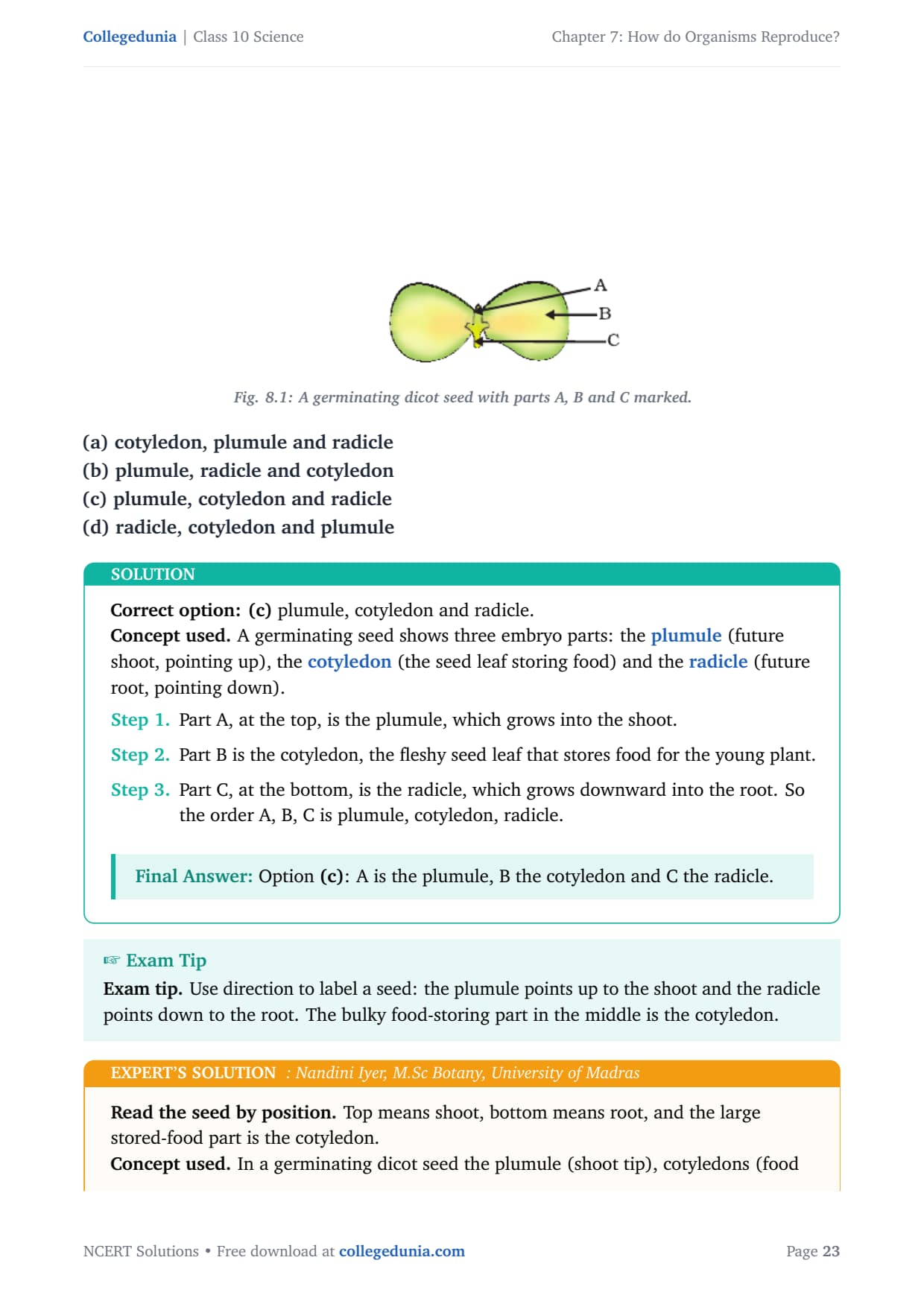
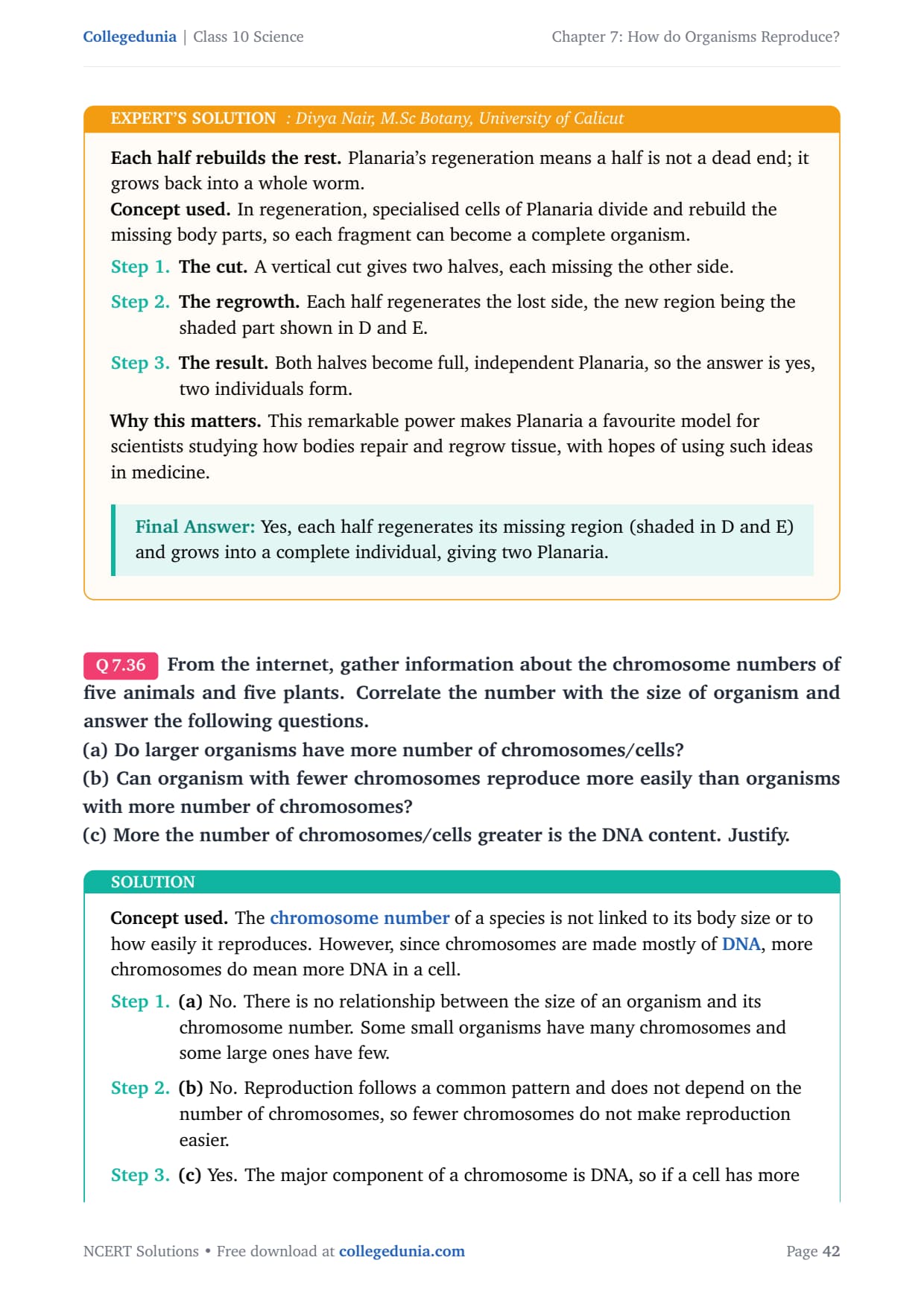
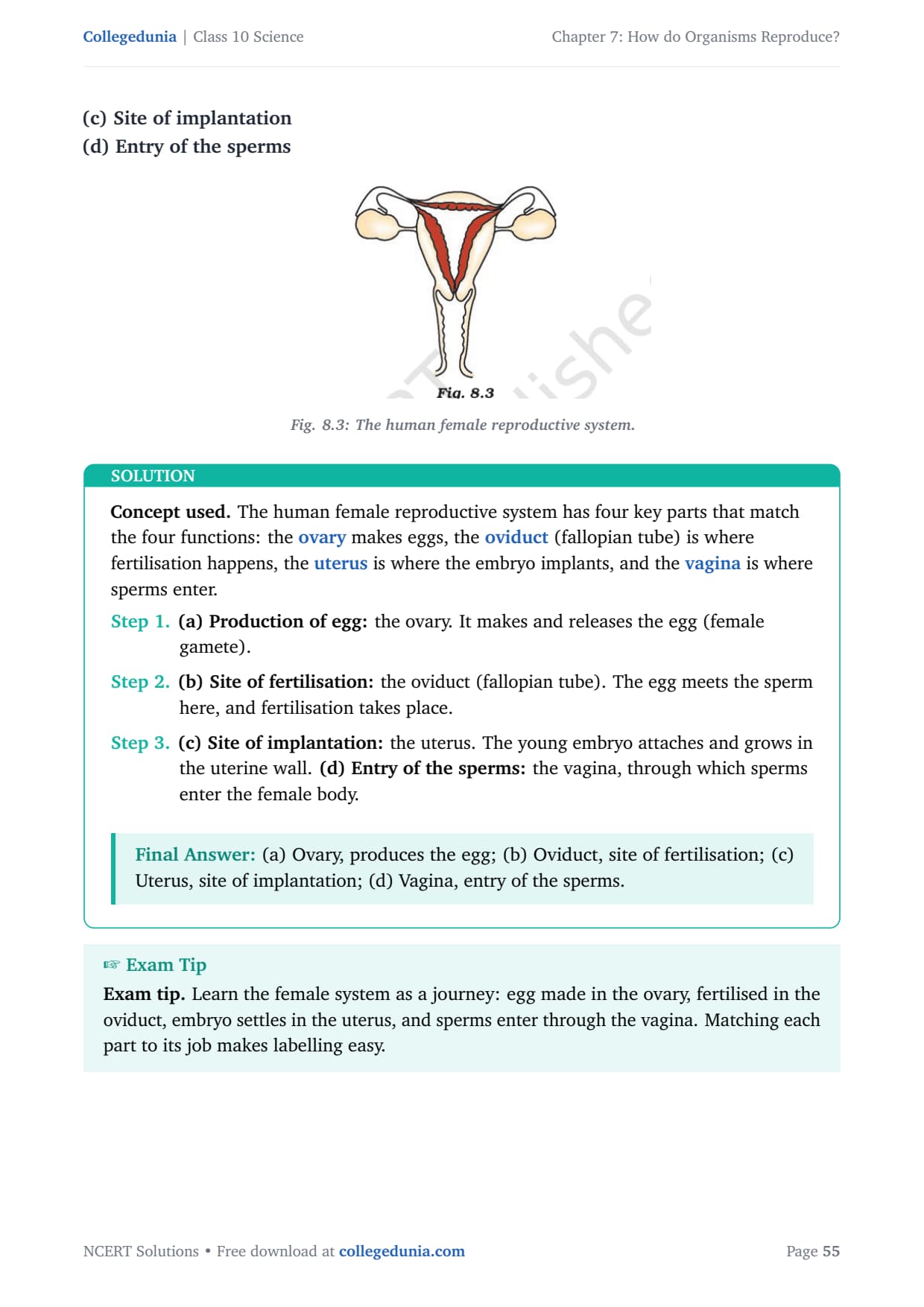
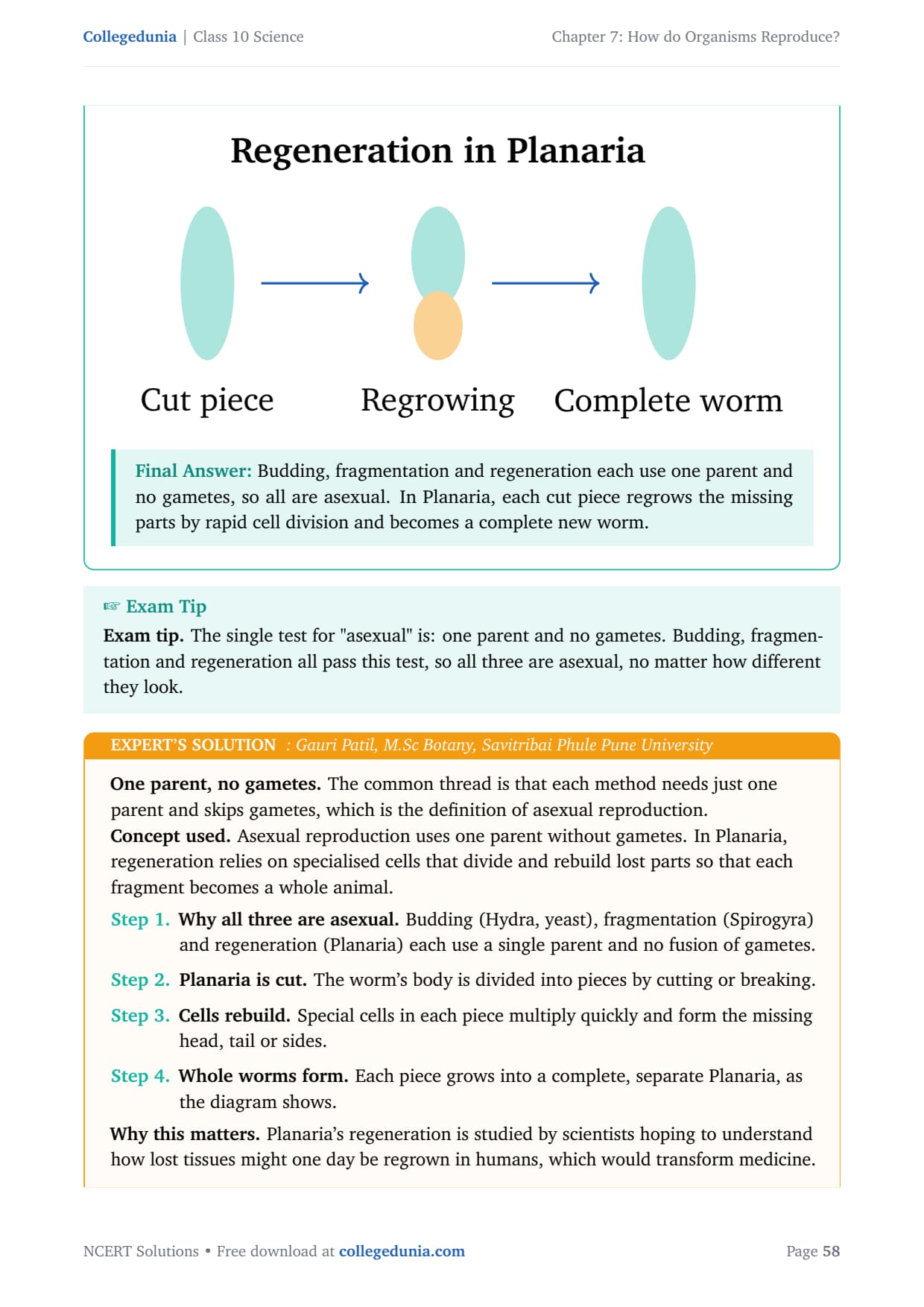
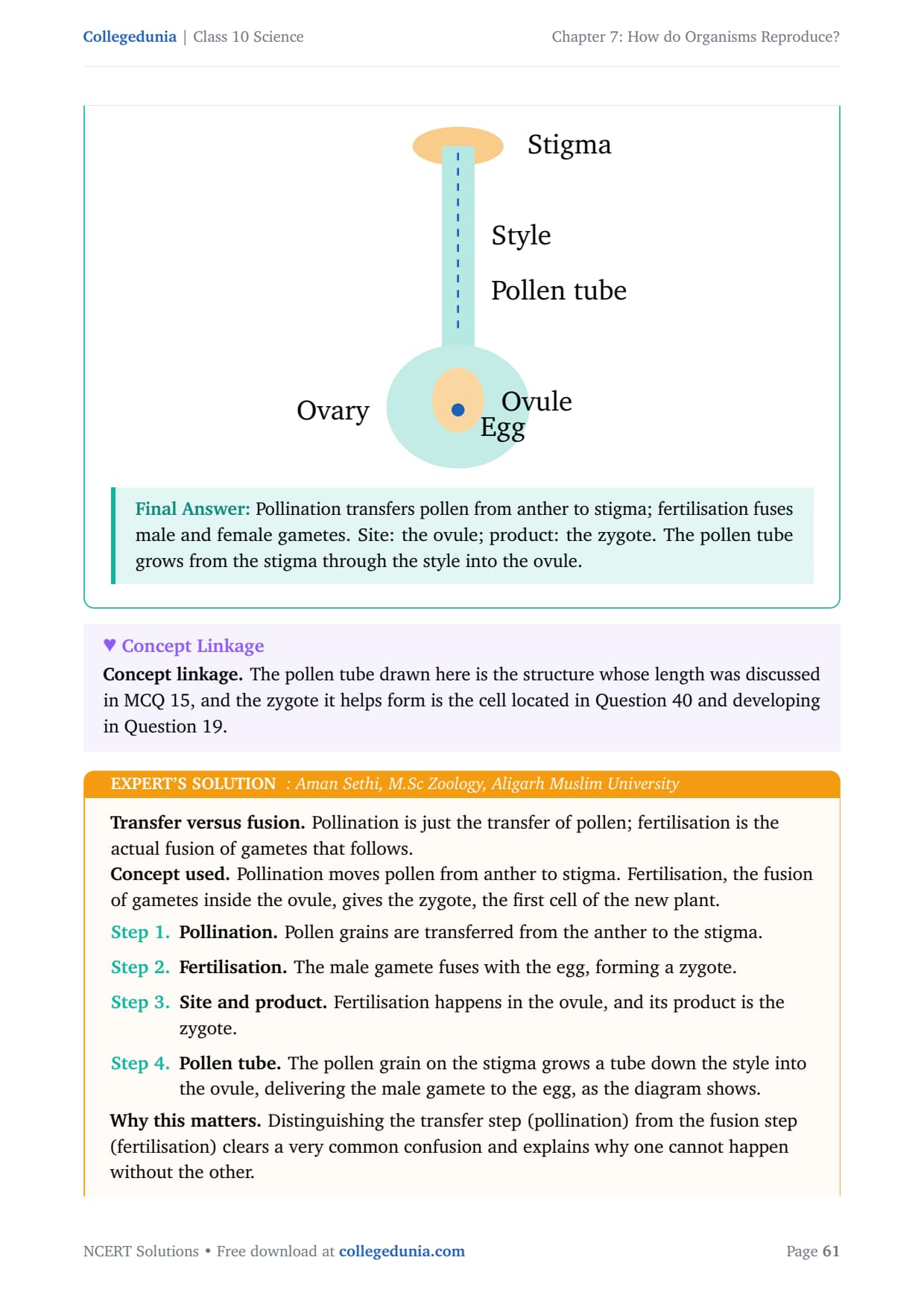
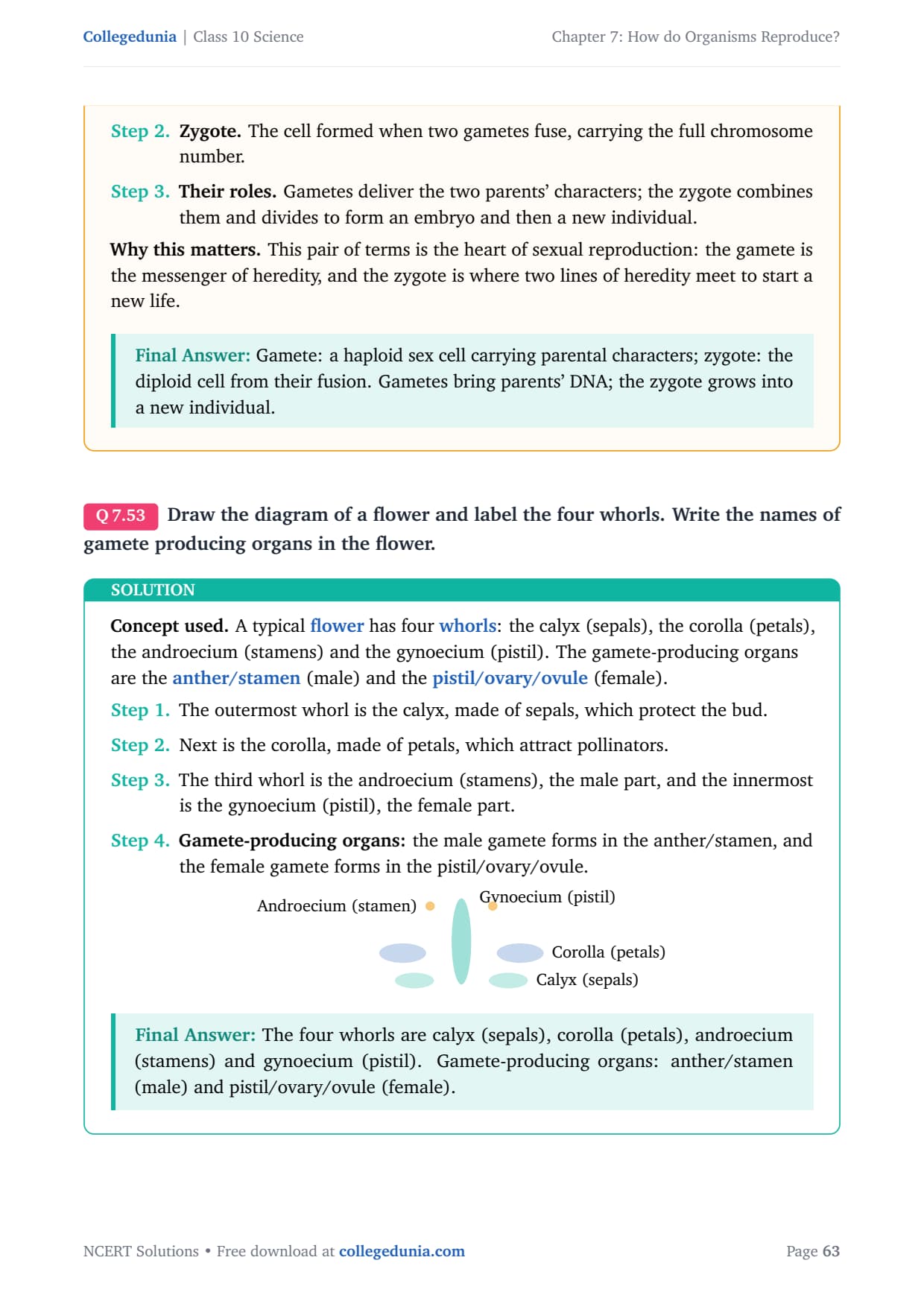
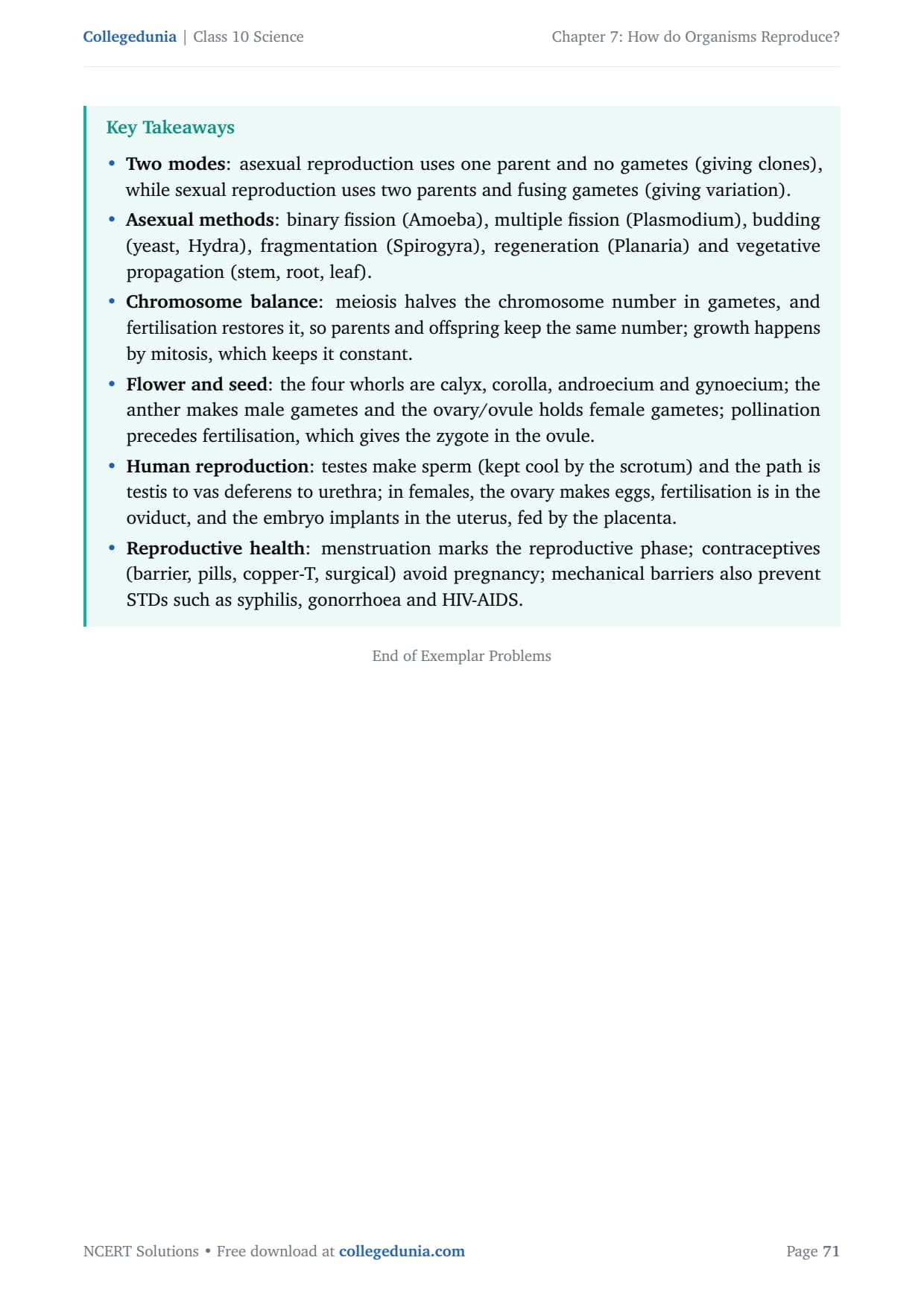
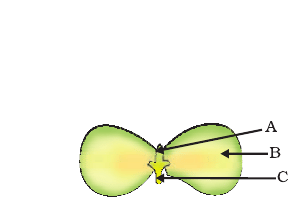
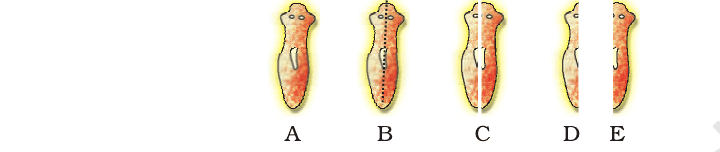
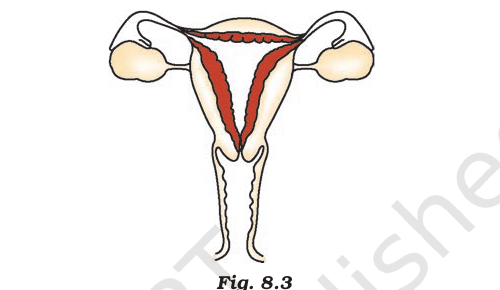



Comments