Maths Mentor, Thapar Institute | Updated on - Jul 21, 2026
The Vector Algebra Class 12 Exemplar Solutions page compiles NCERT Class 12 Mathematics Chapter 10 into a single download-ready resource, aligned to the 2026-27 NCERT syllabus. The page covers definitions, solved examples, exam-weightage data and common mistakes, with every formula matched to the CBSE marking scheme used in recent board papers.
Use the resource above alongside the chapter breakdown below.
Use the resource above alongside the chapter breakdown below.
Use the resource above alongside the chapter breakdown below.
Use the resource above alongside the chapter breakdown below.
Use the resource above alongside the chapter breakdown below.
Use the resource above alongside the chapter breakdown below.
Use the resource above alongside the chapter breakdown below.
Use the resource above alongside the chapter breakdown below.
Use the resource above alongside the chapter breakdown below.
Use the resource above alongside the chapter breakdown below.
Use the resource above alongside the chapter breakdown below.
Use the resource above alongside the chapter breakdown below.
Use the resource above alongside the chapter breakdown below.
Use the resource above alongside the chapter breakdown below.
Use the resource above alongside the chapter breakdown below.
Use the resource above alongside the chapter breakdown below.
Use the resource above alongside the chapter breakdown below.
Use the resource above alongside the chapter breakdown below.
Use the resource above alongside the chapter breakdown below.
Use the resource above alongside the chapter breakdown below.
Use the resource above alongside the chapter breakdown below.
Use the resource above alongside the chapter breakdown below.
Use the resource above alongside the chapter breakdown below.
Use the resource above alongside the chapter breakdown below.
Use the resource above alongside the chapter breakdown below.
Use the resource above alongside the chapter breakdown below.
Use the resource above alongside the chapter breakdown below.
Use the resource above alongside the chapter breakdown below.
Exemplar Problems Solved: 45 in total, split as 14 Short Answer, 4 Long Answer, 15 MCQ, 7 Fill in the Blanks, and 5 True or False.
The chapter sustains 12 named identities (Lagrange, triple cross, scalar triple product, section formula, projection, angle, area, coplanarity, parallelism, orthogonality, unit-vector, direction-cosine) and runs across 8 NCERT Exemplar pages in the 2026-27 print.
Prepared by Collegedunia subject experts, mapped to the 2026-27 NCERT Exemplar print, and benchmarked against the last five CBSE Board and JEE Main cycles on Vector Algebra.
NCERT Exemplar Class 12 Maths Solutions Chapter 10 Vector Algebra: Section-Wise Question Distribution
The 45 Exemplar problems sit across five sections. The MCQ block is the largest, mirroring how JEE Main weighs the the resource Exemplar Solutions, while the four Long Answer items carry the heaviest CBSE-style proof load.
Section
Question Range
Count
Typical Focus
Short Answer (SA)
Q1 to Q14
14
Unit vectors, section formula, dot and cross product computations, projection.
How These Class 12 Maths Exemplar Solutions for Vector Algebra Strengthen Your Preparation
The the PDF Exemplar Solutions address this in the same order as the NCERT textbook.
Wrong product choice at step one wastes the entire question. Each of the 45 solutions opens with a one-line concept identification, names the formula, and shows the determinant expansion or Lagrange manipulation in full. A single sign error inside the determinant can flip the unit-vector direction, so the working is laid out step by step. The Expert Solution after every question adds a JEE Main alternate angle on the same problem.
Determinant minors written on separate lines so the alternating sign is visible.
Pythagorean-triple shortcuts (2,3,6,7) and (1,2,2,3) are flagged in the Expert Solution where they apply, saving rough work in MCQ shifts.
Every Fill in the Blank gets the algebraic justification, not just the numeric answer, so the reader can back-solve in the exam.
True or False entries include the counter-example or proof, not a bare verdict.
Sample MCQ Solved: Lagrange's Identity in Action (Exemplar Q27)
The this chapter Exemplar Solutions address this in the same order as the NCERT textbook.
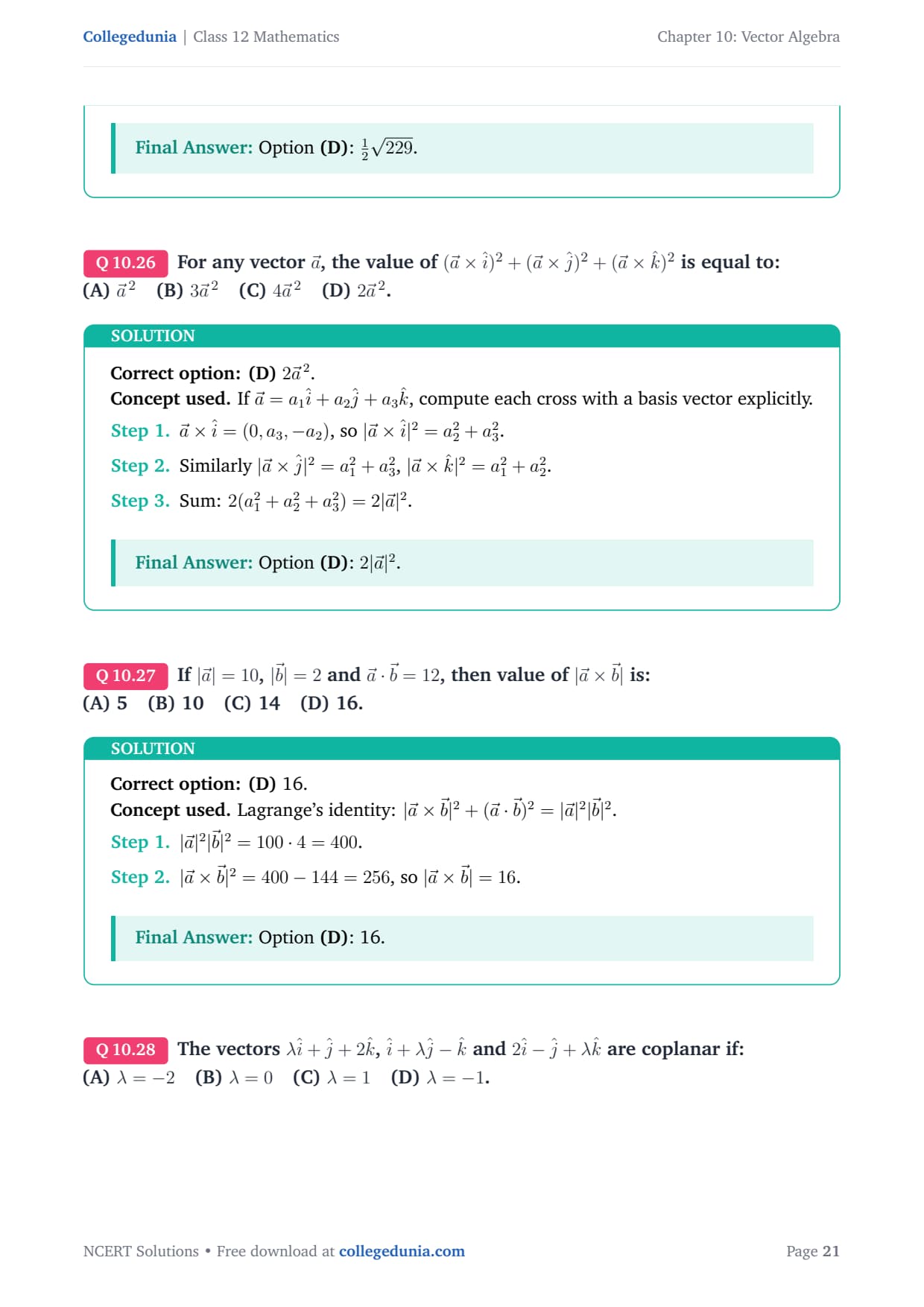
Question 27 is the canonical Lagrange application. Given |a|=10 , |b|=2 , a·b=12 , the question asks for |a×b| . The Exemplar tests the identity in three places (Q27, Q38, Q39), so internalising it pays off across these notes Exemplar Solutions.
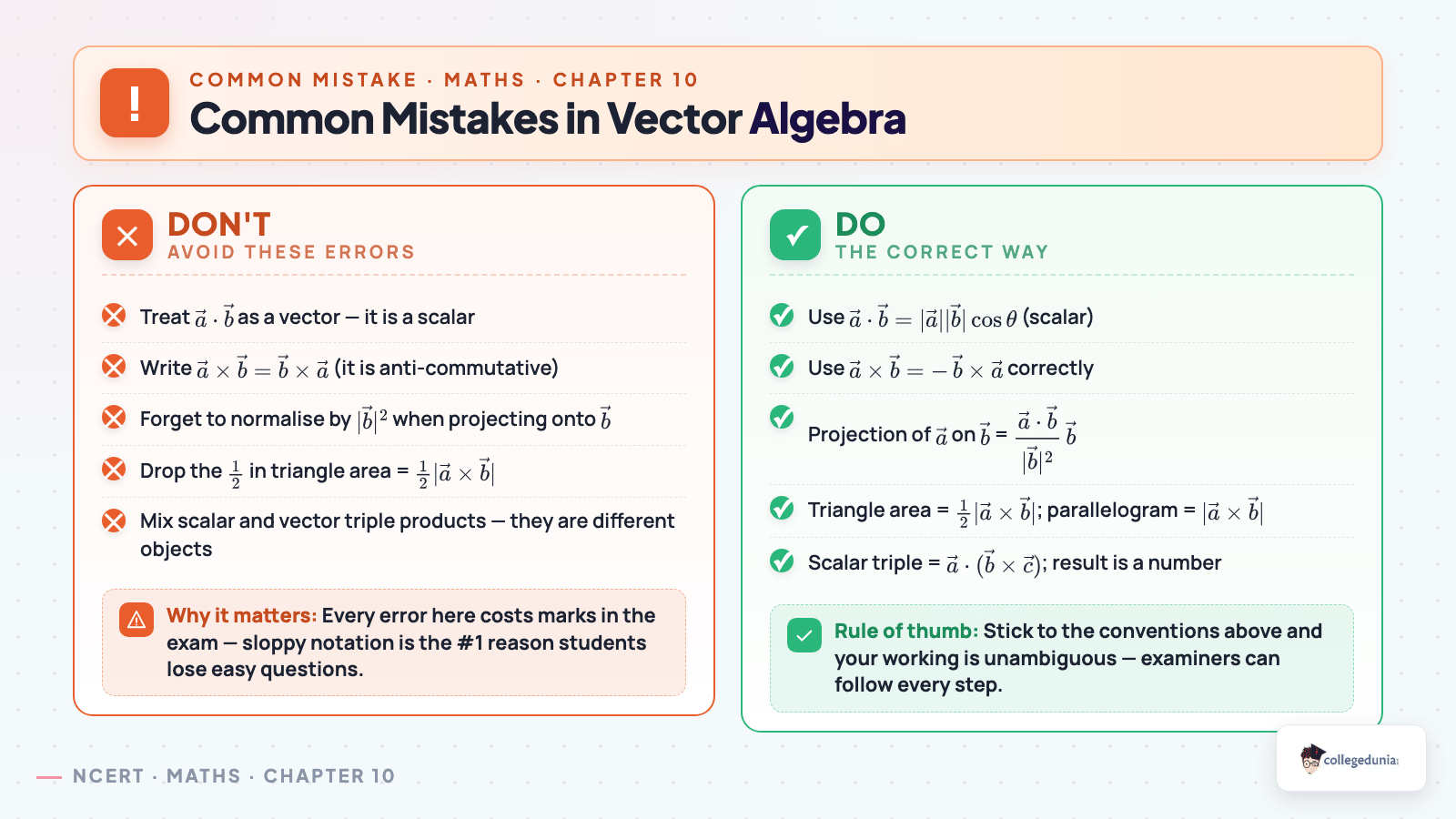
Common Mistakes the Class 12 Vector Algebra Exemplar Solutions Flag
The this Class 12 page Exemplar Solutions are written in formal mathematical notation, line by line, in the same convention as the official NCERT print.
The Mistake boxes inside the the resource Exemplar Solutions flag the four most expensive 1-mark errors in Class 12 Vector Algebra. Each ties directly to a formula in the chapter notes Exemplar Solutions, and each appears at least twice in the Exemplar's 45 problems.
Writing a·b as a vector: the dot product returns a scalar. Reporting a vector loses 1 mark immediately.
Missing sinθ in |a×b| . The common slip is writing |a×b|=|a||b| .
Forgetting the minus sign on swap: a×b=-(b×a) .
Reporting direction ratios when direction cosines are asked. Q7 is the canonical place this trap appears.
Why Vector Algebra Is the 3D-Geometry Springboard for Class 12 Maths
Every JEE Main paper since 2021 has carried at least one cross-product or scalar triple product question, and Chapter 10 is the only place where the algebra of those products is rehearsed end-to-end.
The Exemplar's 15-MCQ block is the densest type-recognition drill in the Class 12 Vector Algebra syllabus, training the reflex of choosing dot or cross before any computation. Chapter 11 Three Dimensional Geometry depends on every identity learnt here, so weak Vector Algebra preparation cascades into weak 3D Geometry.
Other Resources for Class 12 Maths Chapter 10 Vector Algebra
All NCERT Exemplar Questions for Vector Algebra with Step-by-Step Solutions
Every question of the NCERT Exemplar set for Class 12 Mathematics Chapter 10 Vector Algebra is listed below with its full Solution and Expert Solution hidden inside collapsible tabs. Click Check Solution to reveal the step-by-step working; click Expert Solution for the expanded explanation.
Questions
Q 10.1
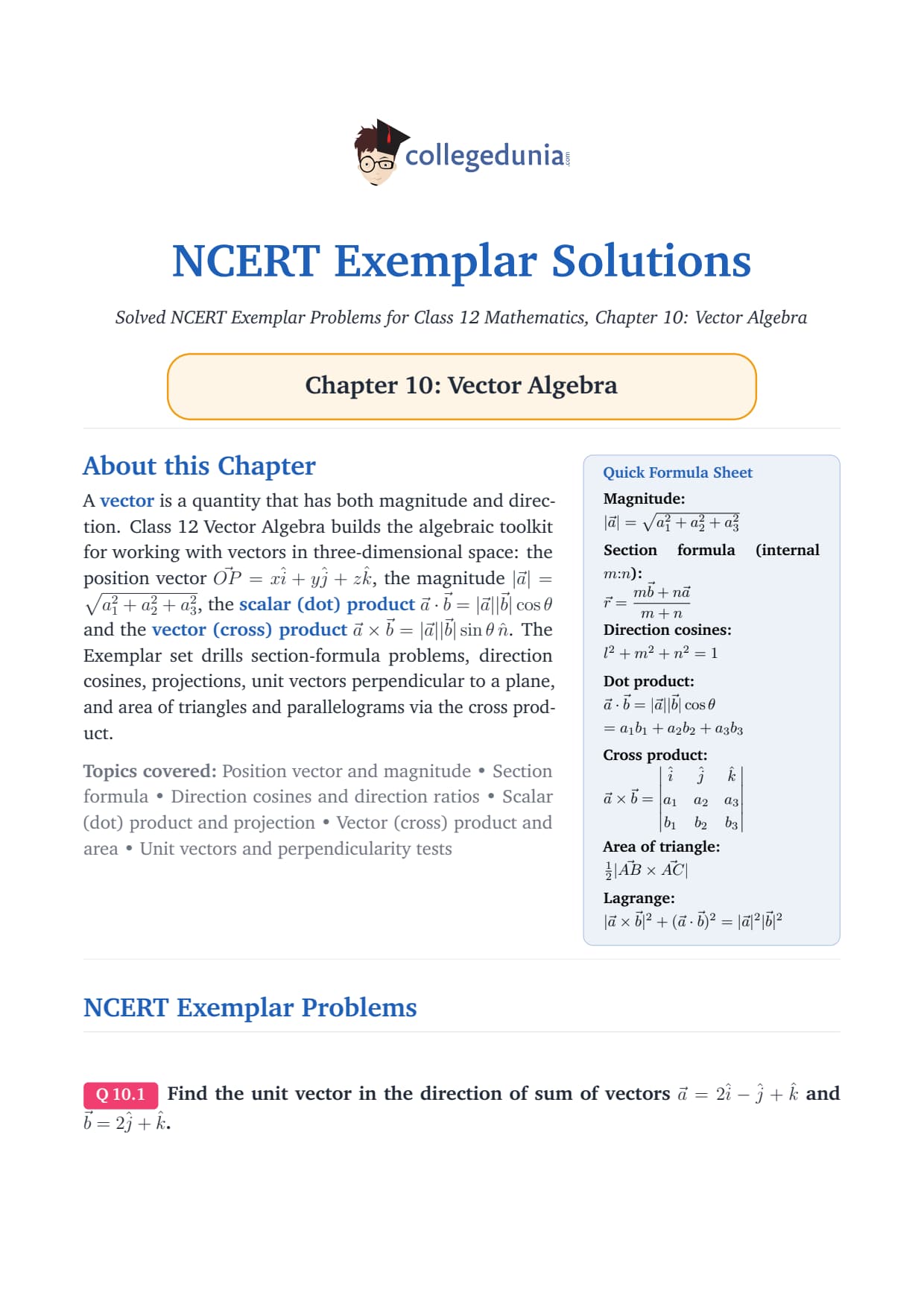
Find the unit vector in the direction of sum of vectors a=2i-j+k and b=2j+k.
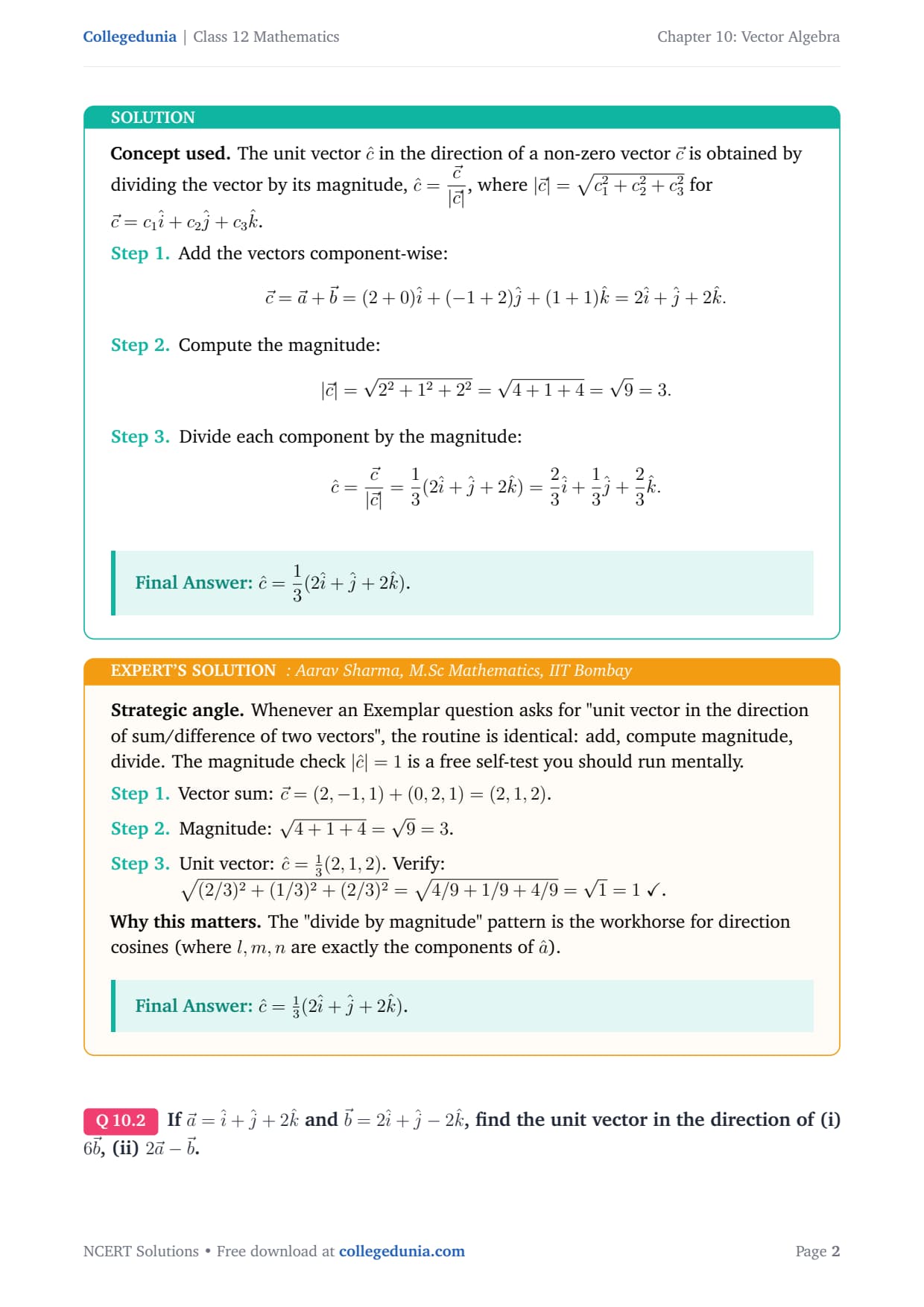
Concept used. The unit vector c in the direction of a non-zero vector c is obtained by dividing the vector by its magnitude, c=c|c|, where |c|=√c12+c22+c32 for c=c1i+c2j+c3k.
Add the vectors component-wise:
c=a+b=(2+0)i+(-1+2)j+(1+1)k=2i+j+2k.
Compute the magnitude:
|c|=√22+12+22=√4+1+4=√9=3.
Divide each component by the magnitude:
c=c|c|=13(2i+j+2k)=23i+13j+23k.
c=13(2i+j+2k).
AS
Aarav Sharma
M.Sc Mathematics, IIT Bombay
Verified Expert
Strategic angle. Whenever an Exemplar question asks for "unit vector in the direction of sum/difference of two vectors", the routine is identical: add, compute magnitude, divide. The magnitude check |c|=1 is a free self-test you should run mentally.
Vector sum: c=(2,-1,1)+(0,2,1)=(2,1,2).
Magnitude: √4+1+4=√9=3.
Unit vector: c=13(2,1,2). Verify: √(2/3)2+(1/3)2+(2/3)2=√4/9+1/9+4/9=√1=1 .
Why this matters. The "divide by magnitude" pattern is the workhorse for direction cosines (where l,m,n are exactly the components of a).
c=13(2i+j+2k).
Q 10.2
If a=i+j+2k and b=2i+j-2k, find the unit vector in the direction of (i) 6b, (ii) 2a-b.
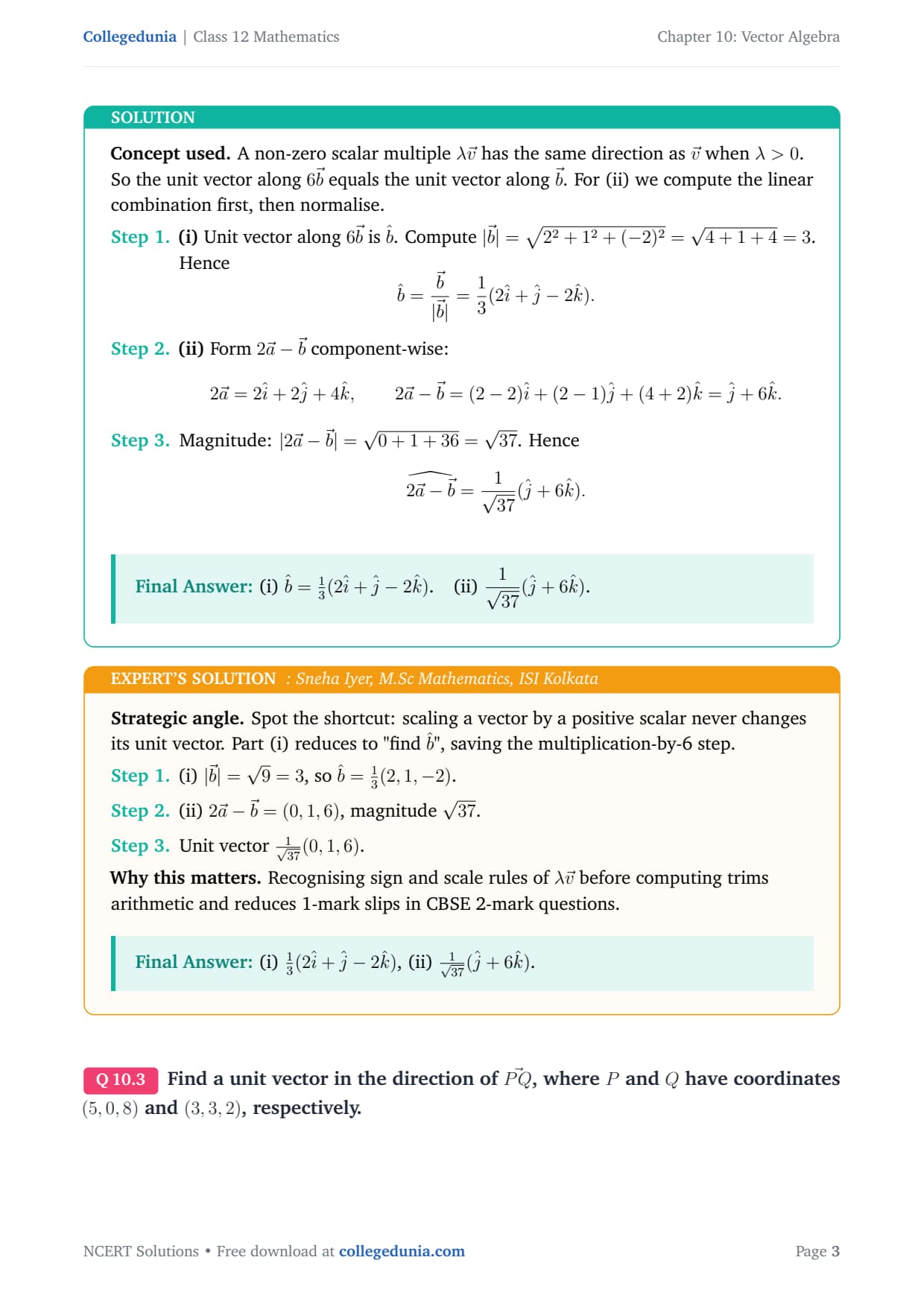
Concept used. A non-zero scalar multiple λv has the same direction as v when λ>0. So the unit vector along 6b equals the unit vector along b. For (ii) we compute the linear combination first, then normalise.
(i) Unit vector along 6b is b. Compute |b|=√22+12+(-2)2=√4+1+4=3. Hence
b=b|b|=13(2i+j-2k).
(ii) Form 2a-b component-wise:
2a=2i+2j+4k, 2a-b=(2-2)i+(2-1)j+(4+2)k=j+6k.
Strategic angle. Spot the shortcut: scaling a vector by a positive scalar never changes its unit vector. Part (i) reduces to "find b", saving the multiplication-by-6 step.
(i) |b|=√9=3, so b=13(2,1,-2).
(ii) 2a-b=(0,1,6), magnitude √37.
Unit vector 1√37(0,1,6).
Why this matters. Recognising sign and scale rules of λv before computing trims arithmetic and reduces 1-mark slips in CBSE 2-mark questions.
(i) 13(2i+j-2k), (ii) 1√37(j+6k).
Q 10.3
Find a unit vector in the direction of PQ⃗, where P and Q have coordinates (5,0,8) and (3,3,2), respectively.
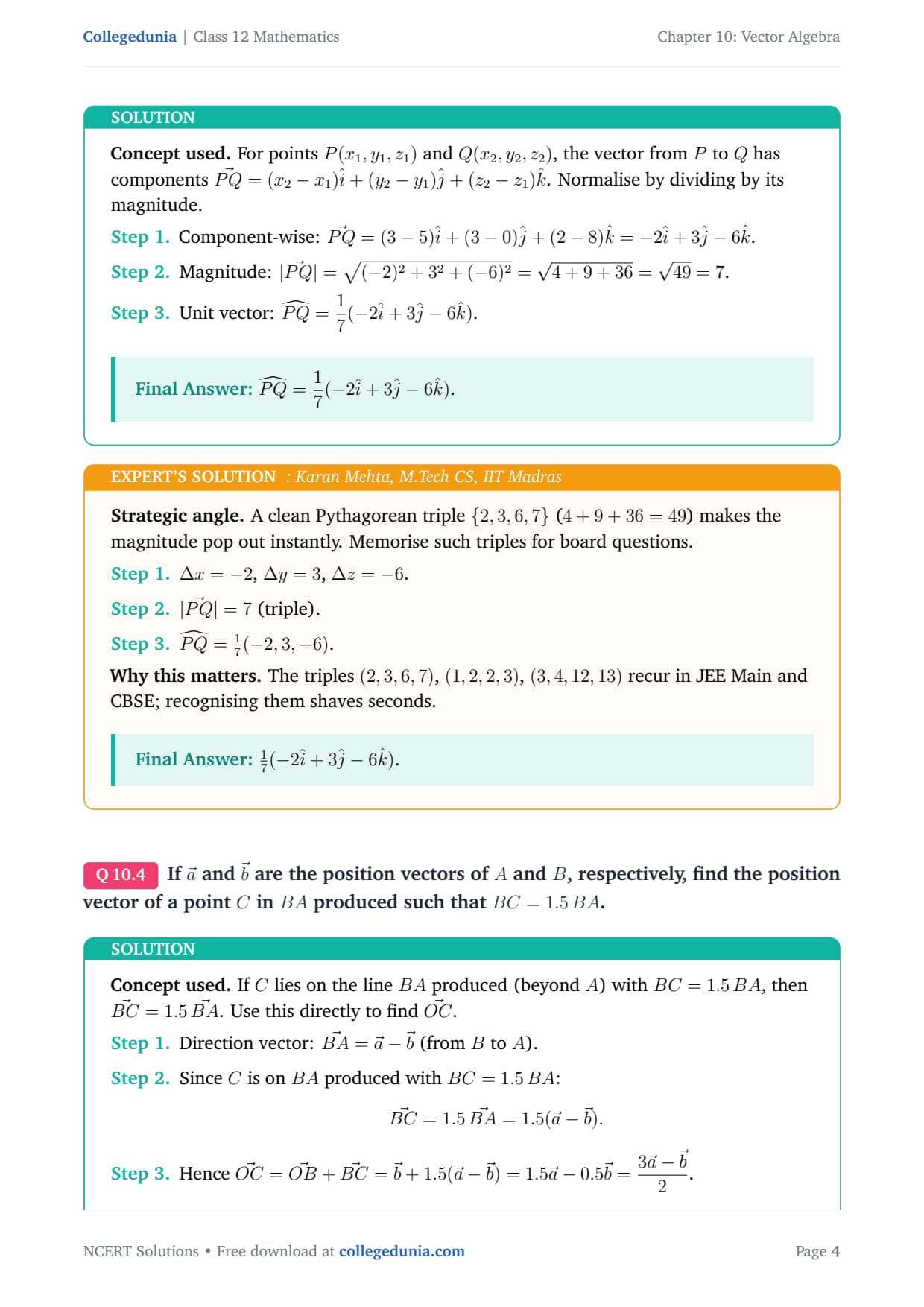
Concept used. For points P(x1,y1,z1) and Q(x2,y2,z2), the vector from P to Q has components PQ⃗=(x2-x1)i+(y2-y1)j+(z2-z1)k. Normalise by dividing by its magnitude.
Strategic angle. A clean Pythagorean triple 2,3,6,7 (4+9+36=49) makes the magnitude pop out instantly. Memorise such triples for board questions.
Δ x=-2, Δ y=3, Δ z=-6.
|PQ⃗|=7 (triple).
PQ̂=17(-2,3,-6).
Why this matters. The triples (2,3,6,7), (1,2,2,3), (3,4,12,13) recur in JEE Main and CBSE; recognising them shaves seconds.
17(-2i+3j-6k).
Q 10.4
If a and b are the position vectors of A and B, respectively, find the position vector of a point C in BA produced such that BC=1.5 BA.
Concept used. If C lies on the line BA produced (beyond A) with BC=1.5 BA, then BC⃗=1.5 BA⃗. Use this directly to find OC⃗.
Direction vector: BA⃗=a-b (from B to A).
Since C is on BA produced with BC=1.5 BA:
BC⃗=1.5 BA⃗=1.5(a-b).
Hence OC⃗=OB⃗+BC⃗=b+1.5(a-b)=1.5a-0.5b=3a-b2.
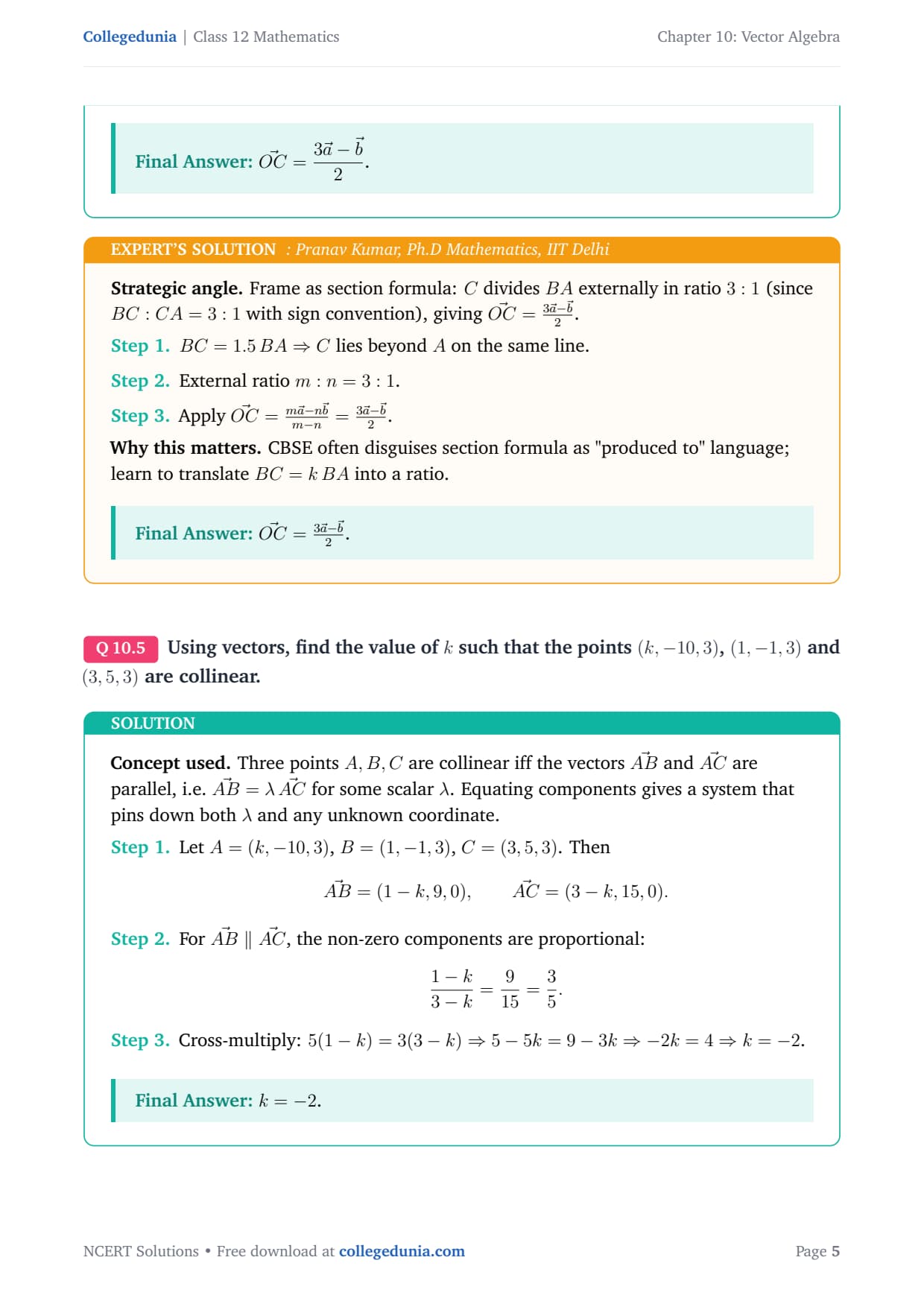
OC⃗=3a-b2.
PK
Pranav Kumar
Ph.D Mathematics, IIT Delhi
Verified Expert
Strategic angle. Frame as section formula: C divides BA externally in ratio 3:1 (since BC:CA=3:1 with sign convention), giving OC⃗=3a-b2.
BC=1.5 BA⇒C lies beyond A on the same line.
External ratio m:n=3:1.
Apply OC⃗=ma-nbm-n=3a-b2.
Why this matters. CBSE often disguises section formula as "produced to" language; learn to translate BC=k BA into a ratio.
OC⃗=3a-b2.
Q 10.5
Using vectors, find the value of k such that the points (k,-10,3), (1,-1,3) and (3,5,3) are collinear.
Concept used. Three points A,B,C are collinear iff the vectors AB⃗ and AC⃗ are parallel, i.e. AB⃗=λ AC⃗ for some scalar λ. Equating components gives a system that pins down both λ and any unknown coordinate.
Let A=(k,-10,3), B=(1,-1,3), C=(3,5,3). Then
AB⃗=(1-k,9,0), AC⃗=(3-k,15,0).
For AB⃗∥AC⃗, the non-zero components are proportional:
1-k3-k=915=35.
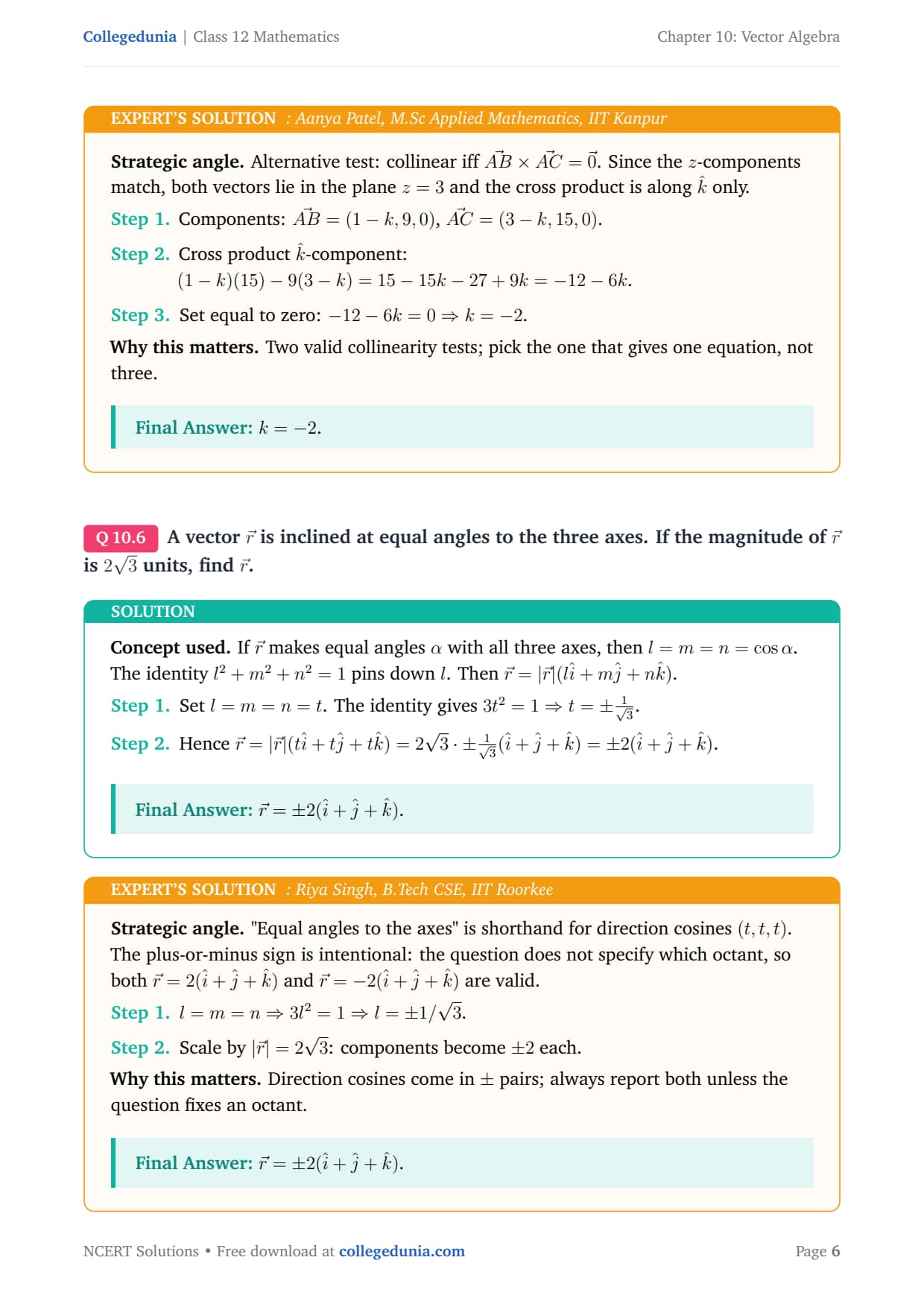
Strategic angle. Alternative test: collinear iff AB⃗×AC⃗=0. Since the z-components match, both vectors lie in the plane z=3 and the cross product is along k only.
Why this matters. Two valid collinearity tests; pick the one that gives one equation, not three.
k=-2.
Q 10.6
A vector r is inclined at equal angles to the three axes. If the magnitude of r is 2√3 units, find r.
Concept used. If r makes equal angles α with all three axes, then l=m=n=cosα. The identity l2+m2+n2=1 pins down l. Then r=|r|(li+mj+nk).
Set l=m=n=t. The identity gives 3t2=1⇒ t=±1√3.
Hence r=|r|(ti+tj+tk)=2√3·±1√3(i+j+k)=± 2(i+j+k).
r=± 2(i+j+k).
RS
Riya Singh
B.Tech CSE, IIT Roorkee
Verified Expert
Strategic angle. "Equal angles to the axes" is shorthand for direction cosines (t,t,t). The plus-or-minus sign is intentional: the question does not specify which octant, so both r=2(i+j+k) and r=-2(i+j+k) are valid.
l=m=n⇒ 3l2=1⇒ l=± 1/3.
Scale by |r|=23: components become ± 2 each.
Why this matters. Direction cosines come in ± pairs; always report both unless the question fixes an octant.
r=± 2(i+j+k).
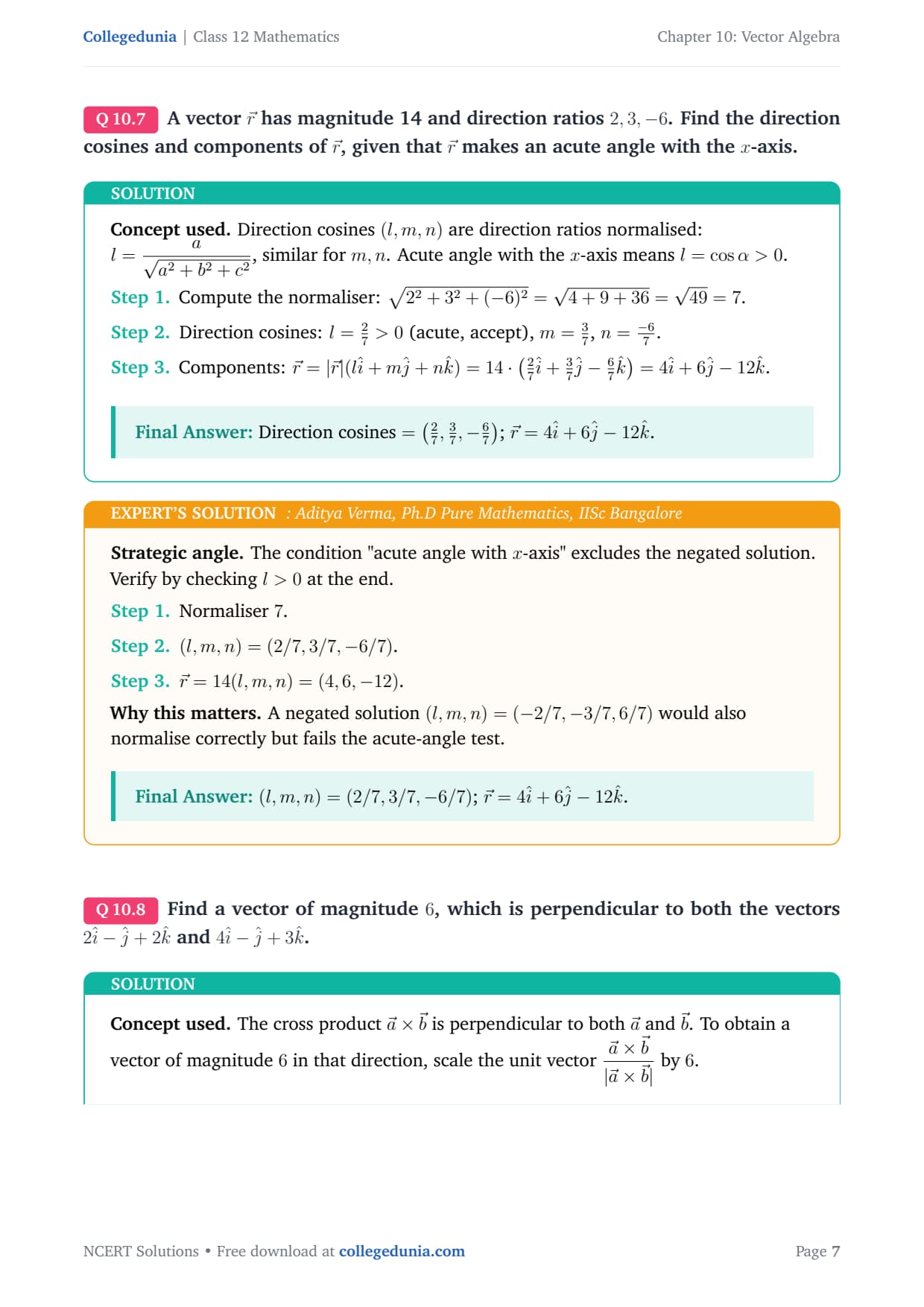
Q 10.7
A vector r has magnitude 14 and direction ratios 2,3,-6. Find the direction cosines and components of r, given that r makes an acute angle with the x-axis.
Concept used. Direction cosines (l,m,n) are direction ratios normalised: l=a√a2+b2+c2, similar for m,n. Acute angle with the x-axis means l=cosα>0.
Compute the normaliser: √22+32+(-6)2=√4+9+36=√49=7.
Direction cosines: l=27>0 (acute, accept), m=37, n=-67.
Strategic angle. The condition "acute angle with x-axis" excludes the negated solution. Verify by checking l>0 at the end.
Normaliser 7.
(l,m,n)=(2/7,3/7,-6/7).
r=14(l,m,n)=(4,6,-12).
Why this matters. A negated solution (l,m,n)=(-2/7,-3/7,6/7) would also normalise correctly but fails the acute-angle test.
(l,m,n)=(2/7,3/7,-6/7); r=4i+6j-12k.
Q 10.8
Find a vector of magnitude 6, which is perpendicular to both the vectors 2i-j+2k and 4i-j+3k.
Concept used. The cross product a×b is perpendicular to both a and b. To obtain a vector of magnitude 6 in that direction, scale the unit vector a×b|a×b| by 6.
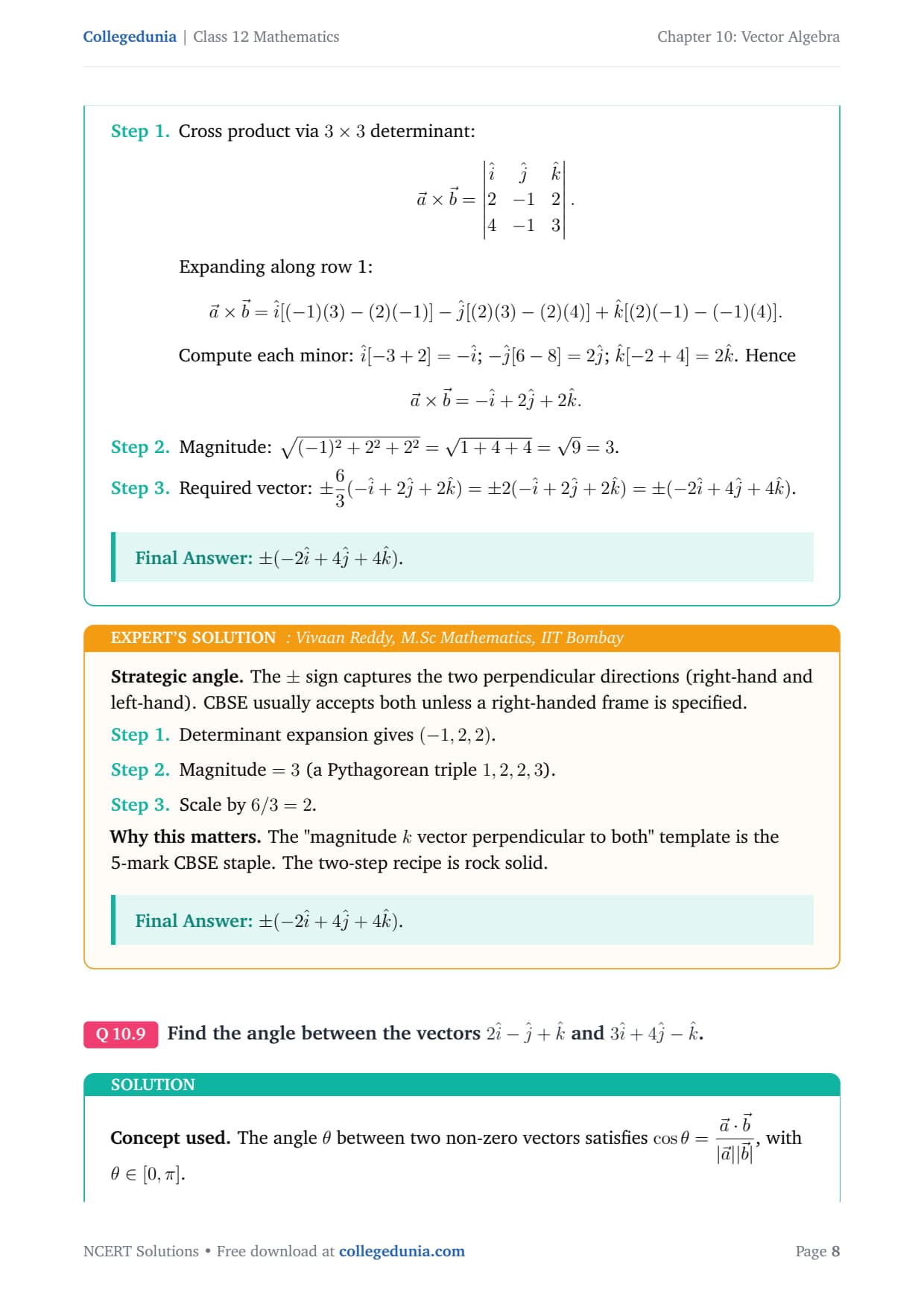
Cross product via 3× 3 determinant:
a×b=vmatrixi&j&k 2&-1&2 4&-1&3vmatrix.
Expanding along row 1:
a×b=i[(-1)(3)-(2)(-1)]-j[(2)(3)-(2)(4)]+k[(2)(-1)-(-1)(4)].
Compute each minor: i[-3+2]=-i; -j[6-8]=2j; k[-2+4]=2k. Hence
a×b=-i+2j+2k.
Strategic angle. The ± sign captures the two perpendicular directions (right-hand and left-hand). CBSE usually accepts both unless a right-handed frame is specified.
Determinant expansion gives (-1,2,2).
Magnitude =3 (a Pythagorean triple 1,2,2,3).
Scale by 6/3=2.
Why this matters. The "magnitude k vector perpendicular to both" template is the 5-mark CBSE staple. The two-step recipe is rock solid.
±(-2i+4j+4k).
Q 10.9
Find the angle between the vectors 2i-j+k and 3i+4j-k.
Concept used. The angle θ between two non-zero vectors satisfies cosθ=a·b|a||b|, with θ∈[0,π].
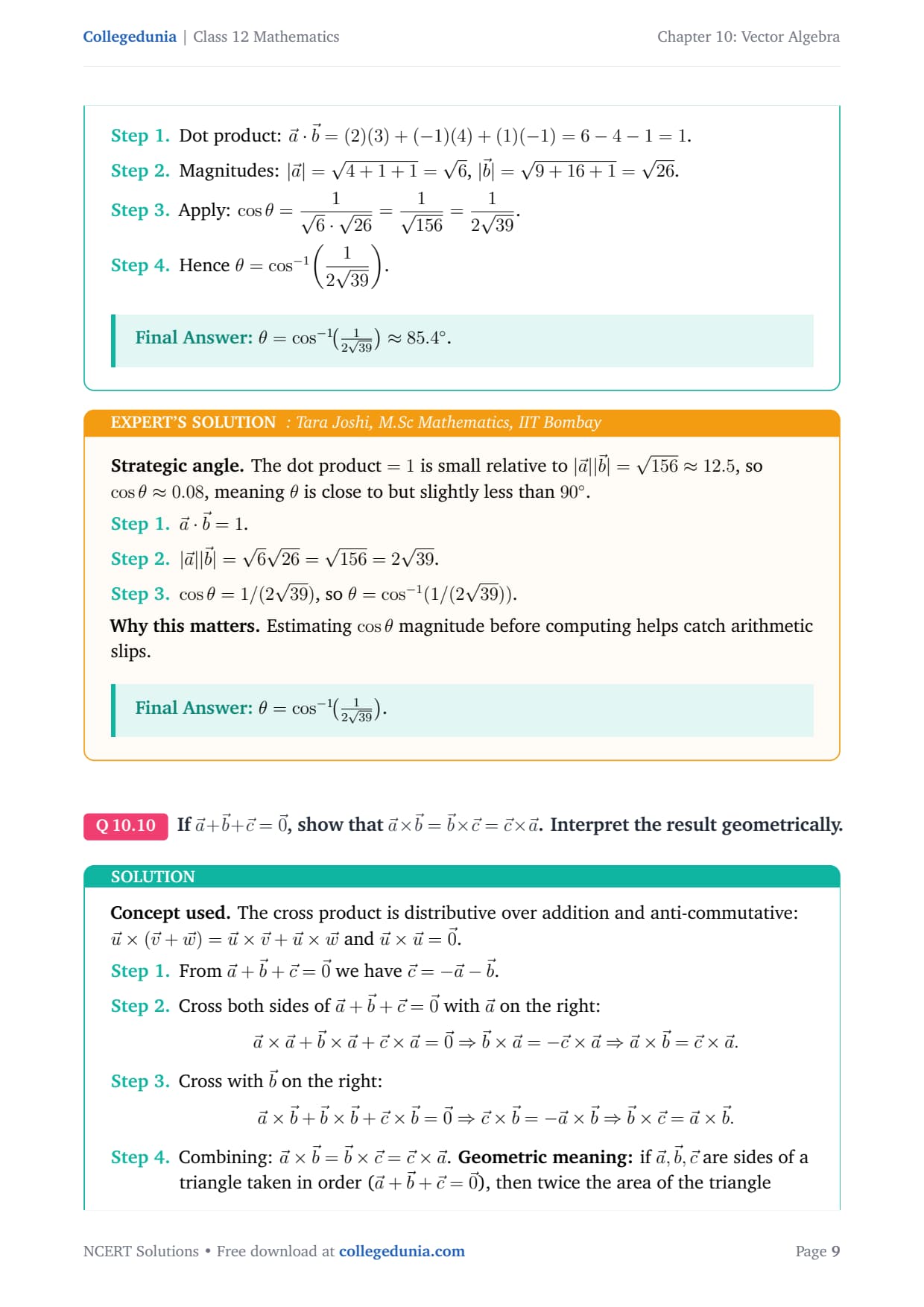
Dot product: a·b=(2)(3)+(-1)(4)+(1)(-1)=6-4-1=1.
Magnitudes: |a|=√4+1+1=√6, |b|=√9+16+1=√26.
Apply: cosθ=1√6·√26=1√156=12√39.
Hence θ=cos-1(12√39).
θ=cos-1(12√39)≈ 85.4∘.
TJ
Tara Joshi
M.Sc Mathematics, IIT Bombay
Verified Expert
Strategic angle. The dot product =1 is small relative to |a||b|=√156≈ 12.5, so cosθ≈ 0.08, meaning θ is close to but slightly less than 90∘.
a·b=1.
|a||b|=√6√26=√156=2√39.
cosθ=1/(2√39), so θ=cos-1(1/(2√39)).
Why this matters. Estimating cosθ magnitude before computing helps catch arithmetic slips.
θ=cos-1(12√39).
Q 10.10
If a+b+c=0, show that a×b=b×c=c×a. Interpret the result geometrically.
Concept used. The cross product is distributive over addition and anti-commutative: u×(v+w)=u×v+u×w and u×u=0.
From a+b+c=0 we have c=-a-b.
Cross both sides of a+b+c=0 with a on the right:
a×a+b×a+c×a=0⇒ b×a=-c×a⇒ a×b=c×a.
Cross with b on the right:
a×b+b×b+c×b=0⇒ c×b=-a×b⇒ b×c=a×b.
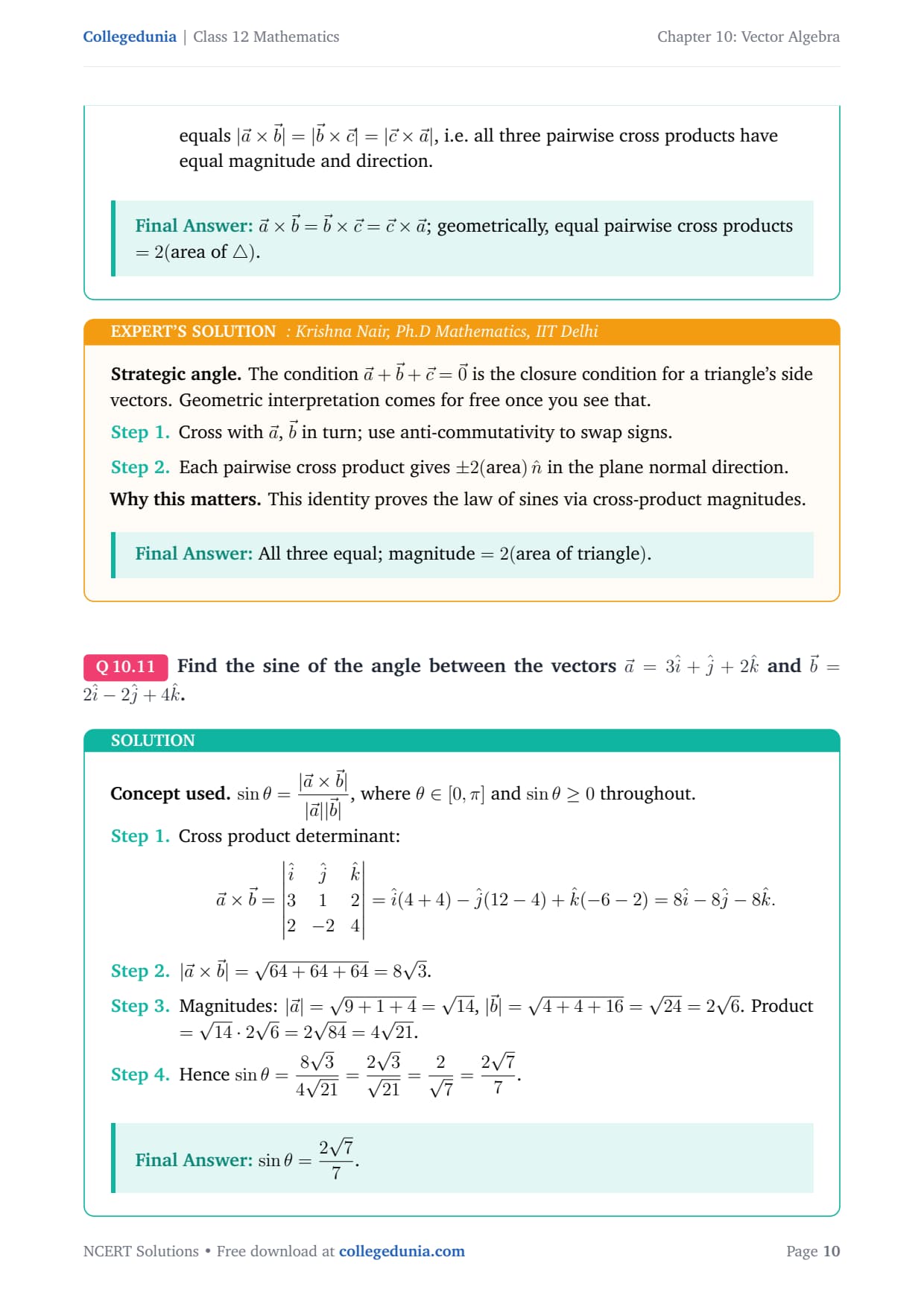
Combining: a×b=b×c=c×a. Geometric meaning: if a,b,c are sides of a triangle taken in order (a+b+c=0), then twice the area of the triangle equals |a×b|=|b×c|=|c×a|, i.e. all three pairwise cross products have equal magnitude and direction.
a×b=b×c=c×a; geometrically, equal pairwise cross products =2(area of ).
KN
Krishna Nair
Ph.D Mathematics, IIT Delhi
Verified Expert
Strategic angle. The condition a+b+c=0 is the closure condition for a triangle's side vectors. Geometric interpretation comes for free once you see that.
Cross with a, b in turn; use anti-commutativity to swap signs.
Each pairwise cross product gives ± 2(area) n in the plane normal direction.
Why this matters. This identity proves the law of sines via cross-product magnitudes.
All three equal; magnitude =2(area of triangle).
Q 10.11
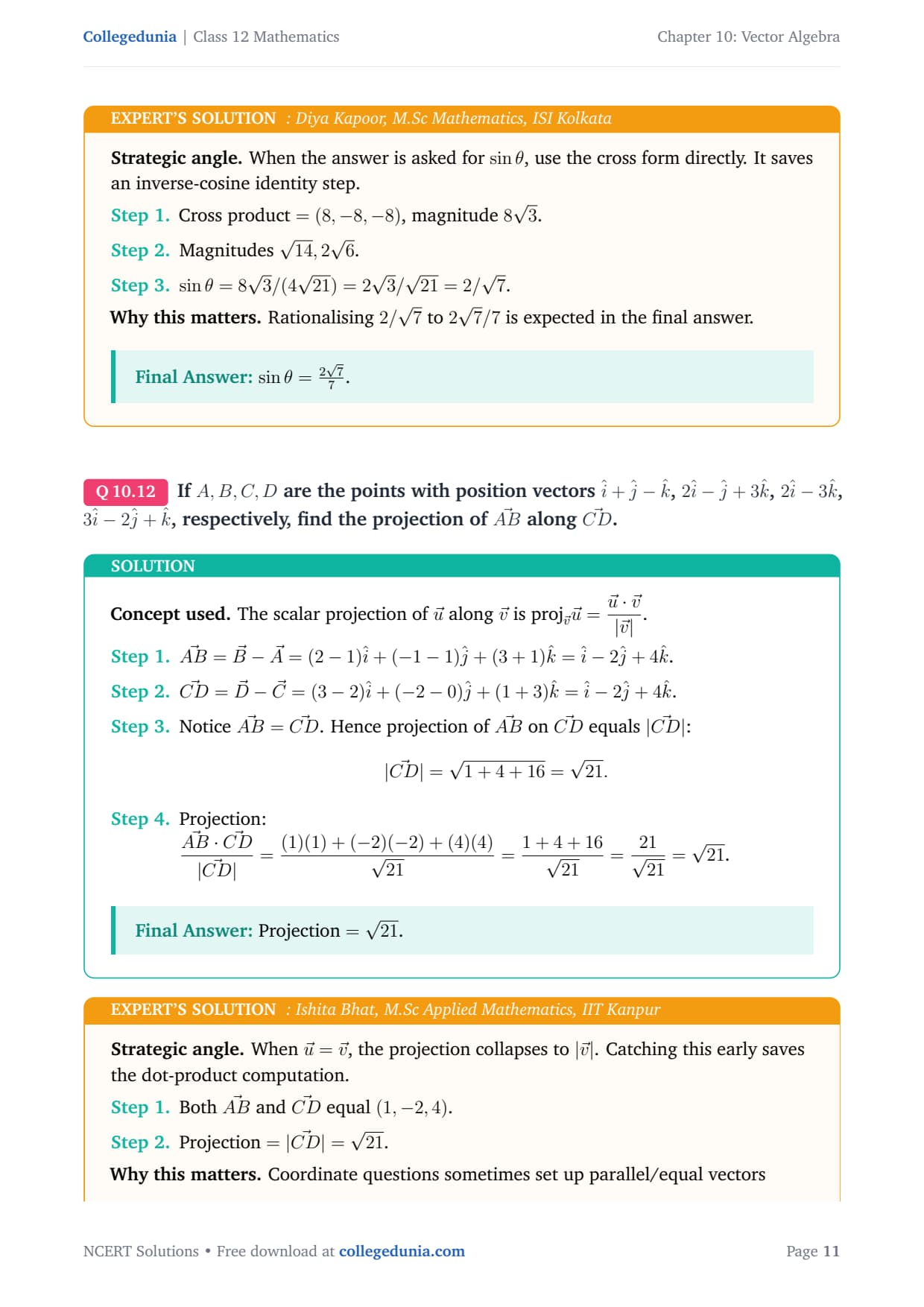
Find the sine of the angle between the vectors a=3i+j+2k and b=2i-2j+4k.
Concept used.sinθ=|a×b||a||b|, where θ∈[0,π] and sinθ≥ 0 throughout.
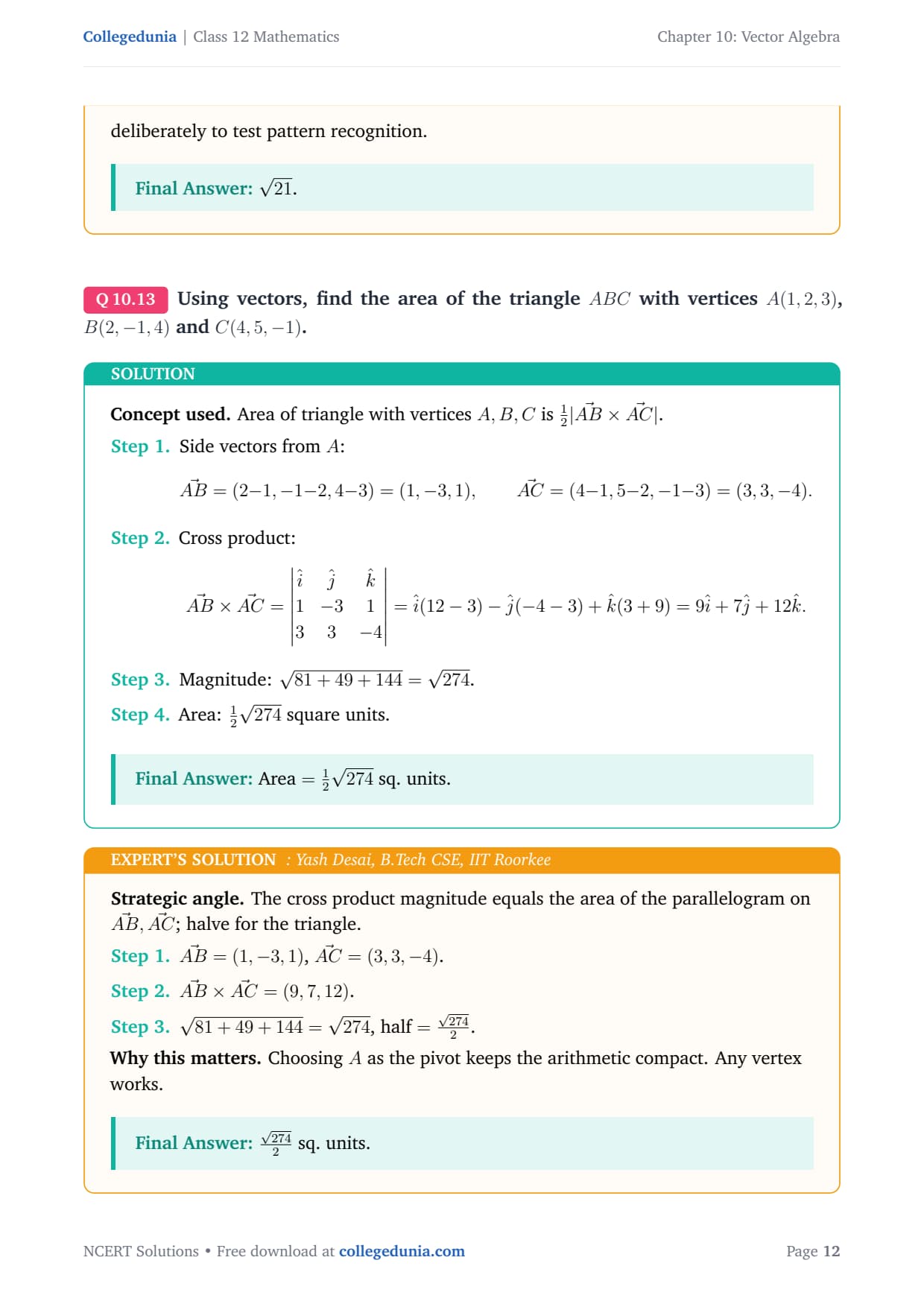
Strategic angle. The cross product magnitude equals the area of the parallelogram on AB⃗,AC⃗; halve for the triangle.
AB⃗=(1,-3,1), AC⃗=(3,3,-4).
AB⃗×AC⃗=(9,7,12).
√81+49+144=√274, half =√2742.
Why this matters. Choosing A as the pivot keeps the arithmetic compact. Any vertex works.
√2742 sq. units.
Q 10.14
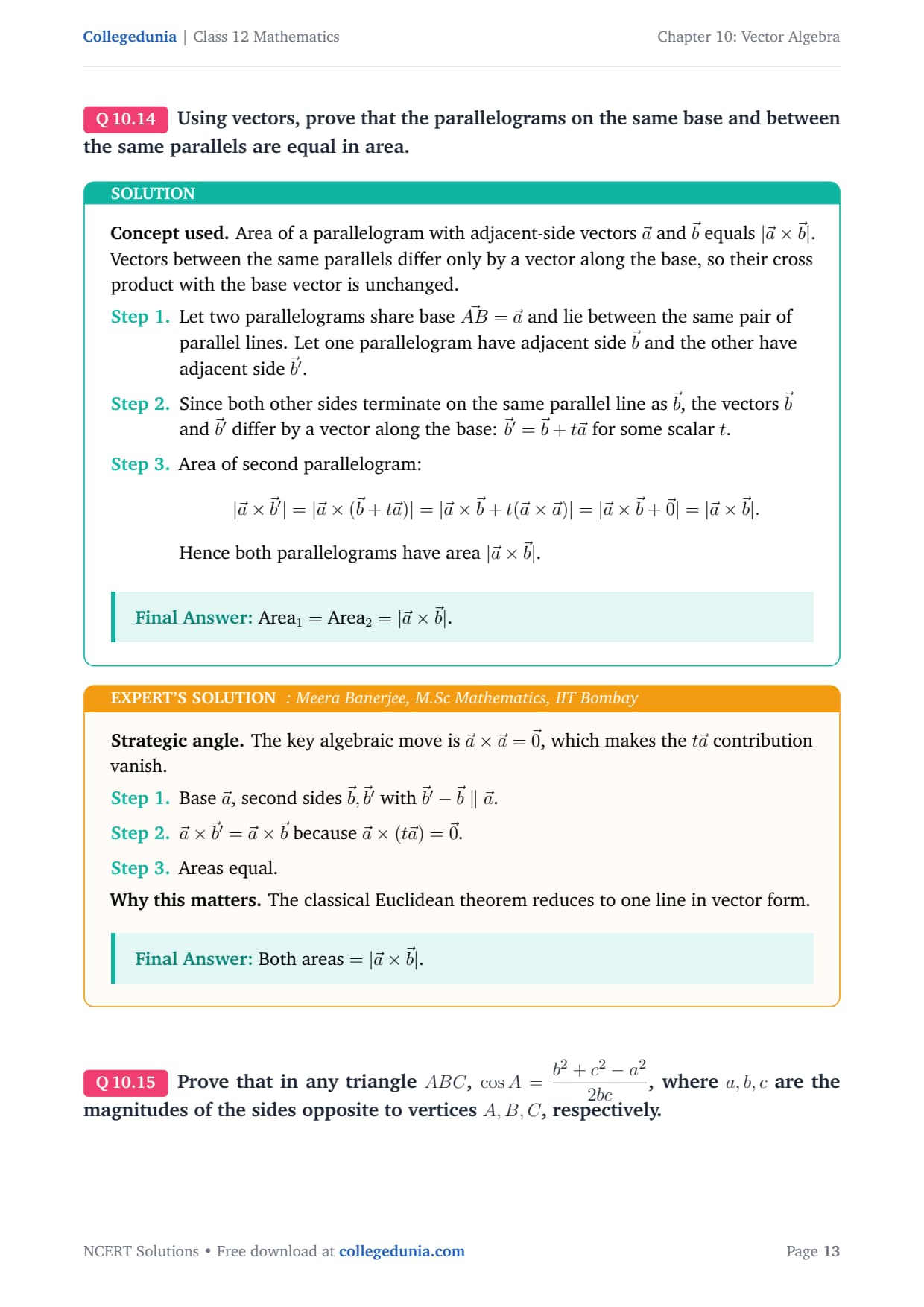
Using vectors, prove that the parallelograms on the same base and between the same parallels are equal in area.
Concept used. Area of a parallelogram with adjacent-side vectors a and b equals |a×b|. Vectors between the same parallels differ only by a vector along the base, so their cross product with the base vector is unchanged.
Let two parallelograms share base AB⃗=a and lie between the same pair of parallel lines. Let one parallelogram have adjacent side b and the other have adjacent side b'.
Since both other sides terminate on the same parallel line as b, the vectors b and b' differ by a vector along the base: b'=b+ta for some scalar t.
Area of second parallelogram:
|a×b'|=|a×(b+ta)|=|a×b+t(a×a)|=|a×b+0|=|a×b|.
Hence both parallelograms have area |a×b|.
Area1= Area2=|a×b|.
MB
Meera Banerjee
M.Sc Mathematics, IIT Bombay
Verified Expert
Strategic angle. The key algebraic move is a×a=0, which makes the ta contribution vanish.
Base a, second sides b, b' with b'-b∥a.
a×b'=a×b because a×(ta)=0.
Areas equal.
Why this matters. The classical Euclidean theorem reduces to one line in vector form.
Both areas =|a×b|.
Q 10.15
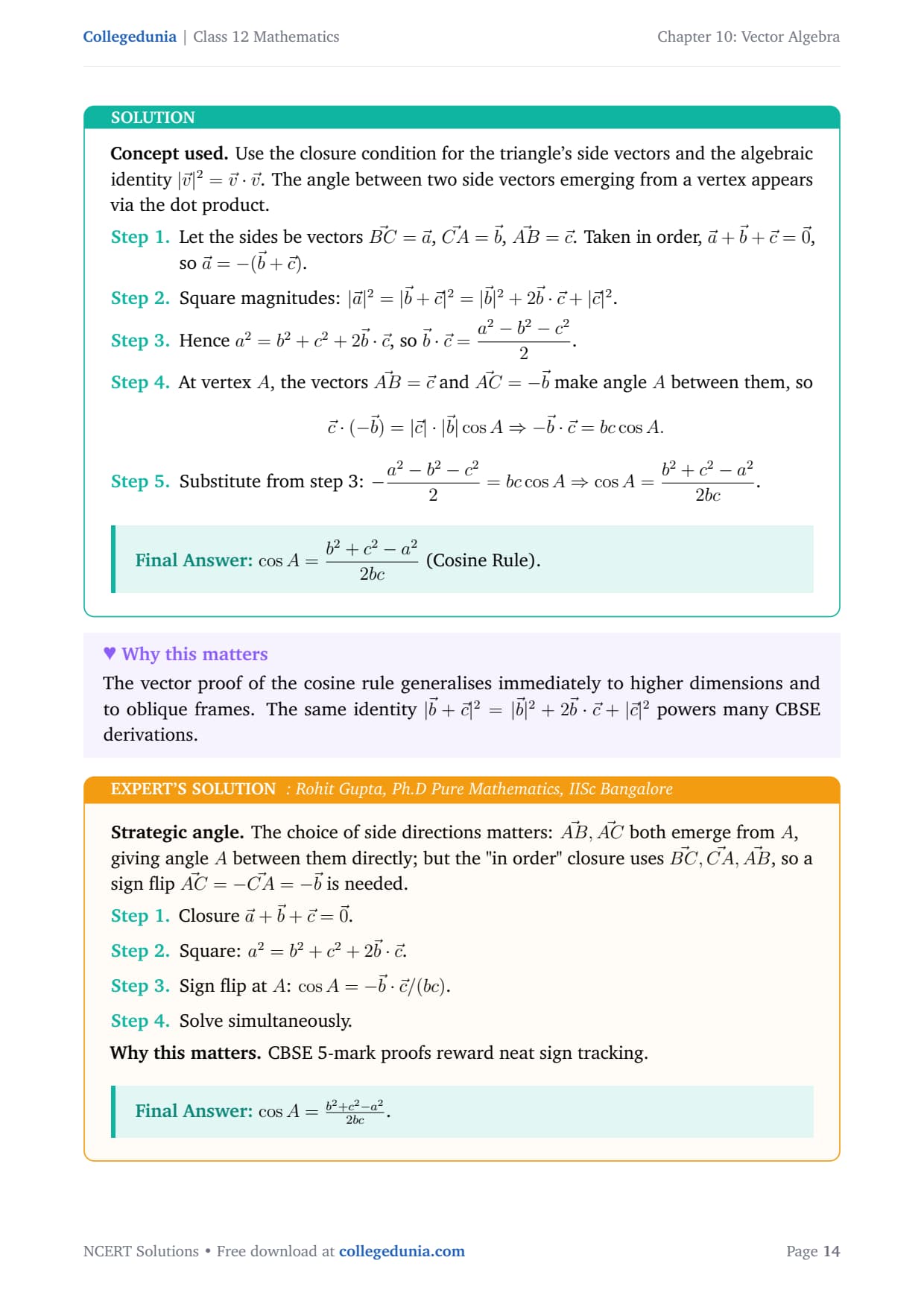
Prove that in any triangle ABC, cos A=b2+c2-a22bc, where a,b,c are the magnitudes of the sides opposite to vertices A,B,C, respectively.
Concept used. Use the closure condition for the triangle's side vectors and the algebraic identity |v|2=v·v. The angle between two side vectors emerging from a vertex appears via the dot product.
Let the sides be vectors BC⃗=a, CA⃗=b, AB⃗=c. Taken in order, a+b+c=0, so a=-(b+c).
Square magnitudes: |a|2=|b+c|2=|b|2+2b·c+|c|2.
Hence a2=b2+c2+2b·c, so b·c=a2-b2-c22.
At vertex A, the vectors AB⃗=c and AC⃗=-b make angle A between them, so
c·(-b)=|c|·|b|cos A⇒ -b·c=bccos A.
Substitute from step 3: -a2-b2-c22=bccos A⇒ cos A=b2+c2-a22bc.
cos A=b2+c2-a22bc (Cosine Rule).
RG
Rohit Gupta
Ph.D Pure Mathematics, IISc Bangalore
Verified Expert
Strategic angle. The choice of side directions matters: AB⃗,AC⃗ both emerge from A, giving angle A between them directly; but the "in order" closure uses BC⃗,CA⃗,AB⃗, so a sign flip AC⃗=-CA⃗=-b is needed.
Closure a+b+c=0.
Square: a2=b2+c2+2b·c.
Sign flip at A: cos A=-b·c/(bc).
Solve simultaneously.
Why this matters. CBSE 5-mark proofs reward neat sign tracking.
cos A=b2+c2-a22bc.
Q 10.16
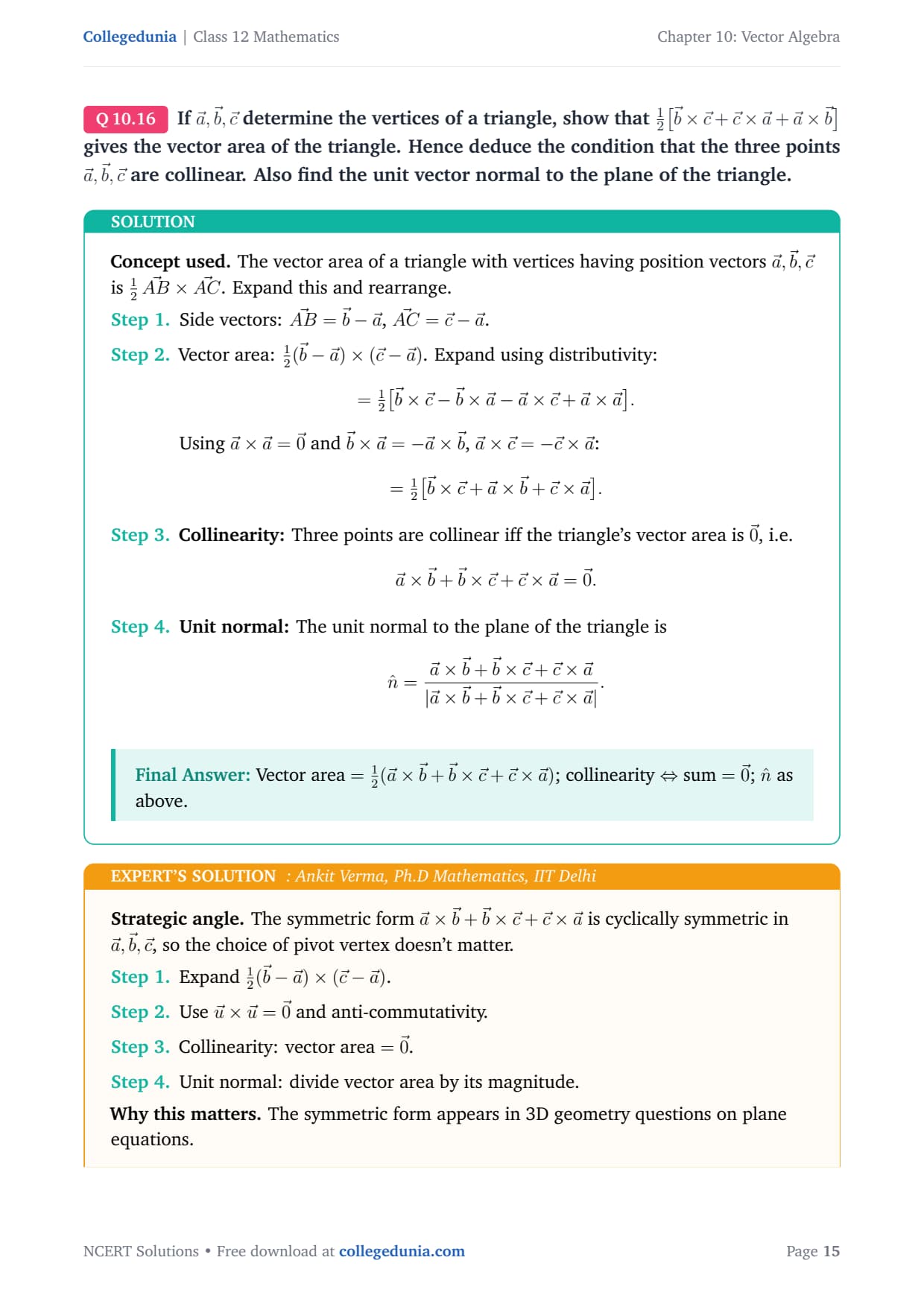
If a,b,c determine the vertices of a triangle, show that 12[b×c+c×a+a×b] gives the vector area of the triangle. Hence deduce the condition that the three points a,b,c are collinear. Also find the unit vector normal to the plane of the triangle.
Concept used. The vector area of a triangle with vertices having position vectors a,b,c is 12AB⃗×AC⃗. Expand this and rearrange.
Side vectors: AB⃗=b-a, AC⃗=c-a.
Vector area: 12(b-a)×(c-a). Expand using distributivity:
=12[b×c-b×a-a×c+a×a].
Using a×a=0 and b×a=-a×b, a×c=-c×a:
=12[b×c+a×b+c×a].
Collinearity: Three points are collinear iff the triangle's vector area is 0, i.e.
a×b+b×c+c×a=0.
Unit normal: The unit normal to the plane of the triangle is
n=a×b+b×c+c×a|a×b+b×c+c×a|.
Vector area =12(a×b+b×c+c×a); collinearity ⇔ sum =0; n as above.
AV
Ankit Verma
Ph.D Mathematics, IIT Delhi
Verified Expert
Strategic angle. The symmetric form a×b+b×c+c×a is cyclically symmetric in a,b,c, so the choice of pivot vertex doesn't matter.
Expand 12(b-a)×(c-a).
Use u×u=0 and anti-commutativity.
Collinearity: vector area =0.
Unit normal: divide vector area by its magnitude.
Why this matters. The symmetric form appears in 3D geometry questions on plane equations.
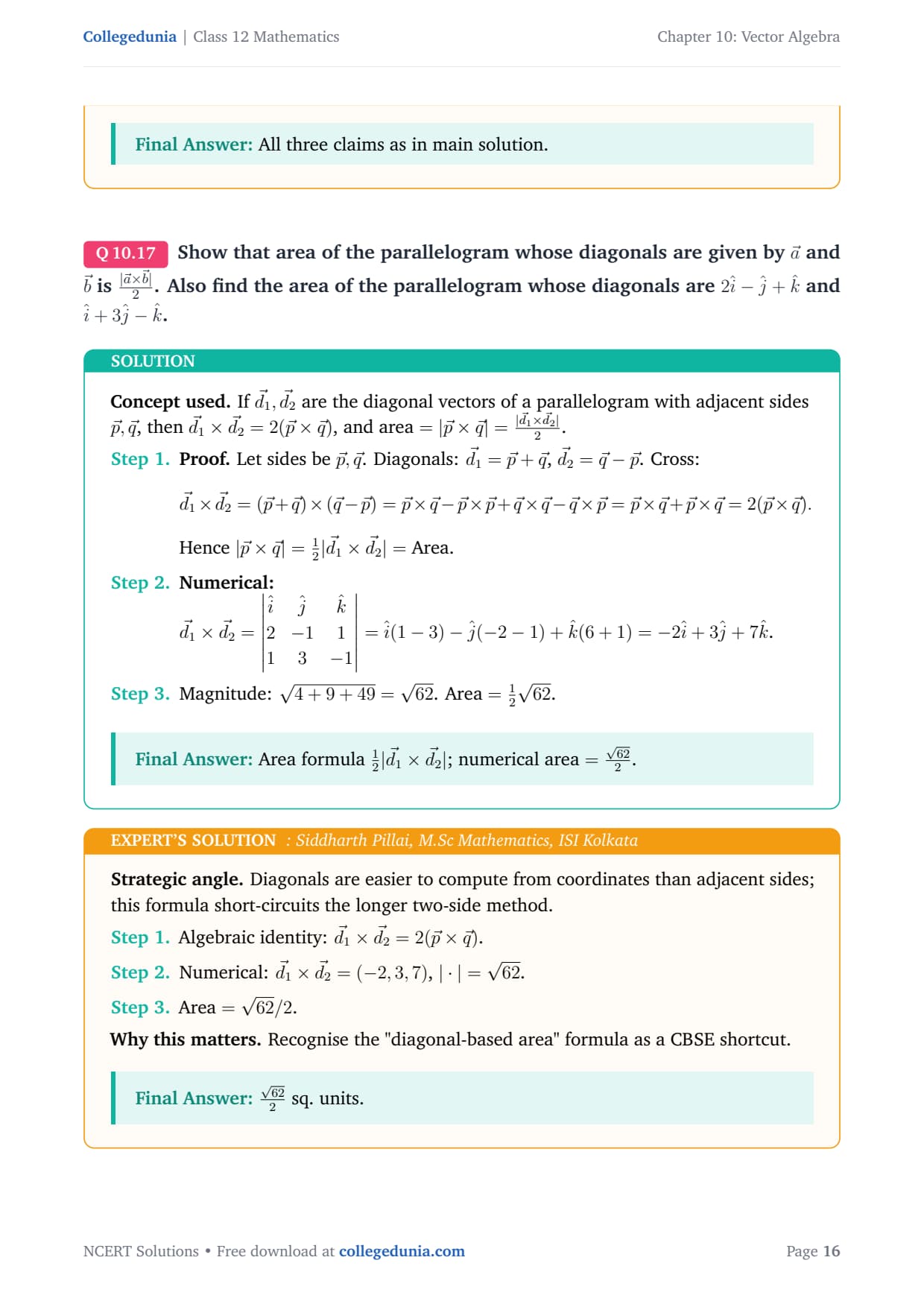
All three claims as in main solution.
Q 10.17
Show that area of the parallelogram whose diagonals are given by a and b is |a×b|2. Also find the area of the parallelogram whose diagonals are 2i-j+k and i+3j-k.
Concept used. If d1,d2 are the diagonal vectors of a parallelogram with adjacent sides p,q, then d1×d2=2(p×q), and area =|p×q|=|d1×d2|2.
Proof. Let sides be p,q. Diagonals: d1=p+q, d2=q-p. Cross:
d1×d2=(p+q)×(q-p)=p×q-p×p+q×q-q×p=p×q+p×q=2(p×q).
Hence |p×q|=12|d1×d2|= Area.
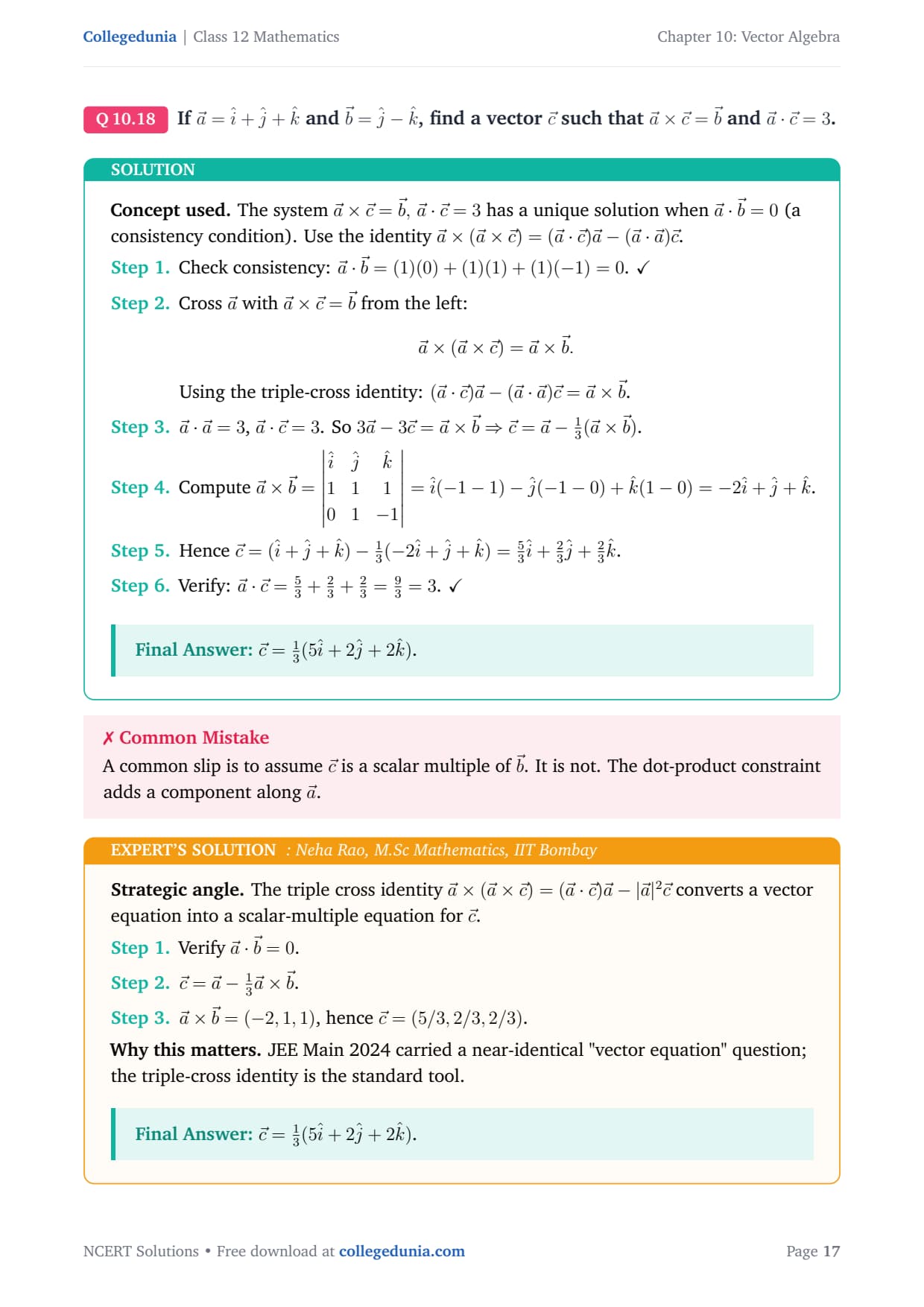
Strategic angle. The triple cross identity a×(a×c)=(a·c)a-|a|2c converts a vector equation into a scalar-multiple equation for c.
Verify a·b=0.
c=a-13a×b.
a×b=(-2,1,1), hence c=(5/3,2/3,2/3).
Why this matters. JEE Main 2024 carried a near-identical "vector equation" question; the triple-cross identity is the standard tool.
c=13(5i+2j+2k).
Q 10.19
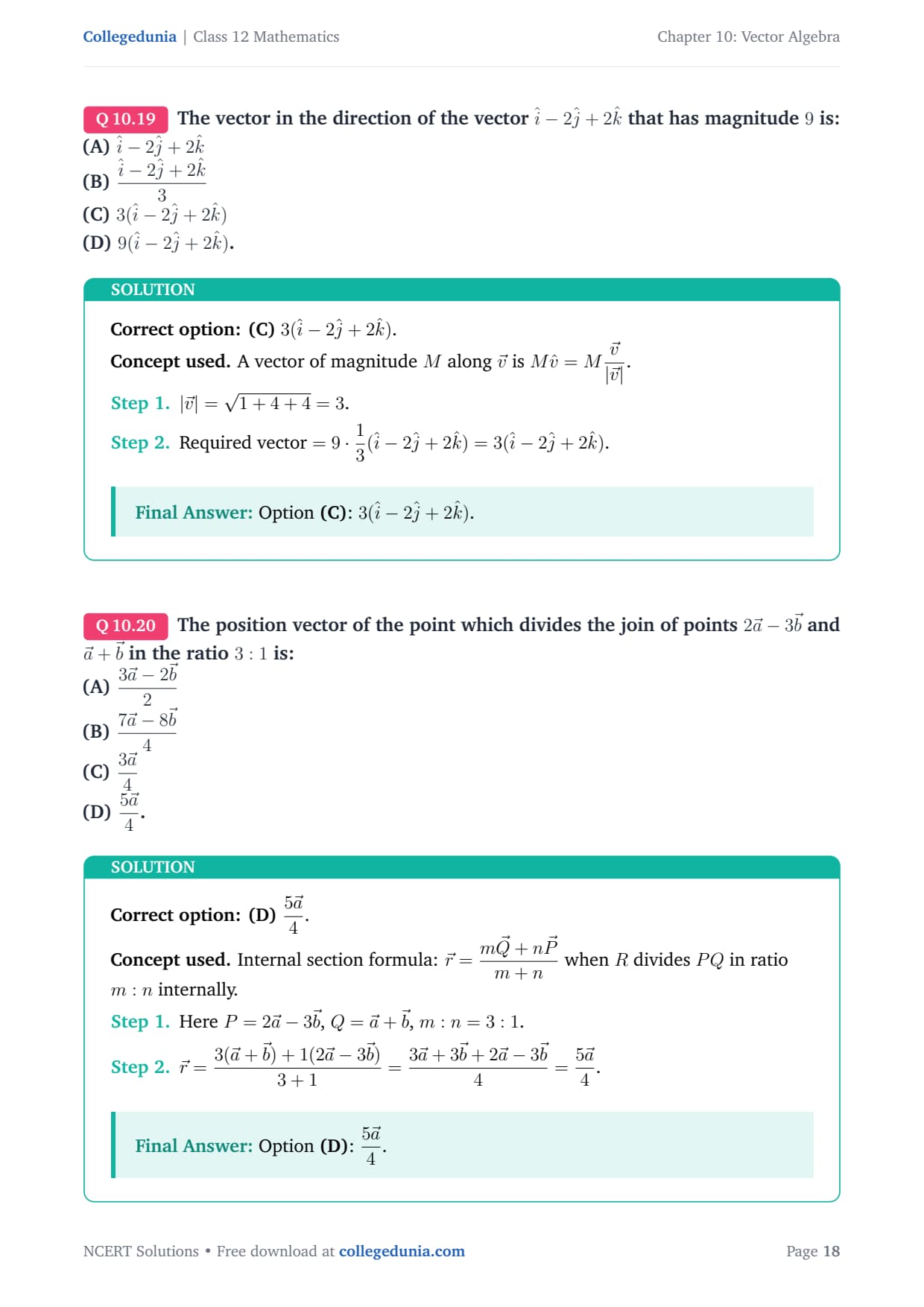
The vector in the direction of the vector i-2j+2k that has magnitude 9 is:
(A) i-2j+2k
(B) i-2j+2k3
(C) 3(i-2j+2k)
(D) 9(i-2j+2k).
Correct option: (C)3(i-2j+2k).
Concept used. A vector of magnitude M along v is Mv=Mv|v|.
|v|=√1+4+4=3.
Required vector =9·13(i-2j+2k)=3(i-2j+2k).
Option (C): 3(i-2j+2k).
Q 10.20
The position vector of the point which divides the join of points 2a-3b and a+b in the ratio 3:1 is:
(A) 3a-2b2
(B) 7a-8b4
(C) 3a4
(D) 5a4.
Correct option: (D)5a4.
Concept used. Internal section formula: r=mQ+nPm+n when R divides PQ in ratio m:n internally.
Here P=2a-3b, Q=a+b, m:n=3:1.
r=3(a+b)+1(2a-3b)3+1=3a+3b+2a-3b4=5a4.
Option (D): 5a4.
Q 10.21
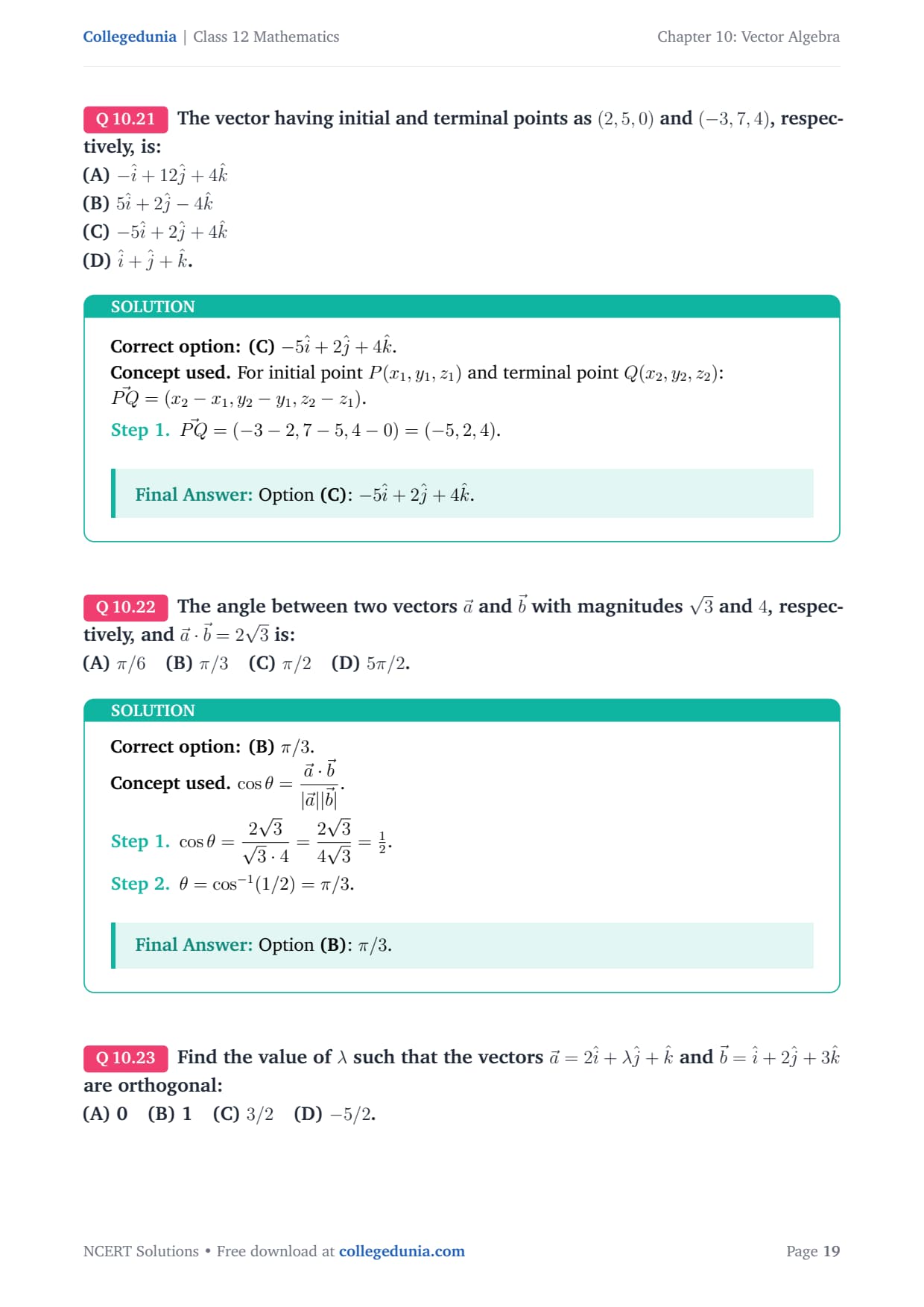
The vector having initial and terminal points as (2,5,0) and (-3,7,4), respectively, is:
(A) -i+12j+4k
(B) 5i+2j-4k
(C) -5i+2j+4k
(D) i+j+k.
Correct option: (C)-5i+2j+4k.
Concept used. For initial point P(x1,y1,z1) and terminal point Q(x2,y2,z2): PQ⃗=(x2-x1,y2-y1,z2-z1).
PQ⃗=(-3-2,7-5,4-0)=(-5,2,4).
Option (C): -5i+2j+4k.
Q 10.22
The angle between two vectors a and b with magnitudes √3 and 4, respectively, and a·b=2√3 is:
(A) π/6 (B) π/3 (C) π/2 (D) 5π/2.
Correct option: (B)π/3.
Concept used.cosθ=a·b|a||b|.
cosθ=233· 4=2343=12.
θ=cos-1(1/2)=π/3.
Option (B): π/3.
Q 10.23
Find the value of λ such that the vectors a=2i+λj+k and b=i+2j+3k are orthogonal:
(A) 0 (B) 1 (C) 3/2 (D) -5/2.
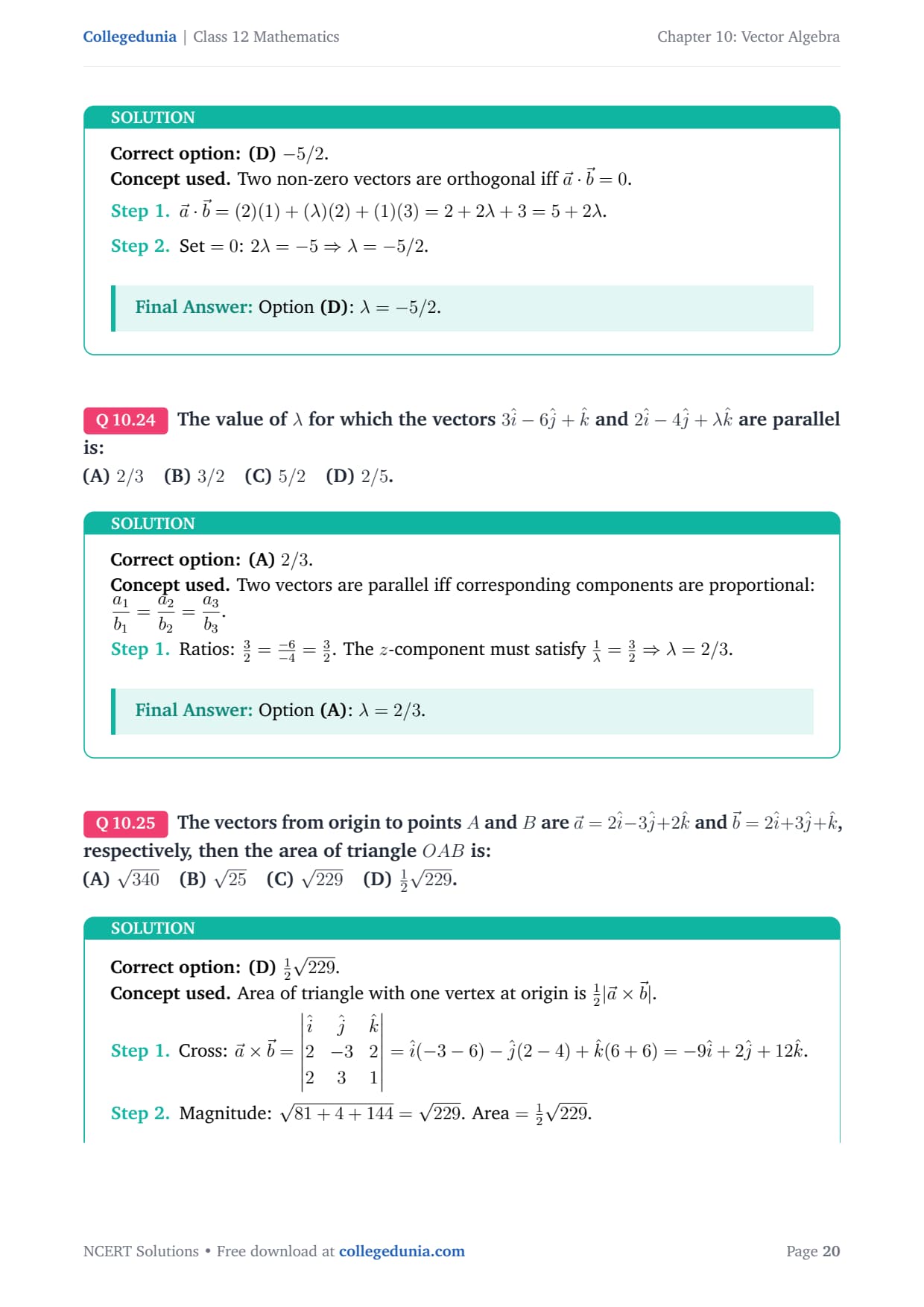
Correct option: (D)-5/2.
Concept used. Two non-zero vectors are orthogonal iff a·b=0.
a·b=(2)(1)+(λ)(2)+(1)(3)=2+2λ+3=5+2λ.
Set =0: 2λ=-5⇒ λ=-5/2.
Option (D): λ=-5/2.
Q 10.24
The value of λ for which the vectors 3i-6j+k and 2i-4j+λk are parallel is:
(A) 2/3 (B) 3/2 (C) 5/2 (D) 2/5.
Correct option: (A)2/3.
Concept used. Two vectors are parallel iff corresponding components are proportional: a1b1=a2b2=a3b3.
Ratios: 32=-6-4=32. The z-component must satisfy 1λ=32⇒ λ=2/3.
Option (A): λ=2/3.
Q 10.25
The vectors from origin to points A and B are a=2i-3j+2k and b=2i+3j+k, respectively, then the area of triangle OAB is:
(A) √340 (B) √25 (C) √229 (D) 12√229.
Correct option: (D)12√229.
Concept used. Area of triangle with one vertex at origin is 12|a×b|.
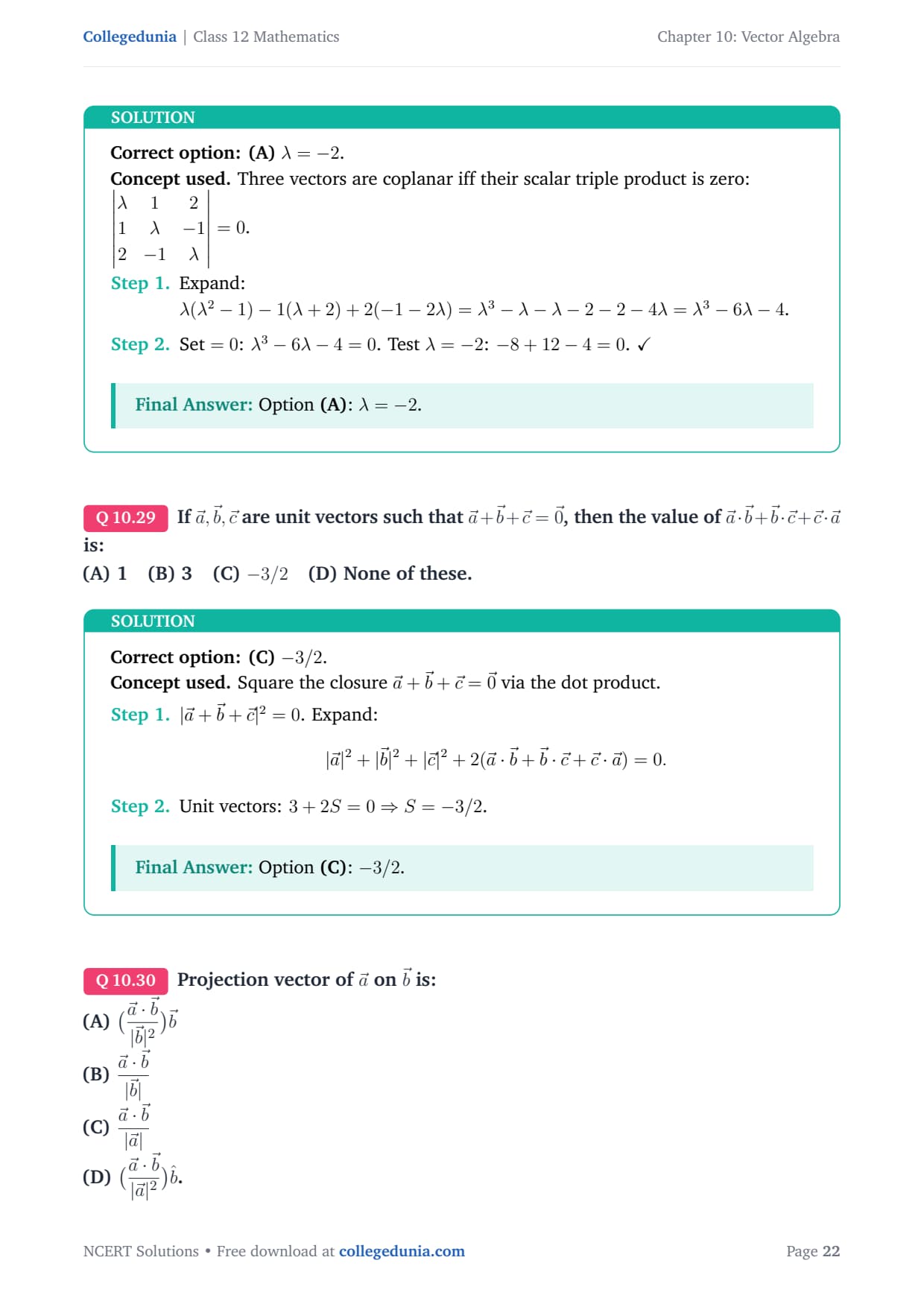
Projection vector of a on b is:
(A) (a·b|b|2)b
(B) a·b|b|
(C) a·b|a|
(D) (a·b|a|2)b.
Correct option: (A)(a·b|b|2)b.
Concept used. The vector projection of a on b is the scalar projection times the unit vector b, i.e. (a·b|b|)b=(a·b|b|2)b.
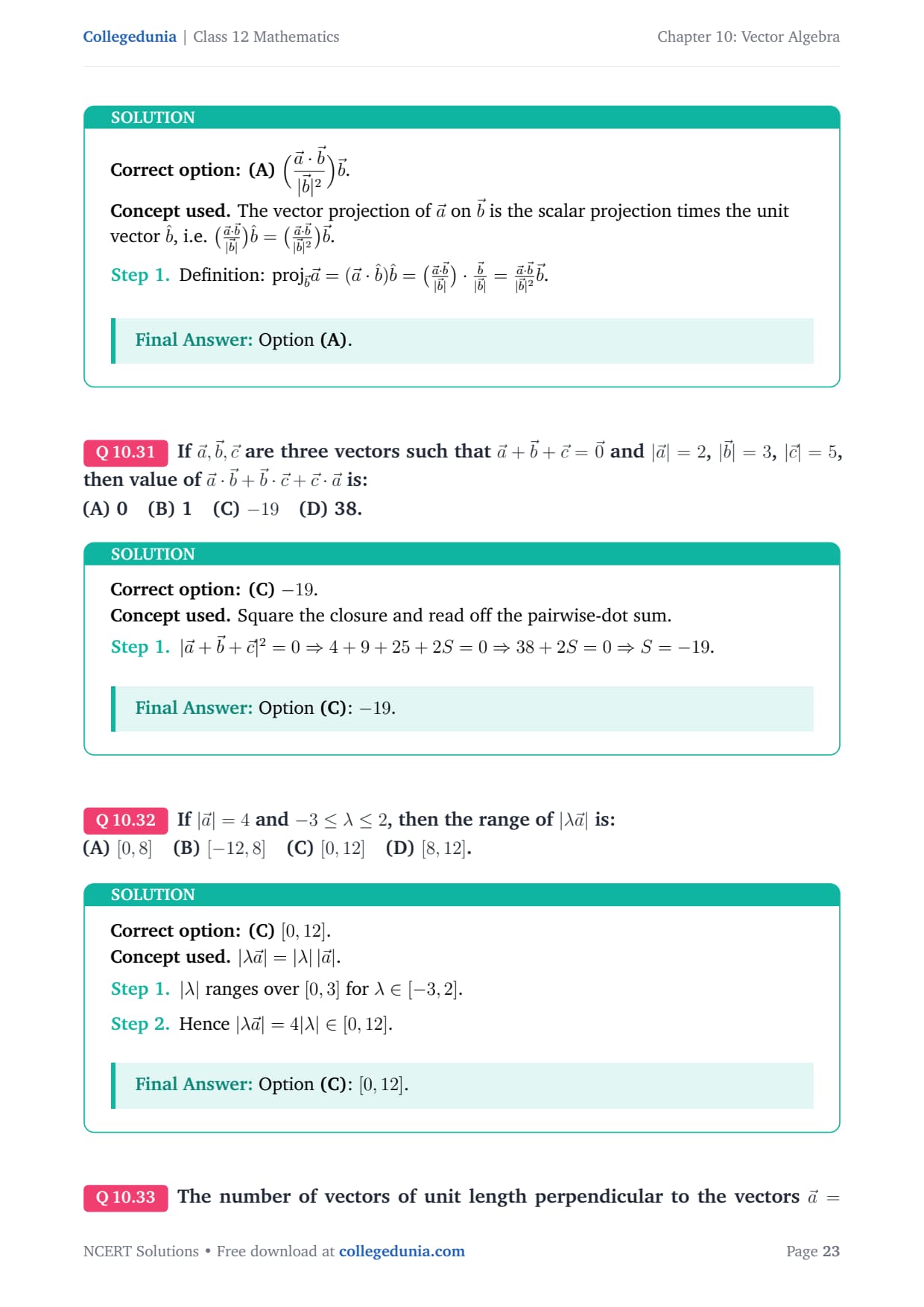
Definition: projba=(a·b)b=(a·b|b|)·b|b|=a·b|b|2b.
Option (A).
Q 10.31
If a,b,c are three vectors such that a+b+c=0 and |a|=2, |b|=3, |c|=5, then value of a·b+b·c+c·a is:
(A) 0 (B) 1 (C) -19 (D) 38.
Correct option: (C)-19.
Concept used. Square the closure and read off the pairwise-dot sum.
|a+b+c|2=0⇒ 4+9+25+2S=0⇒ 38+2S=0⇒ S=-19.
Option (C): -19.
Q 10.32
If |a|=4 and -3λ≤ 2, then the range of |λa| is:
(A) [0,8] (B) [-12,8] (C) [0,12] (D) [8,12].
Correct option: (C)[0,12].
Concept used.|λa|=|λ| |a|.
|λ| ranges over [0,3] for λ∈[-3,2].
Hence |λa|=4|λ|∈[0,12].
Option (C): [0,12].
Q 10.33
The number of vectors of unit length perpendicular to the vectors a=2i+j+2k and b=j+k is:
(A) one (B) two (C) three (D) infinite.
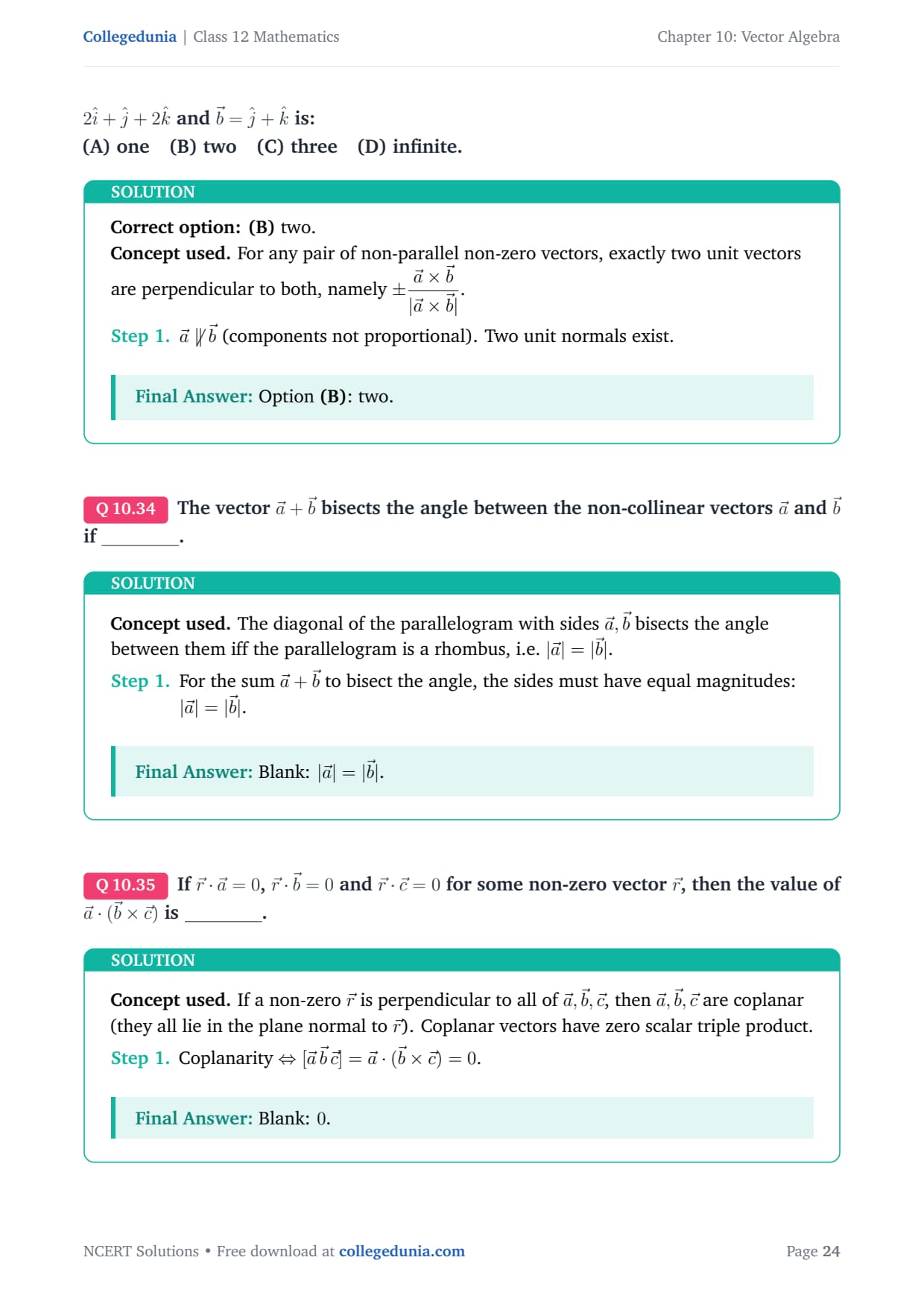
Correct option: (B) two.
Concept used. For any pair of non-parallel non-zero vectors, exactly two unit vectors are perpendicular to both, namely ±a×b|a×b|.
a∥b (components not proportional). Two unit normals exist.
Option (B): two.
Q 10.34
The vector a+b bisects the angle between the non-collinear vectors a and b if 4em.
Concept used. The diagonal of the parallelogram with sides a,b bisects the angle between them iff the parallelogram is a rhombus, i.e. |a|=|b|.
For the sum a+b to bisect the angle, the sides must have equal magnitudes: |a|=|b|.
Blank: |a|=|b|.
Q 10.35
If r·a=0, r·b=0 and r·c=0 for some non-zero vector r, then the value of a·(b×c) is 4em.
Concept used. If a non-zero r is perpendicular to all of a,b,c, then a,b,c are coplanar (they all lie in the plane normal to r). Coplanar vectors have zero scalar triple product.
Coplanarity ⇔ [abc]=a·(b×c)=0.
Blank: 0.
Q 10.36
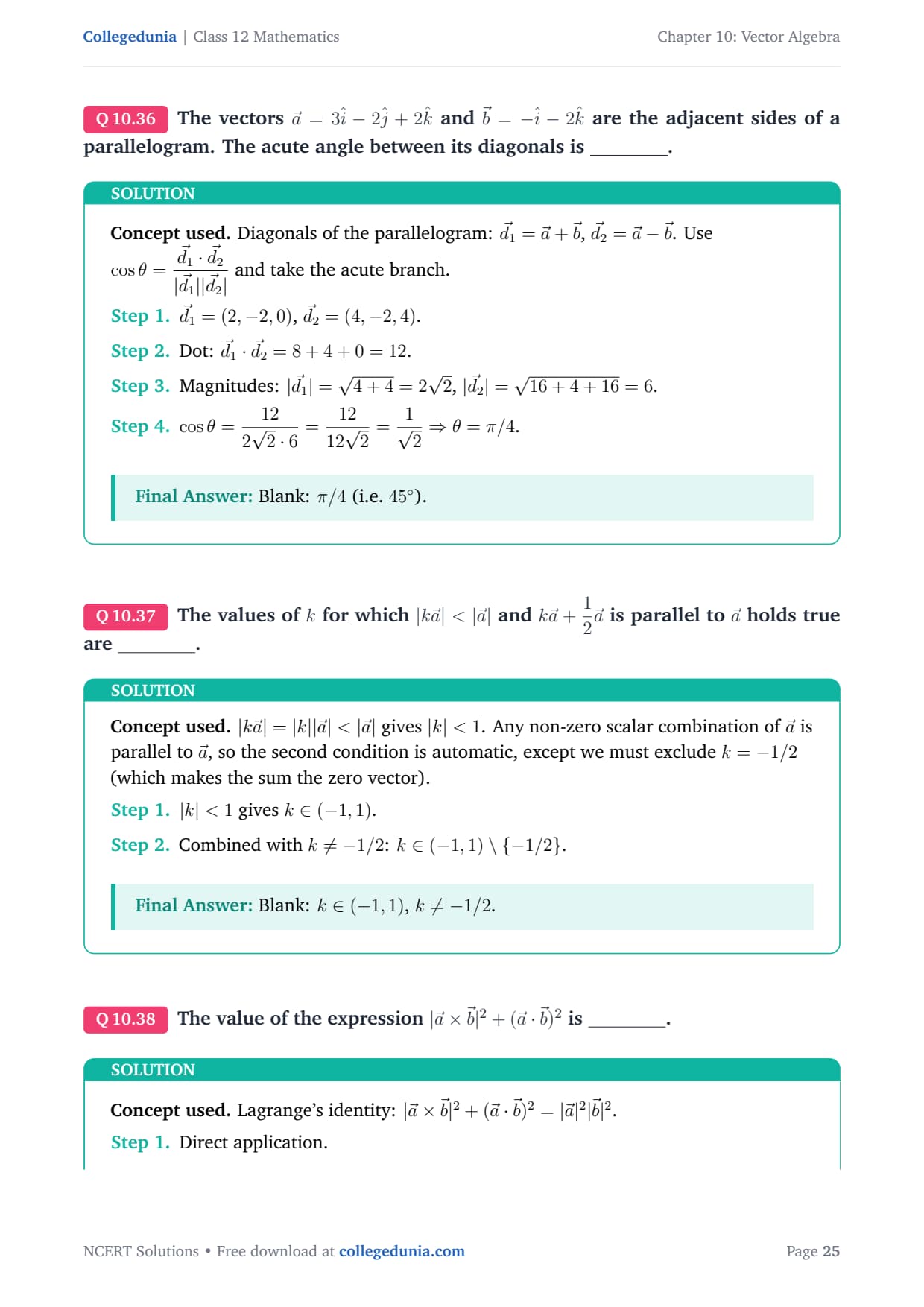
The vectors a=3i-2j+2k and b=-i-2k are the adjacent sides of a parallelogram. The acute angle between its diagonals is 4em.
Concept used. Diagonals of the parallelogram: d1=a+b, d2=a-b. Use cosθ=d1·d2|d1||d2| and take the acute branch.
d1=(2,-2,0), d2=(4,-2,4).
Dot: d1·d2=8+4+0=12.
Magnitudes: |d1|=√4+4=22, |d2|=√16+4+16=6.
cosθ=1222· 6=12122=12⇒ θ=π/4.
Blank: π/4 (i.e. 45∘).
Q 10.37
The values of k for which |ka|<|a| and ka+12a is parallel to a holds true are 4em.
Concept used.|ka|=|k||a|<|a| gives |k|<1. Any non-zero scalar combination of a is parallel to a, so the second condition is automatic, except we must exclude k=-1/2 (which makes the sum the zero vector).
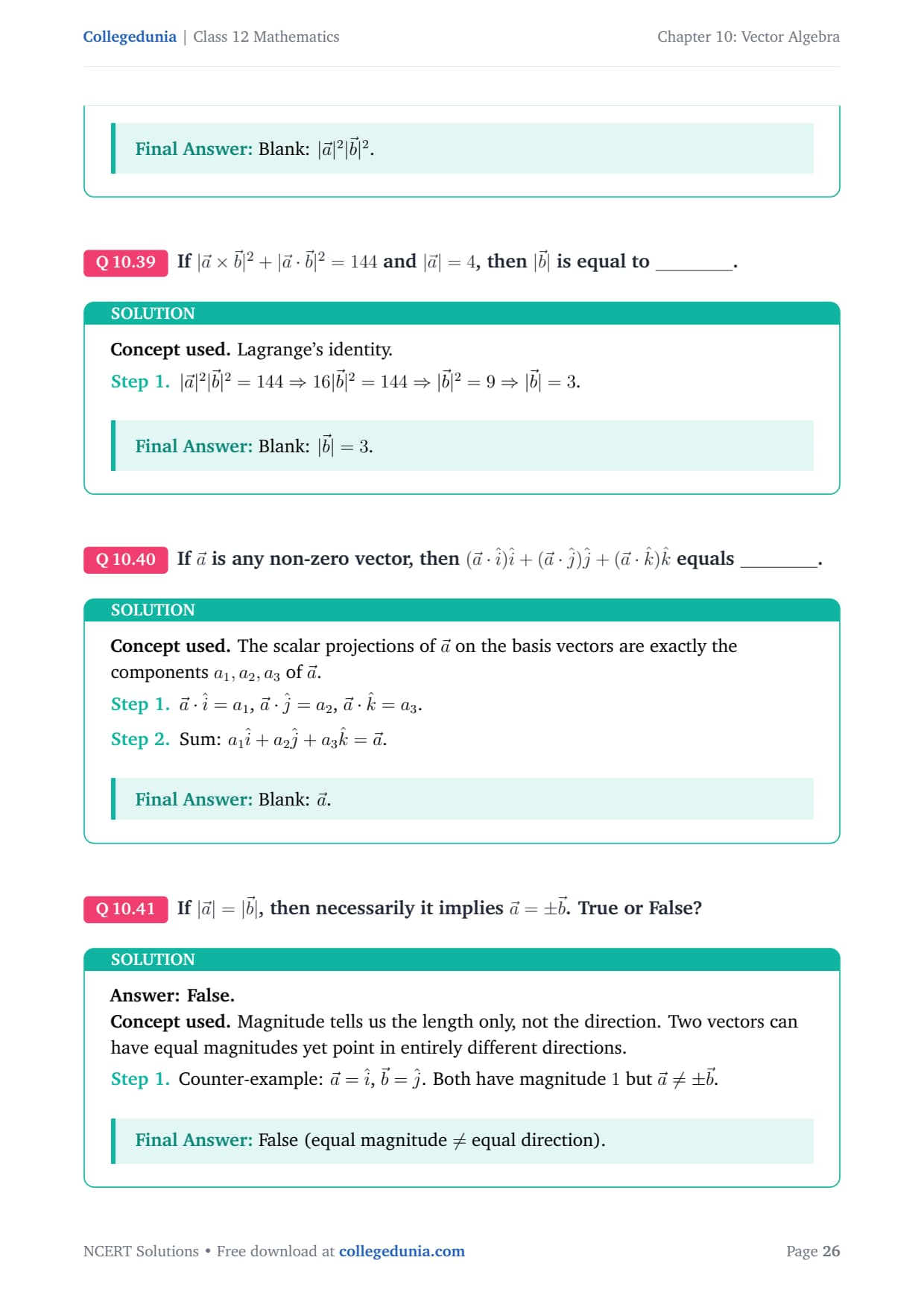
If |a×b|2+|a·b|2=144 and |a|=4, then |b| is equal to 4em.
Concept used. Lagrange's identity.
|a|2|b|2=144⇒ 16|b|2=144⇒ |b|2=9⇒ |b|=3.
Blank: |b|=3.
Q 10.40
If a is any non-zero vector, then (a·i)i+(a·j)j+(a·k)k equals 4em.
Concept used. The scalar projections of a on the basis vectors are exactly the components a1,a2,a3 of a.
a·i=a1, a·j=a2, a·k=a3.
Sum: a1i+a2j+a3k=a.
Blank: a.
Q 10.41
If |a|=|b|, then necessarily it implies a=±b. True or False?
Answer: False.
Concept used. Magnitude tells us the length only, not the direction. Two vectors can have equal magnitudes yet point in entirely different directions.
Counter-example: a=i, b=j. Both have magnitude 1 but a≠±b.
False (equal magnitude ≠ equal direction).
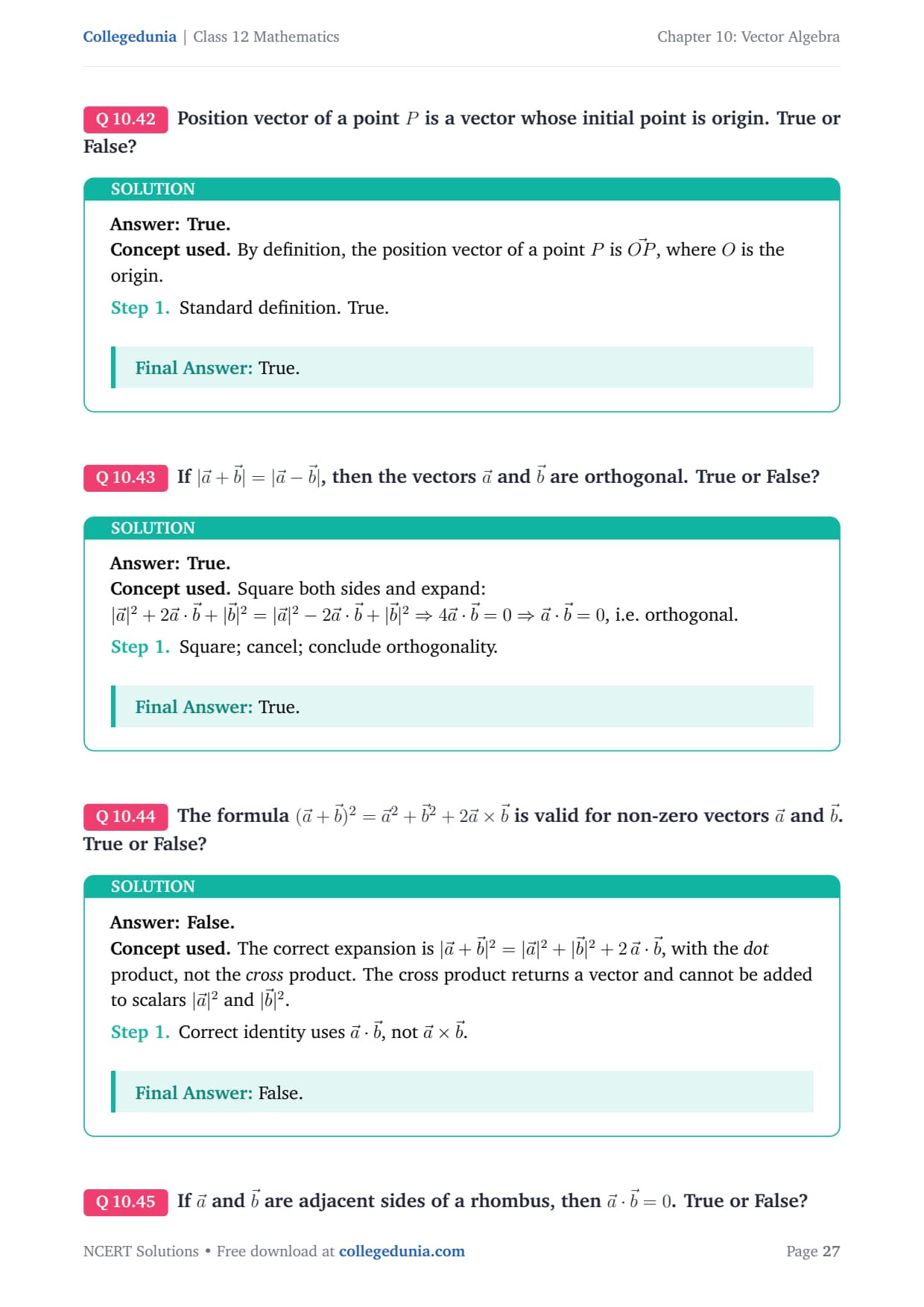
Q 10.42
Position vector of a point P is a vector whose initial point is origin. True or False?
Answer: True.
Concept used. By definition, the position vector of a point P is OP⃗, where O is the origin.
Standard definition. True.
True.
Q 10.43
If |a+b|=|a-b|, then the vectors a and b are orthogonal. True or False?
Answer: True.
Concept used. Square both sides and expand: |a|2+2a·b+|b|2=|a|2-2a·b+|b|2⇒ 4a·b=0⇒ a·b=0, i.e. orthogonal.
Square; cancel; conclude orthogonality.
True.
Q 10.44
The formula (a+b)2=a2+b2+2a×b is valid for non-zero vectors a and b. True or False?
Answer: False.
Concept used. The correct expansion is |a+b|2=|a|2+|b|2+2 a·b, with the dot product, not the cross product. The cross product returns a vector and cannot be added to scalars |a|2 and |b|2.
Correct identity uses a·b, not a×b.
False.
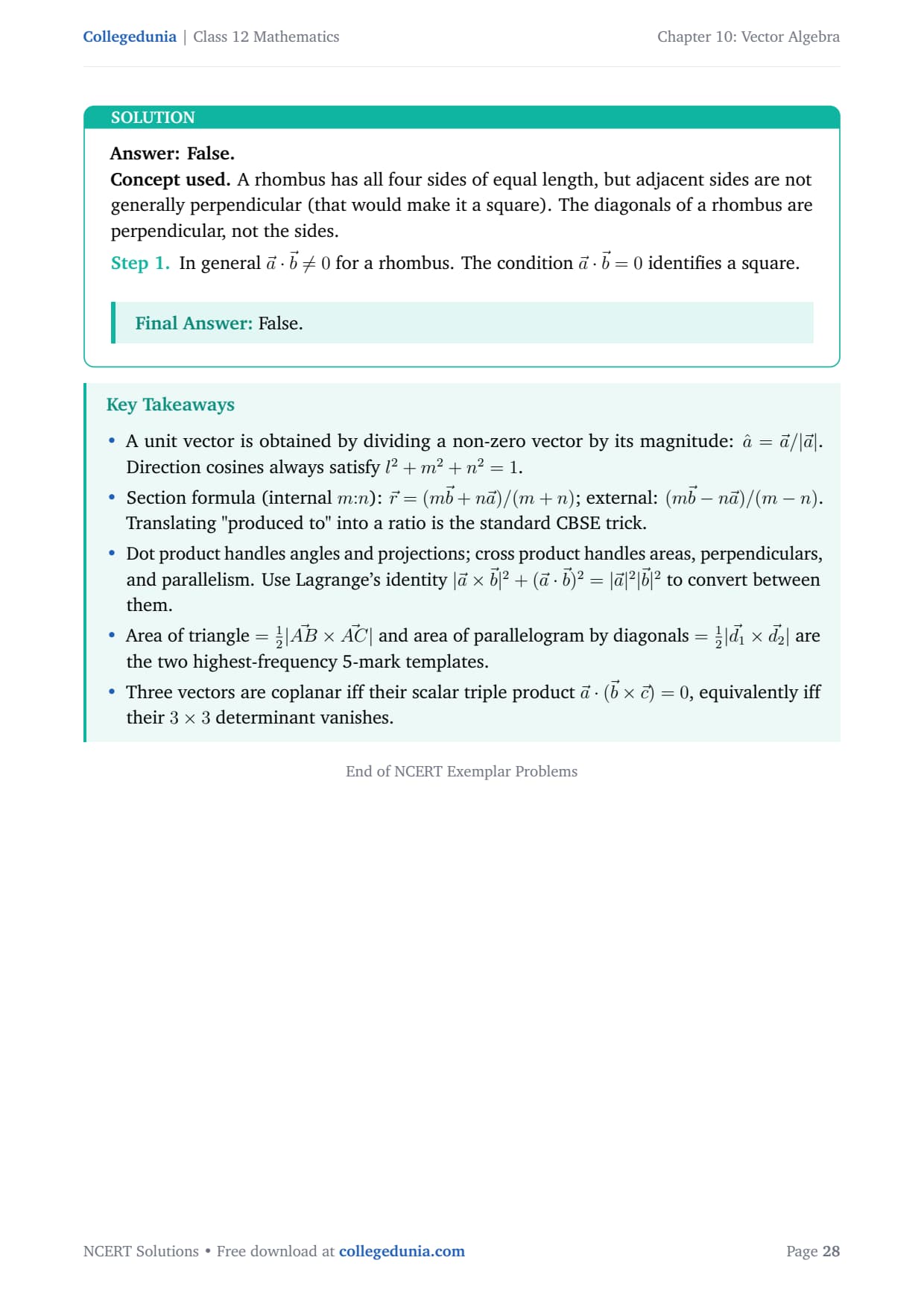
Q 10.45
If a and b are adjacent sides of a rhombus, then a·b=0. True or False?
Answer: False.
Concept used. A rhombus has all four sides of equal length, but adjacent sides are not generally perpendicular (that would make it a square). The diagonals of a rhombus are perpendicular, not the sides.
In general a·b≠ 0 for a rhombus. The condition a·b=0 identifies a square.
False.
NCERT Exemplar Solutions for Class 12 Maths: All Chapters
The table below maps every other Class 12 Maths chapter to its Exemplar solutions page. Use it as a one-stop revision hub across the syllabus.







Comments