



The Class 10 Maths Chapter 11 Areas Related to Circles formula sheet puts every formula and result from the chapter on one page. It takes the circle basics you already know and adds sector and segment calculations. One idea runs through it all: a sector of angle θ is just the fraction θ/360 of the full circle. The formulas match the 2026-27 CBSE syllabus.
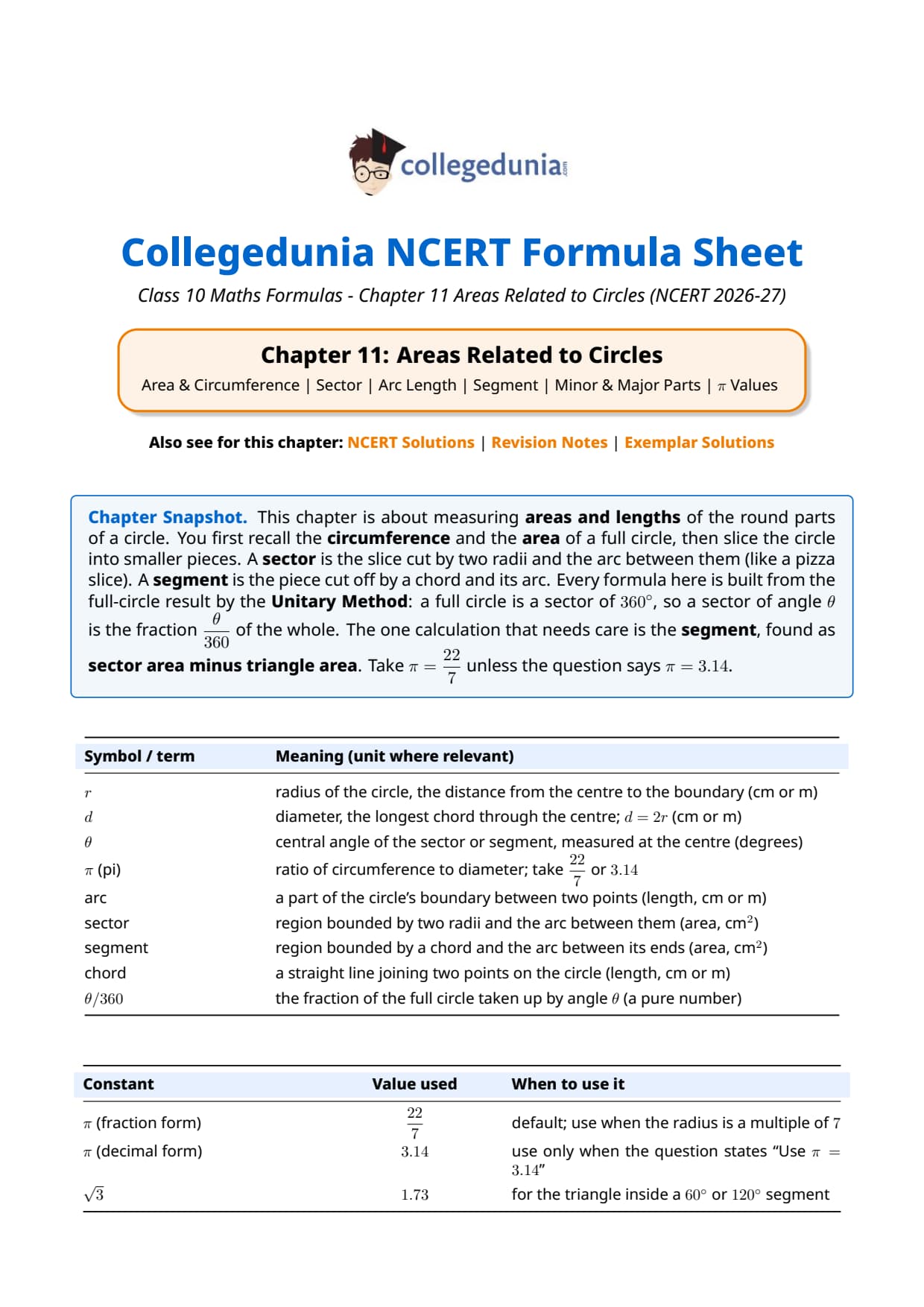
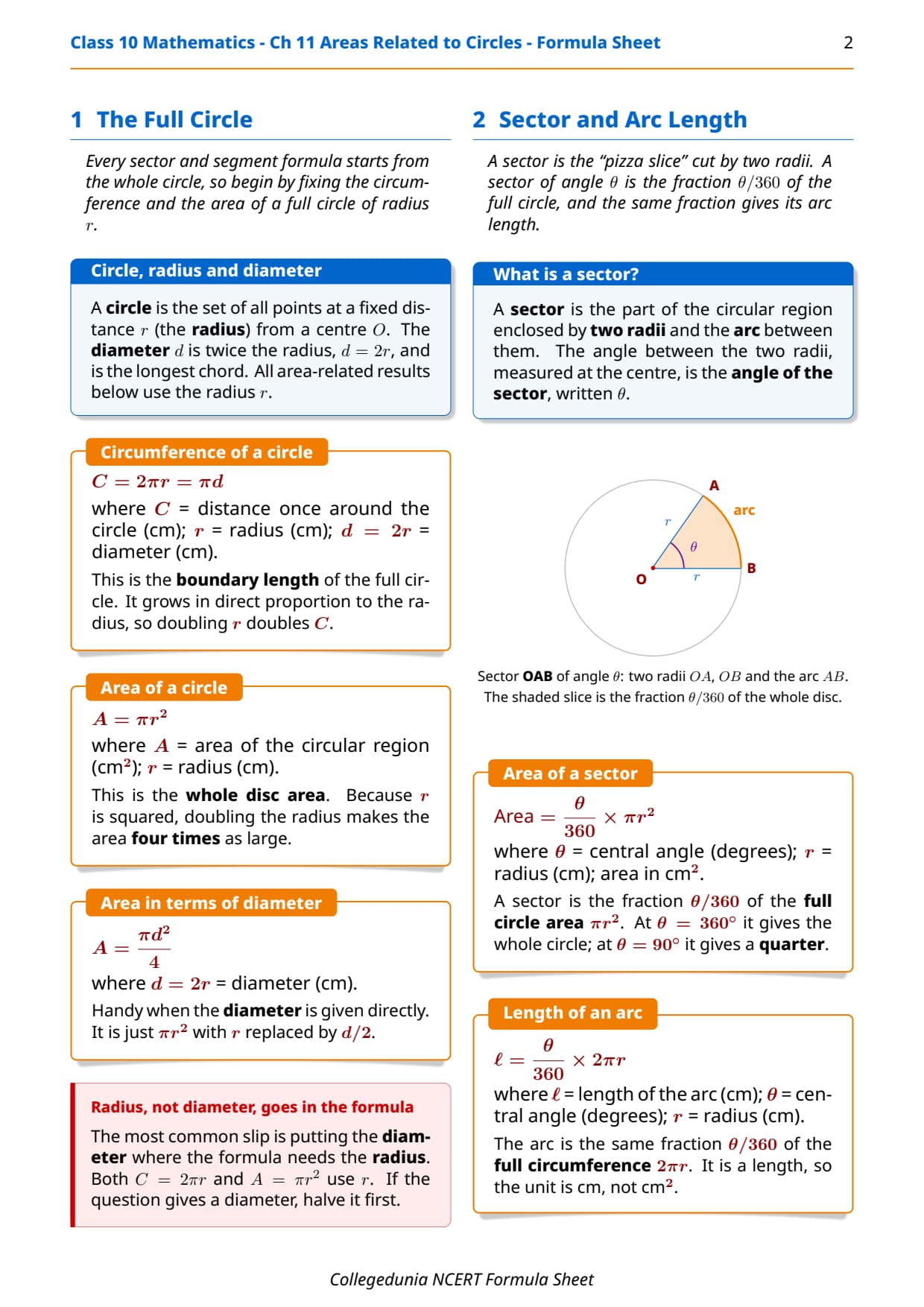
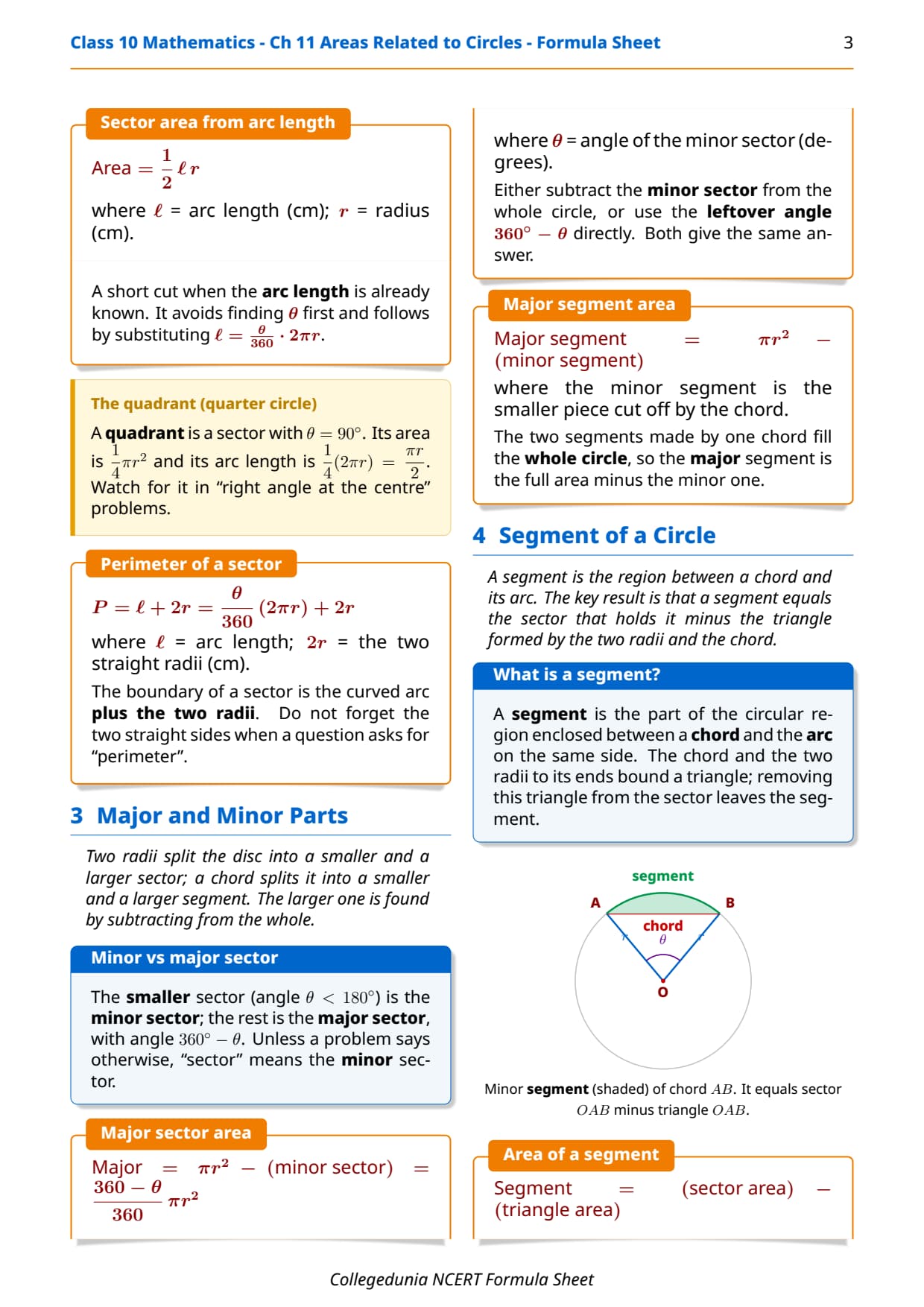
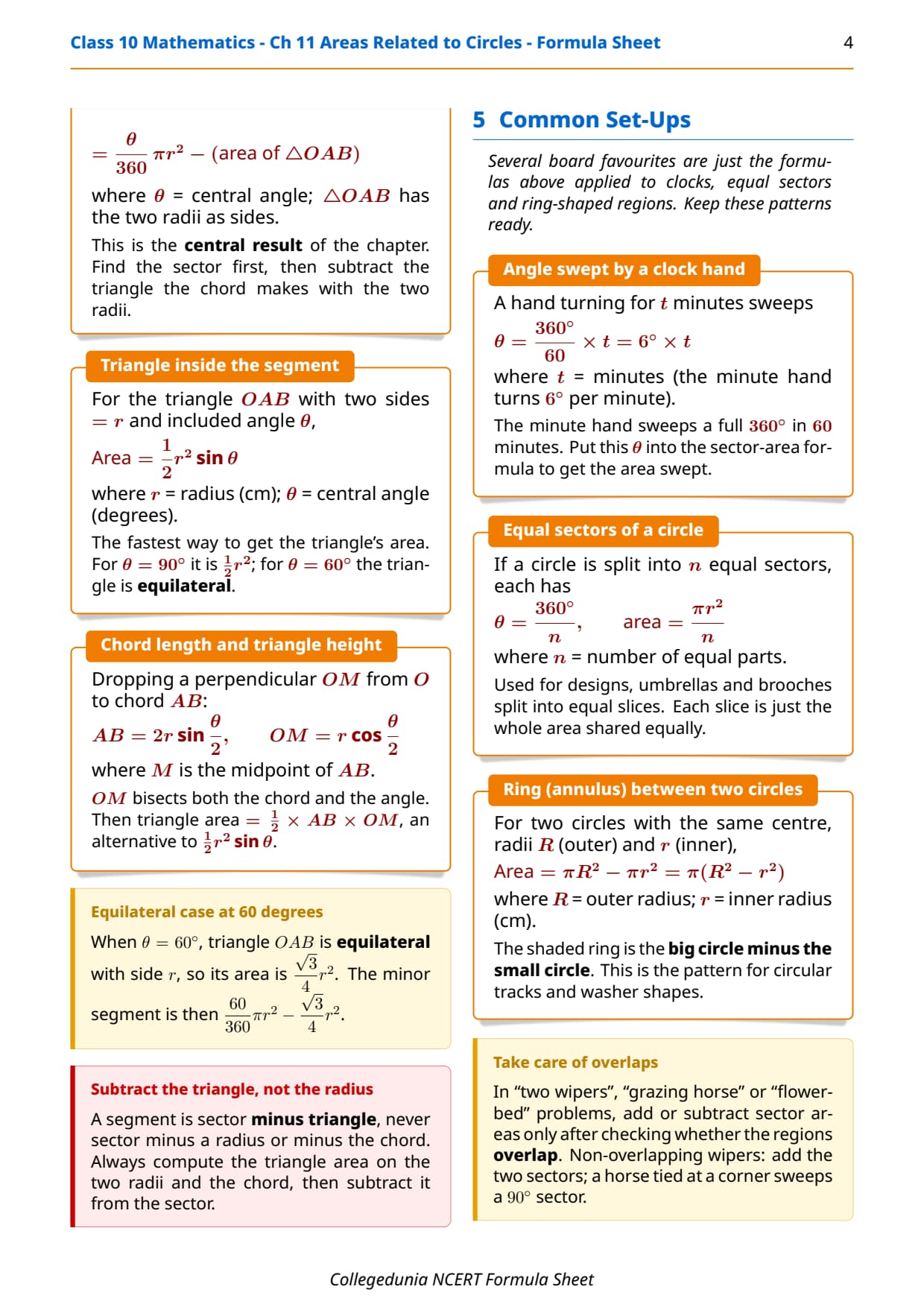
- Core formula: sector area = (θ/360) × πr² and arc length = (θ/360) × 2πr. Both are the same fraction of the full circle.
- Segment formula: minor segment = sector area − triangle OAB. This is the most important result in the chapter.
- Board context: sector, segment and combined-figure problems usually carry 5 to 8 marks.
Student Feedback: In a Collegedunia poll of 3,100 Class 10 students before the 2026 boards, 91% of students wished they had learned the segment formula sooner: area = sector area minus triangle area. Students who kept this one fact clear solved almost every problem here without confusion.
Watch Areas Related to Circles Class 10 Maths Explained
Source: Ritik Mishra - 9th & 10th on YouTube
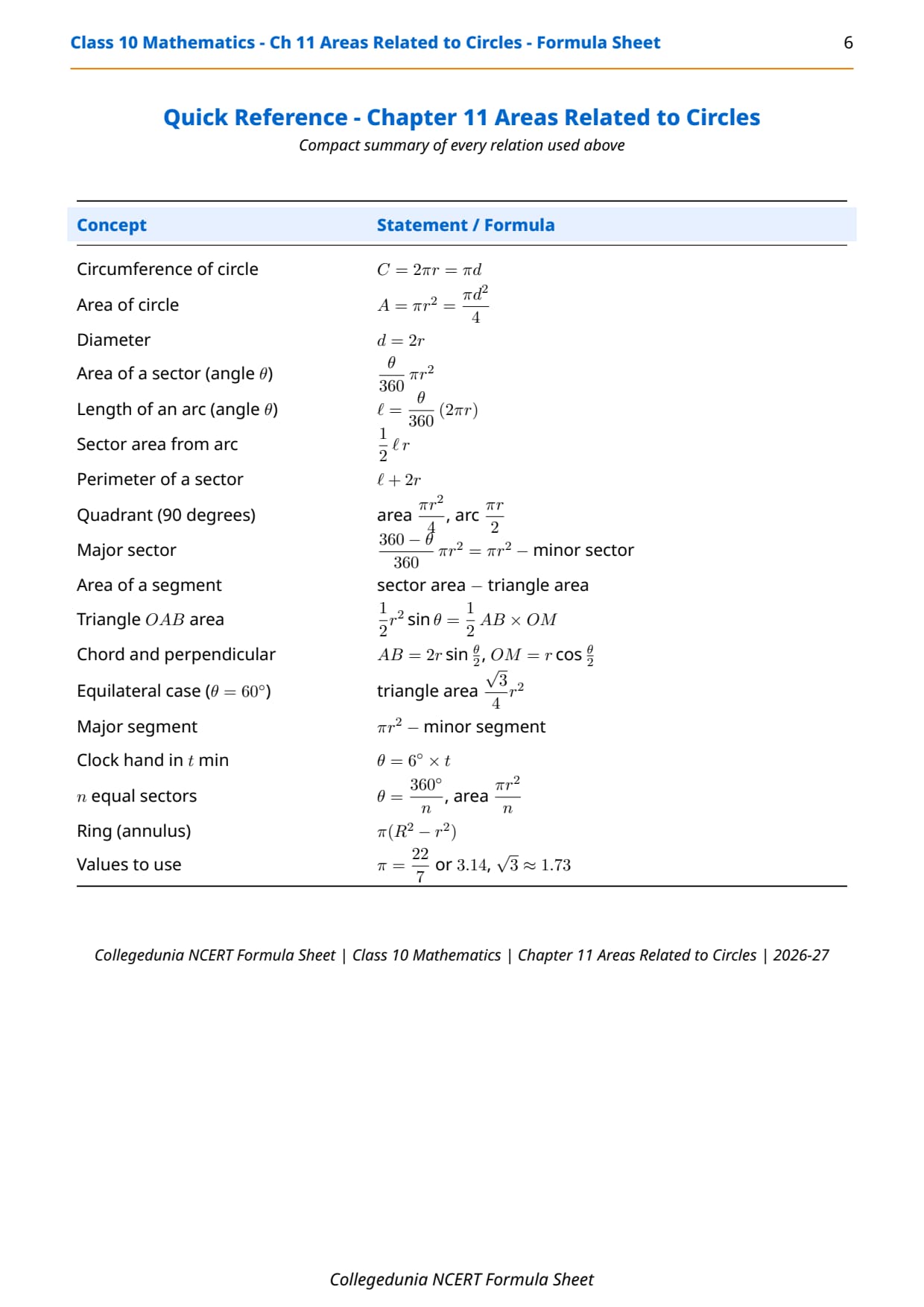
Complete Formula List
The table below lists every formula and result from this chapter, mirroring the single-page PDF. One idea ties it together: any sector or arc is just the fraction θ/360 of the full circle. Only the segment needs an extra step, where you subtract the triangle from the sector.
| Concept | Formula / Result |
|---|---|
| Circumference of a circle | C = 2πr = πd, where r = radius, d = diameter |
| Area of a circle | A = πr² = πd²/4 |
| Diameter and radius | d = 2r |
| Area of a sector (angle θ) | Area = (θ/360) × πr² |
| Length of an arc (angle θ) | ℓ = (θ/360) × 2πr |
| Sector area from arc length | Area = (1/2) × ℓ × r |
| Perimeter of a sector | P = ℓ + 2r |
| Quadrant (quarter circle, θ = 90°) | Area = πr²/4, arc length = πr/2 |
| Major sector area | (360 − θ)/360 × πr² = πr² − minor sector |
| Area of a segment (minor) | Segment = sector area − triangle area = (θ/360)πr² − area of ▵OAB |
| Triangle OAB area (inside segment) | (1/2)r²sinθ, or (1/2) × AB × OM (OM = perpendicular from centre to chord) |
| Chord length AB | AB = 2r sin(θ/2) |
| Height OM from centre to chord | OM = r cos(θ/2) |
| Equilateral-triangle case (θ = 60°) | Triangle OAB is equilateral with side r; area = (√3/4)r² |
| Major segment area | πr² − minor segment |
| Clock hand in t minutes | θ = 6° × t (minute hand turns 6° per minute) |
| n equal sectors of a circle | θ = 360°/n; area of each = πr²/n |
| Ring (annulus) between two circles | Area = πR² − πr² = π(R² − r²), where R = outer radius, r = inner radius |
| Value of π to use | 22/7 (default); 3.14 only when the question says so |
| √3 approximation | 1.73 (used in 60° and 120° segment calculations) |
The two key formulas of Chapter 11: a sector is the fraction θ/360 of the full circle, and a segment equals the sector minus the triangle formed by the two radii and the chord.
Full Circle Formulas: Circumference and Area
Every formula in Chapter 11 starts from two full-circle results: circumference C = 2πr and area A = πr². Both use the radius, not the diameter. If a question gives the diameter, halve it first. A common slip is using the diameter directly, giving answers four times too large for area.
| Quantity | Formula | Unit | Note |
|---|---|---|---|
| Circumference | C = 2πr = πd | cm (or m) | Boundary length of the full circle; grows linearly with r |
| Area of circle | A = πr² | cm² | Doubles the radius makes area 4 times larger |
| Area in terms of diameter | A = πd²/4 | cm² | Use when only the diameter is given |
| Diameter | d = 2r | cm | Always convert to radius before using sector formulas |
Sector Area and Arc Length: Formulas and Worked Examples
A sector is the slice cut by two radii and the arc between them. A sector of angle θ is the fraction θ/360 of the full circle. Apply this fraction to the full area to get the sector area, and to the full circumference to get the arc length. Whether θ is 60°, 90° or 120°, only the numerator of θ/360 changes.
| Formula | Expression | Worked Example |
|---|---|---|
| Area of sector | (θ/360) × πr² | r = 7 cm, θ = 90°: Area = (90/360) × (22/7) × 49 = (1/4) × 154 = 38.5 cm² |
| Arc length ℓ | (θ/360) × 2πr | r = 7 cm, θ = 90°: ℓ = (90/360) × 2 × (22/7) × 7 = (1/4) × 44 = 11 cm |
| Sector area from arc | (1/2) × ℓ × r | ℓ = 11 cm, r = 7 cm: Area = (1/2) × 11 × 7 = 38.5 cm² |
| Perimeter of sector | ℓ + 2r | ℓ = 11 cm, r = 7 cm: P = 11 + 14 = 25 cm |
| Quadrant (θ = 90°) | Area = πr²/4; arc = πr/2 | r = 14 cm: Area = (22/7)(196)/4 = 154 cm²; arc = (22/7)(14)/2 = 22 cm |
Area of a Segment: Formula and Step-by-Step Method
The segment formula is the most important result in Chapter 11. A segment is the region between a chord and the arc on the same side. The segment equals the sector minus the triangle formed by the two radii and the chord. Board problems mostly use θ = 60°, 90° or 120°. In the 60° case both radii equal the chord, so the triangle is equilateral with area (√3/4)r².
| Step | Action | Formula used |
|---|---|---|
| Step 1 | Find the sector area for angle θ | Sector = (θ/360) × πr² |
| Step 2 | Find the area of triangle OAB | Triangle = (1/2)r²sinθ, or (1/2) × AB × OM |
| Step 3 | Subtract: segment = sector − triangle | Segment = (θ/360)πr² − (1/2)r²sinθ |
| Alternative at θ = 90° | Triangle is right-angled with legs r and r | Triangle = (1/2)r²; Segment = (π/4 − 1/2)r² |
| Alternative at θ = 60° | Triangle OAB is equilateral with side r | Triangle = (√3/4)r²; Segment = (π/6 − √3/4)r² |
Major Sector and Major Segment: Formulas
Two radii split the circle into a minor and a major part. Once you know the minor sector or segment, the major version is the full circle minus the minor part: major sector = πr² − minor sector = ((360 − θ)/360) × πr², and major segment = πr² − minor segment. No new formula is needed.
The key to major-versus-minor questions: identify which angle you are given and which you need. If the major angle (say 300°) is given, use it directly. If only the minor angle (60°) is given, use (360 − 60)/360 as your fraction. Both routes give the same answer.
Chapter 11 covers sector area, arc length, segment area, major and minor parts, and combined figures involving circular regions.
Common Set-Ups: Clock, Equal Sectors, Ring (Annulus)
Several board-favourite patterns use the sector formula in a specific context. Recognising these set-ups lets students write the formula directly.
| Pattern | Formula | Typical board question |
|---|---|---|
| Clock hand in t minutes | θ = 6° × t; area swept = (6t/360) × πr² | "Find the area swept by the minute hand of radius 14 cm in 5 minutes" |
| n equal sectors | θ = 360/n; each area = πr²/n | "A design is made by drawing 6 equal sectors in a circle of radius 21 cm; find each sector's area" |
| Ring (annulus) | Area = π(R² − r²) | "A circular track of outer radius 35 m and inner radius 28 m; find the area of the track" |
| Grazing horse / umbrella | Identify the sector angle at each anchor point; sum non-overlapping sectors | "A horse tied to a corner of a square field; find the area it can graze" |
| Combining shapes | Area = area of full shape minus or plus circular region | "Area of a flower design made of petals each consisting of an arc and a chord" |
Triangle Areas at Key Angles (60, 90, 120 Degrees)
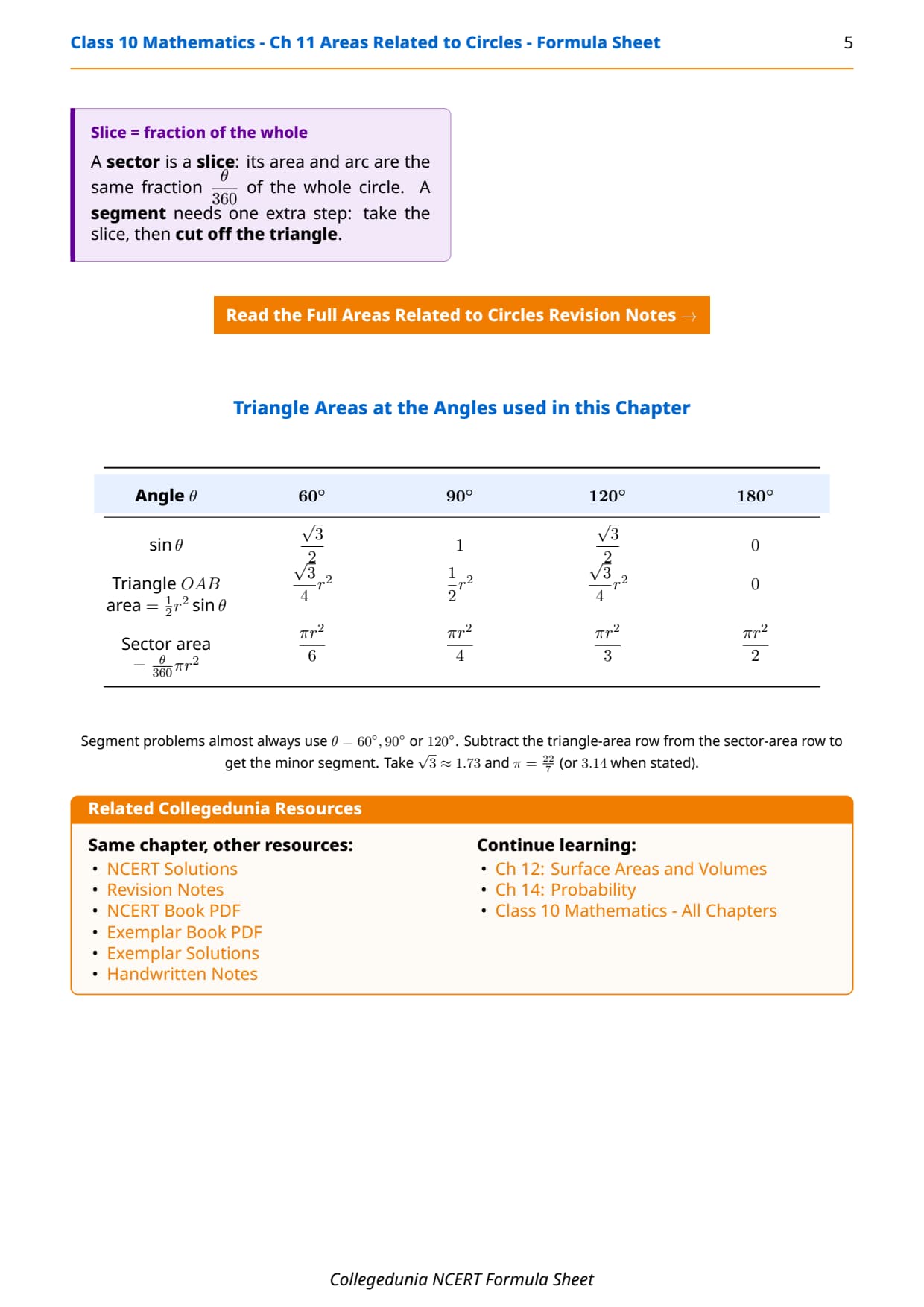
Segment problems almost always use 60°, 90° or 120°. The table below gives the triangle area and sector area for each, so students can read off the answer quickly.
| Central angle θ | sin θ | Triangle OAB area = (1/2)r²sinθ | Sector area = (θ/360)πr² | Minor segment = sector − triangle |
|---|---|---|---|---|
| 60° | √3 / 2 ≈ 0.866 | (√3/4)r² | πr²/6 | (π/6 − √3/4)r² |
| 90° | 1 | r²/2 | πr²/4 | (π/4 − 1/2)r² |
| 120° | √3 / 2 ≈ 0.866 | (√3/4)r² | πr²/3 | (π/3 − √3/4)r² |
| 180° | 0 | 0 (flat triangle) | πr²/2 | πr²/2 (a semicircle) |
Note on 60° and 120°: both give the same triangle area because sin 60° = sin 120°, but the 120° segment is larger. Take √3 ≈ 1.73 and π = 22/7 unless the question says π = 3.14.
CBSE Board Exam Weightage for Chapter 11 Areas Related to Circles
Chapter 11 is a consistent source of marks. It tests both formula recall and numerical application in multi-step sector, segment and combined-figure problems.
| Topic | Typical Question Type | Usual Marks |
|---|---|---|
| Sector area and arc length | Given r and θ, find sector area and arc length using the θ/360 fraction | 2 to 3 marks |
| Segment area | Given r and θ (usually 60°, 90° or 120°), find area of minor segment | 3 marks |
| Major vs minor | Find area of major sector or major segment given the minor angle | 2 to 3 marks |
| Ring (annulus) | Given outer and inner radii, find the ring area = π(R² − r²) | 2 marks |
| Clock and equal sectors | Find area swept by clock hand in given minutes, or area of each equal slice | 2 to 3 marks |
| Combined figure | Square or rectangle with circular cut-outs or quarter-circles; find shaded area | 3 to 4 marks |
Chapter 11 usually carries a 3 to 5 mark question. Sector and segment problems are the most predictable high-value items.
Common Mistakes in Class 10 Areas Related to Circles Problems
Mistake 1: Using the diameter where the formula needs the radius. Halve it on your first line.
Mistake 2: Forgetting to subtract the triangle in segment problems. A segment is sector minus triangle OAB.
Mistake 3: Confusing arc length (cm) with sector area (cm²). Units reveal the error instantly.
Mistake 4: Not adding the two radii for a sector perimeter. It is arc + 2r, not just the arc.
Mistake 5: Using π = 3.14 when the radius is a multiple of 7. Use 22/7 by default.
Each slip costs 1 to 2 marks.
More Class 10 Areas Related to Circles Resources
Use this formula sheet alongside the other Chapter 11 resources below. Each covers a different aspect of the chapter, so together they give complete board preparation.
| Resource | Best Used For |
|---|---|
| Areas Related to Circles NCERT Solutions | Step-by-step answers to all textbook questions |
| Areas Related to Circles Notes | Full chapter explanation with solved examples |
| Areas Related to Circles Handwritten Notes | Quick visual revision in a notebook style |
| Areas Related to Circles NCERT Book PDF | The official textbook chapter to read |
| Areas Related to Circles NCERT Exemplar Solutions | Harder practice questions with solutions |
| Areas Related to Circles NCERT Exemplar Book PDF | The official Exemplar problems to attempt |
NCERT Formula Sheets for Class 10 Maths: All Chapters
Jump to the formula sheet for any other chapter using the table below.
| Chapter | Formula Sheet |
|---|---|
| Chapter 1 | Real Numbers Formula Sheet |
| Chapter 2 | Polynomials Formula Sheet |
| Chapter 3 | Pair of Linear Equations in Two Variables Formula Sheet |
| Chapter 4 | Quadratic Equations Formula Sheet |
| Chapter 5 | Arithmetic Progressions Formula Sheet |
| Chapter 6 | Triangles Formula Sheet |
| Chapter 7 | Coordinate Geometry Formula Sheet |
| Chapter 8 | Introduction to Trigonometry Formula Sheet |
| Chapter 9 | Some Applications of Trigonometry Formula Sheet |
| Chapter 10 | Circles Formula Sheet |
| Chapter 11 | Areas Related to Circles Formula Sheet (this page) |
| Chapter 12 | Surface Areas and Volumes Formula Sheet |
| Chapter 13 | Statistics Formula Sheet |
| Chapter 14 | Probability Formula Sheet |
Class 10 Maths Chapter 11 Areas Related to Circles Formula Sheet FAQs
Ques. What formulas are in the Class 10 Chapter 11 Areas Related to Circles formula sheet?
Ans. The sheet covers the circumference formula (C = 2πr), the area of a circle (πr²), the sector area ((θ/360) × πr²), the arc length ((θ/360) × 2πr), the sector area from arc length ((1/2)ℓr), the perimeter of a sector (ℓ + 2r), the quadrant formulas, the major sector and major segment results, the segment formula (sector minus triangle), the triangle area inside a segment ((1/2)r²sinθ), chord length (2r sin(θ/2)), OM height formula (r cos(θ/2)), the clock-hand angle formula (θ = 6t), the equal-sectors result, the annulus formula (π(R² − r²)), and the sin-value table for 60°, 90° and 120°.
Ques. What is the formula for the area of a sector?
Ans. The area of a sector with radius r and central angle θ (in degrees) is (θ/360) × πr². This comes from the unitary method: a full circle of 360° has area πr², so a sector of angle θ is the fraction θ/360 of that. For example, a sector with r = 7 cm and θ = 90° has area (90/360) × (22/7) × 49 = (1/4) × 154 = 38.5 cm². The arc length of the same sector is (90/360) × 2 × (22/7) × 7 = 11 cm.
Ques. What is the formula for the area of a segment?
Ans. The area of a minor segment is: segment area = sector area minus triangle OAB area = (θ/360) × πr² minus (1/2)r²sinθ. The triangle OAB is the one bounded by the two radii OA and OB and the chord AB, where O is the centre. For the most common case θ = 90°, this gives segment = (πr²/4) minus (r²/2) = (π/4 minus 1/2)r². For θ = 60°, the triangle is equilateral and its area is (√3/4)r², giving segment = (πr²/6) minus (√3/4)r².
Ques. What is the formula for the area of a ring or annulus?
Ans. The area of the ring (annulus) between two concentric circles of outer radius R and inner radius r is πR² minus πr² = π(R² minus r²). This is a standard Class 10 board question format: a circular track, a ring-shaped path or a washer shape. For example, if R = 35 m and r = 28 m, the ring area = (22/7)(35² minus 28²) = (22/7)(1225 minus 784) = (22/7)(441) = 1386 m².
Ques. Is this formula sheet aligned with the 2026-27 NCERT syllabus?
Ans. Yes. This page reflects the current 2026-27 CBSE Class 10 Mathematics syllabus. Chapter 11 Areas Related to Circles is retained in full in the 2026-27 edition. All formulas, diagrams and worked examples on this sheet match the textbook exercises and examples from the current NCERT book.
Ques. Where can I download the Class 10 Maths Chapter 11 Areas Related to Circles formula sheet PDF?
Ans. You can download the Class 10 Maths Chapter 11 Areas Related to Circles formula sheet PDF using the download card near the top of this page. It contains all key formulas from circumference and area to sector, arc length, segment, major-minor parts, clock problems, equal sectors, and the annulus, all on one page designed for quick CBSE board exam revision under the 2026-27 syllabus.
Ques. How many pages is the Class 10 Maths Chapter 11 Areas Related to Circles formula sheet PDF?
Ans. The formula sheet PDF runs about 2 pages and covers all major formulas, the standard-angle triangle area table, labelled diagrams for the sector and segment, and a quick-reference summary of every relation used in the chapter. It is designed to fit on two A4 pages for easy single-session revision.



Comments