


The Class 10 Maths Chapter 3 Pair of Linear Equations in Two Variables formula sheet puts every key result on one page. It covers the general form of a pair, the meaning of a solution, the ratio (consistency) test for the number of solutions, and the graphical, substitution and elimination methods. Built for the 2026-27 CBSE syllabus, it is made for a quick night-before revision.
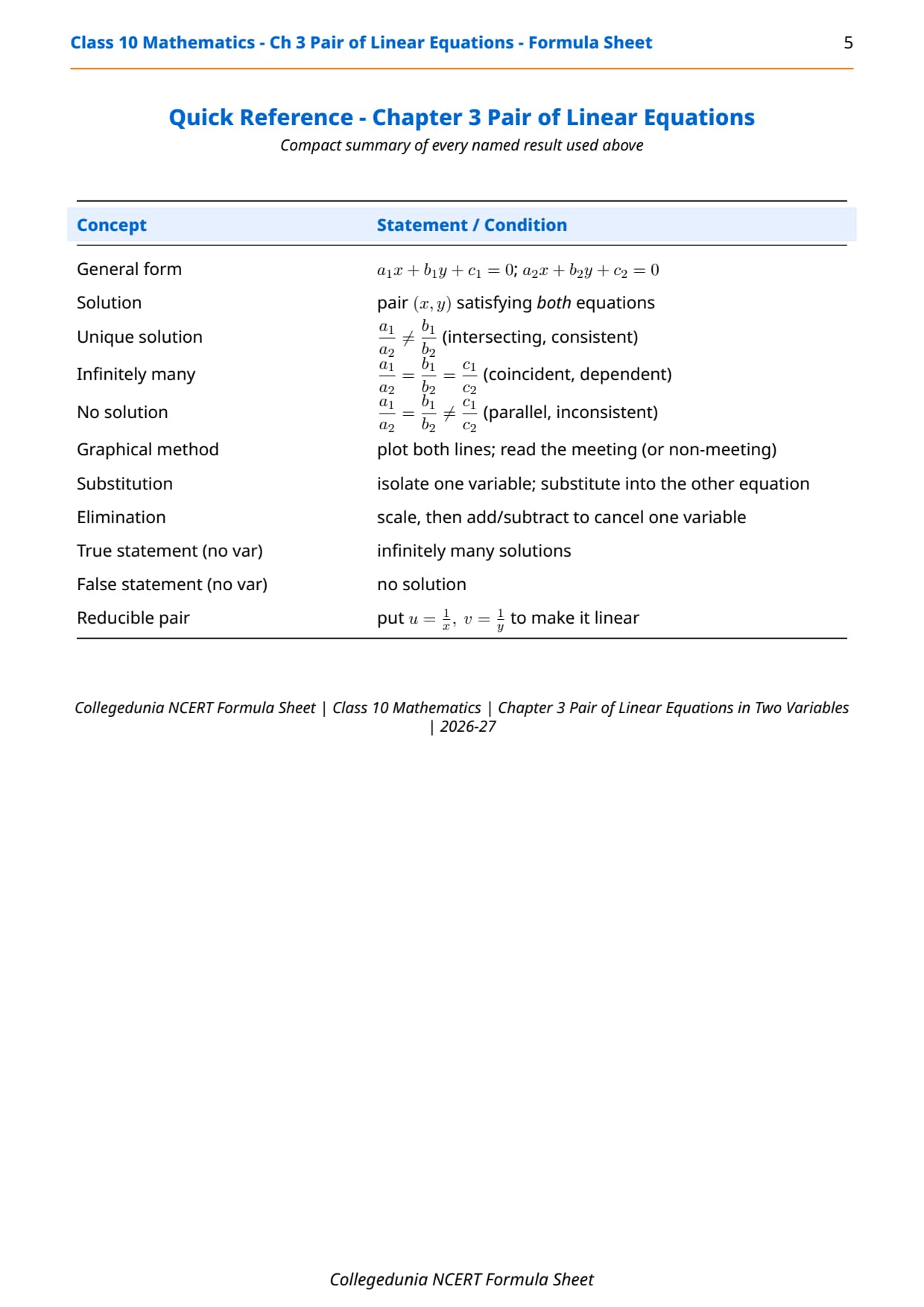
- All core formulas in one place, each with a plain-English meaning.
- Ratio test for unique, infinite or no solution straight from the coefficients, plus when each method is fastest.
- Method toolkit: graphical, substitution and elimination steps, with one worked example each.
Student Feedback: In a Collegedunia poll of 2,600 Class 10 students before the 2026 boards, 71% of students said the ratio (consistency) test was what they revised most from a one-page sheet, ahead of the graphical and elimination methods.
|
Table of Contents |
Watch Pair of Linear Equations Class 10 Maths Explained
Source: Magnet Brains on YouTube
Complete Formula List
The table below lists every named result you need. The chapter rests on two ideas: a pair of lines can meet, overlap or stay apart, giving a unique, infinite or no solution; and the ratio test on the coefficients tells you which case you are in, while three methods find the solution.
| Concept | Formula / Statement |
|---|---|
| General form of a pair | a1x + b1y + c1 = 0 and a2x + b2y + c2 = 0 |
| Solution of a pair | A pair (x, y) that satisfies both equations at the same time |
| Consistent pair | Has at least one solution (unique or infinitely many) |
| Inconsistent pair | Has no solution (parallel lines) |
| Unique solution (intersecting) | a1/a2 ≠ b1/b2 |
| Infinitely many solutions (coincident) | a1/a2 = b1/b2 = c1/c2 |
| No solution (parallel) | a1/a2 = b1/b2 ≠ c1/c2 |
| Graphical method | Plot both lines; the meeting point is the solution |
| Substitution method | Isolate one variable, then substitute into the other equation |
| Elimination method | Scale the equations, then add or subtract to cancel one variable |
| True statement, no variable left | The pair has infinitely many solutions |
| False statement, no variable left | The pair has no solution |
| Reducible pair | Put u = 1/x and v = 1/y to make the pair linear |
The three coefficient-ratio cases that decide the number of solutions.
General Form and Solution of a Pair
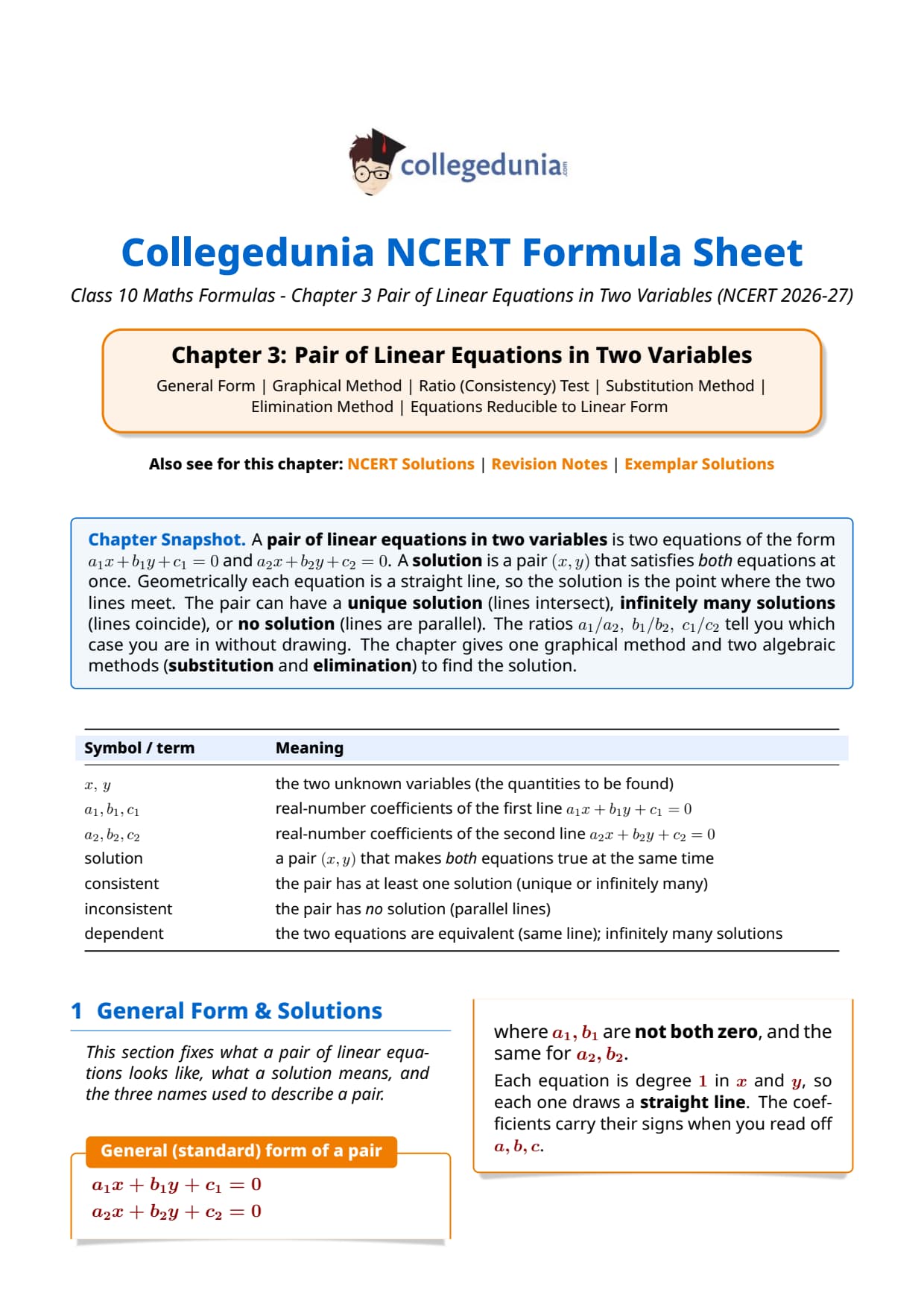
A pair of linear equations in two variables is two equations of the form a1x + b1y + c1 = 0 and a2x + b2y + c2 = 0. Each is degree 1, so each draws a straight line. A solution is a pair (x, y) that makes both true, that is the point of intersection.
- Consistent: at least one solution, either unique or infinitely many.
- Inconsistent: no solution (parallel lines).
- Dependent: the two equations are the same line, so infinitely many solutions; always consistent.
First write each equation in "= 0" form and read off a, b and c with their signs; a sign slip breaks the ratio test below.
Ratio Test for the Number of Solutions
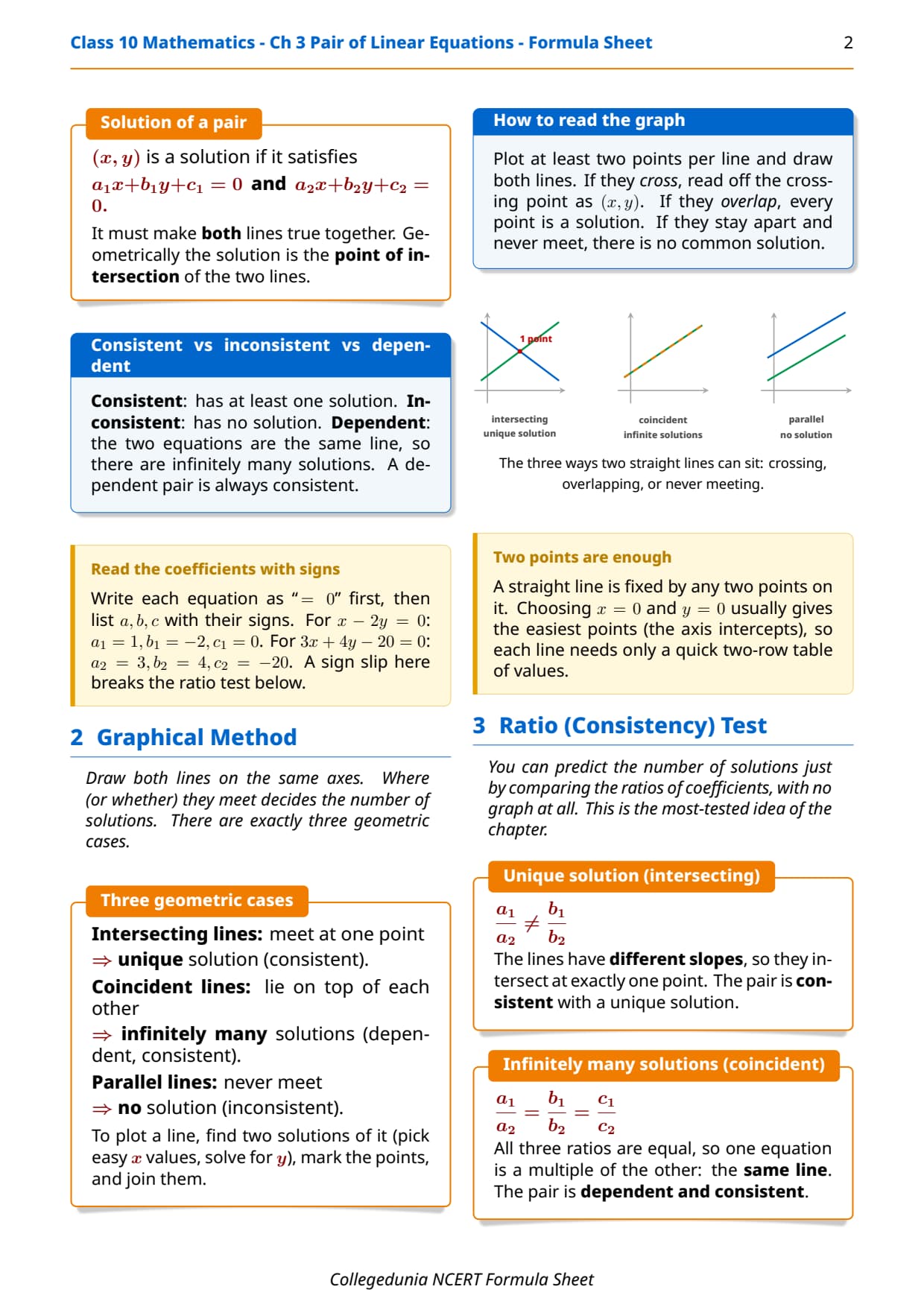
This is the most-tested idea in the chapter. Comparing the coefficient ratios predicts the number of solutions without a graph, in three cases. The c-ratio separates parallel from coincident.
| Ratio Condition | Lines | Number of Solutions |
|---|---|---|
| a1/a2 ≠ b1/b2 | Intersecting | Unique solution (consistent) |
| a1/a2 = b1/b2 = c1/c2 | Coincident | Infinitely many (dependent, consistent) |
| a1/a2 = b1/b2 ≠ c1/c2 | Parallel | No solution (inconsistent) |
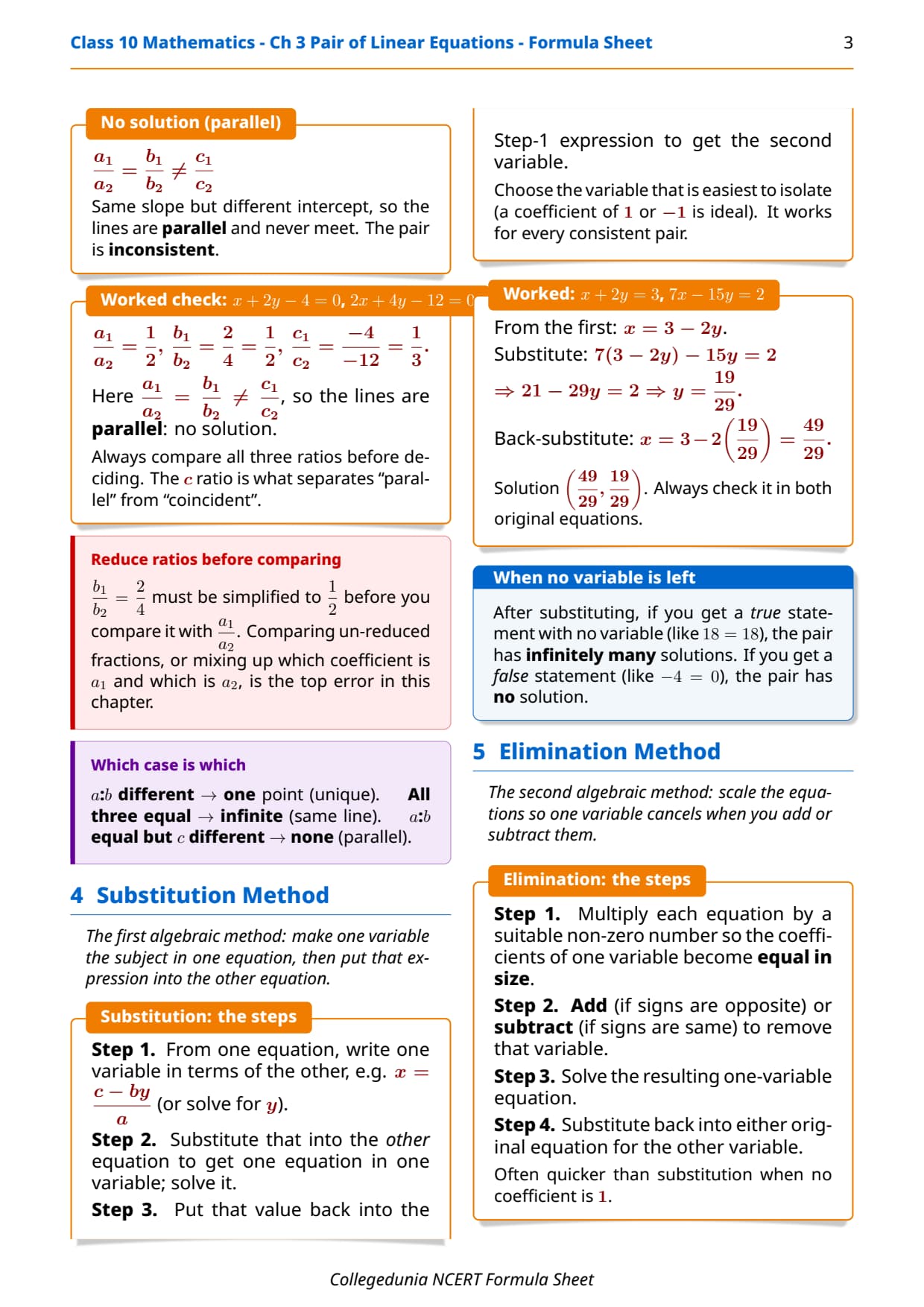
For x + 2y − 4 = 0 and 2x + 4y − 12 = 0: a1/a2 = 1/2, b1/b2 = 1/2, c1/c2 = 1/3. The first two match but the c-ratio differs, so the lines are parallel with no solution. Reduce each fraction first.
Graphical Method: Three Cases
Draw both lines on the same axes; where, or whether, they meet decides the number of solutions. To plot a line, find two solutions and join them.
- Intersecting lines: cross at one point, so a unique solution (consistent).
- Coincident lines: lie on top of each other, so infinitely many solutions (dependent).
- Parallel lines: never meet, so no solution (inconsistent).
In a graph question, one crossing point means one solution, overlap means infinitely many, and a clear gap means none.
Substitution Method: Formula & Steps
Substitution makes one variable the subject, then puts that expression into the other equation. It works for every consistent pair and is easiest when a coefficient is 1 or −1.
When to pick substitution and when to pick elimination, side by side.
- Step 1: from one equation, write one variable in terms of the other, e.g. x = (c − by) / a.
- Step 2: substitute into the other equation to get one equation in one variable, and solve.
- Step 3: put that value back into the Step-1 expression for the second variable.
For x + 2y = 3 and 7x − 15y = 2, the first gives x = 3 − 2y. Substituting, 21 − 29y = 2, so y = 19/29 and x = 49/29. A true statement with no variable left means infinitely many solutions; a false one means no solution.
Elimination Method: Formula & Steps
Elimination scales the equations so one variable's coefficients match in size, then adds or subtracts to cancel it. It is often quicker than substitution when no coefficient is 1.
| Step | What to Do |
|---|---|
| Step 1 | Multiply each equation by a non-zero number so one variable's coefficients become equal in size. |
| Step 2 | Add if the matched signs are opposite, or subtract if they are the same, to remove that variable. |
| Step 3 | Solve the resulting one-variable equation. |
| Step 4 | Substitute back into either original equation to get the other variable. |
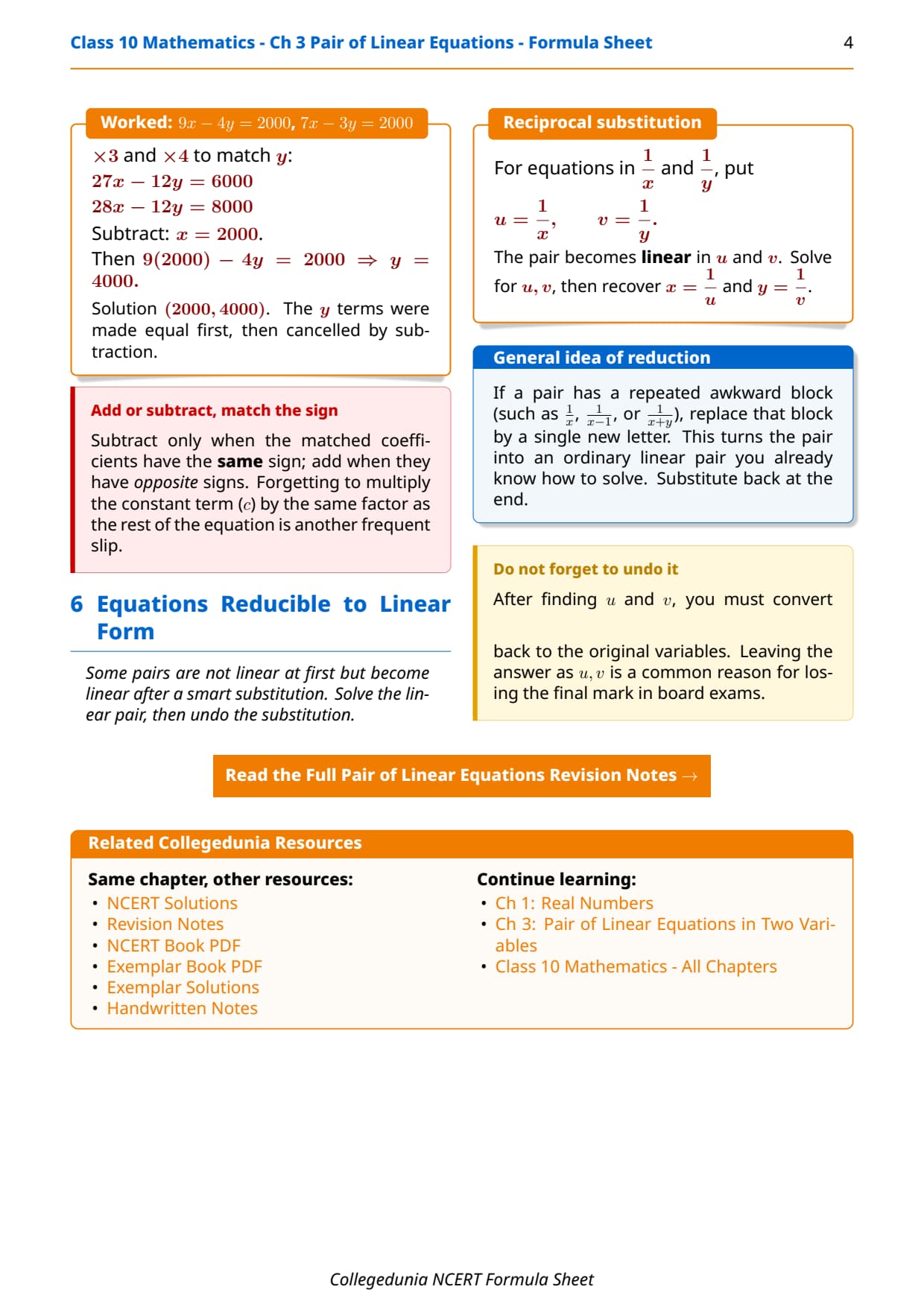
For 9x − 4y = 2000 and 7x − 3y = 2000, multiply by 3 and 4 to match y, then subtract to get x = 2000 and y = 4000, so the solution is (2000, 4000). Scale the constant c by the same factor as the rest.
Equations Reducible to Linear Form
Some pairs become linear after a smart substitution: replace a repeated awkward block with a new letter, solve the linear pair, then undo the substitution.
- Reciprocal pairs: for equations in 1/x and 1/y, put u = 1/x and v = 1/y to make the pair linear in u and v.
- Solve and recover: find u and v, then recover x = 1/u and y = 1/v.
The mark students lose most often is forgetting to undo the substitution. After finding u and v, convert back to x and y.
How to Use This Formula Sheet
- Night-before revision: state each rule, especially the three ratio conditions, without your notes.
- During practice: keep the PDF open to look up the ratio test and method steps.
- For graph questions: one crossing point means a unique solution, overlap means infinitely many, a gap means none.
Weightage in the CBSE Board Exam
This chapter sits in the Algebra unit. The table shows where its topics fit among the high-frequency question types.
| Topic in Chapter 3 | Typical Question Type | Usual Marks |
|---|---|---|
| Ratio (consistency) test | Find the number of solutions / find k | 1 to 2 marks |
| Substitution or elimination method | Solve the pair | 2 to 3 marks |
| Word problem framed as a pair | Long answer | 3 to 5 marks |
| Graphical method | Plot and read the solution | 2 to 3 marks |
Across recent CBSE papers, this chapter usually carries about 5 to 6 marks, often through a word problem.
Common Mistakes With These Formulas
Mistake 1: Comparing un-reduced ratios. Simplify b1/b2 = 2/4 to 1/2 before you compare it with a1/a2.
Mistake 2: Mixing up which equation is the first and which is the second, so a1 and a2 get swapped in the ratio test.
Mistake 3: In elimination, adding when you should subtract. Add only when the matched coefficients have opposite signs.
Mistake 4: Forgetting to convert u and v back to x and y after solving a reducible pair.
Each slip can cost 1 to 2 marks in the board exam.
More Resources for This Chapter
Use this formula sheet with the resources below.
| Resource | Best Used For |
|---|---|
| Pair of Linear Equations NCERT Solutions | Step-by-step answers to all textbook questions |
| Pair of Linear Equations Notes | Full chapter explanation with solved examples |
| Pair of Linear Equations Handwritten Notes | Quick visual revision in a notebook style |
| Pair of Linear Equations NCERT Book PDF | The official textbook chapter to read |
| Pair of Linear Equations NCERT Exemplar Solutions | Harder practice questions with solutions |
| Pair of Linear Equations NCERT Exemplar Book PDF | The official Exemplar problems to attempt |
NCERT Formula Sheets for Class 10 Maths: All Chapters
| Chapter | Formula Sheet |
|---|---|
| Chapter 1 | Real Numbers Formula Sheet |
| Chapter 2 | Polynomials Formula Sheet |
| Chapter 3 | Pair of Linear Equations in Two Variables Formula Sheet (this page) |
| Chapter 4 | Quadratic Equations Formula Sheet |
| Chapter 5 | Arithmetic Progressions Formula Sheet |
| Chapter 6 | Triangles Formula Sheet |
| Chapter 7 | Coordinate Geometry Formula Sheet |
| Chapter 8 | Introduction to Trigonometry Formula Sheet |
| Chapter 9 | Some Applications of Trigonometry Formula Sheet |
| Chapter 10 | Circles Formula Sheet |
| Chapter 11 | Areas Related to Circles Formula Sheet |
| Chapter 12 | Surface Areas and Volumes Formula Sheet |
| Chapter 13 | Statistics Formula Sheet |
| Chapter 14 | Probability Formula Sheet |
Class 10 Maths Chapter 3 Pair of Linear Equations Formula Sheet FAQs
Ques. What formulas are in the Class 10 Pair of Linear Equations formula sheet?
Ans. It covers the general form of a pair, the meaning of a solution, the ratio (consistency) test, and the graphical, substitution and elimination methods. The full list is in the table at the top of this page.
Ques. How does the ratio test decide the number of solutions?
Ans. Compare a1/a2, b1/b2 and c1/c2. If a1/a2 is not equal to b1/b2, there is a unique solution. If all three ratios are equal, there are infinitely many. If the first two are equal but the c-ratio differs, there is no solution.
Ques. What is the difference between the substitution and elimination methods?
Ans. In substitution you make one variable the subject and put it into the other equation, easiest when a coefficient is 1. In elimination you scale both equations to match one variable, then add or subtract to cancel it, faster when no coefficient is 1.
Ques. When does a pair of linear equations have no solution?
Ans. A pair has no solution when the lines are parallel, that is when a1/a2 = b1/b2 but is not equal to c1/c2. Such a pair is called inconsistent because the lines never meet.
Ques. How much weightage does Pair of Linear Equations carry in the CBSE board exam?
Ans. It usually carries about 5 to 6 marks in the CBSE Class 10 Maths paper, often through a word problem solved by substitution or elimination, plus a short ratio-test question. It is a reliable scoring chapter if you learn the formula sheet well.
Ques. Where can I download the Pair of Linear Equations formula sheet PDF?
Ans. You can download the Class 10 Maths Chapter 3 Pair of Linear Equations in Two Variables formula sheet PDF using the download card near the top of this page. It fits the whole chapter on one page for quick revision under the 2026-27 syllabus.



Comments