


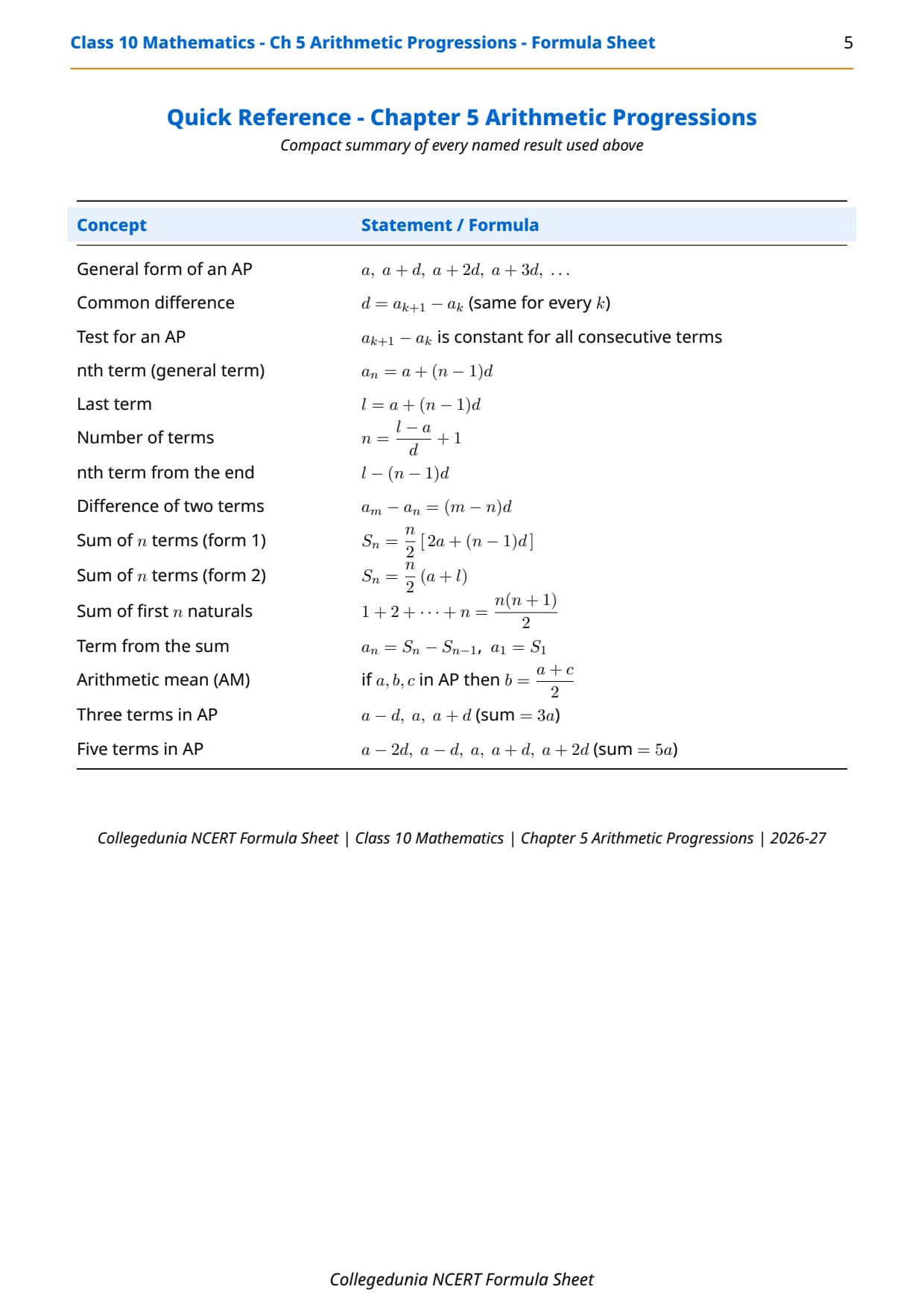
The Class 10 Maths Chapter 5 Arithmetic Progressions formula sheet puts every key result on one page. It covers the definition of an AP, the nth term formula, the two sum formulas, and the arithmetic mean. Built for the 2026-27 CBSE syllabus, it is made for a quick revision pass the night before the exam.
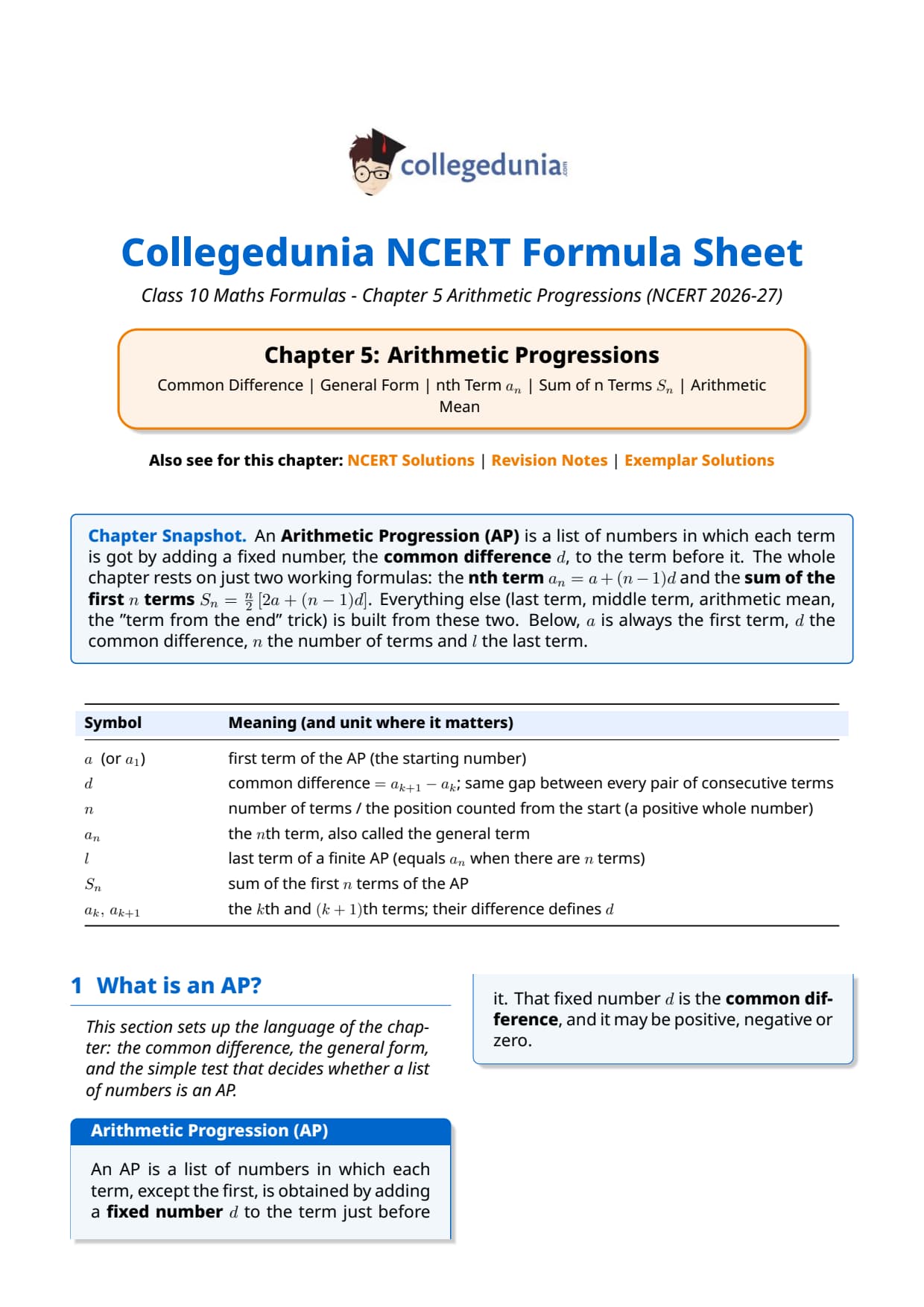
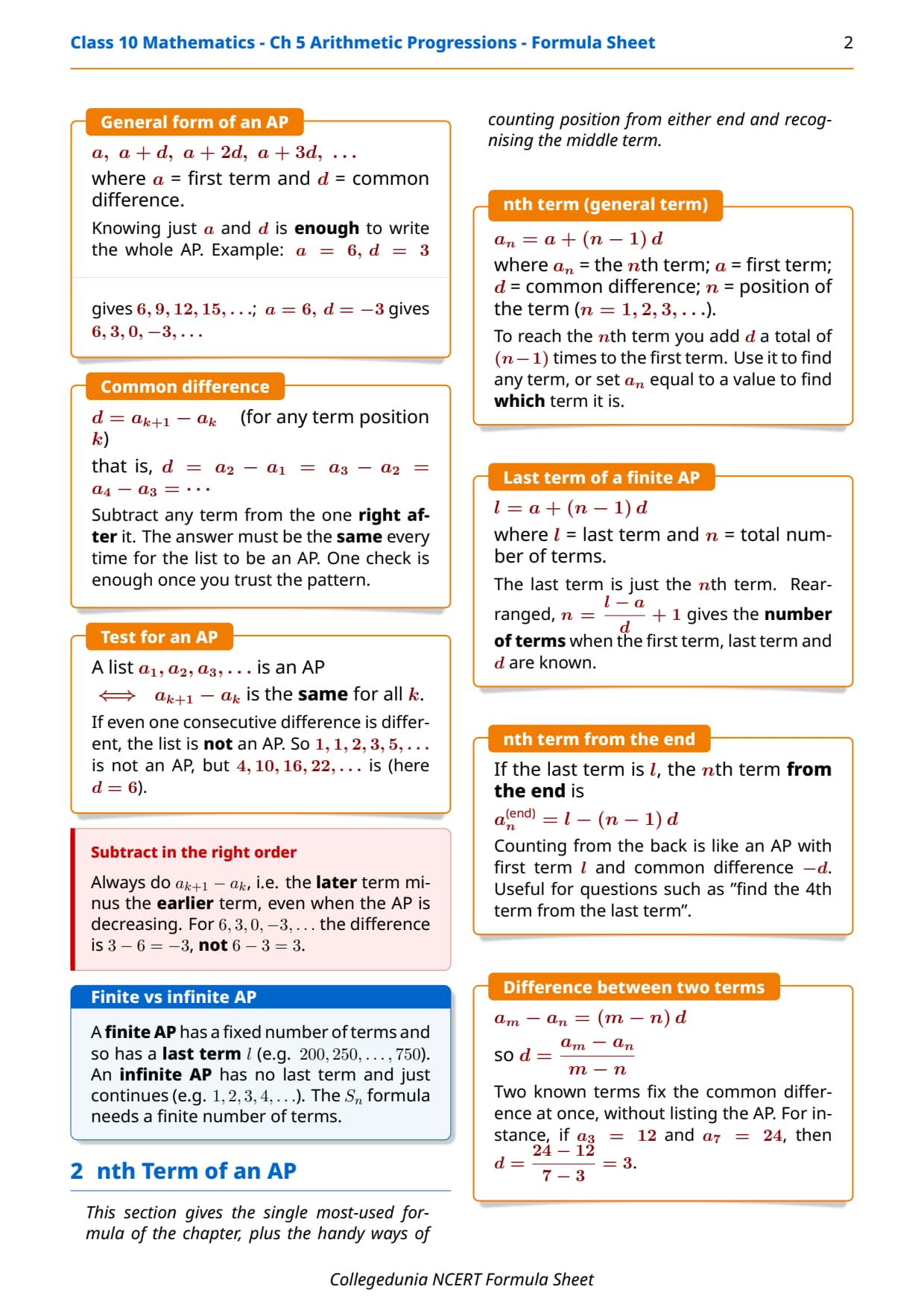
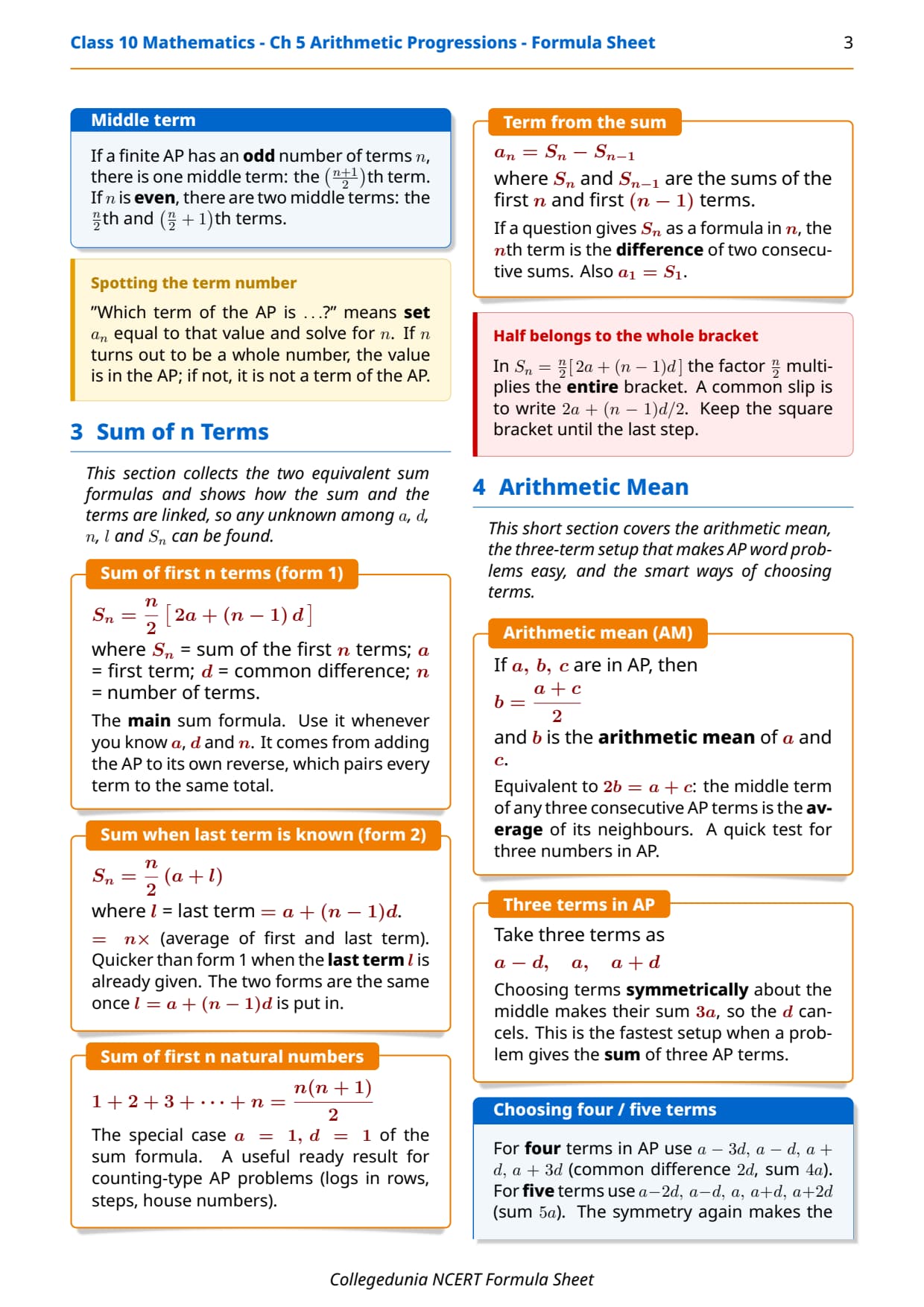
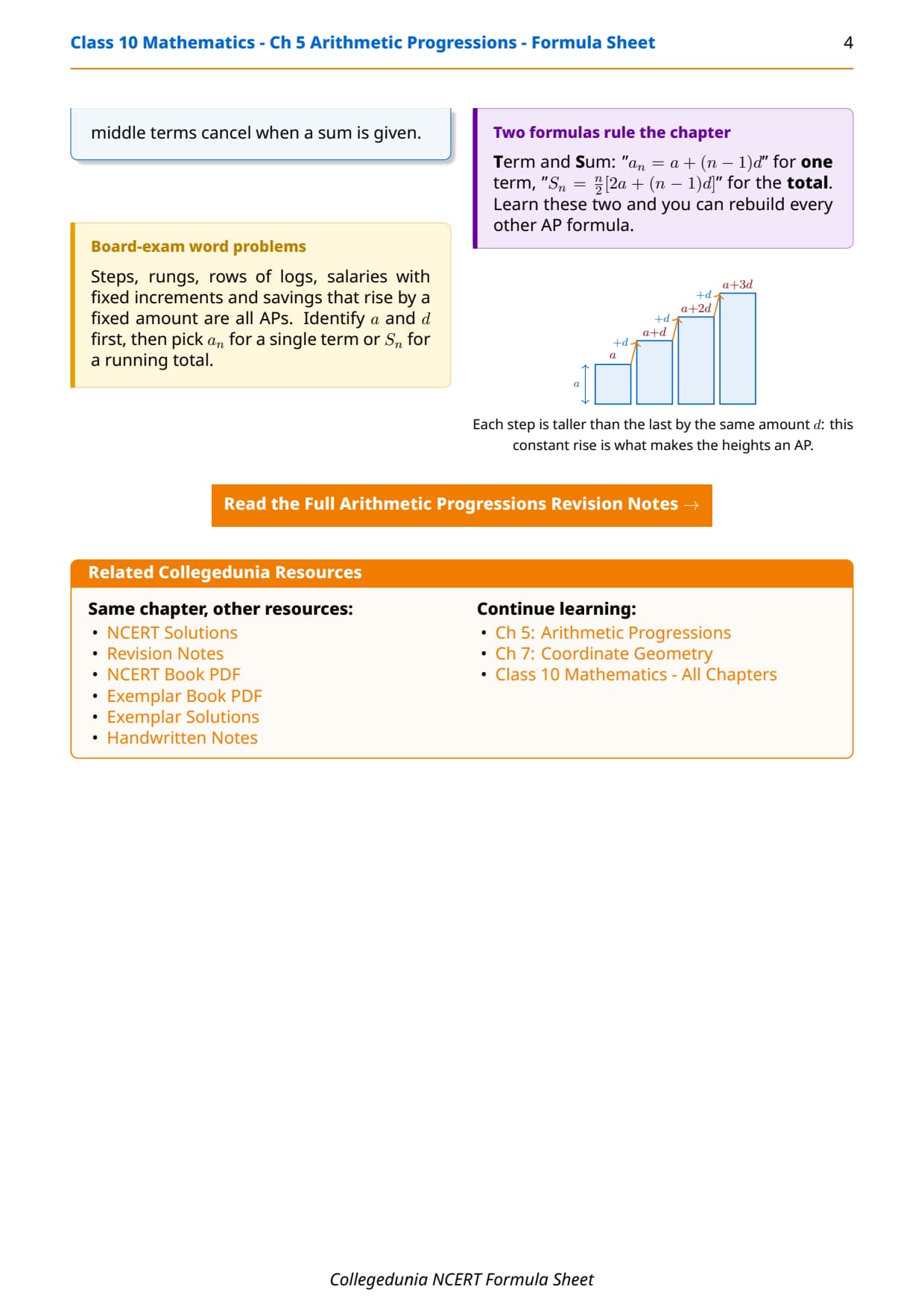
- All core AP formulas in one place, each with a plain-English meaning.
- nth term and sum formulas with worked examples for every step.
- CBSE board focus: number of terms, middle term, and sum up to n terms.
Student Feedback: In a Collegedunia poll of 2,400 Class 10 students before the 2026 boards, 78% of students said the nth term and sum formulas were what they revised most from a one-page sheet, ahead of the arithmetic mean and number-of-terms questions.
Watch Arithmetic Progressions Class 10 Maths Explained
Source: Magnet Brains on YouTube
Complete Formula List
The table below lists every named result you need from Arithmetic Progressions. The chapter rests on two ideas: any AP is fixed by its first term a and common difference d, with the nth term formula finding any term directly; and the two sum formulas add up n terms without writing them all out.
| Concept | Formula / Statement |
|---|---|
| Arithmetic Progression (AP) | a, a+d, a+2d, a+3d, ... (each term = previous term + d) |
| First term | a (also written a1) |
| Common difference | d = a2 − a1 = a3 − a2 = ... (constant) |
| nth term (general term) | an = a + (n − 1)d |
| Last term (l) | l = a + (n − 1)d |
| Sum of first n terms (using d) | Sn = n/2 × [2a + (n − 1)d] |
| Sum of first n terms (using l) | Sn = n/2 × (a + l), where l is the last term |
| Relation between Sn and an | an = Sn − Sn−1 (for n ≥ 2) |
| Arithmetic mean of two numbers | AM = (a + b) / 2 |
| Number of terms | n = (l − a)/d + 1, where l = last term |
| Sum of first n natural numbers | 1 + 2 + ... + n = n(n+1)/2 |
The nth term formula: the most-used result in this chapter.
What Is an Arithmetic Progression?
An Arithmetic Progression is a list of numbers where each term is the one before plus a fixed number, the common difference d. The first term is a, so the AP is a, a+d, a+2d, a+3d, and so on.
- d is constant: subtract any term from the next; the same answer means it is an AP.
- d can be positive, negative or zero: 2, 5, 8 (d = 3), 10, 7, 4 (d = −3) and 5, 5, 5 (d = 0) are all APs.
- Finite vs infinite: an AP with a last term is finite; most board questions use a finite AP.
Before any formula, fix a and d clearly. A sign slip in d throws off every term and the sum.
nth Term of an AP: an = a + (n − 1)d
The nth term formula finds any term without listing the ones before it. For an AP with first term a and common difference d, the nth term is an = a + (n − 1)d. The last term l is an when n is the total number of terms.
- Finding a term: for 5, 8, 11, ..., a = 5 and d = 3, so a10 = 5 + 9 × 3 = 32.
- Finding n given a term: rearrange to n = (an − a)/d + 1. If n is not a whole number, the value is not a term.
- Using the last term: n = (l − a)/d + 1 counts the terms directly.
The (n − 1) is there because d is added n − 1 times to reach the nth term from the first.
Sum of First n Terms of an AP: Sn = n/2 [2a + (n − 1)d]
There are two versions of the sum formula. Pick the one that fits what the question gives you:
The two sum formulas: d-version when d is known, l-version when the last term is known.
| When to use | Formula |
|---|---|
| You know a, d and n | Sn = n/2 × [2a + (n − 1)d] |
| You know a, l (last term) and n | Sn = n/2 × (a + l) |
Worked example: find S20 for 3, 7, 11, 15, .... Here a = 3 and d = 4, so S20 = 20/2 × [6 + 19 × 4] = 10 × 82 = 820.
The relation an = Sn − Sn−1 helps on two-mark questions that give Sn as a formula and ask for an.
Arithmetic Mean
The arithmetic mean of two numbers a and b is (a + b)/2. If three numbers are in AP, the middle one is the mean of the other two, so write them as a − d, a, a + d and the sum is just 3a.
- Three numbers in AP: take as a − d, a, a + d; sum 3a, product a(a2 − d2).
- Four numbers in AP: take as a − 3d, a − d, a + d, a + 3d; sum 4a.
- Inserting means: to put k arithmetic means between a and b, use d = (b − a)/(k + 1).
Example: three numbers in AP sum to 24, product 480. From 3a = 24, a = 8; then 8(64 − d2) = 480 gives d = ±2, so the numbers are 6, 8, 10.
Finding the Number of Terms
Board questions often give the first term, last term and common difference, then ask how many terms there are. The formula is n = (l − a)/d + 1, where l is the last term, straight from l = a + (n − 1)d. Check that n is a positive integer; if it is not a whole number, you have misread a, d or l.
Selecting Terms in an AP
Writing a set of terms around a central value makes d cancel out in the sum, saving a lot of algebra.
| Number of terms | Representation | Sum |
|---|---|---|
| 3 terms | a − d, a, a + d | 3a |
| 4 terms | a − 3d, a − d, a + d, a + 3d | 4a |
| 5 terms | a − 2d, a − d, a, a + d, a + 2d | 5a |
This is useful in two-step problems: get a from the sum condition, then find d from the product. Use the odd-term pattern (centre = a, steps of d) for 3 and 5 terms, and the even-term pattern (steps of 2d) for 4 terms.
How to Use This Arithmetic Progressions Formula Sheet
- Night-before revision: check you can write an = a + (n − 1)d and both sum formulas without peeking.
- During practice: look up the right formula before solving, rather than guessing mid-question.
- For "find the AP" questions: choose normal form (a, a+d, ...) or symmetric form (a − d, a, a + d) based on what the question gives you.
Arithmetic Progressions Weightage in the CBSE Class 10 Board Exam
Arithmetic Progressions sits in the Algebra unit. The table shows where the chapter's topics fit among high-frequency question types.
| Topic in Chapter 5 | Typical Question Type | Usual Marks |
|---|---|---|
| nth term formula (an = a + (n − 1)d) | Find a term or find n | 1 to 2 marks |
| Sum formula Sn | Find sum of n terms or total of an AP | 2 to 3 marks |
| Word problem (AP in real life) | Long answer using both formulas | 3 to 5 marks |
| Selection of terms in AP | Find three or four terms given sum/product | 3 marks |
| Arithmetic mean | Short answer | 1 to 2 marks |
This chapter usually carries about 5 to 8 marks in total. Word problems that translate a real-life situation into an AP are common in the 4 to 5 mark section. The nth term and sum formulas are reliable scoring opportunities.
Common Mistakes With These Formulas
Mistake 1: Writing Sn = n/2 [2a + nd] instead of n/2 [2a + (n − 1)d]. The bracket holds (n − 1), not n.
Mistake 2: Confusing an with Sn. The nth term and the sum of n terms are different; an = Sn − Sn−1 connects them.
Mistake 3: Getting the sign of d wrong. For a decreasing AP like 20, 17, 14, ..., d = −3, not +3.
Mistake 4: Forgetting to check that n is a positive integer when using n = (l − a)/d + 1.
Each slip can cost 1 to 2 marks in the board exam.
More Class 10 Arithmetic Progressions Resources
Use this formula sheet together with the other Arithmetic Progressions resources below. Each one covers a different part of the chapter, so they work best together for full preparation.
| Resource | Best Used For |
|---|---|
| Arithmetic Progressions NCERT Solutions | Step-by-step answers to all textbook questions |
| Arithmetic Progressions Notes | Full chapter explanation with solved examples |
| Arithmetic Progressions Handwritten Notes | Quick visual revision in a notebook style |
| Arithmetic Progressions NCERT Book PDF | The official textbook chapter to read |
| Arithmetic Progressions NCERT Exemplar Solutions | Harder practice questions with solutions |
| Arithmetic Progressions NCERT Exemplar Book PDF | The official Exemplar problems to attempt |
NCERT Formula Sheets for Class 10 Maths: All Chapters
| Chapter | Formula Sheet |
|---|---|
| Chapter 1 | Real Numbers Formula Sheet |
| Chapter 2 | Polynomials Formula Sheet |
| Chapter 3 | Pair of Linear Equations in Two Variables Formula Sheet |
| Chapter 4 | Quadratic Equations Formula Sheet |
| Chapter 5 | Arithmetic Progressions Formula Sheet (this page) |
| Chapter 6 | Triangles Formula Sheet |
| Chapter 7 | Coordinate Geometry Formula Sheet |
| Chapter 8 | Introduction to Trigonometry Formula Sheet |
| Chapter 9 | Some Applications of Trigonometry Formula Sheet |
| Chapter 10 | Circles Formula Sheet |
| Chapter 11 | Areas Related to Circles Formula Sheet |
| Chapter 12 | Surface Areas and Volumes Formula Sheet |
| Chapter 13 | Statistics Formula Sheet |
| Chapter 14 | Probability Formula Sheet |
Class 10 Maths Chapter 5 Arithmetic Progressions Formula Sheet FAQs
Ques. What formulas are in the Class 10 Arithmetic Progressions formula sheet?
Ans. The sheet covers the definition of an AP, the first term a and common difference d, the nth term formula an = a + (n − 1)d, the two sum formulas Sn = n/2 [2a + (n − 1)d] and Sn = n/2 (a + l), the relation an = Sn − Sn−1, the arithmetic mean, and the selection-of-terms trick for 3 and 4 consecutive terms.
Ques. What is the nth term formula for an AP?
Ans. The nth term of an AP is an = a + (n − 1)d, where a is the first term and d is the common difference. To find any specific term, substitute the term number n and calculate. The last term l is also equal to a + (n − 1)d when n is the total number of terms.
Ques. What are the two sum formulas for an AP?
Ans. There are two versions. If you know the first term a, the common difference d and n, use Sn = n/2 times [2a + (n − 1)d]. If you know the first term a, the last term l and n, use Sn = n/2 times (a + l). Both give the same answer; pick whichever requires fewer steps with the given information.
Ques. How do you find the number of terms in an AP?
Ans. Use n = (l − a)/d + 1, where l is the last term, a is the first term and d is the common difference. This formula comes from rearranging the nth term formula. Always check that the result is a positive whole number; if it is not, recheck your values of a, d and l.
Ques. Why should I write three terms in AP as a minus d, a, a plus d?
Ans. Writing three consecutive terms as a − d, a, a + d makes their sum equal to 3a, which removes d from the sum equation. This lets you find a in one step from the sum condition. You then use the product or another condition to find d. The same idea applies for five terms (sum = 5a) and four terms written as a − 3d, a − d, a + d, a + 3d (sum = 4a).
Ques. Where can I download the Arithmetic Progressions formula sheet PDF?
Ans. You can download the Class 10 Maths Chapter 5 Arithmetic Progressions formula sheet PDF using the download card near the top of this page. It fits all the key AP formulas on one page for quick revision under the 2026-27 CBSE syllabus.



Comments