



The Class 10 Maths Chapter 8 Introduction to Trigonometry formula sheet gives you every key result on one page. It covers all six trigonometric ratios, the standard angle table for 0°, 30°, 45°, 60° and 90°, the three trigonometric identities, and the complementary-angle relations. It follows the 2026-27 CBSE syllabus for quick board revision.
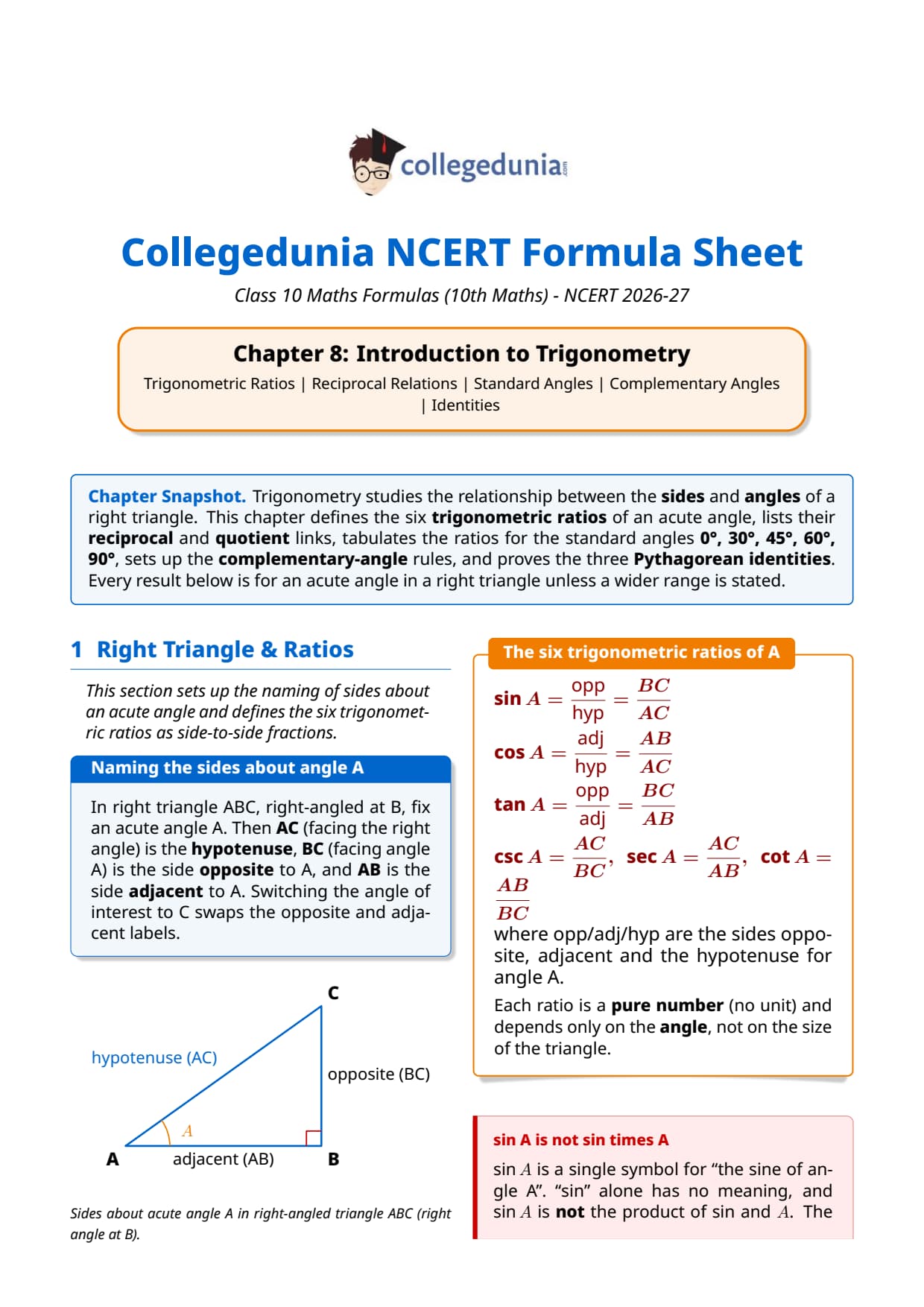
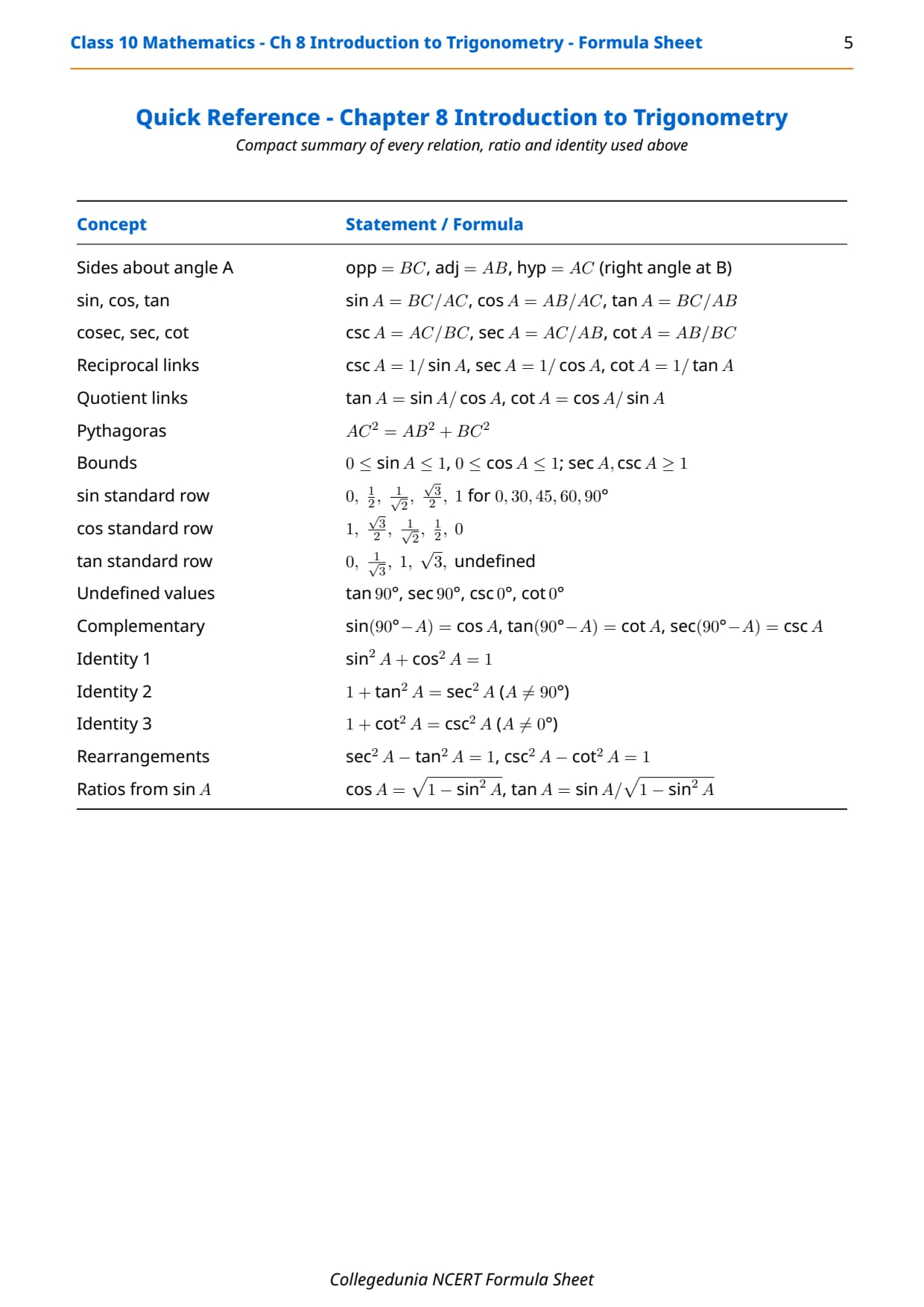
- All six trig ratios defined from the sides of a right triangle, plus the reciprocal relations.
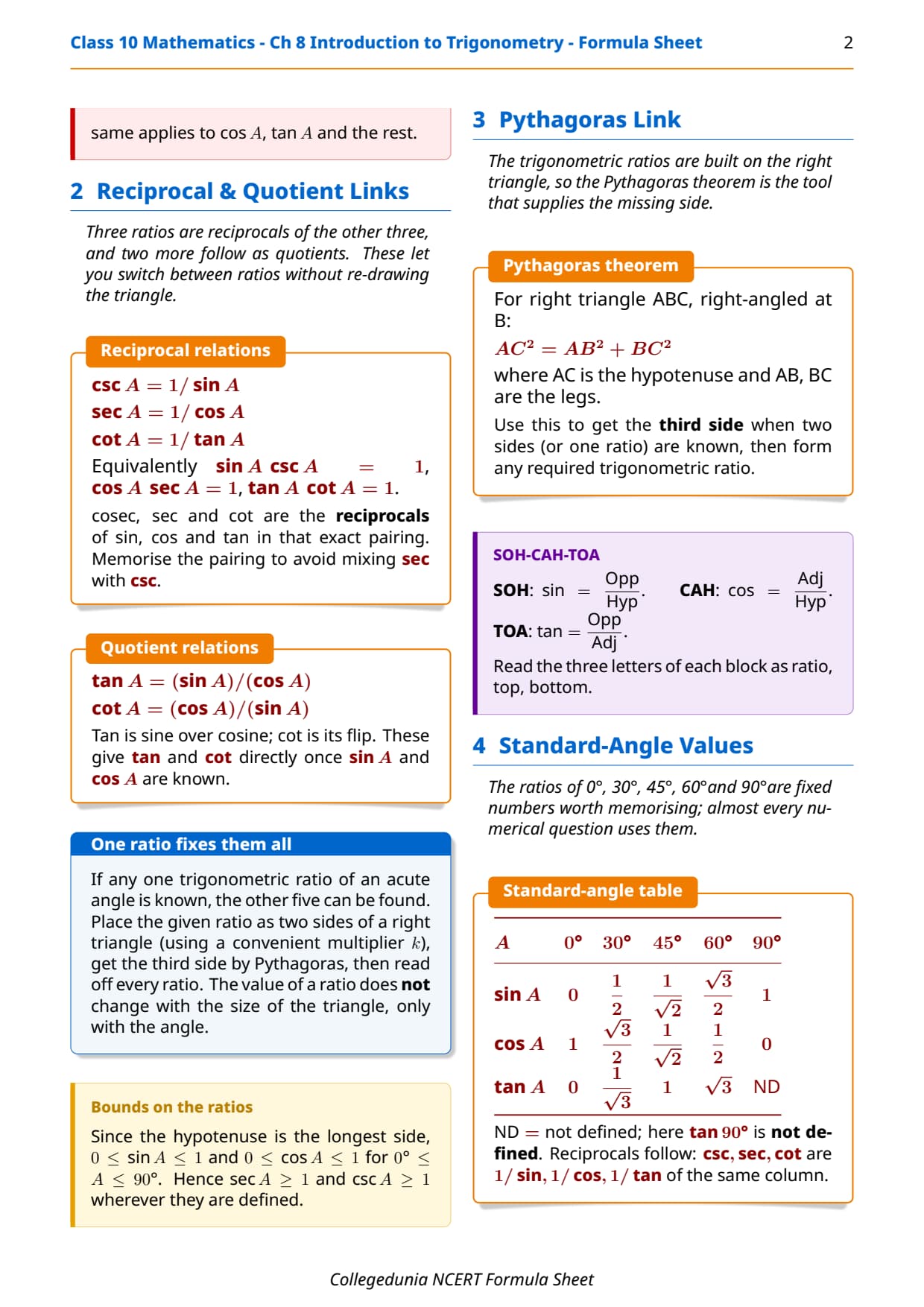
- Standard angle table with exact sin, cos and tan values for 0°, 30°, 45°, 60° and 90°.
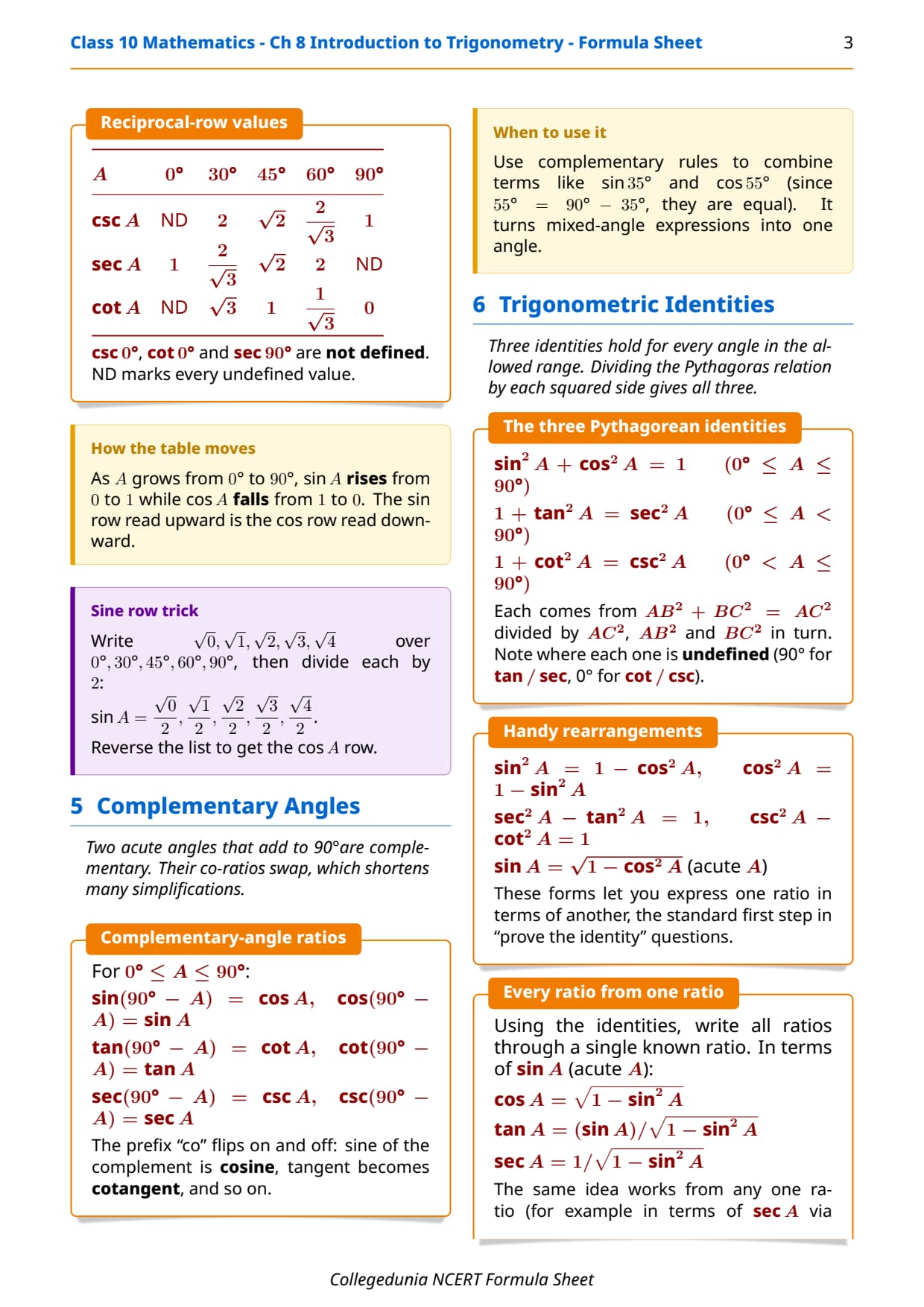
- Board focus: three Pythagorean identities, complementary angle rules, and the ratio question types asked every year.
Student Feedback: In a Collegedunia poll of 2,400 Class 10 students before the 2026 board exam, 87% of students said the standard angle table was the result they revised most from a formula sheet, followed by the three Pythagorean identities.
|
Table of Contents |
Watch Introduction to Trigonometry Class 10 Maths Explained
Source: Magnet Brains on YouTube
Complete Formula List
This sheet lists every formula and result you need from the chapter, mirroring the single-page PDF. The chapter rests on two pillars: the six trigonometric ratios link the sides of a right triangle, and the three Pythagorean identities connect those ratios. Each section below gives the exact formulae and values.
Trigonometric ratios and standard angle values: the core of Chapter 8.
The Six Trigonometric Ratios
All six ratios come from the sides of a right triangle ABC, right-angled at B. Relative to angle A, the sides are the opposite (BC), the adjacent (AB), and the hypotenuse (AC).
| Ratio | Side definition | Reciprocal of |
|---|---|---|
| sin A | Opposite / Hypotenuse | cosec A |
| cos A | Adjacent / Hypotenuse | sec A |
| tan A | Opposite / Adjacent | cot A |
| cosec A | Hypotenuse / Opposite | sin A |
| sec A | Hypotenuse / Adjacent | cos A |
| cot A | Adjacent / Opposite | tan A |
The reciprocals follow at once: cosec A = 1/sin A, sec A = 1/cos A, cot A = 1/tan A, and tan A = sin A / cos A. A quick memory aid is SOH-CAH-TOA. Note tan A and sec A are undefined at A = 90°, while cosec A and cot A are undefined at A = 0°.
Standard Angle Table
The standard angle table is the most-tested memory in this chapter; recall these values instantly. They come from the 30-60-90 and 45-45-90 special triangles.
| Angle (A) | sin A | cos A | tan A | cosec A | sec A | cot A |
|---|---|---|---|---|---|---|
| 0° | 0 | 1 | 0 | Not defined | 1 | Not defined |
| 30° | 1/2 | √3/2 | 1/√3 | 2 | 2/√3 | √3 |
| 45° | 1/√2 | 1/√2 | 1 | √2 | √2 | 1 |
| 60° | √3/2 | 1/2 | √3 | 2/√3 | 2 | 1/√3 |
| 90° | 1 | 0 | Not defined | 1 | Not defined | 0 |
Sin values go 0, 1/2, 1/√2, √3/2, 1; cos values do the reverse. A quick trick for sin: write √0/2, √1/2, √2/2, √3/2, √4/2 and simplify. Knowing sin A and cos A for all five angles is enough to fill every other cell using the reciprocal and ratio formulas.
The Three Trigonometric Identities
All three Class 10 identities come from sin2A + cos2A = 1 (Pythagoras Theorem divided by AC2). Dividing by cos2A gives Identity 2, and by sin2A gives Identity 3, with the rearrangements below:
| Identity | Standard form | Rearrangement |
|---|---|---|
| Pythagorean 1 | sin2A + cos2A = 1 | sin2A = 1 - cos2A |
| Pythagorean 2 | 1 + tan2A = sec2A | tan2A = sec2A - 1 |
| Pythagorean 3 | 1 + cot2A = cosec2A | cot2A = cosec2A - 1 |
In board questions, identities appear two ways: prove an expression equals a simpler form (express everything in sin A and cos A, then use Identity 1), or find one ratio from another (use the right identity, keeping all ratios positive for 0° < A < 90°).
Complementary Angles (90° - A)
Two angles are complementary if they add to 90°. The two non-right angles of a right triangle are complementary, giving six relations between the ratios of A and (90° - A):
| Ratio of (90° - A) | Equals | Memory: swap |
|---|---|---|
| sin(90° - A) | cos A | sin ↔ cos |
| cos(90° - A) | sin A | cos ↔ sin |
| tan(90° - A) | cot A | tan ↔ cot |
| cot(90° - A) | tan A | cot ↔ tan |
| sec(90° - A) | cosec A | sec ↔ cosec |
| cosec(90° - A) | sec A | cosec ↔ sec |
Every ratio of (90° - A) equals its co-ratio of A: sin pairs with cos, tan with cot, sec with cosec. So to simplify sin 70° / cos 20°, rewrite sin 70° = sin(90° - 20°) = cos 20°, giving cos 20° / cos 20° = 1.
The three Pythagorean identities and complementary angle rules: core tools for simplification questions.
Reciprocal & Ratio Relations
The reciprocal pairs are sin A × cosec A = 1, cos A × sec A = 1, tan A × cot A = 1. The square-root forms below help when a question gives one ratio and asks for another:
| Source | Formula |
|---|---|
| From Identity 1 | sin A = √(1 - cos2A); cos A = √(1 - sin2A) |
| From Identity 2 | tan A = √(sec2A - 1) |
| From Identity 3 | cot A = √(cosec2A - 1) |
For example, if sin A = 3/5, then cos A = √(1 - 9/25) = 4/5, so tan A = 3/4. Always take the positive root, since the angle lies between 0° and 90°.
Which Formula for Which Question
Most questions fall into a few standard types. Spot the type, and it tells you which formula to use.
| Question type | Formula to use |
|---|---|
| Find a ratio given one ratio | Identity 1, then reciprocal/ratio |
| Evaluate using standard angles | Standard angle table |
| Prove an identity (LHS = RHS) | Convert to sin and cos; use Identity 1, 2 or 3 |
| Simplify with 90° - A | Complementary angle formulas |
| Find angle given ratio value | Standard angle table; match angle |
| Expression with sec2A or cosec2A | Identity 2 or 3 |
The strongest single move: express everything in sin A and cos A. This collapses all six ratios to two, and Identity 1 handles the rest. For proofs, start from the harder side.
How to Use This Sheet
- Night-before revision: write the standard angle table from memory, then check it against the sheet.
- Proof questions: decide which identity (1, 2 or 3) the proof needs after converting to sin and cos.
- Complementary angle questions: scan for pairs that add to 90°, rewrite with the co-function relations, then simplify.
Board Exam Weightage
Introduction to Trigonometry is one of the higher-scoring board chapters. The table shows the usual split by topic.
| Topic in Chapter 8 | Typical Question Type | Usual Marks |
|---|---|---|
| Trigonometric Ratios | Find one ratio given another, or evaluate using triangle | 2 to 3 marks |
| Standard Angle Table | Evaluate expression with exact values | 1 to 2 marks |
| Trigonometric Identities | Prove that LHS = RHS, or simplify | 3 to 4 marks |
| Complementary Angles | Simplify expression using 90° - A relations | 1 to 3 marks |
Chapters 8 and 9 together carry about 8 to 12 marks. Identity proofs and complementary angle simplifications are the most common multi-mark items. Master the standard angle table and the three Pythagorean identities.
Common Mistakes With Trigonometry Formulas
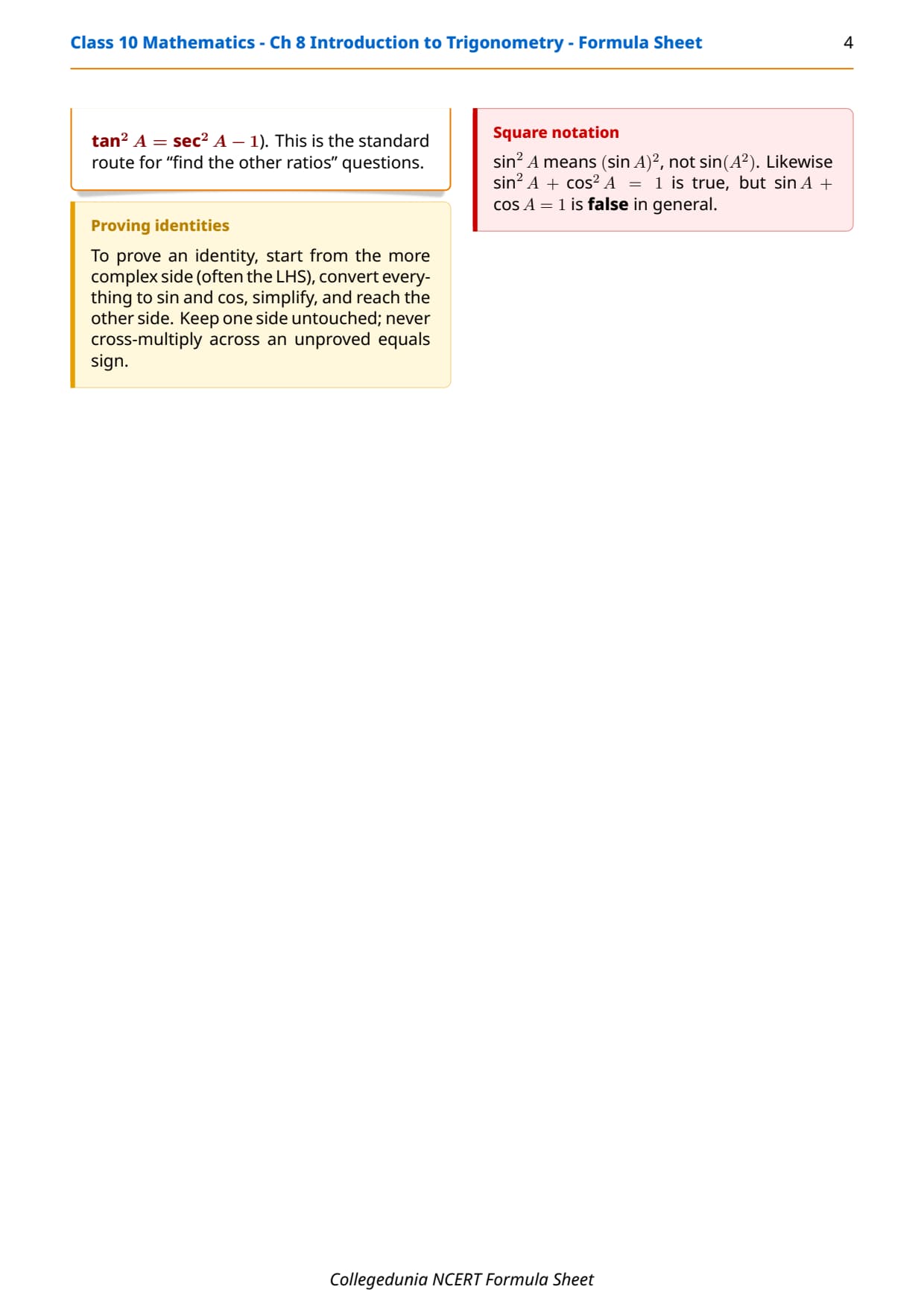
Mistake 1: Writing sin 2A instead of (sin A)2. sin2A means (sin A)2, not sin(2A).
Mistake 2: Forgetting that tan 90° and sec 90° are not defined.
Mistake 3: Confusing the complementary rule direction: sin(90° - A) = cos A, not sin A.
Mistake 4: In proofs, working both sides at once. Transform one side (usually the harder) into the other.
Mistake 5: Not rationalising the denominator; CBSE expects rationalised forms.
More Trigonometry Resources
Use this formula sheet with the other resources below. Each covers a different part of the chapter, so they work best together.
| Resource | Best Used For |
|---|---|
| Introduction to Trigonometry NCERT Solutions | Step-by-step answers to all textbook questions |
| Introduction to Trigonometry Notes | Full chapter explanation with solved examples |
| Introduction to Trigonometry Handwritten Notes | Quick visual revision in a notebook style |
| Introduction to Trigonometry NCERT Book PDF | The official textbook chapter to read |
| Introduction to Trigonometry NCERT Exemplar Solutions | Harder practice questions with solutions |
| Introduction to Trigonometry NCERT Exemplar Book PDF | The official Exemplar problems to attempt |
All Class 10 Maths Formula Sheets
| Chapter | Formula Sheet |
|---|---|
| Chapter 1 | Real Numbers Formula Sheet |
| Chapter 2 | Polynomials Formula Sheet |
| Chapter 3 | Pair of Linear Equations in Two Variables Formula Sheet |
| Chapter 4 | Quadratic Equations Formula Sheet |
| Chapter 5 | Arithmetic Progressions Formula Sheet |
| Chapter 6 | Triangles Formula Sheet |
| Chapter 7 | Coordinate Geometry Formula Sheet |
| Chapter 8 | Introduction to Trigonometry Formula Sheet (this page) |
| Chapter 9 | Some Applications of Trigonometry Formula Sheet |
| Chapter 10 | Circles Formula Sheet |
| Chapter 11 | Areas Related to Circles Formula Sheet |
| Chapter 12 | Surface Areas and Volumes Formula Sheet |
| Chapter 13 | Statistics Formula Sheet |
| Chapter 14 | Probability Formula Sheet |
Class 10 Maths Chapter 8 Introduction to Trigonometry Formula Sheet FAQs
Ques. What formulas are in the Class 10 Introduction to Trigonometry formula sheet?
Ans. The sheet covers all six trigonometric ratios (sin, cos, tan, cosec, sec, cot) with their side-based definitions, the standard angle table with exact values for 0°, 30°, 45°, 60° and 90°, the three Pythagorean identities (sin2A + cos2A = 1, 1 + tan2A = sec2A, 1 + cot2A = cosec2A), all six complementary angle relations, and the reciprocal and ratio connections between the six functions.
Ques. What is the standard angle table for Class 10 trigonometry?
Ans. The standard angle table gives the exact values of sin, cos and tan for the five standard angles: sin 0° = 0, sin 30° = 1/2, sin 45° = 1/√2, sin 60° = √3/2, sin 90° = 1. Cos values go in the reverse order (cos 0° = 1 down to cos 90° = 0). Tan = sin/cos, so tan 0° = 0, tan 30° = 1/√3, tan 45° = 1, tan 60° = √3, tan 90° is not defined. The three reciprocal ratios (cosec, sec, cot) are the reciprocals of these.
Ques. What are the three trigonometric identities in Class 10?
Ans. The three identities are: (1) sin2A + cos2A = 1, (2) 1 + tan2A = sec2A, and (3) 1 + cot2A = cosec2A. All three come from the Pythagoras Theorem applied to a right triangle. Identity 1 is the most fundamental and both Identity 2 and 3 are derived from it by dividing through by cos2A and sin2A respectively. Each identity has two additional rearrangements useful in proof questions.
Ques. What are the complementary angle formulas in trigonometry?
Ans. Complementary angles add to 90°. The six relations are: sin(90° - A) = cos A, cos(90° - A) = sin A, tan(90° - A) = cot A, cot(90° - A) = tan A, sec(90° - A) = cosec A, cosec(90° - A) = sec A. The pattern is that every ratio of (90° - A) equals the co-ratio of A. In board questions, use these to simplify expressions like sin 65°/cos 25° by rewriting sin 65° = sin(90° - 25°) = cos 25°, giving the answer 1.
Ques. How do you find all trigonometric ratios if one ratio is given?
Ans. Start from the given ratio and use Pythagorean Identity 1 (sin2A + cos2A = 1) to find the missing basic ratio. For example, if sin A = 3/5, then cos A = √(1 - 9/25) = 4/5. Then tan A = sin A / cos A = 3/4. The three reciprocals follow: cosec A = 5/3, sec A = 5/4, cot A = 4/3. All six ratios are positive for 0° < A < 90°, so always take the positive square root.
Ques. Where can I download the Introduction to Trigonometry formula sheet PDF?
Ans. Use the download card near the top of this page. It fits all six ratios, the standard angle table, the three Pythagorean identities, and the complementary angle formulas on one page for quick 2026-27 CBSE revision.



Comments