



The Class 10 Maths Chapter 9 Some Applications of Trigonometry formula sheet puts every key result on one page. This chapter uses the angle of elevation and angle of depression to find heights and distances in real life. The one tool you need is a right triangle plus the three basic ratios, all aligned to the 2026-27 CBSE syllabus.
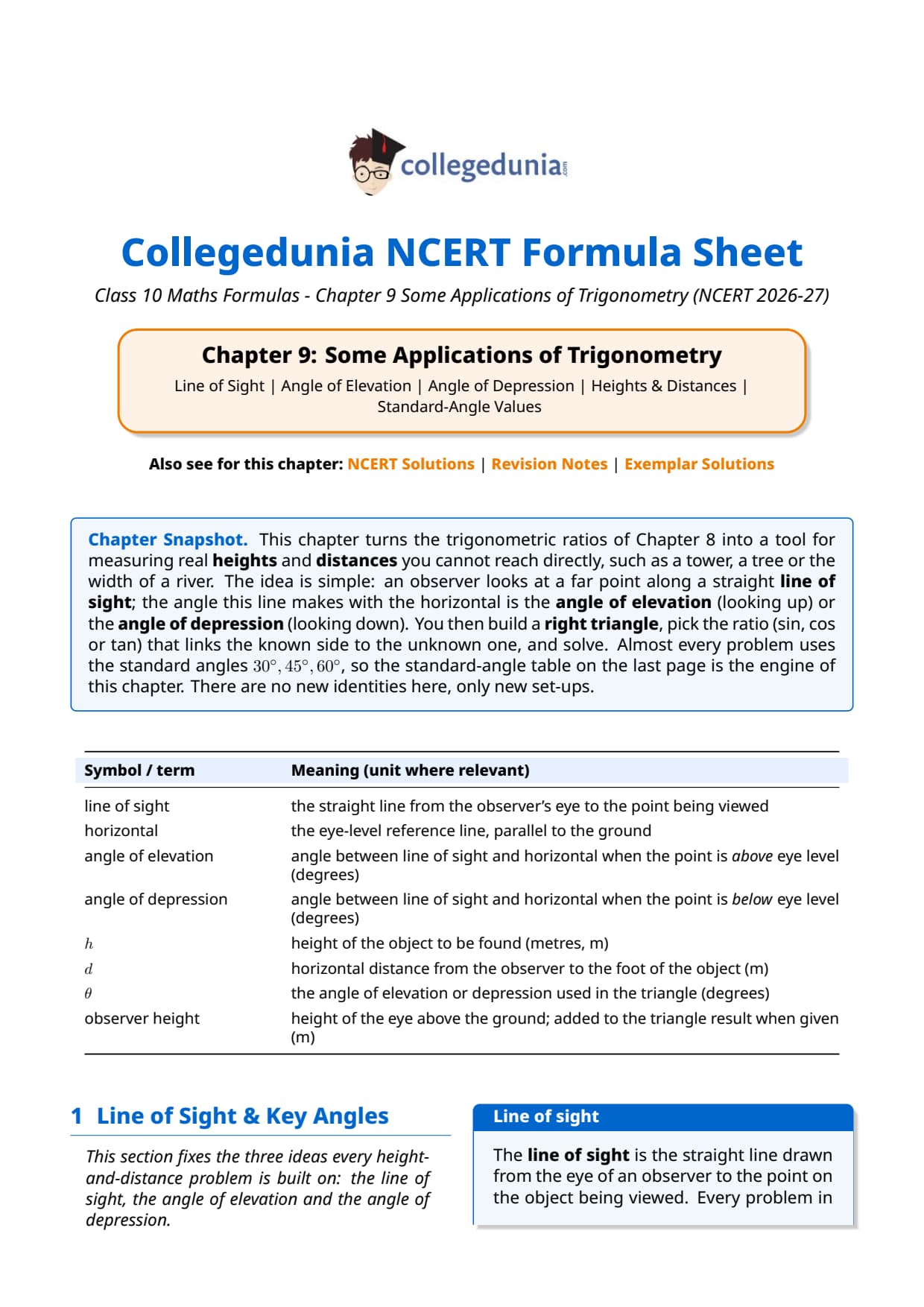
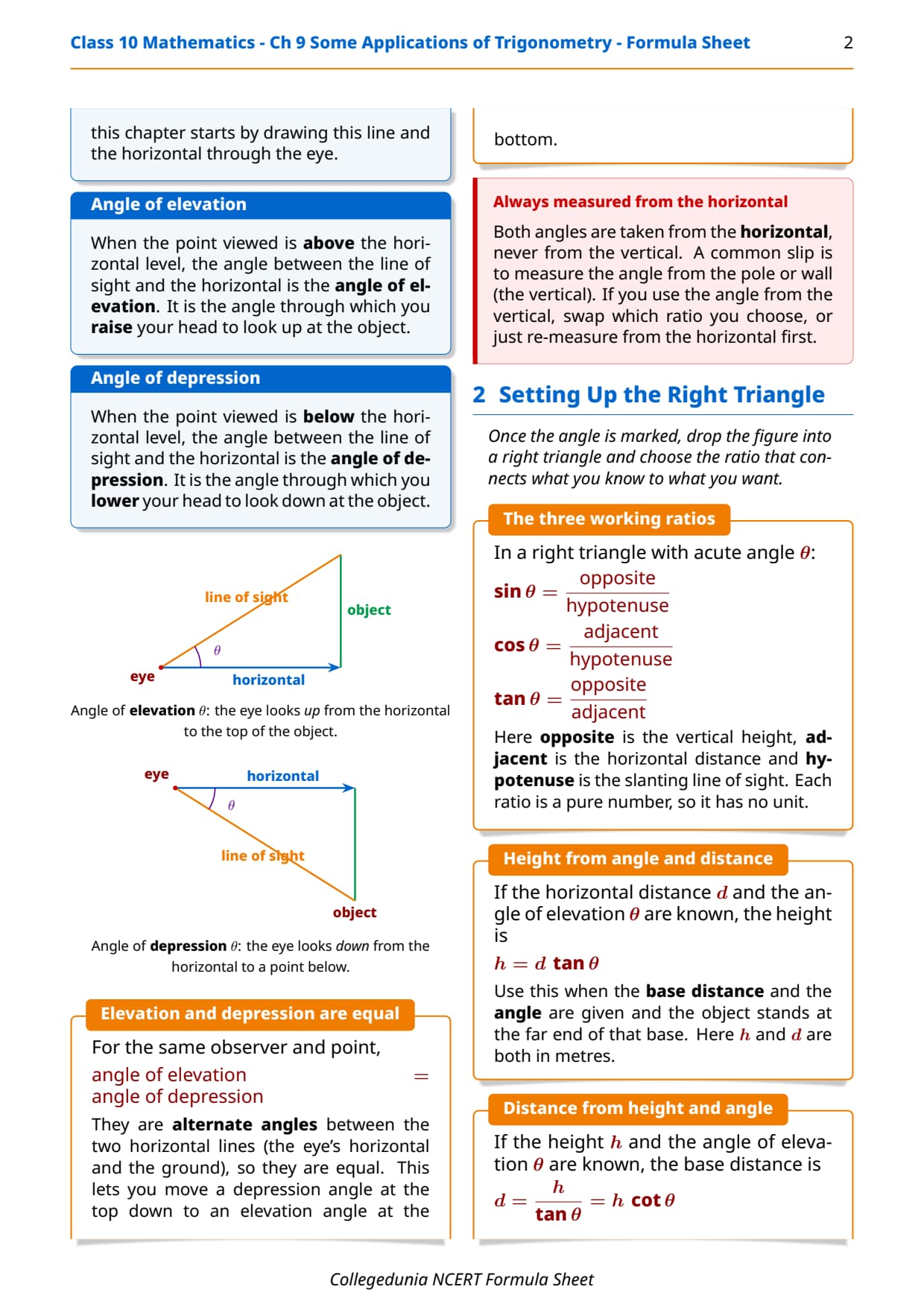
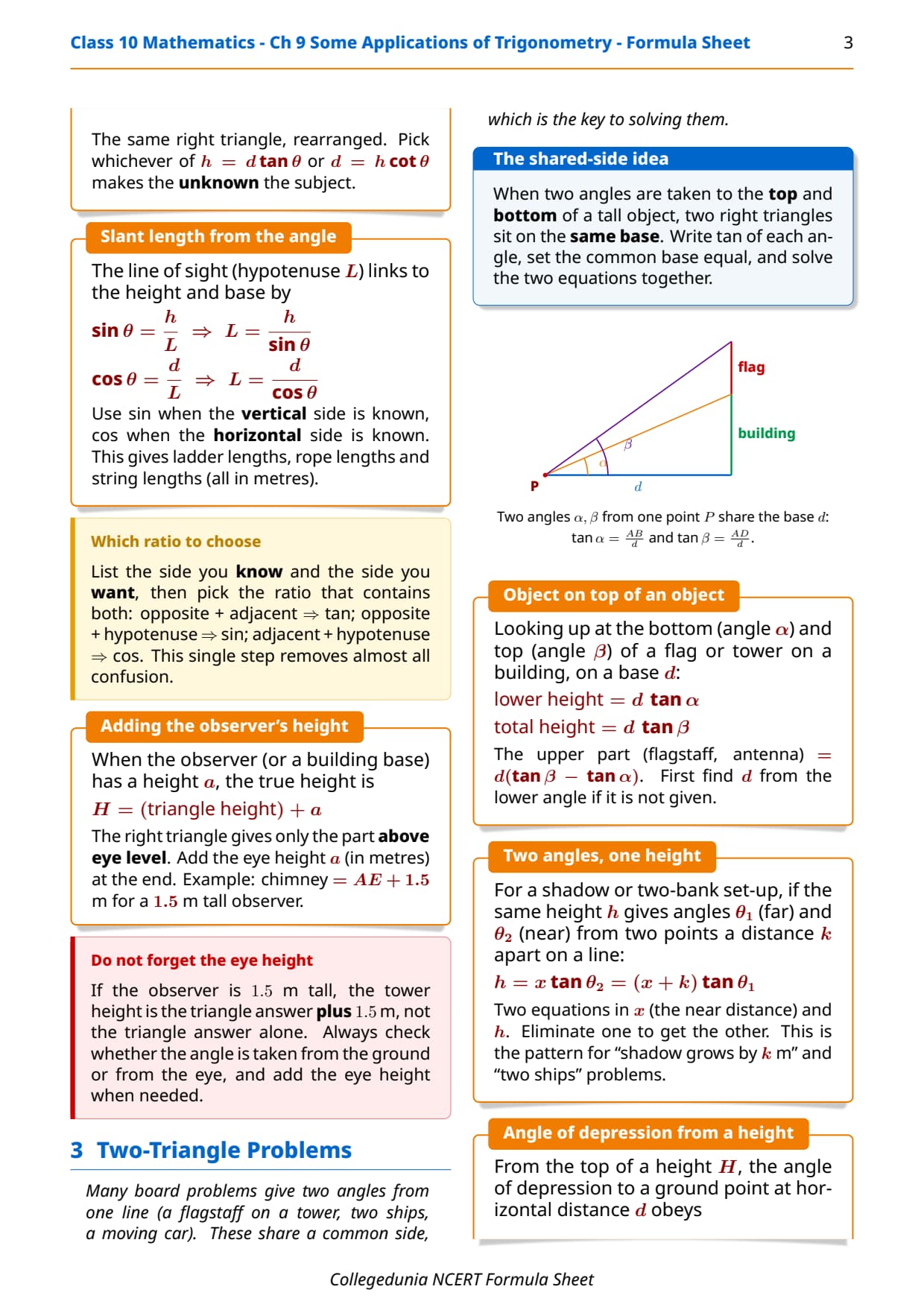
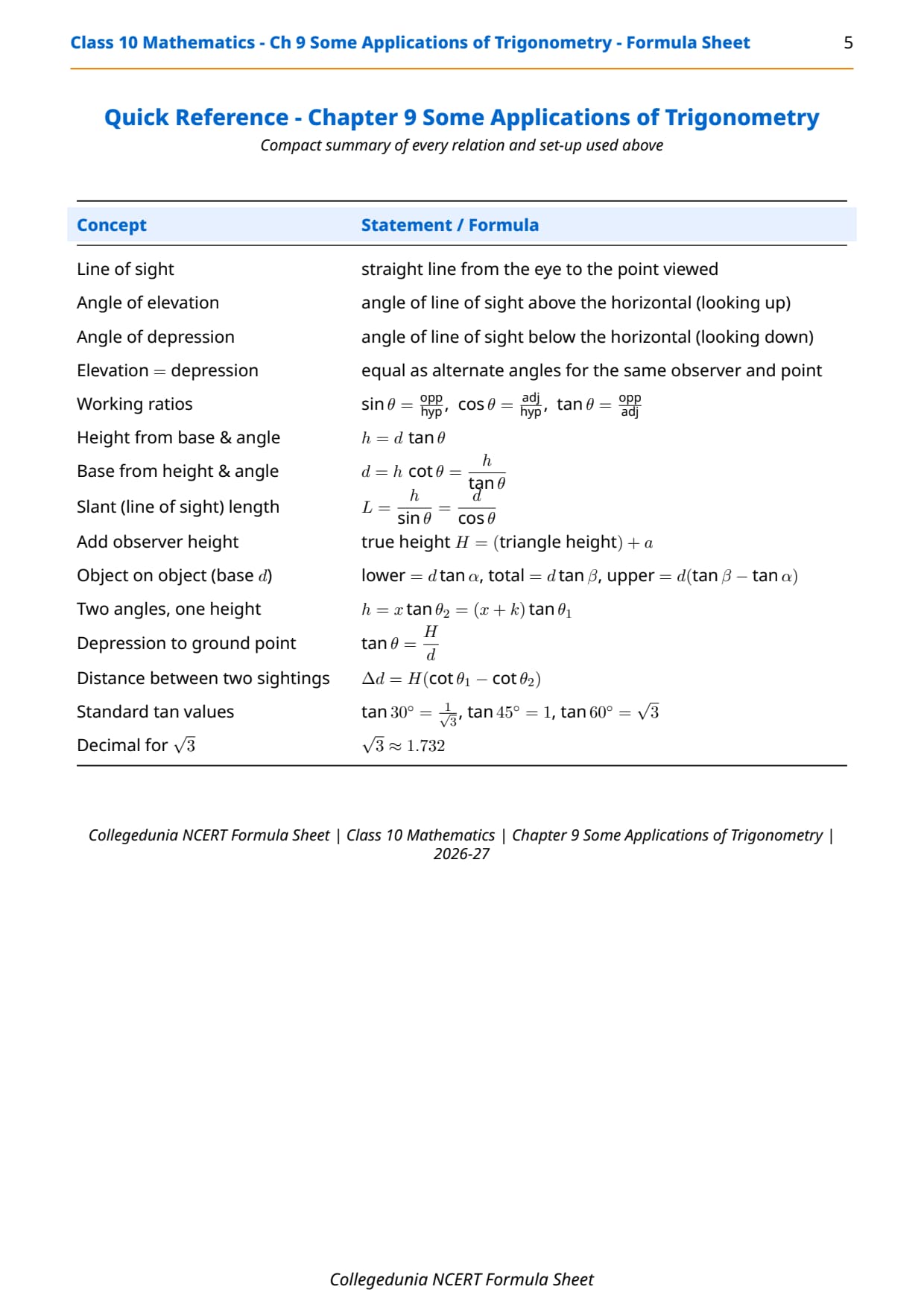
- Angle of elevation and depression defined, with the tan formulas that link height, distance and angle.
- Key formulas: tan θ = height / base, height = distance × tan θ, distance = height / tan θ.
- Board focus: single and two-observer problems, shadow problems, and the tan/sin/cos pattern in every Exercise 9.1 question.
Student Feedback: In a Collegedunia poll of 2,600 Class 10 students before the 2026 board exam, 91% of students said tan θ = height / distance was the formula they revised most, since it unlocks every height-and-distance problem on the paper.
Watch Applications of Trigonometry Class 10 Maths Explained
Source: Magnet Brains on YouTube
Complete Formula List
The table below lists every formula you need. Every problem draws a right triangle, marks the angle, and asks for an unknown side. The only formulas are tan θ = opposite / adjacent, sin θ = opposite / hypotenuse, and cos θ = adjacent / hypotenuse. Tan is the workhorse, since most problems give a horizontal distance and a vertical height.
| Concept | Formula / Result |
|---|---|
| tan θ (main formula) | tan θ = Height / Horizontal distance |
| Height from distance and angle | Height = Distance × tan θ |
| Distance from height and angle | Distance = Height / tan θ |
| sin θ / cos θ (slant problems) | sin θ = Height / Slant; cos θ = Distance / Slant |
| Two-observer formula (same side) | h = d × tan α tan β / (tan α - tan β) |
| Shadow problem (sun angle) | tan θ = Height / Shadow length |
| Pythagoras check | Slant2 = Height2 + Distance2 |
Angle of elevation and depression, both solved with tan θ = height / distance.
Angle of Elevation and Depression: Definitions
Both angles are measured from the horizontal; only the direction of sight differs. Angle of elevation goes upward to an object above you (a tower top); angle of depression goes downward to an object below you (a ship seen from a lighthouse).
- Elevation setup: observer at ground O, object top T, foot B; tan(elevation) = TB / OB.
- Depression setup: observer at building top A, object on ground C; tan(depression) = AB / BC.
- Key equality: the angle of elevation from the object equals the angle of depression from the observer (alternate angles).
A good habit: draw the right triangle first, label the known side, unknown side and angle, then pick the ratio linking the two sides. This prevents almost every setup error.
Height and Distance Formulas (tan, sin, cos)
Once the triangle is drawn, you need only three formulas, picked by the two sides in the question.
| Given | Find | Formula |
|---|---|---|
| Distance (d) and angle (θ) | Height (h) | h = d × tan θ |
| Height (h) and angle (θ) | Distance (d) | d = h / tan θ = h cot θ |
| Slant (l) and angle (θ) | Height (h) | h = l × sin θ |
| Slant (l) and angle (θ) | Distance (d) | d = l × cos θ |
| Height (h) and distance (d) | Slant (l) | l = √(h2 + d2) |
In most Exercise 9.1 questions the distance is given and the height unknown, making h = d × tan θ the formula you use most. Substitute the exact tan value (1/√3, 1, √3) to avoid decimals.
Two-Observer Problems: Formulas and Approach
Some board problems place two observers looking at the same tower from different distances. These need a system of two equations.
| Problem type | Setup | Key relation |
|---|---|---|
| Two observers, distances d1, d2 | Both look up at tower h; angles α, β | tan α = h / d1, tan β = h / d2 |
| Distance between observers D | Closer at α, farther at β | h = D tan α tan β / (tan α - tan β) |
| Top of one building, sees base and top of another | Elevation α and depression β | Two tan equations; solve simultaneously |
The strategy is always: write one equation per triangle, find the shared variable (height h or base distance), and eliminate it by dividing or substituting. For example, if h = d1 tan α and h = (d1 + D) tan β, then d1 = D tan β / (tan α - tan β).
Shadow Problems and Sun Angle Formulas
Shadow problems treat sunlight as parallel rays hitting the ground at the sun's angle of elevation. The vertical object is one leg of the triangle and the shadow is the other.
| Given | Find | Formula |
|---|---|---|
| Height (h), sun angle (θ) | Shadow (s) | s = h / tan θ = h cot θ |
| Shadow (s), sun angle (θ) | Height (h) | h = s × tan θ |
| Height (h), shadow (s) | Sun angle (θ) | tan θ = h / s |
The shadow formula is the same as the height-and-distance formula, with different labels. If the sun angle is 45°, then tan 45° = 1, so height = shadow length.
The three core ratios: pick one based on which two sides appear in the question.
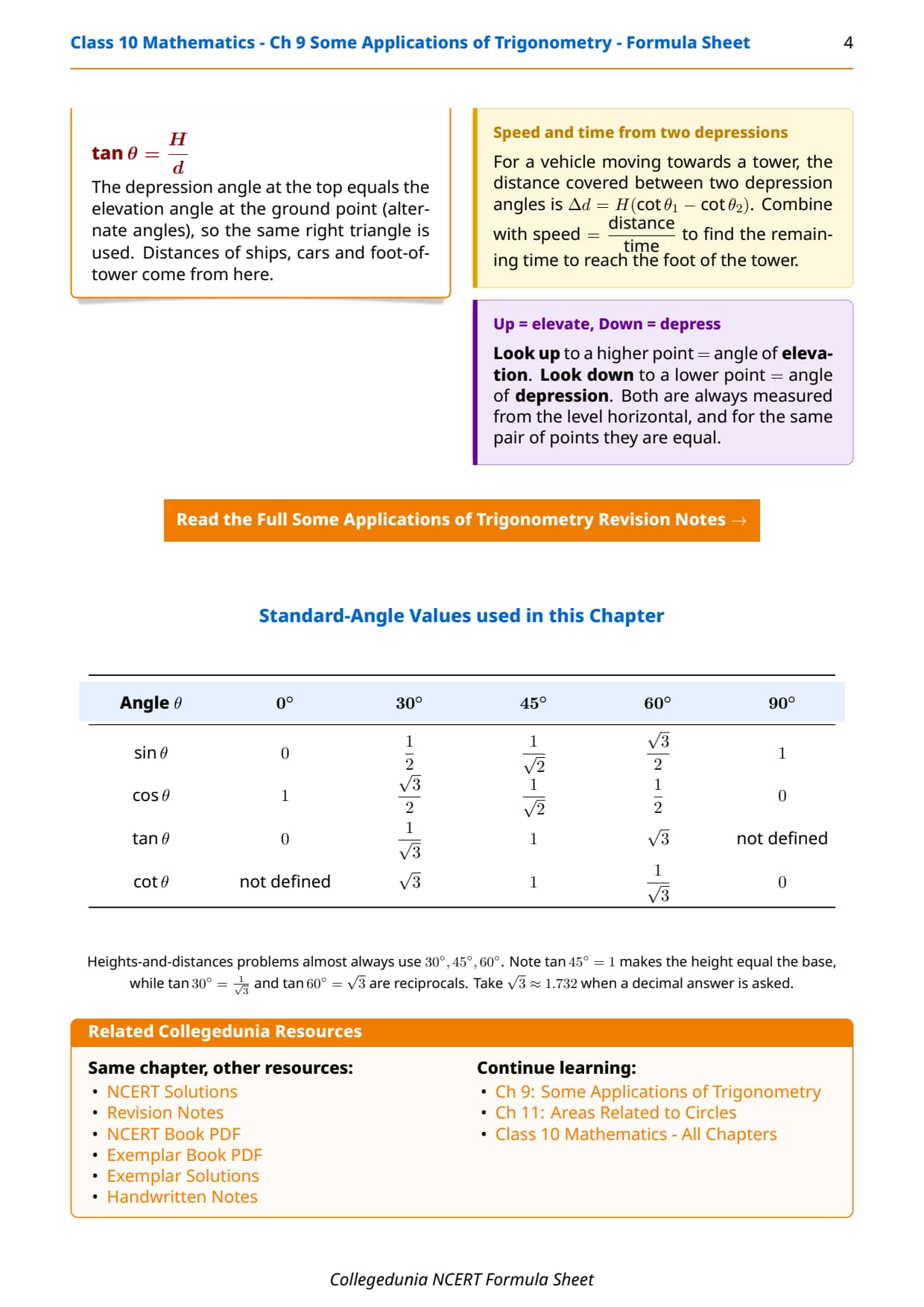
Standard Angle Values Used in Chapter 9 Problems
Every numerical answer uses one of the five standard angles. Memorise the tan row, since it is the ratio you use most.
| Angle (θ) | sin θ | cos θ | tan θ | cot θ |
|---|---|---|---|---|
| 0° | 0 | 1 | 0 | Not defined |
| 30° | 1/2 | √3/2 | 1/√3 | √3 |
| 45° | 1/√2 | 1/√2 | 1 | 1 |
| 60° | √3/2 | 1/2 | √3 | 1/√3 |
| 90° | 1 | 0 | Not defined | 0 |
The three values used most are tan 30° = 1/√3, tan 45° = 1 and tan 60° = √3. Rationalise any √3 denominator in the final answer, as CBSE marking schemes expect surd form, not decimals.
How to Set Up a Height-and-Distance Problem Step by Step
Chapter 9 problems follow a fixed structure. These five steps mean you never lose setup marks.
| Step | Action |
|---|---|
| Step 1 | Draw a diagram; mark observer, object and horizontal, and label the angle. |
| Step 2 | Identify the right triangle; name opposite, adjacent and hypotenuse. |
| Step 3 | Choose the ratio: two legs use tan; one leg and hypotenuse use sin or cos. |
| Step 4 | Substitute the standard angle value and solve for the unknown. |
| Step 5 | Rationalise any surd denominator and write the answer with units. |
For two-triangle problems, run Steps 1 to 3 for each triangle, then eliminate one variable. The most common error is mixing up which angle belongs to which triangle, which clear labelling prevents.
CBSE Board Exam Weightage for Some Applications of Trigonometry
Chapter 9 is short but appears consistently in the CBSE board exam. The table below shows the typical distribution.
| Topic in Chapter 9 | Typical Question Type | Usual Marks |
|---|---|---|
| Angle of elevation (single observer) | Find height or distance given the other and the angle | 2 to 3 marks |
| Angle of depression | Find distance using alternate angle equality | 2 to 3 marks |
| Two-observer / two-angle problem | Two simultaneous tan equations | 4 to 5 marks |
| Shadow problem | Find shadow or height given sun angle | 2 marks |
Chapters 8 and 9 together carry about 8 to 12 marks, with Chapter 9 usually a 3 or 5-mark question. The 5-mark two-observer question is the most common high-value item and always reduces to two tan equations with one unknown.
Common Mistakes in Chapter 9 Height-and-Distance Problems
Mistake 1: Confusing elevation with depression. Both use the same formula but the diagram differs, so draw it every time.
Mistake 2: Not using the alternate-angle rule for depression. The depression from the top equals the elevation from the base.
Mistake 3: Writing tan θ = base / height instead of height / base. Tan is opposite over adjacent, so vertical height over horizontal distance.
Mistake 4: Leaving the answer as h/√3 without rationalising. Multiply by √3 to get h√3/3.
Mistake 5: Assuming distances are additive. Opposite sides of the tower add; the same side subtracts.
More Class 10 Some Applications of Trigonometry Resources
Use this formula sheet alongside the other Chapter 9 resources below.
| Resource | Best Used For |
|---|---|
| Some Applications of Trigonometry NCERT Solutions | Step-by-step answers to all textbook questions |
| Some Applications of Trigonometry Notes | Full chapter explanation with solved examples |
| Some Applications of Trigonometry Handwritten Notes | Quick visual revision in a notebook style |
| Some Applications of Trigonometry NCERT Book PDF | The official textbook chapter to read |
| Some Applications of Trigonometry NCERT Exemplar Solutions | Harder practice questions with solutions |
| Some Applications of Trigonometry NCERT Exemplar Book PDF | The official Exemplar problems to attempt |
NCERT Formula Sheets for Class 10 Maths: All Chapters
| Chapter | Formula Sheet |
|---|---|
| Chapter 1 | Real Numbers Formula Sheet |
| Chapter 2 | Polynomials Formula Sheet |
| Chapter 3 | Pair of Linear Equations in Two Variables Formula Sheet |
| Chapter 4 | Quadratic Equations Formula Sheet |
| Chapter 5 | Arithmetic Progressions Formula Sheet |
| Chapter 6 | Triangles Formula Sheet |
| Chapter 7 | Coordinate Geometry Formula Sheet |
| Chapter 8 | Introduction to Trigonometry Formula Sheet |
| Chapter 9 | Some Applications of Trigonometry Formula Sheet (this page) |
| Chapter 10 | Circles Formula Sheet |
| Chapter 11 | Areas Related to Circles Formula Sheet |
| Chapter 12 | Surface Areas and Volumes Formula Sheet |
| Chapter 13 | Statistics Formula Sheet |
| Chapter 14 | Probability Formula Sheet |
Class 10 Maths Chapter 9 Some Applications of Trigonometry Formula Sheet FAQs
Ques. What formulas are in the Class 10 Chapter 9 Some Applications of Trigonometry formula sheet?
Ans. The sheet covers the definitions of angle of elevation and angle of depression, the core formula tan θ = height / horizontal distance, derived forms such as height = distance × tan θ and distance = height / tan θ, the sin and cos versions for slant-distance problems, the two-observer formula, the shadow problem formula, and the standard angle values of tan, sin and cos for 0°, 30°, 45°, 60° and 90°.
Ques. What is the formula for angle of elevation in Chapter 9?
Ans. In a right triangle where the observer is at the base and the object is at the top, the angle of elevation θ satisfies tan θ = opposite / adjacent = height of object / horizontal distance from observer to base of object. To find height: height = horizontal distance × tan θ. To find horizontal distance: horizontal distance = height / tan θ. The angle is always measured from the horizontal line of sight upward to the object.
Ques. What is the difference between angle of elevation and angle of depression?
Ans. The angle of elevation is the angle measured upward from the observer's horizontal line of sight to an object above the observer. The angle of depression is the angle measured downward from the observer's horizontal line of sight to an object below the observer. A key result used in NCERT Chapter 9 is that the angle of depression from the top of a building to an object on the ground equals the angle of elevation from that object back to the top of the building (alternate interior angles on parallel horizontal lines).
Ques. How do you solve a two-observer height-and-distance problem?
Ans. Set up one tan equation for each observer. Let the tower height be h and the unknown distances be d1 and d2. Write tan α = h / d1 and tan β = h / d2. If the total distance D = d1 + d2 (observers on opposite sides) or D = d1 - d2 (same side), substitute to get one equation in h alone and solve. For same-side observers, the combined formula is h = D × tan α × tan β / (tan α - tan β), where D is the distance between them and α > β.
Ques. What is the formula for shadow problems in Chapter 9?
Ans. When sunlight falls at an angle of elevation θ, the shadow length s and object height h satisfy tan θ = h / s. So h = s × tan θ and s = h / tan θ. At 45° the shadow equals the height (since tan 45° = 1). At 30° the shadow is h√3 (longer shadow). At 60° the shadow is h/√3 (shorter shadow). When the sun angle changes from one value to another, write two tan equations for the same height h and divide to eliminate h.
Ques. Where can I download the Some Applications of Trigonometry formula sheet PDF for Class 10?
Ans. You can download the Class 10 Maths Chapter 9 Some Applications of Trigonometry formula sheet PDF using the download card near the top of this page. It fits all height-and-distance formulas, angle of elevation and depression definitions, the two-observer formula, shadow problem rules, and standard angle values on one page for quick board exam revision under the 2026-27 CBSE syllabus.



Comments