




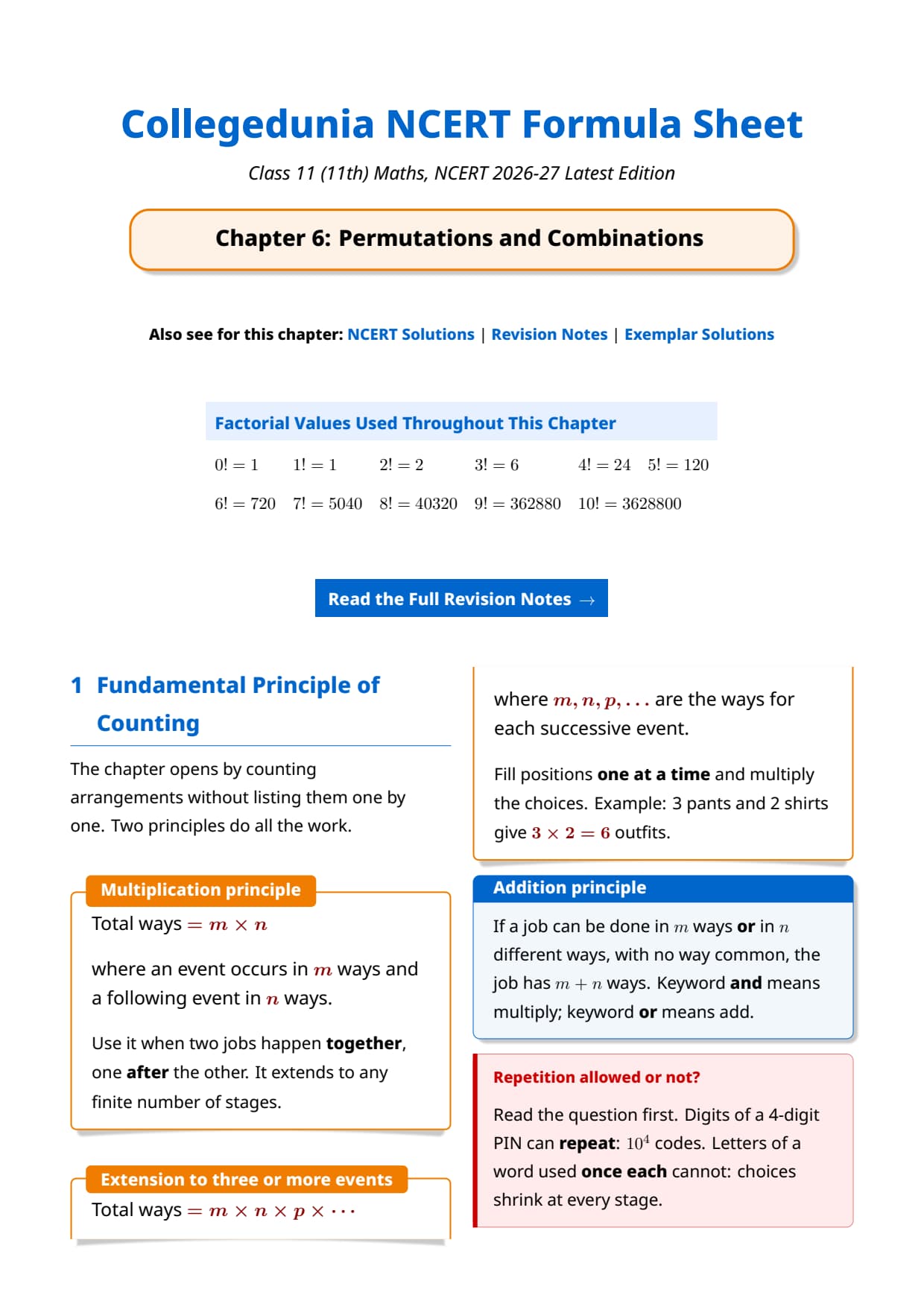
The class 11 maths formula sheet chapter 6 permutations and combinations collects every counting principle, arrangement rule and selection formula tested in the Boards, JEE Main, JEE Advanced and CUET exams. It lists the factorial notation, the nPr and nCr formulas and their key properties so students can revise the whole chapter in one place.
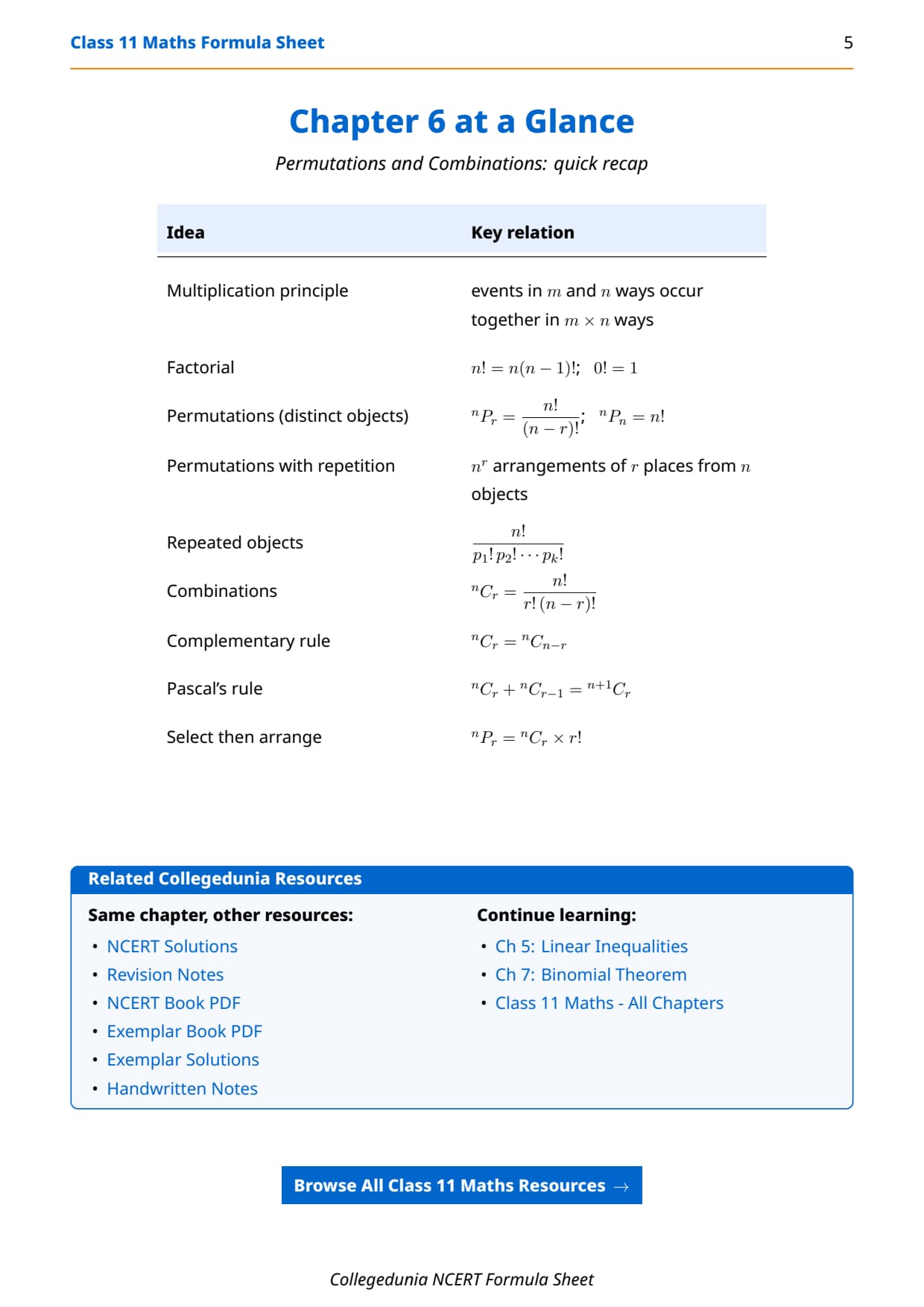
These permutation and combination class 11 formulas power later work in the binomial theorem and probability, so a clean grasp of them pays off across the year.
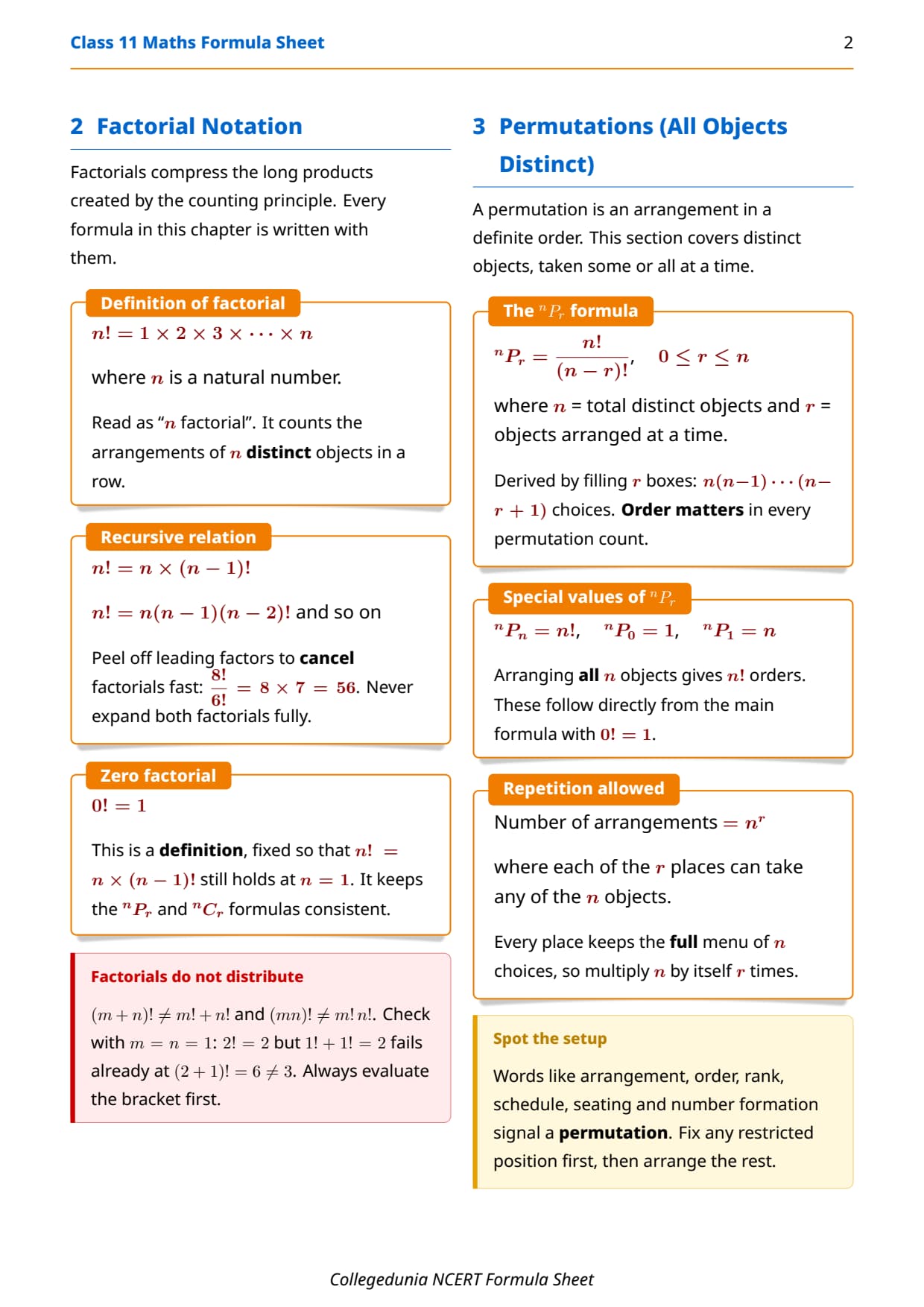
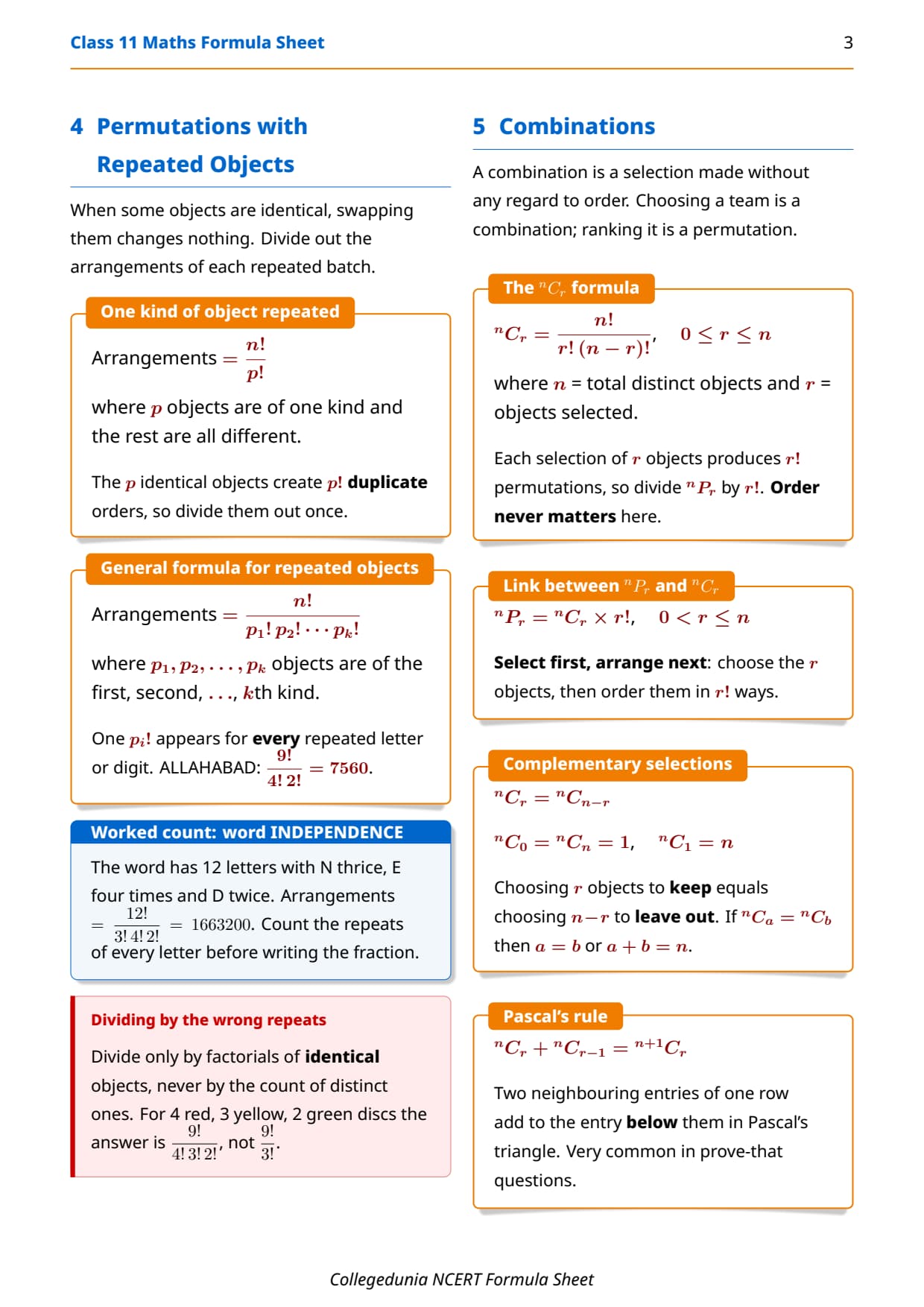
- Covers the fundamental principle of counting, factorials, permutations of distinct and repeated objects, and combinations.
- Lists the link nPr = r! · nCr, the complementary rule and Pascal's rule for objective questions.
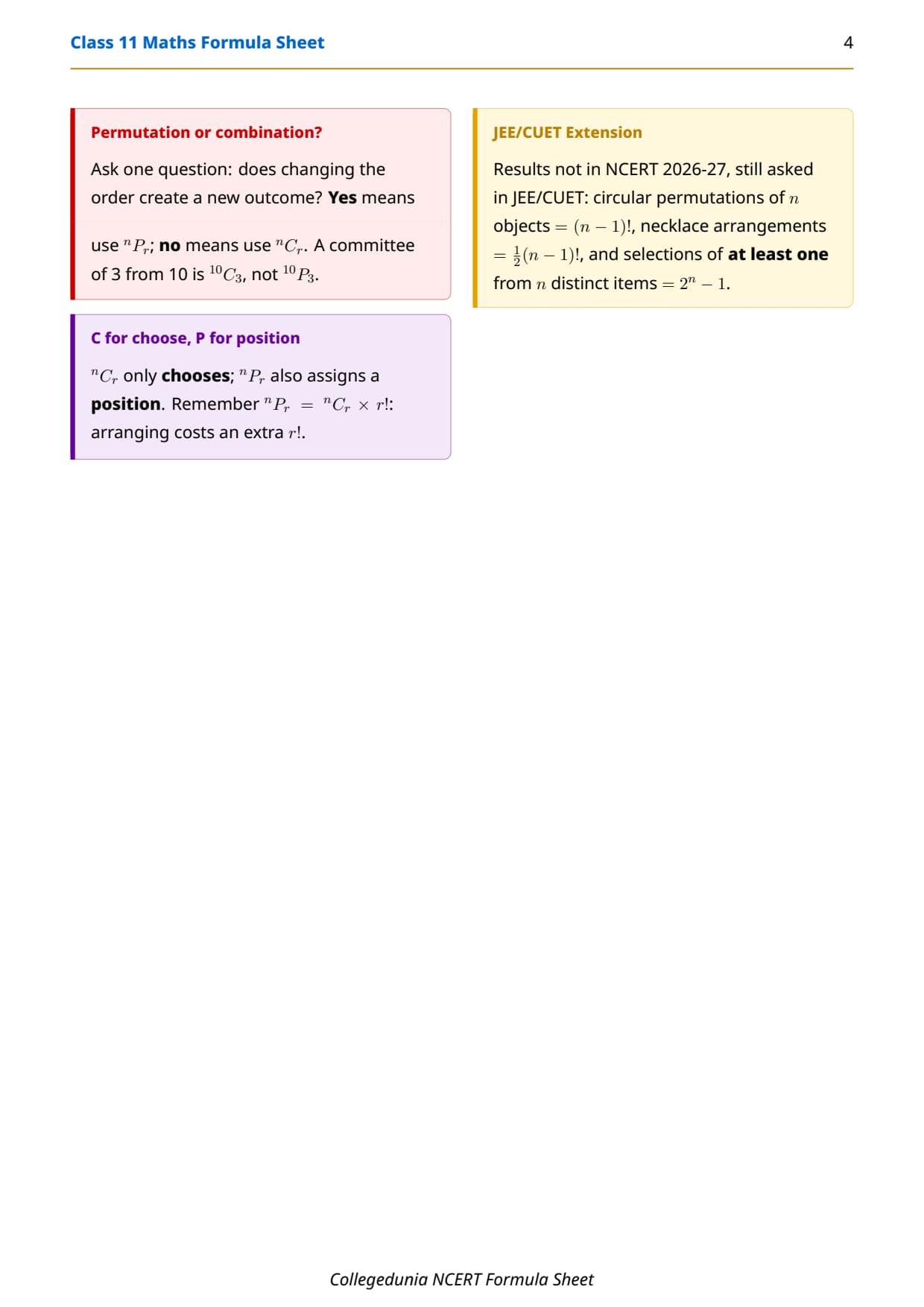
- Helps students decide quickly whether a problem needs a permutation or a combination.
This class 11 maths formula sheet chapter 6 permutations and combinations is curated by subject experts and checked against the 2026-27 NCERT and recent CBSE and JEE papers.
All Permutations and Combinations Formulas at a Glance
Every counting rule and formula sits in one table below, with its meaning. Learn the nPr and nCr rows first, since almost every objective question uses them.
| Formula | What it means | Condition |
|---|---|---|
| Total ways = m × n | Fundamental counting principle: two events in sequence multiply | Events happen one after the other |
| n! = n(n − 1)! | Factorial as a product of descending naturals | n is a natural number |
| 0! = 1 | Zero factorial, fixed by definition | Keeps nPr and nCr consistent |
| nPr = n! ⁄ (n − r)! | Permutations: arrange r of n distinct objects, order matters | 0 ≤ r ≤ n |
| nr | Permutations with repetition: each place keeps all n choices | Repetition allowed, r places |
| n! ⁄ (p1! p2! … pk!) | Arrangements when some objects are alike | p1, …, pk identical of each kind |
| nCr = n! ⁄ (r! (n − r)!) | Combinations: select r of n objects, order ignored | 0 ≤ r ≤ n |
Key Properties of nPr and nCr
These identities connect the two counts and let students simplify expressions fast. The link nPr = r! · nCr is the most tested, since it turns a selection into an arrangement.
| Property | Statement |
|---|---|
| Select then arrange | nPr = r! · nCr |
| Complementary rule | nCr = nCn−r |
| Pascal's rule | nCr + nCr−1 = n+1Cr |
| Boundary values | nC0 = nCn = 1; nC1 = n |
Factorials Quick Reference
Factorials grow fast, so keeping the small values ready saves time in the exam hall. The table below lists 0! to 8!, which cover almost every NCERT and Boards problem.
| Factorial | Value |
|---|---|
| 0! | 1 |
| 1! | 1 |
| 2! | 2 |
| 3! | 6 |
| 4! | 24 |
| 5! | 120 |
| 6! | 720 |
| 7! | 5040 |
| 8! | 40320 |
A permutation counts arrangements where order matters, while a combination counts selections where order does not, so nPr is always at least as large as nCr.
How to Revise Permutations and Combinations Formulas Before the Exam
This chapter rewards careful reading of the question over heavy calculation. A short, ordered revision keeps the arrangement and selection rules from blurring together.
- Fix the factorial values 0! to 8! in memory, since they appear inside almost every calculation.
- Write the nPr and nCr formulas from memory, then derive one from the other using nPr = r! · nCr.
- For every practice problem, ask does the order matter before choosing a permutation or a combination.
- Practise the repeated-object rule n! ⁄ (p1! p2! …) on words like ALLAHABAD and INDEPENDENCE.
Student Feedback on the Permutations and Combinations Formula Sheet
In a survey of 1,150 Class 11 students who used this sheet during revision, 79% said the single-page formula table cut their revision time before unit tests. Toppers reported that repeatedly asking "does order matter?" made the choice between nPr and nCr automatic by the Boards.
Other Permutations and Combinations Class 11 Maths Resources
Pair this formula sheet with the solved answers, notes and textbook PDF.
| Resource | Link |
|---|---|
| NCERT Solutions | Permutations and Combinations Class 11 NCERT Solutions |
| Revision Notes | Permutations and Combinations Class 11 Notes |
| Handwritten Notes | Permutations and Combinations Class 11 Handwritten Notes |
| NCERT Book PDF | Permutations and Combinations Class 11 Book PDF |
NCERT Formula Sheet for Class 11 Maths: All Chapters
Revise every chapter from one place. Each link opens the formula sheet for that chapter.
| Chapter | Formula Sheet |
|---|---|
| Chapter 1 | Sets |
| Chapter 2 | Relations and Functions |
| Chapter 3 | Trigonometric Functions |
| Chapter 4 | Complex Numbers and Quadratic Equations |
| Chapter 5 | Linear Inequalities |
| Chapter 6 | Permutations and Combinations |
| Chapter 7 | Binomial Theorem |
| Chapter 8 | Sequences and Series |
| Chapter 9 | Straight Lines |
| Chapter 10 | Conic Sections |
| Chapter 11 | Introduction to Three Dimensional Geometry |
| Chapter 12 | Limits and Derivatives |
| Chapter 13 | Statistics |
| Chapter 14 | Probability |
FAQs on Permutations and Combinations Class 11 Maths Formula Sheet
Permutations and Combinations Formula Sheet - Frequently Asked Questions
Ques. What formulas does the class 11 maths formula sheet chapter 6 permutations and combinations cover?
Ans. This class 11 maths formula sheet chapter 6 permutations and combinations covers the fundamental principle of counting, factorial notation with 0! = 1, the permutation formula nPr = n! ⁄ (n − r)!, arrangements with repetition nr and alike objects n! ⁄ (p1! p2! …), and the combination formula nCr = n! ⁄ (r! (n − r)!) with its key properties.
Ques. What is the difference between a permutation and a combination?
Ans. A permutation counts arrangements where the order matters, so ranking or seating uses nPr. A combination counts selections where the order does not matter, so choosing a team or committee uses nCr. The two are linked by nPr = r! · nCr.
Ques. Why is 0! equal to 1?
Ans. By definition 0! = 1. This value is fixed so that the recursive relation n! = n(n − 1)! still holds at n = 1, and so that nPn = n! and nC0 = 1 come out correctly.
Ques. Are circular permutations part of the Class 11 NCERT chapter?
Ans. Circular permutations of n objects, given by (n − 1)!, are beyond the current NCERT 2026-27 chapter and are a JEE and CUET extension. The Class 11 syllabus focuses on the linear permutation formula nPr and the combination formula nCr.



Comments