


About 5 to 7 marks per CBSE Social Science board paper come from Minerals and Energy Resources, Chapter 5 of Contemporary India II.
Chapter5MineralsandEnergyResourcesHandwrittenNotes.pdf?page=1&dpi=150)
Chapter5MineralsandEnergyResourcesHandwrittenNotes.pdf?page=2&dpi=150)
Chapter5MineralsandEnergyResourcesHandwrittenNotes.pdf?page=3&dpi=150)
Chapter5MineralsandEnergyResourcesHandwrittenNotes.pdf?page=4&dpi=150)
Chapter5MineralsandEnergyResourcesHandwrittenNotes.pdf?page=5&dpi=150)
Chapter5MineralsandEnergyResourcesHandwrittenNotes.pdf?page=6&dpi=150)
Chapter5MineralsandEnergyResourcesHandwrittenNotes.pdf?page=7&dpi=150)
Chapter5MineralsandEnergyResourcesHandwrittenNotes.pdf?page=8&dpi=150)
Chapter5MineralsandEnergyResourcesHandwrittenNotes.pdf?page=9&dpi=150)
Chapter5MineralsandEnergyResourcesHandwrittenNotes.pdf?page=10&dpi=150)
Chapter5MineralsandEnergyResourcesHandwrittenNotes.pdf?page=11&dpi=150)
Chapter5MineralsandEnergyResourcesHandwrittenNotes.pdf?page=12&dpi=150)
Chapter5MineralsandEnergyResourcesHandwrittenNotes.pdf?page=13&dpi=150)
Chapter5MineralsandEnergyResourcesHandwrittenNotes.pdf?page=14&dpi=150)
Chapter5MineralsandEnergyResourcesHandwrittenNotes.pdf?page=15&dpi=150)
Chapter5MineralsandEnergyResourcesHandwrittenNotes.pdf?page=16&dpi=150)
Chapter5MineralsandEnergyResourcesHandwrittenNotes.pdf?page=17&dpi=150)
Chapter5MineralsandEnergyResourcesHandwrittenNotes.pdf?page=18&dpi=150)
Chapter5MineralsandEnergyResourcesHandwrittenNotes.pdf?page=19&dpi=150)
Chapter5MineralsandEnergyResourcesHandwrittenNotes.pdf?page=20&dpi=150)
These class 10 geography handwritten notes chapter 5 Minerals and Energy Resources turn the whole chapter into clean, scanned notebook pages for fast revision, set to the 2026-27 CBSE syllabus.
- Scanned, pen-on-paper pages with boxed key terms, a minerals classification tree and an iron-ore belts table.
- One of the higher-weightage Class 10 Geography chapters, often carrying a Long Answer plus a map-marking question.
- Pairs with the NCERT Solutions, Notes and Book PDF for the same chapter, all linked lower on this page.
These notes are prepared from the official NCERT Contemporary India II textbook and checked against the last five years of CBSE board papers.
What These Handwritten Notes Include
Minerals and Energy Resources is the fifth chapter of Contemporary India II. It covers what a mineral is, how minerals occur and are classified, the major minerals, and the energy resources of India. These notes condense all of it into pages a student can read in one sitting. Every page is built around the four threads the board paper tests:
- Mineral basics: the definition, mode of occurrence in veins and lodes, and the metallic, non-metallic and energy classification.
- Metallic minerals: ferrous iron ore and manganese, plus non-ferrous copper and bauxite with producing states.
- Non-metallic minerals: mica and limestone with their uses and source regions.
- Energy resources: coal, petroleum, natural gas, electricity and the non-conventional sources.
Key terms sit in boxes and mineral names are underlined. That makes these minerals and energy resources handwritten notes ideal for a last revision.
What Is a Mineral and Classification Pages
The first pages keep the mineral definition and its classification side by side, because the board picks a question straight from this list. Each class sits in its own box with sub-types and examples.
| Class of mineral | Sub-types and examples |
|---|---|
| Metallic (ferrous) | Contain iron; iron ore, manganese, nickel, cobalt. |
| Metallic (non-ferrous) | No iron; copper, bauxite, lead, zinc and gold. |
| Metallic (precious) | Gold, silver and platinum. |
| Non-metallic | Mica, salt, potash, sulphur, granite, limestone, marble and sandstone. |
| Energy minerals | Coal, petroleum and natural gas. |
The pages box the key fact in red ink: a mineral is a homogeneous, naturally occurring substance with a definable internal structure. A small arrow notes that smaller occurrences are called veins and larger ones are lodes.
Ferrous Minerals and Iron Ore Belts Pages
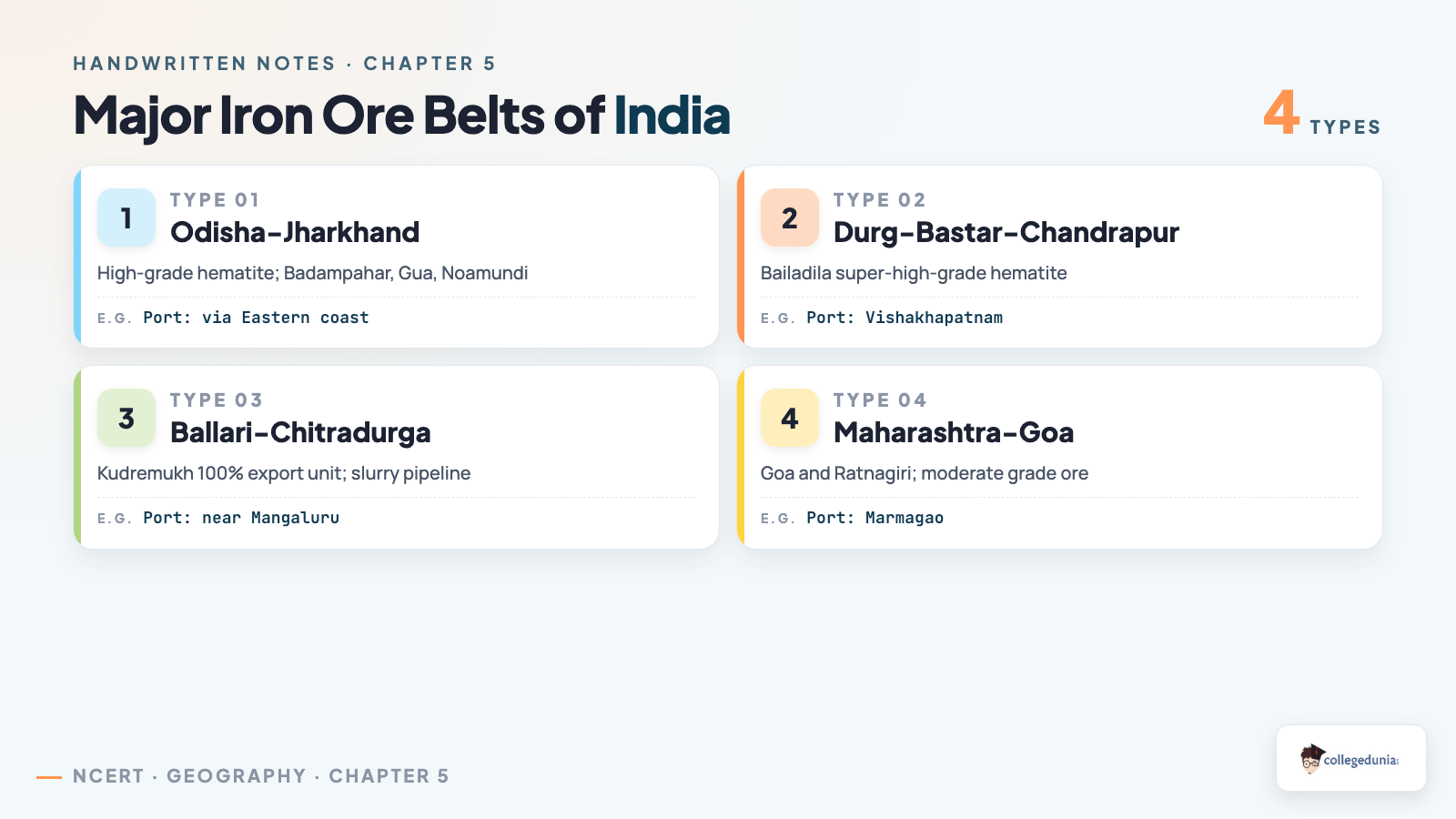
These pages keep the four major iron ore belts in order, because the board often asks students to link a mine to its port. The magnetite and hematite types come first, then the belts and their export ports.
| Iron ore belt | States, mines and export port |
|---|---|
| Odisha-Jharkhand belt | High-grade hematite at Badampahar (Mayurbhanj), Kendujhar, Gua and Noamundi (Singhbhum). |
| Durg-Bastar-Chandrapur belt | Chhattisgarh and Maharashtra; Bailadila hematite exported to Japan via Vishakhapatnam. |
| Ballari-Chitradurga belt | Karnataka; Kudremukh, a full export unit; ore piped as slurry to a port near Mangaluru. |
| Maharashtra-Goa belt | Goa and Ratnagiri; moderate-grade ore exported through Marmagao port. |
The pages box the most-asked iron fact: magnetite is the finest iron ore with up to 70 per cent iron, while hematite, with 50 to 60 per cent iron, is the most widely used ore. A margin note adds that nearly 10 kg of manganese is needed per tonne of steel.
Minerals and Energy Resources Class 10 Explained by Magnet Brains
Source: Magnet Brains on YouTube
Non-Ferrous and Non-Metallic Minerals Pages
The non-ferrous and non-metallic pages are the heart of the producing-states question, so each mineral gets one box with its use and top producing states.
- Copper: India is deficient; malleable, ductile, a good conductor; used in cables and electronics; Balaghat (MP), Khetri (Rajasthan) and Singhbhum (Jharkhand) lead.
- Bauxite: the ore of aluminium; Odisha leads with about 65 per cent from the Panchpatmali-Koraput area.
- Mica: splits into thin sheets, has excellent di-electric strength; vital in electric and electronic work; Koderma (Jharkhand) leads.
- Limestone: a calcium-carbonate rock; the raw material for cement and essential for smelting iron ore in the blast furnace.
The notes box the most-asked use fact: aluminium combines the strength of iron with lightness, good conductivity and malleability, which is why bauxite matters. A margin arrow reminds students that Koderma in Jharkhand leads in mica production.
Energy Resources and Conservation Pages
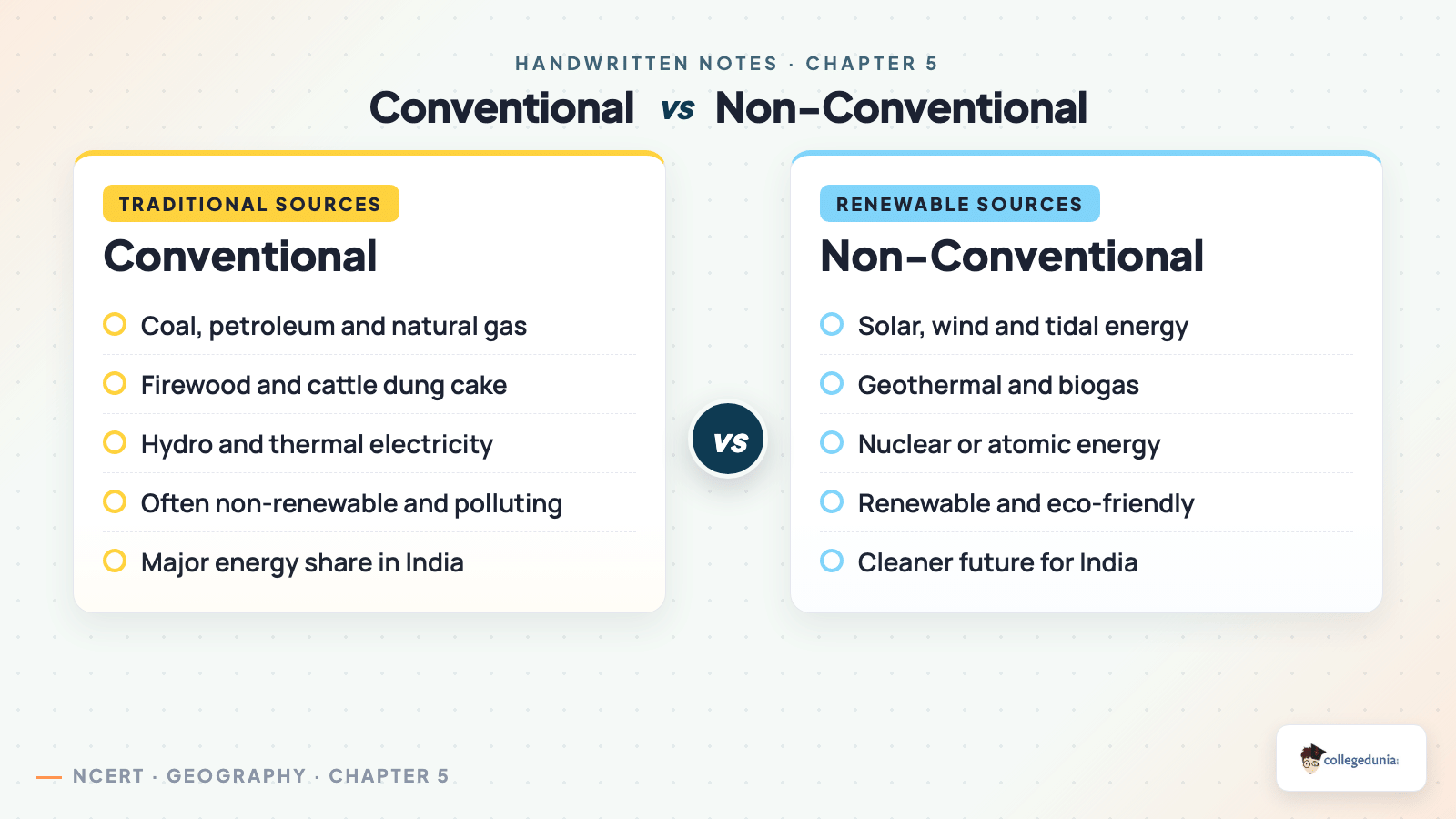
These pages keep the energy story in order, because the board pairs the source with its example. The notes split conventional from non-conventional first, then list each source in its own box.
- Coal: the most abundant fossil fuel in India; grades run from peat and lignite (Neyveli) to bituminous and anthracite; Gondwana coal of the Damodar valley (Jharia, Raniganj, Bokaro) is metallurgical.
- Petroleum and natural gas: found in anticlines and fault traps; Mumbai High, Gujarat (Ankleshwar) and Assam (Digboi) are the main fields; the HVJ pipeline carries gas.
- Electricity: generated as hydro power (Bhakra Nangal, Damodar Valley) and thermal power from coal, petroleum and gas.
- Non-conventional sources: nuclear (uranium, thorium), solar, wind (Nagarcoil to Madurai cluster), tidal, geothermal and biogas.
The notes box the conservation message: minerals are finite and non-renewable, so they must be used in a planned, sustainable way, with recycling of metals and use of low-grade ores. A margin note closes with the line that energy saved is energy produced.
How to Use These Handwritten Notes
Handwritten notes work best as a final layer of revision, not as a first read. The plan below helps students get the most out of the class 10 geography handwritten notes chapter 5 Minerals and Energy Resources.
- First pass: read the notes once in the mineral, ore belt, energy source and conservation order.
- Active recall: cover the boxed mine names and write each iron ore belt with its export port from memory.
- Map practice: redraw the mineral-region sketch and mark the iron ore mines, coal fields and oil fields.
- Self-test: attempt a short class 10 geography chapter 5 mcq drill to check the small facts.
Because the pages are scanned, students can save them on a phone and revise offline on the way to the exam centre. Many search for minerals and energy resources class 10 notes the night before a test, so a saved PDF keeps revision at hand.
Common Mistakes These Notes Help You Avoid
A few errors cost marks in this chapter every year. Most come from mixing up the iron-ore types or matching a mineral to the wrong region.
- Swapping veins and lodes - veins are smaller, lodes are larger.
- Saying hematite has the highest iron content - magnetite has up to 70 per cent iron, but hematite is the most used ore.
- Calling coal a non-conventional source - coal, petroleum and gas are conventional fossil fuels.
- Forgetting that bauxite is the ore of aluminium, not a finished metal.
- Confusing ferrous with non-ferrous - iron ore and manganese are ferrous; copper, bauxite and gold are non-ferrous.
Students who fix these five points usually move from average to high marks. The exam rewards a clear mineral-and-region answer.
Student Feedback
In a Collegedunia poll of 12,100 Class 10 Social Science students before the 2026 boards, 81% of students said the scanned iron-ore belts table and the minerals classification tree were the fastest way to revise this chapter.
Source: 2026-27 Class 10 Social Science student poll. Sample of 12,100 students from CBSE schools across 15 states.
Other Resources for Minerals and Energy Resources Class 10 Geography
These handwritten notes are a revision layer. Use them with the other resources below.
| Resource | Best used for |
|---|---|
| Minerals and Energy Resources NCERT Solutions | Step-by-step answers to every back-exercise question |
| Minerals and Energy Resources Class 10 Notes | Quick chapter summary in one place |
| Minerals and Energy Resources NCERT Book PDF | Original NCERT text, mineral maps and figures |
Tip: use the handwritten mineral-region sketch to memorise which mineral comes from where. Drawing the map once from memory fixes the map-work answer.
All Class 10 Geography Handwritten Notes by Chapter
The table links the handwritten notes for every Class 10 Geography chapter. Minerals and Energy Resources is highlighted.
| Chapter | Handwritten Notes |
|---|---|
| Chapter 1 | Resources and Development |
| Chapter 2 | Forest and Wildlife Resources |
| Chapter 3 | Water Resources |
| Chapter 4 | Agriculture |
| Chapter 5 | Minerals and Energy Resources |
| Chapter 6 | Manufacturing Industries |
| Chapter 7 | Lifelines of National Economy |
Minerals and Energy Resources Class 10 Handwritten Notes Common Questions
Ques. Where can I download the Minerals and Energy Resources handwritten notes PDF?
Ans. You can download the Minerals and Energy Resources handwritten notes PDF directly from this page. It is free, follows the 2026-27 NCERT, and gives the chapter as clean scanned notebook pages with boxed mineral names, an iron-ore belts table and an India mineral-region sketch.
Ques. Are handwritten notes good enough for the class 10 geography board exam?
Ans. Yes, for revision. Handwritten notes are best used as a final layer after you have read the chapter and practised the solutions. They make the mineral classification, the iron ore belts and the energy sources quick to recall in the exam.
Ques. What does the Minerals and Energy Resources chapter cover?
Ans. It covers what a mineral is, the mode of occurrence in veins and lodes, the classification into metallic, non-metallic and energy minerals, the major minerals such as iron ore, manganese, copper, bauxite, mica and limestone, and the conventional and non-conventional energy resources of India.
Ques. What is the difference between magnetite and hematite in class 10 geography?
Ans. Magnetite is the finest iron ore with up to 70 per cent iron and excellent magnetic quality. Hematite has a slightly lower iron content of 50 to 60 per cent but is the most widely used ore industrially. Magnetite leads in iron content while hematite leads in use.
Ques. How should I use these notes for quick revision?
Ans. Read the pages once in the mineral, ore belt, energy source and conservation order, cover the boxed mine names and write each iron ore belt with its export port from memory, redraw the India mineral-region sketch, then attempt a short class 10 geography chapter 5 mcq drill to test the small facts.



Comments