


Class 10 Maths Chapter 14 Probability carries about 3 to 4 marks in the CBSE Board exam and closes the Statistics and Probability unit. These class 10 maths handwritten notes chapter 14 Probability cover theoretical probability, sure and impossible events, complementary events, and quick coin, dice, and card sums in a hand-drawn revision style.
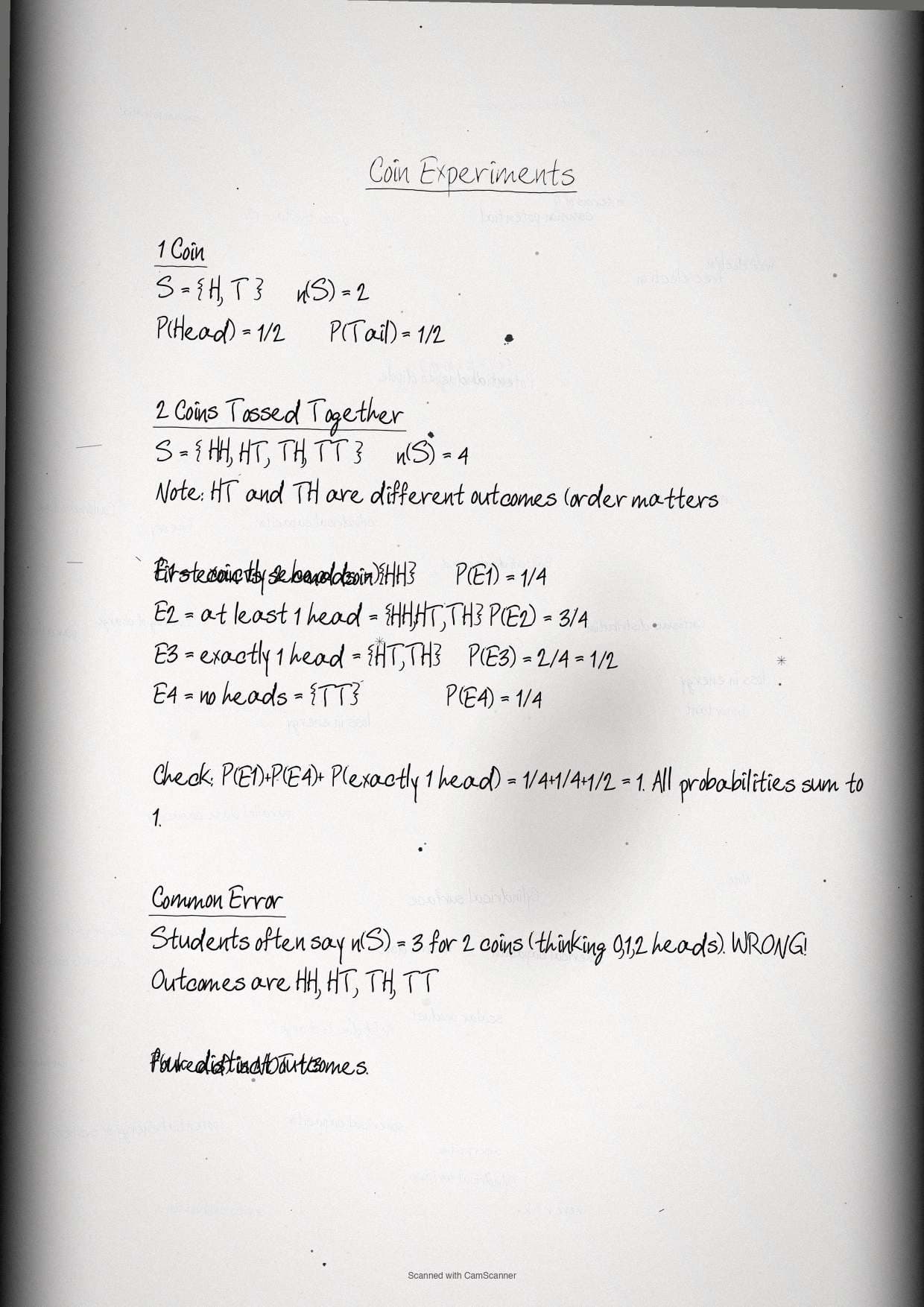
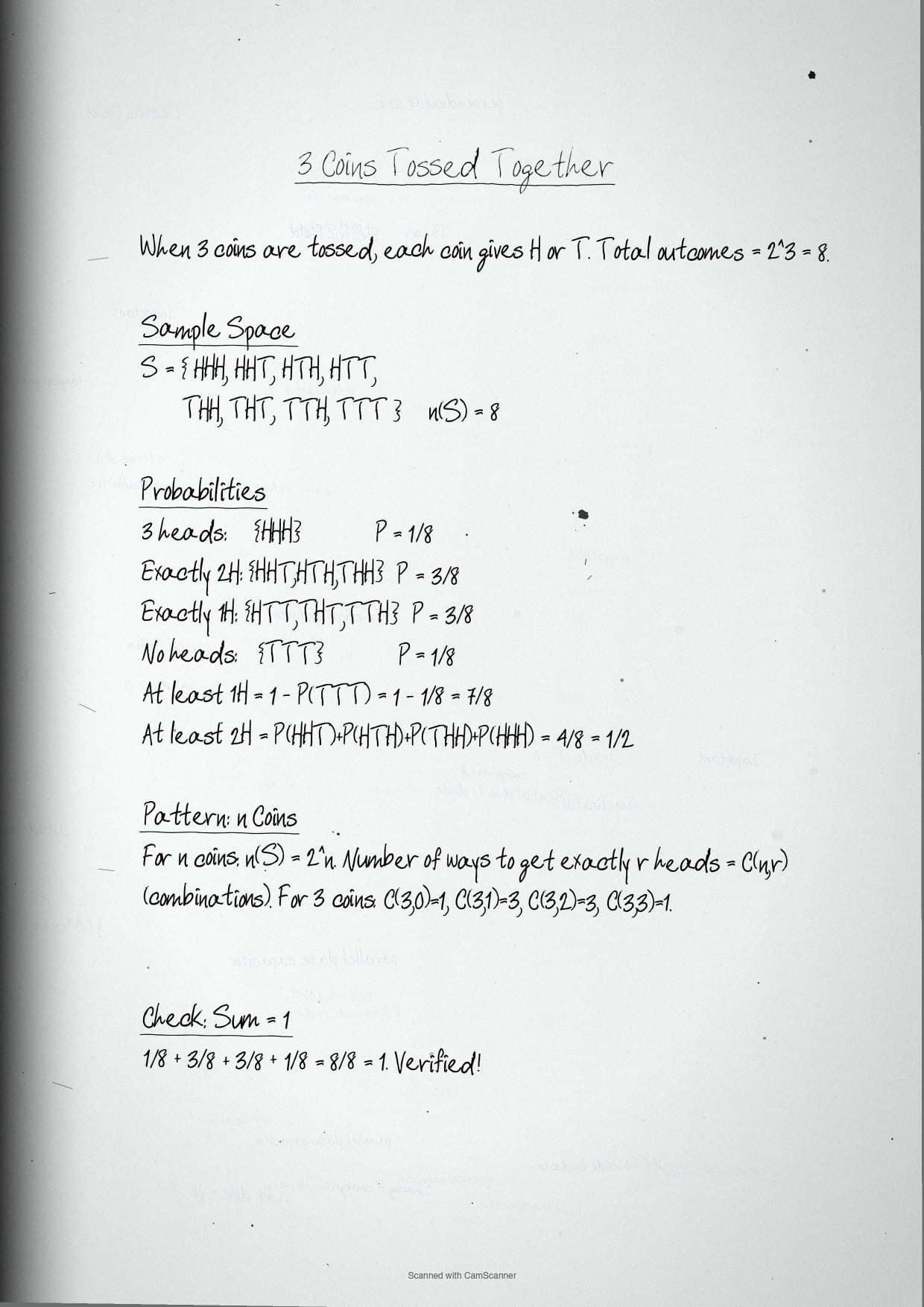
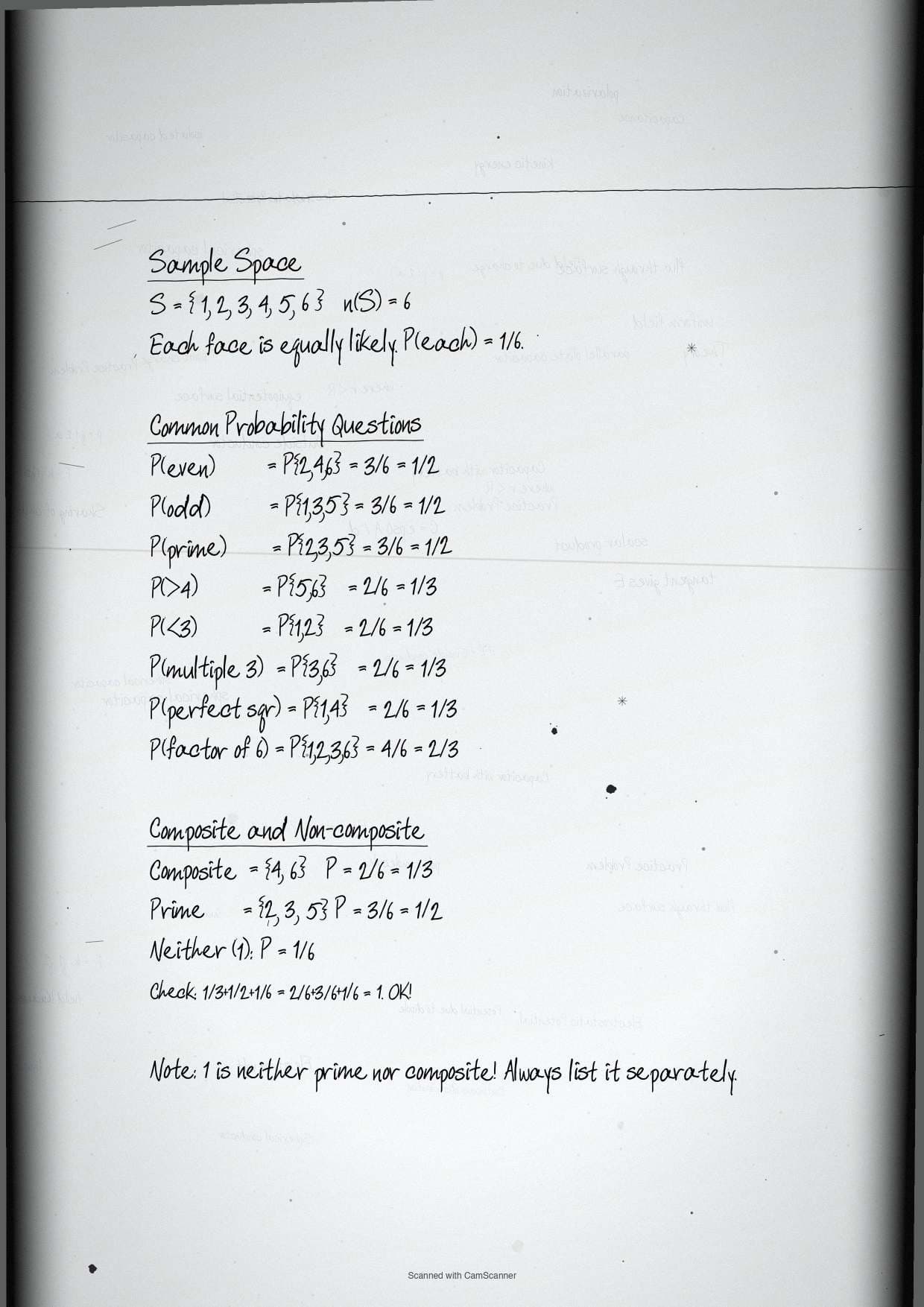
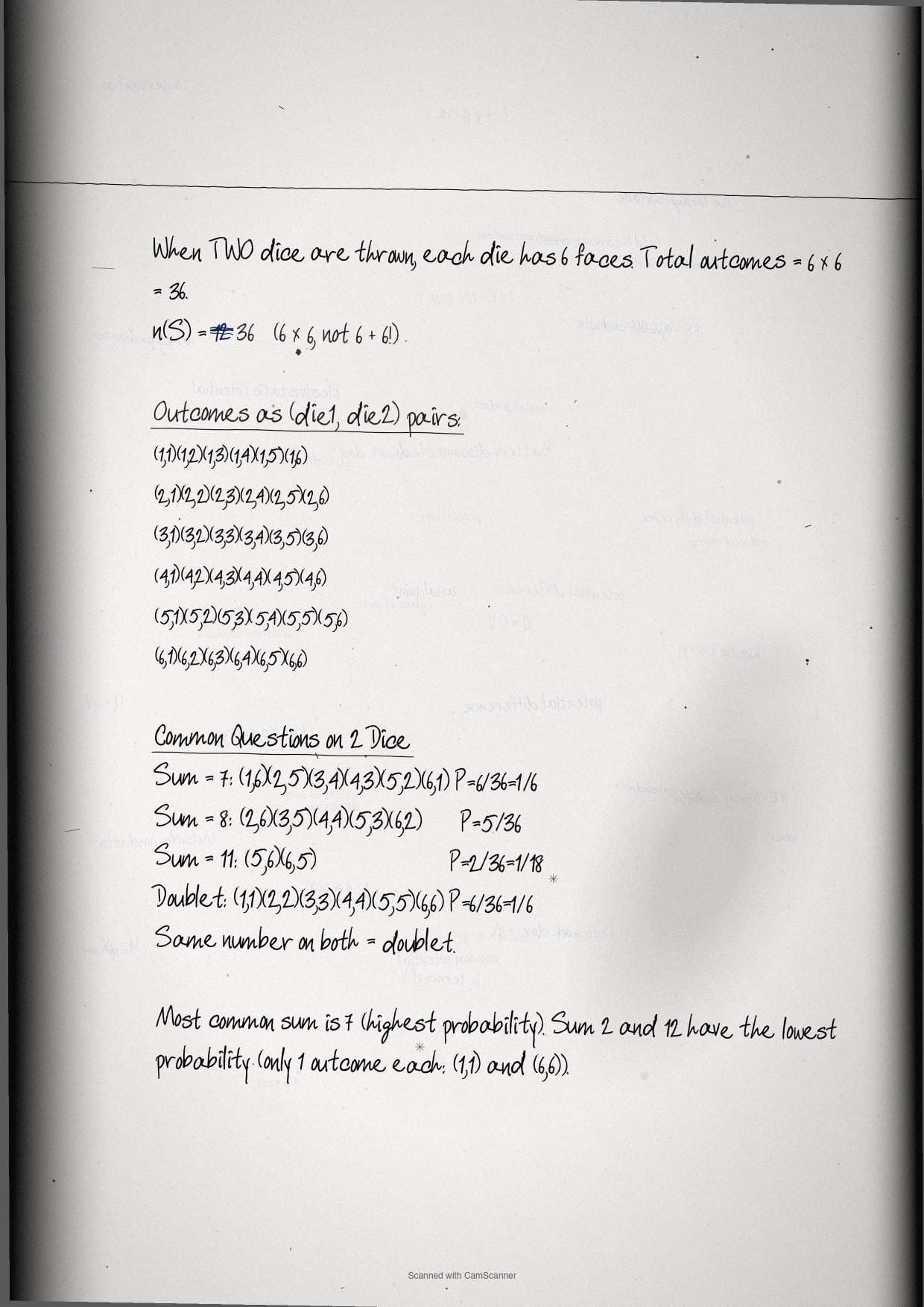
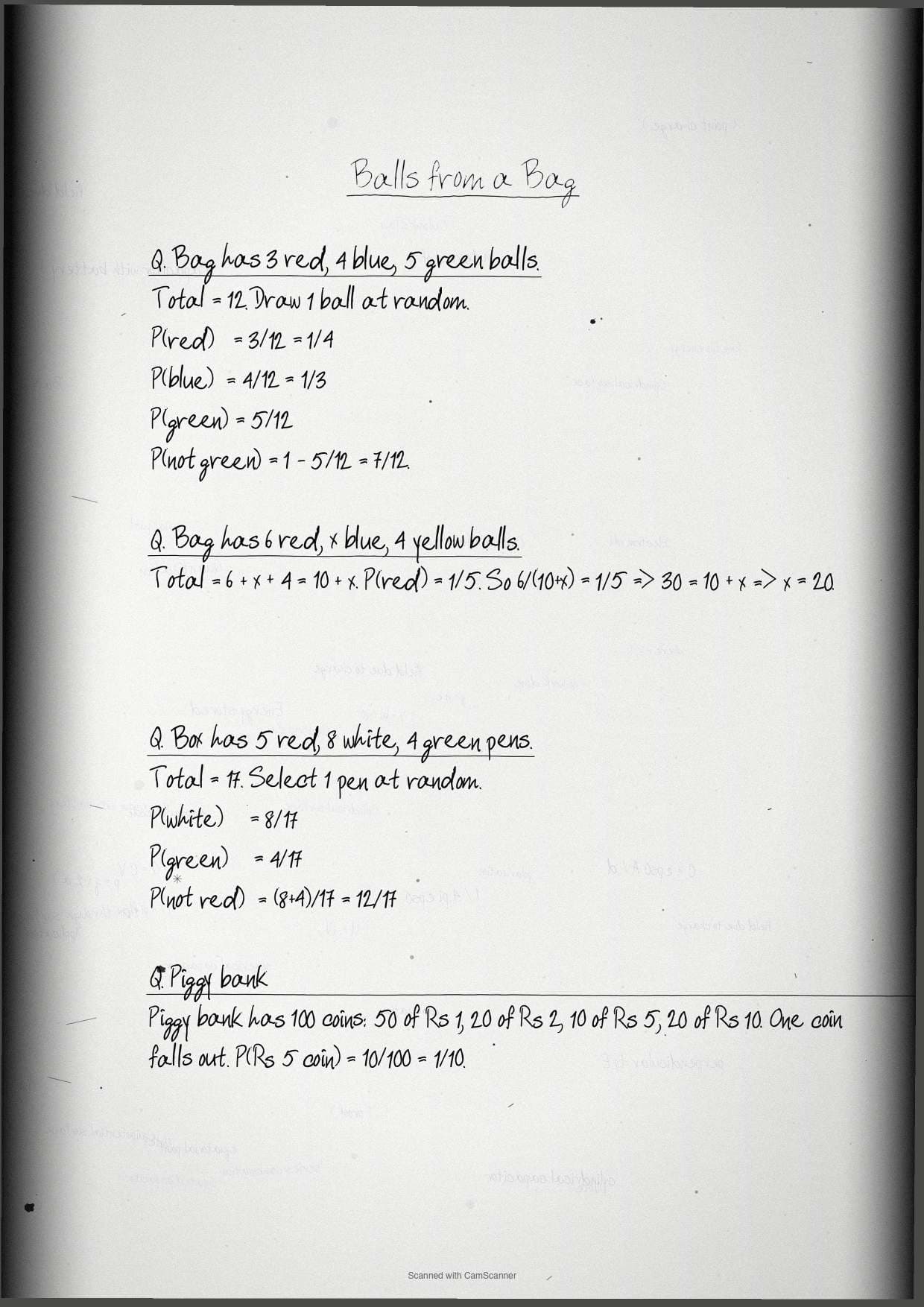
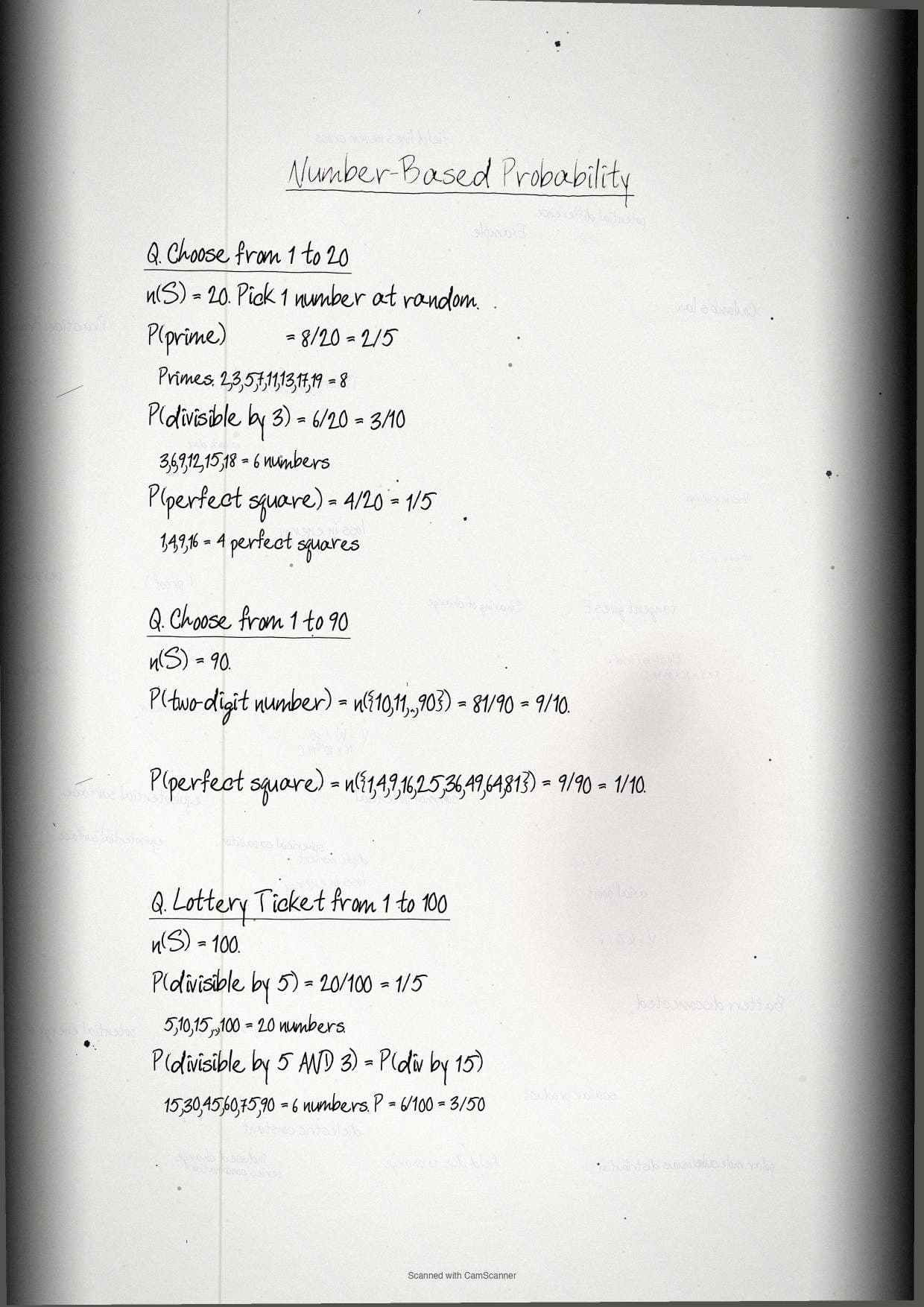
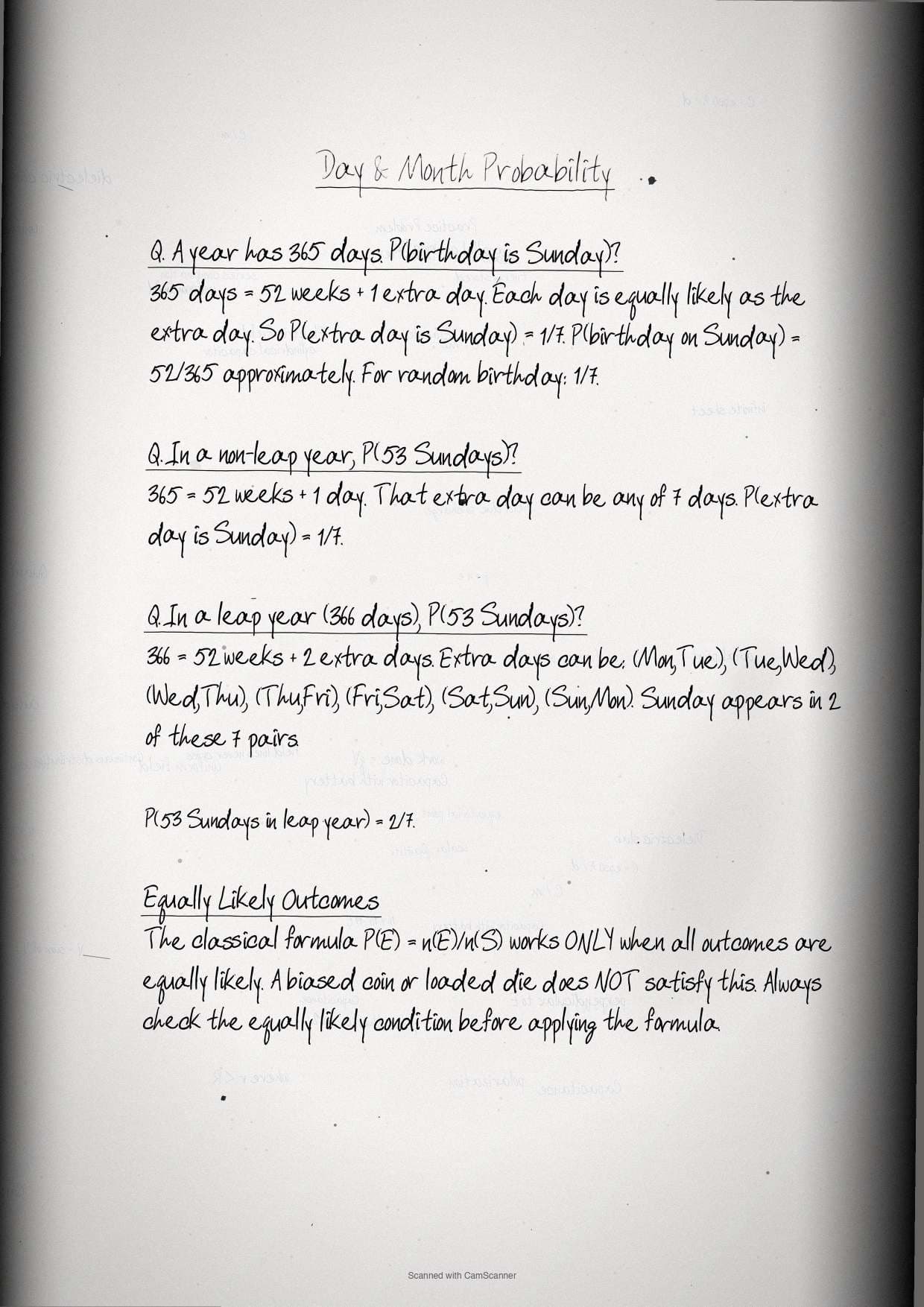
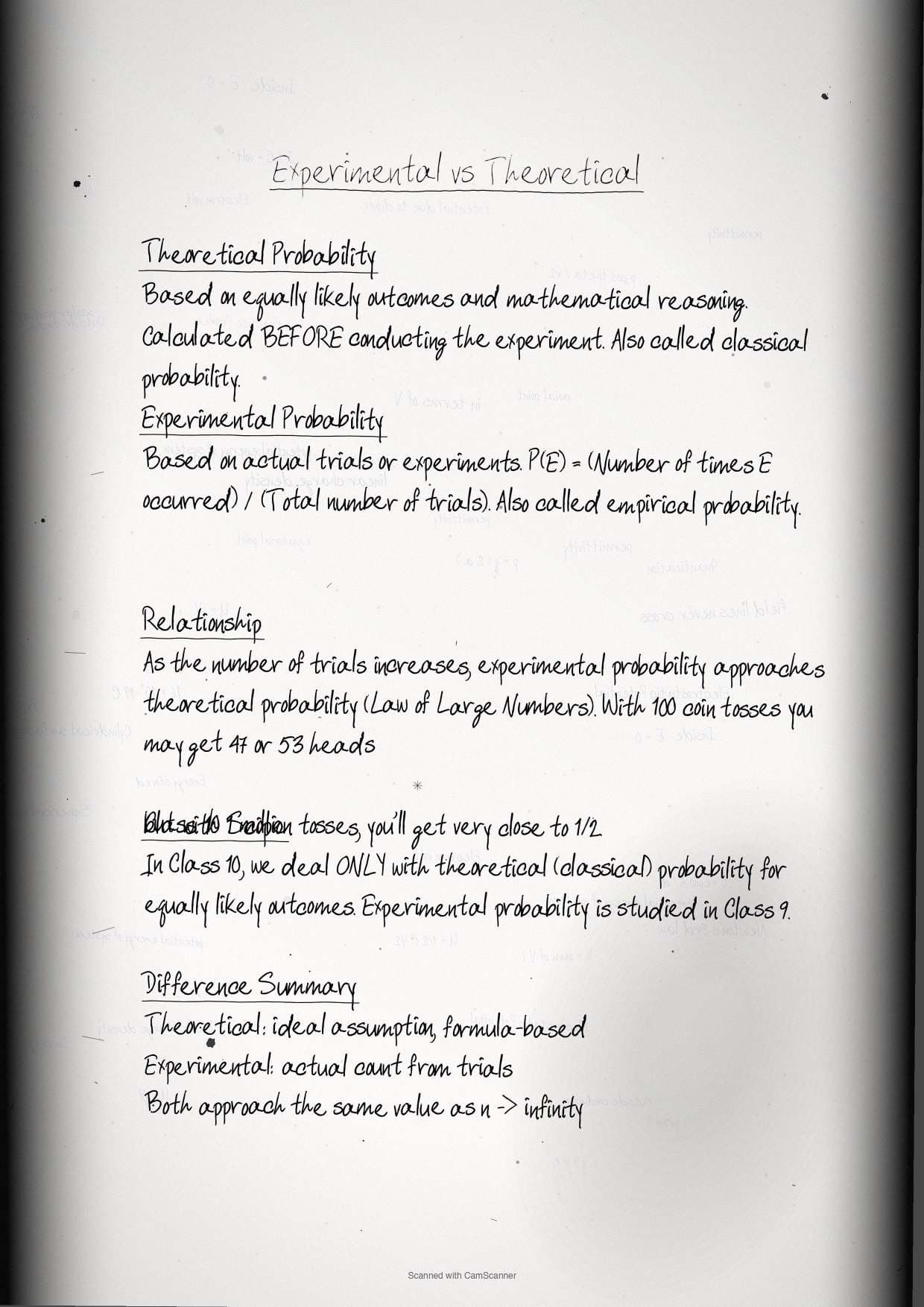
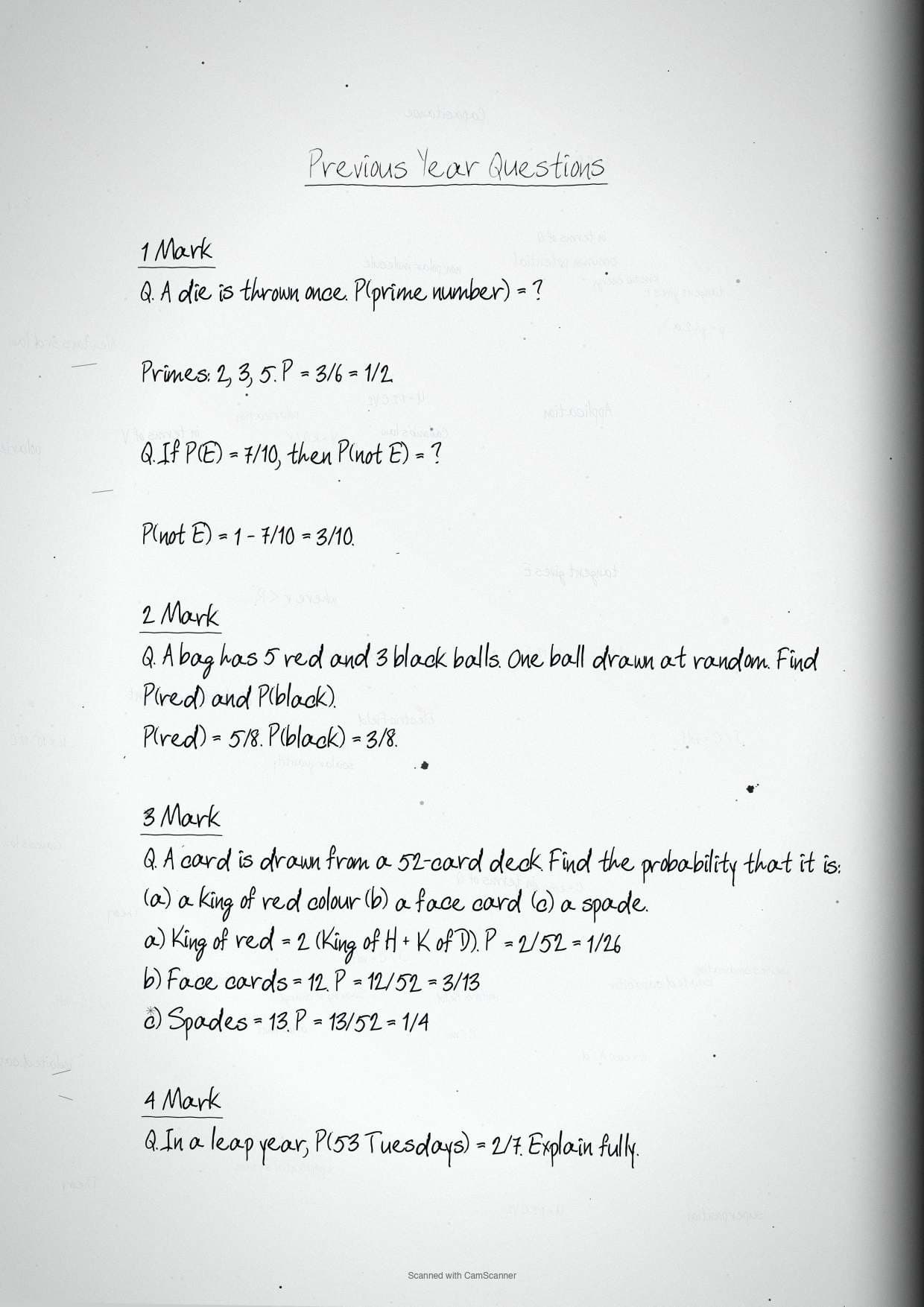
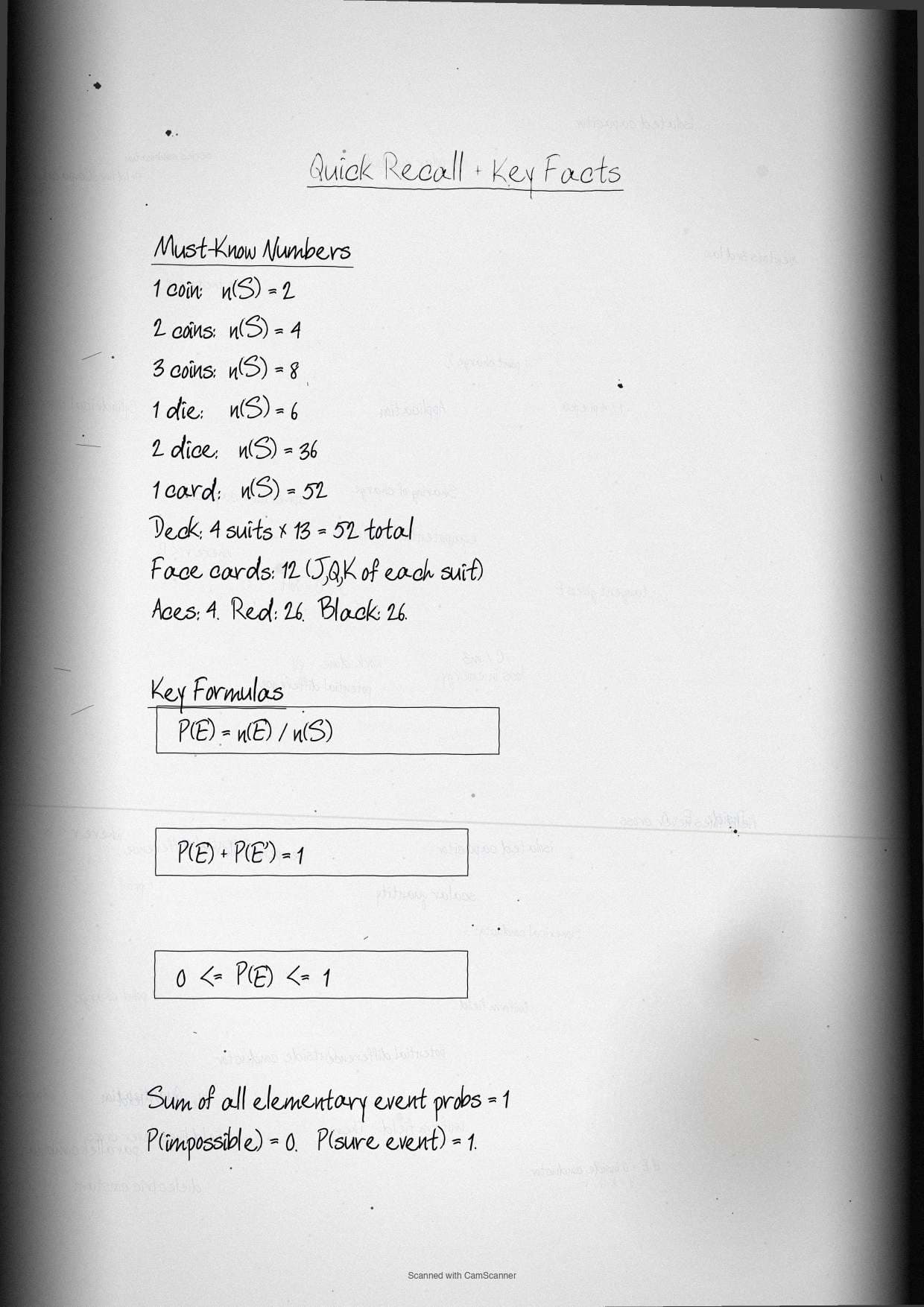
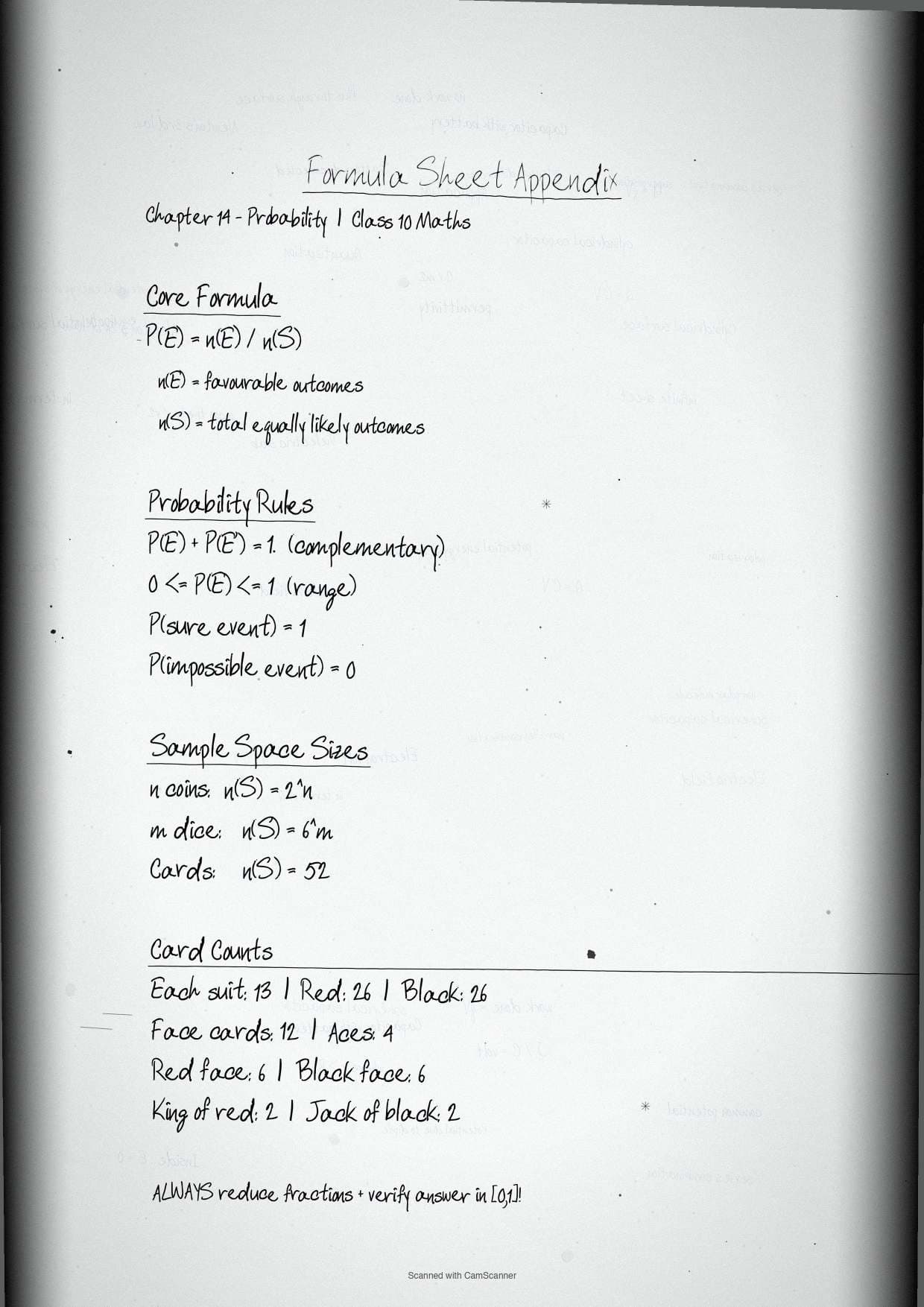
- CBSE Board: about 3 to 4 marks, usually one short coin or dice sum plus one card or complementary-event problem
- JEE Main: rarely a direct question, but the classical probability idea seeds later permutation and combination work
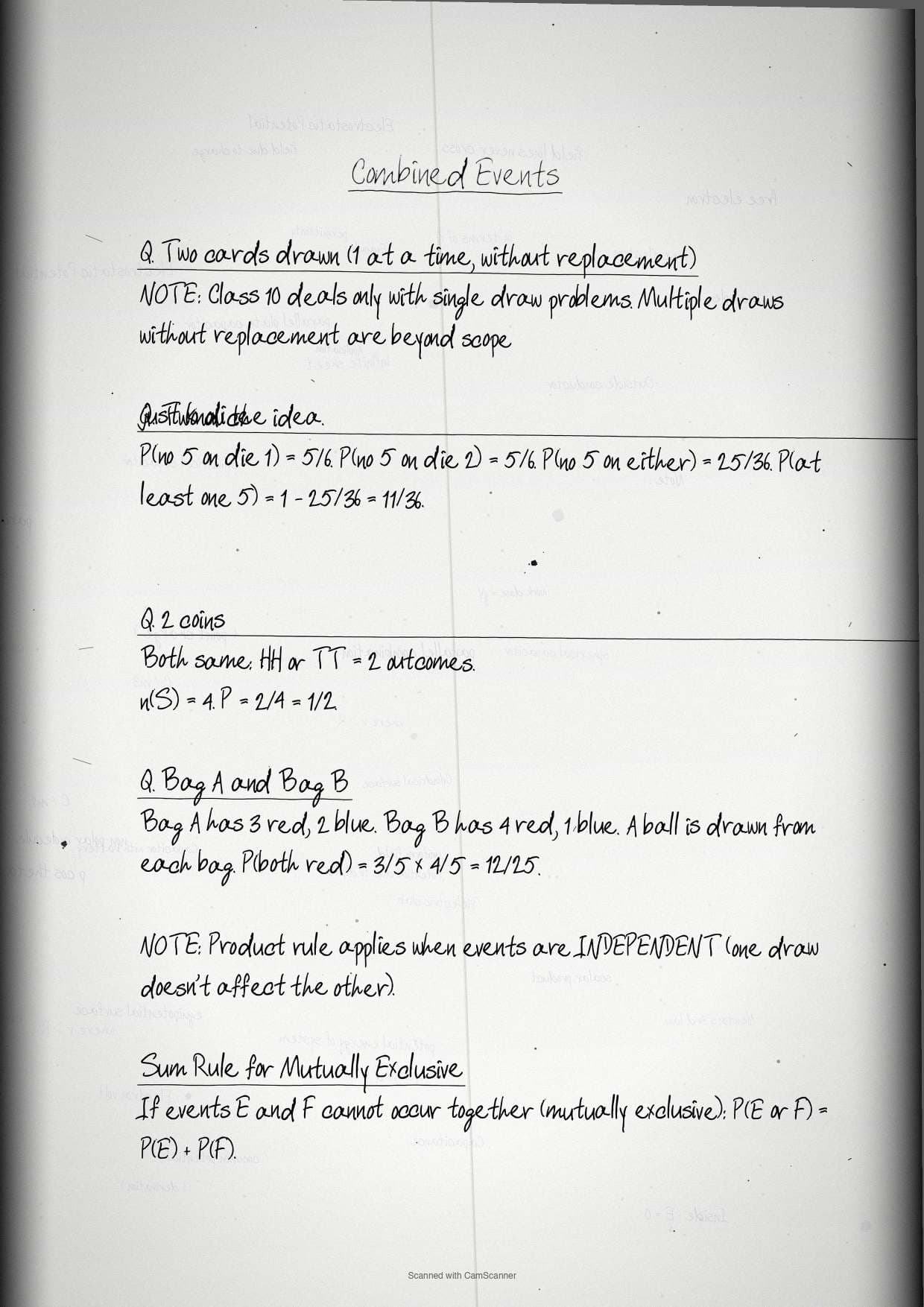
The handwritten notebook below opens with the diagram list, walks through the classical formula and the sure or impossible cases, then closes with a night-before-exam recall card.
These notes are prepared by Collegedunia subject mentors, matched to the 2026-27 NCERT print and recent CBSE Board papers.
|
Table of Contents |
Watch Probability Class 10 Maths Chapter 14 Explained
Source: Magnet Brains on YouTube
Probability Handwritten Notes: Complete Diagram List for Class 10 Maths
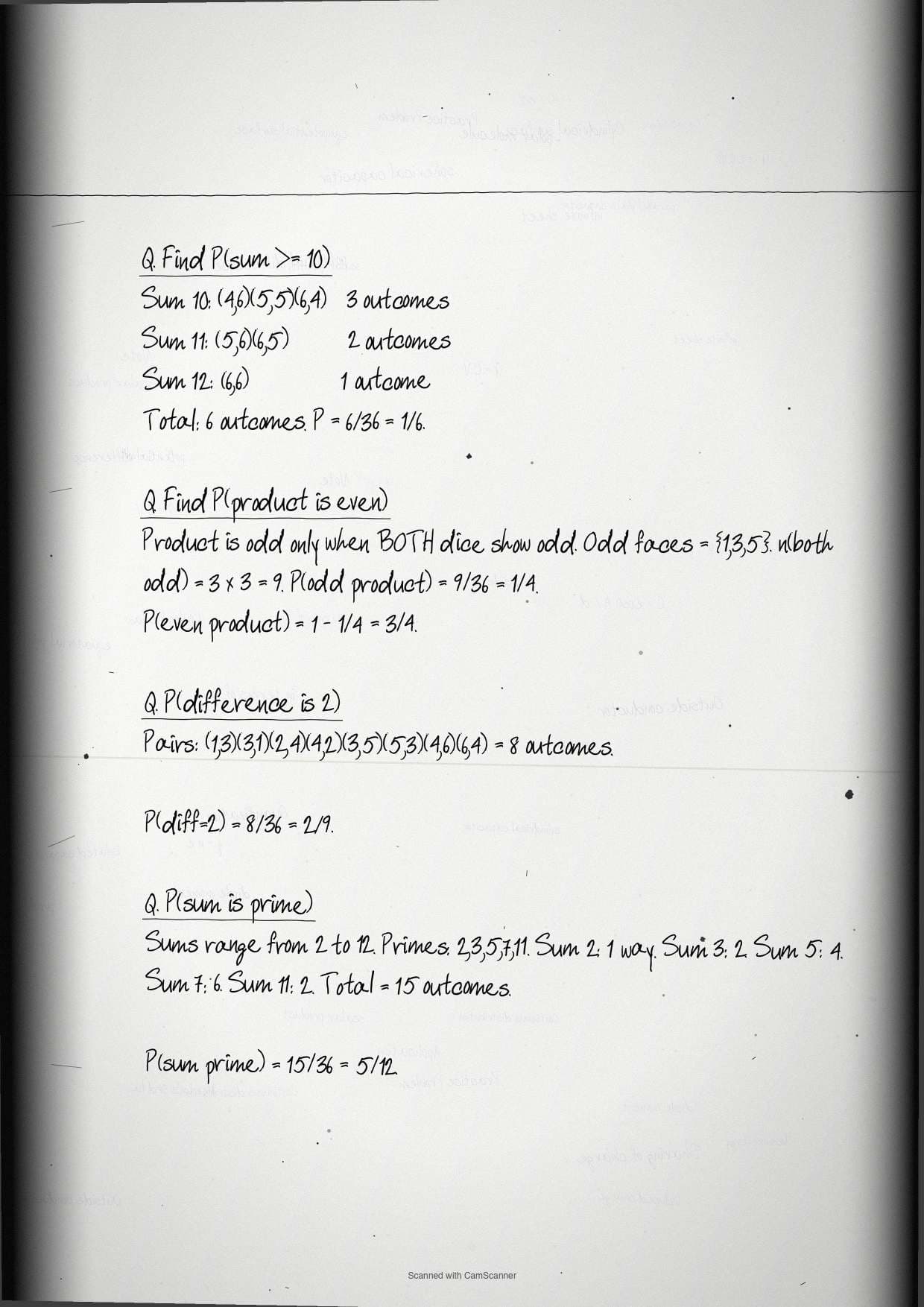
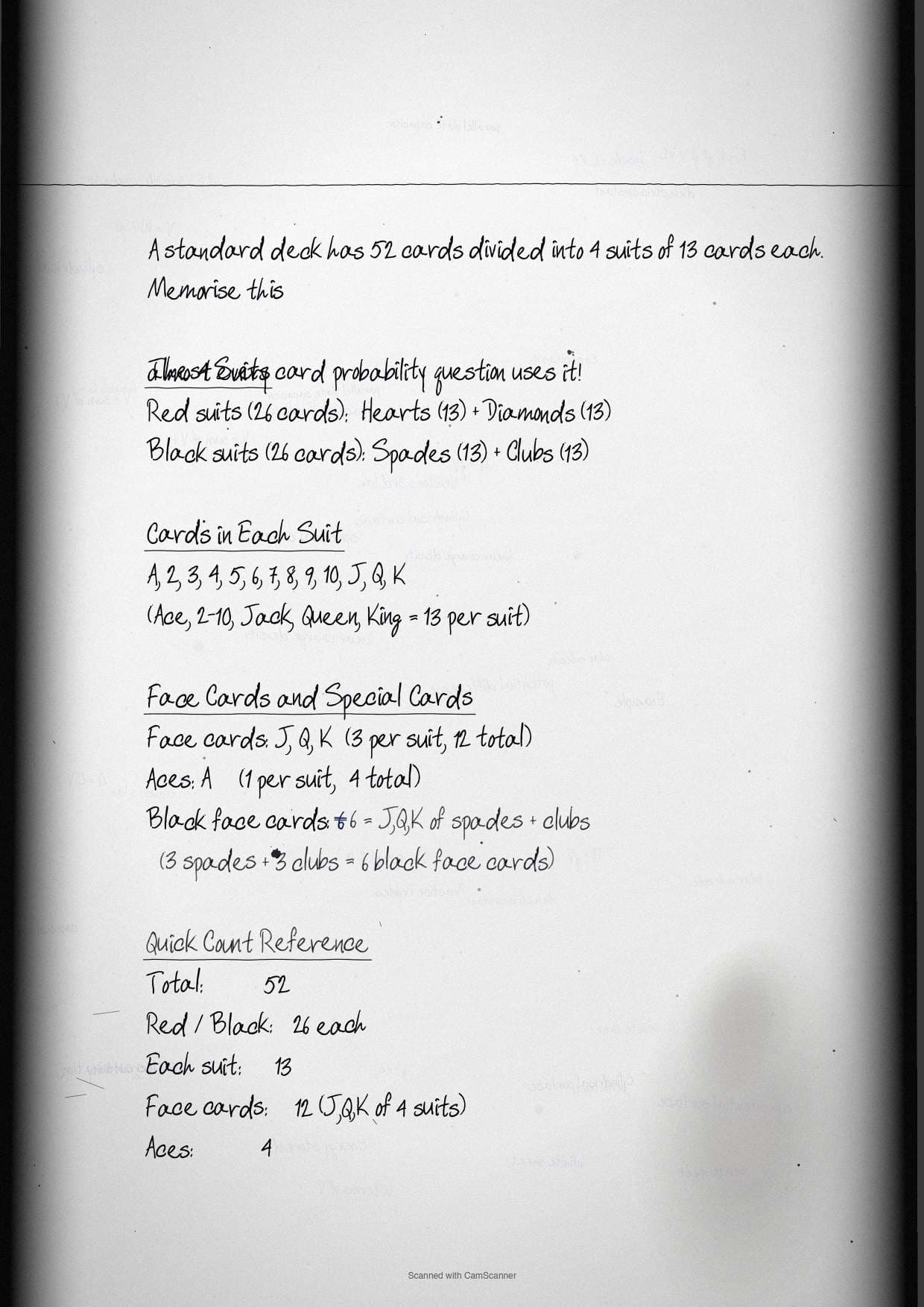
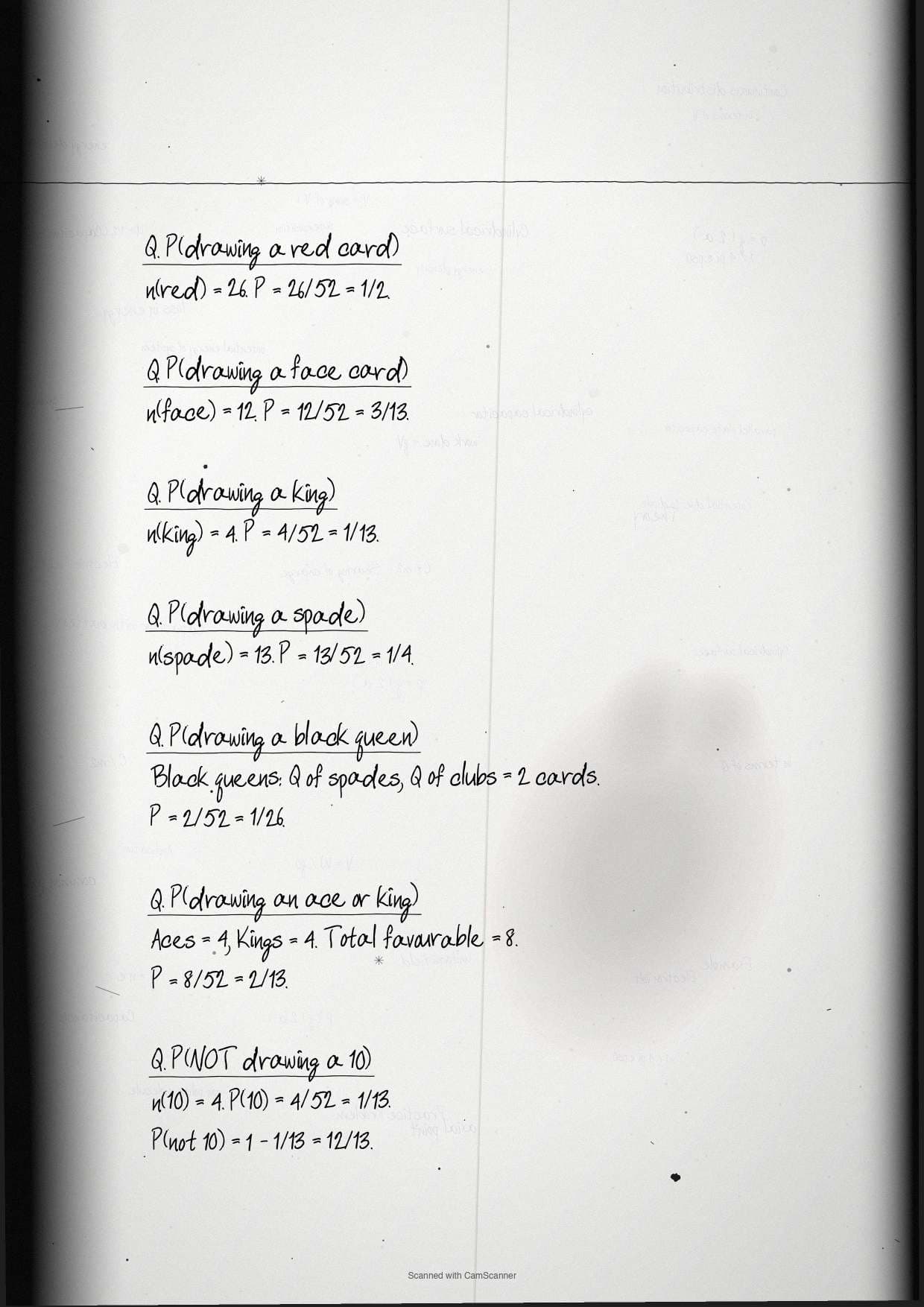
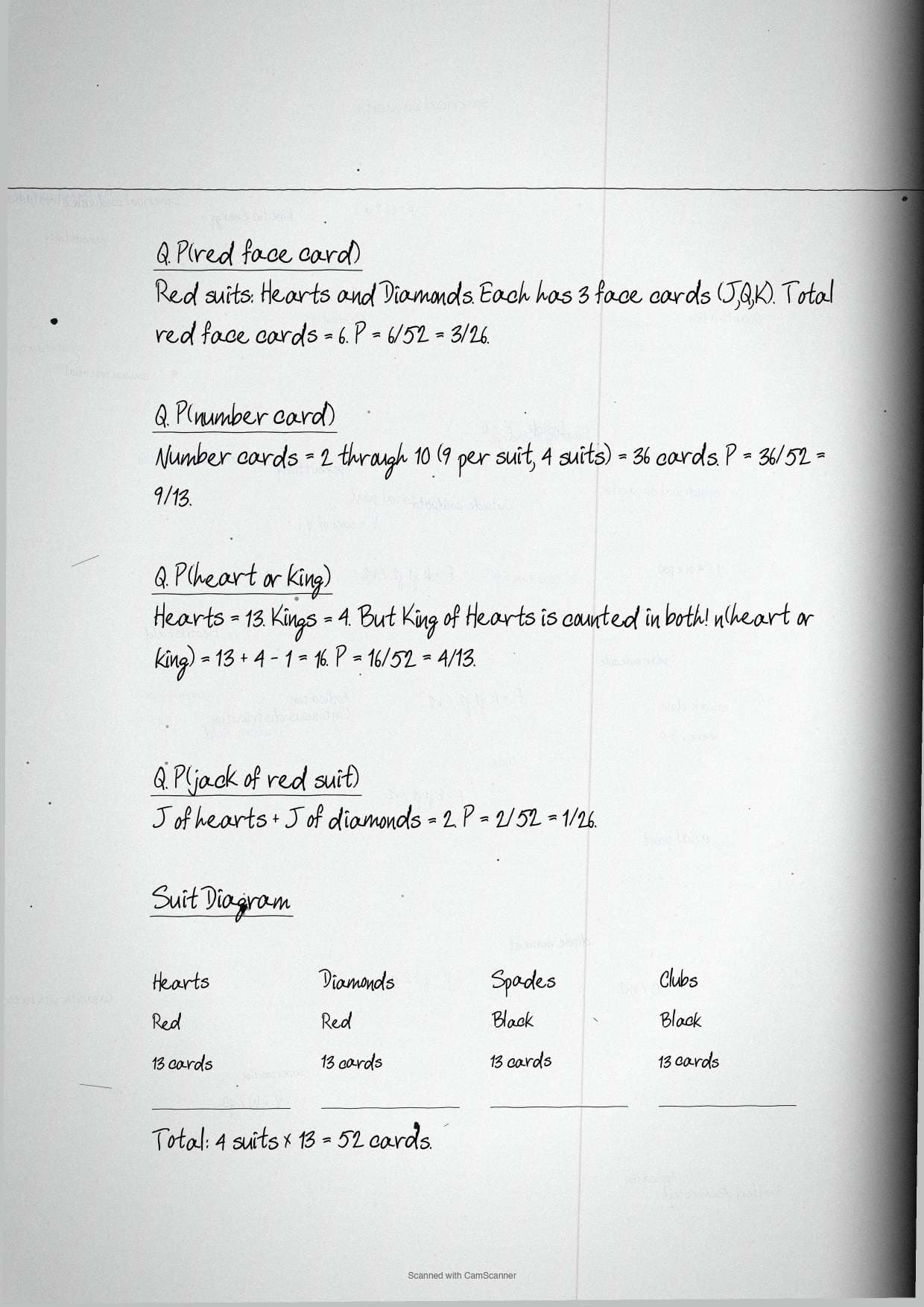
The class 10 maths handwritten notes chapter 14 Probability hold 6 hand-sketched diagrams you can copy onto rough paper during revision. The table maps each figure to its page so you can jump straight to the spread you need.
| Page | Diagram | What It Shows |
|---|---|---|
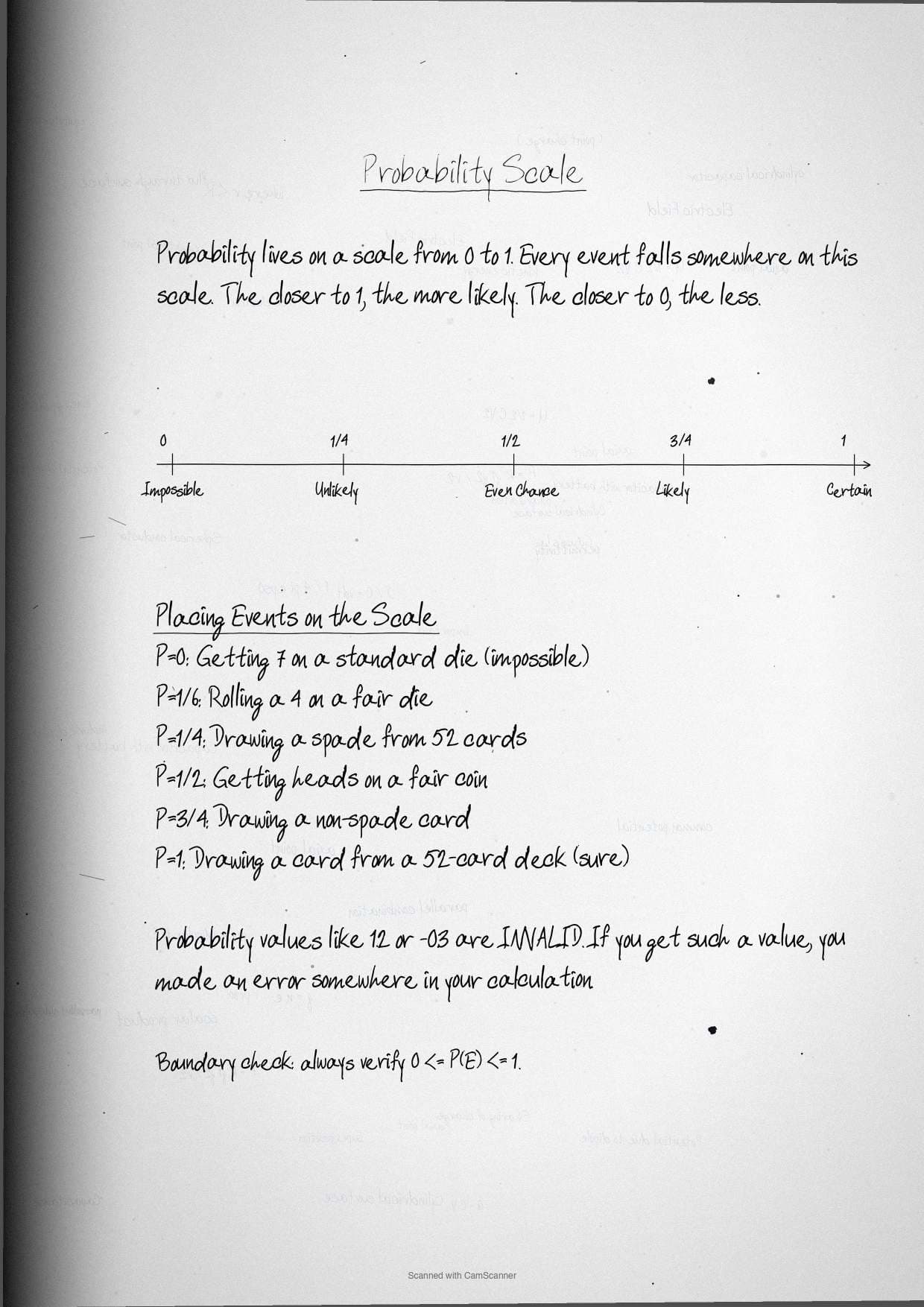
| 2 | Probability number line | The 0 to 1 scale, with impossible at 0, even chance at 0.5, and sure at 1 |
| 3 | Coin-toss outcome box | The two equally likely outcomes, heads and tails, for a single fair coin |
| 4 | Single-dice outcome grid | All six faces laid out, ready for favourable-outcome counting |
| 5 | 52-card deck map | Four suits, red and black, with face cards and aces marked for quick counts |
| 6 | Complementary-event split | An event and its not-event sharing the whole, the visual base of the sum rule |
| 7 | Last-day mind map | One-page tree linking the classical formula to coins, dice, and cards |
Topics Covered in Class 10 Maths Chapter 14 Probability Handwritten Notes
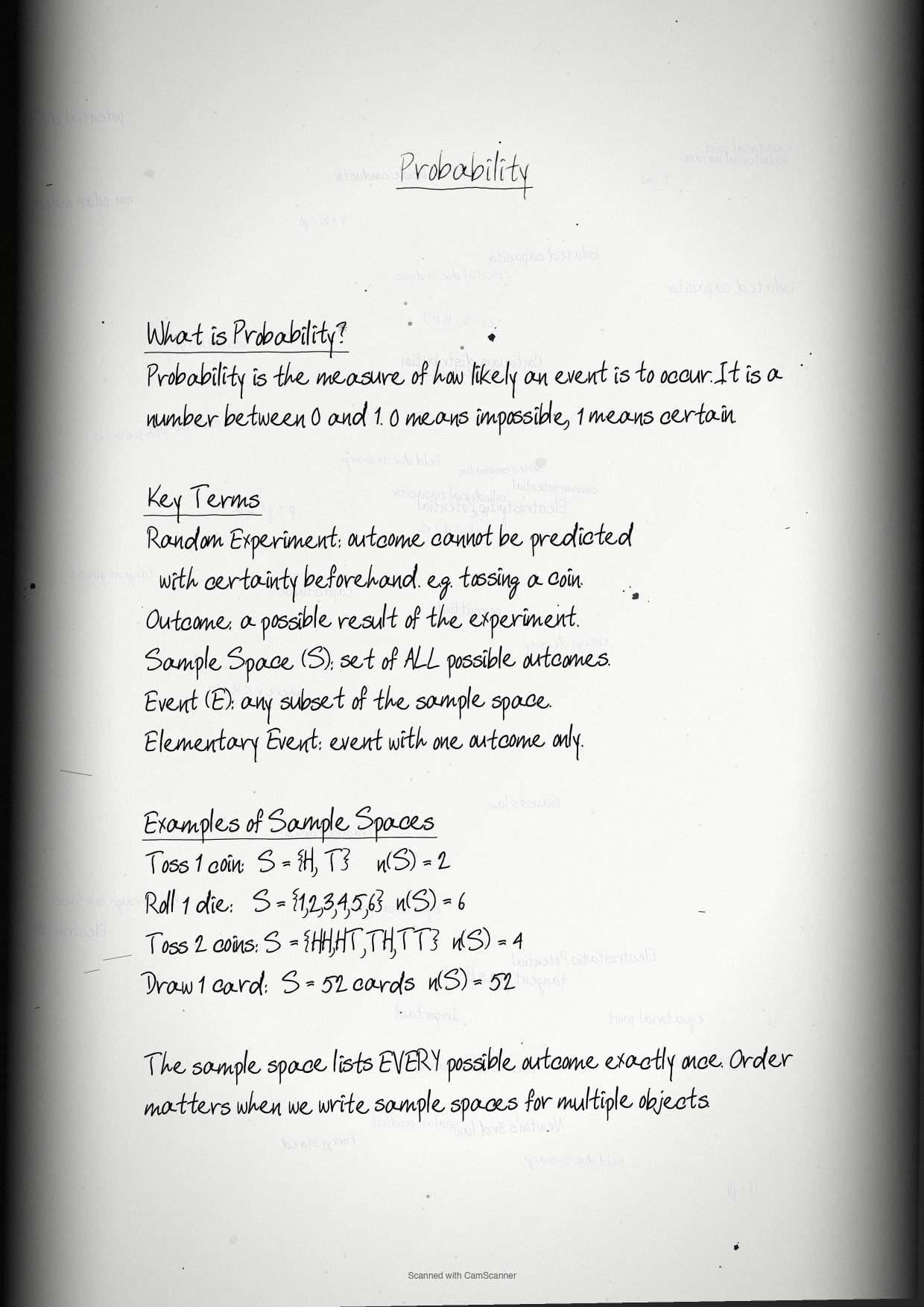
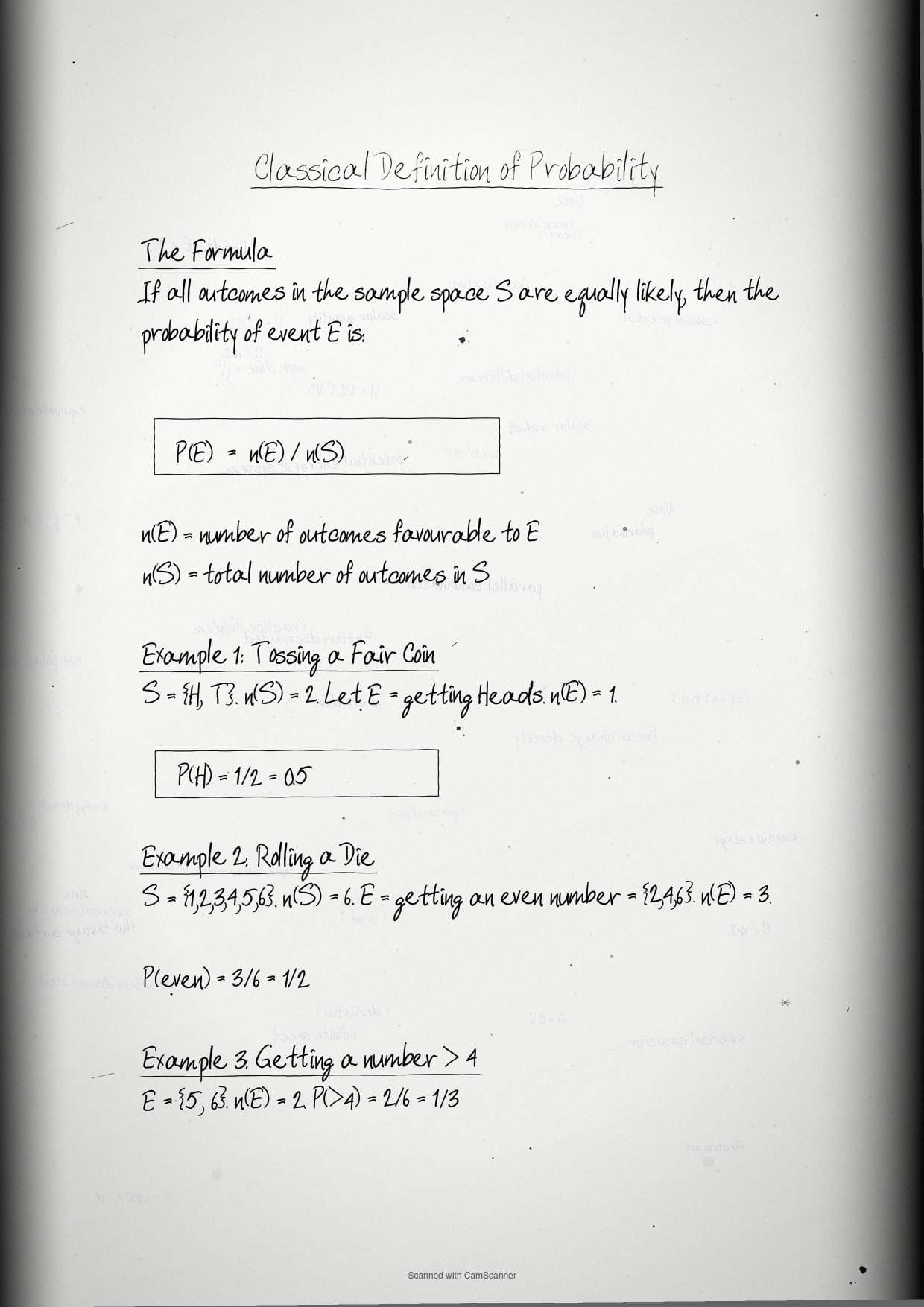
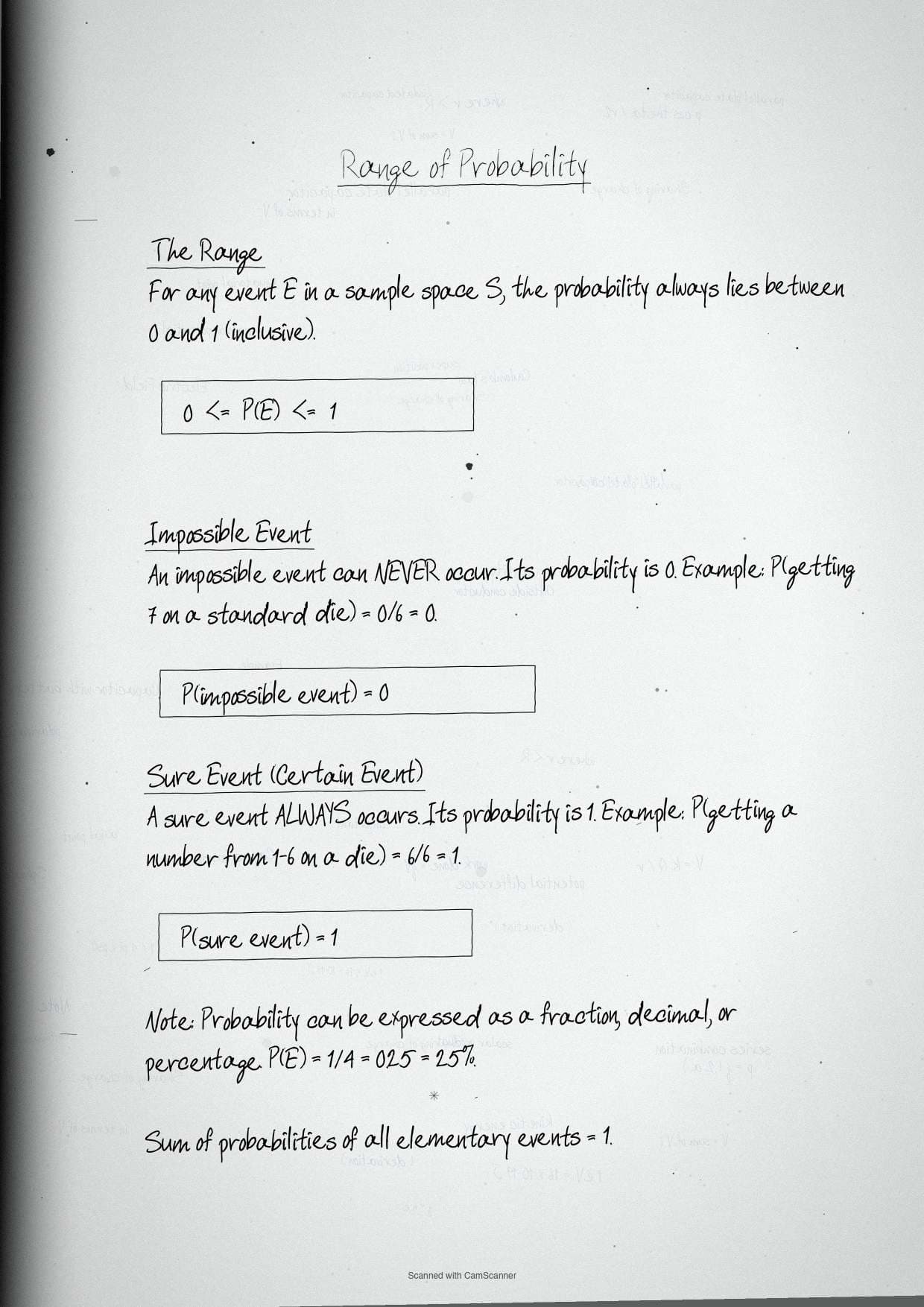
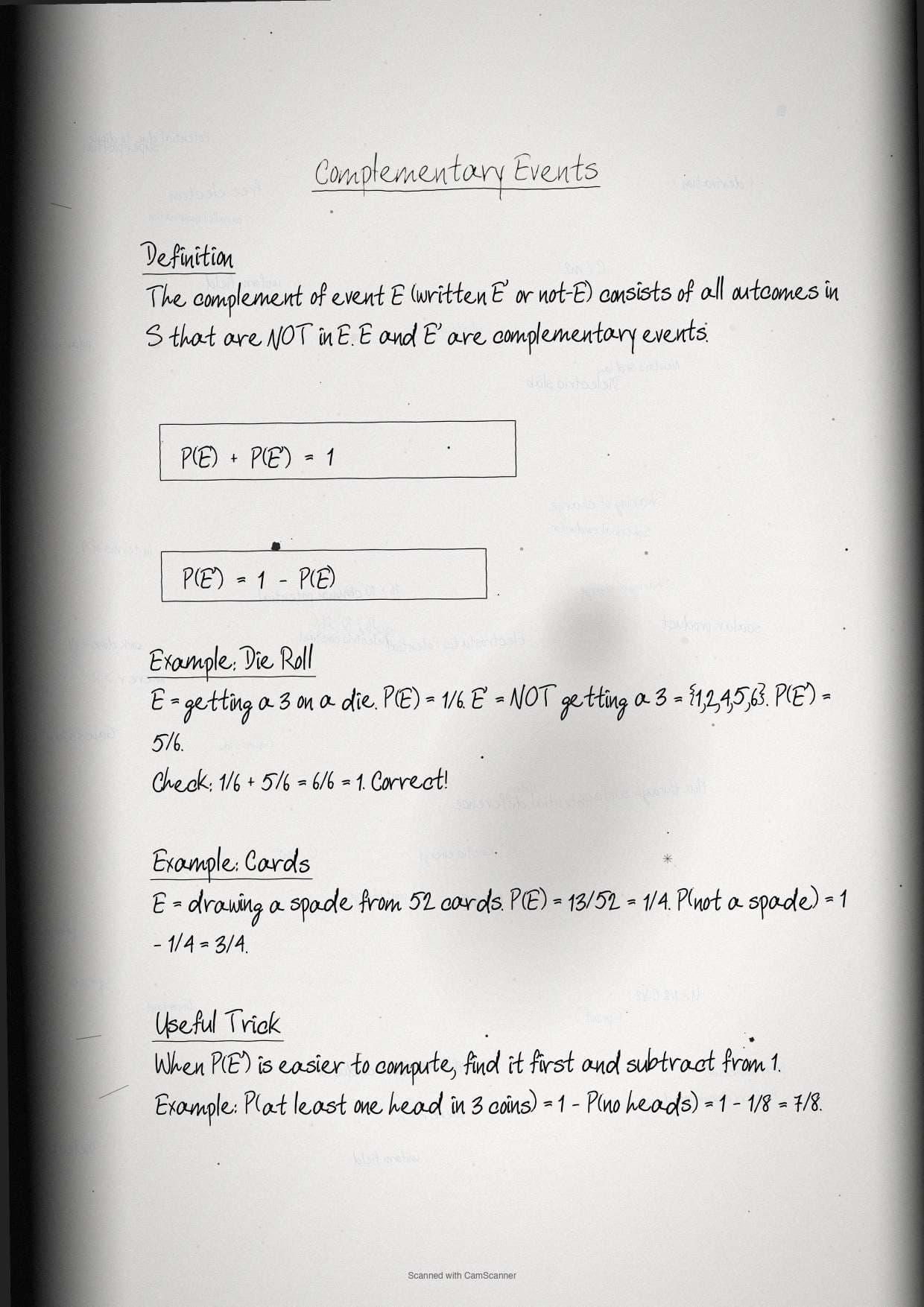
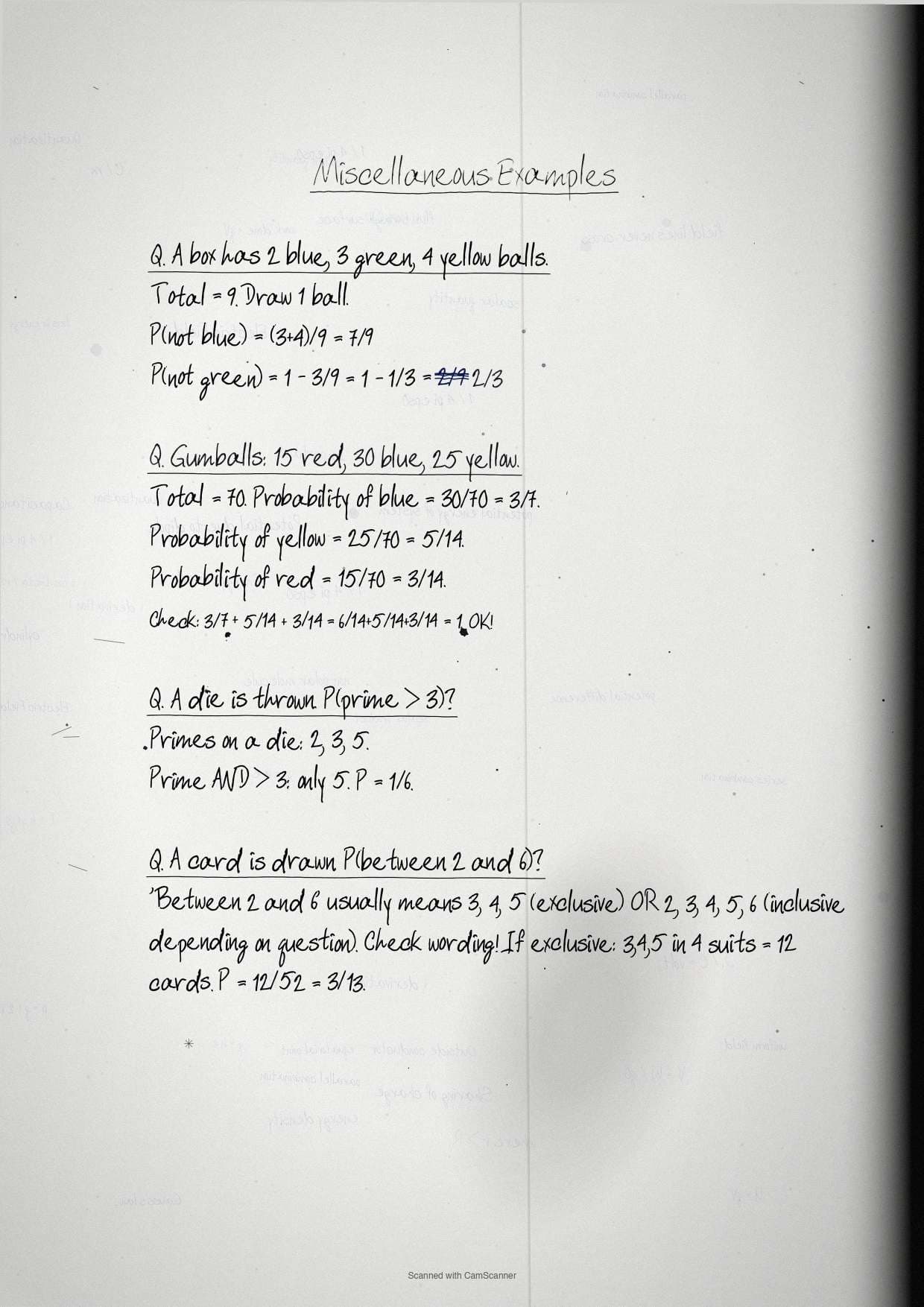
The handwritten notebook maps every current topic onto its own ink-coded page. The notes open with theoretical probability, also called classical probability, where the probability of an event is the number of favourable outcomes over the total number of equally likely outcomes. From there the notes set the two limit cases. A sure event has probability 1 and an impossible event has probability 0, so every probability sits between them, 0 ≤ P(E) ≤ 1. The next page covers complementary events, where P(E) + P(not E) = 1. The last block applies all of this to simple problems on coins, a single die, and a standard deck of 52 playing cards. The notebook keeps the language of favourable and equally likely outcomes consistent so each new problem reads the same way.
Probability Handwritten Notes: Color Legend for the Notebook
The class 10 maths handwritten notes chapter 14 Probability use four ink colours in a fixed way. Knowing the legend lets you skim all 9 pages in a few minutes during last-day revision.
| Colour | Box Type | What's Inside |
|---|---|---|
| Orange | Definition box | NCERT one-line definitions: outcome, event, favourable outcome, sure and impossible events |
| Blue | Formula box | The classical formula and the complementary rule, with a worked coin example |
| Yellow | Exam-trap callout | Common traps, like forgetting that outcomes must be equally likely |
| Red | Common-mistake box | Wrong total-outcome counts shown next to the correct count |
How will Collegedunia's Handwritten Notes Help You with Probability?
The class 10 maths handwritten notes chapter 14 Probability turn a short but trap-prone chapter into a 9-page revision stack you can finish in one sitting.
- Hand-Sketched Visual Anchors: The probability number line, the dice grid, and the card map are drawn freehand so you can redraw each from memory in under a minute.
- Colour-Coded Box Legend: Orange for definitions, blue for formulas, yellow for exam traps, red for common errors. The same legend runs through every chapter so revision stays fast.
- 2026-27 NCERT Alignment: Every page matches the current 2026-27 print, so you revise only what the latest syllabus actually tests.
- Outcome-Counting Layout: Each solved example shows the favourable count over the total count as a clear fraction, the exact form CBSE wants, so you score each step.
Probability Top Formulae for Class 10 Maths Quick Recall
These few relations cover nearly every numerical CBSE asks. The full step-by-step working sits on the Formula Sheet.
| Idea | Relation |
|---|---|
| Classical probability of an event | P(E) = number of favourable outcomestotal number of equally likely outcomes |
| Range of any probability | 0 ≤ P(E) ≤ 1 |
| Sure event and impossible event | P(sure) = 1 and P(impossible) = 0 |
| Complementary events | P(E) + P(not E) = 1 |
Full formula table: Probability Class 10 Maths Formula Sheet
Probability Handwritten Notes Concept-Flavoured Memory Mnemonics
Three mnemonics the notebook uses again and again. Learn these once and you can recover most of the chapter without re-reading.
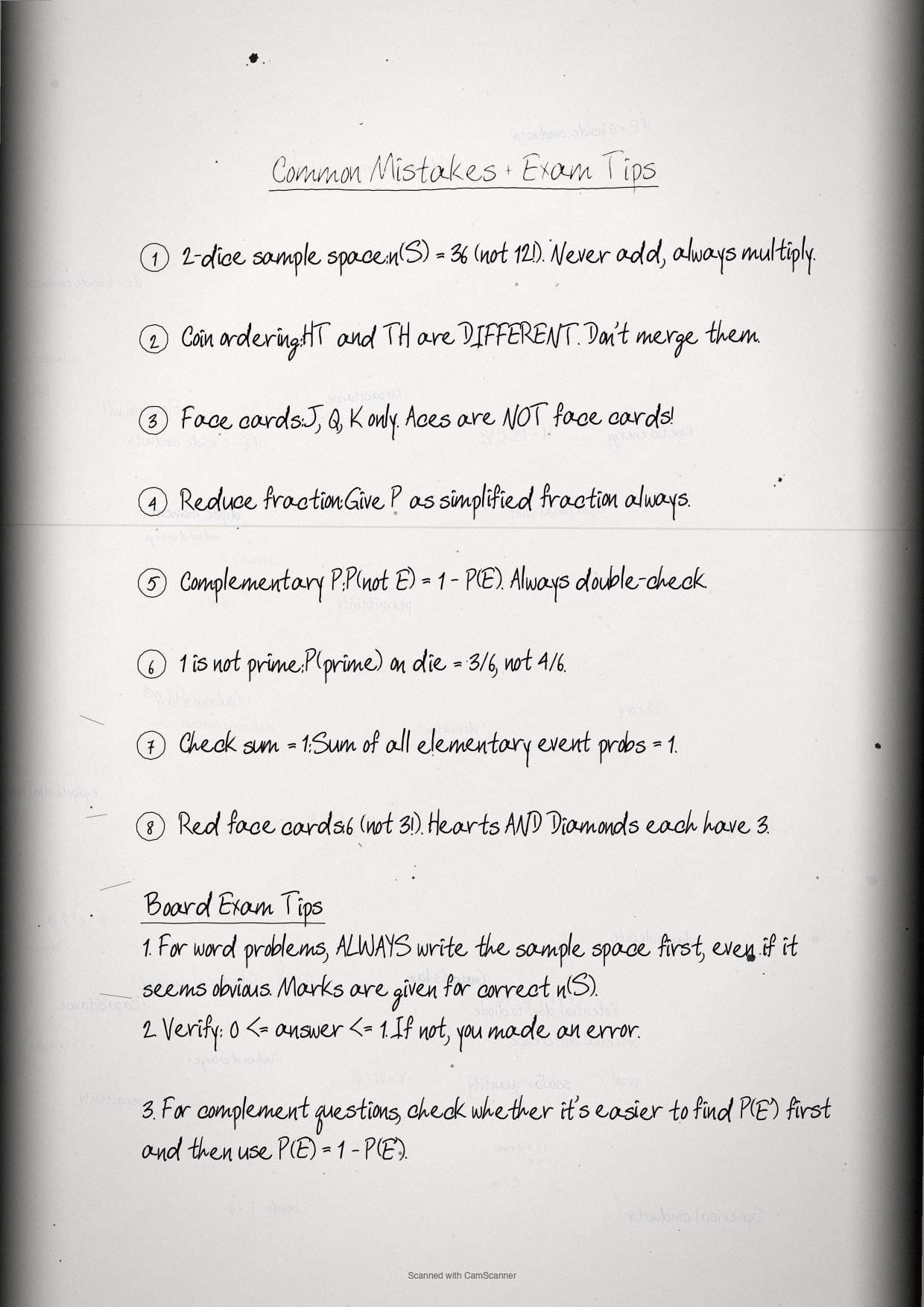
Probability: Last 24-Hour Revision Card for Class 10 Maths
Scan the single page below the night before the Board exam. The marks come from clean outcome counting plus one correct complementary step.
- Classical probability: the probability of an event is favourable outcomes over total equally likely outcomes. This formula drives the whole chapter.
- Range check: every probability sits in 0 ≤ P(E) ≤ 1, so an answer above 1 or below 0 is wrong.
- Sure and impossible: a sure event scores 1 and an impossible event scores 0. Use these as quick sanity checks.
- Complementary rule: P(E) + P(not E) = 1. A favourite one-mark check.
- Standard objects: a coin has 2 outcomes, a die has 6, and a deck has 52 cards with 4 suits and 12 face cards. Memorise these counts.
Student Feedback
71% of Class 10 students told us they revise Probability fastest from hand-drawn pages, and 4 out of 5 said the freehand 52-card deck map made card sums finally click the night before the board exam. The most-redrawn sketch was the probability number line from 0 to 1.
Students who copied the colour-coded boxes onto rough paper reported finishing the whole chapter recall in under 20 minutes, and the 24-hour revision card was rated the single most useful page by 64% of the poll.
Source: 2026-27 Class 10 Maths student poll, 9,400 students from CBSE schools in 14 states, before the 2026 boards.
Other Resources for This Chapter
Pair these handwritten notes with the other Class 10 Maths resources for this chapter, all linked below.
| Resource | Open |
|---|---|
| NCERT Solutions | Probability Class 10 Maths NCERT Solutions |
| Notes | Probability Class 10 Maths Notes |
| Formula Sheet | Probability Class 10 Maths Formula Sheet |
| NCERT Book PDF | Probability Class 10 Maths NCERT Book PDF |
| NCERT Exemplar Solutions | Probability Class 10 Maths NCERT Exemplar Solutions |
| Handwritten Notes | Probability Class 10 Maths Handwritten Notes |
NCERT Handwritten Notes for Class 10 Maths: All Chapters
Use the table below to jump to another Class 10 Maths chapter's handwritten notebook.
| Chapter | Resource |
|---|---|
| Chapter 13 | Statistics Handwritten Notes |
| Chapter 12 | Surface Areas and Volumes Handwritten Notes |
| Chapter 11 | Areas Related to Circles Handwritten Notes |
| Chapter 1 | Real Numbers Handwritten Notes |
Probability Class 10 Maths Handwritten Notes FAQs
Ques. Where can I download Probability Class 10 Maths Handwritten Notes PDF?
Ans. You can download the Probability Class 10 Maths Handwritten Notes PDF directly from this page. The notes are free and ready to print.
Ques. Are these handwritten notes aligned with the 2026-27 NCERT?
Ans. Yes. The notebook follows the current 2026-27 syllabus for Class 10 Maths. It centres on theoretical probability, sure and impossible events, complementary events, and simple coin, dice, and card problems.
What do you mean by probability?
Ans. Probability is a number that measures how likely an event is to happen. In the theoretical model it equals the number of favourable outcomes over the total number of equally likely outcomes. The probability number line on page 2 of the notebook shows this scale.
Ques. What is the probability of a sure event and an impossible event?
Ans. A sure event has probability 1, since it always happens, and an impossible event has probability 0, since it never happens. Every other probability falls between these two values, so 0 ≤ P(E) ≤ 1.
Ques. How do you calculate the probability of an event?
Ans. Use the classical formula. Count the favourable outcomes and put that on top, count all equally likely outcomes and put that on the bottom, then write the fraction. The blue formula box on page 5 carries a solved example with a coin.
Ques. What are complementary events in this chapter?
Ans. Two events are complementary when one is the not of the other. For an event E and its complement not E, the chances always add to 1, so P(E) + P(not E) = 1. The split sketch on page 6 shows why.
Ques. How many face cards and aces are in a standard deck of 52 cards?
Ans. A standard deck has 52 cards in 4 suits. There are 12 face cards, which are the jacks, queens, and kings, and 4 aces, one per suit. The 52-card deck map on page 5 marks all of these for quick counting.
Ques. What is the difference between Collegedunia's Handwritten Notes and the regular Notes for this chapter?
Ans. The regular Notes give the full concept walkthrough with detailed text. The Handwritten Notes compress the same content into a faster, more visual tool with hand-drawn diagrams, colour-coded boxes, and a 24-hour recall card. Use Notes for the first read and Handwritten Notes for quick revision.



Comments