



Class 10 Maths Chapter 4 Quadratic Equations carries about 6 to 8 marks in the CBSE Board exam and sits in the Algebra unit. These notes cover the standard form, solving by factorisation, completing the square, the quadratic formula, and the discriminant.
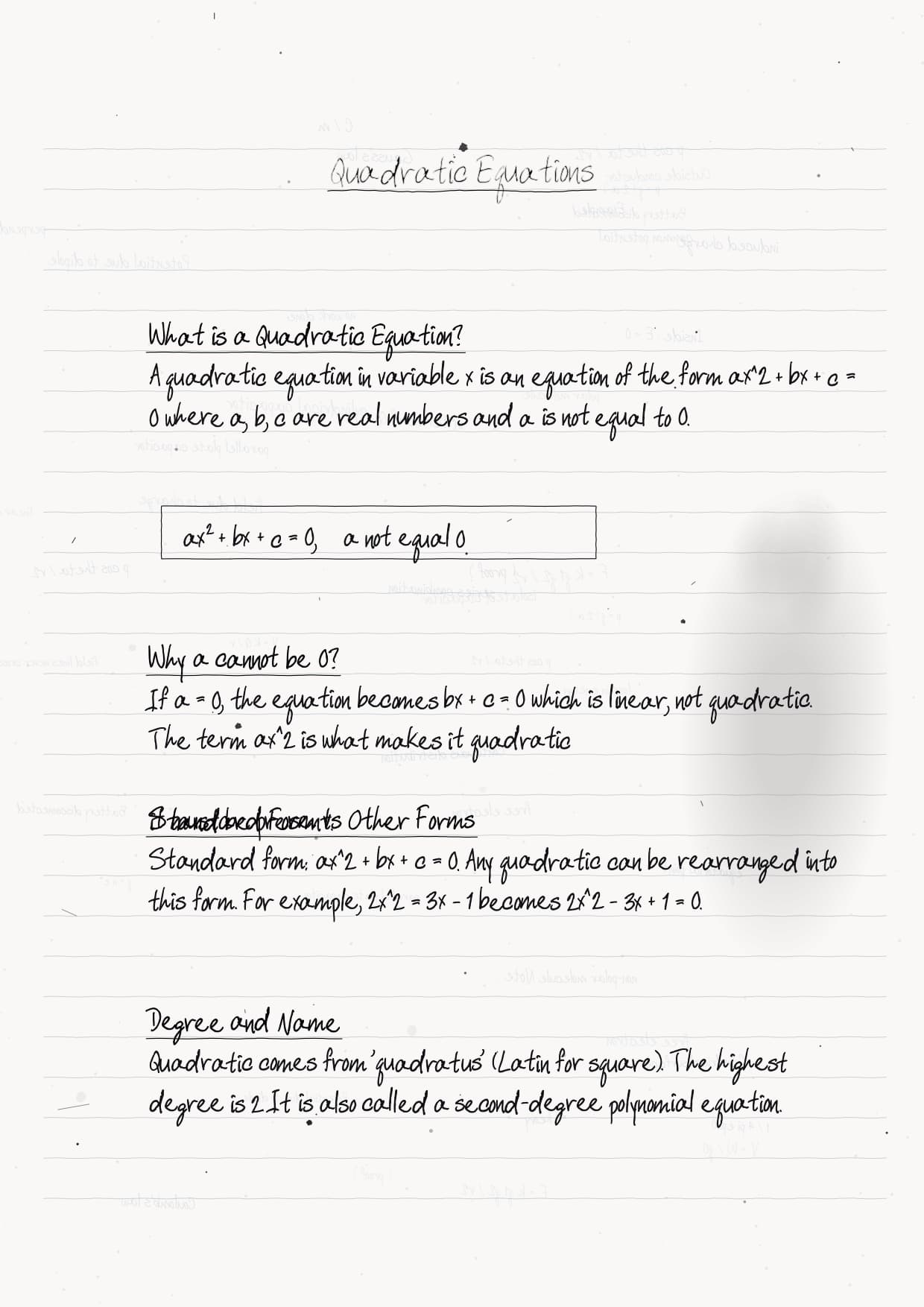
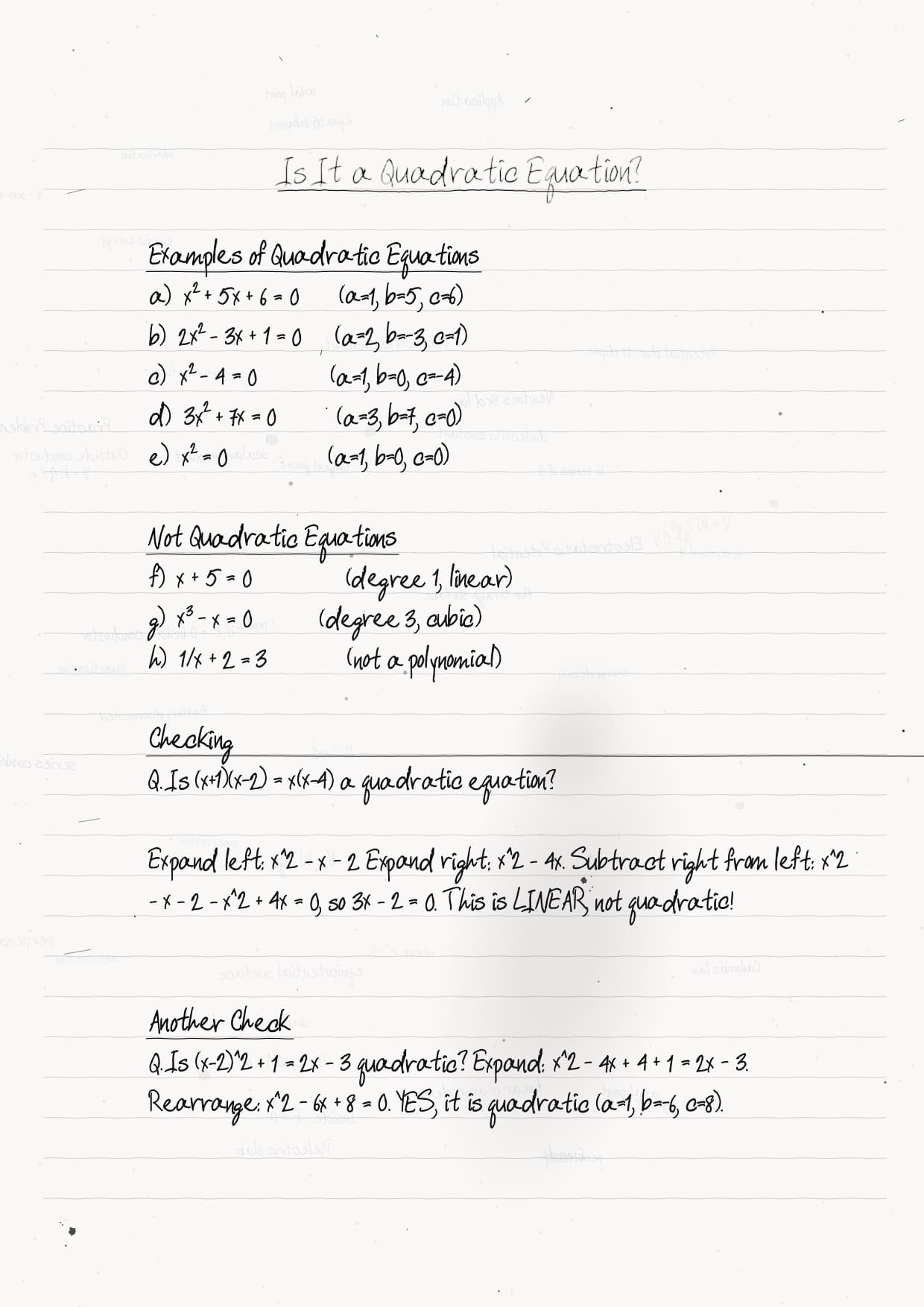
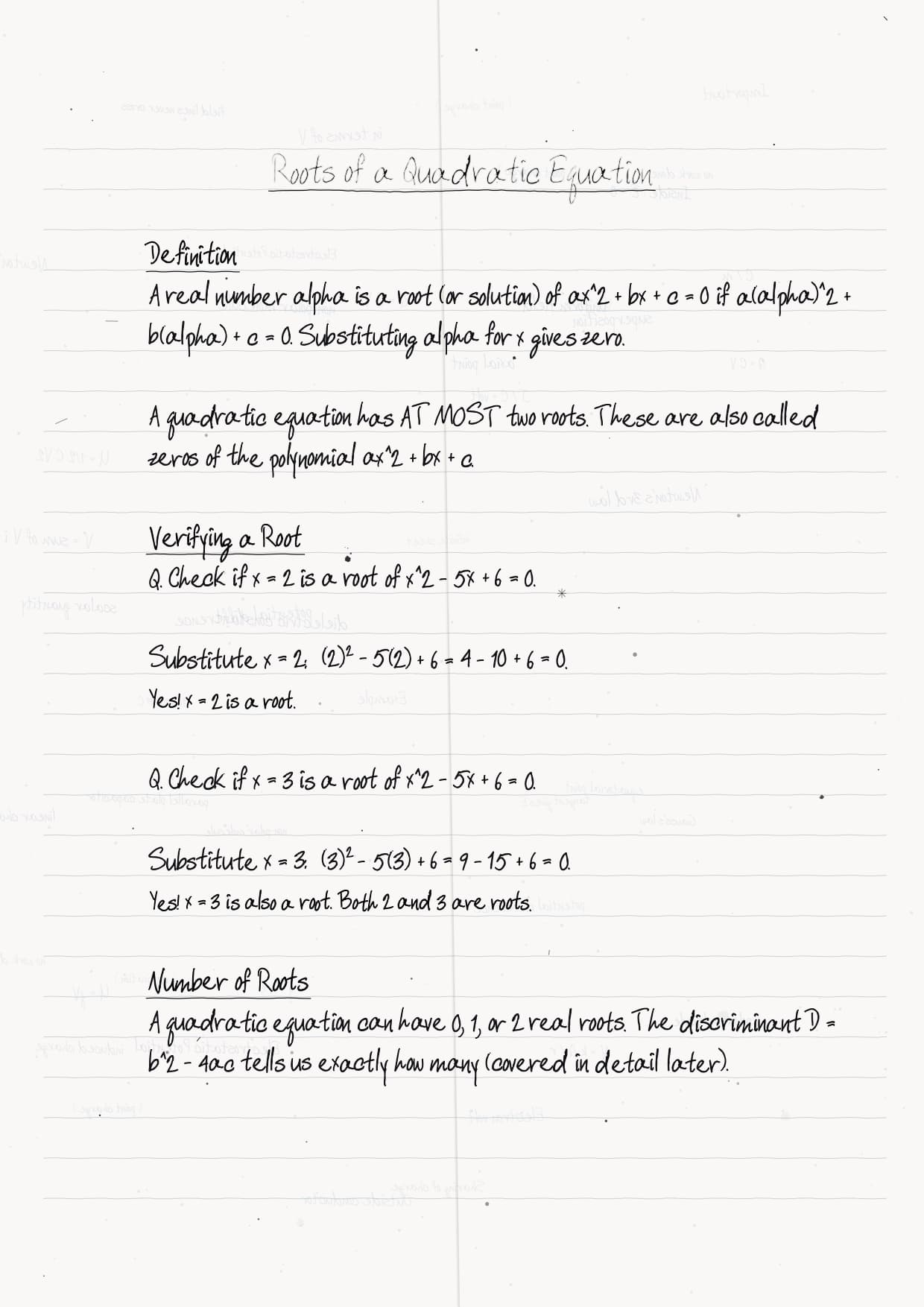
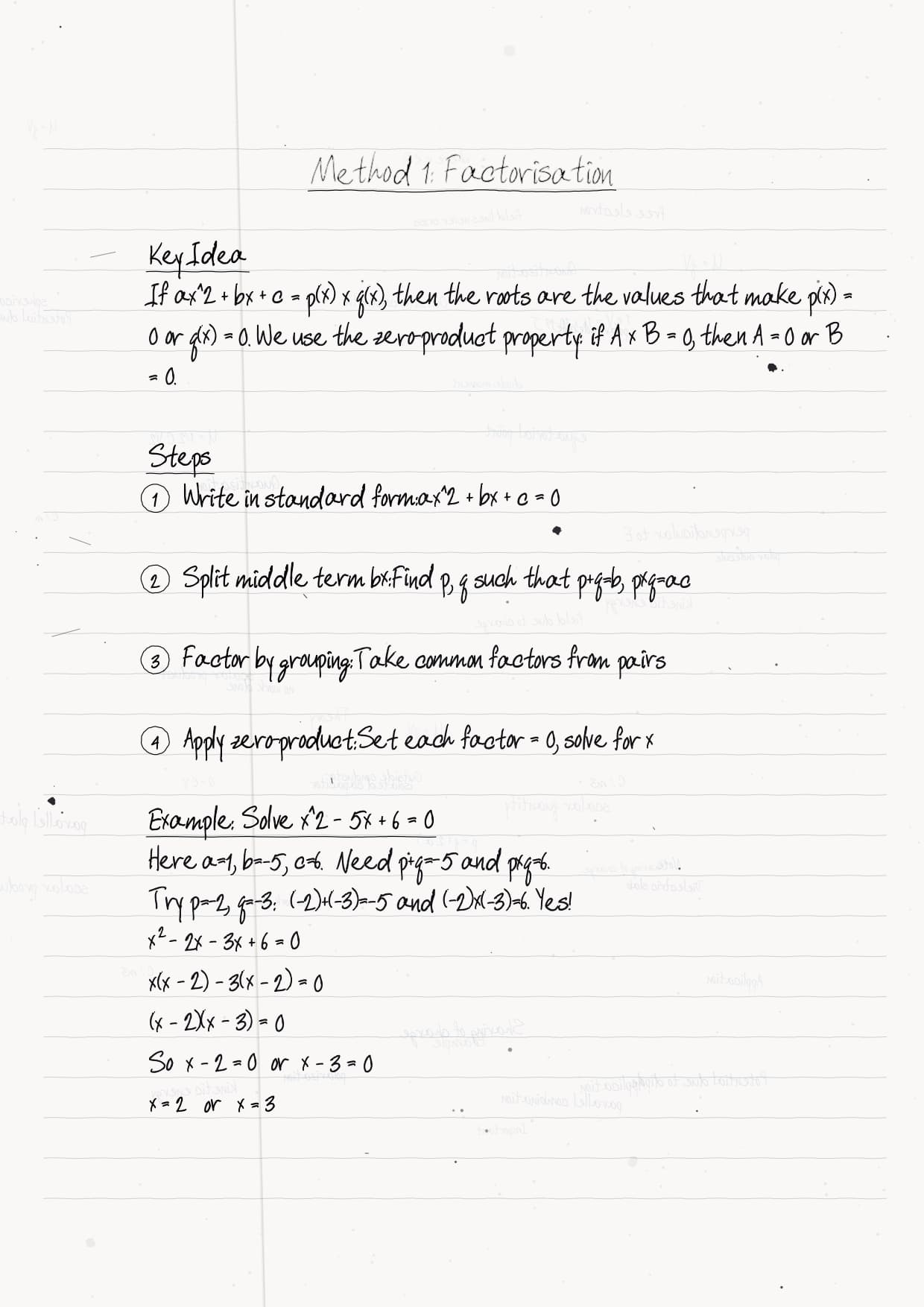
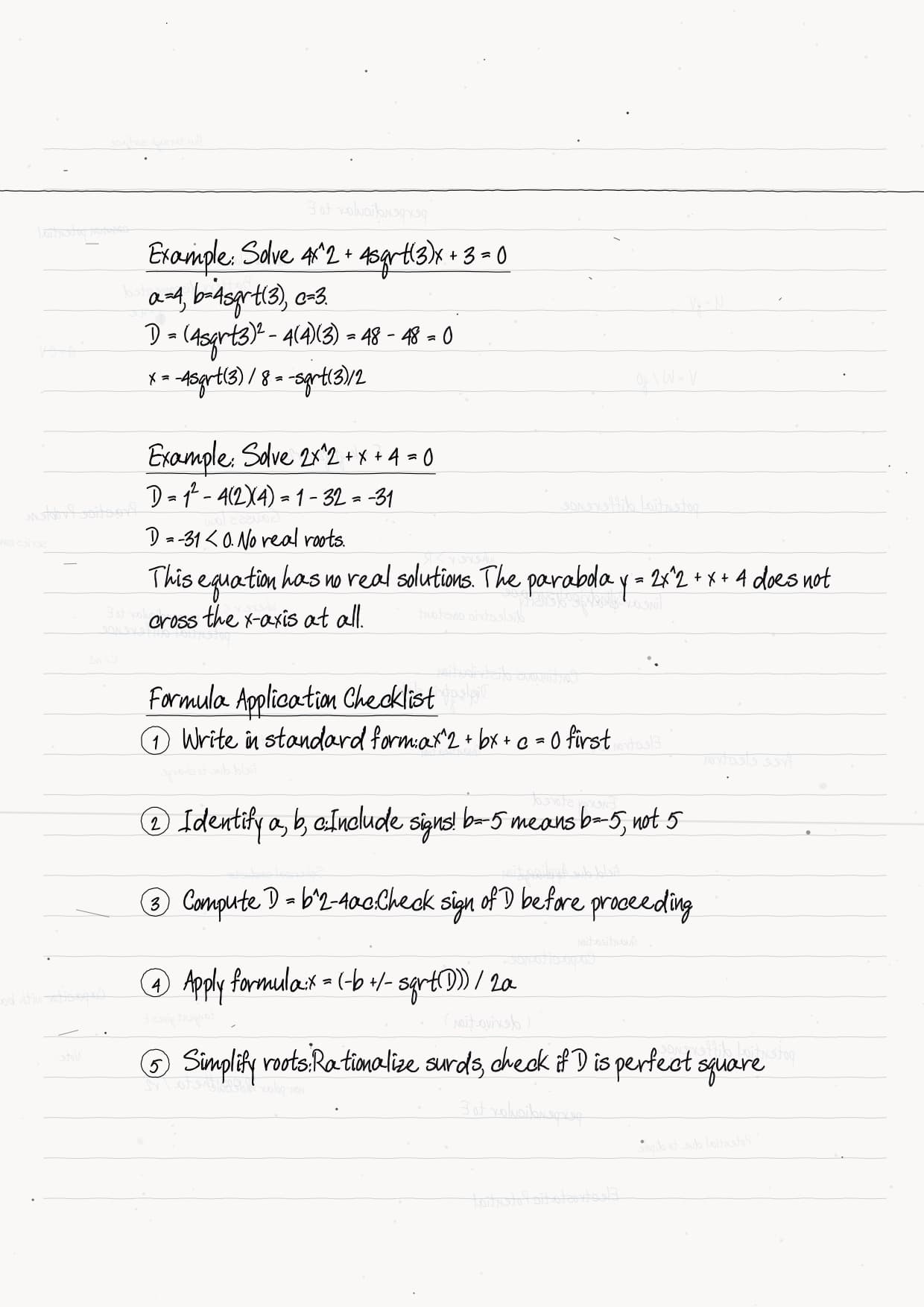
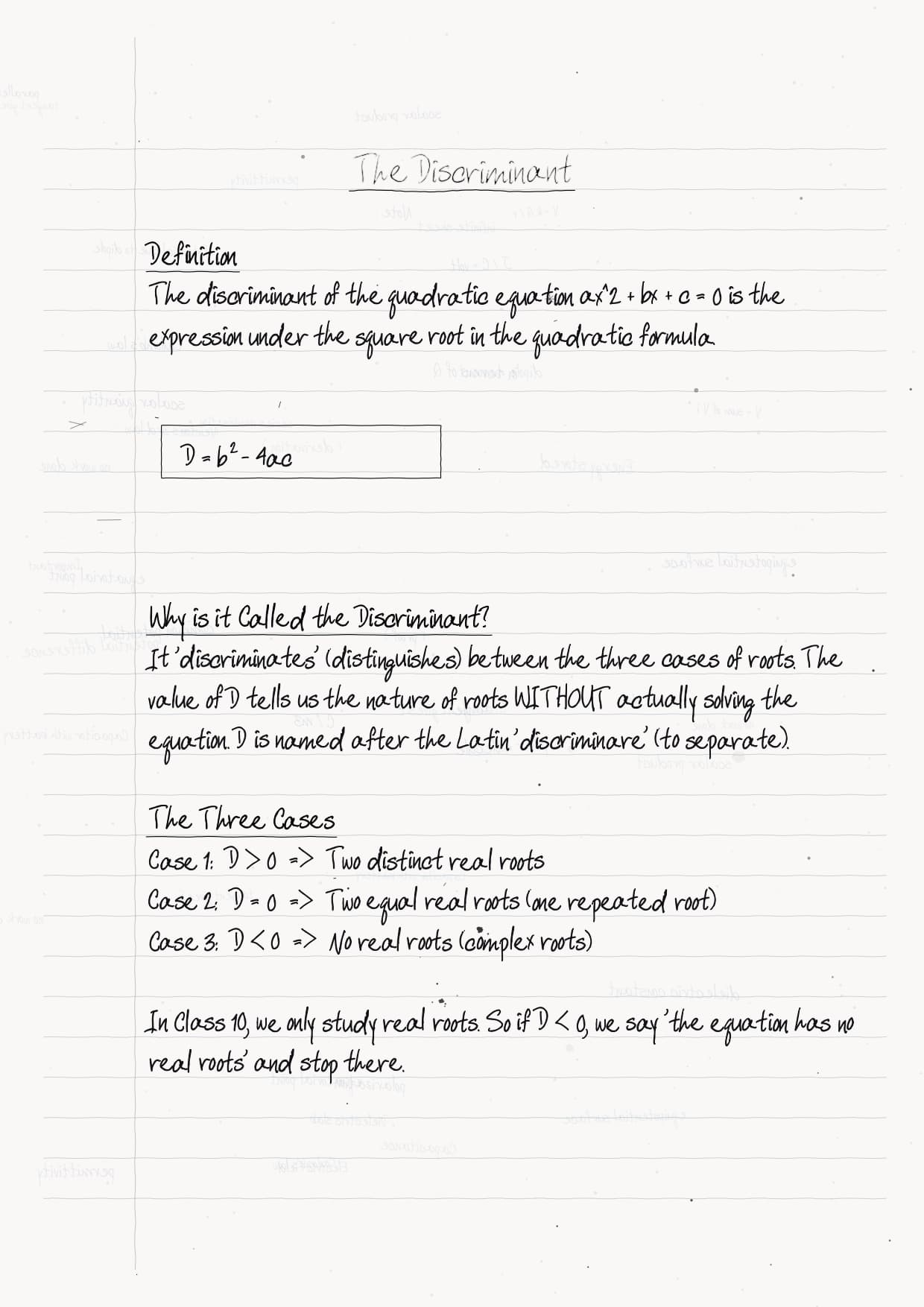
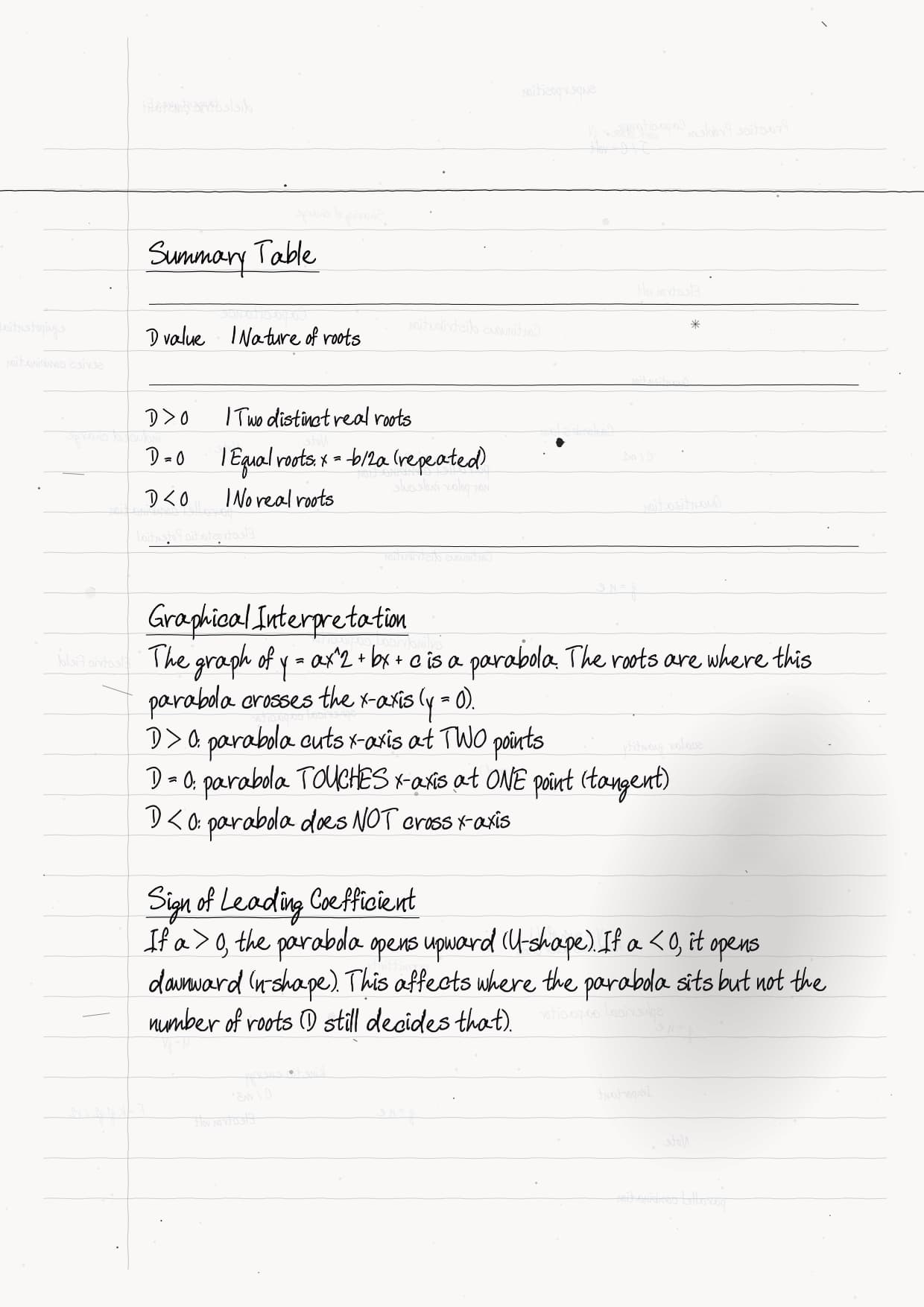
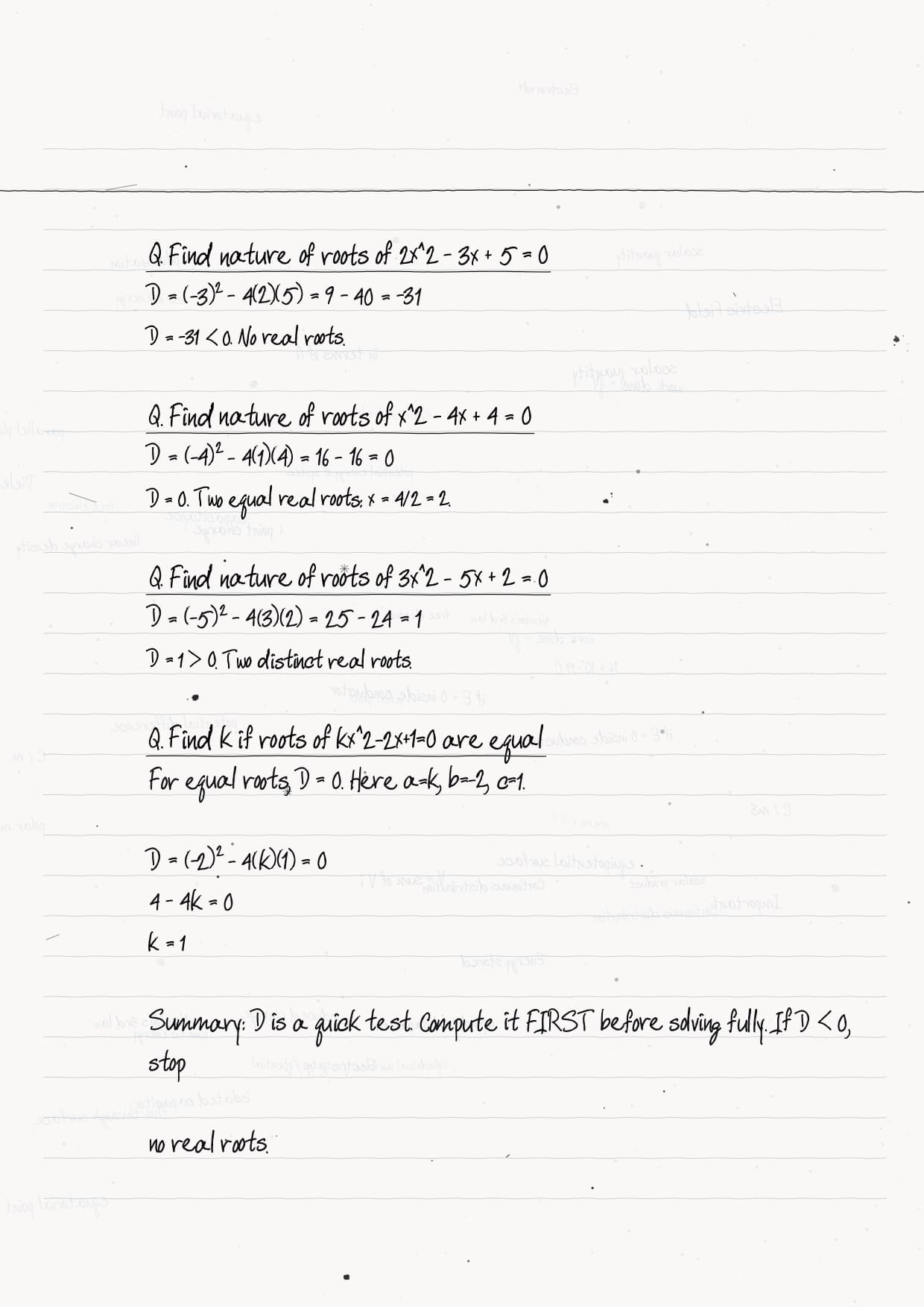
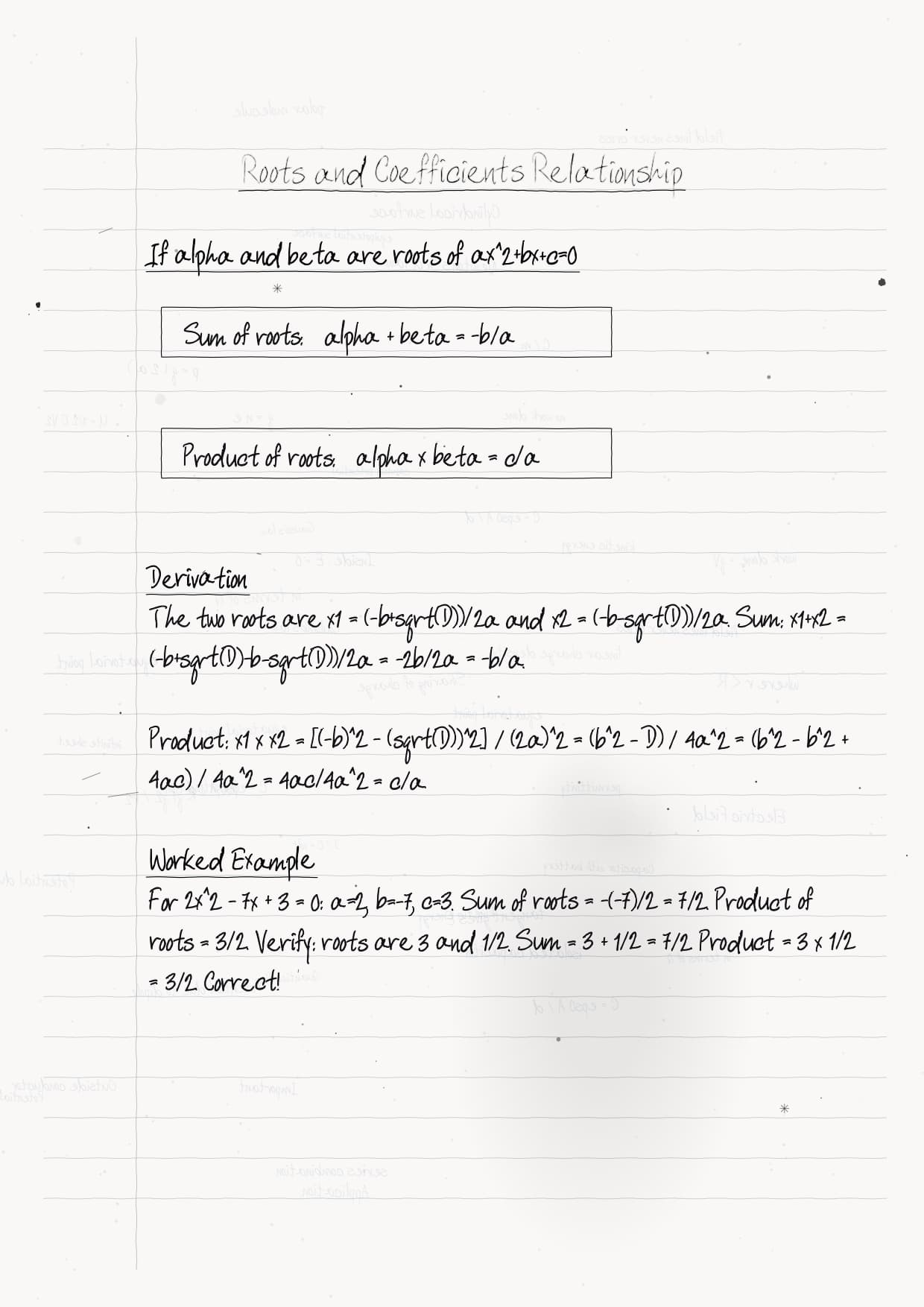
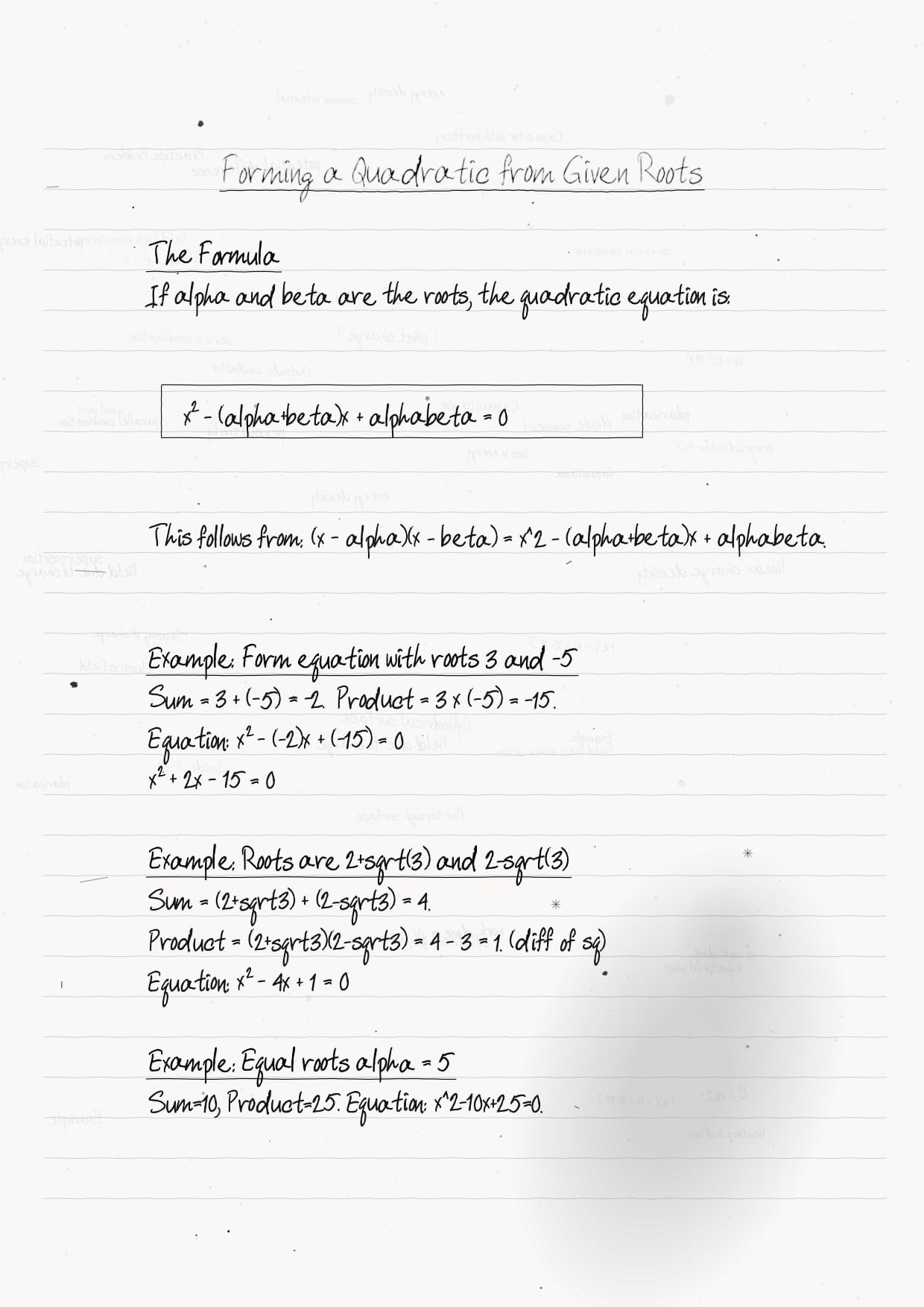
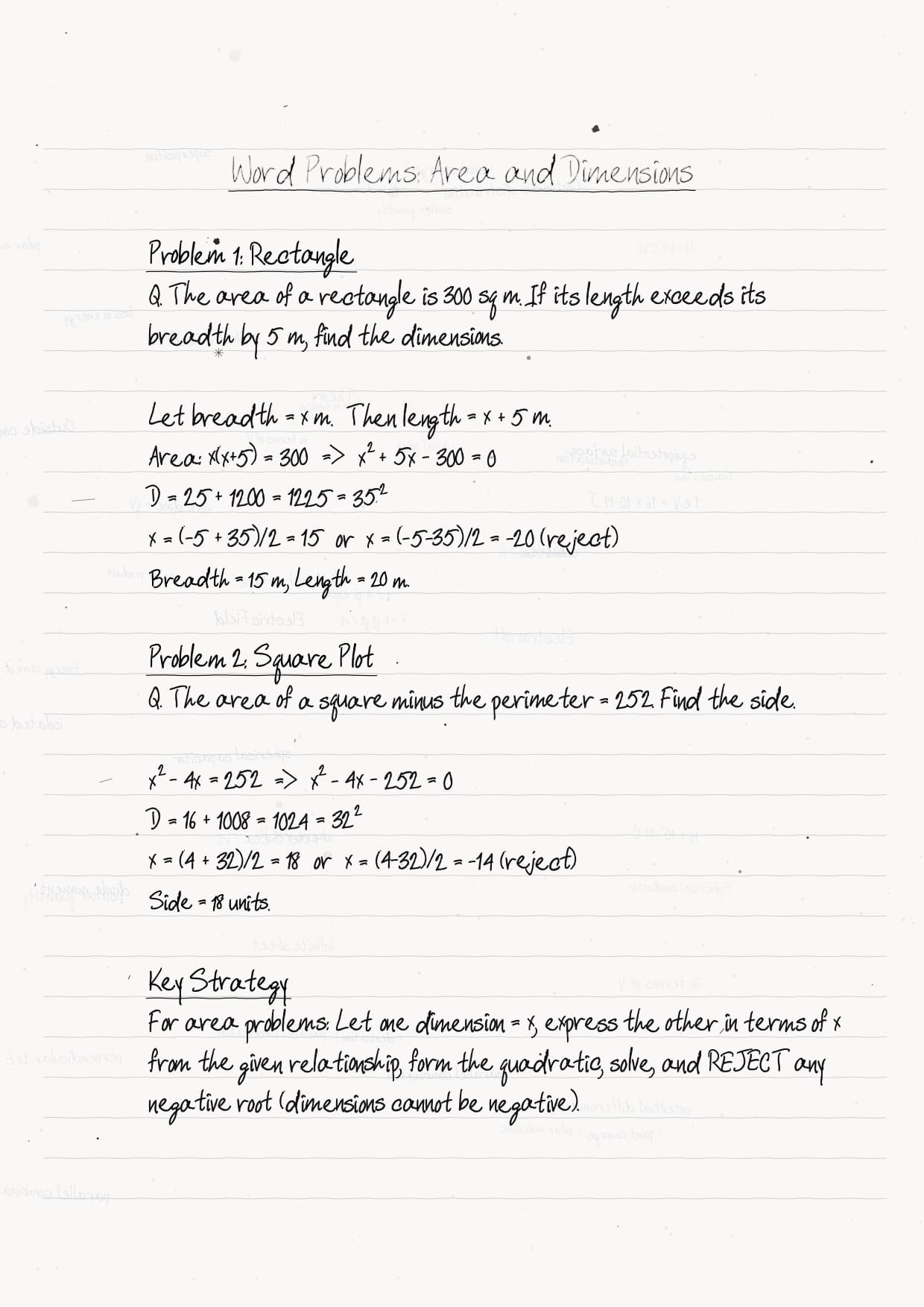
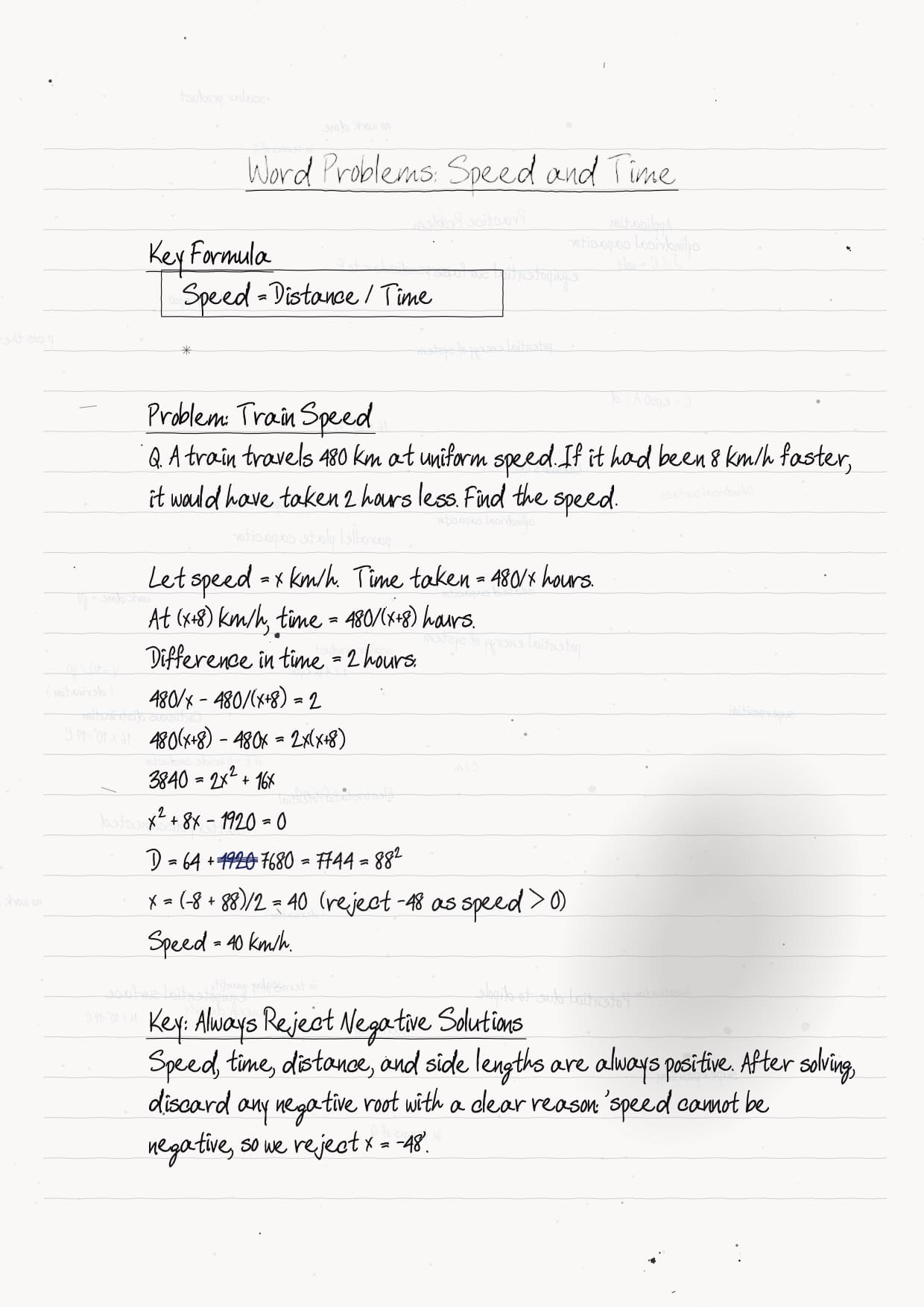
- CBSE Board: about 6 to 8 marks, usually one factorisation sum, one formula or word problem, and a discriminant case
- JEE Main: a frequent base, since roots and the discriminant feed into higher algebra and graphs
These notes are prepared by Collegedunia subject mentors, matched to the 2026-27 NCERT print and recent CBSE Board papers.
|
Table of Contents |
Watch Quadratic Equations Class 10 Maths Chapter 4 Explained
Source: Magnet Brains on YouTube
Quadratic Equations Handwritten Notes: Complete Diagram List for Class 10 Maths
These notes hold 6 hand-sketched diagrams you can copy onto rough paper. The table maps each figure to its page.
| Page | Diagram | What It Shows |
|---|---|---|
| 2 | Standard form strip | The shape ax2 + bx + c = 0 with each letter labelled and the rule that a is not zero |
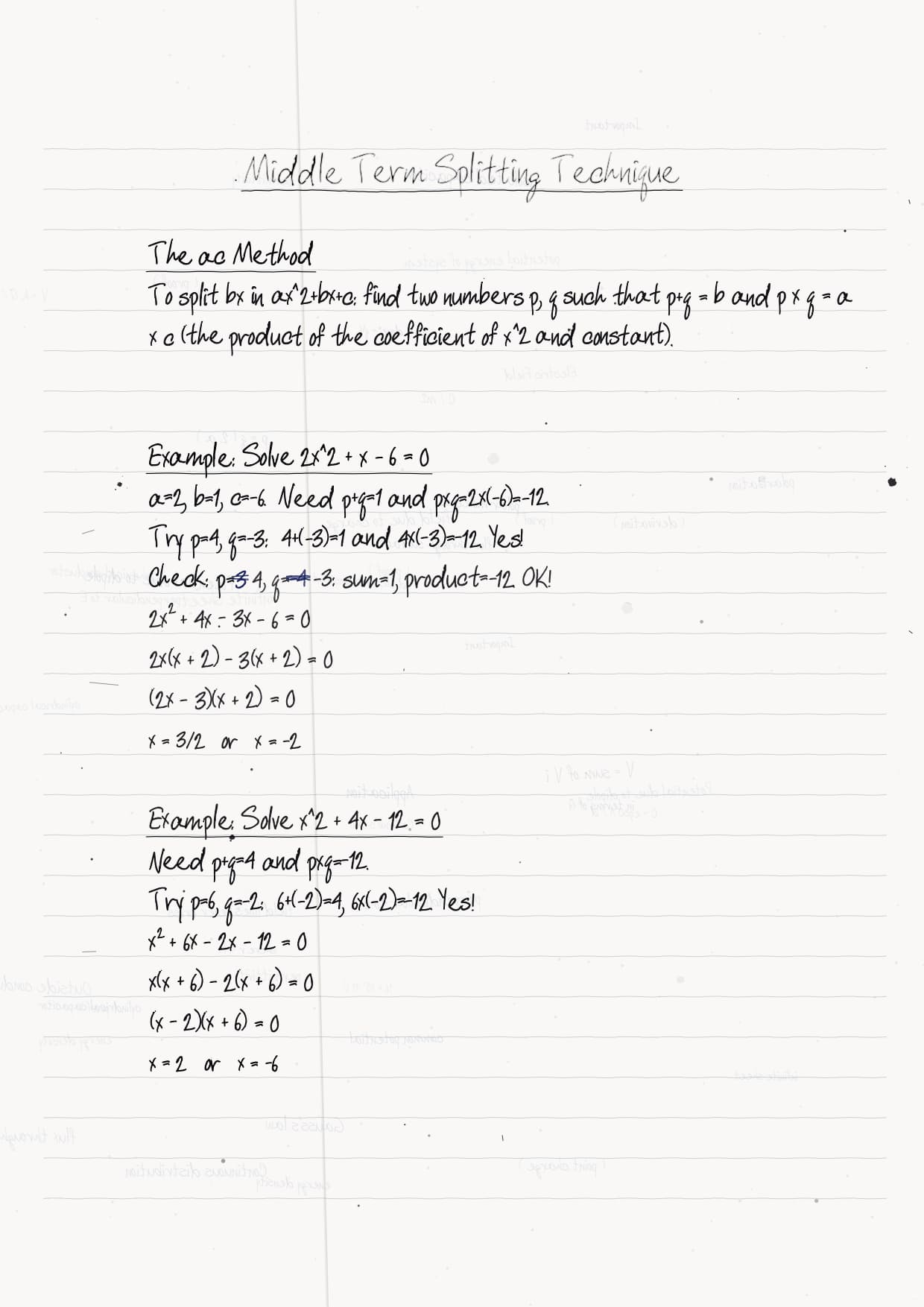
| 3 | Factorisation split sketch | How the middle term breaks into two parts whose product is ac and whose sum is b |
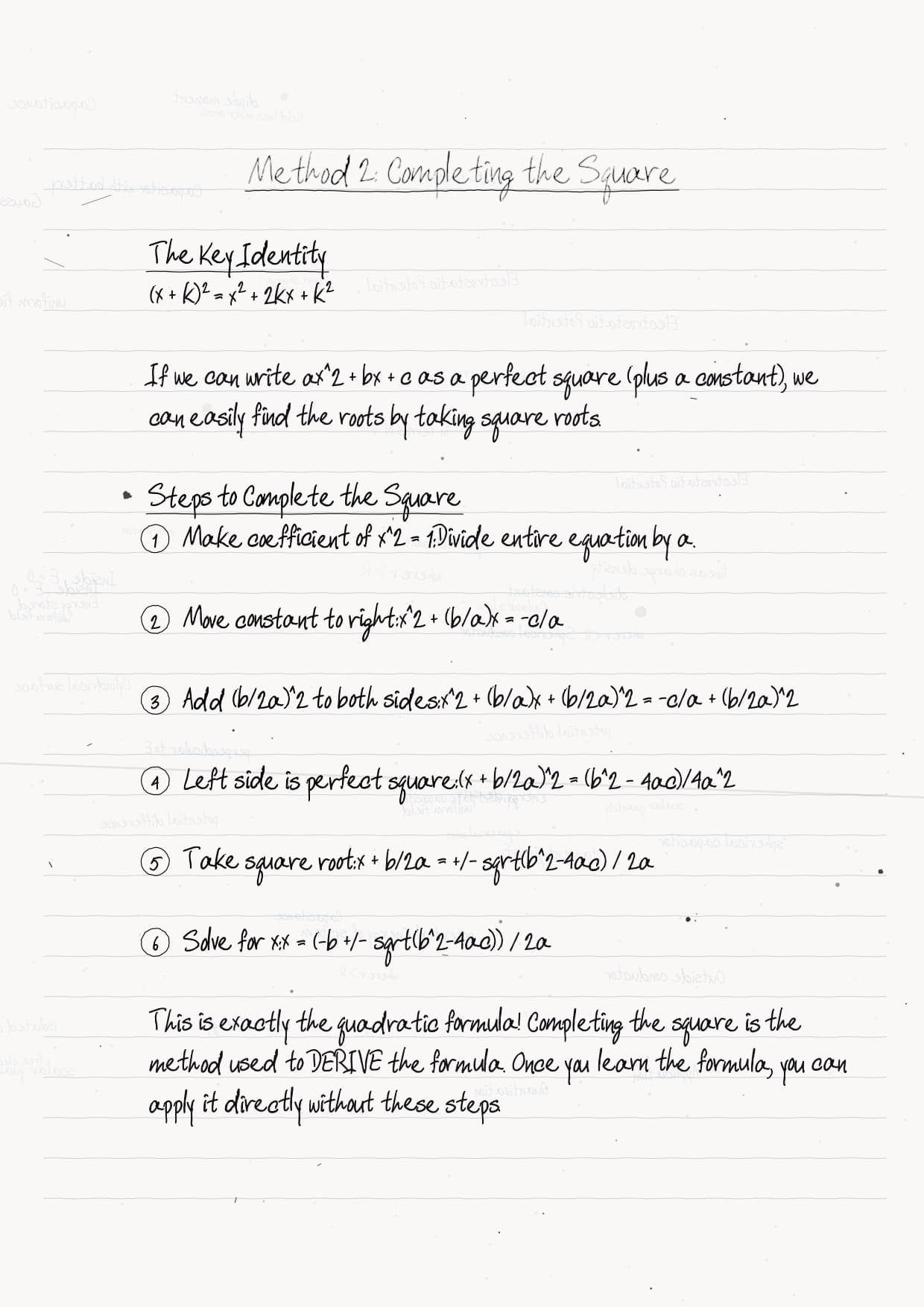
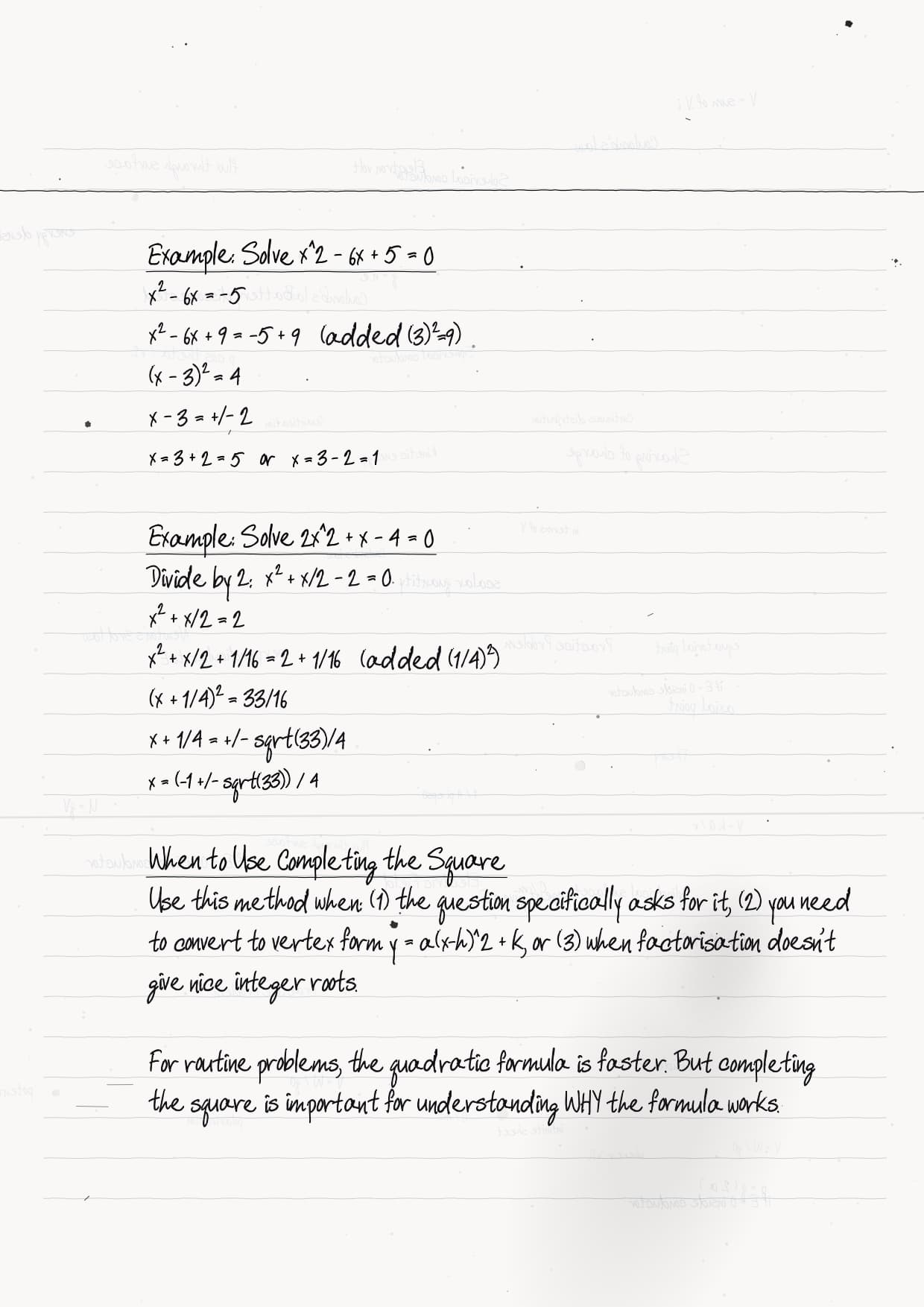
| 4 | Completing the square block | A square drawn around x2 + bx to show the half-of-b idea step by step |
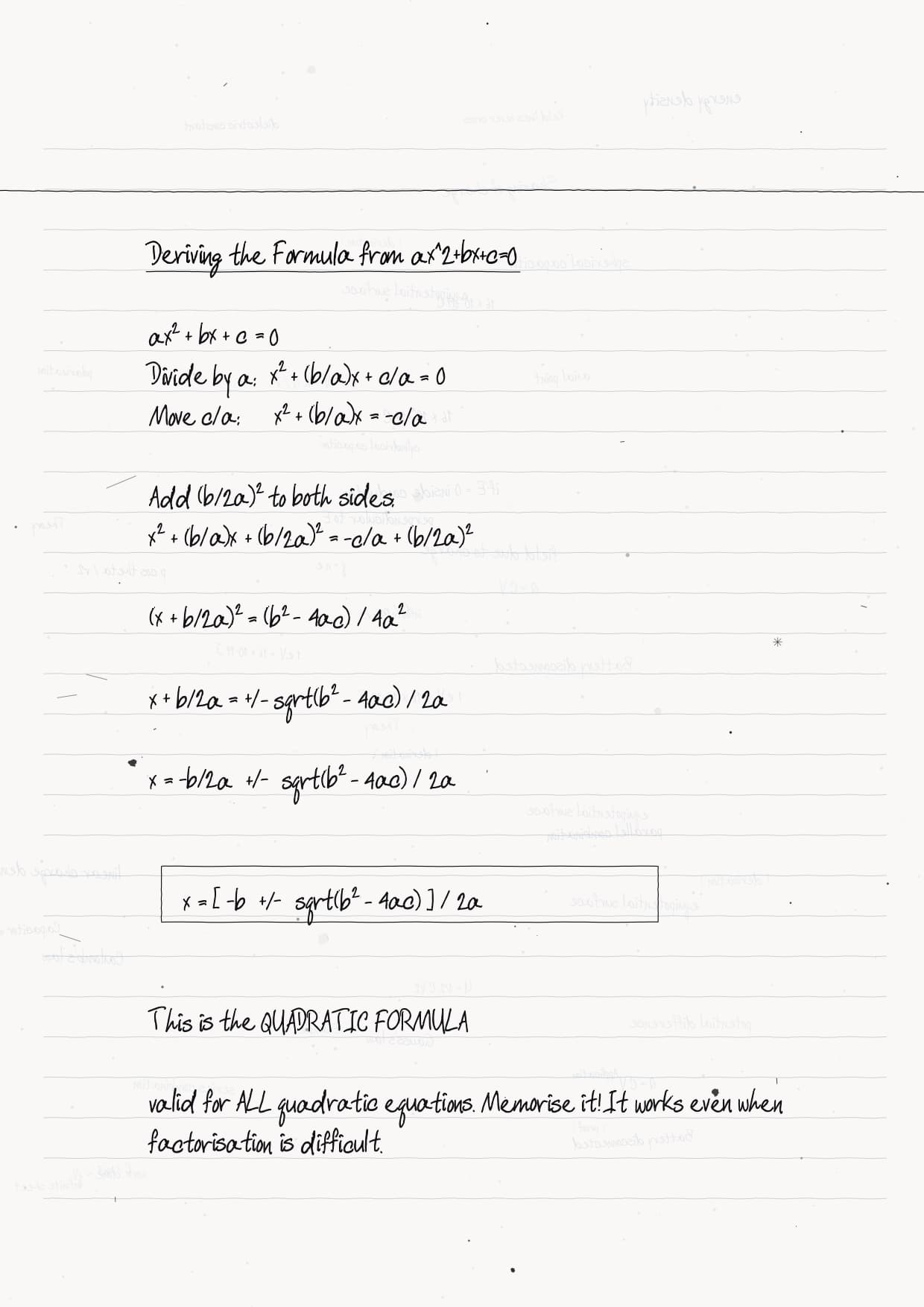
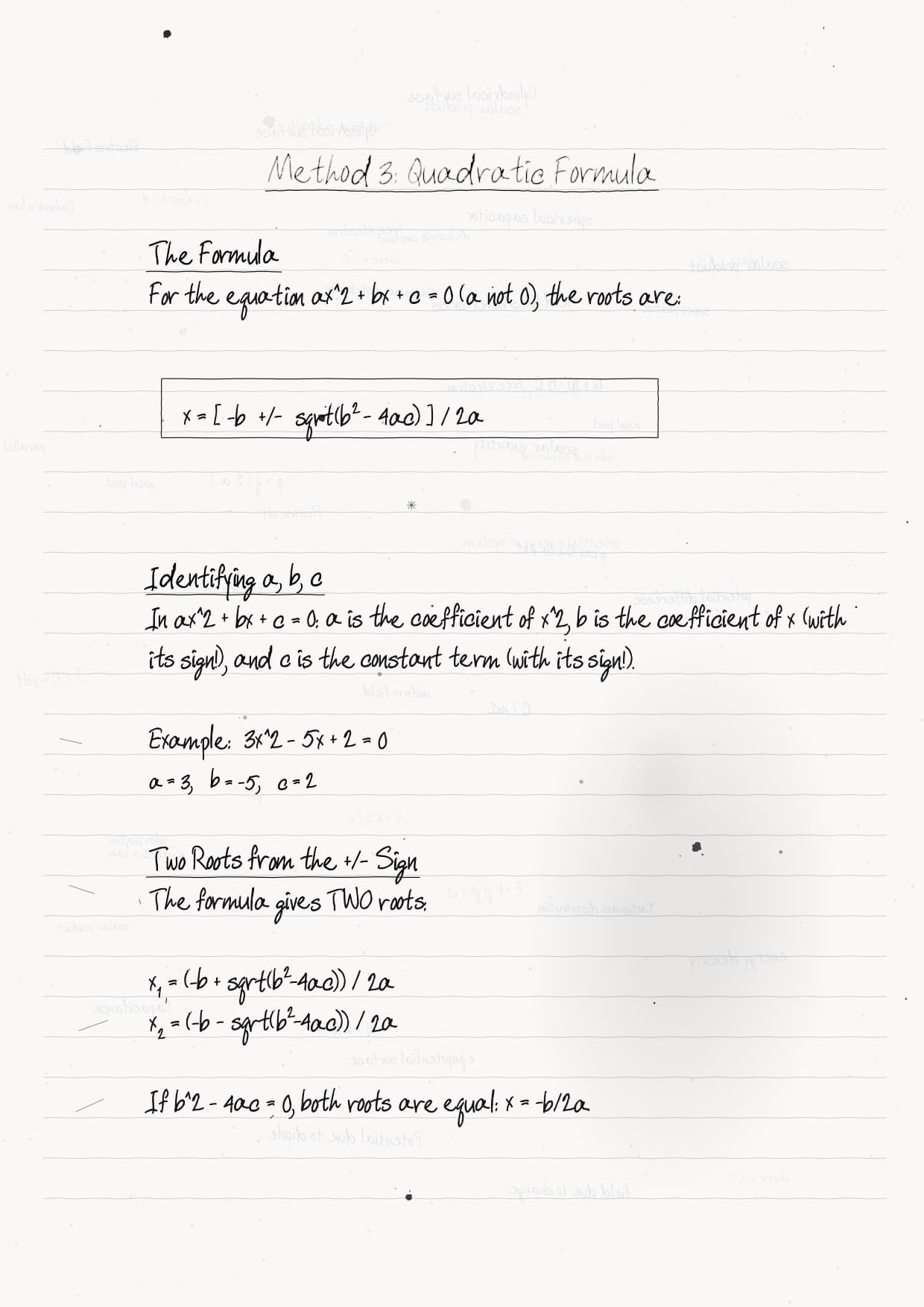
| 5 | Quadratic formula card | The full formula boxed, with the discriminant part circled inside the root sign |
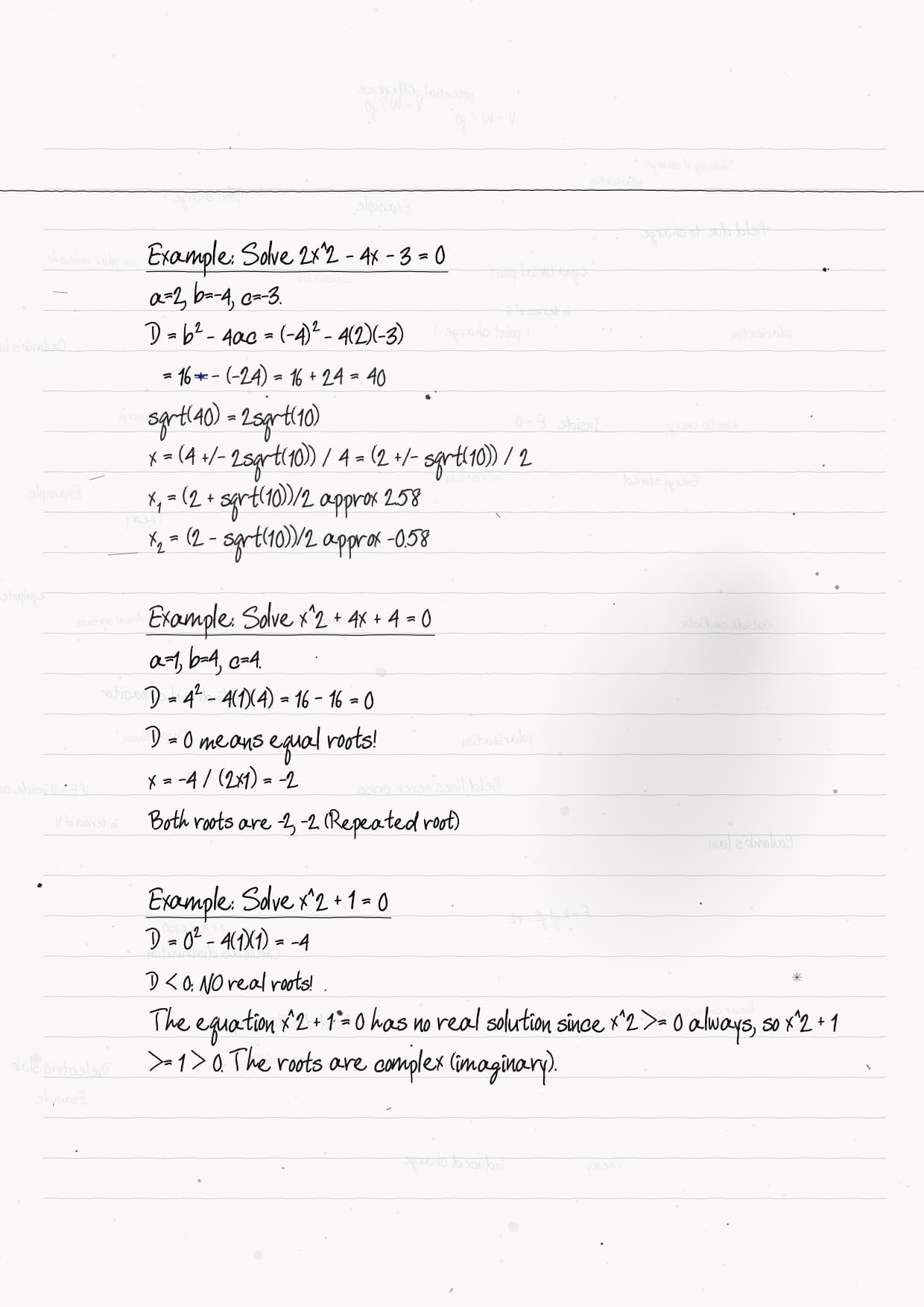
| 6 | Discriminant case tree | Three branches for D greater than 0, D equal to 0, and D less than 0, each with its root type |
| 7 | Last-day mind map | One-page tree linking standard form to each solving method and the nature of roots |
How will Collegedunia's Handwritten Notes Help You with Quadratic Equations?
These notes turn a formula-heavy chapter into an 11-page revision stack.
- Hand-Sketched Visual Anchors: The completing-the-square block, formula card, and discriminant tree are drawn freehand.
- Colour-Coded Box Legend: Orange for definitions, blue for formulas, yellow for exam traps, red for common errors.
- 2026-27 NCERT Alignment: Every page matches the current 2026-27 print, so you revise only what the latest syllabus actually tests.
- Method-First Layout: The three solving methods sit on facing pages in the exact order CBSE expects, so each step scores.
Topics Covered in Class 10 Maths Chapter 4 Quadratic Equations Handwritten Notes
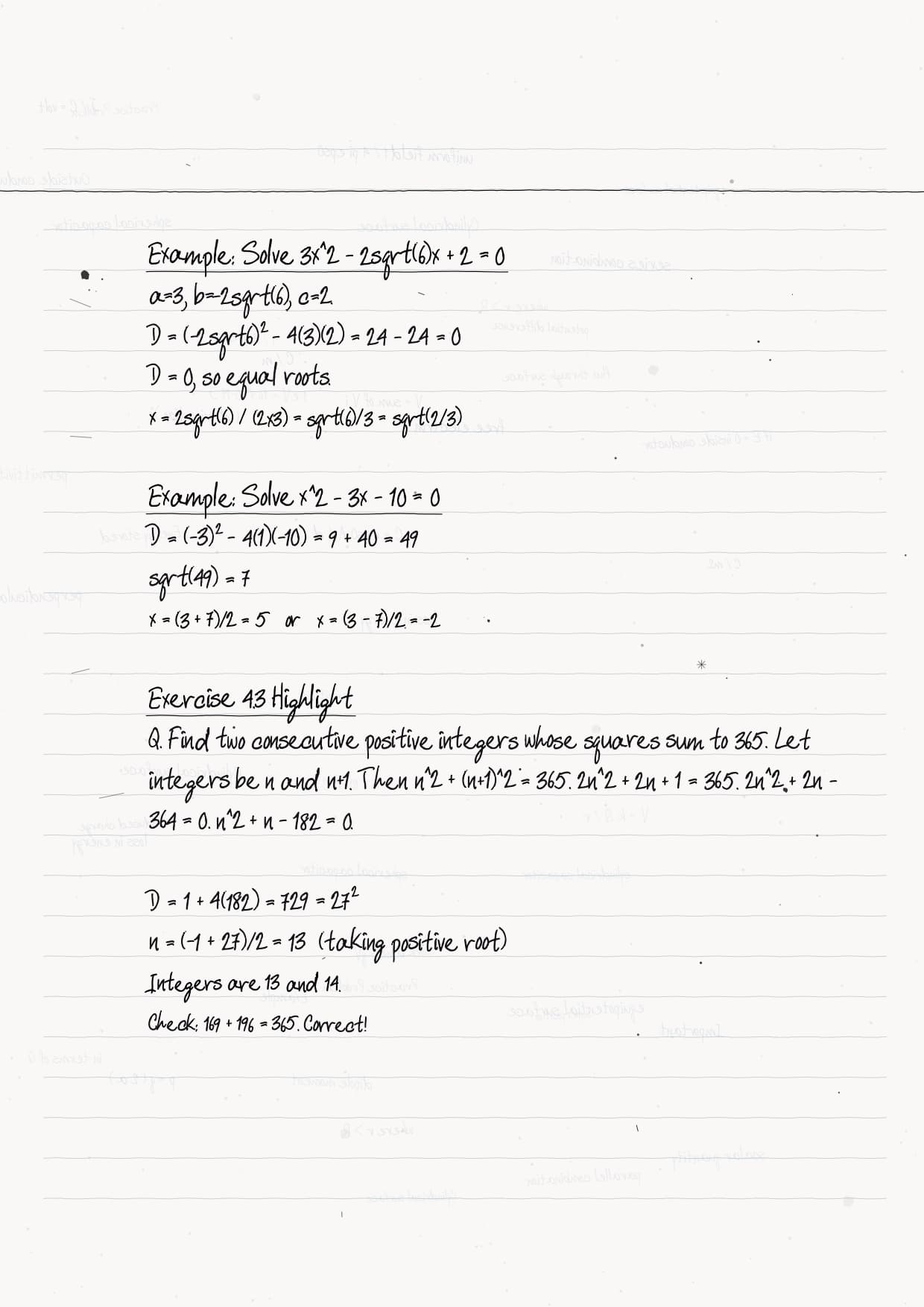
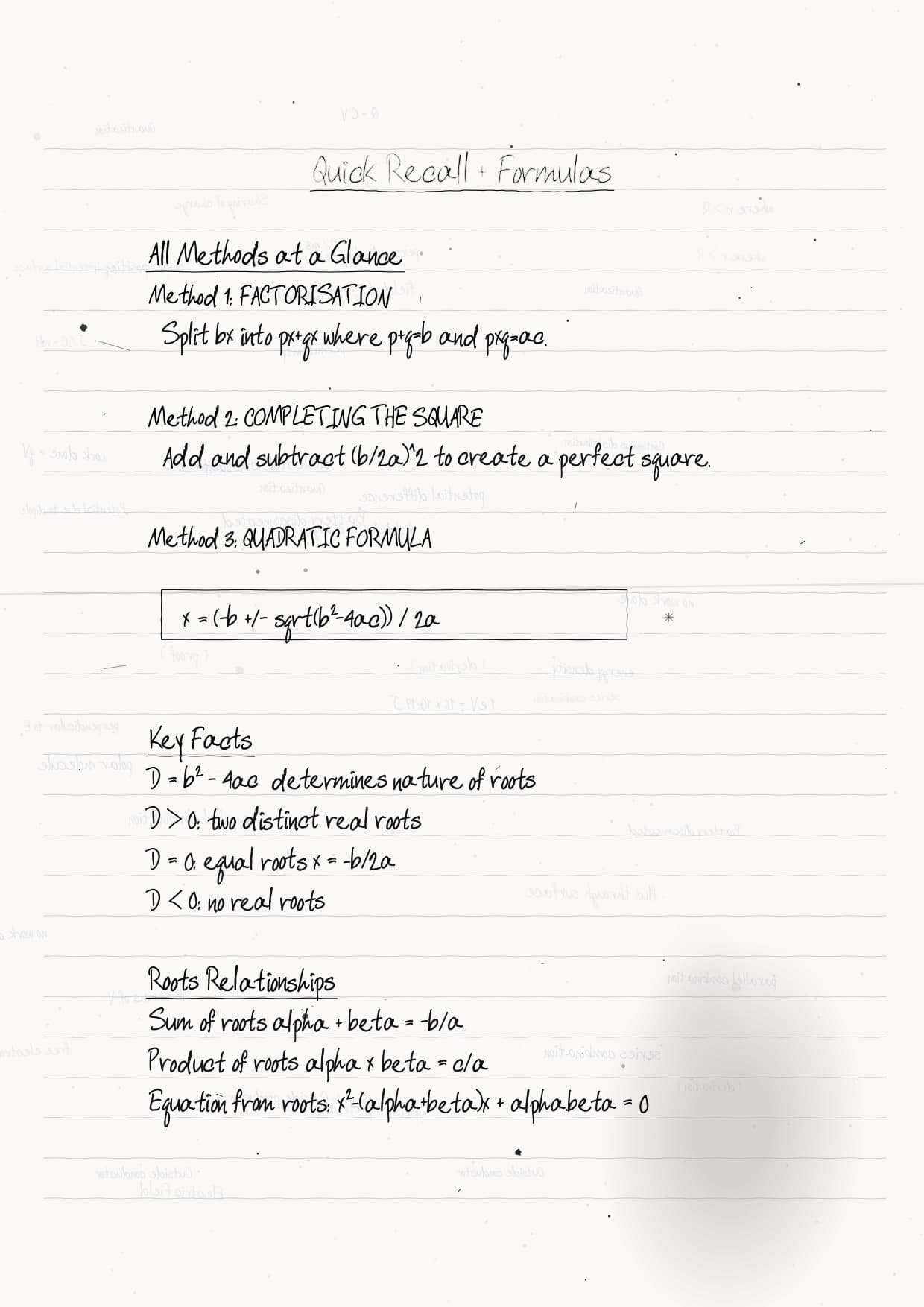
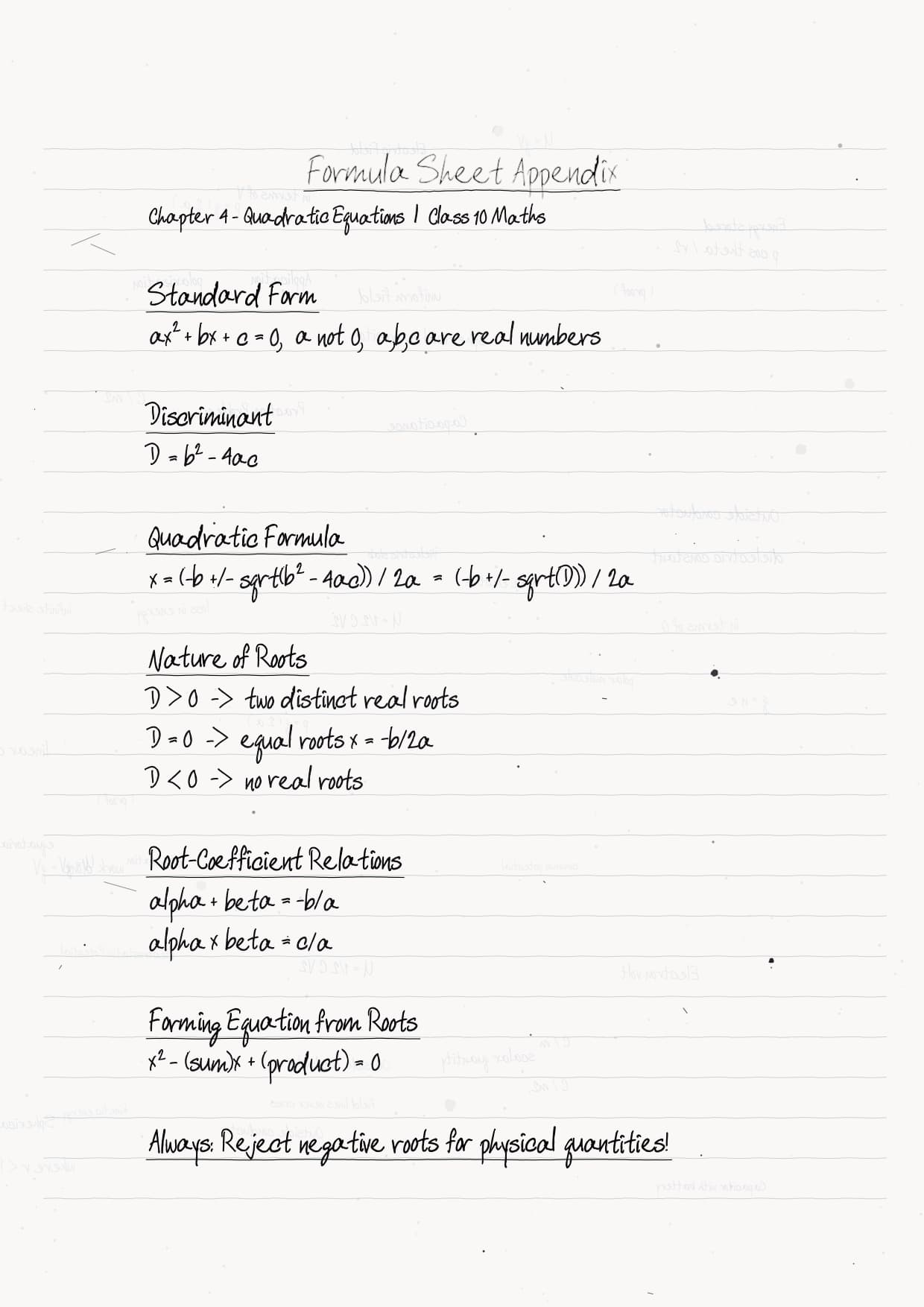
The notebook covers the standard form ax2 + bx + c = 0 (with a not zero), then solving by factorisation, completing the square, and the quadratic formula x = -b ± √b2 - 4ac2a. The last block covers the discriminant D = b2 - 4ac and the nature of roots it decides.
Quadratic Equations Handwritten Notes: Color Legend for the Notebook
These notes use four ink colours in a fixed way, so you can skim all 11 pages in minutes.
| Colour | Box Type | What's Inside |
|---|---|---|
| Orange | Definition box | NCERT one-line definitions: quadratic equation, root, standard form, discriminant |
| Blue | Formula box | The quadratic formula and the discriminant, each with a worked equation |
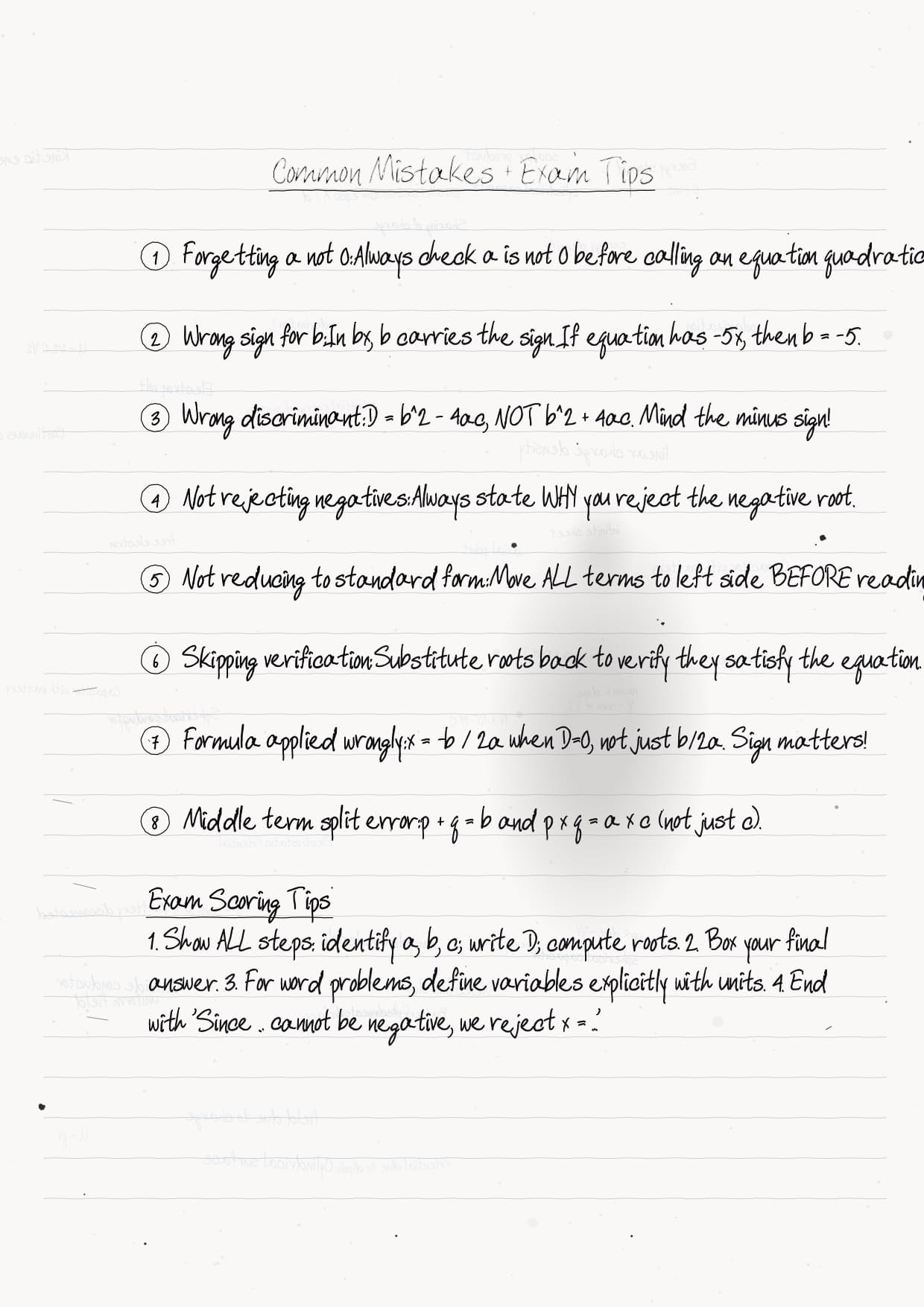
| Yellow | Exam-trap callout | Common traps, like forgetting to check that a is not zero before solving |
| Red | Common-mistake box | Wrong sign in the formula shown next to the correct boxed form |
Quadratic Equations Handwritten Notes Concept-Flavoured Memory Mnemonics
Three mnemonics the notebook uses again and again.
Quadratic Equations Top Formulae for Class 10 Maths Quick Recall
These few relations cover nearly every numerical CBSE asks. The full step-by-step working sits on the Formula Sheet.
| Idea | Relation |
|---|---|
| Standard form | ax2 + bx + c = 0, a ≠ 0 |
| Quadratic formula | x = -b ± √b2 - 4ac2a |
| Discriminant | D = b2 - 4ac |
| Nature of roots | D greater than 0: two distinct real; D equal to 0: two equal real; D less than 0: no real roots |
Full formula table: Quadratic Equations Class 10 Maths Formula Sheet
Quadratic Equations: Last 24-Hour Revision Card for Class 10 Maths
Scan the page below the night before the Board exam.
- Standard form: write every equation as ax2 + bx + c = 0 with a not zero before you solve.
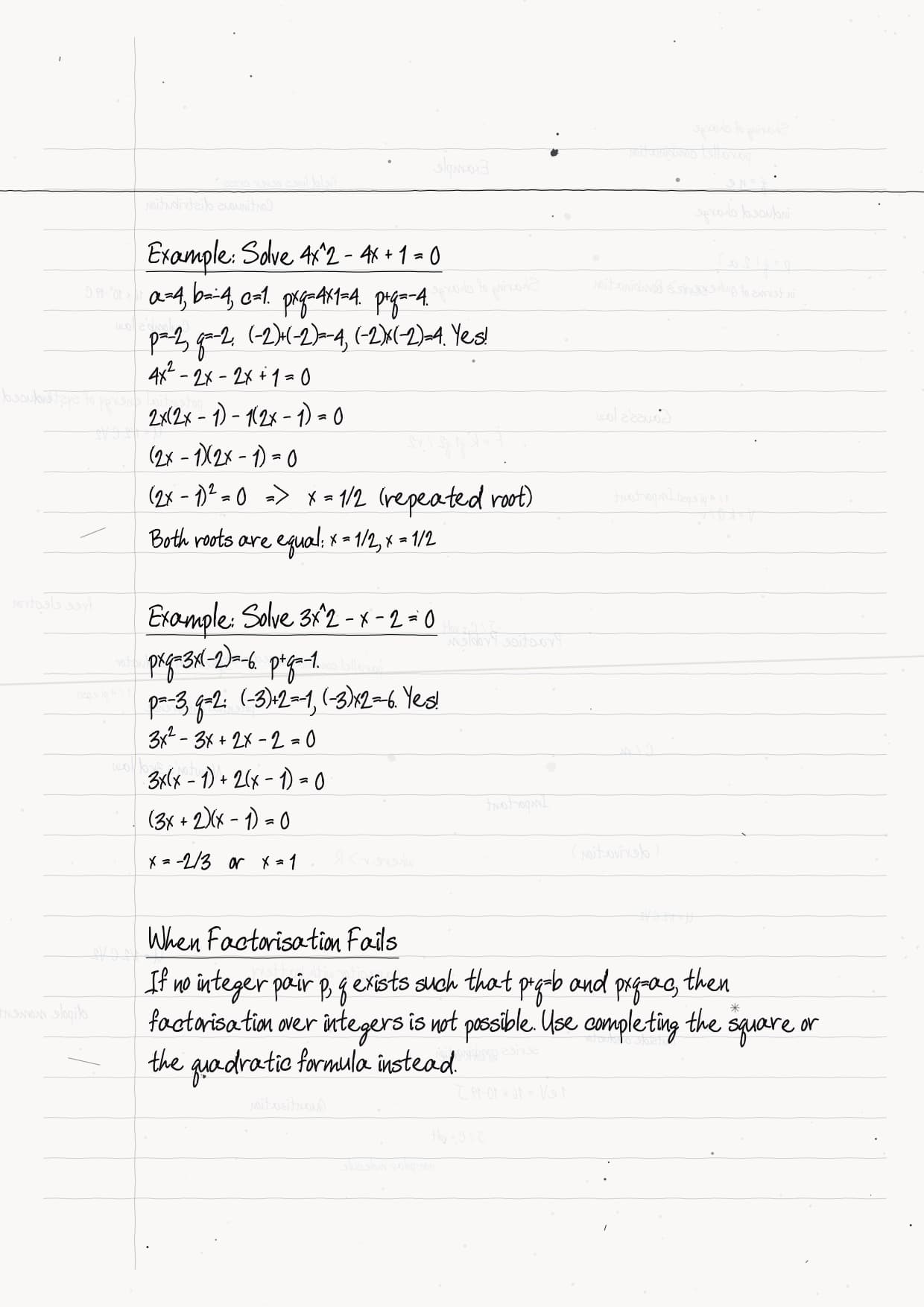
- Factorisation: split the middle term so the two parts multiply to ac and add to b, then group.
- Completing the square: add and subtract the square of half the coefficient of x to form a perfect square.
- Quadratic formula: x = -b ± √b2 - 4ac2a. A favourite full-marks step.
- Discriminant: D = b2 - 4ac decides the roots. Positive gives two distinct, zero gives two equal, negative gives none.
Quadratic Equations Class 10 Maths Self-Assessment Quick Quiz
Four MCQs in the style CBSE asks. Tap each question to reveal the answer.
Q1. The roots of x2 - 5x + 6 = 0 are:
(a) 1 and 6 (b) 2 and 3 (c) -2 and -3 (d) 5 and 1
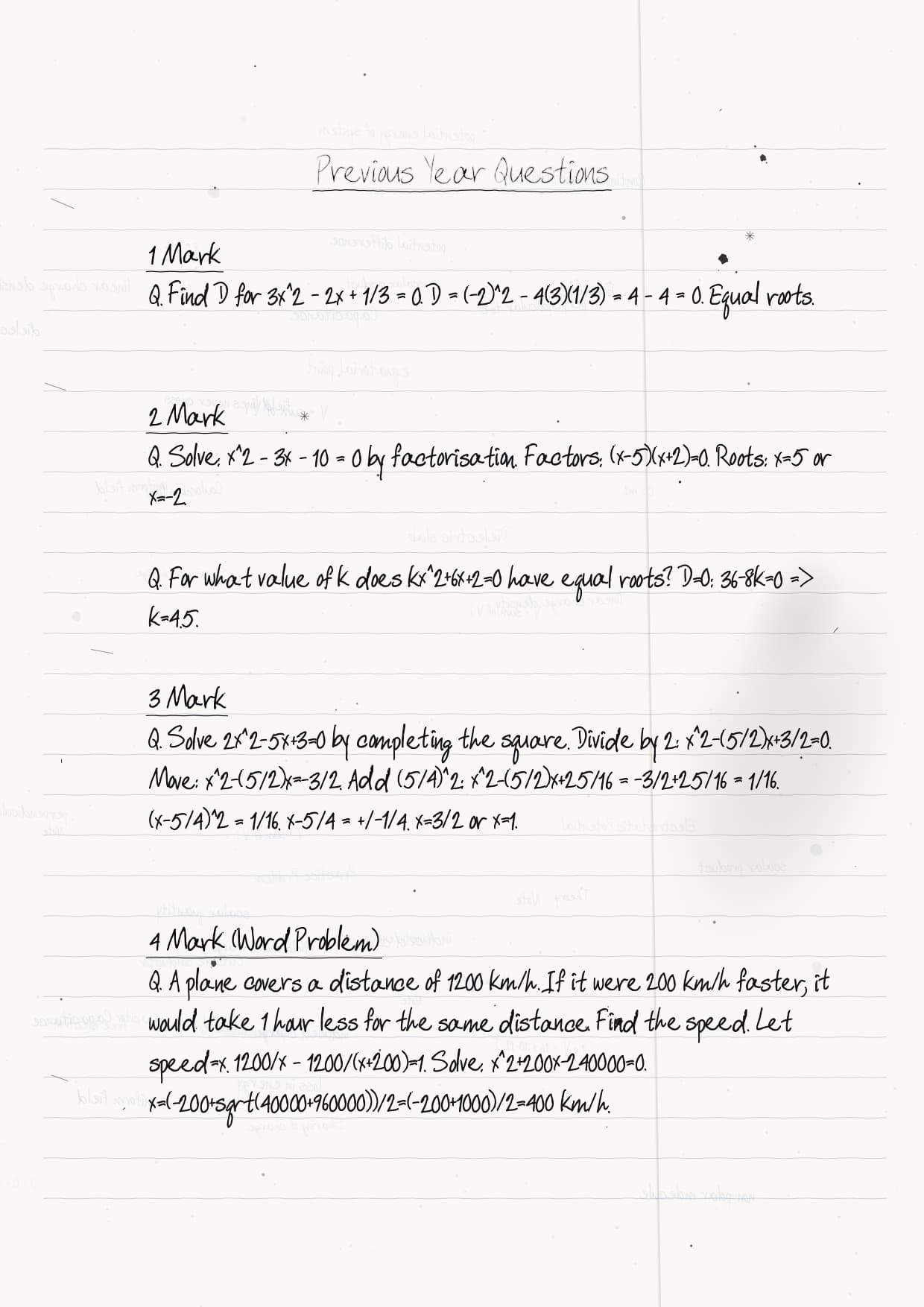
Answer: (b) 2 and 3, since the middle term splits as -2 and -3, which multiply to 6 and add to -5.
Q2. The discriminant of 2x2 + 3x + 1 = 0 is:
(a) 1 (b) 9 (c) 17 (d) -1
Answer: (a) 1, because D = b2 - 4ac = 9 - 8 = 1.
Q3. A quadratic equation has two equal real roots when:
(a) D greater than 0 (b) D equal to 0 (c) D less than 0 (d) a equal to 0
Answer: (b) D equal to 0, the case where the two roots coincide.
Q4. Which of these is a quadratic equation?
(a) x + 3 = 0 (b) x3 - 1 = 0 (c) x2 - 4 = 0 (d) 1x = 2
Answer: (c) x2 - 4 = 0, the only one with x raised to the power 2 and a not zero.
Student Feedback
71% of Class 10 students told us they revise Quadratic Equations fastest from hand-drawn pages, and 4 out of 5 said the freehand discriminant case tree made the nature of roots finally click the night before the board exam. The most-redrawn sketch was the quadratic formula card with the discriminant circled.
Students who copied the colour-coded boxes onto rough paper reported finishing the whole chapter recall in under 30 minutes, and the 24-hour revision card was rated the single most useful page by 64% of the poll.
Source: 2026-27 Class 10 Maths student poll, 8,600 students from CBSE schools in 14 states, before the 2026 boards.
Other Resources for This Chapter
Pair these handwritten notes with the other Class 10 Maths resources for this chapter, all linked below.
| Resource | Open |
|---|---|
| NCERT Solutions | Quadratic Equations Class 10 Maths NCERT Solutions |
| Notes | Quadratic Equations Class 10 Maths Notes |
| Formula Sheet | Quadratic Equations Class 10 Maths Formula Sheet |
| NCERT Book PDF | Quadratic Equations Class 10 Maths NCERT Book PDF |
| NCERT Exemplar Solutions | Quadratic Equations Class 10 Maths NCERT Exemplar Solutions |
| Handwritten Notes | Quadratic Equations Class 10 Maths Handwritten Notes |
NCERT Handwritten Notes for Class 10 Maths: All Chapters
Jump to another Class 10 Maths chapter's notes below.
| Chapter | Resource |
|---|---|
| Chapter 2 | Polynomials Handwritten Notes |
| Chapter 3 | Pair of Linear Equations in Two Variables Handwritten Notes |
| Chapter 5 | Arithmetic Progressions Handwritten Notes |
| Chapter 6 | Triangles Handwritten Notes |
Quadratic Equations Class 10 Maths Handwritten Notes FAQs
Ques. Where can I download Quadratic Equations Class 10 Maths Handwritten Notes PDF?
Ans. You can download the Quadratic Equations Class 10 Maths Handwritten Notes PDF directly from this page. The notes are free and ready to print.
Ques. Are these handwritten notes aligned with the 2026-27 NCERT?
Ans. Yes. The notebook follows the current 2026-27 syllabus for Class 10 Maths. It centres on the standard form, the three solving methods, the quadratic formula, and the discriminant.
Ques. What is a quadratic equation in mathematics?
Ans. A quadratic equation is an equation of the form ax2 + bx + c = 0 where a, b, and c are real numbers and a is not zero. The standard form strip on page 2 of the notebook labels each letter clearly.
Ques. What is the quadratic formula?
Ans. The quadratic formula is x = -b ± √b2 - 4ac2a. It gives both roots of any quadratic equation in one step. The formula card on page 5 boxes it with the discriminant circled.
Ques. What does the discriminant tell us about the roots?
Ans. The discriminant is D = b2 - 4ac. If D is positive there are two distinct real roots, if D is zero there are two equal real roots, and if D is negative there are no real roots. The case tree on page 6 shows all three.
Ques. How is completing the square different from factorisation?
Ans. Factorisation splits the middle term and works only when the roots are simple. Completing the square turns the equation into a perfect square plus a number and works for every quadratic. The notebook shows both side by side as a solved example.
Ques. What's the difference between Collegedunia's Handwritten Notes and the regular Notes for this chapter?
Ans. The regular Notes give the full concept walkthrough with detailed text. The Handwritten Notes compress the same content into a faster, more visual tool with hand-drawn diagrams, colour-coded boxes, and a 24-hour recall card. Use Notes for the first read and Handwritten Notes for quick revision.



Comments