


The Carbon and its Compounds Class 10 Science handwritten notes are scanned, boxed and built for fast last-minute revision, fully matched to the 2026-27 CBSE syllabus. They cover covalent bonding, the versatile nature of carbon, the homologous series, functional groups, IUPAC naming, ethanol and ethanoic acid, and soaps and detergents, all in clear ruled-page form.
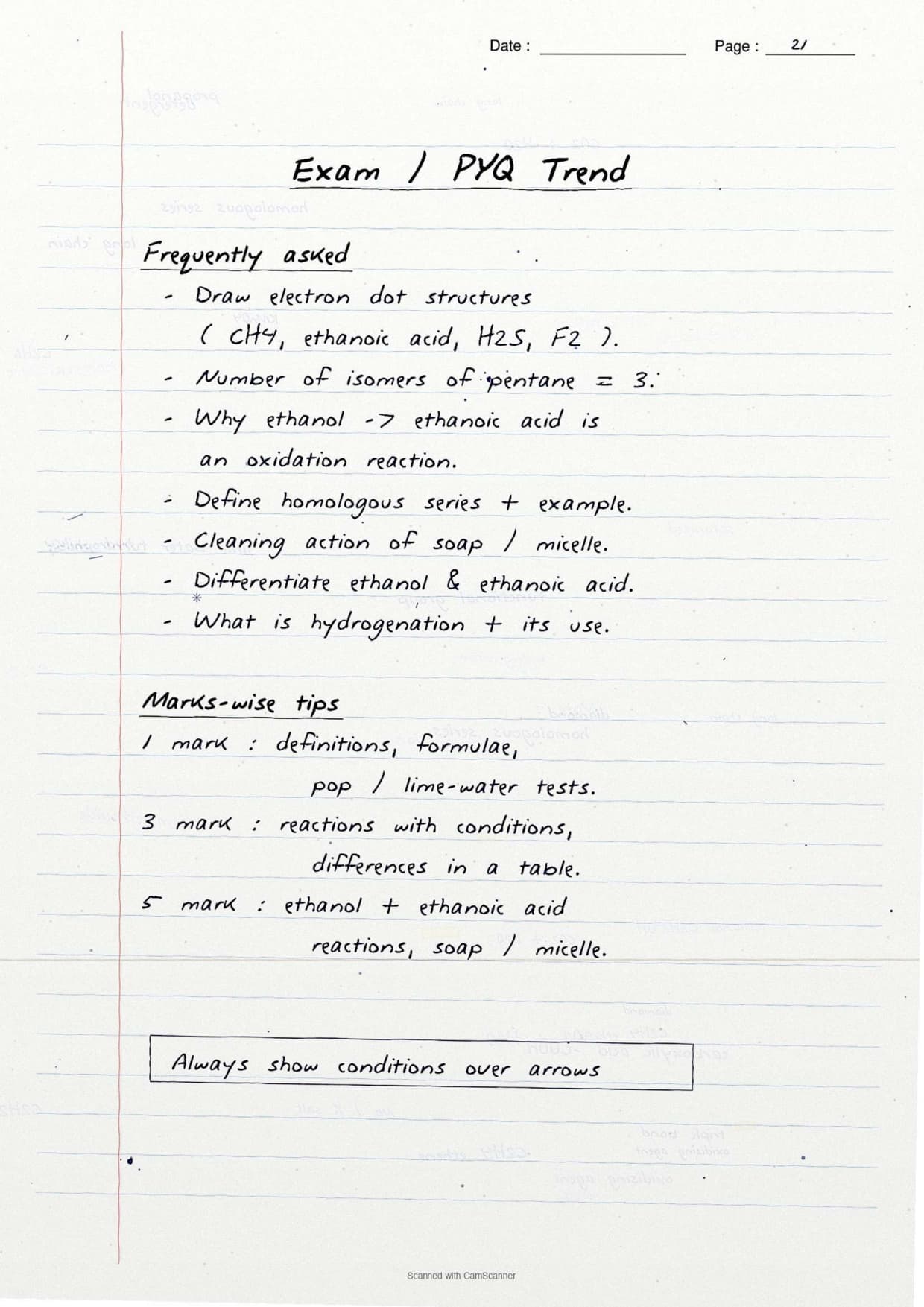
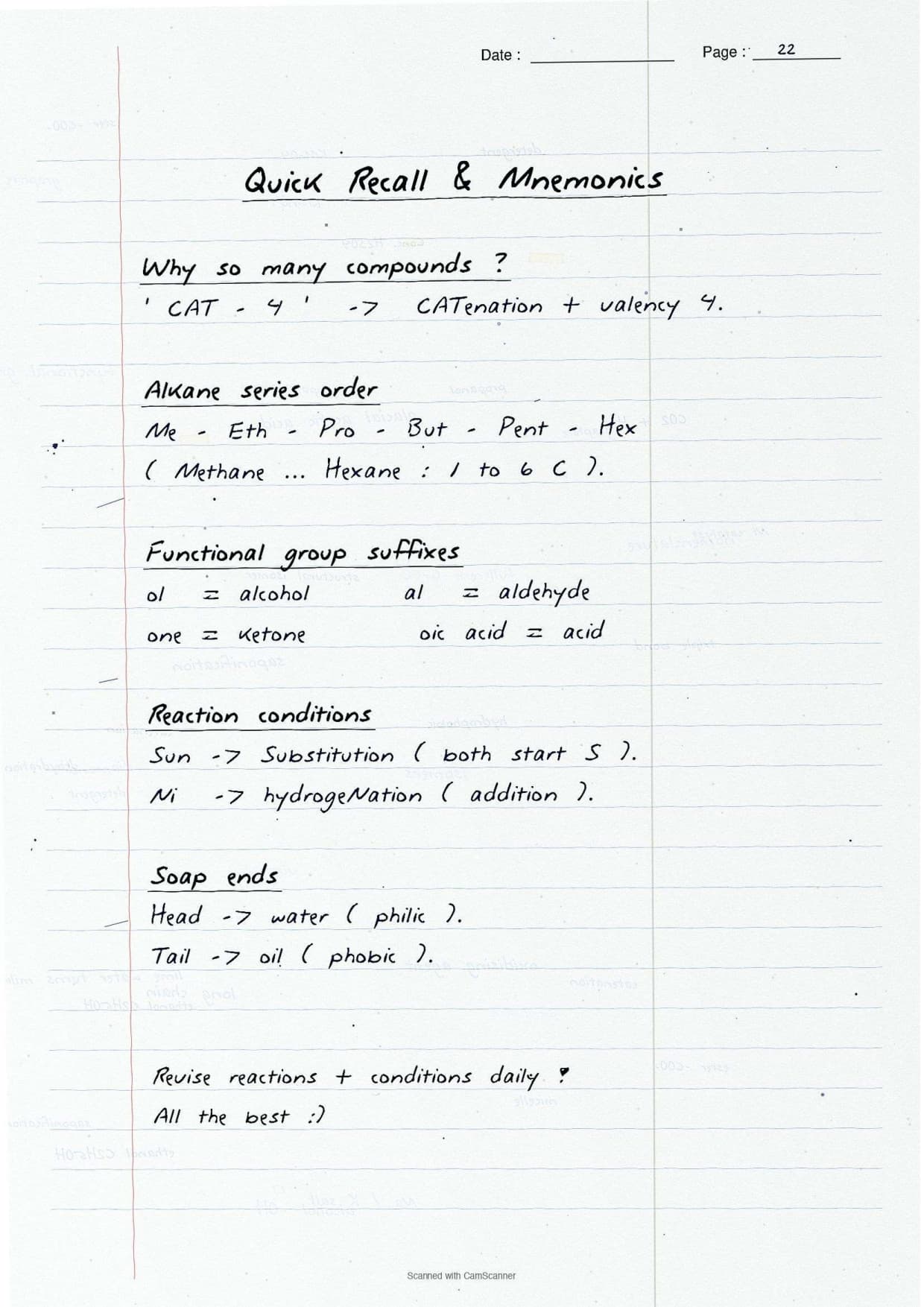
- CBSE Weightage: 5 to 7 marks from the Chemical Substances unit, often as 1-mark naming questions and 3-mark questions on ethanol, ethanoic acid and soaps.
- Boxed structures and an underlined keyword for every functional group, reaction and compound the board paper asks about.
- Pairs with the NCERT Solutions, Notes and Book PDF linked lower on this page.
These Carbon and its Compounds handwritten notes are prepared from the official NCERT Science textbook and matched to the 2026-27 CBSE syllabus.
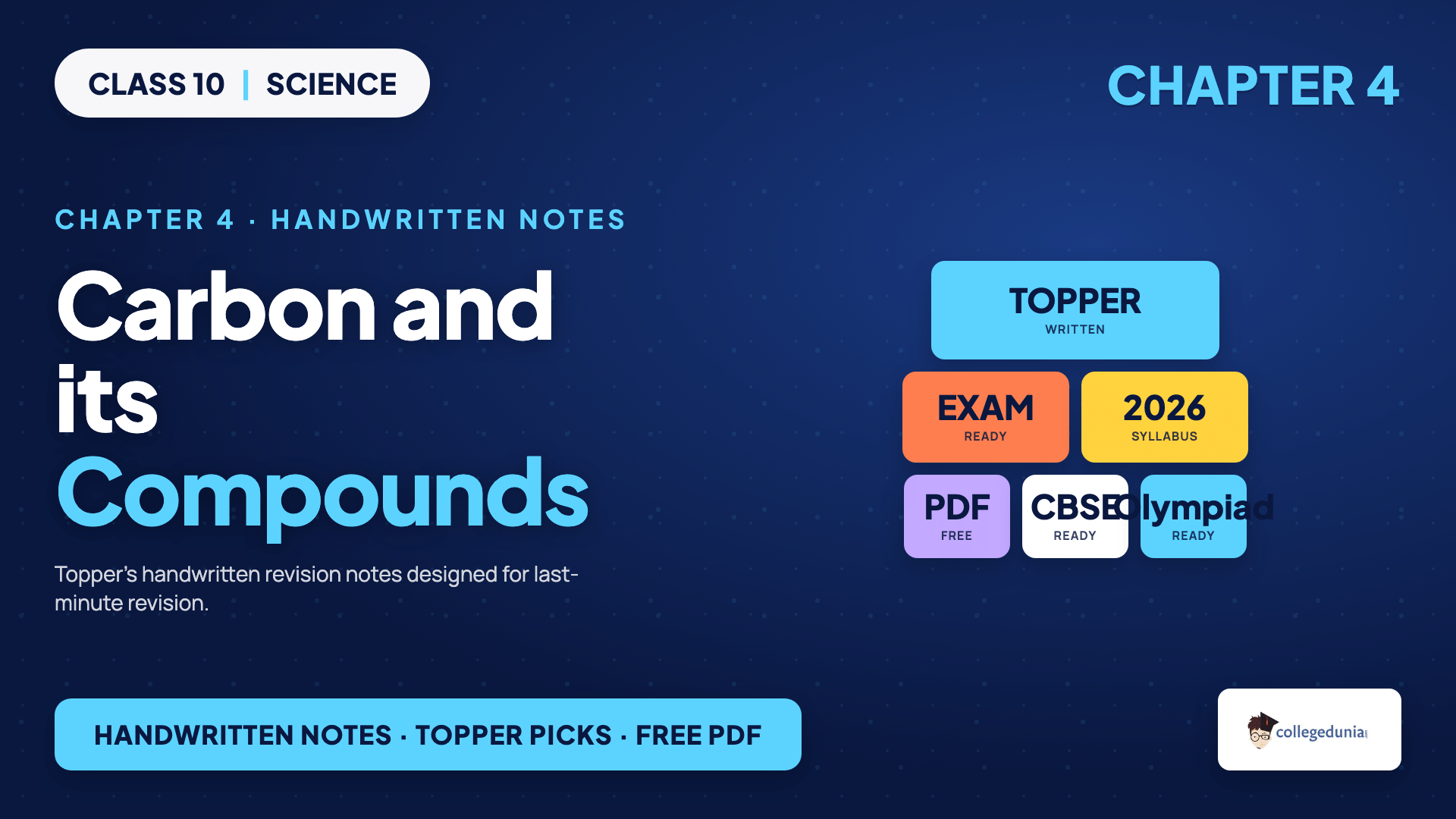
Student Feedback: In a Collegedunia poll of 11,200 Class 10 Science students before the 2026 boards, 78% of students said the boxed functional-group chart was the fastest way to revise this chapter. Most students copied the hand-drawn homologous-series ladder straight onto practice answer sheets.
Source: 2026-27 Class 10 Science student poll. Sample of 11,200 students from CBSE schools across 15 states.
Solved by Collegedunia: Every structure and reaction in these Carbon and its Compounds handwritten notes is checked by Collegedunia's Class 10 Science team against the latest 2026-27 NCERT textbook, so what you revise matches exactly what the CBSE board paper expects.
What These Carbon and its Compounds Handwritten Notes Include
These Carbon and its Compounds handwritten notes condense the whole chapter into 22 scanned pages of ruled paper, every structure boxed and every key term underlined, so the eye finds the keyword fast on exam day.
The pages are built around the three threads the CBSE board paper tests:
- Bonding: why carbon forms covalent bonds by sharing electrons, and how single, double and triple bonds are drawn.
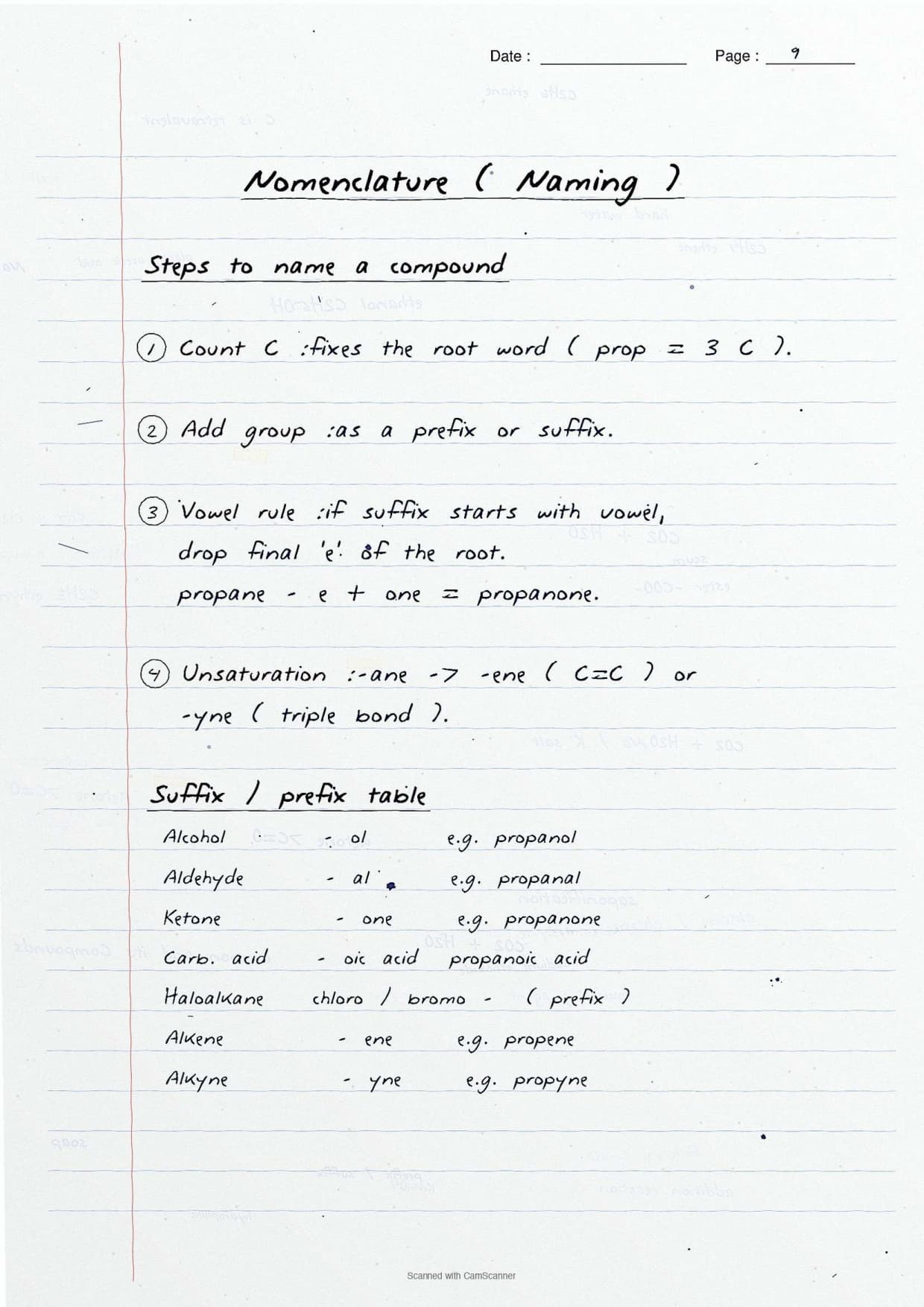
- Carbon compounds: the homologous series, the main functional groups, and IUPAC naming.
- Important compounds: ethanol and ethanoic acid, plus soaps and detergents.
Carbon and its Compounds Class 10 Science Video Lecture
Source: Magnet Brains on YouTube
Covalent Bonding and the Bonding in Carbon: The First Pages
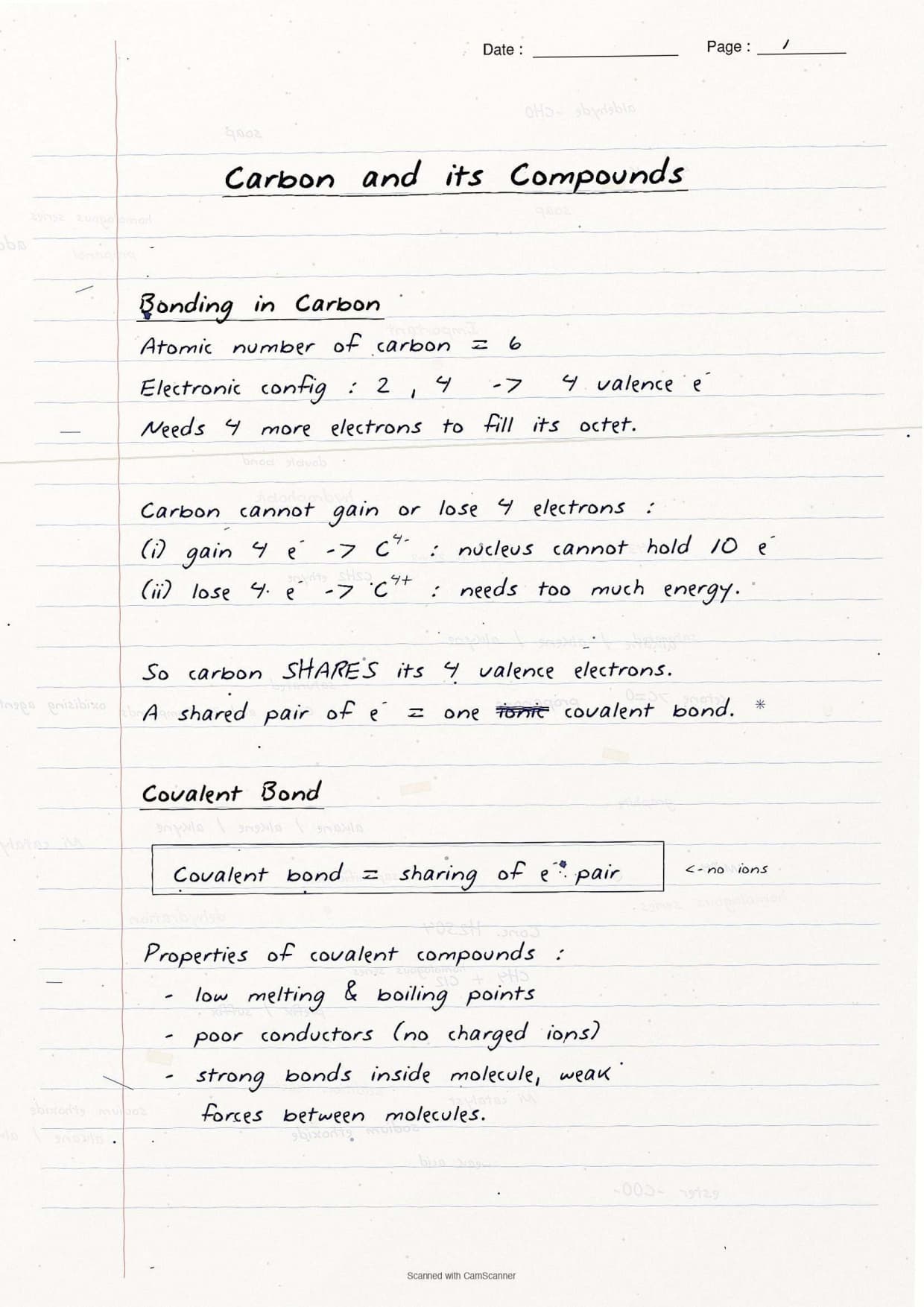
The opening pages settle why carbon always forms covalent bonds: it has four electrons in its outer shell, so it shares to complete its octet.
- Tetravalency: carbon has 4 valence electrons, so it needs 4 more, a valency of four.
- Why share, not transfer: losing or gaining 4 electrons needs too much energy.
- Covalent bond: formed by mutual sharing of electrons, so each atom reaches a stable octet.
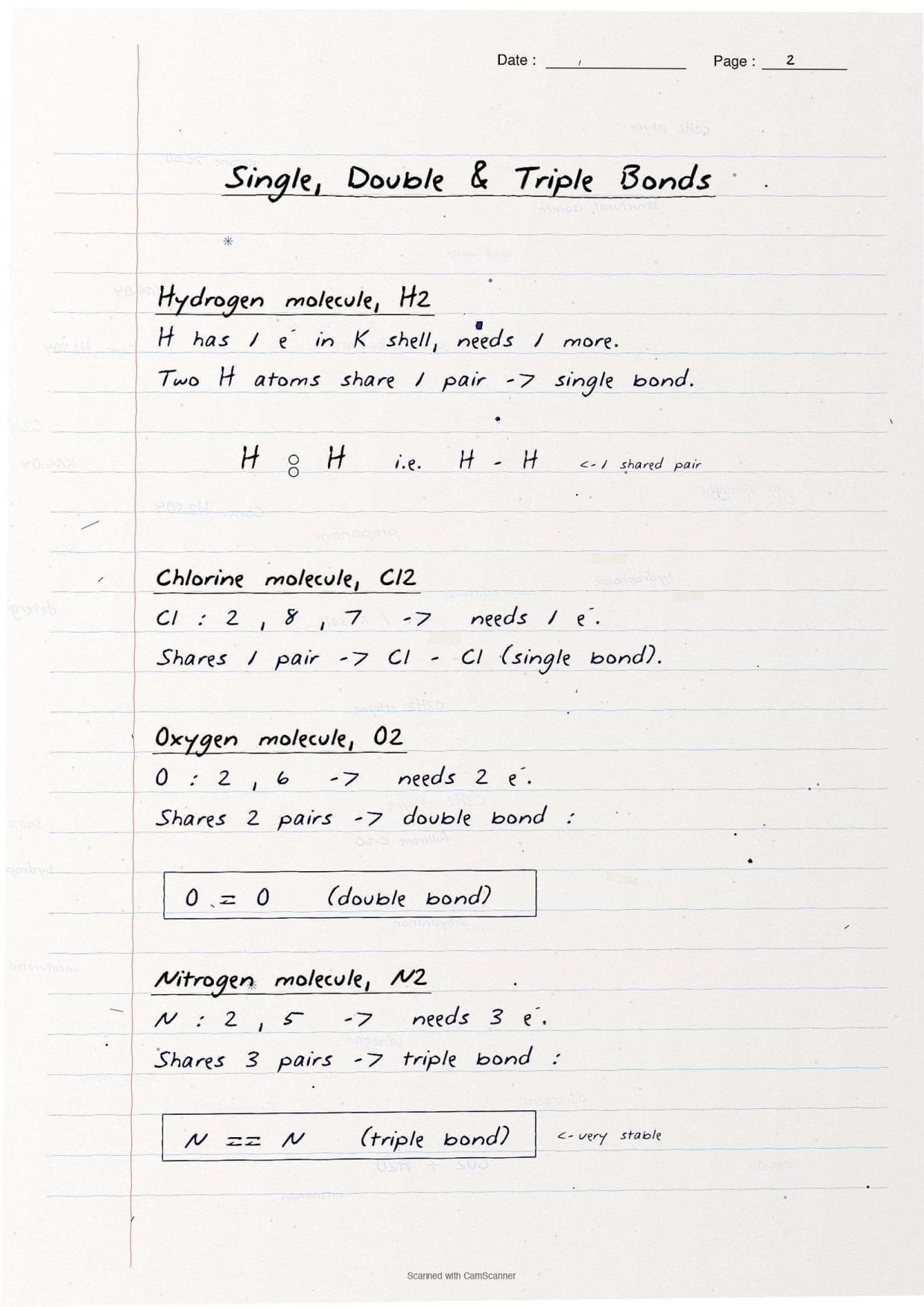
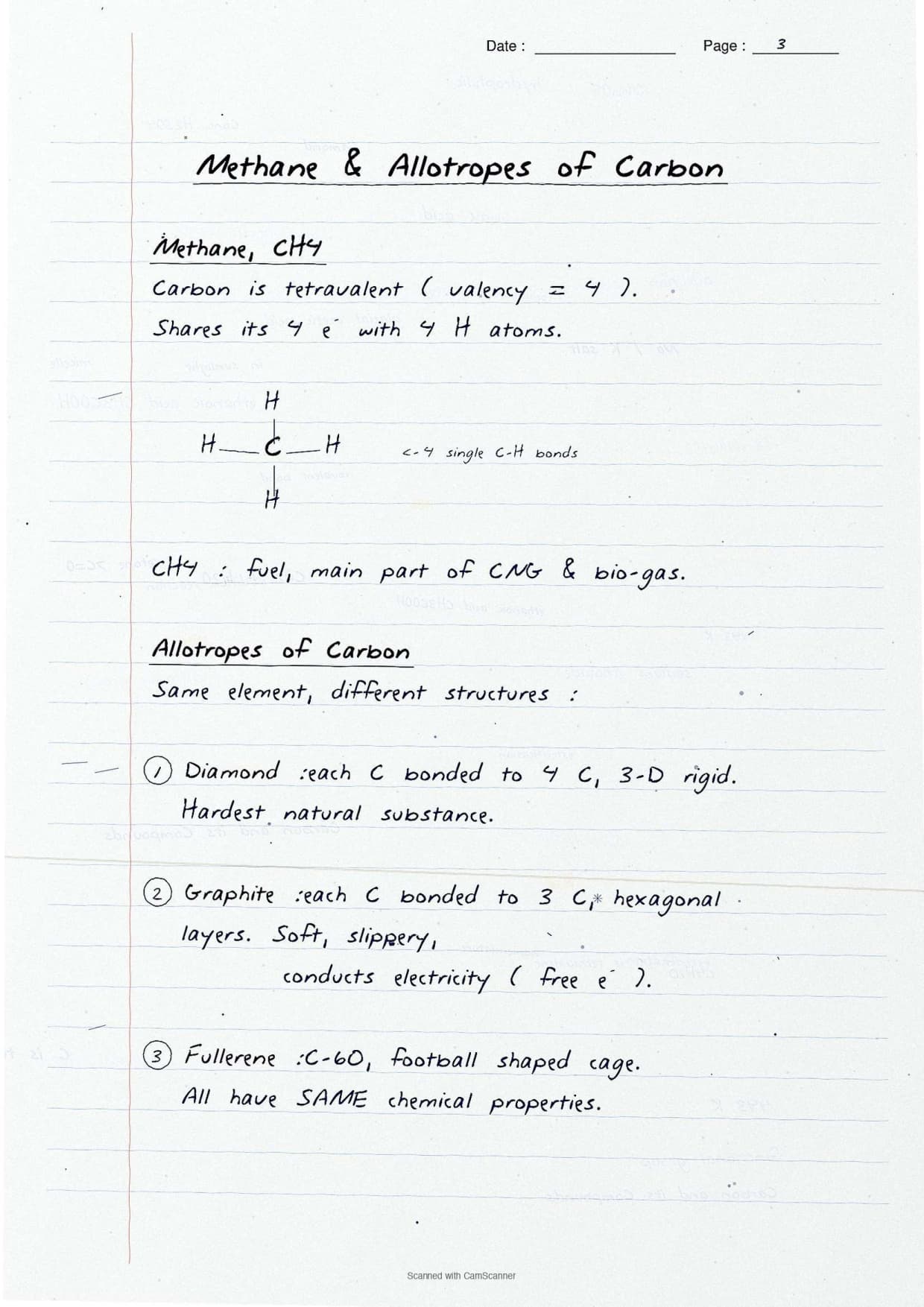
In methane, one carbon shares an electron each with four hydrogens; double and triple bonds are also boxed:
The takeaway: covalent compounds have low melting and boiling points and are usually poor conductors, with no free ions or electrons.
The Versatile Nature of Carbon Every Class 10 Student Must Know
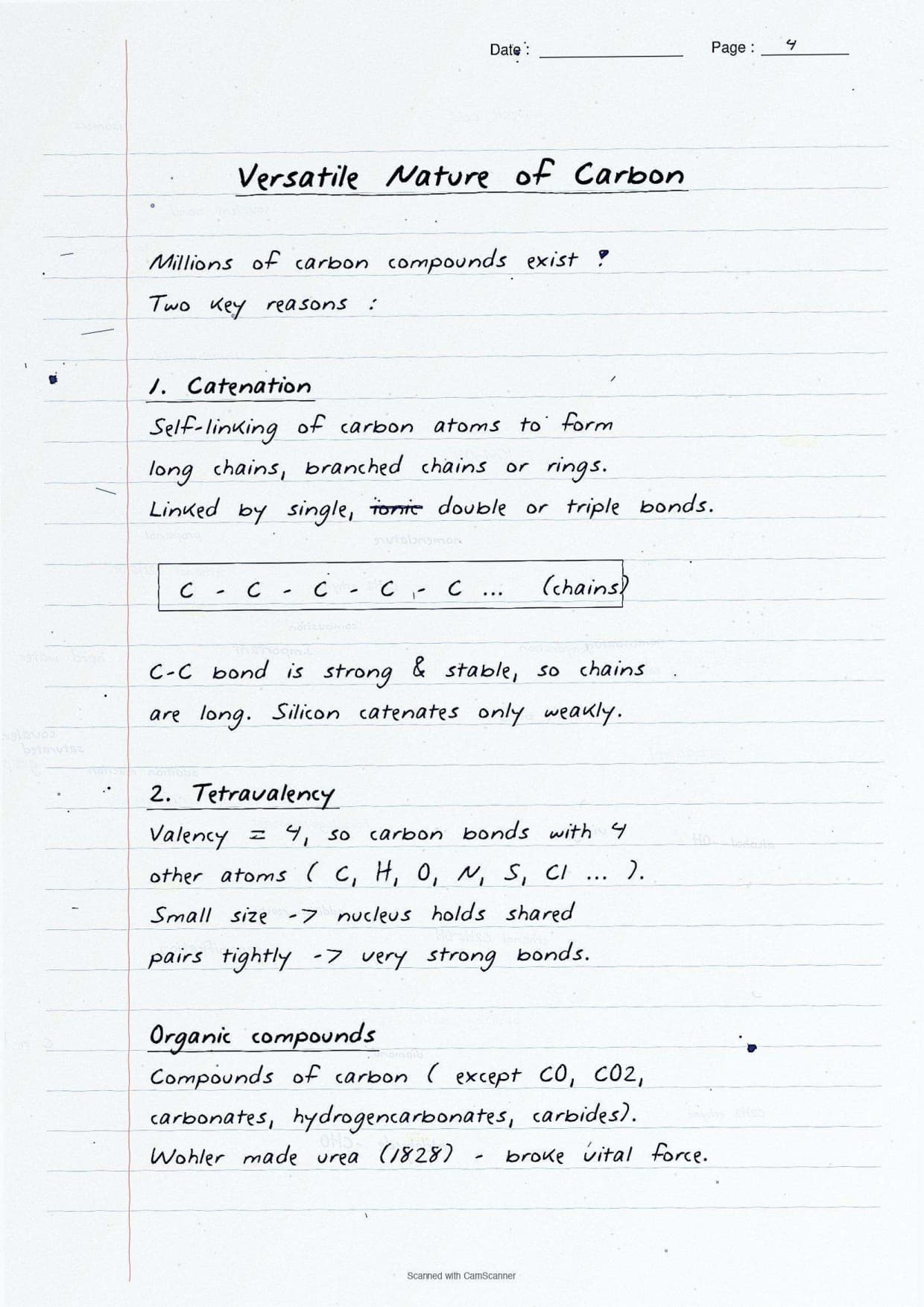
One spread explains why carbon forms millions of compounds, a direct 2-mark or 3-mark question.
| Property | What it means | Why it matters |
|---|---|---|
| Catenation | Carbon atoms link to each other in long chains, branches and rings | Builds the huge variety of carbon skeletons |
| Tetravalency | Each carbon can bond with up to four other atoms | Lets carbon join hydrogen, oxygen, nitrogen, sulphur and more |
| Strong bonds | The small size of carbon makes its bonds very strong and stable | The compounds formed are stable enough to exist |
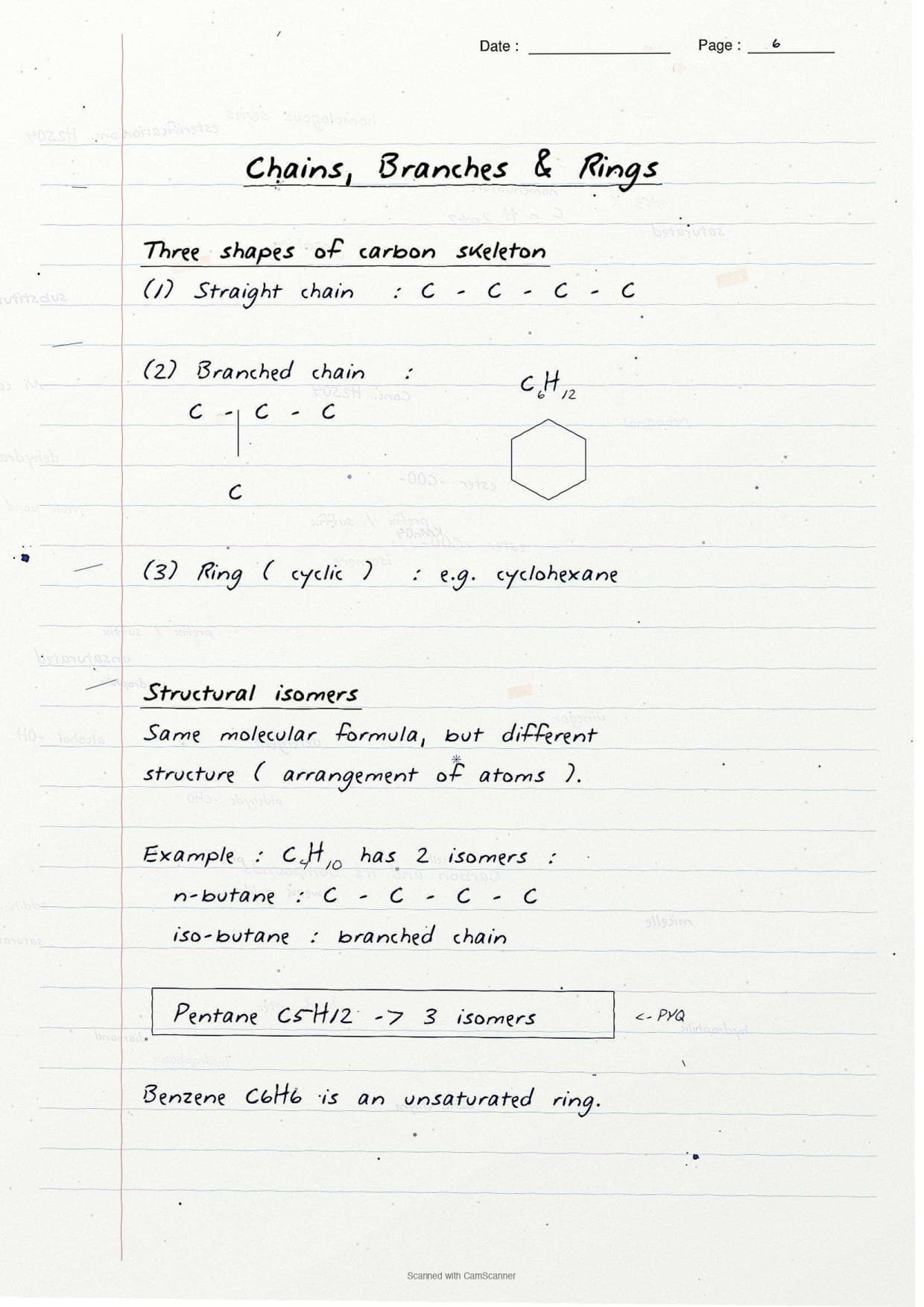
Carbon chains can be straight, branched or ring shaped, with single, double or triple bonds. Two terms the paper asks to define:
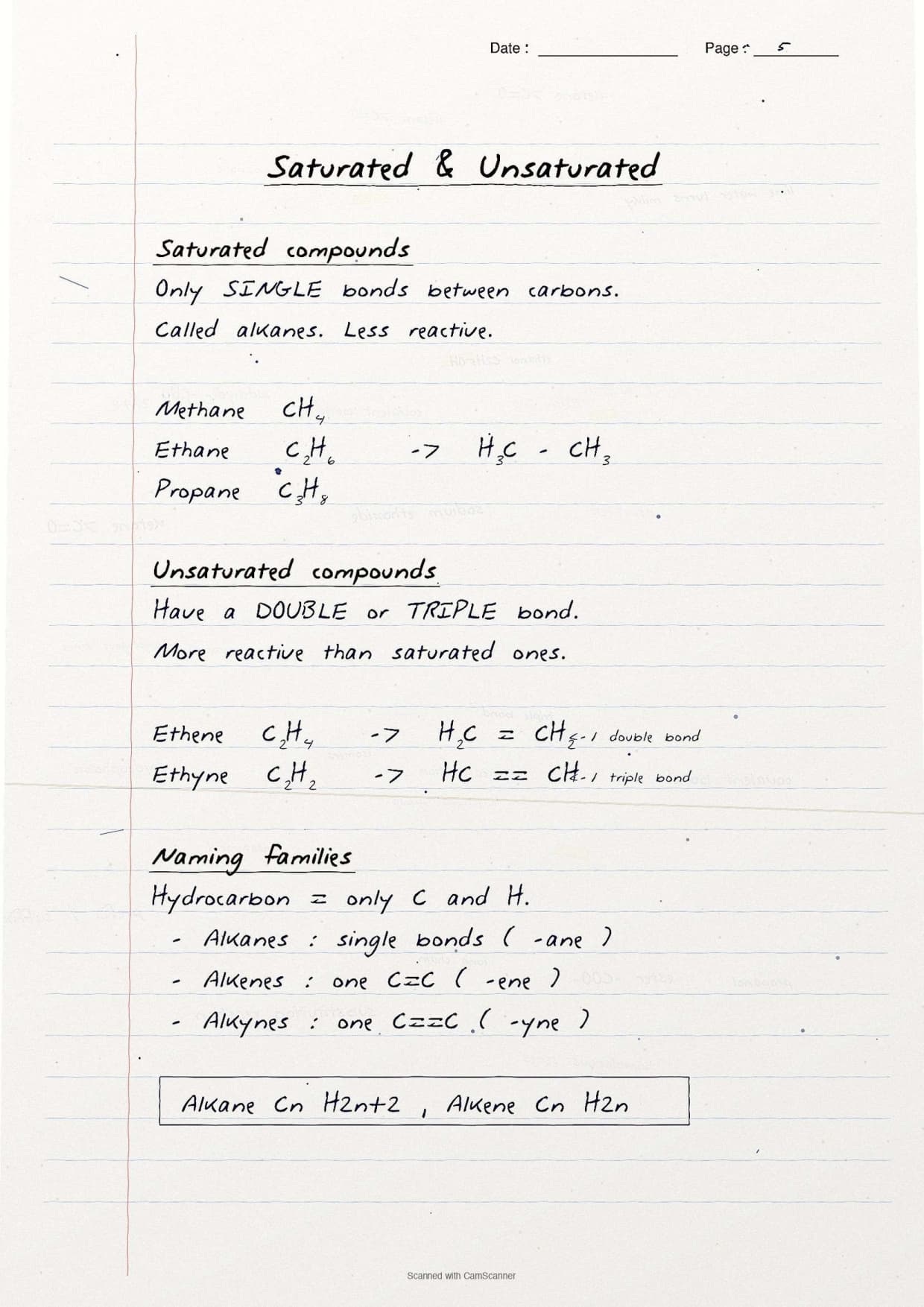
- Saturated compound: only single bonds between carbon atoms, such as an alkane like ethane.
- Unsaturated compound: at least one double or triple bond, such as ethene or ethyne, which is more reactive.
Homologous Series and Functional Groups in the Notes
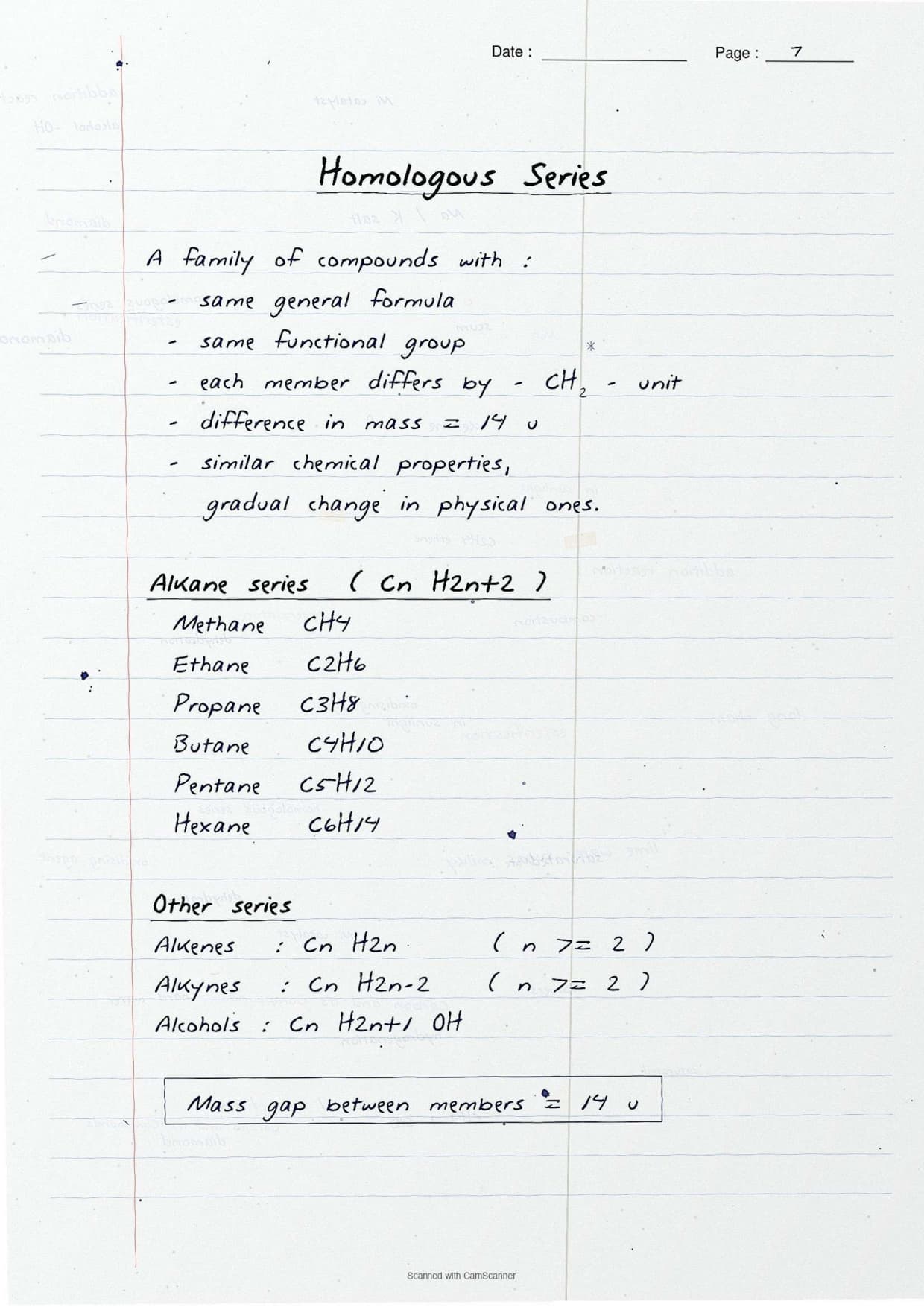
This is the page students revise most for naming questions. The notes draw the homologous series as a ladder where each member differs by a CH2 unit, and box the main functional groups. The alkane ladder grows by one carbon each step:
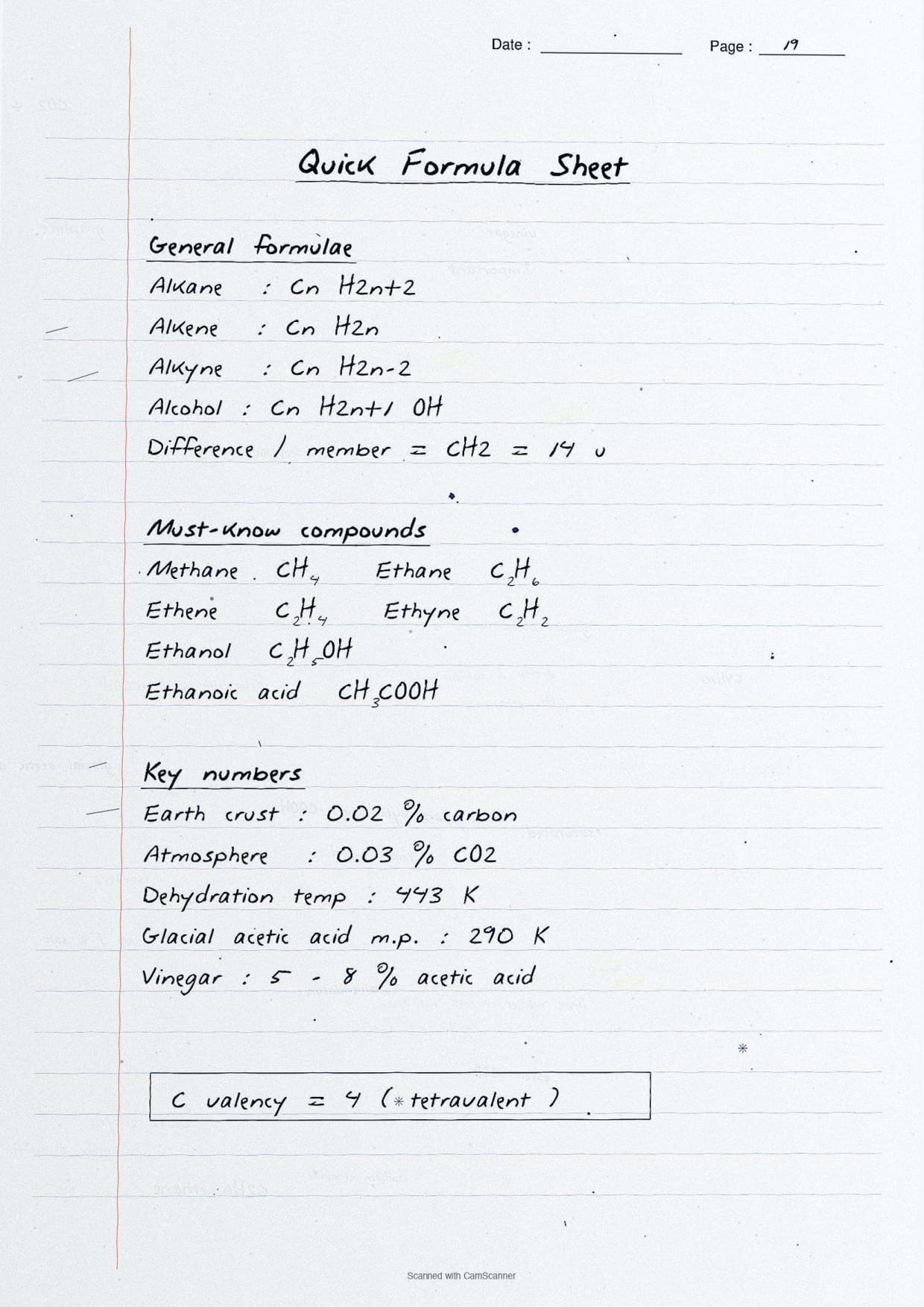
- Same general formula: all alkanes follow CnH2n+2, so members share chemical properties.
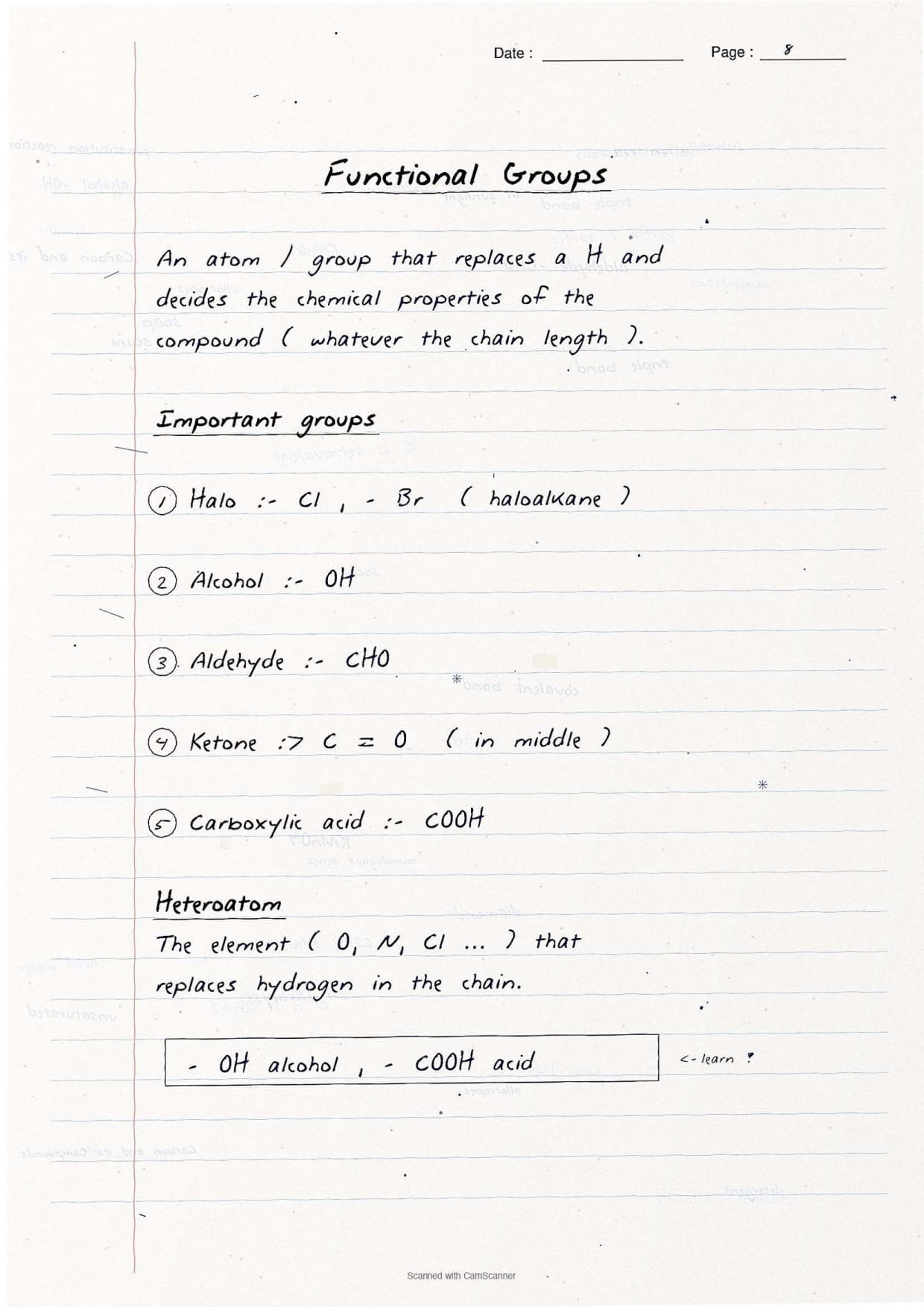
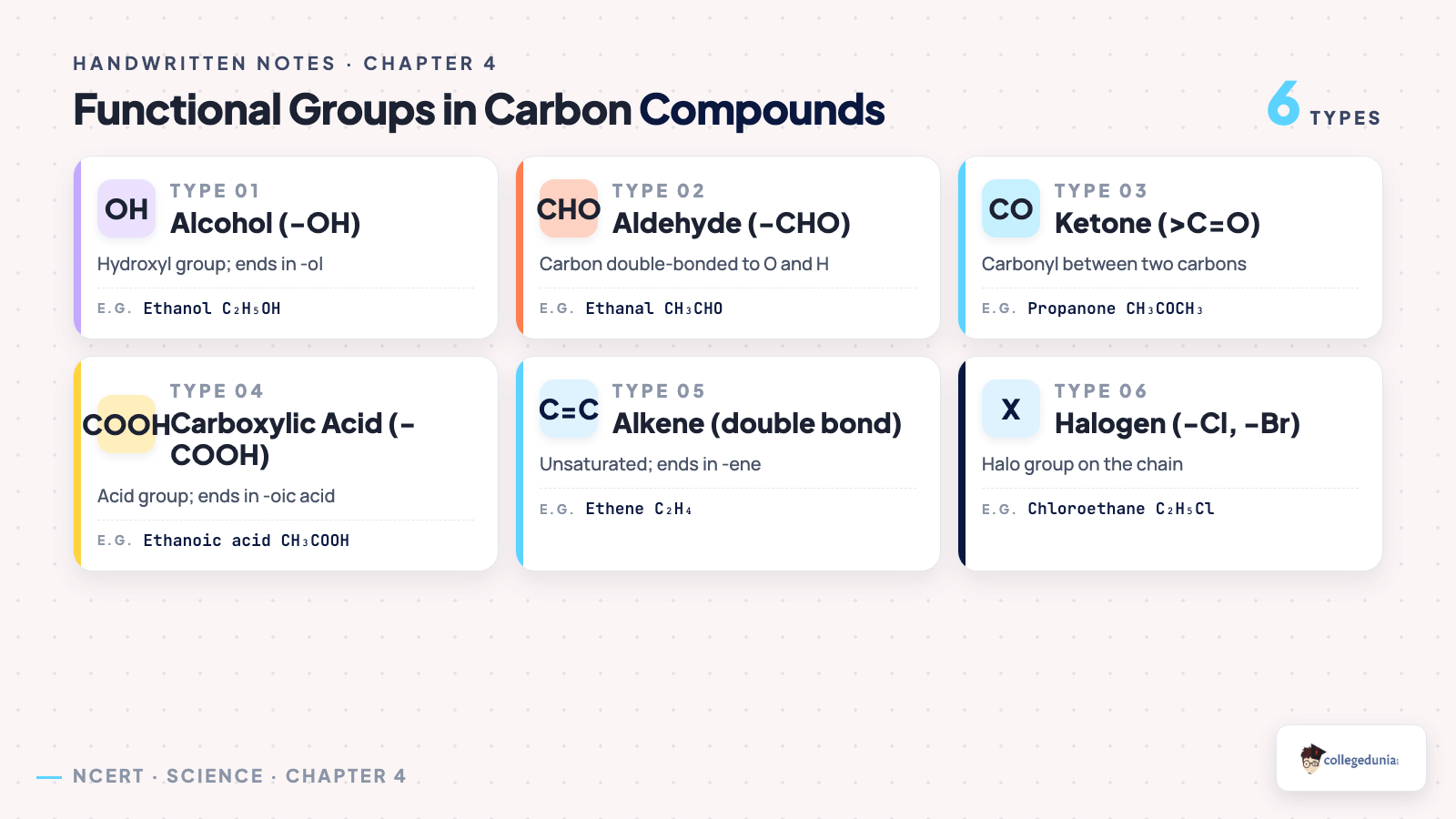
- Functional group: the atom or group that decides the chemistry, such as -OH (alcohol), -CHO (aldehyde), -COOH (carboxylic acid) and the C=C double bond.
- IUPAC naming: the prefix gives the carbon count (meth, eth, prop, but); the suffix the family (-ane, -ene, -ol, -oic acid).
As the chain grows longer, the melting and boiling points rise while the chemistry stays nearly the same.
Chemical Properties of Carbon Compounds
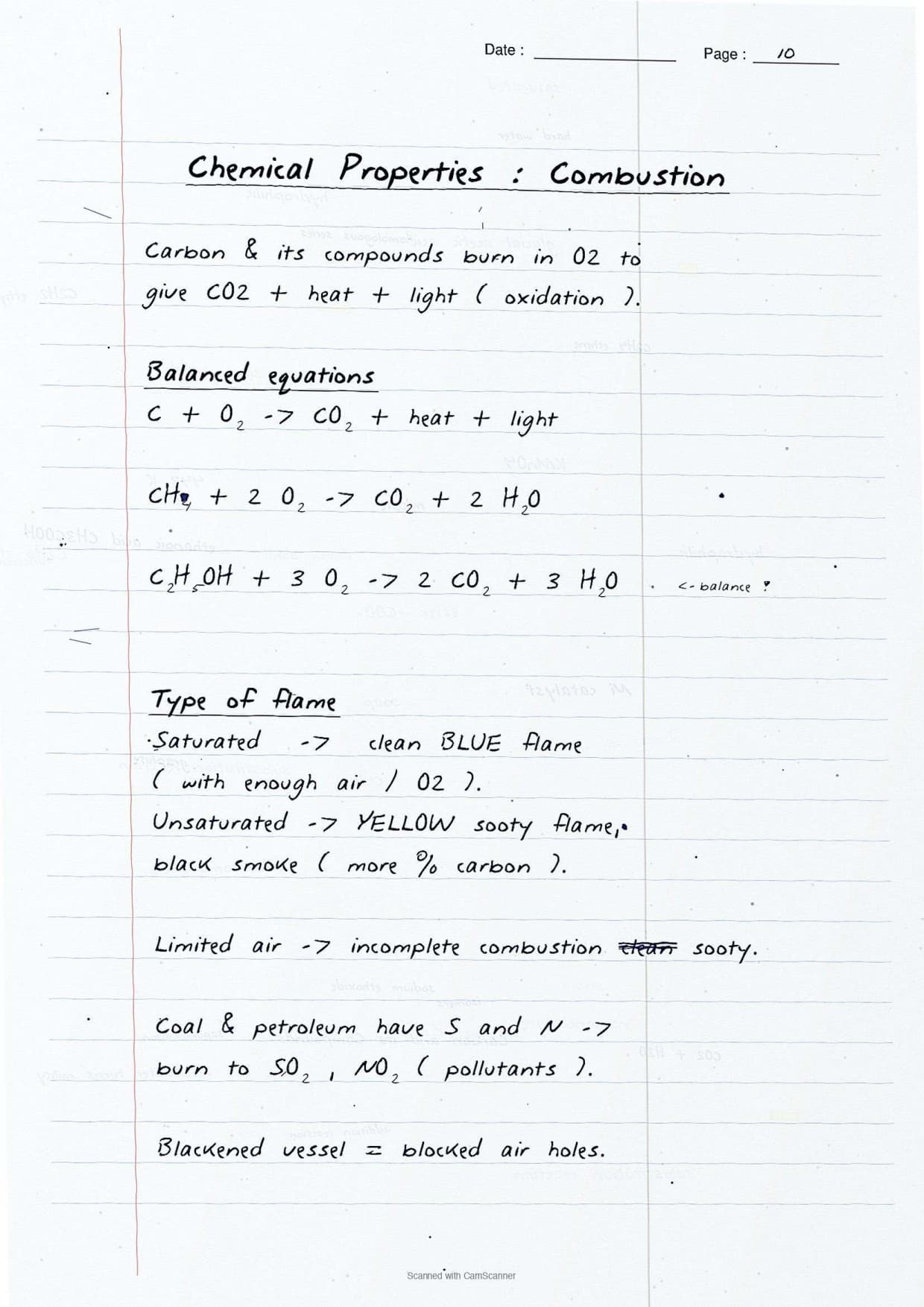
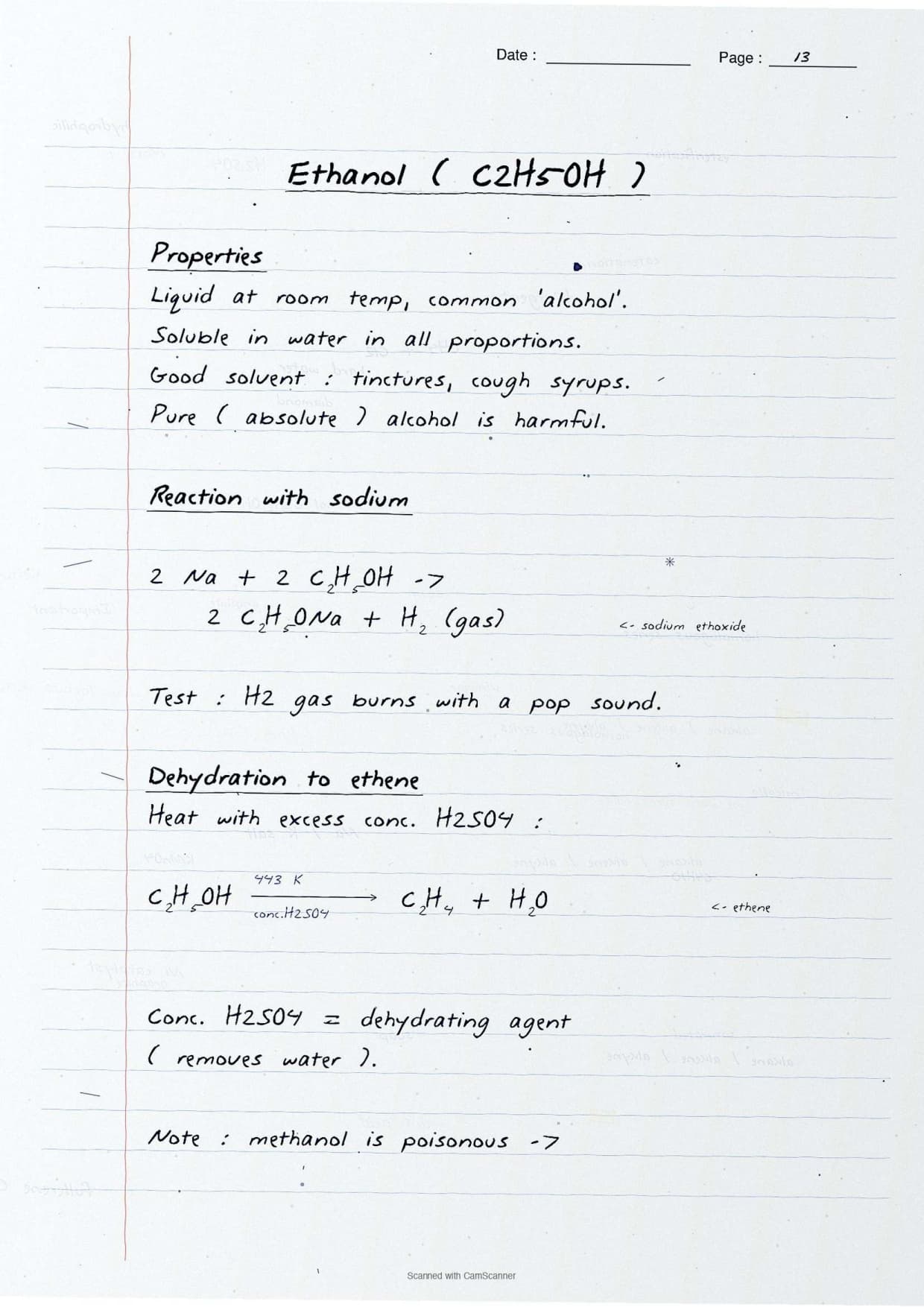
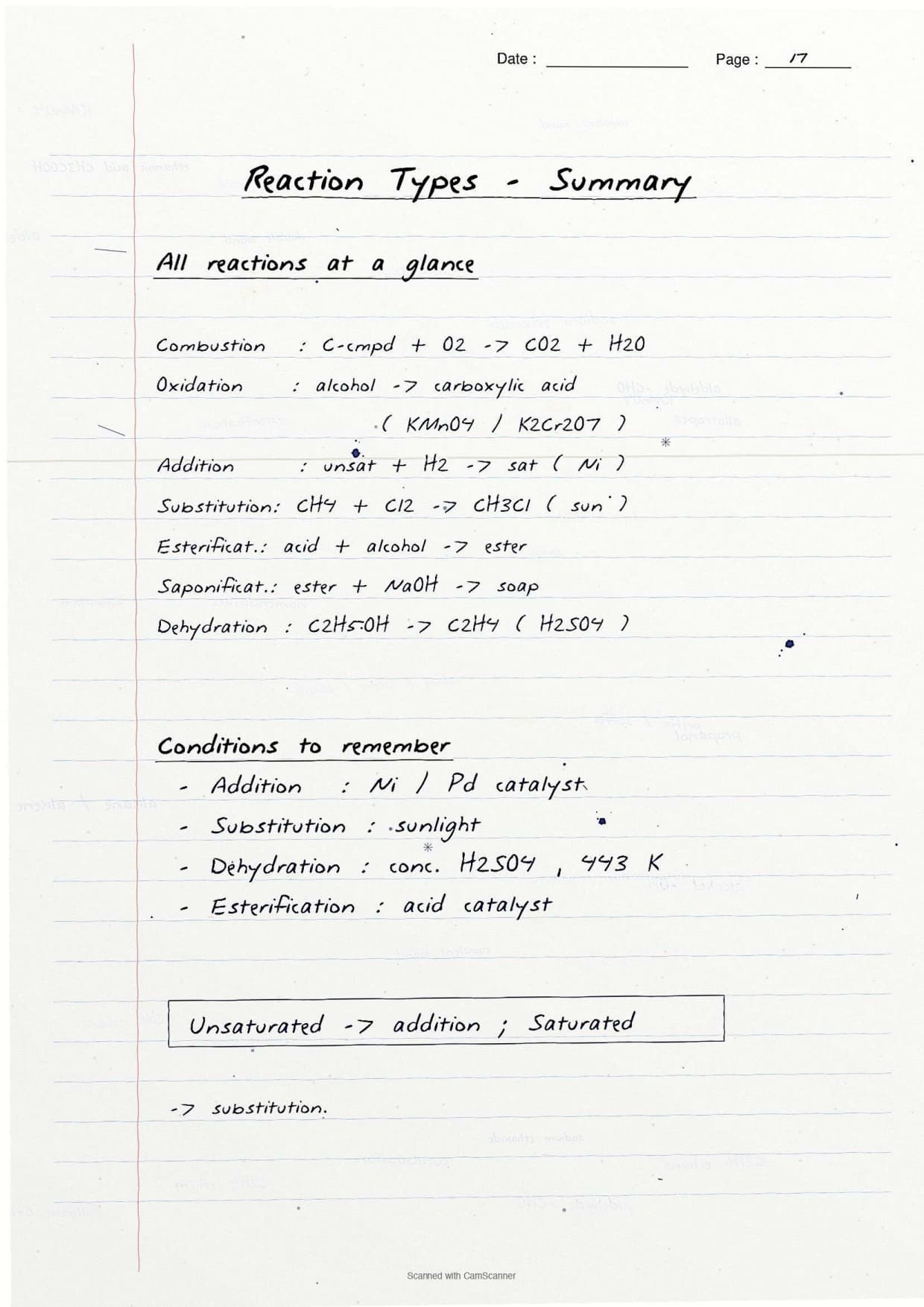
This page covers the reactions the paper asks about by name: combustion, oxidation, addition and substitution. When a carbon compound burns in air it gives carbon dioxide, water and heat. Ethanol's combustion is the standard example:
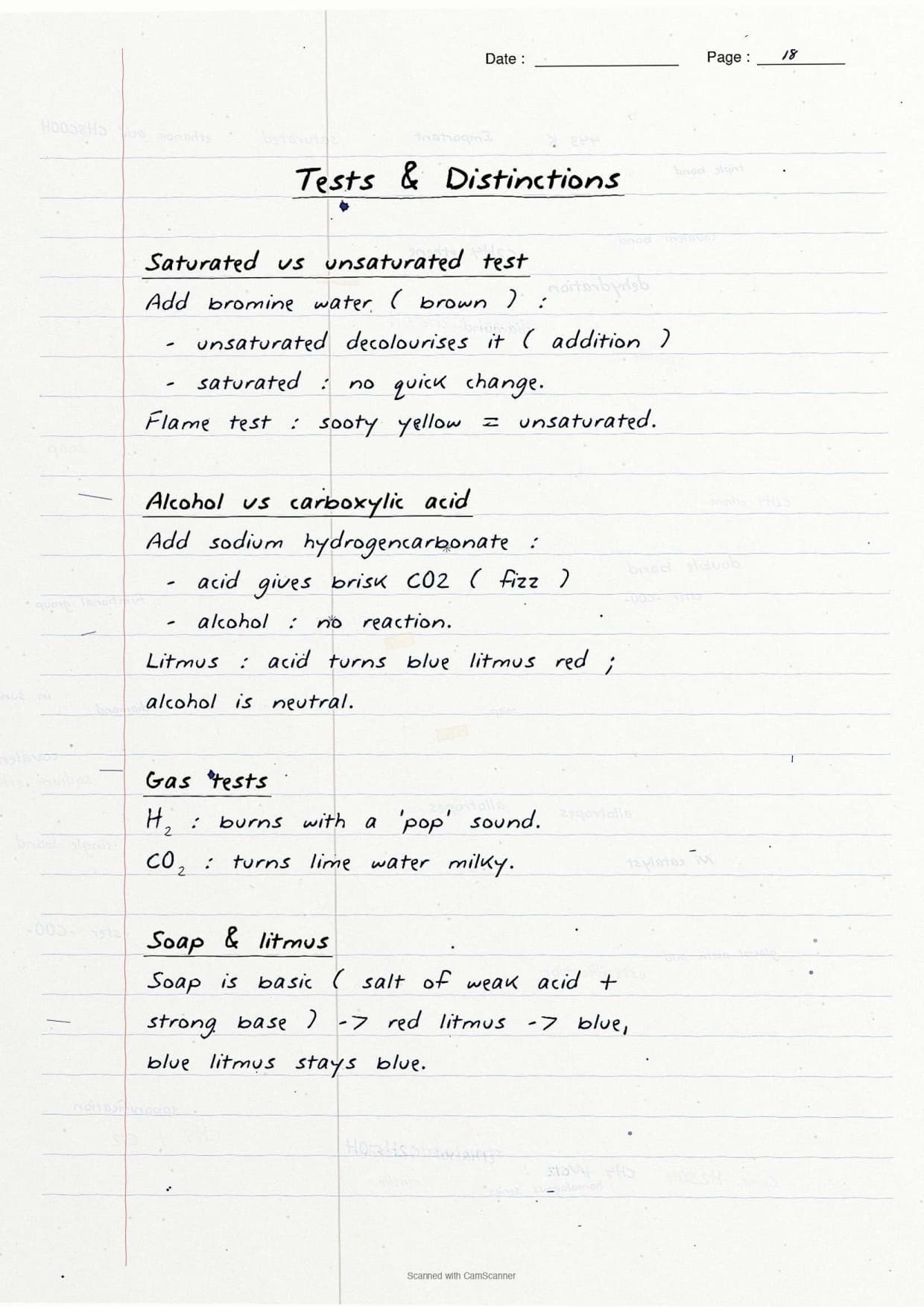
- Combustion: saturated compounds burn with a clean blue flame, unsaturated with a sooty yellow flame.
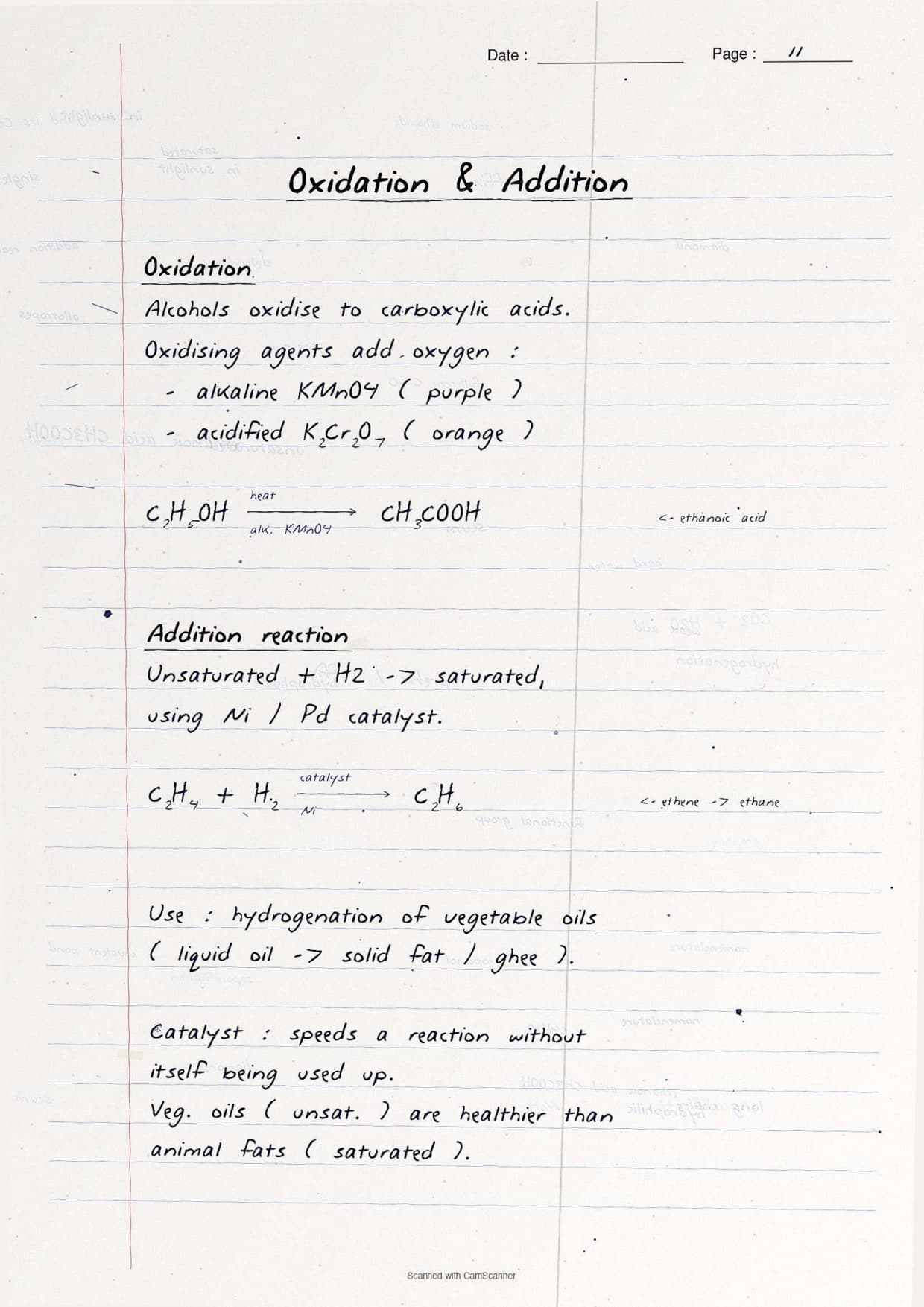
- Addition: an unsaturated compound adds hydrogen across its double bond with a nickel catalyst, turning oil into fat (hydrogenation).
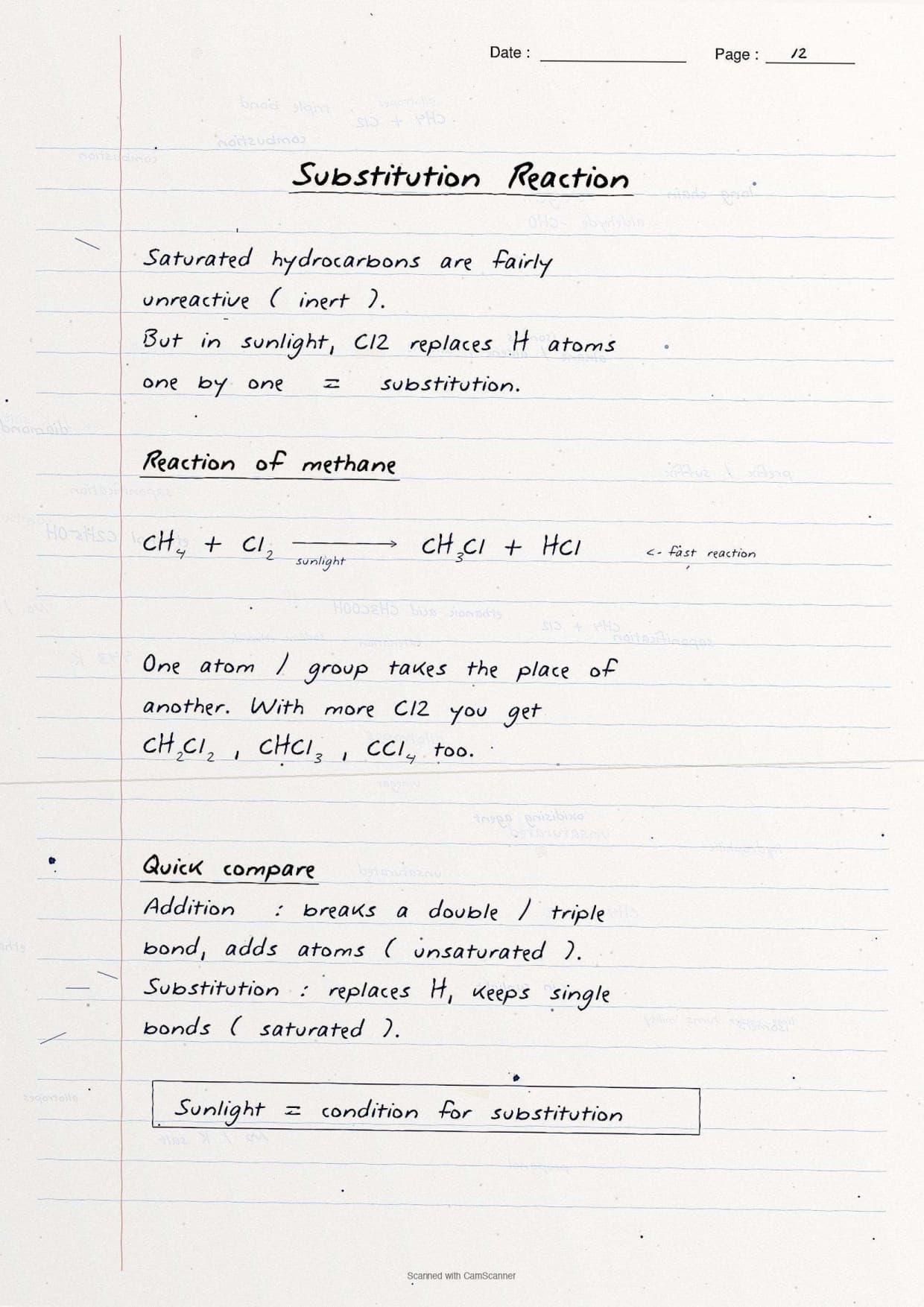
- Substitution: in sunlight, chlorine replaces hydrogen one at a time: CH4 + Cl2 → CH3Cl + HCl.
The test examiners ask about most: unsaturated compounds decolourise bromine water, but saturated compounds do not. This is the standard way to tell an alkene from an alkane.
Ethanol, Ethanoic Acid, Soaps and Detergents
The last spread covers ethanol, ethanoic acid, and soaps. Ethanol (C2H5OH) reacts with sodium:
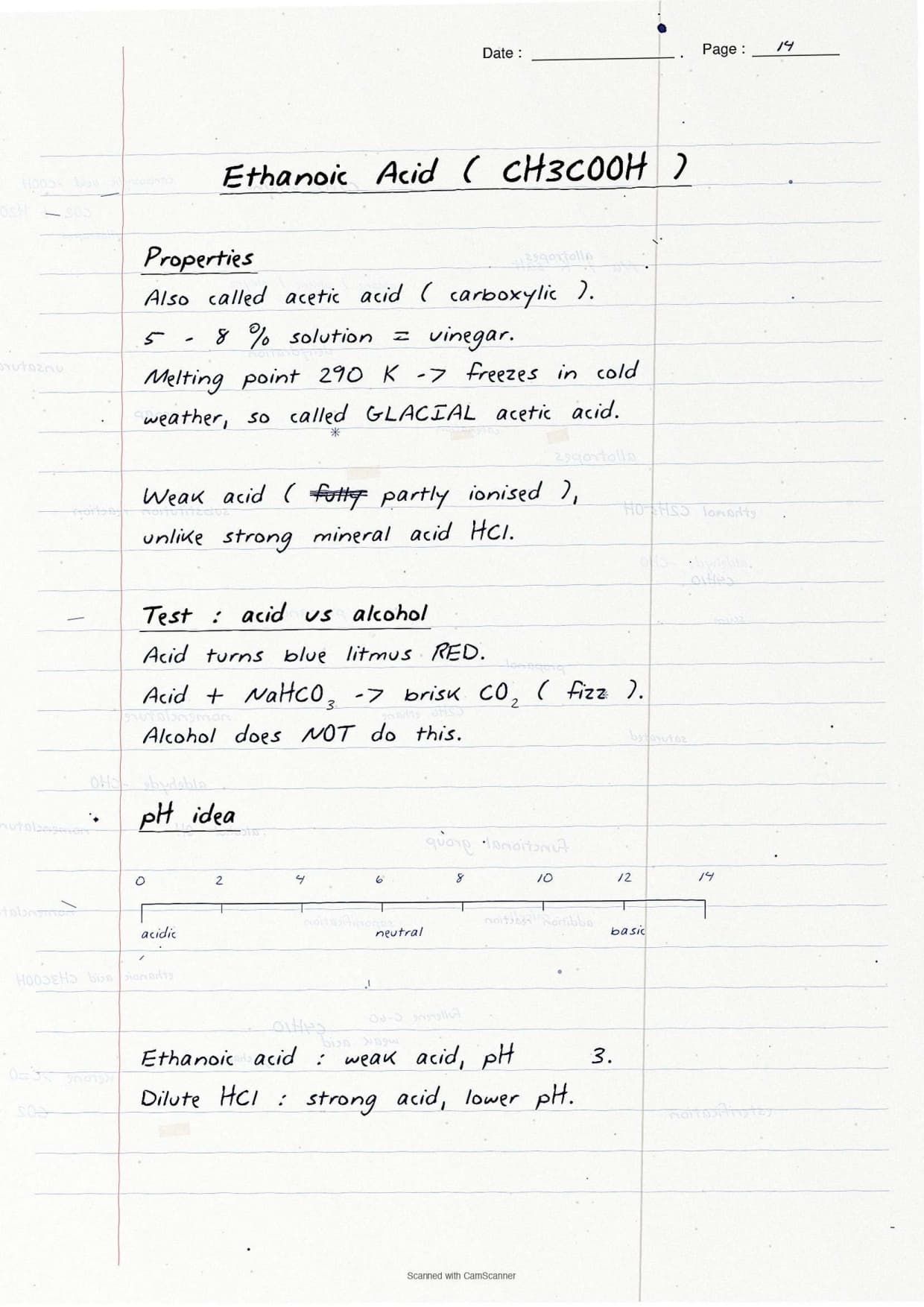
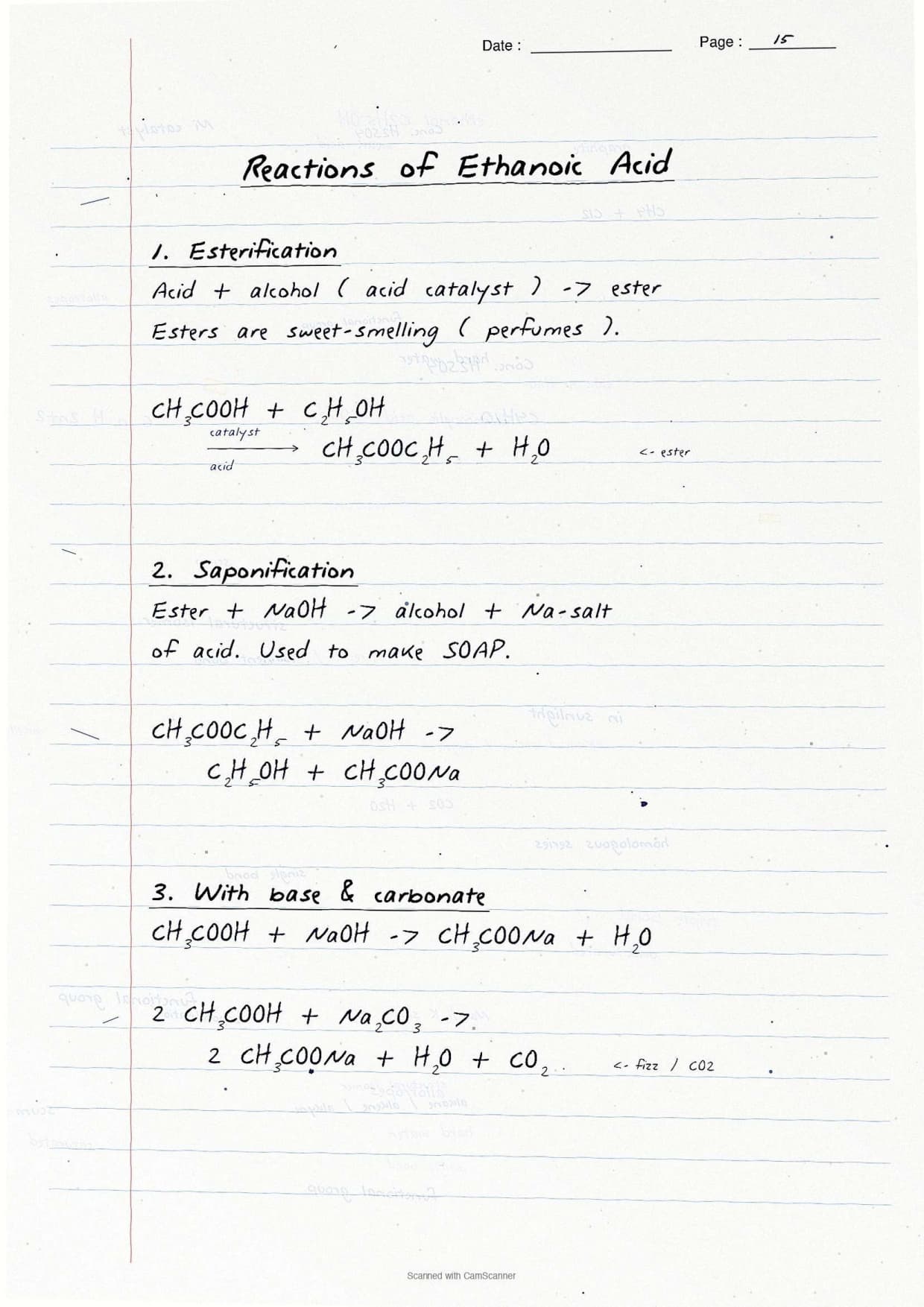
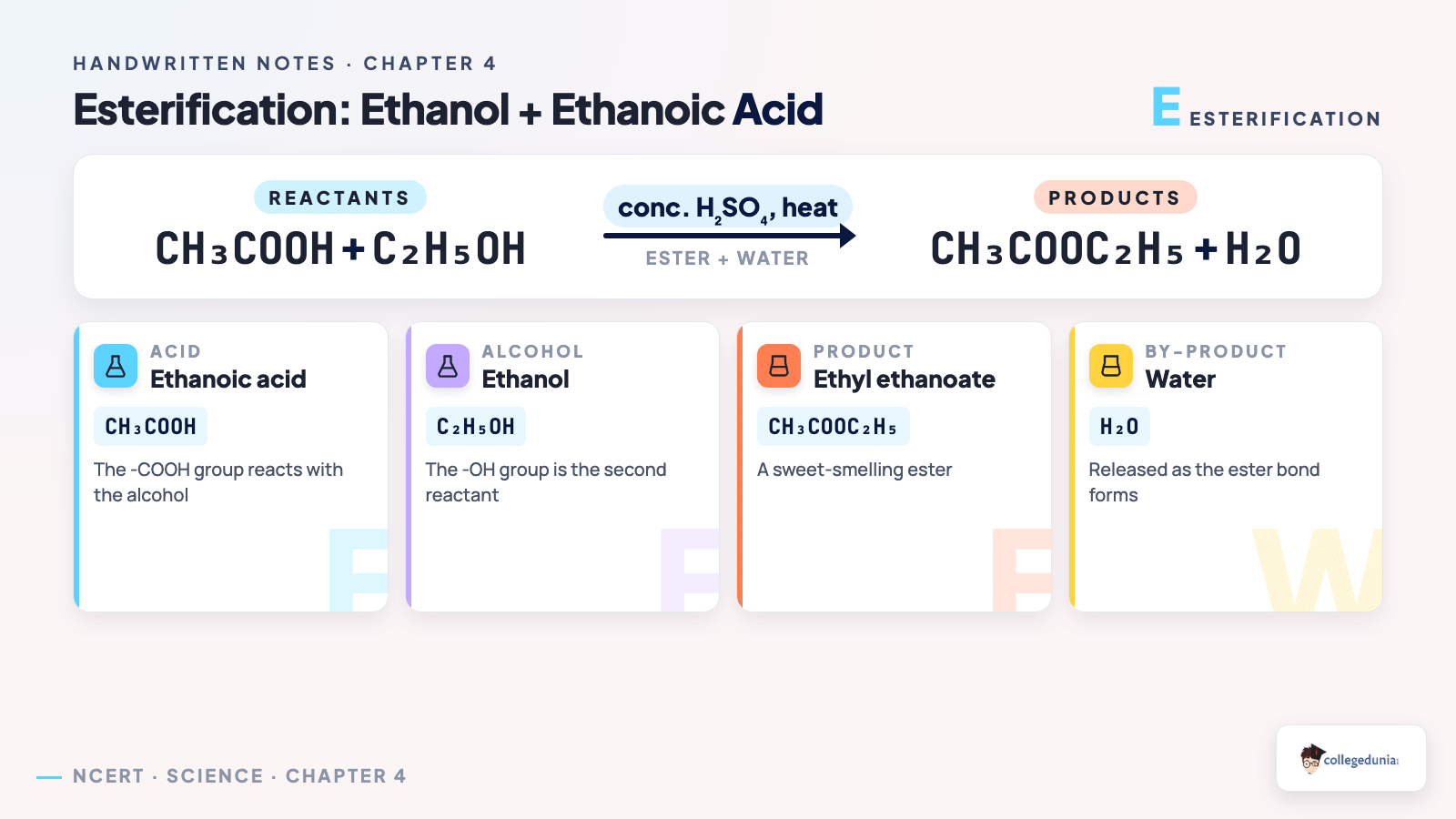
Ethanoic acid (acetic acid) is a carboxylic acid in vinegar. Esterification is a guaranteed 3-mark answer:
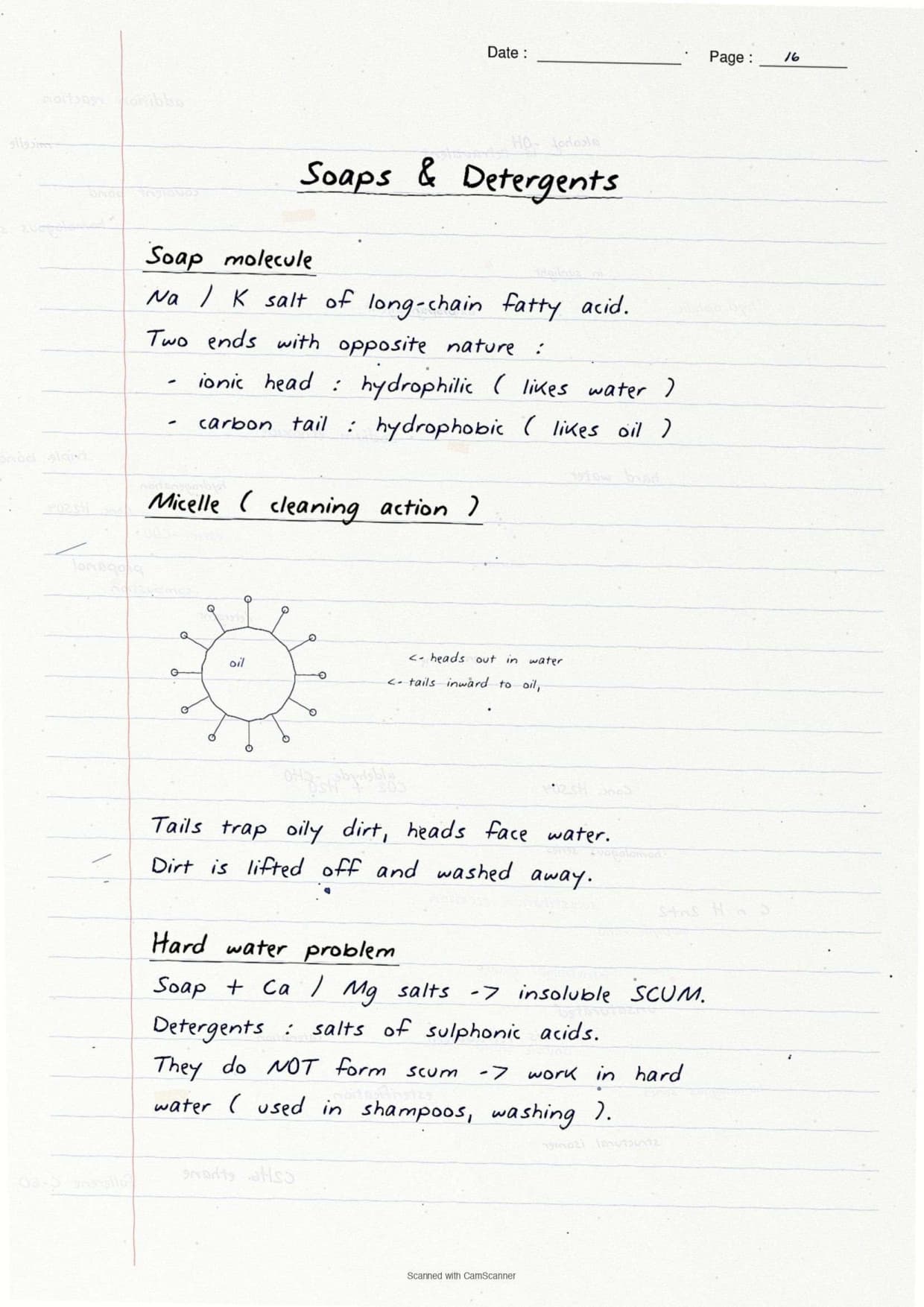
How cleaning agents work:
- Soap: the sodium salt of a long-chain fatty acid, with a water-loving head and an oil-loving tail.
- Micelle: soap molecules group with oily tails toward the dirt, trapping grease so it washes away.
- Detergents: work even in hard water, as their salts do not form an insoluble scum.
Soap does not work well in hard water because it reacts with calcium and magnesium ions to form an insoluble scum. Detergents solve this.
How to Use These Handwritten Notes Effectively
Handwritten notes work best as a final revision layer, not your first read. Use them like this before the board exam:
- First pass: read in order, bonding first, then catenation and tetravalency, then the homologous series and named compounds.
- Active recall: cover the boxed structures and draw each functional group and reaction from memory.
- Naming drill: practise IUPAC names, since the paper often gives 1 mark for naming a simple compound.
The scanned pages save on a phone for offline revision; check your structures against the full solutions.
Common Mistakes These Notes Help You Avoid
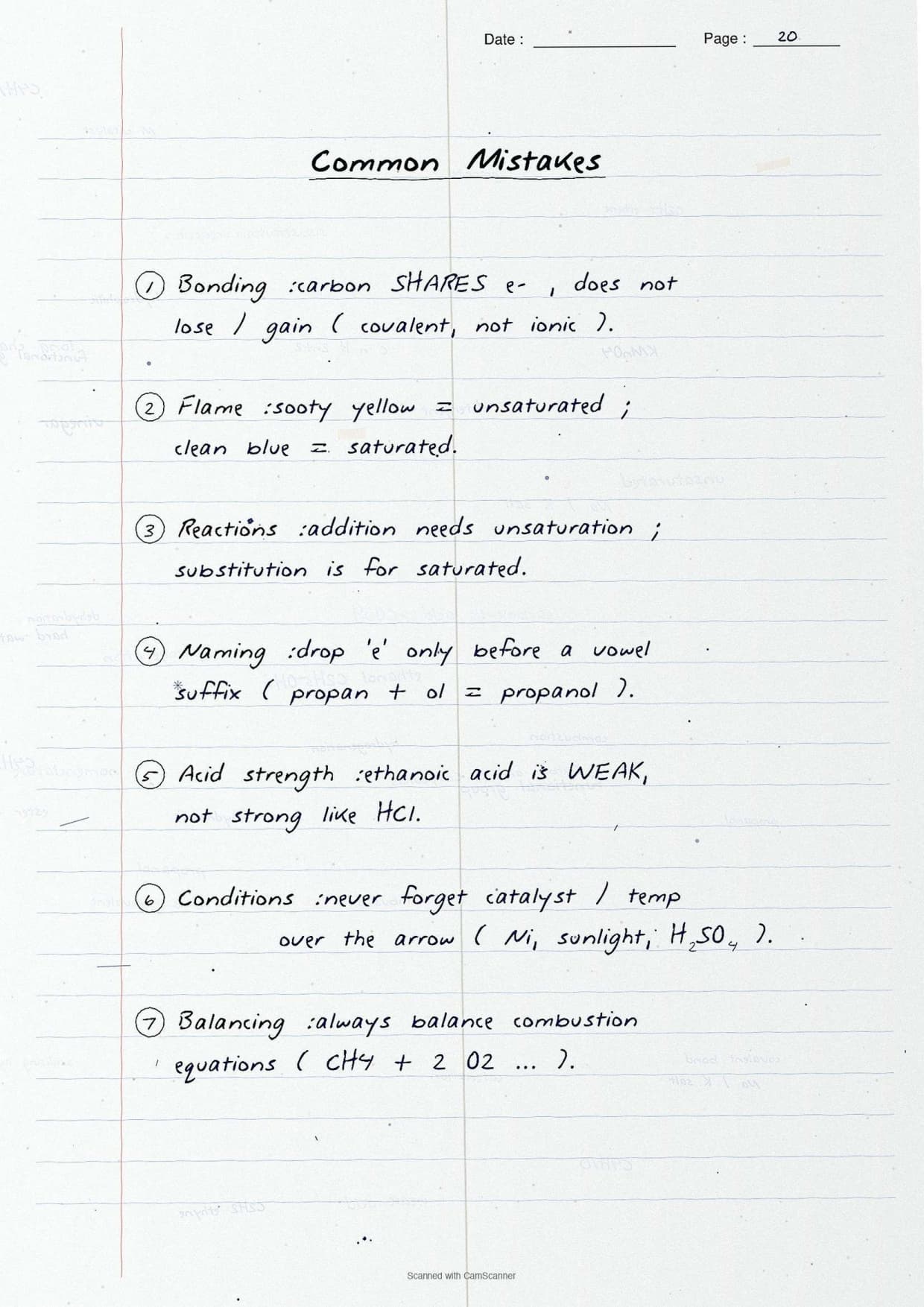
A few errors cost marks every year, mostly from mixing up functional groups or forgetting the flame colour:
- Saying carbon forms ionic bonds. Carbon always shares electrons, so it forms covalent bonds.
- Mixing up the suffixes. -ol means alcohol and -oic acid means carboxylic acid; do not swap them.
- Claiming saturated compounds decolourise bromine water. Only unsaturated compounds do that.
- Writing the wrong flame. Saturated compounds burn with a clean blue flame, unsaturated with a sooty yellow flame.
- Saying soap works fine in hard water. Soap forms an insoluble scum in hard water; detergents do not.
How These Notes Pair with the Solutions and Book PDF
Use these notes with the other resources for the same chapter, linked below.
| Resource | Best used for |
|---|---|
| Carbon and its Compounds NCERT Solutions | Step-by-step balanced answers for every in-text and back-exercise question |
| Carbon and its Compounds Class 10 Notes | Quick typed summary with every structure, reaction and functional group in one place |
| Carbon and its Compounds Formula Sheet | One-page list of the key reactions, functional groups and general formulae |
| Carbon and its Compounds NCERT Book PDF | Reading the original NCERT chapter text from the textbook |
All Class 10 Science Handwritten Notes by Chapter
The table links the handwritten notes for every Class 10 Science chapter. Carbon and its Compounds is highlighted.
| Chapter | Handwritten Notes |
|---|---|
| Chapter 1 | Chemical Reactions and Equations |
| Chapter 2 | Acids, Bases and Salts |
| Chapter 3 | Metals and Non-metals |
| Chapter 4 | Carbon and its Compounds |
| Chapter 5 | Life Processes |
| Chapter 6 | Control and Coordination |
| Chapter 7 | How do Organisms Reproduce? |
| Chapter 8 | Heredity |
| Chapter 9 | Light - Reflection and Refraction |
| Chapter 10 | The Human Eye and the Colourful World |
| Chapter 11 | Electricity |
| Chapter 12 | Magnetic Effects of Electric Current |
| Chapter 13 | Our Environment |
FAQs on Carbon and its Compounds Handwritten Notes
Carbon and its Compounds Class 10 Science Handwritten Notes Common Questions
Ques. Are these class 10 science chapter 4 Carbon and its Compounds handwritten notes free to download?
Ans. Yes. The Carbon and its Compounds handwritten notes are free to download as a PDF from this page. They follow the 2026-27 NCERT syllabus and cover the full chapter across 22 scanned, boxed-structure pages for quick revision.
Ques. What does Chapter 4 Carbon and its Compounds cover in Class 10 Science?
Ans. The notes cover covalent bonding in carbon, the versatile nature of carbon (catenation and tetravalency), the homologous series, functional groups, IUPAC naming, the chemical properties of carbon compounds, and the named compounds ethanol, ethanoic acid, soaps and detergents, all of which the CBSE board paper tests directly.
Ques. Why does carbon form covalent bonds?
Ans. Carbon has four electrons in its outermost shell, so it would need to lose or gain four electrons to become stable. Both take too much energy, so carbon instead shares its four electrons with other atoms to complete its octet, forming covalent bonds.
Ques. What is a homologous series in Class 10 Science?
Ans. A homologous series is a family of carbon compounds with the same functional group and general formula, where each member differs from the next by a CH2 unit. The members show similar chemical properties, while their melting and boiling points rise steadily as the chain gets longer.
Ques. Are these notes enough for the class 10 science chapter 4 board exam?
Ans. They are a strong final revision layer. For full preparation, pair them with the NCERT Solutions linked on this page so you can write out complete balanced answers to every in-text and back-exercise question and check them against model answers.



Comments