



The Light Reflection and Refraction Class 10 Science handwritten notes are scanned, boxed and built for fast last-minute revision, fully matched to the 2026-27 CBSE syllabus. They cover the laws of reflection, concave and convex mirrors, the mirror formula and magnification, the laws of refraction, refractive index, convex and concave lenses, the lens formula, and the power of a lens, all in clear ruled-page form with hand-drawn ray diagrams and boxed formulas.
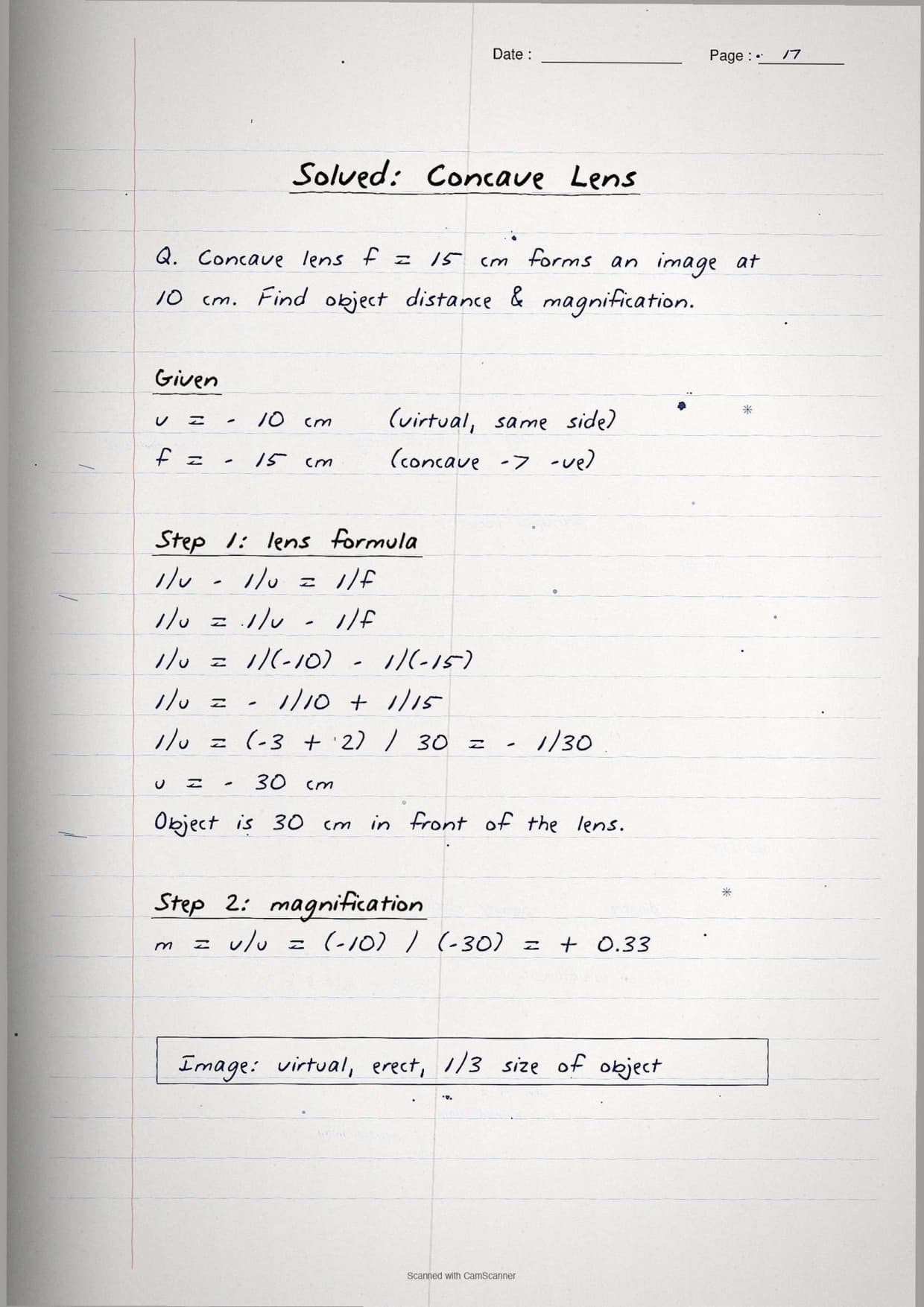
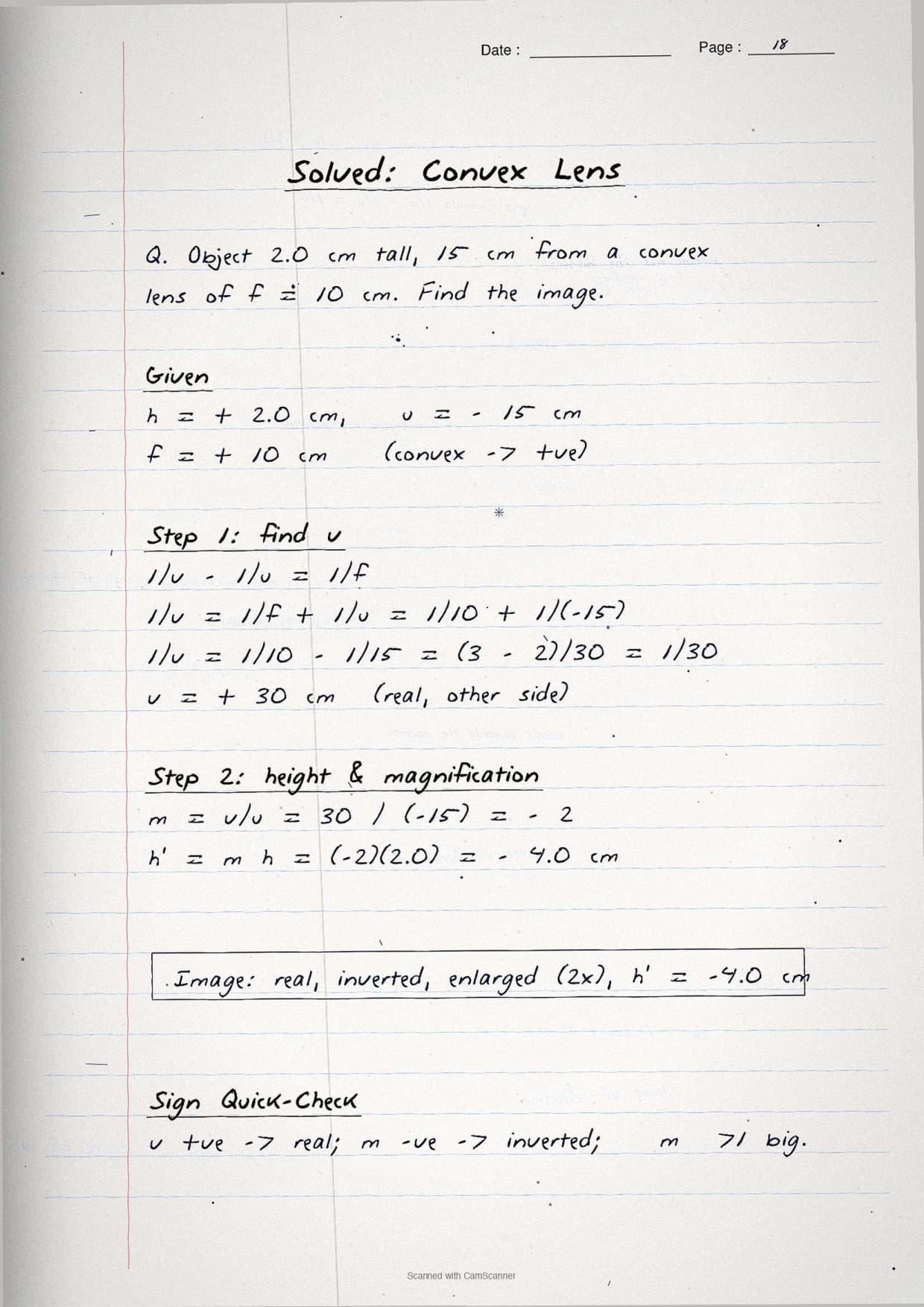
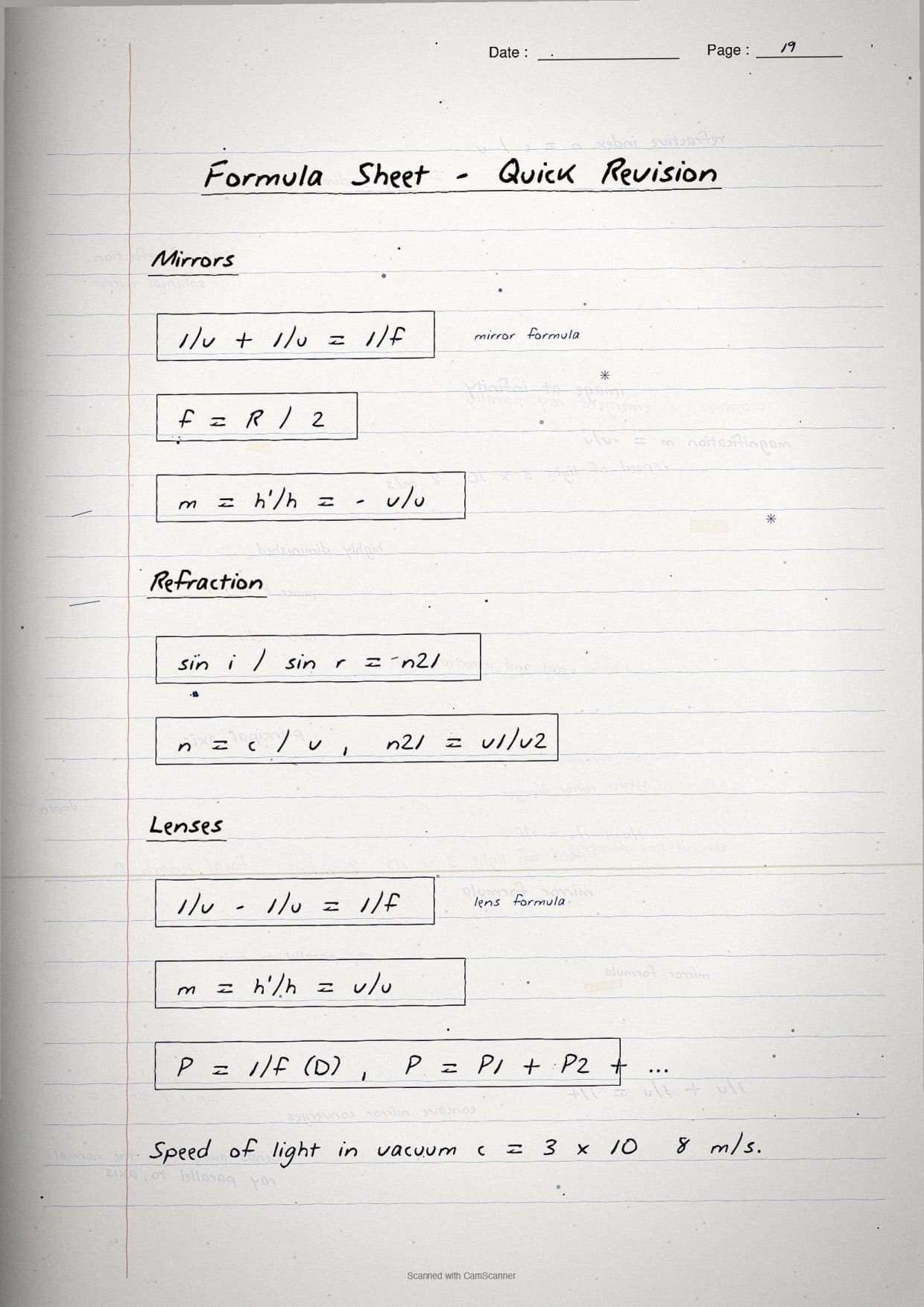
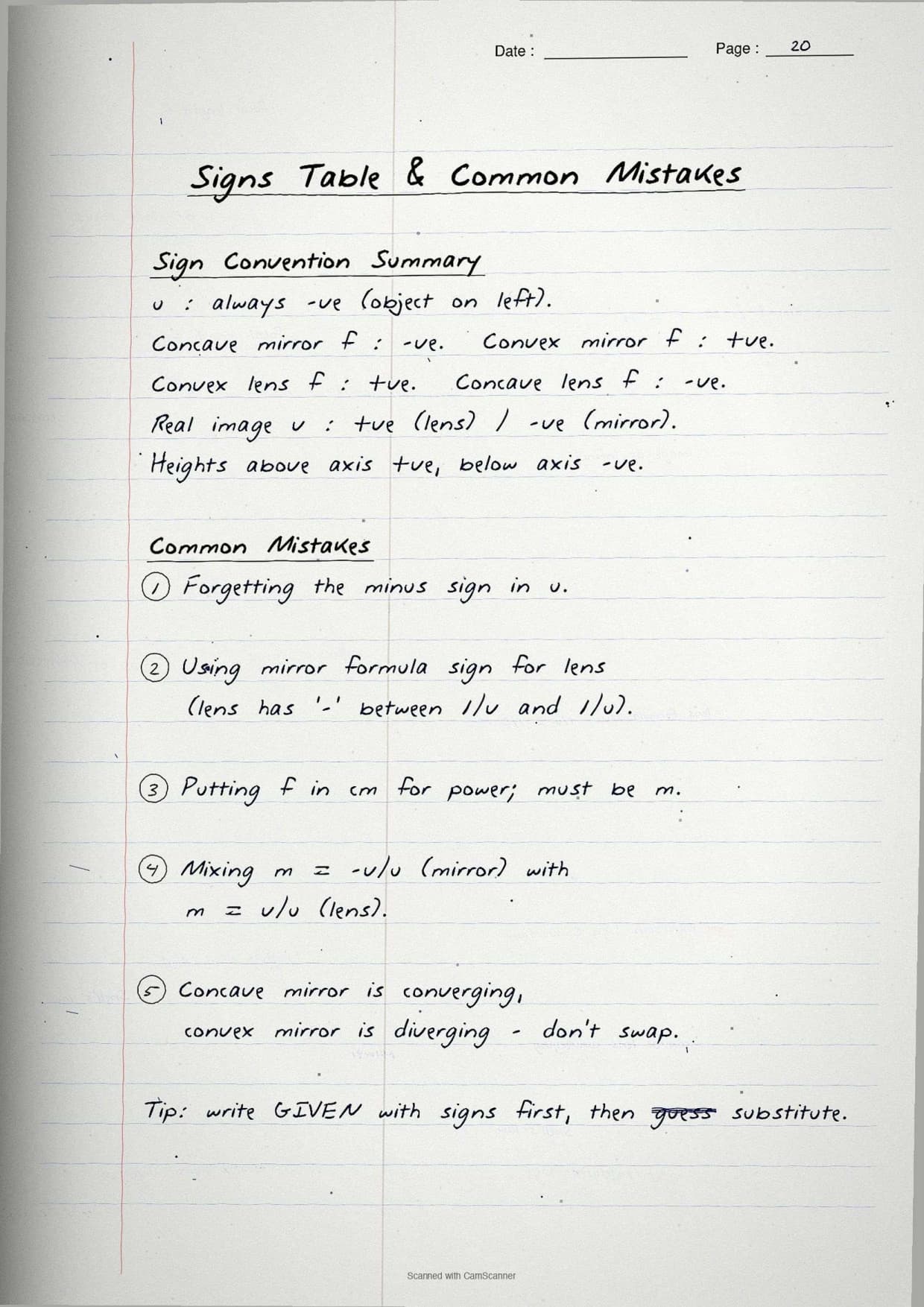
- CBSE Weightage: about 8 to 10 marks from the unit Natural Phenomena and Effects of Current, often as ray-diagram, formula and numerical questions.
- Boxed formulas and a hand-drawn ray diagram for every mirror, lens and rule the board paper asks about.
- Pairs with the NCERT Solutions, Notes and Book PDF linked lower on this page.
These Light Reflection and Refraction handwritten notes are prepared from the official NCERT Science textbook and matched to the 2026-27 CBSE syllabus.
Student Feedback: In a Collegedunia poll of 12,100 Class 10 Science students before the 2026 boards, 83% of students said the hand-drawn ray diagrams and the boxed mirror and lens formulas were the fastest way to revise this chapter. Most students copied the boxed image-formation tables straight onto practice answer sheets.
Source: 2026-27 Class 10 Science student poll. Sample of 12,100 students from CBSE schools across 16 states.
Solved by Collegedunia: Every ray diagram, table and formula in these Light Reflection and Refraction handwritten notes is checked by Collegedunia's Class 10 Science team against the latest 2026-27 NCERT textbook, so what you revise matches exactly what the CBSE board paper expects.
What These Light Reflection and Refraction Handwritten Notes Include
These Light Reflection and Refraction handwritten notes condense the whole chapter into 22 scanned pages, with every ray diagram hand-drawn and every formula boxed in pen. They cover the three big ideas the CBSE board paper tests:
- Reflection by mirrors: the two laws of reflection, concave and convex mirrors, the image-formation tables, and the mirror formula with magnification.
- Refraction by media: the two laws of refraction, Snell's law, refractive index, and refraction through a rectangular glass slab.
- Refraction by lenses: convex and concave lenses, the lens formula, magnification, and the power of a lens in dioptre.
Light - Reflection and Refraction Class 10 Science Video Lecture
Source: Magnet Brains on YouTube
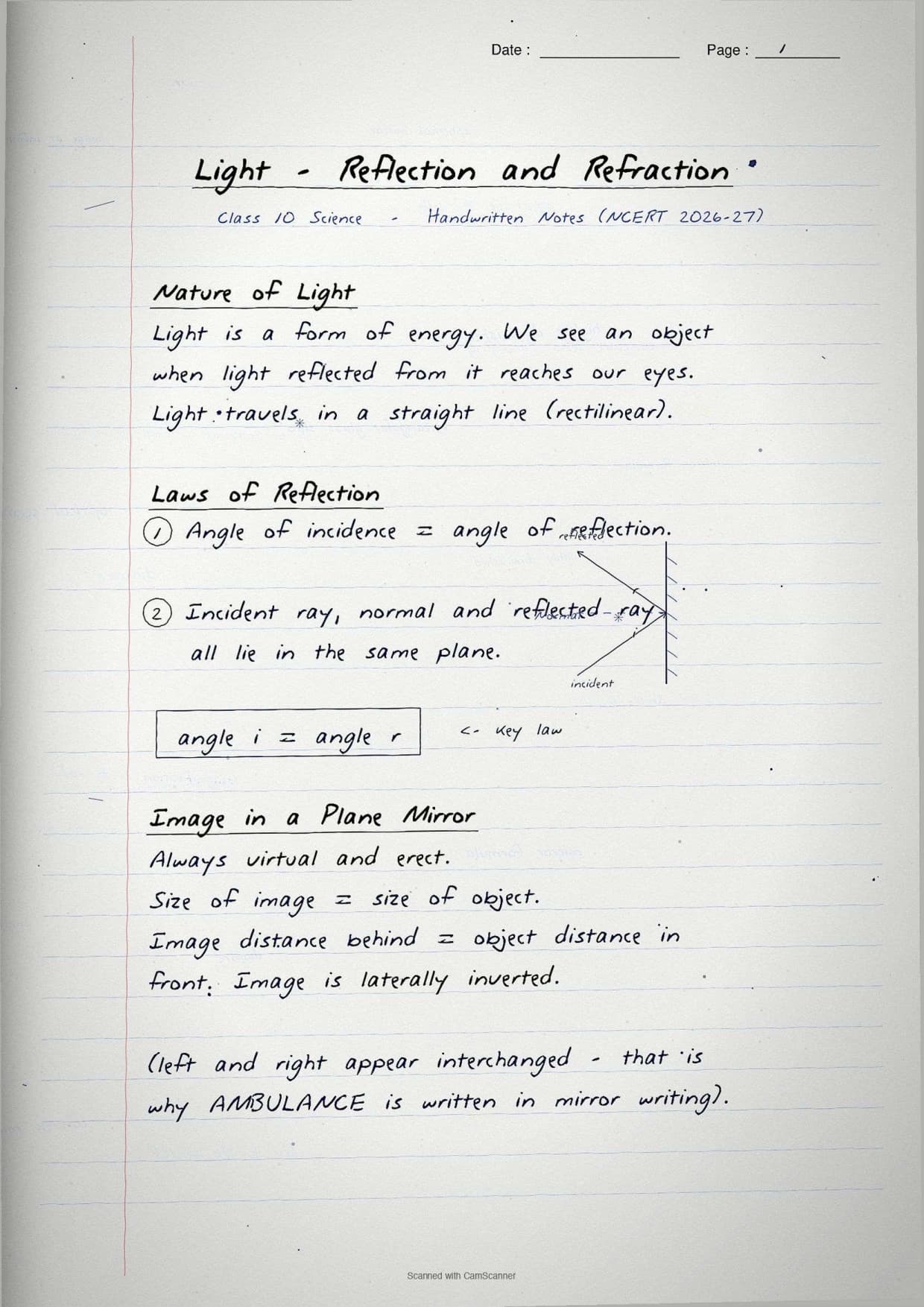
Reflection of Light and the Two Laws: The First Page of the Notes
Reflection of light is the bouncing back of light when it strikes a polished surface, such as a mirror. It always follows two laws:
- First law: the angle of incidence equals the angle of reflection, written as ∠i = ∠r.
- Second law: the incident ray, the reflected ray, and the normal at the point of incidence all lie in the same plane. Both laws hold for every reflecting surface, plane or spherical.
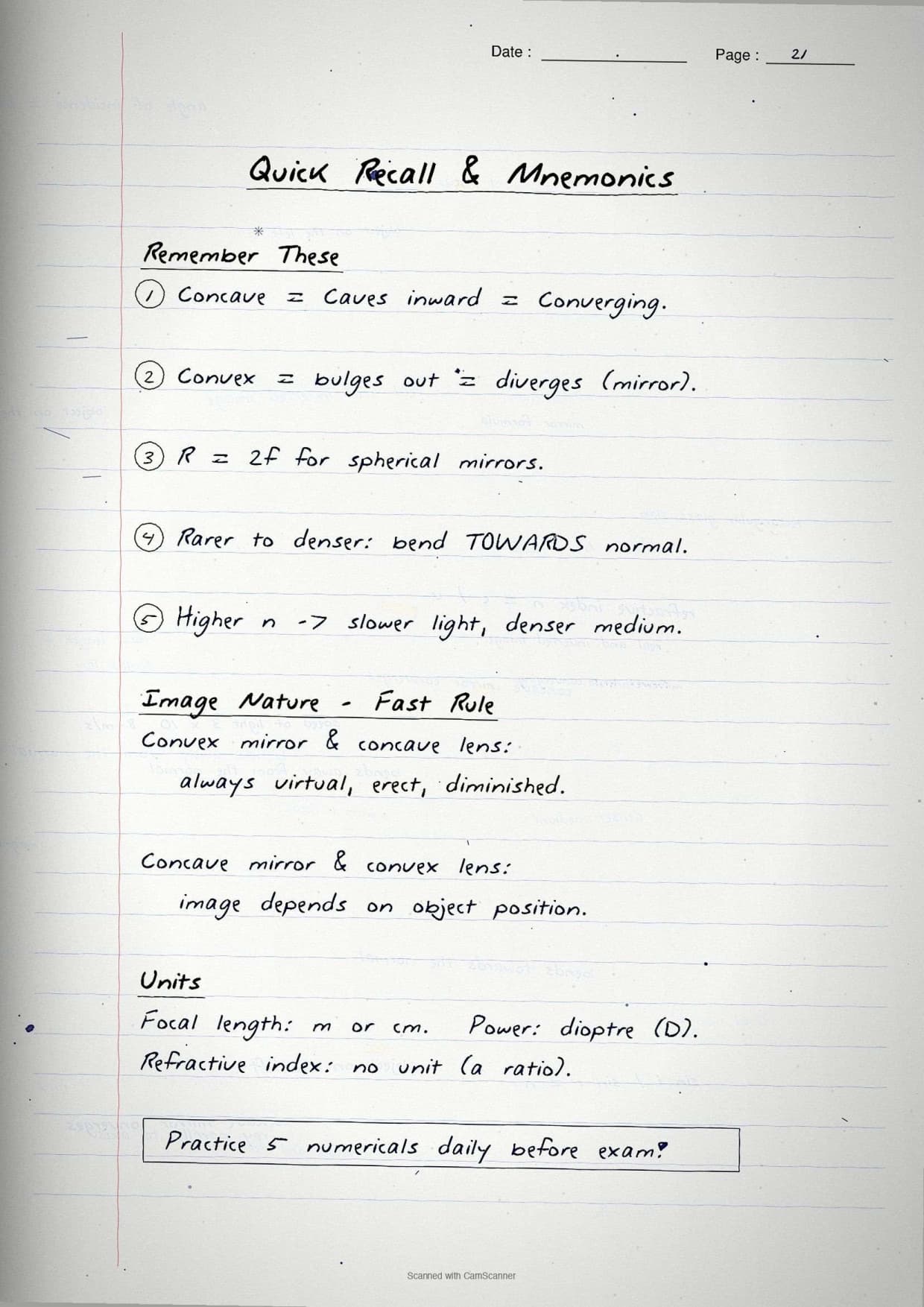
A plane mirror image (a favourite one-mark question) is virtual and erect, same size as the object, and laterally inverted, formed as far behind the mirror as the object is in front. Curved mirrors differ: the image changes with the object's position.
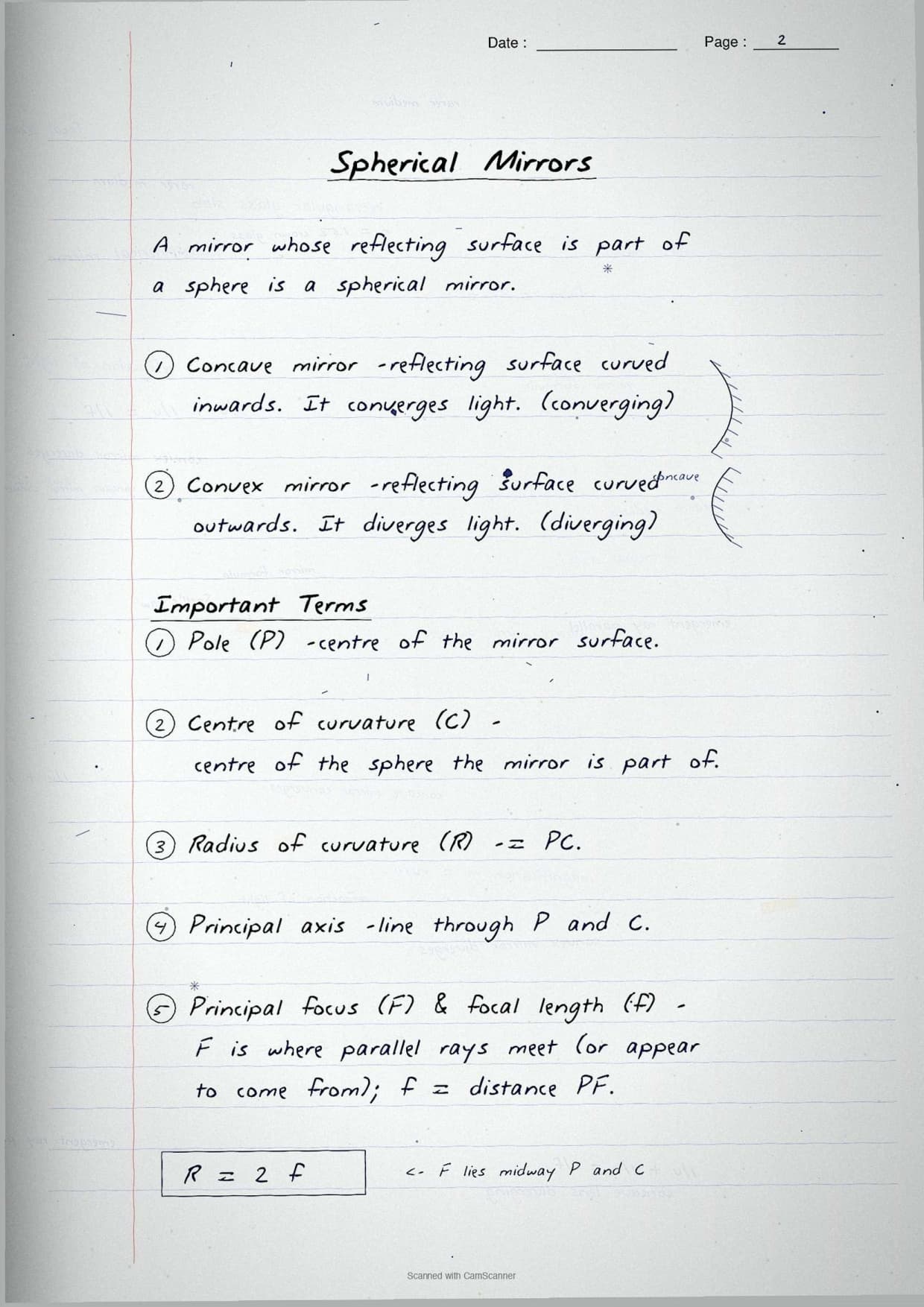
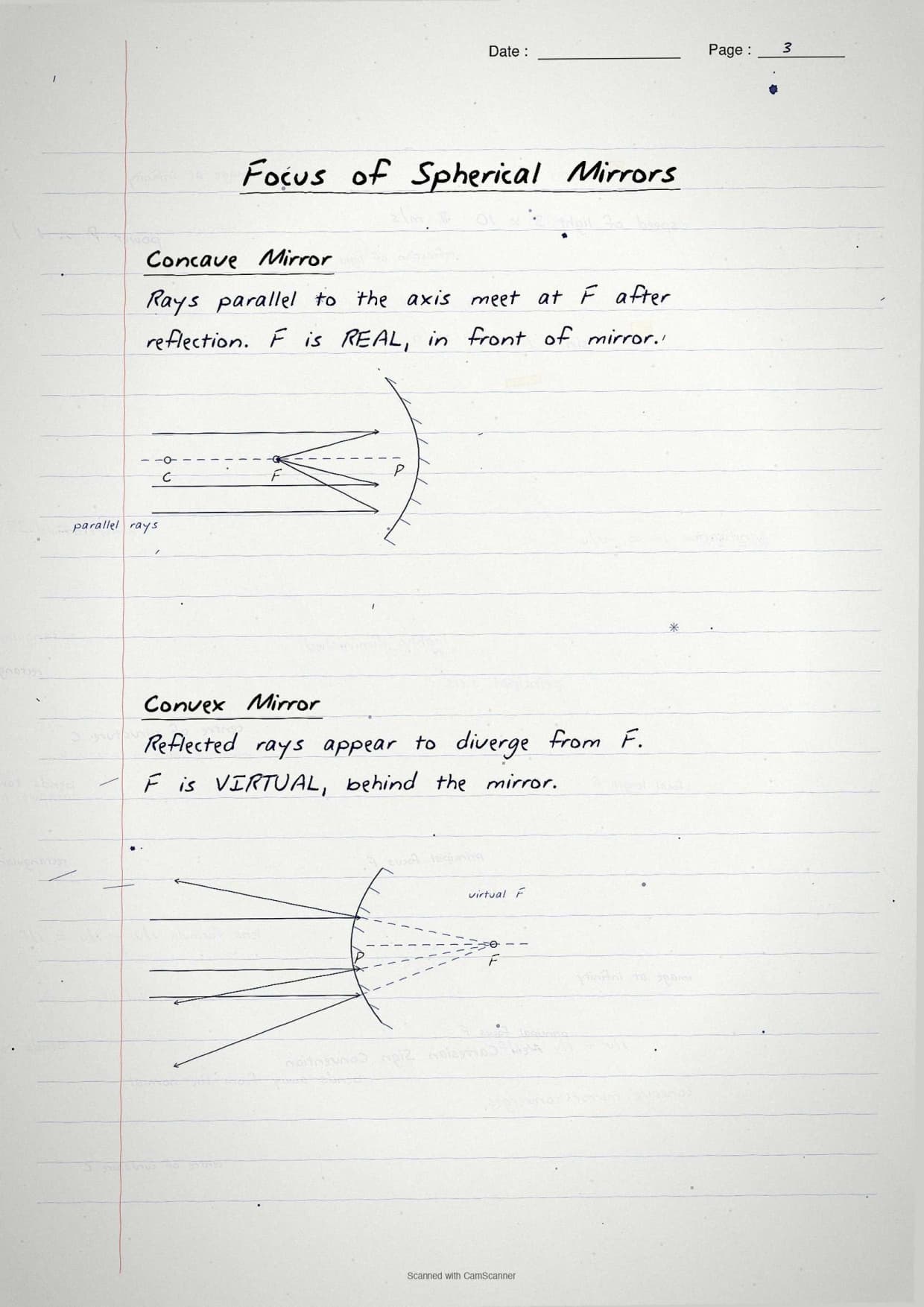
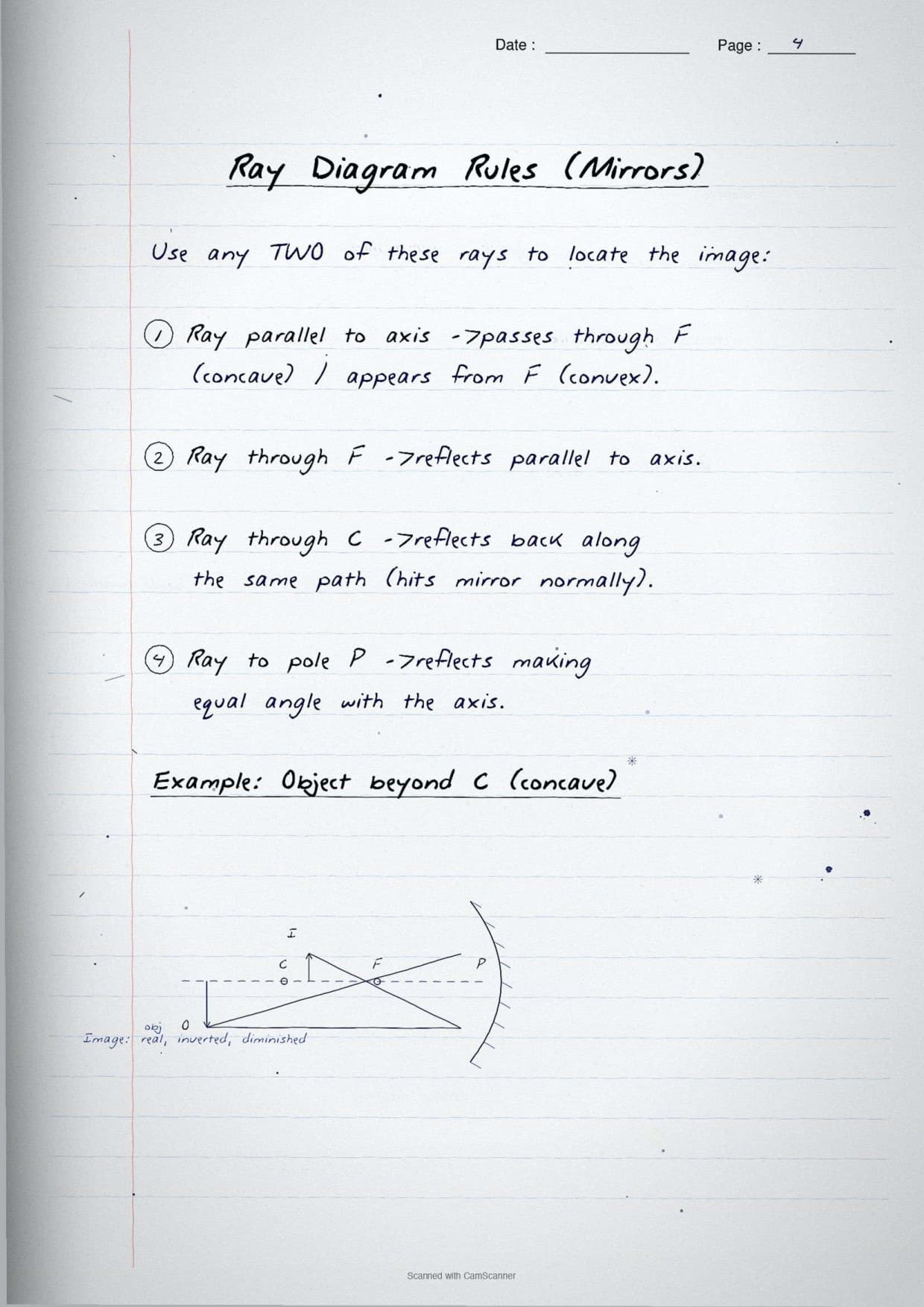
Concave and Convex Mirrors: Image Formation Tables
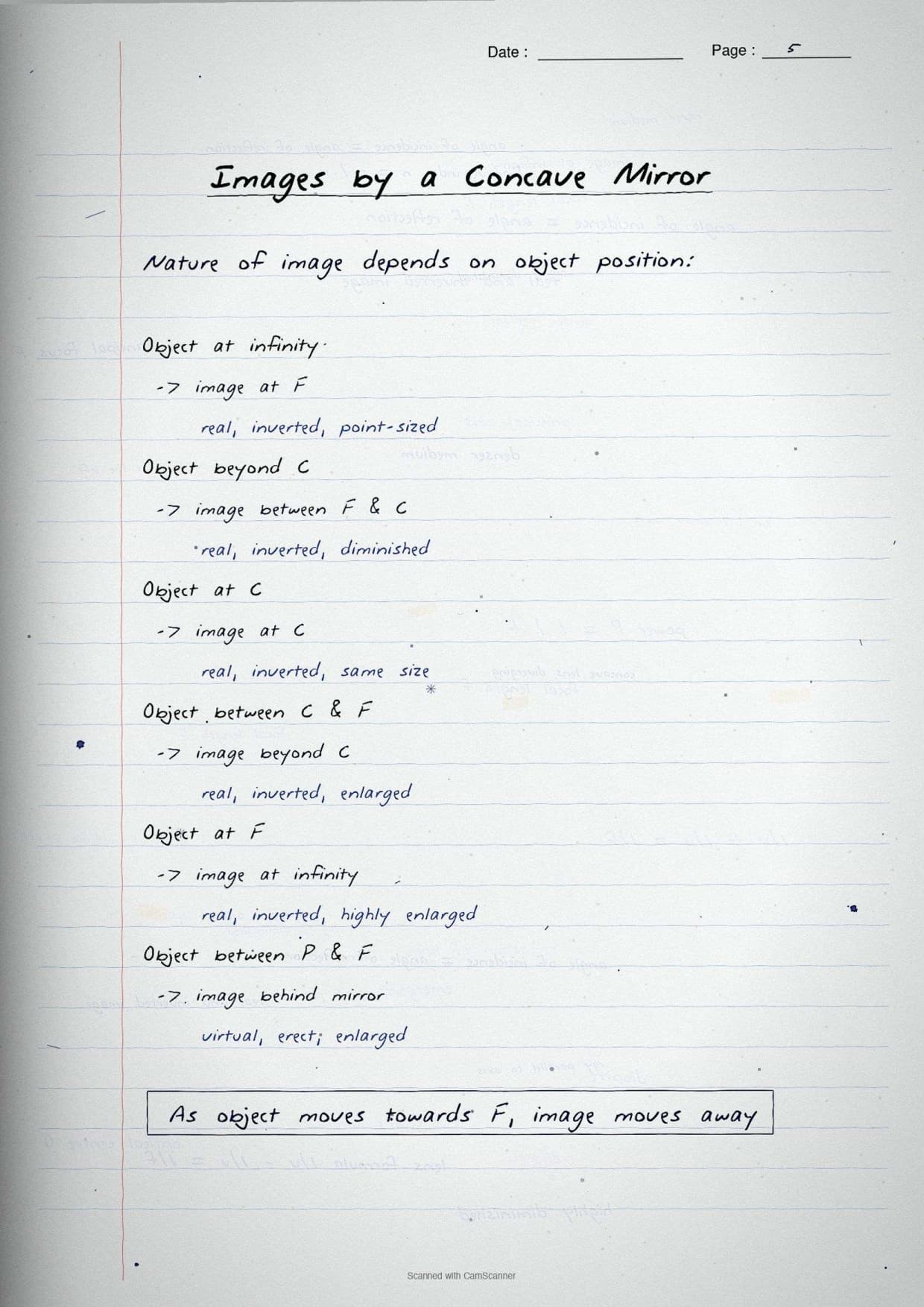
The nature of the image is a guaranteed 3-mark question. The concave mirror image-formation table is below.
| Object position (concave mirror) | Image position | Size | Nature |
|---|---|---|---|
| At infinity | At the focus F | Highly diminished | Real and inverted |
| Beyond C | Between F and C | Diminished | Real and inverted |
| At C | At C | Same size | Real and inverted |
| Between C and F | Beyond C | Enlarged | Real and inverted |
| At F | At infinity | Highly enlarged | Real and inverted |
| Between P and F | Behind the mirror | Enlarged | Virtual and erect |
A concave mirror gives a virtual, erect image only when the object is between the pole and the focus; otherwise the image is real and inverted. Key exam points:
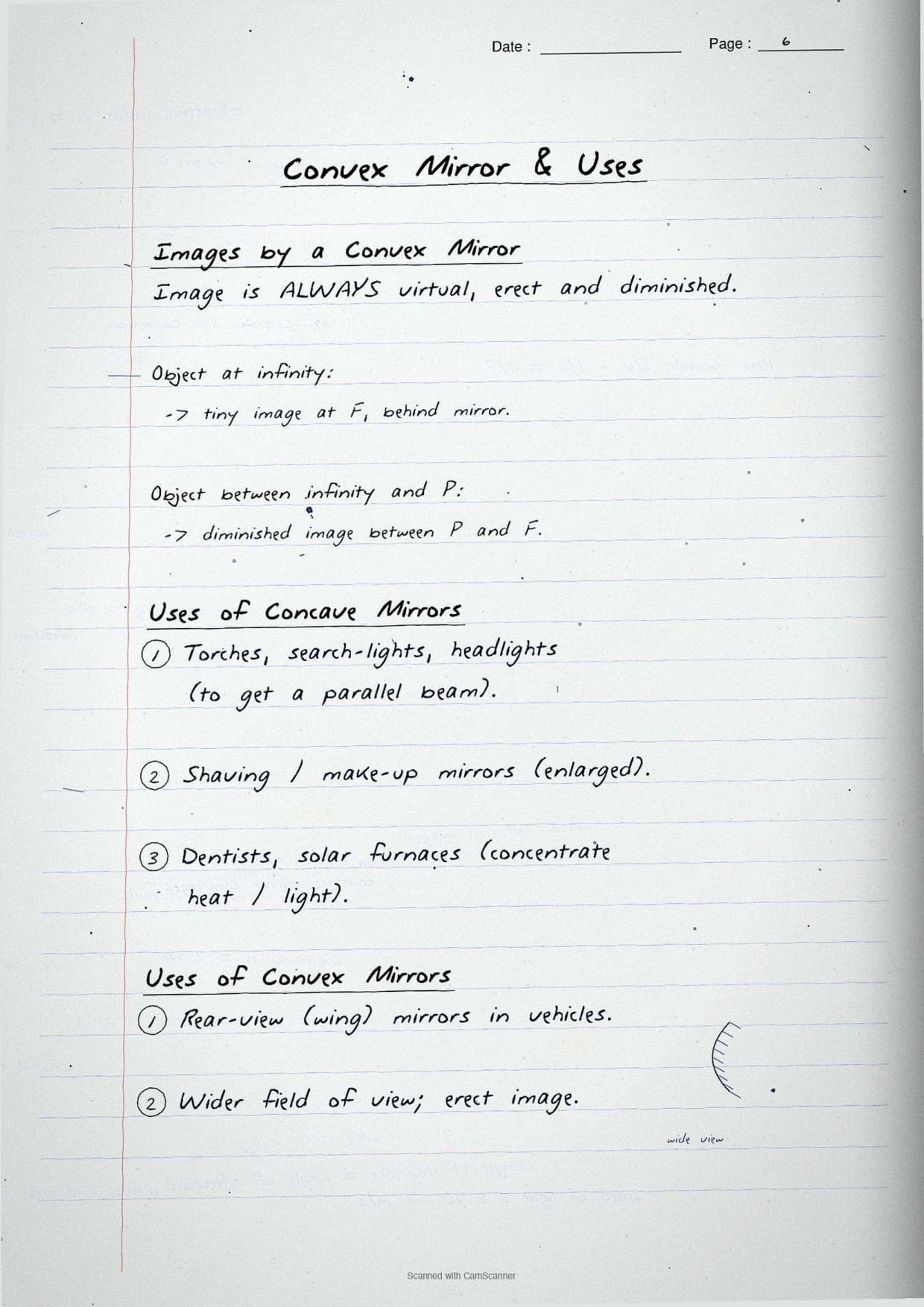
- Concave mirror uses: shaving and dentists' mirrors, and reflectors in torches, head-lights and search-lights.
- Convex mirror image: always virtual, erect and diminished, whatever the object position.
- Convex mirror use: rear-view (wing) mirror, for an erect image and wide field of view.
Mirror Formula, Magnification and Sign Convention
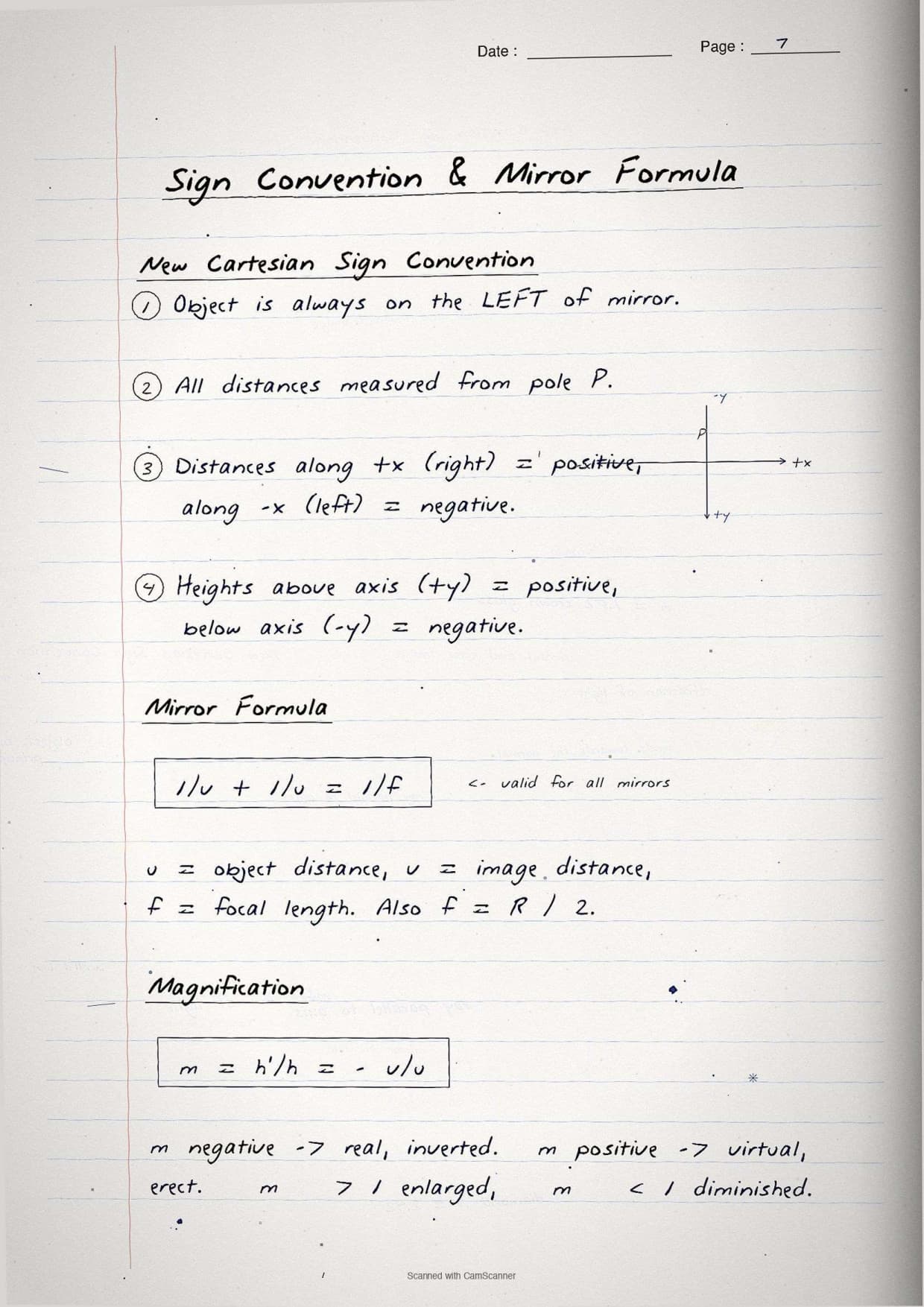
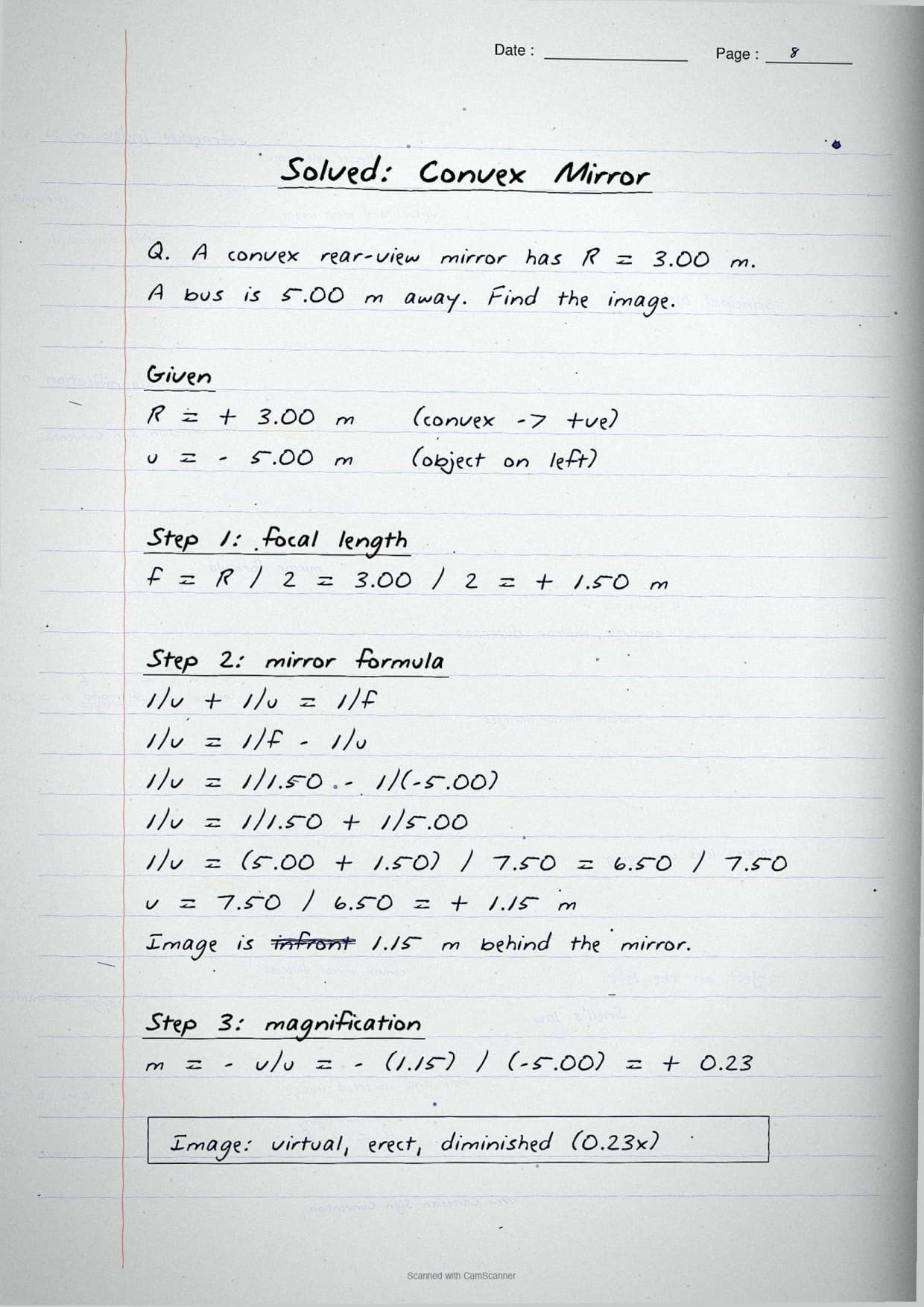
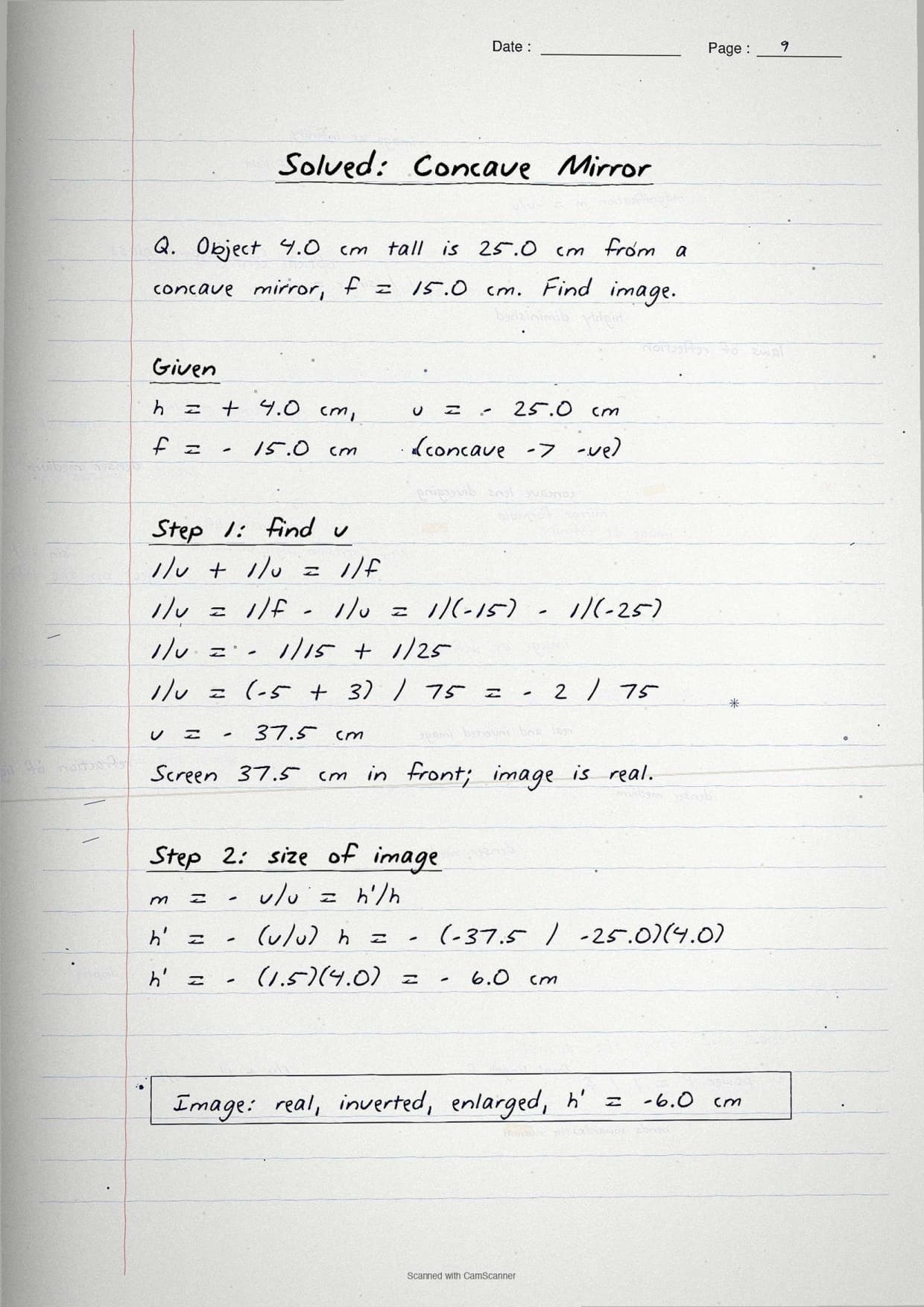
A 3-mark mirror numerical appears in almost every board paper. The mirror formula links u, v and f:
1v + 1u = 1f
The magnification (m) tells how big the image is compared with the object:
m = h′h = − vu
Almost every lost mark comes from a wrong sign, so learn the New Cartesian Sign Convention: the pole is the origin; the object distance u is always negative; distances right of the pole are positive, those to the left negative; heights above the axis positive, below it negative.
A negative magnification means a real, inverted image; a positive magnification means a virtual, erect image. The focal length is negative for a concave mirror and positive for a convex mirror, with f = R/2.
Refraction of Light and Refractive Index in the Notes
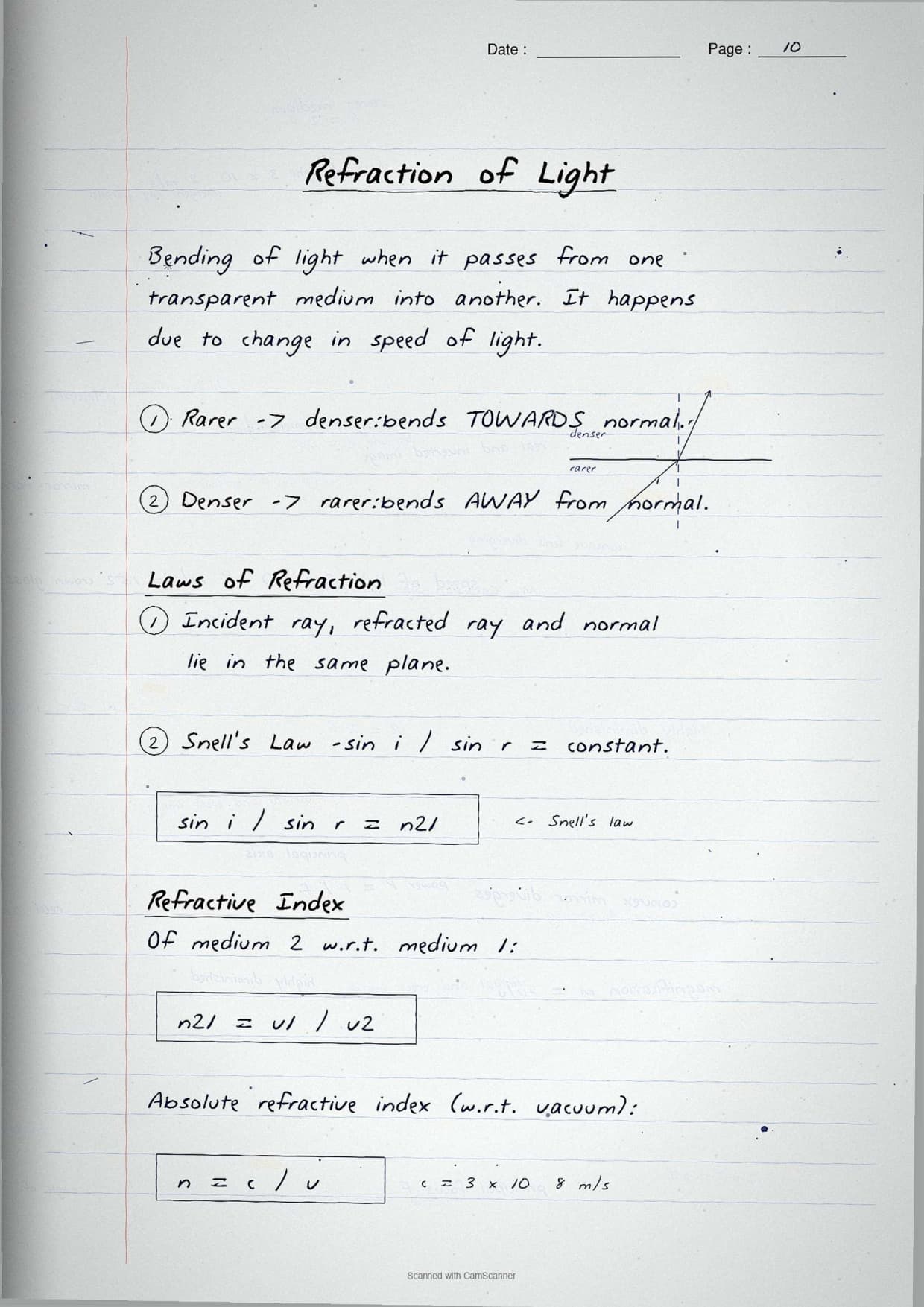
Refraction of light is the bending of light passing from one transparent medium to another, because light changes its speed. Two laws:
- First law: the incident ray, refracted ray and normal at the point of incidence all lie in the same plane.
- Second law (Snell's law): (sin i) / (sin r) = constant for a given pair of media.
- Bending rule: light bends towards the normal entering a denser medium, away entering a rarer one.
The refractive index is the ratio of the speed of light in vacuum (c) to the speed in the medium (v):
n = cv
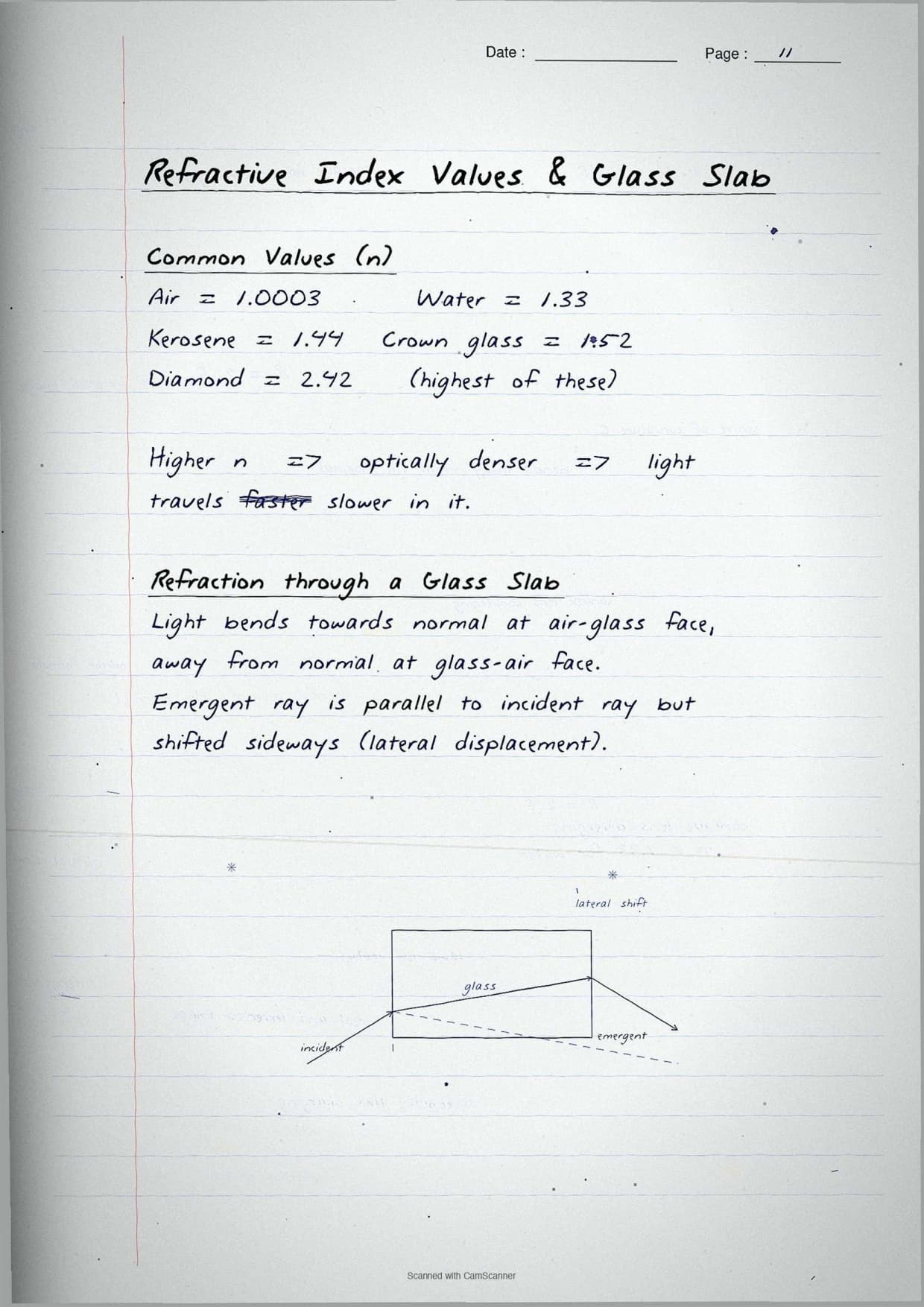
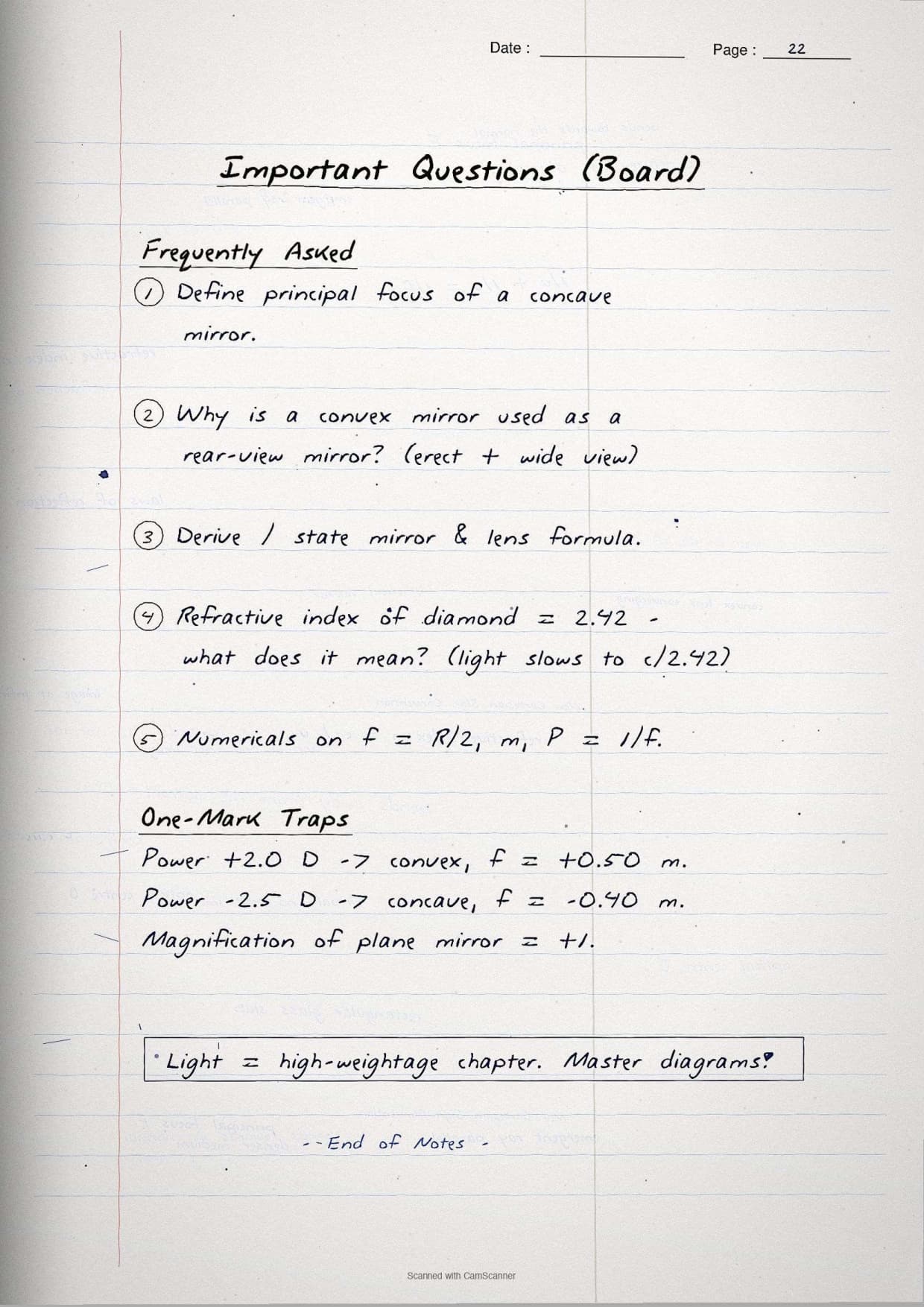
Common values: water 1.33, crown glass 1.52, diamond 2.42 (highest in the NCERT table). A medium with a higher refractive index is optically denser. For a rectangular glass slab the emergent ray is parallel to the incident ray, only shifted sideways.
Lenses, the Lens Formula and Power of a Lens
Most students lose marks here on sign and formula.
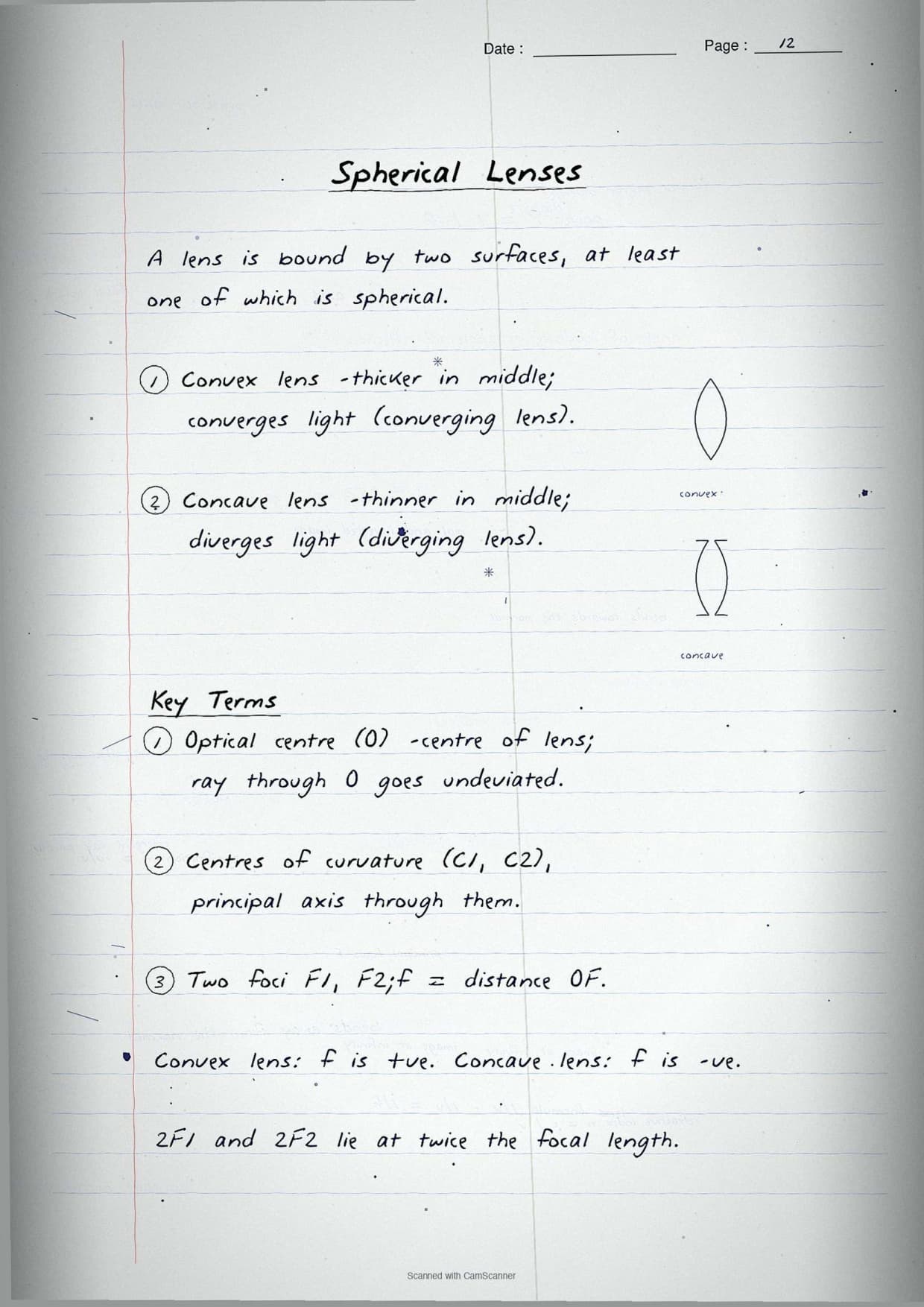
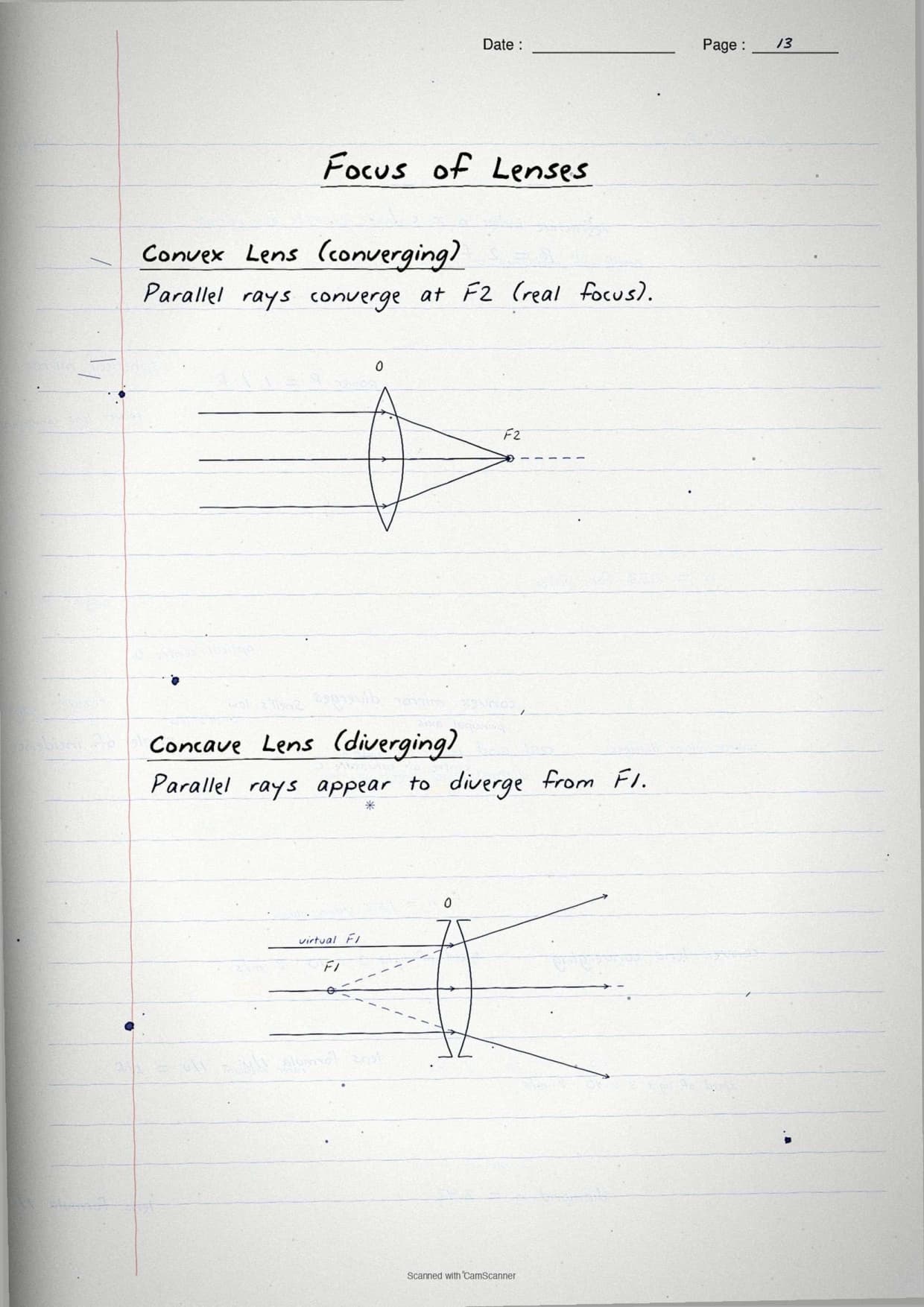
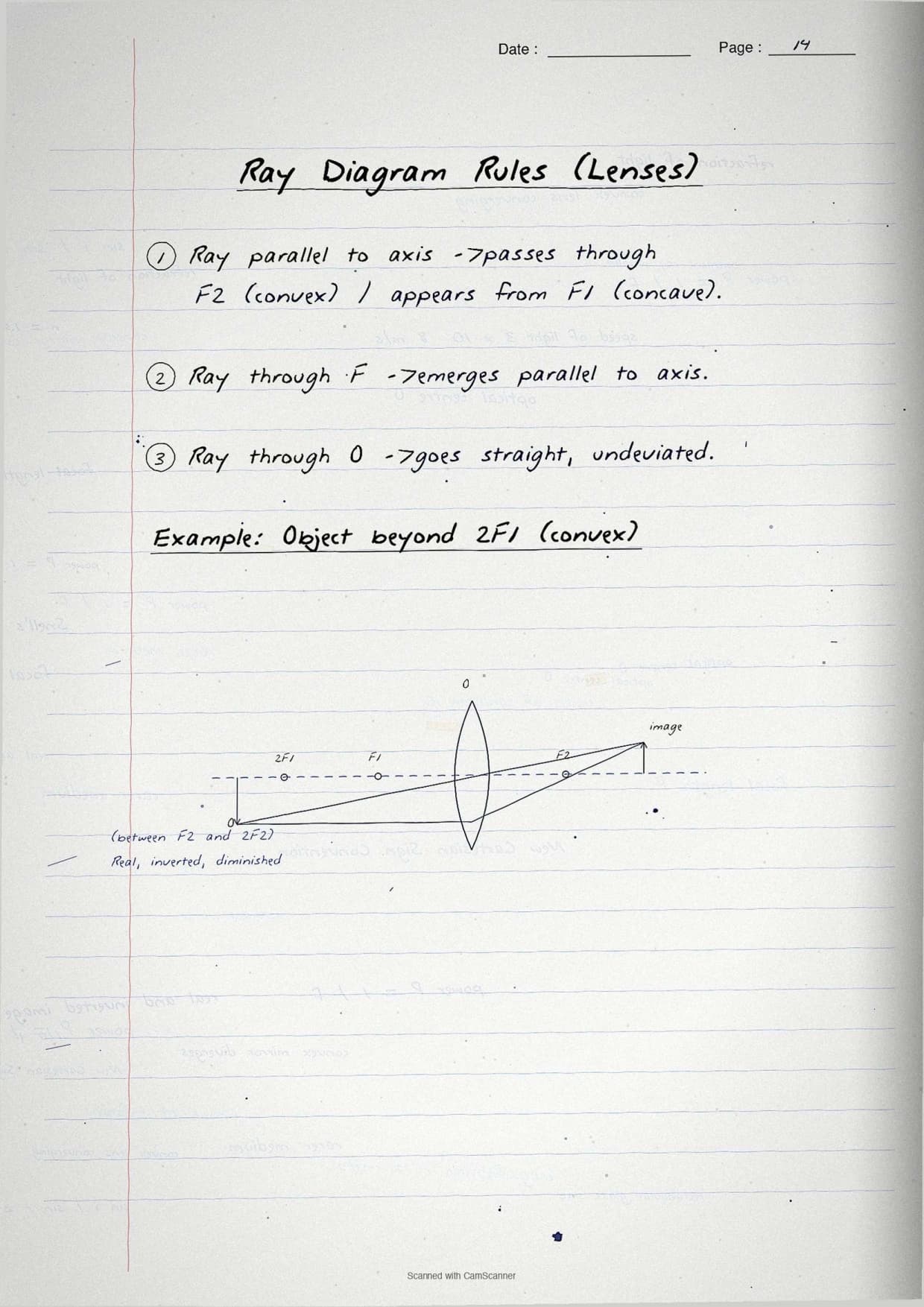
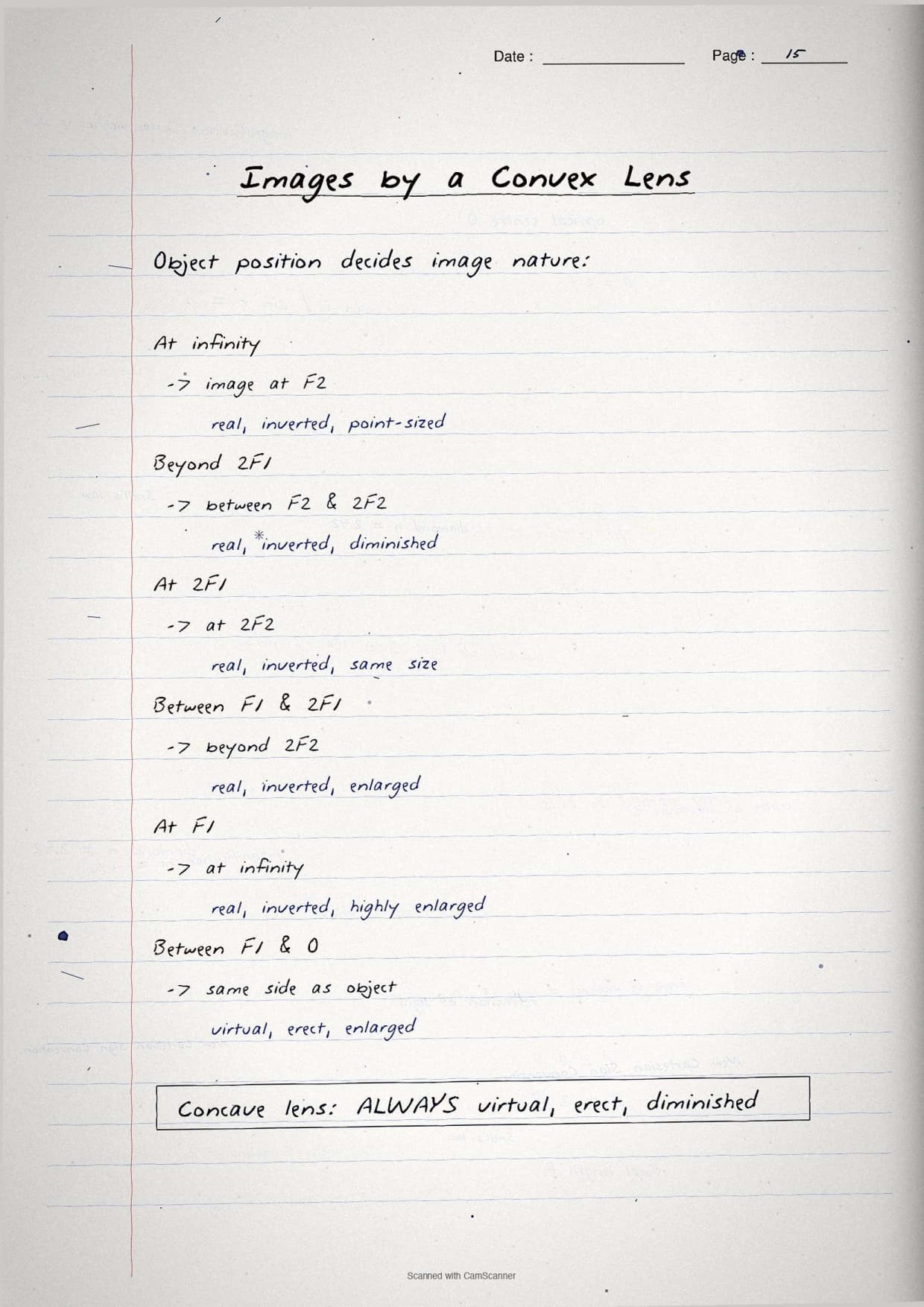
- Convex lens: converges light; forms real or virtual images; corrects long sight. Focal length positive.
- Concave lens: diverges light; always gives a virtual, erect, diminished image; corrects short sight. Focal length negative.
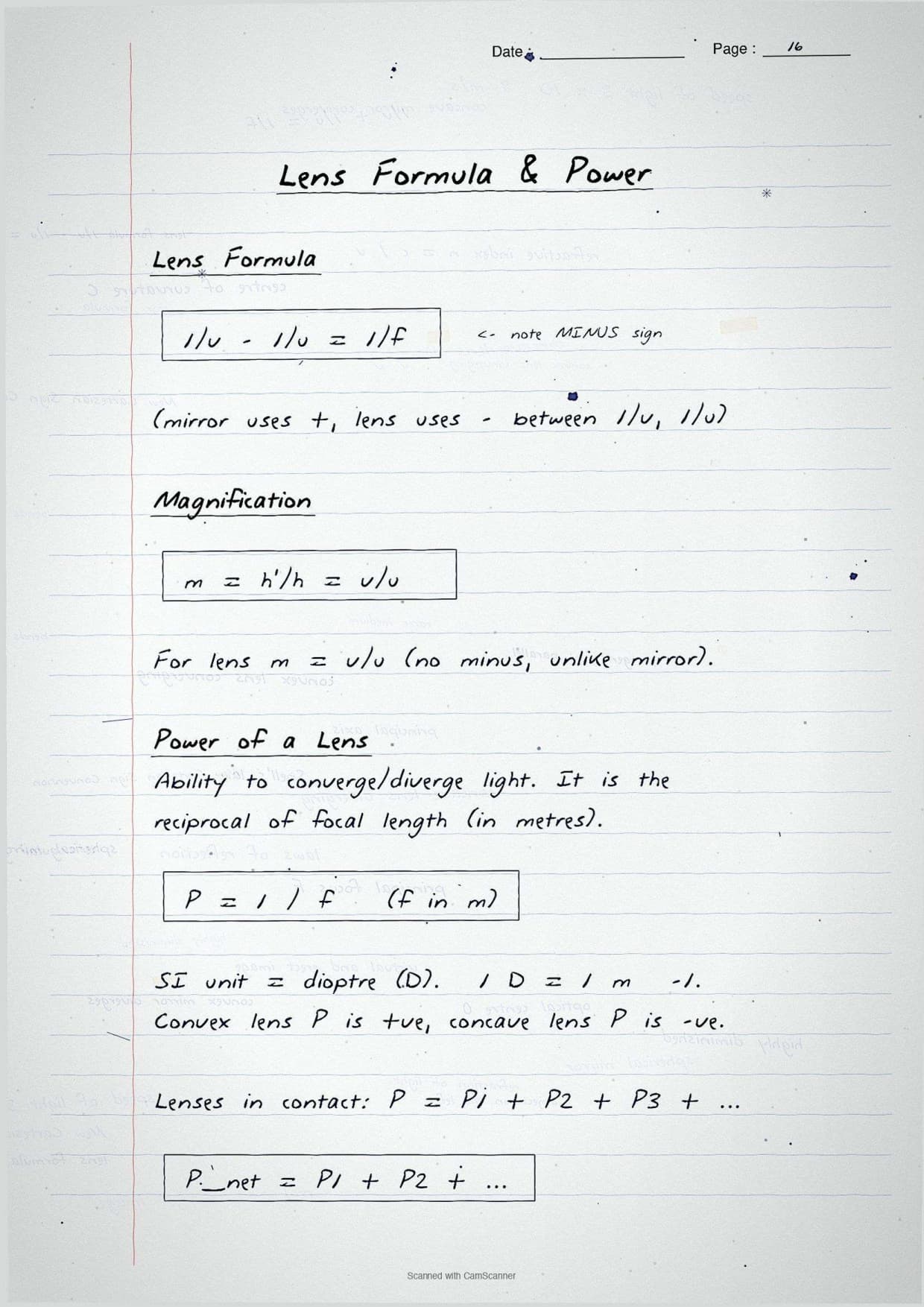
The lens formula, with a sign change from the mirror formula:
1v − 1u = 1f
The power of a lens is the reciprocal of the focal length in metres, in dioptre (D):
P = 1f (in metres) (unit: dioptre, D)
- Magnification: m = h′/h = v/u, with no minus sign, unlike the mirror formula.
- Power sign: positive for convex, negative for concave; powers add when lenses are in contact.
The exam catch: the lens formula uses a minus sign (1/v − 1/u), the mirror formula a plus sign (1/v + 1/u). Mixing these up is the most common slip.
How to Use These Handwritten Notes Effectively
Handwritten notes work best as a final layer of revision, not your first read. Follow this plan before the board exam:
- First pass: read the pages in order, mirrors, then refraction, then lenses and power.
- Active recall: cover the ray diagrams and redraw the concave mirror and convex lens diagrams from memory.
- Formula drill: write the mirror formula, lens formula and magnification with their signs.
- Self-test: pair the pages with the full solutions to check your numericals.
Common Mistakes These Notes Help You Avoid
A few errors cost marks every year, mostly from a wrong sign:
- Using the plus sign in the lens formula. It is 1/v − 1/u = 1/f, with a minus.
- Forgetting that the object distance u is always negative in the sign convention.
- Saying a convex mirror can give a real image. It always gives a virtual, erect, diminished image.
- Writing that light bends away from the normal entering a denser medium. It bends towards the normal.
- Confusing focal length f with power; P = 1/f and is measured in dioptre.
How These Notes Pair with the Solutions and Book PDF
Use these notes with the other resources for the same chapter, linked below.
| Resource | Best used for |
|---|---|
| Light Reflection and Refraction NCERT Solutions | Step-by-step answers and numericals for every in-text and back-exercise question |
| Light Reflection and Refraction Class 10 Notes | Quick typed summary with every law, ray diagram and formula in one place |
| Light Reflection and Refraction Formula Sheet | One-page quick reference of the mirror, lens and power formulas |
| Light Reflection and Refraction NCERT Book PDF | Reading the original NCERT chapter text from the textbook |
All Class 10 Science Handwritten Notes by Chapter
Handwritten notes for every Class 10 Science chapter are linked below. Light - Reflection and Refraction is highlighted.
| Chapter | Handwritten Notes |
|---|---|
| Chapter 1 | Chemical Reactions and Equations |
| Chapter 2 | Acids, Bases and Salts |
| Chapter 3 | Metals and Non-metals |
| Chapter 4 | Carbon and its Compounds |
| Chapter 5 | Life Processes |
| Chapter 6 | Control and Coordination |
| Chapter 7 | How do Organisms Reproduce? |
| Chapter 8 | Heredity |
| Chapter 9 | Light - Reflection and Refraction |
| Chapter 10 | The Human Eye and the Colourful World |
| Chapter 11 | Electricity |
| Chapter 12 | Magnetic Effects of Electric Current |
| Chapter 13 | Our Environment |
FAQs on Light Reflection and Refraction Handwritten Notes
Light Reflection and Refraction Class 10 Science Handwritten Notes Common Questions
Ques. Are these class 10 science chapter 9 Light Reflection and Refraction handwritten notes free to download?
Ans. Yes. The Light Reflection and Refraction handwritten notes are free to download as a PDF from this page. They follow the 2026-27 NCERT syllabus and cover the full chapter across 22 scanned, hand-drawn-diagram pages for quick revision.
Ques. What does Chapter 9 Light Reflection and Refraction cover in Class 10 Science?
Ans. The notes cover the laws of reflection, image formation by concave and convex mirrors, the mirror formula and magnification, the New Cartesian Sign Convention, the laws of refraction and Snell's law, refractive index, refraction through a glass slab, image formation by convex and concave lenses, the lens formula and the power of a lens, all of which the CBSE board paper tests directly.
Ques. What is the difference between the mirror formula and the lens formula?
Ans. The mirror formula is 1/v + 1/u = 1/f, with a plus sign, while the lens formula is 1/v − 1/u = 1/f, with a minus sign. Both link the object distance u, the image distance v and the focal length f, and both must be used with the New Cartesian Sign Convention.
Ques. Why is a convex mirror used as a rear-view mirror in vehicles?
Ans. A convex mirror always forms a virtual, erect and diminished image, whatever the object position, and it has a wider field of view because it curves outwards. This lets the driver see a large area of traffic behind the vehicle in an upright image, which is why it is used as a rear-view or wing mirror.
Ques. Are these notes enough for the class 10 science chapter 9 board exam?
Ans. They are a strong final revision layer. For full preparation, pair them with the NCERT Solutions linked on this page so you can write out complete answers, draw the ray diagrams and solve the numericals for every in-text and back-exercise question and check them against model answers.



Comments