




NCERT Handwritten Notes for Class 12 English (Suppl.) Chapter 12 Kaleidoscope: Time and Time Again help students revise A.K. Ramanujan's poem through colourful notes, clock-symbol charts and NCERT answer cues for the 2026-27 reprint.
- Resource: Class 12 English Supplementary Chapter 12 handwritten revision notes PDF.
- Chapter focus: A.K. Ramanujan, clock towers, uneven time, communal disharmony, riot, lightning and public order.
- Revision use: quick poem summary, symbol map, theme table and short answer frames.
Chapter12Kaleidoscope:TimeandTimeAgainHandwrittenNotes.pdf?page=1&dpi=150)
Chapter12Kaleidoscope:TimeandTimeAgainHandwrittenNotes.pdf?page=2&dpi=150)
Chapter12Kaleidoscope:TimeandTimeAgainHandwrittenNotes.pdf?page=3&dpi=150)
Chapter12Kaleidoscope:TimeandTimeAgainHandwrittenNotes.pdf?page=4&dpi=150)
Chapter12Kaleidoscope:TimeandTimeAgainHandwrittenNotes.pdf?page=5&dpi=150)
Chapter12Kaleidoscope:TimeandTimeAgainHandwrittenNotes.pdf?page=6&dpi=150)
Chapter12Kaleidoscope:TimeandTimeAgainHandwrittenNotes.pdf?page=7&dpi=150)
Chapter12Kaleidoscope:TimeandTimeAgainHandwrittenNotes.pdf?page=8&dpi=150)
Chapter12Kaleidoscope:TimeandTimeAgainHandwrittenNotes.pdf?page=9&dpi=150)
Chapter12Kaleidoscope:TimeandTimeAgainHandwrittenNotes.pdf?page=10&dpi=150)
Chapter12Kaleidoscope:TimeandTimeAgainHandwrittenNotes.pdf?page=11&dpi=150)
Chapter12Kaleidoscope:TimeandTimeAgainHandwrittenNotes.pdf?page=12&dpi=150)
Chapter12Kaleidoscope:TimeandTimeAgainHandwrittenNotes.pdf?page=13&dpi=150)
Chapter12Kaleidoscope:TimeandTimeAgainHandwrittenNotes.pdf?page=14&dpi=150)
Chapter12Kaleidoscope:TimeandTimeAgainHandwrittenNotes.pdf?page=15&dpi=150)
Chapter12Kaleidoscope:TimeandTimeAgainHandwrittenNotes.pdf?page=16&dpi=150)
Chapter12Kaleidoscope:TimeandTimeAgainHandwrittenNotes.pdf?page=17&dpi=150)
Chapter12Kaleidoscope:TimeandTimeAgainHandwrittenNotes.pdf?page=18&dpi=150)
Chapter12Kaleidoscope:TimeandTimeAgainHandwrittenNotes.pdf?page=19&dpi=150)
Chapter12Kaleidoscope:TimeandTimeAgainHandwrittenNotes.pdf?page=20&dpi=150)
Chapter12Kaleidoscope:TimeandTimeAgainHandwrittenNotes.pdf?page=21&dpi=150)
Chapter12Kaleidoscope:TimeandTimeAgainHandwrittenNotes.pdf?page=22&dpi=150)
Chapter12Kaleidoscope:TimeandTimeAgainHandwrittenNotes.pdf?page=23&dpi=150)
Student Feedback: Students understand this poem faster when they treat the clock towers as public symbols, not just machines that tell time.
Time and Time Again Handwritten Notes Overview
Time and Time Again handwritten notes cover the poem's clock-tower sounds, differences in timekeeping, public monuments, religious communities, backstreet quarrel, broken clockwork and the phrase precise act of nature.
The chapter works through one central idea: public time looks ordered, but the city carries repeated difference, conflict and damage.
Time and Time Again Revision Flow
The poem is easiest to revise as a movement from clock sound to civic tension and then to a damaged public symbol.
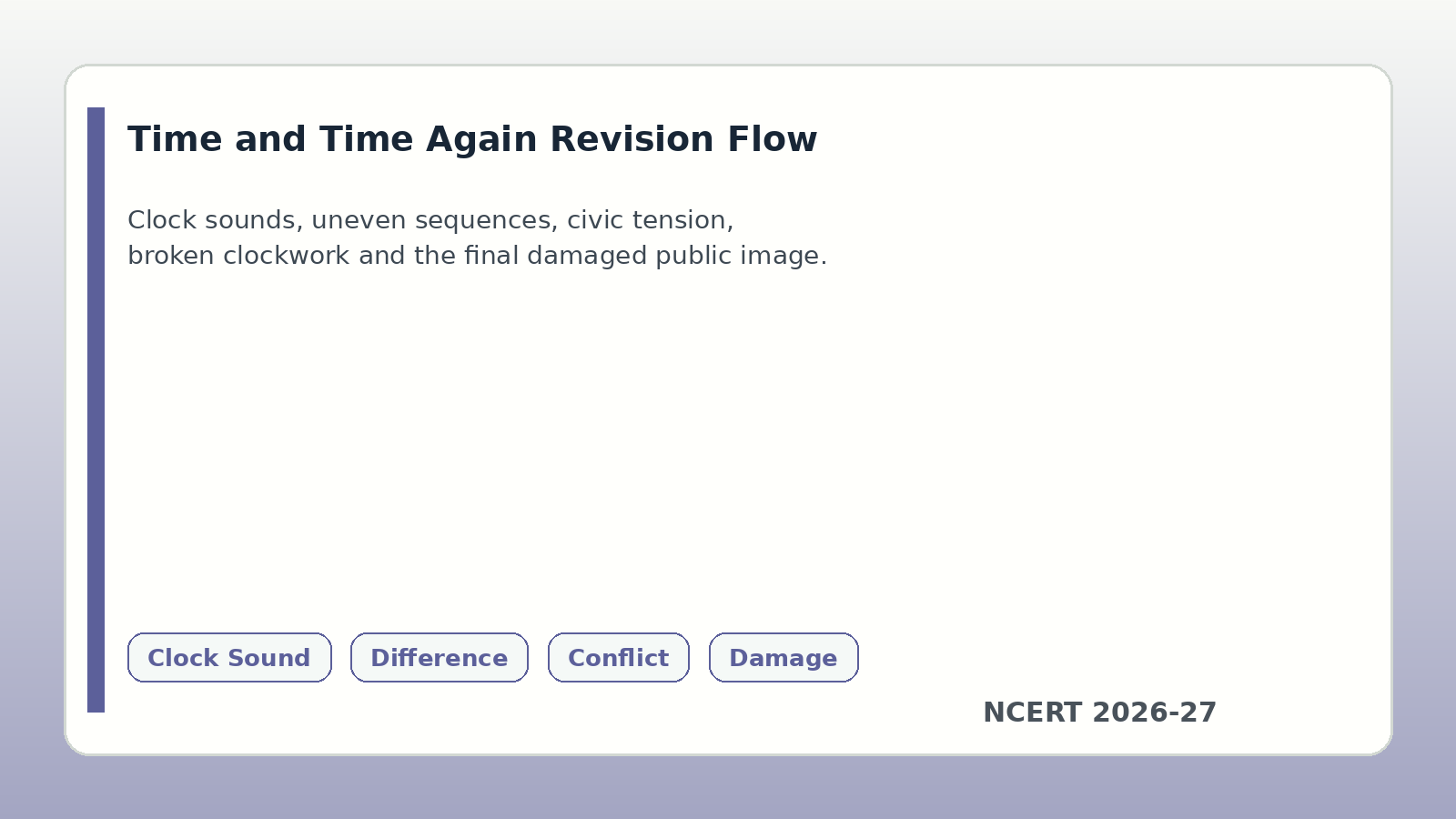
| Stage | Image or phrase | Answer cue |
|---|---|---|
| Clock sound | clocktowers beating their gongs | Time is public and heard across the city. |
| Difference | each slightly off the others time | Shared time is uneven and plural. |
| Social strain | perennial feuds and seasonal alliance | The city carries recurring conflict. |
| Damage | eyeless silent clock, zigzag sky | Public order becomes visibly broken. |
Time and Time Again Class 12 Video Explanation
Source: ENG EDU HUB on YouTube
Clock Symbol Map in Time and Time Again Class 12 English
The clocks are public machines, but in the poem they also suggest community history, difference, power, chance and fragile civic harmony.
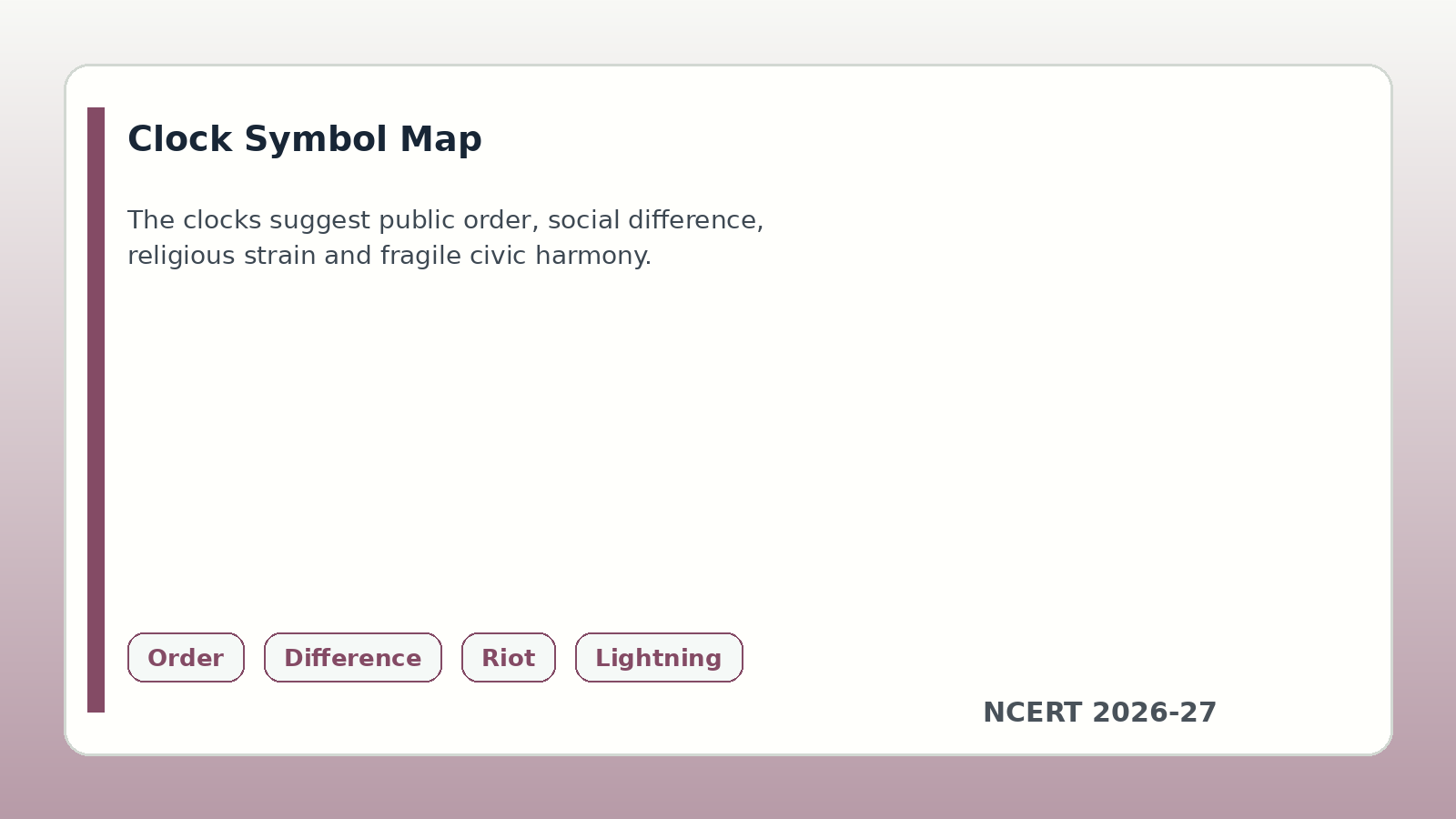
| Symbol point | Meaning | How to write it |
|---|---|---|
| Clock towers | Public order and shared city time. | Begin with sound and civic rhythm. |
| Slightly off time | Difference inside one city. | Link to alloy, distance and community life. |
| Siren and quarrel | Emergency and social rupture. | Show how harmony is interrupted. |
| Broken clockwork | Damage to public order. | Use eyeless, silent and zigzag sky. |
Themes and NCERT Answer Cues in Time and Time Again
The handwritten notes mark the themes students need for short and long answers. The poem is about time, but it is also about the repeated fragility of civic life.
- Public time: clock towers create a shared city rhythm.
- Difference: each clock is slightly off because of material, craft, distance and history.
- Communal disharmony: perennial feuds and named communities point to social strain.
- Nature and violence: lightning is precise, while riot and bomb carry human blame.
How to Use the Time and Time Again Handwritten Notes PDF
Use the PDF for quick revision before class tests or board-style practice. First revise the clock imagery, then the social comparison, and finally the damaged clock ending.
- Use the opening pages for clock-tower and sound imagery answers.
- Use the symbol pages for slightly off time and social difference.
- Use the answer-frame pages for the six NCERT response questions.
- Use the final revision page before writing a theme-based answer.
Related Class 12 English Supplementary Resources
Use these related resources with the handwritten notes for full chapter preparation.
| Resource | Best use | Link |
|---|---|---|
| NCERT Solutions | Step-by-step answers for Time and Time Again | Open solutions |
| NCERT Notes | Typed revision notes for the same poem | Open notes |
| NCERT Book PDF | Official chapter reading | Open book PDF |
All Class 12 English Supplementary Handwritten Notes
The table below keeps the same resource type together, so students can move chapter by chapter through the Class 12 English Supplementary Kaleidoscope handwritten notes.
| Chapter | Title | Handwritten notes link |
|---|---|---|
| Chapter 7 | Poems by Milton | Open handwritten notes |
| Chapter 8 | Poems by Blake | Open handwritten notes |
| Chapter 9 | Kubla Khan | Open handwritten notes |
| Chapter 10 | Trees | Open handwritten notes |
| Chapter 11 | The Wild Swans at Coole | Open handwritten notes |
| Chapter 12 | Time and Time Again | Open handwritten notes |
| Chapter 13 | Blood | Open handwritten notes |
| Chapter 14 | Freedom | Open handwritten notes |
| Chapter 15 | The Mark on the Wall | Open handwritten notes |
| Chapter 16 | Film-Making | Open handwritten notes |
Time and Time Again Class 12 English Handwritten Notes FAQs
Ques. What do Time and Time Again handwritten notes cover?
Ans. The notes cover A.K. Ramanujan, clock towers, uneven timekeeping, communal disharmony, siren, quarrel, riot, time bomb, lightning and NCERT answer cues for 2026-27.
Ques. What is the main idea of Time and Time Again?
Ans. The poem shows how public clock time appears orderly, but the city carries repeated differences, conflicts and damage.
Ques. What do the clock towers symbolise in the poem?
Ans. The clock towers symbolise public order, shared civic time, social difference and the fragility of communal harmony.
Ques. Are these notes aligned with the 2026-27 NCERT book?
Ans. Yes. The notes are prepared for Class 12 English Supplementary Kaleidoscope Chapter 12 Time and Time Again in the 2026-27 NCERT reprint.



Comments