



NCERT Handwritten Notes for Class 12 English (Suppl.) Chapter 8 Kaleidoscope: Poems by Blake help students revise The Divine Image and The Human Abstract through clear colourful notes, poem comparison charts and NCERT answer points for the 2026-27 reprint.
- Resource: Class 12 English Supplementary Chapter 8 handwritten revision notes PDF.
- Chapter focus: Blake, innocence, experience, Mercy, Pity, Peace, Love, social cruelty and the human brain image.
- Revision use: quick poem summaries, symbol notes, language work and short answer frames.
Chapter8Kaleidoscope:PoemsbyBlakeHandwrittenNotes.pdf?page=1&dpi=150)
Chapter8Kaleidoscope:PoemsbyBlakeHandwrittenNotes.pdf?page=2&dpi=150)
Chapter8Kaleidoscope:PoemsbyBlakeHandwrittenNotes.pdf?page=3&dpi=150)
Chapter8Kaleidoscope:PoemsbyBlakeHandwrittenNotes.pdf?page=4&dpi=150)
Chapter8Kaleidoscope:PoemsbyBlakeHandwrittenNotes.pdf?page=5&dpi=150)
Chapter8Kaleidoscope:PoemsbyBlakeHandwrittenNotes.pdf?page=6&dpi=150)
Chapter8Kaleidoscope:PoemsbyBlakeHandwrittenNotes.pdf?page=7&dpi=150)
Chapter8Kaleidoscope:PoemsbyBlakeHandwrittenNotes.pdf?page=8&dpi=150)
Chapter8Kaleidoscope:PoemsbyBlakeHandwrittenNotes.pdf?page=9&dpi=150)
Chapter8Kaleidoscope:PoemsbyBlakeHandwrittenNotes.pdf?page=10&dpi=150)
Chapter8Kaleidoscope:PoemsbyBlakeHandwrittenNotes.pdf?page=11&dpi=150)
Chapter8Kaleidoscope:PoemsbyBlakeHandwrittenNotes.pdf?page=12&dpi=150)
Chapter8Kaleidoscope:PoemsbyBlakeHandwrittenNotes.pdf?page=13&dpi=150)
Chapter8Kaleidoscope:PoemsbyBlakeHandwrittenNotes.pdf?page=14&dpi=150)
Chapter8Kaleidoscope:PoemsbyBlakeHandwrittenNotes.pdf?page=15&dpi=150)
Chapter8Kaleidoscope:PoemsbyBlakeHandwrittenNotes.pdf?page=16&dpi=150)
Chapter8Kaleidoscope:PoemsbyBlakeHandwrittenNotes.pdf?page=17&dpi=150)
Chapter8Kaleidoscope:PoemsbyBlakeHandwrittenNotes.pdf?page=18&dpi=150)
Chapter8Kaleidoscope:PoemsbyBlakeHandwrittenNotes.pdf?page=19&dpi=150)
Chapter8Kaleidoscope:PoemsbyBlakeHandwrittenNotes.pdf?page=20&dpi=150)
Chapter8Kaleidoscope:PoemsbyBlakeHandwrittenNotes.pdf?page=21&dpi=150)
Chapter8Kaleidoscope:PoemsbyBlakeHandwrittenNotes.pdf?page=22&dpi=150)
Chapter8Kaleidoscope:PoemsbyBlakeHandwrittenNotes.pdf?page=23&dpi=150)
Student Feedback: Students usually revise this chapter faster when they place innocence and experience side by side, then track how Blake repeats Mercy, Pity, Peace and Love.
Poems by Blake Handwritten Notes Overview
Class 12 English Supplementary Chapter 8 places two Blake poems side by side. The Divine Image belongs to Songs of Innocence and presents human virtues as divine. The Human Abstract belongs to Songs of Experience and shows how those virtues become distorted by fear, poverty, cruelty and deceit.
The notes focus on the chapter's main contrasts: innocence and experience, compassion and social cruelty, human goodness and the dark tree that grows in the human brain.
The Divine Image and The Human Abstract Comparison
The paired poems are easiest to revise through comparison. The same virtue words return in both poems, but Blake changes their meaning from trust and worship to social criticism.
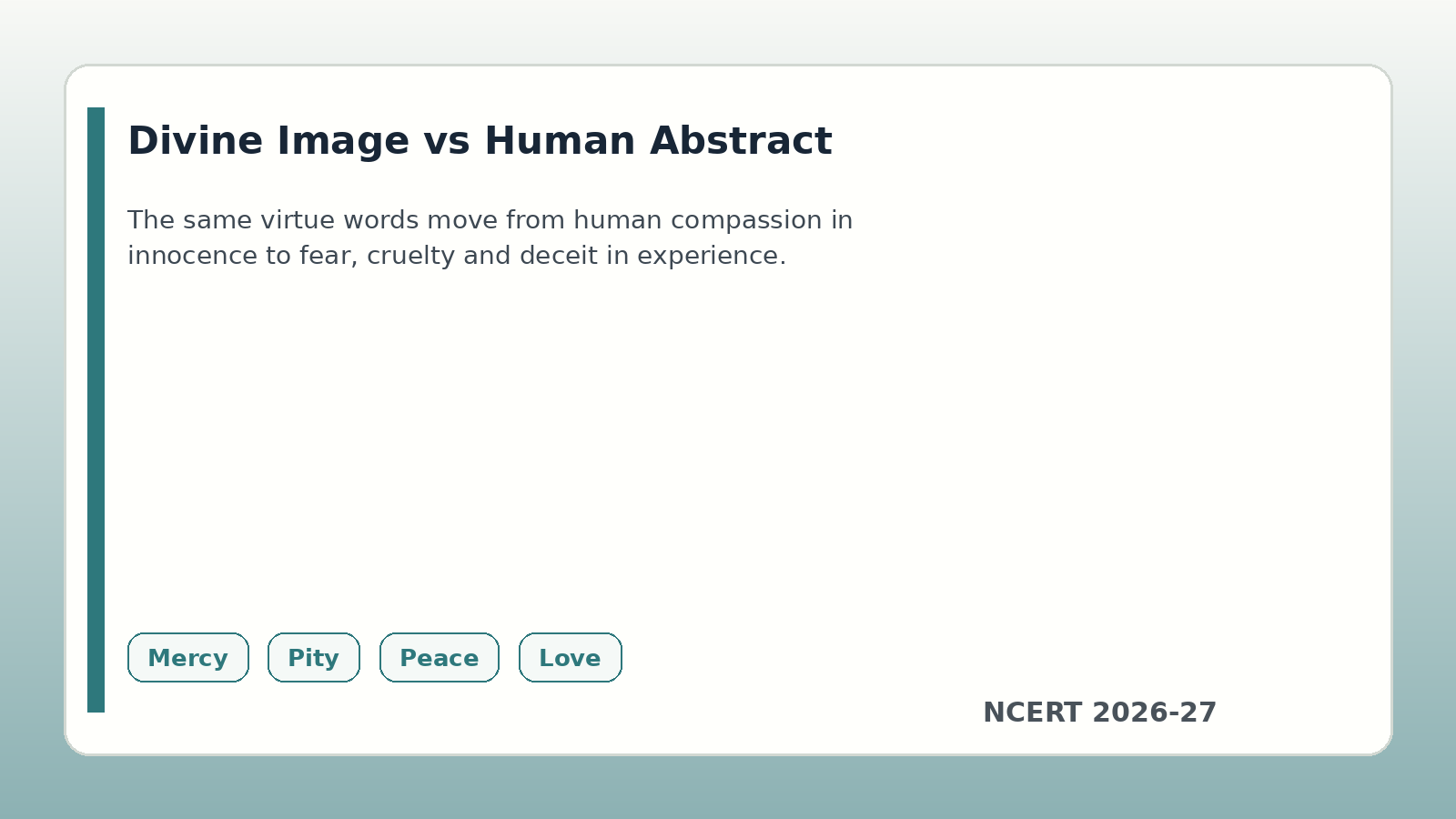
| Point | The Divine Image | The Human Abstract |
|---|---|---|
| Collection | Songs of Innocence | Songs of Experience |
| Virtue words | Mercy, Pity, Peace and Love reflect God. | Pity, Mercy and Peace expose poverty and fear. |
| Human being | Humanity can show the divine image. | Human thought can create cruelty and deceit. |
| Exam angle | Explain human form divine. | Explain distorted virtues in the human brain. |
Poems by Blake Class 12 Explanation Video
Source: Magnet Brains on YouTube
The Human Abstract Tree Image
The Human Abstract turns social cruelty into a dark tree. Cruelty waters the ground with tears, Mystery spreads shade, Deceit becomes fruit and the Raven nests in that shade.
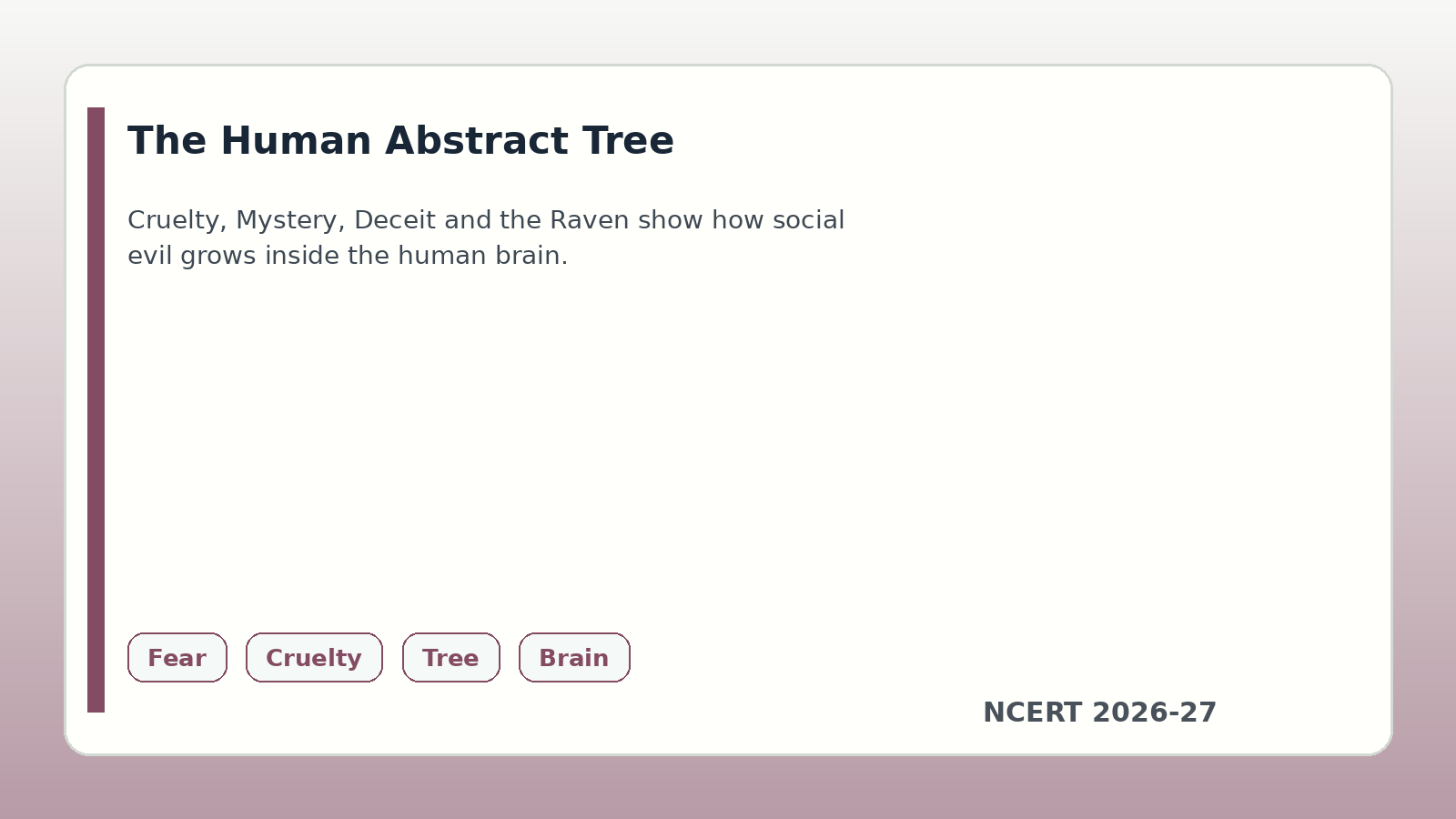
| Image | Meaning | Answer cue |
|---|---|---|
| Snare and bait | Cruelty acts carefully and traps others. | social control |
| Dismal shade | Mystery hides truth and feeds secrecy. | dark inner world |
| Fruit of Deceit | False sweetness grows from cruelty. | attractive evil |
| Human Brain | The tree grows inside human thought. | mental and social evil |
Themes and Language Study in Poems by Blake
The handwritten notes mark the main ideas students need for short and long answers. Blake presents humanity as capable of divine compassion, but also capable of creating fear, poverty and deceit.
- Innocence and experience: the two poems show opposite states of the human soul.
- Human form divine: Mercy, Pity, Peace and Love become visible in human life.
- Social criticism: Blake questions a society that creates poverty and then praises pity.
- Capitalised words: Mercy, Pity, Peace, Love, Cruelty and Mystery are personified forces.
How to Use the Poems by Blake Handwritten Notes PDF
Use the PDF for quick revision before class tests or board-style practice. First revise the comparison chart, then write one paragraph on the human form divine and one paragraph on the Human Brain ending.
- Use the comparison pages for NCERT Question 1.
- Use the virtue pages for the lines on Mercy, Pity, Love and Peace.
- Use the tree pages for distorted virtues and the human brain image.
- Use the language-study page for capitalised words and syllable pattern points.
Related Class 12 English Supplementary Resources
Use these related resources with the handwritten notes for full chapter preparation.
| Resource | Best use | Link |
|---|---|---|
| NCERT Solutions | Step-by-step answers for Poems by Blake | Open solutions |
| NCERT Notes | Typed revision notes for the same chapter | Open notes |
| NCERT Book PDF | Official chapter reading | Open book PDF |
All Class 12 English Supplementary Handwritten Notes
The table below keeps the same resource type together, so students can move chapter by chapter through the Class 12 English Supplementary Kaleidoscope handwritten notes.
| Chapter | Title | Handwritten notes link |
|---|---|---|
| Chapter 1 | I Sell my Dreams | Open handwritten notes |
| Chapter 2 | Eveline | Open handwritten notes |
| Chapter 3 | A Wedding in Brownsville | Open handwritten notes |
| Chapter 4 | Tomorrow | Open handwritten notes |
| Chapter 5 | One Centimetre | Open handwritten notes |
| Chapter 6 | A Lecture upon the Shadow | Open handwritten notes |
| Chapter 7 | Poems by Milton | Open handwritten notes |
| Chapter 8 | Poems by Blake | Open handwritten notes |
Poems by Blake Class 12 English Handwritten Notes FAQs
Ques. What do the Poems by Blake handwritten notes cover?
Ans. The notes cover William Blake, The Divine Image, The Human Abstract, innocence and experience, Mercy, Pity, Peace, Love, the tree image and NCERT answer cues for 2026-27.
Ques. What is the main idea of The Divine Image?
Ans. The Divine Image says that Mercy, Pity, Peace and Love are human virtues that also reveal God's image in human life.
Ques. How does The Human Abstract distort the virtue words?
Ans. The poem shows that pity, mercy and peace can hide poverty, fear and cruelty when human society creates suffering first.
Ques. Are these notes aligned with the 2026-27 NCERT book?
Ans. Yes. The notes are prepared for Class 12 English Supplementary Kaleidoscope Chapter 8 Poems by Blake in the 2026-27 NCERT reprint.



Comments