



The handwritten notes on Class 12 Legal Studies Chapter 1 Judiciary have been carefully prepared for one-shot revision, according to the latest 2026-27 CBSE syllabus. They walk through the court hierarchy, judicial independence, Supreme Court jurisdiction and the collegium system in the same order the textbook uses.
- Length: 26 handwritten pages covering the full Judiciary unit and every named case law.
- Must-learn pair: the four kinds of Supreme Court jurisdiction and the three Judges Cases that built the collegium system.
- Also on this page: a quick recall table, a common mistakes list and a link to the Class 11 Political Science Judiciary notes.
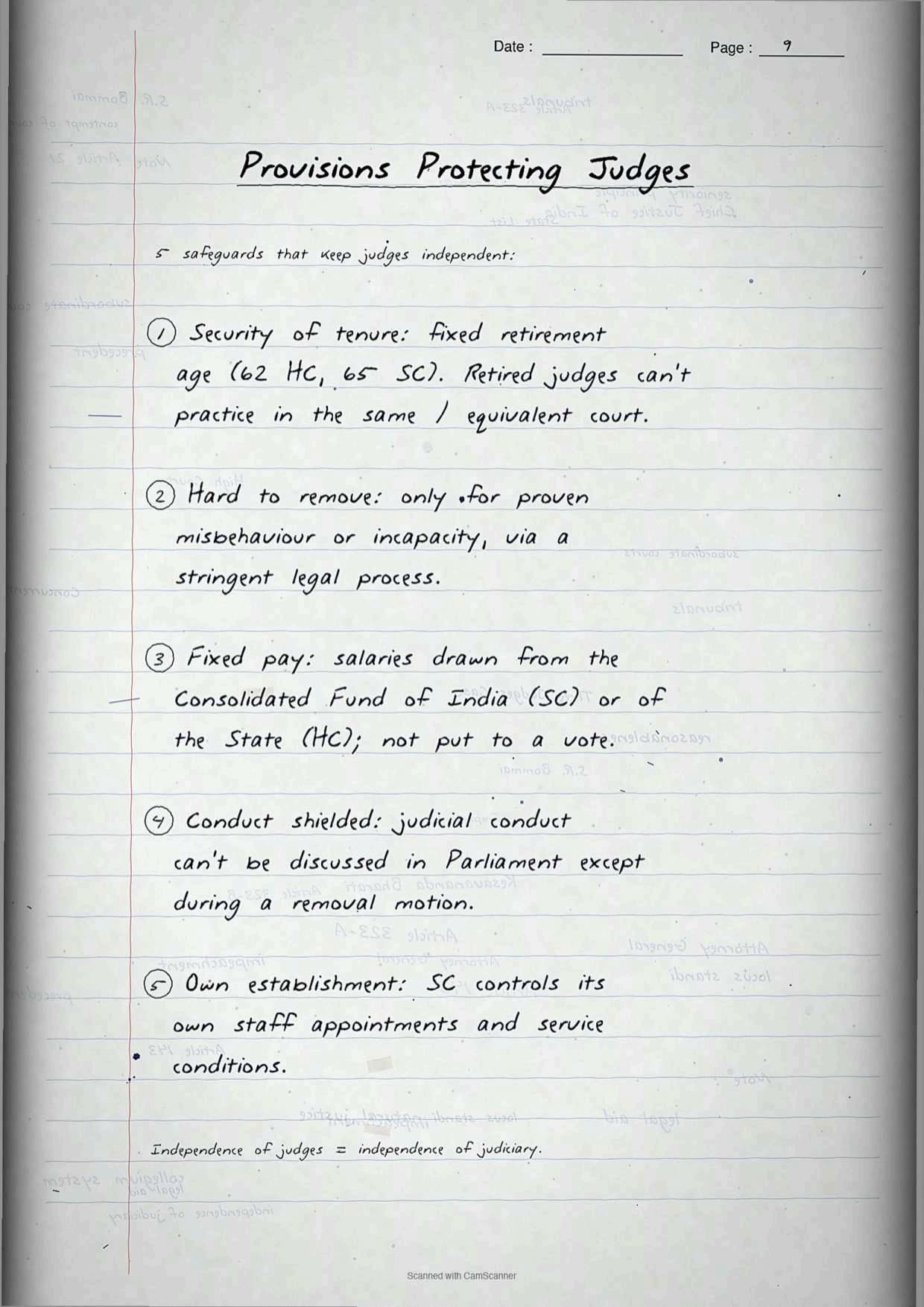
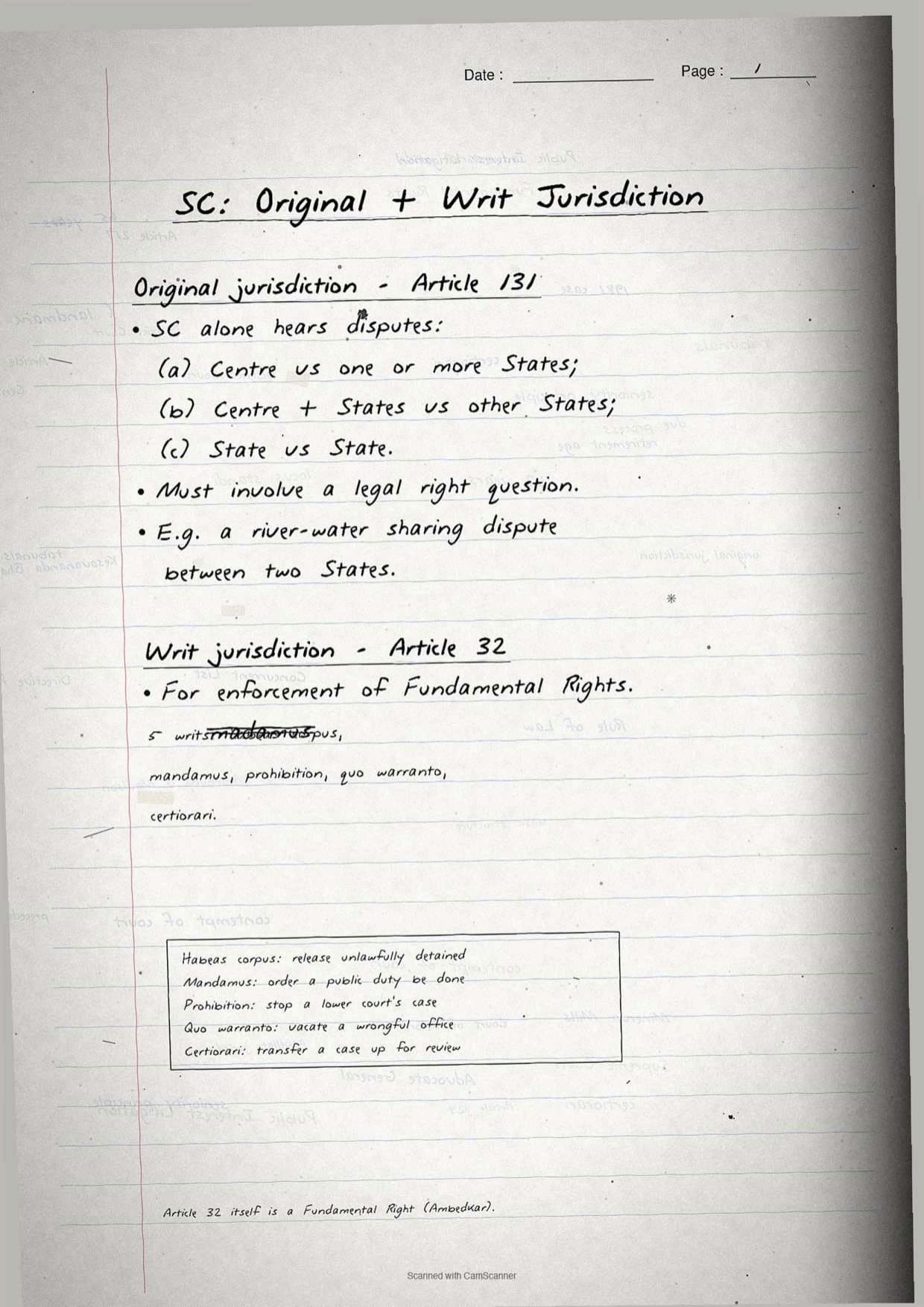
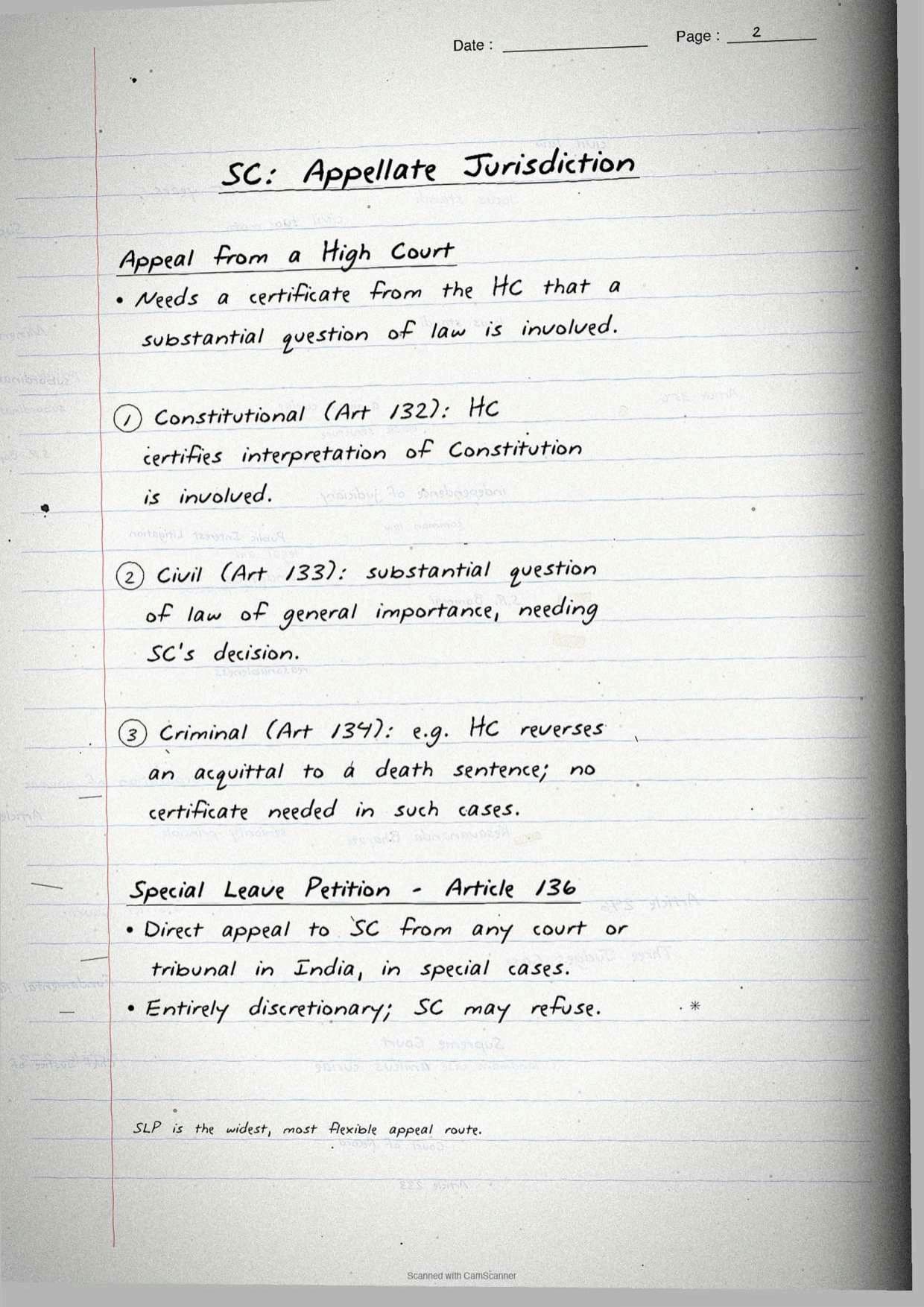
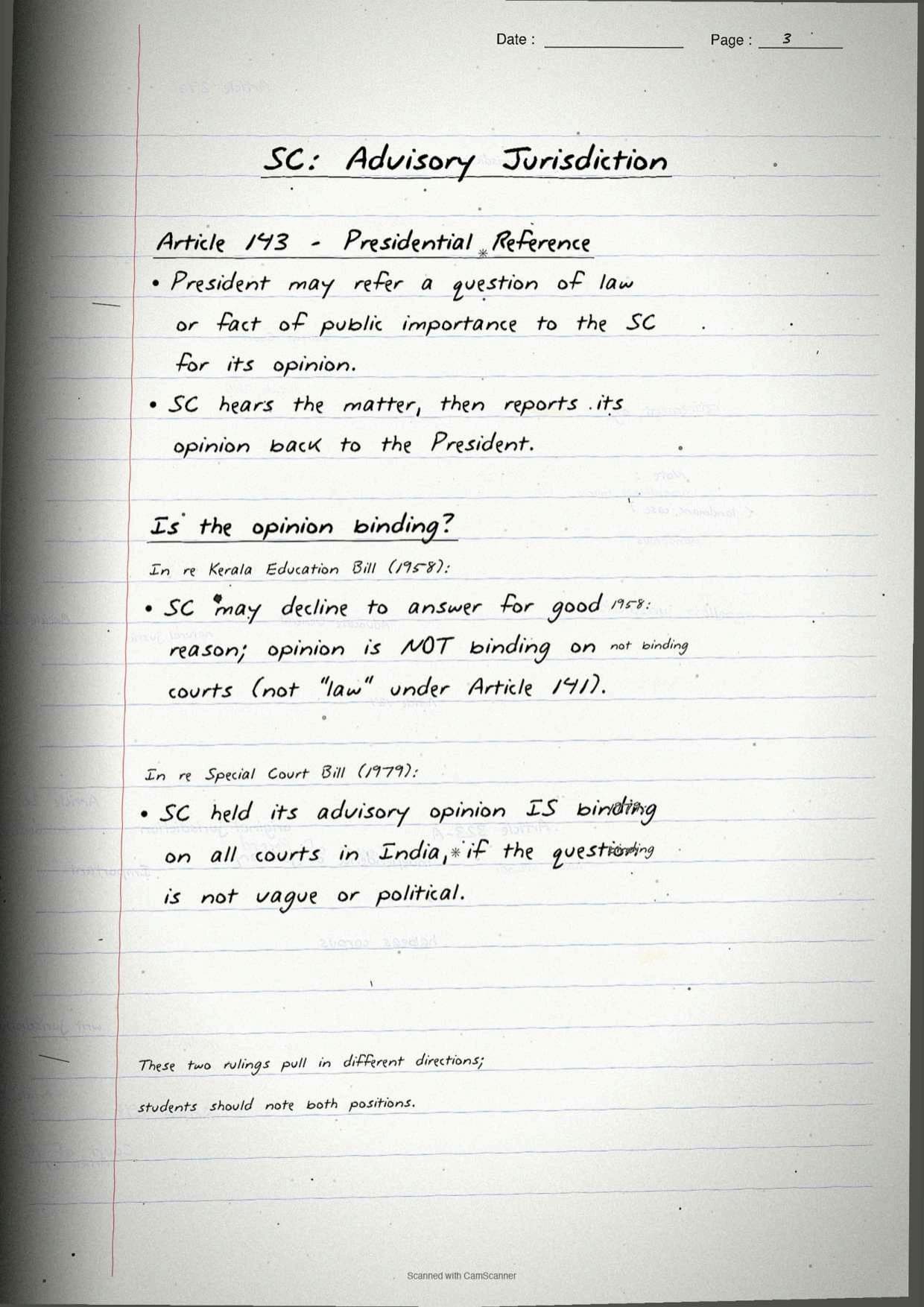
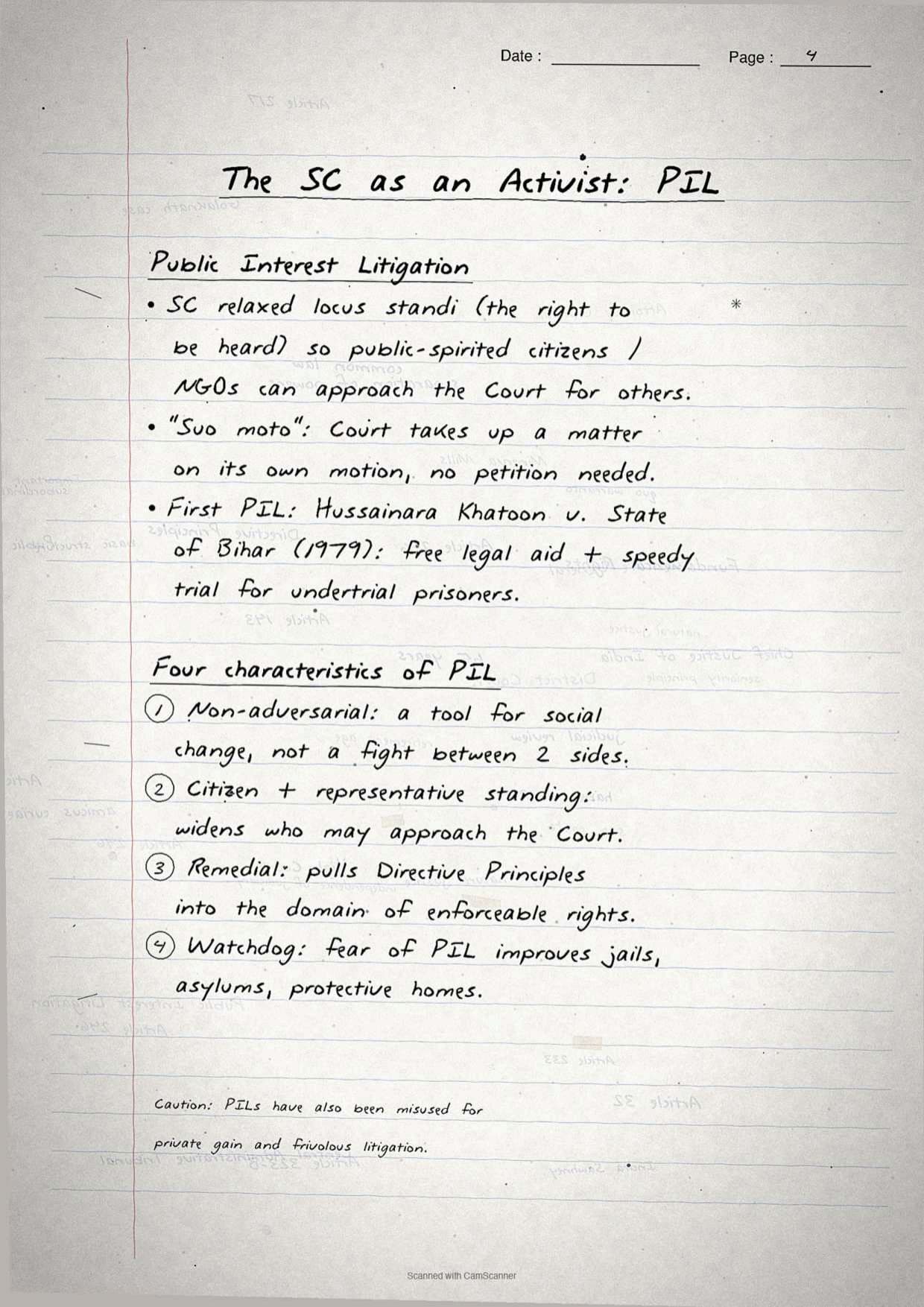
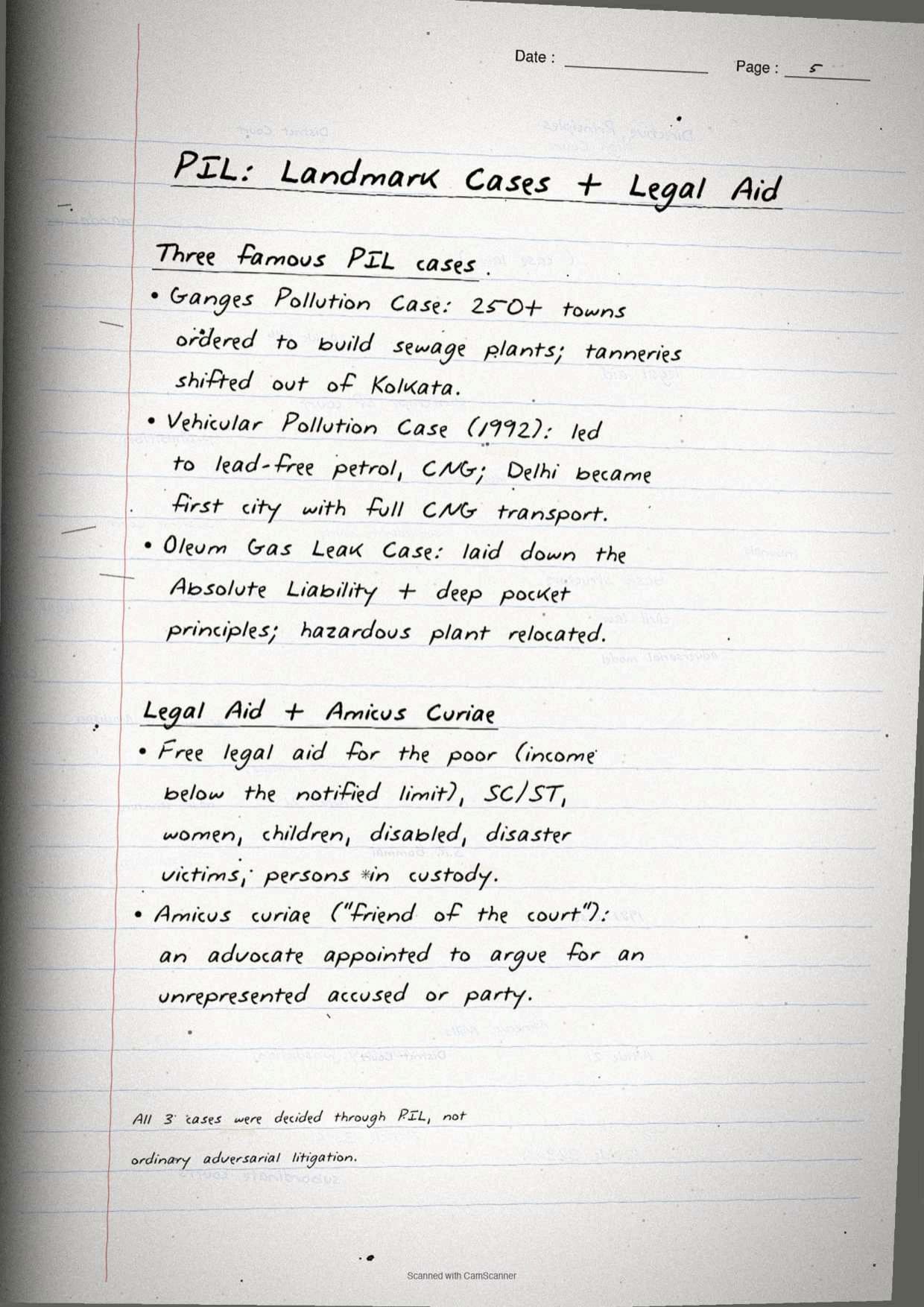
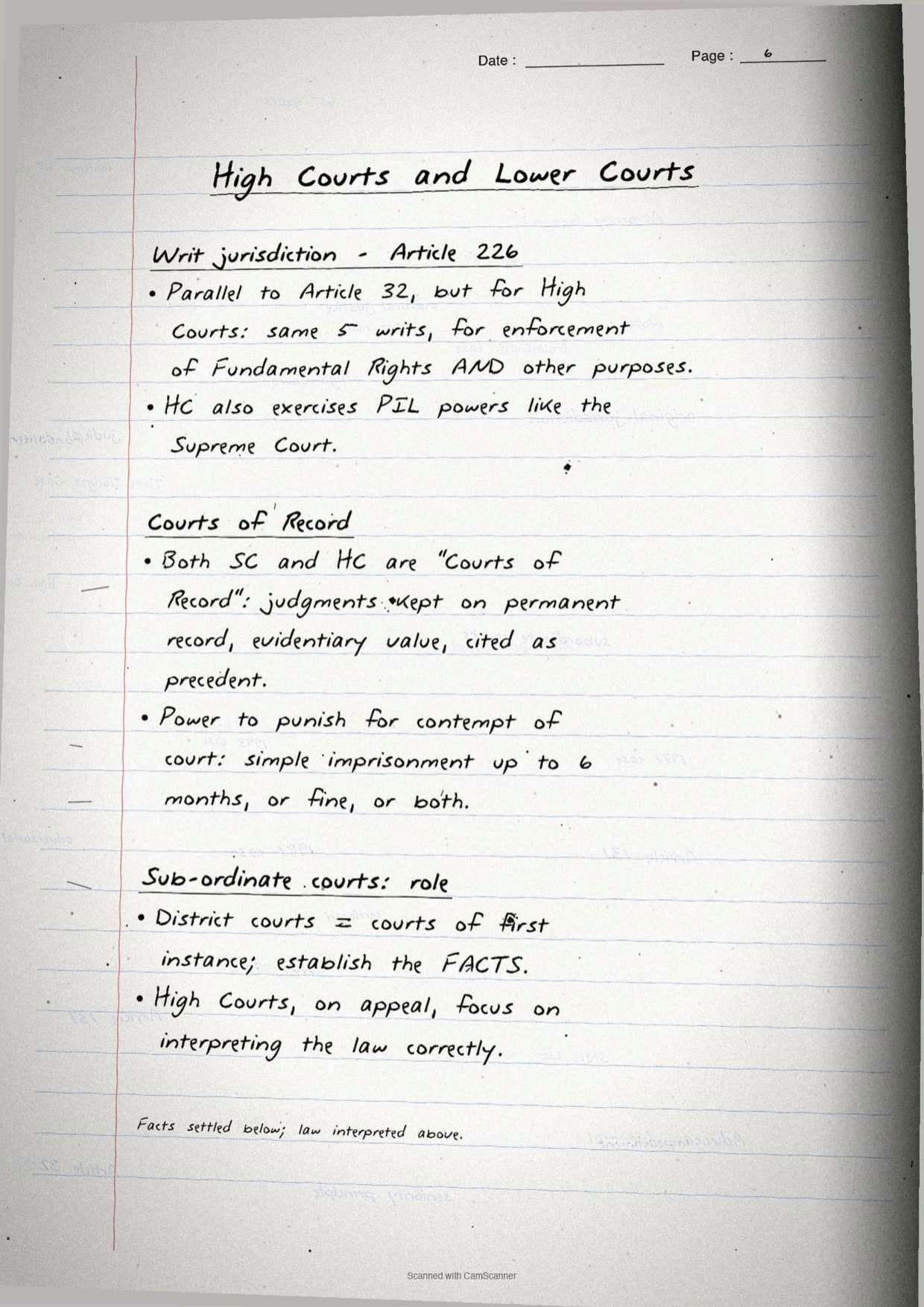
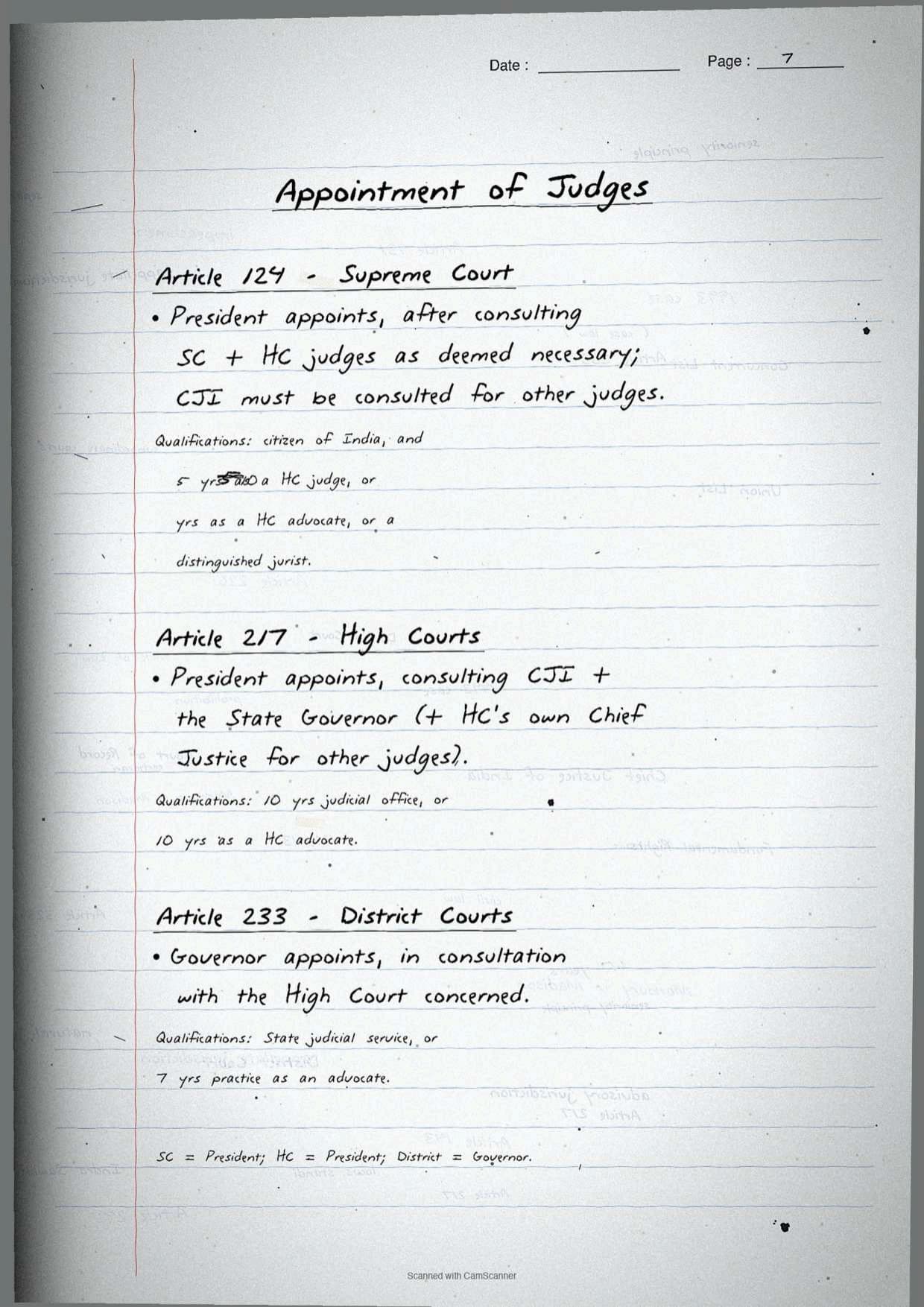
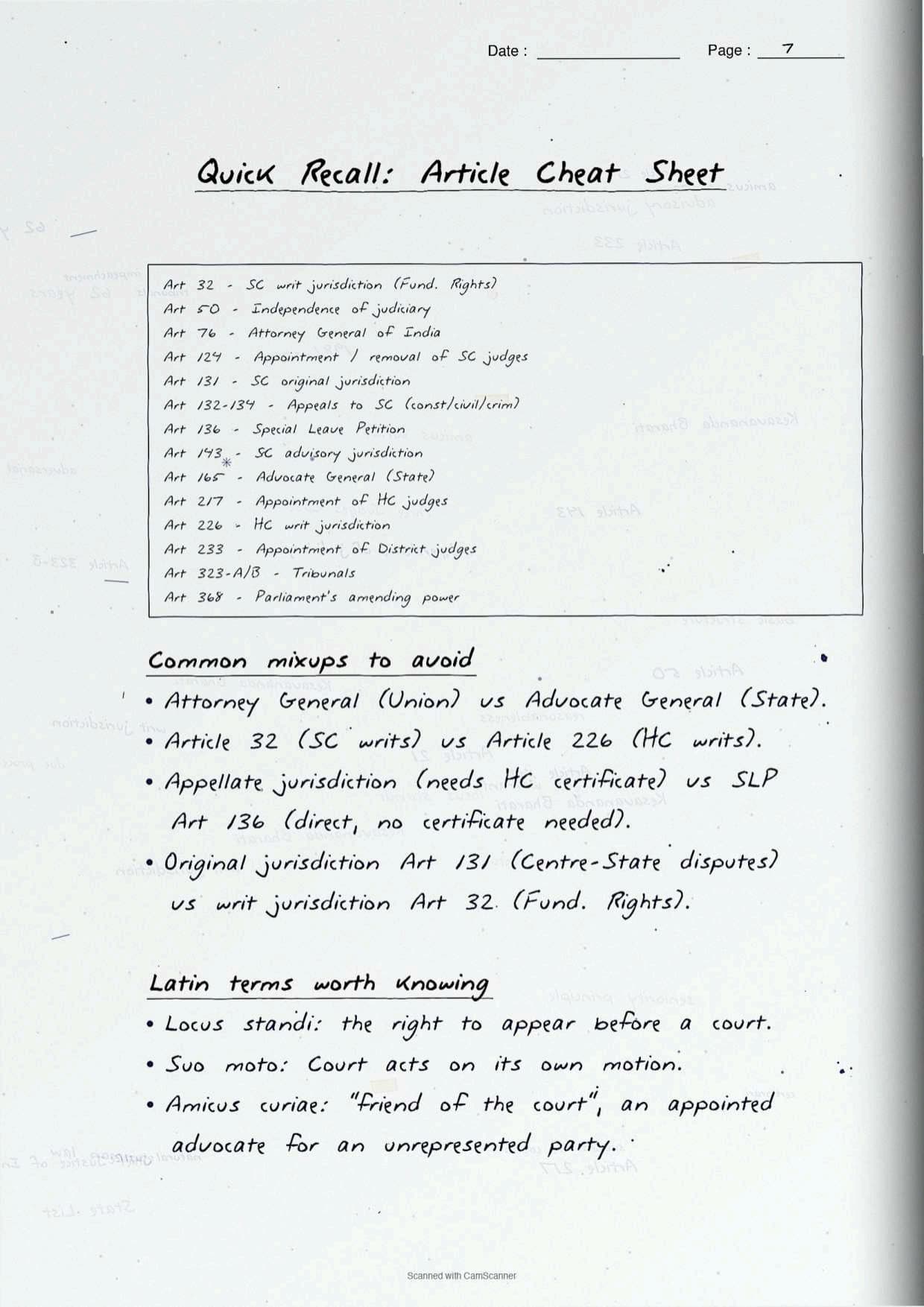
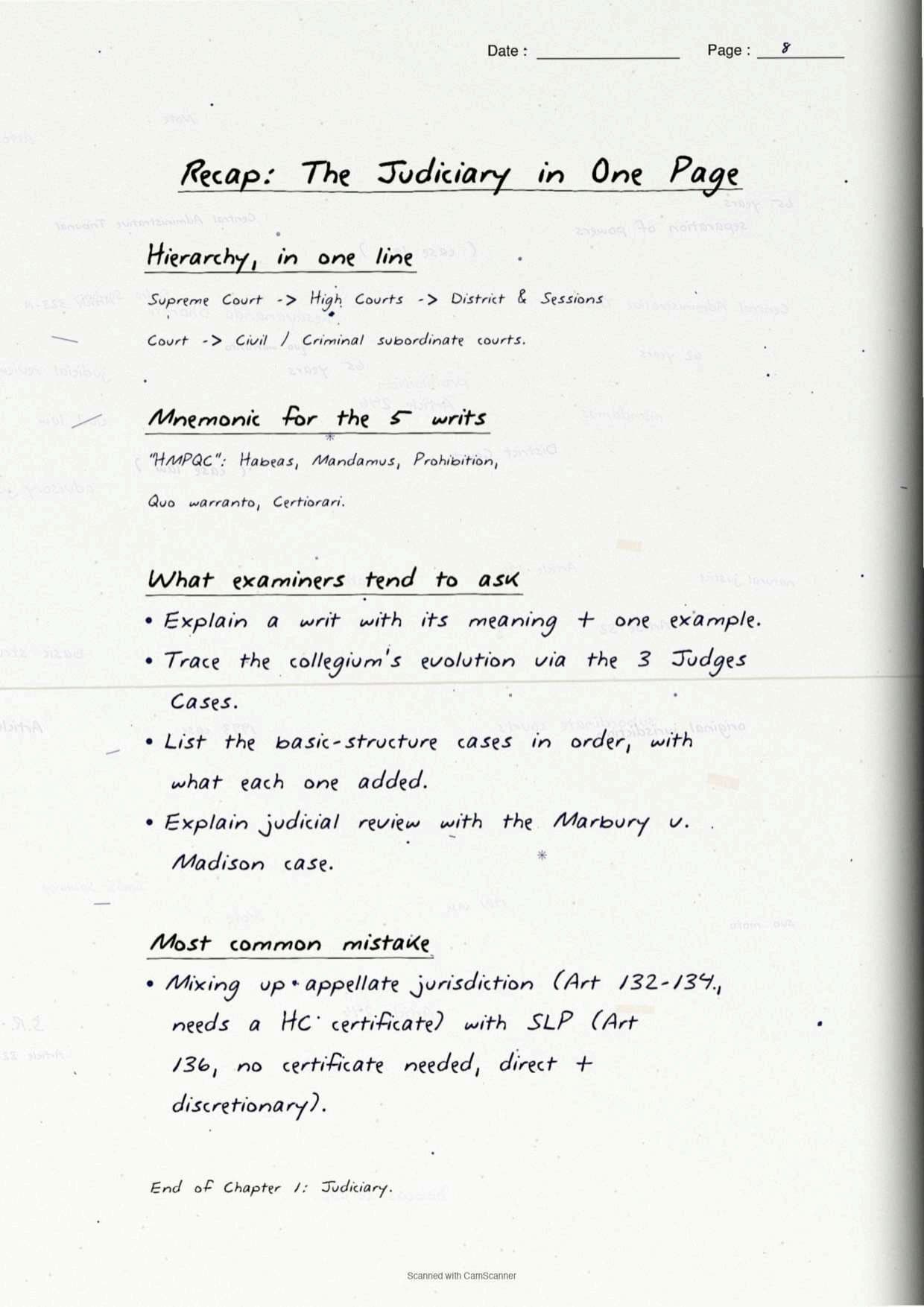
Every page in these Judiciary notes is written by hand, checked against the 2026-27 Class 12 Legal Studies print, and matched to the way board papers ask about court hierarchy, writ jurisdiction and the collegium system.
Student Feedback: In a Collegedunia survey of 11,540 Class 12 Legal Studies students conducted before the 2026 boards, 71% said the four types of Supreme Court jurisdiction and the three Judges Cases are the two blocks they mix up most often. Students who wrote the four jurisdiction names on one flashcard and the three case years on another reported fewer mix-ups within a week.
Source: 2026-27 Class 12 Legal Studies student poll. Sample of 11,540 students from CBSE schools across 16 states.
Structure and Hierarchy of Courts in India
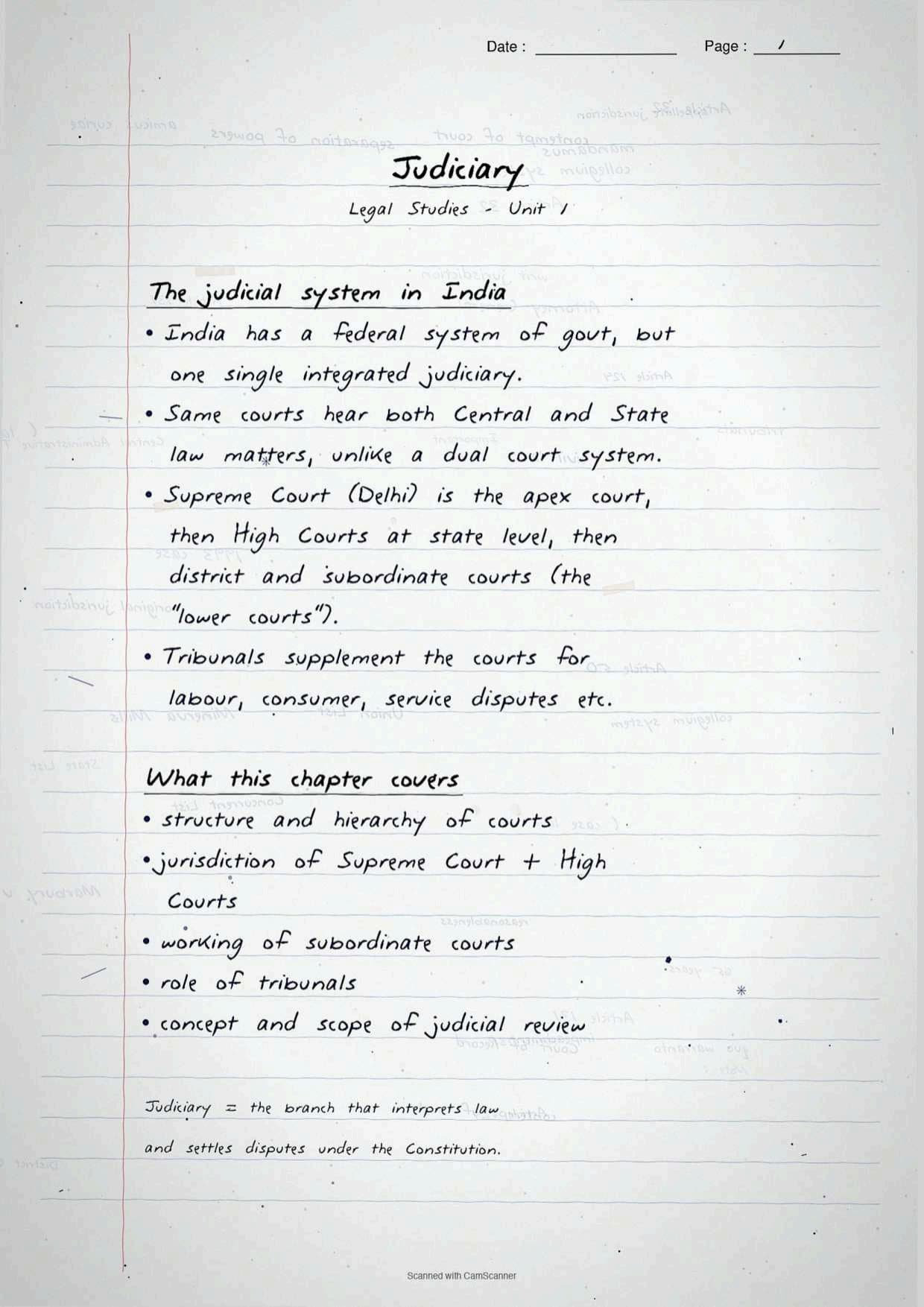
The chapter opens with the shape of the system. India runs a federal structure of government, so law-making power is split between the Centre and the States. Even so, the Constitution sets up one single, integrated judiciary that handles both Central and State laws instead of two separate court ladders.
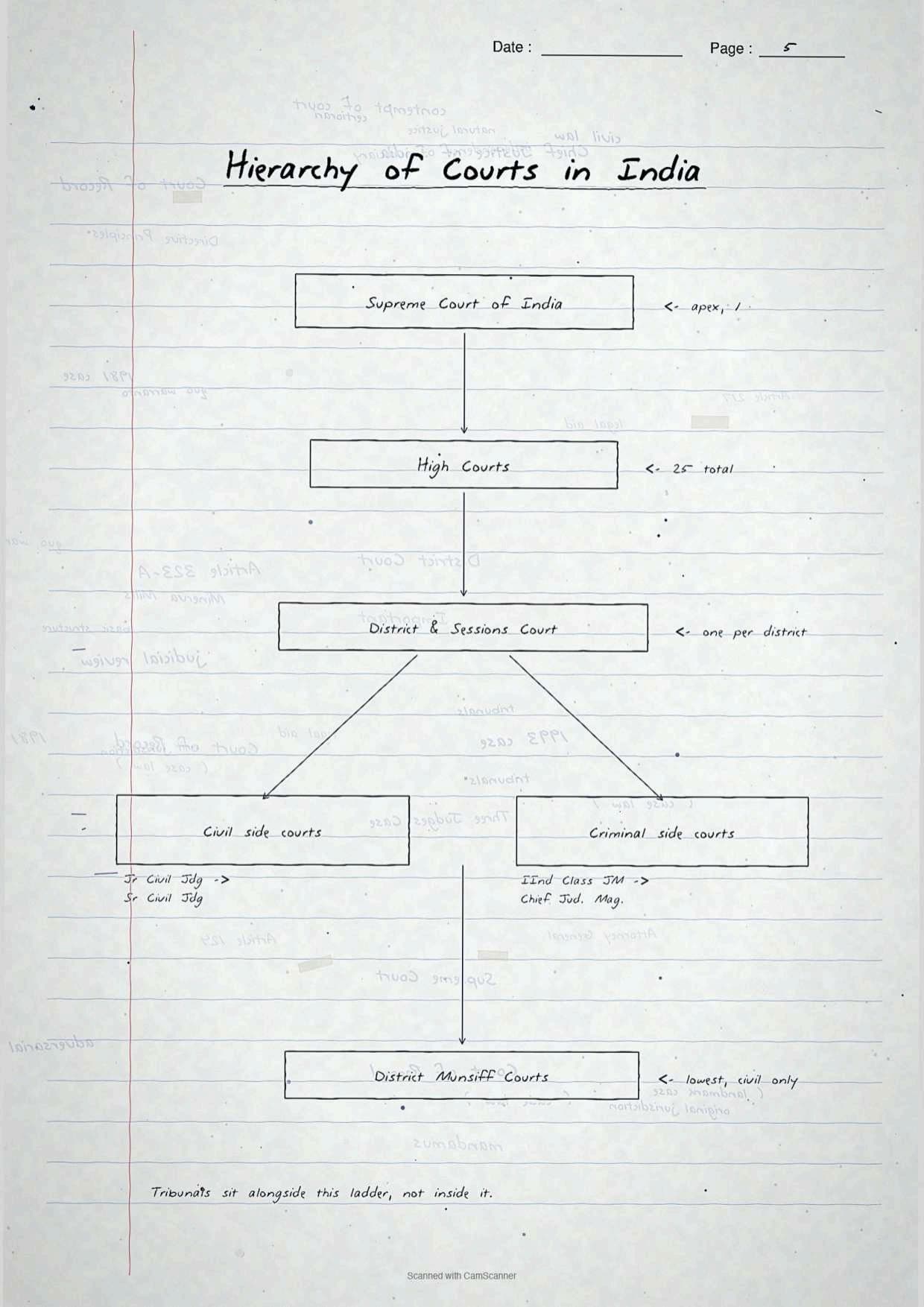
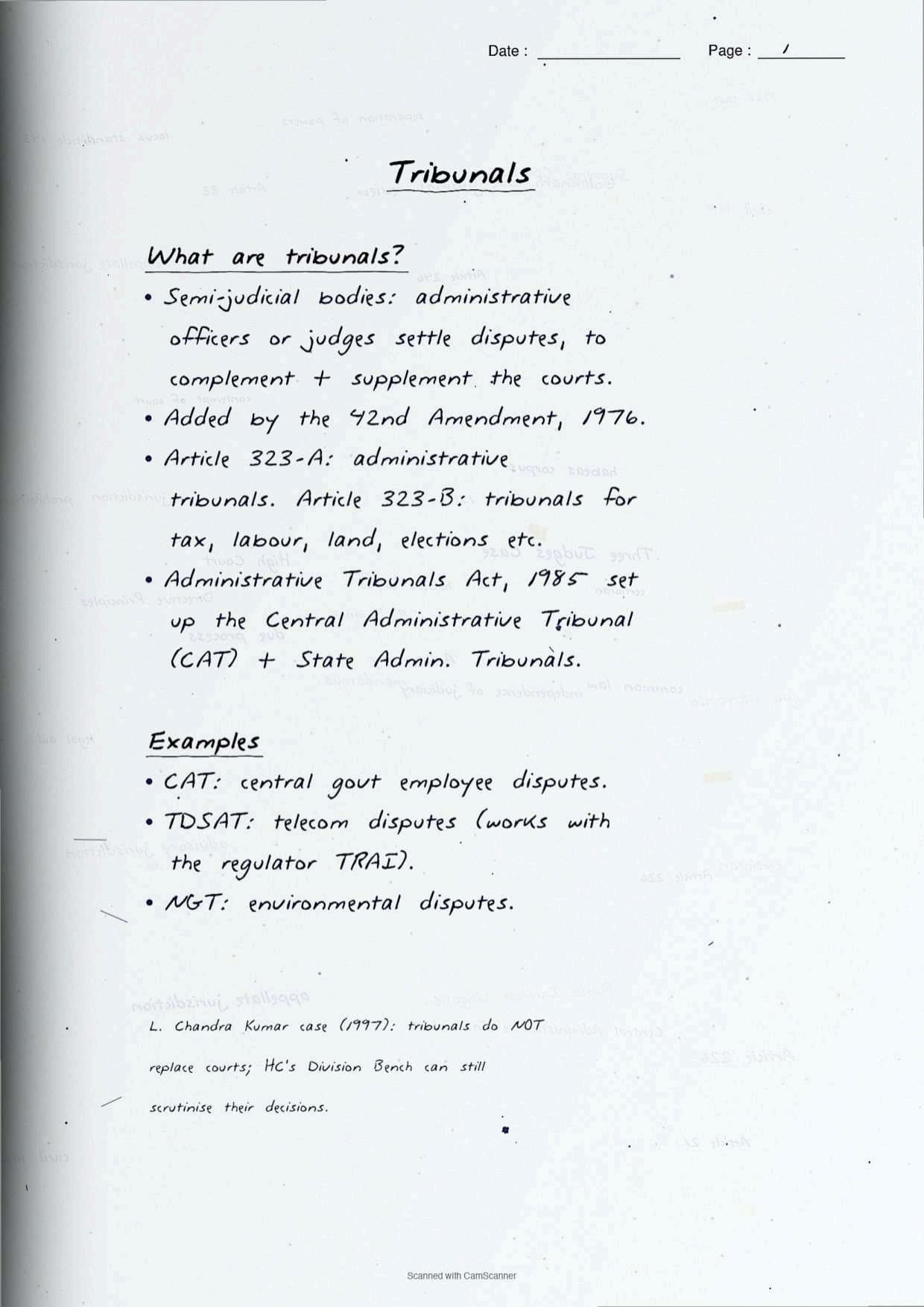
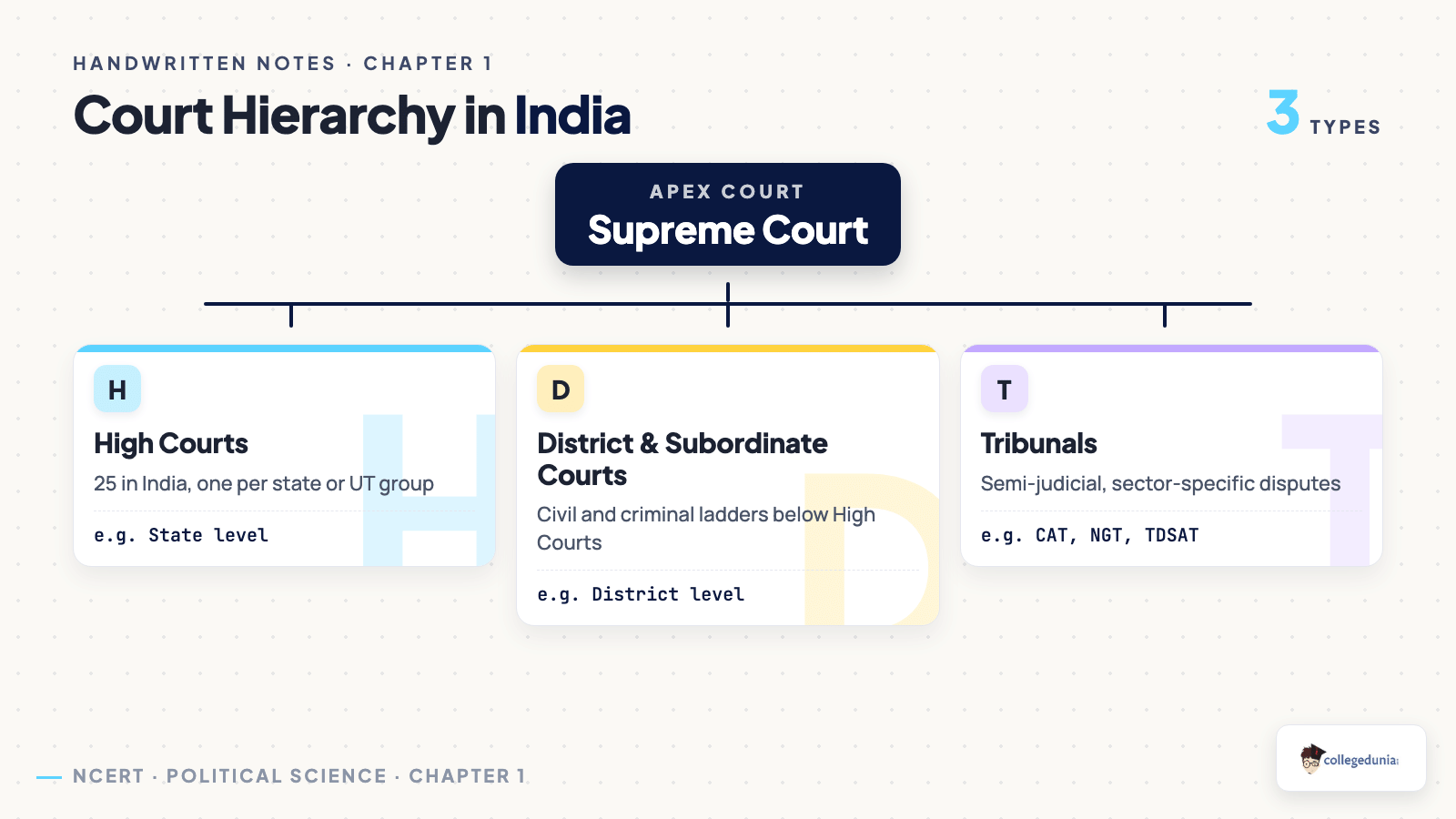
At the top sits the Supreme Court in New Delhi. Below it come the High Courts, one for a state or a group of states and union territories. Below the High Courts sit the district and subordinate courts, split into civil and criminal ladders and popularly called the lower courts. Tribunals sit alongside this ladder to handle sector-specific disputes such as labour, consumer and service matters.
| Level | Court or body | What it handles |
|---|---|---|
| 1 | Supreme Court | Apex court, New Delhi, one for the whole country |
| 2 | High Courts | 25 in India, one per state, union territory or group of them |
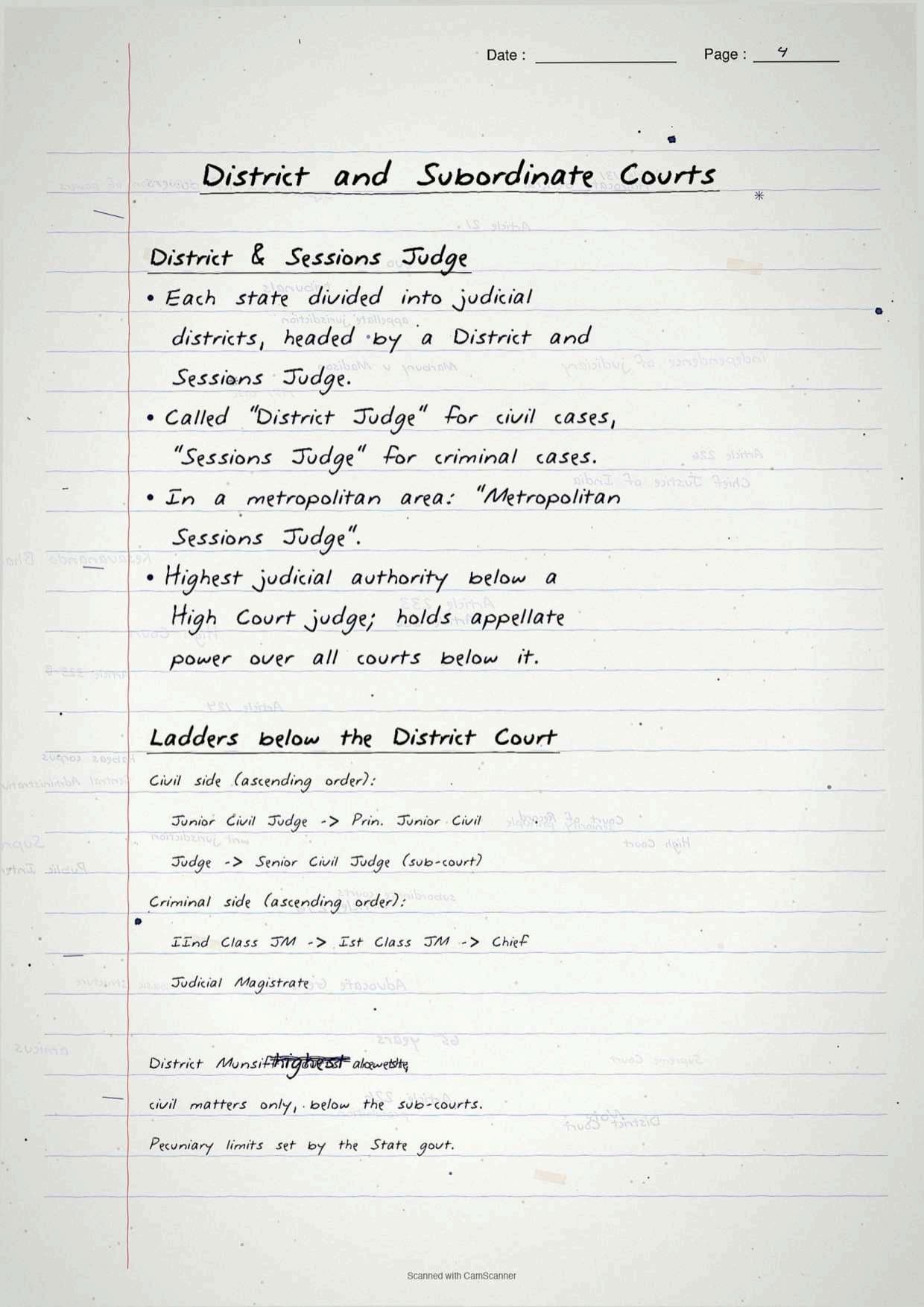
| 3 | District and subordinate courts | Civil and criminal courts below the High Court, popularly called lower courts |
| Parallel | Tribunals | Semi-judicial bodies for labour, consumer, service and other sector disputes |
Tip: a diagram question on court structure wants the ladder drawn top to bottom, Supreme Court first, then High Courts, then district and subordinate courts, with tribunals shown as a side branch rather than a fourth rung.
The Supreme Court of India: Origin and Present Strength
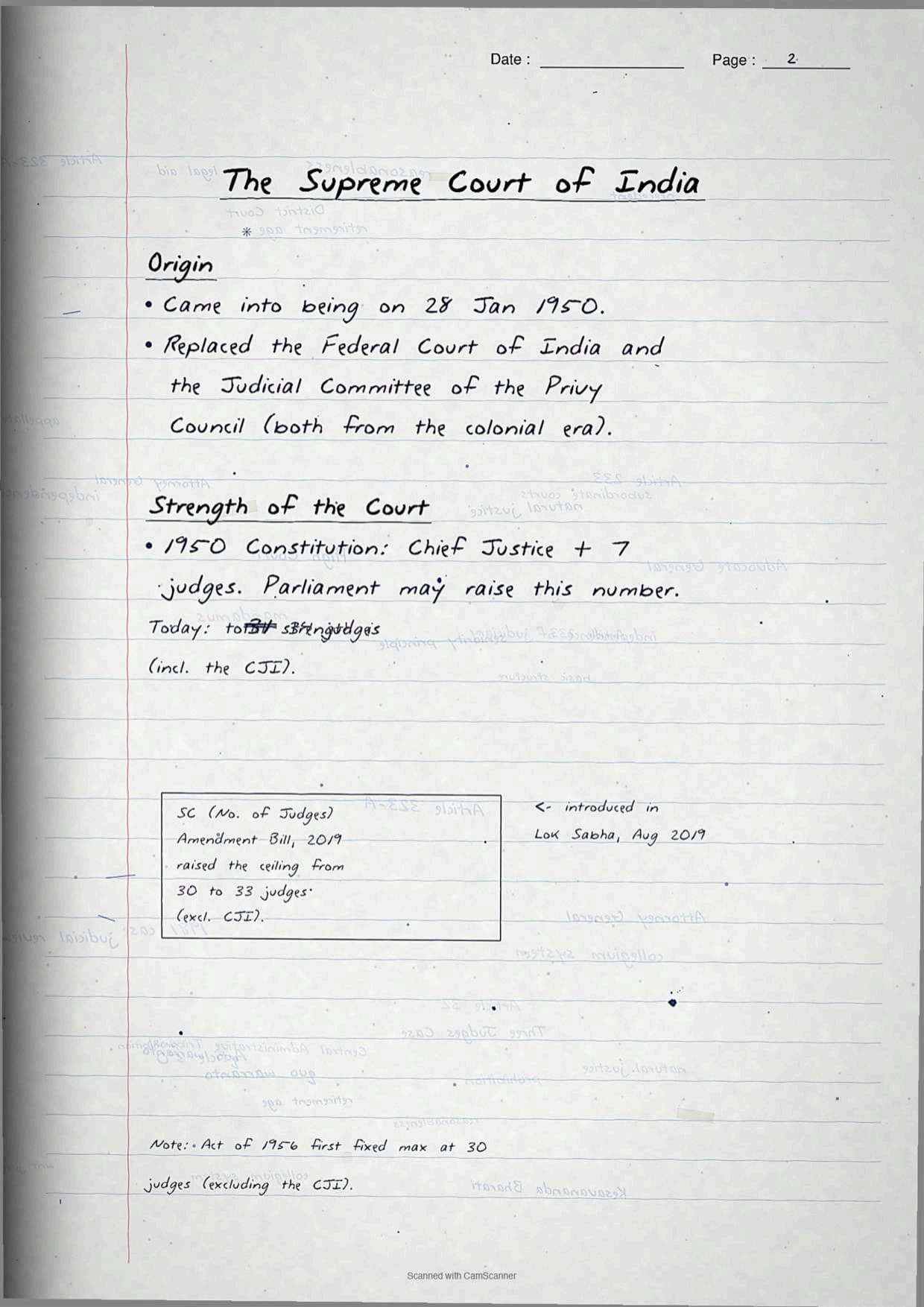
The Supreme Court of India came into being on 28 January 1950. It replaced two colonial-era bodies at once, the Federal Court of India and the Judicial Committee of the Privy Council, both of which had sat at the top of the Indian court system under British rule.
The Constitution as it stood in 1950 planned for a Chief Justice plus 7 judges. Parliament was given the power to raise this number over time, and it has. The Supreme Court's total strength today is 34 judges including the Chief Justice of India. The Supreme Court (Number of Judges) Amendment Bill, 2019, introduced in the Lok Sabha on 5 August 2019, raised the sanctioned strength fixed by the Supreme Court (Number of Judges) Act, 1956 from 30 to 33 judges, not counting the Chief Justice.
- 28 January 1950: Supreme Court established, replacing the Federal Court and the Privy Council.
- 1950 strength: Chief Justice of India plus 7 judges.
- Present strength: 34 judges including the CJI, after the 2019 amendment raised the count.
High Courts and the District and Subordinate Judiciary
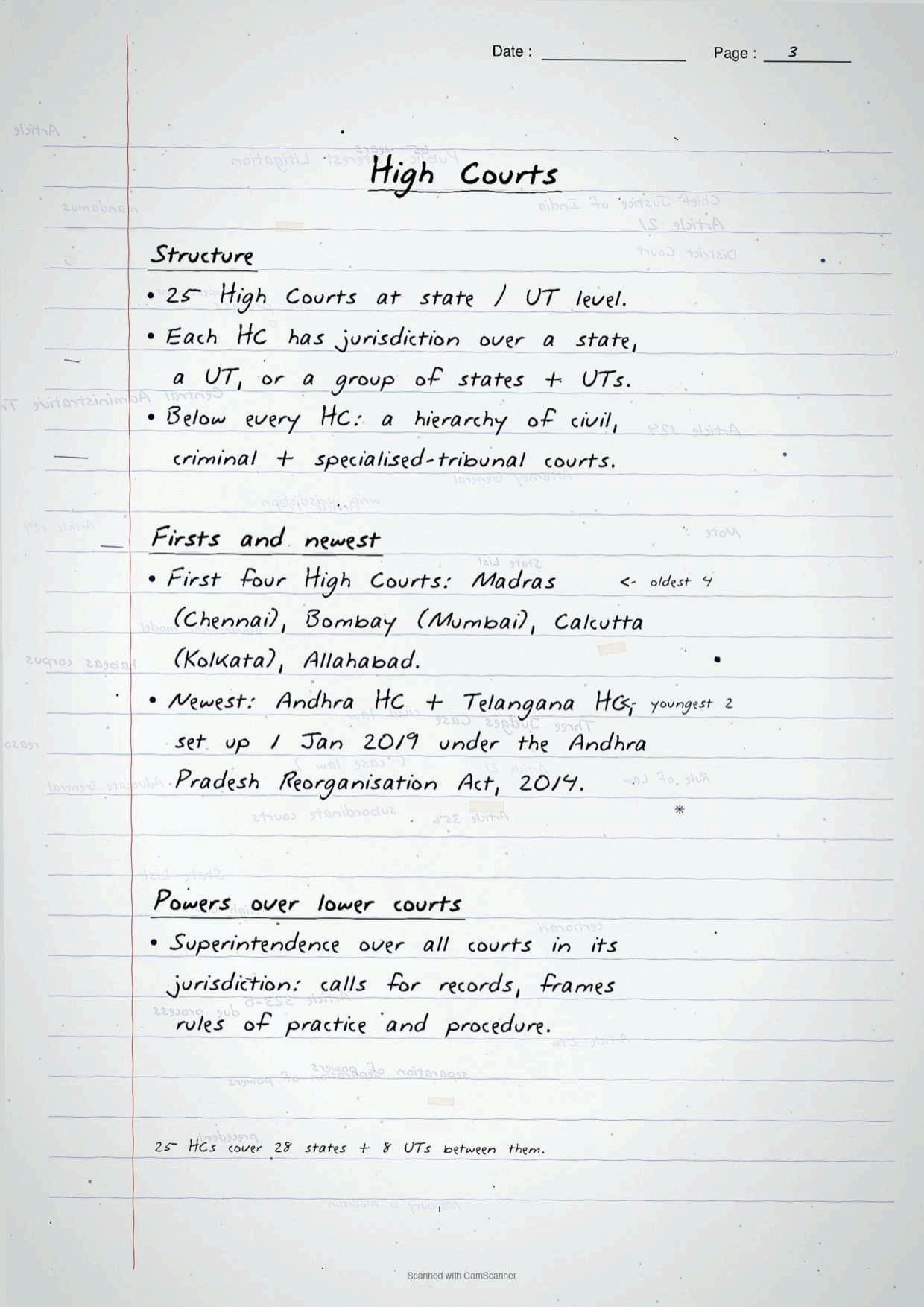
India has 25 High Courts. Each one has jurisdiction over a single state, a union territory, or a group of states and union territories together. Below every High Court sits a ladder of lower courts, split into civil courts, criminal courts, and specialised tribunals.
The chapter names the first four High Courts and the newest two. Getting these four names and two dates right is an easy mark that many students still drop.
| High Court | City | Note |
|---|---|---|
| Madras High Court | Chennai | One of the first four High Courts |
| Bombay High Court | Mumbai | One of the first four High Courts |
| Calcutta High Court | Kolkata | One of the first four High Courts |
| Allahabad High Court | Allahabad | One of the first four High Courts |
| Andhra Pradesh High Court | Amaravati | Newest, established 1 January 2019 |
| Telangana High Court | Hyderabad | Newest, established 1 January 2019 under the AP Reorganisation Act, 2014 |
Common Law System and the Adversarial Model
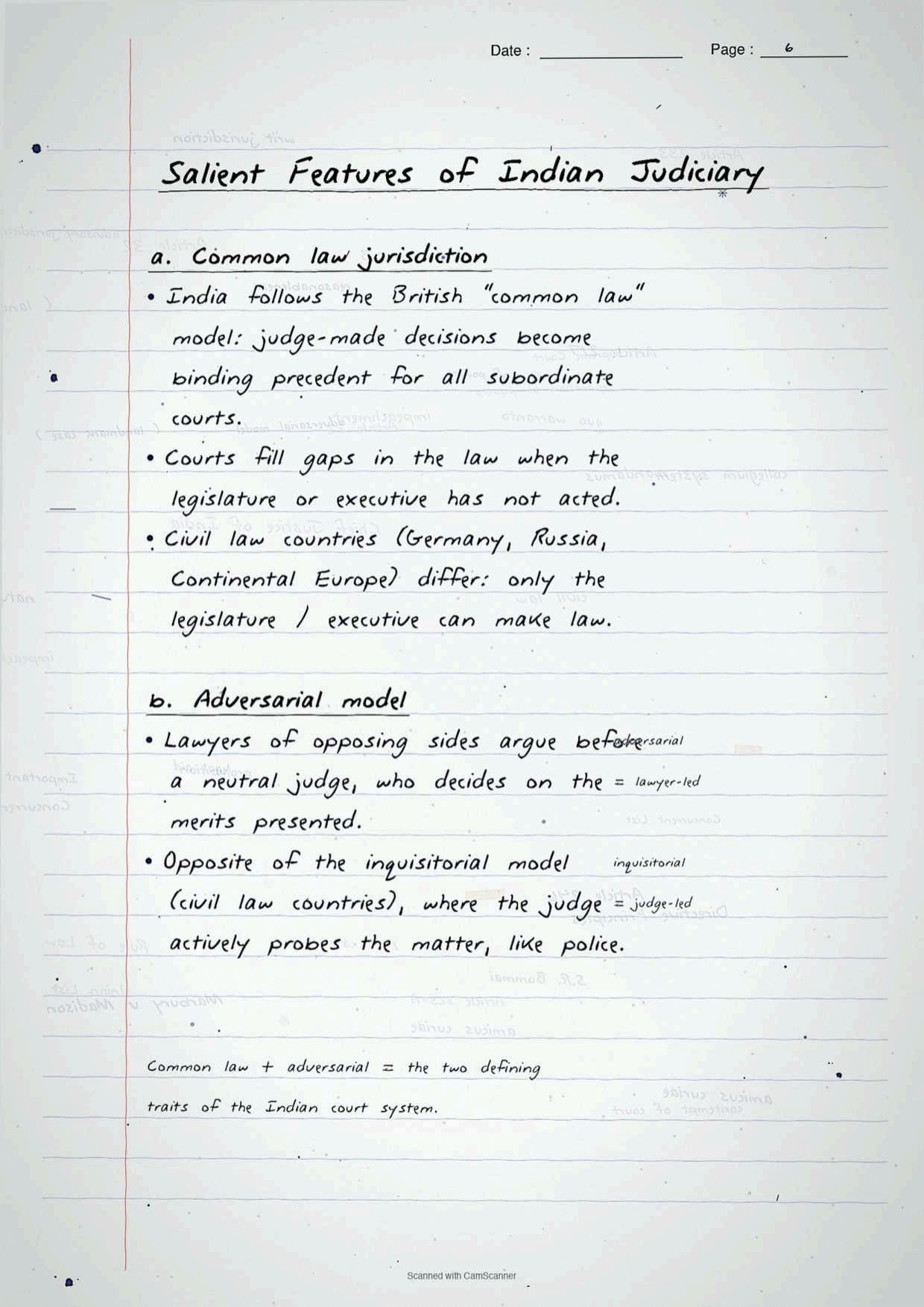
Two features decide how Indian courts actually work day to day. The first is the common law system, the model India follows where judges can create law through their decisions, and those decisions bind subordinate courts as precedent. This is different from the civil law system used in Germany, Russia and Continental Europe, where only the legislature or the executive can make law and the judiciary cannot.
The second is the adversarial model of dispute resolution. In this model, lawyers for each side present their case to a neutral judge, who decides based on the arguments made. This is different from the inquisitorial model followed in many civil law countries, where the judge takes an active, almost police-like role in investigating the matter rather than staying neutral.
| Feature | India's model | Contrasting model |
|---|---|---|
| Source of law | Common law, judges make binding precedent | Civil law (Germany, Russia), only legislature or executive makes law |
| Trial method | Adversarial, lawyers argue before a neutral judge | Inquisitorial, judge actively investigates the case |
Legal Officers in India: The Attorney General
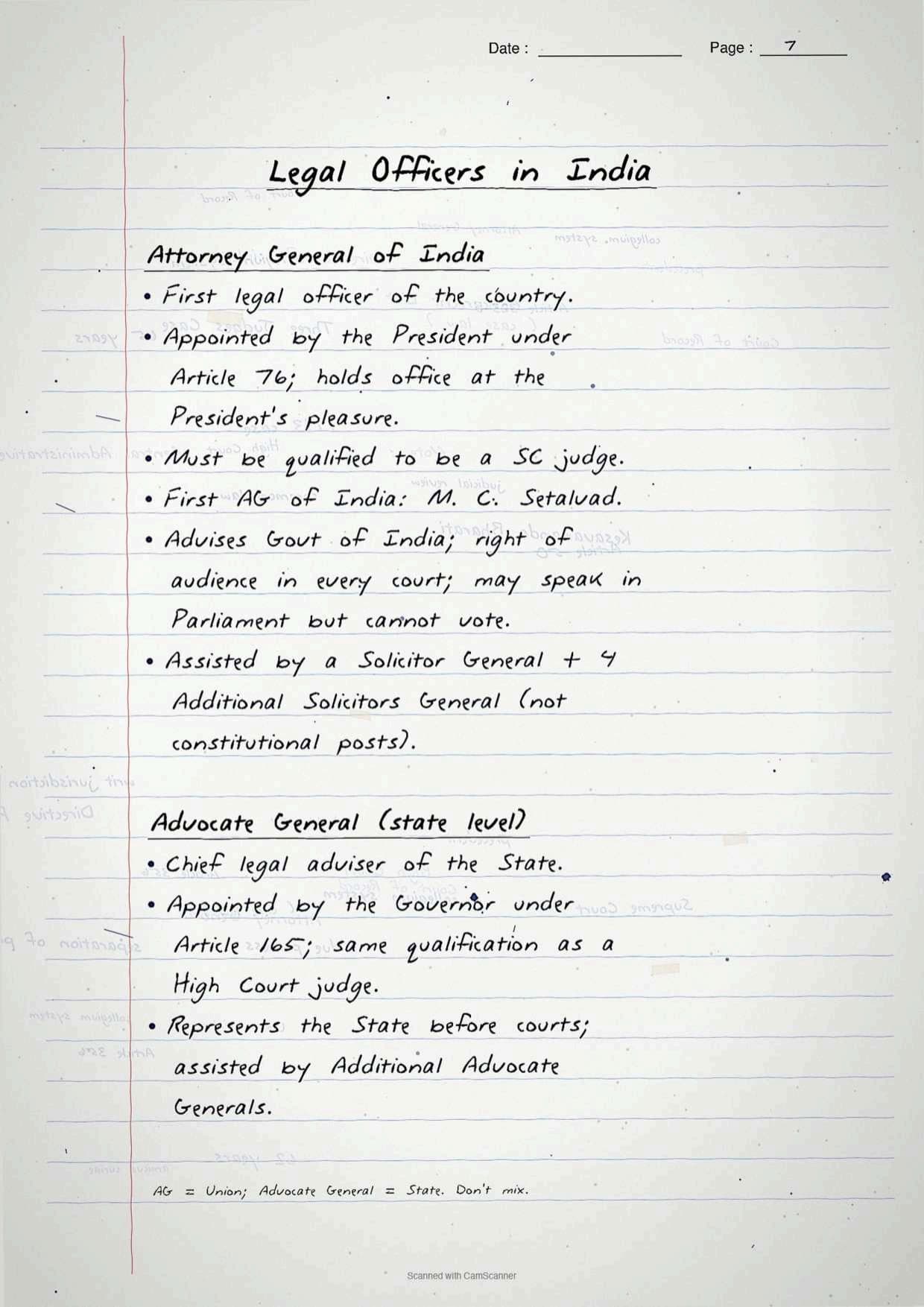
The Attorney General of India is the country's first law officer. He is appointed by the President under Article 76 of the Constitution and holds office during the President's pleasure. He must be qualified to be appointed a Supreme Court judge, and the first Attorney General of India was M.C. Setalvad.
- Advises the Government of India on legal matters the President refers to him.
- Has the right to appear and be heard in every court in the territory of India.
- May speak in both Houses of Parliament and their joint sittings, and in any parliamentary committee he belongs to, but cannot vote.
- Enjoys the privileges and immunities available to a Member of Parliament.
Independence of the Judiciary: Why and How It Is Protected
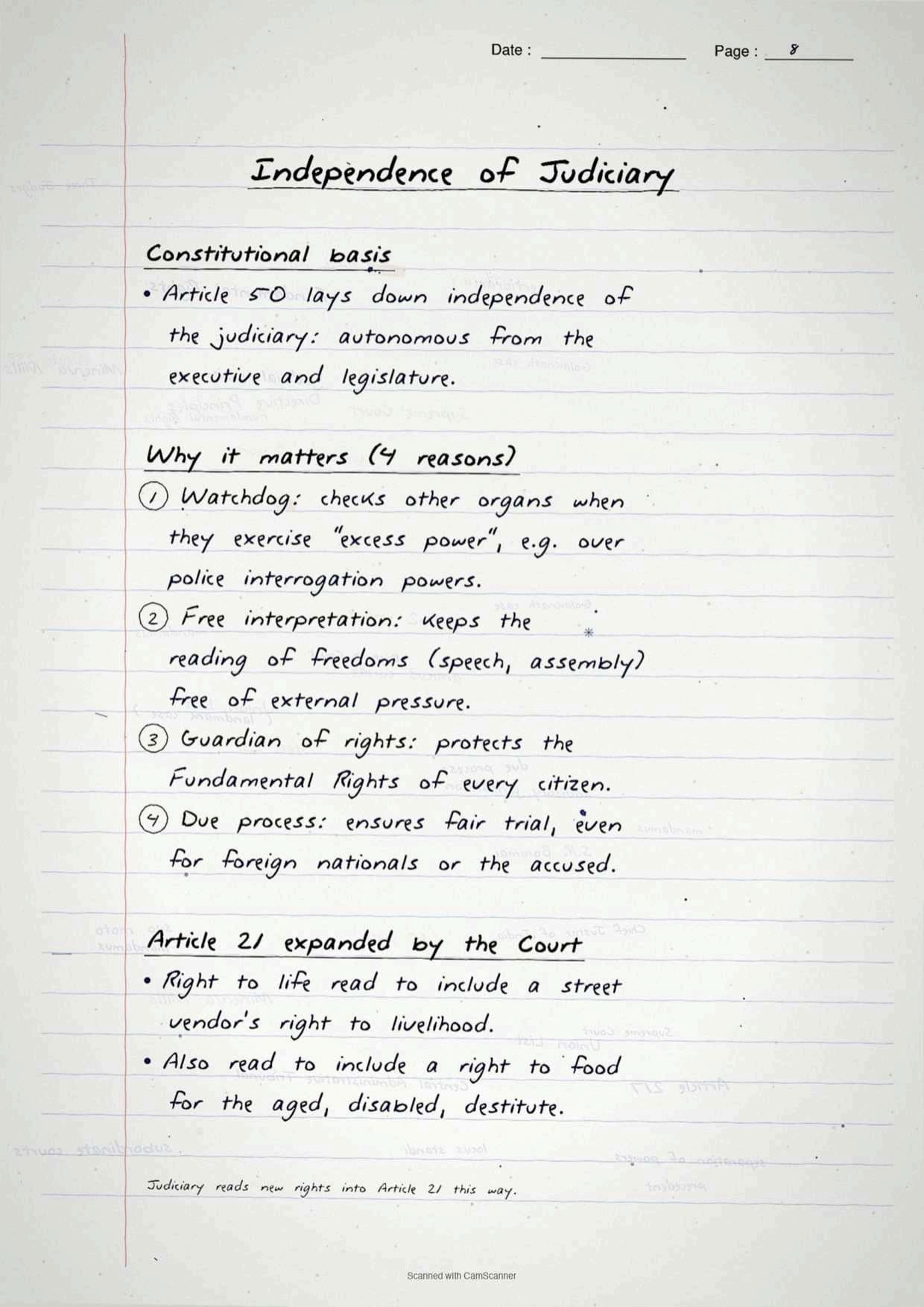
The chapter gives two reasons why judicial independence matters. First, the judiciary acts as a watchdog, keeping checks and balances over the other arms of government, and steps in when any organ exercises excess power. The textbook's own example is the police's power to interrogate a suspect against the accused's right under Article 20(3), which says no person accused of an offence can be compelled to be a witness against himself. Second, the judiciary has to be free of outside pressure so it can correctly interpret guaranteed freedoms such as speech and peaceful assembly, especially when a government and a group of protestors are in conflict.
To make that independence real, the Constitution builds in five protections. This independence rests on keeping the judiciary separate from the executive, and the five points below are how that separation is actually enforced.
- Security of tenure: judges serve till the retirement age (62 for High Court judges, 65 for Supreme Court judges) and cannot practise as an advocate in the same or an equivalent court after retiring. A retired High Court judge may appear in the Supreme Court, but not in any High Court.
- Difficult removal: a judge can be removed only for proven misbehaviour or incapacity, through a deliberately strict process.
- Fixed pay: salaries and allowances come from the Consolidated Fund of India (Supreme Court) or the Consolidated Fund of the State (High Courts), are not put to a legislative vote, and cannot be reduced except during a financial emergency.
- No parliamentary discussion: the conduct of Supreme Court and High Court judges cannot be discussed in Parliament or a state legislature, except when a removal motion is actually before the President.
- Control over its own staff: the Supreme Court has authority over its own establishment and appoints its own officers and staff.
Jurisdiction of the Supreme Court: Original, Writ, Appellate and Advisory
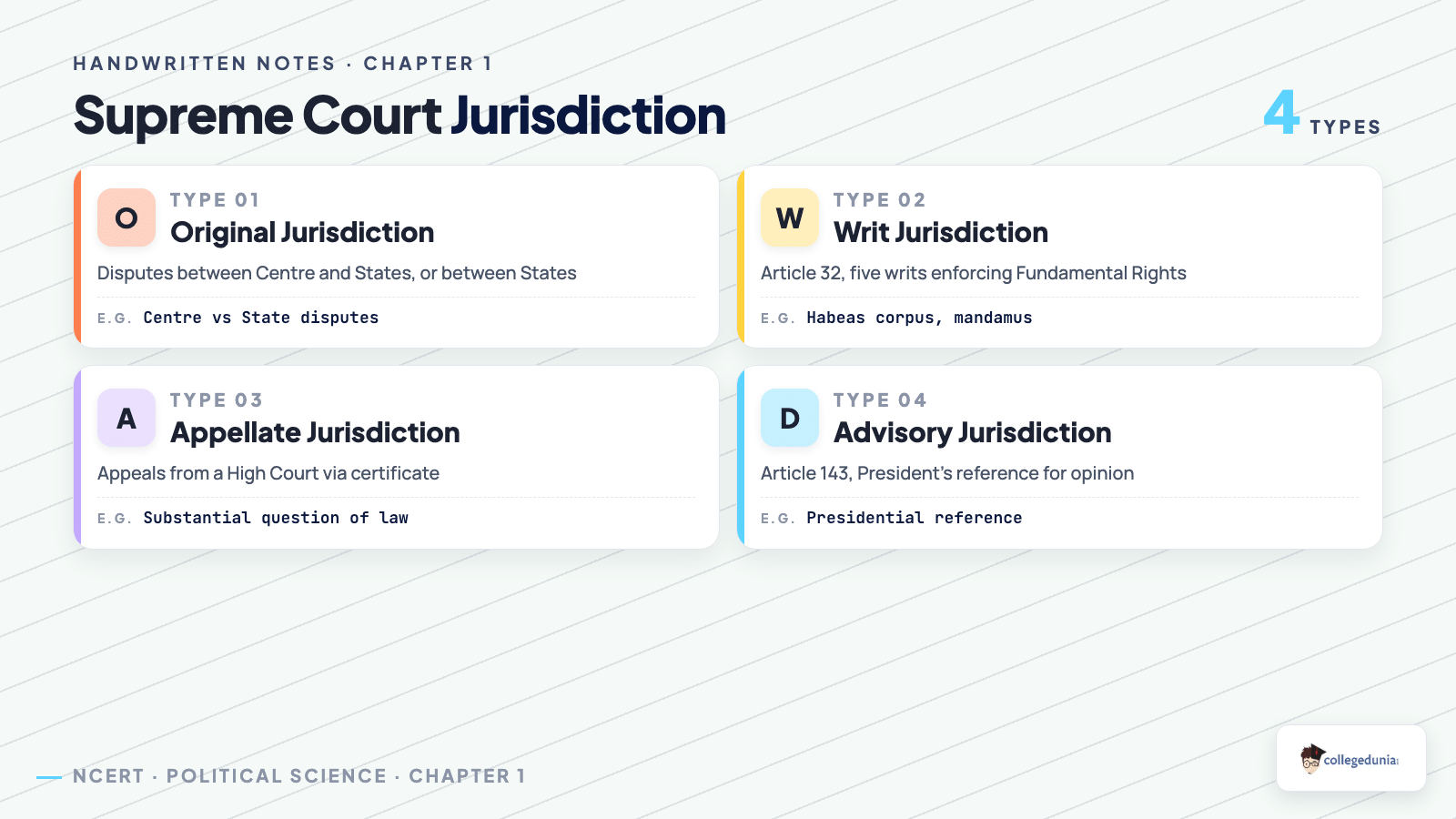
This is the most exam-heavy section of the chapter, and it comes in four distinct types. Learn which article or route triggers each one, because a question naming a scenario expects the matching jurisdiction by name.
| Type of jurisdiction | Source or trigger | What it covers |
|---|---|---|
| Original jurisdiction | Direct filing at the Supreme Court | Disputes between the Centre and a State, or between States, including disputes over natural resources |
| Writ jurisdiction | Article 32 | Enforcement of Fundamental Rights through habeas corpus, mandamus, prohibition, quo warranto and certiorari |
| Appellate jurisdiction | Certificate granted by a High Court | Appeals against a High Court judgment, decree or final order in civil or criminal matters, where a substantial question of law is involved |
| Advisory jurisdiction | Article 143, Presidential reference | The Court's opinion on a question the President refers to it |
The five writs under Article 32 deserve their own line each, since a "name and explain the writ" question is close to guaranteed.
- Habeas corpus: orders the release of a person unlawfully detained.
- Mandamus: orders a public authority to carry out its duty.
- Prohibition: stops a subordinate court from continuing a case.
- Quo warranto: directs a person to vacate an office wrongfully held.
- Certiorari: transfers a case from a subordinate court for review.
Tip: Article 226 gives High Courts a parallel writ power, so a High Court can also issue these five writs, it is not a Supreme Court monopoly. On advisory jurisdiction, remember the In re Special Court Bill case (1979), where the Court held its advisory opinions bind all courts, and that it must answer a Presidential reference unless the question is vague or purely political.
Public Interest Litigation and Judicial Activism
The chapter calls the Supreme Court a sentinel qui vive, a watchful guardian of fundamental and constitutional rights. Courts have taken up matters of social, political and economic importance on their own motion, or on the basis of a simple letter. This grew out of Public Interest Litigation, which relaxed the old rule of locus standi so that public-spirited citizens and civil society groups could approach the court on behalf of victims who could not approach it themselves.
Two named cases show PIL at work. The Ganges Pollution Case produced three landmark judgments and orders against more than 50,000 polluting industries across 8 states in the Ganga basin, made over 250 towns and cities install sewage treatment, and moved about 600 tanneries out of congested Kolkata into a planned leather complex in West Bengal. The Vehicular Pollution Case (1992) saw a retired Supreme Court judge and three members appointed to recommend nationwide vehicular pollution control, leading to orders for lead-free petrol and cleaner fuels.
PIL is not open to every complaint. The chapter lists what is accepted and what is turned away.
| PIL accepts | PIL does not accept |
|---|---|
| Bonded labour, non-payment of minimum wages | Landlord-tenant disputes |
| Jail petitions on harassment, premature release, custodial death, speedy trial | Service, pension and gratuity matters |
| Police high-handedness, refusal to register a case | Routine complaints against government departments |
| Atrocities against women, harassment of SC/ST persons | Admission to educational institutions |
| Environmental pollution, heritage and wildlife matters | Requests to speed up cases already pending in court |
Judicial activism has also drawn criticism inside the same chapter, mainly for encouraging frivolous litigation and for what critics call judicial over-reach into the legislature's own domain.
Court of Record, Legal Aid and Amicus Curiae
Both the Supreme Court and every High Court are Courts of Record. Their judgments and proceedings are kept on permanent record, treated as evidence, and cited as legal precedent by other courts. Each also has the power to punish for contempt of court, and for the Supreme Court this can mean simple imprisonment up to six months, a fine, or both.
The chapter also covers who gets free legal help and how an unrepresented accused is protected in court.
- Free legal aid: available through the Supreme Court Legal Aid Committee to a person from the poor section, an SC or ST member, a natural-calamity victim, a woman, a child, a person who is mentally ill or disabled, an industrial workman, or a person in custody.
- Middle-income aid: the Supreme Court Middle Income Group Society gives aid on nominal payment.
- Amicus curiae: literally "friend of the court", an advocate the court appoints to represent an accused who has no lawyer, common in jail petitions.
Appointment of Judges and the Collegium System
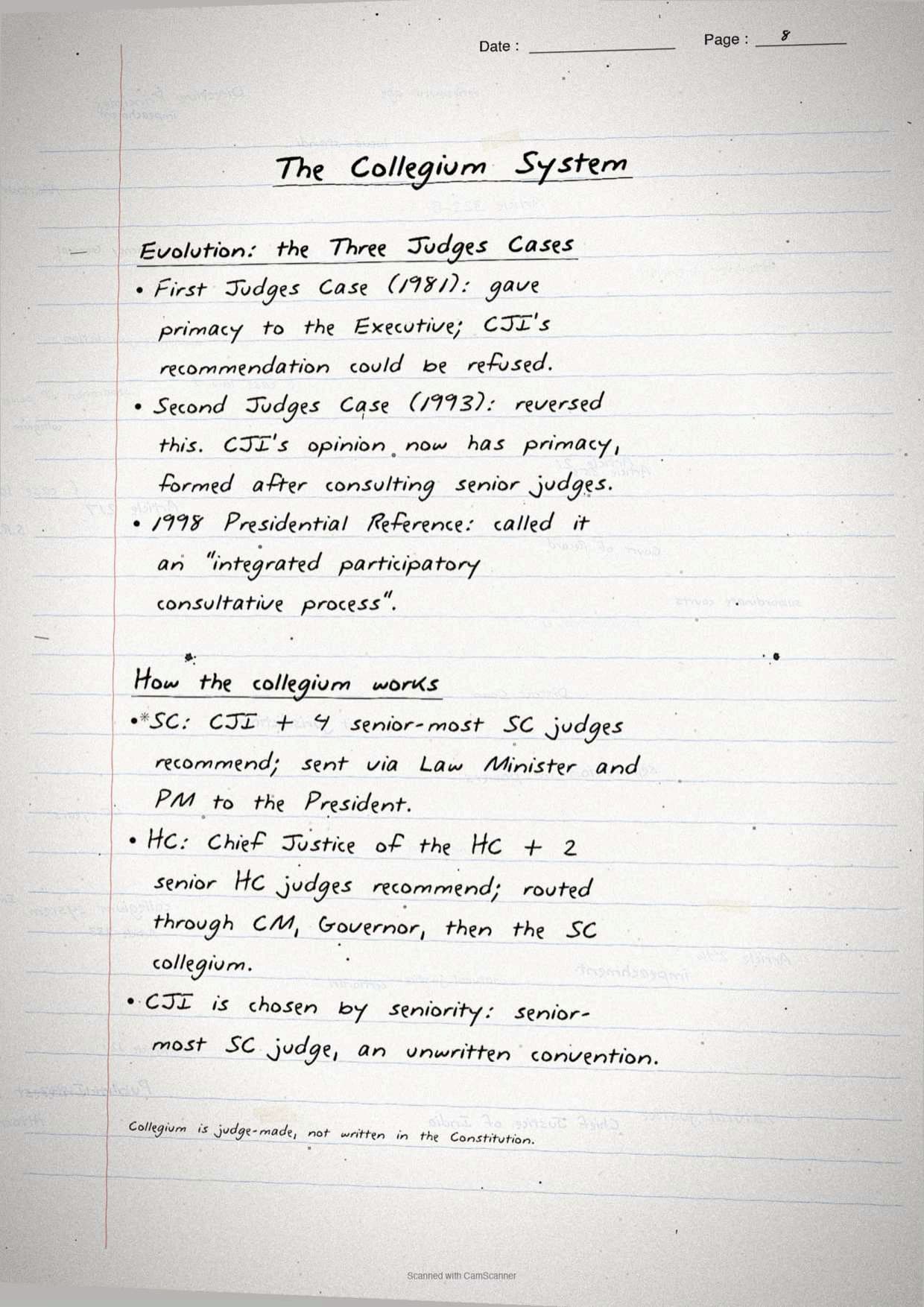
Two articles fix how judges are appointed. Under Article 124, Supreme Court judges are appointed by the President after consulting such judges of the Supreme Court and High Courts as the President thinks fit, and the CJI must be consulted for any judge other than the CJI. Under Article 217, High Court judges are appointed by the President after consulting the CJI, the Governor of the state, and the Chief Justice of that High Court.
| Post | Qualification route |
|---|---|
| Supreme Court judge | Indian citizen, plus 5 years as a High Court judge, or 10 years as a High Court advocate, or a distinguished jurist in the President's opinion |
| High Court judge | Indian citizen, plus at least 10 years holding judicial office in India |
The collegium system did not exist on day one, it grew out of three Judges Cases. The First Judges Case (1981) gave the Executive primacy, letting the President refuse the CJI's recommendation for cogent reasons, and this lasted about 12 years. The Second Judges Case (1993), a nine-judge bench decision with five judges in the majority, reversed this and gave the CJI primacy, holding that an appointment must conform to the CJI's final opinion formed after consulting other senior judges. This is the ruling that actually created the collegium system. A 1998 Presidential reference then described the process as an integrated, participatory, consultative one, where the CJI forms an opinion only after consulting a plurality of senior judges rather than alone.
Retirement and Removal of Judges
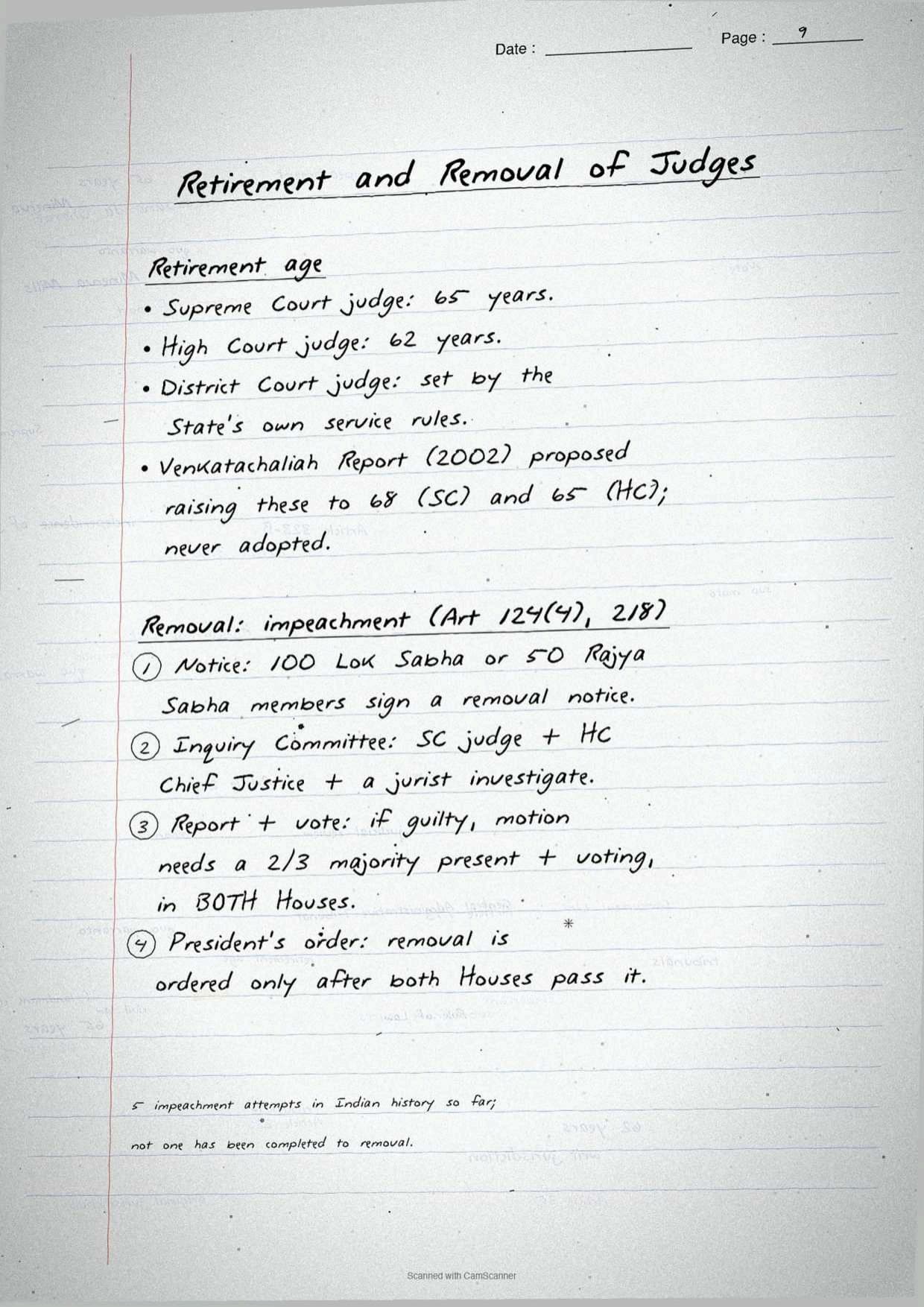
Retirement age is 65 for Supreme Court judges and 62 for High Court judges; District Court judges retire as fixed by their State Government's own service rules. The Venkatachaliah Commission (2002) recommended raising these to 65 and 68, and the Constitution (114th Amendment) Bill, 2010 tried to raise the High Court age to 65 but lapsed when the 15th Lok Sabha was dissolved.
| Country or court | Retirement practice |
|---|---|
| United States Supreme Court, Austria, Greece | Judges appointed for life |
| Belgium, Denmark, Ireland, Netherlands, Norway, Australia | Retirement age of 70 |
| India | 62 for High Court judges, 65 for Supreme Court judges |
Removal, called impeachment, follows the same steps for the Supreme Court and every High Court under Article 124. A removal notice is admitted in Parliament, an Inquiry Committee of one Supreme Court judge, one High Court Chief Justice and one distinguished jurist investigates, and if the report finds proven misbehaviour or incapacity, the motion needs a majority of the total membership of each House plus a two-thirds majority of members present and voting under Article 124(4). Once both Houses pass it, the President orders the removal. A District Judge, by contrast, is removed by the State Government.
Judicial Review and the Basic Structure Doctrine
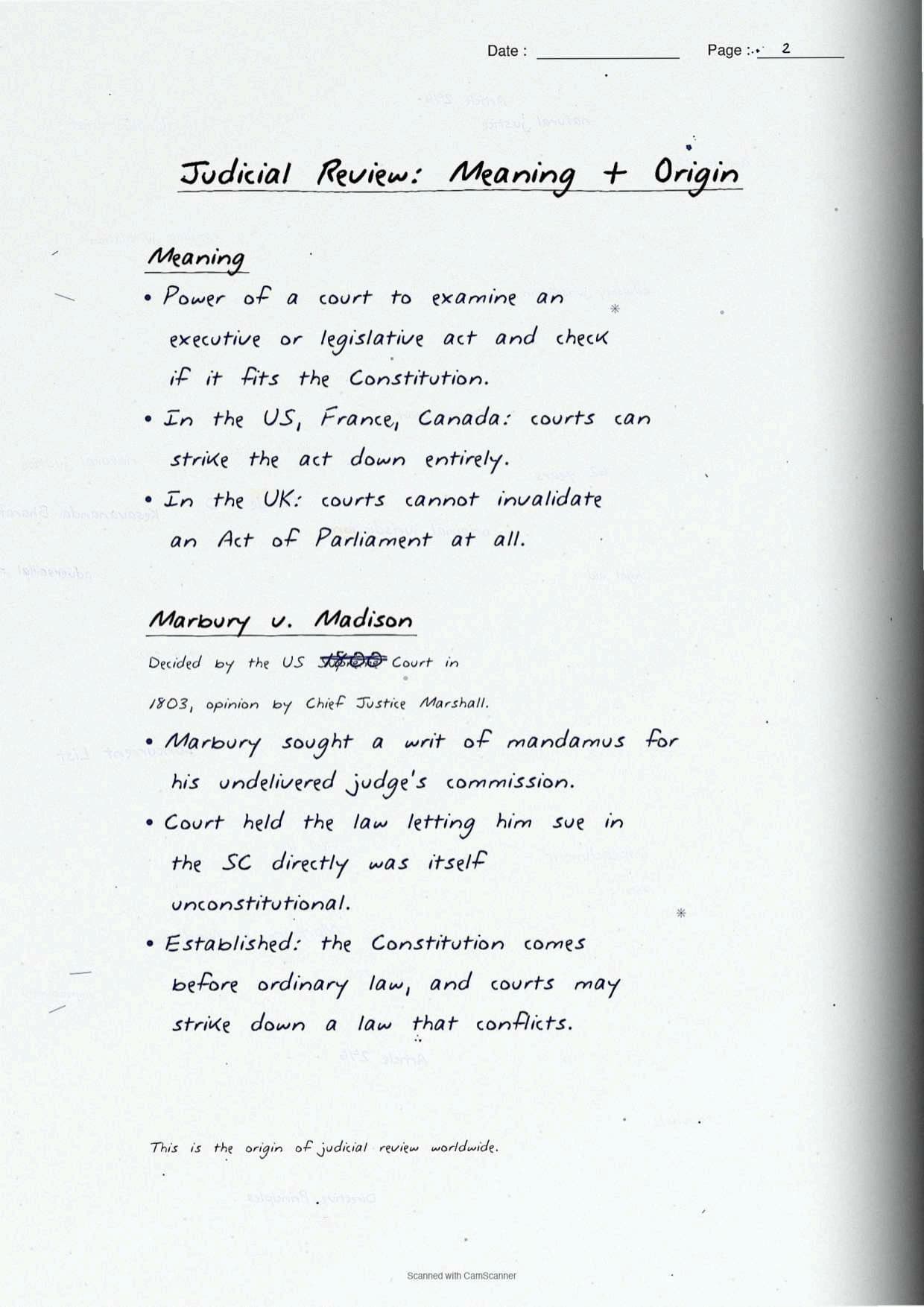
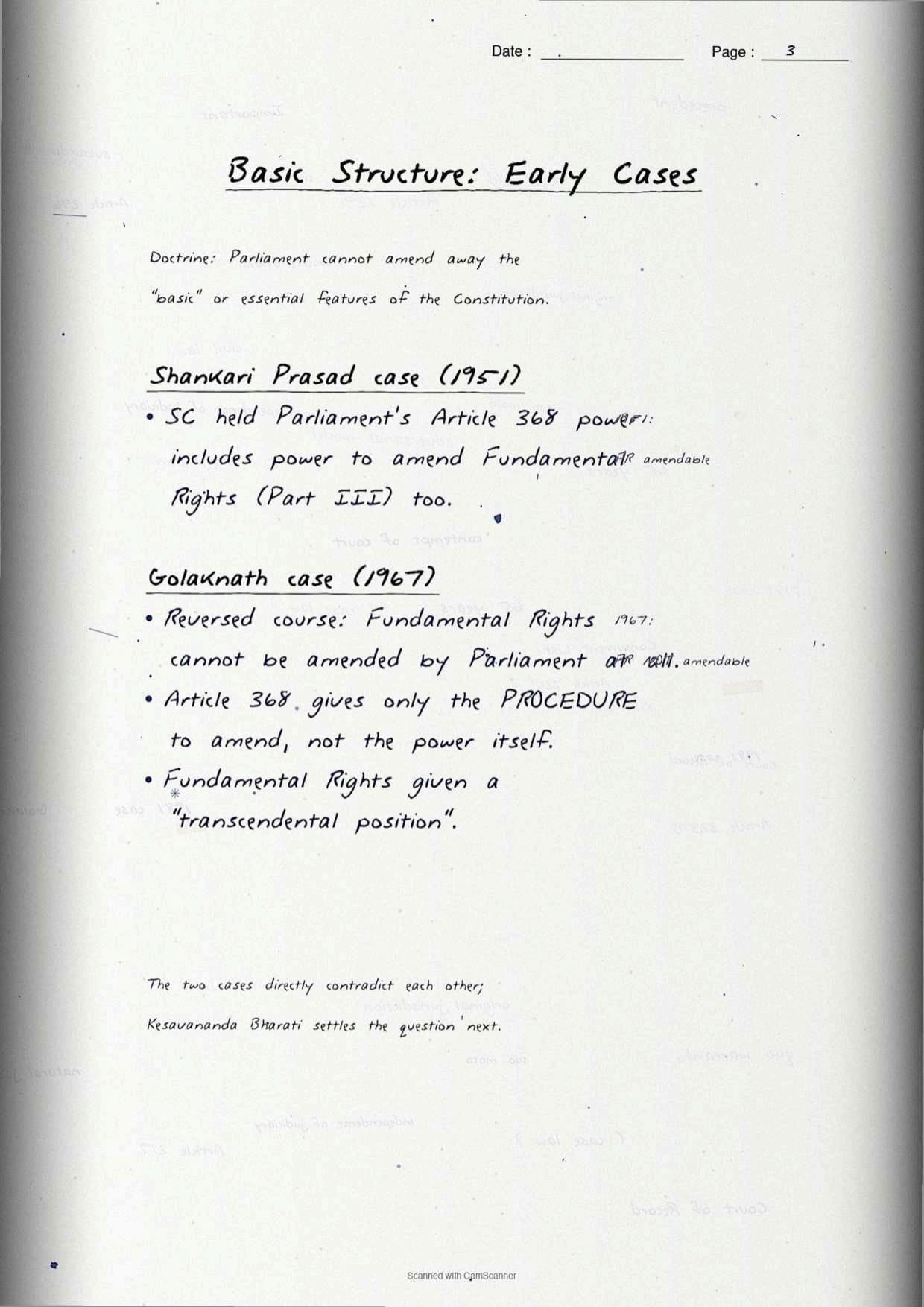
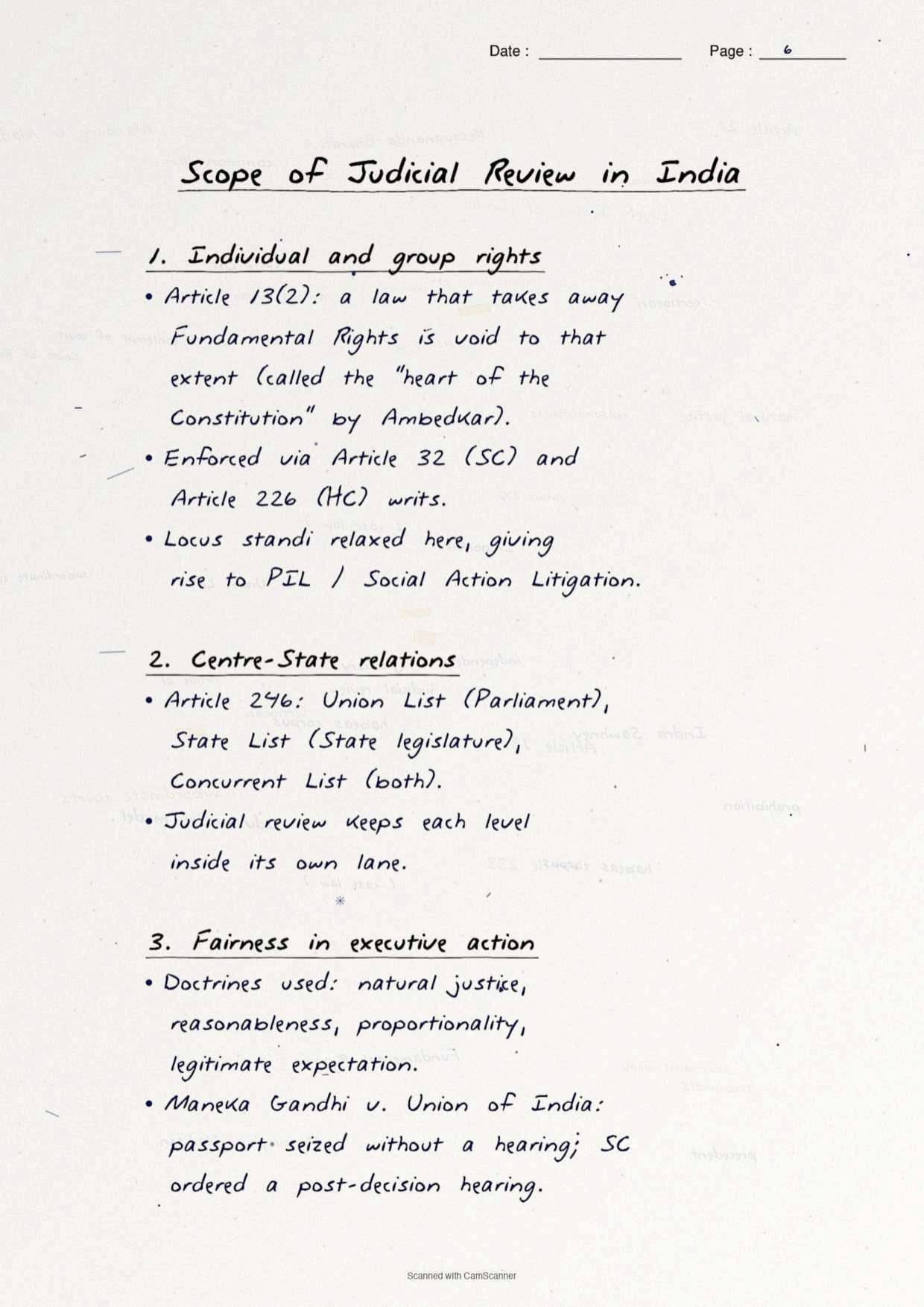
The chapter traces judicial review back to the American case Marbury v. Madison, where Chief Justice Marshall held that a law conflicting with the Constitution is void, establishing that a court can strike down an unconstitutional law. In India, Article 13(2) voids any law that takes away or abridges a Fundamental Right, a clause Dr B.R. Ambedkar called the heart of the Constitution. Article 32 lets citizens move the Supreme Court, and Article 226 lets them move a High Court, to enforce those rights through the five writs.
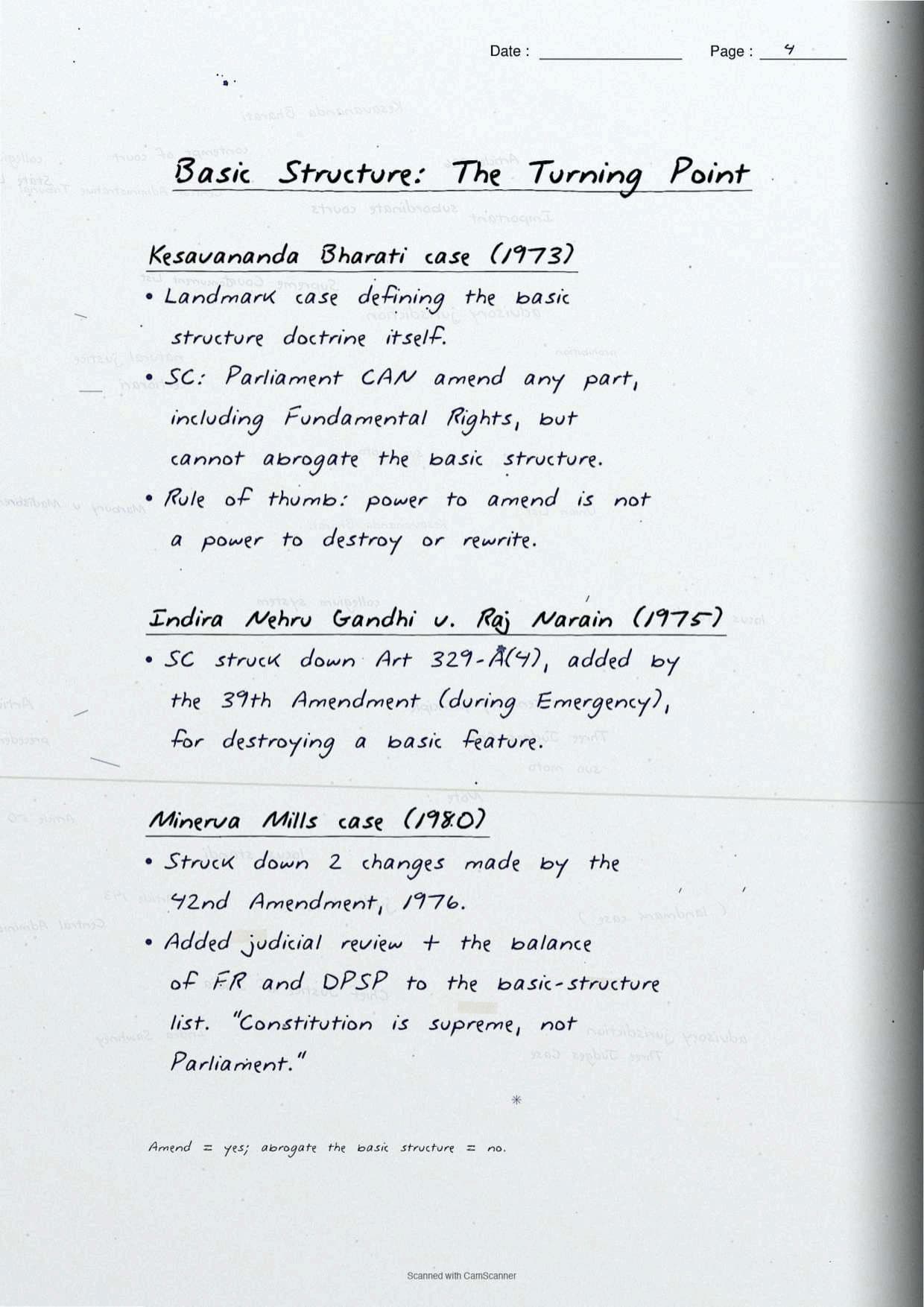
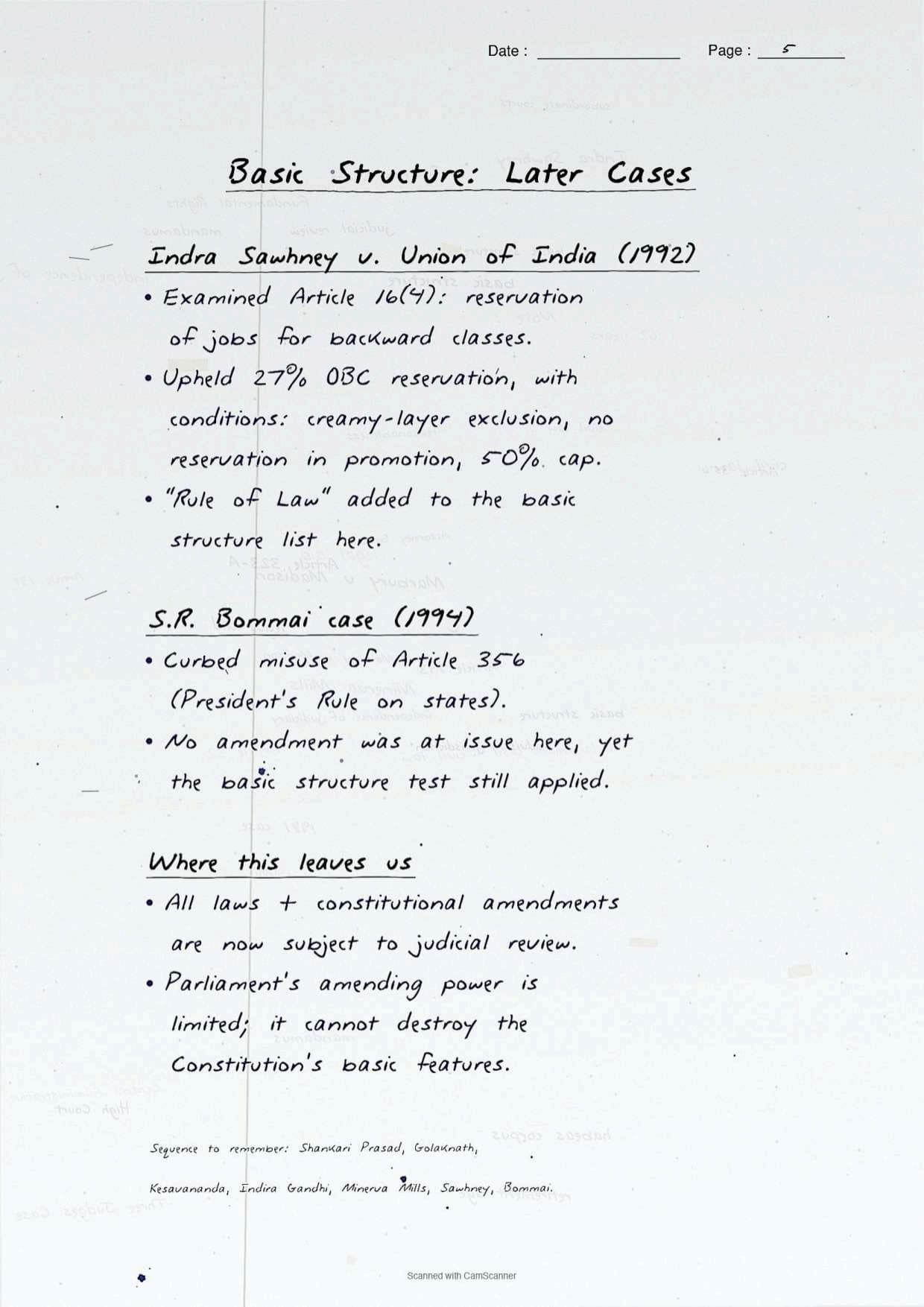
The basic structure doctrine grew case by case, and each case added or confirmed something specific. This sequence is worth learning in strict order, since exam questions often ask what changed between two consecutive cases.
| Case | Year | What it held |
|---|---|---|
| Shankari Prasad | 1951 | Parliament's Article 368 power to amend the Constitution includes Fundamental Rights |
| Golaknath | 1967 | Reversed that view, Fundamental Rights cannot be abridged by Parliament under Article 368 alone |
| Kesavananda Bharati | 1973 | Parliament can amend any part of the Constitution, but cannot abrogate its basic structure |
| Minerva Mills | 1980 | Struck down two 42nd Amendment changes, added judicial review and the Fundamental Rights and DPSP balance to the basic structure |
| Indra Sawhney | 1992 | Upheld 27% OBC reservation under Article 16(4), added Rule of Law to the basic structure |
| S.R. Bommai | 1994 | Held that state action against a basic-structure element is valid ground to invoke Article 356 |
Landmark Cases Every Judiciary Chapter Student Should Know
The supplementary reading in the chapter adds two cases that show the writ jurisdiction and Article 21 in action, not just the basic structure line of cases.
- Hussainara Khatoon v. State of Bihar: a habeas corpus petition under Article 32 for 17 under-trial prisoners in Bihar. The Court held that speedy trial is a Fundamental Right under Article 21 and ordered free legal aid for the poor as part of that right.
- Maneka Gandhi v. Union of India (1978): the petitioner's passport was impounded without being given a reason. A seven-judge bench held that personal liberty under Article 21 is very wide, includes the right to travel abroad, and that any procedure taking away liberty must be fair and reasonable. The Court also used a post-decisional hearing to give her a hearing after the fact, since the matter was urgent.
The chapter closes by calling the judiciary the guardian and custodian of the Constitution, a watchdog against the abuse of state power for citizens and non-citizens alike.
Judiciary Class 12 Legal Studies Explained in Simple Language
Source: Magnet Brains on YouTube
Common Mistakes Students Make in the Judiciary Chapter
Five traps that cost easy marks in the Class 12 Legal Studies paper:
- Mixing up 62 and 65. High Court judges retire at 62, Supreme Court judges retire at 65.
- Naming the wrong writ. Mandamus orders a duty to be done, certiorari transfers a case for review, they are not interchangeable.
- Confusing the First and Second Judges Cases. The First Judges Case (1981) gave the Executive primacy, the Second (1993) gave the CJI primacy and created the collegium system.
- Calling tribunals a fourth court level. Tribunals supplement the court ladder, they are not part of the Supreme Court, High Court, district court hierarchy.
- Forgetting who removes a District Judge. Impeachment applies to Supreme Court and High Court judges, a District Judge is removed by the State Government.
Quick Recall Sheet for the Judiciary Chapter
| Term | One-line meaning |
|---|---|
| Supreme Court | Apex court, established 28 January 1950, 34 judges including the CJI |
| High Courts | 25 in India, first four are Madras, Bombay, Calcutta, Allahabad |
| Writ jurisdiction | Article 32, five writs enforcing Fundamental Rights |
| Advisory jurisdiction | Article 143, Presidential reference, binding per the 1979 Special Court Bill case |
| PIL | Relaxed locus standi, lets public-spirited citizens approach the court |
| Collegium system | Created by the Second Judges Case, 1993, gives the CJI primacy in appointments |
| Impeachment | Removal process for SC and HC judges under Article 124 |
| Basic structure doctrine | Kesavananda Bharati, 1973, Parliament cannot abrogate it by amendment |
What the Judiciary Handwritten Notes PDF Contains
The file is a set of handwritten revision notes with the textbook's tables and case names placed where the chapter uses them.
- Pages 1 to 6: court structure, the Supreme Court's origin, High Court list and the district and subordinate ladder.
- Pages 7 to 12: common law versus civil law, the adversarial model, the Attorney General and judicial independence.
- Pages 13 to 18: the four kinds of Supreme Court jurisdiction, the five writs, PIL and judicial activism.
- Pages 19 to 23: legal aid, amicus curiae, appointment of judges and the three Judges Cases.
- Pages 24 to 26: retirement and removal, judicial review, the basic structure doctrine table and the quick recall sheet.
How to Use These Handwritten Notes Most Effectively
The Judiciary chapter is dense with articles, cases and years rather than difficult concepts, so spacing the revision out works better than cramming it into one sitting.
- Block 1, 40 minutes. Court structure, the Supreme Court and High Courts, common law and the adversarial model.
- Block 2, 40 minutes. Judicial independence, the Attorney General, and the four kinds of Supreme Court jurisdiction with the five writs.
- Block 3, 40 minutes. PIL, legal aid, amicus curiae, appointment of judges and the collegium system.
- Block 4, 30 minutes. Retirement, removal, judicial review and the basic structure case table.
- Night before, 15 minutes. Quick recall sheet and the five common mistakes, nothing else.
How These Handwritten Notes Pair with Other Judiciary Resources
Also Check: the judiciary appears again in Class 11 Political Science, where a full chapter is already live on Collegedunia. Read that chapter for the constitutional design first, then use this Class 12 page for jurisdiction, appointment and case law detail.
| Resource | Best used for | Open it |
|---|---|---|
| Class 11 Political Science Judiciary Handwritten Notes | The constitutional design behind an independent judiciary, at Class 11 level | Judiciary Class 11 Political Science Handwritten Notes |
| Class 12 Legal Studies Chapter 1 Notes | Typed revision notes for the same chapter with every article explained | Judiciary Class 12 Notes (coming soon) |
| Class 12 Legal Studies Chapter 1 Book PDF | The official chapter text with the Marbury v. Madison excerpt and both supplementary cases | Judiciary Class 12 Book PDF (coming soon) |
| Class 12 Legal Studies Chapter 2 Topics in Law Handwritten Notes | The next unit in the same textbook | Topics in Law Class 12 Handwritten Notes (coming soon) |
NCERT Handwritten Notes for Class 12 Legal Studies: All Chapters
Related Links: handwritten revision notes for the Class 12 Legal Studies textbook, written to the 2026-27 syllabus.
| Chapter | Class 12 Legal Studies Handwritten Notes |
|---|---|
| Chapter 1 | Judiciary Class 12 Handwritten Notes (this page) |
| Chapter 2 | Topics in Law Class 12 Handwritten Notes (coming soon) |
| Chapter 3 | Legal Systems and Framework Class 12 Handwritten Notes (coming soon) |
| Chapter 4 | Legal Profession Class 12 Handwritten Notes (coming soon) |
| Chapter 5 | Alternate Dispute Resolution Class 12 Handwritten Notes (coming soon) |
Judiciary Class 12 Legal Studies Handwritten Notes FAQs
Questions Students Ask Before Downloading These Notes
Ques. When was the Supreme Court of India established and what did it replace?
Ans. The Supreme Court of India was established on 28 January 1950. It replaced both the Federal Court of India and the Judicial Committee of the Privy Council, which had been at the top of the Indian court system during the colonial period. It started with a Chief Justice and 7 judges, and today its total strength is 34 judges including the Chief Justice.
Ques. What are the four kinds of Supreme Court jurisdiction?
Ans. Original jurisdiction covers disputes between the Centre and a State, or between States. Writ jurisdiction, under Article 32, lets the Court enforce Fundamental Rights through habeas corpus, mandamus, prohibition, quo warranto and certiorari. Appellate jurisdiction handles appeals from a High Court on a certificate involving a substantial question of law. Advisory jurisdiction, under Article 143, is the Court's opinion on a question the President refers to it.
Ques. What are the five writs the Supreme Court can issue?
Ans. Habeas corpus orders the release of a person unlawfully detained. Mandamus orders a public authority to do its duty. Prohibition stops a subordinate court from continuing a case. Quo warranto directs a person to vacate a wrongfully held office. Certiorari transfers a case from a subordinate court for review. All five come from Article 32, and Article 226 gives High Courts the same power.
Ques. How does the collegium system for appointing judges work?
Ans. The collegium system grew out of the Second Judges Case (1993), which gave the Chief Justice of India primacy in appointments after the First Judges Case (1981) had given the Executive that role. Under the current process, described in a 1998 Presidential reference as an integrated participatory consultative process, the CJI forms an opinion only after consulting a plurality of senior judges before recommending names to the President.
Ques. What is the difference between the retirement age of Supreme Court and High Court judges?
Ans. Supreme Court judges retire at 65 years. High Court judges retire at 62 years. District Court judges retire as fixed by their respective State Government's service rules. The Venkatachaliah Commission of 2002 had recommended raising these to 68 and 65, but that change was never made law.
Ques. How are judges of the Supreme Court and High Courts removed from office?
Ans. Judges are removed through impeachment under Article 124, the same process for both courts. An Inquiry Committee of one Supreme Court judge, one High Court Chief Justice and one distinguished jurist investigates a removal notice. If it finds proven misbehaviour or incapacity, the motion needs a majority of the total membership of each House plus a two-thirds majority of members present and voting, after which the President orders the removal.
Ques. What is Public Interest Litigation and what has it achieved?
Ans. Public Interest Litigation relaxed the traditional rule of locus standi so public-spirited citizens and civil society groups could approach a court on behalf of victims. The Ganges Pollution Case led to orders against over 50,000 polluting industries across 8 states, and the Vehicular Pollution Case (1992) led to orders for lead-free petrol and cleaner fuels nationwide.
Ques. What is the basic structure doctrine and which case established it?
Ans. The basic structure doctrine says Parliament can amend any part of the Constitution, including Fundamental Rights, but cannot abrogate the Constitution's basic structure. It was established in the Kesavananda Bharati case (1973), and later cases such as Minerva Mills, Indra Sawhney and S.R. Bommai added features like judicial review, the Rule of Law and limits on Article 356 to the basic structure list.
Ques. What is judicial review and where did the idea come from?
Ans. Judicial review is the power of a court to examine an executive or legislative act and decide if it conflicts with the Constitution. The chapter traces the idea to the American case Marbury v. Madison, where Chief Justice Marshall held that a law conflicting with the Constitution is void. In India, Article 13(2) and the writ powers under Articles 32 and 226 give courts this power over Fundamental Rights.
Ques. Who is entitled to free legal aid under this chapter?
Ans. The Supreme Court Legal Aid Committee gives free legal aid to a person from the poor section of society, a Scheduled Caste or Scheduled Tribe member, a natural-calamity victim, a woman, a child, a person who is mentally ill or disabled, an industrial workman, or a person in custody. Those in a middle-income bracket get aid from the Supreme Court Middle Income Group Society on nominal payment.
Ques. Where can I download the Class 12 Legal Studies Chapter 1 Judiciary handwritten notes PDF?
Ans. Use the download option at the top of this page. The file is free and printable, runs to 26 handwritten pages, and follows the 2026-27 chapter order, so it can sit beside the textbook while you revise.



Comments