



The handwritten notes for Class 6 Mathematics Ganita Prakash Chapter 1 Patterns in Mathematics are prepared for quick 2026-27 revision. The PDF turns the chapter into neat notebook pages covering number patterns, shape patterns, square numbers, triangular numbers and pattern rules.
- Best use: revise the chapter before class tests, notebook checks and short oral practice.
- PDF focus: identifying a rule, testing it on every term and explaining the pattern in words.
- Chapter value: this chapter builds the observation skills needed for later arithmetic, geometry and algebra.
Chapter1PatternsinMathematicsHandwrittenNotes.pdf?page=1&dpi=150)
Chapter1PatternsinMathematicsHandwrittenNotes.pdf?page=2&dpi=150)
Chapter1PatternsinMathematicsHandwrittenNotes.pdf?page=3&dpi=150)
Chapter1PatternsinMathematicsHandwrittenNotes.pdf?page=4&dpi=150)
Chapter1PatternsinMathematicsHandwrittenNotes.pdf?page=5&dpi=150)
Chapter1PatternsinMathematicsHandwrittenNotes.pdf?page=6&dpi=150)
Chapter1PatternsinMathematicsHandwrittenNotes.pdf?page=7&dpi=150)
Chapter1PatternsinMathematicsHandwrittenNotes.pdf?page=8&dpi=150)
Chapter1PatternsinMathematicsHandwrittenNotes.pdf?page=9&dpi=150)
Chapter1PatternsinMathematicsHandwrittenNotes.pdf?page=10&dpi=150)
Chapter1PatternsinMathematicsHandwrittenNotes.pdf?page=11&dpi=150)
Chapter1PatternsinMathematicsHandwrittenNotes.pdf?page=12&dpi=150)
Chapter1PatternsinMathematicsHandwrittenNotes.pdf?page=13&dpi=150)
Chapter1PatternsinMathematicsHandwrittenNotes.pdf?page=14&dpi=150)
Chapter1PatternsinMathematicsHandwrittenNotes.pdf?page=15&dpi=150)
Chapter1PatternsinMathematicsHandwrittenNotes.pdf?page=16&dpi=150)
Chapter1PatternsinMathematicsHandwrittenNotes.pdf?page=17&dpi=150)
Chapter1PatternsinMathematicsHandwrittenNotes.pdf?page=18&dpi=150)
Chapter1PatternsinMathematicsHandwrittenNotes.pdf?page=19&dpi=150)
Chapter1PatternsinMathematicsHandwrittenNotes.pdf?page=20&dpi=150)
Chapter1PatternsinMathematicsHandwrittenNotes.pdf?page=21&dpi=150)
Chapter1PatternsinMathematicsHandwrittenNotes.pdf?page=22&dpi=150)
Student Feedback: In a Collegedunia study check for Class 6 Mathematics revision, students found pattern chapters easier when number rules and picture rules were written side by side in notebook format.
Class 6 Mathematics Chapter 1 Handwritten Notes Overview
Patterns in Mathematics introduces students to the habit of noticing order. The chapter begins with simple number sequences and moves towards visual arrangements such as dot patterns, square patterns and triangular patterns. The handwritten PDF keeps this movement visible by placing definitions, examples and quick checks on separate notebook pages.
The central idea is simple: a pattern is not a guess. It is an arrangement that follows a rule. A student should observe the terms, propose a rule, test that rule and then write the next term or missing term. This method works for numbers as well as shapes.
The most useful revision line is: find the rule, test the rule, then extend the pattern.
Patterns in Mathematics Video Revision
Source: Magnet Brains on YouTube
What These Handwritten Notes Cover
The PDF begins with the meaning of a pattern and then explains how to read the rule behind a sequence. Students revise increasing patterns, decreasing patterns, repeating patterns and alternating patterns. The pages also include short checkpoints so that a learner can decide whether the same rule works from start to finish.
After the number pattern pages, the notes move to visual patterns. Students see how dots, boxes, matchsticks and simple grids can grow by a rule. The notebook style is useful here because each figure is paired with a small counting table.
- Number patterns: addition, subtraction, multiplication and alternating growth.
- Visual patterns: dots, grids, rows, columns and figure numbers.
- Revision checks: rule testing, next term writing and explanation in words.
Number Pattern Rules in Chapter 1
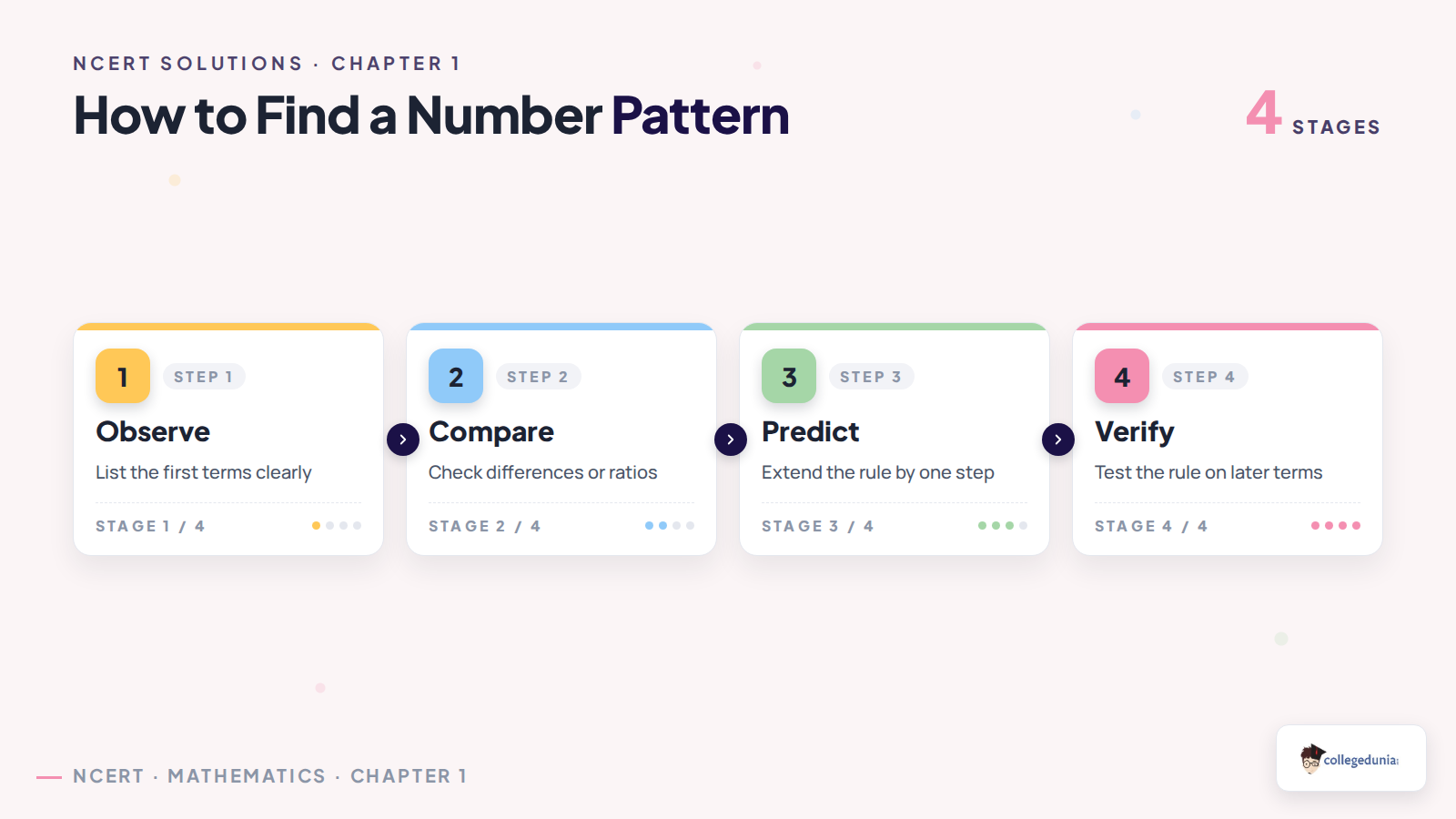
Number patterns are the fastest way to practise this chapter. Students should first compare neighbouring terms. If the sequence is 4, 7, 10, 13, the same difference of 3 appears each time. If the sequence is 2, 4, 8, 16, multiplication by 2 explains the growth better than addition.
Do not stop after checking only one gap. The rule must work across the whole sequence. If a rule works for two terms but fails later, the pattern needs a better explanation.
| Pattern type | How to check | Example |
|---|---|---|
| Addition pattern | Same number is added each time | 5, 9, 13, 17 |
| Subtraction pattern | Same number is removed each time | 30, 25, 20, 15 |
| Multiplication pattern | Each term is multiplied by the same number | 3, 6, 12, 24 |
| Alternating pattern | Two rules work one after another | 2, 5, 4, 7, 6, 9 |
Shape Patterns and Visual Counting
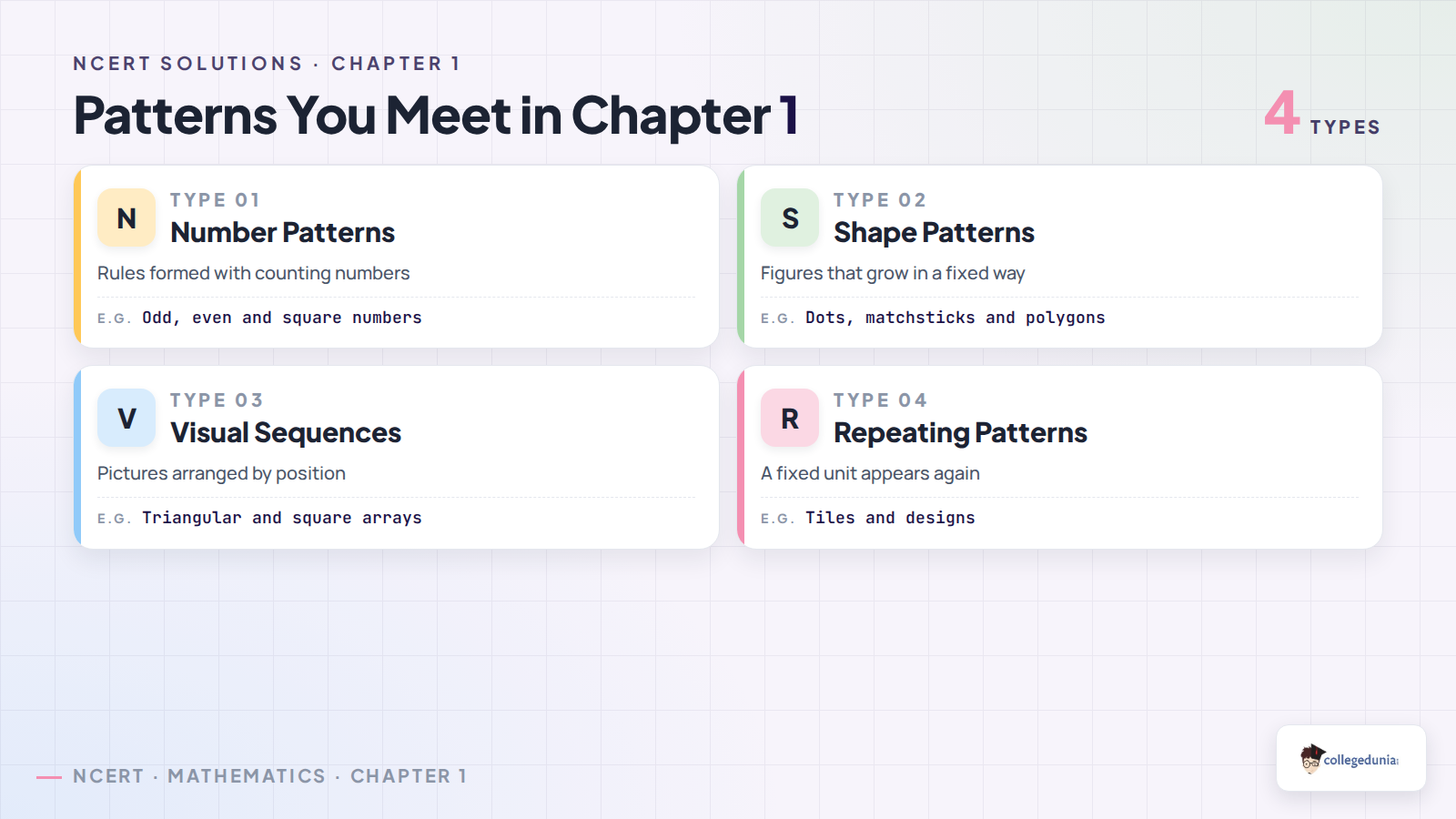
Shape patterns need careful counting. A student should count visible parts such as dots, boxes, sides, sticks or corners. When a figure grows, the added part may share a side with the old figure. Shared parts must be counted only once.
The handwritten notes use simple visual tables for this reason. One column shows the figure number and another column shows the total count. This makes it easier to see whether the totals are 1, 3, 6, 10 or some other sequence.
- Draw the next figure lightly before counting it.
- Mark the newly added part in each step.
- Use a table when the figure becomes crowded.
- Write the rule in words after counting.
Square and Triangular Number Revision
Two important visual families in the chapter are square numbers and triangular numbers. Square numbers can be arranged as equal rows and equal columns. The first square numbers are 1, 4, 9, 16 and 25. Triangular numbers can be arranged in triangular dot patterns. The first triangular numbers are 1, 3, 6, 10 and 15.
These sequences help students connect arithmetic with pictures. For example, 9 can be shown as 3 rows of 3 dots, while 10 can be shown as rows of 1, 2, 3 and 4 dots.
| Sequence | First five terms | Picture idea |
|---|---|---|
| Square numbers | 1, 4, 9, 16, 25 | Equal rows and columns |
| Triangular numbers | 1, 3, 6, 10, 15 | Dots arranged in triangle rows |
| Odd numbers | 1, 3, 5, 7, 9 | Adding odd layers makes squares |
Common Mistakes to Avoid
- Do not decide the rule after only two terms.
- Do not count a shared side twice in a shape pattern.
- Do not mix the figure number with the number of dots or sticks.
- Do not write only the next term when the question asks for the rule.
- Do not skip checking whether the rule fits every term.
For fast revision, students should read one notebook page, cover the answer line and explain the pattern aloud. This makes the PDF useful for both written practice and oral class discussion.
Related NCERT Resources for This Chapter
| Resource | Link |
|---|---|
| NCERT Solutions | Class 6 Mathematics Chapter 1 NCERT Solutions |
| NCERT Notes | Class 6 Mathematics Chapter 1 Notes |
| NCERT Book PDF | Class 6 Mathematics Chapter 1 Book PDF |
More Class 6 Mathematics Handwritten Notes
| Chapter | Handwritten Notes |
|---|---|
| Chapter 1 | Patterns in Mathematics |
| Chapter 2 | Lines and Angles |
| Chapter 3 | Number Play |
| Chapter 4 | Data Handling and Presentation |
Patterns in Mathematics Class 6 Handwritten Notes FAQs
Ques. What is covered in Patterns in Mathematics handwritten notes?
Ans. The notes cover number patterns, shape patterns, square numbers, triangular numbers, rule testing and common mistakes from Class 6 Mathematics Chapter 1.
Ques. Are these handwritten notes based on the 2026-27 Ganita Prakash textbook?
Ans. Yes. The PDF follows Class 6 Mathematics Ganita Prakash Chapter 1 for the 2026-27 session.
Ques. How should students revise this chapter from the PDF?
Ans. Students should revise the rule-finding steps first, then practise number sequences, square patterns, triangular patterns and visual counting tables.
Ques. Why are handwritten notes useful for this chapter?
Ans. Notebook-style notes place diagrams, rules and examples close together, which makes visual patterns easier to compare during quick revision.



Comments