




NCERT Handwritten Notes for Class 7 Arts (Kriti) Chapter 15 Objects in Icons and Symbols have been carefully prepared for quick revision, according to the 2026-27 NCERT syllabus. The PDF covers icons, positive and negative space, stencils, contour, silhouette, shading, signages, symbols and peer assessment.
- Download a 23-page handwritten revision PDF for Class 7 Arts Chapter 15.
- Revise Activity 15.1 to Activity 15.4 with clear visual checkpoints.
- Use the notes before a class activity, art file review or school test.
Chapter15ObjectsinIconsandSymbolsHandwrittenNotes.pdf?page=1&dpi=150)
Chapter15ObjectsinIconsandSymbolsHandwrittenNotes.pdf?page=2&dpi=150)
Chapter15ObjectsinIconsandSymbolsHandwrittenNotes.pdf?page=3&dpi=150)
Chapter15ObjectsinIconsandSymbolsHandwrittenNotes.pdf?page=4&dpi=150)
Chapter15ObjectsinIconsandSymbolsHandwrittenNotes.pdf?page=5&dpi=150)
Chapter15ObjectsinIconsandSymbolsHandwrittenNotes.pdf?page=6&dpi=150)
Chapter15ObjectsinIconsandSymbolsHandwrittenNotes.pdf?page=7&dpi=150)
Chapter15ObjectsinIconsandSymbolsHandwrittenNotes.pdf?page=8&dpi=150)
Chapter15ObjectsinIconsandSymbolsHandwrittenNotes.pdf?page=9&dpi=150)
Chapter15ObjectsinIconsandSymbolsHandwrittenNotes.pdf?page=10&dpi=150)
Chapter15ObjectsinIconsandSymbolsHandwrittenNotes.pdf?page=11&dpi=150)
Chapter15ObjectsinIconsandSymbolsHandwrittenNotes.pdf?page=12&dpi=150)
Chapter15ObjectsinIconsandSymbolsHandwrittenNotes.pdf?page=13&dpi=150)
Chapter15ObjectsinIconsandSymbolsHandwrittenNotes.pdf?page=14&dpi=150)
Chapter15ObjectsinIconsandSymbolsHandwrittenNotes.pdf?page=15&dpi=150)
Chapter15ObjectsinIconsandSymbolsHandwrittenNotes.pdf?page=16&dpi=150)
Chapter15ObjectsinIconsandSymbolsHandwrittenNotes.pdf?page=17&dpi=150)
Chapter15ObjectsinIconsandSymbolsHandwrittenNotes.pdf?page=18&dpi=150)
Chapter15ObjectsinIconsandSymbolsHandwrittenNotes.pdf?page=19&dpi=150)
Chapter15ObjectsinIconsandSymbolsHandwrittenNotes.pdf?page=20&dpi=150)
Chapter15ObjectsinIconsandSymbolsHandwrittenNotes.pdf?page=21&dpi=150)
Chapter15ObjectsinIconsandSymbolsHandwrittenNotes.pdf?page=22&dpi=150)
Chapter15ObjectsinIconsandSymbolsHandwrittenNotes.pdf?page=23&dpi=150)
Objects in Icons and Symbols Chapter Snapshot
Objects in Icons and Symbols explains how simple visuals carry information. An icon is a simplified visual of an object, place or idea. It removes extra detail so the viewer can recognise it quickly.
Remember the chapter as object, outline, simplify, test and use. This short chain covers most activities in the chapter.
| Topic | Meaning | Revision Cue |
|---|---|---|
| Icon | A simplified visual that gives quick information. | Use clear shape. |
| Signage | A visual sign that tells what a space is used for. | Pick a familiar object. |
| Symbol | A visual with deeper accepted meaning. | Know the context. |
Positive and Negative Space in Icons
Activity 15.1 asks students to observe simple fork and spoon icons. Positive space shows the object. Negative space is the blank area around or inside the shape.
Icons usually keep a lot of negative space. This makes the main object visible even at a small size. If the filled and blank areas are switched, the icon may still be clear.
- Positive space carries the main object.
- Negative space supports the object shape.
- Clean blank space helps small icons stay readable.
Object to Icon Drawing Process
Activity 15.2 shows one object in different ways. Students draw the contour, make a silhouette, shade the object, and then simplify it into an icon.
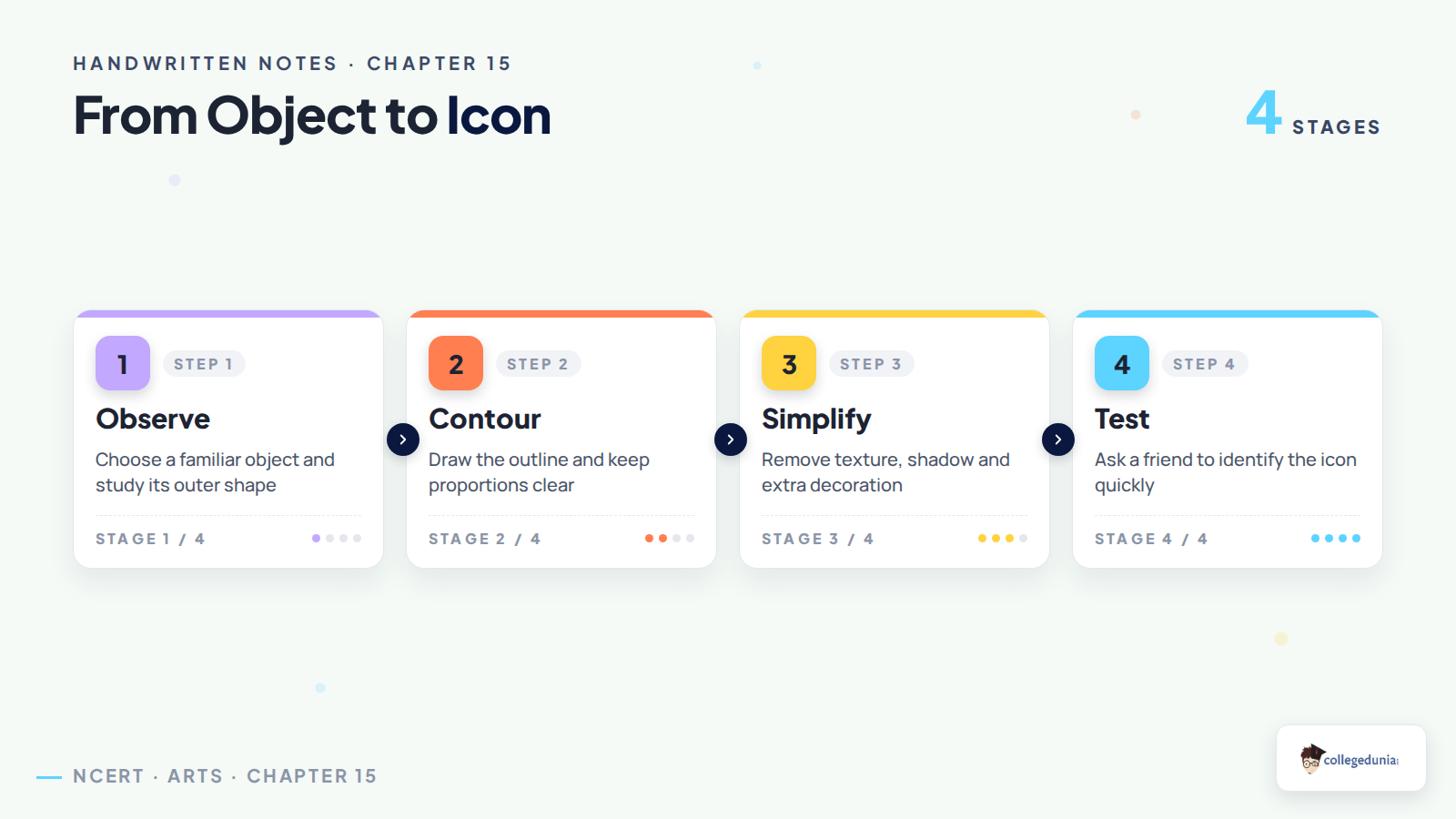
Contour means the outer line of the object. Silhouette means a flat filled shape. Cross hatching uses crossed lines for tones. Stippling uses dots for light and dark areas.
- Use the same object for every drawing.
- Keep only the important details in the icon.
- Ask a friend whether the icon is easy to identify.
Icons for Signages in School Spaces
Activity 15.3 asks students to design signages for school spaces. A library, dining area, play area, art room or washroom can be shown with a clear icon.
Start with the space. List the objects connected with it. Then choose the most important object and draw it in a simple form.
| School Space | Possible Object | Icon Tip |
|---|---|---|
| Library | Open book | Show the book shape, not page text. |
| Art room | Brush or palette | Use one colour and a bold outline. |
| Play area | Ball | Keep the shape round and direct. |
Icon and Symbol Difference for Class 7 Arts
Objects also become symbols. A symbol has deeper meaning and may represent an idea, value, emotion or movement. Icons give direct information, while symbols carry shared meaning.
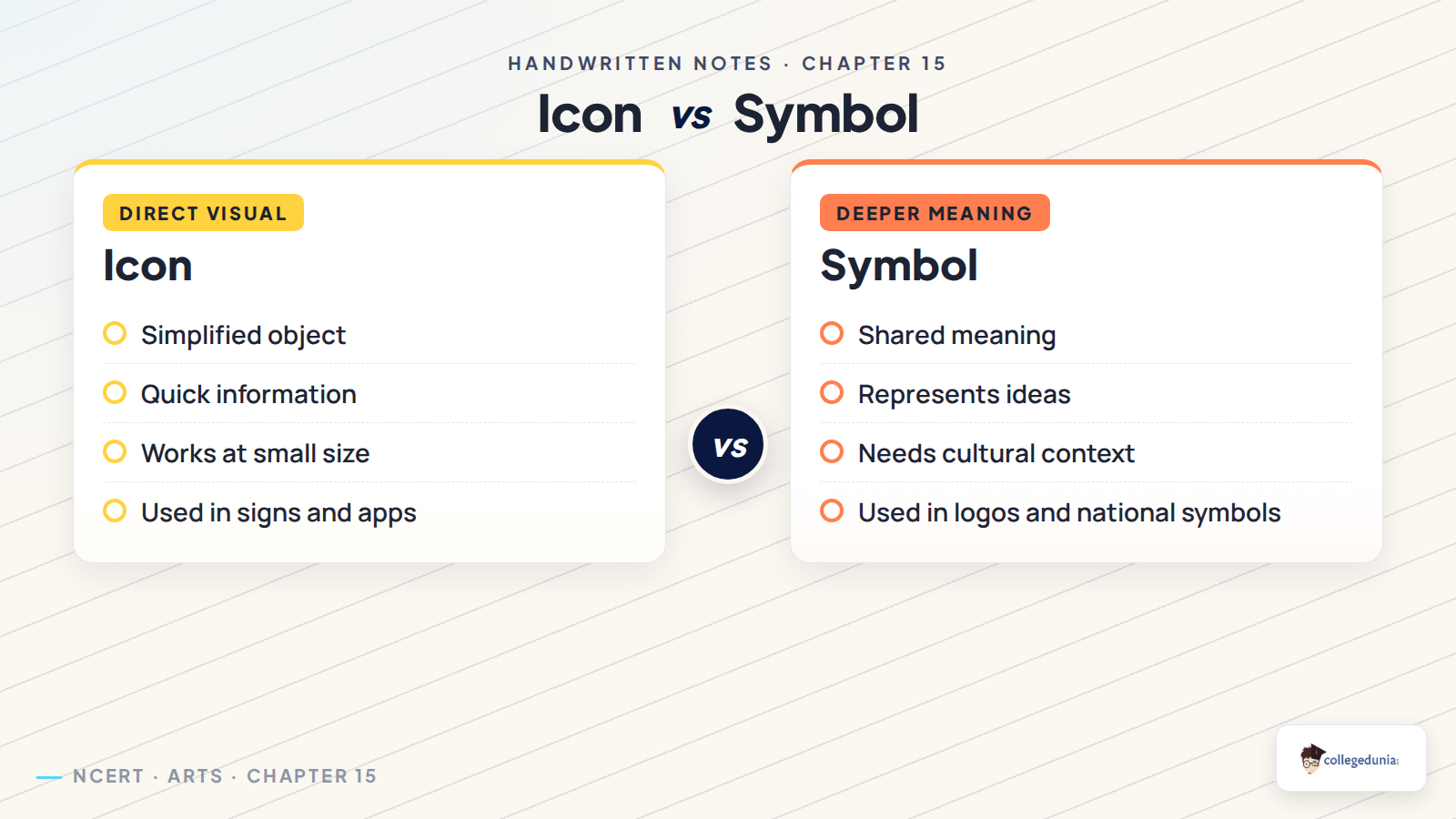
The Dharma Chakra in the national flag is a symbol of law, time and progress. Round spectacles in the Swachhata Abhiyan logo remind many Indians of Mahatma Gandhi and clean India.
- An icon can be understood quickly from its shape.
- A symbol needs shared context and accepted meaning.
- The same visual can work as both icon and symbol.
Objects in Icons and Symbols Video Lesson
The video below can be used as a quick support lesson for revising the Class 7 Arts (Kriti) textbook before reading the handwritten notes.
Source: Prof.Analysis on YouTube
Related NCERT Class 7 Arts (Kriti) Resources
Use these related resources when you want the official book chapter or nearby handwritten notes from the same Arts (Kriti) visual arts unit.
| Resource | Link |
|---|---|
| NCERT Book PDF | Class 7 Arts Chapter 15 NCERT Book PDF |
| Previous Chapter | Class 7 Arts Chapter 14 Handwritten Notes |
| Next Chapter | Class 7 Arts Chapter 16 Handwritten Notes |
All Chapters for Class 7 Arts (Kriti) Handwritten Notes
| Chapter | Handwritten Notes |
|---|---|
| Chapter 10 Dance and Sculpture | Download Notes |
| Chapter 11 Dance Vocabulary and Techniques | Download Notes |
| Chapter 12 Dance, You and Creativity | Download Notes |
| Chapter 13 Personalities | Download Notes |
| Chapter 14 Natya | Download Notes |
| Chapter 15 Objects in Icons and Symbols | Current Chapter |
FAQs on NCERT Class 7 Arts Chapter 15 Handwritten Notes
Ques. What is covered in Class 7 Arts Chapter 15 Objects in Icons and Symbols?
Ans. The chapter covers icons, positive and negative space, stencils, contour, silhouette, cross hatching, stippling, signages, symbols and peer assessment.
Ques. What is an icon in this chapter?
Ans. An icon is a simplified visual representation of an object, place or idea. It gives information quickly and avoids unnecessary detail.
Ques. What is the difference between positive and negative space?
Ans. Positive space shows the object. Negative space is the blank area around or inside the object that helps the shape become clear.
Ques. What is the difference between an icon and a symbol?
Ans. An icon gives direct information through a simple shape. A symbol carries deeper accepted meaning, such as the Dharma Chakra or Gandhi's spectacles.



Comments