



The handwritten notes on Class 8 Vocational Education Chapter 3 Working with Wood and Bamboo have been carefully prepared for quick 2026-27 revision. The PDF covers workshop visit points, tool safety, common joints, prototype making, wood product steps, bamboo product steps, costing and school repair work in simple revision language.
- Best use: revise the wood and bamboo project before writing the activity file.
- PDF focus: safety rules, joint types, product-making flow, costing and reflection answers.
- Revision style: topper's handwritten notes with short points, formula-style boxes and hand-drawn flow charts.
Chapter3WorkingwithWoodandBambooHandwrittenNotes.pdf?page=1&dpi=150)
Chapter3WorkingwithWoodandBambooHandwrittenNotes.pdf?page=2&dpi=150)
Chapter3WorkingwithWoodandBambooHandwrittenNotes.pdf?page=3&dpi=150)
Chapter3WorkingwithWoodandBambooHandwrittenNotes.pdf?page=4&dpi=150)
Chapter3WorkingwithWoodandBambooHandwrittenNotes.pdf?page=5&dpi=150)
Chapter3WorkingwithWoodandBambooHandwrittenNotes.pdf?page=6&dpi=150)
Chapter3WorkingwithWoodandBambooHandwrittenNotes.pdf?page=7&dpi=150)
Chapter3WorkingwithWoodandBambooHandwrittenNotes.pdf?page=8&dpi=150)
Chapter3WorkingwithWoodandBambooHandwrittenNotes.pdf?page=9&dpi=150)
Chapter3WorkingwithWoodandBambooHandwrittenNotes.pdf?page=10&dpi=150)
Chapter3WorkingwithWoodandBambooHandwrittenNotes.pdf?page=11&dpi=150)
Chapter3WorkingwithWoodandBambooHandwrittenNotes.pdf?page=12&dpi=150)
Chapter3WorkingwithWoodandBambooHandwrittenNotes.pdf?page=13&dpi=150)
Chapter3WorkingwithWoodandBambooHandwrittenNotes.pdf?page=14&dpi=150)
Chapter3WorkingwithWoodandBambooHandwrittenNotes.pdf?page=15&dpi=150)
Chapter3WorkingwithWoodandBambooHandwrittenNotes.pdf?page=16&dpi=150)
Chapter3WorkingwithWoodandBambooHandwrittenNotes.pdf?page=17&dpi=150)
Chapter3WorkingwithWoodandBambooHandwrittenNotes.pdf?page=18&dpi=150)
Chapter3WorkingwithWoodandBambooHandwrittenNotes.pdf?page=19&dpi=150)
Chapter3WorkingwithWoodandBambooHandwrittenNotes.pdf?page=20&dpi=150)
Chapter3WorkingwithWoodandBambooHandwrittenNotes.pdf?page=21&dpi=150)
Chapter3WorkingwithWoodandBambooHandwrittenNotes.pdf?page=22&dpi=150)
Chapter3WorkingwithWoodandBambooHandwrittenNotes.pdf?page=23&dpi=150)
Chapter3WorkingwithWoodandBambooHandwrittenNotes.pdf?page=24&dpi=150)
Chapter3WorkingwithWoodandBambooHandwrittenNotes.pdf?page=25&dpi=150)
Chapter3WorkingwithWoodandBambooHandwrittenNotes.pdf?page=26&dpi=150)
These handwritten revision notes follow the 2026-27 NCERT Kaushal Bodh chapter and keep the carpentry project easy to revise.
Student Feedback: In a Collegedunia classroom check of 1,090 middle-school students, most students revised this project faster after separating joints, product-making steps and costing into three quick lists.
|
Table of Contents |
Working with Wood and Bamboo Handwritten Notes Overview
Working with Wood and Bamboo is Project 3 in Class 8 Kaushal Bodh. It teaches students how natural materials can be measured, cut, joined, finished and repaired safely.
The chapter begins with daily uses of wood and bamboo. Students learn why these materials are useful, renewable and still need careful use.
- Wood is used for doors, benches, shelves, tools, toys, carts and sports items.
- Bamboo is strong, light and grows back after cutting.
- The project connects design, craft skill, safety and responsible use of resources.
Working with Wood and Bamboo Project Flow for Class 8
The PDF is arranged like a project notebook. It turns the long NCERT activity chapter into clear steps that students can revise before practical work.
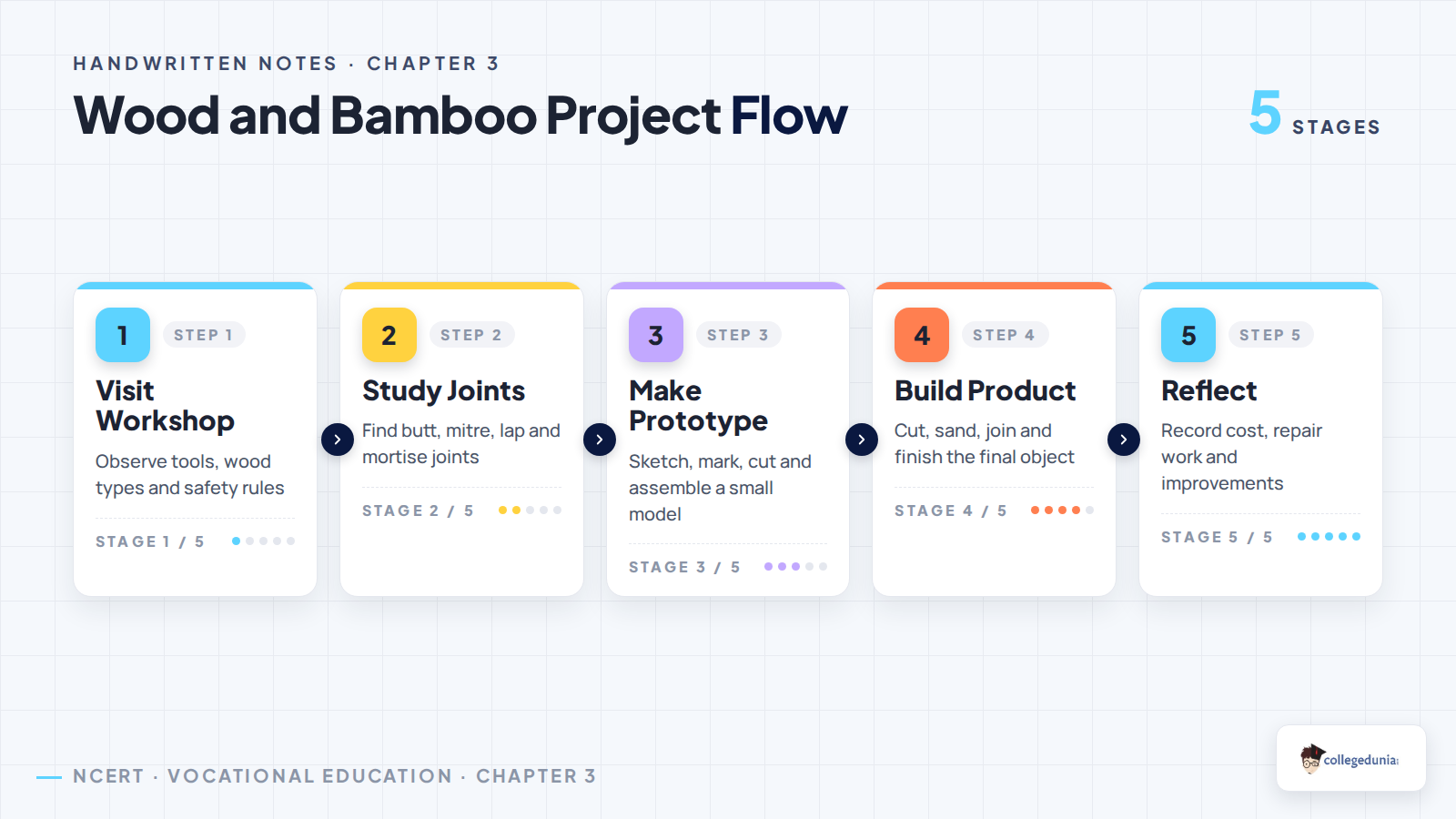
The main flow is workshop visit, joint study, prototype making, product building, costing, repair and reflection. Each stage has a short page in the handwritten PDF.
- Activity 1 records the carpenter's work, tools and safety rules.
- Activity 2 studies parts, materials, fasteners and joints.
- Activity 3 checks the prototype before the final product.
- Activities 4 and 5 cover wood and bamboo product-making steps.
Working with Wood and Bamboo Project Recap
Source: NCERT Hindi Tutor on YouTube
Wood, Bamboo and Engineered Wood Revision Points
Wood comes from different trees and is used according to strength, weight and finish. Hardwood is stronger but harder to work with. Softwood is easier for a beginner project.
Bamboo is a perennial grass. Its hollow culm is divided by solid nodes and can be used for crafts, utensils and simple products.
- Hardwood: useful for construction, frames, ships and heavy furniture.
- Softwood: useful for light furniture, shelves and packing boxes.
- Engineered wood: includes plywood and MDF made from recycled wood or fibre.
- Bamboo: useful for lightweight, strong and eco-friendly products.
Common Wood Joints and Fasteners in Working with Wood and Bamboo
Wooden objects are usually made by assembling many parts. Joints and fasteners decide how strong and useful the product becomes.
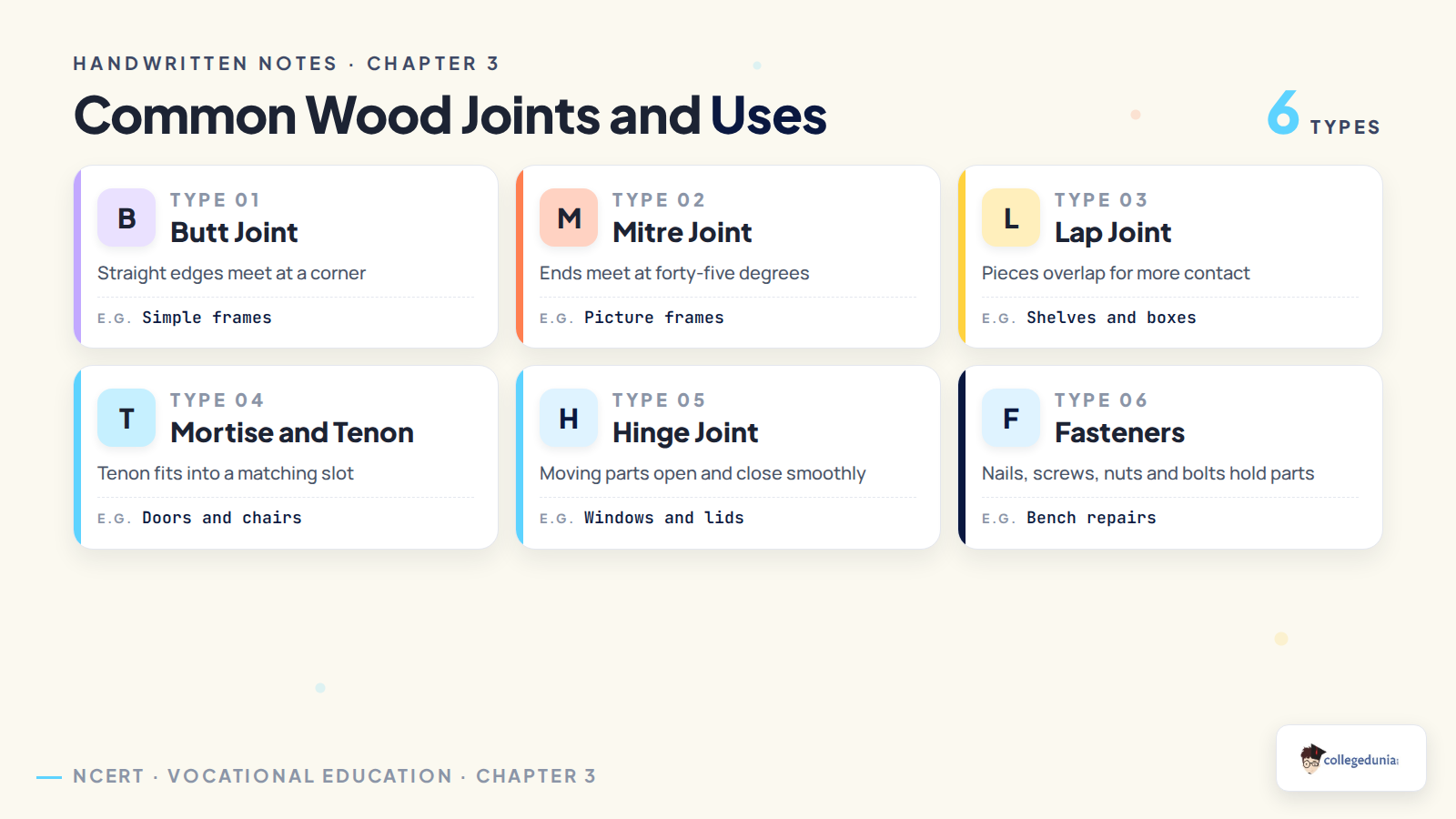
Butt, mitre, lap and mortise-and-tenon joints are the main joint types shown in the chapter. Hinges are used when the parts need movement.
- Butt joints join straight edges at corners.
- Mitre joints meet at a 45 degree angle.
- Lap joints overlap pieces for stronger contact.
- Nails, screws, nuts and bolts are common fasteners.
Prototype and Product-Making Steps for Wood and Bamboo
A prototype is the first model of a product. NCERT asks students to make it with cardboard or waste softwood before using final material.
Prototyping reduces errors because students can check size, shape, joining and balance before the final build. It also saves material and cost.
- Sketch the object with dimensions.
- Collect cardboard, waste softwood, cutter, pencil and scale.
- Mark the design and cut carefully.
- Assemble the model with glue or tape.
- Review the model and take peer feedback.
Woodworking Safety, Tools and Finishing Techniques
Safety is a major part of this project. Students should use cutting tools only after learning the correct grip and should work with adult supervision.
Important tools include a tri-square, hand saw, wood file, plane, claw hammer, measuring tape, steel ruler, bench vice, clamps, hand drill and cutter.
- Use goggles and a mask when dust is produced.
- Secure the wooden piece in a bench vice before cutting.
- Use a plane to remove high spots and smooth the surface.
- Use sandpaper to smoothen edges before varnish or paint.
- Keep tools in their proper place after use.
Costing and Repair Work in Working with Wood and Bamboo
Costing helps students decide how much money was spent on materials and tools. The chapter also asks students to estimate the time spent on each activity.
The cost table includes wood or bamboo, nails, paint or varnish, sandpaper and other materials. Students should compare their total with the market price of a similar product.
- Write each material separately.
- Add quantity, cost per item and total cost.
- Record labour time in periods or hours.
- Repair work can include tightening screws, sanding edges or painting.
How to Use These Handwritten Notes for Project Records
Use these notes while filling the NCERT activity tables. They help students remember what to observe, measure, ask, make and reflect on.
A strong project file should include the selected object, sketch with dimensions, tools used, steps followed, problems faced and improvements made.
- For Activity 1, record the workshop visit details.
- For Activity 2, sketch the object and label joints.
- For Activity 3, write prototype feedback.
- For Activities 4 and 5, list the wood or bamboo process.
- For Activity 6, complete the costing table.
Related Working with Wood and Bamboo Resources
Use the links below with the handwritten notes. They help students move from quick revision to solved project answers and the official NCERT chapter.
| Resource | Use it for | Link |
|---|---|---|
| NCERT Solutions | Activity answers and reflection questions | Open solutions |
| NCERT Book PDF | Official chapter text and activity tables | Open book PDF |
| NCERT Notes | Typed revision notes for the same project | Open notes |
All Class 8 Vocational Education Handwritten Notes
| Chapter | Topic | Handwritten notes link |
|---|---|---|
| Chapter 1 | Hydroponics: Growing Plants without Soil | Open Chapter 1 notes |
| Chapter 2 | Feeding and Caring for Farm Animals | Open Chapter 2 notes |
| Chapter 3 | Working with Wood and Bamboo | Open Chapter 3 notes |
| Chapter 4 | Home Automation | Open Chapter 4 notes |
| Chapter 5 | Water Audit for Water Management | Open Chapter 5 notes |
Working with Wood and Bamboo Handwritten Notes FAQs
Ques. What is covered in Working with Wood and Bamboo handwritten notes?
Ans. The notes cover workshop visit points, wood types, bamboo parts, safety rules, common joints, prototype steps, product-making flow, costing and repair work.
Ques. How do these handwritten notes help in the Class 8 project?
Ans. They turn the NCERT project into short revision pages. Students can quickly revise what to observe, sketch, make, cost and write in the activity file.
Ques. Are common joints included in the PDF?
Ans. Yes. The PDF includes butt joint, mitre joint, lap joint, mortise-and-tenon joint, hinges and common fasteners like nails and screws.
Ques. Does the PDF include costing and repair work?
Ans. Yes. The notes explain the costing table, labour-time idea and basic repair tasks such as tightening screws, sanding edges and painting surfaces.



Comments