


If you are preparing for the Class 10 Civics board paper, Gender, Religion and Caste is one chapter you cannot afford to skip.
Chapter3Gender,ReligionandCasteNotes.pdf?page=1&dpi=150)
Chapter3Gender,ReligionandCasteNotes.pdf?page=2&dpi=150)
Chapter3Gender,ReligionandCasteNotes.pdf?page=3&dpi=150)
Chapter3Gender,ReligionandCasteNotes.pdf?page=4&dpi=150)
Chapter3Gender,ReligionandCasteNotes.pdf?page=5&dpi=150)
Chapter3Gender,ReligionandCasteNotes.pdf?page=6&dpi=150)
Chapter3Gender,ReligionandCasteNotes.pdf?page=7&dpi=150)
Chapter3Gender,ReligionandCasteNotes.pdf?page=8&dpi=150)
Chapter3Gender,ReligionandCasteNotes.pdf?page=9&dpi=150)
Chapter3Gender,ReligionandCasteNotes.pdf?page=10&dpi=150)
Chapter3Gender,ReligionandCasteNotes.pdf?page=11&dpi=150)
Chapter3Gender,ReligionandCasteNotes.pdf?page=12&dpi=150)
Chapter3Gender,ReligionandCasteNotes.pdf?page=13&dpi=150)
Chapter3Gender,ReligionandCasteNotes.pdf?page=14&dpi=150)
Chapter3Gender,ReligionandCasteNotes.pdf?page=15&dpi=150)
Chapter3Gender,ReligionandCasteNotes.pdf?page=16&dpi=150)
Chapter3Gender,ReligionandCasteNotes.pdf?page=17&dpi=150)
Chapter3Gender,ReligionandCasteNotes.pdf?page=18&dpi=150)
Chapter3Gender,ReligionandCasteNotes.pdf?page=19&dpi=150)
Chapter3Gender,ReligionandCasteNotes.pdf?page=20&dpi=150)
These gender caste and religion class 10 notes cover every idea the CBSE paper tests, from the sexual division of labour to communalism and caste in politics, according to the latest 2026-27 NCERT Democratic Politics II textbook.
- Board weightage: the chapter usually carries 5 to 6 marks across one short-answer and one long-answer question.
- Key flashcard fact: gender division is based on social expectations, not biology, and India is a secular state with no official religion.
- Pair with: the NCERT Solutions and Handwritten Notes for this same chapter, linked in the table near the end.
Every set of gender caste and religion class 10 notes in this Collegedunia compilation is curated by Social Science experts, based on the 2026-27 NCERT Democratic Politics II textbook, and checked against the last five years of CBSE board papers.
What Is in Gender, Religion and Caste Class 10 Civics
The big idea is simple: social differences do not threaten a democracy. What matters is how they are expressed in politics.
- The chapter studies three social divisions: gender, religion and caste.
- The golden rule: the expression of difference is healthy, but domination through difference is harmful.
- Three close terms: a social difference is any way groups differ, a social division forms when one difference overpowers the rest, and a social inequality exists when one group has more power or wealth.
Gender, Religion and Caste Class 10 Full Chapter Explained in One Video
Source: Magnet Brains on YouTube
Gender and Politics in Class 10 Civics Notes
Gender division is based on social expectations and stereotypes about what men and women should do, not on biology.
- Sexual division of labour: women do most work inside the home (cooking, cleaning, child care), while men work outside. When the same jobs are paid, men step in (most hotel cooks and tailors are men).
- Public and private divide: women's work stays in the private home, unpaid and treated as invisible.
- Patriarchy means rule by the father, a system that values men more than women.
A Time Use Survey found an average woman works over seven and a half hours a day against about six and a half for a man, but her unpaid household hours are not counted.
How Women Are Discriminated Against
Women face disadvantage in several measurable ways. Learn the numbers, because the paper often turns them into fill-in-the-blanks.
| Area | How Women Are Disadvantaged |
|---|---|
| Literacy | Female literacy is about 54 per cent against 76 per cent for men |
| Wages | Women are paid less despite the Equal Remuneration Act, 1976 |
| High-paid jobs | Very few women reach highly paid, valued posts |
| Child sex ratio | Son preference pushed it down to about 919 girls per 1000 boys |
| Safety | Harassment, exploitation and domestic violence, even at home |
Feminism and Women's Political Representation
Women organised and agitated for equal rights, from voting rights and education to equality in family life. These are feminist movements.
- A feminist believes in equal rights for women and men, so feminism is pro-equality, not anti-men.
- In the Lok Sabha, the share of elected women touched 14.36 per cent in 2019; in state assemblies it is still under 5 per cent.
- In Panchayati Raj, one-third of local-body seats are reserved for women (over 10 lakh representatives).
- The Women's Reservation Act, 2023 (Nari Shakti Vandan Adhiniyam) provides 33 per cent reservation in the Lok Sabha and state assemblies.
Keep the two reservations straight: local bodies are already one-third reserved, while the Lok Sabha and assemblies got 33 per cent only through the 2023 Act.
Religion, Communalism and Politics Class 10
The second division is religion. Religious differences are often expressed in politics, and this is not always wrong. The problem starts only when religion is set against religion.
- Gandhiji said religion cannot be separated from politics, meaning the moral values that inform all religions.
- Human rights groups demand steps to prevent communal riots and protect minorities.
- The women's movement argues that the family laws of all religions should be made fair.
These mixes are acceptable because they treat every religion equally. The danger appears with communalism, the belief that people of one religion form a single community that cannot live as equal citizens with others.
Communalism and the Secular State in India
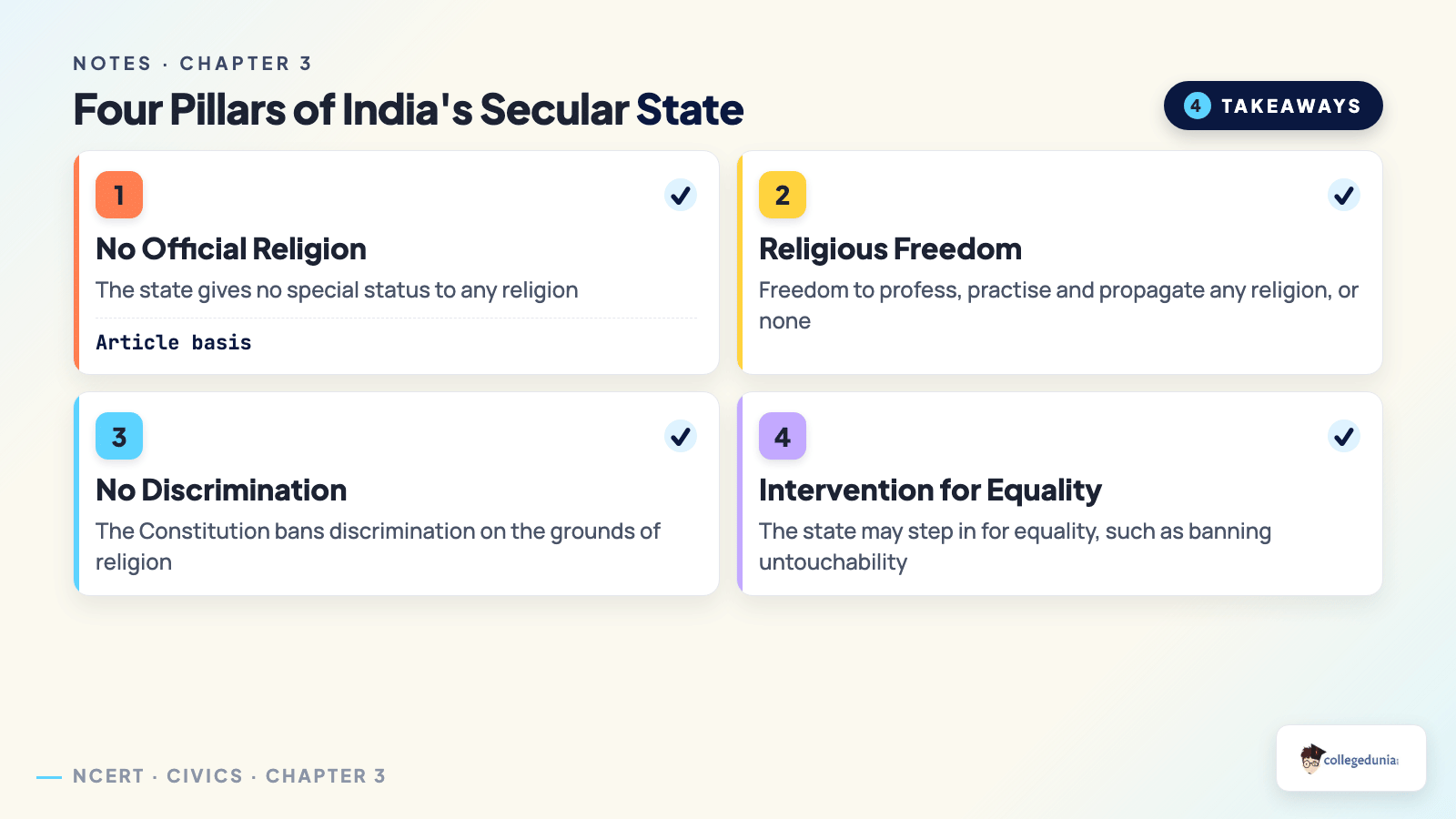
Communalism takes several forms in everyday life and in politics. Learn the four forms and the four pillars below as two clean checklists.
| Form of Communalism | What It Looks Like |
|---|---|
| Everyday beliefs | Prejudice, stereotypes and a sense that one's own religion is superior |
| Political dominance | Majoritarian dominance, or a minority wanting a separate political unit |
| Political mobilisation | Use of sacred symbols, religious leaders, emotional appeal and fear |
| Communal violence | The ugliest form, such as the riots at Partition |
To counter this, the makers of the Constitution chose a secular state. The four pillars of Indian secularism are easy marks:
- There is no official religion of the Indian state, unlike Islam in Pakistan or Buddhism in Sri Lanka.
- Every person has the freedom to profess, practise and propagate any religion, or none.
- The Constitution prohibits discrimination on the grounds of religion.
- The state may intervene for equality, for example by banning untouchability.
Do not confuse being religious with being communal. A secular Constitution is necessary but not enough; communal prejudice must also be fought in everyday life and in politics.
Caste and Politics Class 10 Civics Notes
The third division is caste, special to India. The caste system is an extreme form of hereditary occupational division once sanctioned by rituals.
- It was based on the exclusion of outcaste groups, who faced untouchability.
- Reformers like Jotiba Phule, Gandhiji, B.R. Ambedkar and Periyar Ramaswami Naicker worked to end caste inequality.
- Economic development, urbanisation, literacy and occupational mobility have weakened the old hierarchy.
- The Constitution prohibits caste-based discrimination.
Yet caste has not disappeared: most people still marry within their caste, and upper castes are best off while Dalits and Adivasis are worst off. Caste is one aspect of our lives, not the only one.
Caste in Politics and Politics in Caste
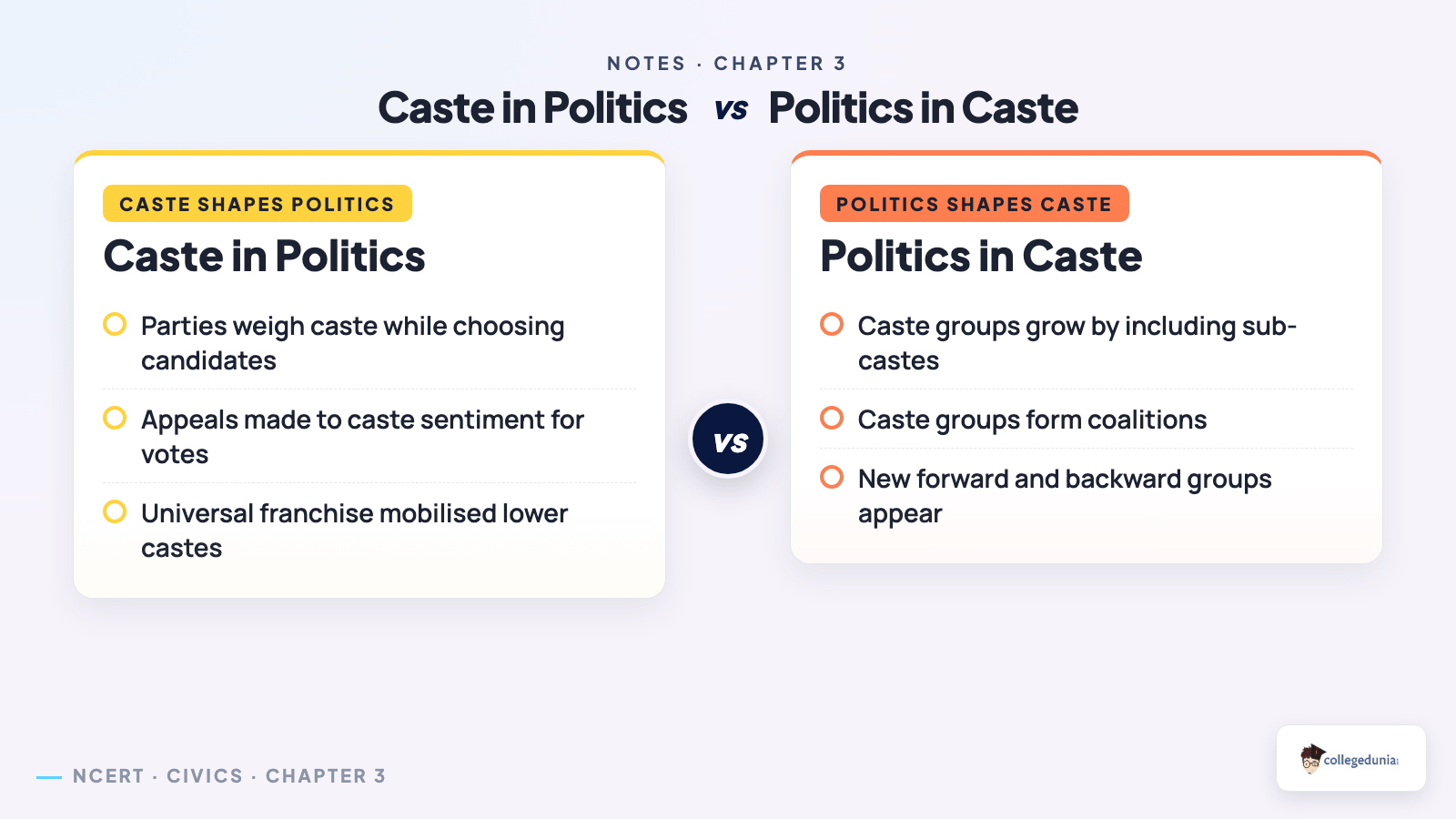
The link between caste and politics runs both ways, and this two-way idea is the heart of the high-mark question. Keep the two directions separate in your answer.
| Direction | How It Works |
|---|---|
| Caste in politics | Parties weigh caste while choosing candidates, appeal to caste sentiment, and universal franchise forced leaders to mobilise lower castes |
| Politics in caste | Caste groups grow by including sub-castes, form coalitions, and new forward and backward groups appear |
Yet elections are not all about caste. No constituency has a single-caste majority, no party wins every vote of one caste, and ruling parties often lose. NCERT puts it sharply: it is not politics that gets caste-ridden, it is caste that gets politicised. On balance, caste politics gives disadvantaged groups a voice but can distract from poverty and development.
Common Mistakes Students Make in the Gender, Religion and Caste Chapter
These slips cost easy marks every year. Read them once before the exam.
- Writing that gender division is biological. It is based on social expectations and stereotypes.
- Calling a religious person communal. Communalism is the political misuse of religion, not faith itself.
- Saying India has an official religion. India is a secular state with no official religion.
- Reversing the NCERT line. It is caste that gets politicised, not politics that gets caste-ridden.
Student Feedback on the Gender, Religion and Caste Chapter
What 11,820 students told us about studying the Gender, Religion and Caste chapter. In a Collegedunia survey of 11,820 Class 10 students conducted before the 2026 boards, 81% said the four pillars of the secular state were the easiest marks to score, while the two-way link between caste and politics was rated the part most worth revising twice.
Source: 2026-27 Class 10 Social Science student poll. Sample of 11,820 students from CBSE schools across 14 states.
Related Class 10 Civics Resources for the Gender, Religion and Caste Chapter
Use the other resources for this same Gender, Religion and Caste chapter to revise from more than one angle.
| Resource Type | Best Used For | Link |
|---|---|---|
| NCERT Solutions | Step-by-step answers to every textbook question | Gender, Religion and Caste Class 10 NCERT Solutions |
| Handwritten Notes | Quick one-shot revision in a scanned notebook style | Gender, Religion and Caste Class 10 Handwritten Notes |
| NCERT Book PDF | The full original chapter text from the textbook | Gender, Religion and Caste Class 10 NCERT Book PDF |
NCERT Notes for All Class 10 Civics Democratic Politics II Chapters
Move through the rest of the Democratic Politics II book with the same notes format.
| Chapter | Topic | Notes Link |
|---|---|---|
| Chapter 1 | Power-sharing | Power-sharing Class 10 Notes |
| Chapter 2 | Federalism | Federalism Class 10 Notes |
| Chapter 4 | Political Parties | Political Parties Class 10 Notes |
| Chapter 5 | Outcomes of Democracy | Outcomes of Democracy Class 10 Notes |
What is the main idea of Gender, Religion and Caste in Class 10 Civics?
Social differences do not threaten democracy. What matters is how they are expressed in politics.
The chapter studies three social divisions, gender, religion and caste. Its central idea is that the mere existence of social differences is normal in a democracy. The danger appears only when one identity is used to dominate or exclude others. Expression of difference is healthy, while domination through difference is harmful. This idea is the core of the gender caste and religion class 10 notes.
Is gender division based on biology in Class 10 Civics?
No. Gender division is based on social expectations and stereotypes, not biology.
NCERT is clear that gender division is not natural or biological. It comes from the social expectations and stereotypes about what men and women should do. The most common form is the sexual division of labour, where women do most unpaid work inside the home. This is the most frequent trap in the MCQ on this chapter, so remember that the basis is social, not biological.
What is communalism in Class 10 Civics notes?
Communalism is the belief that religion is the principal basis of social community.
Communalism is the belief that people who follow the same religion form one community with the same interests, and that different religions cannot live as equal citizens. It shows itself as everyday prejudice, the quest for political dominance, political mobilisation using religious symbols, and at its worst, communal violence such as the riots at Partition. Being religious is not the same as being communal.
What makes India a secular state in Class 10 Civics?
India has no official religion and the Constitution gives equal religious freedom to all.
India is a secular state for four reasons. There is no official religion of the Indian state. Every person is free to profess, practise and propagate any religion or none. The Constitution prohibits discrimination on the grounds of religion. And the state may intervene for equality, for example by banning untouchability. These four pillars are a common five-mark question.
How does caste influence politics and politics influence caste?
Caste shapes candidate selection and vote banks, while politics makes caste groups grow and form coalitions.
Caste in politics means parties weigh caste while choosing candidates, appeal to caste sentiment, and mobilise castes once treated as inferior. Politics in caste means caste groups grow by including sub-castes, form coalitions, and new forward and backward groups appear. NCERT sums this up with the line that it is not politics that gets caste-ridden, it is caste that gets politicised.
What is the Women's Reservation Act mentioned in Class 10 Civics?
The 2023 Act provides 33 per cent reservation for women in the Lok Sabha and state assemblies.
The Women's Reservation Act of 2023, also called the Nari Shakti Vandan Adhiniyam, provides 33 per cent reservation of seats for women in the Lok Sabha, the state legislative assemblies and the Delhi Assembly. This is separate from the one-third reservation that already exists for women in local bodies like panchayats and municipalities. Keep the two reservation levels separate in the exam.
Where can I download the gender caste and religion class 10 notes pdf?
The full notes are available as a free download from the PDF card near the top of this page.
You can download the complete gender caste and religion class 10 notes pdf from the download card at the top of this page. It covers every topic from the sexual division of labour to communalism, the secular state and caste in politics, based on the 2026-27 NCERT Democratic Politics II textbook, so you can revise offline before the boards.



Comments