


If you are revising the Class 10 Civics board syllabus, Political Parties is one of the highest-scoring chapters in Democratic Politics II.
Chapter4PoliticalPartiesNotes.pdf?page=1&dpi=150)
Chapter4PoliticalPartiesNotes.pdf?page=2&dpi=150)
Chapter4PoliticalPartiesNotes.pdf?page=3&dpi=150)
Chapter4PoliticalPartiesNotes.pdf?page=4&dpi=150)
Chapter4PoliticalPartiesNotes.pdf?page=5&dpi=150)
Chapter4PoliticalPartiesNotes.pdf?page=6&dpi=150)
Chapter4PoliticalPartiesNotes.pdf?page=7&dpi=150)
Chapter4PoliticalPartiesNotes.pdf?page=8&dpi=150)
Chapter4PoliticalPartiesNotes.pdf?page=9&dpi=150)
Chapter4PoliticalPartiesNotes.pdf?page=10&dpi=150)
Chapter4PoliticalPartiesNotes.pdf?page=11&dpi=150)
Chapter4PoliticalPartiesNotes.pdf?page=12&dpi=150)
Chapter4PoliticalPartiesNotes.pdf?page=13&dpi=150)
Chapter4PoliticalPartiesNotes.pdf?page=14&dpi=150)
Chapter4PoliticalPartiesNotes.pdf?page=15&dpi=150)
Chapter4PoliticalPartiesNotes.pdf?page=16&dpi=150)
Chapter4PoliticalPartiesNotes.pdf?page=17&dpi=150)
Chapter4PoliticalPartiesNotes.pdf?page=18&dpi=150)
Chapter4PoliticalPartiesNotes.pdf?page=19&dpi=150)
Chapter4PoliticalPartiesNotes.pdf?page=20&dpi=150)
These class 10 civics notes chapter 4 Political Parties cover every idea the CBSE paper tests, from why we need parties to the six national parties, the four challenges and the reforms, mapped to the latest 2026-27 NCERT Democratic Politics II textbook.
- Board weightage: Political Parties usually carries 5 to 6 marks across one short-answer and one long-answer question.
- Key flashcard fact: India has six recognised national parties as per the 2023 ECI notification, and a multi-party system.
- Pair with: the NCERT Solutions and Handwritten Notes for this same chapter, linked in the table near the end.
Every set of class 10 civics notes chapter 4 Political Parties in this Collegedunia compilation is curated by Social Science experts, based on the 2026-27 NCERT Democratic Politics II textbook, and checked against the last five years of CBSE board papers.
What Is a Political Party in Class 10 Civics Democratic Politics II
A political party is a group of people who come together to contest elections and hold power in the government. Its members agree on policies and programmes to promote the collective good. A party is partisan by nature, openly taking the side of one part of society rather than claiming to be neutral.
- A party contests elections and seeks to hold power in the government.
- Members agree on policies and programmes to promote the collective good.
- Every party has three components: leaders, active members, and followers.
The three components are an easy one-mark booster: leaders run the government, active members keep the machinery running, and followers are the ordinary supporters who vote for it.
Political Parties Class 10 Full Chapter Explained in One Video
Source: Magnet Brains on YouTube
Functions of Political Parties Every Class 10 Student Must Know
The CBSE paper loves the functions list. This is a very-high-frequency 3 to 5 mark question, so memorise the seven points.
- Contest elections: elections are fought mainly among candidates put up by parties.
- Put forward policies and programmes: a party groups many opinions into a few basic positions.
- Make laws: members vote in the legislature by the direction of the leadership.
- Form and run governments: parties recruit and train leaders and make them ministers.
- Play the role of opposition: losing parties voice different views and criticise the government.
- Shape public opinion: parties raise issues, and many pressure groups are extensions of parties.
- Provide access to welfare schemes: a local party leader is easier to approach than an officer.
Mnemonic (C-P-L-G-O-S-A): Clever Parties Lead Governments, Oppose, Speak and Assist.
Why Do We Need Political Parties: The Necessity Argument
The textbook imagines a democracy with no parties at all, which is exactly the framing examiners reward.
- Every candidate would be independent, so no one could promise any major policy change.
- A government may form, but no one would be responsible for running the whole country.
- Large societies need an agency to gather views and present them to a responsible government.
Non-party panchayat elections prove this: even where parties do not contest formally, the village splits into factions, each putting up a panel. So parties are a necessary condition for a representative democracy.
How Many Parties: One, Two and Multi-Party Systems
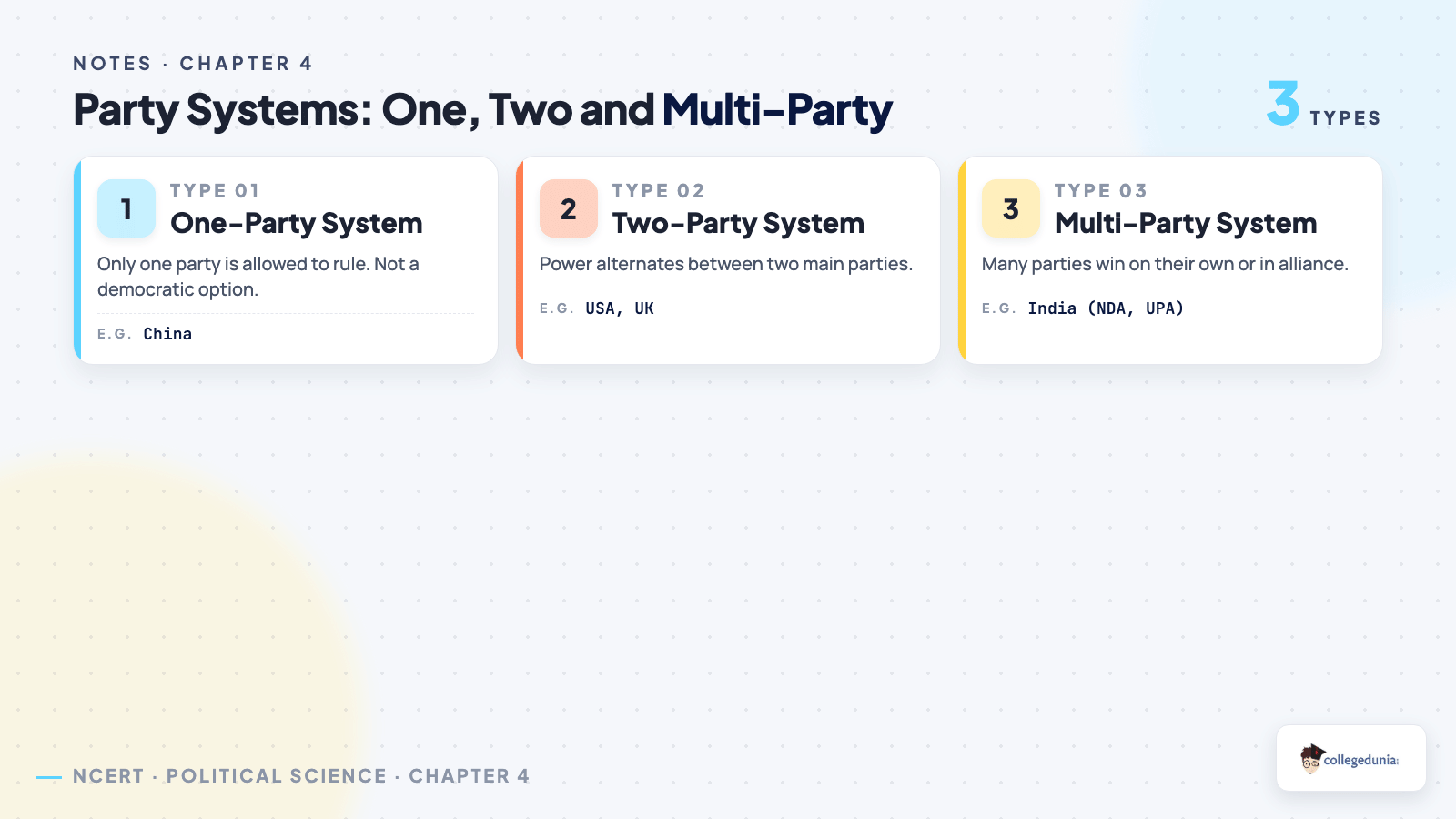
Over 750 parties are registered with the Election Commission, but only a handful are serious contenders. CBSE often asks you to compare the three party systems with examples.
| System | How Power Works | Examples |
|---|---|---|
| One-party | Only one party is allowed to rule; not democratic | China (Communist Party) |
| Two-party | Power alternates between two main parties | USA, United Kingdom |
| Multi-party | Many parties win on their own or in alliance | India (NDA, UPA, Left Front) |
India has a multi-party system because the diversity of such a large country could not be absorbed by two or three parties. When several parties contest together, it is called an alliance or front. A party system is not chosen; it evolves over time.
National and State Parties: ECI Recognition Criteria
The Election Commission gives large, established parties a reserved symbol and calls them recognised parties. The recognition rule is the most confused topic in the chapter.
| Basis | Recognised National Party | Recognised State Party |
|---|---|---|
| Vote share | 6% of valid votes | 6% of valid votes |
| Where | Polls of four States | Assembly poll of one State |
| Seats needed | 4 Lok Sabha seats | 2 Assembly seats |
| Symbol reserved | Across all India | Within that State only |
- The vote share is the same 6% in both; only the spread and seat count differ.
- State parties are commonly called regional parties, but need not be regional in ideology.
- Since 1996 no single national party has won a Lok Sabha majority alone, so they form alliances, which has strengthened federalism.
The Six National Parties of India in Class 10 Civics Notes
According to the ECI notification of 2023, there are six recognised national parties. Learn one fact for each, since the board sets a one-mark match-the-symbol question.
| Party | Founded | Key Identity |
|---|---|---|
| Aam Aadmi Party (AAP) | 2012 | Born of the 2011 anti-corruption movement; clean governance |
| Bahujan Samaj Party (BSP) | 1984 | Founded by Kanshi Ram; Dalits, Adivasis, OBCs, minorities |
| Bharatiya Janata Party (BJP) | 1980 | Cultural nationalism; largest party in 2019 |
| Communist Party of India (Marxist) | 1964 | Marxism-Leninism; strong in West Bengal, Kerala, Tripura |
| Indian National Congress (INC) | 1885 | Centrist, secular; led the UPA from 2004 to 2019 |
| National People's Party (NPP) | 2013 | First national party from North-East India; governs Meghalaya |
Mnemonic (A-B-B-C-I-N): AAP, BSP, BJP, CPI(M), INC, NPP. Other major parties like the BJD or DMK are State parties even when very powerful at home.
Challenges to Political Parties in Class 10 Civics
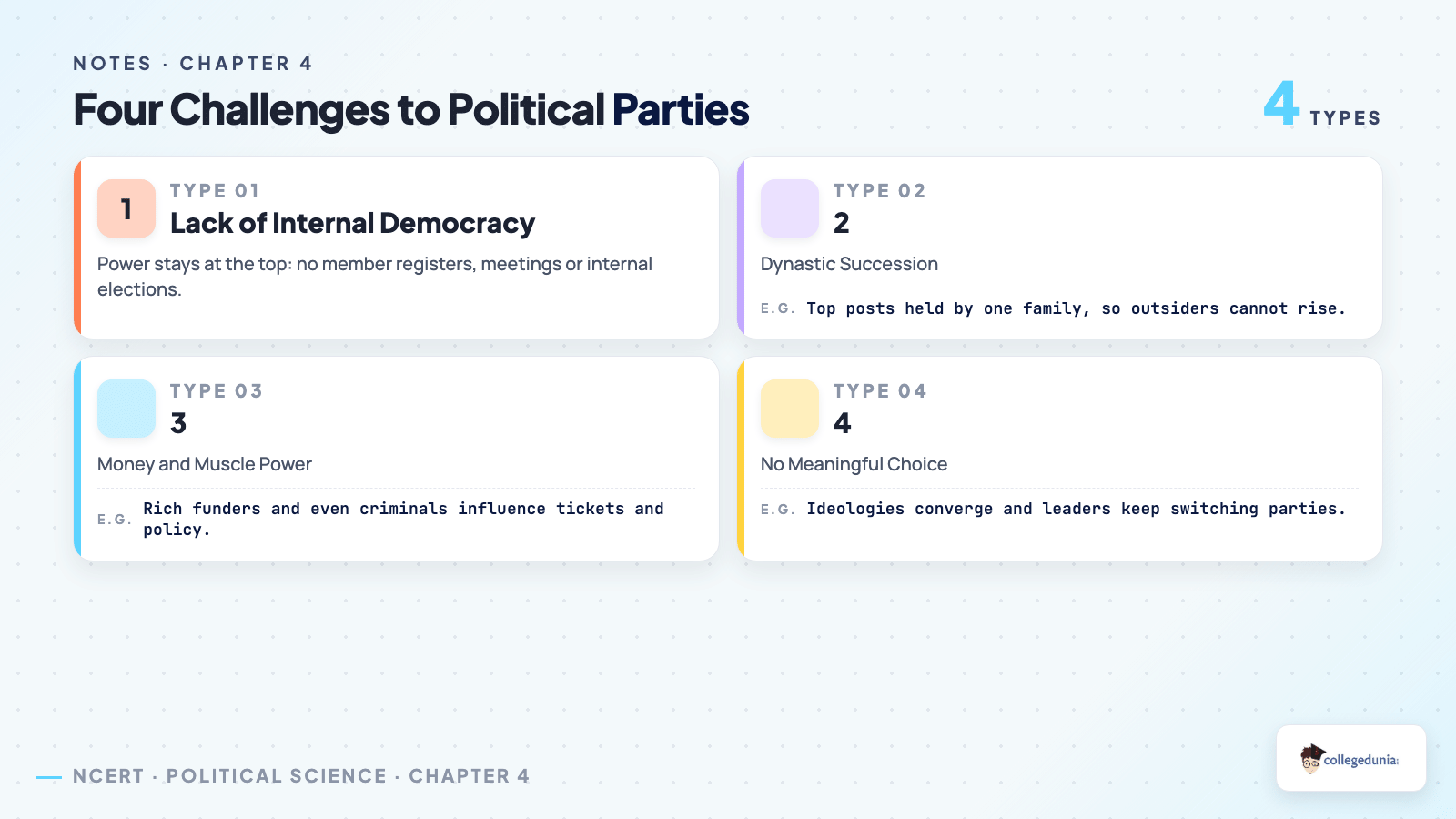
The NCERT focuses popular criticism on four problem areas. This is a very-high-frequency long-answer.
- Lack of internal democracy: power is concentrated at the top, with no membership registers or regular internal elections.
- Dynastic succession: top posts are controlled by one family, so ordinary workers cannot rise.
- Money and muscle power: parties nominate candidates who can raise money, and sometimes back criminals who can win.
- No meaningful choice: ideological differences have narrowed, so voters wanting different policies have few options.
Mnemonic (DDMM): Democracy (lack of), Dynasty, Money and muscle, Meaningful choice (lack of).
How Can Political Parties Be Reformed
The reform answer has three branches: laws in force, suggestions under debate, and what citizens can do. Split your answer this way for full marks.
| Branch | What It Includes | Source |
|---|---|---|
| Laws already made | Anti-Defection Law, affidavit on assets and cases, ECI order on internal polls | Constitution, Supreme Court, ECI |
| Reforms suggested | Regulate internal affairs, one-third tickets to women, state funding | Not yet accepted |
| Role of citizens | Pressure through petitions and media; join parties | Ordinary people |
- The Anti-Defection Law means an MLA or MP who changes parties loses the seat.
- The Supreme Court affidavit rule makes every candidate declare property and criminal cases.
- Close with the NCERT caution: over-regulation can be counter-productive.
Political Parties Class 10 Important Questions and How CBSE Tests Them
The same handful of questions return in slightly different words across recent boards.
| Topic | Typical Marks | How CBSE Asks It |
|---|---|---|
| Functions of political parties | 3 to 5 | State the functions parties perform |
| Challenges to political parties | 3 to 5 | Explain any three challenges faced by parties |
| How parties can be reformed | 3 to 5 | Suggest reforms to strengthen parties |
| National vs State parties | 1 to 3 | How does the ECI recognise a party |
| Six national parties | 1 | Match the symbol or founder to the party |
Common Mistakes Students Make in the Political Parties Chapter
These slips cost easy marks every year. Read them once before the exam.
- Calling a one-party system a democracy. It is not democratic.
- Swapping the seat numbers. National needs 4 Lok Sabha seats in four States; State needs 2 Assembly seats in one State.
- Merging lack of internal democracy with dynastic succession. They are two distinct challenges.
- Forgetting the count: there are six national parties (2023 ECI notification).
- Mixing up an alliance with a party. An alliance or front (NDA, UPA) is several parties joining hands.
How to Use These Political Parties Notes Most Effectively
Split your revision into three short blocks.
- Block 1 (read): the meaning, three components, seven functions and the necessity argument.
- Block 2 (systems and parties): the three party systems, the recognition criteria, and the six national parties.
- Block 3 (recall): write the four challenges and the reform branches from memory.
Related Class 10 Civics Resources for the Political Parties Chapter
Use the other resources for this chapter to revise from more than one angle.
| Resource Type | Best Used For | Link |
|---|---|---|
| NCERT Solutions | Step-by-step answers to every textbook question | Political Parties Class 10 NCERT Solutions |
| Handwritten Notes | Quick one-shot revision in a scanned notebook style | Political Parties Class 10 Handwritten Notes |
| NCERT Book PDF | The full original chapter text from the textbook | Political Parties Class 10 NCERT Book PDF |
NCERT Notes for All Class 10 Civics Democratic Politics II Chapters
| Chapter | Topic | Notes Link |
|---|---|---|
| Chapter 1 | Power-sharing | Power-sharing Class 10 Notes |
| Chapter 2 | Federalism | Federalism Class 10 Notes |
| Chapter 3 | Gender, Religion and Caste | Gender, Religion and Caste Class 10 Notes |
| Chapter 5 | Outcomes of Democracy | Outcomes of Democracy Class 10 Notes |
What is a political party in Class 10 Civics?
A political party is a group of people who come together to contest elections and hold power in the government.
A political party is a group of people who come together to contest elections and hold power in the government. Its members agree on some policies and programmes for society to promote the collective good. Every party has three components, namely the leaders, the active members and the followers. This definition is the most commonly tested point in the political parties class 10 notes.
What are the functions of political parties for Class 10?
There are seven functions, from contesting elections to providing access to welfare schemes.
The seven functions are: contest elections, put forward policies and programmes, make laws, form and run governments, play the role of opposition, shape public opinion, and provide access to government machinery and welfare schemes. Remember them with the mnemonic C-P-L-G-O-S-A. This is almost always a 3 to 5 mark question in the board paper.
How many national parties are there in India in Class 10 Civics?
There are six recognised national parties as per the ECI notification of 2023.
As per the Election Commission of India notification of 2023, there are six recognised national parties: AAP, BSP, BJP, CPI(M), INC and NPP. A recognised national party secures at least 6% of votes in four States plus four Lok Sabha seats, and gets a reserved symbol across all of India.
What are the challenges to political parties in Class 10?
The four challenges are lack of internal democracy, dynastic succession, money and muscle power, and no meaningful choice.
The NCERT lists four challenges: lack of internal democracy, dynastic succession, the growing role of money and muscle power, and the lack of a meaningful choice for voters as ideologies converge. Remember them with the mnemonic DDMM. This is a very-high-frequency long-answer question in the political parties class 10 chapter.
How can political parties be reformed in Class 10 Civics?
Through laws already made, suggested reforms, and the role of ordinary citizens.
Reforms fall into three branches. Laws already made are the Anti-Defection Law, the Supreme Court affidavit rule, and the ECI order on internal elections and tax returns. Suggested reforms include one-third tickets to women and state funding of elections. Citizens can apply pressure and join parties for more and better politics. Add the NCERT caution that over-regulation can be counter-productive.
What is the difference between a national and a state party?
A national party meets the 6% and 4 seat criteria across four States; a state party meets 6% and 2 seats in one State.
A recognised national party secures 6% of votes in four States and at least four Lok Sabha seats, and gets a reserved symbol across India. A recognised state party secures 6% of votes and at least two seats in one State Assembly, and gets a reserved symbol only within that State. The vote share is the same 6% in both; only the spread and the seat count differ.
Why do we need political parties in a democracy?
Without parties no one could promise policy change or be responsible for running the whole country.
The NCERT explains necessity by imagining a democracy with no parties. Every candidate would be independent, so no one could promise a major policy change, and no one would be responsible for how the whole country is run. Large societies need an agency to gather views and form a responsible government, which is exactly what a political party does.
Where can I download the class 10 civics notes chapter 4 Political Parties pdf?
The full notes are available as a free download from the PDF card near the top of this page.
You can download the complete class 10 civics notes chapter 4 Political Parties pdf from the download card at the top of this page. It covers every topic from the meaning of a party to the challenges and reforms, based on the 2026-27 NCERT Democratic Politics II textbook, so you can revise offline before the boards.



Comments