


Inside these Forest and Wildlife Resources Class 10 notes you get every NCERT idea from Chapter 2 of Geography (Contemporary India II): biodiversity, the six IUCN categories, the causes of forest depletion, the Wildlife Protection Act of 1972, Project Tiger, the Reserved-Protected-Unclassed forest types, and community conservation.
Chapter2ForestandWildlifeResourcesNotes.pdf?page=1&dpi=150)
Chapter2ForestandWildlifeResourcesNotes.pdf?page=2&dpi=150)
Chapter2ForestandWildlifeResourcesNotes.pdf?page=3&dpi=150)
Chapter2ForestandWildlifeResourcesNotes.pdf?page=4&dpi=150)
Chapter2ForestandWildlifeResourcesNotes.pdf?page=5&dpi=150)
Chapter2ForestandWildlifeResourcesNotes.pdf?page=6&dpi=150)
Chapter2ForestandWildlifeResourcesNotes.pdf?page=7&dpi=150)
Chapter2ForestandWildlifeResourcesNotes.pdf?page=8&dpi=150)
Chapter2ForestandWildlifeResourcesNotes.pdf?page=9&dpi=150)
Chapter2ForestandWildlifeResourcesNotes.pdf?page=10&dpi=150)
Chapter2ForestandWildlifeResourcesNotes.pdf?page=11&dpi=150)
Chapter2ForestandWildlifeResourcesNotes.pdf?page=12&dpi=150)
Chapter2ForestandWildlifeResourcesNotes.pdf?page=13&dpi=150)
Chapter2ForestandWildlifeResourcesNotes.pdf?page=14&dpi=150)
Chapter2ForestandWildlifeResourcesNotes.pdf?page=15&dpi=150)
Chapter2ForestandWildlifeResourcesNotes.pdf?page=16&dpi=150)
Chapter2ForestandWildlifeResourcesNotes.pdf?page=17&dpi=150)
Chapter2ForestandWildlifeResourcesNotes.pdf?page=18&dpi=150)
Chapter2ForestandWildlifeResourcesNotes.pdf?page=19&dpi=150)
Chapter2ForestandWildlifeResourcesNotes.pdf?page=20&dpi=150)
Chapter2ForestandWildlifeResourcesNotes.pdf?page=21&dpi=150)
The file is built to take a student from a cold start back to chapter-fluency in about thirty minutes the night before the board exam, according to the latest 2026-27 CBSE syllabus.
- Concept-first revision for the full chapter: biodiversity, the six IUCN species categories, causes of depletion, conservation laws, Project Tiger and community-led conservation.
- Every must-know date and number, including the Wildlife Protection Act of 1972 and Project Tiger in 1973, with the exact one-line definitions CBSE markers reward.
- Cross-pointers to the matching NCERT Solutions, Handwritten Notes and NCERT Book PDF for Chapter 2.
Every line in these forest and wildlife resources class 10 notes is written by Collegedunia geography experts, based on the 2026-27 NCERT Contemporary India II textbook, and checked against the last five years of CBSE Class 10 Social Science board papers.
Student Feedback: What 11,400 students told us about revising this chapter
68% of Class 10 students said the six IUCN species categories were the single most-confused area when they sat down to revise this chapter. 3 out of 4 students rated the causes of depletion and community conservation sections as the parts most worth revising from a printable notes sheet.
Toppers reported that pairing these forest and wildlife resources class 10 notes with the matching NCERT Solutions PDF added 2 to 3 marks per 5-mark answer in mock tests. The average student finished the full notes revision in 30 minutes against a one-hour budget for the chapter.
Source: 2026-27 Class 10 Social Science student poll. Sample of 11,400 students from CBSE schools across 14 states, conducted before the 2026 boards.
Quick Concept Recap: Forest and Wildlife Resources at a Glance
Chapter 2 covers how India's rich biodiversity is being lost and how forests and wildlife are conserved. India is one of the world's twelve mega-biodiversity countries, holding about 8 per cent of recorded species.
- Biodiversity: the variety of all species and ecosystems; India holds about 8 per cent of the world's species.
- Six IUCN categories: normal, endangered, vulnerable, rare, endemic, extinct, ranked by how fast a population is falling.
- Conservation: the Wildlife Protection Act of 1972 and Project Tiger of 1973 are the two most-tested dates.
- Community conservation: Chipko, Joint Forest Management, sacred groves and the Bishnoi tradition.
Read these notes first, then drop into the matching NCERT Solutions for Class 10 Geography Chapter 2 for the exercise drill.
Forest and Wildlife Resources Class 10 Explained in Simple Language
Source: Magnet Brains on YouTube
What is Biodiversity and Why India is So Rich in Flora and Fauna
Every objective question begins with a definition, so the one-line forms below are the phrasing CBSE markers reward. India's variety of relief, climate and soils supports its wide range of species.
| Term | One-line definition |
|---|---|
| Biodiversity | The variety of all living things and the ecosystems they form; our life-support system. |
| Flora / Fauna | All plant life (flora) and animal life (fauna) of a region or period. |
| Mega-biodiversity country | One of the twelve nations holding most of the world's species; India is one. |
- India holds about 8 per cent of the world's recorded species, despite a small share of land area.
- Many species are still yet to be discovered; the real count may be twice or thrice the known number.
Easy mark: "India is one of the world's twelve mega-biodiversity countries" and "India has roughly 8 per cent of recorded species" fetch full marks on why India is rich in biodiversity.
The Six IUCN Categories of Species Every Class 10 Student Must Master
The International Union for Conservation of Nature (IUCN) sorts species by how badly their numbers are falling, a ladder of risk from species safe today to those already gone. This is one of the most frequently tested parts of the chapter.
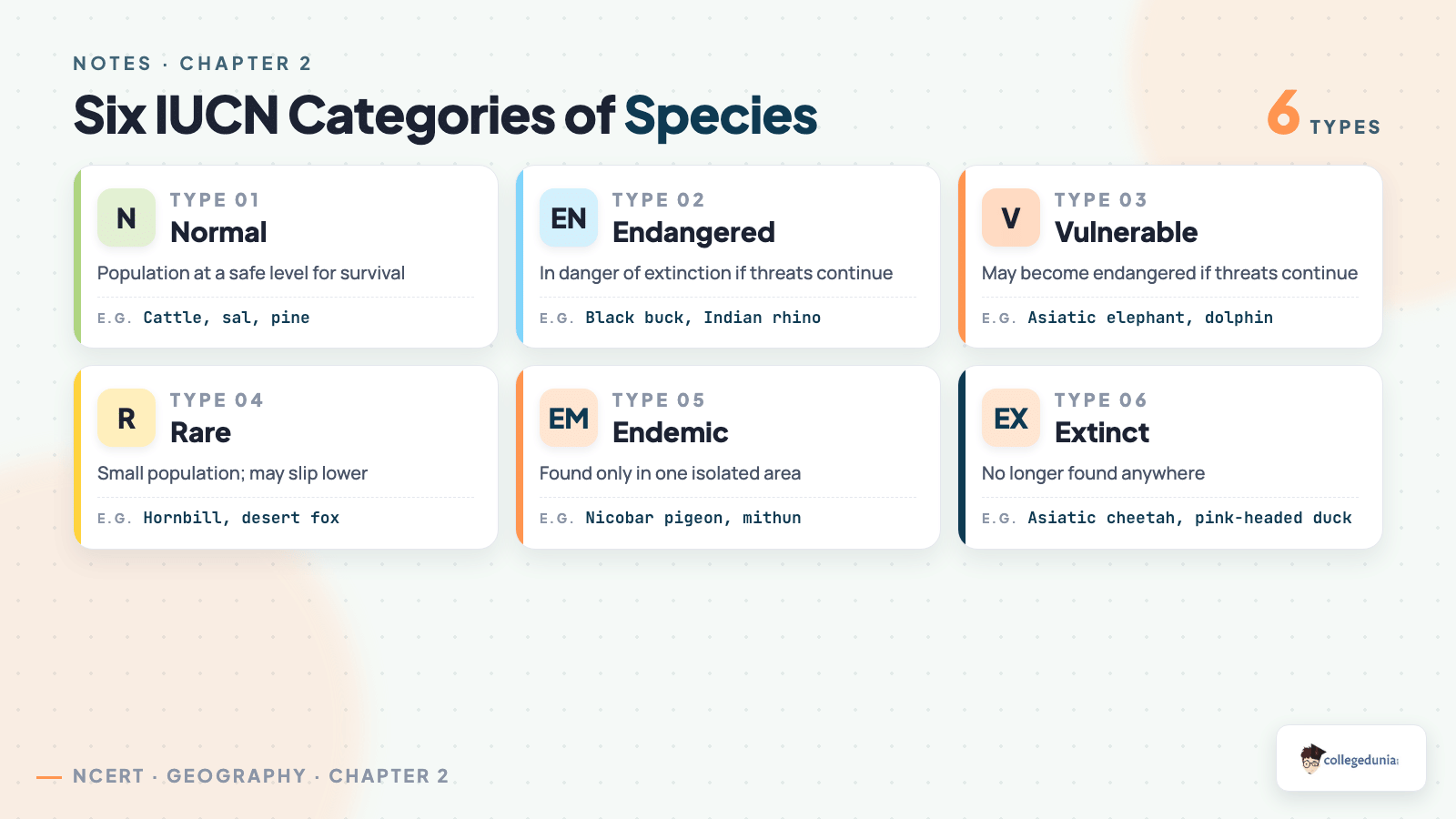
| Category | Meaning | Examples |
|---|---|---|
| Normal | Population at a safe level. | Cattle, sal, pine, rodents |
| Endangered | In danger of extinction if factors persist. | Black buck, Indian rhino, sangai |
| Vulnerable | May become endangered if threats continue. | Blue sheep, Asiatic elephant, Gangetic dolphin |
| Rare | Small population; may move into endangered or vulnerable. | Himalayan brown bear, desert fox, hornbill |
| Endemic | Found only in one isolated area, cut off by natural barriers. | Andaman teal, Nicobar pigeon, mithun |
| Extinct | No longer found anywhere, locally or worldwide. | Asiatic cheetah, pink-headed duck |
Endemic and endangered are not the same. Endemic describes where a species lives (only in one area); endangered describes how close to extinction it is. CBSE tests this as a common-mistake MCQ almost every year.
Causes of Depletion of Flora and Fauna in India (CBSE Marker Checklist)
The exam often asks students to explain how human activities caused the depletion of flora and fauna, so use the full set of causes below.
Six major causes of forest and wildlife depletion:
- Agricultural expansion: 1951 to 1980 large forest areas cleared for farming; shifting cultivation (jhum) also degraded forests.
- Large development projects: dams, roads and railways have submerged or cut through forest tracts since Independence.
- Mining: dolomite mining damaged forests like Buxa Tiger Reserve and disturbed elephant migration.
- Grazing and fuel-wood collection: heavy grazing and fuel-wood gathering degrade forests.
- Forest fires and over-extraction: fires and commercial felling strip forests of cover and species.
- Unequal resource use: over-consumption by a richer section demands far more than the rural poor.
The poor, especially women and tribal communities who depend on forests for fuel, fodder and food, suffer most. Loss of forests means loss of both biological and cultural diversity.
Conservation of Forest and Wildlife: The Wildlife Protection Act of 1972
Conservation preserves our life-support systems of water, air and soil, and keeps the genetic diversity future crops depend on. In the 1960s and 1970s conservationists demanded a national programme, answered by a landmark law.
| Provision | What it did |
|---|---|
| Protected species list | An all-India list of protected species was published for the first time. |
| Ban on hunting | Hunting of listed endangered species banned; habitats given legal protection. |
| Trade restriction | Trade in wildlife products was restricted by law. |
| Parks, sanctuaries, projects | National parks and sanctuaries set up; projects for tiger, rhinoceros, Kashmir stag, crocodiles, Asiatic lion. |
- In 1991, for the first time, plants were added to the protected list (six species).
- The modern approach protects whole ecosystems and biodiversity, not just a few large animals.
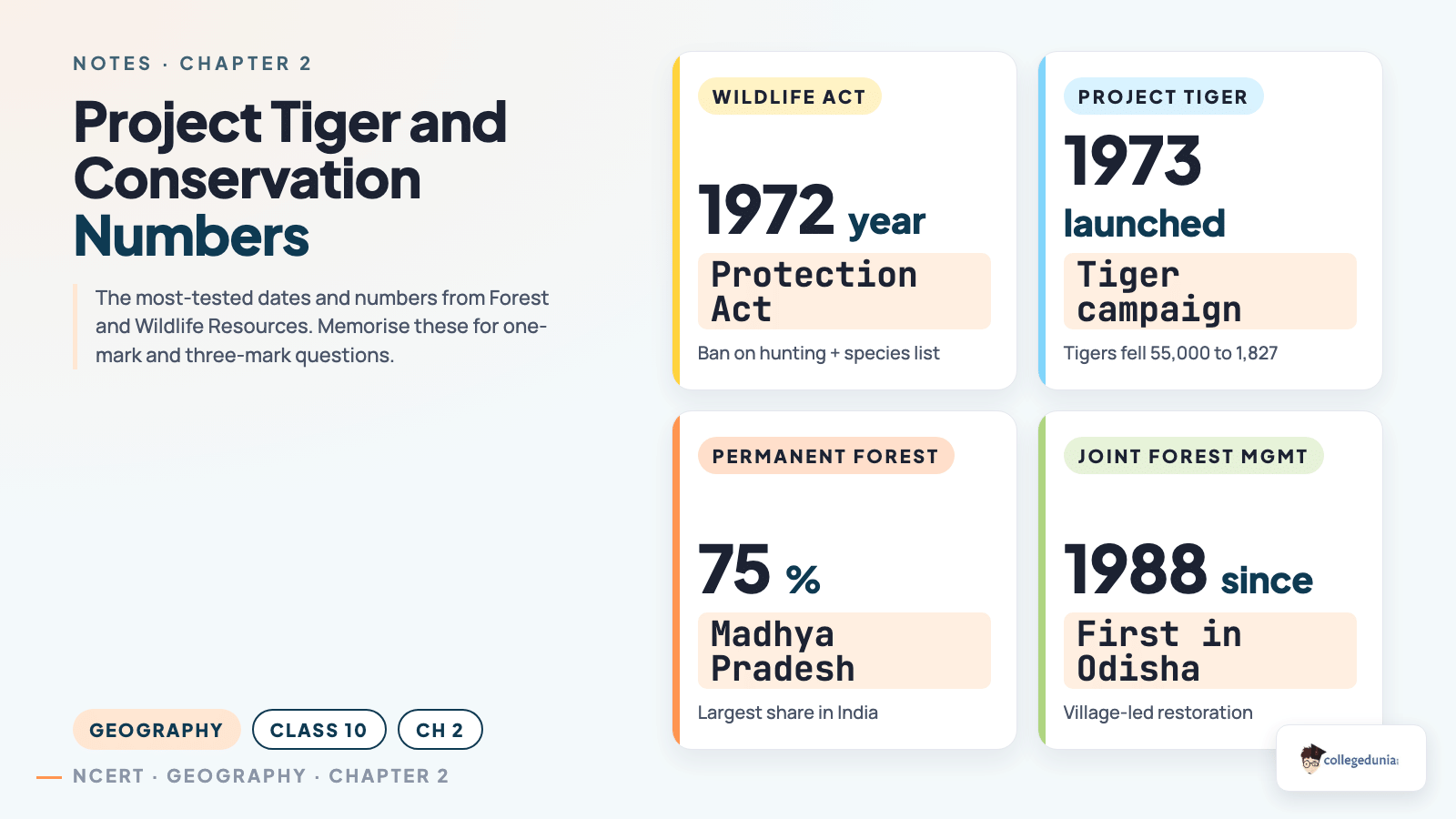
Date to memorise: 1972 is the Wildlife Protection Act and 1973 is Project Tiger.
Protected areas: a wildlife sanctuary protects one species (limited human activity), a national park protects the whole ecosystem (no human activity, stricter), and a biosphere reserve is a very large area that may contain parks and sanctuaries inside.
Project Tiger and Major Tiger Reserves of India
The tiger is a key species in the faunal web. By 1973 the population had crashed to 1,827 from an estimated 55,000 at the turn of the century, so Project Tiger was launched that year to save it from extinction.
- Threats to tigers: poaching for skins and bones, habitat loss, a smaller prey base and use of bones in traditional medicines.
- Significance: India and Nepal hold about two-thirds of the surviving tiger population.
- Goal: not just to save one species but to preserve habitats of sizeable magnitude.
Important tiger reserves: Corbett (Uttarakhand), Sunderbans (West Bengal), Bandhavgarh (Madhya Pradesh), Sariska (Rajasthan), Manas (Assam), Periyar (Kerala).
Types of Forests in India: Reserved, Protected and Unclassed (RPU)
Based on ownership and degree of protection, forests are sorted into three types. The mnemonic RPU runs from most to least legally protected.
| Type of Forest | Meaning | Number Hook |
|---|---|---|
| Reserved Forests | Most valuable for conservation; the most strictly protected category. | More than half of total forest land |
| Protected Forests | Declared by the Forest Department; protected from further depletion. | About one-third of forest area |
| Unclassed Forests | Other forests and wastelands owned by government, private individuals and communities. | High share in north-eastern states |
- Reserved and protected forests together are called permanent forest estates.
- Madhya Pradesh has the largest area under permanent forests, 75 per cent of its total forest area.
- North-eastern states and parts of Gujarat have a high share of unclassed forests managed by local communities.
Community and Conservation: Chipko, Sacred Groves and Joint Forest Management
Conservation is not only a government job. Local communities protect forests and wildlife to secure their own livelihood. This is a favourite for 5-mark questions, so learn the named examples.
| Example | What the community did |
|---|---|
| Sariska Tiger Reserve, Rajasthan | Villagers fought mining by citing the Wildlife Protection Act. |
| Bhairodev Dakav Sonchuri, Alwar | Five villages declared 1,200 hectares a protected area with no-hunting rules. |
| Chipko Movement, Himalayas | Resisted deforestation; proved afforestation with indigenous species works. |
| Beej Bachao Andolan, Navdanya | Showed diversified crops without synthetic chemicals are viable. |
JFM and Sacred Groves
The Joint Forest Management programme involves communities in restoring degraded forests; it has existed since 1988 (Odisha's first resolution), and members get non-timber produce and a timber share. Sacred groves are virgin forests preserved by tribal nature worship, where interference is banned.
- The Mundas and Santhal worship mahua and kadamba trees; peepal and banyan are widely sacred. In Bishnoi villages (Rajasthan), blackbuck, nilgai and peacocks are protected.
Common mistake: the strategy that does not directly involve communities is the demarcation of wildlife sanctuaries (a government act). Chipko, Beej Bachao Andolan and JFM all involve communities.
CBSE Previous Year Trends and Highest-Yield Topics
This chapter is a steady source of marks in the Social Science paper. Prioritise these in the 2026-27 cycle:
- Highest-yield topics: IUCN categories (easy 3 marks), causes of depletion (3 to 5 marks) and community conservation (5 marks).
- Must-know dates: 1972 (Wildlife Protection Act), 1973 (Project Tiger), 1988 (JFM) and 1991 (plants added).
- Must-know numbers: tigers fell from 55,000 to 1,827; Madhya Pradesh has 75 per cent permanent forest; the Bhairodev Sonchuri covers 1,200 hectares.
Other Resources for Class 10 Geography Chapter 2 Forest and Wildlife Resources
Pair these revision notes with the matching NCERT Solutions, handwritten notes and the official NCERT book chapter. The cross-resource table below links to every Collegedunia file for Class 10 Geography Chapter 2.
| Resource | What it covers | Open |
|---|---|---|
| Notes | Concept-first revision notes covering biodiversity, IUCN categories, causes of depletion, conservation laws, Project Tiger and community conservation. | You are here |
| NCERT Solutions | Step-by-step answers to every exercise question, including the 5-mark answers with full detail. | Class 10 Geography Chapter 2 NCERT Solutions |
| Handwritten Notes | Scanned-style handwritten revision pages for last-minute board exam practice. | Class 10 Geography Chapter 2 Handwritten Notes |
| NCERT Book PDF | Official NCERT Contemporary India II Chapter 2 textbook in PDF form. | Class 10 Geography Chapter 2 NCERT Book PDF |
All Chapters Notes for Class 10 Geography Contemporary India II
Related Links: Use the table below to reach the Notes for the other chapters of Class 10 Geography Contemporary India II. Every chapter ships with the same revision-friendly structure, key definitions and FAQ block.
| Chapter | Topic | Notes link |
|---|---|---|
| Chapter 1 | Resources and Development | Class 10 Geography Chapter 1 Notes |
| Chapter 2 | Forest and Wildlife Resources | You are here |
| Chapter 3 | Water Resources | Class 10 Geography Chapter 3 Notes |
| Chapter 4 | Agriculture | Class 10 Geography Chapter 4 Notes |
| Chapter 5 | Minerals and Energy Resources | Class 10 Geography Chapter 5 Notes |
| Chapter 6 | Manufacturing Industries | Class 10 Geography Chapter 6 Notes |
| Chapter 7 | Lifelines of National Economy | Class 10 Geography Chapter 7 Notes |
NCERT Notes Class 10 Geography Chapter 2 Forest and Wildlife Resources FAQs
Ques. What do the forest and wildlife resources class 10 notes cover?
Ans. The forest and wildlife resources class 10 notes are a concept-first revision file that compress the entire NCERT Chapter 2 of Class 10 Geography Contemporary India II into a printable study guide. They cover biodiversity and why India is rich in flora and fauna, the six IUCN species categories, the causes of forest and wildlife depletion, the Wildlife Protection Act of 1972, Project Tiger, the Reserved-Protected-Unclassed forest types and community conservation through Chipko, Joint Forest Management and sacred groves. Students typically use these notes for a 30-minute first-pass revision and a 20-minute night-before pass; the worked answers to the NCERT exercise questions live in the matching NCERT Solutions PDF.
Ques. What are the six IUCN categories of species in Class 10 Geography?
Ans. The six IUCN categories are normal, endangered, vulnerable, rare, endemic and extinct species. Normal species have populations at a safe level, such as cattle, sal and pine. Endangered species are in danger of extinction, such as the black buck and the Indian rhino. Vulnerable species may become endangered if threats continue, such as the Asiatic elephant. Rare species have small populations, such as the hornbill. Endemic species are found only in one isolated area, such as the Nicobar pigeon and the mithun. Extinct species are no longer found anywhere, such as the Asiatic cheetah and the pink-headed duck.
Ques. What is the difference between endemic and endangered species?
Ans. Endemic and endangered are different ideas, and CBSE tests the distinction every year. Endemic describes where a species lives: an endemic species is found only in one isolated area, cut off by natural or geographical barriers, such as the mithun in Arunachal Pradesh. Endangered describes how close to extinction a species is: an endangered species is in danger of disappearing if the negative factors continue, such as the black buck. A species can be endemic without being endangered, and a species can be endangered without being endemic. Students should never use the two words as if they mean the same thing.
Ques. Why were the Wildlife Protection Act of 1972 and Project Tiger introduced?
Ans. The Indian Wildlife Protection Act was implemented in 1972 after conservationists demanded a national wildlife programme in the 1960s and 1970s. It published an all-India list of protected species, banned the hunting of endangered species, restricted trade in wildlife and set up national parks and sanctuaries. Project Tiger was launched in 1973 because the tiger population had crashed from about 55,000 at the turn of the century to just 1,827. Its goal was not only to save the tiger but also to preserve large habitats. India and Nepal together hold about two-thirds of the world's surviving tigers, which makes them important conservation sites.
Ques. What are the three types of forests in Class 10 Geography?
Ans. India's forests are sorted into three types based on ownership and protection, easy to remember as RPU. Reserved forests make up more than half of the total forest land and are the most valuable for conservation, with the strictest protection. Protected forests make up about one-third of the forest area and are protected from any further depletion. Unclassed forests are the other forests and wastelands owned by the government, private individuals and communities. Reserved and protected forests together are called permanent forest estates. Madhya Pradesh has the largest share of permanent forests, at 75 per cent of its total forest area.
Ques. How have communities helped conserve forests and wildlife in India?
Ans. Several community movements show conservation led by ordinary people. In the Sariska Tiger Reserve, villagers fought against mining by citing the Wildlife Protection Act. In Alwar, five villages declared 1,200 hectares as the Bhairodev Dakav Sonchuri with their own no-hunting rules. The Chipko Movement in the Himalayas resisted deforestation and proved that afforestation with indigenous species can succeed. The Joint Forest Management programme, in formal existence since 1988 after Odisha's first resolution, involves village institutions in restoring degraded forests. Sacred groves and the Bishnoi tradition of protecting blackbuck, nilgai and peacocks show conservation rooted in culture and faith.
Ques. Are these forest and wildlife resources class 10 notes updated for the 2026-27 session?
Ans. Yes. These forest and wildlife resources class 10 notes are based on the 2026-27 NCERT Contemporary India II textbook and the latest CBSE Class 10 Social Science sample paper. The chapter structure is unchanged for the current cycle, and the CBSE marking scheme continues to reward well-organised answers with clear cause-and-effect links for the 5-mark questions. Students should use these notes for both the short-answer and long-answer parts of the chapter, then move to the matching NCERT Solutions PDF for full worked answers.



Comments