


These minerals and energy resources class 10 notes compress the whole of NCERT Chapter 5 of Geography (Contemporary India II) into one printable revision sheet: what a mineral and an ore are, the five modes of occurrence, ferrous and non-ferrous minerals, non-metallic and rock minerals, the conservation of minerals, and every conventional and non-conventional energy resource with its India distribution.
Chapter5MineralsandEnergyResourcesNotes.pdf?page=1&dpi=150)
Chapter5MineralsandEnergyResourcesNotes.pdf?page=2&dpi=150)
Chapter5MineralsandEnergyResourcesNotes.pdf?page=3&dpi=150)
Chapter5MineralsandEnergyResourcesNotes.pdf?page=4&dpi=150)
Chapter5MineralsandEnergyResourcesNotes.pdf?page=5&dpi=150)
Chapter5MineralsandEnergyResourcesNotes.pdf?page=6&dpi=150)
Chapter5MineralsandEnergyResourcesNotes.pdf?page=7&dpi=150)
Chapter5MineralsandEnergyResourcesNotes.pdf?page=8&dpi=150)
Chapter5MineralsandEnergyResourcesNotes.pdf?page=9&dpi=150)
Chapter5MineralsandEnergyResourcesNotes.pdf?page=10&dpi=150)
Chapter5MineralsandEnergyResourcesNotes.pdf?page=11&dpi=150)
Chapter5MineralsandEnergyResourcesNotes.pdf?page=12&dpi=150)
Chapter5MineralsandEnergyResourcesNotes.pdf?page=13&dpi=150)
Chapter5MineralsandEnergyResourcesNotes.pdf?page=14&dpi=150)
Chapter5MineralsandEnergyResourcesNotes.pdf?page=15&dpi=150)
Chapter5MineralsandEnergyResourcesNotes.pdf?page=16&dpi=150)
Chapter5MineralsandEnergyResourcesNotes.pdf?page=17&dpi=150)
Chapter5MineralsandEnergyResourcesNotes.pdf?page=18&dpi=150)
Chapter5MineralsandEnergyResourcesNotes.pdf?page=19&dpi=150)
Chapter5MineralsandEnergyResourcesNotes.pdf?page=20&dpi=150)
Chapter5MineralsandEnergyResourcesNotes.pdf?page=21&dpi=150)
The file is built to carry a Class 10 student from a cold start back to chapter-fluency in about thirty minutes the night before the board exam, according to the latest 2026-27 CBSE syllabus.
- Concept-first revision for the full chapter: minerals, modes of occurrence, ferrous and non-ferrous minerals, mica, limestone, conservation, and conventional plus non-conventional energy.
- Every mineral and energy source linked to its mode of occurrence, leading states and export ports, with the exact one-line facts CBSE markers reward, including the Bailadila, Kudremukh and Mumbai High map points.
- Cross-pointers to the matching NCERT Solutions, Handwritten Notes and NCERT Book PDF for Class 10 Geography Chapter 5 Minerals and Energy Resources.
Every line in these minerals and energy resources class 10 notes is written by Collegedunia geography experts, based on the 2026-27 NCERT Contemporary India II textbook, and checked against the last five years of CBSE Class 10 Social Science board papers.
Student Feedback: What 11,900 students told us about revising this chapter
74% of Class 10 students said matching each mineral and energy source to its correct state and export port was the single most-confused area when they sat down to revise this chapter. 3 out of 4 students rated the modes of occurrence and the conventional versus non-conventional energy section as the parts most worth revising from a printable notes sheet.
Toppers reported that pairing these minerals and energy resources class 10 notes with the matching NCERT Solutions PDF added 2 to 3 marks per 5-mark answer in mock tests. The average student finished the full notes revision in 30 minutes against a one-hour budget for the chapter.
Source: 2026-27 Class 10 Social Science student poll. Sample of 11,900 students from CBSE schools across 15 states, conducted before the 2026 boards.
Quick Concept Recap: Minerals and Energy Resources at a Glance
Chapter 5 explains how almost everything we use is made from minerals, and how India is powered by energy resources drawn from the earth. This recap fixes the chapter in one screen.
- Mineral vs ore: a mineral is a homogeneous natural substance; an ore is a deposit rich enough to be mined profitably.
- Five modes of occurrence: veins and lodes, beds and layers, residual masses (bauxite), placer deposits, ocean waters.
- Mineral classes: metallic (ferrous, non-ferrous, precious), non-metallic (mica, limestone), energy minerals (coal, petroleum, gas).
- Energy: conventional (coal, petroleum, gas, hydel, thermal) and non-conventional (nuclear, solar, wind, tidal, geothermal, biogas).
Read these notes first, then use the matching NCERT Solutions for Class 10 Geography Chapter 5.
Minerals and Energy Resources Class 10 Explained in Simple Language
Source: Magnet Brains on YouTube
What is a Mineral, an Ore and the Five Modes of Occurrence
A mineral is a homogeneous, naturally occurring substance, ranging from diamond (hardest) to talc (softest). An ore is a mineral in a concentration high enough to be mined profitably. The mode of occurrence decides how cheaply a mineral can be mined.
| Mode of Occurrence | Key Feature | Example Minerals |
|---|---|---|
| Veins and Lodes | In cracks, faults and joints of igneous and metamorphic rocks; small are veins, large are lodes. | Tin, copper, zinc, lead |
| Beds and Layers | In sedimentary rocks formed by deposition and concentration in horizontal strata. | Coal, iron ore, gypsum (by evaporation) |
| Residual Mass | By decomposition of surface rocks; soluble parts are removed, leaving weathered ore. | Bauxite |
| Placer Deposits | Alluvial deposits in valley-floor sands and hill bases, not corroded by water. | Gold, silver, tin, platinum |
| Ocean Waters | Minerals derived from sea water; ocean beds rich in nodules. | Common salt, magnesium, bromine, manganese nodules |
- Bauxite is the classic residual mineral; gold and platinum are classic placer minerals.
- India's minerals are unevenly spread: peninsular rocks hold coal and metallic minerals, Gujarat and Assam hold petroleum, and the alluvial plains are almost devoid of economic minerals.
Classification of Minerals: Metallic, Non-Metallic and Energy Minerals
Minerals are classified as metallic, non-metallic and energy minerals; metallic minerals split further into ferrous, non-ferrous and precious. Memorise the flowchart below (NCERT Fig 5.1).
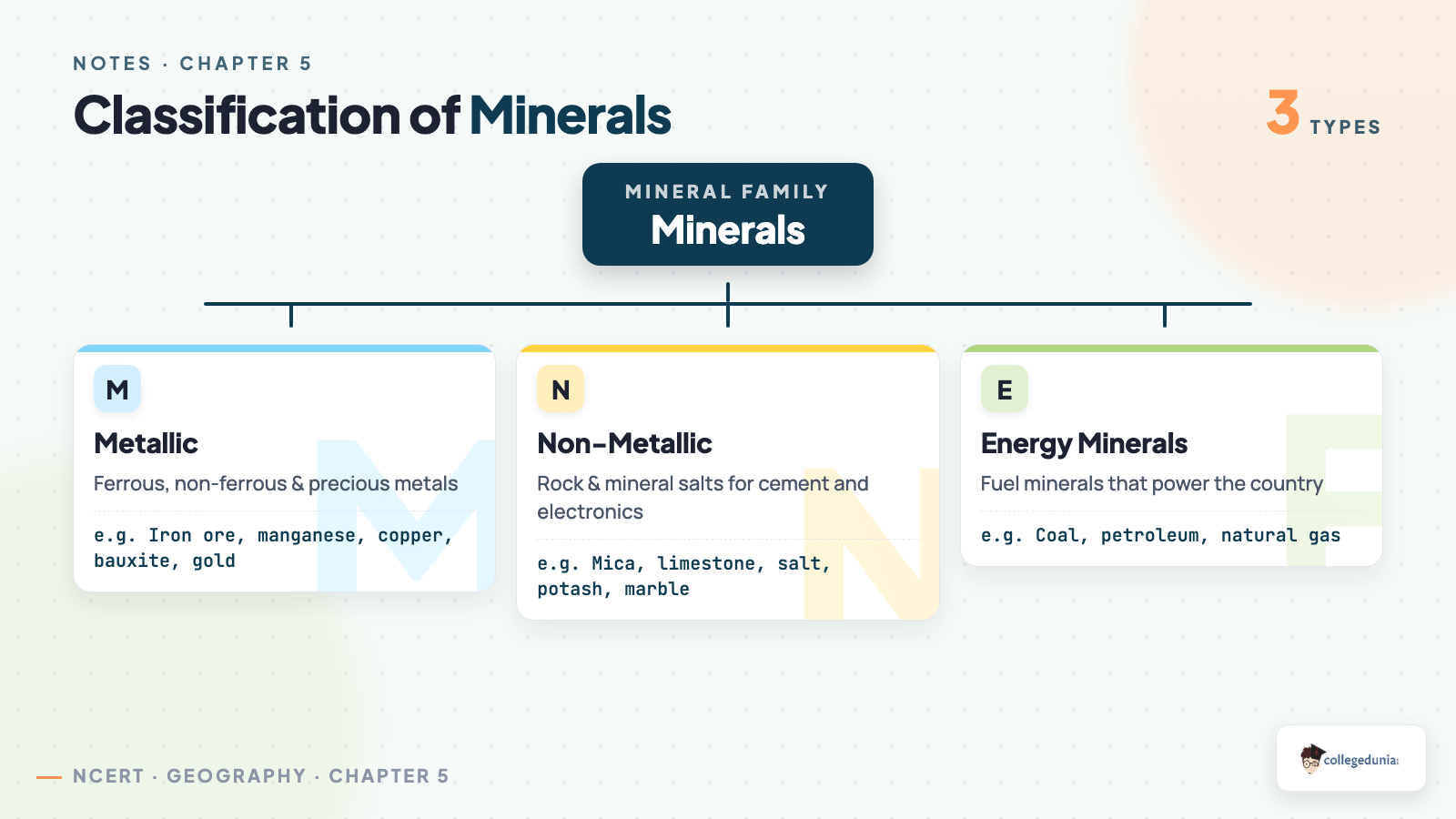
| Class | Sub-class | Examples |
|---|---|---|
| Metallic | Ferrous (contain iron) | Iron ore, manganese, nickel, cobalt |
| Non-Ferrous | Copper, lead, tin, bauxite, zinc | |
| Precious | Gold, silver, platinum | |
| Non-Metallic | Rock and mineral salts | Mica, salt, potash, sulphur, granite, limestone, marble, sandstone |
| Energy Minerals | Fuel minerals | Coal, petroleum, natural gas |
- Ferrous minerals contain iron and account for about three-fourths of the value of metallic-mineral production.
- Non-ferrous minerals (copper, bauxite, lead, zinc) do not contain iron; India's reserves are not very satisfactory.
Ferrous Minerals: Iron Ore Belts and Manganese
For iron ore the board expects the two types (magnetite and hematite), the four iron-ore belts and the export port tied to each belt.
| Iron-Ore Belt | Key Mines / Quality | Export Port |
|---|---|---|
| Odisha-Jharkhand | High-grade hematite at Badampahar (Mayurbhanj, Kendujhar) and Gua, Noamundi (Singhbhum). | Local steel plants |
| Durg-Bastar-Chandrapur | Very high-grade hematite in the famous Bailadila range; best physical properties for steel-making. | Vishakhapatnam (to Japan, South Korea) |
| Ballari-Chitradurga-Tumakuru | Kudremukh mines, a 100 per cent export unit and one of the largest deposits in the world. | Mangaluru (Panambur) |
| Maharashtra-Goa | Ore not of very high quality but efficiently exploited in Goa and Ratnagiri. | Marmagao (Goa) |
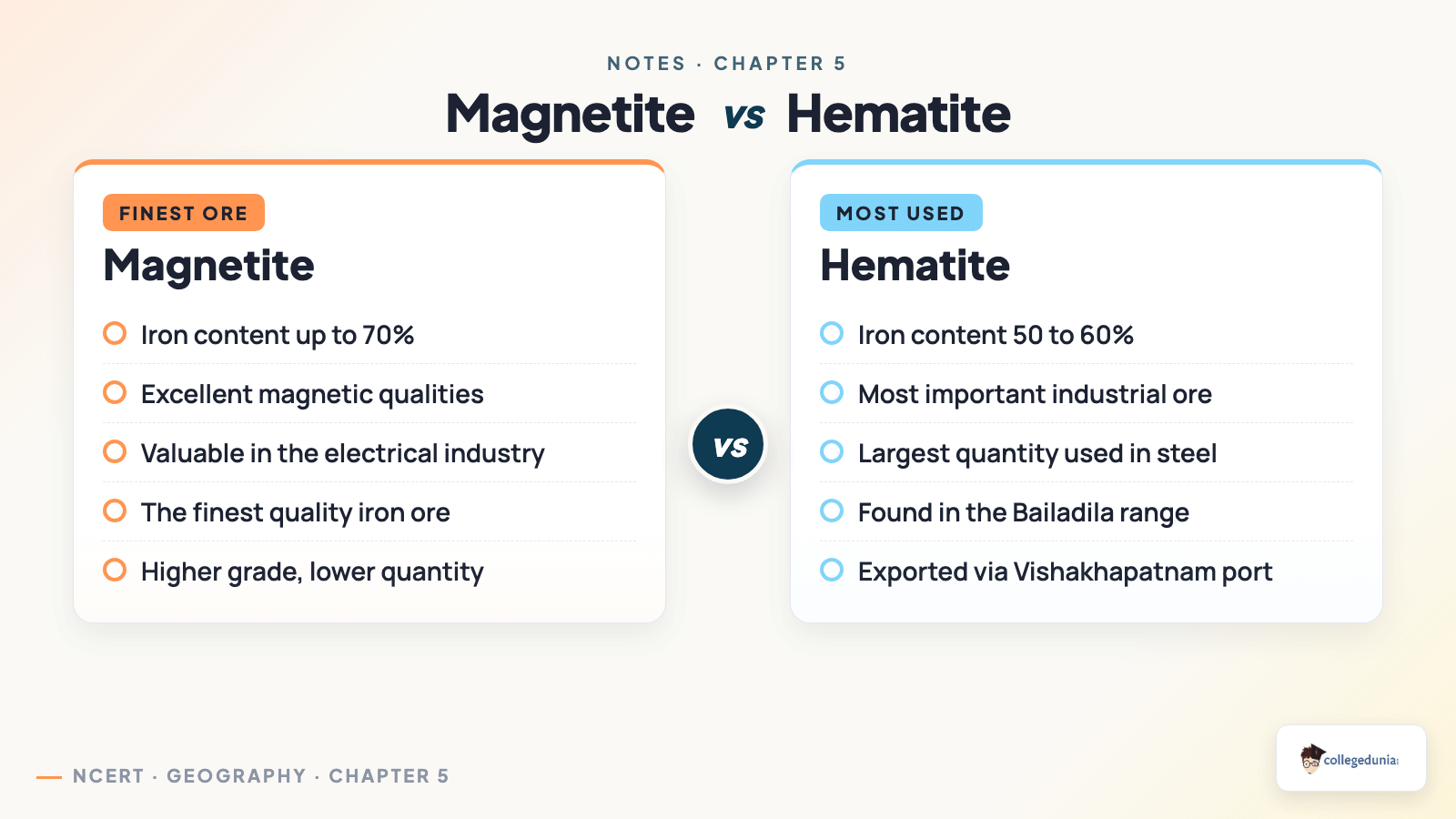
- Magnetite is the finest iron ore with iron content up to 70 per cent and excellent magnetic qualities; hematite is the most important industrial ore but has 50 to 60 per cent iron.
- In 2018-19, 97 per cent of iron-ore production came from four states: Odisha, Chhattisgarh, Karnataka and Jharkhand.
- Manganese is mainly used to make steel (10 kg per tonne of steel); Madhya Pradesh and Maharashtra supply around 60 per cent of output.
Magnetite is the finest ore (up to 70 per cent iron); hematite is the most-used industrial ore despite lower iron (50 to 60 per cent). Memorise the belt-and-port pairs: Bailadila with Vishakhapatnam, Kudremukh with Mangaluru, Goa with Marmagao.
Non-Ferrous, Non-Metallic and Rock Minerals: Copper, Bauxite, Mica and Limestone
Beyond iron, India relies on copper, bauxite, mica and limestone, which power the electrical, cement and engineering industries. Their leading states are favourite board questions.
| Mineral | Use / Note | Leading Areas |
|---|---|---|
| Copper | Malleable, ductile, good conductor; used in electrical cables and electronics; India is critically deficient. | Balaghat (MP), Khetri (Rajasthan), Singhbhum (Jharkhand) |
| Bauxite | Ore from which alumina then aluminium is obtained; formed by decomposition of aluminium-rich rocks. | Odisha (about 65 per cent), Panchpatmali (Koraput), Amarkantak plateau |
| Mica | Splits into thin sheets; excellent di-electric strength and insulation for electronics. | Koderma-Gaya-Hazaribagh (Jharkhand), Ajmer (Rajasthan), Nellore (AP) |
| Limestone | Basic raw material for the cement industry; essential for smelting iron ore in the blast furnace. | Rajasthan, Andhra Pradesh, Madhya Pradesh, Chhattisgarh |
- Copper mines recall as "B-K-S": Balaghat, Khetri, Singhbhum; Khetri (Rajasthan) is the famous one-mark answer.
- Odisha was the largest bauxite producer in 2018-19; the Panchpatmali deposits in Koraput are the most important. Note "bauxite to alumina to aluminium": aluminium is not mined directly.
Why We Must Conserve Minerals
Workable deposits are about 1 per cent of the earth's crust and are finite and non-renewable. We conserve them by planned use, improving technology to use low-grade ores, recycling scrap metals, and finding substitutes.
Conventional Energy Resources: Coal, Petroleum, Natural Gas and Electricity
Conventional sources - firewood, cattle dung cake, coal, petroleum, natural gas and electricity - supply most of India's commercial energy. This is the high-mark portion, often a 5-mark distribution question.
The conventional energy resources you must know:
- Coal: grades by increasing carbon are peat, lignite, bituminous, anthracite. Gondwana coal (metallurgical) lies in the Damodar valley (Jharia, Raniganj, Bokaro); Tertiary coal in the north-east.
- Petroleum: major fields are Mumbai High, Gujarat (Ankleshwar) and Assam (Digboi, the oldest).
- Natural gas: at Mumbai High, Cambay and Krishna-Godavari basins, carried by the 1,700 km HVJ pipeline.
Hydel vs Thermal Electricity
Per-capita electricity consumption is an index of development. Hydel electricity uses fast-flowing water and is renewable (Bhakra Nangal, Damodar Valley Corporation). Thermal electricity burns coal, petroleum and natural gas, so it uses non-renewable fossil fuels; do not call it renewable. Coal is a bulky, weight-losing material, so heavy industries sit on or near coalfields to cut transport cost, a favourite "give a reason" question.
Non-Conventional Energy Resources and Energy Conservation
Rising prices, shortages and pollution from fossil fuels created a need for renewable energy. India is rich in sunlight, water, wind and biomass. The six non-conventional sources below are reliable 3 to 5 mark answers.
| Source | How it Works | India's Key Sites |
|---|---|---|
| Nuclear / Atomic | Energy released by altering the structure of atoms; uses uranium and thorium. | Monazite sands of Kerala (thorium); Aravalli ranges of Rajasthan |
| Solar | Photovoltaic technology converts sunlight directly into electricity. | Tropical India; rural and remote areas |
| Wind | Wind turbines harness moving air to generate power. | Nagarcoil to Madurai (Tamil Nadu), Jaisalmer (Rajasthan) |
| Tidal | Floodgate dams across inlets trap tidal water to spin turbines. | Gulf of Khambhat, Gulf of Kachchh, Gangetic Sunderban delta |
| Geothermal | Groundwater heated by hot rocks rises as steam to drive turbines. | Parvati valley near Manikaran (HP), Puga Valley (Ladakh) |
| Biogas | Decomposed shrubs, farm and animal waste; "Gobar gas plants" give gas plus manure. | Rural areas across India |
- Nuclear energy uses uranium and thorium; the Monazite sands of Kerala are rich in thorium. Six stations: Narora, Rawatbhata, Kakrapar, Tarapur, Kaiga, Kalpakkam.
- Solar energy has a bright future since India is tropical with abundant sunlight.
- A Gobar gas plant gives clean biogas plus nutrient-rich slurry as manure.
Memorise: the six sources are nuclear, solar, wind, tidal, geothermal and biogas.
CBSE Previous Year Trends, Map Work and Highest-Yield Topics
This chapter is a steady source of marks, including a compulsory map-work question.
- Highest-yield: coal distribution (5 marks), modes of occurrence and conservation (3 to 5 marks each).
- Map-work: mark Bailadila, Kudremukh, Mayurbhanj (iron ore), Jharia, Raniganj, Bokaro (coal), Mumbai High, Ankleshwar (oil) and the six nuclear plants.
Other Resources for Class 10 Geography Chapter 5 Minerals and Energy Resources
Pair these revision notes with the matching NCERT Solutions, handwritten notes and the official NCERT book chapter. The cross-resource table below links to every Collegedunia file for Class 10 Geography Chapter 5.
| Resource | What it covers | Open |
|---|---|---|
| Notes | Concept-first revision notes covering minerals, modes of occurrence, ferrous and non-ferrous minerals, conservation and energy resources. | You are here |
| NCERT Solutions | Step-by-step answers to every exercise question, including the 5-mark answers with full detail. | Class 10 Geography Chapter 5 NCERT Solutions |
| Handwritten Notes | Scanned-style handwritten revision pages for last-minute board exam practice. | Class 10 Geography Chapter 5 Handwritten Notes |
| NCERT Book PDF | Official NCERT Contemporary India II Chapter 5 textbook in PDF form. | Class 10 Geography Chapter 5 NCERT Book PDF |
All Chapters Notes for Class 10 Geography Contemporary India II
Related Links: Use the table below to reach the Notes for the other chapters of Class 10 Geography Contemporary India II. Every chapter ships with the same revision-friendly structure, key definitions and FAQ block.
| Chapter | Topic | Notes link |
|---|---|---|
| Chapter 1 | Resources and Development | Class 10 Geography Chapter 1 Notes |
| Chapter 2 | Forest and Wildlife Resources | Class 10 Geography Chapter 2 Notes |
| Chapter 3 | Water Resources | Class 10 Geography Chapter 3 Notes |
| Chapter 4 | Agriculture | Class 10 Geography Chapter 4 Notes |
| Chapter 5 | Minerals and Energy Resources | You are here |
| Chapter 6 | Manufacturing Industries | Class 10 Geography Chapter 6 Notes |
| Chapter 7 | Lifelines of National Economy | Class 10 Geography Chapter 7 Notes |
NCERT Notes Class 10 Geography Chapter 5 Minerals and Energy Resources FAQs
Ques. What do the minerals and energy resources class 10 notes cover?
Ans. The minerals and energy resources class 10 notes are a concept-first revision file that compress the entire NCERT Chapter 5 of Class 10 Geography Contemporary India II into a printable study guide. They cover what a mineral and an ore are, the five modes of occurrence (veins and lodes, beds and layers, residual masses, placer deposits and ocean waters), the classification of minerals into metallic, non-metallic and energy minerals, the iron-ore belts and their export ports, copper, bauxite, mica and limestone, the conservation of minerals, and all the conventional and non-conventional energy resources. Students typically use these notes for a 30-minute first-pass revision and a 20-minute night-before pass; the worked answers to the NCERT exercise questions live in the matching NCERT Solutions PDF.
Ques. What is the difference between a mineral and an ore in Class 10 Geography?
Ans. A mineral is a homogeneous, naturally occurring substance with a definable internal structure, ranging from the hardest substance, diamond, to the softest, talc. An ore is an accumulation of any mineral mixed with other elements, in which the mineral content is concentrated enough to make extraction commercially viable. In short, the mineral is the pure substance found in nature, while the ore is the rock or deposit from which that mineral can be profitably extracted. For example, bauxite is the ore from which the metal aluminium is obtained, so aluminium itself is a metal, not a mineral that is mined directly.
Ques. What are the five modes of occurrence of minerals?
Ans. Minerals occur in five broad modes. First, in cracks, faults and joints of igneous and metamorphic rocks as veins (small) and lodes (large), which yield tin, copper, zinc and lead. Second, in beds and layers of sedimentary rocks formed by deposition, such as coal, iron ore and, by evaporation, gypsum and rock salt. Third, as a residual mass left by the decomposition of surface rocks, which is how bauxite forms. Fourth, as alluvial or placer deposits in the sands of valley floors and hill bases, such as gold, silver and platinum. Fifth, in ocean waters, which supply common salt, magnesium and bromine, while ocean beds are rich in manganese nodules.
Ques. What is the difference between magnetite and hematite iron ore?
Ans. Magnetite and hematite are the two main iron ores used in industry. Magnetite is the finest iron ore, with a very high iron content of up to 70 per cent, and has excellent magnetic qualities that make it valuable in the electrical industry. Hematite is the most important industrial iron ore in terms of the quantity used, but it has a slightly lower iron content of 50 to 60 per cent. India's four main iron-ore belts are the Odisha-Jharkhand belt, the Durg-Bastar-Chandrapur belt (with the famous Bailadila range), the Ballari-Chitradurga-Tumakuru belt (with the Kudremukh mines) and the Maharashtra-Goa belt. Ore is exported through Vishakhapatnam, Mangaluru and Marmagao ports.
Ques. What is the difference between conventional and non-conventional energy resources?
Ans. Conventional sources of energy include firewood, cattle dung cake, coal, petroleum, natural gas and electricity; most of them are non-renewable (except hydel electricity) and cause pollution. Non-conventional sources include nuclear, solar, wind, tidal, geothermal and biogas energy; they are largely renewable, clean and environment-friendly. Conventional sources are well established but depleting, whereas non-conventional sources are abundant but depend on improving technology. India runs one of the largest programmes in the world for developing renewable resources, because rising oil and gas prices and the environmental problems of fossil fuels have made a shift to clean energy urgent.
Ques. Why does coal occur in two geological ages in India?
Ans. Coal in India occurs in two main geological ages. Gondwana coal, a little over 200 million years old, is metallurgical coal located mainly in the Damodar valley along the West Bengal and Jharkhand border, with Jharia, Raniganj and Bokaro as major coalfields; the Godavari, Mahanadi, Son and Wardha valleys also have deposits. Tertiary coal, about 55 million years old, is found in the north-eastern states of Meghalaya, Assam, Arunachal Pradesh and Nagaland. Because coal is a bulky material that loses weight on burning, heavy industries and thermal power stations are usually located on or near the coalfields to cut transport cost. This location logic is a favourite "give a reason" board question.
Ques. Are these minerals and energy resources class 10 notes updated for the 2026-27 session?
Ans. Yes. These minerals and energy resources class 10 notes are based on the 2026-27 NCERT Contemporary India II textbook and the latest CBSE Class 10 Social Science sample paper. The chapter structure is unchanged for the current cycle, and the CBSE marking scheme continues to reward well-organised answers with clear cause-and-effect links for the 5-mark questions on coal distribution and the bright future of solar energy. The compulsory map item still asks students to locate iron-ore mines, coalfields, oil fields and nuclear power stations, so students should use these notes for both the map work and the long-answer parts of the chapter, then move to the matching NCERT Solutions PDF for full worked answers.



Comments