


These class 10 manufacturing industries notes compress NCERT Chapter 6 of Geography (Contemporary India II) into one printable revision sheet: what manufacturing is, why it is the backbone of development, industrial location factors, the classification of industries, the agro-based and mineral-based industries, and industrial pollution with the NTPC control case study.
Chapter6ManufacturingIndustriesNotes.pdf?page=1&dpi=150)
Chapter6ManufacturingIndustriesNotes.pdf?page=2&dpi=150)
Chapter6ManufacturingIndustriesNotes.pdf?page=3&dpi=150)
Chapter6ManufacturingIndustriesNotes.pdf?page=4&dpi=150)
Chapter6ManufacturingIndustriesNotes.pdf?page=5&dpi=150)
Chapter6ManufacturingIndustriesNotes.pdf?page=6&dpi=150)
Chapter6ManufacturingIndustriesNotes.pdf?page=7&dpi=150)
Chapter6ManufacturingIndustriesNotes.pdf?page=8&dpi=150)
Chapter6ManufacturingIndustriesNotes.pdf?page=9&dpi=150)
Chapter6ManufacturingIndustriesNotes.pdf?page=10&dpi=150)
Chapter6ManufacturingIndustriesNotes.pdf?page=11&dpi=150)
Chapter6ManufacturingIndustriesNotes.pdf?page=12&dpi=150)
Chapter6ManufacturingIndustriesNotes.pdf?page=13&dpi=150)
Chapter6ManufacturingIndustriesNotes.pdf?page=14&dpi=150)
Chapter6ManufacturingIndustriesNotes.pdf?page=15&dpi=150)
Chapter6ManufacturingIndustriesNotes.pdf?page=16&dpi=150)
Chapter6ManufacturingIndustriesNotes.pdf?page=17&dpi=150)
Chapter6ManufacturingIndustriesNotes.pdf?page=18&dpi=150)
Chapter6ManufacturingIndustriesNotes.pdf?page=19&dpi=150)
Chapter6ManufacturingIndustriesNotes.pdf?page=20&dpi=150)
Chapter6ManufacturingIndustriesNotes.pdf?page=21&dpi=150)
Chapter6ManufacturingIndustriesNotes.pdf?page=22&dpi=150)
Chapter6ManufacturingIndustriesNotes.pdf?page=23&dpi=150)
They take a student back to chapter-fluency in about thirty minutes, as per the 2026-27 CBSE syllabus.
- Concept-first revision for the full chapter: importance of manufacturing, location factors, classification, agro-based and mineral-based industries, and pollution control.
- Every industry linked to its raw material, key location factors and leading states, with the exact one-line facts CBSE markers reward, including the 4:2:1 steel ratio and the NTPC case study.
- Cross-pointers to the matching NCERT Solutions, Handwritten Notes and NCERT Book PDF for Class 10 Geography Chapter 6 Manufacturing Industries.

Every line in these class 10 manufacturing industries notes is written by Collegedunia geography experts, based on the 2026-27 NCERT Contemporary India II textbook, and checked against the last five years of CBSE Class 10 Social Science board papers.
Student Feedback: What 12,400 students told us about revising this chapter
68% of Class 10 students said matching each industry to its correct raw-material class and leading location was the single most-confused area when they sat down to revise this chapter. 3 out of 4 students rated industrial pollution and its control, and the iron and steel location factors, as the parts most worth revising from a printable notes sheet.
Toppers reported that pairing these class 10 manufacturing industries notes with the matching NCERT Solutions PDF added 2 to 3 marks per 5-mark answer in mock tests. The average student finished the full notes revision in 30 minutes against a one-hour budget for the chapter.
Source: 2026-27 Class 10 Social Science student poll. Sample of 12,400 students from CBSE schools across 15 states, conducted before the 2026 boards.
Quick Concept Recap: Manufacturing Industries at a Glance
Manufacturing is the production of goods in large quantities by processing raw materials into more valuable finished products; it belongs to the secondary sector. This recap fixes the whole chapter in one screen.
- Importance (MUTP): Modernises agriculture, removes Unemployment, boosts Trade, raises Prosperity.
- Classification: by raw material (agro vs mineral), role (basic vs consumer), capital (heavy vs light) and ownership.
- Agro-based: cotton, jute, silk, woollen textiles and sugar. Mineral-based: iron and steel, aluminium, cement, chemical, fertiliser and IT.
- Industrial pollution: air, water, land and noise, controlled by effluent treatment and the NTPC ISO 14001 case study.
Read these notes first, then drop into the matching NCERT Solutions for Class 10 Geography Chapter 6 for the exercise drill.
What Is Manufacturing and Why It Is the Backbone of Development
When wood becomes paper, sugarcane becomes sugar and iron ore becomes steel, that conversion is manufacturing. Telling apart the three economic sectors and listing why manufacturing matters is frequently asked.
| Sector | What it does | Examples of work |
|---|---|---|
| Primary | Extracts raw material from nature. | Farming, mining, fishing |
| Secondary | Processes raw materials into finished goods; manufacturing sits here. | Steel plants, car factories, textile mills |
| Tertiary | Provides services. | Banking, transport, trade |
- NCERT gives four reasons: manufacturing modernises agriculture, removes unemployment, boosts trade and foreign exchange, and raises national prosperity.
- Agriculture and industry move hand in hand: industry supplies pumps and fertilisers to farms, and farms supply cotton, sugarcane and jute back to industry.
- Manufacturing is about 17 per cent of India's GDP, lower than the 25 to 35 per cent of many East-Asian economies.
Manufacturing Industries Class 10 Explained in Simple Language
Source: Magnet Brains on YouTube
Industrial Location Factors and Classification of Industries
The ideal location of an industry is where the cost of production and of delivering the finished good are both lowest. The classification below is essential because every later industry fits into one of these categories.
| Basis | Categories | Examples |
|---|---|---|
| Raw material | Agro vs mineral-based | Cotton, sugar vs iron and steel, cement |
| Main role | Basic (key) vs consumer | Iron and steel vs sugar, paper, fans |
| Capital invested | Heavy vs light | Iron and steel vs electronics |
| Ownership | Public, private, joint, cooperative | BHEL, TISCO, Amul |
- Eight location factors: raw material, capital, labour, market, power, transport, water and government policy.
- A basic or key industry supplies its product as raw material to other industries (iron and steel), while a consumer industry makes goods for direct use.
Common mistake: never confuse a basic industry with a heavy industry. Basic refers to the role of feeding other industries; heavy refers to the bulk and weight of raw materials. Iron and steel is both.
Agro-Based Industries: Cotton, Jute and the Sugar Industry
Agro-based industries use raw materials grown on farms: cotton, jute, silk and woollen textiles, sugar and edible oil. For each, know the raw material, location factors and leading states.
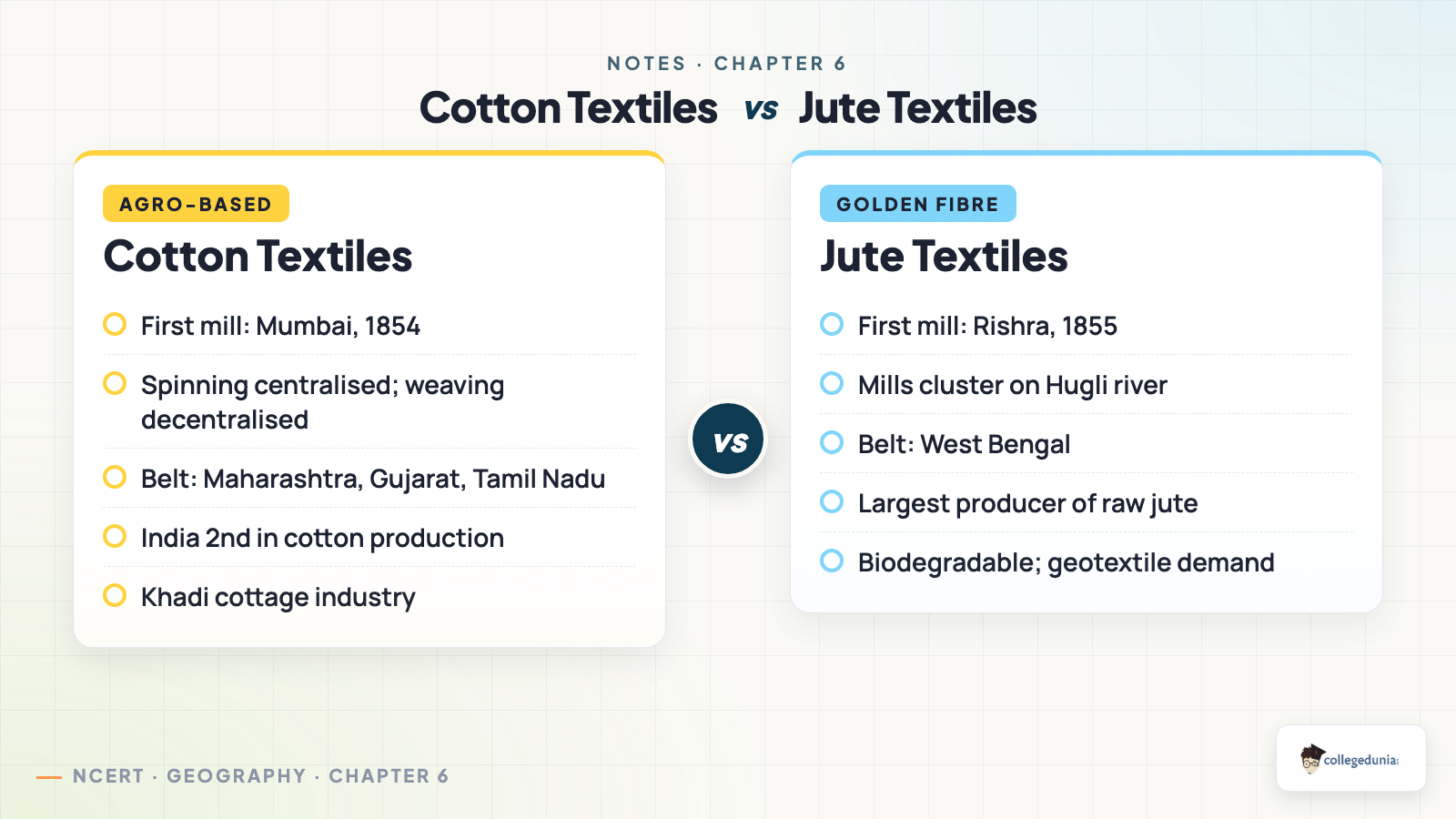
| Industry | Key Facts | Leading States / Belt |
|---|---|---|
| Cotton Textiles | First successful mill Mumbai, 1854. Spinning centralised; weaving decentralised. | Maharashtra, Gujarat, Tamil Nadu |
| Jute Textiles | India is the largest producer of raw jute; first mill Rishra (1855). Mills cluster on the Hugli. | West Bengal (Hugli belt) |
| Silk Textiles | Mulberry-rearing belt in the south. | Karnataka (Bengaluru, Mysuru) |
| Woollen Textiles | North-west wool belt. | Punjab, Haryana, Rajasthan |
| Sugar | Second-largest agro-based industry; India is 1st in gur. Mills tied to the cane belt. | Uttar Pradesh, Bihar, Maharashtra |
- Jute mills cluster on the Hugli because of nearby jute-growing areas, cheap water transport, abundant water, cheap labour, and Kolkata's banking and port facilities.
- India is the largest producer of raw jute but stands second after Bangladesh as an exporter; jute is biodegradable, so demand is rising.
Sugar mills locate near the cane belt, not near markets, because sugarcane is bulky and its sucrose drops during haulage. Mills have shifted to Maharashtra and the south, where cane has higher sucrose content and a longer crushing season. The industry is seasonal, suiting the cooperative sector.
Mineral-Based Industries: Iron and Steel, Aluminium, Cement and IT
Mineral-based industries use minerals and metals as raw materials. Iron and steel is the basic industry because all others depend on it for machinery; steel production indexes a country's development.
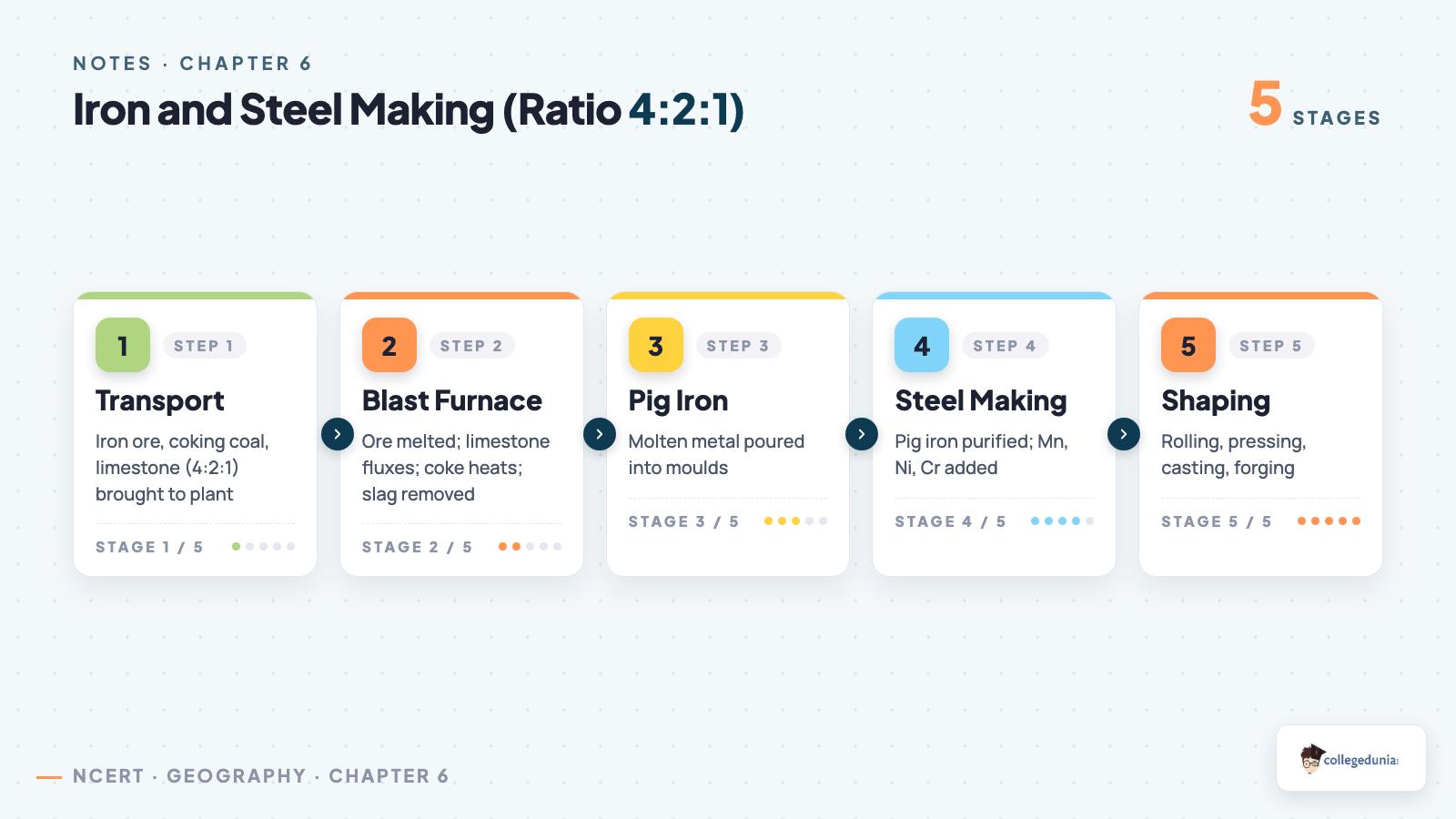
| Industry | Key Facts / Ratio | Leading Location |
|---|---|---|
| Iron and Steel | Basic, heavy industry. Iron ore : coking coal : limestone is about 4 : 2 : 1, plus manganese. | Chotanagpur plateau (Jamshedpur, Bokaro, Durgapur, Rourkela, Bhilai) |
| Aluminium Smelting | 4 to 6 t bauxite gives 1 t aluminium; needs about 18,600 kWh per tonne. | Odisha, West Bengal, Kerala (NALCO in Odisha) |
| Chemical and Fertiliser | Complex fertilisers carry N, P and K. India imports all potash (K). | Gujarat, Tamil Nadu, UP, Punjab, Kerala |
| Cement | Needs limestone, silica, alumina and gypsum; first plant Chennai, 1904. | Gujarat (Gulf export access) |
| IT and Electronics | Bengaluru is the electronic capital of India; biggest impact is employment. | Bengaluru, Noida, Hyderabad, Pune, Chennai |
- Aluminium has two prime location factors: cheap, regular electricity (about 18,600 kWh per tonne) and assured bauxite. Leaving out power loses half the marks.
- India produces nitrogenous and phosphatic fertilisers but imports all of its potash (K); cement plants follow the bulky limestone.
Steel plants cluster on the Chotanagpur plateau, not near markets, because iron ore, coking coal and limestone are heavy and bulky. State all four factors (low-cost iron ore, high-grade raw materials nearby, cheap labour, a large home market) for full marks.
Industrial Pollution and Control of Environmental Degradation
Industries cause four kinds of pollution, plus thermal pollution from power plants. This high-weightage portion is often a 5-mark question, so list the four pollution types and the control measures under clear heads.
| Pollution Type | Cause | Effect / Source |
|---|---|---|
| Air | Sulphur dioxide, carbon monoxide, smoke and dust. | Kilns, refineries, smelters, chemical plants. |
| Water | Dyes, acids and metals like lead and mercury. | Paper, textile, chemical, tannery effluents. |
| Land | Glass, chemicals, salts and garbage dumped. | Solid waste making land unfit for use. |
| Noise | Machinery, drills, generators and construction. | Industrial and construction equipment. |
- Thermal pollution is not air pollution: it is hot water released into rivers and ponds, which lowers dissolved oxygen and harms aquatic life.
- Control focuses on minimising water use, rainwater harvesting, treating effluents, regulating groundwater, and fitting smoke stacks with precipitators and scrubbers.
- Effluent treatment runs in three phases: Primary (mechanical), Secondary (biological) and Tertiary (biological, chemical and physical with recycling).
NTPC: The Model Pollution-Control Case Study
The National Thermal Power Corporation (NTPC) holds ISO 14001 certification for its Environment Management System and is the standard NCERT case study. Its measures: upgraded technology, maximum reuse of fly ash, green belts and afforestation, ash-water recycling, and ecological monitoring. Open a 5-mark answer with the fact that every litre of industrial waste water pollutes about eight times its volume of freshwater.
CBSE Previous Year Trends and Highest-Yield Topics for the Board Exam
Manufacturing Industries is a steady source of marks, including a map-work question. The table below maps each topic to the kind of question CBSE has repeatedly asked.
| Topic | Typical Marks | How it is asked |
|---|---|---|
| Importance of manufacturing | 3, 5 | "Why is manufacturing the backbone of development?" |
| Industrial pollution and control | 5 | "How do industries pollute? Suggest steps to minimise degradation." |
| Iron and steel / location | 3, 5 | "Why is Chotanagpur the steel hub?" |
| Cotton and jute textiles | 3 | Factors for jute mills on the Hugli; spinning vs weaving. |
| Classification of industries | 1, 3 | Basic vs consumer; agro vs mineral based. |
| NTPC / control measures | 3 | Steps NTPC takes to protect the environment. |
| Map work (textile / steel) | 2 | Locate and label steel plants or textile centres. |
- Highest-yield topics: industrial pollution and its control (often a full 5-mark question) and the iron and steel industry. Master these two first.
- Must-know facts: steel ratio 4:2:1; aluminium needs about 18,600 kWh per tonne; India imports all potash; first cotton mill Mumbai 1854; first jute mill Rishra 1855; first cement plant Chennai 1904.
Other Resources for Class 10 Geography Chapter 6 Manufacturing Industries
Pair these revision notes with the matching NCERT Solutions, handwritten notes and the official NCERT book chapter. The cross-resource table below links to every Collegedunia file for Class 10 Geography Chapter 6.
| Resource | What it covers | Open |
|---|---|---|
| Notes | Concept-first revision notes covering importance, location, classification, agro-based and mineral-based industries, and pollution control. | You are here |
| NCERT Solutions | Step-by-step answers to every exercise question, including the 5-mark answers with full detail. | Class 10 Geography Chapter 6 NCERT Solutions |
| Handwritten Notes | Scanned-style handwritten revision pages for last-minute board exam practice. | Class 10 Geography Chapter 6 Handwritten Notes |
| NCERT Book PDF | Official NCERT Contemporary India II Chapter 6 textbook in PDF form. | Class 10 Geography Chapter 6 NCERT Book PDF |
All Chapters Notes for Class 10 Geography Contemporary India II
Related Links: Use the table below to reach the Notes for the other chapters of Class 10 Geography Contemporary India II. Every chapter ships with the same revision-friendly structure, key definitions and FAQ block.
| Chapter | Topic | Notes link |
|---|---|---|
| Chapter 1 | Resources and Development | Class 10 Geography Chapter 1 Notes |
| Chapter 2 | Forest and Wildlife Resources | Class 10 Geography Chapter 2 Notes |
| Chapter 3 | Water Resources | Class 10 Geography Chapter 3 Notes |
| Chapter 4 | Agriculture | Class 10 Geography Chapter 4 Notes |
| Chapter 5 | Minerals and Energy Resources | Class 10 Geography Chapter 5 Notes |
| Chapter 6 | Manufacturing Industries | You are here |
| Chapter 7 | Lifelines of National Economy | Class 10 Geography Chapter 7 Notes |
NCERT Notes Class 10 Geography Chapter 6 Manufacturing Industries FAQs
Ques. What do the class 10 manufacturing industries notes cover?
Ans. The class 10 manufacturing industries notes are a concept-first revision file that compress the entire NCERT Chapter 6 of Class 10 Geography Contemporary India II into a printable study guide. They cover what manufacturing is and why it is the backbone of development (the MUTP points), the eight factors of industrial location, the classification of industries by raw material, role, capital and ownership, the agro-based industries (cotton, jute, silk and woollen textiles and sugar), the mineral-based industries (iron and steel, aluminium, cement, chemical, fertiliser, automobile and IT), and industrial pollution with the NTPC control case study. Students typically use these notes for a 30-minute first-pass revision and a 20-minute night-before pass; the worked answers to the NCERT exercise questions live in the matching NCERT Solutions PDF.
Ques. Why is manufacturing called the backbone of economic development?
Ans. NCERT gives four reasons, easily recalled as MUTP. Manufacturing modernises agriculture by supplying tractors, pumps, fertilisers and pesticides, which raises farm productivity and reduces dependence on agricultural income. It removes unemployment and poverty by creating jobs in the secondary and tertiary sectors, which is why public-sector industries were set up in tribal and backward areas to reduce regional disparities. It boosts trade and brings foreign exchange through the export of manufactured goods. Finally, it raises national prosperity, because countries that turn raw materials into high-value finished goods are more prosperous. Agriculture and industry also move hand in hand rather than competing.
Ques. What is the difference between agro-based and mineral-based industries?
Ans. The classification by raw material is the most important one for the exam. Agro-based industries draw their raw material from agriculture and plantations; they include cotton, woollen, jute and silk textiles, rubber, sugar, tea, coffee and edible oil. Mineral-based industries draw their raw material from minerals and metals; they include iron and steel, cement, aluminium, machine tools and petrochemicals. A linked classification is by main role: a basic or key industry supplies its product as raw material to other industries (iron and steel), while a consumer industry produces goods for direct use (sugar, paper, fans). Industries are also classified by capital invested (heavy versus light) and by ownership (public, private, joint and cooperative).
Ques. Why is the iron and steel industry concentrated on the Chotanagpur plateau?
Ans. The Chotanagpur plateau region has the maximum concentration of iron and steel plants for four reasons that should all be stated for full marks: low-cost iron ore, high-grade raw materials (coking coal and limestone) in close proximity, cheap labour, and a vast home market. Iron and steel is a heavy industry because the raw materials and the finished goods are bulky and involve heavy transport costs, so plants must locate where iron ore, coking coal and limestone come together cheaply. The raw materials are needed in the ratio of about 4 : 2 : 1 (iron ore : coking coal : limestone), with a little manganese added to harden the steel. Plants in this belt include Jamshedpur, Bokaro, Durgapur, Burnpur, Rourkela and Bhilai.
Ques. What are the two location factors for aluminium smelting?
Ans. The two prime location factors for aluminium smelting are a regular supply of cheap electricity and an assured source of raw material (bauxite) at minimum cost. Students often write only the raw material and lose half the marks; smelting is extremely power-hungry, needing about 18,600 kWh per tonne of aluminium, so a regular and cheap power supply is just as important. Bauxite is converted in the ratio of about 4 to 6 tonnes of bauxite giving 2 tonnes of alumina giving 1 tonne of aluminium. Aluminium smelting plants are located in Odisha, West Bengal, Kerala, Uttar Pradesh, Chhattisgarh, Maharashtra and Tamil Nadu, with NALCO in Odisha as a leading example.
Ques. What are the four types of industrial pollution and how are they controlled?
Ans. Industries cause four types of pollution: air pollution from sulphur dioxide, carbon monoxide, smoke and dust; water pollution from dyes, acids and metals like lead and mercury in effluents; land pollution from dumped glass, chemicals, salts and garbage; and noise pollution from machinery, generators and construction. Thermal power plants add thermal pollution, which is hot water discharged into rivers that lowers dissolved oxygen. Control measures include minimising water use by reuse and recycling, rainwater harvesting, three-phase effluent treatment (primary mechanical, secondary biological, tertiary biological-chemical-physical), regulating groundwater overdrawing, fitting smoke stacks with electrostatic precipitators and scrubbers, and reducing smoke and noise. The NTPC, which holds ISO 14001 EMS certification, is the model case study.
Ques. Are these class 10 manufacturing industries notes updated for the 2026-27 session?
Ans. Yes. These class 10 manufacturing industries notes are based on the 2026-27 NCERT Contemporary India II textbook and the latest CBSE Class 10 Social Science sample paper. The chapter structure is unchanged for the current cycle, and the CBSE marking scheme continues to reward well-organised, point-wise answers for the 5-mark questions on industrial pollution control and the iron and steel location factors. Students should use these notes for both the short-answer and long-answer parts of the chapter, then move to the matching NCERT Solutions PDF for full worked answers.



Comments