




These Class 10 History notes chapter 1 The Rise of Nationalism in Europe bring together every date, treaty, leader, and symbol that the CBSE board paper actually tests.
Chapter1TheRiseofNationalisminEuropeNotes.pdf?page=1&dpi=150)
Chapter1TheRiseofNationalisminEuropeNotes.pdf?page=2&dpi=150)
Chapter1TheRiseofNationalisminEuropeNotes.pdf?page=3&dpi=150)
Chapter1TheRiseofNationalisminEuropeNotes.pdf?page=4&dpi=150)
Chapter1TheRiseofNationalisminEuropeNotes.pdf?page=5&dpi=150)
Chapter1TheRiseofNationalisminEuropeNotes.pdf?page=6&dpi=150)
Chapter1TheRiseofNationalisminEuropeNotes.pdf?page=7&dpi=150)
Chapter1TheRiseofNationalisminEuropeNotes.pdf?page=8&dpi=150)
Chapter1TheRiseofNationalisminEuropeNotes.pdf?page=9&dpi=150)
Chapter1TheRiseofNationalisminEuropeNotes.pdf?page=10&dpi=150)
Chapter1TheRiseofNationalisminEuropeNotes.pdf?page=11&dpi=150)
Chapter1TheRiseofNationalisminEuropeNotes.pdf?page=12&dpi=150)
Chapter1TheRiseofNationalisminEuropeNotes.pdf?page=13&dpi=150)
Chapter1TheRiseofNationalisminEuropeNotes.pdf?page=14&dpi=150)
Chapter1TheRiseofNationalisminEuropeNotes.pdf?page=15&dpi=150)
Chapter1TheRiseofNationalisminEuropeNotes.pdf?page=16&dpi=150)
Chapter1TheRiseofNationalisminEuropeNotes.pdf?page=17&dpi=150)
Chapter1TheRiseofNationalisminEuropeNotes.pdf?page=18&dpi=150)
Chapter1TheRiseofNationalisminEuropeNotes.pdf?page=19&dpi=150)
Chapter1TheRiseofNationalisminEuropeNotes.pdf?page=20&dpi=150)
Chapter1TheRiseofNationalisminEuropeNotes.pdf?page=21&dpi=150)
Chapter1TheRiseofNationalisminEuropeNotes.pdf?page=22&dpi=150)
The revision notes follow the NCERT textbook India and the Contemporary World II in exact order, from the French Revolution to the unification of Germany and Italy.
- Carries about 6 to 8 marks in the CBSE Class 10 board paper, drawn from short-answer and source-based questions.
- Covers all key years: 1789, 1804, 1815, 1834, 1848, 1861 and 1871 in one timeline.
- Pairs with the NCERT Solutions for The Rise of Nationalism in Europe for full answers.
Every fact in these class 10 history notes chapter 1 The Rise of Nationalism in Europe is curated by subject experts, checked against the 2026-27 NCERT textbook, and refined using the last five years of CBSE board papers.
The French Revolution and the First Idea of a Nation-State
Nationalism in Europe began with the French Revolution of 1789, which moved power from the king to the people. This is the base for every later event.
- A nation-state is a state where most citizens share a common identity and history.
- The philosopher Ernst Renan called a nation a "large-scale solidarity" built on a shared past.
- In 1789, France became the first modern nation-state in Europe.
The Revolution introduced ideas like la patrie (the fatherland) and le citoyen (the citizen). The tricolour replaced the royal flag, the Estates General became the National Assembly, a common system of weights and measures was set up, and French became the national language. These steps gave ordinary people a sense of being one nation.
The Rise of Nationalism in Europe Explained for Class 10 Boards
Source: Magnet Brains on YouTube
Napoleon and the Civil Code of 1804
After the Revolution slid into chaos, Napoleon Bonaparte took power and made himself emperor, but kept many revolutionary reforms in administration. His most lasting was the Civil Code of 1804, the Napoleonic Code.
- Removed all privileges based on birth.
- Established equality before the law and the right to property.
- Simplified administration and abolished feudalism in the areas Napoleon controlled.
Common mistake to avoid: students often write that Napoleon "spread democracy". He spread administrative reforms, not political freedom. Conquered areas first welcomed him, then turned against him over heavy taxes, censorship, and forced army service.
The Making of Nationalism in Europe: Liberalism and the Zollverein
In the early nineteenth century, national unity was tied to liberalism (from liber, free), which had two meanings for the new middle classes.
- Political liberalism: equality before the law, government by consent, a constitution, and an end to autocracy.
- Economic liberalism: free markets and the removal of state barriers on goods and money.
- Note: liberalism did not mean votes for all. Only property-owning men could vote.
The economic side is seen in the German states, a confederation of 39 states each with its own currency and customs duties. In 1833, a merchant from Hamburg to Nuremberg crossed 11 customs barriers. The Zollverein customs union, formed in 1834 by Prussia, abolished tariff barriers and reduced currencies to two. Remember: first economic unity, then political unity.
Conservatism After 1815 and the Revolutionaries
After Napoleon's defeat in 1815, European rulers wanted to restore the old order, a spirit called conservatism. Conservatives wanted to keep the monarchy, the Church, and social hierarchy.
- In 1815, Britain, Russia, Prussia, and Austria met at the Congress of Vienna, hosted by Duke Metternich.
- The Treaty of Vienna (1815) restored the Bourbon dynasty in France.
- These regimes used censorship to control newspapers, books, plays, and songs.
Liberals and nationalists who opposed this order went underground. The most famous, Giuseppe Mazzini, founded the secret societies Young Italy and Young Europe and wanted a single Italian republic. Metternich called him "the most dangerous enemy of our social order".
The Age of Revolutions: 1830 to 1848
The conservative order did not last. A wave of revolutions swept Europe between 1830 and 1848.
- July 1830 (France): the Bourbon kings were overthrown and a constitutional monarchy under Louis Philippe set up. It sparked an uprising that made Belgium break from the Netherlands.
- Greek War of Independence (1821): Greece won freedom from the Ottoman Empire; the poet Lord Byron died fighting there. The Treaty of Constantinople (1832) recognised Greece as independent.
Culture also built national feeling. Romanticism stressed emotion and shared heritage; Herder said true German culture lived among the common people, das volk; the Grimm Brothers collected folktales; and in partitioned Poland, the banned Polish language became a weapon of resistance.
1848: The Revolution of the Liberals
The year 1848 saw two revolts at once: the poor against hunger and hardship, and the educated middle classes for constitutions and national unity.
- In France, food shortages and unemployment forced the king to flee. France became a republic with the vote for all adult men.
- In the German regions, the middle classes formed the Frankfurt Parliament and drafted a constitution for a united Germany. The crown was offered to the Prussian king, who rejected it, and the assembly was crushed by troops.
Although the 1848 liberal revolts failed, monarchs realised change could no longer be fully resisted. Serfdom and bonded labour were abolished in the Habsburg lands and in Russia.
The Making of Germany and Italy by Blood and Iron
After 1848, nationalism was used by conservatives to build strong states through war and diplomacy led from above.
Germany: Prussia led. Its chief minister Otto von Bismarck drove unification using the Prussian army, a method called "Blood and Iron".
- Bismarck fought three wars against Denmark, Austria, and France, all won by Prussia (memory hook: D-A-F).
- In January 1871, the Prussian king William I was proclaimed German Emperor at the Palace of Versailles.
Italy was divided into seven states; only Sardinia-Piedmont had an Italian ruler. Its makers are remembered as the pen, the brain, the sword, and the crown.
| Leader | Nickname | Contribution |
|---|---|---|
| Giuseppe Mazzini | The Pen | Idea of a unitary Italian republic via Young Italy. |
| Count Cavour | The Brain | Chief Minister of Sardinia-Piedmont; allied with France to defeat Austria, 1859. |
| Giuseppe Garibaldi | The Sword | Led the Red Shirts into South Italy. |
| Victor Emmanuel II | The Crown | King of a united Italy, 1861. |
The Strange Case of Britain: A Nation Forged Slowly
Britain is the exception. Its nation-state was not the result of one revolution; it grew slowly as England extended power over its neighbours. Before the eighteenth century people saw themselves as English, Welsh, Scot, or Irish.
- The Act of Union (1707) between England and Scotland created the "United Kingdom of Great Britain".
- Ireland was forcibly added in 1801.
- A British identity was promoted through the Union Jack, the anthem, and the English language.
Important: do not describe Britain as unifying like Germany or Italy. Those two were unified by wars that brought states together; Britain grew by extending English power, often by suppressing Scottish, Welsh, and Irish cultures.
Visualising the Nation: Marianne, Germania and Their Symbols
How do you give a face to a nation? Artists personified it as a female figure, called an allegory, giving the abstract idea of the nation a concrete form.
- Marianne was the allegory of France, carrying the red cap, the tricolour, and the cockade of liberty.
- Germania was the allegory of Germany, wearing a crown of oak leaves, since the German oak stands for heroism.
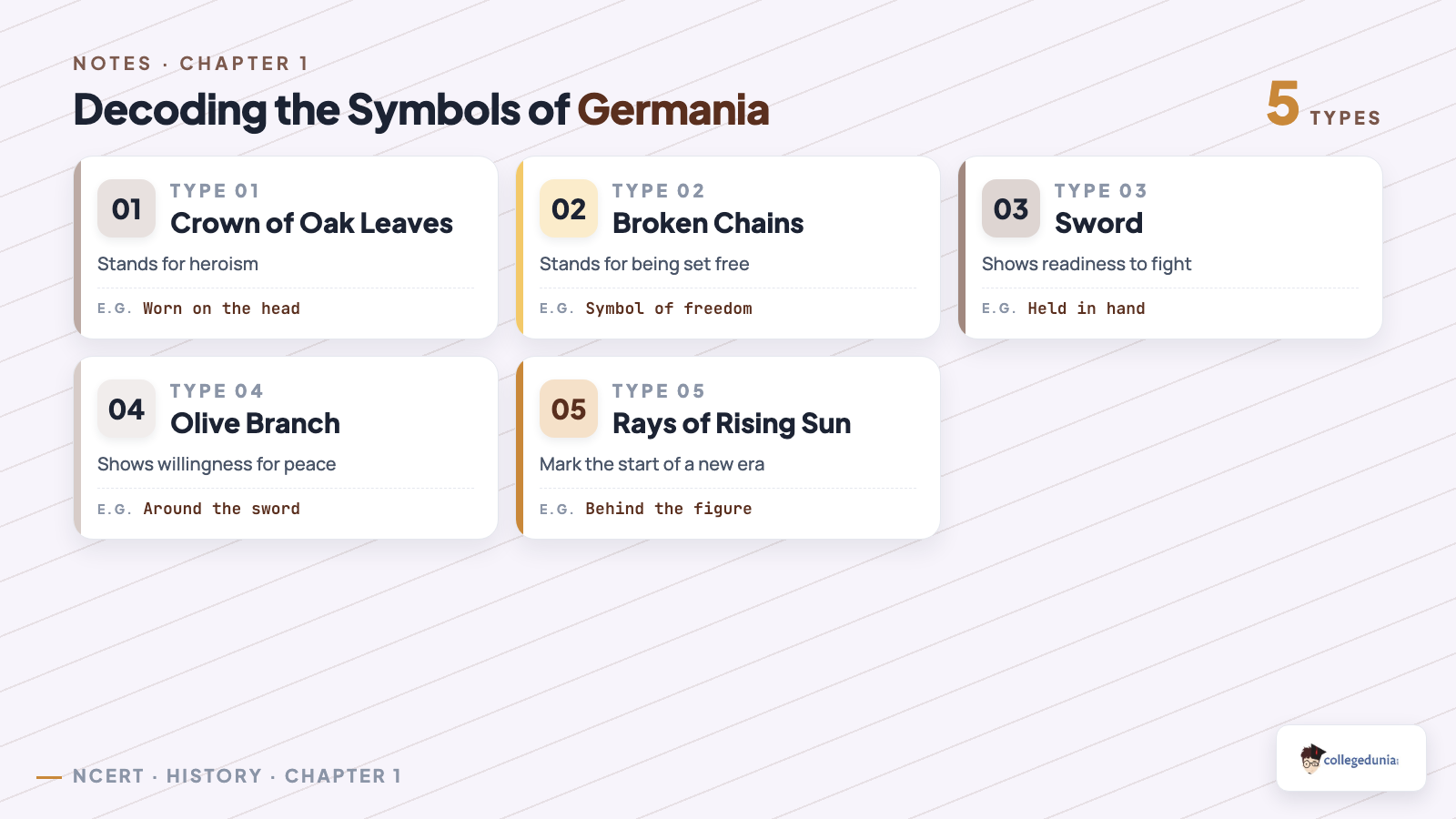
| Symbol on Germania | What it Means |
|---|---|
| Crown of oak leaves | Heroism |
| Broken chains | Being set free |
| Sword | Readiness to fight |
| Olive branch around the sword | Willingness to make peace |
| Rays of the rising sun | The start of a new era |
Key Dates Timeline for The Rise of Nationalism in Europe
CBSE loves one-mark date questions. This timeline puts every must-know year in one place for last-minute revision.
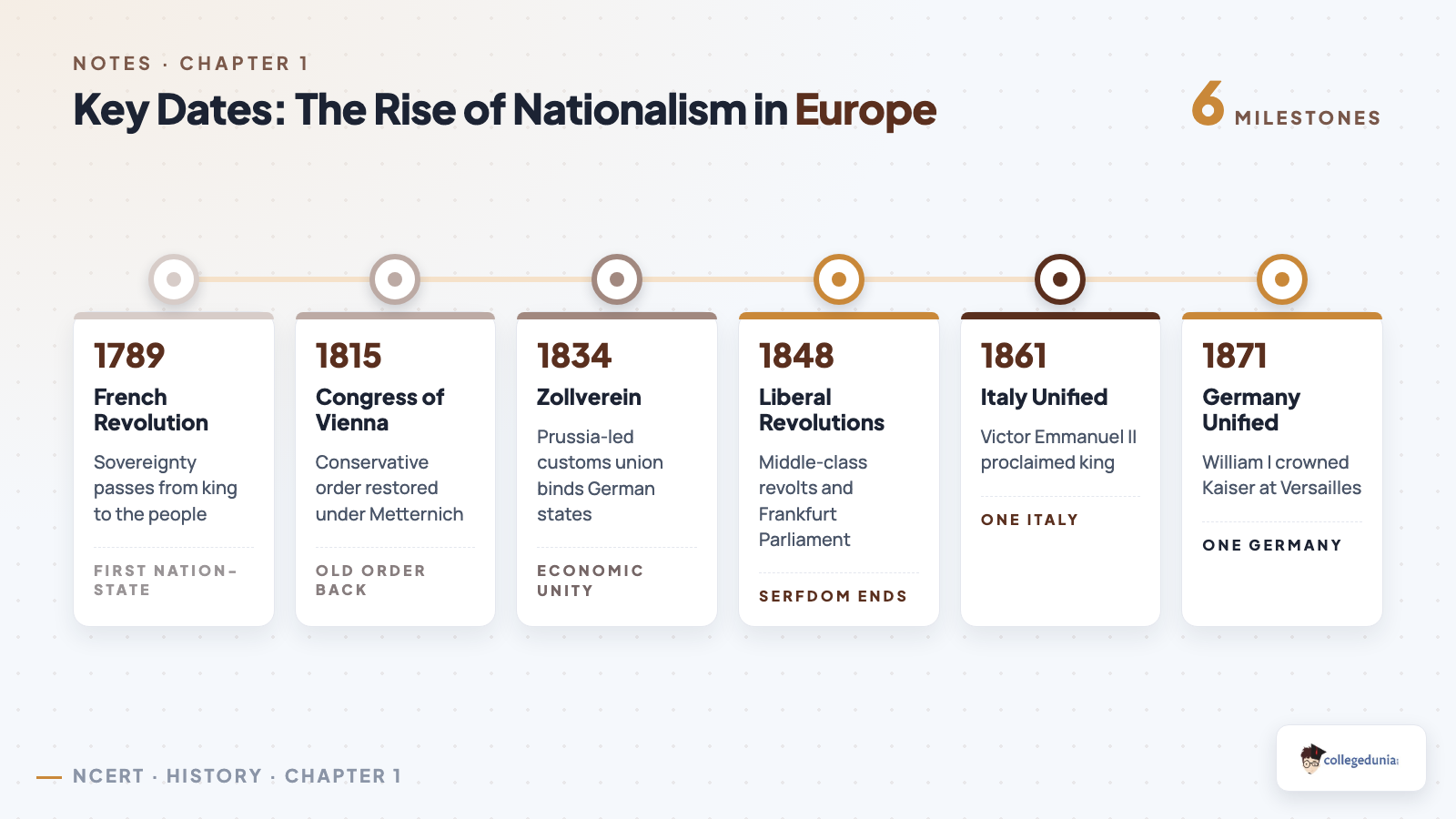
| Year | Event |
|---|---|
| 1789 | French Revolution |
| 1804 | Napoleonic Code |
| 1815 | Congress of Vienna |
| 1834 | Zollverein formed |
| 1848 | Liberal revolutions; Frankfurt Parliament |
| 1861 | Victor Emmanuel II, king of united Italy |
| 1871 | William I, German Emperor at Versailles |
Student Feedback on This Chapter
In a Collegedunia poll of 12,840 Class 10 students conducted before the 2026 boards, the unification of Germany and Italy was rated the hardest part of the chapter. 71% of students said the Bismarck versus Cavour-Garibaldi mix-up cost them marks in practice tests.
The most-skipped sub-topic was the meaning of the Germania symbols, skipped by about 1 in 4 students until they used a symbol table like the one in these notes.
Source: 2026-27 Class 10 History student poll. Sample of 12,840 students from CBSE schools across 14 states.
Also See: Other Resources for The Rise of Nationalism in Europe
Also Check: the same chapter is available in other formats. Use the table below to jump to the resource you need.
| Resource | Best Used For |
|---|---|
| NCERT Solutions | Model answers to every textbook question. |
| Handwritten Notes | A quick scanned visual recap for last-minute revision. |
| NCERT Book PDF | The full original textbook chapter to read from source. |
All Class 10 History Notes, Chapter by Chapter
Related Links: revise the rest of the syllabus with the Class 10 History notes below.
| Chapter | Notes Link |
|---|---|
| Chapter 1: The Rise of Nationalism in Europe | You are here |
| Chapter 2: Nationalism in India | Nationalism in India Notes |
| Chapter 3: The Making of a Global World | The Making of a Global World Notes |
| All chapters | Class 10 History Hub |
Ques. What do the class 10 history notes chapter 1 The Rise of Nationalism in Europe cover?
Ans. These notes cover the French Revolution and the idea of the nation, the Napoleonic Code, liberalism and the Zollverein, the 1830 and 1848 revolutions, the unification of Germany and Italy, the case of Britain, and the female allegories Marianne and Germania, all in NCERT textbook order.
Ques. Why is 1789 important in The Rise of Nationalism in Europe?
Ans. In 1789, the French Revolution moved sovereignty from the king to the people. This was the first time a sense of one nation, with shared symbols, a flag, and a common language, was built for ordinary citizens. France became the first modern nation-state in Europe.
Ques. Who unified Germany and how?
Ans. Prussia's chief minister Otto von Bismarck used a policy of "Blood and Iron". He fought three wars in seven years against Denmark, Austria, and France. In January 1871, the Prussian king William I was proclaimed German Emperor at the Palace of Versailles.
Ques. Who were the three makers of Italy?
Ans. Giuseppe Mazzini gave the idea (the pen), Count Cavour gave the diplomacy (the brain), and Giuseppe Garibaldi led the Red Shirts in war (the sword). In 1861, Victor Emmanuel II was proclaimed king of a united Italy.
Ques. What was the Zollverein?
Ans. The Zollverein was a customs union started in 1834 at the initiative of Prussia. It abolished tariff barriers between German states and reduced many currencies to two. It bound the Germans together economically before they were united politically.
Ques. How is the Class 10 History chapter 1 notes PDF best used?
Ans. Download the notes PDF for quick revision of the timeline, the leaders, and the symbols. Then move to the NCERT Solutions for model answers, and use the handwritten notes for a final visual recap. This three-step plan covers concepts and practice together.
Ques. What is a nation-state?
Ans. A nation-state is a state in which the majority of citizens, not only its rulers, share a sense of common identity and history. The philosopher Ernst Renan called a nation a large-scale solidarity built on a shared past and the will to live together.
Ques. How is liberalism defined in this chapter?
Ans. Liberalism comes from the Latin liber, meaning free. It had a political meaning, namely equality before the law and government by consent, and an economic meaning, namely free markets and no barriers on the movement of goods. It did not mean voting rights for all.
Ques. What are the symbols of Germania?
Ans. Germania, the female allegory of Germany, wears a crown of oak leaves for heroism. Broken chains stand for being set free, the sword for readiness to fight, the olive branch for peace, and the rays of the rising sun for the start of a new era.



Comments