




These Class 10 History notes chapter 3 The Making of a Global World pull together every flow, famine, disease and institution that the CBSE board paper actually tests.
Chapter3TheMakingofaGlobalWorldNotes.pdf?page=1&dpi=150)
Chapter3TheMakingofaGlobalWorldNotes.pdf?page=2&dpi=150)
Chapter3TheMakingofaGlobalWorldNotes.pdf?page=3&dpi=150)
Chapter3TheMakingofaGlobalWorldNotes.pdf?page=4&dpi=150)
Chapter3TheMakingofaGlobalWorldNotes.pdf?page=5&dpi=150)
Chapter3TheMakingofaGlobalWorldNotes.pdf?page=6&dpi=150)
Chapter3TheMakingofaGlobalWorldNotes.pdf?page=7&dpi=150)
Chapter3TheMakingofaGlobalWorldNotes.pdf?page=8&dpi=150)
Chapter3TheMakingofaGlobalWorldNotes.pdf?page=9&dpi=150)
Chapter3TheMakingofaGlobalWorldNotes.pdf?page=10&dpi=150)
Chapter3TheMakingofaGlobalWorldNotes.pdf?page=11&dpi=150)
Chapter3TheMakingofaGlobalWorldNotes.pdf?page=12&dpi=150)
Chapter3TheMakingofaGlobalWorldNotes.pdf?page=13&dpi=150)
Chapter3TheMakingofaGlobalWorldNotes.pdf?page=14&dpi=150)
Chapter3TheMakingofaGlobalWorldNotes.pdf?page=15&dpi=150)
Chapter3TheMakingofaGlobalWorldNotes.pdf?page=16&dpi=150)
Chapter3TheMakingofaGlobalWorldNotes.pdf?page=17&dpi=150)
Chapter3TheMakingofaGlobalWorldNotes.pdf?page=18&dpi=150)
Chapter3TheMakingofaGlobalWorldNotes.pdf?page=19&dpi=150)
Chapter3TheMakingofaGlobalWorldNotes.pdf?page=20&dpi=150)
The revision notes follow the NCERT textbook India and the Contemporary World II in exact order, from the pre-modern silk routes right up to the Bretton Woods system of 1944.
- Carries about 5 to 6 marks in the CBSE Class 10 board paper, drawn from source-based, map and long-answer questions.
- Covers all key milestones: 3000 BCE, 1845, 1885, 1914, 1929 and 1944 in one timeline.
- Pairs with the NCERT Solutions for The Making of a Global World for full answers.
Every fact in these class 10 history notes chapter 3 The Making of a Global World is curated by subject experts, checked against the 2026-27 NCERT textbook, and refined using the last five years of CBSE board papers.
What The Making of a Global World Is Really About
Globalisation is not new. The making of a global world has a long history, stitched together by trade, migration, money, and the exchange of crops, skills, ideas and even germs. The whole chapter rests on three flows:
- Flow of trade: goods such as cloth, wheat or tea moving between countries.
- Flow of labour: people migrating across borders for work.
- Flow of capital: short or long-term investment of money over long distances.
These flows were interwoven yet could break independently: labour migration was often far more restricted than goods or capital. Spotting which flow a question is about is the fastest way to organise a board answer.
The Making of a Global World Explained for Class 10 Boards
Source: Magnet Brains on YouTube
The Pre-modern World: Silk Routes and Travelling Food
Societies were linked long before steamships. As early as 3000 BCE coastal trade joined the Indus Valley with West Asia, and cowries from the Maldives served as currency as far as China and East Africa.
- Several silk routes, over land and sea, thrived from before the Christian Era almost until the fifteenth century.
- West from China: silk, pottery, and (via India) textiles and spices; east to Asia: gold and silver from Europe.
- Trade carried culture too: Christian missionaries, Muslim preachers and Buddhism travelled these routes.
Food is another example. Noodles probably travelled west to become spaghetti, while potatoes, maize, tomatoes and chillies reached Europe only after Columbus. The potato let Europe's poor eat better, but when blight struck, the Great Irish Potato Famine (1845 to 1849) killed around a million people.
Conquest, Disease and the World That Shrank in the 1500s
The pre-modern world shrank in the sixteenth century after European sailors found sea routes to Asia and the Americas. The Spanish conquest of America was powered less by guns than by germs: smallpox could not be captured like a gun.
- America had been cut off for millions of years, so its people had no immunity to smallpox, which spread ahead of the conquerors.
- By the eighteenth century, plantations worked by enslaved Africans grew cotton and sugar for Europe.
- China, once among the richest, then restricted overseas contacts and retreated into isolation.
China's retreat and the rising Americas moved the centre of world trade westwards to Europe. Memory aid for why the world shrank: Sea routes, Silver, and Smallpox.
The Nineteenth-Century Economy: Corn Laws to Colonialism (1815 to 1914)
Between 1815 and 1914 a single connected world economy took shape, beginning with food in industrialising Britain, where the government had restricted corn imports through the Corn Laws.
- Industrialists forced the government to abolish the Corn Laws, so cheap food could be imported.
- British agriculture could not compete; workers migrated to cities or overseas.
- By 1890 a global agricultural economy had formed, food grown far away and shipped in refrigerated holds.
- Nearly 50 million people left Europe for America and Australia, part of about 150 million worldwide.
Technology drove integration: railways, the steamship, the telegraph, and refrigerated ships. Prosperity had a brutal side: in 1885 the European powers met at the Berlin Conference to carve up Africa, which is why many African borders run in straight lines.
Rinderpest: How a Cattle Plague Subdued Africa
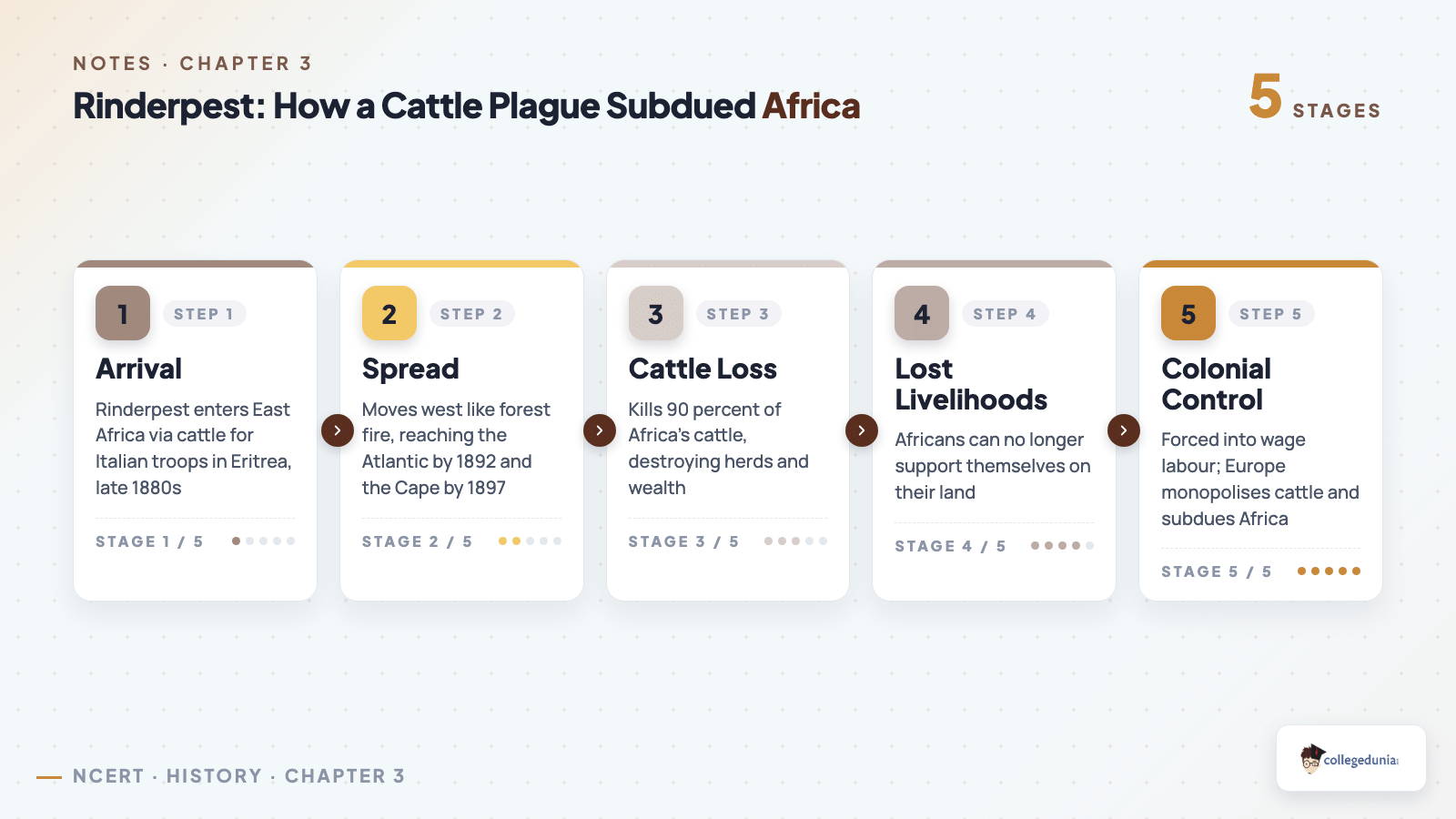
Africa had abundant land but a small population, so Europeans struggled to find labour for plantations and mines until rinderpest changed everything.
- Rinderpest (cattle plague) arrived in the late 1880s through cattle brought to feed Italian soldiers in Eritrea.
- Entering from the east, it moved west, reaching the Atlantic coast in 1892 and the Cape by 1897.
- It killed 90 per cent of Africa's cattle, destroying African livelihoods.
- With their herds gone, Africans were forced into wage labour, and colonisers monopolised surviving cattle to subdue the continent.
Track the plague east to west: Eritrea, the Atlantic in 1892, the Cape in 1897. Students often reverse the direction.
Indentured Labour and India in the World Economy
The nineteenth-century world had two faces: faster growth, but also misery and bondage shown by indentured labour from India.
- An indentured labourer was a bonded worker on a fixed-term contract (often five years) who worked to repay the passage to a new country.
- Indian workers came mainly from eastern UP, Bihar and Tamil Nadu, displaced by rising rents and the decline of cottage industries.
- Main destinations: the Caribbean, Mauritius and Fiji. Called a new system of slavery, indenture was abolished in 1921.
India was once the world's largest producer of fine cotton textiles, but British industrialisation reversed this: the share of cotton textiles in India's exports fell from about 30 per cent around 1800 to below 3 per cent by the 1870s. Britain's trade surplus with India, used to settle deficits elsewhere, belonged to Britain, not India.
The Inter-war Economy and the Great Depression (1914 to 1939)
The First World War (1914 to 1918), the first modern industrial war, plunged the century into a crisis lasting three decades.
- The war caused 9 million dead and 20 million injured, mostly working-age men.
- Britain borrowed huge sums from the US, turning the US into the world's leading creditor.
- Henry Ford adapted the assembly line; the T-Model Ford was the first mass-produced car.
- Hire purchase (credit in instalments) fuelled a 1920s boom in cars and washing machines.
By 1929 the world plunged into the Great Depression. Its main causes were agricultural overproduction, the withdrawal of US loans, bank failures, and higher US import duties. In India, exports and imports nearly halved between 1928 and 1934, and farmers and peasants like the jute growers of Bengal were hit hardest, as farm prices fell while colonial revenue demands did not.
Rebuilding the World: The Bretton Woods System
The Second World War killed at least 60 million people. Out of this came a deliberate effort to rebuild a stable world economy, shaped by two lessons from the inter-war catastrophe.
- Lesson one: mass production needs mass consumption, so governments must ensure high stable incomes and full employment.
- Lesson two: full employment is possible only by controlling flows of goods, capital and labour.
- Agreed at the Bretton Woods Conference, July 1944, in New Hampshire, it set up the IMF (surpluses and deficits) and the World Bank (reconstruction), both opening in 1947.
Bretton Woods used fixed exchange rates, currencies pegged to the US dollar and the dollar tied to gold, opening an era of growth through the 1950s and 1960s. The system collapsed in the early 1970s and was replaced by floating exchange rates.
Key Dates Timeline for The Making of a Global World
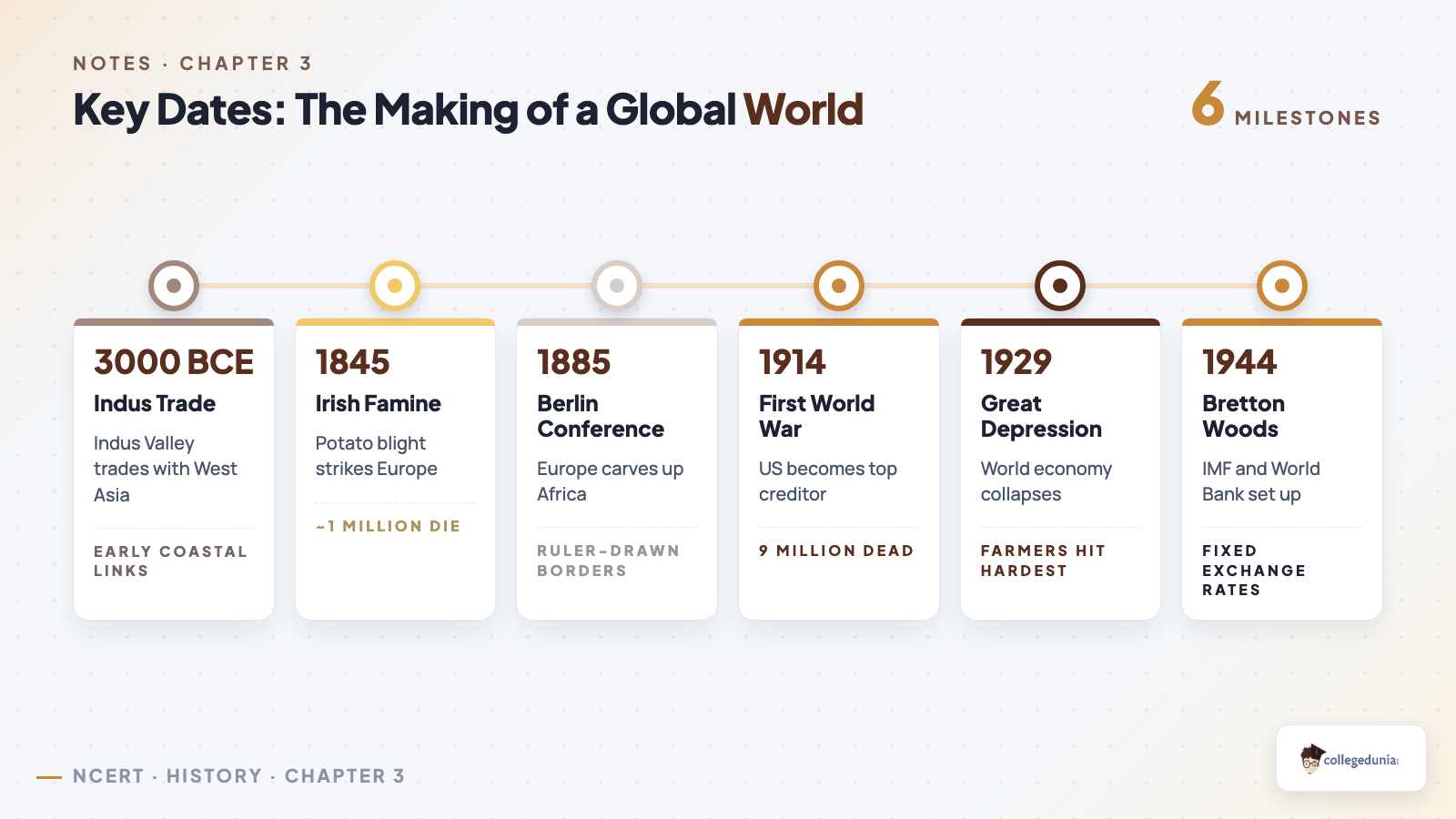
CBSE loves one-mark date questions. This timeline puts every must-know year in one place.
| Year | Event |
|---|---|
| 3000 BCE | Indus Valley trades with West Asia; early coastal links form. |
| 1845 to 1849 | Great Irish Potato Famine after the potato blight. |
| 1885 | Berlin Conference; European powers carve up Africa. |
| 1892 | Rinderpest reaches the Atlantic coast of Africa. |
| 1914 to 1918 | First World War; US becomes the leading creditor. |
| 1921 | Indentured labour migration from India abolished. |
| 1929 | The Great Depression begins. |
| 1944 | Bretton Woods Conference sets up the IMF and World Bank. |
Student Feedback on This Chapter
In a Collegedunia poll of 11,560 Class 10 students conducted before the 2026 boards, the causes of the Great Depression and the Bretton Woods institutions were rated the hardest part of the chapter. 68% of students said the IMF versus World Bank mix-up cost them marks in practice tests.
The most-skipped sub-topic was the rinderpest chain of events, skipped by about 1 in 4 students until they used a cause-and-effect flow like the one in these notes.
Source: 2026-27 Class 10 History student poll. Sample of 11,560 students from CBSE schools across 14 states.
Also See: Other Resources for The Making of a Global World
Also Check: the same chapter is available in other formats.
| Resource | Best Used For |
|---|---|
| NCERT Solutions | Model answers to every textbook question. |
| Handwritten Notes | A quick scanned visual recap for last-minute revision. |
| NCERT Book PDF | The full original textbook chapter to read from source. |
All Class 10 History Notes, Chapter by Chapter
Related Links: revise the rest of the syllabus with the Class 10 History notes for every chapter.
| Chapter | Notes Link |
|---|---|
| Chapter 1: The Rise of Nationalism in Europe | Rise of Nationalism in Europe Notes |
| Chapter 2: Nationalism in India | Nationalism in India Notes |
| Chapter 3: The Making of a Global World | You are here |
| Chapter 4: The Age of Industrialisation | The Age of Industrialisation Notes |
| All chapters | Class 10 History Hub |
Ques. What do the class 10 history notes chapter 3 The Making of a Global World cover?
Ans. These notes cover the pre-modern world and silk routes, travelling food and the Irish famine, conquest and disease, the nineteenth-century economy with the Corn Laws and colonialism, rinderpest in Africa, indentured labour and India in world trade, the inter-war economy and the Great Depression, and the Bretton Woods system, all in NCERT textbook order.
Ques. What are the three flows that connect economies?
Ans. The three flows are the flow of trade in goods such as cloth and wheat, the flow of labour as people migrate for work, and the flow of capital as money is invested over long distances. They are interwoven but can break independently, and labour migration was often the most restricted of the three.
Ques. Why did the world shrink in the sixteenth century?
Ans. The world shrank because European sailors found sea routes to Asia and the Americas, American silver funded fresh trade, and smallpox spread ahead of the conquerors. Since America had been isolated for millions of years, its people had no immunity, so disease rather than guns conquered the continent.
Ques. What was rinderpest and why did it matter?
Ans. Rinderpest was a cattle plague that entered East Africa in the late 1880s with cattle brought to feed Italian soldiers in Eritrea. It spread west to the Atlantic by 1892 and the Cape by 1897, killing 90 per cent of Africa's cattle. With their livelihoods destroyed, Africans were forced into wage labour, which helped Europe subdue Africa.
Ques. What was indentured labour and when was it abolished?
Ans. An indentured labourer was a bonded worker on a fixed-term contract, often five years, who worked to repay the cost of passage to a new country. Indian workers went mainly to the Caribbean, Mauritius and Fiji. Conditions were so harsh that indenture was called a new system of slavery, and it was abolished in 1921.
Ques. Why did the Great Depression hit India so hard?
Ans. The Depression hit India through trade. India's exports and imports nearly halved between 1928 and 1934 and wheat prices fell about 50 per cent. Peasants producing for the world market, like the jute growers of Bengal, were worst hit because the colonial government did not lower revenue demands, so India became an exporter of gold.
Ques. What was the Bretton Woods system?
Ans. The Bretton Woods system was the post-war monetary order agreed in July 1944 in New Hampshire. It set up the IMF to handle surpluses and deficits and the World Bank to finance reconstruction, both opening in 1947, and was based on fixed exchange rates with currencies pegged to the US dollar, which was in turn tied to gold.
Ques. How is the Class 10 History chapter 3 notes PDF best used?
Ans. Download the notes PDF for quick revision of the timeline, the three flows and the key terms. Then move to the NCERT Solutions for model answers, and use the handwritten notes for a final visual recap. This three-step plan covers concepts and practice together for the 2026-27 boards.
Ques. What is the difference between the IMF and the World Bank?
Ans. Both were born at Bretton Woods in 1944. The International Monetary Fund deals with external surpluses and deficits of member countries, while the International Bank for Reconstruction and Development, the World Bank, finances post-war reconstruction and development. Mixing the two up is a frequent board exam mistake.



Comments