



These Notes for Class 10 Maths Chapter 11 Areas Related to Circles give you a formula-first revision of the whole chapter, set to the 2026-27 CBSE syllabus. The chapter takes the basic circle ideas you already know and shows how to find areas and perimeters of sectors, segments, and figures that mix circles with triangles, squares, and rectangles.
- All key formulas covered: arc length, sector area, minor segment area, and major segment area, with worked board-style examples.
- Common figure combinations solved step by step: circle inside a square, ring (annulus), sector with a triangle cut out, and shaded-region problems.
- Built for the 2026-27 CBSE syllabus, to help you score the 5 to 7 marks this chapter carries every year.
These notes are written by Maths experts from the 2026-27 NCERT textbook and checked against the last five years of CBSE Class 10 board papers.
Student Feedback: What 8,400 students told us about this chapter
81% of Class 10 students said writing the formula before putting in any values saved them the most marks here. The formula step earns its own mark. Students who jumped straight to numbers often lost 1 mark per question, even with the right answer. 3 out of 4 students who lost marks did so in shaded-region problems, where they forgot to subtract one area from another.
Top scorers called this one of the most calculation-heavy but formula-light chapters in Class 10 Maths. There are only four core formulas (arc length, sector area, triangle area, and segment by subtraction). Students who could stack them in multi-step figures scored full marks every time.
Source: 2026-27 Class 10 Maths student poll, 8,400 students from CBSE schools in 12 states, before the 2026 boards.
|
Table of Contents |
Watch Areas Related to Circles Class 10 Maths Explained
Source: Ritik Mishra - 9th & 10th on YouTube
What These Notes Cover
Areas Related to Circles takes the basic circle words (radius, diameter, circumference, area) and adds one new skill: finding the area and perimeter of parts of a circle. You meet sectors and segments first, then mix them with squares, rectangles, and triangles to build the shaded-region problems that show up in every board exam.
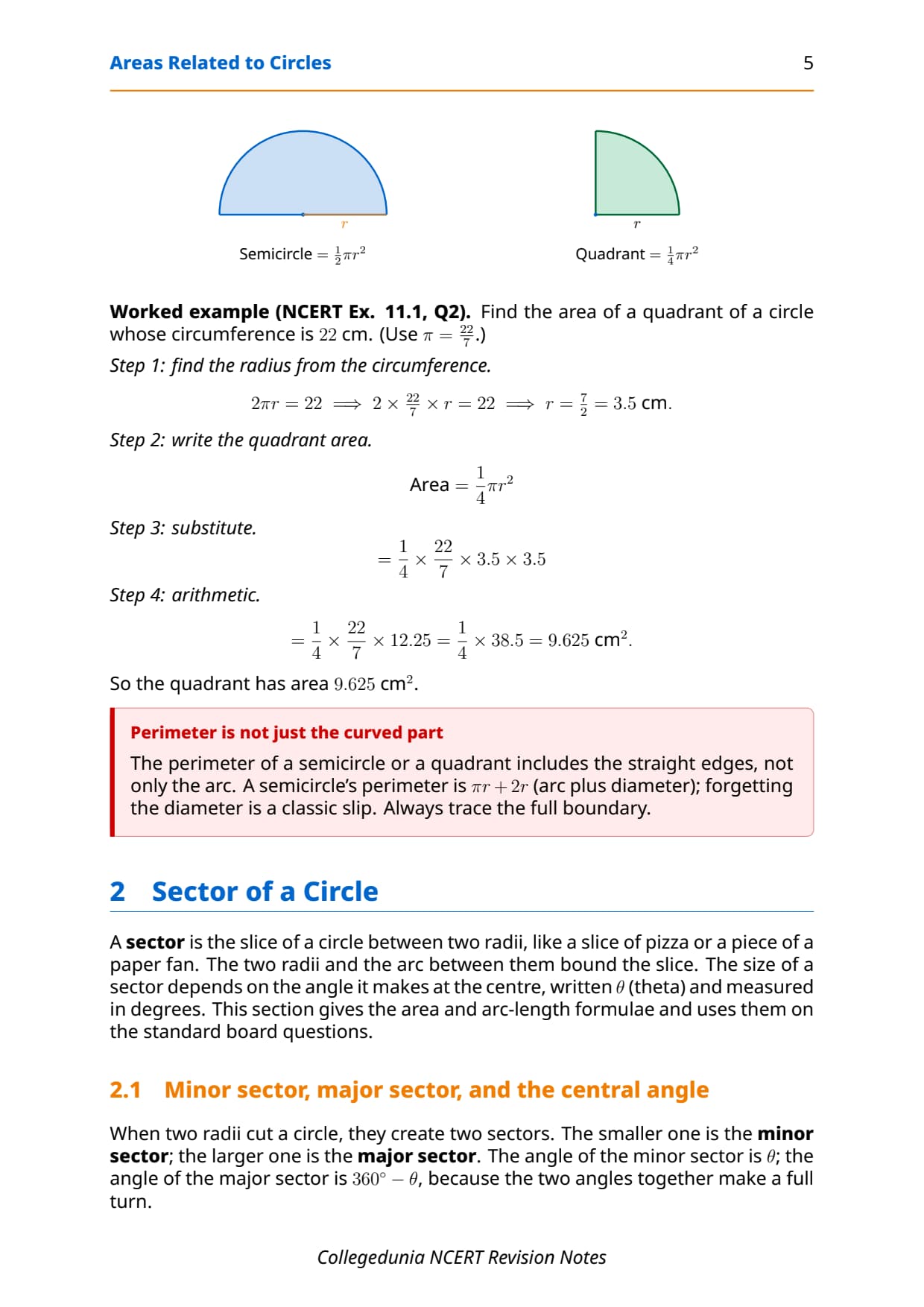
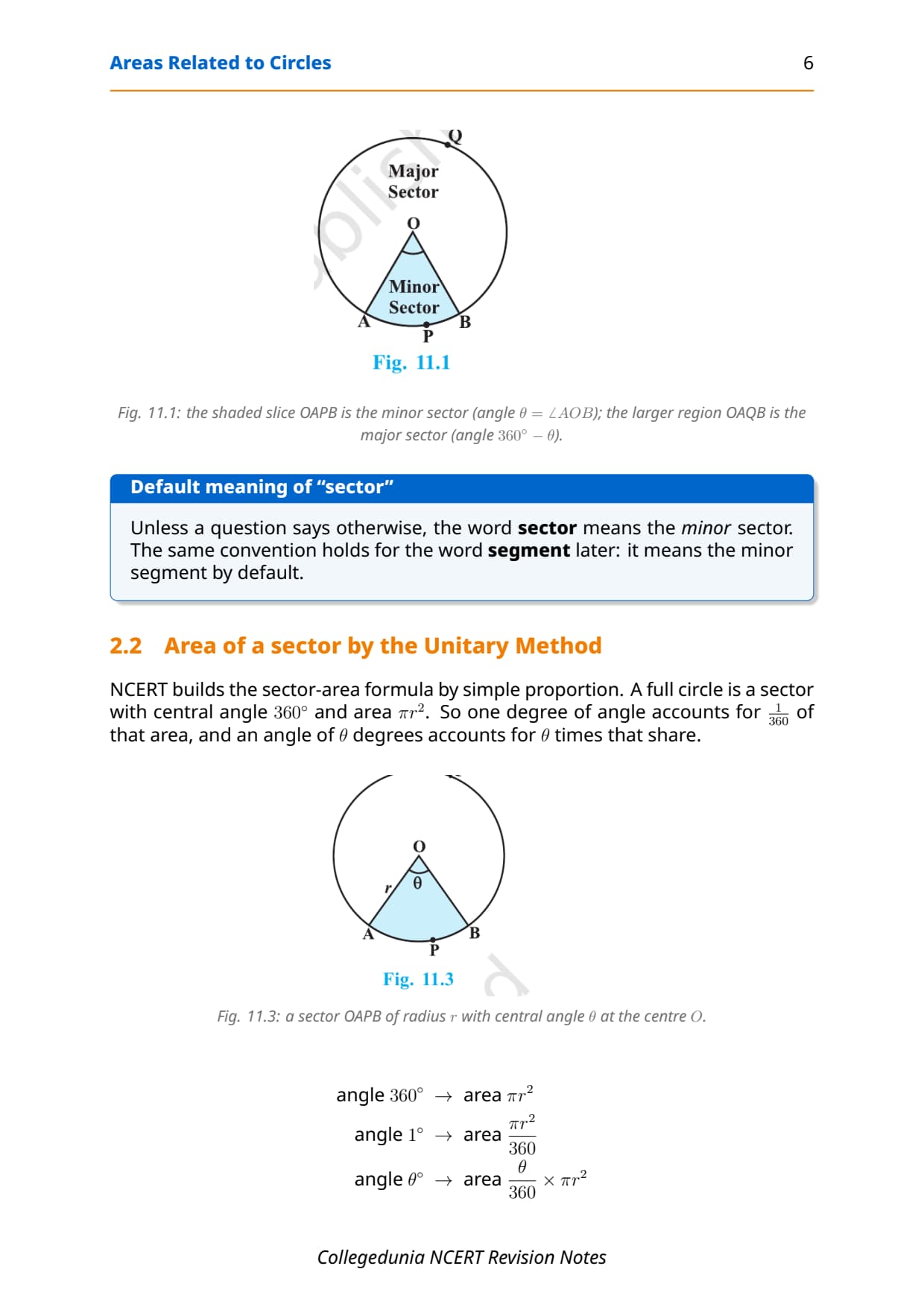
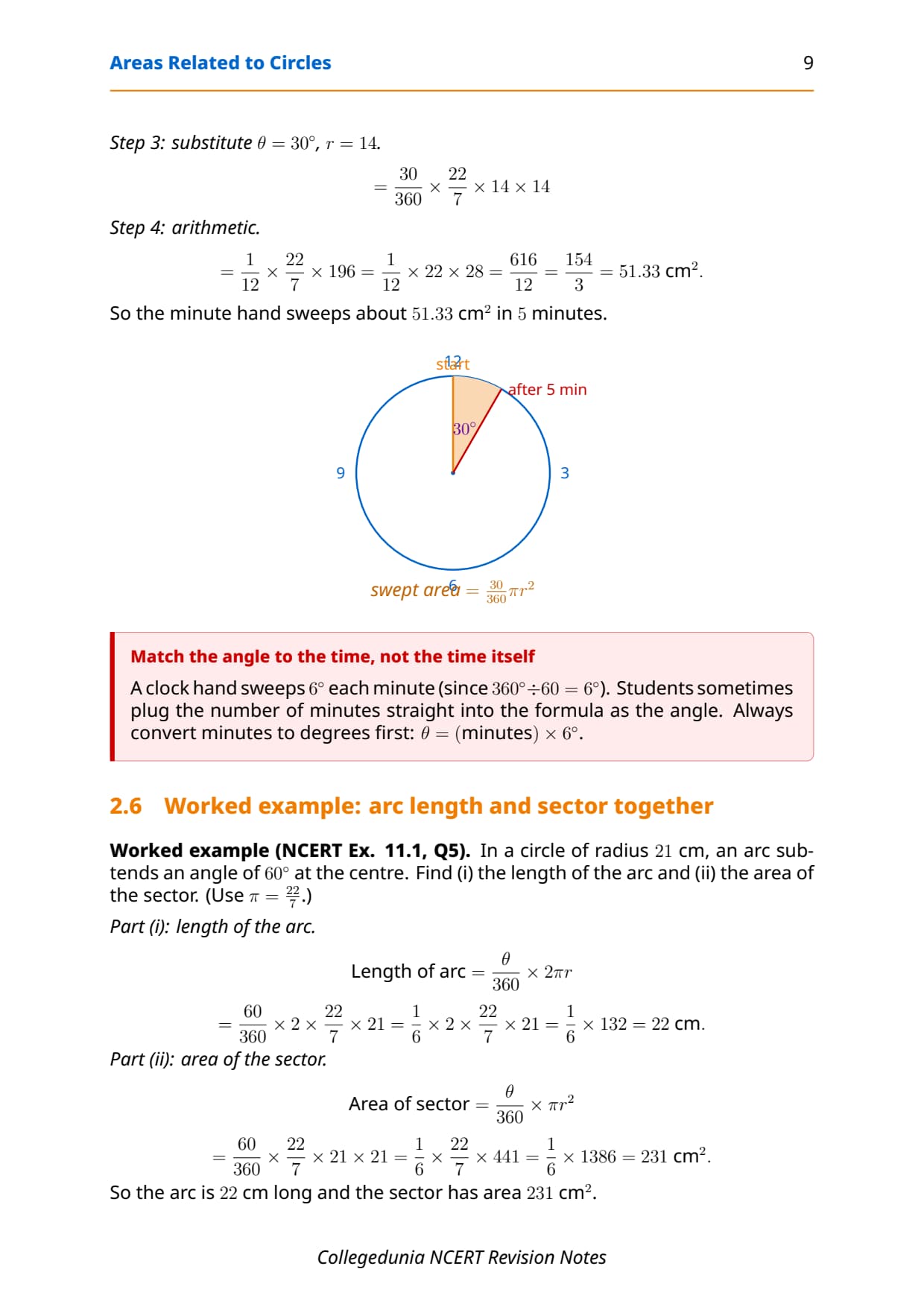
- Sector: the pizza-slice region between two radii and an arc; its area and arc length both depend on the central angle in degrees.
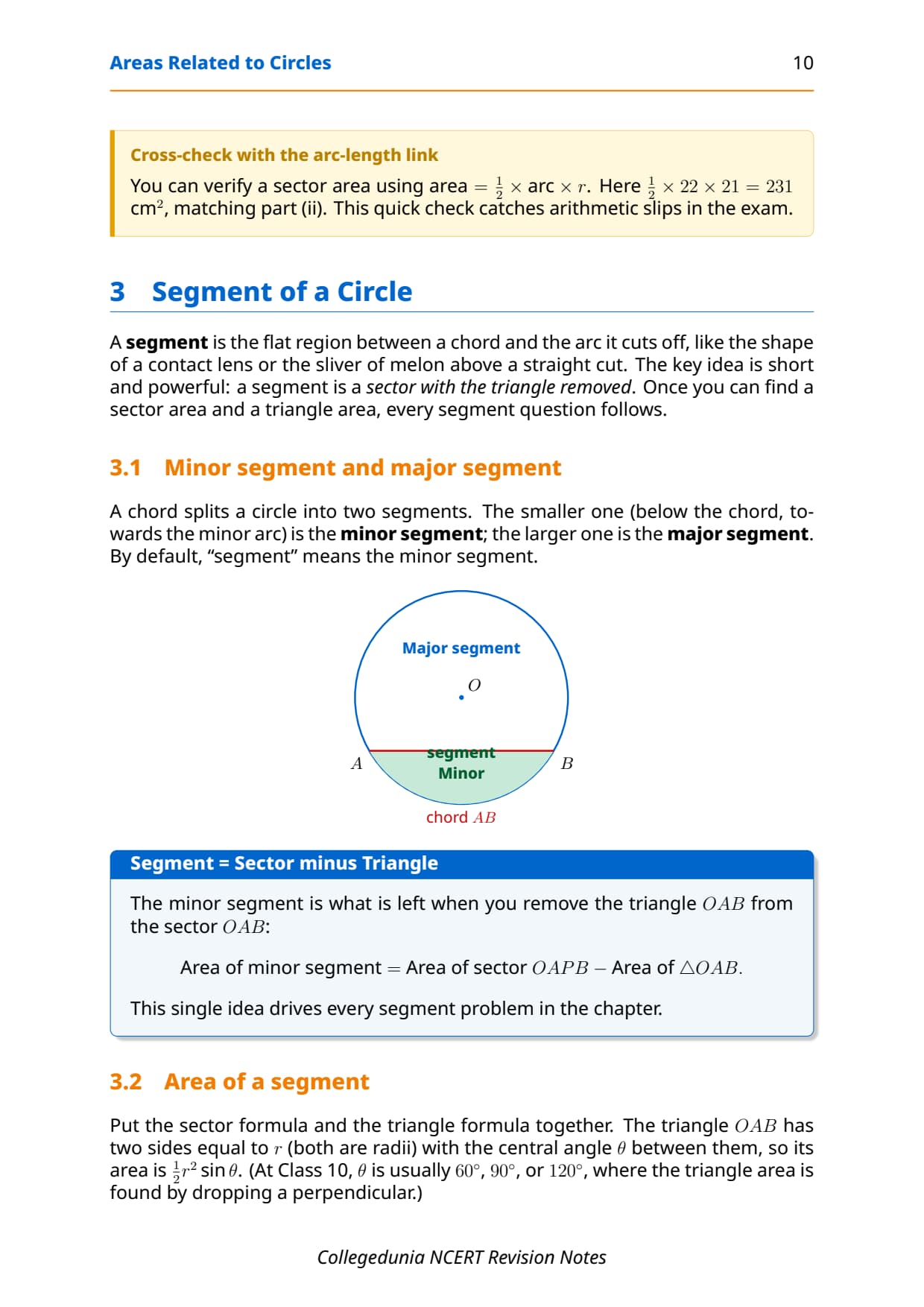
- Segment: the region between a chord and the arc it cuts off; segment area = sector area minus the triangle made by the two radii and the chord.
- Combinations of figures: real shapes like a field with a semicircular end or a sector inside a square. You add and subtract the areas above.
- Value of π (22/7 or 3.14): NCERT tells you which to use in each problem. Check the question first, since the answer changes.
In the 2026-27 NCERT the chapter has only one exercise (Exercise 11.1, 15 questions). The board picks 2 to 3 of these each year, often with the numbers changed.
Core Formulas: Arc Length, Sector & Segment Area
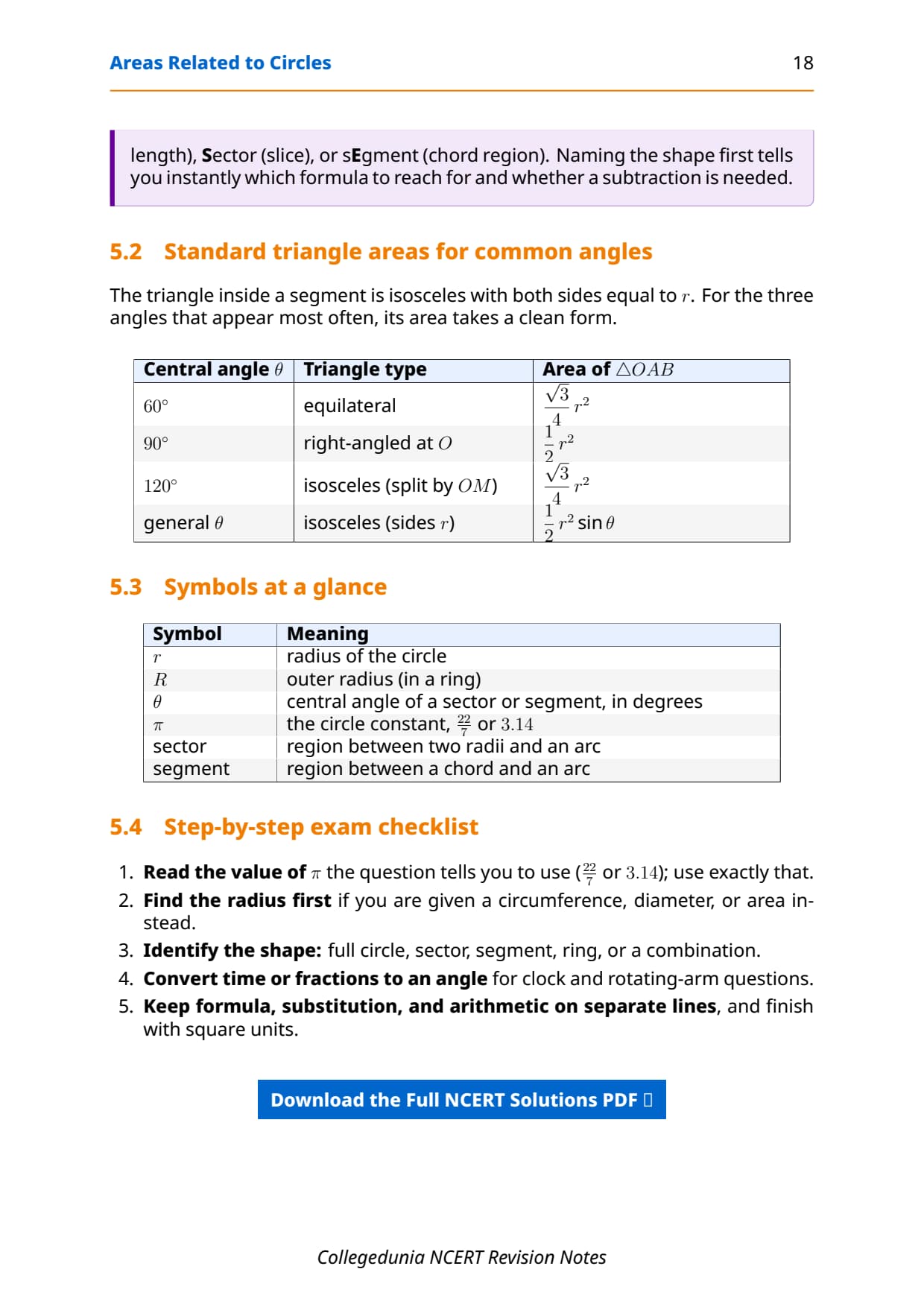
Every board problem here runs on four formulas; get these right and the rest is arithmetic. The table gives each one in the exact NCERT form.
| Quantity | Formula | Variables |
|---|---|---|
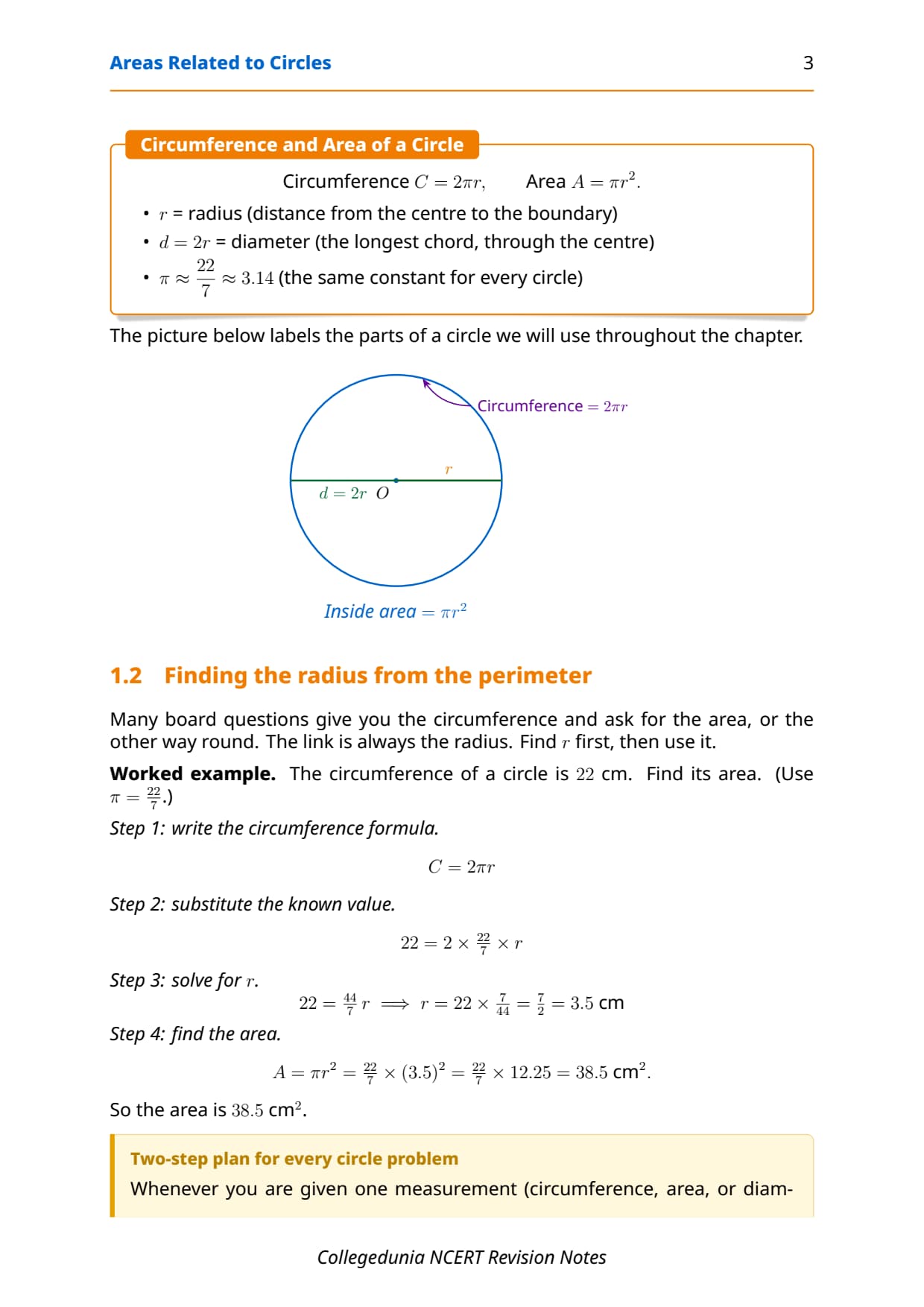
| Circumference of a circle | C = 2πr | r = radius |
| Area of a circle | A = πr2 | r = radius |
| Length of an arc (sector) | l = (θ/360) × 2πr | θ = central angle in degrees, r = radius |
| Area of a sector | Asector = (θ/360) × πr2 | θ = central angle in degrees, r = radius |
| Perimeter of a sector | Psector = l + 2r = (θ/360) × 2πr + 2r | l = arc length, r = radius |
| Area of a minor segment | Aseg = Asector − Atriangle | Triangle formed by the two radii and the chord |
| Area of a major segment | Amajor seg = πr2 − Aminor seg | Remaining area after removing the minor segment |
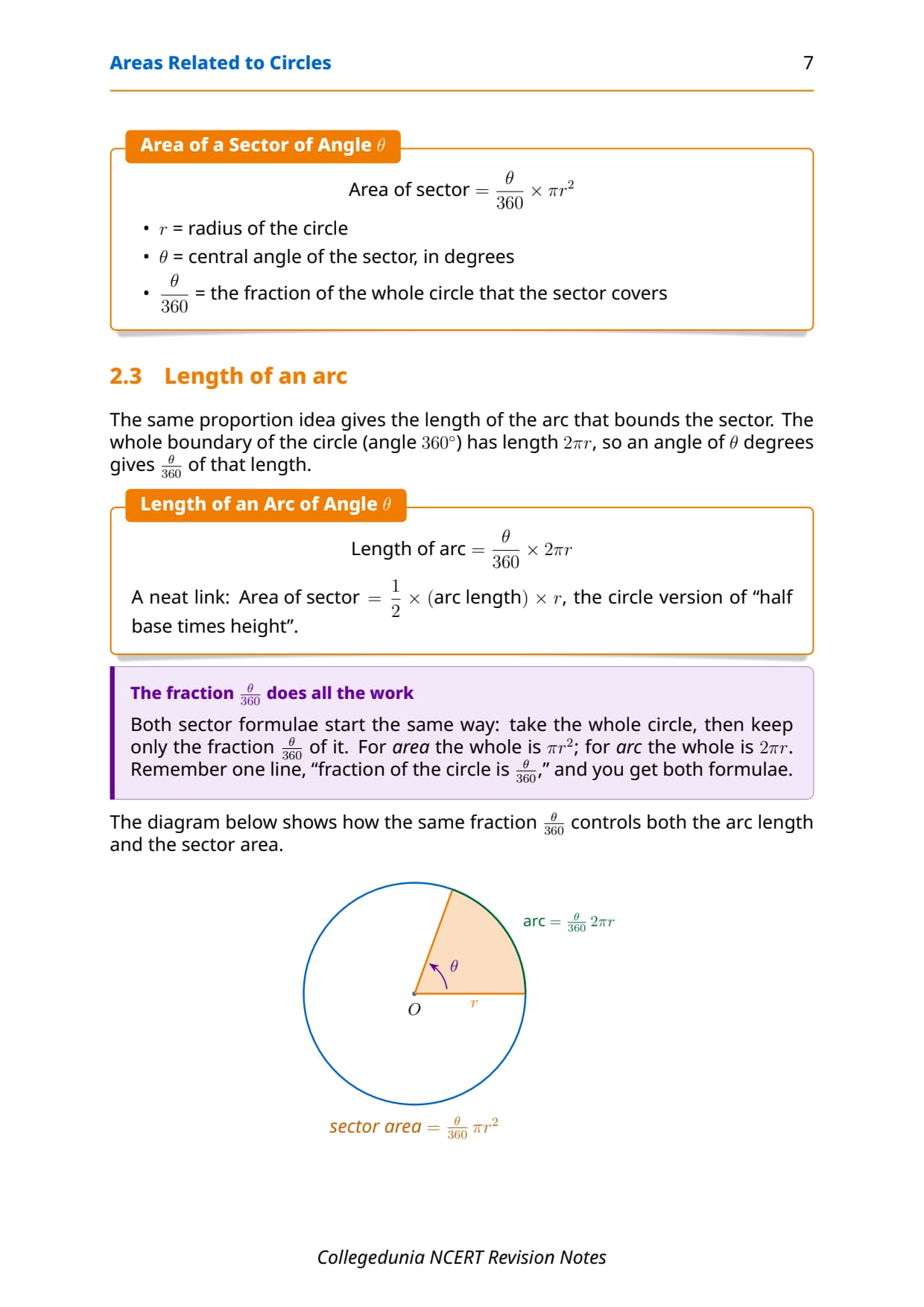
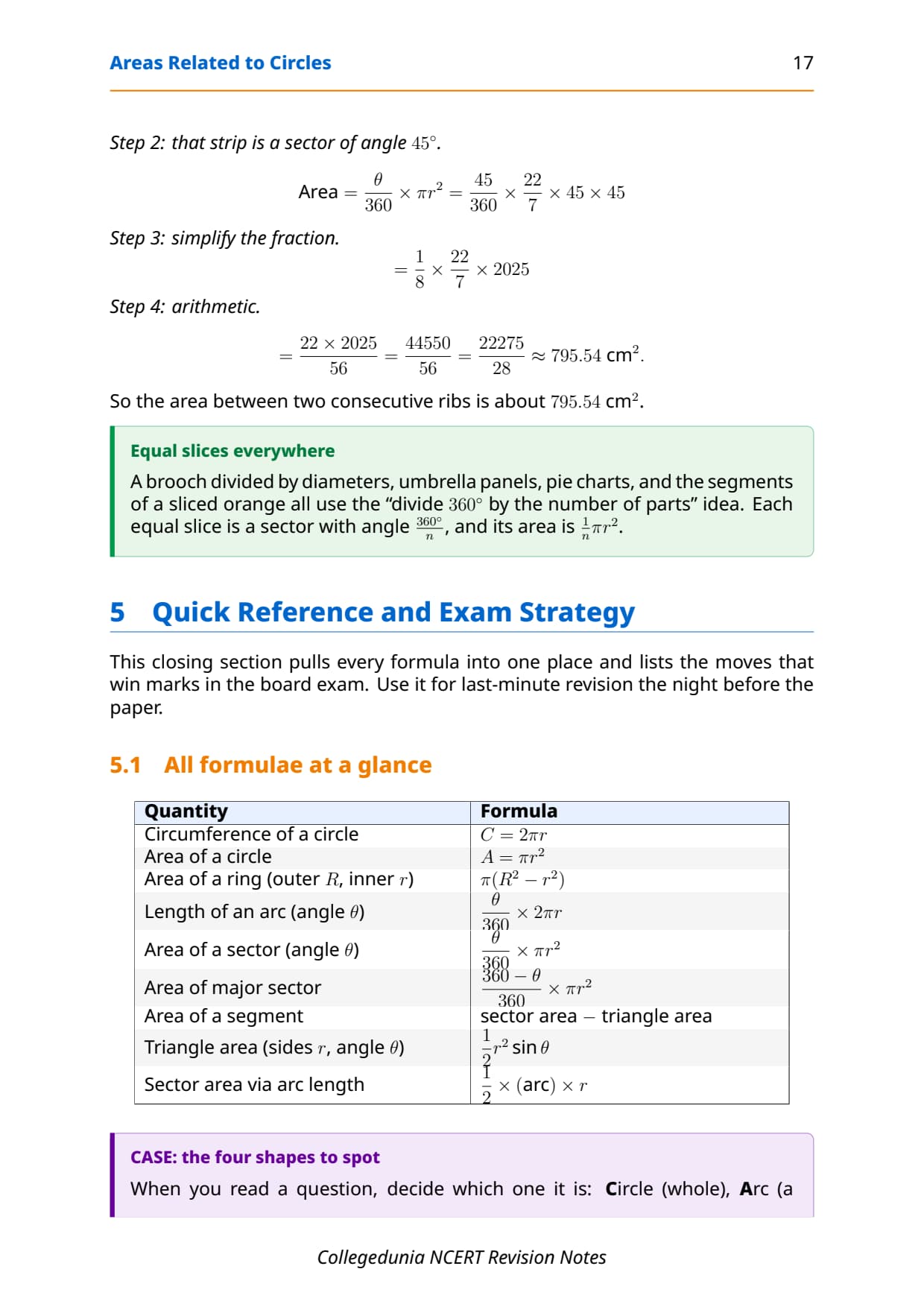
The fraction θ/360 is the key multiplier in both the arc length and sector area formulas: it is the slice of the full circle the sector covers. A 90° sector is 1/4 of the circle (area πr2/4), 60° is 1/6, 120° is 1/3, and 180° (a semicircle) is 1/2. The one formula works for any angle, even an awkward one: put θ over 360, simplify (150/360 = 5/12), and multiply.
Area & Perimeter of a Sector
A sector is the region between two radii and the arc between them, like a pizza slice. Every sector problem is two steps: find the fraction θ/360, then scale the circle's area or circumference by it. Arc length is l = (θ/360) × 2πr and area is A = (θ/360) × πr2. Always state units (cm2 for area, cm for length).
One thing students often miss: the perimeter of a sector includes the two straight radii, not just the arc. Sector perimeter = arc length + 2r. The board sometimes asks for perimeter just to test this.
Area of a Segment: Minor & Major
A segment is the region between a chord and the arc it cuts. Every chord splits the circle into a minor segment (smaller) and a major segment (larger). These are the hardest board problems, since they need one extra step: subtracting the triangle area from the sector area.
Formula for area of a minor segment
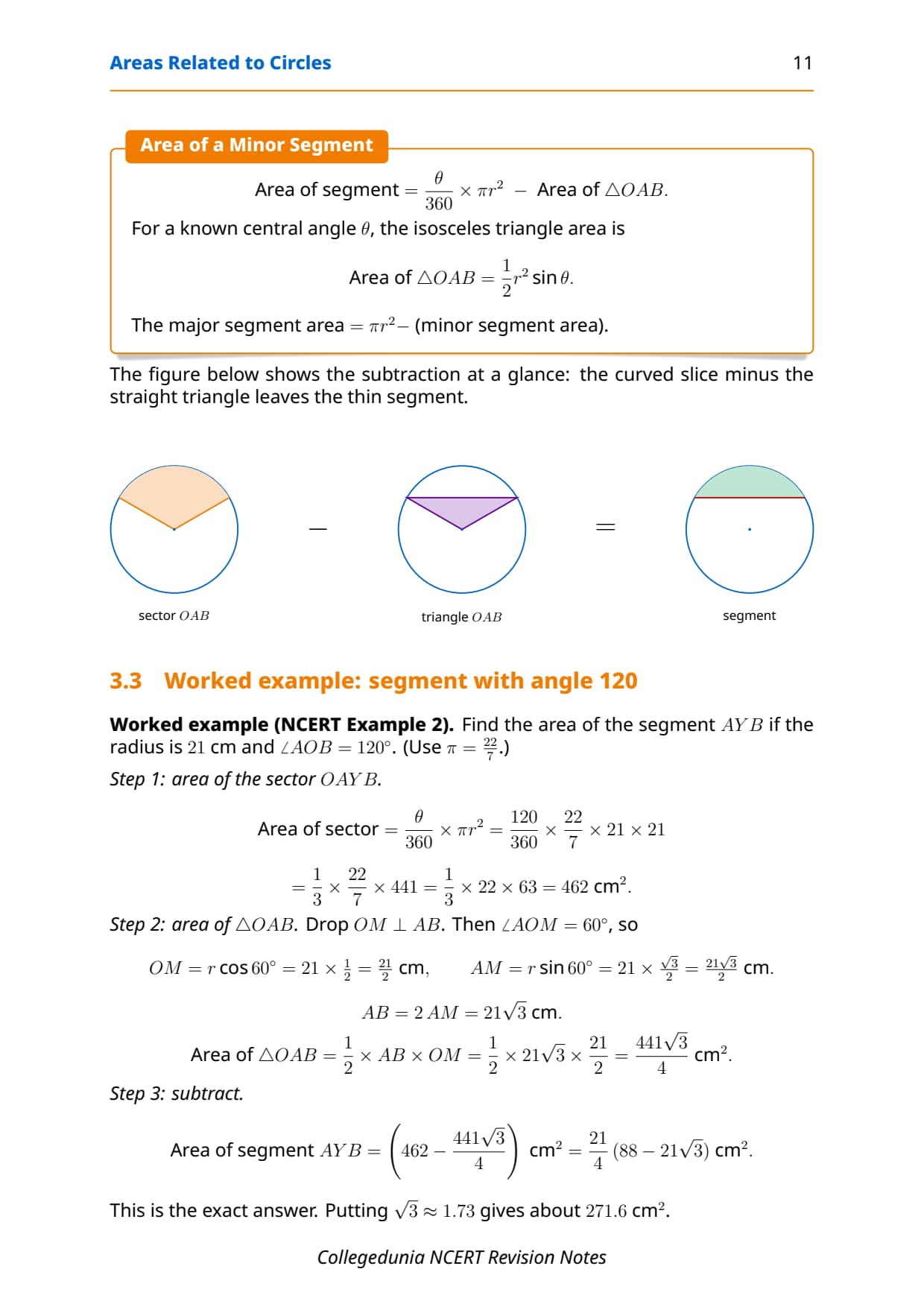
Minor segment = sector minus triangle OAB (O is the centre, A and B the chord ends):
Aminor seg = (θ/360) × πr2 − (1/2) × r2 × sinθ
The triangle area is (1/2) r2 sinθ because OAB has two sides equal to r with angle θ between them. For the common 90° case, sin90° = 1, so the triangle area is r2/2. The major segment follows directly: Amajor seg = πr2 − Aminor seg. It is always sector minus triangle, never the other way round (that gives a negative number).
Shaded-Region Problems: Combined Figures
The hardest and best-marked problems use compound figures: a circle inside a square, a triangle with semicircles on its sides, a ring between two concentric circles, or a garden layout. They all use one strategy: break the shape into parts, find each part's area, then add or subtract.
Standard compound figure types and their formula chains
| Figure type | Strategy | What to compute |
|---|---|---|
| Circle inscribed in a square | Area of square − area of circle | Side = diameter = 2r; Area of square = 4r2 |
| Quadrant inside a square corner | Area of square − 4 quadrants (if all 4 corners) or area of square − 1 quadrant | Quadrant area = πr2/4; radius = side of square |
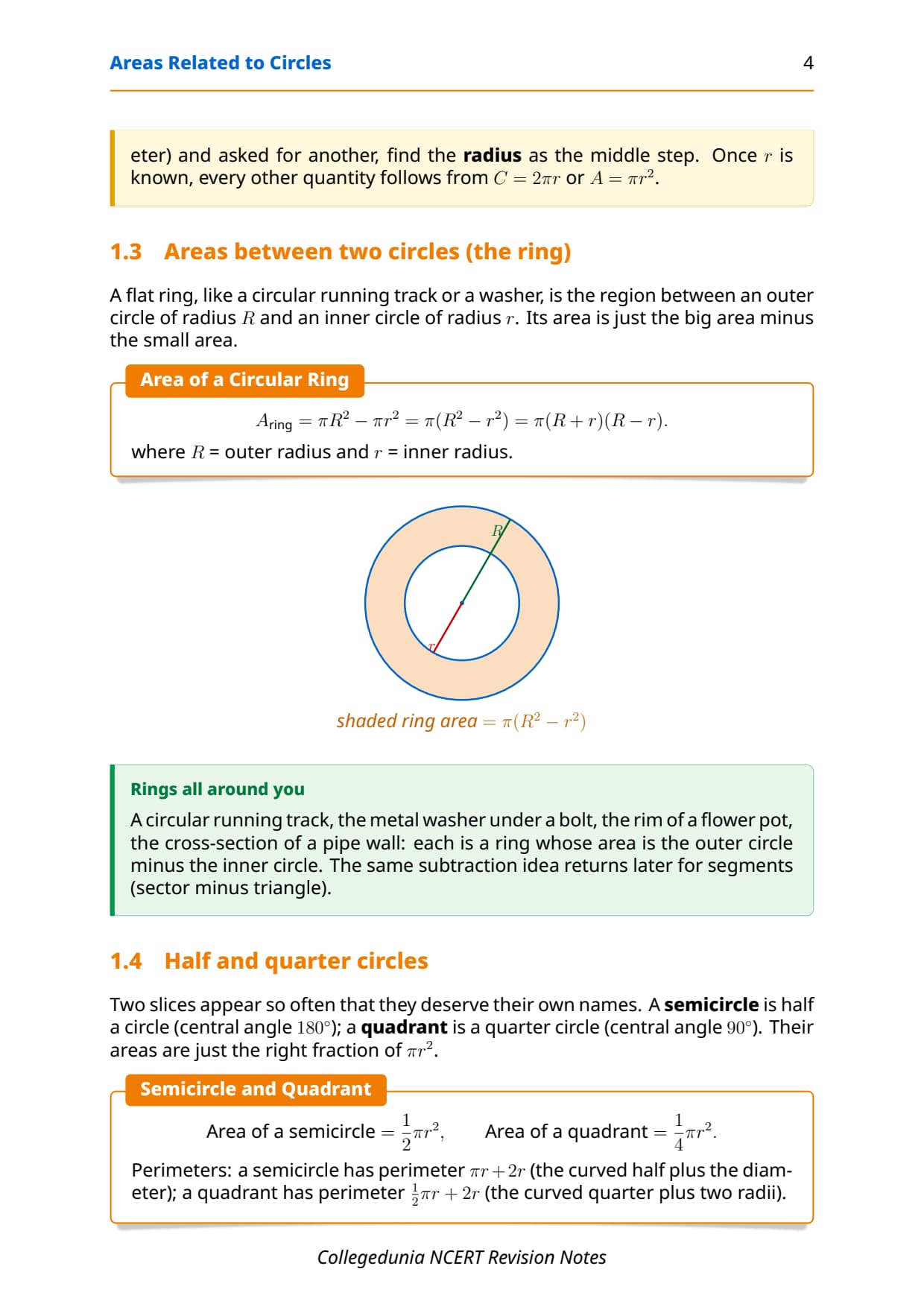
| Ring (annulus) | Area of outer circle − area of inner circle | πR2 − πr2 = π(R2 − r2) |
| Sector with triangle removed | Area of sector − area of triangle | This is exactly the minor segment formula |
| Field with semicircular ends | Rectangle area + 2 semicircle areas | The 2 semicircles together make one full circle |
Two shortcuts: the ring formula factors as π(R + r)(R − r), so you can multiply without squaring each radius; and four quadrants at the corners of a square add up to one full circle, 4 × (πr2/4) = πr2.
Worked Board Problems
This worked problem shows the format the board rewards: write the full formula before any numbers go in, because the examiner gives a method mark for the formula alone.
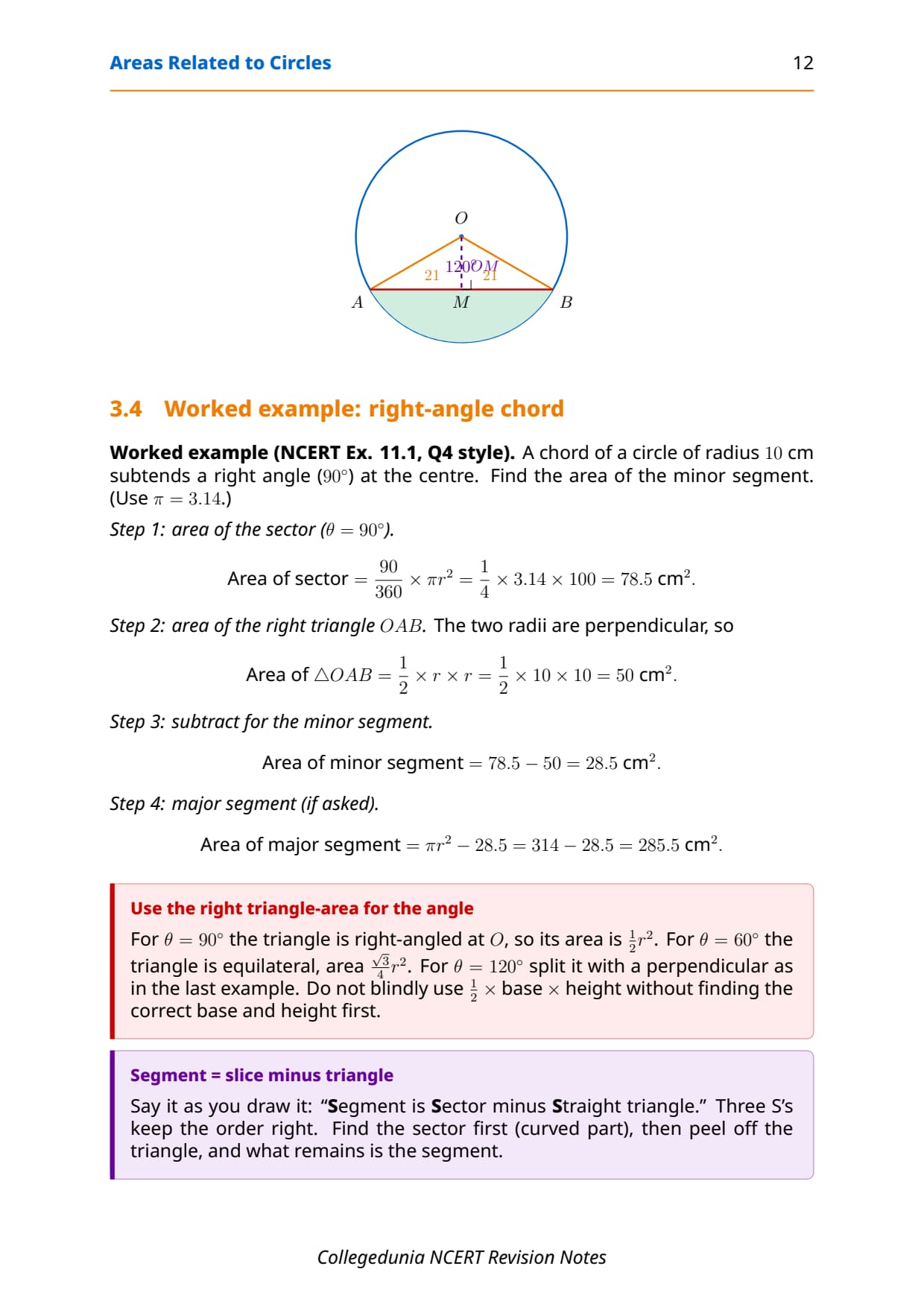
Problem: Area of the minor segment (θ = 90°, r = 10 cm)
Given: r = 10 cm, θ = 90°, π = 3.14.
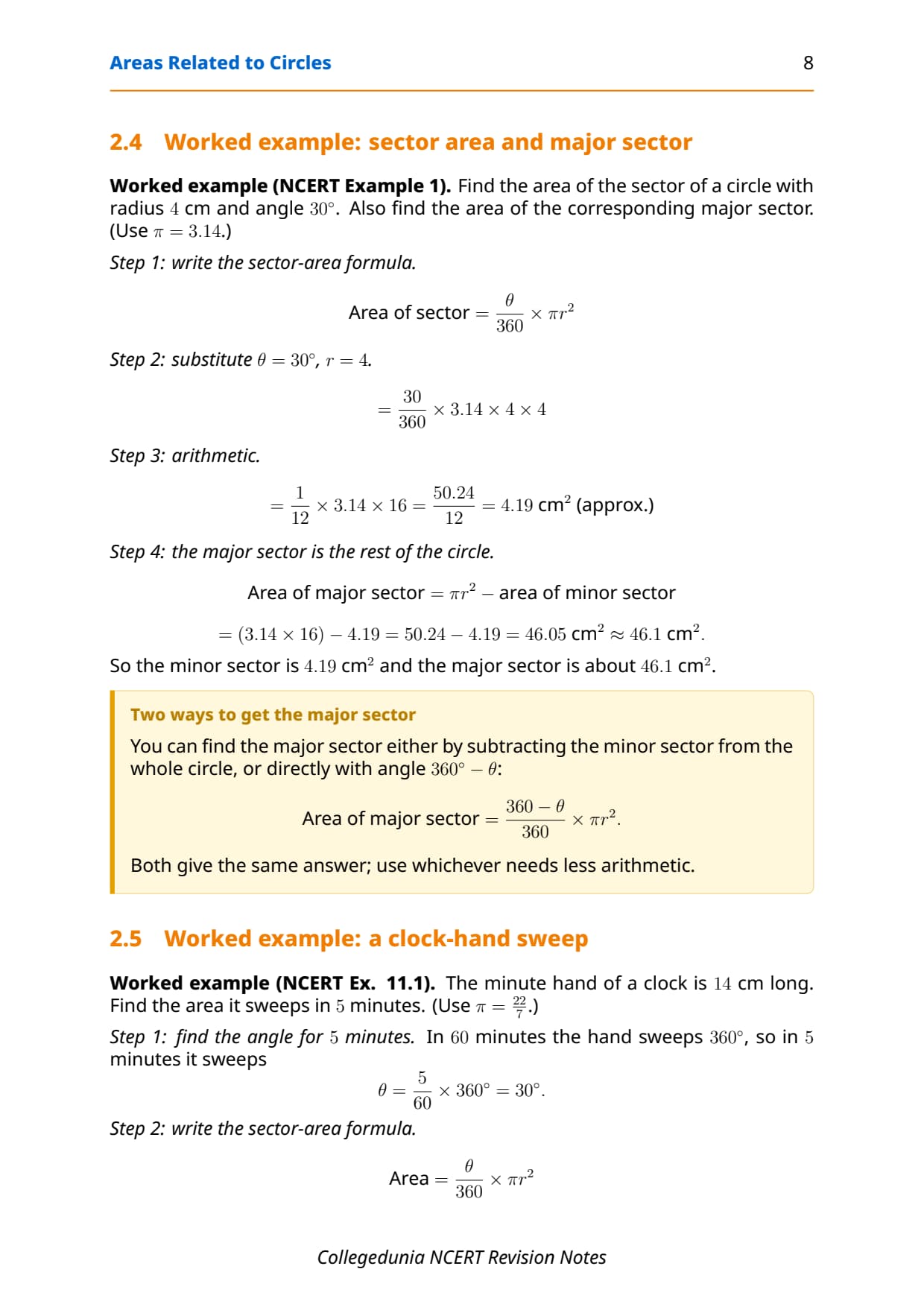
- Area of sector = (90/360) × 3.14 × 102 = (1/4) × 314 = 78.5 cm2.
- Area of triangle OAB (right-angled isosceles, legs = r) = (1/2) × 10 × 10 = 50 cm2.
- Area of minor segment = 78.5 − 50 = 28.5 cm2.
The same pattern handles other types: a 60° sector (r = 7) gives arc 22/3 cm and area 77/3 cm2, and a ring uses π(R + r)(R − r), where factoring beats squaring each radius.
Common Mistakes to Avoid
Most marks lost here come from a short list of formula or arithmetic slips.
The repeat-offender mistakes in board answers:
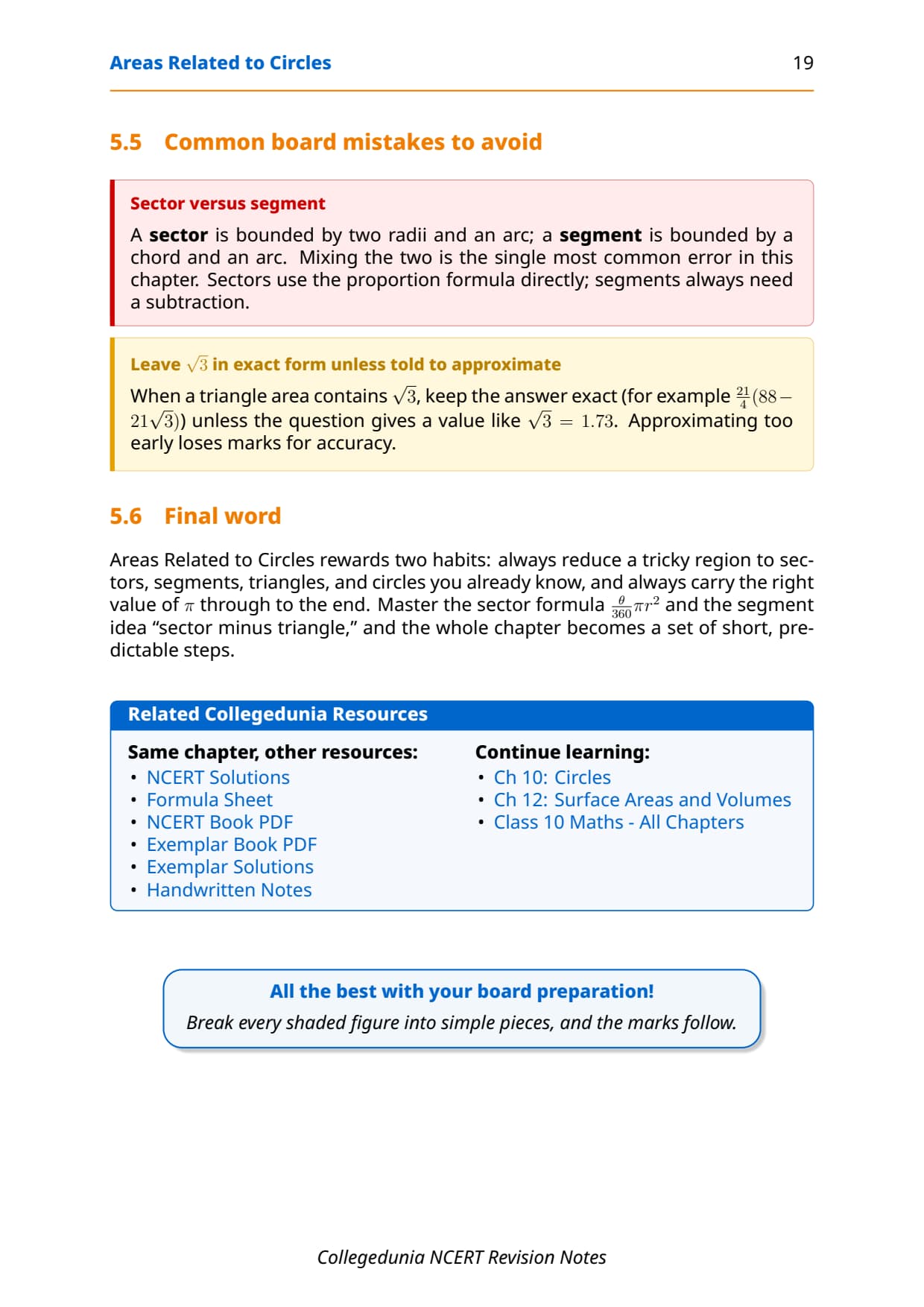
- Not writing the formula before substituting: CBSE gives 1 mark for the formula alone. Put numbers in straight away and you lose it, even with the right answer.
- Mixing up sector perimeter and arc length: arc length is the curved part only; sector perimeter = arc length + 2r.
- Using segment area = triangle area: the segment is sector minus triangle. Swapping them costs the whole question.
- Wrong value of π or no units: use the π the question states, and always write cm2 for area and cm for length.
Previous Year Question Trends
This chapter is a steady source of 3-mark and 4-mark questions, and the types repeat closely each year. Recent boards asked sector area and arc length (2025), four quadrants in a square (2024, 4 marks), a minor segment with θ = 90° (2023), a rectangle with semicircular ends (2022), and a ring (2021, 2 marks).
Also Check: The complete set of step-by-step NCERT exercise solutions for Chapter 11 Areas Related to Circles is at the Chapter 11 Areas Related to Circles NCERT Solutions page.
Quick Revision Summary
Use this the night before the exam as a one-stop formula lookup.
- Arc length: l = (θ/360) × 2πr
- Area of sector: Asector = (θ/360) × πr2
- Perimeter of sector: P = l + 2r = (θ/360) × 2πr + 2r
- Area of minor segment: Aseg = (θ/360) × πr2 − (1/2)r2sinθ
- Area of major segment: πr2 − Aminor seg
- Area of ring: π(R2 − r2) = π(R + r)(R − r)
- Quadrant area: πr2/4 (θ = 90°); Semicircle area: πr2/2 (θ = 180°)
On every problem: draw and label the figure, name each region, write the formula first, then add or subtract (shaded = larger area − smaller area) and state the answer with units.
Other Resources for Areas Related to Circles
Pair these notes with the matching NCERT Solutions, formula sheet, handwritten notes, and the official NCERT book chapter. All resources for Class 10 Maths Chapter 11 are linked below.
| Resource | What it covers | Open |
|---|---|---|
| Notes | Concept-first revision notes on sector area, arc length, segment area, compound figures, worked board problems, and a full revision summary for Areas Related to Circles. | You are here |
| NCERT Solutions | Step-by-step answers to all Exercise 11.1 questions, with full formula-substitution working for every sector, segment, and compound-figure problem. | Class 10 Maths Chapter 11 NCERT Solutions |
| Formula Sheet | One-page reference with arc length, sector area, segment area, ring area, and all special-angle shortcuts for Chapter 11. | Class 10 Maths Chapter 11 Formula Sheet |
| Handwritten Notes | Scanned-style handwritten pages covering all four core formulas, worked examples, and the compound-figure shortcut methods for Chapter 11. | Class 10 Maths Chapter 11 Handwritten Notes |
| NCERT Book PDF | Official NCERT Maths Chapter 11 Areas Related to Circles textbook in PDF form, with all figures and the Exercise 11.1 questions. | Class 10 Maths Chapter 11 NCERT Book PDF |
| Exemplar Solutions | Worked answers to the harder NCERT Exemplar problems on Areas Related to Circles for additional board practice and deeper understanding. | Class 10 Maths Chapter 11 Exemplar Solutions |
Notes for Class 10 Maths: All Chapters
Related Links: Open the notes for any other Class 10 Maths chapter below. Each one uses the same concept-first style, a full PDF download, and a revision FAQ.
| Chapter | Notes link |
|---|---|
| Chapter 1 | Real Numbers Notes |
| Chapter 2 | Polynomials Notes |
| Chapter 3 | Pair of Linear Equations in Two Variables Notes |
| Chapter 4 | Quadratic Equations Notes |
| Chapter 5 | Arithmetic Progressions Notes |
| Chapter 6 | Triangles Notes |
| Chapter 7 | Coordinate Geometry Notes |
| Chapter 8 | Introduction to Trigonometry Notes |
| Chapter 9 | Some Applications of Trigonometry Notes |
| Chapter 10 | Circles Notes |
| Chapter 11 | Areas Related to Circles Notes (You are here) |
| Chapter 12 | Surface Areas and Volumes Notes |
| Chapter 13 | Statistics Notes |
| Chapter 14 | Probability Notes |
Notes Class 10 Maths Chapter 11 Areas Related to Circles FAQs
Ques. What does Chapter 11 Areas Related to Circles cover in Class 10 Maths?
Ans. It covers the area and perimeter of sectors and segments, plus the areas of figures that mix circles with squares, rectangles, and triangles. The main formulas are: arc length l = (θ/360) × 2πr, sector area = (θ/360) × πr2, minor segment area = sector minus triangle, and ring area = π(R2 − r2). There is one exercise (Exercise 11.1) with 15 questions.
Ques. What is the formula for the area of a sector in Class 10?
Ans. The sector area is (θ/360) × πr2, where θ is the central angle in degrees and r is the radius. The fraction θ/360 is the slice of the circle the sector covers. So a 90° sector has area πr2/4, a 60° sector has πr2/6, and a 120° sector has πr2/3. The same fraction sets the arc length: l = (θ/360) × 2πr.
Ques. What is the formula for the area of a segment in Class 10 Maths?
Ans. Minor segment area = sector area minus the triangle made by the two radii and the chord. In symbols: (θ/360) × πr2 − (1/2) × r2 × sinθ. For the common 90° case, sin90° = 1, so the triangle area is r2/2. The major segment is the rest of the circle: πr2 − Aminor seg.
Ques. What is the difference between a sector and a segment of a circle?
Ans. A sector is the region between two radii and the arc between them, shaped like a pizza slice, and it touches the centre. A segment is the region between a chord and the arc it cuts off, and the minor segment does not touch the centre. To get the segment from the sector, remove the triangle made by the two radii and the chord, so segment area = sector area minus triangle area. Quick test: if the region touches the centre, it is a sector; if not, it is a segment.
Ques. What is the perimeter of a sector in Class 10?
Ans. The perimeter is the full boundary: two straight sides (each = radius r) plus the curved arc. So perimeter = arc length + 2r = (θ/360) × 2πr + 2r. A common board mistake is quoting only the arc length when the question wants the perimeter. Always add the two radii. For a quadrant (90°) it is πr/2 + 2r; for a semicircle (180°) it is πr + 2r = r(π + 2).
Ques. How do you find the area of a shaded region in Chapter 11?
Ans. The method for any shaded-region problem is: (1) draw the figure and name the shapes in the whole figure and in the shaded part, (2) write the area formula for each region, (3) find the shaded area by subtracting the unshaded part from the total, or by adding the shaded pieces. Common setups: circle inside a square (square minus circle), quadrants at the corners of a square (4 quadrants minus 4 triangles), and a segment (sector minus triangle). Decide which region is shaded before you set up the formula.
Ques. Is Chapter 11 Areas Related to Circles important for CBSE Class 10 board exams?
Ans. Yes. This chapter appears in the CBSE Class 10 board paper every year, usually as one or two questions worth 3 to 4 marks each. Common types are sector area and arc length (3 marks), minor segment area (3 marks), a shaded region in a compound figure (4 marks), and ring area (2 marks). The types are very predictable, so it is high-value for prep. Practise Exercise 11.1 and the segment formula, and you can score full marks on every Chapter 11 question.
Ques. What value of pi should students use in Chapter 11?
Ans. NCERT tells you which value to use in each question. Most use π = 22/7, which gives neat fractions; some use π = 3.14, which gives decimals. Use whatever the question states and do not switch. If a question says nothing, take π = 22/7. The right value matters because the final number changes, and the examiner checks against the answer for that value.



Comments