


These Notes for Class 10 Science Chapter 12 Magnetic Effects of Electric Current give a fast, concept-first revision of the whole chapter on the 2026-27 CBSE syllabus, covering the magnetic field and field lines, the field due to a current, the right-hand thumb rule, the solenoid and electromagnet, the force on a conductor with Fleming's left-hand rule, the electric motor, electromagnetic induction and the generator, and safe domestic wiring.
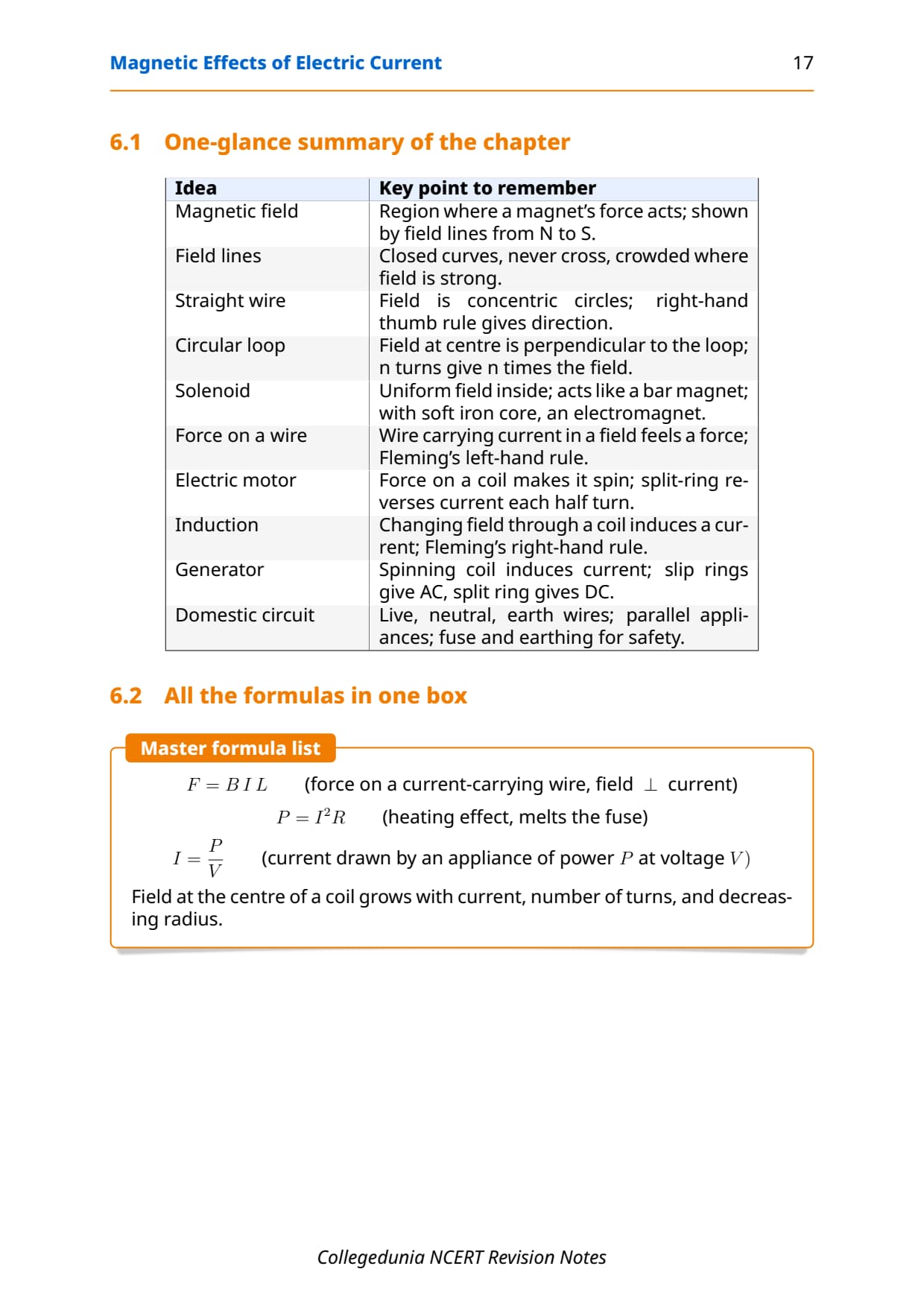
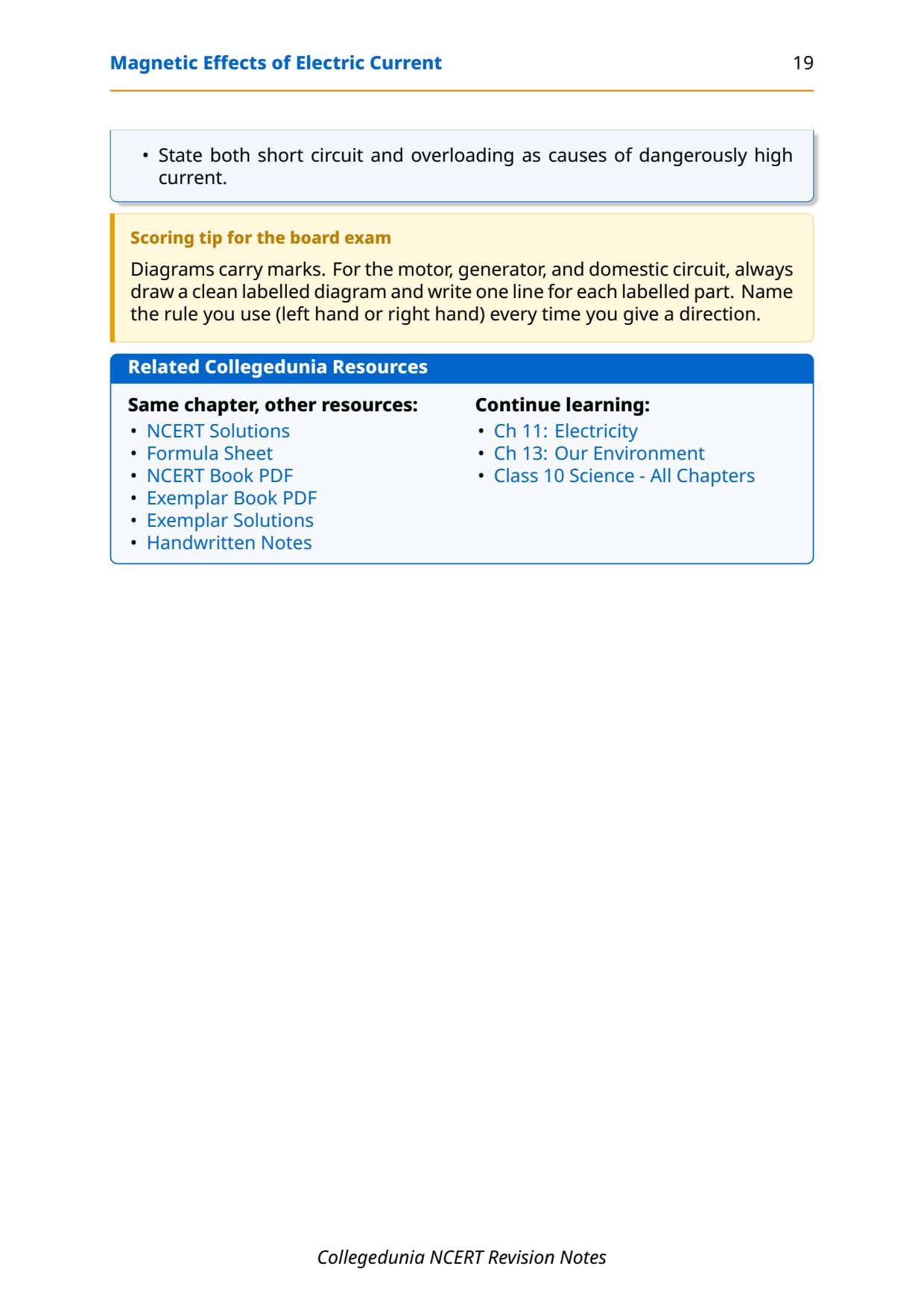
- Every rule and diagram explained with a one-line meaning, a labelled figure, and the exact direction each hand rule gives.
- Full coverage of field lines, the solenoid and electromagnet, Fleming's left and right-hand rules, the motor, the generator and domestic circuits.
- Aligned with the 2026-27 CBSE Class 10 Science syllabus and written for the board exam.
These Collegedunia revision notes are curated by Science subject experts, mapped to the 2026-27 NCERT textbook, and refined against the last five years of CBSE Class 10 Science board papers.
Student Feedback: What 13,200 students told us about this chapter
78% of Class 10 students said they mixed up Fleming's left-hand and right-hand rules, using the wrong hand for the force and the induced current. 3 out of 5 students told us that learning the two rules side by side, "left for the motor, right for the generator," cleared up most of their direction mistakes before the board exam.
Toppers found that drawing a clean labelled diagram for the motor, generator and domestic circuit, with one line per labelled part, saved 10 to 15 minutes and won the easy diagram marks, and the average student spent 3 to 4 hours on these notes across the first read and the final revision.
Source: 2026-27 Class 10 Science student poll. Sample of 13,200 students from CBSE schools across 14 states, conducted before the 2026 boards.
What the Notes for Class 10 Science Chapter 12 Magnetic Effects of Electric Current Cover
The big idea: a current makes a magnetic field, and a field pushes on a current. These notes keep the NCERT order in exam-ready blocks.
- Field: field lines, Oersted's experiment, the field around a wire, loop and solenoid, the right-hand thumb rule, and the electromagnet.
- Force and machines: the force on a conductor, Fleming's left-hand rule, the motor, electromagnetic induction, Fleming's right-hand rule and the generator.
- Safety: the live, neutral and earth wires of a domestic circuit.
Source: Magnet Brains on YouTube
Magnetic Field and Magnetic Field Lines
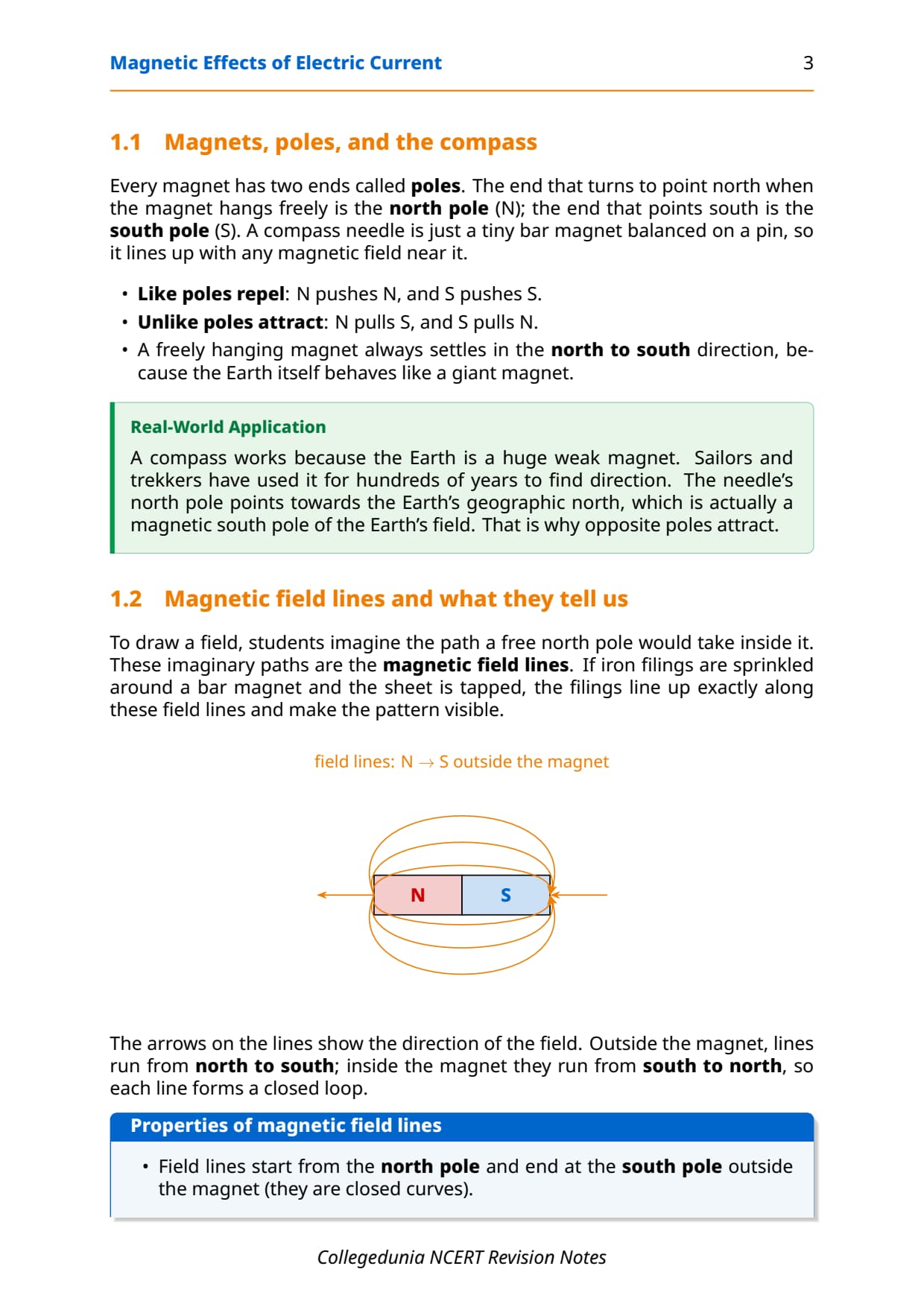
The region around a magnet where its pull or push can be felt is its magnetic field, pictured with magnetic field lines (sprinkle iron filings around a bar magnet and they line up along these lines). Every magnet has a north pole (N) and a south pole (S); like poles repel, unlike poles attract, and a freely hanging magnet settles north to south because the Earth behaves like a giant magnet.
Arrows on field lines show the field direction: outside a magnet from north to south, inside from south to north, so each line is a closed loop. The four properties below are asked about directly.
| Property of field lines | What it means |
|---|---|
| Closed curves | N to S outside the magnet, S to N inside |
| Direction | The way a compass north pole points there |
| Crowding shows strength | Crowded near the poles (strong field), spread out where weak |
| Never cross | A crossing would make a compass point two ways at once |
Magnetic Field Due to a Current-Carrying Conductor
In 1820 Hans Christian Oersted found a compass needle moved when a current flowed in a nearby wire, proving that a current makes a magnetic field. Reversing the current reverses the field; a bigger current makes it stronger.
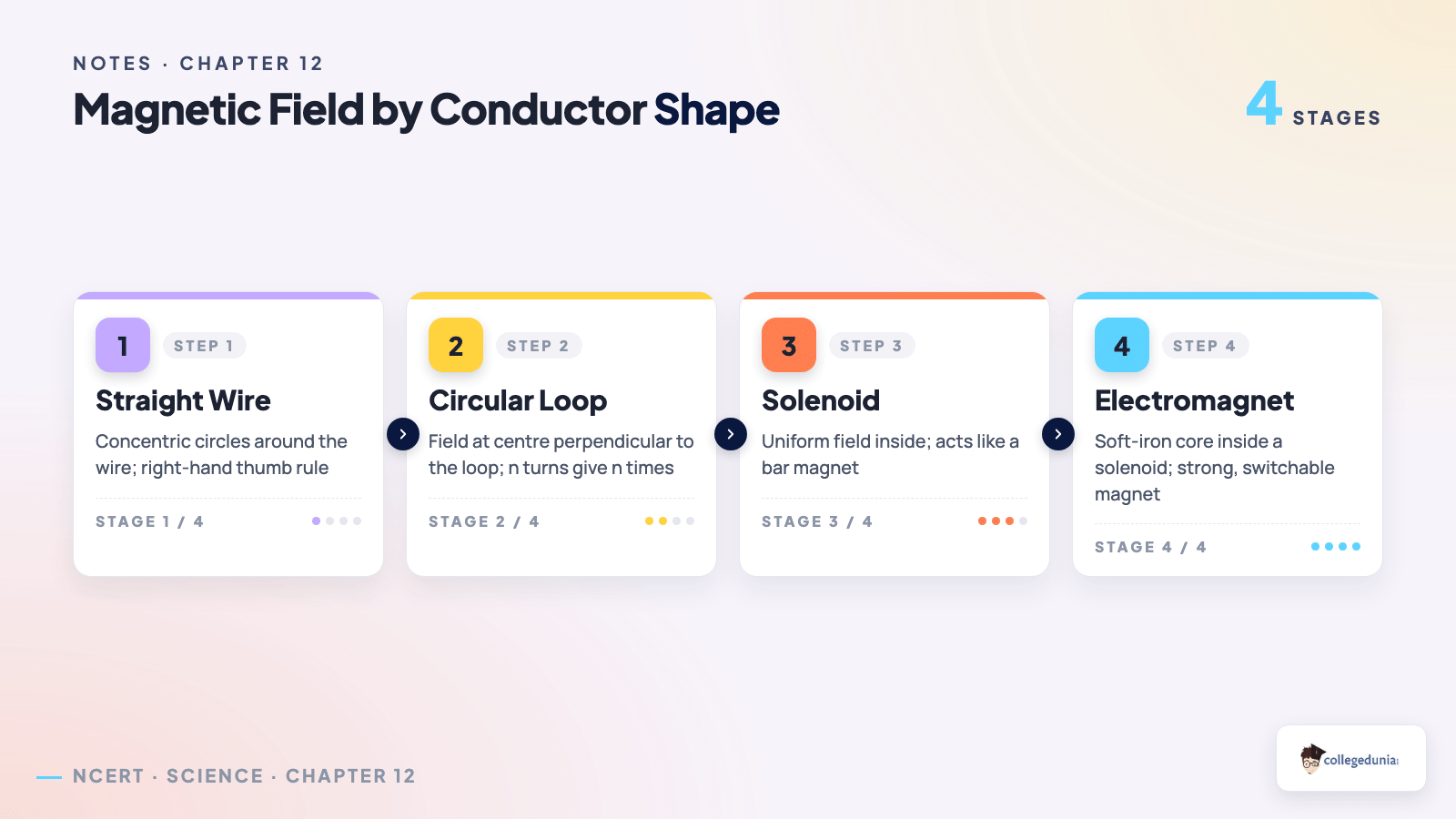
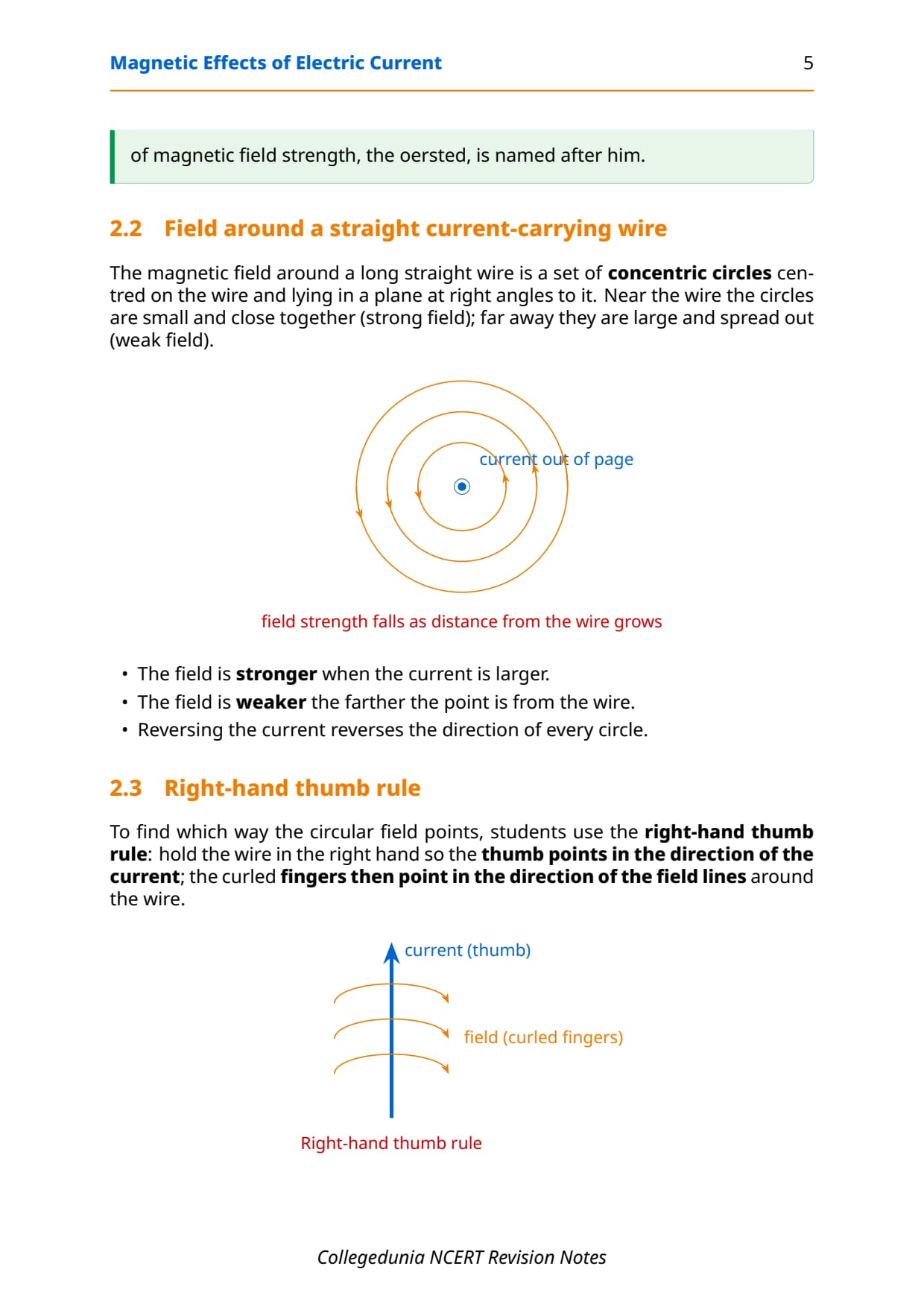
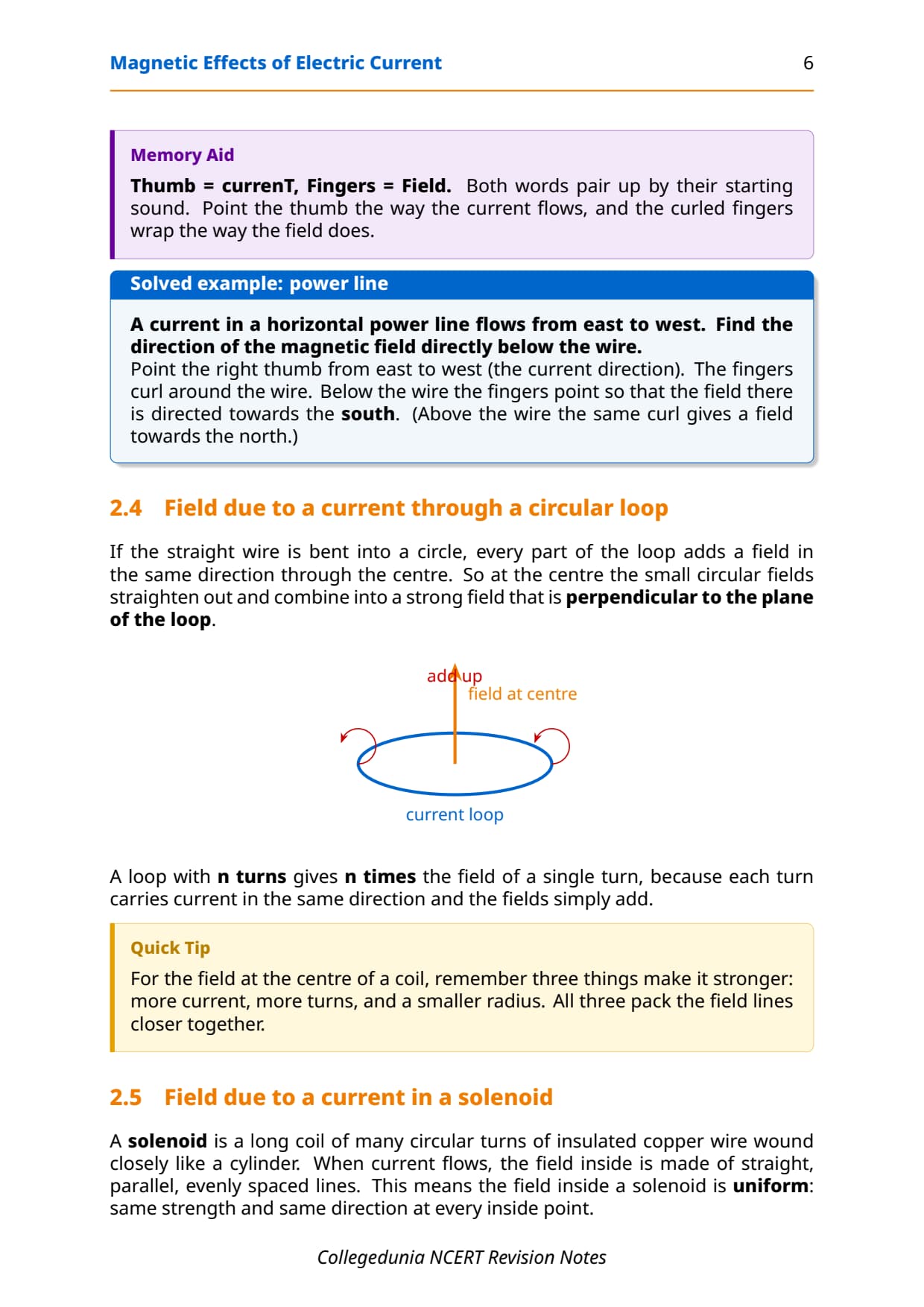
Around a long straight wire the field is concentric circles centred on the wire, strong close to it and weak far away. Bend the wire into a circular loop and the fields add up at the centre into a strong field perpendicular to the plane of the loop; n turns give n times the field. For the direction, use the right-hand thumb rule: thumb along the current, curled fingers along the field.
Solenoid and the Electromagnet
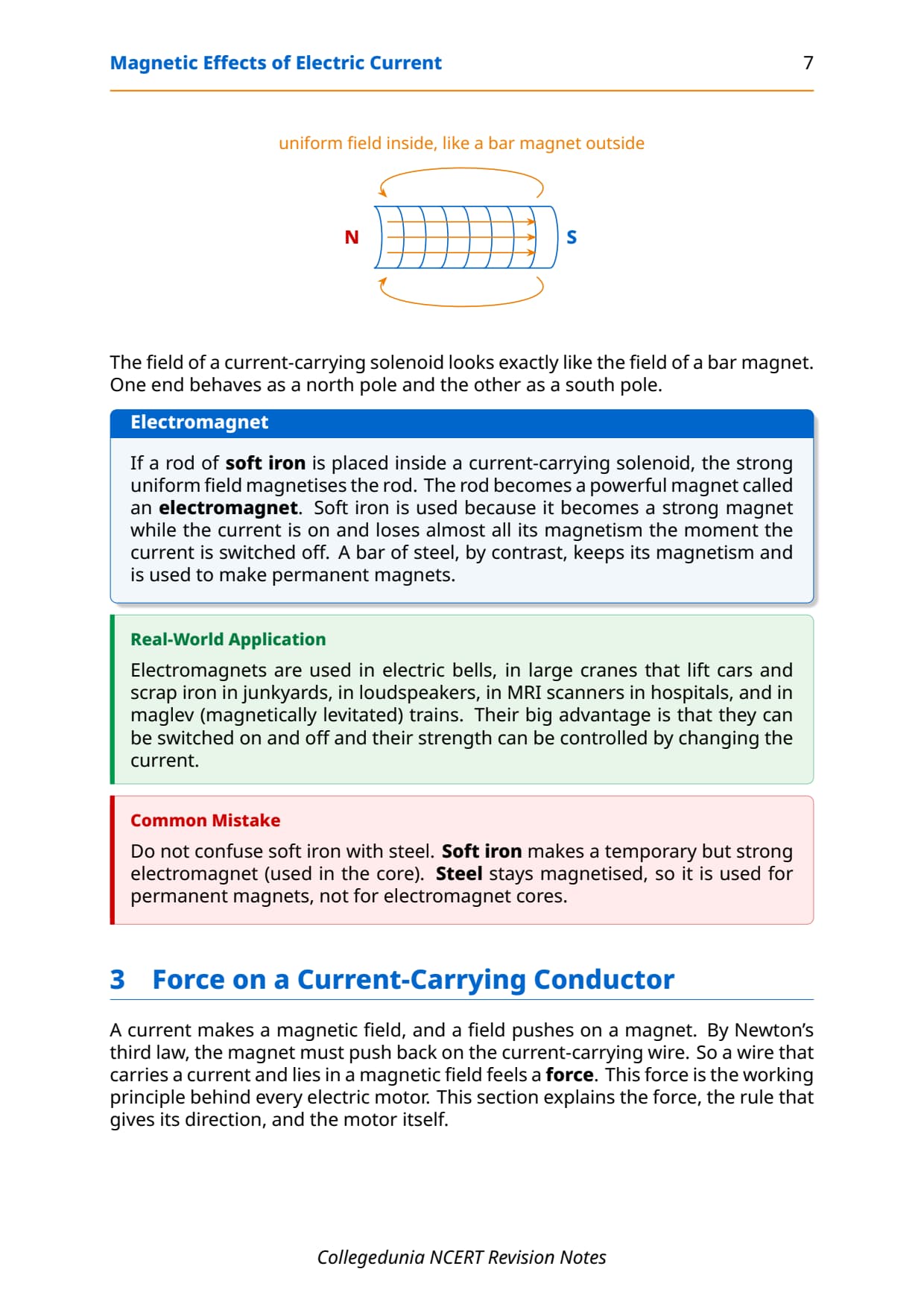
A solenoid is a long coil of closely wound insulated copper wire. With current flowing, the field inside is uniform and looks like a bar magnet's, one end north, the other south. Put a rod of soft iron inside and it becomes a powerful electromagnet: soft iron is used because it is strongly magnetised while the current is on and loses almost all magnetism the moment it stops.
| Material | Behaviour | Used for |
|---|---|---|
| Soft iron | Strong magnet while current flows, loses magnetism when it stops | The core of an electromagnet |
| Steel | Keeps its magnetism after the current stops | Permanent magnets |
Electromagnets are used in electric bells, cranes, loudspeakers, MRI scanners and maglev trains; they can be switched on and off and their strength changed with the current.
Force on a Current-Carrying Conductor and Fleming's Left-Hand Rule
A wire carrying a current in a magnetic field feels a force. The force is largest when current and field are at right angles, and it points at right angles to both.
- The force grows with more current, a stronger field, or a greater length of wire in the field.
F = force (newton, N); B = magnetic field strength (tesla, T); I = current (A); L = length of wire in the field (m)
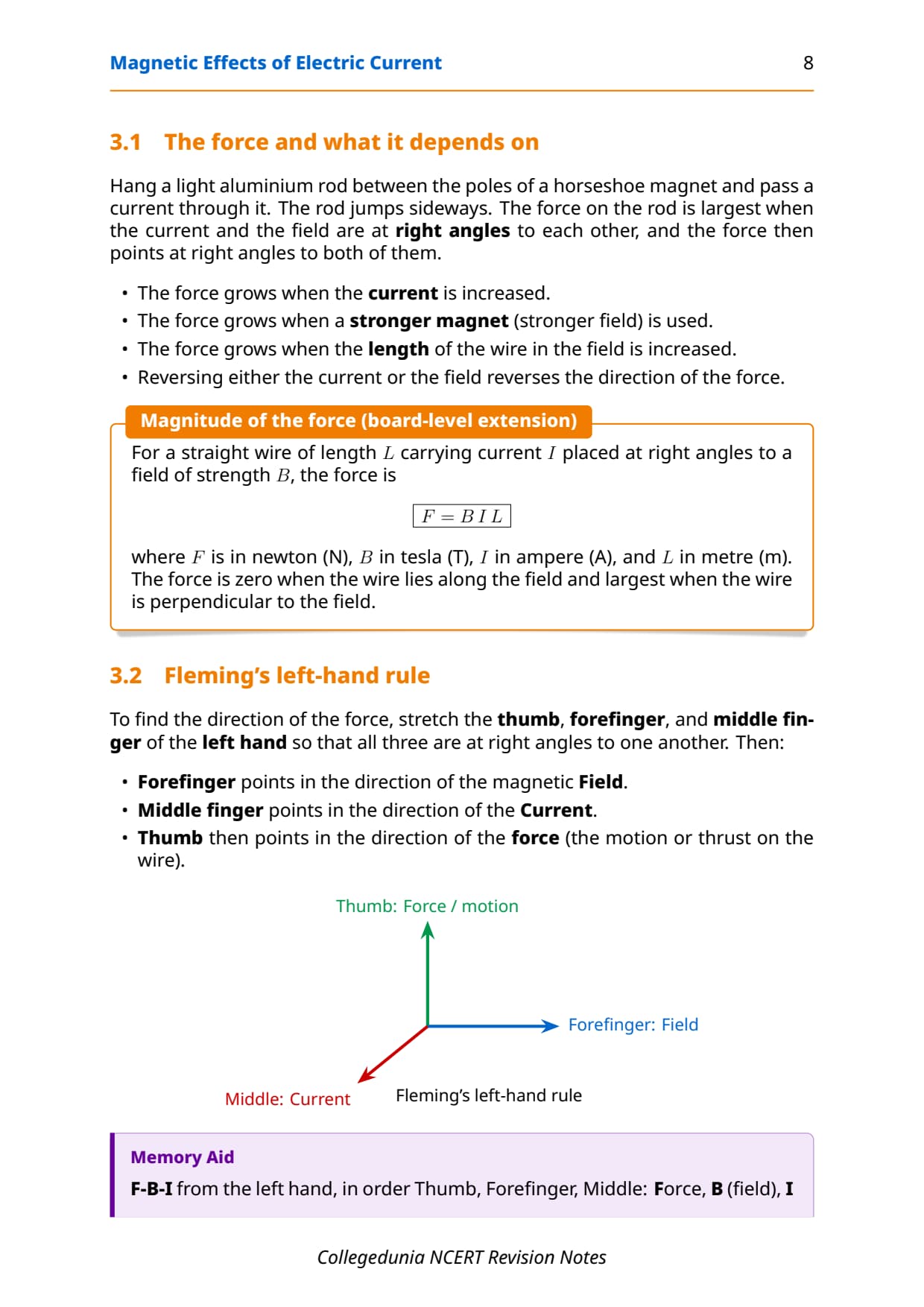
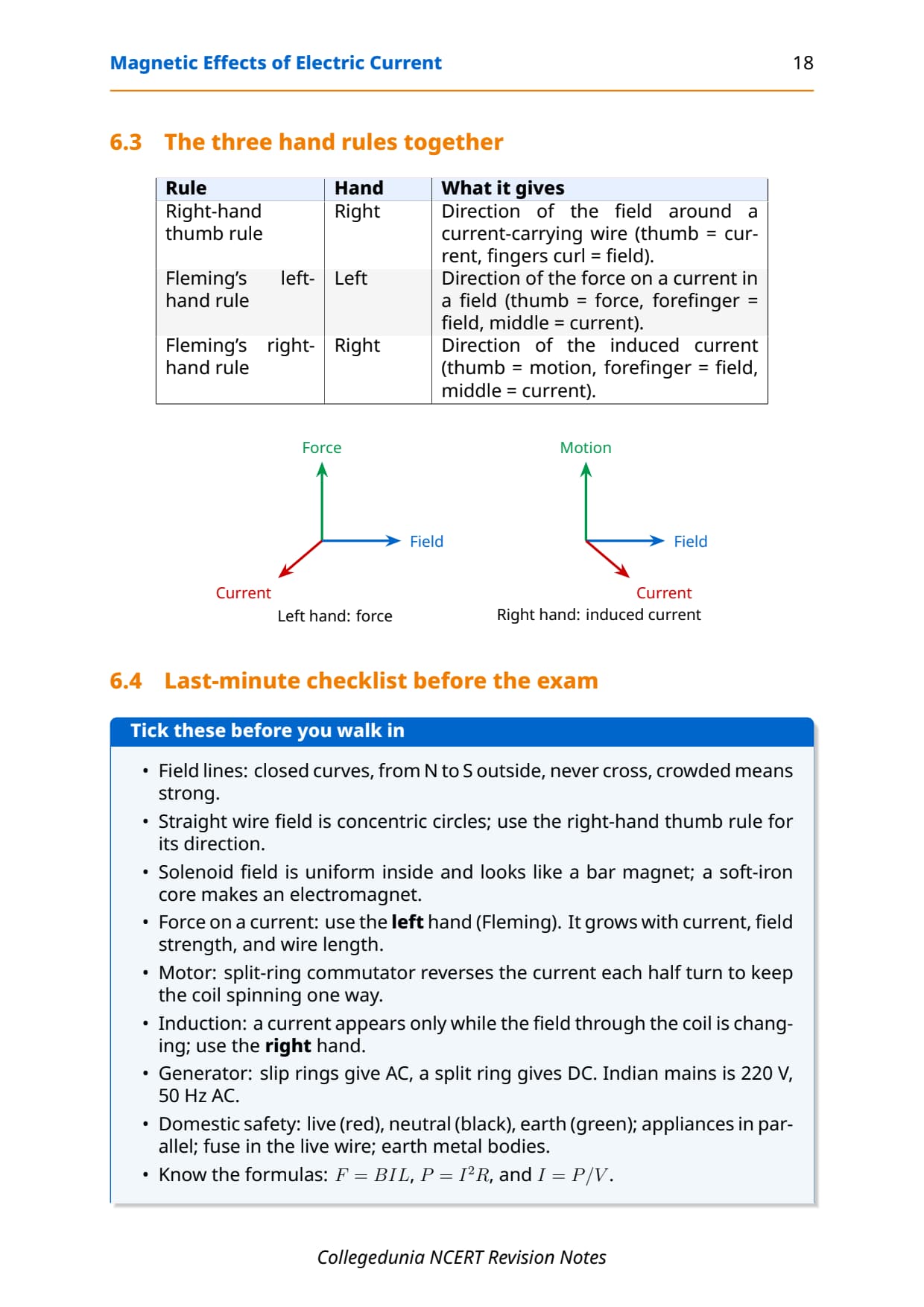
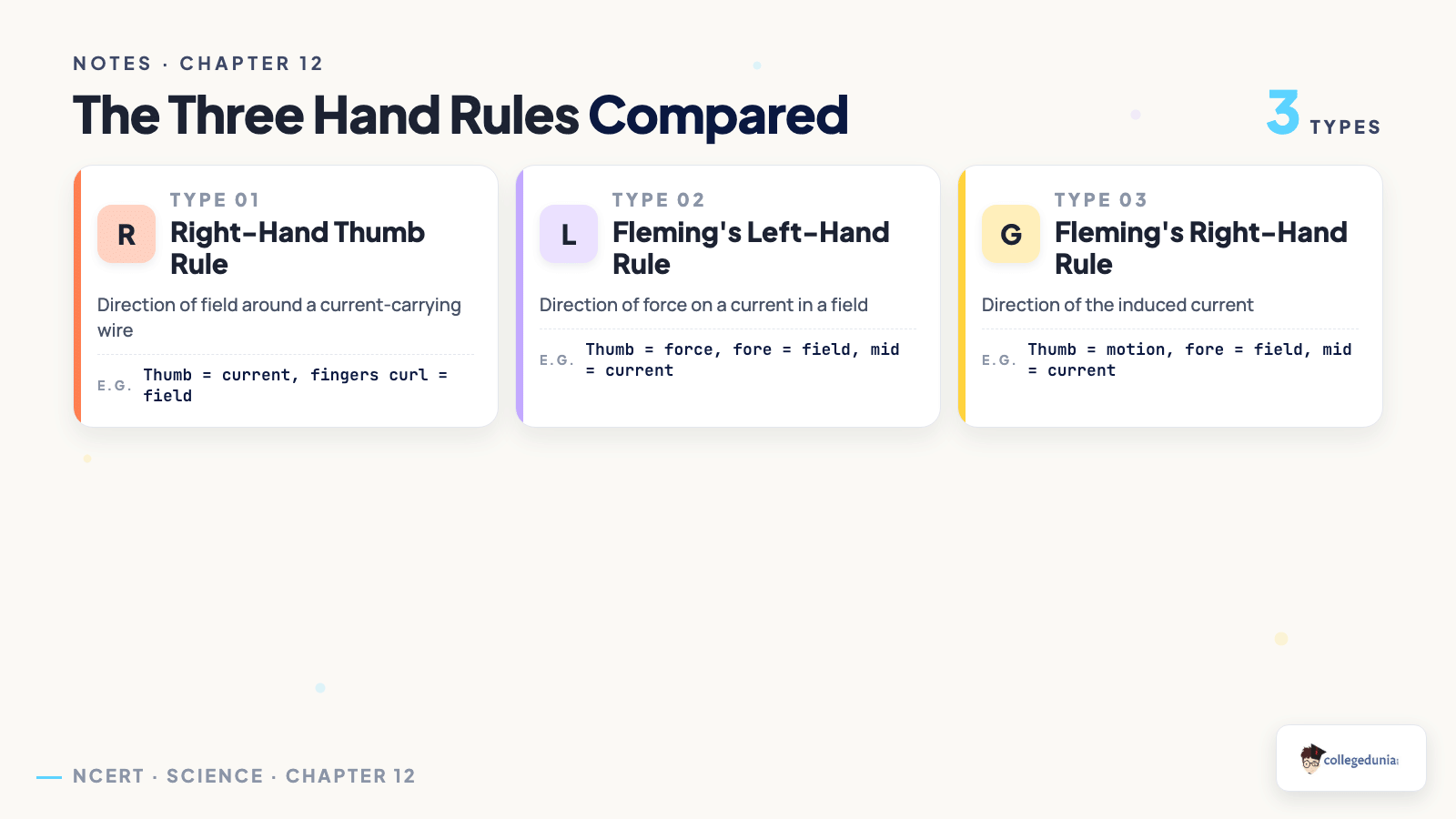
To find the force direction, use Fleming's left-hand rule: stretch the thumb, forefinger and middle finger of the left hand at right angles, then read them off below.
| Finger (left hand) | Points in the direction of |
|---|---|
| Forefinger | The magnetic Field |
| Middle finger | The Current |
| Thumb | The force (the motion or thrust on the wire) |
A handy memory aid is F-B-I from the left hand: Force (thumb), B field (forefinger), I current (middle). Reversing the current or the field reverses the force.
The Electric Motor
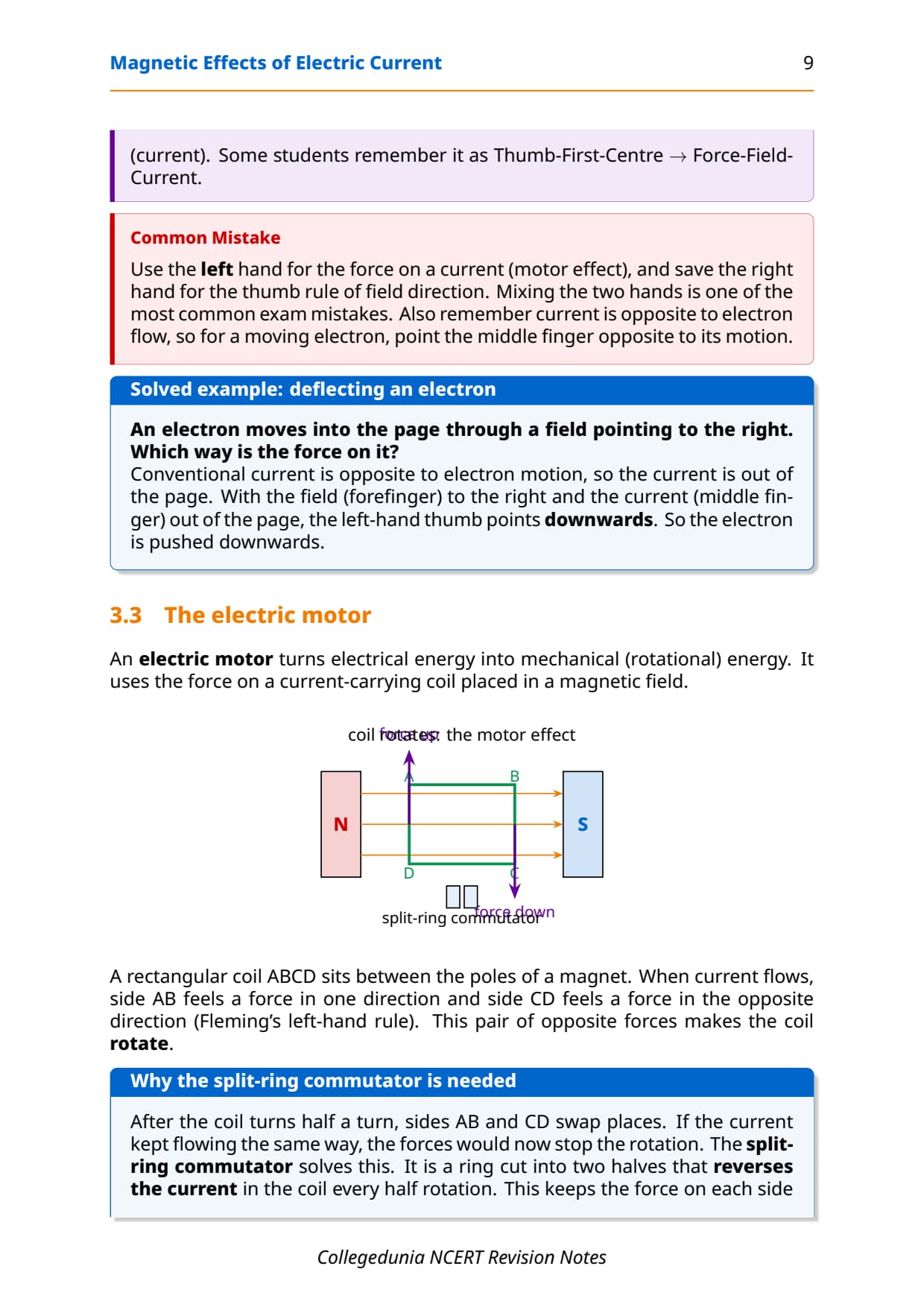
An electric motor turns electrical energy into rotational energy using the force on a current-carrying coil in a field. In a rectangular coil ABCD, side AB feels a force one way and CD the opposite way (Fleming's left-hand rule), so the coil rotates.
After a half turn, AB and CD swap places. The split-ring commutator reverses the current in the coil every half rotation, so it keeps spinning the same way. Main parts: the coil, the magnet, the split-ring commutator, and the brushes that carry current to the coil. Motors run fans, pumps, washing machines, electric cars and trains.
Electromagnetic Induction and the Electric Generator
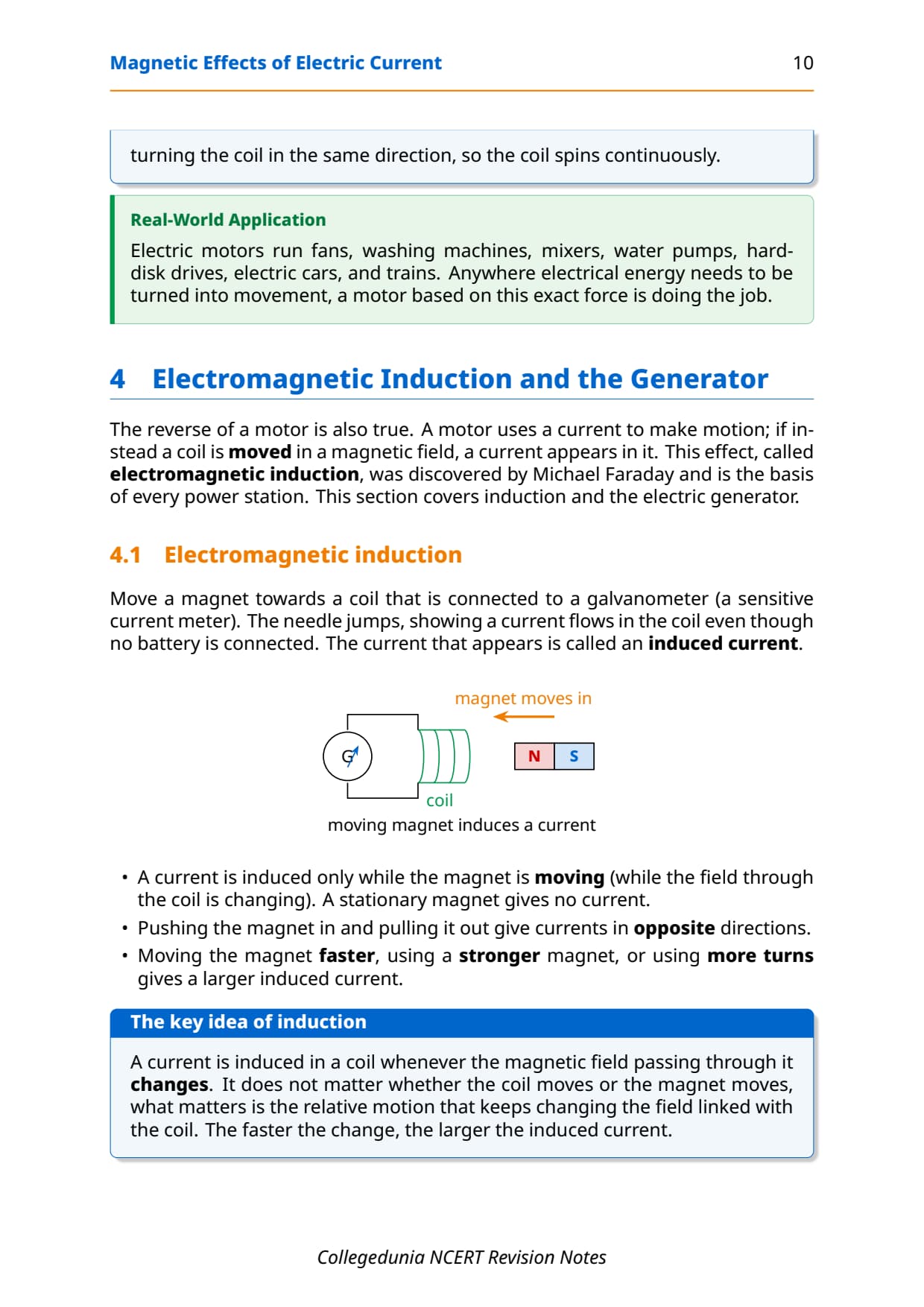
If a coil is moved in a magnetic field, a current appears in it. This effect, electromagnetic induction (discovered by Michael Faraday), is the basis of every power station. Move a magnet towards a coil joined to a galvanometer and the needle jumps, showing an induced current with no battery.
- A current is induced only while the field through the coil is changing; a stationary magnet gives no current, and pushing in and pulling out give opposite directions.
- A faster or stronger magnet, or more turns, gives a larger induced current.
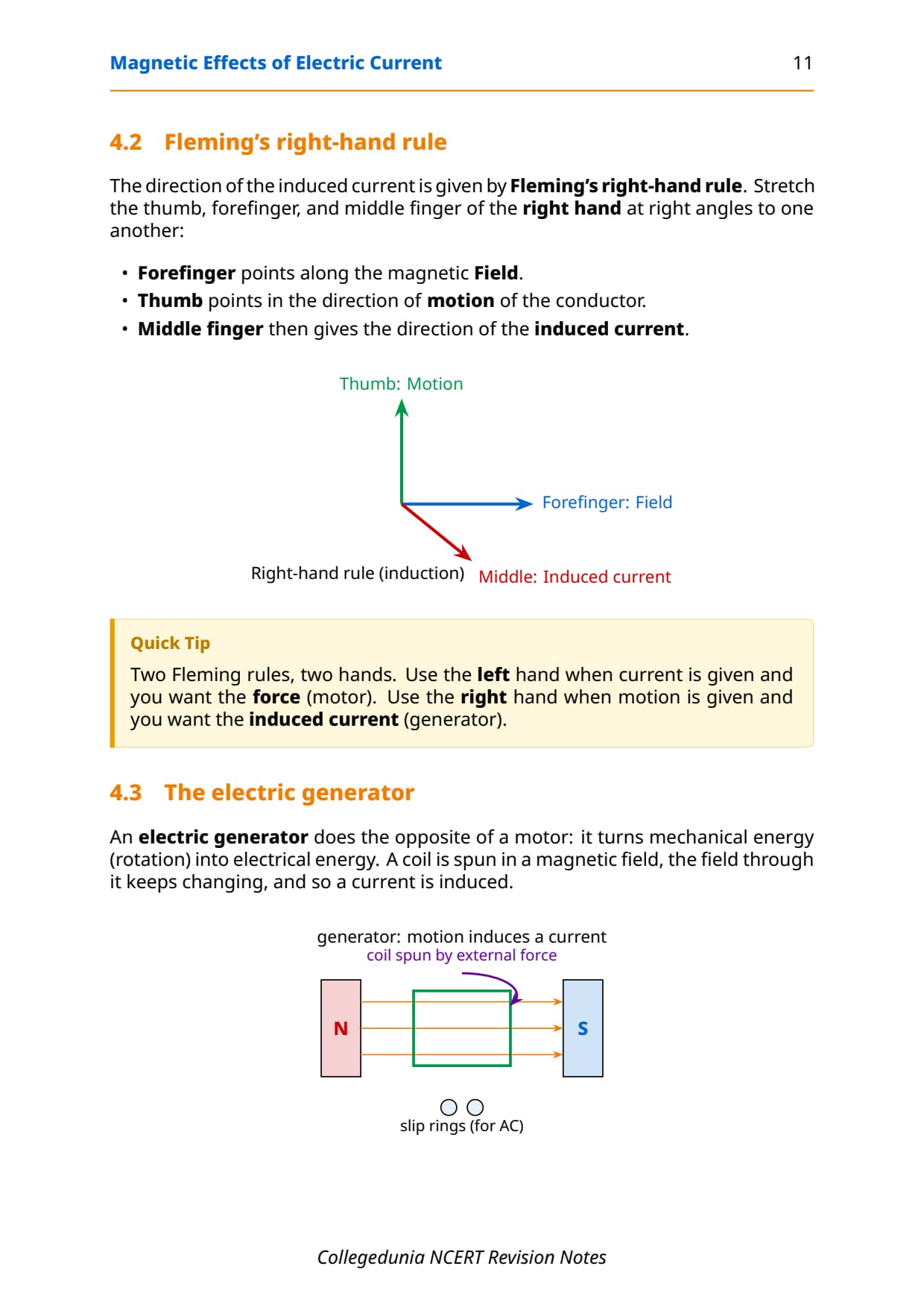
The direction of the induced current is given by Fleming's right-hand rule: forefinger along the field, thumb along the motion, middle finger the induced current. The image below compares all three hand rules.
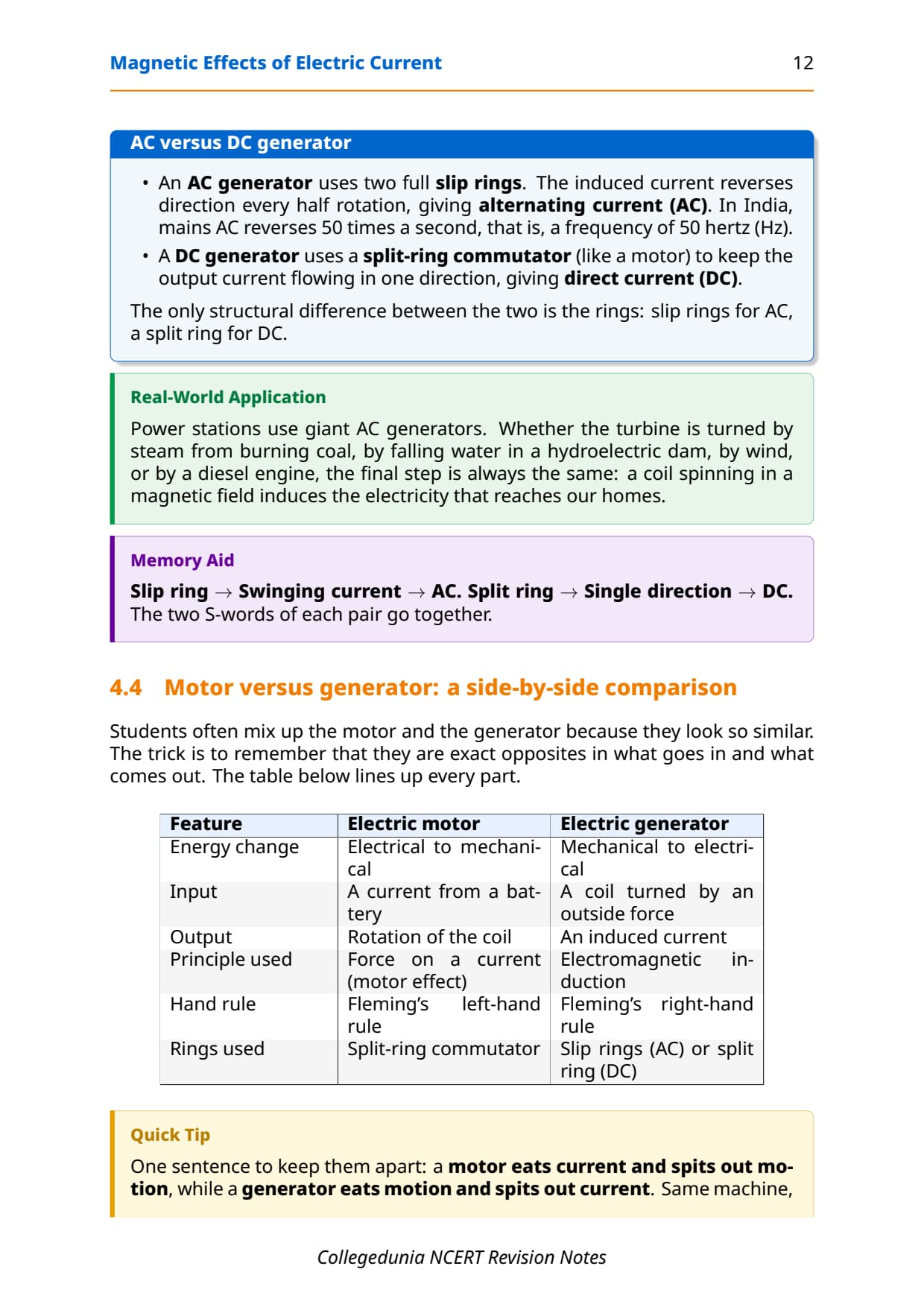
An electric generator does the opposite of a motor: a coil is spun in a magnetic field, the field through it keeps changing, and a current is induced. An AC generator uses two slip rings; a DC generator uses a split-ring commutator.
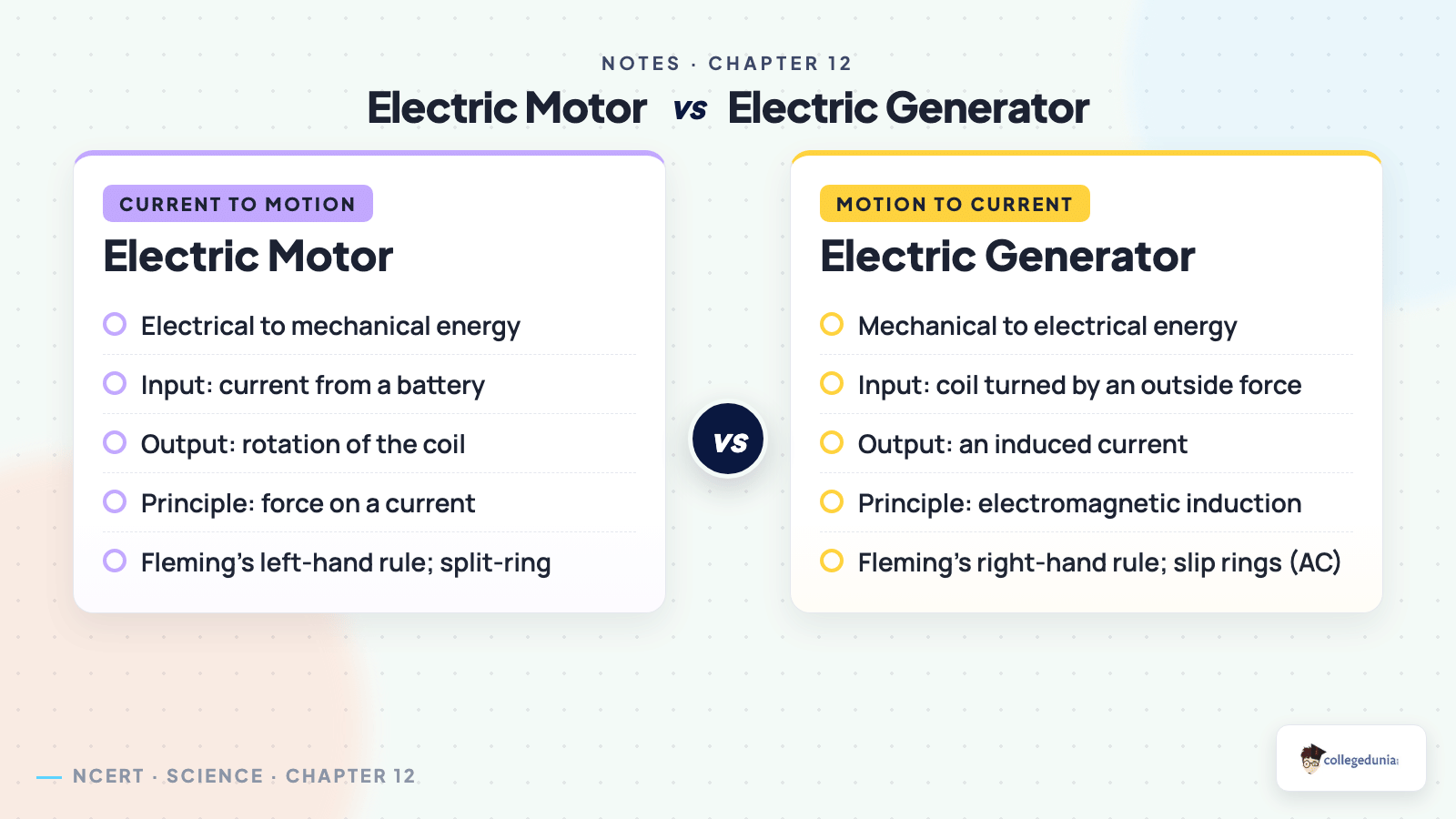
| Feature | Electric motor | Electric generator |
|---|---|---|
| Energy change | Electrical to mechanical | Mechanical to electrical |
| Input / Output | Current in; rotation out | Rotation in; induced current out |
| Principle | Force on a current | Electromagnetic induction |
| Hand rule | Fleming's left hand | Fleming's right hand |
| Rings | Split-ring commutator | Slip rings (AC) / split ring (DC) |
Domestic Electric Circuits and Safety
Power reaches homes at 220 V (AC, 50 Hz in India) on three wires.
| Wire | Insulation colour | Role |
|---|---|---|
| Live | Red (or brown) | Carries the current into the house at high potential |
| Neutral | Black (or blue) | The return path, near earth potential |
| Earth | Green | Safety wire joined to a metal plate buried in the ground |
Homes run two circuits in parallel: a 15 A circuit for high-power appliances (geysers, ACs) and a 5 A circuit for low-power devices (bulbs, fans). All appliances connect in parallel across live and neutral, so each gets the full 220 V. Current can shoot up dangerously via a short circuit (live and neutral touching, resistance near zero) or overloading (too many appliances on one socket); both cause heating that can start a fire.
A fuse is the main safety device: a short low-melting-point wire in series with the live wire that melts and breaks the circuit when the current crosses the safe limit. The earth wire normally carries no current; it acts only during a fault, draining leakage to the ground and blowing the fuse, which is why earthing metal bodies saves lives.
Quick Revision Strip and Common Exam Traps for Magnetic Effects of Electric Current
The repeat-offender mistakes in this chapter:
- Wrong hand: left gives the force (motor), right gives the induced current (generator).
- Crossing field lines: lines never cross and always carry an arrow; crowded lines mean a strong field.
- Soft iron vs steel: soft iron for the temporary electromagnet core; steel for permanent magnets.
- Slip ring vs split ring: slip rings give AC, the split-ring commutator gives DC and is used by a motor.
- Earth wire: carries no current normally; it only acts during a fault.
Also Check: The full set of CBSE board paper questions for this chapter, with step-by-step answers, is included in the downloadable PDF above, updated for the 2026-27 cycle.
Other Resources for Class 10 Science Chapter 12 Magnetic Effects of Electric Current
Pair these revision notes with the matching NCERT Solutions, the formula sheet, handwritten notes and the official NCERT book chapter. All resources for Class 10 Science Chapter 12 Magnetic Effects of Electric Current are linked below.
| Resource | What it covers | Open |
|---|---|---|
| Notes | Concept-first revision notes on magnetic field lines, the solenoid and electromagnet, Fleming's hand rules, the motor and generator, and domestic circuits. | You are here |
| NCERT Solutions | Step-by-step answers to all in-text and exercise questions, with an Expert Solution for each. | Class 10 Science Chapter 12 NCERT Solutions |
| Formula Sheet | Quick reference of the must-know rules, formulae and hand-rule directions of the chapter. | Class 10 Science Chapter 12 Formula Sheet |
| Handwritten Notes | Scanned-style handwritten pages for last-minute board revision. | Class 10 Science Chapter 12 Handwritten Notes |
| NCERT Book PDF | Official NCERT Science Chapter 12 Magnetic Effects of Electric Current textbook in PDF form. | Class 10 Science Chapter 12 NCERT Book PDF |
Notes for Class 10 Science: All Chapters
Related Links: Use the table below to open the revision notes for the other chapters of Class 10 Science. Every chapter ships with the same concept-first notes style, full PDF download, and revision FAQ.
| Chapter | Notes link |
|---|---|
| Chapter 1 | Chemical Reactions and Equations Notes |
| Chapter 2 | Acids, Bases and Salts Notes |
| Chapter 3 | Metals and Non-metals Notes |
| Chapter 4 | Carbon and its Compounds Notes |
| Chapter 5 | Life Processes Notes |
| Chapter 6 | Control and Coordination Notes |
| Chapter 7 | How do Organisms Reproduce? Notes |
| Chapter 8 | Heredity Notes |
| Chapter 9 | Light - Reflection and Refraction Notes |
| Chapter 10 | The Human Eye and the Colourful World Notes |
| Chapter 11 | Electricity Notes |
| Chapter 12 | Magnetic Effects of Electric Current Notes (You are here) |
| Chapter 13 | Our Environment Notes |
Notes Class 10 Science Chapter 12 Magnetic Effects of Electric Current FAQs
Ques. What does Chapter 12 Magnetic Effects of Electric Current cover in Class 10 Science?
Ans. Chapter 12 covers the link between electricity and magnetism. The notes explain the magnetic field and magnetic field lines, Oersted's experiment showing that a current makes a field, and the field around a straight wire, a circular loop and a solenoid, with the right-hand thumb rule for its direction. They then cover the solenoid and the electromagnet, the force on a current-carrying conductor with Fleming's left-hand rule, the electric motor, electromagnetic induction with Fleming's right-hand rule, the electric generator, and the live, neutral and earth wires of a safe domestic circuit, all aligned with the 2026-27 CBSE syllabus.
Ques. What are the properties of magnetic field lines?
Ans. Magnetic field lines are imaginary lines that show the direction and strength of a magnetic field. Outside a magnet they run from the north pole to the south pole, and inside the magnet from south to north, so each line is a closed curve. The direction of the field at any point is the direction in which a compass north pole would point there. Field lines are crowded where the field is strong, such as near the poles, and spread out where it is weak. Most importantly, two field lines can never cross, because a compass at the crossing point would then have to point in two directions at once, which is impossible.
Ques. What is the right-hand thumb rule in Class 10 Science?
Ans. The right-hand thumb rule gives the direction of the magnetic field around a straight current-carrying wire. Hold the wire in your right hand so that the thumb points in the direction of the current; the curled fingers then point in the direction of the magnetic field lines wrapping around the wire. The field around a straight wire forms concentric circles centred on the wire, and these circles are stronger and closer together near the wire and weaker farther away. Reversing the current reverses the direction of the field, which the rule also shows because the thumb then points the other way.
Ques. What is the difference between Fleming's left-hand rule and Fleming's right-hand rule?
Ans. Both rules stretch the thumb, forefinger and middle finger at right angles, but they apply to opposite situations. Fleming's left-hand rule gives the direction of the force on a current-carrying conductor placed in a magnetic field, where the forefinger is the field, the middle finger the current, and the thumb the force; it is used for the electric motor. Fleming's right-hand rule gives the direction of the induced current when a conductor moves in a field, where the forefinger is the field, the thumb the motion, and the middle finger the induced current; it is used for the generator. A simple way to remember is left for the motor force and right for the generator current.
Ques. How does an electric motor work?
Ans. An electric motor converts electrical energy into mechanical energy. A rectangular current-carrying coil is placed between the poles of a magnet. By Fleming's left-hand rule one side of the coil feels a force upward and the opposite side feels a force downward, and this pair of opposite forces makes the coil rotate. After every half rotation the two sides swap places, so a split-ring commutator reverses the current in the coil each half turn. This keeps the force acting in the same rotational sense, so the coil spins continuously. Motors built on this principle run fans, pumps, washing machines and electric vehicles.
Ques. What is electromagnetic induction and how does a generator use it?
Ans. Electromagnetic induction is the production of a current in a coil whenever the magnetic field passing through the coil changes. It was discovered by Michael Faraday. If a magnet is moved towards or away from a coil connected to a galvanometer, the needle deflects, showing an induced current, and the current flows only while the field is changing. An electric generator uses this effect in reverse of a motor: a coil is spun in a magnetic field by an outside force, the field through it keeps changing, and a current is induced. An AC generator uses two slip rings to give alternating current, while a DC generator uses a split-ring commutator to give direct current.
Ques. How many pages is the Class 10 Science Magnetic Effects of Electric Current Notes PDF?
Ans. The Magnetic Effects of Electric Current Notes PDF runs about 20 to 22 pages and covers the full chapter in concept-first revision blocks, with labelled diagrams of the field around a wire, a loop and a solenoid, the electric motor, the generator and the domestic circuit, the three hand rules side by side, a motor-versus-generator comparison table, the fuse and earthing, solved examples, common-mistake boxes, memory aids and a one-glance revision strip. The PDF is free to download for the 2026-27 session, and a green Handwritten Notes button on this page opens the scanned-style version for last-minute revision.
Ques. Are these Notes for Class 10 Science Chapter 12 aligned with the 2026-27 syllabus?
Ans. Yes. This page reflects the current 2026-27 CBSE syllabus for Class 10 Science. The Magnetic Effects of Electric Current chapter is part of the current cycle, and these notes follow the NCERT textbook, covering the magnetic field and field lines, the field due to a current in a straight wire, a loop and a solenoid, the right-hand thumb rule, the electromagnet, the force on a conductor and Fleming's left-hand rule, the electric motor, electromagnetic induction and Fleming's right-hand rule, the generator, and domestic circuits with the live, neutral and earth wires. The notes are written for the CBSE board exam, with the high-frequency diagram and direction questions highlighted throughout.



Comments