


These Notes for Class 10 Science Chapter 5 Life Processes give you a fast, concept-first revision of the whole chapter, built on the latest 2026-27 CBSE syllabus. They cover the four life processes that keep an organism alive: nutrition, respiration, transportation and excretion, in both plants and humans, with every diagram, definition and reaction the board paper likes to ask.
- Every life process explained with a one-line meaning, a labelled idea, and the everyday example CBSE keeps repeating in the board exam.
- Full coverage of photosynthesis, human digestion, aerobic and anaerobic respiration, the human heart, double circulation and the nephron.
- Notes aligned with the 2026-27 CBSE Class 10 Science syllabus and written for the board exam; no NEET or JEE references because this is a Class 10 board chapter.
These Collegedunia revision notes are curated by Science subject experts, mapped to the 2026-27 NCERT textbook, and refined against the last five years of CBSE Class 10 Science board papers.
Student Feedback: What 11,400 students told us about this chapter
74% of Class 10 students said the parts of the human heart and the path of double circulation were the bits they kept mixing up when they first revised. 3 out of 5 students told us a single labelled diagram for the heart and one for the nephron helped them lock the diagram questions before the board exam.
Toppers found that learning the four processes as a set, one diagram and one definition each, saved 10 to 12 minutes in the exam, and the average student spent 2 to 3 hours on these notes across the first read and the final revision.
Source: 2026-27 Class 10 Science student poll. Sample of 11,400 students from CBSE schools across 13 states, conducted before the 2026 boards.
|
Table of Contents |
What the Notes for Class 10 Science Chapter 5 Life Processes Cover
The processes that keep an organism alive by repairing and maintaining the body are life processes. This chapter covers how they work in plants and humans, in exam-ready revision blocks.
- Nutrition: photosynthesis, heterotrophs, and human digestion.
- Respiration: aerobic and anaerobic pathways, ATP, the respiratory system.
- Transportation: the heart, double circulation, blood, and xylem and phloem.
- Excretion: the kidneys and nephron, and excretion in plants.
Source: Magnet Brains on YouTube
What Are Life Processes in Class 10 Science
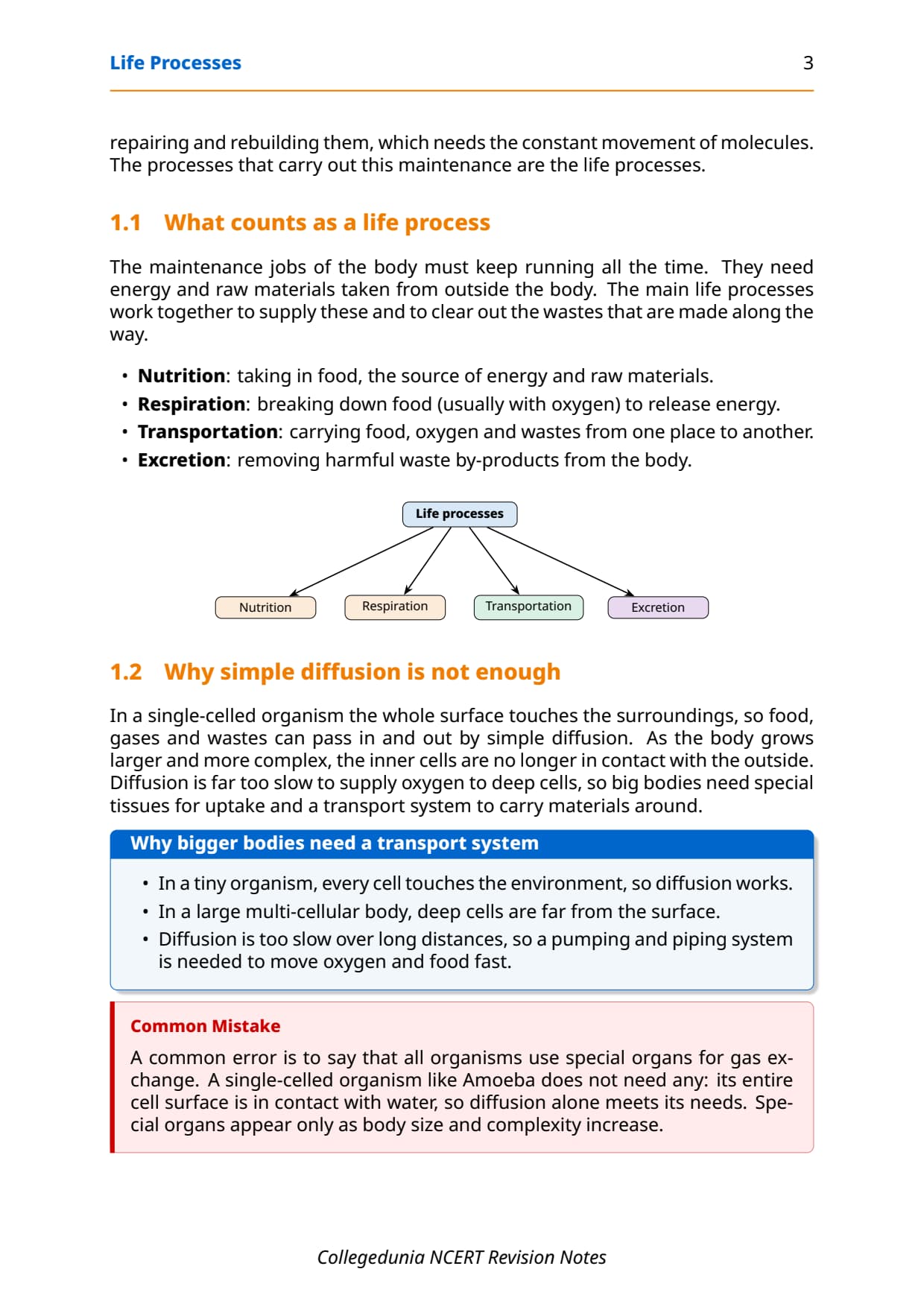
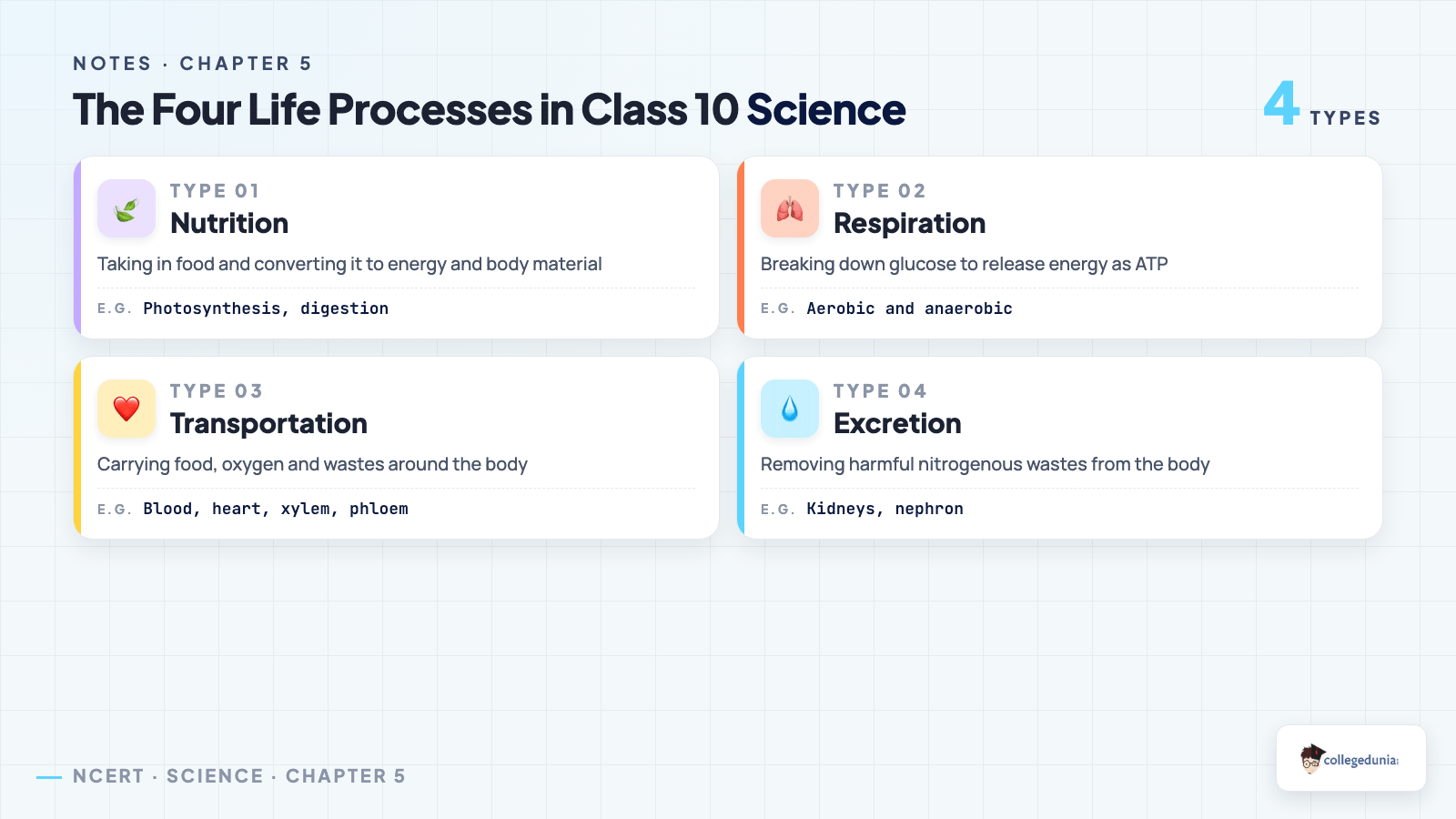
A living body must constantly repair itself to keep its order. The maintenance jobs that do this, even at rest, are the life processes. They all need energy and raw material, so every process below is connected.
In a single-celled organism like Amoeba, the whole surface touches the environment, so simple diffusion moves food, gases and wastes. In a large multicellular organism, inner cells are far from the surface, so diffusion is too slow, which is why bigger organisms develop specialised organs and a transport system.
Nutrition: Autotrophic and Heterotrophic in Class 10 Science
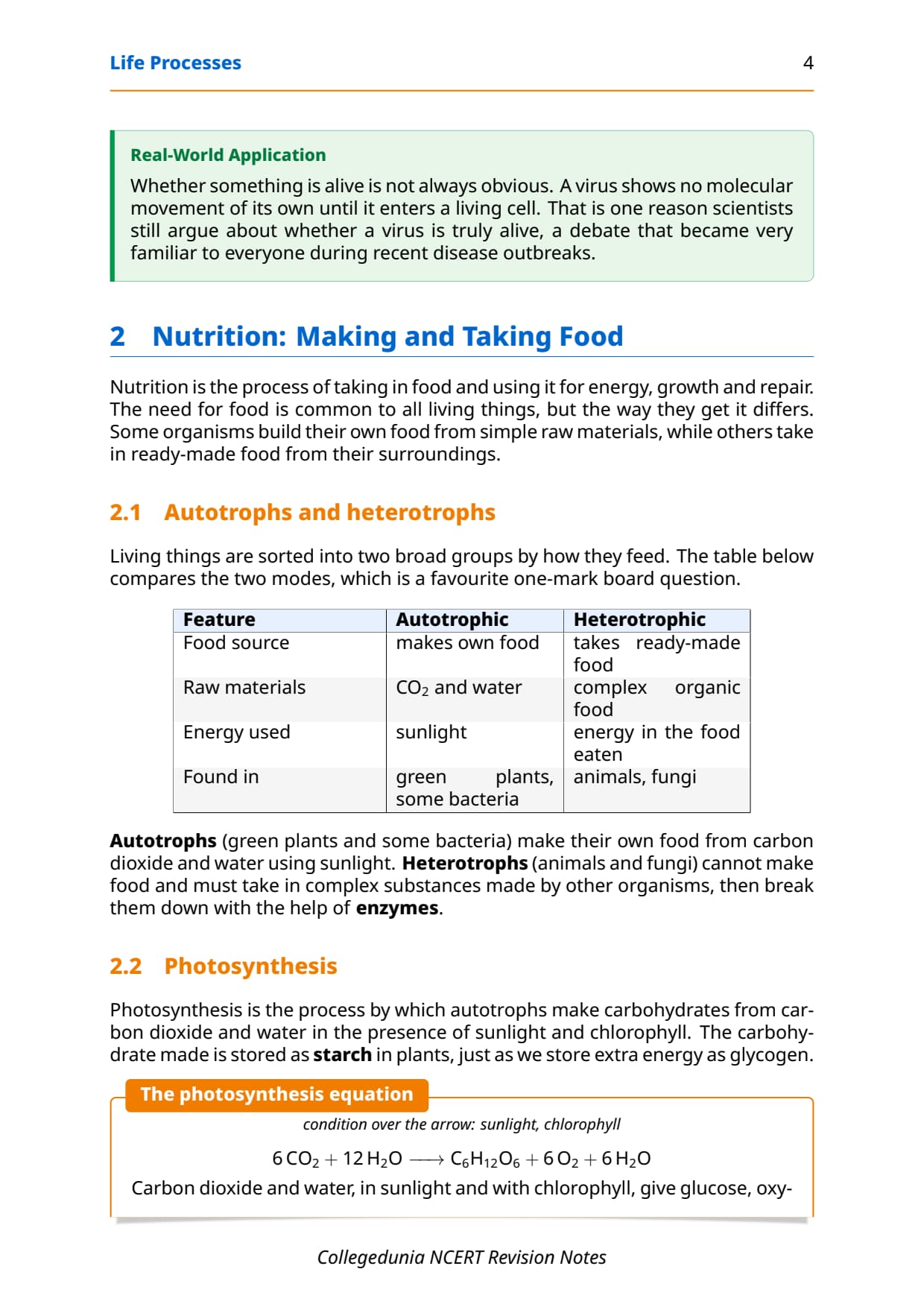
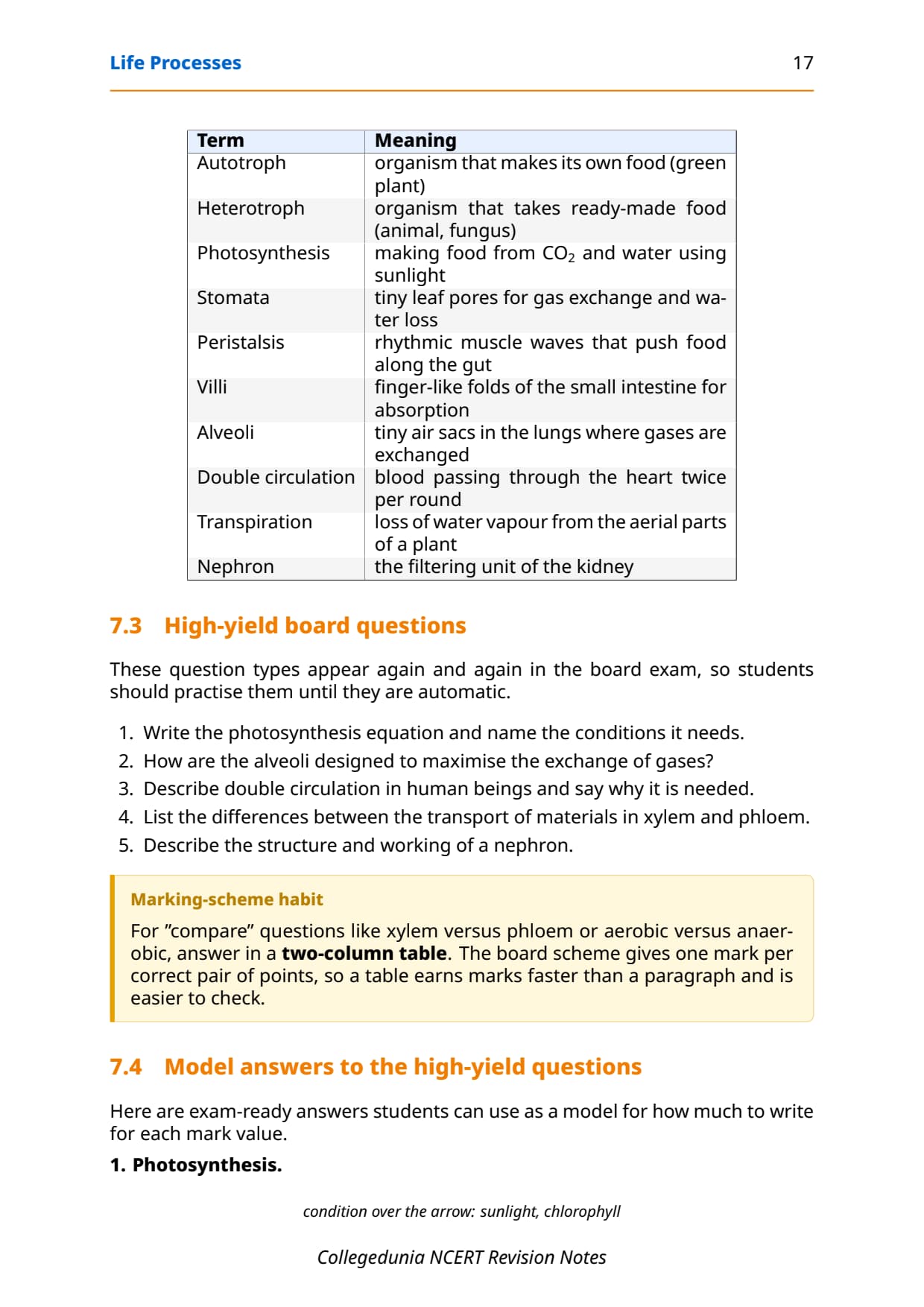
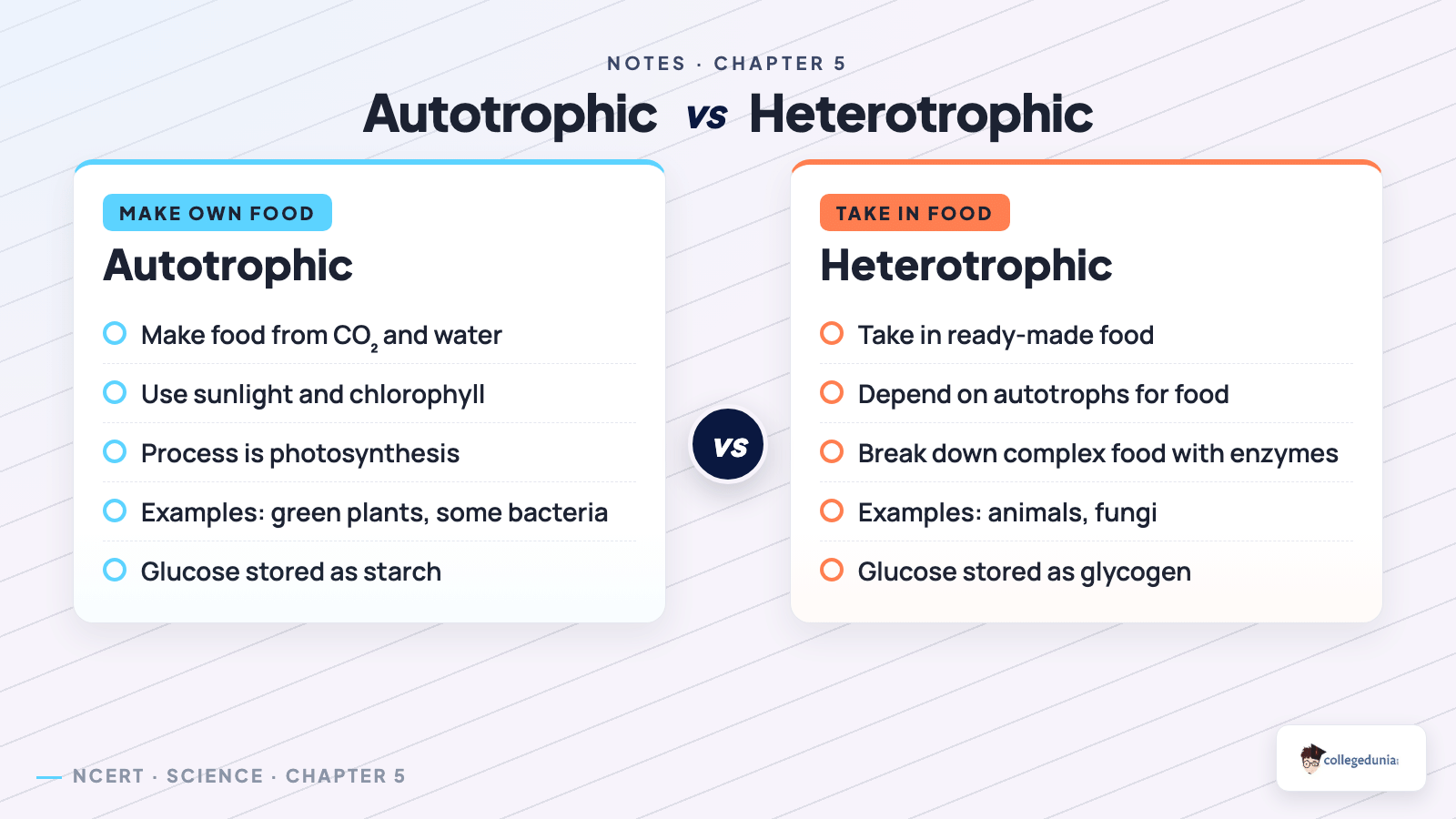
Nutrition is taking in food and using it for energy and growth, in two main ways. Autotrophs make their own food from simple inorganic substances; heterotrophs take in ready-made food from other organisms.
Photosynthesis in autotrophs
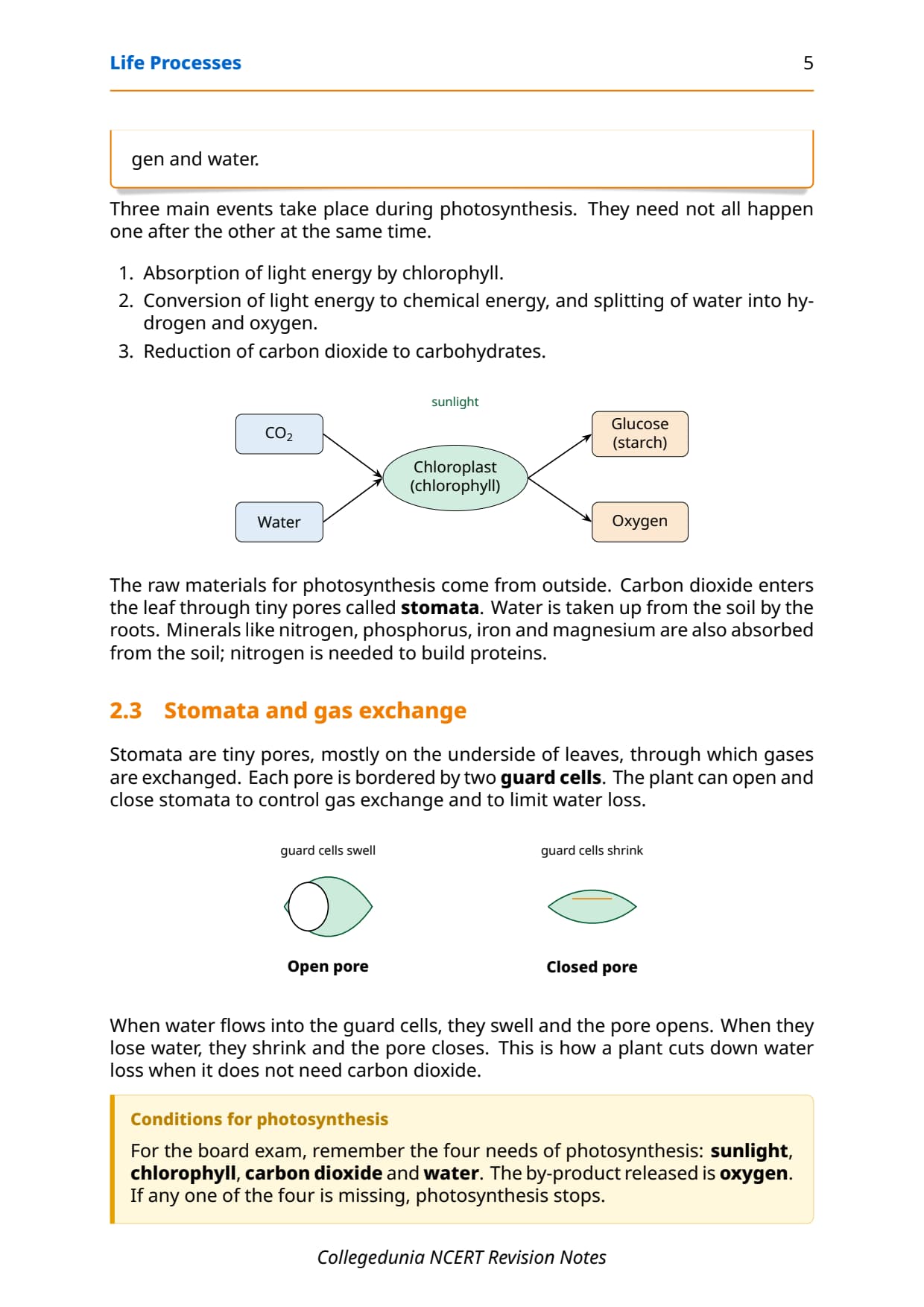
Green plants and some bacteria make food by photosynthesis: carbon dioxide and water become carbohydrates using sunlight and chlorophyll. Unused carbohydrate is stored as starch.
6CO2 + 12H2O → C6H12O6 + 6O2 + 6H2O
condition: sunlight and chlorophyll
Three events occur: absorption of light by chlorophyll, conversion to chemical energy with splitting of water, and reduction of carbon dioxide to carbohydrate. The oxygen released comes from water, not carbon dioxide.
- Raw materials: carbon dioxide (through stomata), water (from roots), plus soil minerals.
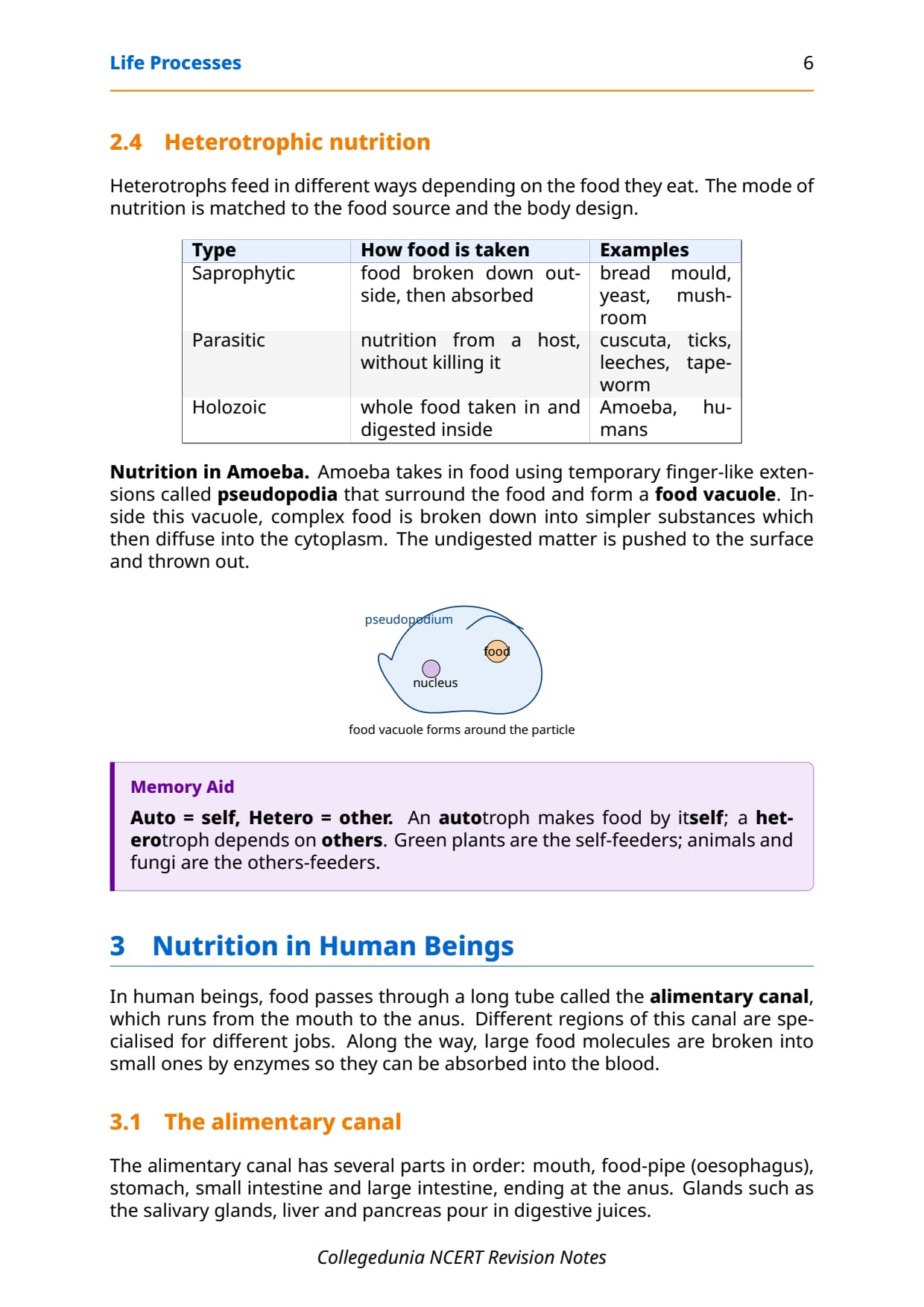
- Stomata: leaf pores for gas exchange; guard cells open and close the pore.
- Site: the chloroplast, which contains chlorophyll.
Heterotrophic nutrition
Heterotrophs (animals and fungi) take in food made by others, in three ways:
| Type | How it feeds | Examples |
|---|---|---|
| Saprotrophic | Breaks down dead matter outside, then absorbs it | Bread mould, yeast, mushrooms |
| Parasitic | Takes food from a living host | Cuscuta, ticks, lice, tapeworms |
| Holozoic | Takes in whole food and digests it inside | Amoeba, Paramoecium, humans |
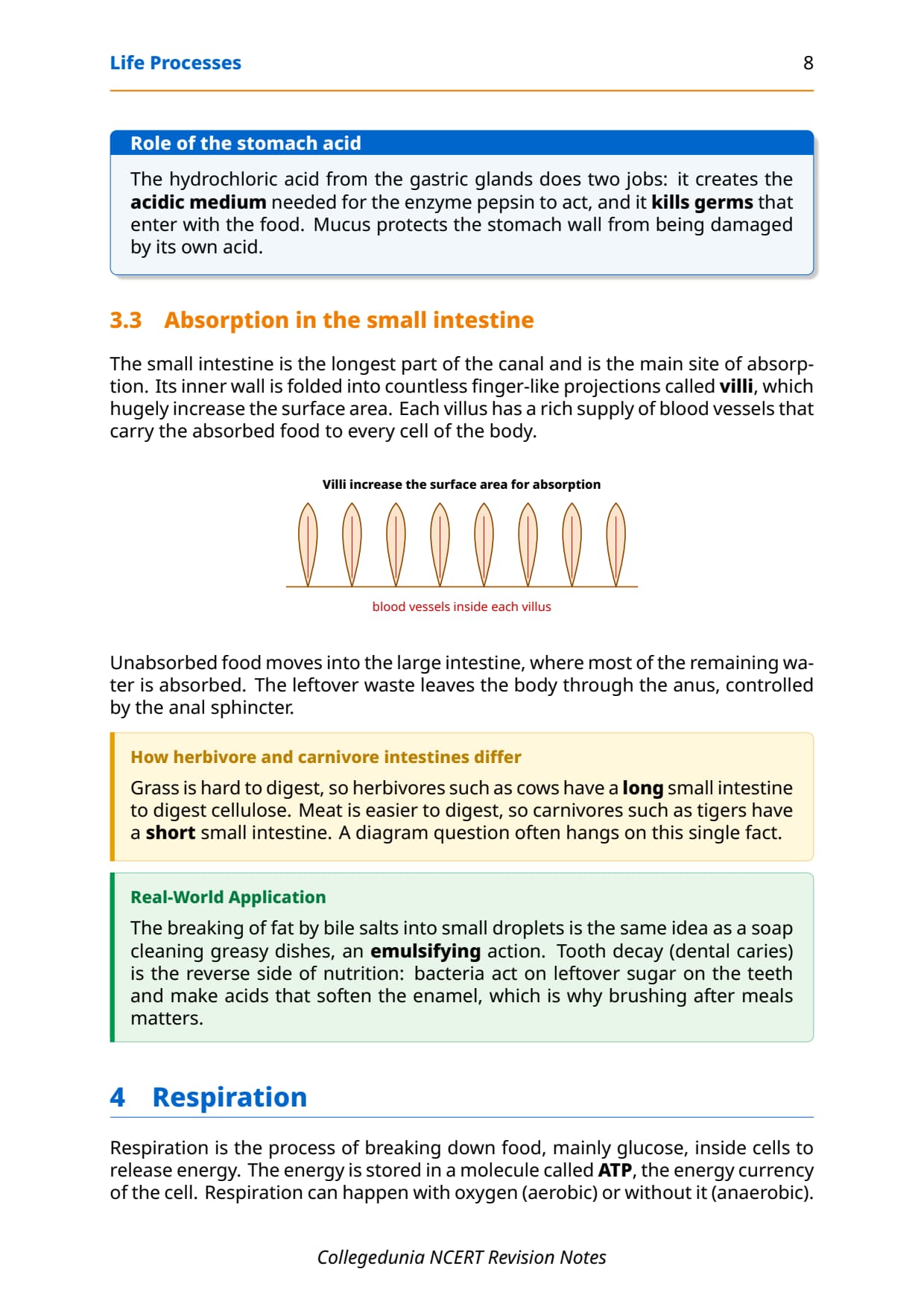
In Amoeba, pseudopodia surround food into a food vacuole where it is digested. In Paramoecium, cilia sweep food to a fixed spot.
Nutrition in Human Beings in Class 10 Science
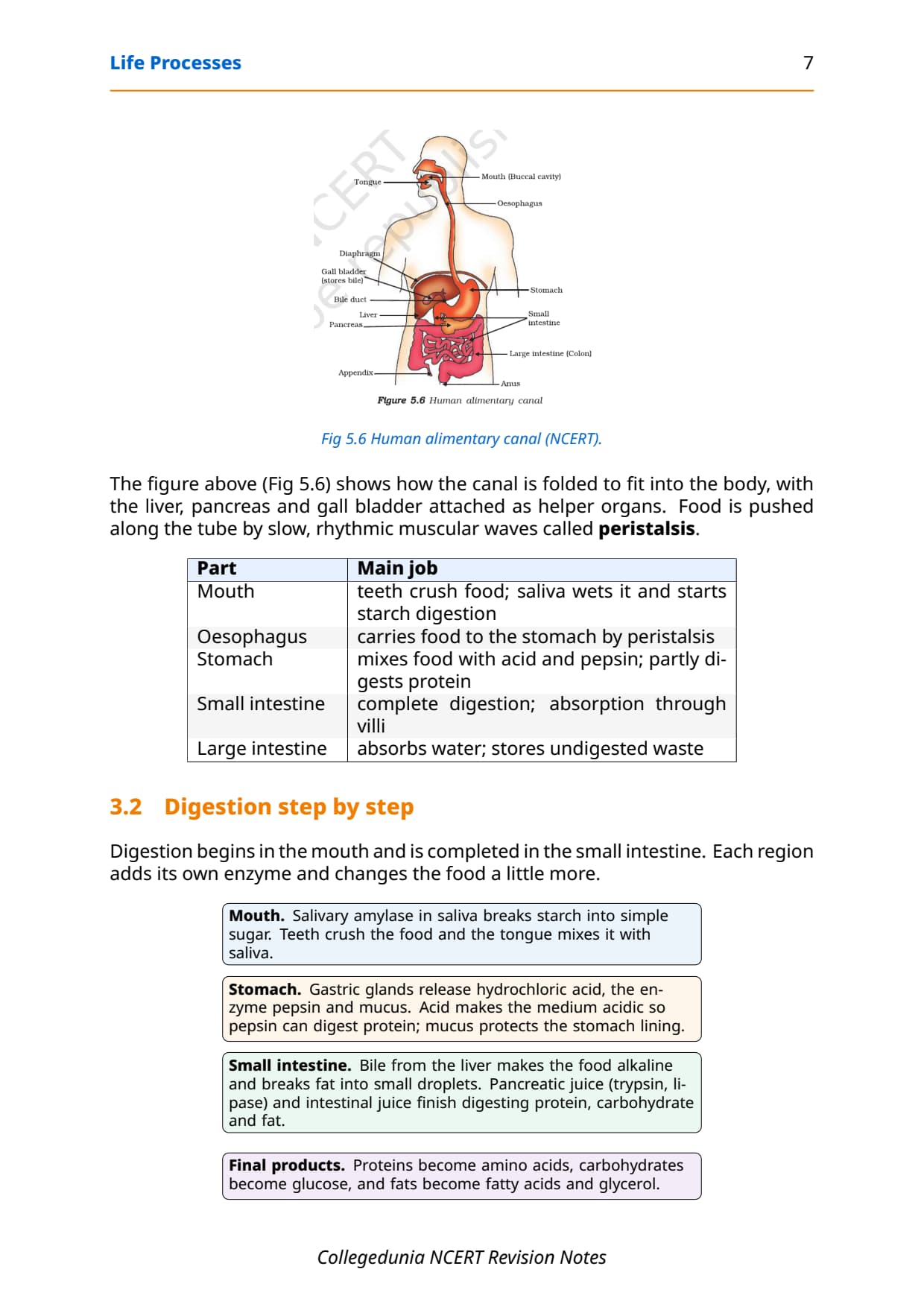
The human digestive system is an alimentary canal from mouth to anus, plus glands. Food is moved by peristalsis and digested step by step by enzymes.
| Region | Enzyme / secretion | What it does |
|---|---|---|
| Mouth | Salivary amylase | Breaks starch into sugar; teeth crush food |
| Stomach | Pepsin, HCl, mucus | Acid medium for pepsin to digest protein; mucus protects lining |
| Small intestine | Bile, trypsin, lipase | Completes digestion; site of absorption |
| Large intestine | (none major) | Absorbs water; rest passed as waste |
- Stomach: HCl gives the acidic medium pepsin needs and kills germs; mucus protects the wall.
- Bile emulsifies fats; pancreatic juice has trypsin (proteins) and lipase (fats).
- End products: proteins → amino acids, carbohydrates → glucose, fats → fatty acids and glycerol.
- Absorption: finger-like villi increase surface area, each with a rich blood supply.
Respiration: Aerobic and Anaerobic in Class 10 Science
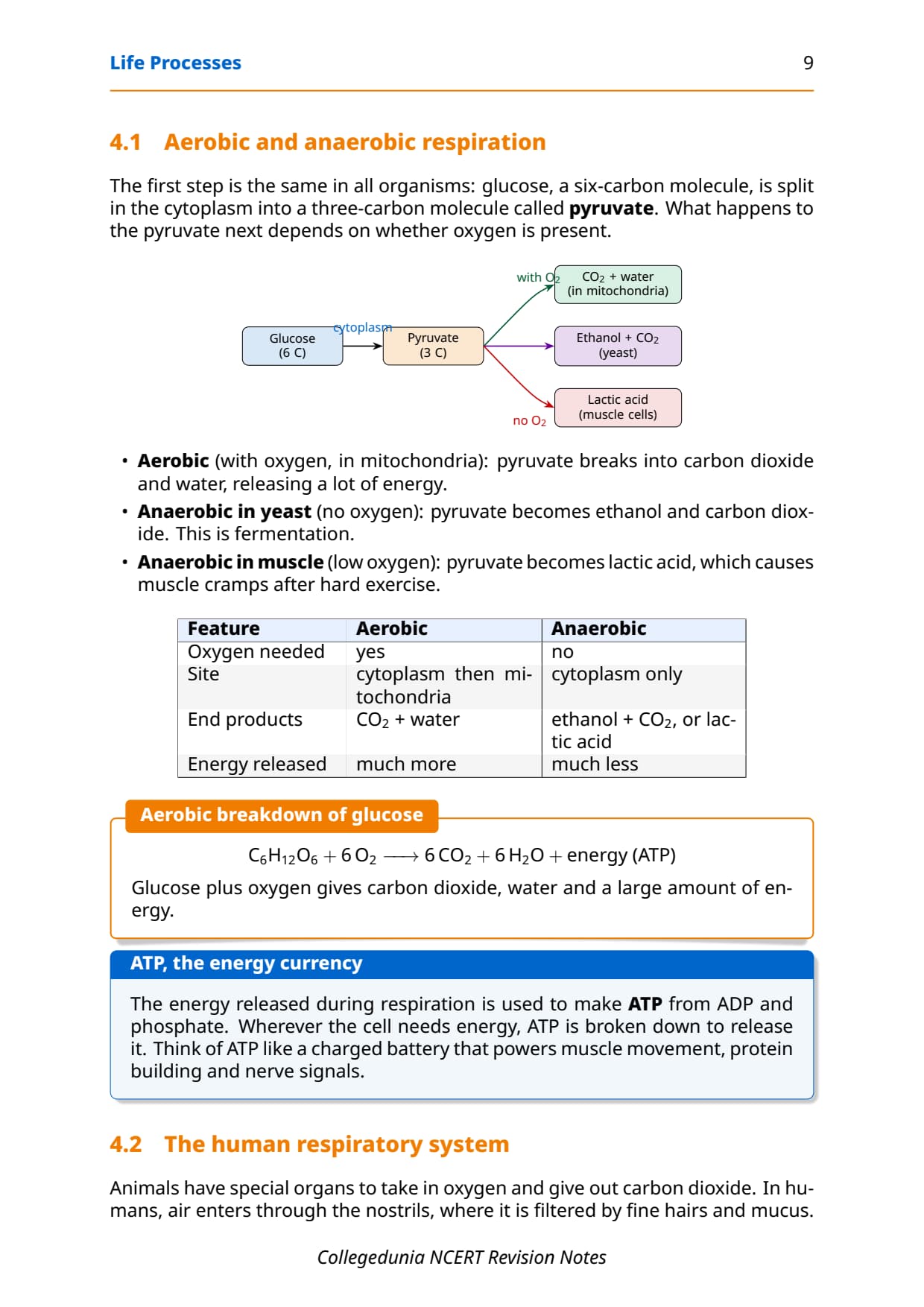
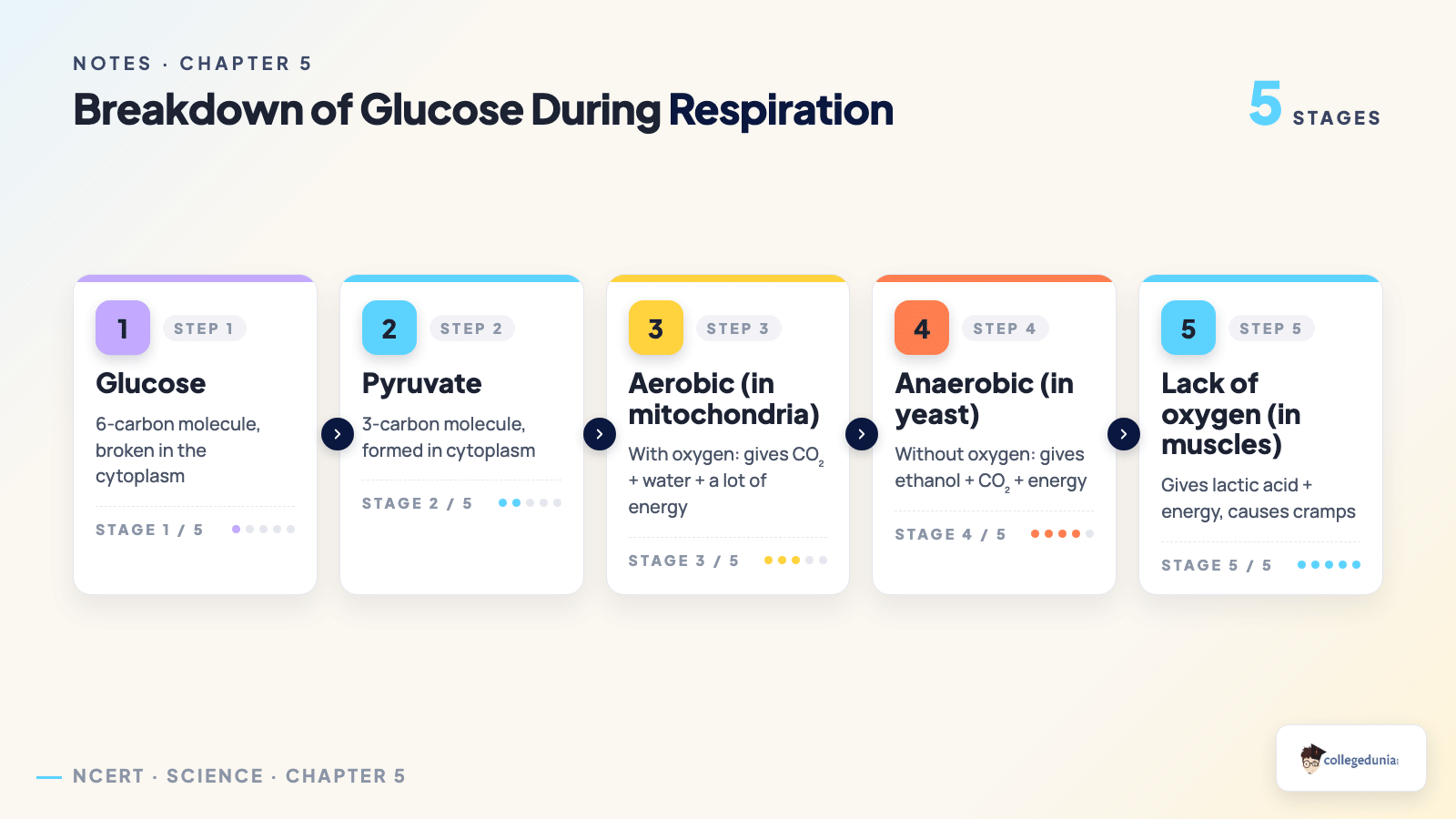
Respiration breaks down food to release energy. The first step breaks glucose (six-carbon) into pyruvate (three-carbon) in the cytoplasm. What happens next depends on whether oxygen is present.
| Pathway | Condition | Products | Energy |
|---|---|---|---|
| Aerobic (in mitochondria) | Presence of oxygen | Carbon dioxide + water | A lot of energy |
| Anaerobic (in yeast) | Absence of oxygen | Ethanol + carbon dioxide | Less energy |
| Anaerobic (in our muscles) | Lack of oxygen | Lactic acid | Less energy |
Aerobic breakdown in the mitochondria releases far more energy than anaerobic routes. When muscles run short of oxygen, pyruvate becomes lactic acid, causing cramps. The energy released makes ATP, the cell's energy currency.
ADP + Phosphate + Energy → ATP
ATP + Water → ADP + Phosphate + 30.5 kJ/mol
Human respiratory system
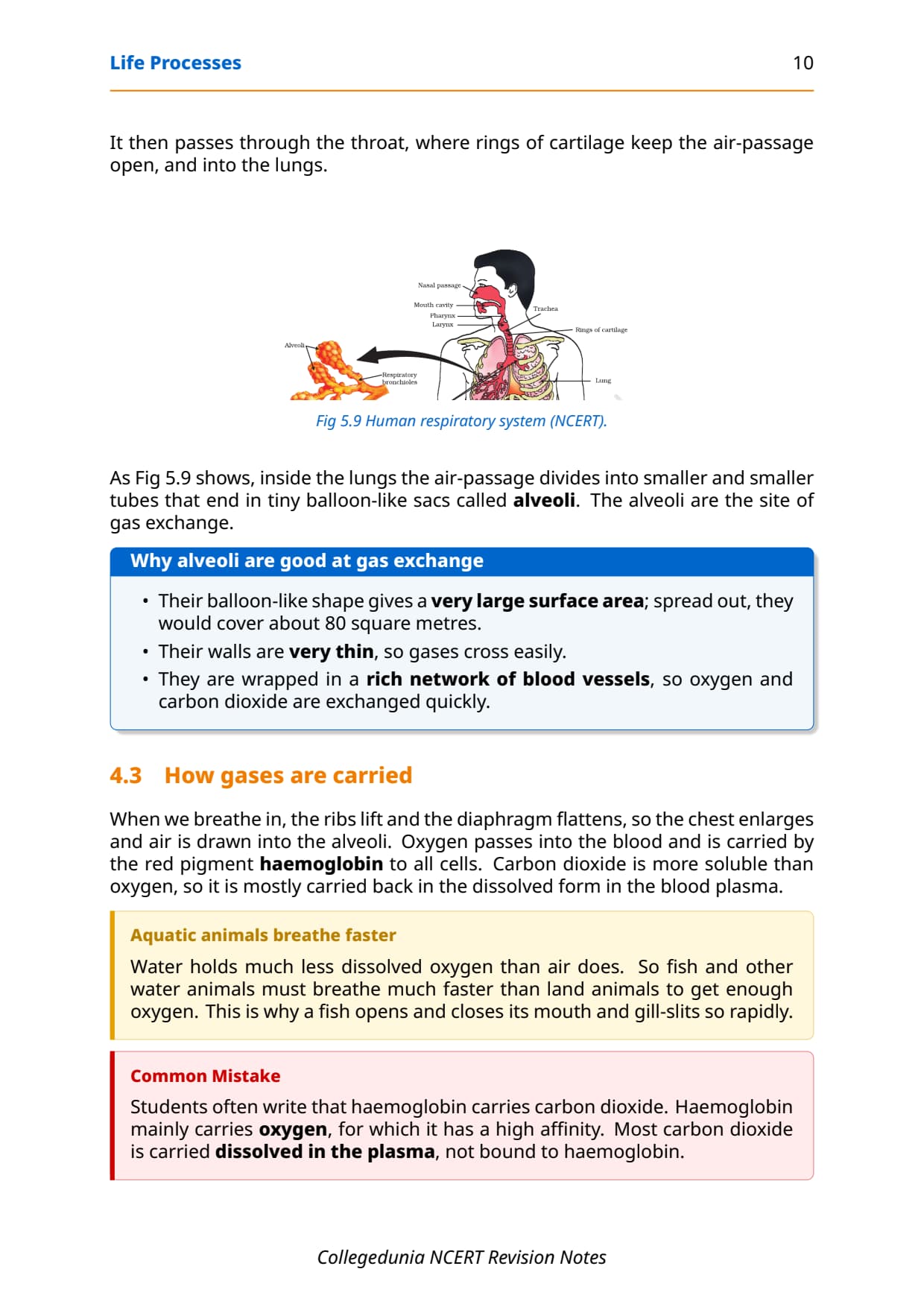
Air enters through the nostrils, passes into the lungs, where the passage divides repeatedly to end in balloon-like alveoli whose walls have a rich blood network for gas exchange.
- Alveoli give a huge surface area for gas exchange.
- Haemoglobin in red blood cells carries oxygen to the tissues.
- Carbon dioxide is more soluble, so it is mostly carried dissolved.
Transportation in Human Beings in Class 10 Science
Blood is a fluid connective tissue. Its fluid part, plasma, carries dissolved food, carbon dioxide and wastes. Circulation needs a pump (the heart), tubes (blood vessels), and platelets to repair leaks.
The human heart and double circulation
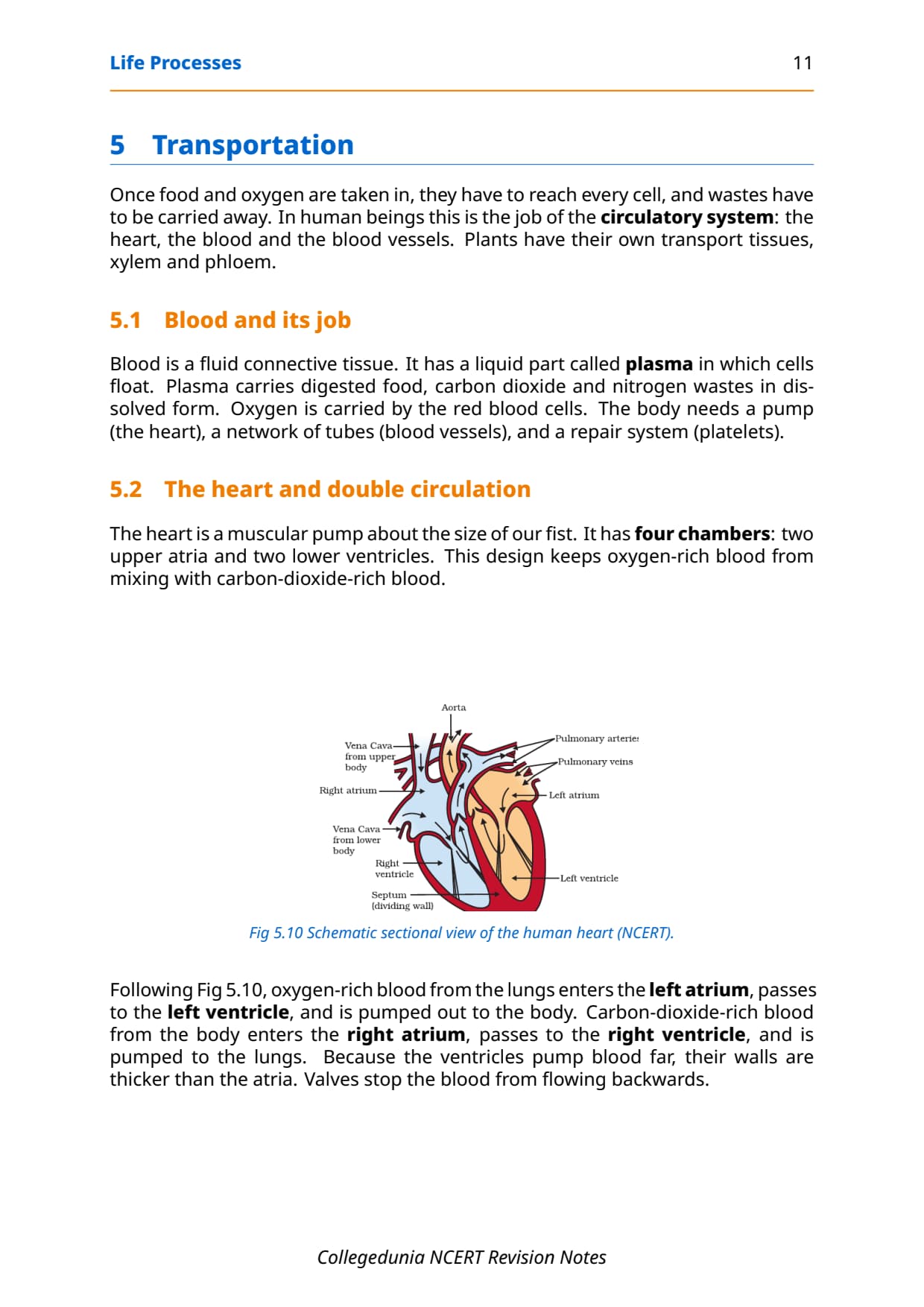
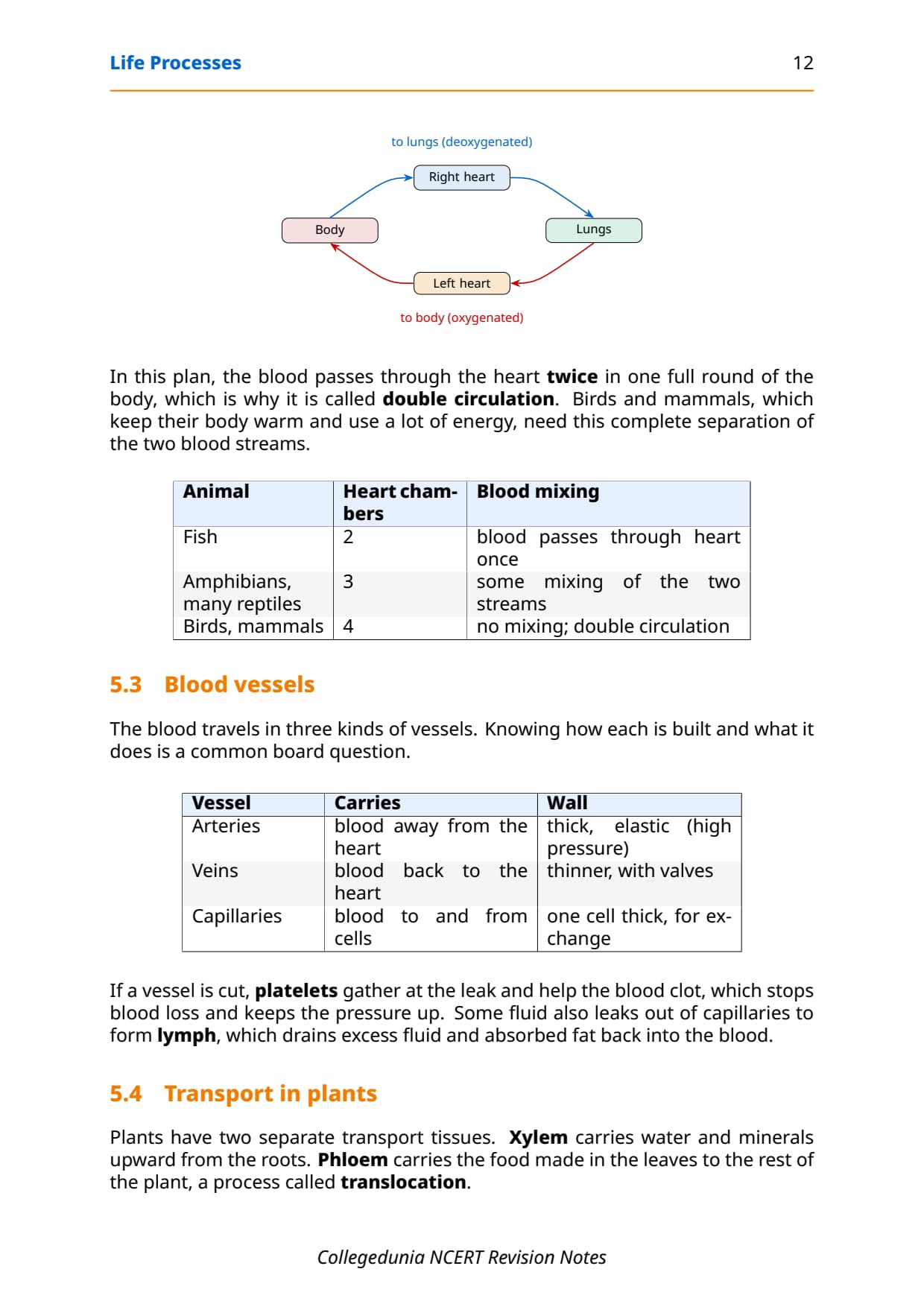
The heart has four chambers: two upper atria and two lower ventricles. They stop oxygen-rich blood mixing with carbon dioxide-rich blood, giving an efficient oxygen supply for warm-blooded birds and mammals.
Lungs → left atrium → left ventricle → body (oxygen-rich)
Body → right atrium → right ventricle → lungs (carbon dioxide-rich)
Because blood passes through the heart twice in one round, this is double circulation. The ventricles have thicker walls than the atria, and valves ensure one-way flow.
| Blood vessel | Carries blood | Wall |
|---|---|---|
| Arteries | Away from the heart, under high pressure | Thick and elastic |
| Veins | Towards the heart, low pressure | Thinner, have valves to stop back-flow |
| Capillaries | Between cells; site of exchange | One cell thick |
Platelets clot blood at injuries, and lymph carries digested fat and drains extra fluid back into the blood.
Transportation in Plants: Xylem and Phloem in Class 10 Science
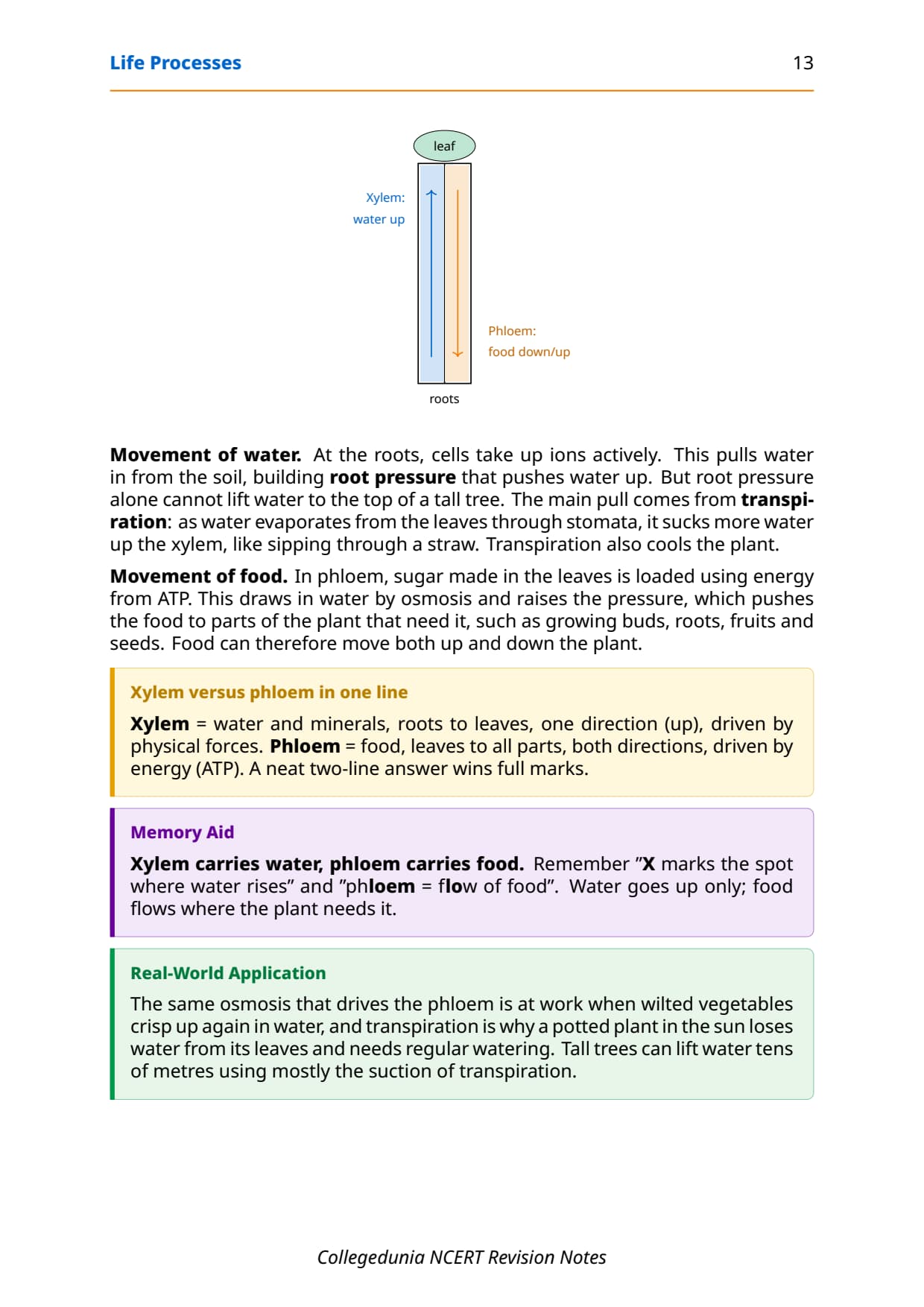
Plants have low energy needs and use slow transport through two pathways: xylem moves water and minerals from the roots, and phloem moves food made in the leaves to the rest of the plant.
How water rises: transpiration pull
At the roots, ion uptake draws water in, creating root pressure. For tall plants this is not enough: water vapour loss from the leaves (transpiration) creates a suction, the transpiration pull, that draws water up the xylem.
| Feature | Xylem | Phloem |
|---|---|---|
| Carries | Water and minerals | Food (sucrose), amino acids |
| Direction | Upward only (roots to leaves) | Both up and down |
| Driving force | Transpiration pull (and root pressure) | Uses energy from ATP (translocation) |
| Cells | Mostly dead | Living |
Food transport in the phloem is translocation: sucrose is loaded using ATP, raising osmotic pressure and moving food to parts that need it. Memory aid: xylem = water up (dead cells), phloem = food both ways (living cells).
Excretion in Humans and Plants in Class 10 Science
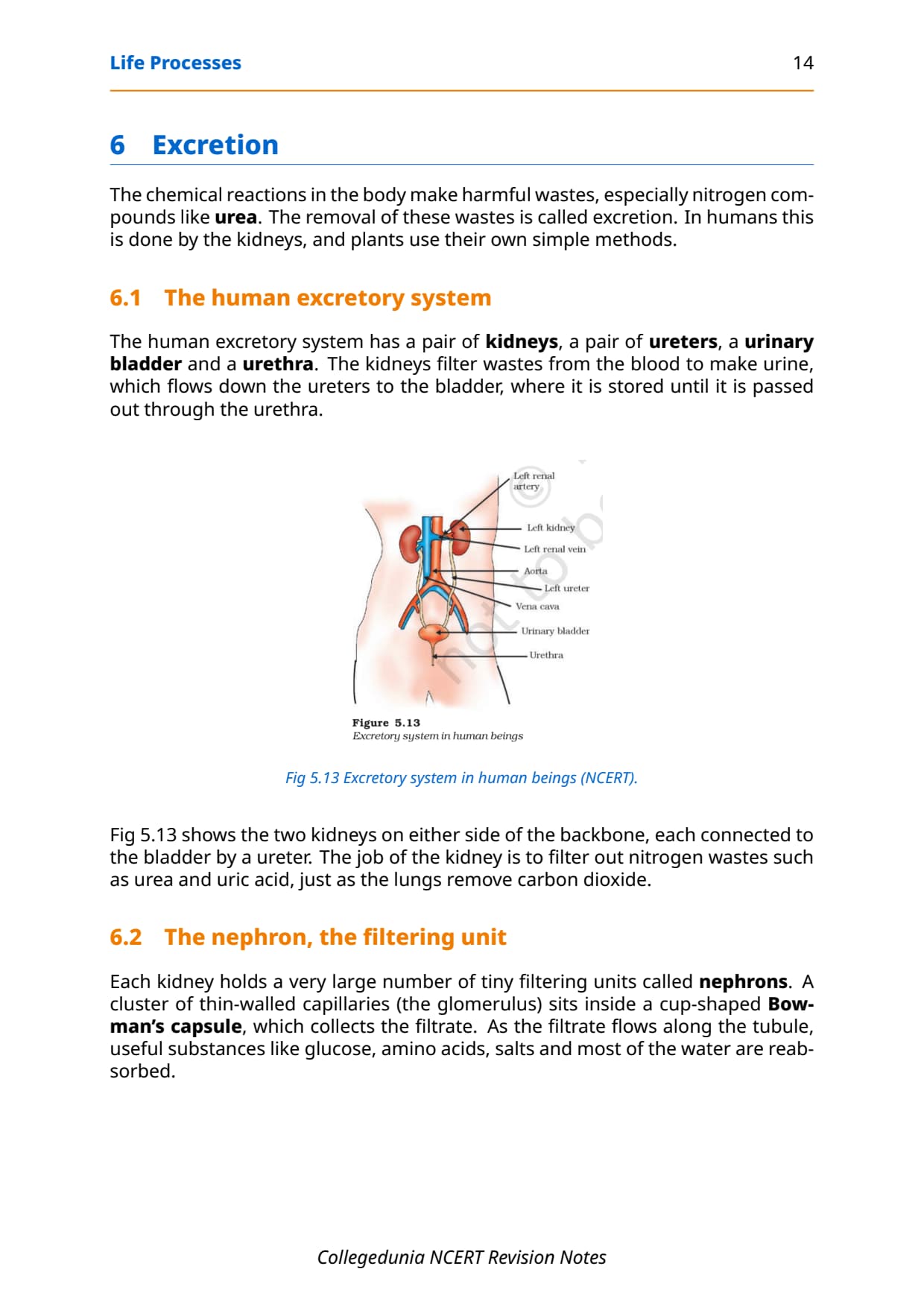
Excretion removes harmful nitrogenous wastes. In humans, the system is a pair of kidneys, a pair of ureters, a bladder and a urethra. The kidneys filter the blood, and waste leaves as urine.
The nephron, the filtering unit
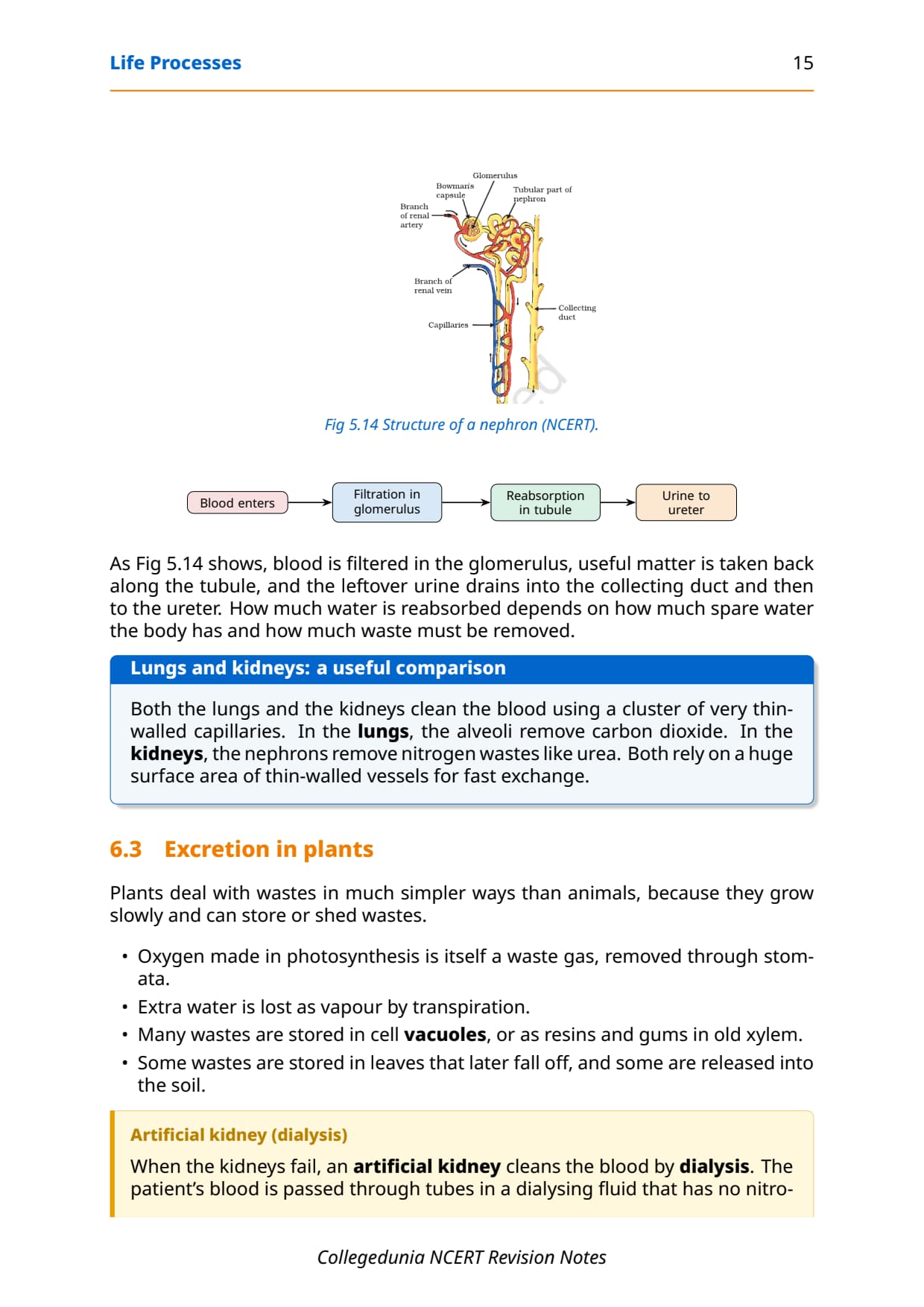
The kidney's filtration unit is the nephron. A cluster of capillaries, the glomerulus, sits in a cup-shaped Bowman's capsule where blood is filtered. Useful substances are then selectively re-absorbed along the tube.
- Glomerulus: filters the blood under pressure inside Bowman's capsule.
- Selective re-absorption: glucose, amino acids, salts and water are taken back into the blood.
- Urine: the leftover liquid passes through the ureter to the bladder and is released through the urethra.
The water re-absorbed depends on the body's needs. When kidneys fail, an artificial kidney (dialysis) removes nitrogenous wastes by diffusion, with no re-absorption.
Excretion in plants
Plants release oxygen and excess water by transpiration. Other wastes are stored in vacuoles, shed with falling leaves, deposited as resins and gums, or released into the soil.
Quick Revision Strip and Common Exam Traps
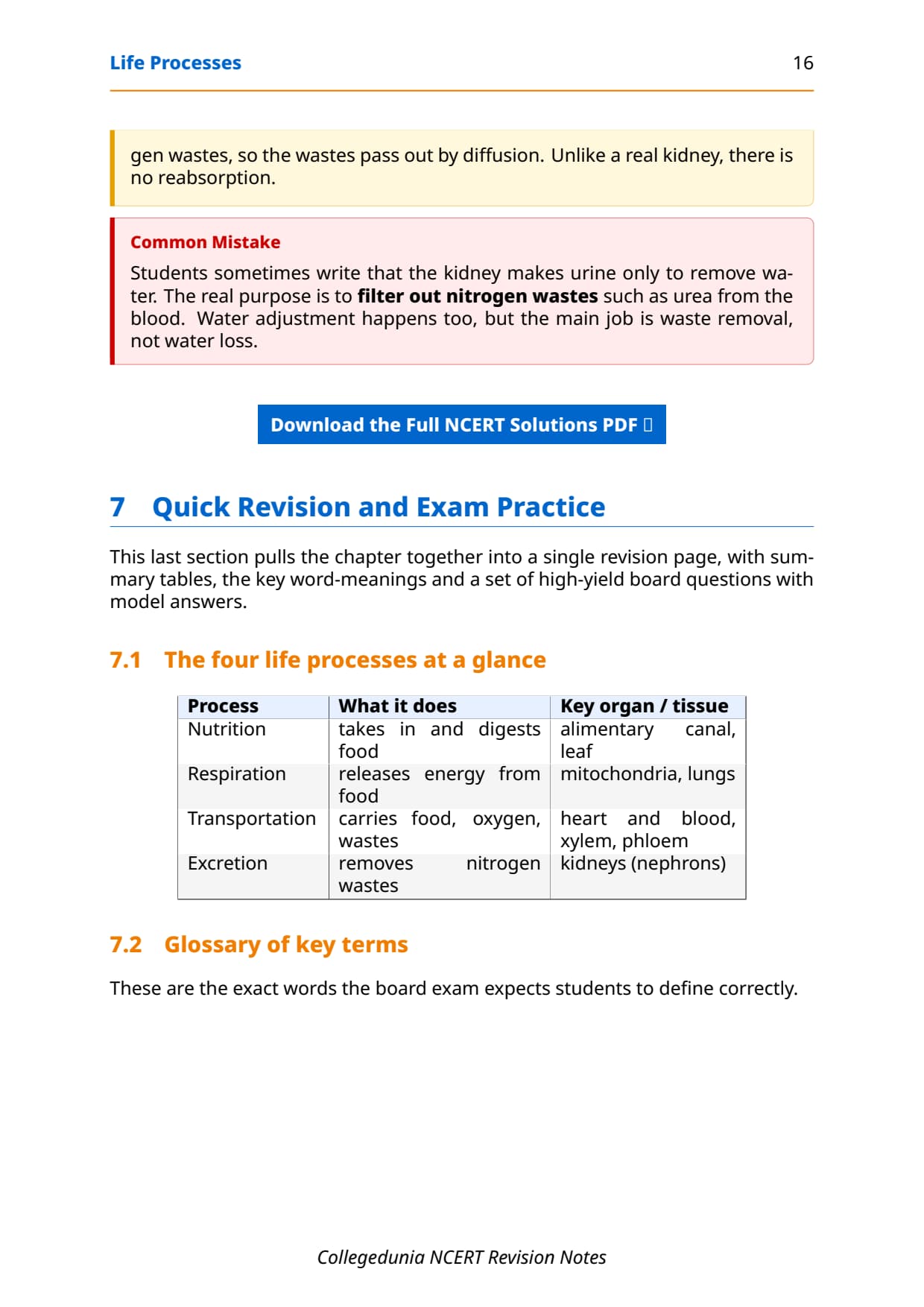
A last-minute revision strip with each big idea and its one-line key point.
| Idea | Key point |
|---|---|
| Photosynthesis | CO2 + water → glucose + oxygen, in chloroplast |
| Respiration | Glucose → pyruvate; aerobic → CO2 + water, anaerobic → lactic acid/ethanol |
| Heart | Four chambers; double circulation; thick ventricle walls |
| Plant transport | Xylem = water up (dead), phloem = food both ways (living) |
| Excretion | Nephron filters blood; glomerulus + Bowman's capsule + re-absorption |
The repeat-offender mistakes in Life Processes board answers:
- Arteries vs veins: arteries carry blood away from the heart under high pressure; veins carry it back with valves.
- Xylem vs phloem: xylem carries water upward (dead cells); phloem carries food both ways (living cells).
- Heart chambers: fish have two, amphibians and most reptiles three, only birds and mammals four.
- Photosynthesis oxygen comes from the splitting of water, not from carbon dioxide.
Previous Year Question Trends from the Life Processes Chapter
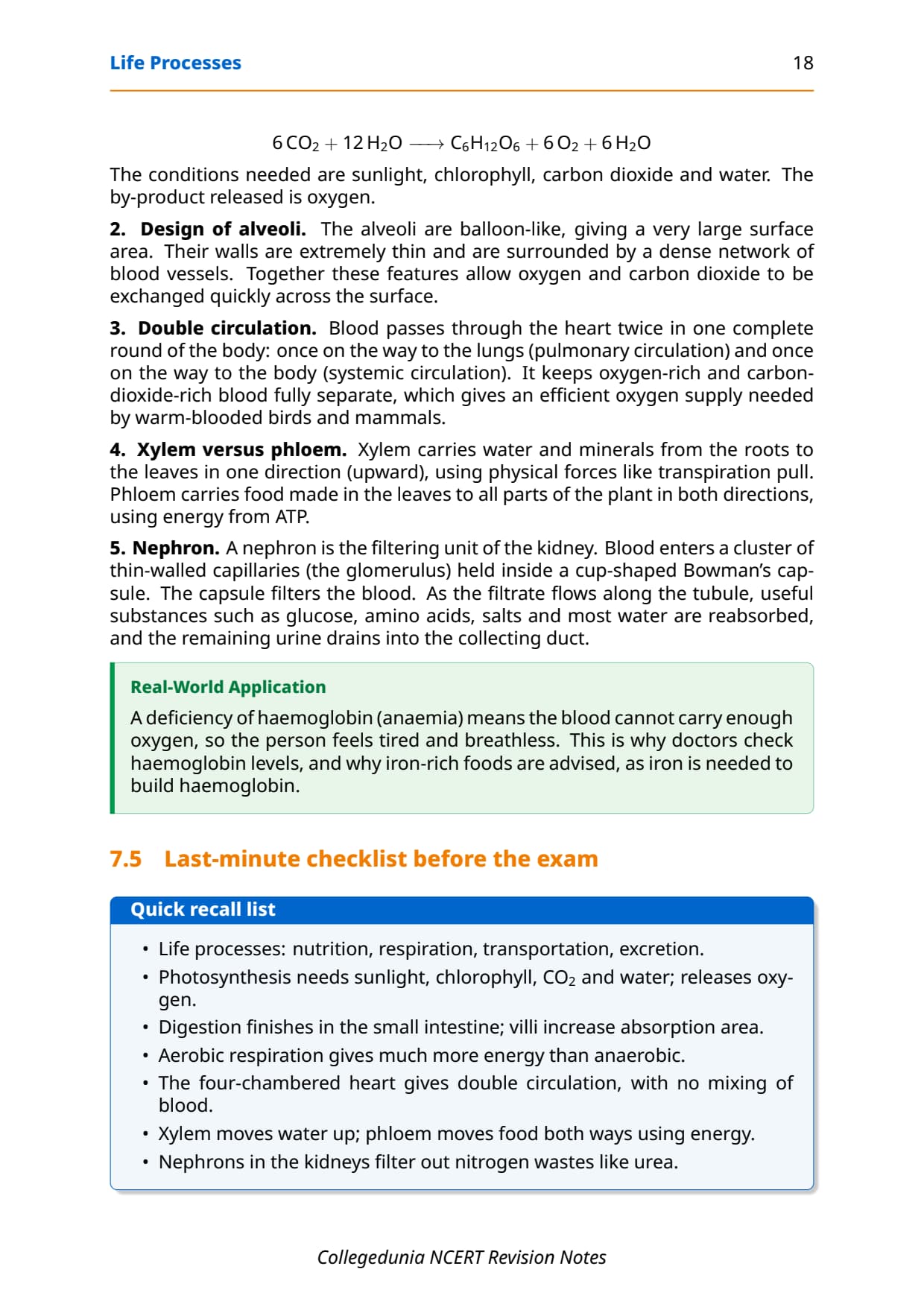
This chapter is tested mainly through diagram-labelling, definitions of the four processes, the heart and double circulation, the nephron, and the xylem-phloem difference.
| Year | Question type asked | Marks |
|---|---|---|
| 2025 | Labelled diagram of the human heart and double circulation | 5 |
| 2024 | Structure and working of a nephron | 3 |
| 2023 | Aerobic vs anaerobic respiration; products in each | 3 |
| 2022 | Digestion and absorption in the small intestine | 2 + 3 |
Also Check: The full set of CBSE board paper questions for this chapter, with step-by-step answers, is included in the downloadable PDF above, updated for the 2026-27 cycle.
Other Resources for Class 10 Science Chapter 5 Life Processes
Pair these revision notes with the matching NCERT Solutions, the formula sheet, handwritten notes and the official NCERT book chapter. All resources for Class 10 Science Chapter 5 Life Processes are linked below.
| Resource | What it covers | Open |
|---|---|---|
| Notes | Concept-first revision notes on the four life processes: nutrition, respiration, transportation and excretion in plants and humans. | You are here |
| NCERT Solutions | Step-by-step answers to all in-text and exercise questions, with an Expert Solution for each. | Class 10 Science Chapter 5 NCERT Solutions |
| Formula Sheet | Quick reference of the must-know diagrams, definitions and the photosynthesis and respiration equations. | Class 10 Science Chapter 5 Formula Sheet |
| Handwritten Notes | Scanned-style handwritten pages for last-minute board revision. | Class 10 Science Chapter 5 Handwritten Notes |
| NCERT Book PDF | Official NCERT Science Chapter 5 Life Processes textbook in PDF form. | Class 10 Science Chapter 5 NCERT Book PDF |
Notes for Class 10 Science: All Chapters
Related Links: Use the table below to open the revision notes for the other chapters of Class 10 Science. Every chapter ships with the same concept-first notes style, full PDF download, and revision FAQ.
| Chapter | Notes link |
|---|---|
| Chapter 1 | Chemical Reactions and Equations Notes |
| Chapter 2 | Acids, Bases and Salts Notes |
| Chapter 3 | Metals and Non-metals Notes |
| Chapter 4 | Carbon and its Compounds Notes |
| Chapter 5 | Life Processes Notes (You are here) |
| Chapter 6 | Control and Coordination Notes |
| Chapter 7 | How do Organisms Reproduce? Notes |
| Chapter 8 | Heredity Notes |
| Chapter 9 | Light - Reflection and Refraction Notes |
| Chapter 10 | The Human Eye and the Colourful World Notes |
| Chapter 11 | Electricity Notes |
| Chapter 12 | Magnetic Effects of Electric Current Notes |
| Chapter 13 | Our Environment Notes |
Notes Class 10 Science Chapter 5 Life Processes FAQs
Ques. What does Chapter 5 Life Processes cover in Class 10 Science?
Ans. Chapter 5 covers the four life processes that keep an organism alive: nutrition, respiration, transportation and excretion. The notes explain autotrophic nutrition by photosynthesis and heterotrophic nutrition, the full path of human digestion with its enzymes, aerobic and anaerobic respiration and ATP, the human respiratory system, the human heart with double circulation, transport in xylem and phloem in plants, and excretion through the kidneys and the nephron. Everything is aligned with the 2026-27 CBSE syllabus.
Ques. What are the four life processes in Class 10 Science?
Ans. The four life processes are nutrition, respiration, transportation and excretion. Nutrition is taking in food and converting it to energy and body material. Respiration is breaking down food, mainly glucose, to release usable energy as ATP. Transportation is carrying food, oxygen and wastes from one part of the body to another, since simple diffusion is too slow in a large body. Excretion is removing harmful nitrogenous wastes from the body. Together these processes do the maintenance job that keeps a living organism in an ordered, working state.
Ques. What is the difference between aerobic and anaerobic respiration?
Ans. In both, glucose, a six-carbon molecule, is first broken down in the cytoplasm into pyruvate, a three-carbon molecule. Aerobic respiration then breaks pyruvate down in the mitochondria in the presence of oxygen to give carbon dioxide and water, releasing a large amount of energy. Anaerobic respiration takes place without oxygen: in yeast it gives ethanol and carbon dioxide, while in our muscle cells, when oxygen runs short, pyruvate becomes lactic acid. The build-up of lactic acid causes muscle cramps. Aerobic respiration releases much more energy than the anaerobic routes.
Ques. What is double circulation in Class 10 Science?
Ans. Double circulation means that blood passes through the heart twice during one complete round of the body. Oxygen-rich blood from the lungs enters the left atrium, goes to the left ventricle, and is pumped to the body. Carbon dioxide-rich blood from the body enters the right atrium, goes to the right ventricle, and is pumped to the lungs. The four-chambered heart keeps the oxygenated and de-oxygenated blood separate, which gives an efficient oxygen supply. This is important for warm-blooded animals such as birds and mammals that constantly use energy to maintain body temperature.
Ques. What is the difference between transport in xylem and phloem?
Ans. Xylem carries water and minerals upward from the roots to the leaves, and it is made mostly of dead cells. The water rises because of root pressure and, mainly, the transpiration pull created when water evaporates from the leaves. Phloem carries the food made in the leaves (mainly sucrose) and amino acids in both upward and downward directions, to storage organs and growing parts. Phloem is made of living cells, and the transport of food, called translocation, uses energy from ATP. A simple memory line is: xylem moves water up, phloem moves food both ways.
Ques. How does the nephron filter blood in Class 10 Science?
Ans. The nephron is the basic filtration unit of the kidney. Each nephron begins with a cluster of thin-walled blood capillaries called the glomerulus, held inside a cup-shaped Bowman's capsule, where the blood is filtered under pressure. As the filtrate flows along the tube of the nephron, useful substances such as glucose, amino acids, salts and most of the water are selectively re-absorbed back into the blood. The remaining liquid, urine, collects and passes through the ureter to the urinary bladder, and is released through the urethra. The amount of water re-absorbed depends on the body's needs.
Ques. How many pages is the Class 10 Science Life Processes Notes PDF?
Ans. The Life Processes Notes PDF runs about 20 to 22 pages and covers the full chapter in concept-first revision blocks, with labelled diagrams of the digestive system, the respiratory system, the heart and the nephron, the photosynthesis and respiration equations, comparison tables, common-mistake boxes and a one-glance revision strip. The PDF is free to download for the 2026-27 session, and a green Handwritten Notes button on this page opens the scanned-style version for last-minute revision.
Ques. Are these Notes for Class 10 Science Chapter 5 aligned with the 2026-27 syllabus?
Ans. Yes. This page reflects the current 2026-27 CBSE syllabus for Class 10 Science. The Life Processes chapter is part of the current cycle, and these notes follow the NCERT textbook, covering the four life processes, autotrophic and heterotrophic nutrition, human digestion, aerobic and anaerobic respiration, the human heart and double circulation, transport in xylem and phloem, and excretion through the nephron. The notes are written for the CBSE board exam, with the high-frequency question types and diagram questions highlighted throughout.



Comments