



NCERT Class 11 English Woven Words Chapter 15 For Elkana Notes explain Nissim Ezekiel's poem through family silence, gentle irony, domestic speech, the child's demand and the poem's comic close for the 2026-27 syllabus.
- Download the Chapter 15 Notes PDF for offline revision.
- Revise the summary, speaker, family communication pattern, understatement and answer frames.
- Student focus: connect every answer to ordinary family life, not just to a literal retelling of the poem.
Chapter15ForElkanaNotes.pdf?page=1&dpi=150)
Chapter15ForElkanaNotes.pdf?page=2&dpi=150)
Chapter15ForElkanaNotes.pdf?page=3&dpi=150)
Chapter15ForElkanaNotes.pdf?page=4&dpi=150)
Chapter15ForElkanaNotes.pdf?page=5&dpi=150)
Chapter15ForElkanaNotes.pdf?page=6&dpi=150)
Chapter15ForElkanaNotes.pdf?page=7&dpi=150)
Chapter15ForElkanaNotes.pdf?page=8&dpi=150)
Chapter15ForElkanaNotes.pdf?page=9&dpi=150)
Chapter15ForElkanaNotes.pdf?page=10&dpi=150)
Chapter15ForElkanaNotes.pdf?page=11&dpi=150)
Chapter15ForElkanaNotes.pdf?page=12&dpi=150)
Chapter15ForElkanaNotes.pdf?page=13&dpi=150)
Chapter15ForElkanaNotes.pdf?page=14&dpi=150)
Chapter15ForElkanaNotes.pdf?page=15&dpi=150)
Chapter15ForElkanaNotes.pdf?page=16&dpi=150)
Chapter15ForElkanaNotes.pdf?page=17&dpi=150)
Chapter15ForElkanaNotes.pdf?page=18&dpi=150)
Chapter15ForElkanaNotes.pdf?page=19&dpi=150)
Chapter15ForElkanaNotes.pdf?page=20&dpi=150)
Chapter15ForElkanaNotes.pdf?page=21&dpi=150)
Chapter15ForElkanaNotes_flat_MobileCard.pdf?page=1&dpi=150)
Chapter15ForElkanaNotes_flat_MobileCard.pdf?page=2&dpi=150)
Chapter15ForElkanaNotes_flat_MobileCard.pdf?page=3&dpi=150)
Chapter15ForElkanaNotes_flat_MobileCard.pdf?page=4&dpi=150)
Chapter15ForElkanaNotes_flat_MobileCard.pdf?page=5&dpi=150)
Chapter15ForElkanaNotes_flat_MobileCard.pdf?page=6&dpi=150)
Chapter15ForElkanaNotes_flat_MobileCard.pdf?page=7&dpi=150)
Chapter15ForElkanaNotes_flat_MobileCard.pdf?page=8&dpi=150)
Chapter15ForElkanaNotes_flat_MobileCard.pdf?page=9&dpi=150)
Chapter15ForElkanaNotes_flat_MobileCard.pdf?page=10&dpi=150)
Chapter15ForElkanaNotes_flat_MobileCard.pdf?page=11&dpi=150)
Chapter15ForElkanaNotes_flat_MobileCard.pdf?page=12&dpi=150)
Chapter15ForElkanaNotes_flat_MobileCard.pdf?page=13&dpi=150)
Chapter15ForElkanaNotes_flat_MobileCard.pdf?page=14&dpi=150)
Chapter15ForElkanaNotes_flat_MobileCard.pdf?page=15&dpi=150)
Chapter15ForElkanaNotes_flat_MobileCard.pdf?page=16&dpi=150)
Chapter15ForElkanaNotes_flat_MobileCard.pdf?page=17&dpi=150)
Chapter15ForElkanaNotes_flat_MobileCard.pdf?page=18&dpi=150)
Chapter15ForElkanaNotes_flat_MobileCard.pdf?page=19&dpi=150)
Chapter15ForElkanaNotes_flat_MobileCard.pdf?page=20&dpi=150)
Chapter15ForElkanaNotes_flat_MobileCard.pdf?page=21&dpi=150)
Chapter15ForElkanaNotes_flat_MobileCard.pdf?page=22&dpi=150)
Chapter15ForElkanaNotes_flat_MobileCard.pdf?page=23&dpi=150)
Chapter15ForElkanaNotes_flat_MobileCard.pdf?page=24&dpi=150)
Chapter15ForElkanaNotes_flat_MobileCard.pdf?page=25&dpi=150)
Chapter15ForElkanaNotes_flat_MobileCard.pdf?page=26&dpi=150)
Chapter15ForElkanaNotes_flat_MobileCard.pdf?page=27&dpi=150)
Chapter15ForElkanaNotes_flat_MobileCard.pdf?page=28&dpi=150)
Chapter15ForElkanaNotes_flat_MobileCard.pdf?page=29&dpi=150)
Chapter15ForElkanaNotes_flat_MobileCard.pdf?page=30&dpi=150)
Chapter15ForElkanaNotes_flat_MobileCard.pdf?page=31&dpi=150)
Chapter15ForElkanaNotes_flat_MobileCard.pdf?page=32&dpi=150)
Chapter15ForElkanaNotes_flat_MobileCard.pdf?page=33&dpi=150)
Student Feedback on For Elkana
In a Collegedunia revision poll of 10,260 Class 11 English students, most students said For Elkana became easier after they studied the poem as a family scene built on silence, interruption and gentle humour.
For Elkana Class 11 Notes PDF Overview
For Elkana is a short poem by Nissim Ezekiel. It catches a domestic moment in which a husband, wife and child reveal the rhythms of a family through small remarks, silence and comic interruption.
| Focus area | What to remember | Exam cue |
|---|---|---|
| Speaker | The poem presents a husband observing his family scene. | Domestic voice |
| Family silence | The couple understands more than what they say aloud. | Communication pattern |
| Child's role | The child interrupts adult reflection with a direct demand. | Comic contrast |
| Tone | The poem is tender, ironic and lightly humorous. | Understatement |
For Elkana Class 11 Poem Explanation
Source: Magnet Brains on YouTube
For Elkana Summary and Central Idea
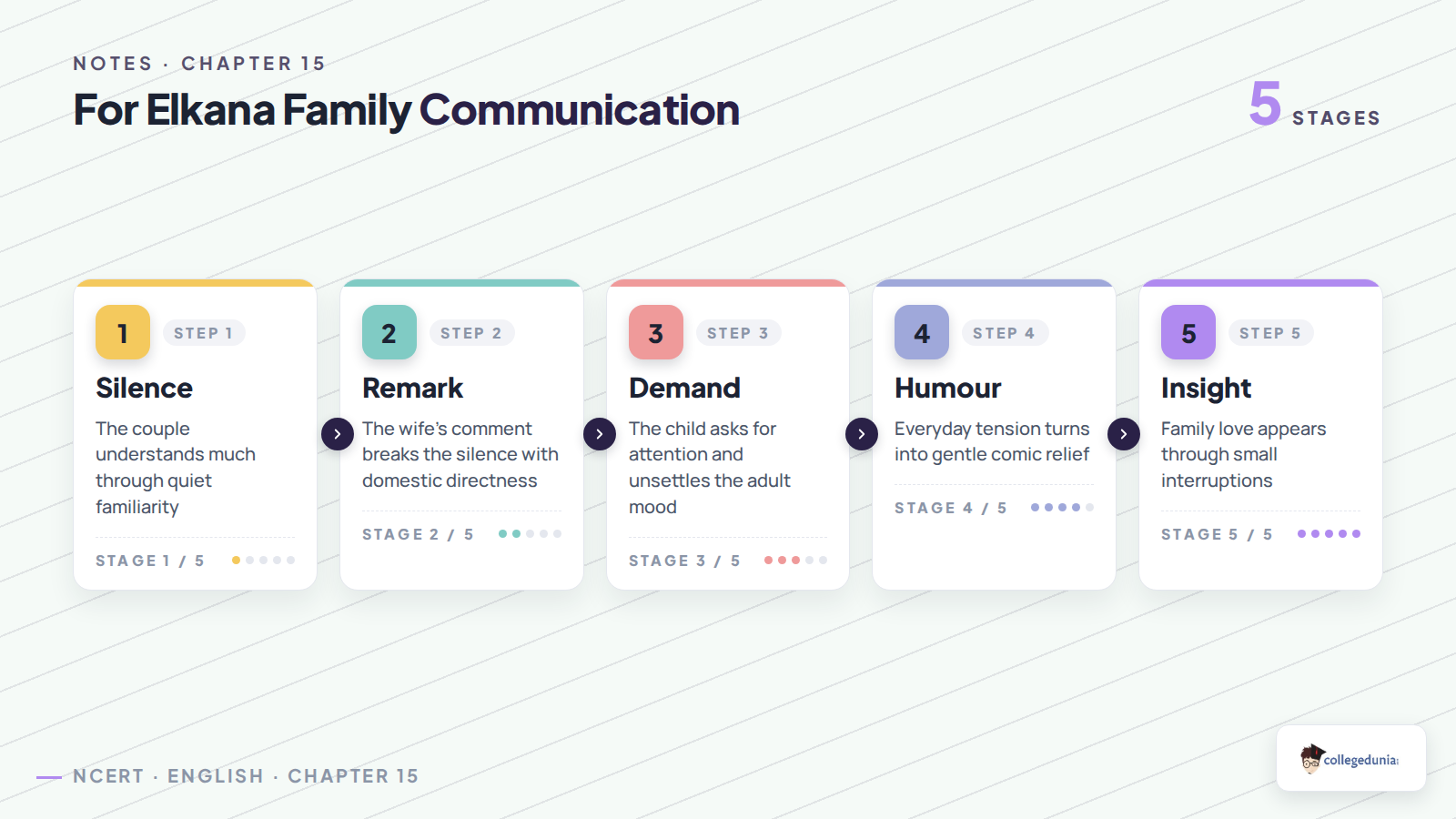
The poem shows an ordinary household moment rather than a dramatic event. A husband reflects on ageing, marriage and the strange language of familiar silence. The wife's practical comment and the child's demand pull the mood back into daily family life.
The central idea is that family communication is often indirect. People who live together understand pauses, half-sentences and sudden interruptions. Ezekiel turns this familiar pattern into gentle comedy.
- The opening mood is quiet and reflective.
- The wife brings the scene into ordinary speech.
- The child breaks adult seriousness with direct need.
- The poem's humour comes from the contrast between reflection and household reality.
Family Communication Pattern in For Elkana
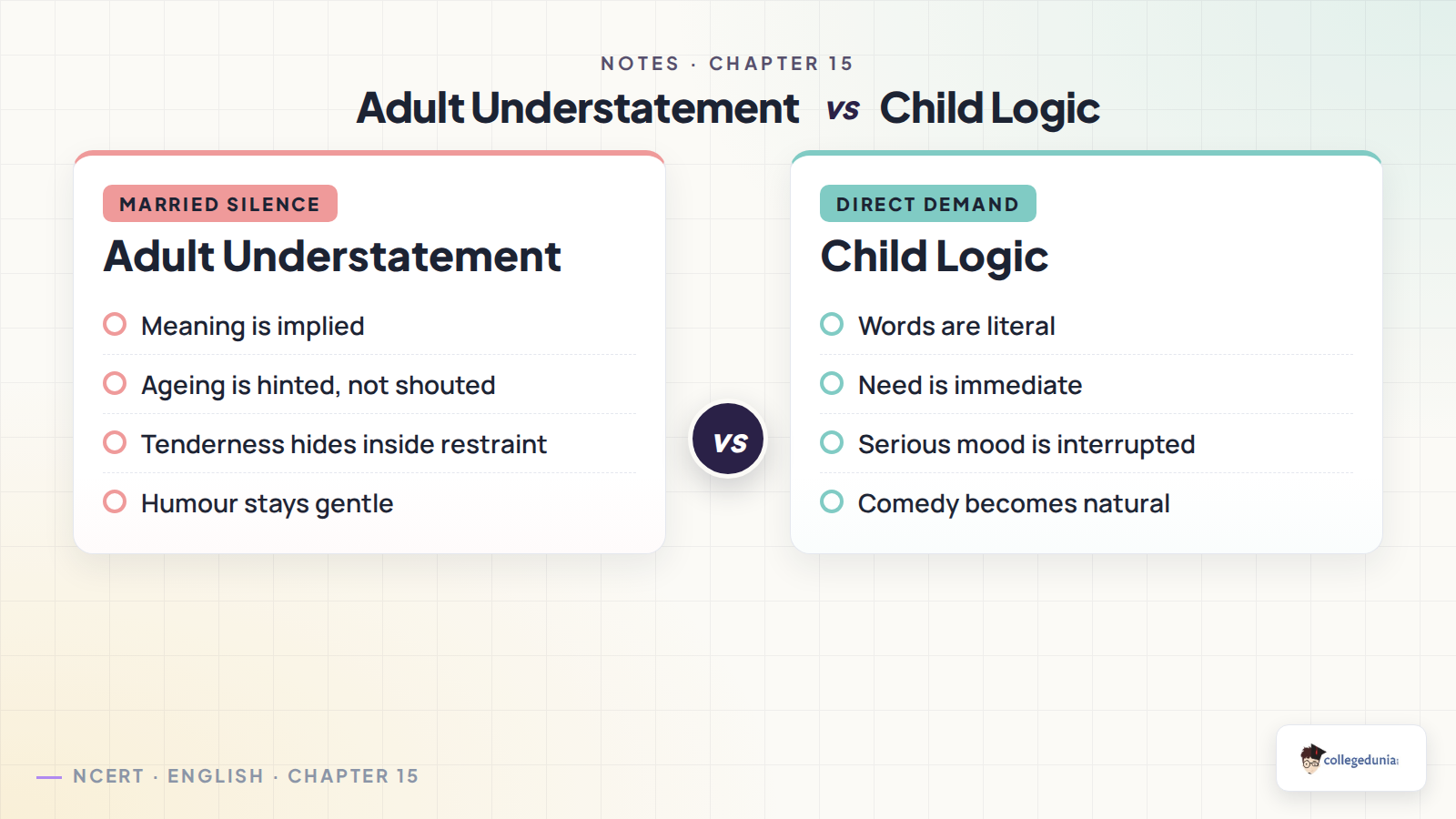
Ezekiel does not present family life as a formal conversation. Instead, he shows how meaning moves through silence, gestures and brief domestic remarks. This is why the poem is useful for answers on subtlety and communication.
| Moment | Meaning | How to write it |
|---|---|---|
| Shared silence | The couple's closeness needs few words. | Use the phrase wordless understanding. |
| Wife's comment | Domestic speech cuts through reflection. | Show practical realism. |
| Child's demand | Family life refuses to stay poetic or solemn. | Connect to comic interruption. |
| Closing effect | The poem ends with affection rather than complaint. | Call the tone tender and humorous. |
How to Write NCERT Answers for For Elkana
NCERT questions on For Elkana usually ask about the family pattern, the use of humour, the relationship between adults and children and the poet's delicate handling of ordinary life. A strong answer names the exact domestic moment before giving the larger idea.
- For subtle communication, explain how silence can carry meaning in a long relationship.
- For humour, mention the child's direct demand and the shift from reflection to daily life.
- For the wife's role, show how practical speech balances the husband's inward mood.
- For tone, avoid calling the poem tragic. It is reflective, comic and affectionate.
| Question type | Best opening | Finish with |
|---|---|---|
| Communication | The poem shows a family where much is understood without direct explanation. | Silence as a family language |
| Humour | The humour comes from ordinary interruption rather than loud comedy. | Child logic and domestic realism |
| Theme | Ezekiel turns a small household scene into a study of marriage and parenthood. | Affection inside routine |
Related Resources for For Elkana
| Resource | Use it for | Link |
|---|---|---|
| NCERT Solutions | Practise textbook answers | Open Solutions |
| NCERT Book PDF | Read the source poem | Use the PDF viewer above |
| Handwritten Notes | Revise with compact visual cues | Open Handwritten Notes |
All Class 11 English Woven Words Notes Chapters
| Chapter | Notes Link |
|---|---|
| Chapter 10 Coming | Open Notes |
| Chapter 11 Telephone Conversation | Open Notes |
| Chapter 12 The World is Too Much With Us | Open Notes |
| Chapter 13 Mother Tongue | Open Notes |
| Chapter 14 Hawk Roosting | Open Notes |
| Chapter 15 For Elkana | Current chapter notes |
For Elkana Class 11 Notes FAQs
Ques. What is the main idea of For Elkana?
Ans. The main idea is that family communication often works through silence, small remarks and interruptions. The poem presents this pattern with gentle humour.
Ques. Why is silence important in For Elkana?
Ans. Silence is important because it shows the closeness of the couple. They do not need to explain every thought in direct words.
Ques. How does the child create humour in the poem?
Ans. The child creates humour by interrupting adult reflection with a simple, immediate demand. This brings the poem back to ordinary household life.
Ques. How should students answer questions on the poem's tone?
Ans. Students should describe the tone as reflective, affectionate and lightly comic. The poem is serious about family life but never heavy in expression.



Comments