



Inside the NCERT Notes Class 11 Geography Chapter 5 Geomorphic Processes, you will find the process versus agent comparison table, all five landslide types explained side by side, and the full soil formation flow, according to the latest 2026-27 CBSE syllabus.
- 22-page PDF covering endogenic and exogenic processes, weathering, mass movements, erosion, deposition and soil formation.
- 10+ comparison tables, including orogeny vs epeirogeny, the three weathering types, and the five landslide types.
- Mnemonic mind map and a quick-recall appendix for last-minute revision before the 2026-27 exams.
You can find the complete NCERT Notes Class 11 Geography Chapter 5 Geomorphic Processes, including every diagram, table and memory aid, in the sections below.
These NCERT Notes Class 11 Geography Chapter 5 Geomorphic Processes are curated by subject experts, mapped to the 2026-27 NCERT Fundamentals of Physical Geography textbook, and checked against the last five years of CBSE Class 11 question papers.
What Are Geomorphic Processes? Endogenic and Exogenic Forces Explained
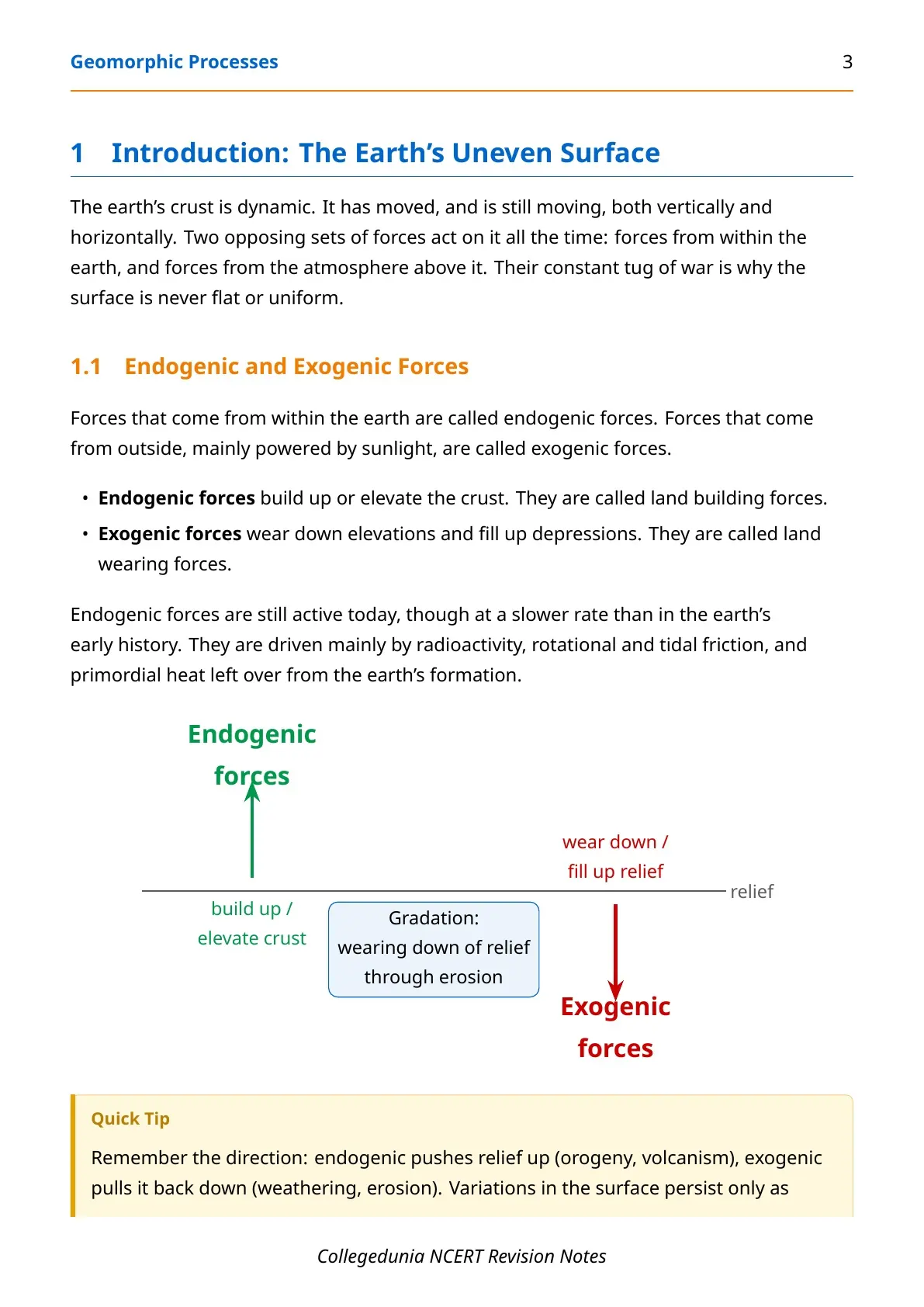
The earth's crust is dynamic, and two opposing forces keep reshaping it. Endogenic forces act from within the earth and build up relief. Exogenic forces act from the atmosphere and wear that relief down. Their constant push and pull is why no two hillsides ever look the same.
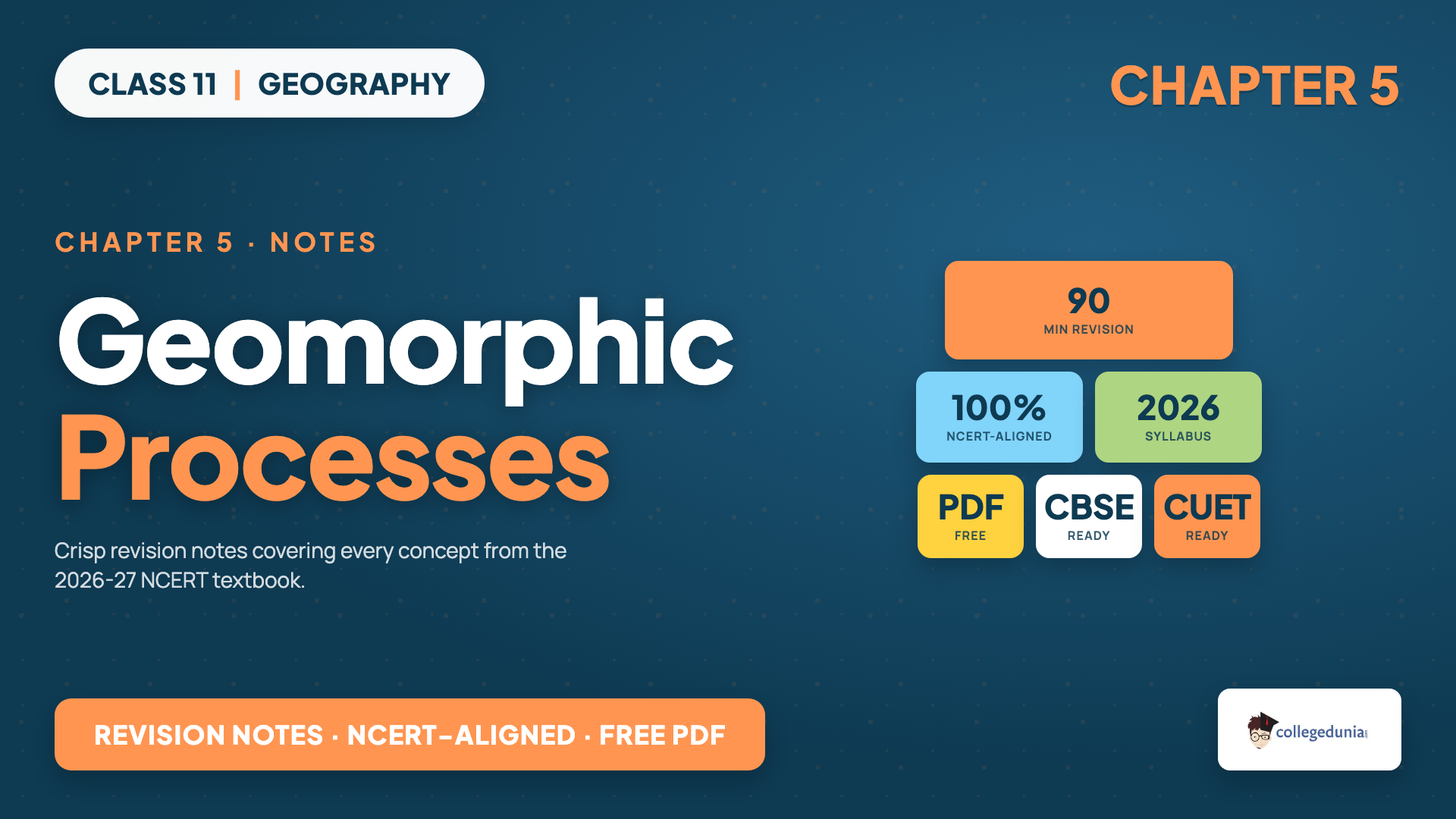
- Endogenic forces are powered by radioactivity, tidal friction and heat left over from the earth's formation.
- Exogenic forces are powered mainly by the sun, working through wind, water, ice and waves.
- Gradation is the wearing down of relief through erosion. It never fully wins, because endogenic forces keep building new relief at the same time.
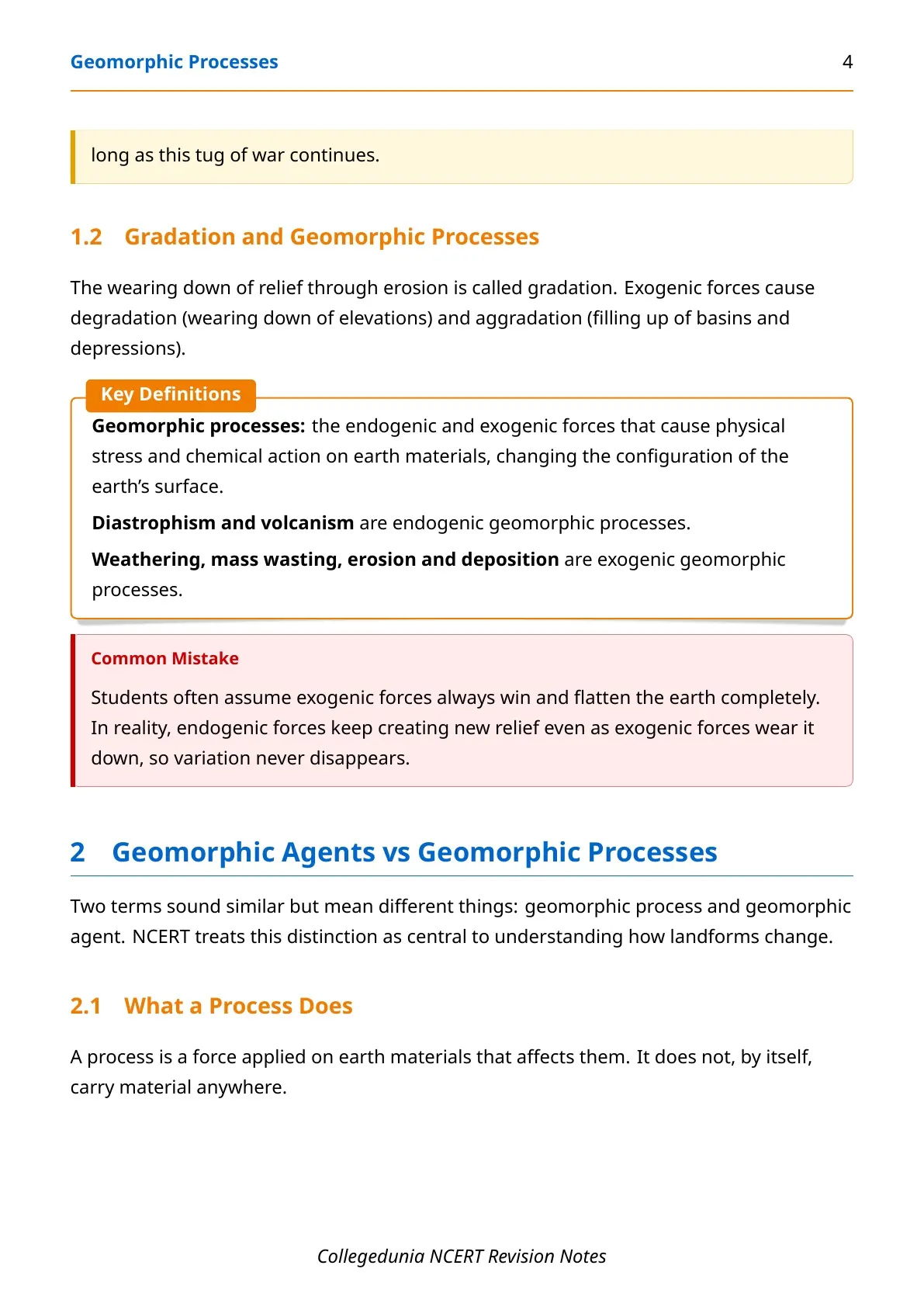
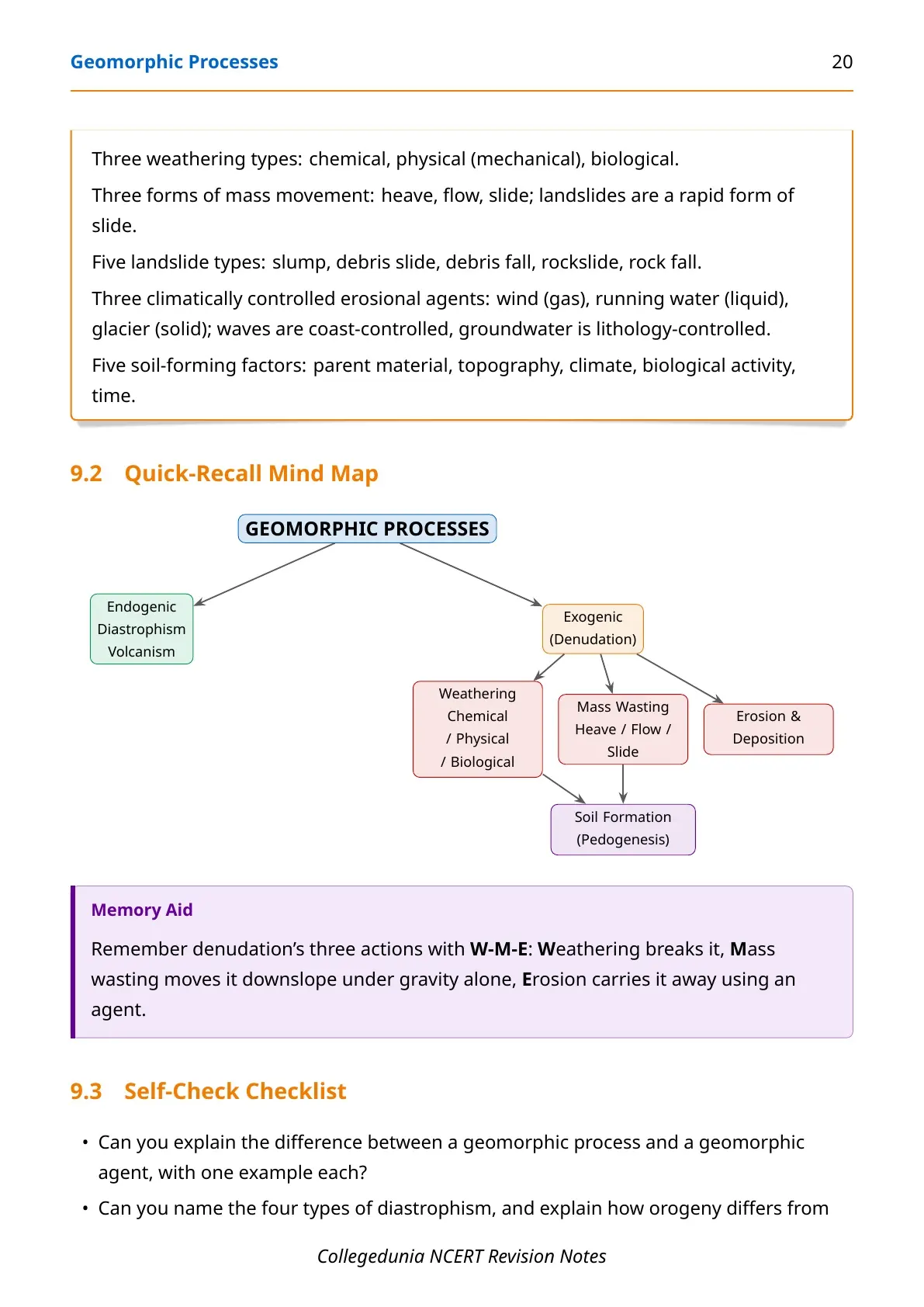
NCERT defines geomorphic processes as the endogenic and exogenic forces that cause physical stress and chemical action on earth material, changing the shape of the earth's surface. Diastrophism and volcanism are endogenic. Weathering, mass wasting, erosion and deposition are exogenic.
Geomorphic Processes Explained: Class 11 Geography Video Recap
Source: Magnet Brains on YouTube
Geomorphic Agent vs Geomorphic Process: The Key Difference
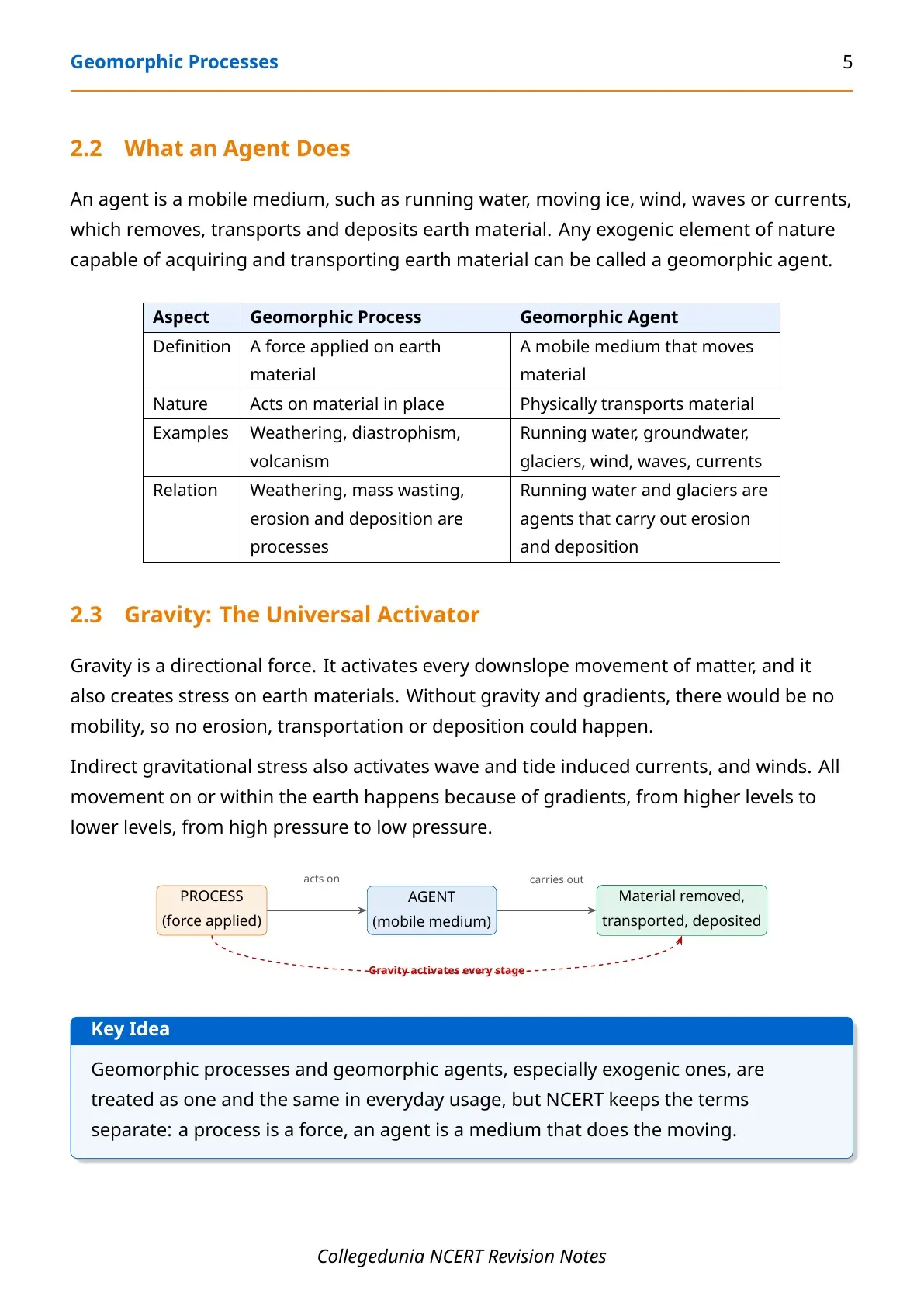
Two terms trip up most Class 11 students: geomorphic process and geomorphic agent. A process is a force applied on rock material. An agent is the mobile medium, such as running water or a glacier, that carries material away. Gravity activates every stage of both.
| Aspect | Geomorphic Process | Geomorphic Agent |
|---|---|---|
| Definition | A force applied on earth material | A mobile medium that moves material |
| Nature | Acts on material in place | Physically transports material |
| Examples | Weathering, diastrophism, volcanism | Running water, groundwater, glaciers, wind, waves |
| Role of gravity | Creates the stress that drives the process | Sets the medium in downslope motion |
Endogenic Processes: Diastrophism and Volcanism in Class 11 Geography
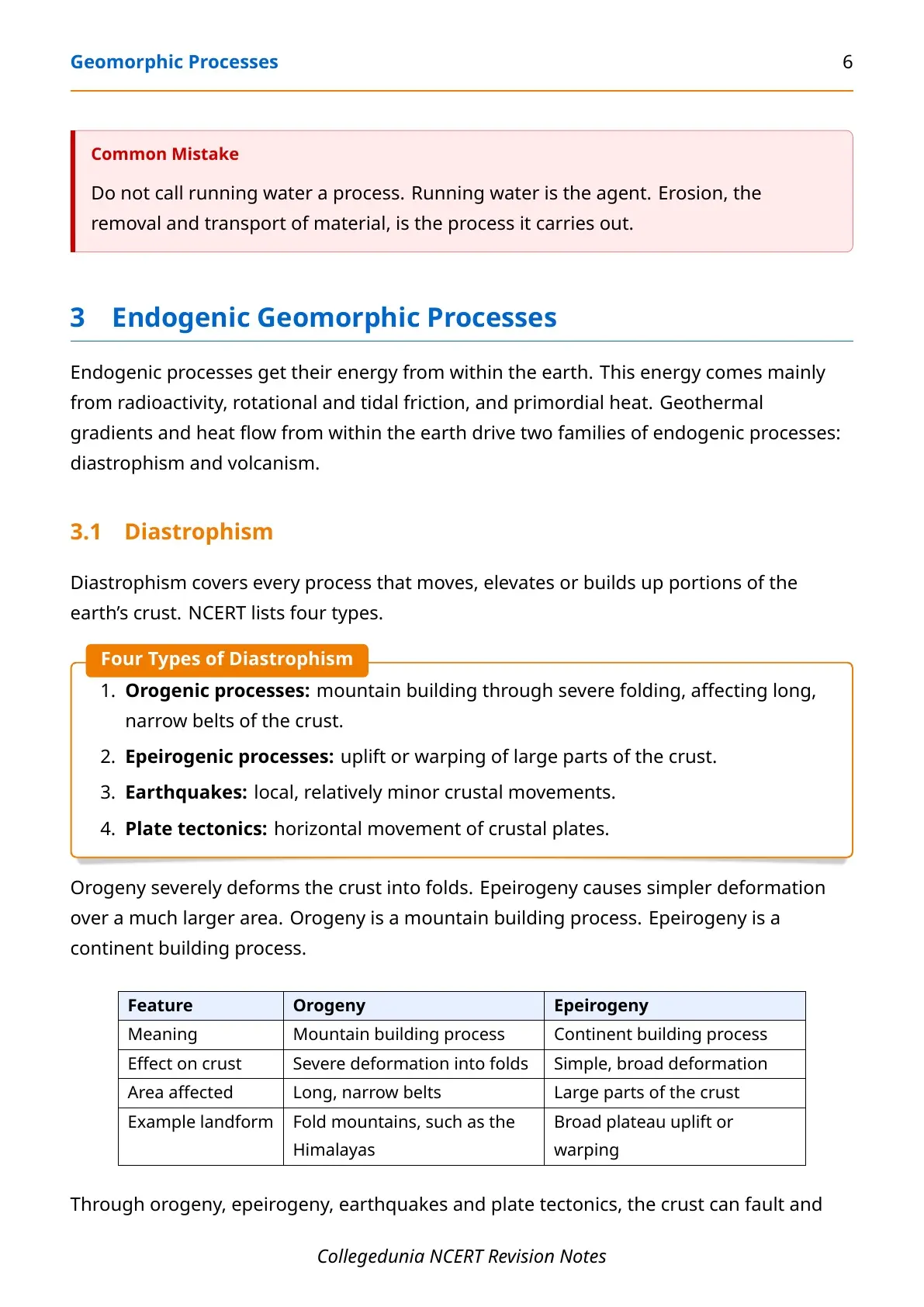
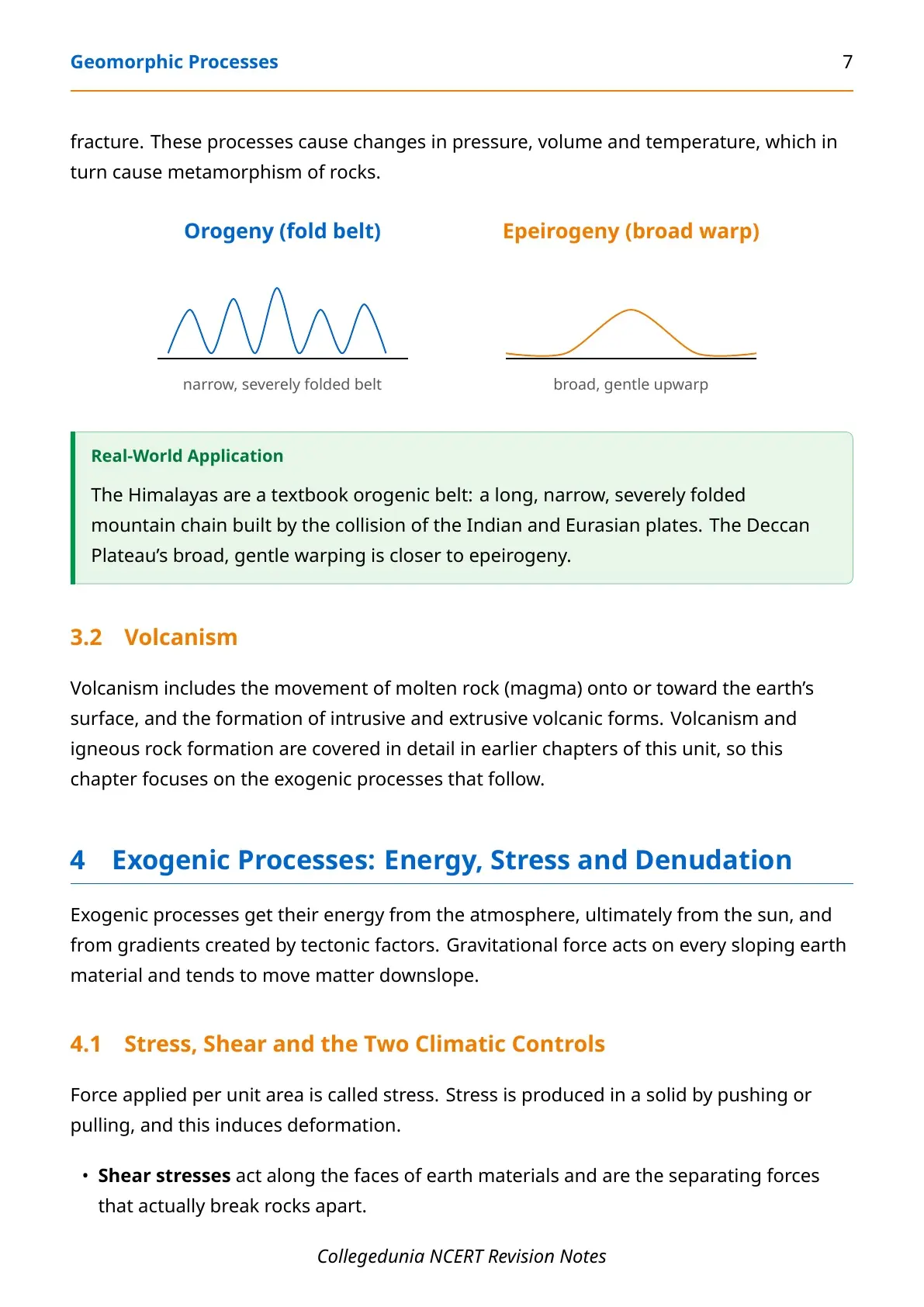
Diastrophism covers every process that moves, elevates or folds the earth's crust. NCERT groups it into four types: orogenic processes, epeirogenic processes, earthquakes and plate tectonics. Orogeny builds mountains; epeirogeny builds continents.
| Feature | Orogeny | Epeirogeny |
|---|---|---|
| Meaning | Mountain building process | Continent building process |
| Effect on crust | Severe deformation into folds | Simple, broad deformation |
| Area affected | Long, narrow belts | Large parts of the crust |
| Example | The Himalayas, a fold mountain belt | Broad plateau uplift or warping |
Volcanism is the other endogenic process. It covers the movement of magma toward the earth's surface, plus the intrusive and extrusive landforms that magma leaves behind. This chapter builds directly on the volcanism and igneous rock content from earlier chapters in the same unit.
Why Exogenic Processes Depend on the Sun, Stress and Rock Structure
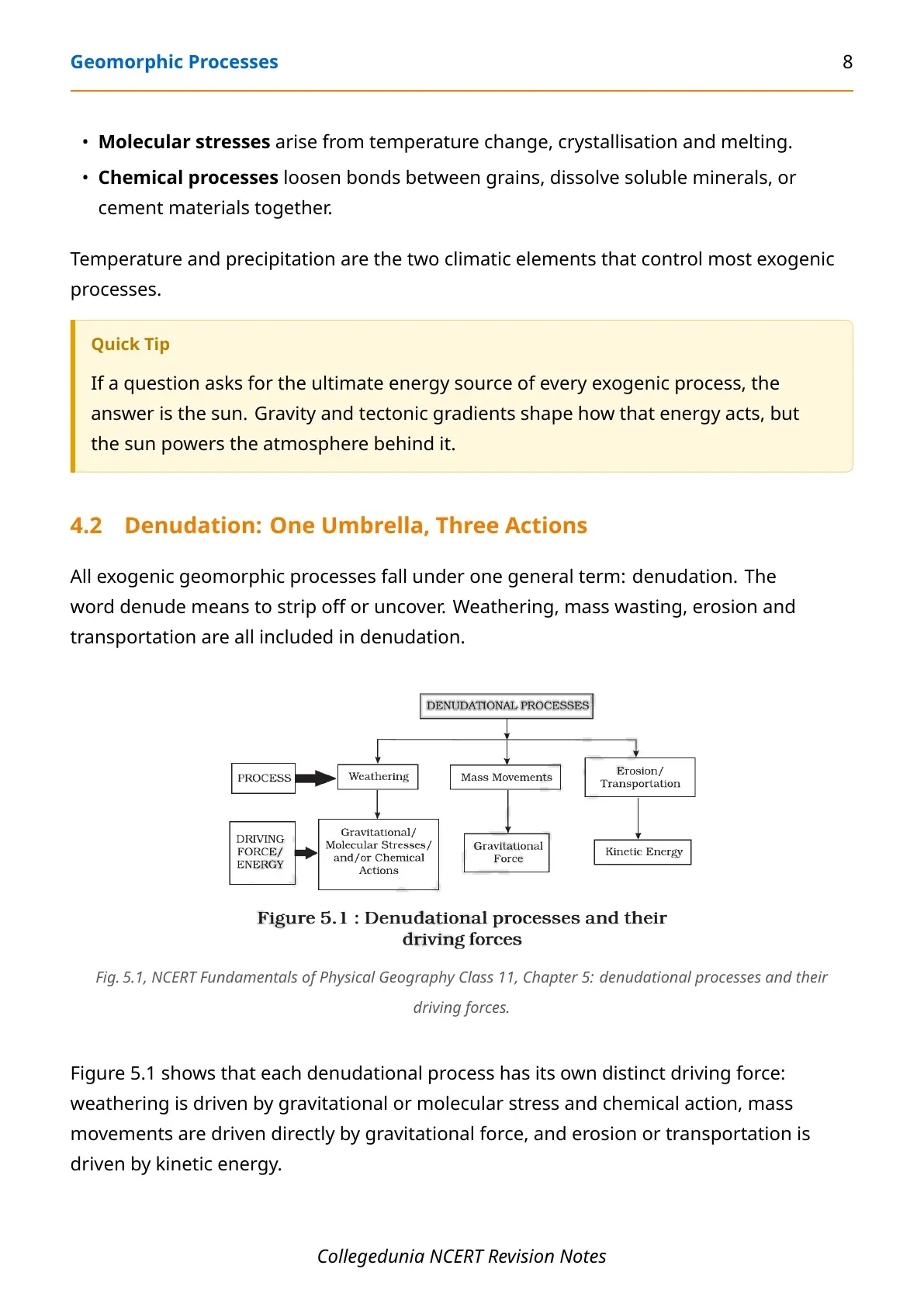
Exogenic processes get their energy from the atmosphere, ultimately from the sun, and from gradients created by tectonic factors. All of them fall under one umbrella term: denudation, meaning to strip off or uncover.
- Denudation includes weathering, mass wasting, erosion and transportation.
- Shear stress along the faces of rock is what actually breaks it apart.
- Temperature and precipitation are the two climatic elements that control most exogenic processes.
- The same rock can resist one process well and resist another poorly, depending on climate and rock structure.
The Three Types of Weathering Every Class 11 Student Must Know
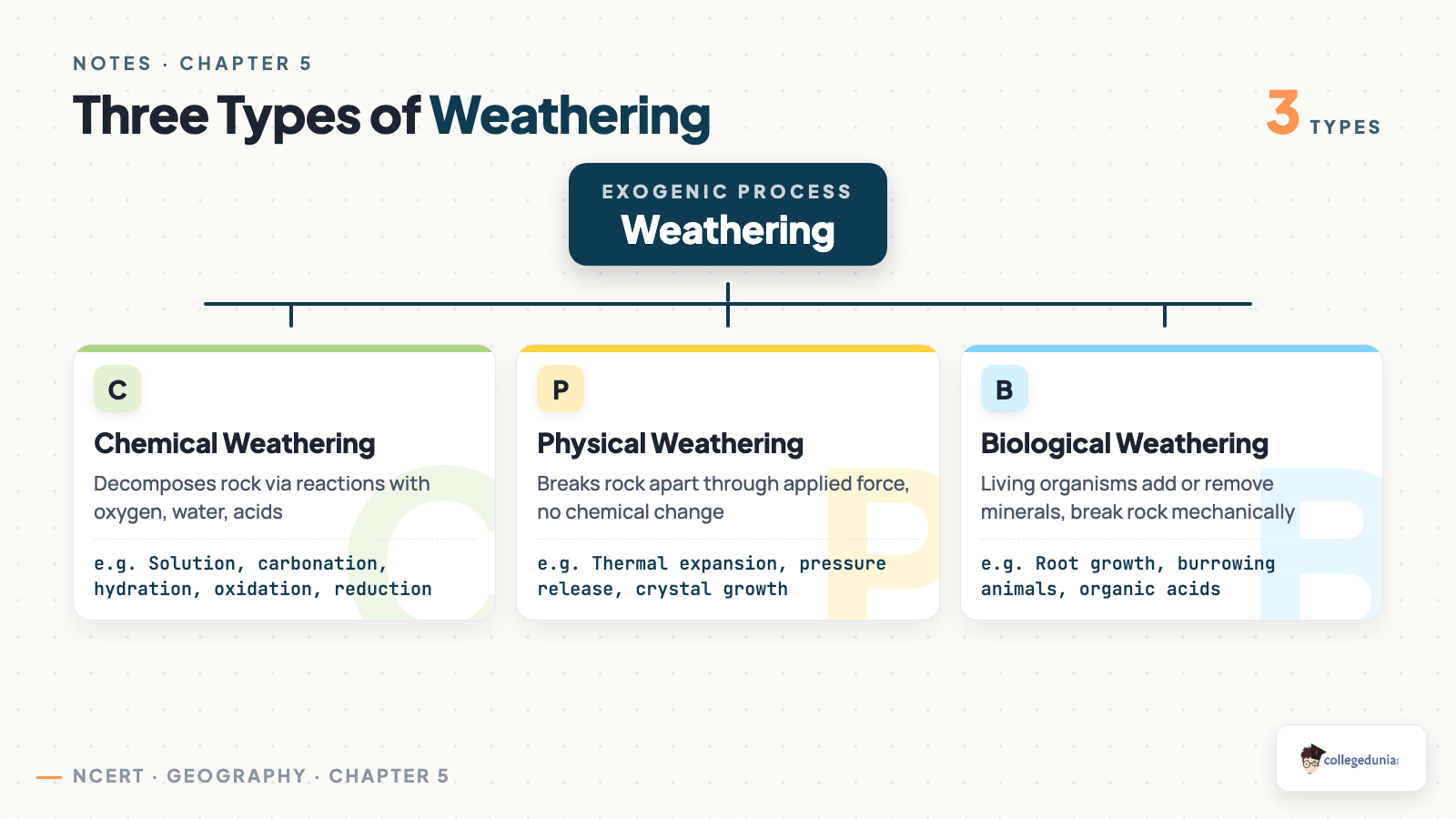
Weathering is the mechanical disintegration and chemical decomposition of rock through weather and climate. It happens in-situ, meaning almost no material moves away from where it breaks down. NCERT groups weathering into three types.
| Type | How It Works | Example Process |
|---|---|---|
| Chemical | Decomposes or dissolves rock through reactions with oxygen, water and acids | Solution, carbonation, hydration, oxidation, reduction |
| Physical (mechanical) | Breaks rock apart through applied force, no chemical change | Thermal expansion, pressure release, crystal growth |
| Biological | Living organisms add or remove minerals and break rock mechanically | Root growth, burrowing animals, organic acids |
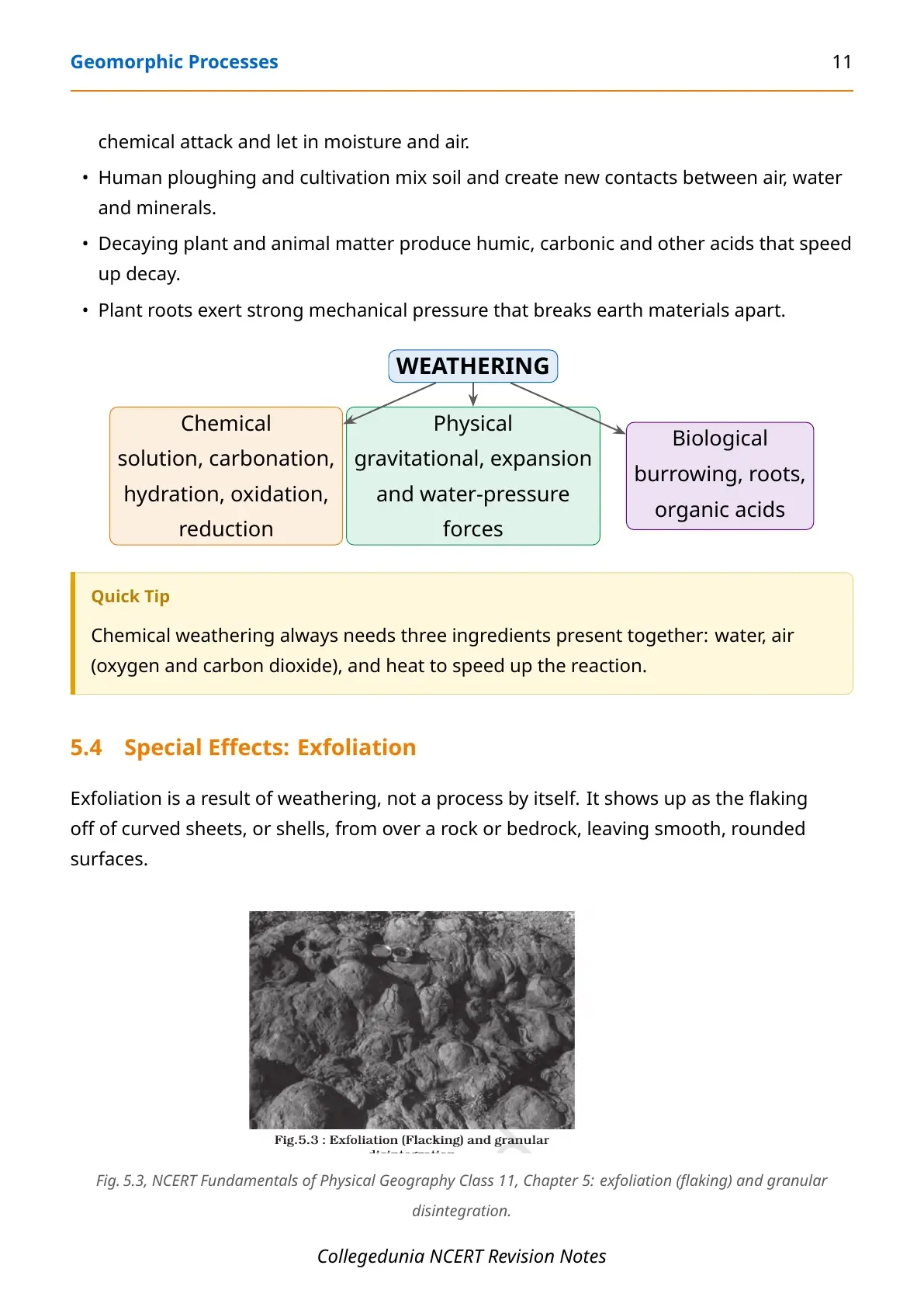
Exfoliation is the flaking off of curved rock sheets caused by weathering. NCERT is specific that exfoliation is a result of weathering, not a fourth type of weathering. Weathering also feeds the national economy directly: it concentrates valuable ores of iron, manganese, aluminium and copper into deposits worth mining, a process called enrichment.
Mass Movements and the Five Landslide Types Explained
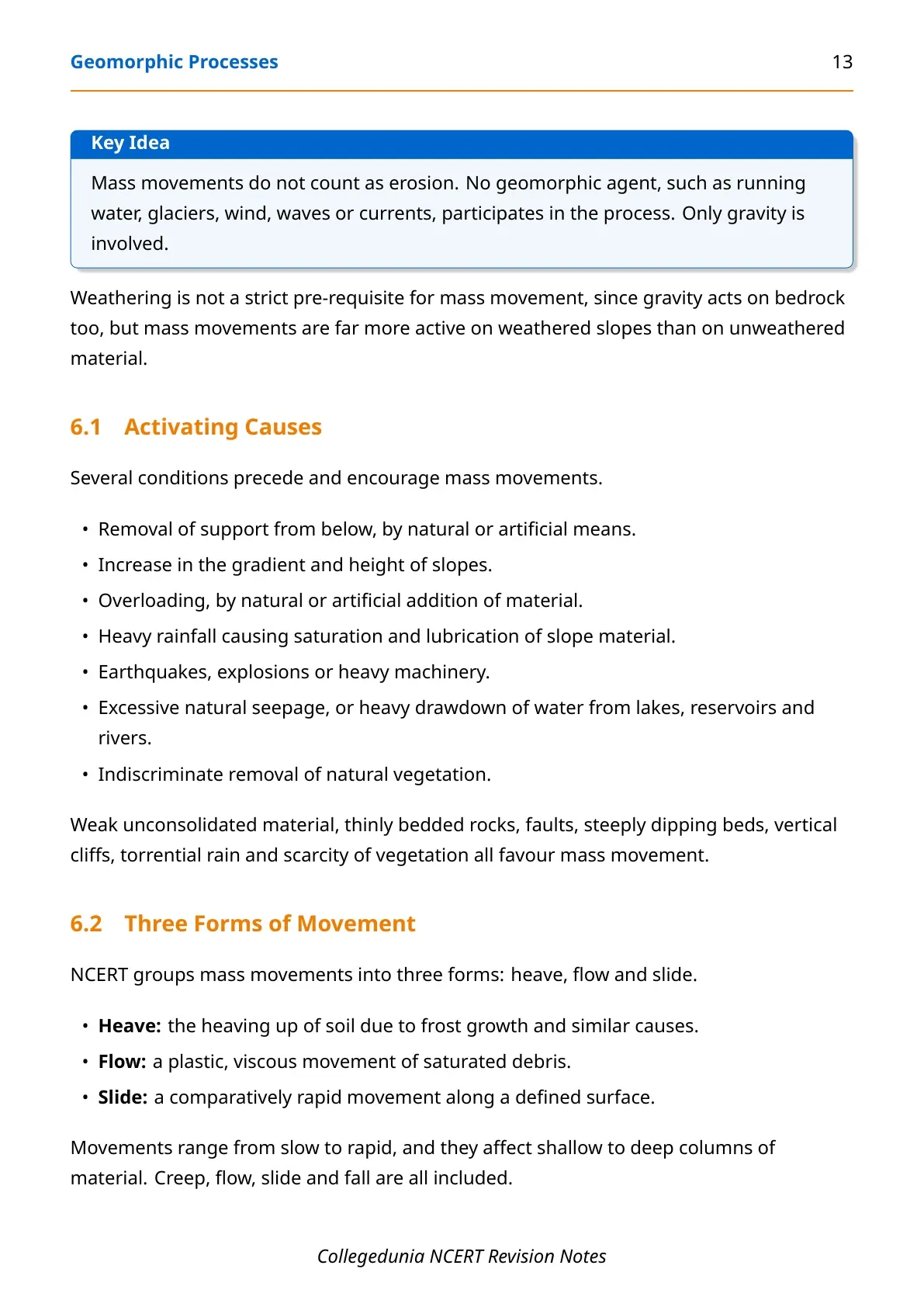
Mass movements shift rock debris downslope under gravity alone. No geomorphic agent carries the material away, which is why mass wasting is not classified as erosion. Weathering aids mass movement but is not a strict requirement for it.
| Landslide Type | Defining Feature |
|---|---|
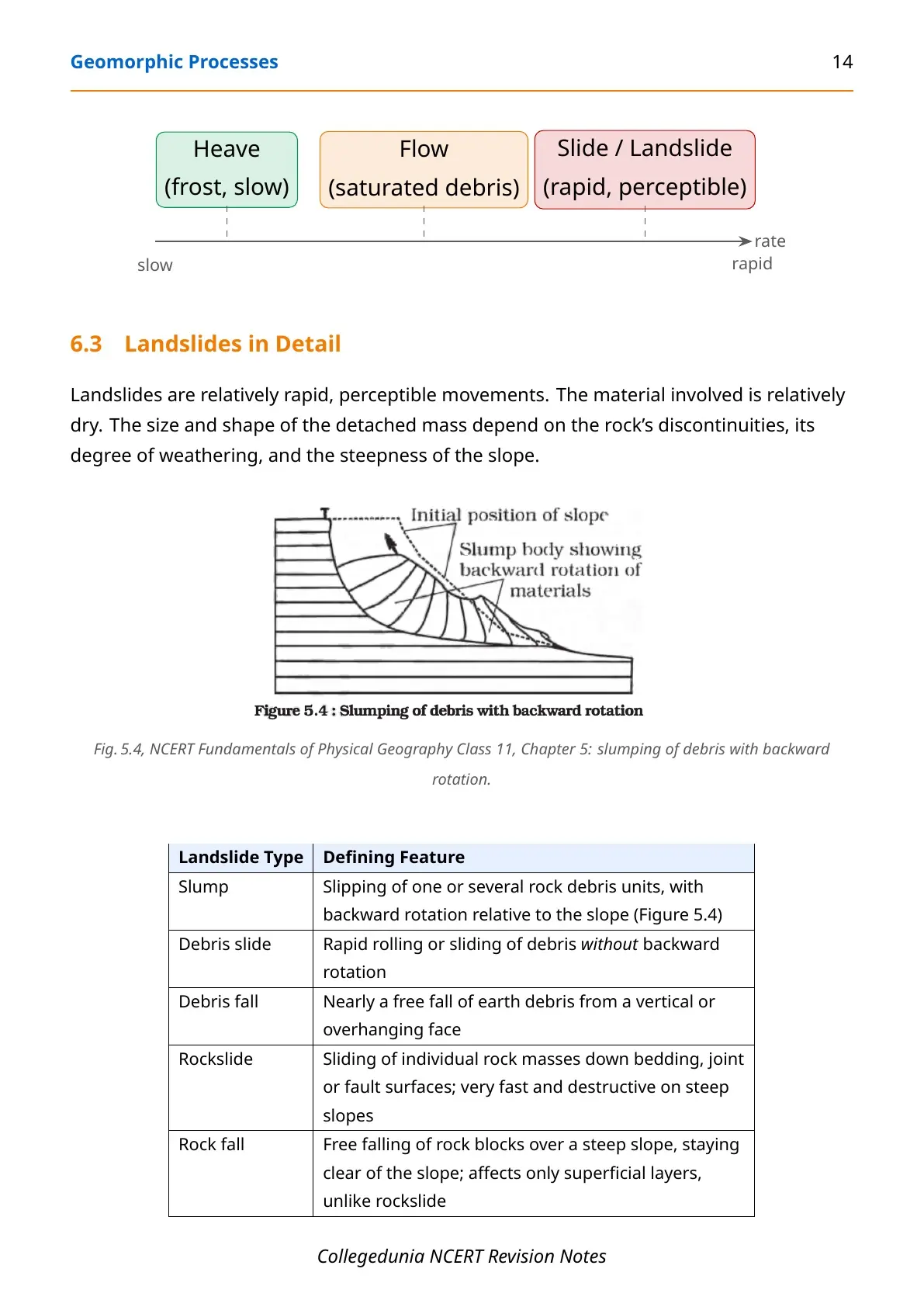
| Slump | Slipping of rock debris with backward rotation relative to the slope |
| Debris slide | Rapid rolling or sliding of debris without backward rotation |
| Debris fall | Nearly a free fall of earth debris from a vertical or overhanging face |
| Rockslide | Sliding of rock masses down bedding, joint or fault surfaces; fast and destructive |
| Rock fall | Free falling rock blocks that stay clear of the slope; only superficial layers affected |
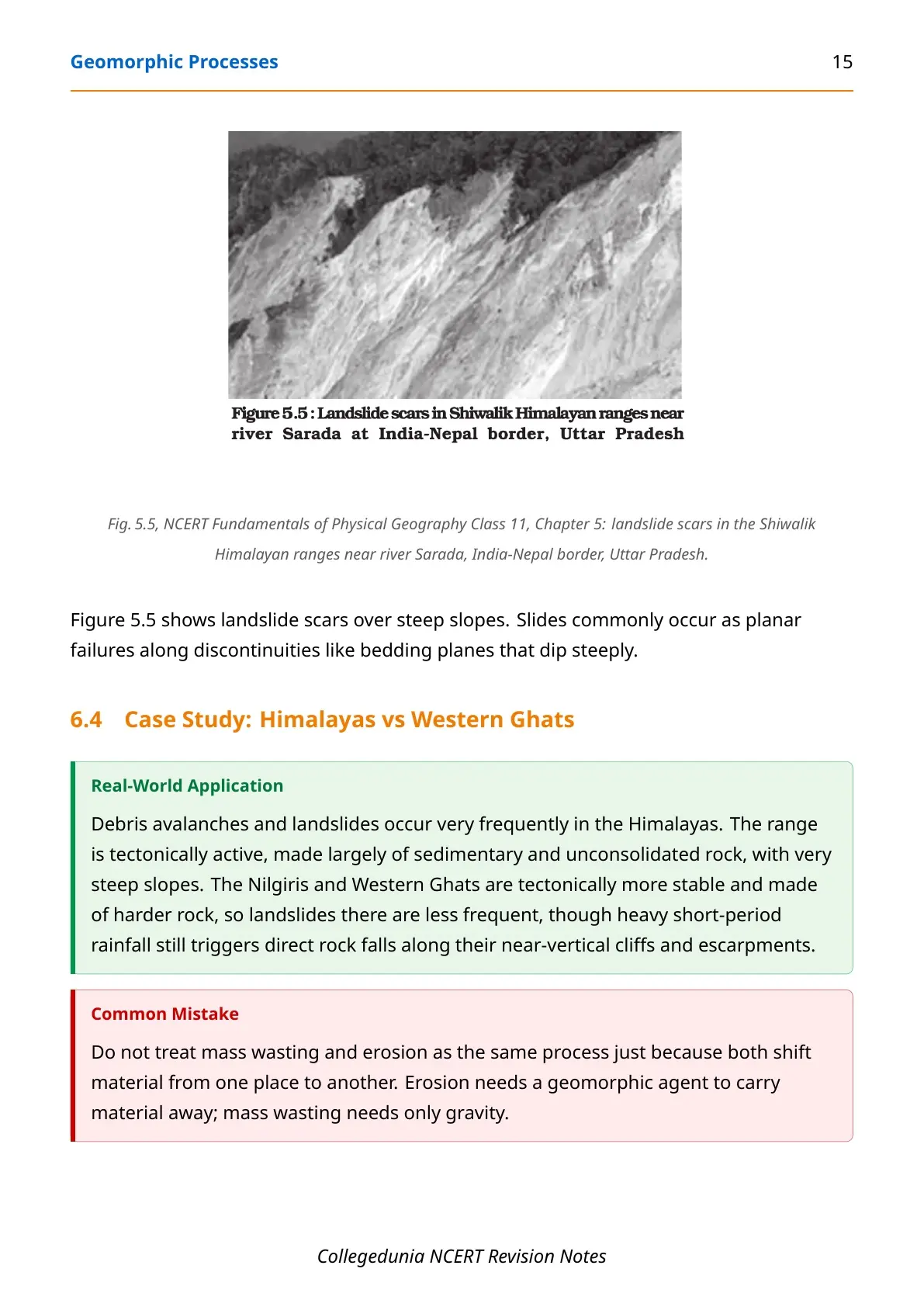
The Himalayas see far more frequent landslides than the Nilgiris and Western Ghats. The Himalayas are tectonically active, made largely of sedimentary and unconsolidated rock, and have very steep slopes. The Western Ghats are more stable and made of harder rock, though heavy short-period rainfall still triggers rock falls along their near-vertical cliffs.
Erosion and Deposition: How Wind, Water, Glaciers and Waves Reshape Land
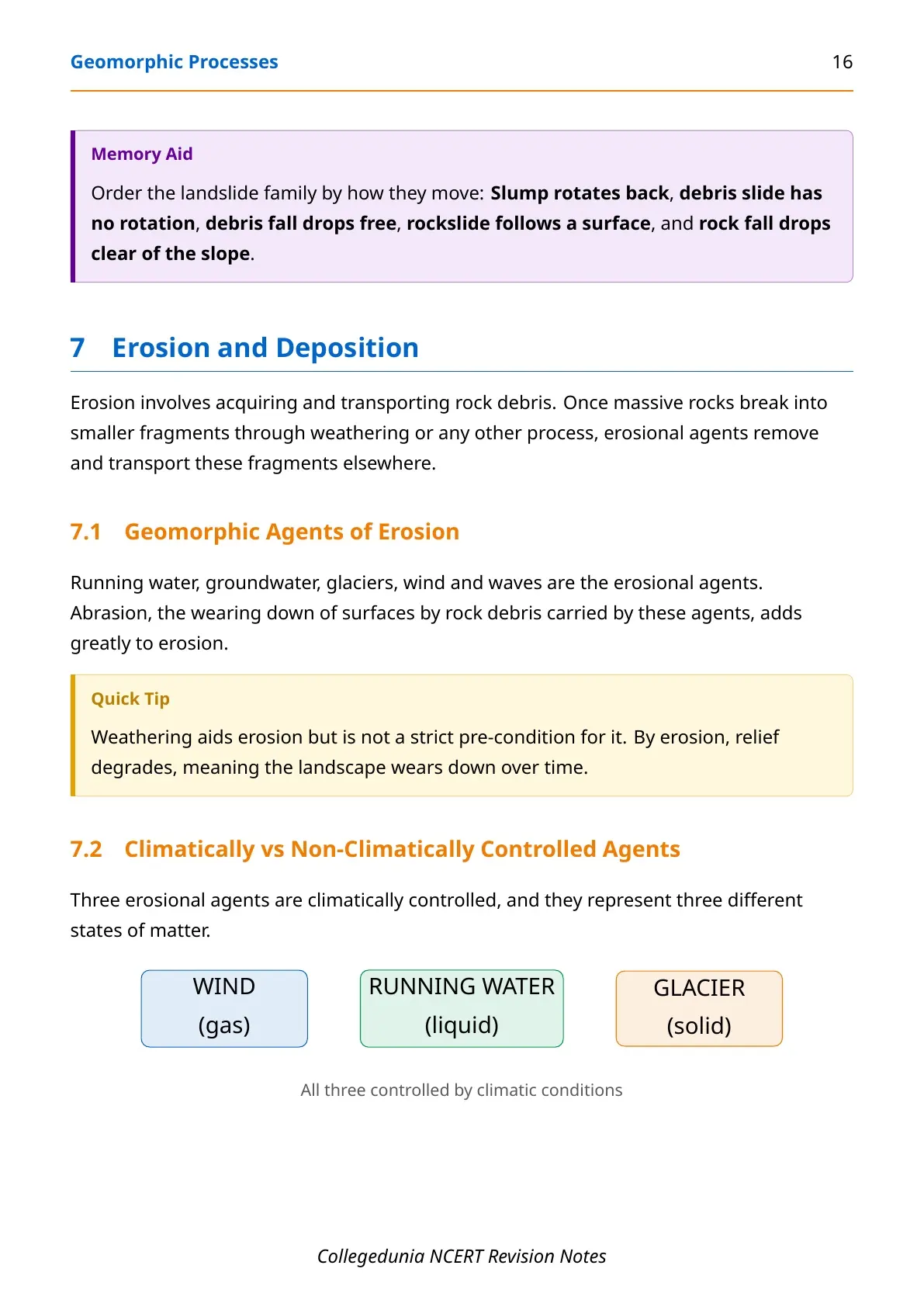
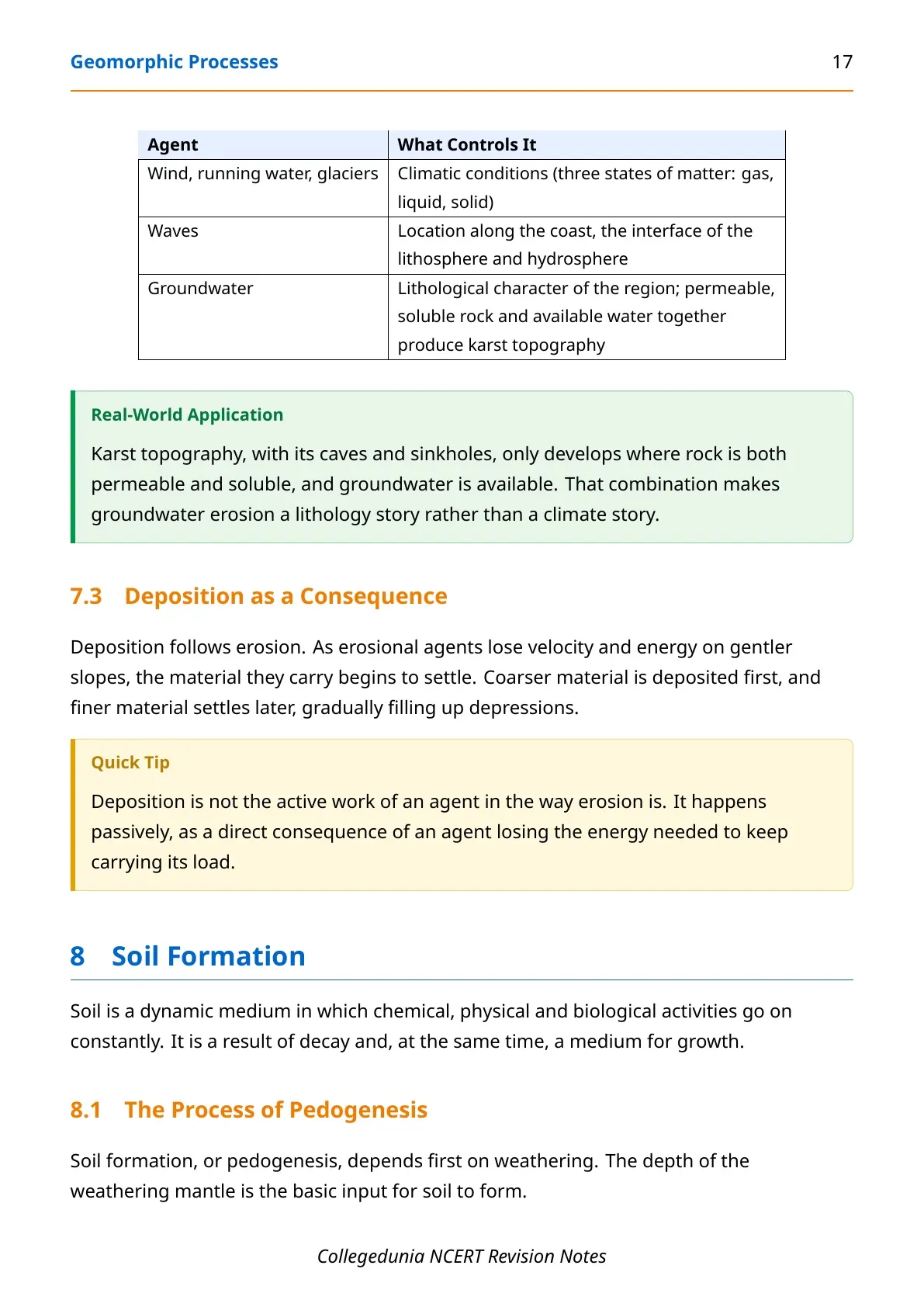
Erosion is the acquisition and transport of rock debris by a geomorphic agent. Three erosional agents are controlled by climate, and each represents a different state of matter: wind (gas), running water (liquid) and glaciers (solid).
| Agent | What Controls It |
|---|---|
| Wind, running water, glaciers | Climatic conditions (gas, liquid, solid states) |
| Waves | Coastal location, where the lithosphere meets the hydrosphere |
| Groundwater | Rock permeability and solubility; produces karst topography when both are present |
Deposition follows erosion. As an agent loses velocity on gentler slopes, it drops the material it carries. Coarser material is deposited first, and finer material settles later, gradually filling depressions.
Soil Formation: Pedogenesis and the Five Soil-Forming Factors
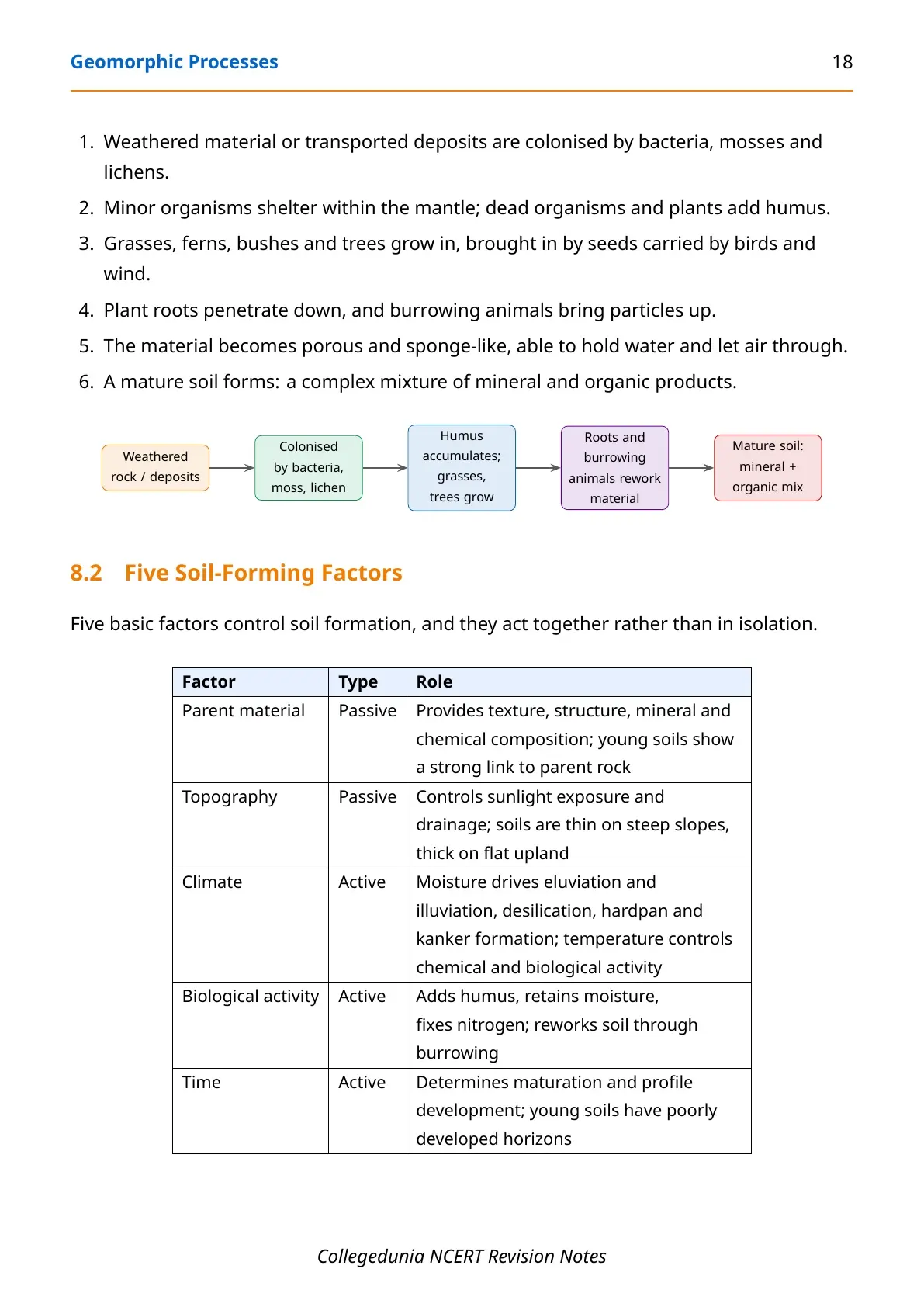
Soil formation, or pedogenesis, starts with the weathering mantle. Bacteria, moss and lichen colonise it first, humus builds up, and grasses and trees follow. Five factors control how a mature soil profile finally forms.
| Factor | Type | Role |
|---|---|---|
| Parent material | Passive | Sets texture, structure and mineral composition |
| Topography | Passive | Controls sunlight exposure and drainage |
| Climate | Active | Drives eluviation, illuviation, desilication and hardpan formation |
| Biological activity | Active | Adds humus, fixes nitrogen, reworks soil through burrowing |
| Time | Active | Determines soil maturity and horizon development |
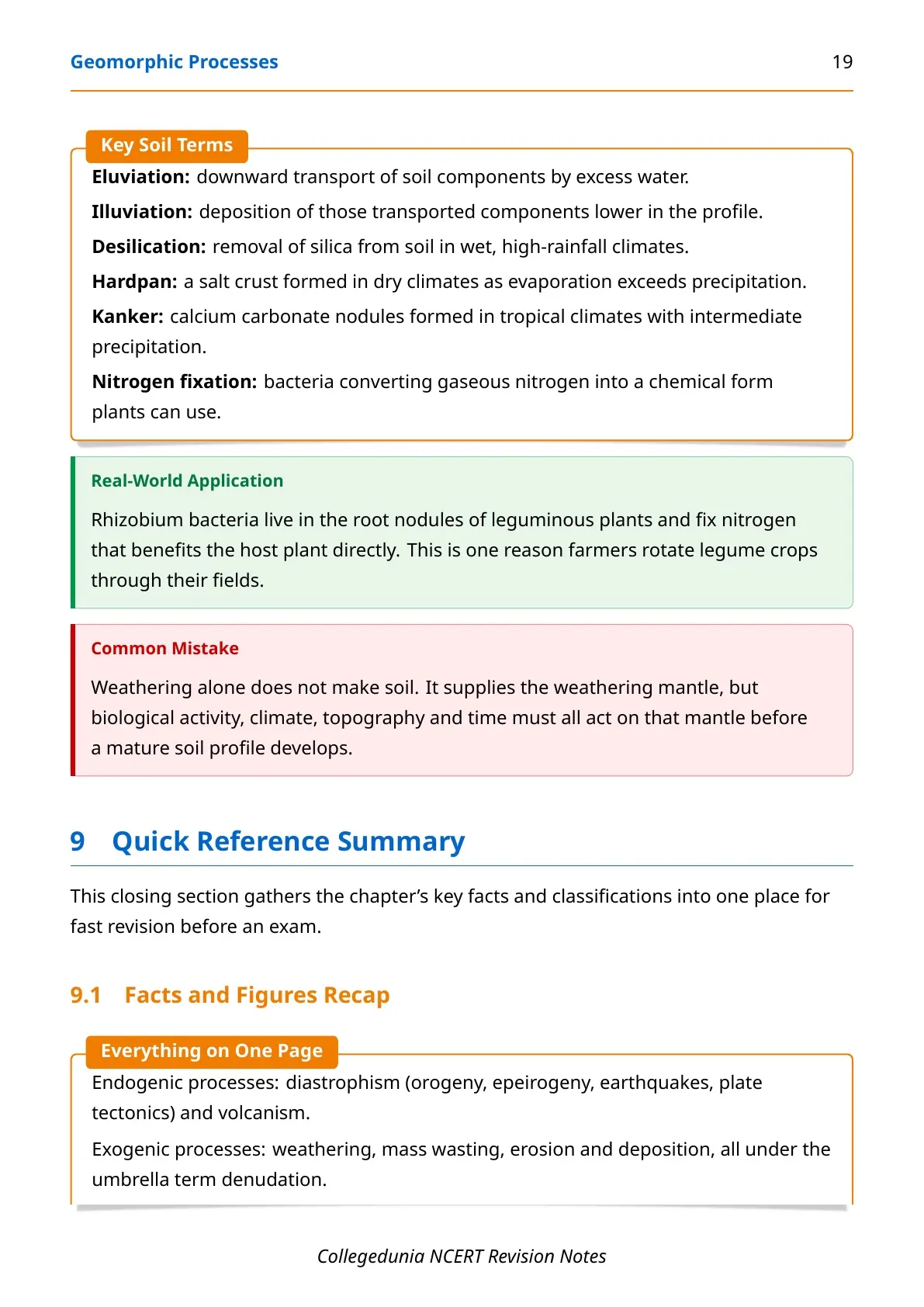
Rhizobium bacteria, living in the root nodules of leguminous plants, fix atmospheric nitrogen into a form plants can use. This single detail explains why farmers rotate legume crops through their fields, and it is a favourite short-answer question on this chapter.
Common Mistakes Students Make in the Geomorphic Processes Chapter
- Calling running water a "process" when it is the agent; erosion is the process it carries out.
- Treating mass wasting and erosion as the same thing because both shift material.
- Describing exfoliation as a fourth type of weathering instead of a result of weathering.
- Mixing up orogeny (mountain building) with epeirogeny (continent building).
- Assuming weathering alone produces soil, when climate, biology and time all have to act too.
What 12,460 students told us about their Geomorphic Processes revision
In a Collegedunia survey of 12,460 Class 11 Geography students conducted ahead of the 2026-27 annual exams, 68% rated the difference between mass wasting and erosion as the most confusing idea in this chapter. The five landslide types ranked second on the confusion list.
How These Geomorphic Processes Notes Pair with Other Class 11 Geography Resources
The table below lists every Collegedunia resource that pairs with the NCERT Notes Class 11 Geography Chapter 5 Geomorphic Processes, including the page you are reading.
| Resource | Link |
|---|---|
| Notes (this page) | Geomorphic Processes Class 11 Geography Notes |
| Handwritten Notes | Geomorphic Processes Class 11 Handwritten Notes |
| NCERT Solutions | (coming soon) |
| NCERT Book PDF | (coming soon) |
NCERT Notes for Class 11 Geography: All Chapters
Use this table to move to any other Class 11 Geography chapter's notes once this chapter is done.
| Chapter | Resource |
|---|---|
| Chapter 1 | Geography as a Discipline Notes (coming soon) |
| Chapter 2 | The Origin and Evolution of the Earth Notes (coming soon) |
| Chapter 3 | Interior of the Earth Notes (coming soon) |
| Chapter 4 | Distribution of Oceans and Continents Notes (coming soon) |
| Chapter 5 | Geomorphic Processes Notes |
| Chapter 6 | Landforms and their Evolution Notes (coming soon) |
| Chapter 7 | Composition and Structure of Atmosphere Notes (coming soon) |
| Chapter 8 | Solar Radiation, Heat Balance and Temperature Notes (coming soon) |
| Chapter 9 | Atmospheric Circulation and Weather Systems Notes (coming soon) |
| Chapter 10 | Water in the Atmosphere Notes (coming soon) |
| Chapter 11 | World Climate and Climate Change Notes (coming soon) |
| Chapter 12 | Water (Oceans) Notes (coming soon) |
| Chapter 13 | Movements of Ocean Water Notes (coming soon) |
| Chapter 14 | Biodiversity and Conservation Notes (coming soon) |
| Chapter 15 | India Location Notes (coming soon) |
| Chapter 16 | Structure and Physiography Notes (coming soon) |
| Chapter 17 | Drainage System Notes (coming soon) |
| Chapter 18 | Climate Notes (coming soon) |
| Chapter 19 | Natural Vegetation Notes (coming soon) |
| Chapter 20 | Natural Hazards and Disasters Notes (coming soon) |
| All Chapters | Class 11 Geography, All Chapters |
Geomorphic Processes Class 11 Geography Notes FAQs
Ques. Where can I download the Geomorphic Processes Class 11 Geography Notes PDF?
Ans. You can download the Geomorphic Processes Class 11 Geography Notes PDF directly from this page. It is free to use for revision.
Ques. Is this Geomorphic Processes notes PDF aligned with the 2026-27 NCERT?
Ans. Yes. This page reflects the current 2026-27 syllabus for Class 11 Geography, and it is built from the NCERT textbook Fundamentals of Physical Geography, Chapter 5.
Ques. How many pages is the Class 11th Geography Geomorphic Processes Notes PDF?
Ans. The notes PDF runs 22 pages and covers endogenic processes, exogenic processes, weathering, mass movements, erosion, deposition and soil formation.
Ques. What is a geomorphic process?
Ans. A geomorphic process is an endogenic or exogenic force that causes physical stress or chemical action on earth material, changing the shape of the earth's surface. Diastrophism, volcanism, weathering, mass wasting, erosion and deposition are all geomorphic processes.
Ques. What is the difference between weathering and erosion?
Ans. Weathering breaks rock down in place, with almost no material moving away. Erosion is the acquisition and transport of that broken-down material by an agent such as running water, wind or a glacier.
Ques. What are the types of mass movement?
Ans. NCERT groups mass movements into three forms: heave (frost-driven, slow), flow (saturated debris) and slide (rapid and perceptible). Landslides are the rapid slide category, and include slump, debris slide, debris fall, rockslide and rock fall.
Ques. What is the difference between orogeny and epeirogeny?
Ans. Orogeny is a mountain building process that severely folds long, narrow belts of the crust, like the Himalayas. Epeirogeny is a continent building process that gently warps or uplifts large parts of the crust.
Ques. What are the five soil-forming factors?
Ans. The five soil-forming factors are parent material, topography, climate, biological activity and time. Parent material and topography are passive factors, while climate, biological activity and time actively drive soil development.



Comments